Mike Woof, Adam Hill, Geoff Hadwick, Ben Spencer, Alan Dron
SUB-EDITOR:
EKH Services
PRODUCTION MANAGER: Nick Bond
OFFICE MANAGER: Kelly Thompson
DESIGNERS:
Simon Ward, Andy Taylder, Stephen Poulton
CIRCULATION & DATABASE
MANAGER:
Charmaine Douglas
WEB ADMINISTRATORS:
Sarah Biswell, Tatyana Mechkarova, Eugene Thomas
INTERNET, IT AND DATA
SERVICES DIRECTOR:
James Howard
MANAGING DIRECTOR: Andrew Barriball
CEO: Roger Adshead
ADVERTISEMENT SALES:
Head of Construction Sales:
Graeme McQueen
Tel: +44 1322 612069
Email: gmcqueen@ropl.com
Classified Ads / UK / North America:
Yvonne Tindall
Tel: +44 1622 844027
Email: ytindall@ropl.com
Italy:
Fulvio Bonfiglietti
Tel: +39 339 1010833
Email: bonfiglietti@tiscali.it
Asia / Australasia:
Roger Adshead
Tel: +44 7768 178163
Email: radshead@ropl.com
ADDRESS:
Route One Publishing Limited, Waterbridge Court, 50 Spital Street, Dartford, Kent DA1 2DT, UK
Tel: +44 1322 612055
Fax: +44 1322 788 063
Email:
[initialsurname]@ropl.com
(eg: radshead@ropl.com)
GLOBAL ROAD SAFETY REVIEW
Digital ISSN 2058-1769
WELCOME
What makes a ‘safe’ road safe? Will there ever be a definitive answer or will we forever define a ‘safe’ road in relation to its geographic location and traffic volume?
For example, according to a World Health Organisation report in 2015, the Federated States of Micronesia had the safest roads on the planet, with 1.9 road deaths per 100,000 people. This regional association of micro-states consisting of 600 Pacific islands inhabited by 106,000 people, had a grand total of two road deaths. Nothing was said about how many people actually owned vehicles and what traffic volumes were.
Also back in 2015, Sweden was the second safest driving country in the world; 2.8 deaths per 100,000 people. It had an estimated 272 road deaths in 2015. According to WHO, the low rate was due to strict drink-driving laws and high vehicle safety standards. Nothing was said about infrastructure design or traffic volumes.
The difficulty with analysing traffic data to formulate safe-road statistics is too often the comparison is between apples and oranges – or country lanes in Micronesia and mountain roads in Sweden. The probable answer to the introductory question is ‘yes’, a safe road will be one that accounts for many factors within its geographic location – not
least protecting people from themselves.
For example again, fast-forward to 2018 and Greece, a member of the European Union. Greece, a country wracked by financial and political difficulties in the past decade, almost halved its road deaths per million inhabitants – a 45% drop. Greece, along with Lithuania at a 43% drop, are the only EU countries that came close to the EU target of halving road deaths between 2010 and 2020 – a European average target not likely to be met, acknowledges the EU Commission.
However, road deaths in Greece are still 64 per million inhabitants, which statistically makes Greek roads less safe than those of the average EU member country at 49 deaths per million. Nonetheless, Greece remains a success story, by a safe country mile.
The global battle to make roads – and road workers – safe continues apace. No one solution or system will be universally effective. But innovation will be a key to winning the road death battle.
Once again, your edition of Global Road Safety Review showcases manufacturers’ innovations from which highways agencies around the world may choose a fit-forpurpose safety solution.
David Arminas, Editor
CONTENTS
04-11 Work Zone
Mobile Barriers; X-Cone traffic management; Highway Care in London
12-15 Tunnel Safety
ITS Australia National Awards; Tradecc tunnel sealing
16-24 Surface and Markings
Retrotek surveys in Estonia; Fugro covers Dutch roads; Interview: Philipp Swarovski of Swarco
25-30 Barriers
ETI’s roller barrier; Tertu’s T32 for Dijon; Vehicle-ramming protection
31-33 Climate Change
The IRF on preserving infrastructure; SmogStop barrier; Biral weather detection
34-36 Lighting
Medusa from Ecolighting; Nyx Hemera lights snowsheds; Bright lights of Dunedin
37-43 Traffic Safety
Curtin for Actibump; Connected Signals in Gainesville
44-45 Bridges
Flexible barrier from Rebloc; Pitchmastic PMB in Brunei; US bridge concern
LINDSAY, ITERIS TO CREATE SMART WORK ZONES
Lindsay, a manufacturer of infrastructure equipment, and Iteris, a manufacturer of applied informatics for transportation, will together create smart work zones for US roadways
The companies said that their partnership supports the Federal Highway Administration’s (FHWA) Smarter Work Zone campaign to reduce traffic congestion and improve safety in work zones using intelligent transportation systems. There were 799 work zone-related fatalities in the US in 2017 – up 4.5% from their previous three-year average of 764, according to the National Workzone Safety Information Clearinghouse. The announcement coincides with the FHWAsponsored National Workzone Awareness Week, which is held annually at the start of the construction season to encourage safe driving through highway work zones.
The partnership will apply Lindsay’s Road Zipper system, a lane management solution, and Iteris’ analytics and visualisation SaaS platform iPeMS to improve mobility during construction. Lindsay says that its Road
congestion by making more efficient use of new or existing roadways. By using Iteris’ iPeMS, an analytics and visualisation platform, it is possible to identify areas prone to recurring congestion and potential work zone safety risks. The Road Zipper can
Keep on truckin’ with X-Cone
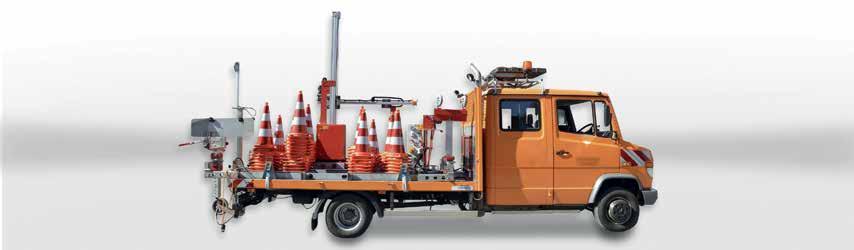
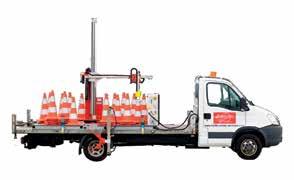
X-Cone is a fully automated traffic-cone management system offering increased worker safety and maximum efficiency for contractors, according to the manufacturer, Franz Janschitz. By using the illuminated 177mm (7”) touchscreen control unit, the driver can select the desired cone spacing, which can be set from 10m upwards. Once set, X-Cone deploys and collects traffic cones
Driver only: the X-Cone system is all loaded up with 224 cones
without manual intervention.
X-Cone has a lightw eight, predominantly aluminium, construction weighing around 600kg and with a life expectancy of 10 or more years but requires minimal maintenance.
accelerate construction projects, improve traffic flow and help safeguard work crews and motorists by separating work areas and traffic.
www.lindsay.com www.iteris.com
X-Cone has a maximum load capacity of 224 traffic cones, dependent upon cone type and size. It has an operating rate of six traffic cones per minute,
allowing for 1km of cones at 36m-spacing to be deployed or collected in around five minutes. Also, cones can be deployed and collected from either side of the vehicle; this allows for maximum flexibility when working with or, where appropriate to do so, against the traffic flow.
Operators are not required to work on the loading bay of the vehicle and the system can be operated by one person only – the driver. www.traffic-safetyservices.com
Vehicle restraint systems with integrated fences tested in accordance with EN 1317
Elevated thinking
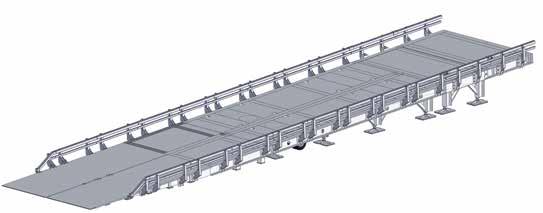
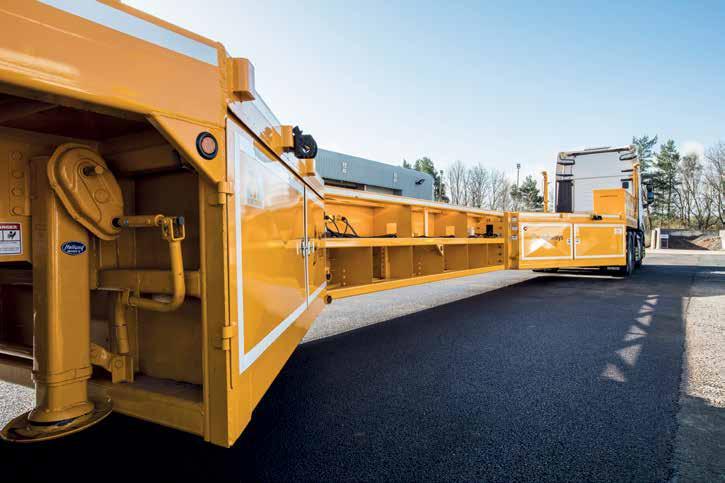
Switzerland will soon tender for companies to build and supply a mobile system for physically shifting traffic away from bridge and road maintenance crews.
The federal highways agency – FEDRO – will be asking manufacturers of heavy equipment to submit bids starting this summer for the Astra Bridge system.
The system will be two lanes wide and include ramp sections at each end of what amounts to a train of elevated connected road sections – a modular construction. Vehicles run onto the top of the train which is positioned directly above where road crews are working. The effect is to create a “bridge” along the length of the lane below and under which paving or maintenance is safely underway and away from traffic.
Switzerland’s FEDRO says the Astra Bridge system will have heavy plates that take the weight of the structure off the wheels in order to distribute the weight and avoid rutting into the pavement
ASTRA’S VITAL STATISTICS
“The inspiration for the Astra Bridge came with our work using a flyover ramp on bridges,” explained Ivo von Arx, a team leader with responsibility for bringing the project from the drawing board to reality. “It’s a pretty cool design,” he told World Highways. “As far as we know, there has never been anything like this before. We have also applied for a patent to the United Nation’s World Intellectual Property Organisation.”
In order to repair and maintain the heavily used motorways in metropolitan regions, work has to be carried out at night to an ever-increasing extent. The driving force for development of the Astra concept is that closures of traffic lanes for maintenance causes congestion - even during the night. To prevent this, maintenance times are
periodically revised and frequently must be shortened which often affect a project’s schedule. In addition, installation and removal of temporary worker safety barriers essential for night-time maintenance costs valuable time and money, noted FEDRO.
The call for tenders will encompass final design work, production of the system and quality control, assembly and dismantling processes and proper and safe operation of the completed assembly.
The chosen manufacturing company will be licenced by FEDRO to construct a system which will be owned by FEDRO and rented out to contractors that win maintenance work, said von Arx. Because FEDRO will own the copyright to the system, it could be that construction of other Astra Bridge systems globally will be licensed.
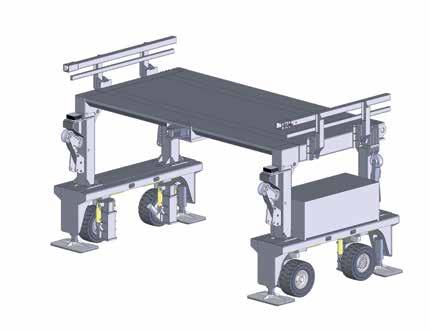
As well as moving the Astra Bridge lengthwise along the road, it can be shifted sideways if necessary to cover a third or third and fourth lanes, said von Arx. To avoid indentations in the road surface, the loads can be borne by large insulated base plates.
Moving the system over a distance of 100m should take between 10-20 minutes, according to the agency. It must be possible to assemble the drive-on and drive-off
NUMBER OF TRAFFIC LANES: 2
LENGTH: 238m, but extendable using modular sections
WIDTH: 7.3m
MAXIMUM INCLINE (DRIVE-ON/DRIVE-OFF
SECTIONS): 6.1%
CLEARANCE IN TRAVEL
DIRECTION: 5.2m x 3.1m
LATERAL CLEARANCE: 2.2m x 3.1m
WEIGHT: around 1,200tonnes
MOVING SPEED: around 0.5kph
VEHICLE SPEED: 60kph
sections in the course of one night. The remainder of the bridge can be extended during a second night to a length of 238m. Vehicle speed, including that for heavy goods vehicles, will be 60kph. A vehicle weight limit of 100tonnes is likely, meaning extra-wide or heavy loads will be banned from using the Astra, he said.
The wheels on each modular section can be turned 45° to allow the structure to be shifted sideways to cover other lanes
A maintenance site around 5.2m wide and 100m long can be set up beneath the Astra which can be raised hydraulically. FEDRO has also canvassed its maintenance crews about working beneath a structure such as the Astra Bridge. “They already have a lot of experience working beneath flyovers and they don’t see there will be a problem. Workers already wear suitable ear protection under flyovers.”
Von Arx said the likely cost to construct the first Astra Bridge is not being disclosed as it will be determined in cooperation with the tender winner. However, it will probably be in the “millions of Swiss francs”.
FEDRO says it wants the system to be operational by 2022.
• The e-mail address for companies interested in submitting a bid is: bridge@astra.admin.ch
Highway Care’s heavy-duty Safe Stop 90 crash cushion absorbs rear-end impacts at speeds of up to 110 kphcompliant to TD49/07
Caught short in London
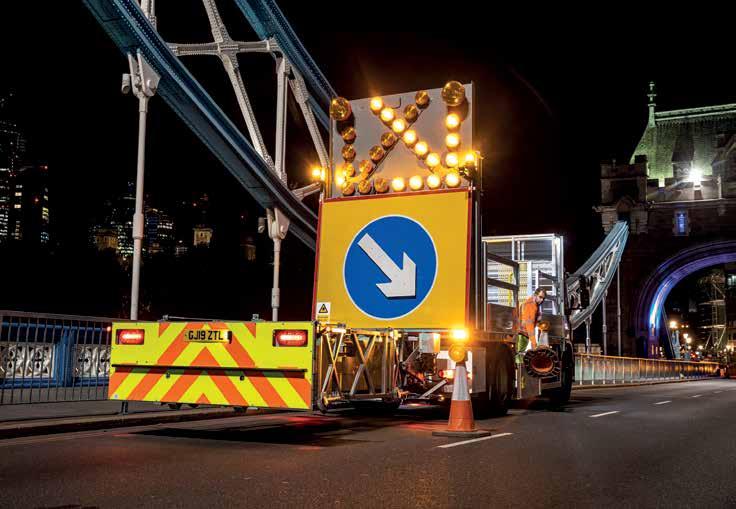
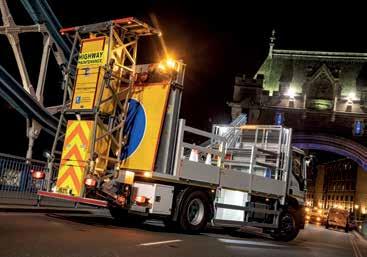
The first impact protection vehicle built by the UK’s Bevan Group and fitted with Highway Care’s safety technology entered service this year in London.
The ‘Stubby’ - as it is nicknamed because of its short length - has a crash cushion and high-visibility light arrow board by Highway Care, based in the UK. The new truck, purposedesigned for operation in the narrow London streets, is being used by traffic management specialist Priority TM.
Priority TM offers traffic management schemes ranging from basic temporary traffic light systems and minor road closures and diversions to multihead, multiphased temporary traffic light systems and major lane closures on some of the UK’s busiest and most congested roads. Early assignments for the Stubby have entailed nighttime traffic closures for routine maintenance on the iconic Tower Bridge.
The unit is only 4.5m long and its body is 2.2m shorter than that of a conventional impact protection vehicle. The 18tonne Iveco Eurocargo chassis is powered by a 183kW sixcylinder Euro VI engine that is compliant with London’s Ultra
Low Emissions Zone regulations.
Bevan Group fitted beacon bars and a comprehensive armoury of 4G recordable and downloadable safety cameras. These included two to assist the driver when reversing: one is activated when the crash cushion is raised; the other when the cushion is deployed.
The truck’s body incorporates wells from which Priority TM’s operatives are able to drop traffic cones safely and rapidly when implementing a road closure. Bevan Group also added around two tonnes of steel ballast beneath the bed to ensure the truck achieved the minimum
10tonne gross weight required for an impact protection vehicle.
Meanwhile, Highway Care’s heavy-duty Safe Stop 90 crash cushion absorbs rear-end impacts at speeds of up to 110 kph - compliant to TD49/07 - and can be deployed at a travelling speed of up to 88kph. It boasts a galvanised external safety frame that offers protection against low-speed, socalled ‘nuisance impacts’ such as when a vehicle is manoeuvring in a yard – a common cause of damage to crash cushions.
Priority TM claims that the new truck is delivering cost and efficiency benefits. For certain
The 18tonne Iveco Eurocargo chassis is powered by a 183kW six-cylinder Euro VI engine that is compliant with London’s Ultra Low Emissions Zone regulations
assignments the company was previously using two vehicles to undertake the same work. This entailed one vehicle, usually a 7.2tonne unit, but sometimes a van-based 3.5tonne unit, carrying the cones while a ballasted truck with a crash cushion travelled behind to ensure the safety of the operating crew.
“Dual working remains the best practice in some circumstances,” explained Priority TM managing director Duncan Crome. “But its flexibility means the new vehicle can undertake other jobs on a solo basis with no need for a second vehicle, meaning it has the potential to save us money.”
However, the unit is not intended for operation on motorways or major trunk road schemes. “Rather, its main role is a back-up for utilities work. We don’t need a full-size wagon that’s 10m long and capable of carrying upwards of 200 cones. So it made sense to restrict its length. If you try to drive a truck like that through central London you’re going to run into difficulties pretty quickly,” said Crome. www.prioritytm.co.uk www.highwaycare.com
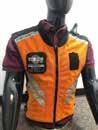
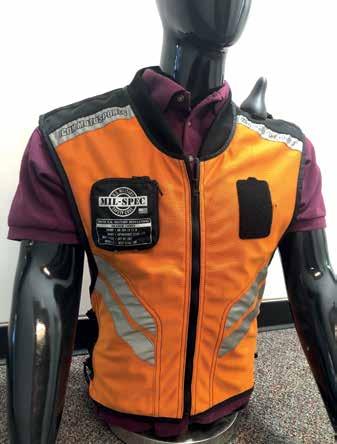
The ‘intelligent vest’ incorporates sensors that can broadcast the wearer’s position to in-car systems, giving drivers advance warning as they approach road crews
VESTED INTEREST
New ITS systems on either side of the Atlantic – such as an intriguing piece of connected clothing – aim to reduce the casualty toll among road maintenance personnel, says Alan Dron
It’s not a lot of fun working on road maintenance or road construction worksites. By definition, you’re out in all weathers. You’re not popular with motorists, who blame you for hold-ups. It’s frequently physically arduous. And, worst of all, the sector has an unenviable record of injurieseven fatalities.
Often working just a metre or so from fast-moving traffic, maintenance and construction crews frequently have only the protection of warning trailers and plastic bollards to protect them from potentially lethal accidents. Much depends on private motorists or heavy goods vehicle (HGV) drivers being alert – especially on motorways, where the monotony of a journey can slow reactions.
To help ease this problem, German company Gewi is deploying a new system that integrates and disseminates advance warning of road workzones to approaching drivers through in-car systems.
Gewi originally deployed the new system in Saxony-Anhalt; the German federal state is a major route for trucks travelling between Amsterdam and eastern Europe, resulting in heavy wear and tear on the region’s roads and subsequent high road maintenance demands to repair damage from HGVs. Road workzones are thus a common sight in the region.
The state has experienced two deaths among road maintenance personnel - in 2014 and 2017 - together with a large number of incidents. In recent years, for example, there have been seven to 10 instances per year of trucks colliding with warning trailers protecting workzones.
The priority for Saxony-Anhalt, said Ronny Dittrich, who is responsible for product management of Gewi’s workzone project, was to get information regarding the location of workzones in front of motorists – particularly truck drivers – to alert them as they approached road personnel.
“The idea was to use existing services that were in place, to combine systems and
transmit information about those sites,” he said.
To do this, Gewi developed its own commercial, off-the-shelf software product. While not a workzone planning tool as such, TIC for Workzones can now be used from the earliest stages of developing a zone through to its completion and enables its precise position to be plotted on to digital systems.
Workzones can involve one or more highways agencies, together with the main contractor and a multiplicity of subcontractors. This raises issues about the uninterrupted flow of information.
are frequently deleted or obscured around roadworks.
“One problem that occurs worldwide is that information about workzones is typically managed very poorly, especially across various agencies,” noted Danny Woolard, business development director for Gewi for Europe and Australia.
TIC is designed to manage that communication process, from the early planning stages when a workzone is defined, initially managing the data to produce the necessary permits. This information can then be disseminated through multiple organisations.
Information on the precise location of a workzone, especially when it changes over the course of a lengthy project, is also gathered and disseminated to the public and across the internet – and specifically, in a format that can be understood and displayed by car navigation systems.
At last year’s ITS America exhibition, Gewi organised a demonstration with a US company that produces roadside beacons that can be attached to workzone bollards whose position can be accurately tracked. “This is becoming more and more relevant as we move towards automated driving,” noted Woolard.
That system can alert autonomous vehicles (AVs) to the presence of road workzones and enable them to take avoiding action. This is particularly important as AVs often use road markings to navigate by, but those markings
Back in Germany, meanwhile, the Gewi system uses TIC to gather the necessary workzone information and pass it to the police, who in turn pass it to the nationwide public radio network, which broadcasts the information to in-car radios.
“The police use TIC already,” said Dittrich. “We just extended that to a more detailed level at the workzones. Everything interacts fluently. That allows the information [regarding workzone locations] to be sent to navigation and information systems in drivers’ cars within around two minutes.”
By mid-March every workzone warning trailer in Saxony-Anhalt was due to be equipped with the necessary equipment to allow its position to be sent over the system.
Additionally, the system is planned to be extended to two other federal German states, North Rhine-Westphalia and Hesse, both of which have high population densities and which already operate the TIC system.
DIFFERENT APPROACH
On the other side of the Atlantic, meanwhile, a different approach to workzone safety is about to be trialled.
The Center for Technology Implementation (CTI) at Virginia Tech Transportation Institute (VTTI) is developing an ‘intelligent vest’ incorporating sensors that can broadcast the wearer’s position to in-car systems, giving drivers advance warning as they approach road crews.
VTTI is focused on helping agencies such as Virginia Department of Transportation to implement new technologies and has been looking at whether information could also
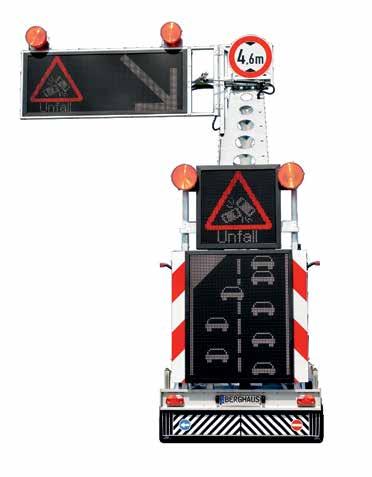
Peter Berghaus GmbH
Safety products for work zones
go in the opposite direction – with roads personnel receiving information (perhaps through a cloud-based system) on vehicles as they near them.
CTI director Michael Mollenhauer noted that, in past projects, normal GPS processing had not been sufficiently accurate to reliably localise an individual’s position. And, as humans move in random ways, predicting their movements has always been difficult.
However, using real-time kinematic (RTK) correction gives a more precise GPS position – down to one metre or less. The idea would be to incorporate that improved GPS system into a vest that would then communicate its position to a connected vehicle. Potentially, it could also calculate the trajectories of people and cars.
VTTI has been looking at the possibility of collecting and interpreting the movements of workers when undertaking specific jobs, such as patching concrete or repairing barriers so that their likely behaviour could be understood and incorporated into the system.
“We’re trying to build the sensors into
WORKZONE CRASHES IN US: RISING NUMBERS
Large trucks are responsible for a large, and growing, proportion of US workzone accidents in which people are killed, according to statistics from the Federal Motor Carrier Safety Administration.
Figures released in January this year noted that the percentage of fatal workzone crashes involving at least one large truck increased to 30.4% in 2017. This was an increase over the previous two years – 27.2% for 2016 and 26.8% in 2015.
the vest so it’s not a burden to the wearer and is part of their standard PPE [personal protective equipment],” said Mollenhauer.
There have been three phases to the project, using different communication modes. The first was dedicated short-range communications; the second, ultra-wideband technology. “As technology developers, we try to be agnostic,” said Mollenhauer.
However, both methods had shortcomings.
WARNING MODES
A third approach is now under way using RTK GPS, with trials of the latest version of the vests scheduled to be held this summer. Built-in equipment will include lightweight, rechargeable and replaceable batteries, a
IMPROVE
“Workzones are typically quite noisy and there are some visibility issues such as darkness and blowing dust, so dual modes are valuable,” Mollenhauer noted.
There is also an option of incorporating an inertial sensor that will give information on how workzone personnel are orientating themselves.
However, he is conscious of the possibility that some warning modes could startle staff at safety-critical moments, so he and his team are experimenting with methods of alerting personnel that could impart the necessary information without causing distraction.
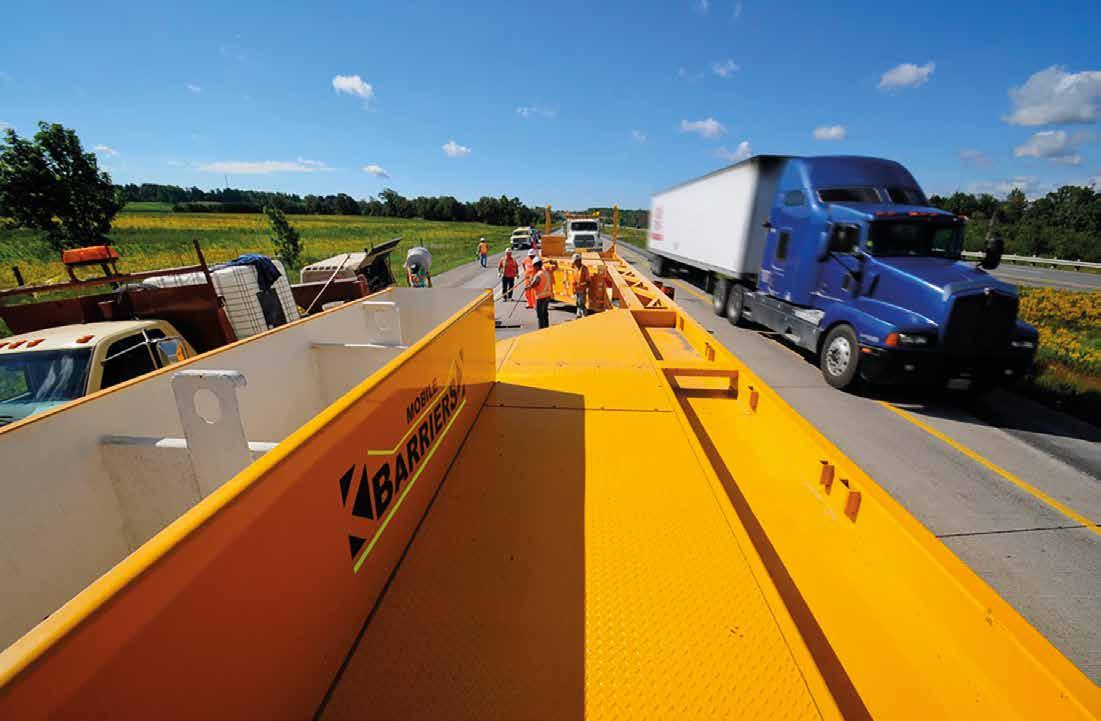
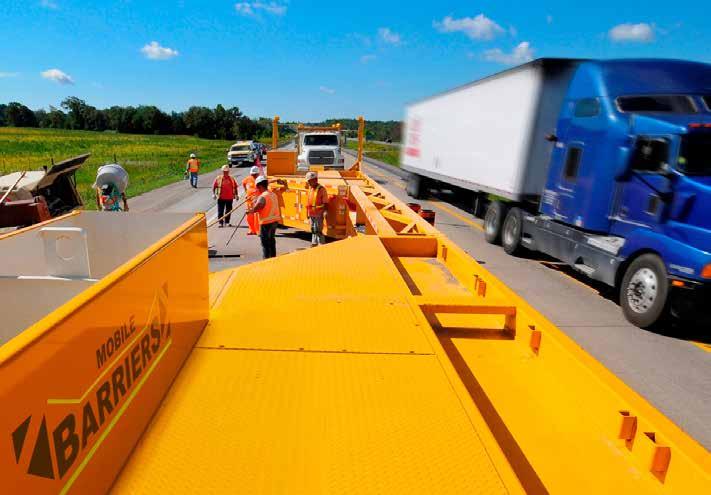
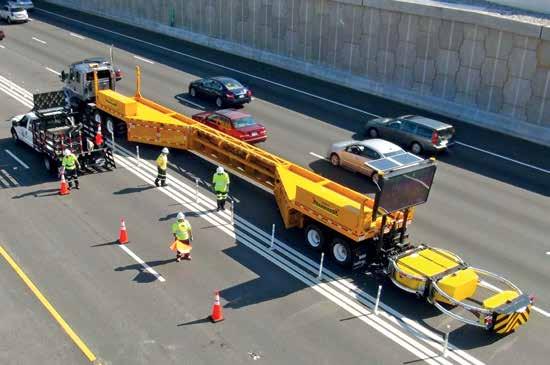
Highly mobile with power, lights and other options. For right and left work at lengths to over 30m. Carries materials and supplies up to 38,000 kgs.
mobilebarriers.com
Ins and outs of Dynamic Works Egress
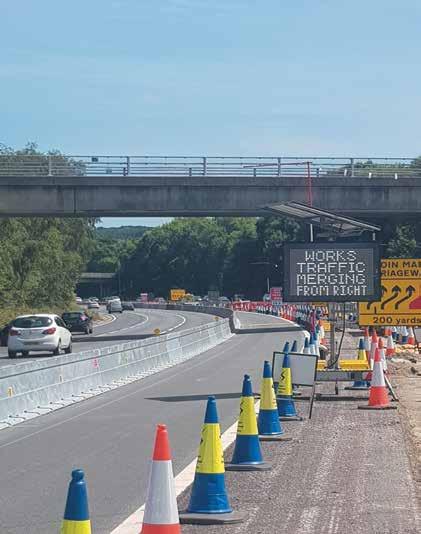
The Dynamic Works Egress Safety Solution from MVIS enables traffic management companies to better protect road users and construction workers. Dynamic Works combines modular electronic perimeters and variable message signs (VMS) to promote the safety of both construction personnel and road users around the exit points of roadside work zones via dynamic text.
MVIS says that the solution targets both highways and work zone traffic, offering a superior alternative to the standard fixed-plate signs and fixed message VMS used to communicate only with highways traffic.
A pair of sensors are located at the beginning of the acceleration zone within the works area. They connect to an HD Compact VMS deployed within the zone. When triggered by an approaching works vehicle, the VMS message changes from “wait here” to “merge when safe”.
The sensors also connect to a roadside, traffic-facing VMS-A, and warn highways road users of the imminent arrival of a works vehicle joining the carriageway. In the event of an emergency, the VMS “works traffic merging” message can be overridden with an alternative message.
After a set time, the HD Compact VMS reverts to its “wait here” message and the VMS-A goes blank to allow traffic to flow freely when no works vehicle is present. All messages may be tailored to the requirements of the site. Every message activation is recorded and can be reviewed for audit purposes.
The Dynamic Works Egress Safety Solution is joined in MVIS’ new product portfolio by the Overhead Service Unit, which promotes the safety of highways construction personnel by warning them of overhead structures - including those where work is underway. www.m-vis.co.uk www.bartco-uk.com
X-CONE® 2.0
The Dynamic Works Egress Safety Solution, from MVIS, targets both highways and work zone traffic
• X-Cone is a fully automated traffic-cone management system offering a higher level of safety for workers and maximum efficiency for contractors.
• By using the illuminated 7″ touchscreen control unit, the driver can select the desired cone spacing.
• X-Cone has a lightweight,aluminium construction (c. 600kg) and a life expectancy of 10+ years.
• X-Cone has a maximum load capacity of 224 traffic cones (dependent upon cone type and size).
SAFE
Operators are not required to work on the loading bay of the vehicle.
ECONOMICAL
Can be operated by one person only (driver).
MULTIDIRECTIONAL
X-Cone can deploy/ collect traffic cones from either side of the vehicle.
FULLY AUTOMATIC AND FAST
X-Cone’s automatic operation can handle 6 traffic cones per minute.
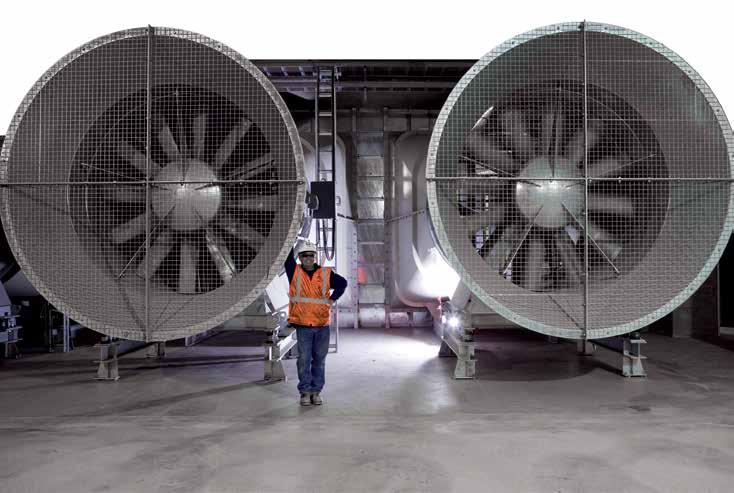
Each stack has five large 275kW, 660VAC ventilation fans that draw air up from the tunnels for dissipation clear from local properties
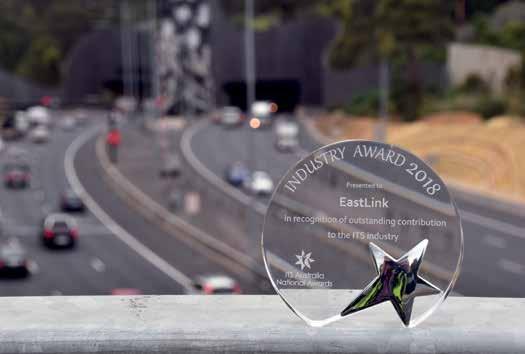
EASTLINK WINS AT ITS AUSTRALIA AWARDS
The Freeway Tunnel Ventilation On-Demand System for Melbourne’s EastLink project picked up the top Industry Award category at the recent 9th ITS Australia National Awards
Traditional tunnel ventilation systems are inefficient. Fans operate at fixed speed in manual mode or with individual fans programmed to switch on and off at preset times to ensure zero portal emissions with all emissions dispersed via ventilation stacks.
EastLink’s new ventilation on-demand – VoD - system matches variable speed fan drives with more efficient impellers which are dynamically controlled based on real-time data from tunnel gas/airflow sensors.
The system reduced power by 68% and halved audible noise for local residents, as Doug Spencer-Roy, EastLink spokesperson, explains. “This award will help encourage Australia’s other freeway tunnel operators to implement ventilation on demand and replicate our success.”
Since EastLink opened in 2008 (see box), traditional methods have been used to manage tunnel ventilation. The original tunnel ventilation system was designed to expel all tunnel air, including all pollutants from vehicle engines via two 45m-high ventilation stacks.
Twelve smaller jet fans within each tunnel maintained airflow in through each tunnel portal, along the length of each tunnel,
towards the base of each ventilation stack. Each stack has five large 275kW, 660VAC ventilation fans to draw air up from the tunnels for dissipation at the stack top, well away from local properties.
The speed of airflows within the tunnels and stacks was controlled by switching individual fans on and off. When switched on, a fan always operated at full speed.
Higher volumes of traffic required higher airflows and therefore more operating fans to dissipate vehicle pollutants via the stacks.
This on/off switching of fans was controlled by EastLink’s tunnel operating system using a simple preset programme based on time-ofday parameters. The largest number of fans operates during peak periods when vehicle pollutants are expected to be at their highest levels.
VARIABLE SPEED DRIVES
To allow fans to run at lower speeds, EastLink upgraded the 10 large ventilation fans from fixed speed fully off/fully on operation by installing variable speed drives to regulate the rotational speed of the impellers.
EastLink contracted Schneider Electric to install an ATV61 660VAC variable speed drive with Active Front End harmonic
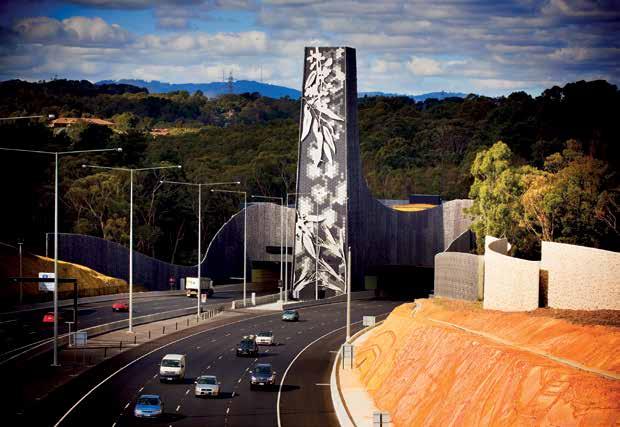
Eastlink’s 45m-high ventilation stacks
mitigation on each of the 10 ventilation fans. A more efficient impeller within each ventilation fan housing was installed.
“Each ventilation fan, weighing over 7 tonnes, was separately removed from the tunnel complex,” says Spencer-Roy. “They were upgraded off-site, and reinstalled within the tunnel complex in delicate operations conducted during nights when traffic was lowest. Remarkably, tunnel closures were not required for these works. Traffic management was limited to temporary lane closures while at least one lane remained operating.”
To allow individual fans to be activated and fan speeds to be adjusted based on actual ventilation needs, EastLink developed a fully automatic ventilation control system. This enabled much more efficient self-regulating, or closed-loop, variable speed fan operation based on real-time data from existing air quality and airflow sensors.
Schneider Electric’s EcoStruxure platform was used to bring together automation, connectivity and software for real-time control and visibility. The top layer of the EcoStruxure solution is a SCADA control system. This provides an interface for EastLink engineers to see how the ventilation system is running at any time and from any location, including the EastLink control room.
Two pairs of Hot Standby Schneider Electric M580 ePACs - ethernet
Programmable Automation Controller - were installed, one pair in each tunnel to create the closed-loop system to control the variable speed drive of each ventilation fan. The ePACs use real-time data from air quality and airflow sensors to dynamically control the speed and number of ventilation and jet fans required to meet ventilation needs.
EASTLINK TOLLWAY
The 40km EastLink – a tolled section of the M3 freeway - is the largest privately operated freeway network in the state of Victoria and the major north-south transport artery in Melbourne, the rapidly growing state capital. It includes twin 1.6km tunnels, carrying up to 115,000 vehicles per day via three traffic lanes in each tunnel. EastLink handles in total 250,000 vehicles daily and connects the Eastern, Monash, Frankston and Peninsula Link freeways. Being 53m underground means that the tunnels protect the environmentally sensitive Mullum Mullum valley above.
“EastLink’s tunnel ventilation system now responds automatically and in real time to the volume of traffic travelling through the tunnels, the vehicle mix for example, the proportion of heavy vehicles, low and zero emission vehicles, and prevailing weather conditions,” says Spencer-Roy.
Emergency operation procedures were programmed into the system. If a vehicle fire occurs within the tunnel, the variable speed drives are automatically bypassed and all available fans operate at full speed. This ensures that tunnel evacuation proceeds safely.
LIMITED PORTAL EMISSIONS
These improvements to the operating efficiency of the tunnel ventilation system and introduction of the closed-loop system to automatically activate fans and adjust fan speeds have enabled a change to EastLink’s tunnel ventilation system licence which has been agreed with the Environment Protection
GRESB “5-star” sustainability rating
The internationally recognised GRESB Infrastructure Assessment covers the environmental, social and governance (ESG) performance of 280 infrastructure projects around the world. GRESB emerged from a collaboration of the world’s largest pension funds and academics from Maastricht University in the Netherlands and the University of California at Berkeley in the US. The inaugural GRESB Assessment in 2009 helped define ESG concepts and frameworks.
EastLink’s ventilation on-demand system was a key factor in the 2018 GRESB Infrastructure Assessment awarding EastLink the top "5 star" sustainability rating for the third year in a row. In addition, the 2018 GRESB Infrastructure Assessment ranked EastLink as number one globally in the road companies (private entity) category and number five globally of 280 infrastructure projects.
emission during night-time, when traffic volumes are low,” he says. “Enabled by the new ventilation on-demand system, the 2018 licence change allows limited tunnel portal emission to be extended to daytime hours. During daytime up to 30% of tunnel air now exits via tunnel portals, with the remaining 70% dissipated via the ventilation stacks.”
This further increases the efficiency of the tunnel ventilation system: less air dissipated via the stacks means less use of ventilation fans.
EastLink also has air quality sensors located within the tunnels and within the ventilation stacks. These sensors measure carbon monoxide, various oxides of nitrogen and particulate matter. Airflow is measured at the tunnel portals and within the ventilation stacks. Daily air quality charts and quarterly reports are published on the EastLink website.
“To ensure that air quality standards in the local community have not been compromised through the introduction of these changes, we have supplemented the air quality sensors already located within the tunnels and stacks with a temporary air quality monitoring station located in a nearby residential area, close to one of the tunnel portals.”
Spencer-Roy notes that results of operating the new ventilation on-demand system have exceeded EastLink’s expectations. Apart from energy cost savings, the reduction in consumption also reduced greenhouse gas emissions from power stations by an estimated 9,000tonnes annually.
Wear and tear on components has significantly reduced, which EastLink expects
Tradecc launches PC Tunnelinject
Tradecc, a manufacturer of concrete tunnelling sealing material, has launched PC Tunnelinject 2K 6822 LV, a very low viscous, fast-reacting, two-component polyurethane injection resin.
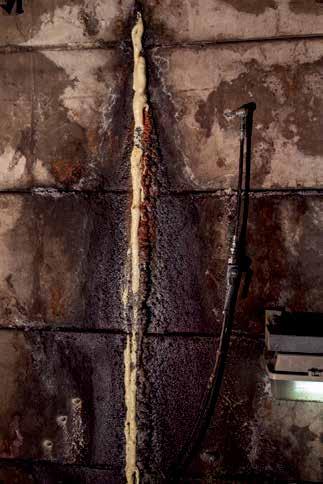
PC Tunnelinject 2K 6822 LV uses the principle of self-injection to push itself further in the crack. The resin is ideal for the consolidation of soil and water sealing of structures with high water flow or pressure, often encountered in tunnelling.
In wet structures it increases eight to 10 times in volume and forms a very strong polyurethane foam, according to the company, based in Antwerp, Belgium. In dry structures the product forms a solid mass. When the injection resin is completely cured, PC Tunnelinject 2K 6822 LV becomes 100% watertight and reinforces the treated structure.
The resin has a very low viscosity of 175 mPas average at 20°C that seals even the finest cracks. When it reacts in a solid mass without the presence of water, it has a compression strength around 70 MPa. The strong foaming ensures that less resin needs to be injected to seal voids and cracks.
The product reacts when in contact with water via a pumping effect. As a result, the
Pushy: Tradecc’s injection resin PC
Tunnelinject 2K 6822 LV pushes itself into a crack
Kapsch secures Westgate Tunnel deal
Kapsch TrafficCom
Australia will deliver the tolling roadside system for the West Gate Tunnel Project under construction in Melbourne, Australia. Kapsch TrafficCom
Australia was contracted by CPB Contractors John Holland Joint Venture to deliver the technology. It will be based upon the company’s single gantry multilane free-flow platform and next-generation stereoscopic vision technology for both vehicle detection and classification
as well as automatic number plate recognition.
“Almost 20 years ago Kapsch delivered the world’s first multilane free flow tolling system in Australia,” said André Laux, chief operating officer at Kapsch TrafficCom, based in Vienna, Austria, and which has subsidiaries and branches in more than 30 countries.
The 5km West Gate Tunnel - to be open in 2022 - will deliver an alternative to the West Gate Bridge, providing
resin pushes itself deeper into the porous rock or concrete structure that needs to be reinforced.
Apart from general void filling, uses include sealing water leakages with high water ingress in shafts, tunnels and mines. It can be used for soil consolidation when encountering high water flow/pressure during excavation of tunnels and other concrete infrastructure. It will also help stabilisation and water sealing of deep drill holes, porous rocks, sand, ground, brick and concrete constructions.
Tradecc also recently announced that its PC Leakinject Hydrogel 6880 is now CE-certified for the European market. The company says that the low viscous, single component, hydrophilic, MDI-based injection resin doesn’t need the addition of a catalyst. The product reacts with water and forms a flexible, closed cell foam.
Leakinject Hydrogel 6880 can be injected pure, directly into a leaking crack, fracture or joint or it can be injected mixed with water, for example in a ratio of 1/1. After injection has taken place, it will foam to expand and fill the void, forming a tight impermeable polyurethane seal.
www.tradecc.com
a second river crossing and removing thousands of trucks from residential streets. Originally called the Western Distributor, it will link the West Gate Freeway at Yarraville with CityLink at Docklands via a tunnel beneath Yarraville.
Meanwhile, the first of the two tunnel boring machines (TBMs) will soon arrive in Melbourne, according to the state government. A steel frame is going up for the 90m x 180m spoil shed at the Yarraville tunnelling site. Work continues at the
northern portal to build the tunnel entrance and where the two TBMs will be launched.
The TBMs will be 90m long, weighing up to 4,000tonnes each and standing 15.6m in diameter. It will be the first time a full-scale TBM has been used in Victoria. Two huge retaining walls have been built either side of the tunnel site, with around 1,000 support columns driven into the ground to help keep workers safe on site. www.kapsch.net/ktc
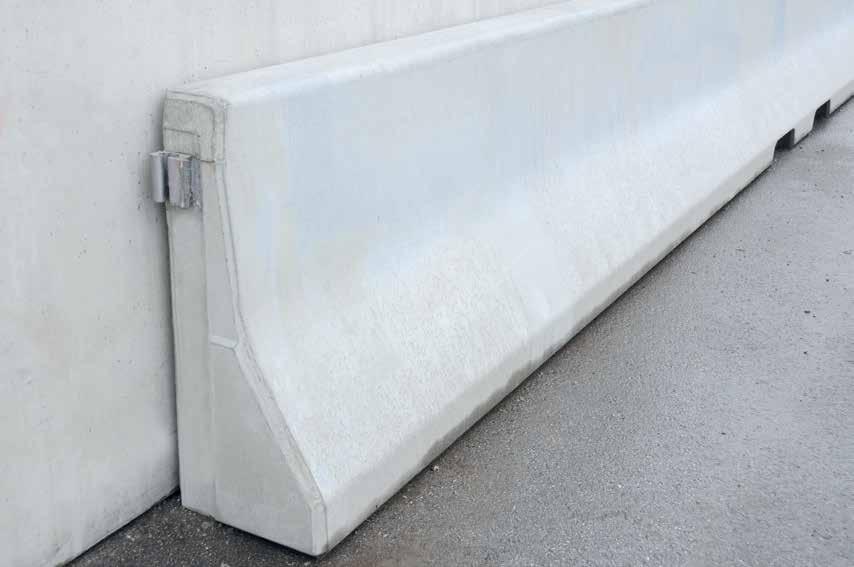
REBLOC’s 80XW_8 has been designed for use along vertical walls, including inside tunnels
Nyx Hemera: small is beautiful
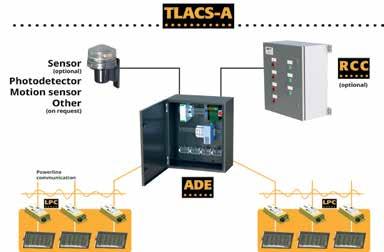
Canadian infrastructure lighting specialist Nyx Hemera Technologies has expanded its range of TLACS solutions with the addition of the TLACS-A.
While the new TLACS-U system has been designed for road underpasses and small tunnels, the new TLACS-A is aimed at controlling various areas, such as indoor and outdoor parking lots, dealer car parks, ports and any other areas that have safety and energy savings challenges. Both new solutions provide intelligent control and lighting system management capabilities to meet the requirements of new smart cities.
In addition, the company says that the use of powerline communication, which allows lighting control over existing electrical wiring, makes them affordable and environmentally friendly solutions that have a significant impact on infrastructure life cycle costs.
The new solutions consist of standard products that are available and ready for shipment for a quick installation without
REBLOC up against a wall
One of the latest product innovations from high-performance vehicle restraint systems maker REBLOC is the 80XW_8 passive concrete barrier system with performance data H2/W1. The 80XW_8 has been designed for use along vertical walls, including inside tunnels. The free-standing system does not need additional anchoring.
Thanks to its asymmetric shape, it can be positioned seamlessly along tunnel walls. Also, due to the system’s low width and working-width W1, it requires only a minimum of space to ensure sufficient traffic-lane width. Positioning the concrete barriers along the tunnel wall reduces the impact
severity of deviating vehicles. This ensures the safety of vehicle passengers according to EN 1317 with ASI B. All elements are connected through the interlocking REBLOC coupling without loose parts to form a strong chain. The high installation speed shortens construction time and reduces to a minimum any traffic-restricting measures for on-coming vehicles.
To allow efficient and secure installation, every element has special openings for a forklift truck. In this way, the system’s elements can be positioned seamlessly against the back wall.
www.rebloc.com
dedicated commissioning by the Nyx Hemera Technologies team, explained Pierre Longtin, president of Nyx Hemera, based in SaintVallier, near Quebec City, Canada.
TLACS fixtures are used in both road tunnels and small areas where energy savings and safety are important. TLACS solutions are installed in more than 75 tunnels and underpasses in several countries, including the US, Canada, Singapore, Spain, Colombia and Peru. Earlier this year, Nyx Hemera supplied its TLACS-U solution to Parks Canada for snowsheds over highways in the
The powerline for the TLACS-A lighting system from Nyx Hemera
Canadian Rocky Mountains. The TLACS turns ON/OFF and dims up and down the luminaires inside the snowsheds to reduce the black hole effect and bring a safe and comfortable lumen output for drivers.
TLACS also helps the operator save on energy costs thanks to not only the LED luminaires but also the dynamic control of the luminaires as needed. This is based on the variable luminosity at the tunnel portal. The TLACS also controls the street luminaires before and after the tunnel. www.nyx-hemera.com
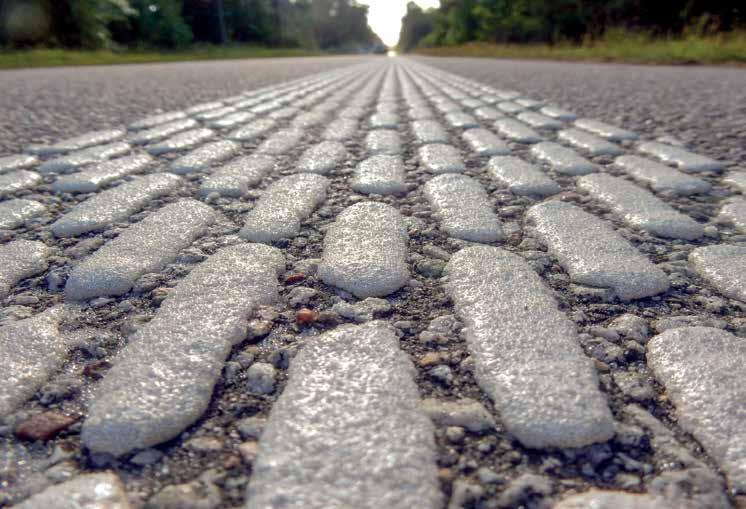
Better visibility with Geveko’s ViaTherm LongDot profiled road marking
DANISH DATE FOR VIATHERM LONGDOT
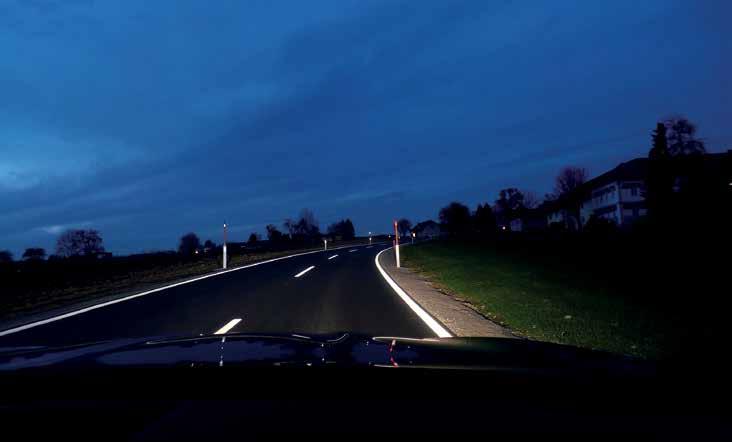
Geveko Markings says that better visibility, reduction of noise and increased road safety are the benefits of its new ViaTherm LongDot road marking
ViaTherm LongDot has been developed in collaboration with Vejdirektoratet - the Danish Road Directorate – and several of its partners within the highways sector, says Geveko.
Road markings everywhere are based mainly on two types of markings. The ordinary flat road marking (Type I) and the structured profiled marking (Type II).
Flat markings are noiseless when vehicles pass over them but can be difficult to see in poor weather conditions and also when dark.
Structured profiled road markings, on the other hand, are much easier to see and reflect light from vehicle better than the ordinary markings because they drain surface water away from the marking. Unfortunately, they create noise when a vehicles passes over them. This means that they are unsuitable for anything else other than edge lines. Because these structured profiled markings give off an audible rumble noise and noticeable vibration when driven over, they provide an efficient warning to the driver that they are crossing the edge lines.
Geveko says that its newly developed ViaTherm LongDot road-marking
system combines the best attributes and performance of the two types of markings. ViaTherm LongDot could, according to the company, be used for all kinds of road markings. Its profile is designed to keep vibration and noise to an absolute minimum inside a vehicle.
During development, ViaTherm LongDot was tested at Denmark’s Aarhus Airport and on the Danish Road Authority official test deck as well as several temporary locations around the country.
In addition, a research report has analysed motorists’ response and so-called preview time using the ViaTherm LongDot compared to the normal standard markings.
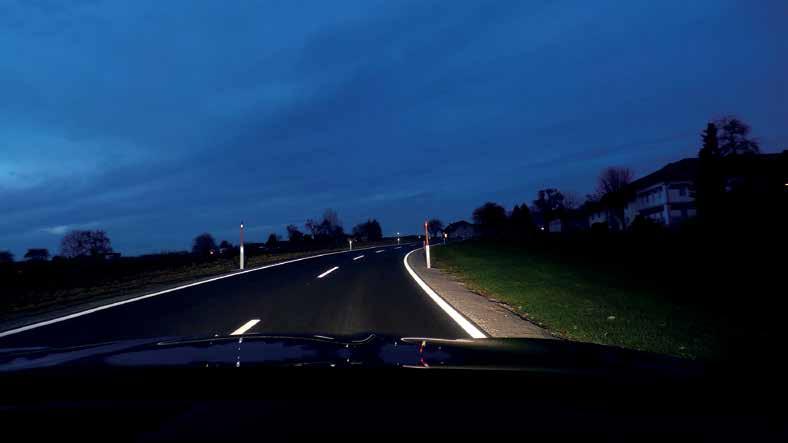
Normally, the lower limit for preview time is two seconds. But in dark and wet conditions, preview time for normal road markings is less than two seconds.
making driving more comfortable and safe. Due to limited visibility of conventional flat road marking, drivers tend to stay close to the edge lines and not use the full width of the lane, a safer option.
They may also slow down noticeably or brake suddenly when visibility becomes too poor. The performance of ViaTherm LongDot will enhance motorists’ orientation and reduce the likelihood of road accidents, says Geveko.
Drivers tend to stay close to the edge lines and not use the full width of the lane, a safer option
Geveko explains that the research showed that by using the new road-marking profile, preview time was improved by up to 50%,
The combination of better visibility in wet conditions and lower noise makes the ViaTherm LongDot suitable for use in both cities and on smaller roads where structured and profiled road markings have not been used or allowed within 150m of buildings. Instead, a lot of conventional flat road markings have been used, even though there is a strong need for better visibility with the highway being so close to objects on the side of the road.
www.geveko-markings.com
Safety at the core of Corsafe
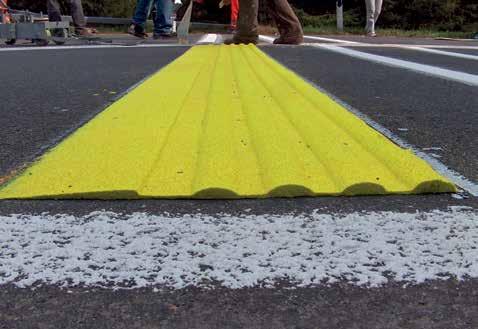
Portuguese manufacturer Candela says that its Corsafe anti-skid system has an anti-skid class S5 (≥ 0,65 SRT) rating, the highest for road-marking material.
Corsafe also has a certificate of durability ranked as P7 (≥4000,000 wheel passes).
Candela has developed a wide range of anti-skid road coverings enabling an active reduction in braking distances and reducing the probability of vehicle skidding.
Corsafe assists road users in the most provable braking areas, such as approaching traffic lights, dangerous bends, intersections, pedestrian crossings and roundabouts. The company also says that Corsafe can improve grip along more complicated road sections and areas such as tight turns or steep climbs where traction is important.
Candela’s range of anti-skid coatings is
available in a wide variety of signal and traffic colours and has different products designed to cope with different levels of traffic and wear. The company says that the products have a proven track record of excellent
Corsafe is said to boost grip along complicated road sections such as tight turns or steep climbs where traction is important
PROMAX CF03
PROMAX CF03
TWIN MIX
PROMAX SP60
PROMAX CF02
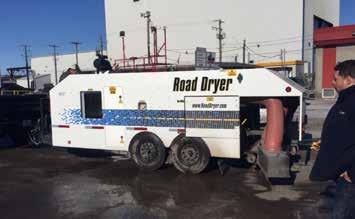
Hot air from Road Dryer
Road Dryer, a US-based manufacturer of road-drying equipment, has expanded its coverage into eastern Canada with the appointment of a dealer.
Montreal Tractor (MTI) and its sister company Hot Mix & Aggregate (HMA), both based in Baie D’Urfé near Montreal in the province of Quebec, now exclusively represent Road Dryer’s pavement-drying units. They cover Quebec as well as the provinces of Ontario, Nova Scotia, New Brunswick, Prince Edward Island and Newfoundland.
or striping after just one pass.
The units blow air heated to 204°C directly downward through multiple nozzles. This delivery eliminates the risk of flying objects and allows traffic to flow in nearby lanes — thus reducing congestion caused by traffic restrictions.
Both dealerships offer new, used and rebuilt equipment, accessories, parts, and components, said Todd Toole, operations manager for Road Dryer, based in Greenville, South Carolina.
focuses on the Ontario market.
MTI was founded in the early 1980s and works with customers across Canada, the US and worldwide. HMA, founded in 2010 in Orangeville, Ontario,
Stay safe with Screen-Safe
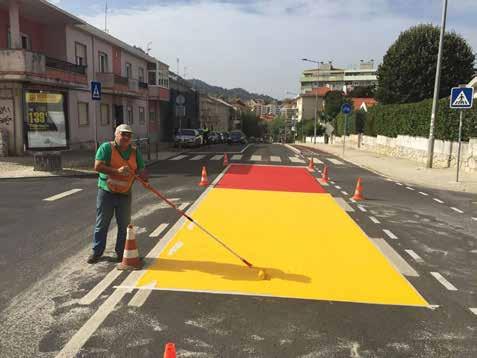
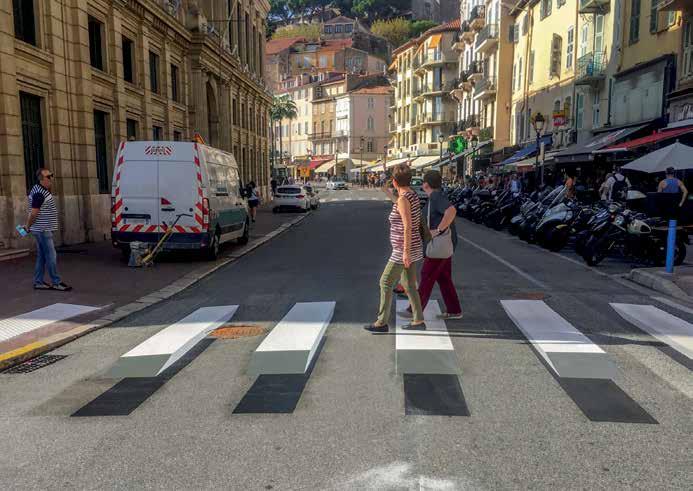
The southern French city of Cannes is testing pedestrian crossings with a three-dimensional effect thanks to Geveko Markings’ PREMARK 3D marking technology.
The crossing, which appears to be floating in the air, has been applied by a team from Miditraçage with technical support from Geveko Markings in France. Together they made sure that in just two and a half hours, Rue Félix-Faure went from ordinary road to a safer and more impressive sight to behold.
Geveko says that the crossing is “decorative, durable and safe” and designed to be “an effective way of assuring that drivers are alert when they reach the area designated to protect pedestrians”.
The eye-catching crosswalk is made of PREMARK preformed thermoplastic material which is NF-certified and has a high degree of skid resistance (S3).
What sets the 3D markings apart from traditional markings, according to Geveko, is the special design which uses the principles of anamorphic illusion. This means that a certain design perspective is forced onto a basic marking, which makes the marking appear to be a floating, physical object. The result is a striking piece of street art that looks very convincing when seen from a specific angle.
A second test application in Cannes is being considered, according to Geveko. www.geveko-markings.com
Road Dryer says that its trailer- and truck-mounted pavement-drying units quickly dry asphalt and concrete pavement, allowing crews to pave or apply surface treatments
The RD-1200 XT can be adjusted for drying widths of 2.4-3.7m, explains Maxime Petrin, product manager for the road-building division at Montreal Tractor. Because it dries pavement on demand, the unit provides flexibility for contractors and government agencies to meet timetables by minimising delays from weather- and project-related wet conditions.
www.roaddryer.com
Don’t trip! Geveko’s PREMARK raises the bar for pedestrian crossings in Cannes
The RD-1200 XT from Road Dryer blows air heated to 204°C directly downward through multiple nozzles onto the road surface
RETROTEK-M HAS ESTONIA COVERED
During the past two years, Estonia’s Road Administration has clocked up 4,021km during a retroreflectivity project on all main state roads and on basic roads
Estonia’s Road Traffic Development Department of the Estonian Road Administration has been working with ERC Consulting to gather retroreflectivity data on road markings on all main state roads and basic roads. The work has shown that out of 1,609km of main state roads, 20% had problems.
The reflective effect is created by glass beads on the surface of the material. However, over time their effect weakens because the beads wear and fade. Compared to the vast majority of countries, Estonia is in a disadvantaged position that makes the problem more acute, due to its tough winters. Snow ploughs break down the lines. Also, vehicles’ winter tyres roughen up the roadmarking surface and dirt is driven into the line.
The Estonian climate also makes roadmarking installation a very seasonal activity. A highly visible road marking is most needed in autumn and winter, from October to March. But to upgrade the markings dry weather conditions are needed where the air temperature is over 10°C. The best time for installation – a short window of opportunity – is from June to July. The applications should last throughout the year, at least until May of the following year.
The Estonian Road Administration has well-established operational requirements
for road markings with a State Road Traffic Instruction document. The reflectivity indicator of road markings from paint and spray plastic origin cannot fall below 100 mcd/m2/lx for at least two years after installation.
According to Janno Sammul, head of the Traffic Development Department at the Estonian Road Administration, the
use of the marking. Everything starts with the quality of the material and installation, including how clean the road was during installation and what the weather was like. After this, the reflectivity of a marking depends upon its maintenance. Also, how often has a snowplough scraped over it? Was the snowplough blade iron or rubber? Is the installation being driven over continuously
The effectiveness of the RetroTek-M technology lies in its capability to survey across the full width of a traffic lane in one pass
These things can be documented and taken into account when setting out maintenance schedules. But without accurate reflectivity data, decisions about the actual situation cannot be made.
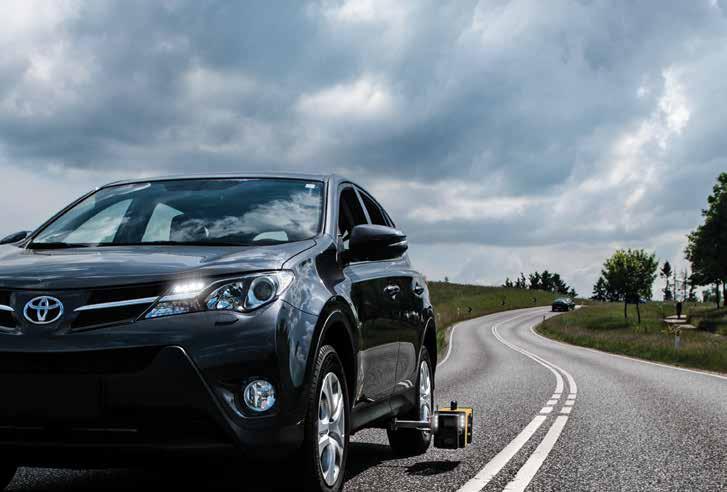
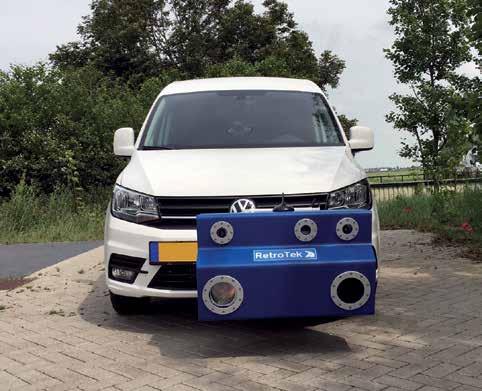
The RetroTek-M device, which measures retroreflectivity, was rented from Reflective Measurement Systems, based in Ireland. RetroTek-M is attached onto the front of a survey vehicle and collects data by directing a light forward to hit the markings.
The effectiveness of the RetroTek-M technology lies in its capability to survey across the full width of a traffic lane in one pass. It can also survey up to six road asset types. The technology can identify right and left lines/markers/raised pavement markers, as well as centre-lane road markings and symbols in one passing.
The entire journey is recorded as a video. This newgeneration measuring device only works in the dark, so measuring work can be done primarily at night when there is usually less traffic.
The survey project has been successful and is continuing on Estonia’s secondary roads
The measured retroreflectivity (RL- mcd/m2/ lx Coefficient of Retroreflected Luminance) results on road markings were divided into four classes of condition:
- Very good – RL > 100 [mcd/m2/lx]
- Good – RL = 80-100 [mcd/m2/lx]
- Satisfactory – RL = 60-80 [mcd/m2/lx]
- Bad – RL < 60 [mcd/m2/lx]
According to Janno Sammul, if the measured result is “very good”, the marking will last for another full year. If it is measured
Fugro picks up Dutch deal
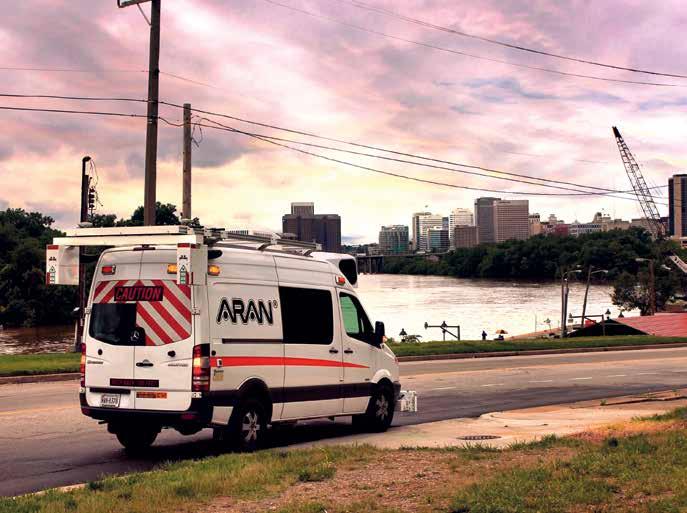
Fugro, a geodata specialist, is using the latest version of its automatic road analyser (ARAN) in a new five-year pavement survey contract for Dutch highways.
The contract, with an option to extend to 10 years, was awarded by the Dutch infrastructure agency Rijkswaterstaat. It includes the collection of surface condition and road measurement data from 8,600km of principal highways each year.
The company’s automatic road analyser is adapted to meet European specifications and includes improved crack detection technology. The platform enables surveys to be conducted at traffic speed, providing a cost-effective, safe, precise means of condition monitoring that enables asset managers to identify and predict deterioration and prioritise expenditure, according to the company, based in the Netherlands.
The ARAN provides fully automated collection of multiple data streams via positioning, video and laser imaging systems that can be tailored to project needs. Options include profile, camber, rutting, cracking, texture and roughness as well as pavement thickness and structure based on groundpenetrating radar.
Rijkswaterstaat receives a clear picture of network condition in a format that complies with national standards, the company notes. With the condition surveys repeated annually, maintenance plans can be optimised to target areas of deterioration based on high-resolution and repeatable
as simply “good”, it must be replaced next year.
For road users, a result that is less than 60 mcd/m2/ lx means the application is not reflecting any useable light. The results of the survey found that of all the main roads, 300km - 7.7%had an RL below 60. Meanwhile, nearly 550km – 15% - had an RL value between 60-80.
According to Sammul, the survey project has been successful and is continuing on Estonia’s secondary roads. The Estonian Road Administration will also continue with regular measurements to better plan maintenance and upgrades. www.reflective-systems.com
datasets. Richard Bun, Fugro’s project lead, said the updated ARAN “will further enhance the efficient transfer and usability of important data for Rijkswaterstaat’s asset management system”. Fugro, listed on Euronext Amsterdam,
employs around 10,000 people in 65 countries. Clients are mainly in the energy and infrastructure industries, both offshore and onshore. In 2018, revenue was around US$1.9 billion. www.fugro.com
Fugro’s latest Automatic Road Analyser – ARAN – is surveying around 8,600km of Dutch main roads
Wider edge lines improve road safety
LAYING DOWN THE MARKER
Swarco’s chief operating officer Philipp Swarovski shares his thoughts on highway safety and infrastructure in an age of uncertain future needs. David Arminas reports
It was in Austria in 1969 when Manfred Swarovski opened his first glass bead factory. Five years later, operations started in the US. As the years rolled by there followed acquisitions and expansion of manufacturing facilities as well as a shift into intelligent transportation systems globally.
Fast forward to 2019 and the family company has half a century in business under its belt. It now has a presence in 80 countries, employing 3,700 people.
Sadly, Manfred isn’t around for the company’s 50th anniversary – he died last year. But his sons are, including Philipp Swarovski, who maintain the family business and its traditions. Philipp, the chief operating officer of Road Marking Systems division, has degrees in engineering and management. He is also a trained gemmologist, having graduated from the Gemological Institute of America in Carlsbad, near San Diego,
The young Swarovski was fascinated with all things engineering. “I was technical when I was young. It was like having a fast car. I wanted a fast computer. I guess I was the family geek,” he says. He confesses to ripping apart his small motorcycle simply to see how it worked. He also put time into working for the family’s crystal business, called D. Swarovski – after his great-great grandfather – which cuts gems and glass optics, including for other divisions of the Swarovski family companies.
gemmology knowledge are being put to good use. Last September Swarco acquired the German-based high-quality glass bead manufacturer Vialux Glasperlennow Swarco Schönborn and one of six Swarco glass bead plants. The micro-glass beads embedded in the marking material retroreflect the headlight beam of vehicles, causing the road marking to appear to be lit up at night.
You get a “life-saving advantage” with road markings, especially wellmaintained ones
Road markings may not be the sexy part of intelligent infrastructure, but it is - and will remain – a very important safety factor and an integral part of future development, says Swarovski. All road-marking companies are improving their products with an eye on safety. “Attributing increased traffic safety to only one technology is probably not appropriate,” he explains. “For sure, road markings are a crucial element to increase safety according to many studies, including how wider edge lines improve road safety.
Intelligent transportation systems are, in general, substantially contributing to traffic safety.”
In 2013 Philipp moved on to Swarco, the independent corporation then owned by his father, and took over the lead of the Road Markings Systems division where his engineering and management education and
All the infrastructure systems have to beand increasingly are – linked and connected. It’s a mix of various technologies, from safety on cars to road markings, such as glass beads within road-marking materials. Swarovski believes that this connectivity will give road users a baseline road condition to make drivers more safety conscious and by doing so reduce the number of accidents and save lives.
There will also need to be random back-up systems for vehicles to position themselves.
“And road users are getting more diverse with electric vehicles, autonomous cars, e-scooters, and more cyclists. It is hard to say what is the future is but I believe that road markings are not in danger of disappearing for the next 30 to 50 years.”
AUTONOMOUS DRIVING
It’s a given that autonomous vehicles will need more sophisticated road infrastructure, he says. “But I think it will still be a very lengthy process until road infrastructure will be entirely different from what we see today. Also, it is unclear how fast this development will move ahead,” says Swarovski, who drives a Level 2 autonomous car. “Even with an exponential development of autonomous vehicle performance, it will take several years before we see L5 being as good as humans at driving. And at that we will have a mixed environment of non-autonomous, semiautonomous and autonomous cars for years to come.”
Whatever the speed and level of autonomous vehicle development, more and more vehicles will be equipped with sensors for lane departure warning and lane keeping assistance, to name a few features of future driving. “Highway agencies are already updating their specifications
both human drivers and machine drivers.”
He notes that the ERF (European Union Road Federation) is recommending to highways agencies that they adopt the so-called 150x150 formula. Lane markings should have a minimum width of 150mm and their retroreflective performance should not drop below 150mcd/lux/m² in dry weather conditions. For wet and rainy conditions, the minimum performance level should be 35mcd/lux/m².
Level 5 vehicles will require an incredibly more complex road infrastructure than now. “Beside highdefinition maps for autonomous
reliability and traffic safety. This is happening already in California where Caltrans [California Department of Transportation] is phasing out road studs and changed the width of road markings from 100mm to 150mm to make them better visible for human drivers and automated driver assistance systems.”
Everyone in the transportation sector is facing a technology rush. Consider embedded sensors, as an example of the problem for agencies setting standards, and consider the 500km Munich-Berlin distance. “It may take a decade to embed sensors along the route. If you start in Munich, by the time you finish in Berlin, the sensors at the Munich end might be outdated. But we still need standards to allow for innovation
Everyone in the transportation sector is facing a technology rush
Cautious in Cornwall: warning signs for when there is a reason
➔
“In
general there has been a steady deterioration in the quality of road markings”
RECKLESS TESTING
A recent pilot scheme in the UK removed the central white lines from several busy A-class roads where speed limits are set at around 100km/h.
This induced driver uncertainty, which led to a 13% reduction in speed and fewer accidents, according to the operators of the scheme. But there are some concerns over this testing. Swarovski even challenges the theory that such changes will reduce accidents in the long run. Such testing could possibly be “reckless” and “not a good idea”, he explains.
Conversely to the test result, “driving on roads with good road markings is more convenient, much safer and lets the traveller arrive much quicker at the destination”. You get a “life-saving advantage” with road markings, especially well-maintained ones. If the goal of removing them is to force drivers to slow down, then at what point is there congestion on the road? Roads are built to a standard and designed to move cars in a wellordered – and safe – speed.
“Well-guided and smoothly flowing traffic is, for us at Swarco, environmentally sound. More cars spending more time on the
road would raise the carbon footprint. Also, for businesses, slower transport of goods could translate into higher consumer prices,” he says.
It’s no secret that government financial cuts in many countries have threatened maintenance of highways safety features, including road markings. “In general there has been a steady deterioration in the quality of road markings – in some places they have simply disappeared,” he says.
“At the same time, modern road markings boast various optical and haptic properties that greatly improve safety. As such there needs to be a more universal – globallyaccepted – definition of what constitutes a ‘good road marking’ which is visible both to driver and intelligent vehicle,” says Swarovski.
Some technologies will likely remain outside mainstream use, he believes. One is the 3D effect for pedestrian crossings. Another may be the road marking seen only from one direction, such as a warning on the asphalt seen only by drivers proceeding along the road in the wrong direction. It is not that they aren’t effective, but they can be especially expensive to set up and maintain.
Safer with Saber skid analysis
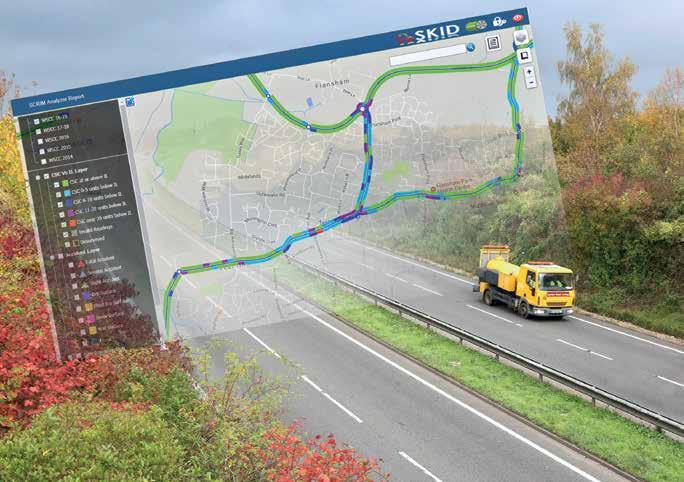
Saber, a UK-based highway condition and inventory specialist, says its new SKIDAnalyser software can help reduce the risk of road traffic accidents.
The cloud-based software analyses data collected by Saber’s fleet of specialist road survey vehicles that measure levels of skid resistance in wet conditions.
The company says that SKIDAnalyser, provided online as a software-as-a-service solution, is an industry-first development that uses Google Maps to display data spatially and includes a tablet app for site investigations.
Saber’s SKIDAnalyser is part of a suite of Saber software for managing highway survey data, explained Steve Batchelor, managing director of Saber. Through rapid
“They can be very time consuming to create and put down. Much of the application is done manually. A painting technique that works with different shades of grey.”
A big advance, he believes, would be road markings that survive better on road surfaces especially prone to ice forming, or on surfaces that are constantly wet.
Longer lasting paint which also keeps its retroreflectivity longer in these instances will save money and lives.
A problem on the horizon, at least for countries that get severe winter conditions - Russia, the Nordic states, Canada and the US – could be sensors whose performance is reduced by snow cover. Also, snowploughs may be liable to simply scrape off the sensors or at least lower the reflectivity of some paint and embedded glass beads.
“Whatever happens, there will have to be a lot more long-term thinking about highway maintenance, including road markings,” he says. “Technological improvements cost money, but local authorities must think that if the products last longer, then savings are larger in terms of life cycle costs. More lives will also be saved in the long run.”
cloud data processing and communication, raw data from surveys becomes available within days of collection, alerting highway authorities to road surfaces that need urgent remedial work to improve road safety.
“This latest development means that skid-risk data becomes available not only much more quickly, but it is presented in a visual, easy to understand way. This allows decisions to be made more quickly and with greater confidence,” said Batchelor.
Accident data can be overlain and historical data shown allowing year by year comparison. The handy tablet app allows data to be accessed and viewed during site investigations, according to the company. www.saber-uk.com
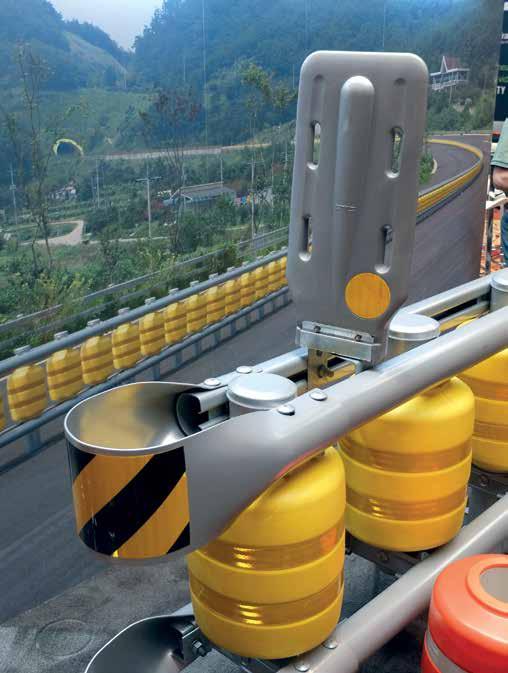
ETI ROLLS OUT A NEW BARRIER
South Korean firm ETI is offering a novel roller barrier system, designed to reduce crash risks
The system meets both US and European requirements for barriers and is well-proven in the South Korean market, with over 100km in use on the country’s road network.
In addition, the firm has also supplied systems to customers in other Asian countries including Malaysia, the Philippines
and Thailand, as well as Latin America, including Chile, Colombia, Ecuador and Mexico.
For the moment the company has not yet installed the system in the US but a representative from the firm said, “Several states are looking at sites to install this.” In addition, the representative
Stay safe with Screen-Safe
Transpo says that its barrier fencing Screen-Safe glare screen safety shield protects drivers and work zone crews from headlight glare and debris.
It is maintenance free and simple to install on guardrails and concrete barriers. It is also flexible in that it is excellent for both permanent installations and temporary work zone applications. Screen-Safe is
made from a double-reversed corrugated fabric, formed from hot-dipped galvanised sheet steel. The fabric is also powder-coated to provide additional protection from salt and snow. Allsteel assembly components make Screen-Safe the most durable highway glare screen and work zone safety shield available to the transportation industry, according to the company. It
A new roller barrier system from South Korean firm ETI is now available for the US and European markets
commented, “The owner will set up manufacturing in the US.” The roller system is best suited to installation at high-risk sites on curves or at the entrances or exits to highways. It also can be supplied with an end treatment. The representative said, “The key is in the absorbent material that reduces the impact forces.”
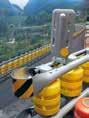
The rollers are made from an ethylenevinyl acetate (EVA) material that is highly shock-absorbent, a key design feature. This material is also said to be durable, long lasting and chemically resistant, while not suffering ageing due to UV exposure.
Following an impact with the roller barrier, the vehicle speed is reduced due to the impact-absorbent properties of the rollers. The system also deflects vehicles at a shallower angle while causing less damage than conventional barrier types.
ETI says that this means vehicles are more controllable after an impact and less likely to be involved in secondary collisions as a result.
The system is said to be well-suited to the types of vehicles used in the US market and the representative said, “The product works well with SUVs and pick-up trucks.”
The standard colour choice for the rollers is yellow, although other options available from the firm include grey, red and green.
Other novel barrier products from the firm meanwhile include anti-glare screens that can be installed on highway curves as well as exit and entry ramps to prevent the lights from oncoming vehicles dazzling drivers. The firm is also testing a new metal screen system designed to cover over upright barrier posts and improve safety for fallen motorcycle riders.
www.etikorea.kr
can be installed in permanent locations on concrete barriers and steel guardrails and is also ideal for curved roadways, access ramps, raised highways, construction lanes and toll-booth plazas.
For temporary work zone installations it can be quickly removed and reinstalled at a new location, with minimal disruption to traffic flow.
Screen-Safe’s doublereversed corrugated fabric
is made from 25 gauge steel sheet, AISI 1010 or 1008, and hot-dip galvanised to ASTM A-653, coating designation G90. The finish is a light grey, medium-gloss powder-coat with zinc.
It conforms to ASTM D 523 for gloss and B 117 for salt spray resistance, reference test for Bonderite. The film thickness minimum is 1.8 mils. www.transpo.com
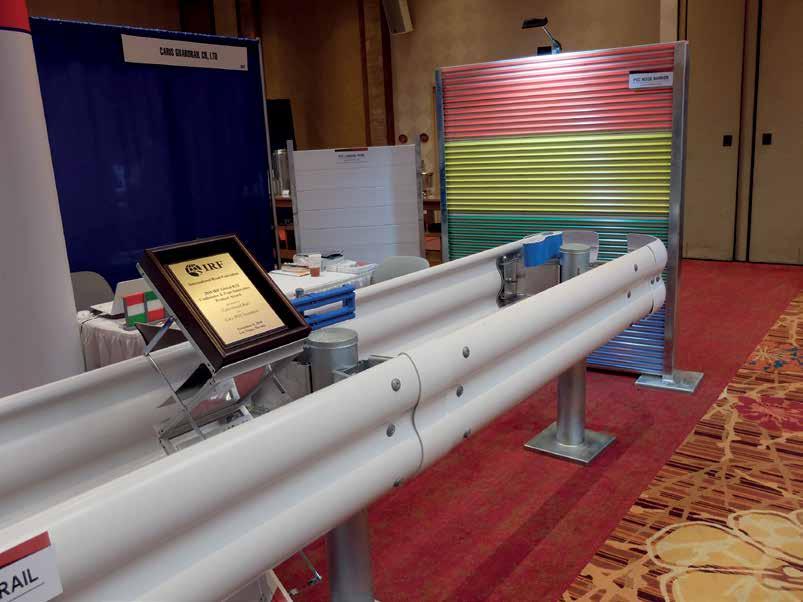
Caris goes for gold
Caris Guardrail became the first firm to receive the Innovative Award in the guardrail segment from the International Road Federation last November.
Yu Cheol, chief executive of Caris, received the 2018 IRF Global R2T Conference & Expo Innovative Award in Las Vegas.
The award was for the South Korean company’s CG10 PVC-composite Guardrail. It has a honeycomb structure for increased strength and the elasticity needed to withstand high-speed vehicle impacts. The fluorescent material enables the guardrail
to be seen in the dark and under low-light conditions.
The material – which contains no glass wool - does not change colour or fade after prolonged exposure to the sun.
One unit of the polyvinyl chloride-based guardrail weighs 28.2kg and can be installed at post intervals of 1.5-2m.
Caris Guardrail also produces the CG40 PVC Guardrail, a roller barrier system that is applied to a rapidly curved section of road. Similar to the CG10 PVC Guardrail, there is a fluorescent option for better vision at night.
Tertu’s T32 for Dijon
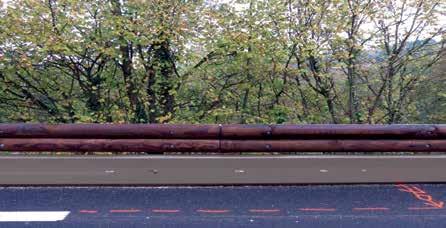
The first section of the new steel-backed timber guardrail T32 has been recently installed near the city of Dijon, in eastern France.
This crash barrier, CE-certified in 2018, has been selected not only for its performance but also for its aesthetic quality, perfectly fitting the beautiful scenery of the Bourgogne region, known worldwide for its famous vineyards.
The T32 is made of a B-profile steel guardrail cladded with four half-round logs of 16cm.
This new system has been tested at N2 containment level and offers both W2 & W3 working widths, depending on post spacing – either 1.33m or 2.66m.
Tertu says that with these specifications, the T32 is an appropriate solution to make safer any roads that have narrow shoulders which are surrounded by obstacles including trees or construction equipment.
Easy and quick to install, the T32 can be equipped with optional safety accessories like the Reflec’bois –reflective device, handrail extension or motorcyclist protection.
The company has signed export deals with firms in Mongolia, Malaysia, Indonesia, China and the Philippines. It also has an exclusive deal worth about US$266 million with Egypt’s ministry of military production . Caris later received the Innovationpromotion Award from South Korea’s ministry of trade, industry and energy. This was followed by the country’s top science award, the Jang Young-sil Award, from the Korea Industrial Technology Association,
The T32 is the most recent addition to Tertu wood and steel road safety barriers range - the largest such range on the market with 14 CE-certified crashworthy solutions from containment level N1 to H2. www.tertu.com
The T32 from French manufacturer Tertu is made of a B-profile steel guardrail cladded with four half-round logs of 16cm
The CG10 PVC Guardrail from South Korean manufacturer Caris
Berghaus
ProTec-Tor 120
tested to DIN EN 1317
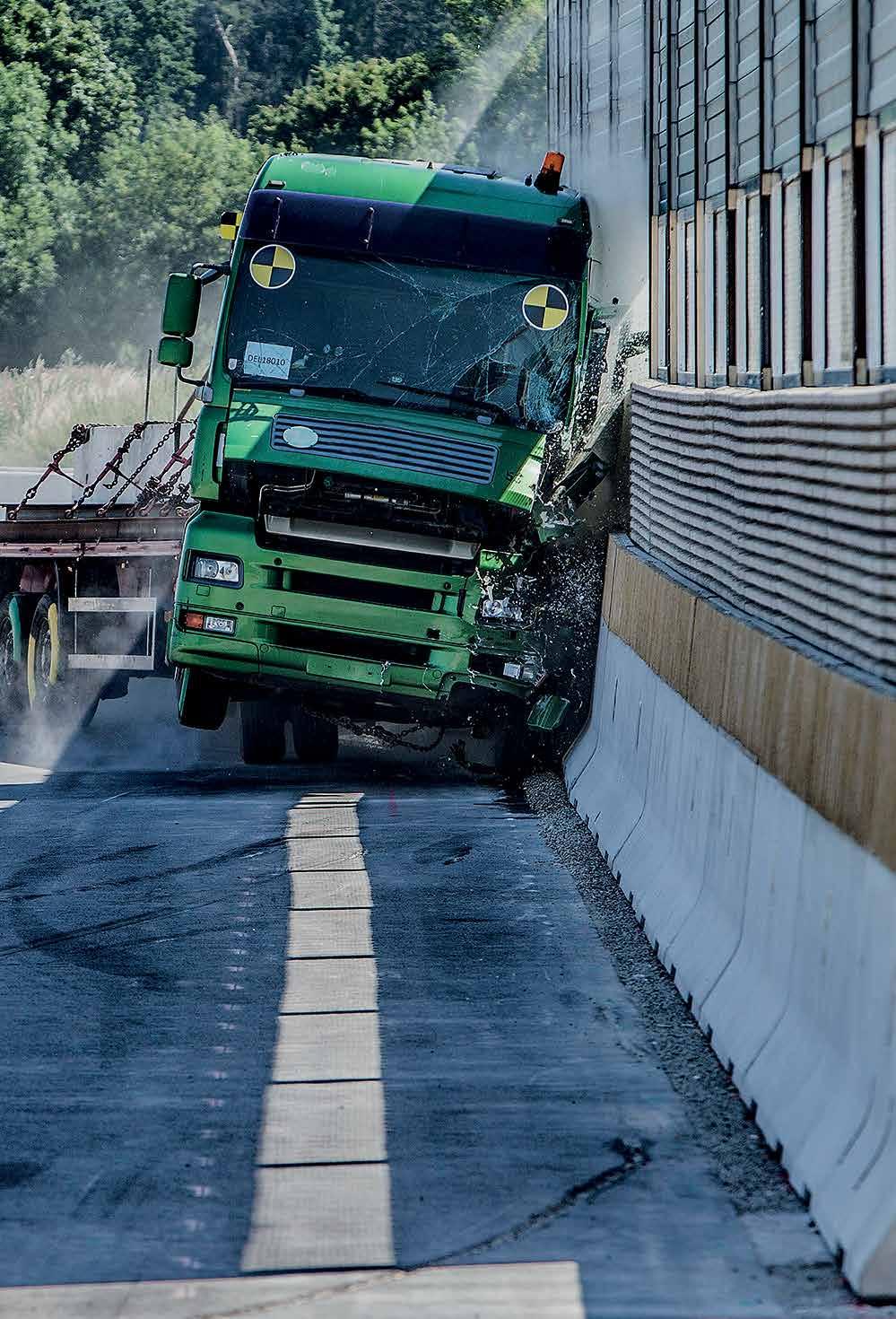
German manufacturer Berghaus reports that its emergency opening ProTec-Tor 120 has successfully been tested according to the test criteria and requirements of DIN EN 1317.
Testing took place with a truck (TB 41) travelling at 70km/h and a car (TB 21) travelling at 80km/h.The ProTec-Tor 120 is a special element in the crash barrier system ProTec 100 (T3 / W2), according to the acceptance criteria of containment level T3.
Up to now, in Germany such special
situations and as a computed simulation. But simulations are not always suitable for providing conclusive corroboration, particularly in terms of the dynamic forces and their impacts on special elements.
Because emergency openings are meanwhile increasingly required as safety devices in restraint systems with contraflow traffic, Berghaus instructed an accredited test lab to test the Pro-Tec-Tor 120.
In the standard crash test, the longitudinal
crash barrier system were documented on the basis of the two impact tests that were carried out. The emergency opening functioned perfectly even after the crash tests with a truck and car at high speeds, with slight shifting of the system.
The ProTec-Tor 120 – as well as the ProTec-Tor 50 – are easily separated elements for mobile crash barriers that can be opened quickly in an emergency without needing tools. According to the company, only a couple of simple actions are needed to release
Gregory’s TTMA-200 passes MASH TL-3
Gregory Highway Products says that its TTMA-200 Trailer has passed MASH TL-3 Crash Testing. Gregory Industries’ Trailer Truck Mounted Attenuator is now eligible for reimbursement under the Federal-aid Highway Program.
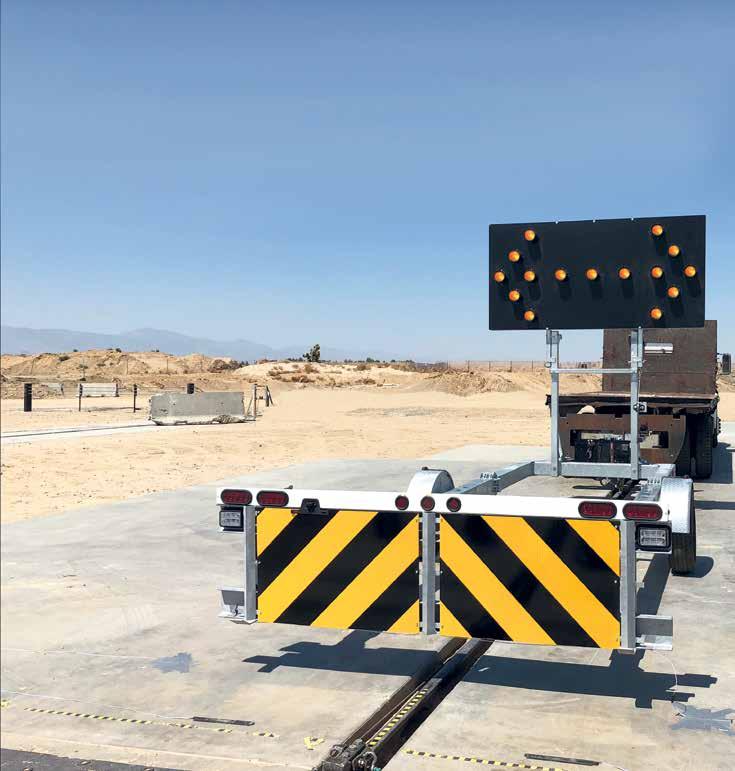
Gregory Highway Products says that its TTMA-200 trailer truck-mounted attenuator has passed Test Level 3 (TL-3) crash safety standards for the US market. The standards are set out in the American Association of State Highway and Transportation Officials’ (AASHTO) Manual for Assessing Safety Hardware (MASH 2016). The TTMA-200 is now eligible for reimbursement under the US government’s Federal-aid Highway Program, administered by the Federal Highway Administration.
The TTMA-200 was assigned control number CC-152. Gregory said that this
letter of eligibility will help the company work with the various departments of transportation at state level to provide a low-cost solution for work zone protection. Gregory claims that its unit, which is designed for use in mobile and stationary work zones, is one of the most versatile attenuator trailers on the market. Thanks to its hitch-mounted design, the trailer can be placed into service in minutes by attaching to most support vehicles with no modifications, explained Jeff Grover, vice president of highway products at Gregory.
“The simplified design offers contractors a means to protect employees while minimising the expenses of investing in new equipment and still meeting AASHTO’s stringent MASH TL-3 testing criteria,” said Grover.
The trailer absorbs energy through the use of an oversized mandrel which pushes
into a smaller tube in the event of a crash. This dissipates energy by splitting the tube into four strips of metal on impact. These strips remain with the trailer and pose no hazard to workers or adjacent traffic.
The TTMA-200 is fully galvanised and built to last against moisture and corrosion. Since it does not require a dedicated support vehicle, the trailer is adaptable to a wide range of operations such as sweeping, salting, sanding, mowing and striping. www.gregorycorpmobile.com
Gregory’s TTMA-200 trailer absorbs energy through an oversized mandrel which pushes into a smaller tube during a crash
Fast solutions with SwiftGates
Canadian road safety equipment manufacturer Versilis says that its latest flexible Horizontal HSG-40CW – 12m in length – is crash-tested to AASHTO MASH requirements. The Horizontal HSG-40CW is part of the Montreal area-based company’s SwiftGate series of barriers that have been sold worldwide. Whether the gates are short or long, they can be made to pivot horizontally or vertically. Importantly, says the company, the gates offer increased
visibility using a high surface of reflective material and LED lighting. Made of corrosion-resistant materials, the HSG-40CW is designed to withstand harsh environments – such as Canadian winters and summers.
The gate’s arm – from around 2m up to 12m in length - is built with easily replaceable high-density polyethylene arrow-shaped posts and aluminium tubing. The arm's arrow-shaped barricade design offers maximum visibility and reflectivity
using an increased flat surface of highintensity retroreflective sheeting - more than double the surface of typical highway gates, according to the company. In the event of an impact, the arrow-shaped posts and chevron bend at the top, allowing the impacting vehicle to go through, minimising damage to the gate and the vehicle. After impact, the arrow-shaped posts and chevron recover their original position. www.versilis.com
The MBT-1 on maintenance duty along the Capital Beltway I-495 Express Lanes in the eastern US state of Virginia
A-1 PROTECTION FROM THE MBT-1
Two giant US-made 21m-long mobile barriers are now keeping highway maintenance workers safe in England
The 16tonne barriers were made by Mobile Barriers, based in Denver, in the state of Colorado. They have been deployed in the West Midlands region of England in collaboration with UK highways maintenance contractor Kier.
With yearly operating costs of US$17,000, the MBT-1 can pay for itself with nominal usage, according to the manufacturer. This could be in less than two years with 10-15 lane closures per month.The barriers are around 2.5m wide and 3.7m high. Ground clearance is just over 0.3m. Top speed for the combined barrier with its traction unit, two
the barriers replace dozens of temporary maintenance cones along the highway. Apart from being physically superior to cones, it means workers are not at risk putting out and retrieving the cones before and after completion of maintenance work. It also reduces the time to complete work on a specified section for highway.
The barriers absorb the side impact of a vehicle while a truck-mounted crash cushion at the rear gives further protection.
Mobile Barriers says the unit can be fitted with integrated power, message board, safety lighting, work lighting, a truck-mounted
The MBT-1 can protect areas to either the right or the left side of the road, depending on to which end of the barrier that the semi-tractor is attached
to carry tools, equipment, materials and supplies to and from the jobsite.
The MBT-1 can protect areas to either the right or the left side of the road depending on which end of the MBT-1 the semi-tractor is attached. MBT-1’s design enables easy visual inspection, repair, and modular replacement in the case of an incident.
According to Mobile Barriers, the MBT-1 was conceived following a tragic incident in which two Colorado maintenance workers were killed by a wrong-way driver in June 2004. It underwent four years of development and refinement with the Colorado Department of Transportation and the Federal Highway Administration before its first deployment, in Colorado in June 2008. After further in-service testing and evaluation, it was formally introduced in San Jose the following year where it received the American Traffic Safety Services Association’s Innovation of the Year Award for 2009.
Highways England also recently announced that self-driving trucks which could help speed up roadworks are being tested for the first time in England.
The dump trucks provide the potential to work around the clock, according to Highways England, so could help reduce the length of time of roadworks. By being autonomous they also reduce the risk of road workers being involved in incidents on site.
Highways England has committed around US$190,000 from its innovation-designated fund into the dump truck trial on the A14 between Cambridge and Huntingdon, near London. www.mobilebarriers.com
Anti-vehicle barriers erected on the pavement on London Bridge as a terrorism prevention measure
THE UNTHINKABLE IS ALREADY HERE
Vehicle-ramming attacks by terrorists on pedestrians – often involving multiple fatalities - are sobering reminders of how cars and vans can be used for ill. But a recent court case in the UK highlights a sinister use of newer technology, says Adam Hill
Two attacks on London’s bridges, in March and June 2017, left 14 people dead, with nearly 100 injured, many critically. The main weapons involved were a car and a van, respectively, followed by random knife attacks.
In both incidents, the vehicles were driven at high speed towards pedestrians, killing several, before the perpetrators abandoned their vehicles and took to the surrounding area on foot, stabbing people as they went. All four perpetrators (one on Westminster Bridge in March, three on London Bridge in June) were killed by police.
In April that year, five people were killed by a terrorist in a truck in Stockholm; in August, 13 people died on the famous La Rambla in Barcelona in a similar attack; and in October, the same modus operandi killed eight people in New York City. The list goes on: sobering reminders of the ease with which old, easy-to-access technology can do great harm.
One UK-based Iraqi national, Farhad Salah, planned to do more. Like many of the other attackers, he was – or claimed to be – a supporter of the Islamic State group. But rather than sacrifice himself, he was going to use new technology to ensure that he would not be a martyr: in July this year he was sentenced to 15 years in jail for plotting to use a driverless car to carry a bomb. He was convicted at Sheffield Crown Court
of planning to put an explosive device in a vehicle which could then be controlled remotely.
TERRIBLE POSSIBILITIES
Back in 2015, ITS International warned of “the potential security risks posed by an unoccupied AV delivering a terrorist’s payload to the centre of a city”. As this court case shows, the threat has not dissipated: a mixture of radical ideology and smart technology may mean it is going to increase. Even without the added complication of a bomb threat, AVs create terrible possibilities.
An AV driven into a crowd would have a similar awful effect on life and limb – but would not require a driver to sacrifice themselves. “Imagine that you don’t have to get in the vehicle, you don’t have to be in the same city – or even the same country,” warned Mike Gillespie, MD of security firm Advent IM, earlier this year at the IFSEC International 2019 security conference in London.
They would still be able to cause the ‘same mayhem’, he suggested. City authorities all over the world have taken obvious measures, such as placing barriers around possible targets; and such anti-terror technology is, in turn, becoming more sophisticated. For example, Italian firm EPS last year released its Hostile Vehicle Mitigation (HVM) system, which consists of a series of hexagonal bases,
each holding a large vertical pillar. Made of steel throughout, the individual bases can be connected with steel pins to create a customised barrier – a design based on the interlocking basalt columns which make up the Giant’s Causeway in Northern Ireland. This will ensure a vehicle slumps on top of the pillars if it gets over the first column, EPS insists.
GRIM CALCULATIONS
The basic weight of each HVM unit is 281kg, but the rigidity of the system can be increased by slotting a solid steel weight inside each of the vertical pillars - boosting the weight to 700kg. The company says its tests show the system is capable of withstanding the impact of a 3.5-tonne truck being driven at it at 48km/h.
The grim reality is that such calculations are necessary. Farhad Salah was caught. But the fact remains that he has just begun a long prison term because he was planning an attack.
It would be naïve to think that he is the only one to have spotted the sinister possibilities of AV technology. For all their potential benefits, driverless vehicles are potential weapons. Terrorists who have hijacked vans and trucks to drive into crowds – causing death and injury to pedestrians –could use AVs to achieve a similar result with no risk to themselves.
PRESERVING TRANSPORT INFRASTRUCTURE: ADAPTING TO CLIMATE CHANGE
Data will be increasingly key to helping us understand climate change and the transport sector has a role to play now, says the IRF
Hundreds of lives lost. More than 8,000 people stuck overnight in a flooded airport in Japan in the wake of a typhoon in 2018. Nearly 800% of the gross domestic product (GDP) of the Dutch island of St. Maarten (and 600% of the GDP of the French half, St. Martin) wiped out during the 2017 hurricane season, which devastated many Caribbean island economies, with over $5.4 billion in losses reported in Anguilla, Bahamas, British Virgin Islands, St. Maarten, and Turks and Caicos Islands alone.
Transportation industry stakeholders across sectors and technical experts from academia and international organisations examined these impacts of extreme weather events and how to better adapt to a changing climate at an UNCTAD meeting on “Climate Change Adaptation for International Transport: Preparing for the Future” held in Geneva, Switzerland, on 16 and 17 April. The International Road Federation was invited to share its views and suggest solutions.
“When it comes to climate change, transport is not just a culprit, but also a victim,” said UNCTAD’s chief of transport policy and legislation, Regina Asariotis.
Though the transport sector is a contributor to climate emissions, it also faces severe risks resulting from impacts of climate change such as sea-level rise, soaring temperatures, extreme storms and floods.
We are suffering more extreme weather events as a result of climate change, warns the Intergovernmental Panel on Climate Change (IPCC) in its latest report, which calls for accurate climate information to support strategies for adaptation and mitigation.
The World Economic Forum’s 2019 global risks report identifies extreme weather events, failure of climate change mitigation and adaptation, and natural disasters as the top three economic risks.
GROWING RISKS FOR TRANSPORTATION
The risks to transportation, especially coastal transport infrastructure, threaten global trade and development. “Coastal risk is becoming one of the most threatening natural hazards, especially in low-income countries,” said Michalis Vousdoukas, an expert from the European Commission Joint Research Centre, while presenting latest global projections on climate risks and multiple
hazard exposure of transport infrastructure assets. Damage, disruption and delays that may be caused by extreme weather events and climate change pose a huge economic risk to closely interlinked global supply chains, with significant repercussions for trade and development.
“Strategies for reducing vulnerabilities, enhancing resilience, and improving economic efficiency are necessary for sustaining economic and social gains,” said Willard Phillips, economic affairs officer at the UN Commission for Latin America and the Caribbean.
ACT NOW ON CLIMATE ADAPTATION. BENEFITS OUTWEIGH INITIAL COSTS
Sustainable and resilient transport is a cross-cutting issue under the 17 Sustainable Development Goals set by the international community in 2015. It is key to the achievement of progress on several goals. But much international debate and action in relation to climate change and international transport has focused on addressing the causes (mitigation) rather than coping with the impacts (adaptation).
The unrelenting assault of climate change requires countries to develop strategies for resilient transport infrastructure and systems, various speakers at the meeting said.
“Despite the potential high initial costs of adaptation measures, their benefits often outweigh the costs, as several studies have found,” said Susanna Zammataro, Director General at the International Road Federation (IRF). “In order to facilitate climate change adaptation, we need to work as supply chains rather than transport modes,” said Michael Woods, principal operations specialist at the Rail Safety and Standards Board in the United Kingdom.
ALL STAKEHOLDERS MUST WORK TOGETHER
“Solutions can only be found by all stakeholders working together,” said John Lengel, who leads the Airports
Council International’s adaptation work. He was underscoring the need to be more proactive in incorporating adaptation into the management and expansion of transport infrastructure.
“The IRF released in 2016 at the COP22 a Manifesto on Climate Change Adaptation - endorsed by IRF members and a number of other key stakeholders from the sector - providing 13 comprehensive and constructive recommendations.” said Zammataro.
“Solutions can only be found by all stakeholders working together”
Data will be key in this process. The establishment of databases on all transport assets, land use, the regional economy, weather and climate change should be a priority in every country, she added. “There
is a need for adaptive policymaking, highquality asset data, capacity-building, and incentives for the private sector to invest in adaptation,” Zammataro said. She also urged the creation of an open-access global transport infrastructure database of adaptation-oriented policies, measures and projects. The above recommendations and others made by experts at the meeting helped inform discussions at the UN SecretaryGeneral’s Climate Action Summit on 23 September at the UN headquarters in New York.
• Please contact IRF’s Secretariat in Geneva to learn more or get engaged on this topic: info@irfnet.ch
Stop it with SmogStop
The SmogStop system has an aerodynamic design and photocatalytic coating that help break down NOx and VOCs
Canadian company Envision SQ says that it has created a photocatalytic pollution barrier for highways that cuts NOx and VOCs in half.
Residents living within 500m of highways suffer the greatest pollution but the effects often extend further afield. Especially on hot sunny days, nitrogen oxides (NOx) and volatile organic compounds (VOCs) undergo chemical reactions that create smog. The result can blanket an entire region in pollution.
Envision SQ – based in the Canadian province of Ontario – says it is taking aim at the issue with the development of its SmogStop Barrier. The system has an aerodynamic design and photocatalytic coating that breaks down NOx and VOCs, transforming them into harmless gases and water, explained Scott Shayko, chief executive of Envision SQ.
Several European jurisdictions have contemplated extra-tall barriers along highways to prevent emissions from reaching nearby residents, but this simply traps them along the roadway where drivers breathe them in. In contrast, SmogStop Barrier dramatically slashes pollution levels and disperses what remains, creating cleaner air for everyone, noted Shayko.
The aluminium-framed modular units are made from a double wall of 2cm-thick acrylic — a crash-proof material rated TL-4 that has been used in highway noise barriers for decades. Powered by sunshine, they require no energy and no moving parts.
The aerodynamic design and angled baffle
help direct emissions between the two walls, maximising contact with the SmogStop coating. These features also enhance vertical mixing of emissions with clean air, further reducing local pollution levels.
Extensive experiments have proved the coating works and, unlike titanium dioxide, it doesn’t lose its effectiveness over time. Wind tunnel trials have revealed the barrier could cut emissions by 58% in downwind neighbourhoods.
In 2017, Envision SQ installed a 15m segment near the Canadian city of Toronto along Highway 401, North America’s busiest highway. Each day, more than 340,000 vehicles drive this 14-lane stretch of freeway. A Toronto public health study estimated that cutting traffic-related air pollution by 30% could result in 189 fewer deaths and US$672 million less in healthcare costs each year.
The pilot project on Highway 401 — conducted in partnership with the University of Guelph and the provincial Ontario Ministry of Transportation — measured NOx levels in the air entering and leaving the barrier for six months. Overall, SmogStop Barrier achieved an average reduction of 49%, according to the manufacturers. During peak daylight hours, that reached as high as 95%.
Envision SQ’s SmogStop is being tested along a section of Highway 401 in the Canadian province of Ontario
The barrier even functioned at night, being powered by illumination from the highway’s high-mast lighting. Shayko noted that the reduction numbers are conservative, since the tests ran during the autumn and winter when daylight hours are limited in number.
The field trial and weatherometer testing examined durability as well. “When you start throwing other things at it [the barrier], such as rain and silt and snow and high winds, you need to make sure the coating is going to remain on the surface of the acrylic,” says Shayko. Once again, SmogStop Barrier delivered.
The Highway 401 results are attracting international interest, he says. Envision SQ is preparing to install SmogStop Barrier in collaboration with Highways England and Gramm Barrier Systems, a highways
company that has been designing, supplying and installing noise barriers in Europe for more than 20 years.
“We see huge potential to save lives,” says Steve Barnes, business development manager for Gramm Barrier. “SmogStop actively removes the traffic emissions, unlike other barriers that simply block them, so we’re helping drivers as well as residents behind the barriers. We’re also stopping smog formation.” www.envisionsq.com www.grammbarriers.com
Biral’s VPF-730 weather detector is designed for high corrosion resistance
Accurate weather detection
Biral’s VPF-730 unit is designed for effective weather detection in areas of maximum corrosion risk. It is suitable for installation on coastal highways or on bridges crossing tidal estuaries for example.
The firm claims that the unit provides accurate visibility and present weather measurement and
suits use in many tough installations due to its efficiency, reliability and performance. The sensor is a compact and robust package with an exceptionally long service life of 15 years or more. It suits use in locations where the local conditions can be severe. www.biral.com
ECOLIGHTING LIGHTS THE WAY WITH MEDUSA
Ecolighting says that its latest LED street luminaire, Medusa, is weatherproof to IP65 and comes with an adjustable pole mounting
BEFORE AFTER
five-pin plug which comes as standard for telematics such as TELENSA or similar open protocols.
Ecolighting says that the Medusa is ideal for use in streets, security, car parks and building exteriors. Importantly, it enables big cost savings and makes a substantial difference to energy bills, according to the company.
By using top quality LEDs in Medusa, Ecolighting ensures high thermal conductivity, minimal light decay, pure light, very stable performance and a 50,000-hour
lifespan. As a result, Ecolighting offers a 10-year conditional guarantee with optional photocell control and a pre-programmed dimming cycle for smaller projects.
The Medusa comes in three body sizes and 10 different LED power outputs from 14250W. The system uses LEDs producing 115 lumens per watt and a colour temperature of 5000K, top quality modular drivers and has surge protection to 10KV.
The company says that the Medusa has no radiation or emitting heat and is free from mercury, lead and other harmful substances. Its head can be adjusted from 0-90°, the optical design suits different roads, and it has a 70:30° road to pavement ratio. Its
Cleveland, Gateway to America
The US city of Cleveland has adopted the T-Light Galaxy Network from ST Engineering Telematics Wireless to manage 61,000 streetlights.
The initiative is part of the Safe, Smart CLE Project, said Ivan Henderson, Cleveland Public Power commissioner. It combines the conversion of streetlights to LED with the ST Engineering lighting control system and 1,000 cameras operated by the Cleveland Police Department.
ST Engineering says that its T-Light platform allows different light intensities to be set for residential and commercial
low LED junction temperature which ensures supply.
For ease of installation, the streetlight has a built-in spirit level and there are different power supply solutions available whether dimming or not dimming. The body comes with an advanced clip for tool-less operation and an easy to maintain fixed brace.
Ecolighting says that an installation of Medusa streetlight in Manchester reduced energy consumption by more than 60% on the previous lighting system. www.ecolightinguk.com
locations. ST Engineering installed three gateways to cover the city’s network of streetlights and plans to install a fourth gateway. Utility company Cleveland Public Power deployed the T-Light Galaxy communications infrastructure in three days. The system provides Cleveland with the ability to add more applications such as the high-definition images, said Henderson. www.telematics-wireless.com
The T-Light Galaxy Base Station is a gateway installed inside a building and connected to the high antenna for wide area coverage
Nyx Hemera’s TLACS lights up snowsheds in British Columbia, Canada
Nyx completes snowshed lighting in Canada
Parks Canada has installed the Tunnel Lighting Addressable Control System (TLACS) from Nyx Hemera in the five snowsheds of Rogers Pass in Glacier National Park. Over the past five years, Parks Canada has been upgrading infrastructure in Rogers Pass - 1,330m above sea level - including the installation of LED luminaires and an intelligent lighting control system.
A snowshed, similar to a tunnel, is a concrete cover built over a road to protect traffic from avalanches. In this case, the snowsheds - Single Bench, Lens, Tupper #1, Tupper #2 and Tupper Timber – are between the towns of Golden and Revelstoke in the western province of British Columbia.
The TLACS turns ON/OFF and dims up and down the luminaires inside the
snowsheds to reduce the black hole effect and bring a safe and comfortable lumen output for drivers. TLACS also helps the operator save on energy costs thanks to not only the LED luminaires but also the dynamic control of the luminaires as needed. This is based on the variable luminosity at the tunnel portal. The TLACS also controls the street luminaires before and after the tunnel.
Nyx Hemera Technologies provided a dedicated SCADA for the remote control and monitoring of the lighting system from the administration buildings a few kilometres away from the avalanche area, explained Pierre Longtin, president of Nyx Hemera Technologies.
The company also recently launched LPC Lite that is embedded into tunnel
luminaires and communicates with the Lighting Control Cabinet (LCC) using powerline communication. Using existing wires to power the luminaires reduces the installation of control cabling, conduits and multiple connectors normally found in standard control system installations. The dynamic individual control and monitoring of every luminaire enable the implementation of many features as well as help operators save on energy and get a better control of maintenance and operational costs.
The new LPC Lite has been specifically designed to interface the new generation of LED drivers that offer advanced diagnostics. The LPC 480 will remain in full production for luminaires that use standard drivers. www.nyx-hemera.com
UK’s Saltash Tunnel gets safety upgrade
Th UK's Saltash Tunnel is undergoing a major US$1.53 million upgrade to the incident detection system to provide quicker detection of vehicle fires and other incidents.
The scheme will see close to 5,000m of cable installed inside the 410m tunnel on the A38 in the county of Cornwall in England.
Overall design of the new system and integrated control systems are from PDS – Paul Ducker Systems – and includes smoke detectors from UK firm SICK Sensor Intelligence and SmartVision fiber-optic temperature sensing systems
from AP Sensing in Germany. Way-finding signs are from Roomfoss.
– installed along with a new CCTV system two years ago - to direct drivers to the safest tunnel
More than US$1.5 million of new safety equipment is being installed in the Saltash Tunnel in England
The tunnel, which opened in 1988, has a speed limit of 50kph and a reversible central lane to cope with holiday and rush hour traffic. Each day, more than 38,000 motorists use the tunnel that was designed by Mott, Hay and Anderson, built by Balfour Beatty and has a design life of at least 100 years.
Highways England said it will hold joint emergency test exercises with the fire services and police when work is finished sometime this spring. https://pdslimited.co.uk www.sick.com www.roomfoss.co.uk www.apsensing.com
The bright lights of Dunedin
Telensa, a provider of connected lighting and smart city data applications, has supplied its smart streetlight system to Dunedin City in New Zealand. Dunedin has around 15,000 high-pressure sodium lights that are reaching the end of their useful life. All of them are being converted by Broadspectrum, a Ferrovial company that designs, funds, constructs, operates and maintains major projects and infrastructure assets around the world.
The newly installed Telensa light-emitting diodes (LEDs) are being wirelessly connected and managed by Telensa’s PLANet system. Telensa says that PLANet will give the city control over lighting levels with the lights remotely tailored to suit each location in Dunedin.
PLANet street lighting system consists of wireless nodes to connect individual lights, a dedicated network owned by the city and a central management application. The company says that the system will support the LEDs in reducing energy and maintenance costs.
The Dunedin project is 85% funded by the New Zealand Transport Agency
At the same time, the system will improve efficiency of maintenance through automatic fault reporting and turning streetlight poles into hubs for smart city sensors, says Will Gibson, founder and
Urban Data Project
Telensa’s Urban Data Project is powered by the Microsoft Azure cloud platform that enables cities to collect, protect and use their data for the benefit of all citizens.
The first deployment is in the English city of Cambridge.
Telensa says that urban data is “the mosaic of street-by-street, minuteby-minute information that makes up a city’s digital twin”. It includes mapping how people use the city, the
products with the help of Microsoft, Samsung
Telensa’s Urban Data Project, launched earlier
Dunedin, New Zealand, gets 15,000 LEDs from Telensa
mix of traffic on the roads, the hyper-local air quality and noise levels. This data is valuable for designing better city infrastructure and for delivering more efficient city services.
But the use of urban data has been limited by two barriers.
The first is the cost of single-purpose sensors and the related cost of moving video data to the cloud.
The second has been one of trust – how a city’s chief data officer can apply best-
practice policies to the data and provide transparency to residents on how that data is protected and used.
Telensa says that there are two key technology elements to the Urban Data Project:
One element is that data is collected by Telensa multisensor pods installed on streetlight poles, with sensors including video and radar feeding into a powerful edge computing platform. The pods run on Microsoft Azure IoT Edge and feature real-time AI and machine
learning to extract insights from the raw data.
The second element is that data from the pods is combined with other city data in the City Data Guardian.
The Guardian is the so-called “trust platform” built on Microsoft Azure that enables cities to apply privacy policies, comply with data regulations and make data available to improve services and drive future city revenues. https://urbandataproject.org/
Connected: real reality check for lights and Gainsville drivers
GAINESVILLE GETS CONNECTED
A partnership between Connected Signals and the Florida city of Gainesville now lets drivers know when traffic lights are going to change
In April 2017, Gainesville began work on a pilot project with Connected Signals, a provider of real-time, predictive traffic signal information. The project was part of the University of Florida Transportation Institute’s I-STREET testbed. I-STREET was created with Florida Department of Transportation’s Connected Vehicle Initiative to test connected and autonomous vehicle technologies.
The pilot continues but now nearly all of Gainesville’s traffic signals are online with Connected Signals’ smart signal information.
Connected Signals aggregates real-time signal information via its patented datacapture device and feeds it through predictive algorithms to determine information - such
phone app.This information will ultimately also be made available through direct integration into connected cars’ displays and powertrains.
Available features currently include redlight countdowns and green-wave speed indicators so that drivers make smarter decisions. Drivers can judge when to take their foot off the accelerator or brake and coast to the light, to slow down sooner, or to avoid that “make a light” surge that is impossible to accomplish.
The green-wave speed indicator is particularly effective in helping drivers to safely adjust their speed to get into a wave of green lights and avoid stopping altogether. This data, when shared with vehicle and
and the support at no cost to municipalities and traffic signal maintaining agencies if they allow data sharing,” said Emmanuel Posadas, traffic operations manager at City of Gainesville.
“This programme has been successful in Gainesville, and we are now working with other agencies in Florida, as part of FDOT’s initiative, that we expect to be able to announce by the end of the year,” said Matt Ginsberg, chief executive and co-founder of Connected Signals.
Connected Signals, based in Eugene in the US state of Oregon, is a provider of realtime, predictive traffic signal information to connected, autonomous, and electric vehicles.
The company’s patent-pending visual traffic signal detection system is capable of finding traffic signals and determining their state in real time.
www.connectedsignals.com
Curtains for speeders at Curtin University
Curtin University in Perth, Australia, is rolling out more Actibumps after a successful trial.
“We expected the same effect as in Sweden,” said David Eskilsson, general manager at Edeva, the Actibump manufacturer based in Linkoping. “But the decrease in the percentage of speeding drivers from over 70% of all drivers in January to below 25% in October last year on
the most difficult site has been better than even we expected.”
In January 2018 Curtin University installed four of the active speed bumps to reduce the number of speeding drivers, particularly on semester week days when there are a lot of pedestrians and vehicles on campus. Each day around 2,000 vehicles use the street which has a speed limit of 40km/h.
“The use of the smart speed bumps also provides a steadier flow of traffic, which makes it easier for pedestrians to judge the speed of the approaching vehicle,” said Graham Arndt, director of operations and maintenance at Curtin University.
“Additionally, the units have been maintenance free.” and operated continuously for a year without the need for any intervention.”
Clearview’s M100 to the rescue in Scotland
A scheme integrating wireless vehicle detection traffic signals, vehicle activated signs (VAS) and a hurry-call system has improved road safety near a Scottish hospital.
The project, outside Borders General Hospital near Melrose on the A6091, has reconfigured a nearby hospital junction to address safety concerns and assist ambulance response times. Tasked with improving safety for the 11,400 motorists who use the junction daily, Clearview Intelligence worked in partnership with road operator Amey and Transport Scotland. Clearview installed a combination of road safety solutions to
control traffic without jeopardising response times for ambulances, explained Chris Keenan, general manager for Scotland at Clearview Intelligence.
“By using vehicle detection, this monitors the build-up of traffic at the junction and informs the traffic signals to provide efficient sequencing to allow enough time for queues to pass,” said Keenan.
“The inclusion of a hurry-call button was installed to allow ambulance or hospital staff to override the traffic light sequencing to maintain a green light in favour of the emergency response vehicles.
On the move with Free Flow Profiler
SICK has launched the Free Flow Profiler vehicle measurement system that enables highly accurate 3D profiling of vehicles across multiple lanes in free-flow traffic
The company says that the Free Flow Profiler is a “versatile and adaptable” all-weather system. It is “ideal for vehicle tolling and classification uses, especially useful in operations such as optimal weight loading of ferries or trains and for verifying vehicle dimensions to maximise revenue recovery”.
During multilane, free road movement, SICK 2D LiDAR sensors are set up to scan traffic at a high frequency and measure vehicle length, width and height automatically. Typically, three SICK sensors will be gantrymounted. However, the system can be enlarged to encompass multiple lanes or adapted with varying sensor layouts to obtain
A hurry-call button was installed to allow ambulance or hospital staff to override the traffic light sequencing
This information is then shared with other road users via the VAS which warns of an ambulance responding to a call-out.”
The installation of the traffic signals reconfigured the junction so that for the first time, traffic could turn right when exiting the hospital. Previously this was a left-turnonly junction which created risks when ambulances were forced to turn right when responding to emergency calls.
The solution centred around the installation of Clearview’s M100 wireless vehicle detection solution, which offers the same functionality as a traditional inductive loop. However, as the sensor is a stud fitted in the centre of the lane, it is faster to install than a loop as it does not require ducting or trenching; instead only a single hole needs to be cored and a power source is not needed.
Using a magnetometer, the M100 detects vehicles waiting at the junction and wirelessly transmits the information to an M110 access point, which is a two-way communications point mounted to the traffic signal. The access point then relays the sensor detection data to the traffic signal controller to manage the light sequence.
www.clearview-intelligence.com
information for monitoring purposes. The system operates up to 40m to profile all vehicle types, from heavy road transport to passenger cars, towed vehicles and motorcycles.
Vehicle measurements are processed in the SICK Traffic Controller to produce a highlyaccurate 3D model of each vehicle. The system captures vehicle dimensions, vehicle type, driving direction and
lane assignment. Options to integrate vehicle classification, axle counting or detection of overheated vehicle parts can be added to meet local operator conditions and requirements.
The SICK Free Flow Profiler system can be incorporated into new facilities, retrofitted and even easily relocated. Capable of accurately profiling vehicles at speeds from 0-120kph, it can be integrated with other
traffic management monitoring systems such as optical character recognition, CCTV and security.
Gantry-mounted, or directmounted on existing structures over traffic lanes, installation is non-disruptive without disturbance of the road surface.
The IP67 protected SICK LMS511 Class 1 (eye-safe) LiDAR sensors have an operating temperature range of -30°C to +60°C.
The Free Flow Profiler software provides operators with easy access to the collected and processed data. Easy to commission with an installation wizard and simple to operate, data can be accessed via a standard web browser and downloaded via the TCP/IP interface to the customer traffic management control. History of the last 50 vehicles is displayed automatically. www.sick.co.uk
SICK’s Free Flow Profiler scans vehicles on the move
Scotland TranServ and Clearview Intelligence: vehicle-activated signs, traffic counters and vehicle identification along Scotland’s major A75 road
INDIA’S IRTE WINS PRINCE MICHAEL AWARD
India’s Institute of Road Traffic Education (IRTE) was among the international winners at the annual Prince Michael International Road Safety Awards in London
IRTE picked up the Premier Award for its road injury prevention programme and for being a key partner in the Safer Cars for India project established by Global NCAP, an independent certification body that evaluates the safety of vehicles.
Part of IRTE’s strategy has been the setting up of what is believed to be Asia’s first Masters of Science in Traffic Management.
For many years IRTE’s College of Traffic Management has been educating and offering courses to police officials and others to help them manage and design traffic and transportation management systems. IRTE president Rohit Baluja, who received the award in London, said the institute has worked with educationalists, doctors, journalists, engineers, ex-servicemen, architects, automobile experts and members of the police to improve road safety in India.
surrounds the capital New Delhi - and the Maharshi Dayanand University in Rohtak, within Haryana.
Baluja said one of the aims of the degree course is to encourage other institutes across South East Asia to sponsor similar masters programmes.
Since its installation in 2015, accidents involving HGVs have fallen 31%
Other winners of Prince Michael International Road Safety Awards came from Kyrgyzstan, Australia, Myanmar and Malaysia. Organisations included the UK’s AA (Automobile Association), French car maker Renault, global tyre manufacturer Goodyear and Australia’s Queensland Police. In the UK, Scotland TranServ – a Balfour Beatty and Mouchel maintenance joint venture – picked up an award for innovative road safety solutions. TranServ manages and maintains more than 600km of main roads and motorways across south-west Scotland.
in more than half of all accidents between 2006 and 2015. Clearview is a UK-based manufacturer of road stud, traffic detection systems and systems for motorway detection and automatic signals.
Research showed KSI figures – killed or seriously injured - for the A75 were one-anda-half times higher than the average for trunk roads in south-west Scotland. Despite cars accounting for between eight and nine times more than the volume of HGVs, accidents involving HGVs were six times the national average for this type of road.
A vehicle-activated sign system was introduced to tackle the problem, using Clearview’s vehicle count and classify device. By identifying the speed and class of vehicle, the different national speed limit warnings could be shown to the passing vehicle via VAS (vehicle-activated signs) to drivers travelling above the safe speed for the road. Since its installation in 2015, accidents involving HGVs have fallen 31% while HGV speed has dropped by 5%. Overall vehicle speed has come down by 12.5%.
The two-year Masters of Science in Traffic Management, which started last August with 30 students, was given approval by the government of Haryana - a state that
Transerv’s award was for an initiative implemented in conjunction with Clearview Intelligence along Scotland’s major A75 road. Heavy goods vehicles (HGVs) were involved
Groupe Renault was recognised for its Your Ideas, Your Initiatives global education programme on road safety and sustainable mobility for teenagers 12-17 years old. It
was launched in 2011 as an international challenge promoted in schools on four continents. Over 400 projects have been carried out by more than 12,500 students.
Picking up the Safer Road Users accolade for 2018 was Project Edward, an initiative run by the European traffic police network TISPOL - Traffic Information System POLice. The aim is to achieve a European Day Without A Road Death. The project was recognised as a low-cost campaign run in a partnership between police forces and road safety stakeholders across Europe.
The judges said TISPOL’s project was recognised for its high-profile, evidencebased work through targeted enforcement,
media and public relations for one day each year. In 2018, 31 countries participated. Also, an information road trip covering 3,000km across 10 European countries helped to highlight the campaign. Social media, too, reached in excess of 38 million people.
TISPOL’s next #ProjectEDWARD day is set to take place in September 2020.
Among winners in the Road Safety Projects category was the Public Association Road Safety (PARS) organisation in Kyrgyzstan, a former Soviet republic. In a country with over 10,000 non-government organisations, PARS is the first and only one solely for road safety. Set up in 2012 with a grant from the UK charity EASST, it has implemented 15
Project Edward, run by the European traffic police network TISPOL - Traffic Information System POLice – aims for a European Day Without A Road Death
The Awards
Established in the UK by Prince Michael of Kent in 1987, the Prince Michael International Road Safety Awards recognise outstanding international road safety initiatives. The awards are presented in five main categories based upon the five pillars of the United Nation’s Global Plan for a Decade of Action. Winners are invited to London for an awards ceremony in December.
In 2017, Bosch Global picked up the Premier Award for its electronic stability control (ESC) technology that was described as the “most significant advance in vehicle safety since the seatbelt”. ESC, which detects and reduces a vehicle’s loss of traction, has been mandatory in all new cars built in the European Union since November 2014. When ESC detects loss of steering control, it automatically applies the brakes to help steer the vehicle where the driver intends to go. Braking is automatically applied to individual
wheels - the outer front wheel to counter oversteer or the inner rear wheel to counter understeer. Some ESC systems also reduce engine power until control is regained.
The first commercial ESC system was introduced by Bosch on the Mercedes-Benz S 600 Coupé in 1995. Global NCAP estimates that since then ESC has helped avoid at least 188,500 crashes which would have resulted in injury and saving more than 6,100 lives.
The UN’s Global Plan for the Decade of Action for Road Safety 2011-2020 provides a framework for safer road activities focusing on five categories or "pillars" of activities. These are: building road safety management capacity; improving the safety of road infrastructure and broader transport networks; further developing the safety of vehicles; enhancing the behaviour of road users; and improving post-crash response. www.roadsafetyawards.com
major projects ranging from public education to children’s programmes. According to the judges, it retains a high profile with many successes confirming its notable public acceptance.
Of major significance is PARS’s Pedestrian Safety campaign in Bishkek, the capital of Kyrgyzstan. This has been effective in influencing the development of the government’s Smart City Strategy to include better provision for vulnerable road users in the city.
In the Road Safety Education category, a winner was a project by the Road Safety Department of Malaysia and the Malaysian Institute of Road Safety Research (MIROS).
MIROS was established in 2007 as an agency under Malaysia’s transport ministry. It is principally engaged in research but also works closely with local and international government agencies and private bodies to improve road safety. MIROS’s research and evidence-based intervention programmes provide the basis for formulation of government strategies, legislation, policies and enforcement measures at local and national level.
A change in Malaysia’s National School Curriculum enabled road safety education modules to become mandatory for primary schools. Teachers, road safety experts, educational psychologists and traffic enforcement teams contributed to development of the modules with support from MIROS. Modules for older children, in secondary schools, are in development.
In 2014, transport ministers from ASEAN (Association of South East Asian Nations) appointed MIROS as the ASEAN Road Safety Centre. The aims of this centre are to promote and provide knowledge on road safety issues among ASEAN member states which includes road traffic laws and regulations, data management, standards development, and road safety awareness and education.
Recently in Malaysia, a 22-year-old ambulance driver was killed and his passenger injured when he reportedly lost control of the vehicle and it crashed into a guardrail. The accident follows an earlier fatal accident where the vehicle hit a guardrail. MIROS is in the forefront of groups working with the government towards better ambulance driver education and to set higher safety standards for guardrails.
In Australia, the Centre for Accident Research and Road Safety - Queensland (CARRS-Q) was honoured for its Higher Degree Research (HDR) education programme. The programme leads to PhD
In Australia, the advanced driving simulator at the Centre for Accident Research and Road Safety - Queensland (CARRS-Q) uses SCANeR studio software and a six-degree of freedom motion platform for movement in three dimensions
and Masters degrees through research by national and international students. Between 2013-2017 alone, 54 domestic students and 26 international HDR students were involved in the programme.
CARRS-Q was established in 1996 as a joint venture between the Motor Accident Insurance Commission (MAIC) and the Queensland University of Technology (QUT). The centre, based within the university’s Faculty of Health, addresses the human, economic and social costs resulting from road crashes. It investigates people’s behaviour with the aim of devising countermeasures.
CARRS-Q has become known for its Advanced Driving Simulator. It uses SCANeR studio software with eight computers, projectors and a six-degree of freedom (6DOF) motion platform that can move and twist in three dimensions. When seated in the
simulator vehicle, the driver and passengers are immersed in a virtual environment that includes a 180O front field of view, simulated rear-view mirror images, surround-sound for engine and environment noise as well as real car cabin and simulated vehicle motion.
The judges recognised RoadSafetyUAE for its safety work, in particular its recent campaign to get the United Arab Emirates to enact what is called the Holistic Seatbelt Law. Founded in 2014, RoadSafetyUAE is an nongovernment organisation that uses a sound data and scientific evidence to underpin its activities and campaigns.
On July 1, 2017 it became the law to buckle up including children. However, RoadSafetyUAE maintained its campaign, noting that many people ignore the law. Every year, Dubai Traffic Police and Abu Dhabi Police fine tens of thousands of drivers
who do not buckle up, despite fines of up to US$110 and several demerit points on an offender’s licence. A study of Abu Dhabi Police in October 2017 showed that 60% of traffic fatalities were due to non-wearing of seat belts.
More recently, RoadSafetyUAE, along with its corporate social responsibility partner, global US-based consumer goods manufacturer Johnson & Johnson, held workshops in the Saudi Arabian cities of Riyadh and Jeddah for female Saudi Arabian drivers.
The workshops contained live video messages from senior Johnson & Johnson executives underlining the importance of safe conduct on Saudi roads. Johnson & Johnson also incorporated much of its Safe Fleet video presentations to highlight the main cause of accidents and developed a child car-seat demonstration and presentation. www.irte.com
Drivers mistakenly travelling in the wrong direction towards traffic exiting motorways and dual carriageways will be alerted using a pioneering warning system in Scotland.
Road operator Amey commissioned Clearview Intelligence to install the country’s first wrong-way slip detection on slip roads near the villages and towns of Philpstoun, Wallyford, Tranent and Lasswade. It follows reports of numerous vehicles turning onto the slip lanes and into the path of motorists exiting the motorways and dual carriageways at high speed.
“This is the first time such a solution has been implemented in Scotland and we are proud to be the team to deliver it,” said Chris Keenan, general manager for the Scottish region with Clearview. “By travelling the wrong way on these slip lanes drivers risk a head-on collision with motorists exiting the junction or driving into the path of three lanes of oncoming traffic if they reach the motorway carriageway.”
Clearview’s system detects vehicles incorrectly turning onto the slip road and uses vehicle activated signs to flash a no-entry warning sign to the transgressing motorist, instantly alerting them of their error.
At all locations there was a static no-entry sign and white road markings to indicate one-way traffic flow.
Clearly viewed, it’s the right solution for a wrong turn
The system uses inductive loops installed in the carriageway and Clearview’s M680 count and classify system to register the direction of vehicles travelling along the slip lanes. When it detects a vehicle travelling the wrong way, it triggers solar-powered vehicleactivated signs to flash a no-entry symbol ahead of the drivers, prompting them to turn around.
At both Tranent and Lasswade, Clearview’s system includes cameras and an auto-alert system from the company’s Insight software platform to notify the Traffic Scotland control centre of a potential hazard.
“Since installing the system, we have recorded incidents of drivers travelling the wrong way at each of these sites, but fortunately turning around in time to avoid colliding with traffic coming at high speeds in the opposite direction,” said Keenan. www.clearview-intelligence.com
IT’S NOT JUST ABOUT THE BIKES
The Netherlands’ famous love of bicycles could be a problem when it comes to the deployment of autonomous vehicles there. And there might be other obstacles, finds Ben Spencer
Of all the countries on the planet, the Netherlands is most ready to start deploying autonomous vehicles (AVs), according to a survey by KPMG earlier this year. On the face of it, this is good news: coming first out of 25 countries listed in the Autonomous Vehicles Readiness Index (AVRI) for the second consecutive year puts the Dutch ahead of the pack.
In March 2018, Dutch infrastructure minister Cora van Nieuwenhuizen announced plans to launch platoons of more than 100 driverless trucks on major routes from Amsterdam to Antwerp in Belgium as well as from Rotterdam to the Ruhr Valley in Germany. It was this work with neighbouring
countries to adopt AV technology for freight which kept the Netherlands in top slot.
But one caveat in KPMG’s research generated the most media attention (‘Unforeseen hitch for Dutch AVs – too many bikes’, ITS International, March-April).
“We have a lot of bicycles,” said Stijn de Groen, manager digital advisory, automotive, at KPMG in the Netherlands. “In urban, crowded areas it will be very difficult to start autonomous driving.”
NOT POSSIBLE
So, too many bicycles = difficulty for AVs. However, that’s not the whole story. While riders on two wheels present problems,
Robbert Lohmann, chief commercial officer at AV developer 2getthere, believes that a mass deployment of AVs is not possible in any city at this stage – regardless of bikes.
“We firmly believe in incremental development, with AVs first learning to operate in mixed traffic where the number of potential scenarios that can be encountered are limited, before jumping in the deep end,” Lohmann says. He warns that human drivers will be able to “take advantage of the courteous nature of AVs”, by taking the right-of-way instead of abiding by the local traffic regulations. “The urban areas that will be best to integrate AVs are those areas where the design of the environment results to the
KPMG AVRI: new entrants and trends
KPMG ranked Singapore in second place in the AVRI 2019 ranking for creating a test town for driverless vehicles, complete with traffic lights, bus stops, skyscrapers and a rain machine which recreates wet and tropical weather.
Norway came third and is one of five new entrants
in this year’s study. The country legalised AV testing on public roads, and operators have started small-scale autonomous bus services. An autonomous taxi pilot is scheduled to begin this year. Other new entrants into this year’s ranking include Finland (6), Israel (14), Czech Republic (19)
and Hungary (21). Richard Threlfall, global head of infrastructure at KPMG, says the findings show that governments are focusing on the modernisation of transport and ensuring that innovation in driverless cars and trucks delivers real benefit to their communities.
The report ranked the UK in seventh place, describing it as “lagging behind other countries” in its quality of roads, 4G coverage, global connectivity and logistics infrastructure. However, it acknowledged investments are being made in 5G to connect to test beds and test tracks.
desired behaviour by all road users (cars, bikes, et cetera) and not only the AVs.”
Lohmann recommends that authorities should set clear and strict regulations for the deployment of driverless cars and that manufacturers should avoid low-speed demonstrations which have a safety driver on board. “These demonstrations don’t add to the learning, but are becoming a business model by themselves. They don’t contribute to the advancement of the industry in any way,” Lohmann insists.
‘CAR-LESS DRIVERS’
Dr. Carlo van de Weijer, director, smart mobility at Eindhoven University of Technology, emphasises that cities need car-less drivers rather than driverless cars. “Cycles, just as all traffic, runs by unwritten rules most of the time,” he says. “Unwritten rules cannot be programmed, by definition. And if we allow robots to learn unwritten rules it would be a pure case of speeding up the end of humanity.”
However, van de Weijer recognises that some locations do have more cycle-friendly infrastructure, making them less problematic than other areas. “Although we will not get a lot of driverless cars, we will see autonomous cars (as cars that can take over control most of the driving time) and they will better be able to do so when, for instance, a separate bike lane exists,” he adds.
van de Weijer believes that issues surrounding an AV deployment can be resolved through implementing more demarcated cycle lanes - a physical separated lane - or establishing a low-speed zone with priority for slow modalities. According to Van de Weijer, the Dutch government and local authorities can help by providing predictable infrastructure, good 5G connection, and by decluttering the infrastructure - as “less intelligence on streets is better for the system”.
ANCIENT INFRASTRUCTURE
In a more positive light, Peter van der Knaap, managing director of SWOV Institute for Road Safety Research, does not believe that an AV deployment is impossible - but warns that it will be difficult to realise.
“This is because of the ancient infrastructure in most Dutch cities, such as Amsterdam, which has canals and narrow roads - as well as the unpredictable nature of cyclists and pedestrians,” van der Knaap says. While recognising that demarcated bicycle lanes may solve part of the problem, van der Knaap maintains that this approach will not prevent crashes at intersections. He emphasises that an improvement in consumer awareness of AVs could help reduce the risks; one study revealed that most vulnerable road users (VRUs) preferred driverless vehicles which can communicate with them: “For example, AVs can let the vulnerable know that the system has detected the VRUs and the AV will yield - or not yield.”
He warns that a certain level of autonomy, which requires a driver to intervene, will only make things worse. “This is the ‘transition of control’ problem. It is very difficult for ‘drivers’ to do nothing related to driving and then suddenly have to drive,” van der Knaap adds. He predicts that there would be a ‘takeover request’ once the car enters an area or domain with cyclists. Therefore it seems that the issues surrounding a mass AV deployment in Dutch cities go much further than the risks presented by cyclists alone. While there may be no clear-cut answer, a focus on improving infrastructure and encouraging cyclists to share the road more safely with vehicles controlled by robotic
“It is very difficult for ‘drivers’ to do nothing related to driving and then suddenly have to drive”
Van de Weijer thinks that AV manufacturers should also concentrate on advanced driver assistance systems (ADAS) so that vehicles can take over when drivers are about to mess things up.
“Be aware that in the future the chance of an accident is independent of whether a car is autonomous or not,” he concludes. “That’s the most-heard argument for AVs and it’s nonsense.”
CONSUMER OPINION AND RECOMMENDATIONS
KPMG issued a series of guidelines for the 25 countries, insisting that the Netherlands and Singapore could outpace other countries if they focus on investing in AV-related firms and R&D, industry partners and an innovation-friendly business environment.
Countries such as Germany, Israel, Japan, Norway and the US are leading in technology and innovation, but an increased focus on achieving greater policy and institutional clarity could take them to the top of the rankings.
KPMG claims that six out of 10 countries which lead on infrastructure – Australia, Austria, Japan, South Korea, Sweden and the United Arab Emirates - should reform their policy and legislative environment. An establishment of AV regulations and institutions could help improve some of the parameters that are in place, such as network connectivity and 4G coverage.
The other countries which make up the top 10 for infrastructure readiness are the Netherlands, Singapore, Norway and the US. Less-developed AV markets such as Brazil and India could take advantage of the high consumer interest in AVs if other areas such as policy and technology are addressed, KPMG adds.
AVs might do better if there is a separate cycle lane
REBLOC ENSURES HIGHEST BRIDGE SAFETY
Concrete barrier expert REBLOC has developed REBLOC 100SFP_8, a powerfully flexible barrier system for new bridges as well as for bridge refurbishment.Tested freestanding, the barrier achieves containment levels H2 with working-width W3 and H4b with W5. It is also possible to achieve H4b with W4 by using an additional position securing system.
The safety concrete barrier is part of the REBLOC SWITCH product line which
enables the use of the same system as either a temporary or a permanent barrier.
All systems use the integrated REBLOC coupling. This not only enhances traffic safety, according to REBLOC, but speeds up installation, meaning fewer travel disruptions and greater traffic safety.
The REBLOC 100SFP_8_H2/W3 has been installed on a bridge undergoing renovation near Regensburg, Germany, where the client required a reliable temporary
Bridging Brunei with PmB
Pitchmastic PmB is wrapping up its bridgedeck waterproofing work on South East Asia’s longest over-sea crossing, the 30km Temburong Bridge in Brunei.
PmB’s work started in April on the US$1.2 billion Temburong Bridge that will, when finished, connect Mengkubau and Sungai Besar in Brunei-Muara District and Labu Estate in the exclave Temburong District. Residents of Temburong will no longer have to travel through Malaysia and the local government hopes the bridge will also boost ecotourism in the area.
The Temburong Bridge contract is the largest bridgedeck waterproofing project ever undertaken by the USL Group, parent company of Pitchmastic PmB International. It required a weekly output of around 10,000m² of the completed PmB system.
PmB protects the reinforced concrete from the effects of water and airborne contamination that would otherwise lead to corrosion and deterioration of the structure. Asphalt is easily laid on top of the PmB system.
Pitchmastic PmB
REBLOC’s 100SFP_8 flexible barrier system–temporary or permanent
PmB has it covered on the US$1.2 billion Temburong Bridge project in Brunei, on the island of Borneo
barrier. The system is used as protection against falls onto a rail-track underneath the bridge. It is also used to secure the construction site – an example of the product’s flexible use.
Additionally, expansion joint elements were installed to allow for normal temperature fluctuations. As safety is REBLOC’s highest priority, these expansion joint elements are part of EN 1317-1/2. www.rebloc.com
International has many projects in South East Asia as well as the Middle East, including the RA214 Doha Link project - part of the strategically important Sheikh Al Jaber Ahmad Causeway in Kuwait. The project spans nearly 13km from Doha to Shuwaikh
of PmB. Multiple teams of Pitchmastic worked alongside highly skilled local support from the project’s main contractor, Korean giant GS Engineering and Construction. www.pitchmasticpmb.com
California’s famous San Mateo bridge is one of the US structures in need of improvements
Concern over US bridges
Bridge condition is a serious concern in the US, according to a new report from the American Road & Transportation Builders Association (ARTBA). The report analysed federal data and shows that 47,052 US bridges are in poor condition. More worryingly still, the report has also revealed that the pace of repair has slowed to a crawl; bridges with structural deficiencies dropped by just 1% last year.
The Brooklyn (NY), Arlington Memorial (Washington, DC-VA), Pensacola (FL), San
Mateo-Hayward (CA) and Vicksburg (MS) bridges are among notables on the list. The average age of a structurally deficient bridge is 62 years, compared to 40 years for nondeficient bridges, while 235,000 (38%) of US bridges need repair, replacement or major rehabilitation.
Meanwhile 18,842 (1 out of every 3) Interstate highway bridges have identifiable repair needs. The length of America’s structurally deficient bridges if placed endto-end would span nearly 1,760km, a new
examination of federal government data shows.
The analysis of the recently released US Department of Transportation 2018 National Bridge Inventory (NBI) database reveals vehicles cross these compromised structures 178 million times/day. Nearly 1,775 are on the Interstate Highway System. The most travelled structurally deficient bridges are on parts of Route 101, Interstate 405 and Interstate 5 in California, where daily crossings are as high as 289,000/day.