

![]()


The 800,000 km on-road guarantee for the new BPW 7t universal swing axle will take you around the world 20 times.
BPW‘s reliable swing axles enable low-loaders, semi-trailers and vehicles for special transport tasks to operate safely and smoothly with heavy and bulky loads in difficult terrain. The new swing axle is available as a 6 or 7-tonne axle and impresses with its compact design, high load capacity and maximum flexibility – for greater cost-effectiveness in use.
YOUR BENEFITS:
Service friendly thanks to maintenance free wheel bearing
Safe and efficient thanks to ECO Drum Brake


— Customer specific base plates for perfect vehicle integration more information: bpw.de/en/swing-axle


Find out about the growth of roadrail combinations as a viable form of commercial transport.
Schmitz Cargobull outlines how technology,
and long-term value is shaping trailer demand across the
JOST is showcasing the use of certi ed quality parts.
Learn how this hydraulic components supplier is creating a perfect global niche for itself.
Cargo the in the US does not appear to be abating. Read the current status of this road crime.
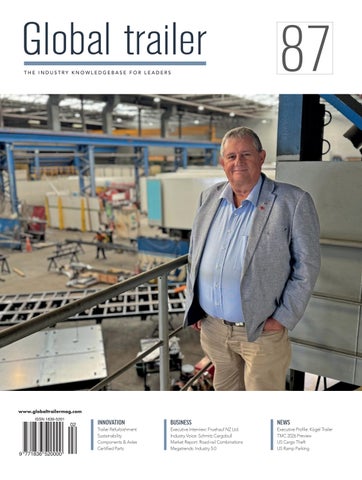
From its origins in a 19th-century American blacksmith’s forge to its position today as New Zealand’s largest trailer manufacturer, Fruehauf’s story is intertwined with the evolution of ‘Kiwi’ road transport — a narrative shaped by distance, determination and a relentless drive to improve.
“WE’VE PROUDLY RE-ESTABLISHED FRUEHAUF AS A LEADER IN INNOVATIVE ROAD TRANSPORT EQUIPMENT, REPAIRS AND MAINTENANCE. OUR FOCUS HAS BEEN ON PRACTICAL INNOVATION, STRONG TEAMWORK AND QUALITY ENGINEERING.”

Global Trailer speals with Kögel Trailer’s new CEO to nd out his direction for the
Read how BPW is partnering with TIP Group to take on the
Read how the Italian composites specialist, Brianza Plastica is creating re-proof solutions.
Read about a growing scourge for authorities and transport operators happening on the US highways.
Take a look at what to expect at TMC 2026, to be held this month in Nashville, Tennessee.
Get a snapshot of transportation news from around the globe.


e trailer industry — long admired for its practicality and engineering grit — is fast
AI is no longer a buzzword reserved for tech a cionados, it is rmly embedded in the global trailer sector and is analysing braking performance, forecasting maintenance intervals and optimising routing decisions in real time. Telematics systems are feeding operators a constant stream of data about tyre pressure, load distribution, refrigeration temperatures and driver behaviour. For eet managers juggling tight margins and tightening regulations, that data is gold.
e modern trailer is becoming a rolling data platform. From tyre monitoring systems and brake diagnostics to predictive maintenance analytics and real-time cargo tracking, the humble semi-trailer is now an intelligent asset. For eet operators facing tight margins, regulatory pressure and labour shortages, these advances are valuable lifelines.
While AI-related changes are the talk of the industry, there is already a new topic in the winds, that of Industry 5.0.
Where Industry 4.0 emphasised automation, connectivity and digital integration, Industry 5.0 adds something deeper: human-centricity, resilience and sustainability. It recognises that technology must serve people, not replace them.
In all this technological surge, there is an understandable tension.
e trailer industry has always been
grounded in old-school values: reliability, cra smanship, mechanical know-how and the hard-earned wisdom of owner-operators.
ere is a legitimate concern that technology may distance operators from the hands-on understanding that has de ned the sector for generations. e reality is that the shi is happening regardless of any scepticism. AI-driven eet management systems are helping operators reduce downtime and fuel consumption. Data-enabled trailers are assets for transporters seeking visibility and sustainability metrics, while autonomous technologies enhance safety and e ciency. Technology is not replacing the fundamentals of transport — it is amplifying them.
e most successful operators are not abandoning old-school principles. ey are blending them with new tools and investing in digital dashboards and connected assets. It is fast becoming a case of join them or miss out. Markets are moving. Customers are demanding greater transparency and lower emissions. e trailer of the future will not only carry freight — it will carry information. e trailer industry has never been afraid of hard work or bold decisions. Embracing AI-centred systems is the next step in its evolution.
e tango between tradition and innovation requires a focus on coordination, trust and a willingness to move with the rhythm.
CHAIRMAN
John Murphy john.murphy@primecreative.com.au
CEO
Christine Clancy christine.clancy@primecreative.com.au
INTERNATIONAL SALES
Ashley Blachford ashley.blachford@primecreative.com.au
MANAGING EDITOR
Luke Applebee
luke.applebee@primecreative.com.au
EDITOR
Paul Lancaster paul.lancaster@primecreative.com.au
HEAD OF DESIGN
Blake Storey
DESIGN
Laura Drinkwater
CLIENT SUCCESS MANAGER
Maria Afendoulides maria.afendoulides@primecreative.com.au
COVER Image: Fruehauf NZ
HEAD OFFICE
Prime Creative Pty Ltd
379 Docklands Drive
Docklands VIC 3008 Australia
+61 3 9690 8766 info@primecreative.com.au www.globaltrailermag.com
SUBSCRIPTIONS
+61 3 9690 8766 subscriptions@primecreative.com.au
Global Trailer is available by subscription from the publisher. e rights of refusal are reserved by the publisher.
All articles submitted for publication become the property of the publisher. e Editor reserves the right to adjust any article to conform with the magazine format.
Global Trailer is owned by Prime Creative Media and published by John Murphy. All material in Global Trailer is copyright and no part may be reproduced or copied in any form or by any means (graphic, electronic or mechanical including information and retrieval systems) without written permission of the publisher. e Editor welcomes contributions but reserves the right to accept or reject any material. While every e ort has been made to ensure the accuracy of information, Prime Creative Media will not accept responsibility for errors or omissions or for any consequences arising from reliance on information published. e opinions expressed in Global Trailer are not necessarily the opinions of, or endorsed by the publisher unless otherwise stated.
FOLLOW US Global Trailer Magazine


The African Development Bank Group has approved a $159.5 million USD loan to the Democratic Republic of Congo to expand freight links serving the Ngandajika AgroIndustrial Park.
This move is expected to significantly cut logistics costs and strengthen regional trade corridors.
Part of a $177.16 million USD co-financed program with the Congolese government, the investment will upgrade the Nkuadi–Ngandajika–PAIN and Lukalaba–Ngandajika roads and improve connections between National Roads 1 and 2. The project includes extending the Mbuji-Mayi
airport runway to support growing agroindustrial airfreight volumes.
Bank officials said the works will enhance the park’s integration into DRC’s central economic corridors, improving market access for farmers, transport operators and processing industries across Lomami province and neighbouring regions.
“This project is a major milestone for Central Africa’s economic integration and for advancing agricultural industrialisation in the DRC,” said Léandre Bassolé, the Bank’s Director General for Central Africa.
“We are strengthening a critical value chain, opening new trade corridors,
and creating powerful opportunities for competitiveness, jobs and economic inclusion.”
The initiative aligns with the Bank Group’s Agricultural Transformation Programme and supports the development of the Ngandajika Special Agro-Industrial Processing Zone. It also contributes to AfCFTA objectives by boosting cross-regional connectivity. According to project task manager Johnny Makwela, the improved road links and upgraded air access will significantly reduce logistics costs and accelerate the integration of producers into agroindustrial value chains.

The African Development Bank Group has approved a $159.5 million USD loan to the DRC. Image: Vadim Nefedov/stock. adobe.com.


A state of the art, upgraded and fully integrated global manufacturing centre of trailer systems and On/Off highway systems. Expertly designed and engineered with worldwide accessibility, offering you private label and OEM manufacturing solutions.
Drawing upon decades ofexpertisespanning Asia, Australia US, and in Europe,Fuwastandsasa globalmanufacturing powerhouse, unrivalled astheforemostnetwork ofspecialists intruckand trailer componentsacross the globe.


Kuehne+Nagel is supporting bicycle and wheelchair tyre manufacturer, Schwalbe’s major expansion in Vietnam.
The expanded role comes as the companies celebrate 10 years of a fruitful partnership and will see Schwalbe’s export distribution centre will grow to nearly 20,000 square metres total capacity, strengthening its ability to meet rising global demand for bicycle tyres. The expansion will create new employment opportunities for local talent and reinforce Vietnam’s role as a key hub for Schwalbe’s global operations, promoting long-term sustainable growth in the region.
From this location, Schwalbe products are distributed to 43 international markets, supporting customers across Europe, Asia, the Americas and Africa.
Kuehne+Nagel Vietnam Managing Director, Bjoern Traemann, said: “We value our strong relationship with Schwalbe and look forward to the continued partnership.
“This expansion demonstrates how collaboration drives innovation and enables us to meet global customer demands sustainably. I would like to thank the teams from both companies for making this partnership possible.”
Schwalbe’s Head of Supply Chain Management, Vanessa Schulte, said:
“We are proud to celebrate 10 years of partnership with Kuehne+Nagel.
“Their expertise and commitment to sustainability have been vital to our success. Looking ahead, we are confident in achieving our goals with the continued excellence of our partnership.”
Federal Express Corporation (FedEx) has appointed Salil Chari as President of its Asia Pacific (APAC) region, effective from 1 January 2026.
Chari steps into the role after serving as Senior Vice President of Marketing and Customer Experience for FedEx APAC. He succeeds Kawal Preet, who has moved into the role of executive vice president, Planning, Engineering and Transformation.

leadership experience and a passion for delivering value to customers,” said Smith.
“With his deep understanding of the region, I am confident he will lead our APAC business to new heights and reinforce the region’s importance to our global growth.”
As regional President, Chari will oversee the strategic direction of the business across APAC, leading a workforce of nearly 30,000 team members. His remit includes driving profitable growth, strengthening customer experience and advancing operational excellence across one of FedEx’s most critical global regions.
Richard W. Smith, Chief Operating Officer –International and CEO Airline at FedEx, said Chari’s appointment reflects the company’s focus on strong regional leadership.
“Salil brings exceptional multi-regional


Chari’s career with FedEx spans almost three decades, beginning in 1997 as a Marketing Analyst in Memphis, US. He has since held senior leadership roles across Latin America and the Caribbean, Asia Pacific and the Middle East, the Indian Subcontinent and Africa, building a reputation for customer-focused growth and market development.
Commenting on his appointment, Chari said Asia Pacific’s position at the heart of global trade presents significant opportunities for FedEx and its customers.
“My priority is to strengthen resilience, accelerate growth and deepen the role FedEx plays as a valued partner for our customers and communities,” he said.
“With the commitment of our team members across the region, we will continue to connect businesses with new possibilities and enable global trade in an evolving marketplace.”
The leadership transition comes as FedEx continues to invest in its international network, with APAC remaining a key growth engine for global logistics, freight movement and supply chain connectivity.


Japan-based fleet, Kameman Transport, is ramping up its use of trailers across its nationwide network amid labour shortages.
Based in Yatsushiro City, Kumamoto Prefecture, the company operates throughout Kyushu and across Japan, moving everything from paper and pulp to fresh produce, frozen foods, grain and feed.
Kameman Transport CEO, Yasukata Tomita, said Trex trailers have been central to the company’s strategy, praising the durability of the equipment, spare parts availability and responsive service support.
The fleet maintains its own workshop and relies on Trex’s quick supply of components to minimise downtime.
Kameman’s shift toward trailer-led relay transport began when the company opened
a Tokyo office and reassessed driver workloads.
Rather than multi-day return trips between Kyushu and Tokyo, the operator embraced a model where drivers focus solely on driving while loading and unloading are separated via truck–trailer swaps.
The move required negotiations with shippers and ferry operators, especially as transit times extended from three days to four or five on ferry-supported routes. Kameman offset this by doubling cargo loads without doubling freight charges, gaining support from shippers for nonperishable goods.
As trailer volumes grew, the company added new and second-hand equipment to support increasing demand and overcome early challenges such as return-load shortages.
According to Tomita, the efficiency gains now allow a single driver to complete up to three round trips under the relay system. To combat labour shortages, Kameman has focused on trailer utilisation rather than longer driver hours, embedding modal shift practices, flexible working hours and driver qualification support. The company has eliminated mandatory morning assemblies, encourages reduced office time and provides financial support for staff to obtain heavy-vehicle and trailer licences.
Tomita said he hopes for continued improvements in Trex’s parts flexibility and is already considering commissioning new-specification trailers as the business continues its expansion of trailer-based logistics across Japan.


For another year, marking 28 consecutive years, Lecitrailer has once again positioned itself as the leader of the Spanish trailer and semi-trailer market.
In doing so, the company is reaffirming the commercial vehicle industry’s confidence in its brand, while it consolidates its track record based on innovation, product quality, and customer focus.
According to official registration data for 2025 provided by Asfares, the Spanish Association of Manufacturers of Trailers, Semi-trailers, Tankers, and Similar Vehicles, Lecitrailer closed the year with 4,041 registered units, representing an 8.57 per cent increase compared to the previous year, while also achieving a market share of 23.07 per cent.
Strong leadership in a competitive market Lecitrailer said the 2025 results reflect the company’s strength in a highly competitive and constantly evolving environment, while its leadership is centred on customer confidence in Lecitrailer’s broad product range, coupled with its ability to meet the needs of transport, logistics, and industry operators.
The results have shown that Lecitrailer continues to attain significant market

share, reinforcing its position as a leading manufacturer in the following segments:
• CurtainsideTrailers: 1,466 units registered, with a 32.50 per cent market share.
• Refrigerated Trailers: 1,071 units, reaching a 22.20per cent market share.
• Vans: 365 units, with an 18.43per cent market share.
• Container Chassis: 319 units representing 30.56 per cent of the market.
• Dollies: 208 units registered, achieving a 64per cent market share.
• The Dollies figure reinforces Lecitrailer’s market leadership in creating solutions for duo-trailer combinations.
Growth in international markets
In addition to its solid leadership in the domestic market, Lecitrailer continues to strengthen its position in key European markets, reaffirming its international reach.
In France, the company closed 2025 with 1,497 registered units, maintaining its position as the third largest brand in the market, with a 9.04 per cent market share. These results confirm the strength of the company’s position in one of Europe’s most competitive markets, reinforced by its

sales and after-sales service structure in France, Lecitrailer said.
In Portugal, Lecitrailer consolidated its presence in that growing market, again secured second place in the rankings with a 10.17 per cent market share.
Other markets also reflect Lecitrailer’s growth, with positive results in Italy, Morocco, the UK, Belgium, the Netherlands, Denmark, and Norway, reinforcing its international presence and confirming its role as a leading European manufacturer.
Long-term vision
Lecitrailer proudly stated that the growth recorded in 2025 is not isolated, but rather the reflection of a sustained industrial and commercial strategy that has allowed it to maintain its market leadership for almost three consecutive decades.
The company said it continues to focus on continual reinvestment, continuous improvement of production processes, and the development of advanced technical solutions, that are aligned with new demands of commercial transport operators in terms of efficiency, sustainability, and safety.
Track record built on customer trust
Achieving 28 consecutive years as the leader in the Spanish market is a direct result of the trust of thousands of customers, the company said.
This is in conjunction with the daily commitment of the entire Lecitrailer team and close collaboration with suppliers and strategic partners, the trailer OEM said.
“This new milestone reinforces Lecitrailer’s position as a leading manufacturer in the trailer and semi-trailer sector, and sets the course for continuing to solidly face the future challenges of transport and logistics,” the OEM said.
International logistics provider, Wallenborn, has expanded its trailer fleet after signing an agreement with TIP Group for the delivery of 25 new Krone units. The latest deal strengthens the longstanding partnership between TIP and Wallenborn and includes 18 refrigerated trailers and seven curtainsiders. The agreement builds on an established collaboration that spans both leasing and workshop services.
The additional capacity will support Wallenborn’s continued growth, particularly in air cargo trucking, where demand is rising. The new units


are expected to enhance operational efficiency and reliability in a sector that requires high levels of precision and quality.
The partnership between TIP and Wallenborn has developed steadily in recent years, underpinned by mutual trust and a shared approach to delivering futureready transport solutions.
“TIP has shown that they understand our business and the requirements of our customers,” said Wallenborn Managing Director, Peter Nygaard.
“Their flexibility and ability to deliver across both leasing and workshop is one of the main reasons why we continue and

expand our collaboration.”
TIP Group also welcomed the expanded agreement.
“We greatly appreciate the trust Wallenborn has shown us, and we are pleased to be able to support their growth both now and in the future,” said Morten Hakmann, Commercial Director at TIP Group.


For the fourth year in a row, Wabash has been listed on Newsweek’s America’s Most Responsible Companies list - now for 2026.
The Newsweek list showcases 600 companies that Newsweek Editor-in-Chief, Jennifer H. Cunningham, said “are taking action each day to uphold their social responsibility”.
“For businesses, committing to sustainability initiatives, helping those in the community or offering robust benefits to workers isn’t only an ethical choice: When consumers and investors know that a company is socially conscious, they are more likely to align themselves with it,” said Cunningham.
Newsweek has produced the list of America’s Most Responsible Companies 2026, partnering with Statista for the seventh time to create the expansive list.
Wabash said it was deeply honoured to be recognised for its sustainability practices.
“Our commitment to responsible practices continues to guide how we innovate and support the industries we serve,” the company said on LinkedIn.
“This recognition reflects the work of our teams across the business and the progress we continue to make in safety, community engagement, and environmental stewardship.
“We remain focused on building solutions that create long-term value for our customers and the communities we operate in.”
The Indiana-based OEM ranked at number 518 in the overall list, and in 61st place in its Industry ranking (Capital Goods), with an overall score of 66.06. Its Environmental Concerns score was 72.03.
The Newsweek Editor-in-Chief noted that, according to a study by The Roundup, 84 percent of customers are deterred from companies with poor environmental practices, and 62 percent “always or often” specifically look for products that are sustainable.

The ranking system is built on an evaluation of companies’ CSR/ESG or sustainability reports, financial reports, history of lawsuits, and 2024 top polluter indexes from the Political Economy Research Institute, Cunningham said.
Additionally, over 30 KPIs were researched from the three areas of ESG—environmental, social and governance performance.
Companies in the 2026 ranking include Apple, American Tower, Ingersoll Rand, Las Vegas Sands, NVIDIA and Tapestry.
The top ranked company, NVIDIA, had an overall score of 92.82 and a perfect Environmental Concerns score of 100.
Industry leading side dump trailer manufacturer, SmithCo Mfg., Inc. has been awarded a nationwide cooperative purchasing contract for Public Works Equipment by the Houston-Galveston Area Council (H-GAC) Cooperative Purchasing Program (HGACBuy).
This contract award, secured through a rigorous competitive solicitation process, allows local governments, district, counties
and state agencies across the nation to purchase SmithCo Side Dump Trailers at pre-negotiated, favourable terms.
“This partnership with HGACBuy should streamline the procurement process for government agencies,” said SmithCo Director of Sales & Marketing, Todd Karolczak. “This contract eliminates the need for agencies to duplicate the competitive bidding process, allowing for easier access to the most popular SmithCo trailers.”
H-GAC has served local governments for over 40 years. The HGAC Buy program allows the collaboration with local governments to provide the best value in goods and services through cooperative purchasing.
It currently serves 49 states and over 9,800 members, which include local governments and non-profit organisations. SmithCo Mfg., Inc., located in Le Mars, Iowa, has been manufacturing high-quality, custom-built side dump trailers for more than 31 years.
Its side dump trailers currently serve a wide variety of markets, including construction, agriculture, mining, government, waste handling and environmental.
UK battery and solar-powered transport refrigeration manufacturer, Sunswap, has expanded into the Latin American market via a distribution partnership with Chilean operator Trailer Logistics.
Trailer Logistics provides distribution, service and support solutions across Chile.
As Sunswap’s exclusive Chilean distributor, it will deliver technical expertise and aftermarket support for electric refrigeration technology and will be the contact point in Chile for Sunswap’s electric transport refrigeration unit, Endurance.
Sunswap sees Chile’s solar intensity as creating optimal conditions for the

Ltechnology. Analysis shows solar panels can contribute up to 80 per cent of energy needs in Chilean operations, it said.
Trailer Logistics brings local expertise and service infrastructure and provides technical support and aftermarket services across Chile.
Endurance is creating massive operating cost reductions compared to diesel units.
“Chilean operators get the same reliability we’ve proven in Europe, with fantastic economics due to solar performance,”said Sunswap CEO, Michael Lowe.
“Trailer Logistics gives us the local expertise and service infrastructure essential for success in the Chilean market.”
Trailer Logistics Owner and Managing Director, Hernan Searle Ferrari, said: “We’re bringing proven technology to a market that demands both environmental performance and operational reliability.
“Chilean operators are sophisticated buyers who need solutions that work economically, not just environmentally.”
He added that: “Operators across Chile can now access this technology with the support infrastructure needed for maximum uptime and confidence.”
Trials of Sunswap Endurance are underway in Chile with customer announcements expected in the near future.

https://low-voc-fiberglass-laminates.com/home-en/


FROM ITS ORIGINS IN A 19TH-CENTURY AMERICAN BLACKSMITH’S FORGE TO ITS POSITION TODAY AS NEW ZEALAND’S LARGEST TRAILER MANUFACTURER, FRUEHAUF’S STORY IS INTERTWINED WITH THE EVOLUTION OF ‘KIWI’ ROAD TRANSPORT — A NARRATIVE SHAPED BY DISTANCE, DETERMINATION AND A RELENTLESS DRIVE TO IMPROVE.


When August Fruehauf built what is widely regarded as the world’s rst semi-trailer in Detroit in 1914, he solved a practical problem for a local sawmiller who needed to move lumber e ciently. at invention did more than move timber — it transformed freight. e articulated combination unlocked new levels of productivity and exibility, laying the foundation for the global road transport industry.
More than a century later, the Fruehauf name remains embedded in trailer manufacturing history. In New Zealand, it has taken on a distinctly local character, evolving from a licensed brand into a fully integrated, locally owned manufacturing powerhouse under the leadership of CEO Je Mear.
Today, Fruehauf New Zealand employs around 165 people across four sites and operates through four complementary brands: Fruehauf, Adams & Currie, Gecko Fibreglass Repairs and Schmitz Cargobull. But to understand its current position, it is essential to look at the broader history of trailer manufacturing and road freight in New Zealand.
For much of the early 20th century, freight in New Zealand was dominated by coastal shipping and rail. e country’s rugged geography — mountainous terrain, isolated farming regions and scattered settlements — made transport logistically complex. Roads were o en rudimentary, and early trucks struggled with the country’s gradients and weather extremes.
However, following World War II, New Zealand underwent rapid economic and infrastructural development. Agricultural production expanded, forestry operations intensi ed and domestic manufacturing grew. ese industries required dependable transport links between rural production areas and ports.
e rise of road freight in the 1950s and 1960s marked a pivotal shi . Improvements in highway infrastructure and vehicle technology allowed trucks and trailers to take on a larger share of the freight task. Local engineering rms stepped into the breach, designing and building trailers tailored to New Zealand’s unique demands — heavy livestock loads, bulk milk collection, timber cartage and later, containerised freight. It was during this period that the Domett family in Feilding built a reputation for quality trailer manufacturing. Having begun operations in the 1940s, the Dometts understood the importance of durability and adaptability in a small but demanding market.
In 1969, Fruehauf entered New Zealand through a licensing agreement with the Domett family. e partnership blended Fruehauf’s international engineering heritage with local manufacturing expertise. It also introduced globally recognised trailer designs to Kiwi operators.
One of the most enduring examples is the alloy ribbed bathtub trailer — an innovation that remains in production today. Its longevity re ects both the robustness of the original concept and the adaptability of local engineering re nement.
e 1980s brought sweeping economic reforms to New Zealand. Deregulation reshaped multiple sectors, including transport. Road freight competition intensi ed as regulatory protections were li ed, and e ciency became paramount.
Trailer manufacturers faced growing pressure to reduce tare weights, increase payload capacity and meet evolving compliance requirements. Operators demanded equipment that could maximise productivity while maintaining safety and durability.
Je Mear entered the industry during this transformative era. With more than 34 years of experience in road transport, including his early role as Sales and Marketing Manager at Roadmaster, Mear developed a practical understanding of the commercial realities eet operators face.

“MY APPROACH TO BUSINESS HAS ALWAYS BEEN GROUNDED IN UNDERSTANDING CUSTOMER REQUIREMENTS. WHEN A TRAILER GOES OFF THE ROAD UNEXPECTEDLY OR DOESN’T PERFORM AS EXPECTED, THE FINANCIAL IMPACT IS IMMEDIATE. WE DESIGN WITH THAT IN MIND.”
FRUEHAUF NZ CEO, JEFF MEAR.
“My approach to business has always been grounded in understanding customer requirements,” Mear said. “When a trailer goes o the road unexpectedly or doesn’t perform as expected, the nancial impact is immediate. We design with that in mind.”
His connection to trailer building runs deeper still. His father, Pat Mear, was a respected trailer builder, embedding a strong sense of cra smanship and accountability from an early age.
“You grow up understanding that what you build has real-world consequences,” Mear noted. “Safety and reliability aren’t optional extras.”
In August 2009, during the lingering a ershocks of the global nancial crisis, Mear purchased Fruehauf NZ Limited. It was a decisive move at a challenging time for global manufacturing. In 2022, he became sole owner, reinforcing his long-term commitment to the brand.
Under his leadership, Fruehauf has expanded its operational footprint and diversi ed its o ering. Today, the Auckland site serves as head o ce and a major operational hub, handling refrigerated trailer builds, truck assemblies and a ermarket support. e site in the small town of Feilding, about 20 kilometres north of Palmerston
North, remains central to core manufacturing, while the 2024 acquisition of Christchurch-based Adams & Currie strengthened the company’s South Island capability.
Gecko Fibreglass Repairs based in Auckland, is the fourth site under the Fruehauf banner and specializes in breglass repairs, further broadening the group’s specialist service o ering in automotive repairs.
As the largest trailer manufacturer in New Zealand, Mear said that Fruehauf NZ Limited proudly helps the local industris as it operates the four nationwide sites related to Fruehauf, Adams & Currie, Gecko Fibreglass Repairs, and Schmitz Cargobull.
“We’ve proudly re-established Fruehauf as a leader in innovative road transport equipment, repairs and maintenance,” Mear said. “Our focus has been on practical innovation, strong teamwork and quality engineering.”
e primary focus of Fruehauf NZ’s trailers services a diverse customer base throughout the north and south islands of New Zealand, supplying high-quality trailers and transport solutions to operators across a wide range of industries.
Mear is keen to note that all products are designed and built to suit New Zealand operating conditions while meeting international standards for quality, performance, and reliability.
e company is also bene tting from New Zealand’s growing freight task demands, driven
by agriculture, construction and expanding distribution networks linked to e-commerce.
Ports in Auckland, Tauranga, Wellington and Christchurch underpin containerised trade, increasing demand for reliable skeletal and specialised trailers.
e burgeoning team under Mear’s direction is in tune with these variant industry demands, knowing which trailer model and modi cation will suit each purpose; each customer. A truly bespoke service.
“New Zealand operators demand a lot from their equipment,” Mear said. “Our trailers have to handle long distances, steep grades and diverse load pro les. Durability is critical.”
Since its nascent days, Fruehauf NZ Ltd has operated on a strong philosophy built around seven core values that guide every aspect of the business — Innovation, Teamwork, Safety, Results-Driven Performance, Environmental Responsibility and Sustainability, Customer Focus, and Professionalism.
“Together, they shape how we design, build, service, and support our products,” said Je Mear.
“ is philosophy ensures we continuously innovate, work collaboratively, prioritise safety, deliver measurable results, operate responsibly, remain focused on our customers’ needs, and uphold the highest professional standards.
“It is this commitment to our core values that underpins Fruehauf NZ Limited’s reputation for quality, reliability, and leadership within the road transport industry.”
Modern trailer manufacturing is increasingly sophisticated. Steel fabrication remains fundamental, but digital systems, lean production methodologies and data-driven workflow management now underpin e ciency gains.
Over the past ve years, Fruehauf has achieved a 58 per cent increase in manufacturing e ciency — a signi cant milestone in a sector where margins can be tight.
“ at improvement has come from re ning our processes, investing in leadership capability and ensuring our teams are aligned,” Mear explained. “Innovation isn’t just about new products — it’s about how you operate.”
Product innovation remains central. Developments in walking oor technology, for fast loading and unloading, and specialised poultry transport solutions have improved loading e ciency and biosecurity outcomes.
Meanwhile, the company’s collaboration with Germany-headquartered international trailer OEM, Schmitz Cargobull, has introduced advanced refrigerated trailer technology, including electric solutions aimed at reducing emissions.
“Customers are increasingly looking for cleaner and more e cient solutions,” Mear said. “Sustainability is no longer a future concept — it’s happening now.”
Perhaps the most visible expression of Fruehauf’s forward strategy is its recent investment in a new 7,500 square metre purpose-built manufacturing facility in Palmerston North, due to open in 2027.
is signi cant investment, which saw ground being broken in November 2025, has been made to support the company’s continued growth and to meet the future demands of New Zealand’s road transport industry.
At the time of the announcement of the move to Palmerston North region, Mear said: “A er 55 years on our current site, it was clear we had outgrown the facility. It was no longer viable to keep pace with industry demand.”
“We’ve outgrown our existing site,” Mear added. “To meet increasing demand and

“I WANT FRUEHAUF TO BE RECOGNISED AS THE CUSTOMER-FOCUSED BRAND THAT DELIVERS REAL SOLUTIONS. WE’RE FOCUSED ON INVESTING IN OUR PEOPLE, EXPANDING OUR CAPABILITIES AND DELIVERING GREATER VALUE TO CUSTOMERS ACROSS NEW ZEALAND.” FRUEHAUF NZ CEO, JEFF MEAR.
Sustainability has also been embedded into the facility’s design, with solar installations planned to o set energy use in paint operations and supplier waste reduction initiatives incorporated into procurement strategies.
“ is investment reinforces our commitment to New Zealand manufacturing,” Mear said. “It strengthens domestic capability and positions us for long-term growth.
“We are incredibly excited to see this project underway and look forward to the opportunities it will create for our people, our customers, and the wider transport industry.”
e trailer market in New Zealand is robust and diverse, underpinned by strong demand across the logistics, agriculture, construction, and recreational sectors. e market is supported by a mix of locally manufactured and imported units, with customers typically seeking strong, durable, and o en custom-built trailer solutions suited to New Zealand operating conditions.
ere is a clear preference for high-quality, New Zealand-manufactured trailers, particularly in the commercial transport sector, where reliability, longevity, and a ersales support are critical. Auckland, Wellington, and Christchurch serve as the primary industry hubs, driven by their port infrastructure, distribution networks, and surrounding agricultural activity.
Market growth continues to be fuelled by increasing logistics and construction activity, ongoing strength in the agricultural sector, and the rapid expansion of e-commerce. Together, these factors are driving sustained demand for commercial transport equipment, including semi-trailers, as operators seek e cient and reliable solutions to support growing freight volumes.
With a surfeit of industry experience and seeing the local market gradually nd its feet, Je Mear is well aware that the New Zealand trailer market presents both signi cant challenges and strong long-term opportunities.
Key challenges include an ongoing shortage of skilled drivers, deteriorating road infrastructure, and the current economic downturn.
New Zealand’s trailer sector operates in a highly competitive environment, balancing locally manufactured products with imported alternatives. Broader economic pressures — including in ation, exchange-rate volatility and interest rates — continue to in uence purchasing decisions.
Like many advanced manufacturing industries, the sector faces ongoing skilled-labour challenges, driven by global competition for talent and o shore opportunities, particularly in Australia. Road infrastructure limitations and evolving compliance requirements add further layers of complexity to the operating environment.

Fruehauf addresses these challenges through a strong focus on teamwork, resilience, and continuous improvement across the business. By working closely across departments and in partnership with customers and suppliers, the company remains agile and responsive in a changing and o en challenging operating environment.
“We operate in a challenging environment,” Mear acknowledged. “But resilience is part of this industry’s DNA.”
He believes that maintaining close relationships with customers is essential. A ermarket support, responsive service and lifecycle partnerships are increasingly di erentiating factors.
“Reducing downtime is critical for our customers,” he said. “ at’s why expanding our service capability is a priority.”
At the same time, environmental sustainability represents a major opportunity for the industry. Customers are increasingly seeking cleaner, more e cient transport solutions, and Fruehauf is leading this shi with the introduction of the Schmitz Cargobull fully electric refrigerated trailer—the rst of its kind in the New Zealand market.
Adoption of this model has been particularly strong in the South Island, re ecting growing demand for sustainable transport solutions.
Mear said digitisation is also emerging as a key opportunity, driven by the increasing need for transparency, data visibility, and connectivity across eets, customers, and suppliers.
As a key participant in New Zealand’s transport sector, Fruehauf sees it as both an opportunity and a responsibility to contribute to a cleaner, more sustainable future, while continuing to deliver exceptional quality, performance, and long-term customer value.
Fruehauf’s leadership continuity adds another dimension to its story. Mear’s son Josh serves as Schmitz Cargobull Product Manager, while daughter Brittany oversees Operational Systems and Brand Communications.
“ at continuity gives us perspective,” Mear said. “We’re building something that will last beyond any one generation.”
Workforce development remains central to that ambition. Apprenticeships, structured training and leadership development programmes aim to build internal capability for the long term.
“THIS PHILOSOPHY ENSURES WE CONTINUOUSLY INNOVATE, WORK COLLABORATIVELY, PRIORITISE SAFETY, DELIVER MEASURABLE RESULTS, OPERATE RESPONSIBLY, REMAIN FOCUSED ON OUR CUSTOMERS’ NEEDS, AND UPHOLD THE HIGHEST PROFESSIONAL STANDARDS.”
FRUEHAUF NZ CEO, JEFF MEAR.
At present, Fruehauf NZ’s primary focus remains on the domestic market. Ongoing international shipping costs mean exporting is not currently economically viable. However, the company continues to monitor overseas opportunities and market conditions and would consider international expansion in the future should logistics costs, partnerships, or strategic opportunities align.
In the meantime, Fruehauf remains committed to strengthening its position in New Zealand and delivering value to local customers through innovation, quality, and service.
Over the next ve years, Fruehauf’s priorities include completing the Palmerston North transition, expanding national a ermarket coverage and continuing to invest in sustainability and digital integration.
is transition will support enhanced national a ermarket coverage, with a focus on further integrating and strengthening nationwide servicing capabilities to reduce customer downtime and improve full lifecycle support.
Alongside this, Fruehauf will continue to advance its sustainability and innovation programs, ensuring the business remains at the forefront of modern, e cient, and environmentally responsible transport solutions.
A key priority will also be workforce development, with ongoing investment in skills, leadership, and creating long-term career pathways for employees.
e company is targeting continued revenue growth and diversi cation, with a strong focus on increasing production capacity, growing market share, and exploring complementary product lines and services that reinforce Fruehauf’s position as New Zealand’s leading trailer manufacturer.
“I want Fruehauf to be recognised as the customer-focused brand that delivers real solutions,” Mear said. “We’re focused on investing in our people, expanding our capabilities and delivering greater value to customers across New Zealand.”
From Detroit to Feilding, from post-war livestock carriers to electric refrigerated units, the Fruehauf story mirrors the broader trajectory of the trailer industry — shaped by necessity, strengthened by innovation and sustained by resilience.
In a country, known affectionately as the ‘Shakey Isles’, where transport is still the lifeblood of the economy despite buoyant agriculture and tourism sectors, that enduring commitment to engineering excellence and customer service, imbued in Jeff Mear from an early age, ensures Fruehauf New Zealand remains firmly on the road ahead.
www.fruehauf.co.nz/


ROAD–RAIL COMBINATIONS ARE NO LONGER A NICHE LOGISTICS SOLUTION BUT A STEADILY EXPANDING FORCE WITHIN THE INTERMODAL FREIGHT SECTOR, RESHAPING HOW GOODS MOVE ACROSS CONTINENTS AND REDEFINING THE BALANCE BETWEEN EFFICIENCY, SUSTAINABILITY AND COMMERCIAL VIABILITY.
Over the past decade, road–rail freight combinations have evolved from policydriven ambition to practical logistics mainstay. Intermodal transport — the seamless movement of cargo using multiple modes without handling the freight itself — has gained traction as supply chains search for resilience, cost control and lower emissions.
e steady growth of road–rail combinations has been particularly visible across Europe and North America, where long-haul trucking pressures, urban congestion and decarbonisation targets have encouraged modal shi . Rather than replacing trucks, rail has increasingly complemented them. e model is straightforward: trucks handle rst- and last-mile delivery, while rail carries freight over long distances more e ciently.
In Europe, combined road-rail transport volumes have risen consistently, supported by regulatory incentives, moves towards decarbonisation and infrastructure investment. Countries such as Germany, Italy and Austria have promoted rail freight corridors, while the European Union’s Green Deal and Fit for 55 targets have further accelerated modal shi ambitions.
North America, meanwhile, has seen robust growth in domestic intermodal volumes, particularly in containerised freight moving between major inland hubs and ports. Class I railroads have expanded intermodal terminals and improved double-stack rail capability, enabling longer and heavier trains to compete with over-the-road transport on cost and reliability.
is growth has not occurred overnight. It has been built on gradual infrastructure
upgrades, digitisation, equipment innovation and changing shipper attitudes.
In Australia, the country’s largest intermodal transport precinct commenced construction in December 2025, at Beveridge, north of Melbourne.
Research across multiple organisations reinforces the narrative of a steady expansion in intermodality.
A recent collaboration between Railinc and North Carolina State University is exploring how advanced data analytics can optimise modal integration.
The collaborative research initiative will investigate how even modest shi s in freight volume from trucks to trains can yield signi cant cost savings, environmental benefits, and infrastructure planning insights.
According to Railinc, improved data visibility and equipment tracking are critical to advancing freight e ciency and reducing dwell times in intermodal networks. Enhanced digital platforms enable better forecasting, real-time tracking and predictive decision-making — all of which reduce friction between road and rail interfaces.
“ e rail industry has made tremendous progress improving freight e ciency over the

years,” said Railinc CEO, Allen West. “This kind of analysis can build on that foundation, informing current trucking shippers of the bene ts of rail.”
“Our early assessments already point to signi cant gains,” said Dr. George List, nationally recognised university professor at NC State. “A two per cent shi from truck to rail could meaningfully increase intermodal rail tonnage and help justify infrastructure investments. We can pinpoint where that shi is feasible and cost-e ective.” is research would support collaborative e orts for emissions reduction and transportation e ciency while advancing the rail industry’s commitment to safety and sustainability, the partner entities said.
Additionally, this study builds on NC State’s recent work analysing the modal demands of supply chain businesses across sectors, which laid the groundwork for a more comprehensive national analysis.
“Rail is o en an overlooked option in freight, yet it can o er advantages in cost, capacity, and sustainability compared to other modes. is research helps identify where rebalancing is not only possible but practical—creating pathways for more resilient supply chains and stronger communities,” said NC State’s Institute for Transportation Research and Education Associate Director, Dr. Daniel J. Findley.
Market intelligence rms have also documented sustained growth in the sector. Allied Market Research has projected strong expansion in the global intermodal freight transportation market, citing cost e ciency, environmental advantages and global trade growth as key drivers. e rm’s analysis points to increased containerisation, rising fuel costs and congestion challenges as structural catalysts for intermodal uptake.
Similarly, Mordor Intelligence has reported that the global intermodal freight transport market is experiencing compound annual growth driven by infrastructure development, digital integration and decarbonisation targets. Europe remains a stronghold for combined transport policy, while Asia-Paci c markets are expanding rapidly as cross-border rail corridors mature.
e data suggests that while annual growth rates may uctuate with economic cycles, the long-term trajectory remains positive. Analysts consistently highlight three reinforcing trends: sustainability
“INTERMODAL TRANSPORT IS BECOMING MORE AND MORE IMPORTANT FOR MANY REASONS. IN ADDITION TO ENVIRONMENTAL ASPECTS, IT ALLOWS FOR COST OPTIMIZATION AND SHORTENING TRANSPORT TIME.”
PRODUCT DEVELOPMENT DIRECTOR, PIOTR AGATA, WIELTON S.A.
mandates, driver shortages and technological integration.
In Europe, regulatory frameworks have explicitly encouraged modal shi to rail to reduce greenhouse gas emissions. Rail freight typically produces signi cantly lower CO2 emissions per tonne-kilometre compared with long-haul trucking. As carbon reporting becomes more stringent, shippers increasingly evaluate transport partners based on environmental performance.
North America’s growth, by contrast, has been more market-driven, but environmental considerations are becoming more in uential. Corporate ESG commitments and fuel price volatility have prompted large retailers and manufacturers to rebalance modal splits.
e advantages of road–rail combinations are well documented.
Environmental performance stands out as a major bene t. Rail transport can reduce carbon emissions substantially on long-haul corridors. With governments tightening emissions standards, intermodal solutions o er a pragmatic pathway toward decarbonisation without sacri cing reach.
Cost e ciency is another driver. Rail’s economies of scale make it competitive for distances typically exceeding 500 kilometres. Fuel e ciency per tonne and reduced road toll exposure enhance its appeal.
Driver shortages further reinforce the case. With trucking industries in both Europe and North America facing persistent labour gaps, shi ing long-haul segments to rail reduces pressure on limited driver pools.
Congestion relief is also signi cant. Moving freight o highways reduces tra c density and infrastructure wear, an increasingly important factor as governments grapple with road maintenance backlogs.
However, the mode is not without disadvantages.

“SPECIALLY DESIGNED TRAILERS AND SWAP BODIES FOR RAIL USE PROVE THAT THIS SEGMENT IS NOT CONSIDERED A NICHE MARKET, BUT RATHER A MARKET WITH A PROMISING FUTURE.”
KRONE
imbalances and scheduling mismatches can erode e ciency gains. Rail networks, while reliable, can lack the exibility of point-to-point trucking, particularly for time-sensitive freight.
Infrastructure investment is capital-intensive. Intermodal terminals, cranes and specialised rolling stock demand signi cant upfront expenditure. Delays in infrastructure development can constrain growth.
Financial volatility has also a ected some operators. A number of intermodal-focused companies have faced pro tability challenges, particularly during economic downturns when freight volumes so en. Rising interest rates and equipment nancing costs have placed additional pressure on balance sheets.
e case of Frankfurt-based road-rail semi-trailer transporter, Helrom GMBH, stands out. e intermodal operator led for insolvency in July 2025, but in January 2026 completed insolvency proceedings when it was able to secure a new investor, with a purchase agreement said to have been signed. e development is expected to safeguard the company’s continued operations.
Moreover, geopolitical tensions and energy market disruptions can impact rail corridors di erently from road networks, adding complexity to risk management.
e sector’s growth, therefore, re ects a balance between structural advantages and operational realities.
Equipment Innovation
e expansion of road–rail combinations has stimulated innovation among trailer manufacturers and specialised equipment providers.
Schmitz Cargobull has been at the forefront of intermodal-ready trailer design. Its reinforced chassis and craneable trailers are engineered to withstand repeated li ing between rail wagons and road tractors. By integrating telematics and predictive maintenance systems, the company has positioned itself as a key enabler of e cient modal transfer.

e leading trailer OEM sees the e ciency of road-rail-combination transport in e ciency across long distances, having successfully completed a trial operation with Spanish trailer builder, Lecitrailer, under the banner of its EcoDuo system.
It said rail is particularly well suited for less timecritical long-haul transport on de ned, repetitive routes, but it is not universally applicable.
“It is therefore not the sole future, but an essential part of it. As a trailer manufacturer we see and ful ll customer demand for equipment that enables seamless intermodal transport without compromising payload, safety or uptime,” Schmitz Cargobull said.
Robust, safe, and easy-to-handle transport units are crucial for fast switching between road, rail, and sea, with Schmitz Cargobull o ering a speci c product o er for combined transport.
e EcoDuo is a 31.7-metre-long combination of two standard semi-trailers connected by a dolly and pulled by a tractor unit. It uses standard, rail-compatible semi-trailers that are ready for immediate use without additional investment.
e vehicle combination distributes the weight across ten axles and can transport up to 72 tonnes in Spain and up to 76 tonnes in Scandinavia – the pilot test in Germany – successfully completed in October 2025 - was carried out with 44 tonnes.
e EcoDuo, which reduced CO2 emissions by up to 30 per cent, also proved to reduce road wear and tear, counteracting the international shortage of quali ed drivers.
rough the use of standard trailers, the EcoDuo concept is easy to apply in combined transport.

Schmitz Cargobull’s S.KO COOL semi-trailer can be equipped with ferry equipment for accompanied and unaccompanied transport. is includes up to four pairs of ferry lashings for securing the trailer on the ferry. A skid plate on the underride guard reduces damage during roll-on/roll-o operation.
For rail transport, the S.KO COOL has cross reinforcements in the insulated floor and, optionally, a spare wheel holder located behind the axle assembly.
Depending on customer requirements and use, di erent envelope pro les are available for all refrigerated semi-trailers.
Schmitz Cargobull said its S.CS UNIVERSAL, S.CS MEGA, S.CS COIL, and S.CS PAPER semitrailers can be equipped for combined transport and are available for di erent envelope pro les. Bolted and galvanised grab rails and Code XLcerti ed body strength o er the best conditions for combined transport.

“ e body is designed as standard for rail speeds of up to 140 km/h and o ers optimum safety for the freight on the rail. In order to equip customers for all variants of wagon technology, all common codi cations for rail-loadable S.CS curtainsiders are available,” it said.
For ferry operation of curtainsiders and dry freight semi-trailers, there are extensive equipment options such as ferry lashings and protective skids for rear underride protection. e Power Curtain body for the curtainsider is a sensible alternative for international use.
Germany-based trailer OEM, KRONE Trailer sees combined transport as an integral part of its product strategy. “Specially designed trailers and swap bodies for rail use prove that this segment is not considered a niche market, but rather a market with a promising future,” said KRONE’s Managing Director Sales & Marketing, Dr. Frank Albers.
“ e combination of road and rail combines two complementary strengths — maximum exibility in pre- and post-carriage by road and high transport capacity and energy e ciency by rail.
“Especially over long distances, rail enables a reduction in fuel consumption and CO2 emissions. At the same time, the necessary ne distribution by truck remains guaranteed. is results in an e cient, scalable and more sustainable overall system for shippers.”
KRONE has similarly invested in swap-body systems and rail-compatible trailers designed for combined transport corridors across Europe. Its Box Liner and Pro Liner ranges are optimised for crane and grab handling, re ecting growing demand for exibility. e company said the road-rail combinations present a new mode of transporting their products. Weekly, a freight train with KRONE trailers, hat its customers have ordered but will not collect themselves, departs from Werlte, Germany heading south.
KRONE said this mode avoids empty runs for trailer collection only, saving resources, time and costs.
Dr. Frank Albers observed that combined transport did have demanding organisational speci cations compared to purely road transport. ese include additional trans-shipment processes in terminals, xed rail timetables and the coordination of several players.
He added, the multimodal performance is heavily dependent on infrastructure, terminal capacities, and network availability. “ e vehicles used must also be specially equipped, which requires investment and technical speci cations,” he said.
As a result, time-sensitive goods may not be suitable for combined transport.
“In combined transport, the majority of the route is covered by rail instead of the road network. e advantage lies in greater energy e ciency and better scalability for long distances,” said Dr. Albers.
“At the same time, the exibility of road transport is retained. is allows economic and ecological advantages to be combined.”
Road transport may retain its primary importance for very short distances or timecritical direct transport, but “combined transport via road and rail networks will continue to play a role in overall freight transport in the future”, said Dr. Albers.
Kögel Trailer is an OEM seeing the bene ts of road-trail combination transport.
Image: Kögel Trailer.

“COMBINED TRANSPORT DELIVERS CLEAR ENVIRONMENTAL ADVANTAGES, NOTABLY LOWER CO₂ EMISSIONS, AND REDUCES DEPENDENCY ON LONG-HAUL TRUCKING AMID ONGOING DRIVER SHORTAGES.”
SPOKESPERSON, TIP GROUP
Across the European transport landscape, momentum is building behind a model that blends the exibility of road haulage with the e ciency of rail freight.
TIP Group sees road–rail combination transport as uniting the two complementary modes, whereby road delivers exibility, accessibility and indispensable rst- and last-mile connectivity. Rail, by contrast, provides e ciency over long distances and signi cantly lower carbon intensity.
TIP Group said these strengths create a logistics system that is more sustainable, more resilient and predictable.
“For shippers, this (combination) results in more predictable transit times, reduced exposure to road congestion, and a logistics network that is both resilient and future-proof.”
In practical terms, this means freight can travel the majority of its journey via rail corridors—avoiding congested motorways and reducing emissions—before completing the nal kilometres by road. e approach is increasingly visible across Europe, where industry events and collaborative initiatives are showcasing viable solutions for transporting both standard and non-cranable trailers by rail.
However, rail infrastructure capacity varies widely between regions, and network maturity remains uneven. Standardisation and seamless modal handovers are still works in progress. e message is clear: combined transport is viable, but unlocking its full potential demands coordinated e ort between operators, regulators and equipment manufacturers.
Environmentally, combined transport delivers measurable CO2 reductions, as rail emits signi cantly less carbon per tonne-kilometre than long-haul trucking.
Economically, it can o er improved cost predictability on major corridors and reduced exposure to fuel price volatility. Operationally, it mitigates some of the pressures created by Europe’s persistent driver shortages.
For TIP Group, intermodal capability is no longer peripheral, with combined transport becoming strategically signi cant. e company has been advancing intermodal-ready equipment across Europe, supporting customers who want to accelerate sustainability goals without disrupting operational continuity.
Equipment innovation is central to this shi . e availability of trailers designed for multimodal compatibility—including solutions for non-cranable units—has created new momentum. Regulatory incentives and customer-driven sustainability targets are further accelerating adoption.
TIP a rmed that road–rail combinations are spurring intermodal growth. “ e availability of equipment designed for multimodal compatibility is creating momentum, especially with new ways for non-cranable trailers to be transported by rail,” it said.
Policy frameworks can shape outcomes decisively, such as the European Union’s forthcoming VECTO regulation for trailers.
VECTO presents a structural challenge for cranable (huckepack) trailers, which are inherently heavier due to reinforced structures and crane pockets required for rail handling. At the same time, aerodynamic add-ons—favoured within the VECTO calculation—are o en impractical for rail operations, as they may not t safely on railway wagons and risk damage.
Such an outcome would run counter to Europe’s broader decarbonisation ambitions. A regulatory framework that inadvertently discourages railcompatible equipment could trigger a modal shi back to road, precisely when climate policy seeks the opposite.
For this reason, the European Transport Board is advocating for the exclusion of cranable trailers from VECTO calculations. Ensuring that intermodal equipment is not unfairly penalised is, in trailer OEMs’ view, essential for maintaining momentum towards EU climate targets.
Beyond regulation, the economic case remains strong. OEMs identify several tangible savings associated with road–rail combinations: lower linehaul costs over long stretches, reduced exposure to fuel volatility, lower maintenance costs due to fewer long-distance road kilometres, and greater operational continuity in congested regions.
Combined transport also strengthens European logistics capacity overall, with TIP not framing the
future as a binary choice between road and rail.
“ e future is not ‘rail instead of road,’ but a seamless integration of both,” the company said.
Road remains indispensable for rst- and lastmile operations. Rail enhances e ciency and sustainability across long corridors. Together, they form a balanced and future-ready logistics ecosystem.
“Fleets expect multimodal usage to rise due to regulatory pressure, environmental priorities and driver scarcity,” said TIP.
Rather than replacing road transport, combined operations reinforce the sector’s long-term viability. In a decarbonising economy shaped by environmental regulation and labour constraints, adaptability is paramount. Intermodal transport expands capacity, lowers emissions and strengthens operational resilience.
By embracing multimodal solutions, operators can balance cost, sustainability and reliability— three pillars that will de ne transport success in the decades ahead.
For TIP Group, the direction of travel is clear. Road will remain foundational. Rail will become increasingly central. And the companies that succeed will be those capable of integrating both seamlessly, e ciently and sustainably.
Spanish trailer manufacturer Lecitrailer has developed intermodal skeletal trailers capable of handling a range of container sizes, while also emphasising lightweight construction to maximise payload e ciency. e ability to move seamlessly between maritime ports, rail terminals and distribution centres is central to its value proposition.
Kögel Trailer has long been associated with combined transport solutions, o ering trailers certified for rail loading and engineered for durability under multimodal stress. Its focus on reducing tare weight aligns with broader intermodal e ciency goals.
Polish manufacturer Wielton has also expanded its intermodal product portfolio, particularly in Central and Eastern Europe where rail corridor development has accelerated. By combining cost competitiveness with robust design, Wielton has tapped into growing regional demand.
“Intermodal transport is becoming more and more important for many reasons. In addition to environmental aspects, it allows for cost optimization and shortening transport time,” said Wielton S.A. Product Development Director, Piotr Agata.
“First of all, using one train, it is possible to transport up to several dozen semi-trailers at the same time over long distances without the need for professional drivers. is is particularly important due to the fact that currently in many countries transport companies are struggling with insu cient employees or rising fuel costs.
“It should also be remembered that combined transport does not require the payment of tolls, which in recent years in some European countries have increased by several dozen percent year-on-year.
“ e main challenges of this sector include the limited availability of terminal infrastructure or the need for precise operational coordination between supply chain participants.
“ e key to this sector can continue to develop is investment in the modernisation and expansion of railway networks and transhipment terminals. Its future and e ectiveness depend on it. At Wielton, we support our customers in this aspect and adapt our portfolio of intermodal vehicles to their growing needs. An example of a dedicated product made by us is Curtain Master Mega semi-trailer vin Intermodal variant.”
e Wielton Curtain Master MEGA semi-trailer with an Intermodal system (huckepack type) is a vehicle that allows for the transport of goods with a height of 3 metres, with a total volume of about 100 m3 and will work well in the mixed transport of large-size goods. e low unladen weight of the semi-trailer - from 6300 kg and the possibility of transporting it by rail or ferry signi cantly reduce the cost of its operation. It is a vehicle designed for intermodal transport thanks to the reinforced frame and detachable air suspension, as well as the use of ergonomic solutions such as a folding bumper.
One of the most innovative players in the sector is Cargobeamer, a leading provider of intermodal solutions for transporting semi-trailers by rail, which has developed a horizontal loading system allowing non-craneable trailers to be loaded onto rail wagons. is technology reduces terminal infrastructure requirements and speeds up transfer times. Cargobeamer’s network expansion across Germany, France and Italy demonstrates how technological innovation can lower barriers to entry for road-based operators considering rail integration.
The Road Ahead
Looking forward, the growth trajectory of road–rail combinations appears cautiously optimistic.
Rail’s relative environmental e ciency makes it an attractive lever for policymakers. Future growth will depend on resolving operational bottlenecks. Capacity constraints at key terminals and inconsistent service reliability remain barriers to broader adoption. Coordination between rail operators, trucking rms and terminal managers must continue to improve.
e broader trend is clear: road–rail combinations have transitioned from policy aspiration to commercial reality. Over the past decade, they have steadily built momentum as an integrated solution rather than a competing mode.
e most likely future is not one where rail replaces road, but one where collaboration deepens. Trucks will remain indispensable for rst- and last-mile delivery, while rail will anchor long-haul corridors. e synergy between the two o ers a pragmatic balance between e ciency, sustainability and exibility.
In an era de ned by supply chain volatility, climate urgency and technological transformation, modal integration represents a strategic response rather than a temporary experiment. e steady growth of road–rail combinations suggests that the hybrid backbone of freight is here to stay — and poised for further evolution.


WHEN MARKUS SIEGNER TOOK THE HELM AS CEO OF KÖGEL TRAILER GMBH ON 1 JANUARY 2026, FROM LONG-TIME BOSS CHRISTIAN RENNERS, HE DID SO WITH MORE THAN TWO DECADES OF INTERNATIONAL INDUSTRIAL LEADERSHIP BEHIND HIM— AND A CLEAR SENSE THAT THE EUROPEAN TRAILER MANUFACTURER STOOD AT AN INFLECTION POINT.
Markus Siegner is an a able and people-oriented person, who, as a commercial vehicle industry stalwart, has a steely focus to drive Kögel Trailer at the top of the competitive European market.
In his role, he will also be responsible for Operations, Supply Chain, Development and Logistics. His focus is on increasing customer bene ts through digital and electronic solutions as well as sustainable management and further increasing the company’s productivity.
Siegner’s career, shaped across complex global organisations and transformation programs, now converges with one of Europe’s most established trailer brands at a time of regulatory upheaval, digital acceleration, and sustainability pressure.
“I have gathered more than 25 years of international management experience in di erent industries,” Siegner explained, re ecting on a professional journey that has taken him deep into operations, global production networks, procurement, supply chain strategy and post-merger integration.
Most recently, as COO of AL-KO Vehicle Technology, he oversaw global operations spanning four business units, more than 25 production sites and over 2,000 employees.
“I led a team to implement comprehensive transformation and e ciency programs, including signi cant productivity and material cost reductions, site optimisations and the operational integration of several acquisitions,” he said.
Before that, his tenure at OSRAM saw him occupy senior leadership roles including COO of a global business unit and VP for Manufacturing & Procurement. ere, his focus was unmistakable: international production networks, footprint
optimisation, cost efficiency, and digital transformation.
“We achieved signi cant cost reductions and e ciency gains, established new sites and drove strategic footprint optimisations,” he recalled.
This operational DNA—transformation, productivity and global integration—now informs his approach at Kögel.
Kögel from the Outside
Before joining the company, Siegner already viewed Kögel as a cornerstone of the European trailer sector.
“I knew Kögel as one of the three key players in the European market,” he said. “It is a brand recognised for high-quality products. is familyowned business has proven nancial strength and stability over many years.”
But with stability comes opportunity. “Kögel has a lot of potential to grow and strengthen its performance by understanding the key challenges of modern road transportation and acting as one team to solve these problems for customers,” he noted.
Digitisation is high on his agenda. “Further digitisation of production, operations, products and services is one of the elements I want to work on with my teams.”
e decision to join was ultimately personal as well as strategic. “I was inspired by the people I met during the interview process,” he said, citing discussions with CFO Christian Spengler, CSO ore Bakker and the company’s owners.
The Kögel Trailer philosophy of “Because we Care” is heavily customer-focused.
“KÖGEL IS RECOGNISED AS THE CLEAR NUMBER THREE IN THE MARKET AND, OF COURSE, I WANT KÖGEL TO STAY THERE. THE FOCUS FOR KÖGEL WILL BE TO GROW IN SPECIFIC BUSINESS AREAS SUCH AS AFTERMARKET, REFURBISHMENT AND GROW OUR PARTNERSHIPS WITH TIP. WE ARE EXPLORING OPPORTUNITIES TO EXPAND BEYOND ESTABLISHED EUROPEAN MARKETS.”
CEO OF KÖGEL TRAILER GMBH MARKUS SIEGNER
“I experienced a lot of energy and dedication. ese were key elements for me to join Kögel.”
He said the dynamism and keenness for future growth and opportunities, coupled with its innovative product line including the Kögel Cool Liteshell refrigerated vehicle, that Kögel Trailer will embrace also convinced him it was the company for Seigner to lead. It is those mindsets and attitudes strongly aligned with his own personal philosophies of people-centric business, Seigner said.
Leadership in a VUCA World Siegner describes today’s global environment using a term borrowed from the US military: VUCA—Volatile, Uncertain, Complex and Ambiguous. “ is describes best what to expect,” he said. “ e way to tackle these uncertainties is to stay exible and resilient.” Flexibility, in his view, means the ability to ramp manufacturing capacity and supply chains up or down rapidly. It also means anticipating sustainability pressures that are

“I WAS INSPIRED BY THE PEOPLE I MET DURING THE INTERVIEW PROCESS, ESPECIALLY THE DISCUSSIONS WITH CHRISTIAN SPENGLER (CFO) AND THORE BAKKER (CSO) AND THE OWNERS OF KÖGEL. I EXPERIENCED A LOT OF ENERGY AND DEDICATION. THESE WERE KEY ELEMENTS FOR ME TO JOIN KÖGEL.” CEO OF KÖGEL TRAILER GMBH MARKUS SIEGNER
“Sustainability, CO2 emissions and general environmental protection continue to play an important role, including for our customers. Kögel continues to o er products and services that help our customers to meet this requirement.”
Products such as the Kögel Cool Liteshell refrigerated trailer, refurbishment programs, and new partnerships—including collaboration with rental provider TIP—form part of the company’s response.
He is candid about the headwinds facing the European trailer sector. “We are cautiously optimistic,” he said, “but increasing cost pressure and regulation are delaying investment decisions among customers.”
through lightweight construction, tyre selection and aerodynamics are at odds with ambitious target paths,” he explained.
e extension of EU CO2 targets to trailers has created uncertainty, and cybersecurity regulations add further compliance complexity and cost.
Kögel’s decision to become party to a legal action challenging EU Regulation 2024/1610 re ects that concern.
“ is regulation a ects all European trailer manufacturers,” said Siegner. “As one of the major players in the EU market, we cannot pretend that this does not concern us and leave it to others to take action. We see it as our duty to take responsibility.”
If left unchallenged, he warns, the regulation could trigger “high annual penalties for even the slightest deviation from targets,” leading to higher trailer prices and, ultimately, increased costs for end consumers. “In our opinion, this decree jeopardises the existence of many trailer

Looking ahead 12 to 48 months, Siegner’s target for Kögel is crystal clear: “Kögel is recognised as the clear number three in the market and, of course, I want Kögel to stay there.”
Growth will focus on speci c areas such as a ermarket services, refurbishment, and deeper partnerships with TIP, while also exploring expansion beyond established European markets.
Significantly, the issue of sustainability remains central to the company’s plans.
“It is important to me to create solutions that will help our customers solve their problems and improve their business,” he said.
Legislation may shape R&D, but design innovation and customer bene t must lead, Siegner added.
On digital technologies, Siegner is pragmatic. “Telematics and AI-based technologies could be an element to provide bene ts for our customers,” he acknowledged.
Yet he also draws on experience from the lighting industry, noting the di culty of generating sustainable margins in data-driven services.
“Issues such as data ownership and customers’ reluctance to pay for data services are hard to resolve.” Nevertheless, Kögel will continue exploring opportunities in collaboration with partners.
At the heart of Siegner’s leadership approach is empowerment with accountability. “My leadership style is to lead by objectives and targets,” he explained.
“My team has the freedom to decide how to achieve these. However, I expect a clear roadmap with measurements, milestones, KPIs and ownership.”
His philosophy is captured in a quotation from Antoine de Saint-Exupéry that he calls his motto: “If you want to build a ship, don’t drum up people to collect wood… but rather teach them to long for the endless immensity of the sea”.
For Siegner, leadership is about inspiring that longing—encouraging teams to go the extra mile not because they must, but because they believe in the journey.
He draws energy from collaborating with

Sustainability is at the core of Kögel Trailer’s approach.

those in the organisation and also from mentoring others, particularly those starting out their careers.
One de ning experience from his storied career—a green eld plant project in Bulgaria—reinforced his utmost faith in teamwork. Facing a delayed start of production, his team achieved the goal in near-record time.
“By the time the investment decision had been nalised, it was clear that we were behind the market and late for SOP,” he explained.
“However, thanks to an incredibly strong team and decisive actions, we were able to catch up, achieving mass production in less than a year from the start. is taught me that a strong, highly motivated team can tackle any problem.”
Running a leading European trailer OEM in a highly competitive market, Siegner says he doesn’t typically rely on an inspiration or motivation for his daily approach to the job, preferring to lean into human interactions.
“I don’t have a specific routine for motivation myself. I am generally an optimistic person who gets energy from connecting with and interacting with people,” he said.
“I really enjoy working with young talent and coaching and guiding them in their careers. In doing so, I also gain new perspectives from these young professionals and learn a great deal myself.”
Siegner also brings with him a holistic, well-rounded approach to business that enables him to maintain perspective and balance while leading this global brand.
“Over the years, I have built an extensive international network of highly skilled and professional individuals,” he explained.
“I enjoy exchanging views with them on politics, business and technology. I believe that it is important to hear opinions from outside Germany and Europe. Different cultures offer many different ways of looking at solutions to problems.”
Although it is still early in his tenure, Siegner’s aspirations are already clear. “I want Kögel to be recognised as a customer-focused brand that provides solutions to customers’ problems,” he said.
Internally, his ambition is equally direct: “For the Kögel team, I want us to work as ONE team by supporting each other.”
Both ambitions align with the company’s slogan: “Because we care.”
For Markus Siegner, that phrase is not a marketing line—it is a leadership mandate for the next chapter of Kögel’s journey.
As Europe’s transport and logistics sector faces mounting pressure to cut costs, reduce emissions, and maintain uptime, trailer refurbishment is emerging as a strategic solution rather than a secondary alternative. What was once viewed primarily as a budget-driven choice is now being rede ned as a cornerstone of sustainable eet management—driven by collaboration between industry leaders such as BPW and TIP Group.
Across the continent, eet owners are rethinking how they manage assets that are seven, eight, or even ten years old. Instead of automatically replacing ageing trailers with new equipment, many operators are turning to structured refurbishment programs that extend service life, reduce capital expenditure, and lower carbon emissions.
At the centre of this shi stands TIP Group, one of Europe’s leading full-service equipment solutions providers, working closely with BPW, a global specialist in running gear, braking systems, and intelligent transport solutions.
The Strategic Case for Refurbishment
Refurbishment at TIP is built around what the company describes as an “age reset”. Rather than allowing trailers to depreciate toward obsolescence, the process restores them technically and cosmetically to a condition comparable to new—while avoiding the nancial and environmental burden of replacement.
e economic case is compelling. New trailer prices have risen signi cantly in recent years, driven by material costs, supply chain disruptions, and regulatory complexity. For operators managing hundreds or thousands of units, full eet renewal can require substantial capital outlay. Refurbishment, by contrast, o ers a lower upfront investment while maintaining operational capability.
Beyond cost savings, the sustainability argument has become equally powerful. TIP has calculated that refurbishing a trailer can save up to 3.9 tonnes of CO2 compared to purchasing a newly manufactured equivalent. In an era where ESG reporting, Scope 3 emissions, and corporate sustainability commitments shape procurement decisions, that measurable reduction carries real weight.
TIP Global Maintenance and Development Director, Jan van Vugt, explained the broader context: “Many of our customers are under pressure to keep eets reliable while managing costs more carefully and reducing their carbon footprint. Refurbishment helps address all three.”

“By working closely with leading industry partners like BPW, we can build refurbishment programs on proven components and real data – giving customers a clear, credible business case and equipment they can rely on for the long term. This is where refurbishment really makes a difference,” he added.
TIP has developed two primary refurbishment pathways to meet differing
allows customers to lease refurbished TIP trailers at competitive rates, gaining access to renewed equipment without ownership burdens. The second, Sale & Leaseback, enables companies to sell their existing trailers to TIP, have them refurbished, and then lease them back—freeing capital previously tied up in fleet assets.
This flexibility is critical in a market where liquidity, asset optimisation, and financial prudence are paramount. Sale & Leaseback in particular has gained traction among operators seeking to strengthen balance sheets without compromising operational continuity.
In recent years, TIP has delivered refurbishment projects for major logistics players including DSV, Howdens, and P&O Ferrymasters, demonstrating that refurbishment is not limited to small fleets but has become mainstream

Refurbishment can extend the life of trailers, as well as boost sustainability.

Despite its advantages, refurbishment is not universally appropriate. Each trailer undergoes a cost-bene t analysis before entering the program. Vehicles that have experienced extreme loads, structural damage, or excessive wear may prove too expensive to restore. In such cases, replacement with new equipment may remain the more rational decision. is disciplined evaluation process ensures that refurbishment remains economically viable and technically sound, rather than becoming a compromise solution.
While TIP leads the refurbishment execution across its network of 130-plus European workshops, BPW provides the technical backbone for running gear and braking upgrades. Contrary to the common perception that BPW focuses solely on axles, the company’s portfolio extends much further.
“Our portfolio in the BPW Group includes axles, suspensions, brake systems and intelligent solutions such as tyre pressure re ll systems, telematics, lighting systems and body hardware components,” said BPW Sales Director OES, Trailer Solutions & Mobility Services, Matthias Stoof. is breadth allows refurbishment to become an opportunity for modernisation. Even trailers that were not originally equipped with smart systems can be upgraded during refurbishment to integrate seamlessly into modern eets.
“In principle there is always the possibility of equipping these trailers with new intelligent functions like telematics as well as economic and sustainable products during the refurbishment process,” said Stoof.
Unlike trucks, trailers do not have engines—but they still in uence fuel consumption and emissions signi cantly. Weight, rolling resistance, tyre pressure, and braking e ciency all a ect the tractor unit’s CO2 output.
Lightweight running gear systems, such as BPW’s Airlight II reduce trailer mass, increasing payload while lowering diesel consumption. Automatic tyre pressure systems like BPW AirSave maintain optimal pressure, reducing fuel use and tyre wear. Axle li systems minimise rolling resistance when trailers run partially loaded.
“Every trailer can be modi ed to make them more energy e cient. Using lightweight running gears can reduce gross weight, lowering diesel consumption and increasing payload. Installing an axle li system is very e ective in reducing rolling resistance and thus lowering the tractor unit’s CO2 emissions,” said Stoof.
Upgrades show how refurbishment improves performance not just extend service life.


A cornerstone of the BPW–TIP collaboration is the consistent use of OEM-quality components. BPW primarily supplies genuine parts manufactured to original equipment speci cations, ensuring durability, safety, and compatibility.
“In a market with huge quality variations, we deliberately choose 100 per cent OEM standards – because our common customers measure us by uptime, safety and total costs of ownership,” said Stoof.
In addition to new genuine components, BPW has introduced its Reman Line—industrially remanufactured parts such as brake calipers that o er OEM-equivalent functionality with lower environmental impact. Remanufacturing reduces resource consumption while supporting fair-value repairs for older trailers.
“ e use of remanufactured components like the BPW Reman brake caliper is another logical step towards making the refurbishment process even more climate-e cient,” Stoof added. Additional remanufactured products, including the BPW Reman Wheelend, are set to follow.
e refurbishment process begins with a joint cost-bene t analysis involving the customer, TIP, and BPW. Typical candidates are van, curtainsider, or chassis trailers between seven and ten years old.
Refurbishment scope can range from cosmetic updates—fresh paintwork, new curtains, reflective tape, and signage— to technical interventions including axle replacements, suspension upgrades, and brake system renewals.

entire vehicle usage – also with a view to the second service life. Using digital solutions such as telematics and digital maintenance functions, we will turn maintenance and refurbishment into a smart, data-driven lifecycle service.”
is shi toward predictive maintenance and digital integration aligns refurbishment with the future of connected eet management.
e European refurbishment industry is undergoing structural transformation. What was once considered a secondary, cost-driven segment is becoming professionalised and industrialised.

Full overhauls result in the replacement of all critical components, including ooring, some parts, as well as vital structural elements.
Pre-assembled, precisely greased BPW wheelends minimise workshop time, increasing trailer availability. Once refurbishment is complete, TIP coordinates vehicle logistics to ensure timely return to operation.
Compared to the extended lead times currently a ecting new trailer production—sometimes up to a year—refurbishment typically requires only a few months, depending on scope.
One of the most compelling aspects of refurbishment is lifecycle extension. A full overhaul can e ectively double a trailer’s operational life. e second lifecycle may last four to eight additional years, particularly when genuine parts are used.
Stoof emphasised BPW’s broader vision. “We see ourselves as a lifecycle partner throughout the
10 bene ts of refurbishment:
•Financially attractive
•Reliable eet operation
•Extended trailer lives
•Environmental sustainability
•Fast availability of trailers
•Improved safety and compliance
•Increased reliability
•Higher resale value
•Enhanced performance and customisation
•Upgraded trailers with quality parts
“ e refurbishment industry in Europe is evolving from a cost-driven alternative market to a strategic component of industrial value creation,” Stoof said. “In the next years we can expect strong market growth, professionalisation, standardisation and industrialisation as refurbishment becomes a competitive factor for sustainability, costs and resilience.”
For BPW, circular economy principles open opportunities for new business models and job creation. For TIP, refurbishment strengthens customer relationships and reinforces its role as a full-service equipment solutions partner.
Feedback from operators has been overwhelmingly positive. Customers report improved reliability, fewer unplanned service interruptions, and more predictable maintenance expenses. e proactive replacement of critical components extends intervals between repairs and enhances uptime.
Van Vugt highlighted the collaborative advantage: “By combining TIP’s refurbishment expertise with BPW’s technical know-how and genuine parts quality, we create reliable, future-proof solutions.”
Stoof reinforced the sustainability imperative: “Refurbishment is one of the most practical sustainable strategies available today,” he said.
“Extending trailer lifecycles while reducing CO2 emissions is not theory – its measurable impact. In a market with huge quality variations, we deliberately choose 100 per cent OEM standards – because our common customers measure us by uptime, safety and total costs of ownership.
“Refurbishment is one of the most practical sustainable strategies available today. Extending trailer lifecycles while reducing CO2 emissions is not theory – it’s measurable impact.”
Both companies intend to deepen their partnership as refurbishment becomes a strategic pillar of European eet management. e shared objective is to set benchmarks for sustainable eet renewal, integrating technical excellence with environmental responsibility.
In a market de ned by volatility, cost pressure, and regulatory change, refurbishment o ers resilience. It preserves capital, reduces emissions, and ensures operational continuity—all while maintaining OEM-level quality and safety.
As circular economy principles gain traction across industries, trailer refurbishment stands out as a tangible, scalable example of sustainability in action.
rough long-standing collaboration built on trust and technical rigor, BPW and TIP are not merely extending the life of trailers—they are rede ning how eets think about value, performance, and responsibility in the years ahead.
www.bpw.de/en/ www.tip-group.com/en/refurbishment
AS SAFETY REGULATIONS TIGHTEN AND TRANSPORT RISKS INTENSIFY, ADVANCED COMPOSITE MATERIALS ARE REDEFINING HOW DANGEROUS GOODS VEHICLES ARE DESIGNED, BUILT AND PROTECTED.
In an era where the safe movement of hazardous materials is under unprecedented scrutiny, vehicle manufacturers face a delicate balancing act. Italian composites specialist Brianza Plastica is on hand to provide the solutions.
At present, OEMs must meet increasingly stringent re safety regulations, while optimising weight for e ciency and payload, and delivering long-term durability in challenging operating environments. Against this backdrop, material innovation has become not merely advantageous, but essential. At the forefront of this shi is Brianza Plastica’s Elyplan FP220, a high-performance GRP laminate, developed as part of its Fire-Perf range.
Fire-Perf portfolio - Elyplan FP220
e Fire-Perf portfolio represents Brianza Plastica’s response to the evolving safety demands of modern mobility.
Designed for use across land and sea transport, electric vehicles, commercial vehicles and unit load devices, these glass bre reinforced plastic (GRP) laminates are engineered to achieve enhanced re performance while complying with rigorous European and international standards.
As regulations governing the transport of dangerous goods continue to develop, materials must now do more than provide structural integrity—they must actively mitigate risk.
Elyplan FP220 was conceived precisely with this purpose in mind. Speci cally developed for the external walls and roof structures of dangerous goods vehicles
For over 60 years, Brianza Plastica has been a leader in GRP materials. Image: Brianza Plastica.

the laminate achieves Class B-s1,d0 fire performance in accordance with EN 13501-1.
In practical terms, this classi cation signi es limited contribution to re, very low smoke emission and no aming droplets. In the highrisk context of hazardous goods transport—where re propagation and smoke development can have catastrophic consequences—this level of performance o ers an additional and measurable layer of protection for operators, emergency responders and the wider public.
Importantly, the laminate is fully compliant with International Carriage of Dangerous Goods by Road (ADR) requirements, enabling bodybuilders and OEMs to meet regulatory obligations without sacri cing design exibility. As compliance frameworks become more demanding, the ability to integrate certi ed re-retardant materials directly into vehicle architecture simpli es the path to approval while enhancing overall safety standards.
Yet re performance is only one dimension of the material’s value. At a thickness of just 2 mm, Elyplan FP220 delivers high resistance to ame while maintaining a reduced weight pro le.
In ADR vehicle design, weight optimisation is critical. Every kilogram saved in body construction can translate into increased payload capacity or improved energy e ciency—particularly signi cant as eet operators seek to lower fuel consumption and reduce carbon emissions. Compared with traditional materials such as aluminium, GRP laminates o er an advantageous strength-to-weight ratio, contributing to both operational e ciency and improved vehicle economics.
Structural robustness is further enhanced by the incorporation of a 300 g/m² glass bre woven roving reinforcement. is reinforcement increases tensile strength, impact resistance and overall stability across large panel surfaces.
For commercial vehicles operating under dynamic loads, vibration and frequent handling, such resilience is essential. The laminate’s performance is not con ned to static laboratory conditions; it is engineered to withstand the rigours of real-world transport.
Durability and maintenance considerations also distinguish Elyplan FP220 from conventional metal alternatives.
Unlike aluminium or steel solutions, GRP laminates do not corrode or rust. As a result, they require no periodic anti-corrosion treatments, reducing lifecycle maintenance costs and eliminating a common source of structural degradation. is advantage becomes particularly relevant in climates characterised by humidity, de-icing salts or signi cant temperature uctuations. Over time, the absence of corrosion contributes to extended service life and more predictable maintenance planning—factors that eet operators value highly in cost-sensitive logistics sectors.
From a manufacturing perspective, the laminate o ers further e ciencies. Installation does not require welding, thereby avoiding heata ected zones typically associated with metal fabrication and reducing production complexity.
Repairs, when necessary, are straightforward and cost-e ective, minimising vehicle downtime. In industries where time equates directly to revenue, such e ciency gains are far from marginal.
e gelcoat surface applied to Elyplan FP220 must be painted and the laminate is supplied already pre-treated for this purpose.
Designed speci cally for external applications, the laminate performs reliably across diverse climatic conditions. Whether operating in southern European heat or northern winter environments, vehicles equipped with Elyplan FP220 bene t from both structural reliability and sustained aesthetic performance.
Dimensional stability represents another critical factor in vehicle body construction. Manufactured through a continuous lamination process, Elyplan FP220 ensures uniform thickness and consistent structural behaviour over large surfaces. is consistency facilitates precise assembly and reliable long-term performance, even under the stresses inherent to commercial road transport. Uniformity across panels reduces the risk of distortion and enhances overall build quality.
Sixty-plus years of GRP solutions expertise
Behind the Elyplan product innovation lies more than six decades of expertise. Founded in 1962, Brianza Plastica has established itself as a leading European manufacturer of GRP laminates, with ve production facilities across Italy. Operating both continuous and discontinuous lamination processes, the company provides exible manufacturing capabilities tailored to the needs of bodybuilders and OEMs.
Over the years, GRP laminates have increasingly supplanted traditional materials such as aluminium in vehicle body construction. e drivers of this transition are clear: lighter structures, improved corrosion resistance and superior lifecycle performance. Glass bre reinforced composites enable manufacturers to achieve structural reliability while reducing overall vehicle mass—supporting increased payload capacity, lower fuel consumption and extended range for electric vehicles.
Elyplan and Elycold
Brianza Plastica’s product portfolio is organised into two principal families — Elycold and Elyplan.
Elycold laminates, produced through a discontinuous process at ambient temperature, o er exceptional surface atness and uniformity. Variants such as Elycold Lite and Elycold Extra-Glass are engineered for reduced weight, structural rigidity and impact resistance, making them well suited to sidewall panels and interior components of temperature-controlled vehicles.
Elyplan laminates, by contrast, are manufactured through a continuous process and supplied in rolls or sheets, with or without gelcoat. Continuous production ensures dimensional accuracy and cost e ciency for high-volume applications.
Variants such as Elyplan Extra-Glass achieve tensile strengths of up to 230 MPa, combining mechanical performance with weight optimisation. Advanced gelcoat formulations enhance resistance to UV exposure, water vapour and condensation, safeguarding both functional integrity and vehicle appearance over time.
Additional services
Beyond product development, Brianza Plastica o ers comprehensive technical support, including customisation, colour matching, material testing and application guidance. is collaborative approach positions the company as a long-term partner for manufacturers navigating increasingly complex regulatory and market landscapes.
Environmental responsibility also forms part of the company’s strategic direction. e introduction of LoVOC laminates aligns with the sustainability objectives demanded by the transport industry, reinforcing a commitment to reducing environmental impact without compromising performance.
In sectors such as dangerous goods transport—where safety, compliance and reliability converge—materials like Elyplan FP220 demonstrate how targeted innovation can shape the future of vehicle construction.
By combining certi ed re performance, structural e ciency and long-term durability, Brianza Plastica’s GRP solutions illustrate how advanced composites are not simply replacing traditional materials; they are rede ning expectations for safety and performance in commercial road transport.
As regulatory frameworks tighten and industry standards rise, the evolution of materials will remain central to progress. In that evolution, solutions such as Brianza Plastica’s signature Elyplan FP220 signal a clear direction: safer and more resilient vehicles built to meet the demands of a changing world.
www. atlaminates.com
FROM PREVENTIVE MAINTENANCE AND CERTIFIED SPARE PARTS TO DIGITAL TOOLS AND RETROFIT TECHNOLOGY, JOST IS POSITIONING ITSELF AS A KEY PARTNER IN STRENGTHENING TRAILER SAFETY AND EXTENDING VEHICLE LIFE ACROSS
As a world-leading producer and supplier of safety-critical systems for the commercial vehicle industry, JOST is reinforcing its role in the trailer a ermarket by delivering a comprehensive support ecosystem for workshops, eet operators and service partners. With refurbishment cycles extending and eets seeking to maximise asset longevity, the company is sharpening its focus on quality, e ciency and above all, safety.
Trailer refurbishment is no longer a purely mechanical exercise. It is a strategic decision that in uences compliance, operational uptime and long-term asset value. JOST’s a ermarket approach addresses each of these dimensions, combining technical education, digital services and certi ed components to help eets extend trailer lifecycles without compromising performance standards.
Long-term safety
Central to this strategy is the company’s structured technical education program. rough its JOST Truck Stop training concept, workshops and eet technicians receive practical instruction in installation, inspection, maintenance and repair of trailer components.


Training is delivered in multiple formats — on site, online and directly at customer premises — ensuring accessibility for service partners across regions. e objective is clear: reinforce the importance of preventive maintenance and professional refurbishment so that older trailers continue to meet evolving safety and regulatory standards.
In an industry where downtime can quickly erode pro tability, structured training helps technicians diagnose wear patterns accurately, perform compliant replacements and avoid unnecessary rework. e program also ensures that service partners remain aligned with manufacturer specifications — a critical requirement as regulatory frameworks tighten globally.
To complement hands-on training, JOST also o ers accessible digital learning resources, including step-by-step technical video content designed to make complex servicing procedures easier to understand. By combining formal instruction with on-demand technical guidance, the company is aiming to embed long-term maintenance expertise across its service network.
Genuine parts matter
Safety-critical systems depend on precision. A h wheel locking mechanism, a load-bearing kingpin or even a correctly speci ed bolt can determine whether a trailer operates reliably or becomes a safety liability.
For this reason, JOST maintains a clear position on the use of genuine spare parts in refurbishment projects. In many jurisdictions, installing non-genuine components in safetyrelevant assemblies is not only discouraged but legally prohibited. Certi ed parts ensure
compliance with performance standards and reduce exposure to liability risks.
JOST genuine spare parts are supplied in distinctive packaging that includes counterfeitprotection features such as holograms and QR codes, allowing workshops to verify authenticity quickly. In a market where low-cost imitations are increasingly available, traceability and certi cation are becoming central to risk management.
To further streamline maintenance operations, the company has introduced a digital parts nder for JOST axles. e online tool enables workshops to identify the correct replacement components rapidly, reducing ordering errors and minimising downtime. In high-throughput workshop environments, such digital e ciencies translate directly into cost savings.
While low-cost a ermarket parts may appear nancially attractive at rst glance, eet operators are increasingly aware of the hidden risks. Inferior components can trigger unplanned breakdowns, leading to vehicle downtime, missed delivery schedules and potential contractual penalties.
Beyond immediate disruption, substandard parts can cause secondary damage to adjacent systems, compounding repair costs. In safety-critical areas, failures may also expose operators to compliance violations, insurance disputes and reputational damage.
ere is also a long-term nancial dimension. Trailers refurbished using non-approved components may su er reduced resale value, undermining asset management strategies. In contrast, manufacturer-approved refurbishment processes help preserve vehicle value while supporting consistent operational performance. By emphasising lifecycle economics rather than upfront purchase price, JOST is encouraging eets to view refurbishment as a strategic investment rather than a short-term cost exercise.
A further pillar of JOST’s a ermarket support is the provision of clearly de ned wear limits and technical measurement speci cations for key components such as kingpins and ball bearing turntables. ese guidelines allow technicians to assess accurately whether a part can remain in service or requires replacement. Such clarity reduces
maintains a wide range of certi ed spare parts.

JOST maintains its position as a leader of high-quality certi ed spare parts.

guesswork during inspections, prevents unnecessary part swaps and ensures that critical wear thresholds are not exceeded.
For workshops, this technical transparency enhances decision-making con dence. For eet operators, it delivers a balance between safety assurance and cost control — extending service life where appropriate while maintaining regulatory compliance.
In Europe, JOST components meet ECE homologation requirements, including compliance with the evolving ECE R55-01 directive. As more European countries incorporate these standards into national road tra c regulations, the use of approved components is becoming increasingly important. For international eet operators, consistency across markets is a signi cant operational advantage.
Refurbishment is not solely about restoring functionality; it can also be an opportunity to modernise equipment. JOST has expanded its retro t portfolio to support this objective, particularly through intelligent upgrade kits designed to enhance coupling systems.
Among these solutions are automatic lubrication systems, pneumatic remote-control features and camera-based coupling assistance technology. ese upgrades improve operational comfort, increase e ciency and enhance safety during coupling procedures. Importantly, such systems are designed for integration into existing trailers and vehicles, making them practical options for mid-life upgrades. For eets seeking to extend trailer service life while adopting modern operational standards, retro t solutions provide a cost-e ective pathway.
e broader value proposition lies in integration. Training, digital tools, genuine parts and retro t technologies form a cohesive a ermarket ecosystem supported by JOST’s global partner network. Reliable product availability and high distribution coverage ensure that workshops can access components and support services when needed. For commercial vehicle workshops operating under time pressure, proximity to manufacturer expertise is crucial. By positioning itself not only as a component supplier but as a technical partner, JOST aims to strengthen the connection between tractor and trailer — and between manufacturer and service provider — across the entire lifecycle of a trailer. As eets confront tighter compliance standards, cost pressures and rising expectations around safety, the importance of structured refurbishment strategies is growing. In this environment, expertise, certi ed components and process e ciency are becoming di erentiators. rough its comprehensive a ermarket approach, JOST is seeking to ensure that trailer refurbishment is not merely about extending service life, but about reinforcing safety, reliability and long-term economic value — one connection at a time.
www.jost-world.com/en/

Hidromas has developed a reputation as a one-stop shop for hydraulic systems and tipping components. Images: Hidromas.

AS GLOBAL TRANSPORT GROWS MORE DEMANDING AND INTERCONNECTED, HYDRAULIC SYSTEMS MANUFACTURER, HIDROMAS IS POSITIONING ITSELF NOT MERELY AS A SUPPLIER OF COMPONENTS, BUT AS A DRIVING FORCE BEHIND A FULLY INTEGRATED HYDRAULIC FUTURE.
Over the past several years, Hidromas has undergone a signi cant transformation, evolving from a traditional component manufacturer into one of the rare global brands capable of delivering a complete hydraulic ecosystem under one roof.
According to Siraj Hasan, Sales and Marketing Manager of Hidromas, this shi has been central to the company’s sustained international growth.
“At Hidromas, our sustained success is not the result of a single product,” Hasan explained.
“It is the result of a comprehensive, solution-oriented approach that addresses the real-world challenges of our partners.”
Business philosophy
Hidromas is a hydraulic systems leader with a complete solutions line for tipping equipment, producing telescopic hydraulic cylinders, pumps, valves, oil tanks, joysticks for trucks, trailers, semi-trailers and platform equipment.
“We are committed to advancing trucking hydraulics for years to come. We are constantly innovating and developing new solutions to meet the ever-evolving needs of the industry,” said Hasan.
Most importantly, the company cherishes every relationship and builds trust with its customers through open communication and exceptional service, he said.
“Our products provide unique value to truck owners, delivering smart, e cient,
Hidromas evolution:
1974: Foundation of Hidromas; production of the rst gear pump.
1979: Production of the rst piston pump realised.
1983: Began manufacturing telescopic tipping cylinders.
1997: Expansion to factory in Konya 2nd Organised Industrial Zone.
2015: Relocated to new 50,000 m² hightech facility in Konya 3rd Organized Industrial Zone.
2021: Launch of the Hmlift brand.
2026: Establishment of Chile warehouse operations.
2026: Products used in 70-plus countries.
and durable solutions for any condition, from mining to construction and long-haul transportation,” said Hasan.
As a result, Hidromas seeks to ensure
pro tability throughout the lifespan of its products, maximising the clients’ return on their investments.
Company background
Established in 1974, Galipoğlu Hidromas A.Ş. has evolved from a visionary local workshop into a global authority in the hydraulic industry through sustained organic growth and engineering mastery.
Operating from its expansive 50,000 m² hightech production complex in Konya, Turkey, the company has rmly established itself as the premier manufacturer of hydraulic cylinders and high-performance pumps in the region.
By centralising manufacturing in Turkey, Hidromas maintains absolute control over quality and innovation, ensuring that every component meets rigorous international standards before leaving the factory. Today, with its headquarters deeply rooted in Konya, Hidromas stands as an independent, world-class leader in hydraulic solutions.
“Our strategic location and integrated production capacity allow us to export to nearly 70 countries e ciently, delivering engineering excellence and exceptional support to partners all over the world,” Hasan explained.
One-stop shop
Rather than competing solely on individual components, Hidromas has built its strategy around integration.
e company provides every critical element
Hidromas products:
•Hydraulic Kits
•Telescopic Cylinders
•Hydraulic Cylinders
•Valves
•Oil Tanks
•Pumps
•Hoses
•PTOs
of a hydraulic system—including telescopic cylinders, customised hydraulic cylinders, high-performance pumps, precision valves, and durable oil tanks—through a vertically integrated production structure.
is “one-stop shop” model eliminates the compatibility issues that o en arise in mixed-brand systems and signi cantly reduces procurement complexity for trailer builders and truck body manufacturers.
“We have moved beyond being just a component manufacturer,” Hasan said.
“We have evolved into one of the world’s few brands capable of providing a complete hydraulic ecosystem under one roof.”
By engineering all system components to the same high standards, Hidromas ensures reliability and performance consistency—an advantage that resonates strongly in competitive global markets.
As Hasan noted: “Our customers can focus on their core assembly operations while we provide a guaranteed, high-performance ‘heart’ for their vehicles.”
Beyond product integration, the company’s global expansion strategy re ects a deep understanding of today’s logistics realities. Hidromas products are currently operating in more than 60 countries across nearly every continent.
However, Hasan emphasised that presence alone is no longer enough. “In today’s transport sector, being global is not just about where you sell,” he explained.
“It is about where you are physically present to support your customers. Uptime is the most critical metric for any eet operator.”
To strengthen localised support, Hidromas has launched its ambitious “5-in-5” initiative—an expansion plan to open ve strategically located warehouses in ve di erent countries within the next ve years.
e objective is clear: reduce lead times, ensure immediate spare parts availability, and provide direct technical support on the ground.
“We want our partners to know that no matter where they are operating, a Hidromas support node will be within reach,” Hasan stated. “ is initiative is a testament to our nancial strength and our long-term commitment to the global industry.”
Looking toward 2030, Hidromas is focusing not only on growth in volume but also on technological advancement.
With more than 50 years of manufacturing heritage, the company is blending decades of engineering expertise with modern, precision-driven production technologies to meet the industry’s evolving demands.
“Our long-term vision is centred on being the global symbol of ‘Engineering for the World,’” said Hasan. “We are not just looking to grow bigger—we are looking to grow deeper in technology.”
As the trailer and truck body sector moves toward lighter, stronger, and more integrated hydraulic systems, Hidromas intends to lead that transformation. e company aims to remain the trusted partner of leading OEM manufacturers worldwide, reinforcing its role as a vital link in the global transport chain.
“We are not simply reacting to the future of the industry,” Hasan concluded. “We are actively engineering it to ensure that Hidromas excellence is accessible in every corner of the world—from the Paci c to the Atlantic.”
With an annual production capacity of 80,000 cylinders, 90,000 pumps, 60,000 valves, and 30,000 oil tanks, Hidromas is the world’s fastest-growing Tipping Hydraulics company.
“Our state-of-the-art manufacturing facilities ensure we can meet the demands of our global customer base,” said Hasan.
AS THE MIDDLE EAST ACCELERATES ITS AMBITIONS AS A GLOBAL FOOD AND LOGISTICS HUB, RELIABLE COLD CHAIN
INFRASTRUCTURE HAS NEVER BEEN MORE CRITICAL. SCHMITZ CARGOBULL BUSINESS DEVELOPMENT MANAGER MIDDLE EAST, VICTORIA ZHORINA, WHO RECENTLY ATTENDED GULFOOD 2026, OUTLINED HOW TECHNOLOGY, DURABILITY AND LONG-TERM VALUE IS SHAPING TRAILER DEMAND ACROSS THE REGION.
Having rejoined Schmitz Cargobull a er a career spanning Australia and the company’s German headquarters, Victoria Zhorina said returning to the brand felt like coming home. “I am very excited to come back to ‘the blue elephant’ family,” she said. “As I am con dent in the company and its products, I can stand for the quality.”
Speaking following Gulfood 2026, Zhorina said the event had been strategically important for understanding how the Middle East’s food and logistics sectors were evolving. While Gulfood was primarily a food and beverage exhibition, she noted it had provided direct access to logistics operators and producers shaping regional supply chains. “It was a great chance to meet with our customers and understand the needs
of the region,” she said. “ at will help us de ne further strategy and steps for the region.”
She pointed to Dubai’s expanding role as a global cold chain and logistics hub as one of the clearest trends from the show. With the UAE handling around 30 per cent of GCC logistics activity, Gulfood’s expansion across two venues highlighted long-term investment in redistribution and supply security. Rising perishable trade and the Middle East’s role as a


regional gateway had made cold chain reliability central to continuity, quality and risk reduction. ose dynamics were re ected in rapidly growing demand for refrigerated and foodgrade trailers. Zhorina said food, pharmaceutical and retail expansion were driving strong eet investment across the Gulf. Saudi Arabia and the UAE remained the largest opportunities, while Qatar, Oman and Bahrain continued to value high-quality, reliable equipment despite their smaller scale. Iraq and Syria, she added, were markets “to keep an eye on” as rebuilding e orts gathered pace.
Operating conditions across the region placed intense pressure on equipment, particularly in extreme heat and long-haul applications. Zhorina said Schmitz Cargobull’s refrigerated trailers had been engineered and proven in exactly those conditions. “Our refrigerated semi-trailer with Ferroplast panels has proven itself on the market,” she said, noting its industry-benchmark insulation performance. Combined with the company’s self-developed S.CU cooling unit, the technology had already been tested “from extreme cold in Canada to extreme heat in Death Valley … or in Mexico”. As a result, she said: “We are the benchmark for the industry.”
Durability extended beyond refrigeration.
Galvanised, bolted chassis designs with a 10-year warranty against rust penetration were designed to simplify maintenance and extend service life, while weight-optimised tipper trailers balanced robustness with payload e ciency. Zhorina also highlighted the brand’s long regional history, noting Schmitz Cargobull trailers had been operating in the Middle East since the 1980s.
Telematics and temperature monitoring had become decisive factors in purchasing decisions, driven by both regulation and commercial reality. “Many governmental institutions require this function as a standard,” she said. “But companies also see the value in this.” With competitive logistics pricing and tight margins, real-time data helped prevent losses from breakdowns, temperature excursions or fuel shortages. “Here, telematics and business intelligence are key to eet success and end customer satisfaction.”

formulated, measurable bene ts” to guide customer decision-making.
Underpinning all of this was a strong emphasis on a ersales support. Zhorina said partnerships in the UAE and Saudi Arabia ensured service quality matched European standards, supported by training and reliable spare parts supply. “We aim to enhance the presence and extend the service in more countries and cities, so our customers always feel that we got their backs on the roads,” she said.
Sustainability, while still emerging compared to Europe, was also gaining traction. Zhorina said governments across the region were increasingly focused on greener energy and more e cient
e key challenge, looking ahead, remained competition and price pressure. However, she believed total cost of ownership told a di erent story. “If we look at the entire life span and TCO of the product then our trailers are much more cost-e ective,” she said, citing higher payloads, lower fuel consumption, faster repairs and strong residual values. Her goal, she said, was to build awareness of those long-term bene ts and support Middle Eastern operators in achieving sustainable, pro table growth.
www.cargobull.com
CARGO THEFT LOSSES ACROSS NORTH AMERICA SURGED IN 2025 DESPITE RELATIVELY STABLE INCIDENT VOLUMES, AS ORGANISED CRIMINAL NETWORKS INCREASINGLY TARGETED HIGH-VALUE SHIPMENTS WITH GREATER PRECISION AND SOPHISTICATION.
New data from Verisk CargoNet shows that estimated supply chain crime losses climbed to nearly $725 million USD in 2025, marking a dramatic 60 per cent increase over 2024. e spike occurred even though the total number of reported supply chain crime incidents remained essentially unchanged year over year.
CargoNet recorded 3,594 supply chain crime events across the United States and Canada in 2025, compared to 3,607 in 2024. However, con rmed cargo the incidents rose sharply, increasing 18 per cent, from 2,243 to 2,646 cases. e most striking shi was in value. e average loss per the jumped 36 per cent, rising from $202,364 USD in 2024 to $273,990 USD in 2025.
CargoNet Vice President of Operations, Keith Lewis, said the data re ects a strategic evolution among organised crime groups. “Criminal enterprises are becoming more selective and sophisticated, targeting extremely high-value shipments rather than relying on opportunistic the ,” Lewis said.
“ is strategic shi explains how losses can rise 60 percent even as overall incident volume holds steady.”
While California remained the most impacted state, with 1,218 incidents, the geography of the activity continued to evolve, within the state and beyond. Outside California, several states posted notable gains in cargo the activity. New Jersey saw a 50 per cent increase, Indiana rose 30 per cent, and Pennsylvania climbed 24 per cent, underscoring a broader national spread of organised cargo crime beyond long-established freight hubs.
Food and beverage shipments experienced the largest spike, with 708 reported the s, a 47 per cent increase compared to 2024. Within that category, meat and seafood products were heavily targeted in the Northeast — particularly in New Jersey — while tree nut the s were more prevalent on the West Coast.
Metal the rose 77 per cent, driven largely by sustained demand for copper products. e continued volatility of metal markets and strong resale demand have made copper and other industrial metals attractive to organised the rings.
Traditional consumer electronics such as televisions and personal computers saw declines in the frequency. Instead, criminals are focusing on enterprise computing components and cryptocurrency mining hardware, which o er higher resale value and are easier to

move through secondary markets.
Vehicle-related products also remained attractive targets. Tyres, auto parts and motor oils were frequently stolen, with a particular emphasis on engines and specialised components destined for domestic vehicle assembly plants.
Separate analysis from US supply chain risk management platform Overhaul reinforced the trend.
e ndings point to a growing professionalisation of cargo the operations. Rather than opportunistic trailer break-ins, many the rings now deploy coordinated schemes involving deception, fraudulent carrier identities and strategic misdirection of freight.
CargoNet warns that “the by deception” groups are expected to increase e orts in 2026 to misdirect shipments tendered to legitimate carriers. ese schemes o en sidestep compliance controls that focus primarily on the tendering process itself, exploiting vulnerabilities a er freight has been assigned.
The organisation also expects continued targeting of high-value technology products, particularly RAM modules, storage drives and enterprise computing equipment, which can be rapidly resold in global secondary markets.
US 2025 Supply Chain Risk Trends Report
• $724,978,757 USD value of stolen goods
• 3,594 thefts reported
• Top three US states targeted:
• 1. California
• 2. Texas
• 3. Illinois
• Top three states made up 51.9 per cent of all thefts
• Most targeted goods:
• Food & Beverage
• Household goods
• Metal
e 2025 data illustrates a clear turning point: cargo the is no longer primarily a volume-driven crime but a value-driven strategy. Organised criminal enterprises are leveraging data, market demand and regulatory gaps to extract maximum nancial return from fewer, but far more lucrative the s.
As cargo the becomes more targeted and technologically adept, the industry faces mounting nancial exposure, insurance pressures and operational disruption. With average losses per incident nearing $274,000 USD and national losses approaching three-quarters of a billion dollars, the stakes for supply chain security have never been higher.
The challenge for 2026 will be whether enforcement, regulatory oversight and privatesector counter-measures can keep pace with criminal organisations.
With the economic damage mounting, industry associations are amplifying calls for a stronger federal response. The American Trucking Associations (ATA) has repeatedly urged Congress to act.
ATA President and CEO, Chris Spear, said cargo the costs the US supply chain billions each year — ultimately a ecting consumers through higher prices and disrupted deliveries.
Spear has advised congressional committees that the rise in sophisticated “strategic the ” — including fraud, identity manipulation and cyber-enabled cargo diversion — demands a coordinated national approach. “Brazen thieves are robbing our industry to the tune of $18 million every single day,” Spear told Congress, adding that the problem has outpaced the capabilities of individual states and local authorities.
At the centre of current federal e orts is the Combating Organized Retail Crime Act of 2025 now advancing through the US Congress. e legislation aims to create a coordinated, national response to organised the networks by establishing an Organized Retail and Supply Chain Crime Coordination Center within the Department of Homeland Security.
CORCA would enhance cooperation between federal, state and local law enforcement, improve threat intelligence sharing with private industry, expand legal tools to prosecute organised crime rings and aggregate the values across multiple incidents to strengthen charges. It also seeks to address both physical and digital crime, re ecting the dual nature of modern supply chain the .
CORCA represents a potential turning point in the ght against an increasingly complex threat. By centralising intelligence and enforcement e orts, the bill could standardise reporting mechanisms, close investigative gaps and accelerate response times.
ATA and other bodies argue that without federal action, the criminal networks will continue to exploit jurisdictional boundaries and technological vulnerabilities in freight tendering and tracking systems. A more robust legal framework, they contend, would protect the trucking and logistics sector, strengthen consumer con dence and reduce in ationary pressures.
The Road Ahead
CargoNet forecasts continued focus on high-value technology products and ongoing threats from the -by-deception schemes that exploit digital freight platforms and carrier identity fraud.
For an industry that moves the vast majority of goods across North America, the stakes could not be higher. Strengthening the national response to cargo the , through legislation and enhanced corporate security, will be critical to reducing nancial losses and safeguarding the resilience of the continent’s logistics networks.
Key takeaways:
• Estimated losses surged 60 per cent to nearly $725 million USD.
• Con rmed cargo theft incidents increased 18 per cent.
• Average theft value rose 36 per cent to $273,990 USD.
• Theft activity dispersed geographically, with major increases in New Jersey (+50 per cent), Indiana (+30 per cent), and Pennsylvania (+24 per cent).
• Food and beverage theft increased 47 per cent, and metals theft climbed 77 per cent, due to demand for copper products.
• Enterprise computing hardware and cryptocurrency mining equipment top tier targets for organized criminal groups.


2.2 MILLION


AUnited States-wide analysis from Altitude by Geotab is shedding fresh light on a problem that has long frustrated drivers, carriers and industry advocates alike: the shortage of safe, authorised truck parking across major freight corridors. Covering the 12-month period from 1 November 2024 to 31 October 2025, the study found that trucks parked on interstate highway ramps more than 2.2 million times, including over 300,000 long-duration stops — a stark indication that the United States’ current rest infrastructure is failing to meet demand.
Ramp parking: growing safety concern
e report, A Nationwide Study of Interstate Ramp Parking, draws on commercial vehicle telematics data to document how and where truck parking shortages are most acute. Ramp parking is more than an inconvenience: it’s a safety issue. When drivers hit the end of their allowable hours under federal Hours-of-Service regulations — typically a er about 837 kilometres and nearly 10 hours on the road — they must stop. But with o cial truck stops and rest areas frequently full, many are le with no option but to park on access ramps or freeway shoulders, o en just metres from high-speed tra c. e data shows the peak for unauthorised ramp parking occurs mid-week on Tuesday and Wednesday nights, when freight movement is busiest. e hotspots for these parking events include major logistics hubs such as Indianapolis, Los Angeles, New York/ Newark and Chicago, where freight density, limited rest facilities and rapid turnover create a perfect storm of demand that existing infrastructure cannot absorb reliably. According to Altitude by Geotab, the sheer scale of ramp parking events — more than two million annually — is not random. Instead, it represents a clear, data-driven signal that infrastructure investment is critically needed to keep drivers safe and supply chains moving e ciently.
ATRI: Parking a top concern
e ndings align closely with the American Transportation Research Institute’s (ATRI) 21st annual Top Industry Issues report, which identi es truck parking as one of the trucking sector’s most pressing problems. While the overall economic outlook remained the top issue for the third consecutive year in 2025, a lack of safe parking options for drivers was ranked among the top concerns, illustrating that the challenge continues
to resonate across the industry.
ATRI’s survey, conducted with input from thousands of motor carrier executives, truck drivers and freight stakeholders, also agged emerging concerns — including artificial intelligence in trucking and English language pro ciency for drivers — but parking remains central in the lived experience of drivers and carriers alike. is persistent pressure highlights that despite growing technological sophistication in logistics, fundamental infrastructure issues still demand urgent attention.
Behind the numbers are real human stories: truck drivers o en nd themselves in a race against time, balancing looming fatigue regulations with the desperate search for a place to rest that doesn’t expose them to safety risks. Parking on ramps and unprotected shoulders not only increases the risk of tra c collisions but also accelerates roadway wear, as these surfaces were not designed to support the static weight of heavy Class 7 and Class 8 vehicles for extended periods.
e operational impacts also ripple across the supply chain. Time spent circulating in search of parking erodes productivity, contributes to unpredictable delivery schedules and adds to eet operating costs. It also exacerbates the ongoing driver shortage, as poor working conditions and lack of basic amenities make long-haul trucking a less attractive career choice.


Infrastructure gaps
e problem of highway ramp parking underscores the broader challenge of infrastructure planning and investment in North America. While federal programs and state authorities have made recent e orts to expand rest areas and pilot new parking solutions, those additions have been unable to keep up with freight growth and industry demand.
Industry leaders and advocacy groups are increasingly calling for targeted investments in authorised truck parking facilities, especially in high-demand freight corridors identi ed by the Altitude by Geotab study. Better integration of telematics data into infrastructure planning, coupled with coordinated federal and state transportation strategies, could enable more e ective allocation of resources where they are most needed.
Broad industry strain
e parking crunch is part of a wider constellation of challenges faced by the trucking industry.
ATRI’s annual survey shows that rising insurance costs, lawsuit abuse reform and driver compensation also rank high on the sector’s concerns — all underscoring that logistical e ciency hinges not only on technology and freight volumes, but on fundamental support structures for drivers and carriers.
e spotlight on truck parking also re ects a particularly urgent intersection of safety, labour welfare and infrastructure adequacy. In the long term, resolving this issue may require not just more parking spaces but smarter policy frameworks that integrate data-driven insights,

Big rigs parked on highway ramps is becoming a growing issue for US authorities, transport companies and trucking organisations. Image: Metamorworks/Stock.adobe.com.

federal and state funding commitments, and collaborative planning between public and private stakeholders.
As the US freight system grows ever more complex, the scale of truck parking challenges revealed in the Altitude by Geotab report makes clear that the status quo is untenable. Two million instances of unauthorized ramp parking each year is a symptom of wider systemic shortfalls — not a blip.
If the industry is to improve safety, retain drivers and sustain the ow of freight that underpins North America’s economy, policymakers and planners must take heed of the data and move beyond reactive xes to strategic, long-term solutions. e study’s granular insights into parking hotspots and patterns o er a foundation for those e orts — but only if they are acted upon with urgency and collaboration.
e search for safe, authorised truck parking may be one of the most visible daily struggles faced by drivers, but it is also among the clearest calls to action for investment and infrastructure reform in the freight networks of tomorrow.
Los Angeles, CA
Kern County, CA
San Joaquin County, CA
Indianapolis, IN
Chicago, IL
New York/Newark, NJ
Pennsylvania Corridor (statewide)
Dallas-Fort Worth, TX
Atlanta, GA
Houston, TX
High
Very High (82% )
High (44% )
Moderate-High
Moderate-High
Very High
Moderate (24% )
Emerging hotspot
Emerging
Emerging
I-80 Corridor (Midwest stretch) Di use hotspot
Top tier hotspots (highest observed ramp parking)
Mid tier (signi cant increases)
Emerging or secondary hotspots


NASHVILLE WILL BE THE EPICENTRE OF TRUCKING INNOVATION AND TRANSPORT ADVANCES AS THE AMERICAN TRUCKING ASSOCIATIONS’ TECHNOLOGY & MAINTENANCE COUNCIL HOSTS ITS LANDMARK ANNUAL EVENT – THE ANNUAL MEETING & TRANSPORTATION TECHNOLOGY EXHIBITION IN THE HOME OF COUNTRY MUSIC FROM 16-19 MARCH.
For professionals across the commercial vehicle sector, the Technology & Maintenance Council (TMC) 2026 Annual Meeting & Transportation Technology Exhibition stands as a central milestone in the calendar of industry events.
A meeting planned by fleets, for fleets, TMC 2026 is where equipment and technology

professionals can leverage the technical expertise of TMC’s membership at the industry’s most innovative educational sessions covering all aspects of vehicle maintenance and design.
From 16–19 March, the Music City Center in Nashville, Tennessee will welcome thousands of owner-operators, fleet managers, technicians, engineers, OEM representatives and equipment suppliers from across North America and beyond.
This four-day conference and exhibition serves not only as a showcase of cuttingedge technologies and best practices but also as a dynamic forum for collaboration, standards development and strategic discussion.
With more than 350 exhibitors expected to participate, TMC 2026 promises to be one of the most impactful editions yet.
Founded decades ago, as part of the American Trucking Associations, the Technology & Maintenance Council has for years served as the premier technical forum in the trucking industry. Its Annual Meeting unites thousands of industry participants each spring to explore emerging trends and real-world solutions that enhance fleet performance, maintenance efficiency and operational safety.
What sets TMC apart is its strong emphasis on user-driven collaboration: members contribute directly to the development of TMC’s Recommended Practices (RPs)— industry standards and guidelines that help fleets optimise equipment specification, maintenance protocols and technology adoption.

“THE MEETINGS GIVE YOU EVERYTHING YOU NEED IN ONE SETTING — THE PEOPLE THAT YOU SEE ARE THE PEOPLE THAT MAKE DECISIONS AS WELL AS THE PEOPLE THAT SUPPORT THE WANTS AND NEEDS OF FLEETS. ALL THE PEOPLE THAT YOU NEED THAT CAN AFFECT YOUR JOB AND FLEET OPERATIONS ARE THERE.”
DELEGATE ATTENDEE TMC 2026.
In 2025, TMC set records for attendance and engagement, with more than 5,300 attendees contributing to the creation and re nement of over 40 new and revised RPs. e positive momentum from that record-breaking meeting has carried into planning for TMC 2026, which coincides with the Technology & Maintenance Council’s 70th anniversary—a milestone celebrated by members, exhibitors and industry leaders alike.
Nashville: heart of transport innovation
Nashville has become a natural home for TMC’s annual meeting, not only for its connectivity as a transportation and logistics hub but also for the spirit and energy it brings to the event. Attendees convene in an atmosphere that blends serious technical exchange with the vibrancy of a city known for its culture, hospitality and central role in freight networks.
e 2026 meeting spans four days of educational sessions, task force meetings, keynote presentations, networking opportunities and an extensive exhibition. Companies of all sizes—spanning component manufacturers, diagnostic tool providers, so ware developers and maintenance solution specialists—will present their newest products and services, o ering delegates a comprehensive view of
the technologies transforming commercial vehicle operations.
Deep and diverse educational program
Central to TMC’s mission is its educational agenda. e 2026 meeting features content across two main tracks: “Back to Basics”, which strengthens foundational knowledge and best practices for maintenance professionals; and Advanced Technology, which explores emerging systems, digital tools and nextgeneration equipment. Attendees can expect in-depth sessions on topics such as diagnostics, powertrain technology, so ware integration, electri cation, alternative fuels, predictive maintenance and compliance strategies. ese sessions are designed to support technicians, managers and leaders with practical insight they can apply directly to day-to-day responsibilities.
Task Forces and Standards Development
What distinguishes TMC from many industry conferences is its active role in standards creation. roughout the meeting, more than 100 Task Forces and Study Groups convene to work collaboratively on issues ranging from braking systems and electrical architectures to telematics and advanced propulsion. ese working groups help develop TMC’s Recommended Practices, which industry stakeholders widely reference when spec’ing vehicles, de ning maintenance criteria and aligning operating procedures. By engaging directly in these sessions, attendees not only learn from current workstreams but can also in uence future directions in eet and technology development.
The TMC Annual Meeting & Transportation Technology Exhibition is home to trucking’s leading eet professionals, vehicle manufacturers, and component suppliers. It is North America’s premier technical meeting for trucking.
Exhibit Hall: Showcasing innovation
e Transportation Technology Exhibition is a major highlight of TMC 2026. With dedicated exhibit hours across multiple days, it brings together the industry’s most in uential buyers and suppliers under one roof. Exhibitors o er hands-on demonstrations, product previews and technical discussions that give attendees rst-hand experience with solutions that can improve uptime, reduce costs and enhance safety. With companies representing hardware, so ware, diagnostics, telematics and support services, the exhibit hall re ects the full breadth of innovation in commercial vehicle technology.
More than 350 exhibiting companies plan to showcase their products and services, providing a dynamic environment for comparison, discovery and networking.
between the lanes. Each lane will be 4” wide. e maximum weight of each rig must be 4.0 pounds, and the maximum length is to be 20 inches. Maximum height of each entry is 5.50 inches, while the maximum width is 3.75 inches. e designs can only be propelled by gravity. Cash prizes and trophies will be awarded for the three fastest and three best appearing trucks.
Beyond education and technology display, TMC 2026 serves as a major networking forum. Attendees include eet executives, maintenance leaders, OEM representatives, parts manufacturers, technical specialists and service providers. Opportunities for strategic dialogue extend from formal sessions and panel discussions to informal meet-ups, scheduled networking events and product launches. e event’s inclusive community fosters collaboration across organisational boundaries, enabling both seasoned professionals and newcomers to forge valuable connections that extend well beyond the Nashville meeting.
Emerging themes and industry focus
e trucking industry is navigating an era of rapid transformation, with sustainability targets, workforce challenges, digital disruption and regulatory change shaping strategic priorities.

line. e track will have 3/8” tall guard rails
TMC 26 will showcase something for everyone involved in North America’s commercial transport industry.

TMC Annual Meeting & Transportation Technology Exhibition highlights:
• TMC Shop Talk — Free-form discussion on equipment issues.
At TMC 2026, these trends are re ected in discussions of electri ed eets, data-driven maintenance models, connectivity standards and methods to improve overall environmental performance.
Fleet managers and technicians attending TMC gain insight into practical approaches for integrating next-generation technologies while maintaining high standards of reliability and uptime.
As the trucking industry evolves, events like TMC 2026 play an increasingly important role in equipping eets, suppliers and technicians with the knowledge and connections they need to succeed.
Whether attendees’ focus is foundational technical skills, emerging vehicle technologies, standards development, or strategic

The annual ATA event, TMC, will showcase exhibitor in 12 di erent service cateogies during the four-day exhibition.

certi ed OEM support.
• Autocar Trucks — #1150
• Blaine Brothers & North American Trailer — #2345
• Associated Equipment Corp. — #351
• Alcoa Wheels — #509
2. Braking Systems & Chassis Components
Suppliers of braking assemblies, suspension components, wheelends, mounts and related hardware.
• Bendix Commercial Vehicle Systems LLC — #1501
• Autoliv — #1523
• AlumiTank — #3049
• ATSCO (Air Tanks & Accessories) — #340
• Alkon Corporation — #2036
• Air-Weigh On-Board Scales — #2124
3. Diagnostic Tools & Telematics
Vendors o ering diagnostic software, onboard computing tools, TPMS, connectivity and eet monitoring.
• Aperia Technologies, Inc. — #1200
• Aeris Communication — #1055
• ATEQ TPMS Tools & Solutions — #2037
• AutoNetTV (Training & Tech Content) — #1053
• Autel (Diagnostics Solutions) — #535
• AXN Heavy Duty — #2954
4. Aftermarket Parts & Accessories
Producers/distributors of aftermarket components, replacement parts and accessory systems.
• Accuride Corporation — #1726
• Amerit Fleet Solutions — #2001
• Associated Graphics (AGI) — #349
• Automann USA — #1716
Manufacturers of thermal management systems and vehicle climate solutions.
• 1800-Radiator and A/C — #1936
• Aero Industries — #2861
6. Cargo Control, Tie-Downs & Load Securing Vendors of load securing hardware, cargo control systems and transport safety equipment.
• Ancra Cargo — #726
7. Corrosion, Treatment & Coating Solutions
Suppliers focusing on protection against environmental exposure and corrosion.
(Note: available vendors will be updated as more exhibitors con rm)
8. Fleet Services, Education & Workforce Support Organisations providing eet support services, workforce development and industry resources.
• AMBEST Service Centers — #1636
• Be Pro Be Proud (Workforce Development) — #3149
• ATA’s Workforce Heroes Tractor-Trailer — #135
9. Hardware, Body & Structural Components Includes body hardware, structural parts, lighting and attachments.
• Accuride Corporation — #1726
• Associated Graphics (AGI) — #349
• Axicle — #553
10. Safety, PPE and On-Vehicle Safety Solutions Companies o ering safety equipment, driver protection and operational safeguards.
11. Mobile Service Providers On-site support and mobile maintenance services.
• ATL Diesel, Inc. — #2041
12. Specialty Tools & Equipment Manufacturers of tools, workshop equipment, calibration systems and specialty devices.
• ATRO Parts (Heavy-Duty Tools) — #320

GLOBAL TRAILER TAKES A LOOK AT WHAT IS MAKING NEWS AROUND THE WORLD IN THE TRANSPORT AND LOGISTICS SECTOR IN THIS INDUSTRY SNAPSHOT.


CHINA


Elbe Flugzeugwerke has expanded its operations in China, signing a new contract with Hengqin Winglet Aircra Technology, that involves the conversion of Airbus A330 passenger aircra into freighters (P2F).

HONG KONG

Beijing has criticised the Panama Supreme Court ruling that ended the Panama ports sales with CK Hutchison. e court annulled a long-term contract with which Panama Ports Company (PPC), a subsidiary of CK Hutchison, operated the Balboa and Cristobal ports, saying PPC violated the country’s constitution. CK Hutchison is taking action to have the case taken to international arbitration.
NEW DELHI, INDIA


the Lekki Deep Sea Port to the Lagos Free Zone (Lagos FZ), Nigeria’s only free zone.

e Indian rupee and stock prices rose a er US President Donald Trump made a deal that would steeply cut trade tari s on India. President Trump said the tari s on India would be reduced to 18 per cent from 50 per cent noting that India would buy oil from the US and potentially Venezuela.
LAGOS, NIGERIA
e Nigeria Customs Service (NCS) has o cially approved the activation of the Lagos Free Zone Green Channel to enable the movement of cargo directly from


South Africa’s Transport Committee Chair says the country’s Road Accident Fund (RAF) shows signs of recovery, saying: “ ere is work happening to improve governance and stabilise operation of RAF.” He described the RAF as being “besieged by historical factors that unnecessarily frustrated the work of the entity”.


CEVA Logistics and Airbus Helicopters have signed a contract to operate a new APAC regional distribution centre, within Singapore’s Airport Logistics Park free-trade zone.
MELBOURNE, AUSTRALIA
Victoria International Container Terminal (VICT) has expanded its trade connections to


America through the “Eagle Service” by MSC, which provides a direct connection between Australia and New Zealand, as well as ports on the US East Coast ports such as Philadelphia and Savannah,via the Panama Canal.
SAVANNAH, GEORGIA
Georgia Ports Authority has appointed Kevin Price as its new President, e ective 1 July 2026. Until mid-2027, Price will report to current CEO, Gri Lynch, a er which he will take on the roles of President and CEO.
SCOTTSDALE, ARIZONA
AI-centred supply chain solutions provider, Blue Yonder, has reported strong market performance for Q4/2025, with revenue of $1.42 billion USD (€1.197 billion),including 10.4 per cent SaaS growth revenue from 2024.
PITTSBURGH, PENNSYLVANIA
Autonomous trucking startup, Aurora Innovation, is tripling its driverless network with the launch of its so ware, Aurora driver. It is also expanding its autonomous footprint across the US’s southern states. Its latest successful trial was a journey from Fort Worth, Texas to Phoenix, Arizona.


BRAZIL
Brazil is the 79th party to the UN’s TIR Convention. e UN-backed TIR system will help the region to maximise investment in the Bioceanic Corridor, connecting the Atlantic and Paci c oceans through Brazil, Paraguay, Argentina and Chile.
Kuehne+Nagel, LATAM Cargo, and the Elite Flower carried out their largest sustainable aviation fuel-based operation in LATAM, reducing about 300 tonnes of CO2e in the transport of over 495 tonnes of owers.
SANTIAGO, CHILE

Mercedes-Benz Trucks has delivered the first battery-electric long-haul eActros 600 truck in Chile, to Empresas Cavalieri. e truck will be used for transporting beverages from Santiago to Viña del Mar in the Valparaíso region.
AGEN, FRANCE
A er evaulating 12 potential sites in the Nouvelle-Aquitaine region, Flying Whales Services has selected Agen as the centre for the world’s rst school specialising in training of professions related to airship operations.
FRANKFURT AM MAIN, GERMANY
Germany’s air freight industry showed growth in Q4/2025, with members of the Association of Air Cargo Handlers in Germany (VACAD) handling about 497 tonnes of freight during this period. is is an increase of 7.1 per cent from Q4/2024. About 1.9 million tonnes of freight were processed in 2025.
FRANKFURT, GERMANY

A new fast charging park has opened for battery-electric trucks at Frankfurt Airport. is follows a survey of about 250 freight forwarders and logistics providers. e results showed the use of e-vehicles in the industry is gaining increasing importance.
AUSTRIA
e 127 km-long high-speed electric railway Koralmbahn (Koralm Railway) has been in operation for freight tra c since November 1, 2025, and has already transported over 1 million tonnes of goods in the rst 100 days.
NAPLES, ITALY

e Grimaldi Group has received its latest ship, the “Grande Michigan” in Naples. It is is the eighth ammonia-ready Pure Car & Truck Carrier (PCTC) of the Grimaldi Group and will be used on routes between Asia and Europe.
GENEVA, SWITZERLAND

e IRU, the world road transport organisation, and the International Transport Forum (ITF) have signed a new cooperation agreement ahead of the ITF 2026 Summit, fuelling their long-standing partnership.
SENEC, SLOVAKIA
DHL Supply Chain has opened an electric vehicle centre in Slovakia, the rst in Central Europe. e 26,000 sqm warehouse provides logistics for lithium-ion batteries, electric components, and the e-mobility ecosystem.
ABU DHABI, UAE
AD Ports Group has achieved a record 2025 revenue of 20.8 billion AED (~€481 million), a 20 per cent increase compared to the previous year.
DUBAI, UAE
e SANY Group has opened a regional supply centre in Dubai, serving 82 MEA countries and regions. e centre is part of SANY’s global supply chain strategy.
RIYADH, SAUDI ARABIA


Saudia Cargo has reported that in 2025 it transported a total cargo volume of 573,000 tonnes across approximately 4,000 ights. ese were coupled with 15,000 tonnes in total exports.
www.globaltrailermag.com


Image: Michael K Greer/Wirestock Creators/stock.adobe.com.

Kentucky, USA
Billed as the largest trucking show in North America, MATS is three days of exhibits, education, networking and entertainment with 850-plus exhibitors, 54,000-plus attendees and over 40 featured events. www.smartdeliveryexpo.com

Image: ADCBstock/stock.adobe.com.

Shanghai, China
Asia’s leading event for container and intermodal professionals, this event will see 7,250-plus global professionals at Asia’s leading intermodal and container transport event. www.intermodal-asia.com
Image: Aerial Flim Studio/stock.adobe.com.


CV SHOW
21-23 APRIL 2026
Birmingham, UK
As the UK’s premier event for road freight, transport, distribution, and logistics, the CV Show unites every corner of the sector, from manufacturers and innovators to eet leaders and policymakers. www.cvshow.com
Image: Phil Fitzgerald/stock.adobe.com.


ICON 2026 17-20 MAY 2026
San Diego, California
ICON brings together the industry’s best supply chain minds from retail, manufacturing, and logistics across four days, in San Diego from May 17-20, 2026. blueyonder.com/events/icon
Image: Collection/stock.adobe.com.

Hunter Valley, Australia
The TSX26 theme is ‘Driving the Future’, and the event will present the solutions that work, results that matter, and progress that lasts, with a focus on e-carbonisation, zero emissions ecosystem, productivity, e ciency, and safety. truckshowx.com.au

Image: Uslatar/stock.adobe.com.
Cologne, Germany
The iVTExpo is a premier trade event that brings together oems, engineers, suppliers and industry professionals from the industrial vehicle technology sectors to showcase the latest advancements shaping the future of the industry. ivtexpo.com/
ACT EXPO
4-7 May 2026
Las Vegas, USA www.actexpo.com/expo/
AUTO EXPO AFRICA 2026
3-5 June 2026
Nairobi, Kenya www.expogr.com/kenyaauto/
MOVE 2026
17-18 June 2026
London, UK
www.terrapinn.com/exhibition/move/ index.stm
RTX 2026
30 June – 2 July 2026
Stoneleigh, UK
roadtransportexpo.co.uk/rtx/en/page/home
2026 FTR TRANSPORTATION CONFERENCE
31 August – 3 September 2026
Indianapolis, USA www.ftrconference.com/
IAA TRANSPORTATION 2026
15-20 September Hanover, Germany www.iaa-transportation.com
MEGATRANS 2026
16-17 September 2026
Melbourne, Australia www.megatrans.com.au
INNOTRANS
22-25 September 2026
Berlin, Germany
https://www.innotrans.de/en/


INDUSTRY 5.0 IS THE NEXT PHASE OF INDUSTRIALISATION THAT FOCUSES ON HUMAN-CENTRIC, SUSTAINABLE, AND RESILIENT PRODUCTION BY CREATING A COLLABORATION BETWEEN HUMANS AND ADVANCED TECHNOLOGIES.
WILL IT HAVE A PROMINENT ROLE IN LOGISTICS AND TRANSPORT?
Industry 5.0 marks a decisive shi in the evolution of global manufacturing and logistics — placing human intelligence, sustainability, and resilience at the centre of technological progress.
For commercial road transport, it represents a rebalancing of innovation toward people, the Earth and long-term performance. Whereas Industry 4.0 focused heavily on automation, data exchange, IoT connectivity, and smart factories, Industry 5.0 goes further and emphasises collaboration between humans and machines and environmental responsibility, accelerating the human-machine partnership within eets.
Advanced driver assistance systems (ADAS), AI-powered route optimisation, predictive maintenance platforms, and real-time telematics automate tasks and enhance human decision-making in Industry 5.0.
In this new model, eet managers rely on analytics dashboards that transform raw operational data into actionable insights, while drivers are supported by intelligent systems that monitor fatigue, optimise fuel e ciency, and improve safety.
e goal of Industry 5.0 is not to replace human expertise, but to amplify it, recognising that technology alone is not the end goal. Value must serve society and sustainability.
Moreover, commercial transport accounts for a signi cant share of global CO2 emissions, and Industry 5.0 aligns innovation directly with decarbonisation. Electric trucks, hydrogen fuel cell technology, lightweight trailer materials, aerodynamic designs, and smart tyre pressure systems all reduce environmental impact, while predictive maintenance reduces unnecessary part replacements and extends asset lifecycles.
Circular economy is also central to Industry 5.0, emphasising remanufactured components, refurbishing trailers, and extended vehicle lifespans. Instead of a linear “produce–use–discard” model, transport operators are increasingly adopting lifecycle management strategies. is reduces raw material demand while improving TCO.
Industry 5.0 addresses vulnerabilities in logistics by promoting decentralised production, regional supply hubs, and digital transparency across supply chains.
In commercial road transport, this translates into smarter eet allocation, dynamic rerouting during disruptions, and real-time visibility of cargo ows.
Workforce transformation is another key impact. As vehicles become more connected and intelligent, technicians must understand so ware diagnostics as well as mechanical systems, with eet managers becoming data strategists.
e concept behind Industry 5.0 is that it does not eliminate jobs—it reshapes them,


demanding higher technical literacy and crossdisciplinary expertise.
Globally, investors and customers are evaluating transport providers based on sustainability metrics and digital capability. Companies that integrate Industry 5.0 principles are better positioned to meet these expectations while maintaining competitiveness.
Industry 5.0 also highlights industry ethics. Autonomous and semi-autonomous driving technologies must prioritise safety and accountability. Data governance becomes critical as vehicles generate vast amounts of operational information. Human oversight remains essential to ensure responsible implementation.
In practical terms, the future commercial transport ecosystem under Industry 5.0 will likely feature connected electric trucks operating in digitally optimised corridors, supported by predictive maintenance systems and circular supply chains. Fleet operations will be continuously monitored and improved through AI analytics, while human expertise remains central to strategic decision-making and complex problem-solving.
Ultimately, Industry 5.0 signals a maturation of industrial progress. It recognises that e ciency alone is insu cient without sustainability, and automation alone is incomplete without human collaboration. For commercial road transport globally, it o ers a blueprint for balancing pro tability, environmental stewardship, and operational resilience.
In an industry that is at the centre of our moving world, proponents of this philosophy see it as ensuring that movement is smarter, cleaner, and more human-centred than ever before.
www.globaltrailermag.com


Heavy transportation traffic becomes electric, green and quiet with the recuperation axle SAF TRAKr
Every great E-Mobility concept begins with a first step: the new e-axle system from SAF-HOLLAND – the innovative technology for the electric transformation. safholland. com


