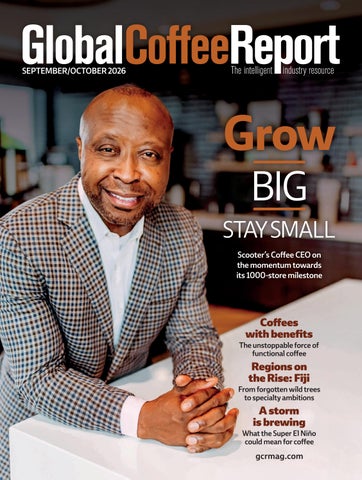
SEPTEMBER/OCTOBER 2026
Grow BIG
STAY SMALL Scooter’s Coffee CEO on the momentum towards its 1000-store milestone
Coffees with benefits
The unstoppable force of functional coffee
Regions on the Rise: Fiji
From forgotten wild trees to specialty ambitions
A storm is brewing
What the Super El Niño could mean for coffee
gcrmag.com
Espresso Technology since 1919
Every extraction matters Raise your standards
unic-espresso.com
CONTENTS SE P T E M BE R /O C T OBE R 2 0 2 6
14 COVER STORY
EQUIPMENT & TECH 18 From part-timer to talent
10 Growing big, staying small
Scooter’s Coffee CEO Joe Thornton on whether there’s still ‘oxygen’ in the US drive-thru sector. “To go to the next level you have to build some new muscles.”
Nuova Simonelli reveals its latest campaign to help the next generation of baristas.
24 Designed to last How Franke’s New A Line combines modular flexibility and premium user experience in one professional coffee platform.
48 Redefining premium grinding
Joe Thornton CEO, SCOOTER’S COFFEE
The role of ‘premium’ grinders is shifting, according to Macap.
ORIGIN
INDUSTRY INSIGHTS
14 A storm is brewing How the upcoming ‘Super El Niño’ could impact coffee production.
20 Regions on the Rise: Fiji The Pacific nation’s emerging coffee industry is creating new livelihoods and reshaping perceptions.
40 Growing more than coffee How intercropping is helping Vietnam’s Robusta producers balance productivity with resilience.
50 Italy’s first ‘authentic’ espresso
26 Coffees with benefits GCR dives into the world of protein foams, adaptogenic mushrooms, and prebiotic cold-brews.
30 From Yemen with love How ARWA transformed from a single café into one of the fastest-growing coffeehouses in the US.
34 The regeneration game Lavazza on the launch of its new regenerative-agriculture milestone.
44 The heritage brand revival
Could rising temperatures see beans grown, processed, and roasted in the birthplace of espresso?
As consolidation within the coffee industry accelerates, heritage brands are proving their value.
30
40
52 Deal’s done How Papua New Guinean exporters secured millions of dollars in projected sales at the 2026 Melbourne International Coffee Expo.
SINGLE-SERVE SHOWCASE 36 Beyond compostable capsules The family-owned coffee company taking the environmental impact of its single-serve packaging into its own hands.
38 Coffee under control IMA reveals the opportunities to optimise coffee quality at every stage of the production journey.
LAST WORD 58 Anatomy of a perfect cup New research reveals the best time, place, and brew method to enjoy the perfect cup coffee – with some surprising results.
REGULARS 04 Editor’s note 06 News in brief 54 Marketplace 56 Diary dashboard
44 GLOBAL COFFEE REPORT
3
EDITOR’S NOTE GL OBA L C OF F E E R E P ORT
Does customer experience still count?
A
S BUSINESSES around the world race to embrace artificial intelligence (AI), and automated machinery continues to prove its worth behind the café counter, the natural next progression could see tech taking over customer interactions. While there are already more than 2000 robotic baristas pouring coffees across Asia, in Europe the United Kingdom’s first AI-powered drive-thru is due to open soon. According to Bocca Felice, the specialty coffee brand behind the project, the store will be entirely operated by AI – from order taking to latte art. But how do customers feel about interacting with “conversational voice AI technology”. In the not-so-distant past, a friendly chat with the barista who knew the customer’s names was the gold-standard of café culture, turning sporadic visitors into regulars. This is something Scooter’s Coffee CEO Joe Thornton considers regularly as the United States (US) drive-thru chain accelerates towards its 1000-store milestone. For the former Starbucks Senior VP, customer experience is still extremely powerful – even in the conveniencefocused drive-thru sector. “I don’t think we give enough credit to how much guest experience and emotional connection really matter. We believe we’ve built that connection, and we’re working hard to extend it as we expand,” Thornton tells Global Coffee Report. In this issue’s cover interview, Thornton reveals why guest experience and creating strong relationships with franchise owners are essential to the brand’s growth strategy. He also shares why he believes there’s plenty of ‘oxygen’ left in the US’ booming drive-thru market and why Scooter’s is
4 GLOBAL COFFEE REPORT
prioritising homegrown expansion over international opportunities. Another sector that’s thriving – in the US and across the world – is functional coffee. According to research provider Mordor Intelligence, the functional coffee market is projected to reach $8.48 billion by 2031 at a compound annual growth rate of 11.23 per cent. As such, in this issue we dive into the world of protein foams, adaptogenic mushrooms, and prebiotic cold-brews to discover what’s driving the trend, who the major players are, and what the future might hold for the market. Earlier this year, headlines were dominated by warnings of a developing ‘Super El Niño’ weather cycle, with forecasts predicting it could last until 2028. Meteorologists widely agree it’s likely and could become strong, but what does this mean for the coffee industry? We ask Dr Aaron Davis, Senior Research Leader at Royal Botanic Gardens in Kew, how the weather phenomenon might impact supply and the potential impact on smallholder farmers and the wider coffee industry. Of course, there’s plenty more to discover in this September/October issue. Don’t miss the exploration into the revival of heritage coffee brands, the Sicilian roaster creating ‘authentic’ Italian espresso, and the science behind what really makes a cup of coffee enjoyable. Enjoy the issue. GCR
Kathryn Lewis Editor, Global Coffee Report
CHIEF EXECUTIVE OFFICER
Christine Clancy christine.clancy@primecreative.com.au
PUBLISHER
Sarah Baker sarah.baker@primecreative.com.au
GROUP MANAGING EDITOR
Myles Hume myles.hume@primecreative.com.au
EDITOR
Kathryn Lewis kathryn.lewis@primecreative.com.au
ASSISTANT EDITOR
Daniel Woods daniel.woods@primecreative.com.au
JOURNALIST
Meg Kennedy meg.kennedy@primecreative.com.au
ART DIRECTOR/DESIGN
Daz Woolley daz.woolley@primecreative.com.au
BUSINESS DEVELOPMENT AND SALES MANAGER
Charlotte Murphy charlotte.murphy@primecreative.com.au
CLIENT SUCCESS
Cait Pillay caitlin.pillay@primecreative.com.au
COVER IMAGE Ariel Panowicz
HEAD OFFICE
Prime Creative Pty Ltd 379 Docklands Drive, Docklands, Victoria, 3008, Australia p: +61 3 9690 8766 info@primecreative.com.au gcrmag.com
SUBSCRIPTIONS
+61 3 9690 8766 subscriptions@primecreative.com.au Global Coffee Report Magazine is available by subscription from the publisher. The rights of refusal are reserved by the publisher.
ARTICLES
All articles submitted for publication become the property of the publisher. The Editor reserves the right to adjust any article to conform with the magazine format.
COPYRIGHT
Global Coffee Report is owned and published by Prime Creative Media. All material in Global Coffee Report Magazine is copyright and no part may be reproduced or copied in any form or by any means (graphic, electronic or mechanical including information and retrieval systems) without written permission of the publisher. The Editor welcomes contributions but reserves the right to accept or reject any material. While every effort has been made to ensure the accuracy of information Prime Creative Media will not accept responsibility for errors or omissions or for any consequences arising from reliance on information published. The opinions expressed in Global Coffee Report are not necessarily the opinions of, or endorsed by the publisher unless otherwise stated.
NEWS in brief AMERICAS In the crowded United States (US) coffee market, growth is easier in boom but harder in maturity. Scooter’s Coffee – now operating 925 stores across 32 states, and targeting 1000 by early 2027 – is keeping its emphasis on profitability over pure expansion. CEO Joe Thornton has made franchisee economics the priority, arguing stronger store-level returns will naturally create organic growth for franchisee and franchisor alike. With roughly 300 franchise owners in its system, many with only a single location, the chain’s future may depend on ensuring its existing stores succeed. In a market fixed with homegrown competition and international players entering the market almost every day, this approach to local loyalty and disciplined expansion may prove more durable than headline-grabbing store counts. See page 10 Climate remains coffee’s most unpredictable stakeholder. Meteorologists are warning of a potentially powerful El Niño event capable of disrupting producing regions across Latin America, Africa, and Asia, dubbed by some as a ‘Godzilla El Niño’. This concern comes not long after Arabica futures prices fell sharply from more than US$4 per pound in late 2025 to about US$2.40 per pound in mid-2026. Growers face the prospect of lower prices coinciding with weather-related production losses, a combination that threatens profitability across the supply chain. Previous El Niño events have reduced yields by as much as 30 to 50 per cent in severely affected regions. See page 14 Functional coffee, once confined to biohackers and health-food shops, is rapidly emerging into the mainstream. So much so that some predictions forecast its revenue potential to outpace the booming ready-todrink sector. Research firm Modor Intelligence values the category at US$4.98 billion in 2026, projecting growth to US$8.48 billion by 2031. Collagen, nootropics, protein, and adaptogenic ingredients are finding their
6 GLOBAL COFFEE REPORT
20
Coffee production in Pacific regions such as Fiji is on the rise. Image: Bula Coffee.
way into cafés and onto retail shelves alike. As younger consumers increasingly seek beverages that promise benefits beyond caffeine, nutrition claims are quickly becoming just as valuable as flavour notes. See page 26 One of the newest players in the US coffee shop game is thriving on authenticity. Texas-based Yemeni coffeehouse ARWA has grown from a single location in 2022 to 17 sites, with another 17 already on the cards. The brand’s success is built not only on great coffee and good partners, but also on the power of truthful storytelling. Introducing its customers to Yemen’s centuries-old coffee heritage through drinks such as qishr and mufawar alongside modern global favourites including matcha and americanos, its distinctiveness is proving a potent competitive edge. See page 30 The whole world seems to be rediscovering value in the old fashioned – from media such as vinyl records and film cameras to mechanical watches and paperback books. The same has been happening in the coffee world for decades. Brands such as Chock full o’Nuts, Hills Bros., Douwe Egberts, and Bewley’s Coffee continue to attract attention because they hold something that is difficult for new brands to replicate: trust.
Consolidation activity across the coffee industry suggests buyers are increasingly valuing those established customer relationships and regional loyalty. In an era obsessed with disruption, there remains considerable worth in brands that have survived for a century or more according to Massimo Zanetti Beverage USA President Matthew Smith. “Consumer trust carries more weight today than ever before because the modern aisle is so crowded with options,” he says. “But nostalgia alone only gets a consumer to buy the first can – quality and consistency are what get them to buy the second, third, and hundredth.” See page 44
EUROPE Nuova Simonelli has introduced the world to ‘Tom’, a student barista representing the reality of much of the world’s hospitality workforce. As cafés continue to contend with staff shortages, high turnover, and limited training budgets, technologies such as Simonelli’s C-Automation system are designed to help improve consistency without sacrificing the theatre of the café. Its aim is not to replace baristas, but to help inexperienced ones like Tom perform like seasoned professionals. See page 18
Franke’s New A Line platform has collected a string of major design awards, praising it for its modularity and versatility. But what actually goes into designing a functional machine built for modern espresso preparation? For the Swiss coffee machine manufacturer, it started with a long-held relationship with design studio 2ND WEST and its Founder Michael Thurnherr, who Franke became aware of for their work in the capsule sector. “The Classic A Line had built strong recognition in the market, so the challenge was to preserve that familiarity while creating a more premium, more intuitive, and more future-ready platform,” says Patrick Probst, Project Manager at Franke Coffee Systems. “Working closely with 2ND WEST allowed us to translate technical innovation, modularity, and daily usability into a design that feels coherent in every configuration.” See page 24
Lavazza has ticked off many milestones in its more than 130-year history. Now, it can add another one to the list. Its La Reserva de ¡Tierra! Selection – part of the broader La Reserva de ¡Tierra! range – has become the first coffee for the away-from-home-segment certified under the Rainforest Alliance Regenerative Agriculture standard, according to the roaster. More than 70 Honduran farms Lavazza sources from have been certified under the standards, while more than 300 producers participate in associated sourcing programs. “La Reserva de ¡Tierra! represents a
US$8.48 billion
The projected value of the functional coffee segment by 2031.
further step in how coffee can be conceived, combining double certification, direct involvement in field implementation, and a product designed specifically for professional use, with the perfect balance between aroma and flavour,” says Lavazza Marketing Away from Home Director, Michele Cannone. See page 34 For years, coffee companies have focused on sustainable sourcing while packaging remained a stubborn environmental challenge. Swiss coffee company Tropical Mountains is trying to address one of the sector’s most overlooked categories: instant sachets. Billions of single-serve coffee sachets are used annually in hotels, airlines, offices, and healthcare facilities, most relying on complex plastic-based materials that are difficult to recycle. After several years of development, Tropical Mountains has introduced what it describes as one of the first commercially
SIMPLIFY COFFEE STAY TRADITIONAL
Discover more:
NEWS in brief
Lavazza’s La Reserva de ¡Tierra! Selection features coffee grown on regenerative farms in Honduras and Brazil. Image: Lavazza.
available instant coffee sachets made from TÜV-certified home-compostable packaging materials. As new European packaging regulations place greater pressure on manufacturers to adopt more sustainable solutions, maintaining coffee quality remains the primary challenge. The company believes innovation in packaging will become increasingly important as businesses seek to reduce their environmental footprint. See page 36 Freshness is one of coffee’s most valuable attributes, yet from the moment it’s ground that quality immediately starts to drop. For roasters, particularly those producing pods and other single-serve formats, controlling what happens between grinding and packaging to maintain that freshness is only growing in importance. IMA believes the answer lies in greater process control. Its CO-Tube system combines vacuum technology and nitrogen injection to accelerate degassing while minimising oxygen exposure, helping preserve aroma and flavour. Rather than relying on fixed waiting periods, the system enables operators to tailor parameters such as temperature, gas composition, and degassing times to individual coffees. The goal is to connect grinding, degassing, storage, and packaging into a single production process. As premium coffee continues to shift into convenient formats, manufacturers are looking for ways to deliver consistency at scale without compromising quality. See page 38
8 GLOBAL COFFEE REPORT
34 The definition of premium coffee equipment is changing. According to Italian grinder manufacturer Macap, operators increasingly judge grinders by performance rather than appearance or price. Café chains and multi-site operators now expect the same precision, consistency, and quality controls once associated mainly with specialty coffee shops. At the same time, labour shortages and rising costs have increased demand for equipment that is easy to use and reliable under highvolume conditions. Macap says its Supra G range reflects this trend, incorporating technologies such as automatic portafilter recognition and grind-by-weight dosing to improve consistency while reducing reliance on operator skill. The company believes the future of grinding lies in combining precision and simplicity, enabling operators to deliver quality coffee more efficiently across multiple locations. See page 48 An unusual Sicilian experiment is challenging long-held assumptions about where coffee can be grown. For more than three decades, the
100
kilograms of coffee produced in Sicily by the Morettino family each year.
Morettino family has cultivated coffee plants on the Mediterranean island. Today, the company produces approximately 100 kilograms annually from varieties including Bourbon, Catuai, Caturra, and Pacamara. Andrea Morettino, Head of Sales and Marketing at Morettino, says while volumes remain small, the project has become something of a living laboratory experiment examining coffee’s adaptability in a changing climate. “Cultivating coffee outside the tropical belt presents us with distinct conditions: we must learn to manage high summer temperatures, limited water resources, and the thermal swings of our evolving Mediterranean climate,” he says. See page 50 One of the largest international coffeeconsumption studies ever conducted has come to the conclusion that the context around a cup of coffee could matter almost as much as what’s in the cup. Researchers surveying nearly 3000 consumers across 11 countries have discovered what season, day of the week, time of day, and drinking receptacle help boost the satisfaction of the brew. See page 58
ASIA-PACIFIC Fiji’s coffee production industry is experiencing something of a renaissance. Once home to a largely forgotten, colonialera coffee sector, it’s becoming a hub of innovation. Bula Coffee has laid critical foundations to the industry over the past 15 years, engaging with about 2000 coffee pickers – 78 per cent of which are women – to produce about 80 to 100 tonnes of cherries per year. More recently, Australian specialty roaster Ona Coffee has joined the efforts, pursuing ambitions that could eventually see one million trees distributed through the archipelago. Supporters hope coffee can become both a booming export industry and a reason for younger Fijians to remain in regional communities rather than seek opportunities abroad. See page 20
Faced with growing climate volatility, many growers in Vietnam’s Central Highlands are supplementing coffee production with crops including durian, pepper, avocado, and jackfruit through intercropping practices. Intercropping is already widespread in the world’s largest producer of Robusta, appearing on 87 per cent of surveyed farms in Dak Lak and 86 per cent in Dak Nong. It’s a strategy that diversifies income while improving resilience against climate. Neumann Kaffee Gruppe, through its subsidiary NKG Vietnam, is helping established roaster Tchibo support its producers in improving their profitability per hectare beyond coffee yield alone. See page 40 Papua New Guinea (PNG) is enjoying a moment on the international stage. The Pacific nation has seen a 32 per cent increase in demand for its coffee from
The Morettino family has been growing coffee in Sicily for more than 30 years. Image: Morettino.
roasters in Australia – one of PNG’s closest geographical neighbours. At the 2026 Melbourne International Coffee Expo, a Pacific delegation involving 12 producers from PNG took to the show floor and generated millions of dollars in projected sales.
50 Industry advocates now face the exciting challenge of converting the heightened interest from the tradeshow into sustained market share through consistent quality and reliable support, with early plans to return in 2027. See page 52
Joe Thornton became CEO of Scooter’s Coffee in January 2024. Image: Ariel Panowicz.
10 GLOBAL COFFEE REPORT
COVER STORY S C O O T E R’ S C OF F E E
GROWING BIG, STAYING
SMALL Scooter’s Coffee CEO Joe Thornton on his measured approach to growth, whether there’s still ‘oxygen’ in the drive-thru sector, and how a strong connection with franchise owners is good for business.
W
HEN JOE THORNTON stepped into
the CEO role at Scooter’s Coffee in January 2024, business was booming for the Nebraska-founded drivethru chain. In a period of strong growth, the franchise format had just ticked over 750 locations across the United States (US) and recently earned the title of second largest drive-thru chain in the country. Not a bad time to take the reins for the incoming CEO. Yet Thornton, with his experience at formative American brands including Blockbuster and Starbucks, was cautious not to take the business’ current success for granted. “When I came into Scooter’s, the first step was to ‘read the tea leaves’. You have to take the time to understand the culture, the people, and all the entities involved: the franchise community, the board, our private equity firm partner, and the founders,” Thornton tells Global Coffee Report. With approximately 200 stores across America in 2019, in just three years the brand had more than doubled its footprint. One of the drivers of this rapid expansion was the pandemic, which supercharged the drive-thru coffee market. According to Thornton, Scooter’s Coffee was “in the right place at the right time”. “This can create a little bit of hubris: ‘It
is easy to believe that everything we touch is great; nothing could ever become a challenge’,” he says. To ensure Scooter’s continued its growth trajectory – with a milestone of 1000 stores in sight – the new CEO undertook a 360 assessment of the company and its strategy. “When I came into the business I asked three foundational questions. One: is our growth schedule the right schedule? Two: is that schedule right for franchisees?,” he says. “And then, probably the most important: how do we professionalise the business? How do we bring in insights, strategy, and data to help us make decisions? Our founders’ instincts got the brand to a fantastic place, but to go to the next level you have to build some new muscles.” Franchising fundamentals
Established in 1998 in Bellevue, Nebraska, by Don and Linda Eckles, Scooter’s hasn’t always been focused on expansion. In fact, two decades into its history, the company only operated 135 stores. That changed when it partnered with McCarthy Capital, now rebranded as M-One Capital. “That was the moment we really began to supercharge growth,” says Thornton. “However, instead of just racing for growth, we have to be more centred on
profitability because almost our entire system is franchised.” Scooter’s Coffee operates a different model from its main competitors. For example, Dutch Bros is largely corporateowned with a much smaller franchise portfolio, while 7Brew mainly sells to well-capitalised franchisees. Unlike these competitors, Scooter’s has 925 locations and approximately 300 owners – a sizeable section of which operate only one location. “This means profitability must be a priority. We have to ask, are these stores working for their owners? If they’re growing cash flow, those owners are going to open more stores,” he says. “It’s about flipping the equation. Instead of store count being the primary input and driver, store count becomes the output. The input is driving annual unit volume and top line sales, which in turn creates more free cash flow for owners.” Thornton says maintaining strong franchisee relationships is a key to building store count, and that requires constant communication. The company hosts regular town halls, webinars, and live sessions to bring franchisees and their teams into the fold. The executive team also hosts a quarterly call to report on how the business is performing so they can feel confident that GLOBAL COFFEE REPORT
11
COVER STORY S C O O T E R’ S C OF F E E
Scooter’s Coffee Founders Don and Linda Eckles. Image: Scooter’s Coffee.
the brand they’ve bought into is healthy. “We’re a fast-moving brand, and a lot of our owners come from very different backgrounds. Some have owned other franchises; many haven’t. They don’t know what they don’t know, which means we must be extremely intentional, high-touch communicators,” he says. “We’ve also formed a Franchise Advisory Council made up of franchisees, both small and large, representing regions across our nationwide footprint.” “Our goal with that group is to vet strategic ideas, campaign launches, and other major initiatives early, so we can get their reactions during the development stage and ensure what we’re planning will be well received. Beyond that, I regularly reach out to a handful of franchisees by email or phone to check in.”
the beverage space over the past five years, something which Thornton highlights as a key factor of the company’s growth. “Customisation in general is here to stay.
“I don’t think we give enough credit to how much guest experience and emotional connection really matter.”
Chasing trends vs embracing tradition
For the Scooter’s executive team, the twoway street of communication goes beyond feedback on company initiatives. Thornton says the menu team receives a huge number of suggestions from franchisees who provide valuable insight into what customers are looking for. “We value their voice across all parts of the business, but menu innovation is where it’s most visible,” he says. “Their ideas matter because we don’t live the lives they do. We’re not running their stores day to day. The worst that can happen is that we make a decision that doesn’t make sense for the system.” Customisation has been a huge trend in 12 GLOBAL COFFEE REPORT
Thornton hopes to reach the 1000-store milestone in early 2027. Image: Scooter’s Coffee.
Customers feel like it creates value when they can choose what they want, and they’re willing to pay more for it,” he says. “At the same time, we must be disciplined about what we introduce. We generally have a standard menu across the US and that’s very intentional.” Over the years, the company’s executives and menu team have had many conversations about regional products and tested some in regional markets. However, very few of these items have been made permanent offerings, instead opting for a more consistent menu and guest experience nationwide. Thornton believes this is representative of some of the country’s most successful drive-thru menus. “When you look at many of the best brands in America, they have a consistent menu,” he says. “When customers know and love a brand and that brand starts to scale, people look for familiarity wherever they go.” One trend the brand has diversified its menu to align with, however, is the expansion of energy. After briefly switching to a proprietary energy drink, in 2024 Scooter’s re-signed a deal with Red Bull to bring back its products. This revitalised the brand’s energy drink offerings with a premium name like Red Bull now powering its Infusions and Vertigo Smoothies. “Consumer demand for the energy sector has been steadily rising and looks to continue when looking ahead to 2030,” he says. “We think the combination of people getting caffeine through coffee or energy is a strengthening point for this industry for the next few years to come.”
Is there any room left?
With Scooter’s, Dutch Bros, and 7Brew all continuing to grow rapidly alongside industry giants such as Starbucks and Dunkin’, is there any room left for more growth? Thornton thinks so – and believes Scooter’s has a unique approach that sets up the brand for success. “When companies try to solve strategic challenges and grow their business, they often sit around a boardroom table and craft plans the size of War and Peace. They think about every possible scenario, but often miss the most important factor: people,” he says. The CEO compares the coffee sector to fast-casual restaurants. Whereas a customer might visit a burger chain once a week, coffee venues have the opportunity to see customers multiple times per week – maybe even every day. “Even if those interactions are only 30 to 60 seconds, you can get to know people. The experience matters enormously, especially in the drive-thru space,” he says. “One of the coolest things I’ve seen was in a store I visited in Dallas where the baristas often know the engine sound of a car and who the customer is before they even get to the window. You don’t see that in many other businesses.” With a physical barrier between the staff and customers, it can be easy to overlook the importance of customer experience in the drive-thru sector. “I don’t think we give enough credit to how much guest experience and emotional connection really matter. We believe we’ve built that connection, and we’re working hard to extend it as we expand,” says Thornton. “We’re in 32 states, but we’re largely around and outside major metro areas. In franchising, one of the superpowers is locality. We can tell the story of a retired engineer who opens a Scooter’s in a town of 30,000 people, and the whole town rallies around that store. “As a result, our growth strategy is built around a geographic approach that’s a little different from our competitors, and that’s part of why there’s still ‘oxygen’ in the coffee space – everyone’s approach is slightly different. Starbucks is ubiquitous; they open everywhere. But for the rest of us, those nuances in strategy leave room for multiple winners.” While many successful American coffee operations have expanded overseas, Thornton says Scooter’s attention remains on its home market.
Thornton says it can be easy to overlook the importance of customer experience in the drive-thru sector. Image: Ariel Panowicz.
“To go to the next level you have to build some new muscles.” “We’ve done a white space study and there’s still enormous opportunity in the US,” he says. “When I joined the brand, we looked at international markets. Some countries are coffee-centric, some are drive-thru centric, and some are both. We know where the targets are if we decide to move in that direction. “One of my early conversations with the board was about how easy it is for brands to try to do everything at once as they grow. I’d never say “never” to going abroad, but we currently have plenty of room to expand in the US.” Scooter’s next goal is to reach 1000 locations, a milestone it hopes to achieve in early 2027. According to Thornton, the
roadmap includes continued disciplined expansion in both core states and newer markets. “We’re at 32 states now. We could double our store count and still be in those same 32 states, given all the infill opportunities,” he says. “One challenge for growing brands is that, in their desire to be national, they spread themselves everywhere at once. We see a lot of logic in clustering stores in markets, giving people more visibility to the brand and raising our profile in a focused way.” While the 1000-store milestone remains a core focus for Thornton, the origins of Scooter’s Coffee continue to guide his decision-making. “A question I often go back to is, ‘How do you keep the soul of the company while driving growth?’ and that leads me back to the saying ‘Growing big and staying small’,” he says. “A franchise owner doesn’t really care how many stores we open; they care how many stores they open, and we must care about their stores.” GCR GLOBAL COFFEE REPORT
13
ORIGIN SU PE R E L N I ÑO
Historically, El Niño events have led to impacts on coffee prices and unpredictable yield outcomes. Image: JR Slompo/stock.adobe.com.
A storm is brewing A ‘Super El Niño’ weather event is predicted to dominate global climate patterns for the second half of 2026. What could it mean for the coffee industry?
T
HERE’S A STORM BREWING.
According to the United Nations (UN) Meteorological Organization (WMO), the Pacific Ocean is heading for a Super El Niño event: a powerful climate pattern that increases the likelihood of above-normal temperatures across much of the world, driving significant shifts in rainfall patterns. El Niño and La Niña are opposite phases of the El Niño–Southern Oscillation (ENSO); one of the most powerful drivers of year-to-year climate variability. A naturally occurring climate pattern characterised by above-average seasurface temperatures in the central and eastern equatorial Pacific Ocean, El Niño events typically occur every two to seven years and usually last between nine and 12 months. Often developing between March and June, they reach peak intensity between November and February, exerting their strongest influence on global temperatures during the year following their onset. At the time of writing, 2026’s El Niño is projected to intensify from August into October. Historically, for the coffee market El Niño 14 GLOBAL COFFEE REPORT
events have led to impacts on market prices and unpredictable yield outcomes – but nothing is ever guaranteed when it comes to the weather. Dr Aaron Davis is the Senior Research Leader of Crops and Global Change at the Royal Botanic Gardens in Kew, United Kingdom. An established leader in climate change adaptation, sustainability, and crop development – with decades of research in coffee – Dr Davis’ work focuses on the application of underutilised plant diversity. The researcher tells Global Coffee Report this event will be the third Super El Niño he’s experienced. “I’ve had these questions come my way and it’s very difficult to project – and I would use the word ‘project’ rather than ‘predict’. It’s difficult to know what’s going to happen,” he says. “I think if anybody really had a good idea or a solid set of projections, they’d be making a lot of money.” It’s useful to look back on previous El Niño events to understand how the incoming one could impact the industry. The evidence is variable, but Dr Davis says these climate patterns can reduce the output of coffee exporting countries and
be “devastating” for the worst affected regions and communities. He stresses a Super El Niño event won’t see universal outcomes across the world’s coffee belt. When looking at the impacts of past El Niños, it’s “very clear the event is highly localised – not just within East Africa, West Africa, or Brazil, for example, but on a smaller scale within regions and countries”. “When we were doing a lot of work in Ethiopia during the last El Niño, some areas fared very well,” he says, but that wasn’t the case for all. “We visited areas that had produced coffee successfully for hundreds of years. It wasn’t about a reduced yield or some minor issues around productivity. The plants were dead. “The branches were snapping in our hands, and the trees were leafless. The leaves of Arabica can fall off and grow back again, but these plants were not going to come back to life.” Dr Davis says the same area, badly hit by drought, also experienced significant floods towards the end of the weather event. Drought, in his opinion, will be the major issue for this Super El Niño. In certain locations in East Africa, he believes we may already be seeing the
negative influence of low rainfall on coffee crops. He makes it clear, however, that distinguishing between cyclical weather events and climate change in general will be difficult, and the two are likely to have negative compounding influence. “Brazil is bringing in most of its crop now, but the critical stage of flowering and early fruit formation will happen in the middle, or towards the end of the Super El Niño,” he explains. “That’s the problem with coffee – there’s very little in its lifecycle that can’t be affected by these extreme climate events. I think we need to look at it in 2026 and 2027 to see how it unfolds.” Changing price points
Although a record-breaking coffee harvest for the 2026/27 cycle was predicted for Brazil, the Brazilian Instant Coffee Industry Association says a Super El Niño event could cut this by up to a fifth. For Will Corby, Director of Coffee and Social Impact at specialty roaster Pact Coffee in the United Kingdom, the weather event is of concern from an economic perspective. He says both extreme outcomes from the event – drought and flood – could reduce yields on coffee farms substantially, causing “a significant decrease” in income for thousands of growers worldwide. “Growers in South America, for example, could see yields fall by 30 to 50 per cent as a result of this year’s El Niño. That’s a huge hit on their profit margin,” he says, noting Brazil’s bumper predictions are not representative of global production. Corby says right now, growers face the “worst of both worlds”, with the commodity market dropping significantly from more than US$4 to US$2.40 per pound between late 2025 to June 2026. While the market measures supply risk by dollars per pound, he believes the industry should approach it differently. “How many pounds per hectare will a grower actually harvest this year?” Corby asks. “Even when prices spike, it’s not a linear increase in revenue, because you can’t sell coffee you couldn’t grow,” he says. “It’s not viable to wait until the commodity market is at a historic high to sell your coffee. Therefore, even in years without extreme shifts in weather patterns, many growers are forced to sell at a loss. “That’s why the question that matters isn’t price – it’s profitability for the grower,
“The question that matters isn’t price – it’s profitability for the grower, especially the millions of smallholders who depend on coffee as their main income.” Will Corby
DIRECTOR OF COFFEE AND SOCIAL IMPACT, PACT COFFEE
especially the millions of smallholders who depend on coffee as their main income.” Dr Davis also recognises stakeholders across the coffee sector often have differing perspectives. “For the big players, it’s about tens of thousands, hundreds of thousands, millions of bags. That’s the scale globally, but for a smallholder farmer, it’s very different,” he says. “I think the coffee sector opens itself to disruption, and that’s partly because we rely on so many producers. Yes, we have the big estates and large producers such as those in Brazil, but millions of smallholder farmers make up a large proportion of global coffee production – managing that global production system is extremely difficult.” Access to resources is also a key
barrier, with many unable to afford to invest in future-proofing against severe weather events. “You can build dams and water catchment systems if you’re a medium- to large-size farm, for example, but many smallholder farmers do not have the capital to invest in that sort of adaptation,” says Dr Davis. If yields decrease and farming conditions become significantly tougher, Corby believes the only way to source coffee ethically is by forming mutually beneficial relationships with growers. “It takes long-term, mutually beneficial relationships, up-front security for growers, and full transparency of our supply chains to make sure the premium reaches the grower, not the trader or speculator in the middle,” he says. Switching lanes
With the livelihoods of farmers and production numbers unknown, will adaptations – both temporary and permanent – be put in place to mitigate the risks for the industry? Pointing to the increase in adoption of Robusta since the early 1900s, Dr Davis notes that in many key production countries, this crop species has to be irrigated to ensure profitability, and in some cases, survival. However, he says those irrigation systems – which rely on rivers, lakes, and groundwater – are vulnerable and many could be further threatened by a Super El Niño event.
Dr Aaron Davis says a Super El Niño event won’t see universal outcomes across the world’s coffee belt. Image: Dr Aaron Davis.
GLOBAL COFFEE REPORT
15
ORIGIN SU PE R E L N I ÑO
regenerative agriculture practices and position it as a major “adaptation pathway” for coffee under climate change. “Whilst I am an advocate for regenerative agriculture and good agronomic practices in general, their use for climate change adaptation will be limited unless they include water retention methods, or the transition from unshaded to tree-shaded coffee (agroforestry),” says Dr Davis. He’s also clear on what he considers to be the major issue: the root causes of climate change. “We need to understand and act on those activities that must be undertaken, to meaningfully reduce greenhouse gas emissions (GHGE), halt and reverse deforestation, and enact other key mitigation requirements,” he says. “Agriculture is a major cause of greenhouse gas emissions, and the coffee farming sector is no exception.” He notes it is clear there is “substantial variation” in the carbon and GHGE footprint across coffee-growing regions and nations, something he believes the sector needs to learn from. “Adaptation is a response and a shortterm strategy; mitigation is the only longterm solution,” he says. Looking ahead
Will Corby says extreme weather outcomes from an El Niño event could cause a signficant decrease in income for growers. Image: Pact Coffee.
With Dr Davis’ research focusing heavily on wild species of coffee as a means of climate change adaptation, he says the industry has accessed wild coffee genetic resources “roughly every 30 years” to shore up the sector in numerous countries. “We’ve gone back [to wild genetic coffee resources] for things like coffee leaf rust resistance, coffee wilt disease resistance, coffee leaf miner resistance, and the like … to say we’re not going to be needing those resources, whether they’re from Arabica, Robusta, or other species, I think is extremely misplaced.” Although any coffee species is susceptible to drought – some less so than others – he says recent positive results of Excelsa coffee in Uganda, and in other African countries, is leading to the establishment of substantial plantations for this species. In Asia, smallholder farmers and some large private sector players are scaling up Liberica and the newly identified Libex coffee. Trials and experimentation with 16 GLOBAL COFFEE REPORT
“Adaptation is a response and a short-term strategy; mitigation is the only long-term solution.” Dr Aaron Davis
SENIOR RESEARCH LEADER OF CROPS AND GLOBAL CHANGE, ROYAL BOTANIC GARDENS
Stenophylla coffee is now underway in several countries. “Farmers are adopting species other than Arabica or Robusta, and they’re not doing it for fun, or to satisfy the specialty coffee sector. They’re doing it to maintain their livelihoods in a changing world,” he says. In recent years, some key players in the industry have adopted, or are promoting
So, will the industry see widespread change in response to the latest weather phenomenon? Dr Davis believes changes will come, but they will be reactionary. “[Changes] will be driven by disruptive events – as they always have been throughout the history of coffee cultivation – what I would like to see is a strategy and clear thinking about not just the next two or three years, but the next 10 to 20, 30 to 50, up to 100 years – and I’m not seeing that.” He notes one of the real issues in the industry is “a lack of understanding” of climate and climate-plant response. “There is always plenty of research that needs to be done, but I think we need to focus on the long-term sustainability of the coffee sector – good governance is also required, based on high-quality scientific evidence,” he says. With an overwhelming amount of scientific information and data on climate change now available, Dr Davis highlights the difficulty for stakeholders to make informed decisions. “How does somebody with a nonscience background wade through all the available information to find a cohesive,
A drought period in the Central Region of Uganda in 2022 led to the essential emergency irrigation of Robusta. Image: Dr Aaron Davis.
workable adaptation pathway?” he says. “It’s really difficult because there are so many voices, voices asking for money and funds to do the research, and those with different ideas and ideologies. I think this will come into focus as we experience events like the Super El Niño, which will be testing beds for the way people strategise about the future of coffee,” he says. “One thing is very clear: we will see change.” With coffee prices remaining volatile and production costs continuing to challenge producers, Corby notes the onus also falls to stakeholders to support growers during unpredictable market conditions. “Coffee companies were forced to pay above the cost of production for beans for almost the entirety of 2025. If they’re still trading, they made that work,” he says. “Now the market has dipped, it’s down to them to do that on a voluntary basis to support growers as they face an incredibly tough series of harvests. “Last year, our industry proved it can pay above the cost of production. If we want to
call ourselves ethical businesses, we keep doing it now – as Super El Niño takes effect from this winter into next year – not just when the market forces your hand.” For Dr Davis, he reiterates the coffee production sector is volatile; not on a yearly basis or decadal basis, but over longer time scales. “Over a generational timescale we’ve seen
TTR EVO ROASTERS SMART ROASTING. SUSTAINABLE FUTURE THERMAL OPTIMIZATION TECHNOLOGY TTR EVO roasters feature a hot-air recirculation system and an eco-design approach that maximises thermal efficiency, with lower energy consumption. By minimising heat loss and optimising roasting efficiency, the TTR EVO achieves substantial energy savings and a reduction in CO₂ emissions. Equipped with integrated sensors and digital control systems, TTR EVO roasters enable precise monitoring of roasting parameters and facilite data-driven process optimisation for a modern sustainable co ee production. Visit us at GULFOOD MANUFACTURING Dubai, UAE • 03-05 November • Shk Saeed Hall 3, Booth S3-D52 PACKEXPO CHICAGO Chicago, IL - USA • 18-21 October • South Building, Booth S-1720
imagroup.com/coffee
huge changes on what kind of coffee we grow, where we grow it, and how, so change is absolutely inevitable,” he says. “Change in the past has been driven by disruptive events, like coffee leaf rust, conflict, and socioeconomics. “We’re now in the era of accelerated climate change, and that will be the driver of disruptive change to come.” GCR
EQUIPMENT & TECH N UOVA SI MON E L L I
Nuova Simonelli has introduced Tom, a part-time barista and student, to its customers.
From part-timer to talent W
HAT IS THE MOST COMMON
demographic you see working in a café? For every venue owner and career barista, there are countless part-time-contracted students and young professionals utilising the industry’s flexibility to make ends meet. In 2023, the European Union’s Labour Force Survey estimated between 25 and 35 per cent of people working across Europe’s broader hospitality workforce were part-time students. This data suggests the average café staff member is likely to be attending school or university in addition to slinging coffees or serving tables. It’s this type of employee Nuova Simonelli is shining a light on in its latest campaign. “In our story, Tom is a barista, but he’s also attending university. To pay his fees he needs to work, so he works in a coffee shop,” says Simonelli Group Chief Marketing Officer, Alessandro Roberti. “We put Tom at the centre because normally the stories in the coffee industry are about roasters, technicians, coffee champions, or business owners. “Tom represents a new generation entering the workforce. He is relatable, learning on the job, and facing the real operational complexity of modern, high volume service.” Critical both to Tom’s work and
18 GLOBAL COFFEE REPORT
Simonelli’s campaign is the company’s C-Automation feature. Integrated into the Nuova Aurelia and Appia Viva range, C-Automation is a technology designed to help coffee businesses improve consistency and quality. It creates a direct connection between the espresso machine and the grinder, enabling the equipment to communicate and adjust extraction parameters in real-time by monitoring factors such as coffee flow and grind size. It’s with employees like Tom behind the espresso machine that Roberti sees the greatest benefits for implementing C-Automation. “We chose Tom because we wanted to move from an industry centric storytelling approach towards a human-centric one. Tom is a symbolic character, but he reflects reality,” says Roberti. “We see very dynamic chains where there is often a need for baristas who are less skilled than in the past, at least at the beginning. “C Automation really helps Tom and other baristas deliver flawless service and consistent beverages, so they can focus more on service and less on the technical steps.” Roberti, like many people, was once one of the working students Tom represents.
“I think most of us have been in Tom’s shoes. I used to work in a restaurant serving coffee, but my knowledge of coffee was zero. I wasn’t lucky enough to have C-Automation, so I don’t really know what kind of coffee I was serving to customers,” says Roberti. “It was probably terrible, and sometimes I could see the customers’ faces were a bit shocked. “With this technology, we are able to elevate the quality of coffee across the industry, from the HoReCa channel to the big chains.” Why Tom?
Roberti says C-Automation is like nothing else currently available in the market. It’s a piece of technology that departs from the norm, and the same logic is being applied to Simonelli’s communication strategy. “At Nuova Simonelli, which is always at the forefront of innovation, we wanted to innovate not only in technology but also in how we communicate,” says Roberti. “We’ve had this technology for two or three years and wanted to boost awareness. Communication has completely changed since social media platforms like Instagram arrived. Everyone can communicate now, but the audience is no longer limited to coffee professionals. It’s much broader.
Images: Nuova Simonelli.
Nuova Simonelli’s latest campaign puts people before technology, showing how C-Automation helps a new generation of baristas deliver consistent coffee while preserving café craft and hospitality.
If you want to be relevant, you must communicate in a powerful way. “We wanted to go beyond the technology and tell the story in a different way from what has been done in the industry so far, particularly for retail, in order to boost awareness of the technology and, consequently, the brand and the reality of what we do.” That’s where Tom comes in. “First, we want operators to recognise themselves in Tom. He represents the new workforce entering the industry – people who are not fully skilled yet and need time to grow. Nuova Simonelli with C-Automation is the perfect ally, because it supports you while you study and learn. “Focusing only on elevating the technology is an outdated narrative. If you look at all the communication around this kind of feature, it all feels very similar. We wanted to be different because the audience is very broad.” The triangle of quality
In an era when every second or third conversation – regardless of demographic – seems to be about the use of artificial intelligence, or the implementation of new kinds of automation, Roberti says Nuova Simonelli is working to preserve the coffee craft – but just make it easier. “As cafés become more operationally complex, and as they start using AI to reduce complexity, there is a risk that staff spend more time managing processes than engaging with customers,” says Roberti. “That’s exactly what we want to avoid. We strongly believe technology should help the entire sector to offer something better for the final customer. “The most successful innovations are often invisible to the customer. People visit cafés because they want an experience, they want to feel the atmosphere. For us, that experience is a triangle: quality, the barista, and the coffee shop environment. Roberti wants any innovation from Nuova Simonelli to elevate all three elements of that triangle. To achieve this, he believes there needs to be something unique behind the scenes. “If we want to elevate this triangle, especially during peak hours, you need a strong ally: technology hidden inside the machine that supports you,” he says. “When a customer steps into the coffee shop and sees a traditional machine, they feel reassured: they think, ‘ok, they know how to make coffee.’ But inside that traditional machine there is technology
Simonelli Group’s Alessandro Roberti says the brand wanted to do something different with this campaign.
that helps the operator deliver fantastic beverages consistently.” Staying on the path
Since it was launched in 2023, Roberti says the overall industry response to C-Automation has been strong. For him, the measure of the technology’s success is how it influences business decisions. “The feedback from baristas and operators has been very positive. Some chains wanted to move to fully automatic machines to have consistent service,” says Roberti. “Thanks to this technology, we convinced them to stay with traditional machines, because we simplify all the work they need to do behind the bar. “With this technology, we offer another path. ‘Stay traditional’ is our payoff, and
it’s important because you can show your customers that you use a traditional machine and respect the craft of making coffee, while at the same time using a technology that elevates everything.” Roberti says there are real-world examples happening right now of how C-Automation is being used to keep that sense of traditional coffee craft behind the bar. “We believe craft has never been about basic tasks. Craft is about judgement, hospitality, care, creativity, and customer experience. Technology removes unnecessary complexity, and professionals can then focus more on these human elements,” he says. “I attended a meeting in the UK with a chain where coffee is a parallel business. They told us they don’t have much time to train people and sometimes quality is inconsistent, so they wanted to move from traditional to fully automatic machines. “We showed them C-Automation and they said, ‘Wow, this is cool, because in our coffee shops where the coffee machine is visible, we want to show a traditional machine. Thanks to this technology, we can remain traditional’. “By the end of the year, I think they will install Nuova Simonelli machines with C-Automation. It’s a tangible example that I have seen with my own eyes.” GCR For more information, visit nuovasimonelli.com/simplify-coffee/
The benefits of C-Automation are central to Tom’s success as a barista.
GLOBAL COFFEE REPORT
19
ORIGIN R E GION S ON T H E R ISE
Large scale coffee plantations appeared on Taveuni during Fiji’s colonial era. Image: Travel Tips Stories/stock.adobe.com.
Regions on the rise: Fiji From forgotten wild coffee trees to specialty-level ambitions, Fiji’s emerging coffee industry is creating new livelihoods and reshaping perceptions of the Pacific origin. “
I
N FIJI, IF SOMETHING is stuffed up, it’s stuffed up for three generations.” That was the landscape Luke Fryett, a New Zealand national, was entering into when he set out to help revive Fiji’s coffee production more than 15 years ago. Before starting Bula Coffee in 2011, he had always been passionate about the South Pacific archipelago, which is more famed for white sandy beaches and bright blue seas than agricultural lands and coffee trees. The history of coffee in Fiji, like many places colonised by European powers, is murky. The plant isn’t native to the region and – given Fiji’s terrain and low altitude – it shouldn’t really be growing there. The land was first colonised by the British in 1874, which in turn brought thousands of labourers from Asia, mostly North India, to work the land. Remnants of rusted and overgrown coffee plantations and factories, thought to have been active during the 19th and 20th centuries, are dotted across the islands of Viti Levu, Vanua Levu, and Taveuni. “There’s definitely a long-held history of coffee here,” says Fryett. “One of the first
20 GLOBAL COFFEE REPORT
places we found it, a woman in her late 80s told us that when she was young she used to take coffee downriver on a raft and barter with it. “She said it was the early 1900s and one of her earliest memories. People talk about a huge trade they used to have with boats sailing up their big river to buy coffee.” Now, roughly 100 years after that story, Fiji is slowly turning back to coffee as an agricultural product. Typically, it’s been a major producer of sugarcane, with a projection of about 1.5 million tonnes produced for the 2026 harvest season. Fryett says the failure of a coffee industry to really take root in the early 20th century still lives in the memory of Fijian communities, and it has taken years to help local farmers see the potential of the crop. “When we first went looking for coffee and talking to people, they told us they weren’t interested and that we were wasting their time. Their grandparents had tried growing coffee and it hadn’t really worked,” he says. “We realised very early that planting coffee trees was only the beginning. For Fiji to have a successful and sustainable coffee
industry, we needed to build everything around the grower – training, processing, quality systems, and markets. Our primary goal was to create an industry that genuinely benefited local communities, so we knew we had to build the infrastructure and knowledge alongside the coffee itself.” For more than a decade, Bula Coffee worked largely on its own to develop the foundations of Fiji’s coffee industry – building the grower network, developing processing capability, and creating international markets for Fijian coffee. A hand up, not a handout
Currently, Bula works with about 2000 villagers who produce between 80 and 100 tonnes of cherries per year. According to the company’s data, about 78 per cent of coffee pickers in Fiji are women. “Culturally, women often do the harvesting of berries, fruits, and nuts, so when coffee is on the trees that falls into their role,” says Fryett, who is also quick to praise the first women who believed in the Bula project and took a risk on coffee in 2011. “We had a handful of women who said
they’d give it a go and started picking. Fifteen years later, look at the industry they’ve helped grow. “If those women hadn’t been brave enough to go out, pick the coffee, and give us a chance, we wouldn’t be anywhere. It’s important to acknowledge them, the risks they took, and the risks they continue to take.” Now, Fryett says many of those women are starting their own businesses. “We wanted a way for people to make their own money and have some buyin, but also for it to be sustainable so we weren’t relying on donations,” he says. “That means when we turn a profit, we can reinvest, and it also gives them money they can use however they want. It gives them a hand up instead of a handout. “We’re really seeing that now, with lots of women starting their own businesses and setting up little companies. It’s had the flowon effect we always hoped for.” A new stage
In 2025, Australian roaster Ona Coffee announced its intention to get involved in Fiji’s coffee landscape. Founded by 2015 World Barista Champion Saša Šestić, and sourcing specialty coffee from around the world, Ona has also recently expanded its
commercial enterprise into the Middle East. More than 12 months on, the foundations have been laid for a successful initiative in the Pacific, with Ona now working with more than 30 communities according to Sales Manager Hany Ezzat. “A lot has been accomplished, which is really cool,” says Ezzat. “We’ve planted about 100,000 trees already in a plot of land, and our goal is to have an oasis of different coffee varieties from all over the world. “That leads into a bigger project which is still under wraps at the moment, but it’s very exciting.” Part of Ona’s vision for the growing capability of Fiji is to help it become a destination for specialty and competitionlevel coffees. Liberica, a species that naturally grows wild there, offers significant potential. “The first harvest we’ve taken has been amazing. We believe this coffee has a place in everyday specialty coffee drinkers’ blends, and we aspire for these coffees to be at that competition level as well,” he says. “Hugh Kelly was one of the first people to bring Liberica onto the world stage, and now you’re seeing the varietal used by almost all competitors over the past few years in the World Brewers Cup. “We love this species, and it has done so
well in Malaysia. It’s globally famous now. We’ve been using it in some of our special feature blends, and people have really been enjoying it.” That vision for a leading Liberica region feeds into Ona’s to create this “oasis”, where varietals and species collected from leading farms all over the world can thrive. “Saša received seeds from farmers around the world he respects – we want to bring varietals from all over the world,” says Ezzat. “At the moment we have about 20, including Pacamara from Jorge Raul Rivera in El Salvador, an amazing Cidra from Pepe Jijón at Finca Solidad, and some coffee from the Lamastus family and famous farms like Finca Deborah from Jamison Savage, among many others. They all shared plant material with us to cultivate. “We want to build and grow within the community there. We’re working directly with the people who are there. It’s quite an amazing but very complex story. What’s been incredible about this is that since the foundation of the project, many, many farmers have approached us. “There’s a lot of excitement in Fiji from the locals. People are bringing cherries and we’re buying it directly from them. Some of them may not have known it was coffee less than a month before they sold it, but
Bula Coffee says it aims to deliver customers a better shot of coffee, and pickers a better shot at life. Image: Bula Coffee.
GLOBAL COFFEE REPORT
21
ORIGIN R E GION S ON T H E R ISE
Germinated Geisha coffee grown at Ona Coffee’s Fijian operations. Image: Ona Coffee.
it’s been growing wild on their land for however long.” The coffee
Fryett says that, despite the combination of a strong Fijian diaspora in Australia and New Zealand along with their evolved specialty coffee cultures, much of the interest in Fijian coffee is coming from Asia. Bula has spent years developing international markets for Fijian coffee, with Fryett representing the origin at expos and events in Japan, China, Australia, and Europe. So much so, it is difficult to keep up with demand. “For these markets, the story matters, but the end cup is really important. They do a lot of cupping, and the flavour notes coming out of Fiji are quite distinct,” he says. “Time and time again, people come here and can’t believe what they’re tasting. We had two visitors recently – one of them travels the world buying green beans. “They sat down and drank two pots of pourover between them and were blown away. On the spot, he said, ‘Whatever you can sell us, we’ll buy. We want this coffee. We’ve never seen anything like it’.” Ezzat says Ona is incredibly excited by the opportunities these first two years working in Fiji have presented, and the challenge now is scaling. “We have proven the concept, customers are loving it, and now we need to scale up. Throughout our huge experience in processing, we managed 22 GLOBAL COFFEE REPORT
specialty coffee, Fryett would like to see to bring Liberica to life,” he says. more government support thrown behind “We knew Arabica existed here, but we also knewFAthere find S T CA was PA B LEpotential S U P R A FA Sto T CA PA B LE S U P Rthe A FAcrop. S T CA PA B LE S U P R A FA S T CA PA B LE S U P R A FA S T CA PA B L E S U P R A FAST CA PA B LE S U P it R Ain FAa S Tlocal CA PA B LE S U P R A FA S T“Even CA PA B before LE S U P R A FA S T I CAcould PA B LE see S U P Rthe A FA S T CA PA B L E S U P R A FA S 2011, Liberica. We discovered FAST CAPAB LE S U P R A FA S T CA PA B LE S U P R A FA S T CA PA B LE S U P R A FA S T CA PA B LE S U P R A FA S T CA PA B L E S U P R A FA S T CA PA ” he “As community in Province have FA Ra S T CA PA B LE S U Pand R A FA S T CAbeen PA B LE S U P Rpotential, A FA S T CA PA B LEsays. SUPRA FA Ssugar T CA PAdeclines B LE S U P R Aand FA S T CA PA B L E S U P R A FAST CA PA B LE S U P R A FA S T CA PA B LE S U P R A FA S T CA PA B LE S U P R A FA S T CA PA B LE S U P R A FA S T CA PA B L E S U P R A FA S cane dies out, coffee is where Fiji should developing this program for two years. be heading, and we’re working with “We’ve also had Arabica coffees from government on that. I can see it having a high altitude that were completely massive impact.” undiscovered. We met with the producers, There are two key measures he believes picked and dried the coffee, and had an 86need to be addressed. plus experience.” “One, the government needs to start Despite the excitement in the coffee itself, Ezzat says his early experiences of travelling protecting coffee as an industry and how it is exported,” he says. to Fiji and engaging with the communities “We’re already seeing – and will see Ona is working with has been the most more – people coming in, doing the bare rewarding aspect of the project. minimum, and shipping coffee out. That “The thing that excites me the most is seeing the value that’s being directly added. affects the industry because the coffee gets treated like a commodity; it’s not processed It’s not about making coffees taste better properly, and some of it is finished offshore. at this point, it’s so much bigger. It’s about That diminishes the reputation of Fijian building a new economy and a structure coffee as a whole. We’ve spent 15 years where people can thrive in a new way,” building the reputation of Fijian coffee he says. “There are still so many challenges ahead, in international markets, so protecting the quality and integrity of the origin is but what’s exciting is the drive and the really important. excitement is there, and the product itself “Two, the growers themselves need to has been proven. It’s seeing the value in organise and petition the government. something that not many people have seen before. We’re really excited by the prospects For it to be sustainable, the focus must be on looking after farmers. If they’re looked of being able to help facilitate.” after and paid well, the industry will last. Overcoming obstacles We’ve seen in other countries that farmers It’s all well and good for the likes of Bula are the ones who end up short-changed and Ona to head to Fiji with the goal or given the runaround. If we can prevent of growing the region’s coffee industry, that in Fiji, it means the industry can but for it to take the next step from an keep growing.” emerging origin to a place renowned for Fiji, like many other nations facing
economic challenges, is seeing many of its young people leave for opportunities in other countries. It had a net-out migration rate of about five per cent in 2023, according to the Fiji Bureau of Statistics – very high in a global context. “One of the biggest obstacles in Fiji at the moment, as a country, is that a lot of people are leaving, especially the next generation,” says Ezzat. “As they have access to the rest of the world, a lot of them don’t actually want to stay, because there aren’t many opportunities. “Within that, hopefully our work creates more opportunities and growth, inevitably bringing a new wave of specialty into Fiji, Ona Coffee’s Maheer Prajan (left) and Hany Ezzat (centre) are part of the Ona team which is the dream.” growing coffee in Fiji. Image: Ona Coffee. Fryett believes there is significant opportunity to be found in seeing the wider Pacific region as a coffee origin, rather than really good coffees coming out of those “Fiji alone is never going to be able to single countries. places,” he says. supply all the coffee that’s needed, but if However, he believes it needs to be made “From Fiji, I can’t import coffee directly we work together as a Pacific region, we easier for them to collaborate. from Vanuatu or Solomon Islands to sell have an opportunity to put Pacific specialty “We’re already in touch with farmers in here. But if I import it via New Zealand coffee on the world stage and build an Solomon Islands, Vanuatu, Tonga, and first, suddenly it’s ‘safe’, and can import it to industry that creates lasting value for ThSere Fiji withE no issue. toB LEcome. A FAST CAPA BLSamoa. E S U P R A FA T CAare PA B Lsome E S U P Rreally A FAST interesting, CAPABL E SUPRA FAST CAPABL SUPRA FA S T CA PA B LE S U P R A FA S T CA PA B LE S Ugenerations P R A FA S T CA PA S U P R”A GCR FA S T CA PA B LE S U P R A FA S T CA PA B L E S U P R
ST CAPA B L E S U P R A FA S T CA PA B L E S U P R A FA S T CAPABL E SUPRA FAST CAPABL E SUPRA FAST CA PA B LE S U P R A FA S T CA PA B LE S U P R A FA S T CA PA B LE S U P R A FA S T CA PA B LE S U P R A FA S T CA PA B L E S U P R A FA S ABLE S U PR A FA S T CA PA B L E S U P R A FA S T CA PABL E SUPRA FAST CAPABL E SUPRA FAST CAPA B LE S U P R A FA S T CA PA B LE S U P R A FA S T CA PA B LE S U P R A FA S T CA PA B LE S U P R A FA S T CA PA B L E S U P R A FA S T CA P A FAST CAPA BL E S U P R A FA S T CA PA B L E S U P R A FAST CAPABL E SUPRA FAST CAPABL E SUPRA FA S T CA PA B LE S U P R A FA S T CA PA B LE S U P R A FA S T CA PA B LE S U P R A FA S T CA PA B LE S U P R A FA S T CA PA B L E S U P R ST CAPA B L E S U P R A FA S T CA PA B L E S U P R A FA S T CAPABL E SUPRA FAST CAPABL E SUPRA FAST CA PA B LE S U P R A FA S T CA PA B LE S U P R A FA S T CA PA B LE S U P R A FA S T CA PA B LE S U P R A FA S T CA PA B L E S U P R A FA S
COMMERCIAL-READY GRIND-BY-WEIGHT.
BUILT FOR HIGH-VOLUME CAFÉS.
DISCOVER SUPRA
EQUIPMENT & TECH FRANKE
The New A Line has received multiple design awards. Images: Franke.
Designed to last How Franke’s New A Line combines Swiss design, modular flexibility, and premium user experience in one professional coffee platform.
W
HEN A PROFESSIONAL coffee machine is placed in a customerfacing environment, it does more than prepare beverages. It becomes part of the space, communicating quality, reliability, and attention to detail before the first cup is served. For Franke Coffee Systems, this philosophy sits at the heart of the New A Line. The latest generation of its fully automatic
coffee machine platform has received the Red Dot Design Award and iF Design Award, and is also nominated for the UX Design Awards. The design was led by 2ND WEST, a design studio based in Rapperswil, Switzerland. The collaboration between Franke and 2ND WEST began many years ago, when the coffee machine manufacturer became aware of the studio through its work in the capsule coffee machine sector. Michael
Michael Thurnherr led the design team behind the New A Line.
24 GLOBAL COFFEE REPORT
Thurnherr, founder of 2ND WEST, says Franke was impressed by the studio’s award-winning work and its design attitude rooted in Swiss simplicity and functionality. From the beginning, the relationship was not only about creating an attractive exterior but also turning technical requirements and operational needs into a design that works in practice. Thurnherr describes 2ND WEST as a team of technology-oriented designers focused on improving how a product is used every day. That approach became especially important during the development of the original A Line. The Classic A Line had already established a clear, modular design language. With the New A Line, Franke wanted to retain that recognition while raising the platform’s visual, functional, and operational quality. “With the New A Line, our goal was not to replace a successful design language but to evolve it with purpose,” says Patrick Probst, Project Manager at Franke Coffee Systems. “The Classic A Line had built strong recognition in the market, so the challenge was to preserve that familiarity while creating a more premium, more intuitive, and more future-ready platform.” “Working closely with 2ND WEST allowed us to translate technical innovation, modularity, and daily usability
into a design that feels coherent in every configuration.” According to Thurnherr, the key was to treat design as an integral part of the development process, influencing decisions from concept to final execution. “Our goal was to bring the design concept to life in every detail, both technically and aesthetically,” he says. “The result is a machine that feels sophisticated, refined, and professional, and one the whole team can truly be proud of.”
Thurnherr and 2ND WEST’s relationship with Franke spans several years.
Less is more
For Thurnherr, the design language of the New A Line is rooted in Franke’s brand DNA: premium, professional, and Swiss, while also incorporating emotional appeal, simplicity, and ease of use. Simplicity is not the same as being basic, nor does it mean reducing a product until it becomes anonymous and boring. “If a good solution appears simple, there is usually a long journey behind it,” he says. “It is not only about making everything simple. It is about finding the right solution, one that feels obvious in the end.” One example is the redesign of the bean hoppers. The New A Line uses the full available width of the machine. This increases volume without adding unnecessary height, which matters for staff when refilling the machine, especially in international markets where user ergonomics, counter heights, and operator needs can vary. On the New A Line the hopper lids remain attached when opened, while still being easy to remove for cleaning or in locations with limited height. The same user-centred thinking applies to the wider configuration of the machine. Different grinder configurations, bean containers, spouts, refrigerator sizes, colour options, and add-on modules all need to serve different requirements without making the platform feel visually complex. These details may look simple, but they reveal the operational thinking behind the design. The aim is to reduce unnecessary steps, make daily handling easier, and avoid visual or functional complexity wherever possible. For Thurnherr, premium quality is not created by one material, surface, or detail alone. It is the result of a balanced overall experience, in which materials, sound, light, user interface, and daily handling work together in a coherent way. This is where the idea of Swissness
beverage is being prepared, or attention is required. Its smooth lighting effects are also designed to contribute to the premium impression. “The light provides an additional form of communication. It does not replace the display but offers another level of feedback that can be seen at a glance,” says Thurnherr. “Design is functionality, and functionality is design. A professional fully automatic coffee machine must first deliver consistent results in the cup. But that alone is not enough. The machine should speak to the operator, support interaction and create a sense of confidence and enjoyment in daily use.” Designed as a platform
becomes more than a visual reference. In Thurnherr’s view, Franke’s design language communicates reduction, precision, craftsmanship, and honesty while remaining relevant across international markets. The New A Line does not try to look like a traditional espresso machine. It presents itself as a premium fully automatic professional coffee machine. A machine that communicates
One of the most distinctive visual elements of the New A Line is the Dynamic Spout Light. It serves as a recognisable feature while also supporting communication with the operator. Depending on the situation, it shifts to show a selection has been accepted, a
“Design is functionality, and functionality is design.” Michael Thurnherr FOUNDER, 2ND WEST
Modularity was another defining challenge. Unlike a single standalone product, the New A Line is a platform that must work across different segments and machine configurations, including a wide range of add-ons and accessory units. The challenge, Thurnherr explains, is that every configuration must look intentional and complete. A more streamlined version should never appear unfinished, while additional modules should feel fully integrated rather than added afterwards. This enables operators and decisionmakers to choose the configuration they need without compromising the overall appearance. The machine should still be recognised as premium and as part of one coherent product family. The screen and digital user interface (UI) are also part of this overall experience. The UI was developed by Imago Design in Germany, while 2ND WEST integrated the display into the machine architecture so it feels like a natural part of the overall design. That matters because a professional coffee machine is often visible to the guest. In a customer-facing environment, it can become part of the atmosphere and brand experience. A machine that looks premium, functions intuitively, and fits naturally into different spaces can create a sense of trust before the first beverage is served. Built to adapt to evolving drinking cultures, emerging beverage trends, and the operational demands of professional coffee environments, it reflects exactly what its design story suggests: designed to last. GCR For more information, visit aline.franke.coffee GLOBAL COFFEE REPORT
25
INDUSTRY INSIGHTS F U NC T IONA L C OF F E E
The functional coffee market is projected to reach US$8.4 billion by 2031. Image: marcos/stock.adobe.com.
Coffees with benefits With the functional coffee market growing significantly faster than the traditional coffee sector, GCR dives into the world of protein foams, adaptogenic mushrooms, and prebiotic cold-brews.
W
HAT WAS ONCE a niche corner
of the coffee sector, embraced predominantly by natural-health enthusiasts and biohackers seeking optimisation, is now one of the market’s fastest-growing categories. While financial forecasts must be approached as educated estimates rather than guaranteed outcomes, it’s widely agreed the functional coffee segment is trending towards impressive growth. According to research provider Mordor Intelligence, as of 2026 the market was valued at US$4.98 billion, with a projection of reaching US$8.48 billion by 2031. This would deliver an impressive compound annual growth rate of 11.23 per cent, which far outpaces many estimates for the ready-to-drink (RTD) and specialty sectors that many coffee companies have been targeting in recent years. It’s no surprise, therefore, that small functional-coffee brands have been popping up across the world while the major players redirect a portion of their R&D efforts into the space. Global Coffee Report delves into the wellness world to reveal its opportunities, success stories, and future.
What is functional coffee?
Functional coffee is a broad term, but it’s widely agreed it covers coffee beverages supplemented with ingredients that are 26 GLOBAL COFFEE REPORT
added to provide health, wellness, or performance benefits. Common additions include protein, collagen, adaptogenic mushrooms, probiotics, MCT (medium-chain triglyceride) oil, vitamins, minerals, and nootropics, with each seeking to deliver a range of specific health or lifestyle outcomes. For example, prebiotic coffee beverages might include additional prebiotic fibres such as chicory root to promote gut health, while collagen cold foam could be included as part of a signature drink to support hair, skin, nail, and joint health. While the benefit claims of each ingredient are backed by varying levels of scientific research, broader wellness trends are creating buzz around them – and a market willing to pay for them. What’s driving the trend?
Like every trend, there’s no one factor driving momentum, but the continued growth of the wellness sector is a major influence. According to Innova’s Global Consumers Trends 2025 report, consumers are becoming more conscious of their health and focusing on nutrition. “Consumers are facing many external stresses, especially in terms of health, the environment, the changing global political landscape, and personal financial constraints,” the report reads.
“As a result, they are choosing to take more control for themselves and are evaluating brands more carefully. “Consumers have been pursuing healthier lifestyles since the pandemic. Innova Market Insights’ survey shows that consumers prioritise investment in health and wellbeing.” A growing body of research shows an increasing number of consumers want food and beverages to deliver specific health outcomes rather than just taste or stimulation. Coffee provides a good vehicle because it’s already a habit for the estimated one billion people who drink it every day. “Today’s consumers want indulgent, caféquality beverages that do more than simply provide caffeine: they want products that satisfy cravings, support their health goals, and make every cup feel like a special treat,” says Brandon Monaghan, Co-Founder and CMO of functional beverage brand Javvy. “They’re looking for beverages that support their health goals, fit into their busy lifestyles, and deliver meaningful benefits without sacrificing taste. “Traditional coffee is no longer enough. Consumers are increasingly moving away from beverages loaded with added sugar, artificial ingredients, and empty calories in favour of options that provide tangible benefits.” The growing use of GLP-1 medications to
manage weight is also thought to be feeding the trend for nutrient-focused food and drink products. With fewer calories being consumed, healthcare professionals advise users to prioritise protein- and nutrientdense items. “We’re also seeing broader cultural shifts influence the category,” says Monaghan. “Consumers are paying closer attention to ingredient labels and actively seeking products that help them meet their daily protein goals while still fitting seamlessly into their existing routines.” Alongside health, many functional-coffee products focus on supporting energy, focus, mood enhancement, and stress reduction – a trend largely fuelled by Gen Z consumers. Filipa Aguiar Loureiro, Head of Retail Product Marketing & AFH at Peet’s Coffee, says new products such as protein coffee reflect the global coffee industry’s current climate, which is largely driven by trends made popular by younger consumers. “The [Peet’s Coffee Vitality] menu was born from the growing demand for functional coffee that goes beyond the usual caffeine boost,” says Aguiar Loureiro. “Health and wellness are quickly becoming core to how consumers experience specialty coffee – and that momentum isn’t slowing down. People are no longer just chasing a caffeine kick: they’re looking for drinks that support their overall lifestyle – from immune health to sustained energy. “Social media is where functional favourites like protein coffee gain momentum, as consumers share creative ways to boost their brews. These viral moments are reshaping what people expect from their daily cup.” Adaptogenic ingredients, which some say help the body adapt to physical, mental, or environmental stress, are one of the fastestgrowing subcategories of the functional coffee space. Mushrooms such as Lion’s Mane, Reishi, Ashwagandha, Cordyceps, and Rhodiola are being added to coffee – or replacing the coffee altogether – in blends claiming benefits related to focus, stress management, energy, immunity, and overall wellbeing. While mushroom-based additions have made their mark on the market, by far the most popular functional ingredient is protein. The 2025 Food & Health Survey from the International Food Information Council found eight in 10 Americans are prioritising adding protein to their diet daily.
“People are no longer just chasing a caffeine kick: they’re looking for drinks that support their overall lifestyle – from immune health to sustained energy.” Filipa Aguiar Loureiro
HEAD OF RETAIL PRODUCT MARKETING & AFH, PEET’S COFFEE
It’s a preference that’s being witnessed right across the world in many food and beverage markets. In the coffee sector, big brands such as Starbucks have been quick to respond. In September 2025, the international coffeehouse chain launched new lines of Protein Foam and Protein Lattes made with “protein-boosted milk” across its United States (US) and Canadian venues. “As we continue to get back to Starbucks, we’re focused on modernising our menu with innovative, relevant, and hypeworthy products that will resonate with
our customers,” says Tressie Lieberman, Starbucks Global Chief Brand Officer. “Our new protein beverages tap into the growing consumer demand for protein in an innovative, premium, and delicious way that only Starbucks can deliver.” Who are the major players?
While leading brands such as Peet’s and Starbucks introduced functional drinks to their menus in 2025, one of the earliest players in the modern functional beverage space was Bulletproof. Popularised by ‘the father of biohacking’ Dave Asprey in the late 2000s, the drink became intrinsically linked with Silicon Valley executives seeking to boost productivity and cognitive performance. The original recipe featured espresso, grassfed butter, and MCT oil, and was positioned as a performance beverage that could provide sustained energy, mental clarity, satiety, and reduced hunger compared with a standard cup of coffee. Such was the mainstream success of the drink that, in 2013, Asprey turned the recipe into Bulletproof 360. Today, the brand is owned by Bia Foods and its product range has expanded to cover a wide range of functional ingredients including creatine, protein, Lion’s Mane, collagen, B vitamins, and more. Alongside Bulletproof, many other brands have been established to quench consumers’ thirst for coffee that provides more than
In 2025, Starbucks launched new lines of Protein Foam and Protein Lattes made with “protein-boosted milk”. Image: Starbucks.
*Assumes grande size. Grams of protein are approximate.
GLOBAL COFFEE REPORT
27
INDUSTRY INSIGHTS F U NC T IONA L C OF F E E
caffeine. In 2020, Brandon Monaghan and Justin Kemperman launched Javvy to “address a major gap in the market”. “As the world embraced better-foryou foods and drinks, there weren’t any brands addressing coffee, the second most consumed beverage in the world after water,” says Monaghan. “Our core consumer is the modern, health-conscious individual, primarily women aged 25 to 55 who are balancing busy lifestyles and seeking products that fit seamlessly into their routines. “Consumers are becoming more educated and discerning about ingredient labels. It’s no longer enough to simply add a functional ingredient; people want products that taste incredible and are made with ingredients they feel good about consuming every day.” Today, Javvy offers a growing portfolio of products including coffee concentrates, protein coffee, protein creamers, syrups, and clear protein refreshers. It is available online and at 8000 stores across the US. “Over the past several years, we’ve seen the functional coffee category expand significantly,” he says. “What began as a cult-favourite directto-consumer brand has rapidly scaled into a mid-nine-figure omnichannel business, reaching millions of consumers across social, email, and retail.” As smaller brands such as Javvy have brought innovation to the space, larger coffee companies have been slower to enter the functional coffee market. While many coffee chains have rolled out new drinks lines focused on functional ingredients, at-home product launches for
Javvy’s functional products are now available at 8000 stores across the US. Image: Javvy.
28 GLOBAL COFFEE REPORT
“The next generation of functional coffee beverages will continue to move towards multifunctionality.” Brandon Monaghan CO-FOUNDER AND CMO, JAVVY
the major producers such as Nestlé, JDE Peet’s, and Keurig Dr Pepper are reportedly still in the R&D stages. What’s next for the sector?
With impressive growth forecast for the sector, there’s no doubt many of the major coffee producers will enter the market in the near future. Innovation often stems from smaller companies with more flexibility and fewer people to sign off new product launches. Therefore, as bigger players make their move, continued progression is expected from the pioneers like Javvy and Bulletproof. “We believe the next generation of functional coffee beverages will continue to move towards multifunctionality, combining benefits such as protein, hydration, gut health, cognitive support, and energy into a single product,” says Monaghan.
“Consumers don’t want to manage five different supplements or beverages throughout the day. They’re looking for products that simplify their routines while helping them feel their best.” Previous experience shows what’s popular in cafés can also find success in on-thego retail formats. Thus, the RTD sector is fertile ground for functional ingredients. In October 2025, Australian specialty roaster ST. ALi partnered with micronutrition brand Pillar Performance to launch a canned collagen cold brew. Unveiled at the Melbourne Marathon Festival, Pillar said the inspiration was to “habit stack a part of every runner’s morning that they never forget”. “We’ve built performance into the ritual, with clean caffeine to wake you up, and Tendoforte collagen to support your tendon and ligament health post run,” says the company. Mordor Intelligence predicts RTD functional coffee products will have a 12.15 per cent CAGR through 2031. “Ready-to-drink products remain significant due to their precise dosing, portability, and extended shelf life,” reads Mordor’s Global Functional Coffee Market report. Another area of opportunity is the single-serve pod market. While specialist functional coffee brands such as Bulletproof, Four Sigmatic, and VitaCup have pod product lines, there’s huge opportunity for established capsule brands such as Nespresso and K-Cup to jump on the trend. What was once a niche sub-category of the coffee space has gone mainstream – and looks set to continue gathering momentum in the market. GCR
THE WORLD’S DESTINATION FOR COFFEE
MELBOURNE CONVENTION AND EXHIBITION CENTRE
MELBOURNE INTERNATIONAL COFFEE EXPO
4–6 MARCH TWENTY–27
to GET INVOLVED
INDUSTRY INSIGHTS U N IC
From Yemen with love How ARWA transformed from a single café in Texas into one of the fastest-growing coffeehouses in the United States.
T
HERE’S NO CLEARER SIGN that a
business is onto a winning idea than a line out of the door and around the block on its first day of operation. That’s the exact situation ARWA CoFounder Yazan Soofi was met with on a Wednesday morning in December 2022, when the Yemeni café brand’s first location opened in Richardson, Texas. Now, almost half a decade later, there are 17 ARWA locations across the United States (US), and that number is only set to climb. “We have another 17 locations set to open in the next few months, and we expect to be at more than 30 by December,” says Soofi. “If growth continues at this rate, we’ll probably double again by summer. It’s been quite a journey and a blessing.” A taste of Yemen
The popularity of Yemeni coffee in the US is booming. With customers continuing to seek new experiences, whether through new drinks, different environments, or opportunities to engage with cultures and traditions outside their own, it’s a trend being seen around the world. Soofi believes this desire for discovery has helped fuel interest in Yemeni coffee and culture. “The specialty coffee culture in the US has changed dramatically over the past few years. It used to be enough to lean on roast levels and sourcing great beans, but now it’s about the overall experience. That’s what people are seeking,” he says. “Our customer base is extremely diverse and we’re seeing everyone wants to try something new. You still need to roast consistently and have good equipment, but it’s about more than that now.” ARWA is a project co-created by Soofi alongside his wife Susan, sister Nora, and brother-in-law Faris. While none of them had a significant background in hospitality coming into the project – Soofi, for example, was an engineer – the business started with a goal of sharing a piece of their culture with everyone. “When we first opened, we were only planning to have one coffee shop. We 30 GLOBAL COFFEE REPORT
Co-Founder Yazan Soofi says ARWA has used UNIC Stella Epic machines since day one. Images: UNIC.
wanted a space to share with our friends, our neighbours, and our community,” he says. “I’d have friends ask where Yemen was, others would only know it from an episode of Friends, in which Chandler flies to Yemen. For us, the thing that brings people closer together is sharing our differences, and that’s what we wanted: to share a little bit of Yemen.” Situated at the southwestern edge of the Arabian Peninsula, bordering Saudi Arabia and Oman, Yemen is known as one of the birthplaces of coffee. While Ethiopia, which is just across the Red Sea, is heralded as the birthplace of Arabica, Yemeni culture was likely the first to actually cultivate the plant. Some evidence of cultivation in the region is estimated to date back to the 12th century, with the earliest verifiable documentation of coffee being consumed as a drink coming from Sufi monasteries in the 15th century. While the scale of coffee production in regions such as South America and Southeast Asia, along with conflicts in the Middle East, has restricted the volume at which Yemeni coffee is produced, its influence on global coffee culture remains undeniable.
Soofi says celebrating and sharing that history is at the heart of ARWA. “Yemen’s rich coffee heritage is the foundation of everything we do. We’re known for the first cultivation of coffee, for coffee being traded to the rest of the world, and for some of the first cups of coffee ever brewed,” he says. “There’s always that debate between Ethiopia and Yemen, but we really wanted to lean into this rich history of coffee. It’s our responsibility to honour that history.” Building for scale
When Soofi reflects on the journey he and his family have been on with ARWA, and the journey they still have ahead of them, he credits consistency as a key factor behind the rapid rise. “On our first day, there were four of us working behind the bar. We opened on a Wednesday, and the line was wrapping around the door. There were no Yemeni or Middle Eastern coffee shops in the Dallas area at that time,” he reflects. “We quickly realised we had a good problem. We started hiring rapidly, our hours changed from what we’d originally planned, and we understood we needed to open much later, until 1am or 2am at some locations.”
From the opening day, ARWA has used UNIC Stella Epic machines – from that first location in Richardson, through to California, Illinois, Maine, and everywhere in between. Today, the brand’s venues typically operate either a single three-group Stella Epic or two two-group machines, depending on demand, while the original machine remains in service in Richardson. “From day one, we’ve worked with UNIC. We cared deeply about quality, so we did a lot of research – not just on espresso machines, but on our reverse osmosis systems and batch brewers,” says Soofi. “UNIC stood out for consistency and reliability. I wanted a company that prioritised precision, reliability, and a commitment to craftsmanship. “I wanted to set a dose and know it would be the same every single time. The volumetric options and control let us dial in each coffee. Every bean is different; our beans are very dense and require a level of precision in how you pull the shot and how much volume you extract. “UNIC enabled us to play with that until we got the taste exactly where we wanted it.” Maintaining that consistency across a rapidly expanding footprint is one of the reasons ARWA has continued to rely on the same espresso machine platform as it grows. “It’s extremely important that a customer has essentially the same coffee experience, whether they walk into our original location or a brand new one that’s been
open for just a few weeks,” Soofi continues. “Great coffee starts with the beans but delivering that quality over and over again comes down to the reliability of the equipment.” The Stella Epic is well suited to ARWA’s demands, with the pursuit of consistency also influencing the decision to use the machine. Its multi-boiler architecture and volumetric control have been designed to help staff maintain that consistency, even while the business expands. “You can train your staff very well, but at the end of the day, it’s the machine that’s pulling the shot every time. We wanted to make sure no matter which location a customer visits, they can taste the same cup of coffee,” Soofi continues. “If someone goes to one location and the coffee tastes different at another, they lose trust in you and in your brand.” ARWA’s reality is different now than it was on day one. Over these past few years, it’s grown from an unproven family passion project to a scalable and rapidly growing franchise. Soofi says having collaborators such as UNIC on the journey with them since the beginning has been critical to this growth. “Growth at this scale is all about having the right partners. We’re opening three to four locations every month, and it takes time for equipment to arrive,” he says. “Working with UNIC gives us confidence. We usually share our plans and timelines early: which locations we’re opening and
when. They connect us with the right technicians in each area, and we make sure equipment is in place so there are no hiccups as we grow. “We bring UNIC into the planning as soon as a new project is onboarded. We’re talking about which equipment, which region, how many machines. That direct communication is crucial. It gives us confidence that we can continue to expand while maintaining our standards.” That relationship with UNIC has grown so much over the journey that Soofi is hesitant to even call the French machine manufacturer a partner, and would rather refer to it as part of the wider ARWA family. “If you’re looking to grow, you need great partners. That’s been extremely important to us, from sourcing, to consistency, to equipment, to construction. All these relationships, from our first coffee shop to wherever our scale eventually ends up, have become like family,” he says. “Everyone who has been part of our process is a phone call or text away. Whenever they’re in town, or I’m in their city, we meet. We feel like we’re growing our family, and that’s how we see all our partnerships. “The family is growing significantly, and we’re excited to keep building it.” Finding the balance
In the highly competitive US market, success often depends on balancing familiarity with a point of difference. For ARWA, that balance comes from
ARWA was built to bring a slice of Yemen to US consumers.
GLOBAL COFFEE REPORT
31
INDUSTRY INSIGHTS U N IC
introducing customers to traditional Yemeni beverages and culture without alienating those seeking a more mainstream experience. “We have items on our menu that you would only find in Yemen: drinks that use the coffee husks themselves, spices that are infused, and the traditional processing methods we still use in Yemen,” he says. “From traditional brewing to modern service, we try to highlight every single part through our menu. You can get anything you’d expect in a specialty coffee shop, but you can also experience a whole different world.” The menu features everything from more typical modern café fare such as americanos and matcha, but also offers traditional Yemeni beverages. Among these are two favourites, according to Soofi. Qishr, which is made using spiced coffee husks and ginger – much like a cascara – and mufawar, which is made with coffee, milk, cardamom, cloves, and other ground spices. “When you come into our space, we’ll often offer samples of our traditional items,” says Soofi. “Our customers come from right across the coffee spectrum: some are experts, some are just coming in for matcha. “We want to provide an experience for everyone. Those who are into coffee will usually come in for a pourover or an espresso. “For me, the pourover is what highlights Yemeni coffee in the way most coffee shops can relate to. It really showcases the flavour of the beans. You can taste dried fruit notes, chocolate, and spicy flavours.”
ARWA hopes to reach 30 locations across the US by the end of 2026.
32 GLOBAL COFFEE REPORT
The coffeehouse serves modern café favourites alongside traditional Yemeni fare.
From there, ARWA introduces them to drinks such as the qishr or mufawar. “We have people who are just coming for drip coffee or an americano, and we want to provide consistent quality for everything you’d find in a traditional specialty coffee shop,” Soofi continues. “Then we use those classics as a gateway. There are times when people will come in
for their typical everyday coffee, and by the third or fourth visit, they’re ready to try something different. That’s when we step in with samples of our traditional items so they can experience something new.” GCR For more information, visit unic-espresso.com
THE LATEST INTERNATIONAL COFFEE INFORMATION, DELIVERED TO YOUR DOOR
Global Coffee Report is the leading business magazine covering the international coffee industry. In‑depth features explore on‑the‑ground developments at origin, coffee pricing issues, technology updates, research breakthroughs, and much more.
gcrmag.com/subscribe
INDUSTRY INSIGHTS L AVA Z Z A
The regeneration game Lavazza has launched La Reserva de ¡Tierra! Selection, the first coffee for the away-from-home segment certified under the Rainforest Alliance Regenerative Agriculture standard.
T
HE EVOLUTION of coffee over the
past two decades has reshaped both how it’s consumed and how the chain – from farm to cup – is understood by the end consumer. Once largely viewed as a commodity, coffee is now appreciated as a complex agricultural product defined by origin, processing, and sustainability. Now, increasing attention is being paid to the systems that help sustain production itself, with regenerative agriculture rapidly emerging as vital to this shift.
science, enabling farmers and companies to monitor impact and refine practices over time, according to Edgar Castro, Producer Support Manager at Rainforest Alliance. “Regenerative agriculture means returning to those ancestral practices, respecting the resources that farming depends on,” he says. “Instead of depleting the soil and natural resources, the idea is to regenerate them
What it means
Regenerative agriculture represents a progression from traditional sustainability models. Rather than focusing on minimising negative impact, it seeks to actively restore ecosystems and aims to improve natural resources over time. For coffee, the quality of a crop is inseparable from its environment: soil fertility, water availability, biodiversity, and microclimate all contribute directly to the sensory characteristics expressed in the final cup. While many practices such as agroforestry, organic fertilisation, and water stewardship have long been part of agricultural systems, regenerative agriculture today is distinguished by its structure, measurement, and scalability. It offers a framework for combining time-tested knowledge with modern 34 GLOBAL COFFEE REPORT
The La Reserva de ¡Tierra! Selection is part of the wider La Reserva de ¡Tierra! range by Lavazza.
and restore them to what they once were.” In Honduras, regenerative agriculture is being implemented with support from Lavazza – and farmers are already reporting positive changes. “My farm is, as I always say, my favourite place,” says coffee grower Edward Aria. “Harvesting coffee is the most beautiful thing you can do here as a farmer. It’s managed with an agroforestry system, always taking care of the environment. “[Implementing regenerative agriculture] costs a little more in the end, but it really pays off when it comes to production. It gives us higher yields every year, which helps the plants make better use of the nutrients.” Alma Iris Saravia, another coffee grower involved in the project, says regenerative agriculture is transformative. Her farm, which she originally purchased as cattle pastureland, has been restored through coffee cultivation and regenerative practices. “Four years ago, we implemented regenerative agriculture because it helps us improve the soil, and we’ve already seen quite a change both in the soil and the plants,” she says. Certification is a crucial framework for ensuring this approach is credible and measurable. The Rainforest Alliance Regenerative Agriculture Standard provides independently verified criteria across key impact areas.
Images: Lavazza.
Lavazza has sourced beans from regenerative-certified farms in origins such as Brazil and Honduras for the Selection.
La Reserva de ¡Tierra! Selection
Lavazza’s La Reserva de ¡Tierra! Selection is an example of how regenerative agriculture is being translated into a tangible product for the professional coffee sector. It’s part of a broader collection that reflects the company’s long-term approach to sourcing, sustainability, and quality. With Lavazza’s support for Rainforest Alliance’s early implementation program, more than 70 farms in Honduras have already achieved certification, demonstrating how regenerative agriculture can move from concept to structured, verifiable practice. The La Reserva de ¡Tierra! Selection from regenerative farms in Honduras and Brazil, along with beans from a Lavazza Foundation project in Minas Gerais, Brazil, involves more than 300 producers. Each blend of the wider La Reserva de ¡Tierra! range, which is a collection of certified coffee blends dedicated to professional baristas, contains, among their origins, coffee from territories and communities involved in sustainability projects promoted and managed by the Lavazza Foundation. “The La Reserva de ¡Tierra! range brings together coffee quality, sourcing, and agricultural practices in a way that reflects our long-term work with producing communities,” says Michele Cannone, Lavazza Marketing Away From Home Director. “La Reserva de ¡Tierra! Selection is not simply a new certified blend. It represents a further step in how coffee can be conceived,
Coffee grown on Alma Iris Saravia’s farm has been used in the La Reserva de ¡Tierra! Selection.
Lavazza says it is championing regenerative practices on coffee farms around the world.
combining double certification, direct involvement in field implementation, and a product designed specifically for professional use, with the perfect balance between aroma and flavour.” Designed for professional use, La Reserva de ¡Tierra! Selection is a 100 per cent Arabica blend, with natural Arabica from Brazil and washed Arabica from Honduras. Lavazza says it delivers a balanced cup profile with notes of jasmine, almond, and milk chocolate. Lavazza Food and Innovation Director Francesca Dangelico says that since 2023, Lavazza has been working on regenerative agriculture through two complementary fronts: field projects developed in origin countries and direct support for certification pathways. “The first involves on-the-ground implementation tailored to local realities. The project-based work developed across origins reflects a test-and-learn approach. Practices are financed, implemented, monitored, and progressively refined over time,” says Dangelico. “Regenerative agriculture often requires upfront investment. Lavazza’s approach includes targeted project financing as well as the development of on-farm demonstration areas. This combination of financial support and demonstration is particularly relevant in ensuring regenerative practices are not only technically valid but also economically viable.” What’s next for regenerative coffee?
For Lavazza, the evolution of regenerative agriculture and the launch of La Reserva de ¡Tierra! Selection align with changing
consumer expectations and contribute to the wider adoption of regenerative agriculture practices. “In a context where foodservice operators are increasingly seeking coffees that bring together quality, traceability, and distinctiveness, regenerative agriculture is attracting significant relevance,” says Cannone. “Regeneration is not a fixed model, but a field of continuous development, where practices are tested, measured, and progressively refined.” Cannone believes the success in cultivating the La Reserva de ¡Tierra! Selection can help expand how premium coffee is presented to customers. “Premium coffee storytelling is usually built around origin, craftsmanship, varietals, and sensory profiles. Regenerative agriculture is an enrichment bringing the condition of the land, the resilience of farming systems, and improving management of natural resources into the story,” he continues. “In this sense, La Reserva de ¡Tierra! Selection sits at the intersection of several ongoing transformations in coffee: the evolution of consumers’ habits, the increasing importance of measurable and verifiable approaches, and the integration of agricultural resilience into the definition of quality itself. “Ultimately, what emerges is a closer connection between product quality, origin, farmers, and agricultural practices.” GCR For more information, visit lavazza.com/en/business/la-reserva-detierra-collection or ra.org/Lavazza GLOBAL COFFEE REPORT
35
SINGLE-SERVE SHOWCASE T ROPIC A L MOU N TA I N S
Sustainable packaging has become a priority for Tropical Mountains over the past decade. Images: Tropical Mountains.
Beyond compostable capsules One family-owned coffee company has taken the impact of its packaging into its own hands, developing what it believes to be one of the industry’s first instant coffee sachets made from TÜV-certified home-compostable packaging materials.
W
HILE LARGE CORPORATIONS
have the R&D facilities and budgets required to develop new products, the most innovative ideas often originate from smaller industry players. With fewer shareholders and directors to sign off projects, there can be more freedom to experiment and explore novel opportunities. It was this freedom – as well as an unrelenting drive to reduce packaging waste – that led Swiss coffee company Tropical Mountains to develop what it believes to be a game-changing new solution for the single-serve sector. “The global coffee industry has made significant progress in improving the sustainability of coffee itself,” says Thomas Schwegler, Tropical Mountains Co-Founder and CEO. “Organic farming, Fairtrade certification, regenerative agriculture, and carbon reduction have become increasingly important. Yet one major environmental challenge remains: packaging.” Tropical Mountains has prioritised sustainable coffee production since its origins in South America in 2012. 36 GLOBAL COFFEE REPORT
Schwegler and Co-Founder Gisella Iriarte established the business with a coffee farm in Peru before expanding to Switzerland in 2014, where they began building the premium coffee brand in partnership with specialised roasting experts. From the outset, the duo have prioritised organic farming and direct trade – an approach that’s broadly adopted now but was niche at the time. “We knew we couldn’t compete with the big companies, so we had to do something different,” says Schwegler.
“Innovation takes a long time and requires serious investment. For a smaller company like ours, it can be a big risk.” Thomas Schwegler, CO-FOUNDER, TROPICAL MOUNTAINS
“We first saw the long-term benefits of organic farming on our own land in Peru. Conventional farming methods can increase yields in the short term, but the intensive use of chemical fertilisers and pesticides gradually depletes the soil and can damage its fertility for many years. For us, organic farming was a way to protect the land, preserve its productivity for future generations, and create lasting benefits for both our coffee and the local community. “Over time, we gained Fairtrade and B Corp certification too. We now source coffees from all around the world using different sustainability programs. However, rather than viewing sustainability as a single certification or product feature, we approach it as a continuous process of improvement across the entire value chain.” The hidden packaging challenge
In line with this end-to-end approach to sustainability, packaging has become a key priority for Tropical Mountains over the past decade. In 2015, the brand introduced TÜVcertified home-compostable coffee capsules to offer its customers a practical
alternative to conventional plastic and aluminium products. “Aluminium is a fantastic material for protecting food, but the percentage of aluminium packaging that’s effectively recycled is very low. What’s more, the production process for the metal is energy intensive and the byproducts are damaging to the environment,” says Schwegler. Finding an alternative to traditional coffee capsules was no easy feat and the team encountered several hurdles trying to produce a compostable product, most notably ensuring a reliable oxygen barrier. “The customer will always prioritise the quality of the product and this is the biggest challenge when exploring new packaging solutions,” says Schwegler. “Developing more sustainable packaging is about balancing many different requirements. The material must protect the coffee, perform reliably in production, and meet the quality standards customers expect. Achieving all of this with certified home-compostable materials required years of development and close collaboration with specialised packaging partners. “The successful launch of our homecompostable capsules gave us the confidence to take the next step. We quickly realised that another product category had received very little attention: instant coffee.” The instant solution
Following the success of the homecompostable capsules, Tropical Mountains was approached by a large European hotel group that was looking for a home-compostable coffee sachet for its guestrooms. Each year, billions of instant coffee sachets (or sticks) are used around the world by
Tropical Mountains developed one of the first commercially available instant coffee sachets made from TÜV-certified homecompostable packaging materials.
hotels, airlines, offices, hospitals, catering companies, and more. Most of these sachets rely on conventional plastic-based laminates because they provide the high barrier protection necessary to preserve aroma and product quality. However, these complex structures are difficult to recycle. New and incoming legislation in Europe is tightening the rules on single-use packaging, with businesses of all shapes and sizes having to rethink their product lines. For example, the EU Packaging and Packaging Waste Regulation, which entered into force in 2025, promotes packaging that is recyclable and designed for circularity, creating new challenges for traditional multi-material products. While many coffee companies have focused on creating sustainable packaging options for capsule and bagged coffee within the retail sector, the single-serve instant coffee market has not received the same attention. Tropical Mountains saw a gap in the market. “Single-serve coffee continues to be a fast-growing category, particularly in outof-home environments where convenience, hygiene, and portion control are essential,” says Schwegler. After years of development with specialised packaging partners, Tropical Mountains brought to market what it believes to be one of the industry’s first commercially available instant coffee sachets made from TÜV-certified homecompostable packaging materials. “The objective was ambitious: develop packaging that provides the functional performance required for premium instant coffee while using certified homecompostable materials,” he says. “The result is a solution designed for customers who seek both convenience and a reduced environmental footprint.” He admits the team had to overcome many challenges when developing the new compostable packaging. They even trialled the packaging at their farm in Peru, where the climate is humid, and found it performed well. “Innovation takes a long time and requires serious investment. For a smaller company like ours, it can be a big risk,” he says. “It took us almost two years to get the product right and ensure there was no compromise on quality. However, the additional development time was worthwhile as the feedback has been excellent.” The company’s commitment to
Co-Founders Thomas Schwegler and Gisella Iriarte established the business with a coffee farm in Peru before expanding to Switzerland in 2014.
sustainable packaging also extends beyond instant coffee. In early 2027, Tropical Mountains plans to launch a new range of ready-to-drink iced coffees in “innovative” plastic-free packaging. The packaging is made from more than 75 per cent renewable, fibre-based materials. According to Schwegler, it also provides an excellent oxygen and moisture barrier, helping to protect quality and deliver a shelf life of 12 months without refrigeration. Forward thinking
While the Tropical Mountains team are very happy with their pioneering singleserve packaging, Schwegler says the company is always looking ahead to the next innovation. “The next few years will continue to see more innovation in the sustainable packaging space. As governments and customers increasingly demand more sustainable packaging solutions moving towards net-zero targets, companies of all sizes will need to make more sustainable choices about the products they bring to market,” he says. “Long-term thinking and collaboration will be the keys to success. We are just one small company and to achieve what we want to achieve in this space we need partner companies that are open to spending time and money creating solutions. “In coffee, packaging is often overlooked but it’s a crucial part of the product’s overall environmental footprint. Innovation takes time, but collaboration across the value chain can help the coffee industry develop packaging solutions that deliver meaningful environmental benefits without compromising product quality.” GCR For more information, visit shop.tropicalmountains.com GLOBAL COFFEE REPORT
37
SINGLE-SERVE SHOWCASE IMA
CO-Tube was designed to integrate with the coffee ecosystem. Images: IMA
Coffee under control From processing to packaging, IMA is optimising coffee quality at every stage of the production journey.
T
HE MOMENT COFFEE leaves the roaster, a race against oxidation begins. Every decision made thereon can influence the quality, freshness, and flavour that ultimately reaches the consumer. Roasters must carefully balance production efficiency with product integrity – and achieving this requires precise control at every stage of the process. Coffee production technology provider IMA says its integrated approach enables roasters to manage coffee quality continuously across the entire chain. Once coffee is roasted, and especially once ground, it releases carbon dioxide – a natural phenomenon that must be controlled to avoid packaging deformation, uncontrolled pressure build-up, and oxidation. The challenge for roasters is to accelerate degassing while preserving the aromatic profile and maintaining a consistent product ready for high-speed packaging. To address this, IMA developed CO-Tube, a controlled-atmosphere ground coffee degassing technology combining high vacuum, nitrogen injection, temperature control, and product recirculation in a closed-loop process. Once the coffee has reached the required degassing conditions, it transfers to the packaging stage, where technologies
38 GLOBAL COFFEE REPORT
– such as pod packaging machine the CE1 – combine precise dosing, gentle product handling, and controlledatmosphere packaging. IMA says this integrated approach enables quality to be managed continuously throughout the process, connecting particle size, degassing, aroma preservation, dosing, and final packaging in a single production ecosystem. Rethinking degassing
Nicola Panzani, CEO of IMA Petroncini and Sales Director at IMA Coffee Hub, says a key innovation of CO-Tube’s degassing technology is the ability to accelerate carbon dioxide removal, while maintaining the desired aromatic profile. “The process operates under high vacuum, down to approximately -800 millibars, while nitrogen is injected into the system,” says Panzani. “This accelerates the release of carbon dioxide from the ground coffee, while maintaining an environment with practically zero oxygen exposure.” The result, he says, is faster degassing without exposing the coffee to oxygen levels that could accelerate oxidation and alter its aromatic profile. Another feature of CO-Tube is product recirculation within the silo. This is designed to ensure uniform
contact between the coffee and nitrogen throughout the silo, while maintaining the product’s homogeneity. Nitrogen gas temperature is also controlled to prevent overheating and further support the degassing process. “The result is not simply faster degassing but a more controlled process in which time, oxygen exposure, temperature, carbon dioxide levels, and product homogeneity can all be managed according to the specific coffee recipe,” says Panzani. A recipe-based approach
According to Panzani, one of the key advantages of CO-Tube is its ability to turn degassing into a recipe-driven process rather than “a fixed waiting period”. The temperature of the inert gas can be controlled independently of ambient conditions, enabling the process temperature to remain stable and degassing times tailored to the characteristics of the specific coffee. Recipes can define parameters such as the desired degassing time, sampling frequency, the number and duration of product recirculation cycles, and the desired final carbon dioxide level inside the silo. The system also monitors oxygen and carbon dioxide levels, releasing the silo to the next production stage only once predefined targets have been achieved.
This gives producers greater control over the relationship between coffee characteristics, degassing time, and final packaging outcomes. Process data from each degassing cycle can also be archived, enabling operators to review historical performance and refine recipes over time. “CO-Tube was designed not only to improve product quality but also to optimise the use of resources and integrate seamlessly into the wider coffee production process,” says Panzani. “Its closed-loop nitrogen circuit allows partial recovery of the nitrogen used during the process. This reduces gas losses and limits the amount of fresh inert gas required to continue operation.” Connecting process and packaging CO-Tube was designed to integrate with the wider IMA Coffee ecosystem, from grinding and degassing through to final packaging. The system’s dimensions and configuration can be customised to suit different plant layouts and packaging line speeds – particularly important for highspeed single-serve applications, according to Panzani. “The objective is to create a continuous and controlled process in which the coffee moves from grinding to degassing, storage and packaging, while maintaining product consistency and protecting its sensory characteristics.” And at high-speed, single-serve applications, lane performance depends on the consistency of the coffee entering the packaging machine. “In this context, CO-Tube becomes a key link between precision grinding and highspeed packaging: the quality created during grinding is preserved and managed until the coffee is ready to be dosed and packed,” he says. Supporting high-speed, paper pod production
through to dosing and final packaging. Panzani notes consistent coffee feed is extremely important. Before dosing, ground coffee must remain homogeneous and free from segregation or agglomeration. The CE1 is designed to operate at up to 450 hard pods per minute across three lines, with the geometry of motion optimised to increase speed, while maintaining product quality. Its independent brushless motors enable precise control of the machine movements and allow settings to be adjusted directly from the operator interface. At the machine level, performance can be monitored through the HMI and IMA SENTINEL with real-time efficiency data, historical performance metrics, and advanced monitoring tools to support ongoing optimisation. Preserving quality coffee For premium coffee, Panzani says aroma preservation does not begin at the packaging machine but immediately after roasting and grinding with the management of carbon dioxide release, oxygen exposure, and product handling. “The grinding process must first deliver a stable and repeatable particle size distribution. The coffee then needs to be degassed in a controlled way, without unnecessarily compromising the volatile compounds responsible for the coffee’s sensory profile,” he says. Once the coffee reaches the CE1, the machine’s advanced dosing system is designed to ensure uniform distribution of the coffee inside the pod before mechanical compression, helping create a standardised coffee bed and consistent extraction from pod to pod.
The entire pod production cycle is then performed in a modified and conditioned atmosphere, with controlled nitrogen injection and constant control of humidity and temperature. The system also incorporates nitrogen recovery and recirculation to minimise gas consumption. Its compact footprint allows high production capacity to be achieved within a reduced space, while its modular architecture facilitates cleaning, maintenance, and integration with upstream and downstream equipment. The CE1 also supports the transition towards more sustainable pod production, handling compostable filter paper as well as paper-based and mono-material solutions for the outer envelope. IMA says the machine can also achieve a reduction of up to 20 per cent in filter paper consumption per pod, while the company’s OPENLab network supports the development and validation of new sustainable materials and processes. The result is an integrated approach in which grind consistency, controlled degassing, gentle product handling and protective packaging conditions contribute to preserving the intended sensory profile of the coffee and move towards more sustainable coffee production. “This is why the integration between IMA processing and packaging technologies is strategically important,” says Panzani. “The same production philosophy can be applied across the entire process: control the coffee, preserve its characteristics, and maintain consistency all the way to the final pod.” GCR For more information, visit imagroup.com/coffee
The CE1’s advanced dosing system is designed to ensure uniform distribution of coffee inside the pod before mechanical compression.
A recent processing and packaging line developed by IMA Coffee Hub is pod packaging machine CE1. Sitting alongside CO-Tube, it’s designed to operate at up to 450 hard pods per minute across three lines. At this level of production speed, lane balancing cannot be considered separately from the consistency of the coffee entering the packaging machine. The entire process must be controlled as a continuous chain, from grinding and degassing, GLOBAL COFFEE REPORT
39
ORIGIN N E U M A N N K A F F E E G RU PPE
Intercropping as a form of agroforestry is seeing strong success on Vietnamese coffee farms. Images: Neumann Kaffee Gruppe.
Growing more than coffee Intercropping is helping Vietnam’s Robusta producers balance productivity with resilience, creating new income opportunities while adapting to unpredictable growing conditions.
V
IETNAM IS AN ORIGIN with a
reputation forged on productivity. As the world’s leading producer of Robusta coffee, it has spent decades refining farming systems capable of delivering some of the highest coffee yields on the planet. As climate pressures continue to intensify across the growing regions of the Central Highlands, success is increasingly being shaped by more than coffee yield. Across the coffee-growing provinces in the Central Highlands of Dak Lak, Dak Nong, Gia Lai, and Lam Dong, intercropping systems that combine coffee with other agricultural products can help farmers strengthen their resilience to an unpredictable climate while creating income opportunities beyond coffee. NKG Vietnam, a group company of Neumann Kaffee Gruppe, works with about 16,000 Robusta farmers across approximately 21,000 hectares in Vietnam. A strong and growing team of sustainability and field specialists provides technical assistance on aspects such as intercropping design, shade management, soil health, and regenerative agriculture practices. NKG Vietnam’s Sustainability Manager Loc Cao says successful intercropping
40 GLOBAL COFFEE REPORT
systems are built around local conditions, with species selection, spacing, and farm management tailored to growers’ needs. “In Vietnam, much of what is commonly discussed as agroforestry is, in practice, intercropping with fruit and selected timber trees rather than complex multi-layer agroforestry systems,” says Loc Cao. “For farmers, agroforestry is only attractive if it improves the overall farm business through income diversification, resilience, lower risk, or long-term soil and water benefits. “Intercropping, mostly with fruit trees, is a priority in the context of climate change in many parts of the Vietnamese Highlands because it helps diversify and increase farm income and make coffee farms more resilient. Shade can reduce heat and water stress, while diversified systems support biodiversity and soil health.” Beyond the buzzword
‘Agroforestry’ has become a popular term throughout the global coffee sector and the broader agriculture industry. For growers in a region where any new farming practice must demonstrate economic value before it is widely accepted, intercropping with fruit trees can be an attractive proposition, as farmers can
generate revenue from these added crops while also improving farm resilience and their coffee crop. Commercial intercrops such as durian, avocado, pepper, jackfruit, and cashew are now being commonly used across the Central Highlands. Carefully managed shade trees are also sometimes added to improve farm microclimates and protect soils while providing income and timber for future generations to come. According to Enveritas data from Vietnam’s 2024/25 harvest, intercropping is already widespread in major coffee-growing regions. It’s implemented on 87 per cent of farms in Dak Lak, 86 per cent in Dak Nong, 67 per cent in Gia Lai, and 58 per cent in Lam Dong. “In parts of Vietnam’s Central Highlands, intercropping is already a common and farmer-led practice rather than a new concept,” says Edward Helmond, General Manager of NKG Vietnam. “We see agroforestry as an important part of the future of sustainable coffee production in Vietnam, but not as a onesize-fits-all model, rather as a practical tool to strengthen resilience, livelihoods, and biodiversity.” In modelled scenarios, coffee-durian and coffee-pepper systems offer strong
economic potential under favourable conditions, however, there are many factors that come into play in realworld applications. These scenarios indicate coffee-durian systems have the potential to substantially boost overall farm income compared with coffee monocropping, potentially doubling returns. Coffee-pepper systems also show promise. Model calculations suggest established coffee farms could see income increases of around 20 per cent, rising to around 60 per cent in replanted coffee-pepper systems under favourable conditions. At the same time, pepper is highly vulnerable to pests and diseases, and can often be wiped out once it becomes unproductive, posing significant risks for farmers. Fruit trees such as avocado, durian, and jackfruit prove popular because they combine commercial returns with shade benefits, while selected timber trees can also play a role where appropriate. Popular coffee-durian systems typically contain around 10 per cent durian trees and 90 per cent coffee trees. Established coffeepepper systems often follow a roughly 75:25 ratio, while some replanted coffee-pepper systems utilise closer to one-third pepper and two-thirds coffee. However, Helmond says there’s no benefit in replacing a dependency on coffee crops with another agricultural product. “Results depend heavily on prices, costs, yields, farm management, tree age, and local suitability,” says Helmond. “Income diversification is valuable, but farmers also need to avoid replacing one dependency with another. High-value intercrops such as durian or pepper can be profitable, but they can expose farmers to price volatility, disease risks, and market access constraints. “For growers, the strongest argument is often economic. A well-designed system can, under suitable conditions, increase total farm income per hectare, even if overall coffee yield is not at its peak.” But positioning the discussion around coffee yields alone misses the point. “The key is not to think about trees taking space away from coffee but as improving overall farm productivity, income stability, and resilience. For farmers, the business case is strongest when additional trees or intercrops increase total income per hectare, reduce risk, or provide practical benefits,” says Helmond. Despite these potential benefits,
agroforestry is not a silver bullet that can fix all farm’s problems, with excess shade being a risk to productivity. “The biggest misconception is that more trees or more shade are always better for coffee. The right shade level depends strongly on altitude, temperature, rainfall, and farm design,” adds Loc Cao. “Too many trees can become a burden through additional labour or reduced coffee yields. Benefits depend on selecting suitable species, maintaining appropriate spacing, and actively managing the system.” What matters is balance. Altitude, rainfall patterns, water availability, market access, and soil characteristics can vary greatly between Vietnam’s coffee-growing regions. A farm at lower elevation in Dak Lak facing heat stress and more limited water availability may benefit from a different level of shade and, therefore, different intercropping species, than a cooler, higheraltitude farm in Lam Dong. Building resilience
As climate variability increases across Vietnam’s Central Highlands, resilience has become more relevant to producers. Coffee yields remain strong overall, but farmers continue to encounter extended dry periods, high heat, intense rainfall events, and storms. Intercropping and agroforestry can help reduce exposure to many of these risks. During dry seasons, shade trees can lower temperatures within coffee fields and reduce evapotranspiration, helping coffee trees retain moisture and experience less heat stress.
“When combined with cover crops and soil cover, intercropping can also improve soil moisture retention and reduce irrigation pressure,” says Loc Cao. The benefits extend below ground too. Increased organic matter, improved soil structure, and reduced compaction can support stronger root development and healthier soils over time. Climate resilience is often discussed through the lens of drought, but Loc Cao says rainfall can be equally damaging. “In periods of excessive rainfall, welldesigned tree cover and ground cover can help slow water runoff, protect the soil surface, and reduce erosion, which is especially important on sloped farms,” he says. “Recent flooding and storm events in central Vietnam and the Central Highlands show resilience is not only about drought but also about helping farms better cope with from intense rainfall, landslides, and harvest disruptions. “Agroforestry can contribute to more stable farm systems. Shade and diversified vegetation can buffer microclimatic extremes, while additional crops help farmers manage income risks when coffee production or quality is affected by weather.” Supporting adoption
One important barrier is that many farmers still primarily assess success through coffee yield, especially when coffee prices are elevated. Helmond says high coffee prices seen over the past years have made many farmers
Plants such as durian, pepper, and timber trees are all used for intercropping in Vietnam.
GLOBAL COFFEE REPORT
41
ORIGIN N E U M A N N K A F F E E G RU PPE
Farmers receive seedlings of relevant plants from NKG to help set up productive intercropping.
reluctant to reduce the amount of space available for coffee trees. “Current coffee prices are still quite high. When coffee is very profitable it becomes harder to convince farmers to allocate land to other crops,” he says. “Farmers need to see practical benefits before they change established production systems, especially if they are concerned about losing coffee yield or taking on additional labour. “However, while commodity prices fluctuate, smart intercopped systems have proven to diversify farmers’ income streams and yield higher profitability in the medium- to long-term. “Coffee will continue to play an important role in diversified farming practices, because it is a stable produce. There is always a market, it’s relatively easy to grow, and can be stored for a long time after harvest and drying.” Social and cultural factors also influence adoption rates. Farmers often observe neighbours before changing established management practices, meaning uptake can be slower in regions where intercropping is less common. Even so, the adoption of intercropping has increased markedly across the Central Highlands in recent years. NKG Vietnam seeks to address these challenges through technical support, demonstration farms, practical training, and farmer-to-farmer learning, and has initiated several targeted initiatives. Agronomists provide guidance on species selection, spacing, planting techniques, fertilisation, and pruning. In selected projects, farmers also receive seedlings to help reduce upfront investment costs. 42 GLOBAL COFFEE REPORT
However, distributing seedlings alone is rarely enough. “Tree survival is not always as high as people expect,” says Loc Cao. “Long-term success requires ongoing technical support, farmer engagement, monitoring, and practical management. Simply handing out seedlings does not automatically lead to strong outcomes.” Into practice
One project demonstrating what this support can look like in practice is Tchibo’s climate resilience program, delivered in partnership with NKG Vietnam. Operating in Dak Lak and Gia Lai, the initiative aims to support up to 4000 smallholder coffee producers while strengthening both environmental sustainability and farmer livelihoods,” says Fanny Börner, Project Manager Coffee Sustainability at Tchibo.
NKG Vietnam is working with Tchibo on the roaster’s climate resilience program.
It promotes practical intercropping, among other measures, designed to diversify income sources, improve climate resilience, and reduce dependence on coffee as the sole source of household revenue. “Through workshops, demonstration farms, and on-farm coaching, participants receive training on good agricultural practices, financial management, climate adaptation, crop diversification, and sustainable farm management,” Börner explains. A practical Robusta coffee guidebook has also been developed, covering topics such as soil fertility, water management, intercropping, pest management, farm economics, and climate adaptation. To date, 20 intercropping demonstration farms have been established, and about 3000 farmers have already been targeted to adopt intercrops on their farms. Workshops are designed around local schedules, involve entire families, and encourage farmers to share experiences and learn from one another. Women and young people are actively included to help strengthen long-term community resilience and knowledge transfer. For Börner, these practical, locally grounded approaches reflect the future of sustainable coffee production in Vietnam. “Farmers do not only evaluate yields,” she says. “They evaluate labour requirements, costs, market opportunities, risks, and whether a system creates reliable benefits for their household. “Intercropping is only attractive if it improves the overall farm business.” GCR For more information, visit nkg.coffee
Don’t miss the latest coffee industry news, market reports, must-read features, leader interviews, and more. Subscribe now to get Global Coffee Report’s free weekly newsletter delivered direct to your inbox.
gcrmag.com/newsletter/
INDUSTRY INSIGHTS H E R I TAGE C OF F E E
Today’s coffee drinkers can still access the brews enjoyed by generations past. Image: Library of Congress, Prints & Photographs Division, [reproduction number, e.g., LC-B2-1234].
The heritage brand revival As consolidation within the coffee industry accelerates, heritage brands are proving their value.
T
HE GLOBAL COFFEE INDUSTRY
is often portrayed as an upward spiral to the next great innovation. Progression in areas such as cold brew, ready-to-drink (RTD) beverages, and direct-to-consumer subscriptions continue to make headlines. Yet, alongside the industry’s constant pursuit of the new, there is a parallel in the revitalisation of heritage coffee brands. From century-old grocery staples to regional roasting institutions, legacy coffee names such as Maxwell House, Julius Meinl, Douwe Egberts, and many more continue to attract investment from multinational groups, private equity firms, and strategic buyers. Massimo Zanetti Beverage Group, through Massimo Zanetti Beverage USA (MZB-USA), is the custodian of 44 GLOBAL COFFEE REPORT
a multitude of these brands around the world. Matthew Smith, who was appointed President of MZB-USA in 2026 following a career that spans executive roles at businesses such as VOSS Water, Frito-Lay, and Nestlé Waters, says the company’s heritage portfolio is one of its greatest competitive advantages. “Heritage brands are the bedrock of MZBUSA,” Smith tells Global Coffee Report. “They give our overall portfolio unmatched category stability, deep regional density, and multi-generational trust across retail and foodservice. “Each brand – whether it’s Hills Bros. with its San Francisco origins or Kauai Coffee with its historic legacy as America’s largest coffee farm – holds a distinct geographic and emotional footprint.
“They allow us to serve diverse regional consumer preferences with authentic, localised resonance rather than a generic, one-size-fits-all approach.” For many coffee companies, the appeal of heritage brands lies in their combination of consumer loyalty, brand recognition, and existing distribution networks. “They come with built-in equity, established distribution channels, and an emotional bond with consumers that would take decades and tens of millions of dollars to build from scratch,” Smith continues. “When you pair that deep historical root system with MZB-USA’s global sourcing, state-of-the-art roasting infrastructure, and commercial execution, you unlock incredible opportunities to reignite growth and modernise classic assets for today’s shopper.”
Commercial coffee pioneers
Long before the emergence of specialty coffee and global café chains, the coffee industry was built on household brands that enabled coffee to transition from a luxury item to a staple in kitchens everywhere. Progression in transportation and mass market retail – alongside better roasting technology – saw brands including Hills Bros., Maxwell House, and Folgers standardise coffee consumption across North America. In Europe, players such as Ireland’s Bewley’s, Austria’s Julius Meinl, and Italy’s Caffè Barbera ensured that, rather than being a regional trend, accessible coffee was sweeping across the world. These successes were closely linked to the rise of industrialisation and urbanisation. As populations moved into cities and grocery retail modernised, branded coffee became a symbol of reliability. MZB-USA acquired Chock full o’Nuts in 2006. The brand was founded as a nut store at Broadway and 43rd Street in Manhattan in 1926, hence the interesting name. By 1932, Founder William Black transitioned his 18 nut shops into lunch counters as the Great Depression dampened luxury food sales. It wasn’t long before it became famous for serving a coffee and sandwich for five cents. Then, in 1953, it started selling packaged coffee in grocery stores. It’s a brand with an immense amount of history that maintains relevance in the modern market. Nearly a century after first moving to coffee, it remains one of the clearest examples of how history can become a competitive advantage. Interestingly, some of the renewed interest in heritage brands is being driven by younger consumers according to Smith. Across food and beverage categories, longstanding brands are increasingly being rediscovered by shoppers seeking trust and provenance in a market crowded with new launches and products. While these consumers may not have grown up with some of these brands, they are often attracted to the history and cultural relevance attached to them. “Decades ago, Chock was the daily fix of the classic New York morning routine. Today, while it remains a deeply trusted staple for multi-generational families, its footprint and resonance have expanded across the country,” says Smith. “To modern shoppers, it represents an unfiltered authenticity and grit in a
Renowned jazz musician Arthur Rhames busks in front of a Chock full o’Nuts location in Manhattan, circa 1980. Image: KamandiTheLastBoyOnEarth/public domain.
category that has become overly complex and inflated. “As we look ahead, our strategy is twofold: protect and honour the loyal consumer base that built this brand, while intentionally opening the door for the next generation of coffee drinkers.” For Smith, that relevance is rooted in something many newer brands spend years building and chasing: genuine consumer trust. “When MZB-USA acquired Chock full o’Nuts, we knew we were taking stewardship of an authentic piece of American cultural history – a brand that survived the Great Depression, built an unshakeable bond with everyday New Yorkers from doormen to directors, and earned an iconic place in coffee culture,” he says. “That kind of multi-generational trust
MZB-USA owns a range of heritage coffee brands, including New York’s Chock full o’Nuts. Image: MZB-USA.
is impossible to fabricate. For years, our priority was steady stewardship and maintaining its core distribution footprint. But, as we look at the marketplace today, we are stepping into a dynamic new chapter of brand activation.” Consolidation nation
Over the past two decades, consolidation has touched almost every corner of the coffee value chain. Multinational food and beverage companies have acquired roasters, cafés, RTD manufacturers, and direct-to-consumer brands in a push to secure market share and diversify portfolios. Historically, acquisitions were often driven by scale. Larger businesses looked to increase purchasing power and strengthen their presence on supermarket shelves. While those factors are still important, the rationale behind acquisitions has evolved. Rising green coffee prices, increasing operational costs, and heightened competition for retail shelf space have made scale more valuable than ever. Today’s buyers look to be increasingly targeting brands with established consumer trust and authentic stories that resonate. Large multinational groups continue to seek out these established brands that already possess consumer recognition and distribution strength, rather than building those assets from scratch. In 2026 alone, the merger between Keurig Dr Pepper and JDE Peet’s has been completed, Blue Bottle Coffee has been sold to Luckin Coffee’s main investor, Centurium Capital, and Starbucks has sold a 60 per cent stake of its Chinese operations to Boyu Capital. GLOBAL COFFEE REPORT
45
INDUSTRY INSIGHTS H E R I TAGE C OF F E E
Today’s high streets and supermarket shelves are stacked with competition for the consumer’s dollar. Image: Henry Saint John/stock.adobe.com.
Massimo Zanetti Beverage Group, as one of the world’s largest coffee companies, is certainly part of that consolidation trend. However, Smith says preserving regional identity remains a central pillar of the company’s acquisition strategy. “We’re in a unique position: our portfolio isn’t a collection of overlapping national brands competing for the same shelf space – it’s a set of brands with deep, authentic regional footholds,” he says. “That’s precisely why a one-size-fits-all playbook doesn’t work for us. Chock full o’Nuts carries a century of New York City heritage. Kauai Coffee is genuinely grown and rooted on the island of Kauai. Hills Bros. has its own deep legacy grounded in the Midwest. “Each brand earned its place with a specific community, and our job is to protect and build on that authenticity rather than flatten it into a single corporate template.” While there are common operational threads that link the likes of Chock full o’Nuts, Hills Bros., and Kauai Coffee, MZBUSA’s approach in pushing its portfolio is deliberately tailored brand by brand. “How we show up in retail, the channels we prioritise, the stories we tell, and even the innovation pipeline all flex based on what that brand’s consumer wants and 46 GLOBAL COFFEE REPORT
“Consumer trust carries more weight today than ever before because the modern aisle is so crowded with options.” Matthew Smith PRESIDENT, MZB-USA
where they encounter it,” says Smith. “That is the ultimate advantage of managing a portfolio like ours: we leverage the scale and infrastructure of a national platform while preserving the genuine credibility of true regional favourites.” As specialty coffee and modern, on-trend drinks and venues continue to enter the market, Smith says there is still plenty of room for heritage brands to not only survive but thrive. “Specialty coffee has elevated the overall coffee category, but it has also created a space where many consumers simply want a reliable, great-tasting, straightforward cup of coffee to fuel their daily hustle,” he says.
“Brands like Chock full o’Nuts resonate because we offer an unpretentious, dependable anchor. We don’t ask consumers to decipher complex flavour notes – we give them a rich, satisfying brew rooted in nearly a century of authenticity. “As the market evolves, we recognise that staying relevant requires continuous, purposeful re-engagement. That’s why we are actively reinvigorating Chock full o’Nuts – starting by leaning back heavily into our heartland in the Northeast – to ensure this iconic brand continues to earn its place on the counter for both longtime loyalists and the next generation of coffee drinkers.” Taking it forward
For all the value attached to heritage brands, their long-term viability comes down to preserving decades of consumer trust while adapting to the expectations of the modern coffee drinker. Smith says that while nostalgia is a powerful tool, it alone does not generate repeat business or scalability. “Consumer trust carries more weight today than ever before because the modern aisle is so crowded with options,” he says. “But nostalgia alone only gets a consumer to buy the first can – quality and consistency are what get them to buy the second, third, and hundredth.
“Nostalgia opens the door, but our success is driven by the fact that the coffee inside delivers a rich, consistently bold cup every morning. “Consumers trust us because throughout our history, we haven’t compromised on our quality, taste profile, or commitment to excellence.” How, then, does one modernise a business that means so much to its loyal consumers without putting them offside? “The ‘untouchable’ core of Chock full o’Nuts is our commitment to flavour consistency and our iconic steel package, which remains the gold standard for freshness and circular sustainability,” says Smith. “When looking to modernise, the main consideration is ensuring the visual design reflects the brand’s modern vitality without severing its historic roots.” It’s an approach that will be on show in 2027, with a “major brand evolution” marking 95 years of coffee from the heritage brand on the cards “As we look ahead to 2027, we’re refreshing our visual identity for the first
MZB-USA President Matthew Smith says heritage coffee brands offer an unparalleled level of consumer trust. Image: MZB-USA.
time in more than 15 years and putting in the work to ensure this historic anchor in our portfolio thrives for its second century,” he says.
“Our focus is giving the packaging a sharp, elevated presence on the shelf while reassuring our core consumer that the rich, dependable coffee they love has a new look but the same classic soul,” says Smith. Nearly two decades into MZB-USA’s stewardship of one of the oldest coffee brands in the US, Smith says it continues to shape the company’s thinking on heritage assets. “Chock full o’Nuts has taught us that consumer trust is the single most valuable asset a brand can possess, but it’s never something you can take for granted. Multigenerational loyalty isn’t self-sustaining – it requires continuous effort, respect, and active listening. “Managing a brand with nearly a century of history is a humbling responsibility. It has reminded us that while marketing tactics and retail channels evolve, product integrity and visual relevance must keep pace. “That earned trust is what carried it from a 1920s nut stand to an iconic American household staple, and it’s the foundation we’re building on for its next century.” GCR
EQUIPMENT & TECH M AC A P
With café chains under pressure, having reliable equipment that delivers consistent results across a fleet of locations is one of the keys to success. Image: rawpixel.com/ stock.adobe.com.
Redefining premium grinding
With large operators no longer willing to choose between precision and volume, Macap explores the shifting role of ‘premium’ grinders.
T
ECHNOLOGY IS ADVANCING at a pace never seen before. While the internet took a couple of decades to go mainstream and the electric car had to wait a whole century between invention and widespread adoption, new innovations such as AI are being developed and embraced in a much shorter timeframe. The same applies to the coffee sector, which is experiencing significant change. Customers now expect more customisation, higher quality, and faster service – as well as value at a time when cost-of-living pressures are front of mind. As such, equipment providers are responding quickly to develop new technologies that help operators adapt to evolving expectations while also navigating labour shortages and tighter margins.
The reinvention of ‘premium’
According to the team at Italian manufacturer Macap, these factors have yielded a new era of commercial grinding in which the idea of ‘premium’ equipment has shifted. “Talking of grinders, for a long time, ‘premium’ was almost a placement issue: a certain price point, a certain finish, or a machine you’d expect to find in a flagship, single-site café,” says Denis Girardi, Macap Sales and Commercial Director. “That definition doesn’t hold up anymore, 48 GLOBAL COFFEE REPORT
especially once you’re talking to chains and multi-site operators.” Today, Girardi believes premium is judged on what a grinder actually delivers across an entire operation – not how much it costs or how it looks. “That means consistency from one location to the next, reliability at peak times, and how much it simplifies life for staff who may have very different levels of experience. It’s become a much more operational idea than an aspirational one,” he says. “For us, premium means performance you can depend on, wherever and however often it’s used. It’s a grinder that holds its dosing accuracy after the 200th shot of the morning rush, not just the first. “It’s equipment that’s straightforward enough that a new barista can be trained on it quickly, and robust enough to keep working reliably in real café conditions, not just on a showroom counter.” Precision at scale
For the team of engineers at Macap developing new technology, the priority is now precision that scales. With café chains under pressure from multiple directions, having reliable equipment that delivers consistent results across a fleet of locations is one of the keys to success in an unpredictable market.
“Customer expectations around coffee quality keep rising, menus are getting more complex with different formats and recipes, labour costs are up, and staff turnover means you can’t always count on experienced hands behind the machine,” says Girardi. “On top of that, there’s constant pressure on waste and margins. An operator today needs equipment that protects quality and consistency even when the conditions around it aren’t ideal.” According to Girardi, these factors mean operators are now looking for grinders that not only deliver consistency but also ease of use, reliability at volume, low wastage, and simple serviceability. The era of choosing between a high-volume and precision grinder is over. “That distinction is becoming much less relevant. It used to be that you’d choose one or the other: a workhorse grinder built for volume, or a precision instrument for a smaller, quality-led operation,” he says. “Large operators today don’t accept that trade-off anymore. They need both in the same machine – the throughput to handle high-volume service and the accuracy and repeatability that quality-focused customers now expect as standard, whatever the size of the business.” While the market is calling for multifunctional equipment that helps
operators meet consumers’ demands, Girardi makes an important distinction: the equipment must also be accessible. “Accessibility isn’t just about the price tag,” he says. “It’s also about whether advanced technology can genuinely be deployed across a whole network: used intuitively by every barista regardless of experience, kept running reliably in the everyday conditions of a busy café, and maintained without requiring specialist intervention every time something needs adjusting. “If a feature only works well in ideal conditions with a highly trained operator, it isn’t truly accessible, no matter how sophisticated it is.” Supra-charged solution
When designing their next generation of high-performance commercial grinders, the team at Macap focused on closing the gap between what operators want and what they can realistically put into every site. The result was the Supra G series. “This series brings together productivity, dosing accuracy, robust construction, and genuinely useful workflow technology,” says Girardi. Features such as Instant Portafilter Tare, Automatic Portafilter Recognition, grindby-weight dosing, and Macap’s Coffee Targeting System have been incorporated to deliver these functionalities. “None of that is added complexity for its own sake. Each feature exists to make consistent quality easier to achieve, shift after shift, site after site,” he says. According to Eleonora Bardoni, Macap Marketing Director, some of the Supra G series’ most advanced features are also its most intuitive. “Automatic Portafilter Recognition and Instant Portafilter Tare remove steps that would otherwise depend on a barista’s experience. The machine adapts, rather than asking the person behind it to compensate,” she says. “Grind-by-weight dosing and the Coffee Targeting System give operators precision that used to belong to a much higher price bracket. For us, that’s the real proof point: sophistication expressed as simplicity for the person using it every day.”
“If a feature only works well in ideal conditions with a highly trained operator, it isn’t truly accessible, no matter how sophisticated it is.” Denis Girardi
SALES AND COMMERCIAL DIRECTOR, MACAP
developing our next flagship platform for the most demanding, high-volume environments, while carrying the same
philosophy of intelligent, workflow-driven design through the rest of the range,” says Bardoni. “The goal is that whichever segment an operator sits in, they should feel the same underlying promise: technology that’s genuinely useful, not just impressive on a spec sheet, and increasingly adaptable across chains, specialist cafés, and hospitality settings. “For Macap, this is not simply the direction of one product range but a broader view of where premium grinding is heading. Greater precision, less complexity, and performance that can be deployed reliably at scale.” GCR For more information, visit macap.it
When designing the Supra G series, Macap focused on closing the gap between what operators want and what they can realistically put into every site. Image: Macap.
The future of grinding tech
While the Supra G series is Macap’s latest solution to industry challenges, the team are approaching it as a direction rather than a single product cycle. “We’re continuing to invest at the highest end of commercial performance, GLOBAL COFFEE REPORT
49
ORIGIN SIC I L I A N C OF F E E
Arturo (left) and Andrea Morettino at their Sicilian coffee plantation. Images: Morettino.
The Sicilian experiment Climate change is rapidly changing the way coffee is cultivated, but could rising temperatures see beans for espresso grown, processed, and roasted in the brew method’s birthplace?
I
TALY IS SYNONYMOUS with modern coffee culture. Such is the influence of the European nation on the industry that roasters thousands of miles away will roast to a signature ‘Italian style’. Espresso remains one of the leading methods of preparation and the Italian names for different serves are ubiquitous regardless of the language. The country has shaped almost every element of the café experience, and many seek to serve an ‘authentic’ Italian espresso. However, that definition could change due to an ambitious project to cultivate coffee on Italian soil.
An act of love
Amid the volcanic mountains, rugged coastlines, and fertile plains of Sicily, the Morettino family have experimented with growing coffee for more than three decades. Since 1920, four generations of the family have passed down the art of coffee roasting to build a brand that now includes specialty beans, cafés, and 50 GLOBAL COFFEE REPORT
a school of coffee. In the 1990s, thirdgeneration roaster Arturo Morettino pursued his dream of experimenting with the cultivation of coffee. “The Morettino coffee plantation came from my father’s act of love. On his trips to South America, he was fascinated by plantations and realised his dream was to create his own coffee plantation in Sicily,” says Andrea Morettino, Head of Sales and Marketing at Morettino. “He first experimented with Bourbon and Catuai Arabica varietals, using seeds donated from the Botanical Gardens in Palermo. They were planted at about 350 meters above sea level in the small village of San Lorenzo ai Colli.” With almost all coffee grown in the ‘Bean Belt’ (the area between the Tropics of Cancer and Capricorn), Arturo had no idea how the plants would fare in the Mediterranean climate. The results must have shown some promise as the project continues to this day – and is going from strength to strength.
“Throughout the years the coffee plants have grown from these original seeds en plein air, adapting to the Sicilian climate at way higher latitudes than those of the Bean Belt,” says Andrea. These experiments have continued thanks to a collaboration with the University of Palermo and Palermo Botanical Gardens, as part of a wider research study exploring tropical-fruit growing in Sicily. For coffee, different corners of the island have been selected according to soil conditions, and new varietals – including Caturra and Pacamara – have been trialled. In the past few years production has increased exponentially. In 2021, Morettino produced 30 kilograms of coffee. Since 2024, the project has yielded about 100 kilograms of coffee each year. According to Andrea, significant climate change has contributed to this surge. “The fact that the coffee plant, which thrives at tropical latitudes, is adapting to our land is certainly the result of a changing climate,” he says.
“From 2021 onwards, production has grown year after year. Other tropical crops are also taking root in Sicily: mangoes, papayas, avocados, and lychees are becoming increasingly common across the island.” A unique taste of Italy
As well as growing yields, Morettino reports the bumper harvests have also delivered “a coffee of great finesse, balanced acidity, and a natural sweetness”. “The sensory characteristics of this native Sicilian coffee are a unique result that makes us proud,” says Andrea. “In the past three years, nature has given every year an extraordinary harvest and a truly surprising result in the cup. With unique and particular hints typical of the Sicilian land, the coffee delivers notes of Zibibbo grape and carob, and sweet hints of white pomelia flowers and panela sugar.” The team harvest the coffee manually between June and September. A portion is processed using the Gold Honey method, while the rest is Natural or Washed. At Morettino HQ, it’s roasted medium.
“The fact that the coffee plant, which thrives at tropical latitudes, is adapting to our land is certainly the result of a changing climate.” Andrea Morettino
HEAD OF SALES AND MARKETING, MORETTINO
with distinct conditions: we must learn to manage high summer temperatures, limited water resources, and the thermal swings of our evolving Mediterranean climate. “The precision agronomy techniques and water-stress management practices we are developing here offer valuable
data and fresh perspectives on the plant’s adaptability. “At a time when climate change is forcing the agricultural world to rethink traditional growing regions, our project aims to inspire a new vision: an ethical, niche production that respects resources and honours every link in the chain.” The Morettino family believe this project could also yield solutions for other farmers on the island who are feeling the impacts of climate change. “Nature gave us a strong signal that deserves to be listened to and valued,” he says. “We are witnessing strong climate changes that must make us think about the present and future of our land. It has shown signs of intolerance and risks for the traditional farming of citrus fruits, but also unexpected potential shown by the farming of tropical fruit like mango, papaya, avocado, kiwi – and coffee.” GCR
Sicily’s living laboratory
While the project has continued to grow annually, the Morettino family view it as a scientific initiative rather than a commercial one. Andrea does not predict that Italians will be drinking Italian coffee regularly any time soon. “In Sicily, the utilised agricultural area amounts to 1.3 million hectares of land. To even consider meeting national coffee demand, it would take at least 350,000 hectares cultivated with coffee, meaning more than the current Sicilian vineyards, olive groves, and citrus orchards combined,” he says. “We don’t believe this is feasible, nor are we interested in large-scale production. Our goal is to create a 100 per cent Italian specialty coffee: high-quality, seasonal micro-lots, produced with respect for nature, workers, and the entire supply chain from bean to cup.” For those working on the project, success won’t be measured in industrial volume but instead via its impact, innovation, and value of knowledge for the industry. Working with the scientists at the University of Palermo, it’s hoped the learnings will provide insights for the wider coffee industry. “Sicily can become an advanced living laboratory,” Andrea says. “Cultivating coffee outside the tropical belt presents us
Since 2024, Morettino has harvested about 100 kilograms of coffee annually.
GLOBAL COFFEE REPORT
51
INDUSTRY INSIGHTS M IC E 27
Deal’s done
Some of the PNG producers preparing to showcase their coffees at MICE26. Images: Prime Creative Media.
Months of preparation, improved market readiness, and rising coffee quality helped Papua New Guinean exporters secure millions of dollars in projected sales at MICE26.
T
HE DELEGATION of 16 coffee producers and small and mediumsized enterprises (SMEs) from the Pacific was hard to miss at the 2026 Melbourne International Coffee Expo (MICE). Featured in the heart of the Trip to Origin section, some of the best coffees from Papua New Guinea, Vanuatu, Fiji, and Samoa were on display. Of the 16 representatives showcasing their coffees, 12 were from Papua New Guinea, an origin that is rapidly growing its foothold in the critical Australian market. The United Kingdom Trade Partnerships Programme (UKTP), funded by the UK Government and implemented by the International Trade Centre, which backed the delegation in collaboration with the Australian Government through the Australia – PNG Partnership, says producers secured more than AU$3.3 million (US$2.3 million) in projected sales from MICE, including AU$420,000 (US$300,000) in contracts confirmed directly on the show floor. Jon Edwards, a coffee sector adviser to
52 GLOBAL COFFEE REPORT
the PNG industry, has been involved in coffee at origin for more than four decades. He says the success was a result of months of preparation that focused on improving market readiness and buyer engagement. “We attended MICE with 12 exporters. All of them were locally-owned SMEs, and six were women. The objective was to promote SME exporter operations: increase market access, improve capability and market readiness, and increase competitiveness,” says Edwards. “Looking at the commercial outcomes from MICE, the results were very strong. “The active work in progress opportunities that developed after MICE totalled around AU$4.85 million (US$3.4 million), representing about 24 containers of coffee. That absolutely blew us away.” MICE Moderator, Sarah Baker, says the results demonstrate the power of connecting buyers and sellers face-to-face. “This is exactly why Trip to Origin exists – to put exporters directly in front of Australian roasters actively looking for new origins,” she says.
“Seeing projected sales of this scale come out of those conversations is the clearest proof of what the show delivers, and it’s exactly the kind of outcome we’re building toward again for MICE27.” Training for trade
While MICE26 took place across three massive days, preparations began well before the delegation hit the show floor. “A significant part of our preparation focused on helping the SME exporters understand the Australian coffee market, buyer expectations, and how to present their businesses effectively in an international commercial environment,” says Edwards. “This support was provided through the Australian Government’s Australia– Papua New Guinea Partnership, working in partnership with the International Trade Centre’s UK Government-funded UKTP and the International Trade Centre (ITC). The collaboration between these organisations was instrumental in preparing the delegation and ensuring
exporters were well supported.” Preparation focused on equipping exporters with practical market knowledge, including the information buyers typically seek such as seasonal availability, production capacity, quality assurance systems, shipping arrangements, traceability, and each coffee’s characteristics. Equal emphasis was placed on developing effective communication skills, enabling exporters to engage confidently with buyers and build the relationships that underpin successful long-term trading partnerships. “Events such as MICE provide an invaluable opportunity for mentoring,” says Edwards. “Many of these businesses already produce excellent coffee and have strong relationships with their farming communities. Our role was to help them communicate that value in a way that appealed to international buyers.” “Rather than describing the fundamentals of coffee production, buyers are interested in understanding what differentiates each coffee and the story behind the people producing it. “Helping exporters present this information confidently allows them to have more meaningful commercial conversations and better demonstrate the strengths of their businesses.” Edwards also acknowledged the contribution of Openflor, whose specialist market and technical expertise played an important role in preparing the delegation. “Ben Bicknell and the Openflor team were an integral part of the program. They provided guidance on the Australian specialty coffee market, assisted with pavilion design, organised industry visits, including an informative visit to Code Black Coffee Roasters,” he says. “They also coordinated technical coffee preparation. Samples were roasted, assessed, and profiled prior to the event, ensuring exporters could present their coffees at the highest possible standard.” For Jon, whose career spans senior roles with large coffee companies, it provided an opportunity to connect with former PNG industry colleagues. “One of the highlights was meeting people who had worked in PNG and knew some of the SMEs when they were coffee suppliers,” he says. “To see those businesses now developing into exporters was a positive reflection of how the sector is evolving.” One was Scott Bennett, Director of Bennetts Coffee, whose team then travelled to PNG to visit contacts made at MICE. “Scott later told me the visit had been
successful. That sort of follow-through where a MICE introduction led to direct engagement in PNG is exactly what we hoped to achieve,” says Edwards. Quality and quantity
In the past 12 months, Australia has increased its usage of coffee from PNG by 32 per cent – but why? Australians are not drinking 32 per cent more coffee, nor has PNG suddenly increased production by the same margin. “The trend in the last year has been incredible,” he says. “It’s due more to a change in sourcing: Brazil, Colombia, Vietnam and others have had shortages and high prices, so PNG was an obvious outlet. “That shift in sourcing has given PNG a big shot in the arm. The challenge now is to hang on to that as the market corrects or eases.” Edwards says the rising quality of coffee coming from PNG is also a major factor. “Historically, PNG’s quality has been an issue, but I’d like to think over the last few years, particularly with the four major trade houses present, it’s improved,” he continues. “They have the facilities and capacity for disciplined processing, export monitoring, and strict quality assurance programs. The grading system within the regulatory body has also changed, and that has steered the industry toward better quality. “Y grade used to account for about 70 per cent of exports. That’s now fallen to less than 50 per cent. There is now a premium smallholder coffee, or B grade, in the new
grading system, which reflects improved quality. That has worked very well for the Australian market. “PNG produces very good coffee, and its proximity to Australia makes it well suited to the Australian market, both as a single origin and as a valuable blend component.” Now, the onus is on PNG producers to continue to build momentum behind this rising demand for its coffee. “To maintain this increased level of export into Australia, PNG needs to leverage its advantages: proximity, lower freight costs compared with Central and South America, and the ability to offer consistent supply and quality,” says Edwards. “We now have to deliver on what we’ve promised – consistency of supply, consistency of quality, and honest communication about capabilities. “We’ve also had strong positive feedback from buyers. They commented on the strong cup quality of the SMEs’ coffees and on the distinct regional differences. You could taste the difference between, for example, Morobe coffee and Western Highlands coffee. “Buyers could cup coffees directly, engage with exporters, and discuss origin, processing and supply chain details. That helped them feel confident that these SMEs had established, reliable supply chains.” GCR For more information, visit internationalcoffeeexpo.com
MICE26 was a hub of activity across all three days.
GLOBAL COFFEE REPORT
53
PRODUCT M A R K E T PL AC E
PRODUCT marketplace
STELLA Epic
Image: UNIC.
For more than a century, UNIC has been designing and manufacturing professional espresso machines that combine French engineering expertise with exceptional in-cup performance. The STELLA Epic embodies the brand’s commitment to precision, reliability, and craftsmanship, combining iconic design with advanced multi-boiler technology. Featuring Pulse Profiling, Mechanical Pre Infusion, and the patented Easylock Brew Group, it is said to deliver exceptional thermal stability and precise control over every extraction. Designed for specialty coffee professionals and demanding coffee environments, the STELLA Epic has been engineered to deliver consistency in every cup while helping baristas reveal the full aromatic potential and unique character of every coffee served. For more information, visit unic-espresso.com
XTREME GRIND
For more information, visit imagroup.com
54 GLOBAL COFFEE REPORT
Image: IMA.
Precision, flexibility, and productivity are the hallmarks of XTREME GRIND, the new IMA roller grinder series designed to deliver outstanding grinding uniformity, consistent product quality, and maximum operational efficiency. Built on a compact, modular steel frame, XTREME GRIND can be configured with two or three grinding stages, depending on production requirements. IMA says its robust construction ensures stability even at high throughputs, guaranteeing reliability and long-term performance. It is also said to deliver an unprecedented level of control over particle size distribution, critical for ensuring consistent flavour extraction and product uniformity across batches.
New A Line ActiveChill
Image: Franke.
Iced coffee has outgrown the summer menu, and operators need a way to deliver it without compromise. ActiveChill, now available on Franke’s New A Line, cools freshly brewed coffee from 88 to 92 degrees Celsius down to 35 to 40 degrees Celsius during dispensing, locking in aroma and taste immediately after extraction while slowing ice melt. Paired with iQFlow extraction, ActiveChill is designed to deliver barista-level iced coffee with repeatable results, cup after cup. Integrated directly into the machine, it reduces manual steps through an integrated workflow and automated cleaning, giving operators a dependable way to keep pace with rising demand for iced beverages. For more information, visit aline.franke.coffee
C-Automation As coffee menus become more complex and customer expectations continue to rise, Nuova Simonelli’s C-Automation is designed to make life behind the counter easier. By automating and standardising key stages of coffee extraction and milk frothing, the system helps reduce errors, waste, and variability while ensuring consistent beverage quality.
The brand’s new campaign featuring Tom – a student and barista – highlights how technology can support people, not replace them. The result? Faster service, less stress, and more time for what matters most: creating genuine customer connections and memorable coffee experiences.
Image: Nuova Simonelli.
For more information, visit nuovasimonelli.com
GLOBAL COFFEE REPORT
55
DIARY dashboard
Global coffee 1
World of Coffee Panama PANAMA CITY, PANAMA
8
23 to 25 October 2026 World of Coffee Panama will make history as the first World of Coffee event held in Latin America, bringing the global specialty coffee community to Panama City in October. Hosted at the Panama Convention Center, the tradeshow is expected to attract more than 13,000 visitors and 370 exhibitors from across the coffee value chain. Attendees can explore Roaster and Producer Villages, educational lectures, workshops, cuppings, and networking opportunities. The event will also host the 2026 World Barista Championship, showcasing elite coffee talent while highlighting Panama’s renowned coffee heritage and celebrated Geisha varieties.
3
1
panama.worldofcoffee.org
2
3
4
Café Show Seoul
SINTERCAFE
SEOUL, SOUTH KOREA
SAN JOSÉ, COSTA RICA
European Coffee Symposium
11 to 14 November 2026
11 to 14 November 2026
BERLIN, GERMANY
Café Show Seoul brings together hundreds of exhibitors and thousands of industry professionals from across the globe. The event showcases the latest innovations in coffee, tea, bakery, desserts, beverage equipment, and foodservice solutions. Attendees can experience new products, participate in business matching programs, and gain insights through seminars, conferences, and industry forums. As a key hub for networking and trade, Café Show Seoul provides a comprehensive view of emerging trends and opportunities shaping the future of the global coffee and café sectors.
Producers, exporters, roasters, traders, and buyers from around the world convene at SINTERCAFE, one of the industry’s leading origin-based events. Founded in 1987 to promote Costa Rican coffee, the annual conference has grown into an international forum for networking, knowledge sharing, and coffee trade. The program combines industry presentations, panel discussions, cuppings, and immersive field visits to farms and mills to provide attendees with firsthand insight into coffee production.
eng.cafeshow.com 56 GLOBAL COFFEE REPORT
sintercafe.com
23 to 25 November 2026 The annual European Coffee Symposium gathers senior leaders from the continent’s coffee and hospitality sectors to discuss market developments, business strategy, and consumer trends. Established in 2008, the event rotates between major European cities and attracts coffee retailers, roasters, suppliers, investors, and industry analysts. The program typically includes keynote presentations, panel discussions, networking sessions, and business meetings, as well as the European Coffee Awards.
europeancoffeesymposium.com
4
events around the world 8
The London Coffee Festival LONDON, UNITED KINGDOM
13 to 16 May 2027 The London Coffee Festival is a four-day event showcasing the latest developments in coffee, hospitality, and café culture. Held at The Truman Brewery in East London, the festival features dedicated trade days for hospitality professionals, followed by public sessions focused on coffee experiences, education, and consumer trends. Attendees can explore workshops, tastings, and competitions. With more than 275 exhibiting brands, the festival provides opportunities to discover new products, gain industry insights, and engage with businesses from across the coffee and hospitality sectors.
2 6 5
7
londoncoffeefestival.com
5
6
7
ASEAN Café Show
World of Coffee Dubai
BANGKOK, THAILAND
DUBAI, UNITED ARAB EMIRATES
Melbourne International Coffee Expo (MICE)
26 to 29 November 2026
26 to 28 January 2027
MELBOURNE, AUSTRALIA
ASEAN Café Show is a celebration of the café, coffee, tea, bakery, ice cream, and beverage sectors in Southeast Asia. Held annually in Thailand, the event brings together manufacturers, suppliers, distributors, café operators, foodservice businesses, and industry professionals from across the region and beyond. The exhibition features coffee equipment, ingredients, café technology, bakery products, and foodservice solutions, alongside workshops, product demonstrations, competitions, and educational sessions.
Organised by the Specialty Coffee Association, World of Coffee Dubai sees coffee producers, traders, roasters, equipment manufacturers, café operators, and hospitality professionals gather to share ideas in the Middle East. The specialty coffee tradeshow’s program includes educational lectures, cupping sessions, workshops, and national coffee championships. With participation from coffee-producing and consuming countries, the event provides opportunities for networking and business development, while highlighting developments within one of the fastest-growing coffee markets.
4 to 6 March 2027
dubai.worldofcoffee.org
Melbourne International Coffee Expo (MICE) is the Southern Hemisphere’s largest dedicated coffee industry event, providing a space for café owners, roasters, manufacturers, producers, traders, and more to connect and do business. Alongside a comprehensive trade exhibition, MICE features educational programs, industry forums, and networking opportunities. With a strong focus on knowledge sharing, the event has become a key meeting place for the Asia-Pacific coffee sector and a valuable platform for exploring emerging trends, products, and opportunities across the industry.
internationalcoffeeexpo.com
aseancafeshow.com
GLOBAL COFFEE REPORT
57
LAST WORD C OF F E E E N JOY M E N T
Researchers surveyed almost 3000 coffee drinkers to explore which factors influence enjoyment. Image: proliman/ stock.adobe.com.
Anatomy of a perfect cup What makes a cup of coffee most enjoyable? Drinking it black from a ceramic cup on a Wednesday morning in spring, according to new research.
E
VERY COFFEE LOVER has their
own ritual for their ultimate coffee moment, but are there common factors beyond taste that contribute to – or take away from – enjoyment? That’s what an international research team led by Alexandru Ioan Cuza University in Romania set out to answer in one of the largest global studies to examine coffee enjoyment in real-world settings. Surveying nearly 3000 coffee drinkers across 11 countries, researchers explored how factors such as time of day, season, cup type, additional ingredients, price, and consumer habits affect coffee enjoyment. “Our main interest was whether habitual behaviour would result in altered perceptual experience,” says Georgiana Juravle, Associate Professor of Neuroscience. “We were curious if any coffee-related habits – for example drinking coffee while walking versus sitting, or slurping coffee like a connoisseur or simply sipping – make the experience more or less enjoyable.” The research team found in-the-moment coffee enjoyment was, in fact, as much about the context as the beverage itself. The results suggest timing plays an important role, with coffee receiving the highest enjoyment scores when consumed in the morning. Time of year also played a role, with enjoyment peaking in spring and plummeting in autumn. 58 GLOBAL COFFEE REPORT
“We were surprised to find coffee is liked best on Wednesdays, as if the drink could help people get over the midweek ‘hump’,” says Juravle. “Another result that surprised us was sugar. Given people’s well-known sweettaste preference, we expected them to like a sweetened coffee. However, adding sugar was consistently associated with a lower coffee liking. “We interpreted this result as a coping mechanism, likely signalling a drinker who is managing the perceived bitterness of coffee, rather than truly enjoying the coffee in front of them.” While menu innovation continues to focus on customisation and flamboyant flavours, participants reported the highest enjoyment scores for black coffee, with multiple ingredients progressively reducing scores. “Preference for black coffee proved remarkably steady, maintaining its appeal throughout the week, as compared to coffee with added ingredients,” says Juravle. “For these added ingredients, note that milk acted to raise coffee liking, but nevertheless those people who added milk to their coffee were less likely to give their coffee a perfect liking score.” Participants also showed a cup preference, with coffee consumed from ceramic vessels consistently scoring
higher than paper or plastic versions. What’s more, coffee lids used for takeaway drinks reduced enjoyment significantly, particularly in colder seasons. The researchers put this down to lids restricting the release of aromas, which impacts flavour perception. At a time when green bean prices continue to add pressure to the industry, Juravle says one finding from this study provides a reassuring message for business owners. “Consumers are not only tolerating coffee at higher prices but they also report enjoying it more, with the higher price paid associated with a higher likelihood of a perfect liking rating,” she says. “However, we believe that for enhanced liking to continue to happen, price may need to be known and framed as a signal of quality. The drink that costs the least to prepare, the black coffee, was the most appreciated in our sample. Probably because no other addition in the cup can mask the taste of the beans, investment in higher-quality green coffee may be economically justified. “Furthermore, the most satisfied customers in our sample were the habitual ones – those who drink around four to five cups per day. This result makes a clear case for subscriptions and loyalty programs built around the frequency of having a cup of coffee.” GCR
CO F F E E I S A T E A M P L AY E R
AI-generated
Agroforestry and intercropping are regenerative farming practices that combine coffee with trees and complementary crops such as pepper, cardamom, vanilla, durian, or bananas to improve biodiversity, soil health, farmer resilience, and adaptation to climate change.
SHAPING THE FUTURE O F C O F F E E C U LT I VAT I O N – E X P L O R E N KG’ S R E G E N E R AT I V E PR AC TICES ON THE GROUND: W W W. N KG . C O F F E E / F U T U R E
Iced coffee. Made simple.
ActiveChill Barista-level iced coffee – every time. By rapidly cooling freshly brewed coffee, ActiveChill preserves full flavor and ensures consistent quality with every serve. Available now for the New A Line and combined with iQFlow™, ActiveChill ensures premium iced coffee with minimal manual work, empowering operators to meet rising demand for high-quality iced beverages with ease. It’s all about the moment.
Discover more