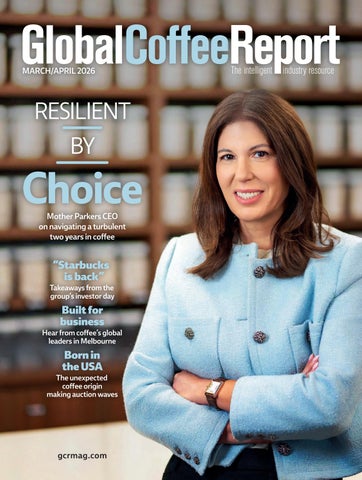
Global Coffee Report March 2026

Page 1


MARCH/APRIL 2026

Choice BY RESILIENT

Mother Parkers CEO on navigating a turbulent two years in coffee

“Starbucks is back”

Takeaways from the group’s investor day Built for business

Hear from coffee’s global leaders in Melbourne

Born in the USA

The unexpected coffee origin making auction waves

new problems. Rather, Buencafé says it’s revealing new opportunities.

53 Built for business

10 Resilient by choice

Mother Parkers President and CEO on her first two years in charge.

“After about six months the US tariffs hit. That level of volatility and disruption was unprecedented.”

INDUSTRY INSIGHTS

16 Starbucks’ new chapter

Starbucks has laid out a set of lofty targets for FY28. What are they, and how will the world’s largest coffee company meet them?

20 Awareness to accountability

Why the coffee industry has moved past raising awareness of sustainability issues at origin, and is now holding itself accountable.

22 Duty calls

Coffee taxes continue to hit the headlines, but the commodity has a long and fascinating history of taxations.

40 Frozen with flavour

Changing consumer expectations on freeze-dried coffee isn’t presenting

Get readyfor the thought-provoking Global Coffee Report Leaders Symposium at the 2026 Melbourne International Coffee Expo.

COFFEE ORIGIN SHOWCASE

28 Born in the USA

How Southern California is emerging as one of the world’s most exciting young coffee origins, and why it’s gearing up to take the industry by storm.

32 The regeneration window

Neumann Kaffee Gruppe is helping thousands of smallholder farms in Honduras adapt to the pressures of climate change.

36 Regions on the Rise: Panama

There’s more than meets the eye to Panama, home to some of the world’s most expensive coffees.

EQUIPMENT AND TECH

25 Breaking coffee’s conventions

A fully automatic machine is now a mainstay on the world’s top la e art

stage, proving technology and skill can elevate each other.

42 Legacy in every roast

PROBAT introduces its newly engineered drum roaster, the Cx70, to the world.

44 Packed and ready

A sneak peek into what CAMA Group has in store for 2026 and beyond.

46 Anywhere, any time

How the Mahlkönig EK Omnia builds on the legacy of the “Queen of Coffee Grinders”.

48 Giving flavour a spin

Unpacking the shift from coffee’s ‘yield-first’ mandates to the exploration of aroma and flavour.

50 Reframing menu diversity

How Legacy+ became Eversys’ answer to the changing landscape of coffee.

LAST WORD

58 Heavyweights commit to supply security

JDE Peet’s and Nestlé’s new commitments to saving the future of coffee.

04 Editor’s note 06 News in brief 56 Marketplace

IVersatility and resilience at the ready

T’S AN INTERESTING time in the global co ee industry. Starbucks

Chairman and CEO Brian Niccol has claimed “Starbucks is back” as he looks to reconnect the brand to its worldwide clientele, JDE Peet’s has released a roadmap to protect the long-term viability of co ee production, co ee prices have shown a 2.6 per cent decrease since December, and Pakistan is looking to embrace Rwandan co ee with its introduction to the South Asian nation. Pakistan isn’t the only country to throw a curveball. A Californian Washed Geisha fetched US$256 per kilogram at the Dubai Co ee Auction at World of Co ee Dubai that featured the likes of Hacienda La Esmeralda, Finca Nuguo, and Alo Co ee, begging the question: where else could we see co ee production thrive over the coming years with climate change shi ing the co ee producing belt? Australia, the Middle East, Italy – it’s not so out of the question.

Honduras, currently the world’s eighthlargest producer, is one such country that has been producing co ee since the 18th century, o ering incredible microclimates. However, it needs added support to ensure thousands of smallholder farmers adapt to the growing pressures of climate change, irregular rainfall patterns, and prolonged periods of drought. Two years ago, I was fortunate to experience a fraction of Honduras’ farming culture, and I was impressed upon the proactive and forwardthinking approach to climate change. Locals explained to me how they were at the mercy of mother nature and in February, as this edition was written, the monthly rainfall average was at its lowest in a ve-year period. Fast forward, however, and thanks to Neumann Ka ee Gruppe and Bene cio de Café Montecristo (Becamo), postharvest maintenance practices overseen by a 40-strong team of agronomists are further helping local farmers navigate the tightrope

of production and long-term crop viability.

At the other end of the production scale is this month’s cover story with Mother Parkers Tea & Co ee CEO Danielle Barran.

A er starting as a small wholesale grocery distributor in 1912, it’s become a behindthe-scenes behemoth of North American co ee. Barran is open about navigating the volatile global market, acknowledging that while rising prices and in ation is part-and-parcel with business leadership, fresh challenges are the “new normal”, with the arrival of US tari s causing further disruption and market confusion, and climate risk an ever-present issue.

e challenge then, like so many other roasters, is to ensure the customer doesn’t feel the pinch from increasing crop failures and sourcing challenges. It’s about nding ways to intrigue the market with new beverage adaptations that keep customer demand strong – and businesses like Mother Parkers in operation for the next 114 years.

is is also the ambition of 53-year-old company Buencafé, which began as the only freeze-dried co ee company in Colombia and is now o ering experiential and customisable avoured co ees for a younger demographic. It’s going beyond traditional o erings but preserving the essence of its 100 per cent Colombian co ee.

We’re in a market that’s open to making co ee more a ordable and accessible, which as Buencafé General Director Mauricio Trujillo Diaz says, will accelerate domestic consumption and open new avenues for market growth.

Let’s hope this is the fairer playing eld we need for all representatives across the entire value chain. GCR

CHIEF EXECUTIVE OFFICER

Christine Clancy christine.clancy@primecreative.com.au

PUBLISHER

Sarah Baker sarah.baker@primecreative.com.au

GROUP MANAGING EDITOR

Myles Hume myles.hume@primecreative.com.au

EDITOR

Kathryn Lewis kathryn.lewis@primecreative.com.au

JOURNALISTS

Daniel Woods

daniel.woods@primecreative.com.au

Meg Kennedy meg.kennedy@primecreative.com.au

ART DIRECTOR/DESIGN

Daz Woolley daz.woolley@primecreative.com.au

HEAD OF DESIGN

Blake Storey blake.storey@primecreative.com.au

BUSINESS DEVELOPMENT AND SALES MANAGER

Charlotte Murphy charlotte.murphy@primecreative.com.au

CLIENT SUCCESS

Cailtin Pillay caitlin.pillay@primecreative.com.au

COVER IMAGE

Panther Sohi

HEAD OFFICE

Prime Creative Pty Ltd 379 Docklands Drive, Docklands, Victoria, 3008, Australia p: +61 3 9690 8766 info@primecreative.com.au gcrmag.com

SUBSCRIPTIONS

+61 3 9690 8766 subscriptions@primecreative.com.au

Global Co ee Report Magazine is available by subscription from the publisher. e rights of refusal are reserved by the publisher.

ARTICLES

All articles submitted for publication become the property of the publisher. e Editor reserves the right to adjust any article to conform with the magazine format.

COPYRIGHT

Global Co ee Report is owned and published by Prime Creative Media. All material in Global Co ee Report Magazine is copyright and no part may be reproduced or copied in any form or by any means (graphic, electronic or mechanical including information and retrieval systems) without written permission of the publisher. e Editor welcomes contributions but reserves the right to accept or reject any material. While every e ort has been made to ensure the accuracy of information Prime Creative Media will not accept responsibility for errors or omissions or for any consequences arising from reliance on information published. e opinions expressed in Global Co ee Report are not necessarily the opinions of, or endorsed by the publisher unless otherwise stated.

Training new staff takes time. Downtime costs businesses. That’s why the New A Line is designed to be intuitive from the first touch – no training needed, no delays, just smooth operation when the pressure’s on. It’s all about the moment

NEWS in brief

AMERICAS

With more than a century of history behind it, Mother Parkers Tea & Coffee is a familyowned Canadian roaster and beverage solutions provider based in Mississauga, Ontario, blending, roasting, and packaging coffee and tea for major retailers and foodservice chains across North America.

The company’s leadership recently ushered in a new chapter with the appointment of Danielle Barran as President and CEO, a former McCain Foods and J.M. Smucker executive tasked with driving growth and innovation in a competitive market.

She talks about building on the legacy of one of North America’s largest privately-owned coffee roasters, and navigating the challenges and opportunities her first two years in charge have presented.

See page 10

Starbucks hosted its first investor day in three years, just days after announcing its first sales increase at United States (US) stores in two years. Chairman and CEO Brian Niccol declared “Starbucks is back”, citing the ‘Back to Starbucks’ campaign as critical in reconnecting the brand to customers.

“Customers are responding to our commitment to world-class service, compelling menu innovation, and marketing that truly resonates,” says Niccol.

“We’re pu ing the customer at the centre of everything we do and se ing our partners up for success.”

He outlined an ambitious fiscal 2028 outlook, including more than 2000 net new stores across the global companyoperated and licensed portfolio, including around 400 net new US companyoperated stores.

See page 16

11 billion cups of coffee

The amount of coffee roasted by Mother Parkers per year.

The United States tariff turbulence of 2025 brought coffee taxes into the mainstream to a greater extent than ever before, but the application and eventual withdrawal on coffee imports is not the first time the product has faced taxation.

From coffee sniffers in 18th century Prussia to instant coffee GST slashing in India, Global Coffee Report looks at how coffee has been taxed in the past, and how current laws have changed the landscape of green-bean importing.

See page 22

Frinj Coffee is pioneering specialty coffee production in the continental United States, proving high quality coffee can thrive

outside the traditional bean belt from its base in Southern California. Founded by farmer agronomist Jay Ruskey, the seed to cup company has built a network supporting more than 60 local growers with adapted varietals and technical know how.

Frinj’s California Geisha recently featured on the global stage of the Dubai Coffee Auction, spotlighting US terroir on the world specialty market. Its science driven approach continues to expand coffee’s footprint in California agriculture.

See page 28

As the world’s eighth-largest producer, Honduras’ diverse coffee industry –

Paul and Michael Higgins are the third generation family owners of Mother Parkers. Image: Mother Parkers.

involving thousands of smallholder farmers spanning 700 to 2000m elevations – is meeting climate pressure head-on with support from Neumann Kaffee Gruppe (NKG) through its local arm, Becamo.

“After years impacted by leaf rust, aging trees, and climate stress, the country has slowly strengthened its sector through investments in nurseries, improved varieties like Parainema and Anacafe 14, and intensive farmer training initiatives,” says José Manuel Calero Moraga, who directs the local Unit for Sustainable Producer Services (USSP) at Becamo, adding the most recent harvest reflects this “gradual stabilisation”.

See page 32

Once overshadowed by larger Latin American producers, Panama has emerged as a premium coffee powerhouse. Its high-altitude microclimates, rich volcanic soils, and quality Geisha have captured global a ention.

Specialty-focused farms are blending

traditional practices with innovative, sustainable methods, boosting both quality and reputation. International competitions are also increasingly recognising Panamanian coffees, driving demand among discerning buyers and roasters. The nation is fostering a community of forward-thinking producers dedicated to environmental stewardship and traceability.

See page 36

Colombia has long been celebrated as one of the world’s premier coffee producers, known for its smooth flavour and nu y undertones. Yet the industry is evolving to engage new audiences without alienating traditional coffee drinkers.

Buencafé is embracing this shift with a new flavoured coffees under its Café Buendía brand, including a collaboration featuring Aguardiente Amarillo de Manzanares.

“Flavours such as vanilla, choco-hazelnut, amare o, and maple respond to global trends while allowing consumers to enjoy premium 100 per cent Colombian coffee in

new ways,” says Mauricio Trujillo, General Director at Buencafé.

See page 40

EUROPE

Rainforest Alliance has been certifying coffee farms since its first program in Guatemala, evolving from basic compliance checks to rigorous, modern standards reflecting regenerative agriculture. The green frog symbol has become a global marker of sustainable practices, with certifications like Rainforest Alliance and B Corp now key marketing tools. These certifications help prevent false sustainability claims while meeting rising consumer expectations for ethical business.

As the coffee sector faces new environmental challenges, certifications continue to adapt, emphasising accountability and supporting positive change at origin, ensuring a more sustainable future for the industry.

See page 20

Rainforest Alliance certified its first coffee farm more than 30 years ago. Image: RafMaster/stock.adobe.com

NEWS in brief

Swiss fully automatic coffee machine manufacturer Thermoplan is now a familiar face on the coffee competition scene after its Black&White4 Competizione was chosen as the qualified espresso machine for the World La e Art Championships (WLAC).

It’s now three years since the Specialty Coffee Association’s historic decision to use the technology, which will take centre stage at the upcoming WLAC during World of Coffee in San Diego between 10-12 April 2026.

“It shows the industry that automation and top-tier coffee quality are not opposites, but can actually complement and elevate each other,” says Martin Ulrich, Head of Black&White Sales at Thermoplan.

See page 25

German coffee roasting equipment manufacturer PROBAT is unveiling its new Cx70 at HOTELEX Shanghai 2026 in March – one of the world’s largest and most influential trade fairs for the hospitality.

The company describes the newgeneration roaster as “customer-driven industrial roasting technology” –highlighting fewer compromises and

unnecessary features, with a sharper focus on efficiency, productivity, and profitability, without abandoning roast quality or process transparency.

Out of all its exciting benefits – such as a higher throughput, two automation system choices, and entry-level pricing – the company’s Product Manager Mark Weimer says the improved cost-performance ratio stands out.

“This means we increase the batch size to 70 kilograms, and then at the same time, we reduce the entry price tag to approximately 30 per cent less than the competition.”

See page 42

As the packaging industry descends on Düsseldorf, Germany, in May for the 2026 edition of Interpack, CAMA Group sees the triennial trade fair as test, proving exhibitors have “been doing their homework”.

As a leader in secondary-packaging, the Italian firm will showcase three machines, and promote its Machine Enhacement Program.

“We’re presenting a concept that can be 100 per cent integrated into our new

machines, or it can be retrofi ed for a brownfield to fit whatever customers have in their factory; we’re developing projects to automate the loading of machines away from the CAMA line, but customers still see a partner in CAMA for this assessment and project development,” says CAMA Group Key Account Manager Lorenzo Birro.

See page 44

Taking its name from the Latin word omnis, the Mahlkönig EK Omnia has been developed to be a universal powerhouse grinder, capable of delivering in any situation.

Built on the foundations of the EK43, which is also known as the ‘Queen of Coffee Grinders’, new features of the Omnia have been built off the back of customer feedback, according to Ziya Boro, Chief Sales Officer at Hemro Group.

“EK Omnia is the result of an ongoing dialogue with the market,” she says.

“Continuous improvement is essential if a product is to remain relevant in real-world café environments.”

See page 46

Thermoplan’s fully automatic Black&White4 Competizione will make its third appearance at the World La e Art Championships in San Diego in April 2026. Image: Thermoplan.

After introducing the world to its new Legacy+ line at Host Milano 2025, Eversys has dived into exactly what it saw in the market that led to the launch of its latest evolution.

Everysys Marketing Director, Miranda Caldwell, says there has already been incredible interest in the new capabilities of Legacy+ in areas ranging far and wide from the traditional café.

“We’ve been working on the Legacy+ ever since the Legacy launched,” she says. “We wanted to bring more power and speed to the market, especially for those larger format drinks.

“Menu diversity is increasing at a rapid

2000 worldwide net new stores

pace globally with matcha, espresso, and limited time offer beverages, we’re also seeing strong interest in menu diversity outside the café in places like c-stores, offices, bakeries, and more.”

See page 50

ASIA-PACIFIC

Australian extraction technology

manufacturer Flavourtech and its Spinning Cone Column (SCC) has led the charge for almost 40 years to solve a key gap in the production of flavourful soluble and readyto-drink (RTD) coffee.

The company works with some of the world’s top beverage brands, helping them extra aroma without the use of high temperatures.

“The SCC has the versatility to capture flavour notes from various bean types without damage,” says Global Sales Manager Paul Ahn. “The SCC is able to capture those volatile notes, which means coffee producers

– whether making RTD concentrated liquids, or soluble coffee – can put those single, original, or unique characteristic notes back into the finished product.”

See page 48

“One of the biggest lessons I’ve learned is the importance of constantly reinvesting back into the business – in people, systems, equipment, and culture,” says Michael Rababi, Founder of Di Pacci Coffee Company in Australia.

“Sustainable growth doesn’t come from extracting profits early, but from building strong foundations over time.”

This is a snippet of what GCR Leaders Symposium a endees can expect on Friday 27 March 2026. Taking place within the Melbourne International Coffee Expo (MICE), the event is a rare opportunity for roasters, operators, and industry decisionmakers to hear directly from leaders who have successfully navigated the challenges of growth, scale, and innovation in coffee.

See page 53

Danielle Barran was appointed CEO of Mother Parkers Tea & Coffee in April 2024. Image: Panther Sohi.

LONG GAME THE PLAYING

From tariff turbulence to ready-to-drink opportunities, Mother Parkers Tea & Coffee CEO Danielle Barran dives into her first two years leading one of North America’s most successful private coffee companies.

ELEVEN BILLION CUPS of co ee. It’s a number so large it’s almost impossible to mentally quantify. It’s also the same amount of co ee Canada’s Mother Parkers Tea & Co ee roasts per year.

A family business still owned by thirdgeneration Paul and Michael Higgins, Mother Parkers has grown from humble beginnings as a small wholesale grocery distributor in 1912 into a behind-the-scenes behemoth of North American co ee. Danielle Barran was handed the reins as new CEO in April 2024. Previously named one of Canada’s 100 most powerful women by the Women’s Executive Network, she arrived at the business with a high level of experience in food and beverage retail with e J.M. Smucker Company and McCain Foods – including a stint as Smucker’s VP of Marketing for Co ee in the United States (US).

As a local of Mississauga, Ontario, where the company’s Canadian co ee operations are based, she’s likened her return to somewhat of a homecoming. So much so that she even went to high school with one of the company’s sensory lab technicians. at return hasn’t been limited to local reconnections, though. She says she’s reencountering many of the same people who were already embedded in North America’s co ee scene when she originally le it more than a decade ago.

“I had been out of the co ee category for 15 years, but as I’ve come back in – whether that be through board work or conferences – I’ve seen a lot of the same people,” says Barran.

“It’s a category that draws people in and keeps them. I can see why – it inspires deep expertise, and I’ve enjoyed coming back.”

Through turbulent times

Barran is a self-professed “boomerang” to the co ee industry, but despite her previous experience in the category, it’s not been smooth sailing in the two years since her return.

Mother Parkers, like the rest of the co ee world, has been forced to navigate a volatile global atmosphere. From historic green bean price highs and falling harvests in major regions at origin, to in ation and tari volatility, most people involved in the co ee supply chain continue to feel the pinch.

While some of this volatility is part and parcel of operating in co ee’s modern commercial landscape, Barran says there have been new challenges to address since she took over at Mother Parkers.

“Rising prices and in ation are part of the playbook for business leaders,” says Barran.

“I had a great onboarding but a er about six months the US tari s hit, and that level of volatility and disruption

was unprecedented.

“I wouldn’t say we’re through it, but a er a year of navigating that volatility, we’ve learned to manage it and accept it as the new normal.”

Canadian co ee manufacturers, including Mother Parkers, continue to face 35 per cent tari s when exporting co ee products to the US at the time of writing – a serious trade issue that is placing signi cant pressure on operations.

Just a year ago, these types of trade barriers were almost unheard of, as the North American market was tightly integrated with most goods owing tari free in both directions.

Aside from Canada, one of the most signi cant remaining tari s on any co ee being imported into the US is a 50 per cent duty on soluble co ee from Brazil, but the co ee world was forced to navigate immediate price hikes into the world’s largest consumer market during 2025.

Brazilian products entering the US were slugged with a 50 per cent added duty, while other top producers including Vietnam, Indonesia, and Colombia were hit with tari s between 10 and 20 per cent.

For a business with the size and scope of Mother Parkers – Barran shared it’s likely a top ve roaster in North America by volume – green beans are procured all over the world.

“We source from nearly every growing region to ensure exibility in our blend management and meet our customers’ speci c and evolving taste and quality needs,” says Barran. “ ere’s also a level of volatility in climate risk, so part of our risk mitigation is making sure we have a footprint that isn’t overly focused in one region.

“Concentration in the largest origins is natural, but we make sure we maintain strong relationships elsewhere because we want to be a part of that. It enables us exibility around formulation, as well as risk mitigation. If there’s a crop failure in a major sourcing region, it’s our job to make sure the customer doesn’t feel the pain of that.”

Alongside Mother Parkers’ Canadian origins and Mississauga headquarters, it also operates a facility south of the border in Fort Worth, Texas, with large sections of its business dedicated to the world’s largest

co ee consumer market.

e facility, which rst opened in 2000, had been constructed in just nine months. Paul and Michael Higgins, who were running the business at the time, saw it as critical to creating a genuine footprint in the US.

“Our infrastructure was designed to support North American growth. We have strong customers both north and south of the border,” says Barran.

“We’re more than 100 years old and we grew up in Canada, so we have a lot of infrastructure here, but our owners had the foresight to build a signi cant footprint in Fort Worth, which allows us to adjust production quickly as market conditions shi .

“When things like tari s and duty environments change overnight, we’re able to ex our infrastructure. In response to the current environment, we moved quickly to ramp up our fully operational facility in Texas.”

Taking action

Mother Parkers remains one of North America’s largest privately held companies in the co ee category. While private ownership brings its own dynamics, Barran believes the structure has yielded a signi cant advantage in navigating the historically volatile co ee market of recent years.

“One of the bene ts of being a privately held company is the ability to take a longterm approach, and that’s helped us. While we had to balance disruption and price tags in the short term, we’ve done it through a long-term lens, with a continued focus on the fundamentals,” says Barran.

“My background is in nance, even though I’ve spent the bulk of my career in the commercial space, I think through the business in numbers. So, the rst thing I did was get a real handle on the levers of the P&L and what the key aspects are that drive the Mother Parkers top and bottom lines.

“ e other thing that helped us navigate an increasingly volatile environment is that I came into a deeply engaged organisation. Spending time early on with both employees and customers allowed us to build a shared understanding of what was working and what wasn’t. at engagement built the trust needed to execute our strategy with excellence.”

She adds a combination of the strength of Mother Parkers as an enterprise, alongside the leadership team around her, has been critical in steering the ship through the rocks of international duty law and in ation.

“I was fortunate in that it wasn’t a company under duress, and it had a very strong track record when I came in. e

rst 90 days are important because I think it does set a trajectory for your leadership, but when it comes to organisational change you must tread carefully. When you arrive as a new leader you rarely have the luxury of completely recreating the playbook on day one, usually it’s given to you.

“I have a high bias for action, which I think is good because that means I can be decisive, but the leadership team around me is critical. We spent time together understanding what levers we could pull depending on the situation, and making sure we were aligned on strategy.

“We’re steeped in our values and how we do business. at enabled us to move quickly and share some of the responsibility across the business around managing volatility like tari s.”

Paul and Michael Higgins are the third generation family owners of Mother Parkers. Image: Mother Parkers.

The new opportunities

While there has been signi cant change in the co ee industry over Barran’s career, there are also trends in the market that has strong similarities to 15 years ago.

Although the current green bean price trends are reaching highs never seen before, it’s not the rst time they’ve been moving almost unstoppably upwards.

However, one key emergence in the retail co ee category in recent years has been the rise of cold co ee, including ready-to-drink (RTD) options.

“Co ee is such a fascinating category, and that’s why I love it so much,” says Barran. “When I rst le it, the idea of cold co ee was just starting to trend into the mainstream. It was something a lot of companies were starting to look into trying to understand if it was a fad, and what kind of traction was going to exist.

“Now, cold co ee is a massive part of the category. Few categories of this size that can undergo that level of transformation in just 15 years – which is not a long time.

“We know when our customers are consuming co ee outside the home, and among 18 to 24 year olds, 62 per cent of that consumption is cold co ee.

e prevailing thought is it’s not a habit that’s going to change over time. ose consumers aren’t suddenly going to get older and convert to hot co ee.” at prevalence of cold co ee has also ltered into the in-home market, which Barran says has been heavily in uenced by its own type of instability.

“During Covid we naturally saw a lot of people convert their consumption to in-home, and post-Covid we’ve seen a shi back to out-of-home, but not all the way.

“Once you layer on this degree of in ation that isn’t just co ee-related, I see changes in consumer habits that are probably a bit stickier than we would have initially thought,” she says.

As part of this product innovation, Mother Parkers is preparing to launch its rst foray into the cold co ee and RTD space with a new facility capable of producing co ee extract products at scale. Featuring a super-concentrated liquid base – o en several times stronger than espresso before dilution – the concentrate and extract space is a market that has been steadily evolving in recent years. Not only are some big international players hedging bets on it, but there is some incredible innovation taking place.

Nestlé has been a signi cant mover and shaker with its Espresso Concentrate range

Barran says rising prices and inflation are “part of the playbook” for business leaders. Image: Panther Sohi.

and upped its capacity to produce it as recently as August 2025, when the company added a new production line to its Sri Muda factory in Malaysia.

New technology, like ‘Baby Hardtank’ from Polish company Hardtank, has also been created to speed up the cold brew extraction process in cafés to add menu exibility and safety.

It’s an emerging market within an already growing sector of the industry, with Barran and Mother Parkers seeing signi cant potential in its development.

“We’re still in the early days of the cold co ee category, but the growth trajectory is clear. We expect demand to accelerate, and we’re thrilled to be at the forefront of bringing scalable, di erentiated solutions to the market with a facility that’s going live this year,” says Barran.

“It’s a big investment on the company’s part, and we’re excited about it for a lot of reasons, particularly the fact that we’re bringing something to market that is quite di erentiated for our customers.

“It’s designed to deliver value, and it’s an aseptic solution – allowing it to be distributed at an ambient temperature, which is critical from a customer perspective. I believe it will create a superior sensory experience, and we see cold co ee not as a passing trend, but as something that’s here to stay.”

is appetite for innovation, Barran says, is part of Mother Parkers’ DNA, and is

why it has continued to grow since it was founded more than a century ago.

“I think it speaks to having a healthy appetite around what we view as risk adjusted innovation. It’s a company and family that’s willing to invest for growth,” she says.

“ e advantage of being a privately held company is the ability to align quickly when capital deployment decisions need to be made. When there’s a strong business case, we can move decisively. We’re one of the largest suppliers in North American tea and co ee. And we have e ectively found the balance between the bene t of that scale and the exibility to o er true di erentiation around things like avour and value.”

Blending art and science

Alongside the Mother Parkers portfolio of retail brands that includes – but is not limited to – Marley Co ee, Martinson, Higgins & Burke Tea, and, of course, the original namesake, is a private and white label roasting business that is one of the company’s major divisions.

Barran believes end consumers are shi ing to two ends of the same value spectrum, and it’s up to roasters to identify methods they can use to serve both emerging camps.

“It’s a great time to be in private label, because consumers are not really delineating between what’s a national brand and what’s a store brand,” says Barran.

“We know consumers are looking for value … we’ve seen a group of consumers gravitating towards large pack o erings where they’re focused on value per serving, while at the other end of the scale, people are looking at value through an absolute price point.”

While perception of value may di er between Mother Parkers’ retail customers, private roasting clients, and everyone in between, Barran says it’s important to strike a balance between the two to ensure there’s a product and price point that keeps everyone happy.

“One of the great things about co ee is it’s a blend of art and science. Much like a car, you start with a chassis, but what really matters is how you build the bells and whistles around it,” she says.

“We try to strike the right balance between not creating a Swiss Army knife that can do everything, which can be dangerous, and not going so far into specialty that scaling becomes a challenge.

“I think we found a sweet spot in the middle to make sure our chassis has that di erentiation – whether that be sustainability, brand value, and engineering ourselves towards di erent private label brand positions.”

An inherent passion

While the most major, tangible development taking place at Mother Parkers this calendar year is undoubtedly its rst steps into the cold co ee, Barran and the brand she leads is positioning itself to continue to grow with the co ee industry at large.

At its base level, food and beverage retail exists and grows because of peoples’ biological need for sustenance, but it twists, shi s, and expands to t not only what the customer needs, but what it wants.

at’s the bene t of co ee as a category, according to Barran. People’s desire to consume it, along with their passion for the category, has created a high-growth market of ripe with opportunity.

“Few categories inspire the level of passion that co ee does,” she says.

“Most categories would kill for the level of consumption we have. Co ee is the most consumed daily beverage in the US, and the outlook: whether it’s hot, cold, single-serve, or out-of-home, remains incredibly strong.

“It’s an amazing category to be in and I feel like the world is our oyster – not just for Mother Parkers, but for the industry overall.” GCR

A Mother Parkers storefront in 1920. Image: Mother Parkers.

Starbucks’ next chapter

As part of its first investor day in three years, Starbucks executives outlined the key factors altering its trajectory. Here are four key takeaways.

THE END OF Starbucks’ 2025 scal year has marked something of a turning point for the brand, if remarks from its executive team and a new three-year outlook are anything to go by.

A er reporting its rst United States (US) same-store sales growth in two years in its Q1 FY2025 reports, nalising the sale of 60 per cent of its Chinese operations to investment rm Boyu Capital, and leaning even more into the Back to Starbucks disposition, President and CEO Brian Niccol hosted Starbucks’ rst investor day since 2023.

e Seattle-based multinational chain, according to Niccol, currently operates more than 41,000 company-operated and licensed co eehouses in 90 countries, making it the largest co ee brand in the world.

It serves more than 20 billion customers per year worldwide and has more than 85 million members in its Starbucks Rewards program. It’s drive-thru business in the US alone generates more than US$10 billion per year. Yet, some headwinds before Niccol’s appointment in 2024, and for a period since, has tested the Starbucks business.

e growth of new co ee chain powerhouses in its home market of the United States, plus international players like China’s Luckin Co ee and Cotti Co ee, Japan’s Doutor Co ee and Komeda Co ee, and South Korea’s Compose Co ee and

theVenti, have challenged Starbucks’ share in key markets.

Niccol and company say Starbucks is embracing the global change, and emerging challenges, it is facing around the world and is repositioning itself to not only hold onto its current slice of the global co ee pie, but to grow it.

Its investor day o ered deeper insight into how it would do this. Among the discussions – covering everything from barista interest in Starbucks stock to a rollout of new in-store machinery – four key themes emerged.

Customers are embracing ‘Back to Starbucks’

In September 2024, just days into his tenure, Niccol revealed his master plan to bring Starbucks back to its customer service roots – aptly named ‘Back to Starbucks’.

In the close to two years since, the business has undergone signi cant transformation within its executive and corporate structure, and on the ground in its stores, to execute this new plan.

From reducing wait time, providing additional hours coverage, the removal of non-dairy milk upcharges, and shi ing the business’ marketing strategy, Niccol says the customer was returned to the centre of everything Starbucks did.

Now, he says that return is started to pay dividends in its home market.

“On my second day I shared an open letter outlining our Back to Starbucks plan, and in that I was pretty clear on what I believe has always set us apart,” says Niccol.

“It’s a plan rooted in who we are and what’s made us successful, and it’s also centred around core pillars that provide us a clear path towards growth and a stronger future.

“We’ve put the customer back at the centre of every decision we make. We focused our time, resources, and investments on work that has made the greatest impact … inside the co eehouse. We made it much easier to run great co eehouses by launching Green Apron Service across North America in all our company-operated stores.”

e customer uptake has been positive, prompting Niccol to state: “Starbucks is back”.

“Customers are responding to our commitment to world-class service, compelling menu innovation, and marketing that truly resonates. We’re putting the customer at the centre of everything we do and setting our partners up for success.

“We know there’s more work ahead, but we’re con dent in our plan and see signi cant opportunity in the U.S. and around the world.”

Clear growth targets – despite headwinds

Alongside its investor day, Starbucks released a new suite of FY2028 targets and nancial frameworks, which include

Images: Starbucks.
CEO Brian Niccol addresses a endees of the Starbucks 2026 investor day.

targets that can only be achieved through the growth of the company’s US and global operations.

In FY2028, it expects to deliver ve per cent or greater consolidated net revenue growth, three per cent or greater global and US comparable store sales growth, two to three per cent consolidated revenue contribution from new stores, and over 2000 net new stores globally – with approximately 400 of those being companyowned in the US.

FY2025, for context, saw 600-650 global net new store openings. is, according to Starbucks, will result in a non-GAAP consolidated operating margin of 13.5 to 15 per cent, and nonGAAP earnings per share of US$3.35 to US$4.

Niccol assured investors that the company’s ambitions “extend well beyond this timeline”, with Chief Financial O cer Cathy Smith stating some of Starbucks’ work in areas including supply chain and in-store development will only begin contributing fully to Starbucks’ P&L in “several years”.

“While we have more work to do to strengthen our operating foundation, we have a clear plan and we’ve made a lot of progress. e work underway isn’t incremental, it’s transformational,” says Smith.

“ e nancial framework we shared today shows how we will translate our Back to Starbucks strategy into sustainable, pro table growth and, in turn, compelling shareholder returns.

“Every element is in our control. We’re not relying on external factors or favourable market conditions. is is fundamentally about executing on our core competencies with discipline and speed.”

Creating new opportunities

Around the world, co ee is no longer just co ee. While classics like the long black or Americano remain innately popular, the signature and specialty drink movement is gathering momentum with no sign of slowing down.

Leaning into the consumer appetite for new o erings, Starbucks says it is also looking at growing the revenue share of its food menu.

Starbucks Global Chief Brand O cer, Tressie Lieberman, discussed the ywheel that Starbucks is using to inform how it constructs its menu.

“First is experiences. When an experience is truly innovative, it sparks cultural movements. We’re not just launching new items; we’re making icons of our items and investing in the development of new ones. From menu to merchandise, we drive momentum by giving our customers things to talk about,” she says.

“Second is rituals. We create moments that fuel brand passion, unleash loyalists, and unlock new occasions every day. We are doubling down on our core platforms that customers love and evolving our rewards program to make sure every member feels values.

“ ird is connection. Our partners are the heart of the brand, creating connections

across all channels. We have a unique opportunity to connect people over co ee during a time when loneliness is pervasive.”

New menu items are on the horizon for Starbucks, whether its customisation options or seasonal o erings, according to Lieberman.

She cited that this spring, Starbucks is expanding its popular Refreshers platform with Energy Refreshers and exploring ways to create more products to extend it from blended to sparkling, and add new customisation options like decaf.

Lieberman says it will be important for Starbucks to take successful concepts from key markets to the world, to foster organic menu growth.

“When an idea works in one market, we can scale it around the world. Take Pumpkin Spice Latte, for example. It began in the US and now it’s in more than 80 markets,” she says.

“Cold Foam is now one of our largest modi ers and represents one-third of our billion-dollar customisation business. Customers can now make 90 per cent of their drinks a protein drink with an upsell to protein milk or protein cold foam. Protein has been a great incremental driver.”

In addition to leveraging new options on its drinks menu, Lieberman says Starbucks is looking to create a “true second peak” in the day by continuing to push its food items.

In FY2025, she says Starbucks generated more than US$12 billion in revenue before 11am.

A recentring of customer service has been critical to Niccol’s Back to Starbucks strategy.

With its food business doubling since 2020, now accounting for about 25 per cent of sales worth nearly US$6 billion, it’s an evolution Starbucks will continue to lean into, Lieberman adds.

“We’ll maintain relevance by continuing to evolve our breakfast and bakery o erings. And this February, we’re expanding our bakery case with a curated lineup of globally inspired avours designed to elevate the customer experience,” she says.

“ is bakery case isn’t just about the mornings. It’s also about giving customers choice for that a ernoon snack. Midday and a ernoon dayparts already generate $11 billion a er 11am., but we believe there’s room to create a true second peak.

“We see an opportunity to own a new Starbucks occasion in the a ernoon, a true a ernoon reset, a culture-shaping ritual that Starbucks is perfectly poised to de ne and own.”

To the world

Starbucks’ sale of 60 per cent of its Chinese operations to Boyu Capital was one of the major global co ee news stories of 2025, and it indicated a genuine shi in what has traditionally been Starbucks’ second largest global market.

In FY2025, 40 per cent of Starbucks’ international revenue came from China, despite reports the average person there

drinks just three cups of co ee per year – considerably lower than the 300 annual cups consumed by the average American. rough the agreement with Boyu, Starbucks’ Chinese locations will shi from a company-owned to an almost fully licensed model, says Starbucks International CEO Brady Brewer.

“In scal 2025, international made up roughly one third of global system sales and generated 20 per cent of total company revenue. Approximately 40 per cent of that revenue came from China,” says Brewer. “ rough our joint venture with Boyu, we’re shi ing our 8,000 co eehouses from a company-operated model to a licensed model, and that will shi our international mix of co eehouses from roughly 55 percent licensed to 90 percent licensed, underscoring the point that we are an asset-

light, higher margin operating model.

“Our partnership with Boyu shi s our international segment to a higher margin business model overnight. And at the same time, by retaining a 40 per cent stake in China, we’ll continue to bene t from future growth along with better returns on invested capital.”

Brewer continues to say brand recognition and trust will be critical for Starbucks’ growth in its key international markets, especially in Asia.

“In China, Japan, and Korea, our three largest international markets, our brand measurement consistently shows that Starbucks is the most loved brand,” he says.

“Why does that matter? Because when you combine rising global demand for co ee with our expanding co eehouse footprint, and then you add in the strength of customer love for Starbucks and momentum of our Back to Starbucks Plan, the result is a powerful, strategic advantage.

“We expect international net new openings will be at least 1,500 stores in scal 2028, far outpacing North America. Shi ing to margin, our consolidated operating margin framework shows the bridge from where we are to where we expect to be in scal 2028. Building on this philosophy, we expect to achieve our 2028 operating margin guidance of 13.5 per cent to 15 per cent through a combination of drivers.” GCR

Starbucks announced Boyu Capital had acquired 60 per cent of Starbucks China for US$4 billion in November 2025.
Starbucks scrapped dairy milk upcharges in North America in November 2024.

Awareness to accountability

With the ethics of consuming sustainable product only becoming more important to consumers around the world, Rainforest Alliance details how the coffee industry has shifted gears from intention to action.

COFFEE, LIKE almost every other agricultural practice in the world, is innately tied to the environment. A er all, without the growing conditions that enable co ee production to thrive, the entire industry would grind to a halt.

Although the genetic evolution of co ee varietals is enabling trees to ourish in di erent environments, the bean belt between the Topic of Cancer and Tropic of Capricorn is still where the lion’s share of co ee farming occurs, yet those regions are among the most at risk to factors like climate change and deforestation.

Since certifying its rst co ee farm in Guatemala in 1995, the green frog of the Rainforest Alliance has become a global indicator of sustainable practices, from bean to cup.

ere has always been some level of

responsibility on co ee producers and procurers in ensuring the beans sourced are sustainable in nature, but Global Strategy Lead Co ee & Cocoa at the Rainforest Alliance, Maya Sermeno, says that responsibility is widening ever further to include more people in the co ee value chain.

“ e agricultural sector is at a critical tipping point. We can no longer a ord a ‘do no harm’ mindset; we must move toward a model that actively repairs and restores,” Sermeno says.

“ e twin crises of accelerating climate change and land degradation is making vast areas of traditional co ee-growing land increasingly unviable. If we continue with business-as-usual, we risk not only the loss of biodiversity and forest cover but the collapse of the livelihoods of millions of smallholders who produce

70 per cent of the world’s co ee.

“Restoration not only helps co ee plants survive extreme weather but can also boost net farm income by up to 30 per cent. is transition requires a shi to shared responsibility, where roasters and retailers provide the up-front investment and technical support farmers need to implement these restorative practices.

“Sustainability is a journey of continuous improvement, not a destination.”

While an increasing consumer awareness around the in uence di erent products have on the environment is helping foster change, Sermeno says changing legislation around the world is creating a necessary shi .

Laws like the delayed European Union Deforestation Regulation (EUDR), the proposed United States FOREST Act, and Colombia’s Green Pact Law (Ley del Pacto

Verde) all involve due diligence compliance to ensure new sustainability standards around the world will be met.

Sermeno says legislated change like these are critical in fostering a more actiondriven approach to sustainability in the co ee industry, and in wider agriculture.

“We have moved from the ‘awareness’ phase to a new era of accountability, accelerated by evolving sustainability legislation,” she says.

“Consumers, and now regulators, are increasingly expecting businesses to prove they are addressing their impact on the planet and its people.

“We help companies meet these rising expectations on deforestation, climate, and human rights by setting clear, credible requirements. For large businesses, sustainability is no longer a side project; it is a fundamental requirement for market access.

“Our role is to help them verify their progress and turn those high-level commitments into measurable action on the ground, enabling them to build trust in the marketplace through our green frog seal and related claims.”

Much like evolving national legislation, the certi cation process for what co ee is considered sustainable or ethical is also constantly shi ing, with certi cations like Fair Trade and Organic also highly thought of by consumers.

Regenerative agriculture looks to be the latest step in sustainable farming, and it’s already in uencing the co ee industry in

a big way, from not only a sustainability perspective, but through evolving consumer preferences.

Swedish roaster Lö ergs recently purchased its rst lot of Regenerative Organic Certi ed (ROC) co ee from Nicaragua, while Expocacer has cited Europe as a huge market for regenerative co ee, while interest in regenerative products is also increasing in the United Kingdom and United States.

Rainforest Alliance has now built its own Regenerative Agriculture Standard in a move, Sermeno says, re ects this journey.

“ is shi in global urgency led to the development of our new Regenerative Agriculture Standard, built on the Rainforest Alliance’s nearly 40 years of expertise in sustainable agriculture and global certi cation,” she says.

“ e standard builds upon our Sustainable Agriculture Standard (SAS), deepening requirements for soil fertility, biodiversity, and carbon sequestration to deliver speci c, restorative outcomes.

“ e Regenerative Agriculture certi cation programme will also enable brands to make credible, science-based claims about their regenerative transition. At a time of increased greenwashing, our standard provides a pathway to turn ambition into veri ed, measurable action that can help secure the long-term future of co ee.

“Because our certi cation standards are based on rigorous, independent third-party

audits and a clear chain of custody, they provide the empirical evidence needed to back up sustainability claims.”

Whether it be through the earned green frog of Rainforest Alliance certi cation, di erent certi cations, or the communicating of a brand mission to be a sustainable company, businesses that showcase their commitments to protecting the planet o en use so as a tool for marketing that stems from that inherent desire to do good.

Sermeno believes companies that put out their sustainability goals and ambitions into the world can create a powerful cycle.

“Marketing sustainability can a powerful force for good when it is backed by certi cation. When a company goes public with its sustainability goals, it creates a ‘virtuous cycle’ of accountability and demand for more sustainable products,” says Sermeno.

“ is transparency motivates businesses to align their internal procurement practices with their external brand image, making their e orts more genuine and impactful because the stakes –both  nancial and reputational – are so high.

“Sustainability only matters if it leads to real change for forests and the people who depend on them. Our role is to help move sustainability from intention to action. is clarity helps consumers, companies, and policymakers understand which e orts are credible.” GCR

Rainforest Alliance certified its first coffee farm more than 30 years ago.

Image: RafMaster/stock.adobe.com.

Coffee sniffers roamed the streets of 18th century Prussia to catch people illegally making coffee.

Duty calls

While tariffs on coffee have been a hot topic over the past year, the commodity has a long and fascinating history of taxation – from monarchs’ moral panics to professional ‘coffee sniffers’ hired to detect illegal roasting.

IT’S A SAFE BET that the public was never so aware of international trade duties as they were in 2025, and as we move well into 2026, the topic of tari s and taxes remain a hot topic.

President Donald Trump’s sweeping tari s on imported goods into the United States (US) have been in headlines since they were rst announced on 2 April 2025. While most of the ‘Liberation Day’ duties have since been repealed, commodity markets continue to rise and fall under the threat of new levies.

It’s not just President Trump’s actions that have brought taxation into the co ee conversation though. During the past year, several countries have reduced or scrapped duties on co ee products in a bid to alleviate rising household costs.

In March 2025, the Brazilian Government agreed to remove import taxes on co ee –

as well as other foods such as corn, olive oil, and sugar – as part of its move to curb food pricing in ation.

“ ese are emergency measures to reduce taxes, to reduce food costs, and to help, at this exceptional time, to reduce in ation, especially food in ation,” said Vice President Geraldo Alckmin.

In August 2025, the Danish Government announced plans to remove tax on co ee amid a wider group of food and drink items.

Originally introduced in Denmark in 1930 as part of a luxury goods tax, the duty adds about 25 per cent to the cost of co ee and is planned to be phased out by 2027.

“We have chosen to implement a step that will have an immediate impact on people’s lives, they will quickly notice more money in their wallets,” said Deputy

Prime Minister Troels Lund Poulsen in an interview with local broadcaster TV2

Just one month later, the Indian Government slashed the Goods and Services Tax (GST) rate on instant co ee from 18 to ve per cent. e reduced rate took e ect on 22 September 2025 and was celebrated by the country’s co ee producers.

“[ is is] a progressive step that will signi cantly upli the Indian co ee industry,” said Rana George, Managing Director of Kelachandra Co ee, one of India’s largest privately held plantations.

“By making co ee more a ordable and accessible, this move will accelerate domestic consumption and open new avenues for market growth. It creates a fairer playing eld for growers, processors, and retailers, ensuring bene ts across the entire value chain.”

A chequered history

While the past year has seen co ee become the subject of many duty changes, the commodity has a long history with taxation that spans centuries and continents. Over the years, the seeds of the Co ea plant have sparked social rebellion, become an illegal underground industry, and even been used to perform scienti c experiments on prisoners.

e earliest known taxation of co ee is said to be during the Ottoman Empire in the 16th century. As co ee houses became popular across the Middle East, the government began taxing the item as a state-regulated commodity in a bid to control public gatherings and trade pro ts.

However, by the 17th century, Sultan Murad IV banned the consumption of co ee in Istanbul altogether – along with tobacco and alcohol – as he believed co ee houses were a hot bed for antiestablishment ideas and plots to bring him down. It is said the Sultan even disguised himself to patrol the streets and catch those who de ed the ruling.

e Sultan was certainly not the only leader to attempt to quell the growing popularity of co ee. In the 18th century, King Adolf Frederick of Sweden periodically introduced bans of co ee and tea. While the King proposed them as way to protect citizens against ca eine’s ‘detrimental e ects’, it is thought he was really looking to protect the local beer industry.

Legend goes that Adolf Frederick’s son, King Gustav III, took to ‘science’ to prove to his people that co ee is de nitively harmful. It’s said he made two condemned prisoners drink copious amounts of co ee or tea to see which died rst –unfortunately they both lived for many years longer than the King himself, with the tea-drinker eventually succumbing rst. From the mid-1700s to the mid-1800s, co ee in Sweden was banned, taxed, and relegalised at least ve times.

Around this era, the taxation and banishment of ca einated beverages was somewhat of a trend throughout Europe. In 18th century Prussia (now Germany), ‘co ee sni ers’ were hired to catch out people illegally brewing or roasting during a time when co ee was taxed as a luxury item – up to 150 per cent of the sale price at some times.

Interestingly, a hangover of this tax still impacts co ee businesses in Germany today. While professional co ee sni ers may be a thing of the past, the excise duty

known as Ka eesteuer still applies and classes co ee as a luxury good. e tax adds €2.19 (US$2.60) per kilogram for roasted co ee and €4.78 (US$5.68) per kilogram for soluble co ee, while green beans are exempt.

State of play

Today, it’s not unusual for consuming countries to impose higher import duties on roasted co ee compared to green beans. For example, the European Union (EU) currently imposes a duty rate of zero per cent on green co ee and 7.5 per cent on roasted non-deca einated co ee. is decision is said to be in uenced by the fact that roasted co ee doesn’t add much value to domestic markets because it is a nished product, while green beans enable the addition of value through the process of trading and roasting.

According to data from the International Co ee Organization (ICO), between 1990 and 2019, 72 per cent of co ee imports into importing countries were green beans. e main importing nations were the European Union, the United States, Japan, Russia, Canada, Switzerland, South Korea, Malaysia, China, and Algeria.

It has long been said that roasting at origin would improve outcomes for co ee growers as the set up would retain more value in the country of origin. However,

as well as current duty implications, there are also other factors to consider such as the freshness of the roasted co ee and the e ciency of roasting in production countries.

Despite this, in its latest Obstacles to Consumption report in 2020, the ICO did report that domestic consumption in co ee-exporting countries had an average annual growth rate of three per cent from 1990 to 2019.

“Although the vast majority of co ee exports are destined for non-producing countries, there is a vibrant trade both between exporting countries, as well as re-exports from importing countries to exporting countries,” said the authors.

“Domestic consumption in co eeexporting countries has grown signi cantly. Moreover, low per capita consumption in almost all exporting countries indicates signi cant unexploited potential for increased domestic consumption. In many of these countries there is a rapid expansion of middleclass population adopting co ee drinking culture.”

While co ee taxation may remain a complex and constantly shi ing phenomenon, more people are now talking about it than ever before and considering its impacts on the whole supply chain – in part thanks to President Trump’s activities since re-entering o ce in January 2025. GCR

Coffee taxation is constantly shifting, with the likes of India and Denmark changing their policies in recent months. Image: Sergej Seemann/ stock.adobe.com.

BOARDROOM

A

Breaking coffee’s conventions

fully automatic machine is now a mainstay on the world’s top la e art stage, proving that precision technology and barista skill can elevate each other – in competition and cafés worldwide.

shi towards the adoption of fully automatic technology in high-end specialty co ee.

“It showed the industry that automation and top-tier co ee quality are not opposites, but can actually complement and elevate each other,” says Martin Ulrich, Head of Black&White Sales at ermoplan.

than on the World Latte Art Championship

the nal bastions of analogue barista skill; de ned by manual porta lters and the steady hands of elite competitors.

It is against this backdrop that the gravity of the Specialty Co ee Association (SCA)’s decision to opt for a fully automatic machine for WLAC from 2024 to 2027 becomes more apparent (2026 is taking place during the World of Co ee San Diego, 10 – 12 April).

Beyond a turning point in the way co ee competitions are conducted, the historic decision to appoint ermoplan’s Black&White4 Competizione as the quali ed WLAC espresso machine signals a broader

“ e 2024 event in Copenhagen, Denmark, was the rst WLAC to feature the Black&White4 Competizione, and the reception was extremely positive. Although there had been some concerned voices from the barista community a er the selection process and the announcement of the o cial machine, the competition itself demonstrated what the Black&White4 Competizione is truly capable of.

“ roughout the event, the machine proved its performance, reliability, and how e ectively it could support the competitors on stage. By the end of the WLAC 2024, the baristas were enthusiastic, and we received consistently positive feedback from participants and industry professionals alike.”

Once emotion and nostalgia are removed from the equation, it becomes obvious why the SCA selected the Swiss-manufactured Black&White4 Competizione.

At the heart of the decision is the machine’s “measurable excellence”, according to ermoplan.

During the selection phase, it is said to have consistently maintained stable temperature and pressure, achieved extraction results within the ideal 18 – 22 per cent range, and demonstrated “exceptional grinding precision with doses within ±0.3 grams”.

“Its steam system was a key factor as well: the machine keeps steam pressure and temperature completely stable – even under heavy use – ensuring perfect, repeatable microfoam for latte art,” says Ulrich.

“In short, the Black&White4 Competizione proved itself through performance, not prestige, earning its place as the ideal machine for the competition.”

While the machine is fully automatic, there’s exibility for professionals to

Images: Thermoplan.
South Korea’s Jiyu Lee using the Black&White4 Competizione at the World La e Art Championship 2025 in Geneva.

showcase their skills.

Key to this is the intelligent steam wand. ermoplan’s AirSteam technology is ideal for beginners or high-volume service thanks to fully automated milk frothing at the push of a button, with pre-programmable consistency and temperature settings.

Meanwhile, the AutoSteam function enables manual control for experienced baristas wanting to cra milk texture precisely during the rolling and steaming phases – which is used in the WLAC.

“ e Black&White4 Competizione proves that exceptional precision, consistency, and advanced milk texturing can be achieved with manual milk preparation, supported by professional technology,” says Ulrich.

Additional professional features include: Intelligent Shot Quality (ISQ) Technology, ensuring consistently high co ee quality regardless of operator or time of day; dual-system design that can brew co ee and steam milk simultaneously without losing performance; and fully automatic integrated cleaning for maximum hygiene with minimal e ort.

It’s little wonder that outside the WLAC spotlight, businesses and baristas are turning to the Black&White4 Competizione.

“ is machine is ideally suited for specialty cafés, co ee bars, hotels, restaurants, co ee chains, and high-end catering venues, delivering world-class co ee consistency, precise milk foam, and professional performance – even during busy service periods,” says Ulrich. Visually, the machine also stands out

in these real-world settings. With three design variants – chestnut wood, highquality polymer, and robust metal – and customisable RAL-coloured panels, it’s designed to suit all kinds of interiors while evoking a sense of exclusivity and professional quality.

e WLAC stage provides signi cant exposure and validation for ermoplan technology, but the company isn’t resting on its laurels.

“Our involvement in the WLAC 2026 aims to show how far fully automatic technology has come and how it can

genuinely support baristas on the world’s biggest stage,” says Ulrich.

“At the same time, WLAC 2026 is an opportunity to gather valuable feedback from top baristas, continue improving our machines, and strengthen our connection with the specialty co ee community.

“Ultimately, we hope to help shape the future of co ee by building trust, inspiring innovation, and proving that ermoplan’s technology delivers competition level performance in real cafés every day.”

New dual-milk solution

Beyond its hero Black&White4 Competizione unit, ermoplan is re ning how other machines perform in everyday café environments.

One of the latest developments is a new dual-milk solution for the Black&White4 compact, re ecting how quickly beverage expectations are shi ing.

e Black&White4 compact is known for delivering strong performance in a small footprint. According to the company, the new system builds on that by adding exibility without complexity.

“ e key feature of the new dual milk solution is the ability to store and dispense two completely separate milk types in a single, compact cooling unit,” says Ulrich. Instead of the previous four-litre con guration, the updated unit includes two individual containers, enabling operators to serve traditional dairy alongside plant-based and specialty milks from the same machine.

“ is upgrade is essential because customer expectations have changed. Demand for plant-based and specialty milks continues to rise, and cafés need a way to o er this variety without sacri cing space or work ow e ciency,” says Ulrich.

ermoplan says the update makes the Black&White4 compact more versatile and better aligned with modern beverage trends, while maintaining its hallmark compact design and reliability.

Maintaining milk quality and hygiene across di erent milk types was a central consideration in the system’s design. Each milk is kept independent in its own chilled container.

“Dairy and alternative options never come into contact, preventing cross contamination and preserving the natural taste and texture of each product,” says Ulrich.

“Temperature is consistently maintained in both containers, and dedicated lines ensure every beverage is prepared with clean, correctly stored milk. Hygiene is

Final touches being made at the WLAC in 2025.
The Black&White4 Competizione’s extraction consistency was a key factor in the WLAC selection.

further supported by the machine’s fully automatic cleaning system. Plus, cleaning intervals are pre-programmed to guarantee consistent hygiene and beverage quality, and the use of cleaning keys simpli es the process, while ensuring precise dosing of cleaning agents. is makes daily operations easier and more reliable.”

Operationally, the change is designed to be felt most during busy service periods. With two milk types available simultaneously, sta can move between dairy and alternatives instantly, without swapping equipment or slowing work ow.

“With two separate milk containers in the integrated cooling unit, the Black&White4 compact allows sta to switch instantly between milks without changing equipment or slowing down service,” says Ulrich.

e system can also broaden menu scope while preserving the machine’s space-saving appeal, and it supports the use of original milk packaging to simplify handling. For cafés working with tight counter layouts, this version of the Black&White4 compact can be paired with an external refrigerator under the counter.

“ is frees up valuable space on the bar

while still allowing one or two milk types, including milk alternatives, to be used,” says Ulrich. “Overall, dual milk capability speeds up service, streamlines work ow, increases menu versatility, and adapts to di erent space con gurations, making it

easier for cafés to meet today’s customer expectations e ciently.” GCR

For more information, visit thermoplan.ch/en/home

Thermoplan has released a new dual-milk solution for its Black&White4 compact machine.

Born in the USA

The continental United States has never been considered a world-leading coffee origin, but with a Geisha grown in Southern California selling at the Dubai Coffee Auction, could that be about to change?

MOMENTUM at the premium end of the co ee market has carried through to 2026, with one of the year’s rst major auctions creating history for a little-known origin.

During January’s Dubai Co ee Auction at World of Co ee Dubai, powerhouses such as Panama, Ethiopia, and Brazil stood alongside a newcomer to the scene. e continental United States.

Jay Ruskey, Owner of Frinj Co ee and a long-time crop farmer in the region, has spearheaded the rise of Southern California as an emerging specialty origin for more than 20 years, starting with a collaboration with the University of California (UC) that rst exposed him to Panamanian co ee trees back in 2002.

Now, his California Washed Geisha has fetched US$256 per kilogram at an auction that featured the likes of Hacienda La Esmeralda, Finca Nuguo, and Alo Co ee. For Ruskey, this auction debut feels a

long time in the making. Because the United States hasn’t been a readily accepted origin at these types of events, it’s been a waiting game for Frinj to put itself on the world stage.

“Previously we hadn’t quali ed because we weren’t an accepted growing region, but the Dubai auction opened up a whole new opportunity to be at a worldwide event,” Ruskey says.

“We submitted a Laurina, a Geisha, and a Caturra. ey were put through a blind sensory evaluation according to SCA standards. It felt like a long shot, but we quali ed and things have started to compound since then.

“It was very exciting, and just to be accepted alongside some of those growers was an honour for us.”

e winning bid was placed by Japanese roastery and café Philoco ea, which is owned and operated by 2016 World Brewer’s Cup Champion, Tetsu Sakuya.

From citrus to coffee

Southern California, while located outside the traditional bean belt between the Tropic of Cancer and Tropic of Capricorn, is one of the world’s most productive and diverse agricultural regions.

With wet winters, warm and dry summers, and a distinctly Mediterranean climate, it’s well-suited to year-round growing and crop rotations. ere’s a reason California’s Central Valley has o en been referred to as one of the breadbaskets of the world.

Ruskey says Frinj’s co ee-producing farms are set up in areas that have been traditionally successful in growing citrus fruits and avocados.

“In California there are lots of di erent climates based on the geological terrain and ocean currents, that’s what makes it such a diverse agricultural region,” says Ruskey. “ ere are little nuances that give Californian co ee a distinct avour

Coffee trees at Condor Ridge Ranch in Southern California.

characteristic that is sought a er in today’s premium market.

“ e southern section is well-known for citrus and avocados, and that’s where our target focus is. We have western currents that bring semi-warm subtropical waters to the ocean on this coast which bu ers the heat and cold, and we farm in our southern exposure which gives us a little bit more sunlight.”

With a high latitude, it has a longer growing season. In a lot of ways, Ruskey says this extends the maturation period due to such “a high uctuation in sunlight from the longest days to the shortest days of the year”.

“It’s mimicking what we would see growing co ee at high elevations in tropical areas, where people use shade to slow maturation down, and we use some shade which creates a bit more of an intense cherry and fruit level,” he says.

e farm that produced the Geisha that eventually made it to auction, Ruskey’s own family farm, is no di erent.

“It was the perfect co ee for this auction at this time. It was grown on what was the rst Frinj farm. It was a Geisha that was washed in a really simple clean process, so it was essentially the bare essence of what a Geisha should be.

“Nowadays there are a lot of co ees that use hyperfermentations to amplify the fruitiness, and I love drinking co ees like this, but we made a decision to really taste the Geisha, and the classic taste it gave created conversations, and I love that.”

Three decades in the making Ruskey’s journey in farming did not begin with the establishment of Frinj in 2017, nor did it begin with the rst batch of co ee trees he planted in Southern California.

Coming from a farming family and with an interest in geology, he has been farming for more than 35 years. From cut owers to tree crops and avocados, he’s taken full advantage of the Southern California climate.

It was only when he started working with the University of California that the establishment of any kind of co ee producing industry in the region became possible.

“My background is in trying to be a geologist, but I caught the farming bug over the years,” says Ruskey. “I developed my family farm and I run other farms. It used to mainly be cherimoyas, then we moved to avocados.

“I worked in farmer’s markets, I did rare fruit growing, I partnered with the University of California Small Farm Extension Service on working on new crop introductions where I started looking for crops that had strong markets that we could grow. We started with lychees and longans, and I helped develop the nger lime market in Australia, I was the rst nger lime grower in California.

“New crop introduction was part of my gig, and my rst co ee plants came in 2002 by Dr Mark Gaskell of the UC Farm Extension Service. We’d done some work in Boquete, Panama and got to know some co ee growers down there.

“He saw there was potential where my avocados were growing that co ee could grow, and there was a developing marketplace for high-end co ees, because 2002 was the time when auction prices really started to break loose.”

From there, co ee was not the be all, end all for Ruskey or other farms in the region.

“For about 15 years I grew co ee quietly with my avocados, and I was able to get crop, and Mark continued to supply me with varieties I segregated in my elds. Eventually, in 2016, I was approached by some of the professors at UC Davis to start studying the genetics of Geisha co ee,” he says.

“We eventually sequenced the genome, and I had farmers who wanted to plant new crops coming to me. I was beginning to produce some co ee, I had scored 91 points on a Caturra, which created a big buzz in 2014, and it was 2017 when people approached me to say we should do something bigger.

“Frinj Co ee was formed with the ultimate goal to provide full systems solutions for a co ee growing region. e challenges were quite big, from genetics to

Images: Frinj Coff ee.
Jay Ruskey at World of Coffee Dubai 2026.

equipment and market development, but over the course of a few years we’ve planted dozens of farms in Southern California.”

The Middle East

From the temperate winter of Southern California, Ruskey travelled to Dubai for the auction to kick o 2026.

e Dubai Co ee Auction itself took place over two days, with the windows to bid on each co ee open for 24 hours.

Managed by M-Cultivo and the Dubai Multi Commodities Centre (DMCC), Ruskey says the exposure of Frinj Co ee to any and all interested parties saw a whole new range of people introduced to Californian co ee.

“It was an amazing process, but I was apprehensive. I hadn’t really been part of the auction scene before, but the M-Cultivo sta did a great job of giving exposure to everyone’s co ee,” says Ruskey.

“ ey were running cuppings every two hours for the rst two days of the World of Co ee Dubai conference, and the tables were constantly full of people tasting. ere was a whole lot of talk about California, and I got plenty of kudos from people I respect.

“ ere were a lot of judges and Q Graders that patted me on the back, and it was an honour. It was great to be in a place where we could open up and cup with certain people.”

Ruskey’s experience of Dubai’s co ee scene was not just limited to the auction hall though. He took the opportunity to engage with the local community and educate people about Frinj Co ee and Southern California as a growing region.

A collaboration even broke out with another co ee auction history-maker, Julith Co ee Roasters, which paid a world record US$30,204 per kilogram for a 20-kilogram lot of Washed Panama Geisha from Hacienda La Esmeralda at the 2025 Best of Panama auction.

“I did a bar takeover at Julith and was able to serve people,” says Ruskey. “ at’s what’s great about this co ee community, everybody tries to help each other out. I look forward to the next opportunity to go there and maybe expose a di erent co ee than Geisha next time.

“I really enjoy the co ee community in Dubai and the wider Middle East. ere’s a passion, especially at the young level. Archer’s is another great co ee shop that has a soul and passion for co ee, and a young energy around its culture.

“I was introduced to another world where co ee is an essential and historic part of the culture, and to be able to showcase Californian co ee there is a real feather in the hat.”

What’s next?

Ruskey is now back in Southern California, where he says the interest in Frinj Co ee – and co ee from Southern California as a whole – has boomed in the weeks since the auction.

Now, this emerging origin within one of the world’s largest co ee consumption markets is not just being whispered about; it’s earned a place in the global co ee conversation.

e run-up to the establishment of this new co ee origin has, inadvertently, been

more than three decades in the making for Ruskey.

He says while the praise earned from Frinj’s global debut at World of Co ee Dubai has been both humbling and gratifying, he doesn’t plan to stop.

“My goal has been to establish an industry, and it’s been my passion for decades. Now, there’s a proof of concept that co ee from here can taste good. is new high-end market is becoming a lot more celebrated, much like in ne wines, and I see potential for a lot more growth and scaling in California,” he says.

“My goal is to make sure the farmers we have right now can get their co ees in front of the right people, and to continue to build to Californian co ee industry with the right strategic partners who share this vision.

“We will never be a commodity co ee, that’s not part of it, but we can be a quality co ee. In Southern California, we can also be an educational force to the community of people that really enjoy co ee because we’re easily accessible. ere’s a lot of potential as we move forward.”

Ruskey points to California’s development as a wine region as a framework for how co ee can evolve there. Jean-Louis Vignes established his pioneering vineyard, El Aliso, in the early 1800s in Los Angeles. He was among the rst to bring superior European vines like cabernet savignon and cabernet franc to the region.

However, it wasn’t until the wine revolution of the 1960s that the world started to take notice.

By 1976, a high-pro le blind tasting saw some of California’s wines pitted against the

Ruskey helped professors at UC Davis to help study the genetics of Geisha coffee.

best of France’s Bordeaux and Burgundy regions and came out on top.

“People see what we’re doing, and it’s like the wine industry in California in the 20th century. e challenges are to start up and prove yourself, but eventually the goal is to build a whole Californian high-end co ee industry.

“Our goal is to focus on premium co ee, we’re not taking on Brazil in commodity, so we’re trying to grow the best co ees in the world using modern Californian agricultural techniques.”

As for the rest of the US, Ruskey says there are continuing e orts to establish more micro-origins around the nation. However, he says there are immense challenges these regions would need to overcome to become viable.

“Trying to nd new co ee origins and adaptability is kind of my specialty. I’ve communicated with some people in Florida that are researching what co ees may work there, and I’ve heard there might be some co ee farming being attempted in North and South Carolina, but conditions are really cold there,” he says.

“ ere have been multiple attempts in

Florida, but hurricanes are a big challenge there. Our little Southern California growing region is the only place I can see being successful right now without changes in genetics or growing systems.

“It’s still early and there’s still going to be a lot to explore for everybody. From a consumer standpoint, it’s exciting to be able to understand the community behind us and

what we’re producing. It’s great I can take decades of works and put it into a moment like this, and hopefully our farmers can really bene t from that.” GCR

Editor’s note: Jay Ruskey sadly passed away prior to this article being published. e entire Global Co ee Report team sends their best wishes to his family and everyone at Frinj Co ee.

Create Instant & RTD Coffee that tastes like Fresh Brewed with the Spinning Cone Column

Simultaneous Brewing & Aroma Recovery with unique slurry capabilities for complete aroma profiles

One lot of Frinj’s California Geisha sold for US$256 per kilogram at this year’s Dubai Coffee Auction.

The regeneration window

With the latest harvest behind them, Honduras’ smallholder coffee farmers are adopting methods that protecting yields and crop resilience for seasons to come. This article is part of a series on regenerative agriculture across the coffee agronomic cycle, as practised by exporters within Neumann Kaffee Gruppe.

HONDURAS may only be the size of an average US state, but its co eegrowing regions are remarkably diverse, spanning elevations from 700 to 2000 metres, and o ering microclimates as varied as the cups of co ee they produce. It’s in this patchwork landscape that Neumann Ka ee Gruppe (NKG), led

NKG operates in Honduras through Becamo, which provides technical support to farmers on the ground.

locally by its group company Bene cio de Café Montecristo (Becamo), is helping thousands of smallholder farmers adapt to the growing pressures of climate change.

“Climate change is a reality in Honduras. Irregular rainfall patterns disrupt the emergence of pests and diseases that a ect co ee crops. It rains in months when it

shouldn’t, and droughts are becoming increasingly prolonged,” says José Manuel Calero Moraga, who directs the local Unit for Sustainable Producer Services (USSP) at Becamo.

“ is puts greater pressure on smallscale producers, who must prepare to face these changes and adapt to new climatic conditions.”

Becamo’s USSP consists of a team of eld agronomists who help turn regenerative agriculture from a concept into practice.

Calero says this work helps farmers become more e cient with existing areas, without expanding into new ones – preventing advancement of the agricultural frontier while restoring soils and biodiversity.

“ is is achieved through crop renewal with pest- and disease-tolerant, highly productive co ee varieties that also produce excellent cup quality, and through agroforestry systems that include native trees and fruit trees to help diversify income,” he says.

Becamo also promotes good agricultural practises with producers, working on practices such as pruning, e cient soil nutrition, and the use of waste products like

Images: Neumann Kaff ee Gruppe.
Regenerative farming practices are becoming a top priority for Honduras coffee farmers.

co ee pulp to produce organic fertilisers, and we support this by facilitating learning across origins, and ensuring they have the resources and platforms needed to drive long term change.”

Honduras is one of 28 countries NKG operates in. According to Felix Stiegler, who leads the Environment & Producer Services team at NKG’s holding in Hamburg, Germany, the group consists of more than 40 companies, including Becamo.

“NKG has more than 3300 employees that touch the entire co ee value chain, including export and milling, import, farm management, insurance, logistics, warehousing, nancing, and statistics,” he says.

At the time of this interview in January 2026, Honduras was in peak harvest, especially at mid and high elevations. As the world’s eighth-largest producer with 5 million 60kg bags in the 2024-25 period, Stiegler says the nation’s co ee industry is steadying itself despite recent headwinds.

“ e sector is dominated by smallholders, typically farming 1.5 to three hectares, which makes productivity, climate resilience, and generational continuity ongoing challenges,” adds Calero who leads the agronomists on the ground.

“A er years impacted by leaf rust, aging trees, and climate stress, the country has slowly strengthened its sector through investments in nurseries, improved varieties like Parainema and Anacafe 14, and intensive farmer training initiatives.”

e most recent harvest re ects this “gradual stabilisation”. Early assessments for 2025-26 indicate modest improvement, though timing varies by altitude.

“Renovated plots and resilient varieties show healthier development, but farmers still face tight labour availability, rising picking costs, and irregular rainfall –especially at lower elevations,” Calero says.

“Overall, the harvest suggests a sector recovering, though unevenly, with productivity improving in some regions.”

Seen through this lens, the value of regenerative farming practices comes into sharp focus. It’s a key priority for Becamo – one of the country’s most established exporters and a leader in farmer services – whose team of 40 agronomists work yearround with Honduras’ co ee farmers.

Services include soil analysis and fertiliser recommendations, as well as largescale renovation programs that replace unproductive monocultures with resilient systems combining co ee, fruit, and forest trees.

Farmers also bene t from seven-year renovation loans, high-quality seedlings from Becamo’s nursery, and social programs such as youth initiatives exist, alongside targeted training to strengthen women producers’ participation and longterm farm resilience.

e renovation process is supported by Ecopil, a biodegradable planting technology that leaves no plastic residues in the soil and aims to promote healthier root development. Special initiatives also support young producers through training in farm administration, nancial management, labour organisation, and cupping sessions that strengthen quality awareness and market understanding.

In parallel, seven childcare centres operate during the harvest season, providing a safe and supportive environment for more than 800 children while their parents work in the co ee elds. ese centres o er four meals a day, educational materials, and trained caregivers, ensuring children’s well-being, learning, and protection during peak harvest periods.

Above all, Becamo’s team provides yearround technical training in regenerative and climate-smart practices – a critical ingredient as Honduras moves into its post-harvest maintenance phase in the rst quarter of 2026.

Rejuvenation, stumping and pruning

As soon as the rst plots are picked, Honduran farmers are already shi ing their focus to post-harvest maintenance. According to Calero, it’s one of “the most in uential windows” for setting up

farms – and the next crop – for success. e e ectiveness of these practices, like pruning and renovation, depend heavily on the farmer’s understanding of their trees – variety, age, planting distance, projected growth, and long-term farm goals – so Becamo’s agronomists can help producers develop individualised management plans.

Plant-speci c pruning is the immediate priority, along with soil management such as mulching and compost application. “ ese interventions help restore plant vigour a er the harvest, reduce disease pressure, retain soil moisture, and support more uniform owering for the upcoming season,” Calero says.

Pruning is considered the key annual management practice that stimulates the growth of productive plant parts, such as well-spaced internodes, which de ne future owering and fruit development.

“For that reason, Becamo’s agronomists help producers to assess each plot, and select appropriate strategies. ese include sanitation pruning to remove diseased or unproductive branches, lateral pruning to open the plant canopy, height reduction pruning (or topping) to improve light penetration, and harvesting accessibility,” he says.

“We also consider stumping when full regeneration is needed. Selecting practices based on the plot characteristics therefore are essential – for instance, a plot with narrower planting distance will require stronger or earlier pruning, as compared to wider planting distances that leave more room for aeration and plant growth.”

Calero says these steps are carefully

The Honduras coffee farming landscape is dominated by smallholders, typically farming 1.5 to three hectares.

phased so only part of the farm experiences a temporary drop in productivity, helping farmers maintain income while trees recover. It’s a tough balancing act due to the added complexity of Honduras’ fragmented co ee farming landscape.

“It’s vital we approach rejuvenation, pruning, and renovation with a focus on maintaining producers’ economic stability, while improving long-term productivity and strengthening producer resilience,” he says.

But even when executed perfectly, these practices can lose much of their value if they’re not conducted within a broader agronomical plan for the farm.

“A well-pruned co ee tree that lacks su cient sunlight due to absent shade regulation, or that does not receive adequate and timely fertilisation, will never reach its productive potential,” Calero explains.

“Pruning is therefore treated as one essential piece within a connected set of practices – including nutrition, shade and agroforestry management, soil health, and timely renovation – that must interact coherently to drive plant vigour and co ee quality.”

When plantations are both old and highly susceptible to rust, Becamo moves from recovery pruning to phased renovation –renewing no more than about 30 per cent at a time in line with the principle “renovate without stopping to produce”.

“ ey use rust-tolerant, high-performing varieties propagated through the Ecopil method (a biodegradable planting technology that improves root development and reduces waste) in Becamo’s nursery and provide all required services to make the renovation a success,” he says.

e result is a complete agroforestry system, which includes high-quality co ee plants, forest trees, fruit trees, and inputs to the farmers. Calero says the seeds used in the nursery are certi ed, ensuring genetic purity and that the plants express their maximum potential in the eld.

“With the forest and fruit trees, we ensure landscape restoration, provide shade for the co ee plants, and generate additional income. ese plantations are planted in June, when the rainy season begins in Honduras. Furthermore, the technical support ensures that the producer establishes the plot according to the technical recommendations established by Becamo,” he says.

“Becamo deliberately limits promoting gra ing because – besides the fact it’s

di cult and time-consuming to execute well in the eld – the steep terrain in many Honduran regions makes gra unions unstable, especially in high-yielding varieties, leading to economically signi cant plant losses of o en more than 10 per cent.”

Brick-by-brick

Stiegler says sustainable practices –particularly those considered regenerative agriculture – are becoming increasingly relevant in Honduras, though adoption is gradual.

He says farmers are cognisant of the importance of soil regeneration, active pruning strategies, agroforestry approaches, and e cient resource use. But it requires more than awareness: he says farmers need continuous technical guidance, access to nancing, quality planting materials, and support services to integrate new practices into their farming systems.

“Younger producers, in particular, are showing more interest in these transitions,” Stiegler says. “Ensuring long-term progress requires e ective services and shared risk mechanisms so that producers can make changes without jeopardising their livelihoods.”

It’s why Becamo has signi cantly strengthened its eld presence and technical capacity in recent times, ensuring farmers receive consistent on-farm coaching and can correctly apply the interconnected practices for productive and resilient co ee systems.

But a lot of this wouldn’t be possible without adequate nance – something that isn’t always readily accessible through the banking system.

“To address this, Becamo o ers NKG’s unique, risk-sharing credit solution with four lending organisations – the Smallholder Livelihoods Financing Facility. e facility allows farmers to quickly and easily borrow funds as needed,” Stiegler says. is includes seven-year renovation loans with up to three years of grace before the rst repayment is due, aligning repayment schedules with the reality that renovated plots require time to return to full production. In addition, producers have access to complementary credit options for fertiliser purchases, ensuring adequate crop nutrition and supporting productivity throughout the renovation and recovery process.

“ is reduces pressure during low-yield years and demonstrates that Becamo shares the investment risk with farmers,” Stiegler adds.

“By combining phased renovation, improved varieties, targeted training, agroforestry integration, and nancing built around real farm cash ow patterns, Becamo helps producers strengthen productivity and resilience at a pace that is economically manageable and – in the true meaning of the word – sustainable.” GCR

For more information, visit www.nkg.net

With a team of 40 agronomists, Becamo is one of the Honduras’ most established exporters and a leader in farmer services.

The mountainous Chiriquí region of Panama produces some of the world’s most expensive and high-quality coffees. Image: travelview/stock. adobe.com.

Regions on the Rise: Panama

Panama Geisha coffee has become the benchmark for auction coffee in recent years, but there’s far more than meets the eye to this Central American specialty coffee powerhouse.

PANAMA. It’s a nation famed for the high standard of its auctionlevel co ee. From a Hacienda La Esmeralda Washed Geisha fetching more than US$30,000 per kilogram at 2025’s World of Co ee Panama auction, to its popularity in global markets including China and the Middle East, the origin that has seen a surge in popularity over the past two decades is reaching new heights.

At just over 75,000 square kilometres in landmass, Panama will never be able to compete with the large-scale commercial producers like Brazil which, for reference, spans more than 8.5 million square kilometres.

Despite this, the small sliver of land that connects the Americas is a signi cant player in the world’s co ee industry –particularly in the specialty space. As the birthplace of modern Geisha, it’s an industry that is bene tting from the booming popularity of co ee auctions. However, there is far more to Panamanian co ee than the almost-obscene prices paid at auction in recent years.

A unique terroir

At the time of writing, Panama has become synonymous with Geisha co ee. Despite the varietal being native to southwest Ethiopia, where it was rst discovered in the 1930s, it’s in the mountainous regions and volcanic soil of Central America that it has truly thrived. Between its introduction as part of a co ee exchange program with the Costa Rican government in the 1950s, to its ‘rediscovery’ by Hacienda La Esmeralda and the Peterson family in the early 2000s, Panama was typically known for smallscale farming of heirloom varieties like Typica and Bourbon, as well as Catuai and Caturra.

Historically, much of Panama’s co ee –particularly specialty-grade – is grown in the highlands of the the Chririquí province, which includes regions Boquete, Tierras Altas, Volcán, and Renacimiento. Due to its volcanic soil and span of microclimates, these locations o er unique growing conditions for co ee.

Although the United States Department of Agriculture says Panama is responsible

for just 0.1 per cent of the world’s co ee production – approximately 100,000 60-kilogram bags – it’s this unique terroir that has helped scale the quality and notoriety of Panama’s specialty co ee production.

Jamison Savage, a United States entrepreneur and Founder of Savage Co ees, rst acquired what would become Finca Deborah in the mountains of Volcán, in the Chiriquí province in 2005.

In 2008, work began on improving the roads, infrastructure, and land to lay the foundations for the creation of a new co ee farm before the rst Geisha trees were placed in 2010.

In the 16 years since, Finca Deborah has become famous for the use of its beans in international co ee competitions, including World Barista Champions Jack Simpson (2025) and Mikael Jasin (2024), alongside a range of competitors and podium nishers over the years.

e renown of Savage Co ees comes from its willingness to push the boundaries of processing techniques to get the most out of the specialty Geisha grown there.

Savage says it is the unique terroir, though, that lays the foundation for the standard of co ee grown there.

“We are blessed with extraordinary terroir in Panama, and it happens to suit the Geisha variety perfectly. I de ne terroir as the place where something is grown. is includes soils, micro-climate, indigenous foliage, altitude, and so on,” he says.

“I believe terroir to be approximately 70 per cent of cup quality. Our extracting processing techniques also play a crucial role in cup quality.

“ rough years of painstaking experimentation and pushing the boundaries of both innovation and quality, our team has managed to lead a highly competitive industry into new and exciting sensory experiences and World Championship wins.”

At the auction house

While Panamanian co ee has bene tted from the global competition stage in recent years, the auction house is where it’s truly made waves.

Since Hacienda La Esmeralda rst submitted a Geisha to the Best of Panama auction in 2004 – scoring a 94.1 – records have consistently tumbled and new bars set for the chasing pack.

at historic lot sold for just US$21 per pound. at gure, in the scope of the modern co ee auction landscape, looks almost insigni cant, but it was an incredible sum to be paid for a single lot of co ee 22 years ago.

In 2013, a Hacienda La Esmeralda Gesha sold for US$350.35 per pound. In 2019, the US$1000 per pound mark was surpassed for the rst time, with an Elida Estate Natural ASD Geisha selling for US$1029.

A er a couple of years of steady record increases, in 2023 it was smashed again, with a Carmen Estates Washed Geisha selling for US$10,005 per kilogram, purchased by Panama’s own Panama Red Carmen Café – the rst ve- gure sum paid per kilogram.

en, in 2025, the record returned to the estate that started it all, with the 20-kilogram lot of Hacienda La Esmeralda selling for more than US$600,000 to Dubai’s Julith Co ee Roasters, which valued it at US$30,204 per kilogram.

Even behind that record-breaking lot, La Esmeralda also sold a Natural Geisha lot to a buyer from China for US$23,608 per kilogram.

In total, Best of Panama 2025 ended with sales totalling more than US$2.8

million, with a weighted average price of US$2,861.20 per kilogram.

Record auction prices continue to be shattered, so much so it has parts of the co ee industry questioning whether it is sustainable.

Savage believes not only are these high prices set to continue in the coming years, but they stand to bene t Panama as a nation, not just its co ee industry.

“Considering the parabolic growth of the global money supply and credit by central banks, I think these prices are sustainable,” he says.

“ e most recent staggering auction prices in Dubai were won by the Peterson family, owners and operators of Hacienda La Esmeralda.

“ e Petersons are very conscientious of our community, here in Boquete, having recently funded our town library and park, so some of the high prices lter back into the community.”

More than a producer e best of the entirety of Panama’s co ee industry will be on display to the world

later this year when it hosts World of Co ee Panama – the rst World of Co ee event to be held in Central America. e 2026 World Barista Championship Final will be part of the celebrations, with Savage Co ees almost certain to once again showcase some of the best Panama has to o er at the heights of the competitive stage. e build-up to World of Co ee

Panama has been ongoing since it was rst announced by the Specialty Co ee Association (SCA) at the end of 2023.

In addition to being Central America’s rst World of Co ee event, it will also be the rst held in a producing nation, with the show typically focusing on consumeroriented regions, such as 2026 locations Dubai, Brussels, San Diego, and Bangkok.

“ is marks a signi cant step in our commitment to promoting co ee consumption within producing countries, a key element for the sustainability of co ee,” said SCA CEO Yannis Apostolopoulos at the time of the announcement.

“World of Co ee Panama is the ideal platform for co ee professionals, producers, and traders worldwide to connect, network,

Jamison Savage first planted Geisha trees at Finca Deborah in 2010. Image: Savage Coffees.

and foster innovation in the specialty co ee sector.”

James Hunter Tedman, President of the Specialty Co ee Association of Panama, believes its selection as the rst true origin country to host a World of Co ee event re ects its growth as a genuine powerhouse in the co ee sector.

“In SCAP we are very proud that the Specialty Co ee Association has chosen our country for the rst Latin American World of Co ee. We see it as a recognition of the hard work Panama has done in positioning out co ees as one of the best in the world.

“[It] will highlight many industries in our country. Tourism, commerce, and service sectors will bene t tremendously.”

The contribution of community

With the best of Panama’s co ee typically on show at high-level auctions,

the emergence of shows like World of Co ee electing to travel to the region will help display the entirety of its co ee community to the world.

It’s in this community Savage believes the true strength of Panama lies. Although landmass restrictions mean it will never be able to challenge the world’s top commercial producers like Brazil, Vietnam, or Indonesia, that’s not the role Panamanian co ee plays in the international co ee community.

“I believe Panama’s producers have unique qualities and a sense of camaraderie. We’re a tiny country with boutique producers sharing a common vision of creating the world’s nest co ees, particularly the Geisha variety,” he says.

“Producers here are very knowledgeable and competitive, but we also understand cohesion and cooperation as keys to our

successes. When one of us wins, we all win.”

Savage Co ees is living that mantra through the Producer Partnership Program, which started in 2016, where high-quality co ee grown by other producers in the region partner with Savage to create a nal product.

ere are also other Panama co ee estates under the Savage Co ees banner, including the Iris Estate, Morgan Estate, and Don Eduardo Estate.

“I noticed early on that beautiful, high elevation cherries were being blended with lower quality cherries by institutional co ee companies, then processed for the local market,” says Savage.

“It was in 2016 when we started e Savage Co ees’ Producer Partnership Program. Our goal was, and is today, to provide 90-point-plus co ees at entry level prices.

“We source these high elevation cherries from our fellow producers, at a premium, and process the cherries to our standards.

“ e program bene ts producers, consumers, and our company by harnessing value that would otherwise be lost.”

For now, though, Savage says that as long as the sense of camaraderie and community in Panama’s co ee producing industry continue, it will keep growing and thriving.

“For Panama’s co ee producing industry to become even better, we simply maintain the positive spirit of cooperation and competitiveness,” he says.

“ e rest takes care of itself, and I’m honoured to be a part of it.” GCR

Hacienda La Esmeralda coffees smashed auction records at Best of Panama 2025. Image: SCAP.
World of Coffee Panama was announced in 2023 and will be the first World of Coffee show held in Central America. Image: SCA.

Don’t miss the latest coffee industry news, market reports, must-read features, leader interviews, and more.

Subscribe now to get Global Coffee Report’s free weekly newsletter delivered direct to your inbox.

gcrmag.com/newsletter/

Buencafé exclusively works with 100 per cent Colombian

Frozen with flavour

For Colombia’s only producer of freeze-dried coffee, a shift in consumer expectations isn’t presenting new problems. Rather, it’s revealing new opportunities.

NOT ONLY IS COLOMBIA one of the world’s major co ee producers, but it’s regarded by many as one of the best.

e co ee beans that come from the South American nation are internationally renowned for their smooth avour pro le and nutty undertones, making them the perfect base for a large range of co ees.

But in a world where there is more to co ee than just, well, the co ee, the industry is seeing adaptation and innovation in a bid to capture the Gen Z consumer without losing sight of traditional co ee drinkers.

Striking the balance is a tightrope act, and many in the industry, including Buencafé, are walking it.

Founded in 1973 and aligned with the Colombian Co ee Growers Federation, Buencafé opened as the only freeze-dried co ee company in Colombia, a mantle it still holds today.

While much has changed in the more than 50 years it has been operating, the world’s love of Colombian co ee has remained just as strong – if not increased. at being said, a steady stream of new products is meeting the needs of an emerging, and vocal, consumer group that

expects more from its co ee, according to Mauricio Trujillo Díaz, General Director at Buencafé.

“At Buencafé, product development is always a collaborative process, led by our Innovation and Renovation team and grounded in sensory science,” he says.

“We are seeing a clear shi toward experiential and customisable consumption, particularly among younger consumers and during moments beyond the traditional breakfast occasion.”

is has motivated Buencafé to cra a new range of avoured co ees, including a notable collaboration featuring Aguardiente Amarillo de Manzanares, one of Colombia’s most iconic liquors, developed under the Café Buendía retail brand.

“Flavours such as vanilla, choco-hazelnut, amaretto, and maple respond to global trends while allowing consumers to enjoy premium 100 per cent Colombian co ee in new ways. ese pro les extend co ee consumption into indulgent, a ernoon, and lifestyle-driven moments – without compromising quality or origin,” says Trujillo.

“For Café Buendía – Aguardiente Amarillo de Manzanares avour, the priority was to highlight the distinctive

liquor notes while preserving the essence of 100 per cent Colombian co ee”.

“ e process involved multiple formulation trials, sensory evaluations, and ne-tuning of avour intensity before scaling up under our strict quality standards and a well-de ned value proposition.”

While this is not the rst crossColombian collaboration for Buencafé, it’s certainly one of the most notable.

Frequently used as a celebratory drink and known for its yellow colour and unique avour pro le, Aguardiente Amarillo de Manzanares is an iconic part of Colombia’s history and future.

Trujillo says the success of the partnership has shown the power in two Colombian companies working together for the good of the customer.

“ e collaboration emerged from a shared vision: two Colombian icons seeking to innovate while honouring tradition. We identi ed a co-creation opportunity that allowed each brand to contribute its strengths,” he says.

“Café Buendía brings the richness, aroma, and quality of premium freeze-dried co ee, while Aguardiente Amarillo de Manzanares contributes its unmistakable anise-driven

Images: Buencafé.
coffee.

character. e result is a bold fusion that celebrates Colombian culture and its festive spirit.

“ is launch represents more than a new product: it is the result of a historic collaboration between two category leaders.

Café Buendía, synonymous with premium 100 per cent Colombian freeze-dried co ee, and Aguardiente Amarillo de Manzanares, an iconic liquor that resonates strongly with younger generations in Colombia.

“ e success of this project con rms the potential of 100 per cent Colombian co ee as a platform for cross-industry collaboration. We remain open to partnerships that create shared value, respect sector identities, and keep co ee at the centre, always highlighting the best of Colombia.”

Whether it be through collaborations like that with Aguardiente Amarillo de Manzanares or the creation of new avoured co ees, Buencafé is determined to o er products that meet the changing co ee consumption landscape.

“Co ee is becoming a versatile ingredient that ts di erent lifestyles – whether as a treat, a functional snack, or a moment of indulgence – while maintaining the quality and origin that de ne us,” says Trujillo.

“It is increasingly moving beyond its

traditional role and into indulgent and hybrid formats. is is why our portfolio also includes 100 per cent Colombian co ee extract for applications such as ice cream, confectionery, and ready to drink beverages”.

“Our future is driven by continuous innovation, diversi cation of co ee applications, and the development of solutions aligned with global trends, from functional products to ingredientbased applications. Our goal is to expand consumption occasions while preserving the essence of 100 per cent Colombian co ee.”

is understanding of the market has led Buencafé to be leading innovators in the freeze-dried space and o er a range of co ee and co ee-based products both domestically and internationally.

“Buencafé is the only freeze-dried co ee producer in Colombia, working exclusively with 100 per cent Colombian co ee – an attribute that di erentiates us globally,” says Trujillo.

“Our innovation lies not only in technology, but in understanding that consumers seek di erent experiences throughout the day. As a result, we have developed a diversi ed portfolio that includes classic freeze-dried co ee, cold-

A

soluble freeze-dried co ee, ready-to-drink (RTD) latte beverages, avoured co ees, organic freeze-dried co ee, and co eebased functional formats like protein bars.

“ is portfolio approach allows co ee to adapt to multiple lifestyles and occasions while preserving its Colombian identity.”

e process of freeze-drying co ee involves freezing co ee extract to about -50 degrees Celsius before cutting it into granules. ese frozen granules are then dried at low temperature and under vacuum to ensure the preservation of the co ee’s authentic avours.

“Freeze-drying is a highly demanding process that delivers superior quality, but it requires precise formulation and processing control. Achieving harmony between co ee and added avours is a delicate balance of science, technology, and sensory expertise,” says Trujillo.

“ e main challenge is preserving avour stability without compromising solubility, aroma, or co ee quality.”

Buencafé has made it its mission to improve the quality of life of co ee growers and their families, and sources its co ee from more than half-a-million co eegrowing families across the country. Selected co ees within its portfolio also hold organic, fair trade, and Rainforest Alliance certi cations.

“As a company owned by Colombian co ee growers, all pro ts are reinvested into the well-being of farming families and the sustainability of the sector. ese programs strengthen livelihoods, sustainability, and the institutional framework of the Colombian co ee sector,” says Trujillo.

“Buencafé exists to add value to the co ee produced by more than 550,000 Colombian families, transforming it into premium freeze-dried co ee exported to more than 60 countries.”

Buencafé’s avoured drinks are available globally through private label portfolios, with products such as maple- avoured co ee already present in Canada, the United States, and Mexico.

Products under the Café Buendía brand are widely available across Colombia, including major retail chains, neighbourhood stores, and the Buendía Market in Chinchiná. Internationally, the brand is present in markets such as Ecuador, Spain, the United States, and China. GCR

For more information, visit buencafe.com

steady stream of new products is meeting the needs of a vocal consumer group that expects more from its coffee.

Legacy in every roast

One of the most reputable names in roasting technology debuts its newly engineering drum roaster, the Cx70, on the global stage this month.

FOR MORE THAN 150 YEARS, PROBAT has set the benchmark for performance and reliability in co ee roasting technology.

Now, with its forthcoming Cx70 drum roaster, the company is creating a new frontier – answering the industry’s call for more sustainable, exible, and streamlined equipment among its modern-day customer-base.

is new-generation roaster – launching at the upcoming HOTELEX Shanghai 2026 trade show – represents what the company describes as “customerdriven industrial roasting technology” – highlighting fewer compromises and unnecessary features, with a sharper focus on e ciency, productivity, and pro tability, without abandoning roast quality or process transparency.

One of the unique selling points of the Cx70 is that it’s designed to be approximately a third more cost-e ective per kilogram than comparable one-bag roasters. e Cx70 also provides more exibility around the desired level of automation: available as Cx70 (manual/ assisted) or Cx70A (higher automation), enabling roasters to choose their preferred level of process automation.

“In general, the Cx70 strongly aligns with the PROBAT vision, mission, and strategic goals that we set ourselves,” says Mark Weimer, one of the company’s Product Managers.

“On one side, it integrates a strong focus on energy e ciency and performanceoriented operation. At its heart, we’re emphasising process reliability and operational  excellence.”

e Cx70 features an approximate roasting capacity of 350 kg/hour, focusing on roasters who are scaling production, but without moving into fully continuous systems.

Out of all its exciting bene ts – such as a higher throughput, two automation system choices, and entry-level pricing – Weimer says the improved cost-performance ratio stands out.

“ is means we increase the batch size to

70 kilograms, and then at the same time, we reduce the entry price tag to approximately 30 per cent less than the competition – a clear statement to the market that we are ready to build a roaster with a very low price tag, but does not have any compromises on reliability, performance, or technical features,” he says.

“When we’re talking about e ciency, we implement optional partial recirculation; when we’re talking about so ware, we integrate the newest version of our ProCS Machine Control, which is the standard industrial so ware with all the advantages that customers really love.”

Reliable performance and robustness, rather than niche features, has been the priority in the Cx70 design. Weimer says

meeting this demand is becoming more important as the global market continues to see high co ee bean and energy prices, alongside increasing labour costs.

“ e costs are increasing in every perspective, and for that reason, the customer needs to compensate these high increasing costs with low equipment costs,” he says.

“Of course, we see that phenomenon, and we want to give the market a solution for that. is is why we put the price tag and the very attractive price performance ratio as the top-level strategy for this machine, which absolutely enables low capital expenditure, which then enables low operational expenditures, and that results in a rapid return on investment.”

With over a century and half of knowledge behind it, PROBAT is still finding ways to serve the shifting needs of the market with its new Cx70 roaster.
Images: PROBAT.

PROBAT is taking the Cx70’s coste ective positioning further, by enabling customers to only pay for the machine features they need.

“With partial recirculation coming in as an option choice, there are several examples surrounding roasters, including the Cx70, where we can ask, is it really a must-have, or is it a nice to have?” says Weimer.

“In the entry-level version, we have several option packages the customer can select – depending on their individual demands. e Cx70 can be con gured to meet even the highest of customer demands – that way we can focus on what is essential for the customer – nothing more, nothing less.”

Finding the spark

e Cx70, which uses primarily natural gas, will also include an all-electric roasting option coming soon, amid a wider industry shi towards electric-based machinery to reduce carbon emissions.

Weimer says there are currently two ways for the industry to move towards cleaner operations – hydrogen and electrical – but notes the current infrastructure is not yet ready to accommodate the amount of hydrogen, particularly green hydrogen, required for end-to-end e ciency.

“With electricity demands o en spiking, those uctuations can be di cult for standard grid infrastructure to handle. From our perspective, it’s essential to provide a solution that can manage those peaks, ensuring the process remains stable while still delivering the performance the machine is designed for.”

“We’re introducing the electrical heating version as an option more frequently – we are ready to go with electrical heating

for industrial roasters, and we’re in the development phase for a fully electric version, which is coming soon.”

Making a mark around the world

With over a century and half of knowledge behind it, PROBAT is still nding ways to serve the shi ing needs of the market.

“With the Cx70, we wanted to completely start with a blank page engineering approach, so our target was to think about every component inside the roaster, surrounding the roaster, and every system that is linked – engineering under the entry-level pricing, but without any compromises on quality and technical features and reliability of the process,” says Weimer.

“ is is the core value of the machine.

From my point of view, we will set a new

Reliable performance and robustness, rather than niche features, have been the priority in the Cx70 design.

benchmark in the market.”

With the Cx70’s launch at HOTELEX Shanghai 2026 in March – one of the world’s largest and most in uential trade fairs for the hospitality (the company will located be at booth 2.2B50) –Weimer says the decision to launch the product at the event follows the Asia Paci c region continuing to be a key market for PROBAT.

“ e machine will be purchased globally, but of course in this particular market we see a lot of regional suppliers of roasting machines,” says Weimer.

Even with more than a century of experience under its belt, the Cx70 shows PROBAT is still only looking ahead. GCR

For more information, visit probat.com

PROBAT says the Cx70 can be configured to meet even the highest of customer demands.

Packed and ready

As the anticipated return of Interpack draws nearer, secondary-packaging leader CAMA Group is raring to showcase its next level of machinery.

AS THE PACKAGING INDUSTRY

descends on Düsseldorf, Germany this May for the 2026 edition of Interpack, CAMA Group Key Account Manager Lorenzo Birro describes the triennial trade fair as test, proving exhibitors have “been doing their homework”.

“I attended my rst Interpack in 2002, and I am very much convinced that what you show the expo is telling your customers, ‘We’ve been studying in the last three years, and we’ve developed to this stage and level’,” he says.

“I see it as showcasing that we understand what the market dynamics are, and where we want to go.” is mindset will serve as an exciting preview for attendees eager to see what CAMA has in store for 2026 (the company’s booth will be based at Hall 13 – A33).

CAMA is a leader in secondarypackaging – the layer of packaging that groups products – as well as materials such as capsules, pods, cans, sticks, and bags.

At Interpack – one of the world’s key processing and packaging industry trade events – the company will showcase three machines that Birro describes as “representing the three pillars of CAMA’s production program”, boosted by its Machine Enhancement Program (MEP) and the transition to Industry 5.0 (the European Union Commission paradigm on

the collaboration of humans and machines) at large.

“What it means is that visitors will be exposed to the full overview of our technology and see rst-hand how CAMA is focused on secondary and tertiary packaging, and anything related to cardboard – it will feature side-loading, top-loading and case packing machines –they’ll be able to get it all from our booth.”

Visitors at the CAMA booth can nd machinery suited for their needs. “Based on industry, the style of cartons, or cases they use in production, they can nd it all on our di erent machines.”

A feature of the CAMA booth will be its cardboard-based applications. is ts with the company’s MEP, an initiative for new and retro tted packaging machinery aiming to maximise e ciency, including through automation and robotics.

e company will showcase two systems: the rst, a cobot-based palletiser, and secondly, the Automatic Carton Palletizer (ACP) that loads blanks onto the magazines of a case packer.

“ e exible layout of the palletiser allows several con gurations – the unit can be positioned in line with the case packer or rotated by 90 degrees, keeping aisles clear for forkli s and pallet trucks and improving the intralogistic ows within the department,” says Birro.

“We look at it much more than the

machines itself – we look at the supply chain, the intralogistics of the factory, so it really is an eye opener for the customer and case packer.”

e company will also showcase its newest robotic technology, the RB 003, a three-axis robot specialising in highspeed collation and automation. Although smaller, it’s designed to work in conjunction with other robots in the same working area – attendees will be treated to a demonstration of the machines in action.

“It’s real stu that we can show to our customers, and it will show our capability in robotics in spaces that are smaller and denser, showing capability in providing solutions, and bringing these together to make a customised solution.”

For what impact CAMA expects the machinery to have, Birro says there’s a large appetite for optimising the number of people working on production lines, highlighting recruitment and a growing attention to the health and safety of workers as key factors.

“It’s seen as an area where companies can automate, and therefore reduce costs, but also reduces health risks of the people working in the factory,” he says.

“We see this as a natural extension of our machines, because we speak packaging, and how to handle the packaging automation process towards secondary and tertiary packages.”

Images: CAMA
Interpack will see CAMA Group showcase three machines that “represent the three pillars” of CAMA’s production program.

Making changes across the industry

At Interpack, CAMA will also seek customer feedback on its cardboard base-loading concepts, or cardboard base automation, as the company continues to focus on creating solutions across the industry through the MEP – even applying these to third-party machines outside of the CAMA brand.

“CAMA is saying there is a huge opportunity on the brown eld of automating existing lines,” says Birro.

“We’re presenting a concept that can be 100 per cent integrated into our new machines, or it can be retro tted for a brown eld to t whatever customers have in their factory; we’re developing projects to automate the loading of machines away from the CAMA line, but customers still see a partner in CAMA for this assessment and project development.”

is follows what Birro describes as a “tipping point” on safety regulations for

factories, with changes to legislation around cardboard-based applications.

“What this means, in practical terms, is that safety, fencing, cycle time, gripper design, cardboard location, and interaction with the factory oor and layout, become the priority whenever we start the development of a project.”

is all ties into the broader Industry 5.0 milestone – Birro says CAMA is using the concept to guide what it can deliver for its customers via automatic machinery.

“We’ve been providing this kind of machine on the market for many years, but it’s the rst time we’re showing it at Interpack with what we describe as the appropriate audience,” he says.

“We know from history that for our customers, one of the biggest losses in production is the time they lose moving from one format to another, because by the time they perform the changeover and restart the line, it takes a lot of

time. But the moment you perform an automated changeover, customers have a vertical startup.”

e advent of automation through arti cial intelligence is another key development area for CAMA. Although not speci cally showcasing these developments at Interpack 2026, Birro says the company has already delivered solutions where AI is applied to vision systems.

“Whenever we need to perform quality checks, alignment checks, or the presence of a certain quantity of products within a carton, we already have systems in the market working with AI,” he says.

With more exciting developments in automation on the horizon, it’s clear CAMA is aiming for top marks at this year’s Interpack. GCR

For more information on CAMA Group, visit camagroup.com.

CAMA’s RB 003, a three-axis robot specialising in high-speed collation and automation, will be showcased at Interpack this year.

Anywhere, any time

Since its debut on the market in 2023, the Mahlkönig EK Omnia continues to make waves in coffee grinding innovation and efficiency.

THE LATIN word omnis translates to “all” or “everything”. Traditionally, it’s been used to denote the totality or universality of something.

Grinder manufacturer Mahlkönig has not only taken inspiration from the word for its award-winning EK Omnia grinder, but it has designed its namesake to be a universal powerhouse grinder for cafés and co eeshops around the world.

Part of the established EK range, which includes the successful EK43 and EK43 S, the EK Omnia has rapidly become a favourite of the co ee industry, both for its performance and design. So much so that since its launch in 2023, it has gone on to win the 2024 iF Design Award and UX Design Award.

Despite the success of other EK range grinders, Mahlkönig describes the Omnia as “the most advanced EK grinder ever developed”, with the name re ecting its capacity as a universal grinder, suitable for cafés and co ee shops of almost any description.

Beyond its functional meaning, Mahkönig says the Omnia also conveys inclusivity

and completeness – bringing together precision engineering, advanced so ware, and intuitive usability in one holistic grinding solution.

“As specialty co ee operations have evolved, so too have their operational demands. e market has increasingly called for a solution that preserves the iconic EK grind performance while introducing a new level of automation, precision, and e ciency. e EK Omnia was developed to meet exactly this need,” says the company.

Built on the trusted foundation of the EK43 – referred to as the ‘Queen of Co ee Grinders’ – the Omnia takes the platform forward with fully electric, micron-level grind size adjustment, a high-e ciency BLDC motor that signi cantly reduces noise and heat, and an intuitive user interface powered by intelligent so ware.

Features such as recipe storage and three operating modes – from timebased grinding to single dosing – make the EK Omnia ideally suited for highvolume, multi-barista, and multilocation environments.

“Rather than replacing the EK43, the EK Omnia advances its legacy – maintaining the grind quality professionals rely on while streamlining daily work ows and elevating precision and repeatability,” says Ziya Boro, Chief Sales O cer at Hemro Group, the parent company of Mahlkönig.

Mahlkönig is con dent demand for the entire EK43 and EK43 S remains strong, with all three models – EK43, EK43 S, and EK Omnia – forming a complementary and future-ready EK lineup.

e company says end-user feedback has been positive since the Omnia’s debut three years ago, with operators highlighting the intuitive user interface, advanced so ware, and the modern design. e quiet, low-heat operation enabled by the BLDC motor has also been frequently cited as a key bene t by those who have implemented it into their operations.

With a myriad of engaging features, Library Mode serves as a potential standout. It has been designed to enable baristas to save up to 10 grinding recipes, each including the bean name, beverage weight, burr distance measured in microns.

Images: Hemro Group.
Part of the established EK range, the EK Omnia has rapidly become a favourite of the coffee industry.

When a recipe is selected, the EK Omnia automatically adjusts the burrs to the stored micron setting, which has been designed to eliminate the need for manual adjustments, weighing, and trial-and-error. In high-volume cafés, this can help translate into faster work ows, more seamless co ee changes, reduced barista error, and consistent cup quality across shi s and locations.

e company says this feature has proven particularly impactful, with users reporting reduced training time, less guesswork, and more consistent quality across baristas and locations.

“Library Mode turns complexity into simplicity, allowing cafés to scale without sacri cing precision, which is a critical challenge in modern specialty co ee,” says Boro.

Feedback has also shown baristas value the HMI touchscreen, faster work ows during peak service, and the assurance that recipes are executed exactly as intended, according to Boro. Since its launch, Mahlkönig has continued to incorporate market feedback into incremental updates, further re ning usability and performance.

“EK Omnia is the result of an ongoing dialogue with the market,” says Boro. “Continuous improvement is essential if a

product is to remain relevant in real-world café environments.”

e EK Omnia continuously measures burr distance in real time with micronlevel precision. Each saved recipe contains an exact burr distance value, and when selected, the grinder’s automatic adjustment system moves the burrs precisely to that position.

Mahlkönig says this drastically reduces reliance on manual dial adjustments and ensures exceptional repeatability, independent of the operator, however, calibration – speci cally de ning the zero point – remains an essential step.

e company says that while there is still the need for baristas to dial the grinder in, its technology in the EK Omnia has made it a far easier process.

“ e EK Omnia does not replace calibration but makes it exceptionally simple. e process can be completed quickly through a few intuitive interactions via the grinder and its touchscreen interface,” says Mahlkönig.

e ultra-e cient BLDC motor is designed to deliver stable performance with signi cantly reduced energy consumption and minimal heat generation.

Lower thermal impact helps preserve co ee aromas and avour integrity while also improving long-term component

durability. e motor’s e ciency further contributes to smoother operation, reduced co ee spray, and lower overall energy usage – key advantages in demanding commercial environments.

e EK Omnia uses the same proven 98 mm cast steel burrs as the EK43. However, its more consistent motor speed and reduced heat buildup have been credited with enabling greater clarity, stability, and repeatability. is helps baristas to achieve a more precise and reliable expression of a co ee’s pro le across di erent settings, operators, and service conditions.

As with improved performance, sustainability at Mahlkönig is rooted in durability and longevity. Precision engineering, long service life, and reliable performance help reduce waste and extend product life cycles – key factors in responsible equipment manufacturing.

“Building grinders that last is one of the most e ective ways we can contribute to sustainability,” says Boro.

As the industry continues to evolve in automation, the EK Omina stands as a testament that true innovation empowers –not replaces – the cra of co ee. GCR

For more information, visit mahlkoenig.com

Feedback has shown baristas value the EK Omina’s HMI touchscreen.

Giving flavour a spin

As consumers increase their palate for single-origin profiles and natural ingredients across instant and ready-to-drink coffee, Flavourtech’s slurry processing solutions are preserving the sensory aspects of the bean.

FOR DECADES, the co ee sector operated under a “yield- rst” mandate. e trade-o was simple, but ultimately costly: high-temperature extraction provided e ciency, but o en decimated the delicate volatile aroma compounds that de ne premium co ee.

Today, the industry is hitting a pivot point. With the rise of single-origin appreciation, and a younger demographic demanding natural avours, traditional thermal-heavy models are becoming outdated and reductive.

Australian technology manufacturer Flavourtech and its Spinning Cone Column (SCC) has led the charge for almost 40 years to solve this gap – involved in the production of avourful soluble and readyto-drink (RTD) co ee for some of the world’s top beverage brands.

Developed by Flavourtech in 1987 for the wine industry, there are now more than 120 SCCs processing co ee around the globe, with di erent sized models catering to the needs of various throughputs.

When co ee companies incorporate Flavourtech’s SCC into their processing plants, they may locate it in one of two positions: in place of traditional extraction cells for the production of soluble or RTD co ee, or directly a er traditional soluble co ee extraction cells.

In the rst (and optimal) of these options, the co ee is processed as a slurry of milled

roasted co ee beans and water (rather than a traditional liquid extract). is allows the simultaneous extraction of aroma and extract taken directly from roasted beans using the lower temperatures and shorter extraction times of the SCC.

e company says the result is both a higher quality extract and aroma fraction when compared to traditional extraction methods.

e captured aroma is then protected in a chilled tank, while the remaining slurry is clari ed and concentrated.

Removing aroma using the SCC means it is not subjected to thermal damage normally sustained during evaporation. It is then returned to the concentrated extract immediately prior to drying, thus improving the aroma of the nal co ee powder, granules, or RTD product.

Flavourtech Global Sales Manager Paul Ahn says the SCC’s key feature is that it’s the only system on the market that can capture aroma compounds from slurries and purées.

He points to the example of avour companies around the world using the SCC to capture natural avours from fruits and vegetables, then using these to fortify other products, or to sell as natural avours.

How this translates to co ee is its own matter.

With mass-produced instant co ee tracing its roots back to fuelling soldiers

in World War I, Ahn says the process generally still involves “a whole lot of high temperatures, which means you lose aroma”.

“Other manufacturers install an aroma capture device a er the extraction process, a er which a lot of the aroma is already lost or damaged,” he says.

“We can do this too but if you get the aroma from a slurry, from the roasted beans themselves – where the aroma is freshest and best – you can then capture the roast and ground avours from the raw material itself.”

e company says the aroma recovered from a co ee slurry is not only more intense than that recovered from liquid extracts, but is also generously weighted in distinctive front-end aroma compounds that many co ee beverages lack.

It’s well-documented that co ee is never a one-size- ts-all approach – each crop and blend encompasses its own unique aromas and avours. e SCC caters to these di erent needs, Ahn says.

“Whether it’s Arabica or Robusta from Kenya, Colombia, Brazil, or Papua New Guinea, the SCC has the versatility to capture avour notes from various bean types without damage,” he says.

“ e SCC is able to capture those volatile notes, which means co ee producers –whether making RTD concentrated liquids, or soluble co ee – can put those single,

Originally developed in 1987 for the wine industry, there are now more than 120 SCC installations processing coffee around the globe.

original, or unique characteristic notes back into the nished product.

“ at’s quite a big change for the co ee manufacturers, which is then bene tting their end-customers.”

With co ee companies following demand from a health-conscious younger generation seeking di erent natural avours, Ahn says the SCC can also add particular avours into the nished product.

“For example, citrus is always growing around the world, so the SCC can add those notes in if a manufacturer wants to make a secondary citrus co ee, or another kind of avour, allowing a natural product to come through,” says Ahn.

is proof has been put into practise many times, with Ahn pointing to an Asian company that produces a popular RTD canned co ee drink. e company approached Flavourtech to help it automate an extraction process and improve the taste of its products.

“We designed a whole process that’s automated, called the Integrated Extraction System (IES), which encompasses the SCC upfront, collects the aroma from various roasted beans, and automates the extraction

process to produce a premium RTD drink,” says Ahn.

“ at company has experienced a large amount of growth within a very short period, so the ROI has been very quick for them. ey’ve expanded to the whole world producing a range of RTD canned co ee products.”

e nature of co ee production also comes with day-to-day risks on the factory oor, as high temperature liquids constantly snake through the pipes. Alongside e ciency, sta safety is also top of mind when it comes to incorporating automated systems into the work ow.

“Improving health and safety is paramount for any manufacturing process. Flavourtech works with its customers and engineers to design a system to t the manufacturing site, allowing pushbutton operation so customers can start the process and keep going in line with minimal human input.” says Ahn.

One small step

Although the SCC generates big results, it has decreased in physical size in recent years – in the best way. In 2021, Flavourtech designed a

miniaturised version of the SCC – the SCC100 – which comes in at around the size of a desk, allowing for more exibility and experimentation with smaller throughputs.

With instant co ee companies producing lots of extract, it also means minor changes, such as R&D or market testing, take time to run through the larger SCC models.

“We’ve listened to our customer’s requests to allow pilot trials to occur with lower inputs and costs, so they can make those minor changes and see outcomes in a short period of time, with less feed volume as well,” says Ahn.

In the four years since Flavourtech sold its rst small-scale system – originally a Covid project – Ahn says Flavourtech have enhanced the model further with their customer’s input.

“We’ve been able to modify and improve a few things to make [the unit] better with our customer’s feedback. We’ve adopted these changes to improve the process, improve the output, and then improve the quality of the recovered aroma,” he says.

“We’ve also implemented communication systems inside that allow customers to maintain and service the technology. So, once their SCC is commissioned, our support network is able to communicate and pre-emptively check and diagnose any issues. Features like this really minimise downtime for our busy customers.”

“We know we compete with massive global corporations with 50,000 employees – changing something there would be very di cult,” says Ahn.

“But at Flavourtech, we listen to and help manufacturers achieve the high-quality products their customers want by making changes and adapting quickly.” GCR

For more information on Flavourtech, visit flavourtech.com.

Images: Flavourtech.
The SCC100 allows for more flexibility and experimentation with smaller throughputs.
Flavourtech Global Sales Manager
Paul Ahn says the SCC is the only system on the market that can capture aroma compounds from slurries and purées.

Reframing menu diversity

Eversys’ Legacy+ line is the machine manufacturer’s answer to expanding menus, shrinking footprints, and rising expectations.

AS BEVERAGE MENUS grow more complex and counter space is at an all-time premium, co ee equipment is being asked to solve new problems. With the launch of its Legacy+ platform at Host Milano in 2025, Eversys has positioned its reimagined line as critical to meeting the priorities of the modern technological era.

Menu diversity, speed, and quality have been aligned as complementary aspects of the new line, and at the heart of the rollout was a marketing campaign created to break away from restrained and technical tones o en associated with equipment launches to be bright, playful, and aligned with contemporary beverage culture.

Marketing Director at Eversys, Miranda Caldwell, says the campaign brief was less about telling the story of the product, but more about creating new associations in the minds of operators.

“Our goal with the campaign is to create a strong connection in people’s minds between menu diversity and the Legacy+,” says Caldwell. “We want to show the Legacy+ as the tool that unlocks a huge range of beverages in the one machine – from the best co ee quality to the fun drink.”

Built for a changing landscape Eversys’ framing of the Legacy+ line re ects the ongoing recalibration of how market realities are in uencing equipment manufacturers.

Although quality, consistency, and sustainability remain essential, they are not necessarily seen as di erentiators anymore. Instead, success is becoming more about versatility, speed, and the ability to support a range of menus in a shrinking physical footprint.

Operators across markets are expanding menus far beyond the traditional espressobased o erings, although demand for those still remains strong.

Instead, Caldwell says a new generation of beverages are seeing increasing demand, and it’s up to machines like the Legacy+ to keep up.

“Menu diversity is increasing at a rapid pace globally with matcha, espresso, and limited time o er beverages,” she says.

“We’re also seeing strong interest in menu diversity outside the café in places like c-stores, o ces, bakeries, and more.”

At the same time, these operators are being asked to do more in less space. Counter footprints are tightening,

particularly in urban environments, while throughput expectations continue to rise. e Legacy+ was developed as a direct response to this tension.

“Working against this is that available counter space is shrinking as outlets need to do more in smaller spaces,” Caldwell says. “Legacy+ is really the answer to this need. e footprint is small, it can have up to four grinders and two powders.”

Host Milano provided a strong platform to debut Eversys’ message surrounding the Legacy+. With its global reach and emphasis on future-facing foodservice solutions, it enabled the world’s hospitality industry to relate the machine line to the continuing shi s on how co ee is being sold.

Rather than focusing on hypothetical future use cases, the Eversys’ campaign has leaned heavily on the present day realities facing operators, like crowded menus, limited space, and the growing importance of visually appealing drinks, and presented what it sees as a solution.

Driven by capability

Caldwell says the Legacy+ launch was built from the desire to shine a light on the new

Images: Eversys.
Eversys says its Legacy+ line is a natural evolution from its popular Legacy machines.

line’s capabilities, rather than hide them beneath a broader positioning statement.

“ e campaign is entirely based on the capabilities of the product itself,” she says. “It can handle a lot of options in a single machine and in a small footprint, which means it truly is the ‘fun drink’ maker.” at capability is re ected in a series of design and performance enhancements aimed squarely at modern beverage execution. e Legacy+ enables operators to serve larger format drinks without compromising work ow. Its brew chamber can also handle more co ee, designed to ensure espresso avour remains prominent even in milk-heavy or extended beverages.

“ e spouts can accommodate taller cups, and the brew chamber can accommodate more co ee so that the espresso can shine through in taller drinks,” Caldwell says. “ is campaign is simply a re ection of what’s possible with Legacy+.”

Rather than using aspirational language, the campaign translates engineering improvements into practical outcomes operators can immediately recognise – faster service, broader menus, and fewer compromises.

e technical leap from Legacy to Legacy+ is substantial. According to Caldwell, development on the new platform began almost immediately a er the original Legacy launched.

“We’ve been working on the Legacy+ ever since the Legacy launched,” she says. “We wanted to bring more power and speed to the market, especially for those larger format drinks.”

e Legacy+ features a 40 per cent increase in hydraulic boiler power, updated electrical con gurations, and an enhanced milk module designed to deliver a 33 per cent higher ow rate. Together, these upgrades translate into faster throughput and more consistent performance across a broader range of beverages.

For operators, the distinction goes beyond raw speci cations. Eversys says the additional power and speed allow menus to expand without requiring additional machines or signi cant layout changes.

Interestingly, while the Legacy+ was not designed primarily for traditional cafés, it has gained traction in that channel.

“We didn’t really design the Legacy+ for co ee shops,” says Caldwell. “But the response has been so overwhelmingly positive, even from folks I wouldn’t include in our target segment.

“But they have such a strong need for bringing these colourful menus to life that

they’re naturally gravitating towards it.”

Seasonal menus, social-media-driven drinks, and demand for rapid service have blurred traditional equipment boundaries, pushing cafés to seek solutions that prioritise exibility alongside quality.

Looking ahead, Eversys is hoping to position the Legacy+ as a future-proof platform. Telemetry enables operators to update or expand menus without physical modi cations, allowing beverage programmes to evolve as trends shi .

“Having a lot of optionality with the Legacy+ allows menus to change or grow with the push of a button via telemetry,” Caldwell says.

She points to petrol and convenience environments as a key growth area, where food and beverage are increasingly relied upon to drive revenue as fuel margins tighten, all while consumer expectations for co ee quality continue to rise.

“No matter where trends take the market, Legacy+ will deliver on both co ee quality and actualising beverage innovation,” she says.

e Legacy+ line is already available globally. GCR

For more information, visit eversys.com

Eversys says it is seeing strong interest in the Legacy+ from c-stores, bakeries, offices, hotels, and cafés.

THE LATEST INTERNATIONAL COFFEE INFORMATION, DELIVERED TO YOUR DOOR

Global Coffee Report is the leading business magazine covering the international coffee industry. In‑depth features explore on‑the‑ground developments at origin, coffee pricing issues, technology updates, research breakthroughs, and much more.

gcrmag.com/subscribe

Built for business

In a world obsessed with growth, longevity depends less on size and more on foundations, daily habits, and long-term thinking. This, and other thought-provoking ideas, will be debated at the GCR Leaders Symposium.

GROWTH IN COFFEE is o en talked about in terms of volume, footprint, or revenue. But for a trio of industry leaders headlining the 2026 Global Co ee Report (GCR) Leaders Symposium that’s only the destination. To them, the secret to scaling businesses comes down to a clear strategy, cultural expectations, and the micro-behaviours of a cohesive team.

But what does this look like in practise?

“One of the biggest lessons I’ve learned is the importance of constantly reinvesting back into the business – in people, systems, equipment, and culture,” says Michael Rababi, Worldwide Director and Founder of Di Pacci Co ee Company, which started as a single suburban Sydney co ee cart to become one of the Southern Hemisphere’s largest co ee operations.

“Sustainable growth doesn’t come from extracting pro ts early, but from building strong foundations over time.”

is is just a snippet of what GCR Leaders Symposium attendees can expect over a sitdown breakfast on Friday 27 March 2026 in Melbourne – a city considered a jewel in the global co ee crown.

Taking place within the Melbourne International Co ee Expo (MICE), and moderated by Global Co ee Report

Publisher Sarah Baker, the event is a rare opportunity for roasters, operators, and industry decision-makers to hear directly from leaders who have successfully navigated the challenges of growth, scale, and innovation in co ee.

e symposium will deliver insights that are speci c, yet broad enough, to be translated into co ee markets across the world. Rababi, who also opened a AUD$25

million membership-based co ee roasting facility, e Roasting Club, in 2025, will bring real-world lessons to the opening session, How to Scale Smart e panel also includes counterparts Lachlan Ward, ST. ALi CEO, and Craig Dickson, Nomad Co ee Group Founder and CEO. Rounding out the quartet is Andrew Low, CEO of Co ee Supreme that today supplies more than 1000 cafés across New Zealand, Australia, and Japan, plus retail customers via online stores and New Zealand supermarkets.

Low brings strong credentials to the panel: Co ee Supreme acquired Sydney roaster Gabriel Co ee 12 months ago to accelerate its Australian expansion. Prior, he cofounded Ordermentum, a digital ordering

and payment platform for Australian hospitality businesses, and he was the CEO of Toby’s Estate from 2010 to 2014.

In his experience scaling businesses, strategy sets the direction while culture ensures delivery.

“Scaling smartly comes down to a few fundamentals. One of those is hire for culture, train aggressively, and give autonomy,” he says.

“It’s also vital to set clear targets so that performance gaps are very transparent from day one; de ne success clearly and don’t leave it to interpretation as your view of success is not necessarily someone else’s.

“Test and learn by rolling out a product, pricing tactic, or strategy in one region before re ning and reviewing. Only then should you invest at scale.”

Plus, it’s OK to change one’s mind.

“It’s also key to be honest with yourself if it’s not working – and be comfortable cutting quickly and resetting the playbook. I adopt a philosophy of strong opinions, lightly held … seek out opposing views and constructive challenge.”

Scaling up has been a big part of the ST. ALi story too. Today, the Melbourne business roasts around 1.5 million kilograms of beans per year, sold through wholesale, grocery and e-commerce channels.

It also operates seven cafés in Australia, Bali, Indonesia, and Manila, Philippines, with additional Bali and new Singapore sites coming soon.

“For a long time, particularly when I rst started in the business, the cafés were the business and that’s where the brand has been built. But for us these days they’re the best organic way to experience the

Images: Prime Creative Media.
Shae Macnamara, Founder of Indonesia’s Expat. Roasters, was a drawcard at the 2025 GCR Leaders Symposium.
Coffee Supreme CEO Andrew Low says when recruiting staff : hire for culture, train aggressively, and create autonomy.

brand; we see them as billboards for the broader business,” Ward says. “Our South Melbourne café is our most successful salesperson in the business, because that café has won us more referrals and done more for the brand than any one person has.”

Ward says the secret to establishing a successful business, and then scaling it, comes down to working out the company’s di erentiators.

“Even in a competitive and mature environment like Australia, new cafés and co ee brands continue to enter the market.

e key is to identify what makes you unique early on and double down on it, rather than trying to copy everyone else.

ere’s room for everyone, but success comes from marching to the beat of your own drum,” he says.

In St ALi’s case, this involves the energy poured into brand creativity and building an ecosystem around co ee.

“Co ee can be a vehicle for so many things and by extension it can command a lot of loyalty. So, we’ve spent a lot of time working out how can we create a brand around this product that makes people feel so good they don’t want to go anywhere else, and stretches the brand in di erent directions, becoming immersed and in di erent communities,” he says.

“Of course, everything is grounded in

quality co ee – we’ve never strayed from that – but our strength lies in the brand and positioning we’ve developed.”

Dickson, whose Nomad Co ee Group operates Veneziano Co ee Roasters in Melbourne, says discipline is a key attribute.

“You need clear systems, the right technology, and strong people in place before you chase volume,” he says.

“Maintaining quality, culture and brand integrity becomes harder as you grow, so those foundations matter more than ever. Smart scaling also means listening closely to customers and staying adaptable, ensuring growth enhances the experience rather than diluting it.”

Other headline acts

Baker says this is just a slice of the quality content and insights attendees can expect at the GCR Leaders Symposium.

“We’re excited to welcome some of Australia’s most revered roasters to the GCR Leaders Symposium to share their wealth of knowledge and insights. It’s rare to have four of Australia’s largest company directors and CEOs on the one panel,” she says.

“But that’s only part of the story. Starbucks Australia CEO Braeden Lord will join the symposium for a keynote discussion examining the lessons of Starbucks Australia’s past, the realities behind its current resurgence, and the future of the brand as it looks to grow sustainably within Australia’s world-leading co ee culture.”

Lord will be joined by Winnie Nawei, Managing Director of Kenangan Co ee Australia who is leading the brand’s growth as it brings Indonesia’s most loved co ee experience to Australia. With others, she will discuss international success, the barriers to foreign business, and how they plan to adapt international identity within local markets. Also presenting will be Kate Langford, CEO of the Big Group, detailing the expansion of quality co ee in the wider hospitality industry.

For attendees, the value of the event lies not just in panels or presentations, but in the opportunity to engage directly with leaders.

Brazil anchors new ‘Trip to Origin’ feature

As Trip to Origin debuts at MICE26, Brazil’s presence underscores how far the country’s coffee identity has shifted – moving beyond a reputation for high output to a key specialty coffee producer.

THE MELBOURNE International Co ee Expo (MICE26) will place co ee producers rmly in the spotlight with the debut of Trip to Origin – a dedicated section on the exhibition oor bringing the extreme ends of the co ee supply chain closer together.

Helping to anchor the new zone is the world’s largest co ee producer, Brazil.

Delivered under the sectoral project ‘Brazil. e Co ee Nation’ – a partnership between the Brazil Specialty Co ee Association (BSCA) and ApexBrasil, the Brazilian Government’s trade and investment promotion agency – the nation’s presence adds considerable weight to the Trip to Origin concept designed to complete co ee’s story on the MICE trade  oor.

While baristas, roasters, and consumers work at the consumer end of the chain, the labour, risk, and environmental uncertainty

faced by farmers can feel distant. For many in the industry, visiting origin also remains a long-held ambition, yet one that few will realise.

“ is new MICE platform is designed to narrow that gap, o ering a rare opportunity to engage directly with producing countries, organisations, and growers in one place,” says Siobhan Rocks, General Manager – Events at Prime Creative Media, which runs MICE.

“It will host co ee farmers, green bean traders, co ee boards, and embassies from producing nations, creating space to explore both the challenges and opportunities shaping co ee production today.

“It is also intended as a sensory and educational experience, where visitors can taste, smell, and interact with

Vinicius Estrela, Executive Director at BSCA, says Australia remains a strategically important destination for Brazilian specialty coffee. Image: BSCA.
Michael Rababi, Founder of Di Pacci Coffee Company, says early profit-taking should be avoided to scale businesses well.

“ e co ee industry only moves forward when experienced operators pass on what they’ve learned. is event creates a space where ideas, mistakes, and successes can be shared honestly, helping the entire industry raise its standards,” Baker says.

Rababi echoes this, highlighting the personal responsibility of established leaders to contribute more broadly.

“I’ve always believed in giving back to the industry that has given me so much,” he says. “ is is a privilege and an opportunity to contribute in a meaningful way, to help the next generation of co ee operators grow sustainably.”

co ees closer to their source.”

Brazil is the icing on the cake for what’s shaping up to be a diverse and engaging Trip to Origin feature in 2026. e nation will appear alongside other origin representatives including the Australian Latin American Business Association (ALABC), the Nepal Co ee Producers Association, and the Co ee Board of India (exhibiting as Co ees of India), with Peru, Uganda, and Papua New Guinea also represented.

An education stage will also host panel discussions and presentations, interactive tasting areas, and structured opportunities for direct engagement between producers and buyers.

As both the largest co ee producer globally and a signi cant specialty supplier, Brazil’s participation reinforces the aim of connecting Australian roasters, buyers, and café operators directly with origin.

Vinicius Estrela, Executive Director of the BSCA, says Australia remains a strategically important destination for

Ward has similar motivations. In the co ee industry most businesses spend their waking hours focused on the cup or customer in front of them, he says.

“Opportunities for café owners or co ee professionals to get out of that environment, learn from others, and network are incredibly bene cial. For me, being part of that ecosystem has been invaluable over my journey in co ee,” Ward explains.

“Co ee attracts a certain kind of person – most of us get involved because we love the product. ere’s no university for this. Being able to give back, share experiences, and have meaningful conversations with peers is really important.”

Because co ee is a highly competitive industry, Low says learning from others is essential. But getting access to ideas, tactics and strategies can be di cult to unlock.

“Events like the GCR Leaders Symposium give a safe, permissible place to share and learn,” he says. “I believe in the power of learning from collective experience, and feel a sense of responsibility as a senior leader in co ee to pay forward my experience – both the wins and the battle scars.”

Seats are limited and lling fast. For those serious about the future of their co ee business, and how it ts into a global context, missing the event is not an option, Baker says.

Brazilian specialty co ee.

“Australia is a highly important market for Brazilian specialty co ees. Melbourne, o en considered the co ee capital of Australia, brings together the country’s main specialty co ee players and attracts professionals not only from Australia, but also from neighbouring markets,” he says.

“ e passion Australians have for specialty co ee mirrors the same passion that drives Brazil to produce high-quality co ees for the most demanding palates worldwide.”

At MICE26, BSCA will showcase the breadth and diversity of Brazilian specialty co ee through hands-on experiences including a dedicated brew bar and cupping sessions. e focus will extend beyond avour to highlight Brazil’s investment in research, innovation, and the development of new co ee varieties aimed at improving resilience, productivity, and climate adaptability – key themes as sustainability and market volatility

“ e 2025 edition was sold-out – with the big drawcard being the in uential voices from across the global co ee sector,” she says.

“We’re replicating that in 2026 and we can’t wait to see you there.”

e GCR Leaders Symposium is taking place within the MICE expo at the Café Education Stage (enter via Door 9). Registrations open at 8am. GCR

For tickets, visit primecreative.eventsair.com/mice2026/ a endee-registrationnew/Site/Register

continue to shape industry conversations. “Being present at the most important co ee event in the country is both strategic and a source of pride, as it allows Brazil to showcase its specialty co ees, strengthen relationships, and reinforce its position in this in uential market,” Estrela says.

BSCA’s involvement also re ects a longer journey. Founded in 1991, the association has worked to reshape global perceptions of Brazilian co ee, ensuring the country’s specialty potential is recognised alongside its production scale.

Its role in establishing the Cup of Excellence program in 1999 marked a turning point in highlighting qualitydriven producers.

“By placing producing nations at the heart of the show oor, Trip to Origin takes MICE’s celebration of café culture and equipment innovation, to a new level,” says Rocks. “It’s now also a forum to acknowledge the agricultural foundations of every cup – and the people and ecosystems that make it possible.”

Craig Dickson, of Nomad Coffee Group, says growth needs to occur while enhancing the customer experience rather than diluting it.
ST. ALi CEO Lachlan Ward says companies need to figure out their differentiators – and double down on them.

Collaborative Palletizer

CAMA’s Collaborative Palletizer, part of the Machine Enhancement Program (MEP), is a cobot-based application designed to optimise the productivity of packaging lines by automating activities that are still performed manually. Both competitive in cost and economically advantageous, the collaborative applications of the MEP can be integrated into CAMA automatic machines, or added ex-post as retrofit solutions on existing lines. It reduces operational errors and personnel risks, helping make the end-of-line packaging flow more continuous and predictable. Vision systems and safety cameras control the carton, production recipe, and the correct orientation of materials in the machine magazine. They also check the language and the regulatory compliance of the packaging for the destination country, helping prevent batch recalls, energy and material waste, and delays in delivery.

For more information, visit camagroup.com

ThermoplanConnect 2.0 makes managing co ee machines or fleets smarter, simpler, and more e cient for co ee businesses of all sizes. With live monitoring, businesses can track every machine in real time, spotting potential issues before they impact operations. Remote management allows updates to recipes, software, and backups anytime, while service experts can diagnose and solve problems from afar. Machine Insights turn data into actionable intelligence: analyse usage patterns, identify trends, optimise seasonal o ers, and predict co ee bean consumption with AI-powered forecasts. Content Management ensures screens are dynamic and consistent, with centrally controlled slideshows, promotions, and messages that can be scheduled and managed e ortlessly. The integrated Help Center, Knowledge Base, and News area keep you supported and informed every step of the way.

For more information, visit thermoplan.ch/en/products/digital-solutions

GT Roll Grinder

PROBAT’s new GT Roll Grinder Series brings high industrial performance to a remarkably compact footprint, combining precise, consistent grinding with e cient, hygienic operation. Engineered for reliable results across standard applications, the GT Series uses water cooled, corrugated rolls to achieve uniform particle sizes at throughputs of up to 1800 kg/h. Its innovative single engine belt drive powers the grinding rolls as well as the turbo mixer for enhanced energy e ciency, easier maintenance, and maximum uptime, while the hygienic design ensures fast access and easy cleaning. With integrated inline gap adjustment, the grinder automatically maintains target particle size for continuously stable performance. Thanks to its integrated feeding roll and space saving drive concept, the GT Series requires minimal floor space, o ering exceptional flexibility for plant layout and integration.

For more information, visit probat.com

Image: Thermoplan.

Spinning Cone Column

Flavourtech’s Spinning Cone Column (SCC) has a number of applications in the co ee industry, but is increasingly being used by cold brew co ee producers for the recovery of valuable components remaining in spent beans post cold temperature extraction. These spent beans retain a considerable amount of flavour and soluble solids that can be recovered using an SCC and converted into RTD or instant co ee products. At a time when co ee prices are on the rise, any ability to extract more from each kilogram of beans is welcome news to producers. In one example, spent beans are mixed with water and passed through the SCC at 90 to 100 degrees Celsius to produce an extract for a new RTD co ee product. Aroma is also recovered during this step, with a portion added back to the RTD product, and the rest sold as a natural co ee flavour – creating an additional revenue stream.

Mahlkönig E80 GbS

Mahlkönig’s E80W Grind-by-Sync marks a major milestone as the first espresso grinder powered by the Sync System. Building on the success of the E80S Grind-by-Weight, this next-generation grinder introduces advanced connectivity and intelligent automation to elevate workflow e ciency and cup consistency. Engineered for high-volume and fast-paced co ee environments, the E80W Grind-by-Sync pairs 80 mm burrs with active temperature control to deliver exceptional grinding speed, repeatability, and productivity throughout the day. At the core of the E80W Grind-by-Sync is Sync-enabled connectivity, allowing for precise electrical adjustment of the burr distance. Baristas can fine-tune grind size manually or activate automatic synchronisation with a compatible espresso machine or Sync-enabled device, enabling the grinder to target optimal extraction times with minimal intervention. Driven by an intelligent algorithm, the E80W Grind-by-Sync ensures consistently accurate dosing and extraction, even during peak service. The result is a powerful, reliable solution designed to help co ee professionals maintain quality, speed, and control in the busiest café settings.

For more information, visit mahlkoenig.com

The all-in-one machine. Legacy+ is built for flexibility. It supports up to four grinders, two types of milks, and two types of powders, enabling a broad range of drinks from one platform – espresso, milk-based beverages, hot chocolate, chai, matcha, and more.

Image: Hemro Group.

Heavyweights go regenerative

JDE Peet’s and Nestlé are among global coffee giants tying regenerative agriculture directly to long-term supply security.

WITHOUT NATURE there is no co ee.”

It’s a concept that’s obvious to those aware of the challenges currently facing the global agricultural industry. It’s also, according to JDE Peet’s VP of Engagement Laurent Sagarra, a statement informing the co ee company’s latest innovation in the sustainability landscape.

JDE Peet’s, one of the world’s largest pure-play co ee companies that sources approximately eight per cent of the world’s green co ee, unveiled its Nature Transition Plan, Grounded in Nature, in January 2026.

e company describes it as a sciencebased roadmap designed to protect ecosystems, strengthen farmer resilience, and help secure the long-term viability of co ee production. It builds on nearly a decade of work through its Common Grounds program, which has reached close to one million farmers since 2015.

e plan is structured around clear targets. JDE Peet’s aims to achieve deforestation-free co ee that goes beyond EU Deforestation Regulation compliance, expand regenerative co ee farming practices to an additional 200,000 hectares by 2030, and move towards 100 per cent

responsibly sourced green co ee by 2028.

As of 2024, JDE Peet’s says it has reached 83.2 per cent responsibly sourced green co ee, and has achieved a 100 per cent rate in several major markets, including Europe, the United States, and Australia and New Zealand. e company has also stressed the importance of maintaining sourcing diversity across co ee-growing countries.

Sagarra says the issue is as much a risk management issue as an environmental one, with nature-related pressures already impacting farmers and supply chains.

e Nature Transition Plan, in that context, is presented as both a roadmap and a call for wider industry collaboration with governments, NGOs, and co ee farmers “to bend the curve on biodiversity loss and secure the future of co ee”.

JDE Peet’s is not the only largescale international co ee company to unveil new farmer and agriculture programs though, with Nestlé also announcing its own partnerships just days a er.

Nestlé’s latest move connects its push for regenerative agriculture with another growing industry challenge: who will be farming in the decades ahead?

At the World Economic Forum Annual

Meeting in Davos, Switzerland, the company announced new partnerships with e Nature Conservancy (TNC) and global youth learning platform, Goodwall.

e aim is to accelerate the transition to regenerative agriculture across Nestlé’s global operations while encouraging more young people to see agriculture as a viable career path.

Nestlé Chief Operating O cer Stephanie Hart says regenerative agriculture is directly linked to business resilience and food system stability.

“By combining TNC’s conservation expertise with Goodwall’s ability to mobilise millions of young people, we can accelerate progress and build a more sustainable future for farmers, communities and the planet,” she says.

Nestlé and TNC have an existing relationship, with the new phase of work focusing on scaling practical, sciencebased solutions that restore ecosystems, protect biodiversity, and strengthen farmer livelihoods, according to TNC CEO Jennifer Morris.

e Goodwall partnership adds a workforce dimension that is increasingly relevant in many producing regions.

To demonstrate how farming can be an attractive, secure career going forward, Nestlé’s partnership with Goodwall will help the latter build its agriculture curriculum, using gami cation to raise young people’s awareness and understanding of regenerative agriculture, equip them with practical skills, and empower them as ‘agripreneurs’.

If January is any indication, regenerative agriculture won’t be dri ing o the agenda this year – as the world’s biggest companies put these plans into action.

“Nature-related risks are no longer distant threats,” Sagarra says, highlighting the urgency. “ ey are here, now, impacting co ee farmers and supply chains worldwide.”

Stephanie Hart, Jennifer Morris, and Taha Bawa conduct a panel at the World Economic Forum.
Image: Nestlé.

Still Maximum Performance on Minimal Space. Now With Twice the Milk Choice.

COMPACT POWER

Top performance in minimal space

DUAL MILK SOLUTION

Serve dairy and alternative milks from one machine

FRESH & HYGIENIC

Separate chilled containers with automatic cleaning

SPACE-SMART

Optional under-table fridge frees up counter space

In order to achieve maximum performance when growing coffee cherries, the plants need a break sometimes. What we do together with producers is rejuvenation, pruning and stomping after the harvest. Targeted pruning renews coffee trees, improving vitality, productivity and long-term resilience. Fresh shoots mark the start of a healthier cycle and help farms regenerate sustainably.

SHAPING THE FUTURE OF COFFEE CULTIVATION –EXPLORE NKG’S REGENERATIVE PRACTICES ON THE GROUND: WWW.NKG.COFFEE/FUTURE

Turn static files into dynamic content formats.

Create a flipbook