Farms & Farm Machinery 461

Page 1


Alliance Agricultural Tyres are backed by one of the industry's most comprehensive warranties. Alliance stands by your work, season after season. Because when it comes to performance and peace of mind, we're always by your side.

AGRI STAR II

One million tyres. Five unstoppable years. AgriStar II has earned its place in elds across the globe. Trusted by farmers for its durability, traction, and performance. This milestone is more than a number; it’s a testament to the con dence growers place in Alliance.

On the cover

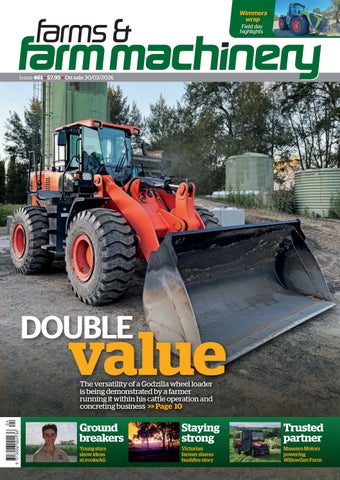
10 A Godzilla wheel loader from Digger King is demonstrating its versatility for a farmer using it for both his cattle operation and concreting business

Farming

6 Matthew Plunkett lost 8,000 sheep during January’s bush res but refuses to be defeated

32 Five young entrepreneurs take the spotlight at evokeAG

60 Researchers to create virtual replica of Australia’s agricultural landscape

Machinery

14 A Bobcat CT1025 has proven to be perfect for a WA property owner’s rst ever tractor purchase

18 Massaro Motors and Kubota instrumental in Willow Zen Farms’ long-term growth

22 Shell Lubricants, supplied by Viva Energy Australia, keeping Aussie farmers operating at their best

Editorial & Design

Editor Lincoln Bertelli

lincoln.bertelli@primecreative.com.au

Journalist Jackson Haddad

Contributors Trevor Whittington, Gary Northover

Design Danielle Harris, Jacqueline Buckmaster

Art Director Daz Woolley

Managing Editor Eugene Du y

Cover image Digger King

24 New face and facilities bolstering Kerfab’s footprint in Queensland

28 Maxam tyres removing reliability stresses during seeding season

Event news

40 First speakers announced for annual TMA conference

42 Early bird tickets on sale for Australian Bulk Handling Expo

44 Machinery and exhibitor highlights from Wimmera

Industry news

64 NFF celebrating a er $100 billion output goal reached

65 Record-breaking grain harvest achieved in WA

66 Horticulture sector delivers best ever performance

66 NSW research facility to improve horticulture market access

67 Autonomous eTractor gets venture funding

68 Victoria’s rst virtual fencing product approved

68 Agricultural waste being turned into energy and fertilisers

Market news

53 Large tractor sales have continued to strengthen, according to the Tractor and Machinery Association’s February gures

Opinion

54 WAFarmers CEO Trevor Whittington sees long-term challenges for global grain markets as the world’s population growth eventually slows down

Regular items

4 Editor’s note

56 Calendar of upcoming events

72 List your item for sale!

79 Elevated growth

United Rentals grows Australian eet and footprint with acquisition of access equipment specialist

to the latest edition of Farms & Farm Machinery

The past month has provided plenty of opportunities for the Farms & Farm Machinery team to get out and about as the events and eld day season begins.

Most recently, a trip to the Wimmera Machinery Field Days was a chance to look at the vast array of machinery on display and we have an extensive wrap of what was being showcased at the popular western Victorian event.

Melbourne also hosted the annual AgriFutures evokeAG conference last month, which featured two inspiring days of presentations and discussion around the themes of “invest, innovate and impact”.

There were far too many worthwhile stories to t into one edition of the magazine, so expect plenty of coverage – including farmer pro les –from this wonderful event in the coming months.

One of the biggest highlights of evokeAG was the Groundbreakers session.

During this, ve young entrepreneurs talked about the business ideas they have devoted themselves to, sharing their stories of innovation for the agrifood sector and the inspiration behind them.

Each of these young people had a fascinating story to tell and it is an honour to share these stories in detail in this edition.

On a completely di erent tone, it was also an honour to tell the story of Matthew Plunkett in this edition.

Matthew and his family are Victorian farmers who lost more than half their livestock to bush res in January, and he spoke about the day of the re and his determination to rebuild since then.

Beyond these stories of individuals who make Australian agriculture tick, we also have plenty of machinery featured in this edition.

Our cover story talks about a New South Wales farmer who purchased a Godzilla wheel loader from Digger King that is being used for both his cattle operations and concreting business.

We talk to a Western Australian property owner who made his rst ever tractor purchase – a Bobcat CT1025 to manage a trotting training track on his ve acre lifestyle block in addition to general cleanup duties.

There is also the story of WillowZen Farm, which has relied on Kubota machinery from Massaro Motors since its inception and has gone from strength to strength.

Kerfab is looking to grow its Queensland presence, adding a business development manager and expanding its physical footprint and we hear about how this will better help the attachments manufacturer to serve that market.

Shell Rimula engine oils from Viva Energy are put in the spotlight, as are Maxam tyres which can bene t more than just tractors as attention shi s to seeding season.

The Tractor and Machinery Association’s annual conference is edging closer and we reveal who the rst batch of con rmed speakers for this year’s event are.

Australia is set to get a ‘digital twin’, the rst ever national-scale virtual copy of the agricultural landscape.

We learn how this will work and its bene ts, while our industry news section celebrates the National Farmers Federation’s $100 billion output goal being achieved ahead of schedule, along with harvest and horticulture records.

Happy reading!

Australia’s Most Useful Attachment

Despite losing more than half his livestock and therefore income to bush re in January, Matthew Plunkett refuses to be defeated.

Support from the nearby community and Victorian Farmers Federation have helped, but a natural determination to keep the farm operating has led Matthew to look for the opportunities rather than seek sympathy.

Plunkett and his family are sheep farmers near Longwood in northern Victoria, with their property being among the estimated 140,000 hectares burnt by the blaze.

The re ripped through his property far quicker than he anticipated, even to an experienced farmer with knowledge of the land and conditions.

Hitting quickly

It all began on a Wednesday a ernoon.

Matthew was in Wangaratta, about two hours’ drive from the farm, when he rst heard the re had started.

He immediately returned to the property, where his son was, and returned to nd the re was on a ridge beside his farm but had not yet a ected it and the severity was not apparent.

“If I’m being honest, I thought we would have plenty of time to protect our farm over the next few days,” he says.

That night was spent preparing, with Matthew and his family working on the edge of the property that would have potentially burnt them out if the re immediately spread.

By this point, he says the re had got away into some bush in another direction and at about 2am, the family decided to get some rest – again still thinking they would have until at least 9am before the wind changed.

The alarms were set for 4am – only a short sleep – and this proved a wise decision as the conditions rapidly turned.

“At about 4.30am the wind changed and we were hit around our house and yards,” Matthew says.

“At 5 in the morning the wind and the re came past us really quickly.

Images: Matthew Plunkett
Attention now turns to rebuilding after the January bushfires

“Because it was dark, it was scary but you couldn’t measure where the re was because it’s not daylight so there is just a ame coming at you.”

Matthew then called a couple of neighbours, some of whom live only 500m to 800m away, who came to help before their roles were quickly reversed.

“It burnt past us in one direction, and then my neighbour’s house was under attack at 8 or 9 in the morning, and so we were around his place protecting it for the next few hours and just coming back to our place and putting out tree litter and stu like that which was burning,” he says.

“By roughly 12pm, it had burnt all of my farm and all of my dad’s farm, which is seven kilometres away, but probably three or four kilometres as the crow ies.

“In a paddock sense, we were wiped out by 12pm.”

Sad losses

The rest is a blur for Matthew, and while his e orts meant their house remained intact, the same unfortunately could not be said for much of their livestock.

Shearers had come to help move the sheep to safer ground but despite moving the ock twice, there was nothing which could be done to protect them all.

“We would open gates but we ran out of places to put them and the young sheep su ered a lot more because they were in paddocks that had more grass originally if we hadn’t already got to them and they’re slower to move,” Matthew says.

“We did lose a lot of mature ewes, but I lost probably 90 per cent of my young sheep.

“We’ve lost maybe 60 per cent of our livestock, which is about 8,000 sheep, and we’ve lost 60 per cent of our income for a while, which might take a year or two to recover.

“We were nearly ready to start shearing and we’ve only got less than half the sheep to shear and we’ll have half the lambs to mark.”

Despite these devastating losses, there were also sheep which survived by sheer fortune, an experience which Matthew is naturally grateful for but cannot explain.

“I can still picture the rst few mobs I saw that were nearly totally wiped out, but then you go the paddock next door and wonder ‘how did that mob survive?’,” he says.

“They’re the same sheep, same age group, essentially the same sort of paddock, but just in some cases they went into a fence and couldn’t get out and in some cases they must have stood on the rocks.

“One lot sat under some pine trees and they survived – that was a big mob and they all survived under the pine trees.”

Pivotal decision

Once the re had eventually passed, the next challenge became an inability to move around due to fallen trees and rubbish blocking the roads.

Matthew had to go through his farm to access his father’s property, cutting some fences along the way, and was able to protect a cottage but says “there wasn’t a lot we could do” about paddocks.

The decision about whether to stay or go during times of bush re can be life-impacting, and while Matthew says he cannot advocate that other farmers should stay – he is grateful that was the decision he made in this instance.

“You are trapped in our environment once the re is near us because of the heavily timbered roads,” he says.

“I actually felt quite safe in our open paddocks because we’ve got areas of lots of rock and our house is an oasis, we have green lawn and stu like that.

“It was very hot and smoky, but it’s actually a safe area and we had a fairly big bu er, although it did get closer than I thought.

“You obviously can’t advocate you should stay, but I think we would have lost a lot more of our houses if we hadn’t

stayed to protect them, like my son’s house, he would almost certainly have lost it.

“We all had lots of friends from the local area helping, like the shearers and the fencing contractor, they spent a lot of time with us when the re hit and a erwards.”

Forward thinking

The next steps are to rebuild, with attention already turning to what happens next.

Replacing fencing is the rst priority, before working out how to grow feed to maintain the remaining sheep through lambing and the winter and spring seasons.

“We’re working out which paddocks we can sow, and with what, to grow feed and reduce our costs,” he says.

“We’re essentially planning a big feed sowing program, which we’ve nearly got organised. We’ve bought another secondhand disc seeder so that we can get grass in the ground, which is a challenge, but it’s also a bit exciting.

“We have been growing rye grass and things like that for sheep for the last few years really well and so this will just be a much bigger scale of that.

The bushfire meant Matthew lost about half of his livestock

FARMING

“If we can grow enough feed and we have an excess of feed, in the spring we will buy cattle or buy sheep or something like that or cut hay and rebuild our reserves.

“We’re going to have a lot of new fences so we might change our livestock mix a bit – maybe we’ll introduce some shedding sheep into some of our areas and because we’re down on stock, we might put some cattle into the mix, which we o en have.”

Among the support Matthew has already received has been from the Victorian Farmers Federation’s disaster relief fund and emergency fodder support program.

“It’s actually surprisingly practical and very helpful, but it’s also a bit humbling,” he says.

“When people are donating literally truckloads of hay, that’s a lot of money and it’s a lot of time, like the truckies who are bringing it.

“There is a lot being devoted to this and you just realise how important it is.”

The devastation has also brought the community together, he says, with relationships being strengthened with other farmers he previously only knew in passing coming together to help them get back on their feet.

While nobody would question that Matthew, along with other farmers impacted by the bush res, deserve a positive change of luck – they still remain

at the mercy of the weather as farmers do every season.

“I think we could have a very tough autumn and winter and even spring, but we’ve got to try and get some grass in the ground and grow it and get some grass in front of us,” he says.

“It will make a big di erence if we can get some nice rain and grow some of the grass that we’re going to sow.

“There is a lot of not necessarily renewed enthusiasm, but there is a lot of work going on to get us back on track, which is pretty good. We’re not defeated.”

Bushfire caused significant damage to the property
Matthew and his family’s property is near Longwood in northern Victoria

DOUBLEvalue

The versatility of a Godzilla wheel loader from Digger King is being demonstrated by a farmer relying on a 17-tonne model for both his cattle operation and concreting business

Viv White is using a Godzilla wheel loader on his farm and within his concreting business

For most farmers, they’ve had a lifetime involvement in the agricultural industry, making it rare to see someone take on new challenges in unfamiliar territory.

New South Wales farmer Viv White is an exception to this, having purchased a concreting business in his small town of Molong just under a year ago to run alongside his local cattle operation.

With signi cant experience in farming and livestock transport, White’s Molong Ready Mixed Concrete business –supplying the local area with concrete, landscape supplies, aggregates and sand – has been an exciting new chapter in his family’s history.

“Our farming operations have changed a lot over the years – we originally had a livestock transport business where we carted sheep and cattle in central Queensland,” he says.

“Later on, we moved down to Molong where we predominantly bred Hereford cattle, lambs, and grew cereal crops to feed our stock.

“I’ve only got a small farm now with a herd of about 80 cattle, so farming has been a big part of my life and I’m only new to the concrete game.”

Timely upgrade

Initially, a small wheel loader from the previous business owner was used to assist in the concrete batching plant’s operations. However, White aimed to halve the time taken to load material in the hopper of the batching plant – quickly realising he needed a more powerful machine.

Digger King’s 17-tonne Godzilla 5500w wheel loader proved to be his solution, with the machine boasting a 215hp (158kW) Cummins engine and a 5.5-tonne rated operating load.

“I was looking at some of the large international brands, but the price of the Godzilla was unbelievable, I couldn’t go anywhere else,” White says.

“The Cummins motor sold me on it, because nearly every machine we used in trucking and farming had a Cummins in it.

“I knew the motor – they’re simple with very little electronics on it, which was what I was looking for.”

All-rounder

While the main intention of the Godzilla purchase was to assist Molong Ready Mixed Concrete, White has also found himself employing the wheel loader on his farm –which is a signi cant endorsement of both the machine’s versatility and performance.

For several months now, the Godzilla wheel loader has been performing a range of all-round maintenance tasks on White’s property, including cleaning up dams, loading and unloading hay, as well as moving storage containers on and o the farm.

The 4.5 cubic metre GP bucket and heavy-duty forks attachments have had a signi cant part to play in the wheel loader’s success in these jobs, with the standard hydraulic quick hitch also being a winner for White.

The wheel loader boasts a 215hp (158kW) Cummins engine and a 5.5-tonne rated operating load

Images: Viv White

White has been using the wheel loader for a range of all-round maintenance tasks on his property

“We use the Godzilla for everything, and you don’t even have to get out of the loader to change attachments, because the quick release is controlled from the cab,” he says.

“It’s very powerful for the weight of the machine. We do a lot of heavy li ing with it, including all my product from the batching plant and it’s been brilliant – no problems at all.

“Since getting the Godzilla, I’ve been able to halve my batching time, so I can batch twice as much concrete now compared to what I did in the same amount of time with the previous loader.”

Hassle-free

The experience with the Godzilla wheel loader has been made even smoother, thanks to Digger King’s friendly team and a ersales support.

Just a er purchasing the machine, White had the privilege of travelling to Papua New Guinea with his eldest daughter to take on the famous Kokoda Trail – a 96km trek through rugged and isolated terrain, which served as the

location of the World War II battle between Japanese and Australian forces in 1942.

Given the isolated nature of the trek, White had no mobile phone service for several days, meaning he was unable to stay in contact with the Digger King team during the delivery process of the Godzilla wheel loader.

However, White says Digger King made it stress-free, delivering the machine to his Molong-based site while he was still walking the Kokoda Trail.

“Once we were coming out of the Kokoda Track, I got service again, and there was a message on there that the wheel loader had turned up at my yard,” he says.

“It was an e ortless process, Digger King were super good to deal with and there were no dramas.

“I’d recommend the Godzilla loader to anyone. I have a lot of people come to my yard to have a look at it and the simplicity of it is always a standout for them.”

For more information on Digger King’s Godzilla 5500w wheel loader, visit diggerking.com.au or call 1300 676 996.

Doing the job

Western Australia’s Graeme Hammond did not need something big for his rst ever tractor purchase, but a Bobcat CT1025 has proven to be perfect

Sometimes a tractor’s main purpose is just to get the job done.

For broadacre farmers covering thousands of hectares, every horsepower boost and new piece of technology can mean crucial e ciency gains, but not every tractor owner has the same priorities.

Graeme Hammond invested in his rst ever tractor last year a er his retirement, opting for a Bobcat CT1025 from Clark Equipment.

Graeme has lived on a ve acre lifestyle block in Mundijong in Perth’s south-east for the past 42 years and his recent retirement has meant having more time to tackle the maintenance jobs which the property requires.

“It’s got to the stage where a lot of the

bush block has become overgrown in the 40 years that I was working and putting jobs o ,” he says.

“When I retired, I bought the tractor just to make life a lot easier and it has been everything that I wanted.”

Stepping up

Graeme’s rst foray into tractor ownership has created the opportunity to manage his property more e ectively, having previously relied on an old ute to pull out and shi overgrowth – a method he admits “wasn’t all that e ective”.

When he purchased the tractor, he bought it as a package from Clark Equipment which featured a front-end loader and four-in-one bucket, along with

several Daken implements including a 1m slasher, 1.2m carryall, 1.2m stick rake and 200L spot sprayer.

Having these implements with the tractor has already paid o for Graeme, who also trains some horses for trots racing as a hobby and has been able to improve the quality of the training track on his property.

“I use the tractor to grade my track, just shi ing sand around and things like that,” he says.

“All the implements have come in handy because I’ve got the stick rake which I’ll load up on an angle and use it to drag the sand back into the middle of my training track.

“Everything I’ve got with the machine has been useful for what I need.

“The only things I haven’t used yet are the carry-all and the sprayer, but they will come in handy over winter once grass starts growing again.”

Mighty fine

Bobcat’s CT1025 is the smallest of the manufacturer’s compact tractors.

It “packs a lot of power into a small frame size”, Bobcat says, with the unit itself measuring just 2.52m long and 1.17m wide.

Its three-cylinder diesel engine produces 26hp (19kW) and it also o ers a Category 1 three-point hitch, along with independent rear PTO system and midPTO system for implements such as an optional mid-mount mower.

These make it ideal for drag-behind and PTO-powered implements, such

Images: Clark Equipment
A Daken 200L spot sprayer was one attachment Graeme got with his tractor
Graeme Hammond has a five acre bush block in Perth’s south-east

as those Graeme uses, and other handy features include four-wheel drive steering and clutch-free two-range hydrostatic transmission.

The CT1025 also has a maximum speed of 16.6km/h forward and 11.2km/h in reverse, while it also o ers rear standard di erential lock and fold-down ROPS.

Other models in the Bobcat compact

tractor range include the CT2035 and CT2040, which step up to 35hp (26kW) and 38hp (28kW) engines respectively.

Trusted brand

Graeme used to work in the grain handling industry and used Bobcat machinery during his professional life.

This brand familiarity, combined with

applying the same concepts of “pushing materials up and shi ing a bit of dirt around it”, made him con dent the Bobcat tractor would be what he needed for his own property.

The CT1025 was also not his rst foray into Bobcat machinery in a personal capacity, having purchased a 48-inch (1.2m) zero-turn mower from the same brand last year.

Bobcat machinery is distributed nationwide by Bobcat of Australia, which is a business unit of Clark Equipment.

When he later saw Clark Equipment advertising the CT1025 tractor, the decision to purchase it – and the accompanying implements – was easy.

“I’ve dealt with Clark before, I’ve bought a couple of bits and pieces o them,”

Graeme says.

“I saw the tractor and I thought if I’ve already got the Bobcat mower I might as well stick with the same brand, and I’ve been happy with it.”

Graeme is full of praise for the service provided by Nick Dicembre from Clark Equipment’s Perth branch, both during the buying process and with follow-ups to ensure everything is running smoothly.

“Clark Equipment were brilliant to deal with when I was buying the machine,” he says.

“Nick rang recently to see if I wanted it serviced, but I haven’t had a problem yet and because I’ve only used it for an hour

The CT1025 is Bobcat’s smallest compact tractor

or so here and there, it’s not up for service yet.

“It is probably another three or four months before I need to have it serviced, but the machine itself has been running like a dream.”

Plenty of plans

Beyond preparing his horse training track, much of the work Graeme intends to do with the tractor and attachments relates to general property maintenance.

“I’ve already made a couple of bon re heaps and I can heap all the debris up and put it on top of each other, whereas before I was doing it manually,” he says.

“The tractor has been able to handle everything I’ve tried to pick up with the bucket.

“Having the four-wheel drive on it is good as well, because parts of my block are a bit sandy.”

The Bobcat CT1025 is a classic case of purchasing the ideal sized tractor for his needs, with Graeme knowing it would not be used for major earthworks or for travelling around a large property.

“If you had ten acres you might have

to look for something a bit bigger, but for what I’ve got it’s perfect,” he says.

Bought with a speci c purpose in mind, it has met all of Graeme’s expectations so far – with plenty more maintenance to be done once winter sets in.

“I really haven’t had a chance to do everything I want to do yet because the easterly winds have been so heavy this summer and I don’t want my next door neighbours to get my sand,” he says.

“Our verge is all overgrown with dead trees and I want to heap them up so I need to be able to push them around.

“I walk out every day and think ‘that’s got to be done and that’s got to be done’ but I’ll just wait until it’s wet enough to push things around a bit.

“When the rain starts, I can do a lot of burning o and cleaning up with it as well.

“I’ve got big plans once it gets a bit damp and I can do a bit more.

“I knew what I was getting with this tractor and it is doing everything I expected and wanted it to do.”

The full Bobcat range can be viewed online at www.bobcatofaustralia.com.au

Antonio Carraro tractors made in Italy since 1910. The perfect tractor
vineyards
steep terrain

When Kelvin Slade entered agriculture, he admits his knowledge about tractors and machinery was minimal.

Not having been backed by multiple generations of farming history and expertise, his leap into free range eggs in 2009 was the rst time he had owned any of the machinery which many farmers take for granted.

This made it important to nd a dealer who could not only supply what he needed but also give plenty of helpful advice to a newcomer.

His dealer of choice was Massaro Motors, whose Kubota range and ongoing service has created a relationship that is still thriving nearly two decades later.

“When we rst started out, I didn’t have a lot of knowledge about tractors,” Kelvin says.

“I had a theoretical knowledge of what I wanted to do but I hadn’t owned any of the equipment before.

“I didn’t have that experience and there’s only one way to get experience, which is to do things and make mistakes.”

This is where Massaro provided valuable insights into which machinery would best suit Kelvin’s circumstances and get him successfully up and running.

“Massaro were always respectful from the beginning in helping me to learn more and do more on the farm,” Kelvin says.

“They gave me really good advice in terms of equipment when we were rst starting out.

“As we got bigger and more successful and more experienced, they’ve helped us to grow.

“I’ve always just found dealing with Massaro to be great, whether it’s talking with [founder] Ray, [his son] Luke, or their service people.”

Di erent approach

Kelvin and his wife Kumi own WillowZen Farm in Victoria’s Gippsland region, which has an average of about 3,500 hens spread across 23 hectares.

Having lived in multiple countries, the couple decided they wanted to grow food and raise animals in a “regenerative and ethical manner” and chose Gippsland due to its rich soil, reliable rainfall and a strong local community, which Massaro Motors is part of.

Being open pasture egg farmers is one of a “triple whammy” of challenges that Kelvin says they have faced, but a desire to be di erent – and also give valuable experiences to their young sons – has helped WillowZen to excel despite being a relatively new farming business.

“I don’t have three or four generations

Kumi and Kelvin Slade run WillowZen Farm
An RTV is one of the Kubota machines used on the Gippsland property

behind me on the farm here – we do things in a much less standardised way – so some of the questions that we ask of Massaro can be outside the box,” he says.

“But, if you do things like everybody else, how are you going to compete?

“It’s like a triple whammy – we’re rst generation, we’re egg farmers not cattle farmers and we’re open pasture egg farmers, not caged egg farmers.

“Pretty much everything that we do

is outside of the box and against trends, but we must be doing something right because we’re successful.”

Built to last

Keeping WillowZen Farm operating smoothly is the Kubota machinery it has bought from Morwell-based Massaro Motors.

A Kubota M7-2152 tractor is the main workhorse on the farm, complemented

by an RTV, track loader and power harrow from the same brand.

“We chose Kubota because it’s got a good reputation,” Kelvin says.

“We spoke with a few di erent dealerships about tractors and other equipment when we were making our rst big investments in equipment on the farm.

“We were impressed in terms of the fact that Kubota just seemed to be the best value for money. It’s built to last and it’s built for resale value.”

Kubota machinery is manufactured in Japan, a country where Kelvin has spent plenty of time due to it being his wife Kumi’s homeland.

“Kubota has got a long history – they’ve gone from producing smaller tractors and smaller engines, reliable diesel engines, and they’ve branched out into now applying that diesel capability across pretty much the whole range,” he says.

“As you can see when you’re driving down the road and pretty much every single construction site is full of Kubota equipment, they must be doing something right.”

Exceeding expectations

Kubota’s M7-152 tractor is part of its M7-2 series, described by the manufacturer as its “ agship”.

Its four-cylinder diesel engine produces 148hp (110kW) and it boasts an impressive 9,400kg rear linkage li capacity.

An 80L/min hydraulic pump output is complemented by hydraulic power steering, while other features include

Massaro Motors sells Kubota machinery, including RTVs, in the Gippsland region
Image: Massaro Motors

semi-powershi transmission, and speed ranges from 40km/h down to just 370m/h thanks to its additional 24 forward and 12 reverse creep speeds.

Described by Kubota as being “versatile and hard-working”, this tractor o ers straightforward controls and a powerful drivetrain.

Having a front PTO on the tractor –which Kelvin says he rst experienced on the M7-2 range – is one feature which he nds particularly helpful.

“That’s so important for us because we manage our pasture for our chickens using a front mounted mulcher mower,” he says.

“Having had a rear mounted mulcher mower in the past, when the pasture is long and you drive over it and then mulch it, it just stands back up again.

“Being able to have the front mounted PTO-based mulcher mower on the front and then having harrow or discs on the back means I do both tasks at once; both pasture management and ground management.”

Kubota’s acquisition of Kverneland has also allowed for the integration of seeding

implements with the M7-2, something which has enhanced e ciency for both Kelvin and the team.

“The way they’ve integrated the tractor with the computer controls for the seed boxes is something I found very easy to use and pretty seamless,” he says.

“When it comes to precision control of implements such as seeding implements, because you’re going to be out on the tractor for hours, if not days, doing that work, relying on a human to get any sort of seed ratio right and driving at the correct speed is just unrealistic. Having that integration between speed and seeding rate just works really well and I like it.”

Established service

Kelvin says Kubota machinery is “built tough” and he has trust that it will continue serving him for the long haul.

The same applies to family-owned Massaro Motors, which has been in operation for more than half a century.

Kelvin deals regularly with founder Ray Massaro, his son Luke and the wider service team, and is full of praise for the service he has received.

“They’ve been in the game for a long time so they’re not just trying to get a quick sale,” he says.

“It’s not just about Ray and Luke running the business, it’s also their service department who I deal with when they come out. They’re extremely knowledgeable about the systems.

“With the increasing complexity of the systems, they really need to understand how they all work in their intricacies, because there’s so much which is computer controlled.

“Wade is worth his weight in gold – he drives tractors himself and drives the models that Massaro sell and service, so he knows what it’s like to use them in real work, not just driving them around the yard.

“Massaro Motors have always been responsive and they want to make sure that everything’s working. When something needs xing, they jump to it.”

Massaro Motors is located at 497 Princes Drive, Morwell and its full range can be viewed online at www.massaromotors.com.au

up for the seeding season

Rimula Beanie
Rimula Yeti

Maximise equipment

Shell Rimula supplied by Viva Energy Australia, the Shell Lubricant Macro Distributor of Australia, is a heavy-duty diesel engine oil suitable for agriculture machinery and equipment

Farmers o en operate in extreme conditions, facing new pressures every day, whether that is weather, or global commodity prices; they are out of a farmer’s hands.

However, the di erence between a smooth season and costly downtime comes down to choices made before machinery is employed in the eld.

Farmers can take control of how their machinery operates.

Choosing the right lubricant is vital to maximise a machine’s operational e ciency, ensuring farm operations run smoothly, while protecting the long-term capability of farmer’s valuable investments including equipment and machinery.

Shell is one of the most recognised oil and lubricant brands globally, recently ranked number one global lubricants supplier on nished products for the 19th year in a row.

Shell has a worldwide network of advanced research and development

centres with more than 200 scientists and engineers focused on developing lubricant technology that delivers real bene ts to the eld.

Viva Energy Australia, Australia’s Shell Lubricants Macro Distributor, brings this global expertise directly to local Australian operators so that farmers and machinery owners can choose the right lubricant for their machinery and equipment.

Top choice

Viva Energy technical specialist Silvana Farrugia explains that quality lubricants are essential to:

• Reduce and protect equipment from wear on critical machinery components

• Improve e ciency as lubricants can help keep engines clean of sludge build-up

• Lower fuel consumption and emissions

• Lower the cost of ownership

Whether it’s a tractor, harvester, plough or seeder, Shell has developed a unique product range that assists operators in

ensuring careful management of their engines.

Shell Rimula is developed with Shell’s Dynamic Protection Plus Technology to create exceptional resistance to corrosion, wear and oxidation while producing lower emissions.

This technology is also versatile in a wide range of environments, providing protection against acid and deposit build-up to keep engines working harder and longer.

As part of the development process for

Images:
Viva
Shell Rimula R4 X 15W-40 engine oil

today’s Shell Rimula, based on the API CK-4 engine-oil speci cations, over 160 million kilometres of road tests were run in Australia, USA, Europe, China and other markets.

Proven performer

The Shell Rimula R4 range formulated with Adaptive Additive Technology adapts to varying engine conditions to deliver dynamic protection.

This helps to safeguard engines against wear and acid corrosion which can be harmful to engine life, thus lowering maintenance costs and increasing vehicle reliability.

High shear stability helps prevent lubricant breakdown to ensure excellent load-carrying performance.

Shell Rimula R4 range allows farmers to plan for engine maintenance cycles with con dence, with some service intervals ranging from 200 to 500 hours depending on equipment.

It is important for farmers to note that oil drain intervals are determined by the original equipment manufacturer (OEM), not the oil supplier, and operators must always follow the OEM-recommended service intervals as outlined in the product manual.

Any extension of oil drain intervals should only be considered in consultation with the OEM and supported by Used Oil Analysis to ensure engine protection and optimal performance year-round.

Extra mile

Within the Shell Rimula R4 range, a particular standout is the Shell Rimula R4 X.

This is designed to provide triple protection which targets key areas such as acid and corrosion, wear control and deposit control, helping to keep engines clean and critical engine components working.

Additionally, it is suitable for many low emission engines and for use with biodiesel as per OEM-recommended oil drain intervals.

Protecting the performance of exhaust emissions control systems is not only important to ensure that machinery complies with legislative requirements, but it also ensures operational e ciency.

The aim is to keep Australian farmers operating at their best in whatever conditions they face.

Shell Lubricants’ latest global research reveals that nearly half of farmers miss regular equipment maintenance and it is only when their equipment breaks down that they realise the e ect on their operations.

Businesses can seek real-time support on what lubricant is optimal for their engine through the Viva Energy Technical Help Desk (Shell Lubricant Specialists).

For the more digitally savvy, the Shell LubeMatch and Shell LubeAnalyst digital tools allow customers to input the details of their equipment and access detailed

lube-matching information, as well as survey and monitor their engine health.

To learn more about the Shell Rimula R4 range, reach out to Viva Energy Australia (Shell Lubricants Macro Distributor) at 1300 134 205 or technicalhelpdesk@ vivaenergy.com.au

Shell has developed a unique product range to assist operators in careful management of their engines
Shell Lubricants aim to keep Australian farmers operating at their best

Northern growth

Kerfab’s footprint in Queensland is growing as the attachments manufacturer looks to better serve customers of all sizes

Having a quality, Australian-made product backed up by boots on the ground to serve its customer base are two steps towards ensuring long-term success.

Kerfab rstly added a business development manager in Western Australia last year to support that state and has done the same in Queensland, with Michael Knight joining the company about six months ago.

Based in Toowoomba, he describes the experience so far in only positive terms and is proud to represent the manufacturer’s range of attachments.

“Every time I walk into a dealer, shop or farm, everyone tells me Kerfab builds good gear that is really solid, they get good reliability out of and they love using,” he says.

“As a business development manager, it’s just a good feeling when people say they love their Kerfab bucket, rakes, forks or cotton spikes.

“Even dealers say to me ‘you work for a really good company’ and for dealers to

tell you that, it means their dealings with Kerfab over time have been good.”

Expansion plans

The addition of Knight to Kerfab’s team marks an important step in the manufacturer growing its Queensland presence.

Kerfab has had a northern region sales manager for many years, who is strategically based in Warwick, south of Toowoomba and close to two major highways.

Kerfab’s o ce footprint in Warwick is set to expand with warehouse facilities later this year, enabling more stock to be held in Queensland for quicker dispatch to customers.

“We’ll have space and pallet racking and we’ll have some stock which will help us with much quicker deliveries of products we sell all the time, but it will also help that we can say we’ve got a presence in Queensland,” Knight says.

“It’s going to speed up how quickly we can do things, so if you want a four-tine

bale fork for your ag loader, we can say we’ve got one in Warwick, we can have it on a truck this a ernoon and you should see it tomorrow in Toowoomba, Dalby or Brisbane.”

Multiple markets

For Kerfab to have the most popular products available quickly for Queensland customers, it needs to know what these actually are.

Agriculture makes up a signi cant part of the company’s o ering, but other markets such as construction –particularly ahead of the 2032 Brisbane Olympics – and even the waste sector rely heavily on Kerfab attachments.

These markets all have unique needs and expectations, and being there to meet them requires a business development manager to be at the coalface with these customers.

Knight’s background is in agriculture, meaning he understands the seasonality associated with the industry and that

farmers require particular attachments at di erent times of the year.

“I understand that agriculture is quite seasonal so I can prepare for that and the company will be better prepared for it,” Knight says.

“Within my role, I’ll be in front of some of the big dealers, the major distributors and importers of those pieces of equipment who are dealing with bigger agricultural customers and also some of the big construction companies talking about what’s coming up for the Olympics and what is needed.

“I know when cotton is being picked so I know when we’ll need cotton forks and I know when hay is being cut, so we’ll need hay forks.

“I also know when big companies have got a contract for delivering gravel to an Olympic site or the Cross River Rail.

“The rst things to hit the ground with some of this big infrastructure is wheel loaders and excavators or a bulldozer and they will put a set of tines and a blade on a bulldozer – we’re in those markets.

“My focus will shi throughout the year and quite o en, as with life, there are multiple things going on at once so it’s really nding out what it is the customer needs.”

Support role

Beyond just the obvious remit of increasing sales, Knight’s role within Kerfab in ensuring every customer gets what they need, whether it is a farmer seeking a single, o -the-shelf attachment

or a major agricultural contractor or construction company needing several customised products.

Kerfab’s production facility is located in the northern Victorian town of Kerang, where a second factory was also added in recent years to keep up with growing demand.

Having a “great depth of experience” within Kerfab’s team of design engineers means Knight can contact the Kerangbased team and organise customised attachments to suit a speci c need.

“I’ve been stepping into the o ce of some of the large grain handlers, and sometimes the conversation is just ‘we like the look of your new sweeps’, so I ask how many of those they need, what widths do they need and what are they being attached on,” he says.

“All these people have got multiple things going on so it’s up to me to make

it simple. That’s one of my jobs – to listen, work out what they need and say here’s our solution.

“We’re well known for planning with large-scale customers six or 12 months out to get what they need.

“Those guys are seasonal as well, so when they need something to operate in December, they will start thinking about it now in January or February and we’re involved in that decision-making process.”

Top products

Kerfab’s range of Australian designed and made attachments includes everything from bale forks, pallet forks, four-in-one buckets, grabs and grapples, li ing equipment and sweepers.

Having such a depth of product means Knight can easily be in a conversation with a major grain handling corporation about their product needs as he can

A second factory in Kerang has expanded the manufacturing capacity
Kerfab is growing its national footprint

with a rubbish truck contractor about attachments for their eet.

In that instance, Kerfab has worked with a major rubbish company to ensure its next batch of custom buckets are exactly what they need when it comes time to replace them.

“We’re well known that our buckets are guaranteed to last for 10,000 hours in the rubbish and waste industries,” Knight says.

“They’re already using our buckets –designed speci cally for them – and maybe they want to add a bigger edge next time.

“These things run 20-odd hours a day doing rubbish and they may just say they need a hardened edge because they found out that the bottom wore a bit quickly.

“I can then go back to the engineers and ask if we can do a harder, bigger edge on the bottom and the answer will be yes.

“We also sell quite a few buckets to New

South Wales grain handling organisations and we’ve designed a couple which are suitable for large volumes – again, it’s asking what it is they need.

“There’s a rolled edge on one of our grain buckets that we did, which the customer uses all the time.

“They also use a high dump bucket because they’re easier to operate, they li higher and their volume is o en bigger.”

Moving ahead

Not only will Kerfab customers soon have quicker access to their attachments thanks to the expanded warehouse facilities, but Knight’s presence means an extra dedicated contact who understands the needs of the agricultural industry.

Having spent six months in the role already, he has no doubt that Kerfab’s

products are suited to what farmers in demanding Queensland conditions require.

“What makes Kerfab suitable for Queensland is that we are tough. We build stu tough and we build it to last, but you have to go the extra mile and ask ‘what is it that you desire up here? What is di erent about us?” Knight says.

“We’re there to do what the customer needs and when talking to customers, I focus on the reliability and the structural stability and strength of Kerfab products.

“If you’ve got a situation where you need something, I’m the man to talk to and I’ll take it back to our design engineers and back to Kerang where there is a great depth of experience behind me.”

Michael Knight can be contacted on 0407 810 684 while Kerfab’s full range is available at www.kerfab.com.au

All Kerfab attachments are manufactured in Australia
Kerfab’s Queensland team of Michael Knight and Nigel Weis

UPTO36"MININGPUMPS PUMP VXTE48791. TA206423. $14,510

SOUTHERNCROSS100X65-315PUMPSET withNissanQD32(65hp),skidfueltank,oil-temp,hi/lo timerwatchdogandforkliftroof.Vel67912. TA11060. $13,750

PERKINSISOSILENCED PUMP NewPerkinsDieselIso Silencedpumpsetwithfuel tankbase..Perkisosilent1. TA223696. $26,000

PONTOONPUMP ELECTRIC Pontoonwithelectricpump. xzdef19652. TA206427. $14,910

PERKINSGENERATORS 6,8,10,13,15,20and30KVA generators,singleand 3-phase,poweredby water-cooledPerkinsheavy dutydieselengines,keyor remotestart,fueltankbase, fullengineprotection,500 hoursserviceintervalsIdeal backuporprimepowerCall foryourspecialprice!. AW54939-ST190912. DPLIn27583. POA

GRUNDFOSVARIUOS PUMPS VariedModels.S1. TA250286. $4,500

UNKNOWNPTO GENERATOR 50KVA-ThreePhase-3 pointlinkagewithheavy dutyjackstands.VEL4156. TA10931. $8,710

Trusted partner

With seeding season front of mind for many Australian farmers, opting for Maxam tyres on valuable pieces of equipment removes the stress around reliability

A one-size- ts-all approach rarely works in Australian agriculture, with di erent machinery types and environments requiring specialised and unique setups.

Even in the world of tyres, Maxam rstly knows that agricultural needs are vastly di erent to average road users, and also that what works perfectly for a tractor is not necessarily the same for other farm machines.

With seeding season occupying the minds of many farmers around the nation, Maxam is a trusted and reliable partner for both growers and dealers heading into this important time of year.

Maxam’s range includes implement tyres designed for planters, seeders, and support equipment, all of which are built to carry high loads while protecting soil structure.

The brand’s portfolio supports seeding operations end to end and does so while o ering strong warranty support designed for real agricultural conditions.

As seeding approaches, growers operate under heavy workloads, tight timeframes, and o en variable soil conditions.

Tyres play a critical role in maintaining e ciency, protecting soil structure, and carrying increasing machinery loads.

Maxam tyres are engineered to support

these demands through Very High Flexion (VF) technology, strong load capacity, and a warranty designed to give growers and dealers con dence in the eld.

Special tech

The seeding period is one of the most demanding times of the year for agricultural machinery.

Tyres must support increased loads from seeders, air carts, and implements while maintaining traction and stability across varying soil conditions, making the choice of tyre critical.

Maxam’s VF technology is pivotal in giving the brand’s tyres an edge during this demanding time, as it allows machinery to carry higher loads at lower in ation pressures compared with standard radial tyres.

VF technology means tyres can carry 40 per cent more load at standard pressure, thereby increasing the overall carrying capacity on hard-working machinery such as seeders.

Alternatively, it can be used to operate with 40 per cent lower pressure for the same load, something which helps reduce soil compaction, improve traction, and maintain productivity during critical planting windows.

Reducing the soil compaction helps to support soil health and crop establishment, an ever-important aspiration for farmers which becomes even more crucial during seeding time.

Maxam’s VF technology also helps to improve stability during seeding operations and provides greater e ciency across long working hours and heavy eld loads.

Proven range

The heart of Maxam’s agricultural range is its trusted Agrixtra.

Despite coming under the same overarching banner, these are also far from a one-size- ts-all o ering.

Agrixtra has its 65, 70 and 85 Series tyres, all of which are suitable for tractors.

An advanced lug arrangement is designed for high levels of traction during eld applications, excellent grip and relatively quiet running in road applications, while a exible sidewall and radial carcass construction provides a comfortable ride and reduced driver fatigue.

A reinforced lug design and belt package gives resistance to punctures and damage and its long-wearing compound and optimised lug design means consistent wear and long life.

Images: Maxam

An optimised footprint shape and dimensions ensure stable operation and minimised soil compaction.

Maxam’s Agrixtra XL is a large volume tyre designed speci cally for high horsepower tractors, which boasts a 45-degree angle lug pro le for maximum traction and minimised vibration while their wide footprint pro le ensures limited soil compaction.

Premium rubber compound construction ensures limited cracking and weathering for optimum durability and maximum tyre life.

Within this XL range, for example, Maxam o ers multiple pattern options with varying loads and speeds, tread depths, section widths and overall sizes.

Agrixtra is not just restricted to tractor owners though, with one example of another tyre being the Agrixtra H series which is designed speci cally for harvesters.

There is also the Agrixtra N – a narrow pro le R1W tractor tyre which is suited to both high traction tractors along with sprayers working in row crop applications.

Again, a wide footprint pro le ensures limited soil compaction and therefore reduced crop damage.

ANNUAL CONFERENCE

The Agrixtra XL is a large volume tyre

MACHINERY

Something for all

Maxam also provides Flotxtra, a otation tyre range which has rounded tread lug edges to ensure optimal protection of crop areas.

An advanced tread geometry design means limited stone and mud retention while there is excellent directional stability caused by the nearly continuous central rib.

Special tread block design ensures excellent lateral grip and multi-oriented tread blockfaces ensure excellent selfcleaning properties.

Another o ering from Maxam is its Rowxtra tyres.

These are designed for balers, hay mergers, seeders, and other agricultural machinery and feature all-steel radial ribbed implement L1 pattern which provides high otation, high exibility, excellent puncture resistance, extended service life, low rolling resistance and minimal soil disturbance.

The special cut-resistant compound signi cantly enhances wear life and cut resistance and the adaptive sidewall design has been engineered with a highly exible sidewall structure to withstand constant exing.

A ribbed pattern ensures even ground contact, e ectively reducing soil compaction while lowering rolling resistance.

Wonderful warranty

Having such a comprehensive o ering of tyres – including models speci cally designed for implements and seeding equipment – means Maxam can support the entire machinery setup of Australian farmers rather than only their tractor.

This end-to-end o ering is backed up by an impressive warranty, which Maxam says shows con dence in its engineering and manufacturing standards.

The warranty covers workmanship and materials for eight years, with conditional eld hazard and stubble damage covered for ve years.

For dealers, this backup help to give further reassurance when recommending the product to growers, while for farmers it provides assurance they are investing in tyres which are built to perform and excel across demanding seasons in the paddock.

Australian users have also been involved in extensive testing to ensure ongoing improvement of Maxam tyres, giving a further shot of con dence in the local suitability of the product in addition to its half-century of years successfully operating around the globe.

Maxam tyres are available through an extensive national dealer network and can be viewed online at www.maxamtyres.com.au

Maxam tyres can suit various agricultural machinery types
Maxam also o ers the Flotxtra for high flotation
Maxam’s Agrixtra tyre

Inspiring ideas

Five young entrepreneurs dubbed the Groundbreakers shared their innovations to a captive audience at evokeAG

One of the highlights of this year’s evokeAG conference in Melbourne was the Groundbreakers session, where ve young people shared their innovative ideas to bene t agriculture.

Each of them had the opportunity to share the work they have already done, on everything from using drones for cattle mustering through to a livestock vaccination needle steriliser.

Two of the ve Groundbreakers travelled from New Zealand to participate in the evokeAG presentation, which concluded with an audience question-and-answer session.

All ve participants have an idea which they have already invested their time and energy into, and which will continue to evolve as time passes.

Their stories are unique and their work will impact the future of agriculture.

As an environmentally conscious teenager during the Covid lockdowns of 2020, New Zealand’s Elisa Harley had a goal.

Then she had a realisation which inspired a business idea she has pursued ever since.

Elisa built herself a greenhouse, growing more than 700 native plants which she sold at local fairs and to garden stores.

Feeling proud that she was helping the planet, what she hadn’t counted on was

the hundreds of plastic plant pots she was now le with.

Speaking to a farmer who planted 1,000 native trees to restore a wetland and was le with 1,000 plastic pots destined for land ll, Elisa realised this was a major problem.

More than 350 million plastic plant pots

Elisa Harley discussed her work on developing biodegradable plant pots. Image: Prime Creative Media

are used every year in New Zealand alone, she said at evokeAG, with biosecurity rules making it risky for these pots to be reused.

Elisa knew there had to be a better way.

Industry professionals laughed at her idea when she suggested creating biodegradable plants pots, telling her it would be too expensive to make them in New Zealand.

“That didn’t sound right to me, so as the stubborn 16-year-old I was, I decided I was going to prove them wrong,” she said at evokeAG.

“I opened my kitchen cupboard, grabbed my family food processors, and started blending – wood chips, old sheets of my homework, and self-raising our.

“You can imagine the mess, but that mess took me on road trips during my school holidays to visit nurseries, forestry sites, sawmills, factories, and to more meetings with experts, all working together to map out a pipeline within New Zealand for a solution to be 100 per cent Kiwi.”

A $40,000 grant enabled her to develop a second prototype, which unlocked funding for a third and o cially created Enivo pots – a biodegradable plant pot made in New Zealand, from 100 per cent local primary industry residue.

“You don’t remove the plant from the pot, you put the whole thing straight into the ground, where it biodegrades in less than 12 months,” she says.

More than 600 di erent pots have been tested in nurseries across New Zealand a er an 18-month process of working with scientists on di erent systems, designs and materials.

Elisa then hit a roadblock, with nobody in New Zealand able to process the materials at a pricing scale which was commercially viable.

This did not deter her though.

“My options were give up and let plastic pots remain industry standard or make some short-term compromises,” she says.

“These are that my pots will be 2cm shorter than I wanted, and they’re going to be made out of recycled cardboard and paper waste.

“But for Enivo pots to be made in New Zealand, these compromises are going to be worth it.”

A er three years of development, Elisa is now set to produce 20,000 units to be distributed at scale.

“The secret that got me here? People,” she says.

“The teachers who didn’t laugh at me, the scientists who hopped on Zoom calls, the business leaders who replied to my LinkedIn messages, and an industry that treated me as someone who could contribute, not just someone that was too young.

“The doors that were unlocked for me have led me to be here today.”

Finding a solution to sending plastic plant pots to land ll, something only created as a byproduct for an environmentally focused concept of planting trees, shows the bene ts of taking one small idea that can have a big impact.

“At its core, my journey comes back to something simple – planting trees should not create waste,” Elisa says.

“It’s one tiny part of the agriculture industry, but it’s one part that could be done better. Enivo pots saw that problem, created a local solution, and now we’re striving for global impact.”

Tiarna Scerri

Growing up on the outskirts of Sydney, it was not until attending Hurlstone Agricultural High School that Tiarna Scerri developed an appreciation for agriculture.

Combined with an interest in law and policy, she became drawn to the challenge of regulating agricultural innovation, speci cally around biotechnology and “how the law must balance the need for safety and fairness against the need to support industry and food security”.

With an understanding of both the hands-on nature of agriculture and the industry’s policy-making side, it was the 2017 drought in New South Wales when Tiarna realised she was in a unique position.

“I discovered there was a distinct language barrier between those standing in crinkly, dried up paddocks and those in Parliament,” she says.

“I was struck by the disparity between what farmers were saying they needed and what government was doing to help and I was devastated to see that real people were su ering the consequences.

“To me, the solution was simple. What we

Tiarna Scerri aims to bring her knowledge of real-world agriculture and policy together for the greater good. Image: evokeAG

FARMING

need is people who are bilingual – people who are dually literate in the needs of science and agriculture, law and policy, who can translate for each side.”

Tiarna did not want to see a similar “language gap” open up around ag biotech, so she decided she needed to become a “translator” and embraced a long academic journey to achieve this dual literacy.

She has majored in genetics, focusing on livestock, biotech and welfare, while also studying law and recently being admitted to the Supreme Court of New South Wales.

For most people, this would be more than enough – but not for Tiarna, who is now also a PhD candidate, working on the interdisciplinary issue of bovine mastitis and the antimicrobial resistance crisis.

“For decades, the conventional treatment for mastitis has been antibiotics, but around the world, key mastitiscausing bacteria are becoming more and more resistant to these conventional treatments,” she says.

“We are heading towards a world where these treatments simply don’t work.

“And then what? That’s not just a farm business problem. That’s an animal welfare problem, an industry problem, and not just for dairy. That’s a food security problem.”

Tiarna says Australian agriculture needs to be proactive rather than reactive in management of agricultural challenges like antimicrobial resistance and start working on the roadblocks now to avoid future losses before this crisis becomes a reality for Australian dairy.

This means working on long-term rather than short-term solutions, Tiarna says, and she is developing an antibiotic alternative that is designed to be a “sustainable solution for 20, 30 years and beyond”.

Tiarna’s position in the centre of the Venn diagram between agriculture and policy means she realises simply developing a mastitis solution that works is not xing the entire problem if the regulations around using it prove a roadblock.

“There is no point in me developing a mastitis treatment that farmers can’t or won’t use,” she says.

“From a policy perspective, proactivity also means pushing for regulatory frameworks that are more biotechnology conscious and therefore more future proof.

“The problem is that although these mastitis treatments could help support the sustainability of the dairy industry, the regulatory frameworks in place are not equipped to harness this innovation properly.

“What seems like a small regulatory oversight can cause long-term detrimental impact to land, livestock, and livelihoods, which is what we’re trying to avoid in the rst place.”

Based on Tiarna’s study as a “translator” in this context, she says options for regulators include banning all biotech not accounted for in legislation, adopting an ‘open slather’ approach, having an initial trial phase for each new biotechnology and implementing new rules as required, or simply ignoring the problem and reacting once the crisis is here.

Tiarna Scerri’s journey has been multifaceted, including her law career and PhD. Image: Prime Creative Media

“I am open to all options bar the latter,” she says.

“To me, productivity is possible. We just need to start and we need translators in the room to make sure that we’re all speaking the same language – the language of results.

“I believe that with great innovative power comes great regulatory responsibility and that’s a responsibility we all share.”

Jade Luxton

Having stepped o the family farm near Hamilton on New Zealand’s north island to study product design, Jade Luxton was convinced she had le agriculture behind.

But even though she le physically, she says the problems did not leave her mind and conversations with over 100 farmers revealed a reoccurring problem – sterilising needles between livestock vaccinations when time is of the essence.

“When you’re vaccinating hundreds of animals, there isn’t time to stop,” she says.

“There isn’t a clean solution, so farmers adapt. They compromise and they accept the risk because they have to.

“That bothered me because if this was human medicine it wouldn’t be acceptable.

“Why was it normal in agriculture? Why hasn’t anybody xed this?

“That’s when it hit me: our small ideas matter, these small ideas start change. A simple tool can prevent real harm and that’s where Sterineedle began.”

Beginning her evokeAG presentation with the bold statement: “You can’t innovate… is what I thought”, Jade realised that innovation does not just belong to large agtech companies.

Pondering the question of whether needles could be automatically sterilised every time they were holstered eventually revealed they in fact could, which is how Sterineedle was formed.

Already studying product design, combined with a passion for solving this problem she was hearing from farmers across New Zealand, she realised she could also innovate and set about building “something that matters”.

As a 17-year-old with a prototype, Jade still doubted whether this idea could become a business – but then came New Zealand’s Fieldays event.

“I took my 3D printed model into the innovation tent and I was blown away,” she says.

“Farmers crowded around, vets came

Jade Luxton created Sterineedle to help farmers with vaccinating livestock. Image: evokeAG
Jade Luxton travelled from New Zealand for evokeAG. Image: Prime Creative Media

FARMING

over. Everyone asked, how much is it? Where can I buy one?

“Even the Deputy Prime Minister walked across the tent to see what this Kiwi kid is up to.

“Those moments changed everything – Sterineedle wasn’t just my project anymore. It was an industry solution.”

That was Jade’s ‘Eureka’ moment, an endorsement that Sterineedle had potential to be a commercial success, but getting to that point was far from an overnight success.

It started as a sketch, and then more than 100 iterations and prototypes, in the pursuit of perfection.

“This tool, used thousands of times a day, had to be right,” she says.

“Now we have a design that can clip onto your belt or pocket, hold the vaccination gun to give you a third hand, and safely clean the needle with our Sterineedle solution each time it is holstered.

“Sterineedle saves up to 30 seconds per animal, reduces infection risks, and makes on-farm hygiene faster, simpler, and safer –across a herd of 300, that’s 2.5 hours saved.”

Beyond just saving time, Jade says because Sterineedle can be safely reduced, it can reduce the number of needles required by 80 per cent and also save farmers money.

“With fewer infections from cleaner practices, farmers are able to save $500 per animal with fewer vet callouts,” she says.

“As well as being safer for our animals, it’s safer for our farmers, reducing the risk of needle stick injuries.

“Farmers in our trials have been so impressed they’ve asked for more Sterineedles for themselves and their mates.

“That’s how you know something works; when behaviour starts changing on its own.

“But Sterineedle is about more than e ciency, it’s about respect for the farmers who do the work and for the animals they care for, as agriculture is built on mutual respect. Healthier animals mean healthier returns, and better welfare leads to better trust.”

Jessie Armstrong

As the daughter of a second-generation farmer from western New South Wales, Jessie Armstrong was born into farming and is passionate about everything the industry represents.

Growing up on a 24,000 hectare sheep and cattle station, she says the “ at, treeless countryside is where I belong”.

What inspired her business AgriSmart, and her broader passion of connecting research with real world farming, was realising just how important the concept of culture is to the agricultural industry.

“When we start talking about belonging, we are talking about a fundamental human need,” she says.

“A need where feeling connected to, and integral to, our surrounding systems, like our friends, families and workplaces, contributes to why we want to be somewhere.

“When I had the opportunity to deliver a co-design project investigating how we could support on-farm labour during drought, there was a lot we already knew.

“What I didn’t expect to hear was how o en cultural factors were identi ed as barriers to considering farm roles as viable long-term career options.

“Factors like how work-life balance was managed and how expectations were set and communicated on farm.

“How training, feedback and con ict management was conducted within teams, how workplace values were shared

and practiced, and how working with a team who wants to be at work and enjoys the work environment contributes to a culture that people want to be a part of.”

A er attending last year’s evokeAG pondering the question of what is being done at a national level to support the people who make agriculture possible, and her epiphany came during a conversation with a Queensland producer.

“There are plenty of programs to help our farm managers be better farmers, but almost none to help them become better managers and leaders,” she says.

“I realised in that moment, solutions to our workforce issues wouldn’t come from strategies or roadmaps alone.

“They come from culture, and culture is shaped every day by how our managers and leaders show up.

“In our workplaces, on our farms and in our sheds, culture determines whether people feel like they belong, and when people belong they tend to stick around.”

AgriShi was born at evokeAG, Jessie says, with the business being her version of a paddock trial.

“Ideas are sown, tried and tested with real people, on real farms, because these ideas have to hold up in the yards, in the dust, and when the pressure is on,” she says.

AgriShi is launching the Riverina Stock Dog Apprentices Pilot this year, which Jessie describes as a progressive working dog and livestock handling program in the Western Riverina.

This is designed with a focus on peer learning and mentoring to increase the con dence and skills of young people working on farm.

Next, AgriShi is co-designing cultural benchmarking, investigating how they can quantify, measure, and support onfarm businesses in improving workplace culture and practices, before exploring Mustermates, a mentoring program aimed at support Hay Inc Rural Education Program alumni beyond the program’s traditional life cycle.

“What ties all of these ideas together is the intention of keeping people front and centre by building capability, shaping culture and strengthening our community,” she says.

“AgriShi is a small sh in a big pond and challenging and piloting new ways to overcome our workforce challenges can’t sit with one business.

“It’s time for us to start taking a bit more accountability over the culture that we create in our workplaces.

“If we can start doing that and treating it with the same seriousness as productivity and pro t, then I’m going to know that I’ve started doing my job right.”

Jessie Armstrong aims to develop workplace culture through AgriSmart. Image: evokeAG

Growing up on a cattle station in north Queensland, Sam Rogers had a fairly normal rural childhood where work and life blended into one.

In April 2023, while Sam was in his last year of high school, everything changed.

“Over a six-month period, a tumour grew in my spine,” Sam told the evokeAG conference.

“My spine collapsed. Two of my vertebrae had a great big hole in them. I broke my back in three places, I couldn’t walk.

“There were shards of bone going up and down my back and that a ected my family just as much as it a ected me.”

Sam was fortunate enough to recover from the injuries, but he also realised that “recovery isn’t the same as reversal”.

Having spent his childhood surrounded by the cattle station’s daily work, he assumed the family could – and would –always be able to run their operation in the same way for Sam’s entire life.

“What I never really considered was how thin the margin for error could be in a business like that,” he says.

“At 16, time became my most limited and desperate commodity. I got my time back, but in that same breath of relief, I was faced with a harsh reality that my family didn’t.

“A er those six months, they weren’t six

months that dad could get back or catch up on the property.

“He’d gone from working on his business to working for the station.

“From the outside, that was a small shi . You couldn’t visibly tell what had changed, but to us, there was something material about it.”

As the time Sam had reclaimed continued to progress, he moved to study robotics at the University of Sydney, where he saw how technology could compress hours of work into minutes but

also how none of this technology followed him home.

He promptly dropped out of university last year to start building a better grazing solution for families like his own, which quickly became GrazeMate.

“We’re building autonomous drones to help farmers and ranchers move and monitor their cattle with no pilot,” he says.

“We teamed up with our incredible internal team, but also everyone from animal psychologists to low-stress stock handlers to teach a drone what a

Sam Rogers
Jessie Armstrong is passionate about developing the rural workforce. Image: Prime Creative Media
Sam Rogers has built GrazeMate to help families like his own. Image: evokeAG

FARMING

cow’s thinking, how an animal is going to respond to a drone buzzing in the air behind it, and how we use that to guide cattle from one paddock to another.

“GrazeMate lets farmers move their cattle more o en, let them do it more consistently for less money and less time.

“We track everything down to the head angle of a cow and how fast it’s moving through a paddock to build out an idea of how quickly it’s going to respond and to not only move cattle e ciently, but to do it while they’re calm and in a headspace that works for the cow, for the grass, for the paddock, and for the people running the operation.

“Beyond letting you rotationally graze more, we’re now working on models that let graziers weigh their cattle from the air and tell you how much grass is in a paddock, all from one drone.”

A byproduct of this idea has been an abundance of regulatory challenges, forcing Sam to move to San Francisco to give the concept the best chance of succeeding quickly.

“I did that not because Australia lacks the talent or the research or the problem – we’ve got world-class agriculture with world-class researchers and world-class problems worth solving,” he says.

“Unfortunately, the fastest way to realise

a solution like GrazeMate for Australian cattlemen like my dad was to validate that in an international market, in this case the US.”

It has been a success – with GrazeMate working with more than 500,000 cattle over the past six months and having a waiting list of almost two million more.

Sam says a Brazilian rancher had always known how he wanted to run his cattle and GrazeMate will be the rst product that allows him to do it, while a Queensland farmer told him he took his rst international holiday in six years because GrazeMate gives him the oversight of his property from afar.

GrazeMate’s motto is simple – giving farmers back control over their time, money and resources so that other farmers do not have to experience the same loss of time and control that Sam’s family did.

“What surprised us most… is how consistent the problem is, how universal the desire to do more with the time and more with your money has been,” he says.

“We found that the problem was never the work. It was that the cost of time was invisible. My family found that out the hard way, and GrazeMate is doing everything we can to change that.”

GrazeMate founder Sam Rogers grew up on a north Queensland cattle station. Image: Prime Creative Media
The five Groundbreakers held a question-and-answer session at evokeAG. Image: Prime Creative Media

Taking shape

The rst speakers have been revealed for this year’s Tractor and Machinery Association of Australia annual conference, along with the event’s theme

Building better businesses through people, innovation and strategy will be the theme of this year’s Tractor and Machinery Association of Australia conference.

A er being held in Melbourne for the past two years, the TMA is also taking the conference back to Sydney – with Novotel Brighton Beach to host attendees on Wednesday July 29.

The TMA says this year’s conference program has been designed to give attendees a practical insight into the leadership, economic and technological shi s shaping the future of the machinery industry.

The rst batch of conference speakers has also been revealed – including Hancock Agriculture CEO Adam Giles, Revolution and Toyota Community Trust senior advisor and board member Sean Hanley, and sales coach Georgia Stormont.

They will be complemented by regular

speaker Melinda Haley from Kynetec and a er-dinner speaker Rob Redenbach.

“The 2026 agenda brings together senior leaders from agribusiness, automotive, nance, research and professional development to address the real issues facing dealerships and suppliers,” TMA executive director Gary Northover says.

“By bringing together expertise in people development, technological change, nancial conditions and industry forecasting, the program re ects the central theme of building better businesses through a clear focus on strategy, innovation and the strength of the people who drive the industry forward.”

Fresh perspectives

As head of one of Australia’s largest agricultural enterprises, Hancock Agriculture CEO Adam Giles brings experience in large-scale operations,

investment strategy and regional workforce leadership.

He will deliver a key address and his perspective will focus on long-term business thinking, disciplined growth and leading organisations through change.

Hanley, meanwhile, will speak on preparing dealerships and workforce for electri cation and automation.

With decades of experience in the automotive sector and a deep understanding of evolving vehicle technologies, he will examine what electri cation and automation mean for regional dealer networks.

His session will consider infrastructure readiness, skills development, customer expectations and the strategic planning required to remain competitive as technology advances.

Georgia Stormont is a sales coach and founder and her presentation will be titled ‘harvesting a bumper crop of growing relationships’.

Known for her work with agricultural and regional sales teams, Stormont focuses on building strong client relationships that drive sustainable revenue growth.

She will share practical tools for improving communication, accountability and performance within dealership sales teams.

As host of a sales focused podcast, she regularly interviews industry professionals on leadership and growth strategies, bringing real-world case studies and tested frameworks to her sessions.

Returning favourites

Two conference staples will also be back in 2026.

Melinda Haley from Kynetec will expand on the widely regarded state of the industry insights to explore improved forecasting tools for machinery businesses.

Drawing on market data and industry research, her presentation will look beyond headline trends to help members better interpret signals in demand, pricing and investment cycles.

The aim is to equip business owners and managers with sharper forecasting capability to support more con dent decision making.

Westpac Bank will once again provide the very popular economic forecast tailored to the agricultural and machinery sectors.

This session will examine interest rate settings, business conditions, credit trends and broader macroeconomic factors that in uence investment and purchasing behaviour across regional Australia.

The conference will conclude with a er dinner speaker Rob Redenbach, whose presentations focus on leadership, mindset and resilience.

His address will provide a re ective close to the day, challenging attendees to consider how culture, discipline and personal leadership standards in uence business performance.

Northover says this year’s conference is designed to deliver actionable insight rather than theory, giving attendees clear strategies they can take back to their teams, dealerships and businesses.

“With strong representation across sectors that directly in uence the machinery industry, the event aims to help members strengthen capability, improve performance and prepare for the next phase of industry evolution,” he says.

Further program details, tickets and registration information will be released by TMA soon.

Images: Prime Creative Media
Last year’s conference also featured a panel session discussing industry issues
Kynetec’s Melinda Haley will again present during the 2026 TMA conference

Access available

Early bird tickets for this year’s Bulk Handling Technical Conference and Expo have o cially gone on sale

For a limited time, attendees can secure early bird tickets to the Bulk Handling Technical Conference and Expo, guaranteeing their spot at Australia’s only dedicated exhibition and conference for the bulk solids handling industry.

Taking place on 16-17 September at the Melbourne Convention and Exhibition Centre, Bulk Expo brings together professionals from every corner of the bulk handling industry – including the grain handling sector which is so pivotal to Australian agriculture – for two days of world-class insights, networking and showcases.

For a limited time only, attendees can grab a full Conference Pass for just $155 AUD – a discount of over 60 per cent.

The pass includes two full days on the show oor, access to the day one networking event sponsored by SRO Technology, and entry to the Bulk Handling Technical Conference which is curated by the Australian Society for Bulk Solids Handling (ASBSH).

Prime Creative Media events general manager Siobhan Rocks says o ering

early bird tickets is about providing value for attendees.

“We know budgets are always front of mind,” Rocks says.

“This deal is designed to give people maximum access to Bulk Expo without the usual barriers, so more of the industry can be involved.

“Between the conference, the expo, the networking events and the awards, it’s shaping up to be a brilliant couple of days for the industry.”

The rst night of the event will have networking drinks sponsored by SRO Technology, giving attendees the chance to connect with peers, suppliers and industry leaders in a relaxed, informal setting.

Designed to spark conversation and build meaningful connections, the evening sets the tone for two days of collaboration across the industry.

Another major drawcard for industry professionals is the conference program, o ering insights from industry experts and ensuring attendees gain actionable knowledge to take back to their teams.

Bulk Expo will also include a technical conference providing expert insights

The program will cover ow properties, storage design, conveying solutions, dust mitigation, wear challenges, optimisation and real-world case studies.

The event has also received strong backing from the industry, including ASBSH and the International Cargo Handling Co-ordination Association of Australia.

Conveyor belt optimisation specialist Belt Wise has also come onboard as a Gold Sponsor.

“If you’ve been thinking about coming along, this is the perfect time to jump in,” Rocks says.

“Demand is expected to be high, making now the best time to lock in a spot at this can’t-miss event.”

Early bird tickets are now available and won’t last long.

Secure your place to join the conversation shaping the future of bulk handling in Australia.

Get tickets before they’re gone by visiting: https://bulkhandlingexpo.com. au/attend/

Annual staple

A er a delayed start, the 62nd Wimmera Machinery Field Days gave farmers the chance to see plenty of exciting machinery

Residual water from heavy weekend rains forced the opening day’s cancellation, but Wimmera Machinery Field Days returned in style earlier this month once gates eventually opened.

Sunshine greeted crowds for what became a two-day event on March 4 and 5, allowing thousands of visitors to browse everything from broadacre machinery through to technology services.

Organisers had their work cut out to prepare the site a er wet conditions meant it was deemed unsafe to hold the rst day following more than 100mm of rain.

In addition to the wide array of machinery on show, this year’s event had a special exhibit of ‘Fantastic Farm Trucks’ with many classic machines displayed around the site.

Wimmera also has an annual awards section to honour the best sites and machines.

The 62nd Wimmera Machinery Field Days were held earlier this month

Swayn & McCabe Claas Harvest Centre was named the best ag machinery outdoor site, while the Goldacres G8 Crop Cruiser Series won machine of the year.

Some of the machinery and technology highlights from this year’s Wimmera Machinery Field Days included:

John Berends slasher

Melbourne-based manufacturer John Berends Implements showed o a selection of the products which has made it a trusted name for farmers over many decades.

One of these product ranges is the slasher, described by Berends as a “bread and butter” product, and the EH 180 model featured at Wimmera.

Part of its extra heavy-duty range, this is ideal for contractors and farmers and o ers a 25-100mm cutting height, 1.75m cutting width and suits tractors above 60hp (45kW).

A Bondioli & Pavesi Series 8 PTO driveshaft with integrated four-plate slip clutch protects both the slasher and tractor, while the hardened bushes and spring steel rotor blade

JCB’s 532-70 Agri telehandler from Michaels Group

assembly help to ensure excellent strength and durability.

Massey Ferguson tractor

As the largest model in Massey Ferguson’s MF 9S range, the 9S.425 tractor caught the eye during Wimmera.

The manufacturer says this “blends power with versatility and is tailored speci cally to farmers’ needs” by having a “high level of comprehensive standard speci cation and advanced technology”.

Its six-cylinder, 8.4L engine produces 425hp (313kW) and 1,750Nm of torque, while also o ering a 660L fuel tank and unique Power Control lever that provides straightforward three-in-one operation.

Standard features includes QuadLink front axle suspension, mechanical active cab suspension, Closed Centre 205L/min eco hydraulics and a spacious and comfortable cabin with semi-leather automatic air suspended swivel seat.

JCB telehandler

JCB’s 532-70 Agri telehandler was ying the ag both metaphorically and literally for multi-branch dealer Michaels Group.

Massey Ferguson’s MF 9S.425 tractor

Rata Power

Claw

Sharing a stand with dealer Lonsdale Merchants, Rata Equipment was able to showcase a variety of its popular attachments.

Among the selection of products at the stand was the Power Claw, shown in a variety of sizes to highlight its full versatility.

Rata reported strong sales of the Power Claw throughout the eld days, with farmers drawn to its ability to e ortlessly clean up paddocks.

It brings the bene ts of four-in-one buckets along with the ability to quickly and safely move large items such as rocks and logs thanks to its claw-like nature and interlocking tines.

Kuhn cultivator

Increasing pro tability in cultivation applications is the basis of Kuhn’s tillage implement range, which the Optimer XL 6000 forms a key part of.

This independent disc stubble cultivator combines intensive mixing, high speed and easy adjustment, along with uniform and e cient work.

This popular unit is speci cally designed for the agricultural market and provides a 150hp (112kW) engine, 7m maximum li height, 3,200kg maximum li capacity and a top speed of 40km/h for moving quickly between locations where it is required.

The manufacturer also implemented its new CommandPlus cab to give operators the most comfortable experience possible during long days in the telehandler, which o ers a 12 per cent increase in size, 50 per cent reduction in cabin noise and a 14 per cent increase in upward visibility compared to previous iterations.

Auto bucket control makes it easier for users to fully empty material via a button on the joystick, while a one-piece fully welded chassis maximises strength and minimises weight.

Burder bale feeder

A feedout wagon from Burder AgAttachments provided just one example of the Victorian manufacturer’s capabilities.

Celebrating 35 years of operation in 2026, Burder produces a variety of products for Australian conditions with this feedout wagon built to be rust-resistant for long-term use.

It is also nished with two-pack epoxy paint which the manufacturer says is much stronger than normal paint.

The unit also o ers a high-torque 400cc motor, bi-directional feedout, galvanised feedout bars and feedout extensions that enable it to throw the shredded bale out beyond the track of the wheels.

Optimer XL 6000 is a Double U roller that includes a 6m working width which crucially folds to 3m for easy transport, along with 620mm conical discs.

It is designed for median stubble ploughing to incorporate heavy residue and the 620mm disc interrupts capillary action and mechanically destroys weeds and plant cover crops.

Merlo telehandlers

Two of the popular models within Merlo’s agricultural telehandler range were being displayed at the event.

Burder AgAttachments’ feedout wagon
The Power Claw was one item on Rata Equipment and Lonsdale Merchants’ display

The Italian manufacturer’s Multifarmer 44.9, which combines the bene ts of both a tractor and telehandler, was shown alongside the Turbofarmer 42.7, which is more of a traditional telehandler.

Merlo’s MF44.9, which has a 170hp (127kW) engine, is described as a “unique and unrivalled telescopic tractor” that o ers the functionality and drivability of a tractor, along with telehandler bene ts such as a 4,400kg li capacity, 8.9m li height and 6.1m maximum reach.

The TF42.7 gives farmers a 7m li height, 4,000kg li capacity and 3.8m maximum reach from its 105hp (78kW) engine and its low pro le has made it suitable for multiple farming sectors such as hay and almonds.

Claas tractor

In addition to Swayn & McCabe winning a Wimmera site award, the presence of an award-winning Xerion tractor was another highlight.

The Xerion 12.650 was displayed with wheels at Wimmera, while its tracked Terra Trac concept won the 2024 Tractor of the Year at Agritechnica in Europe.

Xerion 12 boasts an enormous power output of 653hp (480kW) and produces 3,100Nm of torque at just 1,300rpm from its 15.6L engine.

It is a four-wheel drive tractor with continuously variable transmission and also boasts a 50-50 weight distribution and can be tted with up to a 537L/minute hydraulic system.

Bourgault drill

As one of the company’s newest additions that showcase its ‘big machine’ capabilities, Bourgault was keen to show its 4420 DKD to the broadacre market at Wimmera.

This deep knife drill is optimised to work 12cm to 16.5cm below the surface and has proven to be a winner since its introduction in late 2023.

Manufactured with the Australian

Kuhn’s Optimer XL 6000 cultivator
The Merlo MF 44.9 and TF 42.7 were on show
Claas had the Xerion 12.650 tractor at Wimmera

market in mind, this product has 12m and 18m working widths – both of which fold to 5.5m for transportation.

This can carry up to 5,400L of liquid on board and also features a deep-ripping front fertiliser knife, a new opener and a seed knife which follows behind on a parallel arm to give accurate seed placement and depth setting.

Flexi-Coil air cart

Amid an array of Case IH machinery, dealership group O’Connors also showcased the Flexi-Coil 5560 air cart.

Part of the 60 Series, this mid-sized air

cart o ers a 555 bushel (19,558L) capacity split across three tanks, along with a fast ll conveyor with remote control.

These “set a new standard for accurate, reliable air seeding” and o ers simple variable rate application and section control, something which the manufacturer says makes it ideal for large-scale broadacre farmers who depend on e ciency and productivity.

Other features include enhanced corrosion resistance, large platforms with wide stairway and a FlexRate modular metering system.

Kubota tractor

Kubota’s M7-152 Deluxe model was on display, giving visitors an insight into the manufacturer’s “ agship” M7-2 range.

The Deluxe speci cation takes “the simplicity of operation of our standard grade with select speci cations from our premium grade”, therefore combining an operating system with less electronics without missing valuable features.

These include a closed centre load sensing hydraulic system with 110L/min

Bourgault’s 4420 deep knife drill
Flexi-Coil’s 5560 air cart
Kubota’s M7-152 Deluxe tractor

ow to help with demanding jobs, along with a mechanical self-levelling loader system that signi cantly increases the li ing height to 4.25m.

The M7-152 also o ers a 148hp (109kW) engine, along with 9,400kg rear li capacity, 2,620kg front li capacity plus a tight turning radius and excellent mobility.

Midwest harvest platforms

As the rst company to manufacture a harvest platform at 60-foot (18.3m) wide, Midwest Fabrication has always been proud of its innovations.

The Queensland-based company exhibited at Wimmera, giving farmers an insight into what is available, speci cally its Legacy and Durus platforms.

Legacy is purpose-built for John Deere X9 1000 and X9 1100 Series combines, while the Durus integrates with all other combine harvester brands.

An upgraded frame and centre mount feature on the Legacy platform to handle the greater loads delivered by larger Deere combines, while the Durus – which Midwest describes as its “workhorse” is popular with farmers chasing e ciency over multiple crop types.

Goldacres sprayer

While Victorian sprayer manufacturer Goldacres was celebrating its G8 Crop

Midwest Fabrication is a pioneer in harvest platforms
The Goldacres 6536 Prairie Pro Series 2 trailing sprayer
Mick Laurie from MJM Equipment with the Balzer 56-tonne chaser bin

Balzer chaser bin

Available through MJM Equipment, Balzer’s 56-tonne chaser bin captured the eye for many Wimmera visitors.

This is designed for high-output harvest operations which require greater capacity while still maintaining a transport width of under 4.5m.

Part of Balzer’s Field Floater 7 range, which o ers sizes between 42 and 78 tonnes, the range boasts unloading speeds of up to 30 tonnes per minute, along with a 61cm (24-inch) diameter unloading auger system as standard.

There is also Balzer’s patented hydraulic engagement clutch system for the horizontal auger., along with independent running gear and a distinct axle arrangement that uses the patented Auto-Trail steerable axle system, helping to make heavy loads feel e ortless.

Agridrone

Founded by two brothers-in-law who combine “boots-on-the-ground farming and practical agtech experience”, Agridrone displayed one of its showpiece products.

The DJI Agras T100 is described as a “groundbreaking innovation, 12 years in the making” and has a maximum payload capacity of 100kg.

It is suitable for a wide range of agricultural applications including spraying, spreading and li ing and comes equipped with “industry-leading safety systems and advanced algorithms”.

Cruiser Series winning Wimmera machine of the year, it was not the only machine on its stand.

The 6536 model of its Prairie Pro Series 2 trailing sprayer was on display, with the model number representing its 6,500L capacity and 36m boom width.

The Series 2 was redesigned with a completely new chassis along with adjustable height pull to adapt to di erent tractor drawbars.

Goldacres also says the biggest advancement on the new model is its in-house developed G-Hub sprayer control system that features a 5-inch (13cm) screen and keypad at the ll station along with an optional 12-inch (31cm) touch screen inside the tractor cabin.

Agridrone says it suits everyone from farmers needing to quickly cover large hectares with paddocks are inaccessible to spray ring, or where di cult terrain means traditional spray gear cannot reach it, to contractors needing to handle multiple clients across diverse applications with high capacity.

Agridrone’s DJI Agras T100 drone
Achmea Farm Insurance was at Wimmera to o er advice to farmers

Achmea Farm Insurance

Out of the sunshine in the event’s Moore Exhibition Centre, Achmea Farm Insurance was present to show visitors about the importance of farm insurance.

Achmea is built on more than 200 years of heritage and is a local and direct farm insurer, operating under the guiding principle of “keeping farmers farming”.

Its o ering includes the ‘All-in-One Farm Pack’, which is described as both exible and scalable.

This means farmers can tailor their insurance package to their speci c needs and gives greater control over their premiums, while also being backed by the personalised service of local Farm Insurance Specialists.

Bushmans tanks

A selection of tanks and accessories was shown by Bushmans, showing Wimmera visitors how many solutions are available for farmers.

Bushmans is a wholly Australian operated company with more than 35 years of experience and which builds its products across multiple Australian states.

Sunsmart technology helps to ensure a long lifespan in tough Australian

conditions, while poly tanks are delivered, places and have their ttings installed by the Bushmans expert team.

The company’s extensive range includes everything up to 360,000L steel water tanks, while smaller tanks and items such as pumps were part of the eld day display.

Dunstan chaser bin

Victorian manufacturer Dunstan displayed one of its tried-and-tested chaser bins.

Backed by more than 50 years of local manufacturing, Dunstan had its 39-tonne bin available for customers to see at Wimmera.

This dual-axle unit measures 10.14m long and includes a 20-inch (51cm) auger plus discharge rate of up to 12 tonnes per minute.

Dunstan says it “combines fast unloading with proven reliability” and also o ers internal ow control, hydraulic tilt spout and large inspection windows as standard.

Bushmans displayed a range of tanks and accessories
Dunstan’s 39-tonne chaser bin

2023CASEIHJX100 163hrs.Wouldsuitnewbuyer. (VIC)

$79,200

2023CASECX37C 488hrsIncDohertyHitch,1200Mud, 600Dig,450Dig,300Dig,Singletine

2008AMAZONEUG3000

3000L,24mRatecontrolled,Hydr steering,twinpump.(TAS)

JOHNDEERE458 8400bales,Willbegoingthrough theworkshop.(TAS)

$27,500

CASEIHFARMALL105C FELwithSTDBucket3RDFuncc LocatedLatrobe(TAS)

$88,000

KUHNAXIS40.2H-EMC-W foldovertarp,ISOBUS,loadcells, sectioncont,upto24mspread(VIC) POA

2004GOLDACRES3000LTR 21mboom3000Lratecontrol3 sectiongoodcondition.(TAS)

2015CASEIHRB465 6ftbalesandknives.Tidybaler only8000bales(TAS)

$55,000

CASEIHOPTUM270 2018,NewEngine,4wheel dualsExcellentcondition(TAS)

2023MASSEYFERGUSON7S.210 FactoryGPSwithtaskcontroller unlock.(TAS)

GILTRAP8301 2014modelTwinspinner10ton trailedbeltspreader(TAS)

SILVAN2500 2500L,18mHydrboom.HydrDrive, Bravo180S5SectRatecontr.(VIC)

2013KRONECOMPRIMAV180XC 17300bales,Willbegoing throughtheworkshop.(TAS)

$36,300

NEWHOLLANDTH7.42ELITE 2019IncPalletforks,JCBhitchand dramonerearhitch.(TAS)

KUHNDELTIS1502 factoryq/hitch,18mtrMTS2boom 500mmspacingwith5sects(VIC)

$49,500

KUHNVCB2265OC 2017model,approx30,000bales, 3Dwrapping,inoculationdevice(VIC)

$77,000

Big positive

Large tractors in the 200hp plus range have again led the way in February, increasing 22.5 per cent on the same month last year.

This has been o set somewhat by the decline in smaller unit sales, which has resulted in an overall drop of 6.6 per cent compared to February last year.

With just on 700 tractors sold in the month, hopes of improvement appear to be some months away yet.

A major positive though comes from the retail turnover gure.

While unit sales are down, the number of actual dollars transacted is 18 per cent up on the same time last year which represents the current mix of sales including the higher sales of large tractors.

South Australia was the standout this month, where sales were up nearly 11 per cent compared to February 2025, while the smaller Northern Territory market had a 14 per cent li on the same month last year.

Tractor sales across the globe are struggling as increased manufacturing costs continue to weigh on demand.

Here in Australia, this has been further exacerbated by the challenging climate with some areas, particularly in the south

of the country, being in severe drought while some in the north are experiencing high seasonal rains.

Recent forecast reports from the likes of John Deere and CNH in the United States are pointing to being either at or near the bottom of the cycle, so 2026 will remain a challenge.

Combine harvester sales were minimal this month and baler sales have taken a breather from a recent run of big months.

Balers were down 18 per cent on the month but still remain 24 per cent ahead of last year on a year-to-date basis a er a big January.

Sales of out-front mowers were 7 per cent ahead and sales of self-propelled sprayers were down 4 per cent compared to February last year.

The annual TMA conference will be held this July in Sydney with the theme being “Building Better Businesses through People, Innovation and Strategy”.

The rst conference speakers have now been announced and full details are available on page 40 of this magazine.

You can visit the TMA’s website at www.tma.asn.au and follow the association on Facebook and LinkedIn.

Gary Northover is executive director of the Tractor & Machinery Association of Australia (TMA). He can be contacted on (03) 9813 8011 or at gary@tma.asn.au

February’s tractor sales figures sorted by size category and state. Image: TMA

Large tractors were the sales standout for February. Image: JCB
Large tractor sales have continued to strengthen, according to the Tractor and Maxhinery Association’s February gures
Tractor sales in detail

Grain drain

WAFarmers CEO Trevor Whittington has looked well into the future of grain markets and sees challenges as global population growth slows down

For most of the modern era, the story of food was scarcity. More people meant more demand, higher prices, and everexpanding markets for farmers.

That part of human history has now come to an end.

For the rst time, global population growth is slowing sharply at the same time as global food production continues to rise.

The implications for agriculture –particularly for bulk grain and meat producers like Australia – are profound, under-discussed, and should concern anyone planning to buy land at current prices.

Running the numbers

Since the early 1970s, global grain output has risen from around 1.2 billion tonnes to just under 3 billion tonnes today.

That is a remarkably steady expansion – roughly 1.7 to 1.9 per cent a year in total production over ve decades – sustained through oil shocks, wars, nancial crises and pandemics.

Yield growth has been around 1 to 1.2 per cent a year; the rest has come from area expansion.

Like peak oil, the doomsayers keep predicting we have hit peak grain but it never seems to arrive.

Economists now argue the world could comfortably produce 4 billion tonnes of grain with current technology as a near-term milestone, and by 2100 could easily double production – and more again if prices ever returned to sensible real levels.

If wheat were $1,000 a tonne, grain would pour out of every marginal paddock on earth. Show me the money and I’ll show you the grain.

The problem, of course, is that pricing like that is always over the horizon – and

even if it brie y appears, bad governments have a habit of standing in front of the gate.

In fact, there is no reason why $1,000 wheat is absurd.

In real terms – a er stripping out in ation – grain prices have fallen by roughly 75 per cent over the past 75 years.

If wheat had simply held its post-war real value, today’s $330-a-tonne wheat would be closer to $1,300.

That 75 per cent decline equates to about 1.7 per cent a year, compounded.

This sounds harmless until you realise it halves the real value of grain roughly every 40 years, meaning you must double production just to stand still.

It’s a brutal game – and it is about to get harder. As production has grown, trade has expanded alongside it.

Global grain exports have increased from well under 150 million tonnes a year in the early 1970s to around 440 million tonnes today.

Roughly 17 per cent of all grain produced is now traded internationally.

Farmers no longer compete with neighbours or regions, but with producers across oceans.

Now consider consumption: today’s 3 billion tonnes of grain spread across a global population a little over 8 billion people equates to roughly 350 to 370 kilograms per person.

At current long-run growth rates of 1 to 1.2 per cent a year, this means global production reaches 6 to 7 billion tonnes by 2100 – or 600 to 750 kilograms per person, roughly double today’s per-capita availability.

This raises the obvious question: who exactly is going to double their consumption of grain or meat, and where are all these new rich consumers supposed to come from?

At some point this century, the old

equation of growing population × rising GDP = farmers making money ips to falling population × stagnant GDP = farmers losing money.

This is the critical shi .

Changing landscape

Population growth is slowing faster than anyone expected, while the world’s capacity to grow grain continues to expand faster than anyone expected.

Food output is steadily outstripping population growth, and the long-standing assumption that increasing numbers of mouths would reliably absorb rising production is breaking down.

This demographic shi did not begin yesterday.

Global fertility peaked around 1963 at roughly ve children per woman but today it sits near 2.3 and continues to fall.

More than 60 countries are already in population decline, including almost all of Europe, Japan, South Korea and much of East Asia.

Global population growth has slowed to under 1 per cent – the lowest rate since 1950 – notably below the long-run growth rate of grain production.

The world reached 8 billion people in November 2022.

It took 12 years to grow from 7 to 8 billion; it will take about 15 years to reach 9 billion.

The slowdown is real, measurable and accelerating.

The United Nations projects that 61 countries will see their populations shrink by at least 1 per cent between 2022 and 2050.

Trevor Whittington is CEO of WAFarmers

Of those, 26 are expected to lose more than 10 per cent.

China has already begun declining a er peaking at 1.426 billion in 2022 and is projected to lose tens of millions by mid-century – potentially halving its population to between 500 and 700 million by 2100.

By the end of the century, fertility rates are expected to fall below replacement in 183 of the world’s 195 countries.

Two-thirds of humanity already lives in a country below replacement fertility.

Yes, population growth will continue in parts of South Asia and Africa.

India is projected to grow to around 1.67 billion by 2050 before declining.

Africa is the outlier, expected to account for more than half of global population growth in coming decades.

But here is the awkward economic truth which farmers are not told: population growth alone does not create food demand otherwise Indonesia and India would be the only markets we need. Income does.

If an economy cannot design, assemble or export complex manufactured goods, it is unlikely to generate the incomes required to buy

large volumes of Australian grain at world prices.

Governments may import grain to prevent unrest – and o en do – but that is not the same as building a deep, growing consumer market.

Africa is not about to replace China or the Middle East as Australia’s next great demand engine.

Meanwhile, the regions experiencing the fastest population decline also happen to be major grain producers.

When populations fall, grain output does not politely contract. Surplus looks for a home.

Long-term approach

What matters for grain markets is not just fewer people, but fewer new consumers. Domestic demand weakens while exportable surplus grows and global markets become more crowded.

For Australia, the implication is uncomfortable but clear.

Our competitors are not running out of grain – they are running out of customers.

Over the next 50 years, that demographic squeeze is likely to drive more aggressive export behaviour from some of the world’s lowest-cost producers,

placing persistent downward pressure on prices.

This matters because farming is a multigeneration investment and land values assume expanding markets.

But if demand growth attens while supply keeps rising, today’s $300-a-tonne wheat may be the new normal – before becoming $200-a-tonne later this century.

Some argue an ageing world will be a richer one. Perhaps – but older societies consume di erently: fewer bulk calories, more services.

Having travelled through Italy and Japan, past empty villages and pensioners sitting quietly in the sun, it is hard to see them rescuing global pasta and rice markets.

Others point to biofuels, yet global biofuel production has absorbed only a fraction of recent grain growth.

Physics, food maths and scal reality have a habit of asserting themselves.

The uncomfortable truth is this: unless rich countries start eating a lot more, Africa suddenly wakes up and industrialises at scale, or governments stop distorting markets, global grain production is likely to continue outpacing demand.

Slowing global population growth will impact food markets in generations to come, Whittington says

Events Calendar

Here are upcoming eld day and agricultural events for 2026. Information was current as of going to press

Sydney Royal Easter Show –Sydney, NSW

First held in 1823, the Sydney Royal Easter Show is Australia’s largest annual ticketed event, attracting over 850,000 attendees on average. Revenue generated by it allows the RAS to invest in agricultural programs, competitions, education, youth and rural NSW.

When: April 2-13, 2026

More info: www.eastershow.com.au

East Gippsland Field Days –Bairnsdale, Vic

An iconic event on the East Gippsland calendar, this Bairnsdale-based eld day has proudly been run by the Lindenow Lions Club since its inception in 1986. With over 350 exhibitor spaces and numerous quality promotions at the Field Days, East Gippsland is not one to miss.

When: April 10–11, 2026

More Info: www.eg elddays.com.au

Seymour Alternative Farming Expo –Seymour, Vic

Held in the heart of Victoria at Kings Park, Seymour, the Expo features approximately 500 exhibitors and attracts 20,000 visitors across three days. Explore the latest technology, practices and trends in small and backyard farming, visit the animals and enjoy the market style shopping, food and entertainment.

When: April 17-19, 2026

More Info: seymourexpo.com.au

Co s Harbour Agricultural Show – Co s Harbour, NSW

Organised by the Co s Harbour Show Society, the Co s Harbour Agricultural Show has trade exhibitors as well as competitions and rides.

When: May 1-2, 2026

More info: co sharbourshowsociety.com.au

Tocal Field Days – Tocal, NSW

Highly regarded for its educational aspects, Tocal Field Days provides an opportunity each year for landholders and the community to see rst-hand a range of livestock and animal handling and husbandry skills. The site also features a large land management area that provides great information on caring for our environment.

When: May 1-3, 2026

More info: www.tocal elddays.com

Agfest – Carrick, Tas

Agfest is a multi-award-winning event and o ers an excellent opportunity for your business to showcase its products to thousands of people. Operating for over 35 years, Agfest is a Tasmanian success story that injects millions of dollars into the local economy annually.

When: May 7-9, 2026

More info: www.agfest.com.au

Bellingen Show –Bellingen, NSW

Begun in 1881, the Bellingen Show is a yearly event that brings together members from throughout the community providing a venue for both

young and old to showcase their unique skills and talents through traditional agricultural events, the exhibition of agricultural produce, arts and cra s, and top class local entertainment.

When: May 9-10, 2026

More info: www.bellingenshow.com.au

Mildura Field Days –Mildura, Vic

Mildura Field Days are two full days of the best that the region has to o er as well as the latest in agricultural machinery and innovation. Agriculture focused exhibitors are joined by new exhibitors forming a wide range of appeal including local food & wine, health & beauty and more. Events include live music, presentations and kids’ activities.

When: May 15-16, 2026

More info: mildura elddays.com.au

Diesel Dirt & Turf Expo –Sydney, NSW

Diesel Dirt & Turf Expo is a family-friendly event designed to boost the Western Sydney construction boom – showcasing the biggest range of earthmoving machinery dealers, earthmoving attachments, trucks, bikes, utilities, mowing equipment and much, much more.

When: May 17-19, 2026

More info: dieseldirtandturf.com.au

Agritechnica Asia –Bangkok, Thailand

Agritechnica Asia focuses on Asia’s largest agricultural buyers from across the region, emphasising agricultural engineering

solutions that are both relevant and important to the development of agriculture in Asian markets. Agritechnica Asia will be held in conjunction with Horti Asia, the region’s largest trade exhibition for smart horticulture in Asia, and the special exhibition Systems & Components Asia.

When: May 20-22, 2026

More info: agritechnica-asia.com

Primex Field Days – Casino, NSW

Positioned as being ‘Australia’s sustainable farming expo’, Norco Primex has evolved from a localised event to become one of the country’s leading primary industries expos. It now boasts more than 1,000 di erent companies on show and more than 25,000 visitors across its three days.

When: May 21–23, 2026

More info: www.primex.net.au

Casino Beef Week –Casino, NSW

Casino Beef Week is an annual celebration of this iconic Australian industry and the rural way of life. The festival provides entertainment, education and an authentic country experience for the whole family. With over 100 vibrant events, there is no shortage of fun things to see and do.

When: May 23-31, 2026

More info: casinobeefweek.com.au

Rotary NQ Field Day –Townsville, Qld

From the latest in farming technology to time-honoured traditions, Rotary NQ Field Day is about sharing knowledge, strengthening connections, and

honouring the hardworking hands that shape our elds and our future. From interactive exhibits showcasing cuttingedge farming equipment to engaging workshops on sustainable practices, there’s something for everyone.

When: May 29-30, 2026

More info: nq eldday.com.au

Gidgegannup Small Farm Field Day – Gidgegannup, WA

Gidgegannup Small Farm Field Day is the place where those living and working on small farms in the agricultural sector can view and compare a selection of products and services designed for e cient farming and rural practices.

When: May 31, 2026

More Info: gidgegannup.info/ small-farm- eld-day

Visit tradefarmmachinery.com.au/agricultural-and-rural-

Diesel Dirt & Turf is an annual staple in Sydney

Digital twin

Researchers plan to create a virtual replica of Australia’s agricultural landscapes to better support decision making through prediction models and scenario testing

The Australasian Space Innovation Institute (ASII) recently launched a $15 million initiative to create a virtual replica of Australia’s agricultural landscapes, through satellite images, climate data, and farm system models.

The National Digital Twin for Australian Agriculture project will deliver the rst national-scale sovereign, AI-enabled virtual copy of Australia’s agricultural landscape, enabling coordinated decision-making and innovation for the industry.

The Digital Twin’s capabilities will support predictive scenario modelling across climate resilience, biosecurity, water management and productivity, allowing decision-makers to test options,

anticipate risks and re ne actions before they are implemented.

From stress-testing crops against extreme weather to simulating disease outbreaks and natural disasters, the Digital Twin’s scenario modelling capabilities will equip farmers with better advice and tools to improve their operations and understand the impacts of these situations.

“Australia has world-class agricultural, forestry and sheries capability, but we lack a shared national capability to turn that strength into decision-ready insight at scale,” ASII founding CEO and managing director Professor Andy Koronios says.

“The National Digital Twin provides that missing layer – a sovereign, AI-enabled

The National Digital Twin for Australian Agriculture will deliver the first national-scale sovereign, AI-enabled virtual copy of Australia’s agricultural landscape. Image: ASII

environment where Australia can model scenarios, test outcomes, and make better decisions across productivity, resilience and policy.”

Value add

With its predictive scenario modelling capabilities, the National Digital Twin –which has been supported by Elders, Meat & Livestock Australia and Charles Sturt University – will help to re ne agricultural trials in the virtual landscape before deploying them in the real world.

By doing so, it aims to reduce the reliance on lengthy and expensive eld programs, with livestock being just one example of a sector which is expected to reap the bene ts.

“The Digital Twin creates the foundation for a new virtual R&D capability – scenario modelling and hypothesis testing inside a replica of agricultural environments,” Meat & Livestock Australia managing director Mick Crowley says.

“That means we can test livestock management options and research questions faster, re ne trials before we invest in large scale eld trials, adoption or commercialisation.

“Done well, this approach can save millions of dollars and years of research time compared with traditional methods, while li ing con dence in what we deploy at scale.”

The platform will also complement existing systems, while enabling the government to design and evaluate policy settings to benefit farmers and ensure environmental sustainability, Koronios adds.

“Those validated insights are embedded into the commercial tools and advisory services that farmers already use,” he says.

Koronios explains the National Digital Twin is not intended to compete with commercial agtech platforms but is instead designed to complement current initiatives.

Australasian Space Innovation Institute founding CEO and managing director Professor Andy Koronios. Image: ASII

“It is not just another farm app or dashboard – it exists to connect, validate and amplify the value of existing investments and initiatives across RDCs, government, and industry through a holistic approach,” he says.

“By operating upstream of the market as a source of trusted datasets, models and APIs, it strengthens the quality, consistency and credibility of the intelligence delivered at the farm gate.”

The National Digital Twin integrates satellite Earth Observation, Internet of Things, sensor, weather, water and soil data and farm system models into a shared digital environment.

As this data continues to expand, Koronios says the National Digital Twin will evolve alongside it.

“We can expect more information sources to be integrated over time, particularly as Australia’s sovereign

Earth Observation capabilities advance and technologies such as IoT networks with intelligent sensors are increasingly deployed across the agricultural and related sectors,” he says.

“This new data will feed into the National Digital Twin, strengthening its modelling capabilities and predictive performance. The Digital Twin will serve as living R&D engine, continuously improving as new data and insights are validated and incorporated.”

FARMING

With $15 million in foundational funding already secured and a target of more than $50 million to support the rst ve years of operation, a dedicated Digital Twin program team has already been appointed, with governance structures designed to support credible national delivery.

Rather than acting as a direct to farmer application, Koronios says the Digital Twin will primarily deliver capability through existing industry and agtech platforms, advisors and trusted service networks.

“This is why Elders have come onboard – it will add to their already comprehensive agronomic services, supporting farmers with expertise in broadacre cropping, horticulture and pasture management,” he says.

“They see that it can further enhance the advice they provide to their clients to optimise crop yields, soil health and pest management.”

Elders CEO, managing director and ASII board member Mark Allison says the organisation’s strength has always been its people and their relationships with farmers.

“The National Digital Twin builds on that by giving agronomists, advisors and agtech providers access to trusted, nationally consistent intelligence and a powerful environment to test and re ne ideas before they reach the paddock,” Allison says.

“It aims to strengthen the advice that can be provided, while keeping relationships and judgement rmly with the advisor.”

The digital twin will map Australia’s agricultural landscape. Image: Overflightstock/stock.adobe.com

The National Digital Twin’s predictive scenario modelling capabilities will help to refine agricultural trials in the virtual landscape before deploying them in the real world. Image: ASII

Initial stages

The initiative is set to be delivered in phases, with early 2026 seeing the formalisation of the project steering committee and program structures, while initial workstreams also commence.

From there, Koronios says the priority lies in designing, building, and testing the core platform, plus validating initial use cases with partners. Once it is ready, the platform will transition from pilot deployments to operational services, adding national layers over time.

“The National Digital Twin for Australian Agriculture is a long-term initiative to establish a sustained 50-plus year national digital infrastructure, akin to a shared backbone that will support agricultural productivity, resilience and policy coordination for years to come,” Koronios says.

“It is designed as an enduring national infrastructure that will evolve continuously as new data sources and modelling techniques become available and new partners join.”

UNITEDIMPLEMENTS(USA)NEWTRAILINGBOX GRADERMADEINUSA 2022,MadeinUSA,heavydutybuild Hydraulicliftwheels,hydraulicangleadjustment 1800mmto3600mm.S363. TA1025493.

hoistortwinunderbody.Optionaldropsides.Custom build.Colourofchoice.Sandblastedandfinishedin

25years!Australianmade,onepiecestainlessdeck, fullgeardrive,stainlessdeck,75HPgearboxes,3plor trailing,sizesfrom1.5mtrto12mtr,suitable farms,golfcourses,councils,contractorsandmore. S364. TA1025498.

Frontfeed,Singleordoubleaxle,optionalrear

SAMMUTSPREADKING5000ORCHARD/VINEYARD SPREADER 2020,H/DAustralianbuild,frontorreardelivery.Sizes from2m3to18m3,optionaltelescopicconveyor, optionalendrotororendspinner,custombuilttosuit

TOSCANOSTONEBURIEREXTRAHEAVYDUTY 2020,Extraheavyduty Hydraulicliftroller,geardrive Anti-panblades 2200mmto3200mm.S369. TA1025532. Pricefrom$17,900+GST

TOSCANOSPEEDDISC 2022,Buydirectfromtheimporterandsave! Heavyduty,Hydraulicliftcrumbleroller,560mmdiscs ,3plandtrailing,2.5mtrto6mtr(trailing).S368.

gearboxes,sizesfrom3m3to30m3,scales,incab controls,ptionalfoldingconveyorwithoptionallength,

toneto30tone,heavyDutyconveyorchain,slurrydoor, incabcontrols,twinverticalbeaterswithbottom spinner,suitable etcWetcowmanure,mulch,greenwasteetc,18TONE MACHINE(ASPICTURED).S373.

FIMAKSVERTICALFEEDMIXERS 2020,Hardenedbinandfloor,H/DComerItalian reductionbox.S371. TA1025537. TA1025543.

TA1025472.
TA1025500.

Australia’s

Dream achieved

The National Farmers Federation is celebrating a er Australia reached its $100 billion farmgate output target ahead of schedule

Australia’s agricultural production value will reach a record $101.4 billion for 2025-26.

This means the National Farmers Federation’s long-state goal of achieving $100 billion in farmgate output by 2030 has been achieved four years ahead of time.

“This is a landmark moment for Australian agriculture,” NFF president Hamish McIntyre says.

“In 2018, $100 billion was seen as ambitious. This shows agriculture is an industry worth backing, because when we set a goal, we deliver.

“This milestone wasn’t handed to us, but earned through droughts, res and oods, through a pandemic and global trade disruption.”

Australian Bureau of Agricultural Resources Economics and Sciences (ABARES) released its latest forecast which revealed the record gure, which jumps to $107.4 billion when combined with sheries and forestry.

Exports across agriculture, sheries and forestry will also reach a record high of nearly $85 billion for the 2025-26 nancial year.

Federal agriculture minister Julie Collins says the government has removed trade barriers, including $20 billion worth of trade with China, and delivered more market access opportunities for Australian farmers.

“This gives Australians 100 billion reasons to thank our farmers, whose hard work, resilience and skill is helping power our national economy,” she says.

“Being on track to exceed industry’s $100 billion target by four years is a tremendous result for our farmers and regional communities, and it’s what you can achieve when government works together with industry to progress their priorities.

“As we celebrate this signi cant milestone, we also rea rm our commitment to supporting our farmers

and producers during di cult conditions, because we will always have their back.”

The NFF rst stated its $100 billion output goal in 2018 when it released its 2030 Roadmap, with the gure being a focal point of a multifaceted goal to improve the industry.

“It’s important to remember, our target has never been just about chasing a headline number. It is underpinned by a detailed roadmap that places farmer wellbeing, sustainability and natural capital alongside productivity and pro tability,” McIntyre says.

“While we are forecast to achieve this signi cant target, we can’t lose sight of the hard fact that there is still much more work to be done to reach the other goals set out in the 2030 Roadmap.

“These are equally important drivers of our industry’s growth and prosperity.”

A further reminder of the ongoing work to be done comes from ABARES’ predictions for 2026-27, which has tipped agricultural production to drop by six per cent, moving the total back to $95 billion and below the stated goal.

Lower livestock prices and volumes are tipped to cause an eight per cent

drop for that sector, while lower crop production volumes are expected to lead to a five per cent drop for the cropping sector.

This will also lead to a nine per cent reduction in export values according to ABARES, along with reducing average farm business pro ts.

Mcintyre says the $100 billion goal was not achieved by accident, but rather by Australian farmers backing themselves, and he says he is ready for the work ahead to ensure the industry continues to build for the long term.

“Reaching $100 billion will not be the nish line, but a signi cant stage in agriculture’s trajectory,” McIntyre says.

“It proves something important, that Australian agriculture is an industry where anything is possible.

“Now the task is to build on this success sustainably, competitively and with con dence.

“If we get the policy settings right by continuing to improve trade opportunities, strengthening local supply chains, investing in innovation and avoiding unnecessary red tape, there is no reason we can’t go further.”

agricultural output is set to exceed $100 billion. Image: Hamish/stock.adobe.com
NFF president Hamish McIntyre says achieving the goal is a “landmark” moment. Image: NFF

Favourable seasonal conditions and innovations in science and technology have led to a record-breaking grain harvest in Western Australia

The Western Australian government has announced the state’s grains industry has delivered a 27.352 million tonne harvest, the largest on record.

The Grains Industry Association of Western Australia (GIWA) Crop Report says the 2025 grain season exceeded the previous record by two million tonnes and is the fourth record set in the past ve years.

Exceptionally good yields in three of the ve port zones and good yields across the other two contributed to the result, GIWA adds.

The report says adequate rainfall in July and August in most areas followed

chris/stock.adobe.com

by mild temperatures during grain-fill allowed crops to push water use efficiency to very high levels.

The WA government says the grains industry is the largest contributor to the state’s agriculture sector and a valuable export earner, with this achievement re ecting the industry’s expertise and hard work to capitalise on favourable seasonal conditions, while li ing crop production to new heights through science, innovation, and technology.

The government says the Department of Primary Industries and Regional Development (DPIRD) has played a key role in this achievement, working alongside growers and industry partners to produce more grain from less rain in a drying climate.

DPIRD research collaborations have advanced soils, agronomy, crop genetics, and farming systems research and development to lift yield potential and overcome challenges to grain quality.

“The grains industry’s achievement is remarkable, demonstrating how sustained innovation, technology, and productivity-focused research has equipped growers to improve crop performance and capitalise on favourable seasons at scale,” WA agriculture minister Jackie Jarvis says.

“The enduring collaboration between DPIRD, growers, and industry has li ed yields to levels that could not have been imagined 30 years ago.”

Rocky River Ag Services

CASEIHSTEIGER400 2014model,c/w800/70R38duals,PRO700Screen, excellentcondition.51305. TA1308598. $385,000

HARDI7036COMMANDER c/whydaxlesuspension,60LVacnmix,boom wheels,5500controller,(Asis).51234. TA1178769. $51,700

CASEIHWDX1902/RDX161 WDX1902SPWindrower&RDX161DiscMower,2006 model,goodcondition.51303.

CASEIH4430PATRIOT c/wAimCommand,6000L,30m,heightcontrol,2"fill pump,boomflush,autogreaser,6sect.51294. TA1308599. $187,000

FLEXICOIL3850 3bin,TBH,2007model,goodcondition.51274. TA1253556. $82,500

FLEXICOIL5500

70ft,12"spacing,c/wdoubleshootairkit,Rootboot points,hydtynes,p/wheels.51257. TA1199729. $216,700

The 2025 grain season exceeded the previous record by two million tonnes. Image:

The fruit sector is leading national growth in production value. Image: Hort Innovation

climbing 13 per cent to reach a record $1.7 billion in production value.

Record high

Australia’s horticulture sector has delivered a year of record-breaking performance, driven by a strong domestic demand and surging export performance

The 2024-25 Australian Horticulture Statistics Handbook has revealed the industry achieved its highest production value to date of $18.4 billion – up six per cent on the previous year – and its strongest fresh export value climbing 13 per cent to $3.5 billion.

Produced by Hort Innovation, the handbook is a source of national industry data, covering production volumes, values, trade performance and long-term trends across more than 70 horticulture categories.

Findings from the handbook show the fruit sector is leading national growth again, with production values reaching a record $7.3 billion, underpinned by major increases in avocados, table grapes, and citrus production value.

Citrus alone reached its highest ever farmgate value of more than $1.2 billion and achieved its highest combined export

Research facility

A new state-of-the-art research and development facility in New South Wales aims to improve market access for the state’s horticulture sector

New South Wales has unveiled its new $9 million Centre for Australian Horticultural Market Access in Ourimbah on the state’s Central Coast.

The research and development hub and will help create major projects designed to strengthen the state’s horticulture sector.

It includes state-of-the-art DNA-based tools to quickly identify foodborne germs, increased laboratory capacity to support food safety R&D programs and sorting technology to detect quarantine pests and diseases and improve fruit quality.

The centre will protect and grow NSW regional industries and markets across

value on record at $569.7 million, while bananas, melons and dried grapes also hit new highs in production value.

All-time highs in export value were achieved for cherries and watermelons, reaching $91.3 million and $22 million, while strong results were seen for strawberries ($36.8 million) and grapefruit ($5.3 million).

Vegetables recorded their highest value on record at $6 billion, increasing six per cent in 2024-25 despite a slight fall in production volume.

This was driven by value increases in potatoes, tomatoes, cucumbers, lettuce and capsicums.

Vegetables continued to demonstrate export strength in key categories, with carrots and potatoes maintaining rst and second highest export value respectively year on year.

The nut sector continued its expansion,

key horticultural industries including citrus, berries, avocados, melons and vegetables, while enhancing capacity to support supply chain e ciencies, fruit quality and food safety.

“Market access and fruit quality remain a crucial issue for the horticulture industry to continue to grow and maintain markets,” NSW agriculture minister Tara Moriarty says.

“This facility will be an essential hub for research and development to support projects critical to building domestic and export markets for NSW’s and Australia’s horticultural produce.”

Equipment available at the centre includes technology to detect quarantine pests and diseases and improve fruit quality and to reduce chemical use and improve sustainability of NSW horticultural exports.

A high-pressure washing facility has the capacity to remove surface pests and contaminants, while advanced controlled-atmosphere technologies and fumigation equipment aim to improve market access outcomes.

Almonds remained the standout, with production value rising 20 per cent and export value hitting a record $1.3 billion, the highest of any horticultural export.

Pistachios also achieved record export value of $32.6 million.

The nursery sector continued its upward trajectory, increasing four per cent to reach $2.8 billion, serving as one of the largest categories in the horticulture sector.

“Each year the Australian Horticulture Statistics Handbook provides a clear picture of how our growers are performing, and this year’s results show an industry that is scaling with strength,” Hort Innovation CEO Brett Fi eld says.

“Powered by strong domestic demand, improving seasonal conditions and surging export performance across major commodities, the results show an industry continuing to scale and strengthen, despite the ongoing external pressures and cost challenges the industry faces.

“We’ve seen record gains across fruit, vegetables and nuts, complemented by extraordinary export performance.

“As the industry continues to evolve and innovate, this data helps guide investment, identify opportunities, and ensure growers can not only remain globally competitive but continue to grow their pro tability over time.”

The centre will help grow markets across key horticultural industries including berries. Image: SalenayaAlena/stock.adobe.com

The centre also includes upgraded and new cool rooms and fumigation facilities to scale-up research to semi-commercial equivalence, as well as a new biosafety level 2 laboratory for containment of human pathogens with automated diagnostic work ows enhancing food safety surveillance.

Backing future solutions

The Hort Innovation Venture Fund is investing in an electric, autonomous eTractor with a range of smart towed attachments for horticultural use

The small, lightweight tractor-and-trailer units can operate for up to 10 hours continuously. Image: Hort Innovation

New Zealand founded horticultural robotics company, Agovor, has raised $3 million from a pre-seed funding round, led by Tenacious Ventures with co-investment coming from the Hort Innovation Investment Fund, managed by Artesian, and from an individual investor.

Agovor’s solution combines an electric, autonomous eTractor with a range of smart towed attachments, including mowers and sprayers.

These small, lightweight tractor-and-trailer units can operate for up to 10 hours continuously, navigate narrow rows, and work reliably in heat, cold, rain or windy conditions.

Agovor co-founders Richard Beaumont and Simon Carroll say the oversubscribed investment round is a huge vote of con dence from the Australian industry

in Agovor’s practical approach to creating a ordable autonomous robots for horticultural use.

“Agovor started as a way to solve a problem for our own use at Ardmore Nurseries,” Beaumont says.

“We had the same problems as everyone else – labour constrained, while trying to reduce costs – but there were too many barriers for adoption of new solutions.

“We built something that worked for us, and it’s been encouraging to see our rst customers across New Zealand and Australia nding the same value, whether they’re working in berry tunnel houses, orchards or vineyards.

“From here, our focus is threefold –continuing to improve the eTractor itself; expanding the range of towable implements so growers can carry out

multiple tasks by simply switching trailers; and helping customers get the most out of these machines on their farms, every minute of the day and night.”

Hort Innovation general manager of production and sustainability Anthony Kachenko explained what this means for Australian horticulture.

“Growers are telling us that Agovor’s technology is delivering real world savings where it counts,” Kachenko says.

“Early adopters are already seeing upward of $30,000 in annual savings, alongside a 90 per cent reduction in water use and a 12.5 per cent reduction in chemical inputs.

“These machines may be small, but they’re mighty when it comes to opening doors for horticulture growers – boosting e ciency, lowering input costs and making on farm automation more accessible across the sector.”

The investment will allow Agovor to accelerate research and development alongside manufacturing in Sydney, and expand its sales and service infrastructure both in the New Zealand and Australia markets.

Halter’s P5 electronic collar system connects to an app, allowing farmers to virtually fence, move and monitor wellbeing of their cows. Image: Halter

Spence also highlighted the approval during her speech at last month’s evokeAG conference in Melbourne, while Halter president Andrew Fraser also shared his excitement about the opportunities the technology would present.

Boundaries set

Victoria’s rst approved virtual fencing product is now available, following thorough animal welfare testing

The Victorian government has announced Halter’s P5 electronic collar system is the rst to be approved in the state for virtual fencing.

Halter’s P5 system features a collar connected to an app, allowing farmers to virtually fence, move and monitor wellbeing of their cows while receiving real-time insights into animal health and pasture conditions.

This technology will help farmers to save on the cost of building and maintaining cattle fencing through smart, real-time technology, the state government says.

Farmers can virtually fence around waterways and sensitive land or vegetation, while still allowing native

Getting a makeover

Major vegetable grower Kalfresh is leading a project which will transform agricultural waste into energy sources and sustainable fertilisers

$80 million has been invested in Queensland’s Scenic Rim Agricultural Industrial Precinct, backing local biofuel innovation at the bioenergy and food hub in Kalbar, southwest of Brisbane.

Led by major vegetable grower Kalfresh, the project is set to transform agricultural waste into energy sources and sustainable fertilisers.

The precinct will include a biogas anaerobic digestion facility, which will convert agricultural and food waste into enough energy to power up to 31,000 homes or fuel up to 98 million kilometres of transport a year, the state government says, while also producing natural bio-fertilisers to reduce reliance on imported synthetic alternatives and support local agriculture.

animals to access them, promoting faster pasture recovery, healthier riparian zones and reduced reliance on fertiliser.

The state government adds farmers using various forms of virtual fencing have made it clear the technology makes a signi cant di erence to the health of their stock, their pastures and their workloads.

“We’re making it easier for farmers to care for their herds and to deliver high quality beef and dairy produce to Victorian families,” Victorian agriculture minister Ros Spence says.

“This approval makes sure Victorian farmers have access to the latest innovative technology.”

“Halter is honoured to be the rst virtual fencing company to operate and to support Victorian farmers, in the state that produces two thirds of national milk supply and has a thriving beef sector,”

Fraser said at evokeAG.

Halter’s technology has been approved and is now available for purchase, following rigorous animal welfare testing at the Ellinbank SmartFarm.

Approvals are reliant on accurate record keeping and reporting, use of approved technology, training provided by the manufacturer, maintaining physical boundary fences or barriers and ensuring collars are checked regularly.

A second application from another virtual fencing technology manufacturer is also currently being considered.

Electronic collars for livestock species other than cattle can only be used when a scienti c licence has been granted under the POCTA Act, and the use is approved by an Animal Ethics Committee.

Kalfresh co-owner and CEO Richard Gorman says agriculture’s role is expanding and the project puts farmers at the heart of solving critical energy challenges, to build a stronger Queensland agricultural industry.

“Our food and bioenergy model will bring lasting bene ts to the region through new investment in high-value manufacturing, value-adding waste into baseload energy

and biofuels, and by creating valuable biofertiliser for the next crop,” he says.

Construction on the Scenic Rim Agricultural Industrial Precinct has already commenced, with the rst ow of energy scheduled for mid-2027.

The project is expected to deliver over 1,000 jobs, including 641 during construction and 475 ongoing operational roles.

An artist’s impression of the Scenic Rim Agricultural Industrial Precinct. Image: Scenic Rim Agricultural Industrial Precinct

NOBILISDS150MULCHER (Silvan)withMulcherAttachment,side deliverysystem,dischargesintorowsunderthecanopiesoforchards orvineyards,3pointlinkage,workingwidth1500mm,hydraulic sideshift.7303. TA1206534. $9,500INCLGST

$19,950INCLGST

JOHNDEEREZ997RZTRAKRIDEONMOWER d.7353. TA1227757.

$11,500INCLGST

ATLASCOPCOXAS90COMPRESSOR AtlasCopcoXAS90 Compressor,3.7bar/54psi,90CFM,approximately344 hoursindicated$11,500ASIS,TIDYUPPRICEEXTRA.7142. TA1160700.

$3,800INCLGST

JOHNSHEARERFEEDOUTCART(08)83238795 hydraulic drive,loadingforks.7088. TA1132517.

$5,700INCLGST

CONNORSHEASEEDERS ConnorShea18 row seeders, linkage&trailed,super&seedboxes,readytogo (2OF)$14,900/$15,650.7107. TA1141898. POA

HOESPLUSASELECTIONOFOTHERROTARYHOESINSTOCK. 7379. TA1238951. POA

LARGERANGEOFHOWARDROTARY

HOWARDROTARYHOES

$37,850INCLGST

$3,950INCLGST

SILVANFIREFIGHTERUNIT SilvanFirefighterUnit, approximately700ltrwithsuctionhosetofillfromdam, HondaGX160motor,asnew.7396. TA1251170.

TractorwithBenWyeKBF3000FrontForkAttachmentwithForks,4 wheeldrive,60horsepowerapprox,3pointlinkage,rollframe&roof, 2,300hoursasindicated.7351. TA1227753. $24,950INCLGST

wheeldrive,60horsepowerapprox,3pointlinkage,rollframe&roof,

CASEIH3230TRACTORWITHFRONTFORKATTACHMENT 3230

DIESELENGINE SouthernCrossPortablePumponTrailer,4 CylinderAirCooled,ModelAG1PDieselEngine.6764. TA1039939. $7,500INCGST

BONEL5TYNERIPPER

Bonel5TyneRipper,3pointlinkage, withshearpins,heavyduty,6'width,excellentcondition. 7348. TA1226869.

JOHNDEERE5525FWATRACTOR JohnDeere5525FWATractor, withJohnDeereSelfLevellingFrontEndLoader,yearapproximately 2005-2008,4wheeldrive,ROPS&Roof,91horsepowerapproximately, PTO,approximately1,968hoursindicated,3pointlinkage.7073. TA1125206.

JohnDeere5525FWA Tractor,

$11,850INCLGST

Tractor,2wheeldrive,ROPS,23pointlinkage,power steering,tyres85%nocracks,approximately44 horsepower.7466. TA1283662.

MASSEYFERGUSON240TRACTOR MasseyFerguson240

$9,500INCLGST

BONNEBYSCHWARZESE6TROADBROOM/SWEEPER diesel,yearapprox2013,vinno:6T9T26ABLD09P9005,with books,servicehistory&controller,lowhours.7316. TA1219701.

2wheeldrive,3cylinderPerkinsdiesel,rollframe, rearwheelweights(optional),approximately42horsepower, tyres80%nocracks.7422. TA1254042. $9,850INCLGST

rearwheelweights(optional),approximately42 horsepower,

NH Gehl & Tiki

Rollers (Cambridge), culti packers, stones & tyre)

7' to 28'. PTO hammermills, roller mills, grain gristers. From $595 3PL, 5-9 tine trail, 8-14 tine chisel ploughs From $795

Irrigation pipes, pumps & motors, travelling irrigators. Scoops, 3PL, silt blades, carryalls and rippers.

2nd hand tractor tyres, belt pulleys, PTO From $195 2nd hand new tines Augers, 50' x 6" & 8", pencil 14' x 4" new and 2nd hand.

Harrows all types From $45

Boom sprays, 3PL, Hardi and Silvan, 400 & 600ltr.

Power Harrows 3PL Lely 15' Crump (Kurrajong 1000) 1 tonne trailing

Manure-lime & super spreaders Super spreaders ground drive, ½ - 4.5 tonne. 9' Roto wiper, new & secondhand Vicon spreaders 10 to 30 bag, Hardi 1200 ltr boomspray trail, foam & PTO.

OFFSET/DISC PLOUGHS Grizzly 20 424 disc Gibbons Rawlings 28 plate SCARIFIERS & TILLERS Ferguson scarifiers 3PL 19 tyne Bagshaw scarifier towable SHEEP AND CATTLE

Feeders (hay & grain) Cattle Scales

Feedout bins and trailers. Shearing plants, grinders, lamb cradles, handlers, wool pressers, bail heads, crushes, wool tables, hyd  woolpress.

SLASHERS

8’ slasher 3PL (superior) 2.3 high body Nobili mulcher

TRAILERS

HYD Tipping 10' x 6'

Freighter 4 wheel trailer

Tipping trailer 8' x 6' From $975

TRACTORS

Ford 3000, 45hp, 3PL, P-Steer. FE Loader. Fergie TEA20 petrol

56 HYDRAULIC ROLLER BAR HAY RAKE
13FT NOBILI NK 3PL MULCHER

KUBOTAL5740D 2007, Engine:Kubota.Cylinders:4. Fueltype:Diesel.59 HP. Transmission. Hydrostatic. Differentiallock.Operational. PTO: 540.Threepoint. Top link,30457.QLD. DIY1308485. 0480 898 637. $14,700

JOHNDEERE6130M 2018, Configuration:Standard.Cab: Cab.Transmission:Partial PowerShift.Guidance-ready: No. FrontAxle:MFWD.Rear PTO:540/1000. Tire Width: Mid.Loader: Yes, 1L06130MCHG896932. QLD. DIY1303747. 0468 053 227. $40,000

MERCEDES-BENZ ATEGO 1628 2003,Mercedesflatbed cranetruck.Newengine installed2023->5000kms sinceinstall.Invoice attached.SoldwithCOI, Crane operational, 90691100215800. QLD. DIY1303760. 0484 856 250. $59,250

OURFARMREDEARTH24 ROW RedEarth24 row seeder, doublediscwithsolidrubber presswheeltoclose. Twin fertiliserboxes.Hydrauliclift fordiscsandtoutiliseend tow function.12months warranty,N/a. NSW. DIY1307832. 0448 274 357. $22,000

MASSEYFERGUSONGC1723E

IntroducingtheGC1700 seriestractorwiththesame provendrivetrain,butnew styling,operatorcomfortand ergonomicenhancements taketheGC1723tothe level,MBC230KKR01819.QLD. DIY1307096. 0468 053 227. $12,400

AGRISONFRONTENDLOADER 2010,3pointbackhoe.4in1bucket-allasnew condition.Hardlyeverused.Only300hours. Alwayskeptingarage. Top buy.Firsttoseewill buy.Bestbuyforthisprice,..VIC. DIY1286657. 0416 136 256. $29,000

NEWHOLLANDTL100 QUICKEQ950LOADER 3706 hoursonly.QuickeQ950 Loader. 3rd Service.Manual shuttle.420/85R34340/85 R2495%.NewLED Worklightsfrontand rear. 100hp4cylinder.PUH.4WD. 2rearspools.Recently serviced,1291799.QLD. DIY1304351. 0420 555 379. $13,400

OTHERROCKBUSTER1220 1993,Awesomemachineyou don'tneedabighorsepower tractortopullitasitsgotits own motoritsmashesthe rockstothesamesizeof road base, 6G9T26000M2GC2001. WA. DIY1303663. 0416 455 789. $47,000

VERSATILE620DT 2019,CheckoutthisusedVersatile 620DT!ImmaculateCondition! 575Hp(620Hpmax) -CumminsQSX15LTier3engine -3,446Nmpeaktorque - CAT TA2216x4Powershift transmission -416L/minhydraulicpumpwith6 electrohydraulicremotes -18,800Ldieseltank -Front&Reardifferentiallock -DeluxcabwithAgCabsuspension, -Trimblesetup -30"tracks

Hours:3973

Contact0431075312-Unitbeingheld inYatala,QLD,BVA1821017.QLD. DIY1254382. 0431 075 312. $330,000

WANTED TO BUY TRACTORS FOR WRECKING

CASE

585, 595, 685, 695, 800, 830, 832, 870 2WD, 885, 895, 900, 930, 932, 956, 970, 1030, 1032, 1070, 1194, 1270, 1370, 1390, 1394, 1594, 1690, 2090, 2094, 2096, 2290, 2290, 2294, 2390, 2394, 2470, 2590, 2594, 2670, 2870, 3394, 3594, 4230, 4496, 4694, 4994, 7110, 7210, CVX 170, CX60, MAGNUM 275, MAGNUM 290, MAGNUM 305, MX80C, MX255, MX285, PUMA, STX 375 QUADTRACK, STX425, STX440 QUADTRACK, STX450, STX485, STX500

CASE IH

1896, 4690, 4890, 4894, 5120, 5130, 5140, 5150, 7120, 7130, 7140, 7150, 7220, 7230, 7240, 7250, 8910, 8920, 8930, 8940, 8950, 9130, 9150, 9170, 9180, 9250, 9260, 9280, 9350, 9370 QUADTRACK, 9380 QUADTRACK, 9390, MX90, MX130, MX135, MX150, MX230, MX240, MX200, MX220, MXM175, MX270, MXM190, STX375, STX440, STX480

CATERPILLAR

CHALLENGER SERIES – 35, 45, 55, 65, 65C, 75, 75C, 75E, 85C, 85D, 95E, 65E TRACK MACHINE, MT765D, MT765C, MT865C

FORD

3000, 3610, 4000, 4600, 4610, 5000, 5610, 5640, 6000, 6600, 6610, 6700, 6810, 7000, 7600, 7700, 7710, 7840, 8000, 8210, 8230, 8340, 8401, 8600, 8700, 9000, 9600, 9700,, TW5, TW10, TW15, TW20, TW25, TW30

INTERNATIONAL

385, 414, 434, 444, 484, 514, 554, 564, 574, 585, 624, 660, 674, 686, 696, 706, 756,766, 786, 856, 866, 885, 886, 956, 976, 986, 1056, 1066, 1086, 1256, 1466, 1468, 1486, 1566, 1568, 1586, 3288, 3388, 3588, 3688, 3788, 4166, 4186, 4366, 4386, 4568, 4586, 4786, 5088, 5288, 5488, 6388, 6588, 6788, 844S, AW6, AW7, AWD6, AWD7, B250, B275, W6, W7,

JOHN DEERE

950, 1050, 1130, 1140, 1640, 1750, 2010, 2020, 2030, 2040, 2120, 2130, 2140, 2250, 2450, 2650, 2850, 3010, 3020, 3120, 3130, 3140, 3350, 3640, 3650, 4010, 4020, 4030, 4040, 4050, 4055, 4230, 4240, 4250, 4255, 4430, 4440, 4450, 4455, 4555, 4560, 4620, 4630, 4640, 4650, 4755, 4760, 4840, 4850, 4955, 4960, 5010, 5020, 5310, 5515, 5300, 6030, 6110, 6170R, 6200, 6220, 6300, 6310, 6320, 6330, 6400, 6410, 6620, 6630 Premium, 6810, 6820, 7210, 7330, 7510, 7520, 7600, 7610, 7700, 7800, 7810, 7920, 7930, 8100, 8200, 8230, 8285R, 8300, 8310, 8320R, 8330, 8345RT, 8360RT, 8370RT, 8400, 8400 TRACK, 8410, 8430, 8440, 8450, 8520, 8520T, 8530, 8630, 8640, 8650, 8760, 8770, 8850, 8960, 8970, 9400, 9410R, 9420T, 9430T

NEW HOLLAND

7840, 8430, 8560, 8870, 8970, 9482, 9682, 9860, 9880, 9882, 9482, 9484, G210, G240, L85, L95, T6020, T7030, TG230, TG235, TG255, TG285, TJ375, TJ425, TJ450, TL70, TL90, TM125, TM135, TM195, TN55D, TN95F, TS100, TS100A, TS110A, TS125A, T9060

STEIGER

KP525, KP 1350, KP1325, KP1400, BEARCAT 3 & 4, COUGAR 2 & 4 CM250, PANTHER 2, PANTHER 3 ST310 & ST325, PANTHER 4 CM325, TIGER ST470,

VERSATILE

500, 700, 800, 835, 836, 855, 875, 895, 900, 935, 945, 946, 950, 956, 975, 976, 1150, 1156

ISOLOADERHL-PC-35

Two(2)ISOLOADERPrecastConcreteHandlingRubberTyreGantriesbuyoneorbothfortandemliftandtraveleachwithSWL35,000kg.R3696R3697. TA1222670. POA ISOLOADER21

TheIsoloader21isastraddledesignedtoliftandtransport32,000kg,6mand27,000kg 12mISOcontainersfromroadtransportvehiclesandplacethemontheground.(Filephotoasexample)Twoavailable.R3621. TA1061595. $100,000EaPlusGST

www.flt.com.au

HYSTERH18.00XM-12

withforkpositioningsideshiftcarriage, 2440mmforks,Cumminsengine,fullyenclosed airconditionedcab-Option20x40sideliftcont. frame.R3632. TA1124211.

POAForSaleorHirePh:1800688788

HYSTERH10.00XM

HYSTERH16.00XM-6

2010,lowhoursandingreatconditionwithMichelin XZMradialtyres,forkpositioningsideshiftand 2,440mmForks.R3525. TA730601. ForSaleorHirePOAPh:1800688788toInspect

HYSTERH12.00XM

200811,740kg4500mmlift,sideshiftcarriageand 2440mmforks.HireorBuyFreeCall1800688788. R3405. TA369982. POA

HYSTERH650C

6newContinentaltyres,Cummins6CTenginethis budgetpricedforkliftisreadyforwork.Option20'or 20x40toppickcontainerspreaders..R3712. TA1216675.

ForSaleorHirePh1800688788POA

KALMARDRT450-65S

2013,Stacksladen20x40containers5high.Cummins QSM11dieselengine.Dana15.5HR36000XMSN. H10300280. TA1153805.

ForSaleorHirePOAFreeCall1800688788

2006,Cumminsengine.WideForkPositioningSideshift Carriagewouldsuitlongloadse.g.pipe.R3689. TA1216676. POAForSaleorHirePh:1800688788

KALMARDRT450

2014,SOLD-AnotherAvailable.Only11081hourswith originalCumminsengine.Stack45,000kg1st row 31,000kg2ndrow.ReadyNow.R3603. TA998021. POAForSaleorHirePh:1800688788

OMEGA16-12W

IdealfurnitureremovalistsolutionRated12,000kgwith ELME558sidesliftabletostackuptofourhigh20and 40footcontainers..353AUFL443. TA1154000.

ForSaleorHirePOAFreeCall1800688788

TERBERGYT182

2006,HardtofindTerminalTractorwithelevating5th wheelforquick&safetrailermarshaliingwithoutneed todismountcab.S116. TA1276949. $59,800

HYSTERH18.00XM-12

2008,stacks12,000kghighcube20'&40'3high.ELME 55820x40spreaderwithtopentrytwistlocks.Frontline unitreadynow.R3547. TA829125. ForSaleorHirePOAFreeCall1800688788

PRENTICE7,000KGSWL forklifttruckramps(8)topickfrom.Idealforshipping containers.Forsaleorhire.R3274. TA96974. $12,000+GST=$13,200ForSaleorHire

SNORKELMHP13/35 2012,TrailerMounted articulatedboomlift featuresasafeandstable workingheightofupto 12.6m.Stillinhirefleet, verygoodcondition.S38.

$25,000+GST

SKYJACK3219 2015,SkyJack3219 scissorlift,10year inspected,electric,5.8m platformheight.S40.

$7,500+GST

HAULOTTECOMPACT14 2014,12melectric scissorliftverypopular unit.14mworkingheight. 1unitavailable.S21.

$6,000+GST

SNORKELSRT3370 10mDieselScissorLiftVeryreliable,GreatValue, 2008dateofmanufacture. S8.

$20,000+GST

SNORKELTB47J 4WDTB47JDZTelescopic BoomLift,10Year Inspected,Hydraulic Generator,Diesel,Very reliablemachine..S39.

$35,000+GST

SNORKELTB42JDZ 42fttelescopicboomlift. 4WDDiesel.S30. $15,000+GST

SNORKELPRO126 126ftstraightstickboom, diesel,4WD,working height40.2m,good workingcondition.S36.

$30,000+GST

SNORKELTB47J 47fttelescopicboomlift. 4WDdiesel.S31. $25,000+GST

SKYJACKSJ3219

SkyJackSJ192014/2015 model,severalavailable. Goodreliablemachine.. S41.

$4,500+GST

JLG600AJ JLG600AJarticulating knuckleboom.Good reliablemachine.Highly soughtafter..S42. $35,000+GST

Elevated growth

United Rentals has grown its eet and footprint in Australia with the acquisition of an access equipment specialist

Global equipment hire company United Rentals has announced it has acquired Australian aerial rental supplier Alfasi Hire.

The acquisition expands United Rentals’ general rental business providing customers with greater access to an extensive range of elevated work platforms (EWP) – including scissor, spider and boom li s – telehandlers, and forkli s.

United Rentals Australia and New Zealand regional vice president Neil Littlewood says a company like Alfasi Hire is key to United Rentals’ commitment to providing a one stop shop for customers’ rental requirements across Australia.

“Alfasi is a highly respected business and has built strong relationships with its customers over 40 years,” Littlewood says.

“With a focus on servicing the construction and mining industries, its modern, state of the art machinery and highly experienced team has made them an industry leader.

“Bringing the Alfasi team together with the resources and expertise United Rentals have as a global leader in the hire sector enables us to provide customers with increased support and access to a growing range of products and services.”

The announcement follows United

Rentals’ acquisition of Royal Wolf in 2021, as well as the Shore Hire and Orange Hire companies in 2024.

Littlewood says Alfasi Hire’s company values align perfectly with United Rentals’ ongoing commitment to providing great a ersales service and support, quality equipment, telematics, and innovative solutions for its customers.

“As United Rentals continues to enhance its capability across the country, customers can expect the same industry-leading standards that have made the company the largest equipment rental provider in the world,” he says.

The acquisition will expand United Rentals’ range of elevated work platforms. Image: An-T/stock.adobe.com

19-29 Curlew Cresc

Tamworth NSW 2340

www.philhuntparts.com.au brendan@philhuntparts.com.au

JOHNDEERE872GP JustinforDismantling,16Foot Moldboard,20.5x25TyresandRims,Sweetrunning 6090Engine,RearRippers,AllPartsAvailable,Phone Brendan0267624466.S196. TA1297688. POA

HITACHIDX175 JustinforDismantling,BullTiltBlade,Angle TiltBlade,BladeMountedTreePusher,CliponStickrake, RipperAssywithLongSeriesTyne's,ExcConditionSealed TrackswithAlligatorJoiners,8365.25Engine,AllParts Available,PhoneBrendan0267624466.S198. TA1297690. POA

The HUNT stops here

NEW AND S/H PARTS

ALLIS-CHALMERS/HANOMAG/MASSEY

JOHN DEERE INDUSTRIAL

PARTS FOR Dozers, Loaders, Drotts, Graders, Scrapers

WRECKING DOZERS

ALLIS-CHALMERS: “M”, HD5B, HD6B, HD6E, HD6G, HD7W, HD7G, HD9B, HD10W, HD11B, HD11E, HD11EC, HD11EP, HD11 Ser B, HD15,C, HD16A, HD16AC, HD16D, DC, HD16DP, HD19,20,21A, HD21B,C, HD31, HD41B

FIAT: 451C, 555, 605C, 50CI, 70CI, 8, 8B, AD10, BD10B, FD10E, AD12, 14B, 14C, BD20, DX175

HANOMAG/MASSEY: 2244, 200, 300, 3366, 400, 500, L400C, L600C, D600D Super, D700C

JOHN DEERE : 1010C, 850 LOADERS

ALLIS-CHALMERS: TL12D, TL14, TL20, 545, 605B, 645, 745B,C FIAT: FR20B

LD3, LD5, LD6, LD7 and LD9 Scoopmobile

HANOMAG/MASSEY 22,33C,44, 55, CL55C,66C-D, 77 GRADERS

ALLIS-CHALMERS: D, DD, M65, 65B, AD30-40, 45, 145, M100A, B, FG95

DRMCO/CHAMPION 562, 600, 720, 740

JOHN DEERE 570, 570A, 670, 670A, 670B, 770, 770A, 772A, 770BH, 670CH, 670D, 672GP, 770GP, 772GP

ALLIS WHEEL TRACTORS

AC D17, D19, D21, XT190, 7000, 7010, 7020, 7040, 7060, 7080, 8010, 8050, 8070, 7580, 8550, 440 ALSO AVAILABLE Track Chains, Rollers, Idlers, Sprockets Various 4-1 Buckets, POA

HYUNDAIHL760-9 Justinfordismantling,New23.5R25 Tyres,CumminsEngine,AllPartsAvailable,Phone Brendan0267624466.S197. TA1297689. POA

JOHNDEERE772GP Justinfordismantling,6Wheel Drive,14FootMoldboard,SweetRunning6090Engine, 17.5x25TyresandRimsAllRound,RearRipperAssy,All PartsAvailable,PhoneBrendanon0267624466.S191. TA1239667. POA

Allis Chalmers • Fiat Allis • Hanomag • Massey • JD Industrial

KOMATSUFB18M

$18,000+GST

1800KGCapacity.4.5MLiftHeight.3Stage ContainerMast.SideShift.LowHours.3Wheel Compact.1YearOldBattery.FullLightKit.

.R035. TA1296175. $19,800

KOMATSUFG25HT-17

$19,000+GST

2500KGCapacity.4.7MLiftHeight.3Stage ContainerMast.SideShift.NewDigitalWeight Guage.4xNewPneumaticTyres.LEDLightKit.

.R076. TA1296203. $20,900

TOYOTATG10TOWTUG

$10,000+GST

15,000KGCapacity.LPGFuelled.3Speed Transmission.Driver&PassengerSeats.Front& RearTowHitches.LEDLights.LowHours

.PO81. TA1296229. $11,000

KOMATSUFB25-12

$18,000+GST

2500KGCapacity.4.7MLiftHeight.3Stage ContainerMast.SideShift.LowHours.FullLight Kit.4YearOldBattery.95%PunctureProofTyres.

.R060. TA1296197. $19,800

KOMATSUFG30T-17

$17,000+GST

3000KGCapacity.4.5MLiftHeight.Clearview Mast.ForkPositioners.WeightGauge.FullLED LightKit.PunctureProofTyres.LPGFueled.

.R049. TA1296206. $18,700

NISSANRV02

$37,000+GST

37,000KGTowingCapacity.Automatic Transmission.Z24NissanLPGEngine.Driver ReleasedRearTowHitch.FrontTowHitch

.L067. TA1296230. $40,700

KOMATSUFB30-11

$20,000+GST

3000KGCapacity.4MLiftHeight.ClearviewMast. SideShift.PowerSteering.2YearOldBattery. SinglePointWaterSystem.FullLightKit. .R028.

KOMATSUFG35AT-16

$19,000+GST

3500KGCapacity.4.5MLiftHeight.Clearview Mast.ForkPositioners.SideShift.LPGFuelled. FullLEDLightKit.PunctureProofTyres.

.R024. TA1296213. $20,900

TOYOTATD25 From$40,000plusGST

37,000TowingCapacity.1DZ2.5LitreDiesel Engine.AutomaticTransmission.DriverReleased Rear2LevelTowHitch.FrontTowHitch

.S492. TA1296235. $44,000

PRIVATE Advertising

QINGONGCPD20C 2012,QingongCPD20C 2-Tonne ElectricCounterbalanceForkliftExcellentCondition, SERIAL 12050720.VIC. DIY1296551. 0439 719 342. $16,489ONO

ZARMMIXERZARMMIXER StainlessSteelHeavyDuty Approx60LitreCapacityZArmMixingMachinewith Swing Away SafetyCover, Tipping MixingBin,Controlto 415V3PhaseElectricMotorandSwitch,-.VIC. DIY1285244. 0411 317 362. $15,500

VARIOUSFUSO 2019,MitsubishiFusoTruck+Complete HighPressureCleaningSetup.2019MitsubishiFUSO truckforsalewithonly53,000km.Afullysetupand uniquesystem,perfectforahighpressurecleaningor

FUJIFUJIFLOWRAPPERFW341M2 FujiMotorised StainlessSteelProductForm,FillandSealingMachine Model:FW341M2withStainlessSteelChainFeed-In Conveyor,WrappingandSealingHeads,RubberBelt OutfeedConveyor,-.VIC. DIY1285245. 0411 317 362. $35,000

UNKNOWNSANDBLASTINGPOTS Sandblastingpots. 140L.Allcompletewithhoses.Moderncontrolsmask. Excellentcondition,..NSW. DIY1283258. 0421 882 614. $2,200

CONTAINERISEDSEWAGETREATMENTPLANT(20FT)20KL DAILYCAPACITY

2022,20ftContainerisedMBR,UV&disinfectionClassA+Waste watersystem,20kLvolumethroughputdaily.3yearold,

SAVAGESAVAGEBROSGASFIREDMIXER SavageBros StainlessSteelGasFiredIngredientsMixingandCooking Unit,TwinCopperApprox50LitreCookingPots, RetractableMixingHead,SteelFramedMobileTreadle HydraulicPotStorageStand,Swing Away Attendants Table,Controlto415V3PhaseElectricMotorandSwitch, -.VIC. DIY1285242. 0411 317 362. $49,000

00

SiteOffices/Toilets-Male&Female/Shower.3xPortablesiteunits. 2xOffices6.0mtrs.1xToilet4.8mtrs.Fullyaircon.Officefurniture included.Carpettilestofloorarea.Fullypoweredwithfluro lighting/switchboard.Plumbedforquickconnectionofservices. FullsecuritytowindowsanddoorsOfficesonly,0.QLD. DIY1297548. 0413 703 704. $20,000

MAGLONUTOILROASTER StainlessSteelMotorisedGas FiredNutOilRoaster,ComprisingRawNutLoadHopper, CleatedRubberBeltElevatingConveyor,Vibratory

YAMATOYAMATO YamatoDataweighVolumeWeighing, FillingandSealingMachinewithStainlessSteel VibratoryInfeedHopper,SteelFramed Bucket Elevating LoadConveyor,VolumeWeighingHeadwithMetalcheck 9MetalDetector,BagSealingandFillingHead,Rubber BeltElevating Take-Out ConveyorwithMetalcheckMetal Detector,Controlto415V3PhaseElectricMotorand SwitchWholeMountedonHeavyDutySteelFramed StandwithLadderAccessandSafetyBarricades,-.VIC. DIY1285236. 0411 317 362. $18,900

HARD WORKING

With a full 8 year warranty as standard*

The Maxam Agrixtra range delivers minimal soil compaction, a comfortable ride and improved traction which surpasses all agricultural tyre expectations.

8-YEAR FARM TYRE WARRANTY

*Maxam farm tyres come with an 8-Year warranty against manufacturing defects. This offer includes a full tyre replacement warranty for the first 12 months and a pro-rata replacement warranty thereafter.

AGRIXTRA
AGRIXTRA
AGRIXTRA

Turn static files into dynamic content formats.

Create a flipbook