![]()


Field Service is in our DNA - 20+ years of solving in-field frustrations
SLA’s not ETA’s - We deliver to expectations, not estimated windows
From parts to full projects - We support all infield inventory needs
Inventory visibility in the palm of your hand - MOS is standalone or ERP connected

Scan the QR code to transform your in-field workforce.
Published by
Chairman
John Murphy
Chief Executive O cer
Christine Clancy
Publisher
Sarah Baker
Managing Editor
Eugene Du y
Editor
Tom Parker
Art Director
Alejandro Molano
Designer
Danielle Harris
National Media Executive
Michael Ingram-Casha P: 0423 266 991 michael.ingram@primecreative.com.au
Client Success Manager
Cait Pillay
Head O ce
Prime Creative Pty Ltd
379 Docklands Drive
Docklands VIC 3008 Australia
P: (03) 9690 8766 info@primecreative.com.au www.primecreativemedia.com.au
The storage conversation is shifting in Australia’s energy landscape. As installers determine the capacity needed for their BESS project, they are calling on integration experts to build a fit-for-purpose operation for an evolving grid.
“You shouldn’t be building for today’s market,” Genus chief operating o cer Fyfe told Energy. “You need to be building for what the grid will look like in five or ten years.”
In this edition, we explore what “smart storage” means in a market where renewables are now the default source of new supply and constraints sit increasingly in networks, logistics and coordination rather than technology.
CSIRO director of energy Dr Dietmar Tourbier opens the March edition with a 2030 outlook piece. He reminds us that while 2050 remains the destination, the next four years will determine whether Australia can translate record levels of clean energy investment into delivered, reliable capacity.
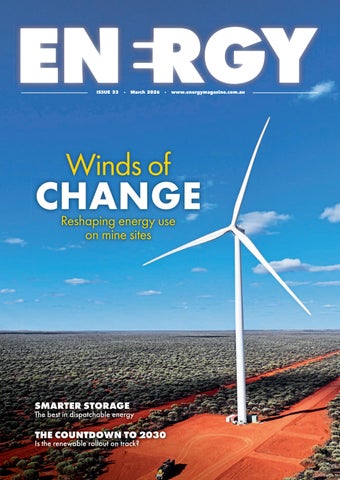
In our cover story, Minerals Council of Australia stresses how a ordable, reliable and low-emissions energy will be critical to Australia remaining competitive in the global investment environment. The organisation spotlights the work Lynas Rare Earths is doing to decarbonise its Mt Weld operation, where 7MW of solar, 24MW of wind, and a 12MW battery energy storage system is installed.
Having delivered large-scale projects across the National Electricity Market

connection strategy and system studies can make or break timelines.
At the other end of the spectrum, Decon Corporation examines smart storage inside data centres, where safety and reliability are paramount, while Droppoint discusses its Australian-first inventory solution. This sees the company dynamically position inventory close to renewable energy sites and technicians, with 24–7 access and pre-8am delivery options across a broad network of locations.
Elsewhere in this issue, we promote EnergyConnect, spotlight the Melbourne Renewable Energy Hub, and work with the Grattan Institute to set the record straight on electricity prices.
Happy reading.
Tom Parker Editor

10 Australia’s energy test
The Minerals Council of Australia believes countries that can offer an energy advantage are best placed to attract investment.
12 The great connector
Australia’s largest transmission project is nearing completion, positioning EnergyConnect as a central pillar of the national energy transition.
16 The battery race heats up
Australia’s battery boom isn’t coming, it’s already here, and it’s reshaping how the grid operates.
20 Smart storage for data centres
SMC batteries are increasingly being chosen in the energy industry as a safer alternative to lithium-ion alternatives.
22 Checkpoint for the battery boom
Droppoint is a first-of-its-kind solution removing inventory obstacles for battery installers and operators.
24 Three principles for a well-behaved BESS
A reliable BESS starts with a reliable network. Here’s three principles to ensure your BESS performs as it should.
34 Your technology playbook
CSIRO outlines the technologies and costs shaping Australia’s complex, cross-sector energy transition.
42 Is Australia’s energy transition on track?
Energy crunches the numbers to determine whether Australia can hit its target of 82 per cent renewable capacity by 2030.
46 Global capital charges in
The Australian renewable energy industry has become a marketplace of international players. Why is this the case?


The ability to achieve 2030 targets hinges more on system alignment than the delivery of new generation technology.


CSIRO director of energy, Dr Dietmar Tourbier, is often asked about 2050 – Australia’s longterm net-zero destination. But as 2026 begins, his focus is drawn to a much closer horizon.
“It’s often easy to focus on 2050 as that all-important target,” Dr Tourbier said. “But there’s a nearer-term deadline posing more questions.”
According to data from the Australian Energy Market Operator (AEMO), renewables made up 51 per cent of
the National Electricity Market (NEM) in the fourth quarter of 2025. This is a significant achievement but brings Australia’s goal of reaching 82 per cent renewable electricity by 2030 firmly under the microscope.
Growing renewable capacity comes as global investment in energy systems accelerates at an unprecedented pace.
According to the International Energy Agency, global energy investment was slated to reach a record $3.3 trillion in 2025, with clean energy
technologies attracting more than twice the investment flowing to fossil fuels.
Yet even as spending on renewable generation surges, investment in grids and system integration continues to lag, and system constraints are emerging as a shared challenge across advanced economies.
Renewables are becoming the default source of new supply, so the decisive question is no longer whether clean energy can be built cheaply, but
who has the capability, coordination and institutional leverage to navigate system bottlenecks?
“Internationally, capital investment in clean energy is becoming more selective not because clean energy is unproven, but because the risks now sit in grid integration, approvals, execution and operation rather than the generation technology itself,” Dr Tourbier said.
“Countries that can align investment signals with system build-out – rather than generation alone – will convert spending into delivered capacity faster and at lower cost.
What will determine success by 2030, Dr Tourbier argued, is whether Australia can successfully engage with communities, develop and reskill workforces and ultimately build the necessary infrastructure.
While Australia’s electricity sector remains the fastest-moving part of the transition, Dr Tourbier is clear that scaling renewables is no longer just about building more generation.
“We need to move from where we are now – around 50 per cent renewables – to more than 80 per cent by 2030 while rapidly expanding capacity and doubling or even tripling energy throughput by 2050,” he said.
“And we have to do that while keeping the grid stable and reliable.”
That systems-level challenge sits at the heart of the Australian Research in Power Systems Transition (AR-PST) initiative, a collaboration between CSIRO, AEMO, universities and international research partners.
The work focuses on how a highly distributed, renewables-dominated grid can operate securely at scale.
“In industries such as aerospace, people understand that distributed systems are often more reliable than centralised ones,” Dr Tourbier said. “In energy, there’s still a perception that moving away from centralised generation makes the system less stable. From a systems perspective, that’s not true – if you do it right.”
Australia’s long, geographically stretched grid means it is encountering challenges earlier than many other countries – making the next five years even more decisive.
“By 2030, Australia needs to make distributed generation work, supporting the grid services that currently depend on large scale synchronous generators,” Dr Tourbier said. “The technologies around grid-forming inverters, demand response, and time-shifting consumption need to be in place as large scale coal retires.”
Beyond electricity, Dr Tourbier sees significant opportunities for near-term gains in industry and transport, particularly where emissions are tied to heat. CSIRO’s role, he said, is to reduce technical and cost risks so industry can adopt lower-emissions solutions with confidence.
“For Australia’s energy-intense industries, lower-temperature processes can be electrified or served by solar thermal, and highertemperature processes can also be addressed using direct renewable heat,” Dr Tourbier said.
Concentrated solar thermal technologies, which directly convert sunlight into heat, o er promise for industrial applications where high temperatures – not electrons – are the primary requirement. Dr Tourbier points to concentrated solar thermal approaches capable of reaching temperatures above 1000°C, with the potential to deliver industrial heat at a lower cost than gas.
“If heat is what you need, solar thermal can make a lot of sense as converting heat directly can be much more e cient,” he said.
In transport, the most immediate gains remain in electrification.

“Electric vehicles are on a good trajectory, but it’s critical charging infrastructure keeps pace,” Dr Tourbier said.
Other parts of the transport system are more complex. Sectors such as aviation, shipping and rail face harder-to-solve challenges, with fewer near-term alternatives. But progress wherever possible still matters.
“Every gain we make now buys us time,” Dr Tourbier said, “and creates space for the more di cult parts of the system to catch up.”
Carbon management:
An unavoidable reality
Even with rapid electrification, Dr Tourbier was unequivocal that carbon management technologies will be essential to meeting Australia’s climate goals.
While acknowledging the valid concerns around cost and corporate accountability, the scientific consensus is clear: carbon capture and storage is a proven and necessary solution to achieve deep emissions reductions.
“Reaching net zero will require carbon capture,” Dr Tourbier said. “The scale of our current and historic greenhouse gas emissions means there’s no way around that.”
Hydrocarbons represent the majority of Australia’s energy flows, providing a significant contribution to the national economy with more than three quarters of Australia’s coal, gas and oil production exported.
Australia’s geology o ers significant potential for long-term carbon storage – for domestic purposes and potentially as a future foreign investment revenue stream. The challenge is cost, scale and social licence.
“Our target is to get carbon capture from air (direct air capture) below $100 per tonne,” Dr Tourbier said, comparing this to current costs of closer to $1000 per tonne. “By 2030, I’d like to see a demonstrated project achieving a much lower cost.
“Augmenting global industry knowledge on how CO2 reacts when stored in geological formations over time is another driver, helping to build confidence in the long-term integrity of storage sites.”
The real challenge
Across all three pillars, Dr Tourbier returns to a consistent theme: technology is not the limiting factor.

“We need to bring the public along with this – not just to accept infrastructure, but to participate in the transition,” he said.
CSIRO’s social science research, including a 2024 national survey of over 6700 Australians, shows support for renewables alongside clear priorities around a ordability, energy security and emissions reduction.
Combined with CSIRO’s applied science, such research informs the agency’s residential energy e ciency work. Australia’s ~12 million homes account for a quarter of our nation’s electricity use and 10 per cent of our total carbon emissions.
CSIRO’s housing research continues to drive energy e ciency, comfort and sustainability across 90 per cent of new Australian homes. This work is being extended to existing homes through collaboration with the banking and real estate sectors, and government.
Looking to 2030, CSIRO’s new National Energy Analysis Centre (NEAC) combines whole-of-system modelling with a “living lab” concept, allowing households and businesses to share energy data and receive insights into how they use, manage and reduce their energy costs.
“At the end of the day, what matters most to people is cost,” Dr Tourbier said. “CSIRO’s role is to keep innovating and drive down the cost of the transition – for industry, for households, and for government.”
While much of CSIRO’s focus is domestic, Dr Tourbier sees the next five years as a critical window for Australia to step into a stronger regional leadership role, particularly in Southeast Asia and the South Pacific.
“Rather than doing everything ourselves, the bigger impact comes from working with other countries, multinational companies and supply
chains to align research capability, international investment and industrial demand,” he said.
“This is something we must accelerate now – not in another decade.”
A marathon, not a sprint Dr Tourbier is conscious that the transition risks public momentum if it feels endless.
“This is a marathon, not a sprint,” he said. “Don’t think about the whole run; think about smaller milestones instead.”
For him, 2030 is one of those milestones.
CSIRO’s flagship GenCost report highlights the challenges and opportunities of reaching 2030 targets just in the electricity sector, and recent government programs show that progress there can be both rapid and unpredictable.
Home battery installations, for example, have surged since July 2025, when systems became eligible for the Small-scale Renewable Energy Scheme. In just one year, the scale of battery capacity being installed is set to match the storage capacity of the Snowy Hydro scheme.
This rapid uptake demonstrates the fluidity of Australia’s energy transition and the ability for Australia’s households to collectively drive major change.
“The technologies and the drive to innovate is there,” Dr Tourbier said. “That gives me confidence that the energy transition can evolve, sometimes faster than we expect and in areas that are challenging or complex.”
The question now is whether Australia can align investment, policy, and community trust quickly enough to turn potential into reality – within the next five years.


From vision to reality, we partner with clients to navigate the complexity of Australia’s energy transition - aligning policy, markets, and infrastructure to deliver sustainable, future-ready outcomes.


Our Capabilities
Advisory - Strategic guidance to navigate policy, regulation, markets, and investment decisions
Environmental Approvals – De-risking projects through streamlined planning and stakeholder pathways
Design & Engineering – Future-ready solutions for transmission, energy storage, and renewable integration
Project, Cost and Commercial Management

– Integrated program controls and commercial oversight to optimise budgets, manage risk and change, and drive delivery certainty
Connect with us

• Trusted advisor across Australia’s largest energy transition programs
• Global energy transition insights tailored to local challenges
• System-level expertise spanning policy, markets, networks, and delivery


Henry Olivares
Energy Transition Solution Lead, Arcadis
HenryOlivares@arcadis.com


Ali Muhammad
National Discipline Lead- Energy Advisory, Arcadis Muhammad.Ali3@arcadis.com


By Tania Constable, CEO, Minerals Council of Australia
The Minerals Council of Australia believes countries that can o er an energy advantage are best placed to attract investment.
As countries battle for position and influence in today’s hightech economy, the global race for investment is accelerating.
Around the world, governments are competing fiercely for capital to scale up industries, empower modern manufacturing, unlock critical minerals, secure supply chains and give their industries a competitive edge in a low-emissions future.
In this race, Australia should be a natural leader.
Our abundant minerals, skilled workforce, history of innovation and surplus of natural energy resources are of supreme advantage and collectively, the envy of the world.
But in such a competitive global marketplace, natural leadership is not guaranteed and comparative advantage can vanish quickly.
Escalating electricity and gas prices are eroding Australia’s competitiveness at the very moment a ordable, reliable and low-carbon energy is becoming the defining factor in global investment decisions.
Countries that are attracting capital and turning ideas into built reality are those that can o er an energy advantage – making lower energy costs a vital economic imperative, including in support of sovereign manufacturing capability.
High energy prices continue to place significant pressure on Australian industry. Businesses are rethinking expansion plans and may even scale back employment and seek alternative locations as power bills rise.
This increasing burden is also putting pressure on Australia’s decarbonisation e orts.
Australian mining is deeply committed and heavily invested in emissions reduction, with largescale decarbonisation already helping the country to meet its climate commitments.
The mining sector is at the forefront of developing the technologies that will help Australia reach net zero by 2050, while also relying on those innovations to drive its own transition.


Emissions reduction under the Safeguard Mechanism – where many emitting facilities will see their baselines decrease by 4.9 per cent annually to 2030 – is paired with a strong resolve to decarbonise.
Partnerships are leading the way to enable mining companies to focus on what they do best – extracting and processing minerals to meet growing global demand – while bringing in partners to supply energy, or in some cases build, own and operate renewable generation facilities.
The Mt Weld rare earths operation in Western Australia, operated by Lynas Rare Earths, has transitioned from diesel to a hybrid gas and renewable energy solution to reduce greenhouse gas emissions and lower power costs.
This has involved the construction and commissioning of a gas-fired hybrid
renewable power station including the decommissioning of the existing diesel power plant. This transition aligns with Lynas’ goal of lowering emissions while also reducing the cost of power compared to a thermalonly solution.
The project integrates 7MW of solar, 24MW of wind, and a 12MW/12MWh battery energy storage system, enabling “engine o ” capabilities.
The goal is to cover up to 70 per cent of the project’s energy needs with renewable energy, reducing its reliance on diesel and lowering emissions.
Zenith Energy worked with Lynas to spearhead the renewable transition at Mt Weld, overseeing the design, construction, and operation of a 65MW hybrid power station, supported by 24MW of wind capacity.
Newmont’s Cadia gold-copper mine in New South Wales operates one of the world’s most advanced automated underground networks, and the first-ever
fleet of remotely controlled bulldozers on a private 5G network.
With energy critical to its operations, Cadia signed a 15-year power purchase agreement (PPA) with the Rye Park wind farm in 2020. Since becoming fully operational in mid-2024, the wind farm provides about 50 per cent of the mine’s electricity, cutting emissions and stabilising energy costs.
Beyond energy, Cadia is also driving the energy transition. In 2022, the mine produced enough copper to manufacture nearly 21,000 3MW wind turbines, while also housing Australia’s only molybdenum plant, supplying a key ingredient in high-strength steel for turbine components such as shafts, gears and bearings.
Newmont is taking its renewable energy model nationwide. From 2027, the Collgar wind farm will deliver 70 per cent of power to the Boddington gold operation in WA, with solar and battery options also being explored.


At its remote Tanami operation in the Northern Territory, renewable projects are being developed to supply around 40 per cent of its power needs.
These projects and others, such as the implementation of a batterypowered shaft at its expansion project at Tanami, mark a major step in reducing Scope 1 and 2 emissions across


Newmont’s Australian operations and support the company’s goal of achieving carbon neutrality by 2050.
For the minerals sector, the energy transition must be managed in a way that protects Australia’s international competitiveness and does not overwhelm industry, businesses and households with unsustainably high energy costs.
Getting the balance right on lowering energy costs and emissions reduction has never been so important.
To win this race for enabling capital, and to maintain its competitiveness, Australia must act with urgency, embracing policy settings that put a ordable and reliable energy at the centre of its economic strategy.
For mining, such a focus is not only paramount to keep current operations viable, particularly in the nickel and aluminium sectors that face cost pressures from global competitors aided by cheap energy and labour, but to ensure future projects and industries can proceed.
The ambition of Australia’s minerals industry to achieve net-zero emissions by 2050 can only be achieved with a clear, stable and technology-neutral policy framework that attracts large-scale investment in decarbonisation supported by the development and deployment of emissions reduction technologies.
All technologies should be on the table if we are going to keep pace with a tech-driven economy, which means backing carbon capture and storage and removing the ban on nuclear energy.
And consistent policy will give industry the certainty it needs to invest and innovate while ensuring that Australia can meet its international commitments without costing jobs and reducing economic growth.

Australia’s largest transmission project is nearing completion, positioning EnergyConnect as a central pillar of the nationwide energy transition.
Australia is undergoing an energy infrastructure revolution as the country looks to interconnect renewable energy assets and drive down wholesale and retail power costs.
According to Transgrid, this will require 2500km of new transmission lines to accompany the transmission network service provider’s (TNSP) existing 13,000km system.
The 1600km ‘Southern Superhighway’ makes up the lion’s share of this project pipeline, comprising three major projects across New South Wales, Victoria and South Australia.
As HumeLink recently constructed the first of its 800 transmission towers and Victoria to New South Wales Interconnector West (VNI West) is still in its planning phase, EnergyConnect is more than 90 per cent complete.
This 900km-long electricity interconnector – known as Australia’s largest transmission project – recently raised its final steel tower.
“EnergyConnect will help to bring Australia closer to the level of interconnection seen in leading energy markets overseas,” Transgrid executive general manager – major projects Gordon Taylor told Energy
“It will link NSW with abundant renewable energy from South Australia and Victoria while strengthening the grid for all consumers.”
EnergyConnect’s transmission lines, which extend from the South Australian border to Red Cli s in Victoria and up to Wagga Wagga in New South Wales, comprise 1508 towers and monopoles requiring 46,068 tonnes of steel including guyed, Danubio and self-supporting structures.
This installation required 10,385km of high-voltage conductor cabling, enough to span from Sydney to Perth three times.
A new substation has been built at Buronga in NSW, with a major expansion of the Wagga Wagga substation occurring. The world-class Dinawan substation, situated at Bundure where EnergyConnect and VNI West will interconnect, is the final piece to the project puzzle, with completion set for early to mid-2026.
Dinawan comprises two 120MVAr (reactive power output) synchronous condensers – weighing 300 tonnes each – installed in a 60m-long, 1200m² machine hall.
These machines will support voltage stability on the transmission network, providing system resilience services such as inertia, while four shunt reactors

energy system for consumers as coal retires,” Taylor said.
“These projects are a key part of the national energy transition, and are expected to repay their costs,support a healthier environment andastronger economy.”
Taylor said EnergyConnect would also give industry and consumers “peace of mind” as coal generation winds down in NSW and help stabilise the grid at a time when reliability and a ordability are national priorities.
So once EnergyConnect is up and running in late 2026, how will it be integrated into the NEM?
“Once the physical assets are complete and ready for energisation, AEMO will then determine the steps to integrate the project into the network ensuring the earliest benefit to consumers,” Taylor said.

and two capacitor banks have been installed to increase power system e ciency and reduce energy losses in the transmission network.
EnergyConnect’s national signi cance
The Australian Energy Market Operator’s (AEMO) Draft Integrated System Plan (ISP), released in early December, called for 6000km of additional transmission lines to meet 2050 targets.
This will form the basis of the final 2026 ISP, set for release on June 25, which advises on the lowest cost path for generation, storage and transmission infrastructure in the National Electricity Market (NEM) to supply secure and reliable electricity by 2050.
Mentioned on numerous occasions in the Draft ISP, AEMO sees EnergyConnect as a central asset moving forward.
“AEMO confirmed that new transmission projects like EnergyConnect areanessentialpart of theoptimaldevelopment path(ODP) to deliver the least-cost, most reliable
Once integrated, Transgrid sees EnergyConnect connecting South Australia, NSW and Victoria to address inadequate interstate interconnections, while boosting transfer capacity by 800MW to meet growing demand.
EnergyConnect can also support the connection of up to 1800MW of renewable generation in NSW before the closure of coal-fired generators.
The first stage of EnergyConnect was successfully integrated in early 2025 through the staged release of 150MW of transfer capacity between the states, with further networking to ensue.
“Following construction, commissioning and internetwork testing of all network elements from Robertstown, South Australia through to Wagga Wagga, NSW, the full 800MW capacity is expected to be available to the National Electricity Market by late 2027,” Taylor said.
As the transmission bellwether of Australia’s energy transition, Taylor said many lessons can be learned from the EnergyConnect build.
Not only has Transgrid called on international experts for the project, but the local energy industry has also had the opportunity to boost its capacity and capabilities.
“The project has also helped train Australia’s own workforce in transmission line construction,” Taylor said.
“The Legacy 100 program has trained riggers and doggers to erect the towers and string the high-voltage conductor cabling.These personnel will be available to help deliver other new transmission line projects


in Australiaonce EnergyConnect is completed.”
Charles Sturt University also benefited from $2 million in funding to support 100 engineering scholarships and help produce the nation’s next generation of engineers.
Launched in 2023, the Powering Tomorrow Together program enabled Transgrid to bundle procurement of highly sought-after long-lead electrical equipment forEnergyConnect, HumeLink and VNI West.
“The program has allowed Transgrid to purchasematerials like substation equipment earlier and at a lower cost, enabling limited resources to be used across multiple projects,” Taylor said.
“Bundling these three major projects into the Powering Tomorrow Together program will yield savings of half a billion dollars in procurement,labourand inflation costs,and has shaved up to two years o delivery.”
EnergyConnect has seen Transgrid invest more than $264 million in supply contracts with 325 businesses across the Riverina, Murray and Sunraysia regions, demonstrating the project’s commitment to local communities.
The transmission project has also delivered valuable safety lessons.
“EnergyConnect’s strong performance in ensuring the health, safety and wellbeing of its workforce has set the benchmark for

other major transmission projects in Australia,” Taylor said.
“Despite increased activity through major projects such as EnergyConnect to support the renewable energy transition, Transgrid’s total recordable injury frequency rate improved from 7.4 in the 2020–21 financial year (FY21) to a sustained rate below 3.5 since 2022.”
In April 2025, Transgrid came together with 14 other energy construction companies to sign an o cial charter to strengthen safety in major transmission projects being delivered in complex and remote environments.
While EnergyConnect will be the first of three cornerstone transmission projects to come online across NSW, Victoria and South Australia, it’s been built with VNI West’s impending installation in mind.
“The transmission line fromthe Dinawanto Wagga Wagga substations has been future-proofed by designing it for 500kV operation, although itwill beinitiallyenergised at 330kVuntil the 500kV networkreachesWagga Wagga,” Taylor said.
“This strategic approach enables a scalable increase in transmission capacity–from 800MVA (megavoltampere) at 330kV to 3200MVA at 500kV–supporting long-term energy needs.”
The uprated 500kV link will integrate EnergyConnect, VNI West and HumeLink to form a continuous southern backbone into the Sydney Ring – a proposed transmission network boosting supply capacity for Sydney, Wollongong and Newcastle.
This will provide the support infrastructure to unlock the NSW Government’s South West Renewable Energy Zone (REZ), set to underpin an added 3.56GW of clean energy generation capacity.
The South West REZ extends from the Dinawan substation in the east to the Buronga substation in the west, with four renewable energy and storage projects to have been granted access rights to the REZ.
This includes the Dinawan Energy Hub (battery, solar and wind), the Pottinger Energy Park (solar and wind), the Yanco Delta wind farm, and the Bullawah wind farm.
With EnergyConnect’s completion, focus will pivot towards the delivery of HumeLink and the advancement of VNI West, where community engagement continues.
If everything goes to plan, by the 2030s, NEM businesses and consumers will be the beneficiaries of a new-look energy ecosystem, placing a ceiling on wholesale and retail power costs.

BESS networks should only be impressive when something breaks.
In BESS environments, network issues often originate in early design decisions that weren’t pressure-tested before deployment.
In a Battery Energy Storage System, the network does more than move data.
It carries timing signals, protection logic, control traffic, alarms, and recovery behaviour.
When it works properly, no one notices. When it doesn’t, everything else looks like the problem.
Most BESS network issues don’t begin with faulty devices. They begin earlier; architectures that looked fine on a drawing, but weren’t designed to behave predictably under real conditions. Tight commissioning windows. Remote sites. Heat, vibration, electrical noise. Multiple vendors. No margin for guesswork when something fails.
A well-designed BESS network is defined by how it recovers. If a link goes down, recovery time is known. If a device needs replacing, the path is clear. If a new engineer opens the cabinet, the layout makes sense without explanation.
That predictability comes from simple topologies, clear segmentation, and redundancy that behaves the same way every time.
It also depends on hardware being selected, configured, tested, and labelled before it ever reaches site, so commissioning isn’t spent discovering how the network works.
At Madison Technologies, we work with EPCs, system integrators, and asset owners on the operational
networks that underpin BESS and hybrid microgrids.
Our involvement often begins before equipment is ordered and continues through commissioning and long-term support.
In practice, that means validating designs, selecting fit-for-purpose platforms, and preparing systems so recovery behaviour and replacement paths are understood upfront.
Because in the end, a BESS network isn’t judged by how it looks when everything is working. It’s judged by how calmly it behaves when it isn’t.
Australia’s battery boom isn’t coming, it’s already here, and it’s reshaping how the grid operates.
For the third year running, batteries have topped the list of technologies entering construction, with 2025 seeing over 4.1GW (11.9GWh) of utility-scale storage breaking ground in Australia.
But this isn’t just a race for capacity, it’s a race for capability.
As renewables flood the grid and coal is edged out, flexibility has become just as valuable as generation. And batteries – fast, scalable and increasingly essential – are becoming central to how the system remains balanced.
Few companies have been closer to this shift than GenusPlus Group, known simply as Genus.
With large-scale battery projects delivered across both the National Electricity Market (NEM) and Western Australia, including Merredin, Kwinana and Wagerup in WA, Reeves Plains in South Australia and the Melbourne Renewable Energy Hub, Genus has
“Batteries don’t generate electricity, they move it,” Fyfe said. “They’re not on the edges anymore. They’re forming the core of how the system works.”
Surging wind output and high rooftop solar uptake, particularly in WA where over a half of households have deployed their own PV, is bending the traditional load curve. Daytime oversupply is no longer rare, it’s the new normal.
This means one thing: the grid needs tools that can shift power with precision. Batteries are that tool.
They’re already playing a significant role in grid balancing. During the most recent WA summer, more than a gigawatt of installed battery capacity was on hand to support the system through volatile conditions.
They’re also fast to deploy. While wind and transmission projects often face multi-year development horizons,
“If you’re applying overseas battery models here, you’ll fall behind,” Fyfe said.
Australia’s mix of market rules, grid topologies and environmental conditions creates complexity that no o shore playbook accounts for.
WA’s grid stands alone, serving remote communities with long feeders and sparse redundancy. Each NEM jurisdiction brings its own network rules, connection standards and stakeholder expectations.
“No two projects are cookie cutter,” Fyfe said. “Every site is bespoke, from engineering to approvals and delivery.”
Site selection, connection strategy and system studies can make or break a project timeline. This is where experience excels.
The role of batteries is rapidly evolving. Once built simply to shift solar from day to night, batteries are now expected to act more like generators,


some now six, and in some tenders, up to 10-hour durations. As durations increase, batteries begin to play a much larger role in how a system is planned and operated.
“You shouldn’t be building for today’s market,” Fyfe said. “You need to be building for what the grid will look like in five or ten years.”
Hard-earned lessons make the difference
Having worked across both coasts, Genus knows how to navigate regulatory friction, supplier bottlenecks and site logistics.
While Stage 2 of the Kwinana project was more than four times the size of Stage 1, it was built faster. The team already knew where the traps were.
“Experience makes it easier,” Fyfe said. “You know the pitfalls. You know where you can run things in parallel. You know what to lock in early.”
That’s why developers are increasingly bringing in contractors
allows for smarter procurement, layout optimisation and fewer costly fixes down the line. Getting delivery
teams involved early helps shape constructability and sequencing before problems surface on site.
Battery storage may be digital tech, but building it is anything but virtual.
Projects face classic Australian challenges: heat, dust, salt exposure, fire risk, remote access, accommodation bottlenecks and shifting supply chains. Success often comes down to adaptability.
“You need teams that can think on their feet,” Fyfe said. “You hit problems, you solve them, and you keep moving.”
It’s the kind of environment that rewards practical, on-the-ground problem solving and teams that can stay agile as conditions change.
The road ahead
Coal is exiting, gas is flexing, renewables are rising, and batteries are holding it all together.
Australia’s energy transition doesn’t work without storage, and storage doesn’t work without the right delivery partners.
“Getting your contractor right makes a hell of a di erence,” Fyfe said. “Sometimes the cheapest price isn’t the cheapest price.”
The next chapter of Australia’s energy story will be powered by storage. And the companies who know how to design, deliver and adapt; on-site, under pressure, and on-budget, will be the ones who shape it.
Genus is proudly powering what matters. And when it comes to batteries, what matters is getting it done right.

Arcadis has become a key advisor for the adoption of grid-scale and behind-the-meter battery energy storage systems in Australia.
Doors continue to open for Australia’s renewable energy industry, underpinned by a policy environment prioritising the decarbonisation of industries and civilisation as we know it.

The Federal Government is focused on accelerating the renewables roll out, underpinned by attractive subsidies and the loosening of governmental red tape. Pro-renewables reform of national environmental law, the EPBC Act, in November and a $4.9 billion expansion of the Cheaper Home Batteries program in December show where Australia’s priorities lie.
But for this revolutionary movement to see tangible success, the energy industry and government must work in lockstep with stakeholders and communities to ensure all interests are being catered for during the roll out.
Technology selection is equally critical, with storage systems just as important as generation infrastructure in realising a sustainable future.
This is where consulting companies such as Arcadis – with 36,000
employees worldwide – play a critical role.
As Muhammad Ali, Arcadis’ national discipline lead for energy advisory, explained, the Australian renewable energy industry should be approaching storage based on the duration demands at play.
“Australia’s grid is shifting from coal to variable wind and solar, so we need multiple storage durations,” he told Energy “Short-duration batteries (typically up to four hours) are often optimised for grid stability and FCAS (frequency control ancillary services) demands. We have medium duration – four to 12 hours – which covers evening peaks and multi-hour lulls, and then long duration – 12-plus hours to days –which covers extended low-renewable periods and improves resilience.
“While batteries are important for short and medium durations, the longer the storage duration required, the more important pumped hydro becomes as a solution.”
Ali pointed to the Australian Energy Market Operator’s (AEMO) guidance
that, in order to maintain system reliability once coal retires, the grid will require a mix of storage and firming capacity such as gas.
The electricity landscape
Released in December, AEMO’s 2025 Transition Plan for System Security (TPSS) report highlighted that if key technologies aren’t operational ahead of the retirement of the Yallourn and Eraring coal-fired plants in 2028 and 2029, respectively, AEMO may have to intervene in the market more frequently to maintain system reliability.
These interventions, while designed to avoid supply disruptions, could occur at significant cost to consumers and underscore the importance of timely delivery of firming, storage, and system strength solutions.
Synchronous condensers, which mimic the grid-stabilising role of coal generators, are the key technology in discussion, with clutch-fitted gas turbines and grid-forming BESS also critical.
Ali said the energy industry was facing several challenges to deliver
adequate storage infrastructure. This includes connection and network constraints such as queue times, system strength requirements, marginal loss factors, and congestion risk.
Planning approvals, social licence to operate and environmental constraints (particularly for long-duration storage) are other headwinds, along with supply chain and delivery risks such as long lead times and commissioning complexity.
Storage systems are also changing the revenue profile of the energy market.
FCAS demands typically call for short-duration batteries, while the arbitrage market, which sees electricity purchased when prices are low and sold when prices are high, require medium- and long-duration batteries.
“We’ve seen 2023, 2024 and 2025 be very di erent in how battery revenue is generated,” Ali said. “FCAS revenue was high in 2023–24 because battery uptake was low. In 2025, we are seeing FCAS prices decline very quickly as battery uptake increases.”
Ali said the flood of BESS is causing a “supply and demand” shift, with less of a need for the short-term FCAS function, which rapidly corrects frequency deviations to keep the grid stable at around 50Hz, and a greater ability to strategically plan revenue generation through arbitrage methods.
This is because longer-duration batteries can be relied upon to discharge electricity throughout higher demand periods, creating a more predictable revenue cycle.
While longer-duration batteries can support more sustained dispatch across peak periods, revenue predictability ultimately depends on market conditions, contracting structures, and access to capacity or firming mechanisms.
There are many variables at play when it comes to designing and installing
BESS, meaning operators must be able to turn to a trusted partner to ensure the optimised planning and roll-out of these systems.
This is where Arcadis comes to the fore.
“Arcadis supports battery developers in technical and commercial advisory and due diligence, project management, commissioning and development,” Ali said.
“Arcadis also works extensively with lenders and investors, providing lender-grade technical due diligence and bankability assessments to support financing decisions for storage projects.
“We map out a path for the developer to safely get their BESS up and running.”
Ali said Arcadis has specialist teams dedicated to each phase of the project development process. This extends from Ali’s role in initial strategy and investment, to electrical and environmental teams which deliver required studies such as the EIS (Environmental Impact Statement) and GPS (Generator Performance Standards) studies, and project, cost and commercial management teams who oversee program controls and commercial oversight to optimise budgets, manage risk and change, and drive delivery certainty.
Once operations are underway, Arcadis also provides optimisation services to ensure the BESS is performing as desired.
Ali said there are many considerations Arcadis discusses with its clients during the initial scoping phase.
“Operators must be mindful of Australia’s regulatory and planning environment – what studies are required for connecting a battery into the grid, including EIS, and the supply chain requirements,” he said.
“They must also understand the development and delivery timeline required for a BESS, which is typically not 1–2 years, but more like 4–5 years for utility-scale projects with complex grid connections.”


There must also be recognition of the rapidly evolving nature of today’s energy market, with two-hour storage solutions now being outpaced by medium- and long-duration solutions.
“A project might have made a financial investment decision in 2024 or 2025 for two hours of storage and then realise that the market is moving further towards arbitrage and longer durations,” Ali said.
“So operators must factor in the high volatility of the market from a battery application and revenue stack perspective.”
Ali said operators must also intimately understand the technology factors such as warranty terms, degradation assumptions and product availability, along with safety attributes such as fire detection and suppression, separation distances of the battery units, and emergency response planning.
Arcadis is supporting multiple utility-scale and behind-the-meter (BTM) BESS projects across the National Electricity Market, ranging from smaller BTM systems to grid-scale projects in the hundreds of megawatts.
“Here, we are providing owner’s engineering, grid connection support, technical due diligence, and delivery and commissioning assurance for multiple NSW, Victorian and Queensland utility-scale BESS projects, along with confidential preparatory discussions with a range of other early-stage projects,” Ali said.
When asked what battery adoption could look like in 2030, Ali said he expects to see BESS become the dominant firming infrastructure on the market, particularly 2–8-hour systems.
“I also see more hybrid projects (wind/solar and storage) to improve dispatchability and contracting, along with growing BTM and VPP (virtual power plant) participation and greater policy and investment support through initiatives such as the Capacity Investment Scheme,” he said.
“Storage is no longer ‘optional firming’ – it’s becoming the operating backbone of a renewables-led grid. The winners will be the projects that combine strong grid engineering, bankable delivery, and smart commercial optimisation from day one.”

SMC batteries are increasingly being chosen in the energy industry as a safer option than lithium-ion alternatives.
Data centres keep our digital world running, yet one of the most important parts of their infrastructure is often the least visible: the backup battery system.
As workloads grow and expectations around reliability tighten, many operators are taking a closer look at whether their traditional storage options can keep pace.
Increasingly, the answer is pointing towards sodium metal chloride (SMC) batteries, a technology built on chemistry that behaves very di erently from the batteries most of us are familiar with.
Thermal runaway is the major risk that keeps data-centre engineers awake at night.
Lithium-ion batteries, for all their strengths, rely on flammable liquid electrolytes and reactive materials. Under the wrong conditions they can enter a self-heating spiral that’s fast, violent and extremely di cult to stop.
This isn’t what anyone wants in a room packed with servers and switching equipment.
SMC batteries operate di erently. Their design centres around a solid ceramic electrolyte, known as β-alumina, which doesn’t burn or vent.
Inside the sealed cell, sodium metal forms the anode, nickel or iron chloride forms the cathode, and a molten salt electrolyte only becomes active when the battery is running. Because everything is contained within a rigid, high-integrity cell and the electrolyte itself isn’t flammable, there is no pathway for thermal runaway to occur. Abuse testing has shown that even when these cells are crushed, punctured or short-circuited, they remain stable. For a data-centre environment, that’s a major advantage: the battery room doesn’t suddenly become a source of fire risk.
There’s also a common assumption that because SMC batteries operate internally at around 270–300°C, they must produce a lot of heat externally.
In practice, the opposite is true. The internal temperature is part of the chemistry, not a burden on the facility. The outer casing stays safe to touch, the batteries don’t contribute meaningfully to room heat load, and they don’t require active cooling. They also don’t vent gases or release pressure, even under challenging conditions.
For facilities already battling heat constraints or limited air-flow capacity, this stability removes a significant layer of operational stress.
The long service life of SMC batteries is another advantage, with the conversion between sodium metal and sodium chloride a straightforward, highly predictable reaction. It doesn’t generate the side reactions that commonly wear out lithium-ion or lead-acid cells – there’s no electrode swelling, no dendrite formation and no rapid electrolyte breakdown.

Because of this, SMC batteries routinely achieve a design life of around 20 years, with very little gradual decline in usable capacity. For data centres built around consistency and uptime, reducing the number of battery replacements over the life of the facility is a practical and financial benefit.
Despite their safety advantages, SMC batteries don’t force a trade-o in performance. Their nickel-based
systems, while also reducing floor loading. And because the chemistry is non-flammable, the increase in stored energy doesn’t introduce extra fire load – an important distinction when operators are already dealing with strict building codes and limited plant space.
The environmental story is equally important for operators with strong ESG (environmental, social and governance) targets.
One of the standout features of SMC technology is its ability to be refurbished. Instead of discarding entire systems once their capacity
returned to service. This circular approach significantly reduces waste and makes the technology more aligned with modern sustainability expectations than many incumbent chemistries.
The move from theory to practice is already underway. Recently, Decon Corporation partnered with TPG Telecom to deliver a SMC battery system at TPG’s Perth data centre.
The installation proved how well the technology fits into a highavailability environment, delivering the combination operators are looking for: inherent safety, long-term stability and a predictable operating profile that supports the wider digital ecosystem. It’s a strong example of how collaboration can accelerate the adoption of safer and more responsible energy infrastructure in Australia.
As data-centre operators navigate growing energy demands, higher heat loads and stricter sustainability requirements, the choice of battery technology is becoming more consequential.
SMC systems bring together features that genuinely matter: they remove the risk of thermal runaway, deliver stable long-term performance, reduce environmental impact, and remain dependable across a broad range of operating conditions.


In a sector where downtime is unacceptable and risk margins are shrinking, this chemistry o ers a steady, sensible and future-ready way forward.
Droppoint is a first-of-its-kind solution removing inventory obstacles for battery installers and operators.
The battery boom is here, with the role of both grid-forming and home BESS increasingly recognised as a key enabler of Australia’s energy transition.
The stats don’t lie. According to Rystad Energy, 4.1GW (11.9GWh) of utility-scale BESS had commenced construction in 2025 by early December. This equated to, for the third consecutive year, the largest roll out of all renewable technologies, with utilityscale solar the next highest at 1.4GW.
BESS installation has become a fantastic business opportunity for small and medium-sized enterprises (SMEs), including local electrical contractors and service providers, who have the technical expertise and agility to mobilise quickly.
But as Droppoint chief executive o cer Jason Flanagan explains, SMEs
don’t often have the scale or systems to support burgeoning customer needs post-installation.
“BESS is moving fast, and the operational model is still evolving,” Droppoint chief executive o cer Jason Flanagan told Energy
“Many installers and service providers are small to mid-sized teams who might be excellent at delivery on-site, but don’t have the resources to run enterprise-grade warehousing, transport coordination and inventory governance.
“When technicians and supervisors are on the tools, logistics becomes an avoidable constraint.”
While installation and commissioning might go to plan, SMEs can have di culty responding to component failures due to their inability to store adequate and easy-to-access spare part inventories.
As we know, operational problems can occur at any time, and the ability for a service provider to respond quickly to client downtime can be their biggest strength.
This is where Droppoint, as Australia and New Zealand’s only complete inventory and managed logistics solution, comes into its own.
“We provide the supply chain and inventory capability in a way that is practical for the mid-market, with a dedicated operations team that manages movements, staging, storage and urgent replenishment so service teams can stay focused on commissioning and maintenance,” Flanagan said.
Energy distributors see Droppoint as a critical checkpoint on the road, with the company’s Pick-Up-Drop-O (PUDO) inventory network spanning


over 1000 locations across Australia and New Zealand, with the ability to expand and contract the network based on customer requirements.
In-night delivery can be organised to ensure parts arrive at a Droppoint close to technicians or job sites.
“Our decentralised model gives energy operators flexibility that centralised warehouses and fixed footprints struggle to match,” Flanagan said. “We can dynamically position inventory closer to sites and technicians, with 24–7 access and pre8am delivery options across a broad network of locations.
“Our footprint can expand or contract as programs change, without forcing customers into long-term fixed-cost infrastructure. This agility matters in energy, where projects scale quickly, geographies shift and service demand is rarely static.”
Flanagan said he is seeing energy organisations under increasing operational pressure, with the need to scale faster, respond quicker and deliver tighter SLA (service level agreement) performance, often across wide geographic footprints.
“Droppoint addresses this with our secure and widespread PUDO inventory network across Australia and New Zealand, but also our proprietary materials orchestration software (MOS), which improves visibility and control, and a managed service layer that takes the logistics burden o field teams,” he said.
“By providing spare parts warehousing, bulky and time-sensitive
freight, and project logistics for complex rollouts, customers are drawn to solutions that lift technician productivity while reducing inventory waste and downtime risk.”
Droppoint’s solutions are seeing the strongest momentum from energy applications with a large, distributed asset base and from a field workforce that needs fast, reliable access to parts.
This includes smart metering roll outs, EV charging deployment and maintenance, and renewable generation to accompany the fastgrowing energy storage ecosystem.
Flanagan said he is seeing the inventory challenge in the BESS sector becoming very clear.
“There are two phases where inventory strategy will make or break outcomes,” he said.
“First is delivery and commissioning at scale. Battery systems and supporting equipment are heavy, high value and often imported, which means long lead times and real risk if components arrive out of sequence.
“Add the reality of moving oversized loads to remote or greenfield sites, managing safe delivery windows, and staging equipment on constrained ground conditions, and it becomes obvious that inventory planning needs to start early.”
The second phase where inventory strategy can fall over is in operations.
“As deployments accelerate and the market matures, uptime will be won or lost on spares availability and service responsiveness,” Flanagan said. “With
multiple OEMs and integrators in market, and a growing installed base spread across regions, holding critical spares only in a central warehouse is a vulnerability.
“The future looks like distributed inventory – shared stocking locations closer to sites and aligned to service patterns, so technicians can access the right components quickly and consistently.”
This is where Droppoint plays a practical role.
“We help energy organisations position critical parts closer to where work happens, then orchestrate movements through software so inventory is visible, controlled and available when it’s needed,” Flanagan said.
“In short, we de-risk the build phase through smarter staging and delivery coordination, then support the operating phase by enabling reliable access to spares that protect uptime, reduce unnecessary stockholding, and keep maintenance teams moving.”
Droppoint will be at Smart Energy 2026 in Sydney from May 6–7 and All Energy Australia at the Melbourne Convention and Exhibition Centre from October 28–29.
The company will use these events as a platform to educate industry on practical ways to improve uptime and service performance through better parts positioning and simpler logistics execution across a distributed asset base.
For more information, visit droppoint.com.au
A reliable BESS starts with a reliable network. Here are three principles to ensure your BESS performs as it should.
As the adoption of battery energy storage systems (BESS) soars across Australia, and the incentives grow, the grid’s identity is changing.
Diesel generators are being replaced with sustainable alternatives, but they are not a like-for-like replacement, and the energy industry is having to rethink how systems are integrated.
While many energy storage conversations focus on batteries and controls, networking determines whether the system behaves predictably under real conditions.
“Most BESS drawings look tidy on paper, but the network has to be designed around how the system actually operates, not how tidy it looks in CAD (computer-aided design),” Madison Technologies solutions engineer team lead Corey Nesbitt told Energy
“There’s a common assumption that networking is simple; that you connect a few devices and the PLCs will talk. That’s true at a basic level, but once you introduce real-time control, protection, and safety systems, network behaviour becomes critical.
“Because of this misconception, in many BESS projects, networking is treated as a secondary task or outsourced late. It’s not the main integrator’s core discipline, but it still has to perform to the same standard as everything else.”
Nesbitt said given the intricacy of BESS networks, one errant connection could cause a whole BESS system to shut down.
“A BESS network is made up of many interdependent components,” he said. “If the design relies on a single path, one failed connection can take large parts of the system o ine.
“If you only have one connection and it fails, you don’t lose part of the system – you lose visibility and control of the whole network segment.”
Installers integrate redundant components to add further support, however adding additional components creates added complexity,

greater margin for error, and less speed in the system.
“Adding extra connections looks like redundancy, but unless it’s designed properly, it can introduce new failure modes rather than removing them,” Nesbitt said. “The underlying network mechanisms aren’t always designed to handle multiple active paths, and when they aren’t, recovery can slow down.
“In some cases, adding parallel connections increases tra c and instability, which can disrupt the application. We want redundancy, but not at the expense of predictable behaviour.”
Nesbitt has seen instances where a robust BESS control system has been built, but the network isn’t designed to match, creating a “performance indi erence”.
“We often see networks that look ‘strong’ and redundant in a drawing, but don’t behave that way once they’re supporting a live system,” he said.
“More redundancy doesn’t automatically mean better performance. In some cases, it increases failover time and delays the system’s response.”
“Sometimes it’s better to have fewer redundant connections, creating a faster failover time. Ultimately, it’s about

finding a happy medium between having a fault-tolerant network with the right redundancy and having a network that is fast enough to recover when there is a problem.”
These three network principles will help ensure a well-behaved BESS.
The simplest BESS network designs often o er the best reliability. This is where ring topologies come into play.
“Ring topologies, which are extremely common in operational technology, allow us to have a redundant connection with fault tolerance,” Nesbitt said. “This sees a connection sitting ready as a standby, and when it’s needed, it gets turned on and used.”
There are also ultra critical networks which typically connect to protection relays to switch things on and o . Latency is critical here and, in many cases, must be less than 20 milliseconds.
“This enables the network to jump from one topology, which is a ring using a particular protocol, to another ring topology using a di erent protocol, remembering that it’s handling all the connections at once,” Nesbitt said.
“In this case, devices can receive two packets of information and discard the irrelevant packet. This translates to a ‘bumpless’ network, which is so fast that the application would never realise there was ever a problem.”
Principle two:
Removing networking risks
BESS containers designed by OEMs can pose hidden networking risks, such as unmanaged switches, identical IP addressing, and a lack of segmentation or redundancy.
“Many OEM container designs come with built-in networking risks,” Nesbitt said. “In those designs, a single unmanaged switch can be responsible for hundreds of devices, which increases tra c, limits visibility, and raises the risk of disruption.
“This is not good for network performance because you can have hundreds of interconnected devices and IP addresses.”
Nesbitt said optimising BESS container networks can involve segregating them into virtual networks, where multiple devices can talk simultaneously but on a di erent wavelength.
“This ensures, for example, that one conversation is not being heard by another person that doesn’t need to hear it, creating a performance improvement,” he said.
Having everything on the same network also creates cybersecurity risks.
“If we isolate our networks from other devices, so if we were to isolate

OEM-designed BESS containers can pose hidden networking risks.
the BESS container’s air conditioning system from the battery management system, it removes an unnecessary channel of communication between two components,” Nesbitt said.
“This is stronger for cybersecurity, because if we have a vulnerability on one network, it means that vulnerability can’t spread to other networks.”
The key takeaway here, Nesbitt said, is to replace an OEM container’s unmanaged switches with a stronger managed switch that can segregate from a cybersecurity perspective.
Principle three:
Design a network to scale
BESS installers who focus on getting initial design and pre-configuration right, including repeatable configurations, consistent naming, and firmware alignment, to name a few, are setting themselves up for success.
“BESS containers have hundreds of pre-configured IP addresses, which need to be unique to ensure each address is independent,” Nesbitt said.
“To do this, hardware such as routers can translate these IP addresses. If you buy 10 BESS containers with 10 of the same IP addresses, for example, a router can layer network addresses and expose a di erent, unique IP address on the other side.
“This means we can have hundreds of IP addresses translated into one IP address on the outside that we talk to, but on the inside, the addresses are all the same. None of the component IPs
need to be changed, with the router acting as the conduit.”
This, in turn, streamlines container commissioning.
“Using a router in this way simplifies configuration,” Nesbitt said. “And then during operations, maintenance is also simplified because as all components have the same factory IP, you can easily swap a part out with a spare from the shelf.”
These are the insights BESS installers and operators can gather from working with Madison Technologies – a provider of connectivity solutions through the various technology brands it distributes.
Nesbitt a rmed that Madison Technologies is more than a “box mover”.
“We’re an engineering-led distributor, meaning the hardware is only part of the solution,” he said. “We provide clients with network design guidance, pre-configuration, and practical advice based on real deployments.
“When integrators run into complexity, clients come to us to work through it. Because we use this equipment every day, we can recommend architectures and products that fit the application they’re working through.”
For BESS projects, this approach reduces commissioning e ort, improves operational predictability, and supports safer long-term performance.
“Get the network right once,” he said, “and everything that follows becomes easier.”

Rapid BESS adoption in Australia highlights the need for robust safety, risk management, and transparency measures.
Battery energy storage systems (BESS) are becoming a cornerstone of Australia’s renewable energy transition, with all signs pointing to storage being a critical intermediary in maintaining system reliability.
According to the Australian Energy Market Operator’s (AEMO) Quarterly Energy Dynamics report for the third quarter of 2025, 2936MW/6482MWh of new battery capacity entered the National Electricity Market in the 12 months to September 30 last year.
Battery discharge on the NEM increased by 150 per cent to average 215MW over the period, with other peaking sources such as gas-fired generation (down 11 per cent) and hydro (down 3.5 per cent) reducing their contribution due to lower supply requirements.

As the adoption of grid-scale BESS increases, what is less recognised is the risks that come with installing these operations. Battery installations Australia-wide are facing one key challenge: thermal runaway.
Thermal runaway is caused when a battery is subject to high temperatures, either from a high rate of current discharge or proximity to external sources.
This, as the name suggests, creates a chain reaction where heat cannot be dissipated faster than it is created, leading to self-sustaining heat creation and flammable gasses that produce fires.
Between January and August 2025, 94 lithium-ion battery fires occurred in Western Australia, compared with 49 for the whole of 2020. While most of these occurred in residential and commercial
premises, large-scale BESS also run on lithium-ion technology.
As AXA XL energy transition risk consultant Belinda Luu explained, a growing BESS fleet alters its risk profile.
“We’re seeing project capacity and battery durations increasing, and battery containers getting larger, with containers increasing from 3–4 megawatt hours in capacity to at least 5 megawatt hours,” Luu told Energy
“These containers are more energy dense, which means the risk of thermal runaway and the potential for a cascading failure is higher.”
A global BESS leader
A Rystad Energy report from October positioned Australia as the world’s third-largest market for utility-scale BESS, with China and the US first and second, respectively.

The country is awash with international developers, with local integrators such as Akaysha Energy and Stanwell Corporation accompanied by the likes of French company Neoen, Italy and Japan-backed Potentia Energy, and Singapore’s Equis, to name a few.
Luu has observed a more competitive battery market in Australia, creating less transparency.
“Rystad found that in 2025, the top two BESS integrators accounted for 40 per cent of the market share, which was around 70 per cent in prior years,” she said.
“While having a growing number of BESS developers de-risks the supply chain, it also makes it harder for insurers to maintain relationships with OEMs (original equipment manufacturers) and understand the testing they’re undertaking and what they’re developing.”
As Australia’s BESS fleet expands, developers mustn’t lose sight of the inherent safety and loss risks and deploy preventive measures to suit.
“Developers need to ensure that they not only have a robust BESS design but also a BMS (battery management system) that assists down to the cell level and can detect abnormal conditions such as spikes in voltage, high temperatures and pressure changes,” Luu said.
“Early o -gas detection is also important during thermal runaway


events, along with mechanical ventilation systems which can expel excess gas from BESS containers.”
Luu said deflagration panels also play an important role.
“If there is enough pressure created from a fire or explosion, deflagration panels open and release the pressure instead of the container bursting at the seams, so to speak,” she said.
“Testing is also a critical component. The latest standards require large-scale NFPA 855 fire testing to be carried out, in addition to regular UL 9540A testing. This ensures the worst-case scenario for a fire event and how fire can propagate to other containers is considered. Previous standards didn’t mandate this.”
Local guidelines
The importance of fire testing is recognised in the Country Fire Authority’s (CFA) ‘Fire Safety Studies for Battery Energy Storage Systems’ guidelines, first released in June 2025.
Here, the CFA may request the development of a fire safety study for BESS over 1MWh in capacity based on
the unique design, complexity, location and proposed operations of the system. This would accompany a standard risk management plan.
Luu called the report “one of the more comprehensive guidelines” she’s seen on BESS fire safety.
“The report from the Victorian authority makes reference to the NFPA 855 fire testing that got rolled out in September 2025, so they’re on top of it,” she said.
“It also stipulates the need for a four-hour supply of water despite acknowledging the fact that the standard approach for thermal runaway fires is to ‘let it burn’. The water may be needed to cool down adjacent assets or mitigate other issues.”
While the release of the report is encouraging for the Australian BESS sector, Luu called for more transparency.
“Often we will hear about a news report of a BESS failure, but the outcome of investigations can be di cult to find,” she said.
“For the BESS sector to clearly understand the risks at play, they require reference points, so I encourage industry to be forthcoming with findings from investigations carried out into BESS failures and fires.

“BESS technology is still new, and we’re all learning as we go.”
AXA XL has provided coverage for BESS operations for some time now. In doing so, the company supports the use of captives in insuring renewable energy risks. This includes sustainability-linked insurance and fronting services.
Clients can use captives to cover risks that may be di cult to place in the traditional insurance market and to meet sustainability goals. They can also capture valuable data, which helps them better understand and manage their threats. Tailored insurance solutions such as captives have an important role to play in protecting BESS developers from operational risks. It doesn’t, however, take away from the importance of having sturdy fire safety and risk management plans in place.

Recent data from AEMO shows how wholesale prices are dropping as renewable generation increases.
The Australian electricity landscape is changing before our eyes, with renewable energy driving higher quarterly generation averages in the National Electricity Market (NEM) than fossil fuel sources.
In a first for Australia, data from the Australian Energy Market Operator’s (AEMO) Quarterly Energy Dynamics (QED) report found renewables accounted for 51 per cent of the energy mix in the fourth quarter (Q4) of 2025 (up from 46 per cent in Q4 2024), with fossil fuels making up the balance.
Variable renewable energy (VRE), comprising grid-scale solar and wind, posted a new quarterly average output record of 6627MW, with output
increases of 29 per cent for wind and 15 per cent for grid-scale solar.
Rooftop solar was a success story, singularly supplying the second highest proportion of energy to the NEM of 17.6 per cent (behind only black coal). This drove record lows in minimum operational demand in the NEM of 9666MW, with South Australia in the negative at -263MW.
Battery discharge also soared, nearly tripling to average 268MW, benefited by 3796MW of large-scale battery capacity being added to the grid since the end of 2024.
This comes as coal-fired generation delivered an average quarterly output of 11,544MW – an all-time low and 4.6 per cent down from Q4
2024. Gas-fired generation posted its lowest quarterly output since 2000, averaging 741MW.
AEMO executive general manager – policy and corporate a airs, Violette Mouchaileh, hailed the Q4 performance.
“This is a landmark moment for the NEM,” she said. “For the first time, renewables and storage supplied more than half of the system’s energy needs for a full quarter.
“It reflects years of sustained investment and demonstrates that more wind, solar and battery capacity in the system reduces reliance on higher cost coal and gas generation, placing sustained downward pressure on wholesale electricity prices.”
Like an age-old marketing ploy from Coles, yes, yes, the prices were down.
Wholesale electricity prices averaged $50/MWh across the NEM in Q4 2025, down $39/MWh from Q4 2024 and down $37/MWh from Q3 2025.
Increased wind generation and battery discharge reduced the reliance on gas and hydro generation during evening peaks, suppressing average prices and limiting the incidence of high-price intervals (+$300/MWh).
At the same time, AEMO observed NEM average prices decreasing across most hours of the day (from Q4 2024 levels).
Average Queensland prices dropped 55 per cent to $58/MWh, with New South Wales prices declining 48 per cent to $75/MWh. Wholesale electricity was most a ordable in South Australia and Victoria at $37/MWh, with 30 per cent and 18 per cent quarterly declines, respectively.
AEMO explained the price discrepancies in greater detail.
“During Q4 2025, price separation between northern regions (Queensland and New South Wales) and southern regions (Victoria and South Australia) persisted,” the QED report stated.
“During midday hours (1000hrs–1600hrs), NSW energy prices averaged $12/MWh, remaining $41/MWh above South Australia and $25/MWh above Victoria, while the price gap between New South Wales and Queensland narrowed to $5/MWh.
“Price separation was evident between Victoria and South Australia between 1300hrs and 1600hrs this quarter, with South Australian prices averaging -$33/MWh while prices in Victoria averaged -$10/MWh.”
Wholesale electricity price volatility decreased in Q4 2025, with aggregated NEM-wide cap returns –representing contributions when the spot price jumps above $300/MWh – declining from $86/MWh in Q4 2024 to $13/MWh in Q4 2025.
AEMO noted that while Q4 2024 saw elevated price volatility concentrated in NSW and Queensland due, in part, to higher operational demands from a heatwave in November and early December that year, a slight operational demand increase in Q4 2025 was o set by higher wind generation across all hours, particularly during peak periods.
“During the morning peak (0600hrs–1000hrs), wind generation rose by 706MW (+26%) and grid-scale solar output was up by 686MW (+16%),

resulting in a year-on-year decrease in coal-fired and gas-fired generation,” the QED report stated.
“During the evening peak (1600hrs–2000hrs), wind generation surged by 1030MW (+30%), while battery discharge increased by 486MW (+175%), reducing the dispatch of gas and hydro generation.
“These outcomes led to a significant reduction in price volatility compared to Q4 2024.”
negative price frequencies during the night (2200hrs–0600hrs), recording negative or zero prices in 20 per cent and 19 per cent of intervals, respectively. This was a 11 per cent increase for both states.
How did these negative-price dynamics translate to revenue?
The QED found the higher frequency of negative price intervals was cushioned by lower prices for large-scale generation certificates

The frequency of negative prices across the NEM notched a new record in Q4 2025 at 31 per cent of regional dispatch intervals (up from 23.1 per cent in Q4 2024).
All mainland NEM states experienced record negative price occurrences, with South Australia seeing negative prices at 48.4 per cent of intervals during the recent quarter, followed by Victoria at 43.1 per cent, Queensland at 30.2 per cent and NSW at 26.7 per cent.
“Negative price occurrence is higher in daytime hours when operational demand is low due to high distributed PV output, (strong) large-scale VRE generation output … and coal-fired units maintaining minimum stable output levels,” the QED report stated.
“During the daytime hours (0900hrs–1700hrs) in NSW and Queensland, negative prices occurred 60 per cent and 66 per cent of intervals respectively. Across the same time period, spot prices in South Australia and Victoria were zero or negative for 88 per cent and 78 per cent of intervals respectively.”
The QED also found South Australia and Victoria experienced increases in
(LGCs), which dropped from $34/ certificate in Q4 2024 to $9/certificate in Q4 2025.
This saw negative prices range between -$30/MWh to $0/MWh 53 per cent more often than Q4 2024, with the average price during negative intervals lifting from -$41.3/ MWh to -$19.4/MWh.
“Because of this increase, NEMwide negative price impact – reflecting the combined e ect of negative price levels and frequencies on quarterly average price – declined to $6/MWh this quarter, down by $3.5/MWh compared to Q4 2024, despite the higher frequency of negative price intervals,” the QED stated.
What Q4 2025 ultimately shows is not just a renewable milestone, but a system behaving di erently. More wind, solar and batteries are reshaping when and how energy is supplied – lowering average prices, dampening volatility and pushing coal and gas further to the margins.
The quarter also underscores the next challenge: managing abundance, as record negative-price frequencies and shifting revenue dynamics make dispatchable flexibility and smarter contracting increasingly critical.


Energy calls in the Grattan Institute to unpack the diverse elements driving electricity prices.
Political football.”
It’s a phrase often used to describe the electricity-price debate in Australia, particularly at a time when cost of living pressures continue to impact households.
But the pricing issue requires more investigation than the flippant treatment it can receive in the political arena, so we’ve enlisted Grattan Institute to help provide a clear view on the topic.
Firstly, Grattan Institute energy and climate change program director Alison Reeve shed light on the political landscape.
“For a long time, everyone had a mental shortcut, which was, ‘Renewables are more expensive’, because that was true,” Reeve told Energy. “The thing is, the more we deployed them (renewables), the more the cost came
down, and so a lot of people are having to change their mental shortcuts.
“People who don’t spend all their time engaging with the energy system still have the old mental shortcut, which means politically, that message (renewables = higher prices) lands, because people go, ‘Yes, that politician is a rming the thing I know to be true’.”
Reeve believes this is why pushing the electricity-price debate has become attractive as a political strategy.
“We also often hear the argument of ‘coal is cheap’,” Reeve said. “The reason coal is cheap is because we paid o the capital decades ago.
“If you replace existing coal infrastructure with new coal plants, that new coal would not be cheap, because you would be footed with capital once again.”
CSIRO’s draft GenCost 2025–26 report released in December projected the capital costs of building various energy infrastructure in the years to come.
For Australia to achieve its 82 per cent renewable energy target by 2030 under current policies, building black coal and brown coal energy infrastructure would cost $6164/kW (down from $6946/kW today) and $9385/kW (down from $10,725/kW today), respectively.
In contrast, the capital costs of large-scale solar PV under current policies would cost $1239/kW in 2030 (a drop from $1621/kW today), and onshore wind would cost $2697/kW by the end of the decade (down from $3248/ kW today).


The great connectors
In parallel with the renewable energy assets underpinning low-emissions power generation, Australia has been undergoing mammoth transmission projects to help interconnect such infrastructure, with several of these undertakings still in their infancy.
While EnergyConnect – an 900kmlong electricity interconnector that extends from South Australia into Victoria and up to Wagga Wagga in NSW – is more than 90 per cent complete, HumeLink recently constructed the first of its 800 transmission towers.
Victoria to New South Wales Interconnector West (VNI West), on the other hand, which will transmit renewable energy between the two states, is still in its planning phase. Same goes for Marinus Link, a subsea power cable traversing Bass Strait to connect Heybridge, Tasmania with Waratah Bay, Victoria.
Project delays have led to cost overruns, adding further fuel to the cost debate.
“We’re having to build new transmission and new generation
at the same time, which creates a coordination problem,” Reeve said.
“State governments have been trying to solve this by putting process around getting the transmission built, auctioning o access to that transmission and so on. This should be good for keeping costs down, but it also tends to slow everything down.
“And the longer you slow it down, the more costs go up.”
Reeve explained that when projects are initially costed with suppliers, they are held to that for a period of time.
“Your supplier of wind turbine blades, for example, might only be able to hold prices for 12 months,” she said. “If your project is delayed by 18 months, then your prices are going to be higher when you get underway.”
Cutting through green tape
Transmission and clean energy projects are also facing approval delays.
The Federal Government released its inaugural National Renewable Energy Priority List in March 2025, identifying 56 priority projects that will receive targeted support to streamline regulatory planning and approvals processes.

Long-sought reforms to the Environment Protection and Biodiversity Conservation (EPBC) Act came in November, with a new Streamlined Assessment Pathway reducing the timeframe for operators “who provide su cient information upfront”.
New bilateral agreements between Federal and State Governments under the EPBC Act will remove duplication in the project assessment and approval process, while defined ‘go’ and ‘no go’ zones will provide greater clarity for
by Infrastructure Australia viewed approval delays as being among the greatest risks to project delivery. This was shared in a November 2025 report.
VNI West, which is expected to be completed in 2030 instead of the previous goal of 2028, has faced community pushback.
In 2023, after six weeks of community and stakeholder consultation was undertaken by the Australian Electricity Market Operator (AEMO) and Transgrid regarding VNI West, 533 submissions
Transmission Company Victoria (TCV), which is now overseeing the project, said in July 2025 that the timeline for VNI West had been extended two years to reflect “updated planning, design, and construction assumptions that have evolved through the project’s early development stages”.
Reeve said approval delays had been compounded by labour shortages “which are still kicking through the system” after COVID.
“There’s been a number of headwinds

they’ve all manifested at once, creating a situation where things are slower and more expensive,” she said.
A low-emissions power system
In releasing its GenCost report in December, CSIRO introduced the system levelised cost of electricity (SLCOE) method to di er from the levelised cost of electricity (LCOE) metric used in the past, which simply compared costs of individual technologies.
SLCOE scrutinises capital costs against various electricity emission abatement scenarios to 2050, which CSIRO chief energy economist and

GenCost project leader Paul Graham said provides “system modelling of the future generation mix and average cost of wholesale electricity”.
Using the new costing method, CSIRO found that the average cost of electricity in the National Electricity Market (NEM) consistent with meeting Australia’s 82 per cent renewables target by 2030 to be $91/MWh including transmission or $81/MWh for wholesale generation cost only.
For the electricity sector to support whole-of-economy net-zero abatement by 2050, CSIRO projected electricity costs to be between $135/MWh to $148/MWh in the NEM inclusive of new transmission costs or $115/MWh to $124/MWh from wholesale generation costs only.
For context, the historical average NEM volume-weighted generation price for 2024–25 is expected to be $129/MWh.
This suggests wholesale electricity prices will increase from 2030 to 2050, with GenCost demonstrating the true cost of running a highly reliable, near-zero-emissions power system, rather than just the cost of generating energy.
CSIRO sees a range of factors driving higher wholesale electricity prices as we reach 2050, with added costs for transmission, storage and firming to ensure reliable supply for a newlook grid.
The lowest-cost large-scale generation mix consistent with achieving 82 per cent renewables by 2030, according to CSIRO, comprises six per cent hydro, 41 per cent wind, 31 per cent solar PV, four per cent gas, and 18 per cent coal.
Could we already have the solution?
In releasing its report, Bills down, emissions down: A practical path to net-zero electricity, in October, Grattan Institute explored what additional carbon constraint could mean for electricity prices.
“All of Australia’s policies are about pushing renewables in,” Reeve said. “What we thought about, instead, is what happens if you constrain how much people are allowed to emit, which is much more akin to taking coal and gas out.”
Grattan Institute analysed what impact emissions constraint would have on wholesale and retail electricity prices, along with overall household energy costs.
In doing so, the Melbourne-based think tank explored what adapting the Safeguard Mechanism to the electricity sector would look like.
Under the Safeguard Mechanism, which largely pertains to operators in industrial and transport sectors, companies that emit more than 100,000 tonnes of CO2-equivalent (CO2-e) per financial year are required to buy Australian carbon credit units (ACCUs) to o set their carbon footprint.
“Each (electricity) generator would receive an individual baseline, calculated from its output (MWh) and an emissionsintensity value,” the report stated.
“Generators that are above their baselines would need to obtain credits to o set these emissions. Generators that are below would be awarded credits.”
This model would see coal and gas generators pay renewable generators for credits, to essentially be a subsidy for renewable generators, “but one that is contained within the electricity market rather than coming from government”.
“The e ect would be to make loweremissions generation a more attractive investment, and higher-emissions generation less attractive,” the report stated. “Over time, this should achieve an e cient mix of generation to deliver the sector’s carbon budget.”
Grattan Institute found, with no policy change, the average annual household energy bill (including petrol, electricity, and gas) in 2050 would be about $2900 – down from about $5800 today.
By reducing emissions in line with the net-zero-by-2050 target, and by deploying the Safeguard Mechanism in the electricity sector, the average annual household energy bill would be about $3000.
“Emissions-reduction targets would be met, and households would still be about $2800 better o than they are today,” Grattan said.
Australia’s electricity cost landscape is complex, with a range of mechanisms and reports available to predict 2030 and 2050 trajectories.
While managing a highly reliable, 2050-era renewable energy system brings its added wholesale costs, many consumers will be self-determinant by that point – generating energy at home and storing excess power for peak demand.
And many electricity generators might be participating in a Safeguard Mechanism, built to deter emissions generation and support a healthy net-zero ecosystem.


CSIRO outlines the technologies and costs shaping Australia’s complex, cross-sector energy transition.
Australia is known globally as a technology pioneer, with many innovations in medical, computing, manufacturing, mining and fintech industries developed on these shores.
Think Google Maps, Afterpay, the Cochlear implant, the cervical cancer vaccine and Wi-Fi, the latter of which was invented by Australia’s national science agency, CSIRO.
The next big thing is always around the corner, and CSIRO understands that research, development and demonstration (RD&D) has a critical role to play in facilitating the energy transition.
This is why the agency has developed a report exploring the RD&D opportunities on o er
for various sectors critical to industrial decarbonisation, such as electricity, low-carbon fuels, transport, carbon management and mining-adjacent industries such as iron and steelmaking.
When asked what inspired TheState of Energy Transition Technologies report, CSIRO’s director of energy, Dr Dietmar Tourbier, was clear on CSIRO’s vision.
“The energy transition is extremely complex,” he told Energy. “And Australia’s puzzle is quite unique in terms of its distinct landscape, industrial mix, and what needs to be done.
“But when we look at technologies and then go one step further into what’s needed, it’s quite opaque, and stakeholders are often faced


with fragmented, competing or conflicting information.
“At the same time, these technologies need RD&D to bring down their costs and e ectively integrate them into Australia’s energy system.
“We set out to provide objective and transparent analysis of technologies, levelised costs and RD&D opportunities to support Australia’s energy transition and create a resource that people can use to make decisions based on their own context.”
The transition of Australia’s electricity industry is already underway and how this sector adopts new decarbonisation technologies will inherently influence the direction of other industries.
“Electrification and the use of renewables underpin many of Australia’s cross-sectoral decarbonisation strategies and will require the deployment and integration of technologies and infrastructure at an accelerated pace,” the report states.
“However, Australia’s electricity system is unique, spanning both interconnected and isolated grids, servicing both high-density urban centres and sparsely populated regions.”
CSIRO understands that Australia requires more than just the deployment of low-emission electricity technologies; universal access and reliability at
When asked about a key RD&D opportunity for the electricity industry, CSIRO senior manager and report co-author, Melissa Craig, discussed storage in its various forms.
“Energy storage technologies are rapidly evolving, meaning decision makers need more information to determine the best technology for their use case, particularly for longer duration storage,” she told Energy
“Batteries and pumped hydro might come to mind first, but there are other technologies that could meet industry demands.”
“For example, geologically dependent long-duration energy storage technologies, like underground hydrogen or compressed air energy storage (CAES), are an important area of opportunity for Australia given our expertise in oil and gas and mining.”
CAES involves compressing and storing ambient air underground. When required, the compressed air is released to drive a turbine, generating electricity.
Important RD&D opportunities for CAES, CSIRO explains, include improving site selection and geological characterisation, and advanced engineering considerations like the impacts of compressed air on natural reservoirs.
Low-carbon fuels
The development of sustainable


cross-sectoral decarbonisation strategies where fuel is required.
CSIRO’s report highlights that not all applications can be easily electrified and explains the importance of low carbon gaseous and liquid fuels, particularly for freight, aviation, mining and construction industries.
However, their adoption is “hindered by high costs” and requires investment in “new production, storage and enduse infrastructure and technologies”.
For hydrogen to be commercially de-risked, for example, productionrelated RD&D has a significant role to play. This includes a focus on di erent electrolysis systems and associated RD&D opportunities to reduce costs and improve e ciency through optimised cell designs, enhanced stack durability, and by using waste heat to lower electrical energy demand.
Natural accumulations of hydrogen in subsurface reservoirs could provide another source of fuel.
Craig said while natural hydrogen has potential in Australia, RD&D is required to explore for and discover these natural hydrogen accumulations and optimise the production of hydrogen from them.

The report also focuses on the importance of LCF storage and transport.
“The molecular size of hydrogen is very small, meaning gas can escape if the right materials aren’t used, making materials development a key RD&D focus area,” Craig said.
“This has implications, because LCFs need to be transported and stored to act as fuel for vehicles and vessels.”

expansive, spanning road, aviation, rail and maritime modes, which increases the RD&D opportunities available and the complexity of deployment.
When considering Australia’s diverse passenger and freight requirements, the report focuses on advancing battery and fuel cell technologies, alongside the integration of robust charging and hydrogen infrastructure, to improve the safety and performance of battery electric vehicles (BEVs) and the development and deployment of hydrogen fuel cell electric vehicles (hydrogen FCEVs).
In aviation, RD&D will need to improve the e ciency of producing drop-in biofuels and synfuel for existing aircraft.
CSIRO associate director and report co-author Vivek Srinivasan said the need for RD&D to reduce costs will be critical for technology commercialisation.
“The cost story is significant in transport, particularly for sectors such as shipping where low-emission technologies are not forecast to be cost competitive with current carbon-based options,” Srinivasan said.
“For low-emission technologies such as methanol and ammonia combustion engines, you’d have to cut forecast 2050 costs nearly in half for them to be competitive with today’s oil-driven engines. RD&D will be critical in closing this gap.”
The story is positive in some subsectors where low-emission technologies are forecast to be cost competitive, such as battery electric and hydrogen fuel cell locomotives for rail freight.
Srinivasan highlighted the inherent complexity of Australia’s road transport ecosystem as basis for continued RD&D.
he said.
“And some of these trucks are going to regional and remote areas, carrying important food or goods for communities and industry.”
Srinivasan said practical deployment of low-emission road transport technologies must factor in everything from the length and direction of trips to route infrastructure.
The e ective deployment and widespread adoption of BEVs and hydrogen FCEVs can only be achieved if supporting infrastructure such as charging systems and refuelling stations are rolled out.
“While there might be potentially competitive solutions available to the road transport sector, to develop viable options, we must think about the system holistically and understand what works where,” he said.
“RD&D will play a critical role in planning out the system more broadly where new low-emission technologies
including iron and steelmaking, the use of medium-temperature process steam in alumina refining, and mining heavy haulage.
Analysis shows there’s still a road ahead to commercialise decarbonisation technologies.
“We looked at 14 technologies across three sub-sectors and only three of them are currently commercially deployable – natural gas direct reduced iron (DRI), electric arc furnaces for iron and steelmaking and low-temperature electric boilers for medium-temperature process team,” Craig said.
“This means 11 technologies require investment to both develop them at pilot or small scale, and then demonstrate them with Australian raw materials, such as our iron ore for steelmaking or bauxite for alumina.”
Various iron and steelmaking technologies explored include oxygen blast furnace (oxyBF) and basic oxygen furnace (BOF) for brownfield applications, and directreduced iron (both natural gas- and hydrogen-driven), electric smelting furnace and electric arc furnace for greenfield applications.
For alumina decarbonisation, the report covers electric, hydrogen and biomass combustion boilers, and thermal energy storage with electricity input and heat output (eTESh) systems, while heavy haulage, like other transport sub-sectors, explores battery electric

“Australia has many heavy road truck movements, moving goods from South Australia and Victoria to the north, for example, or from major cities
The mining industry contributes significantly to Australia’s GDP, exports and employment, but is also one of Australia’s largest emissions contributors.
This section of TheState of Energy Transition Technologies report explores a “mixture of mining sub-sectors”,
E ective carbon management is needed to support the decarbonisation of hard-to-abate industries, reduce Australia’s emissions and reach netzero targets by 2050.
The national science agency explores carbon capture, storage and utilisation as

a three-pronged pathway to managing greenhouse gas emissions associated with hydrocarbon fuels and manufacturing of plastics, chemicals, steel and concrete.
Carbon capture garners the most attention in TheState of Energy Transition Technologies, with Srinivasan underlining the importance of simultaneously maturing and scaling up earlier-stage technologies while aggressively bringing down costs.
“We know we need to scale carbon capture technologies,” Srinivasan said. “They will play an important role in industrial decarbonisation, synthetic fuel production and carbon dioxide removal, among other applications.”
Advancing point source capture and direct air capture (DAC) technologies will be critical to achieving emissions reduction goals, with RD&D to focus on improving point source reactor design and materials, while exploring modular plant designs and the integration of waste heat could help reduce the costs of emerging DAC technologies.
Srinivasan said TheState of Energy Transition Technologies report isn’t about picking winners.
“This is particularly important given the complexity of low-emission technology development and deployment across industries,” he said. “Industries must be empowered to make informed RD&D decisions about specific technologies that will reduce their carbon footprint.”
CSIRO earmarked 43 technologies in the report, acknowledging that some solutions didn’t meet its criteria.
“We understand that there are other low-emission technologies that we didn’t look at, such as hybrid cars or fossil-based hydrogen, because of the criteria we set,” Craig said. “These areas are being actively researched and will still likely form part of the technology mix as we transition.”
Srinivasan said that he was seeing “a lot of progress” in abatement solutions in the electricity and LCF sectors, with

work being done “on some of the most challenging applications” in industry and transport.
“We’re heading in the right direction, but there’s still a lot of work to do,” he said. “Many novel technologies and innovations developed in Australia are adopted overseas, so we have belief in Australia’s capability.”
“But one of our messages is ensuring that we’re making clear decisions at the pilot and demonstration phase, so developers are focused on either ruling solutions out earlier or helping them flourish.”
Given Australia’s recognised RD&D capability and the potential to deliver cross-sectoral benefits, low-emission technology development could be rapidly expedited if Australia seizes the opportunity.
And in TheState of Energy Transition Technologies, developers will know they have a resource to go back to, where specific RD&D opportunities and levelised costs are clearly outlined.
Westsun Energy installed 10 Fronius Tauro inverters at a 1.3MW commercial solar project in WA. It’s easy to see why.
In an Australian renewable energy industry rife with new brands, there’s more choice for developers and installers than ever before.
While a stream of new products and innovations is always welcome, it creates added complexity and a larger margin for error, with many solutions not proven or field-tested.
This is why having a trusted partner is critical.
“We’ve had di culty with the reliability of Chinese-made products in the past, with customers facing breakdowns and costly downtime, while many of these companies come and go,” Westsun Energy director Ben Emery told Energy
“This is why we go with Fronius, a European manufacturer with a strong local presence and diversified global supply chain.
“I can call Shane (Arnold, Fronius Australia WA state manager) any day of the week and visit their o ce in Subiaco to discuss any queries or pain points I’m experiencing. Fronius is upfront and reliable.”

Westsun partnered with Fronius at a recent 1.3MW commercial solar project in WA, with 10 Fronius Tauro 100kW inverters installed to support the array and provide additional grid protection in a highly regulated WA power industry.
Emery discussed the motivation for the installation.
“The customer – a major engineering company – has seen their electricity bills soar in recent years, and they’ve had to think creatively about energy generation as they face grid constraints,” he said.
“They’ve also expanded their factory by installing more CNC (computer numerical control) machines, which need to be consistently kept at about 24 degrees Celsius and require constant air conditioning to ensure the machines consistently operate at a perfect tolerance. This requires more energy.”
Industrial companies in WA operating on the South West Interconnected System (SWIS) increasingly face constraints on how much electricity they can draw from the grid.
This comes as many businesses look to expand their operations, with electricity a key enabler of growth. At the same time, the SWIS is facing heightened demand as companies transition from fossil-fuel generation to electrification, and


through the rising adoption of gridconnected renewables.
It is because of WA’s stretched and distinct energy market that the state has become a proving ground for alternative, high-e ciency solutions underpinned by reliability, value and grid compliance.
The need for evolution in the WA energy market caters not only for new ways of thinking but also a steady hand, something which Fronius is known for.
“With the applications and rules in WA, installers need protection equipment and a lot of engineering done to comply with standards, trip settings, frequencies, and so forth,” Emery said.
“Installers need to know what they’re doing, and they need to design installations correctly, otherwise customers could face system issues and trips. This is why we always use top-shelf, Tier 1 engineers and products, and why we turn to Fronius.”
Fronius Tauro inverters o er remote monitoring capabilities through the Solar.web platform, enabling solar installers and operators to monitor and alter their equipment from afar.
“Fronius inverters allow us to have a clear view of operations,” Emery said. “We can monitor contactors and relays, and we can dial into the system through our own designated network.
“If there’s ever any issues or trips, we know in real-time and can diagnose them remotely. This allows us to quickly turn systems back on.
“Using the right equipment can be the di erence between the main switch of a workshop constantly tripping or the power staying on. This is significant for our larger customers who can’t a ord their plant to be without power for long periods of time.”

Because Westsun’s 1.3MW installation exceeded 220kVA, grid protection was mandatory. This traditionally necessitates additional hardware, engineering time and significant installation cost.
Westsun avoided around $55,000 in extra spend simply by using the Tauro’s integrated WSD (wired shutdown) capability. This in-built functionality removed the need for external protection devices while still meeting all compliance requirements.
Emery explained the upside of this capability.
“When AC (alternating current) is lost on an inverter, the inverter turns o – a capability built into the inverter,” he said.
“But Western Power, having their own network, are very strict, and they require secondary anti-islanding protection – a second means of shutting the inverter o when there’s no AC.
“Most inverters don’t have in-built contactors and relays to support secondary anti-islanding protection, because it can require extra materials, costs, labor and space.
“Fronius, on the other hand, has manufactured Western Power-approved in-built contactors that provide that
additional layer of protection. For us, it’s a great sales and installation point.”
Arnold said it’s also a great “risk remover”.
“When using a motorised contactor, you are held by the lifespan and warranty of that hardware, which is usually quite short,” he told Energy “When using the Fronius onboard disconnect you are protected by Fronius’ extended warranty options.
“So as far as the end consumer’s concerned, yes, they might have a warranty with a motorised contactor, but if you had to replace the contactor in two years’ time, you’ve got to shut the whole system down to do that.
“In Fronius’ instance, if you experience a trip but the contactor on the Fronius inverter doesn’t work when it comes back online, you’ve got nine other inverters as back-up. We’ll then go out with a replacement product under warranty, swap it out, and get that inverter up and running again.”
The partnership between Westsun and Fronius is a pairing of two respected energy players, which goes a long way in an industry strewn with unproven products and solutions.
This has underpinned Westsun’s growing order book and further verified Fronius’ inverter technology and software.
“A lot of people in this industry get in and get out – they don’t see the longevity,” Emery said. “As a renewable energy installer and solutions provider, I want to work with companies I know are going to be around for a long time.


“Fronius is one of those companies. You can go into an engineering workshop anywhere in Perth and you’ll find a Fronius welder, which are just as well regarded as their inverters.
“Fronius is constantly evolving and diversifying, while staying true to product quality and reliability. That is a partner I want to work with.”
With proven modular infrastructure solutions, ATCO Structures is supporting Australian energy projects with speed, reliability and national-scale delivery.
The Australian energy industry is awash with development as the country transitions from fossil fuel sources to renewable energy to meet sustainability targets and limit the impact of climate change.
It’s one thing to develop the solar, wind and batteries to generate and store the required energy, and it’s another thing to construct the transmission infrastructure to transport these resources from one jurisdiction to the next.
Yet no energy project can survive without a home for their workers, dedicated facilities for operations and maintenance (O&M), o ce complexes and intrinsic bathroom amenities, to name a few.
And with many energy projects located in far-flung Australian locations
established in Adelaide in 1961 armed with modular building solutions to service Australia’s most pressing logistics concerns.
The company quickly gained a reputation for providing a trusted pair of hands, with many Australian energy developers and operators turning to ATCO Structures for modular site o ces, commercial buildings, accommodation camps, and legacy housing.
With 11 sales branches throughout Australia and more than 35,000m² of undercover space across four state-of-the-art manufacturing facilities, ATCO Structures is now a market leader.
A portfolio of options
While ATCO Structures o ers a wide
“Incorporating a systemised modular formula, we combine plug-and-play modules manufactured from sustainable materials with high-quality and durable contemporary finishes that meet the home-away-from-home necessities and luxuries of those who live the FIFO (fly-in, fly-out) lifestyle.”
Available in four pre-approved sizes – 120-, 360-, 480-, and 600-person capacity – RDCs are built for convenience, leave minimal impact upon installation and a virtually untouched footprint when decommissioned.
Many of them are then reused as legacy houses to support communities well beyond the life of the project.
ATCO Standardised O&M Buildings, on the other hand, are formulated to design life that encapsulates everything


“These modular building designs can be manufactured and installed in a matter of weeks, expediting O&M work for energy asset teams.”
Like RDCs, Standardised O&M Buildings are constructed by ATCO’s specialist in-house team, with 75 per cent of construction occurring o site to ensure facilities are ready to support the rigorous schedule demands of the energy transition.
Turpin said ATCO Structures places as much emphasis on the construction strategy as the construction itself.
“We consider all aspects of the project prior to formulating a solution based on our knowledge of modular construction, building regulations, manning allowances, safety regulations, sustainability solutions, and quality standards,” he said.
“Additionally, our sales and design teams have extensive industry experience to deliver an end-to-end solution within budgets and in a timely manner for all clients.”
ATCO Structures’ ability to meet tight deadlines is bolstered by its national footprint of branches and manufacturing facilities.
“Our long-term tenure in Australia gives us vast local knowledge and well-placed resources to respond with multiple unique intellectual property solutions and deploy the chosen solution promptly,” Turpin said.
ATCO in action
ATCO Structures has been involved in numerous energy projects nationally ranging from the supply of site o ces, amenities and large-scale workforce accommodation camps for the construction phase to O&M buildings for ongoing support of transmission and renewable energy assets.
“We currently have multiple projects under construction with many in the pipeline to come,” Turpin said.
Recent projects include a partnership with Abergeldie to design, manufacture and install a 33m x 14m O&M facility at the Mt Piper power station in NSW – a fully air-conditioned building including a laboratory, equipment control room, administration o ce, meeting rooms, first aid facilities, a lunch room, and bathroom amenities.
ATCO Structures also delivered a modular O&M building for Australia Pacific LNG in Biloela, Queensland, achieving an in-situ aesthetic by applying an architectural external cladding combined with a clerestory roof raised above the main structure.
The Wheatstone oil and gas project in WA benefited from the design, manufacture and installation of 357 accommodation buildings, a 2756m² o ce complex and a 1995m² training centre. Located within blast radius of the oil and gas operation, ATCO
Structures ensured all buildings met peak overpressure of 6.2kPa.
ATCO Structures has a key role to play in supporting the energy sector in 2026 and beyond, with Turpin, who has more than 20 years of experience, chosen as the dedicated lead to support energy projects nationally.
With intimate knowledge of the energy industry, Turpin can assist with the value-added adoption of ATCO IP to achieve the best project outcome.
“As a service provider, our goal is to provide solutions to developers and contractors with respect to their on-site structural needs/balance of plant so they in turn can focus on the core project,” Turpin said.
As Australia’s energy build-out accelerates and project timelines tighten, ATCO Structures’ proposition is increasingly clear: proven modular solutions delivered at speed, scale and with minimal site impact.
Backed by decades of local experience, a national manufacturing footprint and deep energy-sector know-how, the company is helping developers and operators de-risk logistics, support workforces and keep critical projects moving.

Energy analyses all the important statistics to determine whether Australia can hit its target of 82 per cent renewable capacity by 2030.

Several firsts were achieved in the Australian renewable energy industry in 2025 as the adoption of solar, wind, hydro and batteries continued to climb.
Last year saw more than 10GW of clean energy generation energised in the National Electricity Market (NEM) for the first time. This included the first pumped hydro operation to energise in more than 40 years, with Genex’s 2GWh Kidston project entering the NEM in November.
Renewables overtook coal on a monthly basis for the first time in September 2025, producing 48.8 per cent of total generation in that month with coal comprising 47.6 per cent of the share. Renewables remained on top from October to December.
The success of the Cheaper Home Batteries program must also be recognised as a first, with 200,000 installations completed from when it commenced on July 1 until mid-January.
This amounts to 4.7GWhs of battery storage capacity installed across households and small businesses, with the Federal Government targeting two million installations by 2030.
Meanwhile, to go alongside new energisation, the local renewable energy sector continued to stride forward with new project announcements, approvals and construction commencements.
Energy enlisted Rystad Energy senior analyst David Dixon to analyse the key trends from the year just gone.
New announcements
According to Rystad data, Australia saw 130GW of new renewable energy capacity announced last year (90GW in the NEM), which Dixon said was “broadly aligned with what we’ve seen historically”.
“Our findings indicate that development activities are still tracking with what they have in the recent past,” Dixon told Energy
“It’s certainly not bearish, but development activity is always pretty high, and you don’t get anywhere near that amount of capacity reaching financial close every year. The pipeline is very strong relative to what we actually need.”
Utility batteries made up 46GW of the 90GW announced through a mix of multi-GW standalone projects and add-ons to solar and wind proposals. This was followed by onshore wind with 29GW announced, with utility solar accounting for 8.6GW.
“These statistics are in line with what we’ve seen recently,” Dixon said. “From 2018 to 2022, we had a solar boom as PV costs started to come down. As the market has become oversupplied with solar, there’s been a transition to wind on the development side.”
Dixon said a reduction in battery costs and an increasingly amenable policy landscape were driving high rates of activity in this sector, with the Federal Government championing this technology as it looks to rapidly scale renewable energy adoption to achieve 62–70 emissions reduction from 2005 levels by 2035.
New South Wales led the pack with 38GW of announced renewable energy capacity in 2025. Queensland followed with 33GW.
Australia approved 21GW of clean energy projects in 2025, 19GW of which was approved in the NEM – a 43 per cent increase year on year.
Utility batteries made up 8.4GW of this, with onshore wind making up 6.9GW and utility solar comprising 2.6GW. Victoria led the way with 5.7GW of approvals, while NSW notched 5.3GW and Queensland 4.8GW.
Dixon said there was a red herring with these statistics.
“One of the key trends in recent years is project sizes have gotten a lot larger,” he said. “So what was a big project five years ago – maybe 50, 100, 200 megawatts – is now medium to small scale.
“On the wind side, the numbers are a bit distorted, because the projects being approved are large.”
Dixon said that while approved wind capacity in gigawatts was quite high, you could count the number of wind projects being approved “on one, maybe two hands”.
“It is still really challenging to get wind projects across the line,” he said.
“Batteries are low in height and have a small footprint, meaning you don’t run into many complaints. Meanwhile, there’s less solar development activity and a high proportion of solar already approved in the system.”
Despite the uptick in approved capacity, Rystad found approval pathways across the market becoming tougher “as rule changes, rising public objections, and greater scrutiny from central authorities lengthen timelines and complicate decision-making”.
Queensland, in particular, has added green tape to its approvals processes.
In December, the Queensland Government announced new regulation that graduated the approvals process for large-scale BESS (50MW or more) from local council to state government. This followed similar regulation for solar and wind projects announced in July 2025.
More than 5GW of utility solar, wind and batteries began construction in the NEM in 2025, with batteries making up 4.1GW of this.
“Utility batteries have garnered, for the third consecutive year, the highest capacity to start construction among all technologies,” the report stated.
Utility solar saw at least 1.4GW of projects commence construction, with the 300MW Blind Creek solar–BESS hybrid asset the largest (featuring a 243MW BESS).
Rystad found no new wind farms broke ground in 2025, which Dixon said came down to economics.
“Where the wind industry has
costs have gone up fairly dramatically in this industry, hurting the economics of wind assets themselves,” he said.
“Wind farms used to cost around $2.50 per watt 24 months ago, and now they cost about $3–3.50 per watt.”
Dixon said that while the cost of building solar and batteries is getting more a ordable as “the e ciency of battery and solar cells gets better over time”, wind turbines are getting larger and more costly.
“Vestas, the biggest turbine supplier to the Australian market, was loss making for a period of time, and had to increase prices to get back in the black,” he said.
“A few turbine commodity inputs went up in price as well, so the wind market has experienced a double whammy of cost inflation and the need to get back to profitability.”
The on-site labour cost has also gone up in regional areas, while there are also service challenges.
“Because the turbines are bigger, you’re limited with the cranes you can use to lift the turbines up, meaning many wind farm developers are restricted to a narrower set
Despite the headwinds, Australia’s wind industry has experienced a rush of momentum in recent months, with several projects reaching financial close. This included the Andrew Forrest-backed Clarke Creek wind farm in Queensland, which secured a $1 billion financing package in early December.
The Kentbruck green power hub in Victoria, which includes a 600MW wind farm, received Ministerial approval in January following a positive Environment E ects Statement (EES) assessment.
Kentbruck construction is slated to commence in 2026 once all remaining approvals are achieved.
A record 10GW of generation capacity was energised in the NEM in 2025, more than 6GW of which stemmed from the utility sector.
Utility batteries made up at least 3.8GW of this energisation, followed by 1.4GW of solar, with Snowy Hydro’s Kurri Kurri gas-fired plant the only gas facility to be energised


there were also new lows.
“What’s worthy of noting is how little utility solar and wind got energised, which – at about two gigawatts – was a figure we haven’t seen 2017,” Dixon said.
Dixon acknowledged the advent of the Federal Government’s Cheaper Home Batteries program, which, through a 30 per cent upfront subsidy, has created a boom in household battery installations, with 200,000 installations in its first six months.
In announcing a $5 billion expansion of the Cheaper Home Batteries program in December, the Federal Government announced a tiered system to ensure the discount remains at around 30 per cent for a range of battery sizes.
Discounts are on o er through STC (small-scale technology certificates), with the STC Factor to taper as the size of battery increases. The STC Factor will also taper as expected battery prices come down in the years to come.
Rystad observed a slowdown in rooftop solar installations throughout 2025 to below 2GW – its lowest figure since 2019.
There is plenty of optimism regarding Australia’s renewable energy trajectory, but there’s still an uphill climb to reach desired targets.
In fact, Dixon said there was “no way” Australia was going to hit 82 per cent renewable energy generation by 2030 at its current pace.
“The numbers that you need to be installing per year in order to hit those targets are just simply too high,” he said.
Operator (AEMO) released its Draft 2026 Integrated System Plan (ISP) in December, it downgraded its forecast 2030 utility wind capacity to 26GW by 2030, down from 40GW in the 2024 ISP.
Forecast utility solar capacity was upgraded from 17GW to 32GW between the ISPs, with the potential to maximise deployment due to lower costs, shorter delivery timelines, and fewer planning constraints.
“To remain on track for national emissions and a grid reliability of 82 per cent renewable electricity by 2030, Australia will need to approve and deliver wind at a pace of approximately 3.6GW per year … alongside 4.8GW per year of utility-scale solar,” Rystad said in a January report.
“This rate of deployment is well beyond anything achieved historically.”
Rystad said the one of the most significant bottlenecks in the energy system was development approvals.
“In the NEM, the average approval timeframe for wind projects is approximately … 34 months, compared with around 18 months for utility solar and less than 10 months for utility standalone battery projects, reinforcing wind’s structural disadvantage within the current planning systems.”
The Federal Government has been working to expedite approvals for Australian renewable energy projects, with one significant measure including long-sought reforms to the Environment Protection and Biodiversity Conservation (EPBC) Act which passed in November.
This included a new Streamlined Assessment Pathway to “significantly reduce the timeframe” for operators “who provide su cient information upfront”.
between Federal and State Governments will remove duplication in the project assessment and approval process, while defined ‘go’ and ‘no go’ zones will provide greater clarity for project planning.
Asked if EPBC Act reform would change the regulatory and approval landscape in Australia, Dixon said he was “sceptical” but also acknowledged he wasn’t “in the weeds” of that reform.
It must be noted that EPBC Act reform will roll out in stages, with components of the revised Act not starting until mid-2027.
Dixon believes that while it’s unlikely Australia will reach its 82 per cent renewable energy target by 2030, the market “will continue to move forward”.
“The rooftop PV market and household batteries will continue to grow, as will the wind and solar markets,” he said.
“We realistically think these markets grow between one and two gigawatts a year, which is roughly in line with historical trends, with booms and bust cycles within that depending on challenges with the technologies and economics.”
Rystad forecasts Australia’s renewable energy capacity to reach around 60 per cent by 2030 – still a significant achievement on historical trends.
“We started the decade at around 20 per cent (renewable energy capacity), so to go from there to delivering the majority of our electricity supply in 10 years is a significant shift in the market,” he said.
The Australian renewable energy industry has become a marketplace of international players. Why is this the case?

Australia has become a hive of international investment in recent years as companies flock to the country’s burgeoning renewable energy sector.
Pan across Australia’s wind, solar and battery projects and you’ll find many European brands are bringing these to fruition, including Neoen, European Energy, RWE and Iberdrola, while Asia is also significantly represented through names such as ACEN, HD Renewable Energy and Sembcorp Industries.
This accompanies Australia’s clean energy brigade comprising Squadron Energy, Tilt Renewables, Atmos Renewables and Akaysha Energy, to name a few.
So what is driving so much international activity in Australian
renewables, and what does the local mergers and acquisitions (M&A) landscape look like?
“International investors are drawn to Australia’s exceptional natural resources, where world-class solar and wind potential are complemented by an expansive landmass ideal for large-scale energy deployment,” Corrs Chambers Westgarth partner Simon Huxley told Energy
“Further, Australia o ers a stable legal and regulatory environment, with legislated net-zero targets providing certainty as to continued government funding and support for renewable assets.”
Huxley said Australia has sent a clear signal that renewable energy is the path forward, underpinned by
the country’s goal of 62–70 per cent emissions reduction by 2035 from 2005 levels.
Many initiatives have been created to support this, with the Clean Energy Finance Corporation (CEFC) and Australian Renewable Energy Agency (ARENA) playing important roles.
The Capacity Investment Scheme (CIS) has also proven influential, with the Federal Government holding regular auctions to attract tenders from renewable energy developers. Those successful receive long-term underwriting for their projects, decreasing financial risk for investors.
Announced in October, recipients in CIS Tender 4 included Tilt Renewables (for its Liverpool Range wind farm), EDPR (for its Merino solar farm), Potentia

Energy (for its Tallawang solar–BESS hybrid project) and Equis (for its Bell Bay wind farm).
Eight of the 20 companies successful in CIS Tender 4 are internationally headquartered.
“The CIS buoys investor sentiment as its revenue support mechanisms allow institutional investors to treat CISbacked projects as being more closely aligned to stable, ‘infrastructure-style’ assets rather than higher-risk energy plays,” Huxley said.
The CEFC, ARENA and CIS form part of Australia’s ‘Net Zero Plan’ released in September, as does the ‘Nelson Review’, which provides recommendations for improving the National Electricity Market (NEM) through renewable, firming and storage
capacity investment while addressing price volatility.
What comes with keen international participation and investment is increased M&A activity, as companies look to acquire what they don’t have previously, or shu e their chess pieces strategically.
Notable M&A deals in the Australian renewable energy sector in 2025 included Sembcorp Industries’ $6.5 billion acquisition of Alinta Energy announced in December.
The Singaporean state-owned energy giant sees the transaction as an opportunity to combine Alinta’s “local market expertise” with its “global renewables capability” as it
looks to drive renewables growth in Australia.
While Alinta has historically been a coal- and gas-driven gentailer, the company has grown its investment in renewable energy in recent years, with investment in a host of wind and solar farms across Australia.
Sembcorp, on the other hand, boasts a 28.3GW portfolio of renewables, storage and gas assets across the Asia Pacific, the Middle East and Europe, and runs Singapore’s largest utilityscale energy storage system.
Announced in June, KKR’s $1.7 billion acquisition of Zenith Energy was also significant.
Zenith said the deal with the global investment firm would strengthen its capacity to “scale renewable and hybrid energy solutions across Australia’s most remote and energyintensive industries”.
AGL o oaded its 19.9 per cent stake in Tilt Renewables to the Queensland Investment Corporation (QIC) for $750 million in November to support “balance sheet flexibility”, while Neoen and Potentia Energy also made moves, with the former o oading its Victorian assets to HMC Capital for $950 million and the latter adding over 1GW of Australian renewable energy assets last year.
Huxley said Australia’s renewables sector was seeing a “wave of consolidation”.
“By accumulating numerous small assets into expansive, diversified portfolios, major players can achieve significant economies of scale, reduce operational costs and better manage the risks associated with intermittent generation,” he said.
“We expect this will continue, with the sector moving from a fragmented landscape of many small developments towards a concentrated market of major ‘platform’ owners.”
Huxley also observed more companies willing to invest in earlierstage renewable energy projects, rather than a historical preference to only invest in “constructionready” assets.
“Early entry allows investors to capture higher growth potential and secure pipelines in a highly competitive market,” he said.
Government-owned SEC has become an increasingly active player in Victoria’s renewable energy industry, most recently playing a key role in financing the $1.1 billion Melbourne
Renewable Energy Hub (MREH) that opened in December.
SEC acquired a 38.5 per cent stake in MREH in December 2023, providing important early capital for a project.
“There were two ways we thought we could help improve the MREH,” SEC executive general manager – assets
Lane Crockett told Energy
“One was by bringing our equity to bring it to market more quickly. The other was to upsize the third battery from two hours to four hours in duration and commit to 100 per cent of the o take from that.
“The SEC is of the view that some longer-duration storage is required in the market for system security.”
The path ahead
Looking ahead to 2026, Huxley sees greater M&A emphasis on energy storage.
“As renewables continue to produce a greater share of Australia’s electricity, the grid will require further reliance on storage solutions to manage variability and firm supply,” he said.
“We expect that in 2026, renewable projects without integrated batteries
may struggle to attract investment (or be the subject of M&A activity), due to growing recognition of batteries’ ability to maximise energy output and mitigate curtailment risk.”
Huxley said batteries transform conventional solar and wind farms into a “sophisticated trading asset”.
“(This allows) owners to access and ‘stack’ a number of potential market revenue opportunities, including tolling arrangements and frequency control ancillary services,” he said.
There’s an expectation that M&A interest in wind generation will continue to cool, Huxley said, driven by escalating capital costs and social licence challenges associated with large-scale wind infrastructure.
In its 2024 Integrated System Plan (ISP), AEMO said wind generation would “dominate installations” through to 2030, accounting for 70 per cent of new utility-scale variable generation by the end of the decade.
But in its Draft 2026 ISP released in December, of the 58GW of grid-scale wind and solar capacity required by 2030, solar made up 32GW of this, with wind comprising 26GW.
While he acknowledged the continued importance of wind, Huxley expects such assets to be developed by sophisticated developers who have “expertise in alternative revenue arrangements” and the ability to “invest at scale”.
“Investment in wind in 2026 will likely be driven by large institutions with the capital to support developers achieve scale and the longer time horizons required to take these complex projects to commercial operation and profitability,” he said.
International investment and M&A are driving an increasingly globalised Australian renewable energy sector, steadily turning a fragmented market of small projects into a more consolidated landscape of platform owners.
While Australia has a significant road ahead to align renewable energy construction with grid capability, there’s no doubting the role of solar, wind, storage and firming infrastructure in a 2030 and 2050 energy market.
As long as the policy environment remains amenable, that constancy is sure to underpin continued investment interest.


The $1.1 billion Melbourne Renewable Energy Hub has set an example for planning and delivering battery energy storage systems in Australia.
The electricity that powers our homes and business could fall o a proverbial cli in the coming years if strategic thought isn’t given to post-coal infrastructure and frameworks.
These are the thoughts of the Australian Energy Market Operator (AEMO), which acknowledges that a grid powered by renewable energy behaves markedly di erent to one driven by coal-fired power plants and other fossil fuel sources.
The closure of the Yallourn and Eraring coal-fired plants, set for 2028 and 2029, respectively, are particular sticking points, with AEMO recently advising of the importance of three key
technologies in its 2025 Transition Plan for System Security report.
Alongside synchronous condensers and clutched gas turbines, which both provide system strength capabilities such as inertia, fault current and voltage control, grid-forming BESS (battery energy storage systems) will be integral to a future grid, storing solar and wind generation to be deployed during peak electricity demand.
For Victoria, the $1.1 billion Melbourne Renewable Energy Hub (MREH) is an embodiment of this purpose, boasting 444 Tesla Megapack battery units to provide 600 megawatts (MW) of capacity and 1.6 gigawatt hours (GWh) of storage. This can power
200,000 homes during the evening peak period.
As SEC executive general manager –assets Lane Crockett explained, MREH has been strategically positioned to support the grid needs of Victoria and beyond.
“MREH is located at a 500kV level – the highest voltage level in the network – which means the biggest trunk lines that carry the most energy in the system,” he told Energy
“Here, you’ve got connecting lines coming in from New South Wales in the north and the Latrobe Valley in Victoria, while it also connects to South Australia to support imports and exports from the west.

“So MREH is in a key part of the network, and to have a large battery facility with fast-acting electrical performance provides a fantastic level of security for the grid, keeping the system stable when conditions get challenging.”
According to data from VicGrid, Victoria was a net energy exporter 81 per cent of the time in 2023–24, with 4810GWh exported across the
March 2017 to 2023–24, over half of exports went to New South Wales and a quarter went to Tasmania.
This trend is shifting, however, as other states in the National Electricity Market (NEM) increase their renewable energy capability and Victoria prepares for the closure of its Yallourn, Loy Yang A and Loy Yang B coal-fired power plants.
It’s important, therefore, that there is stability in the transmission lines that interconnect us with South Australia, New South Wales and other states.
“This is why a battery at this location is key,” Crockett said. “It creates system security and provides AEMO the confidence that if they, at any moment, need energy injected into the system, then you’ve got a battery that’s perfectly positioned to do this.”
The MREH can also create additional capacity through ‘virtual transmission’, which sees BESS mimic the role of power lines to absorb or inject power and manage network congestion.
“The more batteries you put in, the more you facilitate the connection of new renewable infrastructure and the creation of additional energy,” Crockett said. “This supports what we call ‘virtual transmission’, which e ectively creates more capacity and versatility in a network.
“And when there are negative prices during the day, which means the market is being flooded with too much energy, MREH will be able to store that and provide it to the market when there is a peak in demand.”
The MREH, which was connected to the grid in December and is operating at its full 600MW capacity, was delivered on time and on budget, which, according to Crockett, demonstrates that big batteries are “absolutely feasible and worthwhile”.
“We’ve shown that large battery


commercial and physical risks are manageable,” Crockett said.
“Our partner Equis Australia did a great job in overseeing the construction and delivery of the plant, which is a good example of public–private partnerships, not just in the use of capital but also in the way we’ve worked together to achieve a successful outcome.
“The project was, to put it simply, well planned and well executed.”
A 38.5 per cent equity owner in the MREH, SEC also owns 100 per cent of the o take from MREH A3, the plant’s four-hour 200MW/800MWh battery.
The government-owned renewable energy company also owns the SEC Renewable Energy Park in Horsham, Victoria and the SEC Delburn wind farm just south of the Latrobe Valley.
“We’re about halfway through the construction of the SEC Renewable Energy Park, which is a 119MW solar farm with a 100MW, two-hour battery,” Crockett said.
“We’re also working on a pipeline of other projects that are all helping to bring forward infrastructure to assist the energy transition.”
In the meantime, the MREH is playing its role to support the grid.
“We’re trading every day and it’s working really well,” Crockett said. “It fills up in the middle of the day when prices are low and there’s plenty of solar resource, and then it discharges back into the market in the morning peak for maybe an hour or so, and then into the evening peak for a few more hours.”
More than 1200 people worked on the MREH build, including more than 70 trainees and apprentices.
A $2.5 million Community Benefit Fund from SEC and Equis will see $100,000 distributed to community programs per year across the 25-year life of the plant.
Consumers and businesses can lower their power bills through various renewable energy methods, many of which are subsidised. This includes household batteries.
Energy analyses how consumer battery uptake is a ecting power prices.
Firstly, what impact has the Cheaper Home Batteries scheme had on prices?
Having attracted 200,000 installations by January, six months after it was first inaugurated on July 1, 2025, the program has been seen as a significant success, and representative of the consumer’s role in the energy transition.
Penrith Solar Centre founder and managing director Jake Warner noted increased grid stability following the rush of home battery installations.
“This is evident with wholesale energy prices over the last couple of weeks, and events that we’ve seen over a typical Christmas period,” he said in January.
“So we’re seeing these batteries work. We’re seeing everyday Australians have incredible results.
Households can leverage stored energy to power their home during evening peaks rather than relying on coal-fired electricity when it’s most expensive.
According to Skip Bowman, author of monthly energy transition newsletter, In the Dark, “self-consumption is the exit”.
He observed prices during South Australia’s recent heatwave, where despite whole electricity prices going negative during the day on Wednesday January 7 due to an influx of renewable energy, at 7:50pm that night, the spot price in the state soared above $1000/MWh.
“Grid-scale batteries are faster than gas, cleaner than gas, and perfectly forecastable,” he said. “In theory, they should smooth the ramp from solar abundance to evening scarcity. In practice, they did what the market trained them to do. They waited.
“They didn’t discharge early to flatten risk. They conserved capacity for the moment when households had no choice but to pay.”
Bowman provided more colour.
“On Tuesday, wholesale prices went negative in the middle of the day,” he
demand was manageable. For most of the heatwave, electricity was cheap or free. The expensive hours were a brief, predictable window each evening.
“But households don’t see that. They pay 40 cents at noon when power costs nothing. They pay 40 cents at 7pm when power costs a dollar. The retailer pockets the di erence both ways.”
While wholesale prices surge up and down depending on generation throughout the day, retailers smooth prices to “shield” consumers from the spikes.
Pricing volatility might disappear for households, but they don’t benefit from the energy abundance created during periods of the day.
Self-consumption is the best form of energy self-determination, Bowman argues.
“Generate your own power, store it, use it,” he said. “Stop being the demand that scarcity is priced against.
“Self-consumption doesn’t just lower your bills, it removes you from the game. You capture the midday abundance that retailers would otherwise arbitrage away. You use


Aleading market analyst believes the continued reliance on oil and gas is pushing global climate targets out of reach.
BMI – a unit of Fitch Solutions –believes global energy emissions will reach their peak in 2032 and grow by 3 per cent from 37,000 million tonnes (Mt) CO2, or 37 gigatonnes, in 2025 to 38,100Mt CO2 by 2034.
“This is driven by oil and gas emissions, which are expected to grow by 16 per cent and 5 per cent, respectively, over the same period, while coal emissions will decline by 5 per cent,” BMI said.
BMI believes China will lead the way, making up nearly a third of global emissions by 2034 (11,400Mt CO2) and nearly double the next largest emitter, the US, which will account for 13 per cent of global energy emissions that year.
“While China’s reliance on coal remains high, there are downside risks to our emissions forecasts due to China’s accelerated buildout of clean energy,” BMI said.
“China is deploying wind, solar, and battery storage capacity at record
levels, consistently outpacing previous targets.”
BMI said the “attractiveness” of oil and gas has grown, fuelled by falling energy prices and local policy prioritising domestic fossil fuel energy supply.
The US has become a leader in this regard, embodied by its recent intervention in Venezuela, where the capture of Venezuelan President Nicolás Maduro formed part of a focused e ort to control the South American nation’s oil reserves.
This has seen the US Government encourage existing Venezuelan oil operators to boost production in the region, with Chevron chief executive o cer Mike Wirth suggesting his company could increase production by 50 per cent in the next 18–24 months.
Repsol believes it could triple oil production in the coming years if the conditions were right.
Venezuelan operators would need to overhaul deteriorating infrastructure to achieve such goals.
“Previously, the US played a leading role in promoting global climate
action, particularly through propping up global finance,” BMI said. “In 2022, US bilateral climate aid more than tripled with the Biden Administration, but this trend is now reversing.
“US domestic policy is increasingly focused on boosting oil and gas production, while federal support for renewables is wavering. This will slow emissions declines over the coming decade, while also undermining the US’ global leadership in climate action.”
BMI said India, Russia, Iran and Saudi Arabia were also not on track to make significant emissions reductions.
Saudi Arabia, for example, is set to grow its emissions by 33.2 per cent from 2024 to reach 766.2Mt CO2 by 2034 amidst increased economic growth and fossil fuel dependency.
Despite the bleak emissions forecasts, BMI said the Asia-Pacific (APAC) region, led by China and India, was now the “dominant force” in clean energy.
“APAC will contribute two-thirds of new global non-hydropower renewables capacity this decade,” BMI said.
Queensland renewable energy developers will need to navigate new legislation to get their projects up and running.
Queensland wind, solar and battery projects will be required to navigate new regulatory processes to gain approval.
When the Planning (Social Impact and Community Benefit) and Other Legislation Amendment Act 2025 became e ective in July 2025, it introduced the need for Social Impact Assessments (SIAs) to be undertaken and Community Benefit Agreements (CBAs) to be established with local communities before a wind or solar project seeks approval.
Large-scale solar and wind farms are now “impact assessable” by the State Assessment and Referral Agency (SARA), meaning development applications are subject to public notification, with community members able to lodge submissions regarding the proposal.
The Queensland Government dovetailed this regulation to introduce the Planning (Battery Storage Facilities) and Other Legislation Amendment Regulation 2025 in December, bringing BESS (battery energy storage systems) in line with other renewable energy developments.
“The Crisafulli Government’s changes make sure BESS projects are assessed consistently and transparently, removing delays and providing certainty for industry and communities,”
Deputy Premier and Minister for State Development, Infrastructure and Planning Jarrod Bleijie said.
“We’re giving communities a stronger voice and empowering local governments to play a greater role in managing social impacts, negotiating community benefits, ensuring projects deliver the best outcomes for communities.”
Local farmers welcomed the new legislation, but clean energy advocates such as Clean Energy Council chief executive Jackie Trad felt di erently.
“These changes, announced with 24 hours’ notice, have jeopardised billions of dollars of projects already in the pipeline and sends a message that the investment environment in Queensland is not stable,” she told TheAustralian Financial Review.
“Industry is supposed to be welcome in Queensland, not frozen out.”
The Pleystowe battery project has been in the firing line since the BESS regulation was introduced, with local communities encouraged to provide public submissions regarding the development. The Capricorn battery project has also faced public submissions via the Rockhampton Regional Council.
The Queensland Government has also introduced the Energy Roadmap Amendment Act 2025, removing renewable energy targets in favour


of a more “realistic and market-driven approach” to planning the state’s future energy needs.
“Infrastructure frameworks are … improved under the Act to support coordinated and e cient development of strategic transmission infrastructure and the renamed ‘Regional Energy Hubs’ framework will facilitate the market-led development of coordinated transmission,” the Queensland Government said.
There’s also a provision to facilitate and support Queensland’s CopperString transmission project, set to connect north and northwest Queensland to the National Electricity Market.
Queensland Treasurer and Minister for Energy David Janetzki said the Energy Roadmap Amendment Act 2025 would attract private capital into new energy infrastructure and unlock economic growth.
These three strings of legislation form part of Queensland’s new Energy Roadmap, which aims to deliver “a ordable, reliable and sustainable” energy for the state.
Janetzki set the scene.
“We need coal generation, more wind and solar, and additional dispatchable supply, including gas turbines, smaller and more manageable pumped hydro, and batteries for firming and storage,” he said.
AEMO has detailed three key technologies that require investment ahead of the closure of baseload coal plants such as Eraring and Yallourn in the years to come.
In releasing its Transition Plan for System Security report, AEMO suggested synchronous condensers fitted with flywheels will play a critical role, providing both “system strength and inertia”.
Synchronous condensers mimic the gridstabilising role of coal generators, either absorbing or supplying reactive power to regulate voltage.
The market operator also encourages investment in gas turbines fitted with clutches, enabling them to act as synchronous condensers, while grid-forming BESS (battery energy storage systems) will be increasingly important, providing “frequency control, voltage stability and some aspects of system strength”.
System strength and inertia solutions must be delivered in tandem, AEMO said, and investments are necessary sooner rather than later for various reasons.
“Many assets capable of providing system security services are progressing but have long lead times (five or more years) for approvals, procurement and installation,” the market operator said.
“Readiness is required for when coal generators commercially implement more flexible operating profiles such as going o ine during the middle of the day or seasonally, which may occur many years before retirement.”
AEMO said the market must ultimately “decouple” reliance on coal generators for system security to ensure a sustainable grid for years to come.
The market operator also acknowledged the increased role of consumer energy resources (CER) but said greater stability measures are required to contain the rise of rooftop solar.
AEMO said it was monitoring minimum system load (MSL) conditions created by higher rooftop solar contributions, with the need to ensure “supply-demand balance across all elements of the power system”, while warning of the potential of emergency backstop situations.
“In the near term, if replacement sources of system security services are delivered on time, the system can continue to support higher contributions of rooftop solar, and emergency backstop capability, which pauses or restricts rooftop solar exports to the grid, will remain rare,”
AEMO said.
“If delayed, costs and interventions (including the possibility of using emergency backstop mechanisms) are likely to rise.”
AEMO said industry and governments were “acting to resolve risks”, including Transgrid progressing the procurement of new synchronous condensers to provide support once the Eraring power station closes in 2029.
The market operator flagged that if synchronous condensers aren’t operational in time, there are circumstances where it could operationally intervene “30 per cent of the time, at significant cost to consumers, to avoid potential consequences of greater severity”.
The New South Wales power system could face “last-resort operational actions” as a result.
Queensland requires increased emergency distributed PV backstop capacity to support system security, while Victoria also requires synchronous condensers with the closure of the Yallourn power station coming in mid-2028.
“If gas generators need to be directed online to maintain system strength (in Victoria), adequate fuel supplies would be essential,” AEMO said.


Renewable energy projects are set to benefit from a smoother approvals process through long-sought reform to the Environment Protection and Biodiversity Conservation (EPBC) Act.
A new Streamlined Assessment Pathway is set “to significantly reduce the timeframe” for operators “who provide su cient information upfront”.
New bilateral agreements between Federal and State Governments will remove duplication in the project assessment and approval process, while defined ‘go’ and ‘no go’ zones will provide greater clarity for project planning.
Clean Energy Council chief executive Jackie Trad said EPBC Act reform would bring the project assessment and approvals process “into the 21st century”.
“The forthcoming passage of these reforms ... will make meaningful progress to protecting the environment and deliver the clarity and certainty that industry needs for sustainable development,” Trad said.
“Once enacted, we look forward to seeing stronger results from minimising duplicative processes between the Commonwealth and the states, and delivering a fit-for-purpose, regionalbased approach to environmental and
biodiversity assessments, critical to delivering the new energy infrastructure we need.”
Australia will get its first national Environment Protection Agency through the EPBC Act. This will be a “strong, independent regulator” with a focus on ensuring “better compliance with and stronger enforcement of Australia’s new environmental laws”.
National Environmental Standards will be installed for the first time, representing legally binding rules to ensure activities are above board. Higher penalties have been installed to ensure compliance.
There are forestry protections in the reform, removing land clearing exemptions from the EPBC Act, while there is now the requirement for large emitting projects to “disclose their greenhouse gas emissions and their emission reduction plans”.
Trad said the hard work doesn’t stop here, with collaboration essential to developing the new National Environmental Standards and other regulations.
“The hard work continues from here to implement these reforms, and we encourage all states and territories to collaborate on its implementation,” she said.
“Regional planning is a core part of this reform package with the establishment of Environment Information Australia, and this will be key to supporting strong environmental outcomes.”
Environment Information Australia aims to support environmental decisionmaking and reporting by providing higher quality information and data.
The EPBC Act was originally introduced in 1999 by the Howard Government.
The first independent review of the EPBC Act was completed in October 2009, with Dr Allan Hawke providing 71 recommendations to the Federal Government on potential reform. Very few of these recommendations were implemented.
Then, in 2020, Professor Graeme Samuel conducted the second independent review into the environmental bill, making 38 recommendations for change. The passing of the EPBC Act is the culmination of this review.
EPBC Act reform will roll out in stages, with the national Environment Protection Agency to come online from mid-2026, with other components of the revised Act not starting until mid-2027.


Investment specialist Roby Camagong was recently promoted to managing director of Equis Australia, continuing the work he has done to establish the company’s clean energy footprint in Australia.

Camagong played an influential role in establishing Equis’ BESS business in Australia in 2022, a 4.5GW platform which now boasts more than 1600MWh of storage capacity under construction.
Horizon Power
Krystal Skinner has been recognised for a successful stint as acting chief executive o cer (CEO) of Horizon Power, taking on the top job on a permanent basis in December.
Skinner has demonstrated “outstanding leadership, vision, and commitment” to Horizon Power’s purpose of “delivering clean energy solutions for regional growth and vibrant communities”.
“Krystal is a proven leader with a clear focus on delivering for regional Western Australia,” Horizon Power chair Samantha Tough said.

Spotlighting the recent personnel changes in the energy sector.
Danny Cooper has joined Endeavour Energy as its new CEO, succeeding Guy Chalkley, who has departed after six years at the company.
Cooper, who arrives at Endeavour from BGC Group, where he served as CEO for more than six years, has led teams and businesses in both Australian and international markets.
Origin Energy CEO Frank Calabria was recently appointed chair of Australian Energy Council’s (AEC) board, with Erin van Maanen, who serves as Hydro Tasmania’s executive general manager – strategy, becoming deputy chair.
It comes after AGL Energy managing director Damien Nicks and EDL CEO James Harman stepped down as chair and deputy chair, respectively.
Janus Electric
Nicole Bilman began as CEO of Western Australian renewable energy provider PSW Energy in early February.


Janus Electric, an Australian innovator in heavy vehicle electrification, recently welcomed Ben Hutt as CEO and managing director, who’s been recognised for his proven ability to commercialise technology and oversee high-growth businesses.
Hutt was most recently CEO and managing director of Evergen.

Bilman, who joined PSW Energy as administration manager more than five years ago, has been recognised for her work in growing the company from a 10-person business to an operation of more than 50 people.
She also led PSW through ISO 9001 (Quality), ISO 45001 (WHS), and ISO 14001 (Environment) certification with Bureau Veritas.
Other appointments
Gareth Burton commenced as CEO of EA Technology in early February, while Queensland Government-owned CS Energy rung in a series of changes in January, with Beth Schutz appointed as head of sustainability, Michael Lynch appointed as head of risk, and Damien Herd becoming head of trading and analytics.

Con Hristodoulidos was also on the move in January, becoming executive general manager – policy at Clean Energy Council.


ATCO Structures has supported the Energy sector for more than 75 years with standarised modular building offerings ready for immediate deployment.
Call 1800 707 077 today to learn more about the benefits of modular construction and discuss your modular needs with team ATCO.


Australia’s storage boom is real, but so are the roadblocks. Climate, compliance, community, connection. None of it’s simple. Getting BESS built here takes more than ambition. It takes real delivery experience. And Genus has it.
We’ve successfully delivered the Kwinana battery and are currently building large-scale BESS at Merredin, Wagerup in Western Australia, and Reeves Plains in South Australia. Our joint venture has also achieved energisation at The Melbourne Renewable Energy Hub, one of the largest batteries in the world.
If you need a BESS delivery partner who knows how to get the job done, trust Genus.