

(It’s even better when it’s free) Teachers want support.


Bring QT to your school.

![]()


(It’s even better when it’s free) Teachers want support.


Bring QT to your school.

As schools continue to evolve in response to increasing complexity, so too does the way they are led. In this issue of Education Matters Secondary, we turn our attention to one model gaining momentum across the sector: the co-principalship.


Traditionally, the role of principal has been both singular and expansive – one person responsible for the strategic direction, operational management and cultural leadership of an entire school community. But as the scope of that role has grown, so too has the question of whether it is sustainable, or even desirable, for it to sit with one individual.
The co-principal model offers an alternative. Built on shared responsibility, complementary strengths and collective decision-making, it challenges long-held assumptions about what effective leadership looks like in schools. For some, it presents a practical response to workload and complexity. For others, it opens up new possibilities for collaboration and more balanced leadership.
In our Hot Topic feature, we hear from school leaders working within coprincipal arrangements, each offering insight into how the model operates in practice. What becomes clear is that while structures may differ, successful partnerships are underpinned by trust, clarity and a shared vision for the school.
At the same time, the model is not without its challenges. Questions around accountability, communication and role delineation require careful navigation. Establishing and maintaining alignment, both between co-principals and across the broader leadership team, is critical.

What emerges from these perspectives is not a one-size-fits-all solution, but a model that demands intentional design and ongoing reflection. When it works well, it has the potential to strengthen decision-making, distribute leadership more effectively and create a more sustainable approach to leading schools.
As the demands on school leaders continue to grow, it is likely that alternative leadership structures such as this will become an increasingly important part of the conversation.
We hope this feature provides a useful lens through which to consider not just how schools are led, but how leadership itself is evolving.
Happy reading!
Rhiannon Bowman Editor – Education Matters
rhiannon.bowman@primecreative.com.au
Chief Executive Officer: Christine Clancy christine.clancy@primecreative.com.au
Publisher: Sarah Baker sarah.baker@primecreative.com.au
Group Managing Editor: Myles Hume myles.hume@primecreative.com.au
Editor: Rhiannon Bowman rhiannon.bowman@primecreative.com.au
Design Production Manager: Michelle Weston
Art Director: Blake Storey
Designer: Michelle Weston
Media Bookings and Advertising: Holly Larkspur holly.larkspur@primecreative.com.au 0422 775 308
Client Success Manager: Sabrina Zor
Education Matters is a division of Prime Creative Media Pty. Ltd. 379 Docklands Dr, Docklands, VIC Ph: (+61 3) 9690 8766
Subscriptions
Education Matters is available by subscription from the publisher.
The rights of refusal are reserved by the publisher. Ph: (+61 3) 9690 8766 E: subscriptions@primecreative.com.au
Articles
All articles submitted for publication become the property of the publisher. We reserve the right to adjust any article to conform with the magazine format.
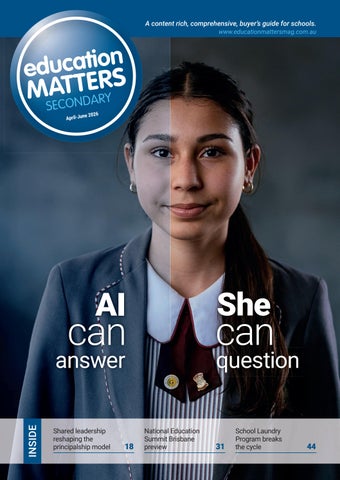
Cover Image
Mount Alvernia College


www.educationmattersmag.com.au
www.educationmattersmag.com.au/subscribe/
Copyright Education Matters is owned by Prime Creative Media Pty. Ltd. and published by John Murphy. All material in Education Matters is copyright and no part may be reproduced or copied in any form or by any means (graphic, electronic, or mechanical including information retrieval systems) without the written permission of the publisher. The Editor welcomes contributions but reserves the right to accept or reject any material. While every effort has been made to ensure the accuracy of information, Prime Creative Media will not accept responsibility for errors or omissions or for any consequenses arising from information published. The opinions of the magazine are not necessarily the opinions of, or endorsed by the publisher unless otherwise stated. All photographs of schools (including students) depicted in feature articles and advertisements throughout this magazine have been supplied to the publisher (and approved) by the contributing school. All material supplied by schools is done so with the understanding that such images will be published in Education Matters and may also appear on the our website: www.edumatters.com.au.

28 Stepping in How acting principals can establish clarity, confidence and credibility.
31 National Education Summit
Four streams, one shared learning focus in Brisbane in May.
34 Collaboration driving better teaching and assessment
Principal Ms Alina Page reflects on introducing Quality Teaching Rounds.
36 A new school, a restored dream Dhupuma Barker’s new campus on Yol u Country realises a decades-long vision for the College.
38 Fountains give water a bad name
How to create a healthier school routine with one simple change.
39 Census confirms camps are a cornerstone of education
New research shows school camps play a vital role in building student wellbeing, resilience, and confidence.
40 Learning the ropes in the real world
Work experience builds confidence, teamwork and communication skills.

41 When should you talk to a Super Specialist?
Five key life stages where specialist guidance can help optimise your super, investments and insurance.
42 Location and logistics no barrier to school branding

Regional schools are overcoming merchandise and signage challenges.
43 Smart airflow supports learning at Hymba Yumba
A Queensland school has enhanced its multi-purpose Performance Hall.
44 Laundry program breaks the cycle

Access to clean clothes is shaping attendance and engagement.
45 Closures expose urgent gaps in school air quality
Indoor air quality is emerging as a key consideration for school leaders.
46 On a rising tide
Pittwater House Principal Dr Steven Middleton brings three decades of experience to his role.
48 Expert Contributors
Andrew Murray, Melissa Gould, Edward Lin and Janet Schneider share their expertise.


“Students and teachers are telling us they are seeing these harmful
ideologies and behaviours show up in classrooms every day.”
Dr Naomi Pfitzner, Director of the Monash Gender and Family Violence Prevention Hub at

behaviour.
A new resource to help teachers respond to the growing influence of the “manosphere” in Australian classrooms has been released by researchers at Monash University in partnership with Australia’s National Research Organisation for Women’s Safety.
The guide, An introductory guide to the Manosphere and the impacts for young people, teachers and schools, is designed for secondary educators and provides practical strategies to recognise, understand and respond to harmful online ideologies shaping student behaviour.
Developed in response to increasing reports from educators, the resource addresses classroom disruptions, “baiting” questions and disrespectful behaviour linked to viral “manfluencer” content. It outlines key beliefs associated with the manosphere, links to violence, recruitment pathways for boys and young men, and the role of social media algorithms in amplifying extreme content.
CEO of Australia’s National Research Organisation for Women’s Safety, Dr Tessa oyd-Caine, said teachers were often on the frontline of coordinated attempts to undermine authority and disrupt learning.
“We know there are girls and young women who feel unsafe at school due to boys’ behaviours,” she said, noting this can reduce participation and impact attendance.
“At the same time, many boys and young men feel uncomfortable with the misogyny
they witness online but feel unable to challenge it.”
The guide includes practical advice for identifying tactics intended to derail lessons or humiliate teachers, responding to coordinated student behaviour, and understanding how online content can escalate from benign topics to harmful narratives.
Research cited in the resource highlights the scale of the issue, with one Australian study finding one in four girls feel unsafe at school due to boys’ behaviour. Women teachers have also reported harassment ranging from verbal abuse to physical intimidation.
Lead researcher Dr Naomi Pfitzner, Director of the Monash Gender and Family iolence Prevention Hub at Monash University, said the guide provides an evidence-based starting point for schools.
“Students and teachers are telling us they are seeing these harmful ideologies and behaviours show up in classrooms every day,” she said.
Co-author Dr Stephanie Wescott said the manosphere was “not a fringe phenomenon” but one shaping attitudes and behaviours in schools.
The guide forms part of the Supporting Schools project, which aims to equip educators with professional learning to address sexist and misogynistic content online, and is now available to schools nationwide. EM


“The emotional and physical violence experienced by principals stems from students, parents, sta , and community members. It is increasingly seen as normalised and as some principals describe; ‘just part of the job’.”
Denise Lofts, Principal, Ulladulla High School
More than half of Australian public school principals have experienced violence, harassment or abuse at work, according to confronting new national research that highlights the growing pressures facing school leaders.
The study, led by Monash University in collaboration with Deakin University and University of Sydney, draws on 29 critical incident testimonies from 256 principals across the country.
Released as part of the Invisible labour: Principals’ emotional labour in volatile times project, the report examines the emotional and physical toll of escalating violence, with female principals experiencing disproportionately high levels of harassment and gendered violence.
More than 64 per cent of respondents reported incidents involving physical violence, threats, sexual harassment or abuse. Principals described feeling “fearful”, “vulnerable” and “frightened” in their workplaces.

In addition, .9 per cent reported inappropriate behaviour from parents, including stalking, aggression, repeated emails and online bullying campaigns.
Lead researcher Professor ane Wilkinson said the findings reflect deeper structural issues in Australia’s education system.
“Public school principals are expected to educate our most disadvantaged students without adequate funding, frontline services, or support,” she said.
The report argues that decades of underfunding have left government schools carrying a disproportionate burden, contributing to rising aggression and violence. It notes Australia ranks in the bottom third of the OECD for equity in schools.
Principals also reported feeling unsupported by education departments during crises, with bureaucratic delays limiting timely intervention. Many rely on peer networks, mentoring and informal support to manage the emotional demands of the role.
Ulladulla High School Principal Ms Denise Lofts said principals are absorbing the emotional fallout while maintaining professionalism, often at significant personal cost.
“The emotional and physical violence experienced by principals stems from students, parents, staff and community members. It is increasingly seen as normalised – ‘just part of the job’,” she said.
Some principals reported feeling unsafe at work, with accounts of physical assault and ongoing psychological trauma.
Co-author Professor Lucas Walsh said the findings point to an urgent need for coordinated national action.
The report calls for full funding of public schools to 100 per cent of the Schooling Resource Standard, stronger legal protections against occupational violence, and a national summit to address school safety.
Researchers warn that without urgent reform, the wellbeing and sustainability of Australia’s public school principals remain at serious risk.


www.mta.qld.edu.au
enrolments@mta.qld.edu.au

“This research exposes a profession carrying immense emotional labour at great personal cost, with principals reporting chronic stress, exhaustion, trauma and even symptoms consistent with PTSD.”
A new national study has revealed Australian school principals are feeling increasingly unsupported by governments, with mounting pressures contributing to burnout, health issues and an exodus from leadership roles.
Led by Monash University in collaboration with Deakin University and University of Sydney, the research draws on 29 critical incident testimonies from 256 principals nationwide. It forms the final report in the Invisible labour: Principals’ emotional labour in volatile times project.
The findings come as government school leaders prepare to join teachers in strike action, highlighting growing concern across the profession.
More than a third of respondents 4. per cent were critical of their employer’s response during crises, with many describing feeling “hung out to dry”. Principals reported being left to manage complex situations, including trauma, violence and community grief, often without adequate departmental support.
One regional ictorian principal said she felt “abandoned and isolated”, while a New South Wales secondary principal described leaving the profession feeling “used and abused”.

Lead researcher Professor ane Wilkinson said principals are operating in increasingly volatile environments, with their emotional labour largely unrecognised.
“Australian public school principals are navigating increasingly complex demands with limited government support,” she said.
The report highlights the significant personal toll of the role, with respondents reporting insomnia, anxiety, depression and other physical manifestations of stress. It also identifies “emotional dissonance”, isolation and a lack of systemic support as key factors deterring teachers from pursuing leadership pathways.
Mr Andrew Cock, ictorian ranch President of the Australian Principals Federation, said the findings confirm longstanding concerns.
“The role has become unsustainable and, in far too many cases, unsafe,” he said,
noting principals are expected to act as educators, counsellors, crisis managers and first responders.
The report warns that without intervention, the sustainability of school leadership is at risk. It calls for principal wellbeing to be prioritised in national workforce planning, alongside reduced administrative workloads and improved access to mental health and frontline support services.
Additional recommendations include standardised counselling programs, better induction for new principals and public campaigns to rebuild respect for educators.
Researchers say urgent reform is needed to protect principals’ wellbeing and ensure the future of Australia’s public school system. EM

School 3d Wall Lettering
School Acrylic Stands
School A-Frame – Magnetic
School A-Frames
School Anti Slip Flooring Buttons
School Anti Slip Flooring Strips
School Anti Slip Flooring Tiles
School Artwork Display System
School Banners
School Bulletin Board
School Bunting Flags
School Caution Tape 500 Metres
School Ceiling Signs
School Classroom Blinds
School Classroom Curtains
School Classroom Sign
School Classroom Storage
School Cork Boards
School Custom Banners
School Desk Flag Set
School Desk Name Sign
School Display Table
School Door Signage
School Door Signs
School Drop Off & Pick Up Signs
School Enrol Now Banners
School Entrance Mat
School External Gate Sign
School Fabric Banners
School Feather Flags
School Fence Banner
School Fireproof Lock Box
School Flag Stand Silver Or Gold
School Flags With School Logo
School Foyer Mat
School Full Length Stage Banners
School Gate Sign – Metal
School Gazebo
School Gym Mat
School Hallway Mat
School Hallway Runner
School Hallway Signs
School Heavy Duty Ipad Cables
School Hi Vis Jacket
School House Flags


School Indoor Base For Flag Stands
School Indoor Base For
Marching Banners
School Indoor Flag Stand
School Learning Intentions Magnet
School Lectern Banner
School Lectern
School Logo Mat
School Magnetic Whiteboard Tiles
School Marching Banner
School Marquee
School Mat With Logo
School Mat


School Media Wall
School Metal Signs
School Music Stand Banner
School No Parking
School Non Slip Flooring Buttons
School Non Slip Flooring Strips
School Non Slip Flooring Tiles
School Notice Board
School Notice Stand
School Outdoor Safety Mat
School Parade Banner
School Parking Flags And Signs
School Picture Hanging System

School Picture Hanging System
School Portable A-Frame
School Portable Outdoor Sign
School Printed Apron With Logo
School Printed Deluxe Tablecloths
School Projector Lamps
School Pull Up Banner
School Reception Mats
School Religious Banners
School Room Signs
School Sign Printing
School Signs – Portable
School Signs With Wheels


School Single Person Marching Banners
School Snap Frame
School Sports Day Flags
School Staff Lanyards


School Staff Name Badges
School Stage Banner And Base
School Stage Banner Bases
School Stage Banner
School Stage Curtains
School Staging Module
School Stair Non Slip Tape
School Step And Repeat Media Wall
School Stringlines For Displaying Artwork
School Student Apron
School Student Art Display System
School Student Badges
School Success Criteria
School Suspended Signs
School Table Runners
School Tablecloths
School Teardrop Flags
School Toilet Signs
School Two Person Marching Banner
School Umbrella – Staff
School Vinyl Banners
School Welcome Mat
School Whiteboard
School Window Privacy Film
School Wristbands
More than 60 South Australian schools are transforming how financial literacy is taught, as teachers adopt practical, real-world approaches through the Changemakers in Financial Education program. Delivered by Deakin University’s Research for Educational Impact REDI in partnership with the South Australian Department for Education, the program has supported 9 teachers to embed topics such as cryptocurrency, buy-now pay-later services, scams and identity theft into lessons. More than ,000 students have benefited so far.
At Marryatville High School in Adelaide, financial literacy is delivered through electives and cross-curricular projects. Teacher ianca Drum said the program has boosted students’ confidence and mindset.
“Students move from confusion or anxiety to genuine confidence,” she said.
“They develop practical skills – from budgeting to building diversified ETF portfolios – and shift from ‘get rich quick’ thinking to long-term, informed decision-making.”
Teacher azmin Nardelli added the program makes financial concepts accessible and relevant. “When students learn to budget, understand debt, and plan for the future, they gain confidence and a sense of agency that lasts beyond the classroom.”
Teachers tailor financial education to their student cohorts, integrating it across subjects including mathematics, humanities and digital technologies. This embeds learning throughout the year rather than as a standalone topic.
An evaluation found 9 per cent of teachers reported improved classroom practice, and 5 per cent felt inspired to lead curriculum innovation. Professor Martin Westwell, Chief Executive of
Australia’s first national school-based e-mobility education program is expanding across the country, as rising injury rates among young riders prompt calls for earlier and more consistent safety education.
Developed by road safety charity RAKE Driver Awareness Australia, the program targets students aged 11–15, teaching them how to ride safely, recognise hazards, and understand the risks associated with speed, night riding and intoxication.
Initially delivered to three local high schools, the program has already reached more than 90,000 students across over 190 Queensland schools. It is now being rolled out nationally, with launches underway in ictoria and South Australia, and Northern Territory schools already committed.
The expansion comes as e-scooter use continues to surge, with .6 million
Australians using the devices in a single year. However, the rapid uptake has highlighted what RAKE describes as a significant safety gap among young riders.
In Queensland, more than five people per day present to emergency departments with e-scooter injuries, while 2,000 riders were seriously injured in 2025, up from 1,626 in 2024 and 1, 0 in 202 . In ictoria, nearly half of e-scooter injuries involve children aged 10 to 14.
Teenagers are also disproportionately affected, with e-bike accidents now the most common among those aged 15–1 , pointing to the risks associated with more powerful devices and limited rider experience.
Chief Operating Officer at RAKE Driver Awareness Australia, Mr ohn Duncan, said the speed of adoption has outpaced education.


the South Australian Department for Education, said the program “empowers young people to make smart financial decisions for better futures.” EM
“While the technology and availability have arrived quickly, the education hasn’t, and that gap is costing young people their safety,” he said.
Delivered across two classroom lessons, the program equips students with practical skills including hazard recognition, managing peer pressure, understanding stopping distances, and riding predictably in traffic. It also addresses visibility, legal responsibilities, and the impact of rider behaviour on others in shared spaces.
A Rural and Remote module has also been introduced, recognising that nearly two-thirds of fatal crashes occur outside major cities.
BRAKE is calling on schools and communities to support the rollout, with the aim of embedding ongoing road safety education as e-mobility becomes part of everyday life for young Australians. EM
The first progress report on the etter and Fairer Schools Agreement FSA has highlighted early improvements in student attendance, teacher numbers and Year 12 completion, as school leaders welcome the findings while calling for more detailed data on secondary education outcomes.
Released a year after all states and territories signed the national agreement, the report shows that declines in attendance and high school completion over the past decade are beginning to reverse. Attendance rates, which fell from 92. per cent in 2014 to 6.5 per cent in 2022, are now improving. Similarly, the proportion of students completing high school – down from a peak of 4. per cent in 201 to 9.1 per cent in 202 –has started to rise. Teacher workforce data also points to recovery, with


student enrolments in teaching degrees increasing by 20 per cent in recent years and preliminary figures suggesting a further 6. per cent rise in undergraduate teaching offers this year.
The federal government has framed the FSA as the largest investment in public schools by an Australian Government, committing 16.5 billion over the next decade. Funding is tied to reforms including evidence-based teaching practices, phonics and numeracy checks, and targeted small-group tutoring.
The Australian Secondary Principals’ Association ASPA has welcomed the report, describing the early indicators as a reflection of the combined efforts of school leaders, teachers and education systems. However, ASPA cautioned that headline figures do not yet provide sufficient insight into impacts on


secondary schools, which face challenges such as complex senior secondary delivery, diverse student pathways, and difficulty recruiting specialist teachers.
ASPA is calling for future FSA reporting to include detailed, disaggregated data on funding distribution, attendance, completion rates and workforce trends at the secondary level. “Without this level of transparency, it is difficult for school leaders and the community to assess whether the Agreement’s full-funding promise is reaching the students and schools that need it most,” the association said.
At its National Summit in Canberra, ASPA discussed the report with principals and welcomed a new Commonwealthfunded pilot program with Headspace to support principals’ wellbeing through reflective supervision. EM


Drawing on decades in secondary education, Mr Russell Dyer champions assessment as a tool for understanding and growth, giving teachers insight and students the opportunity to succeed.

When Mr Russell Dyer discusses assessment, he speaks with the authority of someone who has lived every layer of it, from the chalk dust of the classroom to the strategic complexity of national education systems.
As Executive Director of Assessment and Reporting at the Australian Curriculum, Assessment and Reporting Authority (ACARA), Mr Dyer oversees NAPLAN, the My School website, and the full suite of national assessment programs and reporting. But the heart of his philosophy was shaped long before he reached national leadership.
“I always tried to provide the best environment for my students to learn in,” he says, reflecting on his 26 years in secondary science classrooms.
“Assessment was never about getting marks into a spreadsheet. It was about understanding where each student was and how I could help them progress.”
Mr Dyer’s 42-year career spans teaching, curriculum design, system performance, examinations and policy. His trajectory mirrors the evolution of Australian assessment over four decades.
At the School Curriculum and Standards Authority (SCSA) in Western Australia, he helped lead the state’s transition to online NAPLAN, guided the Western Australia Certificate of Education examinations and certification cycles, and oversaw major projects in online literacy and numeracy assessments. These responsibilities sharpened his understanding of both the power and the limitations of assessment.
“I’ve never viewed assessment as separate from learning,” Mr Dyer says. “It only becomes powerful when teachers can use it to understand how best to support their students.”
This philosophy prepared him well for ACARA’s national role.
“It was a natural progression. Each step of my career built on the one before it,” he says.
Mr Dyer’s decades in secondary teaching remain central to how he understands assessment today. He remembers how varied secondary classrooms are with students at different starting points, with different skill sets and different motivations.
“Secondary teachers make hundreds of decisions a week. Good assessment information helps them make those decisions with confidence,” Mr Dyer says.
Shaping national assessment with precision and purpose
For Mr Dyer, NAPLAN remains an invaluable tool in understanding how students across the country are developing the literacy and numeracy skills that underpin all learning. He describes it as a national check point that sits alongside classroom-based assessments and teacher judgment, providing a standardised view of progress measured on an objective national scale.
“Around the country, more than 1. million students sat NAPLAN in 2025, with more than 4.5 million online tests completed. ut it is important to remember that NAPLAN is just one tool in a much broader picture. Teachers know their students best, and NAPLAN adds another layer that can help show how learning is tracking against national expectations,” Mr Dyer says.
The transition to NAPLAN online, completed in 2022, allowed ACARA to introduce adaptive tailored testing. Mr Dyer says this change has transformed the precision of the results.
“The move online created the opportunity to bring in tailored testing. Students now receive items that match their skill level while they complete the test. It means we are picking up more detailed information, especially for students who may be at the very top or the very bottom of the scale. It provides a much clearer picture of where they are on their learning journey,” he says.
“The tailored test design has transformed NAPLAN. Students stay


not about collecting data. It’s about using it well.

engaged because the questions adjust to them, and teachers receive far more finegrained detail than ever before.”
ACARA is currently preparing for major future-focused work, including the eventual replacement of the online National Assessment Program platform, the backbone of the online NAPLAN assessments.
“This next phase gives us opportunities to enhance accessibility, usability and reliability,” Mr Dyer says.
ACARA is also collaborating with governments to refine the Measurement Framework for Schooling in Australia that lists the agreed national key performance
measures for schooling, outlines the annual assessment and reporting cycles and underpins the National Report on Schooling in Australia and looking at potential improvements to the My School website to make the information clearer and more accessible.
“The most effective secondary schools use data with purpose,” he says. “They integrate qualitative, quantitative and standardised information, understand where their students have come from and know where they need to go next.”
These schools also evaluate the impact of their programs and encourage teachers to reflect on their practice “It’s
“At ACARA, we are focused on delivering curriculum, assessment and reporting that genuinely support the goals of Australian schooling. We want every young person to become a successful learner, a confident and creative individual and an active and informed citizen. That vision guides everything we do,” he says.
Mr Dyer hopes the clarity and consistency provided by ACARA’s work continue to strengthen the education system and ensure that every student, whether in a small town or a major city, has the opportunity to succeed.
“We want teachers to feel supported by the information we provide. We want parents to feel informed. Most of all, we want students to grow. That is what has always mattered to me, from my first day teaching science in Kambalda in Western Australia right through to the national level today.”

Andy Mison, President of the Australian Secondary Principals' Association, says real education reform depends on strengthening agency for students, teachers and leaders across every level of the system.
The 2026 ASPA National Summit, held at the National Gallery of Australia in Canberra on 24 and 25 March, brought together school leaders, researchers, system leaders, policymakers, community partners and young people under a single, deliberate theme: Agency for Equity and Excellence: Shaping Policy through Partnership Delegates worked through three interconnected themes: Flourishing Students, Strengthening Leaders and Transforming Systems, reflecting ASPA's conviction that lasting improvement in Australian education must be pursued simultaneously at every level. Students cannot flourish if the leaders around them are unsupported. Leaders cannot lead with coherence if the systems around them are fragmented. And none of it holds together if those systems are not oriented toward the same goals.
Agency emerged as the galvanising idea of the Summit. Not consultation after the decision has already been made, but the capacity to be present and constructively influential when the decisions that shape our schools and our students are actually being designed.
There is a quality of listening that we are not yet doing consistently well. Young people were clear. They want transparency about where their choices lead, learning that feels genuinely relevant to their lives, and a voice in the small decisions, not just the ones adults think are significant. Flourishing is broader than attainment, and students with genuine agency are more likely to be engaged, more likely to attend and more likely to

build the dispositions that endure beyond school.
A persistent gap exists between aspiration and capacity. Leaders want to respond to what students name as important, but funding, staffing and compliance demands limit what is possible. This is a systems design problem requiring action at the system level. Students and school leaders alike pointed to the same priorities for stronger relationships, more flexible learning structures, meaningful pathways, and schools that treat young people as active partners rather than passive recipients.
Agency for students depends, in the first instance, on agency for teachers. A teacher working under sustained overload, without adequate support or meaningful input into decisions shaping their practice, is not
well placed to create those conditions for the young people in front of them. The evidence is now unambiguous. TALIS 2024, the AITSL Australian Teacher Workforce Data and the ACU Principal Health and Wellbeing Survey have reached the same conclusion through different methodologies. Three independent sources. The same picture. Australia is not adequately caring for the workforce that makes everything else possible.
Teachers need to be trusted as professionals. Policy designed without genuine practitioner input and handed down for implementation is corrosive to the profession. Policy designed with teachers and school leaders, rather than for them, produces better outcomes. This is not a claim about sentiment. It is a design principle.
Principals are simultaneously
the recipients of system policy and the people responsible for translating it into the life of a school community, carrying the expectations of students, families, staff, systems and governments, often without the authority and resources to meet all of them. Leader agency should not be contingent on individual bravery. Systems must value the expertise of leaders to act in the interest of students in the local context, and activate networks that support, sustain and protect colleagues to do what is good, not merely what is easy.
This means genuine involvement in policy design from the beginning, not advisory groups that receive decisions for endorsement. The growing burden of compliance, risk management and administrative load reduces the time available for teaching and learning. Deteriorating working conditions cannot become the accepted norm. Naming them is necessary. Acting on them is urgent.


"Equity reform takes 10 to 20 years, not a three-year election cycle."
Mr Andy Mison, ASPA President
The proposed National Teaching and Learning Commission, the Better and Fairer Schools Agreement and the review of the Australian Professional Standard for Principals are all live sites of decision-making right now. The profession has a clear stake in each. The National Principals' Reference Group has a seat at the working group developing the Commission's design. That is real. It matters. And it needs to be the beginning of something more sustained, not an exception. Equity reform takes 10 to 20 years, not a three-year election cycle. Bipartisan commitment, and structures that make practitioner voice a condition of
policy quality rather than an optional feature, are what the system needs. Agency for students means the right to be active partners in their own learning, not passive recipients of a system designed around them. Agency for teachers means the professional trust and working conditions that allow them to do the work they trained to do. Agency for school leaders means the structural presence and practical authority to shape the decisions that determine what is possible in their schools. These are not separate agendas. They are the same agenda at different levels of the system. Progress at any one level depends on progress at all three. ASPA will carry this conviction into its advocacy work, and into its representation at every national forum where these questions are being decided. The profession has something essential to contribute. EM


Schools in Australia and New Zealand are trialling co-principal leadership structures, combining complementary skills and shared responsibility to address the increasing complexity and demands of school leadership.
School leadership has traditionally been defined by a single figure at the top of the organisation. Increasingly, however, some schools are experimenting with an alternative.
Across Australia and New Zealand, a small but growing number of schools are adopting a co-principal model in which leadership responsibilities are shared between two people. While still relatively uncommon, the approach is emerging in different contexts – from Catholic primary schools to specialist and gifted education settings – as systems look for ways to respond to the expanding scope and demands of school leadership.
Among the schools adopting the approach is Dara School in Adelaide. Australia’s first school dedicated exclusively to gifted education appointed Ms Tania Allen and Dr Emma Goodall as co-principals in 2025, with the pair taking up the joint role in Term 4.
The school board says the decision reflects both research and the practical realities of leading a contemporary school.
“Dara has never been afraid to do things differently,” a board spokesperson said. “While conducting an extremely rigorous principal search, we found a lot of evidence and research
that supports the co-principal model. We hope this collaborative leadership approach provides both sustainability and vision as Dara continues to grow as a leading education provider for gifted students.”
The move places Dara alongside other schools exploring shared leadership at the top level, including Star of the Sea School and Suneden Specialist School in Adelaide, Logan Park High School in New Zealand, and Gunbalanya School in West Arnhem Land.
Observers such as Adelaidebased education researcher Dr Deborah Netolicky say these models are emerging as part of a wider reconsideration of what sustainable leadership in schools might look like.
Dara School: Complementary skills in gifted education
For Dr Emma Goodall, the scale and complexity of the principalship drives Dara’s shared leadership structure.
“The principal job is massive,” she says. “Dara is a K-12 school, so not only are you needing to be a principal of a primary, but also secondary. And obviously that adds another layer of complexity.”


Dara School currently enrols just under 100 students and has grown steadily since opening a decade ago. The school focuses exclusively on gifted education, drawing families from across Adelaide and interstate.
“It’s the only gifted school in Australia,” Dr Goodall says. “There

are other schools that obviously service gifted children, but we’re the only school specifically for gifted children.”
She describes giftedness as extending beyond academic performance.
“It’s not just that they have a high IQ,” she says. “They learn more quickly, they often have more advanced language than peers, and they’re very curious. It doesn’t mean they’re advanced in everything – they may still struggle socially or emotionally – but they do learn very quickly.”
In this environment, the coprincipal model brings together complementary expertise.
“It’s a practical and pragmatic way of getting two people who have complementary skills and who both are interested in job sharing so that we can share what we both bring best,” Dr Goodall says.
The model also reflects broader challenges in recruiting and retaining principals.
“It is really, really hard now to find somebody that wants to be a principal,” she says. “We know in the state sector that often places only have one or two applicants. That’s becoming rarer to have lots of applicants for principal positions.”
Dr Goodall joined Dara in Term 4 last year, bringing a career spanning the United Kingdom, mainland Europe, New Zealand and Australia. Her professional background includes teaching, research, and work within education
systems supporting students with additional needs.
At Dara, the co-principal arrangement divides the week while maintaining a dedicated crossover day.
“Tania and I basically split the week up,” Dr Goodall says. “She works Monday to Wednesday and I work Wednesday to Friday, so we have that Wednesday as a whole-day handover.”
The shared day allows the pair to align decisions and maintain continuity.
“Without that crossover day things would fall through the cracks,” she says.
While both leaders carry the full responsibilities of the principalship, some areas align with individual expertise.
“We do everything generically that a principal does, but we have divided up some particular things,” Dr Goodall says. She takes particular responsibility for senior schooling and practical life skills within the school’s approach to learning. Teaching also remains part of her role.
“I do some teaching as principal,” Dr Goodall says. “From a really practical perspective, if you’re teaching a class you can really see how their teachers are working with them, how they’re interacting with their teachers and their schoolwork.”
Early feedback from the school community is positive.
“The board and the parents have been really supportive and really welcoming,” she says. “Seeing Tania and I together, it is obvious that we can work together and that we like each other.”
For schools considering a similar structure, she emphasises the selection process.
“One of the things the board did when they were considering whether to pursue this model was to give Tania and I opportunities to meet and decide, would this work for us,” she says.
“It needs to be part of the process –the two candidates look at how they can work together.”
The approach changes how schools think about leadership capability.
“It enables schools to look at the whole skill set they want,” Dr Goodall says. “Rather than just saying to one person, ‘You’ve got 90 per cent of our desired skills’, you can look at where are the two people that together bring 110 per cent of the skills.”
"It's been amazing to see, already, how stabilising the co-principal role is, and the flexibility it provides Dara – particularly around work/life balance and leave. This is future-proofing the school," the board said.
Star of the Sea School:
‘A sounding board’
Star of the Sea School in Adelaide provides another example of the model in practice. The Catholic primary school enrols around 600 students and operates distinctive programs, including an on-site marine discovery centre and out-ofschool-hours care.
Co-principal Ms Annette Diassinas
says the structure emerged organically while she and colleague Ms Kelly Manera were in acting leadership roles.
“When our previous principal decided to retire, I stepped up to acting principal and Kelly stepped up to acting deputy principal,” Ms Diassinas explains.
During that period, the pair began to recognise how effectively they worked together.
After discussions with Catholic Education South Australia, the pair jointly applied for the principal role.
Their joint appointment followed a thorough selection process, with the candidates interviewed individually and together.
“There were many questions during the interview process around how we’d manage the challenges, and who’s ultimately responsible for decisions, because obviously there’s one signature on lots of things, we now have a joint signature to ensure full accountability for us both,” Ms Diassinas says.
The two leaders now share the principalship, each working four days a week with three overlapping days. The arrangement increases leadership presence across the school.
They say one of the greatest benefits is the opportunity to test and refine decisions collaboratively. Support is particularly valuable during complex or sensitive situations.
“One of the great strengths of our corole is the ability to collaborate and work through things together.”
Responsibilities are shared broadly, with some areas aligned to individual strengths.
“Kelly is an exceptional leader supporting families in the inclusive education space, so she heads up a lot of that work,” Ms Diassinas says.
“The financial decisions of the school are always a joint decision because at the end of the day we’re both responsible,” she says.
Communication between the two leaders is constant.
“We talk a lot, regularly debriefing about what’s been happening. There’s a huge amount of trust and respect for each other,” Ms Diassinas says. “There’s
“For our school community, this leadership model allows us to maintain a strong and consistent presence across the many events that take place throughout the life of our school.”
Annette Diassinas, Star of the Sea School
never been a decision Kelly makes that doesn’t sit at the core of what I would have done.”
For the school community, the model means leadership is present across a wider range of events and responsibilities.
“For our school community, this leadership model allows us to maintain a strong and consistent presence across the many events that take place throughout the life of our school. As a large school, it is common for multiple events to occur at the same time. While we enjoy attending events together, this model also allows us to divide responsibilities when needed, ensuring that a principal is present wherever possible.
“We see this as a real benefit for our community, as it enables us to remain visible, connected and actively involved in school life, something we value deeply in our roles,” Ms Manera says.
Dr Deborah Netolicky:
A shift in leadership thinking Education researcher and school principal Dr Deborah Netolicky sees co-principalship as part of a broader reconsideration of school leadership. She is principal of Walford Anglican School for Girls in Adelaide and an adjunct senior fellow at Adelaide University. Her research explores professional learning, leadership identity and sustainable leadership.
“I think it’s part of a broader cultural shift that we’re seeing outside of education and inside education,” she says.
The traditional principalship often frames a single leader carrying ultimate responsibility.
“Most principals would say it’s not
a job you can ever do alone,” she says. “You’re not the individual heroic leader as a principal. You absolutely have a team around you.”
Yet expectations on that role remain extensive. “The buck does stop with the principal,” she says.
The co-principal model makes shared leadership explicit.
“What the co-principal leadership model allows is that explicitness of collective capacity – sharing the load and working with a colleague,” Dr Netolicky says.
The approach also responds to growing concerns about principal wellbeing.
“If you look at the Australian Principal Occupational Health, Safety and Wellbeing Survey, it reports high levels of stress, burnout, sleep problems, anxiety and depression among school leaders,” she says.
Shared leadership offers a practical way to sustain the role.
“It’s literally sharing the load so those heads can remain nourished and renewed and able to serve their communities without burning out,” she says.
The model broadens the expertise available to a school.
“You’ve got the strengths of two people rather than the strengths of one,” Dr Netolicky says. “You’ve got a wider diversity of expertise potentially coming into those roles, and therefore the organisation is benefiting.”
However, implementation requires careful design. “You need clear role articulation and clear communication about how it works,” she says.
Staff, parents and students must understand decision-making and responsibilities.
“What you don’t want is someone thinking, ‘I’ll ask the other principal when they’re in on Thursday because I might get a different answer,’” she says.
Above all, the relationship between the two leaders must be strong.
“I think that relationship must be of the utmost importance,” Dr Netolicky says. “You couldn’t share a role like this unless you really had explicit trust and respect for each other.” EM


DISCOVER THE FUN HERE
At The Great Aussie Bush Camp, we redefine what a school camp can be! As Australia’s adventure camp specialists, we take you beyond the ordinary, empower you to go further, and inspire you to live large. Across seven locations nationwide, we deliver fully customised outdoor education programs that build confidence, strengthen connections, and create unforgettable memories. Come and experience one of the country’s widest ranges of adventure activities and discover school camps on a whole new level.
As artificial intelligence reshapes education, Mount Alvernia College is placing ethics, relationships and critical thinking at the centre of learning through its Human Edge initiative.
Artificial intelligence AI has rapidly transformed how students learn, access information and engage with the world around them. For schools, the challenge is no longer simply how to manage new technologies, but how to ensure students develop the skills and judgement to use them responsibly.
At Mount Alvernia College in risbane’s north, Principal Samantha ensen says that challenge has
cannot easily replicate.
The program – known as The Human Edge – encourages students to think critically about AI while exploring the ethical questions that accompany its growing influence.
“It’s a very big ticket item in education at the moment, the use of AI in schools and in education. Like many good schools, we’re well prepared in terms of policy and assessment design. ut what we have added this
“It’s about how we are going to prepare not only our staff but our students for a world in which technology is transformative. It’s enabling us to do great things. It’s automating and streamlining and making things more efficient.
“ ut what we need to pay attention to is how we maintain our human centredness and how we can really think ethically about the tools that we’re using and how we’re using them.”

four-week program focused on personal development for all students. Rather than focusing purely on the technical capabilities of AI, the curriculum explores the broader implications of using these tools in everyday life.
“We’re looking at the cognitive cost of outsourcing thinking to machines and what that means to our own brains and neuroscience," Ms ensen says.
“Then we’re looking at the ethical implications of deepfakes and the questions of meaning, morality and authorship in the digital age. It’s a deeper education around the ethics of AI.
“It’s about how as a society we can lose touch with each other through the medium of technology that erases our nuances as human beings and our relationships with others.”
Alongside student learning, the college is also considering how AI is reshaping classroom practice and teacher decision-making.
Ms ensen says professional learning has focused on ensuring staff understand both the opportunities and the limitations of emerging tools.
“There’s a real balance to be struck. AI can be incredibly helpful in reducing administrative load and supporting planning, but we also need to be conscious of where professional judgement sits.
“We don’t want to outsource the craft of teaching. We want to enhance it, and that means being very deliberate about how and when these tools are used.”
Developing students’ capacity to question information and reflect on how technology shapes their thinking is a central goal of the initiative.
“What does it mean to have all the answers but not know the right questions to ask That’s where we really want to help our girls develop those critical thinking skills.”
Students themselves have contributed to shaping the program, Ms ensen says, with consultation forming part of its development.
“They’ve been really involved. We had working groups and consultation with students, and now as we’re leading


this kind of curriculum we’re uncovering more and more that they have a lot to say about it.”
The college is also engaging parents as part of the initiative, recognising that conversations about AI extend well beyond the classroom.
The College’s Human Edge approach extends beyond the classroom to its parent community. Through the College’s online Education and Digital Growth Environment EDGE , parents are invited to engage in the same learning experiences as their daughters, including courses such as Understanding AI.
Key Pillars of The Human Edge:
• Human-Centered Learning: Focuses on strengthening self-belief, mind, and heart, rather than just technical skill.
• Curiosity & Empathy: Encourages lifelong learning, critical thought, and understanding others, which are irreplaceable by AI.
• Adaptability & Connection: Connects students to the community and prepares them to navigate a transforming work landscape with ethical, "connected” skills.
“This shared learning model creates opportunities for meaningful conversations at home and a deeper, shared understanding of emerging technologies,” Ms ensen says.
“Complementing this, our community-wide Human-centred AI

Framework provides transparency and visibility into how AI is used at Mount Alvernia College – ensuring technology is applied thoughtfully, ethically and always in service of better learning outcomes.”
A campus designed for the future While the college is exploring the philosophical questions raised by emerging technologies, it is also remodelling its physical learning environments.
At the centre of the campus, construction is underway on a new learning precinct known as The Canticle – a development designed to bring together a range of academic and creative spaces within a single hub.
“It will house our new library, but it also incorporates a Senior Learning Centre, a lecture theatre, which we’ve never had at the college before, and numerous breakout zones, and a postproduction space for podcasting and film development,” Ms ensen says.
“It’s a very contemporary space. It’s in the centre of the school, which poses logistical challenges in terms of the building process, but it is going to be the heartbeat of the college.”
Positioning the building as a shared resource was a deliberate decision, she explains, rather than creating a facility tied to a single discipline.
“We reviewed the master plan in the year that I started at the college in 2021, and by 2022 it was identified that this particular stage of the master plan
needed to be a building that could be universally accessed and enjoyed by all students.”
The development will significantly expand the existing library footprint and introduce several new learning environments.
“Our architects have worked with the risbane Planetarium to design an astronomical dome in the ceiling of our new lecture theatre, which will have beautiful lighting of the sky country as well.
“It is not just a place to go and learn. The building itself is a learning experience.”
Construction is well underway and subject to weather conditions is expected to open in March 202 .
Environmental sustainability and cultural understanding have also influenced the design of the new precinct.
Mount Alvernia’s Franciscan heritage emphasises respect for nature and the relationship between built environments and natural spaces.
“Our architects, who previously worked with us on our La Foresta gardens, which featured on Gardening Australia, have been able to maintain a beautiful aesthetic stemming from our Italian heritage, and have honoured the relationship between indoor and outdoor spaces,” Ms ensen says.
Sustainability has shaped not only the design but also the construction approach, with the architects retaining the foundations and concrete pillars of the existing library to rebuild over it.
The surrounding landscape will continue the connection between learning spaces and the natural environment.
“There’ll even be a continuation of the garden with grass that you can use to weave. Women’s business in Indigenous culture is very much around weaving, so every aspect has been thought of.”
Consultation with First Nations voices including urrundi Designs and First Nations students has been an important part of the design process, she adds.
“We’ve had a full First Nations consultation, so the design of the building has been done in the spirit of

designing with Country.
“We’ve looked at the Indigenous biodiversity of the area and really listened to where the wind is going to move.
“It’s been a really beautiful process, and we’ve done that also with our Mt A Mob, which are our First Nations students, so that design process has been quite collaborative.”
The name of the building reflects these intersecting cultural influences.
“We’ve called it The Canticle. In Christian tradition a canticle means a hymn or a story. And if you think about Indigenous songlines and knowledge and where knowledge is kept, it’s a beautiful crossover of two traditions.”
Alongside developments in technology and infrastructure, Mount Alvernia’s college leadership team is also considering how education itself may evolve in the coming years.
The college has a leadership structure designed to support a growing student population, with four deputy principals responsible for key areas including teaching and learning, staff development, student wellbeing, and faith and mission.
“We’re creeping up to 1,000 students now, so it makes sense to have robust leadership portfolio areas in place. We work closely as a team because each of them has a significant portfolio,” Ms ensen says.
Supporting staff remains a priority as schools navigate increasing expectations and the pace of change across the sector.
“Staff resilience and wellbeing is a priority for the College. We've engaged People ench in an ongoing capacity to track and monitor staff resilience as part of our commitment to staff wellbeing."
Later this year, Ms ensen will undertake a sabbatical at the University of Oxford, an experience she says will provide an opportunity to further explore the global trends already reshaping schools.
She says the questions driving that work are already front of mind.
“I think probably the next phase for the sector will be around more flexible modalities of school life. That might


be timetables that look different for senior students.
“It’s no secret that Australia, like the rest of the world, has a workforce shortage, particularly in some of those technical and STEM design and technology areas.”
Those pressures could lead to new partnerships between schools, industry and tertiary institutions, she says, giving students earlier exposure to emerging career pathways.
“We’re already seeing a lot more interest in how students can connect their learning to the real world – whether that’s through industry engagement, different learning pathways or more flexible senior schooling options.”
At the same time, Ms ensen believes schools will need to move beyond traditional models that have remained largely unchanged for decades.
“The factory settings of education – where cohorts move year by year through a school – are going to have to shift. Schools will need to think far more creatively and far more flexibly than we have before.
“That doesn’t mean losing the structure and community that schools provide, but it does mean thinking carefully about how learning experiences are designed.”
As knowledge becomes more accessible through technology, the role of teachers may also continue to evolve.
“I think the relational element of student and teacher partnership is going to need to increase as knowledge bases continue to expand.
“It’s really about teachers becoming more of a guide through the information that is available to them. That’s already happening, but I think we’re going to have to be far more agile and flexible and creative.”
For Ms ensen, ensuring students remain grounded in human values will be central to preparing them for an increasingly complex future.
“We’re entering a world where technology is doing more and more for us. Our job in schools is making sure our students remain deeply human – that they can think critically, act ethically and stay connected to one another.” EM
Award-winning science teacher Mr Matt Dodds is transforming learning through hands-on experiments, real-world research and a commitment to showcasing diverse scientific role models for regional students.
As the wheels on a car made from a mousetrap rattled down the hallway, a class of Year 8 students whooped and chased after it. The distance it travelled was impressive – impressive enough that teacher Mr Matt Dodds knew he’d set a challenge.
“Right,” he told the class, “whoever can beat mine gets a canteen voucher.” Instantly, the room buzzed with redesigns, tweaks, measurements and discussion about torque and friction.
For Mr Dodds, who recently won the Prime Minister’s Prize for Excellence in Science Teaching (Secondary), this is science at its best: hands-on, energetic and grounded in real-world problem-solving.
“Every topic I teach, I try and get the students to do either an experiment or an activity. I want them engaged," he says.
Mr Dodds’ journey into teaching began in the Blue Mountains, where he grew up before heading to UNSW to study biotechnology. Near the end of his degree, he realised he wasn’t ready to leave university behind – and wasn’t sure the lab life was for him. So he added a Bachelor of Education. “I really enjoyed it,” he says. “Both the science education and the actual practice.”
An excursion with the NSW Department of Education, aimed at encouraging teachers to consider rural posts, took him to Tamworth. He spent three days observing classes at Farrer Memorial Agricultural High School. Although teaching wasn’t required,
Mr Dodds couldn’t resist jumping in, and a team-teaching session led to a strong recommendation and a job. He stayed at Farrer for nearly ten years before moving to Glen Innes High School, where he now teaches Years 7–10 Science and Year 11–12 Physics and iology.
How to make science stick
Mr Dodds is clear about his philosophy: science should feel meaningful, tangible and achievable for every young person – especially those in regional or low socio-economic communities. Some activities are high-tech, like the senior biology practical in which students genetically modify bacteria to make them glow. Others are deceptively simple, like the mousetrap car challenge, but still rooted in core scientific principles and healthy competition.
He also brings in experts to reinforce that science is a living, breathing field. Students have met world-renowned cane toad researcher Professor Rick Shine via Zoom about his current research. But diversity matters just as much as expertise. Mr Dodds alternates male and female scientists deliberately, so students don’t develop a narrow view of who belongs in STEM.
This commitment is visible on the classroom walls. Alongside posters of Einstein and Galileo is a curated set of female physicists, each with a short biography. One of them, astrophysicist


Jocelyn Bell Burnell, is someone Mr Dodds has met in person. “You can’t be what you can’t see,” he says. “It’s important students see scientists who look like them.”
Moving from an all-boys school to a co-ed school sharpened Mr Dodds’ awareness of gender gaps in senior science.
“Previously, Glen Innes High School had a 10-year average of 1.1 girls doing HSC physics,” he says. When he arrived, there was only one female student in the class.
Mr Dodds decided to intervene early, speaking to Year 10 students when they were choosing subjects. He was blunt about the pre-requisites but also made a compelling case for the subject’s value. Crucially, he pointed to real examples, encouraging younger students to speak to highachieving girls in Year 12. The results were immediate: female enrolments doubled, and momentum continued.
Beyond showcasing current students, Mr Dodds draws on the accomplishments of former ones. One past student he taught in 2014 now builds orbital rockets on the Gold Coast with Gilmour Space Technologies and has spoken to classes. More recently, he invited a female mechanical engineer from the same company so students could see gender-balanced examples of STEM careers..
From the classroom to the cosmos One of the standout achievements recognised in Mr Dodds’ PM’s Prize citation is the astronomy and astrophysics depth study program he created at Siding Spring Observatory near Coonabarabran.
The idea started as a simple excursion for his own students, but Mr Dodds quickly realised the effort involved could benefit others.
“It takes a lot of work to organise an excursion,” he says, “but it doesn’t take that much more to share it with other schools.”
What began as a single-school trip is now a sought-after regional event. Students from multiple schools come together to learn from astronomers –some travelling in person from Canberra, others joining via Zoom. Universities often supply presenters, ensuring the content aligns with and extends beyond the syllabus. ANU even sponsored the
excursion, meaning students can attend at no cost. Students tour the facility, including the iconic 3.9-metre telescope, and spend the night observing the sky through smaller telescopes. They also study Indigenous astronomy, broadening both scientific and cultural understanding.
Crucially, they work with real telescope data, using their laptops to calculate, for example, how fast the universe is expanding.
“It’s real for them,” Mr Dodds says. “They’re actually engaging in the creation of the science.”
This matters even more in regional schools, where senior physics classes can be as small as two or three students. The excursion helps students form connections with peers who share their interests – something that can significantly influence their confidence and post-school aspirations.
Mr Dodds applies the same principles back in the classroom. In November, for
instance, his senior physics students calculated the mass of stars using NASA data. In biology, students recently built amino acids using molecular modelling kits and will link them into accurate protein structures next lesson.
“A lot of thought has gone into the activities we do and the learning behind them,” he says.
He also shares many of his resources with teachers across Australia through Facebook groups. His aim for 2026 is to build a website where teachers can access everything more reliably.
Many of his former students, including high-achieving physics graduate Charlotte, have gone on to fields far beyond traditional science, from engineering to policymaking. For Mr Dodds, physics is not just a subject at school. It’s a way of thinking.
“It’s great to come from Glen Innes, but it’s great to pursue your dreams after school as well,” he says. EM


Leadership transitions can unsettle school communities. Andrew Cock, from the Australian Principals Federation, outlines how new and acting principals can establish clarity, confidence and credibility from day one.
Mr Andrew Cock, previously Principal of Blackburn Primary School in Victoria, is an active leader in school leadership advocacy. He is currently the President of the Australian Principals Federation’s Victorian branch, representing principal class interests and wellbeing in industrial forums. In his school and professional roles, he champions support, advocacy and improved conditions for educational leaders.
There are few moments in school leadership as defining, or as confronting, as stepping into a Principal role, particularly when it occurs suddenly. Whether due to an unexpected departure, extended leave or successful appointment to a position, schools can find themselves navigating a leadership transition and, in these moments, is an opportunity a necessity to maintain stability, and an opportunity to demonstrate leadership under pressure.
Let’s be clear, walking into a school as a new or Acting Principal is not a gentle onboarding exercise – it’s hitting the ground running, sometimes feeling like when you are also at your most unfit There is no pause button. The school community – staff, students, parents, and the system continues to expect clarity, confidence, and competence from day one. All while trying to navigate the change of work location and the nuances, changes and inheriting decisions made by another leader.
The reality of leadership change
Any change in leadership can create uncertainty across a school community. Staff, students and parents may feel unsettled, routines may be disrupted, and confidence can waver. In this context, the arrival of a new or Acting Principal is not just about filling the chair, it is about maintaining confidence and momentum.
Especially those stepping into a school mid-term/year. The Principal inherits the operational responsibilities
of the role, but also the culture and morale of the organisation. Relationships, tensions, expectations and histories are already in play. They do not have the luxury of building everything from scratch instead, must quickly read the landscape and respond accordingly.
This is where leadership judgement becomes vital. The temptation can be to “make your mark” immediately. However, experienced leaders know that credibility is not built through rapid change, but through thoughtful, strategic and informed action.
he first da s
Michael Watkins’ book The First 90 Days was gifted to me when I moved into my first Principalship, and it remains a resource I return to regularly. It serves as a useful framework for navigating this transition, in what can feel like an overwhelming period. At its core, the message is simple – and, at times, counterintuitive resist the urge to act before you understand.
The first phase about gaining an understanding. What is the current state of the school Where are the pressure points Who are the key influencers What is working well and should be protected In practical terms, this means
• Listening more than speaking
• Observing before intervening
• Asking questions that uncover, not questions to confirm assumptions Watkins emphasises the importance of securing early wins, but these must be strategic, not
cosmetic. Fixing those small issues that have frustrated staff for months will build far more credibility than introducing a new initiative that nobody asked for. Put bluntly early success comes from solving existing problems, not inventing new ones.
It’s all there waiting
One of the most underestimated aspects of stepping into an Acting Principal role is the sheer volume of operational duties that sits behind the scenes. Schools are complex organisations, and leadership transitions can expose just how much sits within the Principal’s remit.
The breadth of responsibility
• Finance: budgets, bank accounts, school databases reports, grants
• Sta fing workforce plans, staff roles, contracts, class structures
• Programs: curriculum areas, assessment, reporting, disability support, transitions
• Operations: timetables, yard duty, extracurricular programs
• Administration: security, systems, maintenance, contractors
• Governance school council, parent groups, key contacts
• Infrastructure: ICT systems, facilities, essential services
In short, the role is not just instructional leadership - it is full-spectrum organisational leadership.
The key is not to master everything immediately, but to prioritise. This is where experienced leaders lean into their teams. No Principal leads alone, and those who try tend to learn that lesson the hard way.
If the operational side of the role is complex, the human side is even more so.
Staff will be watching closely. Not in a hostile way, but in a “Can I trust this person ” way. They want to know
• Will this leader listen
• Will they support us
• Will they make informed decisions
In times of change, communication becomes your most powerful tool. Silence creates speculation clarity builds confidence.


It would be remiss to frame Principal roles purely in terms of challenge. They are some of the most rewarding and powerful professional growth opportunities.
Stepping into the role accelerates learning in a way that no professional development course can replicate. You are not observing leadership you are it.
Many substantive Principals will tell you that their most significant growth occurred during Acting appointments. It is where theory meets reality and reality tends to win.
Taking on a new or Acting Principal role, requires composure, judgement, and a willingness to operate in ambiguity.
Practical advice: what actually works
However, it is also where leadership is most clearly defined. The role carries authority, and decisions must be made. On the other hand, you are stepping into an existing context, often temporarily, and must bring people with you.
Unfortunately in school leadership, as in most things, the real learning doesn’t come when everything is going to plan. It comes when you are handed the keys mid-journey and expected to keep driving.
In the end, schools do not need perfection from their leaders. They need presence. They need clarity. They need someone who can step in, steady the ship, and keep it moving forward. If you can do that quietly, effectively, and with integrity – you will not only survive the experience – you will be better for it. EM
Stripping away the theory, a few practical principles consistently hold true:
1. Get the basics right
If the school is safe, staffed, and operating smoothly, you are already doing well.
2. Find your key people early
Business Manager, Assistant Principal, leading teachers – these are your network. The importance of having the right people around you is paramount.
3. Communicate early and often
You cannot over-communicate in a leadership transition – it inspires confidence.
4. Don’t try to fix everything
Focus on what matters most. The rest can wait.
5. Be decisive, but not dismissive
Make timely, well-considered decisions that provide clarity and direction.
6. Be confident, but not arrogant
Project assurance in your leadership and judgement, while remaining open to feedback and acknowledging expertise, knowledge and experience in others.
7. Be visible, but not overbearing
Maintain a strong and consistent presence across the school to build trust and connection.
8. Take care of yourself
The role is demanding. Fatigue leads to poor decisions. This is not a sprint, it’s a sustained effort – find those moments away from school that reenergise you.


From AI in classrooms to trauma-informed strategies, Brisbane’s National Education Summit o ers four conference streams packed with practical tools, fresh ideas, and professional learning opportunities for educators.
The National Education Summit returns to Brisbane in May 2026, bringing together educators, school leaders and specialists from across Australia for a multi-stream professional learning event.
Hosted by the International Expo Group and supported by Education Matters as official media partner, the summit is designed to offer practical, classroom-focused professional development across four key areas: artificial intelligence AI in the classroom, teacher wellbeing, diverse learners, and school libraries.
The Brisbane event will take place over two days, with concurrent conference streams, keynote presentations and panel discussions. Each stream is structured to provide targeted insights for educators working in a range of roles and contexts, from classroom teachers to school leaders and specialist staff.
Speakers across the program bring experience from schools, research and
consultancy, with sessions aimed at addressing current challenges while sharing strategies and frameworks that can be applied in practice.
As one presenter notes, the event offers “a really collegial atmosphere”, where participants are encouraged not only to learn, but to contribute and reflect on their own practice.
The AI in the Classroom stream explores how artificial intelligence is already shaping teaching and learning, and what schools need to consider as its use becomes more widespread.
Presenter Mr Matthew Esterman, a former teacher and now AI education consultant, will draw on his experience working with schools to support their AI journeys. His session will focus on the impact of AI on students, teachers and school systems, rather than the technical detail of the tools themselves.
“We’ll cover the basics of what AI is today,” he says, noting that the
technology is evolving rapidly. “It is different to what it was six months ago, 12 months ago, two years ago.”
A key focus of his session is responsible use, pointing to the importance of maintaining professional judgement when engaging with AI tools, particularly when handling sensitive information.
“You wouldn’t share private information about students with your family or friends… it’s the same thing with AI.”
Mr Esterman will also highlight the need for consistency and transparency within schools, particularly when it comes to expectations for staff and students.
“Students can get frustrated when they’re told, don’t use AI on a document, but might even still have the prompt the teacher used to create the document.”
Beyond risks, the stream will also examine opportunities. AI is already being used by educators to support planning, assessment and resource
creation, while students are increasingly integrating it into their learning, both inside and outside the classroom.
“What we need to think about is the effect of it on students, the effect of it on teachers and school leaders as well,” Mr Esterman says.
The Wellbeing for Future Focused Schools stream will shift the focus to the conditions that determine educators’ dayto-day experience of their work.
Ms Amy Green, founder of The Wellness Strategy and a former teacher and school leader, will draw on nearly two decades in education to examine how schools can better support staff.
Her work will centre on the idea that wellbeing is not just an individual responsibility, but a systemic one.
Ms Green will emphasise that while wellbeing is often discussed, it is rarely defined in practical terms within schools. Instead, she focuses on identifying the specific conditions that enable educators
actually do their job well?”
A key part of this approach involves working with schools to identify barriers. These can vary widely depending on context, from unclear planning processes to team dysfunction or inconsistent curriculum approaches.
“Until you actually get into a school, you don’t know what that is,” she says. “In one school it could be behaviour… in another school it could be that they don’t have planning processes in place.”
Ms Green also challenges generalised narratives around workload and stress, encouraging educators to be more specific about the issues they face.
“We can all say that, but that’s not really helpful… unless you can name it specifically, how do we know what we’re trying to solve?”
Her session will guide participants
“Unless we get the conditions right to do our job, all the other things – productivity, engagement,
to identify what supports or hinders their ability to thrive, and to examine the “invisible barriers built into everyday systems”.
“Wellbeing becomes a byproduct of getting the conditions right,” she says.
Supporting diverse learners
The Diverse Learners Symposium will address the needs of students with varied learning profiles, including those who are neurodivergent or have experienced trauma.
Ms Jade Wong, a learning support teacher and author, brings both professional and personal perspectives to her work in this area. As a parent of neurodivergent children with trauma backgrounds, she will speak to the importance of understanding behaviour in context.
Her session will focus on traumainformed practice and the importance of building relationships with students as a foundation for learning.
“The thing you need to focus on, more than anything… is just getting to know that student and building relationship with

National Education Summit – Brisbane
When: 14-15 May 2026
Where: Brisbane Convention & Exhibition Centre
To register: Visit the National Education Summit website and secure your place in the Brisbane program. Early registration is recommended due to high demand across streams.
Speaker Profiles


Amy Green Stream: Wellbeing for Future Focused Schools
When: Thursday 14 May 2026, 9:10 – 9:40AM
Session Title: Creating the Conditions to Thrive: Rethinking How We Work in Schools
Focuses on designing school environments that intentionally support teacher wellbeing and sustainable workplace practices.
“For them, felt safety is, does this grown up see me? Do they understand me ”
Matthew Esterman Stream: AI in the Classroom
When: Thursday 14 May 2026, 12:00 – 12:40PM
Session Title: Cyborgs in schools – where to next? Explores the current and future impact of AI in teaching and learning, and what schools need to consider.
She will also reframe challenging behaviour as a response to underlying needs, rather than intentional defiance.
Practical strategies discussed in the session will include recognising triggers, allowing time for regulation, and adapting expectations to meet individual needs.
For educators, the aim is to provide clarity around what can be done in the classroom to better support these students.
School libraries and teacher librarianship
The Capacity Building School Libraries Conference will highlight the evolving role of libraries and teacher librarians within contemporary education.
Dr Kay Oddone, an experienced educator and researcher in teacher librarianship, will open the Brisbane program and serve as MC for the conference.
Her work focuses on information

Jade Wong Stream: Diverse Learners Symposium
When: Friday 15 May 2026, 10:10 – 10:40AM
Session Title: Navigating Education with Adverse Childhood Experiences: A Dual Lens of Parent and Educator
Explores how adverse childhood experiences affect learning, behaviour, and emotional regulation, and practical strategies for trauma-informed, supportive classrooms.
literacy, critical digital literacy and the role of libraries in supporting learning across the school community.
“The foundation of effective use of AI is information literacy,” she says, positioning libraries as central to emerging conversations about technology in schools.
Dr Oddone also addresses the ongoing challenge of articulating the value of school libraries, particularly in the face of competing priorities.
“Teacher librarians are constantly advocating and trying to explain the impact that libraries have on students,” she says.
Her session will encourage participants to recognise and connect the various elements of library work, from reading promotion to digital access and curriculum support.
“It’s only when you see the constellation… that you can see the full value,” she explains.
By drawing these connections, library staff can more effectively demonstrate their contribution to academic outcomes and broader school goals.

Dr Kay Oddone Stream: Capacity Building School Libraries
When: Thursday 14 May 2026, 9:10 – 9:40AM
Session Title: Constellations of Practice: Recentering the School Library with Purpose and Possibility
Explores how school libraries link people, ideas, and possibilities. Attendees will gain practical strategies to strengthen library impact, build capacity, and support inclusive, future-focused learning.
The session will include practical examples and a reflective framework to help participants identify and communicate the impact of their work.
A shared professional learning experience
Across all four streams, a common theme emerges: the importance of context, collaboration and clarity in addressing the challenges facing schools.
The summit’s structure allows participants to engage deeply with their chosen area, while also drawing connections across the broader program.
Sessions are designed to be practical and reflective, with opportunities for discussion, networking and shared learning.
As Dr Oddone notes, the event fosters a supportive environment where educators can both learn from others and consider their own contributions.
“It’s got a really collegial atmosphere… encouraging people to step up and think about what they might do for the following year.” EM
When Ms Alina Page first encountered Quality Teaching Rounds, she was leading Para Hills High School in Adelaide. Today she is Principal of The Heights School, but the experience of introducing the program at Para Hills continues to shape how she thinks about professional learning and collaboration in schools.
Her introduction to the approach was unexpected. “I came across it by complete coincidence,” she says. “ Laureate Professor enny Gore and I were both receiving an award and we just happened to strike up a conversation and exchange notes about what each of us do.”
Professor Gore is one of the architects of Quality Teaching Rounds, a professional development program that has been evaluated through several randomised controlled trials.
Curious, Ms Page began looking into what the program might mean for her school.
“The one thing that was glaringly obvious is how much of a lens it put on teachers working together to improve their professional practice,” she says, “rather than relying on an external observer to come in and provide feedback.”
The concept appealed immediately, but she didn’t introduce it at Para Hills straight away.
“I sat on it for about a year and a half,” she says. “That was purely because the school was just not ready for that.”
For Ms Page, introducing any new professional learning initiative requires careful consideration.
“As a leader, you have to really judge what comes in when,” she says. “Whilst I knew from the moment I looked into it that I wanted to implement it in the school, the timing was really important.”
When the time came, Para Hills High School joined the federal governmentfunded Strengthening Induction through Quality Teaching Rounds initiative. The first step was small.
“We sent a team of four people –two experienced teachers and two early career teachers – to do the training,” Ms Page says. “They came back raving about how this could work.”
A structured approach to collaboration Quality Teaching Rounds QTR is a professional learning program developed by researchers at the University of Newcastle. It is designed to improve teaching practice through structured collaboration between teachers.
The program is built around the Quality Teaching Model, which focuses on three dimensions of teaching practice intellectual quality, quality learning environment and significance. Each dimension includes a set of teaching elements that provide a shared language for analysing classroom practice.
In a typical Quality Teaching

Round, a group of four teachers forms a professional learning community. Each teacher teaches a lesson that the others observe. Afterwards, the group meets to discuss the lesson using the Quality Teaching Model.
Rather than informal feedback, the discussion is structured and evidencebased. Teachers analyse what occurred in the lesson and code it against the elements of the Model. The purpose is not to evaluate the teacher but to examine teaching practice collectively.
For Ms Page, this collaborative design was one of the most appealing features of Quality Teaching Rounds.
“It creates that vehicle for people learning from each other,” she says.
Traditional classroom observations often position leaders as evaluators. Ms Page felt that approach had limitations.
“ ery often, observation processes are conducted as the principal coming in with a checklist and you’re passing or failing,” she says. “This is completely different.”
“The focus is on teachers working together to improve their professional
practice. It’s developmental in nature rather than judgemental.”
She says the structure also supports collaboration between teachers at different stages of their careers.
“Creating a vehicle for them learning from each other has always been the goal.”
At Para Hills High School, the first trained group quickly became advocates for Quality Teaching Rounds. As their experiences spread through the staffroom, interest grew.
“They were really enthusiastic about the impact,” Ms Page says. “That early adopter group became the people who drove it forward.”
“What we’ve seen is through those early adopters there was a gradual drive for the whole school to be part of the approach.”
Extending the framework into assessment and building trust As Quality Teaching Rounds became embedded within the school’s professional learning culture, staff began exploring how the same framework could be applied beyond classroom observation. That led to the introduction of QT Assessment Rounds.
Assessment Rounds use the same model to analyse and improve assessment tasks. Instead of focusing on a lesson, teachers work together to review the design of an assessment task before it is delivered to students.
The process encourages teachers to consider how well an assessment promotes deep understanding, intellectual challenge and meaningful engagement with content. It also requires less professional learning time and teacher release compared to the full or half-day Quality Teaching Rounds.
For Ms Page, the shift was a natural extension of the work already happening through Quality Teaching Rounds. At Para Hills High School, the school already had strong quality assurance processes, which helped integrate the approach.
“We want to have this continuous improvement cycle in our staff and in everything we do,” Ms Page says.
QT Assessment Rounds strengthened that cycle by bringing teachers together to analyse assessment design collaboratively, placing greater emphasis on the quality of the task itself.
The approach helped ensure alignment between curriculum, teaching practice and assessment. y analysing assessment tasks together, teachers could refine their approach and share ideas about how to improve learning outcomes. The process also extended the professional dialogue that had begun through classroom observation.
For Ms Page, one of the most significant outcomes of introducing Quality Teaching Rounds was the shift in professional culture within the school.
Rather than being directed entirely from leadership, the initiative gained

momentum through teacher ownership.
“One of the fantastic things was it wasn’t something that was leadershipled necessarily,” she says. “It was leadership supported and promoted, but it was staff-led.”
Teachers volunteered to participate in rounds, observed each other’s classrooms and contributed to professional discussions about practice. Over time, the process helped build trust among staff.
“When teachers feel safe to open their classroom and talk about practice honestly, that’s where the real improvement happens,” she says.
The Quality Teaching Model also provided a shared language that helped keep conversations focused and constructive, supporting both early career and experienced teachers.
“From my perspective, teaching and learning is at the core of what schools are about,” she says. “If that’s not on point, anything else falls apart.”
In late 2025, Ms Page moved to her current role as Principal of The Heights School in Adelaide. While she is still early in her tenure there, the experience at Para Hills High School continues to inform her thinking about professional learning.
There have already been early conversations about introducing Quality Teaching Rounds at The Heights in the future.
“It’s certainly something we’re looking at,” Ms Page says. “ ut, as with Para Hills, the timing has to be right and the staff have to feel ready to engage in that kind of collaborative professional practice.”
At Para Hills High School, once the conditions were in place, the model spread gradually through staff interest and peer influence. Ms Page says the experience reinforced the value of creating structured opportunities for teachers to collaborate. At its core, the approach focuses on something simple giving teachers the time and structure to learn from each other.
“How do we get people to collaborate and work together in professional practice that is non-threatening and developmental in nature ” Ms Page says. “That’s really what Quality Teaching Rounds allows teachers to do.” EM
Dhupuma Barker’s new campus on Yolŋu Country realises a decades-long vision, strengthening two-way education, cultural continuity and community pride while keeping children learning and connected.
In December 2025, more than 200 community members gathered on Yol u Country overlooking Melville ay to witness a moment decades in the making the soft opening of the new Dhupuma arker school. For families from Gunyangara and Nhulunbuy, the day marked far more than the unveiling of new buildings. It represented the renewal of a long-held vision for two-way, bicultural education that allows Yol u children to remain on Country while
confidently walking in two worlds.
The new campus stands as a tangible expression of hope, partnership and cultural continuity. Designed with Yol u voices at its centre, Dhupuma arker reflects a model of education shaped by community, grounded in language and culture, and oriented

intended to support a growing school community. Despite the limitations, student attendance and engagement dramatically increased, affirming the community’s desire for an on-Country schooling option that honoured Yol u identity and knowledge systems.
The soft opening of the new campus on 10 December 2025 marked a turning point. Yol u ceremonial leaders led a procession from the old school site to the new, symbolically carrying the school’s spirit forward.
Families, elders, students, staff and supporters gathered to celebrate the realisation of a promise first made years earlier that Dhupuma arker would one day have a permanent home designed for learning, community gathering and cultural expression.
The first stage of the new Dhupuma arker campus includes three purpose-built classrooms, a Families as First Teachers learning space, a Community Hall for adult education and gatherings, amenities blocks, a covered outdoor court and a dedicated bu gul ground for ceremony and dance. Space has also been set aside to support anticipated future growth, acknowledging the strong demand for the school within the region.
For staff, the impact of the new school is deeply personal. Ms alerie Ganambarr describes Dhupuma arker as, “a safe place for all children and community to learn and grow,” adding with pride, “This is the best school for the children of Gunyangara.” Her words reflect a shared sense that the campus is not only fit for purpose, but a place where children feel protected, supported and valued.
Every element of the campus reflects Yol u values and storytelling. Learning areas are distinguished by colour and meaning, symbolising growth, renewal, excellence and leadership across different stages of learning. Children’s artwork features prominently throughout the school, visually reinforcing the idea that students are not only learners, but contributors and creators within their own educational environment.
The Dje arra Community Hall holds particular significance. Named in honour of Dr G Yunupingu, community elder, educator and founding figure of the school, the space is designed to support shared learning between children and adults, reinforcing the collective responsibility the community holds for education. As noted by his daughter inmila Yunupi u following his passing, “Dje arra means precision, clarity, forward thinking with a laser-sharp beam.” The djamarrkuli of Dhupuma arker are encouraged to look out to the broad horizons in their futures.
During the opening ceremony, Yol u leader Djawa Yunupi u reflected on the far-sighted vision of his father and brothers, who were instrumental in the founding of the original Dhupuma College in 19 2. That early college, which closed in 19 0, had been created to ensure Yol u children could receive a strong education without leaving Country, a yearning that elders have carried ever since.
The reopening of Dhupuma as a school once again represents the restoration of that dream. While the contemporary Dhupuma arker is shaped by modern educational practice, its heart remains the same two-way learning that values both Yol u knowledge and Western education as complementary, not competing, systems.
Mr Phillip Heath AM, Head of arker College, acknowledged this legacy during the opening, speaking of the original families connected to Dhupuma and the importance of faith, joy and celebration in the school’s story. For arker’s leadership, staff and Council members present, the ceremony was both humbling and affirming, a reminder of the responsibility that comes with partnership and trust.
At its core, Dhupuma arker exists to prepare young people to move confidently
The school supports students to imagine futures that honour both community and individual potential.


between cultural contexts, grounded in identity and equipped for opportunity. This philosophy is lived daily through bilingual teaching, strong community involvement and experiences that extend learning beyond the classroom.
For students, the move into the new school has brought a renewed sense of pride and belonging. Year student Mya Gurruwiwi explains what the new campus means to her “This school is important to me because it is important to learn. I like that it is all brand new because that makes me feel special.” Her words capture the quiet power of a learning environment that communicates worth and expectation through its very design.
“The community now feel seen and proud. In the future the students will graduate and work here, they now have the opportunity to stay with family and community.”
Tanya Yunupiŋu, Dhupuma Barker sta member
Younger students share that sense of safety and possibility. Year 1 student Kitana Yunupi u says, “I feel happy to be in the new school and I feel safe. I like to be here because I can learn lots and have fun.” Already, the new setting is helping children imagine their futures, with Kitana adding confidently, “I want to be a hospital worker when I grow up ”
Such moments reflect the school’s emphasis on aspiration that feels tangible rather than abstract. y combining learning on Country with exposure to
wider educational pathways, Dhupuma arker supports students to imagine futures that honour both community and individual potential.
Dhupuma arker’s success is built on partnership, between Yol u and alanda staff, between community and school leadership, and between Dhupuma arker and the broader arker College community. This shared vision is often expressed through the Yol u phrase ukmak mitji, everyone together, a principle that underpins decision-making, teaching practice and long-term planning.
For the wider community, the opening of the new school carries deep significance. Staff member Ms Tanya Yunupi u reflects on the message it has sent “Community feels excited to see it open finally. This is the first time we have gotten a new school and for a long time there was no school, now we have a great school ” She adds that the impact goes beyond the present moment. “The community now feel seen and proud. In the future the students will graduate and work here, they now have the opportunity to stay with family and community.”
Staff speak of the privilege of teaching in a setting where culture, history and learning are inseparable. With the completion of the new campus, opportunities for sharing knowledge with visitors, partners and the wider education sector will only grow stronger, strengthening understanding across cultures and contexts.
The opening of the new Dhupuma arker school marks the beginning of a new chapter, not an endpoint. As students are settling into their classrooms and community life continues to shape the rhythm of the campus, the school remains focused on growth, sustainability and ongoing collaboration.
For the families of Gunyangara, the new school stands as a visible commitment to children’s futures. For educators, it offers a powerful model of what is possible when learning is co-designed with community at its heart. And for djamarrku i, Dhupuma arker is more than a school building, it is a place where identity is affirmed, voices are valued, and dreams that began generations ago are carried forward with confidence. EM
Water station manufacturer Civiq shares how to create a healthier school routine with one simple change.
It’s late morning. The bell rings. Students line up at the bubbler, waiting for slow refills before rushing back to play. Minutes later, they return to class distracted, tired, and under-hydrated. This everyday routine is more than an inconvenience. It shapes habits. In a study of 4 5 students across two regional Australian high schools, 0 per cent never used school fountains, while 5 per cent chose bottled water instead.
water. Many report fountains that are broken, unhygienic, or impractical in daily use. One parent described bubblers positioned in full sun, “like molten steel to touch for most of the year”, often filled with grime. A teacher shared that only three of 15 nozzles were working for 1 0 students during extreme heat, forcing students to fill bottles from alternative sources. Common issues include
• Rusty or frequently broken units
• Warm or unappealing water, especially in summer
• Poor hygiene, with awkward or impractical designs
• Long queues and limited access during peak times When fountains are difficult to
through health and science lessons
• Use signage or student-led campaigns to promote water consumption
• Highlight the environmental benefits of reducing single-use plastics When water is easy to access and appealing to use, students are far more likely to build consistent hydration habits. The difference is noticeable. Students refill bottles quickly without queues. Water is clean, cool, and available throughout the day. Hydration becomes routine. Schools that have upgraded their drinking infrastructure report improved student engagement with water, fewer disruptions in class, and a stronger culture of wellbeing. As one principal noted, giving students a say in the design of hydration stations increased their enthusiasm students actively chose to refill bottles and engage with the space, turning a simple utility into something they valued.

Many schools continue to manage outdated, inefficient fountains that no longer meet student needs. But improving access to water is one of the simplest ways to support student health,
The next step is straightforward: assess what’s currently in place and identify where small changes could have EM
Over 2,500 Aussie schools have already made the switch to modern Aquafil hydration stations. Book a free hydration review with Civiq's education team. They’ll assess your current setup, recommend the right solution, and provide a tailored quote. Mention EM26 for 10% off your hydration station, plus a free Aboriginal art panel or use your own custom artwork.
New research shows school camps play a vital role in building student wellbeing, resilience, and confidence, yet half of Australian children miss out on these experiences.
According to the Australian Camps Association’s first national census, nearly two million Australian schoolaged children attend camps each year – around half of the student

in mental health, social skills, and engagement. For school leaders, the issue is not simply participation rates, but the implications of nonparticipation. Without access to these experiences, students may miss structured opportunities to develop independence, resilience, and peer connection outside the classroom setting.
Mr Graham Ward, CEO of The Great Aussie ush Camp, says the current environment has amplified the need for these experiences. “School camps have never been more important. At a time when young people are facing unprecedented levels of stress, screen time, and social pressure, camps provide something rare: real-world challenges, real confidence and real connections,” he says.
Outdoor programs are typically structured around experiential learning, where students engage in activities such as climbing, canoeing, and team-based challenges. According to Mr Ward, these environments allow students to encounter controlled levels of risk and challenge. “When students climb a tower, paddle a raft, or take a leap of faith, they’re not just doing an activity, they’re rewiring how they respond to challenge,” he says. “Research shows these experiences activate the brain’s reward systems, reduce fear over time, and build resilience. That confidence carries back into the classroom and into everyday life.”
The documented benefits extend beyond the duration of the camp itself, including improved sleep, reduced
stress levels, and increased emotional resilience following participation in adventure-based activities – outcomes that align with broader school priorities around student wellbeing and engagement. Mr Ward also notes the longer-term impact: “The lessons learned at camp don’t fade when the buses leave. Students return more confident, more independent, and better equipped to handle setbacks.”
Providers have responded by designing programs aligned to school objectives. The Great Aussie ush Camp, which operates seven centres across Australia, delivers curriculumlinked experiences in natural settings, with activities and accommodation located on-site. Programs follow a ‘challenge by choice’ approach, allowing students to engage at their own pace while working toward shared learning goals.
Despite these established benefits, the participation gap identified in the census remains, raising questions about access and resourcing. “Outdoor education is a powerful tool to support student wellbeing,” Mr Ward says. “What’s concerning is that despite these benefits, only about half of school-aged children attend camp each year – meaning millions of young Australians miss out on experiences that support confidence, independence, and mental health.” EM
To learn more about The Great Aussie Bush Camp outdoor education and its seven centres across Australia, visit https://bushcamp.com.au/.
A work experience placement at Live Wire Park introduced Year 10 student Ivy Gordon to outdoor education, helping her build confidence, teamwork and communication skills.
Set among the treetops of the Otways near Lorne, Live Wire Park offers elevated outdoor experiences including zip lines, rope courses and suspended canopy walks. Designed as a low-impact, off-grid attraction, the park hosts school groups alongside general visitors, creating opportunities for students to engage with outdoor learning in a practical setting.
For Ivy Gordon, a student at Lorne P-12 College, that setting became the starting point for her first experience of work in the outdoor sector. Through a school-based advanced program, she completed a short placement at the park, attending weekly sessions over several weeks. During that time, students were introduced to the fundamentals of working in an outdoor environment, including fitting harnesses and delivering safety briefings to younger students visiting the course.
The experience provided an early insight into how structured outdoor programs operate, particularly in supporting primary-aged students to participate safely in physically and mentally challenging activities. It also exposed Ivy to the pace and expectations of working in a live visitor environment, where staff balance safety, instruction and encouragement.
“I loved how you get to work out in the outdoors, and you’re always up and about being active,” Ivy says.
Beyond the activities themselves, the workplace culture left a strong impression. Working alongside staff in a team-focused environment shaped her decision to pursue a role at the park after
completing the placement.
“The thing that made me want to apply for a job at Live Wire Park was the great team atmosphere and always working outdoors and enjoying people having fun,” she says.
Since joining the team, Ivy’s role has involved supporting participants as they move through the courses, reinforcing safety procedures and helping visitors build confidence as they navigate challenges. Through this, she has developed communication skills and an increased ability to engage with a wide range of people.
Through regular interaction with visitors, she said her confidence has grown both in and out of the workplace, particularly when speaking to new people and working collaboratively with colleagues.
“I definitely feel a lot more confident speaking in public and starting a conversation with people that I have never met,” Ivy says.
The role also involves encouraging participants who may feel unsure or hesitant on the course. Supporting those moments has become a key part of the experience, as visitors work through obstacles and complete the activities.
“When somebody overcomes a challenge at the park it makes me feel happy that they trust in my briefing talk and the staff around them, and most importantly they are having fun,” Ivy says.
For Ivy, the outdoor setting itself is a defining aspect of the role. Compared with a traditional classroom environment, she describes the park as offering a


more active and less pressured space to learn and work, where interaction with peers and staff happens in a natural environment. The opportunity also reflects the park’s connection to the local community, particularly in employing and training young people. Ivy points to the trust placed in younger staff members and the pathways created through school partnerships as key aspects of that relationship.
“Luke and the team certainly have trust in the younger local community to work at the park, it is a great young team to work alongside,” she says.
Looking ahead, Ivy says the experience has clarified her future direction, reinforcing her interest in pursuing work that is active, social and based outdoors.
“Since working at Live Wire it has shown me that I really want to work outdoors and amongst a fun team and not be sitting at a desk all day!” EM
Want more information?
To enquire about booking a school excursion or for further information on work experience placement, visit www.livewirepark.com.au.
NGS Super highlights five key life stages where specialist guidance can help optimise your super, investments and insurance.
Superannuation is one of the most important financial assets many Australians will have. ut because it often sits in the background while you’re working and saving, it can be easy to overlook the decisions that shape how it grows over time.
Speaking with an NGS Super Specialist can help you understand your options and make more confident decisions about your super. These conversations are complimentary and can address specific questions about super, investments or insurance.
So, when is the right time to reach out Here are five common situations where speaking to a Super Specialist could help.
hen ou re starting our first ob Your first job is when you start building your super savings. While it may seem like a long way from retirement, the decisions you make early on can have a significant impact over time.
A Super Specialist can help you understand how super contributions work, what investment options are available and how your super can grow over the long term. Contributions or investment decisions made early in your career can compound over time, so it can be valuable to understand how super works from the beginning.
hen ou change obs or want to consolidate your super Starting a new job is also a great opportunity to review your super savings, how it's set up and what your goals are.
It’s common to accumulate multiple super accounts across different jobs. Having several accounts may mean paying multiple sets of fees.
A Super Specialist can explain how to find your other super accounts, why consolidating your super may benefit you and what to consider before transferring balances.
You can also check if any insurance attached to an existing account may be affected before you consolidate.
hen ou want to review our investment options
Most super funds offer a range of investment options, from conservative to higher-growth strategies. Over time, your risk tolerance may change.
Speaking to a Super Specialist can help you better understand how different investment options work and how investment choices may affect long-term retirement outcomes.
Learn more about investing in super at www.ngssuper.com.au/insights/ investment/why-your-investmentoption-matters.
the most of your super
hen ou want to understand our insurance in super
After joining NGS Super, most members can choose a default level of insurance cover or wait until they become eligible to automatically receive this cover. Choosing to be insured can provide you with a safety net for life’s most challenging times. A Super Specialist can help explain what type of cover you have, how premiums are paid through your super and how to review or adjust your cover to suit you. Understanding your insurance can help ensure it continues to suit your circumstances as your life and responsibilities change.
hen ou re preparing or retirement As retirement approaches, decisions about your super become more immediate and important. A Super Specialist can help you understand how your super balance may support your retirement income, options for drawing an income and what steps to consider as you get closer to retiring. Starting these conversations several years before retirement can help you plan with greater clarity. EM
Your super is designed to support you later in life, but understanding how it works today can help you make more informed decisions along the way. Speaking with a Super Specialist can help get answers to your questions and better understand the choices available. Book a complimentary chat today with an NGS Super Specialist at www.ngssuper.com.au/advice-and-education/advice-services/super-specialist. This information is general information only and does not take into account your objectives, financial situation or needs. Before acting on this information, or making an investment decision, consider whether it is appropriate to you and read our Product Disclosure Statements and Target Market Determinations. You should also consider obtaining financial, taxation and/or legal advice tailored to your personal circumstances before making a decision. This information and specified financial products are issued by NGS Super Pty Ltd ABN 46 003 491 487 and AFSL 233 154.
Regional and metropolitan schools are overcoming merchandise and signage challenges by sourcing solutions that deliver highquality, transportable materials despite distance or tight schedules.
Schools often struggle to source highquality signage and event materials when location, delivery costs, or tight timelines pose obstacles. Harvey Primary, a small school of 250 students inland from Bunbury, Western Australia, and Haberfield Public School, a metropolitan school of 500 students in New South Wales, recently faced these challenges.
At Harvey Primary, distance had previously limited options for updating classroom signs, school banners, and outdoor marquees. “We find it really difficult for companies to supply to us without delivery costs being through the roof,” school officer Ms Krystel Brown says. The school needed banners for interschool competitions, a marching banner, and five new marquees for sporting events.
The solution came through Edusign. With printing facilities in Melbourne and Sydney, Edusign design and manufacture a range of merchandise and signage products tailored for schools – and deliver Australia wide. By consolidating orders through one supplier, Harvey Primary could ensure visual consistency across all items, with a fast turnaround and no hidden logistical issues. “They came in very fast… as soon as we made payment,


they were delivered within a couple of weeks,” Ms rown says.
In New South Wales, Haberfield Public School encountered similar challenges. Deputy Principal Ms Katie Martin explained that timely access to professional, transportable materials was critical for school events and promotions.
“The quote and proofs were sent the same day, and once we made the order, the product was on our doorstep in less than two weeks. One item we needed urgently was expedited with no inconvenience,” she says.
Their order included branded marquees, a pull-up banner for school tours, parade banners, and teardrop flags. Ms Martin highlighted their portability: “All of the products have
their own storage and carry bags. They’re compact and can be easily transported to different venues within the school or beyond.”
For both schools, working with a single supplier allowed them to overcome logistical challenges while maintaining cohesive school branding. "Their price point was very competitive and their website was really easy to navigate. It was just a matter of contacting them for a specific quote,” Ms Martin says. EM
Discover how Edusign can improve the visibility of your schools’ identity. For more information, email sales@ edusign.com.au, phone (07) 3041 4081 or visit www.edusign.com.au.


A Queensland First Nations school has enhanced comfort and focus in its multi-purpose Performance Hall through high-volume, low-speed fan technology.

At Hymba Yumba Independent School in Springfield, learning is grounded in culture, community and connection to Country. Situated on the traditional lands of the agera, Yuggera and Ugarapul people in South-East Queensland, the school’s name – meaning ‘Listening and Learning Place’ in idjara language – reflects its commitment to nurturing thoughtful, connected learners.
Founded in 2011 by Uncle Albert Holt with just 50 students and eight staff, the school has grown to more than 2 0 jarjums children , supported by a team of 40. Its holistic approach embeds First Nations culture, spirituality and identity across all aspects of school life, fostering both confidence and a strong sense of belonging among students.
A central feature of the campus is the Performance Hall and Arts uilding, a flexible, multi-purpose space designed to accommodate assemblies, cultural events, sporting activities and specialist arts programs. The facility includes a recording studio, multimedia labs, dance studio, elders’ room and gallery, creating a rich environment for creativity and expression.
However, designing for flexibility and connection to the natural environment brought challenges – particularly when it came to maintaining comfort in a
large, high-occupancy space. Large operable doors allow the hall to open to surrounding bushland, supporting natural ventilation. ut ensuring consistent airflow throughout the year remained a priority.
To address this, the school installed two high-volume, low-speed H LS fans in the hall, capable of moving large volumes of air while operating quietly. The system, supplied by ig Ass Fans, provides even airflow across the entire space, supporting both focused classroom activities and largescale gatherings.
“ ig Ass Fans make a noticeable difference for our students,” says the school’s Acting Operations Manager, Mr Shane McDonald. “They stay cool, which helps them focus and enjoy their activities. The fans have multiple settings, so we can adjust airflow depending on the activity.”
The fans are engineered for durability, with a 15-year warranty and an IP66 rating, making them well-suited to demanding school environments. Staff can easily adjust fan speeds depending on whether the space is being used for assemblies, rehearsals or smaller group activities.
Since installation, the school has seen improved air distribution throughout the hall, complementing its
natural ventilation strategy. Increased airflow can help occupants feel several degrees cooler, reducing heat stress and supporting student concentration.
For the project’s architects, the solution needed to align with both performance requirements and the design intent of the building.
“We specified ig Ass Fans for the Hymba Yumba Performance Hall because they provide an outstanding product and installation,” says Mr Luke Watson, Principal at Deicke Richards Architects. “It was important to choose a solution that not only performed well, but also supported the design intent. The fans deliver excellent air movement without the need for air conditioning.”
y combining thoughtful architectural design with effective airflow solutions, Hymba Yumba Independent School has created a facility that is comfortable, flexible and culturally responsive. The Performance Hall and Arts uilding supports student wellbeing while providing a vibrant space for learning, creativity and community connection. EM
Explore the Big Ass Fans range suited to education spaces and enquire about a quote at https://bigassfans. com/au/education/.
Access to clean clothes is shaping attendance and engagement, with one school’s laundry initiative o ering a practical solution to a hidden barrier to learning.
A few years ago at Frankston High School, staff began noticing a pattern that pointed to a deeper issue affecting student engagement. Some students were arriving in wet or unclean uniforms. Others were absent altogether. The reason, in many cases, was simple: they did not have access to a working washing machine at home.
The school’s Business Manager Ms Carolyn Florance says the issue became impossible to ignore. For some students, the lack of clean clothing created a barrier to attendance.
“It’s the difference between whether they come to school or they don’t come. If they don’t have clean clothes, they don’t come,” Ms Florance says.
The impact extended beyond attendance. Staff observed students becoming disengaged in the classroom, reluctant to participate, or avoiding school altogether due to embarrassment.
According to School Laundry Program coordinator Ms Katie Lavidis, this is a common experience across schools. The program funds and installs washing machines within school grounds, giving students access to free laundry facilities. Orange Sky manages the setup, including installation, supplies and training, allowing schools to focus on student support.
“Teachers are seeing students either asking for second-hand uniforms because they don’t have anything to wear, or disengaging because they’re embarrassed or being singled out,” she says. “In some cases, students are disengaging from school completely because they don’t have anything clean to wear.”
Seeking a way to support students, Ms Florance reached out to Orange Sky


after seeing Co-founder Lucas Patchett speak about the organisation’s work. What began as a request for advice became the first pilot of the School Laundry Program.
“We aim to make it as easy as possible for schools,” Ms Lavidis says. “We work with them to understand their needs, find a suitable space, and align the laundry with existing wellbeing services.”
At Frankston High School, the laundry is located alongside inclusion and wellbeing offices, creating a central hub where students can access multiple forms of support. While their clothes are being washed, students can connect with staff, seek assistance, or simply spend time in a supportive environment.
The impact has been immediate and sustained. More than 900 washes have been completed since the program
began, with strong uptake from students. Ms Florance says the response highlighted the scale of the need.
“Once they were told about the laundry here at the school, they were in tears of relief that they were able to wash their clothes, not just their school clothes, but their clothes at home and their bedding,” she says.
Staff have also observed increased engagement and attendance among students using the service. By removing a basic barrier, the program is helping students return to the classroom with confidence and a stronger sense of belonging.
“The amount of engagement that we see in students at school as a result of being able to access the laundry has increased,” Ms Florance says. “It’s fantastic that we have this here in our school and in our community.” EM
Schools interested in joining the program can submit an expression of interest via Orange Sky’s website at https://orangesky.org.au/school-laundry-program/. The team guides schools through the setup, provides training, and ensures the program meets each school’s unique needs.
Mould-related closures and new national evidence are driving urgency around indoor air quality, with filtration and ventilation emerging as key considerations for school leaders.
A significant mould outbreak that forced the closure of Willyama High School in roken Hill in 2024 has sharpened focus on indoor air quality IAQ risks in Australian schools, with more than 600 students and staff displaced after buildings were deemed unsafe.
The disruption reflects a broader issue facing school systems when indoor environments fail, learning stops. Other reported cases of mould exposure in schools have triggered health concerns, investigations and temporary closures, reinforcing the operational risks tied to poor air quality.
A 2024 national evidence review examines how indoor air quality influences airborne disease transmission in public buildings, including schools. The report identifies four key strategies to improve indoor air quality
• Air cleaning eg HEPA filtration
• Air disinfection eg U C systems
• entilation introducing outdoor air
• Airflow control within spaces
Indoor air quality concerns extend beyond airborne disease to include mould, volatile organic compounds and particulate matter, all of which can affect health, comfort and attendance.
Combining HEPA filtration with U C sanitisation removes 99.9 per cent of indoor air contaminants or OC's, reducing the spread of CO ID 19, Influenza, common colds and other airborne transmissible diseases.
For school leaders, IAQ is increasingly linked to operational continuity and risk management.
• Poor air quality has been associated
with health impacts, absenteeism and reduced productivity
• Students and staff spend extended periods indoors, increasing exposure
• uilding-related issues such as mould can lead to closures, relocations and costly remediation
• entilation and filtration performance can vary significantly depending on building design and usage
The report also highlights practical constraints. Larger spaces may require commercial-scale filtration units, which can introduce noise challenges in classrooms, while H AC upgrades can be complex and costly.
Natural ventilation is not always reliable due to weather, building design or external pollution, and no single monitoring method can directly measure infection risk.
Policy settings add further complexity. Australia currently has no specific IAQ regulation outside workplace health and safety frameworks, leaving schools to navigate decisions across jurisdictions.
According to Mr Colin ell, Proprietor of Purified Air Australia, the issue was escalated through federal channels following engagement with Independent MP Dr Sophie Scamps. Mr ell said Dr Scamps raised indoor air quality in the House of Representatives, prompting a rapid parliamentary response and the commissioning of the national evidence review.
The report concludes that IAQ strategies are most effective when implemented as part of a broader, integrated approach tailored to each space. Mr ell said recent changes to Work Health and Safety laws mean
workplace exposure standards will transition to workplace exposure limits WEL from 1 December 2026, reinforcing that these values are limits not to be exceeded.
What schools should do next
• Review ventilation, airflow and known risk areas such as older buildings or moisture-prone spaces
• Consider where air cleaning or filtration may supplement existing systems
• Ensure any systems are appropriately sized and positioned for classrooms and shared areas
• Combine ventilation, filtration and maintenance strategies rather than relying on a single intervention. EM


Purified Air Australia offers a 20 per cent promotional discount to all schools and aged care facilities. For more information, visit www. purifiedairaustralia.com.au or call 1300 571 671.
New Pittwater House Principal Dr Steven Middleton brings three decades of experience, a focus on character, and a vision for global, future-ready learning.
When Dr Steven Middleton looks out through the gates of Pittwater House, he can glimpse the Pacific Ocean. The view captures something essential about the school he has joined as principal at the beginning of 2026 – a campus grounded in its local environment but conscious of the wider world beyond it.
Pittwater House on Sydney’s Northern Beaches is an independent, non-denominational school from pre-K through to Year 12, with around 1,000 students and 150 staff.
“We’ve got lovely sporting facilities at our campus, including a fantastic aquatic centre with an outdoor heated -lane, 25-metre pool, which fits in beautifully with the vibe of sun, sand and surf,” Dr Middleton says.
But beyond its location and facilities, Pittwater House is also known for a distinctive approach to teaching and learning. The school operates using a structure it calls the “diamond model”.
Students learn in co-educational classes in the early years before moving into single-gender classes through the middle years of schooling, then returning to co-educational classes for the senior years.
The model means boys and girls share the same campus and community while learning in different classroom settings during key developmental stages.
“Essentially, we have a co-ed campus but single-gender classes,” he says. “That gives us the opportunity to tailor our teaching and programs to the developmental phases of young people, particularly in the early to middle years of adolescence.”
Dr Middleton says the approach reflects what educators know about differences in development during those years.
“Girls tend to be stronger in their literacy and numeracy and perhaps more physically developed than boys, who have a lot of energy but need to really focus on their literacy development.”

Although relatively uncommon in Australia, the model allows the school to combine academic focus with social interaction.
“Schools have a role in preparing young people for life as much as they have in preparing young people for exams.”
Dr Steven Middleton, Principal, Pittwater House
“The emotional development in the classroom is supported by the social development in the playground,” he says. “It’s a dynamic, energetic, vibrant co-educational campus. Boys and girls are socialising together, studying together and mixing together as you would expect.”
The result, he believes, is the best of both worlds.
“In some areas we keep them apart to honour what we know about educational research and the way boys and girls can learn differently,” he says.“But we also provide an environment that offers the social connections that are really important through childhood and adolescence.”
Lifelong learning and leadership Dr Middleton’s own journey in education spans more than three decades across independent schools in Australia. He grew up in western Victoria, where education was strongly valued within his family.
“Part of our language as a family was an understanding that education and learning were powerfully transformative forces in life,” he says.
“My parents were strong advocates for us – one of three boys – to learn. Reading and conversation were a very big part of our background, and my grandmother was a particularly big influence.”
After completing his studies at the University of Melbourne while living at Queen’s College, Dr Middleton began teaching at several leading Victorian schools before moving to Sydney.
“Living in a learning community shaped my values and my friendships and relationships,” he says.
He later taught at schools including Haileybury, Carey Grammar and Brighton Grammar before taking on roles in Sydney at Knox Grammar and The King’s School.
More recently, he spent eight years in leadership at St Margaret’s and Berwick Grammar in Melbourne.
“I oversaw a school thriving with enrolments and academic results,” he says.
The opportunity to lead Pittwater

House, however, was one he could not pass up.
“I was following an outstanding principal, Dr Nancy Hillier, who’d been here for 15 years,” he says.
“There were very strong foundations in terms of educating the whole child, but what I also found was a very strong sense of community and connection from our families and students.”
For Dr Middleton, education extends well beyond academic outcomes.
“I believe schools are humandeveloping organisations,” he says. “Schools have an opportunity to work closely with families to grow great human beings.”
That philosophy is reflected in the school’s emphasis on co-curricular programs such as cadets, drama and performing arts.
“They’re wonderful vehicles to develop values, character and leadership capacity,” he says.
At the same time, Dr Middleton’s own professional journey reflects a strong commitment to lifelong learning. He holds a Master of Education, a Master of Business in Sport Management and a Doctor of Education.
“Lifelong learner – always seeking the next opportunity for growth,” he says. “That background provides me with a deep insight into what excellence looks like in great schools.”
Like many school leaders, Dr Middleton sees significant challenges emerging in education.
“One of the realities is the volatility and ambiguity of our external context,” he says. “The world is changing rapidly. It’s a period of conflict, and even though that’s occurring in other countries, we’re seeing elements of that in our own country.”
Helping students navigate difference respectfully, he says, is essential.
“Even if we don’t share the same ideas, we are the same people,” he says. “We have more in common than divides us.”
“The all-pervasive nature of social media can influence values and attitudes,” he says. “It can lead to young people being in a hurry to grow up and leave childhood behind, rather than embracing that time of their life.”
For Dr Middleton, schools have a responsibility to help students develop resilience.
“The quest for perfection that social media promotes can take us away from understanding that life has its ups and downs,” he says. “Resilience is really what we’re made for.”
Technology is also central to students’ futures, but Dr Middleton believes schools must balance digital learning with the opportunities around them.

“Every student here has a device,” he says. “But the Northern Beaches is a very dynamic place, and we want to tap into the natural creativity of young people and their entrepreneurial flair.”
Partnerships with local organisations and community groups are part of that approach.
“There’s a vibrant tourist industry, hospitality industry and surf fashion industry here,” he says.
“Young people are presented with a great deal of opportunity if we can partner with those organisations.”
The school’s cadet program and strong community connections also play a role in shaping students’ development.
“We’ve just appointed our first ever female commanding officer of the cadet unit,” he says.
“That’s a great opportunity for young people to work together and collaborate.”
Having only recently arrived at Pittwater House, Dr Middleton says his immediate priority is to listen and learn.
“My job here is to listen and understand what makes our school what it is,” he says. “Then to establish a vision for the next chapter of our history.”
That vision will combine innovation with respect for tradition.
“We want to be increasingly innovative while honouring the legacy and traditions of the past,” he says.
It also includes strengthening connections beyond Australia.
“Increasingly our young people have opportunities on a global scale,” he says. “We want them to understand what it means to be a responsible citizen in the 21st century – a global citizen who understands that their future may take them far from where they are today.”
For Dr Middleton, however, the purpose of schooling remains clear.
“We’re very fortunate to stand on the shoulders and build on the legacy of those who have gone before,” he says. “And the foundations that matter most – good manners, relationships, selfdiscipline, routine and habits – help us not just in the journey toward exams, but in the journey toward life.” EM
Former secondary school principal Mr Andrew Murray believes the end of Term 1 is the best time of the year to reset your start-of-the-year systems, especially the induction process.


Mr Andrew Murray is a leadership and sta wellbeing strategist across New Zealand and Australia. A former secondary school principal, he partners with leaders to build data-driven wellbeing frameworks. His work integrates Te Whare Tapa Whā with Harvard’s flourishing model. He lectures at BBI, tutors at Australian Catholic University, hosts the Well.I.Am podcast, and is completing PhD research.
January and February offer a rare leadership opportunity. Energy is high. Staff are open. Habits are not yet fixed. What you establish in these early weeks shapes the tone of the entire year. Yet in many schools, induction is treated as a procedural necessity. A morning of presentations. A handbook. A few introductions. Then everyone moves on.
Over time, I came to see induction very differently. It is not an event. It is formation.
When a new teacher walks into your school, two quiet questions sit beneath the surface. Do I belong here? Can I succeed here? Your induction process answers those questions long before your appraisal system does.
I remember a beginning teacher coming into my office about five weeks into her first term. She was capable and committed, but exhausted. “I thought I was the only one struggling,” she told me. No one had normalised the intensity of Term 1. No one had explained that feeling overwhelmed in the early weeks is common. She was not failing. She was adjusting. But in the absence of reassurance and structured support, she assumed the problem was her.
That conversation changed my leadership.
Flourishing does not happen by accident. It must be designed for. It requires clarity, connection, and growing confidence from the outset. When those are missing, anxiety fills the gap.
Clarity is often underestimated.
Ambiguity is draining. When new staff are unsure about expectations, reporting lines, or how decisions are made, they expend enormous energy trying to decode the system. Induction should make explicit what good teaching looks like in your context, how communication works, what is non-negotiable, and where flexibility sits. If people do not understand the framework, they will create their own version of it, and that is where inconsistency and frustration begin.
Belonging is equally critical. Flourishing is relational before it is individual. Staff stay where they feel connected. They disengage where they feel peripheral. Yet in many schools, social integration is left to chance. We assume new staff will find their place. Some do. Many do not.
Structured mentoring in the first term should be standard practice, particularly for beginning teachers. Fortnightly conversations, protected in the timetable, are not a luxury. They are a safeguard. If you assign mentors but do not protect the time, you are signalling that support is optional.
Experienced teachers who are new to the school need something different. They are not learning how to teach. They are learning how your school works. They need cultural translation. They need clarity about decisionmaking, influence, and expectations. Without it, capable professionals remain tentative far longer than they should.
We also need to be honest about wellbeing. A session on resilience

during induction will not compensate for unrealistic workload. If a first-year teacher is given a heavy co-curricular load in Term 1, no amount of mindfulness will offset the strain. If email expectations are unclear, boundaries erode within weeks. If struggling staff are noticed but not supported early, fatigue becomes attrition.
Wellbeing is structural before it is personal. Induction is the moment to define what is protected in your school and what is not. If workload boundaries, mentoring time, and leadership accessibility are unclear in the first term, they will be difficult to establish later.
Psychological safety also begins here. New staff are highly attuned to tone. The first staff meeting matters. The first piece of feedback matters. The way mistakes are handled matters. If errors are met with public correction or subtle judgement, trust contracts quickly. If questions are welcomed and missteps treated as part of professional growth, trust expands. Culture is formed in these early interactions, not in strategic documents.
In my later years of leadership, I ensured that every new staff member met with me individually within the first month. Not for evaluation. For conversation.
"If
experienced sta spend months trying to decode culture rather than contributing their strengths, your school loses capacity it cannot a ord to waste."
Andrew Murray, Director, Lumina Consulting
It signalled that they mattered and that leadership was accessible. Those meetings were simple, but they shifted the tone of the entire year.
Induction, at its best, is an act of stewardship. When someone joins your school, they entrust you with a significant portion of their professional life. They bring energy, identity, and purpose into your community. The question for leaders is direct. Are we forming our people well from the beginning, or are we expecting them to adapt to a system that has not been examined
In a climate where teacher retention remains an ongoing national concern, this is not a minor issue. Early professional experiences shape long-term trajectories. If new teachers spend their first term
surviving rather than growing, the risk of burnout increases. If experienced staff spend months trying to decode culture rather than contributing their strengths, your school loses capacity it cannot afford to waste.
Strong induction is not soft leadership. It is disciplined leadership. It strengthens retention. It reduces early attrition. It builds trust. It sets cultural expectations that endure.
As this term closes, resist the temptation to file induction away until next anuary. Review it while the experience is still fresh. Ask your newest staff what worked and what did not. Examine whether mentor time was genuinely protected. Check whether workload expectations in the first ten weeks were realistic. Identify where confusion lingered and address it now.
Do not treat induction as an administrative task. Treat it as a cultural intervention.
The schools that sustain excellence over time are those that form their people well from the first day. Induction is where that formation begins. And culture, more than any policy or initiative, determines whether your staff endure the year or genuinely flourish within it. EM
A former regional Victorian principal explores how school leaders navigated two major crises, revealing the imperfect, human work of sustaining wellbeing, trust, and leadership under pressure.


Schools are far more than institutions where students acquire academic knowledge in subjects like mathematics, science, or history. They are the heartbeat of communities, safe spaces where children develop socially and emotionally, where families find connection and support, and where teachers inspire curiosity and growth. At the centre of these environments are principals: leaders, problem-solvers, visionaries, and, in times of crisis, essential stabilising figures who safeguard not only learning but also the wellbeing of their communities. When a crisis strikes, such as a natural disaster or a pandemic, principals’ roles amplify dramatically. But how do they adapt? How do their leadership styles evolve to meet the needs of both staff and students in such turbulent conditions?
and empathetic in its approach, the research captures the nuanced realities of leadership under pressure, showing how principals navigate shifting priorities, emotional demands, and operational challenges.
Melissa Gould is a Deputy Principal and former school principal, recognised for her commitment to relational, valuesdriven leadership. Having led school communities through significant crises, she brings a deep understanding of the emotional and operational realities of educational leadership. Her doctoral research focuses on crisis leadership, sta wellbeing, and the systemic conditions that enable principals to thrive.
The recent study Imperfect Principals – Leading through Crisis offers a deeply human, contextsensitive exploration of these questions. Conducted in rural and regional Victoria, Australia, it focuses on principals’ professional practices and the occupational wellbeing of staff, drawing on the lived experiences of leaders who guided their schools through significant crises, including the COVID-19 pandemic and the 2022 ictorian floods. These events tested the resilience of educational systems and exposed the fragility of existing supports, creating conditions where uncertainty and adversity became daily realities. Reflective
At its core, the study is grounded in authenticity. Participants were not treated merely as sources of data; they were engaged as collaborators in meaning-making. As a former principal with firsthand experience of crisis leadership, I view knowledge as something co-created through dialogue and social interaction. Principals voices, stories, and insights were valued as essential to understanding leadership in contexts where no universal playbook exists. The research recognises multiple realities, each shaped by personal and social perspectives. This lens affirms that truth is context-bound and inseparable from those who live it, a crucial standpoint when exploring leadership in diverse school settings.
The research is profoundly relational. Principals are portrayed not only in their professional capacities but also as individuals whose moral purpose, values, and personal histories inform their decision-making. Their accounts reveal an unwavering commitment to inclusivity, equity, and the creation of safe, supportive environments for students and their staff, even amid chaos. Leadership in crisis, the study shows, is not simply about operational management; it is about sustaining hope, trust, and

connection within school communities. These leaders embody both strategic competence and emotional attentiveness.
A recurring emotional thread in the findings is the tension between resilience and vulnerability. Principals demonstrate adaptability, agility, and innovative problem-solving, yet they acknowledge the strain of competing demands and limited resources. The study avoids romanticising their role, instead highlighting the complexity and emotional toll inherent in crisis leadership. Transparent communication, empathy, and prioritising wellbeing emerge as practices that mitigate anxiety and strengthen staff cohesion. Leaders are depicted as both strong and human, capable of making difficult strategic decisions while fostering compassion and trust.
Empathy runs throughout the findings. Staff are consistently recognised as the most important resource in any school, with their wellbeing positioned as central to effective leadership and positive student outcomes. The study underscores the relational trust between principals and their communities, showing that leadership extends beyond school gates to address broader community needs, such as food security, housing instability, and mental health support. This holistic approach reflects the belief that schools are integral parts of the social fabric, and that nurturing this fabric is essential during crises.
The research is solution-oriented, aiming to influence policy and strengthen systemic supports for principals. Motivated by concern that departmental systems have not evolved sufficiently despite repeated crises, it documents the
In
times of crisis, principals are not just managers of schools, but stabilising figures for entire communities.
Melissa Gould, Deputy Principal
enduring effects of crisis on leadership styles and professional practices. The study advocates for professional development, evidence-based guidelines, extended support and increased awareness of best practices for leading through uncertainty. It emphasises that principals’ wellbeing is inseparable from that of their staff and students.
Imperfect Principals – Leading through Crisis presents a compelling vision for the future of school leadership. It shows how crises can catalyse positive shifts toward greater empathy, adaptability, and relational trust. Crises reveal that leadership is inherently imperfect, complex, and deeply human. Perfection is neither attainable nor necessary; what matters is the capacity to connect, care, adapt, and lead with integrity in the messy reality of crisis. The study argues that by reimagining practice architectures to enable rather than constrain leadership, schools can better fulfil their moral purpose, retain talented leaders, and remain resilient in the face of ongoing challenges.
The implications for policy are clear. The study calls for systemic changes that empower principals as pedagogical leaders supported by strong peer and community networks, sustained by cultures that value their wellbeing and professional agency. It recommends
moving beyond individualistic models of leadership development toward approaches that address the enabling and constraining conditions within each school’s context. Professional learning should focus on adaptability, crisis management, relational care, and reflective engagement with the sayings, doings, and relatings of leadership practice. Policy frameworks should be flexible enough to allow local adaptation, recognising that a one-size-fits-all approach will not meet the needs of diverse communities.
Practically, principals and leadership teams should be supported to develop adaptability through ongoing training in crisis management, community engagement, and innovation. Principals need autonomy to lead their communities in times of crisis. Mentorship and peer networks can provide invaluable spaces for debriefing, sharing strategies, and fostering resilience. Embedding wellbeing as a systemic priority, for leaders as well as staff and students, is essential to sustaining healthy, effective school cultures.
In the face of ongoing disruptions, principals must be supported as imperfect yet reflective professionals, equipped with the skills, networks and systemic backing to sustain their communities. Crises test leadership but also reveal its transformative potential. This study shows that adaptability, empathy and trust are core competencies of effective leadership. Embedding these qualities in policy and practice helps safeguard the wellbeing of leaders, staff and students, ensuring schools remain the heart of their communities, even in the most challenging times. EM

phenomenological research, and teachers’ professional learning. He is currently undertaking a PhD at QUT examining teachers’ experiences of emergency online teaching.
A professional learning visit to Brisbane State High School highlights how international teacher exchanges can deepen pedagogy, strengthen cultural understanding and benefit both education systems.

Janet Schneider is Head of Languages at Brisbane State High School in Queensland, Australia. Her work focuses on strengthening language programs through curriculum innovation, international partnerships, and contemporary approaches to language learning. She is an active contributor to national language education discussions and regularly shares practice with language teachers across Australia.
For Australian schools, hosting international professional learning programs represents more than hospitality. It contributes to a wider regional ecosystem of educational collaboration, enabling knowledge to move in multiple directions and positioning education as a shared endeavour that extends beyond national borders.
In this context, the professional learning experiences of visiting Taiwanese teachers in Australia illustrate how cross-cultural engagement can strengthen both systems while enriching the international education community.
Such exchanges position classrooms as spaces for global dialogue, where educators observe, reflect and share ideas about how learning, culture and identity intersect across different national contexts.
In July 2025, a cohort of ten Taiwanese secondary school teachers travelled to Queensland for a two-week observational visit to Brisbane State High School (BSHS). The visit formed part of a professional development initiative organised by National Cheng Kung University (NCKU) in Tainan, Taiwan, led by Professors Regine Lin and Wenli Tsou.
The group was welcomed by BSHS Executive Principal Greg Pierce,
together with Head of Languages Janet Schneider and a group of classroom teachers who acted as “buddy teachers” throughout the program. While classroom observation formed the core of the experience, the program was designed to encourage professional conversations, reflection and mutual exchange.
Rather than simply observing lessons, the visiting teachers engaged with colleagues, discussed teaching practices and reflected on how ideas might translate into their own classrooms. Follow-up interviews were later conducted with three of the participants: Ines, a music teacher and arts coordinator; MM, a physics and chemistry teacher; and Sarah, a science teacher working in a gifted education program. Their reflections provide insight into how international observation can prompt teachers to reconsider familiar practices and develop new professional perspectives.
Learning through observation and exchange
All three teachers described strong motivations for participating in the program. Ines wanted to observe different teaching approaches and explore ideas that could enrich arts education. MM saw the program as
a rare opportunity for publicly funded international professional development. Sarah was motivated by the chance to broaden her professional horizons and connect with educators interested in innovative teaching.
Despite their different subject backgrounds, the teachers shared a sense that international learning offers valuable professional perspective. Each education system, they noted, reflects its own cultural and organisational context, and observing these differences can deepen teachers’ understanding of their own practice.
During their time at BSHS, the teachers observed a range of lessons across subject areas. Ines highlighted a Humanities lesson as particularly memorable. The teacher began with a single image and used it to guide students through a multi-layered inquiry process that encouraged critical thinking and cross-disciplinary discussion.
MM and Sarah also emphasised the value of observing everyday classroom routines and post-lesson discussions, which helped them interpret classroom events from different perspectives and strengthened their reflective practice.
Another theme that emerged from the interviews was the use of student-owned digital devices in Australian classrooms. At BSHS, laptops and tablets were frequently used for learning tasks, often with relatively limited direct monitoring by teachers.
For the visiting teachers, this level of student autonomy contrasted with classroom expectations in Taiwan, where teachers typically play a stronger role in monitoring behaviour and ensuring devices are used appropriately.
MM explained that Taiwanese classroom culture places greater emphasis on visible behavioural management. Ines noted that several factors could make it difficult to adopt similar bring-your-own-device (BYOD) approaches in Taiwan, including differences in students’ self-regulation skills, parental expectations around discipline, and concerns about screen time and eye health.
Sarah also suggested that greater


autonomy in device use would require broader cultural adjustment before it could be implemented effectively. However, observing alternative classroom approaches prompted valuable reflection about how responsibility, independence and learner agency are understood across different education systems.
Towards the end of the visit, the Taiwanese teachers moved from observation to active participation by planning and delivering a lesson to Australian students. This experience proved to be one of the most memorable aspects of the program.
Drawing on her science background, Sarah designed a lesson exploring environmental practices in Taiwan and Australia. Students compared waste management systems in both countries, examining how geography, population density and social habits influence approaches to recycling and waste reduction.
Australian students showed particular interest in Taiwan’s musical garbage trucks, detailed recycling categories and pay-as-you-throw waste policies. These examples sparked discussion about environmental responsibility and how public systems influence everyday behaviour.
For the visiting teachers, teaching in a different educational and cultural environment required them to adapt their approaches in real time. Across the group, they highlighted the importance of clear
explanations, visual scaffolding, and realworld examples when teaching across linguistic and cultural boundaries.
The experience has already influenced their teaching back in Taiwan. Sarah has introduced more bilingual terminology into her science lessons and incorporated international examples, including Brisbane’s ferry system, to broaden students’ global awareness. Ines has diversified instructional approaches in her music program, while MM gained confidence from delivering a full lesson in English and has begun incorporating more multimodal materials into her teaching.
From an Australian perspective, programs such as the NCKU–BSHS partnership demonstrate how schools can contribute to the international education community. By opening classrooms, sharing practice and fostering professional relationships, schools can support regional collaboration while also enriching their own professional cultures.
Such initiatives do not require large-scale reforms. Instead, they build on existing strengths: a willingness to collaborate, openness to new ideas and the recognition that teaching practice can be strengthened through international dialogue. Partnerships like the one between NCKU and Brisbane State High School show how international professional learning can support educators to become globally aware, professionally enriched and better equipped to prepare students for an increasingly interconnected world. EM
Lucinda Lyons, a partner in Sydney law firm, Kennedys, looks at the ongoing impact of the NSW Court of Appeal’s decision which confirms that a school’s duty of care can extend beyond school grounds and outside normal hours.
For decades, schools across Australia have operated on a broadly accepted understanding of duty of care. Supervision begins when students arrive for the day and ends when the final bell rings or the school gates close. A recent New South Wales Court of Appeal decision has made clear that this assumption no longer reflects either the law or contemporary expectations of student safety.
The ruling in State of NSW v T2 confirms that a school’s duty of care may extend beyond school hours and outside school grounds, particularly during the period when students are dispersing after the end of the school day. While the decision turns on its specific facts, it represents a significant recalibration of where responsibility begins and ends, with immediate consequences for school leaders, education departments and insurers.
A duty that no longer stops at the school gate
The case arose from a deeply distressing incident involving a 14-yearold student who was assaulted shortly after school finished in a park near his school. The assault was carried out by fellow students and followed a history of known conflict, including the recent return of one student from suspension for a prior violent incident. The student anticipated the attack and attempted to seek help, returning to the school administration office only to find it closed. His mother’s calls to the school went unanswered. Within minutes, the assault occurred.
What made this case legally significant was not simply the violence itself, but the Court’s assessment of foreseeability and supervision. The judges rejected the long-standing notion that a school’s duty of care automatically ends at a fixed time or physical boundary. Instead, they examined whether it was reasonable for the school to anticipate risk during the student dispersal period and whether relatively simple precautions could have reduced that risk.
In this case, the absence of staff after the bell, the early closure of the administration office and the lack of supervision in an area immediately adjoining the school were all factors that carried weight. The Court concluded that having a responsible adult available for a reasonable period after dismissal, whether in the office, on bus duty or nearby, could have altered the outcome.

grounds, have become increasingly prominent in public discourse. At the same time, there is growing anxiety about the age at which violent behaviour is occurring and whether existing supervision models are keeping pace with reality. Against that backdrop, the ruling provides parents with a clearer legal foundation to pursue claims where supervision is perceived to have fallen short.
Importantly, the Court was careful to stress that schools are not insurers of student safety and that liability will always depend on the particular facts. However, it made equally clear that strict time-based or boundarybased limits on duty of care are no longer appropriate. Where risks are foreseeable, especially for vulnerable students or those involved in known disputes, schools are expected to take reasonable steps that extend beyond the classroom and beyond the bell.
This decision arrives at a moment of heightened concern about youth violence, bullying and student wellbeing. Serious incidents involving school-aged children, including
The rise of psychological injury and secondary claims
Beyond supervision and physical safety, the decision sits within a broader and accelerating trend that schools can no longer ignore: the growth of psychological injury, often referred to as nervous shock, as a central component of litigation.
Historically, claims arising from school incidents focused primarily on the directly injured student. Increasingly, however, claims are being brought by secondary victims, most often parents, who allege psychiatric injury arising from what happened to their child. These claims are not limited
to extreme cases of physical violence. Allegations of bullying, harassment and abuse frequently give rise to claims of lasting psychological harm suffered by family members.
This represents a fundamental shift in the risk landscape for schools. Parents are now recognised as a new and expanding category of potential claimants. In many cases, the children involved may have little memory of the events themselves, while the parents carry the enduring psychological impact. As a result, schools may face multiple claims arising from a single incident, with exposure extending far beyond what was once anticipated.
Insurers and underwriters, including those writing Australian education risk from overseas markets, are paying close attention to this development. Policy wording is under renewed
asked about who is covered, how abuse is defined, whether bullying and harassment fall within scope, and how deductibles and liability limits apply when multiple claimants are involved. For schools, this means that incidents once considered operational issues can now escalate into complex legal and insurance disputes.
For education leaders, the message from the Court of Appeal is not that schools must control everything that happens once students leave the gate. Rather, it is that schools must think carefully about what risks are foreseeable in the immediate aftermath of the school day and whether reasonable measures are in place to manage them. Knowledge matters. Where schools are aware of prior bullying, behavioural concerns or student vulnerability, the expectation to
This decision reflects a broader shift in how courts view school responsibility in a changing social environment. Rising levels of reported bullying, increased awareness of psychological harm and real-world patterns of youth violence are shaping legal expectations. The emphasis is moving steadily towards proactive risk management rather than reactive response.
For principals, boards and education departments, now is the time to reassess supervision practices, review policies and ensure procedures reflect the realities students face beyond the classroom. The cost of getting this wrong is no longer abstract. It carries legal, financial and reputational consequences and, most importantly, human ones. When school ends is no longer defined solely by

Ongoing professional development (PD) for teachers is central to sustaining high-quality classroom practice and fostering continuous improvement. In contemporary education, teachers encounter rapid change: shifting curricula, diverse student needs, and new evidence about pedagogy and student learning. PD that is sustained, collaborative and grounded in evidence helps teachers translate research into practice, adapt to contextual challenges and maintain professional motivation. Effective PD is iterative, embedded and aligned with teachers’ immediate instructional concerns.
Reading groups provide a structured yet flexible forum for teachers to engage with current research and to interrogate its relevance to their classrooms. These groups create a professional learning community in which members collectively interpret evidence, question assumptions and test new ideas. The social dimension is crucial: dialogue supports reflective practice and builds shared understandings. Reading groups also foster a culture of inquiry, signalling that learning is an ongoing professional responsibility rather than an occasional obligation.
Selecting contemporary, evidencebased journal articles as the reading focus ensures that discussions are anchored in rigorous research. When teachers critically evaluate journal articles they develop research literacy, assessing the validity, generalisability and practical implications of the research findings. This generates rich discussion, because participants bring different classroom contexts
and experiences, which help to identify alternative perspectives and to refine implementation strategies. Importantly, the goal is not uncritical adoption of research but informed adaptation, identifying which aspects of an intervention might work in a particular setting and the required supports.
Deliberate attention to alternative perspectives enhances the quality of professional learning. Teachers benefit from encountering conflicting findings, methodological debates and culturally responsive lenses that challenge dominant narratives. Discussion that foregrounds diverse viewpoints promotes critical thinking and protects against one-size-fits-all solutions. In practice, facilitators can invite contrasts by selecting articles with different conclusions, incorporating practitioner commentaries, or using short provocations that stimulate debate, thus strengthening collective decisionmaking and supporting teachers to design context-sensitive changes.

As a team from two Australian universities (The University of Melbourne and Charles Sturt University), we provide a programme for teachers in Victoria and NSW that offers a professional learning reading group each term, focussing on an important educational issue or concern raised by the group. Participants are encouraged to nominate topics of immediate relevance, such as inclusive practice, numeracy and/or literacy interventions, leadership models and pedagogical approaches such as direct instruction.
The discussions of 60-90 minutes are organised to balance research
experiences. The programme aims to improve teacher efficacy, encourage research-informed innovation and build collective capacity to address pressing educational concerns. Evaluation methods for the effectiveness of the discussion groups include optional participant surveys and individual interviews. Early indicators from the pilot study in 2025 suggest that participants valued the access to current educational literature and found the sessions both stimulating and thought provoking.
Sustained professional development, delivered through reading groups and anchored in current evidence-based journal articles, offers a powerful route to meaningful teacher learning. By providing professional learning discussion that is responsive to teacher-identified concerns, schools can cultivate a culture of inquiry, diversify perspectives and progressively translate research into effective classroom practice. EM
To list an event in our calendar, email rhiannon.bowman@primecreative.com.au
National Road Safety Week 17 – 24 May roadsafetyweek.com.au
National Careers Week 11 – 17 May careersweek.com.au
National Education Summit 14 – 15 May, Brisbane nationaleducationsummit. com.au
National Walk Safely to School Day 15 May walk.com.au/wstsd
Government Schools Principals Conference
28 – 29 May, Melbourne academy.vic.gov.au/ government-schoolsprincipals-conference
National Reconciliation Week 27 May – 3 June reconciliation.org.au
EDUtech Australia 3 – 4 June, Sydney terrapinn.com/exhibition/ edutech-australia
World Environment Day 5 June worldenvironmentday.global
Australian Teacher Education Association Conference
1 – 3 July, Gold Coast atea.edu.au
Schools Tree Day 24 July treeday.planetark.org
National Science Week 15 – 23 August scienceweek.net.au
Bullying No Way: National Week of Action 17 – 21 August bullyingnoway.gov.au
Children’s Book Week 22 – 28 August cbca.org.au
National Skills Week 24 – 30 August nationalskillsweek.com.au
Australian Primary Principals Association National Conference
31 August – 3 September, Canberra appaconference.com.au
Educate Plus International Conference
1 – 4 September, Brisbane educateplus.edu.au/ conferences
National Education Summit 3 – 4 September, Melbourne nationaleducationsummit. com.au
Indigenous Literacy Day 7 September indigenousliteracyfoundation. org.au
R U OK? Day 10 September ruok.org.au
Media Literacy Week 24 – 31 October medialiteracy.org.au
Australian International Education Conference (AIEC) 27 – 30 October, Sydney aiec.idp.com
World Teachers’ Day (Australia) 30 October worldteachersday.edu.au
National Recycling Week 9 – 15 November recyclingnearyou.com.au/ nationalrecyclingweek Remembrance Day 11 November awm.gov.au/commemoration/ remembrance-day


Welcome to People on the Move, Education Matters’ bulletin to keep the Australian education sector updated on new appointments and personnel changes.


Cornerstone College welcomes new Principal Mr Kelvin Grivell has been appointed Principal of Cornerstone College, commencing in Term 2. He joins from Encounter Lutheran College, where he has served as Principal for 14 years. During his tenure, he oversaw the College’s growth from a primary school into an Early Learning to Year 12 campus, alongside significant facilities expansion and a focus on student wellbeing, innovation and community engagement. He holds a Master of usiness Administration and is completing doctoral studies.
Image: Encounter Lutheran College


School, where she was Principal for four years, bringing experience in secondary education leadership within the public system. Prior to that Ms Parhas was Assistant Principal at Glenunga International High School for 10 years.
Image: Adelaide High School


Ave Maria College appoints new Principal
Mr Dane Calleja has been appointed Principal at Ave Maria College, having served as Acting Principal since late 2025. Mr Calleja joined Ave Maria College in 202 as Executive Deputy Principal (Learning and Operations), bringing extensive experience in Catholic education, including roles as Deputy Principal, Assistant Principal (Learning and Teaching), and Director of Learning and Teaching. He previously held senior leadership roles at Kolbe Catholic College, Greenvale.
Image: Ave Maria College


Teachers Health Group appoints new CEO Teachers Health Group (THG) has appointed Ms Simone Tregeagle as its next CEO effective 1 July 2026. Ms Tregeagle, currently THG’s Chief Customer Officer, succeeds Mr rad Joyce, who is retiring after 20 years leading the organisation. ringing nearly 0 years of leadership experience in Australia’s mutual and not-for-profit health insurance sector, Ms Tregeagle has held senior roles including CEO of RT Health and Transport Health.
Image: Teachers Health Group


Queensland. A Marist College Ashgrove Old oy, Mr linkhoff has previously held leadership roles
Image: Marist College Ashgrove


Aon strengthens national education team
Risk management and insurance broker, Aon, has appointed Mr Lachlan owden as practice group leader – education, effective 1 April 2026. He will lead the firm’s national education strategy and delivery, bringing more than 15 years’ broking experience and a strong client-focused approach. Previously head of Aon’s education, faith and public sector team in Melbourne, owden is recognised for guiding clients through complex market conditions and will now drive consistent, sector-led advice across Australia.
Image: Aon
If you’d like to tell the sector about a new person in your school, company, institute or not-for-profit, please send the person’s name, position, image and a short description about their role to editor Rhiannon Bowman for consideration at rhiannon.bowman@primecreative.com.au.


Every week you will receive...
• The latest news in education
• Discussion of key issues
• Innovative products and resources
• Rich content that is highly valuable to education professionals


Contact: Holly Larkspur
holly.larkspur@primecreative.com.au


Personally chosen by the founder of Purified Air after years of study and research, these Air Purifiers offer the most advanced technology to remove harmful airborne substances through state-of-the-art disinfecting filtration utilising High grade Hepa filters, over 1KG of Granulated Activated Carbon, Optional UV & Anion sterilisation, Cold Catalyst & Antibacterial filters.


purifiedairaustralia.com.au
