www.educationmattersmag.com.au
education MATTERS PRIMARY
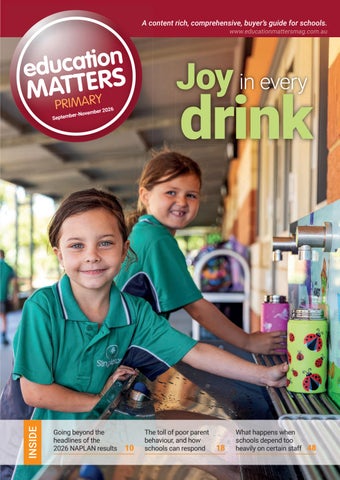
Joy in every
drink
er 2026 Novemb re b m Septe
INSIDE
Sep-Nov 2026
1:32 AM
A content rich, comprehensive, buyer’s guide for schools.
Going beyond the headlines of the 2026 NAPLAN results
10
The toll of poor parent behaviour, and how schools can respond
18
What happens when schools depend too heavily on certain staff 48
EDITOR’S NOTE
Respect and relationships Relationships are everything. In education, as in life, very little is achieved alone. We rely on the people around us to challenge, support, encourage and, sometimes, remind us that help is available if we ask. For children, those relationships are even more fundamental. Before they can learn, the research shows they need to feel safe, valued and connected. It's a thread that runs strongly through this edition of Education Matters, which explores relationships from a number of perspectives – from the way children learn to build healthy and positi e relationships, to the more difficult relationships schools are facing with parents. Our feature on respectful relationships education (RRE) examines an issue that has never been more important. Gender-based violence does not begin in adulthood; the attitudes and behaviours start much earlier – and schools are key to this. But as Our atch O s atty innersly and onash s r aomi fit ner explain, good intentions are not enough. Teachers need the training, resources and confidence to deli er this education effecti ely. ithout that, e ris sending mi ed messages at precisely the time young people are forming their understanding. At the other end of the spectrum is our feature examining the rise of aggressive and offensive behaviour from parents. Most parent-school relationships are constructive and built around a shared desire to see children thrive. Yet principals are increasingly exposed to threats, bullying and other forms of aggression, according to the latest Australian Principal Occupational Health and Wellbeing Survey. But how can we expect our children to model respectful relationships if some of the adults around them are struggling to? As Ms Angela Falkenberg writes in her regular Australian Primary Principals Association column, primary schools are where we practise being human. Children watch how adults behave and regulate themselves in challenging moments. That places an enormous responsibility on all of us – even as families face more pressure in their daily lives. Respect is not something we can simply teach through a one-off lesson. It’s reinforced in the ay a teacher listens to a student, a principal handles a difficult conversation, and a parent disagrees with a decision. Schools understand disagreements are an inherent part of the job. The goal isnt to eliminate conflict, but to ensure that hen it occurs, e ha e the s ills and processes to navigate it with dignity. Because ultimately, education is about more than what happens inside a classroom. It is about preparing young people to participate in a world with other people. f e ant children to become respectful citi ens, they need to e perience respectful citi enship around them.
Chief Executive Officer: Christine Clancy christine.clancy@primecreative.com.au Managing Editor: Myles Hume myles.hume@primecreative.com.au Journalist: Meg Kennedy Head of Design: Clayton Hawley Art Director: Michelle Weston Media Bookings and Advertising: Holly Larkspur holly.larkspur@primecreative.com.au 0422 775 308 Client Success Manager: Sabrina Zor Education Matters is a division of Prime Creative Media Pty. Ltd. 379 Docklands Dr, Docklands, VIC Ph: (+61 3) 9690 8766 Subscriptions Education Matters is available by subscription from the publisher. The rights of refusal are reserved by the publisher. Ph: (+61 3) 9690 8766 E: subscriptions@primecreative.com.au Articles All articles submitted for publication become the property of the publisher. We reserve the right to adjust any article to conform with the magazine format. Cover Image Civiq, Singleton Primary School
Happy reading! Myles Hume Managing Editor – Education Matters myles.hume@primecreative.com.au
education
MATTERS SECONDARY
www.educationmattersmag.com.au
Education Matters Magazine
education
MATTERS PRIMARY
education
MATTERS SECONDARY
www.educationmattersmag.com.au/subscribe/
Education Matters
education matters primary
Copyright Education Matters is owned by Prime Creative Media Pty. Ltd. and published by John Murphy. All material in Education Matters is copyright and no part may be reproduced or copied in any form or by any means (graphic, electronic, or mechanical including information retrieval systems) without the written permission of the publisher. The Editor welcomes contributions but reserves the right to accept or reject any material. While every effort has been made to ensure the accuracy of information, Prime Creative Media will not accept responsibility for errors or omissions or for any consequenses arising from information published. The opinions of the magazine are not necessarily the opinions of, or endorsed by the publisher unless otherwise stated. All photographs of schools (including students) depicted in feature articles and advertisements throughout this magazine have been supplied to the publisher (and approved) by the contributing school. All material supplied by schools is done so with the understanding that such images will be published in Education Matters and may also appear on the our website: www.edumatters.com.au.
3
CONTENTS // EDUCATION MATTERS
12 16
FEATURES 22 Making every drop count
ommunity spirit is helping deli er accessible drin ing stations for schools.
26 Time to transform
o the holiday period can help schools fast trac outdoor pro ects.
28 A sense of place
school s regional identity has been incorporated for a custom playground.
30 Coolest spot in school
o a school has turned hydration into a healthy daily habit.
32 From decoding to discovery ecodable readers are helping turn emerging readers into lifelong learners.
34 Respectful relationships
oundations for healthy relationships are built in primary school.
38
onfidence in curriculum
This program is helping turn maths curriculum ob ecti es into meaningful learning.
40 The sound of learning
Musica Viva Australia is giving teachers ne ays to connect music ith learning.
4
C
M
42 Back to school
Schools can curate unique boo lists ith Office or s for ducation.
Y
CM
MY
CY
44 Deepening dispute
hat ictorias historic industrial action means for education negotiations in ustralia.
CMY
K
46 Part of something bigger nside The Smith amily s earning lubs.
48 When purpose becomes a trap An over-reliance on some staff may be concealing a problem rather than sol ing it.
50 Teachers become researchers What asking honest questions about practice can do for ndigenous ducation.
52 The digital school gate
rincipals and teachers face a difficult balancing act as parent concern unfolds online.
54 AI change in schools
Schools are responding to in mar edly different ays here is the middle ground
education matters primary
28
REGULARS 03 06 08 10 12
ditor s ote e s update R update rincipally Spea ing errimuir rimary School
16 Teacher s oice mmily eering 18 ot Topic ggressi e parents 56 The ast ord 57 alendar of ents 58 eople on the o e
ai17845936957_Education Matters Full Page Ad.pdf 1 21/07/2026 10:28:18 AM
MAKING LIFE BETTER
DESIGNED TO HYDRATE. BUILT TO LAST. C
M
Y
CM
MY
CY
CMY
CF400 Hydration Stations - Because every great school day should start with easy access to clean, refreshing water.
K
BETTER HYDRATION. BETTER FUTURES. Chilled drinking water Filtered Floor or wall-mounted options Available in 1, 2 or 3-tap configurations Optional DDA-compliant configuration Over 100 Dulux powder coat colours to choose from Customisable Laser-etch or vinyl wrap signage options available
BUILT TO LAST
CHILLED & RELIABLE
ACCESSIBLE DESIGN
Premium materials for long-term performance.
High-capacity chilled water when it matters most.
Inclusive solutions for every student and every space.
AUSTRALIAN MADE. DESIGNED FOR REAL COMMUNITIES.
NATIONAL EDUCATION NEWS
“Young people report that RSE often lacks the nuance or practical guidance regarding sexuality and relationships that they are looking for.” Dr Lily Moor, La Trobe University
A nationwide study has found majority of teachers believe sexual health education should be taught in schools, but most receive “little or no formal training” to prepare them for lessons – with many fearing repercussions for teaching it. La Trobe University’s Third National Study of Australian Teachers of Relationships and Sexuality Education (RSE), which surveyed 482 teachers across government, Catholic and independent schools, found 68.1 percent of teachers reported no pre-service training in the subject, with most fearing negative reactions from parents or saying the wrong thing in class. Data also found male teachers were significantly more concerned than female teachers about risks to their professional reputation related to RSE teaching. Researcher Dr Lily Moor, from La Trobe’s Australian Research Centre in Sex, Health and Society (ARCSHS), said school-based RSE was the cornerstone of sexual health education for young people in Australia. The benefits of school based RS are ell documented but young people report that RSE often lacks the nuance or practical guidance regarding sexuality and relationships that they are looking for,” said Dr Moor.
The study found the majority of teachers reported no pre-service training in sex education.
There was near-universal agreement among those surveyed that schools should teach core topics including consent (98.6 per cent), sexual development (96.8 per cent) and contraception (96.8 per cent). Lead researcher Professor Jennifer Power, also at ARCSHS, said national guidelines for RSE had been introduced in 2015 but there was still considerable variability in how the subject was taught across states, schools and individual classrooms. The study makes 13 recommendations to strengthen RSE nationally, including making training compulsory for all Australian teacher education and developing a coherent national outcomes framework to ensure consistent, evidence-based delivery across schools. EM
Former Education Minister Ben Carroll becomes Victorian Premier Former Victorian Education Minister Mr Ben Carroll has been sworn-in as the new Premier of Victoria, following almost three years across the education portfolio. s part of a cabinet reshuffle, eputy Premier Gabrielle Williams will become the state’s new Minister for Education. The appointment follows former Premier Ms Jacinta Allan’s decision to step down from the role the morning of Tuesday 28 July 2026.
6
“My cabinet will stay focused on what matters most – cost of living, keeping Victorians safe and delivering great healthcare and education,” Mr arroll said. Congratulating Mr Carroll on social media, Prime Minister Mr Anthony Albanese said he and the former Education Minister had locked in full funding for every Victorian school. “Premier, I’m looking forward to
education matters primary
working together to deliver better schools, healthcare and more homes for Victorians,” said Mr Albanese. Mr Carroll was appointed to the role of Education Minister in October 2023. His tenure has been marked by ongoing negotiations with the Australian Education Union on a new Victorian Government Schools Agreement for teachers, education support and school leaders in public schools. EM
Image: Pressmaster/shutterstock.com
Study: teachers support sex education but lack formal training
‘Schoolyard Greenprint’ launched for outdoor spaces
Image: POV_artist/shutterstock.com
The University of Canberra (UC) has launched a new ‘Schoolyard Greenprint’ guide to the evolution of schools’ outdoor spaces. After 22 months of study, researchers said they’ve addressed the gap for improving outdoor spaces for adolescents. The comprehensi e set of findings and guidelines includes for best practice in schoolyard design, which UC said “articulates ho to meet the ery specific needs of high schoolers”. The university said that in conjunction with a Youth Voices reference group, the researchers held workshops with over 500 students to identify the needs of different cohorts of students, including LGBTQ, First Nations and female and gender di erse students. With a stakeholder working group and reference group, they then co-designed better ways to utilise outdoor spaces. “From designing safe spaces to minimise bullying, to sensory areas to help
neurodivergent students or age-appropriate places to take risks and play that aren’t the usual formal sports facilities, the Schoolyard Greenprint provides evidence-based practical guidelines to help schools move away from the typical, outdated design,” UC said in a statement. The research team mapped typical school typologies around the country and found most fit into one of nine designs. Lead researcher Dr Gweneth Leigh, a landscape architect and Research Fellow in the Mental Health Policy Unit at UC’s Health Research Institute (HRI) said the researchers have brought together current design standards with health and wellbeing frameworks to cater to different cohorts of students. “Teen mental health is in crisis globally; the schoolyard remains an overlooked opportunity. By rethinking our schoolyards, we can create spaces that help young people to connect, recharge and learn,” said Dr Leigh. EM
“By rethinking our schoolyards, we can create spaces that help young people to connect, recharge and learn.” After 22 months of study, researchers said they’ve addressed the gap for improving outdoor spaces for adolescents.
caption
education matters primary
Dr Gweneth Leigh, University of Canberra
7
AUSTRALIAN PRIMARY PRINCIPALS ASSOCIATION // PRESIDENT
Better together: Primary schools and a more connected society At a time when people report feeling increasingly isolated, Angela Falkenberg says primary schools remain one of the few places where an entire community gathers regularly and with purpose.
Australian Primary Principals Association (APPA) President Ms Angela Falkenberg has held senior school leadership positions across both primary and secondary schools and has extensive experience in the education of First Nations children. APPA provides a voice to more than 7,600 public, Catholic and independent primary school principals across the country.
8
Every morning, when the gates of a primary school open, a community gathers. hildren arri e ready to learn. Teachers elcome them by name. Families exchange greetings and grandparents, volunteers and support staff take up their places. t is a familiar scene, repeated in thousands of schools across Australia, yet it is anything but ordinary. Beyond academic and creative discovery, schools teach us something more profound before the first bell e en rings ho to li e ell together. This is isible in e eryday acts of connection. t is found when teachers listen to a child's story, older students guide younger ones, parents connect at the gate, volunteers open breakfast clubs, and shy children are in ited to play. These moments may seem small, but are, perhaps, some of the most important things that happen in our schools. Because before children learn how to contribute to society, they first need to learn ho to belong to it. Primary schools are where we practise being human. e practise listening, patience and indness. e practise seeing the orld from someone else's perspective and we practise resol ing disagreements. e practise understanding that while we are each unique, we are
education matters primary
also connected. This is at the ery heart of what education has always been about. Humans are wired for connection. euroscience sho s that relationships are not optional extras; they are the foundation for a child's learning, wellbeing and identity. s r athan allis notes, before children can absorb knowledge, they must feel safe, alued and connected. Through positive relationships, they develop the emotional regulation and confidence to flourish. This reflects the frican philosophy of buntu am because e are , e become oursel es through others. This feels particularly important at a time when connection can sometimes feel fragile. e li e in an age where communication is constant, yet many people describe feeling increasingly isolated. Technology has gi en us extraordinary opportunities to connect across the world, but it can never replace the everyday human interactions that build trust, empathy and understanding. The conversations over a school fence, the shared laughter at a community event or the moment when someone hears a story that helps them understand another persons e perience. These are the small interactions that hold communities together.
Image: athichoke pim/shutterstock.com
Leadership thinker Ms Mary Freer offers a powerful reminder when she says The only certainty e ha e is partiality. Our understanding is always incomplete because each of us experiences the world through our own history, culture and circumstances. one of us sees the hole picture. Stories matter because they expand our perspective, replacing judgment ith curiosity and building empathy. n primary schools, these stories converge daily. ery child, family and educator arrives with a unique background of hopes, traditions and e periences. hen schools create spaces to share these narratives, they do something remar able they transform a group of neighbours into a connected community hub. n a time hen many institutions are becoming more specialised or disconnected, primary schools remain one of the few places where an entire community gathers regularly and ith purpose.
school concert, a armony ay celebration, a O ee acti ity, a community garden or a simple morning tea can become much more than an e ent on a calendar. They become opportunities for connection. They remind us that belonging is something e create together. nd belonging matters. or while engagement as a gateway to achievement, belonging is a gateway to engagement. hen children feel no n, safe and valued, they are more willing to participate. They as uestions.
“Primary schools are helping shape the kind of society we hope to become, where future colleagues and parents learn collaboration, empathy and the importance of listening." Angela Falkenberg, President, APPA
School events become much more than an event on a calendar, rather they become opportunities for connection, Ms Falkenberg says.
education matters primary
They ta e ris s. They perse ere hen learning becomes difficult. They de elop confidence because they understand that they ha e a place. The same is true for adults. ommunities flourish hen people feel they belong. Schools do not simply teach respectful relationships. They model them. hildren atch ho adults speak to each other and notice whether differences are approached with respect or conflict. They obser e ho disagreements are handled. They learn from the respectful relationships they see between teachers, leaders, families and community members. f e ant children to become respectful citizens, they need to experience respectful citizenship around them. This is hy the role of primary schools extends far beyond curriculum deli ery. Primary schools are helping shape the kind of society we hope to become, where future colleagues and parents learn collaboration, empathy and the importance of listening. here future citizens learn that diversity strengthens communities and where children discover that they can contribute something aluable to the orld around them. Many of these outcomes will never appear on a standardised assessment and cannot be reduced to a score or a ran ing. et they may be among the most important things education achie es. Because the future ill not only require people who know things, it will require people who know how to or together. People who can listen before responding, people who can disagree ithout di iding. eople ho can recognise the humanity in others and people who understand that our wellbeing is connected to the wellbeing of those around us. Every day, primary schools quietly build these capabilities through ordinary, yet e traordinary, interactions. nd they do more than prepare children for the future, they create it, one respectful, connected relationship at a time. or education is not just about what children know, but who they become together. EM
9
AUSTRALIAN CURRICULUM, ASSESSMENT AND REPORTING AUTHORITY (ACARA) // STEPHEN GNIEL
What the 2026 NAPLAN results tell us Our annual NAPLAN assessments measure essential skills in literacy and numeracy. These are the foundational skills that underpin learning and life. Each year, we publish the national NAPLAN results, which include national, state and territory breakdowns, as well as data grouped by student background, gender, language background other than English and location and data on participation. The purpose of NAPLAN is clear. It is the only national assessment that allows us to see whether young Australians are developing critical literacy and numeracy skills using a national objective scale. It provides valuable evidence that helps teachers, school leaders, education authorities and governments understand what is working and where additional support is needed. The overall national picture in the 2026 NAPLAN results remains broadly stable and consistent with the results from the previous three
10
Image: ACARA
NAPLAN results show improvements in national numeracy levels alongside areas for continued attention, says ACARA CEO Mr Stephen Gniel.
ACARA CEO Mr Stephen Gniel says the overall national 2026 NAPLAN results remained broadly stable and consistent.
years. This year’s results continued to show some encouraging patterns of impro ement identified last year as well as reinforcing those areas where further attention is required. Across all year levels and assessment areas, about two-thirds of students achieved results at the Strong or ceeding proficiency
education matters primary
le els. This reflects a strong le el of achievement for students, meeting challenging but achievable benchmarks, and shows that many students are developing the skills and knowledge expected for their stage of schooling. Around one in 10 students were identified as being in the eeds additional support’ category. This reminds us that it’s crucial to continue helping those students who may be finding literacy or numeracy challenging. They deserve particular attention because early intervention can ma e a significant difference to their educational outcomes. At the primary school level, one of the most positi e findings in this year s results is the continued improvement in numeracy among Year 5 students. The national average numeracy scores in Years 5, 7 and 9 are now the highest since hen ne proficiency levels were introduced. Around 29,000 more Australian students across these year levels are performing at
Image: arrowsmith2/shutterstock.com
Across all year levels and assessment areas, about two-thirds of students achieved results at the ‘Strong’ or ‘Exceeding’ proficiency levels.
Image: ACARA
ceeding the highest proficiency level – in 2026 compared to 2023. This pattern of improvement in Year 5, 7 and 9 numeracy is testament to the exceptional work of our amazing teachers, principals and school staff across Australia, as well as the commitment shown by parents and carers and the students themselves. Unfortunately, these gains were not repeated for younger students in Year 3, where the average numeracy score was the lowest since 2023. The decline in Year 3 numeracy results is clearly concerning as the early years of schooling are critical for building mathematical understanding. When we see signs that some younger students might be finding it difficult to develop this understanding, we must respond quickly and effectively. Education ministers are addressing this through a range of measures including the rollout of the national Year 1 numeracy check, which will provide earlier information about student learning. ACARA is also playing its part by reviewing the Foundation to Year 2 Mathematics curriculum to ensure our youngest learners get the strong grounding in mathematics and numeracy they need to succeed in their education and later in life. The 2026 results also highlighted some other areas that deserve our close attention. The average reading scores in Years 5, 7 and 9 are lower than in 2025. We also saw a slight increase since 2023 across all year levels in the proportion of students requiring additional support in reading and writing. It was also disheartening to see disparities persisting over the years in the attainment of students from our regional and remote areas, Indigenous students and those from a disadvantaged background. This must be a continuing focus for all of us working in the education sector in the coming years. In preparing for this year’s results release, we had to address the impact of two disruptions during the test indo period. technical issue ith the national NAPLAN platform affected the first day of testing this year. The
At the primary school level, one of the most positive findings is the continued improvement in numeracy among Year 5 students (pictured). However, ACARA says the decline in Year 3 numeracy results is concerning.
disruption early in the morning impacted schools largely on the east coast of Australia and affected only the writing test and only students in Years 5, 7 and . Despite this, the national average scores in writing remained similar to last year. However, as the disruption varied in its impacts for students and schools, we have included a caveat on the 2026 writing results for students in Years 5, 7 and 9 in the national reporting, as well as the individual student reports for parents and carers, which notes that the results should be interpreted with care given the disruptions. The low Tasmanian participation in NAPLAN 2026, due to industrial action in government schools, was far below ACARA’s technical data standard for the accurate reporting of results. Therefore, education ministers agreed not to report Tasmanian state-level NAPLAN results. It’s very disappointing that we don’t have this year’s state level NAPLAN results for Tasmania. For education
authorities and affected schools in Tasmania, it means we can’t report on the changes from previous years’ results. s e reflect on the results, it’s evident that the overall picture remains one of steady performance, with continuing signs of growth in some key areas. It’s certainly heartening to see to the sustained progress in numeracy among older primary students. However, as some of the other primary school level results show, what remains vital is ensuring every student, regardless of background, gender or location, has access to the right support to continue to develop their literacy and numeracy skills. NAPLAN is a snapshot in time, but its impact is long-lasting. By measuring and comparing achievement across all Australian schools, it gives us a better understanding of where students are at and where we need to provide additional support, so all our students are developing the literacy and numeracy skills that are essential in everyday life. EM
To learn more about the results, visit
www.acara.edu.au/naplanresults. To keep up to date with ACARA’s work on the Australian Curriculum, the National Assessment Program and the reporting on schooling in Australia, follow them on Facebook or LinkedIn and subscribe to its regular ACARA Update e-newsletter at www.acara.edu.au/news-and-media/subscribe-toacara-update.
education matters primary
11
PRINCIPALLY SPEAKING // KERRIMUIR PRIMARY SCHOOL
The unlikely principal who welcomes ‘harebrained ideas’
Images: Kerrimuir Primary School
He left school at 16, worked in electronics, built businesses and then became a principal within a decade of entering the classroom. How award-winning principal Mr Michael McLean applied his career outside of education to transform Kerrimuir Primary School.
12
Mr Michael McLean’s rise to principal hasn’t been conventional. Far from it. He didn’t follow the well-trodden path of high-achieving high school student, education degree and hopping between schools before landing his first principalship. nstead, he left school at 16, skipped his ictorian ertificate of ducation ( altogether, undertoo an apprenticeship, and forged a career in electronics and business before setting foot in a classroom. By the time he did, he was 38 years old. That was at Kerrimuir Primary School in Box Hill North, Melbourne, the only school he’s ever worked at. And a school he became principal of in 2018 after 10 years in the profession. t s been a pretty rapid rise, you might say,” he quips. nterest not money is hat motivates me. Most of my life has been about building something up, getting bored, and going off to do something else. found teaching wasn’t boring because every day was different. o m principal, each day it’s incredibly different. That’s what keeps me going. often say this is the best ob e e er had and e had , belie e it or not. n this role get to use all the s ills ac uired in pre ious careers, and still get to play.” Today, Kerrimuir is capped out at around students (it has an enrolment management plan limiting gro th beyond that number , and has built a strong reputation after
Mr Michael McLean is a firm believer that strong engagement leads to positive behaviour.
education matters primary
a transformative period that initially focused on lifting spelling standards across the school. While he partially credits the work of his predecessor, Mr McLean’s leadership during this time didn’t go unnoticed. n , he as a arded the Outstanding Primary Principal of the ear as part of the ictorian ducation cellence ards. When Mr McLean arrived as a graduate teacher a decade ago, the school had about children. O er time, he grew to become a Leading Teacher and Assistant Principal, and enrolments grew too with around 360 students. Two and a half years after he became principal, that number sat at . “Some of that growth was due to the work of the principal before me. She changed the culture of the school, changed how we operated, and really upskilled the staff,” he says. “At the same time there was a population boom in Box Hill North. Today, about percent of our students ha e nglish as an additional language, and roughly percent of our students speak Mandarin at home.” The school was achieving strong results thanks to its high achieving students. But around percent weren’t meeting the standard. The root issue was spelling, and that weakness bled into writing and reading, Mr c ean says. “We were seeing the same students going through intervention programs again and again,” he recalls. t that stage introduced synthetic phonics to the school. We started using it within intervention, beginning with a multisensory structured language ( S approach, which then developed into using Orton illingham. O er time that became the way spelling was taught across the whole school.” All staff have four days of intensive training in this approach . t too four to fi e years for this explicit approach to embed itself and take root before the school started to see improvements in spelling, reading and writing. The efforts have paid off: in
Kerrimuir is capped out at around 575 students and has been through transformative period that initially focused on lifting spelling standards across the school.
2024, Kerrimuir was recognised among the top-performing schools in the state based on NAPLAN results. “Our results really took off from there,” Mr McLean says. “My motivation has always been the bottom percent of students. f you lift the students at the bottom, you end up with a cohort where everyone is strong, and many exceed expectations. lus, hen the ictorian o ernment announced in that e ery school in the state had to teach synthetic phonics, that as a great day for me. t confirmed the choice made eight years earlier as the right one.” Thinking differently Since taking the helm at Kerrimuir, Mr McLean has stayed true to his unconventional style. He can be found performing maintenance obs around the school replastering, repainting and recarpeting the staff room, art room and other spaces. lthough he finds en oyment in this work, there’s another motivator. “That keeps me interested, and it means we have more of those funds available to support students.” His business background also gave him an advantage in skills that many principals spend years developing after a classroom career. “Running a school is, in many ways, li e running a business. t might be a government business, but it still has a budget, staff, HR, industrial relations, interpersonal issues and a brand to market,” he says. already had that part largely worked out. For me, the bigger question
education matters primary
as hy do ant to do this, and ho do ant to lead people ” So, what is Mr McLean’s leadership style big part of that is empo erment. The fact three assistant principals have left to take up principal roles elsewhere during his tenure speaks volumes. see some principals or ing many hours a week, trying to do everything. That doesn t help their staff it ust ma es everyone more reliant on the principal instead of building their capacity,” he says. often say my biggest uest in this ob is to ma e myself redundant. ant to ups ill as many people as can so that they can do my ob. m a big belie er in professional development, training, and continuous growth.” Alongside that, he has another strong belief: “harebrained ideas are good”. That applies to students and staff. He embraces the outrageous ideas because when children are exposed to different, interesting experiences, it leads to engagement. “A lot of people talk about behaviour management as the core focus. see engagement as the core focus, with behaviour management a byproduct of that.” One of those “harebrained” ideas includes a beehive on the school grounds, which was initiated by a teacher after the school received a Victorian unior andcare and Biodi ersity rant to investigate bees. y first thought as, hat about the ris . To e plore it properly, four of us went to a beekeeper course one Sunday. We came back pretty unsure, but e ent ahead any ay. t too three years, two queens, a hive, enclosures and
13
PRINCIPALLY SPEAKING // KERRIMUIR PRIMARY SCHOOL
endless risk assessments, but this year e har ested our first batch of errimuir honey,” he says. Another grant funded a recycling machine that allows students to shred bottle caps and in ection mould them into pens. “There are so many ways to get children engaged in learning that don’t involve staring at a screen,” Mr c ean says. Intersection of wellbeing and learning With almost 40 teachers, plus 22 education support staff and three additional leadership positions, the responsibility of the role isn’t lost on Mr McLean. Perhaps that’s why he works 11 hours most days, along with the odd Saturday or Sunday, to feed what he o ingly describes as his addiction”. He’s also recently expanded his staff to include experts in mental health and ellbeing. Mr McLean’s a strong advocate that learning and ellbeing fit together, in line ith the rame or for mpro ing Student Outcomes ( SO . “You can’t effectively have one without the other, which is why we’ve built a significant ellbeing structure around students,” he says. “As principal, you get to choose how you spend your budget, and those choices reflect hat you alue. One big turning point for us was deciding we needed a psychologist on staff, someone who could carry out assessments. So, we employed one and she works here a few days a week, conducts assessments, and sees the really complex cases.” r c ean says a ma or benefit is that students can see her relatively quickly, compared to the private system where families can wait several months. “We also have a MHiPS (Mental ealth in rimary Schools person and a counsellor. So there’s a layered wellbeing team in place,” Mr McLean says. “Ultimately, if students are well supported in terms of wellbeing, they are much better able to access learning. Our ob is to ma e sure e ery child can access the curriculum, in whatever way they need.”
14
Kerrimuir Primary School, in Melbourne’s east, was the first school Mr Michael McLean taught at. Now he’s principal.
“When the Victorian Government announced in 2025 that every school in the state had to teach synthetic phonics, that was a great day for me. It confirmed the choice I made eight years earlier was the right one.” Michael McLean, Principal, Kerrimuir Primary School The next challenge Despite the accolades and positive student outcomes, the work of a principal is never quite done. Looking ahead, Mr McLean is treating “consistency of practise” across the teaching cohort as a top priority. “We’re working on how to regain that ithout sacrificing responsi eness to students’ needs,” he says. “Our spelling program is embedded and working well, and our writing and reading are trending well. Academically, students are in a good place. The challenge is to maintain consistency without introducing dramatic change, while still keeping innovation alive. “You can’t take your foot off the accelerator and coast if you do,
education matters primary
you start going bac ards. But also don’t want constant upheaval, so it’s about balance.” He’s also thinking about how he will adapt to changes brought about by recent industrial action in Victoria, which would cut formal meetings down from two per week. m unsure ho schools are meant to roll out ne initiati es ith ust one meeting a week, especially in weeks where there’s an open night or other events,” he says. t s ell documented one of the biggest issues in education is the administrative load on teachers and principals. Plus, schools are being increasingly as ed to fit more into their timetables. Mr McLean believes the workload has increased significantly during the past four years. But addressing that without pulling teachers away from their core or face to face teaching is the tricky part. As for aspiring principals, Mr McLean’s advice is: “to model the behaviour you want to see.” s a acilitator of the nspire program through the Victorian Academy of Teaching and Leadership, designed for teachers considering leadership roles, he urges them to keep seeking new experiences and maintain a hunger for learning. tell them they re already leaders they lead classes of students e ery day. Similarly, leading adults is still about getting people to do what you need them to do, helping them grow and getting the best out of them ideally ithout them even knowing,” he says. “As a leader, you’ll always have early adopters in your teams, the ones ho ould ump off the roof ith you if you suggested it. And you’ll always ha e someone call the blac hat the person ho uestions, resists and complains. “My advice is to work out who your blac hat is and go to them first. dentify what motivates them, what they need to get over the line, and focus on that. Once you get them on board, everyone else is relatively easy.” EM
TEACHER’S VOICE //EMMILY DEERING
Why connection comes first in this classroom From warm welcomes to trauma-informed practice, Mrs Emmily Deering puts relationships at the heart of her approach at Woodland Grove Primary School.
16
Images: Emmily Deering
Step into Mrs Emmily Deering’s classroom and you ll find that e ery bit of gro th from reading their first ords to forming ne friendships begins ith the connections she builds ith her students. t starts ith the small, consistent moments, such as greeting e ery child armly as they al into her room at oodland ro e rimary School, erth. t s listening carefully to their ideas, noticing hen something seems a little off, and celebrating their efforts as much as their achie ements. ant children to no that they are seen, their oice is heard and respected. That might mean ta ing the time to learn about their interests, incorporating their e periences into our learning, or supporting them through challenging emotions in a calm and supporti e ay,” she says. belie e relationships are the foundation of learning because children learn best hen they feel emotionally safe. hen a child trusts their teacher and feels a sense of belonging, they are more illing to ta e ris s, as uestions, perse ere through difficulties and engage in their learning.” t s an approach that has earned rs eering the respect of her peers and recognition beyond her o n classroom. t her pre ious school, orth Tom rice rimary School, she as named a finalist for the inister s Teacher
Teaching listening skills, clear routines, visual supports, and calm and consistent responses are central to her approach.
of the ear for estern ustralia. t as both humbling and incredibly meaningful. Teaching is such a collaborati e profession, so ie ed the recognition not only as a personal achie ement, but as a reflection of the onderful students, families and colleagues ha e had the pri ilege of or ing alongside throughout my career,” rs eering says. belie e it reflects my commitment to creating classrooms here children feel safe, alued and genuinely e cited to learn.” Today, at oodland ro e, rs eering teaches a indergarten classroom hile also contributing to hole school initiati es that support high uality early childhood practice. Shes al ays had a strong passion for early childhood education and is a big ad ocate for a balanced approach, here e plicit teaching is thoughtfully combined ith purposeful play based e periences”. n the classroom, this in ol es
education matters primary
structured, e idence informed teaching practices to de elop strong foundations. This is counter balanced ith rich opportunities for children to e plore, in estigate and apply their learning through hands on play based e periences. belie e young children learn best hen they can engage ith concepts in concrete, meaningful ays,” she says. hen combining intentional teaching ith opportunities for play, in uiry and e ploration, can support children to build confidence, deepen their understanding and de elop a genuine lo e of learning,” she says. t allo s children to engage ith learning at their indi idual le el, build confidence and de elop a lo e of learning. But it isn’t possible until time has been in ested in building positi e relationships. n her ie , it s ultimately hat great teaching comes do n to. y ad ice is to al ays start ith
connection. et to no your students, their interests, strengths, challenges and hat ma es them feel successful,” she says. reate clear routines, high e pectations and a classroom culture here mista es are ie ed as part of learning, children feeling that the learning is meaningful, achie able and rele ant to them.” nclusi e classrooms, she says, are built through intentional planning, fle ibility, collaboration ith families and staff, and a genuine belief that e ery child s oice is alued. ost importantly, e need to create a learning en ironment that is elcoming, safe and engaging. space that reflects the students themsel es, celebrates their indi iduality and fosters a strong sense of belonging. hen children feel connected, respected and empo ered, you are igniting that lo e for learning and school.” A lifelong love of learning rs eering as first dra n to teaching because she anted to ma e a meaningful difference in childrens li es, particularly during those foundational early years hen confidence, curiosity, identity and a lo e for learning are being ignited. Shes al ays lo ed the energy, creati ity and honesty that young children bring to the classroom. hat continues to inspire me is that e ery day is different, and get to itness those small but significant moments of gro th, hether it s a child learning to read their first ords, forming a ne friendship, o ercoming a challenge or feeling proud of themsel es for trying something ne ,” she says. Being part of a child s learning ourney is a pri ilege. atching children disco er their strengths, achie e their o n successes and gro into confident little learners is hat eeps me passionate about early childhood education.” Shes so passionate about this area because often it s the early years that lay the foundation for a child s lifelong lo e of learning. y goal is to ensure e ery child de elops a strong sense of belonging ithin our school community and to ignite
Ms Emmily Deering has always loved the energy, creativity and honesty that young children bring to the classroom.
a lo e of learning from the ery beginning. ant children to feel safe, confident and e cited to come to school each day,” she says. These inno ati e and inclusi e teaching practices earned her recognition as a lead practitioner in early childhood education in the inister s Teacher of the ear ards. Specifically, the epartment of ducation ac no ledged her e pertise in early childhood de elopment, literacy, numeracy, and trauma informed practices. t also highlighted the ay she collaborated ith families, local health agencies and professionals to ensure the best outcomes for her students, hile promoting cultural a areness through partnerships ith boriginal communities. Trauma informed practice has had a significant impact on the ay ie beha iour. al ays thin , hat may this child be e periencing and ho can help ,” she says. n my classroom this means prioritising predictability, emotional safety and connection.” lear routines, isual supports, calm and consistent responses, and co regulation strategies are all adopted to help children manage big emotions. also recognise that beha iour is often a form of communication,
education matters primary
particularly for young children ho may not yet ha e the language or s ills to e press their needs effecti ely,” she says. t s not about lo ering e pectations it s about pro iding the support they need for them to be able to meet those e pectations in their o n ay.” amilies, health professionals and the ider community are also essential” relationships in her or . She says children achie e the best outcomes hen the adults around them are or ing together ith a shared understanding of their strengths, needs and goals. Regardless of postcodes, ha e or ed closely ith families, speech pathologists, occupational therapists, psychologists and school support teams to de elop consistent strategies across home and school for the best outcomes for the child,” she says. or rs eering, the or ultimately comes bac to one simple idea before children can flourish as learners, they need to feel that they belong. nd perhaps that is the lasting impact of her approach. n those small, e eryday moments, she is helping lay the foundations not ust for successful learners, but for confident young people ho belie e they ha e a place in the orld. EM
17
HOT TOPIC // PARENT-SCHOOL RELATIONSHIPS
Principals are exposed to threats and violence more frequently today compared to 15 years ago, data shows.
Zero tolerance: Managing offensive and aggressive parents "The principal is the canary in the coal mine: their health and wellbeing are a good proxy for the health of the school." Fifteen years after launching the first Australian Principal Occupational Health and Wellbeing Survey, Emeritus Professor Phil Riley says that observation remains as relevant as ever. But how are principals coping with the growing complexities of their role in workplaces that feel less safe than in years gone by? Talk to any principal, and one of the beauties of the role is that no two days are the same. s the figurehead, they play a pivotal role in their school communities, leading learning, supporting staff and students, and
18
building relationships with families. At the same time, principals now deal with complex mental health issues, workforce shortages, greater compliance demands and community tensions. The average working week remains at 53.9 hours, with 99 percent of principals working “dangerously long hours every week”. The data also shows more principals are carrying an unnecessarily high burden in the form of irrational and aggressive behaviour from parents and caregi ers. While most parent-school relationships remain constructive, the survey – now in its 15th year – highlights how principals are exposed
education matters primary
to threats and violence more frequently now compared to 2011, with exposure to aggression becoming “disturbingly normalised” in that time. It’s a problem Prof Riley has seen in the data, and e perienced first hand. Before moving into academia where he researched the o erlapping fields of psychology, education and leadership, he spent 16 years in the classroom, with four of those as a principal. “I did experience a couple of incidents where people tried to physically threaten me because of decisions I’d made,” recalls Prof Riley, who’s now an Honorary Professor at Deakin University with expertise in education leadership.
Image: WavebreakMediaMicro/stock.adobe.com
Abusive behaviour from a small minority of parents is becoming an increasingly common part of school leadership. New research reveals the growing toll this is taking on principals – and what schools can do to respond.
“They need to realise that children are impacted because that teacher is less productive in the aftermath. They’re not their most attentive, best selves.” Ms Angela Falkenberg, President, Australia Primary Principals Association With 2,044 school leaders participating, the Australian Catholic University (ACU)'s Principal Occupational Health and Wellbeing Survey, is now considered the most comprehensive and representative study of its kind in Australia. It shows experience of physical violence surged from 27.3 percent in 2011 to 47.8 percent in 2025. Threats of violence jumped from 37.9 percent to 53.7 percent over the same period. To gain greater traction with policymakers, in 2025 the survey for the first time uantified lost producti ity due to the problem. It found 2 percent of principals now report exposure to offensive behaviour with an estimated annual cost of managing offensive behaviours to the education sector exceeding million. On average, principals suffer $25,495 per year in lost productivity based on an analysis of their income, hours worked and time spent dealing
with behaviours, including physical violence, threats, bullying, cyber bullying and sexual harassment. “Sadly, the number of parents who perpetrate violent acts in schools has been increasing year on year. And it’s not just the number of incidents, but also the severity,” Prof Riley says. “We need to spare a thought for the leaders who are trying to protect the children and the staff they are responsible for proactively. Until Australia acknowledges the root causes of violence and sets about addressing them at every level of society, principals will be forced to make tough decisions.” State governments are also recognising the magnitude of the issue. Victoria, Queensland and New South Wales have each committed over $100 million to tackle the problem. Lately, the Victorian Government moved to strengthen School Community Safety Orders, giving principals and the department greater powers to handle damaging behaviour towards employees, including on social media and messaging platforms. “The other big shift I’ve seen over my lifetime is in how parents respond when something goes wrong at school,” Prof Riley says. “When I was a child, if I’d behaved poorly, the school would call my parents and the adults would make a decision in the best interests of the child. “A lot of that has changed now. Parents are much more likely to immediately take the child’s side. That attitude has crept into all facets of schooling.” The other big change has been social media and chat groups, which can act as echo chambers on contentious issues, with algorithms that promote negativity and outrage. “I’ve heard stories from principals ho arri e at or to find parents gathered on the school oval in a meeting they knew nothing about – all organised over the weekend on social media, based on an assumption that the principal was in the wrong and that action needed to be taken,” Prof Riley says.
education matters primary
15 YEARS OF DATA
Image: ACU
“What I learnt from that experience is that teachers and principals are constantly dealing with highly emotive situations. After all, the most important thing in most people’s lives is their children. It’s a tricky space to navigate, and educators take that on – they know that’s part of the job. “What they don’t sign up for is an unsafe or place. olice officers accept physical danger as part of their role; principals and teachers don’t. et they can still find themsel es in similar situations because emotions are running so high.”
The Australian Principal Occupational Health, Safe ty, and Wellbeing Survey:
ANNUAL REPORT 2025 DATA
The Australian Principal Occupational Health and Wellbeing Survey, considered the sector’s most comprehensive, paints a sobering picture about exposure to violence, stress and workload among principals.
The emotional toll While those experiences prompted Prof Riley into thinking about the health and wellbeing of Australian principals, it was later in his career – while leading a mentoring program for first time principals in Victoria – that the idea for the Principal Occupational Health and Wellbeing Survey crystallised. During break times, he was hearing stories about how tough life was becoming in schools, with the mentors expressing concern about what the new principals would walk into. “I thought, ‘Bloody hell – what’s going on here?’ And that’s when I started the survey in 2011.” Today, the survey is led by Professor Theresa Dicke, Program Lead for the Educational and Developmental Psychology Program within ACU’s Institute for Positive Psychology and Education (IPPE). Professor Herbert W. Marsh, part of the IPPE, is also a Chief Investigator, working with several other investigators such as Associate Professor Paul Kidson, Course Coordinator (Master of Educational Leadership) at ACU’s National School of Education. A/Prof Kidson says schools have a clear set of expectations and codes
19
20
Image: Phil Riley
of conduct when parents want to lodge a complaint, grievance or seek clarification. o e er, an increasing number feel those rules don’t apply to them. All-caps emails at 11pm (that expect a response by 8am the next day) are one example. He also recalls a principal dealing with “a very litigious, vexatious and aggressive parent” who they thought about while lying awake at night. “She said to me: ‘I had to work out how to keep that person out of my house at night,’ metaphorically speaking,” he says. “Unfortunately, we're seeing an increasing number of parents and caregivers coming with the assumption that the school has made the wrong decision – and it isn’t until it’s mentioned it’s all on CCTV footage that they change their stance. “What sort of breakdown of civil discourse has occurred to reach that point ” And it takes a toll on principals. In the recent survey, 54.4 percent of school leaders reported seriously considering leaving their roles. “Wouldn’t it be better if they had that time and emotional energy to put into positive learning experiences and improving the school?” A/Prof idson says. “It becomes not just an issue for the individual principal and the physical and emotional toll it takes on them, but it has a deteriorating effect on the culture of the school generally.” A/Prof Kidson and Prof Riley agree the trend is part of a societal shift. Whether it’s at an airport or café, businesses have been compelled to remind patrons to treat their staff with courtesy and respect. Factors like rising living costs are creating background stress, and it’s harder for busy parents to build trust and rapport with teachers through casual interactions. “In the ‘good old days’, more parents could wander down and have a chat with the teacher in the playground at pick-up time or drop-off time, and
Image: Jane Wilkinson
HOT TOPIC // PARENT-SCHOOL RELATIONSHIPS
Emeritus Professor Phil Riley says there’s been a shift in how parents respond initially.
you often nipped a few things in the bud that way,” Prof Riley adds. It’s a sentiment Professor Jane Wilkinson concurs with. As a Professor in Educational Leadership at Monash University, she was the lead author of Invisible labour: Principals’ emotional labour in volatile times, published earlier in 2026. The study, led by Monash University in collaboration with Deakin University and the University of Sydney, draws on 285 critical incident testimonies from 248 principals and reveals what researchers describe as a “growing and normalised culture of violence directed at school leaders”. The research examined the emotional and physical toll of escalating violence on principals’ health and wellbeing, with female principals facing disproportionate levels of harassment and gendered violence. More than half of Australian public school principals have experienced physical violence, verbal abuse, gendered violence or sexual harassment at work. Prof Wilkinson says today people are generally more aware of how to exercise their democratic rights and speak up. “But they have to be balanced against the school’s professional responsibility to educate in a way that is appropriate for all children,” she says. One of the big tensions principals face is balancing the duty of care for an individual with their obligations to
education matters primary
Professor Jane Wilkinson says proactively building relationships is key for schools.
the broader group. A child might come from a traumatised background, which plays out in inappropriate behaviour at school. “Principals understand that trauma and want to support the child, but they also have to keep everyone else safe,” Prof Wilkinson says. “This is just one illustration of how individual, family and school interests intersect.” She says it has become tougher for parents. Families are more isolated and often under intense economic pressure. “And that can feed into how parents respond to schools,” she says. “I’m not excusing poor behaviour, but we have to recognise children’s needs are more complex, communities are more fragmented, and the kinds of social supports that used to exist – such as churches and other community institutions – have weakened.” How to respond While this article will explore the ways schools can respond formally, and in the heat of the moment, Ms Angela Falkenberg, President of the Australian Primary Principals Association (APPA), says it needs to start with parents. She took a hiatus from teaching to work in healthcare where it was shown nurses or doctors that were abused couldn't perform as well. “We don’t seem to challenge the idea that because someone is frustrated, it’s OK to be mean or abusive. They need to realise that children are impacted
because that teacher is less productive in the aftermath. They’re not their most attentive, best selves, and it’s not just the emotional impact but also the time it takes away from planning and teaching to fill in forms, rite critical incident reports etc,” she says. “Schools do not have time to co-regulate an adult. We would like adults to be mindful of their responsibility to manage their own emotions and self-regulate.” She urges parents to adopt an open mind and take some time before raising a complaint with the school. They should be seeking to model respectful disagreement or conflict resolution. And when a parent becomes aggressive, she says it’s important to try to understand what’s driving their response. But it’s equally important to call it out. Not doing so only perpetuates the problem. “I remember saying to a mother one day, ‘Tell me what you’re thinking is the implication of this?’ Her child was eight. She said, ‘I’m worried he’ll have to go to jail when he’s older’,” she says. “These aggressive people are small in numbers, but what if the whole community stood together and said, like in the Bluey episode where Dad says to Bingo, ‘It’s not the done thing, mate. We just don’t do that here’. Imagine if that was our national mantra?” APPA and schools have developed scripts for managing aggressive behaviour so principals aren’t scrambling in the moment. For example: • “I can see you’re angry, and I’ve heard what you’ve said. I’m going to need some time to think about it. Can you give me that time?” • “I’d like to pause you there, because it’s really important we maintain respectful communication – for everyone’s sake.” • “All staff, like anyone in any workplace, have the right to be safe and respected. If a conversation crosses into being personal, aggressive or harassing, that’s not something we can overlook, regardless of intent.”
Schools should also clearly point out there is a process “we know will work” that deals with such matters. Ms Falkenberg has another rule: “if a parent sends more than a paragraph in an email, it needs to become a con ersation.” On an angry phone call, Prof Riley suggests the principal begin responding before hanging up mid-sentence, rather than ending the call while the parent is speaking, making it appear to be a technical fault rather than a deliberate hang up. “Sometimes they feel they’ve vented enough and don’t ring back. Sometimes you can say, ‘We got cut off,’ but often the heat will have gone by that point,” he says. “In person, I also encourage principals to have a clipboard and write everything down. This is usually a more effective strategy than asking the parent to wait. By taking notes you are demonstrating you are taking the complaint seriously, and by slowing down, because you need to write everything down, you are controlling the pace and hopefully the temperature of the interaction.” When the situation spirals out of control, schools can also turn to the law. A/Prof Kidson says in New South Wales non-government schools have been instigating the Enclosed Lands Act while government schools have been taking similar moves to institute Community Safety Order-style powers for principals. Victoria is also looking at stronger powers that would allow principals to ban adults from school grounds, related places or from contacting school staff when necessary. “When it gets to the point where you need to invoke a legal instrument … lots has gone wrong along the path – and that's what's sad,” says A/Prof Kidson. Prof Wilkinson says principals don’t use these orders often but they value having them on when all avenues have been exhausted. “It’s important principals feel supported by their department in using such measures where necessary,
education matters primary
and that caregivers and community members understand they can’t behave however they like on school premises,” she says. “We need to take a collective deep breath and invest in the proactive work of building relationships, articulating what respect looks and feels like, and supporting staff and communities with the time, training and structures to do this work properly,” she says. “Combined with clear guidelines and firm boundaries around unacceptable behaviour, that kind of investment could go a long way towards bringing the temperature down.” Ms Falkenberg says APPA and other associations are pushing for a pilot of professional supervision – or mandated reflecti e practice for principals. t s similar to the way psychologists and social workers debrief on the challenges of their work. Prof Riley has worked with leaders in the Northern Territory and Victoria with this exact approach. “It was very successful. Principals felt much more in control of their work life. It didn’t change the burden of work – they were still doing 50 or 60 hours a week – but they felt more in control in those difficult situations ith tough parents particularly, but also difficult ids and difficult staff members,” he says. For principals, the data shows the top three sources of stress are sheer quantity of work, lack of time to focus on teaching and learning, and student issues – all issues that become exacerbated when managing poor adult behaviour. A/Prof Kidson is encouraged governments are taking the issue seriously. They re starting to realise, firstly, the level of tolerance and the impact it has currently, and secondly, that it reduces the interest of people in early and middle career stages. They're looking at the role and saying, ‘I'm not sure I'd like to do that job’,” A/Prof Kidson says. “It is a joint responsibility between not just government and school leaders, but parents and caregivers in every school across the nation.” EM
21
OUTDOOR INFRASTRUCTURE // CIVIQ – COVER STORY
Convenient bottle-refill functions are a popular feature of Civiq’s Aquafil Hydrobank water stations.
Making every drop count Two schools illustrate how strong community spirit can deliver brighter, more accessible drinking stations that put joy back in the ritual of hydration. St Maria Goretti Primary School in Inglewood and Biloela State School may be separated by 558km across the vast Queensland landscape, but both have turned something as simple as a drink of water into a reminder of what can happen when a community gets behind an idea. Both schools have recently replaced outdated drinking fountains with vibrant Civiq hydration stations, complete ith con enient bottle refill functions designed to make hydration a more enjoyable part of the school day and encourage healthier habits. What these two schools also have in common is a strong community story that sits behind their new hydration stations. At St Maria Goretti Primary
22
School, a small 32-student school two hours from Toowoomba, its Parent Engagement Network held two cent sale fundraisers, taking two years to raise the funds. “It might have been quicker in a bigger area, but that’s our reality,” says Principal Mrs Olivia Osborne. “Plus, as a Catholic school, it’s not always easy for us to secure grants, so the water station reflects ho much e rely on our community and how much they support us.” nd it s made a significant difference. In the summer months, temperatures in Inglewood can climb to as high as 40 degrees Celsius. With the school’s original bubblers, students had to let the water run for a while before it got cold.
education matters primary
Fortunately, St Maria Goretti’s new uafil ydroban ater station ith a chiller and filter arri ed in time for the heat in Term 3 2025. “Now, it’s instant cold water, which is great, because the kids weren’t drinking enough when the water was hot,” Mrs Osborne says. Biloela State School also has its to than for t o ydroban ater stations from Civiq, replacing its twodecade-old bubblers that were in a state of disrepair. Other ydroban benefits include the use of stainless steel, and certification that it has been designed in line with the spirit and intent of the Disability Discrimination Act. Plus, schools can choose optional extras like personalised art, chiller or
Unquestionable impact By viewing the before and after images at Biloela State School, it’s easy to see why Mr Sahlqvist was highly motivated to replace its existing water fountains. While they were refrigerated, the original trough-style bubblers had been in place for almost 20 years and were becoming increasingly difficult to use. Leaking units, poor water pressure and old-fashioned handles all contributed to a facility that was no longer meeting the needs of the school’s students. The ne ydroban ater stations have addressed those problems while adding dedicated bottle refill points. That has changed how students access water during the day, allowing them to keep their bottles topped up rather than relying on the drinking fountains for individual drinks – and potentially missing parts of their lessons. The hydration stations are also more inviting for staff who are now using them. They promote greater use of reusable drink bottles too, which themselves are becoming a fashion accessory or statement piece. “Students are more likely to accept change if we as a staff provide the example. Students have been noticed filling up those onderful name brand bottles, just like their teacher,” Mr Sahlqvist says. “This is very pleasing – it also has the added benefit of reducing the number
of single-use plastic water bottles that would otherwise end up in our recycling program.” Accessibility was another problem that Biloela o ercame ith its ydroban water stations, which are in line with current anthropometric data of people seated in a manual wheelchair. Mr Sahlqvist says some students also struggled with the handles on the original fountains. “Now with push-button operation this makes a big difference for our younger children and those who might have had difficulty ith the old taps. e ere also able to lower the height, so the units are easier for everyone to use,” Mr Sahl ist says. The visual transformation has been just as noticeable at Biloela. When working with Civiq, schools can build a sense of identity with personalised graphics, or they can choose from a comprehensive range of artwork templates, including Aboriginal artworks from Mr Luke Penrith. “The old stainless-steel troughs didn’t
add anything to the environment – they were very utilitarian. The new hydration stations are much more vibrant, with colourful backgrounds that really lift the look of the area and make it more inviting for students,” Mr Sahlqvist says. “We involved our student council in choosing the background designs. As a staff, we have found the students are enthusiastic about the fun of refilling their water bottles at such a colourful unit that they have input into.” Meanwhile, at St Maria Goretti, Mrs Osborne selected a blue and white design to match the school colours, featuring an ocean-wave motif and bringing a splash of colour. “Our school is 75 years old this year, and the buildings are those typical beige, maroon, and green colours, so the fountain has definitely added some vibrancy,” she says. When it comes to functionality, the bottle refill points ha e made the biggest difference at St Maria Goretti. Rather than relying solely on the school’s basic metal, trough-style
Images: Civiq
ater meter, and sub micron or fi e micron filters. To cater for 260 students, each of Biloela’s new hydration stations features three bottle refill points and three drinking fountains, ensuring that fresh, filtered ater is accessible throughout the campus. “Our Parents and Citizens Association ran a range of fundraising activities, including a colour fun run and operating the tuckshop, and it took around a year and a half to raise the money needed for the purchase and installation,” says Principal Mr Matt Sahlqvist. “It was very much a community effort, and the end result is something our students use and benefit from e ery day.”
A before and after image of the hydration station upgrade at Biloela State School.
education matters primary
23
Image: St Maria Goretti Primary School
OUTDOOR INFRASTRUCTURE // CIVIQ – COVER STORY
The new Aquafil Hydrobank water station at St Maria Goretti Primary School in Inglewood, regional Queensland.
bubblers, students can no refill their bottles ith chilled, filtered ater before returning to class or heading out to play. The change has definitely influenced behaviour. Students – and even staff fill up their bottles at the fountain. t gives us clean water that we know is cool and safe, and it encourages better hydration habits throughout the day,” Mrs Osborne says. Working with Civiq For both schools, having their new ydroban ater stations in place as the final step in a much longer community effort. Once the fundraising targets had been reached, the installation process needed to be frictionless.
Mr Sahlqvist says Civiq stood out during the school’s initial search because the project could be managed endto end. “Everything was straightforward,” he says. “Being a Queensland Department of Education preferred supplier also made the process smoother. t simplified the quoting and approval stages and ga e us confidence that e ere choosing a reputable provider.” At St Maria Goretti, Mrs Osborne had a similar experience: “The team at Civiq were really easy to deal with. I just picked the design and colours, and they handled the rest.” The result is something both schools now see as much more
The installation at Singleton Primary School in Perth is an example how the artworks on Civiq water stations can bring vibrancy and a sense of identity to outdoor areas.
24
education matters primary
than a replacement for an ageing drin ing fountain. They have become colourful, accessible parts of the school environment that encourage students to drink more water, support reusable bottles and provide greater ownership of their surroundings. “The new hydration stations have made those areas of our school much more appealing and vibrant for students,” Mr Sahlqvist says. “They’re visually engaging, easier to use, and they support better hydration habits. Giving students better access to chilled water throughout the day – especially in our hot climate in Central Queensland – has been a real positive for our school.” For schools looking at ageing bubblers, slo refill points or tired troughs, the first step is no ing hat the site needs. i i offers a free ydration Re ie that helps schools assess capacity, access, chilled ater, filtration, art or options, and the right station for the space. Mention ‘EM26’ to receive a Free Aboriginal Art Panel upgrade from Luke Penrith’s exclusive collection on ualified orders. EM
For more information: Email: sales@civiq.com.au Phone: 1300 600 300 Visit: civiq.com.au/em26
Empowering Educators, Engaging Learners Quality literacy resources that support At Nelson Primary, we support educators with research-informed literacy resources that help every student become a confident, capable reader. From foundational phonics to deep comprehension, our resources provide instructional support while allowing teachers the flexibility to support every learner.
Non-Fiction 'HFRGDEOHVBQRQ ÀFWLRQ ÀFWLRQ
A beech tree starts as a tiny seed and grows as tall as a chimney!
Ben
LONG VOWELS
From a Seed to a Tree
Decodables_blurb LONG VOWELS e y ee ea ey ie ei
ByBy Cameron Maggie Macintosh Vaughn
Discover more about Nelson Decodable Readers: nelsonprimary.com.au/decodables
from-a-seed-to-a-tree_02221_cvr_aus_press_ready.indd All Pages
09/10/25 5:16 PM
Nelson Cengage is here to support your school
Scan the QR code to reach out to your Learning Consultant
OUTDOOR INFRASTRUCTURE // FELTON INDUSTRIES
Time to transform For schools, the spring holiday break can provide a valuable opportunity to complete infrastructure upgrades and installation projects that would be difficult to underta e hile students are on campus. For Australian outdoor furniture and shelter specialist Felton Industries, the period is one of the busiest times of the year, as the company works closely with schools to plan and deliver projects to enhance learning, wellbeing and community engagement. According to the manufacturer’s Queensland Account Manager, Ms Tina Leko, schools are increasingly taking a strategic approach to facility upgrades, with many developing long-term plans to modernise outdoor spaces and improve safety across their campuses. “In general, schools are focusing on replacing or re-evaluating the timber furniture they have because timber outdoor furniture does require maintenance,” says Ms Leko. “When I’m speaking with schools, they do prioritise, bit by bit, having a plan to change the leftover timber – even just for safety, as students can get splinters.” Rather than recommending schools replace all furniture at once, Felton Industries works closely with facilities teams to develop practical upgrade schedules that suit both budgets and operational requirements. “Our role is to guide them in having a forecast plan, where if they do have a lot of changes, they can do it progressively,” Ms Leko says. Felton Industries’ timber-look aluminium selection – including the Avoca range – has become a popular solution for schools wanting to retain the natural appearance of timber while eliminating many of the maintenance challenges associated with traditional materials.
26
Image: Felton Industries
How the holiday period can help schools fast-track larger outdoor projects.
Felton Industries is helping schools create furniture solutions that support both recreation and education.
“Our range of timber-look aluminium means schools can still have that biophilic look for the outside, while replacing benches with a product that is easy to maintain,” says Ms Leko. Maximising minimal disruption Ms Leko says Felton Industries regularly works backwards from school holiday dates to ensure projects are delivered and installed within the available timeframe. “It’s always a good conversation with facilities teams, and we’re happy to assist in helping them plan their timeframes so it can be a smooth transition with no students around if they’re doing a larger-scale project,” she says. And as schools increasingly embrace outdoor learning, Felton Industries is helping education providers create furniture solutions that support both recreation and education. The ‘Lunch ‘n’ Learn’ range is specifically designed to support fle ible learning en ironments, providing students with spaces that can be used throughout the day for
education matters primary
different activities. e re finding schools are anting a sit-to-stand solution for outdoor learning, such as completing artworks. This creates an undercover, semishaded area for indoor-outdoor activities all year round,” says Ms Leko. She says another major focus for schools is creating weather-protected spaces that encourage students to collaborate and socialise outdoors and e perience the pedagogy of a campfire setting. As for full protection from the elements, Felton Industries Product Marketing Manager Mr Simon Clayton says schools are increasingly investing in modular and cantilever shelters that provide both shade and protection. The manufacturer recently launched its modular shelter range, hich can be configured to suit different school environments. “The range effectively means you have a three-by-three metre, or four-by-four metre shelter that can be connected all and have one seamless shelter that goes from one classroom to another,” says Mr Clayton.
Supporting school communities Beyond learning spaces, Felton Industries is helping schools strengthen community connections through upgrades to sporting and recreational facilities. Ms Leko says schools are increasingly installing spectator seating, sheltered grandstands and tiered seating around sporting ovals to create more welcoming environments for families and visitors. “When the students come back to school, they’ve got the ability to sit outside and not be hindered by the weather. Our grandstands are fully sheltered, giving them a place to gather that’s not just sitting on a concrete footpath,” she says. “It’s a no-brainer for a larger school to install and know the products are all engineered and certified.” Alongside grandstands, the manufacturer has also helped schools create meaningful community spaces through memorial benches.
“It’s been really nice to see those people are still celebrated as part of the school community, with the school taking the time to either remember a principal that may have passed, or a student, in a special space,” says Ms Leko. Planning early For schools considering holiday upgrades, both Ms Leko and Mr Clayton emphasise successful projects begin with early planning and consultation. “Having those early discovery meetings, e en if they re si months out, really help involve the school and guide them through the process of what it’s going to need, or even uncover things they may not have thought about,” says Ms Leko. Early engagement also allows Felton Industries to recommend customised solutions where required. “If there’s anything that is not straight off the shelf, we’ve got the ability to work with the school and ensure it’s
something that s fit for purpose for them,” she says. To help schools meet tight holiday timelines, Felton Industries manufactures its products in Australia and maintains ready-to-assemble components in its regional New South Wales facility. “When we do have tight turnarounds, especially around the school holiday period, we can effectively get them out within two to three days,” says Mr Clayton. Ultimately, Mr Clayton says preparation is critical. “It’s about planning. You really need to ensure you have all your ducks in a row and an idea of what you want to put in,” he says. “We always recommend you have a ualified installer and not lea e it until the last minute.” EM
For more information, visit felton.net.au
OUTDOOR INFRASTRUCTURE // WILLPLAY
Teelba State School has woven its regional identity into a new custom playground designed for students of all ages.
The playground at Teelba State School looks a little different from what you might find else here. There are slides, monkey bars and spaces for imaginative play. But there is also something distinctly Teelba truc s. A great school playground can do more than give students somewhere to burn off energy at lunchtime. t can become a place where children explore and challenge themselves – and even see aspects of their own community reflected at them. That was the thinking behind the new play space at Teelba, a small regional school located fi e hours inland from Brisbane, hich used a funding grant to engage ill lay to design, manufacture and install the playground in . The 100 percent Australian-owned family business based in Bundaberg, ueensland, or ed ith the school to develop a bespoke Truck PlayPark with
Willplay worked with Teelba State School to develop a bespoke Truck PlayPark with the school’s name featured across it.
the school s name featured across it. The concept came directly from the students and featured a custom play fort designed as a ser o, tractor car roc er, trac ride, and digger. “The playground also needed to be challenging for both younger and older ids. s a result, it has broadened their play during lunchtimes, and has enabled them to practise challenging s ills, li e mon ey bars,” says Teelbas principal. “The games they are coming up with are ama ing. t has truly changed our play times, for the better.” And the verdict from the students has been emphatic too. “Our students are beside themselves ith e citement. They don t play ith anything else – they all head straight to the ne playground. The big ids lo e the big slide and the net, and they lo e the imaginati e play aspect as ell. They re so happy.”
Teelba State School’s principal says the students are loving to play on their new playground.
28
education matters primary
ccording to ill lay, Teelba is an example of how a playground can hold more meaning when schools incorporate their community identity into the design. t s also an illustration of ho it can cater for different sites, budgets, themes, ages and abilities, as ell as specific client re uirements. “Teelba State School came to us with a clear vision to create a play space that truly reflected their local en ironment,” the company says. Because Teelba is a regional community, here truc s are a familiar sight that the ids see e ery day, incorporating them into the design meant the students could directly connect with the space and bring their e eryday orld into imaginati e play. “We worked side-by-side with the school through multiple drafts, t ea ing the concepts until everyone was happy ith the final result.” Customisation can transform off the shelf e uipment into a signature landmar for a school, the company says. By building a bespo e Truc PlayPark featuring Teelba’s name prominently across the structure, e deli ered a space that belongs uni uely to their school,” ill lay says. “Adding that personal touch creates a deep sense of pride and ownership for the students, connecting their daily play experience directly with their regional identity.”
Images: Willplay
A sense of place
Built for longevity n Teelba, playground e uipment needs to withstand more than enthusiastic young users. The south-west Queensland climate brings hot summers, intense sun and periods of hea y rainfall, ma ing durability an essential part of any longterm in estment in outdoor play. This is a major consideration for WillPlay when designing and manufacturing playgrounds and fitness e uipment for schools and other community organisations. e design our e uipment to handle both the harsh Australian climate and non-stop use from energetic kids every single day,” the company says. “School play areas take a real beating during recess and lunch, so e ery component uses hea y duty, commercial-grade materials designed for high traffic longe ity. “WillPlay’s warranty backs us by providing comfort to the school knowing
that if something does go rong, our warranty will cover the replacement parts. t lets the school in est ith confidence, no ing their asset is protected for the long haul.” Worthy investment Beyond design and in house manufacturing at its Bundaberg site, a key part of WillPlay’s end-to-end service is its installation team. They re the people that turn the dream into reality. The installation process of a new playground comprises se eral stages. The first step is to remo e the e isting playground or clear the area for a new one. Then ill lay puts the posts in place before assembling the e uipment. But there are many other components the installation team takes care of beyond this. n the case of Teelba, this in ol ed the installation of a hard roof shade structure o er the entire play area, timber edging, certified sand softfall under e uipment,
M U S I C A V I VA A U S T R A L I A E D U C AT I O N P R O G R A M BOOKINGS NOW OPEN Packed with 15 diverse touring shows, professional development workshops, and comprehensive teaching resources to support educators in every classroom, our program is sure to inspire teachers and students alike. Head to our website to discover the full lineup and book now! musicaviva.com.au/education
drainage, turf around the edge of play area and organising the re uired third party certification. The project has culminated in an investment that Teelba’s principal is deeply satisfied ith. “The whole process of working with ill lay as ery smooth. They ere more than happy to make adjustments and really listened to hat e anted. They were also a breeze to work with on site,” she says. “Everyone is absolutely loving the new playground. The ids are lo ing playing on it and the feedback from parents has been fantastic. e ha e also had a great response on social media. m e cited to see it used for generations to come. t s a ery ell built playground, and it ill be part of the school and community for a long time.” EM
For more information, visit: willplay.com.au
OUTDOOR INFRASTRUCTURE // URBAN+
Four years on – and still the coolest spot in the school How Star of the Sea School, Merrimac, turned hydration into a healthy daily habit with the Urban+ CF400.
Images: Urban+
Back in May 2022, Star of the Sea School, errimac, as one of the first campuses to install the Urban+ CF400 Hydration Station. It did so with a simple aim: to provide students with an easy, dependable place to refill their ater bottles throughout the day. More than four years later, Principal Mr Tony Barron says that mission has been accomplished, prompting the Gold Coast Catholic school to invest in more units manufactured by Urban+. The company has provided Australian-made drinking fountains and outdoor furniture since 2001. "One of the main reasons we chose the CF400 Hydration Station was its impressive design. It also offered the con enience of both a bottle filling
30
station and a bubbler in the one unit, making it a practical solution for our school,” Mr Barron says. "When selecting a hydration solution, we were looking for something that was practical, affordable and efficient, hile still being durable enough to withstand everyday use in a school environment." According to Urban+, its CF400 Standard Hydration Station Series is a robust, high-capacity chilled unit capable of delivering 72 litres per hour. It’s built from modular stainless steel ith grade trough and fi ings, and includes a built in filter for impro ed water quality, plus easy-activated push buttons. Schools can choose from single, double, or triple tap configurations
Star of the Sea School, Merrimac, Principal Mr Tony Barron with the school’s new CF400 Hydration Station from Urban+.
education matters primary
all or floor mounted and they can opt for optional features such as Disability Discrimination Act (DDA)-compliant basin for accessible use. Customisation options include either a premium vinyl wrap for vibrant graphics and branding, or custom laser-etched signage for a durable, permanent finish. When it came time to upgrade its drinking water facilities, Mr Barron says the school wanted something that loo ed modern, or ed efficiently, encouraged bottle refilling and could withstand the demands of hundreds of students each day. “The standout feature for us is ha ing both the bottle filler and bubbler integrated into a single unit. It makes the station versatile and convenient for students,” he says. But functionality alone wasn’t enough. Star of the Sea also wanted a hydration station that complemented the school environment and felt modern, welcoming, and student-friendly. ccording to rban , that e citement around hydration is what schools hope to achie e creating healthy habits through infrastructure students genuinely enjoy using. "The response from our school community has been amazing. Parents love the hydration stations and appreciate that our students have access to cold, filtered drin ing ater throughout the day,” Mr Barron says. "We've absolutely noticed an increase in bottle refilling since the CF400 was installed. In fact, some children even arrive at school with empty drin bottles ust so they can fill them with water from the CF400." With school budgets always under pressure, Mr Barron knows every dollar spent needs to deliver value. He says the
B
is an e ample of ho in esting in quality infrastructure pays off long term. Since the original CF400 installation, Star of the Sea School has gone on to invest in an additional CF400 unit along with other Urban+ products across the campus a reflection of the school s confidence in rbans product uality and long-term performance. From initial enquiry through to installation of multiple units, Mr Barron has appreciated the ease of working ith rban. or ing ith rban as e cellent from start to finish. The hole process as seamless, uic and efficient, and the team was professional throughout,” he says. And when asked whether he would recommend the CF400 to other schools, councils and organisations, that e perience has left little doubt. "Our goal was to install a hydration station that was both stylish and practical, and the CF400 delivered on both fronts,” he says.
"We're very happy we chose Urban+ and the CF400. It's been a great investment for our school and we're pleased with the outcome. ould definitely recommend the CF400 to other schools. It's a great all-round unit that has been a fantastic addition to our school.” For schools looking to upgrade their hydration solutions, Urban+ encourages them to get in touch and e plore its range. Each of its outdoor drinking fountains, ater bubblers and bottle refill stations ha e been designed and manufactured in its ustralian factory to ithstand vandalism, high volume use and harsh weather conditions. They re also ater ar certified to standard WMTS-105:2016, including Lead ree certification. These re uirements help ensure products used in drinking water applications meet the necessary standards for safety, quality and suitability for human use. “Hydration infrastructure should do more than simply provide access to water.
It should help foster healthier habits, support student wellbeing, enhance the e eryday school e perience and deli er a solution built to stand the test of time,” the company says. “More than four years after installation, the CF400 at Star of the Sea School continues to demonstrate e actly hat that loo s li e a reliable, durable hydration solution that has become a valued part of the school environment.” EM
An advantage of the CF400 is that it contains both a bottle filling station and a bubbler in a single unit.
For more information, visit: urbanff.com.au
Built to Last Designed by big people, for little treasures.
1300 132 047 www.willplay.com.au
info@willplay.com.au
CURRICULUM // CENGAGE
From decoding to discovery How one of Australia’s largest decodable reader collections is helping turn emerging readers into lifelong learners.
e perienced literacy authors to rite narratives with a beginning, complication and resolution, the series includes photographic non fiction te ts from the ery first set to e pose students to different te t types. “Importantly, the characters and photographic subjects featured in Nelson ecodable Readers reflect the di ersity of our audiences,” says Ms Crisp. Built on evidence e eloped at a time hen scientific research as increasingly influencing literacy instruction, Nelson’s Primary team set out to combine its e perience in creating quality content for Australian classrooms with the latest theoretical research. “The scope and sequence (S&S) as de eloped by an e perienced early-years educator, who referenced resources like the 2006 UK Rose Report on the importance of e plicit and systematic phonics instruction, and drew inspiration from Prof Stanislas Dehaene’s Reading the Brain,” says Ms Crisp. “The Simple View of Reading theory and Scarborough’s Reading Rope were, of course, also pivotal in the series de elopment.”
Images: Cengage
For many children, the journey to literacy begins with sounding out simple ords, building confidence one letter and phoneme at a time. Recognising the need for engaging resources to support emerging literacy development, Australian education company Cengage’s Nelson Decodable Readers collection has grown to more than 300 titles. The series features both fiction and non fiction te ts focusing on an array of topics: from animals and gardening to first responders and machinery. Developed to complement systematic synthetic phonics instruction, the collection holds a dual purpose: helping students practise and master foundational reading skills while also fostering genuine enthusiasm for reading. “Phonics readers can be a bit dry simply because of the limited number of letters you have to work with at each stage, but we worked really hard to ensure Nelson Decodable Readers engage young readers, as well as being pedagogically sound,” says Primary Publisher Ms Rebecca Crisp. “Our aim was for kids to truly want to read them.” Alongside commissioning
32
education matters primary
Like all rigorous decodable series, she says, Nelson Decodable Readers were created with the key principles of the Science of Reading front of mind. “Rather than being solely an instructional program, the series is designed to be used for practice and consolidation of taught skills. And the breadth of the series means schools can map our decodables to their preferred program,” says Ms Crisp. Real-world experience le ibility has become increasingly important as schools adopt a structured literacy approach to teaching while seeking resources that align with their e isting phonics S S. In developing the framework for the readers, the team combined those robust insights from academia with practical insights from ustralian classrooms. “As the evidence and understanding of how students learn to read continues to evolve, we also continue listening and learning, just as teachers are doing,” says Ms Crisp. The series aligns with the Australian Curriculum’s literacy objectives and is supported by a suite of classroom and home-learning resources,
The Nelson Decodable Readers series has grown to more than 300 titles across an array of topics.
including ebook versions for whole-class teaching, slide decks, parent guides and assessment tools. “In particular, it supports the learning of phonics code that helps students master letter-sound relationships and become proficient readers ith ell de eloped comprehension and fluency s ills,” she says. Ms Crisp notes the Nelson Decodable Readers S&S is based on “many years of classroom e perience” and, again, as informed by Science of Reading research. “When developing the S&S, we worked alongside literacy e perts for guidance and feedback, and visited Australian classrooms to observe phonics instruction in practice,” she says. But releasing resources alone was not enough – Nelson also invested in professional learning opportunities for educators. This led to the creation of a Teacher Resource webpage, featuring short ideos e ploring Science of Reading principles, and an ongoing free professional development webinar series to support literacy instruction and the practical application of decodables in the classroom. A Teacher Diagnostic Assessment Tool is also available, designed to help educators identify learning gaps and match students ith appropriate te ts, and assist teachers in monitoring growth and preparing students for assessments such as the Year 1 Phonics Check. Ms Crisp says the tool was developed by Nelson’s publishing and professional development teams with input from former primary teachers and was, in part, modelled on early local and international phonics screening tests. “Our hope is the tool allows students to begin their reading journey in the right place – so that they are either appropriately
supported or appropriately challenged.” The readers themselves also include support features intended to make integration into e isting programs as straightforward as possible. Each te t identifies the featured grapheme phoneme correspondences, while accompanying activities support comprehension, vocabulary development and oral language. “As such, the series is easily adaptable to any phonics program or S&S,” says s risp. s the collection has e panded, s Crisp says feedback from schools has had significiant influence. “Educators had communicated to their local Learning Consultants that certain phonic skills were proving more challenging to their students than others such as long o els so e e panded our S&S with supplemental sets to provide more reading practice in these areas,” she says. Growing with readers Nelson Decodable Readers aims to address another priority identified in reading research e posing students to a di erse range of te ts and te t types from the earliest stages of reading de elopment. “As the research indicates, this is one of the most effective ways to help young learners become capable readers," says Ms Crisp. The fiction titles feature recurring characters and familiar e periences intended to resonate with young readers, hile the non fiction boo s co er topics spanning science, social wellbeing and the wider world. “By encouraging an interest in a range of subjects, the series supports the development of key literacy skills.”
education matters primary
Creating books that were both decodable and engaging required an e tensi e content de elopment process. Authors worked from detailed writing briefs and approved word lists aligned to specific stages of the phonics S S, or for learning a high-frequency (HF) word. “Generally speaking, we aimed for ‘100 percent’ decodability, which in practice meant e ery ord in the te t is either decodable, a known HF word or a pretaught challenge word,” says Ms Crisp. The result, she says, was a collection designed to remove barriers while maintaining student engagement. “This ensured the books engaged students but didn’t throw any obstacles in the way of their becoming successful readers.” Ms Crisp reiterates the goal has always been to combine strong pedagogy with books that children genuinely en oy reading. “Our intention for the series is twofold: obviously, it’s vital the series is pedagogically sound and meets the requirements of the various national and state curricula, but we also aimed to create engaging, entertaining and informative books that children really want to pick up and go back to – again and again,” she says. Ultimately, the aspiration is to support teachers in one of the most fundamental of tasks. “We hope Nelson Decodable Readers supports educators in the e tremely challenging task of teaching children how to read by giving them a resource they can trust and that encourages a love of reading in their students.” EM
For more information, visit cengage.com.au
33
CURRICULUM // RESPECTFUL RELATIONSHIPS
Setting the foundation for healthy relationships Respectful relationships education is a key part of Australia’s strategy to prevent gender-based violence. Experts say primary schools play an influential role – but only when teachers have the training, time and resources.
spanning everything from sexual health and puberty through to relationships, decision ma ing and safety. onsent, emotional literacy, respectful communication, gender norms and the attitudes that underpin equality and safety are also taught. But recent evidence shows the current system is struggling to keep pace with the realities young people face. Some of the most telling insights came from the eighth edition of Australia’s largest study of teen sexual health and relationships drawing on experiences from 4,396 adolescents aged to across the country. The latest Australian Survey of Secondary Students and Sexual Health
The foundations for positive and healthy relationships are built in primary school.
34
(SSASH), released on 28 May 2026, showed almost all (92 percent) young people had received RSE at school, yet less than half (45 percent) found it rele ant. t also highlighted urgent gaps” in consent education, support ser ices and help see ing path ays for young people, despite significant in estment in this space. o erage of practical information about sex was also mixed, with 44 percent saying they had learned where to get help or support for sexual issues, while only 11 percent had received lessons to answer their practical uestions about ha ing se . The intricacies of se are really difficult to discuss but they re the things young people want to learn about,”
Image: Rawpixel.com/shutterstock.com
Teaching Respectful relationships and consent education is complex work – and recent evidence raises questions about whether current approaches are fit for purpose. n classrooms and ithin already crowded timetables, educators are expected to navigate varied cultural backgrounds, uneven maturity levels, the influence of social media and e plicit content, and increasing gender and identity diversity, all while addressing deeply sensiti e topics. In Australia, the national curriculum positions respectful relationships education (RRE) and consent education as part of broader health and physical education. The two are closely intertwined,
education matters primary
Monash University's Dr Naomi Pfitzner says teachers are shouldering the bulk of responsibility for delivering this education, yet many are doing so without the training and resources required.
Image: Naomi Pfitzner
Professor Jennifer Power, the survey’s lead in estigator says, reflecting on the findings. t s in this conte t that e shouldn t be surprised many young people turn to porn – they are curious to know what sex loo s li e. hat needs to happen is finding ways to direct young people to quality safe online resources.” On almost the same day, another report from Our atch and the ni ersity of elbourne s outh Research ollecti e reinforced the urgent need for better uality education. It found young people are forming attitudes about gender, sex and relationships earlier than e er. Romantic relationships are commonly beginning between the ages of 10 and 13, sexual activity often starts around age 15, and nearly one in three sexually active young people reported experiencing un anted se . ender based iolence doesn t start in adulthood,” says Our atch O s atty innersly. t is shaped by the attitudes, norms and behaviours that young people are e posed to early in life. ffecti e, ell resourced RRE is a vital step to helping young people deal ith that.” nd therein lies the challenge. The or of r aomi fit ner, irector of the onash ender and amily iolence Prevention Hub, has shown schools and teachers are generally ill e uipped, and when RRE lessons aren’t delivered well it can only compound the problem. re enting iolence needs to start early and schools are uniquely placed to equip students with the knowledge and skills to build positive and equal relationships,” she says. Teachers are shouldering the bul of responsibility for delivering this type of education, yet many are doing so without the training and resources they need.” r fit ner says the research and the updated national curriculum – shows that respectful relationships education can start from a ery young age. She says it s ell documented that children start to understand and act out gender roles and stereotypes as early as t o or three years old. That s hy e tal about starting in
foundation or prep and going right through to senior secondary,” she says. t s al ays done in age and de elopmentally appropriate ays. So, for primary school children, talking about stereotypes might be asking whether they think certain colours or activities are ‘for boys’ or ‘for girls’, and getting them to think about having diverse interests and choices, rather than adhering to rigid ideas about how a boy or a girl should look or beha e.”
“It needs to build so that when students get into secondary school [they] are really starting to make sense of these issues.” A/Prof Debbie Ollis, Honorary Associate Professor at Deakin University As students mature and move through schooling, this de elops. r fit ner says the first formati e dating relationships are highly impactful for young people. t s crucial e tal to them about relationships based on communication, empathy, care and understanding, so that hen they re in their first relationships they’re equipped to talk about what they do and don’t want to do, what’s off the table and hat s on the table,” she says. That s really the goal of respectful relationships education.” Against this backdrop, she’s helped
education matters primary
de elop ustralias first National Respectful Relationships Education Framework, which was published on March 11 2026 with colleagues at ea in ni ersity and the ni ersity of ueensland. n the lead up to this or , r fit ner helped lead a national Rapid Review Survey completed in 2023, and only recently published, to identify how schools in ustralia are deli ering RR . The survey provides the most up to date national picture of ho primary and secondary schools are delivering RRE, drawing on 182 responses from go ernment, independent and atholic schools across metropolitan, regional, rural and remote communities. It shows three quarters of RRE programs are delivered by internal school staff. espite this, many teachers ha e not received professional learning and de elopment and only one in fi e said their school implements a comprehensive hole of school approach. It’s hoped the new National Respectful Relationships Education Framework will help bridge this gap. r fit ner says it s designed so schools can deliver RRE in line with ersion . of the ustralian urriculum released in May 2023, which integrated more explicit, mandatory education on consent and respectful relationships. hen it comes to respectful relationships – how schools teach this, the pedagogy, and the learning activities that s really important. Our ne national framework is about providing guidance for schools on how to deliver high quality and, importantly, evidence based respectful relationships programs,” she says. t s onderful that e no ha e this explicit focus on consent and respectful relationships in the national curriculum, but if we mandate curriculum, we really ha e to mandate professional learning.” Where and when to start RRE is a key pillar in Australia’s national plan to end violence against women and children. The enormity of this tas isn t lost on r fit ner. But ending gender based violence, she says, requires students and teachers to engage in quite confronting, sometimes
35
CURRICULUM // RESPECTFUL RELATIONSHIPS
uncomfortable and challenging discussions about gender, power, ine uality and relationships. These are challenging and sensiti e topics, and we need to make sure we’re equipping teachers not just with skills, but ith confidence and understanding,” she says. es, e need professional learning, but it works best when all school staff understand why we’re doing this work and hy it s so important. can t emphasise enough the crucial role of school leaders. Numerous studies in Australia and overseas show that strong support and commitment from school leaders is the key to success in implementing respectful relationships education. t goes beyond a specific curriculum or program. t s about also loo ing at your policies and procedures to make sure gender equality and respect are embedded, and ensuring staff model this in and outside of classrooms.” This is considered a hole school approach. t s something that s generally lacking in RRE with just 20 percent of schools surveyed delivering a comprehensi e hole school approach, according to r fit ner s or . It might be simple things like: does the school celebrate achievements in arts, maths or literature in the same way it celebrates sporting achievements? Is there gender equity among school staff, particularly in leadership roles that young people see? t s about embedding gender e uality in e eryday school life. Sta eholders e consulted – nearly 200 of them – told us they needed support to bridge the gap between the policy theory of whole school approaches and what this actually looks li e in schools,” r fit ner says. One practical step she suggests for schools is to host parent and carer information nights to bring families into the conversation and explain what’s being taught. Schools can outline what RRE content they’re covering that term, and suggest how parents can continue these con ersations at home. Schools said they need practical guidance on how to deliver this policy
36
aspiration. That s a big gap at the moment,” r fit ner says. One of the most telling findings in the Rapid Review Survey showed ‘evaluation’ was the least commonly actioned element of a whole school approach among the schools that participated. r fit ner says a pre ious national stocktake of existing evaluations of respectful relationships programs, found some promising, high quality programs e ist. But it also highlighted programs demonstrating no impact on young people. Most concerningly, she says some programs showed students came out with greater adherence to problematic attitudes – more likely to support rape myths or rigid gender stereotypes – after completing the program. That s hy e aluation is so important,” she says. irstly, schools can t or out what’s working well for their community and context, and what needs improvement, if they re not trac ing it. al ays thin of it as: we can’t get from good to great if we’re not trac ing hat s happening. Secondly, there simply aren t many evaluations in this area, and that’s a major gap. e need to or to ard a uality assurance process. The frame or is a great start to help guide schools in selecting programs, but schools can’t do this alone. ducation systems need to step in and support schools so they can be confident they re implementing e idence based curriculum.” Combating manosphere, pornography and more e people are better placed to connect the threads of gender, respectful relationships and sexuality education than s ebbie Ollis. She’s an Honorary Associate Professor at ea in ni ersity and has ritten a number of national frameworks and national resources for schools, particularly in the ictorian education system, during the past years. The stat she’s most concerned about is from the aforementioned SSASH study where only 45 percent of young people found relationships and sexuality education at school rele ant. She was involved in a 2016 project
education matters primary
The influence of the online manosphere, which frames masculinity around dominance and claims that gender equality has disadvantaged men, is a major challenge in schools.
that showed students and teachers were completely at odds about what needs to be taught and ho hen it comes to RR . She says society can’t expect teachers to cover these issues without adequate training and time to build comfort and confidence in this area. oung people do not ant a lecture or someone ust reading off a o er oint. They want engaging activities and approaches that help them explore the social world in which they live,” A/Prof Ollis says. They re grappling ith uestions li e hat does it mean to be a man hat does it mean to be a non binary young person How do I reconcile my religious framework with what I want and experience? hen it comes to se uality education, they don t ant it sugar coated. They ant to no the truth. They ant us to tal about se and actually name hat it is.” There has been plenty of positive progress though. rof Ollis says during the past 20 years conversations have moved away from shame and harm, to harm minimisation and now to a sex positi e, strength based approach ith young people. se positi e approach goes further and acknowledges that one of the reasons people have sex is because it’s pleasurable, it can provide closeness and intimacy,” she says. One of the things as teachers is: ‘How many of you cover love in your curriculum nd they usually don t. hether you re coming from a se positi e approach like mine, or from a spiritual or religious framework that positions sex only in marriage, lo e is a uni ersal concept.
Image: Joe Therasakdhi/stock.adobe.com
t s about finding ays to ma e the learning culturally appropriate in a broad sense for the students you re or ing ith.” ith respectful relationships, rof Ollis says professional development needs to equip teachers with access to the latest research, along with time to explore the issues they’re going to cover with young people. They also re uire s ills to deal ith difficult uestions, homophobic, transphobic or se ist comments. ompared to hen rof Ollis began in the gender and violence education space, in the early 1990s, she feels the e tent of gender based iolence is, in some ays, orse no . The figures continue to o er helmingly sho gender based iolence is perpetrated by men between 18 and 35, and against omen, other men and children. The internet, she says, has changed many things due to its anonymity the pressure on young people to loo or act a certain ay. At the time of writing, 29 women had already died at the hands of an intimate partner in ustralia. There’s also the rise of the misogyny and ‘manosphere’ on social media which frames masculinity around dominance and claims that gender equality has disad antaged men. This year, r fit ner as in ol ed ith publishing An introductory guide to the Manosphere and the impacts for young people, teachers and schools. This came in response to reports from educators who are encountering classroom disruptions, baiting” uestions and disrespectful beha iour lin ed to iral manfluencer” content circulating on social media. The guide includes advice for
educators on identifying tactics used to derail lessons or embarrass teachers, responding to coordinated behaviour intended to intimidate peers or staff, and understanding how social media algorithms can lead students from seemingly harmless content to more e treme material. e e no got influencers li e ndre Tate and others who are impacting on young people,” says rof Ollis. ornography is a real issue today too. nless e re going to tal to young people and enable them to explore these issues in an honest way, you can’t blame them for trying to find out hat se is through pornography. nd often that pornography is ery negative and is adding to the problem of gender based iolence and constructions of masculinities and femininities.” From one-off lessons to lifelong learning If there is one point on which both Dr fit ner and rof Ollis agree, it is that respectful relationships and sexuality education cannot be treated as a once a year lesson or a curriculum bo to tic . Schools are already juggling competing priorities, and teachers face increasing pressure to cover everything from consent and respectful relationships through to online safety, sexual health and ellbeing. The challenge is not simply finding room for these topics, but ensuring they are taught in an accurate and effecti e ay. A/Prof Ollis says teachers need clear support to understand how these areas fit together, rather than treating them as separate initiati es. t the moment in ictoria, e e got the respectful relationships rollout, which is mandated, and a new sexuality education resource I’ve been involved in riting,” she says. These t o o erlap, and teachers need practical advice on how to cover the priorities in this area.” Students are often fortunate to receive consistent education in this space through to Year 10, she says, but opportunities can become increasingly limited in the senior years when many
education matters primary
young people are actively navigating relationships, identity and se uality. That s hy e e got to start in primary school,” rof Ollis says. One good thing about both the Respectful Relationships curriculum and the updated sexuality education resource is that they re designed from oundation through to ear . t needs to build so that when students get into secondary school [they] are really starting to make sense of these issues.” Digital literacy has become just as important. Young people today are exposed to a constant stream of information about relationships, gender and sex through social media, influencers and pornography. Schools therefore ha e a responsibility to help students question and evaluate the content they encounter beyond the classroom. r fit ner says schools beginning this or should focus first on deli ering curriculum in a sequenced and sustained ay across all year le els. e no that hen a program is delivered just as a half day in Year 7, another half day in Year 9, or once a year, those kinds of engagements don’t tend to lead to behaviour and attitude change,” she says. ntegration across the years is really important.” Just as importantly, schools cannot do this or alone. arents and carers are crucial to all of this or ,” r fit ner says. They often ant to ha e these conversations at home, but they don’t necessarily know what the school is co ering or ho to tal about it. e need to do this work where students learn, but also here they li e and here they play. amilies and homes are hugely influential in supporting the success of this.” A/Prof Ollis argues that the education of parents and carers and family groups is the missing lin in this important or ”. But hose responsibly is it ,” she says. Schools are already stretched to the limit, yet without parents’ education, the divide between home and school ill remain.” EM
37
CURRICULUM // ADELAIDE UNIVERSITY
From curriculum to confidence A professional learning program from Adelaide University is helping teachers turn curriculum objectives into meaningful maths learning.
the classroom. Delivered as part of the federal government-funded Maths in Schools Teaching and Learning Resources for Schools Project, the initiative offers professional learning courses, workshops and downloadable resources, designed to support teachers across a range of settings. According to East Torrens Principal Ms Lynette Simons, the program has had a direct influence on teaching practice. As part of the partnership, teachers participated in a pupil free day workshop and completed online learning through the Maths in Schools series. “The professional development opportunities have supported teachers
A major focus of the Maths In Schools program is helping teachers unpack curriculum requirements.
38
to improve their mathematics teaching and create collaborative, problemsol ing acti ities in ST ,” she says. “These approaches encourage students to work together to solve real-world challenges, strengthening their critical thinking and communication s ills.” As a result, Ms Simons says students are becoming confident and adaptable learners, ready to succeed in their future education and beyond. “By engaging with high-quality professional learning and resources, our staff are adopting new strategies that enhance student engagement and achievement, ensuring our students are well prepared with the skills and confidence needed for success in an e ol ing orld.”
Image: Adelaide University
As Australian schools continue to navigate curriculum changes and growing expectations around science, technology, engineering and mathematics (STEM) education, effective professional development gives teachers the skills and confidence to put it into practice. At East Torrens Primary School in South Australia, a learning program has become an important part of the school s broader ST strategy. Developed by Adelaide University’s Computer Science Education Research (CSER) Group, in collaboration with Education Services Australia, the Maths in Schools Professional Learning program is helping teachers bring the Australian Curriculum: athematics ersion . to life in
education matters primary
aths n Schools ro ect Officer s Toni Falusi says the suite of professional learning courses are guided by extensive classroom experience, current research, evidence-based practice and culturally responsi e pedagogies. “We ensure our resources are relevant to Australian classrooms by working with educators across diverse settings and designing practical activities that align with curriculum needs and can be implemented or adapted to the needs of their students,” she says. A major focus has been helping teachers unpack curriculum requirements, making complex topics easy for teachers to translate into classroom learning. “Across all of our courses, we highlight careers content and real-world case studies so that teachers can help students to see the relevance of what they are learning in the classroom to real-world career opportunities and study path ays,” she says. “Each course combines clear curriculum connections with practical examples, adaptable activities and opportunities for teachers to build their no ledge and confidence before applying the ideas in their o n conte t.” The connection between curriculum, real-world application and teacher confidence is a recurring theme throughout the Maths in Schools program. Ms Falusi says the answer lies in viewing these priorities as interconnected rather than separate considerations. “Real-world contexts, crosscurriculum connections and appropriate use of technology help make the learning meaningful for both teachers and students.” This philosophy is reflected in the way the program is structured too: through workshops, online learning opportunities and supporting resources, teachers are provided with multiple pathways to engage with content and apply it ithin their o n schools. Resources available through the Mathematics Hub include three free
Maths Professional Learning courses (MOOCs) for educators across oundation to ear . For Ms Falusi, boosting teacher confidence remains one of the most important objectives of professional learning. e find that teachers are een to build their confidence in the sub ect matter, whether it is AI, cybersecurity or a particular area of mathematics,” she says. “There is also growing interest in finding ays to engage di erse learners, make STEM relevant and help students understand the value of these subjects for future study and career opportunities.” Teachers often encounter a range of challenges when implementing STEMrelated curriculum areas, particularly as technology evolves and expectations continue to shift. “Teachers commonly face limited time, arying le els of confidence and content knowledge, and uncertainty about how to translate curriculum requirements and rapidly changing technologies into meaningful classroom learning,” s alusi says. “Our professional learning resources can help address these challenges as they are varied and multimodal to suit different teacher needs. "We have webinars ranging from minutes to an hour, pro ect officers to support schools, self-paced online MOOCs, classroom ready lesson plans and access to a lending library of e uipment.” ollaboration also plays a significant role in successful mathematics teaching. Ms Falusi says some of the most effective classroom practices emerge hen educators or together. “Teachers have also embraced culturally responsive pedagogies and the concrete, representational, abstract (CRA) approach featured in our Maths courses, using these strategies across both primary and secondary settings to ma e concepts more accessible. “Communities of practice further support teachers to share ideas, reflect on their e periences and
education matters primary
create meaningful opportunities for students to apply their learning in realorld conte ts.” And as the relationship between mathematics and technology strengthens, educators are also considering how students can be prepared for future workplaces and industries. “Maths and Digital Technologies complement each other by helping students understand problems, recognise patterns and use technology to develop and test solutions,” Ms alusi says. Together, they build the fle ible and critical thinking skills students will need to adapt confidently as technologies, industries and workplaces continue to change.” For school leaders seeking to strengthen STEM outcomes, Ms Falusi emphasises the importance of sustained, hole school commitment. “My advice would be to invest in a collaborative culture where teachers are given time, support and permission to plan, trial and reflect on ST learning together,” she says. “Strong outcomes are more likely when STEM is treated as a sustained whole-school priority rather than a series of isolated acti ities.” That long-term perspective resonates with East Torrens Primary School s e perience. Ms Simons says the school intends to continue drawing on the program’s professional learning opportunities and resources throughout the year. Reflecting on the partnership, she belie es the benefits go ell beyond mathematics lessons alone. “By engaging with high-quality professional learning and resources,” Ms Simons says, “our staff are adopting new strategies that enhance student engagement and achievement, ensuring our students are well prepared with the s ills and confidence needed for success in an e ol ing orld.” EM
For more information, visit csermoocs.adelaide.edu.au
39
BEYOND THE CLASSROOM // MUSICA VIVA AUSTRALIA
The sound of learning
Musica Viva Australia aims to bring music education into classrooms across the country.
Time is one of the most limited resources in the school day. While teachers recognise the value of music learning, priorities like lesson planning, curriculum requirements, assessment and student wellbeing can make it challenging to incorporate meaningful arts experiences. It is a reality chamber music organisation Musica Viva Australia (MVA) is seeking to address through a combination of live performance experiences and curriculum-aligned teaching resources. Recently launching its 2027 Education Program, MVA is introducing two new school shows to help teachers integrate music learning into classrooms across the country. The 2027 program features 15 touring productions delivered by professional musicians to schools nation ide. Among the new additions to the 2027 lineup are ‘Back to the Roots’ and ‘Power Grooves’, two shows selected through MVA’s open expression-of-interest
40
process and de eloped specifically for school audiences. According to Ms Isobel Ferrier, Creative Producer at MVA, the shows were chosen for both their artistic quality and educational value. “Each year we are delighted with the calibre of artists who choose to work with us and join us on our mission to inspire students all over Australia. The artists' outstanding musicianship and highly creative show ideas offer potential for joyful live music performance and rich student learning opportunities,” she says. “Both the new shows are highly engaging, interactive shows that encourage participation and learning for students.” Back to the Roots brings themes of cultural awareness and collaboration to the classroom, giving children the opportunity for greater understanding and awareness of music that they may not otherwise have heard. Meanwhile, Power Grooves explores creativity through percussion and technology.
education matters primary
“The show features two outstanding percussionists with fresh, engaging creative personalities. With music technology as a core element, Power Groves features a mix of acoustic and amplified percussion, mo ing seamlessly between both to demonstrate how creative expression is possible for everyone,” says Ms Ferrier. The t o productions reflect broader themes within the 2027 program, placing emphasis on cultural diversity, participation and connections between music and other learning areas. MVA says all performances are supported by at least a term’s worth of classroom resources designed to help teachers build learning experiences before and after each live event. Making music accessible Every booking includes access to MVA’s recently redesigned Education Resource Platform (ERP), which provides lesson materials, activity sequences and supporting content for classroom teachers and music specialists alike.
Images: Musica Viva Australia
Musica Viva Australia is giving teachers new ways to connect music with learning across the curriculum.
Relaunched in July 2025, the platform includes simplified na igation, mobile responsive functionality, improved download capabilities and streamlined access to multimedia resources. Teachers can browse materials by year level, curriculum area and learning sequence, helping them quickly identify activities suited to their students. Ms Cassandra Lake, Director of Education at MVA, says teacher workload was a major consideration in the redesign. She says more than 4,600 teachers have accessed the site since its relaunch. “We recognise teachers are often managing complex demands on their time, in any given day, and considered this the key issue to address when designing our new platform,” she says. “The fresh new layout and navigation tools make it user-friendly for teachers to uic ly find curriculum aligned acti ities for their students’ year level and musical experience. The suite of digital learning resources can be accessed online with an improved download feature for those who struggle with internet connectivity. The new ERP is also mobile-optimised to support teachers who are planning on the go.” As planning begins for the 2027 touring cycle, MVA is already looking at further enhancements informed by teacher feedbac . “We aim to remain proactive in our approach to meeting teacher needs, and are already working on additional features that support teachers to meet curriculum expectations when delivering music. We are also keen to take better advantage of using technology to support both teacher and student outcomes," Ms Lake says. significant feature of the resources is their cross-curricular focus. While centred on music education, the activities connect with a range of learning areas including English, mathematics, humanities and social sciences, history and broader arts learning, neighbouring Asian countries and First Nations culture, alongside activities that encourage mindfulness, directly supporting student health and wellbeing outcomes. According to Ms Lake, this was a deliberate aspect of program development.
Musica Viva Australia’s redesigned platform includes simplified navigation, mobile-responsive functionality and streamlined access to multimedia resources.
“When we select new Musica Viva Australia in Schools (MVAIS) shows for development, we carefully consider the unique idea they bring to our portfolio of ensembles, and the added layer of diversity they bring to our work,” she e plains. “The result is a beautiful collection of musical styles and program ideas that at their heart, use music as a tool to support a wide range of subjects and learning areas.” With MVA musicians highly skilled in presenting informative, enjoyable and participatory shows, Ms Lake says the digital learning resources build on key elements and program ideas presented in the show. The resources provide detailed information on cultural protocols, artist biographies, musical repertoire, visual stories for students with additional learning needs, and activities set out by year groups, including musically ad anced students. “In formatting our resources this way, we give teachers’ agency to explore and utilise the resources to the extent that best suits their students, including the depth of engagement with any aspect of the resources,” says Ms Lake. The ERP is also designed to deepen learning around the live performances themsel es. Pre-show activities introduce students to musical concepts, performers and cultural contexts, while post-performance tas s encourage reflection and further e ploration. “Apart from the fact our musicians love it when school audiences join in the show, when teachers utilise the digital
education matters primary
learning resources, their students can actively participate in the live show by joining in body movements or dancing, actions and singing,” Ms Lake says. “Physical movement being connected to sensory experiences in this way is a key element of embodied learning. This approach of mind-body connected learning supports students to have better memory and focus, and post-show acti ities teach students reflection and self-evaluation.” Accessibility has also shaped the development of both the performances and associated resources. Ms Ferrier says every new production undergoes an extensive creative development process for up to 18 months before it is ‘tour-ready’ for schools. That process includes workshops, school trials, consultation with specialist educators and adaptations for students with diverse access needs. The result, Ms Ferrier says, is a program de eloped ith schools firmly in mind, specially focused around access, equity and inclusion, and effective, ageappropriate presentation. As for what the future looks like, Ms Lake is optimistic for how MVA can address issues of access to quality music education. “By utilising technology to provide teachers with curriculum-aligned digital learning resources, we hope to amplify our reach and deliver long-term positive education outcomes for students through our music program.” EM
For more information, visit musicaviva.com.au/education
41
BEYOND THE CLASSROOM // OFFICEWORKS
Back to school made easy A successful start to Term 1 begins with students feeling prepared for hat lies ahead. significant, yet underestimated, part of that is ensuring they ha e the boo s, resources and stationery to make a confident start to the school year. nd for parents and carers, sourcing everything on a school boo list can be a uggling act, particularly hen trying to fit it around busy family schedules and when multiple children require different school essentials. Office or s for ducation aims to simplify this process by giving schools a secure online platform where they can curate booklists for families to purchase so their children are equipped for the year ahead without much fuss. It’s one of the key features of Office or s for ducation, hich itself is a dedicated procurement program for schools and early childhood education and care ( introduced in after Office or s decided to consolidate its education business into a single platform. Office or s says it is changing the ay students, parents and educators access learning resources. undaring hristian ollege, a Pre-Kindergarten to Year 12 school in Western Australia with around 850 students, is part of that mo ement. It’s been a game-changer for s ichelle Smo er, the school s ccounts Officer, ho loo s after back-to-school booklists. “It was really easy for our parents to use,” she says. “It was a matter of a click of a button. They can see the products that are required. They can choose
42
Image: Officeworks
Through Officeworks for Education schools can curate their own booklists, creating an easier way for families to secure the resources they need for the year ahead.
Officeworks for Education offers access to special pricing on thousands of products.
whether they want them or not. They can choose a different option. They can go through chec out, pay for it, get it deli ered to the house, or go in store and pic up.” When schools partner with Office or s for ducation, they can curate and finalise boo lists ith support from a dedicated Office or s ducation Team, before sharing them with parents and guardians. The platform is designed to reduce administration for schools while offering families an easy ordering e perience, ith clic collect and home delivery options. Schools can also collect oluntary contributions,
education matters primary
while quality products at marketleading prices can help deliver savings for families. Ms Smoker says the program has helped families save anywhere between $20-50 each year. nother ey feature of Office or s for ducation is the ay it bridges physical and digital learning materials through the Box of Books platform. It provides students and educators access to content from more than publishers. “Our Box of Books digital platform gives schools instant access to Australia’s most comprehensive collection of te tboo s, interacti e
content and supplementary resources,” Office or s says. “Physical and digital materials from leading publishers are ready for classrooms, homes and remote learning – making it simple to keep students engaged and teachers supported all year long.” hen curating their boo lists, schools can combine publisher titles and school created resources, all accessible through the dedicated online portal. lus, the platform supports both online and offline learning, offering tools for highlighting, note ta ing, and interactive features across most devices. “Users can simply sign in through the Bo of Boo s portal, ie their personalised booklist and order schoolboo s online,” the company says.
Image: Monkey Business Images/shutterstock.com
Product backed by service Office or s is no n as one of ustralia s largest suppliers of office and stationery products and has been a trusted partner for schools for many years. hen it established Office or s for ducation, it did so ith the aim of providing schools with access to just about e erything they need in one place, including everyday school supplies li e stationery, art materials, education
resources, classroom essentials and cleaning products, as ell as technology such as laptops, tablets, printers, and accessories. The range even covers early learning centres, ith critical, e eryday products including nappies, ipes and glo es. It means that schools partnering ith Office or s for ducation ha e access to special pricing on thousands of products. But the company wanted to go beyond providing product alone. It wanted to simplify procurement for school leaders, business managers, bursars, teachers and others making key purchasing decisions through consolidated in oicing, simple online ordering and fle ible deli ery options. ue to the breadth of its range, schools get access to competitive pricing. Once education providers set up an account, pricing is clearly sho n when browsing or shopping online. ccording to the company, this ma es it easy to stay on budget while still ensuring quality supplies for students and classrooms. And schools will be supported along the ay. benefit of partnering ith Office or s for ducation is access to a dedicated team who can tailor solutions.
OFFICEWORKS FOR EDUCATION A complete solution covering: • Educational resources • Classroom supplies • Textbooks and online resources • Back to school solutions • School workplace essentials • Technology and furniture supplies • Online and in-store printing solutions “We have education business specialists ho no schools and centres inside out, from early learning to ear ,” Office or s says. “They take the time to understand the school’s priorities and provide tailored solutions for e ery student, educator and classroom need. From curriculum resources to classroom furniture and tech, e re here to ma e learning easier, e ery step of the ay.” Instead of juggling multiple suppliers across different categories, Office or s for ducation is bringing purchasing together in one place, helping schools li e undaring hristian ollege streamline processes, impro e efficiency and manage costs. e lo e or ing ith Office or s,” says Ms Smoker. “They cater to all our needs, and hen there are products that e don t ha e, then e re able to call our account manager, and they are able to source it for us. “They have great people. They ha e the ama ing, uality products at competiti e prices, and they re here to provide the best for us and what we need for the school.” EM
For more information, visit:
Through a partnership with Officeworks for Education, schools can use a secure online platform to curate booklists that families can then purchase from.
officeworks.com.au/campaigns/ officeworks-for-education
education matters primary
43
BEYOND THE CLASSROOM // VICTORIAN INDUSTRIAL ACTION
Beyond the ballot Beyond wages and conditions, the recent Victorian Government School Agreement (VGSA) bargaining process has sparked a broader conversation about the expectations placed on teachers in today’s learning en ironments. fter holding its first state ide strike in more than 13 years in March 2026, the Australian Education Union ( ictorian Branch intensified its campaign for improved pay and conditions. In June, members rejected an in-principle agreement, with the Victorian Government returning to the table ith a re ised offer in uly. That proposal was also rejected, triggering further stop-work action as negotiations remained deadlocked into August, before a majority of members accepted another offer in mid ugust. At the time of writing, the VGSA will proceed to a vote of all employees as re uired under the air or ct. Mr Ben Sacco is an educator, author and Managing Director of consultancy business Education conomy. ith more than years experience working with schools and education, he writes on education policy, system leadership, school culture and student beha iour. From a historical perspective, Mr Sacco tells Education Matters what sets this bargaining round apart was the sequence of events that unfolded leading up to the industrial action. He explains the AEU Victorian Branch Leadership Council publicly endorsed the initial in-principle agreement, yet members voted to re ect it. urther negotiations resulted in additional improvements across several claims, before a narrow
44
Image: Ben Sacco
Enterprise bargaining for Victorian public educators has raised deeper questions about workload, professional sustainability and what negotiations can realistically achieve.
manageable with the resources a ailable to them,” he says. Those different definitions ha e always existed, but they have become especially isible during this dispute.”
majority voted against the revised offer, which Mr Sacco says left the profession almost e enly di ided”. While agreement rejections are not unprecedented in Victorian education bargaining, Mr Sacco says the combination of leadership endorsement, member rejection, successful renegotiation and further rejection before the acceptance vote represented a “relatively uncommon pattern” in Victorian educator bargaining. Significantly, the dispute also revealed starkly different interpretations of what constitutes an improvement in teachers' or ing conditions. According to Mr Sacco, the state government has largely approached conditions through formal industrial mechanisms such as salary, hours, leave entitlements and employment protections, whereas the union has focused broadly on or load, staffing le els, class si es and school funding. “Teachers and school leaders often understand conditions through their daily experience, whether the work is practically and emotionally
A profession under pressure Although salary increases have dominated much of the public discussion, Mr Sacco says negotiations highlighted pressures that had been building across Victorian schools for years. Teachers, principals and education support staff are increasingly balancing administrative obligations, complex student needs, behavioural challenges, workforce shortages and growing expectations from families, often alongside extensive work completed outside classroom hours. Mr Sacco highlights education support staff face additional challenges as their responsibilities continue to broaden, hile classification structures struggle to keep pace with the complexity of contemporary school en ironments. Concurrently, schools are confronting social issues that increasingly spill into classrooms. "There has been a widely reported rise in anxiety among children and young people, alongside growing concerns about disengagement, mental health, truancy, belonging and the pressure placed on schools to respond to issues that extend well beyond the classroom,” says r Sacco. The prevalence of social media adds another layer of complexity, with schools now routinely responding to online bullying, misinformation, harmful content and social conflicts that originate outside the campus but inevitably affect
Educator and author Ben Sacco says one of the clearest lessons from the dispute is that pay and workload are inseparable for Victorian educators.
education matters primary
The pay versus workload debate One of the clearest lessons from the dispute, says Mr Sacco, is that pay and or load are inseparable. Though salary is significant influencing recruitment, retention and Victoria's ability to compete with other states for ualified teachers r Sacco emphasises higher pay alone cannot solve deeper or force challenges. “An education professional may be better paid and still decide to leave if excessive administration, behavioural complexity, unpaid work and a lack of planning time continue to dominate their or ing life,” he says. Victoria is not alone in confronting uestions around or load. n , the NSW Government's Audit of Teachers' Administrative Tasks supported that teacher workload extends well beyond face-to-face teaching hours and meetings, ith a significant component dedicated to policies, compliance requirements, student wellbeing responsibilities and administrati e systems. Mr Sacco says if state governments genuinely want teachers spending more time teaching and less time navigating administrative processes, reducing workload needs to become a “long-term focus for the education system, rather than something expected to be resolved through enterprise bargaining alone”. Equally, he says, workload reforms without competitive remuneration are unli ely to address teacher shortages. The next chapter Mr Sacco says the dispute has, in many respects, highlighted the distinction between industrial outcomes and
Image: WH_Pics/Adobe Stock
students and staff during school hours. Mr Sacco says these responsibilities have added a level of “emotional, relational and administrative complexity” that was far less prominent in earlier negotiations. “The bargaining process brought renewed attention to the long-term sustainability of teaching in Victoria, and the importance of continuing conversations about how the profession can be strengthened beyond a single enterprise agreement,” he says.
The recent Victorian Government School Agreement (VGSA) bargaining process has sparked a broader conversation about the expectations placed on teachers in today’s learning environments.
systemic reform. “Some aspects can be addressed through bargaining, while others depend on the Victorian Government’s decisions about funding, legislation and long-term education policy,” he says. ollo ing the first ballot, members were invited to identify the issues they believed should remain priorities for further negotiation. r Sacco says this was a reasonable way of informing the next stage of bargaining and ensuring member aspirations continued to shape the process. He suggests industrial bargaining and systemic reform could be viewed as complementary, rather than competing processes. “Enterprise agreements can deliver important improvements in pay and conditions, while broader reform addresses the structural issues that shape how schools operate over decades rather than years.” Another challenge within enterprise bargaining is that progress rarely feels substantial at the moment r Sacco says that when expectations are high and genuine concerns remain unresolved, it’s understandable attention gravitates to ards hat has not been achie ed. “Negotiation is, by its nature, a process of compromise. hile not e ery ob ecti e can be achieved immediately, negotiated outcomes can still deliver meaningful progress,” he says. “Likewise, every proposed improvement must be considered in the context of financial sustainability, operational re uirements and or force impacts. “For example, moving from the established four-year bargaining cycle to a three-year cycle would represent a significant departure from the approach that has historically underpinned S s. Whether such a change is warranted is a
education matters primary
legitimate matter for discussion. “However, as with any major reform, it is important to understand how it would be funded, implemented and integrated into the long-term planning necessary to support a strong, stable and sustainable public education system.” Lessons for beyond If there is one message from this dispute, says Mr Sacco, it is that everyone involved ultimately wants the same outcome: a stronger public education system that attracts, supports and retains education professionals, while delivering the best possible outcomes for students and the community. “The discussion has never been solely about pay. t has reflected broader questions about workload, professional respect, student complexity, school funding and the long-term sustainability of teaching as a profession,” he says. ducation professionals are ustified in seeking fair remuneration, manageable workloads and conditions that make the profession sustainable. ually, governments have a responsibility to ensure public resources are managed responsibly, and commitments made through bargaining are capable of being implemented across the entire education system.” Ultimately, Mr Sacco says the future of Victorian education is unlikely to be formed by a single vote, agreement or industrial campaign, but rather from the willingness of the profession, representative organisations, community and government to continue building on each step for ard. “Perhaps the greatest learning from this dispute is that progress and aspiration are not mutually e clusi e,” he says. “It is entirely possible to acknowledge meaningful improvements while continuing to ad ocate for further change.” EM
45
BEYOND THE CLASSROOM // THE SMITH FAMILY
Part of something bigger When Mr Harry Chan was a student at Melbourne Grammar School (2012-17), he signed up to volunteer as a Learning Club buddy, supporting younger students experiencing disadvantage in The Smith Family’s Learning for Life scholarship program. “I worked with the same buddy for several years, and that continuity made a real difference,” he says. “It wasn’t just about schoolwork, it was about showing up each week and building trust.” He recalls a moment from when he finished school that has ne er left him. “At the end of Year 12, my buddy wrote me a letter, and I’ve kept it,” he says. “It shows how meaningful those relationships can be. It’s mentoring, it’s connection, and it feels like you’re part of something bigger.” In 2026, Mr Chan has returned to Melbourne Grammar School as a staff member to support the Learning lub, or ing ith a ne cohort of students. Support like this plays a critical role in addressing the educational divide. Analysis of NAPLAN data by the Grattan Institute shows achievement gaps between students begin in primary school and widen over time. By Year 9, students experiencing disad antage can be up to four to fi e years behind their peers in literacy and numeracy, gaps unlikely to close without ongoing support. Out-of-school learning support is increasingly recognised as an important component of efforts to reduce these gaps. Programs such as The Smith Family’s Learning Clubs provide smallgroup tutoring and homework support in community settings, extending learning
46
Image: The Smith Family
As volunteer numbers decline nationally, programs like The Smith Family’s Learning Clubs are showing how sustained, relationship-based support can help close widening educational gaps.
Mr Harry Chan says volunteering as a Learning Club buddy when he was at Melbourne Grammar School was a deeply rewarding experience.
beyond the classroom. Alongside academic development, they emphasise consistent attendance, personalised support and relationship-building. round four in fi e students ho attend Learning Clubs say it improves their confidence, engagement and willingness to attend school. Ms Rebekah Robertson, a Smith Family Learning for Life Team Leader in ictoria, says the model reflects hat research indicates is most effective. “We know students who are behind need sustained support, not one-off interventions,” she says. “What makes the difference is consistency, small-group learning and relationships that help students stay engaged over time.” The power of peer support For more than 13 years, Melbourne Grammar has helped deliver peerto-peer support through Learning Clubs and the student2student reading program. Senior school students volunteer as
education matters primary
‘Learning Club buddies’ to help younger students at a nearby school. Sessions combine structured academic work with informal interaction, supporting both s ill de elopment and confidence. Leo, a Year 12 volunteer, says the difference it makes for the younger students is noticeable. “At the start, some students are really hesitant and unsure. But as the weeks go on, they start to open up. They ask questions, they have a go, and you can see their confidence gro ,” he says. These incremental gains are consistent with research identifying confidence and engagement as key drivers of academic progress, particularly for students who have fallen behind. “When students start to experience success, even in small steps, it changes how they see themselves,” Ms Robertson says. “That’s often what helps them re-engage and continue progressing.” Mr Tas Anastasiou, Teacher at
Melbourne Grammar, has led the program for more than a decade. “What makes this program so effective is that it’s grounded in relationships,” he says. “Students aren’t just receiving academic support; they’re building trust with someone who shows up consistently.” e says the benefits go beyond immediate academic outcomes. “Over time, you see students become more confident in themsel es as learners. What’s equally powerful is what it does for our students who are volunteering,” Mr Anastasiou says. “They develop a real understanding of educational disadvantage, but also a strong sense of responsibility to give back. It shapes how they see their role in the community.” Why connection matters While access to resources like devices, books and tutoring are vital for learning, research increasingly points to the importance of relationships and consistency in shaping student outcomes. Learning Clubs are structured to deliver both, typically running over extended periods to reinforce learning and build routine. “Targeted and sustained supports like those offered through the program, do more to help engage students who need targeted support than one-off interventions,” Mr nastasiou says. “Anecdotally, we know the evidence is there to show the peer to peer model works ... you can actually see the learning that’s going on and the progression week-in-week-out.” s Robertson says this reflects a change in the type of support offered. “We’re not just focusing on academic performance alone. We’re looking at confidence, moti ation and engagement, because those are the factors that drive learning,” she says. “When students feel supported, they’re more willing to participate. And once they engage, that’s when the academic progress begins to follow.”
Growing demand, shrinking volunteer base At Melbourne Grammar, this work sits within the school’s ‘Values in Action’ program, through which students contribute to community initiatives. In 2024, students supported 29 organisations, including The Smith amily, olunteering almost , hours. Nationally, demand for the support provided by charities is increasing, but volunteer numbers are falling. Data shows formal volunteering has been in long-term decline, with a 19 percent drop between the 2016 and 2021 Censuses. More than 80 percent of organisations using volunteers say they need more of them. Despite this, charities depend on volunteers to deliver programs and support. Across The Smith Family’s programs, thousands of volunteers contribute more than 100,000 hours each year. Mr Doug Taylor, CEO of The Smith Family, says the pressure is intensifying. arents are doing their best, but cost of-living pressures are making it harder to afford the essentials students need to participate fully in school,” he says. “At the same time, we’re seeing increased demand for support, along with pressure on the volunteer base that helps deliver it.”
A shared effort The Smith Family’s programs, such as Learning Clubs and student2student, rely not just on volunteers but on collaboration between schools and communities. “Programs like this show what’s possible when schools and communities work together,” Mr Anastasiou says. “But they rely on that partnership continuing.” Ms Robertson says the program’s impact extends beyond the students. “It strengthens families and communities and helps create opportunities that last.” Mr Taylor adds: “Tackling educational inequality is key to breaking the cycle of disadvantage. When we support students to succeed at school, we are investing in stronger communities and a fairer future.” Consistent, evidence-based support, grounded in strong relationships can help students catch up and move forward ith confidence. In Mr Chan’s case, he’s back involved with the Learning Club, now as a supervisor. “I know it's a long-standing relationship we have with The Smith Family, so fostering those sorts of relationships, so we can continue to have avenues to give back, I think they're really important,” he says. “I had a great experience with it at school. All students should try and do a program like this at some point. “This one is hands-on, and you see the difference you're making, especially if you do it over time.” EM
Learning Clubs provide smallgroup tutoring and homework support in community settings.
education matters primary
47
EXPERT CONTRIBUTOR // ANDREW MURRAY
When purpose becomes a trap Andrew Murray cautions schools against an over-reliance on staff who continually go above and beyond, arguing they may be concealing a problem rather than solving it.
Andrew Murray is a former Secondary School Principal and currently a PhD Candidate at Australian Catholic University, researching the flourishing of school leaders. Drawing on more than 30 years in education, his work asks how leaders can sustain themselves in demanding and complex environments without losing their sense of purpose. Often described by those who work with him as a ‘horse whisperer’, Mr Murray brings a calm, perceptive and deeply human approach to his work. He helps leaders name what is really happening beneath the surface, make sense of complexity, and find more sustainable ways to lead. In 2026, he will join Boston College as the International Research Fellow, where he will engage with a global community of doctoral researchers. Andrew is the author of the popular book Faith, Flourishing and Wellbeing.
48
There is a particular kind of teacher that can be found in almost any school across Australia. You may even be that teacher. I know I was. They stay a little longer when a student needs them, volunteer for the activity when nobody else has stepped forward, answer the email at night knowing a parent is worried, and notice when a colleague is struggling and offer to help. Generous, reliable and deeply committed, schools are undoubtedly better because of them. But there is an uncomfortable issue we probably do not talk about enough: what happens when a school starts depending too heavily on these staff For many of us, education has never been just a job. The right conversation can change the direction of a young person’s day, and turning up, listening, encouraging and believing in someone can have an influence that lasts long after they leave school. That sense of purpose is one of the great gifts. t gets us through difficult ee s, reminds us why we began, and gives meaning to work that can sometimes feel relentless. t can also ma e it difficult to see when too much is being asked. Each decision to stay late, send an extra email or accept another responsibility is reasonable on its own. The problem begins when these individual acts become the way the school routinely gets its work done. When generosity becomes expected Staying late is no longer occasional. Evening emails become routine. The same dependable staff eep filling the gaps. Saying, ‘I cannot do that this
education matters primary
time,’ begins to feel like evidence you are somehow less dedicated. Three questions can help identify when this is happening: • o ha e a real choice • s the relationship reciprocal • ould eep li ing li e this These three questions overlap. Choice asks whether the extra effort is genuinely voluntary. Reciprocity asks what the organisation is doing in return. Sustainability asks what the pattern costs over time. Do I have a choice? There is a difference between choosing to stay late for a student at an important moment and feeling that a good teacher must always be available. The clearest test may be what happens when you try to say no . Can you decline an additional tas ithout disproportionate guilt Can you leave an email until morning without worrying you’re letting someone do n an you say, am at capacity,’ without your dedication being uestioned or load in education is difficult because there is usually a person at the other end of it. I know that tension well. During my years in school leadership, there were periods when working more than 70 hours a week had become normal. School followed me into evenings and weekends. Almost every extra hour had a good explanation. That was part of the problem. When each additional demand can be ustified indi idually, it becomes easy to miss the pattern being created collectively. A demanding week is one thing,
Image: Frame Stock Footage/shutterstock.com
After-hours emails are a classic workload issue for teachers, especially when a concerned family is involved.
but losing the practical freedom to have anything other than demanding weeks is another. Is it reciprocal? The second question moves attention from the educator to the school. Schools can reasonably expect strong contributions from their teachers – but responsibility cannot travel in only one direction. When someone says, ‘I am at capacity,’ does a leader help decide what can stop hen an e perienced teacher repeatedly fi es the same problem, is the underlying process repaired hen one reliable person accumulates additional responsibilities, is the work eventually redistributed hen ne priorities are introduced, are older ones remo ed These are more meaningful signs of reciprocity than simply thanking people for their dedication. It’s important to realise the most dependable staff can unintentionally make poor arrangements appear workable, middle leaders can solve problems before they grow, and teachers can take on another responsibility because the alternative is letting students down. When the work gets done, the organisation receives little pressure to change. The question is not simply how much staff are willing to give. It is whether the school notices what their extra effort is compensating for.
Could I keep living like this? The third question looks at cumulative cost. Teaching will always have demanding periods, and people will willingly give more because the situation requires it. The important question is whether the pressure eventually eases. Could I work this way for another year and still have enough energy for my health, relationships, faith, rest and interests beyond school That as s something different from, ‘Can I make it through this ee People can sustain intense effort for surprisingly long periods, particularly when the work feels worthwhile. Being capable of maintaining a pattern does not mean the pattern is healthy. This is where it’s useful to ask if the person is flourishing . use the term simply to mean being able to do meaningful work while still having enough life left for the person beyond the professional role. Managing stress, exercising, sleeping well and learning to switch off all matter. But there are limits to what individuals can do when the structure of the work continually pushes in the opposite direction (for example, encouraging rest achieves little if responsibilities continue to increase while nothing is removed). The goal is not an easy professional life. The issue is whether those periods remain periods rather than becoming the permanent cost of doing the job well.
education matters primary
A question for leaders The three questions become even more pertinent when teaching or leadership is experienced as a vocation. Calling can give work depth. But vocation does not make every demand reasonable. If you’re a leader and some of these scenarios ring true in your school, think about the staff you rely on most. Who almost al ays says yes ho fi es problems before anyone as s Who is carrying responsibilities because they are exceptionally reliable rather than because those responsibilities properly belong to them Then ask: if those staff members stopped giving extraordinary effort and simply worked within fair expectations, hat ould stop getting done That question takes me back to my own years of 70-hour weeks. At the time, the hours could be explained by the importance of the work in front of me. Looking back, the more important question was what had become dependent on those hours being or ed. That is the question leaders need to ask about their schools. If essential work depends on particular people continually giving more than reasonably expected, their dedication may be concealing a problem rather than solving it. Good teachers should not have to disappear beneath the very work they lo e. EM
49
Image: Tracy Woodroffe
EXPERT CONTRIBUTOR // /PROF TRACY WOODROFFE & DR KUSHALTA CHAUHAN
Image: Dr Dean Mobbs
Associate Professor Tracy Woodroffe, Humanities & Northern Institute Warumungu Luritja is an educatorresearcher advancing Indigenous knowledges and culturally responsive approaches to teacher education.
Dr Kushalta Chauhan, Lecturer in Education, Charles Darwin University is an educator-researcher advancing inclusive, equitable and culturally responsive approaches to teaching and learning.
50
When teachers become researchers Associate Professor Tracy Woodroffe and Dr Kushalta Chauhan explore what practitioner inquiry – by stepping back and asking honest questions about practice – can do for Indigenous Education.
Experience alone does not make us better teachers. Professor John Hattie distinguishes between experienced teachers and expert teachers: those who not only accumulate years in the classroom but continually refine their practice. Most educators aspire to be experts, but expertise develops through reflection. hen learning isn t happening as expected, effective teachers assess the situation, reconsider their approach, try something different and evaluate the impact. In doing so, they become practitioner researchers. hat ma es a good teacher This is the question that pre-service teachers have asked many times, and each time the answer is the same. e must care for our students and want to be the best teacher possible for them. Students only learn if we are teaching. If learning isn t happening, or not in the ay expected, then we need to be able to assess the situation, reflect on our practice, consider what we should do differently, develop a plan to implement the change, and note the impact. Sound familiar hen following this type of method, we become practitioner researchers. Importance of practitioner research Refle i ity is the practice of critically examining our assumptions, decisions and responses as educators. Schön (1983) described
education matters primary
this as reflection during teaching and reflection after teaching. hile both matter, it is the deeper reflection afterwards that helps us identify patterns and improve practice o er time. In Indigenous education, refle i ity is particularly important. Milner (2007) argues that educators working across cultural contexts must examine their own assumptions and the systems of knowledge they regard as normal. ithout this scrutiny, well-intentioned practice can unintentionally reinforce inequities. Refle i ity helps teachers mo e beyond assumptions and make more informed decisions about how they teach and engage with students, families and communities. How teacher re e i ity led us to be researchers As Northern Territory teachers, I, Dr Tracy oodroffe ( ndigenous , and r Kushalta Chauhan (non-Indigenous), have had different experiences that led us both to seeing ourselves as practitioner researchers. Neither of us arri ed at this field of in uiry as outside observers, our research questions emerged directly from years of classroom practice, and from a sustained process of refle i ity on what we were witnessing within it. Our experiences show how teachers can become researchers by following their questions.
After teaching in Northern Territory primary schools, Dr Kushalta Chauhan thought deeply about why Indigenous students often experienced poorer educational outcomes despite their strengths, capabilities and potential.
"Practitioner inquiry became the bridge between noticing a problem and creating evidenceinformed solutions." A/Prof Tracy Woodroffe, Charles Darwin University
Image: Dr Dean Mobbs
informed adjustments. This is the power of practitioner research. hen teachers in estigate their own curriculum choices, assumptions and student responses, professional learning becomes personal, relevant and immediately applicable. The benefits e tend not only to ndigenous students but to all learners.
Pro oodro e s tory I taught in Northern Territory schools for more than 20 years across primary, early childhood and secondary settings, as well as leadership and specialist roles. s a local boriginal ( arumungu Luritja) woman, I increasingly recognised cultural and practice inequities that I was no longer willing to accept. Moving into teacher education at Charles Darwin University gave me opportunities to critically examine educational practice and promote strengths-based perspectives of Indigenous success. This naturally led me to doctoral research. My PhD explored the importance of including Indigenous knowledge in pre-service teacher education, allowing me to investigate questions that had emerged directly from my classroom experience. Practitioner inquiry became the bridge between noticing a problem and creating evidence-informed solutions.
r hauhans tory I spent almost a decade teaching in Northern Territory primary schools before moving into research. Throughout that time, I observed a persistent pattern: Aboriginal and Torres Strait Islander students often experienced poorer educational outcomes despite their strengths, capabilities and potential. Reflection led me to a uestion that classroom experience alone could not ans er hy did this continue to occur That question became the focus of my PhD research into the Aboriginal and Torres Strait Islander Histories and Cultures cross-curriculum priority. The research confirmed hat many educators already suspected: there is often a gap between policy intentions and classroom practice. But closing that gap requires more than new policies or recommendations. It requires teachers to critically examine their own practice, as difficult uestions and ma e
education matters primary
hat this could look like on onday ractitioner research doesn t re uire a PhD, a formal project, or even a name for hat you re doing. t can start much smaller than that – with a genuine question about something in your own classroom that isn t uite or ing, or a nagging sense that there s a better ay to reach a particular student or group. From there, it might mean sitting down with a colleague over a coffee to tal through hat you re both noticing, digging into a piece of evidence-based research relevant to the problem, or simply trying something different next lesson and paying close attention to what shifts. None of this needs to be formal to be aluable. hat matters is the habit of stepping back from the daily busyness of teaching to ask honest questions about practice, staying curious rather than settling for hat s always been done, and treating your own classroom as a legitimate site of learning for your students, and for you as a teacher. EM Further Reading • Hattie, J. (2003). Teachers make a difference: What is the research evidence? ACER Research Conference. • Milner, H. R. IV. (2007). Race, culture, and researcher positionality: Working through dangers seen, unseen, and unforeseen. Educational Researcher, 36(7), 388-400. • Schön, D. A. (1983). The reflective practitioner: How professionals think in action. Basic Books.
51
EXPERT CONTRIBUTOR // ANDREW COCK
When the school gate spills online
Image: Mr Andrew Cock
As parent concerns unfold on Facebook and WhatsApp groups more frequently, schools are facing a difficult balancing act: protecting staff from online harassment while ensuring parents remain free to question and challenge decisions.
Mr Andrew Cock, previously Principal of Blackburn Primary School in Victoria, is an active leader in school leadership advocacy. He is currently the President of the Australian Principals Federation’s Victorian branch, representing principal class interests and wellbeing in industrial forums. In his school and professional roles, he champions support, advocacy and improved conditions for educational leaders.
52
For generations, the relationship between families and schools has been central to successful schools. Parents will not always agree with the decisions schools make, nor should they be expected to. Questions, concerns and even robust disagreement are part of a healthy school community. What has changed is the way some of those disagreements are now expressed. Increasingly, a concern that might once have resulted in a telephone call, meeting or conversation at the school gate is instead being taken to email, Facebook, WhatsApp or another online forum. Within minutes, a relatively straightforward issue can become public. For principals and teachers, the conse uences can be significant. Research and media reporting have been warning about this problem for several years. In 2022, The Guardian reported that almost 90 per cent of NSW school leaders surveyed said parent-led “social media hate campaigns” were affecting their wellbeing and consuming their time. School leaders described relatively minor issues escalating online and subsequently requiring hours to resolve. Four years later, the issue had certainly not disappeared. In many schools parents are increasingly turning to unofficial WhatsApp groups and other social media channels where school decisions, teachers, principals and sometimes individual students can become subjects of discussion. These forums can undoubtedly
education matters primary
serve a positive purpose. They allow parents to connect, organise activities, share reminders and build community. These groups can also quickly become echo chambers – one parent raises a concern. Another adds a similar experience. Someone repeats something their child has said. Assumptions become accepted as facts and, before long, a narrative develops about a teacher, principal or the school without anyone contacting the school. The difficulty for schools is that they often cannot publicly correct misinformation. Student pri acy, employee confidentiality and departmental processes mean principals cannot simply enter a discussion and explain the other side of the story. The result is an extraordinary imbalance: a school employee can be publicly criticised while being professionally prevented from defending themselves. The human cost It is easy to dismiss online commentary as simply “social media”, however for the person being discussed, there is nothing virtual about the impact. Reading comments questioning your professionalism, integrity or competence is not something that can necessarily be switched off when you close your laptop. This creates a genuine psychological health and safety issue and it also creates workload. Every allegation needs: • to be considered
Image: tete_escape/sshutterstock.com
Mr Andrew Cock says the school gate has moved online, so expectations of respectful behaviour must move with it.
• • •
screenshots taken or forwarded teachers seek support complaints arrive from people who have read online discussions • regional and departmental advice may be needed • records must be maintained • meetings occur • responses are drafted. Time that should be spent leading teaching and learning is instead consumed managing the fallout from conversations occurring on platforms over which the school has no control. Victoria's response is important Victoria's School Community Safety Order Scheme has, since 2022, provided principals with powers to respond to harmful, abusive, aggressive or threatening adult behaviour. Importantly, the Victorian Government announced in 2026 that it intended to strengthen these protections following a review of the scheme. This included examining protections relating to social media behaviour and reducing the administrative burden associated with issuing safety orders. Historically, protections focused heavily on what occurred physically at school or through school-controlled communications. Yet harassment does not suddenly become harmless because it occurs in a private Facebook or WhatsApp group.
If someone repeatedly targets, intimidates, abuses or threatens a teacher or principal online, the impact follows that employee through the school gate. At the same time, safety orders must remain a proportionate response rather than becoming the first response to disagreement. The existing Victorian framework appropriately regards them as a last resort. The overwhelming majority of parents work constructively with schools. We must be careful not to characterise legitimate criticism, advocacy or disagreement as aggression simply because it makes us uncomfortable. But there is an equally important line that must be drawn. We also need to stop rewarding the pile-on Schools themselves need clear and consistent processes. Parents should know where concerns should be directed and how they will be handled. Staff should know they will be supported when unreasonable behaviour occurs. Schools should resist the temptation to respond instantly to every social media post simply because someone has demanded an immediate ans er. Where serious online behaviour occurs, however, schools should
education matters primary
document it carefully. Screenshots, dates, correspondence and records of previous interventions may become important if behaviour escalates. Principals should also seek departmental or professional advice early rather than carrying these matters alone and perhaps most importantly, school communities need to rebuild confidence in direct con ersation. Respect must work both ways Schools rightly spend considerable time teaching young people about respectful relationships, cyberbullying, digital citizenship and responsible online behaviour. Adults must meet the same standard. Teachers and principals accept accountability as part of their profession. They ma e difficult decisions every day and occasionally they will get things wrong. Parents must always have accessible avenues to raise concerns and challenge decisions. But accountability cannot mean accepting intimidation, harassment or personal attacks as simply part of the job. A safe school is not only a safe place for students. It must also be a safe workplace for the people who teach and lead them. The school gate has moved online. Our expectations of respectful behaviour must move with it. EM
53
EXPERT CONTRIBUTOR // DAVID CHINOFUNGA
Leading AI change in schools Schools are responding to AI in markedly different ways – some are ‘waiting and seeing’, while others are moving quickly to introduce new tools with little planning or professional learning. Where is the middle ground?
Teaching and learning are undergoing profound transformation as artificial intelligence ( rapidly influence educational practice. From lesson planning and assessment to feedback and differentiation, AI is no longer a distant concept, it is increasingly embedded in the daily work of teachers. As this shift accelerates, schools that prioritise a teacher centric approach to AI implementation will be best positioned for sustainable, longterm success. Not long ago, AI in education was easy to dismiss. Early tools were often inaccurate, impersonal, and poorly aligned with classroom realities. Today, however, AI presents credible, powerful alternatives that are changing how teachers work and how students learn, this at a pace few could have anticipated. Yet how schools respond to this change matters as much as the technology itself.
David Chinofunga (PhD) is Head of Teaching and Learning at Endeavour Christian College, Cooktown, Queensland, and an Education Researcher with James Cook University.
54
The risk of doing too little or too much Across education systems, responses to AI have largely fallen into two camps. Some schools have adopted a cautious “wait and see” approach, hoping the disruption will stabilise before acting. Others have rushed headlong into implementation, introducing AI tools with minimal planning or professional learning. Both approaches carry risks. Avoiding AI altogether limits teachers’ opportunities to or more efficiently, productively, and creatively. Conversely, rushed implementation often results in poor adoption,
education matters primary
confusion, and escalating teacher anxiety, fuel for scepticism rather than innovation. Research from Prosci highlights the heart of the issue: 38 percent of AI implementation challenges are caused by user proficiency gaps, not technical failure. In other words, the barrier to success is not the tool but it is how people are supported to use it. Prosci’s change management research consistently shows that phased, well planned implementation leads to higher adoption, particularly when organisations focus on building no ledge, trust, and confidence without overwhelming staff. In schools, this insight is especially critical. literacy the missing link My experience as a senior school leader and educational researcher has placed me at the centre of AI adoption efforts. What has become increasingly clear is that AI literacy is the linchpin of successful implementation. aher ( defines literacy as more than knowing how to use a tool. It involves understanding how AI works, recognising its applications, and grappling with its ethical implications. AI literate teachers can critically evaluate outputs, identify limitations, and make informed decisions about how and whether AI should be used in learning contexts. Yet supporting AI literacy remains one of the greatest challenges facing schools. The OECD’s (2025) AI Literacy Framework offers a powerful foundation. While presented as a
cyclical model, its four domains can be meaningfully reimagined as a linear pathway tailored to school contexts, one that guides teachers from exploration to confident, ethical use. tage ngaging with Rather than discouraging AI use, schools should begin by creating safe, supported opportunities for teachers to engage with AI tools. This early stage is about exploration, not perfection. Teachers need space to experiment, observe everyday applications, and critically evaluate outputs. Developing a foundational understanding of AI’s capabilities and limitations enables informed scepticism rather than fear. School leaders can support this by surveying staff to identify tools of interest and potential early adopters. Importantly, schools should consider funding one AI subscription per teacher, allowing full access rather than limited trial versions. Early adopters can then share their learning during professional development sessions, demonstrating practical classroom impact. Alternatively,
external providers may be invited to facilitate tool specific or shops. At this stage, the goal is insight and understanding not compliance. tage reating with Once teachers understand and evaluate AI tools, the focus shifts from consumption to creation. Here, teachers begin using AI as part of problem solving and creative processes, designing resources, refining assessments, differentiating materials, and improving feedback through thoughtful prompting and iteration. onfidence gro s, though proficiency will naturally vary. This stage brings ethical considerations to the forefront, requiring teachers to interrogate potential bias, fairness, and inclusivity in AI outputs. For school leaders, this is a critical listening moment. Feedback from teachers helps determine which tools genuinely enhance practice and which do not. Different year levels or subject areas may benefit from different tools, and fle ibility is ey. rucially, this stage addresses the human factors,
Image: Thidarat Kwangten/shutterstock.com
Rather than discouraging AI use, schools could begin by creating safe, supported opportunities for teachers to engage with AI tools.
trust, alignment, and uncertainty that ultimately determine whether AI adoption succeeds or stalls. tage anaging with purpose s confidence increases, schools must establish clear parameters for AI use. Managing AI means intentionally deciding where it adds value and where human judgement remains essential. This includes defining tas delegation, setting expectations, and ensuring oversight. For example, while AI may assist with assessment marking, professional judgement must remain central to ensure fairness and accuracy. At this stage, AI policies should be formative and adaptive, shaped by staff experience rather than imposed from above. Many early adopting schools are currently navigating this space, refining guidelines as teaching and learning needs evolve. Importantly, policy should be driven by pedagogy, not technological no elty. tage From consumers to designers Every school operates within a unique context shaped by community, pedagogy, resources, and student demographics. No single AI tool can fully address that complexity. Looking ahead, schools should consider developing capacity not just to use AI, but to understand, adapt, and design it for local needs. The aim is not to build commercial products, but to experiment with AI systems that respond to real world, school-based challenges. This shift, from consumer to designer ensures AI remains relevant, ethical, and grounded in educational purpose. AI is not a passing trend. It is a structural shift in how education operates. Schools that succeed will not be those that adopt the most tools the fastest, but those that place teachers at the centre of change, investing in literacy, trust, and thoughtful implementation. Ultimately, AI’s value in education will not be determined by what it can do, but by how deliberately and humanly we choose to use it. EM Note: Reference will appear in the online version of this article.
education matters primary
55
THE LAST WORD // NGS SUPER
Young educators are putting retirement before life’s big milestones. That should make us pause, writes NGS Super CEO Ms Natalie Previtera. When we talk about younger Australians and money, there’s often an assumption retirement is the last thing on their minds. But new research commissioned by NGS Super suggests the opposite may be true for early-career educators. Our survey of 500 Australians aged 18-35 working in the education sector found that four in fi e say sa ing for retirement is personally important to them – well ahead of those who say saving for major life milestones like buying a home (55 percent), having children or getting married (52 percent) or taking a dream holiday (58 percent) is personally important. t first glance, that might sound like a sign that young educators are financially disciplined and thinking ahead. And in many ways, they are. But when you look deeper, a more complicated picture emerges. Almost all young educators say they care about their super. But for many, retirement savings aren’t the immediate priority. Right no , their financial focus is on getting by day to day and trying to increase their income. This tension tells us something important about the financial reality facing early-career educators today. Superannuation is increasingly becoming the wealth-building system younger Australians believe they can actually access and will play a critical role in their future security. But they’re also navigating a cost-of-living environment that makes even everyday expenses feel uncertain. In that context, it’s not surprising that many are focusing first on financial stability. What is surprising is the extent to which traditional life milestones appear to be slipping down the list.
56
For generations of Aussies, buying a home, starting a family or planning a wedding were seen as natural markers of adulthood. For many younger educators today, those goals can feel increasingly out of reach. Housing affordability, rising rents and the broader cost of living mean longterm financial security may feel more achievable through super than through property or other major commitments. That s a significant shift. While recent budget announcements have aimed to ease some of these pressures, particularly around housing and cost-of-living, meaningful change is unlikely to happen overnight, and many young people are still na igating financial uncertainty in the meantime. If younger Aussies are delaying or reconsidering these life milestones because of financial pressures, it has implications not only for their personal wellbeing but also for the broader economy and for society. At the same time, the research highlights something encouraging: young educators are thin ing about their financial futures earlier than we might expect. Helping them translate that awareness into action is what is important. One of the most powerful aspects of superannuation is time. Even small contributions made early in a career can gro significantly o er decades thanks to compound returns. But that only works if people remain engaged with their super from the start. Our research suggests there is still room to improve here. While some young educators (21 percent) know their exact super balance and actively track it, many have only a vague or approximate idea
education matters primary
Image: NGS Super
Where young teachers are investing their money
of their balance (68 percent) – and one in ten (11 percent) say they don’t know what their balance is at all. That’s where practical steps can make a difference. Checking your super balance, consolidating multiple accounts, reviewing investment options and making small additional contributions where possible are all simple actions that can have a meaningful impact over time. And given educators invest every day in the learning of others, it's worth giving yourself permission to be the student – whether that's a personal finance podcast on the commute or a free retirement calculator on your super fund's website, moments of self-directed microlearning can turn financial an iety into confidence. For educators in particular, building financial confidence matters. Teaching is a profession built on supporting others’ futures. Early-career teachers deserve to feel confident about their o n as ell. The findings from this research should prompt an important conversation. If younger Australians in the education sector are already worrying about having enough for retirement, then the financial system including super funds, employers and policymakers – has an opportunity to support them with the tools, education and guidance they need. Because planning for the future shouldn’t mean putting the rest of life on hold. EM
CALENDAR
To list an event in our calendar, email myles.hume@primecreative.com.au SEPTEMBER
The Australian Inclusive Schooling Conference will take place in March 2027 in Townsville.
Indigenous Literacy Day 7 September indigenousliteracyfoundation.org.au R U OK? Day 10 September ruok.org.au
OCTOBER Image: Illume Learning
Children’s Week 24 October – 1 November childrensweek.org.au Media Literacy Week 24 – 31 October medialiteracy.org.au Australian International Education Conference (AIEC) 27 – 30 October, Sydney aiec.idp.com World Teachers’ Day (Australia) 30 October worldteachersday.edu.au National Water Week 2026 19 – 25 October nationalwaterweek.org/get-involved
NOVEMBER
JANUARY 2027
National Recycling Week 9 – 15 November recyclingnearyou.com.au/ nationalrecyclingweek
International Day of Education 24 January unesco.org/en/days/education
Remembrance Day 11 November awm.gov.au/commemoration/ remembrance-day
FEBRUARY Safer Internet Day 9 February esafety.gov.au/safer-internet-day
MARCH
Image: Xyfen/Adobe Stock
Image: Elena Medoks/shutterstock.com
Australian Inclusive Schooling Conference (AISC) 18 – 19 March, 2027 Townsville
The eSafety Commissioner says Safer Internet Day in February 2027 is an opportunity for teachers to discuss making online spaces safer and more positive for everyone.
Planet Ark says the recycling rate in Australia has risen from 7 percent to over 60 percent in the last 29 years.
education matters primary
57
EDUCATION MATTERS
People on the Move Welcome to People on the Move, Education Matters’ bulletin to keep the Australian education sector updated on new appointments and personnel changes.
Theresa Redgwell confirmed as permanent Holy Family Principal Ms Theresa Redgwell is now the permanent Principal of Holy Family School, Indooroopilly. Officially commencing this month, her priority is fostering an environment where every student feels valued and a strong sense of belonging. She emphasises the importance of visible leadership, open communication and strong relationships with students, families and staff in building a thriving Catholic school community. Image: Holy Family School
Acting principal cements permanent role St Peter's Woodlands Grammar School has announced Mrs Sarah Noell as its new Principal. She began the role with immediate effect in July 2026. Having served as Head of Early Years, Deputy Principal and, most recently, as Acting Principal, she has led “with integrity, compassion and a deep commitment to every student, staff member and family”. The appointment reflects the trust and confidence she has earned through her outstanding leadership and dedication, the school said.
Luke Bennett appointed to new specialist school Mr Luke Bennett has been appointed Principal of Officer Brunt Road Specialist School (interim name), ahead of the Victorian school's opening in Term 1, 2027. With 15 years' experience across the United Kingdom and Australia, Mr Bennett brings expertise in inclusive education and school leadership. Mr Bennett will lead the establishment of an inclusive, high-performing school culture focused on wellbeing, explicit teaching and strong community partnerships. Image: Marnebek School
Image: St Peter's Woodlands Grammar School
Dr Sandra Hewson appointed to lead Riverlea Park campus Xavier College has made experienced educator Dr Sandra Hewson its inaugural Campus Principal of its new Riverlea Park campus in South Australia. Opening in 2027, the campus will initially cater for Reception to Year 6 before expanding through to Year 12. Dr Hewson will commence in Term 3 and will lead the establishment of the new campus, ensuring Xavier College's values, culture and educational approach are embedded from the outset.
Foundation principal appointment The Foundation Principal to lead a new Catholic primary school currently under construction in Clyde has been announced as Mrs Michelle Bruitzman. Mrs Bruitzman, who is currently principal of St Agatha’s Catholic Primary School, Cranbourne, will assume her new principalship in July for the commencement of Term 3, 2026, in preparation of the school’s planned opening in Term 1, 2027. Image: Diocese of Sale
Image: Xavier College
Leader for new St Oscar Romero Catholic Primary School Mr Derek Bruitzman has been appointed Foundation Principal of the new St Oscar Romero Catholic Primary School in Drouin, which is currently under construction ahead of its planned opening in Term 1, 2027. Mr Bruitzman, who has spent 18 years in education, will commence in the role in Term 3, 2026. He joins the new school from St John’s Catholic Primary School, Frankston East, where he has served as Principal for the past seven years. Image: Diocese of Sale
If you’d like to tell the sector about a new person in your school, company, institute or not-for-profit, please send the person’s name, position, image and a short description about their role to editor Myles Hume for consideration at myles.hume@primecreative.com.au.
58
education matters primary
Myles Hume Host & Editor, Education Matters
LISTEN NOW
SEARCH “ E D U C AT I O N M AT T E R S A U S T R A L I A”
Lisa Holt Principal, Rosebud Secondary School
Andrew Fuller Clinical Psychologist and Author
The Education Matters Australia podcast is the principal’s playbook for leading a better school. Targeted at primary and secondary leaders, it goes beyond the headlines to explore practical leadership insights, expert perspectives and real-world advice on everything from staff wellbeing and school culture to pedagogy, technology and AI.
education MATTERS PRIMARY
Back to school made easy Scan here to learn more
Big Ideas, Low Prices
OW1535 SOFT LAUNCH ADVERTISING - FULL PAGE AD JULY-SEPT V2 FA.indd 1
05/08/26 11:32 AM
Sep-Nov 2026
Schools can stock up on bulk classroom essentials, or set up individual booklist for parents. With competitive business pricing, simple online ordering, consolidated invoicing and flexible delivery, Officeworks for Education makes back to school, and year round ordering easy.