SOLAR INSTALLER ISSUE 156 | OCTOBER 2026 ISSUE 156 | OCTOBER 2026
OFFICIALLY ENDORSED BY
Powering forward Global innovation, local investment and energy leadership PAG E 10
PAG E 15
PAG E 4 2
Cover Story: Backing big batteries
All Energy Australia is here
Supporting regional economies
_EGEN1026_Cover.indd 3
21/9/2026 10:27 am
_EGEN1026_Cover.indd 4
21/9/2026 10:27 am
Need Aluminium Extrusions made
?
Capral can do. As Australia’s largest supplier and extruder of aluminium, Capral is committed to supporting the nation’s energy transition with high quality, locally produced aluminium extrusions purpose-built for energy and renewable energy projects. Our state-of-the-art manufacturing facilities deliver precision engineered solutions for solar, wind, transmission, storage, and supporting infrastructure, designed to perform in demanding Australian conditions.
Choosing Capral means dependable local supply, reduced lead times and the confidence that comes from working with an Australian manufacturer invested in long term capability, skills, and production. When you need aluminium made right here for energy and renewables, Capral can do.
Order online 24/7 Pick-up & Delivery shop.capral.com.au
Celebrating 90 years of Australian manufacturing
Contents ISSUE 156 | OCTOBER 2026
ALL ENERGY AUSTRALIA RX Australia switches gear................................................................................15 Smarter system sizing...........................................................................................18 Unlocking longer payback..................................................................................21 SMEs in the spotlight...............................................................................................24 From Italy to Australia........................................................................................... 27 Backing installer education.............................................................................30 Adjusting batteries to the new ecosystem....................................32 Embracing intelligent software...................................................................34 Adapting to Australia’s extremes.............................................................36
15 REGULARS From the Editor.......................................................................................................................6 Industry update from Clean Energy Council....................................... 8
COVER STORY There’s a new fox in town..........................................................................................10
UTILITY-SCALE Calibrating electrical instruments................................................................38 Growing scrutiny of embodied carbon................................................... 40
REGIONAL IMPACT Backing the people behind infrastructure..........................................42
BESS The cells behind long-term economics.................................................. 46
50
O&M Driving a multi-technology approach.......................................................48
EVENTS Shaping the Power Systems of Tomorrow.........................................50 Utility Awards.........................................................................................................................52 Endeavour Manufacturing Awards............................................................. 53
THE SOLAR INSTALLER The latest updates in residential solar The rebate aftermath.................................................................................................. 56 Keeping installers safe............................................................................................... 58 Solar water heater register released....................................................... 58 4 | ecogeneration October 2026
52 www.ecogeneration.com.au
EDITORIAL
Chief Executive Officer: Christine Clancy Chairman: John Murphy
From the editor
T
Business Development Manager: Nick Lovering, +61 414 217 190 nick.lovering@primecreative.com.au Client Success Manager: Karyssa Arendt karyssa.arendt@primecreative.com.au Head of Design: Clayton Hawley Designer: Deborah Pilarinos & Apostolos Topatsis Subscriptions: T: +61 3 9690 8766 subscriptions@primecreative.com.au
Published by: PRIME CREATIVE MEDIA PTY LTD ABN: 51 127 239 212 379 Docklands Drive Melbourne VIC 3008, Australia T: +61 3 9690 8766 www.primecreativemedia.com.au
www.ecogeneration.com.au SOLAR INSTALLER ISSUE 156 | OCTOBER
2026 OFFICIALLY ENDORSED
BY
ISSUE 156 | OCTOBER 2026
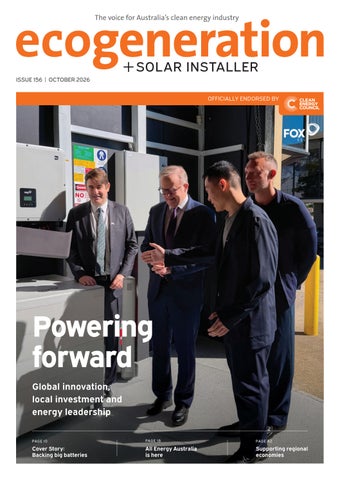
his edition of ecogeneration explores Australia’s energy transition evolution through All Energy Australia 2026, which is broadening beyond its traditional solar and storage foundations to reflect the wider energy transition. In the residential landscape, Australia’s battery boom is shifting the conversation from simply adding more storage capacity, to selecting smarter, scalable systems that can respond to changing household energy consumption. To celebrate Australia's milestone of 500,000 home battery installations driven by the Federal Government's Cheaper Home Batteries program, ecogeneration is honoured to feature the Prime Minister of Australia, Anthony Albanese, on the front cover, alongside the battery storage system technology of Fox ESS following a press conference the company hosted in August. On another important note, the momentum of the commercial and industrial (C&I) market is in its stride. This editon's cover story, Fox ESS, examines how changing Federal and state policy settings is strengthening the business case for C&I solar and battery storage. Fronius Australia and Green Energy Trading join the conversation. Meanwhile, Sungrow, Growatt, FranklinWH and SAJ Electric explore how intelligent energy management has become the expected norm. Meanwhile, SOFAR Solar highlights why ongoing installer education is the foundation for seamless clean home energy experiences. On a utility-scale, EnerVenue, Solarig and Si Clean Energy turn their attention to operations, maintenance and long-term asset performance. Specialised Energy Solutions shares how regional recruitment, procurement and skills development can ensure investment in new energy infrastructure delivers benefits to its host communities. Beyond deployment, Capral Aluminium examines the importance of independently verified environmental data, while the Italian Trade Agency shares how international manufacturing and engineering expertise can strengthen the nation’s renewable energy supply chains. Together, these stories reflect a dynamic industry assessing what comes after Australia achieves its immediate energy transition goals. We look forward to learning how this year's All Energy event contributes to these discussions.
Editor: Lavinia Hulley lavinia.hulley@primecreative.com.au
Cover image: Fox ESS Powering forward Global innovation, local investment and energy leadership PAG E 15 PAG E 10
Cover Story: Backing big batteries
All Energy Australia is here
PAG E 4 2
Supporting regional economies
ecogeneration is printed on Lumi paper which is PEFC-certified and manufactured in an ISO 14001-certified mill. Lumi paper also contains premium white waste paper, reducing matter going into landfill. This magazine is available to interested parties throughout Australia and overseas. The magazine is also available by subscription. The publisher welcomes editorial contributions from interested parties, however, the publisher and the Editorial Board accept no responsibility for the content of these contributions and the views contained therein are not necessarily those of the publisher or of the Editorial Board. The publisher and the Editorial Board do not accept responsibility for any claims made by advertisers. Unless explicitly stated otherwise in writing, by providing editorial material to Prime Creative Media, including text and images, you are providing permission for that material to be subsequently used by Prime Creative Media, whole or in part, edited or unchanged, alone or in combination with other material in any publication or format in print or online or howsoever distributed, whether produced by Prime Creative Media and its agents and associates or another party to who Prime Creative Media has provided permission.
Lavinia Hulley
Follow ecogeneration on LinkedIn
Average net distribution 6616 Period ending September 2021
Like us on Facebook facebook.com/EcoGenMag
ecogeneration acknowledges the Cammeraygal people, traditional custodians of the land on which this publication is produced, and we pay our respects to their elders past and present. We extend that respect to all Aboriginal and Torres Strait Islander people today. For the latest industry news, sign up for the FREE WEEKLY NEWSLETTER and check out our website at ecogeneration.com.au
6 | ecogeneration October 2026
www.ecogeneration.com.au
X
INDUSTRY UPDATE | CLEAN ENERGY COUNCIL
A message from Clean Energy Council As the Chief Executive Officer of the Clean Energy Council writes, Australia’s renewable energy industry is positioned to play a critical role in shaping the nation’s future economy and way of life.
A
amendments to foreign resident Capital Gains Tax measures, extending the 50 per cent concession for large-scale renewable energy infrastructure from 2030 to 2040, following sustained industry advocacy and engagement by us at Clean Energy Council (CEC) and our partners. The CEC also welcomed the Federal Government’s recent support package to secure the future of the Tomago aluminium smelter beyond 2028 through the procurement of almost three gigawatts of new renewable electricity generation and firming capacity. Developments like these demonstrate that traditional heavy industry, alongside emerging sectors
such as data centres, can help promote new renewable generation and storage that brings more power into our system, not less. Regions such as the Hunter, Gippsland and many others are being asked to host the infrastructure needed to meet our growing power needs sustainably. Working on the ground, it is evident the industry’s most valuable resource today is trust. Communities need to see tangible and lasting benefits from the billions of dollars being invested in their backyards. That is why the CEC has called for a national discussion on a Renewable Resources Payment scheme to simplify how benefits are understood by communities and ensure that the value added by the sector in the regions is properly recognised. While Australia’s clean energy story is increasingly one of progress, there are
Image: Thomas/Stock.Adobe.com
ustralia’s energy will shape not only how we power our homes and industries, but whether Australia secures a lasting competitive advantage in a rapidly changing global economy. All Energy Australia arrives at a defining moment for Australia’s renewable energy industry. The opportunities before us are growing. It is up to us to make the most of this moment. The past few months have shown that when government and industry work together, we can make real progress. We each recognise the imperative to accelerate investment in the infrastructure required to power Australia’s future. With meaningful consultation, we can take the concrete steps needed to turn vision into reality. Investment certainty has been strengthened by the Treasury’s recent
8 | ecogeneration October 2026
www.ecogeneration.com.au
CLEAN ENERGY COUNCIL | INDUSTRY UPDATE
challenges ahead. No state faces more immediate and significant decisions over the next four years than Victoria. Ageing coal-fired power stations, such as Yallourn and Loy Yang, are near the end of their operational lives. The question is not whether replacement infrastructure will be needed, but what combination of renewable generation, storage, firming and transmission will ensure Victorians continue to receive affordable, reliable power when and where they need it. The commencement of Australia’s first offshore wind auction in Gippsland earlier this year represents a major milestone and offers a glimpse of the next chapter in Victoria’s economic future. But there is much more to do. Decisions on transmission, storage and new generation are hugely consequential and will directly impact households across the state – their bills and the reliability of their power. Projects such as the Victoria to New South Wales Interconnector West, which will unlock enough electricity to power more than two million homes, will be crucial to meeting the demands of a growing state. For the next Victorian Government, energy security and affordability will be a central challenge. Victorians deserve a credible and transparent explanation of where their future electricity supply will come from, and how it will be delivered.
www.ecogeneration.com.au
We look forward to working with whomever wins this year’s election as they rise to the challenge of powering this modern state sustainably and affordably in the years to come. While the big questions about energy supply and reliability are a priority for the CEC, we are equally focused on delivering for our members. I am pleased to report that the Australian Consumer and Competition Commission has granted reauthorisation to the New Energy Tech Consumer Code administered by the CEC for the next five years. This means that the Code can continue providing strong standards and consumer protections as Australia’s market for new energy technology continues to grow. I would also like to take the opportunity to acknowledge the contribution of outgoing Clean Energy Finance Corporation Chief Executive Officer, Ian Learmonth, whose tenure concludes this year. With more than three decades of experience financing major infrastructure and clean energy projects in Australia and overseas, Learmonth has helped establish clean energy investment as a mainstream proposition, supporting the deployment of billions of dollars into projects across the country. Another leader in our field, the Hon. Lily D’Ambrosio MP, recently announced her retirement from serving as Victoria’s
Minister for Energy and Resources, Climate Action, and the State Electricity Commission. She is Australia’s longestserving Energy and Climate Minister. Over more than a decade in the portfolio, she has helped drive Victoria from a state heavily reliant on brown coal to a national leader in renewable energy, with 41.5 per cent of the state’s electricity generated from renewables in 2024-25. I wish Learmonth and D’Ambrosio all the best and would like to formally thank them for the legacy they had left behind for Australia’s clean energy future. Like us at CEC, they know that the next few years will be pivotal for the transition to clean energy around the world. But I can say with absolute confidence that there is no place I would rather be doing this work than here in Australia. The nation has all the ingredients to get this right. By working together across the sector, facing challenges head on and reminding Australians of the enormous benefits our industry brings, I know our future is bright.
Jackie Trad Chief Executive Officer Clean Energy Council
October 2026 ecogeneration | 9
COVER STORY | FOX ESS: STAND N123
Big batteries mean business With Federal Government policies now backing the commercial and industrial energy market, a new generation of scalable battery systems is rising.
A
nnounced in August 2026, Federal Minister for Climate Change and Energy Minister, Chris Bowen, shared the Federal Government’s decision to expand the Small-scale Renewable Energy Scheme (SRES). This Federal Government policy shift effectively increases the eligible solar photovoltaic (PV) system size from 100 kilowatts (kW) to one megawatt (MW). Australian businesses have installed approximately 5.6 gigawatts (GW) of solar commercially, compared with around 22 GW across the residential sector. The Federal Government expects that extending the SRES to systems as large as one MW will reduce the cost of eligible medium-scale installations by around 20 per cent. Following the Federal Government’s recent policy support for larger rooftop
solar installations across commercial, industrial and agricultural facilities, Fox ESS is positioning its commercial and industrial (C&I) energy storage portfolio to support businesses looking to generate, store and manage more energy onsite. Brooks Richard Geng, Managing Director APAC and Middle East at Fox ESS, explains that the SRES expansion, alongside developments in the New South Wales Peak Demand Reduction Scheme (NSW PDRS), presents a prime opportunity for the company to help boost Australia’s uptake of C&I energy storage. Turning the Federal Government’s policy shifts into action, Fox ESS continues to build its established residential presence to expand its C&I portfolio in Australia. “Founded in Wenzhou, China, in 2019, Fox ESS is already a trusted manufacturer
of solar and energy storage technologies for residential, commercial and industrial applications. After establishing its residential solar and battery business, the company expanded into C&I storage in 2024 as demand grew for higher-capacity systems,” Geng says. Fox ESS’s established residential business has provided a strong foundation for the company’s next chapter in Australia. “Fox ESS has achieved significant milestones in Australia’s residential energy storage market. From January to July 2026, we installed 72,371 energy storage systems, with a total installed capacity of 3.1 gigawatthours (GWh),” Geng says. Based on MWh shipments in S&P Global, Fox ESS was ranked the top provider of residential energy storage systems in Australia for the first half of 2026.
In July 2026, Fox ESS launched POWER BEAST to simplify commercial and industrial energy storage deployment.
10 | ecogeneration October 2026
www.ecogeneration.com.au
COVER STORY | FOX ESS: STAND N123
Installation case: The Fox ESS G-Max Plus Battery Energy Storage Systems installed for a C&I project in Europe.
According to Solar Nerds data, Fox ESS installations make up around 31 per cent of Australia’s residential energy storage market, demonstrating the company’s capability to expand across the C&I sector also. “Fox ESS’s C&I segment is materially developing, with solutions such as POWER BEAST and G-MAX Plus that give Australian businesses more scalable and flexible energy storage options,” Geng says. Building POWER BEAST and G-MAX Plus Central to Fox ESS’s C&I expansion is POWER BEAST, the company’s modular storage solution that launched in Australia in July 2026. The system combines the H3 Plus Hybrid Inverter with Fox ESS’s CQ7 high-voltage battery platform. H3 Plus inverter options range from 50 to 125 kW, with a single inverter supporting up to 292 kilowatt-hours (kWh) of battery capacity. Leo Ye, Australia Product Director at Fox ESS, explains that POWER BEAST was essentially developed to address the practical challenges Australians face when deploying C&I batteries. “Traditional C&I energy storage systems can be bulky, time-consuming to install and www.ecogeneration.com.au
difficult to wire, with limited flexibility in system sizing,” Ye says. “POWER BEAST was designed to solve these challenges. Built around the H3 Plus Hybrid Inverter and modular CQ7 High Voltage Battery, it’s simple to deploy, flexible to scale and powerful by design.” POWER BEAST’s modular architecture allows capacity to be tailored to individual sites, rather than requiring businesses to adopt a fixed system size. It can also integrate solar PV, batteries, backup power, generators and electric vehicle (EV) charging within a broader commercial energy system. Pairing solar PV with battery storage allows businesses to store electricity generated onsite for later use, potentially increasing self-consumption and providing greater control over when electricity is drawn from the grid. “The CQ7 can support different system sizes from 28 to 300 kWh and beyond. With the optional Dual Stack Base, the 97 kWh capacity that once required a 2.5-metre stack is now achieved in under 1.3 metres, making better use of limited space,” Ye says. “Pre-installed power and connection lines also simplify installation, while the system can scale up to 3.125 MW / 7.35 megawatthours (MWh) on-grid and 1.25 MW / 2.94
MWh off-grid.” For installers and businesses, the design effectively reduces wiring, installation time and space requirements, while allowing capacity to be adjusted to suit the site. In New South Wales (NSW), another catalyst for C&I storage is the Peak Demand Reduction Scheme (PDRS), a NSW Government initiative designed to encourage activities that reduce or shift electricity consumption during peak periods. From 1 September 2026, the new BESS4 pathway (as part of the NSW PDRS) extends this framework to eligible behind-the-meter batteries with more than 20 kWh, and up to 200 kWh of usable capacity installed by small and medium businesses. Behind-the-meter batteries are installed on the customer side of the electricity meter and can be used to manage onsite generation and consumption. This allows businesses to store energy when it is available and use it when site demand or grid electricity costs are higher. POWER BEAST’s modularity makes it particularly suited for this emerging segment in C&I battery capability. “Fox ESS has a long-term product roadmap. Our C&I portfolio was already well established before these policy changes were announced. Our solutions have already October 2026 ecogeneration | 11
COVER STORY | FOX ESS: STAND N123
Brooks Richard Geng, Managing Director APAC and Middle East at Fox ESS.
Images: Fox ESS
Leo Ye, Australia Product Director at Fox ESS.
Michelle Li, Global Marketing and Brand Director at Fox ESS,
12 | ecogeneration October 2026
gained strong traction in the European market, so we’re confident it’ll gain traction in Australia as well,” Geng says. At All Energy Australia 2026, Fox ESS will showcase its latest C&I offering, including the Australian debut of the much anticipated G-MAX Plus. While POWER BEAST uses modular battery architecture, G-MAX Plus packages the major components of a C&I energy storage system into a single outdoor cabinet. The all-in-one system integrates the battery, the battery management system, power conversion system, safety systems, power distribution, and thermal management. “POWER BEAST is a modular and flexible solution, well suited to small to mid-scale C&I projects and the PDRS BESS4 pathway,” Ye says. “And G-MAX Plus is an all-in-one energy storage solution that integrates key components into a single cabinet, simplifying installation and system deployment. It’s designed for large-scale C&I projects and is also well suited to the PDRS BESS5 pathway.” The cabinet is preconfigured during manufacturing, reflecting Fox ESS’s approach of reducing onsite installation complexity through integrated designs. “In the C&I sector, we continue to focus on delivering easy-to-install, scalable, highperformance energy storage solutions to help Australian businesses reduce energy costs and improve energy resilience,” Ye says. From policy to scale Renewable electricity demand continues to grow with the expansion of energyintensive industries and emerging demand from sectors such as data centres. This is corroborated by the Australian Energy Market Operator’s (AEMO) 2026 Integrated System Plan, which forecasts electricity consumption in the National Electricity Market to nearly double by 2050. At the same time, coal-fired generators are expected to progressively retire across Australia, requiring new generation, storage and network infrastructure. To resolve this, the AEMO identified that renewable generation supported by storage would be the least-cost pathway for maintaining a secure and reliable electricity supply through to 2050. For businesses, these broader changes are prompting them to rethink about how they generate, store and consume renewable electricity onsite to power their everyday operations. For the C&I sector, the
practical benefit of C&I batteries is that it can complement rooftop solar by shifting renewable generation to different periods of the day to backup capability where system configurations allow. With the changing policy environment gearing towards C&I battery uptake, bringing solar and storage across a broader range of commercial sites and uses across Australia is within reach. This is supported by Federal Government estimates, which show that C&I and agricultural rooftops have more than 80 GW of technical solar potential, compared with approximately 5.6 GW currently installed across Australian businesses. For a medium-sized businesses looking to install a 250 kW solar system, the Federal Government estimates the expanded SRES could reduce their upfront installation cost by approximately $68,000. However, the reform does not mean every C&I solar project below one MW will automatically qualify. For example, the Clean Energy Regulator stated that the Federal Government is currently considering additional design, installation and compliance requirements for mid-scale systems, with further eligibility information due to be released. In the meantime, Fox ESS is strengthening its position in Australia’s C&I market with a portfolio designed to accommodate a range of project sizes and system architectures. This is a key capability that will be on full display at All Energy Australia 2026. Michelle Li, Global Marketing and Brand Director at Fox ESS, says the event will also provide an opportunity to gather feedback directly from Australian users. “Most importantly, All Energy is a great opportunity for us to meet Australian installers, partners and businesses faceto-face, while demonstrating how easily our solutions can be deployed to meet user needs,” Li says. “We’re excited to turn these conversations into new opportunities for the next stage of Fox ESS’s growth in Australia.” Visitors of Fox ESS’s booth can expect to see some of its latest products; including, POWER BEAST, G-Max Plus, Avocado, Power Cube, EQ5500, Airgate, and more. “Beyond the products and solutions, we’re also bringing our Fox ESS brand experience to the show,” Li says. “Our team will be interacting with visitors throughout the event, with a range of fun and engaging activities for attendees to take part in.” www.ecogeneration.com.au
A part of
C&I Solar is evolving So are the opportunities With 19 years of experience, we help C&I Solar businesses navigate the SRES expansion, from 100kW to 1MW, stack STC and PRC incentives, and stay ahead.
500+ accredited power stations Australia's largest volume LGC accreditor
Speak to us and maximise your project value www.greenenergytrading.com.au | 03 9805 0700
SOLAR FARM SERVICES Mega Watt Power is a family-owned Australian business specialising in renewable energy design, installation, construction, and maintenance. we operate across three specialist business units: Utility-scale renewable electrical construction and servicing Electronics hardware repairs and maintenance Solar power systems sales, installation and services We employ a full-time local and remote FIFO workforce of around 50, supported by additional project staff as required. We deliver projects ranging from kilowatt systems to large-scale installations of hundreds of megawatts and bring over 36 years of proven experience in the renewable energy industry.
DC, LV & HV TEST & COMMISSIONING SOLAR FARM ELECTRICALS RECTIFICATION & REPAIRS STATCOM CONSTRUCTION HV SWITCHING & PLANNING HV TERMINATIONS IV-CURVE TESTING WEATHER STATIONS O&M SUPPORT SUBSTATION O&M TRANSFORMER TESTING BESS, INSTALLATION & MAINTENANCE
CONTACT US:
service@megawattpower.com.au www.megawattpower.com.au
02 6652 9700
ALL ENERGY AUSTRALIA | EXHIBITION & CONFERENCE 2026
To help visitors navigate the large showgrounds for All Energy Australia, RX Australia have curated three Recommended Zones for 2026.
Where the sector connects All Energy Australia 2026 is broadening its conference agenda while maintaining the solar and storage foundations of the event.
A
ll Energy Australia 2026 is just around the corner, returning to the Melbourne Convention and Exhibition Centre on 28-29 October with more than 490 suppliers and 500 speakers across more than 100 conference sessions. Robby Clark, Exhibition Director at RX Australia, says the event has evolved rapidly over the past decade, both in scale and reach. “The number of attendees has grown by the thousands year-on-year, which has just been phenomenal,” he says. “All Energy has transformed itself from being a Victorian-focused event to a national event, and now it’s an international event.” For 2026, that growth is also reflected in the breadth of technologies and industry www.ecogeneration.com.au
segments that are represented across the exhibition floor. “In the early days, solar was the leading focus. Over the last few years, we asked ourselves at RX Australia how we could grow the event to encompass the growing clean energy pipeline,” Clark says. That approach has seen All Energy Australia progressively introduce dedicated areas for different parts of the wider clean energy market. In 2019, the event strengthened its energy management and efficiency offering through a partnership with the Energy Efficiency Council. More recently, an Electric Vehicle (EV) Technology & Infrastructure area was introduced as EV uptake increased
and attention turned to the infrastructure required to support electrification. “A lot of customers were saying that it’d be great if we had more focus on EV, which is why we launched the EV Technology & Infrastructure area last year,” Clark says. In 2026, this approach will be consolidated through three Recommended Zones: EV Technology & Infrastructure, Energy Management, and Grid & Network. Each of these zones group exhibitors, technologies and education around a particular part of the energy transition, helping visitors navigate the exhibition and find the suppliers, solutions and information most relevant to their work. The Grid & Network area has undergone a October 2026 ecogeneration | 15
ALL ENERGY AUSTRALIA | EXHIBITION & CONFERENCE 2026
Solar remains central While All Energy Australia has broadened its focus across the clean energy ecosystem, solar remains a central part of the event. “Solar manufacturers, inverter companies, residential battery providers, installers and electricians continue to form a core part of both the exhibition and conference program,” Clark says. “On a residential level, we’re fortunate to have all the major solar panel manufacturers, inverter companies and battery energy storage systems on display at All Energy.” “By no means can we fall short of showcasing the residential market. It’s a massive focus area for us given its ongoing growth in the clean energy sector.” For Clark, ensuring All Energy Australia evolves alongside these changes is central to the event’s defining role. 16 | ecogeneration October 2026
“The renewable energy sector evolves at a rapid pace compared to other sectors. Every month it seems a new technological innovation emerges, or a government policy changes, for which the sector is required to understand and implement,” he says. “For this reason, we’ll be maintaining our focus on new technologies and CPD sessions for installers and electricians.” Major solar panel, inverter and residential battery manufacturers will again feature across the exhibition floor, giving installers an opportunity to compare equipment, speak directly with manufacturers about specialised methods for certain technology models, and undertake CPD onsite. “Understandably, CPD is a big selling point for installers as it’s a mandatory requirement to remain accredited under Australian regulations. In addition, designers must earn 100 CPD points annually to renew their accreditation,” Clark says. Following industry trends As always, All Energy Australia strives to be a mini two-day universe representing what is trending, in need of solving and learning. This is especially important as Australia strives towards achieving 82 per cent renewable electricity by 2030 and net zero emissions by 2050. The need to keep pace with the sector extends beyond the exhibition floor to All Energy Australia’s conference program. One of the hottest topics for 2026 is the rapid growth of data centres. The conference agenda will include sessions examining
.
energy efficiency in data centres, their implications for Australia’s energy transition, and how these facilities requiring enormous amounts of electricity will be integrated into the grid without impacting other users of the National Electricity Network. Major players in the data centre arena will be presenting at All Energy Australia this year; including, Amazon, ENGIE and AirTrunk. “We’re always on the lookout for what new topics people want to learn about to ensure our conference program is highly relevant. Data centres were the natural next step,” Clark says. Data centres will form one part of a broader program spanning 13 conference streams running concurrently across the event. Other surrounding topics will range from electrification and grid integration to startups, community engagement and First Nations participation in renewable energy project development. “At the beginning of the conference program, All Energy will be focused on the big policies and where we’re heading. Then, as we break out the conference sessions, we get into the gritty details,” Clark says. The event will also turn its attention to workforce development. A new skills and jobs area will be introduced in the foyer for 2026, laying the groundwork for a broader focus on employment, education, skills and apprenticeships in future editions. “This will provide a springboard for supporting jobs, skills, education and apprenticeships across the sector in 2027 and beyond, so watch this space,” Clark says.
Over the past decade, All Energy Australia has transitioned from a solar-focused event to the entire clean energy ecosystem across its exhibitors and conference agenda.
Images: Rx Australia
particularly significant expansion for 2026, with around 50 exhibitors added alongside a dedicated education program across two full days. That expansion reflects RX Australia’s broader strategic approach for All Energy Australia. To date, this has meant combining industry discussion with practical workshops, while also unpacking the latest developments in climate policy, grid modernisation, investment trends, and emerging technologies that underpin Australia’s energy transition. “Technology and government policies in this sector are constantly evolving, and so it’s no surprise the education aspect of All Energy is the main reason people attend,” Clark says. For the 2026 event, All Energy Australia will again partner with the Clean Energy Council to deliver its Continuing Professional Development (CPD) Masterclass. Meanwhile, Solar Victoria will host a dedicated solar industry workshop on day one. According to RX Australia, access to suppliers, technology and education is increasingly attracting installers from across Australia to All Energy, extending the event’s reach well beyond its Melbourne base. “A solar installer can go to the show over the two days and see all of the suppliers and pick up the CPD points, which are required under Solar Accreditation Australia for them to go about their business,” Clark says. “We’re actually finding that more and more installers are making the effort to fly all the way down to Melbourne, especially from South and Western Australia.”
www.ecogeneration.com.au
GROWATT: STAND R113
Sizing storage smarter Changing household demand and market conditions are prompting a closer look at what makes a battery system fit-for-purpose in the long-term.
A
ccording to SunWiz data for July 2026, the 20 to 30 kilowatt-hour (kWh) battery segment grew by 18 per cent month-on-month, overtaking the 40-50 kWh category as the largest storage segment in Australia. Lisa Zhang, Vice President of Operations and Marketing at Growatt, believes this data indicates the residential storage market is shifting away from a focus on maximum battery capacity. “The market is moving from ‘bigger is better’ to right-sizing,” she says. “Post-subsidy adjustment, the 20 to 30 kWh band overtook 40 to 50 kWh as the largest segment for the first time in Australia. This shows that households are now matching capacity to actual usage and subsidy economics.” This shift comes as batteries become a more established part of residential solar systems, allowing households to store excess rooftop generation, manage timeof-use tariffs, and reduce grid electricity consumption during higher-cost periods. Zhang adds that the changing economics of storage is also influencing competition among suppliers and installers. “Australia’s residential storage market is transitioning from subsidy-fuelled growth
to economics-driven adoption. The 20 to 30 kWh segment has become the next battleground,” she says. Designing around demand Within the changing market of residential storage, Growatt is introducing its MINA and MODA all-in-one energy storage systems to Australian households. Developed for single-phase and threephase homes, Growatt’s MINA and MODA energy storage systems integrate an inverter, modular battery storage, backup capability and energy management technology into a single architecture. MINA is available in Australia in five to 10 kilowatt (kW) power configurations, with battery capacity scalable from seven to 49 kWh. Meanwhile, MODA covers four to 15 kW three-phase applications and uses a modular storage architecture. This is specifically aimed at households with higher power requirements. According to Zhang, the emergence of the 20 to 30 kWh segment reflects a balance between usable household capacity and upfront investment. “I think 20 to 30 kWh is becoming a sweet spot because it is large enough to meet the energy needs of many Australian households
The Growatt MINA All-In-One Energy Storage System, MINA5-10K-AU.
18 | ecogeneration October 2026
Lisa Zhang, Vice President of Operations and Marketing at Growatt.
while still remaining financially accessible,” she says. “It gives households the opportunity to install enough storage to meaningfully increase their energy independence without necessarily oversizing the system.” That balance has influenced Growatt’s emphasis on modularity. Rather than requiring households to determine their maximum future storage requirement at installation, Growatt’s MINA and MODA energy storage systems allow battery capacity to be expanded as household energy consumption increases. This will become more apparent as household loads increase through their usage of renewable energy powered technologies and appliances, such as electric vehicles (EVs), electric hot water pumps and electric heating and cooling. “Scalability gives households the flexibility to match their battery capacity with both their current energy needs and their budget,” Zhang says. “For example, a customer with a lower initial budget or lower energy demand could start with a 10 kWh system and add more battery capacity later as their energy needs or budget increases.” Growatt has also sought to reduce the amount of work required for installers. MODA incorporates self-aligning connectors and wire-free battery stacking, while its integrated architecture reduces the number of separate system components. www.ecogeneration.com.au
“For installers, the modular and stackable design of MODA makes installation simpler, with less complex wiring and a more streamlined installation process. This has evidentially reduced installation times, labour requirements and overall costs.” Zhang says. MINA incorporates battery optimiser technology that manages individual battery modules to limit performance losses caused by differences in state of charge, usage history or ageing. It also enables additional modules to be incorporated as storage requirements increase. MODA extends the concept to larger three-phase applications, with three maximum power point trackers, up to 20 amperes (A) string current and 63-A, wholehome backup capability. Further, both the MINA and MODA systems incorporate backup functionality, removing the need for a separate backup box in supported configurations. The integrated Uninterruptible Power Supply (UPS) function is designed to automatically provide stored battery power to selected household circuits, such as lighting, refrigeration or other essential appliances, when grid electricity is unavailable. “The UPS capability of both the MINA and MODA systems can continue supplying power to selected loads during a blackout, giving customers greater energy security,” Zhang says. “Because the backup function is integrated into the system, household users do not need to install a separate backup box, which can reduce installation complexity and the space required.” From storage to energy management According to Growatt, as more Australian households seek to pair rooftop solar with battery storage, residential batteries are beginning to play a broader role in household energy management. For context, batteries have traditionally been primarily supported by solar energy time-shifting, storing surplus rooftop photovoltaic (PV) generation for use when solar output is lower or unavailable. Electricity generated and stored during the day, for example, can be used in the evening when household demand or electricity prices may be higher. Federal Government initiatives are also encouraging households to consider when they consume, store and export electricity. This is increasing the importance of energy www.ecogeneration.com.au
Images: Growatt
GROWATT: STAND R113
The Growatt MODA All-In-One Energy Storage System, MODA4-15K-AU.
management software and connectivity alongside physical battery capacity. The Federal Government’s Solar Sharer Offer is one example. Introduced in July 2026, the initiative provides eligible households in New South Wales, South Australia and South East Queensland with three hours of free electricity in the middle of the day. This encourages households to shift flexible loads, such as EV charging, to periods of abundant daytime solar generation. The Cheaper Home Batteries Program is also supporting greater connectivity between household batteries and the wider electricity system. Eligible on-grid batteries installed under the program must be technically capable of participating in a virtual power plant (VPP), although households are not required to join one. VPPs use software and communications technology to coordinate participating household batteries and other distributed energy resources as a fleet. This allows stored energy across multiple systems to be managed in response to electricity market or grid conditions, including by adjusting battery charging and discharging. “Over the next 12 to 24 months, I expect the battery market to move towards smarter, more connected systems and VPPs. As a result, choosing a battery system that is VPPready and capable of participating in future energy programs will become increasingly important,” Zhang says. Growatt is positioning MODA for this shift. The system is VPP-ready, while its hardware has also been designed to support 25 kW bidirectional direct current charging for future vehicle-to-grid (V2G) applications.
Unlike conventional EV charging, where electricity flows into the vehicle battery, bidirectional charging enables electricity to flow both into and out of the battery. V2G uses this capability to allow energy stored in an EV battery to be exported to the electricity grid, subject to compatible hardware, software and Australia’s current market arrangements. While MODA’s V2G capability is not yet commercially available, its inclusion reflects Growatt’s expectation that rooftop solar, stationary batteries and EVs will become increasingly interconnected within household energy systems. Growatt has operated in the Australian market for more than 15 years, supported by local technical, warehousing and service operations. Zhang explains that Growatt’s long-term presence in Australia will be useful for local clean home energy users as residential battery technologies and relevant government subsidy arrangements develop. “We design for where the market is going, not where it’s been,” she says. “We’re not just selling hardware, we’re building an ecosystem that includes smart energy management, remote monitoring and future-ready capabilities that allow households to expand storage as their usage needs evolve.” According to Zhang, the Australian residential battery market is maturing in a positive direction. “The post Federal Government subsidy adjustment we’re seeing has created a more sustainable, economics-driven market – one where quality, energy supply reliability and long-term value matter more than just chasing the biggest system,” she says. October 2026 ecogeneration | 19
20 | ecogeneration October 2026
AEA_EcoPrint_Ad.indd 1
www.ecogeneration.com.au
14/9/2026 4:51 pm
6 4:51 pm
GREEN ENERGY TRADING: STAND C118
Solar means business For Australian commercial and industrial businesses that have struggled to make the numbers stack up for rooftop solar, the equation is changing.
Green Energy Group brings together five specialist companies and more than 70 people, combining strong commercial and industrial solar expertise with capabilities across environmental certificates, energy efficiency, market intelligence, engineering, and carbon solutions.
A
ustralia’s rooftop solar market has grown rapidly, but it’s the industry’s belief that this growth has not been evenly distributed. While Australian households have installed approximately 22 gigawatts (GW) of solar, businesses with rooftop solar installed only accounts for 5.6 GW of the market. A recent expansion of Australia’s commercial and industrial (C&I) rooftop solar policy is beginning to close that gap. In August, the Federal Government announced plans to expand the Smallscale Renewable Energy Scheme (SRES), increasing the maximum eligible solar system size from 100 kilowatts (kW) to www.ecogeneration.com.au
one megawatt (MW). Under the SRES expansion, C&I businesses that want to install systems above 100 kW and up to one MW will be able to generate Small-scale Technology Certificates (STCs), allowing them to receive an upfront discount on installation costs. The Federal Government estimates the reform could reduce the upfront cost of midscale solar by around 20 per cent, including approximately $68,000 for a 250 kW system and $136,000 for a 500 kW installation. C&I market shift According to Caroline Bennett, Chief Innovation Officer at Green Energy
Group, the Federal Government’s recent announcement is already changing conversations across the C&I market. “Many rooftop solar businesses are being asked to revisit old quotes for C&I customers due to the appeal of the reduced payback period,” she says. “The Federal Government’s recent announcement is a good example of how policy can directly unlock projects that were previously marginal.” This current policy shift is particularly relevant for mid-sized businesses with sufficient roof space and the required daytime load profile to support larger systems. These types of businesses include October 2026 ecogeneration | 21
GREEN ENERGY TRADING: STAND C118
Images: Green Energy Trading
Caroline Bennett, Chief Innovation Officer at Green Energy Group.
manufacturers, warehousing and logistics operators, cold storage, and agribusiness. “Multi-site retail and commercial property owners are another group we’re seeing take another look at solar off the back of the Federal Government’s recent announcement,” Bennett says. However, upfront cost is only one factor for businesses considering larger rooftop solar installations. Access to capital, grid connection requirements and available incentives also influence investment decisions. “Long simple payback periods and competing internal access to capital has historically been the biggest barriers for businesses wanting to install rooftop solar, alongside the complexity of certificate schemes and grid connection requirements,” Bennett says. “The split incentive between tenants and landlords has historically been a barrier too. It’s great to see simple paybacks reduced.” Navigating incentives As C&I rooftop solar installation economics improve, understanding which incentives apply to individual projects has been a central focus for C&I businesses. This is 22 | ecogeneration October 2026
where Green Energy Trading comes in. Established by Ric Brazzale in 2007, Green Energy Trading helps renewable energy and energy-efficiency businesses access Federal and State Government incentives. The company does this through the creation and trading of environmental certificates. With more than 500 power stations under group’s portfolio, its C&I solar capabilities include access to incentives through all available state-based and national certificate creation methods specialising in compliance management and consistently delivered payment terms. “At Green Energy Trading, we help C&I customers, and their installation partners determine what incentives they’re eligible for, manage the certificate creation and registration process, and monetise the certificate value through the brokered market,” Bennett says. “Over our 19-year history we have built up deep operational knowledge of how to efficiently access certificate schemes and apply the most appropriate incentive opportunities specific to each customer’s business site.” In Victoria, this experience extends to the Victorian Energy Upgrades (VEU) program and Victorian Energy Efficiency Certificates (VEECs). Eligible non-residential solar projects between 30 kW and 200 kW can access upfront VEEC incentives. Systems installed in Victoria between 30 kW and 200 kW can combine VEECs with STCs or Large-scale Generation Certificates, allowing eligible projects to draw on multiple incentives. This is a significant boost for Victorian projects typically increasing the certificate revenue by at least 38 per cent compared with other states. Green Energy Trading is part of the wider Green Energy Group, which combines specialist businesses spanning certificate creation, energy-market analysis, engineering, consulting and environmental commodity trading. “The Group brings together a number of complementary specialist businesses that support customers to access incentives in different activities and jurisdictions,” Bennett says. “Green Energy Trading works together with our sister company, National Carbon Bank of Australia, to give commercial customers a single point of access to the technical/compliance processing side for value stacking activities. These activities include solar PV and battery energy storage in New South Wales, STCs, and VEECs for
solar PV in Victoria.” Alongside Green Energy Trading and the National Carbon Bank of Australia, Green Energy Markets provides energy market, policy and analytical services, while Green Energy & Carbon Management provides engineering and consulting expertise for larger energy users implementing emissionsreduction projects. Recently, Green Energy Trading expanded further into the C&I energy sector through the Green Energy Group’s acquisition of Outperformers Next. This breadth of expertise with the wider Green Energy Trading group essentially provides C&I businesses with a variety of expertise to access multiple incentives and other potential revenue streams. While the SRES expansion creates a near-term opportunity for larger rooftop solar, Green Energy Trading expects the C&I market to evolve into the battery storage space in the coming years. “The immediate near-term opportunity is helping customers access available incentives through the imminent SRES expansion and the NSW battery incentives that commenced on 1 September so that more large-scale systems get installed,” Bennett says. “Beyond that, we see batteries becoming increasingly relevant in markets like Victoria where they aren’t yet as incentivised as NSW. Installers who build capability in storage now will be well placed for that shift.” According to Bennett, solar can also provide larger energy users with a starting point for broader electrification and emissions-reduction strategies. “For large energy consumers, the opportunity isn’t just C&I solar,” she says. Bennett adds that renewable electrification is just one pillar on the decarbonisation journey. “After accessing the first incentive, energy consumers have a broader understanding of their energy use and are more tuned into the whole incentive landscape and what they could access next as schemes evolve.” Green Energy Trading sees significant opportunity to help businesses across Australia navigate that changing incentive landscape, especially as C&I energy projects expand from standalone solar towards storage and broader electrification. “As an experienced, forward-looking partner that understands the whole incentive landscape, we can help business customers make projects stack up financially today, and into the future as the rules continue to evolve,” Bennett says. www.ecogeneration.com.au
P
New and Made in Europe*: Fronius Reserva Pro.
Pros only. Our new battery storage system for large residential buildings, commercial facilities, and farms where high energy demands need to be reliably met. Specifically designed to work with GEN24 Plus & Verto Plus: Capacities ranging from 12 to 128kWh, with charging/ discharging power of up to 28.3 kW**.
* Cells and modules manufactured in the EU. ** Maximum capacities & charge/discharge power dependent on system configuration. More information: www.fronius.com.au/reserva-pro www.ecogeneration.com.au
October 2026 ecogeneration | 23
FRONIUS AUSTRALIA: STAND HH113
SMEs: A growth opportunity for installers Small to medium-sized enterprises (SMEs), from medical centres to retail stores, are turning to distributed energy resources to cut their utility costs.
Matching solar generation with daytime energy use can deliver significant benefits for agriculture businesses.
A
ustralia’s small and medium-sized enterprises (SMEs) are finally getting its time in the distributed energy transition spotlight. From medical centres and pharmacies to retail stores, workshops and professional offices, SMEs often combine strong daytime electricity demand with suitable rooftop space for solar photovoltaic (PV). Despite this potential, SMEs remain one of the least developed areas of Australia’s rooftop solar market. Rod Dewar, Head of Solution Management at Fronius Australia, believes unused commercial rooftop space across the roofs of SMEs, combined with energy price pressures and improving battery economics, will provide the runway for commercial and industrial (C&I) rooftop solar to take off. “Commercial rooftop solar remains significantly underpenetrated compared with residential installations, which is a shame because millions of square metres of commercial roof space remain unused across Australia,” he says. Matching solar with business Announced in August, the Federal Government made an increase to the 24 | ecogeneration October 2026
maximum eligible solar PV system size from 100 kilowatts (kW) to one megawatt (MW) under the Small-scale Renewable Energy Scheme (SRES). This policy shift aims to make rooftop solar adoption financially attractive for SMEs, farms, community facilities, and public buildings. “Medical centres, pharmacies, retail stores and workshops typically operate during daylight hours, which means their peak electricity consumption coincides with peak solar production. And so, it’s really a no brainer for SMEs to adopt rooftop solar,” Dewar says. The type of load differs considerably between businesses. Medical centres depend on heating, ventilation and air conditioning, lighting, computers and medical equipment, while pharmacies can require temperaturecontrolled storage. Retail stores can have substantial lighting, cooling and refrigeration requirements, while workshops experience concentrated demand from machinery, compressors, tools, and ventilation. For installers, these different operating profiles make accurate solar generation system sizing essential.
“There can be many limiting factors when determining the optimal system size, with available roof space often being one of them,” Dewar says. “Many SME sites can only accommodate around 30 to 40 kW of solar, and sometimes even less, despite having energy consumption that could support a larger system size.” Rather than simply maximising installed capacity, Dewar says system design should consider consumption patterns, available rooftop space and the financial objectives of the business. “Ultimately, commercial businesses want a highly targeted solar solution that maximises financial returns,” he says. From generation to management Battery storage adds another dimension to the SME energy proposition. Businesses can use storage to increase onsite consumption of solar, reduce grid purchases during expensive periods and manage demand peaks. In suitable configurations, batteries can also support critical loads during outages. “The greatest value from battery storage comes when businesses look beyond simple energy arbitrage,” Dewar says. “C&I battery storage can help SMEs reduce peak demand charges, avoid high electricity prices, maximise the value of their rooftop solar, and provide backup power during outages.” These benefits are particularly relevant to businesses where even a temporary loss of electricity could disrupt critical operations, such as pharmacies storing temperaturesensitive medicines or medical centres relying on life-saving equipment. “For businesses like these, the combination of cost savings and operational resilience can make battery storage a highly compelling investment,” Dewar says. Fronius is targeting the SME segment in Australia through an integrated energy ecosystem; comprising, the Verto Plus www.ecogeneration.com.au
FRONIUS AUSTRALIA: STAND HH113
Images: Fronius Australia
commercial inverter, Reserva Pro battery storage system and the Wattpilot Flex smart electric vehicle (EV) charger. The Reserva Pro can be scaled from 12 kilowatt-hours (kWh) to 128 kWh. When combined with the Verto Plus, the result is high charge and discharge rates to manage demand spikes during peak usage periods. Dewar explains interoperability between different energy assets is becoming more important as businesses increasingly install storage and EV chargers. “With the onset of more and more EVs being purchased and customer requests for faster charging, export limits and import limits both need to be flexible,” he says. “When using different vendors for inverters, batteries and EV chargers, this interoperable control is extremely difficult.” Using an integrated system can enable solar generation, storage, EV charging and business loads to be coordinated through a common energy management approach. “Having one vendor for this makes life much easier,” Dewar says. This capability could become increasingly relevant as SMEs electrify their vehicle fleets. The Australian Renewable Energy Agency estimates that 410,000 Australian businesses operate fleets of fewer than 100 vehicles, with the cost and complexity of charging infrastructure remaining key barriers to electrification. Adding EV charging also changes the way a business consumes electricity, requiring designers to consider charging demand alongside solar generation, batteries, existing
www.ecogeneration.com.au
loads and network capacity. “We’re no longer designing just powerproviding products or systems, but energy management systems,” Dewar says. “Now, C&I systems need to be more flexible than ever when it comes to controls and user settings in order to adapt to the wide range of use cases of users.” This means C&I solar system designers need to understand how customers want energy to move between different assets, including whether stored electricity should be used to charge vehicles. “The designer needs to take into account how the customer would like to manage their energy – not just how they want to make it,” Dewar says. For SMEs without dedicated energy management teams, the increasing sophistication of these systems also makes energy supply reliability, monitoring and ongoing support important considerations. “This is important because most SMEs lack dedicated facilities or energy management teams, they need systems that are reliable, easy to monitor and backed by long-term warranties and local support,” Dewar says. “Installers need to understand the customer’s load profile, operating costs, demand charges, resilience requirements and future electrification plans, and then design an energy solution around those needs.” Access to capital, financing and uncertainty around returns remain barriers to SME investment. However, Dewar explains that the solar
industry’s recent focus on the residential battery boom may have diverted required attention to C&I rooftop solar adoption across SMEs. Engaging the SME market will require a different kind of conversation compared to the residential market. For example, the business case for SMEs is centred around operating costs, system reliability, future energy requirements and financial return. “Therefore, ramping up SME uptake isn’t only about Federal Government incentives. It’s also about installers having the confidence to engage these customers with a compelling business case that suits their commercial needs,” Dewar says. With the SRES expansion set to increase activity across larger commercial rooftops, Dewar cautions installers against underestimating the additional engineering, time and workforce requirements involved in C&I projects. For solar businesses looking to expand beyond residential solar PV installations, the C&I sector offers a natural pathway for growth without requiring them to take on larger-scale projects they may not yet be prepared for. “We believe the SME segment is a good middle point for installers,” Dewar says. To provide SMEs with an opportunity to explore Fronius Australia’s complete C&I solar PV and battery storage range, the company will be showcasing its solutions at the All Energy Australia 2026 conference and exhibition in Melbourne.
The Fronius Reserva Pro battery system pairs with the Verto Plus inverter to support the growing energy needs of farms and commercial businesses.
October 2026 ecogeneration | 25
ITALIAN TRADE AGENCY: STAND S123
Italy meets Australia Italy’s manufacturing expertise intersects with Australia’s energy ambitions as six technology companies arrive at All Energy Australia seeking new partnerships.
B
ehind new solar farms, battery projects and industrial decarbonisation initiatives sits a growing requirement for transformers, switchgear, manufacturing capability, recycling infrastructure and technologies capable of supporting the physical buildout. It is within this changing market that the Italian Trade Agency (ITA) will return to All Energy Australia for the third consecutive year, connecting six Italian technology companies with Australian developers, engineering, procurement and construction (EPC) contractors, utilities and other industry participants. ITA established its first dedicated pavilion at the Melbourne event in 2024 with eight Italian companies, before expanding its presence to 12 exhibitors in 2025. Alessandro Lamura, Italian Trade Commissioner and Director at the ITA in Sydney, shares that the agency’s third appearance is intended to position Italian manufacturers as potential long-term partners in Australia’s energy transition. “Through our third consecutive appearance at All Energy Australia, the ITA aims to position Italy not merely as an exporter of goods, but as a strategic engineering partner for Australia’s renewable energy future,” Lamura says. “As far as the electromechanical industry www.ecogeneration.com.au
Alessandro Lamura, Italian Trade Commissioner and Director at the Italian Trade Agency (Sydney office).
is concerned, Italy is the second-largest production hub in Europe after Germany.” That manufacturing base extends across technologies needed throughout the electricity supply chain, giving the ITA an opportunity to present the pavilion as more than a collection of individual suppliers. “At this year’s pavilion, we’re showcasing this technological leadership by bringing end-to-end solutions that directly address the most acute operational bottlenecks in the local market, from severe transformer supply shortages to impending state-level e-waste mandates,” Lamura says. Strengthening the supply chain In the ITA’s view, Australia is undergoing one of the most rapid and complex grid transformations globally. “With an estimated 11 gigawatts of coalfired generation retiring and being replaced by decentralised renewable energy and battery storage, the demand for electrical infrastructure has reached unprecedented levels in Australia,” Lamura says. For Lamura, one of the clearest implications is growing demand for the equipment sitting between new generation and the electricity network. “Because decentralised renewable systems require 1.5 to three times more transformers than traditional centralised generation,
Australia’s reliance on imports for these components is projected to reach $1.45 billion by 2026,” he says. “The global lead time for large transformers has extended dramatically – often taking between 18 months and four years – which threatens to stall the momentum of Australia’s energy transition.” Interestingly, three of the six companies exhibiting through the Italian Pavilion are positioned directly within this grid infrastructure market. Established in 1985, C.R. Technology Systems specialises in electrical infrastructure for renewable and conventional energy projects, with a particular focus on solar photovoltaic (PV) and battery energy storage system (BESS) projects. Celme Transformers has manufactured transformer technology since 1964, supplying equipment for PV, wind, hydrogen and industrial applications. Fellow transformer manufacturer GBE brings around 40 years of experience across transformers and reactors, with its liquidimmersed transformer capability extending to 50 megavolt-ampere (MVA). “For heavy grid connection, C.R. Technology Systems provides fully equipped modular eHouses and medium-voltage switchgear, while its GBE and Celme Transformers bring decades of expertise in customised transformers and reactors, with GBE offering bespoke solutions up to 50 MVA and 145 kilovolts,” Lamura says. “Italian manufacturers offer a reliable, vertically integrated alternative to secure these critical supply chains.” For Australian developers and EPC contractors, this means greater diversity within its supply chains to better support project delivery. “By partnering with Italian manufacturing firms, Australian developers can secure reliable supply chains for critical balance-ofplant components,” Lamura says. “This can effectively help bypass global bottlenecks that currently threaten to inflate capital expenditures and delay commercial operation dates.” October 2026 ecogeneration | 27
ITALIAN TRADE AGENCY: STAND S123
Building a circular transition The rapid increase in renewable technology uptake is also creating another challenge: What happens to equipment when it reaches the end of its operating life. Australia’s large installed solar base means growing volumes of modules will require testing, reuse, recycling or disposal over the coming decade. According to the ITA solar panel waste is predicted to reach 91,165 tonnes by 2030 and an estimated 280,000 tonnes by 2035. Fittingly, Ecoprogetti brings a manufacturing and circular economy focus to the wider ITA group and the Australian renewable energy market. Founded in 1998, Ecoprogetti designs machinery and turnkey production lines for solar module manufacturing, testing and recycling, and has delivered more than 150 production lines globally. “On the solar front, as states like Western Australia implement strict e-waste regulations prohibiting the disposal of solar panels in landfills, Italian innovations in automated PV testing and recycling lines present a highly lucrative opportunity to scale local waste management and resource recovery operations,” Lamura says. “Importing Italian expertise in industrial decarbonisation and lifecycle management will allow Australia to scale its renewable
buildout sustainably, turning looming liabilities – like thousands of tonnes of endof-life solar panels – into valuable resource recovery streams.” The Italian Pavilion also extends beyond electricity infrastructure into technologies targeting industrial decarbonisation. For example, Mabre has specialised in biomass-fired air heaters and boilers since 1972. Its systems convert biomass and agricultural or industrial by-products including wood chips, sawdust, pellets, olive waste and nut shells into thermal energy for applications, such as industrial process heat, agricultural drying and heating. Furthermore, Redecam Group focuses on industrial air-pollution control and wasteheat recovery, delivering more than 3,300 solutions across six continents. Redecam Group technologies include filtration, flue-gas treatment and heatrecovery systems for industries such as power generation, biomass, waste-to-energy, cement, and metals. “For hard-to-abate industries, Mabre provides highly efficient biomass-fired boilers that convert agricultural by-products into clean thermal energy, and Redecam Group supplies globally recognised air pollution control and waste heat recovery systems for heavy industry,” Lamura says. Together, the six companies that make up
the Italian Pavilion demonstrate the breadth of Italy’s technological capabilities, spanning renewable energy generation through to the practical work of connecting, operating and ultimately recycling Australia’s energy infrastructure to support the nation’s net zero goals. However, Lamura explains that accessing the Australian market brings its own technical challenges. “The Australian energy market is characterised by geographical vastness and some of the strictest grid connection regulations in the world,” he says. “Navigating rigorous national standards, such as ensuring equipment behaves predictably in a highly decentralised grid, requires exhaustive dynamic modelling, compliance testing and localisation.” For the ITA, the longer-term objective is to turn those introductions into partnerships that combine Australian project pipelines with Italian manufacturing and engineering. “Stronger collaboration can effectively merge Australian project development pipelines and abundant renewable resources with Italy’s deep industrial heritage, rapid manufacturing capacity and bespoke engineering,” Lamura says. “Ultimately, this bilateral partnership de-risks investments and accelerates the physical deployment of Australia’s renewable energy infrastructure.”
Images: Italian Trade Agency
The Italian Pavilion at All Energy Australia 2025.
28 | ecogeneration October 2026
www.ecogeneration.com.au
Safe & Stable 16x Tier 1 LFP cells per battery, all with individual temperature monitors.
Maximum Flexibility AC-coupled, fully compatible with all solar inverter brands.
Built for Australia IP67 waterproof, C5 salt-resistant, automotive-grade durability.
Smart Management Battery, gateway, generator/V2L and Smart Circuits for set-and-forget peace of mind.
Booth www.franklinwh.com/au
HH135
info-au@franklinwh.com
SOFAR SOLAR: STAND DD113
SOFAR Solar offers residential solar and energy storage solutions including its ESI hybrid inverter ranges, BTS5K highvoltage battery and upcoming CBS5000 battery system.
Keeping installers current New technology is transforming the Australian home energy system. In turn, this is raising the bar for those tasked with installing it.
I
nstalling rooftop solar is no longer just about panels and inverters. As more Australians adopt clean energy technologies, installers are having to keep pace by expanding their knowledge of battery configuration, backup power, energy management systems and evolving regulatory standards. For SOFAR Solar, the growing technical complexity of the home clean energy landscape is strengthening the case for taking product education directly to where installers are. From July to August, the solar and energy storage technology company joined its authorised Australian distributor, Sunsavers Group, on the Smart Energy Council’s Smart Installer Roadshow, travelling through Perth, Townsville, Sydney and Melbourne. Freddy Chen, Technical Service Manager for Australia at SOFAR Solar, explains that the roadshow was a prime opportunity to move beyond product specifications, and speak directly with the people installing and commissioning energy systems for Australian homes. “Maintaining regular, face-to-face 30 | ecogeneration October 2026
dialogue with installers is central to how we refine our local technical support and product offering,” he says. Founded in Shenzhen, China in 2013, SOFAR Solar develops solar photovoltaic (PV) and hybrid inverters, battery energy storage systems and monitoring solutions for residential, commercial and industrial and utility-scale applications. Australia was one of SOFAR Solar’s earliest international markets. Since entering the country, the company has expanded its local presence through technical teams, service infrastructure and warehousing, while making installer education a key focus through three to four monthly training sessions with the Solar Training Centre. The Smart Installer Roadshow extended that approach into four Australian markets, giving installers face-to-face access to technical presentations, product discussions and continuing professional development (CPD) opportunities. From specifications to installations In Sydney and Melbourne, Smart Installer Roadshow discussions centred around
SOFAR Solar’s residential energy storage offering and how the company’s new system capabilities translate into practical installation outcomes. SOFAR Solar used the roadshow to introduce its ESI-8-12K-S1 single-phase hybrid inverter series, including a 9.99 kilowatt model, alongside the ESI-5-12K-T1 three-phase range. “Installers were particularly interested in the specifications and practical functionality of those models,” Chen says. “Their questions focused on configuration and compatibility, including the up-to-three maximum power point tracking design, Arc-Fault Circuit Interrupters protection, IP66-rated enclosure and how these features translate into real installation outcomes.” Both ranges offer flexible all-in-one or split installation options, with each providing different capabilities. The singlephase ESI-8-12K-S1 features an integrated multi-function energy management system and can switch between on-grid and off-grid operation in four milliseconds, while the three-phase ESI-5-12K-T1 supports 100 per cent three-phase unbalanced loads. www.ecogeneration.com.au
SOFAR SOLAR: STAND DD113
Listening to installers While the Smart Installer Roadshow gave SOFAR Solar an opportunity to demonstrate their latest technology to installers, it was not a one-way conversation. According to Chen, installers consistently raised two competing considerations: Reducing the amount of work required onsite, and delivering residential systems capable of meeting complex household energy requirements and consumption. “Installers are consistently looking for ways to reduce installation times onsite, while homeowners want confidence that a system can meet household energy needs and reduce energy costs,” he says. “Appearance, available space and backup for critical loads during an outage were also raised as important considerations.” This feedback from installers means manufacturers need to consider installation requirements alongside the experience of the www.ecogeneration.com.au
eventual system owner. “Good product design must balance these two perspectives,” Chen says. “At SOFAR Solar, we aim to make systems easier to install without compromising structural safety or system performance.” Chen points to SOFAR Solar’s BTS5K highvoltage residential battery as an example. The battery platform can support single and three-phase systems, standalone HYD inverter installations with future battery expansion, direct current and alternating current coupling, and parallel operation. “This gives household users higher alternating current output, stronger backup capability and scalable battery capacity, while keeping inventory management simpler for installers,” he says. During the July to August roadshow in Melbourne, installers were also given an early look at SOFAR Solar’s upcoming CBS5000 battery system ahead of its introduction to the Australian market. Importantly, Chen affirms that feedback gathered during the Smart Installer Roadshow will be actioned by SOFAR Solar’s local team. “SOFAR Solar’s local product managers have consolidated and shared these insights with our product team in our central headquarters for review,” he says. According to Chen, this process has already influenced accessory releases and software updates. Feedback that cannot be addressed within existing hardware or software will instead be considered when future product generations are developed. This feedback loop will likely become more important as batteries increasingly interact with electric vehicle (EV) chargers and other electrified household loads.
“As batteries, EV charging and household electrification become more interconnected within residential systems, installers will need a strong grasp of Australia’s codes and standards,” Chen says. “Keeping up with standards takes time and effort, but correct, compliant installation is essential. This ensures systems can perform as designed and deliver the outcomes customers expect.” For SOFAR Solar and Sunsavers Group, the end of the July to August Smart Installer Roadshow does not mark the end of important installer conversations. SOFAR Solar has continued its installer engagement through CPD training in Adelaide and Brisbane and will return to another four Smart Energy Council Installer Roadshow locations in November. Before then, the company will exhibiting at All Energy Australia at the Melbourne Convention and Exhibition Centre, allowing local installers to see the next stage of its Australian product portfolio. “At booth DD113, we’ll introduce the new PowerIn Series, designed for residential and commercial PV and battery energy-storage applications,” he says. “We’ll also display commercial EV charger and battery cabinet solutions.” For Chen, these industry events form part of the company’s broader strategy towards stronger installer engagement beyond product launches and training sessions. “The feedback we continue to receive from installers will inform our technical support, product planning and market activity in the long-term, as well as our regular product updates focused on supporting the everevolving needs of Australian households and installers,” he says. Images: SOFAR Solar
Facilitated by SOFAR Solar, Smart Installer Roadshow conversations extended beyond headline inverter specifications. “One feature that generated strong interest was automatic state-of-charge balancing between individual battery blocks in SOFAR Solar battery systems. Installers wanted to understand how this function supports balanced system operation over time,” Chen says. Installers already familiar with SOFAR Solar equipment showed strong interest in hearing from other installers and homeowners about their experiences with the technology and its performance. “Many participants asked for Australian case references to better understand how different configurations perform under local conditions and whether particular systems were suited to specific household requirements,” Chen says. Such conversations were particularly poignant with technical requirements varying between jurisdictions. “Different states and local markets have their own requirements and rules. The recurring challenge is navigating Australia’s rigorous standards for battery products and installations,” Chen says. For Chen, meeting regulatory requirements go hand-in-hand with product development and education. “Installers need robust education on both local regulations and manufacturer installation manuals to ensure compliant, reliable operation and to protect their customers’ property,” he says.
The Smart Installer Roadshow brought solar and battery installers together from across Australia.
October 2026 ecogeneration | 31
SUNGROW: STAND KK123
Changing the home energy equation The Australian home is becoming its own energy ecosystem, driving demand for storage solutions like Sungrow PowerHarbour, that go beyond charging and discharging.
A
ustralia’s residential battery market is expanding rapidly. By August 2026, more than 500,000 household battery systems had been installed under the Federal Government’s Cheaper Home Batteries Program, with recent installation trends putting the total on track to approach 550,000 by October. At the same time, battery systems are becoming larger, reflecting growing household demand for greater energy storage capacity. Naturally, as battery uptake has grown, household electricity demand has also increased with the greater use of electric vehicles (EVs), electric hot water, heating and cooling. In response, Sungrow is preparing to launch its PowerHarbour allin-one residential energy storage system in Australia at All Energy 2026. First unveiled at Intersolar Europe 2026 in Germany, PowerHarbour combines a hybrid inverter, modular battery storage and energy management within a single system. Scott Su, Engineering and Technical Services Director at Sungrow Australia, shares that the company is developing
different system configurations to meet varying household requirements. “We continually seek to diversify and complement our product strategy in Australia to meet the varying energy needs of households,” he says. “This means investing in and developing our modular residential energy storage solutions that allow households to expand batteries to the capacity they require. We’re very proud to have achieved a battery capacity of up to 120 kilowatt-hours (kWh) through PowerHarbour.” Built to grow with the home PowerHarbour has been designed around a modular architecture, with inverter power ratings between 5-30 kilowatts (kW) and storage capacity scalable up to 120 kWh. This offers a highly competitive usable capacity per module. “This flexible capacity range allows homeowners to start small and expand later as their renewable electricity consumption grows, especially as their usage of EV charging and heat pumps grows to cut their energy costs,” Su says.
“While Australian households are increasingly adopting larger battery systems, most residential installations remain in the tens of kWh. PowerHarbour extends well beyond this range, with up to 120 kWh of storage capacity available in a single system. This gives households with higher energy consumption significantly more room to store and use renewable energy, particularly as electrification accelerates with the growing adoption of EVs, heat pumps and other highload appliances,” Su says. For installers, Sungrow has also sought to simplify deployment through a modular plugand-play architecture. Beyond rooftop solar Federal Government guidance encourages households to maximise the use of their own rooftop solar generation, with batteries providing a way to store excess electricity generated during the day for use at other times. PowerHarbour’s direct current (DC) coupled architecture enables simultaneous photovoltaic (PV) charging and grid charging, with a combined battery charging power of up to 2.6 times the inverter rating. This
Sungrow has unveiled PowerHarbor, its brand-new all-in-one residential battery energy storage.
32 | ecogeneration October 2026
www.ecogeneration.com.au
Images: Sungrow
SUNGROW: STAND KK123
On 28-29 October, attendees of this year’s All Energy Australia will be able see Sungrow PowerHarbour up close.
allows excess solar energy to be captured and stored rather than curtailed during peak generation periods, while also taking full advantage of the increasingly common three to four hour free electricity windows offered by Australian retailers. By combining available PV generation with grid energy, the battery can be recharged significantly faster, ensuring more stored energy is available for evening consumption and maximising overall energy savings. For households, the value of consuming their own generation is also changing as the amount paid for exported rooftop solar declines in many parts of the country. “Feed-in tariffs continue to decline across many regions, making exported solar energy less valuable than before,” Su says. “By using more of their own solar generation, households can maximise energy savings, reduce reliance on the grid and improve their return on investment.” To help households make the most of their solar generation, PowerHarbour combines higher-capacity storage with intelligent energy management. In a compact dongle form factor, iHomeManager Mini provides data collection and communication functions similar to Sungrow’s Logger1000, with artificial intelligence powered energy management capabilities for the home. It integrates weather, solar generation and household load forecasts to help determine when energy should be stored, used or supplied to the home. The system works alongside the upgraded iSolarCloud platform, giving homeowners greater visibility and control over their energy use. www.ecogeneration.com.au
The same charging and discharging capabilities have also been designed to support participation in virtual power plants (VPPs). “PowerHarbour is designed to maximise energy flexibility for both homeowners and VPP operators,” Su says. This allows stored household energy to be more readily dispatched when requested through a VPP or required to support the grid. In turn, households can readily participate in VPP dispatch events and grid support services. This compact design allows EnergyBridge to be installed directly within the existing distribution board, reducing wiring complexity and installation requirements. Compared with conventional box-type backup gateways, EnergyBridge is up to 99 per cent smaller by volume and occupies just four to six distribution-board poles, compared with around 14 poles for conventional solutions. Although Sungrow supports an integrated approach to energy storage systems, Sungrow does not see PowerHarbour as replacing existing residential storage systems already available to Australian consumers. “For us, it’s not about choosing one product architecture over another. Instead, it’s about building a more comprehensive product portfolio that can address different household requirements, residential conditions and energy needs,” Su says. PowerHarbour is also designed with future system flexibility in mind. Its modular top-unit inverter can be configured with a switchgear that connects
to the DC connectors of Sungrow’s existing all-in-one systems, allowing additional PowerHarbour storage capacity to be added to an existing installation. This provides Australian households with a more flexible pathway to expand their energy storage as household needs grow, without necessarily replacing their existing solar and energy system. For Sungrow, maintaining both architectures is intended to give households greater choice as residential electricity requirements evolve. “We want to give Australian consumers the flexibility to choose the solution that best fits their lifestyle and energy needs,” Su says. PowerHarbour will make its Australian debut at All Energy Australia 2026, alongside Sungrow’s other latest technologies; spanning, residential, commercial and industrial (C&I), and utility-scale solar and energy storage. “Visitors can expect far more than the launch of the new PowerHarbour all-in-one residential energy storage solution,” Su says. For Sungrow, this year’s All Energy industry event is a chance to get feedback on how the company can continue to advance its residential batteries. “We’re looking forward to connecting with installers, distributors, partners and industry professionals from across Australia,” Su says. “We can’t wait to share our global technological insights, as well as build our understanding of the evolving policy landscape in Australia to support the nation’s energy transition.” October 2026 ecogeneration | 33
SAJ ELECTRIC: STAND M143
Thinking beyond capacity As batteries become a more common fixture in Australian homes and businesses, smarter management of stored energy is emerging as the next frontier.
Samil Ouyang, Chief Executive Officer at SAJ Electric.
A
ccording to the Australian Energy Market Operator (AEMO), close to 250,000 grid-connected distributed battery systems were operating across the National Electricity Market (NEM) at the end of the 2023-24 financial year. By June 2026, AEMO announced that more than 400,000 home batteries had been installed during the previous 12 months alone. For Samil Ouyang, Chief Executive Officer at SAJ Electric, the scale of Australia’s residential storage market represents both an opportunity and a challenge for suppliers. “The market volume is very good, but on the other side it’s very competitive, especially residential storage,” he says. “Australia is now one of the biggest residential storage markets, so we need to provide something different. Otherwise, the 34 | ecogeneration October 2026
competition becomes focused only on the lowest price.” Established in Guangzhou, China in 2005, SAJ develops solar inverters, battery energy storage systems and smart energy management technology that is distributed to over 80 countries. The company entered the Australian solar market in 2013, before establishing SAJ Digital Energy Australia in 2019 to strengthen its local sales, technical support and operations. Its involvement in residential storage began before the current market expansion, with SAJ introducing residential storage products into Australia from 2018. As the battery storage sector continues to mature, Ouyang explains that changing household energy profiles are placing greater emphasis on the way solar, batteries and electrical loads are managed as one system. “When we look at the whole residential energy system, we need to think about battery technology, but we also need to think about different loads, such as heat pumps and electric vehicle (EV) chargers, as well as think about the utility side,” he says. SAJ’s residential portfolio combines hybrid inverters, modular battery storage and intelligent energy management, allowing surplus rooftop solar generated during the day to be stored for later consumption. This can reduce reliance on electricity derived from the grid during periods of higher tariffs, while increasing the proportion of rooftop solar consumed onsite. Building on this foundation, SAJ’s elekeeper is an intelligent energy management platform designed to optimise how solar energy and battery storage are used. At its core, AI Saving uses AI to analyse solar generation, electricity prices, power consumption and battery status, anticipate changing energy conditions, and dynamically optimise battery charging and discharging while taking energy needs and system constraints into account. “Improving hardware efficiency by even one per cent is difficult, but our software can deliver much greater gains – potentially improving system performance by 10 or 20 per cent. That can translate into meaningful
electricity cost savings for customers,” Ouyang says. The SAJ system is designed to forecast solar production alongside electricity buying and selling prices and can anticipate household loads, allowing stored energy to be scheduled around self-consumption requirements and changing Federal and State government electricity tariffs. That capability is becoming more relevant as electricity pricing becomes increasingly dynamic and household loads become more complex through the usage of electric home technologies, such as EVs, heat pumps and other commonly used appliances. “We can do a solar generation forecast, a buying-price forecast and a selling-price forecast. We also forecast the loads – when you may charge the car or use the heat pump – and then we schedule the system based on that information,” Ouyang says. SAJ is also developing AI Keeper within the elekeeper, which Ouyang describes as an interface intended to simplify interaction with residential energy systems. Rather than requiring customers to navigate multiple applications and settings, AI Keeper is continuing to be developed to allow users to interact with their energy system through more intuitive commands. “We believe the future is to keep interaction with these machines and systems easy, especially for users who have less technical knowledge. The best way is through language and voice interaction,” Ouyang says. C&I on the rise While residential batteries are expanding rapidly, storage is also becoming an increasingly important component of commercial and industrial (C&I) energy systems. The AEMO does not publish an equivalent standalone installation figure for C&I behind-the-meter batteries. However, the AEMO has highlighted the growing use of onsite generation, storage, controllable loads and energy management systems among large electricity users. Battery investment more broadly has also expanded substantially. www.ecogeneration.com.au
SAJ ELECTRIC: STAND M143
The SAJ energy ecosystem — from energy storage and inverters to intelligent energy management with elekeeper.
www.ecogeneration.com.au
EK90 and EK70 series solutions, alongside the latest version of AI Keeper. Ouyang shares that these products form part of SAJ’s broader strategy to tend to the mid-to-premium range section of the Australian storage market, rather than competing primarily on upfront costs. “We want to compete in the Australian market through long-term value over a battery’s use, rather than price,” he says. That approach extends beyond individual product specifications. “At SAJ, we don’t just believe in the quality and longevity of the product, but also on how we work with distributors, retailers and end users. We strive to continuously improve our technology without increasing the price. This is especially important for
our C&I customers, so they can keep their operational costs down” Ouyang says. As rooftop solar and flexible electricity consumption grows, batteries have become central to integrated energy systems that manage when electricity is generated, stored, consumed or drawn from the grid. This shift means the next stage of Australia’s storage market does not just depend on battery capacity, but also on how effectively that energy can be managed. SAJ strives to keep up with these market shifts and Federal Government regulations. “The energy sector in Australia changes very quickly, so our product strategy and our business strategy also need to keep evolving. We’re excited to take on this challenge,” Ouyang says. SAJ’s elekeeper is an AI-powered energy management platform that intelligently monitors and optimises solar generation, battery storage, and energy use across residential and commercial applications. .
Images: SAJ Electric
Projects within the NEM connection pipeline increased from 9.2 gigawatts (GW) at the end of 2023 to 18.1 GW at the end of 2024. And, by the first quarter of 2026, batteries represented around half of the NEM’s 67.3 GW project pipeline. For businesses, battery storage serves a similar purpose to residential systems: Maximising the value of onsite generation while reducing reliance on costly electricity from the grid. SAJ’s C&I offering combines battery storage, power conversion and energy management technology with commercial solar systems. This allows businesses to store excess solar energy and use it when onsite demand is higher or grid electricity is more expensive. The SAJ system can also adapt to peak demand periods of the grid, and depending on its configuration, SAJ’s system can provide backup power during grid outages. Ouyang explains that SAJ is receiving strong interest from Australian users in its C&I storage offering. At All Energy Australia 2026, the company plans to showcase its latest CH3 C&I hybrid solution alongside its new residential products and tried and tested energy management technology. “We’re excited to launch the full range of our products from our new C&I and residential solutions range for the Australian market at All Energy,” Ouyang says. The residential display will include SAJ’s
October 2026 ecogeneration | 35
FRANKLINWH: STAND HH135
Surviving Australian conditions A home battery is a long-term investment, placing greater emphasis on how systems are engineered to perform throughout their operating life.
A
ccording to the Department of Climate Change, Energy, Environment and Water, Australia’s shorter winter days, as well as reduced solar generation, can limit the surplus rooftop energy available to recharge household batteries. For battery manufacturers, these seasonal conditions highlight a broader challenge: Ensuring systems designed and tested under controlled conditions can maintain their performance over a decade of use. Andrew Mitchell, Senior Product Manager for Australia and New Zealand at FranklinWH, explains that this requires residential battery systems to be engineered around the conditions that they are likely to encounter in the field. “Data sheets are one thing. It’s easy to pass a test in laboratory conditions, but it’s very hard to meet those specifications in the field,” he says.
According to FranklinWH, there is a lot of research and development and bill-of-materials costs required to allow its technology to perform to its nameplate in the field. “Lithium-ion, and in fact many chemical storage technologies, are highly sensitive to temperature. There are a lot of constraints and considerations that need to go into how the product is specified to perform and how it will perform in real life,” Mitchell says. FranklinWH has sought to address these conditions through different approaches to temperature management within its home energy management and storage system. Its Australian offering combines the aPower battery with the aGate energy management controller and FranklinWH App. The current aPower provides 15 kilowatt-hours (kWh) of usable storage and five kilowatts of continuous power per unit, with up to 15 batteries connected to one aGate for as much as 225 kWh of storage.
In colder environments, FranklinWH’s system uses active heating to bring the battery cells into an appropriate operating range before charging. “We’ve implemented active heating. That means the cells can be preconditioned, similar to an electric vehicle,” Mitchell says. “If you tell a smart electric car you’re driving to a charge station, it’ll prepare the cell pack for fast charging. We have similar technology that allows the cells to be preconditioned for solar or grid charging.” While active heating addresses conditions at the lower end of the temperature range, FranklinWH takes a different approach to managing heat. The aPower is specified to operate between -20 and 50 degrees Celsius and carries an IP67 weatherproof rating, with passive thermal management used instead of fans or liquid cooling systems. “We’ve chosen to incorporate passive cooling into our technology,” Mitchell says.
The FranklinWH System is a fully integrated home energy management and storage solution with two core components: The aGate and the aPower.
36 | ecogeneration October 2026
www.ecogeneration.com.au
“Rather than introduce a point of failure for the sake of density or footprint, we’ve gone with a slightly larger unit, so more heat sinking, to allow that heat to be conducted out of the unit into the surrounding environment.” However, managing the effect of temperature on the battery itself is only one part of preparing a household energy system for summer. Heatwaves can increase electricity consumption as households rely more heavily on air conditioning, while bushfires, storms and other extreme events can disrupt network infrastructure. For Mitchell, these unique Australian conditions mean a battery needs to be considered as part of a broader household energy system, rather than simply as a fixed amount of stored electricity. “Our system is designed to maintain power to the home and maintain the peace-of-mind to the customer that their air-conditioner will still run, even if the grid fails,” he says. That capability depends not only on the amount of energy stored in the battery when an outage begins, but also on whether the household can replenish that energy while disconnected from the grid. FranklinWH’s alternating current coupled architecture allows the system to work with compatible existing and new solar installations. During a grid outage,
continued access to rooftop generation can allow the battery to recharge during daylight hours, extending the period a household can operate independently of the grid. “Assuming the sun is shining for a period of that outage, you can top your battery up every day,” Mitchell says. “With a battery installed, you can live your self-consumption routine off-grid. The supply challenges actually come when there’s no sunlight.” It is during prolonged periods without sufficient solar generation that another layer of backup can become important. FranklinWH’s aGate provides generator integration, allowing an additional source of energy to be used when extended cloud cover or severe weather restricts rooftop solar generation. “You can input a petrol or diesel generator into our system, although you wouldn’t use it routinely. It’s there as an additional backup if you lose power, which can be particularly useful for rural households where outages tend to be more common,” Mitchell says. Reliability beyond installation Designing for these operating conditions also has implications beyond the household. For installers, the reliability of a battery system over its service life is important, as it can influence their amount of time spent returning to completed installations to resolve technical issues. “One of the things our installers love is that they rarely have to return back to an installation site. This is because our hardware can withstand extreme weather over 12 years,” Mitchell says. According to FranklinWH feedback, installers tend to engage with a product that costs more upfront because they know over the lifetime of the installation they won’t have to go back. “Installers that understand what it means to have low maintenance have been highly engaged with our solutions,” Mitchell says. The same focus on long-term performance is reflected in FranklinWH’s warranty. The latest 15 kWh aPower X-02-AU is covered for 12 years or 60 megawatt-hours (MWh) of aggregate energy throughput, whichever occurs first, with at least 70 per cent of rated capacity guaranteed at that point. Engineering for the long-term Supporting that warranty requires reliability to be considered at the individual cell level as well as across the wider battery system. FranklinWH attributes the longevity of its
www.ecogeneration.com.au
Images: FranklinWH
FRANKLINWH: STAND HH135
Andrew Mitchell, Senior Product Manager for Australia and New Zealand at FranklinWH.
technology in part to cell-level monitoring designed to identify potential problems before they affect the wider pack. “We put a temperature sensor on each and every cell, which is not, from my knowledge of the market, common practice by any means,” Mitchell says. “We monitor all of our 16 cells in our product, which allows us to indicate early signs of imbalance or localised issues, and we can immediately quarantine those and manage those.” For Mitchell, that becomes particularly important when designing a product backed by a 12-year warranty, as faults need to be identifiable and manageable well beyond the first few years of operation. “Should a fault occur in year 10, where one cell’s got some issues, we can not only identify that, but quarantine it as well and take necessary actions fast,” he says. Ultimately, FranklinWH’s approach reflects a series of engineering decisions about where additional complexity is warranted and where simplicity may support reliability. Active heating, for example, is used to address cold-weather charging, while passive thermal management avoids introducing additional cooling components at higher temperatures. “Active heating and cooling, for example, all of those are trade-offs because they add cost and they also introduce points of failure. Our philosophy is rather than introduce a point of failure for the sake of density or footprint, we’ve gone with a slightly larger unit,” Mitchell says. For Australian households and installers, these decisions are intended to ensure the FranklinWH system can operate through different temperatures, varying household energy use and grid conditions throughout its operating life. October 2026 ecogeneration | 37
UTILITY-SCALE | SI CLEAN ENERGY
Why electrical instruments matter Image: Si Clean Energy
Before an electrician can trust a reading, they need to trust the instrument behind it. Si Clean Energy is specialising in the precision work that makes that possible.
Si Clean Energy using electrical instruments on a solar farm to test, commission and monitor equipment, diagnose potential faults and safety risks, and verify overall electrical performance.
F
or electricians working across Australia’s renewable energy sector, confidence in electrical system measurements is paramount. From verifying solar photovoltaic (PV) strings during commissioning to testing insulation resistance on a utility-scale solar farm, electrical instruments underpin many of the decisions made during the installation, operation and maintenance of renewable energy assets. For Peter Bulanyi, Founder and Managing Director at Si Clean Energy, ensuring electrical instruments remain accurate has become a natural extension of a business built around electronics and solar technology since 1989. “We have an electronics lab here in Coffs Harbour that’s very well equipped to do this calibration work. It’s of a scientific nature, so it’s the next thing along from regular electronics servicing,” he says. Electrical instrument calibration involves checking measurement equipment against a traceable reference standard to determine whether its readings remain within the required tolerance. Depending on the instrument and results, this can also involve adjustment or repair. In renewable energy, the process applies to equipment including multimeters, clamp meters, insulation resistance testers and specialised PV testing instruments used 38 | ecogeneration October 2026
throughout installation, commissioning, maintenance and fault finding. Bulanyi explains that the distinction between everyday electrical testing and calibration lies largely in the level of precision required. “Our electrical calibration services are a laboratory style of work, so we’re interested in precision,” he says. “If you have a field instrument or an electrician’s instrument, it has a certain accuracy. The instruments that are used to calibrate that are many times more accurate than that.” Si Clean Energy’s precision extends from instruments commonly found in an electrician’s toolkit through to specialised equipment used on utility-scale renewable energy projects. “A regular multimeter is a very typical instrument that every electrician will have. That’s their day-to-day meter,” Bulanyi says. “The clamp meter is what they use for measuring current. Sometimes a clamp meter is a combination multimeter as well. The stock-in-trade instrument for an electrician, being a multimeter or a clamp meter, is something we can carefully test and calibrate.” Si Clean Energy can also calibrate insulation resistance testers, including the higher-voltage instruments used on largescale solar projects.
“Our expert team can also provide calibration services for 5000 Volt (5kV) units and 10,000 Volt (10kV) units used on solar farms,” Bulanyi says. On a utility-scale project, these instruments can be used to check PV strings, test insulation integrity, assess electrical systems and support commissioning before equipment is energised. They can later be used during scheduled maintenance and fault finding to help identify problems or underperforming equipment. Among Si Clean Energy’s more specialised technical capabilities is the careful calibration of PV string current-voltage, or IV curve testing equipment. The company has worked with Solmetric IV curve testing equipment since becoming its Australian partner in 2009. When Fluke acquired Solmetric in 2023, Si Clean Energy continued supporting the technology under the Fluke banner and is now also a Fluke sales distributor. “Some of the instruments, in particular the IV curve testing instruments, are quite unique,” Bulanyi says. “There aren’t too many laboratories in Australia with the capability to test and calibrate those. Typically, we’re talking about the Fluke PVA-1500, which is widely used across the industry.” IV curve testing is used to assess the electrical performance of PV modules, strings and arrays. Bulanyi explains that calibrating the IV curve testing equipment requires an understanding of more than voltage and current measurement alone. “It’s not just the electrical side of the instrument that has to be calibrated, but there’s also the PV array sensor side of it,” he says. The PV array sensor measures the irradiance of the sun, the temperature from the back of the solar panels and the tilt of the solar panels. “These additional inputs are part of the IV curve testing system, in addition to the voltage measurements and current www.ecogeneration.com.au
SI CLEAN ENERGY | UTILITY-SCALE
measurements performed by the IV main unit,” Bulanyi says. For Si Clean Energy, that specialised capability has developed alongside almost four decades of involvement in Australia’s solar industry. The business, established by Bulanyi and his wife Lee in 1989 began with off-grid solar installation and inverter servicing before expanding into solar engineering, product distribution and technical support. As its wholesale operations grew, the installation and project side of the business was separated out and became Mega Watt Power. Today, Mega Watt Power undertakes residential, commercial and utility-scale installation, commissioning, maintenance, testing and diagnostics, while Si Clean Energy provides product support. This includes electronics repair, calibration, spare parts and specialist technical instrument sales and services. While those field capabilities increasingly sit within Mega Watt Power, the Coffs Harbour electronics laboratory has remained central to Si Clean Energy. That laboratory is also where IV curve
www.ecogeneration.com.au
testers are regularly returned for calibration. Bulanyi explains that the calibration period for the Fluke and earlier Solmetric models the company services is two years. Multimeters, clampmeters and insulation resistance testers usually take one year. “In the lead-up to the due date, a window of opportunity will appear where the instrument can be sent away for calibration,” he says. “It will come into the lab and we’ll do the job, provide the certificate of calibration and send the unit back. Then we do it all again in one or two years’ time.” Traceability is central to that process. Rather than simply comparing one instrument with another, the reference equipment used for calibration must be linked through a chain of measurements to an established source of accuracy. “We want to provide the clients and customers with certainty that when they get an instrument calibrated by us, they can trust that it is as we say it is,” Bulanyi says. “The instruments that we’re using to do the calibrations have to be the right ones and in turn themselves are traceable, which is a
keyword. Calibration is about the unbroken chain of traceability all the way back to the source realisation of the physical quantity being calibrated.” For solar businesses managing different sets of test equipment, maintaining electrical instrument accuracy also requires planning. One of the simplest measures is maintaining an asset register recording each instrument and its next calibration date, with alerts well ahead of expiry. “Across the majority of solar farms, you can’t use an instrument unless it’s got a valid calibration,” Bulanyi says. “Even if it’s a simple spreadsheet and somebody is keeping an eye on that, calibrations can be managed and instruments sent away in an orderly fashion, not at the last minute.” Care between calibrations is equally important. For Bulanyi, calibration brings Si Clean Energy back to the electronics expertise on which the company was originally built. “After 37 years in business, we’re proud to have sustained our reliable service and relationships with customers,” he says.
October 2026 ecogeneration | 39
UTILITY-SCALE | CAPRAL ALUMINIUM
Putting lower-carbon claims to the test
Capral Aluminium produces aluminium extrusions across six manufacturing plants in Australia.
As embodied carbon moves up the construction agenda, independently verified environmental data is changing how materials are assessed and specified.
A
ccording to the Green Building Council of Australia, architects, engineers, builders and specifiers need data that quantifies the environmental impacts of construction products across a project or building’s lifecycle. These products include aluminium, steel, concrete, timber, insulation, and cladding. Environmental Product Declarations (EPDs) provide this information using a Life Cycle Assessment (LCA) carefully conducted against defined Product Category Rules (PCRs) and standards. An EPD is an independently verified document that reports quantified information about the environmental impacts of a product across defined stages of its lifecycle. Independent verification checks the LCA, underlying data, data handling and individual EPDs to confirm the information meets these requirements. As one of Australia’s largest aluminium suppliers and extruders for over 90 years, Capral Aluminium manufactures and supplies products for construction, transport and industrial sectors. To provide customers with transparent environmental data, Capral Aluminium is now independently verifying EPDs for its LocAl® and LocAl® SG lower-carbon aluminium extrusion ranges. The declarations provide lifecycle assessment data covering the cradle-to-gate environmental impacts of the products, from raw material supply through to manufacturing, known as lifecycle stages A1-A3. 40 | ecogeneration October 2026
Kellie Moore, Marketing Manager at Capral Aluminium, explains why the company identified the need to develop into the EPD certification space for its construction partners. “As an industry, we’ve reached a point where customers quite rightly expect more than broad sustainability claims,” she says. “Industry want independently verified information that they can confidently use in project specifications, Green Star submissions and embodied carbon reporting. Our new EPDs provide exactly that.” From lower-carbon claims to evidence Capral Aluminium’s LocAl® EPDs are prepared in accordance with robust and internationally recognised ISO 14025 and EN 15804 standards. This provides a consistent methodology for assessing and communicating environmental performance of building materials to customers. The product-specific declarations are published through The International EPD® System, with Capral Aluminium’s EPDs also available through EPD Australasia. The importance of product-specific declarations lies partly in the ability to move beyond generic industry averages when assessing the embodied carbon associated with a project. Product-specific lifecycle information gives project teams a clearer understanding of the environmental impact of the materials they are considering.
Brendon Orth, Specification Manager at Capral Aluminium, explains how the expectations of Australian construction companies have evolved. “Sustainability conversations have matured significantly over the past few years,” he says. “Customers are asking better questions. They want to understand how environmental impacts have been measured, what standards have been applied and whether the information has been independently verified. That’s exactly where the industry should be heading.” According to Capral Aluminium, Green Star certification, government procurement requirements and corporate environmental, and social and governance commitments are among the factors increasing demand for credible environmental information. Moore shares that the expectations of construction companies is also changing around embodied carbon measurement. “Architects, developers and manufacturers are being asked to measure and report embodied carbon with far greater accuracy than ever before,” she says. “Whether they’re pursuing Green Star certification, responding to government procurement requirements or meeting their own environmental, social and government commitments – reliable product certification data has become essential.” Building on LocAl® Capral Aluminium’s LocAl® lower-carbon aluminium range provides extruded www.ecogeneration.com.au
CAPRAL ALUMINIUM | UTILITY-SCALE
Images: Capral Aluminium
aluminium supported by an Aluminium Stewardship Initiative-certified supply chain. The range gives customers an option to reduce the embodied carbon associated with the aluminium used in their projects, while maintaining local supply, quality and product performance. According to Moore, what customers expect from lower-carbon products will continue to evolve. “When we introduced LocAl®, our goal was to give Australian manufacturers and builders a practical way to reduce embodied carbon without compromising quality, performance or local supply,” she says. “That hasn’t changed. What has changed is the market’s maturity. Sustainability conversations have evolved from asking whether a product is lower carbon to asking for the evidence behind those claims.” Product-specific EPDs represent the next stage of that process. Rather than asking customers to rely solely on a lower-carbon designation, the declarations provide independently assessed environmental information that can be incorporated into project documentation and assessment. This distinction becomes especially important as the construction industry strives to reduce embodied carbon. While operational emissions traditionally receive significant attention, the carbon associated with manufacturing and supplying building materials increasingly forms part of the sustainability equation. Access to product-specific data helps project teams compare materials and understand the consequences of specification decisions with greater accuracy.
Capral Aluminium’s LocAl® low-carbon aluminium offers a reduced carbon footprint, supported by independently verified environmental performance data.
www.ecogeneration.com.au
“We want our customers to have confidence not only in the aluminium they’re purchasing, but also in the environmental information that supports it,” Moore says. “Transparency builds trust. By making independently verified lifecycle data available, we’re giving architects, manufacturers and specifiers the confidence to make informed decisions knowing the information has been assessed against internationally recognised standards.” However, EPDs provide only one part of the environmental information increasingly requested by the construction sector. To appease construction company needs across these different certification and disclosure frameworks, Capral Aluminium provides several layers of environmental documentation across its portfolio. This environmental documentation includes EPDs, Declare labels and Aluminium Stewardship Initiative (ASI) certification. Further, the company holds certification against the ASI Performance Standard and ASI Chain of Custody Standard, while its Australian manufacturing credentials are supported through its partnership with the Australian Made Campaign. Orth explains that combining these different forms of documentation gives project teams a broader understanding of the products they consider. “Each of these certifications provides a different piece of the sustainability picture,” he says. “An EPD tells you about environmental performance. Declare lables provides transparency around material ingredients. ASI demonstrates responsible sourcing and production throughout the aluminium value
chain. Together, they give customers a more complete understanding of the products they’re specifying.” Capral Aluminium believes that this distinction is important because no single environmental credential captures every aspect of sustainability. Together, these frameworks help architects, engineers and contractors across Australia to assess products against different project objectives, rather than relying on a single sustainability claim. For Australian manufacturers, this also greatly raises the standard of evidence expected when communicating environmental performance. “Sustainability isn’t about making the biggest claim,” Orth says. “It’s about providing credible product information that stands up to scrutiny. By openly sharing independently verified environmental documentation, Capral Aluminium is helping customers make informed decisions with confidence.” Capral Aluminium expects demand for this information to grow as sustainability reporting becomes more data-driven and the construction sector increases its use of embodied carbon. For specifiers, access to consistent and independently verified information makes environmental considerations easier to incorporate alongside the traditional requirements of cost, performance, compliance and availability. For manufacturers, this shift creates greater responsibility to substantiate environmental claims with evidence that can be scrutinised and compared. “We see these documents as tools for enabling architects, engineers and builders to confidently specify products, meet project requirements and support their own sustainability objectives,” Orth says. Ultimately, Capral Aluminium sees providing EPD information for construction materials as a key part of its role as a trusted Australian manufacturer. With more than 90 years of experience manufacturing aluminium extrusions for the nation’s construction, transport and industrial sectors, Capral Aluminium is equipped for the task. “Our role isn’t simply to manufacture aluminium extrusions. It’s to help customers build better projects,” Moore says.” “Providing credible environmental information supports the future of Australian manufacturing and sustainable construction.” October 2026 ecogeneration | 41
REGIONAL IMPACT | SPECIALISED ENERGY SOLUTIONS
A team of Specialised Energy Solutions electricians and tradespeople celebrating a successful day of operations at an Australian battery energy storage system, solar farm and substation project.
Backing regional Australia The legacy of a renewable energy project is measured not only in megawatts, but also in the skills, businesses and regional connections it leaves behind.
A
ustralia’s energy transition is increasing demand for utilityscale infrastructure and the skilled workers, suppliers and contractors needed to deliver it. For Australian-owned Specialised Energy Solutions (SES), which provides electrical, mechanical, construction, commissioning, operations, and maintenance services to renewable energy and infrastructure projects, that demand is creating opportunities to develop skills locally. Encouragingly, Aaron Mulhall, Chief Executive Officer at SES, affirms workers can enter the utility-scale renewable energy sector without previous experience in the sector. “There’s a lot of transferable skills that people bring to SES from adjacent industries 42 | ecogeneration October 2026
like construction and mining. Because utility-scale renewable projects require specialised knowledge, we invest in project and technology-specific training when people join us, regardless of their previous experience,” Mulhall says. Kane Williams, Executive General Manager – Construction Operations at SES, shares the company is currently recruiting electricians from residential and commercial backgrounds from across Australia. “We want to find people that match our work ethic and company culture of collaboration and continuous learning on the job,” he says. That approach is intended to increase the pool of workers capable of delivering projects as renewable energy technologies and
construction requirements change. “Upskilling Australia’s existing workforce will ensure that the renewable energy sector is self-sustaining in the long-term. Renewable energy technologies and project requirements continue to evolve rapidly, so we need our people to be willing to keep learning on-the-job,” Mulhall says. Sourcing closer to the site Training workers to enter renewables is one part of the workforce challenge. Retaining those skills and providing pathways into more senior roles is another. Mulhall points to an SES apprentice who relocated from Queensland to Wollongong while completing his qualification that has since moved into a leading-hand position. www.ecogeneration.com.au
SPECIALISED ENERGY SOLUTIONS | REGIONAL IMPACT
“He left home, moved down, proved himself on-the-job, and has found himself on the pathway to a leadership position within a couple of years. Like I said, at SES we believe in dedication and hard work, not necessarily your sector experience before joining us,” he says. That same focus on workforce development applies when SES moves between projects across regional Australia. Williams shares that recruiting locally can reduce the need to fly in workers into remote regions that SES has contracted projects. “We have a fairly expansive work area within Australia, and so we always have to look for local people, which is sometimes hard to find in some remote places. But there are definitely people out there,” he says. For example, on a major BESS project near the Australian Capital Territory, SES recruited and trained between 20 to 30 workers from the surrounding region. In turn, this bolstered local employment and skills that can be carried into future renewable energy projects. SES applies a similar approach to procurement, using regional suppliers where they can meet project requirements. “We buy as much supplies as possible within the local area of a project. It’s
beneficial for us and obviously the community as well,” Williams says. According to SES, the benefit of buying local is also practical. Regional suppliers can provide materials quickly when project requirements change, while relationships established with new local workers for one project can continue into a future contract in the local area. For example, while working in the Riverina, New South Wales (NSW), SES developed a relationship with an electrical wholesaler in Wagga Wagga that has since stayed on as a trusted supplier for SES’s broader project portfolio. SES has taken that same local sourcing approach to its manufacturing and fabrication practices. Mulhall recalls a regional project where electrical boxes were required at short notice. Rather than sourcing them from overseas, which would have been cheaper, a local electrical wholesaler connected SES with a business capable of manufacturing them nearby instead. “In the end, it was actually quicker than having to outsource volume from overseas,” he says. On another project, SES worked with a Newcastle (NSW) workshop to fabricate
brackets and modify equipment locally rather than returning components overseas. “Over the last couple of years, we’ve built a network of small engineering and manufacturing firms that can produce what we need at short notice. It benefits the regional economy, SES, and ultimately, the clients whose projects we’re delivering,” Mulhall says. For SES, these examples demonstrate that local procurement does not have to come at the expense of project delivery. In some cases, having regional businesses available can shorten lead times, while directing project expenditure towards Australian suppliers and manufacturers. Building regional networks Interestingly, local sporting competitions have become one of SES’s main avenues for making connections with new employees and suppliers residing in the rural areas their contracted projects are based. Since the business began in 2022, SES has sponsored rugby league, cricket, soccer, golf and other regional events, with Mulhall estimating the company has invested just under $300,000 to date. In Queensland, SES was a platinum sponsor of GH United at the 2025 Gordonvale Indigenous Rugby League
Specialised Energy Solutions was a proud Platinum Sponsor of the Gordonvale Indigenous Rugby League Carnival, held in Gordonvale, Queensland.
www.ecogeneration.com.au
October 2026 ecogeneration | 43
REGIONAL IMPACT | SPECIALISED ENERGY SOLUTIONS
Images: Specialised Energy Solutions
The national project footprint of Specialised Energy Solutions.
Carnival. GH United, established in honour of Gail Hine and Grace Hoffman, went on to win the tournament. SES has also supported cricket in Armidale, sporting events in the Riverina and soccer, alongside country convoy events in regional communities. “Getting involved in local team sports has been an effective way to start conversations and build connections within local communities,” Mulhall says. “All of a sudden, you meet someone on the sporting field whose brother, sister or cousin is a sparky or an apprentice, or someone who wants to start an apprenticeship.” SES’s involvement in sporting events also extends beyond the communities where it delivers renewable energy projects. In 2026, SES was a gold sponsor of the TradeConnex Golf Day, which traditionally attracts participants from construction, infrastructure and energy industries. Its most technologically aligned sponsorship is Airspeeder Team Australia. SES became an official supplier to the Australian team in 44 | ecogeneration October 2026
“I’m proud to see the revenue we generate reinvested into workforce training and Australian communities, because the return in team and community spirit is tenfold.” Aaron Mulhall, Chief Executive Officer at Specialised Energy Solutions
2026, providing renewable power support as it competes in the international electric vertical take-off and landing racing series. For Mulhall, this sporting partnership connects the company’s electrical and renewable energy experience with another emerging Australian technology sector. “It’s been awesome sponsoring Team Australia in the world’s first flying race car series,” he says. SES’s range of sporting sponsorships reflects its broader business objective: Maintaining relationships with the industries and communities for which SES recruits to make its regional utility-scale projects a success. “Sporting culture coincides with SES
culture. It’s about turning up for each other, doing the hard yards for each other, and then celebrating our wins at the end of the day,” Williams says. That investment sits alongside the company’s spending on workforce training, regional procurement and local manufacturing as its project portfolio grows. For Mulhall, reinvesting revenue in those areas is part of building the workforce and supply base needed for Australia’s expanding renewable energy sector. “I’m proud to see our revenue reinvested back into our people and communities. The return isn't just commercial, you see it in capability, opportunity, team culture and community spirit ,” he says. www.ecogeneration.com.au
ADVERTISE IN AUSTRALIA’S LEADING VOICE IN THE CLEAN ENERGY INDUSTRY. EXPERT COVERAGE OF THE PROJECTS AND DEVELOPMENTS THAT ARE RESHAPING THE AUSTRALIAN ENERGY MARKET.
23,000+
COMBINED CIRCULATION
Our magazine, e-newsletters and website are valued at all levels of the industry, from financiers and developers to installers and suppliers. As the energy market transitions to renewables, our readers look to ecogeneration. ecogeneration is the only title in Australia to cover all aspects of the clean energy industry; delivered across print, online and email. The bi-monthly magazine, officially endorsed by the Clean Energy Council, keeps the industry informed from the boardroom to the work van. The print and digital magazine, and pass on rate, has a combined circulation of more than 23,0000, as well as receiving extra distribution at important industry events.
For more information, please contact: Nick Lovering Business Development Manager nick.lovering@primecreative.com.au 0414 217 190
BESS | ENERVENUE
Preventing BESS hazards The utility-scale battery energy storage industry is looking beyond fire mitigation to how risk can be addressed at its source.
A
ustralia commissioned two gigawatts (GW) and 5.1 gigawatthours (GWh) of grid-scale battery energy storage systems (BESS) during 2025, according to the Clean Energy Council. This represents a 233 per cent increase on the previous year. As BESS deployment increases with Australia’s clean energy adoption, the way large-scale battery projects interact with surrounding communities, emergency services and planning authorities is attracting greater scrutiny from the Federal Government, industry and planning bodies. Henning Rath, Chief Executive Officer at EnerVenue, believes the BESS sector needs to focus on how to reduce the likelihood of inevitable BESS incidents, as well as how it manages such consequences. “The industry’s usual answer is that failure is rare, and that is true. Electric Power Research Institute’s database shows the rate of BESS failure incidents fell by 99 per cent between 2018 and 2025,” he says. “However, low probability of risk does not settle the potential dire consequences if the worst case were to happen.” That distinction is particularly relevant right now, as BESS move into regional areas where emergency response capabilities to fire hazards, water availability and road access can differ substantially from metropolitan locations. Because of this, Australian fire authorities continue to develop more detailed expectations around large-scale battery installations. For example, Fire and Rescue New South Wales published guidance around emergency planning and the storage of lithium-ion batteries. Meanwhile, Victoria’s Country Fire Authority (CFA) guidance covers fire safety considerations, including site design, emergency access, firefighting water supplies, vegetation management and more. For Rath, these measures are important, but fundamentally represent mitigation once a particular battery chemistry has already been selected. “Almost everything the industry calls fire safety is mitigation. Separation distances, 46 | ecogeneration October 2026
suppression, setbacks, emergency plans; these all assume fire happens and then we manage the impacts after the fact,” he says. “In my view, effective planning for fire hazards should take place much earlier than most developers think.” Aerospace chemistry provides a solution Founded in 2020, EnerVenue is an energy infrastructure company developing nickel-hydrogen energy storage technology for grid-scale, commercial and industrial applications. Its research and development operations are based in Fremont, California,
while manufacturing takes place in Changzhou, China. EnerVenue’s battery chemistry has its origins in the aerospace sector, with nickel-hydrogen technology used in applications including the Hubble Space Telescope and International Space Station. But historically, platinum catalysts made the technology too expensive for widespread terrestrial use. Research led by Professor Yi Cui at Stanford University sought to address this limitation by reengineering the chemistry using lower-cost materials. EnerVenue was subsequently established to commercialise the technology through its Aqueous Metal Cell.
Henning Rath, Chief Executive Officer at EnerVenue.
www.ecogeneration.com.au
ENERVENUE | BESS
Images: EnerVenue
Process equipment at EnerVenue’s manufacturing line in Changzhou, China. Every machine on the line was specified for the company’s Aqueous Metal Cell.
“We’re not trying to build a better lithiumion battery. We’re building storage that behaves like infrastructure: 30,000 cycles, a thirty-year design life, no augmentation and zero risk of fire from thermal runaway,” Rath says. The Aqueous Metal Cell uses a waterbased, non-flammable electrolyte. According to EnerVenue, the chemistry does not undergo the progression of exothermic reactions associated with thermal runaway that can lead to ignition and propagation between cells in conventional lithium-ion systems. “The practical consequence is that there is no propagating battery fire to suppress,” Rath says. “Where a jurisdiction codes suppression, we fit it, because that’s a local code requirement and not a change to our system. Where a particular code doesn’t require it, none is needed.” To provide greater assurance around fire safety, EnerVenue’s battery cells have completed cell-level UL 9540A testing, which evaluates the potential for thermal runaway and fire propagation in BESS. According to EnerVenue, the testing resulted in zero fire propagation, with further testing at the rack and system level currently underway. Rath advises BESS developers to better understand how battery chemistry can influence project design, including separation distances, emergency planning, www.ecogeneration.com.au
hazard assessments and land requirements. “The chemistry sets what the emergency plan has to contain, what separation the fire authority will look for, what the hazard analysis has to model, how much land the buffer consumes and how long the assessment runs,” Rath says. Developers make that choice inside the stage where Australian projects lose the most time. The Australian Energy Market Operator (AEMO) reports that the median duration of the developer-led proponent implementation phase increased from 14 to 18 months, with almost one-third of projects remaining in this stage for more than two years. “This shows that the battery chemistry BESS developers use is a critical consideration for fire safety, and everything downstream of that choice is consequence management,” Rath says. Beyond safety, EnerVenue is positioning the same chemistry for longer-duration storage. Its Aqueous Metal Cell can be configured for applications ranging from 45 minutes to 12 hours using the same underlying cell, with a rated 30,000-cycle, 30-year design life. Rath acknowledges that the Aqueous Metal Cell has a higher upfront cost and lower energy density than lithium-ion. “The selling point of the Aqueous Metal Cell is its total cost over thirty years, with no need to fund a replacement or factor an augmentation cycle into the implementation
plan,” he says. “We’re building a battery that behaves like infrastructure. Thirty years in, it’s still doing the job with the cells you installed on day one.” EnerVenue’s longer-duration capability comes as Australia’s storage requirements evolve. For example, the AEMO’s 2026 Integrated System Plan forecasts a need for 35 gigawatts of short and medium-duration storage and five gigawatts of long-duration storage by 2050. EnerVenue sees regional Australia as being particularly suited to its BESS technology, with the company already supplying the Australian market through Perth-based AVID, with Western Australia based Horizon Power among its customers. For utility-scale BESS developers in Australia, Rath affirms that technology selection is the determinant when it comes to addressing the practical challenges of operating and maintaining assets in remote areas of Australia. “The BESS site that’s hardest to reach with a fire appliance is usually the site that’s hardest to reach with a replacement rack, and where outages cost the most,” Rath says. “The solution is choosing a battery cell that needs no augmentation, carries no suppression requirement and runs from minus 20 to plus 60 degrees celsius in a container on a low auxiliary load. Importantly, this ultimately optimises a given BESS’s operating model, rather than just the bill of materials.” October 2026 ecogeneration | 47
O&M | SOLARIG
Managing multi-technology renewable assets As solar, storage, wind and high-voltage infrastructure converge, a new approach to operations and maintenance is taking shape among utility-scale project developers.
R
enewable energy developers and asset owners are increasingly deploying solar, battery energy storage systems (BESS), wind and highvoltage infrastructure in both standalone and hybrid configurations. When these technologies are co-located, they may share grid connections, plant controls and electrical infrastructure, increasing flexibility while also creating new operational interfaces. Mariano Martínez Larcuen, Asia-Pacific Energy Services Director at Solarig, shares that this transition is greatly influencing the company’s Australian strategy. “In Australia, our current focus is to build on our leadership in solar operations and maintenance (O&M), while expanding our capabilities into BESS, wind and high-voltage services in line with where the sector is heading,” he says. “Utility-scale projects in Australia are moving toward a multi-technology model, where solar, storage, wind and high-voltage infrastructure operate as one integrated system rather than separate assets. That shift changes what O&M needs to look like. The focus moves from maintaining individual components to optimising how they perform together.” A changing O&M market As hybrid and co-located projects become more common, the need for integrated O&M capabilities is increasing. Wood Mackenzie’s Global Solar
Photovoltaic (PV) O&M Service Provider Dynamics 2026 report assessed 348 gigawatts (GW) of solar PV capacity under O&M at the end of 2025. Notably, the report recorded a 61 GW increase in solar PV capacity under O&M during 2025. The top 15 providers accounted for 41 GW of this growth, taking their combined portfolios to 200 GW, or 57 per cent of the assessed market. Solarig is ranked fourth globally among solar PV O&M providers, according to Wood Mackenzie’s 2026 report. The company’s growth was particularly strong in Australia, where its capacity under O&M increased by 34 per cent during 2025, following the addition of 3.2 gigawatts-direct current. Solarig was also ranked first among PV O&M providers in Australia. Solarig has operated in Australia since 2018 and now manages more than two GW of renewable assets under O&M across five states. Globally, its portfolio exceeds 16 GW of renewable assets and five gigawatt-hours of BESS. As the market grows and utility-scale projects incorporate a broader mix of technologies, Martínez Larcuen affirms that the role of O&M providers is becoming more complex. “The objective for O&M providers isn’t simply to add different services. It’s now about developing the technical capabilities to understand the whole asset and bringing together the expertise, infrastructure and operational resources needed to manage it,” Martínez Larcuen says.
“As projects become more complex, having different providers responsible for different technologies can create more interfaces for the asset owner to manage.” This becomes particularly important as projects move from engineering, procurement and construction into longterm operation, when monitoring, field services, performance and compliance must be coordinated across the asset. “A multi-technology approach can simplify that structure,” Martínez Larcuen says. “Following this approach, you can coordinate monitoring, field services and technical expertise across the project and have a more complete understanding of grid availability, performance and compliance.” Managing the interfaces The importance of coordination becomes particularly evident when generation and storage share grid infrastructure. For example, a solar farm and BESS operating through the same connection point may rely on common high-voltage infrastructure, power plant controllers, supervisory control and data acquisition (SCADA) systems. A fault or constraint in one of these systems can therefore affect the performance of the wider project. For battery assets, that visibility also needs to extend its battery management system and phase change material performance, cell health, degradation and throughput. This allows operators to distinguish between an isolated battery issue
Solarig’s Ross River Solar Farm in Queensland, Australia.
48 | ecogeneration October 2026
www.ecogeneration.com.au
Images: Solarig
SOLARIG | O&M
Mariano Martínez Larcuen, Asia-Pacific Energy Services Director at Solarig.
and a wider plant or grid-interface problem. “When you have solar and BESS sharing infrastructure, you can’t always look at the operation of each technology independently,” Martínez Larcuen says. “It’s important for operators to understand what’s happening across the project, from the generation and storage systems through to the high-voltage infrastructure and the grid connection.” Effective monitoring must therefore be supported by the right expertise to interpret asset data and determine when intervention is required. “You need constant visibility of the asset’s performance, but you also need the technical expertise to understand what the
data is telling you and the local capability to respond when intervention is required,” Martínez Larcuen says. Australia’s geography adds to this challenge. Renewable projects are spread across vast distances, requiring centralised monitoring to be backed by experienced teams capable of responding locally. Assets must also operate within Australian Energy Market Operator (AEMO) and relevant network service provider requirements, placing further emphasis on grid compliance, communications and timely technical response. Across these areas, Solarig supports its Australian portfolio through a local Operations Control Centre providing 24hour monitoring and operational support, alongside service centres in South Australia, Western Australia, New South Wales, Victoria, and Queensland. “Australia is geographically vast, which makes local capabilities essential,” Martínez Larcuen says. “You can have sophisticated monitoring and control systems, but when something needs to happen physically at the asset, you
also need people who can mobilise quickly and have the technical knowledge to resolve the issue.” As Solarig strengthens its solar, BESS, high-voltage and wind capabilities, the company expects its Australian workforce to approach 100 employees during 2026. “We have a dedicated Operations Control Centre that provides us with visibility of asset performance and operational support. This coupled with local teams and service centres allows us to responsive to any potential faults across our expansive portfolio,” Martínez Larcuen says. As hybrid projects become more common, decisions around monitoring, plant controls, high-voltage infrastructure and operational responsibility will increasingly influence performance across the full operating life of the asset. Members of Solarig’s Australian team look forward to attending All Energy Australia 2026 in Melbourne to engage with developers, asset owners and other industry stakeholders on these important topics. “The next generation of O&M is here, and the Australia market is optimal to make the most of it,” Martínez Larcuen says.
Australia
Acknowledging the support of
G O L D COA S T CO N V E N T I O N A N D E X H I B I T I O N C E N T R E
HOSTED BY CIGRE AUSTRALIA - THREE INTEGRATED CONFERENCES Australia
2nd General Conference on the Energy Transition
SEAPAC 27
27 7th Conference on the Integration of Distributed Energy Resources
10th South East Asia Protection, Automation and Control Conference
CONFERENCE 3 DAYS | 17-19 AUGUST
CONFERENCE (C6) 2 DAYS | 18-19 AUGUST
CONFERENCE (B5) 2 DAYS | 18-19 AUGUST
A general conference focusing on the challenges and innovations of the energy transition.
Facilitating practical conversations and information sharing between utilities, product suppliers and communities.
Attracting the full spectrum of specialists in the areas of protection, telecommunication, SCADA, telecommunications and asset management.
Following a hugely successful event in Adelaide last year, join Australia’s leading electric power system conference on the Gold Coast in 2027. Three integrated conferences. One industry-leading event. Featuring a comprehensive technical program, an extensive exhibition, and plenty of opportunities to network with peers.
WANT TO PUT YOUR BRAND FRONT AND CENTRE? EXHIBITOR & SPONSORSHIP PROSPECTUS AVAILABLE NOW
Go to www.cigreconference.com.au or scan the QR code > ECOGENERATION MAG - ADVERT 190mmW x 133mm D.indd 1
www.ecogeneration.com.au
Call for Papers and Registratio ns open in mid
October
28/8/2026 3:45 pm
October 2026 ecogeneration | 49
EVENTS | CIGRE AUSTRALIA
From 17-19 August 2027, over 1000 energy professionals are expected to attend the Shaping the Power Systems of Tomorrow event in the Gold Coast.
Shaping the Power Systems of Tomorrow One power system, three specialist conferences and three days of technical collaboration will converge on the Gold Coast in 2027.
R
enewable generation, distributed energy resources (DER), digitalisation and new approaches to protection and automation are changing how electricity networks are planned, operated and maintained. At this intersection, CIGRE Australia is hosting its second Shaping the Power Systems of Tomorrow industry event at the Gold Coast Convention and Exhibition Centre from 17 to 19 August, 2027. Rather than operating as a conventional single-stream energy conference, Shaping the Power Systems of Tomorrow will bring three specialised conferences together under one roof, spanning the broader energy transition, DER integration and protection, as well as automation and control. According to Peter McIntyre, Chief Executive Officer at CIGRE Australia, the scale of Australia’s power system transformation is strengthening the need for industry-wide technical collaboration. “The 2027 conference comes at a pivotal time for the energy sector,” he says. “Australia’s power system continues to undergo one of the most significant transformations in its history.” “As the pace of decarbonisation accelerates, the industry must address 50 | ecogeneration October 2026
increasingly complex technical, operational and investment challenges.” Day One: Setting the system-wide agenda The first day will centre on CIGRE Australia’s second General Conference on the energy transition, establishing the broader power-system issues that will underpin the three-day event. The program will be structured around three major themes: - Digital, cyber, sustainability and trust - Secure, operable and coordinated systems - Infrastructure, assets and lifecycle resilience Through keynotes, technical presentations and in-depth tutorials, delegates will examine how these areas are influencing the planning, operation and long-term resilience of electricity networks. The day will conclude with a Welcome Cocktail Event, giving delegates an opportunity to connect ahead of the expanded technical program on day two. Day one will also include a Next Generation Network seminar by CIGRE Australia Next Generation Network (NGN). The seminar will focus on professional
development for young professionals. Later on that evening, a NGN networking event will take place. Day Two: Expanding the conversation On 18 August, the General Conference will be joined by two established specialist events: The seventh Conference on the Integration of Distributed Energy Resources (CIDER27) and the tenth South East Asia Protection, Automation and Control Conference (SEAPAC27). CIDER27 will focus on the practical challenges of integrating growing volumes of DER into electricity networks. Utilities, technology suppliers, industry leaders and communities will examine approaches to developing more flexible and resilient networks through technical presentations and case studies. “Conferences with this level of technical focus do not take place in Australia very often, making this a unique opportunity for our industry,” McIntyre says. Alongside this, SEAPAC27 will bring together protection and automation specialists from Australia, New Zealand and South East Asia. Its program will cover protection systems, www.ecogeneration.com.au
CIGRE AUSTRALIA | EVENTS
Day Three: Connecting expertise The final day will continue all three
Over 150 technical presentations are planned to take place at Shaping the Power Systems of Tomorrow 2027.
Images: CIGRE
digital substations and condition monitoring, supported by real-world network case studies. Discussions will also extend into telecommunications, supervisory control and data acquisition (SCADA), as well as asset management. With all three conferences running concurrently, delegates can move between technical streams and explore how developments across different areas of the electricity system relate to one another. “The CIGRE Australia Conference provides an important forum for bringing together experts from across the global power systems community to exchange knowledge, share practical experience and collaborate on the solutions that will underpin a secure, reliable and sustainable energy future,” McIntyre says. Furthermore, a Leadership Breakfast hosted by Women in Energy, as well as a Conference Dinner will be taking place, providing delegates with opportunities to build professional connections.
conference programs, allowing delegates to explore the links between the broader energy transition, DER integration, and protection and automation. Alongside this, a large industry exhibition will complement the technical program. “Next year’s Shaping the Power Systems of Tomorrow event will provide delegates multiple opportunities to hear from leading industry experts and build valuable professional connections,” McIntyre says. The event format builds on CIGRE Australia’s 2025 integrated conference series,
which attracted more than 1000 attendees from 20 countries. That event featured 170 technical presentations, four in-depth tutorials and workshops, three keynote speakers and 46 exhibitors. Of those surveyed afterwards, 89 per cent said they would attend a CIGRE Australia Conference again. “Shaping the Power Systems of Tomorrow 2027 will bring that model to the Gold Coast, drawing power-system specialists from across Australia and around the world,” McIntyre says.
Specialist electrical teams equipped to solve the most complex technical challenges across Australia's most remote and demanding renewable energy projects.
Highly skilled electrical expertise. Wherever the challenge takes us.
SPECIALISED ENERGY SOLUTIONS INTEGRITY. INNOVATION. SUSTAINABILITY.
www.ecogeneration.com.au
www.specialised.energy 100% proudly Australian funded & operated
October 2026 ecogeneration | 51
EVENTS | UTILITY AWARDS
Utility Awards recognise standout leaders Image: Freeday photo/Stock.Adobe.com
Cherry-picked from hundreds of entries, 17 individuals and over 70 organisations have been announced as finalists of the 2026 Utility Awards.
The 2026 Utility Awards will recognise excellence across the nation’s essential service industries, from electricity, gas, renewables to water and network infrastructure.
E
lectricity, gas, water and telecommunications networks keep homes connected, businesses operating and essential services functioning. Maintaining these services for wide-spread Australian regions around the clock is no easy feat. The utility sector’s response to this challenge is being driven by people, projects and organisations across the industry. Those leading this work are represented among the star-studded finalists of the 2026 Utility Awards, taking place on 27 October at Evoqé Events in Melbourne. Among the 2026 Utility Awards finalists is Aaron Mulhall, Founder and Chief Executive Officer of Specialised Energy Solutions (SES), under the Utility Person of the Year category, alongside four other nominees with impressive achievements. “It’s a great honour to be recognised alongside such strong leaders. When I started SES in 2022, I had no idea how successful and expansive we would become in the ever-evolving renewable energy sector,” Mulhall says. “The key for me in life and as a leader has always been: Relationships. As the head of SES, that has meant remaining closely connected with every aspect of the business, from executive strategy through to technical problem-solving onsite, and building 52 | ecogeneration October 2026
long-term trust with clients through project teams that feel empowered, supported and well-trained.” This year’s Utility Awards finalists span 14 award categories; covering, customer experience, safety, project delivery, decarbonisation, digital transformation, network innovation, and individual leadership. The category finalists include: Utility Person of the Year - Adem Ali, Utilizer - Santosh Dhakal, TasNetworks - Aaron Mulhall, Specialised Energy Solutions - Sheeza Shakeel, DXC Technologies - Ash Walsh, South East Water Field Excellence Award - CleanPeak Energy, CleanPeak Energy Delivery Team - Unitywater, Unitywater Mutual Aid Team - CivEng Consulting, CivEng Consulting’s Field Delivery Team - TasWater, Selfs Point Sewer Transformation Team - SUEZ – Production & Treatment Alliance, Wastewater Pump Station Team - Sydney Water, Prospect Pre-Treatment Plant Operations Team - Genus, Genus Reeves Plains Delivery Team - Tradetech Services Australia, TSA Utilities Pole-to-Pit Field Team - TasNetworks, Dolphin Sands Response Team Project Delivery Team of the Year - CleanPeak Energy - Downer - Genus - Gladstone Area Water Board & McConnell Dowell BMD Joint Venture - Rohlig Logistics - SEC Victoria - Sydney Water - Tradetech Services Australia - Unique Drilling Services - Veris
Utility of the Year - Endeavour Energy - Epic Energy - Sydney Water - TasNetworks - Unitywater Decarbonisation Initiative of the Year - ActewAGL for Electrify with ActewAGL - Ironbark Joint Venture for Thornleigh Pipeline - Pipeline Duplication Project’s BONNA Pipe Initiative - SA Water Corporation for Reservoirs for Nature - Saunders Aqua Metro for Waverley Spillway - VoltX Energy for Live Every Day Fully Charged with VoltX Energy - Wannon Water for Brierly Basin Floating Solar - Yarra Valley Water for Net Zero Operational Emissions Initiative Utility Project of the Year - Edge Underground and Fulton Hogan for the SA Water Metro Growth North Program - Endeavour Energy for the Western Sydney Airport Transmission Substation - Gladstone Area Water Board for the Fitzroy to Gladstone Pipeline - LGI Limited for the Bunya Renewable Hybrid Facility - Melbourne Water for the Greater Melbourne Flood Information Program - SA Power Networks for Advanced Mobility Platform - TasWater for Selfs Point Sewer Transformation - Transgrid for EnergyConnect - Wannon Water for Brierly Basin Floating Solar - Zinfra for the Waratah Super Battery Network Augmentation. To buy tickets to the Utility Awards, visit: Utilityawards.com.au/attend www.ecogeneration.com.au
Image: Prime Creative Media
ENDEAVOUR MANUFACTURING AWARDS | EVENTS
Manufacturing a resilient economy
Last year’s Endeavour Manufacturing Awards marked the highest volume of nominations since the awards were established in 2003.
The 2027 Endeavour Manufacturing Awards will expand with new categories recognising emerging talent and excellence, as well as Australia’s sovereign manufacturing capability.
P
resented annually by Manufacturers’ Monthly, in collaboration with Australian Manufacturing Week, the 2027 Endeavour Manufacturing Awards have celebrated excellence and innovation across the sector since 2003. The 2027 program will culminate in a gala dinner held during Australian Manufacturing Week in Melbourne in May, bringing together manufacturers and industry leaders to celebrate their standout achievements; spanning, technology, sustainability, workforce development, and sovereign capability. In 2027, the awards program is expanding with three new categories designed to reflect the emerging priorities shaping the sector. Firstly, the Apprentice of the Year Award will recognise rising manufacturing talent, focusing on technical ability, initiative and contribution to industry. Secondly, the SME (small to medium enterprise) of the Year Award will turn attention to Australia’s excelling SME manufacturers, recognising businesses that demonstrate strong performance, innovation and resilience. And thirdly, the new Excellence in Sovereign Capability Award will recognise manufacturers strengthening Australia’s ability to develop and produce critical products, technologies, systems and capabilities domestically. Together, these new award categories broaden the scope of the Endeavour Manufacturing Awards at a time when Australia is looking to significantly strengthen its local manufacturing capacity, skills and technologies required for a changing economy. www.ecogeneration.com.au
Sustainability in action Environmental performance is another important part of the awards through the returning Excellence in Sustainability Award category , which recognises manufacturers demonstrating leadership and innovation in sustainability. The 2026 award was won by South Australian manufacturer REDARC Electronics, providing a prime example of how manufacturers can translate sustainability ambitions into measurable operational improvements. During his acceptance speech on behalf of REDARC Electronics, Aaron Przibilla, Business Development Manager – Queensland at REDARC Electronics, highlighted how the company has led by example through its sustainability efforts over the years. “A few little things that REDARC has been doing to be more sustainable through its business operations has been reducing our electricity consumption by 20 per cent, cutting our emissions by 60 per cent, and diverting 98 per cent of our waste from landfills,” he says. These improvements extend across REDARC’s manufacturing operations, including its Lonsdale facility, where renewable energy has become central to reducing the company’s long-term environmental footprint. “Our Lonsdale facility is actually 100 per cent powered by renewable electricity through solar panels and battery storage. Our battery system can even run our factory for a couple hours if the grid is down,” Przibilla says. Beyond its energy use, REDARC has also
focused on reducing the environmental impact of the materials associated with its products, including a shift away from foam and plastic packaging. “Eighty-eight per cent of packaging across our entire main product lines is now recycled paper or cardboard,” Przibilla said. Manufacturing excellence Alongside sustainability, the returning categories of the 2027 Endeavour Manufacturing Awards demonstrate the breadth of innovation occurring across Australian manufacturing. The updated awards program will recognise achievements in areas such as precision engineering, automation and digital manufacturing, while dedicated innovation awards will highlight developments across aerospace, health technology, food and beverage, manufacturing and transport. Further, the Outstanding Start-Up Award will recognise emerging manufacturers bringing new products to market, while Leader of the Year will celebrate individuals shaping successful businesses and the wider manufacturing industry. Winners across these categories will also be considered for Manufacturer of the Year. With added awards for apprentices, SMEs and sovereign capability, Endeavour Manufacturing Awards 2027 is set to effectively provide an expanded platform for recognising people and businesses strengthening Australia’s industrial sector and resilient economy. To submit a nomination, visit: Endeavourawards.com.au October 2026 ecogeneration | 53
Water Infrastructure
2026
Let’s celebrate
Get tickets
27 October 2026 Evoqe Events
Principal Partner
Gold Partners
THE
SOLAR INSTALLER POWERED BY
SOLAR INSTALLER | NEWS
From the big bang to business Pylon’s inaugural State of Solar Business 2026 report shows Australia’s battery boom is creating opportunities for installers, but sustainable growth will require looking beyond rebate-driven demand.
“The rebates were well intentioned, but government only had the grid and homeowners in mind. No one considered how this sugar rush and subsequent crash would hit installers,” he says. This concern is shared among installers, particularly around the difficulty of planning for sudden changes in demand. “Government rebates continue to provide too much instability to the industry through market highs and sudden cliff-edge busts,” one survey respondent says. For smaller operators, the problem is magnified by their limited capacity to rapidly increase or reduce their workforce as market conditions change. “As a small business, we can’t scale up and down at the drop of a hat, hiring then firing because work stops overnight,” another respondent says. That uncertainty can also make longerterm investment decisions more difficult for solar installation businesses. “My concern is how hard it is to forecast [where investment is needed or when it needs to be saved] due to the unpredictable nature of industry demand,” another respondent says. “I like to have all the information before moving forward on large decisions. This has
resulted in missed opportunities numerous times throughout the life of our business.” Turning demand into a business Pylon’s recent installation business survey findings suggest installers cannot control policy volatility, but they can strengthen their businesses to better withstand it. Pylon’s report identifies four practices associated with stronger financial performance: Maintaining a formal business plan, systematising or automating processes, actively collecting customer feedback, and using at least three marketing channels. The difference this can make is significant. About 20 per cent of installation businesses that did not use any of these practices fell short of generating more than $1 million in annual revenue. That rose to 39 per cent among businesses actioning one of these practices, 48 per cent actioning two, and up to 63 per cent for businesses actioning three of these practices. For installation businesses that have been actioning all four practices associated with stronger financial performance, 73 per cent of them generated more than $1 million of annual revenue. “The most mature, process-driven, marketing-savvy businesses are thriving. But
< $250k
15%
$250–500k
12%
$500–1M
18%
$1–5M
31%
$5–10M
15%
> $10M
9% Annual revenue distribution of surveyed solar installation business, as part of Pylon’s State of Solar Business 2026 report.
56 | ecogeneration October 2026
www.ecogeneration.com.au
Images: Pylon
A
ustralia’s battery rebate has delivered a powerful boost to the solar and battery storage installation industry. However, businesses benefiting from today’s surge in demand are facing a new challenge: What happens when Federal and State government incentives change or disappear? That tension sits at the centre of Pylon’s inaugural State of Solar Business 2026 report. Based on survey responses from 345 solar installation businesses across Australia, Pylon’s research found 78 per cent of businesses experienced growth from the Cheaper Home Batteries Program that commenced on 1 July 2025. Consequently, battery installations shifted from an adjacent offering to a core service for many businesses. Yet, the industry remains divided over the long-term impact. Less than half of respondents (47 per cent) believe the rebate has been a net positive for the industry, while 69 per cent identify its sudden withdrawal as their biggest threat to the sustainability of their business’s revenue. Nelson Zheng, Chief Executive Officer at Pylon, shares his practical view on what solar and battery installations should be considering, based on the company’s State of Solar Business 2026 report findings.
POWERED BY
86%
69%
89%
74%
Large installers
Small & medium
Retailers
Installers
$1M+ revenue
under $1M revenue
with subcontractors
direct
Yes, benefited
No
there are quick wins for installers playing catch-up. Write a formal business plan. Build a system for gathering customer reviews,” Zheng says. Marketing is one area where relatively simple changes could help installers build demand that is less dependent on evolving government incentives. Customer acquisition is already the leading business priority for 61 per cent of surveyed solar installation industry respondents. Despite this, 82 per cent rely on word-of-mouth referrals, while almost one in five depend on word-of-mouth exclusively. Facebook and Instagram advertising is used by 46 per cent of respondents, followed closely by Google Search or SEO at 45 per cent and Google Ads at 35 per cent. And, just 17 per cent use local listings. “Looking beyond word-of-mouth, a strong Google Maps listing and basic website SEO have shown to be low-cost, durable way for businesses to effectively compete in the market,” Zheng says. The opportunity is not necessarily for installers to become sophisticated digital marketers overnight. Instead, Pylon’s report findings indicate many solar installation businesses could make better use of the reputation they have already established. Around 83 per cent of businesses say customers select them because of installation quality or customer service, while only seven per cent primarily compete on price. However, one-third of businesses competing on quality have no structured process for gathering reviews. Businesses that do systematically collect customer feedback are 23 percentage points more likely to generate more than $1 million of annual revenue. That distinction could become increasingly important as established installers compete against businesses www.ecogeneration.com.au
entering the market primarily to capitalise on rebate-driven demand. “The rebate incentivised rebate chasers,” one respondent says. “As a company, we aren’t going to service batteries due to the increase in risk. It’s a shame clients went cheap. Now, I strongly believe many will pay the price.” Rapid market expansion is also placing greater emphasis on technical capability and installation standards. “As an educator in the solar industry, I’m concerned about the quality of installers and their lack of knowledge about the industry. There are too many low quality installations and electricians,” another respondent says. Diversifying beyond the boom Another way installers can reduce their exposure to policy cycles is by expanding what they sell and who they sell it to. Solar and batteries are already offered by 95 and 94 per cent of respondents respectively, but businesses are considering expansion into services including off-grid systems, cleaning and maintenance, heat pumps and air-conditioning. Interestingly, Pylon identifies maintenance as a critical opportunity to establish recurring revenue and recommends commercial and industrial solar and battery installations as a viable avenue for long-term business diversification. Pylon’s surveyed respondents provide some support for that strategy. Among businesses operating across both residential and commercial markets, 60 per cent generate more than $1 million of annual revenue, compared with 51 per cent of residential-only businesses. However, diversification can also expose an important capability gap. Installers rate themselves relatively strongly in areas such as project management, staff retention, costing, scoping and cashflow management.
Solar Installer businesses that reported a financial benefit from the Cheaper Home Batteries program, by business size and model.
Confidence falls to 3.59 out of five for expanding into new services and just 3.16 for geographic expansion. Owner background also appears to influence business performance. Installers (rather than trained business operators) account for 45 per cent of business owners surveyed, but were evidentally least likely to have a formal business plan in place, or be able to generate more than $1 million in annual revenue. For businesses led by people soley trained as an installer, Pylon advises they develop commercial, marketing and management capabilities as this has proven to be just as important as technical expertise. These business growth challenges are compounded in some jurisdictions by administration. In Victoria, 41 per cent of respondents identify administration tasks required by regulatory agencies as a concern for business growth, compared with 20 to 29 per cent elsewhere. “In Victoria, we have had to hire another two staff to keep up with the paperwork,” one respondent says. This administrative pressure on businesses is an example of why scalable internal systems matter as businesses grow. Processes that reduce repetitive work and improve oversight can give installers greater capacity to absorb regulatory requirements, without allowing the administration work it requires to overwhelm customer-facing and installation work. Despite these pressures, Pylon’s State of Solar Business 2026 report findings do not portray an industry in contraction. Notably, 58 per cent of respondents remain positive about the future of the Australian solar and battery industry, while 56 per cent expect their own sales to increase over the next 12 months. Ultimately, Pylon’s report findings suggest businesses with strong processes, diverse services, effective marketing and lasting customer relationships will be better positioned for the next policy cycle. October 2026 ecogeneration | 57
SOLAR INSTALLER | NEWS
POWERED BY
Regulators tackle installation falls So far this year, 14 Solar Victoria investigations have been linked to WorkSafe enforcement activity, resulting in 10 businesses being suspended for inadequate fall prevention measures. Stan Krpan, Chief Executive Officer at Solar Victoria, said that safe working-atheight practices are a non-negotiable requirement for installers participating in the Solar Homes Program. Since 2021,
WorkSafe has prosecuted 42 solar companies for failing to manage fall risks, resulting in more than $1.4 million in courtimposed penalties. WorkSafe will continue to offer free Falls Basics online workshops to help employers prevent falls and improve workplace safety moving forward.
For more information, visit: Worksafe.vic.gov.au Image: ME Image/Stock.Adobe.com
WorkSafe Victoria and Solar Victoria are strengthening compliance activity across the solar sector, targeting unsafe work at height during solar installations. Falls from work undertaken at height remain a major safety risk in Victoria’s construction industry, with more than 2300 workers injured since 2021. As a result, WorkSafe Victoria and Solar Victoria will now be sharing information to better identify unsafe practices and target higher-risk solar installation sites. A newly released WorkSafe data tool can now integrate Solar Victoria installer notifications, allowing inspectors to identify solar activity in their area and access an operator’s compliance history. Sam Jenkin, Chief Health and Safety Officer at WorkSafe, said that inspectors across Victoria continue to encounter solar installers working without adequate fall protection, even when safety equipment is available onsite. WorkSafe inspectors conduct at least three proactive solar installation site visits each week, alongside inspections responding to incidents and safety concerns.
Two technicians servicing annual preventive maintenance solar cells on a high roof.
Updated solar water heater register
58 | ecogeneration October 2026
during CER application rounds. The regulator assesses models against licensing schedules and audits selected products to A member of the solar maintenance verify STC calculations. Applications can be team at Industrias rejected for incorrect model listings Services or Group. certificate calculations. Version 58 follows an application round held from 9 February
to 11 March 2026. Applications for version 59 ran from 3 July to 3 August, with the version 60 round planned to run from 2 October to 2 November.
For detailed guidance, visit: Cer.gov.au
A solar water can slash bills by around 80 per cent, according to the New South Wales Government.
Image: SobrevolandPatagonia/Stock.Adobe.com
The Clean Energy Regulator (CER) has released version 58 of its register of solar water heaters. This outlines the solar hot water and air source heat pump models eligible for smallscale technology certificates (STCs). The register forms part of the Small-scale Renewable Energy Scheme (SRES) and lists eligible systems, their STC entitlements and eligibility periods. As recently outlined by the CER, systems must be installed exactly as listed, as changing or omitting components can make them ineligible for certificates. The register covers air source heat pumps with storage capacity up to 425 litres, solar water heaters up to 700 litres, and systems exceeding 700 litres. Listed products must meet applicable certification requirements, including Australian and New Zealand Standards (AS/NZS 2712:2007). Manufacturers and importers can apply to add or update products
www.ecogeneration.com.au
THE VOICE FOR AUSTRALIA’S CLEAN ENERGY INDUSTRY
OFFICIALLY ENDORSED BY
GET THE ECOGENERATION NEWSLETTER DIRECT TO YOUR INBOX WEEKLY
SCAN TO SUBCRIBE
ecogeneration shines a spotlight on the news, innovations, policies, and people in the renewables space. From solar and wind power, to electric vehicles and hydrogen, ecogeneration is front and centre as the nation transitions to a net-zero future. Get the news that matters from the business world of the clean energy sector, including features on the wind, solar, geothermal, waterpower, bioenergy, energy efficiency, trigeneration and cogeneration industries, and keep up to date on all our events. To stay on top of all the news in your industry and partner offers scan the QR code above.
ECOGENERATION.COM.AU _EGEN1026_Cover.indd 6
21/9/2026 10:27 am
Booth: N123
Meet Fox ESS at All Energy Australia 2026
_EGEN1026_Cover.indd 1
21/9/2026 10:27 am
ISSUE 156 | OCTOBER 2026
3 Stacks = 200 kWh