Cranes and Lifting
THE DEDICATED RESOURCE FOR THE CRANE INDUSTRY / OCTOBER 2026
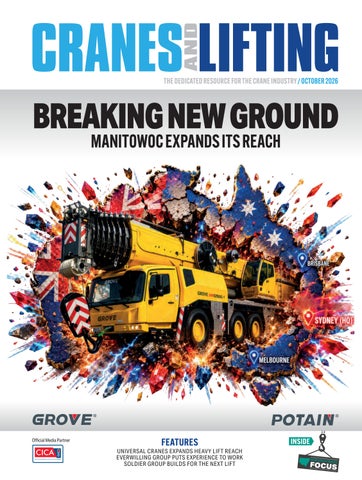
BREAKING NEW GROUND MANITOWOC EXPANDS ITS REACH
October 2026 Official Media Partner
FEATURES
UNIVERSAL CRANES EXPANDS HEAVY LIFT REACH EVERWILLING GROUP PUTS EXPERIENCE TO WORK SOLDIER GROUP BUILDS FOR THE NEXT LIFT
INSIDE
EXPERTS IN MOBILE PLANT INSURANCE
For over 50 years, UAA’s award-winning Mobile Plant and Machinery insurance solutions have powered the cranes and lifting industry - trusted by professionals who keep Australia moving. We are known for our extensive knowledge, operational capability, and capacity to cover a diverse range of plant and machinery across numerous industries. Our seasoned claims team has access to a network of experienced industry repairers, assessors, and suppliers who are well-regarded for their high-quality service.
www.uaa.com.au
SCAN BELOW TO FIND OUT MORE:
IN THIS ISSUE
Cranes and Lifting Magazine
cranes_and_lifting
Cranes and Lifting
48 8
Manitowoc Upfront Manitowoc brigs the energy.
19 C ANZ A complex lift in the ‘windy city’.
12 CICA CEO Report Anticipation building for CICA’s National Conference and Exhibition.
22 LEEA Justin Boehm reflects on his tenure.
15 C ICA CEO Interview Pat Cran discusses the opportunities and challenges facing the industry.
25 Xtreme Engineering Xtreme Engineering takes delivery of the first Liebherr LTR 1150 to arrive in the country.
17 C ICA CCO Alliance CICA and CCO sign strategic alliance.
28 T utt Bryant Equipment Built for Australian conditions.
55
31 ORCA From the wrong to the right side of the tracks. 34 B oom Logistics Boom Logistics addresses operator incidents. 37 M CT Equipment MCT continues to build lifting portfolio. 40 F ranna A trusted partnership with Boom Logistics. 43 D ynamic Rigging Hire The team behind the big lifts. 46 V-DAQ Making compliance work for you. 48 T adano Surelift celebrates 20 years in business. 51 U niversal Cranes Leading the energy transition. 55 D ieci Australia Dieci launches new Zeus 38.10 GD. 58 WATM Positioning for the next phase of growth. 60 L iebherr Australia Liebherr’s Game of Cranes is back.
www.cranesandlifting.com.au
October 2026 CAL / 3
69 144
63 A ltequip Built on over four decades of expertise. 67 High Risk Training Academy A new approach to high risk training.
CICA Conference NSW Focus 70 P otain Examining ‘Potain Speed’. 73 E verwilling Cranes A name built on service. esolution Rigging Services 76 R Much more than just tower cranes. 79 S oldier Group A business on the rise.
124
82 B orger Cranes From pit to port, the people behind Borgers.
121 Empire Cranes Unplugged in Sydney’s CBD.
85 Finlease Financing cranes in turbulent times.
124 EQUIPR Collaboration the key.
89 C omplete Crane Solutions New Hoeflon distributor for the East Coast.
126 Enerpac High tech heavy lifting.
92 Z oomlion The 60-tonner returns. 95 Drake Trailers A good fit for the lifting industry. 98 P alfinger Australia Palfinger Australia distributes BG Lift.
128 DRA Group The Humma advantage. 131 United Slings Delivering the out of the ordinary. 135 A1A Software A1A updates software. 137 All Lifting Experience across borders.
100 PACE Cranes Battery electric Meada to quality builder.
140 RapidWorks Optimising the fleet for success.
103 XCMG Boom Logistics put XCMG to the test.
142 Melbourne Lifting Always ready with solutions.
106 COSMO Cranes A unique lift for a unique project.
144 Alliance Engineering The planning behind a ‘nuclear’ lift.
108 UAA Examining machinery hire insurance.
146 LIFTIQ Keeping track of what’s important.
110 Potain Potain goes big!
149 Terraverde Complex gantry crane lift.
113 Andromeda Industries Celebrating 50 years of Australian Made. 116 Schaften Rental A fleet without borders. 4 / CAL October 2026
118 Baden Davis Crane Connection XCMGs to Mega Lift Solutions.
SCAN
TO SUBSCRIBE TO OUR NEWSLETTER www.cranesandlifting.com.au
FROM THE EDITORIAL TEAM Published by:
WELCOME TO THE OCTOBER ISSUE OF CRANES AND LIFTING IT IS WITH GREAT ANTICIPATION
that this editor’s letter is written. For the past few weeks we have been immersed in the industry, listening to and reporting on the latest developments to bring you what we hope is an interesting and informative read. The construction of data centres has been a frequent topic of conversation during the writing of this issue. According to a recent Ryder Levett Bucknall (RLB) report, Australia’s data centre construction boom is well under way. Data centres have been built in Australia since the 2000s, but construction activity really took off in 2023. Construction work the Australian Bureau of Statistics (ABS) calls ‘commercial buildings not elsewhere classified’ was valued at A$5.1 billion in the year to March 2026, up 226 per cent from three years ago. ABS data also shows data centre activity will ramp up considerably in coming LIFT OF THE YEAR MORE THAN 20T WINNER
Premier Cranes and Rigging, 40t generator installation. Premier Cranes and Rigging’s team was tasked to lift a two-storyhigh 94t generator system at a data centre. The lift faced many constraints from the site condition.
PLAN YOUR ENTRY
LIFT OF THE YEAR LESS THAN 20T WINNER
Brisbane City Cranes, Virgin Mary Coptic Orthodox Church, Calamvale. Large dome lift. Brisbane City Cranes was tasked to lift the 15t dome onto the roof of the newly constructed Virgin Mary Coptic Orthodox Church. The large dome structure had to be constructed and assembled on the ground prior to the lift to reduce working at heights issues to a minimum.
The Crane Industry Council of Australia (CICA) recognises excellence and innovation in the Australian crane industry with the CICA Lift Of The Year Awards. PROJECT OF THE YEAR INNOVATION OF THE YEAR LIFT OF THE YEAR – UNDER 20T LIFT OF THE YEAR – OVER 20T
– PROJECT OF THE YEAR WINNER ALEVRO, PLUTO TRAIN 2 PROJECT
years. Data centre commencements have risen almost 800 per cent over the past three years, with commencements worth over $15 billion in the year to March 2026. In total there is currently $21.6 billion of work under construction. The surge in data centre construction is being driven by rising AI workloads, cloud adoption, digital sovereignty and cybersecurity concerns. Australia is seen as an attractive location for new data centres due to political stability, space, connection to Asia and abundant renewable energy resources. This issue of the magazine will be widely circulated during The Crane Industry Council of Australia’s (CICA) National Conference and Exhibition which is shaping up to be another well attended event. As the major sponsor of CICA’s Lift of the Year Awards, Cranes and Lifting magazine is pleased to confirm this year’s awards are well supported with 23 entries across the four award categories. Entries are as follows: roject of the Year: 6 entries • P ift of the Year (Over 20t): 5 • L • L ift of the Year (Under 20t): 7 • I nnovation Award: 5
6 / CAL October 2026
CEO Christine Clancy E: christine.clancy@primecreative.com.au Publisher Sarah Baker E: sarah.baker@primecreative.com.au Managing Editor Lisa Korycki E: lisa.korycki@primecreative.com.au Editor Simon Gould E: simon.gould@primecreative.com.au T: 0404 865 109 Assistant Editor Danny D’Cruze E: danny.dcruze@primecreative.com.au T: 0429 187 751 Business Development Manager Emily Schlegel E: emily.schlegel@primecreative.com.au T: 0466 317 555 Client Success Manager Ben Sammartino E: ben.sammartino@primecreative.com.au Art Director Bea Barthelson Imaging Assistant Paul Breen Subscriptions T: +61 3 9690 8766 E: subscriptions@primecreative.com.au
Booms Up. The Publisher reserves the right to alter or omit any article or advertisement submitted and requires indemnity from the advertisers and contributors against damages or liabilities that may arise from material published.
INNOVATION AWARD WINNER
om.au/awards-lift-of-the-year To enter the 2026 awards visit cica.c
Chairman John Murphy E: john.murphy@primecreative.com.au
We thank all entrants for taking the trouble to submit their projects, and we wish you all the best. See you all at the end of October in the Hunter Valley.
stands out as The Pluto Train 2 heavy haul project demanding one of the largest and most technically The sheer undertakings of its kind in Australia. and lifting scale and complexity of transporting required tonnes 4,550 to up modules weighing and meticulous planning, advanced engineering flawless execution.
John Holland, Gamuda Australia & Edwards Heavy Lift, Super T Girder Access Platform. The Girder Access Platform (GAP) is an innovation that has revolutionised the M1 Motorway Extension project. By providing a safe and efficient method for accessing lift points on super T girders, the GAP has significantly enhanced safety and efficiency.
379 Docklands Drive, Docklands VIC 3008 T: 03 9690 8766 www.primecreativemedia.com.au
Simon Gould Editor, Cranes and Lifting
© Copyright – No part of this publication may be reproduced, stored in a retrieval system or transmitted in any means electronic, mechanical, photocopying, recording or otherwise without the permission of the publisher.
www.cranesandlifting.com.au
Undefeated
12.8t @ 121m 8.9t @ 133m 60m main boom 136m Max Tip Height
When others reach their limit We’re just getting started
Undisputed 6-Axle Champion NEW GMK6450-1 REmains Undefeated REACH OUT NOW FOR A SIDE-BY-SIDE COMPARISON 450t Capacity 79m Luffing Jib 12.8t @ 121m 8.9t @ 133m 60m main boom 136m Max Tip Height
When others reach their limit We’re just getting started
AND SEE THE DIFFERENCE FOR YOURSELF.
REACH OUT NOW FOR A SIDE-BY-SIDE COMPARISON AND SEE THE DIFFERENCE FOR YOURSELF.
MANITOWOC AUSTRALIA
0417 674 019
INFOANZ@MANITOWOC.COM
MANITOWOC AUSTRALIA
0417 674 019
INFOANZ@MANITOWOC.COM
UP FRONT / MANITOWOC, GROVE AND POTAIN
The arrival of the new Grove GMK5150XLe in early August 2026 marked a significant milestone for the Australian crane industry.
MANITOWOC IS BRINGING THE ENERGY TO AUSTRALIA
From hybrid all-terrain cranes in Perth to battery-powered tower cranes reshaping city skylines, Manitowoc is helping build Australia’s energy future, one lift at a time. AUSTRALIA IS IN THE MIDST OF A ONCE-IN-
a-generation transformation. New housing developments are rising in every major city. Massive renewable energy zones are being built across regional Australia. Data centres are expanding to support the digital economy, while hospitals, rail networks, ports and mining operations continue to demand more sophisticated lifting solutions than ever before. At the centre of many of these projects stands Manitowoc. In 2026, Manitowoc’s Grove and Potain brands are not simply supplying cranes to Australia, they are supplying the technology, innovation and sustainability solutions required to deliver the next chapter of the nation’s growth. From the arrival of Australia’s first Grove GMK5150XLe hybrid all terrain crane to the rapid adoption of Potain Power energy storage systems, Manitowoc is proving that productivity and sustainability can work together. And with approximately 60 new Potain tower cranes expected to 8 / CAL October 2026
enter the Australian market during 2026, that momentum is only accelerating.
PERTH WELCOMES AUSTRALIA’S FIRST HYBRID ALL TERRAIN CRANE
The arrival of the new Grove GMK5150XLe in early August 2026 marked a significant milestone for the Australian crane industry. Now operating throughout the Perth metropolitan area, the 150 tonne all terrain combines a fully electrified superstructure with Grove’s proven five-axle carrier platform. The result is a crane capable of performing demanding lifts while producing virtually no on-site emissions. For projects located near hospitals, schools, residential developments and sensitive urban environments, the benefits are immediate. Reduced emissions, reduced noise and significantly lower fuel consumption are increasingly becoming key requirements for contractors and project owners. The GMK5150XLe achieves this without compromising capability. Featuring Grove’s
renowned 69 metre main boom, advanced CCS operating system, and MAXbase™ variable outrigger positioning technology, the crane delivers the versatility and lifting performance operators have come to expect from the Grove brand. “The industry has been waiting for a practical hybrid crane that delivers genuine performance, not just an environmental ticked box,” says one major Australian crane fleet manager. “The GMK5150XLe proves you don’t have to choose between sustainability and productivity. You can have both,” says an East Coast manager. Perth contractors can now leverage the crane’s capabilities, while the second crane is in route to the East Coast.
THE TRANSMISSION LINE SPECIALIST BEHIND AUSTRALIA’S RENEWABLE ENERGY EXPANSION
While the GMK5150XLe captures headlines, another Grove crane is quietly playing an equally important role in Australia’s energy www.cranesandlifting.com.au
www.cranesandlifting.com.au
The Grove GMK5250XL-1 has become the preferred mobile crane for many of Australia’s electrical transmission line projects and the leading assist crane supporting wind turbine construction throughout the country.
“The GMK5250XL-1 has become one of the most valuable assets on renewable energy projects,” notes an Australian transmission infrastructure contractor. “Its ability to travel quickly between lift locations and handle a wide variety of components makes it a productivity machine for transmission and wind projects.” As renewable energy zones continue to expand across Queensland, New South Wales, Victoria, South Australia and Western Australia, the GMK5250XL-1 is increasingly becoming the crane connecting renewable generation to the grid.
BUILDING SOMETHING REAL Manitowoc strengthens local support with new Queensland and Victoria facilities
Manitowoc has significantly expanded its Australian footprint with the opening of new factory direct facilities in Queensland and Victoria, reinforcing its commitment to delivering industry-leading support for Grove mobile crane and Potain tower crane customers across the country. The new Queensland facility, strategically located at Yatala in the industrial corridor between Brisbane and the Gold Coast, has been established in direct response to growing customer demand. As major infrastructure projects gather pace and October 2026 CAL / 9
Images: Manitowoc
transition. The Grove GMK5250XL-1 has become the preferred mobile crane for many of Australia’s electrical transmission line projects and the leading assist crane supporting wind turbine construction throughout the country. Australia’s renewable energy boom extends far beyond the wind turbine itself. Electricity generated by wind farms and solar plants must be transported through hundreds of kilometres of transmission infrastructure before reaching homes, hospitals, factories, transport systems and data centres. Projects such as HumeLink, Project EnergyConnect, VNI West, and the proposed Marinus Link are creating the high-voltage backbone required to transmit renewable energy across Australia’s eastern states. HumeLink alone involves approximately 365 kilometres of new 500 kilovolt transmission line infrastructure linking energy hubs throughout New South Wales, while VNI West will strengthen interconnection between New South Wales and Victoria to improve the flow of renewable energy across the national grid. This is where the GMK5250XL-1 excels. With a 250 tonne maximum lifting capacity, 78.5 metre seven-section MEGAFORM™ main boom, Grove’s advanced MAXbase outrigger system, and the ability to travel efficiently between remote work locations, the crane is ideally suited to the demands of transmission line construction. Whether erecting transmission towers, installing monopoles, lifting large transformers, positioning substation equipment or supporting conductorstringing operations, the crane delivers a unique combination of reach, capacity and mobility. Its versatility has also made it the number one assist crane for Australia’s wind energy sector. Before a wind turbine can generate power, large crawler cranes must be assembled, tower sections staged, nacelles positioned and blades prepared for lifting. The GMK5250XL-1’s exceptional boom length and strong load charts make it a natural fit for supporting these operations.
UP FRONT / MANITOWOC, GROVE AND POTAIN
The new Queensland facility, strategically located at Yatala in the industrial corridor between Brisbane and the Gold Coast, has been established in direct response to growing customer demand.
preparations continue for the Brisbane 2032 Olympic Games, Manitowoc is investing in the people, facilities, and resources needed to support the accelerating growth of both Grove and Potain cranes throughout the state. The facility offers four workshop bays, a dedicated wash bay, an outdoor covered work area, and more than 2200 square metres of hardstand space, creating an ideal platform for continued expansion. In Victoria, Manitowoc has opened a dedicated three-bay facility in Melbourne’s western industrial area, providing a permanent home base for its growing team and strengthening support for the expanding populations of Grove and Potain cranes operating throughout Victoria. The new facility features about 1400 square metres of hardstand space and is staffed by three mobile crane technicians, supported by two additional technicians based in Tasmania. A dedicated tower crane technician will soon join the team, alongside a spare parts coordinator, administration support, and experienced sales personnel. Customers will benefit from increased parts availability, factory-trained field technicians, servicing and breakdown repair capabilities, and in-state technical consultation and support. These capabilities are designed to improve response times, increase equipment uptime, and provide a closer connection to Manitowoc’s factory expertise. “Customers increasingly want a dedicated manufacturing partner with local expertise and direct access to factory support,” said John Stewart. “These investments allow us to put more resources closer to our customers, improving service response, increasing 10 / CAL October 2026
parts availability, and ensuring we continue to deliver the level of support the market expects from Manitowoc.” With the Queensland and Victoria facilities now operational, Manitowoc is well positioned to support the next phase of growth in Australia’s crane industry while remaining focused on what matters most: helping customers keep their cranes working safely, reliably, and productively. Perhaps the most compelling part of Manitowoc’s Australian story is the breadth of projects its equipment supports. Across Australia’s major cities, Potain cranes are contributing to critical housing developments aimed at addressing growing demand. Elsewhere, cranes are helping construct hospitals, schools, transportation infrastructure, logistics facilities and hyperscale data centres. In regional Australia, Grove and Potain products support renewable
energy generation, transmission infrastructure, mining expansion and major industrial projects. From the Snowy Mountains energy network and renewable energy zones throughout the eastern states to mineral extraction projects in Far North Queensland, Manitowoc cranes are helping build the infrastructure underpinning Australia’s future economy.
The numbers tell part of the story:
• A ustralia’s first GMK5150XLe hybrid all terrain crane now operating in Perth. • Th e GMK5250XL-1 helping deliver transmission and renewable energy projects nationwide. • N early 30 Potain Power energy storage systems operating or on the way. • A pproximately 60 new Potain tower cranes expected to be delivered during 2026. But the real story is larger than the numbers. It is about cleaner construction sites. More sustainable infrastructure. More efficient project delivery. And the technology required to meet Australia’s growing demand for housing, energy and economic development. From powering renewable energy projects to transforming city skylines, Manitowoc isn’t just bringing the energy to Australia, it’s helping build the future that energy will power.
Manitowoc has opened a dedicated three-bay facility in Melbourne’s western industrial area, providing a permanent home base for its growing team and strengthening support for the expanding populations of Grove and Potain cranes operating throughout Victoria.
www.cranesandlifting.com.au
WA’s most trusted crane and service provider for over 50 years
LIFT YOUR GAME WATM Crane Sales & Services
watm.com.au WATM Head Office 165 Beechboro Rd South, Bayswater WA 6053 08 9271 8000
WATM Newman 21 Shovelanna Street, Newman WA 6753 08 9175 2846
WATM Picket Street 29 Pickett Street, Bayswater WA 6053 08 9271 8000
WATM Port Hedland 2 Carlindie Way, Wedgefield 6721 08 9271 8000
WATM Karratha Field Service
WATM Kalgoorlie Field Service
Established in 1974, WATM is a Western Australian familyowned and operated business with over 50 years of experience supporting the lifting, transport, mining, construction, ports and industrial sectors. As a trusted name in crane sales, service and aftercare, WATM provides complete lifting equipment solutions across Western Australia, from new equipment supply through to field service, preventative maintenance, breakdown support, major repairs, parts, technical support and long-term fleet aftercare. WATM is proud to represent some of the world’s leading lifting equipment brands, including: » Exclusive Western Australian distributor for Manitowoc Cranes, including the industry-leading Grove range of mobile cranes » Exclusive Western Australian distributor for Hiab, offering premium vehicle loading cranes and transport lifting solutions » Exclusive Pettibone dealer across Australia and the APAC region WATM, reliable support, and aftercare that keeps you lifting.
CICA CEO REPORT
CELEBRATING OUR INDUSTRY Welcome to the October issue: The one in everyone’s hands at the 2026 CICA National Conference.
of the magazine. The CICA National Conference is always one of the highlights of the CICA calendar and will be my first one as CEO. And what better place than the Hunter! Thank you to all of our sponsors – your support makes this event memorable, our industry comes together from all over Australia to share knowledge, challenge the way we do things and, importantly, recognise the people and businesses that keep Australia’s crane industry moving. I’d especially like to congratulate our platinum sponsor Franna on celebrating 40 years – what a milestone and achievement for this crane that carries out hundreds of lifts all over Australia every day, and was developed, designed and manufactured here in Australia. Like you, I’m looking forward to seeing everyone come together for what promises to be another outstanding Conference. The nice thing about the 12 / CAL October 2026
Hunter is that everyone stays on site and with some of the program changes, like the mock trial, the lifting expert panel and the high level of interest we’ve had in the crane and equipment display, really keeps things pertinent and interesting. There will be health checks again this year, and I strongly encourage everyone to participate – in an industry where the demands are high and deadlines are tight, a simple check can save your life. CICA continues to make significant strides in safety, both here in Australia and internationally. Our safety programs and initiatives are increasingly being recognised beyond our borders, demonstrating that the work being undertaken by our members and the wider CICA team is setting a standard that has relevance well beyond Australia. Programs such as CraneSafe, CrewSafe and StartSafe are built around a simple objective: raising the
Pat Cran
Images: CICA
WELCOME TO THIS SPECIAL EDITION
standard of safety across our industry. In August, Andrew Esquilant, Anthony Grosser and myself (CICA) met with Thomas Sicklesteel and Brandon Hitch (NCCCO) to cement the Green Sticker by CraneSafe Strategic Alliance. This Strategic Alliance and the international recognition of CraneSafe www.cranesandlifting.com.au
Caption
CICA BOARD Marcus Ferrari – President
Thomas Webber
Karli Sutherland – Vice President
thomas@cica.com.au
Communications Coordinator
Danny Adair – Director Danny Black – Director
Michelle Verkerk
David Solomon – Director
Executive - Communications and
Anthony Grosser – Director
Special Projects
Image: aiyoshi597shutterstock.com
Andrew Esquilant – Director
is a testament to the foresight of CICA’s life members, the commitment of our current members and the collective expertise within the Australian crane industry. There is a real sense of momentum across CICA at the moment. We are continuing to advocate for our members, support you with events and relevant information, strengthen our safety and training programs, flesh out the National Training Model, engage with regulators and government, and look for opportunities to position our industry for the future. This conference issue captures some of that momentum. I encourage you to explore the stories inside, celebrate the achievements of our industry and, most importantly, make the most of the opportunity to connect with your fellow CICA members at the conference. The recognition of your peers or colleagues, maybe even you in the CICA Awards, sponsored by Cranes and Lifting will feature in next month’s issue, so watch this space. I look forward to seeing you there. Patrick Cran Chief Executive Officer CICA www.cranesandlifting.com.au
Grant Gjessing – Director
CICA OFFICE Patrick Cran Chief Executive Officer 0488 004 274 ceo@cica.com.au Julie Turner Board Secretary julie@cica.com.au
michelle@cica.com.au Justina Blackman Executive - Member Events and Engagement 0403 717 626 justina@cica.com.au Shane Coupe CraneSafe & CrewSafe Administrative Assistant Officer 0491 047 134 shane@cica.com.au
Alice Edwards Road Technical Engineer 03 8320 0440 alice@cica.com.au Loreta Lukic Office Manager 0490 356 041 loreta@cica.com.au Damien Hense Senior Executive Road Poilicy 0488 007 575 damien@cica.com.au
Timothy Weir CraneSafe Technical Officer tim@cica.com.au 0494 658 614
Unit 10, 18–22 Lexia Place, Mulgrave Vic 3170 Phone: 03 9501 0078 Email: admin@cica.com.au Website: www.cica.com.au
For information, please visit our website or call the CICA office.
October 2026 CAL / 13
XCMG Cranes Reaching New Heights General Manager Stephen Broomfield stephenb@xcmg.net.au 0401 540 136 xcmg.net.au
WA, NT, SA Robert Smith robert@ronco.com.au 0403 059 712 ronco.com.au
NSW, QLD Anthony Davis anthony@craneconnection.com.au 0407 220 584 www.craneconnection.com.au
CICA CEO INTERVIEW
CICA CEO INSIGHTS
Navigating challenges, building capacity and advocating for industry. continues to play a vital role in delivering the nation’s infrastructure, CICA’s Chief Executive Officer, Patrick Cran sat down to discuss the opportunities and challenges facing crane owners, operators, and the broader crane sector.
Q: Hi Pat, how long have you been in the crane industry? CEO: I have worked in the industry for 24 years, and 11 of those were with CICA managing the CraneSafe program before taking on the role of CEO in May this year.
Q: What do you see as the most significant challenge facing the crane industry today?
CEO: There isn’t one single challenge facing our industry right now. We’re dealing with a mix of issues, including skilled labour shortages, increasing compliance requirements, and growing logistical hurdles that affect productivity every day. One of the biggest challenges is simply getting cranes to site, because moving a crane from one job to another now often involves multiple permits, approvals, and dealing with different authorities across jurisdictions. In many cases, our members tell us that organising the transport of the crane is more difficult than carrying out the lift itself. At the same time, Australia is experiencing record levels of infrastructure and construction activity, which is driving strong demand for crane services. While the industry is ready and willing to support these projects, workforce shortages, regulatory requirements, and the complexity of accessing project sites are increasingly challenging our ability to respond efficiently. www.cranesandlifting.com.au
Q: Workforce shortages continue to be raised by members. How serious is the issue?
CEO: One of the biggest challenges facing our industry is the ageing workforce. There are a lot of experienced crane operators, doggers, riggers, technicians and other skilled workers expected to retire over the next 10 to 15 years. When they leave, they take with them years of knowledge and practical experience that can’t be replaced overnight. We need more people coming into the industry at all levels, from operators and riggers through to technicians and engineers. The crane industry offers great career opportunities, good wages, and plenty of room for advancement, but many young people simply don’t know what opportunities exist. The challenge isn’t just attracting new people, it’s also giving them clear pathways into the industry and being prepared to invest the time and effort into training and mentoring them. As an industry, we need to keep promoting these careers, supporting training
initiatives, and developing the next generation of skilled workers if we want to meet future demand and maintain the high standards our industry is known for.
Q: Compliance and regulation are topics that frequently arise in industry discussions. What are members telling you?
CEO: Safety will always be the number one priority in our industry, but one growing challenge is the amount of administration and compliance requirements businesses have to manage. Every level of government seems to introduce new forms, permits, reporting requirements, or paperwork. While each requirement may have a valid purpose, together they create a significant burden on businesses. Our members regularly tell us they are spending more time on paperwork and administration than ever before. That’s time and money that could otherwise be invested in training people, upgrading equipment, improving productivity, and growing Pat Cran presenting at a recent event.
Image: CICA
AS AUSTRALIA’S CRANE INDUSTRY
October 2026 CAL / 15
CICA CEO INTERVIEW (CONT)
their businesses. The challenge is finding the right balance between maintaining high safety standards and avoiding unnecessary duplication and red tape. At CICA, our CraneSafe, CrewSafe and StartSafe programs are designed to give industry, clients and regulators confidence that our members are operating safely and professionally. These programs help businesses focus on managing real safety risks while demonstrating their commitment to best practice across the industry.
Q: How does this growing compliance burden impact productivity?
CEO: When permits take longer to obtain, approval processes become more complicated, or the rules are different from one state or council to another, projects slow down and costs increase. Businesses spend more time dealing with paperwork and approvals instead of focusing on getting the job done safely and efficiently. Productivity is a major issue across the construction industry, and the crane sector feels those pressures every day. Cranes are often on the critical path of a project, so any delays with planning, permits, transport, or site access can have a flow-on effect across the entire job. When you add rising fuel costs and other operating expenses, it puts even more pressure on businesses. We’re not asking for lower safety standards – our industry is committed to maintaining the highest levels of safety. What we’re looking for is a more consistent and practical approach across jurisdictions that reduces unnecessary delays and duplication. If businesses can operate more efficiently while maintaining worldclass safety standards, it benefits not only our industry but the delivery of construction and infrastructure projects across the country.
Q: What role does industry advocacy play in addressing these challenges?
CEO: One of CICA’s most important 16 / CAL October 2026
roles is making sure the voices of crane owners, operators and the wider industry are heard by governments, regulators and other key decisionmakers. Too often, policies and regulations are developed without a full understanding of the practical challenges businesses face on the ground every day. By bringing the industry together and speaking with a united voice, CICA can help deliver better outcomes for everyone. Whether it’s transport regulations, workforce development, licensing requirements, procurement practices or safety initiatives, it’s important that industry is involved in the conversation from the start. Our industry has a huge amount of knowledge and experience, and that’s exactly what we’re showcasing through our new Cranes Lift Australia initiative. We want governments and
renewable energy developments, commercial construction and other large-scale projects continuing across the country, the demand for crane services and skilled lifting solutions remains strong. To make the most of these opportunities, we need to ensure we have the right workforce, practical regulations and an operating environment that allows businesses to be productive and efficient. If industry, government and regulators can work together to address these challenges, I believe the future of the Australian crane industry is very positive.
QUICK QUESTIONS What keeps you awake at night?
The growing gap between infrastructure demand and workforce capacity, and how I’ll coach my daughter’s basketball team to the finals.
“The crane industry isn’t asking for less safety or fewer standards. We’re asking for practical, consistent regulation that allows businesses to remain productive while continuing to deliver world-class safety outcomes.” policymakers to draw on that expertise before making decisions that affect our members. Those working in the industry every day understand the challenges and opportunities better than anyone, and that practical experience can help create better, more workable solutions for everyone.
What gives you confidence about the future?
Q: Despite the challenges, are you optimistic about the future?
One thing you’d change tomorrow?
CEO: The crane industry has always been resilient. Every day, our members work on some of Australia’s most complex and important projects, often in challenging environments and under tight timeframes. No matter the conditions, they continue to get the job done safely and professionally. Looking ahead, there are tremendous opportunities for our industry, with major infrastructure projects,
The professionalism, expertise, and innovation demonstrated by our members every day.
What is the industry’s greatest strength? Its people.
A more consistent and streamlined regulatory framework across all Australian jurisdictions.
Your message to members?
Keep sharing your challenges and experiences with us, the stronger our collective voice, the stronger our industry will be.
Summer or winter?
Winter in Brisbane is beautiful. www.cranesandlifting.com.au
M
S d o e
T
M lin
St co in lo
CICA AND CCO
The strategic alliance between The Crane Industry Council of Australia (CICA) and National Commission for the Certification of Crane Operators (CCO) Certification was formally signed in August 2026. THIS MARKS AN IMPORTANT STEP
forward for CraneSafe and the broader lifting industry. While both organisations have long shared a commitment to improving safety standards, this partnership brings together a shared industry ownership of CraneSafe. The CraneSafe program has long been
Image: CICA
CICA/CCO STRATEGIC ALLIANCE Patrick Cran (CICA), Andrew Esquilant (CICA), Anthony Grosser (CICA), Thomas Sicklesteel (CCO), Brandon Hitch (CCO).
recognised in Australia as a benchmark for crane safety and maintenance standards, providing users and sites with confidence that the crane is safe and that the owner can provide the evidence to back it up. CCO’s uptake of the program reinforces the program’s credibility and expands its reach throughout the international
industry. As regulatory requirements continue to increase and businesses navigate workforce shortages, compliance pressures and evolving customer expectations, the alliance demonstrates a united approach to improving safety outcomes while supporting the long-term sustainability of both Australia and the US crane sector.
Inspection
More than just a pre-start checklist
Frame and Cabin Counterweight Attatchment - Security
StartSafe is comprehensive tool designed to streamline your crane operations, enhance safety, and ensure accountability.
Load Charts
Controls
TAILORED
VISIBLE
Machine specific checklists are in line with the CraneSafe program.
Photos tell the story.
StartSafe streamlines the process for collecting pre-start information, with instant data retention to a central location for the crane owner to access.
When a faulty item is recorded by the operator, the maintenance team is notified of the issue by email, which includes photo evidence of the fault. This also assists with gathering major inspection data.
Windows
PREVIOUS
NEXT
Game of Cranes 2026/2027 The world championship of mobile crane operators Who is up for the challenge? Applications open from 1 October 2026.
Mobile and crawler cranes
Apply now
WHEN WELLINGTON’S WIND STOPPED ON DEMAND Getting major new HVAC plant onto the roof of Wellington’s tallest building required much more than a big crane. FOR LT MCGUINNESS AND TITAN CRANES,
the Majestic Centre HVAC upgrade became an exercise in engineering, collaboration, logistics – and finding a seven-hour window when Wellington’s notorious wind decided to cooperate. In the middle of Wellington, surrounded by high-rise buildings, apartments, hotels and busy inner-city streets, the Majestic Centre, owned by Charter Hall, presents an imposing target for any lifting operation. At 116 metres and 30 storeys, the building is a prominent part of Wellington’s skyline and the city’s largest office building. As part of a major HVAC and electrification upgrade, new plant needed to make its way from street level to the roof. That meant finding a way to position and configure a large mobile crane on one of Wellington’s steep, constrained centralcity streets, establish it around existing underground services and neighbouring buildings, manage public and vehicle access – and then lift sizeable plant to the top of the tower. And, because this is Wellington, there was one variable nobody could ignore: the wind. For Crane Association members LT McGuinness (LTM) and Titan Cranes, the solution came down to detailed planning, engineering and a well-established working relationship.
PLANNING BEFORE LIFTING
Long before the crane arrived, LTM and Titan were working through how the operation could be achieved. Several methodologies had been considered during the pre-planning phase, with the project team needing to demonstrate why alternative approaches would not work and establish that www.cranesandlifting.com.au
the eventual methodology could be undertaken safely. For the building owner, there were understandable concerns: the gradient and restricted width of the surrounding streets, neighbouring properties, pedestrians and public access, the ground conditions beneath the crane and Wellington’s weather. The planning process therefore went well beyond the lift itself. It included Wellington City Council and Civil Aviation Authority approvals, a temporary works engineering assessment for ground loading, underground services scanning, traffic management planning, communication with surrounding neighbours, detailed lifting plans and ongoing weather monitoring. Wellington City Council worked closely with the project team on the required street closures and asset management. The aim was to contain the disruption to the weekend while retaining access to as many surrounding apartments, hotels and other buildings as possible. A clear division of responsibility was also established between the two companies. LTM managed the wider site environment, including traffic management, coordination with council, security, neighbours and the public, as well as the ground conditions and protection of underground services. Once above the engineered crane platform, Titan took responsibility for the crane: its placement, component logistics and assembly, outrigger loading and operational stability. Titan was also responsible for the lifting plan, rigging, control and placement of the loads and, critically, the final weather-related go/ no-go decision. It was a partnership that benefited from experience. The two companies had
Images: © Photography by Phil Greig of PhilmHaus NZ
CEO REPORT
Above: The crane selected for the operation was a Liebherr LTM 1350-6.1, configured in TYVEN configuration with 65.6 metres of main boom and 60-metre luffing fly.
undertaken complex operations together previously, allowing risks to be openly worked through and responsibilities clearly allocated.
MAKING A BIG CRANE FIT A SMALL SITE
The crane selected for the operation was a Liebherr LTM 1350-6.1, configured in TYVEN configuration with 65.6 metres of main boom and 60-metre luffing fly. Its maximum lift radius was 55 metres with a maximum lift height for the operation of 119 metres. But selecting the crane was only part of the challenge. Titan point-cloud scanned the Majestic Centre and surrounding environment to accurately model where the mobile crane could be positioned and how it could operate within the available space. The steep, narrow street provided little room for crane assembly and October 2026 CAL / 19
That level of forecasting was also important in giving the building owner confidence that such a complex operation could realistically be delivered. Then Wellington put the planning to the test. The lift was scheduled for Friday 31 July, but high winds forced the team to postpone. The forecast, however, showed something interesting. Around midnight on Saturday, the wind was predicted to fall away. There was expected to be a window of approximately six to seven hours before it returned. With the program relying on getting the plant onto the roof as soon as conditions allowed, LTM and Titan collectively made the call to target the window. At 2am on Saturday, the street was closed and establishment of the LTM 1350-6.1 began. Through the morning and into the afternoon the crane was assembled, including its fly, Y-guy and ropes. Once it was fully established, the crews went home. They needed to sleep. Because at midnight, they were coming back.
The operation involved eight large heat pumps/chillers, the largest weighing approximately 4.6 tonnes, along with pipework, pumps, motors, structural steel and 18 coils of cable, among other equipment.
ZERO WIND brought another unusual complication. Under the manufacturer’s standard instructions, the crane could not be assembled with the fly jib over the front of the crane in the manner required by the site’s constraints. Rather than accepting that as the end of the road, Titan worked directly with the crane manufacturer. The proposed configuration and assembly methodology were modelled by the manufacturer, allowing the approach to be assessed and ultimately signed off. On the ground, there was just as much to consider. Underground services were mapped before establishment, while engineered swamp mats and spreader plates were incorporated to manage the significant loads imposed through the crane’s outriggers. The methodology also modelled crane positioning, rooftop landing areas and clearances between the fly jib and the building. 20 / CAL October 2026
Assembly itself was a substantial operation: mats and outriggers first, followed by the base pack, counterweights and Y-guy, then the boom adaptor and fly jib before the boom could be raised, extended and commissioned for lifting. All of that had to happen within a closed inner-city street. And then there was the weather.
WAITING FOR WELLINGTON
From the beginning, weather forecasting was treated as part of the lift methodology rather than something to check on the morning of the job. The planning allowed for a threeweek window, close monitoring through forecasting applications and contingency days if conditions ruled out the preferred date. Based on the dimensions and characteristics of the new plant, the documented maximum wind speed during lifting was 25 kilometres per hour.
When the crews returned to central Wellington that night, the forecast proved remarkably accurate. The wind stopped. Not merely “good for Wellington”. Virtually zero wind. For a city where wind is an everyday consideration for crane operations, it was an extraordinary piece of timing – and vindication of the forecasting and contingency planning that had gone into the methodology. With conditions on their side, the team went to work. Over the next seven hours, Titan’s crane crews worked alongside LTM’s project team and the project’s mechanical and electrical trades to move the new equipment to Level 30. The operation involved eight large heat pumps/chillers, the largest weighing approximately 4.6 tonnes, along with pipework, pumps, motors, structural steel and 18 coils of cable, among other equipment. For each lift, Titan’s responsibility extended beyond simply operating the crane. Loads were assessed and rigged, long www.cranesandlifting.com.au
CEO REPORT
taglines were used where required to prevent rotation, clearance from the surrounding structure was maintained and each load was landed into its approved rooftop location. At roof level, crews received and manoeuvred the plant into position, turning what was happening on the street below into a carefully coordinated vertical logistics operation. As the night progressed, lift followed lift. Seven hours after they began, the operation was complete. The sun came up over Wellington with the new plant sitting on top of the Majestic Centre. And, almost on cue, the weather window closed.
A JOB BUILT ON COLLABORATION
The spectacle of a 350-tonne mobile crane operating beneath Wellington’s tallest building naturally attracts attention. But the crane itself tells only part of the story.
The success of the Majestic Centre operation was built months earlier: in point-cloud scans and engineering models; underground services investigations and ground-bearing assessments; traffic plans and council discussions; crane configuration and manufacturer consultation; weather forecasting and contingency planning. It was also built on people knowing where their responsibilities began and ended – and trusting the other team to deliver theirs. For LTM and Titan, an established working relationship meant risks could be shared and discussed early rather than becoming problems on the night. When the conditions changed, the plan changed with them. When Friday became impossible, the teams were ready to move to Saturday. When the forecast identified a narrow opportunity, they had done enough planning to confidently take it. And when Wellington finally delivered seven hours of still air, everyone was ready.
The result was a complex inner-city lifting operation completed seamlessly, while disruption to neighbouring businesses and residents was largely contained to a single weekend. With the complexity of the lift there was plenty of public interest, including representatives of Charter Hall flying out from Australia to witness the operation in person. For two CANZ members working together on one of the capital’s most recognisable buildings, it was a striking demonstration that the most impressive part of a major lift often isn’t what happens when the load leaves the ground. It’s everything that had to happen beforehand to make that moment possible. It is also great to see the lift captured so creatively by Phil Greig of PhilmHaus NZ. Contact phil@philmhaus.com or visit www.philmhaus.com
FAREWELL AND THANK YOU NEARLY EIGHT YEARS AGO, I DID MY FIRST
interview for LEEA. If I’m honest, I was not overly interested in joining the Lifting Equipment Engineers Association at the time. But when I spoke with LEEA Chief Executive Officer Ross Moloney he said, “We help our members defy gravity.” I was in. After seven years and nine months, this will be my final article for Cranes and Lifting magazine written on behalf of LEEA. As I move on to a different opportunity, I want to reflect on the things that we’ve achieved over my tenure. When I first stepped into this role, the opportunity in front of us was clear. LEEA had a strong global reputation, respected training, and had a history of supporting the lifting equipment industry dating back to 1944. The task in this region was to ensure that value was better understood, better connected to local industry, and better aligned to the needs of members working across this region. My work has always been built by members for the members. I’ve been fortunate to have guidance though many people. The Regional Council representatives, trainers, technical experts and industry supporters who give their time because they believe this industry should continue to improve. The lifting equipment industry is full of people who care deeply about what they do, even if they do not always say it loudly. They care because they understand the consequences of getting it wrong. LEEA’s vision is of lifting and height safety industries which have eliminated accidents, injuries and fatalities. That vision has always got me out of bed. It gave purpose to my work and a clear reason to keep pushing, even when progress is slower than you would like. Member engagement and understanding 22 / CAL October 2026
Images: LEEA
The Lifting Equipment Engineers Association’s Justin Boehm reflects on his time as Regional Manager for Australia and New Zealand.
Justin Boehm, LEEA’s Regional Manager, Australia and New Zealand.
what you require of us has been central to that purpose, but for me the work has always been bigger than any one project. It has been about building capability so the lifting equipment industry can take its rightful place at the table. One of the moments that showed the real value of this industry came during COVID. Like every sector, our members were dealing with uncertainty, disruption, changing rules and real commercial pressure. But lifting equipment inspection and testing remained critical to the safe operation of essential industries. The recognition from Federal and State governments that our work was, and still is, an essential service was incredibly important. It confirmed what our members already knew: this industry underpins much of the economy, often without the public recognition it deserves. That period also reinforced why strong industry representation matters. When things become difficult, industries need a voice that understands their work and
can explain why it matters. That need for voice and connection led to one of the achievements I am most proud of: the establishment of the LEEA Regional Council in Australia and New Zealand. The Council has provided a genuine voice for members and created a stronger link between local industry issues and LEEA’s global direction. It has brought together people with real experience, strong opinions, but a shared commitment to improving outcomes. It has not always been easy to wrangle a group of industry leaders, but it has been brilliant for the region. The Council has worked because it is grounded in member leadership and shaped by people who understand the realities of the work. The fact that this model has since been replicated in the Middle East and South East Asia is something Australia and New Zealand should be proud of. It shows that good ideas developed here can influence how LEEA engages with members globally. Another major achievement has been the development of the Certificate IV in Lifting Equipment Testing and Inspection. This was three years of dedication to ensuring our industry technicians receive the recognition they deserve. For too long, lifting equipment inspection has been underestimated by those outside the industry. It is not a basic task and should never be treated as one. It requires genuine competence, practical judgement and demonstrated capability. The now completed Certificate IV creates a clearer pathway for technicians, gives employers something meaningful to build around, and helps the broader market understand what good inspection practice should look like. Most importantly, it helps lift the standard across the industry. Every inspection decision carries responsibility, www.cranesandlifting.com.au
LEEA
and our technicians deserve a pathway that reflects the importance of the work they perform. Being involved in Standards development has also been an important part of the journey. My first real foray into that world was a significant learning opportunity and gave me a much deeper appreciation for the work that sits behind the documents our industry relies on. Standards development is not easy, and it should not be. Being part of the AS 1353 draft review reinforced how important it is for our region to have a strong voice in decisions that shape lifting equipment inspection, testing and use. This voice is shaping the development of LEEA’s Code of Practice for the Safe Inspection of Lifting Equipment (COPSILE), which has had significant input from Australian members. LiftEx Gold Coast was another moment that will stay with me. Bringing the industry together matters. Events are not just about presentations or stands on a floor. They create the conversations that move an industry forward. LiftEx gave members the chance to share challenges, see new innovations and also catch up with old friends. For our region, LiftEx
Justin brings LiftEx Gold Coast to a successful conclusion as he does his tenure as LEEA’s Regional Manager.
“Standards development is not easy, and it should not be. Being part of the AS 1353 draft review reinforced how important it is for our region to have a strong voice in decisions that shape lifting equipment inspection, testing and use.” showed there was a real appetite for connection and a strong desire to be part of something bigger. The LEEA Lifting Legend Award has also been an important initiative because industries need to recognise their people. Too often, those who shape the industry are not celebrated until after they leave. Raymond McLaren was a deserving recipient, and his recognition was a reminder that this industry is built by people who give more than their job description requires. Looking back, it has been an incredible www.cranesandlifting.com.au
journey and one I believe has helped raise the bar. It has not always been easy, but the common thread through the work has been capability. Whether through advocacy, Regional Council, the Certificate IV, Standards development, LiftEx or recognising our Lifting Legends, the aim has always been to build something our members are proud to be a part of. The lifting equipment industry in the region has enormous strength and as I sign off from this role, I do so with real pride in what has been achieved and
genuine confidence in what comes next. The work is not finished, nor should it be. Industries like ours only improve when good people continue to support one another, challenge norms and insist on better practice. It has been a privilege to work with LEEA members across Australia, New Zealand and the Pacific, and to play a part in strengthening the Association’s presence in this region. I am grateful for the relationships built, the conversations had, and the trust shown by so many people across the industry. To the members, Regional Council representatives, colleagues, industry partners and the Cranes and Lifting team (Simon, thanks for being an integral part of my time) who have supported this journey, thank you. You have made the past eight years something I will always be proud of. Take care, and we’ll speak soon. October 2026 CAL / 23
A steadily expanding Heavy Fabrication and Engineering locally owned Company, based in Gladstone since 2007. Xtreme Engineering are here to help with all you construction and engineering needs including: > Workshop Fabrication > Onsite Construction > Planned Maintenance > Breakdowns > Equipment & Labour Hire With a fleet of Mobile, Slew & Crawler Cranes as well as Prime Movers and an array of trailers Xtreme can assist with almost everything to get the job done.
“
Individual commitment to a group effort – that is what makes a team work, a company work, a society work, a civilization work. VINCE LOMBARDI This is what Xtreme Engineering Stand by.
GET IN CONTACT WITH US TO SEE WHAT WE CAN DO TO HELP Office. 07 4972 4003 | 24HR Mobile. 0481 261 841 Email. sales@xtremeengineering.com.au Visit. xtremeengineering.com.au
IN FOCUS / XTREME ENGINEERING AND LIEBHERR
XTREME FIRST WITH LIEBHERR
Australia’s first Liebherr LTR 1150 heads to Xtreme Engineering. has become the first company in Australia to take delivery of Liebherr’s new LTR 1150 telescopic crawler crane, investing in the machine to improve efficiency and reduce mobilisation costs on weather tower installation projects across the country. The fabrication and installation of weather monitoring towers form a significant part of Xtreme Engineering’s workload, and according to General Manager Scott Harrington, the business had been searching for a lifting solution that could simplify what is traditionally a complex operation. “Traditionally the installation of these weather towers requires a two crane lift, a larger capacity all terrain or crawler for the main lift and a 40 or 25 tonnes Franna to assist. When you factor in some of the sites can be eight or nine hours from the closest crane yard, the mobilisation costs can seriously add up,” said Scott. Xtreme Engineering has experience with Liebherr, operating a 220 tonne and 70 tonne all terrain. “We have worked closely with crane hire businesses like Universal Cranes on a number of projects, where we bring in their larger capacity cranes for jobs and they hire ours when they are short. A while ago, I decided to take the plunge on a 220 capacity all terrain and I contacted Tom Grady, Liebherr’s Used Crane Manager and he put me onto a crane hire business in Canberra. “I flew down to find the owners had taken good care of the crane, they had the full service history, and it came with the truck and the dolly. It was no brainer for me. During this process I was introduced to Bryce O’Brien Liebherr’s Sales Manager QLD, NT, PNG, mobile and crawler cranes. He and Tom are the nicest guys. I know they are there to sell cranes, but they are genuine and professional with their advice and information and
www.cranesandlifting.com.au
The LTR 1150 is the first telescopic crawler crane to be equipped with the Liebherr VarioBase, which enables the crane control to determine the optimum load capacity depending on the track width and angle of rotation.
Images: Xtreme Engineering and Prime Creative Media.
GLADSTONE-BASED XTREME ENGINEERING
October 2026 CAL / 25
IN FOCUS / XTREME ENGINEERING AND LIEBHERR
although I’m not a large customer compared to many, they always give me the time of day and are super responsive to my requirements,” said Scott. Last year, Scott was in discussions with Liebherr regarding the LTM 10704.2 when he mentioned he might also be interested in the LTR 110, 110 tonnes capacity telescopic crawler. “I was looking at a crane that I could ‘top and tail’ when lifting the weather Liebherr’s Bryce O’Brien and Xtreme Engineering’s Scott Harrington.
26 / CAL October 2026
towers, and I needed it to easily mobilise and demobilise. When I mentioned this to Bryce, he said the factory had just launched the LTR 1150 and he handed me a brochure which I read on the flight home. By the time I got to Gladstone, I was convinced this was the crane I’d been looking for. I called Bryce and he put my name on the first of the model to be delivered into the country,” said Scott.
Liebherr’s LTR 1150 is easily transported, weighing 60 tonnes and a transport width of 3.5 metres and without crawler carriers it weighs just 38 tonnes and a width of only 3.0 metres. Key features for LTR 1150 include a maximum load capacity of 150 tonne, a telescopic boom of 52 metres, maximum hoist height of 89 metres and a maximum operating radius of 76 metres. The LTR 1150 is the first telescopic crawler crane to be equipped with the Liebherr VarioBase®, which enables the crane control to determine the optimum load capacity depending on the track width and angle of rotation. The VarioBase variable supporting base not only provides greater safety for telescopic mobile cranes, but also allows significantly higher load capacities, especially for lifts directly over the supports. “For me, a key feature with the LTR 1150 is the crane’s ability to suck in its tracks and walk straight up and onto the back of the float. It means you have one truck to mobilise and one B-double to follow which means a lot of efficiencies and cost savings. In my opinion, Liebherr’s are the best engineered cranes in the world,” said Scott. Scott has purchased the Liebherr crawler with a construction jib which enables him to lift with the main block and www.cranesandlifting.com.au
Liebherr’s LTR 1150 is easily transported weighing 60 tonnes and a transport width of 3.5 metres and without crawler carriers it weighs just 38 tonnes and a width of only 3.0 metres.
Key features for LTR 1150 include a maximum load capacity of 150 tonne, a telescopic boom of 52 metres, maximum hoist height of 89 metres and a maximum operating radius of 76 metres.
winch to ‘top and tail’ the weather towers, eliminating the need for a second crane.
OPERATOR ACCEPTANCE
Operator feedback has also been positive. “All of our operators have been impressed with the technology included on the crane and also commented on how similar Liebherr’s computer systems are across all of the models. The LTR 1150 features Liebherr’s VarioBase which is unusual for a crawler, and this enables us to maximise our charts wherever we’re working. They were also really impressed that you can remotely operate the crane from outside of the cabin which they described as a ‘game changer’,” he said.
LIEBHERR HANDOVER AND TRAINING
Before the crane began its first major project, a schedule delay provided additional time for Xtreme’s crews to become familiar with the crane. “The delay in the project provided a great opportunity for the crews to go right through the crane and learn all about the machine. Danny Pratt, Liebherr Australia’s Field Service Technician spent the best part of a week with us, and we were able to have multiple operators trained on the crane. The training and the handover from Liebherr were absolutely second to none,” said Scott. www.cranesandlifting.com.au
“I was looking at a crane that I could ‘top and tail’ when lifting the weather towers, and I needed it to easily mobilise and demobilise.” NEW DRAKE TRAILER
Xtreme also purchased a Drake Trailer for the new Liebherr. “We picked up the new Drake trailer in mid August. It’s a five by eight with a two by eight dolly configuration. Although it is a fairly common configuration in other states, it isn’t so much in Queensland. The trailer is ideal for the Liebherr crawler but it can also transport the 220. This means I’m able
to mobilise the key assets in the fleet with the same trailer, making us self-sufficient when it comes to transporting them around the country,” said Scott. “As a heavy fabrication business I recognise high quality workmanship when I see it, and Drake are most certainly at the ‘top of their game’ when it comes to the design, engineering and manufacturing of their product.” October 2026 CAL / 27
IN FOCUS / TUTT BRYANT, SANY AND BORGER CRANES
Borger Cranes worked with Tutt Bryant Equipment and SANY to develop the SCC1100A-1 around Australian lifting requirements.
FILLING THE GAP IN THE 110-TONNE CLASS Finding the right replacement for a successful crane is rarely straightforward.
THAT WAS THE CHALLENGE FACING
Borger Cranes as it looked to fill a gap in its 110-tonne crawler fleet. Rather than settling for an off-the-shelf solution, the company collaborated with Tutt Bryant Equipment and SANY to refine the SCC1100A-1 for Australian conditions before introducing a number into the fleet. Andrew Pearce, Projects and Heavy Lift General Manager at Borger Cranes, said the search centred on finding a machine that could replace a proven performer in the 110-tonne class. “For some time, we had been looking for the right model in this class,” Andrew said. “We looked at what was available globally, but nothing quite matched what we were looking for in terms of capacities and how we wanted the crane to perform.” It was then that Tutt Bryant Equipment took Borger Cranes to SANY’s facilities in China in late 2024. “Peter Lawgall from Tutt Bryant Equipment asked SANY if they had a 28 / CAL October 2026
110-tonne crawler. One of the engineers said they had a domestic version, but it wasn’t built to EN13000 standards, so they couldn’t offer it to us. Once we saw the crane, we realised it had the bones of what we wanted.”
BUILDING A CRANE FOR AUSTRALIAN CONDITIONS
Andrew said the focus was never about reinventing the crane. Instead, it was about improving the features that matter most to crane owners, their crews and customers alike. One of the first changes involved the counterweight system. “The original crane didn’t have a selferecting counterweight arrangement,” Andrew said. “ SANY redesigned that system so the counterweights could be assembled on the ground and lifted into position on the crane.” Transportability was another priority. “In China they traditionally remove all of the
counterweight before moving the crane,” he said. “In Australia we have different transport practices, so we worked with them to redesign the lower counterweights improving the approach angles so the crane could be moved the way we needed.” The project also resulted in improvements to the crane’s safety and accessibility. Borger Cranes worked with Tutt Bryant Equipment and SANY to introduce larger walkways, compliant handrails and other changes that better aligned the machine with Australian safety expectations. Another significant design change was replacing traditional wire rope pendants with solid pendant bars. “Wire pendants are cumbersome to assemble, deteriorate over time, they need testing and ongoing maintenance,” Andrew said. “Pendant bars are a much simpler and more durable solution, so that became one of the major design changes on the crane.” The auxiliary systems also received attention, with refinements to the auxiliary winch configuration and dual winch www.cranesandlifting.com.au
Images: Borger Cranes
capability to support mid-air load rotation on suitable lifts.
OPERATOR FEEDBACK AT THE CENTRE
While much of the engineering work focused on the crane itself, Andrew said just as much attention was given to the people who spend long days inside the cab. “We looked at how the load charts are presented, how the load moment indicator works and even the joystick layouts for improved ergonomic operator positioning,” he said. “We actually raised the side consoles and changed the layout around the seat. They’re small things, but operators spend eight, 10 or 12 hours in these cranes. If an operator is comfortable it results in safer operation, that’s better for everyone.” Borger Cranes also worked with Tutt Bryant Equipment and SANY to refine the crane’s operating characteristics. Andrew explained that Chinese-built cranes are often configured with highly conservative operating parameters, including numerous automatic speed reductions and intervention systems. “Our operators are highly trained and highly qualified,” he said. “We wanted the crane to operate smoothly without unnecessary interruptions, so we worked through those control systems to make the operation much more refined.” The result was a machine better suited to Australian operating practices while maintaining the required safety standards. Operator feedback influenced the layout of the load charts, load moment indicator and joystick controls.
www.cranesandlifting.com.au
SANY redesigned the counterweight system so the weights could be assembled on the ground and lifted into position on the crane.
FROM CONCEPT TO PRODUCTION
The collaboration between Tutt Bryant Equipment, SANY and Borgers continued well beyond the initial discussions. Andrew returned to China in August 2025 to spend a week testing the first prototype. “We made quite a number of changes during that testing,” he said. “One example was the luffing system. We recognised the luffing speeds and smoothness of operation weren’t sufficient, so SANY redesigned the hydraulic circuit and fitted a larger luffing motor.” For Andrew, that willingness to respond to feedback became one of the defining aspects of the project.
“They listened,” he said. “When we identified something that could be improved, they went away, redesigned it and came back with another solution.” Borger Cranes also worked with SANY and Tutt Bryant Equipment on refining the crane’s load charts under the latest EN13000 standard. Andrew said the company examined comparable machines across the market before providing feedback on where it believed the crane’s lifting performance needed to be strongest. “In a conscious effort to align with market requirements, focus was placed into refining the capacities in the most common operating ranges for this capacity of crane.”
PRACTICAL IMPROVEMENTS
The four SANY SCC1100A-1 crawler cranes supplied by Tutt Bryant Equipment have now been operating in Borger Cranes’ fleet for around six months and, according to Andrew, have been well received by both operators and customers. Rather than treating the purchase as a straightforward fleet replacement, Borger Cranes used the opportunity to help shape a machine around the realities of Australian lifting work. “We’re the people using these machines every day,” Andrew said. “If we can provide feedback that improves the crane for operators, and customers, that’s a good outcome for everyone.” October 2026 CAL / 29
Redefining Recruitment Leading from the front We connect skilled crane operators, riggers, truck drivers and lifting supervisors with WA’s biggest industrial and construction projects.
If you want to hire skilled lifting crews that you can trust, contact us at ORCA Recruitment. info@orcarecruitment.com.au 0475 440 505 orcarecruitment.com.au
IN FOCUS / ORCA
FROM THE WRONG TO RIGHT SIDE OF THE TRACKS Luke Villa has turned his life around through personal determination and support and guidance from the team at Operators, Riggers, Cranes Australia (ORCA) Recruitment. This is Luke’s story. and discipline of school. “I would describe my younger self as being very defiant. I was a kid who never liked the structure and discipline of school, and I really didn’t see the point of it. Consequently, I wasn’t sure of the direction in which I was headed and as tends to happen, I fell in with a group of ‘friends’ who had a similar outlook on life,” he says. “In this group, everyone was kind of doing the wrong thing and as we matured our focus became partying. Drugs increasingly came onto the scene, and this gradually became a focus of my life, which eventually led to drug addiction. “With my addiction came crime, the proceeds from which I used to purchase the drugs. I slowly slipped into a destructive path of addiction and crime, which eventually led to convictions and prison.” Luke served his sentence and as his release date drew closer, he knew he had to make some hard decisions. Was he going to go back to his previous life, or did he want better for himself? “I was sitting in my prison cell, and I realised my life needed to change. I had been communicating with some mates on the outside who were crane operators, and the way they described their jobs and the projects they were working on, it sounded like a job I could enjoy. “So, I decided to make the most of the time before my release date and I got my Riggers and EWP (Elevated Work Platform) tickets and as soon as I was released, I started the search for a job,” said Luke. After years under the hook, that search led him to a crane hire business where he first met Andre Bucci and Harley Moad, who, along with business partner Lloyd Bucci, are the driving force behind ORCA. www.cranesandlifting.com.au
Luke with ORCA’s Harley Moad.
“I’ve known Andre and Harley for around six years and since we first met, they’ve gone on to establish ORCA Recruitment as the number one recruitment business in the industry. I know it’s a business, but they are a team of regular guys who look for the best in people and they take the wellbeing of their people very seriously. “When we were working together Andre, was always helping me do better in the
Images: ORCA
LUKE DIDN’T RESPOND TO THE STRUCTURE
industry. I’ve always been prepared to work hard, it was just that I needed someone to trust me when I said I wanted a do better with my life,” Luke said. “From our very first phone call, I told Andre how my life looked, where I had come from and where I intended to get to. From the very get go, he never judged my past and never stopped trying to help, especially when I needed it. October 2026 CAL / 31
IN FOCUS / ORCA
Training and upskilling is a major focus for ORCA, it really helps everyone and it especially helped Luke.
Luke with twins Hunter and Hudson.
Luke has turned his life around; he’s in full-time employment, he’s married and he’s a father. “Honestly, it wasn’t that long ago when I was thinking maybe I might not live much longer. My brother and I were driving recently and he said, ‘Luke, I honestly didn’t “Harley was the one who helped me get into the cranes along with other operators. He won’t mind me saying this, but when we first met, he was actually trying to lose weight and because I had my crane ticket, he would push for me to get in the crane so he could get his daily steps in.” When Harley, Lloyd and Andre started ORCA Recruitment, Luke was quick to follow and sign on the books. “I wouldn’t really say they helped me get back on track, I did that on my own, but what they have done is provide me with the opportunities which have given me a better life and goals to reach. This has helped me love what I am doing and I really couldn’t imagine doing anything else. “When you are on the books with ORCA, you don’t feel like a worker, no one really bosses you around, you are working with a couple of good blokes who are trying to help a mate get into a better career path. The training and upskilling is a major focus for ORCA, and it really helps everyone, and it 32 / CAL October 2026
“When you are on the books with ORCA, you don’t feel like a worker, no one really bosses you around, you are working with a couple good blokes who are trying to help a mate get into a better career path.” especially helped me. I’m always challenging myself and feel I want to make up for lost time. I want more for myself, I want to do better and be better. Who doesn’t want to get in the big cranes? What a life!” Luke is grateful to the team at ORCA. “Harley and Andre have strived to get me the best opportunities and now I’m operating a 500 tonner. “Not long ago Andre said, ‘that’s fantastic mate, that’s bigger than any crane I’ve ever operated,’ there was no jealousy, just a man who was proud of where my life is at now. Harley is the same and has always cheered my achievements. I feel it’s important in life to surround yourself with genuine people like this,” said Luke.
think you would come back to us,’ and that really hit me hard. I met my partner and now wife Jaymie a while ago and we were presented with the wonderful news that we were expecting twins, and we just recently welcomed Hunter and Hudson into the world. “The team at ORCA have always supported me and provided the right opportunities to be the best me I can be. “I wasn’t too sure where I’d end up this year, but I’m really happy to be here now. ORCA has opened a massive career path for me, and I will be forever grateful for their guidance and the confidence they showed in me, at a time in life when I needed it most.” www.cranesandlifting.com.au
IN FOCUS / BOOM LOGISTICS
BOOM LOGISTICS LEADING FROM THE FRONT
When it comes to positively influencing operator behaviour, Boom Logistics is leading from the front. Following incidents relating to operators overriding the safety controls of pick and carry cranes, Boom Logistics took action. NOW, THE COMPANY IS OPERATING AN
Override, Overload Monitoring System or OOMS for short, which monitors every action of its 100-plus pick and carry fleet. Developed in conjunction with its In-Vehicle Monitoring System (IVMS) provider, OOMS provides an immediate view to any unsafe work practices potentially affecting operators and crews as well as clients’ personnel. Rod Welfare, General Manager, East Coast for Boom Logistics, discusses the development of OOMS, what the system delivers to Boom Logistics and how this was achieved. The system enables Boom Logistics management to view how pick and carry cranes are configured, what the rating capacity is, its tilt, its roll, its articulation, what it is doing, the weight of the load and the percentage of the charts the crane is operating within. Basically, OOMS provides everything they need to know about a Boom Logistics pick and carry crane operating anywhere in the country and in real time. “The system features a replay function which enables management to see exactly what operators have been up to at any time during the day and night. We can see how many times an override function has been activated, exactly which one, the duration, as well as the actions immediately preceding and following the activation. It gives us the entire picture rather than looking at a single event in isolation,” said Rod. The results of implementing OOMS speak for themselves. Over a sustained 90-day period, Boom experienced a 96 34 / CAL October 2026
Above: Understanding what happened during the lift.
per cent reduction in overrides on the pick and carry fleet, and a 100 per cent reduction in non-compliant overrides. There is still a functional need to use an override for some operational reasons, such as the anti-two-block switch, so the focus is on eliminating non-compliant use rather than simply eliminating every override activation. The practical shift is from relying on incident reviews after the fact to having forward and proactive visibility of behaviours as they occur, allowing the business to coach and intervene earlier. “OOMS extends the Load Moment Indicator (LMI) visibility beyond the crane cabin, essentially replicating what the LMI is displaying within the crane. Management has live KPI dashboards that enable them to log in to see everything the operator sees, how many times an operator has gone over 90 per
cent or to 100 per cent of the chart and how many times the alarm has been activated,” said Rod. The project started in January 2025 following an overload/override incident involving a 40-tonne capacity pick-and-carry crane. Boom Logistics was challenged to work on a system that not only addressed the incident but also addressed operator behaviours. “During the investigation, we pulled a lot of the information from the Dynamic Load Moment Indicator (DLMI) and we found a lot of override activations. During the sequence of events before the incident, the operator activated the crane’s override functions three times. The conclusion was we needed to change operator behaviours around what they thought was safe and what was unsafe, which is essentially what we’ve done,” said Rod. “Initially, there was resistance to the implementation of OOMS from operators, but they very quickly got better at operating pick and carry cranes. They understood they were not consciously doing the wrong thing, but they didn’t understand the implications of pushing the buttons they were pushing and why they were pushing them. “More training has helped increase the skill set of the operators and they now understand how to avoid putting the crane in an unsafe position, as well as having a greater understanding of the functionality of the crane when an override is activated. This has led to the dramatic reduction in non-compliant override events.” www.cranesandlifting.com.au
Response from Boom Logistics’ customers has been overwhelmingly positive, especially from tier one coal mines in Queensland, which have been concerned about the number of incidents involving pick and carry cranes. “We operate a large number of pick and carry cranes throughout Queensland’s coal sector and keeping the mines on side was in everyone’s interest. Tier one customers are happy with the implementation of OOMS because they are alerted before anything goes wrong, helping to prevent incidents,” said Rod. Terex Franna has been supportive, answering technical questions and helping to interpret pitch and roll and other calculations. For Boom Logistics, slew cranes will be the next iteration for OOMS. Slew crane manufacturers already have the ability to provide this functionality, so there is still work to be done to understand how the existing Original Equipment Manufacturer (OEM) data and capability can be incorporated.
Images: Boom Logistics
CUSTOMER RESPONSE
Terex Franna has been supportive, answering technical questions and helping to interpret pitch and roll and other calculations.
Measurable Improvement in Operational Behaviour MEASURABLE IMPROVEMENTS IN OPERATIONAL BEHAVIOUR
OOMS WORKS VIA TELSTRA NETWORKS
OOMS is designed to be fully mobile, operating on Apple and Android devices. If a crane is unable to connect to the Telstra network due to remoteness or operating underground, the system Following implementation of OOMS, override events reduced significantly across the fleet, demonstrating has the ability to connect to Iridium improved operator behaviours, increased accountability and effective supervisor intervention. Edge or Starlink devices.Following implementation OOMS, events reduced across the fleet, demonstrating Overrideof Event Trend -override Override activations reduced bysignificantly 96% over a 90-day period post-implementation period. improved operator beh The system provides each crane accountability and effective supervisor intervention. with a terminal which features a 32 - Override reduced bydemonstrates 96% over a 90-day period post-implementation perio than we expected.activations Existing customers GB SD card as well as 120Override MB flashEvent Trend our commitment to have welcomed the initiative and for new safety. Obviously, OOMS cannot drives. Even when a crane is out of customers it opens up a conversation GSM reception, it continues to store the stop an operator from operating a information and the moment it connects point highlighting how genuine we crane and it can’t stop an operator Empowering Industries. Building Futures. One to a network, the system downloads that are in trying to change behaviours of from physically overloading but it can operators in industry,” said Rod. information in chronological order. If assist in monitoring and changing “In my opinion, pick and carry the crane is operating for an extended that behaviour. I think that is the big cranes aren’t given enough respect. period of time with no connection, takeout from the initiative. We now They are the first cranes operators the system will still be capturing a lot have a mobile-first and repeatable step into when they graduate from of information. safety operating model, providing being a rigger for example, but they real-time visibility, faster field UNEXPECTED RESULTS are the most dangerous if they’re not response, stronger coaching and better “The results from OOMS have certainly fully understood. OOMS provides us operational discipline for our fleet of benefitted the business in more ways with coaching initiatives as well and pick and carry cranes.” www.cranesandlifting.com.au
October 2026 CAL / 35
Delivering Next Level Alternative Lifting Solutions across Australia FIXED BOOM TELEHANDLERS, ROTATIONAL TELEHANDLERS & MATERIAL HANDLING EQUIPMENT
Standard Telehandlers from 3.5 ton to 70 ton
Rotating Telehandlers from 5 ton to 13 ton
Forklifts from 3 ton to 5 ton
Heavy Telehandlers from 10 ton to 50 ton
COMPACT SPIDER CRANES
from 550kg to 10ton
Compact Strength for Bigger Jobs
Ultra Compact Footprint
ELECTRIC PICK & CARRY CRANES
from 0.9 ton to 70 ton
8 Hours Non-Stop 0 Emissions
MOBILE GANTRY CRANES
Custom Material Handling Solutions
USED MACHINERY & AFTERSALES & SUPPORT USED MACHINERY Bringing Used Equipment Back to Life
AFTERSALES & SUPPORT Powering the Full Life of your Machinery
Images: MCT Equipment
IN FOCUS / MCT EQUIPMENT
Magni’s RTH rotating telehandlers range from 5 to 13 tonnes and provide 360-degree rotation, advanced load monitoring and the flexibility to work with a wide range of attachments.
LIFTING WITHOUT LIMITS Expanding the possibilities with MCT Equipment.
THE LIFTING INDUSTRY IS CHANGING.
Projects are becoming more complex, access is increasingly restricted, and businesses are under growing pressure to improve safety, productivity and efficiency without compromising performance. For MCT Equipment, these changing demands have reinforced a simple philosophy: the best lifting solution isn’t always the biggest machine. It is the machine that is right for the job. Over the past year, MCT Equipment has continued to strengthen its position as a trusted provider of specialised lifting and material handling solutions across Australia. MCT Equipment works closely with customers across a range of industries, combining industry experience with leading equipment brands to find practical solutions for each application, through their partnerships with Hoeflon, Magni, JMG and Cimolai Technology. One of the biggest shifts in the industry is the demand for equipment that can deliver substantial lifting performance without requiring a large footprint. This is where Hoeflon compact spider cranes have made a significant impact. Distributed and supported throughout Australia by MCT www.cranesandlifting.com.au
Equipment, the Hoeflon range combines impressive lifting capacity with an ultracompact footprint, allowing operators to work in locations where conventional cranes struggle to access. From construction and specialist glazing through to industrial shutdowns, mining and renewable energy projects, Hoeflon machines provide precise lifting in confined spaces. Electric models also offer zeroemission, low-noise operation, making them particularly suited to indoor environments and projects where environmental considerations are increasingly important. As access becomes more challenging, compact lifting equipment is proving that bigger isn’t always better. In many applications, the right machine is simply the one that can get where others cannot. That same focus on versatility is evident across MCT Equipment’s Magni telehandler range. The Magni TH telehandler range offers capacities from three to seven tonnes, providing a practical option for a wide range of construction, industrial and material handling applications. Alongside these, the Magni’s RTH rotating telehandlers range from five to 13 tonnes and provide 360-degree rotation, advanced load
monitoring and the flexibility to work with a wide range of attachments, including forks, hooks, winches and baskets, with boom lengths from 18 metres to 51 metres. For demanding applications, Magni’s HTH heavy-duty telehandlers provide capacities of up to 50 tonnes, delivering the stability, power and manoeuvrability required across mining, major construction and manufacturing. MCT Equipment also supplies Magni rough-terrain forklifts, with capacities up to five tonnes and 2WD/4WD traction, providing a robust solution for handling materials across challenging site conditions. Together, the Magni range gives customers the ability to select equipment based on the requirements of the application, whether that means reach, lifting capacity, manoeuvrability or the ability to use multiple attachments. That application-led approach is also driving growing interest in electric lifting equipment. As businesses look for ways to reduce emissions and noise, electric pick-and-carry cranes are becoming an increasingly practical option across a range of industries. Manufactured in Italy, JMG electric cranes offer capacities ranging October 2026 CAL / 37
IN FOCUS / MCT EQUIPMENT
Hoeflon compact spider cranes combine impressive lifting capacity with an ultra-compact footprint, allowing operators to work in locations where conventional cranes struggle to access.
Above: Through its partnership with Cimolai Technology, MCT Equipment can deliver engineered and customised gantry crane and material handling solutions.
from 0.9 to 70 tonnes, combining zeroemission, low-noise operation with the manoeuvrability required for indoor and confined-space lifting. For manufacturing facilities, maintenance environments and
projects where traditional diesel-powered equipment may not be suitable, JMG provides an alternative that delivers lifting performance without compromising the working environment. While off-the-shelf equipment can solve many lifting challenges, some applications require a more tailored approach. Through its partnership with Cimolai Technology, MCT Equipment can deliver engineered and customised gantry crane and material handling solutions. The process begins with understanding the application, the load, the available space and the way the equipment needs to operate. From there, MCT Equipment works with the customer to determine the most effective solution, from project conception through to implementation. This is where MCT Equipment’s approach extends beyond simply supplying machinery. The focus is on understanding the challenge first, then Manufactured in Italy, JMG electric cranes offer capacities ranging from 0.9 to 70 tonnes, combining zeroemission, low-noise operation with the manoeuvrability required for indoor and confined-space lifting.
38 / CAL October 2026
finding or developing the equipment that best meets the requirements. That same approach extends into the used crane and lifting equipment market. MCT Equipment’s experience, trained workshop and established global sourcing network allow the business to source, assess and prepare quality used equipment for customers across Australia. From Franna, all terrain and crawler cranes through to customised refurbishments, mechanical overhauls and complete repaints, MCT Equipment has the experience and resources to extend the working life of quality lifting equipment. For customers, this provides another pathway to finding the right equipment for their operation, whether that means new technology, a proven used machine or a refurbished solution tailored to the application. Finding the right machine is only the beginning. Keeping it operating safely, reliably and efficiently is just as important. MCT Equipment supports customers throughout the working life of their equipment with workshop servicing, major inspections, CraneSafe inspections, repairs, genuine parts, refurbishments, rebuilds, maintenance programs and factorytrained service technicians. With ongoing aftersales support and a 24/7 product support line, customers have access to the assistance they need long after the initial equipment purchase. As technology, project requirements and expectations around safety and efficiency continue to evolve, so does the way businesses approach lifting. For MCT Equipment, that means continuing to look beyond simply supplying a machine and instead working alongside customers to understand what they are trying to achieve. Sometimes the right solution is a compact electric crane. Sometimes it is a versatile telehandler, an electric pick-and-carry crane, a customised gantry system or a quality used machine. And when the right equipment isn’t already available, MCT Equipment can work with its network to source it or develop a solution to suit. Ultimately, it comes back to a simple idea: understand the job, understand the challenge and find the right way to get it done. www.cranesandlifting.com.au
AUCKLAND WAIKATO
IN FOCUS / TEREX FRANNA AND BOOM LOGISTICS
A TRUSTED PARTNERSHIP
Earlier in the year, Boom Logistics announced it had extended its contract with BHP at its Olympic Dam mining site in South Australia, one of the world’s most significant deposits of copper, gold and uranium.
Terex Franna has been a huge part of the Boom Logistics story for well over 20 years.
TO SUPPORT THE RENEWED CONTRACT,
Boom Logistics has ordered four new Franna AT22-2s and four MAC25-5s from Terex Franna, reinforcing the company’s commitment to fleet renewal, safety and operational reliability. For Boom Logistics, the investment reflects more than fleet replacement. Boom Logistics’ Rod Welfare and Chris Vas say the order highlights the strength of Boom’s long-standing relationship with Terex Franna. “Terex Franna has been a huge part of the Boom Logistics story for well over 20 years. Pick and carry cranes are the largest single asset class in our fleet and Franna is the most prevalent crane brand in our fleet,” said Rod. “This order for eight latest-generation Franna cranes coincides with the renewal of the contract with BHP and the Olympic Dam project. The new cranes are not solely about fleet replacement. With Terex Franna’s backing, we’ve been able to ensure 40 / CAL October 2026
the right assets are matched to the right work, with the maintenance, critical spare parts and training needed to support the project. “The understanding between our organisations has developed over a relationship spanning more than two decades and Terex Franna has consistently delivered the service and technical backing required over that time. Franna remains the most recognised pick and carry brand in Australia.” Rod also discusses the latest safety technology featured in the Frannas and how the updated engines support lower emissions across industry sectors. “Safety and emissions efficiency are key topics in conversations we have about future projects, especially with tier one customers. The AT22-2s and MAC25-5s feature advanced safety technology and engines compliant with current ADR requirements and designed to support future emissions
expectations. These were key factors for the Olympic Dam project. Today’s Frannas are much more sophisticated than they were 10 years ago or even five years ago, but the basics really haven’t changed. They are still a very familiar machine. They are reliable, they are productive and they are very well supported. We trust the equipment and we trust the people that are delivering this allround package,” said Rod. The Franna AT22-2 combines updated technology with a familiar pick and carry platform. The Mercedes-Benz OM936 engine supports emissions efficiency and helps operators meet evolving environmental requirements. The OM936 has also been used in European all terrain and other special-purpose vehicles for many years. Safety is another area where the AT22-2 reflects Franna’s ongoing product development. The model includes Franna’s patent-pending Safety Radar as a standard feature, giving operators another tool to support awareness and planning on site. The Safety Radar system works alongside the patented Dynamic LMI (Load Moment Indicator) system, providing a colourcontoured visual representation of the crane’s rated capacity across its working area. This allows the operator to assess capacity before moving the load, rather than relying only on traditional rated capacity alarms or motion cuts. At its core, the Franna MAC25-5 lifts 25 tonnes, but an optional SuperLift (SL) kit adds a low-slung counterweight, boosting capacity by up to 30 per cent in selected configurations – ideal for modular plant components that have become heavier and complex. The MAC25-5 also brings upgrades across powertrain, steering response, hydraulic performance and serviceability, while retaining the roadability that has made Franna cranes a familiar sight across www.cranesandlifting.com.au
Images: Terex Franna
(L to R) Boom’s Rod Welfare, Terex Franna’s Danny Black, Boom’s Chris Vas and Boom’s Pieter Jansen van Rensburg.
“The new cranes are not just about fleet replacement. With Terex Franna’s backing, we’ve been able to ensure the right assets are matched to the right work, with the maintenance, critical spare parts and training needed to support the project.” regional Australia. Olympic Dam has been a flagship contract for Boom Logistics for many years, and the latest Franna order reflects Boom’s commitment to fleet renewal and technology upgrades to support the renewed contract. “The Olympic Dam contract is over a multi-year term. BHP has made a significant commitment to us, and this investment forms a key part of our commitment in return to support the project,” said Chris.
“The order for the Frannas is a combination of replacing assets, expanding the fleet capabilities and also investing in new technology. In terms of emissions and new technology, we know every miner is cognisant of their carbon footprint and their emissions. “More efficient technology is an important issue that we examine in all purchases and it was important for us to see it featuring in the new Frannas.
“In terms of capital decisions and allocation, we review everything on its merit and examine purchases holistically. There are checks and balances in place and everything has to stack up. In terms of the pick and carry fleet, Terex Franna has been a long-standing and trusted partner. The brand has credibility in the industry and Boom Logistics has developed a very strong relationship with Terex Franna and long may it continue,” he said. With the renewed Olympic Dam contract extending over a multi-year term, Boom Logistics’ investment in the latest Franna AT22-2 and MAC25-5 cranes underlines the company’s focus on safety, reliability, emissions performance and long-term customer support. It also reinforces the role of Terex Franna as a trusted partner in Australia’s pick and carry crane sector.
The order for the Frannas is a combination of replacing assets, expanding the fleet capabilities and also investing in new technology.
www.cranesandlifting.com.au
October 2026 CAL / 41
SANY SAC700E
New to Australia. Ready for the Next Lift.
Tutt Bryant Equipment is preparing to welcome the SANY SAC700E to Australia for the first time, adding a versatile new model to its growing SANY crane range. With a 70-tonne lifting capacity and a 50-metre, six-section main boom, the SAC700E is designed to deliver strong lifting performance while maintaining the flexibility required for demanding worksites. Featuring multiple steering modes, flexible outrigger configurations and intelligent control technology, the SAC700E is designed for efficient setup and confident operation. Its new-generation operator and driver cabs are designed with comfort and usability in mind, while SANY’s SICON2 intelligent control system supports safer, more efficient operation. The SAC700E will shortly make its Australian debut through Tutt Bryant Equipment, providing Australian lifting contractors with another SANY solution for a broad range of applications.
BRISBANE | SYDNEY | MELBOURNE | ADELAIDE | PERTH 0419 099 835
Daniel.Avard@tuttbryant.com.au
Peter Lawgall (NSW, ACT, QLD, NT)
0411 256 388
Peter.Lawgall@tuttbryant.com.au
Todd Alexander (SA, VIC, TAS)
03 9554 0303
Todd.Alexander@tuttbryant.com.au
Daniel Avard (WA)
Sany C+L - 2026 October.indd 1
Follow us on:
tuttbryant.com.au
1300 658 888
31/08/2026 3:23:07 PM
THE PEOPLE BEHIND THE GEAR
Dynamic Rigging Hire’s Melbourne operation has changed significantly over the past four years. But for Managing Director Ross Johnson, the growth of the business is ultimately about the people behind it. Images: Dynamic Rigging Hire
r
IN FOCUS / DYNAMIC RIGGING HIRE
n
888
23:07 PM
Dynamic Rigging Hire’s Melbourne team has grown since the business was acquired by Axel Johnson International in 2022.
THERE IS NO SHORTAGE OF EQUIPMENT
inside Dynamic Rigging Hire’s Melbourne facility. Yet Managing Director Ross Johnson believes the equipment itself only tells part of the story. “Ultimately, when it all boils down, it all really gets down to the relationships with the people,” Ross said. It is an important distinction for a rental business. Ross compares Dynamic Rigging Hire to a library. Customers may own plenty of equipment themselves, but there will always be occasions when they need additional gear because their own equipment is already on another job, undergoing inspection or simply unavailable when required. www.cranesandlifting.com.au
Being able to respond when that happens requires more than having equipment sitting on the shelf. It requires people who understand what the customer needs and can get the right gear where it needs to be. That capability has grown considerably in Melbourne. Dynamic Rigging Hire was acquired by Swedish industrial group Axel Johnson in November 2022. At the time, Ross said the Melbourne operation was based in a much smaller facility and employed about four people. Since then, the workforce has doubled and the business has moved into a significantly larger facility. The Melbourne team now numbers eight, with an additional
entry-level factory position expected to take that figure to nine. Leading the day-to-day operation is Branch Manager Reiko Kikas. Working alongside him is Hire Controller Chris O’Donnell, who is generally the first point of contact for customers. Chris handles incoming enquiries, coordinates jobs, prepares equipment lists for the workshop team and organises transport, pickups and deliveries. Ross describes the role as being similar to a crane allocator, with Chris connecting the customer-facing and operational sides of the business. The latest addition is Office Manager Jane Rushworth, a newly created position October 2026 CAL / 43
IN FOCUS / DYNAMIC RIGGING HIRE
The Melbourne branch has added a larger truck to improve control over equipment deliveries and collections.
designed to take responsibility for many of the administrative tasks that sit behind the operation. Ross calls them the “one percenters” – the smaller jobs that may not fall directly to the branch manager or hire controller, but are important to keeping the business organised. Jane’s responsibilities include document management, purchasing and health and safety. She is also working with Ross and the wider group’s health and safety resources as Dynamic progresses towards ISO (International Organization for Standardization) accreditation. The additional resources reflect how the Melbourne business has matured. Previously, much of the team’s attention was necessarily directed towards customer-facing work. Growth has allowed Dynamic to invest in people who can concentrate on the systems and processes behind those operations. That includes improving traceability and compliance. Dynamic uses the Point of Rental asset management system to track its rental fleet, including equipment history, location and maintenance schedules. QR codes have also been fitted to larger rental assets, including spreader beams, crane work boxes and winches. Scanning the code provides access to the relevant equipment documentation without requiring a login. 44 / CAL October 2026
Investment has also extended to the equipment and logistics supporting the Melbourne team. A larger truck added this year has reduced Dynamic’s reliance on external
transport and given the branch greater control over deliveries and collections. The truck was specified with Tier 1 sites in mind, with features including side safety railing, integrated steps, warning systems and audible turning alerts.” Ross said that capability is becoming increasingly important because major infrastructure sites often expect suppliers to manage delivery and collection themselves. “For us, logistics is everything,” he said. “Tier 1 sites, like your Suburban Rail Loop and the Metro Tunnel, almost exclusively want you to look after the delivery and the collection.” The company has also continued investing in its rental fleet, including additional counterweighted offset beams after equipment was distributed to Queensland and Western Australia, leaving Melbourne with less availability than required. But Ross keeps returning to the same point: equipment is only useful when there is a capable team behind it. That is why he sees the expansion of the Melbourne workforce as an important part of Dynamic Rigging Hire’s development.
“QR codes have also been fitted to larger rental assets, including spreader beams, crane work boxes and winches. Scanning the code provides access to the relevant equipment documentation without requiring a login.” As Dynamic works towards ISO accreditation, the Melbourne team is strengthening the systems and processes.
www.cranesandlifting.com.au
Quality cranes from XCMG Cranes Registration preparation for all states In house painting services
Your new home for
XCMG Cranes Sales & Service
NSW ACT QLD VIC
XCMG XCA120G7-1AU 120T Truck Crane
Main Boom 66m Hydraulic Luffing Fly Jib 18.5m 2.9m Panel Jib 2 Winches Rooster Sheave
In Stock Available Now
XCMG XLC110MC 110T Crawler Crane
Maximum Lifting Capacity: 110t Main Boom Length: 13–64m Fixed Jib Length: 7–19m Maximum Boom + Jib: 52m + 19m 10.7t @ 26m
In Stock Available Now
www.craneconnection.com.au Anthony Davis | 0407 220 584 Andrew Whyte | 0457 758 212
02 9672 1682 43 Holbeche Road Arndell ParkNSW 2148 Australia
IN FOCUS / V-DAQ
V-DAQ is bringing compliance, telematics, vehicle tracking and fleet data together to give crane operators a clearer view of their operations.
TURNING COMPLIANCE INTO OPERATIONAL INSIGHT Telematics has to do more than satisfy a regulatory requirement for crane owners and operators. It needs to make the day-to-day operation easier.
THAT IS THE NEXT PART OF THE STORY FOR
Above: Live tracking allows fleet owners to see where a crane is in real time.
46 / CAL October 2026
V-DAQ. The company has grown from an Australian telematics startup into a broader fleet intelligence business. Its platform brings vehicles, drivers, assets, video and regulatory telematics together, with compliance forming the starting point rather than the end goal. But what does that technology mean in practice for crane operators? V-DAQ Senior Account Executive Mark Jay said the industry is at an important point in its adoption of telematics. Many operators understand that they need to move away from older compliance processes, including the Intelligent Access Program (IAP), but there can still be uncertainty around the transition to the Telematics Monitoring Application (TMA). “Operators know or want to change from IAP to TMA, but they don’t have confidence in why they should change
and what that actually means for them,” Mark said. But regulatory tracking is only one part of the compliance picture. Crane businesses also need to manage safety, vehicle movements, driver behaviour, maintenance and other operational requirements. Mark said technology can bring that information together and give businesses greater visibility over where their risks sit. “What we’re finding is that operators don’t necessarily want to have a multitude of different systems telling them the same thing. They want to have one, two, maybe three systems at most that all talk and integrate into one place, so they can bring it all together for a clear view,” he said. That ability to connect systems is central to V-DAQ’s approach. The platform can bring together telematics information from cranes, prime movers, trucks and trailers before feeding relevant information into other enterprise and safety management systems. For example, speed events and alerts can identify driving behaviour that needs attention. Engine hours and kilometres can help businesses plan servicing based on actual equipment use, while geofencing can provide an accurate record of when equipment arrived and left a particular location, making it easier to confirm time on site, support accurate customer billing and resolve disputes when they arise. Live traffic information can also help allocators reroute equipment when delays occur. For Motion Group, that visibility is already proving useful. John Mcloughlin from Motion Group said one of the company’s challenges was knowing exactly where cranes were when drivers called with questions about approved routes, bridges or other infrastructure. With live tracking and mapping, the team can now see the crane’s location rather than trying to establish it over the phone. It can check the route and give the driver better information before the crane proceeds. The same information is useful once a job is complete. Motion Group can see when a crane left, where it travelled and when it returned. www.cranesandlifting.com.au
Images: V-DAQ
Geofencing provides another record when questions arise about job timing or crane movements, reducing the reliance on phone calls, dockets and manual records. That mirrors one of the practical uses Mark sees for telematics. V-DAQ’s cloudbased geofencing can also apply a newly created geofence to historical information, helping an operator review previous movements when a customer query arises. Installation is another area where Motion Group has seen a difference. John said its previous supplier required an installer to be booked, potentially leaving a crane unavailable for half a day or longer. V-DAQ’s telematics tracking hardware that is fitted to the crane, can instead be sent to Motion Group and fitted by its own team, often in an hour or less. V-DAQ then checks that the data is being received correctly. Mark said simplifying that process has been a deliberate part of V-DAQ’s approach. Its products are designed to make implementation and ongoing management as straightforward as possible, from self-installation through to features that improve the customer experience and reduce administrative effort, such as managing certificates of enrolment for regulatory telematics. For Mick Williams, Company Director at Motion Group, support was another factor behind the company’s decision to go with V-DAQ. When Motion Group first approached V-DAQ, it needed to get a crane operational quickly. V-DAQ completed the first installation in approximately three days.
V-DAQ’s platform can connect telematics data from cranes, prime movers, trucks and trailers with other enterprise and safety management systems.
Since then, the relationship has expanded to include an integration with fleet maintenance and compliance software platform Gearbox. Automating odometer data between the two systems is one example of how V-DAQ brings fleet systems together, helping operators get more value from their data. Mick said feedback from the broader Motion Group team has also been positive, with the system proving easier to work with than previous technology. That has supported the company’s decision to move more of its fleet across to V-DAQ. For V-DAQ Marketing Manager Thamona Mc Minn, flexibility is another important part of the offering. During the discussion, she pointed to the company’s approach to pricing and subscriptions as an area designed around how operators manage their fleets.
Mark said the broader objective is to avoid making compliance another complicated task. The system is designed to keep the process as simple as possible for drivers, while giving operations and administration teams access to the information they need. The technology will continue to develop. V-DAQ is looking at greater connectivity with crane manufacturers, including bringing information from crane systems and sensors into the same platform. V-DAQ’s vision is clear: an interconnected system where information from across the operation comes together in a way that is simple for operators to understand and use. As more information becomes available from different parts of the business, the focus is on making that information easier to interpret and act on.
Speed events and alerts can give fleet managers greater visibility of driver behaviour.
www.cranesandlifting.com.au
October 2026 CAL / 47
IN FOCUS / TADANO AND SURELIFT
Over the 20 years there have been significant advancements in cranes. Capacities have increased as have the safety and technological features and for Surelift, Tadano is at the forefront of these developments.
SURELIFT CELEBRATES 20 YEARS
In 2006, Surelift’s Owner and Director, Mark ‘Chopper’ Read saw an opportunity to address a shortage of cranes servicing the coal mining sector of the Issac Region in Central Queensland. 20 YEARS LATER, AND WITH THE SUPPORT OF partners like Tadano Oceania, SureLift is a crane hire powerhouse. Chopper started out as a dogman in 1993 finding the crane industry suited him well. “Back in the ’90s and early 2000s I spent time as a dogman, rigger and crane operator and increasingly I noticed there was a significant lack of cranes serving the coal mining industry around Moranbah. So, I decided to back myself and bought a 20T Franna and went out on my own,” said Chopper. In 2009, Chopper bought his first slew crane, a 60 tonnes capacity Demag AC603. Since then, he has gone on to purchase a significant number of Tadano all terrains including: adano Demag Slew Crane 140T • T • T adano Demag Slew Crane 220T adano Demag Slew Crane 100T • T 48 / CAL October 2026
• • • • • •
Tadano Demag Slew Crane 300T Tadano Demag Slew Crane 60T Tadano Demag Slew Crane 100T Tadano Demag Slew Crane 60T Tadano Demag Slew Crane 450T Tadano Demag Slew Crane 300T Tadano’s Jason Perry has worked closely with Chopper on the more recent sales. “I first met Jason when he was a crane operator for a competitor and this was prior to me starting Surelift. My first dealings with Jason, as a salesman with Tadano, were in 2016,” said Chopper. “Like the rest of the Tadano sales team, Jason is a very straight shooter, he understands my business and listens carefully to my plans about future directions. He then comes back with recommendations regarding the cranes he sees best fitting these plans and more often than not he is spot on.”
“When Tadano purchased Demag, I decided to stick with the brand. The Demags had performed well for me and I’m a loyal guy, when I find something is working for me in business, I stick with it.” Chopper has always been impressed with the ‘complete package’ offered by Tadano. “When you invest significant amounts in your fleet, as we do, you want to be confident that the right levels of after sales service and support will be there. That has absolutely proved to be the case with Tadano. “Over the years, I have developed good relationships with the various departments within the business, especially product support, parts and service. I’ve always been impressed with the reliability of the Tadano product, and after sales product support and service has always been there whenever I’ve needed it. When it comes to servicing the cranes, Tadano’s www.cranesandlifting.com.au
www.cranesandlifting.com.au
Tadano all terrain cranes feature a range of boom lengths and lifting capacities that adapt easily to diverse lifting tasks.
He goes on to discuss his crews. “Over the 20 years we have built a culture around safety, teamwork, respect and accountability. We absolutely encourage our experienced crew members to share their knowledge and experience with newer team members. A lot of our training happens on the job, where our experienced operators mentor newer crew members and help them develop their skills by passing on the practical knowledge that comes from years of experience. “We see this as an important part of building a strong team and maintaining our high standards of safety and workmanship. An important part of this culture is the maintenance of our fleet and ensuring our equipment is kept at the highest of standards.
We think this is an important strategy to encourage our employees to stay with the business long term. “Branding is also important to us, and we believe a customer’s first impression of our business is the presentation of the equipment arriving on site. Our cranes and support vehicles, including trucks and purpose trailers, are all in the same livery and always well presented. If our image is strong, our business is strong,” Chopper said. “We regularly receive comments about our fleet and how well presented our fleet always is. Our crews respond positively to this type of feedback and I am proud to say the vast majority of our team are proud to be a part of Surelift, and we will celebrate our 20th birthday together.” October 2026 CAL / 49
Images: Surelift
service team work around my schedules for the cranes, they’ll fit them into the Tadano workshop for any major services when it suits the business or send mobile technicians for minor servicing. “As far as spare parts are concerned, the parts team ensure excellent availability with stock on hand and when I order parts, they are always supplied in a timely manner,” said Chopper. The latest Tadano to join the fleet is a AC 6.300-1, a compact six axle all terrain known for outstanding jobsite accessibility. With its 80 metre main boom and outstanding lifting power, this 300 tonne powerhouse checks every box for tight job sites and tall challenges. The AC 6.300-1 boasts best-in-class lifting capacity on a fully telescoped main boom with 15 tonne. Equipped with an optional luffing jib, this versatile AT provides an unparalleled strong chart – making it an optimal choice for modern construction. The AC 6.300-1 helps to optimise transportation. Additionally, the many components of this manoeuvrable machine are shared with Tadano all terrain cranes including AC5.130-1, AC5.160-1, AC5.220L-1 and AC.250-1 all terrains, reducing the number of spare parts required in stock. With its efficient rigging processes that allow a fast, safe setup, the AC 6.300-1 can be quite the time and money saver as it produces great lifting performance on a myriad of applications. Tadano all terrain cranes feature a range of boom lengths and lifting capacities that adapt easily to diverse lifting tasks. They feature all-wheel steering and advanced suspension systems – ensuring smooth highway travel, tight cornering and excellent off-road capability. With a strong focus on safety, reliability and operator comfort, these versatile all terrain cranes are designed to maximise uptime while minimising operating costs. “Over the 20 years there have been significant advancements in cranes. Capacities have increased dramatically as have the safety and technological features of the cranes. From our perspective, Tadano is at the forefront of these developments,” said Chopper.
Crane Capacity
2.98t x 2.5m
Max. Working Radius
Max. Lifting Height
12.16m x 0.26t 12.52m
MC305C-5 Crane / Outrigger Interlock System Programmable Moment Limiter Multi Outrigger Mode Digital Feedback Remote Control 4 Fall / 2 Fall Hook Block EU Stage V Compliant Engine Available with Searcher Hooks Electric Motor Power (option)
pacecranes.com.au +61 2 9533 5411 sales@pacecranes.com.au
IN FOCUS / UNIVERSAL CRANES
LIFTING QUEENSLAND’S ENERGY TRANSITION
Universal Cranes is investing to support Queensland’s renewable energy and major infrastructure pipeline, with the acquisition of its first Liebherr LTM 1750-9.1 800-tonne all terrain crane which will be permanently based in Brisbane. The crane will also position the business to support major projects leading into Brisbane 2032.
Images: Universal Cranes
North Queensland dam lift.
UNIVERSAL CRANES IS STRENGTHENING
its heavy lift capacity as demand grows across Queensland’s renewable energy, infrastructure and industrial maintenance sectors. The company recently added a Liebherr LTM 1750-9.1 800-tonne all terrain crane to its fleet, acquired from Metcalf Crane Services. The crane provides Universal Cranes with another heavy lift option that can be mobilised to projects across Queensland. The LTM 1750-9.1 is expected to support work including wind farm maintenance, Battery Energy Storage Systems (BESS) developments, major industrial shutdowns and large infrastructure projects. Its addition is part of a broader strategy to position the right equipment close to areas of growing demand. Across Queensland, www.cranesandlifting.com.au
BESS developments, wind farms, transmission infrastructure and pumped hydro are creating opportunities that require different lifting solutions, backed by local people and engineering support. Glenn Wright, Business Development Lead at Universal Cranes, said the company has deliberately positioned larger cranes across Queensland. It has eight branches across the state, stretching from the Gold Coast to Townsville, with heavy lift capacity available across South East, Central and North Queensland. “We’ve looked to place key assets in those areas to service the market we already have, but also capitalise on the renewable space from a maintenance point of view and from battery, which is definitely an emerging market,” Glenn said. That approach is particularly relevant
as battery storage becomes a larger part of Australia’s energy infrastructure. The company has already worked across a number of BESS projects in South-East Queensland and elsewhere in the state. Its work has included battery installations at Brendale and Tarong, as well as a major project with UGL at Kogan Creek involving 140 batteries installed over approximately six weeks. For Universal Cranes, the crane itself is only part of the equation. Planning how the crane will work across a BESS site can have a major effect on productivity. “A lot of customers come to us saying, ‘Here’s a battery project. What are the best cranes for it?’” Glenn said. “Our engineering team will look at it and say you can use this crane, but you’re going to have to move every five batteries. October 2026 CAL / 51
IN FOCUS / UNIVERSAL CRANES
Kidston Pumped Storage Hydro Project in North Queensland.
Switch room Lotus Creek wind farm.
If you use another crane, you might move every 12 or 16. That might work better with the transport deliveries and give you more efficiency and less moving on site.” Shane Raphael, Sunshine Coast Branch Manager, has seen that approach work firsthand on the Woolooga BESS project, west of Gympie, where the existing solar farm was being upgraded. Rather than simply following the initial methodology based around a larger crane, the team examined whether its locally based 130-tonne crane could complete the work efficiently. The solution allowed the team to install two batteries from each set-up and achieve approximately six installations per day, while avoiding having a larger crane sitting idle when battery deliveries were interrupted. 52 / CAL October 2026
“We did a couple of tests and proved to the client that this was a workable solution,” Shane said. “It has now provided a case study for other BESS projects in the area to show that this can be done with smaller cranes that are more available.” The project was completed using a GMK5130-2, with 40-tonne Frannas later brought in for supporting work including cable reels. Further north, Central Queensland is seeing a different part of the energy transition, with activity across wind farms, transmission infrastructure and energy storage, according to Luke Brushe, Gladstone Branch Manager. At Boulder Creek Wind Farm, the Gladstone operation has supplied cranes for several different tasks. A 25-tonne crane handled cable reels, a 350-tonne crane was used for switch rooms, while 60 and 100-tonne cranes supported transmission work. “Basically, the fleet in Central Queensland ranges from a 15-tonne Franna to the 450-tonne all terrain crane, and everything in between has been used on these sites depending on what gets asked for,” Luke said. Universal Cranes is also providing crane hire services to the Kidston Pumped Storage Hydro Project in North Queensland. A 250-tonne all terrain crane has been supporting the project for close to two years, while a 250-tonne crawler crane from the company’s projects division has also been deployed there. One particularly specialised application involves the project’s vent shaft.
Luke said the 250-tonne all terrain crane was selected partly because of the depth of the shaft, which he estimated at more than 200 metres. The crane forms part of the backup system for accessing the shaft, with an electrically-powered hydraulic pump providing another level of redundancy if the crane engine fails. Universal Cranes also has a comprehensive 450-tonne all terrain fleet positioned across Queensland. The company’s renewable work is also extending to auxiliary lifting on wind farms, where the 450-tonne cranes have become increasingly useful. The GMK7450 can travel with its boom on the crane, reducing the additional cranes, transport and resources that can otherwise be required when mobilising large cranes to remote projects. “The 450 is also an ideal unload construction crane,” Glenn said. “As a new wind farm is being constructed, it can be used for unloading and can also be used for the first pre-assembly. It can actually do a little bit more.” Luke said the value of that flexibility has become clearer as the Gladstone branch has found more applications for the crane. “Traditionally, locally, a crawler crane would have been mobilised to do the job, spend a day or two building the crane, then do the job and pull it apart,” Luke said. “With the 450, we can go in, do the job and get out in the same day if it’s one or two lifts. We’re finding more and more opportunities for that crane.” Looking ahead, Luke expects Central Queensland’s requirements to broaden further as renewable generation is connected to major industrial users, with battery storage, solar projects and transmission upgrades among the strongest areas of activity over the next five years. For Universal Cranes, that reflects a wider change in the market. Renewable generation is only one part of the challenge. Storage and transmission infrastructure must develop alongside it. That is where the company sees its Queensland footprint becoming increasingly important. “We move people and move assets around all the time,” Glenn said. “That’s one of the key strengths that this business has.” www.cranesandlifting.com.au
OTA ad C
OTA ad Cranes&Lifting FP 200x265mm v1 - 270826.indd 1
28/08/2026 9:57:13 AM
YOUR SITE. YOUR EQUIPMENT. REAL-WORLD TRAINING. Why take your team away from the job when you can bring training to them?
WHY HRTA? • Experienced, award-winning industry trainers • Tailored solutions for complex training requirements • Flexible delivery scheduled around your operations • Practical training in a real working environment • Triple ISO Certified RTO
High Risk Training Academy (HRTA) delivers nationally recognised Crane and Lifting safety training tailored to the needs of your operation.
Whether you’re training one team or supporting multiple projects across Western Australia, HRTA provides practical, industry-focused training that works for your business.
Scan the QR code to explore our Crane and Lifting safety courses. www.highrisktrainingacademy.com.au/onsite • info@hrtawa.com.au • General Manager, Victor Cavallaro: 0410 867 367
RTO 46215
IN FOCUS / DIECI AUSTRALIA
POWER AND AGILITY FOR MAXIMUM EFFICIENCY
Dieci Australia recently announced the release of the new Zeus 38.10 GD telehandler. THE NEEDS ON CONSTRUCTION SITES
are changing. Management costs must be reduced and machine productivity continuously improved. Dieci meets the demands of customers with more versatile, more robust and more reliable machines that are easy to drive and operate. The new Zeus 38.10 GD features a 3800 kilogram and maximum lift height of 9.6 metres and strikes the perfect balance between power and agility. It’s designed to handle heavy loads in confined spaces, making it ideal for all applications. The new model also features great power, excellent handling, precision movement control and soundproofing for absolute comfort. It also features three steering modes including twowheel steer, four-wheel steer and crab steering. The intelligently-designed control layout makes the Zeus 38.10 GD simple, intuitive and comfortable to use. It can also be fitted with a full range of attachments, making it www.cranesandlifting.com.au
an incredibly versatile machine. Bob Mules, Dieci Australia’s National Sales Manager has this to say about the new model. “The Zeus 38.10 has always been a strong machine in our construction range, and this new generation builds on that proven platform,” he said. “We’re retaining the 3.8-tonne lifting capability customers know, while introducing the latest GD cab and a significantly updated operator environment.”
ITALIAN DESIGN, BUILT FOR AUSTRALIAN CONDITIONS
A key feature of the new Zeus 38.10 (GD) is the Giugiaro Design (GD) cab which delivers a spacious cab with enhanced ergonomics and comfort. Increased legroom, 360 degree visibility and integrated LED work lights ensure excellent visibility day or night. Large mirrors and camera systems provide complete site awareness. The advanced control layout, intuitive dashboard and diagnostic display provide operators with clear
Images: Dieci Australia
The new Zeus 38.10 GD strikes the perfect balance between power and agility and is designed to handle heavy loads in confined spaces.
machine feedback at all times. Advanced heating and climate control, along with soundproofing and an air suspension seat, increases operator comfort all year round. Equipped with an integrated electric driver’s window, heater and semiautomatic air conditioning system, the cabin provides effective air circulation and climate control for maximum operator comfort. “One of the biggest changes operators will notice is the new GD cab. The improved visibility, 18 centimetre colour display, air-suspension seat and upgraded controls create a much more comfortable and intuitive working environment, particularly for operators spending long days in the machine,” said Bob. Dieci telehandlers have always been a combination of comfort and functionality making them suitable for work environments where there is a need to handle large volumes and reduce work cycles. Maintenance is straightforward, with durable components and materials October 2026 CAL / 55
IN FOCUS / DIECI AUSTRALIA
A key feature of the new Zeus 38.10 (GD) is the Giugiaro Design (GD) cab which delivers a spacious cab with enhanced ergonomics and comfort.
designed to last. The new Zeus 38.10 GD features an advanced telescopic boom made of high resistance steel, while load sensing and flow sharing distributors allow for more simultaneous movements during operation. The boom can be fully operated by the hydraulic control distributorsingle joystick with proportional and simultaneous controls which also incorporates FNR, for easier and more practical direction control. A single compensation cylinder, patented by Dieci, is located inside the lifting ram, and this ensures that the load on the boom is balanced at all times, thereby improving durability. “With a 3800 kilogram maximum capacity, 9.6 metre lift height and 6.2 metres of forward reach, the new Zeus 38.10 GD hits a very useful sweet spot for Australian contractors. It provides serious lifting capability and reach without moving into a much larger class of telehandler,” said Bob. 56 / CAL October 2026
“For Australia, the Zeus 38.10 GD will be powered by the 125 horsepower FPT Tier 3 engine. It gives us a strong, proven powertrain matched with hydrostatic transmission and the performance required across demanding construction, civil and materials-handling applications.” The new Zeus 38.10 GD will be powered by the 125 horsepower FPT Tier 3 engine and features an ‘Inching Pedal’ which is an essential control that allows travel speed to momentarily slow down or come to a stop while still offering maximum power to boom functions to increase precision and productivity for delicate operations. “For Australia, the Zeus 38.10 GD will be powered by the 125 horsepower FPT Tier 3 engine. It gives us a strong, proven powertrain matched with hydrostatic transmission and the performance required across demanding construction, civil and materials-
handling applications,” said Bob. The new Zeus 38.10 GD also features a hydrostatic transmission complete with a servo controlled two-speed gear box and constantly varying hydrostatic drive, which guarantees top-end speed and low-end torque. “We’re looking forward to introducing the new Zeus 38.10 GD to Australia in November,” said Bob. “It combines the lifting performance that has made the Zeus range successful here with the latest Dieci GD cab design, improved operator comfort and a specification developed around the requirements of Australian sites.” www.cranesandlifting.com.au
When it’s urgent – call Melbourne Lifting • Personal support • Unbeatable service • Dependable products • Fast delivery • No job too small
CALL OUR TEAM NOW | (03) 9761 0333 MELBOURNE • VICTORIA • AUSTRALIA
IN FOCUS / WATM
General Crane Services WA has secured Australia’s first Grove GMK5150XLe plugin hybrid via Triple One WA.
BUILDING CAPABILITY FOR THE NEXT LIFT
WATM’s partnership with East West Pilbara Group has created Indigenous-owned Triple One WA, a new platform for emerging equipment, decarbonisation and the technicians who will support them. WESTERN AUSTRALIA’S CRANE MARKET IS
changing. Customers increasingly expect lower-emission equipment and credible Indigenous participation, while cranes are becoming more complex and skilled technicians remain difficult to source. WATM is positioning its next phase of growth around these challenges. At the centre of that strategy is Triple One WA. It will introduce new and emerging cranes and equipment, support practical decarbonisation and create enduring Indigenous capability and technical careers. WATM Managing Director Anthony Lazenby said the business had considered numerous partnership approaches but sought a relationship grounded in aligned values and genuine long-term outcomes. “We have always been deliberate about whom we align WATM with. A partnership like this cannot be built on procurement opportunities alone. It requires trust, shared standards and a long-term commitment to safety, customer service and real outcomes. At East West Pilbara Group, we believe we have found the right partner.”
58 / CAL October 2026
Triple One WA brings together East West Pilbara Group’s Indigenous business leadership, regional knowledge and community relationships with WATM’s original equipment manufacturer (OEM) relationships, equipment expertise and lifecycle support systems. It will serve the mining, construction, infrastructure, energy and heavy industry sectors, with a particular focus on Indigenous-led projects and customers seeking stronger Indigenous participation. Its first transaction demonstrates the model. General Crane Services WA has secured Australia’s first Grove GMK5150XLe plug-in hybrid via Triple One WA. According to WATM, it is only the second of this model sold globally, providing the new company with an immediate proof point for introducing advanced lifting technology to Western Australia. WATM has represented Grove in Western Australia since 2000 and moved early on the hybrid because it combines a new power system with a proven five-axle platform. The road-legal, 150-tonne crane retains the 68.7-metre, seven-section
boom and lifting performance of the diesel GMK5150XL, while using an electricallydriven superstructure. Its 160 kilowatt-hour battery can be charged externally or by the integrated generator while travelling. This enables electric lifting with no local exhaust emissions, reduced site noise and the flexibility to move between jobs. “This purchase sets a new standard for what customers can expect from a mobile crane fleet in WA. We want to lead with practical green initiatives – not just talk about them,” said Nick Bucciarelli, Managing Director, General Crane Services WA. Decarbonisation is increasingly shaping tenders, project approvals and supplychain decisions, but diesel cranes will not disappear from Western Australian sites overnight. Remote work, long mobilisation distances, heavy-duty cycles and limited charging infrastructure mean the transition will involve mixed fleets. Hybrid and electric cranes will be adopted where they offer a practical advantage, while conventional cranes will continue where alternatives are not yet viable. www.cranesandlifting.com.au
New technology only creates value when it can be safely supported. Hybrid cranes still require mechanical, hydraulic and cranespecific expertise, but they also introduce high-voltage systems, battery management, charging equipment, electronic controls, CANBUS networks, software-based diagnostics and new isolation procedures. WATM is already upskilling technicians through original equipment manufacturer (OEM) training, technical information, hands-on learning, diagnostic equipment and safe work procedures for electricallypowered systems. The objective is to build capability before customers need it. Remote diagnostics will also be important. Connected tools and crane operating data can help identify likely faults, prepare the correct parts and tooling, and improve first-visit resolution. For equipment in the Pilbara, at a port or offshore, that preparation can materially reduce downtime.
Images: WATM and General Crane Services
THE TECHNICIANS BEHIND THE TECHNOLOGY
WATM’s broader support business continues to grow across planned maintenance, shutdowns, inspections, breakdown response and long-term site support.
GROWTH BUILT ON SAFE, DEPENDABLE SUPPORT
WATM’s broader support business continues to grow across planned maintenance, shutdowns, inspections, breakdown response and long-term site support. Customers need more than someone to fill a shift; they need site-ready technicians who are technically capable, reliable and aligned with their safety systems. “WATM has maintained Tier 1 mining contracts for more than a decade, and our safety record is one of the main reasons customers continue to place that trust in us. We are also seeing growth outside WA and have made significant steps in the marine and offshore sector. The next phase is to grow without lowering the standard that built the business,” said Dale Whittle, Group Operations Manager, WATM A WATM technician is supported by product specialists, parts, warranty, service information, workshop capability and established safety and quality systems. Customers receive a managed technical service with clear accountability when work becomes more complex. www.cranesandlifting.com.au
INDIGENOUS PATHWAYS LINKED TO REAL WORK
Triple One WA will work with Indigenous organisations, Traditional Owner businesses, contractors and major customers to create pathways into the crane and lifting industry. These may include apprenticeships, traineeships, mentoring, work experience, supplier participation and progression into technical, operational, sales and support roles. The aim is to connect participation with a genuine pipeline of equipment and project work, recognised competencies and sustainable careers. It also creates an opportunity to train people in hybrid and digitally controlled cranes as these technologies become more common.
WATM’S NEXT CHAPTER
Triple One WA reflects where WATM
believes the industry is heading: towards safe, productive lifting supported by better environmental performance, credible Indigenous participation, and strong local technical capability. The GMK5150XLe sale brings those priorities together an Indigenous-owned supply partnership, a practical step towards lower-emission lifting, a road-capable crane suited to Western Australia operations and a commitment to train the technicians who will support it. For Triple One WA, it is a strong first proof point. For General Crane Services WA, it supports a fleet strategy built around practical green initiatives. For WATM, it demonstrates that its next phase of growth will be shaped not only by the cranes it sells, but by the partnerships, skills and lifecycle support built around them. October 2026 CAL / 59
IN FOCUS / LIEBHERR’S GAME OF CRANES
LIEBHERR’S GAME OF CRANES IS BACK! Who will be the world’s best mobile crane operator?
of last year’s competition, Liebherr has announced plans for Game of Cranes 2026-2027. Precision down to the millimetre, maximum concentration and perfect teamwork between operator and machine: the inaugural Game of Cranes demonstrated the skills required of today’s mobile crane operators. The competition returns for its second edition, and once again Liebherr is looking for the world’s best mobile crane operator. Following international qualifying rounds, the grand final will take place in Ehingen, Germany in June 2027 – with a unique atmosphere and an even bigger stage for outstanding performance. Technical understanding and strong nerves are essential: participants must master demanding challenges in complex courses. Every movement counts and can make the difference between victory and defeat. One special feature will remain in place: the community will again help decide who advances to the qualifying rounds.
REVIEW OF 2025
With impressive skill, five final participants held their own against strong competition in the regional competitions. Each of them showed exceptional performance and deservedly fought their way into the grand final. Representing five regions from around the world were Kirk Smith (Titan Cranes NZ) from New Zealand for Africa, the Middle East and Asia, Scott White (City Lifting) from the United Kingdom for Europe, Nick Jackman (Mountain Crane) from the United States of America for North America, Leonardo Navarro (WWN Guindastes) from Brazil for South America, and Joey Fisher (Johnson & Young Cranes) from Australia. Joey went on to achieve an outstanding second place finish in the global competition. 60 / CAL October 2026
For Joey Fisher from Johnson & Young Cranes, one of the biggest takeaways was how seriously Liebherr values operators, not just machines.
For Joey, one of the biggest takeaways was how seriously Liebherr values operators, not just machines. “They made us feel like royalty,” he said. “Everyone knew our names. They’d come up, shake your hand, have a chat. Didn’t matter if they were the boss or someone in the factory. They treated us all the same.” That respect came through during the final ceremony as well. “They said if it wasn’t for the operators, they wouldn’t be around. Hearing that from them, a company like Liebherr, it has a big impact,” Joey said. He came home with a silver trophy, official certificates, limited-edition gear, a model crane, and a €1250 Liebherr voucher. But the biggest reward was something less tangible. “It made me proud of myself,” he said. “You miss a lot in this job – birthdays, family stuff, dinners. Sometimes you
Images: Liebherr
FOLLOWING THE OUTSTANDING SUCCESS
wonder if it’s all worth it. Coming second in the world … it felt like everything I’ve put in over the years meant something.” His crew hasn’t let the moment go unnoticed either. “The boys have been telling everyone: ‘We’ve got #2 in the world here.’ It’s funny hearing that on site.” Joey’s advice for anyone considering entering for Game of Cranes 2026-2027: give it a shot. “It was one of the best trips I’ve ever had,” he said. “Even if you don’t think you’re the best, do it for the experience. You learn heaps, meet great people and see things you’d never get to see otherwise.” Want to be part of it? Applications are open to Liebherr customers from 1 October 2026 to 13 November 2026 via the Liebherr website. What do you need? A compelling video and photo, and the ambition to measure yourself against the very best. www.cranesandlifting.com.au
Competing in Liebherr’s Game of Cranes takes technical understanding, strong nerves and participants must master demanding challenges in complex courses.
www.cranesandlifting.com.au
October 2026 CAL / 61
World-Leading Lifting Innovation United Sling Co and Black Snake, two of Australia’s leading manufacturers in lifting and recovery technology, have combined their strengths to engineer a patent-pending heavy lift sling system for the global market. LiftLink™ is the world’s first Australian-designed and manufactured HMPE high performance round sling featuring integrated steel thimbles and a captive pin system, eliminating the need for separate shackles.
Key Advantages of LiftLink™ (Patent Application No. 2025904530) • Shackle-Free Connection: Patent-pending captive pin and thimble design for fast, safe attachment. • Field-Proven Durability: Black Snake’s rubber-coated termination technology combined with Webbing Industries Australia’s woven HMPE sleeving to resist wear, cuts, bursts, and corrosion. • Extended Service Life: Steel thimbles reinforce sling eyes, preventing deformation and abrasion. • Lightweight Rigging: HMPE core and integrated terminations reduce rigging weight without compromising strength. • Optimised Geometry: Rubber “throat” design matches shackle body dimensions, built in d:D ratios removing the need for edge-radius calculations. • Simplified Load Path: Fewer load-bearing contact points improve reliability and safety.
All LiftLink™ slings are RFID-traceable, prooftested, supplied with NATA certification, fully compliant to the relevant standards
IN FOCUS / SOCAGE AND ALTEQUIP
Images: Altequip
From 35 metres to 100 metres, Socage’s TJ and TJJ range covers a broad range of truck-mounted access applications.
BUILT ON FOUR DECADES OF SOLID EXPERIENCE
Socage is not a new name in aerial platforms. The Italian manufacturer has more than 40 years of experience and today offers one of the broadest ranges in the sector. WITH ITS HEADQUARTERS BASED IN CARPI, Modena, Italy, the company traces its history back to 1974. Since then, continued investment in research, innovation, manufacturing and product development has helped Socage expand into a global manufacturer with machines covering a wide range of applications. For Australian customers, that depth is becoming increasingly visible through Socage’s TJ and TJJ range. The larger models include the 35TJ, 39TJJ, 44TJJ, 47TJJ, 54TJJ, 75TJJ and 100TJJ, giving customers a progression of truck-mounted platforms from 35 metres through to the ultra-high access category. Altequip, Socage’s exclusive official distributor in Australia and New Zealand, represents the manufacturer’s range locally and provides sales, service and technical support. Altequip Managing Director Curtis Morley said the breadth of www.cranesandlifting.com.au
the Socage portfolio is one of the brand’s key strengths. “There are more than 28 different units that we can offer into Australia, so there are plenty of options there,” Curtis said. Within the TJ and TJJ range, the 35TJ provides a versatile starting point for larger truck-mounted applications, while the 54TJJ moves further into specialist access work. The 75TJJ is aimed at demanding infrastructure applications, while the 100TJJ extends the range into the increasingly popular 100-metre class. Curtis said the manufacturer continues to innovate and develop its products around expectations for outreach, basket capacity, overall machine weight, control operation and overall usability. “They’re continually exploring opportunities of improvement within their product offering,” he said. “They’re always willing to adapt and innovate, and
they’re committed to developing ahead of technology and industry trends.” That willingness to adapt has played an important role in Socage’s development. The manufacturer offers a special projects program that allows existing platforms to be modified and engineered around customer specific applications. It is an approach that can be especially relevant in Australia and New Zealand, where vehicle dimensions, axle loads, chassis requirements and operating environments can create different challenges to those found in Europe. “If you have a particular requirement for a particular style of machine to do a particular set of tasks, they will consider the possibilities, engineer it accordingly and build a unique machine like no other,” Curtis said. “That’s one of their main strengths.” That flexibility is also supported by a long-standing relationship between Socage and Altequip in Australia. October 2026 CAL / 63
IN FOCUS / SOCAGE AND ALTEQUIP
More than four decades of Italian engineering are behind Socage’s growing Australian access equipment range.
Socage continues to adapt its aerial platforms to meet different applications, markets and customer requirements.
64 / CAL October 2026
“We’ve had a direct relationship in Australia with Socage for over 15 years,” Altequip Sales Manager Robbie English said. Robbie said the relationship goes beyond simply supplying machines. When technical questions or unusual applications arise, Altequip can work directly with Socage to develop a solution, while Australian customers have the backing of Altequip’s factory-trained service team for ongoing support. Altequip technicians travel to the Italian HQ annually for updated training, while Socage technicians and engineers have also come to Australia to properly understand the environment in which these machines operate. Quality has remained another important part of Socage’s development. The company operates under an International Organization for Standardization (ISO) 9001-aligned quality system focused on continuous improvement, product reliability and customer satisfaction. Its stated approach is to develop equipment that combines performance with ease of use while meeting ever improving safety standards. All Socage machines supplied into Australia are manufactured in Italy. “I’ve always associated Italian engineering with the highest quality available. From my experience, they produce reliable, high quality machines,” Curtis said. Socage has continued investing in its engineering capability over time. In 2012, the manufacturer made substantial investments in new 3D design software, allowing engineers to undertake stress analysis before components entered production. Four years later, the acquisition of a manufacturing facility in Boretto gave Socage almost complete production autonomy. Today, Socage controls almost 100 per cent of its component manufacturing process, including the hydraulic and electronic systems. For Altequip, the aim is to bring greater awareness of that capability to the Australian market. From the 35TJ through to the 100TJJ, this high performance range reflects more than four decades of experience in aerial platforms, backed by a manufacturer that continues to refine its products to adapt to markets and applications. www.cranesandlifting.com.au
Altequip: The Exclusive Socage EWP Agent for Australia. As highly experienced Travel Tower and Spider Operators ourselves, we know firsthand the importance of quality and reliability when working at heights. Altequip is proud to bring the premium Italian brand Socage’s EWP products to the Australian market.
This includes their innovative range of Raptor Spider machines, which deliver exceptional lifting capacity and versatility up to the impressive Truck Mounted TJJ100 100m.
INES MACH M 14 FROM M TO 100
Altequip
Sales, Service & Parts 1800 762 243 sales@altequip.au www.altequip.au @altequip
PEGASUS 360° 50.21 FULL ROTATION, FULL POWER, ONE SMART SOLUTION When it comes to reach, rotation, and all-in-one capability, the Dieci Pegasus 50.21 leads the pack. This heavy-duty telehandler delivers a 360° continuous rotation and a massive 5,000 kg lift capacity, built to take on the biggest jobs in construction. With a lift height of over 20 metres, it combines the functionality of a crane, boom lift, and telehandler into one highly adaptable machine. From tunnelling to tower construction, the 50.21’s range of smart attachments and built-in stability systems ensure precision, safety, and maximum productivity—wherever the job takes you.
Max Capacity:
Max Lift Height:
Total Weight:
Max Power:
5,000 kg
20.50 m
17,540 kg
104 kW (139 hp)
Contact Dieci on 1300 888 479 or visit www.dieciaustralia.com.au
1
N
,
g
)
IN FOCUS / HIGH RISK TRAINING ACADEMY
BRINGING HIGH RISK TRAINING TO THE WORKPLACE
FROM SHORT SAFETY COURSES TO
industry-specific training for the crane and lifting sector, HRTA provides a practical and convenient alternative to traditional off-site training. Award-winning trainer and HRTA General Manager Victor Cavallaro explains how the organisation’s mobile approach to training benefits customers. “We find mobile training is far less disruptive for our customers and their teams. We take what we need to their place of work and we utilise their equipment, which the staff know and understand. We are in the staff’s ‘work space’, which makes them more relaxed and comfortable, and the whole environment is composed and conducive to learning.” Victor said. “We have our ‘Mobile Trailer Number One’, which essentially carries the equipment required for the assessment tasks for the Dogging Certificate. Typically, we will utilise a training or lunch room on site for the theory elements of the course, and then we back the trailer up for the practical element. “I’ll hire in a crane from the multiple resources we have available to us, and when it comes to the crane course, a lot of our customers operate their own cranes, which we’ll utilise. “Our second trailer has everything required for our Working at Heights and Confined Space courses. Our mobile strategy is popular with customers because of the significant savings they make. Staff remain on site, they don’t have to travel, and they don’t require hotel accommodation. “With the training, we are mindful of time. When it comes to the theory, instead of putting on multiple YouTube videos we get to the key topics quickly, allowing www.cranesandlifting.com.au
Images: HRTA
High Risk Training Academy (HRTA) is a Registered Training Organisation (RTO) with a difference, bringing its high risk training expertise directly to workplaces through its mobile training model.
Victor Cavallaro, General Manager HRTA.
October 2026 CAL / 67
IN FOCUS / HIGH RISK TRAINING ACADEMY
that way and it would take nearly a year before anyone gave you a serious look,” he said.
HRTA’s mobile strategy is popular with customers because of the significant savings they make.
HRTA is ISO certified in three standards:
ISO 9001 – Quality Management Systems ISO 45001 – Occupational Health and Safety Management Systems ISO 14001 – Environmental Management Systems
“As we know, the crane industry is very relationship driven. I believe we need to be smarter as an industry and the more training we are able to offer, the more the industry will benefit.” more time for the practical side of the courses where we utilise the customer’s equipment and also their own material. “For example, the business might have prepared their own Safe Work Method Statements (SWMS), which the staff will be familiar with, so we’ll use these. When the session finishes, the staff go back to work.” Victor represents HRTA on the Crane Industry Council of Australia’s (CICA) Western Australian Steering Committee and on the technical committee for the TLI Cranes Licencing training course, which is part of Western Australia’s High Risk Work licence framework and is legally required for operating large vehicle loading cranes. “TLI Cranes Licencing Training is the course code for crane operating courses, and I’ve been asked to represent on the technical committee for the TLI Crane Licencing Training Update Project. 68 / CAL October 2026
Currently, you don’t need to have a dogging qualification or prerequisite to get a crane ticket, and I’ve been invited to work alongside WorkSafe on the licencing project. We think it is important for an RTO to have a voice on this key subject,” said Victor. “The plan is to have the new approach in place by December 2027. As soon as we know what the implications are, we’ll be advising crane companies what the implications will be for their businesses. The aim is to address the shortage of operators in the industry, which is only going to get worse. We will examine ways of streamlining the process. “When I started in the industry as an apprentice, after some time you took your Dogman certificate, then your rigging ticket, and after a while you might be allowed to sit in the operator’s seat and be mentored by an experienced operator. You worked your way through the yard
“From a business standpoint, we saw ISO certification as an important credential. It shows the industry that we are an RTO that takes safety and compliance seriously,” said Victor. “We’re in this for the long term, and the ISO certification was a natural progression for the business. I spent over 10 years in the crane industry before establishing HRTA, so I understand the challenges crane companies face. “We work with some of the leading crane companies in Perth, including WA Universal, Urban Cranes, Rigsafe and Riverside, and they appreciate the versatility of our mobile training capabilities. We are often involved in upskilling their existing staff.” The challenges facing the crane industry in Perth are different to other Australian capital cities due to competition for the labour force, especially from the mines, said Victor. “Our challenge is to encourage today’s youth to stay in Perth and not chase the dollars available in the mines,” he said. “CICA has a strategic approach to schools and has introduced initiatives such as Crane Quest and the crane simulator, which are designed to engage students with the industry at a young age. “In my opinion, you can’t tackle this issue alone. We have to work as an industry. If I didn’t have the conversations with the industry, I wouldn’t know what the requirements are, where the gaps in training are and how we fill them. “The crane industry is very relationship driven. I believe we need to be smarter as an industry and the more training we are able to offer, the more the industry will benefit.” www.cranesandlifting.com.au
BUILD HIGHER. BUILD FASTER. BUILT POTAIN.
IN FOCUS / MANITOWOC AND POTAIN
The result is zero generator costs, lower energy costs, quieter sites and meaningful environmental savings. With nearly 30 Potain Power battery systems either operating or destined for Australian projects, builders are discovering that sustainable construction can also be highly profitable construction.
THE LUFFING CRANE REVOLUTION ‘Potain Speed’ philosophy is straightforward. Listen to customers, engineer solutions quickly, and move from concept to market in record time.
POTAIN SPEED
Powering Australia’s skyline revolution FOURTEEN NEW CRANE MODELS. FIVE
new mast variants. Six luffing crane developments in just 30 months. Across Australia, from Melbourne high-rises and Brisbane residential towers to Adelaide’s largest infrastructure project and Sydney’s hyperscale data centres, Potain’s renewed engineering momentum is transforming the construction landscape. In an industry traditionally measured in decades, Potain is moving at a remarkably different pace. Over the past six years, Manitowoc’s Potain engineering and manufacturing centre in Zhangjiagang, China, located approximately 90 minutes northwest of Shanghai, has become one of the most dynamic crane development hubs in the world. During that period, the facility has delivered 14 new tower crane models and five new mast system developments, many designed specifically around the evolving requirements of Australian customers. Internally and among customers, this acceleration of product development has earned a simple nickname:
‘POTAIN SPEED’
The philosophy is straightforward: listen to customers, engineer solutions quickly, and move from concept to market in record time. 70 / CAL October 2026
The result is a tower crane portfolio that is reshaping Australian skylines.
A GREEN FUTURE BUILT ELECTRIC
Unlike diesel-powered alternatives that remain common in some markets, every Potain tower crane operates using electric power. The benefits are substantial. Lower operating costs. Reduced emissions. Increased reliability. Quieter construction sites. Improved energy efficiency. As project owners place increasing emphasis on sustainability, environmental, social, and governance (ESG) performance and operational efficiency, electric tower cranes are becoming a strategic advantage rather than simply an equipment choice. Potain has taken the concept a step further with the introduction of Potain Power battery energy storage systems. These intelligent energy storage solutions reduce peak power demand, improve site power stability and allow tower cranes to operate from surprisingly modest incoming power supplies. A perfect example is the increasingly popular Potain MCR515, 25 tonne luffer. When paired with Potain Power battery storage technology, the crane can operate continuously from as little as a 32-amp trickle-charge supply, with the battery providing the energy required, including the peak lifting demand.
Perhaps nowhere is ‘Potain Speed’ more evident than within its luffing-jib crane portfolio. In just 30 months, Potain has introduced six new luffing crane developments and variants tailored to Australian construction requirements. The journey began with the MCR305, offered in both 20 tonne and 25 tonne configurations. Then came the MCR305A, which quickly gained popularity with Australian contractors due to its remarkably compact 9.5 metre out-of-service radius, allowing cranes to work efficiently on congested urban sites where traditional crane swing clearances become problematic. The MCR305A’s success has been remarkable. Today, units can be found operating in virtually every Australian capital city, with Hobart likely to join the list soon. But perhaps the most impressive example of customer-focused engineering came with the next stage of development.
THE AUSTRALIAN INFLUENCE: MCR505 AND MCR515
When Potain developed the MCR505, Australian customers played a significant role in shaping the final product in a 10-month development timeframe. East Coast contractors were seeking a crane capable of delivering greater lifting performance while maintaining operational efficiency and exceptional erection times. The result was the MCR505. The crane rapidly gained acceptance throughout Australia and is now a common sight across major developments. Brisbane, Perth and Sydney all have multiple MCR505 cranes erected, supporting residential, commercial and hospital construction projects. Yet the story did not end there. www.cranesandlifting.com.au
• Designed for heavy precast, modular and industrial construction • Exceptional lifting performance at significant hook heights As building components continue growing in size and complexity, demand for cranes in this category is expected to increase significantly.
TOPLESS GIANTS SUPPORTING AUSTRALIA’S BIGGEST PROJECTS
• M aximum capacity of 25 tonne • Up to 65m jib length and 15m out of service radius • H igh-performance 17.5 tonne single-line lifting capability • E xtremely fast hoisting speeds, up to 204 metres per minute • C ompact luffing design ideal for dense urban environments The MCR515 is rapidly becoming one of the most talked-about tower cranes in the Australian market.
While Potain’s luffing cranes receive much of the attention, Australia’s largest infrastructure and industrial developments increasingly rely upon Potain’s large-capacity topless cranes. One of the most successful models has been the 25 tonne MCT565A, a crane that has become a favourite among contractors looking for powerful lifting capacity, rapid erection and simplified multicrane coordination. Above it sits a range of increasingly powerful machines, including the MCT1105 (50 tonne) and Australia’s largest topless crane, the impressive MCT2205 (80 tonne). The MCT1105 has become particularly successful in Sydney’s rapidly expanding data centre market.
THE RISE OF HEAVY LIFT LUFFERS
MCT1105 HIGHLIGHTS
KEY MCR515 HIGHLIGHTS
At the larger end of the luffing range, Potain has introduced the MCR815, a heavylift machine designed for increasingly complex commercial, residential and industrial developments. With a maximum capacity of 64 tonne, the crane fills a critical gap between traditional tower cranes and specialised heavy-lift solutions. Its Australian journey has only just begun. Two MCR815s are currently working in Perth with Atlas Building, supporting heavy precast concrete construction. Another crane has been erected in Parramatta, contributing to a major modular construction development. Several additional units are already planned for delivery in the coming year.
THREE KEY ADVANTAGES OF THE MCR815
• M aximum lifting capacity of 64 tonne • 7 0m luffing jib, 60+ m standard freestanding height www.cranesandlifting.com.au
• M aximum capacity of 50 tonne • U p to 80m jib, 58+ m standard free standing height • H igh lifting speeds supporting accelerated construction programs For hyperscale data centres where schedule certainty and precision installation are critical, these capabilities are becoming increasingly valuable.
THE MCT2205 ARRIVES IN ADELAIDE
At the pinnacle of the Australian Potain fleet stands the MCT2205. With an extraordinary 80 tonne maximum lifting capacity, impressive 23.5 tonne capacity at an 80 metre radius, and 19.5 tonne at maximum 85 metre radius, the MCT2205 is currently the largest topless tower crane operating in Australia. The MCT2205 is starting it’s Aussie life on a massive assignment, Adelaide’s Torrens to Darlington (T2D) Project, a transformative infrastructure development
Images: Manitowoc and Potain
Discussions with Victorian customers highlighted the growing demand for a higher-speed, heavy single-line lifting solution capable of supporting increasingly industrialised construction techniques. Potain responded with extraordinary speed. The result was the MCR515. From customer feedback to final development, the project was expedited in three months, an engineering response time rarely seen within the tower crane industry. MCR515 cranes are operating on Melbourne construction projects, where their performance characteristics are helping challenge older diesel-powered solutions.
Above: Unlike diesel-powered alternatives that remain common in some markets, every Potain tower crane operates using electric power.
that will complete the final missing link of Adelaide’s North-South Corridor.
T2D PROJECT HIGHLIGHTS
• C reation of approximately 10.5 kilometres of motorway connection • C onstruction of twin tunnels beneath Adelaide’s western suburbs • M ajor improvements to freight movement and commuter travel times across metropolitan Adelaide Projects of this scale demand extraordinary lifting capability, and the MCT2205 is proving ideally suited to the challenge.
LIFTING AUSTRALIA’S FUTURE
From residential towers in Brisbane and Melbourne to hospitals in Perth, hyperscale data centres in Sydney and transformational infrastructure in Adelaide, Potain cranes have become a defining feature of Australia’s construction industry. What makes the story remarkable is not simply the scale of the cranes themselves. It is the speed at which they have evolved. The combination of customer-driven engineering, rapid development cycles, electric-powered efficiency and innovative energy storage solutions has created a crane range that is increasingly aligned with the future needs of the construction industry. And there are a few more surprises to come later this year. The phrase ‘Potain Speed’ may have started as an internal description of engineering agility. Today, it’s much more significant. It is visible throughout Australia’s sky. Most importantly, it is proving that innovation, sustainability and customer focus can move at the same speed. And that speed is – FAST. October 2026 CAL / 71
IN FOCUS / EVERWILLING GROUP
EVERWILLING TO DELIVER Built over more than four decades, Everwilling Group has grown from a small Sydney crane business into a diverse lifting operation, while remaining firmly focused on service, people and family.
Everwilling Group has grown from a small Sydney crane business into a diverse lifting operation.
considerably since Gordon Henderson first entered the crane industry more than 50 years ago. The cranes are bigger, the fleet is broader and the projects have become more complex. But the philosophy behind the Sydney-based family business has remained relatively simple. “We pride ourselves on being exactly what we’re named,” Gordon said. “We believe that the client is the number one person, and every job that we go to, we go there with the idea to impress.” Today, much of the responsibility for carrying that philosophy forward sits with General Manager Steve Allen, Gordon’s son-in-law. Steve joined Everwilling in 1997 and has seen the business develop from a relatively small crane operation into the company it is today. When Steve moved into the office as an allocator in 2007, the fleet consisted of one Franna, a couple of conventional 50-tonne cranes and mobile cranes with capacities of 55, 100 and 200 tonnes. The fleet today looks very different. Everwilling operates seven Franna cranes alongside a mobile crane fleet ranging from four tonnes to 450 tonnes. The business also has capabilities in tower cranes, landing platforms and precast concrete installations, giving customers access to a broader range of lifting solutions. For Steve, however, the size of the fleet is not what defines the company. “We just want to be known as a good service company,” Steve said. “We provide www.cranesandlifting.com.au
Images: Everwilling Group
EVERWILLING GROUP HAS CHANGED
the service backed up by great machinery and great support from the OEMs.” That approach also influences Everwilling’s investment in equipment. Steve said strong Original Equipment Manufacturer (OEM) support is critical because crane availability ultimately affects the company’s ability to deliver for its customers.
BUILDING THE BUSINESS
The foundations of Everwilling were laid around 1982, when Gordon became a partner in a small crane operation with three cranes. The business was initially known as Eveready Cranes and operated
from a rented yard at Toongabbie. It was not an easy beginning. Gordon had already spent years working across the crane industry and had experienced his share of disagreements along the way. Later, the recession of the late 1980s and early 1990s almost brought the business to an end. “I almost went broke then, but I always said I had nothing to lose because I started with nothing,” Gordon said. After selling equipment carrying debt and renting out the remaining cranes, Gordon eventually returned to crane hire with his son Jamie. The words ‘Ever Willing’ had previously appeared beneath the Eveready name on the company’s October 2026 CAL / 73
IN FOCUS / EVERWILLING GROUP
Everwilling’s involvement in precast construction extends beyond crane hire, with the company also supplying riggers to install panels on site.
cranes, providing the inspiration for the new company name. One of the important projects during the rebuilding period was the tunnel to Mascot Airport, which operated 24 hours a day, seven days a week. Gordon credits Jamie with working long hours and being a mainstay of Everwilling’s involvement in the project. From that relatively modest restart, Everwilling continued to grow.
MORE THAN CRANE HIRE
Precast construction is now a major part of Everwilling’s workload. Steve said the company works with many of Sydney’s major precast businesses, supplying cranes as well as riggers to install panels on site. That combination has taken 74 / CAL October 2026
Everwilling onto a wide range of major construction projects. “We’re very much precast dominated,” Steve said. “Most of the major precasters in Sydney use us for our cranes, but also for our riggers who install the panels on site.” More recently, Sydney’s growing data centre market has become an important source of work. Everwilling is involved across major data centre developments, often working for the principal contractor but also generally supporting the precast and other specialist contractors working on those projects. Despite those opportunities, Steve said Everwilling is not looking to chase every market or expand simply for the sake of growth. The company remains predominantly focused on New South
Wales and supporting the contractors and customers with which it has developed long-term relationships. That approach is supported by an experienced team. Everwilling’s supervisors have come through operational roles in the field, bringing practical lifting experience into the planning and management side of the business. Long-term employees are particularly important to Gordon. “That’s what our company is built around, people that we can rely on, and who are ever willing people,” he said. Some have been with the company for decades, including Operations Manager Vaughn Collings, who Gordon said has spent around 25 to 30 years with the business. That continuity extends to the Henderson family. Gordon’s daughter Linda, who is married to Steve, is Everwilling’s Work Health and Safety Manager and plays an important role in the day-to-day operation of the business. Gordon is also proud that another generation is now involved, with his grandchildren Jacob, Erin, Ethan, Bailey and Jesse all working in the business. As Gordon puts it, they have “Everwilling in their blood”. For Steve, preserving that family connection is an important part of taking the company forward. He said Gordon remains particularly focused on legacy and ensuring the business stays within the family for another generation. Even at 85, Gordon’s connection with cranes remains strong. He recently wrote The Little Crane That Wanted to Be Ever Willing, a children’s book inspired by a small Maeda crane. Gordon had about 500 copies printed, with plans to share them with employees and customers. For a company that has survived downturns, rebuilt from a handful of cranes and steadily expanded its capabilities, the title is fitting. Everwilling today has significantly more lifting capacity. But its identity remains tied to the same idea: a family business built around people, service and being willing to get the job done. www.cranesandlifting.com.au
W W
L
T n
A
We don·t just build software. We build it with you. LISTEN · UNDERSTAND · SOLVE · DELIVER · PARTNER
Tell us what your operation actually needs. Australian-built for heavy industry. equiprsoftware.com
HEAVY LIFT· CRANE HIRE· PLANT HIRE CARTAGE & HAULAGE· CIVIL Built for your industry
START A CONVERSATION
IN FOCUS / RESOLUTION RIGGING SERVICES
FAR MORE THAN TOWER CRANES
With new cranes and new business ventures, 2026 has proved to be a busy year for Resolution Rigging Services (RRS). Director Tony Noronha explains more. “2026 SEES RRS CELEBRATE OVER 25
years in business, and it is proving to be a busy year. We seem to be constantly dismantling cranes from finished projects and erecting them again for new ones. The end of this year is shaping up to be really busy, as is the start of 2027,” said Tony. “The data centre market is keeping us busy, and we have two of our Favelle Favco M860DX’s, which we purchased over the past 24 months, starting on a data centre project early next year. Our brand new M860DX was erected at the end of August on a site for the redevelopment of a heritage-listed building and a new build which coincides with the same project.” Favelle Favco’s M860DX boasts impressive charts lifting 96 tonnes at 11.8 metres and 5.7 tonnes at 80.7 metres. “We determined the governing factors for the M860DX to work on this project included the weight of some of the precast panels and the crane’s ability to reach as much as the project as possible. With almost 82 metres of boom, it was a nobrainer to have a crane of this size on the project,” said Tony. To help manage the growth of RRS and the increase in the number of tower cranes in the fleet –which now stands at 30 – there have been some additions to the team as well as changes in roles. “There has been significant growth in the business, and to help manage this we have promoted Rhys Noronha to General Manager, his bother Zac has rejoined after a stint away, and we are bringing on another project manager to help us deal with the increased workload. We are soon to recruit another project engineer to work under Jeff Fernandes. We’ve also brought back some good guys who have left the business for one reason or another and have slotted right back into the business, which is good to see. 76 / CAL October 2026
Rhys, his bother Zac and Tony Noronha installing the new Favelle Favco M860 DX.
“We’ve got a number of projects which involve a significant number of ties and climbs, including internal climbing with a number of high-rise projects coming up. We’ve just started one in Kent Street in Sydney’s CBD with another two to follow which feature internal climbing and then another project
featuring external climbing on a build of 40 plus storeys.” RRS recently introduced a range of lifting accessories which includes offset man boxes, offset lifting beams, ballast frames for load testing, Skydecks for material loading as well as crane deck loading platforms. www.cranesandlifting.com.au
Images: RRS
RRS has available for hire both 4 metre and 6 metre offset man boxes.
“We were confident that this new range of products would resonate with the industry and we were right, we’ve had a tonne of enquiries since we launched the range,” said Tony. “The offset man box went to site almost immediately and we haven’t seen it since and we continue to receive plenty of enquiries for the four metre and six metre configurations.” The four metre man box features an offset of two metres and the six metre option a massive four metre offset. The offset man boxes have been specifically designed and engineered to RRS’ specifications and manufactured by leading industrial designer and fabricator Maxirig, who are no strangers to the lifting sector having manufactured numerous bespoke solutions over many years. “These offset man boxes are manufactured here in Australia, with Australian steel, and comply with Australian Standard AS1418.17. They provide access to otherwise difficult to reach places that standard man boxes cannot reach,” said Tony. “Many of the applications we see for the range are www.cranesandlifting.com.au
encountered by crane companies every day of the week.” Resolution Rigging Services is also supplying and offering for hire, offset lifting beams to further assist with materials handling across the industry. The offset lifting beams are available in capacities ranging from two tonnes up to 14 tonnes providing offsets from 1.5 metres up to five metres. These off-set lifting beams are ideal for lifting and installing items directly under suspended floor levels. “The offset lifting beams are going really well and we recently introduced another design to the range having an offset of up to three metres and lifting between 3.9 tonne and 11.5 tonne. We had to meet some tight deadlines, and once fabricated it immediately went to the project and is now out on hire for six months. “It’s installing precast panels at a minimum radius of five metres from the tower crane, but the precast panels are being installed a metre off the tower. The offset beam is installing the precast panels because the tower crane is so close to the structure,” said Tony. “This is where the offset beams can make a huge difference
to a project. The tower crane can manage far more of the lifts, negating the need to bring in mobile cranes to place the panels. The tower crane with the offset beam can make a project far more sustainable and cost-effective.” RRS has also introduced a range of Skydecks which feature a safe working load (SWL) of four tonnes which offers construction sites multiple applications. They are especially useful during the scaffold removal process, where they are lifted and placed alongside an erected scaffold system and the scaffolders dismantle existing scaffold and place inside the Skydeck. “Our Skydecks feature a six metre by 2.5 metre platform with doors at either end. The four tonnes SWL provides peace of mind for users and the cage offers outward and inward opening doors at each end, providing easy walk-in and walk-out access, as well as enhancing safe work practices,” said Tony. “We continue to provide our retractable crane decks or loading platforms with capacities from 2.5 tonnes to five tonnes and these complement any tower crane fleet perfectly.” October 2026 CAL / 77
DRY HIRE SPECIALISTS AUSTRALIA WIDE
Need a crane on your next project?
empirecranes.com.au SCAN FOR OUR FLEET
1300 986 955 SPEAK TO OUR TEAM
Images: Soldier Group
IN FOCUS / SOLDIER GROUP
Soldier Group provides labour hire, crane hire, traffic control, hoist services, crane sales, servicing, repairs and auxiliary equipment.
BUILT FROM THE GROUND UP
Soldier Group did not start with a fleet of tower cranes or a long-term plan to become a major construction services business. IT STARTED WITH PAYMAAN SHAHROKHEY
5
spotting an opportunity. Paymaan, Founder and Director of Soldier Pty Ltd, had moved to Sydney and was working on construction sites when he began to see how much demand there was for skilled workers. What followed was a steady move from labour hire into crane crews, traffic control and eventually tower crane ownership. The Soldier name itself goes back even further. Before construction, Paymaan was a professional Muay Thai fighter and competed under the name “Soldier”. He later ran a small fitness business using the same name before carrying it into construction.
M
www.cranesandlifting.com.au
His first move into cranes came almost by chance. After starting as a labourer, Paymaan was given the opportunity to operate machinery and later obtained his crane ticket. “I’ve always looked for opportunities,” Paymaan said. “There was so much work going on in Sydney and there was a massive shortage of workers. I thought there had to be an opportunity there.” At the time, he had no team behind him. He found the people he needed, put crews together and began learning the other parts of running a construction business along the way, from insurance and safety documentation to managing cash flow.
For Paymaan, much of that early growth came down to keeping the business simple. “One thing I realised very early, and something I’ve stuck with throughout the company, was just to be honest,” he said. “Be honest with the clients and look after the workers. That was really important to me.” The business grew from around six or seven people to more than 20 within its early stages. In the early days, Paymaan and his partner sometimes made personal sacrifices, even cutting back on meals and falling behind on rent, to make sure their workers were paid on time. “You’re only as good as your team,” he said. October 2026 CAL / 79
IN FOCUS / SOLDIER GROUP
Soldier Group’s broader service model is designed to give builders access to multiple construction services through one supplier.
on cross hire. After considering several options, he travelled to China to inspect the manufacturers himself. The visit to Zoomlion changed his plans. “I went to the factory, had a look around and I had never seen anything like it,” Paymaan said. “The scale of the place, the technology and the way everything was organised really stood out. “The technology they use is next level, but it was also the way they worked with us,” Paymaan said. “If I saw something and said we needed to change it, there were no questions asked. They listened and went away and did it.” Paymaan initially intended to purchase one crane. He left having committed to three.
TAKING ON BIGGER PROJECTS
As the fleet and workforce have expanded, “We respected the workers and looked after them. At the same time, we built relationships with our clients and always tried to go that extra mile.”
EXPANDING THE OFFER
Labour hire formed the foundation of Soldier for its first few years, but Paymaan continued looking for ways to broaden what the company could provide. Traffic control was added, followed by more construction personnel and eventually tower cranes. Today, Soldier Group provides crane hire, crane crews, skilled personnel, traffic control and hoist services, along with crane sales, servicing, repairs and auxiliary equipment. That broader model was built around making it easier for builders to source several important parts of a project through one supplier. “I kept thinking, what can we do differently and what else can we provide?” Paymaan said. “We added traffic control and other services, and then after that I thought it was time to start getting into the cranes.” The move into crane ownership represented another significant step. Rather than entering the already crowded smaller-capacity tower crane market, 80 / CAL October 2026
“The technology they use is next level, but it was also the way they worked with us.” Paymaan focused on larger cranes that could support the requirements of Tier 2 builders. The Soldier Group has a fleet of around 20 to 22 cranes, with further machines planned for both New South Wales and Queensland. The company employs around 120 people in Sydney across crane crews, traffic control, hoist operations and associated roles. The business has also undergone a restructure, with Soldier Group becoming the parent company and separate Soldier Cranes businesses established for New South Wales and Queensland.
MAKING THE MOVE TO ZOOMLION
Zoomlion has become an important part of the next phase of Soldier’s growth. When Soldier needed a luffing jib crane and flat top for a major project at Macquarie Park, Paymaan was determined to put his own cranes on the site rather than continue relying
Soldier Group has worked across residential, commercial, mixed-use and industrial construction. One project Paymaan singled out was Surry Hills Village for Toga, a large redevelopment incorporating retail, hotel, terrace and residential elements. Soldier has also worked across a range of industrial and retail projects. Another upcoming challenge is the extension of the P7 International Airport car park. Soldier plans to install a Zoomlion R600 tower crane on level seven of the existing structure, supported by purpose-designed engineering and grillage, to construct the additional levels above. For Paymaan, those technically demanding projects are exactly where the business is heading. “We’re open to all kinds of projects,” he said. “The interesting ones are the jobs where there is a challenge and you have to work out the engineering and how you’re going to make it happen.” www.cranesandlifting.com.au
Soldier Group has built its reputation across Greater Sydney delivering tower crane hire, experienced crane crews and traffic management through a single accountable partner. Now we're bringing that same model to Brisbane. Getting the job done with Soldier Group.
IN FOCUS / BORGER CRANES
From coal mines and power stations to ports, infrastructure projects and industrial shutdowns or the small family suburban lift, Borger Cranes plays a critical role across the region.
FROM PIT TO PORT
The people behind Borger Cranes in the Hunter Valley. ACROSS NEWCASTLE, SINGLETON AND
Muswellbrook, Borger Cranes has built more than a crane business. Over the years, it has built a community of people, families and long-term careers that continue to support some of the Hunter Valley’s most important industries. From coal mines and power stations to ports, infrastructure projects and industrial shutdowns or the small family suburban lift, Borger Cranes plays a critical role across the region. However, ask those closest to the business what makes Borger different, and the conversation quickly shifts away from cranes and towards people. Two of the key leaders driving Borger Cranes’ Hunter Valley success are Johnathan “Pugs” Anderson, who leads the Newcastle operation, and Paul 82 / CAL October 2026
Volker, Regional Manager for Singleton and Muswellbrook. Together they oversee more than 160 employees across the region and share a common belief that people, culture and relationships are at the heart of everything Borger Cranes does. Johnathan’s journey with Borger Cranes began in 1999 when he joined the business as a dogman working alongside Jon Borger. More than 25 years later, he remains passionate about the culture that has helped shape the company. “I’ve known the Borger family since I was young and have spent most of my working life around the business. While we’ve grown significantly over the years, the values haven’t changed. Borger Cranes is still a family business at heart. We care about our people, we care about our
customers, and we genuinely want everyone to succeed.” Paul shares a similar perspective from the Hunter Valley operation, shaped by decades of experience and a long-standing relationship with the Borger family. “One of the strengths of Borger Cranes is that we’re a large organisation with significant capability, but we still operate with a local mindset. Our teams live in these communities, our families are here and our customers are often people we’ve worked alongside for many years.” While both leaders oversee different operations, they are united by the same culture that has defined Borger Cranes for generations. The Newcastle and Hunter Valley teams work closely together and are supported by the broader Borger Cranes www.cranesandlifting.com.au
fleet and specialist divisions throughout the country. Whether a project requires a Franna, a large capacity crane or one of the company’s largest heavy lift assets, customers benefit from a connected and collaborative network. One of the characteristics both Paul and Jonathan are most proud of is the number of long-serving employees who continue to build careers with the business. Over the years, Borger Cranes has welcomed trainees, apprentices and industry newcomers who have gone on to become some of the company’s most respected operators, supervisors and leaders. Equally, the business continues to benefit from the knowledge and mentorship of experienced industry veterans whose careers stretch back decades. Family connections remain a significant part of the Borger Cranes story. Throughout the Hunter Region, it is not uncommon to find fathers and sons working together, brothers sharing decades of industry experience, or multiple generations connected through the business. These relationships help create a culture built on trust, loyalty and care for one another.
“The Borger family has always been proud of the people who work in the business,” said Jonathan. “It’s not just about projects and cranes. It’s about helping provide opportunities for families, supporting people throughout their careers and creating a workplace where people want to stay.” That commitment to family and longterm careers is perhaps best illustrated by employees such as Newcastle crane operator Darren Wand, who is preparing to retire after more than four decades in the crane industry. Born and raised in Newcastle, Darren represents a generation of crane professionals whose knowledge, work ethic and commitment have helped build the industry we know today. Jonathan describes him as one of Newcastle’s longest-serving crane operators and a highly respected member of the Borger Cranes team. “People like Darren have helped shape the culture we enjoy today,” said Johnathan. “His experience, professionalism and willingness to help others have made a lasting impact on our business and on many of the younger operators coming through.
Whilst we will all miss seeing him around the yard, we wish him every happiness in retirement and thank him for the contribution he has made to the industry.” Looking forward, both Johnathan and Paul see training and workforce development as critical to the future of the industry. “We are committed to bringing through the next generation,” said Paul. “Whether it’s apprentices, trainees or people looking for a career change, we want Borger Cranes to be a place where people can build long and rewarding careers.” From Newcastle’s heavy industry precincts to the mines and infrastructure projects throughout the Hunter Valley and all the surrounding suburbs of family lifting, Borger Cranes continues to deliver safe and reliable lifting solutions every day. Yet despite the scale and complexity of the work, the company’s focus remains unchanged. People first. Customers always. Family at the centre. That has been the Borger Cranes way for generations and will continue to guide the business well into the future.
Images: Borger Cranes
For Borger Cranes, it’s not just about projects and cranes. It’s about providing opportunities for families, supporting people throughout their careers and creating a workplace where people want to stay.
www.cranesandlifting.com.au
October 2026 CAL / 83
A WILLINGNESS TO WORK and a pride in doing so
MOBILE CRANES | TOWER CRANES | PANEL INSTALLATION | LOADING PLATFORMS
02 9892 3377
www.everwillingcranes.com.au
VISIT OUR WEBSITE
IN FOCUS / FINLEASE
SS RK
FINANCING CRANES IN UNCERTAIN TIMES
g so
THE CONFLICT IN THE MIDDLE EAST,
which was meant to last a few weeks, is now well into its sixth month, with no end in sight. This is impacting shipping, fuel and machine costs, all due to congestions in supply chains. The Ukraine/Russia conflict saw the AUD depreciate against the EURO to as low as 54.6 in October 2025, driving prices of European cranes higher, albeit now recovering to 62. Chris Burke, Senior Partner with Finlease, discusses how these and other factors are contributing to the economic uncertainty. “Interest rates are also contributing to the current levels of economic uncertainty. Interest rate movements are the bluntest tool the RBA (Reserve Bank of Australia) can use to stimulate or suppress the economy. At the back
Chris Burke, Senior Partner at Finlease
“At Finlease, we are speaking to crane owners who are seeking more flexible terms to their funding and examining ways in which they can conserve cash.” end of last year, there were three cuts and a feeling of optimism from crane owners. However, since Christmas there have been three interest rate hikes which no economist or bank had predicted. “What do these interest hikes mean for a crane owner? At Finlease, we are speaking to crane owners who are seeking more flexible terms to their funding and examining ways in which they can conserve cash. www.cranesandlifting.com.au
Image: Finlease
MS
The Australian economy is currently navigating its way through uncertain times. Several factors are impacting industry sectors which is undermining confidence within the crane sector.
October 2026 CAL / 85
IN FOCUS / FINLEASE
“Both can be achieved through funding cranes over longer periods. Historically, funding has been over five or seven years but now it’s not uncommon to have customers requesting sequential funding over 10 years+ via two consecutive debt tranches. “Customers are also requesting larger residuals on the back end of their initial funding, or they are wanting to explore potential extensions to the time frame to pay for the crane. These are all normal requests, but they increase in periods where there is uncertainty.” With the current levels of uncertainty and the price of goods remaining high from traditional supply markets, Finlease has experienced an increase in enquiries from crane owners purchasing quality used cranes. “In an article in Cranes and Lifting last year, we flagged that crane owners might look to quality used cranes. This is certainly a trend. For many, new cranes are simply too expensive relative to the rate of return, and what is the best way to increase the rate of return? Buy a more cost effective machine,” said Chris. “Auction houses are busy, secondhand dealers are busy and there are lots of cranes moving privately between companies. Crane owners are examining ways to push their costs down. When it comes to operating costs such as fuel and wages, they have little to no control, but they do have control over the capital expenditure they make. “They understand the market rate and how much they can hire a crane out for, and making considerable savings by purchasing a quality used cranes is a good start to keeping capital expenditure down. “Our team at Finlease is having a lot more of this type of conversation. There’s a lot more consultation as to what is being purchased and why to ensure that there’s adequate margin for the customer. 86 / CAL October 2026
“It has been the most volatile 12 months that I have experienced in finance.” Another way in which crane owners are adapting to the changing market is by purchasing brands they might not have considered in the past. “Crane owners who utilise our financial services understand that Finlease is there to fund the cranes they require, new or used, dealer or private sale, local or imported. “Irrelevant of brand, we simply arrange financing which best suits our customers. We are brand agnostic and we have no preference for any of the brands available in the market, we simply arrange financing which best suits our customers. “As I mentioned earlier, we have noticed a significant increase in the number of quality used cranes being financed, as well as an increase in the
“There is an opportunity here for businesses to reshuffle the deck and ask, ‘What does my fleet look like? What does my blend of assets look like?’ and if done correctly, there is an opportunity to see some of the margins return into the business,” he said. Elements of the crane industry have become so reliant on the government spend on infrastructure projects that when a government turns off the tap, even slightly, like they have in Victoria, the industry feels it, almost immediately. This uncertainty has led to crane businesses reevaluating their business strategies, such as Metcalf Crane Services deciding to sell its assets after 30 years. “There is no doubt these conditions encourage owners to think about what’s next. Especially the mature businesses that have been trading for decades.
3
“With fuel, wages and insurance impacting operating costs for crane businesses, purchasing used or competitively priced new machines provides the business with more bargaining power. The rate they are getting for the cranes is the same, but the capital cost has come down significantly.” number of cranes from competitor brands. This is linked and driven to the uncertainty and economic factors discussed earlier. “Whether it’s used cranes or competitor brands, the outcome is generally lower finance repayments to the bank and more sustainable cash within a business. “With fuel, wages and insurance impacting operating costs for crane businesses, purchasing used or competitively priced new machines provides the business with more bargaining power. “The rate they are getting for the cranes is the same, but the capital cost has come down significantly.
“We continue to see businesses moving through succession planning, or in some cases liquidating their assets through auction houses. “As an industry, we’ve been through uncertain economic times before and in our experience, it is the crane businesses that make sound business decisions around the financing of their businesses today, that prosper when more stable economic conditions return,” said Chris. Over the past 30 years, we have seen that the companies who plan well to survive the winter, to be in good shape for the spring, are the ones which inexorably do well on the next cycle. www.cranesandlifting.com.au
SYD HEA
36 Kilto NSW 2 Phone Email:
GLEN
40 Kilt NSW 2 Phone: Email:
1,000+
330+
SKILLED PROFESSIONALS
cranes
LIFTING THE UNLIFTABLE REACHING THE UNREACHABLE Your project, our full force SYDNEY HEAD OFFICE
KINGSWOOD
MUSWELLBROOK
CENTRAL COAST
SINGLETON
36 Kilto Crescent, Glendenning NSW 2761 Phone: 1300 760 760 Email: allocations@borgercranes.com
3/19 Copeland St, Kingswood NSW 2747 Phone: 02 9832 1044 Email: kingswood@borgercranes.com
20 Strathmore Rd, Muswellbrook NSW 2333 Phone: 02 5542 0077 Email: muswellbrook@borgercranes.com
8 Ainslie Close, Somersby NSW 2250 Phone: 02 4346 4262 Email: centralcoast@borgercranes.com
28 Enterprise Crescent, McDougalls Hill NSW 2330 Phone: 02 5504 5525 Email: singleton@borgercranes.com
GLENDENNING
NEWCASTLE
BOTANY
GOLD COAST
BRISBANE
SUNSHINE COAST
40 Kilto Crescent, Glendenning NSW 2761 Phone: 02 9832 1044 Email: allocations@borgercranes.com
209 Old Maitland Rd, Hexham NSW 2322 Phone: 02 4961 3002 Email: newcastle@borgercranes.com
46 McCauley St, Matraville NSW 2036 Phone: 02 9666 6366 Email: botany@borgercranes.com
6 Hutchinson St, Burleigh Heads QLD 4220 Phone: 07 5588 5158 Email: goldcoast@borgercranes.com
119 Brownlee St, Pinkenba QLD 4008 Phone: 07 3333 5513 Email: brisbane@borgercranes.com
65 Enterprise Drive, Kunda Park QLD 4556 Phone: 07 5445 4900 Email: sunshinecoast@borgercranes.com
We’re more than a service provider — we’re a true partner in keeping your operations moving. From heavy industry and mining in the Pilbara to marine and infrastructure projects on the East Coast, our team of expert technicians and parts specialists deliver around-the-clock, on-site support you can count on.
OUR SERVICES Mobile crane repairs & diagnostics Marine & offshore crane servicing Labour hire (short and long-term) Nationwide parts sourcing & logistics 24/7 emergency breakdown response
With operations based in Karratha (WA) Perth Metro (WA) Sydney (NSW) & SEQ (QLD), we offer rapid mobilisation and local expertise to meet the demands of Australia’s most challenging worksites. NEW DIRECTION. EXPANDED CAPACITY. SHARPER FOCUS.
As CCS enters a new chapter of national growth, we’re investing in the people, systems, and scale to support major projects, port authorities, and private fleets across Australia.
CALL (02) 8750 0107 EMAIL info@completecranesolutions.com.au VISIT completecranesolutions.com.au
Karratha Workshop - WA Pilbara Region - WA Perth Greater Region - WA Kalgoorlie - Boulder - WA Sydney Workshop - NSW Sydney Greater Region - NSW Brisbane Greater Region - QLD
IN FOCUS / COMPLETE CRANE SOLUTIONS
COMPLETE CRANE SOLUTIONS EXPANDS WITH HOEFLON
Complete Crane Solutions (CCS) recently announced it had been appointed the New South Wales distributor, sales and service agent for the Hoeflon range of mini crawler cranes. HOEFLON MINI CRANES ARE IDEALLY
suited for work across various sectors. The range is ideal for placing glass, steel or timber, or for structural, prefabricated or concrete construction. The Hoeflon range is also ideally suited for countless indoor and outdoor tasks including setting glass to installing dormer windows or stairs, assisting with a move or lifting an entire swimming pool into the garden. Hoeflon was founded in 2007 in Barneveld in the Netherlands. Its range of cranes is now sold worldwide. Today, the Hoeflon mini crawler range starts lifting capacity ranges from 550 kilograms up to 9000 kilograms and reach heights range from 5.6 metres up to 30.5 metres. The range starts with the C1e model with a lifting capacity of 550 kilograms, a lift height of 5.6 metres. Next is the C4e with a lifting capacity of 2350 kilograms and a lift height of 14.6 metres. The C6e has a lifting capacity of 3000 kilograms with a lift height of 22 metres. The C10e has lifting capacity of 4000 kilograms and lift height of 22 metres and the C30e has a lifting capacity of 9000 kilograms
and a lift height of 22 metres with the C30eL featuring a longer reach at 30.5 metres. CCS Managing Director Josh John explains why he is excited to take on the Hoeflon distributorship in New South Wales. “We have been watching with interest how the market has become increasingly comfortable with the role of mini crawler cranes and how they are making significant inroads in numerous industry sectors,” he said. “We see the Hoeflon range as being advanced in terms of capabilities and the range offers features and benefits that other brands don’t.”
Features include:
Integrated luffing jibs: Unlike traditional mini cranes that rely on manually pinned or separate lattice extensions, Hoeflon designs models (such as the C6 and C10) with hydraulically extending and hydraulically luffing jibs built directly into the machine. Patented outrigger system: Hoeflon’s infinitely adjustable, hydraulically extendable outriggers (thousands of positioning
combinations without removing lock pins) are a genuine differentiator – most competitors use fixed-position or more limited outrigger settings. All-inclusive transport philosophy: Hoeflon builds units so that auxiliary gear, counterweights, and jibs stay on or within the machine footprint, reducing the need to hunt for separate parts on a busy job site Narrow footprint / doorway access: Hoeflon markets hard on machines such as the C1e fitting into a standard lift/elevator and through single doorways – a similar pitch to BG Lift’s M300 (780 millimetres wide, built for single-door passage), so this isn’t unique to Hoeflon, but it’s a core part of its positioning. Advanced electric and hybrid power: Utilising stable LiFePO4 battery technology on electric models (eg C6e, C30e), the cranes offer zero-emission indoor operation, low noise, and the unique ability to charge while actively working plugged into a standard mains supply. Pick and carry capability: Heavy-duty models like the C30e allow operators to safely travel and manoeuvre across sloping or uneven terrain while under load.
Images: CCS
The Hoeflon mini crawler range starts lifting capacity ranges from 550 kilograms up to 9000 kilograms and reach heights range from 5.6 metres up to 30.5 metres.
www.cranesandlifting.com.au
October 2026 CAL / 89
M
IN FOCUS / COMPLETE CRANE SOLUTIONS
and twists structural steel columns or concrete pillars. • The Multifork module which puts a forklift at the end of a crane boom to slot pallets into high, awkward indoor voids. • The Multivac module which snaps a vacuum frame directly onto the boom for heavy glazing. Josh goes on to discuss the approach CCS will take when it comes to selling and supporting the Hoeflon brand. “We understand that the Hoeflon brand will be new to many customers, so initially our primary focus will be to get the cranes in front of them. We are organising product demonstrations and trials for customers across Sydney and greater New South Wales, which will enable them to better understand the features and benefits of the models and what helps stand Hoeflon apart from the competition,” he said. “Our dedicated Sydney team will be selling the Hoeflon range and providing customers with the same levels of service they have come to expect from CCS. It’s just that they have a lot more to offer with this range. Models will be available in stock colour or customers can customise the cranes to match their company branding. “There’s a lot to like about the entire Hoeflon range, but we anticipate customers will be particularly interested in the C6e gen 2 and C30 gen 2. We also expect the Multitool will be popular as more customers learn about its functionality,” said Josh.
For the Hoeflon brand, CCS had technicians conduct full factory training and will expand on this and upskill others with training as new models are released.
The Hoeflon range also feature the ‘Multitool’ which, when mounted directly to the fly jib of a compact crane such as the C6e, C10e, or C30e, provides the operator full hydraulic gripping, tilting, and rotating power right at the tip of the boom.
ULTIMATE PRECISION IN AWKWARD SPACES By pairing the Multitool with Hoeflon’s intelligent remote telemetry, operators can stand next to the installation point and manipulate heavy elements with precision. It can twist, tilt, and shove heavy components into tight interior structural gaps where a regular ground crew would otherwise face severe crushing 90 / CAL October 2026
hazards.“Right now, your crane is just a hook on a cable. It can lift things up and down, but your crew still has to manually wrestle, twist, and fight the load to get it into position,” said Josh. “The Hoeflon Multitool turns the crane into a giant, precise robotic arm. It locks onto the boom tip, completely eliminates dangerous load swing, and lets a single operator manipulate heavy steel, pallets, or glass with millimetre precision using a remote control. The Multitool is a modular Swiss Army Knife.”
Other features of the Hoeflon range include: • The Multiclaw module which grabs
SERVICE AND SUPPORT
“The servicing and maintenance of cranes is second nature to CCS and for the Hoeflon brand we have had two technicians conduct full factory training and we will expand on this and upskill others as new models are released. Spare parts will be held in our Sydney operation, and we are organising a dedicated Hoeflon service vehicle which will carry spare parts for mobile servicing. “We will be working closely with Hoeflon’s national distributor, MCT Equipment passing on enquiries and sharing parts. This is another exciting step for our organisation and we encourage interested customers to get in touch and learn more about Hoeflon mini crawlers.” www.cranesandlifting.com.au
B
T sp eq E a tr
H
Fe de co fo ch in
H
IP ex ag du ex
C
M
MAX 450 kVA
PA375Pro Max Input Power 5-80kW
Build For Saving
Max Output Power(Peak 1 min) 450 kVA Max Output Current(Peak 1 min) 626A@415V Output Power(Rated) 375 kW Battery Capacity 65 kWh
The Potain Battery is a dedicated power solution designed specifically for tower cranes, construction hoists, and other equipment with high startup power requirements. Engineered around real crane operating conditions, it provides a compact, lightweight, and high-output alternative to traditional diesel generators.
High Performance
Environmentally Friendly Small Size
Features high C-rate cells delivering up to 10C continuous discharge, ideal for managing sudden load changes and powering inductive equipment.
Fewer Greenhouse Gas Emissions Do not release smoke & soot The battery cells come with a 5-year warranty Noise <45dB
Compared to diesel generators and energy storage batteries, its compact design makes it much easier to transport and deploy on-site, effectively saving valuable job site space.
High Reliability
Intelligent Management
Multi-Level Safety
IP65 and C5 rated for exceptional durability against salt spray, sand, dust, and environmental extremes.
Supports remote performance & status monitoring for optimized operation and maintenance.
Integrated fire suppression at battery and cabinet levels, with flammable gas emission and explosion-proof design for maximum safety.
Contact Details: Mail:
ContactUs@manitowoc.com
IN FOCUS / ZOOMLION
ALL SET TO MAKE A MARK IN HUNTER VALLEY
Following a strong showing at last year’s CICA event in Brisbane, Zoomlion is bringing its 60-tonne all terrain crane back to the CICA stage. ZOOMLION IS READY TO RETURN TO THE
Crane Industry Council of Australia (CICA) National Conference and Exhibition to showcase its growing presence in Australia. The manufacturer is also set to demonstrate its ZAT600V653Z 60-tonne all terrain crane at this year’s event. The 2026 conference will bring the Australian crane and lifting industry together at Rydges Resort Hunter Valley, with the exhibition providing manufacturers and suppliers an opportunity to put their latest equipment and services in front of the industry. For Zoomlion, this year’s conference follows its participation at the 2025 CICA National Conference and Exhibition in Brisbane, where the company highlighted both its growing Australian presence and its wider crane manufacturing capabilities.
The Brisbane event attracted senior representatives from Zoomlion, including Deputy General Manager Tongchun Luo and Baomi Zheng, Director of the Wheeled Crane Research Institute at Zoomlion’s Global R&D Center. Guanglei (Stone) Su also represented Zoomlion on the Crane Manufacturers Panel. One of the machines attracting attention at the Brisbane conference was Zoomlion’s 60-tonne all terrain crane. This year, Zoomlion will again put its 60-tonne all terrain offering in front of the industry, with the ZAT600V653Z scheduled to be demonstrated at the Hunter Valley event.
A CLOSER LOOK AT THE 60-TONNER
The ZAT600V653Z has a maximum rated lifting capacity of 60 tonnes and a six-
section main boom extending to 48 metres. With its 16-metre jib, maximum lifting height reaches 64.5 metres. The three-axle crane uses a 6×6×6 all-wheel-drive chassis and has a travelling mass of 36 tonnes in its standard configuration, providing 12-tonne axle loads across each of its three axles. Compact dimensions are another part of the machine’s design. Overall length is 11.72 metres, while Zoomlion lists a turning radius of 6.5 metres and six steering modes. The crane can travel at speeds of up to 80 kilometres per hour and has a maximum gradeability of 63 per cent in its 36-tonne travelling configuration. The ZAT600V653Z can also travel with its full 13-tonne counterweight in another travelling configuration, reducing the amount of equipment that needs
The ZAT600V653Z can travel with its full 13-tonne counterweight fitted, reducing the amount of equipment that needs to be transported separately.
92 / CAL October 2026
www.cranesandlifting.com.au
Zoomlion’s ZAT600V653Z 60-tonne all terrain crane will return to the CICA stage at this year’s Hunter Valley conference.
and a rear-view camera are also included as standard. The operator environment has also received attention. The crane features a tiltable operator’s cab with independent heating, while the carrier cab includes an air-suspension seat and a 15.6-inch multimedia touchscreen.
MANUFACTURING AT SCALE
Images: Zoomlion
Behind the machine is Zoomlion’s wider investment in crane manufacturing. Its Smart City Mobile Crane Park covers approximately one million square metres and produces truck cranes, all terrain cranes and rough-terrain cranes. According to Zoomlion, the facility has annual production capacity of more than 17,000 cranes, with a crane capable of rolling off the production line every 18 minutes. The facility includes 56 highly flexible intelligent production lines and four unmanned production areas, with more than 500 robots used across the site. Zoomlion said the main structural components are automatically manufactured by robots, while production data is traceable throughout the manufacturing process. That manufacturing scale supports a crane portfolio extending well beyond
“According to Zoomlion, the facility has annual production capacity of more than 17,000 cranes, with a crane capable of rolling off the production line every 18 minutes.” to be handled separately when moving between jobs. Zoomlion has incorporated a number of automated functions into the crane. These include one-press automatic boom extension, remote-control operation of functions including counterweight lifting and winches, and automatic vehicle levelling. According to Zoomlion, the levelling system can improve work preparation efficiency by 40 per cent. Safety and monitoring systems include real-time monitoring of outrigger extension, outrigger pressure, tyre pressure and axle loads. Winch video monitoring
www.cranesandlifting.com.au
the 60-tonne class. At last year’s CICA conference, Zoomlion representatives also presented the ZAT40000H763, a 4000-tonne all terrain crane developed around the requirements of large wind projects. The company has also been expanding its international manufacturing and support network. Zoomlion said last year that it had established 400 overseas branches, more than 210 service and spare-parts warehouses and 11 overseas production bases across eight countries. The ZAT600V653Z will give conference delegates an opportunity to examine one example of that approach in person. October 2026 CAL / 93
INDUSTRY LEADERS IN ELECTRIC AND DIESEL TOWER CRANES Why Choose Resolution Rigging Services?
Tailored Solution: Our unique ability to offer electric or diesel cranes depending on the projects best solution. Internal and external climbing along with static bases, grillages and bespoke project specific engineering available. Highest Quality Equipment: Australian and German engineered & made cranes. Built to stand the test of time. Cost efficiency: Our companies reputation of supplying the fastest tower cranes ensures the maximum lift cycles per day. Our crane crews are tried and tested.
Discover how Resolution Rigging Services can enhance your construction projects Call Rhys on 0423 488 642 | info@resolutionrigging.com.au | www.resolutionrigging.com.au
IN FOCUS / THE DRAKE GROUP
Independent cradles allow the same Drake trailer to support different crane models.
ENGINEERING THE MOVE
Moving a large crane is an engineering exercise in its own right. THE WEIGHT, DIMENSIONS AND
Images: Drake Trailers
configuration of the crane are only the starting point. Axle loads, road dimensions, support equipment and the way the trailer will be used after the crane has been delivered all influence the final transport solution. It is an area where The Drake Group has been building a growing presence, working with crane companies to develop trailers around the equipment they operate rather than simply supplying an off-theshelf product. The Drake Group Sales Manager Byron Foss said the process often starts with the crane itself. When a customer approaches Drake with a new machine to transport, the
engineering team can work from the crane’s transport information, including its centre of gravity, before assessing how it will sit on the trailer and how the combination will perform on the road. That process was central to a recent trailer supplied to Xtreme Engineering. Xtreme had a new Liebherr crawler entering the fleet and needed a trailer that could move the crane efficiently around Queensland and further afield. Nick Hodgson from The Drake Group worked with Xtreme on the project. “Scott came to us with the drawings for these new crawler cranes that were coming in,” Nick said. “It was about enlisting our engineers, going back through previous jobs that had been done before and
Rather than designing trailers around a single machine, Drake is developing multi-use configurations that can adapt as crane fleets change.
www.cranesandlifting.com.au
breaking it down for him and showing him what we could do.” An extendable configuration was initially considered, but Drake identified an alternative that would provide greater flexibility across Xtreme’s broader engineering operations. “With a few tweaks and some custom lock positions put into his particular trailer, we were able to make it work well with the crawler cranes, but then be multiuse for Scott’s engineering side of the business,” Nick said. Xtreme Engineering’s Scott Harrington said that flexibility was particularly important to the business. “We picked up the new Drake trailer in mid-August. It’s a five by eight with a two by eight dolly configuration,” Scott said. “The trailer is ideal for the Liebherr crawler but it can also transport the 220. This means I’m able to mobilise the key assets in the fleet with the same trailer, making us self-sufficient when it comes to transporting them around the country.” Drake also worked on the road dimensions of the combination. Nick said custom lock and sliding positions were incorporated to help keep the Xtreme configuration below the dimensions the company was targeting to negate the need for pilot vehicles. Rather than developing trailers dedicated to one piece of equipment, Byron said the company is increasingly looking October 2026 CAL / 95
IN FOCUS / THE DRAKE GROUP
Drake Trailers worked with Xtreme Engineering to develop a multi-use trailer capable of transporting its new Liebherr crawler crane.
at how a trailer can perform several jobs across a crane fleet. The Drake Group has developed systems where counterweight cradles, outrigger pads and other components can be repositioned to suit different axleweight requirements. The cradles remain independent of the trailer itself, allowing the same trailer to support different crane models by changing the equipment cradles fitted to it. It also means existing customers can add new cradles as their crane fleets change, rather than necessarily purchasing another trailer dedicated to each new machine. Safety has been another focus. Byron said O’Phee Trailers’ crane-support design allows operations associated with the trailer to be carried out from ground level, reducing the need for workers to climb onto the deck. A recent project with Advanced Cranes demonstrates the other end of the scale. Advanced Cranes needed to transport a Liebherr LR1750 crawler crane, requiring significant capacity as well as a platform long enough to handle the machine safely. “Advanced Cranes needed a safe way to move a Liebherr LR1750 crawler crane, 96 / CAL October 2026
which meant a long enough trailer with the right capacity and features to make loading and unloading safer. The result was a tenrow steerable platform built specifically to meet that need,” Byron said. But Byron said Drake’s role is increasingly extending beyond the main crane trailer. “What we can do now is provide a complete package,” he said. “We don’t just sell you the trailer to move the crane. We can supply the trailers for your booms, your jib sections, your counterweights, and all the support equipment.” The company has also been working closely with Crane Services on support trailers configured around its Grove GMK6400 and Liebherr LTM 1450. Byron said the trailers are designed so the same platform can be adapted around different cranes and their associated equipment. Surelift Crane Hire has taken a similar approach, operating eight Drake trailers built for the company’s specific requirements. Owner and Director Mark ‘Chopper’ Read said the relationship with Drake has developed over approximately four years. “We have always been impressed with the service we receive from the team at
The Drake Group and the quality of the engineering and manufacturing they include in each trailer,” Mark said. JYC is another long-term customer. Operations Manager Jake Tuohey said, “The strength and reliability in them are commendable and of course being Australian made was a big factor.” One of the latest additions is JYC’s second five-by-eight trailer, with its existing unit already heavily utilised. For Scott, who comes from a heavy fabrication background, the construction of the Xtreme trailer also stood out. “As a heavy fabrication business, I recognise high quality workmanship when I see it, and Drake are most certainly at the ‘top of their game’ when it comes to the design, engineering and manufacturing of their product,” he said. The transport challenge is only becoming greater as crane capacities increase. Byron said some major crane mobilisations can require more than 20 trailers to move the crane and its associated equipment. Drake is factoring that requirement into its designs, with road-train and ABtriple capability allowing multiple trailers to be incorporated into larger transport combinations where required. www.cranesandlifting.com.au
IN FOCUS / PALFINGER AUSTRALIA AND BG LIFT
PALFINGER AUSTRALIA EXPANDS LIFTING SOLUTIONS PORTFOLIO In a significant move for the compact crane sector, PALFINGER AUSTRALIA recently announced it would be representing BG Lift, the Italian manufactured range of crawler mini cranes.
BY ADDING INTERNATIONALLY RECOGNISED
BG Lift to its portfolio, Palfinger Australia is offering customers an even broader range of lifting solutions. From the very outset, BG Lift has set out to offer distinctive and solution-providing tools that are easy to use and pleasing to the eye. BG Lift’s range of crawler mini cranes incorporate safety systems and technological innovation that are perfectly compatible with international standards on safety and protection in the workplace.
BG Lift’s M400 is a compact pick and carry crawler able to move with millimetric precision in very narrow spaces and lift up to 1.6 tonnes.
“We have been examining the compact crane sector for some time and we were considering a number of options, however when Palfinger AG formed a strategic alliance with BG Lift, it was a logical move for us to represent the brand in Australia,” said Scott Patterson, General Manager, Palfinger Australia. As customer requirements continue to evolve across the construction, transport, infrastructure and industrial sectors, Palfinger Australia remains focused on delivering the right solution for every lifting challenge. The addition of BG Lift complements the company’s existing portfolio and introduces new options for customers working in environments where space, access and lifting complexity require more specialised equipment. “The addition of BG Lift is an exciting step for Palfinger Australia. BG Lift has built a strong international reputation for developing crawler mini cranes that perform in challenging environments, and its range is a natural fit for the Australian market. “For our customers, this means greater choice when selecting equipment for specialised lifting applications, backed by the product knowledge, technical expertise and support they expect from Palfinger Australia,” said Scott.
Images: Palfinger
KEY FEATURES OF BG LIFT’S M SERIES
98 / CAL October 2026
The BG Lift range of models span lifting capacities from 600 kilograms to 40 tonnes and include both diesel and electric models, supporting a broad range of construction, infrastructure, industrial, glazing and specialised lifting applications. The advanced design of BG Lift’s M series provides reliable, smooth and quick movements ensuring precise positioning of the crane. The ergonomic controls provide the operator with an ‘easy to operate’ work environment. Each model comes with remote control capabilities enabling the operator to manage the lift remotely whenever necessary. With the BG Connect remote connection system, cranes can be accessed for diagnostic purposes, parameters can be modified, software updated and machine movements customised. M Series models provide continuous self-diagnosis of the machine’s operating www.cranesandlifting.com.au
conditions thanks to an advanced geolocation system which helps to provide status notifications, advanced errors and faults diagnosis. The integrated electronic stability control system allows the crane to automatically adjust its load capacity according to the position of each outrigger. The M series is powered by the latest generation of diesel engines, batteries working from mains supply or fast-charging, eco sustainable lithium batteries. A low centre of gravity simplifies movement on difficult terrain and the high ground clearance facilitates loading and unloading from ramps of all kinds. All models, except for the M60 and M100, can be equipped with an operator basket, allowing the crane to be converted into a certified aerial platform (AWP/ MEWP) which comply with international safety standards.
A SNAPSHOT OF MODELS IN BG LIFT’S M SERIES
The largest model from BG Lift, the M 4000 pushes the boundaries for crawler mini cranes, delivering high performance in tight spaces. The M 4000 delivers performances that until now were considered near impossible. On a chassis designed to be agile and extremely manoeuvrable and measuring 3.45 × 2.26 × 7.39 metres, the M 4000 is a compact and light crane with lift and reach capabilities which compare to far larger capacity cranes. The M 4000 has a lifting capacity of 40 tonnes and more than 42 metres of horizontal outreach. It features a www.cranesandlifting.com.au
maximum working radius with hydraulic jib (optional) of 42.5 metres and a maximum lifting height with hydraulic jib (from the ground) of 48 metres. At the smaller end of BG Lift’s range, the M 400 is a compact pick and carry crawler and with dimensions of 1.76 x 0.78 x 3.24 metres it is able to move with millimetric precision in very narrow spaces and lift up to 1.6 tonnes. Featuring a lifting capacity of four tonnes, the M 400 features a maximum outreach of 12.85 metres, with the optional hydraulic jib and a maximum lifting height with hydraulic jib of 16 metres. The M 400 features the innovative technology of the double cross-beam stabilisers which provide the crane with greater positioning possibilities, helping the operator to conduct lifts in areas where access is difficult and space to set-up the crane limited. The small size and light weight of the M 400 provides greater manoeuvrability in difficult to access sites. The M 060 is a pick and carry mini crane with a 50 degree rotation capability. With the chassis measuring 1.44 × 0.78 × 1.78 metres the crane is extremely compact and combines ergonomic design with agility, robustness and is ideal for lifting in very narrow spaces and limited access areas. It is ideal for both indoor and outdoor applications and with a weight of 720 kilograms (plus 200 kilograms with counterweight) the crane can operate on upper levels in high rise construction. With a lifting capacity of 580 kilograms, an outreach of 3.01 metres and a maximum lift height of 4.25 metres with the hydraulic jib.
Above: The BG Lift range of models span lifting capacities from 600 kilograms to 40 tonnes and include both diesel and electric models.
BG Lift’s Cocco 50 is a highly versatile tracked transporter designed for lifting, towing, and material handling operations in demanding industrial and construction environments. Its robust structure and advanced hydraulic systems make it ideal for specialised operations requiring precision, safety, and reliability, even under harsh environmental conditions.
SERVICE AND SUPPORT
Customers will be supported through Palfinger Australia’s network of branches and service partners, with access to technical advice, product support, training, spare parts and aftersales service. This local presence is a key part of Palfinger Australia’s service model, helping customers maintain equipment performance and confidence throughout the life of their investment. “Our customers expect more than equipment. They expect practical advice, responsive support and people who understand their operating environment. Through our branch and service partner network, we can support customers locally while drawing on the capability of our national team. That combination is central to the value Palfinger Australia brings to the market,” said Scott. Attendees at the CICA Conference are invited to visit Palfinger Australia’s team on Stand 36-37 to learn more about the BG Lift range of crawler mini cranes. October 2026 CAL / 99
IN FOCUS / PACE CRANES AND MAEDA
The Maeda MK3053CB is easily transportable and fits into areas where other cranes simply can’t.
MAEDA KNUCKLE BOOM VERSATILITY Hardy Built Homes has been building and renovating quality homes in Tamworth and the surrounding regions for 20 years. Owner and Director Scott Hardy recently invested in a Maeda MK3053CB, battery-powered knuckle boom. 100 / CAL October 2026
“I HAVE GOOD RELATIONSHIPS WITH
local crane hire businesses, and I’ve been utilising their services for years. But as our business and reputation has grown, we have an increasing number of customers that are out of town, and it can be a two-hour drive to get to them. As a result, I was noticing how the cranes’ travel costs were as much or more than the hire of the crane for the lift itself. “I have been keeping an eye on the crane market and watching what was happening at home and overseas. I’ve seen the versatility and lifting capabilities of Maeda mini crawler cranes and decided this
was probably the best way forward for the business,” said Scott. He made contact with David ‘Chalky’ White and Michael Cawston at Pace Cranes. “I spoke to Chalky about my work and the type of applications I needed a crane for. He was really informed across the full Maeda range, but the more we discussed the Maeda MK3053CB batterypowered knuckle boom, the more I was convinced this model was the right fit for our business. “I’ve spoken with Chalky numerous times since and he’s been excellent. Nothing has been too much trouble and if there’s anything I’ve been unsure of, he’s put me in touch with the right people within Pace Cranes. I met Michael Cawston when I went to the Pace Cranes’ facility, in Sydney, for training. He was extremely knowledgeable and knew the machine inside out and answered my questions without hesitation. I left pretty confident I could do what I wanted to do with the crane,” said Scott. The MK3053CB features a telescopic boom with a knuckle that folds out from underneath the main boom. The knuckle features a telescoping luffing with a telescoping jib attached. The 12-metre main boom features four falls hook mode as well as a detachable negative angle jib with a maximum height of 16.95 metres. The model also features automatic and stepless multi outrigger settings, variable crawler gauge, diesel/electric and battery electric options, as well fully proportional radio remote control. Maeda has designed this model like the other machines in its range and offer a standard diesel engine option, dieselelectric or full battery lithium-powered for those companies wanting a 100 per cent ‘green machine’. The battery-powered option is designed to work a full day but has the capability of running from the mains for unlimited working hours. “It’s been excellent with glass and steel beam installations. You can ‘tuck in’ the boom and get into really tight corners. With the knuckle boom technology you get a lot more out of your charts going up and over structures and being able to tally out that little knuckle boom. www.cranesandlifting.com.au
Images: Hardy Built Homes
The Maeda MK3053CB features a 12-metre telescopic boom which features four falls hook mode as well as a detachable negative angle jib with a maximum height of 16.95 metres.
“Everything is remote controlled, which comes as standard. The MK3053CB features an expandable undercarriage for the stability of the machine, but the undercarriage also retracts enabling the machine to fit through doorway access,” said Scott. Since taking delivery of the Maeda, Scott has generated interest from local businesses for additional work for the crane outside of his requirements. “Word quickly got around about the capabilities of the crane, and I started receiving enquiries about its availability for work. I could see the demand was there and decided to set up Tamworth Mini Cranes which is a standalone company with its own licensing, insurances and everything else required for a mini crane hire business.” Scott goes on to discuss how impressed he is with the capabilities of the Maeda MK3053CB. “It is really easy to operate the crane and I like its ability to get down a pathway www.cranesandlifting.com.au
“It’s been excellent with glass and steel beam installations. You can ‘tuck in’ the boom and get into really tight corners. With the knuckle boom technology you get a lot more out of your charts going up and over structures and being able to tally out that little knuckle boom.” and out to the back of the home where the renovation or extension is happening. It is easily transportable and fits into areas where other cranes simply can’t. “The remote control makes a hell of a difference as it allows you to get out of the crane and be right next to the lift and manage everything from close range. The intelligent outriggers make the setup really easy. Once we get the crane into the right location and we’ve got the designated room, it’s literally a case of holding a button and the crane automatically unfolds the outriggers, self-levels and you are ready to go,” said Scott.
He goes on to discuss his impressions of the battery-powered option. “When we’ve operating the crane on isolated sites, we’ve been charging the battery overnight and the charge will last the next working day. We use more battery power when we are tracking the crane around a work site, which is understandable. “The other benefit of it being battery powered is the ability to operate indoors. We can plug into power supply and it just runs all day and all night without there being any concerns about emissions or noise, you can take it anywhere.” October 2026 CAL / 101
IN FOCUS /XCMG
MANAGING FLEET STRATEGY AND CAPITAL INVESTMENT
With more than 300 assets and over 800 personnel supporting Boom Logistics’ activities in mining, infrastructure, renewables and industrial services across Australia, fleet strategy and capital allocation discipline are critical business issues.
Images: XCMG
The XCMG XGC320 performed strongly across both operational and commercial measures.
CHRIS VAS, BOOM LOGISTICS’ GENERAL Manager West Coast, examines the acquisition of the XCMG XGC320 320-tonne lattice boom crawler.
FLEET STRATEGY DRIVES CAPITAL ALLOCATION DECISIONS
Fleet strategy sits at the centre of Boom Logistics’ operating model, with every capital investment assessed through a disciplined framework focused on customer demand, utilisation, lifecycle cost and return on capital. With more than 300 assets and over 800 personnel supporting mining, infrastructure, renewables and industrial services across Australia, we continuously review how our fleet is deployed and where capital can be www.cranesandlifting.com.au
allocated to generate the best long-term value for customers and shareholders. Our approach is disciplined and evidencebased. Every asset has to justify its place in the fleet, judged not only on its capability but on utilisation outlook, supportability, wholeof-life cost and the returns it can generate over its operating life. That philosophy underpins our ongoing fleet renewal program which maintains a value-weighted average fleet age of approximately six years while preserving the flexibility to redeploy assets nationally as market demand evolves.
ASSESSING THE XGC320 OPPORTUNITY
The acquisition of the XCMG XGC320 320-tonne crawler crane provides a
practical example of how we evaluate investment opportunities. The purchase was driven by a specific lifting requirement within a Tier One mining environment, where capacity, reliability and uptime were critical to project delivery. As with any major capital decision, we assessed multiple solutions against a common evaluation framework covering operational capability, safety systems, support availability, maintenance requirements, mobilisation considerations, utilisation potential and total cost of ownership. The decision was never about selecting a particular brand. It was about identifying the asset that best met the operational requirement while also aligning with our commercial objectives and October 2026 CAL / 103
IN FOCUS /XCMG
The XGC320 has now operated for approximately three years on a Tier One mining project, providing a meaningful test of performance in a demanding operating environment.
the expected investment required when introducing a new platform into the fleet.
THREE YEARS OF OPERATIONAL PERFORMANCE
The XGC320 has now operated for approximately three years on a Tier One mining project, providing a meaningful test of performance in a demanding operating environment. Mining operations are an effective proving ground because equipment utilisation is high and reliability expectations are uncompromising. Over that period the crane has delivered performance consistent with the original business case, achieving strong availability and meeting operational requirements while integrating successfully into the fleet. Equally important have been the lessons learned throughout the process, and the experience helped us further refine our commissioning approach, operator training programs and maintenance planning for new equipment introductions. Those learnings have value beyond a single asset, and strengthen how we approach future fleet investments.
INVESTMENT DISCIPLINE REMAINS THE KEY OUTCOME
long-term fleet strategy. For this application, the XGC320 performed strongly across both operational and commercial measures. The availability of regional technical support, parts access and service capability also contributed positively to the assessment.
MANAGING IMPLEMENTATION RISKS
Introducing any new original equipment manufacturer (OEM) platform into an established fleet involves risk, regardless of manufacturer. We identified several key considerations during the evaluation process including commissioning requirements, operator familiarisation, maintenance capability, parts supply and technical support. 104 / CAL October 2026
There are always challenges associated with introducing a new equipment platform. The important thing is understanding those risks upfront and putting the appropriate controls, training and support structures in place before the asset enters service. Commissioning required close collaboration between our operations and maintenance teams, together with the OEM and local support partners, to establish maintenance routines, build technical capability and ensure operators were comfortable with the equipment. While these activities required additional effort during the early stages of deployment, they formed part of
For Boom Logistics, the outcome validates the investment process as much as the asset itself. Would we make the same decision again? Based on the performance, commercial outcomes and operational experience to date, yes. But the more important point is that successful fleet investment decisions come from having a disciplined framework rather than following a particular brand or product. Every decision ultimately comes back to the same fundamentals – customer demand, utilisation, supportability, lifecycle cost and return on capital. For this application, the XGC320 met those requirements and has performed strongly over the past three years. The broader takeaway is that a disciplined and repeatable approach to capital allocation consistently delivers the best outcomes for our customers, our people and the business. www.cranesandlifting.com.au
IN FOCUS / COSMO CRANES
A DETAILED APPROACH TO COMPLEX LIFTING Sydney’s central business distric (CBD) does not leave crane companies much room for error.
At Sydney’s Pencil Tower Hotel, the approximately 100-metre tower will occupy a site only around 6.4 metres wide.
106 / CAL October 2026
TIGHT BOUNDARIES, NEIGHBOURING
towers, limited street access and increasingly complex construction requirements can turn crane planning into an engineering exercise long before anything arrives on site. For Cosmo Cranes, those constraints have become a familiar part of the job. The Sydney crane business specialises in mobile and tower crane operations, including luffing, hydraulic luffing and flat-top tower cranes. Its broader operations also cover precast installation and material handling for high-rise projects. Cosmo Cranes Director John (Johno) Handley said the company now has around 80 tower cranes, with equipment working across Sydney. Two recent projects demonstrate the planning required to put that fleet to work in some of the city’s most restrictive locations. The first involved recladding works on a roughly 200-metre-high, 52-storey CBD building. The height meant bringing in a mobile crane to simply place the required equipment on the roof was not an option. Cosmo instead developed a staged methodology to establish the lifting equipment at roof level. “We had to come up with a methodology of how to get these cranes on top of the roof,” John said. A stiff-leg derrick was used to establish a smaller crane, followed by a Jarlway JTD4020 recovery crane and then a Comedil CTL 140. What began as a three-crane arrangement eventually required a fourth crane when the scope expanded to include the removal of large architectural louvres. Those louvres were approximately 27 metres long, creating another lifting challenge at the top of the building. “It was a pretty unique job,” John said. The project began around 2024 and Cosmo completed its involvement in early 2026. Roborigger technology was also extensively used during the project to provide greater control of suspended loads without relying on conventional taglines. John said it was used for the majority of the relevant lifting work. That experience has carried into another unusual Cosmo project www.cranesandlifting.com.au
Images: Cosmo Cranes
A staged lifting methodology allowed Cosmo Cranes to establish equipment on the roof of a 200-metrehigh CBD building.
in the Sydney CBD: the Pencil Tower Hotel at 410 Pitt Street. Designed by Durbach Block Jaggers, the proposed boutique hotel stands out because of its proportions. The approximately 100-metre tower occupies a site only about 6.4 metres wide, giving it a height-to-width ratio of around 16:1. For Cosmo, those dimensions create a very different crane problem. Space around the project is severely restricted, including by substantial neighbouring buildings. Cosmo has therefore had to consider not simply which crane can complete the lifts, but where the crane can physically be installed and how materials can be brought into the site. The tower crane sits on a purposedesigned grillage system at the front of the project. John said the grillage itself weighs approximately 27 tonnes, with the solution developed because of the difficulty of constructing a conventional crane base within a boundary-to-boundary site. The tower crane selected for the project is a Comedil CTLH 192. Cosmo used its new 450-tonne Tadano mobile crane to install the tower crane, configured with an 80-metre main boom and MS extension to provide the required offset. The crane will support general construction activities, including moving www.cranesandlifting.com.au
steel into the constrained site. Cosmo also plans to use a Roborigger for precast installation, where the surrounding buildings and limited clearance make conventional load control difficult. The challenges are inherent to the building itself. Early architectural information for the project identified crane access above level six as one of the major construction constraints created by the narrow site. Cosmo’s crane solution required substantial planning before installation. “This job’s been two years in the making,” John said. That included engineering the crane base and developing specialised solutions to transfer the loads into a structure with little room available to accommodate them. The crane will initially operate at freestanding height before being climbed as construction progresses. The dismantling process has also been considered as part of the methodology. Cosmo plans to climb the tower down before using the 450-tonne Tadano to remove the remaining upper sections, said Matt Bickle, Project Manager at Cosmo Cranes. For Cosmo, both projects highlight an increasingly important part of high-rise crane work: the lift itself can be only one part of the challenge.
Getting the right crane into position, transferring its loads safely into the structure, working around neighbouring buildings and eventually getting the equipment back out can require months, and sometimes years, of planning. In the centre of Sydney, where available space is measured carefully, that planning is becoming just as important as the crane itself. Working in Sydney’s CBD often means planning the crane installation as carefully as the lift itself.
October 2026 CAL / 107
IN FOCUS / UAA
MACHINERY HIRE INSURANCE: WHY GETTING IT RIGHT MATTERS
Cover, contracts and claims lessons for businesses hiring cranes, access equipment and mobile plant. HIRING PLANT AND EQUIPMENT HAS
become an essential part of modern construction, infrastructure and lifting operations. Whether it’s a tower crane on a major project, an elevated work platform for a shutdown, or a forklift needed to meet a short-term demand spike, hiring equipment offers businesses flexibility without the capital commitment of ownership. Yet many contractors remain unaware of the insurance exposures that come with hired-in equipment, often relying solely on damage waivers or assuming their existing policies will respond when something goes wrong. According to specialists from UAA, understanding the relationship between hire agreements, insurance cover and claims outcomes can make the difference between a manageable incident and a significant financial loss.
THE HIDDEN RISK OF HIRED PLANT
When a business hires equipment on a dry hire basis, meaning the equipment is supplied without an operator, responsibility for the care, custody and control of that equipment typically transfers to the hirer. This means the hirer may become legally liable for repair costs, replacement costs and even ongoing hire charges if the equipment is damaged while in their possession. Many hire agreements place those obligations squarely on the party hiring the plant. For businesses operating in the cranes, lifting, earthmoving and construction sectors, these liabilities can quickly escalate. A damaged excavator may cost hundreds of thousands of dollars to repair or replace, while a tower crane could represent an exposure in excess of a million dollars. 108 / CAL October 2026
SPECIFIED VS BLANKET COVER
One of the most common questions raised during UAA’s recent machinery hire insurance webinar was how businesses should insure hired plant. The answer often depends on the nature of the hire. For long-term or high-value hires, specified cover can be an effective solution. This approach allows individual pieces of equipment, such as tower cranes or specialised lifting assets, to be specifically listed on the policy with nominated values and terms. For businesses that frequently hire a variety of equipment, blanket cover can provide greater flexibility. Rather than insuring each item separately, a blanket limit applies across multiple hired assets, provided policy conditions are met and the total value does not exceed the agreed limit. This approach is particularly beneficial for contractors who regularly bring in a mixture of cranes, access equipment, earthmoving machinery and attachments throughout the year.
WHY CONTRACTS MATTER
One of the strongest messages delivered during the webinar was the importance of having formal hire agreements in place. As UAA Group General Manager WA Daniel Joiner noted, risk is transferred through the hire agreement before it is ultimately transferred to the insurer via an insurance policy. Informal arrangements, such as lending equipment to another contractor or borrowing machinery from a business associate, can create significant uncertainty if a loss occurs. Without a written agreement, establishing responsibility can become difficult and may lead to disputes between the parties involved. Even where agreements exist,
contractors should carefully review the terms and conditions. Some contracts may impose onerous obligations that exceed what an insurer is prepared to cover. Examples can include “new for old” replacement requirements on ageing equipment or clauses that waive an insurer’s recovery rights. The lesson is simple: read the contract before signing it, and where necessary seek advice from your broker or insurer.
THE DAMAGE WAIVER TRAP
Many equipment hire companies offer damage waivers as part of the hiring process. While convenient, they are often misunderstood. Damage waivers can add between 10 and 15 per cent to hire costs, yet they frequently contain exclusions and conditions that significantly limit the protection provided. In one example discussed during the webinar, a scissor lift was damaged after a water pump failure caused flooding at a worksite. The hirer had purchased a damage waiver, believing this would protect them from any loss. However, the hire company argued that additional precautions could have been taken and denied the claim under the waiver conditions. Fortunately, the business also held a blanket hired plant insurance policy arranged by its broker. The policy responded, and repair costs were covered. The case highlighted a key industry reality: damage waivers are not always a substitute for properly structured insurance.
CLAIMS LESSONS FROM THE FIELD
Real-world claims provide some of the most valuable learning opportunities. Another example shared during the www.cranesandlifting.com.au
Left: For businesses operating in the cranes, lifting and construction sectors, machinery hire insurance should be viewed as a core risk-management tool rather than an optional extra.
was able to pursue recovery from the responsible party’s insurer. This reduced the financial impact on the owner and demonstrates the value of strong administrative controls.
Image: Photo owner: Kali9. Source: Canva.com
KEY TAKEAWAYS FOR CONTRACTORS
“Many equipment hire companies offer damage waivers as part of the hiring process. While convenient, they are often misunderstood.” webinar involved a tracked dumper, sometimes referred to as a motorised wheelbarrow, which was stolen overnight from a worksite. The machine had pre-existing damage that allowed thieves to start it without using a key. The equipment was left unattended and unsecured on a roadway before being stolen. While the hired plant policy ultimately responded to the loss, the incident highlighted important riskmanagement principles. Businesses should inspect equipment upon delivery, document any existing damage, implement appropriate site security measures and treat hired equipment with the same level of care as their own assets. www.cranesandlifting.com.au
Security remains particularly important for yellow plant, where many machines can be operated using universal keys, making them attractive targets for organised theft.
DUE DILIGENCE DELIVERS BETTER OUTCOMES
Good risk management can significantly improve claims outcomes. One example involved a forklift returned with extensive damage, including concrete overspray, cracked components and windscreen damage. Because the hire company had completed pre-delivery inspections, retained photographs, maintained a robust hire agreement and collected the hirer’s certificate of currency, the insurer
For businesses operating in the cranes, lifting and construction sectors, machinery hire insurance should be viewed as a core risk-management tool rather than an optional extra. Before hiring equipment, businesses should: • Understand whether the arrangement is wet hire or dry hire. • Review all hire agreements and contractual obligations. • Consider dedicated hired plant insurance rather than relying solely on damage waivers. • Conduct pre-hire and return inspections with photographic evidence. • Verify licences, competencies and insurance documentation. • Implement appropriate security measures for hired equipment. • Discuss blanket cover options with their broker if hiring plant regularly. As project delivery schedules tighten and contractors increasingly rely on hired equipment to maintain productivity, ensuring appropriate cover is in place can help prevent unforeseen losses from turning into major financial setbacks. In an industry where downtime is costly and margins are often tight, getting machinery hire insurance right is just as important as selecting the right equipment for the job. Disclaimer: This article contains general information only. It does not constitute professional advice and should not be relied upon as such. Readers should seek independent advice relevant to their circumstances. October 2026 CAL / 109
IN FOCUS / POTAIN
Images: Potain
Potain’s new MDT 1609 tower crane features a maximum capacity of 40 tonnes and can work with up to 80 metres of jib. Jib end capacity is 14.1 tonnes at 80 metres.
POTAIN LAUNCHES NEW HEAVYWEIGHT MDT 1609 AND DELIVERS FIRST MODEL TO GERMANY The first of Potain’s impressive new MDT 1609 tower cranes has entered service at the headquarters of building materials specialist Karl Bachl Betonwerke in Bavaria, Germany.
MAXIMUM CAPACITY FOR THE CRANE IS
40 tonnes and it can work with up to 80 metres of jib. Jib end capacity is 14.1 tonne at 80 metres, and the crane is now the largest topless crane available from Potain. At the Karl Bachl Betonwerke facility, the MDT 1609 has been erected at a height of 40.2 metres. The state-of-the-art tower crane is one of the most powerful in its class and sets new standards for the precision handling of large loads. At Karl Bachl Betonwerke, it is used to move goods in the storage yard. A key advantage is the 80 metre reach, which allows the company to optimise yard space, streamlining loading 110 / CAL October 2026
and pre-loading for shipments. The high-performance crane operates two daily shifts, handling a variety of loads, including precast concrete segments weighing up to 40 tonne.
INTELLIGENT TECHNOLOGY FOR OPTIMAL PERFORMANCE
The MDT 1609 features state-of-the-art technology, including an integrated energy storage system that captures kinetic energy from lowering loads and recycles it, thereby reducing the crane’s overall energy consumption and contributing to Karl Bachl Betonwerke’s sustainability goals. There’s also Potain’s Crane Control
L S
A A C
W
System (CCS), which delivers controlled handling and facilitates commissioning so crane operations can be set in just 15 minutes following installation. Karl Bachl Betonwerke is harnessing Potain CONNECT™ on the new MDT 1609, the on-board telematics system that enables remote diagnosis and maintenance, helping customers maximise uptime. With Potain CONNECT, maintenance tasks are easier, and operational reliability improves.
SEAMLESS SET-UP ON SITE
The Potain MDT 1609 was installed at the Karl Bachl Betonwerke facility on www.cranesandlifting.com.au
P si b a S
an existing circular mast of the previous tower crane on site. To manage this integration and installation, long-standing Potain dealer Moser Baumaschinen and Manitowoc’s specialised Lift Solutions team developed a special adapter to seamlessly connect the upperworks of the MDT 1609 with the existing mast. The 3.2 metre-diameter adapter measures 1.55 metres tall and weighs 7.5 tonne. “Each project for Lift Solutions is unique because we are tailoring engineered solutions specifically to the project. For the MDT 1609, we required all our engineering know-how and close cooperation with Moser Baumaschinen, with whom we’ve worked for over 30 years as a Potain dealer. The result was a huge success. The Potain MDT 1609 is the first in an exciting new line of Maxi-MDT cranes – high-performance topless cranes with the latest technology to tackle some of the most challenging applications,” said
The state-of-the-art tower crane is one of the most powerful in its class and sets new standards for the precision handling of large loads.
Bernard Ecabert, Lift Solutions Manager for tower cranes at Manitowoc. Karl Bachl Betonwerke is part of the BACHL Group, one of Europe’s leading names in the construction and building materials segment, with 2600 employees across production and sales sites in
Germany, Austria, the Czech Republic, Hungary, Italy, Poland, Romania, and Croatia. Founded in 1926 the company produces a range of building materials, while its construction division handles projects from industrial and commercial construction to road building.
LIFT PLANNING SUPERCHARGED BY AI AEC has long delivered offshore lift planning. AI now sharpens the workflow, enhancing step-by-step CAD with active simulation and accurate animation. WHAT AI CHANGES IN THE WORKFLOW AI helped AEC engineers build the in-house plugins behind the workflow, opening modelling ground that step-by-step CAD couldn’t reach. 3D laser scans of the live platform, client models and new design elements come together as an active simulation of the asset.
The best alternative route is chosen on evidence, with the dimensional accuracy a lift plan demands. Every setup is checked by AEC engineers with the domain knowledge to back it.
Crane capacities feed in live, so removal options are weighed against safety zones, operational constraints and no-go areas in real time.
Providing accurate AI assisted lifting simulations of real world facilities based on 3D laser surveys, models, and internal developed apps. SCAN QR CODE TO LEARN MORE
TALK TO AEC ABOUT YOUR NEXT OFFSHORE LIFT CALL . 08 9202 6000 Suite 8, 59 Walters Dr, Osborne Park, WA 6017
allianceengineering.com.au
Buy now and receive a FREE one-year Asset Tracking subscription *Offer ends 1st of January 2027
IN FOCUS / ANDROMEDA INDUSTRIES
Images: Andromeda Industries
Andromeda Industries proudly carry the Australian Made logo across its Superflex and Flat Woven manufactured product range.
50 YEARS OF MANUFACTURING, WHAT’S NEXT…
More than 50 years ago, Andromeda Industries began not with a factory, a production line or an established product range, but with one man travelling Australia with a skill that would eventually lead to the creation of a unique Australian lifting product. FOUNDER RAYMOND MCLAREN BEGAN
his career as a wire rope splicer during the 1960s, travelling throughout Australia and hand-splicing wire rope for customers in the towns and regions he passed through. It was a very different lifting industry to the one we know today. Much of Raymond’s work placed him directly on construction, mining and energy-sector job sites, giving him first-hand exposure to the challenges faced by those working with lifting equipment every day. During his time in the field, he recognised a need for a lifting product that could combine two characteristics that traditionally came from very www.cranesandlifting.com.au
different products – the flexibility of synthetic slings, and the strength, durability and resilience of steel wire rope. This lead to the invention of Superflex. After decades spent developing products, solving lifting challenges and contributing to an industry that had been central to his working life, Raymond’s impact was formally recognised in 2025 when he received the Lifting Equipment Engineers Association (LEEA) Legends Award. The recognition was an outstanding achievement and a fitting acknowledgement of a career that has spanned generations of the lifting industry.
Today, Andromeda Industries is under the ownership of long-time employee and now Company Director, Annette Williams. Annette’s connection to Andromeda extends well beyond her time as owner. With close to 20 years of experience within the company, she spent the majority of that time working closely alongside Raymond and developing an extensive understanding of the business, the values, products and people behind it. Moving into the position of owner and company director has given her the opportunity to take that commitment further, with the ability to make decisions, invest in new opportunities and establish a clear direction for Andromeda’s future. October 2026 CAL / 113
IN FOCUS / ANDROMEDA INDUSTRIES
Andromeda’s Annette Williams with founder Raymond McLaren.
Above: It took a while for the Andromeda name to catch on.
Since taking ownership, Annette has faced many challenges, but her family has been alongside her the whole way. Her husband, Brett, daughter Brooklyn and most recently her son Lincoln have all joined the business, bringing their own skills and becoming actively involved in its day-to-day operations. Under Annette’s leadership, significant investment has been made in updating technology, systems and operational 114 / CAL October 2026
processes across the business, creating a more efficient and modern manufacturing environment. This modernisation has also included Andromeda’s marketing and brand presence, with increased investment in advertising and consistent branding across the company. At the same time, National Business Manager Geoff Bower has focused on strengthening Andromeda’s presence within the lifting and rigging industry, building relationships with customers, industry bodies and new markets both nationally and internationally. All of which has proven to be effective. Looking ahead, Andromeda is now focused on investing back into the business and continuing to develop its capabilities internally. With a skilled in-house engineering team supporting the company’s current manufacturing operations, there is potential to further expand the Engineering Division. It is working on manufacturing products for the automotive industry and is at the stage of refining so they can hit the market. “I feel like we have just gotten our feet back into the mix of the industry,” Annette explains. “I would love to see us invest back into the company, continue developing what we can do and make sure
we stay current. There is still so much potential within Andromeda, and I think we are only just beginning to explore what that could look like.” With Andromeda now proudly carrying the Australian Made logo across its Superflex and Flat Woven manufactured product range, the company believes there is a significant opportunity to promote this accreditation and strengthen its position as an Australian manufacturer within the lifting industry. “I think there is a real value in being able to say our products are Australian Made,” Brooklyn explains. “With fewer products being manufactured here in Australia, it is something really special and something we are incredibly proud to promote.” The Andromeda team has also seen an increase in recognition of both the Andromeda and Superflex names throughout the lifting industry, particularly within the growing power and infrastructure sectors. Enquiries are coming through specifically requesting Superflex products, demonstrating the reputation the product has established. “We have worked hard to reconnect the Superflex name back to Andromeda, so when customers hear Superflex, they know exactly who to get it from,” Geoff explains. “It’s even better when they find out it’s manufactured right here in Australia. We love making those connections with customers, and moving forward we want to strengthen that link even further, develop new partnerships and continue building our footing within the industry.” After more than 50 years of Australian manufacturing, Andromeda shows no signs of slowing down. From its early beginnings to the company it is today, manufacturing has remained at the heart of the Andromeda story. With further investment in the company to come, its commitment to manufacturing quality Australian-made products will remain the same. The team is excited to see what the future will bring, with new opportunities and the potential to expand its manufacturing capabilities on the horizon. www.cranesandlifting.com.au
PALFINGER AUSTRALIA LAUNCHES BG LIFT CRAWLER MINI CRANES Fast with Millimetric Movements Ergonomic Controls ‘BG Connect’ Telematics Electronic Stability Control Latest Generation Engines (Diesel & Electric) Optimised for Outdoor Use in Difficult Terrain ‘Pick & Carry’ Mode
PALFINGER.COM.AU
Scan To Learn More
IN FOCUS / SCHAFTEN RENTAL CRANES & SPECIAL TRANSPORT
ALL THE CAPACITY, NONE OF THE BAGGAGE “SCHAFTEN RENTAL CRANES & SPECIAL
Transport is a Rotterdam-based bare rental company with a large and young fleet of cranes and special transport equipment,” said Olesya Gommers, Area Sales Manager for EU and APAC at Schaften Rental. “We rent our equipment worldwide to companies that provide heavy lifting and special transport services.” The story starts in 1977, when Johan van Schaften Sr founded Schaften Trucks, initially focusing on used trucks. Johan van Schaften Jr later built on the knowledge, experience and entrepreneurial foundations established by his parents, expanding the activities over the years with businesses including TMH and Schaften Cranes, and ultimately developing the wider Schaften Group. TMH became Schaften Automotive in 2026, while Schaften Cranes, which has been operating for around 15 years, recently became Schaften Rental Cranes & Special Transport.
Today, the business sits within the wider Schaften Group, bringing together its expertise in crane and special transport equipment rental. The Group’s interest also extends into food, a division shaped by Johan Jr’s passion for food and drinks and the same fascination with products, machinery and technology that runs through its heavy equipment business.
A FLEET BUILT TO TRAVEL
Schaften Rental operates a substantial international fleet spanning crawler and mobile cranes, SPMTs, modular trailers, tractor heads and other specialised transport equipment from major manufacturers. That equipment doesn’t stay put. It works across Australia, Europe, the Middle East, North and South America, and Africa. Not every crane in that fleet is available to Australian customers at any given
Images: Schaften Rental Cranes & Special Transport
Schaften Rental Cranes & Special Transport has been building a presence in the Australian market and is now looking to grow it further.
moment, though. Olesya said Australia’s quarantine requirements make it hard to bring used equipment into the country, so Schaften Rental plans ahead. “Australia is an important market for us, so we plan our new fleet purchases with the Australian market in mind, and we can also order a specific crane for a customer’s project requirements.” The fleet includes cranes from around 30 tonnes through to machines with capacities of up to 1600 tonnes.
116 / CAL October 2026
www.cranesandlifting.com.au
Schaften Rental provides cranes and special transport equipment to heavy-lifting companies on a bare rental basis.
At the smaller end, cranes from around 30 tonnes upward do the general lifting work on mining and construction sites, where flexibility and mobility matter most. At the top end, machines up to 1600 tonnes go to work on wind farm construction and maintenance, and large industrial projects.
THE BARE RENTAL MODEL
Bare rental sits at the heart of how Schaften Rental operates. “Bare rental means that Schaften Rental provides the crane, while the customer takes care of insurance and operational costs during the rental period,” Olesya said. “For many heavy-lift companies, this gives more control and allows them to use their existing local service network, while we remain available to support when required.” Olesya sees plenty of reasons for that model to work well in Australia. Wind farm projects, mining work, infrastructure builds, and the lead-up to the Brisbane 2032 Olympics are all set to demand extra lifting capacity over the coming years. Bare rental lets local heavy-lifting companies www.cranesandlifting.com.au
bring in the crane they need, for as long as they need it, without buying another machine outright. “Once the project is completed, they can return the crane, or, if they have further work, they can extend the rental period.” Australia’s 10-year major inspection requirement adds another factor. Rather than facing a costly inspection or having to sell a crane themselves once it nears that milestone, a rental customer can simply hand the crane back. As for who the model suits best, Olesya was clear: companies that already run their own fleet and have their own experienced operators. Bare rental gives them a way to add capacity for a project without a big capital outlay.
HOW IT WORKS FROM ROTTERDAM
Rentals are managed directly out of Rotterdam. Olesya didn’t rule out a local presence down the track, given the company’s long-term growth plans, but for now the relationship runs straight back to the Netherlands.
Compliance with Australian regulations remains the customer’s responsibility, but Olesya said they’re not left to figure it out alone. Schaften Rental works closely with manufacturers such as Liebherr, Grove, Tadano and Goldhofer, all of whom have experience navigating international markets. “Together: manufacturer, customer, and Schaften Rental, we find a solution for every situation.” That collaborative approach carries through to how Schaften Rental sees its role after the equipment arrives on site. “Our strongest points are communication and support,” Olesya said. “We value personal contact with our customers, because it helps us understand their business, how they work, and what they need. For us, it’s not just about renting out equipment. We want to build long-term relationships.” With major infrastructure, mining and renewable energy projects on the horizon, Schaften Rental is positioning itself to provide additional crane and specialised transport capacity as demand grows. October 2026 CAL / 117
IN FOCUS / CRANE CONNECTION, XCMG AND MEGA LIFT SOLUTIONS
The XCMG XTC160 telescopic crawler crane delivers an impressive combination of lifting performance, transport efficiency, and operator comfort.
MEGA LIFT’S CONNECTION WITH XCMG
Mega Lift Solutions recently announced it had placed a multiple crane order with Crane Connection, the East Coast distributor for XCMG. Directors Glenn Dorrian and Nick Reed also confirmed the appointment of industry stalwart, Paul Marshall. MEGA LIFT SOLUTIONS OPERATES ACROSS the East Coast with a fleet spanning capacities from 40 tonnes to 250 tonnes and includes crawler cranes, rough terrains and city cranes. Working with Anthony Davis and the team at Crane 118 / CAL October 2026
Connection, Mega Lift Solutions has made a significant investment in XCMG cranes. The ‘jewel in the crown’ in the recent order is the XCMG XTC 160, a 160 tonnes telescopic crawler, the first of its kind to arrive in Australia.
“We have a number of cranes arriving over the next few months and we’re really excited to receive the XCMG XTC 160 which will be here early next year. “It’s an interesting crane and it’s different and we think it’s going to be sought after and generate plenty of interest in the market,” said Nick. Glenn discusses the collaboration process which led to the purchase of the XTC 160. “Nick and I have made multiple trips to the XCMG factory with Anthony Davis and we’ve put a significant amount of time exploring our options. We have worked closely with XCMG’s engineering department which has been responsive to our feedback and suggestions about improvements that could be made for the Australian market. “With his years of experience in dealing with crane manufacturers, Anthony has played an integral role in these conversations, and we are looking forward to continuing this collaborative approach,” he said. The XCMG XTC160 telescopic crawler crane delivers an impressive combination of lifting performance, transport efficiency, and operator comfort, making it a versatile solution for infrastructure, civil, mining, and general construction projects across Australia. Featuring a maximum lifting capacity of 160 tonnes, a 65 metre main boom, and up to 91.5 metre maximum boom and jib combination, the XTC160 is designed to handle demanding lifts while maintaining excellent site mobility and fast setup times. Built with a powerful Cummins engine and advanced LUDV hydraulic system, the XTC160 provides smooth multi-function operation, strong travel performance, and precise lifting control. Its hydraulically retractable crawler frame allows transport width reduction to just 3.5 metres, helping minimise transport costs and simplifying mobilisation between jobsites. The crane is equipped with intelligent safety and monitoring systems including real-time ground pressure monitoring, load moment indication, wind speed alarms, emergency stop systems, and automatic fault diagnosis to maximise www.cranesandlifting.com.au
Images: Crane Connection and Mega Lift Solutions
With 40 years of experience in the crane industry, Paul Marshall has joined Mega Lift Solutions as the National Crane Manager.
operational safety and reliability. Operator comfort is enhanced with a modern panoramic cab, ergonomic controls, climate-controlled air conditioning, and integrated diagnostic displays for efficient operation and reduced downtime.
APPOINTMENT OF PAUL MARSHALL
Paul Marshall has joined Mega Lift Solutions as the National Crane Manager. With over 40 years of experience in the crane industry, Glenn and Nick are delighted to welcome him onboard. “Paul has been in the crane industry for over 40 years, and he’s well known and respected. With the size of our fleet and the growth trajectory of the business, we are really happy to welcome Paul’s expertise, knowledge and industry stature and we know he is equally excited to be joining the management team,” said Nick.
OPERATOR FEEDBACK ON XCMG
Mega Lift Solutions has been operating an XCMG 60 tonnes capacity tele crawler for a number of months, and operator feedback has been very positive. “The 60 tonner has been out on its fourth job and we’ve had our own experienced operators driving the crane. We’ve been specific with them about their feedback, both good and bad. “We’ve had four or five different operators in the crane, and the feedback has been really good. We had a couple of small operational issues that needed adjusting, including the position of www.cranesandlifting.com.au
toolboxes, steps and ladders. But overall the feedback has been excellent, and the crane has proved ideal for infrastructure projects, which is what we bought it for,” said Glenn. Nick talks about the relationship between Anthony and the team at Crane Connection. “First and foremost they are genuinely good blokes and with Anthony and Andrew Whyte in sales through to Ben Baden and his team of technicians, the sales and support package we receive from Crane Connection is second to none. “We’ve been operating our Kobelco crawler for some time now and we’ve experienced the levels of backup and support they provide, and it’s been the same with XCMG. They are true to their word and deliver what they say they are going to deliver, and we have no complaints whatsoever. It’s very clear that the XCMG product is in good hands with Crane Connection,” he said. Nick and Glenn have visited XCMG a number of times and have been impressed with what they have seen. “We recently visited the crawler crane and all terrain factories, spending a day in each and I have to say the experience was mind-blowing. You can’t help but be impressed by the enormity and cleanliness of the factories and the meticulous nature of the factory layouts. The engineering capabilities and the amount of technology including robotics is impressive, but it’s the five to eight machines that come
Mega Lift Solutions has been operating an XCMG 60 tonnes capacity tele crawler for a number of months, and operator feedback has been very positive.
off the production line, per day, that is staggering,” said Nick. “We were there for XCMG’s International Customers Festival during which they have a huge parade of every piece of equipment you can imagine. This included the huge all terrains that they’re bringing into the market as well, with 3000 to 4000 tonnes capacity. “These are tailored for the wind farm construction in China and they are getting around the country and being utilised already,” he said. “It’s going to be interesting to see when they arrive in Australia. But what XCMG displayed during the Festival is beyond next level.” October 2026 CAL / 119
SAVE TIME BE FLEXIBLE Flexible on the construction site • Short set up time • Easy to transport • Travel under 100 % load Sennebogen 6133E Telescopic Crawler Crane 130 Tonne Capacity 52m Main Boom 15m Fly Jib
Telescopic Crane 8t – 130t
Duty Cycle Crane 30t – 300t
Crawler Crane 50t – 300t
PACE CRANES | 5-7 Lorraine Street, Peakhurst, NSW, 2210
www.pacecranes.com.au
Tel. 61 2 9533 5411 | Fax 61 2 9533 5585 | sales@pacecranes.com.au
IN FOCUS / EMPIRE CRANES
Images: Empire Cranes and Liebherr
UNPLUGGED IN THE HEART OF SYDNEY Empire Cranes has been one of the main crane contractors on the Sydney Metro mega project, with up to eight cranes on the job at one time, among them one of the first battery electric crawler cranes in the world, working 24/7 in the middle of the CBD. DIRECTORS JARROD BELSEY AND JARED
McDonald talk about this impressive crane, the project, and how the dry-hire specialists keep growing their fleet to keep up with the demands of their clients. Sydney Metro is the largest project Empire Cranes has been part of to date. “We’ve worked hard as a team over the past eight years to build a level of service and quality that the industries we work in would respect, and as a result we’ve been fortunate to be part of some of Australia’s largest projects, from transmission lines and wind farms to some of the country’s biggest infrastructure jobs in Melbourne, Sydney, Brisbane and South Australia,” said Jarrod. “Our largest involvement to date, and the one we’re most proud of, is the Sydney Metro project at Hunter Street with the John Holland, CPB and Ghella (JCG) joint venture. We were awarded a dry-hire crane package in 2024 and have had up to eight cranes on the project at any one time. Three of our lattice crawlers have been working around the clock on www.cranesandlifting.com.au
Empire Cranes’ sustainable answer to Sydney Metro’s noise sensitive site: the Liebherr LR1160-1 Unplugged, working 24/7 in the heart of Sydney CBD. Zero emissions. Zero noise.
the top platforms in the middle of the CBD, removing spoil and supporting the tunnel crews, while our more compact Sany and Maeda telecrawlers and mini crawlers have been down in the caverns following the TBMs (tunnel boring machines), throwing up steel and building the stations underground.” The three crawlers on site long-term at Hunter Street are the Kobelco CKS1350 (135 tonne), the Sany SCC1500A-5 (150 tonne) and the newest lattice crawler in the Empire fleet, the Liebherr LR1160.1 Unplugged, a fully battery electric crawler and one of the first cranes of its kind in the world. All have been running around the clock and have performed exceptionally well.
“Delivering a project of this scale has taken a real team effort between our crews and the site teams, starting well before the first crane was mobilised,” says Jared. “Communication is the key. Keeping everyone on the same page at every step matters on a job like this. It’s not just about understanding what the client needs. With the larger crawler cranes running 24/7, we’re always working in small windows to service them and keep them running. Over the past 18 months we’ve built up our in-house service capability, and as well as working with the service departments of the crane OEMs (original equipment manufacturers) and distributors, we now have two full-time, very experienced October 2026 CAL / 121
IN FOCUS / EMPIRE CRANES
Maeda, Sennebogen and Terex Franna. “We have no plans to stop growing alongside our clients. We want to support them wherever their project is and whatever its scale, and we know we can deliver. That’s why the client relationship is the most important thing to us. It comes down to understanding what cranes they want and when they want them, then using our relationships with the manufacturers to go to market and have the crane bought and ready for their project start date,” Jarrod said.
Empire Cranes’ Jared McDonald receives their second LTR 1220 from Liebherr’s National Used Crane Manager, Tom Grady.
BUILDING THE FLEET, REDUCING THE AGE
technicians. Their preventative maintenance work is a big part of how we keep the cranes on site running.”
SUSTAINABLE AND STRONG
The LR1160.1 Unplugged found its way into Empire’s fleet and onto the project because of the site itself. Hunter Street sits in the middle of Sydney’s CBD, surrounded by hotels, residential towers and office buildings, and the program demands the project runs 24 hours a day, seven days a week. On night shift, noise is the issue that matters most. “The project team needed a crane of that size that could work around the clock on a very noise sensitive site, and we knew the LR1160 Unplugged answered the problem,” said Jared. “We approached the JCG JV with the crane and the sustainability case behind it. They were on board straight away, and what really impressed them was that there’s no loss of output from the crane and no diesel costs, which in today’s climate makes it a very feasible option. They’ve 122 / CAL October 2026
plugged the crane into mains power, which is the perfect application, and running it around the clock and putting some serious hours on it. The crane has delivered. Operators love it, and we’re impressed with the performance.”
DRY HIRE, AUSTRALIA-WIDE
Empire Cranes is a national dry-hire specialist. Across multiple industry sectors, the clients’ own crews operate the cranes while Empire moves them from site to site and provides technical support, scheduled maintenance and breakdown services. The model suits tier one contractors who run their own lifting teams and want certainty that the crane will perform. Empire also supports crane companies nationally that need supplementary cranes on a project. The fleet now stands at nearly 40 units and growing, from pick and carry and mini crawlers to RT and AT cranes and telescopic and lattice boom crawlers, across the major brands including Liebherr, Sany, Kobelco,
Equipment quality has been the focus from day one, and over the past two years the company has been bringing the average age of the fleet down while adding bigger cranes. “It’s important that we give our clients up to date, quality cranes that are safe to operate,” says Jarrod. “We cycle out the older cranes as best we can and we’re always looking to buy new. Working with manufacturers and distributors, we’ve bought new cranes or quality, OEM factory refurbished near-new machines. The past 15 purchases have been new or only a couple of years old.” Recent purchases include the company’s second Liebherr LTR1220 telescopic crawler, a fully refurbished crane sourced from the factory in Germany through Liebherr Australia’s national used crane manager, Tom Grady. “Buying refurbished cranes through Tom and his team has worked well for us,” said Jarrod. And if client support continues, the LR1160 Unplugged will not be the last electric or hybrid crane in the fleet. “We’re actively pursuing the sustainable side of the fleet,” said Jared. “The OEMs are developing some very interesting battery electric and hybrid options, and future purchases will come down to what our clients and their projects need. But we’ve noticed a very strong pull in the sustainability direction from all the tier ones we speak to, which is exciting for the future of electric and hybrid cranes.”
www.cranesandlifting.com.au
IN FOCUS / EQUIPR
FROM CONVERSATION TO COLLABORATION HEAVY LIFT PLANNING
The story behind EQUIPR Horizon. How a conversation at CICA 2025 helped shape a new approach to long-term heavy lift planning.
WHAT WOULD THE RIGHT PLATFORM ACTUALLY LOOK LIKE?
“We sought a partner to develop a cloud-based tool that integrates our labour and equipment database with a project planner spanning our national and international operations. The EQUIPR team delivered a smooth, easyto-adopt interface. While we are in the early stages of implementation, we see 124 / CAL October 2026
strong potential for global deployment,” said Rocco Ravella, CEVA Fagioli.
HORIZON TAKES SHAPE
A series of meetings followed to understand the operational requirements in greater detail. Those conversations became the foundation for EQUIPR Horizon – a long-term asset and personnel planning platform designed with the complexities of heavy lift operations in mind. CEVA/Fagioli contributed practical knowledge of heavy lift planning, while EQUIPR translated that knowledge into workflows, screens and planning tools that could be reviewed and refined. “When someone describes a problem your product doesn’t solve, you have two choices: talk them into your product anyway, or take the problem
Images: EQUIPR and CEVA/Fagiloi
WHEN EQUIPR SOFTWARE CONNECTED
with CEVA/Fagioli at the CICA Conference in October 2025, the conversation initially centred around the existing Allocate and Operator platforms. The team demonstrated how EQUIPR supported the day-to-day scheduling and management of equipment, people and field operations. While there were elements that aligned with Fagioli’s operations, it quickly became clear that its requirements were different. The challenge wasn’t simply allocating tomorrow’s work, it needed to look months into the future. For complex heavy lift operations, long-term planning requires visibility across specialised assets and personnel, staff rosters, project commitments and travel arrangements including flights. Planners also need to understand the impact when circumstances change and adjust their plans based on the latest information available. Rather than trying to make an existing product fit a different problem, the discussions moved towards a simple question.
seriously. We took it seriously. The most productive thing we did in those early sessions was ask questions and draw screens – letting the people who actually plan this work shape
As CEVA/Fagioli began reviewing and working with the platform, further discussion identified opportunities to improve workflows, introduce new functionality and better reflect how planning decisions are actually made within the business.
www.cranesandlifting.com.au
CEVA Fagioli sought a partner to develop a cloud-based tool that integrates its labour and equipment database with a project planner spanning its national and international operations.
what the platform needed to become. Fagioli brought decades of heavy lift knowledge to the table. Horizon is what happens when the software is built around that knowledge, instead of the other way around,” said Anthony Roche, Managing Director, EQUIPR Software. The initial platform provided the ability to visualise future asset and personnel allocations, rosters and availability across an extended planning horizon.
BUT HORIZON WASN’T TREATED AS A FINISHED PRODUCT
As CEVA/Fagioli began reviewing and working with the platform, further discussion identified opportunities to improve workflows, introduce new functionality and better reflect how planning decisions are actually made within the business. www.cranesandlifting.com.au
“From the beginning, EQUIPR stood out as a dedicated team willing to take on a big challenge, coupled with an ‘anything is possible’ mindset which was both promising and reassuring from the outset. Horizon has since evolved into a practical, user-friendly source of truth for our constantly changing labour requirements, movements and highly specialised equipment. “The ability to influence the platform’s development has been invaluable, allowing us to create a tailor-made solution around the way our business actually operates, rather than trying to force an existing system to fit our needs,” said Zoe De Santis, CEVA Fagioli.
THE STORY IS STILL BEING WRITTEN
What started as a general conversation about software at an industry conference became a confluence
of operational experience, industry knowledge and software development. Horizon has evolved into a platform specifically focused on the longterm planning challenges faced by organisations managing specialised heavy lift assets and personnel. EQUIPR and CEVA/Fagioli continue to work closely together, refining the platform, identifying new ideas and exploring where Horizon can go next. “Heavy lift is a global industry, and the planning challenges Fagioli described don’t stop at any border – so Horizon was built to travel with them. What this collaboration represents for EQUIPR is a way of working: industry experts and software builders in the same room, solving the real problem. Our job from here is to keep earning that seat,” said Anthony. The story of Horizon isn’t finished. In many ways, it’s only just beginning. October 2026 CAL / 125
IN FOCUS / ENERPAC
ENERPAC FOCUS ON DATA CENTRE HEAVY LIFT OPPORTUNITY As the demand for data centres grows, equipment manufacturers, installers and operators alike face significant logistics and maintenance challenges.
HEAVY EQUIPMENT HANDLING
and positioning shouldn’t be one of them, according to Varghese George, Enerpac APAC Infrastructure Vertical Market Manager. The common thread running through data centre development is equipment lifting, moving and accurate positioning. Equipment must be manufactured, transported to site and stored ahead of being installed. Manufacturers are learning to be agile in the way they respond to increased demand. However, expanding facilities can be a costly and time consuming business, often at odds with the need for significantly higher volume manufacturing and shorter delivery times. Once at the data centre site, equipment must be lifted off the vehicle transporter for temporary storage, then lifted onto a local site transporter such as a Self-Propelled Modular Transporter (SPMT) and delivered to its final installation location. Here it is lifted and accurately positioned. As the site becomes busier and congested, more care
is needed in the choice of installation lifting and positioning method. Ahead of the data centre beginning full operation, there may be the need to swap out or reconfigure equipment. At this point, lifting, moving and positioning equipment becomes more demanding in a space constrained environment. As a leading supplier of heavy lifting systems, Enerpac, has considerable experience in assisting manufacturers, contractors and operators in responding to the opportunities created by data centre developments. In equipment production facilities, Enerpac gantries allow manufacturers to quickly respond to increased demand as an alternative to an overhead crane. In data centre construction, Enerpac gantries are used to lift and position heavy power plant equipment.
COMPACT, HEAVY LIFTERS
Enerpac hydraulic gantries range from the Super Beam Lift, SBL1100, with a lifting Intelli-Lift 2.0. Smarter. Safer. Advanced wireless gantry control.
126 / CAL October 2026
capacity of 1069 tonnes to the ML40 mini-lift gantry with a lifting capacity of 40 tonnes. Its short, collapsed height and narrow width means the ML40 can get into spaces that other equipment cannot, and easily moved within a building. The larger Enerpac gantries such as the SBL1100, SBL900 (900 tonnes capacity) and SBL600 (600 tonnes capacity) are used for lifting and positioning power plant equipment such as generators, transformers, switchgear, Heating, Ventilation, and Air Conditioning (HVAC) and prefabricated infrastructure. Used in conjunction with a low-height skidding track and operated and controlled by the Intelli-Lift 2.0 wireless control system, they allow unobstructed views of the load and provide millimetre positioning accuracy for heavy equipment. With the recent introduction of Intelli-lift 2.0, the advantages of deploying Enerpac gantries in data centre construction moved up a gear. For the first time, the gantry operator can define the gantry’s operating limits to suit the load and maximum lift height, improving lift safety and enabling more accurate load monitoring. The Enerpac Intelli-Lift 2.0 Wireless Gantry Controller gives Enerpac gantry users the opportunity to handle more challenging projects, involving up to eight gantry towers operating synchronously, with enhanced safety, improved reliability and efficiency, and greater precision than traditional control methods. It uses dual 2.4 gigahertz (GHz) and Ultra-Wideband (UWB) wireless for uninterrupted wireless operation even in high radio frequency environments commonly found in industrial production and construction sites. By minimising connection issues during heavy lifting and rigging operations, it allows projects to be completed quickly. www.cranesandlifting.com.au
Images: Enerpac
Enerpac tandem E-movers’ dual Sync-Drives ensure synchronous motion and precision movement..
Accurate gantry control is vital to ensuring safety and precise load positioning. The Intelli-Lift 2.0 includes ergonomically designed dual joysticks with proportional speed control for speed and precision of gantry movement, and easy switching between lifting, side shift, and horizontal travel. It has an 18 centimetre full-colour, sunlight-readable, high-definition touch screen providing easy-view graphic feedback of lift status, joystick control and operational information. Data logging is automatic for reporting purposes, saving time lost in manual record-keeping.
LOW HEIGHT SKIDDING JUST GOT EASIER AND QUICKER
Skidding is an important component in moving heavy equipment in space constrained environments, for example, moving 16 tonne transformers along a basement corridor which were then lowered three metres into a substation – no crane was possible. Enerpac skidding systems can be used standalone or in conjunction with a jacking system, such as a cube jack. The function provides the same smooth movement and accurate positioning. www.cranesandlifting.com.au
Released earlier this year, the Enerpac LHS4-2 skidding system makes skidding loads up to 400T (362.9 tonnes), easier and is quicker to deploy than earlier skidding tracks, the LHS4-2 features a new track fast-coupling system –no tools needed – and longer tracks allowing quicker assembly.
ENERPAC E-MOVER FOR CONFINED SPACES
Data centres are carefully planned to ensure optimum positioning of equipment. Inevitably, as the site becomes more congested, moving equipment will require more planning. Greater flexibility in the type of moving system is needed; one that can cope with planned equipment installations and the unforeseen moves arising from equipment failures. For just such moves, Enerpac has developed the EMLS Series Battery-Powered Machine Skates (E-movers) capable of moving heavy equipment in confined spaces where conventional methods are not an option. They keep the load close to the ground, reducing the overhead clearance required to move the load through a facility, and importantly, increasing safety. Enerpac Skates allow a single operator to safely and remotely position loads of up to 500kN.
In a recent development, Enerpac has introduced battery-powered skates with Enerpac Sync-Drive™ technology, allowing the E-movers to be used in tandem for moving equipment up to 800 kilonewton. Enerpac EMLSD Sync-Drive combines synchronised motion control, integrated lifting, precise steering, and remote operation to safely, efficiently transport and position. By synchronising multiple E-Movers into a single coordinated system, it minimises manual handling, reduces dependency on specialised rigging crews, and makes heavy equipment installation, relocation, and positioning easier. “Few companies, if any, possess the lifting systems and know-how that Enerpac offers data centre equipment manufacturers, installation contractors and maintenance companies,” said Varghese. “From hydraulic gantries and low-height skidding systems to remote controlled E-mover skates, Enerpac is shaping the efficiency of data centre construction and maintenance operations.” For an opportunity to learn more about Enerpac and data centres and to see the Enerpac E-mover in action, visit the Enerpac stand no 20 at the CICA Annual Conference. October 2026 CAL / 127
IN FOCUS / DRA GROUP
Murrell Crane Hire & Logistics has added a Humma 35 to increase lifting capacity without significantly increasing its footprint on site.
HUMMA STEPS UP IN BUNDABERG Murrell Cranes and Logistics adds a Humma 35 to its fleet as demand for flexible pick-and-carry capacity grows across Bundaberg and the wider region.
MURRELL CRANE HIRE & LOGISTICS CHOSE
to add a Humma 35 to its fleet for more than just its size. The Bundaberg-based business wanted more lifting capacity without moving into a machine that would be significantly larger on site. That combination of capacity and compactness eventually led Phillip Murrell to the Humma 35. Murrell Cranes and Logistics has been operating for close to four decades. Phillip’s father started the business with one crane and one truck, before Phillip returned to Bundaberg at 20 and joined the company. He bought the business in February 2021 and has continued to grow its crane, transport and logistics operations. Today, the business works across Bundaberg and the wider Wide Bay region, servicing construction, commercial projects, agriculture, marine work and machinery installations. Phillip said increasing development around Bundaberg has created a need for equipment that can cover a broad range of jobs. 128 / CAL October 2026
That was the thinking behind the latest fleet addition. “I was set on buying a 25-tonne pickand-carry crane,” Phillip said. “I knew Humma was around, but I didn’t really know they were still making cranes. Merv Cardell, who does our annual crane inspections and servicing, suggested I have a look at the Humma.” That recommendation led Phillip to contact the Humma team and learn more about the 35-tonne machine. What caught his attention was not simply the maximum capacity, but how much capability could be packaged into a relatively compact footprint. “When we started talking about what it could do, that was the big thing for me,” Phillip said. “The footprint is basically the same as a 25-tonne crane, apart from being a little longer at the back, but it has the capability of a 35-tonne crane. That was the biggest seller for me.” Phillip and his father later travelled to Western Australia to inspect the crane
and visit the factory. The trip gave him the chance to look closely at the build and, importantly, operate the machine before committing to the purchase. The Humma 35 combines a 35-tonne maximum lifting capacity. The crane can lift 35 tonnes at a 1.4-metre radius, while its four-section powered boom extends to 20.9 metres. It also features a removable three-tonne counterweight, airbag suspension, a dynamic load moment indicator with side-slope derating, a four-camera vision system and a climatecontrolled two-person cabin. “The cab runs across the full width of the crane, and you’ve got that big glass panel across the front,” Phillip said. “I drove it around with an 18-tonne block off the front hook and I was pretty impressed. We did the handshake that day. Once I had seen it, driven it and understood what it could do, I wasn’t really hesitating.” The factory visit also gave Phillip confidence in the construction of the machine. “It is very well-built in regards to www.cranesandlifting.com.au
Images: Murrell Crane Hire & Logistics
the construction and sizing,” Phillip said. “Everything seems to be beefed up that bit more. I feel like they’ve done a pretty good job with the quality of the machine.” Since arriving in Bundaberg around the beginning of August, the Humma has started working in Murrell’s general hire fleet. Phillip was among the first to put it to work and said the initial operating experience had been positive. “It was really good to drive. The operation was smooth and it ticked the boxes for me. The drivers are getting used to it now, and we’re able to go to our customers and say we have more capability available.” For Murrell Crane Hire & Logistics, that extra capability is particularly important as the local construction market expands. The company is already working with contractors involved in the new Bundaberg Hospital project, and Phillip sees the Humma 35 as a strong fit for the mobile lifting work that will come as construction progresses. The crane has so far been used within the type of work Murrell would normally allocate to a 25-tonne machine, giving the team time to become familiar with it. Phillip said it has handled that work comfortably, while leaving additional capacity available when heavier lifts arise. Support also played a part in the purchase. With DRA Group and Humma based in Western Australia, Phillip wanted confidence that a crane operating in
The Humma 35 is expected to support Murrell’s work with contractors involved in the new Bundaberg Hospital project.
regional Queensland could be supported quickly. His existing relationship with Merv helped, while Humma’s willingness to work with local service providers was another positive. “For a business like ours, service makes a huge difference because we don’t have a massive fleet where we can just substitute another crane,” Phillip said. “If something is down, we need it back working quickly.
From the conversations we’ve had, nothing has seemed to be a problem and that gives us confidence.” The Humma 35 is still a new addition, but for Murrell Crane Hire & Logistics the reason for buying it is already clear: more lifting capacity, a familiar-sized footprint and the flexibility to move between everyday crane hire and heavier work as demand requires.
“I drove it around with an 18-tonne block off the front hook and I was pretty impressed.”
A removable three-tonne counterweight gives the Humma 35 additional flexibility across different lifting applications.
www.cranesandlifting.com.au
October 2026 CAL / 129
“Your First Choice in Lifting”
SUPERFLEX SLINGS
With capacities up to 168 tonnes, our Superflex Slings and Cables deliver the flexibility and strength to handle any job.
OUR PRODUCTS Superflex Slings
Superflex Strops
Flat Woven Slings Dean-0 Slings
Rubber Matting 02 6760 3773
www.andromedaindustries.com.au sales@andind.com.au
IN FOCUS / UNITED SLING CO.
A CUSTOM-MADE FOCUS TO LIFTING SOLUTIONS
When it comes to custom-made lifting solutions, Australian Manufacturing is alive and well with West Australian-based United Sling Co. manufacture of high-quality synthetic products for the lifting and rigging industry, manufacturing a range of products including round slings, flat webbing slings, tow straps, snatch straps and much more. United Sling Co. products are vigorously tested to industry standards and are designed for safety and efficiency in lifting operations. The company is also involved in innovative product development such as the LiftLink™ Sling, a next generation heavy lift sling system designed for durability and performance in challenging environments. “United Sling Co. has built its reputation on designing and engineering innovative lifting solutions and in many instances our products are custom made for customers,” said General Manager, Blake Dillon. “We can manufacture round slings to just about United Sling Co. recently manufactured and supplied Dynamic Rigging 410 tonne and 365 tonne high-modulus polyethylene (HMPE) lifting slings for a ‘mega lift’ in Melbourne.
www.cranesandlifting.com.au
any size and any length and our machinery is capable of making custom webbing products like drum lifters and custom sized webbing slings. We’ve also manufactured different sized lifting bridles using both round slings and webbing materials. “Just recently, we manufactured some custom-made lifting bridles which required special fitting and lengths to lift a rudder back onto the back of an aircraft. It is our capability and willingness to listen to our customers and design and manufacture ‘bespoke’ solutions which other providers simply won’t attempt, which sets us apart,” said Blake. United Sling Co. works with a national network of key distributors and being responsive to their requirements is important. Responsiveness is also a key. “We don’t sell directly into the market,
rather, we work closely with our network of quality distributors, and they know we are super responsive when it comes to time sensitive enquiries,” said Blake. “Recently we received a call on a Tuesday from a reseller in Port Hedland. They had a client that needed a number of 200 tonnes capacity, 10 metre slings which had to be on a truck and in Port Hedland by Friday. They were and they were there ready for the lift by Friday afternoon.” United Sling Co. recently manufactured and supplied Dynamic Rigging 410 tonne and 365 tonne high-modulus polyethylene (HMPE) lifting slings for a ‘mega lift’ in Melbourne because the project had a preference for Australian manufacturing. “This was a very interesting project because slings this size hadn’t been designed and manufactured in Australia before, and Images: United Sling Co./Dynamic Rigging
UNITED SLING CO. SPECIALISES IN THE
October 2026 CAL / 131
IN FOCUS / UNITED SLING CO.
there wasn’t a test bed in the country big enough to test them,” said Blake. “We have our design specifications which confirm how many strands go into each size of sling for example, and we used these to calculate what would be required for these slings. Then we tapped into the immense industry knowledge we have available to us, and we found a Det Norske Veritas (DNV) standard that allowed for 1.5 times the working load proof testing and this enabled us to get them tested by Franklin Offshore.” Protecting slings, especially the larger options, sets United Sling Co’s products apart from competitors, said Blake. “For the really big slings, we wind hanks of yarn together and wrap these in heavyduty casing to protect them from wear and tear. More recently we’ve been offering High Modulus Polythene (HMPE) Wear sleeves for the High Performance slings as standard. Premium products require premium protection. We can also provide slings with full HMPE sleeving. “Eighteen months ago, we had another enquiry from another distributor who had a customer lifting concrete in and out of salt water in a desalination plant. As you can imagine this is a highly corrosive
United Sling Co. recently designed and manufactured a custom gas bottle lifter.
132 / CAL October 2026
environment for synthetic slings, and the distributor said they were ‘busting through polyester slings almost on a daily basis, and did we have anything that would be more hard wearing?’ “We made a number of high performance slings with the HMP yarn which we covered with a HMP sleeving. They’ve been using our slings every day since, lifting concrete in and out of the salt water, and although they look understandably dirty, they are in absolute mint condition,” he said. Research and development remain a priority for United Sling Co. as does standing by the quality of the products it manufactures. “We have been committed to a research and development program from day one. John Maras and now Alex Greatorex have invested in the quality and continued development of our products utilising the many years of knowledge available to us as well as the calculations and results from years of testing. “We continue to work with, trial and test new types of high performance yarn and perform regular break tests to ensure we’re meeting the appropriate safety standards whilst exploring the possibilities of making slings smaller and lighter,” said Blake. “When you are working with an Australian manufacturer like United Sling Co. customers can be assured that we have manufactured our products to the highest quality which we stand by. So much so that if a customer finds a fault with, or damage to, any of our round slings in the first 12 months, it can be returned and we will repair it free of charge, no questions asked.” United Sling Co. also manufactures a range of synthetic 10 tonne load restraint systems as well as vehicle recovery systems with the snatch straps and towing slings. “Customers associate United Sling Co. with the manufacture of big round slings, but we also manufacture a range of other products including flat slings up to 20 tonne in any lengths a customer requires,” said Blake. “In fact, when I started with the business, we actually had a project where we manufactured a number of one tonne 50 metre long round slings, which were ultimately used for a helicopter lift.”
Above: Research and development remain a priority for United Sling Co. as does standing by the quality of the products it manufactures.
He goes on to discuss his concerns about the quality of imported products and the impact they are having on the lifting industry. “I understand the reputable imported brands supply quality products but there are many brands that we examine and question how a three tonne sling can lift to that capacity when it’s the size of one of our one tonne slings. “With imported products, it appears everyone is in a race to the bottom to get to the cheapest possible price, a strategy we question because these products are being fitted to multi-million-dollar machines. Does the industry really want to take this type of risk of fitting a potentially suspect piece of rigging for the sake of few hundred or even a $1000? “I recently read an interesting article in Cranes and Lifting magazine from the Lifting Equipment Engineers Association (LEEA) which examined the Chain of Responsibility (COR) when it comes to the import of these products. The article discussed how LEEA didn’t believe the importers were fully aware of the risk they are undertaking in assuming the responsibility of the overseas manufacturer. “United Sling Co. manufactures locally and we take full responsibility for the quality and the performance of our products. “We encourage customers to speak to their local rigging supplier about our range of products to see for themselves why we are involved on some of the most complex lifting projects across the country.” www.cranesandlifting.com.au
SCHRC
Cranes - Special Transport Formerly Schaften Cranes, now Schaften Rental
Schaften Rental provides worldwide bare rental solutions for heavy lifting and transport equipment, including mobile cranes, crawler cranes, SPMTs, heavy transport trucks and trailers. With one of the largest and most modern crane and transport fleets in Europe, we deliver the right equipment for every job.
SPMT & Special Transport
Mobile Cranes Up to 750 tons
Crawler Cranes Up to 1350 tons
Mobile Lattice Boom Cranes
From 30 tons up to 1600 tons. Our fleet includes leading brands such as Liebherr, Demag, Tadano, Grove, Scheuerle, Faymonville and Nooteboom. We invest continuously in new equipment to ensure reliability, safety and performance. With strong technical expertise and fast logistics, we provide flexible
Our modern fleet and efficient coordination allow us to move quickly, even for projects with unique specifications or regional requirements. We operate globally across industries such as energy, offshore and infrastructure.
solutions and worldwide delivery.
Up to 750 tons
Telescopic Crawler Cranes Up to 220 tons
SCHRC 01-09 2.indd 1
schaftenrental.com
01-09-2026 16:33
TAKE YOUR LIFT PLANNING TO THE NEXT LEVEL! The A1A Product Suite brings powerful app based tools together for smarter planning, safer operations, and greater efficiency.
3D LIFT PLAN
SKETCHPAD
RIGGING DESIGNER
JOBSITE DESIGNER
3D LIFT VISION
EXPERIENCE THE A1A PRODUCT SUITE!
Creators of 3D Lift Plan iCraneTrax www.a1asoftware.com | 904-430-0355
f an ax
-0355
Image: A1A Software
IN FOCUS / A1A SOFTWARE
A1A SOFTWARE’S A1A APP SUITE, IFLEETTRAX AND TELEMATICS
A1A Software continues to expand its technology offerings for the crane, rigging, heavy construction and equipment industries with a connected platform designed to support lift planning, business operations and fleet management. THE COMPANY’S LATEST SOLUTIONS
include the A1A App Suite, iFleetTrax and Telematics, giving customers tools that extend from the initial lift plan to daily business and fleet operations. The A1A App Suite brings A1A Software’s lift-planning technology into a collection of app-based tools designed for greater flexibility, mobility and performance. The suite includes 3D Lift Plan App, SketchPad, Rigging Designer, Jobsite Designer and 3D Lift Vision. Together, these applications help users build jobsites, select cranes, design rigging configurations, develop lift plans and visualise planned lifts. Features including built-in maps and GPS, an extensive crane library and mobile and desktop access allow teams to plan and communicate more effectively from the office or field. 3D Lift Vision adds another level of visualisation by turning actual lift plans into immersive crane simulations. Lift teams can www.cranesandlifting.com.au
experience specific cranes, loads, rigging arrangements, obstructions and lift paths before work begins, supporting operator preparation, communication, training and risk management. Beyond lift planning, A1A Software is introducing iFleetTrax, its next-generation CRM (customer relationship management) and fleet-management platform. Initially developed as a modern rewrite and evolution of iCraneTrax, iFleetTrax brings customer, job, equipment and operational information together in one system. The platform includes sales and CRM tools, dispatch and scheduling, quotes and invoicing, fleet maintenance, document handling, detailed reporting, alerts and utilisation tracking. iFleetTrax is also capable of QuickBooks integration, helping connect operational and accounting workflows. Future integration with 3D Lift Plan will further connect lift planning with fleet and job management.
Above: Beyond lift planning, A1A Software is introducing iFleetTrax, its next-generation CRM and fleet-management platform.
A1A Software’s Telematics solutions provide deeper visibility into mixed fleets through GPS tracking, original equipment manufacturer (OEM) component data and driver dash cameras. Fleet managers can monitor equipment location, engine and component hours, maintenance status and overall fleet health while using historical data to support predictive maintenance and reduce unexpected downtime. Dashcameras technology provides event footage and driver-behavior information to support safety, training and incident review. Together, these solutions reflect a focus on connecting the office, field and jobsite through technology built for crane, rigging and heavy-equipment operations. For more information, visit: www.a1asoftware.com October 2026 CAL / 135
IN FOCUS / ALL LIFTING
PUTTING DECADES OF EXPERIENCE TO WORK
Ten years in Papua New Guinea (PNG) has changed the way Rick Barrett looks at the lifting industry.
Image: All Lifting
All Lifting’s Rick Barrett and his PNG team worked for 21 days to safely recover an excavator after it went over the side of a mountain.
MANAGING ALL LIFTING’S PNG
operations means working across mines, aviation businesses, marine operations and remote sites where equipment, parts and technical support are not always close at hand. It also makes staying connected to the wider industry important. Rick attended last year’s CICA National Conference in Brisbane, his first Crane Industry Council of Australia event after spending much of the past decade based in PNG. “It was good to catch up with some old faces,” Rick said. “I’ve been in PNG for 10 years now, so I don’t get to see a lot of those people as often.” The conference also gave him the chance to catch up with manufacturers and suppliers whose equipment is already finding its way into PNG. He saw new crane developments, met people he had previously dealt with, mostly over the phone, and picked up ideas that could have applications back home. “Technology is advancing and lifting equipment is advancing with it,” Rick said. www.cranesandlifting.com.au
That is why the 2026 CICA National Conference in the Hunter Valley is again on his radar. Rick is approaching 20 years with All Lifting. He initially joined as a sales representative before quickly moving into hands-on work. His involvement in PNG began on a fly-in, fly-out basis before the business established a permanent operation there. It has grown steadily since. All Lifting now has 11 PNG employees and works across six gold mines, three helicopter companies and two marine companies. It also supports smaller businesses around Port Moresby, while much of its other work is carried out at remote fly-in locations. The operation has its own wire rope press and testing facilities in PNG. A mobile test bed has also been operating at one mine site for close to nine years. Australia remains an important support base. “All our supply comes through Australia,” Rick said. “Wherever it comes from globally, it comes here first, gets checked and then goes across to us in PNG.”
But the long-term focus is firmly on building local capability. Members of the PNG team regularly travel to Australia for technical training before taking those skills back into the local operation. That includes practical experience across inspection, wire rope, lifting equipment and newer products such as Dyneema rope. One PNG team member, Armson Pangu, who has been with All Lifting for 10 years, described the Australian training as valuable exposure to experienced inspectors and different applications. “It has been really good exposure for me,” he said. “I’ve worked with experienced inspectors like Rick and gained a lot from that. The idea is to take that knowledge back to PNG and pass it on to the younger generation coming through.” The aim is not simply to complete training courses. It is to build practical knowledge that can be applied in very different working environments. Rick said that matters because lifting equipment can behave differently depending on the job. October 2026 CAL / 137
IN FOCUS / ALL LIFTING
All Lifting’s PNG Team.
“You can read it from a book, but when you are actually handling the equipment in a live environment, it is completely different,” he said. “You can’t always get every answer from a book.” Mining, aviation, drilling and marine work may all involve lifting equipment, but the applications and challenges can vary significantly. Remote locations add another layer. “You can’t just go down the road and get what you need,” Rick said. “You have to spend the time developing the skills and knowledge within the team.” 138 / CAL October 2026
as chain slings while still working within safety requirements. The need to solve problems with the resources available was tested during one recovery job Rick still remembers clearly. He was preparing to return home for the birth of his first grandchild when he was called to a mine site. A large excavator had gone over the side of a mountain. Rick initially expected to be home the next day. He was still on site 21 days later. Another Australian business had been involved in the recovery before pulling out. Rick and the local team continued. “It was great to see the PNG team put their hands up and achieve that task,” Rick said. “We worked with what we had, recovered the machine and got it back up and running.” That job summed up the demands of working in PNG. “Safety always comes first, but the mine still has to operate and the drilling still has to continue,” Rick said. “You have to find a safe solution with the capabilities you have available.” Those demands are changing too. Rick has seen a stronger focus on safety, accountability and traceability across PNG. Digital reporting, photographs and asset information are making it easier for customers to access inspection records quickly, while lifting equipment itself continues to develop. “Safety requirements are becoming more stringent and there is much more accountability,” Rick said. “Customers need to be able to access their information
“Safety requirements are becoming more stringent and there is much more accountability.” That reality has shaped the way All Lifting operates on mine sites. At one location, the team works to reuse and reconfigure serviceable components where appropriate instead of automatically replacing everything. Rick said the approach has reduced waste and lowered expenditure on items such
quickly, and technology is making that easier.” That makes connections with the wider industry valuable. The CICA National Conference in Hunter Valley gives Rick another chance to see what is changing in the industry and share his valuable experience with his peers. www.cranesandlifting.com.au
We specialise in: - Mobile Cranes - Tower Cranes - Crane Decks - CC Panels - Labour Hire
1300 1 COSMO www.cosmocranes.com.au
IN FOCUS / VISUAL DISPATCH AND ADVANCED CRANES
BUILDING AN OPERATIONAL PLATFORM FOR GROWTH RapidWorks’ Visual Dispatch is helping Advanced Cranes improve scheduling, compliance and efficiency across a growing multi-depot operation. FOR A GROWING CRANE COMPANY,
scheduling is not simply a matter of filling a calendar. Every job depends on the right people, the right equipment, current compliance information and clear communication between the office, field crews and customers. Justin Borchers, General Manager at Advanced Cranes, said Visual Dispatch is helping Advanced Cranes manage scheduling, compliance and operations across multiple depots.
140 / CAL October 2026
the company has been using RapidWorks’ Visual Dispatch since mid-2024, with the platform becoming an increasingly important part of its operations. “Advanced Cranes continues to grow year on year, and meeting increasing customer demand meant we needed software that could support the business both now and into
the future,” Justin said. “We wanted a system that would make scheduling faster, reduce administrative handling and provide a clearer picture of our people, equipment and projects.” One of the most significant changes has been in scheduling. Advanced Cranes’ schedulers particularly value the drag-and-drop functionality within Visual Dispatch, which allows both employees and equipment to be allocated and rescheduled quickly. “The schedule is faster to manage, easier to understand and gives the team a much clearer view of availability across the business,” Justin said. Compliance works alongside the scheduling process. “The compliance function within Visual Dispatch has been a game changer,” Justin said. “It immediately identifies when an employee does not hold the credentials required to attend a particular project. It also applies to equipment, helping the team verify that the items allocated to a job meet the relevant project requirements. “This provides an important safeguard before people and equipment are dispatched, supports a strong compliance culture and helps us consistently meet the safety and competency standards our customers expect.” RapidWorks’ mobile dispatch function also ensures employees receive the job information relevant to them directly via SMS and email. Before attending site, the crew can clearly see where they need to go, what equipment they need to bring, the scope of the task and who they are meeting. Providing this information in a consistent and accessible format improves communication, reduces unnecessary calls to the operations team and helps crews arrive prepared to complete the job efficiently. The dedicated e-ticket system has also improved visibility between field crews and the operations team. As soon as an e-ticket is signed, the operations team is notified that the task has been completed and the crew has cleared the site. This removes the need for unnecessary follow-up calls and gives schedulers a more current view of crew availability. www.cranesandlifting.com.au
www.cranesandlifting.com.au
Images: Advanced Cranes
One particularly useful feature is the ability to send an e-ticket for remote approval. “At the end of a shift, obtaining timely sign-off can sometimes be challenging, particularly on busy or large-scale sites,” Justin said. “The e-ticket can be sent directly to the nominated signatory for review and approval, providing a simple and efficient way to complete the sign-off process without unnecessary delays.” This allows completed work to be confirmed sooner and reduces a common bottleneck in the invoicing process. Digital timesheets have also streamlined payroll processing because the hours recorded on each job docket automatically flow into the relevant employee’s timesheet. This reduces duplicate data entry and the administrative time required to process payroll, while giving the payroll team more reliable information to work from. The quoting function has been another valuable tool for Advanced Cranes’ project managers. They can prepare and send a quote directly to the client and, once it is accepted, move the job straight into scheduling. This creates a smoother transition from enquiry to confirmed booking and removes additional administrative work for the scheduling team. Justin said Advanced Cranes is still expanding the way it uses the platform. “There are still features of the platform we haven’t fully utilised, but as the business grows, we expect to draw on more of its capabilities.” The integration between Visual Dispatch and Advanced Cranes’ existing accounting package was also pivotal in the decision to adopt the system. “We needed a solution that would improve our operational processes without disrupting the financial systems already working within the business,” Justin said. The integration allows information to flow between the two platforms from job completion through to invoicing and financial administration. Implementation and training have also been important as the system has been introduced across multiple offices and depots.
Onsite and remote training have supported the rollout of Visual Dispatch across Advanced Cranes’ growing network.
Digital timesheets automatically capture job hours, reducing duplicate data entry during payroll processing.
“The level of assistance provided by the Visual Dispatch team was an important part of the transition. With multiple offices and depots involved, their on-the-ground support helped us implement the platform across the business,” Justin said. Advanced Cranes has since continued to use a combination of onsite and remote training to support employees and increase adoption as its requirements evolve.
“As Advanced Cranes expands into Queensland and operates across a growing network of depots, we have confidence that Visual Dispatch can scale with us wherever we operate across Australia,” he said. “With new cranes being added to the fleet each month, project requirements and customer expectations continuing to increase, the platform has supported our growth in ways we could not have anticipated.” October 2026 CAL / 141
IN FOCUS / MELBOURNE LIFTING
READY WHEN IT MATTERS Images: Melbourne Lifting
Businesses using cranes transport equipment and heavy machinery face the risk of downtime becoming incredibly expensive.
Same-day inspections, testing and equipment deliveries are part of Melbourne Lifting’s urgent response service.
A BROKEN WIRE ROPE, EQUIPMENT WAITING
for inspection or a missing piece of lifting gear can be enough to stop a job. For Melbourne Lifting, responding to those situations has become an important part of its day-to-day work. The business supports customers across cranes, construction, civil works, transport, housing and manufacturing, with its work ranging from planned inspections and testing to urgent breakdowns and equipment supply. Melbourne Lifting’s owners Clair and Mick say urgent requests can take several forms, but the common requirement is getting customers operational as quickly as possible. “We often get called for an urgent job on the same day,” Clair said. “It might be delivering new equipment or going on site to do an inspection. If we don’t have the goods, we will go and pick them up, take them out to the customer, tagged and ready for site use.” For Mick, the nature of urgent work means there is rarely a standard solution. 142 / CAL October 2026
Sometimes a customer does not have the equipment required for a job. In other cases, existing equipment needs immediate attention before work can continue. “There’s not always one specific problem,”
Mick said. “It’s mainly that they haven’t got the gear, or they need the gear tested straight away.” The response can involve work at Melbourne Lifting’s facility or sending the team to site. The company also operates testing equipment that can help customers plan inspections around scheduled downtime. Mick said there is an important distinction between that planned work and the breakdown jobs that need immediate attention. “The test bed is usually booked in, so I wouldn’t class that as an urgent turnaround. That’s more of a downtime saver,” he said. “The urgent ones are more like a breakdown. If a wire rope breaks on a tow truck, they’ll bring it in. If we’ve got the stock, we can have it done because we understand that they can’t work without it.” Responding quickly, however, still requires the same processes around testing, tagging and safety. Melbourne Lifting holds Lifting Equipment Engineers Association (LEEA) certification, with
Melbourne Lifting’s testing equipment helps customers plan inspections around scheduled downtime.
www.cranesandlifting.com.au
More that just a 'Green Sticker' LEEA certification supports Melbourne Lifting’s established testing, inspection and tagging processes.
established processes covering work through the factory. Clair said having those procedures already in place allows the team to respond to urgent work without having to change the fundamentals of how a job is handled. The other part is communication. Melbourne Lifting uses a combination of its online systems, a physical diary and, as Mick puts it, a “whiteboard marker” to manage its workload. But when something needs to happen immediately, both Mick and Clair say direct communication remains particularly important. “I don’t think emails get urgent ones done. Phone calls do,” Mick said. That direct contact also allows Mick to assess the situation and rearrange work where necessary. “I can prioritise certain jobs around it,” he said. “I can push one back if it’s not urgent, get the urgent one sorted and then hop back into the everyday routine jobs that are on the list.” Sometimes that response involves more than the work taking place in the workshop. Mick recalled a recent request from a long-term customer who urgently needed four eye bolts. Rather than asking the customer to organise the logistics, Mick collected the equipment from Coburg and delivered it to them the same day. “It wasn’t about the money,” he said. “It was about keeping them happy, and they keep coming back.” That willingness to do the legwork reflects Melbourne Lifting’s broader approach to urgent work. The team’s role is not simply to identify what is wrong, but to take responsibility for getting the problem resolved. “We probably do more of the running around, more of the legwork to get the job done,” Mick said. “They know it’s just going to get sorted.” www.cranesandlifting.com.au
CraneSafe is Australia's leading crane maintenance assessment program.
IN FOCUS / ALLIANCE ENGINEERING CONSULTANTS
AEC independently verified the lifting operation for this 1000-tonne basemat at Ontario’s Darlington New Nuclear Project.
INDEPENDENT VERIFICATION OF NUCLEAR REACTOR BASEMAT LIFT Alliance Engineering Consultants (AEC) is recognised by its clients as a technical specialist in the independent verification of complex lifting operations. AEC HAS BEEN ENGAGED FOR MANY
independent verification projects during the 32 years since the company was founded. AEC recently undertook independent verification for the lift of a 1000-tonne small modular nuclear reactor (SMR) basemat in Ontario, Canada, for the Darlington New Nuclear Project (DNNP). The DNNP is a major clean energy initiative by Ontario Left: Careful engineering and rigging preparation were critical to the successful lift.
144 / CAL October 2026
Power Generation to build the G7’s first grid-scale small modular reactor. It uses a newly developed construction technique, with factory-fabricated steel and concrete modules assembled on site to create efficiencies. This type of construction requires numerous heavy and complex lifting operations that need to be well planned and executed to achieve the targeted benefits. AEC’s scope was to review the basemat lift analysis, rigging, crane selection, crane foundation and the www.cranesandlifting.com.au
Images: Alliance Engineering Consultants
Laurens van Veen (left) from Lifting by Design with Nick Birks from AEC.
structural adequacy of the reactor shaft contiguous piles. AEC Lead Engineer Nick Birks was responsible for the project and attended after-hours meetings with personnel in Canada, with the 12-hour time difference requiring meetings outside normal working hours. The 1000-tonne basemat is a permanent component of the reactor building and forms part of the containment structure for the reactor. The basemat is a circular structure with 24 lift points. It was necessary to ensure relatively even tension in each of the 24 slings to prevent overstress. The rigging configuration is highly statically indeterminate. Although the slings were ordered as a set, the manufacturing length tolerance of the slings was not precise enough to ensure the required load distribution in the rigging. For this reason, the slings were measured under a specified tension, and custom link plates were matched to each sling to create sets of equal length. A purpose-designed welded steel lifting ring was used for the basemat lift. The lifting ring weighs 1.3 tonnes. www.cranesandlifting.com.au
The Darlington New Nuclear Project could demonstrate how modular construction can improve the cost and schedule of future nuclear projects.
“The slings were measured under a specified tension, and custom link plates were matched to each sling to create sets of equal length.” Although lifting rings are complex to fabricate, they are usually the most efficient way to lift large circular objects with more than six lifting points. The basemat lift was successfully carried out in April this year. AEC said it was proud to have
been a part of the construction of the Darlington New Nuclear Project in Ontario, Canada. If the modular construction technique used for the DNNP achieves its potential cost and schedule benefits, it could be a gamechanger for the nuclear industry. October 2026 CAL / 145
IN FOCUS / LIFTIQ
The QR code provides read-only access, preventing people in the field from altering an asset’s compliance record while still allowing them to verify its status.
TRACKING EVERY CHANGE
Lifting equipment can move between cranes, yards and worksites. Its compliance record needs to keep up. INSPECTIONS, DEFECTS, REPAIRS AND
changes in status all form part of an asset’s history. As crane fleets grow, maintaining a clear record of those changes becomes increasingly important. That is an area LIFTIQ founder and developer Stephen Boyd has focused on with the company’s digital asset management platform.
LIFTIQ was developed to bring lifting equipment into a single digital register, regardless of where that equipment was purchased. The platform has since been adopted by Two Way Cranes, where it is being used to manage thousands of lifting assets across a fleet of about 60 cranes. While having that information in one place is important, Stephen said the ability to track changes to individual records adds another layer of accountability. “There’s an audit trail. So, like where in Excel, if somebody changes the date, you don’t know that it was changed,” he said. “Whereas if somebody touches anything in here, the only people that can touch it are the people that have been granted access to it, not just someone who found it on a shared drive.” That means changes can be traced rather than simply appearing as the latest information against an asset. Stephen said a user can search for a particular item and Left: A smartphone scan can provide access to current compliance information and supporting documents.
146 / CAL October 2026
see the activity associated with it. That traceability also extends to defects. If an inspection identifies an issue, the equipment can be marked out of service and a defect recorded against the asset. Users can also assign a severity to the defect, recognising that not every issue requires the same response. A fading or damaged identification tag, for example, can be recorded even if it does not immediately make the equipment unusable. Once the equipment is repaired, the record continues. The item goes through the reinspection process and its status can then be updated to compliant. The aim is to create a history that follows the equipment rather than maintaining separate records at different stages of its working life. LIFTIQ’s QR codes provide access to that information in the field. Each asset can be assigned a unique QR code linked to its digital record. The code itself remains with the asset while the information behind it is updated as inspections and other changes take place. www.cranesandlifting.com.au
LI R
D s
It an co th
® LIFTING · RIGGING · HEIGHT-SAFETY REGISTER
Ditch the spreadsheet.
It can't scan a tag, can't email you before an inspection falls due, and can't prove compliance in an audit. LiftIQ does all three.
LIFTIQ creates a digital history for each lifting asset. Images: LIFTIQ
Scanning the code with a smartphone can provide access to the asset’s current compliance information and supporting documents. Depending on the equipment, that can include inspection information, proof load certificates, operator manuals and load charts. Importantly, the information used for verification is not restricted to someone logged into the LIFTIQ platform. “It’s publicly accessible data,” Stephen said. “So, if somebody finds a chain sling laying in the middle of a paddock and they scan the QR code, it’ll tell them who owns it.” Stephen said that means a safety manager on a construction site can “walk past an item, scan it, and check themselves without having to ask”. The QR record is read-only for those scanning it. Stephen said users accessing the information through the code cannot edit the asset record, with changes
managed through authorised access to the platform. Behind that individual asset history is a broader view of the fleet. The LIFTIQ dashboard separates equipment by status, allowing managers to identify assets that are current, approaching an inspection date, overdue or carrying a defect. Selecting a status provides a list of the affected equipment so it can be actioned. Inspection reminders can also be configured around the business, including
how frequently notifications are received and how far ahead of an inspection date they are sent. From inspection and everyday use through to a defect, repair and reinspection, each step can remain connected to the asset. Businesses can register for a free LIFTIQ account and test the platform with a limited number of assets before deciding whether to roll it out more broadly.
TO P F E AT U R E · O N S I T E S C A N
Scan the tag. Trust the record.
Scan an asset's QR tag from a phone on site — full history, certs and live status in seconds. LiftIQ emails you automatically efore anything falls due.
Equipment register
Add asset
Inspection reminder emailed—
Grade 80 chain sling
LIQ-04824 · WLL
LIQ-0482
Due in 14 days
.0 t
Lever hoist
· WLL 1.
Compliant
LIQ-04821 · WLL 3.2 t
Round sling
Overdue
t
Start your free trial liftiq.com.au LIFTIQ Tag it. Track it. Tr t it.® Backed by Conveying & Hoisting Solutions
No supplier lock-in
Add any item, any brand.
Print reports Compliance records on demand.
Inspection history
A de ensible a dit trail.
Across the global lifting industry, companies are facing real challenges...
90 %
say operators will need new skills in the next 12 months
60 %
report gaps in knowledge, safety behaviours, or legal compliance
79 %
struggle to recruit skilled lifting operators
IN FOCUS / TERRA VERDE
TERRA VERDE’S GAME-CHANGING TUNNEL BORING MACHINE LIFTS In preparation for tunnelling, the shields of Terra Verde’s first two tunnel boring machines were lifted and lowered using a custom strand jack heavy lift gantry, a unique engineering solution designed specifically for the site.
Suburban Rail Loop (SRL) East, a major infrastructure project in Melbourne’s east and south east, delivering 26 kilometres of twin rail tunnels and six new underground stations between Cheltenham and Box Hill. Terra Verde, a joint venture comprising WeBuild, GS Engineering and Construction Australia and Bouygues Construction Australia, is the contractor responsible for constructing the northern tunnels between Glen Waverley and Box Hill. Burwood is Terra Verde’s tunnelling hub and will become one of the first sites in Australia to launch four separate tunnel boring machines (TBMs) from a single site. Typically, TBMs in Australia are lowered into shafts in parts and assembled underground. To maximise use of the limited space at the Burwood site, Terra Verde has instead fully assembled the 570-tonne TBM shields above ground and lowered each entire shield into the shaft using a custom strand jack heavy lift gantry. This innovative approach enabled critical infrastructure, including the acoustic shed and conveyor system, to be constructed concurrently with TBM assembly, improving site efficiency. Unlike traditional underground assembly, which prevents overhead works from progressing at the same time, the full TBM shield lifts approach limited disruption around the shaft to only the lift period. This reduced disruption in the area to days rather than months, allowing station box construction and excavation of the second tunnel launch site to continue. Terra Verde’s Lifting Superintendent Mick Nixon shared that “while this was an ambitious task to plan and execute, we were excited by the challenge. Having safely completed the lifts, it’s www.cranesandlifting.com.au
Image: Terra Verde
THIS CONSTRUCTION FORMS PART OF
an extremely rewarding outcome for everyone involved.” Delivering the two 570-tonne TBM shield lifts required more than a year of detailed engineering, planning and collaboration. Planning commenced in July 2025, when Terra Verde adopted an above-ground TBM assembly methodology to maximise space at the constrained Burwood launch site and optimise the construction program. From the outset, Terra Verde partnered with heavy lifting specialist Sarens to develop an original lifting system specifically for the site’s requirements. Terra Verde also collaborated with TBM manufacturer China Railway Engineering Equipment Group (CREG) and a range of specialist suppliers and industry experts to engineer a lifting solution. Weekly coordination meetings ensured engineering design, procurement, commissioning and lift execution was successful.
Above: Unlike traditional underground assembly, which prevents overhead works from progressing concurrently, the full TBM shield lifts approach limited disruption around the shaft to only the lift period.
Terra Verde Senior Project Engineer and Package Owner Felix D’Arcangues shared that “coordinating this TBM shield lift required careful planning and collaboration with stakeholders from the outset. Successfully delivering this lift has generated valuable insights that can be applied to future projects.” Terra Verde worked closely with regulators throughout the process to complete the required design registration before operations commenced. Stuart Edwards from Edwards Heavy Lift assisted in this third-party design verification and design registration application. The final lift solution comprised a strand jack system mounted on a gantry crane, October 2026 CAL / 149
IN FOCUS / TERRA VERDE
specifically engineered to safely lower the TBMs into the launch shaft. Components for the system were sourced from across the world, including Belgium, Malaysia and Australia. A key engineering challenge to overcome was managing the TBM’s load distribution. A custom underslung lifting arrangement was designed to keep the 570-tonne machines in balance while transferring loads across the two runway beams. Terra Verde’s TBM shield lifts are unique as a strand jack system is rarely used to lower TBMs in Australia. It is the first time in Australia that Sarens has used a strand jack system travelling across runway beams, an innovative design developed specifically for the project. Before lifting the TBM shields, the team carried out a full-scale test lift to validate the original lifting system. “Prior to executing the TBM lifts, we decided to perform a test lift,” explained Mick Nixon. “We assessed several options, including water bags, pulling against anchors in the shaft base slab, and using two superlift trays stacked with weights. After evaluating the risks and practicality of each approach, we selected the superlift tray solution.” The first challenge in conducting the test lift was designing a rigging configuration that could transition from the strand jacks spaced at 7.35 metre centres down to the 2.8 metre for the lift points on the superlift trays. Brek Mansfield and Ash Hunter from Johnson and Young Cranes developed a solution using an inverted spreader bar, transitioned through 300-tonne shackles to a secondary spreader bar below. That was only the beginning. Simulating the TBM shield lifts required finding enough lifting equipment for the rigging configuration, twice, which saw the team sourcing as far as Queensland and Western Australia. Ross Johnson and Reiko Kikas from Dynamic Rigging, with support from Milan at MG Lifting, secured the high capacity lifting equipment needed for the test lift. Finding suitable superlift trays and counterweights was also a challenge for the team to overcome. “Through strong industry relationships, the team secured the required superlift trays and counterweight to support the lift design,” said Mick. “Ash Hunter provided 150 / CAL October 2026
two CC2200 superlift trays and a significant portion of the required counterweight. Shayne Tronconi from SLT Diesel connected us with Paul Wood from Fitzgeralds, who supplied the counterweight balance. This collaborative approach ensured we had the equipment required to deliver the lift safely and efficiently.” As the lift design progressed, detailed engineering assessments identified that some rigging equipment would be operating close to its design limits. The team responded by reviewing the configuration and refining the lift plan to ensure the operation remained within safe and engineered parameters. Nick Morris from Conmor was engaged to complete detailed lift studies for both the test lift and the TBM shield lifts. “Nick’s assessment gave us complete confidence in the system,” Mick said. “Once that was complete, all that was left to do was lift.” During the day-long operation, the weighted trays were lifted and traversed along the runway beams while surveyors monitored deflections across the structure.
custom trailer. Along the journey, the team had to plan and execute for the load to clear the underside of bridges. Given the bespoke nature of the system, Terra Verde also engaged Ben Horstmann from Consolidated Plant Services to provide independent inspections and technical verification through the many stages of the assembly and commissioning. “Ben’s passion for this type of scope is no secret and he jumped at the chance to work with us, we are incredibly grateful to have had him involved,” said Mick. The final piece of the puzzle was securing CraneSafe certification. This lifting system did not fit within standard inspection categories, but Jon Wilson from Ideas Cranes and Shayne Tronconi worked closely with the project team to make the process work. Consultation with CREG was instrumental in validating the TBM loading assumptions and confirming the slinging methodology. The result was a highly coordinated operation delivered through months of planning, engineering excellence and industry-wide collaboration.
“We assessed several options, including water bags, pulling against anchors in the shaft base slab, and using two superlift trays stacked with weights. After evaluating the risks and practicality of each approach, we selected the superlift tray solution.” The results confirmed that the system performed exactly as designed and within expected tolerances. The successful test lift validated the engineering design, confirmed the performance of the strand jack gantry under TBM lifting conditions, and provided confidence ahead of the TBM shield lifts. Delivering the operation required expertise from across the industry. Terra Verde partnered with Sarens and CREG throughout the planning and execution phases, while engaging specialist contractors and independent reviewers to verify every aspect of the lifting methodology. Craig Membrey from Membreys Transport and Crane Hire facilitated the assembly of the strand jacks in his yard before transporting them to Burwood on a
Following the successful heavy lifts, the team could begin final preparations for the TBMs to launch. Terra Verde’s Project Director Fabio Ciciotti shared that “the heavy lifts of the two TBM shields marked a major milestone for the project. Successfully lifting the TBMs in the shaft demonstrates the team’s expertise and brought Terra Verde one step closer to commencing tunnel excavation.” Beyond achieving a major project milestone, the operation has demonstrated how innovative engineering can overcome complex site constraints. The use of the original strand jack gantry system and above-ground assembly methodology is game changing for TBM installation in Australia, providing valuable lessons for future tunnelling projects. www.cranesandlifting.com.au
Built Australian – Built Tough _The only Australian made range of Pick & Carry Cranes _Fully fabricated and manufactured in Australia _Australian owned _Field proven lowest operating costs of all Pick & Carry Cranes _Highest levels of safety with class leading innovation _2 year warranty _15 year / 15000hr Major Inspection
P. +61 8 9417 2300 | E. sales@dragroup.com.au DRA Group, 31 Cutler Road, Jandakot WA 6164 hummacranes.com.au
Cranes and Lifting
October 2026