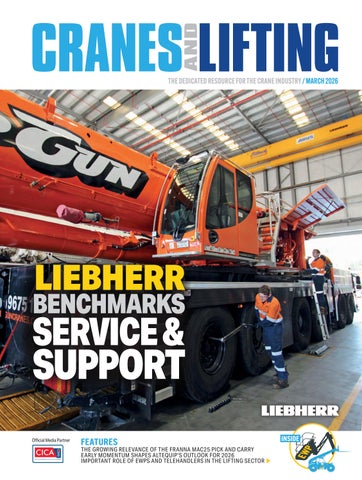
Cranes & Lifting March 2026

Page 1


BENCHMARKS SERVICE & SUPPORT LIEBHERR

From heavy industry and mining in the Pilbara to marine and infrastructure projects on the East Coast, our team of expert technicians and parts specialists deliver around-the-clock, on-site support you can count on.

We’re more than a service provider — we’re a true partner in keeping your operations moving. OUR SERVICES

Mobile crane repairs & diagnostics

With operations based in Karratha (WA) Perth Metro (WA) Sydney (NSW) & SEQ (QLD), we offer rapid mobilisation and local expertise to meet the demands of Australia’s most challenging worksites.

NEW DIRECTION. EXPANDED CAPACITY. SHARPER FOCUS. As CCS enters a new chapter of national growth, we’re investing in the people, systems, and scale to support major projects, port authorities, and private fleets across Australia.

EWP features

Turning opportunity into action

36 Dieci

Exploring Magic Glasses

20 Manitowoc

Manitowoc go big at Conexpo 22 LEEA

Exploring lifting standards

25 Quadrent

When the numbers finally work

28 EQUIPR

Borger Cranes embrace EQUIPR Software

Rotational abilities of Pegasus

39 Altequip

Rising fast in access

42 Tadano

Branching out with Tadano EWPs

44 Zoomlion

Adapting to tighter sites and bigger demands

47 Pace Cranes

Beefing up service capabilities

51 Complete Crane Solutions Tonnage making inroads

54 SANY Australia

Engineering trust over time

57 Franna – A Terex Brand

Crane choices made for the long haul

61 BULK Expo 2026

Industry backing builds momentum

FROM THE EDITORIAL TEAM

WELCOME TO THE MARCH ISSUE OF CRANESAND LIFTINGMAGAZINE

VARIOUS REPORTS HIGHLIGHT THE significant growth the construction industry has experienced since the pandemic mainly as a result of easing interest rates and population growth. This growth is expected to continue, with the market forecast to expand at a Compound Annual Growth Rate (CAGR) of 5.6 per cent from 2026 to 2029. Trends are definitely emerging within the industry.

The Australian building industry will shift its focus toward residential construction, driven by factors such as population growth, increased investment in luxury housing and supportive government policies. The industry will see the increased use of digital twin technologies. These tools create a dynamic virtual replica of a physical project, using real-time data from sensors, IoT devices and building information modelling (BIM) software.

It goes beyond the traditional and static methods of construction planning, with the ability to reflect a construction’s real-world state and performance. It provides data-informed simulation, optimisation, monitoring and predictive maintenance throughout a project’s life cycle.

Th is technology is already being used in Australia across various sectors, including infrastructure planning, emergency management and asset performance. However, it also plays a crucial role and will shape the future course of Australian construction companies.

Artificial Intelligence (AI) will continue to influence the Australian construction sector in the years ahead. According to some market projections, AI in construction will grow to almost $9 billion by 2031 globally, and it will have a tangible impact on Australia’s ability to build.

The implementation of AI in both

the planning and building stages of construction will improve safety, efficiency and project management across Australia — all while reducing costs.

From design to completion, it can detect hazards, predict accidents and monitor compliance. AI will be utilised to ensure quality control, while also boosting productivity and supporting sustainability goals.

Another technological trend that will influence Australia’s construction industry in 2026 and beyond is BIM. This digital tool is crucial for project delivery, providing a shared, intelligent and 3D model of projects.

BIM software serves as a single source of information for the entire construction workforce, enabling stakeholders to work in a unified and informed manner.

In the future, BIM will be further integrated with AI and machine learning systems, fostering collaboration across Australia’s construction industry.

Conversations with crane hire companies confirm our industry needs to and is indeed embracing and implementing new technology to keep pace with the construction sector and others they are servicing. This trend will only enhance productivity and efficiencies and continue to make our industry a destination for the next generations.

As always, the team at Cranes and Lifting has worked hard to bring you mix of industry news, opinion and developments and we hope you enjoy the read.

B ooms Up!

Published by:

379 Docklands Drive, Docklands VIC 3008

T: 03 9690 8766

www.primecreativemedia.com.au

Chairman John Murphy E: john.murphy@primecreative.com.au

CEO

Christine Clancy E: christine.clancy@primecreative.com.au

Publisher Sarah Baker E: sarah.baker@primecreative.com.au

Managing Editor Lisa Korycki E: lisa.korycki@primecreative.com.au

Editor

Simon Gould E: simon.gould@primecreative.com.au

T: 0404 865 109

Assistant Editor Danny D’Cruze

E: danny.dcruze@primecreative.com.au

T: 0429 187 751

Business Development Manager Emily Schlegel

E: emily.schlegel@primecreative.com.au

T: 0466 317 555

Client Success Manager Ben Sammartino E: ben.sammartino@primecreative.com.au

Art Director Bea Barthelson

Imaging Assistant Paul Breen

Subscriptions T: 03 9690 8766 E: subscriptions@primecreative.com.au

The Publisher reserves the right to alter or omit any article or advertisement submitted and requires indemnity from the advertisers and contributors against damages or liabilities that may arise from material published.

© Copyright – No part of this publication may be reproduced, stored in a retrieval system or transmitted in any means electronic, mechanical, photocopying, recording or otherwise without the permission of the publisher.

LIEBHERR BENCHMARKS SERVICE AND SUPPORT

Recognising the increased importance customers are placing on service and support, Liebherr Australia and New Zealand continues to make significant investments in this critical area. Outcomes from the strategy include providing fixed price servicing, increased repair capabilities, improved customer communications, increased technician headcount as well as increased factory training.

Liebherr’s New South Wales Service Manager, Steve Longworth, provides insights into these developments.

LIEBHERR AUSTRALIA AND NEW ZEALAND continues to increase staff levels and capabilities to handle the additional demand for service and support, employing 50 technicians across six facilities in Australia and New Zealand, with numbers continuing to grow. In early 2026, the fabrication division support will increase to three factory certified welders, with one apprentice to start training this year and each facility employing a technical apprentice each year.

Mid this year, Liebherr will be moving into a newly purchased 10,120 sqm facility in Melbourne which features increased parts storage, expanded workshop areas

and new paint and blast facilities.

“With a recent restructure across the entire service business, there has been significant investment in recruitment, customer service, support, and training. Last year we launched a number of initiatives designed to encourage greater loyalty from our customers by providing an increased level of service whilst enabling our customers to better manage their maintenance operational costs,” said Steve.

“After conducting industry research and listening to our customer needs a decision was taken early last year to introduce a fixed price service model available in one, two, or three-year packages. This

Mid this year, Liebherr will be moving into a newly purchased 10,120 sqm facility in Melbourne which features increased parts storage, expanded workshop areas and new paint and blast facilities.

is designed to help customers control their costs for the term they have chosen. Having already agreed contracts with some of the biggest crane operators in NSW, we have found that the three-year plan is the most popular, allowing greater cost control over an extended period of time.”

“When we provide a customer with a fixed price model quotation across their fleet, this is individualised to every serial number and we confirm the service schedule and requirements for that model according to Liebherr Service data, factoring in how engine specifications and models differ etc. We then average out the cost of labour and add the cost of the parts required to complete the services over the period of the service contract,” he said.

Liebherr has also increased its inhouse repair capabilities including a significant upgrade of its paint booth and the employment of two full time specialist spray painters.

“The paint booth has always been a part of the Erskine Park facility, but in the past, we have employed contractors to manage

projects. Now, having our own spray painters, we can conduct repairs in-house providing a serious alternative for insurance work whilst providing customers with the confidence that repairs are being conducted by the manufacturer to ‘manufacturer standards’.

“Recently, we had a customer bring his crane into the facility for a mechanical repair and we identified that the rear corner was damaged having reversed into something. We were able to mechanically repair the crane, repair and realign the damaged corner and put the crane through the paint shop, all within the same day. Our focus is very much on less downtime and more uptime for the crane,” said Steve.

Liebherr’s Erskine Park facility has also expanded the range of services it offers.

“We are broadening the scope of the workshop from being mechanical repairs focused to now incorporate more specialised services such as servicing air conditioning systems, providing electronic fault diagnosis through to detailing and wheel alignment. For electronic fault

diagnostics we have invested in state-ofthe-art equipment and to quickly and correctly diagnose engine and transmission fault codes for every Liebherr model,” said Steve.

Improved communication and responsiveness to customer service requirements is also a key focus, ensuring the provision of having dedicated technicians available for after-hours calls and with the introduction of Podium, a management system specifically designed to enhance Liebherr’s service and support requirements, being introduced last year.

“We wanted communications with customers to be faster and as transparent as possible, so everybody within the business has Podium’s communication platform live on their desktop. All calls are recorded and transcribed, so we have a record of the conversation, we know who spoke to the customer, what was said and when this took place. Transparency with our communication with customers is the key to enable us to respond faster and with information at hand to assist.

“We have the ability to call or text, send videos, send images, schedule messages in advance for services that are due, whatever we need to do, even when we are away from the office as Podium is a mobile platform too. This further increases our response

Images: Prime Creative Media
Liebherr continues to increase staff levels and capabilities to handle the additional demand for service and support.
Spare parts availability has always been a key focus for Liebherr.

guidance. If we can’t do this, the ‘on call’ technician will attend site and provide support regardless of the time of day,” he said.

Another key focus area is training and staff retention throughout the business, said Steve.

“The past 12 months have seen some staff movements at the Erskine Park service division, and I feel that we have come out stronger with the decisions we have made and we now have a much more solid team supporting our customers, that I am proud to work alongside. We continue to provide our technicians with direct access to our manufacturer-level knowledge and best-practice procedures. We have a trainer arriving from Germany in February 2026 and he will be with us in Australia for three months. His presence will help introduce the team to the developing, new technologies featured in our cranes with the intention of ensuring that they become specialists in their chosen areas rather than generalists and are fully equipped with the latest technology advances within the Liebherr Mobile Crane fleet.’

times. Should a team member happen to be absent, a colleague can quickly step in to assist the customer and deal with the enquiry and know exactly what has been said, bringing us up to speed with the issue. This ensures we are always across the customer’s needs, and we can act on them as quickly as possible.”

“With Podium, customers ring us on one number, and all team members are alerted that there is a call on the platform. If the call gets directed to a certain person and they are not answering, somebody else will pick up the call and assist. It’s all about faster response times for the customer,” said Steve.

He goes on to explain more about the

roll out of Liebherr’s ‘on-call system.’

“We recognised the need to support or customers outside of normal business hours. We are in the process of rolling out a system where each of our technicians are rotated on call, after hours, for a particular week and we rotate this responsibility through the field service team consisting of four technicians covering NSW. Customers are now reassured that they can pick up the phone and they can receive a support service for their concern, 24 hours a day. With our ‘on call’ service, customers receive 15 minutes of free advice over the phone to see if we can resolve the issue without a call out. Sometimes an issue is simple to resolve through support

“We believe this approach will further enhance Liebherr’s credibility with customers, insurers and business owners whilst improving staff engagement, encourage retention and career development which are all important factors in today’s industry,” said Steve.

Liebherr has also introduced a loyalty programme including promotional discounts throughout the year as well as 24-hour secure site access for drop off and collections eliminating the need for costly “on road” parking or parking fines. The security and flexibility for dropping off and collecting cranes around customers movements is a huge efficiency saver.

“Many of these programs are being piloted right here at Erskine Park providing us with the opportunity to identify and rectify any issues before they are ‘rolled out’ on a national basis. It’s an exciting time for the Liebherr Mobile Cranes Service Divisions business and we are confident customers will soon view Liebherr’s service and support capabilities in a very different and positive light and want to be part of the progress we are making,” said Steve.

Liebherr has also increased its in-house repair capabilities including a significant upgrade of its paint booth and the employment of two full time specialist spray painters.
Improved communication and responsiveness to customer service requirements is also a key focus.

AUTHORISED FINANCE

Flexible tailored finance - Choose chattel mortgage or flexible leasing

Faster access - Pre-approved limits for Liebherr cranes

Lower cost of ownership - Lower payments through our asset value expertise

Free up capital - Off-balance sheet funding improves ROA and ROE

Stay in control - Diversify lenders and keep banks competing for your business

Scan the QR code to learn more, or chat with our team at www.quadrent.com.au/liebherr

CELEBRATING A LANDMARK INTERNATIONAL PARTNERSHIP

When I think about our industry, what always stands out is those who do things properly. People who do their best to keep people safe, support operators, and build confidence across every jobsite. It’s something our members take seriously every single day.

SO, IT’S INCREDIBLY EXCITING TO SEE that commitment being recognised on a global scale. As you’ve probably already heard, in January, The Crane Industry Council of Australia (CICA) signed a landmark partnership with the National Commission for the Certification of Crane Operators (NCCCO) in the United States, bringing our well established CraneSafe Green Sticker system to a whole new market. For those of us who’ve been part of CraneSafe from the start, it’s a proud moment, seeing something we developed in Australia becoming a benchmark for safety internationally.

You may have also heard that CICA’s CEO Brandon Hitch will be relocating to the US to play a handson role in supporting the program’s rollout. I cannot speak more highly of

“I’m proud of what we’ve achieved and even more excited about what’s ahead.”

Brandon, and everyone I’ve spoken to feels the same. Brandon’s expertise and leadership have been instrumental in CraneSafe and more broadly, CICA’s success here at home. While having him on the ground in the US ensures that the program is implemented smoothly and stays true to the standards Australian operators know and trust, we will all be very sad to say goodbye when the time comes in May.

I’m proud of what we’ve achieved and even more excited about what’s ahead. There’s a lot we can learn from

Thom Sicklesteel, CEO National Commission for the Certification of Crane Operators US and newly appointed CICA CEO Pat Cran.

CICA President

Marcus Ferrari Images: CICA

each other, and this is just the start of seeing CraneSafe make a difference far beyond our borders.

It’s also worth noting that momentum isn’t limited to our international work. Here at home, CICA initiatives continue to gain real traction, with sell-out numbers at the Wind Forum, strong demand for the Lift Supervisor Course, and more and more crane companies putting their teams through CrewSafe and the Mobile Articulated Crane On Road Safety course. These programs reflect the trust the industry and others place in CICA.

That said, there is still important work ahead to improve crew and crane safety, supporting new entrants into the industry, strengthening on-road safety outcomes, and continuing to advocate for sensible road access arrangements. Raising standards is not a one-off effort, it’s a constant commitment. Stay safe.

Marcus Ferrari CICA Board President

CICA BOARD

Marcus Ferrari – President

Karli Sutherland– Vice President

Danny Adair – Director

Danny Black – Director

David Solomon – Director

Anthony Grosser – Director

Andrew Esquilant-Director

Grant Gjessing- Director

CICA OFFICE

Brandon Hitch Chief Executive Officer 0428 228 048 ceo@cica.com.au

Julie Turner

CICA Executive Assistant / Board Secretariat Julie@cica.com.au

Alice Edwards Road Technical Engineer 03 8320 0440 alice@cica.com.au

Patrick Cran

CICA Site Operations Advisor 0488 004 274 pat@cranesafe.com.au

Sharon Pearce

Crane Crew Competency Officer 0491 134 533 sharon@cica.com.au

Damien Hense CICA Road Policy Advisor 0488 007 575 damien@cica.com.au

Thomas Webber Communications Coordinator thomas@cica.com.au

Kate Galloway Traineeship & Industry Engagement Coordinator

0491 047 118 kate@cica.com.au

Michelle Verkerk Communications and Special Projects Advisor michelle@cica.com.au

Just ina Blackman

Member Events and Engagement 0403 717 626 justina@cica.com.au

Shane Coupe CraneSafe & CrewSafe Administrative Assistant Officer 0491 047 134 shane@cica.com.au

Unit 10, 18–22 Lexia Place, Mulgrave Vic 3170

Phone: 03 9501 0078

Email: admin@cica.com.au

Website: www.cica.com.au

For information, please visit our website or call the CICA office.

BRIDGING THE GAP

Why crane businesses need contracts that work in the real world. Ping Gangur, Co-Founder and Principal Lawyer of Level Playing Field Lawyers and Registered Building Practitioner, (and previously licensed to operate a 20 tonne crane), examines the importance of understanding the contract you are signing.

CRANE BUSINESSES RUN SOME OF THE most technical and high-risk operations in construction. Yet many of the contracts do not match how the work is actually carried out on site. Construction lawyer and registered building practitioner, Ping Gangur, believes the answer is not more legal jargon but legal education that is clear, practical and developed with the industry, not for it.

THE COST OF SIGNING A CONTRACT YOU DO NOT UNDERSTAND

A few clauses hidden in a hire agreement can decide who pays the $100,000+ repair bill when a crane is damaged on site.

This happens more often than people think. Many hire agreements do not accurately reflect the risk allocation that parties believe they are signing up to.

Too often the head contractor has contracted to pass site conditions to the crane business, believing the crane business is in the best position to manage this risk.

Conversely, the crane business assumes that the head contractor has assumed some or all of the risk of site conditions.

When something goes wrong and construction lawyers review the hire agreement, the significant mismatch between the contractual position and the parties’ understanding of the scope of works and risk allocation is revealed.

So how can we bridge the gap?

Surely, we cannot expect parties to manage risk if they don’t even know what they are signed up for and the various levers to accept, manage; or eliminate the risk.

Level Playing Field aims to bridge the gap.

We want every crane company owner, and saw firsthand how much pressure crews face to keep jobs moving. I enjoyed the problem solving, the teamwork and the pride that comes with seeing a project completed safely.

way Level Playing Field practises law. Constant engagement with the construction community is just as important as keeping up to date with changes in law.

Image: Level Playying Field Lawyers
Ping Gangur, Co-Founder and Principal Lawyer of Level Playing Field Lawyers and Registered Building Practitioner.

THE REALITY OF CRANE CONTRACTS

Cranes are a fundamental part of many construction sites.

In many cases, the availability and limitation of cranes dictate the construction methodology.

Contracts are often signed quickly so that work on the site can start.

Sometimes work begins even before a contract is signed.

Many businesses assume that the standard terms are fair or can’t be negotiated.

The truth is, the contract is a communication document. A comprehensive ‘bargain’ needs to be reached first, and then the contract should reflect this.

Clauses about indemnity, insurance, delay and site control decide who carries the risk when things go wrong. The common pressure points on site that I have seen are:

• Who pays if the site is not ready and there is significant crane stand down?

• Who is responsible if a crane tips?

• Who is responsible when the principal changes the crane locations halfway through the project?

These are not just legal questions. They are questions about building methodology, who can afford to bear the risk, bargaining position and scope of works.

Every crane business should holistically think about a construction project and how that needs to flow through to the contract.

THE CICA CROSS HIRE AGREEMENT: A CASE STUDY IN INDUSTRY COLLABORATION

When the Crane Industry Council of Australia (CICA) engaged Level Playing Field, to help prepare a Cross-Hire Agreement Template, it became one of the most impactful matters I have worked on.

What made it powerful was the forum for CICA members to essentially negotiate contract departures/ amendments without cost or time pressure.

Level Playing Field produced a draft cross hire agreement, held a working group and for at least four months,

allowed CICA members to submit departures to the terms that we had drafted.

The feedback was detailed, practical and honest.

It made people think about what two parties should negotiate and consider long before a project is even tendered.

The final document was a great outcome. But the bigger achievement was the conversation it started across the industry. It showed that contracts can be a shared tool for fairness, not a weapon. The process of developing the template and the benefits I have seen reinforces how important it is for legal work to cater to the ever-changing needs of people in the industry.

“The most valuable part was not just the template. It was the way CICA members started asking better questions before they  signed.”

LESSONS FOR CRANE OWNERS AND OPERATORS

The cross hire work with CICA confirmed three lessons for every crane business.

1. K now the risk before you lift. Really think about who carries what risk before you sign anything.

2. Negotiate what matters. You may not change every clause, but you can clarify key points such as mobilisation, demobilisation, standby, repair liability and site control.

3. C hoose advisors who understand cranes. A lawyer who understands lift studies, wet and dry hire, principal and contractor pressures and live site decisions will give advice that protects you.

Legal advice should be clear and useful. It should help you win work with confidence. It should not fill your

ABOUT THE AUTHOR

inbox with long documents that no one will  read.

BRIDGING THE GAP AND MAKING THE LAW WORK ON SITE

Bridging the gap between construction and law is not about removing detail. It is about focusing on what really matters.

Crane companies manage mechanical, human and financial risk every single day. Lawyers must understand how work really happens. Work can be delayed by weather. Principals can change their requirements. Site supervisors must make fast safety decisions.

When legal advisors understand these realities, they can write contracts that reflect them. At the same time, crane businesses benefit when they see contracts as communication and protection and not as paperwork to ‘sit in the bottom drawer’.

LIFTING THE STANDARD TOGETHER

The law should not sit in an office far from the site. It should stand beside the people doing the work.

The CICA Cross Hire project proved that when lawyers and the industry work together, everyone benefits. Projects are safer, the potential for dispute is considered before lifting and risk is shared in the most manageable way.

Level Playing Field’s goal is simple. We want legal literacy to form part of every crane business. Because if you can lift one hundred tonnes with precision, then you can also lift the standard of your contracts with confidence.

How would you lift your legal game from now on?

A copy of the Cross Hire Agreement for CICA members is available on the CICA Member Portal.

Ping Gangur is the Principal Lawyer of Level Playing Field Lawyers. The firm specialises in construction law and is committed to making the construction industry a better place to do business. Ping has over fifteen years of experience in both the legal and construction industries and is passionate about helping the people on the ground (including crane companies) across Australia understand and manage legal risk. She works closely with industry bodies such as CICA to promote fair, practical and safe contracting practices across the sector.

CICA’S CRANESAFE GOES GLOBAL IN LANDMARK US PARTNERSHIP

The Crane Industry Council of Australia (CICA) has taken a major step, bringing the Australian crane industry to the global stage by signing a landmark partnership with the National Commission for the Certification of Crane Operators (NCCCO) in the United States.

THE AGREEMENT UNDERPINS THE launch of Green Sticker by CraneSafe (GSCS) across the US which is the first nationwide, standardised framework for periodic crane and load-handling equipment inspections. For an Australian-developed system to be adopted at this scale internationally is no small achievement, and it reflects decades of work by local industry to lift safety, consistency and confidence across worksites.

In Australia, the CraneSafe Green Sticker program is embedded in annual inspection regimes and recognised by major contractors, crane owners and regulators, it demonstrates what can be achieved when industry commits to high standards and continuous improvement.

Brandon Hitch, CICA CEO and Patrick Cran, CICA Site Operations Advisor have worked closely with NCCCO to secure this partnership, and say the agreement is both a validation of CICA’s approach and a significant opportunity for deeper international collaboration.

“CICA and the Australian crane industry have spent years building a rigorous and trusted inspection framework and seeing that model embraced in the US sends a strong signal about the quality of our systems. More importantly, the partnership creates a two-way exchange, allowing both countries to share technical knowledge, align inspection practices and keep lifting the bar on safety outcomes”, said Brandon Hitch. The framework brings together CCO-certified independent inspectors,

workers relying on equipment every day.

CraneSafe USA has described the initiative as working toward a true “Gold Standard” for periodic inspections, improving accountability, system works, why standardisation matters, and how collaboration with manufacturers will help shape the future of crane inspections in North America.

For CICA, the broader significance

Image:
CICA
Brandon Hitch with Thom Sicklesteel, CEO NCCCO US.

of the partnership goes well beyond a single program rollout.

It positions Australia as a global contributor to crane safety practice and highlights the strength of collaboration between industry bodies across borders. It also reinforces the value of operators who invest in doing things properly, operating with integrity, meeting their obligations and committing to best-practice safety systems even when no one is watching.

There are tangible benefits at home as well. International recognition of Australian frameworks strengthens confidence in local industry, supports manufacturers and inspectors working to worldclass benchmarks, and creates new pathways for innovation and continuous improvement.

Perhaps most importantly, the agreement reflects that safety is not a competitive advantage to be guarded, but a standard to be raised together.

CICA CEO Brandon Hitch will be moving to the US in the middle of 2026 to commence a new role with CCO Certification as a Senior Director.

This appointment will play a critical role in ensuring the successful national rollout of GSCS across the US. By providing dedicated technical leadership, industry engagement and program oversight on the ground, this role will support the consistent, high-quality implementation of the GSCS framework and help embed meaningful, long-term change within the US crane industry.

“CICA and the Australian crane industry have spent years building a rigorous and trusted inspection framework and seeing that model embraced in the US sends a strong signal about the quality of our systems.”

CICA has expressed its full support for the transition and pride in seeing Australian expertise recognised on the global stage. “This move reflects not only Brandon’s exceptional contribution to the industry, but also the international respect for the systems and standards developed here in Australia,” CICA Board President, Marcus Ferrari said. “We will truly miss Brandon and are deeply grateful for his years of hard work, dedication and unwavering commitment, and while his move to the United States marks the end of an incredible chapter here in Australia, we are pleased that his connection with CICA will remain strong in his new role.”

THE LIFT SUPERVISOR COURSE

Expert Guidance

The course instructors are seasoned professionals who will mentor course participants through real-life scenarios, preparing them for the challenges and responsibilities of a Crane Lift Supervisor.

Career Advancement

Crane Lift Supervisors are in high demand globally. Completing this course enhances employability and opens doors to a wide array of job opportunities and career growth.

Comprehensive Curriculum

The curriculum covers a wide range of topics, including lift planning, load calculations, safety protocols, communication strategies, and legal compliance.

Scan the QR code to book or to fill out an EOI to help to determine next year's course dates.

The course gives participants the confidence and skills to take control of lifting operations safely and effectively.

—Brandon Hitch, CEO, CICA

* Dates subject to change – See CICA Website for latest information

MAGIC GLASSES: PINNED

WHEN YOU FIRST LOOK AT A MOBILE CRANE set up on outriggers, everything can appear normal. With the Magic Glasses on, you look beyond “it is holding” and focus on what protects the crane when conditions change. Outrigger pinning is one of those details that only matters when something stops being routine.

QUICK SCENE-SETTER

You walk past a mobile crane set up on site. Outriggers are extended, pads are in place, and the crane is level.

• The lift looks routine and is within chart.

• Some outrigger beams are not pinned.

Nothing immediately looks wrong. WHAT MOST PEOPLE SEE:

• Outriggers fully deployed.

• Crane level and stable.

• Load within rated capacity.

• A modern crane with advanced stability systems.

The common assumption is that once the outriggers are down and taking weight, pinning is optional.

WHAT THE MAGIC GLASSES SHOW YOU

Many mobile cranes operate with variable outrigger positions. On cranes with systems such as Variobase, some outrigger lengths do not have a pinning hole. This is normal and by the manufacturer’s design. The important distinction is this:

• No pin available – designed operating condition.

• Pins fitted on some beams but not all.

• Pins omitted because the lift is “light,” “quick,” or the crane is modern.

THE CONTROLS THAT MATTER

• Confirm outrigger pinning requirements against the crane manufacturer’s instructions for the configuration in use.

• Understand when pinning is not possible by design.

• Pin available but not fitted – missed control.

A common misunderstanding is that outrigger pins are only an added safety feature. They are not.

Hydraulic outrigger cylinders are designed to extend and position the beams. They are not intended to provide positive mechanical restraint under abnormal conditions such as uplift, shock loading, or sudden load transfer. Anchor points may also not be designed to tolerate those loads.

There are documented cases where a crane has lifted onto one side, transferring weight unevenly. The loaded side holds. The unpinned beam retracts. The crane overturns.

Not pinning outriggers is like not wearing a life jacket. Most of the time, you do not need it. When you do need it, you really need it, and there is no time to put it on.

Pins exist to manage failure, not normal lifting. Signs to look for:

• Pinning holes aligned but pins not installed.

• Identify when pinning is possible but omitted.

• Fit outrigger pins wherever the crane configuration allows.

• Confirm pins are fully engaged and secured before lifting.

• Treat pinning as a primary mechanical control, not an optional extra. If you can pin, you should.

MAGIC GLASSES CHECKLIST – PINNED OUTRIGGERS (MOBILE CRANES)

• Outrigger positions selected in line with the lift plan.

• Ground prepared with suitable pads or mats.

• Pinning holes checked on all outrigger beams.

• Pins installed wherever the configuration allows.

• Pins fully engaged and secured.

• Pins remain in place for the duration of crane operations.

Pinned outriggers rarely attract attention when everything goes to plan. Their value only becomes clear when something changes suddenly. Modern crane technology allows flexibility, but it does not replace mechanical restraint.

Some outrigger positions cannot be pinned, and that is by design. Where pinning is possible, it remains a critical safeguard.

Next time you walk past a crane, ask one question: Can this be pinned? If the answer is yes, make sure it is.

FORWARD TOGETHER. WHY LEADERSHIP MATTERS AT EVERY LEVEL.

REAL

INDUSTRY LEADERSHIP DOESN’T always come with a title. Sometimes it shows up as a willingness to look a little closer, ask better questions, and help others see what “good” really looks like.

Scott McLeod has been doing exactly that for decades.

A Life Member of the Crane Association of New Zealand, former President, former Councillor, and the creator of SafeCrane, Scott’s contribution to the crane and lifting industry is both deep and enduring. His latest work is a series of articles titled Magic Glasses. It is a powerful example of leadership in action, and a reminder of how our industry is best served when we move forward together.

PUTTING ON THE MAGIC GLASSES

The premise of Magic Glasses is simple and effective: what if we all took a moment to deliberately see our work differently? Through his articles, Scott invites readers to metaphorically put on a pair of “magic glasses” — to pause, observe, and critically assess what’s happening around them on site. From lift planning and execution to behaviours, assumptions, and decisionmaking, Scott highlights what he sees when safety is viewed with intent rather than habit.

These are not theoretical discussions or compliance exercises. They are practical, grounded observations from someone who has spent decades in the industry — drawing attention to the details that often sit in plain sight but are easy to overlook. By sharing what he sees, Scott encourages others to look more closely at their own operations and ask a simple but powerful question: Is this as safe as it could be?

found at www.mcleod.nz/news, and it’s well worth the time to read and reflect on the insights being shared. Or you can read one of Scott’s articles here – republished with his permission and his blessing.

CLARITY. CERTAINTY. CONFIDENCE.

This year’s CANZ Conference theme — Forward Together — is underpinned by three words that reflect where our industry now stands: clarity, certainty, and confidence.

The last few years have not been straightforward. The Association has been rebuilding, navigating significant government change, uncertainty around regulation, and prolonged delays that directly impacted training and the longawaited refresh of the Approved Code of Practice (ACOP). Like many in the industry, we were waiting for the new Plant and Structures Regulations to inform our ACOP, only to see them cancelled following a change of government.

Rather than stand still, the Association has made clear and decisive decisions on behalf of the industry.

We established our own Private Training Establishment (PTE) to regain control of training quality and relevance. We continued to advocate for modern, practical regulatory guidance. And we stayed the course, engaging with Ministry of Business, Innovation and Employment (MBIE) and WorkSafe, to ensure that when the opportunity came, we were ready.

That moment has arrived. MBIE has

endorsed the ACOP refresh and we are in a position to deliver a modern Code of Practice that will underpin higher standards of safety across New Zealand’s crane operations.

With the work on the ACOP, new training Skills Standards and an industry led PTE to deliver them, CANZ is in a better position than ever to provide clarity, certainty and confidence to the members we value so much.

LEADERSHIP AT EVERY LEVEL

While the Association has been doing the heavy lifting at a system level — pushing for regulatory clarity and workable guidance — Scott McLeod’s Magic Glasses series highlights another equally important truth. Progress does not come from regulation alone.

It comes from industry leaders who are willing to share their knowledge, challenge complacency, and show others what good practice looks like in the real world. Scott’s work complements the ACOP refresh by encouraging crane companies and individuals to engage more deeply with their own operations — not because they are told to, but because they understand why it matters.

This is what Forward Together looks like in practice. It is the combination of clear rules, confident systems, and committed people — all pulling in the same direction. It is an industry mature enough to reflect, willing to improve, and determined to keep raising the bar.

And that — more than anything — is how our industry moves forward. Together.

McLeod Cranes Managing Director, Scott McLeod. Image:

MANITOWOC GO BIG AT CONEXPO

Manitowoc truly “Brought the Big” to this year’s ConExpo, unveiling one of the most anticipated mobile cranes in decades: the all new Grove GMK8700. This eight axle, 700 tonne (800 USt) all terrain powerhouse stunned the Las Vegas crowd as it made its global debut, setting a new performance horizon for high capacity mobile lifting.

MANITOWOC’S VOICE OF THE CUSTOMER (VOC) was the foundation for the development of the GMK 8700 ensuring it blends advanced engineering processes with real-world insights to address the needs of customers worldwide. Packed with state of the art technology and engineered for next level efficiency, this crane is designed to thrive in demanding metropolitan lifting environments, industrial shutdowns, wind power work, major infrastructure, and heavy construction.

NEXT GENERATION PERFORMANCE THROUGH ADVANCED ENGINEERING

At the heart of this lifting giant is Grove’s new CCS 2.0 control system, designed to optimise the crane’s performance envelope, improve setup efficiency, and maximise lifting output, enabled by the integrated MAXbase 2.0 outrigger optimisation platform.

Grove’s patented Megatrak® suspension system allows the crane to travel with the boom “over the front” or configured with a boom dolly—critical for East Coast

Australian roading requirements—delivering unprecedented flexibility for an 8-axle class crane.

Matched with the deep, high strength, lightweight wrapped chassis frame, this weight optimised concept enables the GMK8700 to carry a larger, stronger MegaForm boom with a flat deck design that improves operator access and rigging safety.

TWO BOOM OPTIONS. ONE DOMINANT PERORMANCE ENVELOPE.

With a choice of 54 metre (m) or 80 m main boom configurations, the GMK8700 gives owners unmatched versatility.

A further 91 m luffing jib plus 16 m boom extension provides enormous reach for congested city sites, tall buildings, and longradius lifts. Both booms feature the common Megaform™ design with interchangeable telescopic sections, so owners can easily switch setups for a wide variety of projects.

For maximum performance, the crane features Grove’s iconic, self rigging MegaWingLift™, dramatically boosting capacities with minimal mobilisation and ease of rigging.

INNOVATIVE VPC TECHNOLOGYA TRUE GAME CHANGER

The GMK8700 is the first Grove mobile crane to integrate Manitowoc’s pioneering Variable Position Counterweight (VPC) system—originally proven on the MLC650 crawler crane. The VPC adjusts counterweight position, enabling higher capacities without additional counterweight slabs.

With a compact 175 t (385,800 lb) counterweight package, the combined

influence of VPC, MegaWingLift and MegaForm boom geometry results in performance capabilities unmatched in the 700 t mobile crane segment.

POWERFUL DRIVE SYSTEM FOR SUPERIOR MOBILITY

Manoeuvrability, acceleration, and jobsite handling receive a major leap forward thanks to the crane’s five driven axles, integrated with Grove’s high output MegaDrive® technology.

This system delivers immense traction and smooth, controlled power delivery, allowing the GMK8700 to negotiate tight urban sites, uneven terrain, and heavy approach roads with confidence.

Combined with all wheel steering, intelligent driveline management, and the inherent travel advantages of Megatrak®, operators can expect exceptional road handling and site performance in all conditions.

“We are incredibly proud to introduce the GMK8700, a testament to the engineering and manufacturing excellence of our team in Wilhelmshaven, Germany. This landmark model underscores our commitment to delivering highperformance solutions that help customers achieve greater return on invested capital,” said Andreas Cremer, vice president product management mobile cranes at Manitowoc.

Optimised Set Up. Built for the Real World.

The GMK8700 features a host of practical advantages for faster mobilisation and improved safety:

• H style outriggers for superior stability.

• Removable rear outrigger box, simplifying transport.

Images: Manitowoc
Left: Maintenance and Reliability Tools on display included the Wire Rope Cleaner.

• Flat deck boom design for safer rigging access.

• Transport friendly axle and weight configuration for multiple regional roading regulations.

CRANES AND SUPPORT FOCUS FOR CUSTOMER GROWTH

Range-topping crane introductions from Grove and National Crane were showcased alongside new aftermarket products and services to expand Manitowoc’s goal as a total lifecycle lifting solutions company. The Manitowoc booth also featured one of North America’s most popular rough-terrain cranes, the all new Grove GRT780.

“Manitowoc is focused on building around the world the infrastructure and communities of today and tomorrow. Our CRANES+50 strategy guides us as we work to become a full-lifecycle service lifting provider for our customers. Our presence at CONEXPO 2026 reflects that commitment—we showcased some of the largest mobile cranes at the show and demonstrated how our partnership helps customers maximise their investments with industry-leading product support. Our cranes are essential to their operations, and we’re here to support them every step of the way,” said Aaron Ravenscroft, President and

Chief Executive Officer of The Manitowoc Company, Inc.

Manitowoc’s comprehensive customer partnerships deliver long-lasting success on the jobsite, through parts and service, lift consultation, workforce training, maintenance kits, efficiency-boosting technologies, and more.

At CONEXPO 2026, the wide array of customer support solutions was grouped into four key pillars:

• Training and Workforce Enablement focusing on technician training and anchored in the impressive new Mobile Training and Technology Center.

• Technology and Fleet Management covers tools such as Grove CONNECT™ and Potain CONNECT™.

• Lifecycle Solutions demonstrated how Manitowoc supports cranes postpurchase with EnCORE™ Premium Rebuild cranes and Reman parts, Extended Service Coverage, repair/ rebuild pathways, and more.

• Maintenance and Reliability Tools incorporate a wide range of accessories, including the Wire Rope Cleaner, Boom Lubrication Kit, Wireless Hydraulic Pressure Test Kit, next-gen Wika iFLEX2/5 console, and more.

GMK8700 – KEY SPECIFICATIONS

Capacity: 700 t (800 USt)

Axles: 8 axles / 5 driven with MegaDrive®

Boom Options: 54 m or 80 m

Luffing Jib: 91 m + 16 m boom extension

Counterweight: 175 t (385,800 lb)

MegaWingLift™: Self rigging

Counterweight System: Variable Position Counterweight (VPC)

Outriggers: H style with MAXbase 2.0

Control System: CCS 2.0

Above: The Maintenance and Reliability Tools on display also included Wireless Hydraulic Pressure Test Kit.

NEXT LEVEL TRAINING UNVEILED

One highlight was the new Mobile Training & Technology Center which debuted at the show. This industry-first mobile classroom offers modular, on-site training for customers and North American dealers, advancing workforce development for large crane owners and dealers by streamlining technician upskilling.

The Mobile Training & Technology Center travels to site on a 16m step-deck trailer and is deployed via hydraulic jacks. It’s a spacious facility, measuring 12m by 7.6m and can be set up in just 6 hours. The Wi-Fi-enabled Training Center is packed with multimedia, including three TVs and a SMART Interactive Board. Manitowoc provides the instructors to host training sessions in the center, with each event tailored to customer needs.

Manitowoc also showcased its comprehensive customer support services and offerings, with stations for everything from lifecycle solutions to used cranes, and from the latest technologies to an array of specialized tools for lubricating, greasing, cleaning, and more.

The Grove GRT780 Rough Terrain is very popular.

LIFTING STANDARDS

How member-led engagement and strategic partnerships are shaping the future of lifting standards.

STANDARDS ARE THE BACKBONE OF THE lifting equipment industry. Whether you’re using a chain block in a workshop in Christchurch, or lifting a turbine blade into position in Coppabella - providing the framework for safety, reliability, and operational excellence, Standards provide the industry benchmark. For professionals working in lifting operations, adherence to Standards is a commitment to best practice and risk mitigation. As the sector adapts to new technologies and challenges, the Standards that underpin it must also progress. Lifting Equipment Engineers Association (LEEA), and our members are driving positive change across Australia and New Zealand through standards and their development.

The revision of AS1353, the Australian Standard for Flat Woven Webbing slings, stands as a pertinent reminder of the complexity of Standards development. LEEA was heavily involved in the process of rewriting AS1353. I served as Draft Leader for two years, and it was far from straightforward. The entire development stretching over more than three years of rigorous review, technical debate, and stakeholder engagement. This extended timeline reflects the intricate nature of lifting equipment standards and the high stakes involved—where every clause and criteria can have direct implications for safety on worksites across the region.

Such a lengthy development cycle is not unique to AS1353, and it highlights a broader challenge facing Standards development globally. The ME-025 committee, responsible for overseeing lifting equipment standards, faces a monumental task. At the current rate— where a single Standard takes upwards of two years to revise—rewriting every Standard within ME-025 would require more than 100 years to complete. This sobering estimate underscores

the vital need for efficient, inclusive, and forward-thinking approaches to standardisation, especially as technologies and industry practices evolve at a much faster pace.

The ME-025 committee (over 50 per cent being LEEA members) plays a central role in the stewardship of lifting equipment standards in Australia. This group, composed of technical experts, industry representatives, and other stakeholders is tasked with maintaining dozens of documents that collectively set the benchmark for equipment design, manufacture, inspection, and safe use. However, the scope of their work is vast, and the challenge of keeping standards current, is compounded by the slow pace of traditional development processes. Currently each standard requires years of consultation, drafting, and review, so the risk of them becoming outdated is ever-present. This is particularly concerning in a sector where innovation and new challenges can quickly render standards obsolete. The protracted timeline for standards development calls for fresh thinking— greater engagement with practitioners, streamlined processes, and an emphasis on practical, real-world input. Equally important is ensuring that the language and terminology used in standards are accessible and easily understood by all audiences, not just technical experts. Making standards clear and user-friendly helps frontline workers, site managers, and newcomers to the industry understand and implement best practices with confidence, ensuring that safety and compliance are upheld across every level of the sector.

Amidst these challenges, LEEA is also focused on developing industry guidance, through proactive industry consultation. Recognising the wealth of hands-on experience within member ranks, the association played an

active role during the public comment stage of the AS1353 revision. Rather than relying solely on committee deliberations, LEEA sought direct feedback from members and whose insights are grounded in the realities of work across the region.

This collaborative approach marked a significant departure from the traditional, top-down model, where decisions are often made by technical experts without direct engagement with those most affected. LEEA facilitated open discussions, encouraged information sharing via survey, and hosted round table forums where members could share their perspectives on the proposed changes to the AS1353 Standard. The result, industry perspectives that were not only technically robust but also practical and relevant for today’s working environment.

Such engagement fostered a sense of ownership and accountability among LEEA members. By involving members in the standards development process, LEEA ensured that the final document addressed real-world risks and operational needs. This member-led ethos enhances both the quality and credibility of Australian Standards but also gave ownership to the industry.

BRINGING STANDARDS TO MEMBERS

A landmark development for the lifting equipment community arrived with LEEA’s recent partnership with Standards Australia. Historically, direct access to standards was both costly and cumbersome. Many members had to navigate expensive subscriptions or rely on outdated copies, creating barriers to compliance.

LEEA now offers access to standards as a key benefit for its members. Through a special portal, members can view, download, and reference the latest

relevant standards anytime. Members in this region can use the Standards Australia Store for a wide selection of Australian Standards or visit the LEEA website to access thousands of EN and ISO Standards.

This initiative makes compliance easier, fosters ongoing learning, and ensures that our members, inspectors, and professionals always have up-todate guidance for all lifting equipment operations.

The value of this access cannot be overstated. Having standards at your fingertips means that our industry technicians can make informed decisions during equipment inspections, referencing the most current criteria for care and use. Ambiguity is reduced, errors are minimised, and the consistency of inspections is greatly improved. For manufacturers and users alike, ready access to standards supports

better design, fabrication, and risk management—ultimately enhancing safety and reliability across the sector.

The streamlined access to standards further supports a culture of continuous improvement. Through our industry engagement events, LEEA members can share interpretations, clarify technical points, and stay abreast of regulatory changes that impact their day-to-day work. This collaborative environment encourages peer learning and drives the sector towards greater cohesion, transparency, and excellence. Moreover, by breaking down silos and building bridges between technical experts and practitioners, this model ensures that standards remain relevant, effective, and responsive to technological change and evolving practices.

Looking ahead, LEEA is committed to expanding its engagement efforts, inviting more voices into

the conversation and encouraging broader participation from across the lifting community. Ongoing training, seminars, and technical workshops will help members stay ahead of regulatory developments and industry innovation.

For professionals in lifting operations, these changes signal a new era of transparency, collaboration, and accountability. As standards continue to evolve in response to real-world challenges, LEEA membership will ensure that the lifting equipment sector remains both safe and progressive. Industry leaders and practitioners alike can look forward to a future where best practice is a shared reality—driven by the expertise and dedication of those who know the industry best – our members.

Justin Boehm is the Regional Manager for the Lifting Equipment Engineers Association.

LEEA
Image: Virrage
Setting the standard for safety.

Customer Training Courses 202

Australia and New Zealand

Please refer to our Mobile Cranes Customer Training programme for course descriptions and general terms and conditions.

CONTACT US

For more information and bookings, please contact our training department via email LAS-MCTraining@liebherr.com or call us on +61 (2) 9852 1800.

Please note bookings close 4 weeks prior to courses start dates.

Mobile Crane Division

HOW QUADRENT TURNED NEGATIVE EQUITY INTO A STRATEGIC OPPORTUNITY

The challenge of fleet progression has become as much a financial question as an operational one in ANZ’s crane market. Mobile crane owners are under constant pressure to increase lifting capacity, reach, and reliability, while at the same time managing rising costs, tighter margins, and increasing competition.

IN THIS ENVIRONMENT, THE ABILITY to move a fleet forward without creating financial strain has become a defining factor in long-term business performance.

As the only Liebherr-authorised funding partner across Australia and New Zealand, Quadrent works alongside Liebherr to help crane businesses acquire, upgrade, and optimise their fleets, often in situations where conventional lenders struggle to see a path forward. One such opportunity arose for a crane operator that was unable to access finance for an upgraded asset due to the negative equity in their existing crane. Quadrent’s unique approach to crane financing solved the problem.

WHY CRANE FINANCE IS DIFFERENT

What complicates finances for crane operators is that mobile cranes are not short-term assets. They are long-life

pieces of equipment, often retained well beyond the period assumed in standard finance models. Over time, this creates a disconnect between how a crane performs operationally and how it is viewed financially. A crane may still be working regularly, but increasing maintenance costs, downtime risk, and changing project requirements can make it a constraint rather than an enabler. When the equipment values fall behind the outstanding finance balance, operators can find themselves carrying negative equity that limits their options.

For many crane businesses, this is where progress stalls. Traditional financiers tend to view negative equity as a stop sign, regardless of the operator’s workload, reputation, or future opportunity. Yet in the mobile crane market, negative equity is not unusual. It is often a by-product of long ownership cycles, market shifts, and the reality that

cranes age differently to other assets.

This is where specialist finance aligned directly with the manufacturer has begun to change outcomes. Quadrent operates within a funding model that incorporates direct factory support from Liebherr to help underwrite equipment values. Rather than relying purely on historic resale data or conservative asset rules, this approach considers how Liebherr mobile cranes perform in the field, how they are supported over their lifecycle, and how they retain value in active markets.

That alignment becomes particularly important when a crane owner is trying to move forward while carrying legacy finance issues. That’s where Quadrent plays a distinctive role.

SPECIALIST FINANCE SOLUTIONS DESIGNED TO HELP, NOT HINDER

In one recent example, a well-established Australian crane operator was facing a

Images:
Quadrent
Financing simplifies upgrades for operators.

similar scenario. Their business had a solid reputation and a consistent pipeline of work, but its existing mobile crane was becoming a limitation. Maintenance costs were climbing, reliability was becoming less predictable, and the crane no longer aligned with the size and complexity of projects the business was being invited to price.

The obvious solution was to step up into a newer, higher-capacity Liebherr mobile crane. Doing so would allow the business to access larger projects, reduce reliance on cross-hire,and command stronger hourly rates. The problem was that the existing crane carried negative equity. The outstanding finance exceeded its market value, effectively blocking any straightforward upgrade through conventional lending channels.

Rather than treating this as an isolated problem, Quadrent worked within a single, consolidated finance structure that addressed the entire position at once. The facility funded the new Liebherr mobile

unplanned maintenance expenses.

The simplicity of the structure mattered as much as the crane itself. By rolling the legacy position and the new acquisition into a single facility, the owner avoided juggling multiple loans or short-term fixes. Cash flow was protected, administration was simplified, and the business could focus on operating the crane, not managing financial workarounds.

USING FINANCE AS A STRATEGIC TOOL

This outcome highlights a broader shift in how mobile crane finance is being viewed across the industry. Finance is no longer just a means of acquiring equipment; it is a strategic tool that can either restrict or enable growth and help to enable a business strategy. When funding decisions are made with a genuine understanding of crane lifecycles, utilisation patterns, and longterm value, operators are given room to move at the point when it matters most to them.

Liebherr’s factory support also played a significant role in underwriting asset

“The key is not simply buying newer cranes, but doing so in a way that reduces risk, protects cash flow and aligns finance wit h operational goals.”

crane, absorbed the negative equity from the outgoing unit, and included GST funding to preserve working capital. From the crane owner’s perspective, this removed complexity. There was one facility, one repayment, and a clear line of sight between the cost of the upgrade and the income it would generate.

The benefit to the operator was immediate and tangible. The new crane delivered higher lifting capacity and greater reach, opening the door to projects that had previously been out of reach. Utilisation improved, cross-hire costs reduced, and the business was able to price work with greater confidence. Just as importantly, reliability improved significantly, reducing downtime risk and

values. It provides confidence that the equipment being funded is supported over the long term and that its value is grounded in real market behaviour, not generic assumptions. For crane owners, this translates into access to finance structures that better reflect the realities of operating mobile cranes in Australia and New Zealand.

As project requirements continue to evolve and clients demand greater capability, crane businesses that can upgrade their fleets efficiently will be best positioned to compete. The key is not simply buying newer cranes, but doing so in a way that reduces risk, protects cash flow and aligns finance with operational goals.

Specialist finance enables strategic fleet optimisation.

In this case, the result for the crane owner was clear. A financial constraint that could have frozen the business in place was removed. The fleet moved forward, profitability improved, risk was reduced, and the business regained control over its growth path. What began as a challenge defined by negative equity ended as a practical example of how the right finance structure, delivered by Quadrent, can turn today’s limitation into tomorrow’s opportunity.

For operators considering a Liebherr crane upgrade or facing a complex transition involving older equipment, early engagement with a specialist finance partner can open doors that may otherwise remain closed.

To discuss how specialist Liebherr crane finance can support your next fleet decision, contact Quadrent and explore what’s possible when finance is designed around your business.

SUPERFLEX SLINGS

Upgraded cranes deliver higher capacity and reach.

HOW A PARTNERSHIP FORGED IN THE FIELD HELPED SHAPE THE FUTURE OF CRANE AND RIGGING SOFTWARE

When Australian crane hire giant Borger Cranes needed smarter systems to support its exponential growth, EQUIPR Software stepped in. Over the past seven years, they’ve been collaborating closely to engineer the future of crane and rigging operations.

SINCE ITS INCEPTION IN 1980, BORGER

Cranes has grown from a modest onecrane family venture into one of Australia’s leading crane-hire and rigging companies.

Borger now operates an impressive fleet of more than 250 cutting-edge cranes ranging from small 3-tonne units to heavyduty 750-tonne all-terrain cranes. The scale and variety of Borger’s fleet reflects its commitment to meeting the demands of clients across residential, commercial, mining, infrastructure and energy sectors.

With depots across all major East Coast hubs - including Sydney, Central Coast, Newcastle, Hunter Valley, Gold Coast, Brisbane, Sunshine Coast and GympieBorger Cranes has earned a reputation as a leading force in the crane-hire industry.

The company is recognised for its unwavering commitment to safety and reliability, and its proven capability to

deliver on projects of every scale and complexity.

A FLEET TOO BIG FOR SPREADSHEETS

Yet behind this impressive growth lay crippling operational challenges. With an ever-increasing amount of cranes, depots, rigging gear, operators, subcontractors and complex compliance needs, Borger’s existing software simply couldn’t keep up.

“A big part of the reason Borger Cranes was so successful and kept growing was because our business philosophy was to always say yes to the customer,” says Technical Manager Nathan Borger. “Even if we were booked out and someone rang us in the evening needing a crane the next morning, we said yes and then figured out a way to make it happen.

“But to keep being able to say yes, we needed software that would support our

According to Borger Cranes’ Nathan Borger, EQUIPR Operator has reduced manual data entry and supported Borgers’ efforts to centralise invoicing in the Sydney head office, which is a huge benefit.

business processes from start to finish. The software we were using at the time was very limited in its functionality and a lot of manual workarounds were required.”

Recognising they needed a robust, tailored solution rather than generic “plug-and-play” software to manage the intricacies of their operations, the Borger team explored the offerings of several global software providers.

WHY EQUIPR SOFTWARE WAS THE RIGHT FIT

After months of research, Borger decided that EQUIPR Software’s deep industry knowledge and flexible, consultative approach was exactly what it needed.

EQUIPR’s Allocate solution promised to turn chaotic spreadsheets and manual logs into a unified scheduling and resourcemanagement system, allowing Borger to plan crane allocations, manage assets, track operator assignments and avoid doublebookings or downtime.

But what truly sealed the decision was EQUIPR’s willingness to work alongside Borger to understand its business model, listen to its pain points and develop features that genuinely solved them. This partnership mindset - with EQUIPR acting as both a software provider and an operational ally - was exactly what Borger had been seeking.

“The other software providers we considered essentially said, ‘This is our product, take it or leave it,” says General Manager Shawn Borger. “But there were so many features we didn’t need and others we wanted but they didn’t have. The EQUIPR team was willing to custom

design software to meet our needs.”

EQUIPR’s local customer support and impressive responsiveness proved to be another major selling point. With many providers operating overseas and their long time-zone delays creating real operational risks, Borger valued EQUIPR’s commitment to rapid response and iterative development.

STREAMLINING SCHEDULING WITH ALLOCATE

Once the contract with Borger was signed, EQUIPR ran workshops, mapped out Borger’s operational needs and tailored its software to their needs. In early 2020, Borger rolled out EQUIPR Allocate to centralise crane and operator scheduling and streamline resource management across its expanding fleet.

“EQUIPR helped us manage the expansion of the company into the Hunter Valley and Queensland in 2020,” says Shawn Borger. “Allocate allowed us to easily manage bookings across multiple depots, increase fleet utilisation and keep up with increased safety and compliance requirements.”

But no major transition is without hurdles and the shift from manual processes and legacy software to a fully integrated system was no exception.

“Due to Borger’s rapid growth, we needed this software yesterday,” says Nathan Borger. “So, it may not have been perfect when it was rolled out and there were a number of early adoption issues. But EQUIPR responded by hiring extra developers and expanding their support team to meet our increasing requirements.”

Over the next six years, the everevolving tool became Borger’s operational backbone, replacing clunky manual logs with an integrated scheduling platform. And the data clearly demonstrates how Allocate has supported Borger’s exponential growth.

“When we started with Allocate in 2020, we did 30,000 jobs that year,” says Shawn Borger. “In 2025 we completed over 130,000 jobs.”

DITCHING PAPER DOCKETS AND TIMESHEETS FOR A NEXT-GEN SOLUTION

Allocate was just the beginning of Borger’s digital transformation. In 2025, the company adopted EQUIPR’s Operator app, enabling operators to digitally submit timesheets, mobile dockets, safety checks and compliance records instead of relying on outdated paper-based workflows.

“There were a few issues at the start, but EQUIPR was very responsive in fixing them,” says Nathan Borger. “EQUIPR

Operator has reduced manual data entry and supported our efforts to centralise our invoicing in our head office in Sydney, which is a huge benefit.

“In the past, crane crews only got basic job information the day before via text message, and then they had to look up the details on paper sheets on the day of the job. Now, they get all the details through the app as soon as we send out the job information for the next day.”

This shift marked a major turning point. With fewer lost dockets, faster approvals and real-time data flowing back to the office, Borger has dramatically reduced admin time, sped up invoicing and strengthened cash flow.

TOWARDS THE FUTURE: PARTNERS IN PROGRESS

Behind Borger’s epic transformation lies continuous collaboration and codevelopment. Borger shares pain points, provides frontline feedback and suggests workflow improvements. EQUIPR listens, refines the software, builds custom features and supports implementation.

While EQUIPR Software Managing Director Anthony Roche acknowledges the road hasn’t always been smooth, he believes that’s precisely what has made the

designed to streamline your crane operations, enhance safety, and ensure accountability.

designed to streamline your crane operations, enhance safety, and ensure accountability.

EQUIPR’s Allocate solution turned chaotic spreadsheets and manual logs into a unified scheduling and resource-management system.

partnership so valuable and helped shape EQUIPR into the industry-ready platform it is today.

“Some of our biggest product leaps have come directly from Borger’s real-world challenges,” says Anthony. “Their feedback has never been theoretical - it’s born on the jobsite and tested under pressure. That alliance has made our software stronger, smarter and genuinely built for crane operations.”

Machine specific checklists are in line with the CraneSafe program.

Machine specific checklists are in line with the CraneSafe program. StartSafe streamlines the process for collecting pre-start information, with instant data retention to a central location for the crane owner to access.

The partners are currently implementing a new Lifting Gear Management feature that will be a game-changer for Borger.

“We have an equipment yard at our Sydney depot that’s almost the size of a football field,” says Nathan Borger. “It’s really hard to keep an overview of what’s coming in and going out, and to make sure we aren’t double-booking any lifting gear.

When a faulty item is recorded by the operator, the maintenance team is notified of the issue by email, which includes photo evidence of the fault. This also assists with gathering major inspection data. TAILORED

“We often have to chase down a man box or another piece of equipment from another

Photos tell the story.

Photos tell the story.

StartSafe streamlines the process for collecting pre-start information, with instant data retention to a central location for the crane owner to access.

depot at the last minute. But with this new feature, we’ll be able to keep track of all our equipment in the system and see where everything is at all times. It will help us reduce headaches and costs.”

This dynamic co-development cycle shows how a partnership between craneindustry operators and software engineers can yield meaningful, tailored solutions that shape both industries.

“We’re now in a position where the software is ready to scale with us,” says Shawn Borger. “I’m confident that things will be even better going forward and that we’ll continue to expand our operations thanks to our partnership with EQUIPR.”

The EQUIPR team is also looking towards the future with ambitious plans for continued innovation.

“Borger continues to push us forward,” says Anthony. “Their ambition matches ours and that alignment means we’re building more than software together. We’re shaping the future infrastructure of crane and rigging operations.”

More than just a pre-start checklist

When a faulty item is recorded by the operator, the maintenance team is notified of the issue by email, which includes photo evidence of the fault. This also assists with gathering major inspection data.

StartSafe is comprehensive tool designed to streamline your crane operations, enhance safety, and ensure accountability.

StartSafe streamlines the process for collecting pre-start information, with instant data retention to a central location for the crane owner to access.

Photos tell the story.

When a faulty item operator, the maintenance notified of the issue includes photo evidence This also assists with inspection data.

THE IMPORTANCE OF ELEVATED WORK PLATFORMS AND TELEHANDLERS IN THE LIFTING SECTOR

NEED A LIFT?

Tadano’s got you covered.

AERIAL WORK PLATFORMS

KNUCKLE BOOM CRANES

Built for the Realities of the Job Site.

STRAIGHT

BOOM CRANES

On tough sites and tight schedules, you need equipment that performs safely, reliably, and without compromise. Tadano lifting and access solutions are built to keep your jobs moving and your crews protected.

Aerial Work Platforms offer safe, stable access so operators can work efficiently at height.

Knuckle Boom Cranes provide the reach, capacity, and muscle required for heavy lifts.

Straight (Telescopic) Boom Cranes deliver manoeuvrability and precise control where space is tight.

Every Tadano machine is engineered with robust safety systems, proven durability, and the uptime reliability contractors depend on.

Less downtime. More productivity. Safer operations.

©Tadano
Ltd. 2026. Tadano is a registered trademark of Tadano L td. or its subsidiaries.

BUILDING CERTAINTY IN AN UNCERTAIN MARKET

How Haulotte and DLL are helping rental businesses grow with confidence.

FOR EQUIPMENT MANUFACTURERS AND rental businesses alike, growth is rarely just about selling more machines. It is about timing, cash flow, and having the confidence to act when opportunities appear.

In Australia’s access equipment market, that balance has become increasingly important as projects move faster, machines become more specialised, and customers are expected to respond with little notice.

For Keith Clarke, General Manager for Haulotte Australia and New Zealand, that reality has shaped how Haulotte operates in Australia and how it works with finance partner DLL, represented locally by Liam Dalziell, National Sales Lead Vendor Partners – Construction, Transportation

Together, the two businesses have built a long-standing partnership focused on making equipment purchases simpler, faster and more predictable for rental businesses.

A LONG-TERM COMMITMENT TO AUSTRALIA Haulotte’s presence in Australia is not recent. Keith said the company is celebrating 40 years globally in the elevating work platform segment, with more than 25 years of direct involvement in the

“Australia was actually the first country Haulotte expanded into outside of France,” he said. “It has always been a strong market

for access equipment, driven by strict safety standards and a mature approach to working at height.”

WHY FINANCE BECAME CRITICAL

As Haulotte’s customer base grew, another challenge became clear. Many rental businesses were expanding quickly but struggling with the final step of the sales  process.

“We were good at selling equipment, but the biggest risk was always getting paid,” Keith said. “Most of our customers are small to medium businesses. They are great operators, but dealing with banks and finance structures is not always their strength.”

Longer payment cycles created uncertainty for both sides. According to Keith, that was the turning point that led Haulotte to strengthen its partnership with  DLL.

“Working with DLL allowed us to secure funding upfront,” he said. “We know approvals are in place before a deal is finalised, which gives certainty to us and to the customer.”

Keith said the impact on business growth has been significant.

“Honestly, we would not have grown at the pace we have without DLL,” he said.

“Many of our customers would not be where they are today, either.”

He said DLL has helped rental businesses move from small operations into multimillion-dollar enterprises by providing structured financing that traditional banks were often unwilling to offer.

DLL’S PARTNERSHIP-LED APPROACH

For Liam, these outcomes reflect DLL’s broader partnership strategy and the strengths that set it apart in the access equipment and rental sectors.

“Our role is to partner with manufacturers like Haulotte over the long term, and in a way that genuinely supports how their customers operate,” he says. “That means bringing deep asset knowledge, understanding market and rental utilisation cycles, and moving quickly on approvals so operators can secure equipment when they need it. We help them expand their fleet and scale their business in a sustainable way.”

He said the strength of the Haulotte relationship lies in alignment.

“We are not just financing one transaction,” Liam said. “We are building portfolios of repeat customers who grow over time.”

A key part of that model is Haulotte

Images: Haulotte and DLL Partnership between DLL and Haulotte reduces complexity for customers.

to settlement.”

That approach also benefits customers, who deal with a finance provider that understands access equipment and rental business cycles.

FLEXIBILITY OVER RIGIDITY

One of the biggest differences between DLL and traditional lenders, according to Keith, is flexibility.

“Banks have many revenue streams,” he said. “Equipment finance is not always a priority for them, which can make them rigid.”

He said DLL’s understanding of seasonal cash flow is particularly valuable.

“For many rental businesses, December and January are quiet,” Keith said. “Being able to structure transactions upfront, without payments during that period, can make a real difference to business health.”

Liam agreed, saying finance structures need to reflect how equipment is

“Our job is to balance growth with responsible lending,” he said. “We help customers understand their limits so they can respond to demand without overextending themselves.”

Revolving credit lines are a common solution. These allow customers to buy equipment quickly when needed while keeping debt within agreed boundaries.

“That speed is critical,” Keith said. “A customer might tell you they are buying nothing this year, then call three days later needing 30 machines. Having finance preapproved means we can react immediately.”

CHANGING EQUIPMENT DEMANDS

While the industry continues to evolve, Keith said some fundamentals remain the same. Smaller scissor lifts still account for around 60 per cent of the company’s global and Australian sales.

“What is changing is the size at the top end,” he said. “We are seeing more demand for larger scissor lifts and higher reach machines, particularly in warehousing and logistics.”

At the same time, customer expectations around specification and safety continue

to grow. “There is more complexity now,” Keith said. “Additional safety features, sitespecific requirements and short lead times all add pressure.”

This reactivity makes accurate forecasting difficult, which is why close collaboration between manufacturer, financier and customer is essential.

LOOKING AHEAD

Both executives see the partnership continuing to play a central role in 2026 and beyond.

“For most of our customers, DLL is simply part of how business is done,” Keith said. “It works smoothly and supports growth.”

Liam said there is still room to innovate, even in a mature relationship.

“Haulotte is a global brand with strong innovation,” he said. “Our focus is to keep evolving our finance solutions so we continue adding value to them and their customers.”

In a market defined by short lead times and high expectations, that certainty may be the most valuable asset of all.

REACH OUT TO DLL

Curious to find out how DLL can help your business grow? Scan the QR code on the next page to learn more or contact the team.

DISCLAIMER: Finance is provided by De Lage Landen Pty Limited (ABN 20 101 692 040) (DLL). Equipment to be used for business purposes only. Subject to DLL’s standard credit criteria, fees and terms and conditions apply.

Larger scissor lifts and booms with safety features are growing in demand.

Partnering with the Crane Industry, Every Step of the Way

Flexible finance solutions built for crane professionals.

DLL delivers flexible finance solutions that help you grow your fleet, upgrade technology, and stay ahead of the competition. Backed by Rabobank and active in 25+ countries, DLL combines global expertise with local ANZ insight.

DLL is more than just a financing partner - we support your growth, safety, and sustainable investment in next-generation equipment.

Let’s build the future together!

Partner with DLL, finance built for the crane industry.

Scan the QR code to learn more:

DIECI’S PEGASUS LEADS THE WAY IN ROTATIONAL TECHNOLOGY

With the needs of construction sites constantly changing and a large focus on reducing management costs and improving machine productivity, Dieci has invested in delivering a range of rotational telehandlers that match the evolving requests of customers. Bob Mules, Dieci Australia’s National Sales Manager, provides insights into features of the popular Dieci Pegasus 40.18.

WHEN IT COMES TO EFFICIENCY, adaptability and raw lifting power, the Dieci Pegasus 40.18 stands in a league of its own. Designed to handle the toughest jobs, this rotational handler offers 400° non-continuous rotation, transforming how you work on-site. Whether you need the capabilities of a telehandler, an aerial platform, or a crane, the Pegasus 40.18 seamlessly adapts with its diverse range of attachments – one machine, limitless possibilities.

Dieci’s Pegasus outperforms other brands of telehandlers in terms of reach, thanks to the turret rotation. The wide range of available equipment allows customers to perform the functions of a telehandler, a crane and an aerial platform with just a single machine.

Dieci’s range of telehandlers feature a combination of comfort and

functionality and the 40.18 delivers optimal performance, extreme power and lifting abilities, precision movement control, and soundproofing for absolute comfort.

With a lifting capacity of four tonnes, a maximum lifting height of 18 meters, and a 98 horsepower Kubota engine, the Pegasus 40.18 is designed to travel and lift with maximum stability and safety on level ground and off-road. An excellent selflevelling system, adaptive loading software and programmable height and slew limiters eliminate the risks caused by difficult ground and site conditions.

“The non-continuous 400° rotation feature makes the 40.18 a highly productive machine on-site. It really limits the number of times you have to relocate the machine. The 40.18 has good reach and lifting capacity and can lift 500 kilos at 15.3 meters,” said Bob.

Dieci’s Pegasus 40.18 is designed to handle the toughest jobs, offering 400° non-continuous rotation, transforming how you work on-site.

ADVANCED TECHNOLOGY

The technological capability allows for all electronic control units to constantly monitor the machine’s systems, feeding information back to the fully integrated colour TFT instrument cluster. This cluster displays all vital information including engine revolutions per minute (RPM), travel speed and working boom configuration in real time, giving the operator all the feedback necessary to operate seamlessly  and safely.

EASY MANOEUVRING

Dieci’s Pegasus 40.18 features an enhanced soft motion system that ensures all boom movements are easy to control, reducing speed when the machine is approaching its physical limits or in pre-alarm conditions.

MAXIMUM BOOM PRODUCTIVITY

The reinforced boom is made of highresistance steel, with load sensing and flow sharing distributors that offer simultaneous movements for more efficient work. The single compensation cylinder, which is patented by Dieci, is located inside the lifting ram and ensures the load on the boom is balanced at all times.

MAXIMUM SAFETY

The ROPS-FOPS approved cab is designed with a safety cell to provide maximum safety to the operator at all times. Dieci telehandlers comply with AS1418.19/10896.1 safety standards. A

‘deadman’ sensor, combined with operator presence sensor in the seat, prevents accidental operation.

“The cab is designed to make the operator comfortable throughout the day. Featuring full climate control and an air suspension seat, the curvature of the cab’s glass provides the operator with a full 360° vision. The ergonomic joystick is a five-inone proportional joystick designed for long days in the cab, allowing five simultaneous movements including load sensing and flow sharing, providing accurate and smooth placement of the load, anywhere within the working envelope,” said Bob.

The double air filter effectively shields the operator from dust and odours, ensuring a cleaner and more comfortable

Whether you need the capabilities of a telehandler, an aerial platform, or a crane, the Pegasus

seamlessly adapts with its diverse range of attachments.

working environment. Soundproofing, an adjustable steering wheel (height and depth), storage compartments and various accessories such as the air suspension seat enable operation in total comfort.

Height and slew limit technology is designed to assist in avoiding collisions, ensuring absolute precision and maximum safety for operators due to the setting of operating limits in all directions. It also has great stability and precision, even at heights. Travelling and lifting occur in total safety, both on wheels and on outriggers, on level ground and off-road.

The Dieci 40.18 features a servocontrolled two-speed gear box and constantly varying hydrostatic drive, which guarantees top-end speed and low end-torque.

“The load management system automatically detects the load, and the four independent outriggers automatically level with just the push of a button. Another important feature is the hydrostatic transmission and the inching pedal, which enables the operator to position the unit. This is important, particularly in tight or restricted areas.

“The footprint of 40.18 is compact. On wheels, it’s only 2.3 m wide, and on outriggers it is under four meters, which is important for sites limited for space. Given the 400° rotation, excellent lifting capacity and reach, you can see why the Pegasus 40.18 is such a popular model in Australia and all over the world,” said Bob.

Images: Dieci Australia
40.18
Dieci’s range of telehandlers features a combination of comfort and functionality and the 40.18 delivers optimal performance, extreme power and lifting abilities, precision movement control, and soundproofing for absolute comfort.

MOBILE CRANE SCHEDULING SOFTWARE TO STREAMLINE YOUR

OPERATIONS

MOBILE CRANE SCHEDULING SOFTWARE TO STREAMLINE YOUR OPERATIONS

EQUIPR is the leading software platform purpose-built for mobile crane hire operations. From quoting and allocations to job execution, compliance, and invoicing EQUIPR brings your entire operation into one streamlined system. Eliminate paperwork, improve team communication, and gain complete visibility over assets, crews, and job schedules. The result? Smarter resource utilisation, faster decision-making, and less admin for your office and field teams.

EQUIPR is the leading software platform purpose-built for mobile crane hire operations. From quoting and allocations to job execution, compliance, and invoicing EQUIPR brings your entire operation into one streamlined system. Eliminate paperwork, improve team communication, and gain complete visibility over assets, crews, and job schedules. The result? Smarter resource utilisation, faster decision-making, and less admin for your office and field teams.

KEY CAPABILITIES

Allocations & Scheduling

View all assets, crews, and job allocations on a single drag-and-drop board. Allocate cranes, riggers, and support vehicles in just a few clicks.

Mobile Dockets

Mobile Dockets

FEATURES & BENEFITS

FEATURES & BENEFITS

Streamlined Workflow and Increased Efficiency

Streamlined Workflow and Increased Efficiency

Improved Cash Flow

Improved Cash Flow

Reduced Administrative Overhead

Reduced Administrative Overhead

Send jobs instantly to field teams via the EQUIPR Operator app. Capture real-time dockets, timesheets, and job status updates straight from site.

Send jobs instantly to field teams via the EQUIPR Operator app. Capture real-time dockets, timesheets, and job status updates straight from site.

Invoicing

Invoicing

Create and send invoices directly from the job schedule. Automatically attach completed job data and reduce delays with faster invoice turnaround. Integration with most common Accounting software via API.

Create and send invoices directly from the job schedule. Automatically attach completed job data and reduce delays with faster invoice turnaround. Integration with most common Accounting software via API.

Compliance Tracking

Compliance Tracking

Track licences, inductions and safety documentation with automated alerts and visual flags ensuring every job is compliant.

Track licences, inductions and safety documentation with automated alerts and visual flags ensuring every job is compliant.

Reporting & Insights

Reporting & Insights

Access real-time reports on equipment utilisation, job profitability, invoice performance, and more. Customise views to suit operational needs.

Access real-time reports on equipment utilisation, job profitability, invoice performance, and more. Customise views to suit operational needs.

Payroll & Timesheets

Payroll & Timesheets

Reconcile daily jobs with timesheets using side-by-side views. Approve hours worked and streamline payroll processing with accurate, synced data.

Reconcile daily jobs with timesheets using side-by-side views. Approve hours worked and streamline payroll processing with accurate, synced data.

Quoting

Quoting

Generate detailed, dispatch-ready quotes in minutes with pre-filled asset and crew details. Easily convert accepted quotes into scheduled jobs. support vehicles in just a few clicks.

Generate detailed, dispatch-ready quotes in minutes with pre-filled asset and crew details. Easily convert accepted quotes into scheduled jobs.

Time Savings

Time Savings

Better Financial Management

Better Financial Management

Improved Communication

Communication

User-friendly Interface

User-friendly Interface

Designed for Mobile Crane Hire

Designed for Mobile Crane Hire

Australian-based support

Australian-based support

Learn more about industry leaders using our software at equiprsoftware.com

ALTEQUIP BUILDS MOMENTUM WITH EXPANDING SOCAGE PIPELINE

Just two years into its journey, Altequip is entering 2026 with growing confidence, a strong order book and a clear focus on expanding its Socage access platform offering in Australia.

ACCORDING TO CURTIS MORLEY, DIRECTOR at Altequip, customer interest has continued to build across multiple segments, from compact truck-mounted units through to the largest platforms in Socage’s global range.

The year has started strongly for the business, with enquiries picking up almost immediately after the Christmas period. Curtis said: “We’ve had positive conversations already, including energy and utilities sectors, and the momentum is carrying through.”

That momentum is being reflected most clearly in Altequip’s expanding Socage pipeline, with several new models either in development, on order or generating early market interest.

A NEW BENCHMARK IN COMPACT TRUCK MOUNTS

One of the most talked-about developments is a new 19-metre platform being built on the Ford Ranger Super Duty chassis. Designed around a 4.5-tonne Gross Vehicle Mass (GVM), the machine is expected to deliver a combination that does not currently exist in the market.

“We’re mounting a 19-metre Socage unit on the new Ford Ranger Super Duty 4x4,” Curtis said. “It’s fully approved by Socage and we’re now finalising the production details.”

Once complete, the platform will offer a 19-metre working height on a car licence, automatic 4x4 chassis. Curtis said this opens up significant opportunities for utility companies, arborists and councils looking for height without stepping into heavier truck categories.

“That working height on a 4.5-tonne GVM is something new,” he said. “It gives customers a lot of capability without needing a heavy vehicle licence, and that’s

why the interest has been strong.”

The project is currently in the design registration and testing phase, with Altequip aiming to have the first completed unit delivered within six months. Curtis said that Australia is one of the few markets able to fully utilise the Ranger Super Duty platform, creating potential opportunities beyond local  borders.

“There’s potential for other Socage global markets, like South Africa as well,” he said. “It will be a very unique product worldwide.”

GROWING INTEREST IN DJ PLATFORMS

Moving up the range, Altequip is also seeing strong enquiry around Socage’s DJ series, particularly the 32-metre and 37-metre double articulated platforms with jib.

“That’s coming from hire companies, arborists and larger operators,” Curtis  said.

The DJ range is designed to offer strong outreach while maintaining a compact footprint, thanks to stabilisers that deploy vertically within the width of the truck.

For the Australian market, Altequip is focusing on 4x4 chassis options, with the 32 DJ mounted on a 14-tonne chassis and the 37 DJ on an 18-tonne chassis.

“The stabiliser setup gives them a small footprint but still very impressive side reach,” Curtis said. “The 37 DJ, for example, offers a 300-kilogram basket with around 21 metres of outreach, which is significant for its size.”

Curtis expects these models to appeal primarily to medium and large hire companies, as well as established arborist businesses looking to step up their fleet capability.

“We’re trying to position the 37 DJ at under $700,000 on a brand-new 4x4 chassis,” he said. “Compared to a

Images: Altequip
Altequip grows its Socage platform range in Australia.

telescopic jib platform of similar height, that makes it a very compelling option.”

LARGER TJ PLATFORMS ENTER THE CONVERSATION

At the upper end of the market, Altequip is now in active discussions around Socage’s larger TJ platforms, including 75-metre and 100-metre units. These machines are being considered primarily for long-term energy and infrastructure  projects.

“There’s serious interest from power line construction companies,” Curtis said. “We’re talking about projects in Tasmania, Queensland and South Australia.”

These larger platforms are expected to be mounted on all terrain 10x10 chassis configurations, with Altequip currently assessing suitable options such as Tatra and Astra.

“They’re not everyday machines, but for the right projects they make a lot of sense,” Curtis said. “Socage is very keen to support that end of the market as well.”

While these units can also be used in windfarm-related applications, Curtis said that Altequip’s discussions have been with infrastructure companies involved in connecting renewable projects to the grid rather than wind farm operators directly.

STEADY DEMAND FOR SOCAGE RAPTOR SPIDERS

Alongside truck-mounted platforms, the Socage Raptor spider range continues to perform strongly. Altequip currently offers models from 18 metres through to 35 metres, with the first 35-metre units due to arrive in early March.

“They’re already sold,” Curtis said. “We were hoping to keep one as a demonstrator, but demand has been too strong.”

Another delivery is expected in May, with Altequip aiming to have a Raptor available for display at the HIRE26 show in Sydney.

Interest has also emerged in Socage’s SE electric spider range, which offers lithium battery power. However, Curtis said most customers are still opting for diesel-powered units with plug-in electric capability.

“People like having options,” he said. “They can run diesel outdoors or plug in when they’re inside. Fully electric hasn’t become a must-have yet.”

BUILDING CONFIDENCE THROUGH SUPPORT AND DELIVERY

Since commencing operations in January 2024, Altequip has delivered 17 units, with several more already sold or in

production. Curtis said the business has deliberately taken a measured approach to stock, focusing on allocating factory build slots rather than holding large volumes  locally.

“We try to read the room and keep equipment flowing without tying up too much capital,” he said.

Customer feedback, particularly around after-sales support, has been positive. Curtis credited detailed handovers, operator education and a proactive service approach for minimising downtime and issues.

“Most problems come from not knowing what you don’t know,” he said. “Once operators understand the machines, they’re very comfortable with them.”

To support future growth, Altequip has expanded its workshop team with an additional mechanic, and plans to bring on an apprentice later this year. Factory training is also scheduled, with Socage technicians set to visit Australia to work directly with the Altequip team.

With interest building across the Socage range and several new models on the horizon, Curtis said the focus for 2026 is  simple.

“It’s about building capability, supporting customers properly and keeping that momentum going,” he said.

The Raptor spiders range from 18 metres to 35 metres.
Factory training and hands-on support reduce operator downtime.

Altequip: The Exclusive Socage EWP Agent for Australia.

BRANCHING OUT WITH TADANO

Established in 2002 by then 23-year-old Trent Hughes, Independent Tree Services has grown into a well-established local medium-sized tree service company. Throughout its 23 years of operation, the business has operated Tadano Elevated Work Platforms (EWPs). Trent explains more.

“WE EMPLOY AROUND 30 FIELD STAFF who are supported by a team of five in various office roles including workplace health and safety, estimators and a fulltime diesel fitter.

“Our team is very experienced and long-standing, which includes employees with up to 18 years of service, 10 staff members who have been with us for more than 10 years. With this longevity, we’ve built a great team culture, and I genuinely enjoy working with them every day,” said Trent.

“Our customers are primarily Tier One and our work is governmentfocused. We regularly work on projects for the State Government as well as QBuild in South-East Queensland, City of Moreton Bay Council, Redland City Council, Brisbane City Council, defence sites, and civil construction contractors.

“We also maintain a long-standing private sector client base from earlier years, which we still service today.”

TADANO EWPS

Independent Tree Services currently operates four Tadano truckmounted EWPs.

“Over the years, we’ve owned seven Tadanos in total, having sold three previously,” said Trent. “Our fleet includes an 18-metre unit, two 28-metre EWPs, and a 30-metre EWP, providing flexibility across different job requirements.”

The fleet features two AT-255CG models, offering a maximum basket bottom height of 25.5 metres and a depth of 7.1 metres. These units can be mounted on medium duty trucks and include five-way motion control, covering boom telescoping, elevation, slewing, boom articulation, and basket swinging. Advanced computer control

Tadano EWPs provide consistency and reliability.

allows the basket to move in a straight vertical path by adjusting boom length and elevation angle, while slewing and basket swing are coordinated for precise horizontal movement. The articulated boom design enables access to recessed building sections and positions below the base boom.

Also included is the AT-157CG, providing a maximum basket bottom height of 15.7 metres and a depth of 3.9 metres. This model can be mounted on light duty trucks and features the same five-way motion control and computer-assisted movement, allowing operators to achieve accurate vertical and horizontal positioning. Its articulated boom enables approaches to tight or recessed areas that would otherwise be difficult to reach.

Completing the fleet is the AT300CG, which offers a maximum basket bottom height of 30.4 metres and a depth of 7.2 metres. Suitable for mediumto-heavy-duty trucks, it also features five-way motion control and computerassisted movement for precise vertical and horizontal operation. The articulated boom ensures safe and accurate access to recessed building sections and positions below the base boom level.

“All of our truck-mounted EWPs are

Tadano machines. We’ve owned our own Tadanos since 2015, but prior to that we wet-hired the same machines from another EWP hire company dating back to 2002,” said Trent.

“We like the Tadanos because they provide consistency and reliability. Because they’re all the same, they’re easy for operators to use, and they’re very forgiving, safe, and sturdy machines. In terms of reliability, they’ve been excellent.

played a key role in helping us get over the line recently with our two EWPs mounted on four-wheel-drive trucks, which was a first for them.

“They are always responsive to our requirements, phone calls are always answered, and help is available when we need it.

“The service technicians and engineering team provide good support and have strong technical knowledge within the workshop.”

“We like the Tadanos because they provide consistency and reliability. Because they’re all the same, they’re easy for operators to use, and they’re very forgiving, safe, and sturdy machines.”

“Our first purchase was a secondhand AT230: a 1988 model mounted on a 2006 truck, which is still operating today. We often compare Tadano to a Toyota Land Cruiser ute: not a lot has changed over the years, and that’s part of what makes them so dependable.”

SERVICE AND SUPPORT

The service and support from Tadano has always been strong, Trent said.

“Their service and support team

“Parts availability has also been good. If parts aren’t immediately available locally, we can usually source them quickly from interstate or have them airfreighted from Japan.

“Our relationship with Michael Atherden and Mitchell Orupold began around 14 months ago, when we purchased our last two AT255 EWPs on Isuzu 4x4 trucks and we continue to work closely with him and his team at Tadano.”

Images: Tadano Oceania
Trent Hughes has owned Tadanos since 2015, but prior to that he wet-hired the same machines from another EWP hire company dating back to 2002.

TELEHANDLERS TAKE CENTRE STAGE ON AUSTRALIAN WORKSITES

Telehandlers have become a critical part of the access and materials-handling mix on Australian worksites, particularly as projects demand greater reach, tighter manoeuvring and improved safety outcomes.

FROM REGIONAL CONSTRUCTION JOBS

to large-scale infrastructure and industrial projects, versatility is increasingly valued over single-purpose equipment.

Zoomlion’s telehandler offering reflects this reality. Integrated within the company’s wider EWP and access portfolio, the range combines rotating and fixed-frame models designed to handle a wide spread of lifting tasks while remaining suited to Australian operating conditions.

At the top end of the offering are the rotating models, the ZTH4518R and ZTH4525R, which provide 360-degree continuous rotation and a large working envelope, allowing operators to position loads with greater accuracy in tight or congested worksites. Complementing these are the non-rotating models, including the ZTH2506, ZTH3007, ZTH3013, ZTH4014 and ZTH4018. These machines are designed for stability, traction and straightforward material handling, particularly in open

environments where reach and lift capacity are prioritised.

BUILT WITH AUSTRALIAN CONDITIONS IN MIND

Across the range, Zoomlion has focused on practical features that respond directly to Australian site conditions. All models are built on a heavy-duty chassis with strong off-road capability, supported by four-wheel drive systems and multiple steering modes, including four-wheel steer and crab steering. This setup improves manoeuvrability while maintaining traction on uneven ground.

Load control and stability are supported by boom angle and boom length indicators, combined with a longitudinal load moment indicator system. Together, these systems provide real-time feedback to the operator and help reduce the risk of overloading or instability, particularly at extended  reach.

Safety has been a key design focus.

Externally mounted emergency stop switches allow rapid shutdown from outside the cab, while multi-layer signal lights improve machine visibility on busy sites. A white noise reversing alarm provides audible alerts without adding unnecessary noise pollution, making it more suitable for urban and residential environments.

Bin Zhang, Deputy General Manager of Zoomlion Access said, “We’ve focused on creating machines that not only meet but exceed Australian safety standards while delivering practical, userfriendly functionality.”

“From the real-time load monitoring systems to the enhanced emergency controls and maintenance-friendly features, every element is designed to help operators work more safely and efficiently in challenging Australian conditions,” he said.

Model ZTH3007
Model 4525R

Maintenance and daily checks have also been considered. Features such as wheel nut indicators, starter motor isolation switches and Anderson connectors for auxiliary equipment are aimed at reducing downtime and simplifying servicing routines.

OPERATOR-FOCUSED CAB DESIGN

Inside the cab, the telehandlers feature a 10.1-inch colour display that integrates machine monitoring, control functions and diagnostics into a single interface. The layout has been designed to be intuitive, reducing the learning curve for operators moving between models.

Comfort features such as heating and cooling air conditioning, ergonomic controls and clear visibility all contribute to reduced operator fatigue over long shifts. Seat occupancy monitoring and door monitoring systems add another layer of operational  safety.

Electro-hydraulic proportional control is standard across the range, delivering smooth and precise movements when lifting or placing loads. For applications requiring finer positioning, particularly at height, this control system plays an important role in improving productivity.

FLEXIBLE ATTACHMENTS AND APPLICATIONS

A wide selection of attachments allows the telehandlers to be configured for different tasks. Standard floating forks are supported by optional platforms, buckets, bale clamps, and crane booms with winches and hydraulic hooks. Rotating models also benefit from automatic attachment identification and quick-connect hydraulic systems, allowing faster changeovers between tasks.

This flexibility reinforces the machines’ role within Zoomlion’s EWP and access strategy, where a single platform can support multiple applications across construction, logistics and industrial maintenance.

ROTATING MODELS EXPAND ACCESS CAPABILITY

The rotating ZTH4518R and ZTH4525R sit at the premium end of the range and are positioned for complex lifts where reach, rotation and accuracy are critical. With lift heights extending beyond 18 metres and significant forward reach, these machines allow operators to service areas that would otherwise require multiple setups.

Outriggers, hydrostatic drive and

multiple steering modes support stability during operation, while features such as position memory, remote control capability and ECO mode add further operational flexibility.

These models blur the line between traditional telehandlers and access platforms, offering a hybrid solution that aligns with evolving site requirements.

LOCAL SUPPORT UNDERPINS THE PRODUCT OFFERING

Zoomlion has backed its access and EWP range with a growing Australian support network. Offices and warehouses in Perth (1,250 m2), Brisbane (2,054 m2), Melbourne (5,695 m2), and Sydney (1,750 m2) provide parts availability, service coverage and technical support, reducing lead times and improving uptime for customers.

This local footprint is an important part of the company’s strategy as it continues to expand its presence in Australia’s access equipment market. With a broad telehandler range, strong safety focus and an expanding local support structure, Zoomlion is positioning its EWP and access portfolio as a practical option for Australian operators looking for versatile and wellsupported equipment.

Model ZTH4518R
Model ZTH2506
Model ZTH4014

PEGASUS 40.18 400°

POWER & VERSATILITY IN ONE MACHINE

When it comes to efficiency, adaptability, and raw lifting power, the Dieci Pegasus 40.18 stands in a league of its own. Designed to handle the toughest jobs with ease, this rotational telehandler offers 400° non-continuous rotation, transforming how you work on-site. Whether you need the capabilities of a telehandler, an aerial platform, or a crane, the Pegasus 40.18 seamlessly adapts with its diverse range of attachments—one machine, limitless possibilities.

Max Capacity: 4,000 kg

Max Lift Height: 18.00 m Total Weight: 13,700 kg

Max Power: 73.4 kW (98 hp)

PACE CRANES EXPANDS SERVICE AND SUPPORT CAPABILITIES

Pace Cranes recently appointed Jackson Ansell as its Brisbane-based Field Service Technician. The role has been created for Jackson to support the growing population of cranes, including the Maeda and Sennebogen brands, in Brisbane and the surrounding areas. Jackson and Pace Cranes Managing Director Anthony Heeks tell us more.

“IN THE PAST, WHEN IT CAME TO servicing and supporting its brands, Pace Cranes worked closely with its Service Agent, LinCon,” said Anthony.

“We have been fortunate to have been supported by LinCon for the last 15 years. It has provided an excellent service as our agent, and we are very grateful to Coleen, Craig and Tony Fish for the support they have provided us.

“We recently opened a new facility in Brisbane, we have David ‘Chalky’ White making significant inroads in terms of sales and we knew the timing was right for us to bring Jackson on board as our Service Technician,” said Anthony.

Jackson is no stranger to mechanical repairs, with his father running a car repair shop business.

“From a young age, I would hang out with Dad in the repair shop, and I’ve always wanted to understand how all things mechanical work. Straight out of high school I moved up to Queensland, started an apprenticeship and worked on cars for about 10 years in various dealerships and independent workshops and also running my own mobile servicing business for a while. Then I

Images:
Prime Creative Media
Jackson spent his first month in the Sydney working with the service team and Product Support Manager Greg Muller.

moved into field service work on big industrial equipment,” he said.

Training has been a major focus for Jackson.

“There has been a lot to learn about the various brands Pace Cranes represent, especially the technology included in the Maeda and Sennebogen cranes. I spent

my first month with the company in Sydney working with the service team and Product Support Manager Greg Muller, learning about the products. It has been a significant investment by the business, and it has already paid dividends with customers very happy with the quality of service and support we have been providing,” said Jackson.

“Greg has a wealth of knowledge on the products, and he is a good communicator. My first month of training helped me understand how the cranes have developed over the years, how they operate and service and maintenance procedures. I have since travelled to Sydney multiple times and had additional training on a new Sennebogen model,” he said.

Anthony is really happy with the response to Jackson’s appointment.

“The feedback we’ve received has been very positive. We’ve had calls and emails from customers saying how thorough Jackson is with his work and how responsive he is to their requirements. He has a fully-equipped service vehicle, so he is able to visit customers and work around their schedules as well,” he said.

Jackson feels very comfortable at Pace Cranes.

“It’s great working with Chalky. He frequently has customers visiting the showroom for product demonstrations and I have the opportunity to meet them, and I think it helps with the sales process knowing they will be working with me and that I’ll be their contact when it comes to the servicing of their crane.

“The feedback we’ve received has been very positive. We’ve had calls and emails from customers saying how thorough Jackson is with his work and how responsive he is to their requirements.”

“Anthony and the whole team have made me feel really welcome. As I’ve said, there is a world of knowledge and experience that I am able to tap into and if there is an issue I can’t handle, one of the team members will be on a flight to give me a hand,” he said.

“Queensland is going to be an important state for Pace Cranes.”

Jackson had a lot to learn about the various brands Pace Cranes represent, especially the technology included in the Maeda and Sennebogen cranes.

P.A. Construction Equipment Pty Ltd (Pace Cranes) was established in 1987 to provide the construction industry with an independent Australian owned and operated crane sales, crane service and crane spare parts organisation.

For over 30 years Pace Cranes have offered premium quality equipment to the Australasian market with a dedicated and unrivalled service, supported by specialist technical advise across the full range of equipment sold.

Mini Crawler Cranes
Crawler Cranes
Electric Cranes
Mobile Cranes
Telescopic Crawler Cranes
Duty Cycle Cranes
Glass Lifting Devices
Tracked Carriers
Crawler Cranes
Knuckle Boom Cranes
Electric Pick & Carry Cranes
Glass Manipulators
Multi Loaders

TONNAGE MAKES SIGNIFICANT INROADS

Established in March 2025, Tonnage designs, engineers and manufactures a range of equipment including Industrial Stools with a Safe Working Load (SWL) of up to 500 tonnes and Transport Beams.

Tonnage is a collaboration between three leading industry experts: Josh John, National Director for Complete Crane Solutions, Jason Pivac, General Manager V&D Engineering and Didier Smets, Technical Solutions expert. Jason provides an update on the inroads Tonnage has made over the last 12 months.

“WE ESTABLISHED THE TONNAGE BUSINESS in March 2025, and during its first year of trading, it has rapidly positioned itself as a trusted provider of heavy lifting equipment –particularly our engineered Industrial Support Stools.

“The response to our Industrial Stools, which have a SWL up to 500t, has been massive. We already have several hundred out on hire and we are constantly manufacturing more units. We’ve also had success overseas, having established a rental fleet in Saudi Arabia, which is a development we are very proud off. This success is a result of cumulative efforts from the entire team –not just Josh, Didier and myself,” said Jason.

The Tonnage range is engineered and manufactured by Jason’s business, V&D Engineering (VDE), with the Industrial

Stools ideal for applications in heavy transport for the storage or temporary storage of heavy parts, including trailers. Applications also include the servicing of mining equipment, large construction equipment and also cranes. Basically, all applications where equipment needs to be ‘stooled off’ and maintenance conducted. The stools are often only required for a short duration, which is a major reason why Tonnage has a rental model.

The industrial stools can be found in workshop applications, particularly in the mining sector, where large mining excavators and trucks are being dismantled for servicing and maintenance and the heavy componentry is temporarily being stored on the stools. Storing them this way keeps them off the ground and dust-free.

The Tonnage team was proud to

exhibit at The Crane Industry Council of Australia (CICA) National Conference and Exhibition in Brisbane, Jason said.

“Our stand featured some heavy lifting Industry stools repurposed as a seating and networking area. This space quickly became a hub for industry conversation and connection.

“It was at CICA that I connected with Ross Johnson from Dynamic Rigging Hire. During our conversations, it became clear that high-quality heavy lifting stools and associated equipment were in short supply on the East Coast.

“From this shared understanding, a partnership was formed on a good oldfashioned handshake. As a result, a fleet of Tonnage support stools and transport beams were customised from our signature yellow into Dynamic Rigging Hire’s

Images: Rix
Ryan and Tonnage
The Tonnage team was proud to exhibit at The Crane Industry Council of Australia National Conference and Exhibition in Brisbane.

distinctive green and white branding, ready to service Victorian East Coast operations. We are now looking at setting up the same in Queensland,” said Jason.

“We look forward to a strong, long-term partnership with Dynamic Rigging Hire and to continue delivering innovative, modular construction and heavy lifting solutions across the East Coast and Australia-wide,” he said.

Ross Johnson, Manager at Dynamic Rigging is pleased to be a part of the Tonnage development.

“Prior to the CICA Conference and

Exhibition, I had read about the Tonnage product, but I didn’t know the individuals involved,” he said. “Using the stools as a seating area was a clever concept, and they certainly grabbed attention.

“I introduced myself to Jason and he explained how they were Western Australiabased and that he worked closely with Complete Crane Solutions (CCS).

“He said they were looking to broaden their footprint across the country, and for some time we have been looking for an opportunity to put more unique products into our rental offering. It turns out we are

dealing with the same customers, and we all agreed it appeared to be a good fit and everything fell into place very quickly.”

Dynamic Rigging will have the complete Tonnage range in stock from late January.

“We’ve actually got some stools out on hire in Western Australia though our partner Lifting Gear Hire and Sales and we’ll be working with some of the major Tier One players in Victoria and Queensland who are going to love the product,” said Ross.

“Queensland Rigging Hire will have the same levels of stock as us, but their range will be in maroon whilst ours are in the distinctive Dynamic Rigging green. Obviously, it’s a pretty unique type of product ideally suited to larger workshop applications. Jason has a number of case studies where the stools are used to support trailers whilst they are off their wheels to be serviced or painted.

“Other applications will include engineering and construction projects where equipment is delivered in sections and has to be assembled on site and off the ground. There will be a lot of different applications. As I said, we’ll be talking to the our Tier One customers who will find the stools really handy. For us, it’s another product in our inventory which we will handle through our usual processes.”

Tonnage’s Jason Pivac and Ross Johnson from Dynamic Rigging.
Above: Dynamic Rigging has the complete Tonnage range in stock.

BuilT For Saving

The Potain Battery is a dedicated power solution designed specifically for tower cranes, construction hoists, and other equipment with high startup power requirements. Engineered around real crane operating conditions, it provides a compact, lightweight, and high-output alternative to traditional diesel generators.

High Performance

Features high C-rate cells delivering up to 10C continuous discharge, ideal for managing sudden load changes and powering inductive equipment.

High Reliability

IP65 and C5 rated for exceptional durability against salt spray, sand, dust, and environmental extremes.

Environmentally Friendly

Fewer Greenhouse Gas Emissions

Do not release smoke & soot

The battery cells come with a 5-year warranty

Noise <45dB

Intelligent Management

Supports remote performance & status monitoring for optimized operation and maintenance.

Contact Details: Mail: ContactUs@manitowoc.com

Max Input Power 5-80kW

Max Output Power(Peak 1 min) 450 kVA

Max Output Current(Peak 1 min) 626A@415V

Output Power(Rated) 375 kW

Battery Capacity 65 kWh

Small Size

Compared to diesel generators and energy storage batteries, its compact design makes it much easier to transport and deploy on-site, effectively saving valuable job site space.

Multi-Level Safety

Integrated fire suppression at battery and cabinet levels, with flammable gas emission and explosion-proof design for maximum safety.

A PRACTICAL JOURNEY INTO THE AUSTRALIAN CRANE MARKET

When Sany first entered the Australian market in 2007 and 2008, it did so cautiously and without a clear playbook.

ONLY A SMALL NUMBER OF CRANES WERE delivered, and very few were configured in the same way. Specifications varied, details changed between units, and the machines reflected a manufacturer still learning how overseas markets operated. By today’s standards, those early cranes were far from consistent. But they served an important purpose. They exposed Sany to Australian safety standards, compliance requirements, operating practices and, most importantly, direct feedback from local users. That early feedback helped shape how the company would approach export markets in the years that followed.

THE MOMENT THAT CHANGED PERCEPTIONS

Market attention sharpened in 2013, when an Australian heavy-lift contractor placed a significant order for eight crawler cranes – four in the 300-tonne class and four in the 400-tonne class. This was not a trial or demonstration order. The cranes were purchased for active heavy-lift work on Australian projects.

At the time, the buyer had inspected the machines at bauma, where the models were on display. Delivery timelines from established European manufacturers were also becoming longer, while project schedules were not. The order marked a shift in how Sany was viewed locally, from a brand on the

periphery to one capable of supplying large cranes for demanding work.

More than a decade later, those machines remain in operation. Their continued use has become a quiet but meaningful reference point in discussions around durability and lifecycle support.

COMPETITIVE PRICING, BUT NOT AT ANY COST

In Australia, Sany is often described as competitively priced. The company does not dispute this. Purchase costs and service costs are generally lower than many established Western brands. However, within China, Sany now sits at the higher

Crawler cranes form the foundation of market strategy.

end of the domestic price range.

This is a deliberate position. Pricing too low limits long-term investment in engineering, product development and overseas support. For export markets like Australia, Sany’s approach has been to balance price competitiveness with the ability to invest in compliance, engineering adaptation and after-sales capability.

Understanding price without context, the company argues, can be misleading. Manufacturing scale, domestic supply chains and labour structures differ significantly between markets, and comparisons are rarely straightforward.

CONSERVATIVE BY DESIGN IN OVERSEAS MARKETS

Australian customers often ask whether cranes can be used in unusual or extreme operating conditions. Some practices that are common in China can appear unfamiliar or aggressive to Australian  engineers.

In export markets, Sany typically takes a more conservative position. In China, engineers can reach a job site within hours if an issue arises. Overseas, the cost of an incident – operationally, financially and reputationally – is far higher. That reality, combined with an engineering culture that places strong emphasis on responsibility, has pushed Sany toward higher safety margins and more cautious operating recommendations outside its home market.

In heavy equipment, the real test of a machine is rarely at delivery. It emerges years later, when components age and technology move on.

One example cited internally involves a crane delivered in 2009 that experienced a display failure many years into service. By that point, the original system had been superseded and the supplier had exited production. Sany supplied a new display and sent engineers from China to adapt the system on site, charging only for the hardware itself.

For Australian customers, this kind of response has helped reinforce confidence that long-term support is part of the ownership proposition, not an optional extra.

ADAPTING TO AUSTRALIAN OPERATORS

Early Sany cranes were designed primarily for domestic users. Australian operators are typically taller and heavier, and early feedback pointed to limited cab space and ergonomic challenges.

Over time, Sany introduced Australian-

operators and site conditions. The company has also made a point of inviting customers to visit its factories, giving them insight into the engineering process and the environment in which machines are designed and built.

THE ROLE OF LOCAL PARTNERSHIP

A key part of Sany’s evolution in Australia has been its relationship with its national distributor, Tutt Bryant, which has represented the brand since 2020.

According to Sany, the partnership goes beyond execution. The local team brings real-world market pressure, challenges assumptions and feeds frontline experience back into product and engineering decisions. That exchange has played an important role in aligning machines more closely with Australian expectations.

Today, more than 240 Sany cranes are operating across Australia and New Zealand, a figure that reflects steady, rather than rapid, market penetration.

LOOKING AHEAD TO 2026

For Australia and New Zealand, Sany’s priority through 2026 is to consolidate its position in crawler cranes while progressively expanding its all-terrain crane portfolio.

The company sees the region as a logical next step, building on crawler crane performance locally and growing demand for all-terrain cranes in Europe. The approach is measured and selective, with an emphasis on long-term positioning rather than volume  alone.

Sany’s journey in Australia has not been defined by headline moments or rapid expansion. Instead, it has been shaped by incremental learning, local feedback and gradual adaptation – a practical path that continues to influence how the brand approaches the market today.

Local distributor feedback drives engineering improvements for Sany Australia.
Sany SAC2500E.

MODERN CRANES FOR MODERN SITES

Australian construction and engineering contractor Civmec has steadily built a reputation for delivering complex projects across the energy, resources, infrastructure, marine and defence sectors.

AS THE SCOPE OF ITS WORK HAS broadened, so too has the thinking behind its lifting fleet.

Headquartered in Henderson, south of Perth, Civmec operates large fabrication facilities in Western Australia (WA) and New South Wales, supporting major clients across its sectors. The business continues to expand its national footprint, with new facilities at Gladstone in Queensland and Port Hedland in WA, as well as many sites nationally, while retaining a strong focus on inhouse  capability.

Brad Preen, Asset Manager at Civmec, has overseen the steady growth of the company’s plant and equipment fleet over the past eight years. With more than three decades in the construction industry, his experience spans both sitebased operations and corporate asset management.

“My role covers all plant and equipment across the business,” Brad

said. “When I joined, we had around 300 engine-driven assets. Today that number is closer to 700, covering everything from vehicles and generators through to cranes.”

Within that broader fleet sits a crane lineup that is carefully structured to meet Civmec’s long-term project needs. The company currently operates 31 cranes, including crawler cranes, rough terrain units and a strong contingent of Franna pick and carry models.

“Right now, we’ve got 18 Frannas in the fleet, eight rough terrain cranes and four crawlers,” Brad said. “For a construction company, it’s a solid fleet and it serves us well. Where needed, we supplement it with external hire, but having our own capability is  important.”

A LONG ASSOCIATION WITH FRANNA Brad’s relationship with Franna cranes stretches back to the very start of his  career.

“When I first started in the industry

in the mid-1990s, Frannas were also being built in WA, and I was working right next door to them,” he said. “From day one, I’ve had dealings with Franna, and I’ve known the product inside out for most of my working life.”

That long familiarity has shaped Civmec’s approach to pick and carry cranes over the years. Models such as the AT20 and AT22 have traditionally formed the backbone of the fleet, well-suited to structural steel work on construction sites.

“For a long time, there wasn’t a huge difference between the capacities of the various models,” Brad said. “If you’re picking and carrying stick steel, there’s not a lot of benefit moving up in size when the weights are relatively low.”

ENTER THE NEW MAC25S

That thinking began to change as Civmec’s project mix evolved. In late 2025, the company added two Franna MAC25 units to its fleet, alongside additional AT22 cranes.

Images: Civmec
The evolving projects and sites have made the MAC25 more relevant for Civmec.

“The way we work has changed,” Brad said. “We’re lifting modules, working across defence projects, and dealing with more diverse loads.”

Unlike city crane hire businesses that move between multiple short-term jobs, Civmec’s cranes are typically embedded on sites for extended periods.

“We might be on a site for weeks, months or even years,” he said. “That means you need to look at the bigger

including multi-year contracts with various blue-chip clients.

One MAC25 is supporting more traditional structural work, while the other is focused on modular lifts, including infrastructure for electric mining fleets.

“The scope of what we’re lifting is very different from what it used to be,” Brad said. “The MAC25 gives us options we didn’t really need before.”

“Parts availability and technical support, especially in remote areas, has been second to none.”

picture and choose equipment that gives you flexibility over the life of a project.

“The relevance of the MAC25 has grown over time. It made sense for our business. We started with two units to see how they would fit into our operations.”

Those cranes are now being deployed across major resources projects in WA,

PRODUCT CONFIDENCE AND SUPPORT

Despite the step up in capacity, Brad said the decision was not driven by any single standout feature.

“There wasn’t one particular feature that sold it for us,” he said. “The biggest advantage is the range of applications we can use it for across the business.”

That confidence extends beyond the

machines themselves to the support behind them. Civmec operates in remote locations, where downtime can have significant cost implications.

“If we have a breakdown, they’re there helping us get it back on the road,” Brad said. “Parts availability and technical support, especially in remote areas, has been second to none.”

EARLY FEEDBACK FROM SITE

While operator feedback on the new MAC25 units is still emerging, early impressions from handover and familiarisation sessions have been  positive.

“The technology in the cranes is excellent, and operator comfort is right up there,” Brad said.

From a maintenance perspective, the response has been equally  encouraging.

“Our mechanics are genuinely excited about working on them,” Brad said. “That says a lot about the  product.”

MAC25 enables modular and structural lifts.

90

say operators will need new skills in the next 12 months

60

report gaps in knowledge, safety behaviours, or legal compliance

79 % % %

struggle to recruit skilled lifting operators

INDUSTRY BACKING STRENGTHENS BULK EXPO 2026

Bulk Expo 2026 is gathering strong momentum, with major industry backing from the Australian Society for Bulk Solids Handling (ASBSH), ICHCA Australia, Belt Wise and SRO Technology.

TOGETHER, THESE ORGANISATIONS

support the event through technical expertise and industry leadership, reinforcing its position as a key meeting place for Australia’s bulk solids handling  sector.

At the technical heart of Bulk Expo is its partnership with the Australian Society for Bulk Solids Handling. ASBSH has joined as an official association partner and will oversee the development of the technical conference program running alongside the exhibition.

Curated by senior ASBSH experts, the conference will present the latest research, real-world case studies and emerging innovations shaping the future of bulk materials handling. Topics will include material handling challenges, storage and conveying, environmental considerations, transportation, modelling and simulation, and dust monitoring and control.

ASBSH Director Mark Jones said the partnership allows industry and academia to come together in a meaningful way. “This collaboration brings fresh research, practical insights, and innovations from industry and academia to Australia’s bulk-handling professionals, showcasing real-world solutions and fostering idea exchange,” Mark said.

Prime Creative Media General Manager – Events Siobhan Rocks said the partnership ensures the conference remains highly relevant. “Partnering with ASBSH allows Bulk Expo to deliver a conference program that is truly relevant and valuable to the industry,” Siobhan said. “Delegates will walk away with actionable insights and strategies to improve operations, efficiency and  safety.”

Safety and global best practice will

be further strengthened through the involvement of ICHCA Australia, which has joined BULK2026 as an official industry partner. ICHCA Australia is part of the global ICHCA International network and is widely recognised for its work in cargo handling safety and  standards.

ICHCA Chair Scott McKay said the organisation was pleased to partner with an event that brings the bulk handling community together. “We’re proud to support an initiative that encourages collaboration and practical innovation,” Scott said.

Siobhan said ICHCA’s involvement broadens the conversations taking place at the event. “ICHCA’s presence builds even more value for exhibitors and

Topics include material handling, storage, dust control, and simulation.

delegates looking to stay ahead of safety expectations, operational challenges and global trends,” she said.

Industry sponsorship is also playing a key role in shaping Bulk Expo, with Belt Wise joining as a Gold Sponsor. Known for its expertise in conveyor belt optimisation, Belt Wise works across mining, ports, quarrying and heavy industrial operations to improve safety, reliability and uptime.

Belt Wise Managing Director Beau Weiss said the company sees Bulk Expo as a key industry platform. “Bulk Expo is an important platform for bringing together the people, technology and ideas that drive improvement across bulk solids handling,” Beau said. “We’re focused on optimising conveyor performance through

Images:
Prime Creative Media

engineering-led design, quality execution and innovation.”

Siobhan said Belt Wise brings strong practical value to the event. “They consistently push expectations around conveyor performance, response times and service delivery,” she said. “Having Belt Wise join us as a Gold Sponsor brings genuine value for attendees seeking proven solutions backed by deep technical  expertise.”

SRO Technology has also come onboard as a Platinum Sponsor, reinforcing its long-term commitment to Australia’s bulk handling industry. Operating since 1988, SRO supplies precision measurement and protection systems used across bulk material operations nationwide.

Chief Operating Officer David Steel said the event aligns closely with SRO’s engineering-driven approach. “SRO Technology has always been about more than just supplying parts; we’re about solving the complex site-level problems that keep engineers up at night,” David  said.

He said the expo is also an ideal platform to showcase the return of the Ramsey product range. “We see this year’s expo as a great platform to show the industry that the Ramsey legend is back –better than ever,” David said.

With support from ASBSH,

as a landmark event for the bulk handling  sector.

Bulk Expo 2026 will be held on September 16–17 at the Melbourne Convention and Exhibition Centre.

ICHCA Australia, Belt Wise and SRO Technology, Bulk Expo 2026 is shaping up
Bulk Expo 2026 will integrate research and practical insights for bulk operations.
Delegates learn global best practices in bulk materials handling.

endeavourawards.com.au

Turn static files into dynamic content formats.

Create a flipbook