From heavy industry and mining in the Pilbara to marine and infrastructure projects on the East Coast, our team of expert technicians and parts specialists deliver around-the-clock, on-site support you can count on.
We’re more than a service provider — we’re a true partner in keeping your operations moving. OUR SERVICES
Mobile crane repairs & diagnostics
With operations based in Karratha (WA) Perth Metro (WA) Sydney (NSW) & SEQ (QLD), we offer rapid mobilisation and local expertise to meet the demands of Australia’s most challenging worksites.
NEW DIRECTION. EXPANDED CAPACITY. SHARPER FOCUS. As CCS enters a new chapter of national growth, we’re investing in the people, systems, and scale to support major projects, port authorities, and private fleets across Australia.
Tributes for Brandon Hitch.
17 CICA Business Essentials More support for CICA members.
18 CANZ CEO report A year of delivery.
57 Regatta Registers Managing assets the smart way.
61 Austlift Launches new wear-resistant slings.
21 Lif ting Equipment Engineers Association.
24 Borger Crane Hire Expansion in Queensland with new Groves.
27 Bulk Handling Expo Early bird tickets now available.
29 East Coast Cranes Go big with Liebherr.
33 Crane Connection and XCMG Second XCMG for Brisbane City Cranes.
36 Universal Cranes Stacking the core of Toowoomba Hospital.
Between Hook & Load feature
40 Andromeda Industries Proudly Australian made.
43 Dynamic Rigging The making of a mega lift.
47 All Lif ting Lifting capability nationwide.
51 Townley Drop Forge Built to lift, built to last.
54 RUD Chains Showcasing strength and innovation.
64 HYDAC Ensuring safe and smooth lifting.
67 MCT Equipment Hoeflon spider cranes land.
70 Enerpac Heavy lift on Paris Metro.
72 Hijsen Australia Flexibility of Spider Cranes.
76 Zoomlion and Soldier Tower Cranes A new luffing benchmark.
79 Franna The next step for P&D Cranes.
82 Complete Cranes Solutions Now servicing ANC Cranes fleet.
84 Manitowoc One Stop Shop approach to parts.
86 DRA Lifting bigger in Pilbara.
89 Tutt Bryant Fleet growth at Vamp Cranes.
WELCOME TO THE APRIL EDITION OF CRANESANDLIFTING
AT THE END OF 2025 MANY IN THE industry were shocked to learn that Brandon Hitch, Chief Executive Officer of The Crane Industry Council of Australia (CICA) had resigned. This shock was soon replaced with relief that his legacy will not be lost with Pat Cran being announced as his replacement. For many years, Pat has worked closely with Brandon, assisting with the roll out of important industry programs such as CraneSafe, CrewSafe and StartSafe and the industry will remain in good hands under his guidance. We wish Pat all the very best in his new role.
Brandon’s contribution to the Australian crane industry cannot be underestimated. He joined CICA at a time when the industry was relatively fragmented. He quickly gained the trust of the state bodies, encouraging them to work with him on national as well as state-based programs. The cohesion he has helped generate within the Australian crane industry has led to CICA’s participation on International Standards Committees influencing the way the global crane industry operates.
Brandon Hitch, Chief Executive Officer of The Crane Industry Council of Australia (CICA)
The team at Cranes and Lifting magazine has worked closely with Brandon and his team at CICA throughout his tenure and during this time, we have seen immense change in the way the crane industry views itself. There is genuine pride in what you do. We see this in the increasing number and the calibre of the entries for the CICA Lift of the Year competition as well as the number of delegates attending the CICA National Conference and Exhibition.
In this issue, those who are far qualified, pay tribute to Brandon and his long list of achievements. The team at Cranes and Lifting wish Brandon and his family all the best for this next chapter in their lives. We hope you enjoy the read.
Publisher Sarah Baker E: sarah.baker@primecreative.com.au
Managing Editor Lisa Korycki E: lisa.korycki@primecreative.com.au
Editor
Simon Gould
E: simon.gould@primecreative.com.au
T: 0404 865 109
Assistant Editor
Danny D’Cruze
E: danny.dcruze@primecreative.com.au
T: 0429 187 751
Business Development Manager
Emily Schlegel
E: emily.schlegel@primecreative.com.au
T: 0466 317 555
Client Success Manager Ben Sammartino
E: ben.sammartino@primecreative.com.au
Art Director Bea Barthelson
Imaging Assistant Paul Breen
Subscriptions
Frank Rapone
T: 03 9690 8766
E: frank.rapone@primecreative.com.au
The Publisher reserves the right to alter or omit any article or advertisement submitted and requires indemnity from the advertisers and contributors against damages or liabilities that may arise from material published.
When performance matters, the SANY SRC900T delivers. With a commanding 90-tonne lifting capacity and a five-section 47m main boom (reaching 65.5m with jib), this rough terrain crane is built to take on demanding lifts with confidence. Powered by a Cummins QSB6.7 engine producing 194kW, the SRC900T combines strong torque with smooth travel and lifting performance. Its reinforced frame design increases rigidity while keeping overall weight efficient, allowing for convenient one-trailer transport and faster mobilisation between sites.
An advanced load moment indicator system ensures safe, accurate lifting, while the spacious nextgeneration operator’s cab offers improved visibility, comfort and intuitive controls to keep productivity high.
Strong, reliable and ready for tough terrain, the SRC900T is engineered to maximise uptime and deliver results where it counts.
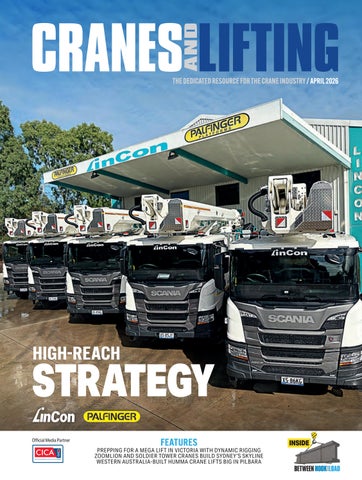
LinCon Hire & Sales expands its national fleet to support transmission and wind farm projects.
EXTENDING REACH ACROSS AUSTRALIA’S TRANSMISSION AND RENEWABLES BOOM
As transmission upgrades and renewable energy projects accelerate across Australia, LinCon is positioning itself with a clear strategy: invest in high-reach capability, control its own logistics, and back a stable, specialist workforce.
TONY FISH, RESPONSIBLE FOR TECHNICAL
Sales, and Damien Pollock, General Manager, outlined a business that has steadily expanded its footprint, particularly in the 75-metre to 100-metre segment. The company now operates 136 machines nationally, with further units arriving through the year.
A FLEET BUILT FOR HEIGHT
LinCon’s recent investments reflect the demands of transmission line construction and wind farm development. Multiple 48-metre units have arrived, offering
33 metres of horizontal outreach at 360 degrees. These complement a growing number of 75-metre and 100-metre platforms already working across the country.
“We’re continuing to upgrade the fleet and add new machines,” Tony said. “We aim for around 10 per cent growth each year.
“We direct the 75-metre machines to transmission line work, while renewables projects call for units with a greater reach.”
Damien said that Western Australia was a bit quiet on renewables, but in the past three to four months it’s really kicked into gear. “Transmission projects in the Pilbara are going off as well,” he said.
This spread of work has reinforced LinCon’s decision to maintain a national footprint, with branches in every state except the Northern Territory.
Maintenance teams operate across all states, supported by Palfingertrained technicians.
BUILDING 100-METRE CAPABILITY
Significant focus has been placed on the continued expansion of LinCon’s 100-metre fleet. Most of these machines are Wumag platforms mounted on Tadano crane carriers, with later models branded under Palfinger following its acquisition of Wumag.
Availability of new carriers has influenced procurement decisions.
LinCon introduced the first 103-metre unit in Australia in 2010. Early uptake was modest, but demand has since grown as customers recognised the advantages of that reach.
“The Wumag 103 metre units were originally built on Tadano crane carriers, but when they were no longer available, we made the decision to meet demand by purchasing second-hand units mounted to the Tadano carrier from other hire companies around the world,” Tony said.
“When they arrive, we carry out a full ten-year major inspection. Units are fully tested prior to disassembly. The booms, outriggers and slew bearing are dismantled for crack testing, and all hoses and cables in both the upper and lower booms are replaced. They roll out of the yard like new.”
LinCon has progressively built this segment, with several second-hand units
Images: LinCon Hire & Sales
sourced from Europe and the United States, all refurbishments are completed in-house.
Damien highlighted a project in Cairns where site access was limited.“They needed around 90 metres of reach, but the turns were too tight and the ground too undulating for larger multi-axle machines,” he said. “Our 103 metre on the five-axle all terrain carrier got in there with ease, did the job and we were in and out in a couple of days.”
In New South Wales, 80-metre towers positioned in constrained terrain required additional reach beyond nominal height.
“The pads were small, so the elevated work platform (EWP) had to sit further away from the tower,” Damien said. “The access was out of reach with a 75 or 80-metre platform, so the 100-metre unit went in. We had one on either side of the crossing and worked both sides at the same time.”
Projects such as CopperString and HumeLink are also expected to demand extended reach because of terrain, tower height and pad design.
“Some of those towers are being designed at 90 metres,” Tony said. “If that job goes ahead as planned, they’ll need that extra height.”
ENGINEERING FOR STABILITY
Working at 100 metres requires careful attention to ground conditions, load distribution and wind.
“All of our 100-metre machines have dedicated pad trucks,” Tony said. “The
most important thing is making sure we’re set up properly for all ground conditions we encounter.”
Each machine travels with steel crane pads and support equipment to create a stable working platform. These machines are rated to operate at 12.5 metres per second with wind speed at 103 metres, and up to 17 metres per second at reduced heights.
“As you can imagine, it’s windy when you’re up, around 17 metres per second,” Tony said. “They have been designed for specific areas in Europe to work in those conditions.”
The boom structure itself is substantial. Tony said, “The 100-metre platform is like a 350-tonne boom. It’s doesn’t move around.”
Damien added that while technical specifications define capacity, (as with a crane) disciplined setup and operator judgement remain central to safe operation.
“You can have all the rating in the world, but it comes back to setup, ground preparation and making sure everything is right before you go up,” he said.
SPECIALIST OPERATORS
Out of roughly 90 operators across the business, about 12 are currently signed off on 100-metre machines. “They don’t just jump from a 30-metre into a 103-metre,” Damien said. “There’s a training process.”
Operators must first demonstrate sustained proficiency on 75-metre units before being considered for higher
platforms. Dedicated trainers, including a national trainer and a South Australia-based trainer, assess both technical competence and mindset.
“Once they show interest and capability, they’ll be assessed in the field,” Damien said. “That can take about a month before they’re signed off.”
Training extends beyond operating at height. Loading and unloading onto floats forms a critical part of competency.
“They have to be fully trained in loading and unloading,” Damien said. “It’s tricky work. They need to know how to handle that safely. We’re always trying to identify operators who want to go that extra 25 or 30 metres in the air.”
TAKING CONTROL OF TRANSPORT
As reach increases, so too does the complexity of mobilisation. In New South Wales, certain high-reach units cannot be driven on public roads and must be transported.
“Coming in at 60 tonne, it costs a substantial amount to relocate a 103 metre platform using external transport companies. We have chosen to invest in a large float and dolly,” Damien said. “We want the flexibility to move our own equipment.”
A new purpose-built prime mover with a Drake five-axle extendible float and dolly, capable of carrying up to 70 tonnes, is expected to arrive in April.
“It gives us control,” Tony said. “Instead of spending that money moving machines around with someone else, we’ll do it ourselves.”
Beyond internal efficiency, the new transport combination also opens the possibility of external haulage work when capacity allows.
“When it’s not moving our machines, we’ll look to get utilisation by offering the combination out for general hire,” Tony said.
WORKSHOP EXPANSION
LinCon is also expanding its workshop network with a new facility in Toowoomba focused on major rebuilds and structural work. The site will house three fully trained technicians and an apprentice. LinCon’s expectations are to have the rebuilt units
LinCon’s Palfinger P480 at Mt Arapiles.
leave like new and the new facility will be complementing LinCon’s existing maintenance network.
LinCon’s workshop facilities have been recognised to have a substantial knowledge of the Palfinger product and have been approached to provide support as a subagent for Palfinger’s crane division in the Toowoomba region. This collaboration only serves to reinforce LinCon’s technical positioning within the elevated work platform and crane maintenance space.
Damien emphasised that LinCon’s specialist EWP experience differentiates it from competitors.
“We fully support our technicians by supplying international quality training to enable them to specialise in all aspects of EWP’s and cranes where needed,” he said. “A lot of our competitors rely on LinCon for their support also.”
PEOPLE AND CULTURE
While fleet growth is visible, Damien sees the business’s stability as a defining strength.
“Most of the management group has been together for eight, nine or 10 years,” he said. “Tony, along with some of the senior workshop staff have been here more than 20 years.”
The management structure is relatively flat and experienced, reducing hierarchy so the team on the ground can access the decision makers.
Promoting internally and building careers keeps experience in the sector. The Western Australian branch, previously led by a long-serving manager who recently retired, has transitioned to a successor already embedded in the business. Long service is recognised formally, with five, 10 and 15year milestones marked.
“We buy a lot of those shirts every year,” Damien said. “There are plenty of people here over five, 10 and 15 years.”
Tony believes the nature of the work and continued support contributes to retention.
“If you want to get paid to see Australia, this is the place to be,” he said.
Transmission and wind farm work often involves extended stays in regional locations, working alongside power authorities and construction crews.
“You become part of the framework with them,” Damien said. “They’re downto-earth people, working out in the bush for long stints. Some really like that type of work.”
At the same time, the business maintains competitive wages and conditions.
“We know we’re right up there in the marketplace,” Damien said. “We look after our people.”
RECRUITMENT CHALLENGES
Despite the stability, growth requires recruitment. To maintain utilisation targets, LinCon is seeking approximately 20 additional operators nationally.
“There’s a discrepancy between 90 operators and 136 machines if you want to run at 80 per cent utilisation,” Damien said.
Finding the right people remains challenging and geographic flexibility is often the limiting factor.
“You can find people who can drive trucks and people who can operate EWPs,” Damien said. “But to find people who suit what we do day to day is tougher.
“You might find the right operator, but they don’t want to travel or move interstate.”
In a niche sector where experience, temperament and mobility all matter, recruitment is as much about fit as
qualification. “We feel blessed to have team of 90 dedicated operators,” Damien said.
LOOKING AHEAD
LinCon continues to assess further acquisitions, including a potential 90-metre unit. However, axle configurations and road compliance vary between states which present hurdles.
“I’m talking to NHVR (National Heavy Vehicle Regulator) to work out how we can get it on the road,” Tony said. “Whether it’s a period permit or single-trip permit, that’s what we’re working through.”
At the same time, the company is reviewing its internal structure to ensure management capacity keeps pace with fleet growth.
“We’re looking at placing people in strategic roles around the country to support the team as we expand,” Damien said.
For LinCon, the path forward is defined less by rapid change and more by deliberate expansion: adding reach where projects demand it, strengthening internal capability and retaining a workforce comfortable with long stints in remote Australia.
With transmission corridors expanding, wind farms rising and infrastructure stretching across varied terrain, the need for high-reach, specialist access solutions is only increasing.
LinCon’s strategy suggests it intends to remain firmly in that space – higher, further and with its own transport to get there.
LinCon deploys 75-metre and 100-metre machines on major projects.
Above: Dedicated pad trucks support stable setup on high-reach projects.
AUCKLAND
WAIKATO
CRANES CENTRAL TO ENERGY TRANSITION
The past few months have been busy, productive and, in many ways, energising for our industry.
CRANES IN WIND – BUILDING MOMENTUM
The CICA Cranes in Wind forum was a huge success. Each year this event grows – not just in attendance, but in relevance. Cranes are at the centre of the energy transition, and our members are literally doing the heavy lifting to make renewable energy projects possible across the country.
We are proud that CICA continues to lead the conversation in this space, and thank Nick Morris, Liam Edwards, Audrey Bao and Alice Edwards (CICA) for coordinating the technical content. The forum brought together crane owners, manufacturers, contractors, engineers, regulators and energy proponents to talk openly about the challenges and opportunities ahead. The size of the room and the quality of the discussion show just how important our industry is to the future of Australia’s energy mix.
CHANGES TO MODEL WHS REGULATIONS
There have been important updates to the Safe Work Australia Model Work Health and Safety Regulations (Crane Licences) Amendment 2024.
In simple terms, the amendment does two main things.
1. Removes “encompassment” from slewing mobile crane licences
Previously, holding a slewing mobile crane high-risk work (HRW) licence automatically covered certain other crane types. That is no longer the case. A slewing mobile crane HRW licence will no longer automatically entitle the holder to operate:
• A vehicle loading crane with a capacity of 10 metre-tonnes or more
• A non-slewing mobile crane exceeding three tonnes
• A reach stacker
These will require the appropriate specific licence.
2. Introduces a prerequisite dogging qualification
The “Licence to perform dogging” VET course will now be a prerequisite for most crane HRW licence classes –including slewing mobile cranes. The main exceptions are bridge and gantry cranes and vehicle loading cranes.
CICA has been actively engaged in this space. We understand that licensing and training changes create uncertainty, and we are committed to working constructively with regulators and training providers. There will be more information in the coming months regarding how this revised training model will be rolled out for existing license holders and when it will take place. Our focus remains on ensuring competency, safety and practical pathways for industry.
ROAD ACCESS – STILL FRONT AND CENTRE
Road access continues to demand significant attention.
We are working with Federal, State and local government representatives to ensure the National Automated Access Scheme (NAAS) scope delivers real, practical benefits to the crane industry. This is no small task. It involves technical detail, cross-jurisdictional coordination and sustained advocacy.
Our objective is straightforward: lawful, efficient access pathways that reflect the complexity of crane operations. We will continue to push for consistency and clarity so that operators can plan with confidence and move equipment without unnecessary barriers.
The CICA Cranes in Wind Forum was very attended and featured high quality presentations .
Images: CICA
GREEN STICKER – LAUNCH IN THE US
In March, Green Sticker by CraneSafe USA was launched at ConExpo to strong interest and excitement. It was encouraging to see our very own CraneSafe concept resonate internationally and to witness first hand the appetite for practical, visible machine safety assurance in the crane sector.
This is another example of how Australian innovation in crane safety continues to influence conversations beyond our borders.
A PERSONAL NOTE
Finally, I would like to thank you for the many messages of support and well wishes my family and I have received as we prepare to move.
We have been genuinely overwhelmed. It has reminded me, once again, how big-hearted this industry is. For all the complexity, compliance and commercial pressure we deal with, at its core this is a community that looks after its own.
Thank you for your continued support of CICA and for the work you do every day to lift Australia, both safely and professionally.
For information, please visit our website or call the CICA office.
Brandon Hitch CICA CEO
Brandon has been a driving force behind some of the Australian Crane Industry’s most influential safety and professionalism initiatives.
HONOURING A TITAN OF THE CRANE INDUSTRY
At the end of 2025 Brandon Hitch announced his resignation as Chief Executive Officer of The Crane Industry Council of Australia (CICA) to take on new challenges in the United States. Since then, there has been an outpouring of gratitude from all sectors of the industry.
FOR MORE THAN A DECADE, BRANDON HAS been a driving force behind some of the Australian crane industry’s most influential safety and professionalism initiatives, including:
• CraneSafe
• CrewSafe
• StartSafe
• Articulated Mobile Crane On-Road Course
• Lift Supervisor Program
• National Training Model
• CICA Member Portal
Marcus Ferrari, CICA Board President, said Brandon has been instrumental in transforming how safety, training and professionalism are approached in the crane industry.
“He has brought deep expertise in
Australian and international Standards, but what truly set him apart was his humble leadership style and his ability to bring people together,” said Marcus.
“His brilliance, integrity and commitment to doing things properly will be greatly missed in Australia.”
In his new role as Senior Director with CCO, Brandon will facilitate the technical delivery of the Green Sticker by CraneSafe (GSCS) program across the United States. CICA has expressed its full support for the transition and pride in seeing Australian expertise recognised on the global stage.
CICA Life Member Allan Macpherson described Brandon’s impact on the Australian Crane Industry as huge and measurable by results.
“I have been involved with Crane
Association of Western Australia (CAWA) and CICA WA since 1979 and the increase in safety has improved across the country mainly due to Brandon’s knowledge and ability to interact with authorities, businesses and members,” Allan said.
“It is beyond words to express the impact one man in conjunction with the hardworking CICA Board, who are all volunteers, and the staff at CICA have had on the industry.
“I know we all must move on sometime in business to better ourselves and our families, and in Brandon’s case I wish it was in another five years. It is very sad that the other original Life Members and ‘founding fathers’, who had the foresight to sit down and form CICA back in 1978-79 are no longer with us to witness what their vision
for CICA has become. RIP.”
Danny Adair is a CICA Board Member and industry stalwart. He said Brandon’s impact on the industry has been one of a ‘born leader’.
“He has a way of ensuring we have all the required tools to make sure we are compliant and he has led the industry by sitting on multiple global standards committees for many years.
“Led by Jeff Brundell and John Gillespie, the CraneSafe team – including Brandon –envisioned CrewSafe and StartSafe as practical alternatives to traditional thirdparty Verification of Competency (VOC).
While many VOCs remain classroombased, paper-driven, and lack cranespecific detail, CrewSafe offers a genuine assessment. It is conducted by industry peers and tailored to specific crane brands, ensuring operators are truly competent on the machinery they use every day,” Danny said.
“Brandon’s legacy will live on and continue to flourish in the hands of our new CEO, Pat Cran as I know there will be a detailed handover which will include the operator’s manual on how to be a successful CEO of The Crane Industry Council of Australia.”
Incoming CICA CEO Pat Cran said Brandon’s leadership has shaped not only the direction of the organisation but also the culture that underpins how it works every day. He said Brandon’s greatest contribution has been the “strong, supportive, and collaborative culture he has built within CICA”.
“Under his guidance, CICA has brought together experts from every aspect of the crane and lifting industry,” Pat said. “The breadth of knowledge and depth of experience within the organisation is no accident; it is a direct reflection of Brandon’s strategic focus on capability, professionalism, and industry-wide representation.
“It has been a privilege working for Brandon, the impact is not just work for me, it’s personal. His guidance and mentorship have developed me both professionally and personally helping me become someone I am proud of as well as someone the industry can rely on.
“Like many in the industry, I will always be very grateful to Brandon for what he has done for me. His leadership has shaped not only the CICA we know today, but the CICA that will continue to serve, strengthen, and advocate for the crane industry for years to come.”
Anthony Grosser, CICA Board Member for CICA WA reflects on Brandon’s entry into the industry “at a turbulent time”.
“He was really the driving force that sees CICA as a genuine national advisory body for the crane industry,” Anthony said. “Following his direction, we have lobbied for better systems and conditions for a safer workplace and CICA is now considered a true advisor contributing to many of the safe work place guidelines we have in place today.”
He says Brandon bought credibility to the CraneSafe program.
“When he joined, the industry was questioning the value of the CraneSafe program, and there were a number of ‘copy cats’ and significant union stigma directed at the program.
“Through continued investment in certifications and development, CraneSafe is now considered the global leader for inspection programs for mobile cranes and that is quite an achievement.
“Training and upskilling have been a strong focus for CICA during Brandon’s tenure, and without this strong push we won’t have an industry. We have come a long way but still have a lot further to go.”
Anthony said that during his 11 years as CEO, Brandon has helped develop CICA into a truly professional organisation and a voice for the industry. He and CICA are respected at all levels as the ‘final word’ on mobile cranes and lifting and he and his team have ensured the industry sits with all levels of politics and governance.
But it’s not just his advocacy that will be missed.
“I have never seen Brandon lose his temper or control and he has been pushed by some idiots over the years,” Anthony said. “His ability to remain calm and respectful, at all times, is a rare skill which gives him significant credibility.
Images: CICA
The Australian Crane Industry wishes Brandon his wife Linda and daughter Grace all the very best for the future.
“His ability to share his knowledge in ‘normal terms’ has helped so many people; he always answers the phone and always finds a solution to an issue.
“Brandon was an incredible find for our industry and as a group we will have to work very hard to ensure his professionalism, legacy and leadership continue,” he said.
Alice Edwards, CICA’s Road Technical Engineer appreciates Brandon’s contribution to the industry and said his knowledge and experience of machine design, site operation and on road crane travelling played a key role in shaping national/international standards, influencing regulations, and fostering continuous improvement.
“Many CICA projects led by Brandon improved safety in the industry,” Alice said. “One example is major inspections. Brandon led the CICA Major Inspection Gold Plate program, and also under his guidance, CICA drafted up a comprehensive guideline for major inspections.
“High Risk Work License (HRWL)
reform is another important project he worked on to improve safety. Across Australia’s crane and lifting sector, the HRWL review represents one of the most consequential safety reforms in recent years.”
She said Brandon’s leadership and effort have helped support an environment where the industry can shape reforms that strengthen competency, enhance training relevance, and improve public and workplace safety.
“Training and upskilling are essential for the industry’s resilience, and two examples stand out for me: the Lift Supervisor Course, which gives experienced crew a structured pathway into critical supervisory roles; and the Articulated Mobile Crane On‑Road course, which closes a recognised competency gap for pick‑and‑carry driving and is now scaling nationally.
“These pathways—alongside simulators and careers outreach—are already strengthening safety outcomes and deepening our talent pipeline.”
According to Alice, Brandon is a leader
who doesn’t just respond to change, he anticipates it. His perspective is always fixed firmly on the horizon. His approach consistently encourages the crane and lifting industry to think beyond today’s challenges and prepare for the world it is heading into.
“Under Brandon’s leadership CICA has matured into a platform that connects members, regulators and global standards. We collaborate at scale and speak with authorities, which means clearer guidance, faster adoption of what works, and better project outcomes for the industry,” said Alice.
Anthony Heeks, ex New South Wales State Chair and Managing Director of Pace Cranes also expressed his appreciation for Brandon’s contribution to the organisation and the wider industry.
“Before becoming CEO, Brandon managed the CraneSafe program and played a pivotal role in shaping it into the respected and trusted program it is today,” said Anthony.
“Under his leadership, our industry
Brandon with new CICA CEO Pat Cran
has grown, supported by a strong and dedicated CICA membership. Brandon has consistently driven improvements in safety standards nationwide, strengthened relationships across industry sectors, and championed change and progress. His commitment to lifting standards will leave a lasting and positive legacy for years to come.
“On a personal level, I am incredibly grateful for the support Brandon has shown me over the years, particularly during my time as New South Wales State Chair. He was always willing to listen, collaborate, and offer assistance whenever it was needed. Thank you, Brandon, for your leadership, your vision, and the integrity you brought to your role. Your contributions have made a significant impact, and you will be greatly missed.”
Andrew Esquilant, CEO of Borger Cranes and CICA Board Member has been impressed with the integrity Brandon has displayed during his tenure as CICA CEO.
While at times of a personnel change comments are rightly positive, Andrew provided some background and his first memories of Brandon – at John Gillespie’s yard, where he was invited to lunch with John, Jeff Brundell, Brandon.
“My initial impression of Brandon was that while he was a large man in stature, he was even bigger in heart – showing a genuine respect for life, opportunity, and people,” Andrew said.
“Over time, Brandon stepped into the full-time role of CEO of CICA. Like anyone taking on a role of that responsibility, he was nervous at the beginning, but there was a clear determination to achieve and to conduct the role properly. He brought discipline, credibility and professionalism to the position and worked tirelessly to elevate both the standing and the voice of the association.”
“Under his leadership, CICA strengthened its presence and influence across government, industry bodies, and the broader public arena. Brandon was instrumental in ensuring the crane industry was not only heard, but respected – advocating consistently for members, for safety, and for professionalism across our sector.”
He said Brandon’s ability to engage with parliament, regulators, and peer associations helped position CICA as a trusted and serious contributor to industry discussion and policy.
Equally important was his focus on governance and integrity. He understood that long-term credibility comes from doing the right thing, even when no one is watching.
“That principle flowed through his leadership style and decision making, and it set a standard for those around him,” Andrew said.
“One moment that stands out is when the board was staying in one hotel, yet Brandon chose to stay in a cheaper hotel down the road out of respect for members’ money. That single decision speaks volumes about his moral compass and the calibre of the person we are farewelling.”
He said Brandon also had a genuine ability to bring people together – across companies, viewpoints, and generations. He believed strongly in collaboration, in lifting the standard of the industry as a
Franna, Brandon’s tenure as CEO is widely credited with transforming the Australian crane industry, lifting national standards, and driving international adoption of Australian safety systems.
“Cultural shifts driven by Brandon include moving the industry toward greater consistency in safety practices, building a culture of accountability and professionalism and strengthening compliance with Australian and international standards and improving collaboration across crane owners, operators, regulators, and contractors,” Danny said.
“Brandon didn’t just improve systems, he changed how the industry thinks and operates. As Brandon departs to take up a senior role with U.S. CCO Certification his leadership is celebrated as transformational, his programs and cultural changes are expected to influence the industry for years and his work enabled global recognition of Australian-developed safety programs.
“Brandon’s personal work ethic,
“Brandon was an incredible find for our industry and as a group we will have to work very hard to ensure his professionalism, legacy and leadership continue.”
whole, and in leaving things better than he found them.
“The results of that mindset will continue to benefit CICA and the crane industry well beyond his time in the role.
“Like all great men, Brandon has exceptional women behind him. As with all of us in life, he has had a strong home team in wife Linda and daughter Grace. Thank you both for sharing this great man with us, and we wish you every enjoyment in the next chapter.
“At this point, I would like to say: look out, ‘crane world’. We have a very special person amongst us – one we know well and respect deeply. Thank you for the first part of the journey, we look forward to watching the next stages from ‘Down Under.’
According to Danny Black, CICA Board member and General Manager at Terex
absolute commitment and passion to ensuring we succeed make him truly one of a kind.”
It’s clear that Brandon has left a real mark on the crane industry. He leads without ego, always ready with a bit of humour to lighten the load and is never too busy to sit down and genuinely listen.
He’s taken the time to help people understand the why behind things, not just the what, and that’s made a lasting difference to many across the sector and the construction space more broadly.
We’re incredibly grateful for the contribution he’s made and wish him and his family all the very best as they take this next step and make the move to the US.
Thank you for everything Brandon, from everyone within the industry, at CICA and Cranes and Lifting magazine.
SUPPORTING OUR MEMBERS BEYOND THE LIFT
At CICA, our focus has always been to support our members, strengthen the industry and make sure crane businesses have what they need not just to operate, but to thrive.
RUNNING A CRANE BUSINESS TODAY means navigating industrial relations, managing cash flow, understanding compliance obligations, investing in training, planning for growth and adapting to constant regulatory change. For many operators, especially small to medium businesses, that can feel like a heavy load in itself.
That’s why we are always looking for practical ways to support our members beyond the technical and safety space.
CICA Business Essentials is one of those ways.
This initiative was developed by Karli Sutherland and Justina Blackman (CICA) to bring real expertise directly to our members in a way that is relevant, accessible and grounded in the realities of the crane industry. Rather than generic business advice, CICA Business Essentials delivers tailored sessions from industry experts who understand the pressures our members face every day.
Some of the topics to date have been legal updates, HR guidance, financial management, insurance insights, crisis communications, AI applications or emerging regulatory changes; the focus is on practical information that members can apply immediately in their own businesses.
It is real-world knowledge delivered by people who work closely with our sector and understand its complexity.
The upcoming topics are: Wednesday, 15 April 1pm –1.30pm (Sydney Time), Mark Jay from V-DAQ will be speaking on ‘Transitioning from IAP to TMA: Everything You Need to Know’.
Head to the CICA Business Essentials webpage: https://cica.com. au/programs/cica-business-essentials/ to book your place and for future webinars.
If you have any suggestions for
Above, L to R: Business Essentials: Lessons in Leadership, and Business Essentials AI.
topics, there is a form on the page for suggestions. We’d love to hear from you.
Images: Canva and CICA
CICA Business Essentials delivers tailored sessions from industry experts who understand the pressures CICA members face every day.
A YEAR OF DELIVERY FOR CANZ
As we move into the second quarter of the year, it is clear that 2026 is shaping up to be a year of delivery for the Crane Association of New Zealand. The building blocks we have been working on across regulation, training, advocacy and governance are now translating into tangible progress.
AT OUR 2024 CONFERENCE, WE ASKED members what mattered most. The message was consistent and unequivocal: clarity, certainty and leadership on the issues that shape our industry. This update outlines the work now underway to respond to that call.
ACOP REFRESH – INDUSTRY-LED AND UNDERWAY
The refresh of the Approved Code of Practice (ACOP) was identified by members as the number one priority. We have taken ownership of progressing this work, and I am pleased to report that it is now firmly underway.
We have convened a group of industry experts representing a broad cross-section of our sector. This group includes crane company owners, operations managers, civil construction representatives, manufacturers, engineers, design verifiers and crane inspectors. The depth of practical and technical expertise within this group is exactly what this project requires.
The first meeting has been held, and the group has determined a clear direction and scope for the work ahead. Importantly, this is not a superficial update. The
intention is to ensure the refreshed ACOP provides the clarity and certainty our industry has been asking for.
The work has now been divided into sections, with each section allocated to a subject matter expert. These experts will engage with others across industry to gather input and ensure their sections are practical, relevant and reflective of real-world operations. This engagement phase will take time. It is critical that we get this right.
Once the sections are collated, the full group will reconvene for a second review. From there, we will begin engaging with other key stakeholders to progress toward a final draft. That draft will then go out for wide consultation.
This is a significant piece of work. It will not happen overnight, but it is moving. It is structured. And it is being driven by the people who understand this industry best. For many years, members have asked for leadership and clarity in this space. It is exciting to now have this project properly underway.
CONFERENCE 2026 – PLANNING IN MOTION
Planning for this year’s conference is also well advanced.
We are returning to Te Pae in Christchurch, a venue that has proven to work exceptionally well for our industry. One of its key advantages is the bespoke exhibition hall, which allows the exhibition and cranes to be housed entirely indoors. This provides certainty around weather, logistics and presentation, and creates a professional environment for exhibitors and attendees alike.
This year, we have also moved the plenary sessions to the lower floor to ensure seamless flow between the speaking program and the exhibition area. The intention is to encourage greater interaction, stronger engagement with exhibitors and a more cohesive overall experience.
Registrations and sponsorship opportunities are now available via our website at www.cranes.org.nz.
The conference remains one of the most visible and powerful touch points for our industry. It is where we come
Te Pae the conference venue for 2026.
together to discuss the issues that matter, showcase innovation, and reinforce the strength of our sector. With planning well underway, we look forward to delivering another high-quality event that reflects the professionalism and capability of New Zealand’s crane industry.
Alongside our technical and industryfacing work, we are progressing a full re-write of the CANZ Constitution. This is not optional. Recent legislative changes require incorporated societies to update their constitutions to meet new compliance and governance standards. For CANZ, this is about more than compliance. It is about ensuring we are structured in a way that supports a sustainable and wellgoverned association into the future.
A strong constitution provides clarity of purpose, clear roles and responsibilities, and a solid governance framework. It protects the association and its members. It ensures transparency. And it positions us to continue advocating effectively on behalf of the crane industry.
The re-write process is well underway, and further communication will follow as we move toward member engagement and adoption. This is foundational work. It may not always be visible, but it is essential to ensuring CANZ remains robust, credible and fit for purpose.
welcome to contact us. We also encourage members travelling through the Capital to call in and see us. Our association exists to serve you, and we value face-to-face connection wherever possible.
NEW OFFICE – A PRACTICAL STEP FORWARD
Earlier this year, CANZ moved into a
THE YEAR OF DELIVERY
Across all of these initiatives, a consistent
constitution re-write. A strengthened operational base. These are not isolated projects. They form part of a broader picture.
The building blocks of regulation, training, advocacy and strong governance have been laid over time. In 2026, we are seeing those building blocks culminate in tangible progress and positive change for our industry.
Change is a constant. Our role is to ensure that change works for the betterment of the crane sector. That means providing clarity where there has been uncertainty. It means strengthening our governance. It means creating forums for connection and discussion. And it means continuing to advocate constructively on your behalf.
Members have a critical role in this. The most effective way to ensure CANZ is delivering what matters to you is to stay engaged. Read our newsletters. Keep up to date with what we are doing. Share your thoughts. Participate in consultation processes. Attend events.
We will also be out there talking to you throughout the year. We value our members and we want you to feel confident that your association is working for you.
There is momentum building across CANZ. The direction is clear. The work is underway. And we look forward to continuing this year of delivery alongside you.
The first ACOP refresh meeting.
Sarah and Lou Compton, Support Officer, outside Te Pae during final venue inspection.
We’re making it easier than ever for you to access the information you need. Our new online hub is designed just for you. Simple, convenient and ready when you are.
This is just the beginning, with more documents on the way.
Now Available:
Scan the QR code to download yours today and stay connected with the latest updates
• AT22-2 OM936 Service Schedule
• MAC25-5 OM936 Service Schedule
• AT40-2 OM936 Service Schedule
LIFTING EQUIPMENT INSPECTIONS EQUALS SAFETY
In a world where safety is paramount, it’s difficult to quantify how badly we need to understand that equipment inspections aren’t simply a cost; they are an assurance service.
I work for. What’s the process and how much does it cost? These third-party inspections are getting too expensive.”
This is a typical call I receive almost weekly – and one that scares the life out of me says Justin Boehm, LEEA’s Regional Manager, Australia and New Zealand.
In a world where safety is paramount, it’s difficult to quantify how badly we need to understand that equipment inspections aren’t simply a cost; they are an assurance service.
When lifting equipment inspections are viewed purely through a financial lens, something critical occurs – safety is seen as a cost. The inspection itself is not merely
to use, whether risks are understood, and whether the people making those decisions are competent to do so.
Yet the economic pressure to reduce inspection costs is increasing.
So why is this happening?
Part of the answer lies in a broader shift that is beginning to affect industrial sectors worldwide.
A recent report from the World Economic Forum, the Future of Jobs Report 2025, highlights the scale of change currently underway in the global workforce. According to the report, nearly 40 per cent of core skills are expected to change by 2030, while more
business transformation.
At first glance, these findings may seem far removed from the daily realities of lifting operations. However, the implications are already being felt across sites in Australia and New Zealand.
As experienced workers retire and technology continues to reshape the way equipment is designed, used, and monitored, industries are confronting a new challenge: how do we ensure competence in an environment where the skills landscape is constantly shifting?
This is where I like to interpret what could be described as the “assurance economy.” In simple terms, the assurance
Image: LEEA
economy recognises that economic value is increasingly created not just by equipment or labour, but by trusted verification and specialist expertise.
In lifting, assurance means knowing that a trained professional has reviewed equipment, identified potential issues, and verified that it is safe to use. It means understanding that inspections are carried out by individuals who possess the knowledge and experience to diagnose wear, compatibility issues, and emerging risks.
When a LEEA-trained technician performs an inspection, the value is not limited to the physical check of equipment. The real value lies in the assurance, that the person performing the task has received structured training, been assessed against recognised industry standards, and understands the operational risks associated with lifting equipment. That assurance is what protects workers on site.
Returning to that phone call earlier in the week, the caller was not wrong to question rising costs. Businesses everywhere are facing pressure to improve productivity while controlling expenses The lifting industry is no exception.
However, there is an important difference between improving efficiency and removing independent assurance from a safety-critical process.
When organisations attempt to internalise inspection roles without the necessary training or experience, they often underestimate the complexity involved. Inspecting lifting equipment requires more than recognising obvious damage. It involves understanding load ratings, compatibility between components, wear patterns, inspection intervals, and the environments in which equipment operates.
In many cases, the most dangerous defects are the ones that are not immediately visible. Replacing an independent inspection regime with an internal process therefore introduces a new layer of risk. Instead of reducing costs, organisations may unintentionally remove one of the most important safety barriers protecting their workforce.
The challenge becomes even greater when viewed through the lens of workforce demographics. Across much of the western world, industries are experiencing a gradual loss of experienced technical workers as older generations retire. At the same time, younger workers entering the workforce are often more familiar with digital systems than the mechanical equipment that still dominates many lifting environments.
The World Economic Forum’s research highlights that demographic change and technological transformation are forcing industries to rethink how they develop and verify workforce competence.
For the users of lifting equipment, this creates a difficult balance. Organisations must improve productivity and deliver projects efficiently, but they must do so in a labour market where specialist skills are becoming harder to find. Knowledge can
play in financial systems or engineers play in structural certification.
One of the most important insights from the World Economic Forum’s research is that industries are moving toward greater emphasis on verified skills and demonstrable competence. For the lifting sector, this trend reinforces the importance of structured training and competency-based assessment.
Practical training remains essential for those working with lifting equipment. Identifying defects in wire rope, assessing the condition of lifting accessories, and understanding the behaviour of mechanical components requires handson knowledge that cannot be gained from theory alone.
Perhaps the most important takeaway from the assurance economy concept is a shift in how we think about value within the lifting industry.
“Lifting safety has always relied on multiple layers of protection: properly designed equipment, trained operators, careful lift planning, and regular inspection of lifting gear.”
be given quickly, but critically – skills and behaviours take time to build.
If users decide to do their own inspections, they not only take on the risk, but they also take on a difficult workforce capability decision.
The lifting industry operates in environments where the consequences of failure can be immediate and severe. When equipment fails or loads move unexpectedly, the margin for error disappears very quickly.
For that reason, lifting safety has always relied on multiple layers of protection: properly designed equipment, trained operators, careful lift planning, and regular inspection of lifting gear. Inspection services form one of the final verification steps in that process.
In the context of the assurance economy, inspection services should be viewed less as a regulatory obligation and more as a professional verification function– similar to the role auditors
For many years, value was primarily associated with equipment – larger cranes, stronger lifting gear, and faster delivery.
Today, value increasingly sits in something less visible: confidence.
Confidence that equipment is safe. Confidence that inspections are meaningful. Confidence that the people responsible for those decisions are competent and accountable. Inspection services are not simply a line item in a budget. They are part of a broader assurance system that protects workers, businesses, and projects from preventable failure.
The next time someone calls to ask how they can eliminate the cost of third-party inspections, the real question may not be about saving money.It may be about understanding what those inspections are actually worth.Because in an industry where the consequences of failure can be catastrophic, assurance is not an optional extra.
4
ONE TEAM. ONE DREAM.
The Queensland operation of Borger Crane Hire continues to grow exponentially. With an increasing pipeline of works and more growth forecast, more cranes are being acquired including two Grove GMK 6450-1s. Adam Courtney, South East Queensland General Manager, has overseen this growth.
BORGER CRANES FIRST ESTABLISHED a permanent foothold in Queensland in 2020 with the acquisition of Kelly Green Cranes, on the Sunshine Coast. Prior to the acquisition the business had been working in Queensland on major projects in the wind and infrastructure sectors by moving cranes up and down
The Grove GMK6450-1 is a six-axle machine making it very versatile and able to run around the city. The Groves have filled the missing piece of Borger Cranes’ fleet puzzle.
the coast from their operations in New South Wales. Following the acquisition the business traded as Borger Kelly Green until the Brisbane depot was opened in January 2021.
“When we opened the Brisbane depot we were officially running as Borger Cranes but still trading as Borger Kelly
Green on the Sunshine Coast. A month or two later, the Borger Kelly Green name was removed, and we were trading as Borger Cranes in both Brisbane and the Sunshine Coast,” Adam said. “When we opened the Brisbane depot, there were approximately six crane crew employees and around four machines.
“In July 2022 we opened our Gold Coast depot and in 2025, we relocated that depot to Burleigh Heads where we now have a much bigger facility and workshop and more hardstand. Today, between the Sunshine Coast, Brisbane and the Gold Coast depots we operate 70 mobile cranes and we have 160 staff members.”
The Sunshine Coast depot has traditionally been working on ‘mum and dad’ projects such as swimming pool lifts or managing work for small building companies.
“There hasn’t been much infrastructure work on the Sunshine Coast, just the odd project here and there,” said Adam. “To date, 80 per
cent of our work has been taxi hire and working in the building sector and 20 per cent in infrastructure. If you look at New South Wales it’s the opposite, 80 per cent in infrastructure and 20 per cent in building.
“However, the transition in Queensland is already happening and we’ve started to see more infrastructure work and there’s several projects commencing with values up to seven billion dollars. Of course, there’s all the work coming for the Olympics as well, so we have to keep expanding to meet these evolving markets that Queensland hasn’t seen in a long time.”
Adam goes on to discuss the addition of the two Grove GMK6450-1s, one based in Brisbane.
“The addition of the Grove GMK64501s to our fleet is strategic. At the end of March we took delivery of a Liebherr LTM 1650-8.1 which will be permanently based in Queensland.
“When we look at our mobile capabilities we start with the 650-ton all terrain crane and move down a 500. Then we go to the new Grove 450, and then the 350, and so on down to a couple of 250s and then 150s and below.
“We’ve now got a 650 boom-on boom-off machine and it’s the same with the 500. We now go to the 450 in the fleet and this is where we were short in capacity. Prior to the Groves we went from the 500 to a 350. So now we’ve got very good capabilities at the high end to be able to look at infrastructure, a 650 and 500 for dual linking bridge beams or whatever the project may be. We’re also keeping the 650 for wind farm maintenance work, plus infrastructure work, plus whatever else.
“Before the arrival of the Groves we went from a 350 to a 500 and that’s where the 450 fits perfectly. We needed that in-between crane that was a very user-friendly taxi crane to get around the state. And that’s why we chose the Grove GMK6450-1, it’s effectively an updated version of the 400 with better charts and lifting capacity etc. But it’s a six-axle machine which makes it very versatile and able to run around the city. The
Grove has filled the missing piece of our fleet’s puzzle,” said Adam.
The addition of the MAXbase™ variable outrigger positioning system on the GMK6400-1 in 2021 allowed customers to further capitalise on the all terrain crane’s strong performance. This feature allows the use of asymmetrical outrigger setups and results in enhanced load charts. In addition, MAXbase can be used in conjunction with the capacityincreasing MegaWingLift™. The selfrigging attachment can be deployed in less than 20 minutes and does not require an assist crane. MAXbase increases lifting capacity by up to 70 per cent on the main boom and by up to 400 per cent when using the luffing jib. These enhancements led to customer requests to rename the crane.
The Grove GMK6450-1 offers segment-leading lifting capabilities and has been used on projects in place of seven-axle – or even eight-axle – allterrain cranes. For example, it can lift 8.9 tonnes between 38 metre and 50 metre radii when working with its full boom and jib system length of 136 metres. When working with 120 metres of boom and jib, the crane handles an impressive 12.8 tonne at distances between 36 metres and 52 metres. Furthermore, the GMK6450-1 is well suited to wind power projects that require flexible set-up distances to the turbine and the ability to
Images: Borger Crane Hire
One Team. One Dream.
IN FOCUS / BORGER CRANES
StartSafe is comprehensive tool designed to streamline your crane operations, enhance safety, and ountability.
lift heavy loads at steep vertical angles. It can lift in wind speeds of up to nine metres per second with its 79 metre luffing jib.
The Grove GMK6450-1 also offers the Grove CONNECT digital platform that provides owners with real-time access to fleet data. Through Grove CONNECT, fleet managers can get instant insights into the crane’s performance with just a couple of taps on a screen. Service technicians are supported with remote, optimised troubleshooting, reducing the frequency of onsite trips and strengthening preventative maintenance programs.
“We operate a number of Groves in our fleet and they’ve proved to be very reliable cranes and our crews enjoy working with them,” Adam said. “The new 450 is a good heavy lift crane, with excellent capacity on a luffing fly jib which makes them ideal for the taxi hire market. We have a
TAILORED
The addition of the MAXbase™ variable outrigger positioning system on the GMK6400-1 allowed customers to further capitalise on the all terrain crane’s strong performance.
“We operate a number of Groves in our fleet and they’ve proved to be very reliable cranes. Our crews enjoy working with them. The new 450s are good heavy lift cranes, with excellent capacity on a luffing fly jib which makes them ideal for the taxi hire market.”
good relationship with Grove, they are reliable and responsive with after sales service, parts and breakdowns –there are no issues there. Whether it’s the fleet in Queensland or New South
Wales, we have parts that are compatible between machines, which ticks boxes, but for us, the Grove GMK6450-1s perfectly fill the missing piece in our ‘fleet jigsaw’.”
recorded by the
More than just a pre-start checklist
team is email, which evidence of the fault.
Machine specific checklists are in line with the CraneSafe program. StartSafe streamlines the process for collecting pre-start information, with instant data retention to a central location for the crane owner to access.
StartSafe is comprehensive tool designed to streamline your crane operations, enhance safety, and ountability.
Photos tell the story. When a faulty item is recorded by the operator, the maintenance team is notified of the issue by email, which includes photo evidence of the
Machine specific checklists are in line with the CraneSafe program.
recorded by the maintenance team is email, which evidence of the fault. gathering major
StartSafe streamlines the process for collecting pre-start information, with instant data retention to a central location for the crane owner to access.
Photos tell the story.
When a faulty item is recorded by the operator, the maintenance team is notified of the issue by email, which includes photo evidence of the fault. This also assists with gathering major inspection data.
EARLY BIRD TICKETS NOW AVAILABLE FOR BULK EXPO 2026
The early bird tickets give industry professionals a chance to secure their place at one of the key gatherings for Australia’s bulk solids handling sector.
THE EVENT WILL TAKE PLACE ON 16-17
September at the Melbourne Convention & Exhibition Centre, bringing together engineers, operators, suppliers and decision makers from across mining, ports, agriculture and heavy industry. The early bird offer is designed to make it easier for more people across the sector to attend.
For a limited time, attendees can purchase a full conference pass for $155, a discount of more than 60 per cent. The pass includes two full days on the show floor, access to the Day One Networking Event sponsored by SRO Technology and entry to the Bulk Handling Technical Conference, curated by the Australian Society for Bulk Solids Handling (ASBSH).
Siobhan Rocks from Prime Creative Media, said, “We know budgets are always front of mind. This deal is designed to give people maximum access to Bulk Expo.”
Siobhan said the event is shaping up to be an important gathering for the sector, with a mix of learning, networking and industry discussions planned across the two days.
A major drawcard for attendees is expected to be the technical conference, which will be curated by ASBSH. The program will focus on practical challenges faced across bulk handling operations and highlight solutions being used across the industry.
Sessions are expected to explore topics such as flow properties, storage and handling design, conveying systems, dust mitigation, wear management and optimisation strategies. Real-world case studies will also play an important role, giving attendees the chance to learn from projects and operations across mining, agriculture, ports and manufacturing.
“The goal is for people to leave with ideas and knowledge they can take back to their
and across operations.”
Alongside the conference, the exhibition floor will feature companies showcasing the latest equipment, technology and services designed to improve efficiency, safety and reliability in bulk materials handling.
The event has already attracted strong industry backing. This includes support from the International Cargo Handling Co-ordination Association Australia, as well as sponsorship from companies such as Belt Wise.
Siobhan said the level of support shows the importance of bringing the sector together.
“There’s a lot of change happening across bulk materials handling right now,” she said. “Events like Bulk Expo give people the chance to step back, share experiences and look at how the industry can keep improving.”
Networking will also be a key focus during the event. The Day One networking drinks are expected to attract a strong turnout and provide a relaxed environment for attendees to connect with colleagues, suppliers and industry leaders.
formal sessions. It’s where people can talk openly about challenges, ideas and opportunities.”
Bulk Expo comes at a time when Australia’s bulk handling sector continues to evolve, driven by strong demand for commodities, new technology, and growing expectations around safety, dust control and operational performance. Bringing industry professionals together in one place helps build collaboration and share practical solutions.
With early bird registrations now open, organisers expect strong interest in the months leading up to the event.
“If you’ve been thinking about coming along, this is the perfect time to jump in,” Siobhan said. “Demand is expected to be high, making now the best time to lock in a spot.”
Early bird tickets are available for a limited time, giving industry professionals the chance to secure their place at one of the sector’s key events for 2026 and join the conversations shaping the future of bulk handling in Australia.
Image: Prime Creative Media
Bulk solids handling industry prepares to gather in Melbourne this September.
LTM 1650-8.1
the right crane at the right time for East Coast Cranes.
“I have a strong relationship with Bryce O’Brien and the team at Liebherr and about two years ago there was an opportunity to grow into the tower crane market. I ordered the first Liebherr LTM 1400-6.1 and I was going to have the very first one in Australia. As we started to generate demand for our big purchase, I was finding that it just wasn’t big enough because the demand was heavier lift projects.
relatively small business like ours, but the We have spoken to many of our current customers, and we have a number of projects on our books that we’re playing around with to get them to work. These include large bridge structures, cooling towers, various shutdowns and work at refineries. All sorts of works that the
“I spoke to Tom Grady, Liebherr’s National Used Crane Manager, Mobile and Crawler cranes and he told me a secondhand 1650 was for sale in Germany and there was an opportunity to swap the ordered 1400 for the LTM 1650-8.1 for similar money.
“I thought about and a brand-new crane versus a four-year-old crane with much larger capacities seemed a no-brainer, so I agreed.
Images: East Coast Cranes
The Liebherr
is a very different machine to manage, but its power and punch means the potential work for the crane is endless.
WHY
THE LIEBHERR LTM1650-8.1
It features a very high hook height with luffing jib, huge lifting capacity at radius and is road transportable vs large crawler cranes. These machines are often used where a 500-tonne capacity crane isn’t enough, or a large crawler crane would be too slow or expensive to mobilise.
Construction and infrastructure
The Liebherr LTM1650-8.1 is ideal for bridge girder installation including the lifting and placing of large precast or steel bridge beams, large precast concrete panels for stadiums, high-rise cores, tilt panels and large structural elements. It lifts heavy bridge components and launching girders, headstocks and large precast beams.
Energy and utilities
The Liebherr LTM1650-8.1 is ideally suited to wind turbine construction including lifting nacelles, hubs, and blades (especially mid-size turbines). It is also well suited for substation transformer installation with heavy transformers weighing 200-tonne to 400-tonne plus.
Industrial projects
These include plant shutdown work in refineries and LNG plants. It is also suitable for mining equipment assembly, lifting crushers, mills, and large components. Specialised lifts for the Liebherr LTM 1650-8.1 include large HVAC plant installation on high-rise buildings, heavy modular lifts (plant rooms, skid modules), shipyard or port lifting tasks.
“The LTM 1650-8.1 is a very different machine to manage, but the power and the punch and the opportunity to grow more opportunities for Brisbane and the capabilities for engineers to design bigger structures means the potential work for the crane is endless,” said Dave.
With a crane the size of the LTM 16508.1 comes different requirements in terms of crew and support vehicles.
“We’ve now got a whole new heavy lift crew and we all received three weeks of training from Liebherr which provided us with a lot more understanding of how intricate the build of the crane is,” said Dave. “Basically, our crane operators have gone from being an operator who jumps in a crane and drives it to site, to being full crane technicians. This crane requires the boom to be dismantled for each job and we cart it on a 4x4 float and dolly.
“When the crew gets to site, the first job is to get the tools out and start building the crane. Technically building the entire crane is a job on its own and the lift becomes the second job, and then dismantling and demobilising from site becomes another whole job on its own. Sometimes it can take eight hours to build the crane and get it ready for a lift. The next day we go back and we do the lift, whatever we’re doing, and then there’s a dismantle crew. Sometimes
it’s all in one consecutive run where you set up in the dark, complete the lift during the day, and then the night crew come back and dismantle the crane. Our crews have had to expand their personal capabilities as well, but they have enjoyed the challenge.”
Dave is impressed with what he has seen from the LTM 1650-8.1.
“The power of the crane is amazing and coupled with the VarioBallast, the opportunities are endless. I’m learning about the crane with the crews; I didn’t know the crane includes a crane simulation program built into the computer screen. So not only can the boys set up the computer, they can actually do a dry run with the crane on the job to ensure that what they are planning is going to work.
“We’ve put on a heavy lift manager, so we’ve got two now. AutoCAD planning has hit an all-time high and all of my office staff can manage the AutoCAD-type lift plans to go deeper into analysis to ensure each lift is perfect. So yes, we have come a long way but in my opinion we are barely starting,” he said.
“This crane puts us in the frame for the planned infrastructure growth. There’s a lot of non-Olympic infrastructure growth coming to town with upgrades to highways, new bridges including the Coomera Connector Project where there’s a lot of bridges.
“There’s the Bruce Highway upgrade interchange into the Gateway, which includes five gigantic bridges, and that’s going to need a lot of cranage. I keep hearing that there’s not going to be enough cranes in Brisbane to cope and some of the southerners are starting to show interest and come up here, so we need to grow while we can and get ready for the workload,” said Dave.
And there’s more expansion happening for East Coast Cranes.
“We’ve ordered another two Franna’s, I’ve got a 40-tonner and a 25-tonner coming in the next two months and a 350 tonne all terrain will be arriving in May,” David said. “This crane is the perfect crane for tower crane erection and dismantling and it will also assist our heavy lift package. Our heavy lift package now consists of a 350, a 450, and the LTM 1650-8.1.”
East Coast Cranes has a new heavy lift crew which received three weeks of training from Liebherr.
SECOND XCMG FOR BRISBANE CITY CRANES
Last year, Brisbane City Cranes, (BCC) purchased a 40 tonne capacity XCMG XCA40_E all terrain. Pleased with its performance and requiring a new crane, Director Joe Conti and General Manager Billy Sasalu decided to add another 60 tonne model to their fleet, the XCMG XCA60_AU.
“WE TOOK DELIVERY OF THE XCMG XCA40_E in the last quarter of 2025, and we’ve been really impressed with its overall performance,” said Joe. “We had also taken delivery of a 100 tonne all terrain, but due to the working capacity of the existing 60 tonne and upcoming projects, we forecast a shortfall in our capacity to supply to our clients throughout 2026 and beyond.
“After liaising with Anthony Davis and Andrew Whyte of Crane Connection, and also Stephen Broomfield, General Manager XCMG Crane Centre, they confirmed the XCMG XCA60_AU was in stock. Experiencing such a shortfall and being able to purchase quickly was extremely advantageous. The crane arrived in early January 2026 and it has been utilised ever since.”
Joe discusses the performance of both the XCMGs.
“The cranes do exactly what we expect of them. We’ve had the 40 tonne in the fleet for a few months. It has been working across Brisbane and the Gold Coast daily and continues to perform efficiently and is very reliable,” he said.
“We did have one very minor issue with a small oil leak (as with all other brands). On this occasion the service from Crane Connection and Luke Thurwell of Mobile Crane Servicing and Maintenance (MCSM) was excellent. They resolved the matter in a few hours. With the cranes powered by a Mercedes engine, the parts were readily available and this expedited the repair.
“The relationship with the guys at the Crane Connection and XCMG continues to build. We have known Anthony, Ben and Andrew for many years and the purchase of the 40 tonne and 60 tonne has quickly enabled the relationship to develop. We’ll
continue to work closely with them. They fulfil all of their obligations as a supplier, and they are really doing a great job for us.”
Billy said operator acceptance is important, especially when it comes to adding a new manufacturer to the fleet. The crew at Brisbane City Cranes is really happy with the new XCMGs.
For Brisbane City Cranes, XCMG provides excellent value for money and return on investment.
Billy said, “another reason we went for the 60 tonne was due to the existing level of operator experience in the fleet. We were able to confidently allocate an experienced
Images:
Brisbane City Cranes
operator to this new crane. The consensus at the depot is that the XCMGs feel like an international brand, they look like one and they perform like one. Fifty per cent of our operators have completed the familiarisation and training, and operator feedback has only been positive,” he said.
The three-axle, 60-tonne all-terrain crane possesses a maximum hook height of 64.1 metres and a maximum operating radius of 40 metres. As a taxi crane, accessibility is at the forefront of the crane’s design with the machine measuring in at 12 metre long, 2.8 metres wide and 3.9 metres tall. The six-section, U-shaped boom possesses a single-cylinder pinning telescoping system and, on its own, can reach heights of 10.7 metres through to 50 metres.
With the fixed lattice jib fitted on, the crane receives an extra 9.2-to-16 metres in height that can be offset at angles of 0, 15, or 30 degrees. The crane can be optionally fitted with a 2.5 metre independent jib head and a 46-tonne hook block.
On the counterweight front, the XCA60_AU can hold a maximum of 13 tonnes of counterweight that is available in six different combinations: 2.4, 3, 7.5, 7.9 and 13 tonnes.
When it comes to roading the crane under the 12 tonne per axle load limit, the crane can be configured in two different modes. The first includes the auxiliary sheave, jib bracket, 2.4 tonnes of counterweight and the 30.5 tonne hook block.
The second reflects the first, however can carry the auxiliary winch in tandem with a lighter hook block measuring in at 13.5 tonnes in capacity.
The XCA60_AU possesses a lifting capacity of 60 tonnes, which the crane can lift at 2.1 metres in radius; at the crane’s maximum telescopic extension of 50 metres.
At an operating radius of 36 metres, the crane can lift 900 kilograms with the full complement of counterweight attached.
On the technology front, XCMG has installed a Load Moment Indicator that audibly and visually warns the operator when they are close to overloading the machine. Operations are automatically stopped before overloading occurs, while
overload memory function and fault diagnosis are available as standard.
XCMG has taken further steps to enhance the safety of its machines, installing hydraulic balance, two-way and relief valves, a lowering limiter for preventing the wire rope from over releasing, and an antitwo block at the boom head to prevent the wire rope from over-winding.
What’s more, XCMG has installed a new steel cab on the XCA60_AU that is capable of being tilted by 20 degrees.
Featuring a spacious interior, operator comfort has been kept forefront in the cabin’s ergonomic design, with the seats being made of leather and breathable mesh, as well as a human machine interactive control panel and a 12-inch display.
Powered by a Mercedes Benz engine, the crane is not only Australian Design Rule (ADR)/03 compliant; XCMG has taken steps to ensure the crane presents a long-term asset that operates at a high level for a sustained period of time by manufacturing the crane to be ADR/04 compliant, meeting European Association of Internal Combustion Engine and Alternative Powertrain Manufacturers (EUROMOT) 5 regulations in the process.
“My position on the Chinese brands, especially XCMG hasn’t changed,” Joe said. “For a growing business like BCC, they
are an excellent option. They provide value for money, and have a quicker purchase timeframe than other international brands. Initially, we went through an extensive cost analysis (reviewing purchase price, charge out rates, delivery times, repayments and resale), the quality of the crane’s componentry, the quality of service and support, and the XCMGs delivered in every area.”
He said use of the fleet over the past 12 months has exceeded expectations, proving that the company has a solid customer base.
“We are known for our quality of cranes and customers are not drawn away by the brand of the crane, provided we continue to deliver a safe, reliable, efficient service,” Joe said. “I believe our clients trust our judgement, and the ability and experience of our crews.
“We are happy to continue to work with Stephen Broomfield, and also The Crane Connection in discussing with other crane owners the capabilities of the XCMGs. We have already had a number of them at the depot looking at the cranes.
“XCMG provides excellent value for money and return on investment. The 40 tonne and 60 tonne have performed exactly as we hoped for. They have really excelled in terms of performance and the operators love them. I don’t think you can ask for much more than that.”
The three-axle, 60-tonne all terrain crane possesses a maximum hook height of 64.1 metres and a maximum operating radius of 40 metres.
LIFTING THE CORE OF A MAJOR BUILD
WhenJohn Holland began delivering the new Toowoomba Hospital, the scale of the structural works demanded a lifting partner with both capacity and planning depth.
UNIVERSAL CRANES WAS ENGAGED TO execute one of the project’s most critical scopes – the installation of six volumetric precast stair cores, each weighing around 90 tonnes. With a strong background in heavy lifting, a focus on safety, a large crawler crane fleet and in-house engineering capability, the company brought the kind of experience and expertise suited to lifts of this scale and complexity.
For Queensland Health, the hospital is a major piece of health infrastructure for the Darling Downs region in Queensland. As managing contractor for the design and construction of the new facility, John Holland is delivering a hospital that will feature 538 overnight beds, including 118 new beds, a cardiac hybrid theatre, additional dialysis chairs and an expanded emergency department.
Scott Paton, Project Engineer at John Holland, is a part of the team responsible for delivering the structure of the main
hospital building. His role covers planning, programming and construction design, along with subcontractor management, quality and cost control.
“The project adopted a volumetric precast concrete solution for the six main stair cores,” Scott said. “Each core was a 4.2-metre-high box, stacked and coupled together using the Aptus concrete connection system and fabricated locally in Toowoomba by Novus Precast Solutions.”
Each box weighed approximately 90 tonnes. With deductibles factored in, the total lifted weight exceeded 100 tonnes. In total, 51 major lifts were required to complete the six stair cores.
A 600-TONNE SOLUTION AT 45 METRES
Universal Cranes deployed its 600-tonne Demag CC2800-1 crawler crane for four of the six stair cores. The lifts were typically completed at a radius of around 45 metres, using the superlift counterweight tray
to achieve the required capacity. Patrick Silver, Project and Heavy Lift Manager at Universal Cranes, said the configuration was substantial.
“We ran 78 metres of main boom with a 30-metre back mast,” Patrick said. “There was 180 tonnes of counterweight on the crane and 300 tonnes in the superlift tray. At that radius, we were lifting close to the crane’s upper working range.”
Each stair core consisted of nine stacked modules, with the highest core having 11 modules stacked atop each other. Universal Cranes initially installed the lower four units for each core, then worked around the site perimeter before returning to complete the full height. This meant multiple crane relocations across a constrained site built on the side of a hill.
“The lift itself was significant, but the bigger challenge was the logistics,” Patrick said. “We had to relocate the crane several times. On a couple of
The Demag CC2800-1 crawler crane lifted 90-tonne precast stair modules.
occasions, we completely disassembled and reassembled it due to height constraints and restricted access.”
The ground conditions and site layout required careful coordination with other construction activities. Wind also played a role. The large precast elements were susceptible to gusts, leading to periodic shutdowns. Despite this, the lifting program was completed to schedule.
“When we were able to work, we made up time,” Patrick said. “In the end, we were a little faster than programmed on installation, which helped offset weather delays.”
ENGINEERING EFFORT BEHIND THE SCENES
Behind the physical lifts was a significant amount of engineering. Nicolas Navarrete, Engineering and Growth Manager at Universal Cranes, said more than 200 hours of engineering went into the project.
“Each stair core required an individual engineered lift study, with variations in boom length, rigging arrangements, and the use of specialised lifting equipment such as the RoboRigger,” Nicolas said.
Working with a Tier 1 contractor meant that every lift plan had to be prepared well in advance and formally reviewed. Midway through the project, the scope expanded from half-height installation to full-height cores, requiring a reconfiguration of the 600-tonne crawler.
Scott noted that this level of preparation was critical to maintaining the structural program.
“The stair cores were central to the structural cycle,” Scott said. “By using precast cores instead of traditional in-situ jump form construction, we allowed the suspended slabs to progress without interruption.
He added that Universal Cranes’ planning and lift engineering played a key role.
“Universal Cranes was pivotal in the planning, lift engineering and execution,” Scott said. “They had the right crane for the project conditions and the support fleet required for assembly.”
BRINGING IN THE LTR 11200
600-tonne crawler. The upper portion of the site included soil-nailed batters and tighter ground bearing limits.
Universal Cranes mobilised its 1200-tonne Liebherr LTR 11200 telescopic boom crawler crane to complete the remaining lifts.
“The ground bearing pressure was the main driver,” Patrick said. “The LTR sits on outriggers, which allowed us to reduce pressures compared to a traditional crawler track.”
For the final two stair cores, site constraints prevented the continued use of the
The crane was built in a separate area of the site and then tracked fully rigged into position before deploying its outriggers. This reduced the need for extensive ground preparation and minimised disruption to surrounding works.
“The ability to track the crane fully rigged into a narrow area was a major advantage,” Nicolas said. “You could have found another crane to do the job, but it would have required more space, more preparation and more time.”
“With a conventional all terrain crane, you would have had to completely de-rig and re-rig to move between positions,” Patrick said. “This was a more efficient solution.”
SAFETY IS KEY
Alongside the engineering and logistics, safety and quality remained a constant focus throughout the project. Universal Cranes is ISO (International Organization for Standardization) Safety and Quality certified. Safety and quality is embedded
Universal Cranes completed 51 major lifts during the installation program.
Images: Universal Cranes
in every project from planning through to execution. Its systems focus and a safety culture encourages team members to identify and address potential issues early.
FLEET SUPPORT AND EXECUTION
The project drew on Universal Cranes’
largest assets. In addition to the 600-tonne and 1200-tonne crawler cranes, the company supplied a 350-tonne mobile crane, a 90-tonne mobile crane, Frannas and other auxiliary equipment to assemble and support the major cranes.
Scott described the overall experience as positive.
“From the operators and riggers through to the lift engineers and heavy lift managers, Universal Cranes was an absolute pleasure to deal with,” he said. “Nothing was too much trouble. They were flexible and ready to adapt to the challenging environment of building on the Toowoomba Range and delivering an industry-first coupled precast core solution.”
For Universal Cranes, the Toowoomba Hospital project combined engineering depth, high-capacity equipment and coordinated execution under tight site constraints. It also demonstrated how early collaboration and detailed lift planning can influence the broader construction program.
As Scott noted, the stair cores were not just heavy lifts – they were structural milestones that enabled the rest of the hospital to take shape.
Universal Cranes installed precast stair cores at the Toowoomba Hospital project.
FOCUSING ON THE IMPORTANCE OF RIGGING AND LIFTING EQUIPMENT
THE STRENGTH BEHIND BIG LIFTS
ANDROMEDA INDUSTRIES: PROUDLY AUSTRALIAN MADE
With continued investment in state-of-the-art manufacturing technology, Andromeda Industries proudly leads the way in the manufacture of a range of lifting products. Customer Relationship Manager Geoff Bower explains how the company continues to grow locally and the progress it is making in international markets.
“RECEIVING ‘AUSTRALIAN MADE certification’ and the marketing campaign we have implemented as a result, has been really successful and changed the way our brand and products are viewed,” said Geoff.
“This is especially the case when it comes to international markets. We have noticed a significant upturn in the number of views to our website with enquiries from Australia being the number one category, closely followed by the United States and China, which has been a real eye opener.”
Geoff and the team have been supporting Andromeda’s marketing
campaign and the use of the Australian Made logo by attending various overseas trade shows and events.
“We attended at the Associated Wire Rope Fabricators (AWRF) trade event in the United States last year and being able to see customers and distributors face to face was priceless. We’ve seen a significant increase in interest and even orders from the US and we are now listed in the AWRF Members Directory which is generating further interest. We continue to successfully advertise in Cranes and Lifting magazine, and our Made in Australia campaign generates
Andromeda Industries’ re-purposed rubber belt division is Australia’s leading supplier of re-purposed rubber belt and rubber matting products.
a lot of conversations with customers from a broad range of industries.
“We continue to work with other industry groups including The Lifting Equipment Engineers Association (LEEA), where we are a regional member, The Crane Industry Council of Australia (CICA), and The Crane Association of New Zealand (CANZ). Exhibiting at their conferences and exhibitions provides an ideal opportunity to talk to our distributors as well as end users of our products.
“We’ve been focused on New Zealand for a while, but the uptake had been slow. Last year we attended the CANZ Conference and Exhibition in Wellington where we met with our distributors and customers and we’ve seen a significant increase in enquiries and orders. It makes such a difference when they can touch and feel the products and understand their lifting capabilities and yet how they remain light and flexible for their capacities,” said Geoff.
A number of industries are switching on to Andromeda Industries products, including the renewable energy sector.
“With the ongoing transition to renewables we are seeing significant demand from the power sector. We recently received significant orders for our slings, which required specialised cable and now we are getting enquiries for the plaited wire rope for ‘drawing in’ of the power lines. We have enquiries which require hand splicing of the soft wire ropes and our team has
“This year has started with the factory working at full throttle and product flying out the door.”
the skills and the experience to do that. We are also responsive to ‘out of the box’ requests.
“Recently we had a customer in Western Australia call and they were in the middle of an emergency vehicle recovery where a massive bulldozer had rolled over. They had already made three unsuccessful attempts using soft slings which simply snapped. The customer said, ‘you are our last hope’, so we made up the Superflex slings, air freighted them the next day and they were able to get the dozer upright as a result of our products. With our continued investment in state-of-theart manufacturing technology and the experience in our engineering team, we
can be super responsive to this type of emergency,” said Geoff.
Andromeda’s Engineering Division is enjoying working on different projects. Currently it is refurbishing an Andromeda winch designed to pull in powerlines. These winches were first designed and manufactured by Andromeda Industries in the early to mid 2000s. Andromeda Industries is also supplying Chock Winch ropes for underground longwall mining applications where equipment is being winched to the surface, and products which are 100 per cent fail-proof are specified.
Geoff explains a recent project for an aluminium smelter plant.
“We supplied a number of our specialised Superflex Billet Strops to the plant to lift the aluminium bars from the smelter. Although they are working in an extreme environment, Superflex is so flexible, it will choke around the aluminium but doesn’t mark. If you mark the aluminium with chains for example, it loses value.
“It’s the same in the piling industry with the vibro hammers. Chains damage the hammers and soft slings can’t handle the vibration, which disintegrates the internal fibres. Superflex is popular in the really tight, niche areas,” he said.
Andromeda Industries re-purposed Rubber Belt division is a leading supplier of re-purposed rubber belt and rubber matting products. The division’s main product is SPLITBELT (which is used mining conveyor belting split down to a usable thickness), a strong, durable, light
Andromeda’s flat woven sling working on a mine site.
THE LIFT SUPERVISOR COURSE
Expert Guidance
The course instructors are seasoned professionals who will mentor course participants through real-life scenarios, preparing them for the challenges and responsibilities of a Crane Lift Supervisor.
Career Advancement
Crane Lift Supervisors are in high demand globally. Completing this course enhances employability and opens doors to a wide array of job opportunities and career growth.
Comprehensive Curriculum
The curriculum covers a wide range of topics, including lift planning, load calculations, safety protocols, communication strategies, and legal compliance.
Scan the QR code to book or to fill out an EOI to help to determine next year's course dates.
Andromeda supplied a number of specialised Superflex Billet Strops to an aluminium plant to lift the aluminium bars from the smelter.
The course gives participants the confidence and skills to take control of lifting operations safely and effectively.
—Brandon Hitch, CEO, CICA
* Dates subject to change – See CICA Website for latest information
and easy to handle product with more than 100 different applications. Geoff explains more.
“We recently sold a load of our split belt heavy load safety mat product to a major OEM (original equipment manufacturer) which is transporting construction and mining equipment including cranes, all over the country. These mats will be used on trailers to help prevent products slipping and damage occurring where you have steel on steel. It’s the same issue for crane businesses when they are transporting counterweights, you can’t have steel on steel, it’s illegal. The rubber belt range also includes Ute matting and blasting curtains,” said Geoff.
“This year has started with the factory working at full throttle and product flying out the door. I was in Sydney recently and it was fantastic to see our Dean-0 slings operating on a number of sites including the Sydney Metro. In the middle of February, we attended one of our suppliers catalogue launch and at the end of the month we visited CONEXPO in Las Vegas which was very interesting. The day after we returned, we were on another flight to Perth for the Energy Exchange Australia Conference and Exhibition which was also good for us. So, it has been a busy and exciting start to the year and there is a lot more to come.”
A MEGA LIFT IN THE MAKING
Dynamic Rigging Hire is gearing up for what could be one of Victoria’s most substantial heavy lifts this year.
THE PROJECT’S SCALE AND THE equipment being assembled speak volumes. Managing Director Ross Johnson offers a glimpse into its magnitude.
“We’ll just call it a large upcoming project,” Ross said. “Those that know will know. But in the rental space, this will be the largest gear available in Australia once it comes out of this job.”
The major lift caps off what has been a sharp turnaround for the Melbournebased rigging specialist.
Ross said this time last year had been slow, with projects delayed and equipment sitting idle.
“We reflect what our customers are doing. If they don’t need the gear, it doesn’t leave the factory,” he said.
The year, however, ended well and 2026 has begun at pace. Dynamic Rigging Hire and its Queensland Rigging Hire have both been busy across commercial highrise construction, major infrastructure and the day-to-day “taxi crane” work that keeps the industry ticking over.
“In Victoria, the crane and construction industry has just been really strong,” Ross said.
“From one-day hires right through to six-month rentals, we cater for all of it.”
But the turning point this year was securing a supply agreement for a major bridge lift in Melbourne.
GEAR THAT IS UNHEARD OF IN THE RENTAL MARKET
What sets this lift apart is not just the weight of the structure, but the rigging required to make it happen.
The project brings some of the largest rental rigging gear ever used in Australia.
“We keep outgrowing our factories,” Ross said. “If we keep it up, we’ll need a building the size of Bunnings.”
ordered and shipped in. For the slings, the project had a preference for Australian manufacturing. Dynamic engaged United Sling to produce 410-tonne and 365-tonne round slings using high-modulus polyethylene (HMPE).
“Even with the high-performance thread making them smaller, a 400-tonne sling is still bulky and heavy,” Ross said. “They’re not easy bits of kit to work with.”
The centrepiece, however, is the new 700-tonne lattice construction spreader beam. Based on an earlier 240-tonne design, the new unit has been scaled up in every dimension – thicker steel, larger joining plates, more bolts and greater overall width.
“EVERYTHING’S JUST BIGGER”
Fabrication is underway in Geelong, allowing the project to avoid lengthy international lead times. Ross said importing a similar beam from the United Kingdom would have taken up to six months including fabrication and sea freight.
“We were able to have them fabricated locally, which was a big advantage,” he said.
The upcoming bridge lift will involve two crawler cranes working in tandem, each with a complete matching rigging set.
When the weight of the rigging is added to the load, the total lift is expected to reach approximately 910 tonnes.
“It’s nearing 1000 tonnes when you include everything,” Ross said.
The spreader beams for the first series of lifts will measure 8.5 metres in length, but the design allows extension to 44 metres while maintaining a 500-tonne capacity. A later lift in the program will see a 25-metre configuration used for a single crane operation.
The equipment is committed to the project for six months and will not enter the wider rental market until around September, 2026. After that, Ross expects demand from interstate resources projects and potentially offshore opportunities.
“The capacity of this equipment is on a global scale,” he said.
BACKING THE INVESTMENT
The investment runs into the hundreds of thousands of dollars, with a large portion spent on Australian fabrication.
Ross said that such a commitment requires careful consideration.
He said some smaller independents may not have had the financial capacity for the upfront spend, while others may have been wary of the scale.
“We’ve got the backing from our owners in Sweden (Axel Johnson International) to make that investment,” Ross said. “If you want to stand at the top of the heap, you’ve got to get involved in these projects.”
The long-term value also played a role. While synthetic slings have a defined lifespan, the spreader beams and shackles are expected to remain in circulation for decades.
“They’ll still be around in 20-odd years’ time,” Ross said.
He sees the lift as part of a broader industry trend.
“Ten or 15 years ago, a big crane was 450 tonnes,” he said. “Now there are 850s and even over 1000 tonnes in parts of Australia. The loads are getting bigger, so the rigging connecting the hook to the load is getting bigger too.”
Designs have also evolved. Lattice-style spreader beams are increasingly preferred over traditional tubular systems for longspan bridge work.
Yet there are practical limits.
“I think the pure rigging weight on this job is around 20-odd tonnes before you even pick up the load,” Ross said.
“Beyond the lift itself, there is the challenge of storage and handling. Large rigging components spend most of their life in the factory, requiring space, inspection and safe movement.
“We keep outgrowing our factories,” Ross said. “If we keep it up, we’ll need a building the size of Bunnings.”
For now, the focus is on delivering what could be one of Victoria’s standout lifts of 2026. The bright limegreen spreader beams, painted for visibility, are expected to be hard to miss under site lighting.
The lift uses 400- and 500-tonne shackles supplied by Van Beest.
90
say operators will need new skills in the next 12 months
60
report gaps in knowledge, safety behaviours, or legal compliance
79 % % %
struggle to recruit skilled lifting operators
ALL LIFTING: EXPANDING FOOTPRINT, STRENGTHENING SERVICE
For All Lifting, 2025 was a year of steady consolidation and strategic expansion.
WHILE THE MARKET CONDITIONS
remained relatively stable, the business focused on improving internal systems, strengthening customer service and broadening its national footprint.
Director Jason Warner said the company’s focus has not been on rapid expansion, but on building a more resilient and efficient business.
“We’ve concentrated on strengthening our systems and processes while continuing to expand in a measured way,” Jason said. “It’s about building long-term capability rather than shortterm momentum.”
A major area of investment has been inspection reporting and compliance management. With lifting equipment operating across multiple sites and industries, maintaining accurate and timely inspection records remains critical.
All Lifting has continued rolling out its automated inspection reporting system across branches,
providing customers with direct portal access to certificates and compliance documentation.
“Compliance is fundamental in our industry,” Jason said. “If we can simplify that process and remove the administrative burden from our customers, that creates real value.”
The system automatically tracks inspection intervals based on applicable standards – whether three, six or 12 months, and generates reminders when equipment is due for re-inspection. This reduces reliance on manual tracking and improves oversight for businesses managing large fleets.
The integration of digital reporting has significantly improved transparency for customers.
“Customers can log into their portal at any time, download certificates and receive automated reminders,” Jason said. “It streamlines the process and reduces the risk of something being overlooked.”
CANBERRA EXPANSION GAINS MOMENTUM
One of the most significant milestones for the business in 2025 was the opening of the Canberra branch. Officially launched under the All Lifting banner on July 1, 2025, the Australian Capital Territory location has quickly established itself as an important servicing hub.
Matthew Lovett-Jeans, Canberra Manager, All Lifting, said the transition into the market has been both demanding and rewarding.
The branch continued servicing previous clients while actively pursuing new opportunities across infrastructure and utilities projects in the region.
“We have pushed our wares pretty hard at local projects securing works with Seymour Whyte on the Commonwealth Bridge upgrade and Scrivener Dam restoration and reinforcing,” Matthew said.
The Canberra team has also secured involvement in a major transmission line tower project.
Images: All Lifting
All Lifting Director, Jason Warner.
“UGL/CPB – Acciona/Genus are working on opposing ends of a transmission line tower project. All Lifting now has a supply contract with one end whilst supplying the tower erecting and logistics team at the other end with lifting and comms equipment,” Matthew said.
Inspection services have been another strong growth area for the ACT operation.
“We are currently offering inspections to all major crane companies in the ACT, only just last week completing the annual inspection for RAR Cranes with 14 mobiles and 12 tower sites,” Matthew said.
“We also inspect and supply Canberra’s major electrical service provider Evoenergy, quarterly inspection and slowly moving into supply as their previous contracts lapse.”
The response from national customers has also been positive. “Since opening, many existing customers from other branches have contacted us to jump on board, which has been great for all as the nearest supplier is Wollongong to the north and Wagga to the south,” Matthew said.
“It has been an eye-opening transition and while lacking the pace of Sydney, there are opportunities arising every day.”
AUSTRALIAN-OWNED, LOCALLY FABRICATED
Beyond geographic expansion, All Lifting continues to emphasise its position as an Australian-owned and operated supplier.
With fabrication capabilities in Melbourne and a network spanning major cities, the company maintains close relationships with customers across construction, infrastructure, utilities and mining.
Local fabrication allows the company to deliver engineered lifting solutions tailored to specific project requirements, rather than relying solely on off-theshelf products.
“Every project has its own requirements,” Jason said.“Being able to design and fabricate locally gives us flexibility and control.”
He said close collaboration with customers remains central to the company’s approach, particularly in sectors such as construction, infrastructure, utilities and mining, where lifting compliance and engineered solutions are essential.
STRENGTHENING SERVICE THROUGH SYSTEMS
While geographic growth remains important, Jason said much of the company’s progress in 2025 has been operational.
“Better systems mean better service,” he said. “If our processes are strong, our customers feel the benefit.”
The continued refinement of inspection management and reporting systems has enhanced internal efficiency while improving visibility for customers managing multiple sites or large equipment fleets.
As All Lifting moves forward, the strategy remains consistent: steady expansion, improved systems and strong customer relationships.
“We’re focused on reliability and responsiveness,” Jason said. “That’s what builds trust and sustains longterm growth.”
In a market where compliance, responsiveness and reliability are critical, All Lifting’s focus on steady improvement and practical expansion appears to be delivering results, one branch, one inspection and one project at a time.
All Lifting Team.
CONTROL WHERE IT COUNTS. MOVE WITH CONFIDENCE.
Hydra-Slide XLP150 Skidding System
Conquer complex equipment moves with the Hydra-Slide XLP Skidding System, now available for hire from LGH Australia. From delicate machinery to large transformers and sensitive equipment, Hydra-Slide delivers a compact, portable, and highly efficient solution.
PRECISION MOVEMENT
Controlled horizontal movement of heavy loads in tight and complex environments
LOW PROFILE DESIGN
Extreme low-profile system keeps loads close to the ground for enhanced stability and safety
HIGH LOAD CAPACITY
Capable of pushing up to 227 tonnes and pulling 136 tonnes with precision control
IN
CIVIL
FORGED FOR THE TASK
Townley Drop Forge and Lock-N-Lift: Forging a safer standard in road plate handling.
CONSTRUCTION, TRENCHING
and road works, steel plates are moved every day. They are heavy, often embedded in asphalt or compacted fill, and usually handled in live traffic conditions. The method used to lift them is not just a matter of convenience, but of safety and reliability.
For Townley Drop Forge, the answer lies in forging.
The Lock-N-Lift road plate lifting system was originally designed by Lock-N-Lift in the United States. Through an authorised licence, Townley manufactures the system in Australia.
The system consists of two core components: a flush-mounted receiver welded into the centre of the steel trench plate, and a lifting tool that locks securely into that receiver. A hook or shackle is attached, and the plate is ready
to lift. There are no threads to maintain and no need to reach under the plate.
Rocky Galati, representing Townley, said the decision to bring the product into the Australian market was deliberate and long considered.
“We knew of the product and once we researched its origins, we made contact with the owners in the US,” Rocky said. “We didn’t want to copy anything. We wanted to do it properly, under licence, and manufacture it here the right way.”
That conversation began in 2021. Initially, Townley explored importing and distributing the original US-made product. However, commercial realities and competition in the local market prompted a different approach.
“We realised pretty quickly that importing it would not give us the
flexibility to provide the same day service that our customers expect from us as a local manufacturer,” Rocky said. “So, we worked with them and redesigned it to suit a forging process so that manufacturing could take place here in Australia.”
BUILT ON FORGING, NOT CASTING
The first part of the Lock-N-Lift story is about manufacturing philosophy.
Forging and casting are fundamentally different processes. Casting involves pouring molten metal into a mould.
Forging, by contrast, involves heating steel to around 1200 degrees and then shaping it under compressive force. The process aligns and compresses the internal grain structure of the steel.
Lock-N-Lift provides a safer way to lift road and trench plates.
“Casting is simply pouring molten metal into a mould,” Rocky said. “Forging is a far superior process when you’re talking about lifting applications.”
The technical advantages are well understood in the lifting industry. Forging produces a denser, more uniform internal structure. This improves tensile strength, resistance to fatigue and impact performance. In practical terms, it means better performance under dynamic and repeated loading.
“In road plate lifting, the plates aren’t handled gently,” Rocky said. “They get dragged, shock loaded, dropped. You need a product that can handle that over and over again.”
While cast products may offer a lower upfront cost, Rocky said longevity becomes the differentiator.
“The feedback we’ve had is reliability,” he said. “The cast versions in the market can fatigue over time. With forging, you get durability. Provided they don’t lose it, customers can have it for life.”
Importantly, the receiver component that is welded into the trench plate is also forged. For plate fabricators, this has delivered a
practical benefit. “The feedback from the fabricators has been very positive,” Rocky said. “The forged receiver is much easier to weld compared to cast versions. That means time savings and better productivity when they’re building plates.”
Townley manufactures the Lock-NLift in Australia and tests it locally.
such as chains through holes or magnetic systems.
With a single-point lift, the tool is rated to a five tonne working load limit (WLL) with a 5:1 safety margin.
The flush-mounted receiver eliminates trip hazards and removes the need for dunnage during storage. Once installed, the receiver sits level with the plate surface. The lifting tool is inserted and locked into place, providing balanced and controlled lifting.
“In live road and trenching environments, you don’t want people reaching under plates or trying to rig something quickly,” Rocky said. “This system gives secure mechanical engagement and predictable lifting every time.”
Since its soft launch in Australia, the product has steadily gained traction among civil contractors and infrastructure operators.
“It’s mainly the road plate and trenching market,” Rocky said. “That’s where it was intended to be used, and that’s where it performs best.”
The combination of proven US design and local forged manufacture has given Townley a clear point of difference in a competitive space.
“In live road and trenching environments, you don’t want people reaching under plates or trying to rig something quickly.”
“We’re a trusted brand in lifting and rigging. When we endorse a product that’s already proven internationally, and then manufacture it properly here, there’s no risk to the customer,” Rocky said.
DESIGNED FOR THE DEMANDS OF THE JOB
The second part of the story is about application.
The Lock-N-Lift system was originally conceived in the field in the United States as a safer way to move trench and road plates. Its dovetail-style mechanical engagement removes the need for improvised lifting methods
“We didn’t take shortcuts,” Rocky said. “We worked with the original owners, redesigned it for forging, and now we manufacture it properly here. It’s about structural integrity. In lifting, that’s everything.”
In an industry where trench plates are moved daily, often under time pressure and strict safety requirements, the choice of lifting method matters. For Townley and Lock-N-Lift, the message is straightforward: when lifting heavy steel plates in unpredictable conditions, strength is not optional. It must be forged in from the start.
The lifting tool engages through a dovetail-style mechanical locking system.
Image: Townley Drop Forge
168T
SUPERFLEX SLINGS
SUPERFLEX STROPS
DOUBLE ENDED STROPS
STEEL FLAT WOVEN SLINGS
DEAN-0 SLING
SUPERFLEX SLINGS
“YOUR FIRST CHOICE IN LIFTING”
“ YOUR FIRST CHOICE IN LIFTING ” SUPERFLEX
A DAY OF LIFTING INNOVATION
RUD Australia opened the doors of its Brisbane engineering and manufacturing facility to host its exclusive Lifting Innovation Day, strategically timed alongside the Crane Industry Council of Australia (CICA) 2025 conference.
PLANNED SPECIFICALLY FOR THE CRANE industry, the event brought together crane business owners, lifting engineers, operations managers and industry partners for a practical demonstration of lifting and lashing technology.
During the Lifting Innovation Event, RUD conducted live breaking and load restraint tests to showcase how its engineered lifting and load securing solutions impact safety, productivity and compliance on Australian worksites.
A LEGACY OF LIFTING EXCELLENCE
Founded in Germany in 1875, the RUD Group celebrated 150 years of innovation in 2025. RUD is still family owned by the Rieger family and employs more than 1700 people globally, with offices and partners in more than 140 countries.
RUD Australia celebrated 40 years in 2024 and is led by the Nuttall family since 1984. RUD Australia has spent four decades supporting the local crane sector with engineered lifting and lashing solutions. Today, the Brisbane head office
includes a 6000 square metre facility with advanced robotic welding technology and 200/500 tonne test beds, ensuring locally manufactured products exceed industry standards.
The highlight of the event was the collaboration of Australian manufacturing expertise with German engineering heritage to offer safe, secure and innovative technologies to the crane industry.
ICE GRADE 120: LIGHTER, STRONGER, SAFER
At the centre of RUD’s lifting solutions is its Innovative Chain Evolution (ICE) Grade 120 chain technology. Designed for maximum strength to weight performance, it is approximately 30 per cent lighter than a Grade 80 chain, delivering a big safety advantage for riggers working at heights.
When paired with a RUD balancer, a 16 millimetre ICE chain can lift up to 48 tonnes –among the highest capacity in its class.
Mark Read, Director of SureLift Crane Hire in Queensland, has long relied on RUD products. “They’re the best chains in the industry,” he said. “The balancer is a huge
point of difference for us. It allows higher capacity lifts while maintaining safety.”
Starting with a single crane in Moranbah and now operating more than 16 cranes, SureLift uses RUD lifting products exclusively. According to Read, the performance and reliability of the equipment “embodies the message of safety”.
Brisbane-based Hulk Lifting also shares a similar confidence. Director Ben Rose said, “Knowing that we are using RUD’s products provides us with a sense of comfort and reassurance. Through the design, manufacturing and final build stages; everything is simply top-notch.”
DEMONSTRATING INNOVATION IN REAL TIME
Live demonstrations were a highlight of Lifting Innovation Day. The visitors witnessed controlled breaking tests, load restraint demonstrations and detailed discussions around lifting design.
One key topic addressed was sudden shock loading – a common but underestimated hazard in crane operations. RUD engineers explained how shock loads
RUD hosted its Lifting Innovation Day at its Brisbane facility.
can dramatically increase forces beyond static load calculations, placing equipment and personnel at risk. In many cases, dynamic loading can exceed nominal working load limits within milliseconds. By selecting appropriate chain grades, components and safety factors, operators can significantly reduce exposure to these dynamic forces.
RUD’s portfolio includes more than 700 boltable and weldable lifting points with load capacities up to 250 tonnes, along with locally engineered spreader and lifting beams. RUD’s manufacturing capacity for bespoke design ensures that crane companies receive custom solutions rather than modified off-the-shelf components.
LOAD SECURING – BEYOND THE HOOK
While lifting remains core to crane operations, safe transport and load restraint are equally critical. RUD’s load securing solutions reflect an integrated, engineered approach to transport safety.
A key focus for RUD is to integrate lashing points during manufacture rather than retrofitting them later. This is a design philosophy that improves structural performance and long-term durability.
Innovations such as the LPW or OPTILASH/OPTILASH-CLICK lashing points demonstrate how intelligent design enhances flexibility and safety. International transport specialist August Alborn relies on this technology for heavy haulage applications, highlighting the importance of
certified, rotatable lashing systems in modern logistics. RUD’s load restraint systems are engineered to meet Australian compliance requirements while improving efficiency on site and in transit.
THE RUD SLING CONFIGURATOR
RUD has introduced a digital Sling Configurator to simplify the process of selecting the appropriate chain slings for the job. In six steps, users can configure a chain sling tailored to their lifting application.
Customers can select between VIP100 and ICE-120 chain systems, compare components, review lifting tips and generate a 3D visualisation of the final assembly.
The platform also allows users to download a PDF summary or CAD (Computer-aided design) file suitable for inclusion in lift plans. Scan the QR code below to visit the Sling Calculator website.
SERVICE BEYOND SUPPLY
A common query during the Lifting
Innovation Day was RUD’s commitment to after-sales service and support. “RUD is always available to provide advice on maintenance, new products and different lifting solutions,” said Mark Read.
Ben Rose added, “Whenever we get something in from RUD, there is always an engineer coming afterwards to inspect the product and ensure that it is performing exactly as it should.”
Both agree this approach reinforces RUD’s position as a supplier and a technical partner to the crane industry.
CONTINUING TO LEAD
As the crane sector faces regulatory scrutiny, heavier lifts and complex projects, engineered lifting and lashing solutions have become critical.
The RUD Lifting Innovation Day showed that innovation is not just about stronger chains or higher capacities, it is about integrating safety into every stage, from design and manufacture to transport and onsite execution.
RUD combines 150 years of global engineering heritage with advanced local manufacturing to deliver safe, reliable and future-ready lifting solutions for Australian crane operators.
SCAN THE QR CODES
SLING CALCULATOR INNOVATION DAY VIDEO
RUD Confitron.
A load balancing setup demonstrating the engineering expertise of RUD.
Images: RUD Chains
ENTERING A NEW PHASE OF GROWTH
Initially built as a digital solution for lifting equipment registers and inspection reporting, Regatta Registers is now expanding into broader asset management.
THIS COMES AS A DIRECT RESPONSE TO THE industry’s demand for a single, streamlined compliance and fleet oversight system.
Marly Pena, Marketing Manager at Regatta Registers, said the shift has been driven largely by customer feedback.
“Customers wanted everything in one platform,” Marly said. “Before, we were delivering lifting equipment registers and inspections. Now we are adding asset management so they can manage cranes, trucks, forklifts or any general assets as well.”
FROM LIFTING REGISTERS TO FULL ASSET VISIBILITY
The platform’s foundation remains lifting compliance. Inspectors complete reports digitally, certificates are issued immediately, and automated reminders are generated based on inspection intervals. Each item, whether due in three, six or 12 months, triggers an email notification ahead of expiry.
“If an item is due in three months or 12 months, the system will send you a reminder when that inspection is due,” Marly said.
a business can set up a main “Cranes” category, then divide it into subcategories such as mobile cranes and tower cranes. The same logic applies to trucks, forklifts or any other equipment.
The system eliminates reliance on spreadsheets and manual calendars. Reports are stored centrally, searchable and downloadable at any time. Inspections can also be scheduled directly within the platform calendar, giving users visibility over upcoming compliance deadlines.
But as lifting companies and contractors increasingly manage complex fleets and mixed assets, a register alone is no longer enough.
That gap is what Regatta Registers is now addressing.
BUILDING A CUSTOMISABLE ASSET MANAGEMENT MODULE
The new asset management functionality allows companies to create categories tailored to their operations. For instance,
Beyond categorisation, users can design their own forms. “They can build forms like pre-start checks and monthly services,” Marly said. “They can also upload manuals or any information related to that specific asset.”
One of the system’s strengths lies in its notification logic. “You can trigger reminders from 50 hours to 100 hours, or monthly, or kilometres,” Marly said. “It’s all customisable so it works the way that business operates.
“We’re trying to make it really simple and easy to set up and use.”
ACCELERATED BY FEEDBACK
The expansion into asset management and mobile functionality gained momentum following feedback at the
Crane Industry Council of Australia (CICA) conference.
“The feedback from customers was the most important aspect of the CICA conference,” Marly said. “We knew we had to build the app, but after the show we realised, we needed it now.”
The mobile app allows users and customers to access inspection reports and certificates directly from their devices. For lifting companies managing equipment across multiple sites, this provides instant verification without paperwork.
The asset management module is currently in advanced testing. According to Marly, it is largely functional, with final refinements underway.
“It’s actually working, and we’re hoping to have it fully ready for the market soon.”
While the mobile app currently focuses on lifting equipment registers, the broader asset management capability will initially be web-based, with further mobile integration planned.
Images: Regatta Registers
Regatta Registers’ marketing manager Marly Pena.
FLEXIBLE PRICING STRUCTURE
Regatta Registers operates on a tiered subscription model: Basic, Pro and Enterprise. These plans are structured around the number of internal company users rather than the number of assets.
“A single user can have one crane or 400 cranes,” Marly said. “There’s no limit to the number of assets or customers they can manage. We only limit it by the number of company users.”
This approach allows sole operators to adopt the platform without excessive cost while still accommodating larger organisations with multiple inspectors and administrative staff.
For enterprise clients requiring higher user numbers, customised pricing structures are available.
HANDS-ON SUPPORT AND ONBOARDING
In its current growth phase, Regatta Registers is maintaining a hands-on approach to customer onboarding. The team conducts workshops, assists with data uploads and provides direct support through email, phone and online meetings.
The system stores inspection reports and certificates in one central platform.
“Some platforms are very big and sometimes too difficult to set up. We want something powerful but easy.”
“We do workshops and we help customers upload their data,” Marly said. “We are only an email, text message or Teams meeting away.”
This level of engagement reflects the platform’s early-stage development mindset. Rather than positioning itself as a distant software provider, the team works closely with customers to refine workflows and resolve issues during implementation.
That collaborative model has also shaped development priorities.
“It was reassuring,” Marly said of recent industry engagement. “What we had in mind is what the market actually needs.”
LOOKING BEYOND THE LOCAL MARKET
With the team’s visit to CONEXPO in Las Vegas, Regatta Registers benchmarked its technology against international solutions.
“We went there to see what’s happening in America in terms of asset management technology,” Marly said. “Some platforms are very big and sometimes too difficult to set up. We want to solve this by building something powerful but easy.”
The company’s focus remains on balancing functionality with usability. In a market where compliance systems are often complex and time-consuming to implement, simplicity may prove to be its strongest differentiator.
As lifting contractors and fleet operators increasingly seek unified oversight of compliance, servicing and asset performance, Regatta Registers is positioning itself as a practical, industryfocused solution.
“We’re building something that works for the industry,” Marly said. “It’s about making it easier to manage while staying compliant.”
AUSTLIFT RELEASES WEAR RESISTANT SLINGS
As a leading supplier of lifting, rigging, load restraint and height safety products, Austlift has a reputation for being innovative when it comes to product development. Managing Director Shang Wang introduces a range of wear-resistant round slings called Durabone.
THE PATENTED DURABONE RANGE OF SLINGS are manufactured with a herringbone pattern, which reduces the amount of friction and abrasion the sling is subjected to during lifting, explains Shang.
“With the traditional round sling material, the surface face of the sling under load will rub and create friction against the load point and the product being lifted. With our patented Durabone round slings, only the high point of the herringbone pattern design is subjected to these forces.
This reduction of friction ensures our slings last far longer than those made with traditional patterns,” said Shang.“We patented the design last year, and our distributors’ customers have been using the Durabone slings for about 12 months. The response has been very positive. They are getting far more lifts from our slings, which is a good thing. They are getting excellent value for money and a return on their investment, which also reduces the amount of slings making their way to landfill.”
The lifting capacity of the Durabone range starts at just over one tonne and goes through to 10 tonnes with various capacities in between.
The Durabone design was subjected to significant testing before being released to the market, said Shang.
“We set up a test where we could compare a sling with the normal pattern with our Durabone sling. We attached them to a motorised drum and a hexagon-shaped axle and ran the slings continuously for 15
“Our continuous commitment to listening, collaborating, and engineering solutions with industry partners ensures that every new design is safer, easier to use, and truly makes a difference in the field.”
hours to simulate the wear and tear they would be subjected to when lifting. The results spoke for themselves.
“After a few hours, the normal sling started to heat up, and once this happens,
the internal polyester yarn starts to melt and loses its flexibility; it becomes solid in nature and has to be thrown out. After 15 hours, our Durabone sling was hardly damaged because of the herringbone pattern and the normal sling was almost destroyed. From this testing, we calculate that our Durabone sling is up to 75 per cent more
to pull back the sleeve to record the tag’s information, especially on the one, two and three tonne slings.
“We addressed this by attaching the information tag to an elastic belt. This
Above: The Information Tag on the Durabone slings is now attached to an elastic belt.
patented innovation enables the tag to be pulled out from the protective jacket sleeve, and then it self-retracts after the information is recorded and released. It’s a simple but very effective design which will save time.
“Our approach to innovation has always been driven by the people who use our products every day. Our continuous commitment to listening, collaborating, and engineering solutions with industry partners ensures that every new design is safer, easier to use, and truly makes a difference in the field. Our Durabone range of slings is the latest example of how our distributors and their customers’ feedback and real-world challenges shape the future of lifting products at Austlift.”
Right: The patented Durabone range of slings are manufactured with a herringbone pattern, which reduces the amount of friction and abrasion the sling is subjected to during lifting.
LOAD-SENSING VALVE - LX-6
PRECISION LOAD-SENSING CONTROL
LOAD SENSING VALVE: PROVEN PERFORMANCE IN LIFTING AND MATERIALS HANDLING
In the cranes and lifting sector, precision, reliability, and efficiency are not optional, they are essential.
HYDRAULIC CONTROL SYSTEMS MUST deliver smooth, predictable movement under varying loads, often in demanding environments. The HYDAC LX-6
Load Sensing Valve has been developed specifically to meet these expectations. Tried, tested and proven in lifting and materials handling applications, the
LX-6 valve provides a flexible and highperformance solution for original equipment manufacturer (OEM) and system integrators seeking efficiency without compromise.
Load sensing technology improves efficiency in lifting applications.
DESIGNED FOR MODERN LOAD SENSING SYSTEMS
The LX-6 is a sectional pressure compensated load sensing valve designed for mobile machinery. It is particularly well suited to cranes, knuckle booms, lifting platforms and materials handling equipment where multiple functions must operate simultaneously with high accuracy.
Key technical characteristics include:
• Load sensing technology for energy efficient operation.
• Precise flow sharing for smooth multi-function control.
• Modular sectional design for configuration flexibility.
• Compact construction for space constrained installations. Load sensing ensures that only the flow and pressure required by the active function is delivered. This reduces energy losses, lowers fuel consumption, and minimises heat generation, critical factors for cranes operating for extended periods.
SMOOTH, PREDICTABLE MULTIFUNCTION CONTROL
This flexibility supports:
• Customised solutions for different crane models.
• Simplified machine platform strategies.
• Reduced engineering time during development.
In lifting applications, operator confidence is built on smooth and predictable movement.
The LX-6 incorporates advanced flow sharing capabilities, enabling simultaneous operation of multiple actuators without unexpected speed changes.
This ensures:
• Controlled lifting and lowering under varying load conditions.
• Stable slewing and extension movements.
• Reduced shock loads on the structure.
• Enhanced operator comfort and safety. For crane manufacturers, this translates to improved machine performance and greater customer satisfaction.
MODULAR FLEXIBILITY FOR OEM INTEGRATION
The LX-6 valve is based on a modular architecture. Sections can be configured to suit specific machine requirements, including different spool types, flow ranges and control options.
• Scalability across product ranges. For OEMs focused on streamlining production while maintaining differentiation, this adaptability is a significant advantage.
EFFICIENCY THAT SUPPORTS SUSTAINABILITY GOALS
Energy efficiency is increasingly important in the lifting sector, particularly as hybrid and electric machines gain traction. The LX-6 load sensing concept reduces unnecessary pump output, helping to:
• Lower fuel consumption in diesel powered machines.
• Extend operating time in electric and hybrid equipment.
• Reduce thermal stress on hydraulic components.
• Improve overall system efficiency. By optimising hydraulic power delivery, the LX-6 contributes to reduced total cost of ownership over the machine lifecycle.
BUILT ON PROVEN HYDRAULIC EXPERTISE
HYDAC is recognised globally as a
technology partner for mobile and industrial hydraulics. The LX-6 reflects decades of experience in valve design, fluid power control and system integration.
In lifting and materials handling applications, where reliability and uptime are critical, the LX-6 has demonstrated consistent performance in demanding realworld conditions. Its robust construction and engineered precision make it suitable for applications where safety and durability are paramount.
SUPPORTING THE LIFTING INDUSTRY IN AUSTRALIA AND NEW ZEALAND HYDAC Australia works closely with OEMs, hydraulic engineers, and system designers to integrate advanced valve solutions into lifting equipment.
Local engineering support, testing capability and technical training ensure that customers receive both a high-performance product and expert assistance throughout the project lifecycle.
For crane and materials handling manufacturers seeking a proven load sensing valve solution, the HYDAC LX-6 offers a combination of efficiency, flexibility, and reliable performance. For more information visit: hydac.com.au.
Hoeflon Compact Cranes. Available at MCT Equipment. Discover the Hoeflon Range
WHERE ACCESS IS LIMITED: PERFORMANCE ISN’T
Hoeflon Cranes has landed at MCT Equipment.
Hoeflon’s compact cranes are purpose-built for highperformance lifting in restricted spaces, delivering serious capacity without the footprint of conventional machinery.
IN TODAY’S CONSTRUCTION AND INDUSTRIAL environments, the challenge isn’t always how much you can lift – it’s where you can lift it.
Confined access. Live sites. Sensitive flooring. Rooftop installations. Interior fitouts. Glass placement metres above ground level with millimetre precision. These are the scenarios where traditional lifting equipment reaches its limits – and where Hoeflon compact cranes excel.
Now available through MCT Equipment, Hoeflon’s compact cranes are purpose-built for high-performance lifting in restricted spaces, delivering serious capacity without the footprint of conventional machinery.
Globally recognised for innovation, Hoeflon cranes combine compact dimensions with impressive lifting charts, advanced electronics, and intelligent safety systems. Fully electric, they’re designed for both indoor and outdoor operating on zero emissions.
But capability is where the Hoeflon range truly stands apart.
Remote operation comes standard, allowing operators to position themselves for optimal visibility and safety while maintaining precise load control. The cranes can charge while operating, enabling continuous workflow on demanding projects. Fully adjustable hydraulic outriggers provide stability on uneven ground, while advanced load systems monitor performance in real time.
“We search the world for the best products, and Hoeflon represents the next level in tight-access lifting,” said Anthony Grosser, Managing Director of MCT Equipment. “These cranes allow our customers to complete lifts that simply wouldn’t be possible with traditional equipment – safely, efficiently, and with absolute precision.”
Images: MCT Equipment
From steel erection and facade installation to machinery relocation and complex glazing, Hoeflon cranes are engineered to maximise lifting performance within minimal access envelopes. Their modular designs allow for disassembly and transport through standard doorways, lifts, and tight site entry points – opening up entirely new possibilities for project planning.
The Hoeflon Range
• C1e – Ultra-compact and perfect for indoor use. Lifts 550 kilograms up to 5.6 metres high. Lightweight, easily transportable, and small enough to fit in an elevator. Ideal for installation work in offices, hospitals, and residential buildings.
• C4e – Efficient, agile, and powerful. Lifts 2350 kilograms up to 15.1 metres high. Suitable for construction sites, upper floors, or rooftops where precision and strength are essential.
• C6e – The all-rounder. Lifts 3000 kilograms up to 16 metres high and can lift more than its own weight. With fully adjustable hydraulic outriggers, it handles glass installation and steel placement with ease.
• C10e – Compact strength for bigger jobs. Lifts 4000 kilograms up to 22 metres
Globally recognised for innovation, Hoeflon cranes combine compact dimensions with impressive lifting charts, advanced electronics, and intelligent safety systems.
“We search the world for the best products, and Hoeflon represents the next level in tight-access lifting. These cranes allow our customers to complete lifts that simply wouldn’t be possible with traditional equipment – safely, efficiently, and with absolute precision.”
high. Ballast and jib can be removed for easier transport.
• C30e – The most powerful electric mini crane in its class. Lifts 9000 kilograms up to 22 metre high, with pick and carry capability and remote operation for ultimate control on large-scale projects.
• TC1 Transport Carrier – A versatile platform carrier with multiple attachments. Designed to navigate tight spaces, tackle steep slopes, and pair seamlessly with Hoeflon cranes.
Hoeflon also offers purpose-built attachments such as the Multitool –designed to clamp, lift, and rotate beams, pipes, or glass panels – along with accessories like vacuum glass lifters that enhance versatility for glazing, installation, and precision handling.
With increasing site constraints and growing safety expectations, compact, high-capability electric cranes are no longer niche solutions; they are fast becoming essential equipment.
Above: Hoeflon cranes are engineered to maximise lifting performance within minimal access envelopes.
Borger Cranes is a family owned and operated crane hire and rigging business servicing New South Wales and Queensland.
Borger cranes maintain a modern fleet of cranes and equipment and our fleet boasts some of the largest cranes on the east coast
2 x LG1750,1 X LTM 750, 2 X LTM 650 2 X LTM 500 2 X GMK 400 4 X GMK 300
With every job, our experienced and industry trained team delivers high quality performance and nothing but excellence.
Borger Cranes getting the job done for you.
SYDNEY
HEAD OFFICE
40 Kilto Crescent, Glendenning NSW 2761
P: 02 9832 1044
BOTANY
46 McCauley Street
Matraville NSW 2036
P: 02 9666 6366
NEWCASTLE
209 Old Maitland Road
Hexham 2322
P: 02 4961 3002
CENTRAL COAST
8 Ainslie Close, Somersby NSW 2250
P: 02 4346 4262
HUNTER VALLEY
10 Rosedale Close
McDougalls Hill NSW 2330
P: 02 5504 5525
MUSWELLBROOK
20 Strathmore Road, Muswellbrook NSW 2333
P: 02 5542 0077
BRISBANE
119 Brownlee Street, Pinkenba QLD 4008
P: 07 3333 5513
SUNSHINE COAST
65 Enterprise Drive
Kunda Parl QLD 4556
P: 07 5445 4900
GOLD COAST
52 City Link Drive
Carrara QLD 4211
P: 5588 5158
ENERPAC’S METRO HEAVY LIFT
Enerpac’s innovative Jack-up Gantry System lifts and lowers Paris Metro Tunnel Boring Machine.
LEADING FRENCH HEAVY LIFT COMPANY, Scales SAS, has used an Enerpac JS-250 Jack-Up Gantry System to lift and lower Koumba, an 8.9 metre diameter and 11.4 metre-long Tunnel Boring Machine (TBM) weighing 800 tonnes, in the latest phase of the Paris Metro extension project.
The Paris Metro Tunnel construction is a significant project aimed at expanding the metro network in the Ile-de-France region. The Grand Paris Express Projects include the construction of new rapid transit lines
and the extension of existing lines, with a total of 200 kilometres of new tracks and 68 new stations planned. The project is expected to serve approximately two million passengers daily and is currently the largest infrastructure project in Europe.
The construction involves the use of advanced tunnelling machines and eco design principles to minimise environmental impact. The project is testament to the city’s commitment to urban planning and infrastructure development, aiming to
Main and top right: The Enerpac JS250 Jack-Up Gantry System lifts and lowers Koumba, an 8.9 metre diameter and 11.4 metre-long Tunnel Boring Machine weighing 800 tonnes.
Enerpac’s JS-250 Jack-Up Gantry System includes the Smart Box SBSJ SCCV4, a proprietary Enerpac control platform which allows operators to control up to eight jack-up towers simultaneously.
improve connectivity and quality of life for the region’s inhabitants.
Features of Enerpac’s JS-250 Jack-Up Gantry System include:
• Self-contained hydraulics in each jackup unit
• Synchronously lift loads with multiple jack-up units
• Adjustable top barrel
• Lifting barrels are stacked together to mechanically hold the load
• Three per cent side load capacity
• The Smart Box SBSJ-SCCV4 is a proprietary Enerpac control platform. It allows operator to control up to eight jack-up towers simultaneously
For more information on the Enerpac JS-250 Jack-Up Gantry System: visit www.enerpac.com or contact Varghese George 0408 477 037 varghese.george@enerpac.com
SPECIFICATIONS OF ENERPAC’S JS-250 JACK-UP GANTRY SYSTEM
INCLUDE:
Capacity per tower: 250 tonnes (2500 kN)
Max. Side load: 3% @ 10m height
Electric Power Pack: 15 kW
Weight per Jack-Up Tower: excluding adjustable top barrel with lock nut: 7500kg
Weight Adjustable top barrel with 3D
Swivel: 2880kg
Collapsed height: 1475 mm
Images: Enerpac
SPIDER LIFTS: HIJSEN’S BIG REACH FOR TRANSMISSION & RENEWABLES
“HIJSEN” is Dutch for lifting or “to hoist”. HIJSEN Pty Ltd, has taken a different approach to this discipline by building a specialist fleet of equipment – including the largest spider lifts in the country – to solve the toughest access and lifting challenges.
DIRECTOR JIM DAWSON HAS SPENT HIS career in the crane industry, starting as a rigger and crane driver.
“We love managing the jobs others can’t or don’t want to handle,” he said. “I realised that jobs are easily done when people are willing to put in the effort and think creatively beyond the usual approach.”
That mindset led to a clear realisation when the team first encountered large spider lifts.
“There was a real opportunity for these machines in the Australian market. I came to the conclusion that many jobs can be done with less ground preparation and environmental impact as a result of the capability of the big spiders, and being prepared to apply
Images: Hijsen Spider lifts combine personnel access and material lifting in one compact, versatile machine.
ourselves and think outside the box.” Traditional access equipment often falls short. Wheeled boom lifts struggle on sloping ground and offer no lifting capacity. Truck-mounted elevated work platforms (EWP) typically lack functionality for crane work and cannot access or set up where the spiders can. Spider lifts fill the gap, combining personnel access and material lifting in one compact, versatile machine. An option that has been received very well, Jim notes.
Hijsen’s fleet is centred on spider lifts, with models from 33 metres to 54 metres:
Capable of traversing steep hills and navigating soft ground, each model features telescopic booms with telescoping jibs, 360 degree slew, multiposition, large stroke outriggers and bileveling tracks. The standout benefit is the ability to switch between EWP and crane
One of the biggest advantages with spider lifts is their ability to access sites with minimal preparation or disturbance.
Hijsen has built a specialist fleet of equipment including the largest spider lifts in the country.
modes in minutes while being able to access and set up on challenging terrain.
“One of the biggest advantages with these machines is their ability to access site with minimal preparation or disturbance. The spiders function as cranes as well as EWPs,” Jim explains. “This flexibility enables us to complete projects that would normally require two machines.”
In energy and telecommunications, the advantages are clear:
• M inimal site disturbance.
– Setup on footpaths
– Set up in vegetation zones
– S et up without hardstand or expensive pad and track preparation
• No traffic control needed on many roadside jobs
“One of the biggest advantages with these machines is their ability to access site with minimal preparation or disturbance. The spiders function as cranes as well as EWPs.”
• S afe, stable operation on rough or uneven terrain
• O ne-machine efficiency — reducing footprint, logistics and cost
Jim sums it up simply, “Hijsen is about providing solutions which help our clients look good to their clients.”
“We are already travelling all over Australia and tracking up the steepest hills to assist the telcos and power guys. Prospects for the future include getting into the city and showing the
builders what these machines can do. Glass, facade, structural steel, access to lane ways. Machines with telescopic fly jibs working at 15 to 50 metres with up to one tonne safe working load.”
For projects where access is tight, but lifting is essential, Hijsen delivers high-performance solutions backed by certified operators, full maintenance programs and tailored Safe Work Method Statements to meet Tier 1 and utility standards.
Contact: 1800 445 736 or hijsen.com.au
The standout benefit of the spider lift is their ability to switch between EWP and crane modes in minutes while being able to access and set up on challenging terrain.
Hijsen Australia supplies the largest spider lift fleet in the country.
Purpose-built machines that switch between personnel access and material lifting in minutes.
54M MACHINES
43M MACHINES
33M MACHINES
SCALING SYDNEY WITH A NEW BENCHMARK IN LUFFING POWER
Soldier Tower Cranes backs Zoomlion’s L500 luffer with one of the world’s first 65-metre jibs.
SOLDIER TOWER CRANES BEGAN APPEARING across Sydney’s skyline in 2017. Since then the company has quickly built a reputation for targeting larger projects while maintaining a flexible model that appeals to Tier 2 and Tier 3 builders.
Paymaan Shahrokhey, Director of Soldier Tower Cranes, started his career as a crane operator before moving into labour hire. “I used to be a crane operator myself and then I started on the labour hire side of things,” he said. “We worked with smaller builders and focused on crane operators and riggers.”
Over time, Paymaan saw a gap in the market. While many labour hire businesses supplied crews, they did not own cranes. At the same time, the smaller end of the crane
market was heavily saturated. “I thought I’d focus more on the bigger side of the market and provide the big cranes with experienced crane crews,” he said.
Today, Soldier provides a full package on site, including crane crews, traffic control, hoist operators and labour. The crane division, however, has become the standout growth engine, driven largely by its partnership with Zoomlion.
A CALCULATED BET ON ZOOMLION
Paymaan said that when Zoomlion began pushing further into the Australian market, some contractors were cautious about adopting Chinese-manufactured tower cranes. He took a different view.
“I think a lot of people were hesitant and took a step back,” he said. “I was in the process of securing a large job at Macquarie Park and we needed big cranes. I decided to fly to China and visit the factory. The minute I walked in, I was sold.”
He described Zoomlion’s manufacturing facility as world class and said the level of service and responsiveness stood out.
“Their factory is next level. I’ve never seen anything like it,” he said. “Their service has been fantastic and the quality has been amazing.”
Crucially, Zoomlion worked closely with Soldier to ensure compliance with Australian standards and to tailor products to local requirements.
The Zoomlion L500 luffer is operating on a large redevelopment project.
“Nothing is a problem for them. If we need something changed to suit the Australian market, they just go ahead and do it,” Paymaan said.
Soldier has since signed a strategic partnership with Zoomlion. The relationship now extends beyond purchases, with Soldier assisting on installs and servicing for other Zoomlion clients on the east coast.
THE L500 LUFFING JIB
The centrepiece of the partnership is the Zoomlion L500 luffing jib tower crane, currently working on a major redevelopment project in Sydney. According to Paymaan, it is the largest luffing tower crane operating in the city, and one of the most significant units in the country.
The L500 is one of two tower cranes operating at Rozelle Village, located on the former Balmain Leagues Club site in Sydney’s inner west. Delivered by Versatile Construction for PERIFA and Mitsubishi Estate, the mixed-use precinct is now in the vertical construction phase, with both cranes driving the build forward.
The L500 in Soldier’s fleet features a 65-metre jib, making it one of the first of its kind globally to be manufactured in that configuration rather than the standard 60 metres.
“It always came standard with a 60-metre jib,” Paymaan said. “For this job at Rozelle, the builder needed 65 metres. I went back to Zoomlion and told them what we needed. Within two weeks they redesigned and reengineered it.”
In terms of performance, the crane is rated as a 32-tonne luffer, with a 32-tonne maximum lifting capacity. At its full 65-metre jib length, it can lift 4.8 tonnes. The freestanding height is 40 metres, with the current project requiring the crane to be climbed to approximately 74 metres.
TECHNOLOGY AND AFTER-SALES SUPPORT
Beyond raw capacity, Paymaan emphasised Zoomlion’s after-sales support as a key differentiator.
“They have every spare part you need already in their Sydney warehouse,” he said. “There are technicians here all the time.”
Before each crane leaves China, Soldier representatives attend factory testing and
load trials. Once shipped to Australia, Zoomlion personnel assist during container unloading and commissioning.
Zoomlion’s digital platform, known as Zoomlion Link, also provides real-time data across the fleet. “It uploads every crane we have and gives real-time data on what’s happening,” Paymaan said. “If there’s an issue, you can troubleshoot from the app, grab the part and go straight to site. That means minimal downtime.”
FLEET EXPANSION AND MARKET FOCUS
Soldier operates 18 tower cranes, including 10 Zoomlion units, with another 10 cranes scheduled for purchase this year. Among the most popular in the fleet is the Zoomlion L315, a 20-tonne luffer known for its versatility and innovative round RB tower sections.
“There are only four pins in the tower sections,” Paymaan said. “We can put up 50 metres of tower in about an hour and a half. It’s fantastic and very easy to assemble.”
Geographically, Soldier’s main footprint remains Sydney but with expansion plans underway in Brisbane ahead of the 2032 Olympics, Soldier’s growth trajectory appears steady.
“We like to commit to a handful of good builders and do all of their work,” Paymaan
said. “We pick and choose our clients so we can maintain the quality we’re known for.”
For Paymaan, the Zoomlion partnership reflects a broader shift in the market.
“We’ve worked together to make everything suit Australia,” he said. “It’s been a big step forward for us and for Zoomlion.”
Images: Soldier Tower Cranes
The Rozelle Village project is moving into its vertical construction phase.
The L500 was redesigned to extend the jib from 60 to 65 metres.
endeavourawards.com.au
IN FOCUS /
THE BUSINESS OF BIGGER LIFTS
P&D Cranes has grown from a small family operation into a sizeable lifting business with a fleet of 48 cranes and more than 80 staff across two Victorian depots.
AT THE CENTRE OF THAT GROWTH STORY
is a long-standing relationship with Franna, a brand the company has relied on for decades and continues to invest in, most recently with the purchase of its second AT40.
FROM ONE CRANE TO 48
Michael Stockdale, Operations Manager at P&D Cranes, said the company’s roots go back decades.
“My father started the business in 1986,” Michael said. “Mum and Dad built it from the ground up. I’ve been in the business since 2008, and I took over in 2023.”
Originally trading as P&D Rigging & Crane Hire, the company evolved into P&D Cranes as the fleet expanded.
“Dad started with one crane,” Michael said. “We’ve now got 48. It’s been a big jump over the years.”
Today, P&D operates from its Dandenong and Traralgon depots,
servicing projects across mining, oil and gas, water infrastructure and power, alongside day-to-day general lifting work.
The fleet includes all terrains up to 250 tonnes, rough terrains up to 100 tonnes, mini crawler cranes, truckmounted cranes and a strong line-up of 15 Franna pick and carry cranes, ranging from AT20s up to the AT40.
The latest addition to the fleet is P&D’s second Franna AT40. The first was delivered in September 2024, with the second arriving in November 2025.
Michael said the decision to move further into the 40-tonne pick and carry segment was driven by market demand and the changing nature of client work.
“It was about expanding the business and playing in that 40-tonne Franna market,” he said. “We do a lot of overhead crane work and they’re getting bigger. Having two 40s helps
with dual lifting on that side of things.” He notes that in some of the mining work P&D undertakes, the traditional 25-tonne pick and carry is increasingly being stretched.
“The 40 helps us expand and better support our customers,” he said.
Transformers are another key application.
“We do a lot of transformer work and they’re getting heavier,” he said. “With transformers, you often need a single lift. You can’t dual lift them. The 40-tonne Franna makes sense for that.”
For P&D, the AT40 is not just about lifting capacity but about giving clients confidence that heavier loads can be handled safely and efficiently without overcomplicating the job.
A LONG-STANDING RELATIONSHIP WITH FRANNA
P&D’s investment in the AT40 is part of a broader commitment to the
Images: P&D Cranes and Franna –A Terex Brand
P&D Cranes continues to grow its fleet to handle larger and more complex lifts.
“The work is changing. The lifts are getting heavier. We need the right machines to match that.”
brand. “We’ve always had Frannas,” Michael said. “It’s something we’ve stuck with.”
A key factor in that loyalty has been the relationship and local support.
“Dealing with the team has been good. They made the transition from when dad had the business to when I took over a lot easier,” he said. “Andy Howe, and the team from the service department in Melbourne is second to none. They’re not far from our yard,
just around the corner, which makes a difference.”
After-sales support, he said, is critical in a busy crane hire business where downtime directly impacts clients.
“If and when we’ve had a problem, they’ve always been there,” he said. “I can’t fault them on the service side.”
That proximity and responsiveness have helped P&D maintain uptime across its 15 pick and carry cranes,
which operate across varied and often demanding environments.
OPERATOR FEEDBACK AND TECHNOLOGY
While capacity and support were key drivers, operator feedback has also played a role in reinforcing the decision to invest in the AT40.
“When the first one arrived, I put one operator in it and he trained up another,” Michael said. “They’d mainly been on 25-tonne Frannas before. For something bigger, they’ve really enjoyed the challenge.
“They’re built well and that makes it easier.”
He points to features such as the 360-degree camera system as practical enhancements.
The AT40s in P&D’s fleet are largely standard builds, fitted with the factory options available from Franna.
A MEASURED GROWTH PATH
With 48 cranes in the fleet and more than 80 staff across two depots, P&D Cranes is no longer a small regional player. Yet the growth has been steady rather than aggressive, shaped by demand and operational capability.
The move from one crane in 1986 to a diversified fleet in 2026 reflects not only generational transition but also a willingness to reinvest in the right equipment at the right time.
For Michael, the second AT40 is part of that broader approach.
“It’s about giving ourselves the capacity to handle the bigger jobs that are coming through,” he said.
“The work is changing. The lifts are getting heavier. We need the right machines to match that.”
As infrastructure, mining and utilities projects continue to demand flexible lifting solutions, pick and carry cranes remain a core part of P&D’s offering.
And with 15 Frannas already in the fleet, the brand’s footprint within the business is unlikely to shrink any time soon.
The latest AT40 pick and carry crane added to the fleet from Franna.
Build For Saving
The Potain Battery is a dedicated power solution designed specifically for tower cranes, construction hoists, and other equipment with high startup power requirements. Engineered around real crane operating conditions, it provides a compact, lightweight, and high-output alternative to traditional diesel generators.
High Performance
Features high C-rate cells delivering up to 10C continuous discharge, ideal for managing sudden load changes and powering inductive equipment.
High Reliability
IP65 and C5 rated for exceptional durability against salt spray, sand, dust, and environmental extremes.
Details:
Environmentally Friendly
Fewer Greenhouse Gas Emissions
Do not release smoke & soot
The battery cells come with a 5-year warranty
Noise <45dB
Intelligent Management
Supports remote performance & status monitoring for optimized operation and maintenance.
Max Input Power 5-80kW
Max Output Power(Peak 1 min) 450 kVA
Max Output Current(Peak 1 min) 626A@415V
Output Power(Rated) 375 kW
Battery Capacity 65 kWh
Small Size
Compared to diesel generators and energy storage batteries, its compact design makes it much easier to transport and deploy on-site, effectively saving valuable job site space.
Multi-Level Safety
Integrated fire suppression at battery and cabinet levels, with flammable gas emission and explosion-proof design for maximum safety.
IN FOCUS / COMPLETE CRANE SOLUTIONS
CCS has experienced technicians in its team and most of them have been factory trained on the big brands.
CCS SOLVES ANC CRANES SERVICE ISSUES
Complete Crane Solutions’ (CCS) service team has done such a good job of servicing Sydney’s ANC Crane’s fleet, it has been given all of its service work. ANC Cranes owner and Director Craig Davies discusses the service provided by CCS.
“I FIRST MET JOSH JOHN A YEAR OR SO AGO at a New South Wales meeting of The Crane Industry Council of Australia (CICA) and he advised they were setting up a workshop in Sydney. He explained how he’d put together a really experienced team of service technicians and how determined he was to make an impact in Sydney,” said Craig.
“Obviously his business has been very successful in Western Australia, and I had been concerned that we were reliant on one company for our servicing, so I decided I would give him and his team a go. I sent a couple of cranes his way and I was impressed from the very beginning. The quality of their work was obvious, and their pricing is very reasonable. They have been servicing our cranes for just over 12 months now, and we’ve been really impressed with both the service they provide and the quality of their work, so much so they now service our entire fleet.”
The Complete Crane Solutions team takes a different approach to servicing ANC Cranes’ fleet, it is focused on what works for Craig and his team and work around them.
“They do work around us which is important. If we’ve got a breakdown, they’re straight there. But I think the best thing, and what I really like about them, is they service our cranes at night, so we’re not losing downtime during the day,” said Craig.
“We can drop a crane into their yard in the afternoon, they service it overnight and
we pick it up the next morning. That’s a big bonus for us.
“We’re not losing a day or two days every three months or so and for a small business like ours that adds up over the year. With CCS servicing our cranes overnight, we are able to utilise our assets more effectively.”
Craig and his team have been impressed with the quality of the work they’ve seen and they are developing relationships with the technicians in the workshop as well as the mobile technicians.
“I’m not one for change but I’ve been impressed with the ability’s they have in their team,” Craig said.
“When we’ve had a breakdown they’ll get the crane going and their response times have been great, which means I’m not sitting around waiting for something to happen.
“They do what they say they are going to do and within the time frames they give. They have experienced technicians in their team and most of them have been factory trained on the big brands. They are also bringing through some young guys which I like to see. All in all, they’ve got a quality business.”
Images: Prime Creative Right: The Complete Crane Solutions team takes a different approach to servicing ANC Cranes’ fleet, it is focused on what works for Craig and his team and work around them.
MANITOWOC’S FOCUS ON PARTS
Steve Divic joined Manitowoc as ANZ Parts Manager six months ago. His challenge was to ensure spare parts are readily available across the country for growing populations of Grove mobile cranes and Potain tower cranes and the future requirements of the business.
PRIOR TO JOINING MANITOWOC, STEVE worked in the elevator industry for 15 years as a national inventory manager before moving into a head of procurement role, where a big part of that role was the spare parts business for a multinational German brand.
During his time in the elevator game, he experienced a similar model to that of Manitowoc, one which is heavily service oriented with healthy inventory levels and many parts movements, relying on an efficient supply chain to succeed.
“After 15 years, I was ready to get back into a more operational position and this opportunity came up. I’m enjoying the operational role and managing a great team responsible for the spare parts, supply chain and service outcomes within business,” said Steve.
One of his early challenges was communicating to national Grove and Potain customers, as well as distributors and service agents, how he and his team intend to provide a more responsive and seamless service offering in terms of parts availability and support.
“The key to success in this business is relationships and credibility. This includes relationships directly with our customers, distributors and our service network. Our aim is to build the parts and service elements of the business as we recognise that this is a key requirement, together with support levels. We must provide for the growing fleet of Groves and Potain equipment in the industry.
“Our shift is a more proactive approach to our spare parts and service offering. We are further validating our quotations and checkingin regarding future requirements, enabling us to get closer to our customers’ business.
“We need to align our pillars of customer service to that of customer expectations be it concise, prompt communication, team-based problem solving and adaptability”
Steve goes on to discuss how his team handles the relationship with the service department, ensures the mobile technicians have the right parts available when they head out for a service or a breakdown and how the right parts are available to the workshop for larger projects such as major inspections.
Images:
Steve Divic with Manitowoc’s Vice President John Stewart.
“In my short time in the crane industry, I’ve quickly learnt how vital our fast reaction time to part enquiries is, particularly for critical situations. We are key business partners in a high-growth, and safety-conscious sector that serves as the backbone of the nation’s construction, mining, and infrastructure development.
“A great way to stay in-touch with the crane environment is to use the industry experts available at our fingertips. With our broad customer base, dealership and internal network, it’s a great insight to make best decisions. It has enabled me to understand the challenges they face in relation to spare parts or service expectations.”
Steve explains how his team manages the stock and how parts are automatically replenished.
“We rely on the SAP system Materials Management, which is in direct correlation with our factories in France, Germany, the United States, and China. As we place the order, they pick it up on their system. Stock is automatically replenished through the Materials Management program.”
Steve discusses the experience with the spare parts team and the ‘can do’ culture with the team members.
“Culture is very important to me, and it is something we have been building from week one. Having a positive atmosphere within the team,
translates to a positive, customercentric, ‘can do’ environment. We want our customers and partners to have a positive experience when they interact with the team, and foster a genuine opportunity to build on our service offering,” he said.
“Yes, we offer crane parts, but expanding our inventory, we are now offering a range of associated crane accessories. For instance, accessories such as tyres, outrigger pads, service kits, wire rope lubricating systems and the like. We are also supplying battery systems for Potain electric tower cranes.
“Stocking more specialised equipment to further enhance our offering to the customer is a significant investment, but one that will pay dividends in the future,” he said.
“Together with our core values, operating with integrity and honesty to create credibility and trust is key. Ultimately, our customers’ success, is our success.”
Potain Battery Packs are now available for electric Potain tower cranes.
Manitowoc has Outrigger Pads available.
MOBULA CRANES BACKS WA-BUILT STRENGTH WITH HUMMA
Mobula Cranes has steadily built its presence across the Pilbara since launching operations in 2012.
Founded by Managing Director Greg Attwood, a Kariyarra Traditional Owner with more than three decades of industry experience, the business has grown from a single 25-tonne pick and carry crane into a six-crane fleet servicing major mining operations in Western Australia.
TODAY, MOBULA CRANES EMPLOYS
between 20 and 25 people. The company is 100 per cent Indigenous-owned and Supply Nation-certified, a point the team is proud to emphasise in a sector where joint ventures are common.
General Manager Grant Newham describes the business as being in a growth phase.
“We’ve had a strong focus on one client for quite some time, but we’re now expanding and looking at new opportunities,” he said. “A lot of our work is in the mining maintenance space.”
Besides pick and carry cranes, Mobula Cranes operates, a 160-tonne Liebherr and a 300-tonne Liebherr, supported by prime movers, drop deck trailers and rigging trucks. The latest addition, a 55-tonne Humma pick and
carry crane, marks an important step in the company’s development.
WHY THE HUMMA 55T
For Grant, the decision to invest in the 55-tonne Humma was driven by capacity and capability.
“We’ve run the 25s and the 40s for a long time, and we could see that the extra capacity of the 55 would be a bit of a game changer for us,” he said.
Equally important was the fact that the machine is manufactured in Western Australia (WA) by DRA Engineering, part of DRA Group.
“It was good to deal with a local company,” Grant said.
“Being able to walk into the workshop in WA, see the crane at different stages of the build and work directly with the team made a big difference.”
That proximity allowed Mobula Cranes to tailor the crane to suit its operating conditions in the Pilbara.
Feleena Attwood, the company’s Chief Financial Officer said, “It was easier being able to go down and look at the different stages of the build. We could make the customisations we needed and talk directly with the team about what would work for us.”
A NEW GENERATION OF PICK AND CARRY
The Humma 55 is not simply a highercapacity version of earlier models. Its development reflects a major step forward in articulated pick and carry crane design.
When the Humma 35 was first released for testing in 2010, it represented a significant leap for the sector. At the time, the industry benchmark for articulated pick and carry cranes was around 25 tonnes.
The Humma 35 became the first model in Humma’s Heavy Lift APAC (Articulated Pick and Carry) crane range. It effectively offered two machines in one –operating as a 25-tonne crane without the counterweight and increasing to 35 tonnes when the counterweight was installed.
Building on that platform, the Humma 55 represented an even bigger engineering step. With a capacity increase of 57 per cent over the Humma 35, the design required upgrades to structural components, hydraulics and electronic systems. The crane also introduced advanced electronic control features, including Humma’s patented autolevelling system.
After its broader market release in 2019, interest in the Humma 55 quickly
More than 30 years of experience guides Greg Attwood and Mobula Cranes.
grew within the mining and crane hire sectors. Early machines were deployed by companies including Freo Group and H.H.I Crane Hire on projects across the Pilbara. Around the same time, Mobula’s Managing Director Greg Attwood began following the development closely, regularly visiting the DRA Engineering facility to see the cranes being built.
BUILT FOR PILBARA CONDITIONS
Operating in the Pilbara brings its own challenges – undulating ground, iron ore dust, heat and heavy loads.
Grant said one of the features that stood out in the 55T is its auto-levelling function.
“Up here the ground is never perfectly flat,” he said. “The auto-levelling improves stability and makes it a safer machine to operate.”
Emily Attwood, Greg and Feleena’s daughter, has been operating cranes for six to seven years and has already spent time in the new 55T. She is part of the next generation in the business and currently balances crane operation with allocations and day-to-day coordination.
She said the stability of the Humma is immediately noticeable.
“I lifted an eight or nine-tonne skid lighting tower and walked it across uneven ground,” she said. “The load hardly moved.”
On another occasion, she tracked a motor down a slope and across rough
ground. “The load barely moved, which was pretty impressive,” she said.
“It feels a lot more stable with heavier loads. And being able to get that extra reach onto diggers and equipment makes things easier compared to a 25 or a 40.”
Grant recalls an early lift that highlighted the crane’s capability.
“On about day three we moved a digger bucket that normally we’d use the 160 or a slewing crane for,” he said. “It was around 21.5 tonnes at about three metres. We picked it up with the Humma and tracked with it.
“It’s changed how we look at certain jobs. Something that might have taken most of a day can now be done in an hour or two,” he said.
SUPPORT BEYOND THE SALE
Grant said DRA’s involvement did not end at delivery.
“Over the Christmas period, Peter Dalla Riva came in on his break and put our team through a training day at the Humma yard,” he said.
“It was good for the operators to learn how the machine works in detail.”
Since the crane has been deployed to the Pilbara, support has continued.
“With any new machine you’ll have a few little niggles,” he said. “But the support has been there. They’re always available on the phone, and if we need a technician, they’ll organise it.”
Emily also highlights the practical aspects of the design.
“It’s easy to get to everything,” she said. “Underneath, it’s clean and accessible. With the heat, dust and mud up here, you do get issues with sensors and things, so it’s good to be able to get in and check them easily.”
Even smaller details have been addressed.
“They added an extra step and some cup holders,” Grant said. “It’s those little things that make a difference day to day.”
WA BUILT, KARIYARRA OWNED
Mobula Cranes has made a point of highlighting the connection between a WA-built crane and a WA-based Indigenous business.
“We’ve got a big sticker on the back –WA built, Kariyarra owned,” Grant said. “It’s about showing that an Australian product is being used by an Australian Indigenous company.”
As Mobula Cranes continues to expand and tender for new work, the 55-tonne Humma is set to play a central role in that growth.
For a business that started with a single 25-tonne crane in 2012, the addition of the largest pick and carry crane in its fleet represents both capability and confidence.
And with the next generation already in the cab, the investment signals more than just a new machine – it reflects a long-term commitment to building local strength in Western Australia’s crane industry.
Images: DRA Engineering and Mobula Cranes
Humma 55-tonne expands pick-andcarry capability.
25-25 mk2
- 2,000 hour / 2 year Warranty
- 15,000 hours / 15 years to first Major Service
- 30 years of Innovation since 1996
- No removable counterweight
- 1,000kg rigging gear capacity
- No IAP required
- Safe driving speed at 100kph
- Lowest proven fuel usage and running costs
» MAX SWL. 25T @ 1.4M
» Max Boom Length. 20.6M
» Max Tip Height. 21M
BACKING DEMAND WITH NEW INVESTMENT
Vamp Cranes has never been shy about growing when the market calls for it.
OVER THE PAST YEAR, THE VICTORIAN-BASED business has expanded its mobile and tower crane fleets, strengthened its presence in South Australia and added new talent across the board.
At the centre of that growth has been a clear-eyed approach to investment, identifying gaps in the market and moving quickly to fill them.
Valerie Patragoulas, General Manager of Vamp Cranes, said the past 12 months have been steady and deliberate.
“We’ve increased the fleet again since we last spoke,” Valerie said. “There’s been good demand across the board, both in Victoria and in South Australia. The work is there, and we’ve made sure we’ve got the equipment to support it.”
The business now runs close to 130 people in Victoria, with a growing team in South Australia. Mobile cranes remain a core part of the operation, alongside a tower crane division that continues to secure steady work across major projects.
But it is the recent addition of new Sany crawler cranes that has attracted attention.
A FRESH 60-TONNE ON THE GROUND
Vamp Cranes recently took delivery of a new 60-tonne Sany crawler crane – and it wasted no time getting to work.
A key part of that expansion has been Vamp Cranes’ relationship with Tutt Bryant Equipment, the national distributor for Sany cranes in Australia. Valerie said the partnership has played an important role in giving the company confidence to continue investing in the brand.
“We took delivery on Thursday and had the unit on site the following Friday,” Valerie said. The delivery and commissioning were handled through Tutt Bryant Equipment, which Valerie said ensured the machine was site-ready almost immediately.
The decision to purchase the 60-tonne followed strong demand in that size category.
“The requests for this size crane has been astounding,” Valerie said. “We thought, alright, let’s bring one in and see what happens. It’s proven to be the right move.”
The 60-tonne joins a 100-tonne Sany crawler that has been in the fleet for just over a year. That crane has already built a solid track record across major infrastructure work.
“The 100 tonne has completed a significant amount of work on the North
stay out.”
That positive experience played a big role in the latest purchase decision.
“We’d already had really good experience with the 100,” Valerie said. “So, when it came time to look at the 60-tonne, it was an obvious choice.”
OPERATOR FEEDBACK
As with any new equipment, operator acceptance is critical.
“Operators get used to particular brands,” Valerie said. “It’s not until they get
Images: Tutt Bryant Equipment and Vamp Cranes
60-tonne Sany crawler crane delivered by Tutt Bryant Equipment.
in the seat and start using it that they realise these cranes can actually perform.”
There have been minor teething issues, which Valerie describes as normal with any new machine, but nothing outside expectations.
“Overall, the feedback has been positive. Each crane has its pros and cons. It’s about understanding and working with them.”
THE ROLE OF TUTT BRYANT
Valerie said having a strong national distributor behind the product was a key factor when the business first invested in Sany. “You’re not just buying a crane, you’re getting the support of Tutt Bryant Equipment as well,” she said. “That was important for us.”
She points to a recent example involving the new 60-tonne.
“We had a small issue with the remote control on the Friday it went out. The team at Tutt Bryant were on the phone straight away. Even though it was late in the day, they were answering and helping the boys work through it.”
That responsiveness matters, particularly when a crane is already on site.
“When something’s out there and not going to plan, it needs to be rectified quickly,” Valerie said.
“They’ve been able to support us in that way. We appreciate that.”
The experience has been similar with the 100-tonne.
“We had an issue previously and they were really good about getting out when we needed them,” she said. “To date, we have been really happy in regards to the aftermarket support.”
LOOKING AHEAD
Vamp Cranes continues to see strong demand across Victoria and South Australia, with major infrastructure and building projects driving utilisation.
For now, the focus remains on making sure the latest additions deliver.
With Tutt Bryant Equipment continuing to support the Sany fleet nationally, Vamp Cranes sees the relationship as a long-term one rather than a single transaction.
“The 60-tonne is out working, the 100-tonne is in demand, and the support’s been there when we’ve needed it,” Valerie said. “For us, it’s about filling the gaps in the market and giving our clients what they’re asking for. At the moment, these cranes are helping us do exactly that.”