

![]()


BY DANIELLE GULLACI
A Bundaberg truckie is celebrating a win, after fronting court to contest a $1688 SafeT-Cam fine for going over the centre white line to avoid an obstacle, while carrying an oversize load.
Steve Walters, 64, was travelling on the Barrier Highway at Broken Hill, NSW, on October 1, 2025 at 4.18pm when the alleged offence occurred.
According to a penalty notice Walters received in the mail, the offence was: “Not keep left of dividing line-class C in Safe-T-Cam” – which carried a whopping $1688 fine.
A highly experienced owner operator, Walters has been driving trucks for nearly 50 years, along with previously working as a driver trainer and assessor for around 30 years.
Walters specialises in transporting oversize loads across the country through his business Ticket Training Solutions. “I have a group of experienced owner operators that I’ve handpicked and who do a good job – and I rely on them, because I do a lot of big jobs, so I need other operators who I know will do the job properly,” Walters said.
At the time of the Safe-TCam incident, Walters was transporting a prefabricated building, measuring 14.2m long and 3.459 metres wide, from Adelaide to Borumba Dam in Queensland, just south of Gympie.

Over the course of around three months, Walters and his team transported 255 of these buildings to Borumba Dam, without any issues – apart from the Safe-T-Cam incident.
As Walters told Big Rigs, “I was driving along and noticed a long roof screw on the road. It would have been about 8 inches long. So I moved over to the right-hand side to try and avoid going over it and puncturing a steer tyre.”
Unfortunately, Walters still ended up puncturing a trailer tyre – he even had the tax invoice to prove it.
Walters wrote to Transport for NSW to contest the fine.
In an email sent on October 28, he said, “At the time of
nearing the camera I noticed a long roof screw on the left hand wheel track.
“At that time noticing the roof screw I moved over more to the RHS to avoid the screw penetrating a tyre, mainly a steer tyre which if it had damaged the tyre, it could have caused catastrophic consequences. As it was, I penetrated a trailer tyre with the screw.”
Walters pointed to his blemish-free driving record, adding, “I would not ever blatantly disregard rules and regulations over safety. I am asking you if you can please consider these points when you make your final decision in the matter.”
He attached the invoice
showing he paid $456 for a new tyre and offered to provide details for a representative at the tyre shop for further clarification of the tyre’s damage.
Walters was left with two options: take the fine to court or accept it. He chose to fight it, with Director and Principal Lawyer at Hughes Law, Belinda Hughes, taking on the case free of charge.
Prior to this, Walters hadn’t had so much as a speeding fine in over 20 years.
Walters appeared in court in Sydney on Tuesday March 17, supported by Hughes Law Senior Associate Kristina Lockley. After pleading his case, the charge was dropped.
Speaking to Big Rigs as he left court, a relieved Walters said he was grateful for the support he received from both Hughes and Lockley. “I don’t think I could have had the same outcome without them.
“The part that annoys me about all of this is that I wrote a submission about the infringement and basically got a reply saying too bad. What I’d like to know is how much today’s episode in court cost the taxpayer.
“But to come out with the win, it’s such a huge relief.”
Hughes says she and her team took on Walters’ case at no fee after hearing about it from Big Rigs. “I just thought that this was so wrong. An experienced driver with a clean record, being prosecuted for averting a danger on the road. Ridiculous!”
As Hughes continued, “There aren’t many defence lawyers working in the trucking space and I take great pride in the responsibility the industry places in my law firm to advocate and represent the transport sector.
“We need experienced and safe drivers like Walters on the road – not being fined. We also need regulators to be focused on the real safety issues.
“Prosecutorial Discretion is there for a reason. We shouldn’t have to court elect to get that result,” she said, adding that Walters can now move on without a fine and without losing any demerit points.


BY JAMES GRAHAM
BARELY two weeks into the Middle East war and husband and wife Gippsland operators Matt and Jess Bertuna are already coming to grips with an uncertain future.
As this issue went to print, the partners in the four-truck operation, Bertuna Transport, were pulling out all the stops to keep the business viable – much like a growing number of smaller transport companies around Australia.
Matt Bertuna, who specialises in transportation for the building industry, said the speed and scale of the latest fuel increase has caught even seasoned operators off guard.
“We use about $40,000 worth of fuel a month across three trucks,” Bertuna said. “Now that’s blown out to about $65,000. That’s a $25,000 jump straight away – and that’s before you even look at anything else.”
With diesel prices surging by as much as 70 to 80 cents per litre in a matter of days after the war broke out on February 28, Bertuna said the impact was immediate and unforgiving.
“Every fill-up is costing an extra $700 or $750 per truck. We’re filling up twice a week. Across three trucks, that’s like employing two extra staff and getting nothing in return,” he said.
For a smaller operation like Bertuna Transport, which only launched in 2022, that kind of cost blowout leaves little room to move.
Matt Bertuna said the business moved quickly to adjust its pricing, lifting rates to reflect the higher fuel costs – but the response from customers has been swift and blunt.
“Our first five or six quotes just got turned down straight away,” he said. “They all know why we’re doing it, but they just don’t want to pay for it.”
The result has been an immediate slowdown in work, with trucks parked up during what would normally be productive days.
“This week I’ve only worked a couple of days because there just wasn’t the work there,” said company driver Darren Bell, who splits his time in the cab with his own pilot business.
“We’re trying to juggle jobs between the blokes just to keep everyone ticking over.”
Matt Bertuna said the rapid spike in fuel costs has placed enormous strain on the business, forcing tough decisions about which jobs to accept and how to keep drivers working.
“Fuel prices are going up, and we can’t seem to get it out of the customers.”
Bertuna Transport has tried to introduce a fuel levy to recover some of the additional costs, but resistance from customers has forced them to absorb a significant portion themselves.
“We’re trying to pass on about 50 per cent and wear the rest, but that just makes it so tight,” Matt Bertuna said.
“We’re sitting around a 15 per cent levy now and hoping we can get that over the line.”
How long that can continue remains uncertain.
“That’s the billion-dollar question,” Bertuna admitted.
“If something goes wrong – a gearbox, a tyre – there’s pret ty much nothing left. That’s where we’re at.”
While some customers are willing to accept fuel lev ies, others are locked into contracts priced months in

advance, leaving little room to move, said Bertuna.
“It’s not that easy, especially when you’re working with bigger companies that have pre-quoted their jobs for six to 12 months in advance,” he said.
As a result, the business is now being forced to prioritise work that is financially viable and walk away from jobs that would result in losses.
“We’ve got to pick and choose what jobs we do now… it’s not viable to go backwards just to keep them happy,” Bertuna said.
The impact is already flowing through to drivers, with reduced workloads and uncertainty around hours.
“It’s also the drivers that suffer. They’re having days off here and there because we just can’t take on work that doesn’t pay,” he said.
Bertuna said sending trucks out at a loss simply isn’t an option.
“To put kilometres on the truck, pay wages and then do it for a loss is just insane,” he said.
The uncertainty has also forced Bertuna to keep drivers on casual arrangements, rather than offering full-time roles.
“I can’t have them on fulltime; it would crush us if everything came to a stop,” he said.
Compounding the issue is growing concern around fuel supply, with shortages already being felt in some regional areas.
“There are plenty of servos


k’s a day, top up the tanks, just in case there’s a shortage,” he said.
Reports of trucks parked on the roadside waiting for fuel have only added to the anxiety.
“It sounds ridiculous, but there were trucks parked up because there was no diesel,”
a tank, but I can’t justify buying 20,000 litres at these prices if it drops in a couple of weeks,” he said.
Despite the challenges, Bertuna remains cautiously hopeful his business can weather the storm – but only with careful planning and support from customers.

Armoury is driven by what customers needrefining, designing, and delivering products that work.
Every product is made to look sharp, fit easily, and last the journey.
Proudly servicing dealers Australia-wide with stainless workshops in Sydney and Melbourne.
“If we plan it right, we’ll get
However, he warned that if fuel prices remain elevated for an extended period, the consequences for small oper
“If it goes on too long, the trucks will end up getting parked up,” he said. Bertuna said the situation highlights the need for a united industry approach, with operators in his region


EXPERIENCED truck driver Adam Craig warned that diesel prices approaching $3 per litre will force transport operators across Australia to park their trucks, with flowon impacts for the entire economy.
In a hard-hitting video message to industry and government soon after the conflict broke out, Craig said many transport businesses would simply be unable to absorb such a dramatic increase in fuel costs.
“At $3 per litre, businesses are going to start parking up,” he said.
“And that’s plain and simple… most businesses will not be able to sustain and absorb that cost.”
Craig said the pressure would be felt by operators of all sizes, from owner-drivers and small fleets through to larger transport companies.
He explained that higher diesel prices would also drive up freight costs, creating a ripple effect for consumers.
“You consumers aren’t going to be able to afford to pay for the amount that it costs to get that job done,” he said.
“Plain and simple, people just won’t pay for it.”
Craig estimated the rising fuel prices in the wake of the war in the Middle East are already adding around $500 per day in additional operating costs for each truck on average.
– $500 on average,” he said.
Deniliquin-based small fleet operator Ted Markwort, who runs two trucks, a Western Star 4900 and Kenworth 909, said the government does not care about the fuel costs.
“I was paying $1.54 per litre before the rise and now it is $2.69. Over a week that would add between $2500 and $3000 to my fuel costs,” Markwort told this masthead.
“Some places have been selling it for $2.83. We need to hold the federal government accountable.”
Perth-based Wayne Cook, who also runs two trucks, said the diesel prices are hurting everyone in the industry.
varies slightly depending on the price of fuel each day.
“I estimate that my trucks use an average of two litres of fuel per kilometre so for every 100km I divide that by two which is 50km and add the price increase from the old rate I paid to the new rate and multiply the number of cents difference by 50 and determine the rate per 100km travelled.
Lord said there hasn’t been any fuel shortages in Tasmania yet but he lives in a farming community which relies on fuel.

is a major deterrent against looking elsewhere for other work.

“That’s across the board, that’s from road trains to rigids
“I have established clients and will have to put my rate up,” he said. “But I will honour a job I received a purchase order for at the rate I quoted.
“How much fuel I use depends on whether I am towing one, two or three trailers. I took on fuel the other day and it was $2.65 at the Northam Roadhouse. That is a big increase.”
Allan Lord from Smithton, Tasmania, said he has come up with a “fair way” to run his 20 trucks to absorb the price surge with a rate that

Owner-driver Gary Evans, who runs a 2003 Mack out of Townsville, said his weekly fuel bill had increased by $800 since the war broke out.
“I was paying $1.75 but now it is up to around $2.65,” he said. “I heard one outlet down south was selling it for $3.19 which is price gouging and needs to be investigated. I will continue working for now and hope the price reduces soon.”
Owner-operator Jim Foody, of Bamaga Transport in Queensland’s Far North, said flooding had put a stop to most of his usual work in remote areas and the fuel spike
“I could run jobs from Cairns to Brisbane but won’t because of the fuel cost. It has gone from $1.65 here in Cairns to $2.75,” he said.
Brian Smith, a partner in Smith Brothers Transport based at Mt Garnet on the Atherton Tablelands, runs three trucks mostly livestock carriers.
“I deal with two or three contractors, and one just told me he won’t be able to deliver to our depot this week. If companies can’t get fuel they will have to park trucks up. Smith said his business can’t afford to park up its three trucks because it has payments to meet.
“For delivery by contractor here now the price is $2.65 but it fluctuates daily. “Before all this it was $1.80. Like everyone else we will have to increase rates and for each $5000 it will have to increase
“This is affecting the road transport big time and is proving a lot of hurt for a lot of people,” he told Big Rigs “It is sending shock waves through the industry. The major problem facing us all will be fuel supply.


PEAK trucking bodies around Australia were united in their call for urgent action to bolster domestic fuel reserves as prices at the bowsers continued to soar.
Australia’s vulnerability, driven by its near-total reliance on imported refined f uels, underscores the serious importance of fuel security, said Queensland Trucking Association CEO Gary Mahon.
“We have limited domestic refining capacity and onshore storage. Global supply chain disruption is not just about cost - it is the uncertainty in markets, industries and the genuine economic drivers in our economy,” Mahon said.
“Fundamentally Australia’s strategic fuel reserve is held offshore, largely in the United States. This may suit international obligations but exposes a dangerous assumption: that in a global crisis, f uel stored on the other side of the world will miraculously appear without disruption.”
Mahon said a fuel reserve that cannot be physically accessed during a supply disruption is not a reserve in any practical sense.

lia and the distribution of its population mean road freight is not simply one part of the economy – it is a national necessity. And because road freight is fundamentally dependent on fuel, any instability in fuel supply carries direct consequences for the movement of goods across the country.”
“Diesel is not optional for our industry. It is the fuel that keeps supermarket shelves stocked, construction projects supplied, pharmacies replenished and the economy moving,” O’Hara said.
“When diesel prices rise sharply, trucking operators wear the hit first. In many cases, they cannot pass those
costs on quickly enough. Margins are squeezed, cashflow is put under pressure, and eventually those higher freight costs flow through to households and businesses across the country.”
Road Freight NSW has called on the Albanese government to ensure Australia maintains adequate and reliable fuel supply for freight operators during the Middle East conflict.
“We have also made the point clearly that this is not just about the bowser price. Diesel and critical consumables such as AdBlue are essential to keeping modern freight fleets running.
“If supply tightens, if prices spike further, or if access becomes inconsistent, the consequences will be felt well beyond the transport sector.”
Earlier this month the federal government released 20 per cent more of Australia’s fuel reserves to help ensure supply flowed through to the regional bowsers.
The Albanese government also established a Fuel Supply Taskforce, headed up by
SYDNEY
510 Victoria Street, Wetherill Park NSW 2164
Ph. 02 9756 6199, email: isri@isri.com.au, www.isri.com.au
BRISBANE
3/120 Gardens Drive, Willawong QLD 4110
“I want to ensure Australians, Australia is well prepared,” Prime Minister Anthony Albanese said.
“Our fuel supply is currently secure, but I want us to be over prepared.”
At issue deadline, however, the government was resisting industry calls for fuel tax relief, or any other financial assistance for trucking operators.
Mahon said the industry urgently needed support through a targeted assistance package similar in intent to JobKeeper, that was put in place during Covid.
“A ‘FuelKeeper’ program would provide critical support to transport operators under extreme pressure. It could be calculated using a transparent formula and implemented quickly, giving businesses certainty at a time when they are being hit from every direction,” said Mahon.
“If immediate support is not provided soon, the cashflow pressures on operators will reach critical levels. They urgently need this support to
poorly understood outside the industry.
“Many people do not realise that a multi-combination vehicle can take on anywhere between 1200-2400 litres of diesel in a single fill.
“At today’s bowser prices, that can mean a fuel cost of more than $5000 per week/ truck. For most businesses, those numbers are simply becoming impossible to absorb.”
Mahon said that operators are watching terminal gate prices every day to calculate fuel surcharges as accurately as possible.
However, with retail diesel now surpassing $3.00 per litre at issue deadline (March 20), the Australian Government must recognise the real risk of it reaching $4.00 per litre, Mahon said.
“No road freight operator could reasonably have been expected to factor cost increases of this scale into their cashflow assumptions.
“Road freight transport operators have little ability to absorb or recover rapidly rising fuel costs, as they are


Ph. 07 3275 2044, email: sales@isribrisbane.com.au, www.isribrisbane.com.au
BRISBANE NORTH
1/259 Cullen Av, East Eagle Farm QLD 4009 Ph 1300 11 4774, email: seats@isrinb.com.au, www.isrinb.com.au
MELBOURNE
Unit 1/569 Somerville Rd, Sunshine West VIC, 3020 Ph. 03 9311 5544, email: sales@isrisunshine.com.au, www.isri.com.au
MACKAY
110 – 120 Maggiolo Drive, Paget QLD 4740 Ph. 07 4952 1844, email: admin@isrimky.com.au, www.isriseatsmackay.com.au
PERTH
408 Welshpool Rd, Welshpool WA 6106 Ph. 08 9362 6800, email: info@mmtisri.com.au, www.mmtisri.com.au
DARWIN
Mobile Sales and Service
Ph. 08 8927 0986, email: info@isridarwin.com.au, www.isridarwin.com.au
NEWCASTLE/HUNTER VALLEY
Ph 02 4932 0600,
Unit 2/13 Hinkler Ave, Rutherford NSW 2320 email: sales@hvss.com.au www.isri.com.au


When moving Heavy Loads comfort equals Safety.

demands are increasing, Safety is important. To achieve Safety you require comfort. Make sure you have an ISRI Seat.


SENATOR Glenn Sterle says the long-awaited industry crackdown on sham contract ing marks a major turning point in a battle he has spent years pushing onto the na tional agenda.
The Western Australian senator, a former truck driv er, has been one of the most vocal advocates for action on sham contracting, warning the practice had been allowed to fester “in the shadows” for far too long.
Following the joint an nouncement from the Austra lian Taxation Office (ATO) and Fair Work Ombudsman (FWO) on the probe across several industries, including road freight, Sterle said he was both relieved and energised.

“I’m very, very happy with that joint announcement,” Sterle said.
“There’s been a lot of work going on behind the scenes; it hasn’t just happened overnight.”
The crackdown comes amid growing concern that sham contracting – where workers on ABNs are incorrectly classified as independent contractors to avoid paying entitlements such as superannuation, leave and workers’ compensation – has reached crisis levels in the trucking industry.
Industry leaders have warned the practice is distorting competition, undercutting compliant operators
and driving a race to the bottom on pricing. Sterle said the scale of the problem had escalated dramatically in recent years. He pointed to real-world examples of operators losing long-held contracts by margins that simply cannot be explained by legitimate cost savings.
“I know a company that had a $20 million-a-year contract that they lost by 30 per cent,” Sterle said.
According to Sterle, those kinds of price cuts are a clear sign something is wrong within the supply chain, with sham contracting, wage theft and tax avoidance allowing
rogue operators to undercut legitimate businesses.
The senator said the latest enforcement push sends a strong message that the days of operating under the radar are coming to an end.
“There’s nowhere to hide now,” he said.
“The message out to all the crooks – enjoy it while you can, because when you get caught out, the fines are going to be huge.”
The crackdown follows months of lobbying and consultation, including an industry roundtable in Canberra late last year that united key stakeholders behind a com-
Sterle said that unified approach was critical in forcing government agen-
It wasn’t just me on some fight, it is because it’s such a
He also revealed that intelligence gathered through ip-offs and industry feedback has played a key role in uilding momentum.
“There’s been quite a few dob-ins, which has helped,”
The ATO and FWO have already signalled that enforcement activity will intensify, with previous operations uch as Operation Topaz and Operation Sentinel, in other industries, demonstrating the scale of compliance action that can be taken.
Sterle confirmed he has pushed for further targeted operations, including in regional areas known for high levels of non-compliance.
Beyond sham contracting, Sterle warned the issue is often intertwined with other forms of non-compliance, including visa fraud.
“I know of companies who are bringing foreign workers in on visas, and when Border Force catches up with them, they’ll be on the first flight back,” he said.
However, he was quick to stress that the sham contracging problem is not limited to one group.
“I want to make very clear,
there’s a lot of Australians doing it too,” he said.
Sterle believes the crackdown is essential not just for workers, but for the longterm sustainability of the industry.
“If we hadn’t started this, I’d hate to think where we were going to be in the next couple of years,” he said. He said the focus must now be on ensuring enforcement delivers real consequences, including significant financial penalties.
“We’ve got to see people start getting some massive fines,” he said. “Shoot one, educate a million.”
Sterle also turned his attention to the top of the supply chain, arguing that major clients who knowingly accept unsustainably low rates must also be held accountable.
While acknowledging there is still more work to be done, Sterle said recent reforms, including “same job, same pay” provisions, are tightening the net around non-compliant operators.
“The noose is tightening now,” he said.
Queensland Trucking Association CEO Gary Mahon praised Sterle for the work he’d done to champion the fight in Canberra and was also pleased to hear of the joint action being taken by the ATO and FWO.
“Following advocacy we began in June 2025, and with the support of the Vic-

torian Transport Association, NatRoad and other associations, this work has now moved from advocacy to action,” said Mahon, who told this masthead that sham contracting was the number one industry scourge.
NatRoad CEO Warren Clark said legitimate truck operators could never compete against businesses operating with a 20 to 30 per cent lower cost base.
“That has already resulted in many legitimate hard-working people losing their livelihood, taking skill and experience out of the industry at a time when we desperately need them,” he said.
“Now that the ATO and the FWO are stepping up, we might finally have a fairer fight on our hands.”
• Turn to page 36 for more comment on the issue from VTA CEO Peter Anderson.

Schaeffler offers a vast collection of heavy commercial vehicle repair solutions under their FAG brand including bearings, Repair Insert Unit (RIU), high performance Wheel Bearings and Complete Hubs. We prioritize durability and high performance, providing OE quality products that ensure longevity. Our comprehensive portfolio of repair solutions is designed to meet all your needs and keep trucks on the road for longer. vehiclelifetimesolutions.schaeffler.com.au/en-gb/catalog


EDITOR JAMES GRAHAM
are still staring down wildly unpredictable fuel bills and trying to keep trucks on the road. But beneath the familiar rhetoric, something is shifting. What we are seeing now is pressure turning into action.
The renewed crackdown on sham contracting (see story on page 6) is a genuine win for trucking. For too long, dodgy operators have undercut compliant businesses by skirting their obligations. That race to the bottom has hurt everyone doing the right thing. Now, with regulators zeroing in, there’s a clear signal that the playing field matters again. Does it fix the fuel crisis? No. Operators are still doing it tough, and the uncertainty around diesel prices wasn’t going away at issue deadline.
But it does show that when the industry speaks with one voice, it can force change.

ADAM Craig’s viral video message warning of wide spread enforced park-ups by operators if diesel bower prices topped $3 triggered an overwhelming online re sponse.
“The fuel shortage of course fuel prices will rise, and we won’t see the prices ever come down again,” replied Glenn Bastock.
“Groceries will continue to rise and as we already have seen over the past few years, the prices will never fall or go down again. Once the rises occur, that’s where prices stay.
“Wages won’t rise to keep up with this new round of living costs as businesses just won’t be able afford to give increases to wages. I guess Labor can use the war as an excuse to do SFA.”

and did actually do something to help, instead of just tue-signaling, that would keep the joint moving.
“Temporarily take their tax off the fuel to ease pressure and to keep the country
The strait’s open, ships are moving, I’m personally confident we won’t run out. One day for prices to skyrocket; let’s see how long it takes for them to bring it back down to the current barrel price.”
Ray Lambert, however, reckons it’s already too late.
“Diesel goes up, food goes up, no diesel, no food deliveries, panic-buying starts, people fighting over the last baked bean can.
OUR recent story about Neil Hancock’s fears that excessive medical tests are forcing older drivers to rethink their future in the industry also got readers’ blood boiling.
“Got that right,” said Michael Barber.

“RMS medical for me at 74 with unconditional MC licence included 9.5 minutes on incline treadmill at 8km/h. I did eight minutes and went into RMS and handed in all my commercial licences.
“My cardiologist asked, ‘Why’d you stop?’. I replied, I don’t wanna play this game anymore.”
Rob Cardona said any decent government would take the fuel tax component off for heavy vehicles so that the transport industry could “maybe” survive, and the farmers that grow our food might be able to put food in our shops, “just maybe”.
Col Moore said he’d be parking up before it gets to $3-per litre.
“You will go broke trying to survive...sometimes you are better off to stay at home and loose $5k in earnings than you are to go to work and spend $10k of savings,” he wrote.
“I know transport is a race to the bottom, but there is only so much money a small business can afford to lose.”
Dixon Thomas reminded operators that the first rule of running a truck is to know that the fuel price will always go up.
“So, factor that it into your costs; if the loads too cheap don’t run it,” he said.
Added John King: “Honestly, the large companies will feel this first as most are running fifty or more local trucks to do supermarket drops.”
David Lantana said now is not the time to start sending a message to those in power.
“Park up, I get it, but all you’re going to do is crush
small business – you park up, we go broke.
“Jobs go, and the whole shit show, folds. Then we start defaulting on mortgages and society turns on itself.
“It’s time for us to all dig deep, put aside the bullshit politicians feed us, and behave the way Australia used to be.
“Stick together, get creative and support each other.”
After a typical 12-hour day, he’s already sitting, thinking of how to keep his business alive.
“First week and already a 15 per cent drop in revenue, and it’s going to get worse.”
Jason Meldrum wrote that if the government did its job
“I can see it coming...watch the dog food go quick....and up go prices, again.”
Lina Mule-Cream said the silence from the federal and state governments on the issue has been deafening to this point.
“Do any of our politicians want to put their hand up and do something about this?” she asked.
“Rationing in some places appears to have started. I am a subbie in Western Australia where prices are rising at a ridiculous rate.
“We are all paying for another country’s stupidity and are caught up in the tail winds of something which we had little to do with.”
Noel Brown agreed: “Three separate medicals in the space of 12 months to cover DGs , BFM and the RMS requirements, yet all government departments, that don’t talk to each other.
“If you do one for RMS it should be on file for the other departments to look at to see if it is current.”
Added Tony James: “One thing I learnt: never ever tell a hospital or some random doctor you’re a truck driver! They’ll put you off the road for an ingrown toenail!”
Others, however, believe it’s a good thing to have to jump through a few medical hoops as you get older.
Tony Stephens, 71, has his MC licence and BDA and has been doing annual medicals since he turned 59 and now does annual aged driving tests as well.
“I understand completely why we should do the medicals,” he said.
“Any one of us could be suffering some medical problem we are not aware of until one day we have a medical incident barreling down the road at 100km/h and kill a family on holidays. Get the medicals done and stop complaining.”
Mark WInter agreed: “I know of at least three middle-aged drivers, to those in their 60s, running off the road due to underlying health issues – strokes, heart attacks and neurological reasons.
“Sometimes a footballer needs to know when to play their last game, no matter how much they love it.”
John Woodley, 67, said he’s had no problem passing his yearly medical test.
“It’s the best way to stay on top of your health. I still have my MC licence, I drive over the Blue Mountains six times a day.
“I will stop when I don’t pass my medical. Happy driving boys.”


Truck driver charged
A B-double driver has been charged after an intercept on Tweed Valley Way at Chinderah, NSW on March 10.
“ With the assistance of a National Heavy Vehicle Regulator (NHVR) Inspector, inquiries revealed that the truck was allegedly being used in contravention of required standards,” NSW Police said.
As the driver’s bag was about to be searched, he took hold of it. A struggle ensued and the driver was arrested.
In the bag, police allegedly located and seized a pipe and approximately 1g of a substance believed to be methamphetamine.
The driver was charged with six offences, including fatigue and drug-related charges. He was prohibited from driving for 24 hours and granted conditional bail to appear before Tweed Heads Local Court on Monday April 13, 2026.
Qld fleet grounded
The NHVR has secured a Supreme Court injunction that prevents a Queenslandbased transport company and its director from operating after they repeatedly ignored prohibition notices.
This follows over 200 mechanical faults and nearly 70 offences detected across the fleet over two years.
“The company had 16 heavy vehicles inspected from their fleet and each one was found to be defective,” NHVR said.
“Despite three prohibition orders issued against the company and one for the director, they continued to operate.
“The Supreme Court has now granted the NHVR an injunction order, meaning they will be defying a court order if they continue to operate, exposing them to significant fines or imprisonment.”
The operator has not been named as per NHVR policy.
A Kenworth Legend SAR will go under the hammer in Manheim Australia’s final Don Watson auction.
It was the pride of the fleet and number 300 in a strictly limited production run of 750. It was also suitably the company’s 300th vehicle.
It’s the final truck in Don Watson’s large fleet to be sold via Manheim, following the company’s closure in 2025.
Bidding opens on April 9 at 10am (AEST). For further details, visit bigrigs.com.au and search ‘Don Watson Legend’.
The Livestock, Bulk and Rural Carriers Association (LBRCA) has raised concerns about the recent increase in truck wash charges at the Berrigan and Finley facilities.
LBRCA formally wrote to Berrigan Shire Council after it increased the cost of using the truck wash to $1.36 per minute – saying it’s “a price that industry believes is excessive and significantly higher than comparable facilities across the region.”
According to LBRCA, the new pricing places Berrigan Shire among the most expensive truck wash facilities within a 100-kilometre radius.
A transport operator in Gympie has been fined almost $17,000 for allegedly a llowing the general public to purchase fuel from its facility at Traveston. The onsite fuelling facilities at Corbet’s Group are for private use, serving the needs of employees and contractors, however the business has been accused of selling it externally, without a permit.
Group said, “An enforcement notice has been issued to us by Gympie Regional Council for ‘allowing members of the general public to gain access to the property and purchase fuel from the fuelling station on the property. This enforcement notice also came with a fine of $16,690.”
Gympie Regional Council says it is “aware of comments circulating regarding corre-
erating within the Gympie region.”
In a statement, dated March 10, Gympie Regional Council said the action relates to the sale of fuel to members of the public, which is not permitted under the site’s current development approval.
“The property currently has development approval for a Transport Depot and High Impact Industry (Compost
approvals requires the appropriate planning assessment and approval process,” the statement read.
“Council has an obligation to enforce the requirements of its planning scheme and had been working with the business to support it in operating lawfully.”
Corbet’s Group also shared its disappointment with the outcome, “As a family-ownedest employers in the region

and a business that proudly supports our local community we did not expect this from our local council and are disappointed and frustrated with the situation.
“We are currently working through the matter and doing everything possible to address the concerns raised by Council.
“We would like to note that the use of the fuelling facility is only for our employees and contractors. We are grateful for the continued support from our community and hope to have an outcome soon.”
Following the Council’s statement, Gympie Mayor Glen Hartwig appeared on 7News. “They don’t have an approval to sell fuel to the public,” he said. “This was after effectively four or five warnings, and many conversations between the company and Council.”
Hartwig added that there are currently no concerns in the region relating to fuel availability, urging the public not to panic buy.
ROAD Freight NSW (RFNSW) is warning that the closure of the Great Western Highway between Lithgow and Mount Victoria is placing significant pressure on freight operators, regional businesses and supply chains across the state.
The closure, triggered by further cracking and movement in the road structure near the historic Convict Bridge at Victoria Pass, has forced trucks onto lengthy diversions and created fresh uncertainty for operators moving freight between Sydney and the Central West, said RFNSW.
Transport for NSW (TfNSW) said the section of highway is likely to be shut for at least three months, with heavy vehicles, and other traffic being diverted along detours that truckies told Big Rigs take a lot longer than the 30 minutes officials are suggesting.
RFNSW CEO Simon O’Hara said the impact on
road freight is immediate and serious.
“The closure of the Great Western Highway is having a significant impact on trucking and freight companies because it is a critical east-west freight corridor linking Sydney with the Central West,” O’Hara said.
“When that corridor is disrupted, operators face longer
journey times, congestion on diversion routes, increased fuel and labour costs, delayed deliveries and major scheduling uncertainty across the supply chain.”
The current diversion is suitable for general access vehicles and PBS Level 1 heavy vehicles up to 20 metres long, but restricted access heavy vehicle operators who cannot

travel on an approved Notice Network are being advised to delay their journeys or contact the National Heavy Vehicle Regulator to seek an amended permit.
That creates additional cost, compliance pressure and inefficiency for many freight businesses, added RFNSW.
O’Hara said the closure again shows the need for stronger freight corridor resilience.
“This is not just a local traffic issue. It affects the reliability of one of the state’s most important freight connections. We need urgent repair works, clear communication and practical support for heavy vehicle access while this disruption continues.”
O’Hara said RFNSW will continue to advocate for practical support for operators affected by the Great Western Highway closure.
“In a nutshell, geotechnical engineers are assessing whether there is further slippage to the road substructure and
sandstone rocks and ascertaining water penetration. We are told there is no timeline for repair as the geotechnical engineers are still assessing the road.”
O’Hara said state Roads Minister Jenny Aitchison will be meeting with RFNSW to discuss the closure and its impacts on industry.
A itchison was at the Great Western Highway site earlier this month to see the cracking and other “deformities” on the bridge for herself and later conceded this “will not be a quick closure.”
“I know that this closure has, and will continue to, affect businesses and families across the Blue Mountains and Central West. For that, I am sorry,” she wrote on her Facebook page.
“This is an extraordinary situation.
“I’m working with my cabinet colleagues to ensure affected communities get the support they need, but this will take time.”
PETER Gunn, the former Victorian truck driver who became a logistics industry giant, died peacefully on February 26, aged 83, with his family by his side.
Gunn began his career in the transport industry working as a truck driver for Fred Brown Transport while studying his BCom degree at the University of Melbourne. He went on to buy the company which is known today as FBT Transwest.
A s the founder of Cubico in 1969, Gunn pioneered the use of bigger trucks capable of transporting large volumes of goods for major companies, including cereal giant Kellogg’s. With a mantra of ‘specialisation, innovation, standardisation’ Gunn was legendary
for being first to market with a wide-range of forward-thinking freight solutions and processes that are still currently in use today.
Gunn was also made a Member of the Order of the Australia (AM) for his services to the transport industry and the development of innovative freight logistics strategies.
In 1999, Gunn merged PGA (Logistics) with Mayne Nickless Limited to create MPG (Logistics) Pty Ltd. PGA group sold its shares in this merged vehicle in 2000. Since 2001, PGA Group Pty Ltd has operated as a family-owned company that invests in commerce, property and other investments.
Gunn is survived by his wife Rae, children Kathryn, Rich-
ard and Jackie Haintz, nine grandchildren and two brothers, Stephen and Denis. He retired from PGA Group two years ago, leaving Richard and Jackie to run the company.
“Peter was a pioneer of the transport and logistics industry, widely respected for his vision, integrity and work ethic,” the Gunn family said in a statement.
“Through his leadership and entrepreneurial spirit, he built a lasting legacy and leaves behind a diverse and enduring family office at PGA, a testament to his determination and foresight.
“Above all, Peter was a generous, fair and deeply loyal man, loved and respected by all who had the privilege of knowing him. His quiet strength, in-
tegrity and kindness touched many lives, and his loss will be felt profoundly by family, friends and colleagues.”
Victorian Transport Association CEO, Peter Anderson, a lso paid tribute to Peter Gunn by reflecting on the many contributions he made.
“Above all, Peter was a dedicated family man, remembered with great love by those closest to him. His family remained by his side throughout his final days, a reflection of the deep bonds that defined his life.
“The VTA Executive Council and Secretariat extend our sincere condolences to the Gunn family, his colleagues and the many people across our industry who were shaped by his leadership, generosity and example.
“Peter’s legacy lives on in the businesses he built, the innovations he championed, and the c


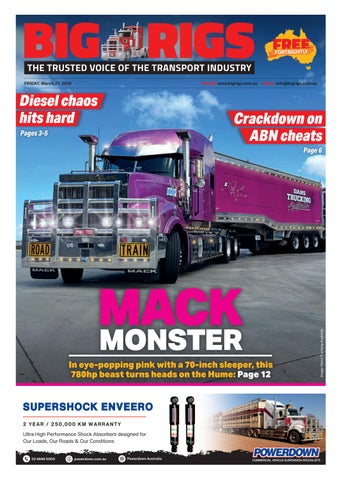
A striking paint scheme, powerful 780hp engine and huge 70-inch sleeper make this bulldog stand out from the pack.
BY DANIELLE GULLACI
THE latest truck to join the Dan’s Trucking Australia fleet is one that commands an almighty presence. Put to work in early February, it’s turning heads wherever it goes.
This new Mack Super-Liner is certainly one almighty beast – both in terms of power and its sheer scale. It’s powered by a Mack MP11 engine that de livers up to 780hp and 2800 lb-ft torque – paired with the mDRIVE automated manual transmission.
through sleeper cab, it’s Mack’s largest one yet, giving the driver plenty of room to move.
of this new pink Super-Liner while it was hard at work trav elling the Hume, just a couple of weeks after it hit the road –and we couldn’t help but take notice.
Melbourne-based Dan Russo, who started his business back in 2017 with a single truck –a Hino agitator. “It was an older one and was really un derpowered. But it was my favourite truck and I loved it,” said Dan.
come a long way, putting in the hard yards to build Dan’s Trucking Australia from the ground up.
road these days but still jumps in the truck whenever he needs to, as was the case when Big Rigs truckie who was unwell.
explained, “I was a sixth-gen eration greengrocer. I had to h we were carting fruit from the markets to the shop. And at the markets, I’d see all these big trucks coming in and I al ways admired them.”

to leave the family business and do something on his own, he left with a truck licence and a forklift licence. “I had left school at 15. I had no other qualifications.”
Dan got his first truck driving gig with Vic Mix, driving a concrete agitator. Only three months in an opportunity came to buy the truck.
“I thought let’s just give this a shot,” he said.
With the Vic Mix fleet being pink, the first truck Dan purchased off them was pink, so he decided to stick with the theme for his fleet, albeit in a different hue.
“I had the Hino for about a year and worked the guts out of it. Then in 2018 I sold it and bought a twin-steer Kenworth T359 – also pink. Agis are usually automatic but I put a manual gearbox in that one because I knew I wanted to eventually move away from concrete – so it would be a straight conversion to turn it into a tipper.
“I saw an opportunity in the

ular set-up, he was tossing p between the 36-inch and 70-inch bunk and ultimately went with the bigger of the two. “I like that style of bunk because it’s quite practical. You have a lot of extra space and headroom and the ability to stand up, so I thought I’d go with that one. It’s huge. Almost too big!” he laughed.
Our other A-double is paired up with a Kenworth Legend SAR. This Mack is bigger which also means it’s nearly 2-tonne heavier too –but it’s come up great. I’m really happy with it.
The fuel economy is fantastic. It’s only done 20,000km ver the past few weeks since being put to work, but the fuel economy is awesome so far.”


up in Melbourne. I had this tipper and no work. I was making phone calls every day trying to chase something down,” Dan said.
Luckily, it was a case of the right place at the right time, when Dan called Andrew Burdett at Burdetts Group, who was happy to give him a shot. “They had a full-time sub-contractor whose truck had caught fire and he wasn’t going to replace it, so Andrew said if I wanted the job, it was mine. That was the start of a two and half year working relationship with Burdetts. It was also the beginning of travelling across the eastern seaboard.”
Cautious of the dangers of putting all his eggs in one basket, Dan explained, “In that time, I bought two more trucks off him, both truck and dogs. I had ambitions of what I wanted to build with my business. I didn’t want to get stung again after what happened the last time so wanted to build a bigger cus-
a swag under the trailer and sleep there. Then the oppor tunity came to buy another truck because of the growing client base, so I bought one with a bunk. From there, it was a bit of an explosion. We went from three trucks to eight trucks pretty quickly,” he explained. “Work brings on more work.”
Based at Wonga Park in Melbourne’s north-east, Dan now runs a fleet of 12 trucks – a mixture of Macks, Ken worths, a Volvo, a Western Star and a Freightliner – and 13 trailers, the biggest combi nations running as A-doubles.
A ll the trucks he’s bought brand new are in his signature shade of pink – although there is also a red and white truck, a blue truck and a white one without any branding that he’s named ‘Incognito’.
Asked about his decision to go pink, Dan explained, “Even after I sold my first truck, I bumped into someone who said, ‘You’re Dan with the pink truck’. I thought

After delivery, the new truck was sent to Bling Man HQ in Queensland for all the stainless steel trimmings.
Then it headed back south to Grant Fowler Signs in Victoria’s Gippsland region. Grant as done up many of Dan’s pink trucks – along with the new one, which he finished off with scrolls and pin stripes, along with the wording: ‘This one’s for Jen’ at the top of cab, a dedication to Dan’s wife.
“I got the hard warning,” laughed Dan. “Every other truck has a name – we have Sadie’s Super-Liner for my daughter, who’s eight, Oscar’s SAR Legend for my son who’s four and another truck named Clydie Boy for our dog, which is the one I’m driving at the moment.
“Jen chose the bonnet, which was a special order. It’s an older style bonnet, which costs more, but I prefer that look –so Jen said just go for it.
“Aussie CTI did the central tyre inflation system, BTE installed the hydraulics, Melbourne Hydraulics did the truck guards, and we had TWS do the interior fit-out including a TV, microwave, fridge and bunk cooler.”
And as for the lucky driver, Dan said, “He absolutely loves the horsepower and the living space. All that’s superb.”
With so much uncertainty in the industry at the moment, Dan is happy to take things as they come, although he added, “Every time I say I want to slow down, the opposite happens. We have a couple more truck orders in the system, it’s just a matter of when we take them. Our next one will be another Mack Super-Liner, this time with the 36-inch bunk.”
Asked what he attributes to the company’s great growth over the past nine years, Dan was quick to acknowledge his employees. “I have a really great team around me. We may have kissed a few frogs over the years before we got our princes, but I have such a great team now. Without the team, we don’t have a business.
“I’m a real workaholic, so I’m also lucky to have a very understanding wife!”


little kid, LBRCA’s
BY DANIELLE GULLACI
FROM as young as three or four years old, third generation livestock truckie Jack Cooke was already watching and learning from the passenger seat.
As any long distance truck driver knows, spending time away from home comes with the job, so Jack treasured the time he’d get to spend with dad Steve Cooke out on the road.
“I’ve been around trucks as far back as I can remember,” said Jack. “I’ve always liked trucks and always been fascinated by them.”
Based in Glenn Innes, he’d get to travel up to 600-kilometres away – both into Victoria and Queensland. Asked about any special memories, he replied, “I used to love pulling up at the Ampol at Warwick for a treat.
“A lot of things have changed now. Back then, I was even allowed to go out to the abattoirs with Dad and Pop. You can’t do that with kids now.
“Dad was teaching me to drive by the time I was 13. I picked up a lot from spending so much time with him in the truck. Then by about 15 or 16, I taught myself by driving around the paddock.”
Steve carted cattle and sheep.
“Dad drove a T650. It’s very different to the T909 I’m in now. There’s so much technology in the trucks these days. He worked for Lockyer Transport. Pop had already gotten out of driving full time when I was little, but still did casual driving, also for Lockyer Transport,” Jack explained.
Jack, now aged 23, started his own career in trucking about four years ago. “When I was at school, I always said I was going to be a truck driver. Mum definitely tried to steer me away from it. Dad was a bit like that at first too, but he
knew he was never going to be able to stop me from doing it.”

At 19 Jack got his HR li cence, a year later he upgraded to his HC and then by 21, he had secured his MC.
His livestock career began with Maloney Livestock at Tamworth, where he spent about 18 months, before starting his current role at Stocktrans’ Glenn Innes depot –where his father also works, as Allocation Manager.
Part of JS Group, Stocktrans was started by Joe Sepos in 1988 and carries an average of over 3500 head of cattle each day.
Jack has now been with Stocktrans for just over 12 months, pulling B-doubles and B-triples of livestock across New South Wales, Queensland, Victoria and South Australia – transporting cattle between paddocks, feedlots, abattoirs and saleyards.


Jack, who much prefers being out on a rough dirt road in the middle of nowhere than having to navigate through the big cities.
“I do spend a lot of time off the bitumen. I enjoy the challenge that gets thrown at me. Every day is a different challenge. I feel you become a better operator being on the dirt roads and in the hills.”
Depending on where he’s travelling, Jack can sometimes be away up to six days at a time. “It varies really. For a few months you might do those longer runs, then through winter you tend to be home a little bit more.”
The 2023-model T909 Jack drives is well equipped for life on the road and he says it’s great to drive. Complete with a 50-inch bunk, it’s powered by the Cummins X15 engine and features an 18-speed Roadranger.
A s for working with livestock, Jack says that was always the career goal. “I like the challenge of it. Different breeds of animals react in different ways, so you learn how to read the stock. It’s not just about jumping in the truck and driving, you need to pull up and check on them.
“The loads are always different and you need to make sure you have as much weight on the top as what you have on the bottom.
“Some of the feedlot cattle can be up to 800kg per animal. There are also bulls that can be around the 1000kg mark.”
Jack’s professionalism and skills in the job haven’t gone unnoticed. On Friday, February 27, he was named the Livestock, Bulk and Rural Carriers A ssociation’s (LBRCA) 2026 Young Driver of the Year.
The award was announced during the 2026 NSW Rural Carriers’ Convention in Coffs Harbour, with Jack named
the same path.


strate best-practice driving b ment to safety, and profession alism across the heavy vehicle i the livestock, bulk and rural transport sectors.

award by his employer and said he was stoked with the recognition – and rightfully proud. “It was a very big sur prise to even be nominated b makes you feel like you are doing the right thing in the industry. I’m very proud to have received this award and Dad was a bit gobsmacked by it all too.”
Upon accepting the award on the night, Jack took the

Award, Jack has won an in dustry study tour valued at $7000, to support his professional development and exposure to best-practice operations.


It’s been about 18 months since this long-time truck driver packed up his life in England and moved to rural Western Australia to begin a new adventure.
BY DANIELLE GULLACI
SAMUEL Thomas, 35, started his truck driving career in his hometown of Essex in England – before a new life in Australia came calling.
As he told Big Rigs, it was a previous role that led to a career in truck driving. “I was working as a mobile tyre fitter and used to go out to fit tyres for truck breakdowns. I got talking to all these truck drivers and they were telling me how much they enjoyed the work,” he said.
“That really piqued my interest, because I was working like a dog – so I got my truck licence at 26, and the rest is history.”
Back home, most of the work involved travelling through busy city streets across London – a far cry from the more laid-back lifestyle he’s been enjoying since moving to Manjimup, about 300 kilometres south-east of Perth, with his wife and twin girls (now 5 years old).
“Originally we’d been thinking of moving to Canada but I got talking with a friend who moved to Western Australia about a year before us. He was telling me how much more chilled it is, and the better standard of living here in terms of wages and work/life balance.”
With that, the decision was made and the family moved to their newfound home in September 2024.
Samuel began documenting his adventures on the road in 2020 when he launched his YouTube channel called Truck It Prayle, which has amassed more than 25,000 followers. “It started about trucking in the UK, then when I moved here and spent some time away from the truck, there was content about the move to Australia, and now my videos are about trucking in Australia,” Samuel said.
Samuel added that he has always enjoyed taking on new challenges. “Back in England, I did flat beds, curtain siders, powder tankers, refrigerated, containers. I like change so I moved around a bit and that’s what ultimately brought me here.
“I was ready to see what my next challenge was – and then of course, there’s the road trains, but looking from afar in England, we don’t have anything like that over there.”
After a brief hiatus from truck driving to juggle fatherhood with work commitments, Samuel upgraded to his MC licence in September 2025 and started a new role with Lindsay Brothers Transport in January this year.
“It’s great being able to drive full time again. And it’s nice to be paid what you’re worth for the work you do. In the UK, I remember doing all the hours under the
sun and barely getting by. Here I work full time and feel like I can still have a life – I go to the gym, have that time with the family and I’m able to focus on myself a bit more.”
Samuel is now behind the wheel of a 2017 Kenworth T409, doing B-double work, carrying fresh produce between the Lindsay Brothers’ Manjimup depot and into the Perth markets.
As Samuel admitted, the truck itself was unlike anything he was used to in England, where he drove predominantly MANs and DAFs. “The only Kenworths we get in the UK are the tow trucks. We don’t have bonneted trucks for this sort of work – the roads just aren’t big enough for the bigger cabs.
“This is the first bonneted truck I’ve driven. I won’t lie, at first, I thought what the hell is this! The view from the cab is so different but you quickly get used to it.”
While the bigger truck and extra trailer have been pretty easy to get used to, it’s taking Samuel a little longer to get acclimatised to WA’s summer heat.
“Trying to sleep in a tin box when it’s 30 degrees at night is definitely not the most enjoyable thing about the job. I have an Icepack but it’s loud like a generator. I have the choice of sweltering in the cab or trying to sleep through the loud noise all night – so it’s not a great choice,” he laughed.
Samuel says that there haven’t been quite as many kangaroos as what he’d expected either. “When I first arrived and we were driving from the airport, I expected to find kangaroos all over the place, but it wasn’t until a couple of hours in that I saw the first one.
“I expected to have a few more kangaroo encounters in the truck but, touch wood, there haven’t been any. The main roads along my run aren’t too impacted by wildlife.”
He also added his unexpected struggles on the U HF. “Obviously there are a lot of different Australian accents – and coming from an English-speaking country I didn’t expect to struggle. But sometimes the accents are quite thick and I can’t understand a word. I know I can talk really fast too.”
Since getting back in the truck, Samuel has been really enjoying his new role and the new scenery. He says it’s also brought a real change of pace.
“One of the biggest differences I’ve noticed here is that drivers are very courteous and look out for each other. There seems to be a bit of a code out here, where even car drivers are more aware of trucks. I’m not sure

if that’s the same in the bigger cities over east, but that’s what I’ve found here,” explained Samuel.
“When you’re driving through London, you need to have eyes and ears at the back of your head – because if you’re not careful, you’ll end up with a scooter beneath the bonnet. It’s not such a rat race here where everyone is in a big rush all the time.
“The scenery here is all countryside and it’s stunning. I didn’t expect it to be so green. I prefer being out of the city. You put the radio on and just go. I’m loving it here. It’s so much more relaxed than how it was in the UK.”
Asked about his future career ambitions, Samuel explained, “What I want and what I’ll do might be two different things because I do have a young family.
“I’d love to be able to do the long hauls from west to east and into the Northern Territory one day, but that also means long periods away from my girls. I moved here for my family so I don’t want to sacrifice family time for my own selfish enjoyment.
“Eventually, one day, the plan is to get my own truck and be able to do some of those longer trips away when I can.”


With the help of a new Freightliner Cascadia, Punky River Rocks is providing gardeners and landscapers with the perfect finishing touch for their projects.
BY DANIELLE GULLACI
BASED at Porepunkah, Victoria – hence the company’s name – Punky River Rocks supplies wholesale river rocks to landscape designers, garden centres and nurseries throughout Victoria, New South Wales and South Australia.
L ocated in Victoria’s High Country, to the northeast of the state, Porepunkah sits at the foot of Mount Buffalo –around 310 kilometres away from Melbourne. The town is nestled at the junction of the Buckland and Ovens Rivers – and it’s this location that allows Punky River Rocks to supply its quality range of decorative rocks.
The company operates its own quarry at Porepunkah, with its products sourced from dredging tailings rather than the region’s riverbeds.
Graham Ryleigh started Punky River Rocks almost 17 years ago, in 2009. As he told Big Rigs, it quickly evolved and changed direction. “I owned a concrete and garden supply business downtown in Melton and was looking for some 7mm rocks for our exposed aggregate concrete,” he said.
“At the time the exposed aggregate rocks were hard to come by. When I realised I could get it here in Porepunkah, I approached a farmer to lease some land and I’ve been there ever since.”
As things picked up at Punky River Rocks, Graham closed his concrete and garden supply business to focus on his current business venture.
“We quickly moved away from those smaller rocks and have got into a decorative rock for landscaping, ranging from 20mm to 200mm river rocks – so we’ve evolved from where we started.
“I sold that concrete and garden supply business, so now it’s just this one that I
concentrate on – and I’m really enjoying the work. Sometimes it feels like more of a hobby than work. I find the work relaxing, I’ve got good reliable equipment and I’m dealing with good people.”
The majority of Graham’s wholesale clients send their own trucks in to pick up their goods, however for those who don’t have their own trucks, Graham began offering a delivery service about 10 years ago – with a Freightliner Coronado serving him well for almost a decade.
“It was time to trade in the old truck. My Coronado was still going well but you don’t hang onto them too long these days. It was a good time to upgrade and get a new one and get the warranty. That Coronado had done around 500,000-600,000 kilometres when we traded it in.”
Impressed by the Freightliner brand, when Graham decided to upgrade the truck last year, he settled on another Freightliner – this time in the form of a 2025-model Cascadia.
Powered by a 600hp Detroit DD16 engine, delivering 2050 lb-ft of torque, Graham said his new truck has plenty of pulling power. “It’s got a truck and quad dog behind it, carrying up to 39.5 tonne.
The Cascadia is really smooth on the road, it feels like it doesn’t even know it’s pulling those sorts of weights.
“I decided to go with the Cascadia because it’s a Detroit motor and transmission, a ll in the one unit. It’s a lot more comfortable to ride in now. The driver seems to like it too.”
It’s also very easy to drive, added Graham. Unlike the manual gearbox in the Coronado, this time Graham went with the Detroit DT12 Automated Manual Transmission, and he says his driver has taken well to the change. “There’s a marked improvement on the previous truck.


It has so many improvements and is a dream to drive.”
Graham opted for the day cab and says the truck is really comfortable for the driver. It’s also equipped with all of the latest safety features – including Active Brake Assist (ABA), Side Guard Assist (SGA), Adaptive Cruise Control (ACC), and Lane Departure Warning (LDW).
The Cascadia has been designed with a sloped hood, air disc brakes and ergonomic controls, for added safety and improved visibility out on the road.
With the truck covering three states, it’ll often head out to deliver rocks and pick up fertiliser for the return trip.
“It’s not running everyday but fills in a gap for people who don’t have their own trucks to access our products,” added Graham.
A nother key advantage with the Cascadia is its fuel efficiency, especially with current uncertainty around fuel costs and supply, with all that’s happening with the Middle East conflict.
Detroit integrates its engine, transmission and axle technology to assist with maximising fuel efficiency. The Integrated Detroit Powertrain (IDP) combines with Cascadia’s aerodynamic features to enhance fuel efficiency.
Graham purchased his new Cascadia through Daimler Trucks Albury. “I dealt with Mitchel Buckman and he couldn’t do enough for us. He was very good to deal with.
“They’re about an hour away from Porepunkah and do all of our servicing and maintenance for the truck. It’s handy having them so close.”
He added that the warranty is great too, at 4 years/800,000km.
Looking ahead, Graham says if the need for another truck arises as business grows, he wouldn’t hesitate to get another Cascadia.

126 Day Cab specs
• DD16 engine: 16 litre, 600hp delivering 2050ft-lb of torque
• DT12 automated manual transmission (AMT)
• Forward Collision Mitigation
• Side Object Detection
• Digital heads-up display and media unit
• 4.6m alloy CBB body and 8.3m 4-axle alloy CBB tipping dog trailer


SHELL Rimula has partnered with Big Rigs in a big way – so there are even more reasons to send in your best truck shots.
Each month, the Big Rigs team will choose a #PicOfTheMonth, with the lucky winner receiving a $500 Shell Coles Express Gift Card.
Keep an eye out for our regular posts on the Big Rigs Facebook page, calling for your best truck photos and add yours in
the comments, or email them direct to danielle.gullaci@ primecreative.com.au for your chance to win the main prize.
Don’t forget to include a brief note about the truck and where the photo was taken. We’ll feature some of the best photos in each print edition of Big Rigs, with one winner announced each month.


Keep those amazing truck pics coming!
D9


Not even rocketing fuel prices could keep them away from this popular showcase for the Historic Commercial Vehicle Club of Australia.
BY GRAHAM HARSANT
AS I filled my car at $1.99 per litre to drive the 2.5-hour, 216km trip to Clunes, I wondered how that event might be a ffected by the closing of the Strait of Hormuz and/or fuel price gouging.
After all, the trucks heading to this Classic of classic truck shows on March 9 chew through an awful lot more juice than my old Territory.
Maybe truckies are better at putting away for a rainy day than yours truly because the attendance was as good as it has ever been – and the rains of the day before had given way to magical blue sky.
Staged by the Ballarat branch of the Historic Commercial vehicle Club of Australia, Clunes has always attracted a large attendance of trucks (and trailers) displayed in their original patina or ‘dressed up’ in new livery that usually reflects their origins.
Whilst – and not surprisingly – the Kenworth brand abounds, Clunes brings more truck variety than any show and shine event. And that’s a good thing.
One such was Tim McMahon with his Western Star 4964 which he bought new back in 1989.
“I bought the truck as part of our family business, mainly carting logs and timber out of Gippsland,” said Tim.
“There was also a bit of interstate to Sydney and Adelaide, hauling Tupperware which was big at the time and had the added benefit of being light.
“I had it for three years and then I sold it to Gary Leeson in Gippsland in 1992, during the recession we have to have. It then passed to another three or four owners.
“I was browsing on Gumtree in 2020 and there it was for sale! The bloke’s wife was going to take it to the tip but my wife, Kelli said, ‘That’s not going to happen!’ So I was put in a position where I couldn’t say no to getting it back.
“Over the last three years, with the help of Thackers Trucks in Bendigo, we’ve got it back to pretty much original.”
Tim said the colours are the same as it came out of Wacol with back in 1989, right down to the original Kentweld bull bar which was put on out at the back of the dairy at Yarragon that same year.
“Original bonnet, cab, bunk, original block – it’s got a Detroit Series 60 DDEC 2. I’ve no idea how many kilometres it’s done but it still drives very nicely.
“The only thing that is different are the two exhaust stacks on it. I originally only had one because A: I couldn’t afford the second one and B: because I was doing a lot of work in the bush. However, I’m the first to admit that the twin stacks look great so they stay.
“So, Kelli was a driving force behind me buying it back and doing it up, but unfortunately she didn’t get the chance to see it finished. She passed away from cancer last year before it was completed. She did get to see it painted but didn’t get to see the final article. So, this is
in memory of her and makes it a very special truck.”
Rare gem polished up a treat
Murray Langford is well known to Big Rigs readers with his collection of outstanding trucks but there is none better than his 1958 Diamond T N50RS.
“They made this model from 1952 to 1958,” said Murray, “but we didn’t get them in Australia, mainly because they were too expensive. They were mostly used for the timber industry over in the US.
“A few of them worked in the oil industry and hence they came out with a very fragile looking brush bar in front. They would start one up in the morning and then they would push all rest with that bar to get them going.
“When I first got it, it was driveable but not registrable. Two of us worked on it solidly for two years. You know what it’s like, when you pull it apart you find everything that’s wrong.”
“Power is by way of a 743 series Cummins, which we knew here as the 220 or 250 horsepower. In the US they whacked a supercharger on and they were 300 or 330. This is 300hp. The yellow and black colour scheme is outstanding. Not original, but rather taken from a Kenworth Murray saw on Vancouver Island, Canada on a trip. In true, gentlemanly fashion, Murray asked the owner if he could use it on the ‘T’.


“There was a bit of a family ‘discussion’ on the colours at home but she came around once she’d seen a few panels,” quipped Murray.
Keeping the legacy alive Terry Lowe was at Clunes with his 1979 White SE9, originally belonging to his father.
“Dad bought it new and I learnt to drive in it,” said Ter ry. “It spent its life hauling Fowlerware bathroom prod ucts from Melbourne to Syd ney. Now she sits in the shed and I bring her out for trucks shows – or for a run to the pie shop to keep charge in the bat teries.
“Dad’s been gone 30 years now but there was a bloke here today who was an apprentice at Cummins and was talking about it with some other blokes who remember dad, so it’s good to get it out and about.”
Lover of the old gear
Andrew ‘Grizzly’ Adams doesn’t like new trucks – one of the reasons he’s at Clunes –so instead has seven older va rieties, one of which is a 1994 Western Star 5694. The aero dynamics look very similar to the old Anteater Kenworth.

“It’s a bit of an ugly duckling, but a rarity. You don’t see too many of them around these days. It was originally one of Les Smith’s from Orange,” said Grizzly.
“Someone else had owned it between times. I bought it as a backup truck and used to do fair bit of interstate but I’m going to rip the bunk off and
turn it into a rigid with a water tank.
“It’s a good truck to drive with a Series 60 and goes well. It also makes as much money for me as a brand-new jobbie.”
To reinforce his love of the old gear, Grizzly also brought along a 1982 W900 Road Train rated, originally from Mount Isa.
Factory rated at 90 tons with six-rod and a 400 Cummins, the truck is a ‘spare’ these days.
“It is great to bring it to these sort of events where we drank tankards of foaming ale and tell tall tales of days of yore.” Clunes. Not even rocketing fuel prices could keep them away!


BY DAVID VILE
A healthy roll-up of trucks and some warm autumn weather has made the inaugural Truck Show and Shine at The Rock, in southern New South Wales a great success.
Held at The Rock Showgrounds on March 7, a wide range of trucks from across the eras turned out, and with Mack the feature brand for the day, the Bulldog brand was well represented.
Show organiser, Geoffrey McConnell had the day packed with a variety of attractions and events ranging from tarp tying and rolling through to kids events and demonstraions from the local SES unit.
With a number of categories up for grabs in the show, and shine (including a special Mack category) the judges had their work cut out, but it was local livestock hauler Raymond (Reggie) Sutton who collected Truck of the Show spoils with his Kenworth T909.
With the 2026 event a winner, and the event being in the middle of an area so dependent on road transport, the 2027 event will no doubt build on the solid foundations that have been put down this year.


Truck of the Show: Raymond (Reggie) Sutton - Kenworth T909
Most Original: Kingston Partners - Mack CHR
Best Modern: Lawrence Transport - Kenworth SAR Legend
Best Restored: Steven Umback - International R200
Best Local Truck: Brock Gladman - Kenworth T909
Best Farm Truck: Holly Umback - International ACCO
Best Tipper: Kennedy Brothers - Kenworth T610SAR
Dirtiest Truck: Justin Livingstone - Kenworth SAR
Best Fleet: Menz Transport Wagga
Furthest Travelled: Bruce Brown - International C1300
Best Mack: Robert Trethowan - Mack Super-Liner
Most Original Mack: Andy Willis - Mack R-Model
Best Restored Mack: Andy Willis - Mack R-Model
Furthest Travelled Mack: Robert Trethowan - Mack Super-Liner


The memorial day started early with trucks gathering in Adelaide for the run up the South Eastern Freeway to the White Hill parking bay.
BY ANN-MARIE HICKS
ANOTHER huge turnout of truckies, families and supporters gathered to pay their respects to lost loved ones at the annual White Hill Truck Drivers’ Memorial at Murray Bridge in South Australia earlier this month.
The March 7 event started early with trucks gathering in Adelaide for the run up the South Eastern Freeway to the White Hill parking bay.
They were met by other trucks from locations around South Australia.
The convoy then made its way into Murray Bridge to the White Hill Truck Drivers’ Memorial, displaying banners on the front of their rigs in tribute to mates, family and colleagues.
The convoy trucks were parked up adjacent to the memorial, and the drivers and their families joined the others that had gathered at the memorial wall to pay their respects.
The new inductees added to the wall were:
• John Arthur Kuchel
• John Lesly Pascoe
• Trinity Anne Green
• Frank Azzollini
• Roy William Page
• David Ronald Nailer
• Damon Mayes
The service concluded with all the trucks participating in a horn ‘sound off’ of one minute as a last tribute.
Unfortunately, this year the annual truck show that runs in conjunction with the memorial service didn’t take place.
The organisers did present an award for the Best Presented Truck which was won by Henry Geyer from Geyer Truckin in Keith.
The committee behind this day are a small group of hard-working, well-organised individuals who do an amazing job, and are appreciated by all in attendance.
In a social media post after the event the committee also thanked all involved in helping them pull together another successful day.
“Thank you to the families that laid their loved ones to rest this year. Thank you to all the families and friends of inductees past who come to share the love we all have for our fallen,” the post read.
“Thank you to our small but fabulous committee and volunteers without which it wouldn’t be possible. Thank you to our incredibly generous sponsors year after year.
“Thank you Pastor David Kuss for your hard work and dedication behind the scenes and on the day.
“Thank you Aunty Pauline Walker for sharing culture, depth and healing.”
The committee also thanked local MPs Adrian Pederick and Tony Pasin for their support, among others.


THERE are always plenty of events to get involved with in the world of trucking. From charity convoys, truck shows, heritage displays, show and shines to industry conferences, they offer an opportunity to bring the industry together.
Here’s a look at what events are coming up for the rest of 2026.
If we’ve missed anything major, see the bottom of the listings for contact details. It’s free to have your event listed in our calendar and it will also feature at bigrigs.com.au.
MARCH
JT Fossey Trucks 2026
Volvo & Mack Truck Show
March 28
30 Dampier St, Tamworth, NSW jtfosseytrucks.com.au
The local dealership promises a great day of coffee, food trucks, kids’ activities, and of course Volvo and Mack trucks everywhere. JT Fossey says it’s looking for a display of everything Volvo and Mack. A ‘cool’ fridge from Blingman HQ is also up for grabs.
APRIL
Bredbo Truck and Machinery Show
April 4
Bredbo, NSW
From vintage trucks, engines and tractors to modern-day vehicles, the Bredbo Truck and Machinery Show will have vehicles of all ages on display. There will also be a vintage tractor pull, stalls, a jumping castle, live music and more.
Crawlin the Hume
April 11
Wallan East to Albury
The convoy will depart from Commercial Drive at Wallan East and make its way to the Albury Race Club for a special dinner (bookings essential). The convoy will also stop along the way at Chiltern Racecourse for lunch, before a grand parade along the main street.
MAY Truck Week
May 11-18
Held nationally truckweek.com.au
Following the success of Truck Week held alongside

the record-breaking 2025 Brisbane Truck Show, Truck Week returns in 2026 with a national focus, inviting businesses and organisations across the country to take part in their own communities and workplaces. It will be a nationwide celebration of Australia’s heavy vehicle, road freight and logistics industries – our people, our stories, and our role in keeping the country moving.
Heritage Truck Show Rocklea
May 16-17
Rocklea Showgrounds, QLD
Held over two days, the event will feature heritage trucks, tractors and machinery. There will also be trade stalls, food and beverages. Entry is $10 and free for children under 14.
TruckShowX
May 18-19
Hunter Valley, NSW truckshowx.com.au
TruckShowX at Rydges Resort will centre around the theme ‘Driving the Future’ and build on the key trends emerging from the recent 2025 Brisbane Truck Show, especially the potential for technology and innovation to boost productivity, efficiency and safety outcomes.
Scenic Rim Truck Show
May 30
Jimboomba, Queensland
Featuring a stunning array of trucks, from state-of-the-art haulers to timeless classics,
each with their own unique story to tell. There will also be live music, delicious food vendors, and family-friendly activities for all ages. All profits from the day go towards local charities.
Trucking Australia Conference
June 3-5
Hamilton Island, Queensland truck.net.au
This major industry event will feature interactive workshops, case studies and interactive discussion on driving solutions for the industry’s future. It will provide an opportunity to connect with peers and industry leaders, to help build relationships and create new opportunities beyond the conference.
JULY
Casino Truck Show
July 31-August 1
Casino, NSW casinotruckshow.com.au
Held over two days, the Casino Truck Show is a community event that showcases the transport industry, held in the heart of Casino’s CBD. The 2025 event attracted an estimated 40,000 people on the Saturday who got to see 550 trucks.
Megatrans
September 16-17
Melbourne, Victoria
Returning to the Melbourne Convention and Exhibition
Centre, MegaTrans is Australia’s largest integrated conference and exhibition dedicated to the logistics and supply chain industry. MegaTrans provides a unique platform to explore the innovations, equipment, and services that will shape the future of logistics.
Lights on the Hill Memorial Convoy Weekend
October 3-4
Gatton, QLD lightsonthehill.com.au
Held every year in October, the Lights on the Hill weekend combines a memorial convoy and truck show at Gatton Showgrounds on Sat-
urday October 3, followed by a touching memorial ceremony at the Lights on the Hill Memorial Wall at Lake Apex Park in Gatton on Sunday October 4.
Camp Quality Convoy Perth
October 4
Perth Motorplex, WA fundraise.campquality.org. au/event/convoyperth
Camp Quality Convoy Perth moves to a new venue for 2026. Supporters can cheer on the convoy, as they travel a 50km route through the streets of Perth, followed by a free Family Festival packed with entertainment and experiences catering for the entire family.
There will be food vans, kids’ rides, face painting, roving entertainment, live music, fundraising awards ceremonies, and of course a Show ‘n’ Shine.
Ulverstone Truck Show
October 31
Ulverstone Showgrounds, TAS
Held as part of the Thank You Day Show, the Ulvertsone Truck Show runs from 9am until 3pm, raising money for Beyond Blue and New Mornings. Entry is by donation, and there will be prizes and giveaways throughout the day.
NOVEMBER
Camp Quality Convoy
Newcastle November 8
Maitland Showground, NSW fundraise.campquality. org.au/convoy/newcastle Raising money for Camp Quality, the convoy starts and finishes at Maitland Showground, where a free family festival will be held, packed with entertainment and experiences for the whole family.
Dane Ballinger Memorial Truck Show November 14
Bathurst Showgrounds, NSW bathursttruckshow.com.au
This event brings together truck enthusiasts, families, and the local community to remember Dane Ballinger and celebrate the trucking industry he loved. Come and see the huge range of trucks on display, from old classics to custom rigs.
Illawarra Convoy
November 15
Illawarra, NSW illawarraconvoy.com.au
Touted as the largest truck and motorbike convoy in the Southern Hemisphere, the Illawarra Convoy raises funds for individuals and families affected by potentially life threatening medical conditions, together with charities that work with these people, and local hospitals.
Have you got an event you’d like included in the next Save the Date? Email all the details to editor@ primecreative.com.au.


PREDICTIVE maintenance
is no longer a “future technology” – it’s now one of the most effective ways Australian fleets can reduce unplanned downtime, stabilise operating costs and protect critical engine and fuel system components such as high pressure pumps and common rail injectors.
But a predictive strategy only works when the data is accurate, the intervals are realistic, and the filtration system is engineered to manage particle contamination, water ingress, and fuel system stability over extended intervals.
For Service and Parts Managers, the challenge is turning raw data into a maintenance schedule that’s both practical
and commercially meaningful while maintaining alignment with OEM engine durability targets and validated filter performance curves.
Imagine a national fleet begins using telematics data to extend maintenance intervals. On paper, it looks efficient; fewer workshop visits and lower labour hours while improving overall fleet availability and uptime metrics.
But six months in, trucks start presenting with early stage injector wear, fluctuating rail pressure and inconsistent fuel consumption indicative of sub micron particle contamination, bypass valve fatigue, and uneven restriction across the fuel system. -

ics; it’s that the filtration system wasn’t designed to maintain performance over an extended interval. The filters selected had non linear or unstable restriction curves, nominal rather than absolute micron ratings, and bypass valves that opened prematurely or inconsistently, leading to contaminant bypass. This unstable filtration profile introduces contamination into the fuel system, accelerating wear in high pressure pumps and injectors, causing erratic fuel delivery and pressure instability, undermining the very data the predictive model relies on.
A successful predictive strategy requires engineering certainty, and that starts with filtration
That’s why you should always use OEM-grade filters. Fleetguard is the Cummins OEM filtration partner, and our aftermarket filters maintain the same engineered tolerances. Stable restriction curves mean the data feeding your predictive model is accurate.
Use telematics to monitor load, heat cycles and idle time. Predictive schedules should reflect real duty cycles, not generic intervals. Set contamination thresholds, not just time/odometer intervals. Fuel system wear accelerates when particle load exceeds injector dura-

bility limits, absolute-rat ed filtration protects these t hresholds.
Include media integrity as a service predictor. Multi-layer, vibration-resistant media (as used in Fleetguard OEM and aftermarket filters) maintains performance longer, making predictions more reliable.
Review filter performance quarterly. Look for trends: rising restriction, pressure instability and fuel economy changes are all early indicators of needed

interval adjustments.
Fleets moving to predictive maintenance with OEM-standard filtration tend to see:
• More accurate service scheduling
• Reduced unplanned events
• L ower injector and pump replacement costs
• Extended component life and stable performance
• Higher asset utilisation and fewer operational disruptions
Predictive maintenance only works when the inputs are
stable and that begins with filtration engineered to protect the engine, not just meet a price point.
If your predictive maintenance model is delivering unexpected wear, pressure instability, or rising fuel costs, it’s time to reassess what’s feeding the data.
Talk to your trusted Fleetguard representative about fi ltration engineered for extended intervals – so your predictive strategy delivers uptime, not surprises.


out of a passion for
in
Truck
for
It was started by Dallas Fabian – a transport operator, farmer and vintage Mack parts specialist – who developed his love for the brand
from a young age. As the owner of 18 Macks, he’s been importing Mack parts since he bought his first vintage model many years
ago. With parts becoming harder and harder to come by, Dallas decided to launch DJF Truck Parts.
Today, from his base in New


South Wales’ Central Coast, Dallas stocks more than 3500 individual parts. The range includes Mack driveline kits, engine rebuild kits, replacement air manifold, cab parts, window winders, door handles, interior trims – and in recent years complete dashboards for Macks from the 1980s era.
“We built complete dashes for 80s model Macks including the Superliner, R-600 and Value-Liner,” said Dallas. “There are a few people who sell individual dashboard parts but what we produce is the complete dash – you just drop it in, hook your wires up and off you go. They’ve been pretty popular since we started manufacturing them.”
The DJF Truck Parts range is ever evolving, driven by customer demand and availability. “That’s what drives our product range,” added Dallas. “If a product is still available in the OEM market, then we’ll supply that. When an item gets discontinued, you need to look at other ways to supply these parts so people can continue to restore these old trucks. So we have things made when we need to.”
For Mack’s R-600 and Super-Liner models, DJF Truck Parts stocks almost every part an owner could need.
Adding to the range more recently, DJF Truck Parts has launched a new step extrusion
of the 80s model Macks. “You can’t get those anymore, so we’ve had them made and we are now supplying them to customers,” said Dallas.
Dallas has created a new mobile showroom on wheels, which he plans to take to various truck shows around the country to showcase the DJF Truck Parts offering.
“I’ve built this display on a 42 ft pantech trailer. It’s set out with benches on each side and a staircase up the back.
“Everything we sell is displayed on the benchtops and the walls, so it’s a showroom on wheels. It gives people a chance to see what we have in the flesh, including our dashboards.”
The trailer’s first truck show outing was the Kyabram Mack Muster in Victoria from March 21-22. The display trailer will also head to the Golden Oldies Truck Show in Dubbo in August, and the Queensland Mack Muster in September.
Additionally, DJF Truck Parts has launched a new website, so customers can browse the range of parts and make enquiries online.
“We’re still adding to the website, so keep checking back, we’re adding more and more products every day,” added Dallas.
For more information visit djftruckpartsaustralia.


IN the world of Australian trucking, there are a few things you can set your watch by: there’ll always be roadworks right when you’re making good time, the coffee at 2am is never quite strong enough, and if you see a set of stainless-steel mudguards gleaming in the sun, there’s a good chance they’re Lelox.
For 50 years, our classic guards have been a badge of honour on rigs across the country. They’ve done the hard yards, survived the bull-dust, and looked the part while doing it. But at Lelox, we’ve never been ones to just sit back and watch. We figured it was time to give the industry something we’ve been dreaming about for years: the 1.6mm thick, ripple-free mudguard.
A new chapter for a classic legacy
Now, don’t get us wrong – we love the classic look that put us on the map. But we know that for many owner-drivers and fleets, that perfectly smooth edge finish is the next step.
Achieving that on a 1.6mm guard without compromising the quality we’re known for? Well, that turned out to be a fair dinkum challenge. It wasn’t a matter of just buying a new machine from overseas and plugging it in. To get the precision we wanted, we had to go back to the drawing board. It took three years of research and development and

18 months of blood, sweat and tears just to build the machine that could pull it off.
Aussie-made: No exceptions
If you want a job done right, you do it yourself – and you do it here. We are incredibly proud to say that every single company involved in the design, engineering, and construction of this new machine is Australian. Keeping the build onshore
wasn’t the easiest route, and it certainly wasn’t the cheapest, but it was the right one.
We wanted to prove that Australian manufacturing doesn’t just “survive” – it leads. This machine is a masterclass in local engineering, proving we can compete on a world stage without ever losing our local accent.
When you buy these guards, you’re backing Australian jobs and Aussie grit. It’s plain and simple.
Built on a bit of a chin-wag
We didn’t build this machine in a vacuum. Before we turned the first bolt, we spent a lot of time talking to the people who actually use our gear. We consulted with dealerships, professional drivers, and industry experts to find out exactly what the :dream mudguard” looked like.
The feedback was clear: you wanted that heavy-duty 1.6mm protection, but with a finish that makes the rig look like a show-piece. We listened, we engineered, and then we spent 18 months building the “beast” that could deliver it.
The human touch (because machines aren’t perfect)
While we’re pretty chuffed with our new high-tech gear, we still believe there’s no substitute for a pair of keen eyes and a bit of elbow grease. Even with the best machine in the country, every single Lelox guard is still hand-checked, hand-cleaned, and hand-wrapped before it leaves our floor.
We treat every guard like it’s going on our own pride and joy. In a world of mass production, we still believe in the power of the human eye. While we’re the first to admit that nobody’s perfect, we make it our mission to ensure that only our absolute best leaves the floor. By hand-checking, cleaning, and wrapping every piece, we put in the hard yards to catch the small stuff before
it ever hits the road. It’s about keeping quality at the very top of the checklist – a commitment that’s been our backbone for 50 years, and one we’ll never stop chasing.
continuing to push the boundaries of what a mudguard can be. Next time you’re passing a big rig, take a look at the new Lelox 1.6mm thick, ripple free mudguards. They’re the result of three years of hard graft, 100 per cent Australian ingenuity, and a passion for the road that’s
For more info, call Lelox on 02 4577 2390 or email sales@


WHEN Brad Marshall from Mars-Haul purchased his new Kenworth T909, he came back to Armoury to complete the build. Brad had previously trusted us with his T610 SAR in 2020, so when the time came for a new truck, entrusting Armoury was the natural step.
Working closely with Suttons Trucks Arncliffe, the T909 was built to suit Brad’s requirements. Brad is an owner who genuinely cares about his trucks, and it shows in the way they are presented and maintained. At the same time, he is straightforward to work with. Clear on what he wants, practical in his approach, and open during the process. That made the build easy from start to finish and allowed everything to move smoothly.
Good builds tend to happen when everyone involved works well together. That made it easy to plan the work, develop a few ideas along the way, and keep the project moving without unnecessary delays.
This particular T909 also became the platform for several new Armoury Stainless products.
One of the key additions was the Peak 14” Sunvisor. The visor features a peaked centre section designed to suit the driver safety camera mounted at the top of the windscreen. The design allows the visor to work around the camera while still delivering the traditional benefits drivers expect from a visor – reduced sun glare and a strong finishing line across the front of the truck. Brad also preferred this design because the peaked profile makes the back of the visor easier to clean.
AND ARMOURY’S FOCUS ON FAST TURNAROUND TIMES, THE T909 MOVED THROUGH THE WORKSHOP EFFICIENTLY AND WAS COMPLETED IN TIME TO GET STRAIGHT TO WORK.”
Another product developed through this build was the Starlink Mounting Bracket. With more operators running Starlink systems, a proper mounting solution is becom ing more common on working trucks. The bracket mounts to the air horns and positions the unit above the cab in a clean, secure location. It avoids the need to drill into the cab or create improvised mounts, re sulting in a tidy installation that looks like it belongs on the truck.
The build also introduced Flat Flares with matching mud flap bracket for the Kenworth T909. Armoury has previously produced curved flares for the model, but this design offers a different option. The flat pro file provides a more subtle look while helping reduce potential clearance issues. It also delivers a durable stainless finish that suits working trucks.

All three products came directly from the requirements of the truck itself. Many new ideas come from real builds where a practical solution is needed. Brad’s T909 provided the opportunity to develop several new components that

will now be available to other operators.
Timing was also important. The truck was needed for harvest work, so the build had to move quickly. With clear planning and Armoury’s focus on fast turnaround times, the T909 moved through the workshop efficiently and was completed in time to get straight to work.
The finished truck reflects the standards Mars-Haul is known for. Practical equipment, carefully chosen accessories, and a clean finish that shows the pride behind the wheel. It also continues a working relationship that started several years ago and keeps producing trucks that stand out for the right reasons.
For more information, call 1300 005 576 or visit armourygroup.com.au.


BY ALF WILSON
QUEENSLAND based Colin Pattel, a second generation transport operator, has named his newest truck Myrtle, after his mum.
It was back in 1958 that his parents Bill and Myrtle Pattel started an earthmoving company. Their first truck was an agitator which travelled to Mary Kathleen Mine for nine months of work.
That business expanded as the years passed and Bill became a well respected and popular earthmoving contractor who made the move into transport during the late 1960s.
Bill and Myrtle were well known residents in the Townsville suburb of Gulliver for many years.
When Bill passed away in 1985 at the age of just 54, the business was taken over by his

It was renamed Pattel’s Heavy Haulage and has its depot in Camuglia Street in Townsville.
Myrtle is now 93 years of age and Big Rigs had a chance meeting recently with Colin’s brother-in-law Ray Gartrell, a former champion cricketer.
“Colin has a new Mack and he has named it after Myrtle,” Ray said.
So I contacted the Colin, 65, who confirmed that the Mack Titan had been purchased from WTG in Townsville.
“It is the second truck we named after mum who has done so much from where it all started,” Colin said.
The legacy of Myrtle’s contribution to the company and the industry is evident when you see her name written on the Mack.
The flashy new Mack Titan is driven by company driver Jayson Walsh and is one of seven prime movers in the fleet.
“We also have a total of 31 bits of registered plant including trailers and carry mainly heavy equipment especially for the mining and construction industry and will travel anywhere in the country,” Colin said. “We employ four full time drivers and also have some casuals.”
His trucks transport all types of heavy items, including cranes, forklifts, excavators, road graders, farm machinery and more.
They have clients in the con-

struction, infrastructure, mining and agricultural industries.
A nother high priority for Colin is the safety and maintenance of his trucks.
Colin has experience supervising that side of the business and as a youngster he completed an apprenticeship as a fitter. He has been involved with the business since then.
“When our trailers and trucks return from long trips, we conduct routine monitoring and servicing to keep them safe on the road.
“We also invest in GPS tracking to keep clients informed of their freight’s status and to ensure your load will arrive at its
destination on time,” he said.
The Pattel trucks have become a common sight around Townsville.
Colin’s new Mack has also been dubbed ‘Stress Factor 12’.
“This is the 12th truck I have had called Stress Factor, which started after a monster truck I saw,” he said.
Colin is a cousin of legendary outback owner-operator Mick Pattel who is based at Richmond, about about 500kilometres west of Townsville along the Flinders Highway.
IT IS THE SECOND TRUCK WE NAMED AFTER MUM WHO HAS DONE SO MUCH FROM WHERE IT ALL STARTED.”
COLIN PATTEL
This true blue North Queenslander is a proud supporter of the North Queensland Cowboys during the NRL season. Along with family and friends, Colin can often be seen attending the Cowboys’ home games at Townsville’s Queensland Country Bank Stadium.


BASED around Albury–Wodonga, Brad Mull has spent more than two decades behind the wheel and still enjoys the lifestyle that comes with long-distance trucking.
While he jokes that he’s been driving trucks since he was six years old, he’s been doing it professionally since 2002, when he got his licence at 19 after first learning the ropes driving the Army’s big green trucks.
Growing up on a farm, trucks and heavy machinery were always part of life.
Brad’s dad drove part-time and plenty of family friends were in transport, so getting into trucking felt almost inevitable.
Joining the Army gave him his first real opportunity to drive heavy vehicles, and when he discharged, he transferred his licences and went straight into the industry.
These days Brad drives for B&K Daley Transport, carting precast concrete panels for Melbourne’s North East Link project, usually returning to Albury with steel loads.
When he caught up with Big

Rigs, he was driving a 2020 Volvo FH16 XXL cab, a truck he says has proven itself to be a comfortable and capable unit for the work.
For Brad, one of the best parts of the job is simply being outdoors and seeing the country from the driver’s seat.
He enjoys stopping in small towns along the way, finding local bakeries and decent meals, and taking in the scenery that comes with life on the highway.
Over the years he’s seen plenty of Australia from behind the wheel and says there’s no shortage of memorable runs.
Heading north out of Sydney on the M1 is a standout for scenery, while crossing the Hay Plains shows a completely different side of the country flat, wide-open country that seems to stretch forever.
When it comes to rest stops, Brad reckons many of the traditional roadhouses along the Hume aren’t what they used to be, with limited fresh food options. Instead, he recommends getting off the highway to find the better spots.
One favourite close to home

is Wimpy’s in Wodonga, a place he says serves a great feed at reasonable prices so good that some locals head there for dinner instead of the pubs.
On the highway itself, he rates the Avenel Roadhouse, which offers flat parking for overnight stops and fresh food at fair prices.
Like many drivers, Brad says the toughest part of the job is time away from family, something every driver deals with in different ways.
He says modern technology has helped close the gap, making it easier to stay connected while on the road. Closer to the day-to-day job, Melbourne traffic remains one of the more frustrating parts of the run.
What keeps Brad coming back is the longevity the industry offers. He points out that trucking is one of the few careers where drivers can continue working well past retirement age without necessarily wearing themselves out physically. The lifestyle has its challenges, but it’s part of what makes trucking what it is.
Looking ahead, Brad expects
he’ll still be somewhere on the Hume doing what he’s always done keeping freight moving.


truck has crossed his mind over the years, he’s content to keep driving someone else’s gear and enjoying the work without the added pressure.
When it comes to industry issues, Brad believes road con ditions on major freight routes a facing drivers.
in both New South Wales and Victoria have deteriorat
he believes the condition of the roads themselves often works against them.
His advice for new drivers is practical: stick with it and be
e the most enjoyable trucks to
Outside of trucking, Brad spends as much time outdoors as he can. Whether it’s fishing, camping, exploring in his fourwheel drive or riding his adventure bike, he makes the most of his time off and enjoys getting out into the bush whenever a
After more than 20 years on the road, Brad still sums it up simply, the lifestyle might make your head hurt from time to time, but that’s
NICK Sturzaker is based in Dandenong and has been trucking for around four years, moving into the industry after deciding it was time for a change from factory work.
With a love of driving already there, trucking turned out to be a natural fit.
Nick currently drives for RS Fleet Group – Reliable Signage, transporting brand new raw fuel and dry bulk tankers between sites.
he does around town.
For Nick, one of the best parts of the job is the relaxed timeframes and steady pace of the work. Being able to get the job done without constant pressure makes the days more enjoyable and helps keep things manageable on the road.
he reckons is hard to beat for a good toasted sandwich or jaffle and a proper break.
What keeps Nick coming back to trucking is simple: he enjoys driving and the job keeps the bills paid.
Like many Melbourne drivers, Nick says the toughest part of trucking is traffic, something that also ranks as his biggest concern for the industry along with the condition of the roads.
Looking ahead, he hopes to still be doing what he enjoys trucking around town and staying behind the wheel.
With over 30 years of experience in the Bullbar and Bumper Bar industry, we design bullbars that are technically more advanced than others on the market that can result in them being 25% stronger. We design our bars not only from our many years of experien ce but from customer and operator feedback, so that we can supply the industry with ultimate Bullbars, designed for safety, strength, aesthetics, and performance
The job involves moving new tankers from base to be painted and then returning them to the company for final fit-out, work that keeps him moving across Melbourne and beyond.
When he caught up with Big Rigs, he was driving a UD 420 single axle prime mover, a setup that suits the type of work
If there’s one place he’d rather avoid, it’s the Monash Freeway, which he says most drivers know can be a challenge on any given day.
When it’s time to pull up, Nick has a clear favourite stop the Corio Roadhouse, which
His advice for new drivers is straightforward: stick with it and make sure you get proper training, as experience and good habits make all the difference over time.
Outside of work, Nick enjoys getting the boat out when he can, catching a feed of fish, and having a few frothies with mates, making the most of his downtime away from the truck.

BULLBARS, REPAIRS AND FITTING.
With over 30 years of experience in the Bullbar and Bumper Bar industry, we design bullbars that are technically more advanced than others on the market that can result in them being 25% stronger. We design our bars not only from our many years of experience but from customer and operator feedback, so that we can supply the industry with ultimate Bullbars, designed for safety, strength, aesthetics, and performance.
acmbullbars.com.au


FRIENDLY owner-operator Richard Jenkins and his wife Nicole both drive trucks.
Richard runs the family business R Jenkins General Haulage out of Brisbane and both he and Nicole drive Kenworths. They do regular services between Brisbane, Gladstone, Rockhampton, Mackay, Townsville, Cairns and south to Newcastle, Sydney, and Melbourne.
I saw Richard parked at the BP Cluden and he had an
roadhouse for a well-earned shower.
“It is for the sugar mill near Ingham,” he said.
An owner-driver for 18 years, Richard said fuel costs were a big problem for small operators [Ed’s note: This interview took place before the Iran war broke out]
Richard rated many Queensland roads as challenging to travel on.
“Where do I start,” he said when asked to nominate
needed with facilities for drivers.
But he couldn’t nominate a preferred roadhouse.
This committed driver has no hobbies because work and family dominate his happy life.
Richard was one of the shyest drivers I have ever spoken to telling me he normally shuns publicity or having photos taken.
But he agreed after a yarn, and I could tell from our conversation he has a wealth


AN impressive white beard ensures that Ian McKinnon stands out from most other drivers when he parks up at roadhouses.
Ian, 57, who drives a Kenworth T610 for Blenners out of Brisbane, has been a Santa several times over the years and is continuing to nurture his eye-catching facial fea ture.
“It has taken me about two years to get to this stage,” he said.
I saw Ian checking out his truck whilst parked at the BP Cluden.
“I am waiting to pick up a load of bananas which are coming down from Maree ba to our Townsville depot. They will be heading to Mel bourne,” he said.
A d river for 30 years, Ian has been with Blenners for more than three years.
“It is the best job I have ever had, and I will be working for the company for many years,” he said.
His nightmare highway is between Charters Towers and Clermont for several reasons.
“I travelled it the other day and it is rough as guts and the worst road I have been on,” he said.
Ian loves his wife’s cooking and said it is superb.
When he gets time off, Ian loves watching two sons and a daughter playing hockey.
“I barrack for the Parramatta Eels in the NRL but am not that confident about their chances,” he said.
I TRAVELLED IT THE OTHER DAY AND IT IS ROUGH AS GUTS AND THE WORST ROAD I HAVE BEEN ON.”

A connoisseur of fine food,


A new toilet and shower building will open in April at the remote Renner Springs Desert Inn Roadhouse on the Stuart Highway in the Northern Territory.
It is located about 160km north of Tennant Creek and approximately eight hours’ drive from either Darwin or Alice Springs.
Several truckies told Spy it was a good place to stop off for a break.
Spy phoned the establishment and asked the boss Rocky Kalkal how many truckies on average stop there each day.
“It would be about 10 and they come from Adelaide, Brisbane, Darwin and many other places,” Rocky said.
“Some are oversized and others carry mining equipment. We have lots of parking for them.”
Rocky added that the food they ordered most would be T-bone or rump steak.
Nine staff work there and Rocky said the current toilet and shower building was a “bit old”.
“So, we will have a brand new one opening in April,” he said.
The roadhouse is open from 6am until 10pm and has 24hour diesel available.
The inn was named in honour of Dr Frederick Renner, medical officer to the men working on the Overland Telegraph Line.
A nearby lagoon and spring are abundant with a large range of natural bird life.
Lights fine unfair
Spy hears of several truckies who have been breached by traffic cops for having “too many lights” on the front of their vehicles.
A veteran owner-operator who received such a fine considers it unfair.
“I had a couple of extra lights fitted on the front but only ever used them when on dark roads and never with oncoming traffic,” he said.
Even though he pleaded with the officer that he considered them an “extra safety m

great on occasions along dark highways where lots of wildlife or stock cross.
Price difference puzzle
A driver who was forced to stop at several different Northern Territory roadhouses during wet weather was mesmerised by the variance in prices for a carton of his favourite beer.
At his hometown of Mount Isa he could purchase a slab for around $60.
“At one of the NT roadhouses it would have cost $88 which was acceptable considering its location,” he said.
However, at another roadhouse a few hundred kilometres away he found it was $144.
“That was exorbitant and I would never pay that,” he said.
The lad wanted to point out he wasn’t going to drink and drive but was going to have a few cans during his long delay.
Toilet rails helpful
A roadhouse frequented by Spy which has rails fitted in the men’s toilet is popular amongst older and heavier truckies.
The rails have been fitted on the walls at each side of the sit down toilet.
Some of these pedestals are low to the ground and bigger lads use the rails to lift themselves.
It sounds like a very menial subject but is certainly im-
W hilst there may have been delays during construction, truckies who have contacted Spy are looking forward to the opening of the Singleton Bypass in NSW later this year.
“A lot of work is going on at a rapid pace and when it is completed it will be a good thing for trucks,” one Singleton driver said.
Major construction has included six bridges along the 8km upgrade of that section of the New England Highway. It has been designed to bypass Singleton’s CBD, removing five sets of traffic lights and improving travel times, freight efficiency, and safety for approximately 15,000 vehicles daily.
Another section of the New England Highway that is being upgraded is between Armidale and Tamworth, to improve safety.
Camera detects logbook error
On the subject of Singleton, Spy heard on the driver’s bush telegraph about a veteran driver who was stopped by traffic cops for a logbook inspection.
He was questioned about one thing he had marked which had him travelling between Wyong and Singleton in just 15 minutes.
Obviously, that is impossible as the distance between the towns is 137km.
Another truckie told Spy it would take at least 90 minutes to safely negotiate the journey.


“Apparently the time he took was detected on pointto-point cameras along the way,” my informant said.
So, the inference was he had doctored his logbook.
Anyway, the cop did possess a wry sense of humour when chastising the old driver.
“You would be flat out travelling between the towns in 15 minutes in a helicopter,” he quipped.
Thank you officer
There is another NSW driver who was thankful to a traffic officer after he was breached for speeding at about 11pm at night.
The lad was dismayed when the flashing lights of a patrol car were on and he was pulled over.
“The speed limit had changed there from 60km/h to 50km/h and I wasn’t aware of that. I was detected going 76km/h and could have faced a very heavy fine or even had to front court on summons. But the officer booked me for just 10km/h over the limit,” he said.
Naturally he thanked the officer and was going to purchase a lotto ticket.
Grain trucks targeted
The K ankool Heavy Vehicle Inspection Station in NSW has been busy in recent weeks.
Some of the drivers who frequent the area have no doubt that inspectors are more active there when many grain trucks are travelling.
“The inspectors have been pulling trucks over and weighing them. When grain in not moving they aren’t around as much,” one said.
Kankool is a locality in the Hunter Region of New South Wales.
Bowser shock
Fellow drivers who were at a big roadhouse got a shock when a truckie took off after filling up and the bowser was removed.
A colleague told Spy that the driver left the nozzle at tached to the bowser and for got to unlock it.
“The bowser was removed and a lot of people felt sorry for what was an honest mis take,” he said.
The incident was certainly the subject of conversation around the roadhouse for days.


by Allan Lord Holdings
whose supremo is the respected Allan Lord.
“The 18,000 tonnes of clay came from a quarry and was headed to a dairy farm beside a council road off the Bass. It was about a 25km trip,” Allan said.
Chicken schnitzel sold out
It is not known who paid the estimated $40,000 for a new bowser.
Hay loss along the Bass Reports have meandered their way to Spy from Tasmania and it involves many incidences of bales of hay falling off truck trailers.
“That has been occurring quite regularly, and some motorists reckon the hay hasn’t been stacked correctly,” a driver said. However, he denied that claim and instead had his own interpretation.
“I would place the blame squarely on the state of the road,” he added.
Big loads of clay
Still in Tasmania, a procession of trucks were seen in the Smithton area hauling loads of clay.
That occurred over a seven day period and involved eight trucks.
Seven of these were owned
Hungry truckies who were caught at the Mobile Roadhouse at Yunta along the Barrier Highway in South Australia when floods closed roads had a huge appetite. Whilst they munched into lots of burgers, the favourite food was chicken schnitzel.
I contacted the roadhouse and spoke to one of the workers who said the truckies purchased so much food that they ran out of some.
“We sold all the chicken schnitzel which were in big demand. Truckies were looked after,” the worker said.
Several truckies told Spy that some of the trucks stuck there were travelling to places like Broken Hill, a distance of 189km or to Peterborough.
“Lots of drivers had to stop there for some time with most of the roads closed,” a Queensland based driver said.
Floods described as being caused by once in a generation levels of rain, thunderstorms and flash flooding threatened parts of South Australia and Victoria.


A N incredible opportunity awaits but time is quickly running out. One lucky winner will walk away with a brand new Kenworth – and what’s more, they’ll get to choose between a T909 or K220.
The $1000 a ticket truck raffle is organised by a local footy club, with sales capped to only 1200 raffle tickets. That’s a 1 in 1200 chance at winning a prize valued at almost $500,000.
The clock is ticking as raffle ticket sales strictly close on April 2, 2026, unless sold prior – so get in quickly to avoid missing out. The winner will then be drawn on April 6.
The competition is being run by the Hepburn Football and Netball Club in Victoria – and it’s the sixth time they’ve raffled off a Kenworth.
A long with the grand prize of a Kenworth T909 or K220, including on-road costs. Two runners-up will receive a $10,000 prepaid fuel card.
“The $1000 raffle ticket price is not a huge outlay in the scheme of things, being about the cost of a tank and a half of fuel for a truck –which gets you a 1 in 1200 chance to win this amazing prize,” said Jason Dooley. He grew up around the club, from playing junior footy as a kid to being part of the committee; and currently runs his own transport busi-
ness called Oz Trans.
As he explained, “This sort of competition isn’t something we do all the time, it only comes around every three to four years.
“Our previous raffles have sold out early, so it’s best to get in quick to avoid missing out. We know that things are tight out there, however this is an amazing opportunity with amazing odds at winning a prize worth half a million dollars. The prize is absolutely massive – and we really appreciate everyone’s support.”
Jason added that fundraisers are an important part of keeping community clubs going strong. They also allow kids to continue playing the sports they love, without their families having to spend an exorbitant amount on fees.
The Hepburn Football and Netball Club first began its popular truck raffles back in the 1990s, where it raffled two Kenworth T900s and a T950. Then when Kenworth launched the Legend 900 in 2017, it saw the return of the club’s truck raffles, with the Legend SAR raffled off in 2023.
“The truck raffles are a huge fundraiser for our club. They’ve meant we can build a lot of infrastructure for the local community at our headquarters – including new changerooms and an electronic scoreboard. The
THE CLOCK IS TICKING AS RAFFLE TICKET SALES STRICTLY CLOSE ON APRIL 2, 2026, UNLESS SOLD PRIOR –SO GET IN QUICKLY TO AVOID MISSING OUT.”
next step will be to upgrade the social rooms – that’s where we’re planning on spending the money from this raffle,” added Jason.
For these latest trucks up for grabs, Jason worked closely with Ron Ludbrook at PACCAR to get them fully specced up.
The “winner’s choice” element was a decision made by the club, in conjunction with PACCAR. As a result, two trucks have been built.
“One of the trucks will go to the raffle winner and then Kenworth Derrimut will sell the other one from the dealership,” said Jason.
Both the T909 and K220 have longer wheelbases with extra tanks, along with custom interiors. And the seats have Hepburn Football and Netball club stitched into the leather.
Tickets can be purchased at kenworthraffle.com or by calling the raffle co-ordinator Colleen on 0475 383 292.


THE heavy vehicle industry has always evolved to meet new challenges – whether that’s technology, customer expectations, or changing safety standards.
The upcoming shift from the National Heavy Vehicle Accreditation Scheme (NHVAS) to the Heavy Vehicle Accreditation (HVA) scheme is the next step in that evolution.
From mid-2026, the NHVAS will be replaced by the new HVA scheme as part of the 2025 Heavy Vehicle National Law amendments.
While the official commencement date remains subject to ministerial approval, the NHVR is working towards
being implementation ready by July 1, 2026.
While the framework is changing, the purpose remains consistent: to recognise operators who invest in strong safety systems and to support safer, more productive heavy vehicle operations across Australia.
A managed transition, not a reset
The NHVAS and HVA scheme will operate concurrently during the transition period, with operators able to remain in NHVAS until their existing accreditation expires.
Operators whose accreditation expires before commencement will be invited to submit a maintain application – including a compliance audit –prior to June 12, 2026. This provides a two-year accreditation period, allowing time for structured planning.
For operators with later expiry dates, Safety Management System (SMS) tools and guidance will be progressively re-
leased, with extensions considered case-by-case if required. This phased approach supports workforce planning, audit scheduling, and internal resource allocation across both large and small transport operations.
From modules to integrated systems
The HVA scheme replaces module-based accreditation with a whole-of-business model.
Under the NHVAS, operators are accredited against discrete modules - Mass, Maintenance, and Fatigue. The HVA scheme introduces General Safety Accreditation (GSA) as the foundation, requiring a whole-of-business SMS covering all safety-related transport activities.
Operators can also access the GSA Maintenance Assurance Program (MAP) by meeting additional Maintenance Management requirements. MAP requires GSA as a prerequisite
and is audited alongside it. GSA also acts as the gateway to Alternative Compliance Accreditation (ACA), which allows access to alternative compliance options for Mass and Fatigue where additional requirements are met.
This approach aligns with contemporary risk-based regulatory practice and strengthens consistency in safety system assessment nationally.
Key operational impacts
Mass: General Mass Limits (GML) will align with Concessional Mass Limits (CML), removing the need for accreditation just to access standard limits. Alternative compliance is still required for Higher Mass Limits (HML), Performance Based Standards (PBS), and certain notices.
Maintenance: Existing concessions, including annual inspection exemptions in QLD and NSW, continue under the HVA scheme.
Fatigue: BFM and AFM
merge into a single, performance-based fatigue model. Templated hour tables simplify applications, while bespoke arrangements remain possible where risk controls are effective.
A stronger, more consistent audit approach
Another key change is the introduction of the National Audit Standard, promoting nationally consistent audit criteria and reporting. Auditors assess SMS using the Present, Suitable, Operating, Effective model – verifying that systems are both well designed and functioning effectively. Entry audits focus on establishment and suitability; subsequent audits evaluate operational effectiveness.
Preparing for implementation
Direct communication with NHVAS operators has already commenced, with detailed HVA guides and supporting
materials to follow.
The move to the HVA scheme represents a shift toward a more integrated, performance-based accreditation system - designed to strengthen assurance while maintaining operational continuity across the sector.
Read more about the transition to the HVA scheme on the NHVR website. Visit nhvr. gov.au and search ‘National Heavy Vehicle Accreditation Scheme’.

represents a shift toward a more integrated, performancebased accreditation system.

For too long, sham contracting has operated like a slow moving rot in Australia’s freight and logistics industry, undermining safety, hollowing out legitimate businesses, and eroding the rights of thousands of hardworking transport operators and drivers.
It has been allowed to fester in the shadows, tolerated by some, ignored by others, and exploited by a minority whose business models rely on cutting corners at the expense of both people and
safety. That era is finally coming to an end.
This month’s announcement from the Australian Taxation Office and the Fair Work Ombudsman marks a decisive turning point.
Their commitment to intensify investigations, particularly in the road freight sector, sends the clearest message yet: misclassifying employees as contractors is illegal, and those who continue to engage in it will face substantial consequences.
Their data-matching work has revealed widespread misclassification, unpaid superannuation, and serious failures in PAYG and reporting obligations.
The sharp rise in tip offs, nearly a quarter of which come from road transport, shows that the community is also ready for this change.
For the Victorian Transport
Association, this escalation is both welcome and overdue
We have long advocated for a cohesive, national approach to eliminating sham contracting.
At its core, this is not a complicated issue: workers who are employees in every practical sense should not be forced into ABNs and stripped of the protections and entitlements every Australian worker deserves.
W hen I describe sham contracting as something that “compromises safety, disadvantages compliant operators, and erodes the rights of transport workers,” I mean it in the most literal sense.
It pushes drivers into unsafe working conditions, removes income stability, and denies workers access to superannuation, workers’ compensation, leave entitlements and penalty rates. It also rewards
businesses that break the law and punishes those doing the right thing, making it harder for ethical operators to remain competitive.
This is not merely an industrial relations problem; it is a safety risk, an economic distortion, and a threat to the long term sustainability of the freight industry.
Our recent meetings in Canberra led by Senator Glenn Sterle and attended by national transport leaders underscored how deeply this issue resonates across the sector.
For the first time in many years, there is genuine alignment: between industry groups, unions, policymakers, and regulators.
Everyone recognises that sham contracting has gone on long enough, and that decisive action is required not just to punish bad behaviour, but
to rebuild confidence in road freight as a safe, stable and fair industry.
This momentum continued at our recent VTA State Conference, where sham contracting dominated discussion.
Industry experts, regulators and operators examined its economic impacts, safety risks, and the challenges it presents for future workforce attraction and retention.
The message from the conference was unmistakable: the industry is united, determined, and ready to see this practice stamped out for good.
But while the regulatory crackdown is an essential step, it is not the end of the story. Enforcement alone cannot fix the cultural and structural conditions that allowed sham contracting to flourish.
The next phase must involve
education, industry leadership, and clear signalling: cutting corners on workplace obligations is not a business strategy, it is a breach of trust, a legal liability, and a risk to public safety.
For the freight and logistics sector to remain viable, safe and attractive to future workers, we must ensure that lawful operators are not undercut by unlawful ones.
This industry is the backbone of Australia’s economy, but it cannot function when operators are forced into a race to the bottom.
The regulators have taken a strong stand. Now the rest of the industry must stand with them. It is time for sham contracting to end – permanently. And with national attention finally focused where it should be, we have the best opportunity in decades to make that happen.


THE accolades keep coming for the workshop team at Scania’s company-owned Dandenong sales and service branch in Melbourne.
Along with its heavy vehicle workshop team securing a place in the Scania Global Top Team Finals to be held in Sweden in May, Scania’s Dandenong branch is also home to three award-winning apprentices. Between them they have won Kangan Institute Awards and two Scania Apprentice of the Year Awards:
• A ndrew Ouranios: Kangan Institute Industry Excellence Awards Inspirational Student of the Year, Automotive 2025, and Scania Apprentice of the Year 2025
• Hayden Peggie: Kangan Institute Apprentice of the Year Lionel Gell School of Instruction Award in Automotive 2025, sponsored by the Sir Henry Royce Foundation.
• Daniel Jones: Scania Apprentice of the Year 2024
For fourth-year Scania apprentice, and 2024 Scania Apprentice of the Year, Daniel Jones, hard work and consistency have been paying off.
Daniel said both the Scania and TAFE apprentice programmes have taught him a lot about the job and what it means to be an apprentice.

“I have done a lot so far, servicing vehicles learning on the job, but the Scania training an advantage.”
In terms of his future, after qualifying as a diesel technician at the end of 2026, Daniel plans to stay on at Scania.
“I would like to continue with Scania because it is a global company, and it has good workplace values. Later this year we’ll be doing a battery electric module at TAFE on EV safety and skills, and that sounds cool,” he said.
Second-year apprentice Hayden Peggie recently secured the Kangan Institute 2025 Apprentice of the Year Lionel Gell School of Instruction Award in Automotive.
“Early on, I wasn’t going to be a mechanic. Then, I went to a careers expo in Melbourne
spoke to someone from Scania about what was involved in the job, and I saw an opening advertised, so I applied.
My dad has been involved in machinery and there’s nothing he can’t fix, so I have been exposed to mechanical things,” he explained.
“I am in my third year now, and I have found the Scania and TAFE programme very supportive, and there are good people to work with at Scania. The training and the quality of work I have been involved with in the workshop has been impressive, and I’ve been given a lot of opportunities to do different things.
Now also a third-year apprentice, Andrew Ouranios
was presented with the 2025 Inspirational Student of the Year Award in the automotive category at the Kangan Industry Excellence Awards, and most recently was also presented with the 2025 Scania Apprentice of the Year Award.
“It feels like my hard work’s been acknowledged and rewarded,” he said. “I’ve tried my very hardest for the two years of being an apprentice. The awards show that my managers understand that I’ve learned quite a lot in two years and that I have a strong work ethic.”
Andrew is an enthusiastic and passionate apprentice technicians and has already found a niche in which to spe-
cialise – rebuilding engines and giving them a second life.
“I want to stay with Scania for as long as I can. I’m learning heaps even though I’ve still got a long way to go. I’m lucky to be on these engines. I’ve done five or six so far and I’m getting quicker and much better at doing them. The engines have covered between 750,000km and 1 million km and we’re refurbishing them before they fail, which might damage the block making it harder to save,” Andrew explained.
“Rebuilding an engine takes around 45 hours and I get a real sense of achievement. It’s such a good feeling, because you’ve taken something that was almost dead and brought it back to life.”
With a family background in GM Holden and a love of cars, a mechanical apprenticeship was not a stretch for An-
drew, although he completed 18 months at university before realising it wasn’t for him.
“Originally, I wanted to work for Holden, but after they closed in 2016 I needed another plan. Now I’m starting my third year, and I would look at doing auto-electrical training as well. I’m already doing some of that replacing sensors etc., when doing the engine rebuilds,” he said. Andrew revealed he’s learned a lot during the apprenticeship and has been given responsibility for rebuilds not just on engines but differentials as well.
“I love my job. Every day I’m excited,” Andrew added. “Even on the weekend. On Sunday I was thinking that I’m so looking forward to this week. My Dad says I am lucky. He says not many people in their lives get to have that joy.”


IN transport and logistics, the quality of the equipment you work with has a direct impact on safety, comfort and pride. It shapes how the job feels day to day and how sustainable a long term career in the industry can be. At Followmont Transport, investing in modern equipment is not a one off decision. It is a deliberate, ongoing commitment to backing people with the right tools to do their job properly.
Followmont operates one of the most comprehensive regional transport networks in
Queensland and New South Wales, supported by more than 1200 pieces of equipment across fleet and operations and a team of around 1000 employees. With 130 linehaul movements each night and hundreds of local pick ups and deliveries handled by our PUD teams, Followmont travels more than 130,000 kilometres every day. Operating at that scale requires equipment that can perform reliably in real world regional conditions, night after night.
Rather than relying on a single fleet solution, Followmont continues to invest consistently across a range of trusted manufacturers, including Kenworth, Volvo, Mack, Isuzu, UD and Sitrak. This approach allows vehicles to be selected based on the work they are required to do, whether that is heavy linehaul, regional freight or local pick up and delivery.
Rob Dummer, General Manager of Linehaul and Fleet said Followmont is always investing in fleet, not

just when something needs replacing.
“It’s about making sure the right equipment is matched to the right task, so our people are supported no matter where they work in the network,” he said.
Safety and comfort sit at the centre of every fleet decision.
Modern safety technology, braking systems, visibility improvements and ergonomic cab design are now essential considerations, particularly for drivers spending long hours on the road.
Comfort also plays a critical role in reducing fatigue and improving overall wellbeing.
“When you’re asking people to do this work night a fter night, the truck has to support them.
“Safety features, comfort and layout all make a real difference to how someone feels at the end of a shift,” said Rob.
Fleet investment at Followmont extends well beyond the vehicles themselves. Ongoing investment in workshops, maintenance programs and compliance systems ensures equipment is supported properly throughout its working life. Strong workshop capability across the network helps minimise downtime and gives drivers confidence in the gear they operate.
“A modern truck only stays a good truck if it’s main-

tained properly,” Rob said.
“Our workshop teams are just as important as the fleet itself. When maintenance, compliance and operations are aligned, it creates a safer and more efficient environment for everyone.”
That alignment also supports a strong culture of pride and ownership across depots, workshops and operational teams. Trucks and trailers are maintained to a high standard not simply for appearance, but because it reflects professionalism and respect for the job. Drivers are encouraged to take ownership of their equipment, while workshop teams are empowered to prioritise safety and quality without compromise.
“When people see the business investing in them
through better equipment and facilities, it builds pride,” added Rob.
“That pride shows up in how the gear is looked after and how teams work together.”
For candidates considering a career in transport, Followmont offers more than just a role. It offers the opportunity to work with modern, well supported equipment in a business that understands the realities of regional transport and continues to invest to improve them. Whether working as part of a local PUD team servicing their community or running linehaul across the state, people are backed by a network designed to support them. Because at Followmont, investing in equipment is really about investing in people.


