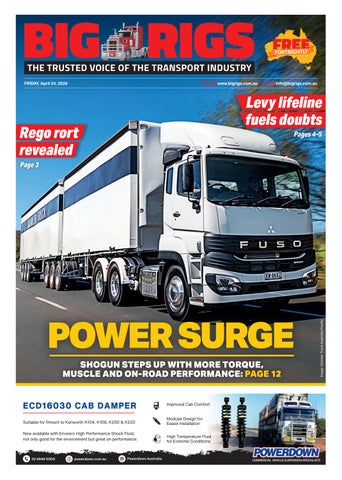
BIG RIGS 24 April 2026

Page 1


Award-winning company placed into liquidation CONTACT US

MARLU Transport Solutions, trading as Nighthawk Transport, has been placed into liquidation less than two years after taking over the keys to the busy NT operation.

After entering voluntary administration on February 9, Nighthawk had continued trading for a short time, but administrators McGrathNicol told Big Rigs earlier this month that the company had now ceased all operations and entered into liquidation.

W hen administrators were called, the company employed 17 full-time and 20 casual employees, and had a long and proud history as a key freight provider servicing remote NT communities, including critical supply routes between Dar-

win, Katherine and the Gove Peninsula.

It had 153 assets including 34 trucks and prime movers, 12 light vehicles, 89 trailers and 13 forklifts.

In its latest report to creditors, McGrathNicol estimated the company’s total debts to be as high as $17.8 million, which was largely made up by $7.8 million in bank debt and $5.2 million in vendor finance.

The latter amount is part of court proceedings in May with Marlu Transport Solutions alleging misleading and deceptive conduct by the vendor Bishdun, while the seller has disputed the claim and commenced a cross-claim for non-payment.

In addition, the Australian

Taxation Office has lodged a $1.6 million proof of debt for unpaid GST and income tax with administrators, and the NT Office of State Revenue is owed $112,000 in unpaid payroll tax and Revenue WA is owed $6900.

Unpaid superannuation is estimated at between $422,000 and $464,000 and it’s estimated unsecured creditors, who the administrators think are unlikely to be repaid, were owed up to $840,000.

According to the report, Nighthawk directors told administrators that following the company’s 2024 purchase for $13 million, plant and equipment required “significant and unforeseen” repairs and maintenance, including 20 assets

“identified as being overdue for major service” during the new owners’ first week.

The report said a valuation report obtained for the purpose of securing finance approval included various assets which were valued on a desktop basis, and the directors alleged the value of the assets was not accurate.

Another major contributor to Nighthawk’s failure, the administrators said, was the fluctuating earnings the company received due to the impact of weather.

Nighthawk, which had depots in Darwin, Katherine, and Nhulunbuy, battled fluctuating wet and dry seasons, which forced road closures.

The administrators said the directors also advised that several revenue streams were lost around the time the sale was completed in May 2024.

Cotton haulage work, which historically generated between $200,000-$400,000 per month, according to vendor information, was lost due to the start of new ginning operations in Western Australia and Queensland.

The lost cotton work also removed associated backload opportunities from Queensland that previously helped make those routes more profitable.

The directors also told administrators that a shared-run partner in South Australia had entered liquidation, resulting in an estimated loss of revenue

of $80,000 per month. In its report McGrathNicol also told creditors it believed the company’s high repair and maintenance costs were a reason for its demise, as were the fees in pursuing legal action against Bishdun.

Marlu Transport Solutions was founded in 2023 by Alex McPhee and Saturn Turnbull as an offshoot to Marlu Resources Group, and is described as a 100 per cent indigenous-owned transport and logistics company. The company and the remainder of the group remains fully operational. Big Rigs approached Turnbull for comment, but she said she was unable to provide a statement due to legal reasons.

In October 2025, Nighthawk Transport won an NT Chamber of Commerce award for excellence in business supply chains and logistics.

Nighthawk has closed the doors after 40 years servicing NT communities. Image: Nighthawk Transport
Marlu Transport Solutions owners Saturn Turnbull and Alex McPhee.

Operators exploiting rego loophole

TRANSPORT operators are saving tens of thousands of dollars a year by exploiting primary producer registration concessions, claims an industry insider.

The well-placed source, who operates a transport company in Victoria and asked not to be named, claims the misuse is widespread across multiple sectors and distorting competition.

Primary producer concessions are designed to support genuine agricultural activity, allowing eligible operators to register vehicles at significantly reduced cost when they are used to transport goods produced on their own land.

However, the source alleges that some operators are using these concessions while undertaking commercial freight tasks.

“They’re saving about $11,000 per truck per year on a standard B-double setup,” the source said.

“When you’ve got seven trucks, that’s about $70,000 a year. I know of fleets running more than 20 trucks all on primary producer registration.”

The operator said he has personally compiled a spread-

sheet of more than 130 trucks operating under the concession, estimating a potential loss in rego revenue of over $1.4 million annually based on those vehicles alone.

He believes that figure only scratches the surface.

“It took about a month just going through publicly available images and checking registrations,” he said. “That’s not even close to the full picture.”

Examples cited include trucks hauling concrete panels, excavators and even oversized military equipment, all allegedly operating under primary producer registration despite performing commercial work.

The source also pointed to livestock and grain operators running full-time commercial fleets under the concession, including multi-combination vehicles such as AB-triples and road trains.

“I have personally observed vehicles operating under this concession involved in freight movements connected to projects such as the Metro Tunnel works.”

In one case, he claims to have lost a contract to a competitor operating under the concession, with freight rates significantly undercut.

“We’re talking $50,000 to $100,000 difference in costs.

You just can’t compete with that.”

According to the source, the issue stems from a lack of verification when vehicles are registered.

“It’s basically a declaration,” he said. “You sign a piece of paper saying the vehicle will be used for primary producer work, and there’s no real checks and balances.”

He claims attempts to report suspected misuse through official channels, including the National Heavy Vehicle Regulator’s confidential hotline, have resulted in little to no enforcement action.

The issue has also been raised in meetings with regulator representatives and state transport officials, but the source claims there has been reluctance to act.

At the same time, he argues that the misuse is undermining compliant operators who are meeting full regulatory obligations, including higher registration, insurance and maintenance costs.

“This creates a massive imbalance,” he said. “Legitimate operators are being pushed out because they can’t match those costs.”

Beyond competition concerns, the source also raised potential safety and legal im-

plications.

Under Victoria’s Road Safety Act, obtaining registration through false or misleading information can render that registration void.

“That raises serious questions about insurance, third-party coverage and what happens if there’s a major accident.”

The source stressed his concerns are not aimed at genuine farmers using the concession as intended, but at commercial operators exploiting it.

He believes the issue warrants greater scrutiny, particularly as the industry grapples with tightening margins.

The operator believes the issue has got so serious it’s now having a similar damaging impact as sham contracting.

The NHVR said it is aware of concerns regarding the potential misuse of concessional registration schemes, including primary producer regos.

“We work closely with state and territory road transport authorities to monitor compliance and respond to intelligence and reports of suspected non-compliance,” a spokesperson said.

W hile concessional registration arrangements are administered at state government level, the NHVR supports a risk-based and data-driven

approach to compliance and enforcement.

“This includes working with our state partner agencies to identify potential misuse through information analysis, on-road inspections and targeted operations where appropriate. This information is then passed onto the relevant state registration authority for action.”

The NHVR said it encourages anyone with evidence of suspected misuse to report these incidents to the Heavy Vehicle Confidential Reporting Line (1800 931 785). Penalties for rego misuse vary by jurisdiction but can include fines, loss of concessional registration access or other enforcement actions, depending on the severity of the offence.

VicRoads didn’t answer the allegations directly, instead telling Big Rigs that providing false or miseleading information is a serious offence and compliance is monitored by the NHVR.

A Transport for NSW (TfNSW) spokesperson said registration applicants must declare eligibility and provide supporting evidence to demonstrate they meet the criteria. This includes documentation such as certification from a registered

tax agent or accountant, or Australian Taxation Office records confirming primary producer status. Applicants are also required to notify TfNSW if they no longer qualify for the concession. Compliance is monitored through a combination of data analysis, inter-agency information sharing, and onroad enforcement.

Penalties for misuse can include voiding of registration and penalties of up to 20 penalty units ($2200) for an individual or 100 penalty units ($11,000) for a corporation. Latest figures show primary producer registrations in NSW had dropped from 30,100 at the end of 2024 to 27,351 by April 14, 2026.

Sterle warns of more crackdowns on truckie visa rorters

WA Senator Glenn Sterle is looking forward to seeing multi-agency blitzes on visa rorters in the road freight transport industry continue throughout the year.

The former owner-driver instigated the first crackdown, revealed earlier this month, as a result of an emergency roundtable he convened to discuss the biggest issues hurting industry.

“There was an absolute cheer for joy when we actually saw them out there doing it,” Sterle told Big Rigs

“I’m rapt that the government is absolutely committed

and that the four agencies in this space have got their sleeves rolled up and they’re out there doing it – we need a lot more of it.

“If this illegal behaviour is not stamped out, our road transport industry is going over a cliff.”

Sterle said the most powerful message at the roundtable was when an industry delegation, led by Queensland Trucking Association CEO Gary Mahon, told the agencies and interested ministers, that the practice seemed to be so rampant there must be a new classification of worker.

NEW PRODUCT RELEASES

The senator said he can’t say when exactly the next industry blitz will be on visa checks, identifying potential migrant worker exploitation and detaining unlawful non-citizens.

But he’ll be encouraging all agencies involved to “go damn hard”.

“I’ll also say that we’re looking for very closely at the DAMAs [Designated Area Migration Agreements] and that should put the fear of Christ up a few because we know there is illegal behaviour out there.”

DAMAs provide access to more overseas workers than

the standard skilled migration programs, and currently includes truck driving in certain regions.

“I won’t give the region up at this stage, but we know who you are.”

Meanwhile, the Australian Border Force (ABF) has warned industry there will be more visa crackdowns in the very near future.

Across the most recent operation, ABF officers cancelled three student visas where the holders had breached their visa conditions, issued three Notices of Intention to Consider Cancellation, and counselled

nine drivers on their visa conditions.

During one Victorian operation, officers identified an unlawful non-citizen driving a heavy vehicle who had been in Australia unlawfully for more than 12 years.

Employers also faced scrutiny, with the ABF issuing five compliance notices for employing an unlawful non-citizen or individuals with incorrect visas or work rights, and a further five employers are now under review for potential breaches, with several new investigations underway across multiple states.

Proudly servicing dealers Australia-wide with stainless workshops in Sydney and Melbourne.

Under Labor’s tougher new laws, employers who exploit migrant workers face serious consequences, including up to two years’ imprisonment and substantial financial penalties.

“You will never know where these actions will occur and when they will pop up,” said ABF Field Operations Commander John Taylor

“Officers will be checking that drivers hold the correct visas and work rights, and that employers are meeting their obligations.

“If you seek to exploit visa settings or workers, expect to be detected and dealt with.”

FUEL CRISIS

Politicians not listening to truckies’ cries, say operators

Sharna Chapman has a blunt response to our opening question about whether Canberra’s fuel crisis lifelines are helping truckies survive.

“No, is the short answer,” said the boss of Runnymede Trucking, a four-truck operation based in Echuca.

“I’ve had grown men ring me crying, I don’t even know half of them, but they are closing their doors,” Chapman told Big Rigs

“I spoke to one guy who said he had $120,000 in the bank that he’d saved up over the years, but in about two weeks he’d have to shut the doors because he’s going to have nothing left.

“For people to sit there and say it is not the government’s fault, I’m sorry, but yes, it is.”

Everywhere Chapman turns, it’s hard to see any light at the end tunnel, which is getting darker each day.

Chapman said she asked her office staff to look into the new interest-free loan option for industry (see page 6 for more), only to be told it was “coming soon”.

“How good is that for those people who don’t have the

money to cover March’s fuel bill?

“There is a fuel bill due on the 21st of this month and that is when a lot of doors will close.”

She’d been too busy driving in the lead-up to this interview to catch-up on news of the Fair Work Commission fuel levy order, which is aimed at forcing customers to pay their fair share of the diesel spike since the war with Iran broke out. But she was far from im-

pressed with what she learned on our call.

“It’s just insane that they think it’s okay for the next person to take the cost on.”

Chapman said she felt terrible having to call a client of nearly 10 years recently to say she’d have to double her fuel levy, her margins were so tight.

“With the cost of living already, why do they [the government] think it’s viable?

Chapman said she’ll have more of a chance this month

of passing on some of a fuel bill that’s already shot up by more than 50 per cent carting timber products for a wide range of clients.

“But I can’t ring them halfway through March and say, ‘yeah, we’re just going to double the fuel levy, just like that’.

“I think the biggest issue we have is that you do not see one of those Labor politicians out there talking to people.

“Get out of your office and go into transport companies and talk to people who are living it.”

Chapman has already parked up one of the trucks she’s driving for a couple of days a week to help make ends meet.

When we call mid-way through April, her fuel bill is already at $41,000, fast closing in on her $80,000 limit.

Added to that is a bill coming for a truck now in the shop needing urgent motor repairs – $33,000, plus GST.

“I had that money sitting there in case things like this happens, but I had to use that money for the fuel bill last month.”

As for a fix for the mess the industry now finds itself in, Chapman said she also has a blunt, simple answer.

“I can’t tell them what to do,

that is their job. My job is to run my transport company.”

Chapman, however, is adamant things will get a lot worse if something isn’t done fast.

“Last week, seven small businesses shut down in transport that I know of. Forty per-cent of the transport industry is made up of owner-operators or small business.

“You take that away, the big guys can’t keep up, they’re not going to be able to do everything.”

Townsville-based operator

Jason Tuttle says the fuel crisis has already forced him to park one truck up, lay off a driver and make tough decisions just to stay afloat.

The boss of Tutts Transport, a four-truck operation that hauls steel, stockfeed and cotton, said the pressure from soaring diesel prices is being felt right across the supply chain.

He said a slowdown in freight demand has only compounded the problem, as customers tighten spending in response to rising costs.

Despite cutting back, the business is still battling a sharp increase in operating costs, particularly fuel.

Tuttle said cashflow has be-

come one of the biggest challenges, with fuel accounts quickly blowing out before the end of the month.

“You might have a $50,000 fuel limit on your account, but you’re actually blowing that out before you get halfway through the month.”

A fuel levy has helped, as have some customers who have stepped up by shortening payment terms.

“Some of them have been really good to us, and they’re actually paying us in seven days, so you can actually put some money on your fuel account to keep it going below the limit.”

But even with those adjustments, the sheer cost of diesel is staggering.

“I put 400 litres in the truck this morning. It was $1258 for 400 litres.”

He said that compares to not long ago when diesel was around $1.64 per litre.

“Fuel’s gone up something like $1.47 a litre. It’s gone up 80 per cent.”

“If you don’t have a fuel levy, you’re going to go broke.”

He was also critical of government measures introduced so far, particularly loan-based support.

“At the end of the day, if you have to borrow money to pay

Sharna Chapman, the boss of Runnymede Trucking, a four-truck operation based in Echuca. Image: Sharna Chapman

a fuel bill, it’s not good.

“By the time you pay that fuel bill, you’ve got another one on your door. What do you do? Borrow more money to pay the next one?

Tuttle said the federal government’s $20 million advertising campaign to encourage motorists to use less fuel would have been money better redirected into the transport industry and farming.

“That’s the greatest waste of money I’ve ever heard of in my life.

“What are they doing to do next? Tell the grey nomads to go on holiday but don’t bring your caravan.”

Tuttle’s message to the federal government is much like Chapman’s: just do your job and look after Australia.

“Stop breaking the country because the country is breaking. And we need the authorities to back off a bit.

“I’m hearing they’re handing out some pretty silly fines for bloody silly things.

“The industry is at a breaking point. Even myself. You can’t sleep because you’re stressed – the whole of Australia is virtually going into survival mode.

“It doesn’t matter how big or small you are, it’ll take no prisoners, and we haven’t seen it in the supermarkets yet. You wait until that happens.”

FUEL CRISIS

Industry boss raises concerns over

Steve Shearer, the Executive Officer of the South Australian Road Transport Association, supports the intent and concept of the emergency fuel levy order being fast-tracked as we went to print.

But he feared that the application with the Fair Work Commission had been rushed through with “undue haste and without fair and proper process.”

“To have a proposed order lodged by the TWU/ARTIO partnership on the eve of Easter, literally and then have the commission issue orders for submissions in response to be lodged just one working day later for a hearing the day after that is just unreasonable haste,” Shearer told Big Rigs “Worse, it has resulted in the requirement that the commission engage and consult with all affected parties not being met.”

Shearer said the draft order he’d sighted on April 14 was actually impractical in a number of ways, as far as the precise meaning and its practical operation/implementation.

“What does “ensure recovery of the increased cost of fuel” actually mean?

“How many operators will

‘rushed’

be able to establish the increase in the cost of the fuel that was directly involved in transporting my two pallets of freight.

“Parties who have transport arrangements with multiple and perhaps many transport operators and subcontractors will be required to go through a fuel cost adjustment process with each of them at least every fortnight.”

Shearer said the order also makes clear that if you have current agreed fuel cost recovery arrangements in place, that will meet the requirements of the order.

“So, anybody with current ‘agreed’ rise and fall clauses in contracts will be stuck with

fuel levy order

whatever that arrangement provides, despite the fact that it does not recover the massive hikes in fuel prices.”

Shearer also flagged a section of the order that said the primary parties at the top of the transport chain will be obliged to “take reasonable steps to ensure that secondary parties engaging regulated road transport contractors or road transport employee-like workers in the same road transport contractual chain adjust the rate they pay to such regulated road transport contractors”.

“These requirements raise the very real risk that we will see a repeat of the serious unintended consequence pro-

D ISRI SEATS

SYDNEY

510 Victoria Street, Wetherill Park NSW 2164 Ph. 02 9756 6199, email: isri@isri.com.au, www.isri.com.au

BRISBANE

duced by the abysmal RSRT.

“Larger operators will be inclined to withdraw work from their subcontractors and bring it back inhouse, once again rendering owner-drivers and small family businesses redundant.

Shearer is also concerned about the risk operators face of losing work if they are forced to take a fuel recovery dispute to the commission.

“At least the commission has heeded the advice that one size does not, and can’t fit all, and they have not sought to impose a set price, or a set fuel levy mechanism.”

National Road Freighters Association President Glyn Castanelli said that for a small operator, the proposed order is designed to be practical and straightforward.

“It doesn’t require complex calculations or detailed cost modelling. Instead, it follows a process that is already familiar across the industry,” he said.

An operator would establish what their fuel cost was prior to the recent spike (on or about March 6th), compare it to what they are paying now, and determine the increase.

centage adjustment to their existing rates.

“The key difference under this order is that fuel cost recovery is no longer optional or dependent on bargaining power.

“Once in place, the obligation sits across the entire contractual chain to ensure that the increased cost of fuel is recovered. This means operators can notify their customers that their rates are being adjusted in line with the order, rather than having to negotiate from a position of weakness.”

Castanelli also said it’s important to note that the order does not require operators to calculate costs at the level of individual jobs, pallets or customers.

“It allows businesses to apply a consistent fuel recovery mechanism across their work, which is how fuel levies have traditionally operated. This keeps the process simple and workable for operators of all sizes.”

If a customer refuses to pay, operators can formally request compliance under the order, and if the issue cannot be resolved, it can be referred

3/120 Gardens Drive, Willawong QLD 4110 Ph. 07 3275 2044, email: sales@isribrisbane.com.au, www.isribrisbane.com.au

BRISBANE NORTH

1/259 Cullen Av, East Eagle Farm QLD 4009 Ph 1300 11 4774, email: seats@isrinb.com.au, www.isrinb.com.au

MELBOURNE

Unit 1/569 Somerville Rd, Sunshine West VIC, 3020 Ph. 03 9311 5544, email: sales@isrisunshine.com.au, www.isri.com.au

MACKAY

110 – 120 Maggiolo Drive, Paget QLD 4740 Ph. 07 4952 1844, email: admin@isrimky.com.au, www.isriseatsmackay.com.au

PERTH

408 Welshpool Rd, Welshpool WA 6106 Ph. 08 9362 6800, email: info@mmtisri.com.au, www.mmtisri.com.au

DARWIN

Mobile Sales and Service

Ph. 08 8927 0986, email: info@isridarwin.com.au, www.isridarwin.com.au

NEWCASTLE/HUNTER VALLEY

Ph 02 4932 0600,

Unit 2/13 Hinkler Ave, Rutherford NSW 2320 email: sales@hvss.com.au www.isri.com.au

Steve Shearer, the Executive Officer of the South Australian Road Transport Association

FUEL CRISIS

Freight relief ramps up across states

WITH diesel in Australia climbing well past the $3 mark – and staying there despite fuel excise cuts – a raft of measures have come into play in a bid to help ease financial pressures.

These range from increased payloads for certain goods in Western Australia, to opening up road access for certain vehicles in New South Wales, removing the need for some permits in South Australia, and incentives to modernise truck fleets.

Here are some of the major lifelines at issue deadline. Check bigrigs.com.au for the most current measures.

Higher payloads in WA

From March 16, the WA Government announced that 27.5m and 36.5m road trains will be permitted to transport up to 10 additional tonnes per load if they are carrying petrol, diesel and/or fertiliser to certain priority regions in Western Australia.

Under the plan, road trains can bring additional petrol, diesel, and fertiliser to key regions such as the Goldfields, the South West, Great Southern and the Wheatbelt.

Transport Minister Rita Saffioti said this would enable the delivery of more petrol, diesel, and fertiliser to regional Western Australians.

“In times of global uncertainty, it’s more important than ever for government to work with industry and the community on practical solutions,” she said.

To help with distribution, industry will work with the government and fuel companies to triage priority areas for more stock.

Industry will provide the location of these depots to Main

Roads which will adjust existing permits on a case-by-case basis to allow for the new temporary conditions.

These new permit conditions will be rolled out progressively from today as required travel routes are identified.

This was followed by an announcement on April 9 that accredited trucks, road trains and milk tankers transporting milk and perishable goods in Western Australia can carry up to an additional 10 tonnes per load, in response to the current fuel crisis – where conditions allow.

Adding to the measures in place in WA, larger road trains are now being allowed along a key stretch of Great Northern Highway in the Wheatbelt, as part of a threemonth trial.

Under the changes, 53.5m triple-trailer road trains will be permitted to travel along Great Northern Highway between Wubin and Muchea with strict safety conditions for the vehicle, and drivers required to have a minimum of three years’ experience driving vehicles of this length.

Triple-trailer road trains were previously not permitted to travel further south than Wubin when travelling into Perth, before needing to be broken down into smaller double-trailer road trains. These changes aim to help improve productivity and reduce truck movements along the key route connecting Perth to the Wheatbelt, Murchison, Goldfields, Pilbara and Kimberley regions.

Reducing red tape in SA In South Australia, the National Heavy Vehicle Regulator (NHVR) has issued five new notices in partnership

with the South Australian Department for Infrastructure and Transport, aimed at improving freight efficiency and delivering more productive networks across the state.

Heavy vehicles that may benefit from the new notices include livestock vehicles, high productivity combinations, and tri drive prime mover and rigid truck combinations.

The new notices enable increased capacities so that more goods can be moved in a single trip, while reducing the administrative burden by removing the need for some permits, cutting road manager consent requests, and providing greater certainty of access for operators.

NHVR Chief Operations Officer Paul Salvati said, “This is a strong example of the NHVR working closely with government and industry to deliver practical, on-theground improvements.”

The publication of these notices was fast-tracked at the request of the South Australian Government, to help ease fuel and cost pressure.

“By expanding access through notices, we are reducing red tape, improving certainty, and helping operators get on with the job,” Salvati said.

Expanding road access in NSW

Late last month, the NSW Government announced measures to increase access to the road network for larger trucks that can carry more goods in a single trip, and ease restrictions on their operating hours.

New measures include adjusting load limits to freight to allow for bigger and longer freight to travel on the state’s road network, and where applicable to allow more freight to travel, load and unload at night, while providing for flexibility for hours of operation and curfews.

A Transport for NSW spokesperson confirmed that the focus is on “higher productivity vehicle combinations derived from existing 26-metre B-doubles, which enable more freight to be carried per trip through longer configurations rather than increased axle mass.”

“Vehicle types being considered include modular combinations such as B-triples, A-doubles, AB-triples, BABquads and Performance Based Standards vehicles, subject to network suitability assessments and formal approvals.”

Exactly where access will be opened up for such vehicles is also yet to be confirmed.

“Initial access is being assessed on the National Land Transport Network, with consideration of connections to key freight locations such as intermodals once assessments are complete,” the spokesperson said.

“The approach recognises that PBS vehicles are not always available at short notice and prioritises the use of vehi-

cles and trailers already widely used by industry.

“There is no increase to axle mass limits or gross combination mass. The changes relate to expanded network access for higher productivity vehicle combinations, which are able to carry more freight per trip through their configuration, rather than increased vehicle mass.”

With the temporary measures, Class 2 vehicles will be permitted to operate on state roads without hours of operation restrictions.

Modernising truck fleets in Victoria

The Victorian Government has unveiled a new funding push aimed at helping freight operators cut emissions and modernise their fleets.

The Victorian Freight Decarbonisation Co-Investment Program (VFDC) is an $8 million initiative offering grants of up to $300,000 to support operators to make the shift to low and zero-emissions technology across the transport and logistics sector.

Applicants were given until April 22 to make an expression of interest (EOI), including the project outline, expected outcomes and timeline for delivery.

There grants require a minimum co-contribution of 20 per cent, which means if you are asking for a $300,000 grant, you must be able to contribute $60,000, excluding GST, toward the project.

Eligible operators could apply for funding to help cover the cost of purchasing or leasing zero or low-emission trucks, installing charging or refuelling infrastructure, or trialling a lternative fuels such as renewable diesel.

The program is open to Victorian-based businesses with fewer than 200 employees, including road and rail freight operators, logistics providers and courier companies.

Among other conditions, projects must be completed within 18 months, placing further pressure on applicants to move quickly from planning to delivery.

ATO lifeline

Operators caught in a cashflow squeeze due to the current fuel crisis could be eligible for some relief via the Australian Taxation Office’s new fuel response payment plan.

The plan, rolled out on April 1, allows eligible businesses to defer tax debts over a three-year period, with no upfront payment and 36 equal monthly instalments.

Crucially, the ATO has also flagged the potential to wipe general interest charges and penalties – but only if operators keep up with repayments and bring all lodgements up to date.

To qualify, operators must prove their financial stress is directly linked to fuel price spikes or flow-on freight costs, not just a general downturn. They also need to show they can’t service an existing or new tax debt under current conditions.

The scheme is open for applications until June 30.

The ATO has also signalled a softer compliance approach during the crisis, alongside support to vary PAYG instalments where profits have taken a hit.

Interest-free loans

Operators feeling the financial squeeze in the fuel crisis can expect the federal government’s interest-free loan scheme to open “very soon”, a spokesperson for the National

Reconstruction Fund Corporation (NRFC) told Big Rigs

“We understand the urgency of the situation facing many in the trucking industry and we are working very quickly to stand up this program so that impacted businesses can access support,” the spokesperson said.

“We anticipate we will be able to advise very soon on when the program is open for applications.”

The NRFC, a corporate Commonwealth entity which facilitates increased flows of finance into priority areas of the Australian economy, said the program will be administered by banks to their existing customers on its behalf.

“This is so we can deploy the money faster and through people who have good understanding of business needs and specific characteristics.

“We are in the process of finalising arrangements with banks now and look forward to being able to share more information soon about the size of loans, eligibility requirements and how to apply.”

Meanwhile, the spokesperson said those seeking more information and to register their interest, should visit nrfa.gov.au and search Economic Resilience Program. The Economic Resilience Program is one of three subfunds under the federal government’s $15 billion National Reconstruction Fund.

Despite fuel excise cuts, diesel still sits well above the $3 mark.
In WA, accredited vehicles transporting milk and perishables can carry up to 10 additional tonnes per load. Image: Rita Saffioti MLA
In SA, heavy vehicles including livestock, high productivity combinations, and tri drive prime mover and rigid truck combinations may benefit from new notices. Image: NHVR
Under Cab Mount
Roof Mount
Rear Wall Mount

Fuel levy confusion

AS we were going to print with this issue, an emergency fuel levy order through the Fair Work Commission was beginning to take shape and should be formally in place by now. But although well-intentioned, it left more questions than answers at first glance.

Industry voices, including the South Australian Road Transport Association, have backed the intent of the order while warning it may have been rushed, leaving critical gaps around how it will actually work in practice. Questions around what constitutes “recovery of increased fuel costs”, how those costs are calculated across complex supply chains, and who ultimately enforces compliance remain unresolved.

There are also fears of unintended consequences. Complex compliance requirements could see larger operators pull work in-house, squeezing out subcontractors and small family businesses – the very people the order is meant to protect.

HOT WEB TOPICS

Truckies echo concerns at Gatton

QUEENSLAND truck-

ies’ advocate Wes Walker is ramping up his efforts to help improve safety at the busy Gatton breakdown pads.

Walker, who helped win toilets for truckies on the site, is now focused on securing parking lines and speed limit signs – before someone gets hurt.

Big Rigs readers have also vented their frustrations about the site.

“It’s too small for the amount of trucks that use it,” said Neil Ridley. “There needs to be one on the inbound side as well, and both need to be able to accommo-

date the amount of trucks using them. Needs to have a designated place for dollies. Police the area and stop trailers being dropped 4 deep as this stops or hinders road trains from hooking up or dropping a trailer.”

Mark Beutel agreed. “The place is too small for starters. There needs to be the same facility on the inbound side so vehicles don’t need to swap sides to access hook up/drop off area. One in bound. One out bound. And both bigger. Sure there are days the place is almost empty. That’s probably the days the experts visit and don’t see a problem.

As Beutel continued, “In

reality, on average, the place is well packed to over full. Dollies everywhere. Trailers parked wherever they can fit at the time.”

Are $1100 fines enough of a deterrent?

ALMOST 100 servos across NSW received $1100 onthe-spot fines for misleading drivers with prices at the bowser that don’t match those advertised on the state’s FuelCheck app.

Around 75 per cent of stations in NSW were inspected by the beginning of April, with around half located outside Sydney.

Inspectors carried out just under 1800 service station inspections across the whole state during this period, issuing 93 penalty infringement notices.

Though when Big Rigs shared this news online, some readers believed that the pen-

alties aren’t enough to deter service stations from doing the wrong thing, at a time when trucking operators are struggling with surging fuel costs.

“Big deal – fine $1100. They will make that back after a truck has fuelled up. I’ll get that for not spelling right in my logbook,” wrote truck driver Greg Thelma Angus.

“Wow that’s very scary,” added Dean Meyer sarcastically. “They would just put the price of fuel up and recoup that in minutes. And at a cost to the taxpayers for the inspections.”

Simon Broomhead commented, “I’m sure they’re do-

ing the maths and thinking that the profits outweigh the fine.”

Fuel cost relief falls short

SKYROCKETING diesel costs are hitting the industry hard and despite a raft of federal government fuel relief measures – trucking operators agree that these will do little in providing tangible financial relief.

Earlier this month, Ross Transport’s True Ross-Sawrey said the changes were “a step forward” but fell well short of what operators need right now with cash flow pressures, weak fuel levy recovery and rising costs continuing to bite.

“It’s obviously a step forward. It’s better than nothing, yes, but my personal opinion is it’s still not going to provide much relief to the now,” she said.

Readers agreed. “My income is stationary, but my fuel bill certainly isn’t. One of my customers is worried what I am going to charge them for a trip from the east coast to Perth. Certainly not what they have been charged in the past,” wrote Michael Tucker.

“It’s hard,” added Len Byrnes. “Fuel was $1.80 a litre, now $3.59. Can’t cover costs like that.”

Melissa Biddle added that it’s simply not sustainable. “Bill jumped from 180k to 350k,” she said.

While Brad Fleming commented, “It’s [diesel] gone straight back up and is supposed to stay. There’s no relief at all. Who’s this moronic government to say there is relief – they are only kidding themselves.”

Truckie, 81, fights to keep licence

IN the job for over 60 years, this 81-year-old truck driver says he’s just about ready to walk away for good after being given the run-around –despite passing multiple medicals, at his own expense.

Based in New South Wales’ Riverina region, he drives a semi as part of a road maintenance crew, predominantly used to patch up potholes. “I know I can handle the work, it keeps me mentally and physically active and I get to work with other like-minded people,” he said.

Online, Kenneth Griffin shared a similar experience,

“You bet it’s age discrimination. I gave up my B-double because it was just too hard to keep it. I still have my HC and go through the medical every year and when the medical goes to RMS, the decision is in the hands of a person who is not a medical practician, just an unqualified pen pusher.”

Rodney Morley also shared his story. “I know what these guys are going through, I’m 63, have to do a medical test every year to just keep a car licence now that doctor had my truck licence taken away from me because he thought I was just getting too old – no

medical or driving test could be done at the time.”

Paul E Jones added, “I have been going through this shit for the last 3 years to keep my NSW heavy vehicle licence. Medicals, echo tests, stress tests, all at my cost.”

help get the message through. Image: Wes Walker

Electric Ready Lease

IN BRIEF

Goldfields blitz

A compliance blitz in the Goldfields has seen 350 vehicles inspected over five days in March.

The blitz came after concerns were raised by industry about heavy vehicles being left in roadside parking bays and reports of unsafe driver behaviour on busy Goldfields roads. The multi-agency operation was led by Main Roads’ Goldfields-Esperance team, as part of a crackdown on heavy vehicle compliance across the Kalgoorlie-Boulder region. There were 74 heavy vehicle compliance offences detected, with 28 heavy vehicle assets impounded. There were also a number of environmental offences for issues including roadside littering and dumping.

Singleton Bypass

The first small section of the $700 million Singleton Bypass opened to traffic on April 8, ahead of the full bypass opening later this year. Traffic was switched to the newly built section of road on the future southern connection, northwest of Newcastle. This latest traffic switch, between White Falls Lane and just past Newington Lane, is one of several staged changes that will occur over coming months. Once complete, the Singleton Bypass will remove up to 15,000 vehicles a day from Singleton’s main street, reduce travel times and allow drivers to bypass five sets of traffic lights.

Outback refinery

An outback Queensland refinery could soon expand its capabilities, as the state government unlocks the development of Australia’s first oil field in 50 years at the Taroom Trough.

The first barrels of oil from the Taroom Trough are making their way into the domestic fuel supply. Shell is producing 200 barrels of high-quality crude oil a day, being refined at iOR’s Eromanga refinery, and produced into diesel. Since opening in 1986, iOR’s Eromanga refinery has continuously processed up to 1250 barrels per day of locally produced crude oil. To support the development of the Taroom Trough as a major oil supply for domestic fuel, the Queensland Government has announced it will streamline roads and trunk infrastructure under a new Taroom Trough Development Plan..

WA bypass progresses

The construction of a $275 million bypass in Western Australia continues to progress, with a 7km northern section of the project opening to traffic on April 9. The Bindoon Bypass is a new 64-kilometre section of the Great Northern Highway, being constructed between Chittering Roadhouse and New Norcia. Currently, triple road trains traveling from the northern regions on the Great Northern Highway can only reach Wubin, before having to split up into shorter combinations The project will allow triples to travel the entire length of the corridor.

Iran conflict tipped to keep brakes on sales

THE new truck market was tracking down for the latter half of 2025 and that trend has continued through the first quarter of 2026, according to the latest numbers released by the Truck Industry Council (TIC).

Overall, the TIC figures showed there were 3665 units moved last month, 460, or 11.1 per cent down from the same month last year.

TIC CEO Tony McMullan warned that the real impact of the war in Iran on sales in Australia is yet to come.

“This downturn in new truck sales is not as a result of the current global geopolitical landscape,” McMullan said.

“Due to the order/build/ registration/delivery process for new trucks, that typically takes two to four months, we are yet to see what effect those global events have on new truck sales in Australia.”

McMullan, however, said there is little doubt that the events in the Middle East over the past six weeks and the ensuing effect of fuel prices in Australia, has placed the road freight industry under substantial financial stress.

“Business confidence in the sector is suffering consider-

ably and understandably the significant increase in operational costs for transport companies may lead many organisations to review their immediate fleet expansion and/or fleet replacement plans.

“I believe that possibly April sales, but particularly May and June numbers will give a better indicator of the likely, tougher times ahead.”

In line with the first two months of 2026, all segments recorded losses compared to March 2025 results.

The heavy duty segment took a fair hit again in March, down 9 per cent, with 1240 sales recorded. This was down 123 heavies when compared to March 2025 sales.

The overall heavy duty numbers for the first quar-

ter 2026 faired a little worse due to poor sales in January and February. Year-to-date the segment trails the same period last year by 11.1 per cent, or 375 trucks. A total of 3005 HD trucks have been sold so far in 2026, compared to 3380 to the end of March 2025.

Medium Duty sales again bore the brunt of the slow down, with only 419 medi-

ums sold in March, down a significant 32.7 percent (-204 trucks) on March 2025.

At the end of the first quarter segment sales lag those of last year by 35.4 per cent (589 trucks). In fact, the first quarter 2026 MD truck sales result of 1075 units, was the worse start to the year since 2001, when only 1009 mediums were sold for the opening quarter. This is a 25-year low.

The light end of the market held up a little better than their bigger brothers last month, revealed TIC. Light Duty Truck sales (trucks between 3500kg and 8000kg GVM) totalled 1131, down just 3.9 per cent (-40 vehicles) over the March 2025 result.

To the end of the first quarter, 2630 light trucks have been delivered, a significant decrease of 10.2 per cent over the 2025 quarter one result, that amounts to 298 fewer light truck sales so far in 2026.

TIC said this is primarily due to poor LD truck sales in January and February this year.

The peak industry body for truck manufacturers and importers in Australia also released an Alternative Fuel Type report for March and first quarter of year 2026.

Kenworth extends Supercars partnership

KENWORTH Trucks Australia has announced the extension of its partnership with Supercars for another three years, handing over a brand new T620 as part of the deal.

Supercars uses two Kenworth prime movers to transport the Supercars logistical juggernaut throughout Australia, travelling more than 35,000 kilometres across the season.

Supercars Transport and Logistics Manager Jason Routley has visited the PACCAR manufacturing site in Bayswater, Victoria, where the new Kenworth T620, was handed over as part of the three-year extension to the Supercars-Kenworth partnership.

The T620 will serve as a mobile boardroom and Su-

THE M1 Pacific Motorway extension to Raymond Terrace (north of Newcastle) is now expected to open to traffic in late 2026, more than a year earlier than originally planned.

The fast-tracked timeline comes as the project reaches a major milestone, with the northern section, the Heatherbrae Bypass, now complete. This encompasses five kilometres of new motorway.

“Completion of the Heatherbrae section of this project means we are well and truly past the halfway mark, with all work set to be completed by the end of the year,” said Federal Infrastructure, Transport, Regional Development and Local Government Minister Catherine King.

“The school holiday traffic

percars media hub. While a K 220 transports the safety and medical cars as well as the office facilities used by the Supercars motorsport team.

The Australian made Kenworth T620 is application engineered for the specific task of towing the Supercars trailer set, powered by a 15 litre Cummins X15 Euro 6 engine and Eaton Endurant XD Pro 18 speed transmission. It comprises an aero roof with an 860mm integrated sleeper.

The new T620 cab delivers an exceptional and safer driver environment including an L ED dashboard, enhanced electrical architecture and the latest suite of active safety technologies.

The c ab’s distinctive fea-

we’re seeing on the existing highway right now is a great reminder as to why this project is vital.

“Nearly 25,000 vehicles use this road on a normal day, with that number swelling during the holiday breaks.”

The Hunter’s largest infrastructure project, the M1 Pacific Motorway extension and Hexham Straight widening projects are jointly funded with a total investment of $2.24 bil-

tures include black leather seats featuring embroidered trim with the Supercars logo as well as personalised exhaust shields.

The team at PACCAR Australia worked closely with Jason Routley and Supercars to ensure the specifications and level of customisation for the build met their requirements.

Jason received the keys to the T620 from Michael Long, Director Sales and Marketing – PACCAR Australia.

“We are thrilled to extend our long-standing partnership with Supercars for a nother three years, by providing a transport solution t hat delivers on the logistical demands faced by the team when transporting the series

lion ($1.792 billion from the Australian Government and $448 million from the NSW Government).

As part of the northern section, the Raymond Terrace interchange, the Masonite Road overpass and a major bridge crossing at Windeyers Creek have also all been completed.

Completion of the Heatherbrae Bypass means this section of the M1 extension will open as soon as work on the 10 ki-

across Australia and over to New Zealand,” said Michael.

K enworth will continue with the Kenworth Driver’s Parade at this year’s Bathurst 1000 event in October. Kenworth officially c laimed naming rights at the Bathurst event in 2006 and since then, customers

from across Australia have been given the opportunity to drive their Kenworth t ruck around the famous Mount Panorama track. Race fans will be able to check out Supercars’ new Kenworth T620 at the Tasmania round, being held in L aunceston from May 2224.

lometre southern section from Black Hill to Tomago is complete, later this year.

Once opened, contractors will remain on site to monitor how the new road adjusts to carrying highway traffic, undertake landscaping establishment, and targeted maintenance as required – for up to t wo years on the southern section and one year on the northern section.

State Minister for the Hunter Yasmin Catley added, “Now that the Heatherbrae Bypass is complete, this next step is linking it properly into the motorway so the benefits are felt right across the Hunter.

“Reaching this milestone is incredibly exciting and even more so because we’re opening ahead of schedule.”

NSW Minister for Roads

Jenny Aitchison added, “Seeing a project of this scale moving more than a year ahead of schedule doesn’t happen by chance – it’s down to the incredible crews on the ground getting the job done.

“As one of the largest infrastructure projects in the region’s history, the M1 extension will deliver faster, safer and more reliable journeys for communities across the region.

“The project is now progressing ahead of the previously expected 2028 completion, with the full motorway on track to open in late 2026.

“Reaching this milestone with the northern section, including the Heatherbrae Bypass, shows just how much progress is being made and brings us one step closer to delivering a fully connected motorway.”

The entire project is on track to open by late 2026. Image: Transport for NSW.
The new T620 will serve as a mobile boardroom and Supercars media hub. Image: PACCAR Australia
The Willows family of Willows Bitumen had something to celebrate in March with the arrival of this stunning new Kenworth T620. Image: Brown and Hurley

Fuso Shogun raises bar with 530hp punch

More muscle, smarter safety and a refined cab – the most powerful Japanese truck you can buy here lifts the bar again for heavy-duty performance.

BACK in 2019 I was invited to test drive the prototype of a brand-new Fuso – so new that it still had the codename, ‘Panther’.

The truck was unveiled at the Brisbane Truck Show a couple of months later and turned out to be the all-new Shogun.

Re-reading the article I wrote at the time I enthused to the point of virtually dribbling over the new truck, from its quietness – I didn’t realise the engine had started when I turned the key – to its interior appointments and safety features. That truck came with a 455hp donk with 2200Nm on tap from 900rpm.

Move forward and the next generation saw the introduction of a 510hp version in the same body, making it the most powerful Japanese truck you could buy.

Now the company has kept that country’s opposition at bay by upping the ante to 530 prancing horses, coupled with 2600Nm. This in a new (and in some respects not so new) cab.

The cabin is in fact the same shell as that of the original, but the front is changed from the midriff down with the addition of a new, full width black grill with the Fuso name incorporated into it, instead of above.

Just above sits the three-diamond logo and to the top left, ‘530’ proclaiming the extra power. There’s plenty of real estate here to incorporate your company’s logo/name. LED headlights are now standard as are the LED taillights.

There are also innocuous black bumps on the rear of the wheel arches which house the Active Sideguard Assist radar, previously only on the nearside of the truck. Overall it looks completely different and has removed what was to my mind a vague resemblance to the M-B Actros.

Inside, the truck is little changed from past versions with the same dash layout incorporating a new and updated multi-media unit. There are new trim panels and the new Isri seat – leather and heated on the 530 models, in-

Spec sheet

FUSO SHOGUN 530

stead of fabric.

The stalks on the steering column are straight from its Mercedes cousin, but Fuso have turned them through 180 degrees so that the indicator is on the RHS. This means that you move the Jacobs Brake forward rather than back to activate its three stages.

Between the seats is a large hump – think KW 100s – but this engine cowl makes the most use of its presence by incorporating a cup holder and various storage compartments, one of which is lockable. And unlike those old K Ws, there is no gearstick to contortion yourself around and so climbing into the bunk is quite easy.

Thoughtfully, Fuso has incorporated not only a curtain track on the rear window but another in the roof lining on the front edge of the bunk as

all the way along the sides, so you could easily block out light for undisturbed sleeping. On the bunk itself; this is not meant to be a home-awayfrom-home affair but is more than adequate for overnighters – on a comfortable mattress –should your logbook max out, or you’re sent away on a longer trip.

The big change inside is the replacement of the old dual parking brakes with an electronic one that releases both cabin and trailer brakes.

Whilst these changes are mild, this cabin has always been a nice place in which to spend one’s day, so there’s no need to reinvent the wheel just for the sake of it.

The biggest news is of course under the cab where now sits the twin turbo, 12.8 litre with those 530 horses and an increase in torque to 2600Nm.

ENGINE: 12.8-litre six-cylinder turbo diesel

POWER: 530hp at 1600rpm

TORQUE: 2600Nm at 1100rpm

TRANSMISSION: 12-speed Automated Manual Transmission (AMT), with crawler mode

ENGINE BRAKE: Three-speed (Jacobs brake) engine brake

RATINGS: 70-tonne Gross Combination Mass (GCM) and 26-tonne Gross Vehicle Mass (GVM)

TARE WEIGHT: 7985kg

SEAT: ISRI leather seat with heating function

AXLE RATIO: 4.222:1

SAFET Y FEATURES: Driver airbag, AEBS Active Brake Assist 6, Active Sideguard Assist, Pedestrian Detection, Adaptive Cruise Control, Electronic Stability Control, LED headligts.

SERVICE INTERVALS: 50,000km or 12 months (whichever comes first)

WARRANTY: Five years or 500,000km, whichever comes first

Those horses are all galloping in sync at 1600rpm with 2000Nm available from just 600 revs through to full torque at 1100rpm and hanging around long enough for the power to do its job.

The result is a perfect blend throughout the rev range and it shows in the (laden) truck’s spirited performance out on the highway. The other result of this increase is an increase from 63-70 tonnes GCM so hauling B-doubles around town, intrastate or even interstate won’t be a problem.

On the road the Shogun rides and steers as surely as its Mercedes-Benz cousins. If you don’t know what I mean by that, you’ve never driven an Actros and your life is not complete. It is simply a pleasure to drive with its 12-speed gearbox giving lightening changes and the Active Cruise Control doing its thing.

The front suspension is Long Taper Leaf with double acting shock absorbers and soaks up the worst our roads can throw at it. It’s not air, but it is close. Aim the truck and it simply goes there.

Jiggling of the steering wheel not required. Believe me, there are still trucks out there that require constant input of the steering wheel. The rear is two-bag air suspension and does all asked of it.

I get to drive the Shogun over a variety of roads and road surfaces which change as quickly and often as Melbourne’s weather on an autumn day. Good, indifferent and all too often shocking, the truck handles them all

without complaint.

The fuel tank is 400 litres which reflects the uses for which this truck is intended such as short haul work. Travel interstate and you’ll have to refill, depending where you’re heading.

That said, these Mercedes-derived engines are renowned for their frugality so you’ll go further than you might expect.

Five radars and a camera, with up to five of the latter available as an option should ensure you don’t get into trouble no matter the situation.

The Daimler group was the first to install Active Sideguard Assist on their trucks. Originally just on the left hand side, this radar detected a person, bike and other obstacles in the truck’s blind spot and would warn the driver.

Now they have added this feature to the driver’s side as well, under barely noticeable black cowlings, unlike the bulky original iteration.

Warning lights built into the

A pillars glow orange when an object is beside the truck, changing to red and emitting an audible warning if collision is imminent.

Other radars take care of things like that Adaptive Cruise Control. These are just some of the full suite of safety features built into the truck. As well as this Prime Mover the Shogun is available as 6x2 rigids as well as an 8x4 for applications like waste. Tipper applications are another area where the company hope to see sales. Engines range from 8 litre through 11 litre and top out with the 13-litre 530. As with the original ‘Panther’, I’m still a great fan of the Shogun. Quiet, capable, surefooted, safe and now with even more guts.

After I climbed down from the Shogun I jumped into a little manual Fuso 515 wide cab truck with the company’s ‘Built Ready Tradie Tray on the back.

Talk about going from the sublime to the ridiculous. This truck is a hoot to drive, but that’s a story for another day.

Hauling B-doubles around town, or further, now won’t be a problem. Images: Daimler Truck LED headlights are now standard.
The plush leather ISRI seats are as good as it gets.
New grill gives the Shogun a totally new look.
Shogun brake goes electric.
The infotainment screen has also been updated.

From pub dream to Kimberley powerhouse

A chance meeting over a beer sparked a thriving outback operation where grit, reliability and diversification keep driving success more than 50 years later.

JAMES GRAHAM

KUNUNURRA-BASED

operator Peter Woodhead is already eyeing up a wellearned cold beer late on the Friday afternoon that Big Rigs calls.

The merciless wet season in the Kimberley shuts down the bulk of the day-to-day operations at JSW Holdings a week before Christmas right up until Easter – but the work rarely stops for the man at the helm of the family trucking business his father John founded in 1975.

When you’re in such a remote location, totally at the mercy of its many seasonal weather events, this is the time that the workshop is flat out, ensuring all mechanical kinks are dealt with and the parts shelves stocked to the brim.

Peter says the business can carry up to a million dollars’ worth of parts on site at any one time.

It’s a unique and unforgiving environment where plenty have set up shop with visions of “taking over the world”, only to be sent packing due to underestimating just how tough it really is.

From November until April it’s 40 degrees, wet and an afternoon shower can see 2550ml of rainfall. Roads become impassable.

Drop a wheel off the bitumen, and you’re pretty much bogged, says Peter, 55.

“The running joke for Kununurra is that an overnight airbag’s three days – and if you’re waiting for something simple, three days is a lot of downtime for machinery and trucks,” Peter said.

“But we’ve been doing it for a long time, so we know what we need to buy and have on the shelves.

“We run the biggest workshop in town, even though we only do our own stuff.”

Peter credits the steady stream of parts from the Truck Centre in Perth and “guru” mechanic Dion Franklin for helping to keep the wheels turning at JSW.

He’s also an unabashed fan of the Truck Centre WA’s ever-reliable equipment – the business was built on the back of the dependability of the UD badge early on.

More recently that’s swung toward the Volvo and Mack divisions of the VGA portfolio as JSW expanded into triples.

Today, JSW boasts two Macks, two UD and three Volvo prime movers, two Volvo body trucks, a UD 8-wheeler side-tipping body truck, a little UD plant truck, a couple of older Western Stars and T950 Kenworths, and a classic LTO 8000 Louisville among a six-strong fleet of self-batching concrete trucks.

“It helps that we have a mechanic [Dion] that comes from Truck Centre in Perth

who loves Volvos. He likes all trucks, but he just has a passion for them.”

By the time you read this, Dion, Pete and the crew will be back in full swing in those rigs, helping to build most of the roads in the Kimberley for Main Roads WA.

For the last few years, JSW has also been tasked with supplying the concrete for the sealing of Tanami Road, most recently a 42km section through the hills south of the Great Northern Highway.

Weather permitting, the next 32km stretch south of Ruby Plains Homestead was due to start last month and is expected to be finished by the end of 2026.

Peter looks back with pride at just how entrenched the JSW name has become with infrastructure works in the region.

He admits none of the family has ever had a goal to be where they are today.

“It’s something that’s evolved naturally, rather than putting your head on a chopping block and hoping something works.

“We’ve generally expanded internally, which has ended in the stuff going out externally. We bought excavators for the quarrying site and then Main Roads then wanted them on the job.

“So, then we had to get more excavators for our quarrying, and things like that. “It’s not like some of those bigger transport companies that had a goal to be big and famous with X amount of trucks.”

Even the business was launched by chance one night in the pub.

Peter’s father John, a brickie by trade, who had arrived in town to lay bricks for the local

school, bought a brick company off the former owner as he spilled tears into his beer over how tough it was to make ends meet.

When he also heard about a local trucking contractor coming up short on loads of roading material, John bought a truck to cart his own and quickly found himself in hot demand by Main Roads.

When Main Roads hired that truck, he bought another one and soon ramped up the quarry side of his operation to capitalise on another market opening.

“That developed into Main Roads sealing and then having a quarry enabled him to push into concrete sales as well,” Peter recalled.

“Everything basically grew naturally by other people not being able to supply.”

Today, John has stepped back due to health reasons but it’s still very much a family affair at JSW.

Peter’s mum Silvia is front and centre helping run the office, alongside his daughter Lana, while Peter’s nephew Albert Nicholson heads up spare parts and quality systems.

Peter’s older brother Stephen also worked alongside him for many years, but sadly passed from cancer just two years ago.

“Before he died, we made the decision to scale the quarries back, so we sold them to Kimberley Quarries.

“We have a really good working relationship with them so we pretty much cart the same amount of material out of there.

“The only thing that’s changed is we don’t have to deal with the mines department anymore.”

As for other work, he’s not out to grow any bigger, content to stay in the current “sweet spot” now he no longer has his dad and brother by his side.

Main Roads keeps JSW busy with general maintenance and other little projects going on.

Peter says there’s another couple of mines developing in the area so there’s also spinoff work on the go from that.

At the time of this interview, Peter says the business had yet to feel any impacts from the fuel crisis.

Peter says a local supplier, CGL Fuels, has turned the region into one of the most expensive places in Australia for fuel, to one of the cheapest.

“They’ve got a fair storage at the moment because Argyle and Savannah Nickel shut down so they haven’t got mines sucking off them so we’re probably in a better position.

“And they don’t run on gate price. They just run on ship price. I think our fuel might have changed two cents [per litre].

“We’ve just made sure everything’s full and ready to go. We keep everything topped up anyway because that’s one of the joys of living up here.

“The roads still shut north and opens and shuts south.”

Pete says diversification is also a key to JSW’s ongoing success.

“Not one thing’s our main income. We do a bit of ship unloading for the co-op, your concrete supplies is steady.

“We do a fair bit of cartage for Kimberley Quarries, so it’s sort of a bit of a mixed bag –and it’s never the same mixed bag each year.

He also prides himself on the relationship he has with

Main Roads.

“It definitely works a lot better when you have a good rapport with them, that’s for sure.”

Staff too are the backbone of the company’s enduring success and Peter is proud of the working environment at JSW that attracts and retains the right people, year after year.

“We’ve got a good recipe –and it works,” Peter said.

“We don’t skimp on maintenance either. If it’s got to be done, we do it.”

Reliability also plays a critical role in winning and retaining work, he adds.

In an industry often driven by price, Peter says his business has carved out a niche by focusing on consistency and performance.

“A lot of our work is also on our quality and reliability

Peter’s fleet has grown as the work dictates and now boasts Macks and Volvos. Image: JSW Holdings
The UD has always been a mainstay due to its reliability.
Peter jumps behind the wheel every chance he gets.
JSW Holdings has forged an enviable reputation for reliability.
JSW gears up for another big year in the toughest terrain.

Sam’s going from strength to strength

This Gippsland-based logging operator looks back with pride on what he’s achieved in his first decade in business.

DAVID VILE

‘BUSINESS as usual’ is the slogan scribed across the sleeper cab of Sam Dicker’s immaculate Kenworth T909 log hauler, and for the affable 42-year-old, the transport business he has built up with partner Cindy over the last decade is one he can be justifiably proud of.

Based in Gippsland, the SRD Haulage operation is spread out across southern Victoria with the eight-truck strong Kenworth fleet engaged on log transport.

Having made the short journey from his home base of Traralgon to the Heyfield Timber Festival, where along with having a chat to Big Rigs, Sam went home a winner with the Kenworth and Kennedy trailer set taking out the Best Log Truck honours on the day.

After being exposed to trucks from an early age in Bairnsdale it wasn’t long before Sam was off and running, building both a career and business in trucking.

“My Dad, David, managed Town’s Haulage, and a lso worked for John Jarvis so I would go to work with him and drive around in the trucks, so I sort of got the bug from that - it never goes away!

“I did an apprenticeship as a boilermaker at Kennedy Trailers in Bairnsdale building log trailers and logging equipment which was a great opportunity and a great stepping stone for my working life,” Sam explained.

With the desire to get behind the wheel still strong, Sam hit the road driving a concrete truck and tippers locally before making a move to the other end of the country.

“I got an opportunity to go to Western Australia at the age of 22 doing road train and heavy haulage work - I was based in Kalgoorlie for four years and then up in Pilbara - as a young bloke there were good opportunities.

“I did some good jobs and saw a lot of big country. I did some pretty cool heavy haulage jobs with platforms and so forth - work which you wouldn’t get the chance to do in Victoria.

“I was pretty green when I went over there and people showed me the ropes which I will be forever grateful for.”

With the intention of always having his own operation those plans came to fruition in 2015 with Sam making his first foray into log haulage.

“I had looked at a few other avenues which didn’t eventuate over the years but was lucky enough to get a timber haulage contract - I was able to buy a new truck, a Kenworth T909, and we got a second-hand set of trailers which we did up and got on the road.”

Fast forward to today and the original T909 is still in the fleet, with another three T909s, three T659s and an older T650 all pulling

B-double log trailer units.

The rapid shutdown of hardwood timber harvesting in Victoria by the Andrews Labor Government in 2020 prompted a change in direction into softwood and plantation cartage and as a result the Dicker trucks are scattered across a wide area rather than being confined to Gippsland.

“It was pretty disappointing with the hardwood shutdown as we had been lucky to do a bit of Vic Forest work for a couple of years for one of the harvest contractors. That was a good experience, I was able to see a bit of country and work around the state a bit until it all came to a head.

Now we run around 60-70 per cent of the time with pine and the rest blue gum plantation logs. As a result, we cover a fair bit of country from Gippsland across to the Otway’s and Western Districts to the South Australian border.”

Having moved to a more central location in Traralgon, the SRD Haulage fleet carts to both timber mills and export sites, with Sam overseeing the business both over the bonnet of a truck and from the office.

“It’s not just driving the truck anymore…there is a lot more paperwork to contend with these days - compliance and permits and so forth. It’s a matter of keeping ahead of the game and keeping an eye on making sure everything is up to scratch.

“I have been pretty lucky with drivers and I have a good crew of blokes - three are based in Colac, with one in Geelong and another in Ballarat, and they all look after the gear.

“We actually got them and all the trucks parked up all together at Christmas for a photo which was really good because it doesn’t happen all that often!” he said.

Sam’s winning T909 from Heyfield is just on 12 months old, first hitting the bush tracks in March last year. Needing a truck able to stand up to the working environment has seen his preference

I HAVE A GOOD PARTNER AND FAMILY BEHIND ME, ALONG WITH SOME GREAT STAFF. IT’S BEEN A REAL TEAM EFFORT.

for the T909 and T659 variants from the Kenworth model range.

“I need them built for the job with a heavy specification – this one is road train rated to 131 tonne. You need to have an eye on the future so you can build them fit for the purpose.

“Both the 909 and the 659 are great bush trucks, I reckon people under-rate the 659 for what it can do. I have bought a few trucks second-hand along the way - like anything you need to keep the maintenance up to them - but I have been lucky and have had a good run.”

The Kenworths tow a mix of Kennedy and Elphinstone log trailers, and with the nature of log haulage requiring versatility, Sam has it covered.

“We have three stag trailer sets and the rest are conventional. I prefer the tri-tri conventional ones but the stag sets are handy if you need to go back to single trailer work, you can drop a trailer off the back pretty quickly.”

Now into the second decade running his own show, Sam is content with how it has evolved and is planning on looking out over the bonnet of a Kenworth hauling logs for some time yet.

“I just love being on the back roads out in the bush. A few more [trucks] would be all right, but I am happy with where we are at and what we have achieved in almost 11 years.

“I have a good partner and family behind me, along with some great staff. It’s been a real team effort.”

Sam did some ‘pretty cool heavy haulage jobs’ during his time in Western Australia.
Sam Dicker with his Kenworth T909 at Heyfield in February. Images: David Vile
Flashback to 2020 with Sam’s T659 working on timber salvage after the 2019-2020 fires at Nariel in Victoria.
Sam did some ‘pretty cool heavy haulage jobs’ during his time in Western Australia.

Proudly supporting Reader Rigs

Share your truck pics to win with Shell Rimula

SHELL Rimula has partnered with Big Rigs in a big way – so there are even more reasons to send in your best truck shots.

Each month, the Big Rigs team will choose a #PicOfTheMonth, with the lucky winner receiving a $500 Shell Coles Express Gift Card.

Keep an eye out for our regular posts on the Big Rigs Facebook page, calling for your best truck photos and add yours in

the comments, or email them direct to danielle.gullaci@ primecreative.com.au for your chance to win the main prize.

Don’t forget to include a brief note about the truck and where the photo was taken. We’ll feature some of the best photos in each print edition of Big Rigs, with one winner announced each month.

Keep those amazing truck pics coming!

A beautiful pic from Travis Linnett, taken while heading northbound at the Hay Plains.
Lachlan Hanna shared this great shot of his Mack Superliner, taken at Clermont, Queensland.
Joshua Hircoe snapped this cool shot while heading southbound to Melbourne.
Anthony Freeman took this great snap while loading out near Rankins Springs, NSW.
Jamie Potter captured this awesome sunset pic in Cue, WA.
A great sunset shot from Gary Morton, snapped while heading northbound at Eighty Mile Beach, WA. Jordan Rance got this great pic of Coolfreight’s Legend SAR around 20km north of Tambo, Queensland.
Dennis Mckenna took this great photo on the Newell Highway between Gillenbah and Jerilderie, NSW.
Rob Reynolds shared this cool shot, snapped at Wittenoom, WA.
Darren Sheen shared this cracking sunrise shot, snapped just south of Goulburn.
Jay Quirk sent in this shot of the K220, that’s clocked up 720,000km in 17 months.
Glenn Burkin of Burkin Landtrans heads out to Burketown in Queensland’s Gulf of Carpentaria. Alexis Deje got this great snap, while making deliveries in Melbourne’s CBD.
A ripper sunset pic from Tom Charlton, taken near Leeton, NSW.

Industry urged to step up to save event

A beloved trucking tradition is hanging in the balance, with organisers calling on passionate truckies to step up and keep Crawlin the Hume alive.

GRAHAM HARSANT

IN 2012 Rob ‘Frenchy’ French and Roger ‘Slasha’ Marchetti were inspired by Bruce Gunter and the event he started –Haulin the Hume – to do the same out of Melbourne.

And so Crawlin the Hume set off that year, running from the old Ford factory at Campbellfield, traversing the Old Hume Highway through long forgotten towns and on to Albury.

Staged every other year, Crawlin has grown to the point where this year saw 350 trucks register for the run and an estimated 50 more joining in just for the hell of it.

Slasha and Frenchy were aided and abetted by a number of willing helpers including Slasha’s wife, Marie, Trevor ‘Slospeed’ Davis, Macca, Billy Reid and partner Lauren.

There was Peter Rowlands who travelled the route prior, to put up ‘Highway 31’ signs and no doubt others whose names I unfortunately don’t have.

A few years ago, and after Slasha sadly and suddenly passed away, Frenchy announced that he was pulling the plug on the event.

Enter Scott ‘Huffy’ Hough and wife, Jenny who’ve also been involved from the start.

The couple took on the last two runs and continued the tradition, again with help from many of the above named along with Jeff Cozens (signage), Chris Poulton, Karen Pedlar, Hayley Defina and more.

Sadly, with work commitments and the ever increasing rules and regulations that have to be met, the couple have called time on the event, announcing that this year would be the last they would run.

So, this may well be the end of Crawlin the Hume, unless new blood steps forth and is prepared to liaise with every council along the route, police, the National Heavy Vehicle Regulator, as well as the months of organising show bags and what goes into them, the dinner and much more.

Should someone step up to the plate, Huffy, Jen and no doubt, Frenchy are more than happy to pass on their learnings and experience.

This year Crawlin began at Wallan and rather than stop at Winton for lunch, proceeded on to Chiltern, a town where more folk come out to cheer on the old trucks and those behind the wheels than any other.

Chiltern has been begging for the trucks to stop there for years and did a magnificent job of accommodating the throng and organising food and festivities for the stop. Then onto the A lbury Racetrack for dinner, drinks and tall tales and true from those gathered.

Trev ‘Slospeed’ Davis felt a bit crook on Christmas Day. He put it down to overindulging. Two major operations later to remove his gallbladder and a

mass next to his pancreas and Trev is now on chemotherapy for the next 12 months.

“Getting that overindulgence checked out has probably saved my life,” he said.

He registered for Crawlin, but unsure how he’d feel on the day – or if he’d be able to go at all - gave the dinner ticket a pass.

“I felt okay so turned up at Wallan in the Purple People Eater (his International) hoping to get to Chiltern. Once there I thought I could go all the way and sit at the bar chatting to folks as they came out to order another drink.”

Huffy was having none of that and a seat at the table was quickly sorted.

“Something like this makes you realise how short life can be,” said Trev.

“The hardest part was breaking the news to my children and grandkids. It’s still emotional and it’s a tough stint.

“You feel alone until you walk into hospital for the chemo and look at all the people lined up in chairs each side with someone else filling the space as soon as one has vacated it. There are a lot of people going through the journey.

“Please get your blood tested and get your PSA done. Please use the poo bag to check when one arrives in the mail. There is nothing unmanly about putting a little stick into your bog. It’s lot better than the alternative.

“Anyway, enough of that. What a fantastic day!”

Trev was blown away by the massive turnout along the way. Every town they went through there you were scores of children and elderly sitting in the sun on the side of the road, waving as the trucks drove through.

“It was just wall-to-wall people. There were kids that have never seen trucks like this, there were old folks who drove them back in the day.

“People in these towns used have them going through constantly seven nights a week and are reliving moments that, at the time they probably hated, but it became part of the fabric of their lives. It is something so special. The appreciation

by the public was second-tonone. Chiltern was also excellent. It was our first time there. We wouldn’t have fitted this number of trucks in at Winton. I so hope that

someone will run with the event into the future, because I intend to be around for many more.”

Continued on page 24

Scott and Jenny Hugh are hoping someone will pick up the reins and ensure the event carries on. Images: Graham Harsant
A stunning 1989 Mack Value-Liner adds to the wide variety of rigs on show again this year.
Mat Lynn Transport from Kilmore turned plenty of heads with this impressive Kenworth W-model.
Even a course of chemo treatment couldn’t keep Trev Davis from attending.
An old International still hard at work on the Hume.
Two classics side-by-side, a sight worth preserving.
Rod Calleja from Maddingly, near Bacchus Marsh in his magnificent Atkinson 4870.
This giant Kenworth T909 makes light work of a heavy load.

Regulars hope to keep on ‘Crawlin’

From page 22

RUSS Ashley must have six hands and feet because he arrived at Albury with three trucks: a 1979 Road Boss which started life as a Caltex fuel tanker, a 1990 Ford LTL 9000 with a 444 Cummins and a 1994 FL Freightliner.

The trucks are all road registered and still work, hauling general out of Dandenong to wherever.

“We come on Crawlin the Hume every year,” Russ said.

“It is a great event and a great weekend. You only need to drive through the main towns to see the people that come out. To see the joy on the kids’ faces is unbelievable.

“You go through Glenrowan on the route we took when I first started driving and that’s how it was. I used to enjoy driving that road. The freeway is obviously a lot safer given the number of trucks on the road these days, but I do miss those old times.”

Graeme ‘Whitey’ Sutherland is 77, has been driving trucks for 62 years (no, that’s not a typo) and is still driving. He crawled the Hume in his 1987 W-model that he bought new.

“I started out in a TK Bedford then drove for Reeves in a 190 Inter. The first trip in that, I’m driving home in the dark and the lights all went out.

“I ring Norm Reeves at the pub and he says to open the vent on the front to let in more air and cool the overload on the old switches and she’ll be right, mate.

“In 1972 they put me in a cabover Kenworth. There weren’t many in the area at the time and the Jackson’s who had 1418 Benz’s used to bow to me. Reckoned I was Jesus.

“I did cattle one off season but didn’t have to load and unload, thank goodness. So we loaded two decks of yearling cattle at Yarram to go to Beaudesert.

“I went twice a week - the first with Charlie Reeves from Sunday to Wednesday, and then Wednesday to Saturday with Murray Reeves.

Whitey would do the run in 53 hours return and the only stops were for Murray to place a bet.

“Then in 1987 I saw a W-model. This was near the end of their run and were hard to get, but Freestones

celled the order in favour of the new 600 model.

“I told the parents that I was going to buy one which I did. Brought it home and

they said I was never to sell it. And I never will! What you see today is all original with over 3 million on the clock.”

Terry Laffan was on the run with dad, Pete who drove his old Bedford, son Jack behind the wheel of Terry’s 190 In ter replete with P plates (“It’s now mine,” proclaimed Jack) and Terry driving his Tran star 4070 which was only registered the day before the run and, as with the 190, he bought from Barry Kitto.

Three beautiful trucks re membering the roads they no doubt ran regularly.

Like everyone else, Terry and family loved the whole event and like others hope it will continue.

And for those (very) few who moaned and groaned over Huffy and Jen calling it quits, if you love Crawlin the Hume that much, YOU do something about it!

Russ Ashley’s trucks may have a few years on them, but they know how to work.
Whitey Sutherland has owned this W-Model since 1987 and says it’ll never be sold.
Internationals never quit, they just keep crawlin the Hume.
Robbie Rose enjoying the day in his Classic Ford Louisville.
Terry, Jorja and Jack Laffan with their old Bedford and immaculate International.
Shearers’ Roadfreight Freightliner backs off to let the old boy through.
You call that a truck? A giant Kenworth T601 dwarfs another star of its era.
matches motors with a 1990 Kenworth T650.

WHG tech slashes admin time

FAMILY-OWNED and operated, Polymer Connect provides tailored bulk handling solutions for polymer, food, and food-grade products, utilising rapid discharge trailer systems for specialised transport across the food service and construction sectors.

While the company has operated in its current form since 2023, its roots date back to the 1980s. Polymer Connect operates from four facilities, its headquarters in Derrimut, Victoria, along with sites in Albury, Brisbane, and Toowoomba. The business is in a strong growth phase, with additional sites scheduled to open in Perth and Sydney in the coming months, followed by Adelaide before year’s end. General Manager, Jason Razumic, said Polymer Connect is a highly specialised transport operator focused on tailored solutions and operational efficiency.

“Polymer Connect transports bulk plastic resin and powders across Australia, while also offering specialised warehousing and packaging services,” he said.

The business currently operates a fleet of 25 prime movers – predominantly Volvo FMs – along with a recently added Kenworth T420. The Kenworth was selected for its higher-capacity performance, operational efficiency, and its ability to be custom-built to exact application requirements, aligning with Polymer Connect’s focus on specialised freight solutions, productivity gains, and support for Australian manufacturing. There are also plans to expand the fleet with additional units as new facilities come online.

“Our equipment is highly specialised. We purchase locally built skeletal trailers with a trusted partner and customise them in-house, enabling us to deliver bulk containers directly into customer silos. We have eight new trailers scheduled for build this year,” Jason said.

Given the specialised nature of the operation, Polymer Connect required a telematics solution capable of adapting to complex fleet requirements. WHG Technologies proved to be the right fit.

“WHG’s technology is innovative and not just off-theshelf,” Jason said. “They adapt their products to suit customer requirements; it’s not a onesize-fits-all approach. Their team takes the time to understand your business and develop solutions accordingly.”

Jason began discussions with WHG approximately 12 months ago after they were recommended by another specialised transport operator.

“With our fleet, particularly the newer equipment, it’s all about increasing efficiency and streamlining processes. Since implementing WHG, we haven’t looked back.”

A strong family and industry legacy also underpins Jason’s approach to innovation.

For many years, Jason’s late father worked alongside Colin Rees, helping to pioneer CRT Group. Widely regarded as a market leader, CRT

Group revolutionised the plastics industry through innovation and strong customer partnerships.

Rees, founder of the Ettamogah Rail Hub, was also a mentor to Jason, reinforcing a long-standing focus on innovation and technology adoption.

“That legacy of innovation has always stayed with me,” Jason said. “We’ve built Polymer Connect on the same values: family focus, strong customer relationships, and a commitment to continuous improvement. That alignment is what drew me to WHG.”

Polymer Connect has implemented WHG’s TCA-ap-

proved Smart On-Board Mass (OBM) system, FleetWEIGH, and its telematics platform, FleetMAX Plus, fully integrated across the fleet.

Fleet safety and visibility have been further enhanced with FleetCAM, an AI-powered video telematics system fitted to prime movers. The system provides real-time video monitoring, AI-driven event detection, Advanced Driver Assistance Systems (ADAS), and Driver Moni toring Systems (DMS).

To date, trucks based at the Albury site have been fitted and are now operational, with a further six being equipped

in Melbourne ahead of the rollout to Brisbane.

“I wanted to streamline our telematics across the fleet,” Jason said. “WHG’s technology integrated easily with everything we were looking to implement.”

“It’s significantly improved compliance and removed manual processes. Instead of having people in each state

seeing everything nationally. Administration has been reduced by 80–90 per cent because everything is available in the cloud.”

“The system has been excellent. We can request recordings going back months, and we can log in and view live forward-facing camera footage at any time.”

“It’s all live, which benefits both our driver/operators and our customers.”

FleetCAM also supports future expansion, including the integration of rear-facing trailer cameras to further enhance safety and visibility for remote locations.

Driver feedback has also been positive, with WHG

day-to-day operations easier for professional operators in a specialised industry.

With full fleet rollout planned across FleetWEIGH, FleetCAM, and FleetMAX Plus, Polymer Connect is also preparing to implement WHG’s vehicle maintenance platform.

“That will allow us to maintain a complete service history for every vehicle, enabling our national fleet manager to oversee all assets from a single location,” Jason said.

To learn more about Polymer Connect visit linkedin. com/company/polymer-connect or call 03 9968 5211. For more information on

The newest truck in the fleet is a Kenworth T420. The company
WHG has been the perfect fit.
Polymer Connect operates a fleet of 25 prime movers. Images: Polymer Connect

Aussie’s truck wash breakthrough

ALL big rig operators know that trucking with livestock is a dirty business. It could be a B-double or B-triple shipment with literally thousands of sheep or hundreds of cattle. By the time you get to the other end of the trip, the trailers are a mess.

Aussie Pumps know that finding a truck wash location to clean the livestock transporters down is often not readily available. To solve the problem, Aussie has developed a super heavy-duty high flow, high pressure cleaning ma-

chine called the Aussie Muck Off.

The Muck Off was designed originally for cleaning down cotton harvesters so they could be washed down in the field, before potentially taking contaminants to the next farm.

The Muck Off is powered by a 13hp electric start Honda petrol engine and built into a rugged stainless-steel frame that’s easy to move on and off the back of the ute or trailer.

It’s a 125 litre per minute, 40 bar pump (580 psi). The smaller version, the Delta 75, is ex-

actly the same in construction and function, but with a 75 litre per minute flow.

Farmers and stock transporting contractors know what it’s like to have to clean down the trailers after a long trip. That’s where the Muck Off comes in.

The same product is available in diesel drive as well with the Yanmar 10hp L100 series engine driving the heavy-duty diaphragm pump to get the job done.

It’s the combination of high volume and pressure that gets the job done fast.

Truckies can save literally hundreds of hours per clean just by having the availability of a water tank and yes, it’s another new development from Australian leading manufacturers – Aussie Pumps.

Aussie Free Safety Program

Aussie Pumps is the only company that offers a FREE Pressure Cleaner Safety Protection Training Course.

The course explains Triplex pump technology and the new safety regulations. It is a major advantage for truck operators

who want to keep themselves and their workers safe.

The Safe Operator Training is a real gift and can also lead to a much faster clean. We are told by operators of 30,000 litre fuel tankers that they can move from six-hour clean ups to less than 2.5 hours to do a great job using our specially equipped truck wash machines. Aussie’s training program is all about staying safe and smart employers get their staff to do the training course as an indication of how serious they take OH&S issues.

After all, as Aussie Pumps say, safety is everybody’s responsibility. Scan on the QR code below to log onto the course. On successful completion of the course, we will send a certificate in the mail to the attendee.

Further information is available from aussiepumps.com. au or call us on 02 8865 3500.

Aussie provides a FREE Safety Operator Training Program. Aussie wash and flush makes stock crate cleaning easy. Images: Aussie Pumps

How infotainment repairs impact safety

TODAY, telematics are central to modern fleet operations.

The trucking industry is rapidly evolving. A truck’s infotainment system functions as the vehicle’s own mobile command centre.

Infotainment systems, like the Interior Command Centre (ICC) units found in Daimler Fuso trucks, are critical to safety, compliance, and connectivity.

Injectronics was founded in 1983, providing supply solutions for electronic and mechatronic components to the automotive aftermarket and original equipment manufacturers. Over the past four decades, Injectronics has also developed a reputation as Australasia’s leading supplier of quality new and remanufactured automotive electronic components, and the preferred repairer of electronic and mechatronic components.

Though times have changed and technology has evolved, what’s remained the same is that Injectronics has always stood for more than just repairs.

The company is trusted by workshops and fleet operators across Australia and New Zealand because Injectronics understands not only the technology, but also the people who rely on it.

For over 40 years, Injectronics has been trusted by work-

shops, fleet operators, and OEMs across Australia and New Zealand to repair and remanufacture complex automotive electronics.

These infotainment units integrate navigation, Bluetooth hands-free calling, reverse camera functionality, and radio systems into one interface. W hen they fail, the truck becomes significantly less safe to operate.

When any part of this system fails, the impact is immediate:

• No reverse camera means increased risk of accidents.

• No Bluetooth connectivity makes phone use illegal and dangerous.

• No display or boot loop issues leave drivers without navigation or system access.

These are issues that Injectronics has witnessed firsthand, and we’ve built a solution around them.

The team at Injectronics of-

fers a specialised repair service for Fuso infotainment units, with a 48-hour turnaround (conditions apply). Along with

repairing these units, Injectronics restores the systems that keep drivers safe and fleets operating smoothly.

To support this, Injectronics has invested in advanced diagnostic tools like our Virtual Automobile Simulator (VAS). This proprietary technology allows us to simulate the vehicle environment and diagnose faults without requiring the entire truck. It cuts diagnostic time by up to 75 per cent, reducing downtime, and ultimately getting vehicles back on the road faster.

Fleet managers today are

under rising pressures. Rising costs, tighter margins, and the push toward electrification mean they need to get more out of every vehicle. With the average age of trucks in Australian fleets at just under 16 years, and new vehicles typically staying in fleets for only six years, our service helps extend the life of older vehicles safely and affordably.

Injectronics is proud to be part of the solution. We know that when a truck’s infotainment system fails, it’s not just a technical issue, it’s more importantly a safety risk.

Injectronics is helping lead the way for restoring safety, connectivity, and confidence in every truck we touch. And we’re doing it with the trust we’ve earned over decades, and the innovation we’re building for the future. Ready to restore safety and remote connectivity in your fleet? If your Fuso infotainment system is experiencing faults, don’t wait. Let us help you keep your vehicles compliant, convenient and safe.

To learn more, please visit injectronics.com.au.

Daimler dealership opens in Townsville

A new state-of-the-art RGM Maintenance facility in Townsville, which also pulls double-duty as the Daimler Trucks Townsville dealership, has been officially opened.

RGM said its new sales, servicing and maintenance hub has been purpose-built to support Australia’s next generation of heavy fleets, including Defence, electric and hydrogen vehicles, while strengthening its ability to deliver high-quality service, repairs, and training across North Queensland.

Daimler Truck Australia Pacific said the site sets a new standard in the region, with 44 vehicle bays and specialised maintenance equipment, including a 20-tonne heavy lift crane.

Daimler Trucks Townsville sells and supports all Freightliner and Mercedes-Benz Trucks vehicles, as well as Fuso trucks and buses at the Heleen Downs facility.

It was the joint winner of the Daimler Trucks Dealer of the Year 2025, having also won

The project was jointly funded by RGM Maintenance and the Queensland Government and the site was officially opened by the Deputy Premier of Queensland and Minister for State Development, Infrastructure, and Planning, Jarrod Bleijie. It will also be used for Australian Defence Force platform sustainment.

the award outright in 2024 and 2018.

Daimler Truck Australia Pacific President and CEO, Daniel Whitehead, congratulated the RGM Maintenance Directors, Russell Newman and Greg Jackson, on the opening.

“This incredible state-of-theart facility allows the RGM Maintenance team to continue to deliver the amazing customer service that our Daimler Truck customers appreciate so much,” said Whitehead, who was at the official launch.

“The team works on the biggest combinations that traverse some of the roughest roads in the harshest conditions, so it is important to have such advanced maintenance facilities.

“I’d like to congratulate Russell and Greg from building up the amazing RGM Maintenance Daimler Trucks dealership network while maintaining a firm customer focus right from the first Unimog they worked on.”

The new Daimler Trucks Townsville dealership also recently received Daimler Trucks Elite Support certification.

RGM Maintenance has maintained a long-standing presence in Townsville and continued to prioritise local employment and veteran recruitment, supporting personnel transitioning from Australian Defence Force service into long-term civilian careers aligned with Defence industry needs.

RGM said its new sales, servicing and maintenance hub has been purpose-built to support Australia’s next generation of heavy fleets. Image: Daimler Truck Australia Pacific
The team at Injectronics offers a specialised repair service for Fuso infotainment units, with a 48-hour turnaround. Images: Injectronics
The Interior Command Centre (ICC) units found in Daimler Fuso trucks are critical to safety, compliance and connectivity.

Fleets turning to air assist

IN an industry where uptime, safety and cost control are everything, suspension is often taken for granted, until it becomes a problem.

Most fleets rely on OEM setups designed to handle a wide range of operating conditions, and for the most part, they do the job well. But in real-world applications where loads vary and vehicles are pushed to their limits, factory suspension doesn’t always provide the flexibility drivers need.

That’s where leaf assist airbag systems start to gain more attention. Rather than replacing existing suspension, these systems work alongside factory leaf springs to provide additional, adjustable support when required. They provide a practical solution that improves load handling without the need for major modifications.

Trucks from manufacturers such as Kenworth, Mack, International, Iveco, Western Star, Sterling, and Peterbilt often operate under very different conditions. Road surface, loads and weight distribution can change daily, and front axle weights in particular can increase with the addition of accessories or equipment. Over time, this can lead to spring sag, uneven ride height and reduced performance, issues that not only affect driver comfort but can also impact efficiency and safety.

Air Suspension leaf assist airbag kits offer a way to address these challenges without

overcomplicating the vehicle. By allowing the drivers to adjust air pressure to suit the load, leaf assist airbag kits provide a level of flexibility that traditional suspension cannot.

For fleets, this means better control over ride height and load distribution, especially in situations where trucks are not always operating at the same weight.

A good example of this approach is the RR7000 front a xle air assist kit, designed to work with existing leaf spring setups on a wide range of heavy vehicles. Built for durability, the system incorporates heavy-duty Firestone airbags, robust mounting brackets and nylon airline systems, along with inflation valves and fittings. With digital instructions and manual accessible via QR code, it is designed to be practical for workshop fitment without unnecessary complexity.

For operators looking for additional control, simple onboard air control and supply systems can also be incorporated.

These range from straightforward manual solutions – such as single switch and gauge setups, as well as the regulator-based systems that allow users to fine-tune pressure as needed – through to auto leveling valves, which automatically maintain a consistent ride height without driver input.

Importantly, these solutions offer a practical balance of

control and convenience, delivering improved vehicle stability and adaptability while remaining far less complex than full electronic suspension systems.

A s fleets continue to look for ways to improve efficiency without significant capital investment, retrofit solutions

like leaf assist airbags are becoming harder to overlook. By working with existing suspension rather than replacing it, they offer a practical middle ground, enhancing performance where it’s needed most, while keeping systems simple, reliable and fit for the realities of the road.

BY ALLOWING THE DRIVERS TO ADJUST AIR PRESSURE TO SUIT THE LOAD, LEAF ASSIST AIRBAG KITS PROVIDE A LEVEL OF FLEXIBILITY THAT

Visit

airbagman.com.au or free call 1800 247 224 today.

Since 1995, Airbag Man has been an Australian manufacturer of air suspension systems. The company designs and produces high-quality solutions for a wide range of applications, including light vehicles (4x4 and 4x2), heavy vehicles, trailers, caravans, motorhomes, supporting and more controlled towing and load management. By partnering with Airbag Man, you can help your clients confidently conquer any load or terrain.

Built for real-world conditions, leaf assist airbag systems give fleets the flexibility to adapt to changing loads while improving stability and safety. Images: Airbag Man
Air assist kits working alongside factory suspensions help maintain correct ride height and balanced load distribution.
Leaf assist airbag systems provide a practical solution that improves load handling without the need for major modifications.

THERE’S something truly powerful about a community coming together for a cause greater than itself, and on Sunday, May 31, Townsville will once again witness that spirit in action with the NSS (Northern Stevedoring Services) Convoy for the Cure Townsville.

This is more than just an event. It’s a moving show of strength, unity, and generosity, led by the incredible trucking and motorcycle communities who continue to stand at the forefront of giving back.

The NSS Convoy for the Cure raises vital funds for childhood brain cancer research, supporting critical trials and initiatives that bring hope to families facing the toughest fight of all.

As an event proudly sup-

ported and promoted within the transport and motorbike industries, we are calling on drivers, riders, companies, and enthusiasts to register, get involved, and be part of something truly meaningful.

Whether you’re behind the wheel of a prime mover, riding a motorcycle, or representing a transport business, this is your opportunity to make a real impact while showcasing the pride and passion of your industry.

The convoy itself is a spectacle like no other. Hundreds of vehicles will roll through Townsville in a powerful display – big rigs, prime movers, B -doubles, tip trucks, dump trucks, cranes, tow trucks, luxury prime movers, and show trucks, all lined up, polished to perfection, and ready

to impress. Drivers and companies go to extraordinary lengths to present their vehicles, with gleaming chrome, detailed finishes, and custom touches that reflect the pride they take in their work.

And alongside them, the motorcycle community brings its own energy and presence, adding to the scale and excitement of the day. Together, these industries create a convoy that is both visually stunning and deeply meaningful.

But what truly sets the NSS Convoy for the Cure apart is the heart behind it.

This event is a reflection of the depth of our city and community. It highlights the generosity and compassion that runs through Townsville, where industries step up, individuals give their time and

resources, and the wider public shows up in support. It’s a reminder that when we come together, we can create something extraordinary.

We encourage the entire community to get involved, not just by registering for the convoy, but by coming out roadside to watch and cheer on the procession. There’s nothing quite like seeing the convoy roll through the streets, hearing the engines, and feeling the atmosphere as the city unites for a common cause.

Following the convoy, the day continues at Ross Dam Park with the Domain Central & The Wholesale Furniture Co Free Family Fun Day. This is where the celebration truly comes to life.

Families can enjoy a fan-

tastic lineup of rides and activities for children, a variety of food trucks, and a vibrant community atmosphere. It’s a chance to relax, connect, and continue supporting the cause in a fun and inclusive environment.

The park will also host presentations and showcases of this year’s participating trucks and bikes giving attendees the opportunity to get up close with some of the most impressive vehicles in the region, meet the drivers, and appreciate the effort that goes into making this event so special.

The NSS Convoy for the Cure is more than a day out, it’s a movement. It’s about driving awareness, raising funds, and showing families affected by childhood brain cancer that they are not alone.

Brain cancer kills more children and adults in Australia than any other disease and these statistics are just not acceptable. The Cure Starts Now Australia was founded in Townsville and has a national reach by funding research projects and currently two clinical trials throughout Australia. The money they have raised through the efforts of the city and community have been a game changer in the work they are able to support and fund in bringing us closer to finding a cure.

So, whether you’re a driver, a rider, a business, or a member of the community, we invite you to be part of it. Together, we are stronger and can make a difference, one convoy, one community, and one cause at a time.

The media launch for Convoy for the Cure 2026 with naming partner Northern Stevedoring Services. Images: Convoy for the Cure
This Mack Trident truck and dog was purchased from Western Truck Group (WTG) by Griggs Haulage

Outback rest area praised

ONE of the questions Spy asks every truckie he yarns to is: Are there enough rest areas around Australia with facilities for drivers?

The majority mostly answer with a resounding no.

So, when numerous truckies over a long period praise one, it certainly deserves further investigation.

The one in question is at Cloncurry and it has toilets, showers, a shaded area, wheelie bins, and an abundance of parking space for road trains.

A sign on the side of an ablution block advises it is for heavy vehicles only.

To add to the attraction for drivers there is a large mural of a road train which says, “Without Trucks Australia Stops – Thanks Truckies”.

The rest area is administered and maintained by the Cloncurry Shire Council and its Mayor Greg Campbell was kind enough to snap pictures of it for Spy.

Dog comfort under NT truck

A Kenworth C501 run by Alice Springs company Tanami Transport was parked up far away from base at a Queensland coastal town.

Laying under the truck was a little dog which was tied up, with a bowl of water beside it.

The pet mutt looked very comfortable and lots of people passing checked it out.

Spy was looking for the driver to have a yarn to, however they must have been snoozing in the sleeper box or over at the roadhouse having a shower or a feed.

A lthough a towel was drying out over the bar on the front of the Kenworth.

The little fella didn’t bark as Spy snapped pics from close by so obviously it’s no watch dog.

Lots of drivers travel far and wide with their dogs for company.

Australia’s most southern roadhouse

The Southport Hotel and Caravan Park located at the

very south of Tasmania is Australia’s most southern pub – and it’s also a roadhouse.

It’s a family friendly hotel with country style meals available for lunch and dinner every day of the week.

The General Store there is open seven days a week and is Australia’s most southern petrol outlet.

The store also has a range of convenience foods, selected groceries, postal agency, takeaway food and bottle shop.

Delivery trucks working in the area pull up there and Spy knows of a group of truckies from around Hobart and Huon Valley who stay there when they get time off for recreation.

Spy was down there last

year and it was a popular place.

Fuel subsidy question

On March 30, the government halved the fuel excise on petrol and diesel for three months, reducing the cost of fuel by 26.3 cents a litre. This was to help consumers absorb the global fuel shock triggered by the war in Iran.

Some roadhouses and service outlets did reduce the price on that day.

Others delayed the decrease for a while claiming they had purchased fuel at the increased rate.

They held off until their tanks needed refilling.

Spy knows of several United outlets which actually dropped the price by 26.3 cents the next day, on March 31.

Being a nosy type, Spy asked one of the operators what was the reason behind this gesture.

“I figured most people would hold off buying diesel or petrol until April 1 to get the discount. But I thought that if we reduced the price earlier people would come here in big numbers,” he said – and he was right.

Road upgrade welcomed

The Mount Isa to Duchess Road in Cloncurry Shire will receive an upgrade that will strengthen it against severe weather.

Works will deliver im-

proved road conditions for local communities and heavy transport and help to reduce economic disruptions due to road closures.

Approximately 25 kilometres of the surface will be sealed, providing enhanced, long-term flood resilience for residents and businesses in the region.

Works will also improve all-weather access for mining and pastoral transport, helping to protect the local economy during disaster events and monsoonal periods.

Mayor of Cloncurry Shire Council Greg Campbell said this announcement reinforces the importance of the Duchess area to the Cloncurry Shire.

“This is a critical part of the Shire and State for agriculture and mining, and this progressive road sealing project shows that government gets it. In this project, three levels of government are working together to deliver outcomes for real people, real jobs and real money for the people in regional Queensland,” Campbell said.

Wide load fuel query

Much travelled Phil Burnett is a regular contributor to this column, providing pics of trucks during his extensive trips.

A s he headed north along the Fitzroy Development Road not far from Middle-

mount he snapped a nice image of a wide load.

It prompted road transport enthusiast Phil to ponder just how much fuel would cost for that heavy vehicle, being in the midst of the fuel price cost surge because of the Middle East conflict.

“I wouldn’t like to be paying for his fuel. It was $3.31 per litre at Nebo north of there today,” Phil said, when he snapped the pic. Phil was travelling from the far north to Warwick in southern Queensland for a family reunion.

He was angst at one stage about whether he would be able to purchase diesel on his trip for his own vehicle.

Business slowed down at markets Typically a hive of activity, the Sydney Markets are never normally short of customers.

However, when fuel prices rose sharply due to the Middle East war, business was a lot slower.

A driver who delivers fruit and vegetables there from orchards said things had been quiet at the markets.

“There is still plenty of fruit coming in but with the cost of living, not as many customers which I normally see,” he said. Those fruit lovers who want to maintain a healthier lifestyle however still patronise the markets.

Australia’s most southern pub and roadhouse at Southport in Tasmania. Image: Alf Wilson
The NT Kenworth with a pet dog under it in the shade. Image: Alf Wilson
Trucks parked up at the Cloncurry rest area. Image: Greg Campbell
The wide load along the Fitzroy Development Road. Image: Phil Burnett
The ablution block and shaded area at the Cloncurry rest area. Image: Greg Campbell.

Shed jam session

Music enthusiast Jason Kane who is based at Berrigan and drives a Kenworth K200, always has a trusty guitar in his travels around NSW.

Jason has a new and very large shed in his backyard which is ideal for playing music and listening to it.

So when he got time off over Easter, Jason organised a jam session in his shed which was popular with mates.

“A group came around and we had a great time,” he said. There was no problem with loud music annoying neighbours as the shed absorbs sound.

“I celebrated my 30th birthday in the shed recent-

ly and it has come in very handy for recreation outside of work,” Jason said.

Flinders Highway upgrade

For many years numerous truckies Spy has spoken to have criticised the condition of many stretches of the Flinders Highway between the outskirts of Townsville and Cloncurry.

Rough sections, narrow bridges and poor highway shoulders have been some of their gripes.

The 100km section between Hughenden and R ichmond is one of the worst parts.

So whilst it will be just a start, drivers will welcome

f unding to improve the busy route around 20km west of Hughenden.

The cost of this critical transport corridor will be jointly funded through Federal and State Government disaster recovery and resilience programs.

The target stretch was directly impacted during extreme weather events and from heavy freight usage.

Flinders Shire Mayor Kate Peddle said the investment would improve safety, reliability and long-term resilience along a vital east-west freight route.

“The Flinders Highway is a critical lifeline for our region and the broader NorthWest, connecting communities, supporting industry and enabling the movement of goods across Queensland. Stretching more than 900 kilometres from Townsville to Mount Isa, it plays a key role in transporting minerals from the North-West Minerals Province to the Port of Townsville, while also supporting our livestock industry and local economies.”

The targeted upgrades are expected to address known issues along the corridor, including pavement deterioration, rutting and deformation, all of which can significantly impact reliabil-

ity following major weather events.

“Following significant rain, this section of road can deteriorate quickly, with potholes, deformation and ongoing maintenance required due to its limited resilience under heavy freight use,” Peddle said.

Cyclones cut off remote communities

Cape York Peninsula community Lockhart River is cut off by road from other areas every time there are floods or cyclones.

The mostly dirt roads to the remote community are either flooded for months or have tree branches and debris across them.

To add to the problems, Lockhart River has suffered an earthquake.

The community relies on trucks in dry weather for most of its supplies.

Lockhart River Aboriginal Shire Council is working towards finding funds for a ‘resilient’ disaster coordination centre.

Lockhart River Mayor Wayne Butcher said it was time.

“Whenever there’s an event, especially a cyclone, we’re operating in silos. The Local Disaster Management Group (LDMG) is forced to work in

a situation where some people have phone reception, some have WIFI, some have twoway.

For most of us, when the power goes out, it cuts everything – all our technology – so we have the police and the SES at the police station, the ambos and Ergon at the health services and the rest of the Council staff in their own place of shelter,” he said.

Colonoscopy recommended

During the past year about 12 drivers have told me during general conversations that they have been advised by health authorities to have a colonoscopy.

It is not surprising to Spy that in contacts with them since, less than half have not heeded that advice.

Perhaps it’s because the thought of such a medical procedure is not good, or maybe just a “man thing” in which many won’t go to a doctor unless seriously ill.

A colonoscopy is generally recommended if you have received a positive screening result from your Faecal Occult Blood Test (FOBT) through the National Bowel Cancer Screening Program.

It involves the examination of the lower gastrointestinal tract to diagnose, and in some cases, treat changes.

It allows the doctor to inspect the colon and perform specialised procedures such as taking biopsies for pathology and removal of polyps (abnormal growths which sometimes develop into cancer).

Colonoscopies can detect polyps, inflamed tissues and cancers, such as colorectal cancer.

It can help doctors diagnose unexplained changes in bowel habits, unexplained tiredness, abdominal pain, bleeding from the bowel and weight loss. In some individuals with a family history of colorectal cancer, it may be an appropriate test and may even help to prevent colon cancer through removing abnormalities before cancer can develop.

Spy had one recently which included a not so pleasant bowel preparation, which involves drinking four litres of water over an eight-hour period.

Before the procedure, sedation is given, either part or general anaesthesia.

Mine took close to an hour and sometime afterwards a doctor told me I was bowel cancer free but some polyps had been removed.

For those drivers which are reluctant to undergo a colonoscopy I would say “have it”.

A tree across the dirt road near Lockhart River. Image: Supplied.

Retired truckie misses being on the road

AFTER 50 years driving trucks, Tamworth-based Mick Lewis is now enjoying an enforced retirement – but wishes he was still behind the wheel.

Mick, who celebrated his 82nd birthday in September, had driven for Carey’s Freight Lines out of Tamworth for 14 years.

Following his 80th birthday a few years ago, Mick was forced to retire after failing what he said was a minor part of his compulsory driving test. “I was asked to squeeze a device which felt like it had been tightened with a vice and I couldn’t do it. I had been with Carey’s for 14 years and the boss had to retire me. Carey’s

was a great family company to work for. I carted groceries around here for supermarkets,” Mick said.

It is obvious that Mick was a popular driver there as several of his workmates had urged me to highlight his long career.

“I started my driving with what was to become O’Brien Glass 50 years ago, driving Ford trucks from Waterloo,” Mick said.

Following that Mick worked for numerous companies until becoming an owner-operator.

“That lasted for 27 years and I subbied for different companies and travelled a loop from Tamworth, Gunnedah, Moree, Narrabri, Inverell,

Armidale and Sydney,” Mick said.

In his retirement Mick travels around Tamworth checking out trucks and taking a welcome trip down memory lane from his days on the highways.

“I had planned to retire when I turned 84 but this wasn’t my decision. I still reckon I could have driven safely as the only problem I had from time to time was sore legs,” he said.

Mick added that younger drivers have told him that he had been a role model. He helped many as they gained experience.

“But I think that many young drivers start in B-doubles soon after getting their licence and I

Young driver loving his role

YOUNG driver Jani Dahl works for Plant Shift Heavy Haulage out of Brisbane and loves the job.

Aged 27, Jani pulled up at Townsville and had left his Kenworth T909 when Big Rigs saw him.

“I have brought up some excavators from Brisbane to Ingham and Tolga and wouldn’t want to do any other job. Trucks are what I enjoy,” he said.

A driver for the past seven years, Jani loves stopping at the Bowen Roadhouse when he heads north from Brisbane.

“It has good food, friendly staff and very clean showers,” he said.

Jani added that many more rest areas are required. “Ones with facilities for us drivers,” he said. His favourite football side is the Canberra Raiders because he used to live there.

I asked Jani what descent he has and he answered quickly, “Family was from Finland but I am an Aussie through and through,” he said. Jani added that he would recommend more younger

people to get a job as a truckie.

“They should give it a crack and if they do get into the industry, have respect for the roads. I have been very well accepted.”

feel they need at least a year’s experience around the yard and locally,” he said.

One of the major changes Mick has witnessed has been the way roadhouses have changed over the decades.

“I used to love stopping at Golden Fleece roadhouses which aren’t around anymore. You could get a great meal at them. Now many sell pies and sausage rolls and other takeaway food,” he said.

One event Mick looks forward to each month is when Carey’s drivers gather at a local establishment for a get together.

“It is great to catch up to with them all,” he said.

From a Western Star to a Nissan on the race track

MY first impression of driver Travis Tupaea was that he was indeed a jolly truckie.

One of the friendliest truckies I have met, 30-year-old Travis was driving a Western Star 4900 when I saw him along Townsville’s Port Access Road in early April.

“I have been a truckie for nine years and came here from New Zealand about a decade ago. I am carrying a demountable building from Brisbane for Townsville,” he said.

His favourite stop off place when on the highways is the Blue Heeler Hotel at Kynuna in the outback.

“It is good there and they look after truckies,” he said.

Ipswich based Travis says he loves steak, chips and salad and used to play rugby as a front rower or prop.

“I barrack for the New Zealand Warriors in the NRL,” he said.

On rest areas, Travis feels there are enough but qualified that.

“More are needed with facil-

ities for truckies,” Travis said. Outside work, Travis is into motorsport as a competition driver and has a Nissan Silvia. “I compete at Queensland Raceway and at other places,” he said.

Jani Dahl drives a T909 for Plant Shift Heavy Haulage.
Travis Tupaea became a truck driver after moving from New Zealand to Australia.
Long-time truck driver Mick Lewis was forced to retire at 80 years old. Images: Alf Wilson

Big turnout for Tamworth show

EACH year in the heart of the New England region, Tamworth, the JT Fossey Mack/ Volvo Annual Truck Show brings together horsepower, heritage, and community spirit at the JT Fossey Trucks premises in Tamworth, NSW.

What began as a vision from John Saint, the Dealer Principal, has turned into a highly anticipated event that

celebrates the strength and legacy of both Mack Trucks and Volvo Trucks across the Tamworth and Greater New England region.

John said the annual show is a unification of owners, operators, families, and enthusiasts who share a passion for their working and retired Mack and Volvo trucks.

“From meticulously restored

vintage models to modern prime movers still clocking up highway kilometres, the event showcases the dedication and pride owners have in their vehicles,” he said.

One of the highlights at this year’s show on March 28 was the presentation of the Best Mack Trophy, this year awarded to Peter Betts for his stunning 2025 Super-Liner 780 which is kept busy hauling stock from the Walcha depot of Betts Rogers Transport.

“I did get a 100-year anniversary Mack, so I didn’t think I really needed another one, but when you start 60 odd years ago with 130 horsepower and suddenly drops 780 in it, you’ve got to have a bit of a think about it,” Peter told Big Rigs in an interview for a December, 2025, feature.

“I think that was the only reason to get it – just to have that power. It’s spec’ed up a bit different with a bigger bunk, and everything on it, but apart from that it’s not a lot different from any of the other Macks we’ve got.”

While the trucks are the main attraction at the Tamworth gathering, the event is far more than a display of machinery.

It’s a genuine community day, said John — a chance for like-minded people to recon-

nect, share stories, and celebrate the industry that keeps regional Australia moving. Families are warmly welcomed, making it a fantastic day out for all ages. Children can get up close to the big rigs, owners swap restoration tips and road stories, and the atmosphere is relaxed, friendly, and full of pride. With food, colouring in competitions, prizes to be won, ice cream, activities and much more.

One of the standout features of the JT Fossey Mack/Volvo Annual Truck Show is the

involvement of the JT Fossey team.

Staff members are hands-on throughout the day, helping coordinate the event, welcoming entrants, and ensuring everything runs smoothly.

“Their enthusiasm reflects the strong relationships built with customers and the broader transport community.

“The show has become a cornerstone event in the regional trucking calendar — a day that strengthens industry connections while celebrating the machines and people behind Australia’s freight network.”

Trophy winners

• Best Mack (Prime Mover): Betts Transport

• Best Volvo (Prime Mover): Gavin Sutton Transport

• Best Mack (Rigid): Rusty’s Civil & Earthmoving

• Best Volvo (Rigid): Norrie McDonald

• Best Bling: TBO Farming

• People’s Choice - Truck of the show: Joniva Group (Outlaw 12)

• Best Mack (0-3 years): Brian Smith Timber Transport

• Best Volvo (0-3 years): Gavin Sutton Transport

• Best Mack (4-9 years): Amps Agribusiness

• Best Volvo (4-9 years): Careys Freight Lines

• Best Mack (10-19 years): TBO Farming

• Best Mack (20-29 years): Charlie Rafferty

• Best Volvo (20-29 years): Mick Denning

• Best Mack (30+ years): Gavin Sutton Transport

Dealer Principal John Saint, right, presents Peter Betts with his Best Mack Trophy. Images: John Saint
Peter Betts’ stunning 2025 Super-Liner 780 was a popular winner of the Best Mack Trophy.
Hundreds of Mack and Volvo fans gathered in Tamworth for the annual event.

Enjoying the freedom of the open road

BASED out of the northern suburbs of Melbourne, Nick Buckley has been in and around trucking for about five years, recently stepping up into HC after spending time in HR roles.

Nick’s interest in trucking started early, inspired by his uncle who spent years running interstate.

Watching tidy rigs roll past on the highway and hearing the stories sparked something that stuck and eventually led him into the driver’s seat himself.

These days, Nick is carting caravans out of Melbourne to destinations right across the country, including Adelaide, Newcastle, Chinderah and Burleigh.

On the return leg, he’s often bringing vehicles back to base in Melbourne.

When he caught up with Big Rigs, he was driving a single axle DAF semi, a setup that suits the work he’s doing.

For Nick, one of the biggest drawcards of the job is the open road. After starting out on HR tilt trays, he’s always enjoyed vehicle transport and now gets to com-

bine that with longer runs and catching up with other drivers he knows along similar routes.

Like many drivers, time away from home can be tough. Nick says one of the hardest parts of the job is missing family and his dogs while out on the road, something that comes with the territory in linehaul work.

Although still building experience on longer runs, he says heading northbound toward Sydney has been a highlight so far, with plenty of good driving and a steady flow to the trip.

When it comes to stops, Nick rates the BP at Beresfield, pointing to the ample parking, strong hot showers, and friendly staff as reasons it stands out from the rest.

What keeps him coming back is the lifestyle. Compared to warehouse work or being stuck in city traffic, Nick says trucking offers a sense of freedom chasing the highway that’s hard to beat.

Looking ahead, he’s keen to keep progressing and would like to get a taste of running doubles, just to see what it’s all about and con-

HIS ADVICE FOR NEW DRIVERS REFLECTS HIS OWN JOURNEY: LISTEN, ASK QUESTIONS, AND LEARN FROM THOSE WILLING TO SHARE THEIR KNOWLEDGE.

tinue building his experience.

On industry challenges, Nick says he’s seen drivers under constant pressure to meet delivery times, something that can add stress to the job, particularly for those still learning the ropes. His advice for new drivers reflects his own journey: listen, ask questions, and learn from those willing to share their knowledge.

He says some of the older drivers have a wealth of experience you just have to be willing to have a chat and take it on board.

Outside of work, Nick enjoys riding motorbikes with mates and catching up over coffee, making the most of his downtime when he’s back home.

Bruce enjoys close link to the land

BASED in Everton, Victorian, Bruce Bennett is a seasoned owner-driver who’s spent close to 28 years in the trucking industry.

Running his own operation, Bruce Bennett Transport, he’s built a career doing what he enjoys working closely with farmers and staying connected to the land.

Bruce’s path into trucking was pretty straightforward. He’s always had a love for big machinery, and compared to life as an apprentice farmer, trucking offered a better income and a chance to stay involved in the agricultural world.

These days, around 98 per cent of his work revolves around hay, straw and silage, supplying local farmers, dairies and feedlots.

It’s a hands-on role that keeps him busy and closely tied to the rural community.

Behind the wheel of a Western Star 4900, Bruce covers plenty of ground, but for him the job is about more than just driving.

One of the things he enjoys most is the interaction catching up with farmers, having a yarn, and often jumping into a tractor to help load or unload when needed. A fter nearly three decades in the industry, Bruce says one of the toughest parts of trucking isn’t the work itself but keeping up with the ever-changing rules and regulations.

From compliance requirements to permits and differing rules across states, it’s an area he believes continues to grow more complex. In fact, Bruce sees overregulation and compliance pressures as one of the biggest issues facing the industry today.

Between permits, PBS requirements and inconsistent rules between states, he says it can make it harder than it should be to simply get on with the job and stay productive.

Despite that, Bruce has no plans of slowing down anytime soon and sees himself still trucking well into the future. Outside of work, Bruce keeps busy with a range of interests. He enjoys collecting vintage tractors and engines, spending time with mates, and riding his horse. And after a big run of work, he says sometimes the best thing you can do is simply sit back and do nothing for a while.

After 28 years behind the wheel, Bruce’s story is a reminder that trucking isn’t just about moving freight it’s about people, community, and a lifelong connection to the land.

Still proving his school teachers wrong years later

BASED in Victoria’s Carrum Downs, Chris Cairns has spent the past 25 years behind the wheel, building a solid career in the industry.

He currently drives for Peninsula Civil Solutions, transporting machinery and formwork to worksites across Victoria.

Like many drivers, Chris’s path into trucking started early. His dad was involved with trucks, and from a young age he developed a strong interest in them.

That early fascination turned into a lifelong career, and decades later he’s still doing what he enjoys most, being behind the wheel.

For Chris, one of the best parts of the job is getting away from the city rat race and out into the country.

The change of scenery is something he still appreciates after all these years, especially on longer runs where the pace slows down and the roads open up.

Ask about favourite runs and Chris says there are plenty, but the Nullarbor stands out, particularly for the sunsets, something you don’t forget once you’ve seen it from the driver’s seat.

One of his preferred stops is Little Billabong, a place he enjoys pulling into for the night. It’s a great spot to wake up with a good view, and for Chris it also means he knows he’s getting closer to home.

After 25 years in the industry, Chris keeps it simple when asked what keeps him coming back. He jokes that he’s still proving his teachers wrong after being told he’d never make a living “looking out a window” something he’s clearly done successfully for a long time now.

Like many drivers, Chris says the toughest parts of the job are traffic and poor driving standards, particularly dealing with heavy congestion on the Monash, which he describes as

a carpark most days. His advice for new drivers is straightforward: stay focused on the road and pay attention to the traffic around you.

Outside of work, Chris enjoys four-wheel driving, camping and cars, making the most of his time away from the truck and getting outdoors when he can.

After a quarter of a century in the industry, Chris says he sees himself doing exactly what he’s doing now, still behind the wheel.

Behind the wheel of a Western Star 4900, Bruce covers plenty of ground. Image: Tim Oakes
Nick was driving a single axle DAF semi, a setup that suits the work he’s doing. Image: Nick Buckley
Chris drives for Peninsula Civil Solutions, transporting machinery and formwork to worksites across Victoria. Image: Tim Oakes

Targeted safety approach NatRoad hits the road

INDUSTRY ADVOCATE

WARREN

RUNNING a road freight business is not for the faint-hearted. Right now, fuel prices are squeezing margins that were already tight.

Regulatory changes are coming thick and fast. And for many operators, especially those out in regional areas, you may be feeling more isolated than ever before.

There has never been a more important time to get together and support each other. That’s why NatRoad is hitting the road for a series of free regional forums, and we’re inviting everyone in the industry to join us. No strings attached, just practical information and good conversation with industry people over a drink and a bite to eat.

We know our industry is doing it tough. We hear from members every week who are feeling the pressure. These forums are a chance for operators around the country to be in the same room as people who get what it’s like to work in our industry right now.

People who are crunching

the same numbers, who’ve wrestled with the same compliance paperwork, and who are driving the same roads you are. Join us to have the discussions you just won’t have elsewhere, while receiving practical and timely advice and information.

The topics we cover at each forum are shaped by what’s most important to operators. At our event in Wodonga in April, we took a detailed look at the changes to the Heavy Vehicle National Law, plus cashflow and fuel levy management to support your business through the fuel crisis. These are the conversations that matter, and they’re the kind you can expect to hear more of at each forum.

Perhaps the best thing about the NatRoad regional trucking forums is that you’ll walk away having connected with people in your region, which is crucial in tough times like these. The trucking industry runs on relationships; knowing who to call, who to trust, who has had the same challenge and figured out how to solve it. These forums are a chance to build your network.

NatRoad regional forums are free, casual and open to all operators. Whether you’re based nearby or passing through on a job, we’d love to see you.

Here’s where we are visiting next: Dubbo, NSW (June 24), Toowoomba, QLD

(July 29), Adelaide, SA (August 19), Henty, NSW (September 23).

R SVPs are essential for catering purposes. Full details and registration are available at natroad.com.au/events.

For operators near the Gold Coast (or eager to make a trip), mark November in your calendar for NatRoad Connect 26 – our National Conference at The Star on the Gold Coast.

This year’s theme is High Stakes, Higher Standards, a timely reminder that success in our industry is built on compliance, safety, and good practice.

It’s going to be an incredible couple of days with countless opportunities to connect with like-minded people, learn from the best, and be a part of an event that lifts our entire industry up.

NatRoad Connect 26 is a paid event, so visit the natroad website – natroad.com.au for the full details and to register. NatRoad exists to be the voice of the road freight industry. These forums help us all stay connected to each other, and what’s really going on out there on the roads.

If you’ve been feeling the pinch, you have got questions, or if you just want to sit down with people who understand your world, make sure you come along to a NatRoad regional forum near you.

NHVR COMMENT

SINCE commencing my role as CEO of the National Heavy Vehicle Regulator, I have had the opportunity to engage with drivers, operators and industry representatives across the country.

While operating environments vary, the feedback has been consistent. Industry expects unsafe operators to be held to account, and those doing the right thing not to be placed at a disadvantage.

That feedback is shaping our direction.

The majority of the heavy vehicle industry operates safely and professionally, often under significant pressure. These businesses invest in compliance, maintain their vehicles, and prioritise the safety of their drivers and the community.

This must be recognised and supported through a regulatory approach that is fair and balanced.

Our focus is increasingly on the small cohort of highest-risk operators – those who repeatedly fail to comply with the law, are involved in serious incidents, or do not act on known risks.

This group is characterised by persistent offending, involvement in serious incidents, and a history of regulatory intervention including multiple educational approaches that has not resulted in sustained change.

It is critical we move be-

yond the expectation that regulators must rely on education or multiple lower-level interventions before taking stronger action. If you are a high-risk operator and you do not meet your obligations, we will take action.

This means earlier and more decisive use of regulatory powers, including prohibition notices, injunctions and prosecutions.

Action may be taken not only at the company level, but also, where appropriate, at the director level, ensuring personal accountability and preventing the avoidance of obligations through changes to corporate structures.

We are strengthening our use of data and intelligence to better identify high-risk behaviours and practices designed to avoid accountability.

This is not a broad increase in enforcement activity. It is a targeted response to clearly identified risk, and a matter of fairness.

Operators who deliberately avoid their obligations create serious safety risks and distort competition.

A focused approach ensures compliant operators are not undercut.

It is important to recognise the shared role we all play in keeping the industry safe. Operators have a key responsibility to ensure drivers are appropriately trained and that both drivers and vehicles are fit for the road.

The NHVR supports industry in meeting these obligations through a range of information and education initiatives, working alongside operators to build understanding and capability across the sector.

Where issues arise, our focus is on helping operators

get it right. However, where there are ongoing or serious non-compliance concerns –particularly where known issues are not addressed – we will take a more targeted, riskbased compliance approach. We also recognise the broader challenges facing the industry. Cost pressures, economic conditions and operational complexity continue to have an impact.

Our role is not only to regulate, but to work with industry and jurisdictions to support practical improvements, including more efficient access to the road network and appropriate productivity measures.

These reforms are important, but they do not replace the need for a strong focus on safety.

Heavy vehicle incidents continue to have serious consequences across the community. Reducing that impact requires sustained effort and a clear focus on areas of highest risk.

Industry also plays a critical role. Information from drivers and operators helps identify unsafe practices, including sham contracting and misuse of business arrangements, and supports more effective enforcement across the chain of responsibility.

We will continue to apply our powers in a way that is proportionate and grounded in risk.

The direction is clear: a stronger focus on highest-risk operators, supported by a stronger use of data, earlier intervention, decisive enforcement, and continued engagement with industry.

This is a necessary – and requested – step toward a safer and more sustainable heavy vehicle sector.

Operators who deliberately avoid their obligations create serious safety risks. Image: NHVR

done what (6)

What are words formed from the initial letters of other words (8)

To have dismounted, is to have done what (8)

acquire, is to do what (6)

Name a large bottle†for wine (6)

20 Who is regarded as the goddess of the rainbow (4)

(6)

PACCAR reveals dealer award winners

PACCAR Australia has announced its 2025 Kenworth and DAF dealers of the year – with Brown and Hurley Kenworth DAF Toowoomba crowned the 2025 Kenworth Dealer of the Year; and CMV Kenworth DAF Hallam named the 2025 DAF Dealer of the Year.

This is the second time the Brown and Hurley Kenworth DAF Toowoomba dealership has received Kenworth Dealer of the Year honours.

The Brown and Hurley Group became the first distributor of Kenworth trucks in 1964, providing services to customers throughout Queensland and NSW’s Northern Rivers region. The full-service Toowoomba dealership opened in 2009.

This award highlights the dealership’s unwavering commitment to customer service, innovative solutions, and exemplary performance within the PACCAR dealer network.

PACCAR says the dealership has consistently exceeded its expectations, showcased its ability to connect with customers and deliver results.

“We are pleased to announce Brown and Hurley Kenworth DAF Toowoomba as the 2025 Kenworth Dealer of the Year,” said Michael Long – Director Sales and Marketing, PACCAR Australia.

“The positive ‘can do’ attitude is demonstrated across all aspects of their business

and the team continue to maintain extremely strong relationships with customers,” Michael added.

He also highlighted the dealership’s commitment to excellence and their focus on customers when he presented the award to Brian Bennetts, Dealer Principal, Brown and Hurley Kenworth DAF Toowoomba.

As he accepted the award, Brian said, “I’m extremely proud of the work our team

has done – we’ve really concentrated on our customers and supporting them in every way possible.

“If you do the right thing by your customers, success will follow. This is the award that every Kenworth dealership wants to win, so we’re thrilled to have been named Dealer of the Year.”

For CMV Kenworth DAF Hallam, it’s the third time the dealership has received the DAF Dealer of the Year

THE POSITIVE ‘CAN DO’ ATTITUDE IS DEMONSTRATED ACROSS ALL ASPECTS OF THEIR BUSINESS AND THE TEAM CONTINUE TO MAINTAIN EXTREMELY STRONG RELATIONSHIPS.”
MICHAEL LONG

award, since its introduction in 2002.

The DAF Dealer of the Year award was presented to CMV Kenworth DAF Hallam Executive General Manager, Matthew Keene. This accolade acknowledges dealer performance across all areas of the DA F business.

The long serving and highly experienced sales team excels in developing new customers whilst at the same time cultivating and strengthening existing relationships. Part of this success is due to a determined focus on the importance of internal cross-functional co-operation and is a credit to the organisation.

Michael presented the Dealer of the Year trophy to Matthew, congratulating him for this achievement and crediting the team for its outstanding performance. “CMV Kenworth

DAF Hallam continue to demonstrate a drive to deliver an excellent customer experience to our DAF customers,” said Michael.

On accepting the award, Matthew expressed gratitude to his winning team, “I am thrilled to accept this award on behalf of our great team. We are extremely passionate about the brand with great salespeople who live and breathe DAF.”

Established in 1934, the Australian family owned CMV

Group now runs substantial operations in automotive dealerships and agriculture in South Australia and Victoria, employing more than 2000 team members. The CMV Kenworth DAF Hallam dealership services Victoria’s second-largest transport hub, Melbourne’s southeast, and became a subsidiary of the CMV Group in 1999. CMV Kenworth DAF Hallam was appointed a DAF dealer in 2003.

L-R: Damian Smethurst, Managing Director, PACCAR Australia; Brian Bennetts, Dealer Principal, Brown and Hurley Kenworth DAF Toowoomba; and Michael Long, Director Sales and Marketing, PACCAR Australia. Images: PACCAR Australia
L-R: Mike Dozier, Executive Vice President, PACCAR Inc.; Damian Smethurst, Managing Director, PACCAR Australia; Matthew Keene, Executive General Manager, CMV Kenworth DAF Hallam; and Michael Long, Director Sales and Marketing, PACCAR Australia.

Iron Women opens doors to driving careers

VOLVO Trucks has partnered with WomenCan Australia, Wodonga TAFE and Transport Women Australia Limited to launch Iron Women – a first-of-its-kind joint training, licensing and job placement program to attract more women into secure transport careers.

Launched on Friday April 10, at CMV Truck & Bus in Derrimut, Melbourne, the Iron Women program aims to build a stronger, more sustainable driver pipeline. The program will support women in gaining a truck licence, connecting with real job opportunities and receiving ongoing mentoring and industry support.

At the program launch, Jane Humphreys, Vice President, People and Culture at Volvo Trucks Australia, said demand for road freight is surging. With so many roles unfilled and an ageing workforce that will transition to retirement over coming years, the Iron Women program provides an opportunity to get more women into truck driving roles.

Australia is facing a significant shortage of truck drivers, with women still representing only a small share of the workforce.

Iron Women pilot, this new ly launched program aims to build a stronger, more sus tainable driver pipeline.

“Between four amazing and very different organisations, we’ve come together to focus on how we attract, support, educate, train and deploy women into truck driving roles around the country,” said Jane.

Wodonga TAFE is now part of Northern Victoria Institute of TAFE. CEO Phil Paterson said at the launch, “This is an industry led initiative. It’s not just about getting that licence, it is about the flexibility of the training model, it’s

always been a strong program but it will now be stronger. It’s about the full journey, it’s about industry and providing opportunities for people to get secure employment in transport as opposed to a licence – which is only really a quarter of the way there.”

According to the Department of Infrastructure, Regional Development and Cities, Australia’s road freight demand is set to grow by 80 per cent by 2030 – and some reports indicate that

and too few younger people enter the profession.

Women remain significantly under-represented in truck driving roles, making up just 4.4 per cent of truck drivers.

Research commissioned by Volvo Group Australia has identified the major barriers as accessing the right licenses (36 per cent), concerns about physical strength (34 per cent), and a “blokey” culture (33 per cent). However, the biggest barrier is that women have never even considered the industry as a career option (76 per cent).

As Jane added, “The most significant barriers to entry for women are simply not thinking about truck driving, or our great sector and industry, as an option.

“We know that we’re essentially missing out on 50 per cent of the community and the population by not investing in that talent pool and attracting women into the industry.”

The new partnership brings together Volvo Trucks, WomenCan Australia, Wodonga TAFE and Transport Women Australia Limited to remove these barriers and create clear pathways into work. The program will sup-

rectly addresses industry barriers by:

• Providing targeted training and licensing pathways for women.

• Ensuring wraparound support, job placement and mentoring, so women not only gain licences but enter and stay in meaningful, secure work.

• Creating a scalable, repeatable model that can be used with regional and metro employers across the freight and logistics sector.

WomenCan Australia supports women to connect to new career pathways – including women who have been out of the workforce due to caring responsibilities, family violence, migration and settlement, or other barriers to education and training. These women bring lived experience, determination and potential that the workforce needs.

Through this partnership, these women will have access to accredited training through Wodonga TAFE and strong industry connections and mentoring through Transport Women Australia Limited and Volvo Trucks.

“Right now, Australia simply does not have enough qualified drivers to keep our freight

TAFE and Transport Women Australia Limited, we are opening the road to secure, skilled transport careers for more women and building a stronger, more sustainable driver workforce for the long term.

“This partnership aims to set a new standard for what an inclusive, professional and sustainable trucking industry should look like,” Jane continued.

“A more equitable and diverse driver workforce introduces new skills, new perspectives and more targeted support for the people who keep our trucks on the road. By investing in this partnership, we’re helping reimagine a transport industry that is fairer, more respectful and more sustainable for everyone.”

L-R: Coralie Chapman, Chair of Transport Women Australia Limited; Jane Humphreys, Vice President, People and Culture at Volvo Trucks Australia; Craig Roberts, CEO of Victorian Skills Authority; Phil Paterson, CEO of Northern Victoria Institute of TAFE; and Heather Saunders, CEO of WomenCan Australia. Images: Volvo Group

Turn static files into dynamic content formats.

Create a flipbook