BIG RIGS 10 April 2026

Page 1


CONTACT US

Address:

Phone:

Email: editor@bigrigs.com.au

Web: bigrigs.com.au

Accounts: 03 9690 8766

Subscriptions: 03 9690 8766

Classifieds: 0403 626 353

Circulation and distribution

queries: 03 9690 8766 info@bigrigs.com.au

EDITOR James Graham: 0478 546 462

james.graham@primecreative.com.au

SENIOR REPORTER

Danielle Gullaci 0478 844 797

danielle.gullaci@primecreative.com.au

DESIGN

Alejandro Molano – Art Director

Daz Woolley – Art Director

GENERAL MANAGER

Peter Hockings: 0410 334 371 peter.hockings@primecreative.com.au

BUSINESS DEVELOPMENT

MANAGER

Treena Heit: 0403 626 353 treena.heit@primecreative.com.au

CLIENT SUCCESS MANAGER

Katharine Causer: 0423 055 787

katharine.causer@primecreative.com.au

CONTRIBUTORS

Truckin in the Topics/Spy on the Road: Alf Wilson, 0408 009 301 David Vile, Graham Harsant, Geoff Middleton, Jonathan Wallis, Tim Oakes.

Big Rigs National Road Transport Newspaper is published by Prime Creative Media. It is the largest circulated fortnightly truck publication in Australia with 22,248* copies per fortnight.

*Average circulation per issue in 2025

DG driver wins $140 parking fine fight in court

AFTER making a delivery at Port Botany, veteran truckie Kerryn Woods was left with no other option but to park in a nearby industrial street for his mandated fatigue break.

As he carries dangerous goods, port regulations stipulate that he isn’t allowed to park within the port’s parking facilities.

In the early hours of the morning on July 13, 2025, Woods chose to park on Military Road, less than a kilometre from Port Botany.

He was shocked to later discover he’d been issued with a $140 parking infringement from the Randwick City Council.

According to the fine, Woods had parked in a 1-hour parking area. “Under local council guidelines, you can only park on the streets for 1-hour, but the Heavy Vehicle National Law (HVNL) says long distance drivers must stay there for seven hours for their rest break.

“Where I was parked, there are no signs that say no parking, no signs saying it’s 1-hour parking and I wasn’t blocking the road or over a driveway,” continued Woods, who had parked his Kenworth K220 and 19-metre B-double there from 3.38am until 10.52am.

“Because I was abiding by the HVNL and required to

take a 7-hour break, it kicked out the argument that I was parked there for over 1-hour – I was abiding by other legislation. There was no other a lternative.

“Sydney is one of the worst places for parking and access. Here we are with the premier port in the country with nowhere to park, so drivers are forced to find somewhere to park and then they get fined by local council.

“Tell us where we’re supposed to go to if we’re given no other alternative.”

While many would just pay the fine as it’s the far easier option, Woods decided to fight it, with the help of Director and Principal Lawyer at Hughes Law, Belinda Hughes, who represented him in court.

“A lot of people ask me why I’m doing this – and I say, because someone has to, we have parking issues there at Port Botany and someone has to stand up and say enough is enough,” Woods told Big Rigs, fresh off his court win.

“Belinda did a magnificent job – but it should never have gotten to this stage. The parking inspector who issued the fine appeared in court and even said that if she had known there was a driver asleep in the vehicle, she wouldn’t have issued the fine.”

As Hughes added, “Despite the council being made

aware of the reason why Kerryn was parking there, they persisted with their prosecution and lost. Another case that never should have proceeded.”

Based in NSW’s Riverina region, Woods does multi-combination tanker work (predominantly dangerous goods) across the eastern seaboard, and sometimes even further afield.

Woods said he parked where he did because he had to. “If you’re short on hours, what are you supposed to do?

Drivers are forced to choose between a $140 parking fine versus a fine under the HVNL – so which one are you going to choose?

“There is a difference between a driver being in the vehicle for their required rest break and a local truck being

I WAS ABIDING BY OTHER LEGISLATION. THERE WAS NO OTHER ALTERNATIVE.”
KERRYN WOODS

abandoned as the driver skips off home.

“The pressure is put on the driver. Do I park at the port and get harassed by security who want me to move, but I can’t move because I’m out of hours? Do I say stuff this and keep driving to another location and then if you’re caught, you’re up for a serious or critical breach under fatigue laws? Or do I find somewhere safe to park, like I did, so I can take my 7-hour break? A parking fine is much cheaper than being fined under the HVNL,” Woods said. He added that there have been parking issues at Port Botany for dangerous goods drivers for the past four years. Thrilled with the court win, Woods hopes it helps to put pressure on authorities to provide somewhere safe for drivers to park, and that it helps them understand the pressure drivers are under. He is now awaiting a further hearing to award costs, including costs for the fine and the expenses incurred to take it to court.

Hughes Law

Relief falls short as diesel costs soar FUEL CRISIS

A leading operator has warned the federal government’s fuel relief measures announced late last month will do little to ease the immediate pain gripping the transport sector.

Ross Transport boss True Ross-Sawrey said the changes were “a step forward” but fell well short of what operators need right now with cash flow pressures, weak fuel levy recovery and rising costs continuing to bite.

“It’s obviously a step forward. It’s better than nothing, yes, but my personal opinion is it’s still not going to provide much relief to the now,” Ross-Sawrey said.

“I think more still needs to be done.”

She said the halving of the 52.6 cents-per-litre (cpl) fuel tax at the bowser for the next three months will have an immediate and welcome impact.

But the scrapping of the road user charge (RUC) of 32.4 cpl for the same period won’t be felt until most operators file their first business activity statements (BAS) in mid-May.

That’s when they’ll get a lift from the usual 20.2 cpl fuel tax credit, (the difference between

the total fuel excise and the RUC) to 26.3 cpl.

But the issue Ross-Sawrey has with that – as many others in the industry do – is that at the time of writing, the cost of diesel had almost doubled, without most customers playing their part by paying the corresponding fuel levy.

“We still have to make it through another 30 days or 45 days before we’ll get that [FTC],” Ross-Sawrey said.

She added that conversations around fuel levies are becoming harder as customers themselves struggle, with payment terms stretching out and cash flow tightening across the supply chain.

“A lot of our customers are wanting their fuel levies removed, to which we have to k indly explain that it’s only 26 cents [the excise reduction], it’s not a lot of money when fuel has gone up by 98 per cent,” she said.

“A lot of my customers have also already moved their payment terms, a lot from 30 to 45 days, which is understandable, everyone is struggling, but it’s just really unhelpful.”

The scale of the cost blowout is stark. Ross-Sawrey revealed her business, which runs about

55 trucks, absorbed an additional $550,000 in fuel costs over March.

“We’re looking at about $30,000 a day, give or take,” she said.

Ross-Sawrey said Ross Transport’s average fuel levy through March was hovering around 20 per cent and moved to 33 per cent as of March 30.

But that still means that Ross Transport is absorbing most of the increased diesel costs, particularly with the bigger customers who set the fuel levy for them.

All through March, one major customer’s levy was fixed at just 0.68 per cent and it wouldn’t budge, said Ross-Sawrey.

“They refused to move it until April 1 so roughly $400,000 of our income is on a 0.68 per cent fuel levy for March.”

While grateful for some relief at the bowser for the next three months, Ross-Sawrey is adamant that more aggressive intervention is needed, including backdating the road user charge relief and broader financial support.

“I still think that they needed to put a pause on people’s loans, they did do that through Covid,” she said.

WHEN YOUR FLEET OWNS THE ROAD

“I think we’re facing the inevitable, that disaster relief payments are going to have to come.”

Small Blue Mountains operator David Bailey said the federal government’s latest fuel relief measures may buy him time, but not enough to fix the underlying crisis gripping the industry.

Bailey, who runs the twotruck operation Bailey Brothers Haulage, described the announcement of a fuel excise reduction as offering only limited short-term relief.

“It will give us a little bit of breathing room, not much, but it will be helpful,” said Bailey, who wrote an open letter to Prime Minister Anthony Albanese and Treasurer Jim Chalmers pleading for help in the days prior to the threemonth reprieve.

“It doesn’t put so much of a strain on cash flow.”

However, he made it clear the timing of the relief does little to address immediate pressures, particularly existing fuel bills.

He revealed the extent of the financial strain, explaining he has been forced to wind back long-standing business practices to preserve cash.

“I’ve always tried to operate where all my vehicles have got 12 months rego. At this point in time, I’ve had to reduce it back down to three.

“That’s how much it’s affected the cash reserves that we had.”

Bailey said the announcement may have delayed the worst, but only marginally.

“It might give us a month; it’s brought us a little bit of time,” he said.

A major concern remains whether customers will accept rising fuel levies, with Bailey warning many are already pushing back. As we were going to print with this issue, there was another lifeline on the horizon with Labor announcing access to interest-free loans for those doing it tough and more relief at the bowser. See page 5 for more and visit bigrigs.com.au.

True Ross-Sawrey, left, with grandmother Fran and father Ross keep the wheels turning at Ross Transport. Image: Ross Transport

Cash flow crunch pushes truckies to brink

A Victorian owner-driver says soaring diesel prices and rigid fuel account limits are pushing small operators to the brink, despite recent moves to introduce fuel levies.

K im Harbour, who runs single-truck operation Lockwood Transport Excavation with husband Andrew Hogg, said their business is now burning through fuel faster than their account can handle, leaving them scrambling to cover the shortfall.

Operating five days a week on a fixed contract, Harbour said their $15,000 fuel account limit had previously been sufficient. But with diesel prices surging in recent weeks, that buffer has all but disappeared.

“We’re teetering on blowing that $15,000 limit by the end of this week,” Harbour told Big Rigs late last month.

“That still leaves us with another five days we’ve got to cover for fuel.”

Harbour said the options provided by their fuel supplier have done little to ease the pressure. Suggestions to prepay funds into the account effectively defeat the purpose of having credit in the first place, she said, particularly in an industry where operators are

rarely paid upfront.

“I don’t know any truck driver that gets prepaid for the work they do. We rely on those accounts for cash flow,” she said.

Alternative payment methods, including bank transfers or credit cards, come with delays or added surcharges, further tightening margins.

Switching fuel providers is also not a simple solution. Harbour said a secondary account they hold is both more expensive and impractical for their daily route, which is tightly scheduled and weight-restricted.

“We’ve got to get two loads in a day. If we divert to another site to refuel, it blows our timelines,” she said.

The couple recently secured a fuel levy through their con-

tract chain, which Harbour said would help offset rising costs, which has also since been backdated.

However, that still doesn’t solve the on-going cash flow crunch.

Fuel costs for the business have nearly doubled in less than a month, jumping from around $1.55 per litre to $3 per litre.

That spike has pushed their monthly fuel spend from roughly $8500–$10,000 to well beyond their account limit.

“It’s just affecting all our cash flow. It’s a nightmare,” Harbour said.

The announcement late last month of a three-month halving of the fuel excise and the scrapping of the road user charge for the same period was welcomed. But Harbour said the real impact won’t be clear until future Business Activity Statement (BAS) periods, warning the next quarter could prove particularly challenging.

“I think this BAS will be okay. I think it’s going to be the next quarter that’s going to be a tough one,” she said.

“I think it’s the combination of the cash flow and playing the catch up, that’s going to be

the problematic part,” she said. Meanwhile, to stay on the road, the business is now being forced to dip into savings or rely on credit.

Harbour said she chose to speak out not just for her own situation, but for others in the industry facing similar pressures.

“There’s a lot of stress out there. Everyone’s worried about where this is heading,” she said.

Harbour believes more decisive government action is needed, particularly around fuel pricing.

“At the end of the day, it’s the government’s responsibility to act in the best interest of the people,” she said.

tweaking excise. This is getting out of control.”

She pointed to discussions around potential disaster-style relief for diesel-reliant industries as one option that should be seriously considered.

“If they don’t start helping these businesses, it’s not just us that gets hit. It flows right through to the supermarket shelf.”

With costs continuing to climb and no immediate fix in sight, Harbour said many small operators are now operating on a knife’s edge.

“It doesn’t take much more of this before people start parking up.”

Sharna Chapman, who runs the four-truck operation Runnymede Trucking in northern

Victoria, published her March fuel bill online to illustrate how much the war in Iran was now hurting the small operators. The bill had jumped from $42,003 in February to $76,603 in March.

“Same work, same runs. Not much had changed from February,” Chapman said.

“This is why I said the help [excise cut] was great BUT we need immediate relief not in a couple of months’ time. To some $35k isn’t much, but in the transport industry, margins are already so tight that this is quite a large sum to have to come up with.

“Income for this month won’t start flowing till 30-60 days – this will be the end of a lot of hard-working operators and I really feel for them.”

South Australian Road Transport Association Executive Officer Steve Shearer said the relief measures, while welcome, fall short of addressing the immediate crisis facing operators.

Shearer warned the bigger issue is unfolding now, with operators struggling to pay March fuel bills that have effectively doubled.

“Everybody’s fuel bill in March is double what they ex-

Lockwood Transport Excavation. Image: Facebook
Chapman.

pected it to be, and haven’t got the money for it,” Shearer said.

He said the situation is being compounded by tightening credit from fuel suppliers, with operators hitting limits earlier and facing demands for immediate payment before further fuel is supplied.

“Fuel companies say, ‘Well, Steve, you got to pay your bill, mate, I’m not going to give you any more fuel until you’ve paid your bill’,” he said.

Shearer said discussions are already underway with government to explore ways of easing these pressures, including broader financial assistance measures and potential intervention to reduce risk for fuel providers extending credit.

“We are exploring a number of forms of financial support and assistance,” he said.

This could include relief on state-based charges and mechanisms to support fuel credit arrangements, but Shearer stressed time is critical.

Despite the temporary relief from fuel tax changes, Shearer said the core problem remains unchanged – operators are not recovering the true cost of fuel from customers.

In a recent survey of SARTA members, it was revealed that 83.5 per cent have not managed to fully pass on the fuel price increase, and on average, they’ve only managed to pass on 42 per cent of the increase.

“For all those operators, they would be nuts to give their customers any of the 26.3 cent drop [in excise].”

He said the only sustainable solution is a fundamental shift in how freight customers respond to rising costs.

“The only truly effective solution is for every customer to understand that if they want transport of their freight, they have to pay the full price of the fuel,” Shearer said.

In the meantime, many operators are facing an uncertain future, with Shearer describing unprecedented levels of distress across the sector.

“In my 32 years, I’ve never seen it as bad as this,” he said.

“Really good, competent operators are ringing me more and more each day and telling me that they and their subbies just don’t know how the hell they’re going to get through.”

With fuel now accounting for a dramatically larger share of operating costs, Shearer said there are few options left for businesses already under strain.

“There is nowhere to get that money from other than the customer or selling your house,” he said.

“How many times can you sell your house?”

Tamworth-based interstate truckie Marty De Vos said the excise cut does little to address the real cost burden,

FUEL CRISIS

Steve Shearer, right, with operator Sharon Middleton and SA’s new Transport Minister Joe Szakacs. Image: Joe Szakacs

arguing more targeted relief is needed to keep businesses afloat. His top priority is removing GST on fuel specifically for owner drivers and small transport operators, describing it as a direct way to deliver immediate cashflow relief where it’s needed most.

He also called for broader cost reductions across the industry, including lowering registration costs by allowing trailer combinations to operate under a single registration, reducing duplication a nd easing overheads.

De Vos said toll relief for heavy vehicles should also be considered, arguing it would deliver immediate savings without adding red tape.

Loan lifeline for operators

OPERATORS doing it

doing it tough in the fuel crisis can now apply for interest-free loans under the federal government’s $15 billion National Reconstruction Fund.

Queensland Trucking Association (QTA) CEO Gary Mahon said the announcement was a clear sign the government had listened to the concerns being raised by industry and responded to the real pressures facing road freight transport businesses.

“This is exactly the kind of support QTA has been advocating for, and we welcome the fact that government has listened to what our members need and what the industry needs to stay afloat, and give them time to balance their cashflows” Mahon said.

“Road freight transport operators are central to Australia’s ability to keep supply chains moving, shelves stocked and regional communities serviced.”

Mahon said QTA had already highlighted the seriousness of the issue on March 20, when it warned that soaring diesel prices were placing

D ISRI SEATS

SYDNEY

510 Victoria Street, Wetherill Park NSW 2164

Ph. 02 9756 6199, email: isri@isri.com.au, www.isri.com.au

BRISBANE

“We also made it clear that without an immediate fuel relief package, the transport supply chain risked grinding to a halt, placing the affordability, availability and reliable delivery of essential goods at serious risk for Australians - especially in regional and remote communities that depend so heavily on road freight.”

Mahon said the government’s support package was an important step in recognising the essential role of the road freight transport and agriculture industries in Australia’s resilience.

In other news as we were going to print, state and territory leaders agreed to further cuts in the fuel excise.

Premiers and chief ministers have agreed to use the extra GST revenue from higher fuel costs to fund a further 5.7 cent per litre cut in the fuel excise.

It will bring the total reduction to 32 cents per litre until June 30.

WA Premier Roger Cook led the discussions between state and territory leaders and said it was up to the Commonwealth when that

Association President Glyn Castanelli also said one of the most important outcome for industry since the Iran war broke out remains the Fairer Fuel Bill which made a swift passage through both the Houses of Parliament late last month.

“This reform creates the pathway for enforceable cost recovery through the supply chain, ensuring that fuel costs are carried by those at the top, rather than being absorbed by operators at the bottom.”

Castanelli said the NRFA, alongside the Transport Workers Union and the Australian Road Transport Industrial Organisation, will now move urgently to progress an application to the Fair Work Commission to deliver these outcomes for operators.

“This is a step forward, but it is not a complete solution,” Castanelli said.

“Without further action to address immediate cash flow pressures, transport capacity will continue to decline, placing Australia’s supply chains at risk.”

Visit bigrigs.com.au for

3/120 Gardens Drive, Willawong QLD 4110 Ph. 07 3275 2044, email: sales@isribrisbane.com.au, www.isribrisbane.com.au

BRISBANE NORTH

1/259 Cullen Av, East Eagle Farm QLD 4009 Ph 1300 11 4774, email: seats@isrinb.com.au, www.isrinb.com.au

MELBOURNE

Unit 1/569 Somerville Rd, Sunshine West VIC, 3020 Ph. 03 9311 5544, email: sales@isrisunshine.com.au, www.isri.com.au

MACKAY

110 – 120 Maggiolo Drive, Paget QLD 4740 Ph. 07 4952 1844, email: admin@isrimky.com.au, www.isriseatsmackay.com.au

PERTH

408 Welshpool Rd, Welshpool WA 6106

Ph. 08 9362 6800, email: info@mmtisri.com.au, www.mmtisri.com.au

DARWIN

Mobile Sales and Service

Ph. 08 8927 0986, email: info@isridarwin.com.au, www.isridarwin.com.au

NEWCASTLE/HUNTER VALLEY

Ph 02 4932 0600,

Unit 2/13 Hinkler Ave, Rutherford NSW 2320 email: sales@hvss.com.au www.isri.com.au

When moving Heavy Loads comfort equals Safety.

IN BRIEF

ABF visa crackdown

Australian Border Force (ABF) officers have put operators and unlawful migrant workers on notice during the launch of a national joint compliance operation. ABF officers, alongside the National Heavy Vehicle Regulator, checked more than 200 vehicles across South Australia, Queensland, New South Wales and Victoria during the week-long operation, conducting visa checks, identifying potential migrant worker exploitation and detaining unlawful non-citizens. ABF officers also cancelled three student visas where the holders had breached their visa conditions, issued three Notices of Intention to Consider Cancellation and counselled nine drivers on their visa conditions.

During one Victorian operation, officers identified an unlawful non-citizen driving a heavy vehicle who had been in Australia for more than 12 years. Heavy vehicle operators can expect the focus on visa compliance and protection of vulnerable migrant workers to continue with lessons learned from the operation applied in the next phase of enforcement.

Locals oppose stop

Plans to expand an existing service station into a 24/7 truck stop has some locals seeing red, with nearly 60 people signing a petition against the proposed development.

A town planning report from May 2024 reveals plans for the construction of a truck refuelling area with Hi-Flow diesel bowsers, a 6.5m high canopy and truck parking spaces, that would adjoin United Petroleum at Henry Street, Nanango, in Queensland’s South Burnett region.

The service station currently operates from 5am until 9pm.

Port trials HPFVs

The Port of Brisbane has been involved in trials of high productivity freight vehicles (HPFV) with a number of freight operators.

Working together with the National Heavy Vehicle Regulator (NHVR), the Port of Brisbane has participated in on-road trials for five new HPFVs over the last 12 months – for transport operators including MEDLOG, South East Queensland Hauliers and Arrow Transport. The new combinations offer productivity increases of between 50 to 100 per cent compared to other heavy vehicles’.

Shipping container fix

After being closed for two months, Waterfall Way – a vital section of road between Bellingen and Dorrigo in NSW’s Northern Tablelands –has reopened to traffic. This comes after the installation of shipping container barriers to help protect vehicles from further potential rockfalls and allow remediation planning to continue.

One lane is operating on the northern side of the road under temporary traffic signals, with vehicles travelling through, one direction at a time, at a reduced speed limition of 40km/h.

Truckies snubbed in $50m detour package

THE NSW Government is investing $50 million to improve key detour routes in the Blue Mountains and Central West, yet a vital truck parking bay in the same region remains closed after more than six months.

The spend is part of the government’s response to the ongoing closure of the Great Western Highway at Victoria Pass due to cracking. That section of the highway is likely to be closed for the next three months.

The Minns Government said the detour package will improve the safety, resilience and reliability of the alternative routes now carrying increased traffic volumes, including more freight and more motorists unfamiliar with these mountain roads.

But local resident Martin Tebbutt says if the state government was serious about improving safety, it wouldn’t have quietly shut the informal bay at Kurrajong Heights on Bells Line of Road last September after more than 50 years in operation.

A long-time truck driver himself, Tebbutt has been leading the charge to have

the site reopened, warning the decision to close it without warning has removed a critical safety buffer on one of the state’s most dangerous freight corridors. He’s witnessed several accidents on the route over his five decades as a resident there.

“It’s a backward step as far as safety is concerned for any road traveller,” Tebbutt told Big Rigs

In correspondence to the Premier, Tebbutt described the facility as a “vital truck rest stop” and said its closure

has left drivers with nowhere safe to pull over before tackling the steep and hazardous descent.

“The only official rest stop for semi-trailers on this road was closed without warning or explanation,” he said.

“It is strategically located before the steep and notorious Bell Bird Hill descent and it is critical for truck driver and community safety.”

The NSW Government has pointed to Hawkesbury City Council as the owner of the land, saying the closure was due to concerns

over illegal dumping and “antisocial” behaviour.

But Tebbutt argues that explanation falls short when weighed against the safety consequences.

“Hawkesbury Council and the Minister for Roads seem to be blaming each other… it seems that safety only receives lip service from these agencies.

“Rubbish gets dumped there, yes, but it gets dumped all over the shire.

What’s more important, a bit of rubbish, or the danger to the travelling public?

“We could end up with someone being killed, simply because a truckie is a bit oo tired.”

The government says it is exploring potential locations for a future rest area s part of broader safety improvements.

But Tebbutt is calling for immediate action, arguing that replacing a long-established facility with a future romise does nothing to address the current risk.

A council spokesperson told Big Rigs the area is an unauthorised truck stop along a state road, and receives no maintenance or f unding from Transport for NSW.

Council received a number of complaints from the community regarding the state of this location and there have been several incidents of illegal dumping at the site.

“Council made representations to Transport for NSW to either provide funding to council to maintain this location or include the location in the State Road Assets Program contract so that its contractors would maintain the location. Both requests were denied,” the spokesperson said.

“In the absence of state funding, and since the location is along a state-managed road, council took action to close and secure the location to minimise risks to motorists and the community.”

A Transport for NSW (TfNSW) spokesperson said it is continuing to explore options for a future rest area as part of planning work on the Bells Line of Road Safety Improvements upgrade.

“As part of the ongoing planning for the Bells Line of Road Upgrade, Transport will collaborate with Hawkesbury Council during any development stages,” a TfNSW spokesperson said.

Fatigue notice changes amid road closure

IN response to lengthy diversions caused by the closure of the Great Western Highway at Victoria Pass, the National Heavy Vehicle Regulator (NHVR) has announced temporary measures, in place for the next three months, for truckies impacted by detours.

The new Great Western Highway – Victoria Pass Fatigue Notice is in place from March 30 until June 30, 2026, and ONLY applies to drivers using the detour routes specifically

Hours will be able to work an additional:

• 2 hours per 24 hours, up to 14 hours

• 4 hours per 7 days, up to 76 hours 6 hours per 14 days, up to

Frustration boils over for

QUEENSLAND truckies’

advocate Wes Walker has ramped up his fight for drivers using the busy Gatton breakdown pads.

Walker, who is renowned for his high-profile battle to win toilets for truckies on the site, is now laser-focused on securing parking lines and speed limit signs, fearing it’s only a matter of time before someone is seriously injured there.

Although vocal on these pages in the past about the issue, Walker has now dipped into his own pocket to build makeshift 15km/h speed-limit signs to help get the message through to authorities.

He knows the limits aren’t legally enforceable but believes they’re already having a positive impact.

Walker says the problems have been there since the facility opened, but have steadily worsened due to a lack of enforcement, direction and basic infrastructure.

“It’s getting worse because no one’s done anything about it,” Walker said.

At the centre of his concerns is what he describes as a chaotic and unsafe environment, with no clear traffic flow, no marked parking bays and no enforceable rules governing

“You’ve got a classroom full of kids and no teacher – they just run amok, and that’s what’s happening,” he said.

He recounts multiple near misses, including one incident involving a trailer and dolly where a truck was running dangerously close behind, and says older drivers are increasingly worried about the risks.

“Someone’s going to get killed in here,” Walker said.

Walker has been pushing for change since late last year, when he presented a sev-

accreditation will be able to work an additional:

• 1.5 hours per 24 hours

• 2 hours per 7 days

• 4 hours per 14 days

Drivers must not work for more than 4 continuous hours, with short rest breaks of at least 15 minutes to be taken after no more than four hours of

work. Night work must also be limited to no more than six times in 14 days. The NHVR advises that eligible drivers using a work diary MUST record the exemption in the comments section on the daily page, noting the time and detour used while transiting the Great Western Highway.

Walker at Gatton pads

tion – and still nothing’s happened,” he said.

In the meantime, he claims the facility is being used as a storage yard by some operators, with trailers parked haphazardly – at times up to five wide – blocking access and forcing drivers to wait hours to retrieve their equipment.

“It’s bad luck if you want to get to your trailer,” he said.

Walker’s concerns have struck a chord with other drivers, with strong backing across social media from those who regularly use the site.

“This is an urgent matter. I would hate to see someone dying there and I’ve done nothing about it,” he said.

enforcing a 48-hour parking rule, and redesigning the layout to create a one-way flow through the facility.

He also suggested relocating dollies and reconfiguring parking areas to increase capacity and improve access, arguing the changes would come at minimal cost.

Despite meetings with local representatives and site visits involving authorities, Walker says there has been no meaningful progress.

“They’re aware of the situa-

Lockyer MP Jim McDonald said he’d met Department of Transport and Main Roads (TMR) representatives on the site on two occasions in 2025 and is fighting to see additional road safety and parking measures installed.

“I am also fighting to see increased capacity at the site as it has been very well utilised from the start,” McDonald told Big Rigs

“I encourage all users of the Gatton pads to drive to the conditions.”

A TMR spokesperson said the department monitors the

operation of the Gatton Heavy Vehicle Decoupling Facility (GHVDF) via CCTV and has observed a high level of compliance with safe driving practices at the site.

“The current layout of the GHVDF, including tight entry and exit curves, naturally encourages drivers to reduce their speed to approximately 20km/h, which is consistent with areas where vehicles and pedestrians share space.” the spokesperson said.

TMR has told Big Rigs that enforcing time limits at the Gatton pads is not a priority, as most drivers use it as intended, and encourages users to not use the site for long-term parking.

The parking bay along the busy freight route has been closed for the last six months. Images: Martin Tebbutt

Fuel crisis

AS we were going to print with this issue, thousands of operators were on tenterhooks wondering how they would pay their March fuel bill.

Yes, we’ve had a 26.3c reduction in the fuel excise for three months and the scrapping of the road user charge for the same period, resulting in a slight rise in the fuel tax credits.

But what no one in Canberra seemed to be grasping was that most customers aren’t even coming close to bridging the gap with a fair fuel levy.

Yes, Labor has fast-tracked legislation to help with that, but those Fair Work changes are going to take months to pack any punch.

Operators were hanging in by the skin of their teeth before the Iran war started.

Add this in to the mix, and they don’t have months to play with. They have days, if that.

Hopefully by the time you read this, Labor has dug deeper with a rescue package. More help can’t come soon enough.

What’s Hot Online

Truckies react to fuel levy reminders

THE flurry of calls from trucking associations urging transport operators to activate and consistently apply a fuel levy to help manage escalating costs was understandably a hot topic online as the diesel crisis worsened.

Peta Thomas said their rates were preset but recently had decreased.

“Some companies tendered lower rates so now that’s what we all work for,” Peta wrote.

“18 months ago, we decided to start selling off our equipment, we have gone from 10 to 4 PBS combinations. Can’t wait until we own zero.

We love trucks but this fuel increase is just a real kick in the teeth on top of all the other bullshit we have to deal with. Can’t wait to be rid of them all.”

Daniel Hillbrich said the answer is simple: “Just stop carting the shit, leave their stuff sitting on the floor. Why be a charity case for these people to profit on what you’re carting and you’re going downhill fast and waiting for 30 day endof-month payments.

“Bank transfers happen straight away these days; why should we wait for payment?”

Ross Transport said there has “certaintly” been some pushback on the fuel levy score.

“I would say 70 per cent have come to the party but there is still 30 per cent that are not accepting a fuel levy, or have implemented a small fuel levy that is barely assisting.”

Dave Carter wrote that fuel levies are all well and good, if they’re built into the agreement.

“But a lot of small operators are on fixed rates and can’t just add one on,” Dave wrote.

“In reality, it’s the small businesses that end up carrying the risk when fuel moves.”

Lawrie Morgan reckons that if you have not charged an extra 40 cents per kilometre, you are going backwards.

“If you are losing money every kilometre you drive

park it up go home and enjoy time with your families,” added Dav Mel.

Brendan Carter reassured one operator that someone will have to pay for it in the end.

“Whether it’s the corporates, you or the end user it will be passed on,” he said.

“No point doing a job for nothing and if your clients don’t accept that, they will have a few issues finding quality operators and be knocking on your door again soon.”

Another readers said the company he works for want to base the fuel levy on an average of 2023, not the preceding 12 months to February 2026, and the 2023 price is 20 odd cents higher.

TRUCKIE Adam Craig’s second message to Canberra from his truck cab, calling for more accountability from politicians and asking truckies to park up, if they can, sparked an outpouring of online support.

“Everyone in Australia need to strike!” wrote Jacqui Taylor.

“That means stay home and not spend any money for 48 hours and the government should change their minds.

“We are the 99 per cent of the population, we can do this together! Let’s show our government.

Stephen Day said he agreed with Adam’s call but said multinational truck companies will never park up because of greed.

“The owner-operator will suffer twice as bad if they parked up.”

Mark Gilberthorpe said essential things like farming, trucking and fishing industries should be excise free and should be given priority, if and when we really run short.

It’s not just here, it’s worldwide,” added Maryanne Crawford. “But if a stand is made here, who knows if it would work, maybe it will.

“It affects everyone not just some. And don’t forget if fuel is high, it is a snowball effect, everything gets passed on to the consumer.”

Derek Divall said he wasn’t normally supportive of “this kind of thing”.

“But the fuel prices are out of control and the govern-

ment can make it more affordable and they aren’t. Park up truckies, something has got to change.”

Marcel Burns believes we should just more rail, and use trucks for transport from there.

“That would keep the trucker in a job, at same time using way less fuel then trucks,” he said.

“Why do you think the grain and coal industry use trains over the trucks?”

Truckie Trevor Warner said another major problem is the credit limits of distributors and retailers.

“Where do these small/medium businesses come up with 75 per cent extra cash to buy the same amount of fuel per delivery as they did 2 weeks ago?

“So, you get less volume and increased demand!

“That’s before the major oil companies start playing silly buggers with preferred customers.”

Kerrie-Anne Callender said the government needs to take their concerns seriously and act now.

“Truckies are the backbone of this country, without them our supermarkets would be empty! I remember the last time they went on strike, it was chaos!”

Added Brett Lucas: “Do it guys and girls. The sooner the better. I’ll support you. The only way these clowns in government will get the message is by hurting their hip pocket.

“They don’t like been made out to be the bad guys and while truckies keep struggling through these times to keep Australia moving they keep making everything seem ok to the government.

“Sometimes it’s easier to let things turn to real shit then it is to get the message out there.”

Others, however, weren’t so sure.

“I don’t agree with this,” said Lachlan Newman. “It’s only going to affect our immediate customers, not the consumers further down the supply chain.

“If you don’t do it, there’ll always be some chump willing to do it cheaper, then you’re out a contract.”

Shannon Tropeano agreed: “Sorry I’d love to be able to support this but banks don’t wait on payments; there’s got to be another way to make our point.”

time the government was held accountable for the industry’s pain at the bowser. Image: Adam Craig
The fuel levy is seen as an essential business tool, not an optional one. Image: Doublelee/stock.adobe.com

Truck Week shines bright light on trucking’s true reach

THIS May, Truck Week will shine a light on the people, technology and businesses that keep Australia supplied.

That includes you.

It’s an opportunity to recognise the role you play – alongside hundreds of thousands of others across the country – in supporting communities and keeping the national economy moving.

It’s also an opportunity to tell that story a little more clearly.

When the industry is understood in terms of the freight task it performs – enabling the industries that make up the major pillars of Australia’s economy – the conversation changes.

The discussion isn’t only about transport.

Across Australia, trucks are on the move every day – heading for farms, factories, construction sites, ports,

CONTINUING its longterm partnership with Heart of Australia, PACCAR has delivered its seventh truck, which will be used to transport another mobile healthcare clinic – called HEART 8 – for rural, remote, and First Nations communities across Australia.

The latest vehicle comes in the form of a DAF XF 530hp prime mover. The truck and B-double trailers will be built on the same specs as HEART 7, launched in November 2025, ahead of its local launch in Newman, Western Australia, in February.

That mobile health clinic marked the expansion of Heart of Australia’s services in the west – and the delivery of the National Lung Cancer Screening Program to communities across the Pilbara, Midwest, and Kimberley.

Like the HEART 7 prime

warehouses and regional communities.

And it doesn’t start or finish on the road. This is an industry that stretches across depots, warehouses, workshops and factories – with tens of thousands more people behind the scenes loading, maintaining, planning and supporting the freight task every day.

For those of you behind the wheel, it’s simply the job. Another load. Another run. Another day keeping the freight task moving.

No fuss. Just getting it done.

But take a step back for a moment and look at the bigger picture.

The scale of what you’re part of, day in, day out, is extraordinary.

The road freight industry is usually measured in terms of the services it sells, the direct economic activity generated moving freight across Australia each year.

Yet that figure only tells a

mover, the new HEART 8 prime mover will be paired with a purpose-built B-double that includes two consult rooms, a cardiac testing room, radiology room, CT and X-ray equipment, a lung function room and audiometry booth.

PACCAR Australia began its relationship with Heart of Australia in 2014, when the organisation – founded by Dr Rolf Gomes – launched its first mobile healthcare clinic.

To help get the program up and running, PACCAR provided Gomes with a prime mover – a Kenworth K200 –to tow his first mobile clinic called HEART 1.

This ensured the fit-for-purpose healthcare trailer could be driven across country Queensland to deliver cardiology and other specialist medicine to rural and remote

small part of the story.

Because while the Australian road freight industry generates billions every year, the freight task it performs underpins industries worth trillions.

Together these sectors represent the lion’s share of Australia’s $2.5-trillion economy; and every one of them depends on trucks moving goods every day.

We’re not telling you anything you don’t already know. Almost everything in Australia moves by truck at some point in its journey.

It’s a system that operates so reliably that most Australians barely notice it.

But step back and look at it as a whole.

Every day, hundreds of thousands of heavy vehicle movements take place across Australia, delivering the goods that keep businesses operating and communities supplied.

Those movements are hap-

communities, where access to these kinds of life-saving services was typically limited to metropolitan areas.

“Since the early days of HEART 1, PACCAR have helped us turn a big idea into a tangible outcome bringing specialist healthcare to people in the bush,” said Gomes.

“Their ongoing commitment has given us the confidence to keep scaling our fleet and expand our reach into far-flung communities across the nation, so that more Australians can receive equitable access to life-saving healthcare.”

PACCAR has gone on to supply Heart of Australia with seven prime movers, including two Kenworth K200 prime movers for HEART 1 and HEART 2, and five DAF prime movers for HEART 4, HEART 5, HEART 6, HEART 7, and HEART 8.

pening simultaneously across every state and territory, every day of the year.

In many ways the freight system functions like the bloodstream of the economy, constantly circulating the goods that keep businesses operating and communities supplied.

When that system flows smoothly, the economy works.

And that system runs because of the people behind the wheel, the operators planning the freight task, and the businesses that keep the industry moving.

That doesn’t mean asking for special treatment.

The road freight industry operates large vehicles on public roads and depends on a strong social licence in order to do so.

Safety, community impact and environmental responsibility will always be central to the industry’s role in Australian life.

Building on that, PACCAR will also support Heart of Australia through its remaining national expansion rollout with prime movers for three additional clinics –HEART 9, HEART 10 and HEART 11.

Today, Heart of Australia is bringing mobile health clinics to over 30 communities in Queensland and 10 communities in northern Western Australia.

Once HEART 8 hits the road in May, this will be expanded to include 17 communities in the Northern Territory.

HEART 8 will be the charity’s first mobile clinic deployed to service the Northern Territory. The 17 communities it will visit are located in the outback, along the coastline and surrounded by sea.

HEART 8 will be regularly

But recognition matters.

Because what this industry does, every day, without much fuss, keeps the country supplied.

It’s a task that connects all of those systems, keeping the goods moving and making modern life possible.

It’s something the industry has always known.

Perhaps it’s time the rest of the country recognised it too.

And that’s exactly what Truck Week is all about.

With Truck Week 2026 just around the corner, there are plenty of ways to get involved. You might be running something at your depot, catching up with others in the industry, or simply taking the time to recognise the people around you. If you’re looking for something to be part of, check out what’s happening near you. There are events taking place right across the country, and more being added all the time.

Truck Week 2026 runs from May 11-18. Find out more at truckweek.com.au

medical aide and, of course, a truck driver.

Lucy Thomas, Fleet Manager and Lead Truck Driver at Heart of Australia added, “When you’re hauling a mobile clinic thousands of kilometres through the bush – fitted with specialised medical equipment – we need a truck that is reliable and capable. PACCAR always delivers.”

This new DAF XF 530hp will be used for HEART 8, marking an expansion into the NT.

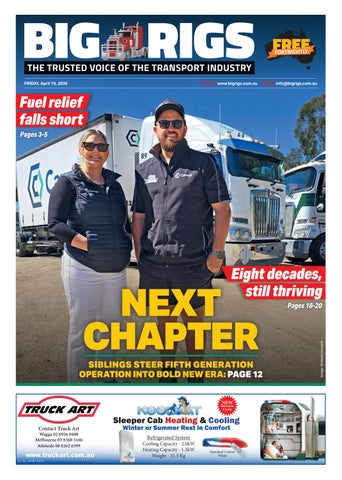
Fifth-gen duo drives legacy into new era

Five generations strong and still pushing forward – meet the brother and sister taking a 121-year-old trucking business in an exciting new direction.

FIVE generations. In trucking, that kind of longevity is almost unheard of.

But for siblings and new owners Jai and Kayla Canny, it’s business as usual at Wangaratta-based Cannys Carrying Company.

They recently stepped up to take over from their father Rodney to lead a family operation that’s been moving freight in the region for 121 years and are now pushing Cannys into its next phase of growth.

When Big Rigs calls for this interview, the family had just signed on the dotted line to buy the old IBM site in Wangaratta which they have plans to turn into a storage and distribution centre.

The fact that this bold move comes amid a fuel crisis isn’t lost on this level-headed duo, if anything it reflects their un derstanding that relying on road-based operations is no longer sustainable.

Their legacy, after all, is built on resilience, relationships and knowing when to pivot.

The company’s story dates back to the late 1890s, when great-great grandfather Bill first began moving goods by horse and cart around northeast Victoria.

By 1905, the business had formally taken shape, steadily building a reputation as a reli able regional carrier.

As transport evolved, so did W. Canny & Son, as it was known back then, purchasing their first truck, a Bean, in 1926 and transitioning into motorised freight.

on relationships and core values.

also have a deep respect for what they’ve inherited.

From there, each generation built on the last with Bill passing over the reins to son Len, then on to Rodney’s father Brian who died in 2016, the latter two also being inducted into the Wall of Fame in Alice Springs.

Opportunities came through necessity – including stepping up when rail strike disruptions created demand for road freight. Over time, the business expanded into interstate work and diversified its operations.

Another key milestone came in 2007 with the purchase of a Melbourne depot in the key location of Derrimut, strengthening its footprint in general freight and container transport.

The decisions and generations of hard work have been crucial to positioning the business where it stands in the transport industry today.

Today, the business operates 40-50 trailers, 30 prime movers, mostly K200s, a few SARs and a 120th anniversary K220, and a large number of DAF rigids across 80 per cent general freight and the rest in container work, maintaining a strong link between regional Victoria and major metropolitan hubs.

But despite the growth, the foundation has remained the same – a family business built

“We’re a family-owned and operated company and when you ring us, you get to talk to real people who can actually help,” says Kayla.

“You get real people and you get real results. You want a pallet picked up, we’ll do itstraightforward, no fuss.

“It’s just old-fashioned, reliable transport service.”

Learning the ropes the hard way

For Jai and Kayla, stepping into leadership wasn’t something that happened overnight.

“I started from the bottom when I started, answering the phone,” Kayla says.

Jai’s path was similar, working his way through the business in various driving roles before eventually stepping into the General Manager seat late last year when Rodney stepped down.

“We both had to do the hard yards to get here,” says Office Manager Kayla, who came on the scene a little later in her early 20s.

Today, it’s an easy-going dynamic at the top that is clearly working. Both “stay in their lane”, Kayla with her admin skills, and Jai with a hands-on approach in the yard.

Both Kayla and Jai, who between them have five children to one day take over the wheel,

Running a business of this standing comes with significant pressure – and they’re acutely aware of what’s at stake.

For Jai, who’s been working at the company since he was 16, it’s still all about the day-to-day challenges and figuring out how he can solve them.

“I like the day-to-day challenge of lining up the right loads, organising drivers, and keeping everything on schedule and meeting the needs of our customers,” added Jai when asked what still drives him after all this time.

Sweet spot through measured growth

Despite pressure to scale up, the Cannys have deliberately kept the business at a manageable size, with a strong customer base, and a loyal workforce – many of whom have been with the company for decades.

“I think we’re at a happy medium; it’s very manageable with the staff we’ve got now,” Jai said.

That approach has seen them walk away from major expansion opportunities in the past.

Instead, the focus has remained on stability and longterm sustainability.

“We want to work with the

local businesses here in the North East, and I think Dad and Brian were a big part of building those relationships,” Kayla said.

It’s a philosophy that reflects the company’s long-standing ties to the community.

Kayla said Rodney is especially proud of the Cannys’ sponsorship partnership with Project 365, a local program that helps raise awareness and support to improve mental health outcomes in the region.

Rodney’s close friend Peter Rourke put together a band called U Can Cry with the name 365 denoting the number of days he had to pull it all together and build a show to launch the project.

Rodney, a major sponsor, chipped in by donating two tautliner trailers to act as rolling billboards.

Big plans for the old IBM site

Now, the next phase of the business is taking shape in Wangaratta.

The old IBM site includes an existing warehouse of about 15,000 square metres, with plans to build an additional 4000 square metre shed on a vacant block at the front.

Operations are expected to begin immediately.

The move represents a significant shift into storage and something the business has been working towards for

“He’s tried it a few different ways in the past 10 to 15 years – he’s got this plan in his head to help local businesses with a need for storage that he has seen grow over the years as businesses expand and look to us to provide additional cost-effective solutions,” Kayla said.

“It’s exciting for him that he’s finally seeing the benefits of it all – and for the town as well and how we can help keep our work local.”

The site’s ability to accommodate B-doubles is a major advantage, said Jai.

can’t get B-doubles into, so you’ve got to double split all the time,” Jai said.

“This site’s all B-double friendly.”

Kayla expects that a lot of Cannys’ customers will use it as a DC-type set-up, where they would distribute their wine, or goods from there.

“A lot of our customers are importing goods, so they’ve got too many containers coming in and not enough space for them.”

Adds Jai: “Whatever it may be, you name it, as long as it’s on a pallet.”

Jai and Kayla Canny have each other’s back as the family business looks to the future. Images: Graham Harsant
Rodney, centre, still likes to drop by the depot every chance he gets.
Jai and Kayla are proud to support the Project365 program.
The Cannys sealed the deal on the old IBM site last month.
W. Canny & Son picks up freight from Wangaratta Railway Station in the mid-1920s.

This robust and dependable 320 kN coupling is engineered for long‑lasting, heavy‑duty performance in Australia’s toughest road conditions. Its self‑closing, automatically secured design enhances safety while delivering consistent, trouble‑free operation over the long term.

With unmatched reliability and exceptional product longevity, the 303 AUS coupling provides outstanding value for money.

I 50mm 303AUS

Quality performance from front to back.

New T909 is something truly special

Fresh

off celebrating 60 years in business in 2025, Emerald Carrying Company has added another special truck to its ever-growing fleet.

EMERALD Carrying Company’s brown, gold and red Kenworths are instantly recognisable out on the highways. The latest addition to the fleet, it’s 250th Kenworth, stands out for all the right reasons.

Group General Freight/ Fleet Manager Matt Haylock is part of the third generation of family members driving the business forward. He said the company’s 135-strong fleet of trucks – working across the general freight and bulk liquids divisions – is almost exclusively Kenworths. “Since about 2020, we haven’t bought anything but Kenworth for our prime movers – we have all the different Kenworth models now. For our 250th Kenworth we went with the T909 because we wanted it to be something special.”

Powered by a 600hp Cummins X15 engine, paired with an 18-speed Roadranger, the new rig was handed over on March 12 at Brown and Hurley Rockhampton and put straight to work. It does the 1900-kilometre round trip between Brisbane and Emerald, pulling B-doubles of general freight.

The truck has been named ‘Front Door Famous’ after a Luke Combs song. Along with being a fan of the song, Matt explained that its lyrics are also very fitting to any long distance truck driv er who spends time away as part of the job. “The song is all about that feeling you get when you get home and walk through the door after being out on the road – and the kids are so excited to greet you at the door,” said Matt.

The flashy new T909 is being driven by Tony ‘Phan tom’ Lewis, who’s worked at the company for the past three years. “He was chuffed with the truck,” said Matt. “He loves it,” as Tony con firmed.

Complete with a 52-inch bunk with double mattress, it features all the creature comforts. Tony explained, “Before this truck I was in a 2010-model Kenworth T908 that was about to clock over 3 million kilometres. You definitely notice a big differ ence with the new truck. It has double rails and a longer wheelbase so it’s a better ride. It also has a stand-up fridge, sub-woofers, an inverter for the microwave and slide-out freezer.”

Matt worked his way from a local driver at the Emerald depot through to his current management role, so he knows the business in and out. He’ll still jump in a truck whenever he gets a chance too.

“I still enjoy getting out there and going for a drive, so I do it as jobs come up.”

Over the years, Matt has also seen the business grow and evolve. Emerald Carrying Company now operates from seven depots across Queensland, as well as another in Darwin.

A major milestone for Emerald Carrying Company came with the acquisition of Monaro Fuel Haulage in 2016. Today that business runs around 70 trucks across its Brisbane, Sydney, Melbourne and Adelaide depots.

Another major milestone came in 2025, as Emerald Carrying Company celebrated its 60th anniversary. A truck was done up to mark the occasion, a Kenworth T909 with 60-inch bunk, driven by long-time driver Shaun Morrisey. It has a mural on the back featuring three trucks: a new Kenworth and the company’s two original trucks, a green Leyland and red Austin. This T909 is used to pull triple road trains of fuel across Queensland and into the Northern Territory.

Asked how he got the nickname Phantom, Tony revealed it came from a past employer. “It was because he never used to hear from me, I just did my job. He used to call me Phantom and it’s just stuck.” Tony got to work closely with Matt to help personalise his weekday ride, with little Phantom images incorporated into the scroll work on the back of the cab, on the kick-

resonates with that too.”

Emerald Carrying Company was started by Matt’s grandparents Bill and Joan Haylock in 1965. Their son Greg Haylock (Matt’s father) took over as Managing Director in the mid 1990s, a role he continues to this day – supported by his children Matt, Ben Haylock (Group Operations Manager), and Taylor Haylock (Contracts and Treasury Coordinator).

ike his siblings, Matt – now 41 – has lived and breathed

There are now around 550 employees working across both businesses, and it’s the drivers and staff who Matt credits with their success. His grandparents started the Emerald Carrying Company story with just one truck – a Leyland that was used to cart off the railway in Emerald. “I’m pretty proud that the business my grandparents started is still going and how far it’s come. Working with your family can have its challenges but we make it all work,” he said.

“I’ve recently moved from Emerald to Brisbane. My brother Ben is in Townsville and my sister Taylor is in Brisbane.

ends – washing trucks, driving rucks around the depot, then eventually driving in quarries and on outback roads.”

“I was visiting the depot from about the age of five and when I was 17,” he said. -

“It hasn’t been easy to get where we are. In a family business like this, it doesn’t get gifted to you, that’s for sure. You have to put in the hard yards!”

The 60th anniversary T909 pulls triple road trains of fuel. Image: Emerald Carrying Company
The Phantom can be seen hiding in the scroll work. Image: Brown
‘Front Door Famous’ features a 52-inch bunk, and all the bells and whistles. Image: Brown and Hurley
The new truck is used for B-double work between Brisbane and Emerald. Image: Emerald Carrying Company
Shaun Morrisey drives the 60th anniversary T909 delivered last year. Image: Emerald Carrying Company

Two families, one vision

For 80 years, two Australian families have continued to work side by side in one of the country’s largest truck dealership groups.

A friendship sparked by Alan Brown and Jack Hurley, while in the army during World War II, was the start of an enduring legacy that has bonded two families, across generations.

Over the past 80 years, Brown and Hurley has sold everything from bikes to chainsaws and tractors, but it was the move into trucks that sparked the beginning of the company as it is known today – namely becoming the first Australian dealer appointed by Kenworth.

Across northern New South Wales and all of Queensland, Brown and Hurley operates from 21 dealerships, employing around 630 staff. Today, the business sells an average of over 1000 Kenworths each year.

An unshakable bond Alan Brown and Jack Hurley met while training troops in the maintenance and repair of trucks and tanks, in the Sydney suburb of Moorebank.

On June 1, 1946, they used their deferred army pay of £900 to purchase a modest bicycle shop in Kyogle. Their first customer? A schoolboy with a punctured tyre.

Jack’s son Jim ‘JJ’ Hurley has been around the family business from the time he was born. Now 83 years of age, he’s watched Brown and Hurley grow from a small bicycle repair shop to a premier truck dealership group that has sold more Kenworth trucks than any other Australian truck dealer.

As he recalls, it wasn’t always smooth sailing, particularly in the early days. “Dad was discharged before Alan. When he returned home, he started doing machinery repairs in the shed,” said Jim.

When Jack came home, the friends wanted to open their own mechanical workshop. Unable to afford the purchase of an existing business, that’s when they decided to buy the bicycle repair shop.

It had a petrol bowser and an old shed that they could use as a workshop.

They faced early financial struggles, and with zero cash reserves, quickly realised that sales commissions were the key to survival. “In the beginning the business was going nowhere and they weren’t making any money,” said Jim.

“Then this fella came in wanting a crawler tractor, so they got him one.

“There were 32 sawmills around Kyogle back then, and all the logging was done with ex-army Blitz and GMC trucks and things like that. When a customer came in wanting to buy a White truck, they brought one in.

“They knew that if they wanted their business to go somewhere, they had to get into selling bigger items.”

Alan and Jack made their

first tractor sale in 1947, a HG42 Oliver Cletrac, and their first truck sale in 1948, a White WB-20. By 1953, they outgrew their original shop and built a new site in Kyogle – by that stage they had grown to 14 staff.

“Their first shop is now a church and that second shop is now a Mitre 10,” added Jim, who’s called Kyogle, in New South Wales’ Northern Rivers region, home for all his life.

“I’ve been around the world and never found a better place to live,” he said.

Enter Kenworth In the trucking space, despite starting off with selling the White brand, the decision was made to switch to Leyland trucks in 1957 because White had refused to offer diesel engines.

“In the mid to late 50s, they concentrated on trucks,” said Rob Brown, Alan’s son. “That’s when the timber industry in the Northern Rivers region of NSW really kicked off, and when the next generation of trucks started coming through, that could haul heavier loads and were far more reliable.

Some trucks had gone to diesel engines which were more reliable than older petrol engines.”

The biggest milestone for Brown and Hurley came in 1964, when it was appointed a Kenworth dealer.

“There was a man named Ed

Cameron who began importing Kenworth trucks into Australia and he was looking for a dealer in Queensland – fortunately we got hold of that,” said Jim.

In 1965, Brown and Hurley sold its first Kenworth, a W923 model, to Doug Wyton from Toowoomba for £12500. Then in 2015, on the 50th anniversary of that sale, his son Gordon Wyton bought a Kenworth T909, in the same livery. Brown and Hurley’s partnership with Kenworth proved so successful that by 2006, the group accounted for more than 30 per cent of all Kenworth sales in Australia.

Through generations

Jim has lived and breathed the family business all his life. He started as an Apprentice Mechanic in 1958, at just 16, went on to manage the Kyogle branch in 1975 and became Group Sales Manager in 1986.

“When I started working at Brown and Hurley as an apprentice in 1958, it seemed like the business had been going forever. Now looking back, it had only been going for about 12 years!” added Jim.

In 1988, after Alan and Jack retired from the company’s day to day operations, taking a place on the board, Jim became Joint Managing Director – together with Rob Brown.

For Rob, 68, his connection

with the business is similar to that of Jim. “When I was younger, I remember Dad working really hard, then coming home and wondering how we would ever pay the bills,” he said.

Rob was 23 when he officially came on board with the business. “I worked as a Service Manager at one of our dealerships, then Dealer Principal in Brisbane. I took over as Joint Managing Director with Jim Hurley when I was 32.

“Jim and I had a shared responsibility,” added Rob. “But we both stayed in our lanes, did our jobs and did everything as best we could. We collaborated together a lot but Jim had certain responsibilities, and I had certain responsibilities, and it worked well.”

It’s not often that you hear of a business that’s been going for 80 years, still under the ownership of the same two families, working side by side.

What time has proven for the Brown and Hurley families is that the bond they have has remained unshakable. “Our families have been very close friends all the way through,” said Jim. “My mum Thelma Hurley and Rob’s mum Lil Brown were great friends too. All the kids were about the same age, and we grew up together and did a lot of the same things. I think our mothers’ friendship was the mortar that held the business together.”

Jim retired from his role as Managing Director in August 2012; and Rob retired in 2018, taking on the role as Chairman of the Board.

Upon Jim’s retirement, his brothers Doug and Kev Hurley were appointed as Joint Managing Directors in 2012. Both had previously held various positions with the compa-

ny, including serving as Dealer Principals and Sales Managers throughout their careers.

Paul Hurley – Jim’s son and Jack’s grandson – took over as CEO in 2018, following over 20 years across various roles within the business, until his retirement in 2024.

Continued on page 20

Former Joint Managing Director Jim Hurley, with a Kenworth T659 that features a mural of Alan and Jack at their original Kyogle site.
Former Joint Managing Director Rob Brown.
After outgrowing the original site, the business moved to new Kyogle premises in 1953.
Brown and Hurley was a Leyland Trucks dealer from 1957 to 1968.
Company founders Alan Brown and Jack Hurley met in the army during WWII.
Jack Hurley and Alan Brown recreated the old photo on the same Sydney street, in 1986.

Well placed for the future

From page 18

THE start of 2025 marked a new era for Brown and Hurley, with the first non-family member appointed to lead the business as CEO – Ryan O’Doherty.

Growing up in Victoria’s Gippsland region, Ryan started his career as a diesel mechanic. “My family has a farming background so I grew up in and around trucks on the family farm,” said Ryan. “I left school at a young age and my father said, if you leave school, you need to get an apprenticeship – so I’ve stayed in trucks and construction most of my working life.”

Asked about the attraction to Brown and Hurley, Ryan explained, “It was an incredible opportunity to lead Paccar’s largest dealer group in Australia. Stepping into a role of this scale, particularly as the first non-family CEO, was something I found both exciting and humbling.

“Brown and Hurley have a big focus on customers, which really attracted me. I’ve been welcomed by both families, our employees and customers with open arms, so it’s been a much easier transition than what I anticipated.”

What’s made Brown and Hurley’s 80th anniversary all the more special, according to Ryan is, “Many businesses reach 80 years, but typically only after changing hands or becoming publicly listed. For our organisation to remain under the stewardship of the same two families for eight decades is an extraordinary achievement,” he said.

“We’re very fortunate that on the Brown side of the family, we have the third generation working in the business and on the Hurley side, we have the

ees, we would not be here. they work in a business that’s still going strong 80 years on –and getting stronger.”

Customer driven Brown and Hurley has always been guided by the philosophy of “principles before profit”.

Jack had a signature management technique when train-

there’s a decision to be made, put yourself in the customers’ shoes before you make it.”

As Rob explained, “Those business principles have never really changed in 80 years. We still have that personal touch with the customer, putting the customer first and giving the customer the benefit of the -

Jim added that this philosophy has placed the company in good stead, “When I first got involved in management, it was never my vison to be the biggest, but it was always my vision to be the best. As customers grew, we grew. And that’s how we got to be one of the biggest truck dealerships.”

Celebrating 80 years

line decision. Principles before rofit means you do the right thing by people, sometimes it might cost you a bit initially, but in the long run you get far more credit back.”

Ryan agreed, “The focus has been on making sure we haven’t lost our grassroots and why we’re here. Although we’re a large company now, it’s still family fuelled and family focused. The number one priority is to go above and beyond for our customers. It’s all about customer service.”

To mark its 80th anniversary, Brown and Hurley will also be launching some very special trucks, on sale until April 30, 2026.

Up to 80 of each Kenworth and DAF model are currently on sale, featuring limited edition 80-year livery.

That’s up to 560 trucks available across the two PACCAR-owned brands.

These trucks will feature an 80th anniversary edition trim and livery, a gold Kenworth bug, 80-year logos on the leather seats and the rear wall of the sleeper, special kick-

plates, heritage series gauges and much more. Brown and Hurley will also mark its 80th anniversary with a set of special commemorative builds that will tour Queensland and northern New South Wales later in the year. The trio will comprise of two 80th anniversary trucks, a limited edition Kenworth T909 and a DAF XG, along with a limited edition Krueger tautliner trailer.

A ll three units will be finished in Brown and Hurley blue and designed to celebrate the company’s legacy. A centrepiece feature of the T909 and Krueger trailer will pay homage to the founders Alan Brown and Jack Hurley.

The anniversary units will feature as part of a special Brown and Hurley roadshow, giving customers and communities across Queensland and northern New South Wales the opportunity to see the builds up close.

Brown and Hurley open days

Brown and Hurley will celebrate its 80-year milestone with a series of open days for staff and customers. These will be held across its branch network in northern New South Wales and Queensland, including a significant event set to take place at Kyogle – where the company’s story started back in 1946.

Each branch is planning something slightly different,” said Ryan O’Doherty, Brown and Hurley CEO.

“It’s an opportunity for us to say thank you to our customers for the role they’ve played in helping us reach 80 years. There will be food, drinks and a time to celebrate this milestone together.

“Reaching 80 years is rare, and we are incredibly fortunate to be able to share the celebration with both our employees and customers.”

Brown and Hurley will release further details about each of these events as they get closer.

The current Kyogle premises, which also features the Brown and Hurley Museum.
Wickham Freight Lines, which has bought every 1000th Kenworth from Brown and Hurley. Pictured with Jim Hurley (centre) are Steve Lord (left) and Graham Keogh (right) from Wickham.
Brown and Hurley has a large apprentice intake each year – pictured above is the 2026 cohort.

DAF XG. Do more.

Feast of legendary Macks on display

From rare Bicentennial legends to record-breaking V8s, Kyabram’s Mack Muster delivered a stunning showcase of heritage, horsepower and passion.

JOHN Bourke, Captain Cook, Governor Phillip, Matthew Flinders. Not a bad guest list to have at your dinner table.

To have them all converge at Kyabram in Victoria’s north to partake in a feast of Mack trucks was something rather special.

Given the current fuel crisis it would not have surprised if numbers at this biennial event were down, but 186 of the fabled brand equalled the numbers attending two years ago. For those wishing for brand variety, there were plenty more attendees out on the showground.

Those Bicentennial Macks, worth roughly $4 million, were not the only special trucks to attend the muster, however. In fact, there could have been five of them but for their colour scheme.

Ky local, Jim Ristovich ordered a Bicentennial Mack – K ingsford Smith – back in the day but wanted it in his fleet colours, only to be told by Mack salesman, John Erhlinson that wouldn’t happen.

So, he cancelled his order and found a black model at the Sydney Truck Show to repaint. John told Jim that he’d ruin the truck but hey, “my truck, my choice.” And so the Magnum 500 became one of Jim’s fleet.

So good was the finished product that Mack took Jim, his family and the truck to the Tasmania Truck Show where it won first prize, the first of many.

Three years later Jim sold the truck only to hunt it down 32 years later.

“I spent a lot of time chasing the original parts in Queensland and other places. I found the gearbox in Queensland. The steering wheel was custom-built back in those days and I found it hanging in the shed so I got that back.

“The spiders were originally chromed but when I got it back they were just the red so I had them taken back to the chrome.

“The original turntable was the last piece of the puzzle. Everyone said I wouldn’t find it, but I had a chap up Sydney way, Glenn Beutel who used to supply me all the parts from America.

“He rang me one day and said he’d found it in a truck yard at Newcastle. I took it to Mario

Calandro in Shepparton who’d manufactured it – he didn’t believe it was his until I showed him the numbers on it – and he

Today, Jim’s Mack Magnum 500 is every bit as special as the Bicentennials, although probably not worth quite as much.

Record-breaking V8 makes appearance

Dean Conway arrived from Bourke along with a record-breaking V8 Super-Liner 500 owned by KF & DM Bowden.

Dean was responsible for the engine restoration in this superbly restored truck. In 1993 this Mack broke the world record by hauling 29 cattle crates weighing some 500 tons.

“It blew the back diff up when Plugger took off. He didn’t have the power divider in because he didn’t want the alarm to muck up the record-

quick call to ‘The Bank of Linda’ and here it is.”

ing (he had a radio guy in the cab with him).

“The back diff disintegrates so in typical Plugger style he just flicked the power divider in and kept going and did it on one diff.”

That record has since been broken many times, but we wonder if any of them have been done on one differential.

With the rumours of another world attempt to be staged at Alice Springs this August, Dean commented, “Might have to make an appearance, I think. It would be a good photo opportunity at the very least.”

Brad indebted to ‘The Bank of Linda’ Brad and Linda Drew came from Geelong with their V8 Value-Liner. This truck led the Geelong Convoy for Kids two

years ago when Brad raised the most funds for that event.

The Drews bought the truck out of Tasmania from Tas Logging – hence the colour scheme - about six years ago.

“I believe it was a Victorian truck originally. We brought it back and put our own touches on it, such as the Super-Liner steps which I wanted.

“We did the suspension and reset the steering back up on it properly, plus a tidy up inside.”

Aside from the engine, which dropped a couple of valves, there was no other major work needed.

“I always wanted one of these. My father and I flew over to Adelaide in the late ‘80s to buy an ex-TNT one at Pickles Auctions.

“I never bought it, but it left a bit of a thirst to own one. When this came up, I made a

Mini Mack Muster brings legends to life Behind the trucks at the show is The Kyabram Mini Mack Muster – a shed full of unbelievably good model Macks. There we meet Ernie Hastas who is an encyclopaedia on the brand, in particular the Paul Costantino Bicentennials of which he has recreated ‘Thunderbolt’ and ‘Captain Bligh’.

“You have to remember these were the fastest Bicentennial’s in Australia,” said Ernie. “Paul’s forte was MelbourneAnywhere Express and he said to the drivers, ‘I don’t care how much fuel you use but don’t be late’.

“They were state-of-theart trucks and the first ones to come out with the woven crushed velour, cruise control and the 48 inch walk-through bunk. There were only 16 built. They wanted to build 20 but fell short because of the economy at the time. A personal loan was 24 per cent and housing loan was 17 per cent so it was the wrong period in time to be moving these trucks.

“They were $231,000 with a $5000 deposit. There were 39 names on the list to choose from and that $5000 had to be in by July 31, 1987 before they actually released them on 12 March, 1988 at Dreamworld. Now you know where Kenworth got the idea with the Legend SARs. They were iconic and you’ll never see something like this again.”

“I built Captain Bligh about 10 years after they were produced. I went and saw Paul at his yard in Footscray over those years and by about 1998 I’d researched it enough to build it. Captain Bligh was completed in 2001.”

With Ernie was Graham Smithers, better known as ‘Fourby’ who’d come along to pick up the model of ‘Thunderbolt’, the Bicentennial Mack he’d driven for Paul Costantino and which Ernie had restored, adding a trailer and stand.

After the exchange of a (considerable) wad of $50 bills, the truck is back in Fourby’s possession.

Models or the real thing, Kyabram was a master class on how to present the Mack brand to a discerning public audience, of which there were many. We look forward to 2028.

Continued on page 24

Jim Ristovich with his Magnum 500 V8 Super-Liner.
Brad Drew with ‘The Bank of Linda’ and their Value-Liner.
Dean Conway brought this history-making V8 Super-Liner II down from Bourke.
Tim Daws, one of the organisers of this very successful event.
Ernie Hastas’ model of Captain Bligh. Simply superb!
Ernie Hastas with his spectacular Costantino recreations.
Johnson’s Trucks Anniversay edition Super-Liner.
‘Fourby’ with the model of ‘Thunderbolt’. He drove the real thing for Paul Costantino.

Andrew’s models making their mark

This Victorian enthusiast recreates Australia’s working trucks down to the finest detail.

FOR many involved in trucks and transport, smaller-scale models which replicate those which turn the big wheels on the highways have always been a hobby for many.

While pre-built die-cast models with an Australian focus have become popular over the last fifteen years, the building of scale models ‘out of the box’ has always been a pastime enjoyed by people of all ages.

One such enthusiast is Andrew Kuipers, who is originally from Gippsland but today calls Shepparton home.

A ndrew is a member of the Gippsland Model Truck Builders Club and over the last two decades as built an impressive array of model trucks and earthmoving equipment.

Specialising in building to-scale log trucks, a few samples of his collection was recently on show as part of the Gippsland club’s display at the Heyfield Timber Festival, including his latest build, a Ford LTL with folding log skel trailer.

“My family is originally from Tasmania where my dad John was in loggingwe moved over to Victoria to Noojee where he worked for Max Radford and Colin Robin, so I have always had an interest in trucks and logging. I always dreamed of driving log trucks but went off in a different direction - I have just been building them on and off for 20 years,” he explained.

From his first build of an Autocar, he has since built a variety of different trucks and trailers with a number of commissioned log-truck builds being sent back over to Tasmania.

In times past the range of trucks to build ‘out of the box’ was somewhat limited with a basic model from Italeri, AMT or ERTL requiring a lot of modification or accessorising to replicate an Australian truck.

Today with specialist Australian suppliers such as Auslowe Model Accessories and 3D printing technology, the process has been made easier, as he detailed.

“When I built the Autocar some 20 years ago, it was

hard to get custom parts such as bull bars for models, so I scratch built a lot of stuff including the log trailer.

“Now it’s a lot easier with getting parts through Auslowe and also using technology - I recently built an FMC Track Skidder where all the parts were made off a 3D printer, I just had to buy the file from the USA.”

Having also built a couple of Caterpillar bulldozers and tippers along the way, Andrew has honed his skills to a variety of model builds but has focused on authenticity in order to have his trucks match the real thing.

“I have a range of tools such as pliers and so forth to get it done as it can be a bit fiddly. You will have little mishaps along the way with bull bars and so forth that you need to contend with,

“I have got some good super-glue now so that’s handy to have in the tool kit. I like the old stuff - Mack R-Models, Whites and W-Model Kenworths are ones I can relate to the most. I have here on display a red-W Model which is related to one that used to work out of Noojee

which was owned by Cuthberston and Richards who were the local sawmillers.”

Andrew’s latest creation, a black Ford LTL, was on display at Heyfield with a number of hours having gone into its build, along with a considerable amount of dedication and patience to scratch build the folding trailer.

“It’s currently my favourite build I have done over the journey - I am pretty happy with that as I scratch built most of the trailer - it was just one I had in my head I always wanted to build.

“It’s hard to say how many hours a week I would spend on the models - the folding skel has been an ongoing project, just do a little bit and put it away for a while, it is loosely based on Kennedy and Blackwood trailer design…with a bit of Kuipers Engineering thrown in,” he said with a smile.

The Gippsland Model Truck Builders club has around 25 members which are spread across a wide area of Victoria with their clubrooms based at Maffra.

The club has its own annual model show on the same weekend as the East Gippsland Heritage Truck Display and, along with Heyfield this year, was also showing as part of the recent Mack Muster in Kyabram.

“It’s a pretty good little club we have - our members help each other out with new kits and bits and pieces someone may be chasing. The computer is the best tool for us to communicate tips and trade parts with each other and so forth,” he said.

With a display cabinet at

home in Shepparton full of his creations put together over the years, Andrew is looking at what project build he may tackle next.

“Theres always something in the pipeline, I have just finished the LTL so might need a bit of time to recover from that,” he said with a grin.

“I have a bit of diecast as well and they all have their place in the cabinet, but building your own is better than just getting a diecast one out of the box and putting it on display.

“I get a lot of pleasure out of looking at one I have made and thinking, ‘I built that’.”

Mighty Macks turn it on in Kyabram

Andrew Kuipers with his latest build, a Ford LTL and folding skel log trailer. Images: David Vile
Drool time! Images: Graham Harsant
Cabovers got their day in the sun as well. A convoy indeed!
Plenty of R models showed up.
This W-Model Kenworth is painted in the colours of former log haulers Andersons of Benambra.
Another couple of builds on show at Heyfield were this International Transtar and R-Model Mack, both with bogie log jinker trailers.

Every part matters

Use genuine parts

Your UD truck is built to go the extra mile, reliably, efficiently, and safely. That’s why every part matters.

Using non-genuine parts might seem like a quick fix, but it’s a gamble that can cost you in downtime, safety, and long-term performance. Genuine UD parts are designed, tested, and built tomeet the highest standards, fitting perfectly and working right the first time. Because when it comes to your truck’s dependability, there’s no room for compromise. Choose genuine. Because every part matters, and your truck’s performance depends on it.

Going the Extra Mile

Proudly supporting Reader Rigs

#PicOfThe Month

Share your truck pics to win with Shell Rimula

SHELL Rimula has partnered with Big Rigs in a big way – so there are even more reasons to send in your best truck shots.

Each month, the Big Rigs team will choose a #PicOfTheMonth, with the lucky winner receiving a $500 Shell Coles Express Gift Card.

Keep an eye out for our regular posts on the Big Rigs Facebook page, calling for your best truck photos and add yours in

the comments, or email them direct to danielle.gullaci@ primecreative.com.au for your chance to win the main prize.

Don’t forget to include a brief note about the truck and where the photo was taken. We’ll feature some of the best photos in each print edition of Big Rigs, with one winner announced each month.

Keep those amazing truck pics coming!

Congratulations to Pic of The Month winner Matty Hill, who snapped this incredible night-time shot while parked in southern WA, a $500 Shell Coles Express voucher is on its way.
Gus Sacco captured this incredible shot near Marlborough, Queensland.
Matt Manning snapped this photo of the T909 he drives for VCT Refrigerated, on the outskirts of Mildura.
Craig Rolfe took this great night-time pic while relocating livestock.
Stew Read transports a new Cat 789 body from Newcastle Port to Lake Cowal Gold Mine.Jake Lacey captured this ripper sunset shot during harvest, near Quambatook, Victoria.
Josh Merrett shared this great photo of Wickhams’ K200 taking in the sunrise at Gilgandra, NSW.
Bryce ‘Baldy’ McGahey captured this great shot at Rockhampton, Queensland.
Wesley Meehan waits for a morning load while enjoying the sunset at Merriwa, NSW.
An awesome shot from Mark McGahey, while on the New England Highway.
A very cool photo from Justin Lavers, taken at the Great Australian Bight.
Tom Charlton snapped this great shot while doing a changeover at Bellata, NSW.
Ryan Mckelvie snapped this ripper pic in Kalgoorlie, WA, while getting ready to unload.
Jessica Woods snapped this great photo recently at Packsaddle Roadhouse, NSW, as trucks waited for roads to reopen.

VETERAN driver Glenn

Cummings lives at idyllic Innot Hot Springs on the Atherton Tablelands and drives far and wide for WW Group, which is based at nearby Ravenshoe.

Glenn, 65, was parked up at the Townsville Port Access Road breakdown pad in his Mack Titan when Big Rigs saw him last month.

“I came down empty and

am heading to pick up containers from near Townsville Port for delivery to Cloncurry,” he said.

Glenn has been a driver for more than 40 years and with this company for the past two.

He doesn’t stop at many roadhouses for food, instead preferring to cook his meals in a hot box.

“I like rump steak with salad

or vegetables,” he said.

The worst road Glenn travels is from Roma to the NSW border. “It is very rough,” he said.

Glenn added that more rest areas are required for drivers but one he does like stopping at is at Fishery Falls, south of Cairns. “It has toilets and some parking,” he said.

I asked what Glenn’s major dislikes are when on the high-

SEQ’s a good fit for Steve Glenn has more than 40 years in the job

STEVE Spearritt, 63, works for SEQ Transport based at Yatala in southern Queensland and was in the driver’s seat of a Kenworth when Big Rigs stopped for a chat.

“I have brought up ute trays from Brisbane to Townsville and am waiting for news about a possible backload,” he said.

He’s been a driver for 33 years and at this company for almost seven.

ever added, “I do like a feed of apricot chicken when I can get it.”

Regarding rest areas, Steve feels there could be more for drivers but qualified that with, “When on the road I manage where I have to stop for fatigue breaks.”

The worst highway he travelled along recently was between Roma and Emerald in Queensland.

“I have two Harleys, two Triumphs, several Kawasakis and three Suzuki bikes,” he said.

Another hobby for Steve is checking out his family tree which he’s dated back to the 1100s.

“I am of German descent but have Celtic heritage way back 900 years,” he said. Standing at 165cm in height, Steve said that this does have advantages over taller truckies. can easily get under a

BASED out of Wacol in Brisbane, Jordan Rance has been in the trucking game for around three and a half years, but like many drivers, it didn’t take long before it got in his blood.

Jordan got his start through a good mate who was running a rigid delivering energy drinks.

After lending a hand for a few days, he quickly realised trucking was something he genuinely enjoyed and from there, it was game on.

These days, Jordan drives for Coolfreight, covering serious kilometres across the country.

His work is as varied as it gets, hauling frozen and chilled freight to Adelaide and Perth, bringing produce back, running fertiliser and general freight out to Emerald and Mareeba, and pushing groceries up into places like Cloncurry, Mackay and Cairns.

ways and he said it was “tourists who drive recklessly”.

WW Group is a large company that caters for engineering, steel fabrication, ore and concentrate haulage, gravel and road base haulage, semi and road train water tankers, and plant and equipment. When Glenn gets time off, he loves having a dip in one of the natural thermal pools at Innot Hot Springs.

Transporting heavy loads

JAMES Mackaway had transported several tractors from Sydney to Tolga on the Atherton Tablelands when Big Rigs saw him recently.

The 41-year-old truckie was sitting in the driver’s seat of the Kenworth 900 he drives for Plant Shift Heavy Haulage.

“The heaviest load I have carried was a 70-tonne exca vator between Adelaide and Rockhampton,” he said.

A truckie for the past 10 years, James said that reck less van drivers were the big gest problem he faces on the roads.

“Some of them overtake and we have to brake check with a big load,” he said.

James likes stopping at the Avenel Roadhouse in Victoria or the Bowen Caltex in

W hen he caught up with Big Rigs, he was behind the wheel of a 2024 Kenworth Legend SAR, towing a Maxi-CUBE double road train set a setup built for the long haul and the kind of work he thrives on.

For Jordan, the biggest drawcard of trucking is the freedom of the open road. He enjoys being able to pull up where he wants, fire up a portable BBQ, and cook a feed while taking in parts of Australia that most people will never get to see.

Ask about favourite runs and there’s no hesitation the Nullarbor is right at the top of the list. In fact, he admits he’s always talking about getting sent across to Perth and can’t get enough of that stretch of road.

When it comes to stops, Jordan rates both the BP at Parkes Bypass and the Shell OTR in Adelaide, saying they’ve

between Cairns and Innisfail and I was talking about that today with another driver. There is one near the Cloncurry saleyards which is good.

got some of the best showers, food and parking setups going around.

Like many long-haul drivers, Jordan says one of the toughest parts of the job is dealing with driver behavior around trucks.

A lack of understanding from other road users especially inconsistent speeds on single lanes and overtaking sections can make the job more difficult than it needs to be.

From an industry perspective, he believes there’s also room for improvement in how drivers are supported and educated.

While compliance is important, he feels there should be a stronger focus on education and engagement, rather than just penalties, to help drivers improve and keep the industry moving forward.

What keeps him coming back is simple, it’s in his

blood now. The freedom and lifestyle that come with trucking are hard to walk away from once you’ve experienced it.

Looking ahead, Jordan has ambitions of one day running his own truck, but for now he’s focused on continuing to learn, gain experience, and build his skills while working with Coolfreight.

His advice for new drivers is clear: soak up as much k nowledge as you can and learn from experienced drivers. No one ever knows everything in this industry, and staying open to advice is what keeps you improving.

Outside of work, Jordan keeps things simple. Any time he’s home is spent with his wife and two kids, making the most of the time together before heading back out on the road.

The showers are clean,” he said. Outside work, James barracks for the Canberra Raiders in the NRL.
40 years. Images: Alf Wilson
James Mackaway drives a Kenworth 900 for Plant Shift Heavy Haulage.

16.5” x 7” Drive

RDPBSK4515Q

Q Plus 16.5” X 8 5/8” RDPBSK4711QP

16.5” x 7” Drive Q-Plus RDPBSK4707QP

16.5” x 5” Steer

RDPBSK4720QP

BPW BC36 Brake 95 RDPBSKBC3695

Q Plus MG2A 4515Q RDPBSK24515Q

Q Plus MG2A 4707QP RDPBSK24707QP

Fuel thefts after sharp price rises

REPORTS have come to

Spy about fuel theft or attempted theft from parked trucks as a direct result of the sharp price rise due to the Middle East war.

Before the war there were isolated cases of such theft but incidences have spiked since it started.

Spy has been contacted by truck drivers in various states and the price hike ensured fuel was very precious.

Some of the thefts have been after fuel cap locks were broken and then diesel siphoned out by thieves.

A majority of thefts reported to Spy have been when trucks were parked up at night at rest areas or roadhouses.

Some of the attempts were thwarted when the driver was awoken from their sleeper box and frightened off the culprits.

Often a complaint is not made to police because the driver feels there is little chance of apprehending the thieves.

Blatant attempt at theft

From Victoria a report has come to Spy about a driver who prevented a blatant attempt to steal fuel from his truck.

The driver who admits to not having a lock on his fuel tank was asleep in his box at a rest area.

“I woke up hearing a noise coming from beside my truck and saw a man with a hood over his face parked beside a four-wheel drive starting to siphon fuel from my tank. I screamed out at him and he took off and had a getaway driver in his vehicle,” he said. It happened so quickly, in the dark, that the truckie did not get a chance to record the four-wheel drive’s registration number.

Tasmanian fuel increase

The hike in fuel prices has really hit road transport operators in Tasmania severely.

A well respected owner-operator told Spy that in mid March, the cost per litre of diesel had risen to around $2.60 per litre.

“A few weeks ago it was selling at the cheapest places for $1.67 per litre. This has become a real concern,” he said.

Spy is told that at least five operators “had parked up” their trucks waiting for prices to drop.

A nother driver said that those affected the most were ones who delivered for “low rates”.

“They don’t have much margin anyway and some of their clients won’t pay an increased rate so they have real problems and have no option but to park up,” another said. We all know that higher fuel prices have a flow-on effect, resulting in food costs skyrocketing.

One of the truckies I spoke to said it was also proving a

dilemma for those operators with huge mortgages.

service a big loan in the cur rent situation,” he said.

Roof flight deck an Australian roadhouse first

A n house which opened at Cam bridge in Tasmania during l comed by many drivers.

for a roadhouse, a rooftop ‘flight’ deck where customers can watch planes coming and going from Hobart airport while enjoying a break.

Operated by Bennett’s Petroleum, it is located along Kennedy Drive, Cambridge, which is in the greater area of Hobart and 18km from the capital via the Tasman Highway.

on weekends from 6am until 8pm.

Watching planes coming and going to Hobart and Launceston airports is a popular recreational pastime in Tassie

A veteran NSW based small fleet owner and his son who also drives a truck were shocked when they stopped at a Port Lincoln Roadhouse in South Australia. Both wanted

“I was told by the worker there that we would each have to pay $30 to have a shower even though we purchased food. I told the worker that was a rip-off and we would go

At many roadhouses around Australia truckies are offered a free shower if they purchase fuel which seems a very fair

They just have to leave their keys at the counter until they finish using the facilities.

Other places charge $5 or even $10 for a shower, which most drivers won’t whinge about, so they can freshen up after a hard day’s work.

The NSW father and son said they won’t be patronising that roadhouse in the future when in the area.

Detective work by defect officers

Bush telegraph chatter Spy had heard at some rest areas and roadhouse parking areas involves NHVR officers setting up an inspection area at Cardwell in Queensland’s north.

The truckies Spy yarned to expressed a liberal sprinkling of humour after an incident there.

It was in a street off the main road through Cardwell as some sections of the Bruce Highway in the area had been closed due to floods.

“Somebody who is unknown let down a couple of t yres on one of the NHVR vehicles much to the disgust of officers,” a driver told me.

He said it was all hush hush as the officers realised that some drivers would indeed find the incident funny.

Old Spy hears that the regional NHVR office has employed a former police detective recently.

Perhaps he is on the case to try and discover the identity of the culprit.

Nabbed by cabin camera

An experienced outback driver was mesmerised when called into his boss’ office who had evidence of a breach.

The driver was filmed by a cabin camera whilst driving on a remote road.

The NHVR had the footage which they referred to the boss.

“I couldn’t plead innocence because it was there on film.

I know I should not have answered the call and it was a bad habit which won’t happen again,” he told Spy.

This lad is one of the nicest fellows you would ever meet and is a genuine Good Samaritan in his hometown.

Spy feels very bad about the incident because the driver was answering a call from me when he answered.

Convoy gathers after floods

An NT driver has sent Spy pics of a large number of trucks which were heading for Darwin and were wait-

ing near the Daly Waters Hi Way Inn.

“I counted 26 trucks stopped there whilst the roads were closed and the roadhouse was doing a roaring trade,” he said.

Driver Paul Williams, who is based at Mount Isa in Queensland, and travels twice weekly into the NT, enjoyed watching trailer changeovers at the roadhouse.

“They were piggy backing trailers and it as magic to watch,” Paul said.

Wrong diagnosis

Spy hears of a road transport identity who had a severe sore throat and went to a doctor. The diagnosis was that he had tonsillitis, to which the reply swiftly came, “That can’t be because I have had my tonsils removed many years ago.”

They both found some humour in the incident and another diagnosis was provided and medication prescribed.

Army vehicles on display at 125th

A big array of defence heavy vehicles were on show at various bases around the country when the Australian Army celebrated 125 years of service to the nation on March 14

Open days were held, inviting members of the public to attend. The Army showcased its capabilities through interactive displays and demonstrations, and offered family-friendly activities.

Australia’s biggest Army base at Townsville’s Lavarack had huge crowds there checking out equipment, including the M1A2 SEP V3 and combat engineer vehicles.

Trucks enter Cardwell where inspectors set up a temporary inspection station. Image: Alf Wilson
Trucks parked up at the Daly Waters Roadhouse when floods closed roads. Image: Paul Williams
People check out a heavy vehicle during an Army Open Day. Image: ADF

Is your workhorse pulling its weight? If youʼre still driving a ute, nowʼs the perfect time for an upgrade. The all-new Isuzu Ready-to-Work range tows and carries more than your average ute. It also comes with a sleek new cab design, more advanced safety features and car-like comfort. With a wide choice of factory-built bodies designed to our exact specifications, Isuzu Ready-to-Work trucks are ready to get the job done. Are you ready to step up to a redefined workhorse? Head to isuzu.com.au or visit your nearest Isuzu Trucks Dealer today. The all-new Ready-to-Work range.

The workhorse redefined.

The thinking man’s tradie truck

When the work gets serious, Isuzu’s Ready to Work N Series proves why purpose-built trucks still outmuscle dual-cabs where it matters most on site.

THE king cab ute outsells everything else on the market and has done for a number of years.

Some buy them because they provide a work tool through the week and a family hack on the weekend.

Others just because they think they are cool, even though a 4WD or station wagon (if you can find one) would probably do the job more efficiently. Desire often supersedes logic.

The manufacturers have taken people’s wants and desires on board as well, with tricked up versions of their utes –sometimes trading carrying capacity for looks.

This story is for those of you who buy a ute primarily for work, spending the week towing that trailer loaded with a couple of tons of tools for the job.

Enter Isuzu’s MY25 N Series Ready to Work range of trucks. There’s wide cabs and narrow cabs, high roof or low roof (which will get you into a multistorey car park).

There’s short trays or long trays (so you don’t need to haul a trailer). There’s tippers that tip up. Or left. Or right. There’s single cabs or crew cabs. And most importantly, just like your Ranger or Hilux, you can just walk in off the street and buy one without waiting for the bodybuilder to do the job.

Isuzu have the biggest range of Ready to Work trucks that are, well, ready to work. To illustrate the breadth of the range and just how effective these trucks are, Isuzu invited Big Rigs to Lang Lang Proving Ground, famous for R&D of Holden’s cars for decades.

There we were greeted with, amongst others, an Isuzu NPR hooked up to a trailer with three tonnes aboard. Next to it was a Ford Ranger Super Duty, carrying the same load.

The first thing I notice is the rear suspension of the Ford is bogged down whereas the N Series doesn’t realise it’s got any weight hanging off the tow hook. This is interesting if for no other fact than the Ranger is rated for 4500kg of towing.

The Ranger Super Duty is 154kW at 3250rpm and puts out 600Nm from 1750rpm through a 10-speed automatic gearbox.

The NPR (in this case with a GVM of 4500kg – it’s also available in a 6500kg version) has 129kW and 430Nm from 1450rpm so is comprehensively beaten by the Ranger on paper.

The NPR has a 9-speed dual clutch automated manual ‘box, a first in trucks of this type. Firstly I drive the Isuzu NPR. This is single cab but you can buy a Crew Cab so you have the same flexibility as a Ranger if you want.

The ride in this truck is very smooth, and the suspension seat is superbly comfortable.

Remember we are sitting over the axle so you would expect the Ford Ranger to be much better.

The 9-speed in-house developed transmission is superb with changes barely noticeable in the very quiet cabin. There is a power mode which will cut in automatically if you floor the pedal, so I don’t bother switching into it. There is an engine brake and when engaged and going downhill the gears will drop back a notch or two to further aid braking – and save on brake pads. I don’t feel the laden trailer ‘pushing’ me downhill at all: zilch, nada.

I enter a 15-degree incline at 20km/h. 30, 40, 50km/h - the truck keeps accelerating all the way up this very steep grade. This with 3000kg hanging on the back. Impressive.

Pulling to a stop I forget to engage the handbrake or put it in Park (on purpose). The truck puts the brake on for me. Just another little something Isuzu have built in to aid your occasional forgetfulness.

Time to swap into the Ranger where everything is on par with the NPR and follow the Isuzu around the same route. Firstly, I know that I’ve got a lot of weight behind me, both on the straight and particularly around corners – even more so down hills where there’s no engine brake to aid me.

The seating in the Ranger is indeed extremely comfortable but the seat in the Isuzu is just as good.

Obviously, you sacrifice a fraction because you are sitting over the axle but seriously, it’s not enough to

really notice. Isuzu has done an amazing job in driver comfort. That is a real surprise. I follow the Isuzu up that 15-degree grade and, even more surprisingly I can’t catch up to it with the extra power and torque at my disposal.

I don’t know how Isuzu do it. If I were to tow a heavy trailer (or caravan) around I’d go the Isuzu any time. The load feels so much more stable in any scenario.

The next exercise is all about getting 2-tonnes to site. We have an NLR tray pack with two tonnes aboard versus a Toyota Hilux with 300kg in the tray (its maximum) and the rest on a trailer.

Again the Isuzu shines, and in more ways than one. This version has all the power of the other Isuzu trucks but in a body with only a 2.5-metre

wheelbase. The turning circle in this truck is an amazing 8.5 metres. The Hilux? 12.6 metres! Add a trailer and it’s no wonder the Hilux knocked over cone after cone in the slalom test while the NPR flew around it.

There are all the other attributes of the Isuzu product like the forward vision, the commonality of parts across much of the range to keep prices down and the number of dealerships right across the country. Safety is right up there with all the acronyms included, plus one very neat party trick. If you’re driving along and have

a medical episode, the passenger can simply pull the electric parking brake switch up and the truck will come to a swift stop as well as activating the hazard lights. If a would-be, ute purchasing tradie could do the exercises I’ve just experienced, I reckon the head would overrule the heart in many cases. Yes, you can be cool, in your new ute. Or you could be ICE-UZUCOOL with a truck designed specifically to do your job. And because this new range looks so good, you can look pretty cool on the weekend as well. Use your head and go check ‘em out.

The NPR hauls 3 tonnes with ease. Get a crew cab version if you want more passenger space.
Images: Graham Harsant
This wee ripper is a mere 2-metres high. Take it into any multistory carpark to pick up trolleys, rubbish bins, etc.
Yet another variant in the Ready to Work range.
Photo taken just before multiple cones were knocked over.
2 tonnes aboard, 8.5-metre turning circle. Do that in your Hilux.
Note the weight on the back axle of the Ranger. Makes for lighter steering - although not safer.
Hand on heart, my personal choice. The Isuzu.

Servicing every corner of Victoria 24/7

BASED in Dandenong in Melbourne’s eastern suburbs, Victorian Freight Specialists (VFS) moves everything from pharmaceutical products and automotive parts to hardware and general freight across metropolitan and regional Victoria.

With a fleet of 150 company vehicles and over 200 subcontractors, Operations Director, Chris Collins, describes the work as “full on,” where hitting tight deadlines, especially in sectors like healthcare, is non-negotiable.

In the high-stakes, 24/7 world of road freight, success isn’t just about moving goods, it’s about moving them reliably, efficiently, and safely, no matter the destination.

“Our specialty is regional country Victoria,” Chris said. “We carry to all parts, including the nooks and crannies. Getting freight to those far-reaching areas is challenging, but that’s where we really excel.”

VFS also recognises that its drivers are its most critical asset and their strategy for attraction and retention is woven into their operational fabric.

“Quality people is probably the key factor for us,” Chris said, highlighting an industry-wide challenge.

To combat this, VFS leverages its reputation as a long-standing, family-oriented business where drivers deal

directly with owners and are part of a team known for its attention to detail.

The company invests in driver comfort and satisfaction through the equipment it provides.

Its partnership with Isuzu, nurtured over many years with Isuzu Trucks’ Dealer of the Year award winners, Ballarat Isuzu, is a cornerstone of V FS’s operational stability and its driver-centric approach.

“Ballarat Isuzu have an indepth understanding of my business,” Chris said.

“I can lean on them, put pressure on them when I need equipment, and I know they’re going to be there. It’s a great relationship and a great partnership.”

For VFS Fleet Manager Glenn Haines, the practical benefits are clear.

His role encompasses procurement of new vehicles, fitting and managing telematics data and ensuring meticulous maintenance across the vast fleet.

As he explained, Isuzu’s extensive model range directly supports VFS’s diverse operational needs.

“We probably have 30 Isuzu

trucks overall,” Glenn said.

“As our customer base grew, we had a growing need for smaller trucks, so we’ve gone from the 6 to 8-tonne, right up to the bigger models. Their massive range really does help with what we do here.”

The most recent workhorse added in the fleet is the allnew Isuzu NQR 88/80-190 bodied with a Pantech van and tail-lift, a light-duty unit that embodies the efficiency, safety, and driver comfort VFS demands.

With a Gross Vehicle Mass (GVM) of 8800kg (or an optional 8000kg for the 190 PS variant) and a GCM of 12,300 kg, the NQR offers robust payload flexibility for regional and metro deliveries alike.

Power is distributed by Isuzu’s newly devised 4HK1TCC Euro VI engine, delivering 140 kW and 513 Nm of torque.

For VFS, the integrated safety and comfort technology of the N Series is another major asset for driver management and retention.

Bristling with safety aids, the MY25 NQR comes equipped with Isuzu’s Advanced Emergency Braking (AEB), Electronic Stability Control (ESC), Lane Departure Warning (LDW), and a Driver Attention Alert system, a mere sample of features that actively promote driver and road user safety while reducing driver stress and fatigue.

“We’ve noticed in the last two to three years all the safety features coming in,” said Glenn.

“Isuzu has a lot of that safety stuff in there… which helps the drivers immensely.”

Driver feedback is also actively sought and acted upon.

“Our drivers are really happy with the Isuzus,” Glenn reported.

“If the drivers need something for their country runs, we make sure they have it. Things like seat covers, cameras…comforts in the cab.”

This proactive approach to driver needs, backed by the modern, safe, and comfortable environment of the Isuzu cab, is a tangible part of VFS’s retention strategy.

The partnership extends into ongoing support well after the sale, with VFS utilising Isuzu’s Victorian dealer network in Geelong, Ballarat and Wodonga, to maintain strict compliance and uptime. This seamless support a llows VFS to focus on its core mission: delivering unparalleled service and supporting its team.

VFS Fleet Manager Glenn Haines. Images: Isuzu
VFS transports freight Victoria-wide.
There are about 30 Isuzus in the VFS fleet.

IT’S 2am. Your truck is fully loaded, the delivery window has blown, and your driver calls wondering what happens next. For transport operators, moments like these aren’t hypothetical – it’s when their insurance either stands up or falls apart.

MBM Insurance Solutions has spent the past 15 years working alongside operators across Australia; not from a distance, not just from behind a desk, but in the day-to-day realities of keeping trucks moving, businesses running, and people paid.

Managing Director Merry Manton says over that time

outcomes between having an advisor who can place an insurance policy, and one who can actually deliver when it matters most. There is a significant difference.

“Insurance in transport is never theoretical. It’s not a document you file away and forget about. It’s about what happens next when something goes wrong,” she said.

“We’ve seen firsthand what happens when it doesn’t work.

Claims get delayed, cover is misunderstood and operators are left carrying costs they shouldn’t have had to. More often than not, it comes back to a lack of genuine under-

MBM’s insurance advisor, Emma Manton, echoes Merry’s sentiment, and says the point of difference is understanding the transport industry operates differently to most sectors, and there’s a tangible advantage in partnering with someone who not only understands the industry but is part of it.

“We know it, because we live it. We know that downtime isn’t just inconvenient, it’s costly. We’ve seen how a single incident can ripple across an entire supply chain, affecting contracts, margins and people’s livelihoods,” she said.

ed as a one-size-fits-all product, with advice that doesn’t reflect the realities operators face every day. That approach has never made sense to us.

From day one, MBM has known its lane.”

MBM supports transport operators and builds advice around how businesses are actually run, not just what is written in a policy. That means asking better questions from the outset, and understanding the many complex moving parts of an operation.

Merry says the goal from the outset is to ensure there are no surprises about what is (and isn’t) covered. Because when things go wrong, the last thing anyone needs is a lesson in fine print.

“Over the years we’ve learned that trust in this industry isn’t given lightly. It’s earned through consistency, reliability and action. It comes from showing up, doing what you say you will, and standing alongside clients when things aren’t going to plan.

Tony Vella from Coastline Logistics has partnered with MBM for over 10 years, and says they set the standard for reliability.

“MBM has extensive in-

vide exceptional service with a personal touch. They go above and beyond to tailor your policies to what you need, really giving you the peace of mind you’re looking for when it comes to insur ance,” said Tony.

Merry says their purpose is simple – to help keep Austra lia’s transport industry mov ing by empowering businesses to manage risks with confi dence.

“Everything we do at MBM is guided by our values: trust and integrity, client-centred partnerships, expertise and reliability, and a steadfast commitment to the industry,” she said.

Whether you’re a family fleet, an owner-operator or a growing business, MBM partners with operators to help ensure their business can keep moving, no matter what comes next.

“We’re proud to have built a name in an industry that demands knowledge, reliability and action. But we’re equally proud that MBM remains approachable and personal. A small business that still thinks big for its clients,” Merry said. At the end of the day, it’s not the size of the broker that

pertise and the commitment standing behind the trucks.

“If you’re looking for a trusted insurance partner who knows transport, shares their expertise and will stand with you when it matters most – let us show you the difference. Partner with a family business that truly understands your world.”

For more information or to get a quote, please visit mbminsurance.com.au. Prefer to chat in person?

MBM Insurance Solutions has worked alongside operators across Australia for the past 15 years.

Remondis expands fleet

VOLVO Trucks Australia has delivered nine new Volvo FMX prime movers to Remondis Australia, to support its national waste and recycling operations.

Concentrated in South East Queensland, the trucks are tasked with hauling material from Remondis’ resource recovery facilities at Rocklea and Northgate to another Remondis facility at Swanbank.

“Remondis plays a critical role in Australia’s shift towards a circular economy, and we’re proud to support their essential work with vehicles designed for durability, safety and productivity,” said Tom Chapman, Vice President, Volvo Trucks Australia.

“The Volvo FMX is purpose-built for demanding applications, and these trucks will help ensure Remondis continues delivering reliable and efficient services to the communities they support every day.

“As a long-term partner, we value the trust Remondis places in Volvo Trucks Australia, and we’re committed to supporting their fleet with the technology, aftersales service and dealer network needed to keep these vehicles working at their best.”

Started locally in 1982, Remondis Australia employs around 1100 people, across more than 40 business locations throughout the country.

Since then, the business has experienced continued growth. Today the company has grown and diversified, to become one of the largest waste and recycling companies in the country, operating around 560 collection vehicles.

Speaking about its latest fleet additions, Remondis said the new Volvo FMX prime movers reflect the company’s focus on performance, safety and sustainability.

“The Volvo FMX is a proven platform for the complex and varied work our teams perform,” a Remondis spokesperson said.

“The new trucks complement many other Volvo trucks that have made up a significant portion of our fleet for many years.

“Good collaboration means we end up with bespoke trucks that enable us to do our job well.

“These prime movers strengthen our operational capability, helping us transport materials safely and efficiently, which enables us to maximise recycling. Volvo Trucks has been a trusted partner for many years, and this latest delivery reinforces our shared commitment to

quality and continuous improvement.”

The nine FMX prime movers are equipped with various features to support enhanced drivability and ease of operation, including crawler gear and Volvo Dynamic Steering (VDS).

Crawler gears help with startability in challenging offroad environments, reducing stress on the clutch and other driveline components. VDS provides electronic steering assistance to the driver, helping to reduce fatigue over the course of a shift whilst improving drivability.

Images: Volvo Trucks Australia
The nine new prime movers will operate in South East Queensland.
The trucks will be used to haul material from Rocklea and Northgate to another Remondis facility at Swanbank.

Celebrating 100 years of success

FOUNDED in 1925 in Colac, Victoria, Wettenhalls recently celebrated its 100th anniversary.

Starting out servicing the dairy industry, Wettenhalls has grown into a national transport business operating a fleet of approximately 200 trucks and trailers.

Wettenhalls continues to service the food and dairy industry, providing bulk dry, chilled and frozen logistics solutions. It also delivers dedicated logistics solutions across the construction, bulk waste, recycling, retail, and import/ export sectors.

Today, the fleet’s operational focus is firmly on reducing fuel consumption, improving sustainability, and maintaining the highest standards of road safety.

For more than a decade, Wettenhalls has been selecting Scanias – and the business has just taken delivery of its 100th Scania truck as part of an order of 15 being delivered early this year.

Head of Fleet for Wettenhalls, Marcus Prato, is tasked with buying trucks and trailers for the company’s activities in Victoria, New South Wales and Queensland. He also supports Wettenhalls’ workshops in Altona, Geelong and Colac.

The 100th Scania, a V8 590hp prime mover, will be used for A-double and B-double inter and intrastate work, hauling general freight, refrigerated goods, construction and specialised logistics.

The order of 15 new Scanias includes a mix of six-cylinder 13-litre Super models and V8 prime movers.

“We’re buying Scania because they’re a good truck,” Marcus stated. “If you look at a Scania today, it ticks the boxes for many reasons: Its safety, its Euro 6, its driver comfort, its fuel consumption, after sales locations that

are suitable for our business, and our relationship with Scania is fantastic.

“Historically we have run a mixed fleet, but these days it is gravitating towards Scania. Just under half of our fleet is Scania now. Our first Scania was fleet number 515, an R 560 V8, sold to us by Scania Victoria’s Jarrod Heggarty in around 2015, and we have been dealing with Scania’s National Fleet Sales Manager, Phillip Mayfield, for about seven years.”

Wettenhalls utilises the Scania Fleet Monitoring programme to keep a close eye on a wide range of performance parameters, from fuel consumption to driving style.

“Jordan Ieraci, Scania’s National Fleet Services Manager, and Phil are very good at bringing our attention anomalies or ideas where we can

make improvements,” Marcus added.

The value of the monitoring is that unexpected performance is immediately identified and can be rectified. And the Scania Fleet Monitoring programme is also complemented by Wettenhalls adding in other third-party monitoring software as well as five cameras mounted in the cab, aimed at enhancing driver safety.

“We like to benchmark fuel performance to see where savings can be made. And we are always discussing possible software upgrades so that our drivers can maintain good fuel performance,” Marcus said.

“Not all of our Scanias are on the Repair and Maintenance programme, but a lot are, and we utilise the Scania Driver Trainers. Feedback

HISTORICALLY

WE HAVE RUN A MIXED FLEET, BUT THESE DAYS IT IS GRAVITATING TOWARDS SCANIA.”

MARCUS PRATO

from their familiarisation and finessing advice has been great, particularly now when we’re taking the new trucks with the all-digital dashboard. Scania’s Drivers Guide app is also a fantastic tool our drivers can download, which gives them instant access to the driver’s manual, switch and symbol libraries and many other key vehicle features that are tailored to the specific vehicle they drive.”

The three most recently acquired V8s also come with Blind Spot Sensors. “They work really well through busy traffic on both driver and passenger sides,” Marcus added.

Wettenhalls requires a lot of flexibility from the equipment and the drivers, who may be running general freight down to Western Victoria one day and working in start-stop deliveries in built up areas the next. So setting a fuel burn benchmark has been tricky.

“What we can do is to benchmark different makes of trucks on similar routes though,” Marcus said. “We’re seeing good fuel from the new Scania Super 13-litre engines, and that 2800 Nm of torque is better than the rival brands we’re running on those sorts of jobs.

The drivers really like them, because of the driveability.”

The new Scania V8 590hp trucks will be pulling new Lucar Cargo Van refrigerated pantechs, carting up to 85-tonnes gross, comprising a mix of frozen goods and perishables. The new G 560 Supers will be running as singles or doubles.

“Utilisation will be high,” Marcus said. “The key to operational efficiency is optimising the fleet where you can. These trucks will be no different. We are looking forward to high uptime, safe and efficient running.

“The specialised divisions are growing particularly well, and there’s associated requirements for Environmental, Social, and Governance measurement, Euro 6 emissions compliance, and high levels of safety features. These sorts of things are on just about every ‘request for quotation’ documents these days,” Marcus continued.

“We’re happy about that because well over two thirds of our fleet is already Euro 6. Pretty much all our Scanias are Euro 6.”

Scania’s Phillip Mayfield said that Wettenhalls has seen significant benefits since switching its buying preference to Scania. “The fuel burn has impressed the customer’s team from the start, and our ability to monitor driver and vehicle performance through our Fleet Monitoring service puts Marcus in the driving seat when it comes to demonstrable savings in operating costs.”

As he continued, “In Australia we have over-delivered on our 8 per cent fuel saving promise since launch here in 2022.”

The 100th Scania is part of an order of 15 being delivered in early 2026.
The new Scania V8 590hp trucks will be pulling new Lucar Cargo Van refrigerated pantechs, carting up to 85-tonnes gross.

Genuine parts matter: The Cummins difference DRIVELINE FEATURE

FOR Australia’s road transport industry, reliability isn’t optional. It’s essential. When a truck stops moving, the cost isn’t just a repair bill. It’s lost time, missed deliveries, disrupted schedules and mounting operational pressure.

That is why the parts used to maintain and repair heavy duty engines play such an important role in keeping fleets moving. Cummins, one of the world’s leading power solutions providers, has spent more than a century engineering engines and the components that keep them running.

For operators, workshops and fleet managers, understanding the difference between genuine and non-genuine components can have a direct impact on uptime, performance and longterm operating costs.

Every Cummins engine is the result of extensive engineering work where each component is designed to function precisely with others. Genuine Cummins Parts are manufactured to meet exact specifications of the original equipment, ensuring compatibility, durability and performance across the entire engine system. This level of precision is critical. Even minor deviations in dimensions, materials or tolerances can lead to inefficient combustion, increased wear and reduced reliability. Non-genuine components are often reverse engineered to resemble original parts but often fail to meet the strict design standards required to perform reliably in demanding operating environments. The difference becomes par-

ticularly important in heavy duty applications such as longhaul transport, construction and mining, where engines operate under extreme loads, high temperatures and long duty cycles.

Cummins Genuine Parts are backed by more than a century of engineering experience and continuous investment in research, design and testing. These parts are developed using advanced manufacturing processes and materials to ensure they can withstand the stresses of real-world operation.

Each component, from pistons and cylinder liners to injectors and bearings, is designed to meet strict engineering tolerances and performance standards – maintaining the efficiency, reliability and durability expected from a Cummins engine throughout its service life.

This engineering approach ensures that when a genuine replacement part is installed, it restores the engine to its intended operating condition, without introducing potential risks.

In the competitive transport environment, there can be pressure to reduce maintenance costs wherever possible. W hile cheaper priced non-gen-

uine parts may appear to offer immediate savings, these cost reductions are short lived if performance and reliability suffers.

The use of non-genuine parts can impact vital aspects of engine operation, including performance, fuel economy, durability and uptime. In severe cases, poorly manufactured components can lead to premature wear, damage to surrounding components or even catastrophic engine failure.

For operators whose business depends on trucks being on the road, downtime can be far more expensive than the initial price difference between parts.

Reliability is one of the most valuable commodities for fleets operating across Australia’s long distances and demanding conditions. Genuine Cummins Parts are engineered specifically to minimise downtime by ensuring optimal compatibility with the engine and maintaining the performance characteristics originally designed into the system.

As these parts are developed by the same engineers who design Cummins engines, they are tested to perform under the same demanding conditions as the original components. The result is consistent

power delivery, improved fuel efficiency and dependable operation across the life of the engine. This translates directly into improved uptime and more predictable maintenance planning.

A key advantage of choosing genuine components is access to Cummins’ global service and support network. With service locations and authorised dealers worldwide, customers have access to expert technicians, genuine replacement parts and comprehensive warranty support when required.

Genuine Cummins Parts are also supported by warranty coverage designed to protect customers against defects in materials or workmanship, providing additional peace of mind and financial protection for operators.

This level of backing ensures that customers are not just purchasing a replacement component, they are investing in a complete support system designed to keep equipment running.

In heavy transport, reliability is everything. Every k ilometre travelled depends on components working together with precision and durability.

Choosing genuine parts ensures that the engine continues to operate as designed, delivering performance, efficiency and reliability when it matters most.

Because when it comes to keeping trucks on the road, the difference between genuine and non-genuine parts can be the difference between uptime and costly downtime.

IN 1888, John Dunlop put air inside a flexible donut and made a fortune. His invention mostly remains misunderstood even to this day. By encasing pressurised air, the tyre was made and modern vehicles became possible. The ‘pneumatic t yre’ via air pressure supports every vehicle. Tyres sit between your vehicle and the road. Without air you have worthless rubber. Tyres provide the envelope and the traction surface but it’s the air pressure within them that supports the load.

Air pressure also works as a spring and damper – an excellent one provided the pressure is at its optimal level.

What is the secret?

The tyre air pressure must be at the optimal level or the tyre is compromised. The contact patch, the rubber that touches the ground, is the key every t yre engineer aims for with their designs. The ambition is an even contact patch, the full width of the tyre, and spread fore and aft in a nice circular or oval shape. The size of the tyre contact patch, often called the “footprint”, depends upon the load and tyre air pressure. Increase the load, and the footprint will increase. Increase the pressure, and the footprint will shrink.

For each tyre, there is one optimal footprint that provides the best compromise between tyre life, tread life, rolling resistance, traction, ride, and vehicle control for that road surface. Any other footprint will degrade most of the above. Too much tyre pressure and the edges of the tyre lift off the road. Then, only the centre part of the tyre is touching, and you lose traction and tyre life. Too little air and the contact patch lengthens, the load on the edges increases, deflection increases, and at speed, this flexing creates heat, which damages the tyre. Another concern is reduced lateral stability. The vehicle wallows, f loats, doesn’t steer as well, and it becomes similar to driving on a flat tyre. The air pressure must be balanced by the load. And the load must be balanced by the tyre’s air pressure. Every time you change the load, you must change the tyre pressure.

The key

The optimum inflation pres sure is unique to each vehicle a

tions, such as load, speed, and terrain. Using AIR CTI (Central Tyre Inflation) gives you the safety, control and savings necessary, by balancing tyre pressure to the job, the load and terrain, to quickly provide daily savings using optimal tyre pressure(s).

Trucks are designed to carry a load. When the load varies, as required by the job, the load on each tyre will change. The steer tyre load usually doesn’t change much, as the engine and cab are integral. The load on the other tyres, including drive and trailer tyres change regularly. Very few trucks operate at the same load all the time. Efficiency, safety and tyre longevity cannot be achieved if tyre pressures remain at a single fixed value only set when tyres are cold. When operating with variable loads in highly variable temperatures, cold and hot pressures play a part in optimal tyre pressure management for best safety outcomes.

All properties of a tyre are influenced by its pressure e.g. vertical stiffness, handling, performance, ride comfort, rolling resistance, speed at which aquaplaning occurs etc. With the correct inflation pressure, the vehicle and the tyres will achieve optimum performance – improving safety, reducing wear and decreasing fuel consumption by reducing rolling resistance.

Under inflation reduces lateral grip, increases aquaplaning and increases fuel consumption. Extreme underinflation leads to large deflections that causes excessive heat build-up and internal structural damage that will eventually lead to tyre failure, often catastrophic.

Over inflation increases stopping distance, reduces traction, cornering grip, vibration and driver stress.

Savings

Optimal tyre pressure reduces our environmental impact. Roads last longer, gravel roads and tracks don’t break up so soon. Potholes, corrugation, dust, ruts, are all reduced when the correct tyre pressures are used.

Corrugations are caused by high pressure tyres, and are actually ironed out by low

lower your costs and improve trip times.

The optimal tyre pressure is also the best compromise between traction, rolling resistance, inherent heat buildup, handling and ride quality.

Air is free

AIR CTI systems use air in tyres for amazing results. The driver can allow for changes in load and road conditions by pressing a button to select a new target pressure. AIR CTI has a significant number of advantages over the basic Tyre Pressure Monitor System (TPMS) sensors. Vehicles fitted with AIR CTI use their integral compressed air source to maintain a targeted tyre pressure without driver intervention. Pressures are sampled at a high rate and keep the tyres to within a few psi of the selected target. Pressure surges caused by elevated road temperature are automatically contained.

Tyres are grouped into zones of control so that pressure adjustments can affect a single tyre group, or the entire vehicle. Should a tyre leak develop mid-journey, the AIR CTI system will warn the driver while continuing to maintain the target pressure. Minor tyre problems can be dealt with later under safe working conditions and not on the side of a busy road. If more traction is needed, the driver can select a lower tyre pressure for increased traction, then complete their delivery objective. W here dual-tyres are present, air flows between inner and outer tyres are coupled together so that load sharing can be maintained, regardless of the camber of the road. AIR CTI also incorporates speed sensors, so when a speed threshold is reached, systems automatically shift to a higher pressure preference. This ensures loaded vehicles at highway speeds a lways operate at the recommended target pressures. W hile TPMS monitors are a useful tool for a small investment they are very labour intense. TPMS only informs drivers of pressures, they do not introduce pressure change without manual intervention.

AIR CTI is designed and tested over decades and the entire system is guaranteed for 500,000km or three years.

DRIVELINE FEATURE

Where tyre value is won – and lost

WHEN fleets talk about tyre mileage, the conver sation often starts in kilo metres – but it rarely ends there.

Kilometres alone don’t tell the full story of tyre value, particularly in an operating environment as varied and unforgiving as Australian freight. Long distances, inconsistent road surfac es, heavy loads and tight delivery windows all place different demands on tyres, and not all kilometres are created equal.

True tyre value is deliv ered through even wear, casing durability and pre dictable service life over time. A tyre that delivers strong headline mileage on paper but wears unevenly

across the axle, runs hot under load or exits service early due to damage or poor maintenance quickly erodes any cost‑per‑kilo metre advantage. For fleets managing hundreds of ve hicles – or owner‑drivers relying on a single truck – those inefficiencies com pound fast.

That reality is why many operators are now looking beyond marketing claims and focusing instead on how tyres behave in re al‑world conditions. Con sistency has become the priority. Predictable wear allows tyres to stay in ser vice longer, be rotated more effectively and removed at planned service intervals rather than prematurely.

This is where tyre design becomes critical.

Giti’s truck and bus tyres are developed through five dedicated global R&D and testing centres, with engi neering teams focused on tread stability, heat man agement and damage re sistance across long‑haul, regional and mixed‑service applications.

Rather than chasing best‑case mileage figures generated under controlled conditions, the emphasis is on wear behaviour that holds up under real operat ing stress.

For Australian fleets, this approach closely reflects day‑to‑day reality. Vehicles rarely operate in one en vironment. A single truck

The Giti GSR259 is a wide‑base steer axle tyre designed specifically for long‑haul and regional line‑haul operations. It is engineered to deliver stable steering performance, consistent wear and fuel‑efficient operation over extended distances, making it well suited to modern fleet use where uptime and cost control are critical. Images: Giti

may spend part of the week running highways, then transition to secondary roads, industrial sites, load ing docks or distribution yards. Tyres need to cope with that variability with out sacrificing structural in tegrity or wear consistency.

Giti’s commercial range is designed around that versatility. The portfolio spans long‑haul, regional, mixed‑service and urban applications, with dedicat ed steer, drive, trailer and all‑position options avail able. Mixed‑service patterns feature reinforced tread blocks and shoulder protec tion to resist chipping and scrubbing, while highway designs prioritise wear sta bility and rolling efficiency

to support fuel economy over long distances.

Casing quality is anoth er major factor in cost per kilometre. Giti truck tyres are engineered to support regrooving and retreading, allowing fleets to extract additional life from each casing instead of treating tyres as single‑use consum ables. This approach reduc es replacement frequency and lowers total tyre spend over the life of the vehicle.

Locally, that confidence is reinforced by Giti’s Triple Truck Tyre Guarantee, which covers manufacturing de fects, provides 100 per cent replacement within the first 50 per cent of wear, pro‑rata coverage for the second half of wear, and guarantees the

casing through multiple re tread lives. For operators, this provides tangible financial protection and underscores the importance of casing in tegrity. Positioned firmly in the value‑performance space, Giti targets fleets focused on controlling tyre spend through consistency, du rability and whole‑of‑life performance rather than premium pricing alone. For operators measuring success in dollars per kilometre rath er than brochure promises, t hat balance is increasingly hard to overlook. In practice, it’s this whole‑of‑life view that sep arates tyres that simply roll distance from those that genuinely earn their keep.

The GAR827 is a versatile all position tyre for all applications, built to withstand Australia’s varied terrains. Its solid shoulder design ensures stability and resists uneven wear, while a tough compound and deep tread provide durability and extended mileage.

Sydney to Canberra EV freight first

AS the fuel crisis tightens its grip on the transport industry, zero-emission trucking company New Energy Transport said it’s proven there is an all-electric alternative for inter-city deliveries in Australia.

During March, the company said it successfully completed Australia’s first all-electric ‘end-to-end’ freight run, a semi-trailer load of toilet paper for Who Gives A Crap from the company’s distribution centre in Sydney to Canberra, around 300km away, all on a single charge of the Windrose prime mover.

The ‘final mile’ deliveries to Canberra customers were made by electric vehicle specialists ANC who said it was proud to partner with New Energy Transport to establish a “green corridor” from Sydney to the capital.

New Energy said the Windrose electric truck delivered an 84 per cent reduction in energy costs compared to a diesel prime mover on the same route.

The journey was also made 25 minutes faster due to the electric truck’s ability to maintain high speeds across all sections of the route, including the steep Skyline and

Governess hills near Goulburn, the company added.

With a range of up to 670km at 49 tonnes combined mass, one-hour fast charging and B-double rated 1400hp horsepower design, James Walmsley, Director Business Development at Windrose, said the company’s next-generation electric long-haul trucks can match diesel routes at a much lower cost.

The milestone Who Gives a Crap delivery follows New Energy Transport’s completion of the longest single-charge electric heavy road freight delivery in Australia late last year, transporting 36 tonnes on a 480-kilometre round trip in partnership with Windrose and Multiquip.

“This delivery ushers in a new era for Australian road freight where electric heavy trucks are not just cheaper and faster, they unshackle Australia from volatile global oil markets, dramatically strengthening our supply chain resilience,” said Daniel Bleakley, Co-CEO, New Energy Transport.

Bleakley, in partnership with Who Gives A Crap and ANC, made the official announcement of the Sydney to Canberra delivery on the lawns of Parliament House in Canberra on March 30, ahead of the Smart Energy Council’s Freight Forward Summit.

“Australia must act now and seize this moment to de-

couple from diesel,” Bleakley added.

“Australia’s major transport buyers, including our super market chains who depend on diesel-based trucking to deliver food to millions, have a responsibility to accelerate the transition to resilient road freight.”

Simon Griffiths, Co-Found er and CEO of Who Gives A Crap, said the company’s goal is to help shape the fu ture of zero-emission freight in Australia.

“We know that as more businesses make the switch to electric, we create the col lective momentum needed to transform our national logis tics network,” he said.

“We’re proud to be leading the charge with partners like New Energy Transport and ANC, and we’re calling on other businesses to join us in making sustainable, electric shipping the new standard.”

John Grimes, CEO at Smart Energy Council, said last year China sold more electric trucks in one year than Australia’s entire diesel fleet.

“Australia runs on road freight so if diesel stops, we stop and starve. Electrifying trucking strengthens our en-

“Every litre of diesel we save on highways by electrifying trucks, is one we keep for farmers.”

New Energy Transport said it plans to establish a pilot

up to 50 heavy electric prime movers, with plans in place to grow the fleet to 200 vehicles by 2031.

fleet of heavy electric trucks ompany says it will be Australia’s largest electric trucking depot. The site will initially house

DRIVELINE FEATURE

Proven reliability for 2 million kilometres

HIGH kilometre diesel maintenance isn’t about luck. It’s about consistency, monitoring, and preventing problems before they turn into downtime.

Over the past 27 years, professional road pilot Paul Mason has travelled more than 2 million kilometres across Australia, in demanding conditions, where reliability is non-negotiable.

For the past 15 years, he’s worked alongside Nick from WIP (Working iT Pilots), which operates a small fleet of modern, regularly maintained vehicles.

In oversize and heavy transport support, reputation comes down to one thing: turning up on time, every time – and that of course starts with reliable equipment.

W hen a pilot vehicle breaks down, it has a ripple effect, delaying more than just the vehicle impacted. “It affects load timeframes, police escort bookings, customer scheduling, and the reputation of everyone involved,” said Paul.

As a subcontractor, Paul says mechanical failure has

consequences well beyond the repair bill. “Being a subcontractor, having a vehicle which is reliable plays a big part in doing our work. We can’t afford a breakdown. There are other factors in-

volved like timeframes for the load and rebooking police escorts.”

That’s exactly why WIP’s approach matters. Properly maintained vehicles reduce risk and keep jobs moving.

Paul’s results come from disciplined maintenance across two long-serving vehicles, a Toyota V8 LandCruiser that clocked up 1,250,000km, and a Toyota Hilux that’s still going strong after 982,000km.

Both vehicles have been consistently maintained throughout their working lives.

Paul’s current Hilux is looked after by Albany Creek Auto. David, the owner, takes a proactive approach and keeps Paul informed about issues before they become big repairs.

“David takes the time to update me of any forthcoming issues,” said Paul. “For me, my vehicle is my office. I need to make sure it’s running at its best.”

A fter nearly three decades on the road, the lessons are simple. Consistency prevents avoidable failures. Monitor-

ing reduces surprises. And performance-based fuel and oil protection supports longterm engine durability.

There’s no secret formula –just discipline and structured preventative maintenance.

For operators aiming to push vehicles beyond 500,000km – or even past 1 million kilometres – proactive maintenance reduces downtime and protects major components.

More than 2 million kilometres confirms it: preventative maintenance is the most cost-effective strategy in long-term diesel ownership.

Performance-based additives and longterm reliability

As a diesel engine racks up serious kilometres, things naturally start to change. Carbon builds up. Injectors wear. Fuel lubricity drops. Soot levels increase. Oil oxidises and sludge can form.

It doesn’t happen overnight, but if it’s ignored, performance gradually declines and wear steadily increases.

Paul works closely with Jim-

my from Cost Effective Maintenance to stay ahead of those risks. He knows that additives aren’t a last-minute fix, they’re part of the plan. Modern common rail diesel systems operate at extremely high pressures, which means even small drops in fuel lubricity or minor deposit build-up can accelerate wear in injectors and pumps.

To stay ahead of it, Paul runs CRD Fuel Enhancer as part of his routine maintenance. It offers long-term protection, resulting in cleaner injectors, improved lubricity, smoother combustion, and reduced stress on precision components.

At the same time, sustained load naturally creates carbon build-up in combustion chambers, piston ring lands, turbochargers, and exhaust systems. Left unmanaged, those deposits gradually reduce efficiency and performance. Rather than waiting for symptoms, Paul periodically uses FTC Decarbonizer to control carbon early and maintain cleaner combustion. His philosophy is

BEING A SUBCONTRACTOR, HAVING A VEHICLE WHICH IS RELIABLE PLAYS A BIG PART IN DOING OUR WORK. WE CAN’T AFFORD A BREAKDOWN.”

to manage it early and avoid fixing it later.

Oil system protection at high kilometres

As engines age, oil contamination becomes a major longevity factor. Soot, oxidised oil, and combustion by-products can restrict oil flow and reduce lubrication efficiency.

At major service intervals, Paul uses Flushing Oil Concentrate to help clean oil galleries before refilling with fresh oil. He also adds AW10 Anti-Wear Treatment to support lubrication under load and reduce metal-to-metal friction.

Most importantly, he monitors what’s happening inside the engine using Oil Sampling Kits. Wear metals, fuel dilution, coolant contamination, and soot levels are measured – not guessed. This structured approach is a big reason Paul’s vehicles have gone the distance.

Reliability builds reputation

WIP’s reputation is built on reliability – the kind that protects timeframes, reduces rescheduling headaches, and keeps transport operations moving.

After more than 2 million kilometres, the conclusion is simple: Extreme diesel longevity isn’t luck. It’s well planned.

For more information on how performance-based additives play a vital role in high kilometre diesel maintenance, contact Cost Effective Maintenance. Visit costeffective.com.au or call 07 3376 6188.

Paul and the Plant Haul Team ready for a trip across the Nullarbor. Images: Cost Effective Maintenance

DRIVELINE FEATURE

Tyres and servicing under one roof

NORTHSIDE Diesel has expanded its offering. The specialist truck servicing, repairs and maintenance workshop – located in the Queensland suburb of Caboolture – is now providing tyre supply and fitment for trucks and trailers.

As Northside Diesel Director Michael Sage explained, the decision to expand into tyres was a natural progression that made perfect sense for the business.

It’s all about increasing convenience for Northside Diesel customers and helping to reduce downtime.

“Customers can now bring their trucks and trailers into our workshop and we do all of their tyres in one go,” Michael said.

“We were seeing a lot of vehicles come in with worn-out t yres, so after customers had work carried out here, they’d have to then take the truck and/or trailer somewhere else to get new tyres. Now they can have it all done in the one place. It’s more convenient for our customers and saves them a lot of time.”

Since Northside Diesel began offering tyre supply and fitment, along with tyre balancing, the business has

quickly seen a surge in demand for these services.

Michael has invested heavily in the latest equipment, including purchasing a new automatic tyre changing ma-

chine, and thoroughly training all workshop staff.

“All of our staff have been trained up on the tyre side, we have the right equipment and we have a great relation-

NOW THEY CAN HAVE IT ALL DONE IN THE ONE PLACE. IT’S MORE CONVENIENT FOR OUR CUSTOMERS AND SAVES THEM A LOT OF TIME.”

MICHAEL SAGE

ship with a local tyre supplier called Neta Tyres and W heels,” he said.

“They’re located at Eagle Farm, about 30 minutes away, so we can have stock from them brought in twice a day. Malcolm is our accounts manager and rep. He’s fantastic in looking after us with back-up support and his tyre expertise – Malcolm has been in the tyre industry all his working life.

“Neta Tyres and Wheels is an Australian owned company, so we’re happy to be supporting them. We’ve visited their warehouse and it’s a really impressive space, with heaps of stock on hand. They also do four trips a day up this way, so that’s great for our supply too.”

Along with its more recent tyre service offering, Northside Diesel continues to provide expert maintenance and repairs to trucks of all makes and models. It is also the only service agent for Volvo, Mack and UD Trucks between Brisbane and the Sunshine Coast, ideally situated to cover the needs of the entire Moreton Bay region.

Michael and his wife Chris Sage took over Northside Diesel just over two years ago, and have been committed to improving and growing the business.

In that time, they’ve updated all their workshop equipment, updated and improved their internal practices, invested in workshop upgrades to improve workplace health and safety, and increased employee resources, including the introduction of their em-

square metres of undercover workspace.

The business caters to the needs of transport businesses of all sizes, from large scale national fleets to small and medium businesses, along with single truck owner op-

Our services include:

• Truck and Trailer service and repair.

• We service and repair American, European and Japanese makes and models

• Engine Overhauls

• Minor and Major Repairs

• 24/7 Breakdown service

• Advanced diagnostics

• VOLVO, MACK and UD service centre

• Approved Inspection Station

For more information, please visit

erators – all with the same evel of care and attention to Northside Diesel abides by its slogan, “Keeping You Moving” – getting trucks back on the road as quickly as possible, in order to minimise downtime.
northsidediesel. com.au.
Diesel’s customers.

How Aussie CTI delivers real savings

FOR fleet managers, the pressure is constant. Every decision affects cost, productivity and performance.

One area gaining serious attention is tyre pressure management. Central Tyre Inflation (CTI) is proving to be a practical way to improve efficiency across operations. What was once seen as a specialised solution for off-road work is now delivering clear value in linehaul, regional freight, and mixed-terrain applications.

CTI allows drivers to adjust tyre pressures on the move, delivering lower costs, less downtime, and better asset utilisation.

Controlling costs where it counts

Tyres are one of the biggest ongoing expenses in any fleet. When pressures are not matched to the load or conditions, wear increases and failures become more likely.

That means more frequent replacements and a higher risk of roadside breakdowns.

Aussie CTI helps address this by keeping tyres at the correct pressure for the job at all times. The result is longer tyre life and fewer failures,

directly reducing total cost of ownership.

Fuel is another major consideration. Tyres running below optimal pressure increase rolling resistance. By maintaining the right pressure on the highway, CTI reduces resistance and improves fuel efficiency across the fleet.

Keeping trucks on the road

Downtime is one of the most expensive problems a fleet can face, often driven by tyre failures and uneven wear. CTI supports a more preventative approach to maintenance. By maintaining consistent pressure, it reduces the stresses that lead to early tyre failure. This helps extend service intervals and improves overall reliability.

Modern systems also provide real-time monitoring.

Aussie CTI systems alert drivers to issues such as slow leaks or pressure loss, allowing problems to be addressed before they become major failures.

Designed for Australian work

Australian fleets operate in conditions that can change quickly. A truck might move from smooth bitumen to rough regional roads or soft access tracks within a single run. Aussie CTI systems are built with this in mind. Drivers can switch between preset pressures or fine-tune as needed without stopping the vehicle.

Lower pressures improve traction and reduce vibration

on rough surfaces. Higher pressures on sealed roads improve efficiency and reduce wear. Having the ability to adjust on demand means fleets can get the best performance without compromise.

Improving safety and protecting assets

Safety is closely linked to tyre performance. Correct pressure improves stability, handling, and braking, particularly in variable conditions. CTI helps keep tyres within the correct range, improving safety and vehicle control.

Aussie CTI systems also include a Pressure Distribution Safety Valve. This component isolates affected wheel ends if there is a failure, preventing pressure loss across the rest of the axle group. It is a simple but important safeguard that helps protect both the vehicle and the driver.

Proven where it matters

For any fleet investment, reliability is critical. Equipment needs to perform consistently, especially in remote or demanding environments where failures are costly and difficult to manage.

Aussie CTI places a strong focus on both testing and component quality. Key parts of the system, such as the rotators, are individually pressure-tested under rotation using purpose-built equipment before they are fitted to a truck.

That testing is backed by the materials and design of the components themselves. Rotators are built from hardcoat anodised 6061 aluminium for corrosion and wear resistance, with triple-seal protection, high-quality bearings, and durable internal components selected for long service life.

The system is designed not just to last, but to be serviceable, using industry-standard fittings that can be easily sourced and replaced when they are needed.

This combination of proven materials, practical design, and consistent testing reduces the likelihood of failure in the field. For fleet managers, that means fewer surprises, more predictable maintenance, and equipment that performs as expected over the long term.

CTI is one of those solutions. It helps reduce fuel use, extend tyre life, minimise downtime, and improve safety. Because at the end of the day, better performance starts with better control at ground level.

For more info or to see how CTI can work for your fleet, visit aussiecti.com.au or call 0459 222 137 to book a fitup or learn more.

Australian fleets operate in conditions that can change quickly. Images: Aussie CTI
Aussie CTI rotators and drop hoses.

DRIVELINE FEATURE

Proven carrier performance

IN this industry, reliability is everything – downtime directly impacts profitability, so keeping trucks on the road is imperative.

Since Meritor was acquired by Cummins in 2022, Meritor’s range of carriers, steer and drive axles have continued to be engineered, assembled, and supported here in Australia.

They’re produced at the dedicated Cummins Drivetrain and Braking Systems (CDBS) facility in Sunshine North, Melbourne.

Thanks to a team of highly trained technicians, these products are proven to deliver the performance and durability that Australia’s tough operating environments demand.

Meritor carriers are in a league of their own, with the combination of genuine OE engineering and continuous product improvement continuing to set them apart from the rest.

Every unit is constructed using 100 per cent brand new Meritor components – never remanufactured – incorporating the latest design updates as standard.

As an example, the most

popular 160 series replacement carriers, which suit Meritor’s most popular tandem drive axle, now come standard with upgraded Timken P900 series pinion bearings in forward carriers and tighter tolerance crown wheel bolts across both forward and rear assemblies – significantly enhancing service life and durability. These enhancements have been driven by local engineering and customer feedback, ensuring longer operational life cycles and reducing the risk of premature wear in the high gross combination weight (GCM) Australian trucking environment.

The new vocational spec 160 series carriers also come Drive

Control Diff Lock (DCDL) ready, giving fleets improved traction capability across demanding applications. At the same time, the forward carrier features an oil bypass line, an innovation that improves internal oil flow.

Other improvements include Teflon coated gasket technology, designed to eliminate the need for silicone sealant, reduce leak risk, and provide visual installation confirmation.

A high efficiency pumpless linehaul spec 160 series carrier is also available and capable of up to 1.5 per cent improvement in fuel efficiency depending on application.

The smaller, lighter weight

14x carrier; the successor to the 145 series, now also features a 20 per cent larger inter axle differential and 30 per cent larger main differential bearings as well as a constantly lubricated input shaft bearing and one of the industry’s widest range of ratios (2.477.17) to deliver optimum fuel efficiency for any application.

For Meritor, manufacturing locally is more than a strategic advantage, it’s also something the business is proud of.

As Meritor carriers are supplied out of the CDBS Sunshine North facility, fleets benefit from faster availability, quicker ratio changes when required, and a supply chain that isn’t at the mercy of overseas delays.

CDBS Australia carries a comprehensive range of ratios, and when a specific ratio isn’t available, the company can change it in house and supply it without delay – a benefit that imported units simply cannot match.

Meritor possesses over 50 years of drivetrain and braking expertise, delivered by the team of staff out on the road, visiting dealers and fleets every week.

They know what customers value most is reliability, service continuity, and the confidence that comes with genuine product support. The team ensures customers don’t just get the right product, it’s also matched with ongoing technical support for installation, diagnostics, and lifecycle optimisation.

Backing Meritor’s manufacturing capability is a nationwide support network, available through most of the major truck OEM dealerships.

Meritor’s commitment to quality is further reinforced by its industry leading warranties. Most replacement carriers, including the up-

graded vocational 160 Series, now feature a three-year 750,000-kilometre warranty, reflecting the brand’s confidence in the durability of every unit supplied. For Australian transport operators travelling long distances, harsh climates and carrying heavy loads, knowing that Meritor’s carriers are locally manufactured, supported and continuously improved, offers customers with added peace of mind.

More than mere components, Meritor’s products are an investment in uptime, supported by a legacy of engineering excellence and a nationwide team committed to keeping Australia moving.

Meritor’s carriers are manufactured at Cummins Drivetrain and Braking Systems (CDBS) facility in Melbourne. Images: CDBS
The most popular 160 series replacement carriers.

Hydrosteer, Australia’s largest heavy vehicle power steering specialists, carrying Australia’s largest range of heavy vehicle power steering and commercial vehicle power steering products. The range includes the following:

• New and re-manufactured power steering gears, R.H. Sheppard, TRW/ Ross, ZF Steering Systems, Bosch, JKC, Aisin Seiki and Koyo

• Steering pumps to suit all makes and models. (ZF, TRW, Vickers and more)

• IMMI (Formerly VIP) steering wheels

• Steering slip shafts

• Australian Made Mitre boxes and R.H. Sheppard.

• Drag link assemblies that are made to OEM`s stringent quality specifications.

• Oil reservoirs, filters and parts

STEERING SYSTEM SERVICE

Hydrosteer have 4 fully equipped workshops in Bayswater Victoria, Laverton Victoria, Maddington W.A., and Wetherill Park New South Wales*. Workshop services include steering system diagnosis, steering system optimisation, full driveway service*, steering gear remanufacturing, pump refurbishment, Dual Control Conversions, LHD to RHD conversions, Road-Rail Vehicles. All completed by qualified technicians with years of experience in heavy vehicle power steering systems. Whatever your heavy vehicle steering system needs are Hydrosteer has you covered, and all our products and services come with a 12 month “No Argument” warranty

PROUD AUTHORISED

No

IT is helpful to understand what you are lawfully required to do and what you must answer if a National Heavy Vehicle Regulator (NHVR) compliance officer interacts with you on the roadside.

Too frequently I am seeing body worn video interactions being used as evidence against the driver or the company.

The roadside interaction can last for 30 minutes or more. A few words can be said during the interaction that are then pulled out and used in evidence against you.

Many don’t realise how

what you say to an officer can be used later in court.

Do I have to consent to the recording?

You have a genuine choice about whether you want the NHVR Officer to capture your personal information on a body worn camera.

The NHVR requires your consent to the body worn video recording your conversation. That should be explained

to you. You are not required to consent.

The NHVR on their website states, “Before making a recording with a Body Worn Camera, an authorised officer will seek your consent to make a recording. If you consent, a recording will be made; if you do not consent, the authorised officer will not record the conversation, unless the authorised officer considers, on reasonable grounds, that there

the movies?

is a real or genuinely perceived threat of harm to themselves or others.”

Can they require me to give them information and answer their questions?

Officers may require you to state your name, address and date of birth. They can also require you to provide evidence of that, for example to show them your licence.

They may require you to produce documents including copies of permits, your work diary, consignment notes and mass declarations. They can copy or take photos of the documents.

As a practice, NHVR officers will ask you a series of questions. Unless they are exercising a specific power to require your answers, you do not need to answer their questions about your journey, load or operator.

If you are not sure, you can ask the officer, “Am I required

to answer your questions?” If you are lawfully required then answer, if you are not then you may choose to preserve your position and any available defences.

It is perfectly acceptable for you to respond to a voluntary question with “no comment” or “I don’t wish to answer your questions” if you believe it may be used in evidence against you.

At court we frequently see the body worn camera conversations with drivers now being played as evidence. Due to the length of the interaction, drivers are sometimes forgetting that they are being recorded.

What if they ask me things about the company?

If you are being asked to comment on the company, check first before answering, to see if you have authority to speak on their behalf.

What must NHVR officers do before they exercise any powers?

Before exercising any roadside powers, officers must produce their officers’ identity card for your inspection or have the identity card displayed so it is clearly visible to you. If they cannot comply with that, then they must produce the identity card at the first reasonable opportunity.

What about personal devices?

Officers cannot demand access to a driver’s mobile phone, personal laptop, or other private data unless it contains required records or is being used in a HVNL capacity such as an electronic work diary. This advice should be considered as general guidance. Each case may present differences that impact this advice. Liability limited by a scheme approved under Professional Standards Legislation.

Freight is rising above today’s pressures

The VTA State Conference once again demonstrated the strength and spirit that define Australia’s freight and logistics industry.

Even in a period marked by fuel volatility, rising operating costs, and intensifying regulatory pressures, our sector continues to push forward with determination, innovation and an unwavering commitment to the communities and businesses we serve.

Freight never stops, and neither does the resolve of the people who power this vital industry.

This year, discussions were dominated by the relentless challenge of fuel volatility, which has become one of the most immediate threats to the sustainability of transport operations. Fuel prices no

longer move on simple supply and demand; they shift with global instability, speculative trading and geopolitical tensions, creating sudden cost spikes that can erase margins overnight.

As I highlighted at the conference, a 10-20 cent per litre jump in fuel costs is not merely inconvenient, it is catastrophic for operators already running on razor thin returns.

That is why the federal government’s recent decision to a mend the Fair Work Act – allowing emergency applications for contract chain orders – was both timely and essential.

For years, the VTA has advocated for mechanisms that a llow operators to recover genuine cost movements in real time. These reforms finally acknowledge that expectation.

They give freight businesses the capacity to seek urgent relief when fuel prices surge, removing the previous six month waiting period and ensuring that the burden of volatility is shared fairly along the supply chain.

This is a practical step to-

ward fuel and energy sovereignty, recognising the essential nature of our industry and the need for sustainable, long term protections.

But as we confront external cost pressures, we must also tackle the internal threats that undermine the integrity of our sector. Chief among these is the growing problem of sham contracting.

During the conference, I stressed that this dangerous practice provides rogue operators with an artificial cost advantage of up to 30 percent – a distortion that cripples compliant businesses, erodes safety standards and feeds the black economy.

With the Australian Taxation Office reporting a surge in tip offs, and regulators increasing their scrutiny, the message is clear: sham contracting cannot be allowed to take root.

The VTA will continue to champion strong enforcement, and we commend leaders such as Senator Glenn Sterle, whose national advocacy has been instrumental in pushing this issue into the public arena.

ICEPACK

Start your year off right with a new ICEPACK. The original and the best since 1995.

While dealing with these pressures, the VTA has also focused on providing operators with the practical tools and data they need to remain stable and informed during the fuel crisis.

We have begun publishing the Average Diesel Price for Victoria and nationally each Monday and continue to offer comprehensive monthly fuel surcharge modelling to help operators adapt to real time conditions.

Our advice remains firm: a fuel surcharge mechanism is essential for sustainable operations. It is not optional – it is fundamental to cashflow, fairness and long term viability.

Despite the challenges, the mood at the state conference was anything but bleak.

The announcement of the Victorian Freight Decarbonisation Co Investment Program and the Electric Heavy Vehicle Trial brought a sense of momentum and optimism, offering operators a practical and supported pathway to test emerging technologies and consider new business models.

These programs recognise that while diesel will remain central for some time, progress toward decarbonisation must be realistic, achievable and commercially viable. What stood out most throughout the conference was the industry’s positivity and cohesion. Our operators understand change.

They understand pressure. And they understand resilience better than most sectors in the Australian economy. Every one of them plays a crucial role in ensuring that essential goods, medical supplies, food, fuel and construc-

tion materials reach their destination, regardless of circumstances.

The road ahead will demand cooperation, fair regulation, and a shared commitment to transparency and sustainability.

But I am confident that, with the right frameworks and continued advocacy, our industry will not only withstand the challenges before us – it will grow stronger because of them.

Freight never stops, and neither will our pursuit of a fair, competitive and future ready transport industry.

Drivers often don’t realise that what they say to an officer can be used later in court. Image: NHVR

Drivers seizing opportunities

FOR Followmont drivers

Chevelle Salis and Jade Harney, a career in transport is about more than getting from A to B. It’s about taking opportunities, building skills and being part of a team that backs you to grow.

Both are part of Followmont’s pick-up and delivery (PUD) team, playing a key role in keeping freight moving and supporting customers across the network each day.

Chevelle joined Followmont in 2023 and has quickly progressed through the business, starting in a van before working her way into a Heavy Rigid driving role.

“It’s more than just a job, it’s something I genuinely enjoy,” Chevelle said.

“Every day is different and I take pride in knowing I’m helping keep businesses moving and delivering for customers.”

For Jade, the journey into transport began in 2019, stepping into the business as a newly licensed forklift operator.

“I was so nervous on my first day I didn’t even go,” Jade admitted.

“But when I came back, the team met me outside and walked me in. From that moment, I felt at home.”

From those early days, Jade built her confidence and capability across the depot before stepping into driving roles, working in both metro and regional areas.

With the support of Followmont, she also gained her Heavy Rigid licence, open ing the door to further op portunities on the road.

H her take on rural runs, de livering to farms and remote communities, before return ing to Brisbane to continue her career on the road.

“That experience showed me just how far the business goes for its customers,” she said.

Both drivers have built their careers by stepping into new opportunities and continuing to develop their skills.

For Chevelle, that progression has come through gaining her Heavy Rigid licence and taking on the responsibility of managing her own run each day.

For Jade, it has been a journey of growth across multiple roles, from forklifts through to driving some of Followmont’s most recognisable trucks, including a Brisbane Lions AFLW themed rigid that has become a favourite with customers.

Her commitment and performance have also been recognised at both a national and company level, receiving the Sam Sali National Young Driver of the Year award in 2024 and Followmont’s PUD Driver of the Year in 2025.

Across both stories, the environment and support within the business has played a key role.

“You’re judged on your work ethic, not your gender. You’re supported, respected and given the chance to step up,” Chevelle said.

Jade agrees, describing Followmont as a workplace where people feel valued and recognised.

“You don’t feel like a number. You feel like part of something bigger, and your effort is noticed,” she said.

That support extends beyond their day-to-day roles, with both drivers highlighting the opportunity they’ve

Chevelle Salis (left) and Jade Harney (right). Images: Followmont Transport
Jade Harney and Travis Scott with the Brisbane Lions AFLW themed truck.

GENERAL KNOWLEDGE

Isuzu highlights technician pathways

WITH skills shortages threatening productivity, fleet uptime and long-term industry sustainability, Isuzu Australia Limited (IAL) says technicians are the backbone of the industry.

In the aftersales workforce, particularly with heavy vehicle technicians, demand continues to aggressively outpace supply across metropolitan and regional Australia.

According to Jobs and Skills Australia, the shortage of qualified automotive and heavy vehicle technicians is classified as national and persistent, with vacancy rates among the highest of any trade occupation.

Industry forecasts from the Motor Trades Association of Australia (MTAA) suggest the sector will require tens of thousands of additional technicians by 2030 to meet replacement demand and fleet growth, while the Australian Automotive Aftermarket Association (AAAA) has repeatedly warned that workforce constraints are now one of the biggest risks facing transport operators nationwide.

IAL says the causes are complex but well understood. An ageing workforce, declining apprenticeship commencements, outdated perceptions of the trade and increasing technical demands placed on modern vehicles.

“Without skilled people

in our workshops, it doesn’t matter how good the product is, trucks just don’t stay on the road, customers don’t operate efficiently, and the entire supply chain feels the impact,” said Glenn Jones, IAL’s National Service Business Manager.

The company says there is a great deal of opportunity for career pathways within the transport and aftersales sector, pathways that begin on the tools but can end in leadership, national roles and long-term professional growth.

And Glenn is a clear example of this. Starting his career as a dealership apprentice, his passion for hands-on work, diagnostics and continuous improvement saw him progress through technical roles, manufacturer support and ultimately into a national leadership role at Isuzu Trucks.

“Taking on the opportunities is critical,” Glenn said. “There’s nothing wrong with loving life on the tools, but this industry also rewards those who want to challenge themselves, learn and step forward.

“Skills competitions, training programs and OEM support can open doors people don’t always realise exist.”

For IAL’s National Service Technical Manager, Brenton Cook, it’s a similar story. His career began as an apprentice

mechanic, a life that took him up and down Australia’s east coast, working across dealerships, brands and technical roles.

That willingness to ‘have a go,’ combined with strong mentoring and a commitment to learning has underpinned a career built on mobility, resilience and leadership.

“These careers don’t follow a single path,” Brenton said.

“But if you’re prepared to work hard, move where op-

Easter Group Pty Ltd Easter Group Pty Ltd

73 Formation St, Wacol

portunities exist and back yourself, the industry will back you in return.”

Isuzu Trucks continues to invest heavily in training, dealer support and career development, recognising that supporting technicians is central to satisfying customers.

“Our people understand what ‘uptime’ really means, because many of them have lived it on the workshop floor,” Glenn said.

“That real-world expe-

rience is invaluable when you’re supporting transport businesses that rely on their trucks every single day.”

As Australia’s freight task continues to grow, the mes sage from Isuzu is that the industry must continue to recognise, support and strengthen the technician pathways that ultimately underpin its future success.

“There’s a misconception that this is a declining trade,” added Glenn.

“The reality is the opposite.

Trucks will be on Australian roads for decades to come, and skilled technicians will always be in demand.”

Easter Group, located in Wacol, provides time sensitive road transporting solutions to many companies throughout Queensland, New South Wales, South Australia and Victoria.

We are a family owned business, operating since 1976. We currently have the following positions available: MC LOCAL, LINEHAUL & 2-UP DRIVERS WANTED (Brisbane, Sydney, Melbourne and Adelaide Based)

Come and work for us as we are committed to:

• Training and further education

• Your safety

• Maintaining an impressive Fleet

On offer are permanent full time, part time, casual and roster positions including weekend work, paid leave entitlements and public holidays. Drivers need to be available for weekend work as scheduled for work falling across the 7 days of the

• Hold a current MC licence (minimum two years)

• Have knowledge of the HVNL and Load Restraint

• Be professional

• Be reliable

To apply for the Driver positions please contact Operations Manager by emailing your resume to

WORKSHOP MECHANICS & TYRE FITTERS WANTED (Brisbane based only)

To apply for Mechanic positions please forward your resume to liame

employment@kseaster.com.au

Isuzu says the industry must continue to recognise, support and strengthen technician pathways. Images: IAL
IAL’s National Service Business Manager Glenn Jones.
IAL’s National Service Technical Manager Brenton Cook.

Hands-on learning at TAFE for new brake technicians

TAFE Queensland students are gaining a deeper, more practical understanding of heavy vehicle braking systems thanks to a revolutionary new training aid built by ABS Trailquip.

The Heavy Duty Truck Air Brake System Training and Functional Demonstration Board, which took around three months to complete, was commissioned for TAFE’s fast-growing Bracken Ridge campus as part of its expanding heavy vehicle training program.

While ABS Trailquip has produced similar training aids for a number of campuses over the years, Managing Director Michael Green says this latest iteration represents a significant step forward.

“Of the various boards we’ve built, this is certainly the most advanced,” Michael said.

Unlike earlier versions that relied heavily on electronic simulation, the new board has been engineered to deliver a far more hands-on, mechanical learning experience.

“They can physically spin the handle to rotate the ABS pole rings and simulate wheel speed,” Michael explains. “But the rings need to reach a certain speed before the ABS system responds, so students quickly understand that it’s not just about movement – it’s about velocity.”

This approach provides a

far more realistic demonstration compared to push-button systems, giving students a genuine appreciation of how wheel speed, braking force and system response interact in real-world conditions.

The board itself is based on a standard North American truck platform, replicating the braking architecture found in vehicles such as Kenworths and Western Star models.

To further enhance its training capability, ABS Trailquip has retrofitted an anti-lock

braking system, allowing students to observe ABS operation on a platform that may not t ypically be factory-equipped with the technology.

Training begins with students introducing workshop air supply into the system, initiating the charging process of the primary and secondary brake circuits.

As pressure builds, the unloader valve activates and the system reaches full capacity, with the air dryer purging excess air to demonstrate nor-

mal operating behaviour.

Once fully pressurised, students can release the park brakes via the MV-3 valve and observe the brake chambers actuating the S-cam assemblies, providing a clear visual representation of mechanical brake application and release.

According to Scott Lewis, TAFE Queensland’s Business Manager in Engineering and Automotive Training, the board represents a major step forward in how students learn about air brake systems

16–17 SEPTEMBER 2026

and related technology.

Scott said the Bracken Ridge campus only began delivering heavy commercial vehicle training in recent years and has been steadily building the resources needed to deliver the full qualification locally.

“We really want to put it on the map for the north side of Brisbane because it has already had an impact on the industry up here – we’re resourcing up to ensure we can deliver the whole qualification, equal to what’s being delivered on other campuses,” he said.

At the centre of the new training capability is the ABS Trailquip training board, which uses genuine components laid out in a clear and accessible format to support both foundational learning and advanced diagnostics.

Scott, a former heavy commercial vehicle repair teacher at Acacia Ridge and a big fan of the board’s first iteration, said the new board allows students to visualise processes that are otherwise difficult to understand.

“When you’re delivering theory training about this stuff, you can tell students what happens with the pressure, but with the board you can say ‘watch this’ and they actually see it – that’s when the penny drops,” he said.

“I’m over the moon with it. It’s perfect, it’s modern and it’s also got the ABS tie-in.”

Scott said he’s now excited to see the follow-up from ABS

Trailquip, a trailer module that’s going to have EBS capability.

“That’s a gamechanger for us. Access to later model vehicles with EBS are limited, an EBS training board gives us not only access to this system but is also designed for training.”

Scott said the board will be used across several levels of training. School students undertaking vocational education programs will use it to learn basic system identification and component functions. Apprentices in their first stage of training will use it during inspection and servicing modules to understand what they are looking for when maintaining air brake systems.

At the higher levels of training, the board will support diagnosis and repair units, where apprentices learn to troubleshoot braking systems and understand how different components interact.

Scott added that he’s also going to encourage his teachers to use the training boards as a student assessment tool, something he also did with the first ABS Trailquip training aid.

“In their final assessment, they can come out and look at that board and tell you how systems and components are working as well as identify what the components are – it’s much easier than using a vehicle.

“As an assessment tool for a teacher, it’s invaluable.”

Image: ABS Trailquip

MERITOR® WHEEL BEARINGS AND SEAL KITS

ADVANTAGES

Superior Durability: Made from high-grade raw materials.

Maximum Strength: Hardening process that increases tensile strength.

Optimised Performance: Precession-engineered for tight and accurate internal geometry.

Validated Reliability: Extensively tested by Meritor and third-party experts to ensure long, dependable service life.

Broad Compatibility: Supports all popular market applications.

Easy Identification: Uses industry-standard part numbering to simplify the ordering process.

Comprehensive Selection: Offers a competitive range of both individual bearings and complete bearing kits.

Turn static files into dynamic content formats.

Create a flipbook