BeanScene April 2026

Page 1


First-in-Australia

PLANT-BASED PERFECTION EVERY POUR

FUTURE.

Footprint. Same compact footprint as Übermilk One.

Uncompromised. Consistent microfoam for oat, soy, almond, more.

Trusted. Over 100 trusted venues in Australia & NZ.

Unifying Workflow. Streamlined workflow reduce steps, speed up service.

Reliable. Proven technology, trusted by cafés worldwide.

Evolved. Purpose, built for plant-based milk service.

All the reliability of Übermilk.

Purpose built for plant-based milks

The all-new Übermilk PB: Barista-trusted engineering, now made for plant-based milk.

With a single touch, Übermilk PB delivers flawless microfoam from oat, soy, almond, and more no workflow disruption, no compromise on quality.

Engineered for reliability and simplicity, Ubermilk PB streamlines your plant-based service so your team can focus on serving, not steaming.

Hundreds of Australia’s best venues trust Übermilk’s technology. Now it‘s ready for your plant-based menu.

Designed for the next generation of café

milk service

Book your demo: www.baristagroup.com.au sales@baristagroup.com.au

15 CONTINUING A LEGACY

Jasper Parker Tren eld on returning to help steer the ship of the roaster that shares his name.

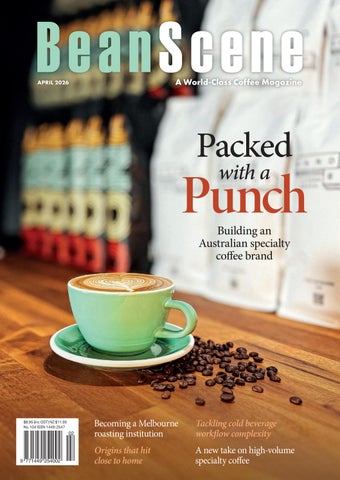
18 PACKED WITH A PUNCH

How a regional co ee brand and its private roasting ally are unlocking growth pathways across the specialty scene.

22 COFFEE FOR THE CULTURE

e roasters and venues hanging their hats on specialising in origins close to their hearts.

72 ESPRESSO YOURSELF

Victor Vu shares the steps to recreate the chameleon latteart design.

74 CAFÉ SCENE

Discover new venues across the region.

78 GET TO KNOW

How Ian Abadiano founded Co ee Mentality and became a leader in Queensland’s emerging specialty co ee scene.

Coffee community

26 SMOOTHER, BETTER, BALANCED

MILKLAB’s R&D team has been working hard on a new soy milk formulation.

28 ALL SYSTEMS GO

Allpress Co ee’s huge move in growing its Australian and international capacity.

30 SIGNATURE SURGE

Riverina Fresh is broadening its product range as innovative drinks reshape the modern beverage menu.

32 NZSCA

Introducing the new competition format set to take New Zealand by storm.

34 MAJOR DEVELOPMENTS

Minor Figures is returning to shake-up the plant-based milk market with its new barista almond milk.

38 SECRET INGREDIENT

T2 tea is contributing to Chef Junda Khoo’s pursuit of excellence.

41 COLD DRINK CONTROL

How Merlo is helping bring this cold drink dispensing solution into the mainstream.

44 ALL IN THE FAMILY

Ahaana Co ee wants to boost Australia’s consumption of Indian co ee.

Industry insights

46 TANTALISING TIRAMISU

Global syrup leader MONIN is hitting the market with its limited-time Tiramisu avour.

48 FOR THE LOVE OF COFFEE

Global hotel brand Citadines reveals how it uses co ee as a key connector for travellers.

50 NETWORK OF SUCCESS

Dive into the fourth edition of Grinders Co ee’s Immersion program.

52 LOVE THY NEIGHBOUR

Unlocking the co ee potential of one of Australia’s closest trade and geographical partners.

54 GROUNDS FOR CHANGE

Australia is facing a looming land ll crisis. For cafés the question isn’t whether to act – it’s how.

Equipment and technology

56 FROM SCEPTICISM TO SCALE

How super-automatic machines are helping rede ne what high-volume specialty co ee can look like.

58 HERITAGE MEETS PRECISION

Introducing the new La Pavoni Mini Cellini X and Cellini EVO PID.

61 WATERSHED MOMENT

While beans provide the blueprint, water is the framework that de nes the nal structure of extraction.

64 A STEAMY SOLUTION

e lowdown on Viper’s new automatic milk steamer.

66 NEXT IN LINE

Franke’s New A Line machine represents the next evolution of its fully automatic co ee solutions.

68 FORM AND FUNCTION

A new automated dispensing solution designed to improve speed, consistency and work ow.

70 THE FUTURE OF MILK TECHNOLOGY

Transformation in co ee happens when tradition meets innovation.

ITALIAN PRECISON,

The new Cellini EVO PID brings modern precision to the art of espresso. Featuring advanced PID temperature control, an integrated shot timer, standby mode for energy efficiency, and a built-in water filter, it delivers exceptional consistency with every extraction. au.lapavoni.com # lapavoni_au

BeanScene covershoot

DONE Coffee

Unit 1/22 Merrigal Road

Port Macquarie

New South Wales 2444

For BeanScene’s April cover, Port Macquarie photographer Cristian Campano turned his lens toward DONE Co ee, capturing the inner workings of the regional roasting operation alongside founder Stew Clark. e shoot documented several sides of the business – right down to the packaging and warehouse space that supports its growing wholesale network.

Among the images produced was the striking cover shot: a somewhat abstract composition featuring a pastel-green cup set against a backdrop of neatly stacked co ee bags. e concept hints at the powerful downstream e ects of thoughtful branding and packaging – how the identity printed on a bag can shape the story cafés present to their customers.

A er more than two decades in business, DONE Co ee continues to evolve its o ering for café partners across New South Wales’ Mid North Coast and beyond. At the heart of that growth is a close partnership with contract roaster Espressology, whose investment in the Trimatt ColourStar AQ printing system has opened new possibilities for exible, on-demand co ee packaging.

e technology allows DONE and its wholesale partners to experiment with seasonal releases, co-branded bags, and limited-edition runs without committing to large print volumes upfront – lowering the barriers for cafés looking to build their own brand identity.

Turn inside for the full cover story exploring how smart packaging and agile printing are helping cafés capture the value of their brand – one bag at a time. For

CHIEF EXECUTIVE OFFICER

Christine Clancy christine.clancy@primecreative.com.au

PUBLISHER

Sarah Baker sarah.baker@primecreative.com.au

GROUP MANAGING EDITOR

Myles Hume myles.hume@primecreative.com.au

JOURNALIST

Daniel Woods daniel.woods@primecreative.com.au

JOURNALIST

Meg Kennedy meg.kennedy@primecreative.com.au

ART DIRECTOR/DESIGN

Daz Woolley

HEAD OF DESIGN

Blake Storey

BUSINESS DEVELOPMENT MANAGER

Charlotte Murphy charlotte.murphy@primecreative.com.au

CLIENT SUCCESS OFFICER

Caitlin Pillay caitlin.pillay@primecreative.com.au

CONTRIBUTORS

Jessica MacDonald, Victor Vu

HEAD OFFICE

PRIME CREATIVE PTY LTD

379 Docklands Drive, Docklands, Victoria 3008 p: 03 9690 8766 info@primecreative.com.au beanscenemagazine.com.au

SUBSCRIPTIONS 03 9690 8766 subscriptions@primecreative.com.au BeanScene magazine is available by subscription from the publisher. e rights of refusal are reserved by the publisher.

ARTICLES

All articles submitted for publication become the property of the publisher. e Editor reserves the right to adjust any article to conform with the magazine format.

COPYRIGHT

Made for the coffee industry.

Contributors

Victor Vu is the three-time ASCA Australian Latte Art Champion. He placed seventh in the 2024 World Latte Art Championhip (WLAC) in Denmark. Born in Vietnam, Victor worked for three years in hospitality before coming to Australia to perfect his latte art skills. He won the 2018 MILKLAB Barista Battle and the 2020, 2024, and 2025 ASCA Australian Latte Art Championships. Today, he works for Grinders Coffee.

Andrew Feldon sits on the events portfolio at the NZSCA and has been part of New Zealand’s coffee industry since 2004. Now, he’s the proud Owner of Mouthwater Coffee Company in Manawatu and has worn hats ranging from barista and competitor to judge and enthusiastic long black drinker. He is passionate about creating a more connected, inclusive, and supportive coffee community and brings a grounded, people-first approach to the NZSCA board.

Once upon a time, supporting your local café meant turning up, ordering your usual, and maybe lingering a little longer over a second cup. ese days, there’s another small ritual many of us have adopted: buying a bag of beans on the way out the door. I was reminded of that recently during a quick visit to a neighbourhood café. e co ee was excellent – the kind that makes you pause halfway through the cup – and as I walked past the retail shelf, I instinctively reached for a bag of their house blend. Not because I needed more co ee at home, but because it felt like the simplest way to support a business that had clearly worked hard to create something people enjoy returning to. at small moment says a lot about the power of branding in co ee. When customers buy a café’s beans, they’re taking home a piece of that experience. e avour, atmosphere, service and familiarity of the place become wrapped up in the bag on their kitchen bench.

It’s something our cover story explores through the journey of DONE Co ee on New South Wales’ Mid North Coast. Founder Stew Clark has spent more than two decades building a business that helps cafés present the best version of themselves – supported by the partnerships and infrastructure behind the scenes.

A decade-long relationship with contract roaster Espressology has played a key role, particularly through the introduction of the Trimatt ColourStar AQ printing system.

e Melbourne-made technology enables short-run, on-demand printing for co ee bags and cartons, removing the need for cafés or emerging brands to commit to thousands of pre-printed units.

Like

In practical terms, it lowers the barrier to entry for cafés wanting to capture their brand equity. If customers are enjoying the co ee in your venue, why not give them the opportunity to take it home? With exible packaging runs, seasonal blends, collaborations or limited releases become far more achievable.

It’s a reminder that brand-building in co ee doesn’t always start with a roasting plant or

Branding power

warehouse full of packaging. Sometimes it starts with a single café, a loyal customer base, and a bag of beans on the counter.

Of course, branding is only part of the equation. Another is operational e ciency –increasingly important as menus expand and service expectations grow.

In this issue, we explore how technology is helping cafés adapt. In Brisbane, Merlo Co ee recently put the FloSmart automated dispensing system to the test at a high-pro le sporting event, producing iced beverages at remarkable speed while maintaining consistency. Meanwhile, the new BatchFlow COSTREE system via Barista Group is designed to simplify preparation of batch brew, syrups and cold brew bases.

In Victoria, the teams at Phoenix Café and Milk & Moss – both located inside hospitals – have embraced super-automatic Eversys machines to handle high volumes of on-themove customers.

While there was some uncertainty about introducing automatic machines in Melbourne, where co ee culture is strong, businesses have followed a predictable arc, according to Tiger Co ee – a key distributor of Eversys machines in Australia.

Initially, cafés and roasters purchased the equipment out of necessity amid sta ng shortages. But once they made the switch, many realised the co ee quality was excellent and repeatable regardless of the operator.

ese stories re ect the reality of modern café operations. Operators are nding new ways to build brands, connect with customers and expand menus while embracing tools that help maintain speed, consistency and pro tability.

Because at the end of the day, whether it’s a beautifully branded bag of beans or a perfectly prepared cup served in seconds, what cafés are really creating is the same thing that convinced me to buy that bag of co ee the other morning: an experience worth coming back for.

New World’s Best Coffee Shop crowned

Toby’s Estate’s Chippendale flagship has re-secured its place among the globe’s top cafés as part of the 2026 World’s 100 Best Coffee Shops list.

The Australian venue, after finishing top in the 2025 rankings, is now ranked in fifth place, with 2025 runner-up Onyx Coffee LAB in Rogers, United States, topping the 2026 list.

After nine Australian cafés were named in the top 100 in 2025, seven were included in this year’s top 100.

Ahead of Toby’s Estate in fourth place is a new addition to the list, Sydney’s Only Coffee Project Crows Nest, while Beta

Vale Ben Toovey

The Australian coffee community is mourning the passing of 2018 ASCA Australian Roasting Championship winner, Ben Toovey.

Ben was part of the Genovese Coffee family for 17 years after starting his journey with the business in a casual role before eventually becoming Head Roaster of the iconic brand.

He later joined Locale Espresso in 2018 as Head Roaster.

Ben’s list of competition accolades included placing Runner-Up in the 2017 ASCA Coffee Roasting Championship,fourth at the 2018 World Coffee Roasting Championship, third in the 2022 ASCA Coffee Roasting Championship, and a multiple winner of the Victorian Aeropress Championship.

Most importantly, Ben is being remembered as a humble, kind, and thoughtful person with an incredible passion for coffee.

Vale Ben Toovey, you will be missed. BeanScene magazine expresses its condolences to Ben’s family, friends and colleagues.

Coffee – also in Sydney – placed 13th.

Melbourne’s first representative on the list is Proud Mary Coffee in Collingwood, which has gone from fourth to 27th position.

Brisbane’s Coffee Anthology has been ranked 29th, down from eighth in 2025, while Single O is another new entrant on the list from Sydney in 53rd.

Vacation Coffee in Melbourne rounds out the list in 100th, meaning of the seven Australian venues selected on the list, four are in Sydney, two are in Melbourne, and one is in Brisbane.

Only the United States (nine) had more

selections than Australia’s seven, with Peru (five), Spain (four), Honduras (four), and Taiwan (four) also well represented.

The rankings were produced through a mixed evaluation system consisting of more than 800 professional judges and 350,000 public votes. In total, more than 15,000 coffee shops around the world were assessed.

“In the end, we are embracing global trends,” says CEO of The World’s 100 Best Coffee Shops, Cesar Ramirez.

“Coffee shop culture continues to grow, and this ranking aims to give greater visibility to more coffee shops worldwide.”

Image: Onyx Coffee Lab.
Image: ASCA.

Qantas boosts in-flight coffee quality

Australia’s national airline, Qantas, has signed an agreement with Lavazza in a bid to improve the in- ight co ee experience for its business and rst-class passengers on domestic and international routes.

Starting from 2026, Qantas will o er Lavazza brews on its ights across its network

which operates an average of about 385 ights per day, servicing more than 100 destinations in 32 countries.

Qantas’ domestic ight network spans about 67 metropolitan and regional airports, while it also services Auckland, Christchurch, Queenstown, and Wellington in New Zealand.

“Lavazza is ready for take o . We’re thrilled to announce our new partnership with Qantas, bringing Lavazza’s iconic co ee experience to travellers around the world,” a Lavazza statement says.

“Beginning in 2026, passengers ying in Business and First Class will enjoy our premium co ee, blended to elevate every moment in the sky.

“ is collaboration marks a new chapter, where Italian cra smanship meets Australian hospitality, delivering a co ee experience de ned by quality, passion, and care.”

e Flying Kangaroo’s attempt to improve the quality of co ee on its airline taps into an ongoing global trend, with American Airlines also announcing a new partnership with Lavazza starting in 2026.

Other recent co ee companies and airlines teaming up around the world include Peet’s Co ee and Southwest Airlines in the United States, FlySafair and Bootlegger Co ee in South Africa, and Costa Co ee and Jet2 in the United Kingdom.

NSW releases regulations around single-use coffee cups

Single-use co ee cups will be required to be recyclable in New South Wales under the new NSW Plastic Plan 2.0.

e plan, which covers the use of “problematic plastics”, also informs the phase-out of heavyweight plastic shopping bags, small items like soy sauce sh, and items already banned in other states such as plastic pizza savers.

A new baseline study by the NSW Department of Climate Change, Energy, the Environment and Water, and the NSW Environment Protection Authority measured the level of microplastics in coastal waterways, where they were detected in every waterway sampled.

As part of the NSW Plastics Plan 2.0, trials for a reusable cup system in NSW Government premises will commence in 2026, while food supply and service items made from expanded or foamed plastic will commence phase-out from late 2027.

Food service businesses will be required to accept reusable cups for takeaway beverages, with regulations for single-use plastic cups food containers, and lids to be recyclable from mid-2028.

NSW Environment Minister, Penny Sharpe, says the regulations will help meet businesses meet consumers where they are.

“Plastic breaks down into microplastic. Microplastics are entering our bodies and polluting our environment and oceans, killing our wildlife,” she says.

“Consumers want to do the right thing and use less plastic. is will help make the right choice the easy choice.

“We will work closely with industry, small businesses, manufacturers, retailers and councils to support a smooth transition to less plastic and safer recycling alternatives.”

To view the full plan, visit the NSW EPA website: epa.nsw.gov.au/Your-environment/ Plastics/plastics-plan-20

Image: anaumenko/stock.adobe.com.
Image: A. Emson/stock.adobe.com.

Allpress launches

Brisbane café

Allpress Co ee has o cially opened its new Brisbane café at 161 Robertson Street, Fortitude Valley.

Designed by Melbourne-based practice Foolscap Studio and delivered in collaboration with Brisbane builder Lowry Group, the space re ects Allpress’ belief that great co ee starts with great people and has been designed balance technical precision with warm, natural materiality.

e menu features Allpress’ signature blends, a rotating selection of single origins and lter options, alongside pastries from Sprout Artisan Bakery.

Signature drinks, including Mont Blancs, Matcha Strawberry Clouds, and Rosé Gelateria a ogato, have also been included on the menu to foster co ee moments longer into the day.

In addition to operating as a café, the Robertson Street location will also serve as a meeting point for Allpress’ wholesale partners and a space for cuppings, trainings, and collaboration.

Adele Winterage, Founder and Principal of Foolscap Studio, says the creation of the café has been born from an openness for collaboration between all involved.

“ e design celebrates the journey of co ee

itself, from the espresso and pour over bars to the dynamic retail space, balancing technical precision with warm, rich, textural brand expressions,” says Adele.

“With Allpress Brisbane, we wanted to create a space that feels both inviting and re ned, a quiet retreat amid the energy of Fortitude Valley, where natural textures, light and honest materials set the tone.

“Collaboration with local makers and circular design studios was central to the

Piccolo Me parent acquires Adelaide chain

e parent company of national café chain Piccolo Me has acquired South Australian chain Bean Bar.

Fabe Group, the multi-brand business that operates brands including Piccolo Me and Sol Bowl, will now integrate Bean Bar into its operations.

Piccolo Me Co-Founder and Fabe Founder, Charlie Hachem, says the continued growth of Fabe has stemmed from a piece of advice given to him by his father.

“My dad, Halim El Hachem, always gave one piece of advice to guide us,” Charlie writes online. “We build with our hands and lead

project. We worked with Mineral Fox on a new to market co ee cha render, Five Mile Radius on a custom concrete pour over bench, and Australian furniture designers Remington Matters and Dowel Jones to create pieces that re ect cra , sustainability and a strong sense of place.”

e new café is the latest expansion site for Allpress, which also operates roasteries and cafés in Sydney, Melbourne, Auckland, Tokyo, and London.

with our hearts. If you treat people like family, there is no limit to what you can do’.

“We have taken that advice and run with it. We believe the future of this café franchising is consolidation. ere are so many incredible entrepreneurs out there, and we want to back them with our system.”

Bean Bar opened its rst location on King William Street in Adelaide in December 2021, and currently operates ve locations across the city, including the King William Street location. It also has a co ee cart that is available to book for events.

Piccolo Me, on the other hand, expanded its footprint out of Australia and into Lebanon in 2025 and operates 41 locations in Australia, most of which are in Sydney.

Charlie says Bean Bar Founder, Nitin Jakhwal, is staying with the business as Fabe’s Head of SA/WA, and not much will change within Bean Bar’s network for the foreseeable future.

“For Adelaide, it’s business as usual,” he says. “We are working in the background to optimise operations and roll them into the Piccolo Me network.

“As my Group GM David Ciantar told the new team this week: ‘growth means nothing without the right people. To the entire Bean Bar team – welcome to our Fabe family.”

Image: Allpress.
Image: Bean Bar.

Continuing a legacy

Jasper Parker Trenfield returned to the business that shares his name in 2023.

Now, alongside his mother and Jasper Coffee Co-Founder Merilyn Parker, and CEO Jeremy Boxall, he’s helping write its next chapter.

Melbourne’s co ee scene in 2026 is a far cry from what it was in 1989. It’s hardly comparing chalk and cheese, but plenty has changed in the past 37 years.

Far from the modern specialty movement the city is now world-renowned for, the late 1980s was an era still almost exclusively built on the in uence of post-war immigration, standing on the shoulders of the Greek and Italian cultures that rst brought espresso to Australia.

Many traces from this time can still be seen today, though. e popularity of espresso-based drinks may have shi ed, but continues to reign supreme, while icons like Pellegrini’s Espresso Bar still stand tall. Jasper Co ee is another business with ‘Melbourne institution status’.

Co-founded by Merilyn Parker and Wells Tren eld, Jasper Co ee has long been a trailblazer in sustainable, organic co ee, and has captured the imagination of the city for close to 40 years.

Now, Jasper Parker Tren eld – son of Merilyn and Wells, and a er whom the business is named – has returned to his namesake and a career in co ee, where he is working alongside Merilyn and the rest of the Jasper team.

Wells, a global titan of sustainable, traceable, and high-quality co ee, sadly passed away in 2024, leaving a vacuum in the business that needed to be lled. His lifetime contribution to co ee was recognised at MICE 2025, where he was named the

expo’s inaugural Legacy Award winner.

Jasper, who came back to Melbourne a er more than a decade living in London, leaped back into the family business upon returning to his hometown despite having a forged successful career in animation.

He contributed to lm productions including Guardians of the Galaxy, Fantastic Beasts, e Jungle Book, and Gravity,

alongside working on a music video for Arctic Monkeys, theme park rides at Framestore London, and a project with leading videogame studio Rocksteady.

It was due to the deterioration in Wells’ health that Jasper and his young family elected to stay in Melbourne. In just one day, they decided to pause his animation career to spend time with his family.

“I had always wanted to be an animator,” says Jasper. “Growing up, we lived in Cli on Hill and Wells hand-built a huge art studio. I’d spend all my school holidays in there making animations with Lego, I was obsessed with it and it’s all I wanted as a career.

“I wanted to go out and make a career and a life for myself away from Melbourne and not feel like I was relying on my parents’ work to make my life meaningful. I did that for quite a long time and I’m really happy with the career I had, but when I saw how rapidly my dad’s health was deteriorating, we made the di cult decision to uproot our lives then and there.

“It was the most di cult thing I’ve ever had to do. It was a real ordeal, both physically and emotionally. We had a six-month-old baby in tow while stepping back into a space that had changed so much.”

Jasper grew up having sometimes taken catnaps on co ee sacks in Jasper Co ee shops and, by his own admission, turning up to school smelling of co ee a er running deliveries in Wells’ van. Now, he was a key piece of the puzzle in moving the business forward.

Merilyn Parker and Jasper Parker Trenfield are helping lead Jasper Coffee into a new era. Images: Jasper Coffee.
Co-Founder Wells Trenfield’s artwork has featured on some Jasper Coffee’s bags – including the popular Ethiopia Yirgacheffe.

Merilyn, as always, was there to help lead the way, now alongside her son. Jasper had also made the call to bring Jeremy Boxall back into the business as CEO.

“When Jasper came back into the business, he was conscious that he had some areas of expertise, but we also needed some help, leading to the decision to bring back Jeremy,” says Merilyn.

“He had worked in the business for 10 years, starting as the store manager in Prahan. Jasper was about 18 he rst worked with him. He’d worked in operations, then as the general manager, and he ran retail operations beside me. He’s also trained as a Q Grader and has a very sophisticated palate and deep knowledge of co ee.

“ at was one of the very smart early things Jasper did, we needed experts around us. We needed to rebuild from the loss of Wells, and there was probably 12 months of shock in the business a er his passing. You take time to

grieve, acknowledge the loss, and build on the presence Wells le behind.

“It was like an earthquake. When an earthquake happens, the world is suddenly di erent, but you must adapt and rebuild.”

Part of that rebuild within the four walls of Jasper Co ee has been a focus on growing its online presence.

Merilyn says it is still important for the business to have a physical presence, which it currently maintains at Highpoint, Brunswick Street, and Prahan Market, but the fastmoving consumer goods sector (FMCG) has been a priority, especially due to the recent and dramatic shi in where people consume co ee.

“A lot of the work has been on growing our web presence and our online store, and that’s been really productive and successful,” says Merilyn.

“Retail is an aspect we’re looking at closely. e corporate market disappeared a lot

with the advent of COVID, and there aren’t as many people going to o ces anymore.

ere’s been a big shi in the way people drink co ee towards FMCG since people have their own machines now.”

ere also appears to be a regearing of the brand looming, which Jasper has taken the reins of.

It’s a tough balance to bring a fresh and modern twist to one of Melbourne’s most signi cant and longstanding brands, because, a er all, Jasper Co ee is not some new upstart café, it’s part of the fabric of the city.

“We’ve been doing a huge amount of work to get the business into a space where we want to make sure we’re taking Jasper into the future in a positive way, but also reinforcing that core of Melbourne co ee we have been part of for a long time,” says Jasper.

“ e biggest things we’re working on is refreshing the look and feel of the brand. We go out into the world with a mix of old and new and we want to marry up the sense of modern Melbourne with our legacy in the city. We’re not going to pretend we’re something we’re not – but we want to bring a new feel while maintaining our approachability.

“We’re also doing a huge amount of work on our co ee quality behind the scenes. A lot of that’s roasting, so we’re making sure we’re cupping every day, and Jeremy is leading that quality assurance process with a team of cuppers here.

“We’ve been really happy to see customers so happy about it, and we’re getting some great reviews.”

Perhaps the most notable of those public reviews has come from mainstream media outlet e Guardian, which ran a test of 41 ground supermarket co ees alongside Condesa Co.Lab, which scored Jasper Co ee’s Ethiopia Yirgache e the winner.

e metrics in this test were to score the co ee out of 10, with scores for milk and black co ee based on bitterness, acidity, sweetness, aroma, and avour.

Reviewer Nicholas Jordan labelled the Yirgache e “a reminder of what co ee can be”.

Jasper says the recognition was unexpected but welcome news, not just to the team at the roastery, but also to the growers.

“It was amazing to tell our growers in Ethiopia about that,” says Jasper. “Our green bean buyer, Abdul, is from Ethiopia. Hewent back recently and took them some co ee, and it was amazing to be able to connect them with that and show them people really like their co ee.

“We’ve had relationships with them for decades, and it’s important to build long-term relationships like that. Knowing who we buy from year a er year is crucial. is Ethiopian co ee was one of the earliest organic and Fairtrade co ees we sold, and it’s crucial to help these growers have stable incomes year a er year.”

Merilyn believes hundreds of people have worked for the business over the years,

Merilyn and Wells at Jasper Coffee’s first Smith Street store.
Jasper Coffee has always prioritised the wellbeing of coffee farmers and producers in its products.

many of whom have gone on to start their own roasteries, cafés, or other businesses within the community. e in uence of Wells, Merilyn, and the Jasper team snakes through Melbourne’s co ee community like a network of tree roots, giving life to its everchanging landscape.

Staying true to the pillars Jasper has been built on – helping people, driving sustainability, and quality co ee – is still critical to the business, and will remain so for as long as Jasper and Merilyn are steering the ship.

It still holds close a liations with a host of non-pro ts and NGOs that were started years ago, including with the likes of Outback Academy and the Red Dust Healers, and Café Femenino in Peru.

Jasper Co ee became Australia’s rst licensed Fairtrade roaster in 2003, Australia’s rst carbon neutral co ee brand in 2009.

Jasper says those certi cations, along with the likes of B Corp – they were Australia’s rst roaster to be certi ed back in 2016 – are just as important now as they have ever been.

“It’s a huge part of what we do. It’s crucial to have an eye on making sure you are progressing things like Fairtrade constantly, because it’s so critical to why we do what we do. is has always been a business

to help drive change in a tangible way,” says Jasper.

“Because my parents rst came at this with an artist’s perspective, not a business perspective.

“ ey didn’t let people tell them what co ee should be; they went out and made

co ee what they wanted it to be, and that attracted people.”

Wells’ in uence still permeates every nook and cranny of Jasper Co ee. From photos he took from early trips to Papua New Guinea adorning the walls of its Abbotsford roastery, to his art being featured some of the brand’s co ee bags.

Now, a er that 12-month shock to the business following the loss of Wells, Merilyn says having Jasper and Jeremy alongside her helping lead Jasper Co ee is a uniquely positive experience.

“Wells was really excited to see Jasper stepping back into the business, and he felt like it was the right move,” says Merilyn. “ e 12 months we all had together with Wells were really important.

“It’s been one of the good outcomes, everybody was together a er being apart for more than 11 years. We had travelled to London to see them, but there was still a sense of missing important moments. Even though Wells’ condition was getting worse, there was a lot of joy in the fact we were together.

“To see Jasper, the contribution he’s making to the business and the thoughtfulness he brings, as well as the long history of knowledge about where we think from and what we’re doing, is incredible.”

AHAANA COFFEE

Jasper embarked on a successful career in animation before returning to help lead the coffee roaster that shares his name.

Packed with a punch

A decade-long partnership between a nimble regional coffee brand and its behind-the-scenes roasting ally is unlocking new growth pathways across Australia’s specialty scene.

Complacency has never been part of the DONE Co ee playbook. A er 22 years in business, supplying dozens of cafés and wholesale customers across New South Wales’ Mid North Coast and beyond, the brief remains the same.

“We like to keep it simple and have a bit of fun,” says Founder Stew Clark. “But we’ll never say, ‘this is all we do.’ When people come to us, we work hard to understand their speci c needs – and usually we can meet them or even do something a bit di erent.

“Our goal is to help our café partners present the best version of themselves, so we

can help them build their co ee sales – which makes us all succeed in the long run.” at philosophy only works if the infrastructure behind it is equally up to the task. In DONE Co ee’s case, the con dence to make those promises is underpinned by a decade-long partnership with Espressology, one of Australia’s largest private label roasters.

Around 12 years ago, DONE began searching for a roasting team that could grow with the business – delivering consistency while remaining exible enough to evolve as client demands shi ed.

Relationships are everything in co ee:

rather than meeting at the Espressology base in Sydney’s west, those early meetings took place in the outdoors, with swags rolled out and conversations about blends and business held around a camp re. It set the foundation for a partnership built on transparency and trust.

“ e big thing with Ged Ryan (CEO) and the guys at Espressology is there’s transparency from go to whoa – and nothing’s ever a drama, it’s why I now consider them some of my best mates.”

Today, a large part of that relationship hinges on Espressology’s investment in the

Stew Clark, Founder of DONE Coffee.
Images: Cristain Campano/Cristain Campano Design.

Trimatt ColourStar AQ printing system, a piece of Melbourne-made equipment that has become central to DONE’s ability to stay nimble and strengthen the relationships with its own café partners.

e Colourstar AQ enables short-run, on-demand printing of co ee bags and cartons, removing the need for large, upfront minimum orders typically associated with pre-printed packaging. It’s the reason why the machine is gaining traction in many co ee companies across Australia.

For co ee businesses like DONE, it means their wholesale customers can explore cobranded runs, seasonal blends, event-based specials or custom designs without overcommitting.

“For our four main blends, we use preprinted roll-stock packaging that runs through Espressology’s Propac form- ll-seal packing system. at works well for highervolume lines,” says Stew.

“But for our lower volume blends, or when a client wants something di erent or their own branding – that’s where Espressology’s Trimatt printing system comes into play. We just send the artwork through and they design it, format it and print it straight onto the bags as required.

“It has opened up a whole lot of doors for us, allowing us to do something a little bit di erent for our clients.”

It’s another feather in the DONE Co ee cap. What began as a regional wholesale supplier has evolved into a multifaceted operation spanning concept design, equipment installation, sta training, consulting, and distribution. It supplies everyone from independent coastal cafés to schools, TAFEs and accounts as far a eld as Lord Howe Island, Brisbane, Geelong and Torquay.

E-commerce sales are also accelerating. Partially due to the exibility of the ColourStar AQ, DONE can run single origins through its online store, produce Easter or Christmas specials, or create small-batch

blends for events and occasions such as Father’s Day.

If the business wanted to activate one of its ambassadors – for example, Hudson Young of the Canberra Raiders and his partner Kelsea Peck – a limited-edition blend could be produced quickly and in controlled volumes.

“It could just be a small run,” Stew says. “You can make it as large or as small as you like.

“Espressology also prints our own DONEbranded boxes on the Trimatt printer. Our

logo has a silhouette of pine trees with a sunset in the background, but we can easily swap that out for a silhouette of someone shing, gol ng, sur ng, camping, or whatever – we can change it up as much as we like.”

A top-tier investment

When Ged re ects on some of the big milestones in Espressology’s journey since its inception in 2008, the Trimatt ColourStar AQ ranks highly.

In fact, it’s one of the top two equipment investments the business has ever made. It’s a big statement for a piece of machinery that has a very particular – yet important – role within the broader contract roasting business.

“In the last ve to seven years alone, it’s easily the best decision we’ve made in the business, purely down to the doors that it has opened,” he says.

Short-run, short-turnaround, instantaneous printing on co ee bags has been an everpresent problem in Australia’s co ee scene, comprising thousands of small-to-medium sized operators.

Solutions exist but achieving results that are also economical and high quality have only added to the challenge. e Trimatt ColourStar AQ was the solution Espressology had been seeking, elevating the service it could o er to customers nding their feet or seeking a bespoke option.

In many cases, he has seen it create a “stepping stone” for brand development.

Ged points to several cases where a café builds such a strong following, that other

DONE Coffee bags and boxes printed with the Trimatt ColourStar AQ.
DONE Coffee’s relationship with Espressology, its roaster team, is a key part of its success.

cafés have approached them to become their wholesale bean supplier. ey’ve gone from running a single venue to a respected ‘roaster’ supplying both wholesale and retail.

O en, Espressology is the private label roaster behind-the-scenes, sourcing the beans, developing the roast pro les and blends –and using custom packaging printed on the ColourStar AQ to help the customer carve out a reputation.

“ e barriers to entry to become a brand are now much lower thanks to the capabilities of the ColourStar AQ,” Ged says. “ ere are many excellent café operators out there today, but this allows you to capture that brand equity by putting it on your bag, helping to build customer loyalty or elevate a business into wholesale supply.

“When someone walks in and is served an excellent co ee and sees a bag with your branding on the counter, they’re going to start buying your co ee instead of going someplace else. It’s a bit of a romantic story, but I’ve seen it happen.”

In practical terms, that means Espressology’s customers no longer need to commit upfront to thousands of pre-printed bags produced o shore – a “daunting” experience for new operators. ey’re also not tying up capital and storage for years. Instead, they can email artwork as a PDF, approve a sample, and run exactly the quantity they need.

For emerging operators testing the waters of private label or wholesale supply, Ged says that exibility is key. It lowers risk, speeds

up iteration, and allows branding to evolve alongside the business.

Beyond branding agility, the Trimatt has delivered signi cant operational e ciencies for Espressology itself – e ciencies that ow through to clients like DONE.

Traditionally, each wholesale brand would require pallets of pre-printed cartons and bags stored on-site. Multiply that by 40 or more clients and the warehouse footprint quickly balloons.

Due to the on-demand printing the ColourStar AQ a ords, those SKUs can be

printed as needed from a small base stock of plain cartons or bags. It also eliminates the need for manually placing sticker and labels on bags or boxes.

“Giving customers these options – where I’ve only got supply kra and white bags, and then we can print and use them straight away – I’m not lling up 15 factories, and the customers is not having to invest thousands of dollars before they’ve made the case that the business is going to be successful. Or it allows you to experiment before giving the green light to rollout a new product,” Ged says.

“ ere’s no MOQ (minimum order quantity). If you want one bag, we’ll do one bag. In these cases, they haven’t spent any money until they sell that bag.”

e machine features an automated feeder, an angle-adjust print head for valved bags, and its organic pigment inks are waterproof and lightfast. It can print 120, one-kilogram bags per minute, at 1200 dots per inch print quality.

Even so, Ged says speed is not the primary advantage.

“Convenience and low MOQ de nitely are. And the storage savings. Storage is everything for a contract manufacturer.”

With Espressology’s investment in the ColourStar AQ, a new door has swung open –one that could change the trajectory for both the business and clients like DONE Co ee.

“ e key things for me are that it can act as that springboard, it gives café owners the equity they deserve and the chance to capture what they’ve built and grow from it,” he says.

“More o en that not, a great co ee experience is due to the café owner/operator rather than the big brand name on the shelf, and this allows them to capture the bene t of that experience.

“Not all of them will take that step, but some do, and that’s o en how they evolve into wholesalers. at’s one of the most transformative things about the Trimatt [ColourStar AQ] printer.”

The Trimatt ColourStar AQ in action at Espressology. Image: Espressology.
Espressology CEO Ged Ryan says the ColourStar AQ helps emerging brands unlock their potential. Image: Espressology.

Co ee for the culture

Single origin coffees are a constant in Australia’s specialty scene, but some roasters and venues are hanging their hat on specialising in origins close to their hearts.

The debate of single origin versus specialty blends remains constant in Australasia’s café scene. Whether the brew of choice is an Arabica blend with beans from major origins like Brazil or Colombia, or a niche, small lot single origin, the stories and culture behind the beans continues to be a critical part of what makes co ee so special.

While many cafés and roasters in Australia and New Zealand will sell single origin products alongside tried and trusted house blends, there is an emerging market that targets just one origin from which to make all its products, from smaller producers like Sri Lanka, to larger scale producers like Vietnam or Ethiopia.

Something different, something new

While Melbourne or Sydney may be the places one rst turns to when looking for unique co ee experiences, there’s one restaurant in Traralgon that specialises in cuisine – and co ee – from the heart of Sri Lanka.

e Leaf Restaurant and Bar, run by husband-and-wife pair Sureshi Fernando and Suresh Silva, has become a popular spot in Victoria’s La Trobe valley since opening just over a year ago.

As the rst Sri Lankan restaurant in the region, it was already exposing its customers to something they may not have tried before, and outside its traditional curries and meals, its co ee stands alone as a unique single origin experience in Australia.

“We source our co ee beans directly from Sri Lanka. ey’re organic, hand-processed and hand-picked by a group of 10 women, so every time someone buys a co ee from us it helps that community as well,” says Sureshi.

“I believe we’re the only place in Australia with these speci c beans, and the response to them has been amazing. Australian people love their co ee, so we’ve had great feedback. We’ve been told it’s really smooth and not too strong, and we have customers that come in just for the co ee.”

Sri Lanka is far from a heralded co ee origin in the modern world, producing less than 8000 tonnes per year across its largely smallholder farm network.

e Leaf’s connection with this origin stems from the fact that Suresh and Sureshi were born and raised there and came to Australia about 15 years ago.

“ e co ee factory we work with in Sri Lanka is owned by one of my husband’s school friends,” says Sureshi. “It’s incredible and it’s generating jobs for that community. He’s taking these women into entrepreneurship which is so important.

“The coffee we sell holds a strong cultural significance for us, and it’s something very close to our hearts.”
Sureshi Fernando COFOUNDER, THE LEAF

We had some samples sent here and they were amazing.

“ is factory, it’s only a few women. eir children, their salaries, their meals, and their

day-to-day lives are helped by this co ee that we sell, so it’s amazing to be a part of that. We display that story in our restaurant as well, and customers love to buy co ee to help that cause. at’s one of the great things about co ee; it connects to everywhere.”

Vietnam may be a more well-known modern co ee origin than Sri Lanka, but the strong and full-bodied Robusta it is renowned for doesn’t always mesh perfectly with the lighter roast Arabica preference of Australia’s espresso-led co ee culture.

Steven Nguyen, Founder of Phin Co ee, started his co ee career as a Sydney barista, and has since held various roles in the industry.

It was during COVID, a er opening his own café, that Steven branched out and

The Leaf is one of many venues around Australia using single origin coffee to help expose its customers to different cultures. Image: The Leaf.

started Phin Co ee to help improve the perception of Vietnamese-grown co ee in one of the most discerning co ee cultures in the world.

“ e Vietnamese population here is big and the co ee industry is so diverse. It took about two years to plan everything and gure out how we would penetrate the specialty market that is such a big fan of lighter roast espresso co ee,” he says. “Vietnamese phin co ee is an alien way of brewing co ee to a lot of people.

“ ere has always been big demand for Vietnamese co ee in the suburbs of Sydney, Brisbane, and even Melbourne. For two years I spent every day knocking on the doors of Vietnamese cafés and banh mi restaurants. Now, we’re pushing about 300 kilograms of wholesale co ee per week.”

Vietnamese-style co ee, made using a phin lter and sweetened condensed milk, has long been a loved and ritualistic alternative brewing method in Australia, and it’s one that is gaining some popularity as the demand for multicultural food and beverage experiences grow.

While the market for Vietnamese-grown co ee has always been comparatively small, the launch of roasters specialising in the beans – all around Australia – is exposing more people to the style.

“When cafés here think of Vietnamese co ee, they always think of Trung Nguyen. ere has never really been many Vietnamese co ee roasters or suppliers in Australia. Now we get emails from people who say they’ve been to Vietnam and loved the co ee but

couldn’t nd anything that tasted like it here in Australia,” says Steven.

“Around 95 per cent of our online orders come from people who don’t actually have Vietnamese backgrounds, so there’s a real appetite for people to try it.”

Challenging perceptions

Vietnam is famed for its Robusta production, and although Australia is – typically – a largely Arabica-favouring espresso, Steven believes there’s signi cant opportunity for Robusta co ee to break through.

Phin Coffee, founded by Steven Nguyen, sources beans from all over Vietnam. Image: Phin Coffee.
Suresh Silva and Sureshi Fernando opened The Leaf to bring a taste of Sri Lanka to Traralgon. Image: The Leaf.

While beans sourced from the likes of India or Uganda tend to be more popular than their Vietnamese counterparts, he believes there’s an emerging market for high-grade robusta from di erent origins.

“I think there’s a misconception about Vietnamese Robusta in Australia. We know Vietnam is the biggest producer of Robusta in the world and it has the distinct chocolatey characteristic and full body, but it might not have the complex, fruity avours of Arabica from Brazil or Ethiopia,” he says.

“In Australia, Vietnamese Robusta is not used as widely as something like Indian or Ugandan Robusta, and it’s very rare to nd Vietnamese Arabica on the Australian market,” he says.

“I’ve heard a lot of roasters say they prefer these origins because they taste better, but I don’t believe that’s true.”

Steven Nguyen believes Vietnamese coffee deserves to hold more of the Australian market than it currently does. Image: Phin Coffee.
“I think there’s a misconception about Vietnamese Robusta in Australia … it is not used as widely as something like Indian or Ugandan Robusta.”
Steven Nguyen FOUNDER, PHIN COFFEE

Steven’s Vietnamese heritage, and specialisation in Vietnamese beans, has enabled him to access beans from all over

Vietnam, including the rarer Vietnamese Arabica varietals.

“We source di erent beans from Vietnam Gia Lai all the way to Son La,” he says. “We try to push forward a very traditional way of brewing. e phin is a traditional device that was introduced to Vietnam about 50 years ago when the French colonised Vietnam, and it has a lot of in uence and tradition.

“At the time, Vietnamese people didn’t have much, so they took the French press and innovated it to make it even simpler. You don’t even need lter paper; you just need a device and some ground co ee.”

Sharing a heritage brew

ere is one, critical thing that ties the story of e Leaf, Phin Co ee, and countless roasters and venues around Australia: the use of co ee as a vehicle to expose people to di erent cultures.

Co ee represents more than just a beverage. From farmers in Sri Lanka, to brew methods in Vietnam, and anything and anywhere in between, it’s a way of life and a point of connection.

For Sureshi and e Leaf, co ee has provided an inroad for Sri Lankan culture to be experienced in regional Victoria.

“Sri Lanka is mostly famous for its tea, but there’s an incredible history to its co ee as well. It’s been lost over the years, but it’s starting to rise again. We want to create a unique experience to our community and give a little bit of Sri Lanka to the valley,” says Sureshi.

“We want to provide more experiences, we have traditions like Sinhala and Tamil New Year coming up, it’s a time where people give away free food on the street, there are ice cream stalls and rice and curries, and lines of people coming to have food. We’re hoping to do something similar because we have so much to share.

“We serve typical lattes and cappuccinos, but in Sri Lanka co ee is traditionally served black with herbs like coriander and ginger, to prevent people from getting sick. It has a strong avour, and it tastes a little bit di erent. Hopefully we’ll be able to start serving that soon.

“ e co ee we sell holds a strong cultural signi cance for us, and it’s something very close to our hearts.”

For Steven, he hopes Phin Co ee can help expose some of the world’s most fastidious co ee drinkers to a whole new world behind the beans.

“Vietnamese co ee, even in Vietnam, is a dying cra . Young people are starting to adopt espresso machines, and I think in the next 10 years espresso-based drinks are going to take over,” he says.

“If we don’t try to preserve the traditions, even in Australia, then Vietnamese co ee will be lost, and people won’t know what it is.

“Phin Co ee, to me, is my personal way of approaching people to explain to them what real Vietnamese co ee is, and how it can stay relevant in the future.”

La Cimbali M200 High Quality Milk is designed to support baristas with intelligent automation that enhances skill, not replaces it. At its core is HQM — High Quality Milk — a built-in feature of the Automated Perfection system, delivering elevated milk performance with speed and precision for both hot and cold milk beverages.

The integrated milk management system produces perfectly textured milk in seconds, ensuring consistent temperature — hot or cold depending on the recipe — silky microfoam and exceptional in-cup quality with minimal effort. The result? Signature beverages with flawless taste, cup after cup — because when performance is constant, creativity can truly shine.

For further information or business requests, contact stefano.giannini@cimbaligroup.com

Smoother, better, balanced

From early testing with roasters and baristas, to ongoing refinement by MILKLAB’s R&D team, a new soy formulation is designed to deliver smoother texture, balanced flavour, and reliable performance with espresso.

Before plant-based milk became a permanent xture on café menus, combining soy with specialty co ee came with its challenges, even for the most seasoned baristas.

Dom Majdandzic, Co-Founder of White Horse Co ee in Sydney, remembers those early days vividly, which also serve as a nice reminder about how far the category has come.

During that time, he believes few have advanced plant-based milks as Noumi, which manufacturers MILKLAB. Since its inception 11 years ago, the plant-based milk brand has continued to evolve formulations across its almond, oat, soy, macadamia, coconut, full cream dairy, and lactose-free milk ranges. e aim has been to create products speci cally for baristas, to deliver high performance, texturing, and stretching with a creamy mouthfeel to complement espresso co ee.

Dom has had a front row seat to MILKLAB’s rise, with the brand trusting White Horse Co ee as a key collaborator, providing enduser feedback on its latest development: the new MILKLAB Soy formulation.

“ e genius behind MILKLAB is that they care deeply about the industry, they care about cafés and they care about baristas, as well as the customers drinking the co ee,” Dom says.

“ ey are always making plant-based milks that are stratospherically better than what we had when plant-based milk was in its infancy. Before they started making plant-based milks, co ee making was largely targeted to dairy drinkers.”

During the testing phase for MILKLAB Soy, White Hose Co ee trialled many iterations in various co ees to help discover the optimal formulation.

“We have seen amazing advances in quality

and production techniques – a genuine leap from where it was before. It will be a true pleasure for baristas to use,” Dom adds.

Lydia San, Brand Manager at MILKLAB, says the brand prioritises the needs of baristas. She says MILKLAB Soy has always been developed with co ee in mind, with the R&D team investing countless hours testing it in-house to ensure it performed properly with espresso.

“ ey looked at things like how it steamed, how stable the foam was and how it tasted in the cup alongside co ee,” she says.

“ roughout the process we’ve collaborated with roasters and baristas to trial di erent iterations and share feedback. at input has played an important role in shaping the product over time.

“We’ve continued to re ne the recipe based on what we’ve learned and the feedback from baristas and roasters along the way. e new

The new MILKLAB Soy has been developed with cafés at front of mind.
Images: MILKLAB.

MILKLAB Soy is smoother, more balanced in co ee, and delivers improved steaming and texture behind the machine.”

Supanan “Fon” Sopapol can attest to this.

e Beverage Consultant and Founder of Fonix Studio is collaborating with MILKLAB to create a range of soy-based recipes for cafés to try.

A hallmark of the MILKLAB Soy is its neutral avour, she says, letting the co ee –or any other avour – shine through while adding body and gentle natural sweetness to the drink.

“One moment that really stood out during testing was when I rst steamed the soy and poured it with espresso there was no noticeable curdling,” she says.

“As baristas, we know that the natural acidity in co ee can o en cause soy milk to split, which a ects both the texture and how the drink presents in the cup. What impressed me about MILKLAB Soy was how stable and smooth it remained, while still allowing the co ee avours to shine through. It creates a creamy texture that supports latte art while keeping the avour of the co ee clean and balanced.”

MILKLAB Plant Milk Product Development Manager, Alice Makimian,

says another standout feature of the re ned formulation is reduced bitterness sometimes associated with soy. is approach is better suited to cafés by increasing sweetness for better balance with espresso and improving the mouthfeel to create a creamier texture.

“We also optimised the processing to minimise beany or earthy notes, resulting in a smoother, cleaner avour pro le that performs well in co ee,” she says.

“It really comes down to how smooth and creamy it is. e avour is nice and neutral, so it works well with co ee without being overpowering. It’s also really versatile behind the bar and holds up nicely in other café drinks like matcha and chai.”

Lydia agrees: “It integrates really well with co ee and gives a richer, more indulgent mouthfeel. We also had more than just co ee in mind. It’s designed to work across a range of café drinks, from matcha through to other avoured beverage builds.”

Menu elevation

is new-found versatility thanks to the improved formulation of soy milk excites Fon, helping cafés broaden their menus and pave the way business success.

“One piece of advice I would give cafés is

that soy milk can work well across di erent drinks on the menu,” she says.

“In hot co ee, it can stay smooth and stable enough for milk-based drinks and latte art, which helps baristas feel more con dent when using it. It’s also a great option beyond co ee, like matcha, chai, iced drinks, or even smoothies.”

Dom sees a nostalgic opportunity for cafés to tap into.

“When I think of soy it takes me back to the infancy of specialty co ee in Australia,” he says.

“During that special time, LSDs (latte soy dandies) were a popular co ee alternative, similar to where matcha sits in this day and age. I think reintroducing dandelion tea and soy on the co ee menu could be a stroke of marketing genius for many cafes. Who doesn’t want to go back and relive the 90s?

“MILKLAB is constantly improving on their products, with soy being their latest. It’s great that more of society are now able to enjoy beautiful co ees with the use of MILKLAB.”

For more information, visit milklabco.com

The new formulation is designed for versatility behind the bar, beyond hot coffee.

All systems go

After growing into four international markets following its New Zealand launch more than 30 years ago, Allpress Coffee has just made one of its biggest announcements this decade.

Since being founded in Auckland in 1989, Allpress Co ee has become a signi cant player in the global specialty co ee landscape.

Now operating cafés and roasteries in its home market as well as Australia, the United Kingdom (UK), Japan, and Singapore, it’s boosting its presence in two of those markets with a new, signi cant investment.

e global footprint of the New Zealandborn roaster will expand with the launch of a pair of new roasteries – one in Melbourne and one in London, reinforcing Allpress’ position as one of the world’s most respected specialty roasters.

e new Melbourne site, located in the northern suburb of Reservoir, is already preparing to open, and started supplying local customers in March 2026.

Not only will this new facility expand Allpress’ capacity in the Australian market, but it is also a consolidation of its existing Melbourne and Sydney, roasteries.

Meanwhile, the new London roastery in Tottenham will open in mid-2026 to support growing demand across the UK and supply a new café in nearby Farringdon, which is set to open around the same time.

Nicola Richardson, Global Director of Allpress Co ee, says strong demand from hospitality partners not only in Australia, but worldwide, has driven the desire to invest in these new facilities.

“Allpress is guided by long-term partnerships, uncompromising standards, and a commitment to brewing better days for our people, cafés, communities, and the planet,” says Nicola.

“Allpress continues to perform ahead of the market across multiple regions. But our expansion has never been about being everywhere. Rather, it’s driven by steady and considered expansion in the right places,

with the right partners – from the co ee farmers we’ve worked with, some for decades, to the cafés we serve every day — delivering exceptional co ee without compromise.

“ ese new roasteries allow us to scale sustainably while protecting what matters most: the integrity of our co ee and the relationships behind it.”

Alongside growing Allpress’ footprint in Australia and the UK, the new equipment strengthens the roasters’ ability to deliver even greater consistency and reliability.

Global Head of Co ee & Quality, Cam MacFadyen, says tests of the new equipment have been immensely positive, but the signature avour of Allpress Co ee will not change.

“When we tasted the new roasts side-by-side with what’s currently in market, the avour pro le was very familiar, but with more sweetness, depth, and body,” says Cam.

“One of our team summed it up perfectly during a cupping, saying it tastes like our Espresso Blend or A.R.T. on a really good day.

“ at’s exactly what this new equipment helps us achieve consistently: the rich sweetness, balance, and clarity that have

always de ned Allpress Co ee.”

Allpress’ recent growth across key markets is not just limited to the opening of its two new roasteries in Melbourne and London, though.

e roaster recently launched its new café location in Brisbane’s Fortitude Valley, which also contains a training and cupping space to establish it as a new-age co ee hub for the region.

Further expansion in Japan has also been teased, a er the rst Allpress roastery and café was launched in Tokyo’s Kiyosumi Shirakawa district, with a second café opening in Toranomon in 2020.

Now, as it enters its fourth decade, Allpress says its focus remains unchanged despite the continuing evolution of the international specialty co ee industry.

It continues to build on those foundations, which, it says, starts with partnering with outstanding cafés, and investing in people, infrastructure, and longterm relationships.

For more information, visit allpressespresso.com

Allpress Coffee is extending its presence in Australia and the United Kingdom with two new roasteries. Images: Allpress Coffee.
Allpress’ new roasteries have already started supplying coffee to customers.
Cam MacFadyen says Allpress’ new roasting technology is bringing more clarity, sweetness, and depth to every batch.

WATER �

SUPPORT �

Signature surge

Riverina Fresh is broadening its product portfolio as signature drinks, fuelled by social media and customer curiosity, reshape the modern beverage menu.

Ten years ago, Australia’s café menus were anchored by a familiar rhythm: espresso, at white, cappuccino. Today, the board o en reads like a avour map. Matcha sits beside cold foam, iced co ees arrive layered in precise bands, and “signature” builds promise of something you can’t get anywhere else. O en it’s a drink designed to be photographed, shared, and ordered again. e surge in signature drinks isn’t just about aesthetics either. Café owners are discovering these beverages have become a practical commercial tool: capturing attention at the point-of-sale, li ing average spend through premium ingredients, and giving customers a reason to return for the next limited avour or seasonal release.

Suppliers are feeling the shi too, as cafés look for ingredients that perform consistently in milk based classics while also standing up in more experimental builds.

For Riverina Fresh, long known as a qualityfocused milk supplier to cafés, the response has been to broaden its food service range and partnerships so venues can create signature o erings with con dence. Milk still forms the foundation of many of the drinks customers want on the menu, but the company says the add-ons matter more than ever.

Luke Hobbs, Head of Sales at Riverina Fresh, sees the change playing out daily. Whether visiting venues with his team or simply walking into a café as a customer, menus are increasingly split between a creamy hero, a non-milk option, and a rotating cast of specialty drinks.

“Bisco creations are standing out across the market, pistachio is on the rise, and I recently tried a chai based syrup elixir mixed with blueberry syrup and Riverina Fresh – it was sensational,” Luke says. “For matcha, strawberry was the go to avour; now we’re seeing blueberry gaining popularity, and new avour pairings are emerging all the time.”

In the last three years Luke and the Riverina Fresh sales team have seen the business continue to grow. ey now supply several thousand cafés across metro and regional markets on the east coast of Australia.

“Our Food Service Business has expanded from being primarily a supplier of the Riverina Fresh range of milks to so much more than that,” Luke says.

ere has been a steady expansion of the company’s portfolio to provide a full suite of products for cafés. Beyond core items such as milk, cream, butter, cheeses and plant based alternatives, Riverina Fresh has seen rising demand for syrups, pastes, spreads and other products that help cafés create genuine points of di erence.

“We’re constantly looking at our range and

how we can optimise it,” Luke says. “My role is to lead the sales team and guide them in having conversations with our customers that are focussed on adding value and helping to grow their business.”

Riverina Fresh manufactures all its dairy products in Wagga Wagga, NSW, where it has been located for more than 100 years. In addition to its own products, Riverina Fresh Food Services now o ers around 300 other products to its customer base in New South Wales and Victoria.

“Our range continues to evolve as consumer demand changes. It has evolved signi cantly over the past three years and has accelerated even in the past six months,” Luke says. “Tea syrups and similar categories, for example, are growing exponentially month on month in both customer numbers and volume.”

Keeping pace with modern cafés without chasing every passing fad comes down

to continual face-to-face contact with its customer base. Luke says Riverina Fresh’s sales team are always looking for insights and current trends to ensure the entire food service range re ects what’s actually in demand out in the market.

“We learn the most from cafés themselves; the baristas and frontline sta ,” he says. “ ey’re always ideating and trying new things, and the regions we operate in; Sydney, Melbourne and the Riverina region are key markets in uencing trends across the country.”

Underpinning all of this is Riverina Fresh’s milk quality. As a 100 per cent Australian owned, independent dairy manufacturer, it has been working with speciality roasters and baristas for more than 15 years. It’s this long standing brand presence in cafés that continues to open the door to broader conversations about innovation.

The Mont Blanc is spearheading a rise in signature drinks. Image: Rohan Cooke/Golden Brown.

“We’re always challenging ourselves, particularly with how milk interacts not only with co ee but also other beverage ingredients,” Luke says.

One example is the company’s Lactose Free Milk, which was named Grand Champion Dairy Product at the Australian Grand Dairy Awards in late 2025. Lactose is a sugar that is broken down into simpler sugars by adding a natural enzyme called lactase. ese sugars are not only more digestible, they also give the milk a sweeter pro le which creates exciting opportunities for avour led signature drinks.

Riverina Fresh says it only manufactures fresh dairy milk and cream products with a constant focus on the highest quality.

e other products in its range come from partners considered leaders in their category and also with a focus on quality.

“ e supply partners we prioritise are the ones who help us add commercial value to customers, have high quality products and are constantly innovating and keeping up with the latest market tends” Luke says. “ e food service industry knows Riverina Fresh is more than just a milk supplier, and brands are keen for their products to be available through our vast distribution network.”

e evolving consumer demand is creating new ways for suppliers and cafés to collaborate.

“As an example, we’re talking with juice suppliers not just about selling packaged juice, but how juice can be incorporated into signature drinks,” Luke says. “ ese are the supply partnerships and innovations we’re starting to focus on to drive real value for customers.”

Social stand-out

Once upon a time, café creativity stayed local, spreading slowly through word-of-mouth, competitions and trade shows. Now, a single video can turn a niche avour combination into tomorrow’s must try order.

But platforms like Instagram and TikTok have turned colourful lattes, layered cold foams, and indulgent milk-based creations into shareable content that is driving foot tra c – and seeing signature drinks explode on to the scene.

Rohan Cooke, whose Melbourne co ee brand Golden Brown exclusively uses Riverina Fresh products and has amassed around 1.7 million followers globally, says it’s been incredible to witness how quickly trends can emerge and, in several cases, gain a foothold.

“Not long ago, ideas could take years to travel internationally, maybe appearing at trade shows rst. Now, trends spread instantly. Every day we see what’s happening all over the world,” he says.

“Social media acts as real-time, free market research – you can see what people like, what engages them, and what excites them. As a cafe owner, it’s important to be aware of, even if you’re not going to implement those exact ideas. But I don’t think you should just blindly follow trends. I still think you should stay true to who you are and use these platforms to help tell that story.”

Rohan believes the visual nature of signature drinks – converging with the popularity of and image-based social media platforms – has driven this new and exciting era.

“A picture or video of a standard espresso is no longer very exciting,” he says.

“Signature drinks are di erent – they’re big, beautiful and intriguing. It uses fascinating ingredients. at’s just so much more enticing in the world of social media, and it’s so much more shareable.

“It’s also approachable because we’re o en using avours that are nostalgic, that are inspiring, and weird. Drinks like tiramisu lattes are instantly shareable to your friend that loves those indulgent desserts, and it creates a reason to share.”

e Coconut Cloud is an “amazing” drink he recently tried. It’s 50 per cent coconut water, 50 per cent lightly whipped cream, and espresso.

“It’s both refreshing and indulgent,” he says.

“But if you start with the basics, the Mont Blanc with Riverina Fresh cream was really one of the catalysts. Somehow the cream top has almost become the standard for what people think of as a signature drink.”

Another trend Rohan has noticed is that layered drinks tend to go viral.

“When people see a layered drink –especially with a cream top – they lose their minds,” he says.

“ e other thing is that the best-performing drinks are usually approachable and a bit nostalgic or comforting. ere’s something familiar about them – like a Mont Blanc giving you Terry’s Chocolate Orange dessert vibes, or the Bisco avours people already know and love.”

For more information, visit riverinafresh.com.au

Milk remains the cornerstone of Riverina Fresh’s offering, with its lactose-free milk (right) offering a sweet dimension for signature drinks.
Image: Prime Creative Media.

e Barista Open

2026 marks a shift in the landscape of Meadow Fresh Aotearoa Barista Championships.

For many years, the NZSCA has delivered the Championships at an exceptional standard under the detailed and watchful eye of Emma Markland Webster. Many of us in the industry – from competitors to judges – owe Emma a huge debt of gratitude.

e competitions and competitors have seen multiple evolutions, and it is important to the NZSCA that we keep striving to improve our o erings to the community.

Over the past six months, the NZSCA board has been focused on addressing a challenge presented through feedback from the community: How can entry into the Barista Competition environment be more accessible, less intimidating and more a ordable?

In response, we’re excited to introduce ‘ e Barista Open’ a fun, fast paced, MC driven, and highly accessible format designed to bring competitions to more regions and lower the barrier to entry.

For the regional competition this provided an opportunity for change that can meet this feedback. Behind the scenes, our education portfolio will continue to support competitors who choose to move from the Barista Open format toward the Meadow Fresh Aotearoa Barista Championships.

What is the Barista Open?

e Barista Open is a head to head, knockout style competition held at a local café or roasteries. Two baristas compete at a time; one progresses. Rounds are quick, clear, and engaging for both audience and competitors. is format extends the competition beyond just the major centres o ering pathways for baristas who may not have been exposed to the competitions to become involved with less experience. It is designed to open the door into the competition environment.

Each match includes:

• One-minute introduction – a chance for baristas to show personality and engage the crowd.

• Five-minute dial in and setup

• Seven-minute beverage round – serving an espresso, a dairy milk beverage, and an alt milk beverage without an expectation of a formal narrated presentation

• One-minute clean down, just like real café service.

Judging is conducted side by side, with transparent paddle decisions announced

live. e focus is on taste, presentation, and overall experience without detailed formal application of the full rules.

e winner receives a paid entry into the Meadow Fresh Aotearoa Barista Championship. To help support the growth to the National Competition a new buddy program will be released soon, providing resources for baristas to gain knowledge and experience they will need to compete with the best in our country.

To keep the pathway open and supportive, the top prize at each event is available only to competitors who have not placed in the top three at Nationals within the past ve years. is is intentional - e Barista Open is designed to help new and emerging competitors build con dence and receive meaningful guidance as they begin their competition journey.

Experienced competitors are absolutely welcome to participate and be part of the energy. e pathway prize is reserved for those taking their rst steps. Everyone is welcome to enter National Championship.

The return of the NZ Brewers Cup 2026 also marks the long awaited return of the NZ Brewers Cup. A er several years without this competition, member feedback made it clear: it was time to bring it back.

e response has been extraordinary –tickets sold out in a staggering one minute. Exciting times are ahead for our industry.

For more information on the New Zealand Specialty Co ee Association, or to join, visit nzsca.org

The Barista Open is the NZSCA’s answer to boosting accessibility to coffee competitions.
Images: NZSCA.
Andrew Feldon sits on the Events Portfolio at the NZSCA.

Major developments

Alternative dairy leader Minor Figures returns to shake-up the plant-based milk market with its new Barista Almond milk.

Minor Figures General Manager Henry Catts says almond milk is incredibly popular in Australia.

As leaders in oat milk for more than 10 years, Minor Figures is con dent it has gured out the formula for quality, healthy alternative milk options.

Following the success with its Barista Oat, Barista Oat Organic, and Everyday Oat products, the brand has decided to spread its reach into almond milk – its rst step outside of the oat segment globally.

With its roots as a cold brew co ee company, founders Stuart Forsyth, Will Rixon, and Jonathan Chiu already believed oat milk was the best alternative milk to

partner with co ee, but further research demonstrated almond’s popularity could not be denied.

But why is now the time to branch out?

“ e market’s appetite for oat milk is still on the rise, but almond milk in Australia is incredibly popular. In fact, from a grocery sale standpoint, almond is the number one plant milk variant on the market,” says Minor Figures General Manager Henry Catts.

Henry says almond milk currently holds a 37 per cent market share in Australian grocery, compared to oat milk at 33 per cent.

“We’ve been serving oat lattes to people for over 10 years now, and there’s a lot of people that really engage with our brand and love our brand, but until now we haven’t been able to satisfy their almond milk cravings,” he says.

“We wanted to have something to support our customers and consumers with.”

With more than a decade in the space, this also comes with lessons learnt – particularly during the R&D process. e almond milk product was in development for nearly a year, with around 25 trials to get it ready for market.

Images: Minor Figures.

“We learnt the hard way [from our oat milk] that you need to get the products right from word ‘go’,” says Henry.

“In the last few years, we transitioned our oat products to using an oat base made here in Australia … with this change brought a period where consistency was a bit of an issue. As Aussies, we expect a perfect cup of co ee every time, so we wanted to make sure that we got this right from the word go.”

“What we’ve done with our oat formulation now is fantastic – it’s absolutely hitting it out of the park. It’s a completely transformed product now compared to the last few years.

at’s why it was so important to us that when we released an almond milk that it was able to hit the same heights as our new Barista Oat.

Henry says the feedback the company has received for the almond milk has been overwhelming, with pre-orders stacking up before the o cial launch last month.

“Minor Figures doesn’t just follow the pack; it was important that our Barista Almond had a point of di erence to the main players in the market. ere is growing demand for seed oil free products both here and globally, but no Barista Almond in major distribution servicing this demand,” he says.

“ at’s why we chose to make our Barista Almond seed oil-free, to give the co ee community something they’ve been crying out for. I think people are really excited to see something new from Minor Figures and the fact that it is seed oil-free adds to this as well.”

Minor Figures says its almond milk uses Australian olive oil, enabling the product to be seed oil free.

Henry says the almond addition also creates opportunity for “being a more complete partner for our cafés”, enabling Minor

Figures to do more to support businesses. One example is the brand’s ‘Cooler Co ee’ campaign in Melbourne and Sydney – which saw a range of Minor Figures cafés serving free iced lattes in limited edition made by Fressko cups.

“ e cafés had a lot of fun with the campaign whilst giving their customers something they can hold onto. It was a great way to get behind our partners and say ‘thank you’ for their support,” says Henry.

“It is really all about supporting customers and our café partners.”

As for how the product di ers from what’s already on o er, Minor Figures says its almond milk uses Australian olive oil – enabling the product to be seed oil free –and is higher in protein whilst lower in fat, carbohydrates, and sugar compared to the other main players in the almond milk space.

“When you taste the product, you’ll notice immediately it tastes a lot cleaner than the products out there on the market,” says Henry.

“A lot of our competitors use a high amount of additives to hold their milk together to make it more stable. e issue with high addiditives is that it can atten the co ee avour. We try to keep our products as clean as possible, so the cafés can express themselves with their beans to set themselves apart from the next café down the street.”

Minor Figures sources 100 per cent of its almonds from Australian farms, particularly around the South Australian and Victorian border. e produce is hot property in Australia at the moment – according to the ABC, the nation produced a record $1.3 billion worth of almonds in the 2024/25 nancial year, with a forecast to harvest a record almond crop of 167,000 tonnes in 2026.

Minor Figures’ production facility is based just outside of Ballarat in regional Victoria, highlighting a tenet for the brand to give back to local communities.

“We love being a part of the community, so it’s important for us to make sure we’re using quality ingredients that are from the local areas and then being a point of employment for regional Victoria as well,” says Henry.

“ at means from farm all the way through to the cup, we’re supporting Australians and doing what we can to make a di erence in the country.”

Health and avour remain at the forefront for Minor Figures, and this new chapter will be shared far and wide from the get-go.

“We’re super excited to get this product into as many people’s hands as possible so they can taste the di erence, which is why it was a huge feature of what we did at the Melbourne International Co ee Expo this year,” says Henry.

“I think people can appreciate what we’re trying to do with a product that is healthfocused and providing consumers with a healthier alternative.”

Even with a foray into a new plant milk variant, Henry says the brand will always let the co ee take the lead.

“Minor Figures has always been co ee- rst with whatever we do – co ee is the hero, we’re the ‘minor gure’ in the cup.”

For more information, visit au.minorfigures.com

Minor Figures’ production facility, Cottonwood Springs, is located just outside of Ballarat in regional Victoria.

e secret ingredient

Chef Junda Khoo’s pursuit of excellence starts with exceptional ingredients – with tea from T2 infused throughout his food, cocktail, and dining experience.

When patrons walk into Ho Jiak, a giant of the Malaysian restaurant scene, they’re really entering “Junda’s playground”.

So much so, it’s the slogan that sits beneath the restaurant’s name, capturing the curiosity that runs through the dining group’s six venues across Sydney and Melbourne, owned by Junda Khoo.

But that sense of adventure comes with a clear purpose built on exceptional cra , service and sourcing.

“To me, excellence is not just about the food. It’s an entire experience when you come to dine at the restaurant. It’s all about discipline and intention. e service has to be warm, friendly, knowledgeable; excellence has to be in the culture,” he says.

“When it comes to quality ingredients, I usually look for freshness, minimal processing done to the ingredient itself, and, of course, clear sourcing where the ingredients are actually coming from.”

For Junda, T2 is a tea company that aligns closely with Ho Jiak’s commitment to excellence. Teas from the Melbourne brand are woven throughout the menu in multiple forms – from being infused into cooking techniques and used in cocktails, to being paired directly with dishes.

Standout examples include the restaurant’s jasmine tea-smoked oysters and its oven roasted dry aged corn-fed duck with Moutai, where tea plays a supporting role in the overall avour journey.

“Something as simple as tea can elevate and change [a dish],” Junda says.

“ e produce is so good already that our job becomes easier. We just have to work around the produce and bring out the best of it.”

Even so, those secondary ingredients like

tea need to be high quality. It’s a big reason why Junda is sourcing from T2.

Known for its broad and o en unexpected range of teas, the company has built its reputation around showcasing the diversity of avours the tea plant can produce, from traditional Chinese varieties to emerging single-origin teas grown in regions such as Nepal, New Zealand, and Hawaii.

In recent years, the category has begun to attract the same kind of attention that specialty co ee has enjoyed for decades. Like co ee, global tea yields are reducing, and the industry is increasingly focused on supporting smallholder farmers and sustainable growing practices.

For venues like Ho Jiak willing to explore the category more deeply, there’s signi cant untapped potential for avour exploration.

Khoo sees tea as a natural t within Ho Jiak’s evolving menu.

“ e avours from T2 really suit the direction we’re heading in, especially in the way they work with our cocktails and the food,” he says.

Even with the creative freedom implied by “Junda’s playground”, there’s a method to his approach that starts with high quality produce and ingredients, and moves into the way the food is prepared, serviced and ultimately consumed.

“A great restaurant should be where a customer walks in and they’re treated with warmth and care – they’re not processed as customers. ere has to be no egos between the front and the back,” he says.

“We all contribute towards the same goal, and we create an experience that is thoughtful and seamless to our guests.”

T2 Marketing Director Peter Randeria says the brand was already supplying Ho Jiak restaurants. en in October 2025, T2 announced it would be co-presenting partner of the Good Food Guide (GFG) & Awards.

“In October Ho Jiak won a GFG ‘hat’ and we took the opportunity to celebrate the success with media support. Since then, in partnership with Good Food, we’ve now expanded that relationship,” he says.

“Junda sees the avour and pro le of tea to match well with food and cocktails he develops. He has used our jasmine teas to smoke oysters and soak with rice. Something as simple as tea, but with a couple of simple steps of preparing it, can elevate and change a meal.

“We’re proud to build a partnership over the long term with Junda.”

For more information, visit t2tea.com

Ho Jiak owner-chef Junda Khoo says excellence starts with high quality ingredients.
With dishes like oven roasted dry aged corn-fed duck with Moutai, tea plays a supporting role in the overall flavour journey.
Images: T2.

Cold drink control

Merlo Coffee is bringing automated cold beverage dispensing to cafés looking to manage the fast-growing demand for iced drinks.

Few environments put hospitality technology under greater pressure than a major sporting event. At the BMW Australian PGA Championship in Brisbane in November 2025, thousands of spectators moved through hospitality areas across the course, demanding quick, consistent drinks service at scale.

For Merlo Co ee, the event became a proving ground for a new piece of equipment now entering the Australian market: the FloSmart automated dispensing system, which the Brisbane roaster is beginning to distribute nationally to wholesale partners.

Rather than relying on manual preparation during peak periods, Merlo integrated the FloSmart unit into its event setup to streamline iced beverage service. Using Merlo’s own co ee concentrate, the system was capable of producing up to 12 drinks in 60 seconds – roughly one every six seconds –with consistent dosing every time.

e economics were equally compelling, with drinks costing around $0.85 per cup in concentrate, while the simpli ed work ow allowed operators to run the station with ease. Beyond the fairways, that same equation is becoming increasingly relevant inside cafés.

It’s something Merlo Chief Operating

O cer David Holt is seeing rsthand across the roaster’s own 16 locations, and among the hundreds of cafés it supplies to.

He says there’s little doubt that cold drinks are a priority of the next generation of co ee

drinkers. Recent gures show 74 per cent of all orders at Starbucks are now cold beverages; almost half of co ee drinkers under 25 had a cold drink yesterday; and ready-to-drink and cold brew co ee formats are set to outpace

As menus expand into cold beverages, automation is key to addressing complexity.

Live events have become a proving ground for the FloSmart machine.

traditional co ee formats in growth by 2031.

“At our university sites – we’ve got three or four of them – the cold drink o ering is huge.

ere’re iced teas, iced matcha, slushies, and a lot of menu variation,” he says.

“But as menus expand into cold beverages, work ows become more complex. In peak environments, from brunch, late nights to pop-up events, consistency and speed directly impact margin.”

David says Merlo works hard to be more than a co ee supplier for its wholesale partners. at means supplying them with high-quality equipment too.

“Our focus has always been quality and service. Using FloSmart allowed us to maintain both while improving speed and cost control in a demanding event environment,” David says.

“Automated dispensing also helps to reduce ingredient waste, free up sta for upsell and ultimately deliver a better guest experience.”

Merlo currently has two FloSmart machines in market: one at its James Street café that doubles as its training facility, and another it is loaning to potential customers.

In addition to the immediate reduction in sta overheads, it also improves the physical management of the space they’re working in.

David notes cold drink making can be multi-faceted, which can disrupt the ow of service.

“Take something like an espresso martini.

COFFEE

Alongside the rollout of FloSmart, Merlo Co ee has introduced a new co ee concentrate designed to deliver espresso-level quality in high-volume service environments.

Developed under the guidance of Merlo Founder Dean Merlo, the team has worked painstakingly to bring it to market – driven by a focus on avour and extraction quality. e result, the company says, is a product that mirrors the pro le of freshly brewed espresso.

To test the outcome, Merlo conducted blind tastings comparing drinks made from the concentrate with an iced latte prepared on a traditional espresso machine. According to the team, participants were unable to distinguish between the two. e concentrate is produced using a full espresso extraction method rather than immersion or funnelstyle techniques commonly used in other concentrates, ensuring the co ee retains the body, balance and aromatics expected in a café setting.

When paired with automated dispensing systems such as FloSmart, the concentrate allows cafés to pre-set milk ratios and beverage recipes, enabling consistent iced co ees and milk-based drinks without requiring a trained barista for every serve. For operators navigating labour pressures and expanding cold drink menus, it provides a potential way to maintain quality while signi cantly simplifying work ow.

Normally you’d have to measure all the ingredients, mix them, and prepare the drink. With this system, you just press a button, place the glass, and hand it over. So speed of service is a major bene t,” he says.

“Consistency is a major selling point, because everything is pre-measured. You’re doing the work beforehand, and the whole container is consistent for every single drink.” e simplicity of the design also means almost anyone can operate it. Merlo has seen

the bene ts at other sporting grounds that take cold drinks out to customers, rather than serving them at a bar.

“ e unit is refrigerated, so you only require power to run it – that portability is a huge plus,” he says.

“ ere’s also a bit of theatre to it. It’s something di erent, and you can have multiple taps running di erent drinks. You can change them up week to week.”

But ultimately the big advantage is speed and simplicity – elements that can reduced sta overheads.

As a roaster, Merlo isn’t immune to the crunch of rising green bean prices, with those costs being passed on to wholesale customers – everyone in the industry is dealing with it.

David says automation forms part of the solution.

“We want our wholesale partners to succeed just as much as our retail cafés,” he says. “So wherever we can introduce automation while still maintaining quality, that’s really key to our business.

“We’re passionate about being more than just a co ee supplier for our wholesale partners. at means supplying them with high-quality equipment like carts and a full suite of product o erings – and that now includes FloSmart.”

For more information, visit merlo.com.au

Merlo’s new coffee concentrate
Merlo Chief Operating Officer David Holt.

MINOR FIGURES BARISTA ALMOND

INTRODUCING BARISTA ALMOND. OUR BARISTA ALMOND IS DESIGNED TO CREATE PERFECTLY BALANCED, SILKY-SMOOTH COFFEES EVERY TIME. WE USE AUSTRALIAN ALMONDS & OLIVE OIL TO ENHANCE THE FLAVOUR PROFILE OF ANY ROAST FOR A DELICOUS FINAL CUP.

TRY THE ALL-NEW BARISTA ALMOND NOW! FOR A FREE SAMPLE EMAIL: HEY@MINORFIGURES.COM

Indian coffee is rising in popularity in Australia. Image: DEVIKA PRODUCTIONS/ stock.adobe.com

All in the family

Ahaana Coffee wants to boost Australia’s consumption of Indian coffee, and is using a special relationship with producers at origin to do so.

Relationships are everything for green bean importers, especially at origin. If importers don’t have strong, trusting relationships with people on the ground, how do they know they’re getting the best co ee possible, and at the best price?

ey’re the crucial middleman between the start of co ee’s journey as a commodity, and the end of it as a high-quality consumer good.

For Ahaana Co ee, a green bean importer based in Melbourne’s east, the relationships it holds with its co ee producers in India are watertight. ey’re far from purely transactional, they’re close like family –because they are exactly that.

A er more than a year of planning, Founder Rajesh Nair has brought Ahaana to market with his wife, Alamelu who is the hgeneration of a co ee farming family.

Her family estates are in Coorg, Karnataka and Yecaud, Tamil Nadu, and they want to highlight the best of Indian co ee produced at the estates owned by the Mena family.

Starting from scratch

Ahaana Co ee is still quite a new player in the co ee importing market, with the business having only gone fully operational less than 12 months ago.

Yet, Rajesh and the team still have 16 di erent categories of co ee available. ere are eight Arabica and eight Robusta products available, some of which are natural,

and some of which are washed.

Rajesh says while much of Australian co ee culture centres around Arabica, it’s Ahaana’s Robusta stocks that have been earning great praise so far.

“In terms of the assessment and scoring of the beans, ours tend to sit somewhere between a 78 and 83 and have a nutty and caramelly avour pro le,” says Rajesh.

“In July 2025 we started to engage with roasters and providing them with samples. Most of the roasters who tried it came back to us with very positive feedback, which was great to hear, a lot of which was actually about the quality of avour of our Robusta.

“Our Robusta, in terms of quality, avour pro le, and price-point, are de nitely better than a lot of other Robustas on the market. About 10 to 20 per cent of the co ee imported into Australia is Robusta, so there’s a great market for high-quality here.”

While Rajesh says Ahaana is currently best suited to roasters operating in the commercial co ee space, he hopes to extend the business into the specialty co ee sector in the near future.

“We need to do some work back at the plantation around our processing to make it happen, but moving into specialty is de nitely a long-term goal of ours.”

e name ‘Ahaana’ is no coincidence, either. Deeply rooted in Indian culture, it’s a name of Sanskrit origin and translates to ‘dawn’, or the

‘ rst ray of sunlight’.

“Currently, the beans from the plantation are provided to the Middle East, Europe, and domestically in India,” says Rajesh.

“ is is new territory, to bring them to Australia, so the name of the business not only references that, but it’s also the name of my daughter so it’s a tribute to her.”

India as a coffee origin

Although India may be world-renowned for its tea, it’s one of the world’s leading co ee producers in terms of its overall output.

Indian saint Baba Budan is credited with bringing co ee to India in the 17th century, with production increasing during the French and British colonial rule from the mid 18th to 20th century.

Ranked seventh in the world by the United States Department of Agriculture, with a total of 6.05-million 60-kilogram bags projected for the 2025/26 harvest.

Total co ee exports from India totalled more than US$2 billion, with Russia, Italy, and Germany the three leading importers of the product, with Belgium, the United States (US), and Japan also key importers.

Co ee production in India is dominated by the southern states of the country, with the Karnataka region believed to account for as much as more than 70 per cent of the entire nation’s co ee production, including the plantations Ahaana sources its co ee from.

ese are located in the northern part of Coorg, Karnataka, on the eastern slopes of the Western Ghat mountains.

“Gopalpur Estate is the main estate, but there are four di erent estates that we source from,” he says.

“ e main city in Coorg is called Madikeri. Golpalpur Estate is about 15 to 20 kilometres away.

“ e altitude is between 900 and 1200 metres, and the varietal that is predominantly grown there is Cauvery, which is a hybrid of the Caturra and Hibredo di Timor varietals.

“About 65 per cent of our plants are Arabica, and 35 per cent are Robusta, and some of the trees on the estate are more than 40 years old.”

Cauvery, o en called a Catimor-derivative,

was developed by the Central Co ee Research Institute in India, and has been commercially available since the 1980s.

It’s renowned for not only being a highyield and co ee leaf rust-resistant varietal, but also typically present a bright acidity and pronounced sweet a ertaste with strong body.

Indian coffee in Australia

Indian co ee is rapidly gaining popularity in Australia, both for its inclusion in espresso blends, with its high-quality Robusta bringing an extra punchiness, or in more traditional brewing methods.

ere are now local roasters who specialise in Indian co ee, local cafés who serve Indian co ee brewed in the traditional kaapi lter

method, and a growing appetite among co ee lovers to experience new and exciting co ees from around the world.

According to TradingEconomics, Australia’s import of co ee and co ee products from India is gaining signi cant traction. In 2020, just US$13.6 million worth of these products were imported, while in 2025 that gure almost tripled to US$32.3 million.

e popularity of Indian co ee in Australia is on the rise, and Ahaana Co ee is ready to highlight the capacity of this highpotential origin.

For more information, visit ahaana.coffee

The Mena family operates four family-owned coffee estates in Coorg and Valparai. Image: Ahaana Coffee.
Ahaana Coffee sources its coffee from plantations owned by the Mena family. Image: Ahaana Coffee.

A new pick-me-up

Global gourmet flavour company MONIN is hitting the Australian market with its limited-time Tiramisu flavour.

The famous Italian dish tiramisu – which literally translates to ‘pick-me-up’ – has experienced a resurgence in the popular conscience, with the dessert transitioning from a classic restaurant staple into a versatile avour pro le for cakes, ice cream, and beverages.

is newfound popularity has led MONIN, a French gourmet avour company, to create a new Tiramisu-inspired syrup, a limited-time product aimed at café operators looking to elevate their beverages menus with indulgent, dessert-inspired avours.

With a target audience of baristas and café managers who want to o er their customers premium, social-worthy drinks that appeal to dessert lovers, co ee enthusiasts, and trend-driven consumers seeking rich avours, MONIN is aiming for comforting avours in everyday café experiences.

“ ere’s tiramisu everywhere at the moment – even a dedicated tiramisu cafe in Fitzroy, Melbourne. I think consumers are going for those very classic, nostalgic avours, and this is one of them,” says Danni Choy, a Brand Ambassador for Stuart Alexander, which distributes MONIN in Australia.

“So many people have interacted with tiramisu at some point in their life – a few years ago, you started seeing all these tiramisu trays with big scoops that people had in their kitchens.

“I think everyone wants that indulgent feeling again of having a big slab of tiramisu, and so that’s why we decided to launch it here in Australia.”

With the original dessert comprising on layers of savoiardia (sponge biscuits), mascarpone, espresso, and dusted with cocoa powder, the new syrup blends these classic avours. e dessert itself also matches current trends towards a blend of traditional, fruit-forward, and indulgent caféinspired variations.

Industry research backs this up: according to IBC Simply, 44 per cent of consumers choose a dessert or cake when dining out, and 62 per cent are actively seeking new an unusual desert avours. Tastewise Dessert Trends says social conversations about tiramisu have increased 36 per cent year-onyear, with the dessert also noted as one of the fastest-growing sweet avours (2025 Kerry Taste Charts).

“Tiramisu is such a unique classic because of that balance. You get this rich, creamy texture that pairs perfectly with the bitterness of the co ee. It isn’t just sweet or overpowering; it’s complementary to all the di erent avour aspects,” says Danni. “ is syrup has a really strong, rich,

delicious co ee avour, and it has that nice depth and bitterness to it, with intense undertones of baked sweets. We’re not going for something that’s super sweet and that’s all you taste – we’re going for something that has the complexity you get from tiramisu.”

Danni recommends using the syrup as a cold foam, as well as adding it to a hot latte, matchas, and desserts. Trending serves include the Matcha Tiramisu Latte, Tiramisu Iced Latte, Tiramisu Hot Chocolate, and Tiramisu Martine.

MONIN’s Tiramisu syup is aimed at café operators looking to elevate their beverage menus with indulgent, dessert-inspired flavours.

“ at’s the great aspect of our product is that it’s so versatile – it has great viscosity; if you do add it to a dessert, it’s going to hold up. It doesn’t introduce too much water where it starts to separate. It has a lot of avour, viscosity, and stability,” she says.

Danni says a fruity avour, such as cherry or strawberry, from the MONIN catalogue pairs well with tiramisu.

“ ose pretty, decadent avours pair well, or you could go for something like a salted caramel or butterscotch – or even

Images: Stuart Alexander.

popcorn. e world is your oyster.”

With MONIN an established brand in the syrups space, Danni says the company is constantly assessing trends to see what is gaining traction. But she notes every trend requires research to survey its potential in the market.

“Take Dubai Chocolate – it’s been this massive thing that has just exploded. We always ask ourselves: is it worth chasing that, or is it better to leave those interesting combinations to the consumers to discover for themselves? at uncertainty is why we do limited-time o ers,” she says.

“We’re always testing, and we have so many avours – our catalogue is a just wall of avour. When I hold studio sessions, I’ll bring out 10 bottles and people say, ‘oh my gosh!’. It’s very fun, and it’s mix and match, choose your own adventure.”

But with the global boxed tiramisu category alone valued at US$889 million in 2024, tiramisu is projected to grow as demand for premium desserts increases.

e syrup will be available in Australia via Stuart Alexander for a limited time from April 2026, with Danni noting the limited nature of the release creates a sense of exclusivity that people naturally crave.

“Tiramisu is a classic avour, but trends are unpredictable; while it’s incredibly popular now, we’re making the most of that

momentum while it lasts,” says Danni.

“It’s just one of those avours that’s constantly increasing in popularity – we’re starting to see the sales of tiramisu explode in the United States, so we’re excited to see if the

Stuart Alexander Brand Ambassador Danni Choy says the limited nature of the syrup’s

Australian market has an appetite for it.”

MONIN is distributed in Australia via Stuart Alexander. For more information, visit stuartalexander.com.au

For the Love of Co ee

Global hotel brand Citadines is using coffee as a key connector for travellers in new cities. Across 2026, Citadines’ Australian activations continue to evolve, offering new moments of connection through coffee.

For many people, co ee is more than just a simple beverage, but for travellers, it’s o en the rst meaningful connection to a new city and helps provide a sense of place.

Hotel brand Citadines has tapped into the universal language of co ee through its global For the Love of Co ee brand signature, an initiative designed to help immerse guests in the unique café cultures that de ne urban life all around the world, while o ering added value for members of the free to join Ascott Star Rewards loyalty program through exclusive discounts and guest perks.

“At Citadines, we design our guest experience around living like a local, and co ee naturally sits at the heart of that philosophy. It’s a daily moment of comfort, connection and discovery, whether you’re travelling for work or leisure,” says Citadines.

“Co ee provides an authentic way for Citadines to connect guests not just to our spaces, but to the neighbourhoods and cultures that surround them.

“For the Love of Co ee was inspired by a simple but universal travel truth: co ee is o en the rst ritual people seek out when they arrive in a new city.”

Citadines, which is part of e Ascott Limited portfolio, has built its global presence on the philosophy of ‘For the Love of Cities’, where it aims to celebrate the character and rhythms of the destinations where it is active. is extension, through co ee, is a natural way to do that.

Launched globally in 2021, the program brings together a year-round calendar of activations across Citadines locations, including in Australia. Workshops, popups, roaster collaborations, and curated café experiences are all on the menu around the world.

More than 120 co ee activations have been completed in more than 100 cities in 31 countries since the launch, the brand’s most extensive participation to date.

Currently, Citadines operates ve locations around Australia in Melbourne, Sydney, and Perth, with a sixth location due to open in Hobart in 2026.

Across Australia, For the Love of Co ee has previously been brought to life in city speci c ways, with each Citadines property interpreting the initiative through the lens of its local co ee culture. ese past activations o er a glimpse into the types of experiences guests may encounter as the program continues to evolve, showcasing how co ee has been used as a starting point for connection, discovery and local immersion.

Melbourne’s world-renowned café scene has

been heroed through For the Love of Co ee at Citadines on Bourke Melbourne location, with guests invited to explore a neighbourhood co ee map that highlights local favourites and partner cafés.

Complimentary co ee has also been available at partner cafés such as Oli & Levi, while a ‘guess the co ee beans competition’ has been designed to pique curiosity.

“In a city like Melbourne, credibility matters. Citadines approaches the co ee experience with humility and respect for the local scene,” the company says.

“Rather than trying to reinvent Melbourne co ee culture, For the Love of Co ee aligns with it, highlighting trusted cafés, celebrating quality, and acknowledging the expertise of local co ee professionals. is ensures the experience resonates not just with visitors, but with co ee savvy locals as well.”

e trio of locations in Sydney have typically taken a di erent approach. Citadines Walker North Sydney challenges guests to experience co ee through the lens of mixology and hospitality, with a house co ee or Mr Black Co ee Negroni on o er at Bar Lettera.

Citadines Connect Sydney Airport has focused on convenience and connection for travellers on-the-go through a complimentary and curated co ee experience with My ree Beans.

In Western Australia, Citadines St Georges Terrace Perth has highlighted the local roasting talent in one of Australia’s emerging co ee cultures through complimentary drip co ee tastings and co ee-themed snacks, while sta -curated lists of local favourite cafés encourage guests to explore the city’s co ee landscape beyond the hotel.

Although For the Love of Co ee experiences vary from city-to-city and are available all year-round, they culminate on International

Co ee Day on 1 October, when Citadines ampli es its co ee-focused programs.

As the universal language of a city, co ee serves as an unparalleled gateway into local culture and is o en the rst step in creating a deeper level of immersion to a new place.

Citadines says guests can expect another exciting schedule of events in 2026 and is encouraging people to get involved and share their own co ee experiences.

“We encourage guests to share their co ee discoveries organically through our Citadines Australia social media, word of mouth and in-stay engagement. By creating experiences that feel personal and authentic, guests are naturally motivated to share where they’ve been and what they’ve discovered,” says Citadines.

“Co ee has evolved from a basic amenity into a de ning part of the hospitality experience. As travellers increasingly seek authenticity and local immersion, co ee o ers an accessible and meaningful touchpoint. Looking ahead, Citadines sees opportunities to expand For the Love of Co ee through deeper local collaborations, curated experiences and events that bring guests, baristas and communities together.”

In 2026, Citadines guests can expect a range of co ee-led experiences designed to bring the campaign to life.

“ ese may include curated café collaborations, limited time tastings, barista-led storytelling sessions and city speci c activations that re ect local co ee culture.

“While details will vary by location, the focus will remain on quality, community and meaningful connection.”

For more information, visit discoverasr.com/citadines

Citadines partners with cafés and roasters around Australia to create authentic coffee experiences. Image: Citadines.

Network of success

This year marks the fourth edition of Grinders Coffee’s Immersion event, where the roaster invites some of its loyal customers from around the country for networking, education, and MICE.

For a business to reach the scale of Grinders Co ee, it must constantly be learning and re ning what it does.

While that mentality, for most businesses, is most o en applied to what directly impacts the pro t and loss statement, it’s also how Grinders approaches its customer support –like its Immersion program.

Now in its fourth year, this year’s program brought 18 of the roaster’s most loyal customers to Melbourne.

Although the rst edition of Immersion was limited to a handful of Victorian customers, Grinders has scaled the program considerably since its launch. In the last three years, customers from every state and territory across the country have taken part.

“ e reason we created the program was to give something back to our customers and provide over and above support, helping to elevate their businesses, other than just providing the great co ee training and support we o er all our customers,” says Grinders Brand Ambassador Jonathan Goldthorpe.

“It’s a great way to also grow Grinders brand advocates through our customers and to showcase to the café and co ee industry just how much value we place on supporting our customers.”

e program’s 2025 edition featured keynote talks from the likes of Yolk Group’s Keiran Spiteri, EXPAT. Roasters Founder,

and former Grinders National Co ee Ambassador, Shae Macnamara, as well as Digital Picnic CEO Cherie Clonan. While education remains a critical focus, Jonathan says creating networking opportunities had the most impact.

“We spoke to our customers through our sales teams to get feedback on what we’ve done in previous years, and the thing that keeps coming back is they love having the opportunity to come together and network with other customers, in addition to the tour of the roastery and QA lab where they can actually see how their co ee is produced with consistency and care,” he says.

“ is year, we really wanted to focus on getting more customers through, and boost networking opportunities. Typically, we’ve had a networking dinner and there have been a lot of breaks throughout the day to encourage interaction. Customers have loved that part of the event and have remained in contact a erwards to provide support on the tough issues that café face every day.

“We really wanted to encourage that this year, so we got them in a night early, and customers from the same state all went to dinner with each other. ey still had their full day in Fair eld at the roastery and some education sessions, and then a big team dinner.”

A key change in this year’s edition of Immersion has been the creation of e

Immersion Podcast, which Jonathan believes will give the roaster a stronger touchpoint with not only its partners around Australia, but the entire co ee community.

“ e Immersion has always been about deepening the connection between Grinders and our café partners through creating a genuine experience,” says Jonathan.

“As culture shi s and the way people consume information evolves, we need to meet our partners where they already are. We’re extending the program into a format that can reach more people, more o en.” is year’s edition also saw a return to scheduling the Immersion event around the Melbourne International Co ee Expo (MICE), where Grinders was one of a string of high-pro le, high-quality roasters showcasing its wares at the Roasters Playground. at decision to schedule it around MICE was no accident, says Jonathan, who says it was an added bene t for Immersion attendees to be able to attend the expo.

“All our customers love coming into the roastery and doing all the networking, but a lot of them are owner-operated venues and it can be tough to pull managers away from them – it’s really di cult to actually get people to want to commit to something like this unless it’s an amazing experience,” says Jonathan.

“We wanted to make sure we had the double whammy of MICE alongside our roastery tour

Grinders Coffee’s Immersion events continue to bring together café owners from around Australia. Images: Grinders Coffee.

and educational sessions, so they could also see the equipment innovation, trends, and speaker sessions at the expo.

“We wanted to help reinvigorate their passion for their venues and inspire them to go back and implement some of the trends and changes they’ve seen and to help grow their business in this tough economy that is a ecting even the strongest hospitality venues.”

e desire to help those customers is the cornerstone of what Grinders does not only with its Immersion program each year, but through its customer support networks.

Owned by Coca-Cola Europaci c Partners, it has the power of one of the world’s biggest service and distribution networks behind it.

“Being part of CCEP, we have unmatched coverage across the country – deliveries, technicians, and support teams in every region. It is a major advantage and a key di erentiator for us as a co ee roaster”.

“It’s so tough to make it not sound cheesy and cliché, but we always talk about the people in our business. We’ve got about 40 people in eld sales that go out and support our customers around the country, and they’re all

passionate and knowledgeable about co ee and genuinely want to help.

“ e passionate co ee people in this business are encouraged to go out and support customers, spend time with them, review their business, do training, and this program showcases how yes, we are a big

co ee business, but that doesn’t stop us from being a thoughtful and caring co ee business that is committed to helping our customers grow.”

For more information, visit grinderscoffee.com.au

I N-HOUSE DIGITAL PRINTING

Education, networking, and hands-on demonstrations are all part of the Immersion experience.

Love thy neighbour

Papua New Guinea is one of Australia’s closest geographical neighbours and trade partners – and coffee is primed to play a growing role in the relationship.

Australia is o en labelled one of the world’s most isolated countries. e reality, however, tells a di erent story. Sure, geographically the island continent is far from most other western, English-speaking nations, but the proximity of the Paci c holds signi cant opportunities.

With the closest point between Australia and Papua New Guinea countries being just four kilometres apart, and mainlandto-mainland distance spanning about 150 kilometres, Australia and PNG are right on each other’s doorsteps.

While Australia’s relationship with the archipelago nation continues to strengthen through policies like the Australia PNG Economic Partnership, and other initiatives like a new PNG team added to Australia’s National Rugby League in 2028, the closeness of Australia’s roasting and café culture

and PNG’s producer network remains somewhat distant.

InterAmerican Co ee sees strong potential for PNG co ee in Australia and has been importing co ee from there since the business began in 2020. Now, about eight per cent of co ee imported into Australia comes from the Paci c – much of which comes from PNG.

General Manager Daniel Vella says it makes sense for Australian roasters to turn to co ee from PNG.

“PNG is unique in that it is the freshest possible co ee that we can get. In Australia co ee freshness and vibrancy in cup is highly valued by roasters, cafés and consumers,” says Daniel.

“It’s important as roasters, cafés and consumers value freshness and liveliness in cup, and some origins can present an age risk due to distance or seasonality. PNG is nearby

Coffee from PNG is often perceived as being low quality – something InterAmerican Coffee wants to challenge.

and available almost all year round.

“Using PNG in blends, A, B, or Y grades can give a fresh element to a co ee almost all year round as PNG also has a y-crop. Short sea freight time of 10 to 20 days to our east coast and the excellent practices of New Guinea Highlands Co ee Exports (NGHCE), who minimise time co ee is held at lower altitude in Lae prior to shipment support freshness, e ectively make PNG Australia’s ‘local’ co ee source.”

InterAmerican Co ee partners with NGHCE to bring PNG co ee into Australia and is working to challenge common misconceptions, particularly the mistaken belief that PNG co ee lacks quality.

“PNG co ee is o en thought of as a bulk co ee or ‘ ller’ and many roasters believe it to be of lesser quality,” says Daniel.

“ e reason for this is that most PNG co ees are Y and B grades, these are co ees which are prepared by the producers rather than in a traditional washed process.

“ ese can lack some quality and consistency, however, that is not always the case. ere are many high-quality B grades from more established supply chains where producers have had more education and training on co ee processing.

“NGHCE strongly promotes this o ering excellent training for producers, it has long established B grade supply chains to guarantee this extra quality.

“We have year-on-year B grade consistency in signi cant volume.”

Daniel says there are PNG A grades that are more traditionally prepared. ese A grades are processed using a traditional washed process where producers must deliver their co ee in cherry form to a wet

InterAmerican Coffee believes PNG coffee has the quality profile to thrive in the Australian market.
Images: InterAmerican Coffee.

mill on the day of harvest.

“ ese co ees are much less common in PNG as many producers cannot reach a wet mill due to lack of volume, transport and lack of proximity to a wet mill,” he says.

“We embrace Y and B grades as purchase of these grades supports small co ee producers who lack scale, resources, and infrastructure.

“ ere is a wide spectrum of avours that can be found in the A grades and excellent qualities comparable with premium origins such as Kenya Guatemala and Colombia. We have also each year been able to secure excellent microlots thanks to the team at NGHCE.”

InterAmerican Co ee is preparing a series of cuppings on Australia’s east coast in a bid to further expose potential customers to the quality of PNG co ee.

Cuppings will be held in Melbourne in partnership with Proud Mary Co ee, Brisbane in partnership with Co ee Commune, and Sydney, with registration links and invitations to be sent out in early May 2026.

Raihaan Esat, General Manager of International Co ee Traders, is hosting the Brisbane event. He says the cuppings are an ideal opportunity to further expose roasters to the potential of PNG co ee.

“We are thrilled to co-host this event in Brisbane and to showcase the exceptional PNG co ees that have been part of our ICT o ering for many years,” says Raihaan.

“It’s a fantastic opportunity to bring the community together and highlight the quality and diversity of PNG producers.”

Paci c Trade Invest Australia (PTI), the trade and investment promotion agency for the Paci c Islands Forum Secretariat, is helping drive the presence of PNG co ee in Australia, connecting Paci c businesses with commercial opportunities in international markets.

Trade Commissioner of PTI, Tim Martin, says Australia is one of the most developed specialty co ee markets in the world.

“Australian roasters are highly engaged with origin, quality and traceability, and those are

InterAmerican Coffee will host cuppings of PNG coffee in Melbourne, Sydney, and Brisbane.

all areas where PNG producers have a strong story to tell,” says Tim.

“For producers, it means access to a sophisticated market that understands co ee and values di erentiation, while for Australian roasters it provides access to a nearby origin with a wide range of avour pro les.”

With co ee not only being one of PNG’s most established export industries, but one of its highest growth potential agricultural products, Tim says there’s signi cant opportunity for the commodity to bring the two nations even closer together.

“Papua New Guinea is Australia’s largest trading partner in the Paci c and, importantly, it’s also our closest neighbour in the region. at proximity naturally creates strong economic ties, particularly in sectors like agriculture where trade relationships can develop quite directly between producers and buyers,” says Tim.

“Co ee supports hundreds of thousands of smallholder farmers across the country.

From Australia’s perspective, PNG is also the region’s primary supplier of co ee.”

While the most common co ee varietals grown in PNG are Arusha and Typica, Tim says there is not only signi cant potential to engage with the origin stories of co ee in PNG, but to engage with the variety of co ee grown there.

“One of the biggest opportunities is deeper engagement with origin. PNG produces a remarkably diverse range of co ees depending on region, altitude and processing methods, but many Australian roasters are still only beginning to explore that diversity.

“Ultimately, strong co ee trade is built on relationships. By creating spaces where exporters and Australian roasters can connect, share knowledge and explore co ees together, we’re hoping to see new sourcing conversations emerge and long-term partnerships develop from there.”

For more information, visit interamerican.com.au

Coffee is one of PNG’s highest potential agricultural industries.
InterAmerican Coffee has been importing coffee from PNG since 2020.

Grounds for change

Australia is facing a looming landfill crisis. For cafés, the question isn’t whether to act – it’s how?

Certi ed compostable packaging might be part of the answer for Australia’s growing waste problem, but sustainable packaging leader BioPak believes the path forward is anything but simple.

According to the NSW Environment Protection Authority, Greater Sydney is expected to exhaust its land ll capacity by 2030. Nationally, Australians send more than ve million tonnes of organic waste to land ll every year (National Waste and Resource Recovery Report). In 2020–21 alone, 2.96 million tonnes of packaging went to land ll, with much of it food-contaminated, meaning it couldn’t be recycled even if it started as recyclable material (Australian Packaging Covenant Organisation).

For café owners, this isn’t an abstract policy problem – it shows up on their countertops every day.

The café problem nobody’s talking about

It’s well documented cafés generate a steady stream of waste, mostly from spent co ee grounds and food scraps, to the packaging that goes out the door with every takeaway order. Much of it ends up in land ll – not because it can’t be recovered, but because the systems to process it aren’t always available, according to BioPak Founder Richard Fine.

“ e reality is that most waste coming out of cafés is organic,” he says. “When those materials are captured and composted instead of buried in land ll, they can be turned into a valuable resource rather than producing methane.”

e moment a conventional plasticlined cup touches food scraps, it becomes contaminated and disquali ed from the recycling stream.

According to BioPak, that’s not a recycling problem, rather it’s a design and systems failure. is is where certi ed compostable packaging enters the conversation, and where things can become “both promising and complicated”.

What ‘compostable’ really means

According to BioPak, packaging labelled ‘green’, ‘biodegradable’, or ‘eco-friendly’ means virtually nothing without certi cation. In Australia, two logos carry the most weight, with both managed by the Australasian Bioplastics Association (ABA).

Products certi ed with the Seeding logo can break down in a commercial composting facility; the kind that controls temperature, humidity, and oxygen levels to reliably process organic waste. ese are the facilities that sit at the end of a functioning Food Organics and Garden Organics (FOGO) system.

Products with the Home Compostable logo certi cation break down in a backyard compost bin. ese conditions are harder to control, so the process takes longer but it doesn’t require industrial infrastructure.

“Certi cation is critical because it gives councils, composters and businesses con dence that a product will break down as intended,” says Richard. “Without clear standards, compostable packaging risks becoming another confusing claim rather than a genuine environmental solution.”

e key opportunity is simple: certi ed compostable packaging can be processed together with food waste. A compostable cup with le over co ee grounds, a certi ed bag with food scraps, in the right system, all of it can go into the green bin and be turned into nutrient-rich compost rather than methanegenerating land ll.

Except there’s one major catch: the right system isn’t everywhere yet.

The infrastructure gap: a nation divided

Australia has dozens of waste systems: state by state, council by council. What a local council accepts in the green bin can di er from the suburb next door.

South Australia is considered the leader. e state is recognised for strong FOGO coverage,

Cafés generate a steady stream of waste, mostly from spent coffee grounds and food scraps.

council acceptance of certi ed compostable packaging, and progressive plastics bans creating something close to a functioning circular system. Western Australia reportedly has clear FOGO mandates and widely accepts compostable liners, while Tasmania is expanding its programs.

Elsewhere, the picture becomes more complicated. NSW has announced an ambitious statewide FOGO rollout, but certi ed compostable packaging is currently restricted in most systems. Victoria is rolling out universal FOGO but many councils don’t accept compostable packaging. Queensland’s uptake remains inconsistent, while the ACT and Northern Territory are still developing their organics infrastructure, BioPak says.

For businesses trying to make responsible choices, that patchwork can be frustrating.

“For café owners, sustainability decisions also have to make operational sense,” says Guy Brent, CEO of the BioPak Group. “Businesses want to do the right thing, but they need clarity: what their council accepts, what customers expect, and what systems actually exist to process that waste.”

What Australians actually think

Commissioned in 2024, research from Compost Connect paints a revealing picture.

Seventy per cent of Australians say correct bin disposal matters to them. One in three

composts at home, and more than half say they would like to start.

But only one in ve believes their council makes composting easy, and one in 10 can recognise o cial compostable certi cation logos.

Seventy per cent say they would look for certi cation logos when buying everyday products if they knew what to look for – a place where cafés play an underappreciated role.

Richard notes that cafés are a daily touchpoint for thousands of Australians who broadly want to do better but o en don’t know how.

“If customers start recognising certi cation logos at cafés, that awareness quickly spreads into households,” he says. “Education at the point of purchase can have a surprisingly powerful ripple e ect.”

e good news: meaningful action doesn’t necessarily require waiting for policy to catch up.

“For many cafés, compostable packaging is part of a broader strategy,” says Guy. “ at includes encouraging reusable cups, reducing unnecessary packaging, and making sure any single-use items that remain are designed for the best possible end-of-life outcome.”

Taken together, the BioPak team believes Australia is facing isn’t simply a waste problem, instead it’s a systems problem.

e technology to recover organic material and turn it into compost already exists – and it works. South Australia proves that when policy, infrastructure and public education align, food waste and compostable packaging can be diverted from land ll at scale.

What’s needed is consistency

According to BioPak, investment in organics infrastructure, clearer national standards, and better public education is required for compostable packaging to become a scalable solution.

And the company believes cafés sit at a powerful intersection within that system by simply purchasing packaging, generating organic waste, and interacting with thousands of customers every week.

“ e co ee industry is uniquely placed to in uence how Australians think about waste,” says Guy.

“When businesses make thoughtful choices about packaging and waste systems, it sends a strong signal to both customers and policymakers.”

And in a country running out of land ll, those choices potentially matter more than ever.

For more information, visit biopak.com.au

Choose certified, not just labelled

Look for suppliers with the ABA Seedling Logo or Home Compostable Logo.

Avoid vague claims like “biodegradable” without certi cation.

Separate

your food waste

Even where compostable packaging isn’t accepted, separating co ee grounds and food scraps for a commercial composting service is a direct win.

Educate at the point of disposal

Clear bin signage removes guesswork. If your packaging is certi ed compostable, explain what that means.

Reduce before you replace

Less packaging is always better than alternative packaging. Incentivise reusable cups, such as Huskee, and remove unnecessary single-use items wherever possible.

From scepticism to scale

The rollout of super-automatic machines across a Melbourne hospitality group is helping redefine what high-volume specialty coffee can look like.

At Phoenix Café, in Werribee Mercy Hospital, the numbers speak for themselves. Since introducing two Eversys super-automatic machines six months ago, daily co ee output has jumped from 350 to 500 cups. It’s a 40 per cent increase that provides immediate justi cation for a signi cant investment.

It’s not just about volume, either. e machines are delivering new levels of consistency – for sta and customers alike, and they have transformed peak service into a relatively smooth a air.

For Ali Ahmad, it’s been remarkable to witness. It’s a step change in the way the company he works for, Continental Hospitality Group, is beginning to operate its eight Melbourne cafés that have always made co ee the traditional way.

When he was Phoenix Café’s Venue Manager, he saw rst-hand how the Eversys E’4m X-Wide – part of the Enigma range and designed for high-volume, professional environments requiring both speed and traditional barista-style milk texturing –could suddenly improve operational e ciency and quality.

Now, he has similar hopes for Milk & Moss, Continental Hospitality Group’s newest

café (three-weeks-old at the time of writing) located in Footscray Hospital’s new $1.5 billion development.

It is now the group’s biggest venue, with capacity for 300 diners, a high-volume takeaway service, and located in a precinct next to a kindergarten and wellness centre.

“At Phoenix in Werribee we had traditional machines, but decided to make the investment into Eversys machines to deliver consistent co ee every time,” says Ali, who recently transitioned to become Venue Manager at Milk & Moss.

“While there might be some misconceptions around automatic technology, the machine controls dose, tamping pressure, extraction time and temperature variables automatically – just like a traditional machine – but faster and more e cient.

“We’ve trained sta to use the machine e ectively, and during peak periods co ee wait times are down to three to ve minutes, or as little as one minute at other times. at was our main goal – customer service. Especially in a hospital setting like Milk and Moss, where nurses and doctors are on the run; they don’t want to be waiting, and they want their co ee to be the same as the one they brought yesterday.”

Tiger Co ee, Eversys’s largest Australian distributor, has been behind the rollout.

Managing Director Stephen Donelley says the Continental Hospitality Group example ts within a broader acceptance of superautomatic technology in the specialty scene.

“ e attitude is changing signi cantly, and it’s due to the quality of the co ee that the super automatics can now produce,” he says. “If they’re properly maintained, you’re going to get a consistent, barista-quality co ee every time – and as we have seen in Phoenix Café’s case it can lead to signi cant labour savings.”

“Ali says the E’4m X-Wide has signi cantly reduced the need for dedicated barista sta ng, allowing the venue to reallocate labour across service and kitchen operations.”

To support its high-volume environment, Milk & Moss operates three machines, two dedicated to takeaway and one for dine-in each individually programmed to match its speci c cup pro le. Six Everfoam+ steam wands ensure alternative milks are handled seamlessly, delivering speed, consistency and quality at the touch of a button.

“ ese automatically froth di erent types of milk to the perfect temperature – soy, almond, oat – without having to hold the jug or worry about burning it,” Ali says.

Eversys E’4m X-Wide machines at the new Milk & Moss café. Image: Continental Hospitality Group.

“You can run multiple wands while pulling shots at the same time, or it allows us to focus on customer service.”

Ali acknowledges there was some uncertainty about introducing superautomatic machines in a Melbourne café – where co ee culture is strong, and people value barista skills.

“But when the co ee tastes the same – or even better – than from traditional machines, and you maintain friendly service, customers appreciate it. ey get what they’re paying for, and they know what to expect every time,” he says.

“Co ee is o en the highlight of someone’s day. It’s their little reward or break. So, convenience and consistency are key. People want e ciency without sacri cing the experience, even if the machine looks di erent.”

is is especially in a setting where people are on the move. Milk & Moss has worked hard to position itself as a venue that provides a high-quality café experience while also quickly ful lling takeaway orders.

Ali says the E’4m X-Wide helps bridge that gap.

“We aim to cater to hospital sta , patients, and visitors, but without the cafeteria vibe. Our food includes fresh sandwiches made daily, rotating salads, and hot dishes. Going to a hospital, people don’t really want to be there, so our venue at least gives them something to look forward to or a place to just get away.

“ en, if you look from the hospital sta point of view, we have a space to grab co ee or something to eat on the run. Striking that balance was important for us.”

A sound business case

Beyond access to the high-quality hardware within Eversys’ Enigma, Shotmaster and Cameo ranges, Stephen says a big reason cafés and roasters work with Tiger Co ee is the service underpinning it all.

“Tiger Co ee has been operating in Australia for 18 years – and 14 of those have been as a distributor for Eversys – so we’re a well-established business,” he says.

“Our entire model is built around superautomatic machines. We’re a service company rst and a sales company second, with just one salesperson and 23 technicians across Australia, which shows where our priorities lie. We can provide parts and service support in every state. Not many, if any, can say that.” e reality of super-automatic machines is they require a more structured maintenance program. is is why Tiger Co ee is built around service, with one big selling point within that.

“Our con dence in these machines is such that, with a Tiger Co ee Service Agreement in place, customers can bene t from comprehensive parts and labour coverage for up to ve years, in accordance with the agreement’s terms and conditions.

“We’ve worked with roasters for years, and now we want to deepen those relationships. We want to partner with more specialty

roasters and o er them a genuine ‘set-andforget’ solution, knowing the equipment will do their co ee justice for ve years at a xed support cost.”

Shotmaster and Enigma are the two Eversys ranges Tiger Co ee believes can create the most value for cafés and roasters. e E’4m X-wide (Enigma) is the most sought-a er machine because it allows two people to work on it at once. e E’4m X-Wide’s wider chassis and dual work zones allow two operators to work simultaneously during peak periods while the narrower Shotmaster machines are better for smaller footprints.

Beyond Continental Hospitality Group, there are numerous case studies involving some big-name roasters to demonstrate the operational bene ts.

Stephen uses a theoretical example of a typical café running three sta from 6am to 1pm, seven hours a day, seven days a week. With a super-automatic machine, he says sta ng can be reduced by two during those hours.

“From a pure co ee production perspective,

a super-automatic can reduce the number of sta required behind the machine during peak trading,” he says.

“In high-volume environments, labour e ciencies can result in payback periods of well under 12 months, depending on trading hours and sta ng structure.”

With Eversys being one of the pioneers of premium super-automatic espresso technology, Stephen says hardware is one thing, but so ware is another. Tiger Co ee can help venues pull vital telemetry data and insights to help make sound business decisions.

“For heavy-use sites of super-automatic machines, we would typically expect at least four services per year – o en ve or six. at’s why our xed-cost maintenance model is important,” he says.

“Telemetry allows us to monitor burr wear and proactively schedule grinder servicing based on shot count.”

Stephen says the bene ts of investing in an Eversys super-automatic machine are clear –with customers following a predicable arc.

Initially, cafés and roasters – unable to nd sta – purchased the equipment out of necessity. Once they made the switch, many realised the co ee quality was not only excellent, but repeatable regardless of the operator.

“From there, momentum has built. In Europe, the rate of conversion from traditional barista machines to superautomatics is already signi cant. Australia is slightly behind that curve, but it’s heading in the same direction,” he says.

“It reduces sta ng headaches, lowers wage costs, and delivers consistent quality co ee every time – provided the machine is properly maintained. At the end of the day, it’s a no brainer.”

The Eversys E’4m X-Wide is designed for high-volume, professional environments. Image: Tiger Coffee.
Tiger Coffee says it is Australia’s largest distributor of Eversys automatic machines. Image: Tiger Coffee.

Where heritage meets precision

La Pavoni is celebrating the launch of its new Mini Cellini X and Cellini EVO PID, and it’s been created with feedback from the Australian coffee community in mind.

For more than a century, La Pavoni has been synonymous with Italian espresso tradition. Founded in Milan in 1905, the brand has long been celebrated for its iconic lever machines, dedication to cra smanship, and pursuit of innovation.

Now, that innovation has taken another step forward with the introduction of two new semi-professional machines designed for the modern home barista: the Mini Cellini X and the Cellini EVO PID.

While manufactured in Italy and used around the world, Australia’s co ee market has played a critical role in the construction of these new machines, and the evolving expectation of café-level performance from domestic equipment has helped guide their development.

Head of La Pavoni Australia Leon Wolf says the sophistication of Australia’s co ee culture in global circles must not be underestimated when creating a new generation of machines.

“Australia is a huge in uence on product development for La Pavoni’s global ranges, alongside the Nordic countries which are also in uential. It’s interesting because they are so far north and Australia is so far south, but the co ee cultures are almost identical,” says Leon.

“Today’s home baristas are looking for greater control, precision, and usability without compromising the cra smanship and aesthetic that de ne Italian espresso machines.”

Precision through PID

At the heart of both the Mini Cellini X and Cellini EVO PID is PID temperature control, enabling users to maintain stable and precise brewing temperatures.

e integrated PID system has been included to enable consistent control over the boiler temperature, helping users dial in di erent co ee pro les and roast styles with greater accuracy.

A built-in shot timer complements this by providing a simple yet valuable tool for measuring extraction time, which is increasingly in demand by home baristas.

Temperature stability is essential to the ne-tuning of extraction, and Leon says more temperature control will enable people who use the new machines more room to play with their co ee to nd their perfect brew.

“Australia has some of the best specialty co ee roasters in the world, and we’re really excited to explore what people can do with our machines now we have PID temperature control,” he says.

“It’s an interesting space, because it enables people to explore more and see what di erences in temperature does to the co ee,

The Australian market has been crucial in advising the new generation of La Pavoni semi-professional machines.

Images: La Pavoni.

what di erence having a pre-infusion or not having a pre-infusion does.”

Designed for modern demands

Beyond brewing precision, the machines introduce several usability upgrades designed for everyday convenience.

Both models feature standby and ECO mode to help reduce energy consumption during idle periods while ensuring the machine is ready to perform when needed.

“We’ve taken feedback from customers who say they’re buying timed switches to turn the machine on earlier for them, whereas now they can turn it on and by the time they’ve lled the water tank, ground their co ee, and got their milk, the machine is ready to go,” says Leon.

“We don’t want to wait 15 or 20 minutes for the machine to heat up, so we’ve improved the e ciency of our heat exchanger boiler.

e new Mini Cellini X takes six to eight minutes to heat up, depending on ambient

temperature, which is incredibly fast.”

La Pavoni has also introduced a new 1.7-litre water tank, now equipped with an integrated water lter supplied as standard.

“In co ee, freshness isn’t just about the beans. Water plays a silent but powerful role in every extraction. When water sits too long, it loses oxygen and picks up impurities — dulling avours and limiting clarity in the cup.

“Our new La Pavoni Semi Professional range is designed for freshness. Easy daily re lling keeps water oxygen-rich and perfectly balanced for extraction, while the intelligent tank and circulation system prevent stagnation and scale buildup.

“Because even water deserves Italian cra smanship.” says Leon.

A premium experience

Recognising the growing number of home baristas pursuing a complete espresso setup, La Pavoni has also included a selection of

professional accessories with each machine.

Both the Mini Cellini X and Cellini EVO PID are now also supplied with a La Pavoni branded stainless steel milk jug and a 58mm co ee tamper, providing users with the essential tools required to cra espresso and milk-based beverages from day one.

“We also supply a milk jug in the box, and a nice, 58mm metal tamp, so the customer has all the essentials in the box ready to go,” says Leon.

“ at, coupled with the new packaging where we’ve integrated so cotton cloths internally instead of single-use plastics, people can see the amount of care that is being taken with these products.”

e Mini Cellini X and Cellini EVO PID will be available in the distinctive stainlesssteel architecture the Cellini platform has become famous for, while also introducing contemporary nishes that re ect modern kitchen aesthetics.

Both machines are available in matte white with oak touchpoints and matte black with walnut touchpoints, pairing European design with natural materials that add warmth and tactility to the user experience.

“ e new design options have been added to give the customer even more choice, and we’ve made them far more accessible than they’ve ever been before,” says Leon.

“ e combination of metal, matte nishes, and timber accents reinforces the balance

between Italian cra smanship and modern interior design trends.”

Bringing together a global coffee culture

La Pavoni has labelled the release of the Mini Cellini X and Cellini EVO PID as a natural evolution of its semi-professional line-up, in a way that both organically honours its Italian heritage while embracing the in uence of world-leading co ee cultures, like those found in Australia.

As the home espresso category continues to grow, the launch perhaps re ects a broader

La Pavoni has made matte black and white colourways more accessible for customers, along with the brand’s famous stainless steel.

shi in consumer expectations. Discerning home baristas no longer just purchase a co ee machine, rather, it’s an investment into a complete espresso experience within their own kitchens.

With the Mini Cellini X and Cellini EVO PID, Leon says La Pavoni brings together more than a century of Italian espresso expertise with precision, functionality, and design demanded by today’s co ee enthusiasts.

For more information, visit au.lapavoni.com

The chemical composition of water is a critical element for pursuing a desired flavour profile in coffee.

Watershed moment

While beans provide the blueprint, water is the framework that defines the final structure of extraction, as the filtration experts at BRITA can attest to.

Café owners, baristas, and other industry professionals will be familiar with the requirements of quality beans, a reliable machine, and excellent cra smanship to achieving the perfect cup.

But an o -underestimated part of the process is direct from the tap – water. e chemical composition of water makes it a critical element when pursuing a desired avour pro le in co ee, with a combination of minerals, acidity, and decarbonisation all contributing to the nal product.

According to BRITA UK, alkalinity is the most important factor for making a good co ee, sometimes referred to as “bu er capacity” or “bu er capacity hydrogen carbonate” – too high, and the delicious avours will be lost; too low, and there will be too much acidity. Hydrogen carbonate also directly in uences sourness, and is the most important mineral for a balanced co ee  avour.

For Richard Pardon, BRITA ANZ Sales Director – Professional Filter, this delicate dance is constantly top of mind when working with equipment distributors, such as Co ee Works Express (CWE), to provide cafés with its range of lters, such as the BRITA Purity C Fresh, Purity C Quell, and Purity C Finest, for co ee machines.

And in a country as unique as Australia, achieving this balance comes with its own considerations.

“Filtration around the country is so vast

and di erent,” says Richard. “No matter what state you’re in, what suburb within that state, or street-to-street sometimes, the water condition can change. Even as we change seasons, the water changes as well because of how the water is treated at the ltration plant.”

It’s due to these constantly changing conditions that cafés should check their local water conditions and regularly adjust lters.

“What we’re trying to do is, number one, provide machine protection and give the machine longevity. But number two, and more importantly, we want to be able to have the right water to produce a really good cup of co ee,” Richard says.e

He says BRITA lters are designed in a way to achieve both of these goals, where the lters so en the water enough that it gives protection to the machine, depending on the style of lter. How the lter is set up can also change the avour pro le and the aroma pro le of the co ee, allowing for slight adjustments to lters and lter heads.

“As we move into the summer months, you might be able to put some more bypass (where hot water is added to co ee a er extraction) in, so it will change the avour pro le. Or, if you’re changing the type of bean you’re putting in there, you can also interchange the type of lter that reacts better with the avour pro le that you’re trying to produce,” he says.

“What we try to do with our distribution partners, as they understand how our lters operate, they can make those slight

adjustments to cater for what the barista is trying to make, or what the roaster is trying to do.

“ ere’s so much exibility within our range, that’s why it suits the Australian market so well.”

Wild weather to warped water

Australia’s extreme weather conditions are a constant – from res, drought, to heavy rainfall. Richard says this needs to be prioritised when setting up a machine’s lter and lter head.

“When we go through re or ood, there’s an over-amount of ltration that happens at treatment plants, because of sediments that get into the water before it gets to the plant. [Water authorities] need to be able to treat it even further to make it safe to head down the line and reach our homes,” he says.

Richard explains BRITA regularly checks the water report for every state’s water authority – for example, Sydney Water – to look at trends and how the authorities treat the water following extreme weather.

“Looking at those reports, I see that we’ve just gone through oods, which means more sediment and grit running through the system. I know Sydney Water will use chlorine and chloramine to purify the water – we need to be aware of that because, downstream, it’s going to have a signi cant e ect on the café.”

Richard says it’s at this point he reaches out to distributors, like CWE, to notify if

Images: BRITA.

customers should make slight adjustments to lter heads and take down the bypass, so more water is going into the lter, leading to cleaner water as it comes out.

“ at’s part of our service, in that we spread that word out to everyone, whether they have a BRITA lter or not. We’re passionate about water and what we do with within the industry, so we put that out there as an educational piece.”

Richard says BRITA works with many

partners and leverages existing relationships with roasters and cafés to hear their feedback for what’s working on day-to-day level.

“It’s a very open forum … I’ve reached out to roasters, and I’ll go to my local café who will say they’ve got, for example, a Slayer machine which has a BRITA lter attached to it,” he says. “ at opens up a conversation to, what are they trying to achieve at the café, or, ‘How can I help set up the lter to give you what you need?’ It’s a very broad community.”

BRITA leverages existing relationships with roasters and cafés to hear their feedback for what’s working on a day-to-day level.

Making changes downstream

For café owners across the nation navigating the world of water, Richard says his best ltration advice is to take the time and test the water right.

“Do your due diligence and know the water condition where your café is, because if you don’t have a lter, maybe you need one,” he says.

“If you do have a lter, has it been set up correctly for the water condition that you have? Once a quarter, you can go out and buy little water test kits, around $30 – $40, which are great investment to test your water and set up your lter correctly. en you’ll have more life to your machine, and you’ll make a better cup at the same time.”

Although water is the core of BRITA’s work, Richard says Australia is a fantastic market for co ee and loves to spread that word.

“We do such a good job of promoting ourselves as a country and the products that we have, and the co ee industry around Australia is brilliant, but it comes down to everyone working together,” he says.

“It’s companies like BRITA, from a ltration point of view; our dealer partners in bringing in good machinery; our roasters bringing in good quality beans and roasting them the right way; and the plethora of baristas we have – my hat’s o to them, because everyone that tries our co ee raves about it internationally.

“We should all be really proud as Australians to have such a good industry, and we’re here to support it and make it grow.”

BRITA products are available via Coffee Works Express. For more information, visit cwe.com.au.

BRITA recommends cafés to regularly check their local water conditions and adjust filters.

Viper has been a mainstay in Australia’s coffee industry since 2012. Images: CMT.

A steamy solution

CMT’s in-house, Australian-made brand Viper is getting ready to serve up a new milk steaming solution.

Co ee Machine Technologies (CMT) has been serving Australia’s co ee community for more than two decades. rough selling, supplying, and servicing, to being directly involved in research, development, and testing equipment from some of the world’s leading co ee brands, the company has unique vantage point into Australian co ee.

ese insights were put to the test in 2012 when it launched Viper, an in-house, Australian-made brand created to even further help cafés and co eehouses around the country.

Now, the Viper range is preparing for its next great step into the emerging world of automation. Initially showcased to the world at Host Milano, it is releasing the new automatic steamer – designed to work handin-hand with its existing milk dispenser – to the market.

CMT General Manager Gianluca Colangeli is excited to see Australia’s co ee industry embrace another product developed under the Viper banner being well received by “Viper is an extension of CMT and was created by John (Colangeli, CMT’s Founder),” says Gianluca. “It’s quickly become one of the

biggest brands we work with, and that’s really special because we make them in-house.

“I came into the business around 2017, and it’s been an awesome experience to be involved in re-engineering, upgrading, modifying, and evolving the brand since then.”

Automation station

e manual Viper milk steamer has been a favourite of Australia’s co ee community since it was rst released, and Gianluca expects the automatic steamer to be met with similar positivity.

It has been created to improve work ow across high-tra c cafés and chains, reducing the need for speci ed training behind the bar.

“ e Viper has, traditionally, been a manual milk steamer which still requires skill and technique in frothing the milk, but the new automatic steamer we’re releasing doesn’t need that – it’s totally hands-free,” says Gianluca.

“ e automatic steamer can be used with jugs of three di erent sizes, and it can steam to three di erent textures – latte, at white, and cappuccino, and it’s basically set and forget.

“You select what sized jug you want, what type of milk, whether that be dairy or any of the alternative milks, and it does the work for you, all from one steamer.

“It’s completely hands-free, and it’s really easy to teach so you don’t need a skilled barista behind the bar.”

Gianluca says CMT has been collaborating with e Udder Way, a sustainable milk delivery system that looks to replace singleuse cartons with reusable 18-litre kegs, for the most e cient and sustainable use of the milk dispenser.

“ e milk dispenser just dispenses cold milk into the jug, so you don’t even need to open the fridge, grab a bottle, and throw it away since it all comes delivered in kegs.

“By combining a milk dispenser and the

365 Coffee & Food uses two Viper dispensers and multiple steam wands to simplify workflow.

new automatic steamer, you limit the need to have fully trained baristas, and it provides extra assistance in high volume environments.

“If you take the automatic steamer and use it in sync with our milk dispenser, then you won’t need bottled milk anymore.”

With the milk dispenser already well established in market, and its popularity only growing, Gianluca believes it will be easy for CMT’s existing customer base to take advantage of the automatic milk steamer.

“It has been available for about a year now, and there are more than 100 units out there. Chains like McDonald’s, and Zarra a’s in Queensland have been using it which is great,” he says.

“ e bene t of having so many existing customers is it will be really easy for them to link the new automatic steamer that’s coming into their setups and help their work ow.”

Once it does become available in just a matter of weeks, the prototypes will have been well and truly put through their paces in a pair of vastly di erent but equally demanding venues in Melbourne.

“We have two of them and they’re being put to the test in the eld right now,” says Gianluca. “ e two venues that are using them have had nothing but good things to say about them.

“One of them is in a really high-volume café in the city, while the other is in a chocolate store, so they pour the milk in with the chocolate and steam it to make hot chocolate.”

Ears to the ground

CMT, as a service provider, has become synonymous with research and development in the Australian co ee market. Whether through international collaborations with brands like Fiorenzato, or the launch of its own products through Viper, John, Gianluca and the team are some of the most trusted industry leaders in the country.

is is exactly how the creation of the entire Viper range, including the automatic steamer, came to be. A er listening to the needs of Australia’s co ee industry, CMT acted to ll a gap and make things easier for café owners and baristas.

“We’re pretty fortunate to be in the position where we can see every side of the story, from cafés and end users to roasters and chains,” says Gianluca.

“Our servicing and sales departments funnel all the information they receive from customers and help us identify trends, and we noticed the market needed something in this area.

“Viper is already very established and embedded in the market, so it’s got trust and history, and that just becomes more evident when you the products being used by customers of a large scale.”

It’s the Australian co ee consumer’s penchant for milk-based co ee that makes products like Viper so integral to improving café work ows.

“ e main reason people use Viper is because most co ee machines can’t handle the steam output that most cafés require since, in Australia, about 90 per cent of drinks are milk-based,” says Gianluca.

“ ey need a lot of steam to be able to steam all that milk, and that’s why we invented Viper and why it’s become so popular. You can have one barista making co ees, another steaming milk with the Viper, and it improves work ow.

“ ere are other products in the market that do it well, but most of them need a

Viper boiler anyway, otherwise you’re just piggybacking o your co ee machine which doesn’t x the problem.

“Putting a Viper in over anything else is de nitely the smart thing to do.”

Backing Australian-made

e Viper manual milk steamer, just a few years a er the brand’s launch, was recognised as one of the premier Australian-made products of any industry.

In 2015, it was named the Best New Australian Made Product Award by e Australian Made Campaign, with then Australian Made Chief Executive labelling CMT’s commitment to Australian manufacturing as “commendable”.

e Viper range continues to be manufactured in Australia to this day, and Gianluca believes it’s important for businesses to look to locally made products to continue to elevate Australian industry.

“I think, unfortunately, manufacturing in Australia has signi cantly reduced in the past 10 years, and seeing an Australian brand at the forefront of what it does doesn’t happen enough,” says Gianluca.

“It’s important for our country to be able to manufacture high quality goods here and to support the people who do that, because that helps brands like Viper stay at the front of the line. One of the major bene ts of using a brand like Viper is the fact it’s locally made.

“Viper equipment also has a very competitive price point and small footprint, and it’s the only product in the market with its own independent boiler and steam or hot water heads that can be mounted on your bench.”

e automatic milk steamer will be available soon, and Gianluca says the best way to get your hands on the new equipment is, simply, to get in touch.

“It’s super easy, just go to the Co ee Machine Technologies website or give us a call on the landline,” says Gianluca.

For more information, visit coffeemachinetechnologies.com.au

Two venues in Victoria have been putting the Viper automatic milk steamer to the test.
365 Coffee & Food has been using Viper Techbar gear since it opened. Image: Prime Creative Media.

Next in line

Franke’s New A Line machine enables cafés to create efficiencies and protect margins without compromising the high standard of coffee customers now expect.

As the co ee industry grapples with sta ng pressures and rising operational costs, Australian and New Zealand café owners have become acutely aware of how improved work ow can translate into business success.

It’s a reality they’re living every day, and they’re the type of challenges Swiss fully automatic co ee machine manufacturer Franke hopes to resolve as it rolls out the New A Line machine to the Australasian market.

David Downing, Franke’s Business Development Director Oceania, says the New A Line – rst unveiled at Host Milano in 2025 – is designed to help streamline and relieve these challenges through automation.

e manufacturer’s goal is to meet the needs of a broad spectrum of businesses, from independent cafés to multinational operators, without compromising on performance or reliability.

“Right now, there is a lot of pressure on café owners, as well as roasters, who operate outside cafés – and they’re signi cant,” says David.

“With Franke’s New A Line system now being rolled out across the region, it gives them the ability to produce a product that’s similar or identical to what you’ll get in a café through a traditional machine – all at the touch of a button with automatic technology.”

Over the past decade, Franke’s Classic A

Line has become a familiar presence in cafés, hotels, and convenience stores worldwide.

e New A Line builds on those foundations, while introducing a suite of technological advancements designed to raise expectations of what fully automatic machines can deliver, including: iQFlow, New FoamMaster, and IndividualMilk technologies, con guration capabilities, high temperatures, and access to the FrankeOS cloud system.

David is con dent excitement behind the New A Line since its global launch will translate into the Australian and New Zealand context. With both nations renowned for their high-quality speciality co ee culture, he hopes the New A Line will complement, rather than replace.

“We launched the New A Line across Oceania in February and the feedback from everyone – roasters, distributors, dealers, and customers – was very positive, because we were able to demonstrate the quality of the extraction espresso rst and foremost, and its ability to blend co ees,” he says.

David says that although it is a challenge to break into the Australasian café market – with automation more proli c in Europe – Franke feels the New A Line system “o ers something unique” that will prompt the local industry take notice.

“We know a lot of cafés are already incorporating automation, whether it be the

traditional press or the grinders – the New A Line is an extension of that,” he says.

“It’s a co ee system that allows cafés to do what they’re already doing. Certainly, from a footprint perspective, it is smaller than a machine they might currently have in a café –plus it will handle high tra c.”

David says the New A Line can blend co ees to create a unique avour, with its foam capabilities notable – the New FoamMaster technology can produce foam at high temperature (72 degrees Celsius) without steam.

“Roasters, particularly, could see the quality of the beverage that we produced, and the quality of that texturing,” he says.

“What they could do with texturing was quite signi cant, and certainly on par with what you could achieve with a traditional machine.”

And in an era where demand for cold beverages and alternative co ee options is ever-growing, the New A Line meets this challenge too.

“Operators can create thick, cold foam. e machine can also deliver iced beverages as well, and that could include powdered products like matcha, or hot chocolate,” says David.

“It allows [cafés] to expand and give the customer what they want in the avourings at the touch of a button.”

In addition to high-quality foam, the New

Franke’s New A Line fully automatic machine was recently launched in Australasia.
Images: Franke.

A Line features technology that separates dairy and alternative milk via Franke’s IndividualMilk technology.

“ e machine is able to incorporate dairy products, but it can also dispense alternative milks too, with complete separation – so you still get that foaming quality at extraction,” says David.

“ e technology within the system still gives you the quality of product, whether it’s dairy or, for example, soy milk. We’ve designed a fridge-style system that has three litres of capacity, and that capacity is signi cant enough for those who want an alternative beverage – the quality we get out of it is exceptional.”

Here to help

e New A Line also includes the FrankeOS – the manufacturer’s digital interface. is is considered the brand’s new digital backbone, with the platform enabling recipe management, remote updates, and performance insights, bringing so ware, connectivity, and user experience into a single, intuitive system. By simplifying navigation and daily routines, FrankeOS also aims to reduce training time while giving operators clearer visibility over machine performance.

In short, David says it enables scalable

control across multiple locations. “If you had a café chain, all the systems can be connected, with access to all the data within the system.” at data from FrankeOS can also provide

key information on how beverages are selling, especially during peak periods, extraction data and times, temperatures, and grammage available in graphs and data.

While automation comes with clear operational bene ts, David notes customers also want reliability, consistency, and quality.

“Distinctly, success in [Australia and New Zealand] would be that we change the perception in the market of automatics – not just around hot beverages, but also cold beverage o erings, and what you can achieve through an automatic system,” he says.

With its advanced technology, David says the system produces exceptional products – both hot and cold – with target markets including national and regional chains, the hotel segment, convenience markets, and the corporate sector.

“ e New A Line gives a lot of options, rather than a sta member being pressured to produce consistent quality, time and time again. It is here to help, and it’s a major point of di erence that we’re really going to market with this year,” he says.

“As we always say: you need to come and test it, you need to come play with it, you need to come and see what it can do.”

For more information, visit aline.franke.coffee.

The machine can deliver iced beverages, including powdered products like matcha.
Cafés dealing with operational and staffing pressures can benefit from fully automatic technology like the New A Line.

Form meets function

As cafés expand into batch brew, cold brew and syrup-based drinks, COSTREE is offering automated dispensing designed to improve speed, consistency and workflow behind the bar.

Speed and consistency have always been fundamental to café operations. But as specialty co ee menus expand beyond espresso, work ow complexity only increases.

Beverages like batch brew, cold brew and layered signature drinks: they all pose new challenges for operators are they seek ways to break new ground in their o ering, without slowing sta down and impacting quality.

Barista Group General Manager Joe Chalhoub believes he has the answer with a new precision beverage dispensing solution, designed for the modern specialty bar.

“COSTREE by BatchFlow is engineered to deliver precise, clean quanti cation at the touch of a button – supporting specialty bars that require repeatability without sacri cing presentation,” he says.

While batch brew stations, cold brew taps and syrup-based drinks can deliver highvolume service and new menu opportunities, they also introduce additional steps behind the bar. Measuring, pouring and decanting liquids can slow service during peak periods and create inconsistencies between sta  members.

is is the problem COSTREE by BatchFlow is designed to address.

One of its standout features is a motor pump designed to handle higher-viscosity liquids compared to standard beverage pumps, making it suitable for dense syrups and concentrate applications.

“For best performance and longevity, COSTREE is recommended for clean liquid formulations without solid particles, pulp or undissolved powders,” says Joe.

“ is makes it particularly well suited to batch brew service stations, cold brew taps, signature beverage bases and syrup-driven menu extensions.”

Automation plays a central role in how COSTREE improves work ow too.

e system’s Infrared Cup Detection enables hands-free pouring, so baristas can place a cup under the dispenser and receive the correct portion without additional input.

During busy service periods, this reduces repetitive tasks and frees up sta to focus on other parts of the beverage preparation process, Joe says.

“Other features include Adjustable Flow Control that enables operators to ne-tune speed and volume to match cup sizes and recipe requirements, ensuring repeatable portion control across shi s and sta ,” he says.

“ e Built-In Display enhances both functionality and front-of-house

COSTREE can help specialty bars achieve consistency and quality without sacrificing presentation.

Image: Barista Group.

presentation, aligning with contemporary café design.”

Cleanability is another critical consideration in any dispensing system.

COSTREE incorporates a one-touch cleaning mode built around a soak-and- ush cycle. e system dispenses cleaning liquid for 40 seconds before pausing for 10 seconds, repeating the process ve times.

“ e pause phase allows cleaning liquid to dwell within internal lines, assisting residue breakdown before ushing. e system supports high-temperature cleaning and uses food-grade materials including Stainless Steel 316 and silicone components,” Joe says.

“As with any dispensing system, adherence to proper cleaning protocol is essential for long-term reliability.”

In a practical café setting, systems like COSTREE are not designed to replace cra smanship behind the bar. Instead, Joe says

they support it by removing repetitive tasks that can slow service or introduce variation.

“For operators running batch brew programs, the technology can speed up service during peak periods. For cold brew and beverage bases, it o ers a cleaner alternative to manual decanting. And for syrup-driven signature drinks, it ensures controlled dosing that maintains avour balance across every cup,” Joe says.

“As cafés scale liquid-based beverage programs, automation is becoming a strategic tool rather than a compromise.

“COSTREE by BatchFlow provides precision, clean dispensing and work ow optimisation – supporting specialty venues that want to increase service e ciency while maintaining standards.”

For more information, visit baristagroup.com.au

BeanScene magazine is always chock-full of the latest coffee news, industry issues, must-read interviews, and educational content.

Subscribe today to receive each new issue delivered direct to your door – all from just $45!

Save more than 25% and never miss an issue. Subscribe today.

e future of milk technology

Transformation in coffee happens when tradition meets innovation, and where human intuition aligns with the latest in engineered precision.

Behind every cup of co ee, there’s a delicate balance of cra and control.

For as long as co ee has been served, brewers and baristas have been the central gures of the ritual – adjusting grind, pressure, temperature, and texture on instinct and skill.

Innovation and technology have always been strategic pillars for Cimbali Group, guiding the development of its espresso machines for over a century. is is re ected in iconic models such as the Super Bar—the rst fully automatic LaCimbali machine, introduced in 1969—and the M50 Dolcevita, which marked a milestone toward automation within the fully automatic range, while supporting the brand’s international expansion.

e evolution of these machines has helped rede ne the role of the barista over the manufacturer’s journey.

Now, building on this heritage of innovation, Cimbali Group has pioneered a collaborative arti cial intelligence approach in a bid to further aid the barista, which it has called its ‘human–machine model’.

Innovation and automation move forward together to create tools that simplify complexity while preserving cra smanship and creativity and enhancing the skills of the barista.

Today, milk preparation has become one of the most tangible expressions of this evolution, and Cimbali Group says making dedicated barista support in this area is a central focus.

Redefining milk in modern coffee

Milk-based beverages account for a growing share of global co ee sales, with menus expanding from traditional beverages to new cold foam creations and plantbased alternatives.

Each beverage introduces new layers of complexity in preparation, from texture, temperature, frothing dynamics, hygiene, and waste management.

Cimbali Group has developed a range of milk technologies that are designed to support and enhance this widening range or recipes demanded in co ee menus in di erent contexts, whether that be traditional co ee shops, QSRs and hotels, or convenience stores. e level of precision that has typically been reserved for espresso extraction now also applies to milk management. Milk is no longer a secondary component, but a new technical challenge.

In fast-paced, high-volume environments advanced systems enable baristas to maintain pro ling and brewing time, while also mastering milk preparation with equal accuracy.

Integrated milk technologies

Cimbali Group has developed an integrated suite of milk technologies that combine intelligent automation, precision, hygiene, and customisation, designed to simplify work behind the counter while promoting consistent excellence.

Central to this ecosystem of technologies is High-Quality Milk (HQM) technology, an innovation integrated into the machine’s

Automated Perfection platform, which froths and heats milk without water contamination. By separating steam generation from direct water contact, the system preserves avour integrity and produces stable, ne microfoam with consistent texture.

Additionally, Cimbali Group’s TurboSteam Milk 4 Cold Touch introduces a fully automatic steam wand system that enables up to four programmable recipes for dairy and plant-based beverages. Operators can set temperature and foam parameters, ensuring repeatability while the insulated ‘Cold Touch’ design enhances safety and ergonomics.

e Automatic Milk Dose System (AMDS) further streamlines operations by drawing milk directly from an external refrigerated unit, doses the exact required quantity into the pitcher and prepares it according to the selected recipe. is has been designed to eliminate manual measurement, reduce waste and improve service speed.

Advanced hygiene and self-cleaning systems complete the ecosystem, with integrated automatic cleaning cycles and guided hygiene protocols to ensure operational continuity and compliance with food safety standards.

LaCimbali M40: performance without compromise

Designed to meet advanced energy-e ciency standards, LaCimbali M40 with AMDS integrates the full milk management platform into a high-performance traditional espresso machine. It is an evolution of Turbosteam technology: it automatically draws the programmed amount of milk or plant-based

Cimbali Group says its human-machine model can help baristas behind the bar.
Images: La Cimbali.

beverage from an external fridge, doses it directly into the pitcher, and then heats or textures it according to the selected recipe.

e M40 is equipped with the Turbosteam Milk4 Cold Touch system, which enables up to four customised automatic steaming recipes for dairy or plant-based milk, with full control over temperature and emulsion level.

LaCimbali M200 HQM – crafted for perfection

LaCimbali M200 HQM brings together advanced automation and barista cra smanship in a system designed to streamline modern co ee service. Built around the same technological philosophy as the LaCimbali M40, the machine focuses on speed, precision, and hybrid functionality while maintaining the hands-on experience that de nes specialty co ee.

At the centre of this approach is High Quality Milk (HQM), e technology separates steam generation from direct water contact, enabling milk to be heated and frothed without dilution. is is designed to preserve avour integrity and produce a stable, silky microfoam with consistent texture. rough its integrated milk management system, it can dispense both hot and cold foamed milk directly through the steam wand using programmable recipes.

Combined with the Perfect Grinding System, the result is an optimised platform that merges traditional extraction with automation—enabling baristas to deliver consistent, high-quality beverages with greater speed and operational e ciency. In both machines, automation enhances rather than replaces manual skill, absorbing operational complexity and transforming it into controlled, repeatable processes.

Modular solutions for diverse environments

Modularity has become a strategic design principle shaping how new co ee technologies are conceived, implemented, and evolved. Designing modular machines means creating

platforms that are exible, scalable, and adaptable to di erent operational volumes, business models, and market needs.

It also prepares equipment for future technological developments, allowing new digital features, connectivity systems, and smart services to be integrated without the need to rethink the entire architecture.

According to Cimbali Group, LaCimbali M40 re ects this contemporary approach to modularity within the traditional espresso segment. At the same time, the company’s latest platform, LaCimbali Supera, extends the concept into the fully automatic category.

Designed as a fully modular system, Supera is built to operate across highly diversi ed environments – from QSR and hospitality to co ee chains, convenience stores, and petrol stations – where exibility, reliability, and beverage variety are essential.

In these high-volume contexts, modular super-automatic machines are becoming increasingly important as menus expand and operators are expected to deliver a broad beverage o ering with speed and consistency.

A key element of this capability in Supera lies in its advanced milk technologies. At the centre of the system is HQM Latte, which automatically prepares both hot and cold milk foam while maintaining precise control over temperature and texture.

Supera is also equipped with dedicated milk circuits for dairy and plant-based beverages, enabling the machine to manage alternative milks separately. is approach prevents cross-contamination, supports the growing demand for plant-based drinks, and reduces product waste.

As a result, operators can expand their menu and maintain consistent beverage quality while bene ting from the e ciency and scalability that modular platforms are designed to provide.

Collaborative AI – the invisible assistant

Arti cial intelligence in co ee is no longer a futuristic promise but an embedded reality.

Both fully automatic and traditional machines integrate advanced digital systems, IoT connectivity and remote service solutions, creating a connected ecosystem capable of monitoring performance, simplifying service and optimising support worldwide.

Within this context, the human–machine model de nes a new balance between technology and professionalism. Automatic grind adjustment, intelligent extraction management, advanced milk systems, along with predictive monitoring tools, function as an invisible assistant, optimising parameters in real time and maintaining operational control.

e bene ts are tangible: greater consistency across shi s and locations, reduced errors, faster service during peak hours, shorter training times and lower waste of co ee, milk and energy. Crucially, collaborative AI does not replace the barista’s cultural and creative role; it enhances it, making expertise scalable and competitive in a market where quality, speed and sustainability must coexist.

The future of espresso

e evolution of milk technologies signals a broader transformation within co ee culture. As beverages become more complex and consumer expectations more demanding, precision and consistency are essential.

Machines such as LaCimbali M40, M200 HQM and Supera demonstrate a clear philosophy: technology is an ally.

In the human-machine model, innovation enhances sustainability, strengthens operational e ciency and elevates human creativity, delivering one perfect cup with precision and intention, every time.

LaCimbali M40 is equipped with the Turbosteam Milk4 Cold Touch system.
The performance of milk systems in coffee machines is critical to creating quality in the final cup.

Chameleon

Three-time

Australian Latte Art Champion Victor Vu shares his step-by-step guide to recreate the challenging chameleon design.

This advanced design first rose to fame through Taiwanese Latte Art Champion Bala

Shao Sing Lin, known as Bala, who placed third in the 2023 World Latte Art Championship. Victor has competed again with him on several occasions and has always been impressed by his work.

“I first recreated the chameleon design in a macchiato cup, but Bala’s version in a 10-ounce cup has much more detail,” he says. “Using a larger cup is actually more challenging as more space means more detail.”

The Australian Latte Art Champion describes this design as “quite difficult” due to the many techniques required to bring it together. When approaching testing designs, Victor recommends watching videos of the pour a couple of times before practising on paper. Once you’ve nailed it with a pen, you can move onto milk.

“When pouring, you don’t have time to think about what your next move is. That’s why you need to get it right on paper first,” he says.

“Designs such as this take a lot of patience and practice!”

Victor Vu, from Grinders Co ee, is the 2025 ASCA Australian Latte Art Champion.

Turn the cup slightly so the handle is at the three o’clock position. From the 12 o’clock mark, pour a long 12-leaf rosetta along the edge of the top of the cup to form the body shape.

Using the wet foam, from the nine o’clock mark draw a short line to meet the leaf rosetta to form the stem of the leaf. From the same point, draw a longer line parallel to the

In the centre of the cup, pour a small five-leaf rosetta to form the belly. Turning the handle to the six o’clock position, pour another small fiveleaf rosetta to meet the top of the body.

From the right-hand side of the body rosetta, draw a spiral to form the tail. Then, from the left-hand side of the body rosetta, drag to form the crest of the chameleon. Still using the same continuous pour, curve around the edge of the cup to form the nose and then pull back up and draw a spiral to form the inner eye. Still using wet foam, draw the bottom lip under the nose.

With the handle in the two o’clock position, pour a 10-leaf rosetta along the bottom of the cup to form a branch.
body.
Using a 10-ounce cup, start by mixing the milk with the coffee until the cup is about a third full.
Images: Prime Creative Media.
Finally, use the dry foam to form three large triangles to fill the body.
Using the dry foam, form the two front legs under the mouth. On the right-hand side of the body rosetta, use the dry foam to form the back leg.

MORE COFFEE

351 Burwood Road, Hawthorn, Victoria, 3122 Open Monday to Friday 7.30am to 3pm, Saturday and Sunday 8.30am to 3.30pm.

Winner of the 2024 Australia’s Richest Barista competition and owner of JuNNie Coffee Workshop, Junnie Phyu, has opened a new Melbourne coffeeshop on Hawthorn’s Burwood Road.

More Coffee, which soft launched at the end of 2025, is the latest venture for the certified Q Grader, coffee instructor, and competition champion, with its opening in the inner east Melbourne suburb representing something of a homecoming.

“I’m very familiar with this area because I graduated from Swinburne University,” she says. “It takes me back to my first times in Melbourne when I didn’t know the city at all.

“Going from that to a position where I can open my own café, it’s great to be here as a

better version of myself than when I first came.

“It’s just a perfect location, we’re right on the corner of Burwood Road. I’ve been looking for the right place to be for two or three years, but it only took a month or two to decide to come to this location.”

From coffee classics to refined signature drinks, Junnie’s imprint is obvious throughout the More Coffee menu.

She’s worked to create something for everyone at More Coffee – and it appears to be paying early dividends with the venue getting “busier and busier” every day.

“We still have the classics, because everyone wants to have their classic coffee, but signature drinks have become very popular recently,” she says. “I’ve gone to a lot of places and tried a lot of drinks and took inspiration from a lot of different coffees.

“I wanted to create a menu that, if a group of four or fi ve friends come in, there’s something for

everyone. We have a lot of different pour over coffees too, but some people want things like matcha or signature drinks too.”

Some of those signature drinks include Lemonade Osmanthus, the 2024 Australia’s Richest Barista winning drink. It’s a sugar-free sensation that Junnie says tastes exactly like lemon cheesecake, which is brewed with osmanthus flowers and finished with a silky lemonade foam.

There’s also Dirty Peach – for the milk lover. For this, a double ristretto “gets a delightful twist” with sweet peach foam and a hint of orange peel. Junnie says it’s “perfectly balanced and incredibly refreshing”.

She’s had plenty of early positive feedback about the quality of More Coffee’s matcha too.

“Customers have said they’ve struggled to find a good matcha spot in this area,” she says, “but they’re very happy and glad about the matcha we serve.”

Junnie Phyu soft-launched More Coffee at the end of 2025. Images: Junnie Phyu.
The café is located near Swinburne University on Burwood Road –a “perfect location”.
More Coffee’s signature drinks  menu is a drawcard for visitors.

BEAR WITH ME

399 Macquarie Street, South Hobart, Tasmania, 7004

Open Monday to Friday 7am to 3pm, Saturday and Sunday 8am to 3pm.

Sixteen years ago, Viv Xiao arrived in Hobart with no real plan to stay. Like many students fi nding their feet in a new country, hospitality simply offered the most accessible work. But the longer he spent in cafés, the more he was drawn to it.

The craft of coffee, the connection with customers, and the sense of community that forms around a good café – this was his calling.

Today, alongside his wife Alicia Liu, Viv operates two venues in the Tasmanian capital: Vilicia Coffee and Bear With Me café. Both refl ect a journey that began behind the bar of someone else’s business but gradually evolved into a desire to build something of his own.

“The more I worked in hospitality, the more I liked it,” Viv says. “Eventually I realised I wanted to do my own thing.”

Vilicia Coffee came fi rst, opening as an espresso bar. But after a couple of years, Viv and Alicia were ready to expand their ambitions. Bear With Me followed, introducing a full kitchen and allowing the couple to broaden their offering beyond coffee alone.

Coffee, however, remains the backbone of the business. The cafés have served ONA

Coffee for the past decade, while the team focuses heavily on upskilling and consistency behind the bar.

“We’re very proud of what we’re doing,” Viv says. “Our baristas are well trained, and if you treat your staff well, they’ll do great things.”

That commitment extends to the dairy and alternative milk in use. Bear With Me partners with MILKLAB, a relationship Viv says praises for its reliability and quality.

“No matter who the representative is, their team always looks after us very well,” he says. “They know their product, and the milk is very consistent, which is important for us. Our customers love it.”

Food plays an equally important role at Bear With Me. Drawing on Viv’s Asian heritage and the experience of kitchen staff who previously worked in Melbourne venues, including Chin Chin, the menu blends comfort and creativity. Dishes such as the peanut butter tofu bao and caramelised sticky pork have become customer favourites.

When Viv refl ects on the journey, the café’s success ultimately comes back to the community around it.

“Hobart is a special place,” he says. “It’s quiet compared to other cities, but people really support each other here. I’m very proud of where we are.”

Coffee remains the backbone of Bear With Me, serving ONA Coffee and partnering with MILKLAB. Images: Bear With Me.
Bear With Me is one of two venues in Hobart operated by husband-and-wife team Viv Xiao and Alicia Liu.

CAFÉ SCENE

CAFÉ & CUCINA

24 Cooper Street, Surry Hills, NSW 2010

Open Monday to Saturday, 6am to 4pm.

AAMARE

407 Elizabeth Street, Surry Hills, NSW 2010

Open Monday to Friday, 7am to 3pm.

Café & Cucina has become a beloved local institution in the leafy Sydney suburb of Surry Hills, known for its rich Italian atmosphere, authentic menu, and high-quality coffee.

Owner Franco Amitrano, who began the original venue 11 years ago, has since spread out to two more locations: one located in the buzzing lobby of News Corp’s Holt Street building, and Aamare, a weeks-old café and panini bar helmed by his daughter.

“We opened up Aamare to do something a little bit different, and my daughter [Chiara]

ONE60 CAFÉ

160 Murray Street Mall, Perth, WA 6000

Open Monday to Thursday 7.30am to 5pm, Friday 7.30am to 6pm, Saturday 7.30am to 5pm, Sunday 8.30am to 5pm.

Back in 2020, brother and sister pair Shaun and Shabnam decided to take a leap into owning their own café. Now, six years later, One60 Café continues to bring its fusion of Persian and Australian hospitality to the people of Perth’s CBD.

is the owner and operator. She’s only 22, so she designed the whole shop and the menu. She wanted a fresh panini bar with all Italian products, such as mozzarella and burrata cheese.”

The café’s outdoor area features an ornate mural of Italian-style balconies as a reminder of “a little bit of Italy”.

As for his favourite picks off the menu, Franco notes Aamare’s breakfast bagel with fresh prosciutto, pesto, feta cheese, and scrambled eggs. The café’s most popular panini is the Milano – one of 10 to choose from.

The Café & Cucina café in Cooper Street features fresh pasta, as well as breakfast dishes and burgers, featuring handmade pasta and sauces.

Franco has been in the café business for more

“Everyone tells us about the difference they experience here,” says Shabnam. “It’s a kind of warm hospitality that shows that care is served in every coffee and every dish, and we pay so much attention to every customer.

“People often tell us about the way we communicate with them, that sort of daily greeting and warm, community vibe we try to bring.”

It is that community-first mindset that has helped One60 evolve from a partnership operation between Shabnam and Shaun into

than 25 years – his first venue was located in Wynyard train station, where he reached out to Merlo after spotting the roaster’s advertisement in a magazine – the beginning of a decadeslong partnership.

“I contacted them, and they came and saw me straight away – since then I’ve been with them, because it’s really great coffee and service. I’ve been with Merlo for more than 25 years.”

For Franco, the most rewarding part of the job is seeing his family take up the reins.

“My 19 year old son is running the News Corp lobby café, and my daughter is the owner and operator of Aamare,” he says.

“I wanted them to do something else for a career, but they both wanted to follow in my footsteps.”

the established, successful venue it is today.

“We are in the main part of the CBD, so we get plenty of locals who work in the city, but that means tourists from north, south, and everywhere else come in for a coffee or some food,” says Shabnam.

“We’re on the corner of Murray Street, near the museum, and close to the train station and some great retail shops, so we get all sorts of people coming in.

“There are plenty of offices around too, so the café has become a real meeting place. The variety of people we serve is amazing, and they’re looking for different things when they walk through the door. It’s something we’re proud of.”

About three years ago, One60 made the call to change its coffee partner to Grinders Coffee, which now has its beans exclusively served at the CBD venue.

Aside from the coffee quality Grinders brings, Shabnam says it is the roaster’s care factor –which reflects One60’s – that is a huge point of difference in the partnership.

“We were so picky and so stressed about changing our coffee, and we spent a long time talking to Grinders about the best way to transition our coffee in a way that didn’t interfere with our customers,” says Shabnam.

“Now, we’re so pleased we did that. The support we get from Grinders is huge, and they show plenty of care and love to our business –it’s not just about selling us coffee for them, they really want to see us grow.”

Aamare.
One60 Café prides itself on exceptional service in the heart of the Perth CBD. Image: One60 Café.
Aamare’s outdoor area features an ornate mural of Italian-style balconies. Images: Café & Cucina.
Cafe & Cucina.

Ian Abadiano

Fourteen years on from launching Coffee Mentality, Ian Abadiano has become a leader in Queensland’s emerging specialty coffee scene.

Name: Ian Abadiano

Venue: Coffee Mentality

Instagram: @coffeementality

What drove you to start Coffee Mentality within Brisbane’s coffee scene?

My wife and I started with the idea of giving myself a job that I would enjoy and feel at home in a way, because we spend so much time at work.

I started Co ee Mentality 14 years ago as a way to create meaningful work for myself. A er more than a decade in banking, I realised I was earning good money, but I wasn’t feeling ful lled by my work. As a migrant from the Philippines, I wanted to do something that felt purposeful. My wife and I decided to do something on our own, even without a business background. Originally, we thought about wine and alcohol, but we decided to get a co ee van.

We opened our rst café in South Brisbane in 2014, and our growth since then has been organic. We’ve expanded to multiple locations and established a roastery, even though that wasn’t part of the original plan.

e business has always been driven by three values: the people, the passion, and the planet. at’s the core of what we are and how we’ve grown.

You’re a real champion of Queensland’s coffee community, and everyone getting together to improve coffee. Why is that so important to you?

is comes back to the people and passion parts of our values. Victoria and New South Wales are pretty much set in their co ee industries, but specialty co ee in Queensland is still very young. Our idea is to unite into being a more collaborative industry, rather than a competitive one.

In March we ran a fundraiser for Queensland’s three Australian Co ee Champions – Karl Lee, Amy Zhang, and Danny Andrade. ese competitors are already so passionate about co ee, that’s why they’ve reached these heights, but what people don’t necessarily understand is they’re also helping promote the industry.

e World Co ee Championships are like an Olympic event, but it’s tough to get funding. We want to change the way people think about things, and we want to show the best side of co ee.

I like to act on things, and I hope we show a good example to the industry and inspire others to collaborate, connect, and unite.

Right now I’m also building a directory of people in Queensland’s co ee industry who are certi ed to

judge at competitive levels to use as a tool to bring everyone together.

We want to bring everyone together, from the co ee producers in Queensland through to the cafés. It’s not easy, but it’s worthwhile.

What exciting things have you got on the horizon not only for yourself, but also for Coffee Mentality?

We look at all aspects of co ee. e rst is ourselves, we have to grow as an ecosystem – growing our community and partners. en, we must look at the industry as the foundation of what we are building. Finally, we’re looking at the entire Australian co ee community as a driver to build connections.

I grew up in the Philippines, and co ee has always been a major driver of building industry there and creating more deforestation-free co ee at origin.

We have an ongoing research partnership with Jack Murat and Gri th University where we work with speci c genotypes in co ee that are suited to Australian conditions.

We also have a focus in the Paci c, places like the Cook Islands, Samoa, and Vanuatu, to build capacity in the community.

What we did at our roastery last year was less normal co ee tasting events, and more around things like soil science, plant growth, agroforestry, and sustainability.

We’re also looking at building our presence in Japan as we already send co ee there, and we have our eyes on other global co ee destinations.

I love what I do, and I could not imagine myself stopping.

Image: Coffee Mentality.

Turn static files into dynamic content formats.

Create a flipbook
BeanScene April 2026 by Prime Group - Issuu