

![]()


With exclusive access to the world's best equipment from Enduro, our experienced team cleans, pigs and inspects pipelines to maximise e ciency and guarantee the delivery of safe, and hygienic water.

|
|
|
|
|
|
|
|
|
|
|
|
‘Everything we do begins and ends with our customers’
- Michael Benson, Austrack MD
‘Everything we do begins and ends with our customers’
- Michael Benson, Austrack MD
-
- Michael Benson, Austrack MD
Michael Benson, Austrack MD
- Michael Benson, Austrack MD
‘Everything we do begins and ends with our customers’
-
‘Everything we do begins and ends with our customers’
- Michael Benson, Austrack MD
The Pipeline stretches away beyond the horizon and Austrack Equipment is with you every step of the way.
‘Everything we do begins and ends with our customers’
- Michael Benson, Austrack MD
‘Everything we do begins and ends with our customers’
Managing the building of major pipelines is challenging, complicated and expensive.
‘Everything we do begins and ends with our customers’
- Michael Benson, Austrack MD
Managing the building of major pipelines is challenging, complicated and expensive.
- Michael Benson, Austrack MD
Michael Benson, Austrack MD
Managing the building of major pipelines is challenging, complicated and expensive.
-
Managing the building of major pipelines is challenging, complicated and expensive.
- Michael Benson, Austrack MD
Managing the building of major pipelines is challenging, complicated and expensive.
Michael Benson, Austrack MD
- Michael Benson, Austrack MD
Managing the building of major pipelines is challenging, complicated and expensive.
One call to Austrack and instantly WE become part of YOUR team. We save you all the stress involved with hiring equipment.
Managing the building of major pipelines is challenging, complicated and expensive.
One call to Austrack and instantly WE become part of YOUR team. We save you all the stress involved with hiring equipment.
Our fleet of 300+ machines and 700+ attachments can deploy to anywhere in Australia EXCAVATORS |
Our fleet of 300+ machines and 700+ attachments can deploy to anywhere in
Managing the building of major pipelines is challenging, complicated and expensive.
One call to Austrack and instantly WE become part of YOUR team. We save you all the stress involved with hiring equipment.
Managing the building of major pipelines is challenging, complicated and expensive.
One call to Austrack and instantly WE become part of YOUR team. We save you all the stress involved with hiring equipment.
Managing the building of major pipelines is challenging, complicated and expensive.
Our fleet of 300+ machines and 700+ attachments can deploy to anywhere in Australia
fleet of 300+ machines and 700+ attachments can deploy to anywhere in Australia
Our fleet of 300+ machines and 700+ attachments can deploy to anywhere in Australia
of 300+ machines and 700+ attachments can deploy to anywhere in Australia EXCAVATORS |
One call to Austrack and instantly WE become part of YOUR team. We save you all the stress involved with hiring equipment.
Managing the building of major pipelines is challenging, complicated and expensive.
One call to Austrack and instantly WE become part of YOUR team. We save you all the stress involved with hiring equipment.
and 700+ attachments can deploy to anywhere in
Our fleet of 300+ machines and 700+ attachments can deploy to anywhere in
Our people bring ‘at the coalface’ hands on experience to get your project moving.
One call to Austrack and instantly WE become part of YOUR team. We save you all the stress involved with hiring equipment.
Our people bring ‘at the coalface’ hands on experience to get your project moving.
One call to Austrack and instantly WE become part of YOUR team. We save you all the stress involved with hiring equipment.
Our people bring ‘at the coalface’ hands on experience to get your project moving.
One call to Austrack and instantly WE become part of YOUR team. We save you all the stress involved with hiring equipment.
Our people bring ‘at the coalface’ hands on experience to get your project moving.
One call to Austrack and instantly WE become part of YOUR team. We save you all the stress involved with hiring equipment.
Our people bring ‘at the coalface’ hands on experience to get your project moving.
One call to Austrack and instantly WE become part of YOUR team. We save you all the stress involved with hiring equipment.
Our people bring ‘at the coalface’ hands on experience to get your project moving.
One call to Austrack and instantly WE become part of YOUR team. We save you all the stress involved with hiring equipment.
Our people bring ‘at the coalface’ hands on experience to get your project moving.
We have you covered on all fronts with:
Our people bring ‘at the coalface’ hands on experience to get your project moving.
• Reliable equipment
•
Our people bring ‘at the coalface’ hands on experience to get your project moving.
• Reliable equipment
We have you covered on all fronts with:
• Reliable equipment
Our people bring ‘at the coalface’ hands on experience to get your project moving.
We have you covered on all fronts with:
• Reliable equipment
Our people bring ‘at the coalface’ hands on experience to get your project moving.
We have you covered on all fronts with:
• Reliable equipment
Our people bring ‘at the coalface’ hands on experience to get your project moving.
• Best Brands
• Best Brands
Our people bring ‘at the coalface’ hands on experience to get your project moving.
We have you covered on all fronts with:
• Best Brands
• Best Brands
Our people bring ‘at the coalface’ hands on experience to get your project moving.
We have you covered on all fronts with:
• Best Brands
• Reliable equipment
• Best Brands
Our people bring ‘at the coalface’ hands on experience to get your project moving.
We have you covered on all fronts
We have you covered on all fronts with:


We have you covered on all fronts with:
• Best Brands
• Reliable equipment
• Superior service
• Superior service
•

We have you covered on all fronts with:
•
• Superior service
• Superior service
• Superior service
• Reliable equipment
We have you covered on all fronts with:
•
• Reliable equipment
We have you covered on all fronts with:
• Reliable equipment
• Superior service
• Best Brands
• Reliable equipment
• Putting safety first
• Reliable equipment
• Putting safety first
• Reliable equipment
•
•
• Superior service
•
• Putting safety first
• Best Brands
• Reliable equipment
• Putting safety first
• Best Brands
•
• Best Brands
•
• Reliable equipment
• Best Brands
• Best Brands
• Putting safety first
• Reliable equipment


• Superior service
• Best Brands
• Best Brands
• New technology
• New technology
•
• Best Brands
• Best Brands
• Best Brands
• New technology
• New technology
• New technology
• Putting safety first
• Best Brands
•
• New technology

• Superior service
• Superior service
•
• Superior service
• Superior service
• Superior
• Putting safety first
• Great Rates
• Great Rates
•
• Great Rates
• Great Rates
• Great Rates
• Superior service


• Superior service
• Superior service
• Superior service
• Superior service
• New technology
• Great Rates
• Putting safety first
• Superior service

• Putting safety first
• New technology


• Putting safety first


•
• Putting safety first
•
•
•
• Putting safety first
•
•
•
• New technology
• New technology
•
•
• Putting safety first
•
• Great Rates
• New technology
• Putting safety first
•


• New technology
•


• Great Rates
• Great Rates
• Great Rates
•
• New technology
• New technology
• Great Rates
• New technology
•
• New technology
• Great Rates


• Great Rates
• Great Rates
• Great Rates
• Great Rates


Chairman John Murphy
CEO Christine Clancy christine.clancy@primecreative.com.au
Managing Editor Eugene Duffy eugene.duffy@primecreative.com.au
Editor Timothy Bond tim.bond@primecreative.com.au
Business Development Manager Jake Niehus jacob.niehus@primecreative.com.au
Head of Design Blake Storey blake.storey@primecreative.com.au
Designers Apostolos Topatsis & Danielle Harris
Front Cover Image The Global Group
Copyright
The Australian Pipeliner is owned by Prime Creative Media and published by John Murphy. All material in The Australian Pipeliner is copyright and no part may be reproduced or copied in any form or by any means (graphic, electronic or mechanical including information and retrieval systems) without written permission of the publisher. The Editor welcomes contributions but reserves the right to accept or reject any material. While every effort has been made to ensure the accuracy of information, Prime Creative Media will not accept responsibility for errors or omissions or for any consequences arising from reliance on information published. The opinions expressed in The Australian Pipeliner are not necessarily the opinions of, or endorsed by the publisher unless otherwise stated. © Copyright Prime Creative Media, 2021
Articles
All articles submitted for publication become the property of the publisher. The Editor reserves the right to adjust any article to conform with the magazine format.

Printed by: The Precision Group
83-89 Freight Drive, Somerton VIC 3062
Ph: (03) 9490 1500
The Australian Pipeliner brand comprises: six editions a year, a news website, a weekly e-newsletter, multiple social media platforms, an annual industry directory and an annual pipelines wallchart. Book an advertising and editorial package to gain access to our exclusive audience.
16,500+ e-newsletter subscribers
Sydney Office Suite 11.01, Level 11, 201 Miller St, North Sydney N SW 2060 Maximise brand awareness by connecting with thousands of
20,000+ website views each month
13,700+ magazine subscribers
3,300+ social media followers
Contact our business development team to discuss how you can grow your business with The Australian Pipeliner. Call 0466 929 675 or email jacob.niehus@primecreative.com.au

Head Office 379 Docklands Drive, Docklands VIC 3008 Ph: (03) 9690 8766
enquiries@primecreative.com.au www.primecreative.com.au
The Australian Pipelines and Gas Association’s (APGA) vision is to lead the sustainable growth in pipeline infrastructure for Australasia’s energy. APGA is a non-profit organisation formed to represent the interests of its members involved in: the ownership, operation, maintenance, design, engineering, supply and construction of pipelines, platforms and all other structures used in or in connection with the drilling for, extraction and transmission of hydrocarbons, solids, slurries and similar substances both onshore and offshore. As a single voice representing the collective interests of its members, APGA is dedicated to encouraging the extension and development of the industry.
The Australian Pipeliner is the official journal of the Australian Pipelines and Gas Association (APGA) and is distributed to members without charge and circulated to interested organisations throughout Australia and overseas. It is also available on subscription. The publishers welcome editorial contributions from interested parties. However, neither the publishers nor APGA accept responsibility for the content of these contributions and the views contained therein are not necessarily the views of the publishers or APGA. Neither the publishers nor APGA accept responsibility for any claims made by advertisers. All communications should be directed to the publishers.


The year has begun with strong momentum, and for the APGA Secretariat there has been no easing into it.
From the outset, we have been deeply engaged in policy and advocacy work that goes to the core of how Australia’s energy system is planned, governed and delivered.
At the end of last year the Federal Government announced the recommendations from its Gas Market Review, with the headline being a gas reservation scheme that will apply across the East Coast. This is an expected development and we are hopeful a line will be drawn under market interventions going forward to allow gas producers, infrastructure providers and user to get on with business.
At the same time, the major focus so far this year has been proposed changes to the Australian Energy Market Operator’s (AEMO) powers, enabling it to financially support investment if it forecasts gas shortfalls occurring. These reforms have significant implications for gas infrastructure, investment confidence and system reliability. APGA’s position is clear: confidence is the foundation of gas infrastructure investment. Pipelines and associated assets are capital-intensive, long-life projects that rely on stable, durable policy settings and clear commercial signals to proceed. These reforms will undermine those signals and are likely to lead to AEMO supporting all projects. The market has proven its ability to deliver supply and infrastructure over decades, as above, it should be allowed to get on with business.
Alongside this policy work, APGA’s events calendar for the year is once again extensive and purposeful. Through technical meetings, seminars, forums and networking events, these activities play a critical role in knowledge sharing, professional development and strengthening connections across the industry. I encourage members to get involved throughout the year.
been an important location for our industry, and it is fitting that we return at a time when northern Australia seeks to play a central role in energy supply, infrastructure development and future fuels.
APGA continues to strengthen its governance. In December, we welcomed Mark Fothergill from APA to the APGA Board. Mark brings deep experience across energy infrastructure and governance, and we look forward to his contribution in the year ahead. Mark is replacing APA’s Liz McNamara and we thank Liz for her contribution to the Board across 2023 and 2024.
The Secretariat has also welcomed a new Head of Advocacy to the team. Matt Williams joined us at the start of February and brings a wealth of government and industry association experience with him. Matt is making a great contribution already and I encourage members to get in touch with him to share insights on the state of the industry and find out what is going on in governments across the country.

We are also particularly looking forward to returning to Darwin for the APGA Convention. Darwin has long
APGA Secretariat
Registered Office:
2nd Floor, NFF House, 14-16 Brisbane Avenue, Barton, ACT 2600
(PO Box 5416, Kingston ACT 2604)
T: +61 2 6273 0577
E: apga@apga.org.au
W: www.apga.org.au
ABN: 29 098 754 324
DAVIES APGA CEO
Chief Executive Officer
Steve Davies
Head of Corporate Services
Dhammith Abeysuriya
Head of Advocacy
Matt Williams
Head of Operations & Communications
Lawrence Shelton
Head of Engagement
Gayle Bower
Accounts & Membership Officer
Katy Spence
Head of Policy
Catriona Rafael
Technical Advisor
Craig Bonar


F60 Lightweight electrofusion welder capable of welding electrofusion fittings for gas, water and other pressure pipe applications.
Gator 2 Automatic butt fusion welder designed and developed for use on gas and water pressure polyethylene pipe networks.

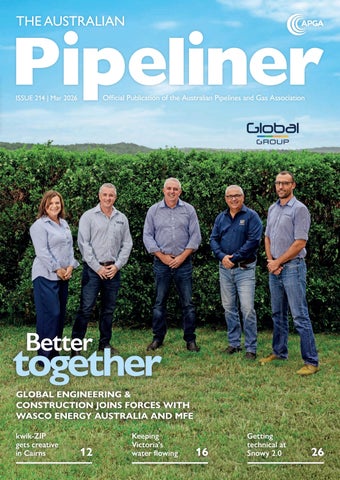
Global Engineering & Construction has acquired Wasco Energy Australia and MFE, and launched into the market as a new group.
Last year was a turning point for the gas industry in Australia. In the throes of the energy transition, the gas industry was placed firmly at the centre of the conversation, overcoming resistance in Canberra and indeed among the public. Policy changed, and so did perception of the industry: without gas, the energy transition will stumble and fall. Now in 2026, it’s mostly full steam ahead. From exploration drilling to new infrastructure development, there’s much in the pipeline, so to speak.
Global Engineering & Construction (GEC) CEO Chris Williams and his team have been quietly making moves to strengthen the company during this time, increasing its capability in key growth areas such as the Surat, Cooper and Beetaloo Basins. In 2025, GEC established Global Electrical and Instrumentation (GEI), which created an inhouse electrical division. GEC’s growth strategy then turned outwards, and after approaching over 80 businesses throughout 2025, GEC has pulled the trigger on two key acquisitions: Wasco Energy Australia and MFE.
Wasco will no doubt be familiar to many in the industry. The company provides engineering, procurement and construction services as well as operator and maintenance services. It is active all over Australia in a range of industries, including oil and gas, mining, and renewables.
“GEC and Wasco are both heavily involved
in pipelines, but what we don’t do at GEC is a lot of gas compression,” Chris Williams told The Australian Pipeliner.
“Wasco is the go-to group in Australia for gas compression install, construct and maintenance, which will allow us to greatly expand our offering to our clients.”
Due to partial overseas ownership, which has now been bought out, the Wasco Energy Australia brand will have to be renamed later this year.
“We’ll be changing the name to Global Energy Australia,” Williams said.
“It’s the same business that people know and love, just with a different name and now 100 per cent Australian ownership.”
GEC’s other acquisition, MFE, is a Chinchilla-based fabrication and maintenance business that is heavily involved in the Surat Basin and other parts of Queensland.
The family-owned business has 75 employees and two locations within the Basin, which allow it to quickly mobilise for urgent work.
“GEC do a little work in the Surat Basin in Queensland, but strategically, we wanted more of a presence there,” Williams said.
“MFE has commercial relationships in that part of the country with the likes of Shell, Origin, Arrow and more.
“GEC has a strong relationship with Santos, which predominantly operates in the north-west area of the Surat basin. We see some opportunity for MFE, partnered with
GEC, to expand out into the west in support of Santos and other operators.”
With the new acquisitions, Williams and his team are officially launching The Global Group, the new parent of GEC, GEI, MFE and GEA (Wasco Energy Australia).
“We’re not just growing to be bigger; we’re growing to be better. Each business complements one another, expanding our scope and service offerings,” he said.
“To put it simply, it means we as a group can do the pipeline, the fabrication, the electrical, the compression, and more. We’ve got it all covered, essentially.
“Our clients will benefit from this straight away. With in-house expertise, we’re not relying on subcontractors, we have greater control over projects, can put better project controls in, and meet commercial targets more easily.
“There will also now be opportunity for employees in our businesses to crosspollinate between brands, expanding into new roles and growing professionally if they wish to do so.”
Williams said that MFE and Wasco Energy both stood out as complementary assets to GEC.
“These businesses share a very similar mindset to us,” Williams said.
“Mel Whyte [Wasco Australia’s MD] is very much about creating a legacy and


helping the people in his organisation put food on the table.
“And Louise and Greg McMahon who own MFE are very much the same. They are heavily involved in the community and look after their people. That was a big factor for us.”
While the new company structure will bring a wealth of opportunity, Williams said that customers can still expect to deal with familiar faces.

“You’ll be dealing with the same team, leadership, great safety statistics, and quality you’ve come to expect.”
Mel Whyte shared a similar sentiment.
“Both organisations share a similar approach to problem solving, customer service and caring for our people,” he said.
“Our aligned values and ways of working make the partnership a natural fit.”
And just like Williams, he’s excited for the future.
“We’re looking forward to collaborating with the teams at GEC, GEI and MFE to align our capabilities and pursue larger, more complex projects together. The partnership enables us to deliver broader, full scope solutions for our customers.”
Louise McMahon said incorporating MFE into The Global Group creates a more controlled, predictable,
and risk-managed delivery environment for clients.
“The acquisition strengthens GEC’s pipeline capabilities by improving supply chain control, reducing delivery risk, and integrating fabrication and technical services in remote and complex environments,” she said.
“At the same time, MFE gains greater scale, engineering depth, and access to larger pipeline opportunities, creating a mutually reinforcing platform for future growth and more resilient project delivery.
“Culturally, the teams are so well aligned. It was the most important factor in taking this step and it will be the reason we are so successful together. The people and values need no change, and our focus can be on process and outcomes knowing we have the team to execute, regardless of which part of the group is supporting our clients.”
What’s next?
If more evidence is needed to support the theory that GEC might secretly have a crystal ball to read the future, look to the Beetaloo Basin.
“Development in the Beetaloo Basin has been going on for a long time, but it’s really got some momentum behind it now,” Williams said.
“We’re seeing full final investment decisions, debt facilities, drilling campaigns and some really strong results in the region. Wasco Australia is the selected builder of a gas plant for Beetaloo Energy, which is about to commence.
“Off the back of that, there are feasibility studies happening for four cross country pipelines. Santos is commencing an appraisal program there this year, and Tamboran Resources has a drilling program underway. On top of that, the Northern Territory Government is right behind the region.
“I think it’s the next big thing in oil and gas.”
GEC has already secured some land in the Basin, central to the development hotspots and a highway.
“We’re building offices out there. Our intention is an in-field fabrication workshop with our own crew, allowing us to project our capabilities across the area with rapid response time. Wasco will also be using those yards to house a lot of their equipment between different phases of Beetaloo project.”
With a breadth of new capabilities, increased local presence, and an investment environment the healthiest it has been in years, the future is undoubtedly bright for the newly minted Global Group.
kwik-ZIP has demonstrated its flexibility on the Cairns water security project.
kwik-ZIP spacer systems help to facilitate the sliplining of pipelines.

Like many cities around Australia, the population of Cairns is growing – and utilities must keep pace. Copperlode Falls Dam is Cairns’ main drinking water supply, but it was built in 1976 when the population numbered just 58,000 people. The city’s population has tripled since then and is expected to hit over 240,000 by 2050. Against this backdrop the regional council launched the Cairns water security stage one project, aimed at securing ample drinking water supply for many years to come.
Stage one of the project involves the construction of a water intake at the Mulgrave River, near the Desmond Trannore Bridge in Gordonvale; a water treatment plant and water reservoirs on council land; and a network of pipes to take raw water to the treatment plant and treated water from the plant to residents.
At a glance, the water will move through the riverbank to the intake pumps being filtered through the sand and gravel as it goes. This type of intake is designed to minimise impacts to the environment. The water will then be piped from the river, along with water from the existing intake at Behana Creek, to the new water treatment plant where it will be treated and stored ready for drinking.
Australian company kwik-ZIP played an important role in the construction of the project by providing various models of pipeline spacers used on various sections. These spacer systems help to facilitate the slip-
lining of pipelines and protect carrier pipes from threats such as ground movement, corrosion, abrasion, and much more.
“It was a meaningful project for us to play a role in,” kwik-ZIP General Manager Paul Jeffreys told The Australian Pipeliner
Three different models of spacers were supplied to the project to suit the various requirements of several different crossings.
“When everything is up and running, the project will provide modern, integrated and long-term water security for the people of Cairns.
“The project had several different crossings with specific requirements, but with kwik-


ZIP’s range of models and availability of different runner heights, we were able to find and supply a solution for all project requirements. Three different models of spacers were supplied for the project.”
kwik-ZIP’s products are approved for use within many utilities’ infrastructure, including Melbourne Retail Water Association, South-East Queensland’s Infrastructure and Materials list, Sydney

Water, and the WA Water Corporation. All products are certified by the Australian Water Quality Centre for use in contact with drinking water.
Engineered from a high-performance thermoplastic blend, they are highly resilient and include integrated rubber grip pads to prevent slippage, eliminating the need for pipe pre-wrapping.
The modular design of these spacers can
also accommodate a wide range of pipe diameters.
Low friction and abrasion resistance is a staple of all kwik-ZIP spacers that allows for longer run lengths and lower insertion forces. This reduces the size of machinery needed for installation, saving energy, money, and valuable space on-site. Pair this with the fact that kwik-ZIP products are simple to install without the requirement of any special tools, and it’s easy to see why the company is a go-to choice for major infrastructure works like the Cairns water security project.
“Everyone deserves clean, secure water. We know just how important this project is for this growing region,” former Minister for the Environment and Water Tanya Plibersek said at the time of the project’s announcement.
“This isn’t just essential for the people who live in Cairns, but also for the industry who rely on the area. It’s good for Cairns, and good for Queensland.”
Once operational, the project is expected to provide approximately 6.4 gigalitres of extra water to the region each year, which is a quarter of Cairns’ current annual use. The $472 million project is jointly funded by the Australian and Queensland Governments and delivered in partnership with Cairns regional council. It is expected to be completed by mid-2026.


Austrack Equipment helping its customers move the dial on their water pipeline projects from good to great.
The Goldfields Water Supply Scheme in the late 1890s oversaw the building of a water pipeline from Perth to Kalgoorlie. On completion at 566km, it was the longest freshwater pipeline in the world.
Building water infrastructure more than a century ago was quite a different proposition than it is today. It was slower and more labour intensive. It was intrinsically more dangerous, and the bulk of the horsepower came literally from horses.
With the development in the meantime of the comprehensive range of heavy earthmoving and construction equipment that is now a feature of pipelining, one kind of horsepower has been exchanged for another. And supplying the yellow iron horsepower that is pipelining today is where Austrack Equipment comes into its own.
Austrack has not been around as long as the Goldfields Water Supply Scheme, but it has been around long enough to earn an enviable reputation as a major equipment supplier. It supplies the horsepower that builds the pipelines that carry the water that keep this great, big, thirsty country moving forward.
Austrack has been an equipment supplier on water pipelines all around Australia. In NSW, Austrack supplied equipment to the Dungowan pipeline and the Murray River to Broken Hill pipeline. In WA, Austrack machines had a significant role to play in the completion of the FMG Ironbridge project.
More recently, Austrack units have been busy on the Gladstone to Fitzroy River and the Haughton Duplication pipeline near Townsville in Queensland and has just commenced supplying equipment into a water project in South Australia.
Austrack matches industry-leading equipment with classic old-style service to provide customers with a premium experience.
“Set and forget is definitely not the Austrack approach,” Austrack Managing Director Michael Benson said.
“Having the quality and range of equipment is only half the battle. Back up service when it is on site is absolutely fundamental to what we do. Whether it is ensuring manufacturers’ service personnel are available or supplying our own fitters to become part of the project, as we regularly do, we know equipment back up service is a nonnegotiable part of our customer offer.”
Austrack is also gaining a reputation for customisation and innovation. Nowhere is this more evident than in the specialised equipment it has available for the construction of water pipelines.
The development of the SafeVac Lifting Systems™ range of vacuum pipe lifters is testament to that.
Developed at

Austrack’s Brisbane headquarters and proudly sporting the Australian Made logo, this excavator lifting attachment brings the lifting and placing of pipes to new levels of efficiency and safety. Built to conform to the European EN13155 Standard, its core ability is to lift and place pipes safely, quickly, and efficiently. In addition, the SafeVac Lifting Systems vacuum lifting attachment range has an array of data capture and data transmission features that are revolutionising pipe handling. By using vacuum as the lifting source, it has eliminated potential damage to the pipe by doing away with slinging. And while the pipe is protected from damage, pipe movements and in trench pipe placements are achieved more quickly and safely.
Similar efficiency benefits come from another Austrack machine, the customised EF450 Sand Hopper backfilling unit. The EF450 results in spectacular savings in manpower, machinery and sand wastage in water pipeline construction. Benson said the machine truly breaks new ground when it comes to precise trench backfilling. And when trench backfilling is being considered, Austrack has the answer to compaction requirements and ensuring pipe integrity.
Austrack can supply specially designed compaction haunchers

which guarantee even the most exacting compaction levels are achieved. The haunchers are customised excavator attachments connected to a vibe plate which straddles the laid pipe in a horseshoe configuration and achieves superior compaction where that is the requirement. For Austrack, it’s just one more cleverly designed attachment that moves the dial from good to great on water pipelines.
commitment to support contractors in the water pipeline business. Another part of our investment in servicing water infrastructure construction is our involvement in Ozwater, the national convention and exhibition of all things water.
“Last year for the first time we exhibited at Ozwater 25 in Adelaide, and we will be back this year for Ozwater 26 in Brisbane. We will be at stand B01 with some exciting new equipment on show and we will be delighted to welcome pipeliners there.”

“Our involvement in water projects is an important part of our business,” Benson said.
“Our in-house development and manufacture of our SafeVac vacuum lifting units and our customisation of machines like the EF450 and the compaction haunchers are a tangible statement of Austrack’s


welding equipment for installation to fittings and couplings for maintenance.
Benton’s supports the majority of water utilities across Victoria, along with a wide client base of contractors who are authorised to construct, repair and maintain these assets.
You don’t get this level of clientele by accident. Bentons has been supporting the water industry with premium-quality products, rapid turnaround, and expert service for the past 27 years. And Zel Kos, who manages Benton’s Plumbing Supplies’ Coburg North location, has been involved since the beginning.
His career with the company began 39 years ago, shortly before the plumbing business in Keilor East he was working for at the time was bought out by the Benton brothers, Michael, Wayne, Brian and Terry.
As Zel puts it, his journey started behind the trade counter. He’d help customers, man the shop, and sweep the floors. When the Benton’s Group of companies established its own water division in 1999, Benton’s Plumbing Supplies, he made the move to water asset supply and never looked back.
Now he has the sizeable role of managing the supply of equipment to the various water utilities in his remit.
“It’s an interesting role; you see bit of everything in this industry. Every day is different,” he told The Australian Pipeliner
“The majority of our work with the water utilities involves stocking their warehouses so
repair bands in 100–300mm diameter. We can also supply brass, copper, and polyethylene pipe if required by the customer.”
Benton’s supplies Hawle Synoflex couplings to the water industry, which Zel said are among the best on the market.

“Butt-welding is common in the water industry due to its simplicity,” Zel said.
“Benton’s supplies high-performance buttwelding equipment from a range of leading brands such as Fusion Plast.
“Because we hold accreditation from these manufacturers, we are able to offer expert servicing, ongoing support and spare parts to keep the machines running at their best.
“When the joining process is carried out properly, the welded sections become the strongest part of the pipe, ensuring the asset will perform reliably for its intended lifespan.”
The Benton’s Group of companies operate out of 16 locations across Victoria, with water asset support primarily handled from the Coburg North, Derrimut, Bendigo, Corio, and Leongatha sites, along with the new supply option opening in Lynbrook around Q3 2026.
The company also has its own transportation fleet to deliver equipment to its customers, giving it a significant degree of control over the entire process from tender to close-out.
“One of the great things about Benton’s is that out of all our 16 locations, no store operates solo. We lean on each other for support, delivery assistance, people power, and knowledge,” Zel said.
“The customer always stays at the forefront, regardless of which Bentons division you’re dealing with.”


Whether you’re testing open end pipe, systems terminating in long radius elbows, flange welds or isolating lines... count on the GripTight Family of Test & Isolation Plugs from Curtiss-Wright to perform above expectations, test after test.
Patented gripper designs, hardened components and single-body uninterrupted seals provide field performance that’s second to none. When safety and reliability matter most, plants around the world trust GripTight Plugs for their hydrostatic testing & pipe isolation needs!
Patented gripper designs for increased safety in high-pressure applications
Save time by eliminating welded end caps to test pipe spools & piping systems
Test flange-to-pipe welds without pressurizing entire systems
Isolate & monitor upstream pressure and vapors during hot work
Standard pressure ratings up to 15,000 PsiG (1034 BarG)
ASME PCC-2 Type I, III & IV Testing Devices available
Call, Click or Scan to Learn About Our Full Line of Test & Isolation Equipment


Pipeline Plant Hire (PPH) has been an active force in water infrastructure and gas supply projects for more than 30 years. Of recent, the supplier of plant machinery and construction services was a key presence on the Wentworth to Broken Hill Pipeline, the Gladstone LNG projects, Northern Network Alliance, BMA mine expansion in Emerald and the Southern Regional Water pipeline among several other high profile projects.
These accomplishments have helped it to forge a reputation synonymous with reliability, innovation and industry best practice on long-term projects that not only involve multiple stakeholders but demand adherence to the highest safety protocols.
Operationally, the business footprint scales nationwide. Many Tier 1 clients look to it as a premier partner that can deliver noticeable and repeatable efficiencies balanced with the immediate safety optimisation expected today on building pipeline infrastructure.
PPH offers comprehensive options across its equipment range. From excavators, loaders, graders, rock breakers, screening buckets — anything required on a pipeline construction project. The sum total of which now approaches over 200 pieces of machinery, not
to mention, custom-designed material handling solutions, such as coil handlers and scrap pipe cutters. The company holds more than 1000 attachments for hire, including hammers, buckets, grader blades, stick rakes and augers.
In recent years, enormous advances have taken place in pipeline assembly, and the business has also evolved to keep pace with them. One of which is VacLift, PPH’s own expertly manufactured and highly optimised vacuum lifts. These machines are designed and built to thoroughly exceed Australian safety standards according to PPH. As part of this mandate, the machines have been equipped with oversized vacuum supply systems. In the event of power failure, the valves will automatically deliver vacuum to the load, something of a decisive advantage in treatment, irrigation and distribution works.
Pipeline Plant Hire’s Director, Gerard O’Brien said vacuum pipe handling equipment creates distance between workers and the pipe itself, reducing the risk of injury and dramatically reducing the cycle time for each pipe movement.
“VacLift achieves three times the output of other pipeline lifting methods, giving the operator complete control of the pipe’s
movement,” he said. “Working with manufacturers, suppliers, and our customers, we continue to provide improvement and innovations wherever we can.”
Raising lengths of polyethylene or steel pipe weighing up to 15 tonnes, VacLift enables the assembly of pipes in-situ through use of a guidance system that makes the presence of ground crew unnecessary. Whereas traditional methods often require personnel to be closer in proximity to hazards when attaching and detaching the slings or hooks.
Productivity gains are also noteworthy. The machines have a cycle time under 40 seconds per pipe length, whereas conventional methods take 5–10 minutes. As part of its commitment to making pipe laying safer by an order of magnitude, the VacLift fleet also features an operational failsafe in the form of a boost reservoir system. Invested heavily in making piping laying safer by removing the need for on-ground personnel and slings from operation, PPH has designed a highly optimised, lightweight package featuring a unique shoe design. Pipe, as a result, cannot be released unless in contact with the ground, significantly reducing the risk of a drop, facilitating much faster and safer pipeline construction.


Water Corporation has announced a $10 million pipeline project in Western Australia.
Construction is set to begin on a 7.4km pipeline linking Sovereign Hill to Guilderton in the Shire of Gingin as part of a government initiative designed to safeguard local drinking water supplies from the effects of climate change.
Delivered by Water Corporation, the $10 million project will supplement Guilderton's drinking water with a more sustainable groundwater source near Sovereign Hill.
The current water supply relies heavily on shallow coastal aquifers that are not only increasingly saline but also vulnerable to the region’s decreasing rainfall patterns.
“By connecting Guilderton to more sustainable groundwater reserves further inland, this project will bolster supply reliability and may otherwise impact the community's ability grow and prosper,” Federal Minister for the Environment and Water Murray Watt said.
“The Albanese Government is pleased to partner with the Cook Government to invest in future-focused water infrastructure that helps regional communities stay resilient in the face of climate change and its impacts to drinking water.”
In addition to laying the pipeline itself, the project includes upgrades to treatment and control systems at both the Sovereign Hill and Guilderton ends of the network. These enhancements will improve system performance and reliability, ensuring residents and visitors alike can depend on a cleaner, more consistent supply of water.
Jointly funded by the Australian Government through the National Water Grid Fund, the project reflects collaboration between federal and state leaders committed

to building infrastructure that meets the challenges of a changing climate.
Construction is scheduled for completion in late 2026, marking a significant milestone in securing a sustainable water future for the Guilderton community.
"This project is a major step forward in strengthening the quality and reliability of
drinking water for the Guilderton community,” Western Australian Water Minister Don Punch said.
"The Cook Government is focused on delivering the infrastructure that regional communities need, and this partnership with the Australian Government shows how we're working together to make it happen."


The DataLogger 7 records all pertinent parameters during the fusion process, providing an added level of quality control and oversight to the project.

McElroy explains why welded HDPE is growing choice for water piping systems worldwide.
Water piping systems are critical to the world’s infrastructure. Today, those systems are being designed and installed with an eye for sustainability, reliability, and efficiency. Welded HDPE fits all three of those criteria.
When installed with a quality welding machine by a well-trained operator using an accepted standard, welded HDPE joints form a joint that is as strong – or stronger – than the surrounding pipe. Its proven record of reliability is clear in its allowable leakage rate of zero, compared to PVC and ductile iron allowable leakage rates of 10-20 per cent. HDPE’s corrosion resistance, immunity to biological growth, and strong chemical tolerance make it ideal for potable water, wastewater, and mining environments.
According to the Plastics Industry Pipe Association of Australia, the polyethylene pipe industry estimates HDPE pipe to be more than 100 years, providing a tremendous savings in maintenance, both in terms of time, repairs, and wasted water.
Plus, with thermoplastic pipe, installation methods go beyond traditional trenchdigging. Eliminating the need for a trench not only reduces the amount of manpower needed for installation – it also minimises the disruptions around the site, such as streets or waterways.
To compensate for the area’s population boom, the City of Gold Coast was recently able to complete a large-scale water recycling network, constructing two of the longest marine pipeline crossings of their kind in all of Australia. By 2050, the area is expected to double to 1.2 million people, meaning the existing infrastructure, installed in the 1980s, was nearing its capacity and needed an overhaul.
Engineers turned to HDPE for the solution. During the first stage of the project, a 1200mm diameter welded HDPE pipeline was pulled under the Nerang River bottom between Winchester Street and Waterways Drive. The pipeline is designed to handle increased volume of wastewater that, after treatment and reclamation, goes on to irrigate golf courses, parks, and more.
The city’s work is ongoing and expansive. According to the City of Gold Coast, plans are underway to connect new drinking water customers in areas that weren’t covered in the first phase of recycled water development. That includes the Gold Coast Botanic Gardens, the Gold Coast Turf Club, and Home of the Arts. In all, the city estimates they’ll be able to save up to 500,000 litres of drinking water per day. From start to finish, traceability and quality control are
cornerstones of the poly pipe welding process.
That’s where McElroy’s DataLogger® comes in. Data-logging equipment is an invaluable tool on any welding jobsite, but the DataLogger stands above the rest thanks to its rugged design, innovative features, and its ever-growing functionalities tailored to meet each jobsite’s needs.
The DataLogger captures and records all pertinent data related to each welded joint, including pressures, the standard being used, the joint’s GPS coordinates, and more. Whether you’re performing butt, sidewall, mitered, or dual-containment welding, the combination of the DataLogger software and ruggedized tablet is an invaluable tool for quality assurance and record-keeping in the field.
Functioning alongside the DataLogger is the Vault™, McElroy’s powerful cloud-based storage platform. When connected to the internet, the DataLogger allows users to upload their fusion data into the Vault, allowing for instant review and oversight, whether down the street or miles away. For engineers, managers, and inspectors, that means getting as granular as you want with the data that comes from each weld, with each machine, on each project.
Understanding and using the information provided by the DataLogger can significantly


improve the bottom line. The DataLogger gives you the tools to improve decisionmaking and overall jobsite performance in the field.
In the City of Gold Coast’s recycled water project, GEM Industrial owner Darren Chandler used a DataLogger to record each step of the fusion process. This lets operators know that the correct temperatures, pressures and heating/cooling times were following during the fusion. Chandler said GEM data
The latest innovations
In February 2026, McElroy officially rolled out two new DataLogger features to assist in identifying related welds in an assembly: Vault ID Tags and Fabrication Workflow.
Vault ID Tags are pre-coded, specially made labels containing QR codes that can be
associated with a specific weld. This allows someone to view the weld report just by scanning the QR code on the label attached to the pipe itself.
These labels are UV stable, water resistant, tear resistant, and fade resistant, with a polyethylene- and polypropylenerated adhesive. The process of assigning a Vault ID Tag is simple: after performing the fusion as normal with the DataLogger tablet, the operator will scan the label to associate it with the Vault record.
Once the information has been uploaded, the report can be viewed by anyone who scans the label with any device.
Even better: no custom app is required, and the open URL allows any device to access the joint report - even without a Vault account.
Fabrication Workflow is an extension of the standard DataLogger workflow to include additional data that relates different joints together. The features of the fabrication workflow were designed for the needs of prefabricated pipe manufacturers but can be used effectively for a number of situations where multiple welds need to be related to each other.


Pack Tuff bags are leaving their mark on Australia’s most significant water pipeline projects.
Water utilities and pipeline companies spare no expense when it comes to finding ways to reduce leakage from water networks. But sometimes it’s the little things – often overlooked – that can make a world of difference.
Pack Tuff bags from Pollards Sawdust Supplies fall comfortably in this bracket. For more than five decades, the company has transformed timber by-products into pipe bedding bags, known as Pack Tuff, that contractors rely on to support and protect vital pipeline infrastructure.

Hundreds of thousands of these bags have been utilised on pipeline projects across Australia. In the water industry, six pallets of Pack Tuff bags were recently shipped to the Alkimos seawater desalination project. This major infrastructure project will provide 50 billion clean, safe drinking water to millions of Western Australians each year. It includes the construction of two underground marine pipelines: an intake pipeline to take seawater into the plant, and an outflow pipeline to return the brine back into the ocean.
On the other side of the country, Pollards Sawdust Supplies provided roughly 30,000 bags for the $500 million Wentworth to Broken Hill pipeline in NSW. This 270km pipeline was built to transport 37.4 megalitres of raw water per day from the River Murray to
Broken Hill and surrounding communities, which had suffered significant water shortages for years.
In Queensland, Pollards supplied roughly 25,000 Pack Tuff bags to the Fitzroy to Gladstone water pipeline. This $983 million mega-project included the construction of a 117km-long pipeline, a water treatment plant, reservoirs and multiple pumping stations.
Down south, the company left its mark on Melbourne Water’s Yan Yean to Bald Hill pipeline, supplying its Pack Tuff bags which helped support the construction of the 20km water pipeline.
These are just a handful of recent projects. For a company that is nearing 60 years in business, its mark on the pipeline industry is hard to overstate.


Letting the best be their best Pack Tuff bags are manufactured using sustainably sourced, chemical-free virgin timber, kiln-dried or air-dried to precise standards. Pack Tuff’s polywoven bags are robust enough to withstand the rough conditions of pipeline construction sites, yet flexible enough under pressure to avoid dangerous ‘exploding’ under the weight of
heavy steel pipeline sections – even those weighing up to 15 tonnes.
Unlike rigid pipe bedding, like wood, the flexible bags are able to contour to challenging terrain. This helps create a stable base even where the ground is uneven or sloped.
One of the most significant advantages of Pack Tuff over traditional sandbags is its low weight. For pipeline crews working long hours
on remote sites, that means easier manual handling and a reduced risk of injury. It also means the cost of transportation remains low. In some cases, Pollards can even freight its Pack Tuff bags packaged with manufactured pipe, eliminating transport costs altogether. The company has such an arrangement with Steel Mains, where the pipe manufacturer will freight its product to site with Pack Tuff bags already on board.
The durability and reusability of Pack Tuff bags also make them an economical solution. Many contractors report being able to reuse them multiple times, even after harsh exposure during transit or construction, adding up to a lower longterm cost of ownership and less waste compared with one-use alternatives.

While pipeline bedding might not grab headlines like large-scale infrastructure upgrades, it is just as critical to the success of the overall project. For Pollards Sawdust Supplies, the company’s merits hardly need explanation. Pick any pipeline project around Australia and there’s a good chance it was built on Pack Tuff bags.


Michels Trenchless has installed water and other utility lines at the nation’s largest renewable energy project.
In 2025, Michels Trenchless performed three extremely complex horizontal directional drills (HDDs) for the Snowy 2.0 Pumped Hydro Project in New South Wales, Australia. Stretching from Lobs Hole to Marica, the HDDs are 2248m long. While this length is impressive, but not exceptional, for an HDD project, the difference in elevation measured 563m from the low side to the high side – a feat never previously accomplished by the industry.
In standard HDD profiles, elevation changes of about 50m between entry and exit locations are considered significant. Although the differential was considered too risky – and even impossible – by many in the industry, the Marica Road HDD was critical for the installation of electrical power, water, and fiber optic cables required to build and operate Snowy 2.0, the largest renewable energy project in Australia. With support from Michels Trenchless, it was determined that an HDD was the most effective approach to

and
The significant change in elevation also posed a challenge in maintaining the drilling fluid “mud” pressure and flow due to the natural effects of gravity when drilling uphill. Forces are reverted to the drilling equipment

due to gravity and friction from the dry bore hole. As fluid is pumped through the hole to lubricate and cool the drilling head and remove chipped rock and dirt that the drilling cutter head breaks up, the chipped rock and dirt are suspended in the liquid. This allows it to flow back out of the hole into the pit by the rig. For this elevation, maintaining the pressure and flow is difficult. To address these concerns, the project team installed a valve-closed rotary diverter on the lower entry side to direct the return flow cuttings and drilling fluids to a concrete containment pit where they are directed to a fluid separation plant for treatment.
Michels designed and fabricated two drill rigs, each with nearly 400 tonnes of push/pull force. Using the pilot hole intersect method wherein one rig drills from the entry side and

the other from the exit side, the drill rigs meet in the middle at a predetermined location along the alignment. The pilot hole intersect method was selected over a traditional one-rig pilot hole method for its unique advantages for the project, including fluid pressure management, reduced risk of inadvertent returns, and steerability through hard rock present at the park.
Kosciuszko National Park is known for its unique, scenic landscapes and recreational and heritage values. Strict restrictions and environmental mandates were placed on how the work could be performed. In accordance with these rules, both rigs were set up inside large, engineered concrete pits to keep the drilling fluids separated from the ground. A gyroscopic combined with a magnetic tracking system allowed the project team to keep drilling operations on the necessary alignment and minimise human interaction with the forest between the entry and exit areas. Crews laid out coil wire in the
straightest path to the centerline without removing vegetation.
The work site’s remote location posed logistical challenges to the transportation of parts and supplies, particularly specialised HDD tooling. Extensive planning was required to ensure all needed equipment, as well as any equipment or supplies that may be needed should unforeseen circumstances arise, was available on-site.
The project team collaborated with the project owner Snowy Hydro Limited and Future Generation Joint Venture to develop a safe, technically solid and constructable solution.
By developing executable plans to resolve extensive challenges without causing harm to individuals or the environment, the awardwinning Marica Road West HDD project broadens the potential use of HDD to build and expand energy pipeline infrastructure in circumstances that may be considered undesirable.

For more information, visit michels.us/michels-trenchless-pty-ltd/
PIPA is driving innovation in plastic pipe systems that keep water flowing, communities healthy, and environmental impact to a minimum.
Every drop of water counts, and as climate pressures intensify, every drop is under increasing strain. At the forefront of protecting this precious resource is the Plastics Industry Pipe Association of Australia (PIPA), championing plastic pipe systems that keep water flowing safely, efficiently, and sustainably.
“Plastic pipes are engineered to last over 100 years,” said Cindy Bray, Executive General Manager of PIPA Australia. “Their longevity isn’t just a technical advantage; it’s a critical safeguard for one of our most precious resources. Fewer leaks, lower failure rates, and reduced risk of contamination mean every drop reaches the communities that depend on it.”
According to PIPA, plastic pipes are built to withstand conditions that challenge many traditional materials.
They are designed for strength, flexibility, and stress resistance, making them well suited to resist corrosion, chemical attack, abrasion, and environmental extremes over many decades.
When maintenance is required, repairs are simpler, faster, and less disruptive, helping ensure communities continue to receive uninterrupted water supply.
“Durability is more than engineering; it’s a commitment to communities. Every pipe we install helps protect water and maintain trust in the systems people rely on every day,” Bray said.
The safety of drinking water is inseparable from the durability of the systems that deliver it. Bray said plastic pipes undergo rigorous testing to ensure they are suitable for drinking water applications, including certification under AS/NZS 4020:2018, which assesses materials in contact with potable water.
“This standard guarantees that water quality, taste, and odour remain unaffected. It gives communities confidence that the water flowing through plastic systems meets the highest health and safety standards. In an industry where contamination can have serious consequences, these measures are essential. Every pipeline, every connection, and every system is designed with public health in mind,” she said.
Environmental sustainability is another key benefit of plastic pipe systems. Lightweight, recyclable, and with a lower carbon footprint over their service life than many traditional alternatives, they help reduce the ecological impact of water infrastructure.
“Choosing plastic pipes isn’t just about operational performance; it’s a decision that supports sustainability. Across their lifetime, these systems consume less energy to transport, install, and maintain, and they can be recycled at end-of-life, supporting a lower-carbon water network. By selecting infrastructure that balances durability, safety, and environmental responsibility, we can protect communities while caring for the planet,” said Bray.
Bray said water scarcity is a growing global challenge, and every decision in infrastructure carries weight. She said droughts, shifting rainfall patterns, and aging networks place increasing pressure on water delivery systems.
“By adopting safe, durable, and environmentally responsible plastic pipes, we ensure more water remains in supply, interventions are minimised, and communities maintain uninterrupted access to safe drinking water,” Bray said.
Plastic pipes reduce water loss, strengthen network reliability and reinforce public confidence in essential infrastructure.
“Protecting water requires smart material choices, strong standards and collaboration across the industry,” she said.
That’s why pipeline operators, regulators, and communities must work together to plan, design, and maintain systems that safeguard both the resource and the people who depend on it.
“Each plastic pipe installed is more than a technical choice. It is a promise to safeguard our most precious resource, ensure reliable access for communities, and minimise environmental impact wherever possible,” Bray said.
“Water is not just a commodity – it is life itself, and delivering it safely is a responsibility we must take seriously.”


WE CAN DO THIS THE EASY WAY, OR WE CAN DO THIS THE EASY WAY.

Need a pipe handling system to make your job faster, safer and easier? At Pipeline Plant Hire we have two flexible solutions ready to go. Hire and attach a PL1500 to your machine, or hire a fully-equipped VL machine as an efficient, all-in-one solution. All our vacuum lifter are capable of safely lifting 15 tonne. Our PL1500 integrates seamlessly with your host excavator using the main controls and hydraulics to operate the vacuum lifter. This system makes your life easier, more productive, and the whole site safer. Talk to us about a solution today.
Elaflex expansion joints have been used on some of the most significant water projects around the world, and for good reason.
Agreat deal of water is lost to the ground due to damaged pipe. Imperfect joins or cracks in the pipe caused by ground movement are risks which the pipeline industry is always trying to minimise. To combat this, manufacturing and installation standards have increased dramatically, with some areas getting more attention than others.
The point at which a pipeline connects to a facility via an expansion joint is only a small link in the chain, but it is arguably one of the most complex. Here, ground movement and vibrations, if not properly accounted for, could rip the pipeline from the connection point, damaging both the facility, the carrier, and the surrounding environment.
Elaflex expansion joints have been eliminating this risk for about 50 years. The company’s expansion joints have been used through Europe, Africa, and Asia-Pacific on major projects like desalination plants, water and wastewater facilities, power plants, and mining mills. In Australia, these expansion joints have been used on power plants in cooling water circuits and flue gas ducts, and on notable copper and zinc mills, in addition to countless water and wastewater networks over the years.
You don’t earn that kind of scale and longevity as a business without having a premium-quality product that delivers. One of the secrets to Elaflex’s success is its relationship with partner company, Ditec, a German manufacturer of bespoke, hand-made expansion joints. These joints range from one metre all the way up to five metres in diameter for a wide range of applications. Elaflex can supply smaller diameter expansion joints with its own standard range down to one inch.
Ditec is one of the few manufacturers in the world that can make expansion joints for round, rectangular and oval pipe for high pressure applications. The German manufacturer’s approach to its craft is extremely rigorous, with each joint hand-made for complete control over quality and specifications.
“We have supplied expansion joints to water and energy projects all over the world,” Elaflex Pacific Sales Manager Mario Iglic told The Australian Pipeliner.
“You can be sure that when you’re going to Elaflex and Ditec, you’re dealing with high quality and reliable equipment.”
The premium quality of these joints is key to keeping total cost of ownership low. Their effectiveness significantly reduces risks to the
pipeline from axial movement, temperature changes, noise and vibrations. Ditec can also fabricate UV shields to protect joints in direct sunlight – perfect for harsh outback conditions in Australia. Additionally, the expansion joints


can compress very well, which also makes maintenance much simpler. Rather than having to cut and remove sections of pipe, workers are able to easily work around the expansion joints to get into the piping.
It’s this combination of proven quality, costeffectiveness, and convenience that makes Elaflex’s expansion joints a premier choice for pipeline operations around the world.
This year, Elaflex will attend Ozwater for the first time. With the company being prominent in the Australian oil and gas industry for many years, Iglic said attending the event signals its clear intention to take on larger projects in Australia's water industry.
“We’re looking forward to attending Ozwater’26 and we have an interesting stand lined up for people to come and take a look at some of our products, like our Ditec expansion joints,” he said.
“If you’re attending Ozwater and work in the water industry, consider stopping by the Elaflex stand to see how we can help with your pipeline project.”


For nearly 60 years, Pollards Sawdust Supplies has been the trusted name in pipeline support. From the $983 million Fitzroy to Gladstone mega-project to the Alkimos desalination intake pipeline, Australia’s most significant water infrastructure relies on Pack Tuff to protect vital assets.
Our pipeline bedding Pack Tuff bags are:


Proven: Trusted on thousands of kilometers of Australian pipelines.
High Performance: Won’t burst under extreme pressure.
Sustainable: Made from chemical-free, sustainably sourced virgin timber.
Efficient: Up to 80% lighter than equivalent sandbags.
Versatile: 3 sizes to suit all pipe diameters.
Contact us for more information about our products, request a free sample for
or place an order.


Pipe Tek Managing Director Myles Brannelly explains some of the common pitfalls when preparing a pipeline for inspection.
Accurate inline inspection (ILI) data is the cornerstone of any effective integrity management program, but even the most advanced inspection tools can deliver poor results if the pipeline isn’t properly prepared. Inadequate preparation can lead to unreliable data, costly reruns and unplanned delays which, according to one of Australia’s leaders in the space, are avoidable outcomes.
Pipe Tek is recognised as one of Australia's leading turnkey pipeline integrity contractors, delivering cleaning, testing and inspection services. As the exclusive partner of Enduro Pipeline Services in Australia, Pipe Tek has direct access to Enduro's advanced ILI technology and products.
While the access to Enduro's ILI systems and experience gives Pipe Tek an edge, Brannelly said that the success of any inspection program is determined before the tool enters a pipeline, starting with thorough cleaning and preparation.
One of the most obvious indicators that a pipeline isn't ready for ILI is the volume of debris returned during pigging runs. If large amounts of wax, scale, sediment or compressible debris continue to come out with each pass, the line is still far from clean.
“A properly prepared pipeline should be recovering less debris after each run,” he said.
“If the amount of debris isn’t getting smaller then more cleaning is required.”
Magnetic Flux Leakage (MFL) tools, like Enduro’s DfL-UHR which Pipe Tek has in its arsenal for advanced ILI projects, rely on stable magnetic fields to detect corrosion and metal loss. The continued presence of ferrous debris can interfere with those magnetic fields, generating signal noise or masking genuine anomalies. Brannelly said if magnetic cleaning tools are repeatedly collecting metal fragments then it is a clear sign the pipeline requires further conditioning before starting inspection.
Inspection tools must also operate within a defined speed range to collect accurate and complete data. Inconsistent speeds during cleaning runs usually indicate internal restrictions, heavy contamination or unstable flow conditions.
“If cleaning pigs can't travel smoothly, an ILI tool is unlikely to perform optimally,” said Brannelly.
“Consistent speed during preparation runs is one of the strongest indicators of inspection readiness.”
often a result of partial blockages or debris in front of the tool. These conditions not only increase operational risk but can also affect tool performance and data resolution.
inspection runs provides valuable insight into the true internal condition of the line.
Brannelly said in any form of data gathering, uncertainty is a red flag.
“Older pipelines, rarely pigged assets, or alignments which have been rehabilitated or reconstructed might contain things the operator isn’t aware of,” he said.
“This can include unknown deposits like scale, corrosion products, water pockets or compacted solids. If we don’t know what’s inside the pipeline, a conservative and methodical cleaning program is essential before committing to ILI.”
According to Brannelly, a common misstep is assuming a single cleaning run will be enough to properly clean the pipeline. Pipe Tek’s preparation for ILI typically involves multiple cleaning passes designed to progressively reduce the amount of debris and stabilise conditions inside the pipeline.
“Skipping this step may save time upfront, but it often results in compromised data and the contractor will most likely need to reclean the pipeline, which can blow the budget of the project,” said Brannelly.
best at what we do. When speaking with asset

that was the root cause of the issues. There are already so many variables at play when working on pipelines. At the end of the day taking the time to meticulously clean a pipeline is going to give us the best chance of success at each step of the inspection process.”
Brannelly said the partnership with Enduro allows Pipe Tek to combine its local expertise with globally proven ILI technology.
“We believe this integrated approach ensures the pipelines we’re working on are not only inspected with the best tools on the market, but properly prepared leveraging our team’s knowledge and experience in local conditions to maximise the collection of accurate data on the first run,” he said.
“By following these steps and taking the time to confirm if a pipeline is ready, the ILI will deliver higher-quality data, reduce the likelihood of reruns, improve the detection of anomalies and significantly increase the overall chances of the project being successful.
“When it comes to ILI, at Pipe Tek, preparation isn't an optional extra, it's the foundation of success.”


Bridger Photonics is using its Gas Mapping LiDAR system to help offshore oil and gas operators measure their emissions.

Offshore oil and gas assets have long been one of the most challenging environments for methane measurement. Platforms are remote, access is costly, weather windows are limited, and traditional inspection-based methods often deliver incomplete data while increasing safety risk.
As regulatory and reporting expectations evolve, methane measurement is no longer just about finding leaks; it’s also about monitoring, reporting, and verification (MRV). Operators increasingly require quantitative, comparable data that informs credible emissions inventories and enterprisewide reporting to guide mitigation planning across all asset types, including offshore.
This is where Bridger Photonics is closing a critical gap. Building on its successful aerial LiDAR technology, Bridger has extended its Gas Mapping LiDAR® (GML) system beyond crewed aircraft to unmanned aerial vehicle
(UAV) based deployments designed specifically for offshore and complex industrial sites. The approach delivers both source-level precision and full facility emissions totals, without the access, safety, or coverage constraints that have historically limited offshore methane monitoring.
Traditional offshore methane monitoring relies heavily on personnel access and episodic inspections. These methods are costly and struggle with complex infrastructure layouts and line-of-sight challenges, creating gaps in emissions inventories.
Aerial LiDAR addresses these limitations by applying laser-based remote sensing and advanced analytics to directly quantify methane emissions with minimal additional time required from persons on board (PoB).
Using airborne deployment, Bridger’s LiDAR
system emits eye-safe laser pulses at wavelengths absorbed by methane, measuring differential absorption to calculate methane concentrations along the flight path.
These measurements are processed using proprietary algorithms that account for atmospheric conditions and flight geometry, producing high-resolution, geospatially referenced emissions data. The result is a consistent measurement methodology that supports emissions inventories, temporal analysis, and independent verification.
Bridger’s aerial LiDAR deployment for offshore enables close-range, high-resolution scans around dense infrastructure while maintaining the same spectroscopic detection and quantification methods trusted in onshore aerial scans.


• Flux curtain system (FCS): Uses coordinated dual-UAV flights to quantify total facility methane emissions by measuring downwind flux
Used together, these methods provide both granular source attribution and facility-scale totals from a single deployment, producing data suitable for OGMP 2.0 Level 4 and Level 5 reporting, inventory baselining and reduction tracking, and LDAR optimisation and benchmarking. These UAV-based deployments are also used for methane detection and measurement across other types of complex facilities, such as LNG terminals.
Offshore platforms and LNG facilities concentrate large volumes of equipment into compact, multi-layered layouts, making methane detection using traditional groundbased approaches difficult.
UAV-based GML is engineered for this complexity. High-resolution plume imagery captured at the time of flight overlays methane plumes directly on site imagery, with pinpoint source localisation to within
The value of offshore aerial LiDAR extends beyond emissions reporting.
Quantified emission rates allow operators to prioritise issues by impact rather than treating all detections equally. Highemitting or persistent sources can be addressed first, while consistently lowemitting assets may require less frequent inspection, improving LDAR efficiency and shortening detect-to-repair cycles.
Over time, comparable datasets support root-cause analysis by linking emissions to equipment classes, operating conditions, or maintenance practices. Time-series analysis further reveals trends tied to operations or seasonal factors, enabling earlier intervention and preventative action.
At scale, this transforms methane management from reactive compliance into a continuous, intelligence-driven process grounded in measured data.
As Australia’s offshore gas sector faces increasing scrutiny around methane performance, credible measurement is

Australian-owned Inductabend has completed a major upgrade program that has significantly boosted its bending capabilities.

Whether it’s an offshore oil and gas rig or a production field in remote Australia, gas operations need pipelines, and pipelines need bends.
One option is to source bends from massproducing overseas markets, but these often have hidden costs in the form of lead time, quality assurance, and after sales support.
That’s why the biggest names in oil and gas go to Inductabend.
Using advanced heat-induction machinery to bend pipe into various configurations, the company creates custom bends that preserve the structural integrity of the original pipe material and meet stringent standards required for high-pressure gas or other industrial pipelines.
Whatever the shape – whether a tight turn, large radius curve, or even helical bend –Inductabend has the skill to deliver. The bends are used both onshore and offshore for everything from gas gathering networks to small-scale maintenance works.
And best of all, these induction bends are all made and delivered from Australian soil.
Inductabend recently completed the final stage of a three-part upgrade program, adding
considerable capabilities to its bending portfolio.
The first phase of the project saw a wiring and PLC upgrade to its Cojafex bending machine, which provides greater process control. Phase two built on this, adding in a state-of-the-art dual frequency induction heater, which provides more options to tailor the process depending on wall thickness, diameter and material grade while improving energy efficiency and heating capacity.
Finally, the newly completed phase three replaced the traditionally fixed bending arm with a dynamic upgrade.
“The upgraded arm has removed the transition zone at the start and stop of the bend, which is typically the weakest part,” Inductabend Business Development Manager Nathan Crouch told The Australian Pipeliner
“This marks a significant capability improvement, enabling us to produce higher grade bends with larger wall thickness and homogeneous material properties.”
This new bending technology was utilised for the first time on an underground gas storage facility in Victoria, which required bends in lengths of DN300 X60 pipe.
It was used more recently on a large order of DN200 seamless duplex pipe, which are
bound for an offshore oil and gas rig in the Bass Strait for a global producer. Inductabend also delivered DN750 X60 28m radius bends for a transmission pipeline in New Zealand.
“Our customers appreciate the consistency we provide,” Crouch said. “They get their high-quality bends quickly and economically,
In any induction bending service, a test bend – called a qualification bend – must be made from the mother pipe intended for use. Samples are then cut from this bend and rigorously tested to ensure it is fit for purpose. The strict quality standards associated with gas pipes mean this can be an arduous and expensive process – but Inductabend can remove this step altogether with its pre-
“We stock a range of X52 PSL2 pipe which we purchase a full run at a time so each pipe
“This way, we can qualify the pipe by making one qualification bend for an entire batch. Inductabend performs and pays for the qualification up front, and then any customer is free to utilise that pipe to make bends customised to their specific project needs.”
This initiative drastically lowers cost and lead-times for pipe bends. Inductabend currently holds pre-qualified stock of standard X52 PSL2 HFW pipe in diameter nominals 100, 150, 200 and 300, suitable for 5D–10D radii bends. Clients can request to add other pipe sizes be carried by Inductabend to suit their pipelines too.
This helps oil and gas companies to make rapid changes to their networks, at a rate which overseas imports would struggle to match.
“The large companies we work with operate in a dynamic environment where they regularly add new assets to their networks and perform maintenance,” Crouch said.
“Our pre-qualified program allows them to undertake these activities without any compromise to the optimal alignment and quality. They simply let us know the geometry of the bends they require and we make the bends to their tailored quality assurance requirements all within a couple of weeks.”


Michels in Motion: Between March 2023 and February 2025, Michels completed 3 record-breaking HDDs in New South Wales. The 2,250-metre HDDs included elevation changes of 590 metres.

STATS Group discusses a major pipeline isolation project in North America.
As urban growth continues to encroach on once-remote pipeline corridors, operators are being compelled to reassess ageing infrastructure in accordance with new regulation. A recent example of this comes from the US, where updated federal regulation imposed tighter integrity management measures, including stricter requirements for material traceability, periodic reassessment and the reconfirmation of maximum allowable operating pressure (MAOP) on older, previously untested pipelines.
For a major North American energy operator, these regulatory developments coincided with significant demographic change. Two parallel 36-inch natural gas transmission lines, constructed in 1961 and
designated Line A and Line B, had long operated in areas that were originally sparsely populated. Decades of residential and commercial expansion altered class location designations, triggering regulatory obligations to remediate the pipelines. In response, the operator committed to replacing a two-mile section of Line B and conducting a MAOP hydrotest on Line A. All works were executed while maintaining gas supply to surrounding communities.
The first phase focused on replacing sections of Line B. To facilitate safe removal and installation works, the pipeline had to be isolated at two locations, referred to as North and South. This required controlled breaking of containment while the system remained
live. STATS Group deployed two 36-inch BISEP double block and bleed line stop tools at each site, each incorporating a 30-inch integral bypass. This arrangement enabled product flow to continue during the remediation process.
Preparation began with excavation at both locations, followed by welding two 36-inch hot tap fittings onto the pipeline at each site. STATS installed double block and bleed slab valves onto these fittings and used its SureTap® hot tap drilling machines to cut into the pressurised line, retrieving the pipe sections removed during drilling. Once the slab valves were closed and the hot tap equipment depressurised and removed, full-bore access was established. Four BISEPs, two at each


location, were then installed. A temporary 30-inch bypass was connected between the BISEPs at both North and South points. With the slab valves reopened, gas was diverted through the bypass lines.
The BISEP provides a fail-safe isolation as the seals are activated and maintained by two independent mechanisms; hydraulic activation and pressure differential across the seals provided by the pipeline pressure. The differential pressure maintains self-energisation of the seals ensuring isolation integrity independent of the hydraulic control circuit. With isolation completed at both North and South points, the section of Line B between the BISEPs was cut out and removed. The new two-mile pipeline segment was installed and tied in, followed by leak testing. Commissioning activities included packing, purging, filling and pressure equalisation. Once operational readiness was confirmed,
the BISEPs were unset and withdrawn into their launchers, restoring gas flow through the new Line B. Slab valves were closed, and the temporary bypasses and removed pipeline sections were depressurised and purged.
The second phase of the project was to isolate a large section of pipeline A to enable a MAOP hydrotest to be conducted. 36-inch hot tap fittings were welded onto Line A at the same North and South locations. A slab valve was installed, and the SureTap system was again used to drill into the live pipeline and retrieve the coupons. The outer BISEPs previously used on Line B were transferred and installed on Line A via the new fittings. Temporary 30-inch bypass lines were then connected between the BISEPs on Line A and those on the original Line B. This configuration redirected gas flow through the older Line B while isolating the targeted section of Line A.

Hydrotesting took place, allowing the pipeline to comply with updated federal regulation. Afterwards, Line A was reconnected, filled and repressurized. The slab valves were closed and the bypasses and old line B were depressurised and removed.
The project achieved several key results:
• Full compliance with updated regulation
• Successful replacement of an aging 36inch pipeline segment
• Zero supply disruptions to residential, commercial, or industrial customers
• Minimal environmental impact due to reduced venting
• Enhanced system reliability and safety “STATS Group are proud to support major North American operators to safely and efficiently achieve their upgrade projects, including hydrotesting to meet MAOP regulation for older, previously untested pipelines,” STATS President USA Jamie Frederick said.
“Our industry leading hot tapping and leak-tight double block and bleed BISEP line stopping equipment can safely and efficiently isolate aging pipelines without disrupting product flow”.
This project illustrates how established isolation systems and disciplined engineering can reconcile regulatory compliance with operational continuity. As federal standards continue to evolve in response to changing land use and ageing assets, such approaches provide a practical pathway for modernising legacy infrastructure while safeguarding energy supply.

As Australia expands its transmission pipeline network, the equipment used to deliver these large and complex projects must keep pace. Longer bores, environmentally sensitive alignments and stricter sustainability requirements are now common challenges across gas and energy infrastructure work. Vermeer has responded to these needs with the D550 Horizontal Directional Drill, a new generation maxi rig designed to support large scale pipeline installations with improved power, efficiency and control.
The world is facing increased pressure on gas supply and Australia is no exception. This has accelerated the push for upgrades to
existing networks and the construction of new long distance corridors. Many of these projects require excavation across significant distances, which traditionally results in substantial disturbance to the surrounding environment. HDD is an increasingly preferred method for these installations and the D550 has been developed to provide a more sustainable and productive solution.
With 100,000 foot pounds of torque, a 10.2 centimetre fluid course through the head shaft and mud swivel that allows up to 1000 gallons per minute of drilling fluid at low pressure, the D550 leads the 550,000 pound drill class. It offers steady, ultra slow rotational control for hard rock and higher rotation speeds for

clay conditions, giving contractors a versatile tool for complex geotechnical environments.
The D550 brings microtunnelling like consistency to large diameter HDD work. Crews can install gas and oil pipelines, water infrastructure and high voltage electrical lines over long distances with improved efficiency and reduced surface disruption. Its hydraulic circuit delivers peak torque at high rotational speeds while maintaining low system pressure, helping extend component life and reducing maintenance related interruptions. With a sound power level of only 111 dB(A), the machine operates quietly enough to comply with urban noise requirements, reducing the need for additional barriers on residential or citybased sites.
Operationally, the D550 offers three auto drilling modes that help maintain consistent rotation, thrust and speed. Its onboard telematics system provides access to diagnostics and performance information for operators and service technicians. The drill also features ultra slow speed thrust control technology that allows precise regulation of weight on bit, supporting optimal cutting action and improved tooling life during long bores. As large transmission pipeline projects continue to grow across Australia, contractors require equipment that allows them to deliver projects efficiently while minimising environmental disturbance. The D550 provides this balance through a combination of power, control and sustainability focused design.

Whether you choose electrofusion or butt welding, the key is simple: follow industry best practice. Because when every weld is done right, the whole system works better, for longer.

APGA Head of Policy Catriona Rafael shares insights on regulatory challenges facing the pipeline industry.
In January, Australia’s Energy Ministers put forward a bold proposal: to allow AEMO to directly and permanently intervene and invest in gas infrastructure through the LongTerm Reliability and Supply Adequacy Tool (LT RSA). This was in response to AEMO modelling that forecast gas supply shortfalls by the end of this decade, and, they argue, an alleged lack of investment appetite from the gas industry.
This represents a fundamental misreading of the investment landscape. The gas infrastructure industry stands ready to respond to market signals to invest. The problem is those signals have been disrupted by a regulatory environment that could at best be described as unstable.
Consultation on the LT RSA on 13 February, with APGA’s rebuttal a comprehensive slalom through the nuances of the proposal.
choking gas infrastructure investment
Over the past decade, Australia's gas pipeline sector has weathered an unprecedented wave of intervention. Economic regulation has been repeatedly amended, pipeline access regimes overhauled, transparency requirements expanded, and price caps imposed on producers.
While each intervention has steadily chipped away at investment confidence, the Form of Regulation Review (FoRR) powers introduced in 2023 represented a step-change in regulatory risk. Now, the Australian Energy Regulator can self-initiate reviews of any non-scheme pipeline at any time, without complaint, ministerial referral, or requirement to demonstrate material concern.
For long-lived infrastructure investments like pipelines, this regulatory uncertainty is unwelcome ballast. Investors must now assume their pipeline could be reclassified immediately after commissioning, potentially impairing capital recovery. The result is predictable: higher risk premiums, increased cost of capital, and reduced appetite for investment.
Market response despite the headwinds
Contrary to claims that the market has failed to respond, APGA members have delivered substantial new infrastructure despite these regulatory headwinds. Recent completions include the East Coast Gas Grid Expansion Stages 1-3, the Northern Goldfields Interconnect, Heytesbury Underground Gas

Storage Project Stage 1, the Sturt Plateau Pipeline, and the Eastern Gas Pipeline reversal. The Port Kembla Energy Terminal and Moomba to Sydney Ethane Pipeline conversion are well advanced.
Meanwhile, the Hunter Gas Pipeline, East Coast Grid Expansion Project Stages 3-5, Golden Beach Energy Storage Project, and multiple LNG import terminals are progressing through various development stages. These represent billions in private investment – hardly evidence of market failure. The fact that they have progressed in spite of the considerable costs involved in navigating regulatory uncertainty demonstrates that the gas infrastructure industry is ready to invest.
Rather than providing a last-resort ski-ramp for critical investment, the proposed LT RSA tool will further distort investment signals and crowd out market-led proposals. Its mere existence will materially alter commercial behaviour in predictable ways.
First, shippers may delay or weaken foundation contracts in anticipation of AEMO support that could enhance their commercial position. Why commit to a 15year foundation contract when AEMO backing might deliver larger infrastructure with lower unit costs, or shorter contract terms with reduced demand risk?
Second, competing projects could both proceed with AEMO backing, undermining the natural selection process inherent in
genuine market-led developments. This creates a real risk of inefficient over-investment, with consumers ultimately paying for redundant infrastructure.
Third, revenue forecasting becomes more complex and uncertain when government intervention can validate competing projects that might otherwise not proceed. This increases the cost of capital and reduces FID likelihood – exactly the opposite of the intended effect.
The cost of getting it wrong
Australia's gas infrastructure has been built through private investment responding to market signals – a model that has delivered world-class reliability at competitive cost. Abandoning this approach in favour of government-directed investment risks misallocated capital, inefficient outcomes, and higher costs for consumers.
The solution to Australia's infrastructure challenges lies not in more regulation, but in regulatory reform that restores investor confidence. Addressing barriers like the Form of Regulation Review would deliver infrastructure faster and at lower cost than any government intervention tool. And the upcoming Gas Market Review recommendations, particularly around domestic gas reservation, will offer the supply certainty that underpins longterm contracting.
It's time to step back from the regulatory ravine and rediscover the market-led approach that built Australia's gas infrastructure in the first place.


Jemena reflects on the past and contemplates the future of one of Australia’s most significant pipelines.
The year 2000. The new millennium had arrived and after endless worry about the Y2K bug corrupting software and leading to global turmoil the new century began with a promise of exciting times to come.
Sydney was preparing to burst onto the world stage as the Olympic host, the Nokia 3310 was considered cutting edge technology, because it could store 50 messages and featured games like Snake, and ‘I'm Outta Love’ by Anastacia was the top charting song in Australia.
The year was also significant in Australian pipeline history because it marked the commissioning of Jemena’s Eastern Gas Pipeline, a critical natural gas artery linking the gas fields of Victoria’s Gippsland Basin with the major gas markets of NSW and the ACT.
The EGP is a feat of engineering and tenacity with numerous technical challenges having to be overcome during its construction as the 797km pipeline weaved its way across the Great Dividing Range, and vast tracts of private land.
Some of the people who worked on the ambitious project still work with Jemena today and they recently gathered to celebrate the EGP turning 25 and to remember the huge part it played in their own lives.
For Technical Officer Steven Bonnici, it’s
the people who made the EGP project special.
“The largest impact this pipeline has personally [had on me] is actually the friendships that I have made over the last 25 years,” he said.
Pipeline Operator John Puljak recalled the hard work required to build the EGP and reveals it wasn’t for the faint hearted.
“We had to trudge through the bush to get this job done. Nowhere to be seen, no roads, but we had a good team. Our objective was to get the job done and we made sure we delivered,” he said.
Field Manager Greg Donald joined the company a year after the EGP was commissioned and added: “I love some of the stories that I heard when I was coming into the business. One that stands out is around the challenges of all the different landowners and native title, the conversations and the learnings that we took [from that process].
“It’s 800km of cross-country pipeline, it traverses some really amazing areas,” he said, noting the EGP operates almost unseen alongside the communities it serves.
“Teamwork was central to the success of the EGP over the last 25 years. It takes a village. It's taken a lot of people to operate, maintain and manage the EGP over the last 25 years. So many people come and go, and come and stay, and it just takes so many people and so
much energy. We’ve had some amazingly robust conversations over the time that sets the direction or the way that we go about whatever the task, whatever the opportunity or challenge.”
Gas Distribution Manager, Besim Geusher, said the team built great relationships that have lasted the quarter of a century to today.
Seeing people from the EGP’s past and present at the 25th celebration also provided staff a glimpse of the EGP’s future.
“Soon we will have the reverse flow happening on the EGP; we have the Victorian gas coming up to New South Wales and we will have the New South Wales gas heading down to Victoria. I think the future is great, the pipeline will be here for a long time to come,” Geusher said.
He’s referring to the next exciting phase in the life of the EGP which will see the pipeline become bi-directional so that it can deliver new gas to both the Victorian and New South Wales markets.
A bidirectional EGP will initially be able to deliver up to 200TJ/d of new gas into Victoria from Squadron’s newly constructed Port Kembla Energy Terminal to supplement gas that is currently supplied by Bass Strait and Orbost. Depending on market needs, with future augmentation Jemena can increase the capacity to around 320TJ/d.

Pipelines Business Development Manager Andrew Zancanaro said the EGPs new bidirectional capabilities are just one example of how the EGP can bring greater flexibility (and with it, system resilience) to the market.
“We see a future where the EGP is enabling even greater volumes of gas to flow from north to south and are looking at options to boost compression today, to make this a reality tomorrow.
“We also know that the EGP can store a lot of energy – the equivalent of 12 Waratah Super Batteries. We want to take advantage of that capability too so that this continues to be an asset that can flexibly respond to the needs of the market as they emerge.

“Just look at the world of entertainment – hiring a movie when the EGP was commissioned meant a trip to the local video store. But Netflix and similar streaming services have done away with that, making it easier for customers to watch what they want, when they want it. That’s the type of flexibility the EGP brings to the world of gas, although it perhaps doesn’t make for as interesting viewing on a Friday night.”
Cameron Dorse, Jemena’s Executive General Manager of Gas Networks said while the EGP’s past was something to be proud of, the company is also proud of what the future holds for the EGP.
“We believe the pipeline will have an important role to play in helping to plug the east coast gas market supply gap by bringing gas south from the Port Kembla Energy Terminal – Australia’s first LNG regasification terminal – while also continuing to supply the NSW market from other new supply options,” he said.
Jemena General Manager, Asset Management, Sean Ward, said the EGP was an incredibly important part of the east coast infrastructure.

“Operating a pipeline safely and reliably to best practise over that long is something I’m incredibly proud of,” he said.
The year 2000 was a time of basic mobiles, dial up internet and speculation about what
future technology would look like. Twentyfive years later, that future is part of everyday life at the EGP. Smartphones, artificial intellgience, robotics and virtual tools are all contributing to the next exciting phase in the pipeline’s life – showing that after powering Australia into the new millennium the EGP is adapting for what comes next.


Gas Infrastructure Research Australia (GIRA) is pleased to announce that its research program is officially active, with five projects now approved for funding, three of which have commenced as of February 2026. The three active projects are reflective of GIRA’s status as the successor entity of Future Fuels CRC, as they each build upon research conducted under the CRC program, as outlined below:
1. Hydrogen test bed
The construction of the ‘Hydrogen Test Bed’, located at Deakin University’s Hycel site in Warrnambool, was a major success story of Future Fuels CRC. While the world-leading project successfully demonstrated the ability to safely transport 100 per cent hydrogen through a range of pipe materials (such as vintage and modern PE63, PE80, PE100 and uPVC), further exposure to hydrogen (beyond the initial three-year period) will allow network operators to better understand the service-life impacts of hydrogen. GIRA has therefore partnered with Deakin University to recommission and extend the operation of the facility into mid-2028, with the pipes repressurised with hydrogen as of December 2025.
2. Managing organisational risks
One of the final projects delivered under Future Fuels was an RMIT study titled Preparing for Public Safety Assurance in the Energy Transition. The project involved a review of past incidents or failures related to technological change from a social and organisational perspective, with a focus on the people involved in the selection, governance, design, construction, operation and maintenance of technological systems. The next stage of this research, recently started
under GIRA, aims to develop a practical toolkit for the identification and management of these ‘sociotechnical risks’ at an individual project level. The study will involve a series of interviews with industry personnel involved in previous energy transition projects, to ensure that the research delivers practical outputs for risk management in real-world projects.
3. Biomethane grid injection
The potential for biomethane to play a key role in the decarbonisation of Australia’s gas networks is increasingly apparent. To capitalise on this momentum, research to aid in the growth of the industry and the development and scale-up of biomethane injection projects has been identified as a key priority of GIRA members. A technoeconomic study undertaken by researchers from the University of Adelaide during the FFCRC led to the development of a set of Biomethane Assessment Tools, to assist industry and government in assessing the viability of biomethane projects. The next stage of this research under GIRA will extend the modelling to evaluate project viability, based on the physical location, capacity and operating conditions of Australia’s gas distribution pipelines.
GIRA’s working groups established
In addition to commencing our initial set of research projects, we have now formally established our three Working Groups, composed of stakeholders representing GIRA’s membership base of transmission and distribution pipeline owner/operators, design consultants, construction contractors and technical regulators. These groups are tasked with driving the development of research proposals and overseeing the direction of research within their respective scopes, which
are outlined in the following paragraphs.
The Infrastructure Development Working Group (WG1) is primarily focussed on research to guide and assist industry with the development and delivery of new infrastructure, particularly relating to topics such as design, materials engineering, welding and construction. This also includes design- and materialsrelated research which is relevant to the repurposing of existing gas pipelines and networks for different applications.
The Infrastructure Operations Working Group (WG2) aims to identify research topics which will allow operators to address the challenges and opportunities for Australia’s existing gas distribution and transmission pipelines. This includes integrity management, emissions management, geohazards and third-party interference – with a specific focus on aging infrastructure and the impact of the broader energy transition. Operational challenges introduced by alternative gases and impurities in the gas stream will also be considered by the Operations WG, such as impacts on fitness for service assessment and inspection techniques.
The Strategic Research Working Group (WG3) has a broad scope, with flexibility to pursue projects that are identified as highly relevant to the longer-term strategies of GIRA’s members. In general, WG3 will focus on research which assists industry in managing the uncertainty of the energy transition. This includes research to improve the understanding of the techno-economics of the energy system, to inform government policy and public understanding, and to support the development and scale-up of renewable gas production and use in Australia.

Bringing the latest trenchless advancements and industry knowledge to Auckland
New Zealand International Convention Centre, Auckland 28 – 29 October 2026

GET TICKETS
ROSEN Group's Michelle Unger and Jan Frowijn put pipeline industry recruitment under the microscope.

Six important factors for talent attraction and retention.
ROSEN Group presented a research paper at Clarion Technical Conferences’ Pipeline Pigging & Integrity Management 2026, which explored pipeline workforce trends, career perceptions, and the evolving skills landscape. By surveying 71 pipeline professionals and interviewing 25 seasoned leaders across multiple regions and roles, the study surfaces deep insights into how the industry can attract, retain, and develop talent. From Australia, these interviewees include APGA CEO Steve Davies, APA Group's Allyson Woodford, independent consultant Susan Jaques, and Jan Hayes from RMIT. These case studies are each available in full from ROSEN upon request. Pipeline work is essential to energy security, public safety, and infrastructure resilience, but it remains underresearched and poorly understood by potential entrants. Traditional recruitment messaging – relying on long tenure, pensions, and hierarchical ladders – no longer resonates with Millennials and Gen Z, who increasingly seek purpose, continuous learning opportunities, flexible careers, and clear societal impact. At the same time, rapid digitalisation, artificial intelligence, and the transition to low-carbon fuels are reshaping job competencies.
Survey and interview data reveal consistent themes that define how professionals experience and view pipeline careers.
Seasoned experts emphasise the importance of mentoring and coaching to guide early-career professionals through complex technical and judgment challenges. Networking accelerates learning, fosters cross-company collaboration, and bridges generational divides. Structured rotational programs broaden experience across functions and prevent siloed career paths.
Participants from all cohorts note that emerging technologies – including AI, digital twins, and hydrogen infrastructure – are central to future work and critical for reframing pipeline careers as innovationdriven and future-facing. Yet public perception remains a persistent barrier: pipelines are often overlooked or associated with negative narratives around safety and fossil fuels. Both seasoned and early-career respondents argue that authentic, engineer-led storytelling and ‘day in the life’ content are necessary to counter misconceptions and broaden appeal, especially among purposedriven younger professionals.
Early-career voices in the survey underline several priority needs. Mentorship and coaching are seen as essential for confidence, technical growth, and navigation of career pathways. Transparent career ladders and progression frameworks give young professionals clarity on competency expectations and timelines.
Training and certification support – especially in digital, soft-skills, and emerging technology domains – is uneven, and financial barriers related to expensive courses and low starting salaries are frequently cited. Respondents also cited cultural and organisational barriers, such as male-dominated norms, referral-based hiring, and rigid entry requirements that may exclude capable candidates.
Work-life balance and mental health support emerged as important retention factors, with hybrid work options and supportive leadership valued alongside compensation. The survey also reflects continuing perceptions of the industry as outdated and manual, even as leadership highlights pilots in digital inspection and sustainable fuel transport. The paper argues that reversing talent challenges requires a wholesale shift in how the industry frames pipeline careers. Rather than static descriptions of infrastructure work, the sector needs coherent, purpose-led narratives that link career journeys to mission-critical outcomes like energy security, sustainability, AI-enhanced safety, and community wellbeing. Narrative theory underscores that stories shape how people imagine their futures, and translating abstract job descriptions into vivid career paths.
Drawing on best practices from other sectors that successfully reframed engineering careers, the authors propose a six-phase framework. This roadmap includes cocreating unified industry stories with crosssector stakeholders, crafting authentic value propositions through multimedia and immersive experiences, activating multichannel engagement with students and professionals, embedding flexible career pathways with structured rotations and credentialing, fostering mentorship and safe learning spaces, and measuring impact through targeted recruitment and retention metrics. The paper asserts that recasting pipeline careers as dynamic, purposeful, and innovation-led journeys is essential for recruitment and workforce transformation. By embedding narrative principles into career development programs, the industry can cultivate cultures where professionals see their work as part of a larger purpose, strengthening engagement, accelerating capability building, and securing the talent needed to power energy systems safely and sustainably for decades to come.
For more information, contact Michelle Unger at rosen-group.com/en/global/general-contact-form


The publication covers everything from upstream gas exploration and facilities, to construction and maintenance of hydrocarbon transmission pipelines and water pipelines. With mature readership lists developed over several decades, excellent brand recognition in the industry and a strong reputation for producing high-quality original content, The Australian Pipeliner has unparalleled access to key decision-makers in the upstream and midstream sectors.


APGA Head of Communications and Operations Lawrence Shelton discusses the real value of industry networking.
In a technical industry like ours, it is easy to focus on specifications, standards, methodologies, and delivery. These are the foundations of our work. Yet one of the most powerful drivers of success in the pipeline sector is far less technical: connection.
Throughout the year, APGA hosts a range of networking events, dinners, Young Pipeliners Forum gatherings, technical seminars, exhibition functions, and industry briefings. At first glance, these may appear to be social additions to a technical calendar. In reality, they are strategic opportunities.
Networking in our industry is not about business cards. It is about building familiarity, trust, and professional confidence in a sector where collaboration is often essential.
Building relationships before you need them
The pipeline industry is interconnected. Projects rely on multiple contractors. Operators depend on specialist suppliers. Regulators, consultants, engineers, and field crews intersect across the lifecycle of infrastructure. In this environment, knowing who to call, and being known as someone credible and capable, matters.
Networking events provide the space to build those relationships before a critical moment arises.
A conversation at a regional dinner can become a solution to a future operational challenge. A discussion at a YPF event can evolve into a cross-company collaboration. A chance introduction at a seminar can broaden your understanding of how another part of the industry operates.
These are not abstract benefits. They are practical outcomes that strengthen delivery, reduce friction, and improve industrywide capability.
Strengthening the industry culture
There is another equally important benefit to networking: culture.
Our industry has long been recognised for its willingness to share knowledge and support one another, even within a competitive environment. That culture is reinforced at networking events. When professionals meet outside the pressures of project timelines and contract negotiations, they connect as peers first. This builds a stronger community.
value so highly is not accidental, it is sustained by repeated engagement across the year.
Supporting the next generation
Networking events are particularly valuable for early-career professionals. For many Young Pipeliners Forum members, these gatherings are their first exposure to the broader ecosystem of the pipeline sector.
Meeting experienced operators, contractors, and technical specialists in an informal setting builds confidence. It provides visibility into career pathways. It humanises leadership. It reinforces that the industry is not just a collection of companies, it is a community of people.
For established professionals, attending these events is equally important. Being present sends a clear message: that developing the next generation matters.
Participation as a strategic choice
Attending a networking event requires time. In busy schedules, it can feel optional. Yet those who consistently participate understand the return on that investment.
They are better connected. Better informed. Better positioned to contribute.
As we move further into a period defined by energy transition, infrastructure renewal, and workforce evolution, strong professional networks will become even more critical. Collaboration will not be a preference; it will be a necessity.
An invitation to engage APGA will continue to host events across the country in 2026, technical sessions, regional dinners, YPF gatherings, and more. These are not peripheral to the industry’s work. They are part of how we strengthen it.
If you have not attended an APGA networking event recently, consider making 2026 the year you do. Bring a colleague. Introduce yourself to someone new. Join a conversation.
Because in this industry, progress is not built in isolation. It is built through relationships.
And those relationships begin with participation.

It becomes easier to ask for advice. Easier to share lessons learned. Easier to have constructive conversations when challenges arise. The tone of collaboration that many of us
Networking

Contractors Committee
Consultants Committee
Coals Seam Gas Committee
Health, Safety & Environment
Pipeline corridor
Pipeline Engineering Competency
Pipeline Operations Group
Suppliers Forum


Research & Standards committee
WA Chapter
Women’s Pipeline Forum
Young Pipliners Forum

International No-Dig Auckland will look to the future, showcasing the latest and greatest innovations and driving better outcomes in the trenchless industry.
Members of the trenchless industry from around the globe will be brought together for this year’s International No-Dig Auckland – the first International Society for Trenchless Technology (ISTT) No-Dig conference and exhibition hosted in New Zealand.
The highly anticipated event is one of the most respected trenchless technology conferences in the world.
It brings together the best of the innovations and advancements in the industry, while providing an unparalleled opportunity to connect with an active audience of engineers, researchers, contractors and directors across the water, sewerage, gas, electricity, and telecom industries.
Renowned for its technically rigorous and practical program, International No-Dig Auckland offers a platform for sharing knowledge that drives better outcomes across underground infrastructure, utilities and the broader community.
Hosted each year in a different country to showcase the global industry, International No-Dig Auckland will be held from October 28-29 at the brand-new New Zealand International Convention Centre (NZICC), which opened its doors in February.
Located in the heart of Auckland, the NZICC offers a purpose-built, world-class environment designed for large-scale exhibitions, conferences and networking. With expansive halls, modern facilities and a central city location, the venue provides the perfect backdrop for an event focused on innovation, technology and the future of underground infrastructure.
Prime Creative Media General Manager – Events Siobhan Rocks says hosting the event at the newly completed convention centre marks an exciting new chapter for International No-Dig Auckland.
“Bringing International No-Dig Auckland into a brand-new, purpose-built convention centre feels like a perfect match,” Rocks says.
“The NZICC represents the future of events in New Zealand, and that aligns so closely with an industry that’s all about innovation, problem-solving and looking ahead.”
Several international heavyweights have already secured their spaces, signalling strong demand for what’s shaping up to be the world’s flagship trenchless technology showcase.
The exhibitor list includes powerful innovators such as Pipe Core, Herrenknecht, IMS Robotics, Creg / Wirth, Norditube / Pipeworks, Inrock, Kaiser, TRACTO, Denson, OptionX, GN Solids / Trenchmate, Channeline International and more.
This indicates the appetite for cutting-edge solutions, live demonstrations and deep technical expertise across the world’s underground infrastructure sector.
“With so many top players already on board, the 2026 show is shaping up to be one of the biggest and most exciting trenchless


events in the world,” Rocks says.
Companies wanting to be part of this global gathering are encouraged to secure their stand while premium spaces remain.
“Exhibition space is filling up fast, and we’re seeing lots of companies keen to get in early,” Rocks says.
“If you want to get in front of the right people and make the most of the buzz, now’s the time to lock in your stand.”
Contributing to innovation
International No-Dig Auckland recently opened abstract submissions for its 2026 technical program, with the Technical Committee inviting industry professionals, researchers and innovators to deliver real-world insight, showcase innovation and advance best practice within the trenchless industry.
Prospective authors are asked to submit an abstract of no more than 250 words, clearly

addressing four key areas, the topic – what the paper will cover, the methodology –whether the work is a case study, product trial, research project or literature review, the findings – key discoveries and their significance, and the value – how the paper contributes to improved trenchless outcomes and community benefit.
All submissions must be in English and should not include tables, figures or references within the abstract. Presenters are also required to supply a 100-word biography and a professional headshot (minimum 1 MB) as part of the submission process, with abstract submissions closing 30 June.
Authors whose abstracts are accepted will be invited to present as part of the International No-Dig 2026 program and are eligible for a discounted presenter registration rate. Registration by the specified deadline is required to secure inclusion in the official conference proceedings.
The International No-Dig Technical Committee encourages submissions that challenge conventional thinking, share lessons learned and deliver tangible value for the trenchless sector.
Submit your abstract and be part of a prestigious, globally recognised technical program shaping the future of trenchless technology.
Early Bird tickets have now launched, offering a large discount for attendees.

Get your ticket now for the PNG Industrial and Mining Resources Exhibition and Conference.
We are only a few months away from the PNG Industrial and Mining Resources Exhibition and Conference – a key event in the resource management calendar that will bring together industry leaders and professionals from mining, energy, construction, infrastructure and material processing.
Papua New Guinea’s booming mining and energy sector is driving Oceania’s fastestgrowing economy, with 2025 growth revised up to 4.6 per cent by the Asian Development Bank.
Record outputs from gold, copper and LNG projects signal a surge in opportunities for suppliers, service providers, and innovators.
At PNG Industrial & Mining Resources Exhibition and Conference, organised by Prime Creative Media, we bring together the companies, technologies, and leaders shaping this growth and highlight the hot topics that the industry is talking about.
Taking place July 1–2, 2026 at The Stanley Hotel in Port Moresby, Papa New Guinea, this year’s event will see an extended exhibition showcasing the latest advances in technology as well as a two-day conference.
Key topics for discussion at the conference include managing health on remote mine sites, environmental management, advances in remote operations, financing and investment, building a skilled workforce and community engagement.
A dedicated logistics panel will tackle the unique geographical challenges PNG faces, transporting heavy equipment across rugged
terrain to overcoming supply chain constraints that affect project timelines and operational efficiency.
The conference will further explore the critical challenges PNG faces in securing reliable and affordable power. Given the nation’s remote and rugged landscape, speakers will discuss whether transitioning to
lower-carbon energy systems or adopting hybrid solutions can deliver more stable and sustainable power for mining operations.
As mining and resource projects continue to expand nationwide, PNG Expo provides a platform for organisations to exchange knowledge and build partnerships that support sustainable and resilient operations.


The event is expected to strengthen collaboration, encourage local participation, and support the ongoing development of Papua New Guinea’s resources industry.
Prime Creative Media Show Director –Mining Events, Rebecca Todesco, said the 2026 PNG Expo is an unmissable opportunity for the mining industry.
“PNG Expo 2026 goes beyond a traditional industry event; it serves as a springboard for the future of mining in Papua New Guinea,” she said.
“Bringing together a diverse range of stakeholders, we’re enabling the collaboration and ideas needed to support sustainable growth and lasting success.”
PNG Expo is projected to attract a strong turnout from across the mining sector, reinforcing its status as a must-attend event for anyone involved in or supporting the resources division in Papua New Guinea.
Speakers include Callum Spink – VP Exploration at Great Pacific Gold, Wayne Osterberg – Partner at KPMG Papua New Guinea and Dr Cate Rogers – MinisterCounsellor, Economics and Infrastructure at the Australian High Commission, Papua New Guinea. As mining and resource projects continue to expand nationwide, PNG Expo provides a timely platform for organisations to connect, exchange knowledge, and build partnerships that support safe, sustainable and resilient operations. The event is expected to strengthen collaboration, encourage local participation, and support the ongoing

development of Papua New Guinea’s resources industry.
Get your ticket now to hear valuable insights into the current resources market in PNG, meet decisionmakers from across the PNG and Pacific, and showcase your solutions to fast-growing mining and energy projects.
Exhibitor spaces are now available, including premium indoor stands and tailored exhibition packages designed to suit a wide range of business needs. With demand already strong and space limited, companies are encouraged to secure their spot early to avoid missing out.

Macallum New Energy (MNE) has listed on the ASX following a successful initial public offering (IPO).
The company launched its IPO capital raising on 8 December 2025 with a target of raising at least $6 million at an issue price of A$0.20 per share. The offer proved successful, closing on 28 January 2026 with $7.4 million raised (before costs). This puts the company’s market capitalisation at listing at roughly $28 million.
MNE’s core focus is on exploration and the potential future development of its wholly owned exploration permits EP-494 and EP-511 located within the onshore
leading to six further commercial gas discoveries in the Perth Basin over the past decade.
The company is now preparing to initiate two seismic campaigns aimed at progressing Jurassic prospects in EP-494, with surveys scheduled to begin in March 2026.
“MNE’s board and management is delighted the company is listed, live and trading on the ASX,” MNE
CEO Andy Furniss said.
“This is a significant milestone for the company and paves the way for MNE to execute its strategy to explore, discover and develop new energy resources in Western Australia.
“At a time when Western Australia is facing a looming gas shortage, MNE is well positioned to deliver on its near-term plan to discover and develop gas resources for the benefit of all West Australians.”


APA Group has announced the progression of Stage 3 of its East Coast Gas Grid (ECGG) Expansion Plan, which will add approximately 30 per cent additional transport capacity and address projected southern market gas shortfalls from 2028.
Stage 3 includes final investment decision (FID) on Stage 3A (ECGG 3A), with investment of $260 million to increase north to south capacity. It also includes a $220 million investment for Stage 3B (ECGG 3B) to enable continued early works and procurement of long lead items for the Bulloo Interlink, including purchase of 342km of line pipe and further pre-FID works to deliver additional capacity beyond winter 2028.
Modelling undertaken by APA provides confidence that domestic gas delivered from northern supply markets can be delivered into southern markets at a cost, inclusive of transport, materially below the cost of imported LNG.
“These capacity expansion investments by APA, along with future planned expansions, make it crystal clear that pipeline capacity will not be a constraint to solving projected east coast gas supply shortfalls,” APA CEO and Managing Director Adam Watson said.
“It’s now critical that the Federal Government implements a well-designed gas reservation policy that supports upstream investment and ensures adequate volumes are supplied into the east coast.
“There is no question that between Queensland and the Northern Territory there is enough gas in the ground to support both the domestic market and Asian LNG customers for decades to come.
“The notion that Australia, as one of the three largest LNG exporters in the world, would need to resort to importing LNG when lower cost, lower emissions domestic gas is readily available, simply doesn’t make sense and would represent a massive failure of government policy.
“Incremental investment in existing pipeline infrastructure is a logical, proven and timely solution to meet domestic gas needs. AEMO’s 2025 Gas Statement of Opportunities clearly states that expansion of existing pipelines, along with unlocking northern supply, would meet forecast gas needs well out into the 2030s without an LNG import terminal.
“APA is addressing southern gas market transport bottlenecks and there’s plenty of domestic gas in the ground. The last piece is the introduction of the domestic gas reservation so Australia’s domestic gas market can get back to what it does best –powering Australian homes and driving Australian industry.”
When Stage 3 is completed, APA will have added more than 50 per cent capacity to the East Coast Gas Grid over the past 5 years, having already increased capacity by approximately 25 per cent via Stages 1 and 2.


The Vermeer D550 HDD delivers 550,000 lbs of thrust/pullback, high torque, and integrated fluid management for large‑diameter pipelines and long crossings. Built for tough ground conditions, it maintains bore integrity and consistent performance from pilot hole to final pullback.Its intelligent monitoring and heavy‑duty frame minimise downtime on critical schedules. The D550 provides the scale, power, and control required for major gas, water, and energy projects across Australia. Contact your local Vermeer Australia team to learn more.


