Mine waste management Mining equipment Volume 118/10 | NOVEMBER 2026
Prospect Awards
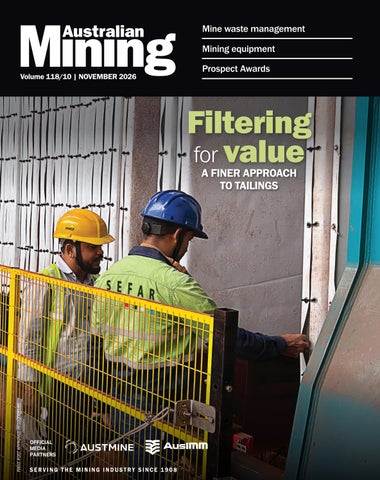
Filtering for value
PRINT POST APPROVED PP100008185
A FINER APPROACH TO TAILINGS
OFFICIAL MEDIA PARTNERS
SERVING THE MINING INDUSTRY SINCE 1908
ELECTRICAL ENGINEERING. SPECIALISING IN HAZARDOUS AREAS. Practical expertise grounded in how your site actually operates.
SCAN TO SEE HOW HAZARDPROOF HELPS
Compliance Audits
Electrical Standards Development
hazardproof.com.au
+61 459 867 510
Classification + Design
Hazardous Area Auditing
COMMENT
Treasure at the tail end Tailings may be yesterday’s leftovers, but with the right approach, there could still be plenty of value left to recover.
Prealene Khera Editor
T
here’s a reason the saying ‘one man’s waste is another man’s treasure’ has stuck around. What one person tosses aside, another might be only too happy to get their hands on. What cuts through for me is how something written off as worthless can turn out to have a lot going for it, depending on who is looking and what they know to look for. In mining, that can make the line between waste and resource a little more interesting than it first appears. Yes, tailings might not have the same appeal as a promising orebody, but that does not mean they should be overlooked. Depending on their composition, these materials may contain minerals that can be recovered through further processing, or have potential uses in other applications. The trick is working out whether there is something worth pursuing, and whether the numbers make sense. But how does one do that, and what do you need to weigh up before turning waste into something of value? The first step is establishing what the tailings contain and whether the minerals can be recovered economically. Advances in processing technology are making it possible to extract minerals that were previously uneconomic to recover, giving operators another reason to assess the material already sitting in storage. The broader economics do depend on several factors, including the quantity and grade of recoverable minerals, the cost of processing and the infrastructure required. The potential to generate additional revenue from material already mined is attractive, but it needs to outweigh the cost of recovery. Fortunately, operators do not have to work through all of this alone. As you’ll see in this edition, there are plenty of companies working on ways to recover more from mine waste and make the material left behind work harder.
After all this talk about waste, let’s now turn our attention to something that’s long been considered a treasure. Mt Lyell has been part of Tasmania’s west coast identity since the late 1800s, helping shape the identity of Queenstown and the surrounding region. Now, more than a decade after the operation entered care and maintenance in 2014, Sibanye-Stillwater is moving the operation towards a restart. The return to operation will bring skilled jobs back to the region, create opportunities for a new generation of workers and help reconnect families with the industry. With construction expected to begin in 2027 and first production targeted for early 2029, the work ahead is substantial, but so too is the significance of Mt Lyell’s return for Queenstown. When news of Mt Lyell’s reopening first broke, Tasmania’s Minister for Business, Industry and Resources Felix Ellis praised the “West Coasters” for always finding a way, or making a way. I reckon that’s a pretty good way to sum up the spirit of this industry, too. Whether it’s finding new uses for mine waste, or developing technology to tackle a difficult problem or getting a historic mine back up and running, mining has never been short of challenges. But when you put this edition down, I hope you’re left with a sense of an industry that doesn’t sit still when faced with a problem, but gets on with finding a way through it.
Prealene Khera Editor
Chairman John Murphy
Adam Daunt adam.daunt@primecreative.com.au
Chief executive officer Christine Clancy
Engelbert Schmidl engelbert.schmidl@primecreative.com.au
Managing Editor Paul Hayes paul.hayes@primecreative.com.au
Client Success Manager Janine Clements 02 9439 7227 janine.clements@primecreative.com.au
Editor Prealene Khera prealene.khera@primecreative.com.au Journalists Ethan Benedicto ethan.benedicto@primecreative.com.au Jackson Haddad jackson.haddad@primecreative.com.au
Sales Manager Jonathan Duckett 0498 091 027 jonathan.duckett@primecreative.com.au Business Development Managers James Phipps 0466 005 715 james.phipps@primecreative.com.au
Ben Cartwright ben.cartwright@primecreative.com.au
AUSTRALIANMINING 3 NOVEMBER 2026
Front cover
Mine tailings management is changing as water scarcity, tighter regulation and increased scrutiny of storage safety place greater emphasis on reliable dewatering. Sefar is helping mining operations optimise filtration through application-specific filter media, laboratory testing and site-level technical support. Its approach focuses on balancing filter-cloth life, filtration capacity and cake moisture rather than treating media as a routine consumable. By matching fabric construction and surface finish to the slurry, equipment and operating conditions, the company aims to improve water recovery, cake discharge and plant availability while reducing maintenance requirements and the overall total cost of ownership across tailings filtration systems.
Rob O’Bryan 0411 067 795 robert.obryan@primecreative.com.au Art Director Michelle Weston michelle.weston@primecreative.com.au Subscription Rates Australia (surface mail) $120.00 (incl GST) Overseas A$149.00 For subscriptions enquiries please contact 03 9690 8766 subscriptions@primecreative.com.au Prime Creative Media 379 Docklands Drive, Docklands, Vic 3008 www.primecreative.com.au © Copyright Prime Creative Media, 2016 All rights reserved. No part of the publication should be reproduced or copied in any form or by any means without the written permission of the publisher.
Printed by Brougham Press 865 Mountain Hwy, Bayswater VIC 3153 03 9873 5144 Published 11 issues a year Cover image: Sefar
In this issue 7
20
7
Mine waste management
20
Industry insight
48
Industry insight
10
Mine waste management
28
Electrical services
60
Industry events
15
Mine waste management
46
Podcast
64
A second life Australian researchers are exploring mine waste’s potential to recover minerals, create useful materials and improve rehabilitation long after operations end. Filtering more value from tailings Sefar is bringing filter-media selection, testing and technical support together to help miners improve the consistency and operating economics of tailings dewatering. A coarser path forward Glencore Technology is rethinking tailings at the source, scavenging coarse particles in flotation to recover more value and improve downstream waste manageability.
Mt Lyell’s new era After being closed for more than a decade, the recent restart of Tasmania’s historic mining operation has opened up fresh opportunities for the state. The power couple HazardProof combines electrical engineering and hazardous area expertise to keep critical infrastructure aligned with evolving site requirements. Aureka’s golden moment Aureka’s managing director James Gurry sat down with the Australian Mining Podcast to talk about the company’s new goldproducing strategy in Victoria.
Finlayson’s golden touch Genesis Minerals executive chair Raleigh Finlayson spoke at the Melbourne Mining Club about his vision for the company in the wake of its merger with Vault Minerals. Western Australia’s growth plan WA Mining 2026 highlighted the state’s ambitions to build a lower-emissions, globally competitive mining industry through practical, achievable steps.
Industry events
Celebrating the industry’s best The 2026 Australian Mining Prospect Awards celebrated the people, projects and ideas driving progress across Australia’s mining and resources industry.
42
35 AUSTRALIANMINING 4 NOVEMBER 2026
WHO WE ARE OTR Tyres is Australia’s leading independent partner for off‑highway tyres, wheels, consumables and service solutions. With nationwide manufacturing, service hubs, and on‑site support teams, we provide the most comprehensive ground‑contact offering in the country. With deep expertise across mining and heavy industry, OTR Tyres is trusted by major operations to deliver safe, compliant, and cost‑effective solutions built for tough Australian conditions.
est Outperform The R
WHAT WE DO TYRE SOLUTIONS • Massive range & stocks of earthmover, truck & LV tyres. • Full range from 6” through to 63” from leading global brands.
Mining tyre and wheel experts. OTR Tyres is at the forefront of tyre, wheel and service innovation, proudly supporting Australia’s mining, construction, transport, agricultural and industrial
• Tyre fitting, rotation, change‑outs and on‑site support. • Tyre pressure management and haul profile optimisation. • Tyre valving, O‑rings & tooling
WHEEL & RIM SOLUTIONS • Wheels, rims, assemblies & components. • Australian manufactured with in‑house design. • Test, repair & certification under Australian Standards AS4457.1. • Latest MID and MRD compliance.
ON-SITE SERVICES • Mobile fitting capability for large OTR assemblies. • Dedicated tyre & wheel technicians for major mining operations. • On‑site wheel, rim & tyre management programs. • Tyre Handlers, mine site spec for sale or hire.
TRAINING • Industry‑accredited Cert II tyre fitting and safety training. • RTO provided on‑site or at OTR facilities.
sectors. We deliver unmatched capability, performance and reliability across every site and every haul road. Our commitment is simple, if your tyres or wheels stop, your production stops - so we’re here to keep you moving.
WITH SERVICE HUBS AND MANUFACTURING FACILITIES ACROSS AUSTRALIA, OTR TYRES PROVIDES RAPID RESPONSE AND CONSISTENT SUPPORT WHEREVER YOU OPERATE.
Phone 1300 OTR TYERS or visit www.otrtyres.com Perth | Mildura | Gold Coast | Brisbane | Emerald | Mackay | Mount Isa | Gladstone | Muswellbrook | Karratha | Port Hedland | Kalgoorlie | Geraldton
20 YEARS OF ENGINEERING PERFORMANCE READY FOR WHAT’S NEXT
SCAN TO DISCOVER 20 YEARS OF MASPRO maspro.com.au
MINE WASTE MANAGEMENT
Image: Janelle/stock.adobe.com
Researchers are exploring a second life for mine tailings.
A second life Australian researchers are exploring mine waste’s potential to recover minerals, create useful materials and improve rehabilitation long after the end of operations.
M
icroscopic organisms breaking down historic mine waste in South Australia have prompted fresh questions about how the resources sector manages the material it leaves behind. Earlier this year, Monash University research revealed that microbes at Mount Painter in the northern Flinders Ranges appeared to be helping transform uranium and rare earth elements into nanoparticles capable of moving through soil and water. At Mount Painter, waste associated with abandoned workings has been largely undisturbed for more than 80 years, and researchers found the greatest nanoparticle concentrations near the surface, where microbial diversity was highest. The university researchers said the finding carried an important message for waste management and also pointed towards potential extraction and remediation technologies. “They are essentially acting as microscopic factories, breaking down stable minerals and mobilising elements like uranium into the surrounding ecosystem,” Monash professor of synchrotron geosciences Joël Brugger said. This challenge is one that is continuously being explored across
Australian research, delving into how to recover more value from mine waste while improving the environmental outcome for the material that remains. The study’s interpretation linked microbial activity with the dissolution of phosphate minerals and the formation of metal-bearing nanoparticles, showing that the chemistry of old waste can continue to change long after mining stops. In terms of assessing long-term rehabilitation, it becomes a question of how biological processes interact with mineral stability, and for those pursuing recovery, an additional layer of reasoning to examine mine waste at a much finer scale. While the research centres around historic mine waste rather than a demonstration at an operating tailings facility, Monash researchers also identified possible future applications. Further development is needed to translate those pathways into practical technologies, especially at a time when there is growing interest in using tailings as a secondary source of metals. Geoscience Australia’s Atlas of Australian Re-mining Potential provides a national foundation for investigating these opportunities.
Developed with university researchers and state geological surveys, the interactive tool covers tailings, waste rock, smelter residues and related materials, with the purpose of identifying potential sources of critical minerals and supporting sustainable, economic recovery from waste. The underlying concept, known as secondary prospectivity, asks whether material discarded during earlier mining could contain minerals worth recovering today. In 2022, Geoscience Australia highlighted Queensland investigations via the interactive tool that began with cobalt in copper tailings around Mount Isa before expanding to other waste facilities. A potential frontier of this campaign can be observed with the Commonwealth Scientific and Industrial Research Organisation’s (CSIRO) mining biotechnology research, which includes bioleaching metals from waste, recovering valuable elements from leach solutions and treating acid mine drainage. According to CSIRO, bioleaching uses microbial activity to help bring metals into solution, allowing further processing to recover them. CSIRO also identifies tailings among the waste streams that microorganisms could help
AUSTRALIANMINING 7 NOVEMBER 2026
unlock, alongside slags and other metalbearing materials. In this context, Mount Painter represents the importance of mineralmicrobe interactions, yet the operational objective remains about managing those interactions within a recovery process, capturing mobilised metals rather than allowing them to disperse through the environment. And if achieved, linking recovery with treatment could help address both the valuable and problematic components of waste, provided the process leaves a residue suitable for long-term management. Recovering metals, however, is only one possible destination for that material. CSIRO researchers said they are also investigating how suitable mine tailings can become geopolymers, which are binding materials, can substitute for cement in concrete. The approach uses aluminosilicates which are compounds containing aluminium and silicon, and found in clay-rich waste. After removing water, chemical reagents bind fine particles into a solid structure. CSIRO reported test blocks with compressive strengths of 20–50 megapascals and progress from kilogramscale experiments to 50-kilogram batches.
MINE WASTE MANAGEMENT
rehabilitation over time. Professor Longbin Huang said earlier work had established that “red mud can be turned into technosol” and that “plants can grow in it”. Huang said that the next step is determining whether biological nitrogen supply can develop and persist despite the
young material’s salt content and alkalinity, supporting vegetation without ongoing external nitrogen fertiliser inputs. Recovering a saleable mineral, producing a useful material or establishing vegetation each addresses part of the opportunities around the broader measure of success for mine waste research.
In the mining sector, the stronger outcome would connect those gains with evidence that the remaining waste can be managed safely over time, with the findings and research demonstrating that assessment must account for processes continuing well beyond the life of a mine. AM
Image: Adwo/stock.adobe.com
New research could unlock more value from mining residues.
Image: JWILL PHOTOGRAPHY/stock.adobe.com
“We have to either work out something to do with mining waste, or work out some better way to store it,” CSIRO scientist Clint McNally said. The research remains subject to practical constraints, considering that different tailings require different formulations, while transporting heavy material from remote operations to construction markets can be costly. This means characterisation is central to the process, and understanding the clay minerals and elemental composition will help determine whether a waste stream is suitable and which reagents are needed. Another Australian research program is also examining whether processing residues can support the next stage of rehabilitation. At the University of Queensland’s (UQ) Sustainable Minerals Institute, researchers are developing technosol, a soil-like material made from red mud, the residue generated during alumina refining. While this is a different waste stream from mineral processing tailings, the work still addresses the shared rehabilitation constraint of limited topsoil availability. The 2025 research has progressed from laboratory work to field trials at Gove in the Northern Territory and larger, long-term trials at Queensland Alumina Limited in Gladstone. In July 2025, UQ announced more than $1 million in Australian Research Council Linkage funding to investigate whether the material can sustain
Recovering minerals is only part of the waste challenge.
AUSTRALIANMINING 8 NOVEMBER 2026
HDA372
HD EXCHANGE
WHY WAIT FOR A REPAIR WHEN YOU CAN EXCHANGE? ONE COMPONENT. TWO PRICING OPTIONS. OPTION 1:
OPTION 2:
Know your price upfront.
Price reflects component condition.
FIXED
FLEX
ENGINES • DRIVETRAIN • HYDRAULICS • ELECTRICAL • COOLING
131 228 | hastingsdeering.com.au AUSTRALIANMINING 9 NOVEMBER 2026
HDA37225-HXP-FullPageAd_235x297_FA.indd 1
9/10/2026 13:45
MINE WASTE MANAGEMENT
Filtering more value from tailings Sefar is bringing filter-media selection, testing and technical support together to help miners improve the consistency and operating economics of tailings dewatering.
A
filter press may command attention through its size, but the fabric concealed between its plates can determine how efficiently a mine recovers water and prepares tailings for their next stage. Mine tailings rarely fail to make an impression. They occupy land, retain water and remain long after the valuable mineral has left the processing plant, and yet one of the components influencing how safely and efficiently that material can be managed is far less visible: the filter cloth inside the dewatering equipment. Sefar believes that the interface between the slurry and the machine is where a tailings strategy becomes an operational outcome. “We are committed to responsible tailings management and to partnering with our customers to achieve the best possible outcomes. We see it as our duty to contribute meaningfully to environmental protection,” Sefar industry manager for minerals Sandrine Forsoni said. A filter press may provide the mechanical force, but its media determine how solids are retained, how readily water passes through and how cleanly the resulting cake is released. Those functions are becoming more important as water scarcity, evolving regulation and closer scrutiny of tailings safety encourage miners to consider filtered tailings and dry stacking. Reliable dewatering can reduce the volume of water reporting to storage, recover process water for reuse and produce a more consistent cake for subsequent handling. Coal, alumina and metalliferous operations can present markedly different slurries, while particle-size distribution, solids concentration, mineralogy and upstream process conditions may change within an individual site. Equipment type, production targets and the moisture level required from the cake add further variables. This makes the filter cloth an application decision rather than a consumable chosen in isolation. Sefar supplies media for several filtration technologies, including filter presses, vacuum belt filters and belt presses, with filter presses forming a focus of its tailings work. “By applying our specialised expertise and capabilities, we help customers reduce their environmental footprint through maximised dewatering efficiency, superior filtration performance, and the longest possible product lifetimes,” Forsoni said. A longer-lasting cloth can also reduce the frequency of shutdowns and
Mining operations rely on filtering to gain more value from tailings.
AUSTRALIANMINING 10 NOVEMBER 2026
maintenance interventions. Higher filtration capacity can support shorter cycles and more stable throughput. Lower cake moisture can increase water recovery and improve the material’s suitability for dry stacking. Together, these outcomes affect equipment availability, operating cost and the stability of the downstream tailings process. Reaching that balance begins with understanding the slurry and the operating conditions. Sefar combines process analysis with laboratory and filter-media testing to investigate filtration problems and establish their root causes. Slurry characteristics and particle-size distribution form part of that work, as do the construction of the fabric and the finish applied to its surface. Application-specific media, fabric designs and surface finishes can be used to influence filtration capacity, cake discharge, service life and water recovery, but the most suitable combination depends on the equipment, slurry and performance priorities. “Our starting point is to understand the customer’s process and the impact of the slurry type, equipment and operating conditions,” Forsoni said. “Based on that initial analysis, and the customer’s needs and priorities, we select the optimal fabric and the most appropriate design.” Sefar’s approach pairs local technical support with access to global application, laboratory and manufacturing resources. Its manufacturing is integrated from yarn to finished filter cloth, allowing the company to consider the properties of the filtration media through the production chain. The value of this support is most evident when improved filtration leads to fewer interventions and more productive cycles. One Sefar customer, using a filter press for iron ore tailings, achieved substantially longer cloth life and a dramatic increase in the number of filtration cycles after their filter fabric was optimised – far exceeding their expectations. The result was a major extension of cloth life and a significant reduction in filter cloth changeouts. At the same time, the operation maintained consistent cake moisture and reliable cake discharge. Fewer replacements reduced maintenance demands, while the longer operating intervals supported higher productivity and lower operating costs. The example shows why the lifetime of cloth cannot be considered in isolation from the broader process. Each avoided change removes a maintenance task and returns time to production, but longevity is only useful if filtration capacity, cake moisture, and discharge remain within the required range. Water recovery provides another important link between filtration and
Filter media plays a key role in tailings management.
mine performance. Water that passes through the filter can be returned to the process, reducing freshwater demand. The benefit varies by site and flowsheet, but it means dewatering contributes more than just preparing the final tailings product. Consistent cake properties also influence what happens after filtration. Filtered material must be discharged, transported and placed, so unreliable release or variable moisture can create problems beyond the press. A filtration solution needs to be considered in the context of the complete tailings-handling
system rather than judged only at the point where the filtrate leaves the equipment. This systems view is especially relevant when mines are assessing dry stacking. Filtration does not by itself determine the safety or performance of a tailings facility, but consistent dewatering can support the stable handling and placement conditions on which the method depends. It also changes how filter media are evaluated, with total cost of ownership also accounting for the labour and downtime required for cloth changes, cycle performance, equipment availability
AUSTRALIANMINING 11 NOVEMBER 2026
and the value of recovered water. A lowercost cloth may prove more expensive if it requires more frequent changes or limits throughput. Ore characteristics and plant conditions can change, while production targets may place different demands on the filtration circuit. Rapid technical support and coordinated access to specialists allow performance to be reassessed when the operating window shifts. As miners seek to recover more water, reduce intervention, and build consistency in filtered tailings, attention is shifting deeper into the dewatering process. AM
Images: Sefar
MINE WASTE MANAGEMENT
MINE WASTE MANAGEMENT
Tough demands, tougher pumps Alemlube’s Dingo pumps provide mine sites versatile equipment for transferring multiple fluids across workshops and field operations.
M
aintenance on mine sites typically involves more than repairing machinery, with workshops and field teams also required to manage diesel, oil, water, coolant and sludge generated by daily operations. This creates a need for equipment capable of handling different types of fluids efficiently, rather than relying on individual pieces of kit for each spill, stain or waste. Alemlube’s Dingo series of aluminium air-operated diaphragm pumps has been developed to support this aspect of mine site maintenance, providing a multi-fluid transfer solution for workshops, service areas and other applications where liquids need to be moved or dispensed. The Dingo series can transfer and dispense diesel, oil, waste oil, water, wastewater, automatic transmission fluid (ATF), coolant, antifreeze, petrol, industrial sludge and some compatible chemicals. This broad fluid capability allows the pump range to support multiple maintenance applications without requiring different equipment for every transfer task. Dingo pumps use polytetrafluoroethylene (PTFE) diaphragms and ball valves within an aluminium body. The diaphragm creates the pumping action, while the ball valves control fluid movement through the pump. Available in five sizes with flow rates of up to 568 litres per minute and a maximum operating pressure of 120psi (8 bar), the Dingo series can accommodate a range of fluid transfer requirements.
incorporates a bolt-through design to support sealing during operation. Maintenance of the pump itself has also been considered, with Alemlube offering two major repair kits across the Dingo range. This provides a servicing pathway for operators and maintenance teams when pumps require attention. Compatibility with existing equipment layouts is another feature of the range, with Dingo pumps featuring the same mounting bracket and bolt-hole configuration as other leading equipment providers, allowing existing pumps to be replaced without modifying existing pipework mounts. For established mine site workshops, that compatibility can simplify the introduction or replacement of fluid transfer equipment.
The Dingo series sits within Alemlube’s wider portfolio of equipment supporting mine site maintenance. The company also supplies lubrication equipment across Australia and New Zealand, alongside Samoa waste oiler drainers and Piusi fuel management systems suitable for mining service trucks. Its offering includes the Alemite high-pressure grease pump, designed for applications requiring consistent grease delivery. With a 40:1 pressure ratio, the pump supports lubrication activities across mobile and fixed plant maintenance environments. Together, these products address different aspects of fluid handling and lubrication, from transferring diesel, coolant and waste products to delivering grease to equipment requiring regular lubrication.
The Dingo series is European Conformity (CE) marked and compliant with ISO 9001 safety standards, providing documented alignment with recognised requirements for product quality and manufacturing processes. For Alemlube, the Dingo series is centred on flexibility and serviceability. For on-site maintenance teams, this translates into a single pump capable of handling multiple fluids and making maintenance work more convenient. In workshops and field environments where different fluids form part of everyday servicing, the ability to transfer and dispense them through versatile equipment provides maintenance teams with another tool for keeping machinery operating. AM
The Dingo series has been designed for harsh mine site conditions, with a compact format that allows the pumps to be integrated into existing maintenance environments. Built for demanding mine site applications, the Alemlube Dingo series of air operated diaphragm pumps deliver reliable fluid transfer with a durable aluminium body and PTFE diaphragms and balls as standard. The fluid cover
Alemlube recently put the Dingo series of pumps on display at the Queensland Mining Expo.
AUSTRALIANMINING 12 NOVEMBER 2026
Image: Alemlube
Designed for mine site applications
Partnering with the mining industry to deliver environmental solutions that protect resources, support communities and sustain progress
Water Management
Tailings & Mine Waste Management
Scan the QR code to learn more about our mining solutions
Environmental Impact Assessments
Community & Stakeholder Engagement
Onterris.com Formerly Epic Environmental
Filter Media Solutions for the Minerals Industry Mining operations run on margins. Every filtration decision affects downtime, output, and cost. Sefar brings together deep application expertise and a leading fabric portfolio to deliver filtration media that perform, reliably, consistently, and over the long run. The result: lower total cost of ownership and a filtration process you can build your operation around.
Sustainable Filtration Excellence Increased operational lifespan Decrease in downtime & maintenance Improved quality of final product Reduction in total cost of ownership Diminishing your environmental footprint
Sefar Oceania sefar.com.au
19-21 Huntingwood Drive, Huntingwood NSW 2148
Phone 1300 306 661 oceaniasales@sefar.com
MINE WASTE MANAGEMENT
A coarser path forward
The Jameson Cell scavenges coarse particles left by the existing concentrator, helping the plant meet recovery and throughput targets.
T
ailings are an unavoidable byproduct of mineral-processing flowsheets, but how they are produced can affect a mine’s costs, water use and environmental risk. Froth flotation concentrates ore by exploiting differences in surface chemistry. Hydrophobic, or water-repelling, mineral particles attach to air bubbles and rise into a concentrate, while hydrophilic materials remain in the slurry and report to tailings. Conventionally, ore is ground until valuable minerals are liberated to maximise recovery, but finer grinding creates finer tailings, which retain water more readily and are harder and more expensive to dewater. As operations push throughput, coarser material enters plants designed for a fixed feed size, forcing operators to balance throughput against recovery. According to specialised engineering and technology company Glencore Technology, the answer is to improve recovery from these coarser fractions within the flotation circuit. Its high-intensity froth flotation device, the Jameson Cell, scavenges coarse particles left by the existing concentrator,
helping the plant meet recovery and throughput targets while rejecting barren waste at a coarser size. The technology has already successfully demonstrated its ability to recover coarse, low-density coal particles, with Glencore Technology adapting that experience for denser base-metal ores, whose particles are more prone to detaching from bubbles. “We’ve been really looking at tailings from the perspective of what else is in it and how can we create value out of that, floating additional material, additional by-products, and therefore bringing that stream down as small as we can,” Glencore Technology director of technology Stanko Nikolic told Australian Mining. Potential by-products include magnetite and sulphur-bearing material for acid or fertiliser production. Depending on its composition, the remainder may be filtered, dry stacked or considered for uses such as road-base aggregate or cement production. Nikolic compared dewatering to using a kitchen sieve. “It’s very much like if you have a sieve in a kitchen that’s got very small openings and you’re trying to sift things through it, then it’s not going to get through,” he said.
“It will take a long time to be able to bring that stuff through. And so the particle size is like that sieve.” Coarser waste allows water to drain more readily, potentially reducing the equipment, energy and capital required for dewatering. Producing it depends on keeping valuable coarse particles attached to bubbles. “What we’ve modified with the Jameson Cell is that we’ve slowed things down as it exits the end of the downcomer,” Nikolic said. The company also redirected flow from vertical to horizontal using a swirl device derived from its ISASMELT bathsmelting technology. In a furnace, recirculation below the swirler maximises fuel-combustion efficiency, and in the flotation cell, a similar region beneath the downcomer reduces particle detachment while preserving the fine bubbles and upward force needed to carry coarse particles. At Ecuador’s Fruta del Norte gold mine, rougher-scalper, cleaner-scalper and scavenger Jameson Cells were commissioned in stages, allowing each cell’s contribution to recovery to be measured.
AUSTRALIANMINING 15 NOVEMBER 2026
“What we saw was actually really quite interesting, and it was that we didn’t just get a recovery of the fine particles,” Nikolic said. “There definitely was an uplift there, especially when we put in the final cell. But we saw a net uplift in all of the mineral size fractions that were being recovered.” Glencore Technology is now implementing a full Jameson Cell circuit at the mine to replace its tank cells. The approach is not universal. Clay mineralogy can determine whether tailings can be filtered effectively, so sitespecific testing remains essential. “We have to do the mineralogical testing at facilities like we have at XPS within the Glencore group,” Nikolic said. “We still have to understand the mineralogy before we can understand the full value of applying the Jameson Cell to scavenging coarse particles in concentrators.” With further coarse-scavenging results due to be published and clients testing field units around the world, Nikolic expects the application to grow. “This is going to be a big part of what we see in the future for the Jameson Cell,” he said. AM
Image: Glencore Technology
Glencore Technology is rethinking tailings at the source by scavenging coarse particles in flotation to recover more value, maximising production and improving downstream waste manageability.
MINE WASTE MANAGEMENT
Withstanding the pressure Bulldog Pressure Services is helping operators strengthen tailings pipeline integrity and reduce the risk of leaks through targeted pressure testing.
Bulldog has extensive experience testing high-pressure pipelines.
Bulldog can conduct this through hydrostatic testing, which allows the pipeline to be tested in a controlled environment using water, rather than tailings or other process material. The test can then locate any leaks, defects or weaknesses, so an operation can fix them before the pipeline is commissioned. “Our role is not simply to apply pressure to a pipeline; it is to manage the complete testing process safely and provide confidence that the system is ready for operation,” Antonie said. “By verifying its integrity, we can provide assurance that the pipeline can safely withstand its intended operating pressures and that the joints, welds, flanges and other components are leak tight.” Bulldog’s expertise was recently demonstrated at South Australia’s Carrapateena copper project, where it
was engaged to hydrostatically test approximately 13.5km of tailings pipeline. The testing was carried out before the pipeline entered service, giving the project team an opportunity to identify and address any issues before tailings were introduced. Bulldog’s team filled and pressurised the pipeline in sections, monitored the tests and recorded the results against the project requirements. Three tests were conducted on 300mm nominal diameter Class 300 and Class 600 ultra-high molecular weight polyethylene (UHMWPE)-lined piping systems, with test pressures ranging from 5500–11,200 kilopascals. Once this was done, Bulldog confirmed that the pipeline could withstand the test pressures and met the required criteria for structural integrity and leak tightness before the tailings were introduced into the system.
AUSTRALIANMINING 16 NOVEMBER 2026
In addition, Bulldog was able to further support the commissioning of a refrigeration plant, completed line blowing and nitrogen leak testing across the newly installed pipework and provided onsite technical and mechanical assistance. “Major resources projects like this require a very high level of technical assurance, safety compliance, planning, and documentation,” Antonie said. “Bulldog helped reduce the risk of an integrity failure by carefully testing the pipeline before commissioning, using controlled test pressures, calibrated instrumentation and continuous, accurate monitoring. “Being engaged on a project like this reflects the trust placed in Bulldog to provide experienced personnel, reliable equipment and accurate results while operating within strict and complex client and site requirements.” AM
Image: Bulldog Pressure Services
B
efore tailings enter a new pipeline, the system needs to be tested, checked and proven ready for operation. Any potential leakage of tailings, left over after metals and minerals are extracted from ore, can have significant operational and environmental consequences. That’s why the expertise of Bulldog Pressure Services can be valuable, with the specialist pressure testing business able to check pipelines are safe and leaktight before they are placed into service. “Tailings pipelines transport abrasive and potentially environmentally harmful material, often across considerable distances and through varying terrain,” Bulldog operations and safety general manager Teagan Antonie told Australian Mining. “A pipeline failure can result in environmental damage, safety risks, loss of containment, operational disruption and significant repair and clean-up costs. That’s why it’s critical to verify pipeline integrity before commissioning.” Bulldog brings specialist pressuretesting equipment and experienced crews to mining projects, carrying out testing from initial preparation through to commissioning. That combination of equipment and experience allows Bulldog to work alongside project teams during construction, commissioning, shutdowns and maintenance, with testing tailored to the pipeline and the requirements of each site. Bulldog can support hydrostatic and pneumatic pressure testing, nitrogen purging and leak testing, line blowing, pipeline pigging, dewatering and drying, test pack preparation and commissioning across both above-ground and buried systems, including pipelines with varying diameters, materials, lengths and test pressures. These capabilities have been central to Bulldog’s development since the business was established by director Eddie Antonie, who found a growing need for specialist pressure-testing contractors able to provide a responsive, practical service to major projects. Since then, Bulldog has grown its equipment fleet and workforce to support major mining, oil and gas, water and resources projects across the country. One of its key services for the mining industry is pre-commissioning pressure testing. This helps operations to check for potential weaknesses in the pipeline before material enters the system.
MINE WASTE MANAGEMENT
Image: Richard/stock.adobe.com
Filtered tailings can reduce water storage.
Solving the tailings puzzle Onterris believes tailings and mine waste management strategies must evolve to address water constraints, operational demands and long-term closure performance.
T
ailings management is undergoing a fundamental transformation. That’s Ljiljana Josic’s belief, and with nearly 30 years in the industry, this view carries weight. As vice president of geotechnical, tailings and mine waste at global environmental consultant Onterris, Josic has seen the shift from mining companies in response to tighter water constraints, complex ore bodies, challenging climatic conditions and increasing expectations for long-term environmental, social and governance (ESG) performance. Within this environment, conventional slurry tailings storage may not always represent the optimal solution. Instead, Josic said companies are looking beyond traditional containment approaches toward systems that reduce water dependency, improve physical stability, enhance operational flexibility and support progressive reclamation. Depending on site conditions, the appropriate strategy may involve filtered tailings, thickened tailings, paste technology, underground or pit backfill, conventional storage or a combination of these approaches. “The important question should always be which tailings deposition technology will perform best for the specific site conditions,” Josic said. “The use of filtered tailings is one response to current demands, which represents a significant change in how mines manage both solids and water.”
Rather than transporting large volumes of slurry to a conventional tailings storage facility, tailings are dewatered through filtration and transported to the selected location, placed, compacted and progressively reclaimed. Josic said this can fundamentally change the configuration and operating philosophy of a tailings facility. Filtered tailings can reduce water storage, increase water recovery and recycling, and improve geotechnical and operational resilience. They can also reduce dependence on large water-retaining embankments and improve adaptability in water-scarce regions and extreme climatic conditions. However, filtered tailings are not a universal solution. The viability of this option, according to Josic, depends on various factors, including ore mineralogy, tailings characteristics, production rates, climate, available energy, filtration performance, transportation distances, stacking requirements, water balance and site conditions. The economics and environmental performance can also change significantly over the life of a mine. “One of the major drivers for filtered tailings is improved water recovery,” Josic said. “As water becomes more and more strategic to mining operations, water management should no longer be treated simply as an environmental consideration.
“It should be embedded directly into tailings design, mine planning, operational decision-making and closure strategy.” Throughout the lifecycle, water recovery can positively influence factors such as regulatory permitting, process reliability, operating costs, site water balance and long-term closure outcomes. Josic said it is important to highlight that even when tailings are filtered and stacked, the resulting conditions on site remain dynamic in terms of geotechnical stability and water management. Performance continues to be influenced by moisture content, degree of compaction, placement methods, stack geometry, drainage performance, pore pressures, settlement, erosion and climatic conditions. As with any other tailings disposal technology, the selection and implementation of a filtered tailings option depends on data and the integration of multiple disciplines. The suitability and performance of the system, according to Josic, is influenced by geotechnical engineering, tailings and mine-waste management, hydrogeology, hydrology, process engineering, geology, geochemistry, mine operations and closure planning. Technological advancements are also supporting the future of tailings management with intelligent, integrated and adaptive mine-waste management solutions. Advances in digital mining technologies and analytics are providing continuous
AUSTRALIANMINING 18 NOVEMBER 2026
insight into facility performance and can support predictive decision-making. Josic said these capabilities are shifting mine-waste management toward being a more integrated system. “The next generation of mine-waste management will increasingly combine engineering, technology, data and operational intelligence,” Josic said. “Filtered tailings represent one of the most promising innovations available to the mining industry today, particularly in regions where water conservation, risk reduction and long-term sustainability are key drivers.” However, Josic said the true value of this approach is realised when it is integrated into a broader mine-waste management framework that considers the entire life cycle of the operation. This requires moving beyond designing a tailings facility as a stand-alone structure and instead considering tailings, waste rock, water, geotechnical conditions, processing, operations and closure as interconnected components. “The future of mining will be defined by how efficiently resources are extracted and by how responsibly waste is managed,” Josic said. “The industry has an exciting opportunity to evolve mine-waste management from a disposal challenge to a strategic system requiring continuous optimisation, informed decision-making, and long-term stewardship from project conception through closure and post-closure.” AM
INDUSTRY INSIGHT
Mt Lyell’s new era The restart of Tasmania’s historic mining operation has opened up fresh opportunities for the state.
F
or more than a century, Mt Lyell has been central to the identity of Queenstown and Tasmania’s west coast, with the mine shaping generations of families, building local skills and underpinning the region’s economy since the late 1800s. When operations entered care and maintenance in 2014, the impact was felt throughout the community, with many skilled workers moving elsewhere and Queenstown adapting to a future without its historic mining operation. But now, after years of planning and redesign, Mt Lyell is moving towards
a new chapter, with Sibanye-Stillwater advancing plans to restart the historic copper operation. The proposed restart could mark a significant turning point for one of Australia’s most storied mining operations and the Queenstown community that has grown around it. Speaking to Australian Mining, Sibanye-Stillwater Australian operations executive vice president Barry Harris said the restart represents far more than the return of a copper producer. “It’s an amazing feeling to get to this point,” Harris said. “There has been a lot of study work, a lot of preparation and a
lot of analysis to really narrow down the best way to restart the asset. To get to this point is hugely gratifying, but even more so for the team of people led by Clint Mayes on the ground at Mt Lyell.” The pathway back to production has been a long one. Harris’ involvement with Mt Lyell began in 2021 when New Century Resources secured an option to purchase the mine from Vedanta. The project progressed through a prefeasibility study, before Sibanye-Stillwater fully acquired New Century Resources in 2023 and continued the work through further feasibility studies. Multiple stages of assessment have shaped the restart, with Sibanye-Stillwater undertaking a class three and then class two feasibility study to determine how the operation could be brought back into production. For the people of Queenstown, however, the significance reaches beyond studies, production forecasts and project economics.
Images: Sibanye-Stillwater
Mt Lyell has been central to local Tasmanian identity for more than a century.
AUSTRALIANMINING 20 NOVEMBER 2026
“Mining is very much in the DNA of the west coast of Tasmania, and specifically in Queenstown at Mt Lyell,” Harris said. “If you read through the history and hear the stories of the pioneers who came and established Queenstown, you get a sense of how, through all the challenges the mine endured, the people endured and they built a skill set, a capability and a community around mining.” The closure of Mt Lyell changed the town’s trajectory, with the loss of the mine meaning loss of employment. “Mt Lyell has been central to the identity of the region for years, but many skilled workers moved elsewhere and the area had to adapt to a future where mining operations were no longer a reality,” Harris said. “Local workers, instead of being close to their families, were moving to Queensland, Western Australia, the Northern Territory, purely because
INDUSTRY INSIGHT
the demand for work in Tasmania basically diminished.” The restart is expected to provide an opportunity for some of those workers and their families to reconnect with the region, while creating new pathways for the next generation, adding an emotional connection to the project beyond simply throughput and production rates. Tasmania Minister for Business, Industry and Resources Felix Ellis made an emotional statement when the restart was announced in September, focusing on the positive impact on families and the local community. “This has been more than a decade in the making,” Ellis said. “On behalf of all Tasmanians, I want to say how grateful I am to the team who has put so much work in, day in, day out, during the operation’s care and maintenance to lead up to this day. “West coasters talk about finding a way or making a way and that’s exactly
The redevelopment aims to build on Mt Lyell’s mining legacy with a modern operation.
what we’ve seen here at Mt Lyell. This will be such a huge change for the better for Queenstown and the west coast. “You talk to families just after the closure, kids are having conversations around the dinner table with Mum about when Dad’s going to come home. He used to be able to work just up the road, and now he’s in another state … this is going to be such a special thing for all those families who want this mine back up and operational.” Bringing Mt Lyell closer to a restart has relied on support well beyond Sibanye-Stillwater itself. “One of the key things that must be noted is the significant support we’ve had from not only the community, but also all levels of government and regulatory bodies,” Harris said. “Tasmania is an amazing place to undertake mining activities because they understand mining and they understand its benefits. As long as you do the right thing, set it up properly from the start and take into account environmental, safety and governance requirements, you have a collaborative environment to have those conversations and progress things.” Collaboration has been central to Sibanye-Stillwater’s approach as it prepares to rebuild the operation. The company has placed stakeholder value and responsible mining at the centre of its planning, Harris said, with the restart being considered through the requirements of employees, the community, regulators, shareholders and the broader region.
Sibanye-Stillwater Australian operations executive vice president Barry Harris told Australian Mining of his delight operations are restarting.
“Ultimately, it has to be a profitable mining operation because it needs to pay its own way, but we need to make sure we’re looking to meet stakeholders’ needs as best we can,” Harris said. A key part of that approach has been redesigning the operation with safety in design as a starting point, rather than attempting to retrofit improvements after construction. The previous operation was suspended following two serious safety incidents before being placed into care and maintenance due to the commodity price environment at the time. Harris said the lessons from that period have informed every stage of the restart planning.
AUSTRALIANMINING 21 NOVEMBER 2026
“From the pre-feasibility study through, we’ve had a lens of safety in design,” he said. “The biggest benefit for the lowest cost in safety comes when you design it in from the start, rather than having to retrospectively apply it later.” The next phase will see the project move from planning into execution. The remainder of 2026 will focus on establishing the project management office, completing front-end engineering design and preparing for construction activities. Execution is expected to begin in 2027, with early works including upgrades and additional accommodation in Queenstown to support the construction workforce. The major construction focus will be a new three-million-tonnesper-annum processing plant near the shaft and a new paste fill plant, alongside refurbishment of supporting infrastructure, underground development and upgrades to the shaft. “We’re building a new processing plant because the orebody deserves a modern, purpose-built facility that will deliver greater efficiency and performance,” Harris said. “We’re reinvigorating underground mining, upgrading the infrastructure and staging everything so we don’t overload the town with a huge spike in construction people and then see it drop away.” The first production is targeted for early 2029, marking the beginning of a new phase for Mt Lyell and Queenstown. AM
TOUGH, DURABLE & INTERCHANGEABLE Built to keep fluids moving in the toughest mine site conditions Built for demanding mine site applications, the Dingo Series of Air Operated Diaphragm Pumps deliver reliable fluid transfer with a durable aluminium body and PTFE diaphragms and balls as standard. Heavy-Duty Mine Site Performance
305mm 152mm
Built for harsh mine site conditions Ideal for transferring & dispensing diesel, oil, coolant, wastewater, sludge & more
Easy Retrofit Replacement Interchangeable with existing pump mounting points for fast retrofitting Supplied standard with PTFE diaphragms & balls
319.5mm 345mm 368mm 100mm
231mm
Durable and Safe Operation
25.5mm 139.5mm
Bolt-through fluid cover helps minimise leaks CE approved & ISO 9001 compliant Repair kits available for easier maintenance
DINGO Series Models include ½”, ¾”, 1”, 1-½” & 2” all readily available
www.alemlube.com.au | info@alemlube.com.au
*For Warranty Policies & Terms and Conditions, visit alemlube.com.au
45°
127mm 235mm
AD25AT DINGO SERIES 1” AIR OPERATED DIAPHRAGM PUMP
*
2
PIPES
Installation to integrity Pipe Tek expands pipeline capabilities, integrating mechanical installation, testing and integrity services to streamline mine site delivery. as flanges – might seem like a relatively straightforward part of a larger project, for Pipe Tek, this sits at the centre of ensuring strong outcomes. Pipe Tek incorporates controlled bolt-up into its mechanical delivery, with installation, inspection and documentation managed as part of the wider project requirements. “When these activities are coordinated by the same contractor responsible for the broader package, potential issues can be identified while crews are still working on the installation, rather than becoming someone else’s problem further down the delivery chain,” Farrant said. On top of this, it means less time spent coordinating interfaces and more clarity around who owns the outcome. “The important thing is having accountability for the finished installation,” Farrant said. “If something needs to be resolved, there’s no question about which contractor’s scope it falls into.
“Our team is responsible for getting the package delivered.” Pipe Tek’s mechanical capability also builds on its existing expertise in pipeline testing and integrity. Once the pipework and mechanical components have been installed, the company can continue through inspection, quality assurance and control and testing, including hydrotesting and verification, creating a continuous delivery model from mechanical installation through to proving the completed system. “We’ve always had a strong focus on what happens once the pipeline is installed, how you test it, verify it and make sure it’s fit for service,” Farrant said. “Now we’re able to take more responsibility for what happens before that point as well.” The move into broader mechanical delivery puts a greater emphasis on the role Pipe Tek can play when supporting mining projects across Australia.
The company can support clients across engineering and procurement before moving into field construction, mechanical installation, testing, commissioning and ongoing integrity – meaning one team responsible instead of balancing multiple. “The pipeline is only one part of the overall system. Our goal is to be able to take responsibility for more of that system and give the client a complete delivery solution,” Farrant said. The result ensures fewer interfaces, a clearer line of accountability and a contractor that understands the project from installation to operation, giving Pipe Tek another string to its bow in supporting mine sites. Not simply as a pipeline testing and integrity specialist, Pipe Tek is positioning itself as a contractor capable of delivering the mechanical package that surrounds the pipeline. AM Pipe Tek brings pipeline installation and maintenance under one roof for mining operations.
Image: Pipe Tek
O
n a mine site, a pipeline is only as effective as the mechanical system supporting it. Every valve, flange, connection and section of pipe needs to be installed, aligned and tested to perform as intended. Once mechanical installations are complete, the entire system then needs to be tested and ready for commissioning – often sitting across several contractors. Pipe Tek is helping mine operations bring pipeline maintenance under one roof, supporting both mechanical installation, such as pipework valve fitting and controlled mechanical boltup, alongside responsibilities involving keeping assets running. This, the company said, is a natural extension to its established pipeline construction, testing and integrity capabilities. “There’s a lot that happens around a pipeline before you get to testing and commissioning,” Pipe Tek chief operating officer Taddam Farrant told Australian Mining. “Pipework, valves, flanges and bolted connections all have to come together properly. If we’re responsible for those activities as part of the same package, we can manage them with the overall project outcome in mind.” Mechanical installation is where engineering drawings and specifications meet the realities of a mine site. Access can be restricted, tie-ins need to be carefully sequenced and existing infrastructure can limit installation options. Pipe Tek’s approach balances the consideration of these requirements with broader package delivery, ensuring installation and maintenance work go hand-in-hand. The company’s teams can undertake pipework installation, valve fitting, flange management and mechanical bolt-up, coordinating those activities with the wider construction and testing program. This turnkey management creates a direct connection between how a system is installed and how it will ultimately be tested. “The advantage is that we’re not looking at bolt-up, valve installation or pipework in isolation,” Farrant said. “We’re looking at how all those components need to come together to deliver a functioning system, and then making sure the installation is ready for the testing and commissioning stages that follow.” Whilst mechanical bolt-up – assembling structural components such
AUSTRALIANMINING 23 NOVEMBER 2026
MINERAL PROCESSING
FLS’ focus is on improving the availability and consistency of cone crushing.
Image: FLS
P
Crushing performance FLS is targeting cone crusher performance improvements through engineered liners, monitoring and maintenance strategies.
A
s mining operations continue to optimise existing assets, attention is turning to the performance of secondary, tertiary and pebblecrushing stages. Cone crusher and liner provider FLS is no stranger to dealing with these phases and the complexities of mineral processing. According to the company, changes in ore characteristics, brownfield expansion requirements and maintenance constraints are increasing the importance of understanding how cone crushers perform within a circuit. FLS’ focus is on improving the availability and consistency of cone crushing by looking beyond the cost of individual wear components and instead considering how equipment performance influences maintenance requirements and downstream processes. Cone crushers play a key role between primary crushing and grinding, controlling the size and consistency of material entering the next stage of processing. In circuits where throughput requirements are increasing, or ore characteristics are changing, maintaining that consistency can become more challenging. FLS said three applications demonstrate where cone performance can become a
key consideration: pebble crushing in semi-autogenous grinding (SAG) circuits, tertiary crushing in spodumene processing and satellite feed operations supplying central processing facilities. In pebble crushing applications, increasing ore competency can increase recycle loads, placing additional demands on crushers. In spodumene circuits, maintaining a controlled top size into dense media separation places greater emphasis on crusher chamber performance and wear management. According to FLS, the issue is often not a complete equipment failure, but a gradual change in performance as wear alters the crusher’s operating profile. The company’s approach is to assess the wear mechanism affecting a specific application and match liner material and chamber design accordingly. An Australian gold operation provides one example of this approach. The site had been using 18 per cent manganese liners, achieving approximately 24 days of service and 300,000 tonnes per set. After changing to a titanium carbide (TiC) product, performance improved to approximately 36 days and 450,000 tonnes per set.
FLS then benchmarked the existing performance, identified the wear mechanism and supplied a titanium carbide liner set designed for the application. The solution combined titanium carbide inserts in high-abrasion areas with an optimised manganese matrix and a chamber profile designed to manage localised wear. Installed during a planned maintenance window and monitored through to end of life, the FLS TiC set delivered approximately 42 days of service and 540,000 tonnes per set. FLS service line crushing representative Luka Jukic said the process of understanding wear behaviour was central to selecting the right solution. “There is no universal liner. What works is measuring what is actually wearing, and where, then engineering the material and the profile against that. Everything else is guesswork with a purchase order attached,” Jukic said. While the results represent a single operating application, FLS said the broader lesson is the importance of using performance data to guide liner selection rather than relying on standardised approaches. The company identifies maintenance duration as another area where cone
AUSTRALIANMINING 24 NOVEMBER 2026
crusher design and support can influence operational outcomes. FLS said liner change-out times are influenced by factors including design, tooling and work sequencing. Some FLS cone crusher designs remove the need for backing compound in smaller frames, reducing requirements associated with curing time. The company also provides purpose-built lifting and extraction tooling intended to support repeatable maintenance tasks. FLS said monitoring technologies can provide additional visibility into crusher condition between maintenance events. Shutdown scanning can provide measured wear profiles and remaining-life estimates, while condition monitoring tools can track crusher settings during operation. The company’s broader approach combines equipment, wear solutions, monitoring and maintenance support to help customers better manage crusher performance throughout the operating cycle. This focus sits at the heart of FLS’ offering, helping operations understand where performance is being lost and identifying opportunities to improve availability, maintenance product consistency and make better use of planned maintenance windows. AM
More metal. Less energy. No compromise. Proven technology to unlock value f rom the world’s most complex mineralogy Visit GlencoreTechnology.com to unlock your ore’s value.
MINING EQUIPMENT
A smarter component exchange HD Exchange gives customers greater flexibility in managing critical component replacements.
K
eeping critical mining equipment moving is a constant balancing act. Every hour of downtime has consequences across the site, whether it’s lost production, delayed schedules, or increased pressure on maintenance teams trying to keep assets running. This challenge sits at the centre of Hastings Deering’s transition from HD Reman to HD Exchange - an evolution of its existing service - introducing two pricing options for customers replacing major machine components. The company’s HD Exchange (HDX) continues to provide reconditioned exchange components rebuilt using genuine Caterpillar (Cat) parts and backed by applicable Cat warranty protections, while adding greater flexibility through two pricing models: Fixed, which provides upfront cost certainty, while Flex aligns the final price with the condition of the returned component. “HDX is about giving customers a choice,” Hastings Deering executive manager of site performance Matthew Small told Australian Mining. “It gives them two different commercial models.
“The component they receive is the same standard component they have always received; it is about how we transact it. With Fixed, customers know the price upfront, making it easier to budget, while Flex bases the final price on the condition of the component returned.” The offering covers some of the most critical and expensive components across a mining fleet, including engines, drivetrains, hydraulics, electrical and cooling components. What this means for mining operations is that rather than waiting for existing components to be rebuilt, customers can exchange them for ready-to-install, reconditioned components to help machines return to service sooner. This is complemented by Hastings Deering’s 15 business centres across Australia, meaning HDX components are available to customers throughout Queensland and the Northern Territory. The value of the offering comes from understanding that maintenance decisions are not isolated from production outcomes. A component replacement can influence an entire operation’s ability to meet production targets.
“We’ve invested in a significant pool of major components, including engines, drivetrains and hydraulics, to support our fleets,” Small said. “HDX is about getting them back to work, to move tonnes, to be available. Having the inventory and components available provides a faster path to replacement, gets the machine back to work and keeps site performance where it needs to be.” The move to HDX also reflects changing conditions across the resources Hastings Deering operates 15 business centres across Australia.
AUSTRALIANMINING 26 NOVEMBER 2026
sector as mining companies place greater scrutiny on productivity, maintenance expenditure, and the financial impact of equipment downtime. Small said the introduction of Flex pricing was designed to provide customers with more choice. “Everyone is under cost pressure at the moment. They are managing their maintenance spend, trying to improve and, ultimately, they need their equipment available to move tonnes,” Small said.
Images: Hastings Deering
Hastings Deering has evolved its component exchange offering with HD Exchange.
MINING EQUIPMENT
“The reason for HDX is to give customers that choice. If they have managed their components well and they are returning a component that is in good condition, there is potential for a cost benefit through the Flex model.” Together, the two pricing options in the new model give customers greater choice in managing maintenance expenditure. Every exchange component continues to be rebuilt using genuine Cat parts, backed by applicable Cat warranty protections and delivered to the same quality standard. Small said the difference in options does not affect the quality of the exchange component. “It is literally the same component that customers get. It is just the commercial offer. With Fixed, there are no variations; customers know the cost upfront, making it easier to budget,” he said. “With Flex, the price is aligned to the condition of the component that gets returned, so customers have that potential upside if their component is in good condition.” In practice, this means a customer can identify the need for replacement through scheduled maintenance, condition monitoring, or an unplanned breakdown, then select the commercial model that best fits their operation. The broader HDX model also reinforces Hastings Deering’s role beyond
HDX covers vital components including engines and drivetrains.
equipment supply as a key partner in equipment lifecycles. “For me, being responsible for site performance, I want our customers’ fleets to perform,” Small said. In practice, the benefit is measured in operational outcomes: faster access to replacement components, reduced downtime, simpler maintenance
planning, and helping sites manage the risks associated with major equipment failures. As mining companies continue to balance productivity demands with cost pressures, Small said the goal remains straightforward: helping customers keep their fleets performing. “At the end of the day, it is about having the right solution for the
customer,” he said. “It’s not just about providing the equipment. It’s about supporting the customer through the entire lifecycle.” “Whether customers want certainty around budgets or want to take advantage of the condition of their returned component, HDX gives them that choice.” AM
800m Down Failure Isn’t an Option Reliable underground dewatering solutions. • Heliflo helical rotor pumps • Jumbo pumps • Fishtank pumps • Explosion proof submersible pumps Find us on
More info
1800 813 677
truflopumps.com.au
Truflo Pumps underground range—proven in the toughest conditions, worldwide. Aussie Built. Aussie Tough. 1526010305
AUSTRALIANMINING 27 NOVEMBER 2026
ELECTRICAL SERVICES
The power couple
Chris and Olivia Mapleson have combined years of experience in mining and marketing to create HazardProof.
I
t was during a cruise trip in 2024 that Chris and Olivia Mapleson first discussed an idea that would later become HazardProof, an electrical engineering services company. Before the ship even docked, the pair had turned the idea into a plan. “We decided that we were going to start HazardProof and the next day we registered the business,” Chris said. As the co-founder, Chris had spent almost 20 years working across metalliferous and underground coal mining, progressing through electrical supervision, engineering management, electrical equipment in hazardous areas and project management roles. He later joined an engineering firm to support a major underground project before moving into business development; a subsequent hazardous area project drew Chris back towards technical work. Shortly after, he gained his accreditation as a Hazardous Area Auditor, and with fellow founder Olivia’s marketing background in the mining and tunnelling sectors, the stage was set for HazardProof.
“I have the marketing background, and Chris has the technical knowledge, so we’ve got two skill sets that we’ve brought together,” Olivia said. The company was registered in April 2024, bringing together decades of experience both above and below ground. That experience underpins HazardProof’s role as an engineering partner, helping mining operations keep electrical systems, hazardous area controls and documentation aligned with the changing conditions of a mine site. HazardProof’s current project revolves around supporting the design of a mine ventilation fan shaft, and given that represents critical mine infrastructure, the scope extends from electrical design and equipment integration to functional safety and hazardous area classification. “We’re not just doing standard procedures, we’re doing an end-to-end process,” Chris said. HazardProof’s electrical engineering services include design reviews, switchboard upgrades, generator integration, power system modelling,
Images: HazardProof
HazardProof combines electrical engineering and hazardous area expertise to keep critical infrastructure aligned with evolving requirements on mine sites.
earthing studies, compliance auditing and the development of site electrical standards. Its engineers also provide project delivery support, taking work from the design stage through to execution and handover. “We tend to do more electrical work than hazardous area work,” Chris said. “But once it blends into those hazardous areas, it’s easy for us to integrate everything into a single package.”
HazardProof can support the design and delivery of a project while incorporating any hazardous area requirements.
AUSTRALIANMINING 28 NOVEMBER 2026
In this case, power system modelling can form one of the first stages of an upgrade, establishing whether a site has sufficient electrical capacity before detailed design work begins. At that stage, HazardProof can support the design and delivery of the project while incorporating any hazardous area requirements that arise. From the Maplesons’ perspective, the project encapsulates the role HazardProof plays across the Australian
ELECTRICAL SERVICES
HazardProof helps mining operations keep electrical systems, hazardous area controls and documentation aligned with the changing conditions of a mine site.
mining industry by bringing the different parts of an electrical project together and ensuring the finished system reflects the conditions under which it will operate. With this mantra and its overall expertise, the couple – alongside their seasoned team – have established a strong reputation of reliability and detailed workmanship in the field. A recent interaction with a former colleague served as the perfect example of HazardProof ’s growing scope, where, upon learning of its electrical engineering capabilities, the former peer had a “light bulb moment” realising he could have been sourcing HazardProof ’s capabilities all along. This intersection of the company’s two workstreams played an important role during a borehole project connecting surface infrastructure to an underground pumping installation. The company designed the surface works, determined what equipment was required underground and incorporated the relevant hazardous area requirements into the wider electrical design. As a result, HazardProof said the ability to look at the complete system is integral and will continue to play an important role as operational sites evolve.
This evolution can see equipment being relocated, switchboards upgraded, ventilation altered or processes changed; and even where the physical work has been completed correctly, the site’s hazardous area classification and supporting records may no longer reflect what is actually installed. Chris said in this context, verification dossiers containing these changes are among the areas most likely to develop gaps over time, adding that “they may not always be maintained to the required standard” on sites. “We find that there is documentation missing and also many things that have changed over the years that haven’t been kept up to date,” he said. However, he and the entire HazardProof team understand that these gaps seldom appear through one major oversight, instead accumulating gradually as equipment is added, drawings become outdated, calculations go missing, and completed inspections are not incorporated into the site’s records. To address this, HazardProof approaches much of its mining audit work as a gap analysis, reviewing the dossier and physical installation before helping the client prioritise its response.
Depending on the site’s requirements, the company can also complete missing calculations, update documentation and support the close-out of identified issues. In response, change management is central to preventing those gaps, which means that when equipment, layouts, ventilation or operating processes change, the relevant classification and documentation should be reviewed as part of the project. “What you generally find is that the last thing that is thought about is the classification, which actually should be the first thing that should be done,” Chris said. “Sometimes modifications are being done [to the site], so that will be flagged as part of the installation program. But a lot of these installation teams aren’t necessarily hazardous areas specialists.” The HazardProof approach, focusing on practical and educational practices, also forms the foundation of its growth strategy. Olivia said that since its inception, the business had concentrated on its hazardous areas expertise, but as the demands and operational needs of modern mine sites continue to change, there is also a greater need for HazardProof’s electrical engineering expertise.
AUSTRALIANMINING 29 NOVEMBER 2026
Olivia is also completing a Master of Data Science, building on the company’s focus on practical, efficient ways of working. She expects the skills she develops through her studies to help HazardProof refine its internal systems, manage client information more effectively and make better use of digital tools as the business evolves. HazardProof now has about nine people across its team, including specialist subcontractors, with further recruitment planned. “We want to grow sustainably. We want to keep a core team, where clients can talk to engineers when we’re doing the work for them,” Olivia said. In the eyes of the Maplesons, preserving that direct relationship is central to HazardProof ’s future and a key part of its growth strategy. This considered approach allows the HazardProof ’s engineers to understand each operation, work closely with the people responsible for it and develop solutions grounded in the realities of the site. “Hazard Proof is a knowledgeable electrical engineering firm,” they said. “We want to be an extension of the clients’ team.” AM
AUSTRALIA'S
TURNKEY PIPELINE SPECIALISTS Our capabilities to manage the entire pipeline lifecycle means we're simplifying project delivery. Whether you're delivering water, slurry, tailings, process or hydrocarbon infrastructure, our experienced team works seamlessly from concept through to commissioning, giving you one point of accountability and confidence that every stage is delivered to the same high standard. Why operators choose turnkey delivery ✔ One accountable contractor ✔ Reduced project complexity ✔ Better coordination between disciplines ✔ Improved safety outcomes ✔ Greater program certainty ✔ Lower interface risk ✔ Faster project delivery
www.pipetek.com.au
WE KNOW PRESSURE ® 1300 PIPE TEK
Our Exclusive Global Partner
MINING EQUIPMENT
Image: Sandvik
The Compact Screens range helps maximise productivity while improving efficiency.
Powering predictability Sandvik’s Compact Screens help to deliver predictable performance while reducing complexity in mineral processing.
S
andvik has developed a new range of screens to help mineral processing operations achieve predictable, repeatable screening performance while reducing engineering complexity and operational risk. Aptly named the Compact Screens range, this new offering has now made its debut around the world. As operations see declining grades with ageing operations and processing demands increasing, Compact Screens helps maximise productivity while improving eco-efficiency. Maintaining this kind of process efficiency has become a priority across the industry. “While throughput remains important, its value ultimately depends on how consistently it can be sustained over time,” Sandvik product manager – screening Jan Ehrenfels said. “In many processing applications, screening plays a much greater role than simply separating material by size.” As processing circuits across operations increase in complexity to try and address demands of increasing productivity, throughput and ore grades, the need for reliable plant performance has become critical. With a stable level of classification, material can move through the plant
as intended, supporting downstream recovery, reducing energy consumption and helping operators maintain greater control across the wider process. “When screening performance becomes inconsistent, the impacts can quickly extend well beyond a single piece of equipment,” Ehrenfels said. For gold processing circuits specifically, the smallest of variations in screening can have direct impacts downstream, with material being misclassified, recovery affected and operating costs increased through unnecessary reprocessing. “Screen media issues such as pegging or blinding can further reduce efficiency by preventing correctly sized material from passing through the deck, diverting valuable material away from its intended path through the circuit,” Ehrenfels said. To address this, Sandvik developed the Compact Screens range using standardised designs built around defined load envelopes and proven configurations. “Instead of relying on projectspecific engineering, each model delivers predictable performance within clearly defined operating conditions, providing processing plant operators with a clear understanding of what to expect throughout the equipment’s life,” Ehrenfels said.
The Compact Screens range comprises seven models, covering screening areas from 0.74m² to 11.91m² and feed sizes up to 100mm. This enables operations to select a validated configuration suited to their application while benefiting from the predictability and reduced project risk that come with a standardised platform. This approach delivers a number of practical advantages. Repeatable, internally tested designs provide validated capacity and lifetime performance. “Operations can select equipment with confidence, while known interfaces and proven configurations support easier integration into existing plants, helping reduce redesign, commissioning challenges and project risk,” Ehrenfels said. Maintenance and lifecycle support are also simplified thanks to a consistent design across the entire range – giving plant maintenance personnel streamlined access to spare parts and global support, ensuring the same platform can be supported reliably across regions. This focus on standardisation has a direct impact on eco-efficiency. By maintaining consistent classification and reducing variability, operations can minimise reprocessing, lower grinding loads and reduce unnecessary energy consumption across the circuit.
AUSTRALIANMINING 31 NOVEMBER 2026
“In gold processing, performance is about knowing how equipment behaves every day,” Ehrenfels said. “Optimised designs with defined load envelopes give operators the control and confidence to run their circuits in a stable and predictable way.” While the Compact Screens range provides the foundation to unlocking greater processing predictability, Sandvik’s expertise plays an equally important role. “Engineers and application specialists work closely with operations teams and plant designers to understand ore characteristics, circuit dynamics and operational requirements, selecting the appropriate configuration to ensure reliable performance within defined operating conditions,” Ehrenfels said. “Backed by decades of screening experience, Sandvik combines a proven product platform with deep application knowledge to help processing plant operators achieve predictable, repeatable results.” With the introduction of Compact Screens, Sandvik is providing a new approach to screening for gold and similar mineral processing applications – one built on proven performance, defined operating limits and the confidence that comes from knowing exactly what to expect. AM
MINING SERVICES
A vision built to last
A
sk Greg Kennard to look back, and he’ll give you a better proposition. Twenty years into the journey at engineering and manufacturing business MASPRO, the founder and chief executive officer would rather keep his sights on tomorrow. “I suppose that’s one thing I am good at, looking out into the future,” Kennard told Australian Mining. It is a trait that has been part of his approach since MASPRO was little more than an idea taking shape inside his father’s engineering business. Kennard joined the family company in the 1990s, where he began his trade in a tool room attached to the existing operation in Condobolin, New South Wales. It was there that he started building the engineering skills and experience that would form the nucleus of the business to come in 2006. Even at that stage, Kennard said he was thinking beyond the immediate job in front of him. “I did have a vision – an understanding of where we could be, and what sort of capability we needed to scale the business,” he said. Since then, MASPRO has evolved from a small engineering operation into
a reliability partner for mining operations, manufacturing and re-engineering components to address recurring failures, extend service life and improve equipment performance. “You can’t scale without getting the foundations right,” he said. “The capability and reach can grow, but the foundation remains practical problemsolving and customer support.” MASPRO’s early work included contract engineering for larger equipment manufacturers, before opportunities emerged in the mining sector. Starting to work directly with mining contractors and local mining firms brought the team closer to equipment in operation and the conditions driving component performance. “Customers would come to us with difficult problems,” Kennard said. “We quickly identified that many recurring failures came from designs that didn’t fully reflect actual field conditions. That created the opportunity to build a business focused on solving those problems properly.” That proximity to the field shaped the approach that remains central to MASPRO today: start by understanding why a component is failing, rather than simply reproducing what has failed.
Images: MASPRO
From a small engineering operation to a reliability partner serving mining customers across Australia and beyond, MASPRO is marking 20 years with its sights firmly set on the future.
For MASPRO founder and CEO Greg Kennard, reliability is at the core of the business.
“We don’t just replace failed parts,” Kennard said. “We work to eliminate the reason they fail.” Scaling those solutions required more than just technical know-how. Over the last two decades, MASPRO has invested in manufacturing technology, precision metrology, automation and structured quality systems, alongside the people and processes needed to deliver consistently. Kennard said that consistency has become a vital part of the company’s proposition as its work has expanded. “We have built genuine trust with customers, and that’s reflected in how
MASPRO has been described as a savvy problem solver due to its practical approach.
AUSTRALIANMINING 32 NOVEMBER 2026
we go above and beyond to deliver on our promise,” he said. That reputation was reinforced recently when a tier one mining company described MASPRO internally in three words: “savvy problem solvers”. The description captures the company’s evolution from manufacturing components to solving the reliability problems behind them. “Essentially, we test and trial solutions in the field and through that process we develop a product that goes beyond the original specifications,” Kennard said. For MASPRO, performance is measured beyond the component itself, including service life, whole-of-life cost, safety and the operational consequences of failure. “Our work is based on three outcomes: safety, reliability, and productivity. We understand what these mean to the client and then build that into the product,” Kennard said. Having put that philosophy into action for two decades, Kennard is clear that the job is not over. That is why he is already looking towards the next stage of MASPRO’s development. “The first 20 years were about earning trust by solving difficult reliability problems in the field,” Kennard said. “And I suppose the next 20 years will be about continuing to scale that engineering capability globally without losing that responsiveness, the quality of our product, and the practical problem solving that took our business to where it is today.” For someone more comfortable looking forward than back, Kennard does allow himself one assessment of the journey so far. “We’ve more than survived … we’ve thrived,” he said. AM
Built for modern mining Resilient, high-capacity connectivity supporting remote operations at scale. Mining and resources organisations rely on secure, high-capacity connectivity to support remote operations, real-time data, and workforce communication. From large-scale infrastructure like the Horizon Cable to tailored fibre, wireless, and satellite solutions, Vocus delivers the networks that keep operations running, no matter how remote or complex.
Scalable network solutions for complex operations. Discover more at vocus.com.au/mining
PIPELINE INTEGRITY STARTS WITH TESTING Specialist pre-commissioning pressure testing for tailings, process and transmission pipelines, delivered by BPS field teams across Australia.
Bulldog Pressure Services delivers pneumatic and hydrostatic testing, nitrogen purging, leak detection and flange management for critical infrastructure projects across Australia. • Pneumatic & hydrostatic pressure testing • Nitrogen purging • Leak detection • Flange management • Pigging Trusted by tier one mining and resources operators across Australia.
Get in touch to see how BPS can support your next project.
www.bulldogpressure.com.au | 0409 959 398
MINING MACHINERY
Heavyweight upgrade
The 558-tonne excavator offers a larger bucket and increased power.
Hitachi Construction Machinery Australia’s EX56007P hydraulic excavator brings enhanced production capacity and greater durability to the pit.
S
ome of the largest excavators in the world call mine sites home, where they’re tasked with moving vast quantities of material, day after day. Just over a year ago, sites across the globe made room for another impressive member: Hitachi Construction Machinery Australia’s (HCA) EX5600-7P ultra-large hydraulic excavator. A backhoe specification model developed with the local mining market in mind, the 558-tonne excavator builds on the current EX5600-7 model with a larger bucket, increased engine and hydraulic pump power, along with structural changes aimed at improving durability. Together, HCA said these changes increase production capacity by 12 per cent while improving fuel efficiency by roughly 10 per cent compared to the current model. The most visible change is the bucket, which has grown from 34m3 on the current model to 37.5m3. Increased engine and hydraulic pump power has also improved the machine’s operating speed, helping it move more material within the same cycle. HCA said the result is a machine that increases output without relying on additional equipment. For a machine of this scale, however, productivity is only part of the puzzle.
Durability can have a direct effect on how much work the equipment delivers over its operating life, making the EX5600-7P’s structural changes another key part of the design. HCA has expanded the use of highstrength steel castings in the boom, while improved structures and welding methods have been incorporated into the arm and upper body frame to reduce the frequency of machine rebuilds. The boom has also been fitted with access holes that can be opened and closed with bolts, making it easier to inspect the structure internally. These changes reflect a broader focus on maintaining the machine’s performance beyond its initial production figures, according to HCA. By combining higher capacity with structural improvements, the EX56007P is intended to support the demands of large-scale Australian mining operations over the longer term. The excavator is also compatible with HCA’s LANDCROS Connect Insight, a platform that retrieves and analyses operational data to help miners get the most out of their equipment. HCA said this gives operations a more detailed view of machine performance and creates a foundation for identifying opportunities to improve equipment efficiency.
The solution has been designed to build on the company’s ConSite Mine service, which has provided 24–hour Internet of Things (IoT) monitoring of Hitachibranded mining machinery since 2022. While ConSite Mine retrieves a snapshot of operational data once each day, HCA said LANDCROS Connect Insight provides high-resolution data in near-real time.
Images: HCA
The EX5600-7P features a 37.5m3 bucket.
AUSTRALIANMINING 35 NOVEMBER 2026
Further support can be provided by data scientists, mechanical engineers and other consultants with specialised mining expertise, who work with dealers to analyse operational data and provide proposals aimed at maximising equipment performance. For HCA, the EX5600-7P is more than just an increase in production capacity; it’s the next evolution in its mining machinery portfolio. The company has a long history with ultra-large hydraulic excavators, dating back to the release of the UH50, a 159-tonne model, in 1979. Its machines have since operated at mining sites around the world, with Australia representing a significant market for the company’s ultralarge excavators. The EX5600-7P continues that focus by combining greater production capacity, strengthened structures and data-driven equipment support in a single machine. Powered by a Cummins QSKTA50-CE engine rated at 1193kW at 1800rpm, the excavator has a maximum digging force of 1480kN at the bucket and a maximum crowd force of 1300kN at the arm. At 558 tonnes, the EX5600-7P is built for an environment where every cycle matters. As Hitachi prepares for a new era with its global rebrand to LANDCROS, effective from April 1, 2027, the EX56007P provides a glimpse of how the company’s engineering capability and technology will support mining operations into the future. AM
DIGITAL SOLUTIONS
Image: Jason Bennee/stock.adobe.com
Minitab’s Simul8 software enables operations to test various scenarios.
Simulating success Minitab’s simulation and process mapping software enables operations to see outcomes before changes are carried out on sites.
A
dding more equipment to a mine does not automatically guarantee more ore production. While it may seem straightforward on paper, many factors influence whether a new investment is deemed effective. Unexpected breakdowns, equipment efficiency and changing cycle times all pose threats to desired productivity and can often lead to higher operating costs without moving any additional ore. That’s why Minitab believes it’s important to understand the impact of scenarios like these before making a new investment or a change in processes. Through its Simul8 process simulation software, the statistical analysis software provider can help mining operations test the viability of proposed changes in a virtual environment before committing any capital. Simul8 recreates the movement of ore, activity and resources through an operation while accounting for the variability that can affect real-world performance. This allows teams to test different scenarios, such as experimenting whether additional haul trucks would increase tonnes moved per shift or adversely create longer queues at the crusher. Stockpile and ore-routing rules can also be tested against changing ore routes,
stockpile capacity limitations and plant feed requirements, while virtual models of increased processing capacity can determine whether a larger crusher, mills or processing line would increase overall output or whether production may be constrained elsewhere in the process. In addition, the software can help mining operations prepare for disruptions by testing the potential impacts of severe weather, maintenance shutdowns, labour shortages or delayed material arrivals, so contingency plans can be created without interfering with live operations. By modelling these scenarios before they occur, Simul8 replaces guesswork with backed-up evidence – helping choose the best path forward. It all starts with building a virtual model of how an operation works, before using it as a foundation for ongoing decision-making. Simul8 can also be connected to live operational data to help keep simulations up to date as conditions change, rather than acting as a one-time project. Once an operational change has been decided on, Minitab can help mining operations implement the new process from planning to execution with its Minitab Workspace tool. Minitab Workspace includes nearly 100 visual
tools to help teams map processes, identify opportunities and solve problems along the way. These include process maps, fishbone diagrams, Failure Modes and Effects Analysis (FMEAs), valuestream maps, Five Whys, Monte Carlo simulation, forms and project roadmaps. One of the key elements of the Minitab Workspace is process mapping, which provides a blueprint of steps, activity, decisions and everything that needs to be considered in the lead-up to the change. Importing Minitab Workspace process maps directly into Simul8 can help identify potential delays, bottlenecks and inefficiencies while removing unnecessary steps that could add cost without adding value. According to Minitab, seeing the entire process visually makes it easier to identify and target improvements, as shown by miners who have used process mapping to reveal wait times between haulage and crushing, blending steps and misaligned stockpile management. This was demonstrated by a large open pit metals mine in Mexico, which was facing high haulage costs with low truck utilisation. It previously measured performance through the number of tonnes hauled by each truck in a shift, but after conducting a deeper analysis,
AUSTRALIANMINING 36 NOVEMBER 2026
it found the fleet was contributing far more by maintaining a consistent stockpile and reducing the impact of crusher downtime. By shifting its focus from a single metric to a broader view of process performance, the mine decided to expand its fleet, which reduced unplanned downtime and improved throughput, according to Minitab. In another example, a processing plant was consistently producing ore above required grade specifications, without a positive uplift. To determine the cause of this issue, the processing plant undertook a root cause analysis using Minitab Solution Centre and Minitab Statistical Software, which revealed overly conservative grade targets, inconsistent ore blending and unreliable sampling and measurement practices. After conducting a measurement systems analysis, setting accurate targets and standardising the blend process, the plant improved grade recovery. By using Minitab Statistical Software, Minitab Workspace and Minitab Simul8 together, Minitab’s customers were able to understand the challenge before implementing the change. For mining operations with similar challenges hidden within their data and processes, Minitab said all they needed were the right tools. AM
a
SHANDONG ZHUOCHENG
Next generation lithium collectors. Tailored for hard-rock spodumene. 1995
IRON ORE COLLECTORS
2005
LEPIDOLITE LITHIUM COLLECTORS
2015
SPODUMENE LITHIUM COLLECTORS
Certified according to ISO 9001 14001 45001 Production capacity, 100.000 t/year
DESIGNED TO MAXIMISE YOUR RECOVERY
LET US SHARE YOUR CHALLENGE GET IN TOUCH. CALL +86 15066999806
MINING EQUIPMENT
Engineered for the heat Aggreko’s flexible underground cooling solutions help keep workers safe and support mining operations as they expand in size and complexity. requirements do not justify permanent infrastructure investment. “The solution is a clear value proposition for mines that have not much life left, or new mines where there is a limited window to produce. Those windows can be anywhere between one and five years,” Loudon said. “However, once we are on those sites and they continue to carry on the financial study or review done by the mines, we can stay involved for a much longer time.” The key distinction, Loudon said, is that Aggreko’s model shifts the focus from equipment ownership to operational outcomes. This gives mining operators access to engineered energy and temperature solutions without the significant upfront capital expenditure traditionally required. “Our focus is on fast integration with a project on a mine, and we have the advantage of having available fleet and
the engineering expertise to support rapid deployment,” he said. That fleet availability is supported through Aggreko’s global network and national depots across Australia, allowing equipment to be sourced, delivered and maintained across regions when required. “We have access to that global network, so if we do not have it in country, we can bring it in from somewhere else within the region very easily,” Loudon said. “We can put a plant on the ground, theoretically up to around 30 megawatts, in three or four months. A capital supplier can take significantly longer because they are designing, manufacturing and delivering a permanent plant.” Aggreko’s approach extends beyond equipment supply, with solutions developed around the specific requirements of each operation. The company provides multi-megawatt underground mine cooling systems,
including high-volume refrigerated air solutions delivered directly or indirectly into underground environments. These systems are supported by qualified engineers, trained technicians and installation teams. “We provide high-volume air into the mine, whether that is direct or indirect. It can be different volumes at different temperatures, but we can do it all,” Loudon said. The modular nature of Aggreko’s equipment also allows cooling systems to adapt as mine conditions change. “It is not always about the first requirement. A mine can start with one cooling requirement, and then, as it gets deeper or hotter, those requirements change,” Loudon said “The benefit of our flexible approach is that we can adapt with the mine rather than the mine having to adapt around a fixed asset.”
Images: Aggreko
M
ining operations – particularly in rural parts of Western Australia – are no strangers to extreme heat on-site, with temperatures regularly reaching 45 degrees. In these scenarios, it’s more important than ever to ensure operations are kept cool and ventilated. For many operators, however, the decision is not only about what cooling capacity is required, but how that capacity should be delivered. A provider of power and cooling solutions, Aggreko’s underground mine cooling offering provides an alternative to traditional capital ownership through a flexible model combining equipment, engineering expertise, installation and ongoing support. Aggreko underground mine cooling sector manager Alan Loudon told Australian Mining that flexible cooling solutions provide value for operations where mine life or production
Aggreko provides power and cooling solutions to remote mine sites.
AUSTRALIANMINING 38 NOVEMBER 2026
MINING EQUIPMENT
Aggreko’s rental model supports operations be flexible where permanent infrastructure isn’t needed.
This flexibility allows Aggreko to support operations across the different stages of development. “We can grow with the operation. A company might come to us and say they are starting at one point, but things are getting hot, and they need cooling. As they go deeper, as their process gets hotter, we can expand with them,” Loudon said. “Aggreko’s model relies on that constant dialogue between supplier and operator. We’re never going to provide something and then wash our hands of it. It’s our operation as much as it is theirs.”
On-the-ground support
Equipment adaptability also reduces the long-term challenge of managing infrastructure that may no longer be required once a mine reaches the end of its operating life. All solutions come with service, maintenance support and spare parts as part of the offering, allowing mine operators to focus on production while Aggreko manages its systems. “Our approach means there is no warranty discussion around individual components. We are working with the customer throughout the life of the system and supporting them hand-inhand,” Loudon said. “That ongoing relationship is a major advantage because we are not just delivering equipment and walking away.” Aggreko also provides guarantees around the performance of its solutions, including the volume and temperature of air delivered into the mine. “When we design a solution to a mine, we guarantee the volume of air coming out and the temperature of that air,” Loudon said.
“What happens after that is entirely up to the mine, but we guarantee that outcome from our equipment.” The company’s local support network provides additional capability, with technicians positioned across Australia to respond to operational requirements while drawing on Aggreko’s wider regional and global resources. The flexibility of the model also extends to expanding existing cooling infrastructure as operations grow in complexity. “We can augment a given plant. If the bulk air coolers pack up, we can send in bulk air coolers to match or even outperform the existing ones on site,” Loudon said. This offering gives mining operations greater flexibility in how they access, deploy and manage cooling infrastructure, without being constrained by traditional ownership models. With a dedicated equipment fleet, technical support and the ability to scale solutions as conditions change, Aggreko is positioning its underground mine cooling offering as a way for operators to access critical infrastructure while maintaining greater flexibility. “When you need it, it is there. If you buy a plant and you do not want it, you still have it. In a world where capital is getting tighter, and operations are expanding at rapid rates, knowing you have these options can be really beneficial,” Loudon said. “That is the value of our approach: we provide the flexibility to access the cooling capacity you need, when you need it, with the focus on delivering the right outcome.” AM
Aggreko provides guarantees around the performance of its solutions, including the volume and temperature of air delivered.
AUSTRALIANMINING 39 NOVEMBER 2026
MINING EQUIPMENT
Images: Techking
Techking took a collaborative approach to designing its tyre solution for an Australian miner.
A different road to development Techking’s collaboration with an Australian mining haulage customer demonstrates why tyre development must begin with the application rather than the product catalogue.
A
tyre can be the correct size and still be wrong for the work. For Techking, that lesson became the starting point for an Australian engineering program and a nomination for Engineering Success of the Year at the 2026 Australian Mining Prospect Awards. The nominated project grew from Techking’s work with an Australian mining haulage customer operating road trains in demanding conditions. Rather than treating the original tyre specification as the finished answer, the two companies developed an ongoing program in which operational feedback became an engineering input. Techking vice president and general manager of the overseas sales centre Sheila Cui said the nomination recognised the collaborative nature of that work between Techking and its customer. “It is amazing recognition of what Techking has achieved,” Cui told Australian Mining. “I think it recognises the success of jointly designing and developing a product with the customer.”
The customer’s feedback was simple: although the supplied tyre was the correct size, that alone was not enough. Techking’s research and development engineers travelled to Australia to examine how the equipment operated. Their assessment considered factors such as load, tyre pressure, and distance travelled rather than relying on a truck tyre specification. “We discovered that it was not a typical truck-tyre application or a conventional set of operating conditions,” Cui said. “It was specific to Australian mining and the road-train application.” Road trains allow Australian operators to move loads across long distances, but the combination of weight, speed and extended travel places demands on tyres. Cui said these conditions required an application-specific product instead of an off-the-shelf selection. The response illustrates the productdevelopment model Techking calls Integrated Product Development (IPD). Under the principle “from the customer, for the customer”, operational feedback enters a cross-functional development process.
Techking’s global coordination connects Australian mine-site feedback with its wider engineering and manufacturing expertise. The local team communicates changing requirements, while research, production and quality specialists translate those observations into product development and monitor the results in service. Requirements continue to be reviewed as mine plans, equipment and operating priorities evolve. “Techking develops the product, but the customer is also part of that development,” Cui said. “The purpose of the system is to ensure that the finished product is the product the customer actually requires.” In this instance, Cui said the Australian haulage project was structured as a multiyear program, allowing tyre behaviour to be monitored as the application evolved. Cui said the award nomination recognition reflected both the tyre solution and the development system connecting site observations, technical analysis, product engineering and inservice monitoring.
AUSTRALIANMINING 40 NOVEMBER 2026
The same application-specific development approach informs Techking’s wider mining tyre portfolio, including underground mining tyres and rigid dump truck tyres. Techking Australia was established in 2018 as the company’s first localised international entity, providing technical services and site support for Australian customers. The local team maintains inventory of tyres and associated components, helping improve product availability when maintenance is required. It also accompanies research and development personnel to mine sites, monitors tyre performance and follows changes in customers’ requirements. “We say that we think globally but act locally. The team can respond quickly when customer requirements change,” Cui said. This combines technical resources from across Techking’s business to be applied through people who understand the Australian operating environment. Cui said the company’s role could also extend beyond the tyre to wheels and related components where a more complete solution was required.
MINING EQUIPMENT
Techking leverages its global engineering team and their insights to support its research and development for new products.
Techking was a nominee at the 2026 Australian Mining Prospect Awards.
This capability becomes increasingly important as the company moves into larger off-the-road products and has been progressively validated across global markets. Techking’s portfolio spans truck, construction, surface-mining and underground-mining applications. Its open-pit giant tire range includes 49, 51 and 57-inch tyres. Each application, especially in the mining sector, requires not only the right product to handle harsh conditions but also the right technical and aftermarket support.
In Australian mining, autonomous haulage is changing how tyre requirements are defined. Operating conditions need to be considered from the early stages of tyre development, while data collected in service supports condition monitoring and maintenance. The joint-development model enables Techking to work with mining customers at an early stage to define these requirements and validate solutions in the field. Autonomous haulage can change duty cycles and operating patterns, potentially affecting tyre loads, wear and heat build-up.
Continuous operation demands reliability and consistent tyre performance. “You cannot just take a tyre that fits the size and place it into the new application. The product needs to be developed for the way that equipment will operate,” Cui said. Australia provides a demanding environment in which to advance that work. For Techking, the country is a longterm strategic market where complex mining applications create opportunities to improve existing products and develop new ones.
“Volume is important, but it is not our first objective. The aim is to build a sustainable and consistent business. We have a long-term plan,” Cui said. Cui said Techking aims to move beyond tyre supply by combining technical expertise, field insights and lifecycle support to improve reliability and reduce operating costs. “We do more than deliver tyres,” Cui said. “Techking’s product development is driven by the changing needs of its customers, with customers participating in the development process rather than simply receiving the finished product.” AM
EXPRESSIONS OF INTEREST
MT DEVINE – A FIRST RATE TARGET | MT ISA A private company has been quietly working on the two co-joined ML’s 2770 & 90071 for a number of years, carrying out RC drilling, EM and IP programs. In view of the current copper price and logistics the results are impressive. The discovery hole encountered 49 metres of 1.55% chalcopyrite with a gold credit of 0.3gt au. The primary sulphide occurs within metres of the surface, unlike the usual deeply weathered and mined oxidised occurrences of the last century which are now being re-visited in the region. Due to the confines of access, the rig was spun around to scissor the discovery hole and encountered a further 20 metres grading 1.19% cu. The first two holes indicated an intersection up to 70 metres wide within the 100 metre tested zone of a potential 600 metre strike. A third step-out hole within the 100m resulted in 48 metres of 1.23% cu while the fourth encountered two horizons – the upper of 20 metres of 0.81% cu and the lower 21 metres of 2.1% with grades of up to 11% cu. Due to cost the first hole was the only one assayed for gold, assuming that further comparative holes would have similar gold values. Following the initial drilling program EM and IP programs have been conducted indicating a significant discovery. It is envisaged a further 6x150 metre RC holes would suffice to open an initial pit and truck ore 55kms to Mt Isa over 11k of easy track and then well-formed roads and sealed highway to Mt Isa and a smelter hungry for ore.
No capital costs involved of an isolated program – just contract mine and truck into Isa.
GET IN TOUCH | Email. donh4123@gmail.com | Phone. 0418193894
AUSTRALIANMINING 41 NOVEMBER 2026
MINING EQUIPMENT
Kal Tire supplies mining tyres to operations across Australia, focusing on delivery and maintenance of assets.
Verified success Kal Tire’s Maple Program has gained ISO verification, helping mining customers quantify sustainability outcomes through tyre life extension.
K
al Tire has strengthened its sustainability offering after achieving independent ISO verification for the carbon footprint methodology behind its KalPRO Maple Program. The verification provides mining customers with greater confidence that the carbon savings calculated through the program are credible, transparent and based on recognised greenhouse gas accounting principles. Completed by SCS Global Services, an international environmental and sustainability verification organisation, the review assessed the Maple Program methodology against ISO 14067:2018, which is the international standard for product carbon footprints. The independent verification was conducted in accordance with ISO 14064-3:2019. Speaking to Australian Mining following the news, Kal Tire Mining Tire Group vice president for Australia Caleb Pullella said the milestone provides
additional credibility in key environmental decision-making. “The verification supports the decisions that are made between Kal Tire and our customers on their tyre management strategies and the sustainable outcomes that can be achieved,” Pullella said. “If you take a product that would otherwise end up in a waste stream and extend its life through repair or retreading instead of purchasing new, you can then demonstrate the environmental and carbon-based outcomes from making that decision.” Introduced in 2019, the Maple Program calculates the environmental benefits of extending mining tyre life through solutions such as repairs, retreading, KalPRO Ultra Repair, and KalPRO Ultra Tread, rather than replacing tyres with new equivalents. The program provides customers with annual certificates detailing calculated carbon emissions and oil savings achieved through tyre life extension. The data can then be used in sustainability reporting.
The verification also provides greater confidence when comparing tyre management options at an operational level, with decisions typically being informed by factors including safety, availability, cost and sustainability considerations. The Maple Program provides a framework to quantify parts of the decision-making process, allowing customers to better understand the environmental outcomes associated with extending tyre life alongside existing operational requirements. The focus is also on using data to make more informed decisions. The foundation of the Maple Program is a lifecycle carbon footprint methodology developed using more than 25 years of Kal Tire repair and retreading data. The methodology compares the lifecycle carbon footprint of two options delivering an equivalent service life: using a new tyre followed by a new replacement, or using a new tyre and then extending its service life through repair or retreading.
AUSTRALIANMINING 42 NOVEMBER 2026
Pullella said the approach is becoming increasingly relevant as mining companies place greater focus on emissions beyond their direct operations, particularly in upstream and downstream processing. “These Scope 3 emissions are going to become more of a focus, in addition to the direct and indirect energy emissions,” he said. Scope 3 emissions relate to those indirectly controlled by a company across value chains, with common sources coming from raw materials, employee business travel and disposal of sold products. “Everyone has really concentrated on Scope 1 and a little bit on Scope 2, but Scope 3 can make up a significant portion of total mining emissions and will become increasingly important as companies move towards their net zero commitments,” Pullella said. According to McKinsey & Company research, these Scope 3 emissions contribute to around 80–90 per cent of an organisation’s total carbon footprint.
MINING EQUIPMENT
Through the Maple Program in 2025, more than 70 mining customers across six regions reported over 32,700 tonnes of calculated carbon savings, Kal Tire said. “It’s really nice to see that what’s typically considered as a smaller effort in moving the dial with greater tyre sustainability is getting acknowledged in our customers’ annual reports,” Pullella said. “These outcomes support better operational decisions and, ultimately, better returns from a shareholder and environmental standpoint.” Pullella said the independent verification adds confidence for customers looking to demonstrate the impact of operational decisions. “It brings credibility to the program, and customers have responded well to that,” he said. The Maple Program represents an extension of the company’s role beyond supplying and maintaining tyres. Kal Tire views tyre management as a full lifecycle process, where repair, retreading and reuse can contribute to improved resource efficiency. Pullella compared the program to the fundamentals required for successful tyre management.
“If you think about it from a sporting perspective, a team has to get all of its fundamentals and skills right before it can achieve success,” he said. “It is the same with tyre management. We need strong fundamentals and a robust tyre management program. “The Maple Program is that extra one per cent, that additional effort to complement the full lifecycle of the tyre and improve emissions and sustainability reporting.” The program considers emissions associated with the manufacture of new tyres, transportation, manufacturing processes, repairs and retreading, allowing customers to compare the environmental impact of extending tyre life against purchasing replacement products. For mining operations, where large off-the-road tyres represent significant assets, this provides a way to quantify the impact of maintenance decisions that may previously have been difficult to measure. Pullella said the verification reflects the work undertaken by the Kal Tire team to transform operational information into practical data for customers. “We are really proud of the team that has spent the time and effort taking all of the operational data we have and applying
it into this program to get meaningful outcomes for customers,” he said. As mining companies continue to develop sustainability reporting frameworks, reliable data is becoming increasingly important when assessing supply chain impacts. Pullella said the Maple Program is designed to provide customers with information they can apply in their tyre management strategies. “We look at everything from the carbon emissions associated with manufacturing
new tyres through to transportation, manufacturing, repair and retread processes,” he said. “Being able to verify real-world data means customers can use that information and apply it within their reporting.” The ISO verification provides an additional layer of assurance for mining companies seeking to understand the environmental outcomes of extending tyre life – reinforcing the role of tyre management in wider sustainability objectives. AM
Kal Tire’s KalPRO Maple Program calculates the environmental benefits of extending mining tyre life.
Images: Kal Tire
The Maple Program is that extra one per cent, that additional effort to complement the full lifecycle of the tyre and improve emissions and sustainability reporting” – Kal Tire vice president Australia Caleb Pullella
The Maple Program uses more than 25 years of Kal Tire repair and retreading data.
AUSTRALIANMINING 43 NOVEMBER 2026
DIGITAL TECHNOLOGY
Vocus works with customers to identify business outcomes and then uses technology to address them.
Connecting the dots Vocus is helping mining operators integrate data, connectivity and artificial intelligence to drive smarter decision-making. “We focus on co-creation with customers, because often we are looking to solve or deliver industry outcomes, and we need to combine our learnings and capability to best deliver. Neither of us know all the answers, but the combined expertise leads to the realisation of greater benefits,” he said. “They are more knowledgeable than us in their industry, while we speak to a wide range of customers within and across industries, so we try to work towards what is possible, with reduced operational risk.”
Becoming outcome-driven
A focus on measurable outcomes also highlights the limitations created by disconnected data, which Vocus helps fix through its suite of scalable digital infrastructure solutions, already adopted by several mining companies across Western Australia and beyond. “The industry needs to overcome elements of these individual technology ecosystems that are proprietary and find ways to extract their data into a single pane of glass or a single observability platform,” Phillips said. The opportunity extends beyond simply bringing data together, with value coming from using information to trigger decisions and actions. “We are seeing a lot of data being gathered and a lot of data available everywhere. It is about what we do with it. What we should see in the future is AI taking actions defined in a workflow from the digital environmental behaviour it observes,” Phillips said. Vocus is seeing renewed interest in edge computing as mining companies seek to make decisions using data closer to where it is generated. While many operations have moved data away from mine sites into
remote operations centres, Phillips said the increased demand for real-time decisionmaking is creating a need to process some information closer to the source. “Where there is more data processing required at the edge for real-time decisionmaking, we are finding an increased demand for edge graphics processing units (GPUs) or edge processing to support those decisions,” he said. The infrastructure supporting those systems is therefore becoming as important as the applications themselves. Vocus has launched its Horizon cable, connecting Perth with the north-west coast of Australia, while also working across private 5G networks and low earth orbit satellite connectivity. Phillips said resilience is becoming a growing consideration as mining companies rely more heavily on connected systems. “The more decisions that they need to make, the more resilient infrastructure and secure infrastructure they need, as much as they need bandwidth,” he said.
AUSTRALIANMINING 44 NOVEMBER 2026
Vocus head of digital solutions and innovation Greg Phillips has noted the need for greater oversight when using technologies such as artificial intelligence.
That requirement also extends to cybersecurity, as AI increases the volume of data processed and the potential attack surface around connected operations. As mining companies continue to pursue productivity gains, lower operational risk and greater resilience, the next phase of digital transformation will depend on how effectively technology, data and infrastructure work together. For Phillips, that means starting with the operational problem and building the technology around it, rather than the other way around. AM Vocus supports remote mining operations with digital infrastructure.
Images: Vocus
A
s mining operations continue to develop their digital technology infrastructure, the way in which tools like artificial intelligence (AI) are measured to deliver value needs to be more considered. Speaking to Australian Mining, Vocus head of digital solutions and innovation Greg Phillips pointed to greater oversight. “We need to lose the buzz of AI a little bit and ask what it actually means and what metrics it is delivering,” he said. “Is it driving iron ore production out of the ground faster, enabling geographical surveys to be completed more quickly, allowing predictive maintenance to be done differently or reducing man-hours on site?” As a provider of digital infrastructure, Vocus is supporting conversations on how technology can be better integrated into mining operations to boost outcomes. “The conversations now are much more about outcomes that are not driven by information technology (IT) teams, but safety and operational items such as productivity gains and reducing risk,” Phillips said. “We are seeing technology adoption being driven by people who do not necessarily speak the traditional technology language, but who are now involved in decisions around digital transformation.” That shift is also changing how technology providers work with mining companies and operators. Rather than presenting a common “off the shelf” solution and asking where it can be implemented, Phillips said Vocus works with customers to identify business outcomes and problems first and then determine how technologies can come together to address them.
AIMEX RELAUNCHED GET INVOLVED, EXHIBIT NOW
MINING A SMARTER FUTURE
PODCAST
Aureka’s golden moment
A
ureka has entered into a binding share sale agreement to acquire 100 per cent of High Grade Holdings, parent company of Core Prospecting, in a move that will see the company shift from an explorer and developer into a gold producer in Victoria. With an inferred mineral resource of more than 450,000 ounces across its portfolio – grading over two grams per tonne gold – the acquisition signals the start of its journey as a producer of one of the world’s most valuable metals. Speaking to the Australian Mining Podcast, Aureka managing director James Gurry outlined exactly what this next phase means for the company and how it could unlock a potential “Russian doll effect” of future, bigger investments as the company looks to reinvest organic cashflow into the next incremental project.
The acquired portfolio includes projects close to Aureka’s existing assets in Victoria’s goldfields. This proximity is key to the strategic rationale for the deal, with the potential to create efficiencies in mining, ore transport and processing
Why was the acquisition a right fit for Aureka?
JG: The transaction is the right strategic fit because we’ve got quite an advanced portfolio of projects. High Grade Holdings has assets right alongside us in the same region, only a few kilometres away. When they were mining at Fiddler’s Creek, and they’ve been doing that for a bit over 12 months now, they were driving their ore up to their mill at Wedderburn; they actually go past one of our projects, the Comstock project outside St Arnaud.
That really got the conversation started because they don’t have enough production to fully utilise their own mill. They came to us and said they’d love to help us get the Comstock project up and running; they could then use that to fully utilise their mill, lower costs, and create a benefit for everyone. It was quite easy to negotiate with these guys and bring together a shareholderfriendly transaction. We’re a listed company and they’re a private company. We’re a good team of explorers and they’re a top-level operating team in small production here in Victoria.
Why was the Wedderburn mill key to the deal?
JG: It’s important for our projects to be able to own the mill outright and not do a tolling agreement, which is very
Aureka’s portfolio consists of the Stawell Corridor, St Arnaud and Jubilee projects in Victoria.
AUSTRALIANMINING 46 NOVEMBER 2026
Aureka managing director James Gurry.
common in Western Australia and other places for small companies that have got an advanced project and want to get nearterm production. You can do a tolling agreement, but you often give away half of the margin. Given High Grade Holdings was a private company, and they weren’t blessed with a huge amount of working capital, bringing everything together means that we can retain that whole processing margin.
Images: Aureka
Aureka’s managing director sat down with the Australian Mining Podcast to discuss the company’s new gold-production strategy in Victoria.
PODCAST
The terrific thing right now is that the mill up at Wedderburn only operates about two days a week, so there is ample spare capacity for our first production project, Comstock, to come online in 12 months or so and seamlessly go into that processing mill. We just have to ask the guys to come to work a few more days per week, so it’s a good fit as we get our first production project up and going.
What does the move into production mean for Aureka?
JG: I think that’s one of the key things that must be noted: the undying support that we’ve had from not only the community but also all levels of government and regulatory bodies. In a world where it’s getting more challenging to bring mining operations on, it’s a unique experience to have such a collaborative environment where, as long as you do the right thing, as long as you do what you say you’re going to do and you set it up properly from the start, taking into account all stakeholders and environmental, safety and governance requirements, you’re getting their support. We would love to help the state pay back its debts and employ local people
as we get our operations up and going. Victoria is blessed with a terrific amount of high-grade gold in the ground. We view Aureka as transitioning with Victoria to be a little more active in terms of getting up and going, having first production and getting more operations into production.
How do Fiddler’s Creek, Comstock and Irvine fit into Aureka’s growth plans?
JG: We want to do things as we can afford them. Starting with Fiddler’s Creek as the first production operation and taking it under our portfolio in a shareholderfriendly transaction is a great way to transition from exploration to production. We’re not putting too much money at risk. We’re not betting the farm. We’re not taking on any external debt whatsoever. It gives us that nucleus of free cash flow and profit generation. We can then reinvest those profits into our brownfield project at Comstock, which is a step bigger than Fiddler’s Creek, but it’s not the world’s biggest project by any stretch of the imagination. The flagship project is Irvine. That’s the mothership project. That’s the one
that has the million-ounce potential and can really drive the company to a much larger valuation. But it’s nice to have those baby-step assets to get us there, because if you’re a small company you don’t want to waste every minute or every cent that you’ve got. It’s hard to get a big project up and going, so it’s great to have those intermediate projects that we can use to generate cash flow and reinvest in the big project.
What does success look like for Aureka over the next few years?
JG: We’re really trying to build a track record of success and credibility, and that’s by delivering on our promises in terms of our projects and to our shareholders. Since we came to the ASX, we came to the market with a 300,000-ounce discovery at Irvine. Since then, we’ve increased our overall resources by 50 per cent up to 455,000 ounces, without counting the Fiddler’s Creek production ounces already. Going forward, we can deliver success in our exploration drilling at Fiddler’s Creek, employing people at the mine site and getting that operation humming at the levels that the current team aspired to.
AUSTRALIANMINING 47 NOVEMBER 2026
The good thing about ounces that we discover at Fiddler’s Creek is we can bring those into production within months. If we discover ounces on our other projects, it might take one to three years to bring them into production. In two or three years, we want Fiddler’s Creek producing at a much higher level, Comstock up and into production, Wedderburn operating more, and Irvine continuing towards that million-ounce potential. We’ve got a fully integrated goldproducing company in central western Victoria. Now it’s about executing on those steps. AM To hear the full conversation, tune in to the Australian Mining Podcast.
The Australian Mining Podcast is available on all major video and audio streaming services including YouTube, Spotify and Apple Podcasts.
INDUSTRY INSIGHT
Finlayson’s golden touch
Image: Prime Creative Media
When Genesis Minerals executive chair Raleigh Finlayson spoke at the Melbourne Mining Club, he outlined his vision for the company in the wake of its merger with Vault Minerals.
Genesis Minerals executive chair in conversation at the Melbourne Mining Club.
R
aleigh Finlayson’s career has been marked by transactions that have re-shaped Australia’s gold industry. But when the Genesis Minerals executive chair describes what makes a mining business successful, his starting point is people. “For me, having good quality people is the starting point and the end point, frankly,” he said. Speaking at the Melbourne Mining Club, Finlayson outlined a leadership philosophy that places talent development alongside operational integration and disciplined investment. He said strong teams can identify, acquire and develop assets. Building those teams is therefore fundamental to building the business. It is a perspective that connects his earlier achievements at Saracen Mineral Holdings – which he helped build from a small cap explorer into a major Australian gold business – with his ambitions for Genesis, where a merger with Vault Minerals could create Australia’s thirdlargest listed gold producer.
Alongside investment in its assets, the company is also focused on building the team needed to support their longterm development. At Genesis, Finlayson said there was a focus on succession planning, training, development and support, complemented by networking and mentoring. The objective is to help emerging talent grow into leadership roles, giving the company the capability to sustain its operations and pursue future opportunities. Alongside his ambitions for Genesis as a major gold producer, a longer-term aspiration is for the company to become known as a developer of outstanding mining talent. That ambition extends beyond filling immediate vacancies. It recognises that a company’s future depends on preparing people to take greater responsibility as its operations grow and experienced workers leave. Finlayson did not shy away from expressing his concern about the state of mining education in the country, from trades to the executive level.
For Finlayson, the workforce pipeline is an industry-wide concern. “We, as a sector, we just assume that people are going to be there,” he said. Finlayson made the point that an ageing workforce and the difficulty of replacing experienced employees required more deliberate planning across professional and trades occupations. He said universities needed sustained mining programs, rather than courses closing when enrolments decline. Employers also need to work with universities to align graduate skills with workforce requirements. He also said companies and governments should anticipate how projects and commodity cycles will change demand for workers. Safety remains central to that transition. As experienced workers depart and newer employees enter the industry, maintaining safe operations and preventing fatalities must remain priorities. Finlayson’s emphasis on developing capability sits alongside a record of
AUSTRALIANMINING 48 NOVEMBER 2026
building scale through acquisitions and operational growth. At Saracen, the business evolved from a junior explorer in the mid-2000s into a major producer after developing Carosue Dam and expanding across Western Australia’s eastern goldfields. In 2019, Saracen acquired a 50 per cent stake in Kalgoorlie’s Super Pit from Barrick Gold for $1.1 billion. The following year, its $16 billion merger with Northern Star Resources brought the Super Pit under single ownership for the first time and created one of Australia’s largest gold companies. After leaving Northern Star in 2021, Finlayson joined Genesis alongside former Fortescue chief executive Nev Power. Genesis subsequently assembled a portfolio around Leonora, acquiring St Barbara’s local assets, adding Kin Mining’s Bruno-Lewis and Raeside projects, and securing full ownership of Daican. The company’s five-year strategy targeted production growth from 140,000 ounces in the 2024 financial year to 325,000 ounces by 2029. That progression provides the backdrop to the proposed Vault merger, which would bring annual production to approximately 600,000–700,000 ounces. For Finlayson, the attraction of the combination lies in the practical opportunities created by neighbouring operations. At the Melbourne Mining Club, he described assets about 35km apart that could share processing capacity and provide greater operating flexibility. “The word ‘synergies’ is often banding around in transactions, but very rarely realised,” he said. “For us, synergies are real. These are cost savings around capex [capital expenditure] and opex [operating expenditure] just on the basis that these assets are next door to each other.” Genesis estimates approximately $2 billion in post-tax synergies over the next decade, with most of the forecast value coming from combining neighbouring assets. One opportunity involves processing ore from Vault’s Tower Hill project through King of the Hills, potentially lifting annual production there beyond 300,000 ounces. However, Finlayson also emphasised the importance of due diligence and becoming comfortable with the other team before proceeding. For a leader who places people at the centre of the business, that assessment is
INDUSTRY INSIGHT
The Gwalia underground mine in WA.
Image: Genesis Minerals
part of deciding whether a transaction can deliver its operational promise. Finlayson remained focused on Genesis’ existing district and organic opportunities moving forward. He also expects the combined portfolio to be assessed for assets that may be non-core. The focus is also shifting towards investment opportunities that extend beyond the current cycle. Finlayson sees Australia’s gold industry operating in a strong but unusual environment: inflation and operating costs are rising, yet producers are earning substantial margins. His concern is whether enough of that strength will be invested in the industry’s future. “I think exploration is a particularly important one,” he said. Resources are being depleted, discoveries are becoming deeper and harder to find, and exploration remains expensive. Finlayson said that insufficient investment could send exploration funding offshore, weakening Australia’s future resource pipeline. His approach calls for disciplined capital allocation that supports exploration and development while providing sustainable shareholder returns. Leadership also requires attention to energy costs, renewable investment and meaningful engagement with traditional owners and local communities.
For Finlayson, Genesis’ next chapter will be judged through operations, investment and the people entrusted to deliver them.
The Vault merger will expand the company’s production and asset base and support a broader ambition is to build the capability that allows that scale to endure.
Mining companies across five continents rely on our mining tyre expertise, independent supply and our KalPROTM innovation tools and solutions. We’re pushing the boundaries of what’s possible for tyre performance and fleet use—all while protecting technicians and promoting sustainability at every stage of tyre life.
Moving Mining Forward
TM
Learn more at Kaltiremining.com
AUSTRALIANMINING 49 NOVEMBER 2026
Developing future leaders is central to that ambition, carrying his people-first philosophy beyond the next transaction and into the company’s long-term future. AM
MAINTENANCE
Built around the application Rototech’s configurable Pope Flexi-Frame motor platform is designed to reduce spare-parts complexity and help mining operations replace failed motors sooner. the equipment and return that asset to service without introducing unnecessary installation work.” Flexi-Frame is available in Extreme IP69, MinePak IP66 and TruPak IP55 specifications. The Extreme IP69 design targets high-pressure washdown and environments where water or dust ingress can shorten motor life. Heavy-duty cast-iron construction is supported by sealing measures including O-rings between mating surfaces and a multi-barrier shaft-seal arrangement. The Pope Tru-Flush grease system allows fresh lubricant to be introduced while old grease is purged through the bearing-cap exhaust path. The range can also be configured for variable-frequency-drive applications. Options include shaft grounding, insulated bearing housings, forced cooling and spikeresistant Class H insulation, addressing electrical and thermal conditions that can affect motor and bearing life. For locations where explosive gas, firedamp or combustible dust may be present, Pope offers IECEx-certified FlexiFrame variants. The available protection concepts include flameproof, increasedsafety and dust-ignition-protection configurations for applications such as underground mining and coal handling. Fail-safe brake motor arrangements are also available for equipment where controlled stopping or load holding is required. Potential applications across mining and materials handling include conveyors, crushers, pumps, ventilation fans, winches and ship loaders. This breadth does not remove the need for correct motor selection. Load characteristics, supply voltage, duty cycle, ambient conditions, speed control and hazardous-area classification still need to be established before a configuration is specified.
Images: Pope
W
hen an electric motor stops on a mine site, the cost is rarely confined to the failed component itself. A failed motor can interrupt a conveyor, pump, crusher or ventilation fan and leave maintenance teams searching for a replacement that matches the mounting arrangement, terminal position and operating environment. Rototech’s Pope Flexi-Frame motor platform was developed to reduce that complexity. Instead of manufacturing every motor as a fixed configuration, the platform uses interchangeable feet, flange rings, cooling systems, brake assemblies and terminal-box arrangements. These components can be combined to produce application-specific configurations without requiring mines to hold numerous motor designs. A Rototech spokesperson told Australian Mining that this flexibility was intended to simplify replacement planning while supporting faster maintenance. “Maintenance teams do not want dozens of different motor designs on the shelf,” the spokesperson said. “They want one proven platform that is available quickly, fits the application and installs as a direct replacement, and they want it to keep water out. “That is the problem Flexi-Frame was designed to solve.” That capability is relevant at remote operations, where a replacement may be separated from the site by a supply chain. Reducing the number of motor variants held in inventory can make spares management practical, provided the stocked platform covers the site’s critical applications. “The objective is not simply to reduce the number of motors in the storeroom,” the spokesperson said. “It is to retain enough flexibility to configure the available motor around
The Pope Flexi-Frame simplifies motor replacement for mining operations.
The Pope Flexi-Frame can produce application-specific configurations.
Rototech positions its Australian engineering and support capability as part of that process, helping customers match the modular platform to existing plant and operating conditions. For mines managing diverse motor populations, the Flexi-Frame approach brings those requirements into a single configurable platform. Its value is measured by whether
AUSTRALIANMINING 50 NOVEMBER 2026
the replacement can be prepared, installed, and returned to service before a motor failure becomes a production interruption. “A motor replacement must do more than physically fit,” the spokesperson said. “It must suit the electrical supply, duty and environment while giving the maintenance team a practical path back to production.” AM
Australian Mining Insights:
Next Generation Mining Guide A practical look at the technologies helping mining operations become safer, smarter and more connected.
Download and read the ebook now
Artificial intelligence
Automation
Connectivity
EXPLORATION
Images: Ziran
Mt Devine hosts primary sulphide copper mineralisation within rhyodacite.
A ‘Devine’ opportunity Tucked in Queensland’s Mt Isa region, the Mt Devine copper prospect has been earmarked for future exploration.
E
xploration success in the Mt Isa region has historically been driven by visible mineralisation, with many discoveries identified through surface evidence such as oxidised copper workings. Ziran director Don Hoult believes Mt Devine represents a different opportunity – one where modern exploration techniques are revealing potential that was overlooked because the mineralisation was not obvious at surface. “Mt Devine is an overlooked discovery that fits into location and copper-gold grade – tonnage is the question,” Hoult told Australian Mining. “However, based on a limited reverse circulation drilling program with follow-up electromagnetic and induced polarisation programs, it would appear the project is in the right ballpark.” Located 45km north-east of Mt Isa, Mt Devine hosts primary sulphide copper mineralisation within rhyodacite, with drilling identifying shallow chalcopyrite intercepts ranging between 20m and more than 50m. Less than 20 per cent of the known strike has been drilled, leaving significant scope to further understand the scale of the mineralised system.
Hoult said the project’s proximity to Mt Isa provides a key advantage, particularly given the capital requirements often associated with developing remote mining operations. “As with any mining operation, its success is based on grade and tonnage,” he said. “If it is in Mt Isa’s front yard, capital costs are negligible. Capital costs are the killer of any promising discovery.” Mt Devine was first identified in the 1960s, when a prospector recognised the potential of oxidised ore before small-scale mining activity exposed the underlying sulphide system. Historical records indicate that Mt Isa later treated several thousand tonnes of sulphide ore grading about 5 per cent copper. The project also attracted attention from Texas Gulf Sulphur geologist Leo Miller, who visited Mt Devine after Tasman Minerals conducted drilling. Miller identified similarities between Mt Devine and Kidd Creek in Ontario, Canada, a major discovery he was involved with. “Miller did not suggest Mt Devine was a Kidd Creek, but it had similar geological characteristics,” Hoult said.
“He thought Mt Devine was a pipe with repetitions along the 30–plus kilometres of the Argylla formation.” Despite this early interest, Hoult said Mt Devine has not undergone the modern exploration programs typically used to assess concealed mineral systems. “Mt Devine has never been the subject of serious exploration followed up with electromagnetic, induced polarisation and drilling because there was practically no surface evidence of mineralisation before Ziran’s involvement,” he said. According to Hoult, the absence of visible mineralisation has historically limited attention, with explorers often prioritising areas where mineralisation can be easily identified at surface. “Mt Devine has been walked over by any number of geologists, but when you cannot see any surface expression of mineralisation, they lose interest,” he said. The difference, he said, is that Mt Devine represents a primary sulphide system with geological characteristics that warrant further investigation. “The difference with Mt Devine is that it occurs as a primary copper sulphide in a volcanic rhyodacite erupting within metres of the surface, over substantial drilled
AUSTRALIANMINING 52 NOVEMBER 2026
widths and within trucking distance of Mt Isa,” Hoult said. For Ziran, further exploration at Mt Devine could provide additional insight into mineral systems across the Mt Isa region, while potentially creating an opportunity for future development. “The opportunity for Ziran is not only significant to it, but to the general knowledge of mineral occurrences in the Mt Isa region, as well as the economic benefits to Mt Isa if an ASX company becomes involved,” Hoult said. With more than five decades of experience examining geological systems across Australia and internationally, Hoult said his role has been identifying the opportunity, while future development requires broader industry involvement. “I can claim to have discovered Mt Devine, but I certainly can’t develop it,” he said. For Ziran, the next phase will use exploration results to determine if the project’s geological potential can translate into a commercially viable resource. “Small ASX companies promote and exist on results,” Hoult said. “Results mirror potential, and they are the main criteria of success.” AM
HUNTER VALLEY MINING EXPO
Be there from the beginning
Register for the inaugural Hunter Valley Mining Expo
REGISTER
FOR FREE
Brought to you by the organisers of
Newcastle Entertainment Centre, Broadmeadow, NSW 19-20 May 2027
BULK MATERIAL HANDLING
Work smarter, not harder
W
hen thousands of tonnes of material need to be moved every hour on a mine site, stopping a conveyor is often out of the question. However, when a conveyor belt requires replacement, it’s no longer avoidable. The challenge then extends beyond changing the belt itself – the task must be completed safely, efficiently and with minimal disruption to production. This is where purpose-built belt changing equipment can make a significant difference. Traditional belt replacement methods can involve extensive manpower, mobile equipment and manual handling, but as belt lengths, widths and weights increase, these methods can introduce additional risks and extend shutdown durations. Industrial manufacturer Thejo Engineering Limited aims to reduce these risks with its specialised belt handling solutions, designed to support large-scale conveyor belt replacement projects. Its range of Ox-n belt coilers, decoilers, belt stand and heavy-duty pullers are engineered to handle demanding applications across mining, bulk material handling and industrial environments. The Ox-n decoiler is designed to safely and efficiently pay out large conveyor belt reels during installation. By controlling reel rotation and belt release, the decoiler helps maintain a The Ox-n heavy-duty pullers provide controlled traction for belt installation and removal.
steady belt feed while helping reduce uncontrolled movement as well as manual intervention. Equipment can be configured to suit large belt reels and projectspecific site requirements, providing a controlled solution for demanding belt replacement operations. Once the old belt is removed, operations may be left to handle several kilometres of used conveyor belt, which can become a major logistical challenge. Thejo’s Ox-n belt coilers provide a solution by collecting and winding removed conveyor belts into manageable reels. This can simplify transportation, handling and subsequent disposal or refurbishment activities. With suitable configurations for different belt widths, thicknesses and weights, the coiling process can be integrated into an organised belt replacement strategy – helping reduce manual handling and improve overall shutdown efficiency. Large steel-cord and fabric conveyor belts can weigh several tonnes and require substantial pulling capacity, so an attempt to move such belts using conventional methods can create additional handling challenges. To offset this, Thejo’s Ox-n heavy-duty pullers are designed for high-capacity belt pulling applications, providing controlled
Images: Thejo
Thejo is streamlining conveyor belt replacements with specialised equipment designed to improve safety and reduce downtime.
Thejo’s decoilers help maintain a steady belt feed.
traction for belt installation and removal. Depending on the application, the system can be configured to accommodate project-specific pulling requirements, conveyor geometry and site conditions. According to Thejo, productivity cannot be separated from safety for mining operations. Effective belt-changing equipment can help minimise manual intervention, improve control over heavy belt movement and create a more systematic replacement process. Thejo said a well-planned belt change considers more than equipment capacity. Belt weight, conveyor length, pulling resistance, reel dimensions, site access, shutdown duration and lifting arrangements all influence the equipment selection. The right combination of Thejo’s Ox-n decoiler, heavy-duty puller and coiler can transform belt replacement AUSTRALIANMINING 54 NOVEMBER 2026
from a labour-intensive activity into a more controlled engineering operation, according to the company. Thejo can also accommodate the specific requirements of each conveyor and site, with every conveyor featuring varying belt widths, lengths, construction, terrain and site constraints between mining operations. The company approaches belt handling as an application-engineering requirement, rather than a one-size-fits-all equipment selection. Equipment can be developed and configured around project requirements, helping customers address the practical challenges encountered during major belt replacement activities. With its specialised Ox-n coilers, decoilers and heavy-duty pullers, Thejo Engineering provides equipment that it said can achieve safer, more controlled and efficient conveyor belt replacements. AM
Ben Cartwright Host Australian Mining Podcast
Joachim Braun, Division President Process Industries, ABB
James Sorahan, Executive Director - Victoria Division, Minerals Council of Australia
LI S TE N NOW
S E A RC H “AU STR ALI AN MINING”
The Australian Mining Podcast gives unparalleled insight into the industry. From technological advancements and sustainability practices to the newest regulatory changes and mine announcements, the podcast provides a platform to showcase the knowledge listeners need to stay ahead.
MINERAL PROCESSING
Getting flotation right Shandong Zhuocheng is turning its attention to Australia, where it is looking to showcase its extensive and tested technical capabilities.
E
xtracting lithium from individual ore bodies at scale is not simply about copy-pasting other projects, just as developing a flotation process for a spodumene deposit is not just a matter of selecting a collector and establishing a dosage. The real challenge is understanding each ore body, its chemistry, mineralogy, liberation characteristics, gangue minerals, particle size distribution, water quality and the requirements of the final concentrate, as they all influence the way a flotation circuit will be designed. For specialist manufacturers of lithium flotation collectors, this means that product and process development are closely connected. Their objective is not only to identify a reagent that performs well in a laboratory cell, but to understand how that reagent behaves within a complete process and how the process can be operated reliably at industrial scale. This is precisely what Shandong Zhuocheng has succeeded in over the past 30 years.
Understanding the ore
Images: Shandong Zhuocheng
Lithium projects often begin with a deceptively simple question: what can actually be recovered from this ore? Even though flotation is only one part of a more complex process chain, each deposit requires a different approach; hence, answering it reliably requires far more than a laboratory assay: a skilled
Shandong Zhuocheng is a specialist manufacturer of lithium flotation collectors.
Shandong Zhuocheng has applied its capabilities in Africa and is now turning its attention to Australia.
process development partner capable of taking a project from the first sample through testing, optimisation and industrial production. Laboratory testing includes characterising ore samples, mineralogical and chemical analysis, understanding the lithium-bearing minerals and their impurities, bench-scale testing, and determining recovery potential. The result is not a “best collector”. It is an initial process window showing the combination of conditions under which the desired balance between lithium recovery, concentrate grade and impurity rejection can be achieved.
Once the main flotation parameters have been established, mass balances become important. Collector manufacturers contribute chemical expertise while working alongside metallurgists and process engineers to translate laboratory observations into a practical flowsheet. Reagent preparation, addition points, conditioning requirements and operating ranges are all considered from the outset. While the laboratory flowsheet can demonstrate technical potential, pilot work is used to validate critical flowsheet components and reduce technical and commercial risks before a full-scale installation is designed, according to Shandong Zhoucheng. Continuous operations can introduce questions that cannot be answered by batch flotation, and pilot testing provides the opportunity to operate the circuit continuously and examine material balances, residence times, circulating loads, reagent distribution and process stability under the local representative conditions. Collector preparation and dosing, water recycling, changes in feed characteristics and the interaction between successive flotation stages can all become significant. For Shandong Zhuocheng, the objective is not simply to reproduce a laboratory recovery figure, but to establish a robust operating envelope.
AUSTRALIANMINING 56 NOVEMBER 2026
From pilots to industry
Once pilot work has confirmed the process, the next step is scale-up. Equipment sizing, residence times, reagent storage and dosing systems, conditioning capacity, flotation-cell volumes, pumping requirements and water circuits can be defined using the metallurgical data generated during the development program. Engineers from Shandong Zhuocheng remain on site as long as necessary to ensure that all knowledge and findings gained are transferred into practical operating guidelines, in the design, commissioning and optimisation phases, during rampup, and even beyond, as it is a continuous development process. For every new lithium project, the journey begins with a sample. What happens next depends on the ability to turn that sample into knowledge, that knowledge into a process, and that process into a functioning plant. Having developed its capabilities in China’s highly competitive lithium industry and having subsequently applied them to projects in Africa, Shandong Zhuocheng is now turning its attention to Australia. With spodumene flotation in Australia traditionally relying heavily on fatty-acidbased collectors, the market presents a new test of the company’s technical capabilities – of mixing different reagents and fine tuning these to the specific needs of each ore – which it is willing to embrace. AM
ISSUE 44 -
THE
RITY FIRS T PRIO
FOR AUS
TRA LIA’S
MIN ING
JUL–AUG 2026
INDU STRY
Through the
2026 | JUL-AU
RIGHT LENS
G | ISSUE
ety Bringing saf o focus int technology
44
THE FIRS
FOR AUS
TRA LIA’
IND UST
REDUCIN
SAFETY LGOthe A material AD hand ling breakth rough
2026 | MAYJUN | ISSUE
K.COM .AU
IA PARTNERS
OFFICIAL MED
43
t
ibitor spotligh
wguide – Exh
QMIHSC sho
nology
Safety tech
nts
Industry eve
SAFE TOW ORK. COM .AU
OFFICIAL
MEDIA PAR
TNERS
Insight
SUBSCRIBE TODAY
Visit www.safetowork.com.au, select Magazines > Subscribe and use our easy online form to subscribe today!
S MIN ING
RY ISSUE 43
SAFET OWOR
Safe to Work is a high-quality, multiplatform publication for the Australian mining sector with safety being the key priority. It is a communication channel within the Australian mining industry that exclusively focuses on safety products and services.
T PRIO RITY
OFFICIAL MEDIA PARTNERS
www.safetowork.com.au
Health
Events
- MAY–JUN
2026
INDUSTRY EVENTS
Mining’s triple-header Three major mining and resources-led events are set to unite industry leaders to drive collaboration, innovation and future-focused solutions in 2027.
I
ndustry events often hold the key to unlocking new conversations on how work can be done better. Prime Creative Media’s suite of mining events are among the most subscribed for this very reason – with 2027 set to offer a fresh breadth of industry immersion opportunities across Australia and beyond. “This has been an incredible year for our industry events, and next year is already shaping up to be bigger and better than previous iterations,” Prime Creative Media head of marketing events Molly Hancock told Australian Mining. “Celebrating what the industry has done and where it’s going sits at the heart of all we do, shining a light on the amazing work currently underway and connecting key industry players to manufacturers and solutions providers.”
“The industry spoke, and we listened. We’re delighted to welcome 116 exhibitors to our inaugural event – including the likes of Glencore, Thiess and Hunter Valley Operations in our Mining Pavilion,” Hancock said. “The Hunter region has a rich history of mining operations, and this event is a true celebration of legacy minerals and how moving global demand is changing the way materials are processed. “HVME has an in-depth conference program tackling these issues with key opportunities for operators, suppliers,
manufacturers and customers. It’s a really exciting time to be involved.” Bolstering the exhibition stalls, mining equipment and technology to be showcased during the event, HVME will also feature a conference delving into the topics most relevant to the Hunter. Taking a small peek at those presenting, Penny Woodward from Malabarra Resources will be touching on the importance of integrated infrastructure and connecting rail, ports and power; University of New South Wales professor Ismet Canbulat will be speaking on
the next chapter of coal; and Aaron McGuigan from Yancoal Australia, as well as Justin Page from the Hunter Jobs Alliance, will talk about what a workforce built for the future looks like for the Hunter. Welcoming both attendees and exhibitors to the event will be a dedicated Networking Drinks session on day one, providing an informal setting for industry professionals to build relationships, explore partnerships and generate new opportunities, while maintaining strong engagement beyond the exhibition floor.
Hunting value
A legacy landscape known for its open-cut thermal and semi-soft metallurgical coal production, New South Wales’ Hunter Valley will welcome a new, regionally focused industry event launching in May 2027. The Hunter Valley Mining Expo (HVME) will be held at the Newcastle Entertainment Centre from May 19–20. With the floorplan already sold out, the event will bring together industry leaders to address the Hunter’s unique operational challenges while supporting the ongoing transformation of the coal sector.
PNG Expo saw its highest attendance in 2026.
AIMEX returns to the Adelaide Showground in September 2027.
AUSTRALIANMINING 58 NOVEMBER 2026
Images: Prime Creative Media
INDUSTRY EVENTS
PNG Expo’s extended floorplan returns for 2027 following strong demand.
Pacific conversations
Just a few days after HVME concludes, attention turns to one of the most rapidly emerging resource markets in the world – Papua New Guinea (PNG) – as the PNG Mining and Industrial Exhibition and Conference (PNG Expo) returns to Port Moresby on May 26–27. Following a record-breaking 2026 edition, PNG Expo will again be held at the Sheraton Port Moresby Stanley Hotel & Suites, providing a central location where the exhibition, conference and networking activities will take place. The event is focused on supporting the growth of PNG’s mining, resources and supporting infrastructure sectors by creating opportunities for industry participants to build partnerships, explore solutions and discuss the challenges shaping the sector. “We’ve been blown away by the response to PNG Expo in 2026 and are so happy with its success,” Hancock said. “Delegates from across the industrial ecosystem in PNG were in attendance, highlighting the importance of the country’s interconnected industry.” The expanded 2026 exhibition floorplan will remain in place for 2027, following strong demand and yearon-year growth. The larger exhibition environment will provide exhibitors with increased space to showcase equipment, technology, products and services while allowing visitors greater opportunity to connect with suppliers and industry participants. Networking remains a key component of PNG Expo, with opportunities extending beyond the exhibition floor. The program
includes dedicated events such as an official networking event and dinner, alongside informal discussions throughout the conference and exhibition program. “Conversations begin on the show floor but evolve often in informal, more relaxed settings,” Hancock said. “Our networking function and event dinner provide space for relationships to mature.” On top of this, PNG Expo’s conference program will continue to provide a platform for industry discussion and insight, curated in collaboration with the editorial team at PNG Mining. PNG Expo 2026 achieved the highest attendance level in the event’s history, demonstrating growing demand for a dedicated meeting place for PNG’s industrial, mining and resources sectors. The 2027 event will build on that momentum, continuing to bring together the individuals and organisations supporting greater collaboration, insight and development.
Mining’s next wave
Asia-Pacific’s International Mining Exhibition (AIMEX) will also return in 2027, bringing together mining operators, suppliers, technology providers and investors at the Adelaide Showground from September 28–30. Positioned as a major mining industry event for the Asia-Pacific region, AIMEX 2027 will focus on the technologies, partnerships and operational approaches shaping the future of mining, including the sector’s role in supporting critical minerals supply chains and the global energy transition. The event will connect participants across the mining value chain, with an
AIMEX 2027 will focus on the technologies and partnerships shaping the future of mining.
exhibition covering areas including automation, robotics and artificial intelligence (AI), digital mine systems, critical minerals processing, electrification, net-zero solutions, engineering and maintenance, cybersecurity and environmental, social and governance (ESG) technologies. It’s this focus on the future that separates the event from others. “Ideas are best when they’re shared with others, especially face-to-face,” Hancock said. “As mining sees unprecedented development in the way work is done, managed and overseen thanks to the introduction of more integrated and autonomous workflows, sharing these ideas on an international scale helps accelerate growth.
AUSTRALIANMINING 59 NOVEMBER 2026
“AIMEX puts all of these issues – and opportunities – at the heart of its offering, bringing together those that dare to think differently.” AIMEX 2027 will feature a conference program and exhibition focused on operational performance, workforce development, critical minerals, energy integration, investment and emerging technologies. The event will bring together mining leaders, innovators and decision makers to explore practical solutions, build partnerships and discuss the sector’s future. With global participation expected, AIMEX 2027 will showcase advances in automation, digital systems and processing technologies as the industry adapts to changing demands. AM
INDUSTRY EVENTS
Western Australia’s growth plan WA Mining 2026 highlighted the state’s ambitions to achieve a practical pathway towards a lower-emissions, globally competitive mining future.
A
cross two days at the Perth Convention and Exhibition Centre, the WA Mining Conference and Exhibition (WA Mining 2026) delivered a clear message about Western Australia’s economic future. After sold-out editions in 2024 and 2025, WA Mining 2026 brought the sector together around automation, decarbonisation and digital innovation. Dedicated Decarbonisation and Transformative Tech zones demonstrated how emissions reduction, automation and data-led tools are moving into operational use. Opening the event on September 16, WA member of the legislative assembly David Scaife said the state’s mineral and petroleum industries generated about $225 billion in sales during the previous year, directly supporting around 136,000 full-time equivalent jobs and returning $10.6 billion in royalties and related revenue to the state. In that time, mining and petroleum investment reached $34 billion, equivalent to 62 per cent of Australian investment across the two sectors, and decades of activity have also helped in establishing an experienced workforce, engineering and mining-services businesses, ports, railways, energy networks and industrial land. Scaife said that this base could support further development in areas such as downstream processing and defence. “A lot of our best opportunities grow out of the mining industry,” he said.
The exhibition floor connected suppliers, distributors and buyers from across the mining sector.
The next step, according to Scaife, would be converting existing strength into new investment. He said a shortage of available industrial land remains one constraint, while approvals must be delivered within reasonable and predictable timeframes. The state is looking to process approvals in parallel and reduce duplication between state
and federal systems while retaining environmental and heritage standards. He said that geology alone will not secure the next generation of projects. WA competes internationally for capital, and investors will also assess infrastructure, regulation, skills and the speed at which projects can move from proposal to development.
The conference program delivered engaging discussions about what happens in the mining sector.
AUSTRALIANMINING 60 NOVEMBER 2026
An industry outlook from Chamber of Minerals and Energy WA head of economics Aaron Walker placed the prize at $8.1 trillion, and analysis commissioned from EY-Parthenon estimated that WA has that value in saleable mineral and energy products remaining across 27 commodities. The estimate includes approximately 48.8 billion tonnes
INDUSTRY EVENTS
technologies were already delivering major gains. “We can electrify and decarbonise significantly using technologies that have existed for a long time and are now being integrated successfully. Solar, wind and batteries have made a tremendous difference,” he said. The economics remain tied to the commodity and expected mine life. Da Cruz said projects generally require a mine life of about 15 years to be economic; which was reaffirmed by Bellevue sustainability superintendent Michael Williams, who said that wind energy was not viable over a 10-year term. “We asked what would happen if we signed for 15 years, and that made wind possible for us,” Williams said. Designing renewables into a project at feasibility can open future options, and retrofitting existing operations can also deliver reductions while emerging technologies mature.
The panel’s central dividing line was between renewable power, which was described as business as usual, and diesel displacement. Gold Fields senior global energy manager James Koerting said technologies such as battery-electric trucks would not be ready within the company’s original timeframe. “Gold Fields therefore moved its target to 2035 based on the technical and economic realities. Most of those technologies were unlikely to be available in time,” he said. Exploring the stages between trials and dependable mine-scale deployment, the panel said that miners need evidence that technology can operate at scale without compromising engineering requirements. Koerting specifically highlighted that renewable-energy projects can take two or three years to develop, with feasibility studies costing about $5 million. Risk allocation may prove decisive, which Da Cruz said existing systems could
take an operation to 80 per cent renewable energy, or close to 90 per cent at Bellevue, but the final portion would require different capabilities. “Everyone needs to share risk when emerging technology is being introduced,” he said. The panellists converged on a practical model, one that pursues large renewable projects, develops the technologies required for diesel displacement and does not ignore smaller reductions available now. In the eyes of the state, leadership may depend less on one invention than on repeated delivery, longer planning horizons, credible targets, real-world demonstrations and partners prepared to share risk. The easy gains have established what renewable energy can do, which means the next phase will see how steadily the sector can turn emerging options into ordinary mining practice. AM
WA Mining 2026 was well attended over the two days of the event.
The popular event followed sold out editions in 2024 and 2025.
AUSTRALIANMINING 61 NOVEMBER 2026
Images: Prime Creative Media
of known iron ore expected to be commercially extractable; about 17 billion tonnes have been extracted during the past 125 years. The $8.1 trillion figure was also based on conservative assumptions where only 80 per cent of identified resources would be developed, no further resources would be discovered, and processing would create no additional value. The analysis reinforced how deeply resources are embedded in WA, with the sector accounting for approximately 40 per cent of the state economy, 90 per cent of exports and about one-quarter of WA Government general revenue. Walker traced WA’s economic development from early gold production to iron ore, liquefied natural gas, nickel, bauxite, lithium and other commodities, a progression he said showed diversification has been occurring within resources for decades. The conference floor showed what that next phase may look like, as automation and digitisation promised safer and more productive operations, while decarbonisation technologies are reshaping how mines are generating and using energy. Likewise, the range of equipment manufacturers, suppliers and emerging technology providers also demonstrated that much of mining’s value sits beyond extraction. A standout panel on the event’s final day, September 17, brought those questions down to the level of individual mine sites. The Re-Shifting Focus Towards a Cleaner Energy Transition panel examined how WA-based mining operations can expand production of the materials required for decarbonisation while reducing emissions from their own operations. Its discussion captured the next step of turning technological capability and resource strength into projects that remain practical, competitive and investable. In that panel, Minerals Research Institute of Western Australia research portfolio manager Geoff Batt said the scale of future mineral demand makes delay untenable. “There is a clear need for more mining globally to meet energy-transition requirements, and Western Australia will play a major part in that,” he said. Batt said that mining must expand to meet demand for copper, steel and other commodities, yet the sector remains a significant source of emissions, cautioning against waiting for one breakthrough. “The important point is not to wait for a single magical solution to everything. We need to break the problem into different parts of the operation, whether that is energy production, transport or another area,” he said. Stationary energy is the most tractable part of that task, and Zenith Energy executive for environmental, social, and governance and stakeholder engagement Dominic Da Cruz said established
TAP PNG
into
Turn connections into business
26-27 May 2027
The Sheraton Port Moresby Stanley Hotel & Suites
BOOK YOUR STAND!
INDUSTRY EVENTS
Images: AusIMM
Queensland Natural Resources and Mines Minister Dale Last and AusIMM chief executive officer Stephen Durkin spoke at the AusIMM Critical Minerals Conference.
Building capability beyond the deposit A coordinated approach to investment, approvals and regional capability is being positioned as the foundation for Queensland’s critical minerals development.
Q
ueensland’s critical minerals ambitions will be tested as much above ground as below it. To achieve peak mineral potential, operations need to account for power, processing capability, investment and the professional know-how that turns plans into operating projects. That delivery challenge shaped a discussion between Queensland Natural Resources and Mines Minister Dale Last and AusIMM chief executive officer Stephen Durkin at this year’s AusIMM Critical Minerals Conference, which ran from September 21–23. Their conversation examined elements of the Delivering Queensland’s Critical Minerals Future 2026–30 report and the respective roles of government, industry and resources professionals in developing the sector. Last said the Queensland Government was seeking to reduce project risk by coordinating policy, infrastructure and investment settings. “Taking the next step on critical minerals is about providing the leadership our industry needs to move ahead,” he said. “We are taking a whole-of-government approach here in Queensland to remove risk and demonstrate clearly to the world that this state is open for business.” The discussion identified clear approvals pathways and investment signals as important parts of that environment. It also highlighted the infrastructure and
processing facilities required to advance mineral opportunities. CopperString was presented as a key piece of enabling infrastructure, alongside advanced facilities including the Queensland Resources Common User Facility and Future Industries Flexi-Lab, showcasing how commonuser and research facilities can provide places where processing pathways and technologies are developed without each participant having to establish the same infrastructure independently. Durkin said professional capability was central to converting government settings and geological resources into an investable industry. “As the peak body for resources professionals, AusIMM’s perspective is that an efficient regulatory environment,
strong investment signals and trusted, credible professional expertise is what turns resource-rich regions into genuine resources powerhouses,” he said. That expertise includes scientists, technologists, engineers and executives working across the resources sector. Their role extends from understanding deposits and designing processing routes to managing projects and operating facilities. Regional Queensland was positioned as both a beneficiary and a source of this capability. Durkin said professional knowledge was being developed and applied in regional communities, creating an opportunity for critical minerals investment to support local expertise. “Regional communities are where our critical minerals professional expertise is being developed, honed and deployed –
The conversation looked at parts of the Delivering Queensland’s Critical Minerals Future 2026–30 report.
AUSTRALIANMINING 63 NOVEMBER 2026
which will deliver enormous benefit for these communities when part of a wellcoordinated approach from industry and government,” he said. The emphasis on coordination is significant because critical minerals development does not end when ore is mined. Establishing value further along the chain requires processing knowledge, supporting infrastructure and a workforce capable of operating facilities. Last said Queensland’s opportunity should therefore be considered as an industrial development task rather than mining alone. “Ultimately, we have the resources, capability and ambition to become a global leader in critical minerals,” he said. “This is about more than mining; it is about building new industries, creating new jobs and generating capability across the critical minerals value chain.” Durkin said progress would depend on leadership across the sector and cooperation with government as economic and technological change accelerated. He said the next measure will be how these policy settings, infrastructure projects and professional capabilities translate into investment and operating capacity. “What we are seeing here in Queensland is a resources sector that will help to transform Australia’s industrial base,” he said. “We are seeing government and the resources sector partner to deliver for current and future generations.” AM
PROSPECT AWARDS
The Prospect Awards brought the mining community together for an evening of recognition and celebration.
Celebrating mining’s best The 2026 Australian Mining Prospect Awards celebrated the people, projects and ideas driving progress across the country’s resources sector. Christine Clancy paid tribute to the practical character of the sector and the work that often takes place away from public view. “One of the things I love most about mining is that it’s full of people who get things done,” Clancy said.
“You are so innovative, resilient, practical and always evolving.” Clancy said Prime Creative Media’s publications, events and industry partnerships helped provide a close view of that progress and an opportunity to recognise it.
Industry professionals gathered at Fraser’s Kings Park in Perth for the awards.
AUSTRALIANMINING 64 NOVEMBER 2026
“Tonight is all about recognising excellence,” she said. “It’s about celebrating the individuals and organisations that are making a real contribution to mining, and taking a moment to acknowledge the hard work that happens behind the scenes.”
Images: Prime Creative Media
T
he winners of the 2026 Australian Mining Prospect Awards were revealed at a black-tie gala at Fraser’s Kings Park in Perth on September 16, bringing together the people and organisations whose work is shaping the mining industry’s next chapter. The annual awards ceremony recognised excellence across a total of 20 awards – three individual, 16 group categories and the Australian Mine of the Year title – spanning leadership, safety, technology, sustainability, operations and workforce development. From established industry figures to emerging professionals, specialist contractors and mine operators, the winners reflected the range of expertise required to keep a complex industry moving forward. Perth proved an apt setting for the occasion, with Western Australia home to many of the country’s largest mining operations and the businesses that support them. However, the evening’s focus went beyond production figures, centring on the thinking, persistence and collaboration behind better ways of working. Opening the event, Prime Creative Media chief executive officer (CEO)
PROSPECT AWARDS
The gala offered industry attendees an opportunity to connect and celebrate the year’s achievements.
For more than a decade, the Prospect Awards have provided a national platform for achievements across mining and minerals processing. The 2026 program refreshed that tradition to better reflect the issues now influencing investment and performance, including digital transformation, decarbonisation, workforce wellbeing and growing expectations around environmental and community outcomes. New and expanded categories placed those priorities alongside established measures of operational excellence. Excellence in Mine Site Rehabilitation and Closure recognised work to restore land and improve long-term closure outcomes, while Sustainability Innovation focused on practical reductions in energy, water use and emissions, and Community Engagement acknowledged the economic and social value created through stronger local relationships and supply chains. Technology also featured prominently in categories such as Excellence in Digital Transformation, which highlighted the use of data, artificial intelligence and connected systems to improve decisions and productivity. Excellence in Autonomous Operations recognised the increasing role of automation in safer and more efficient mining, while Excellence in Mineral Processing celebrated
improvements in recovery, throughput and resource efficiency. The people behind those changes remained central to the program. Mining Leader of the Year and the Rising Star Award put focus on leadership at different stages of a career; Education and Training Program of the Year and Excellence in FIFO Workforce Experience turned attention to the skills, culture and wellbeing needed to sustain a modern mining workforce. Emerging Miner of the Year and Mining Contractor of the Year recognised companies building momentum and delivering measurable value through strong operational partnerships. Prime Creative Media head of awards and conferences Caitlyn Douglas said the updated program was designed to capture the breadth of work taking place across the industry. “The Prospect Awards have always been about recognising the people, projects and ideas that push Australia’s mining industry forward,” Douglas said. “As the sector continues to develop, the 2026 program has been refreshed to better reflect the innovation, leadership and sustainability priorities shaping the future of mining.” The gala also gave colleagues, customers, suppliers and competitors a rare opportunity to step outside the
The night recognised the people, projects and organisations advancing Australian mining.
day-to-day demands of their own operations. Bringing different parts of the sector together allowed the lessons behind each finalist’s work to travel further, whether through a safety improvement, a new technical approach or a workforce initiative that could be adapted elsewhere. Douglas congratulated the winners and acknowledged the contribution represented across the full field of finalists. “It was an opportunity to celebrate the exceptional people and organisations achieving outstanding results across Australia’s mining and resources industry,” she said.
AUSTRALIANMINING 65 NOVEMBER 2026
“Congratulations to all of our winners for their achievements and for the contribution they continue to make to the future of the sector.” The 2026 winners demonstrated that progress in mining rarely comes from one discipline alone, but instead depends on people prepared to question established methods, test new ideas and take responsibility for turning them into safer, stronger and more sustainable outcomes. The Prospect Awards placed those achievements in the spotlight and recognised the individuals and organisations behind them. AM
SEW-EURODRIVE
Drop-in-Solutions
Replacement vs Repair Introducing Drop-in Solutions
Turn legacy gearbox replacement into a cost saving opportunity Repairing a legacy gearbox can often cost more than replacing it with a modern, high-efficiency gearbox. But the real cost extends beyond the repair itself. Downtime, removal and reinstallation, and lost production can quickly increase the total cost of keeping ageing equipment in service. SEW-EURODRIVE’s Drop-in Replacement solution provides a faster, more efficient alternative. Designed to simplify replacement and, it can significantly reduce downtime while improving system efficiency, reliability and long-term operating costs.
More efficiency, less downtime → Direct replacement dimensionally matched to existing installation arrangements → Faster reinstallation without modifications required → Quicker return to service with reduced downtime
→ Greater efficiency with modern gearbox technology → Reduced maintenance with dependable drive technology
T
F t b a in in
M
→ Lower ownership costs through improved longevity and efficiency
L s
Shedder Plate HS Guard Labyrinth Seals Optional Brake Generation X.e Gearbox HS Coupling LS Coupling Motor
LS Guard
Gearbox Base Motor Base Axial Fan Torque Arm
Optional Fork Tine Tubes
T e tandard rive olution FleXeDrive is a versatile industrial drive solution, designed by Australian engineers and suited to harsh Australian conditions. It offers a high degree of flexibility in adaptation, covering a broad range of power, torque, and speed characteristics. The FleXeDrive package is locally assembled from stocked parts, and comes pre-engineered and tested. This allows for easy integration to drive a variety of conveying systems and equipment across a range of heavy industrial applications. Mix and Matc
y
8 Motor Platform Sizes 20 Motor Sizes
Learn more on our website sew-eurodrive.com.au
earbox ase i es 12 Gearbox Sizes
88 FleXeDrive Solutions Multiple Configurations
PROSPECT AWARDS
Mining Leader of the Year
L
Bazil Miller took home the Mining Leader of the Year award.
eading a mine towards the end of its operating life demands a different kind of confidence. At IGO’s Nova Nickel Operation, Bazil Miller has combined clear direction with a willingness to involve people in the decisions shaping their future. Having already guided Forrestania through its move to care and maintenance in 2024, he arrived at Nova with first-hand experience of managing uncertainty without allowing safety or performance to drift. The most striking result has been Nova’s safety turnaround. Under Miller’s leadership, the total recordable injury frequency rate (TRIFR) fell from about 25 to 5.3 by the end of the 2026 financial year (FY26). The operation recorded five consecutive months without a recordable injury, nine months without a serious potential incident and a three-month TRIFR of zero. Visible field leadership, critical control checks and the Taking Control of My Safety program helped turn higher expectations into everyday practice. Performance improved alongside safety, and in June 2026, nickel production exceeded forecast by 30 per cent and copper production by 26 per cent.
Through Operation Metal Tiger, teams across mining, maintenance, processing and technical services were encouraged to find new value in a complex orebody. Miller has also kept communication open through town halls, updates and leader conversations, while engaging Traditional Owners on a shared vision for post-mining land use. His leadership has placed people at the centre of the transition, recognising the importance of maintaining engagement and operational focus as the mine approaches its next exciting chapter. It is an approach that demonstrates how leadership can shape not only the final years of a mine, but also the legacy it leaves behind. AM MINING LEADER OF THE YEAR This award celebrates an individual who has demonstrated exceptional leadership within the mining sector, driving operational success, fostering workplace culture, advancing sustainability, and navigating industry challenges with clear strategic vision.
Lifetime Achievement Award platform changed how mining buckets can be maintained on site. Hall’s influence reaches well beyond engineering, where colleagues describe a mentor who has developed generations of designers, supported crucial customer negotiations and willingly travelled to difficult locations to solve problems at the source. That blend of technical credibility, commercial judgement and generosity has made him a trusted figure across Austin. After more than 34 years of invention, service and leadership, Hall’s legacy is visible both in the equipment working across mine sites and in the people he has helped bring through the industry. AM LIFETIME ACHIEVEMENT AWARD This award celebrates an individual who has been involved in the mining industry for a minimum of 20 years and who has gone above and beyond in their commitment to the industry.
Austin Engineering was on hand to accept the award on behalf of Jamie Hill.
AUSTRALIANMINING 68 NOVEMBER 2026
Images: Prime Creative Media
J
amie Hall’s career has travelled from drawing boards to remote mine sites and patent offices, but one theme has remained constant, that is, designing equipment that performs better while exposing fewer people to risk. Since joining Austin Engineering in 1991, when the company employed about 40 people, Hall has progressed from draftsman to engineer, design manager and innovation manager, helping shape the product portfolio of a global mining equipment business. His record is measured not only in years, but in machines and ideas. Hall has designed more than 800 custom mining buckets and led development of Austin’s High Performance Tray, of which more than 600 units have been manufactured. His patented work spans haul truck bodies, tray canopies and floor systems, tyre and component handling equipment, and modular bucket technology. Among those developments is Austin’s T3 tri-arm tyre handler, created to improve safety in underground mining, while the modular bucket
PROSPECT AWARDS
Rising Star
I
n only five years in resources, Harriet Davis has moved from laboratory operations into environmental leadership, earning a reputation for turning complex compliance requirements into practical tools for the people who use them. At Whitehaven Coal’s Narrabri operation, that ability came together in the Environment and Rehabilitation Data Hub, a project she helped drive from concept to adoption. The platform replaced fragmented, paper-based processes with an integrated system supporting environmental compliance, rehabilitation and day-to-day decisions. It brought together information from more than 3000 boreholes and over 170 Aboriginal cultural heritage sites, giving teams clearer visibility and stronger traceability. Ecological clearing reports that once took up to two weeks can now be completed the same day, while remote digital approvals reduce delays to operational work. Regulators have recognised the hub as a comprehensive and robust system for managing inspection and monitoring data. Davis’ influence extends beyond the technology. She coordinated
Harriet Davis was awarded the Rising Star award recognising her growth.
operational teams, environmental specialists, contractors and developers, building trust across groups with different priorities. While working full-time, she also completed a Graduate Diploma in Environmental Management with a High Distinction. Her achievements were recognised with the 2026 NSW Mining Women in Mining Exceptional Woman in Technological Innovation Award and progression to the national Women in Resources Awards. As Whitehaven expands its use of technology and dataled decision-making, Davis is emerging as the kind of collaborative, technically grounded leader the industry will increasingly need. AM RISING STAR This award celebrates an emerging professional who has demonstrated exceptional potential, innovation and impact early in their career in mining, contributing meaningfully to their organisation and representing the future of the industry.
Australian Mine of the Year
R
io Tinto’s Australian Mine of the Year recognition reflects an operation able to find new capacity not through a single piece of equipment, but by changing how an entire system works together. Its Tonnes per Car project linked mine sites, rail operations and ports around one question: how much more
value could be created from the network already in place? Using eight years of historical data, the team tested a network-first approach through a six-week pilot at five sites. Mine operations, rail, business intelligence and integrated control groups established common loading
targets, standard practices and frequent performance reviews. The collaboration turned thousands of individual wagonloading decisions into a coordinated program of operational improvement. The impact was delivered within 14 weeks. Tonnes per car rose by 1.92 tonnes, allowing a further 1.46 million tonnes of
product to move through the system and creating a projected annual throughput increase of about 5.4 million tonnes. Approximately 190 train paths were released into network capacity. Fewer cycles were needed to meet demand, port efficiency improved, and diesel consumption per tonne fell, all without major capital investment. Those outcomes capture the qualities behind the overall award, one involving scale, discipline and the ability to convert data into sustained performance across organisational boundaries. By keeping tonnes per car as a core indicator and embedding its governance and review cycle, Rio Tinto established a practical model for continued improvement across one of Australia’s most complex integrated mining networks. AM AUSTRALIAN MINE OF THE YEAR This award celebrates a site that has reached its production goals and developed high-level safety controls, environmental and sustainability programs, and has shown capacity to innovate and drive the industry forward.
The Australian Mine of the Year award acknowledged Rio Tinto’s ability to overhaul a system for greater capacity.
AUSTRALIANMINING 69 NOVEMBER 2026
PROSPECT AWARDS
Community Engagement Award
P
owered by Epiroc, CR Mining’s community engagement begins with a straightforward decision: wherever possible, spend locally and build capability close to the work. In Mackay, that approach directs more than $8 million each year to regional suppliers and businesses, turning routine procurement into a substantial contribution to the local economy.
The manufacturing of about 16 new dragline buckets annually shows how widely that value travels. The work supports local fabrication workshops, steel merchants, non-destructive testing facilities, weighing providers, painters and coating specialists, signwriters, transport businesses and engineering shops. Rather than concentrating the benefit in a single contract, the program
sustained a connected supply chain of specialist employers. It helped retain skilled work in the region, strengthened technical capability and gave local businesses the confidence to invest in long-term relationships. That network is also the foundation for the next stage of engagement. Epiroc Mackay said it plans to increase its use of local suppliers where practical, support
vocational and skills-development opportunities, and deepen partnerships with regional service providers. The business is also exploring further involvement in community programs, training initiatives and broader regional development. The result is an engagement model rooted in the way the operation does business, with impacts visible in contracts awarded, jobs supported and capability retained in Mackay. By treating local sourcing as a continuing partnership rather than a one-off commitment, CR Mining and Epiroc are creating value that can remain in the community long after an individual bucket leaves the workshop. AM
Images: Prime Creative Media
COMMUNITY ENGAGEMENT
CR Mining was celebrated for its ability to shift routine procurement to a substantial contribution to the local economy.
This award celebrates a mining company that demonstrates strong, ongoing engagement with local communities, delivering tangible social, economic or environmental benefits through transparent communication, inclusive practices and meaningful partnerships.
Excellence in Digital Transformation
A
t Rana Gruber’s iron ore operations in northern Norway, the daily picture once emerged slowly from paper logs, handwritten notes and a patchwork of spreadsheets. Micromine Pitram has replaced that fragmented process with a realtime operational backbone, giving operators, planners, maintenance teams and managers a shared view of what is happening across underground and openpit activities. The transformation connects equipment sensors, Bluetooth beacons, GPS, Wi-Fi, weighing systems and selected manual inputs. It tracks machine status, location, material movement, cycle times and tonnage, while feeding dashboards and Power BI reporting. The implementation was deliberately staged. Rana Gruber first established reliable visibility and data capture, then expanded integrations and fleet coverage as users gained confidence. Broad involvement from operations, geology, IT, finance, HSE and management helped overcome the cultural and technical challenge of leaving familiar manual processes behind. Within a year, reports that once took hours or days became automatic.
Manual administrative work equivalent to about two full-time roles was redirected towards operational improvement. Teams can now compare truck payload efficiency, analyse haul cycles and monitor waiting and blockage times for crushers during the shift rather than after the fact. Pitram has become the operation’s single source of truth, aligning departments around the same data and enabling faster decisions. The project’s significance lies in that practical progression: it did not digitise paperwork for its own sake. It created a foundation for connected mine control, further automation and continuous improvement built around information people can act on. AM EXCELLENCE IN DIGITAL TRANSFORMATION This award celebrates a company or project that has successfully leveraged digital technologies, such as artificial intelligence, data analytics or the internet of things, to transform mining operations’ overall performance.
The award recognised Micromine’s implementation of a transformational digital platform.
AUSTRALIANMINING 70 NOVEMBER 2026
PROSPECT AWARDS
Discovery of the Year
B
allard Mining’s Pluto prospect has added another high-grade chapter to the emerging gold story at the Mt Ida Gold Project. Drilling returned an intercept of five metres at 10.2 grams per tonne gold, confirming Pluto as the project’s third regional discovery alongside Neptune and Ayla and reinforcing the broader potential of the company’s tenure. The importance of Pluto lies in how it complements what is already taking shape. Mt Ida’s Baldock deposit contains a mineral resource of more than one million ounces, while the
three regional discoveries point to the possibility of multiple high-grade, openpit opportunities. Together, they give Ballard more ways to grow the resource base, refine its geological model and build a development case with greater scale and flexibility. The company is now pursuing a dualtrack strategy of continuing exploration and drilling while advancing the project towards potential production. Planned work includes extending the Baldock resource estimate and testing new drill-ready targets across the wider
project area. Success would create demand for geologists, engineers, drill crews, environmental specialists and construction workers, with further employment in mining, transport, maintenance and administration if development proceeds. From the investors’ perspective, each discovery strengthens the project’s profile and Ballard’s ability to attract development capital. As for the surrounding economy, it carries the prospect of more work for local contractors and service providers, making
Pluto fresh evidence that Mt Ida may host a broader cluster of deposits capable of supporting a long-term gold operation. AM DISCOVERY OF THE YEAR This award celebrates a significant discovery at either a greenfield or brownfield site. Discovery must have been made or recognised as significant for the broader Australian industry.
Education and Training Program of the Year
T
he evolving technological landscape of the resources workforce means that for thousands of Australians, a drone licence serves not only as a technical qualification, but also as a potential career.
Global Drone Solutions has trained more than 8000 people nationwide through a program that combines regulatory rigour with the practical skills needed on complex, safety-critical sites.
Students complete nine theory units, five hours of hands-on flight training and 40 hours of structured learning before undertaking a demanding assessment for the Remote Pilot Licence.
Training covers flight planning, airspace awareness, emergency procedures, risk assessment, mapping, asset inspection and data capture. Industry-focused scenarios ensure participants learn not simply how to fly, but how to make sound decisions in the field. The results demonstrate both reach and consistency. About 600 to 700 students move through the program each year, with a first-time assessment pass rate of approximately 95 per cent. More than 360 five-star reviews, repeat work from major resources clients and continuing employer demand point to the confidence the training has built within the industry. Its relevance is set to grow as mining adopts more automation, remote operations, digital inspection and environmental monitoring. Global Drone Solutions plans to expand regional, school and TAFE pathways while developing advanced capability in thermal imaging, light detection and ranging (LiDAR) and extended and beyond-visual-line-ofsight operations. By helping employers build internal drone expertise and giving individuals a recognised career pathway, the program connects safer work today with the technical skills mining will need tomorrow. AM EDUCATION AND TRAINING PROGRAM OF THE YEAR This award celebrates a program that demonstrates excellence in workforce development through education, training and professional development initiatives within the mining industry.
The feat of training more than 8000 people nationwide secured the award for Global Drone Solutions.
AUSTRALIANMINING 71 NOVEMBER 2026
PROSPECT AWARDS
Emerging Miner of the Year producer and supply about seven per cent of global demand. The project’s initial eight-year mine life carries extension potential through adjacent resources and exploration for antimony, gold and tungsten. Larvotto is also widening its horizon through a binding agreement to acquire Hammer Metals and its Mt Isa copper and critical-minerals portfolio. That step would place Hillgrove within a broader Australian multi-commodity strategy, and for the local community, the revival is already creating employment and building a skilled team. In Larvotto’s eyes, it marks the transition from emerging developer to potential producer of metals with growing strategic importance. AM Images: Prime Creative Media
L
arvotto Resources has moved the Hillgrove antimony-gold project from acquisition towards commissioning in about two and a half years, a rapid development story built on timing, financing and disciplined execution. Acquired in December 2023, the New South Wales asset was scheduled to begin commissioning in August 2026, on time and on budget with an expanded processing plant. The milestones arrived in quick succession. Larvotto completed a preliminary feasibility study within nine months, followed by a definitive feasibility study (DFS) another nine months later. Independent technical approval came four weeks after the DFS, while $150 million in debt was secured within eight weeks and a further $70 million in equity raised two days later. Plant upgrades and underground development began within four weeks of financing. Hillgrove’s appeal is its planned concurrent production of antimony and gold, something the historic operation has not previously achieved. At nameplate capacity, it is expected to become Australia’s largest antimony
EMERGING MINER OF THE YEAR This award celebrates a mining company in its growth phase that has demonstrated strong performance, innovation and potential to become a leading industry player.
The award honoured Larvotto’s rapid development story in Hillgrove.
Excellence in Autonomous Operations
P
ETRA Data Science’s MAXTA Drill and Blast connects a decision made at the blast pattern with what happens later at the digger and processing plant. By fusing geological, drill-andblast and production data, the platform uses machine learning and digital-twin
modelling to test blast parameters against real downstream performance rather than relying on isolated fragmentation estimates or lengthy physical trials. Across 18 mine sites, including five Tier 1 and Tier 2 operations, that approach has produced results. At a Queensland
open-cut coal mine, simulations covering more than 13 million bank cubic metres of overburden identified configurations that improved digger productivity by 10–20 per cent. The operation recorded estimated annual savings of $1.4–$5.7 million and a return on investment of
PETRA Data Science took home the Excellence in Autonomous Operations award.
7.4–10.4 times, without increasing drilland-blast costs. At a Western Australian iron ore operation, MAXTA was credited with more than a 5.5 per cent uplift in plant throughput and an annual value increase of $450 million. The technology is now entering a new phase following Maptek’s acquisition of PETRA in March 2026. MAXTA recommendations already connect with Maptek Vulcan design tools, allowing AI-generated blast settings to move closer to the engineer’s workflow. MAXTA 6.0 will add agentic AI, with broader integration planned through Maptek’s Vestrex platform and future links to mine planning and scheduling products. The ambition displayed a connected technical ecosystem, showcasing optimisation insights that move more quickly from model to measurable operating value. AM EXCELLENCE IN AUTONOMOUS OPERATIONS This award celebrates the implementation of autonomous technologies that enhance productivity, safety and efficiency across mining operations.
AUSTRALIANMINING 72 NOVEMBER 2026
Don’t miss an issue – subscribe today
Combining the resources of our respected editorial team with the knowledge and insights of some of the best and brightest minds in the sector, Mining keeps you up-to-date with the latest news, discussions, innovation and projects in the Australian mining sector.
@MiningMagAus
Mining-Magazine
@mining-mag
SCAN TO SUBSCRIBE
www.miningmagazine.com.au
PROSPECT AWARDS
Engineering Success of the Year
Images: Prime Creative Media
S
ome mine walls sit beyond the safe reach of conventional rigs, leaving operators to choose between difficult access and intrusive work at height. Geovert’s High Reach Drill was designed for that space, and with the ability to install ground support at heights of about 30 metres from the pit floor, it turns previously impractical highwall work into a controlled engineering task. The machine combines drilling and bolting capability with integrated rod handling, reducing the need for rope access, suspended drilling systems and direct interaction with rotating drill steel. Crews can work away from the face and out from beneath the highwall, cutting exposure to some of the activity’s most serious hazards. That reach also changes mine design. The system can support double-benching strategies and, in some applications, walls constructed at angles of 90 degrees while maintaining the required geotechnical safety factors. Steeper, stabilised walls can reduce stripping ratios, improve ore recovery and provide more certainty to production schedules. Remediation from the pit floor further limits delays created by difficult access.
Turning previously impractical highwall work into a controlled task won Geovert the Engineering Success of the Year award.
After more than 15 years of specialised ground-support delivery at a major Australian gold operation, the High Reach Drill has helped Geovert secure repeat and new work across the country. Interest from North American mines points to an international market for the
same capability. Geovert now plans to expand its fleet, refine remote-operation features and continue engineering development. The project’s success rests on a clear proposition: safer access can also unlock better productivity and more efficient mine plans. AM
ENGINEERING SUCCESS OF THE YEAR This award celebrates and recognises a significant project that has been undertaken on a mine site.
Excellence in Mine Safety, OH&S
A
stubborn maintenance task on Caterpillar haul trucks has been redesigned around a simple principle: the safest method should be built into the tool. Geographe’s Ball Stud Bearing Installation and Removal Tool (BSBIRT) replaces hammering, heating and improvised jacking with a purpose-
built hydraulic system for CAT 785, 789 and 793 steering assemblies. The tool combines removal, setting and installation in one guided process. Its containment capsule and controlled alignment reduce dependence on individual technique while limiting exposure to manual force, noise,
projectiles and component damage. It also shortens the time technicians spend within a vehicle’s footprint. Field trials demonstrated the operational value. All four steering arms on a CAT 7-series truck could be serviced in a single 12-hour shift rather than the two shifts previously required.
When paired with Geographe’s earlier Ball Stud Removal Tool, ball-stud removal fell from as much as 12 hours per truck to about one hour. Bearing removal and replacement recorded time savings of more than 90 per cent, helping return equipment to service sooner while reducing permit delays and maintenance intervention. What distinguishes BSBIRT is its specificity. It is not a generic workshop press adapted to a difficult job, but a site-ready system that makes a repeatable process out of a hazardous task. Geographe plans to build on the development through a wider range of enhanced-performance wear parts and specialised tooling, extending its presence from Australia into Africa, the Americas, Canada and the Middle East. AM EXCELLENCE IN MINE SAFETY, OH&S This award celebrates a mine, company or project that has developed or carried out a program that increased safety, removed risk or cut worker issues on a project or mine.
With a tool that combines removal, setting and installation in one guided process, Geographe was awarded Excellence in Mine Safety, OH&S.
AUSTRALIANMINING 74 NOVEMBER 2026
PROSPECT AWARDS
Excellence in FIFO Workforce Experience
Mineral Resources took home the award for its private airline and terminal model with MinRes Air.
A
cknowledging that the journey for fly-in, fly-out workers is part of the job, Mineral Resources has brought the experience in-house through MinRes Air, a private airline and terminal model designed to reduce uncertainty, fatigue and time away from home. Launched in mid-2024, the service now operates four Airbus A319 and A320 aircraft and carries 8500–9500 passengers each month to every MinRes mine site in Western Australia. The aircraft provide up to 25 centimetres more legroom than the
industry standard, while the private Perth terminal offers meals, coffee, Wi-Fi and charging without travel queues. Passengers can also leave within 10–15 minutes of landing. With its crews employed by MinRes, the airline has achieved 97–98 per cent on-time performance, 15–20 percentage points above the industry average. Likewise, workers have noticed the difference. In a 2025 survey of more than 300 employees, 98 per cent rated the overall experience good or excellent and more
than 90 per cent said it had improved their lifestyle. Three-quarters reported less travel stress, 65 per cent more time at home and half a better work–life balance. Feedback has already led to app upgrades, terminal services and charging facilities. The airline sits beside MinRes’s Mind Matters program, which places mentalhealth clinicians on sites and in Perth. Together, the initiatives treat travel, wellbeing and operational reliability as connected. Planned aircraft and route growth will test that model at greater scale,
with the same goal of getting people to work safely and back to their families. AM EXCELLENCE IN FIFO WORKFORCE EXPERIENCE This award celebrates the initiatives that improve the experience, wellbeing and retention of FIFO workers through innovation in workplace culture, facilities and support systems.
Excellence in Mineral Processing
A
cross BHP’s operations, mineral processing is becoming inseparable from the data and autonomous systems surrounding it. The company’s program brings together artificial intelligence, advanced sensing and automation to improve the way ore is mined, moved and processed, linking productivity gains with safer work and more efficient resource use. At Jimblebar, Western Australia, autonomous haulage has improved productivity and reduced costs by about 20 per cent, while autonomous drilling has lifted output and reduced maintenance
wear. Artificial intelligence is being used to improve truck routing and cut crusher queues and idle time. In Chile, the Precision Mining project at Escondida applies advanced sensors to analyse copper ore quality, supporting better extraction decisions, while heapleach trials at Olympic Dam offer another pathway to higher copper production from the resource. These initiatives also address environmental performance. Better orequality decisions and real-time process control can reduce energy, water and waste intensity.
Predictive maintenance limits unnecessary equipment use and downtime, while digital supply-chain optimisation can lower fuel consumed per unit of production. Trials of electric vehicles at Olympic Dam have explored reductions in diesel emissions and employee exposure to diesel particulates. BHP’s next opportunity is scale. The company plans to connect people, systems and data more closely across its global assets, expanding autonomous fleets, artificial intelligence and digital platforms where results can be replicated. Partnerships with technology companies,
AUSTRALIANMINING 75 NOVEMBER 2026
universities and METS providers will support that growth as BHP seeks to lift copper output and extend mine life while improving safety, recovery and competitiveness. AM EXCELLENCE IN MINERAL PROCESSING This award celebrates innovation and performance in mineral processing that improves recovery rates, efficiency, sustainability and/or cost-effectiveness.
PROSPECT AWARDS
Excellence in Mine Site Rehabilitation and Closure
A
cross the Pilbara, Hancock Iron Ore is treating rehabilitation as work to be completed alongside mining, not left for the final years of an operation. The scale of that approach is already visible, with more than 1100 hectares rehabilitated across 13 wasterock landforms and backfilled pits, while government sign-off in March 2026 took approved rail-corridor rehabilitation beyond 2100 hectares. The program combines earthworks, ecology, hydrology and cultural partnership. At Zulu 101, a creek was reinstated over a backfilled pit to restore natural drainage in line with the Nyiyaparli People’s preference for the pre-mining alignment. At Golf 231, additional waste placement softened pit-wall hazards, improved landform geometry and increased the area available for revegetation. Direct-return topsoil preserves soil biology and native seedbanks, while monitoring tracks vegetation, erosion, weeds, habitat and soil function against closure criteria. Technology is extending what can be
Hancock Iron Ore is treating rehabilitation as work to be completed alongside mining, not after.
achieved; in the first year of droneassisted seeding, 1.7 tonnes of seed were spread across more than 200 hectares, producing encouraging early germination. Future trials will refine seasonal timing, seed flow and the treatment of difficult Pilbara species, supported by drone surveys, machine guidance and digital inspections. Hancock Iron Ore intends to
keep progressive rehabilitation embedded in annual targets, life-of-mine plans and leadership reporting. Continued partnership with Nyiyaparli stakeholders, including Guma, will guide land use and cultural priorities. The result is a closure model shaped progressively, with Country and long-term ecological function kept in view throughout the mine life. AM
EXCELLENCE IN MINE SITE REHABILITATION AND CLOSURE This award celebrates a mine, company or project that has developed or carried out an innovative, environmentallyfocused program to rehabilitate or close a mine site and its surrounding environment that has contributed to decarbonisation, reduced waste and/or emissions.
First Nations Engagement
A
Hancock Iron Ore’s philosophy means First Nations engagement has been moved upstream into the machinery of procurement.
t Hancock Iron Ore, First Nations engagement has been moved upstream into the machinery of procurement. Vendor matrixes map Traditional Owner and Indigenous businesses by site, discipline and capability, prompting teams to identify suitable suppliers before market engagement begins rather than after contracts have been shaped. The numbers show how quickly that operating model has expanded. Active Indigenous vendors grew from 39 in the 2024 financial year (FY24) to 100 in FY26, an increase of 159 per cent. Spend rose 53 per cent in FY25 and was 142 per cent higher in FY26 than in FY24, while the five largest Indigenous contractors averaged 19 per cent year-on-year growth. An eight-year partnership with the Palyku-owned Kingsmill Multiplant Joint Venture has delivered sustained growth of 25 per cent and received the 2025 Indigenous Business Excellence Award. Behind those figures is a pathway from occasional work packages to primary contract positions. Hancock Iron Ore supports suppliers in becoming onboarded and contract-ready, connects businesses with buyers through
AUSTRALIANMINING 76 NOVEMBER 2026
forums and workshops, and asks major contractors to establish their own governance and lift Indigenous spend. A March 2026 conference attracted about 300 participants for direct “meet the buyer” conversations. The next phase will widen the supplier register across more sites, operational categories and contractor networks, with higher Traditional Owner spend a stated priority for FY27. By making First Nations supplier identification a standard procurement step, the program creates a repeatable model for regional employment, stronger businesses and shared value that is directly tied to the growth of the operation. AM FIRST NATIONS ENGAGEMENT AWARD This award celebrates collaboration between First Nations owned businesses, organisations or communities, and other mining/minerals processing companies operating within Australia.
PROSPECT AWARDS
Sustainability Innovation
P
umps are essential to mineral processing, yet their sustainability performance can disappear inside larger site-wide figures. Metso’s initiative makes that impact visible through three practical measures: pump efficiency, water-use efficiency and availability as an indicator of wear and material consumption.
Applied at a copper operation, the framework identified an oversized pump working away from its best-efficiency point. Replacing it with a correctly sized unit reduced electricity-related emissions by 36 per cent, material-related emissions by 18 per cent and transport emissions by 22 per cent. Improved sealing and system design also reduced water use.
The case demonstrates how equipment selection can deliver immediate environmental gains while improving overall system performance. The framework extends beyond carbon. Better visibility supports safer, more predictable maintenance and gives engineering teams a common basis for comparing options.
From a governance perspective, it replaces broad sustainability claims with a consistent method for measuring and reporting operational performance. That allows energy, water and material impacts to become part of routine design and maintenance decisions. Metso now plans to embed the metrics in pump-selection technologies and digital tools. Real-time monitoring across a wider installed base will allow teams to track performance, identify drift and continually optimise equipment through its life. Training will be central so engineers and operators can interpret and act on the data. By turning an everyday item of plant into a measurable sustainability opportunity, the program offers a model that can be repeated across commodities, sites and pump fleets. AM SUSTAINABILITY INNOVATION This award celebrates the bestin-class implementation of initiatives on going greener, such as decarbonising or electrifying operations, that works towards a sustainable future.
Metso’s sustainability framework won them the night’s Sustainability Innovation award.
Safety Advocate of the Year The recognition came from those working around him. Five colleagues independently nominated Linehan for IGO’s 2026 internal awards, highlighting his eye for safety gaps, collaborative approach and persistence in carrying solutions through. He went on to receive the award.
As Nova prepares for its transition towards the end of mine life, improvements such as these also preserve knowledge that can be transferred across IGO’s future assets. Linehan’s example is a reminder that meaningful safety change often begins close to the work, with evidence, teamwork and care. AM
SAFETY ADVOCATE OF THE YEAR This award celebrates an individual that is committed to ensuring safety – either for an individual site or company, or for the mining industry as a whole.
Linehan’s work in the Baffle Door Project played a part in winning him the Safety Advocate of the Year award.
Images: Prime Creative Media
J
im Linehan’s work at IGO’s Nova Nickel Operation has shown how much safety leadership can come from someone whose title does not contain the word “safety”. As a mining engineer, he has used ventilation data, operational knowledge and careful questioning to identify gaps and turn them into practical controls for underground workers. His most significant contribution has been the Baffle Door Project. Drawing on detailed ventilation and gas-clearance information, Linehan helped rewrite the Trigger Action Response Plan for a primary ventilation fan failure. The revised plan gives the operation a stronger, evidence-based framework for decision-making during an event with potentially serious consequences below ground. That project forms part of a wider focus on occupational health. Linehan has improved dust and diesel-particulate monitoring, fan-performance testing and exposure controls, helping Nova understand and manage hazards that are not always immediately visible. Colleagues value his ability to interrogate data without losing sight of the people exposed to the risk.
AUSTRALIANMINING 77 NOVEMBER 2026
PROSPECT AWARDS
Mining Contractor of the Year
A
t Griffin Coal, Austin Engineering’s work began with the truck body but grew into a broader partnership around payload, maintenance and data. By replacing conventional original-equipment bodies with highperformance linerless designs, Austin removed unnecessary weight and created more carrying capacity within the fleet.
The gains were substantial. On Komatsu 730E trucks, the new bodies lifted overall fleet payload by 40 per cent and allowed the machines to reach nominal capacity for the first time on record. Engineered bodies and sidewall extensions for the 830E fleet produced a 51 per cent payload improvement and an average load of about 210 tonnes.
With each cycle moving more material, the operation improved haulage efficiency and reduced cost per tonne. The linerless bodies have also operated for more than 30,000 hours without maintenance, reducing downtime and the exposure associated with repair work. Austin Engineering continues to provide spare parts and performance
support, while Griffin serves as a live site for AustIQ attachment-and-wear management and AustPOD remotesensing technology. That arrangement gives both companies operational data they can use to refine designs and maintenance decisions. Austin Engineering’s next growth phase will expand on-site product support, field presence and digital monitoring while growing its spares and ground-engagingtools business. Investment in automation, artificial intelligence and connected equipment is intended to create more value after a product leaves the workshop. The Griffin partnership captures the contractor’s core proposition: engineering, orrow r Tom service and site data working togetherCretoating A BanedttAeltra Inerduastinrial rd h new deliver measurable client results. mAMerger of Rnoegrdal RIPexS nous. Rheenrsowinnea dgbrenanddsto wenitd
A WI
Im A
M
M VOLU
Rex obal ions ry. erin The gl into Regal ain Solut deliv vy Indust ucts tr n Motio rial Power train prod g and Hea in er Indust class pow ns to Min io ld ut wor train Sol Power
MINING CONTRACTOR OF THE YEAR
This award celebrates a contractor that has delivered exceptional service, innovation and performance across mining operations, demonstrating strong partnerships and measurable value to clients.
Outstanding Mine Performance
A
small increase in every loaded rail wagon can become a major gain across an integrated iron ore network. Rio Tinto’s Tonnes per Car project proved the point by treating mines, rail and port as one system and searching for unused capacity within the way existing assets were operated. The initiative drew on eight years of performance data and began with a sixweek pilot across five mine sites. Mine operations, rail, business intelligence and integrated control teams agreed on shared targets, productspecific loading practices and daily and weekly performance reviews. That network-first governance helped replace local optimisation with a consistent view of how each loading decision affected the wider supply chain. Within a 14-week implementation, average tonnes per car increased by 1.92 tonnes. That uplift enabled an additional 1.46 million tonnes of product to be transported and pointed to an annual throughput increase of about 5.4 million tonnes. Around 190 train paths were released back into network capacity, reducing the train cycles required to meet demand and improving port efficiency.
Better wagon utilisation also lowered diesel use per tonne and reduced operating variability. Crucially, the improvement did not depend on major capital expenditure. It came from better data, precision loading, standard work and collaboration across functions.
Rio Tinto now plans to retain the project as a core operational measure and continue the review disciplines established by the project. The result is a repeatable model for extracting more value from an existing network while making each movement more efficient. AM
Rio Tinto’s Tonnes per Car project was significant in its award of Outstanding Mine Performance.
AUSTRALIANMINING 78 NOVEMBER 2026
lp an he IPS c tions. xnord lu rexno al Re rtrain So g e .regal R e ut www l Pow find o .com ct to d Industria rd ta ackay n M no co lrex en Get in h end to @rega ane Brisb it stralia w au s. u yo sale tle 1300
6
258 72
ey Sydn
-
urne
-
as Newc
Melbo
OUTSTANDING MINE PERFORMANCE This award celebrates a mine that is performing well and has carried out an innovative project, partnership, initiative or program.
Images: Prime Creative Media
Austin Engineering showcased its capability by improving metrics without adding to the truck fleet.
Join Australia’s premier mining resource. DECISION-MAKERS
23 IMARC 20 A WIRTGEN GROUP COMPANY
COMMODITY SPOTLIGHT
AWARDS PROSPECT MINERALS L CA ITI CR | FEBRUARY 2024
ENT AGEM MAN
WASTE MINE G MININ PNG
AUTOMATION
VOLUME 116/01
ER 2023
/11 | DECEMB VOLUME 115 ERS Impressively strong. -MAK ISION . DECent Amazingly intellig
MOBICAT MC 120 PRO
r
2023 MBER | NOVE 5/10 ME 11 VOLU
rrow Tomo
Bette rial Indust Altra in d and new era ith a w ers in d brands d en ne to ow d en en ry. ering deliv vy Indust nd Hea
TO LOOKINGURDO E WN TO THE THE FLEUINATDINEGRS SET NCH
CRU
THOSUURGFHACTNEEMFOR 2024 A NEW ERA IN CRUSHING THEINSTCOEDAYC’SES G
MC 120 PRO
E ON TFHIT O FACE
AND SCREENIN
UR RESO OR SECT
TENANCE OPERATION. WITH INTUITIVE, LOW-MAIN nt preAND RUGGEDNESS, COUPLED crusher and the largest independe POWERFUL PERFORMANCE an impressively powerful the concept actively supports mobile jaw crusher features The MOBICAT MC 120 PRO The intuitive SPECTIVE operating MC 120 PRO: performance up to 650 t/h! touchscreen. The MOBICAT S screen in its class – for maximum and precisely – simply by quickly – IA PARTNER task every MED for OFFICIAL user in finding the ideal setting pack. power The intelligent www.kleemann.info
PRINT POST APPROVED PP100008185
Guildford WA 6055VED PP10000818 Highway (off Ivy St) · South APPRO LTD · Lot 2, Great Eastern PRINT POST WIRTGEN AUSTRALIA PTY · www.wirtgengroup.com/australia +61 448 030 420 RS T: +61 8 6279 2200 or Mobile RTNE IAL
OFFIC
lp an he IPS c tions. d.com xnord lu rexnor al Re rtrain So .regal e www Perth l Pow om nord.c
galrex
a@re
astle Newc
ane
-
-
A PA MEDI
85 000081 VED PP1 APPRO POST PRINT
SER
VING
THE
MIN
ING
INDU
OFFICIAL MEDIA PARTNERS
5
STR
Y SI
NC
SERVING
THE MIN
ING IND
USTRY S
INCE 19
08
SERVING THE MINING
INDUSTRY SINCE 1908
08 E 19
y Macka
Brisb
• Access unparalleled industry insights, news and trends. • Explore exclusive interviews, business profiles, newsworthy innovation, and the latest on regulation. • Australian ustralian Mining provides all information in one reputable source. AustralianMining
OzMining
Australian-Mining
SUBSCRIBE
12% MORE PRODUCTION. BUILT INTO EVERY CYCLE. Introducing the new Hitachi EX5600-7P. Engineered with a larger 37.5 m3 bucket, increased engine and hydraulic power, and faster operating speeds, the new EX5600-7P delivers 12% greater production capacity and approximately 10% improved fuel efficiency.* Enhanced boom, arm and upper body frame durability helps reduce overhaul frequency—keeping your operation moving more material, more efficiently, for longer. *Compared with the current Hitachi EX5600-7 model.
Move more with Hitachi | LANDCROS Discover the EX5600-7P at hitachicm.com.au