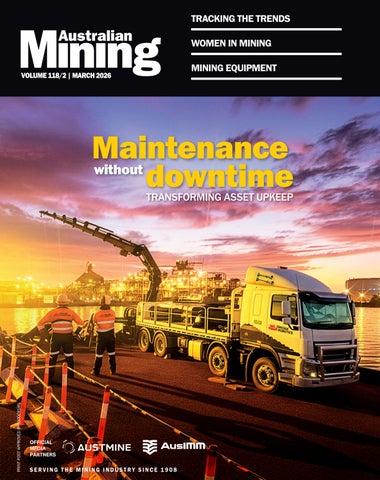
VOLUME 117/2 | MARCH 2026
TRACKING THE TRENDS
WOMEN IN MINING
MINING EQUIPMENT


TRANSFORMING ASSET UPKEEP


![]()
VOLUME 117/2 | MARCH 2026


TRANSFORMING ASSET UPKEEP


Australia’s mining industry has never been short on ambition. What is changing, however, is the context in which our industry operates. Technological disruption, shifting geopolitics, rising expectations around sustainability and workforce transformation are converging at pace.
Yet, as Deloitte’s ‘Tracking the Trends 2026’ makes clear, this complexity is an opportunity.
For Australian mining, the coming years will be defined by how effectively it converts global change into competitive advantage. The resources sector sits at the centre of the energy transition, critical minerals supply chains and economic security conversations worldwide. That brings pressure but also brings influence.
Critical minerals are a case in point. Lithium, rare earths, nickel and cobalt have moved well beyond niche commodities to become strategic assets. Australia’s geological endowment, combined with stable regulation and strong governance, places it in a powerful position to supply partners across Asia, Europe and North America. There is growing momentum to capture greater value domestically, supporting jobs, skills and regional development.
This opportunity also extends to how mining companies think about their portfolios. Volatile markets and geopolitical uncertainty are challenging traditional approaches. The industry response, increasingly, is strategic agility: balancing near-term returns with long-term resilience. Diversification across commodities, jurisdictions and development stages is a growth strategy that enables Australian miners to remain competitive through cycles.
Equally important is the role of purpose. Companies that articulate a clear purpose –
CHAIRMAN JOHN MURPHY
CHIEF EXECUTIVE OFFICER CHRISTINE CLANCY
MANAGING EDITOR PAUL HAYES
Email: paul.hayes@primecreative.com.au
ASSISTANT EDITOR
ENGEL SCHMIDL
Email: engelbert.schmidl@primecreative.com.au
JOURNALISTS
DYLAN BROWN
Email: dylan.brown@primecreative.com.au
BEN CARTWRIGHT
Email: ben.cartwright@primecreative.com.au
and embed it into decision-making – are better placed to earn trust, attract investment and sustain long-term operations.
Technology remains a great strength. Automation, remote operations and digital systems are already well established across much of the sector. The next phase, as highlighted by Deloitte, is integration at scale. Artificial intelligence, analytics and data-driven decisionmaking offer pathways to safer workplaces, lower costs and improved productivity.
Of course, none of this happens without people. The future of work in mining will be shaped by how effectively organisations blend human expertise with digital capability. Investing in skills, training and workforce planning is fundamental to growth. Australia has an opportunity to develop a workforce that is technically proficient and globally sought-after.
Collaboration will underpin this progress. Strong partnerships between industry, government, research institutions and communities have long been a hallmark of Australian mining. As demand for resources intensifies, deepening these relationships will be critical to unlocking infrastructure, accelerating innovation and strengthening social licence.
If Australia embraces this moment, the mining industry can continue to be a cornerstone of national prosperity. When met with confidence and capability, complexity can become a powerful driver of growth.

Paul Hayes Managing Editor
ETHAN BENEDICTO
Email: ethan.benedicto@primecreative.com.au
CLIENT SUCCESS MANAGER
JANINE CLEMENTS
Tel: (02) 9439 7227
Email: janine.clements@primecreative.com.au
SALES MANAGER
JONATHAN DUCKETT
Mob: 0498 091 027
Email: jonathan.duckett@primecreative.com.au
BUSINESS DEVELOPMENT MANAGERS
JAMES PHIPPS
Mob: 0466 005 715
Email: james.phipps@primecreative.com.au
ROB O’BRYAN
Mob: 0411 067 795
Email: robert.obryan@primecreative.com.au

Dredge Robotics is an Australian leader in dredging and water asset maintenance, delivering solutions that keep tanks, ponds and industrial water systems operational while they’re cleaned and inspected. Its fleet of advanced robots can operate in challenging conditions, removing sediment, rocks and reeds safely and efficiently without shutdowns or confined space entry. Accredited to work with major companies under triple ISO-certified systems, Dredge Robotics serves mining, industrial, manufacturing, processing and wastewater sectors reducing downtime and operational risk. Backed by over 35 years of experience through its connection to Fremantle Commercial Diving, the company combines deep technical expertise with cutting-edge sensors, GPS navigation and designs to deliver cost and safety benefits.
Cover image: Dredge Robotics
ART DIRECTOR MICHELLE WESTON michelle.weston@primecreative.com.au
SUBSCRIPTION RATES Australia (surface mail) $120.00 (incl GST) Overseas A$149.00 For subscriptions enquiries
8766 subscriptions@primecreative.com.au


Turning complexity into opportunity
What Deloitte’s ‘Tracking the Trends 2026’ means for the Australian resources industry.
Maintenance in modern
Keeping Australia’s mines safe,
and competitive.
Redefining the future of heavy dredging
Dredge Robotics is changing the way heavy dredging is done, keeping mines running, water assets clean, and people out of harm’s way.
From bottleneck to benchmark
From port to pit, Bedeschi Australia helps miners boost throughput, reduce downtime
32MAINTENANCE
Powering maintenance the right way Australian Power Equipment is working with miners to align high-voltage maintenance strategies with an electrified industry.
56 CRITICAL MINERALS
Scale meets strategy: Australia’s critical minerals builders Larvotto’s rapid restart of the Hillgrove Project comes as Australia moves to secure domestic supplies of critical minerals.
60 CRITICAL MINERALS
Mapping Australia’s vanadium future Energy transition pressures and supply chain ambitions are pushing vanadium into sharper focus.
64 TECHNOLOGY


Tough tech for mining Mining teams are relying on Panasonic’s TOUGHBOOK to withstand the harshest operating environments.
72 EFFICIENCY
Powering peak performance XCMG’s heavy machinery is designed to deliver productivity in Australia’s toughest mining conditions.

ENVIRONMENTAL DNA CAPTURES TRACES OF GENETIC MATERIAL FROM PLANTS, ANIMALS, BACTERIA AND FUNGI INTO SOIL, WATER AND AIR.


ANGLO AMERICAN IS USING NATURE’S DNA TO ADD A POWERFUL NEW LAYER OF EVIDENCE TO MINE REHABILITATION ACROSS THE BOWEN BASIN.
For decades, mine rehabilitation has relied on what could be seen and counted. Plants surveyed, animals spotted, waterways inspected.
But at Anglo American’s steelmaking coal operations in Queensland’s Bowen Basin, a new layer of evidence is being added, one invisible to the eye but rich in detail. Using science familiar from forensic investigations, the miner is turning to environmental DNA to understand how life is returning.
Environmental DNA, or eDNA, captures microscopic traces of genetic material shed by plants, animals, bacteria and fungi into soil, water and air.
Environment teams across Anglo American’s five Bowen Basin mine sites are collecting these samples to detect species living in, or passing through, rehabilitated areas and mining offsets.
“Every plant, animal or insect leaves behind tiny fragments of DNA in water, soil or air,” Anglo American environmental manager Jason Fittler said. “By analysing those samples, we can build a detailed picture of what species are living in or moving through our rehabilitated sites.”
The process does not replace traditional monitoring, but supplements it. Environmental specialists on each site take about 30 samples at a time alongside annual fauna and flora surveys. The difference is in the breadth of what can be detected.
“At one site, we detected four species of fish, 13 species of birds and three mammals, all in a single sample without having to physically see them,” Fittler said.
“This method complements our traditional monitoring as we can detect a different range of plants and animals through DNA.”
Once collected, samples are analysed and matched against national and international genetic databases to confirm species’ presence and track biodiversity trends over time.
According to EnviroDNA principal scientist Dr Luke Noble, the strength of eDNA lies in its reach across ecosystems.
“eDNA allowed access to a broad slice of biodiversity, plants, fungi and animals across marine, freshwater and terrestrial environments,” he said.
In the context of mine rehabilitation, soil has been the most common sample type processed for Anglo American.
“These generate thousands and thousands of biological indicators to track the restoration process, the condition of the soil and the condition of the broader ecosystem as it transitions back to a more natural state,” Noble said.
Noble described DNA as an indirect but powerful detection method.
“eDNA is pretty much everywhere you look; you just need a method to concentrate it or access it in useful ways,” he said. “It tells you what has been at or near the site you sampled.
“By building up a picture of detections through time, we can have much more confidence about what we’re seeing.”
One of the latest additions to Anglo American’s toolkit is air sampling. Using suspended filters that resemble a household cleaning cloth, teams can collect DNA particles moving through the air. The non-invasive nature of the technology is a major advantage for Anglo American’s rehabilitation efforts.
the survey period,” Fittler said. “This approach not only reduces the need for disruptive monitoring techniques but also gives us richer insights into how ecosystems are recovering.”
One of the most exciting findings so far has been the discovery of fish in water ponds created above underground mine subsidence rehabilitation areas.
“We’re using science to tell the story of nature’s comeback,” Fittler said.
“These results show life is returning, and thriving, in the places where we once mined.”
In the Bowen Basin, that story is now being written not just in what

ENVIRONMENT TEAMS ARE COLLECTING SAMPLES TO DETECT SPECIES LIVING IN, OR PASSING THROUGH, REHABILITATED AREAS.


OTR is at the forefront of tyre, wheel and service innovation, proudly supporting Australia’s mining, construction, transport, agricultural and industrial sectors. We deliver unmatched capability, performance and reliability across every site and every haul road. Our commitment is simple, if your tyres or wheels stop, your production stops - so we’re here to keep you moving.

OTR is Australia’s leading independent partner for off‑highway tyres, wheels, consumables and service solutions. With nationwide manufacturing, service hubs, and on‑site support teams, we provide the most comprehensive ground‑contact offering in the country.
With deep expertise across mining and heavy industry, OTR is trusted by major operations to deliver safe, compliant, and cost‑effective solutions built for tough Australian conditions.
•Massive range & stocks of earthmover, truck & LV tyres.
•Full range from 6” through to 63” from leading global brands.
• Tyre fitting, rotation, change‑outs and on‑site support.
• Tyre pressure management and haul profile optimisation.
• Tyre valving, O‑rings & tooling
•Wheels, rims, assemblies & components.
• Australian manufactured with in‑house design.
• Test, repair & certification under Australian Standards AS4457.1.
•Latest MID and MRD compliance.
• Mobile fitting capability for large OTR assemblies.
• Dedicated tyre & wheel technicians for major mining operations.
• On‑site wheel, rim & tyre management programs.
•Tyre Handlers, mine site spec for sale or hire.
• Industry‑accredited Cert II tyre fitting and safety training.
• RTO provided on‑site or at OTR facilities.
WITH SERVICE HUBS AND MANUFACTURING FACILITIES
ACROSS AUSTRALIA, OTR PROVIDES RAPID RESPONSE AND CONSISTENT SUPPORT WHEREVER YOU OPERATE.


As the global mining and metals industry enters a new era shaped by technological disruption, geopolitical transformation and rapidly evolving stakeholder expectations, Australia finds itself well positioned to thrive.
Deloitte’s ‘Tracking the Trends 2026’ report, now in its 18th edition, outlines 10 trends expected to influence the sector over the next 12–18 months, many of which have direct implications for Australia’s resources industry.
The report emphasises that the next phase of growth will be defined by collaboration across industry, government, technology partners and communities. For Australian miners, from global majors to emerging juniors, the opportunity lies in leveraging these trends to strengthen competitiveness, fuel innovation and unlock new pathways to sustainable growth.
Australia already stands as a global leader in critical minerals, including lithium, rare earths, nickel and cobalt, commodities central to the global energy transition.
Deloitte highlights the fact critical minerals have moved into the realm of national security, not just energy transition, as governments aim to secure supply chains that underpin renewable technologies, defence capabilities and electric mobility.
This is a trend that presents a strategic advantage for Australian miners and policymakers.
The country’s abundant resources, strong regulatory frameworks and stable investment environment mean it can play an outsized role supplying critical minerals to Asian and western markets. In practical terms, this could underpin larger investment inflows from sovereign funds, strengthen trade relationships,
and stimulate domestic processing industries that capture more value beyond extraction.
In this context, proactive industry–government collaboration to align exploration incentives with geopolitical demand signals could see Australia shape global demand.
Traditional portfolio-management approaches are being challenged by heightened volatility in commodity prices, trade disruptions and emerging supply chain bottlenecks. Deloitte believes companies must be agile in balancing short-term returns with long term resilience, a message that resonates with Australian producers navigating iron ore cycles while preparing for the next wave of critical mineral demand.
For Australian mining companies, future-proofing means revisiting how assets are evaluated, prioritised and
developed. Rather than viewing assets in isolation, companies can adopt a holistic approach that takes into account geopolitical risk, lifecycle economics and the rising importance of environmental and social governance (ESG) credentials. This shift aligns with broader industry developments, including rising gold and copper prices enhancing the economics of new projects and making once marginal deposits commercially attractive.
By embracing portfolio diversification as a strategic growth lever, Australian companies can deliver stable returns while capturing upside from emerging market dynamics.
Purpose – a clear articulation of why an organisation exists beyond profit – is emerging as a defining differentiator in mining. According to Deloitte’s analysis, companies with authentic, purpose-driven strategies build stronger DIGITAL

THE REPORT HIGHLIGHTS THAT AI WILL RESHAPE HOW ROLES ARE DESIGNED AND TALENT IS DEVELOPED.


trust with communities, investors and partners while enhancing resilience to external shocks.
This is particularly pertinent in Australia, where the resources sector operates in diverse and often sensitive social and environmental contexts. Companies that integrate purpose into decision-making, whether through regional development partnerships, sustainable land stewardship or a genuine commitment to local employment, may find greater success in securing social licence to operate and unlocking long-term value from projects.
Adopting purpose can underpin a more cohesive business strategy, allowing companies to convey purpose through stakeholder engagement and transparent reporting, and by aligning operational goals with broader societal needs.
The rise of digital transformation and new market pressures means traditional operating models may no longer deliver optimal value. Deloitte argues that mining companies must go beyond incremental improvement to reimagine how work is done, blending governance,


people, processes and technology to increase agility and profitability.
Even in Australia, where many companies have already adopted automation and remote operations in areas such as haulage and drilling, there remains an opportunity to elevate operating models further.
Integrating remote monitoring, artificial intelligence (AI)-led optimisation and digital twins can reduce downtime, improve safety outcomes and reduce operational costs. These abilities also support more resilient operations that can withstand labour shortages and energy price volatility.
For Australia’s mining sector, investing in next-generation operating models can translate into safer workplaces, lower unit costs and enhanced investor confidence.
Data is considered by many to be the lifeblood of modern mining operations, yet Deloitte found that many companies still struggle to extract meaningful value from the vast amounts of information they collect. The future lies in smart operations, environments where data flows seamlessly between systems, assets and people, enabling real-time decision-making.
Australian mining companies are well placed to capitalise on this trend. Many have already implemented sophisticated fleet telematics, sensor networks and predictive maintenance platforms. The next step is scaling these capabilities into fully integrated ecosystems powered by cloud computing, edge analytics and cybersecurity frameworks that protect operational and commercial data.
This means decisions driven by performance indicators rather than intuition. Smarter data integration can enhance mine planning, reduce energy consumption and improve ore recovery rates.
AI as a foundation for operational excellence
AI is no longer a futuristic concept; it is becoming a core operational tool.
Deloitte’s report emphasises the fact that, when applied holistically rather than piecemeal, AI can drive step changes in safety, productivity and risk management across mining operations.
In Australia, where large-scale iron ore, gold and base metals operations are commonplace, AI applications can extend from predictive fleets maintenance to real-time safety monitoring. Generative and agentic AI also have implications for workforce structuring, enabling humans and digital agents to collaborate more effectively, helping to alleviate skill shortages and enhance productivity.
Companies that strategically adopt AI stand to benefit from accelerated exploration timelines, optimised supply chains and superior risk anticipation. These are significant advantages as global competition intensifies and operational complexity deepens.
The rise of AI has significant implications for mining workforces.
Deloitte highlights that AI will reshape human resources (HR) functions and force a rethink of how roles are designed and talent is developed.

CRITICAL MINERALS SURGE
Australia’s strength in lithium, nickel, cobalt positions it as a global supplier for the energy transition.
PORTFOLIO AGILITY
Diversify assets to balance short-term returns with long-term resilience in volatile markets.
PURPOSE AS A DIFFERENTIATOR
Authentic social and environmental purpose strengthens trust and longterm value.
NEXT-GEN OPERATING MODELS
Integrated digital, AI and automation solutions reduce costs, improve safety and boost efficiency.
DATA-DRIVEN DECISIONS
Real-time operational insights enable smarter mine planning and higher ore recovery.

Australian mining companies can lead in designing workforce strategies that balance digital augmentation with human expertise. This includes investing in training programs that equip employees with data literacy, AI competency and technical skills, while creating roles that emphasise creativity, judgement and leadership – traits that machines cannot replicate.
Proactive workforce planning also helps address long-standing challenges such as talent shortages and safety culture development.
By embracing AI in HR analytics, companies can better match talent to strategic priorities, forecast future skills requirements and build resilient teams primed to drive transformation.
Mineral exploration has traditionally been driven by ground acquisition and prospecting, but Deloitte argues that data should be the new starting point for discovery.
For Australia, which is renowned for its rich mineral endowment yet faces rising discovery costs, this approach offers a compelling path forward. By standardising and integrating exploration data, from drilling logs to geophysical surveys, and layering it with AI-enabled modelling, companies can identify targets more efficiently and with greater confidence.
This can unlock fresh greenfield opportunities and rejuvenate mature belts, spreading exploration risk while potentially reducing time to discovery. For juniors and mid-tier explorers, enhanced data strategies can improve access to capital by demonstrating clear, data driven potential to investors.
As demand for critical minerals and metals grows, driven by population, urbanisation and energy infrastructure, Deloitte points to the need for collaboration among mining companies, governments and communities.

AI-ENHANCED OPERATIONS
Predictive maintenance, safety monitoring and exploration insights accelerate performance.
FUTURE OF WORK
Upskilling staff for AI and digital collaboration improves productivity and safety.
SMART EXPLORATION
Data-centric exploration accelerates discovery and reduces risk in greenfield and brownfield sites.
COLLABORATION AND PARTNERSHIPS
Joint ventures with government, communities and industry unlock economic and social value.
SUSTAINABILITY AND RESILIENCE
Low-emissions operations, water management and mine rehabilitation futureproof assets.


Australia’s resources sector is already deeply engaged in this kind of cooperative value creation. Partnerships among miners, research institutions, Indigenous groups and local governments have helped deliver projects that balance economic benefits with social and environmental objectives. Strengthening this ecosystem further could accelerate domestic processing, new market development and export diversification.
Collaborative frameworks also enhance social licence to operate, particularly in contexts where community expectations for longterm benefits and environmental stewardship are high.
Perhaps the most urgent imperative for the Australian industry is adapting to sustainability and resilience challenges. Deloitte highlights physical risks such as extreme weather, water scarcity and ecosystem degradation, all of which have profound implications for business continuity.
Yet this challenge also presents opportunity. Australia’s mining sector can leverage its advanced regulatory environment and strong engineering capabilities to lead globally in resilient and sustainable mining practices. This includes technologies
for water recycling, low-emissions operations, mine site rehabilitation and renewable energy integration.

Sustainability is not a cost centre but a source of competitive advantage. Companies that embed resilience into their operating models are likely to attract more investment, improve community trust and reduce long term risk exposure.
The ideas outlined in ‘Tracking the Trends 2026’ paint a picture not of disruption for its own sake but of
transformation fuelled by purpose, partnership and innovation.
For the Australian mining sector, these themes reinforce existing strengths – resource endowment, technological sophistication and collaborative industry culture – while pointing to areas where strategic investment can yield disproportionate returns.
By embracing data-driven exploration, AI-enabled operations and future-fit workforce strategies, Australia’s miners can enhance
productivity and deliver safer, more efficient operations. At the same time, deeper collaboration with government and communities can accelerate infrastructure development, export diversification and sustainable regional growth.
When viewed through this lens, the trends in the Deloitte report are levers that could help the Australian mining industry grow stronger, more resilient and more influential in the global resources landscape. AM

In the heart of Australia’s vast mining sector, maintenance has moved far beyond a routine operational task. It is a strategic imperative that underpins productivity, safety and long-term competitiveness.
As operations grow more complex and equipment more sophisticated, effective programs help to ensure assets keep running, people stay safe and the nation’s mining and resources sector remains at the forefront of global supply chains.
Mining operations operate in some of the harshest and most demanding environments on the planet. Massive fleets of heavy machinery, intricate processing plants and remote work sites expose equipment to extreme wear, corrosion, vibration and dust.
When a piece of equipment fails unexpectedly, production can halt, costing significant time and money. Comprehensive maintenance strategies, from routine servicing to advanced predictive systems, reduce the risk of unplanned breakdowns and minimise costly downtime, keeping operations on schedule and within budget.
REGULAR MAINTENANCE ALLOWS COMPLEX MINING OPERATIONS TO CONTINUE RUNNING AS NEEDED.
The industry’s shift toward strategic maintenance reflects its direct link to financial performance. Unplanned equipment failures can halt multimillion-dollar daily operations, making maintenance a competitive advantage rather than an expense.
But benefits go beyond economics.
Robust maintenance protocols are essential to workplace safety, reducing hazards posed by malfunctioning machines or failing components. Workplace injuries remain a major concern in Australia, with hundreds of thousands of workers experiencing injury or illness each year. Maintenance that keeps equipment operating reliably helps to reduce the conditions that can lead to such incidents, protecting the wellbeing of the workforce and contributing to safer mine sites.
Maintenance on mine sites is a complex, multi-layered operation that reflects the scale and sophistication of the modern industry. Routine servicing forms the backbone of these programs, with scheduled checks and servicing of engines, hydraulics, brakes and other critical components ensuring machinery continues to operate within design specifications.
Preventive maintenance complements these checks. This involves regular replacement of filters, greasing of bearings, monitoring fluid levels, and inspecting moving parts to address potential issues before they develop into major failures.
Modern mining also increasingly relies on predictive maintenance, a data-driven approach where sensors and real-time analytics monitor equipment conditions such as vibration, temperature and pressure. By forecasting when machinery might fail, maintenance teams can schedule interventions proactively, reducing the likelihood of unexpected downtime.
Another critical aspect is corrosion management, which involves the inspection and treatment of equipment exposed to moisture, chemicals and abrasive materials, safeguarding machinery and personnel.
Despite careful planning, unexpected breakdowns can still occur. Emergency repairs and rapid response crews are therefore essential, ready to address equipment failures quickly and minimise disruptions to operations.
Together, these practices form a dynamic maintenance ecosystem that
balances planned schedules with the flexibility to react to unforeseen issues, keeping machines and infrastructure reliable, productive and safe.
The tools and technology used in modern mine maintenance reflect the dual demands of mechanical skill and technological sophistication. On the ground, maintenance crews rely on traditional heavy-duty tools, diagnostic equipment and rigging gear to inspect, repair and service massive machinery such as haul trucks, excavators and conveyors. On-site workshops are equipped to fabricate or retrofit components when needed, allowing teams to respond quickly and keep operations running smoothly.
Alongside these traditional tools, digital innovations are transforming how maintenance is performed. Internet of Things (IoT) sensors embedded in machinery collect real-time data on vibration, temperature, pressure and other indicators, feeding into central analytics platforms that help teams prioritise tasks and plan interventions.
Data analytics and machine learning play a key role in predictive maintenance, using historical and live information to forecast equipment issues and schedule

repairs during planned downtime rather than in emergencies. Mobile maintenance systems further enhance efficiency by automating task reminders, work orders and parts management, improving coordination across teams and ensuring resources are available when and where they are needed.
The combination of hands-on expertise and advanced technology allows mines to move from reactive maintenance toward a more proactive, condition-based approach. By integrating mechanical skill with realtime insights, maintenance teams can anticipate problems before they arise, reduce downtime, extend the lifespan of critical assets and maintain the highest standards of safety.
In modern mining, it is this blend of tools, machinery and technology that keeps operations productive, reliable and globally competitive.
Unplanned downtime is, to put it bluntly, a major productivity killer. Strategic maintenance directly addresses this problem by ensuring potential issues are spotted early and fixed during planned maintenance windows.

Predictive systems that flag anomalies before failure reduce the likelihood of sudden breakdowns and allow teams to plan resources and parts procurement around production schedules. The result is a smoother, more efficient operation.

Fewer emergency repairs mean less disruption to production flow, improved lifespan for major assets and better overall equipment effectiveness. This consistency is especially valuable in high-investment environments where equipment downtime can translate into millions in lost throughput.
Maintenance and safety also go handin-hand.
In the complex environment of a mine site, where heavy machinery moves tonnes of ore daily and processing infrastructure operates around the clock, poorly maintained equipment can quickly become a safety hazard.
Broken brakes, misaligned conveyors, leaking hydraulics and corroded components can all contribute to accidents, injuries and equipment damage. Regular maintenance reduces these risks by keeping machines in optimal condition and ensuring safety systems work as intended.
While mining remains an inherently challenging industry, Australian safety data show a downward trend in fatality rates in recent years, reflecting broader efforts to improve workplace health and safety practices across industries. Maintenance contributes to by eliminating many of the mechanical causes that can lead to incidents, particularly those linked to machinery and equipment failures.
As mining maintenance becomes more technical and data-driven, the role of skilled maintenance professionals, from diesel mechanics and fitters to data analysts and reliability engineers, is expanding. The industry’s adoption of advanced predictive tools and integrated

maintenance management systems is creating demand for workers with blended skills: mechanical know-how paired with digital literacy.
Workforce planning data indicates growth across related sectors in Australia, with thousands of jobs expected in mining and mining services over the coming decade.
This trend highlights the importance of training, apprenticeships and career pathways that equip maintenance teams with the skills needed for modern operations, supporting local jobs and the broader competitiveness of the Australian resources sector.
In a global market where operational resilience, safety performance and cost efficiency are key differentiators, modern maintenance practices offer Australian mines a strategic edge.
By reducing unplanned downtime, extending equipment life, enhancing safety and supporting smarter workforce utilisation, maintenance contributes directly to operational excellence.
As Australia’s mining sector continues to innovate, embracing digital tools, integrated asset management systems and predictive approaches, maintenance stands not just as an operational necessity but as a driver of productivity, safety and long term industry growth.
In this way, maintenance supports not only the machines that extract the nation’s wealth but also the people, communities and economies that benefit from Australia’s world class resources sector.
Keeping machines running well means keeping Australian mining strong – and safe.
TO
PERFORMED ON MINE SITES, DREDGE ROBOTICS IS ELIMINATING DISRUPTION AND DELIVERING SAFER OUTCOMES BY REMOVING PEOPLE FROM HAZARDOUS ENVIRONMENTS.
Through proprietary robotic technology developed inhouse, Dredge Robotics is bringing a new level of precision, safety and uptime to water asset management.
Safer outcomes, greater efficiency
Operational continuity, safety and efficiency are non-negotiable on modern mine sites. In this environment, Dredge Robotics has emerged as a proven innovator, applying purpose-built robotics to one of mining’s most persistent operational challenges: dredging and water asset maintenance.
What began as a response to the limitations of traditional dredging has evolved into a suite of unique robotic systems designed specifically for mining applications.
At its core, Dredge Robotics addresses a fundamental operational question: how can the removal of sediment, sludge and contaminants be

managed efficiently while maintaining production and keeping safety at the forefront, particularly for complex or challenging applications?
From lined ponds to chemical tanks and wastewater facilities, the company’s robotic systems enable in-service cleaning and maintenance, eliminating the need to drain assets or halt production, while avoiding the occupational hazards historically associated with dredging.
Traditional dredging methods tend to carry significant financial, safety and scheduling costs. Downtime can extend for days or weeks, while personnel are exposed to a range of hazards that can include corrosive environments, confined space risks and working over water.
Dredge Robotics’ approach is designed to remove these constraints entirely. Its fleet of robotic dredging systems is engineered to operate continuously while assets remain fully operational, dramatically reducing downtime and removing the need for human entry.

DREDGE ROBOTICS IS RAPIDLY EXTENDING ITS INTERNATIONAL REACH, SERVING MINING OPERATIONS IN REGIONS SUCH AS THE AMERICAS.
DREDGE ROBOTICS HAS DEVELOPED FIVE ITERATIONS OF ITS WEEDING ROBOT TO ENSURE IT IS FIT FOR PURPOSE.


According to the company’s mission, these systems “clean faster, clean smarter and eliminate downtime”, an ethos reflected not just in outcomes but in the unique technology architecture developed by the Dredge Robotics engineering team.
Technology engineered for extreme conditions
Dredge Robotics’ systems are built on a proprietary control platform, designed in-house to provide reliable operation and navigation in challenging mining environments. The machines are capable


advanced sonar, underwater positioning and sensor feedback, the machines can precisely degrade and remove difficult material without disrupting operations, even in fragile lined pond environments.
Dredge Robotics’ systems are remotely operated from the surface, delivering a true zero-entry solution. This approach significantly reduces risk and aligns with the mining sector’s increasing focus on eliminating high-risk work.
Beyond maintenance, Dredge Robotics’ technology also enables the recovery of valuable minerals that would otherwise be lost within production loops. Over time, heavy materials such as gold, nickel, lead and copper can settle and accumulate in lined ponds and process water assets, effectively removing recoverable value from active operations. By dredging precisely back to bare liner while assets remain in service, Dredge Robotics’ systems can selectively recover dense, mineral-rich material without disturbing liner integrity or requiring shutdowns. This capability not only restores pond capacity and hydraulic performance but allows operators to reclaim valuable product that would traditionally remain stranded, converting a maintenance activity into a measurable recovery opportunity.
Dredge Robotics’ technology has not only been adopted by several Tier 1 mining operators but was recently recognised by the broader industry. The
TECHNOLOGY SUPPORTS SUSTAINABILITY OBJECTIVES BY PRESERVING WATER ON SITE.

company’s flagship Zero Entry Robotic Dredging System received the Innovative Mining Solution Award at the 2025 Australian Mining Prospect Awards. The award recognised the system’s ability to operate in live production environments, provide real-time monitoring, and remove significant volumes of sediment without interrupting operations.
Safety and sustainability
Mining’s regulatory landscape and social licence increasingly prioritise
worker safety and environmental stewardship. Dredge Robotics addresses both by eliminating confined space entry and reducing exposure to hazardous conditions.
While Australia remains the company’s home base, Dredge Robotics is in the process of expanding internationally, gearing up to support mining operations across regions including the Americas.
This growth reflects a broader industry shift toward automation and smarter operating models. As
robotics and digital monitoring become central to mining performance, Dredge Robotics sits at the intersection of innovation and operational necessity.
The company’s end-to-end robotic dredging solutions – designed, engineered and refined in-house for rugged mining environments – represent more than incremental improvement. They signal a step change in how dredging, safety and water asset management are evolving across the mining sector. AM

WHAT STARTED AS A FAMILY BUSINESS SERVICING THE AGRICULTURAL SECTOR IN REGIONAL NEW SOUTH WALES HAS EVOLVED INTO ONE OF AUSTRALIA’S MOST RESPECTED NAMES IN MINE DEWATERING.
Founded more than 40 years ago, Truflo Pumps has grown into a leading manufacturer and service supplier of high-performance dewatering solutions purpose-built for the global mining industry. Today, the company’s pumping systems operate across mines in some of the harshest and most demanding environments on the planet, from the Pilbara in Western Australia to Zambia in Africa
The ability to design, build and service pumps for such diverse conditions stems from decades of experience and a long-standing commitment to understanding customer needs.
Truflo Pumps national repairs manager Jason Lidgard told Australian Mining that a key differentiator for the business is its dedication to a specific industry.
“There are a lot of pump manufacturers in Australia, but we are focused almost solely on mining, both open-cut and underground operations,” he said.
That deep knowledge has enabled the company to tailor solutions to the specific needs of each operation.
“Building bespoke is really where we stand apart,” Truflo Pumps national operations manager Jason Bemrose said.
“It’s one of the most challenging, but also most satisfying, things we do for our clients.”
Bespoke requests often require going back to the drawing board and rethinking exactly what is needed and how it can be successfully manufactured.
As mining operations continue to lift safety standards, safety-related specifications have become some of the most significant considerations in pump supply.
“Walkways, handrails and safety access are becoming a major focus,” Bemrose said. “Some sites want very specific standards, others want something slightly different.
“It’s never one-size-fits-all, but we have the experience and the resources to deliver what the client requires.”
“Having our own in-house engineers means we don’t need to go out to consultants. We do the schematics and drawings, have them approved and can go straight into fabrication. It makes the whole process seamless.”
Truflo Pumps also provides a range of service and repairs. Because down time can cost mines thousands of dollars,
Truflo Pumps has built its repair and maintenance service offering around one objective: keeping pumps running and operations productive.
Its service exchange program is designed to dramatically reduce downtime when a pump under performs or fails.
“We’ve built up a bank of refurbished and new wet-ends,” Lidgard said.
“Instead of waiting weeks for repairs, clients can swap out a wet-end and have their asset back in operation within days.”
Under the program, Truflo Pumps dispatches a refurbished wet-end to site, where it is installed during a single crane lift. The removed pump is then returned for inspection, with the customer receiving a core credit once assessed.
“It means they’re pumping and back in business while we refurbish the original unit saving them time and money,” Lidgard said.
With workshops in New South Wales, Queensland and Western Australia, Truflo Pumps services include retro-fits, refurbs and fabrication.
“All our repairs are brought back to OEM [original equipment manufacturer] specification,” Lidgard said. “What we provide gives clients
confidence that the pump will perform as designed.”
The workshops are backed up by a substantial spare parts inventory that ensures fast and efficient turnarounds.
“We’ve got over 900 square metres of spare parts on the floor,” Lidgard said. “Most of the wearable components are already on the shelf. We’re not waiting on parts to come in before we can start work.”
And that capacity is set to grow, with the Truflo Pumps Queensland operation moving into a new purpose-built facility that will double workshop space and nearly triple its spare parts inventory.
“We are growing the workshop crew, too, speeding up turnaround times and giving us the space to handle more pump repairs at any one time,” Lidgard said.
From managing routine groundwater seepage to responding to extreme rainfall events, Truflo Pumps dewatering systems play a critical role in maintaining safe and productive mine sites. With its dewatering systems recognised for moving more water while using less energy, and strategic service locations across the country, Truflo Pumps has positioned itself as a long-term partner to the mining sector. AM


Conveyor belts are among the most critical and high-value assets in mining and bulk material handling operations. They play a vital role in meeting production targets and shipping schedules, and any unplanned repair or replacement can result in extended downtime, lost production and increased operating costs.
As the primary means of material transport across mine sites, conveyor systems must operate reliably in demanding conditions. A by-product of this process is often fugitive material, which causes belt damage, material loss, or component failure and directly impacts efficiency, safety, maintenance costs and product quality. Effective conveyor maintenance is therefore essential to operational performance.
Early inspection and accurate fault diagnosis are critical to effective conveyor maintenance.
Tom Stahura brings decades of experience in bulk conveyor systems, supporting ESS Engineering’s maintenance-led approach to cleaner, safer, more reliable material handling.
ESS Engineering, established in 1979, employs more than 90 people across 11 branches nationwide, with manufacturing facilities in Queensland and Western Australia. This footprint enables rapid site support, backed by in-house engineered conveyor hardware and experienced service personnel. ESS provides a deliberately focused service offering, Stahura told Australian Mining
“We have a niche market, and we don’t supply full conveyors,” he said. “We deal with fugitive material issues – carryback, spillage and dust – problems that directly impact safety, belt alignment, belt life, and operational efficiency.”
ESS emphasises on-site inspection, diagnosis and collaboration with operators. The company works closely with clients to assess problem conveyors, identify root causes, and recommend fitfor-purpose solutions.
“Before we get on-site, we like to hear the client’s perspective to understand what they perceive as the problem,” Stahura said. “Once on-site we’re able to analyse the issue and make our recommendations for the best outcome, though this often is balanced against the client’s budget and time constraints.”
These recommendations are supported through technician training, scheduled maintenance programs or full-service support, depending on-site requirements.
ESS technicians complete extensive internal training focusing on conveyor fundamentals and extensive guided field experience, giving them a practical perspective when addressing conveyorrelated issues.
“We don’t try to go into a site and fix everything on the first visit,” Stahura said.
“It’s about learning how each site operates, because any recommendations we make must consider how the equipment is operated and serviced.”
Stahura believes maintaining a reliable conveyor system is much like keeping a car on the road.
“It won’t run forever, but it will work better and have a longer life if it is correctly serviced,” he said. “We’re flexible, whether we do the work, train site personnel or visit quarterly to check performance. If a site is close to one of our service points, we can quickly send someone out to troubleshoot and carry out maintenance.”
Alongside diagnostics and servicing, ESS also supplies a range of conveyor accessories, including belt cleaners, sealing and support systems, belt tracking solutions, flow aids and conveyor guarding, much of which is designed and manufactured in-house to improve system performance and maintainability.
“Our hardware has been designed to be inspected while the conveyor is in operation,” Stahura said.
“We can carry out inspections and minor adjustments to our belt cleaners with the conveyor online, requiring only minimal downtime during shutdowns to service or replace equipment. That represents a significant productivity gain.”
One of the most common issues Stahura sees at mining operations is incorrect tensioning of conveyor belt accessories, which can lead to spillage, belt damage and unplanned downtime.
“There needs to be regular inspection to keep skirting adjusted and the belt properly supported under the skirt zone,” he said.
“If the belt sags, lump or rock material can jam between the skirt and the belt, damaging the top cover.”

CLOSE SCRUTINY OF THE CONVEYOR IS REQUIRED TO PICK UP POTENTIAL ISSUES.

“If you’re going to work every day and you’re covered in dust and dirt, morale is very low.
“If we can do something simple to reduce that, that’s the goal – a cleaner, safer and more productive system, where material ends up where it’s meant to go.” AM


MACHINES TRAVELLING LONG DISTANCES CAN WASTE ENERGY AND WEAR OUT FASTER, BUT A NEW ROLLER CHAIN SYSTEM IS CHANGING THAT.
When machines need to cover hundreds of metres, every bit of friction, weight and wasted energy matters.
Treotham faced this challenge headon for a client based in Shark Bay, Western Australia, with its partner igus installing the E4/4 rol e-chain, a system designed to make long-distance motion smoother, more efficient and durable.
“The biggest challenge first and foremost was the travel distance,” Treotham WA manager Danne Hallgren told Australian Mining
“We’re talking 214m. With cables that long, the push and pull forces are significant, and the chain itself is very heavy. Reducing friction was critical.”
“That dramatically reduces the drive power needed, even over long distances.”
Beyond energy savings, the chain is built for harsh conditions.
“In the Shark Bay installation, salt frequently falls onto the chain beneath the conveyor belt, yet highstrength rollers and stainless-steel ball bearings ensure reliable operation,” Hallgren said. “That was another reason we chose this system.”


The E4/4 rol e-chain solution lies in a simple yet transformative design: the chain rolls instead of slides, while traditional systems rely on gliding motion, which increases resistance and energy use.
“It’s just rolling on itself instead of colliding,” Hallgren said.


Installation is also straightforward. Delivered as a ready-to-fit, harnessed solution, the system reduces set-up time while guaranteeing reliable performance from the start.
For clients, this translates into operational efficiency and cost savings.
“The previous system lasted 10 years,” Hallgren said. “With this upgrade, we expect the new chain to last a minimum of 15 years, which represents significant savings.”
The E4/4 rol e-chain has a proven track record. It has been used in shipto-shore cranes with travel distances up to 90m, handling heavy loads while maintaining low noise levels.
Even at speeds up to 6m per second, the chain moves smoothly and consistently.
Treotham also offers its clients ongoing maintenance.


THE E4/4 ROL E-CHAIN HAS BEEN USED IN SHIP-TOSHORE CRANES WITH TRAVEL DISTANCES UP TO 90M.
“We monitor the chain in hours of operation and perform service checkups on all components, including chains and cables,” Hallgren said. “The Treotham maintenance team keeps a


TREOTHAM FACED A CHALLENGE HEAD-ON FOR A CLIENT BASED IN SHARK BAY IN WESTERN AUSTRALIA.

schedule of operating hours. For Shark Bay, after the initial installation, the first check will be at 200 hours, then 600, 2400 and 4800, and on from there, maximising the lifespan of the chain and company investment.
“Customers can choose the frequency, but we provide flexible support to ensure optimal performance.”
Customisation adds to the system’s appeal. The chain comes in multiple sizes, with large pin-andbore connections providing strong pushand-pull capacity. Interior separation can be adjusted to precisely guide and protect cables.
For heavier applications, igus offers the E4/4HD heavy-duty series, while the P4 system focuses on maximum energy savings, cutting power use by up to 57 per cent, according to the company. The auto glide series provides selfguiding motion for systems without a guide trough.
“Fast availability is another advantage. Standard systems are typically dispatched within 24 to 48 hours, keeping projects on schedule,” Hallgren said. “Larger systems, like Shark Bay, may take longer due to the complexity and size, but delivery remains timely and reliable.”
For operators, the advantages are clear: lower energy use, longer service life, reduced operating costs and local support.

The system continues to perform in harsh operating environments, making it suitable for mining, construction and bulk handling operations where reliability is essential.

The E4/4 rol e-chain is more than a cable carrier. It is a “moving cable management” solution designed to make long-distance motion smarter, safer and more cost-effective.
By reducing friction, handling heavy loads and enduring tough conditions, it gives Australian operators a proven way to improve efficiency and extend the life of critical equipment. AM
• Complex projects

• Systematic planning
• Manage timelines
• Monitoring
• Coordinate resources


• Extensive expertise with all igus products

• Specialised knowledge on mining applications
• Tailored solutions ensuring optimal performance


• Comprehensive range of igus products
• Nationwide supply
• Products specifically for mining including cables and connectors and guide troughs

• Experienced personnel


• Systematic approach to planning
• Executing, monitoring and completing projects efficiently and effectively


• Treotham provides support to all projects
• Dedicated team of support personnel on call


Water, gas and fuel pipelines run through and under mine sites across the country, playing an integral role in ensuring plant and equipment operates at capacity, often 24 hours a day, 365 days a year.
But is the reliability of these critical assets being undervalued or misunderstood by mining operators?
Speaking with Australian Mining
“Like any element of a supply chain, pipelines are living and breathing assets,” he said.
“Because they are transporting valuable resources safely and efficiently, even minor issues can escalate quickly into major environmental hazards and operational disruptions.
“For instance, the failure of a water pipeline can force an immediate halt to mining operations, stopping extraction and processing, creating significant safety hazards and disrupting the entire
trucks and heavy equipment can sit idle, turning even short interruptions into meaningful productivity losses and increased operating costs.”
With many gas pipelines supplying mines or broader resources regions, gas is playing an increasingly important role on-site. Examples include the Carpentaria and Northern gas pipelines fuelling mines in Mt Isa, Queensland, the Goldfields gas pipeline delivering gas to Kalgoorlie, Western Australia, and more recently the Tanami gas pipeline, constructed to power two stations servicing Newmont’s Tanami gold mine in the remote Northern Territory.

“Disruptions to critical gas infrastructure can immediately impact site power generation and essential services, forcing equipment to shut down, interrupting processes and creating broader operational challenges
company helps operators move from reactive repairs to proactive integrity management, reducing downtime, risk and lost revenue.
Brannelly describes regular inspection of a pipeline as “a bit like taking an annual trip to your GP”.
“You put it off and dread having to do it, but it’s never as bad as what you expect it to be,” he said. “Most importantly, if there are any issues or concerns you come up with a plan on how to address these moving forward.
“We’ve also been trying to simplify the main integrity processes, which can be used independently or in combination as part of an ongoing pipeline integrity plan or a single project.”
This includes hydrostatic testing, which involves filling a pipeline with water and pressurising it above normal operating levels to verify its strength, leak tightness and overall integrity. This is a critical integrity check for new pipelines, major repairs or rerated assets, and is particularly suitable where the line can be safely taken out of service and water disposal can be properly managed.
Pipe Tek last year mobilised to Gove, NT, to deliver hydrotesting as part of the commissioning of a new pipeline for one of the world’s largest mining companies. Working on three sections


“We’re very fortunate to have access to ILI tools direct from Enduro Pipeline Services, one of the world’s leading pipeline inspection and technology companies,” Brannelly said.
“Every pipeline is completely unique, which requires each pig to be customised to suit the job.

of 20-inch pipeline across more than 6km, all three packages were completed and tested in accordance with AS/NZS 2566.2 and NATA.
An integral process in pipeline integrity and maintenance that was also used on this project was pigging. This involves sending specialised tools, known as pigs, through a pipeline to clean debris, remove liquids, separate products or inspect the condition of the pipe wall.
Pigging is vital for pipeline integrity, preventing corrosion, maintaining
flow efficiency and enabling the early detection of defects.
Not all pigs are created equal Pigging is suitable for routine maintenance on operating pipelines and pre-commissioning or inspection programs. Some pigs are smarter than others, fitted with sensors using a range of technologies to gather data as they travel through the pipeline.
Inline inspection (ILI), sometimes referred to as intelligent pigging, delivers value by seeing inside the


pipeline using high-resolution sensors to detect corrosion, cracking, deformation and weld defects long before they become failures.
This allows operators to move from reactive repairs to data-driven integrity management, prioritising maintenance, extending asset life, reducing unplanned downtime and meeting regulatory obligations. As part of a partnership established in 2020, Pipe Tek has exclusive access to the world’s leading intelligent ILI tools for use in Australia and the Pacific.
“We will gather information about the pipeline, its diameter, condition, etcetera, and then consult with Enduro’s R&D [research and development] team at its headquarters in Oklahoma, US, before the tool is manufactured and ultimately shipped to Australia for application.”
Brannelly said the company has an open invitation to any miners to reach out to Pipe Tek’s team to learn more.
“Our door’s always open to any mining operators ready to take pipeline integrity seriously,” he said.
“The first step is to start with a comprehensive assessment of the asset, cleaning, inspecting and gathering data to fully understand its condition. From there we work closely with the operator to co-develop a tailored integrity management plan that prioritises risk, schedules maintenance and supports safe, reliable pipeline performance across the site.
“And ask yourself the question: when was the last time your pipeline had a check-up?” AM


NIVEK INDUSTRIES TAKES THE GUESSWORK OUT OF SAFE MAINTENANCE PRACTICES WITH ITS SUITE OF HEAVY-DUTY SOLUTIONS AND SUPPORT ATTACHMENTS.
For Nivek Industries, offering safe heavy-duty maintenance solutions goes beyond business and is based on a deep personal experience of just how dangerous operations can be.
The company’s founder Kevin Cant narrowly escaped serious injury in 2008, which led to more than three years of research, conceptualisation and design before Nivek’s first Tracked Elevating Device (TED) prototype was released in 2011. The company has since released a range of attachments that enable maintenance work to be done in a safer and less physically stressful way.
“Not everyone can safely lift 20 or 30kg, and they shouldn’t have to,” Nivek Industries general manager Derrick Cant told Australian Mining.
“These systems open maintenance work up to a broader workforce by doing the heavy lifting and holding, while the operator focuses on precision.
While the TED on its own can carry and lift heavy equipment, Nivek’s support attachments add extra functionality and versatility to the already-necessary workshop tool.
Launched in 2019, the Lift Assist (LA) 40 complements the TED system. It is designed to take the weight of rattle guns, impact drivers and torque tooling to reduce worker fatigue and musculoskeletal injuries.
Whether mounted on the TED or any certified attachment point, the LA-40 delivers versatile support, from holding high-torque tools to loading faceplates in hydraulic presses.
“When high-torque tools are involved, the risks multiply,” Cant said. “Crushing injuries, oil injection and unsupported loads are real hazards; this is exactly where removing people from the danger zone makes a measurable difference.”
Key features include a horizontal reach of up to 1.7m and six points of articulation to provide a full 360° of

S-bend extension arms and gimbal mounts for safe access to tight or elevated spaces. Quick-release modules support fast tool change-outs, minimising downtime between tasks.
“One of the biggest advantages is adaptability,” Cant said. “These aren’t one-off solutions; they’re platforms that
can be customised to suit almost any maintenance task or piece of equipment.”
Attachments like the hydraulic torque wrench attachment are designed to hold the notoriously hazardous hydraulic torque wrench tools in place during operation, allowing the operator to control it from a distance and eliminate the risk of oil injection and hand crushing injuries.

Compatible with most major brands – including Enerpac and Hytorc – the attachment mounts via quick-release pins.
Two points of articulation provide precise positioning, helping to keep operators clear of hazards in confined or elevated spaces.
The LA-80 follows the same modular design philosophy to the LA-40, with extended reach, double the lifting capacity and powered actuation for holding loads. This allows operators to manage oversized loads safely without additional manual handling, while maintaining versatility across different mine site tasks.
“Whether it’s hydraulic torque wrenches, super nuts or specialised plant maintenance, we can design attachments that cradle the load, control movement and eliminate manual handling,” Cant said.
With a combination of thoughtful design, versatile attachments and a commitment to keeping operators out of harm’s way, Nivek Industries continues to set a new standard for safe, efficient, and adaptable heavy-duty maintenance. AM


artin Engineering is the worldwide leader in bulk material conveyor system optimization.
Our teams of Walk the Belt ™ experts provide factorytrained analysis of all conveyor system components and deliver hands-on assessment.
Whether you need to identify potential issues before they cause downtime, or ensure peak performance of your existing systems, Martin's experienced technicians have the know-how to assess every aspect of your operation and provide the appropriate reporting and recommendations.
With every inspection, we can offer effective and efficient solutions to safely maximize production, lower costs and increase revenues.
FROM PORT TO PIT, BEDESCHI AUSTRALIA HELPS MINERS BOOST THROUGHPUT, REDUCE DOWNTIME AND SET NEW BENCHMARKS WITH LOCALLY ENGINEERED SOLUTIONS.
Since launching in Australia in early 2023, Bedeschi Group has positioned itself as more than an equipment supplier.
With offices in Perth, Port Hedland and Brisbane, as well as a fully owned workshop and warehouse in Perth, the company sits close to the ports and mine sites that rely on consistent, reliable performance.
A family-owned business operating continuously since 1908, Bedeschi brings more than a century of engineering expertise to the Australian mining sector. Headquartered in Padua, Italy, and led by fourth-generation chief executive officer (CEO) Rino Bedeschi, the company specialises in bulk material handling systems and large balance machines, including stackers and reclaimers. In Australia, that heritage is being applied through a maintenancefirst philosophy, prioritising long-term reliability over quick fixes.
“Our Bedeschi Australia team supports mining operations through a combination of structured maintenance programs, rapid technical response and on-the-ground engineering support, all focused on improving equipment reliability, throughput targets and reducing unplanned downtime,” Bedeschi Australia CEO Uwe Zulehner told Australian Mining.
When a leading iron ore site faced persistent chute blockages, high wear and restricted throughput, Bedeschi treated the challenge as a systemwide engineering problem, not just a maintenance task.
“Detailed 3D scanning of the existing chute and structure was followed by discrete element modelling to optimise material flow for both hematite and magnetite ores,” Bedeschi Australia general manager aftermarket Marco Ringe said.
“The resulting design improved flow reduced wear and minimised future maintenance needs.”
The chute was fully manufactured and pre-assembled off-site, including liners, impact tables and ancillary components, reducing on-site work and shutdown risk. Installation occurred within a tight window, with

Bedeschi providing technical support throughout commissioning.
“The upgrade has increased throughput by approximately 25 per cent, reduced unplanned downtime and set a new ship loading performance benchmark,” the company said.
“The success of the project has led to the solution being adopted on additional reclaimers.”
Central to this success is the Perth workshop and local engineering team members, who repair and remanufacture components onsite, eliminating the delays so often associated with overseas shipping.
“Our workshop team has been carefully selected for their collective experience, technical capability and problem-solving approach, Ringe said.
“They work closely alongside our site and engineering groups to ensure solutions are practical, reliable and aligned with our clients’ operational needs.”
Engineers, field technicians and workshop specialists collaborate directly with site teams, reviewing designs, assessing load cases and improving components to match actual operating conditions.
“Engineering input is often integrated directly into maintenance programs to improve reliability, safety and long-term asset performance,” Bedeschi Australia sales manager James Wilton said.
“We like to say, ‘TLC’: think like a customer.”
Bedeschi’s approach is data-driven and practical. Repairs use dimensional


checks, wear profiling and incorporates operating data. 3D scanning and modelling enable pre-assembly, clash detection and reduced rework.
Modular assemblies, bolt-on wear components and improved access arrangements further cut maintenance time and risk.
Even urgent breakdowns are handled efficiently. Experienced field technicians and engineers are deployed quickly to minimise production impact.
Maintaining bulk material handling equipment is inherently complex, as mines push for higher throughput and material characteristics change. Variations in hardness, abrasiveness,
moisture content, fines distribution and bulk density alter material flow behaviour and operating loads. The loads are continuous, while the machines themselves are subjected to significant cyclic stresses. Large balance machines are particularly sensitive to these conditions, where minor issues can rapidly escalate into unplanned downtime and high cost.
Bedeschi Australia’s engineeringled maintenance strategy combines predictive and preventive techniques to extend equipment life, improve reliability and give Australian miners the confidence to operate at peak performance. AM


Developed in collaboration with leading mining companies, TED’s latest attachments take on the toughest maintenance tasks with precision and control.


Purpose-built to improve safety, e ciency, and component handling, each unit mounts seamlessly to TED, transforming one device into a complete lifting system.


TAKE THE WEIGHT OUT OF SERVICING WITH TED
Hazard Reduction
All Terrain
Any Situation
Productivity


Innovative Attachments

A-FRAME PIN TOOL
Simplifies pin handling and alignment during maintenance


ENGINEERED, TESTED, AND PROVEN IN THE FIELD


T264 STEER CYLINDER CRADLE
Safe, stable support for steer cylinder removal and install
READY FOR A MORE EFFICIENT OPERATION?
Call (02) 6571 3703


DANA AXLE CRADLE
Strong, accurate positioning for safe axle maintenance
ALEMLUBE IS HELPING MINES KEEP PRODUCTION MOVING WITH PRECISE, RELIABLE LUBRICATION SOLUTIONS THAT PROTECT EQUIPMENT, ENHANCE SAFETY AND REDUCE DOWNTIME.
In mining operations, effective lubrication is critical to equipment reliability, safety and production continuity.
Bearings, conveyors and crushers operate under constant load and contamination, while many grease points are difficult or unsafe to access during operation. It can be hard to find the right method, time and amount of lubrication to use to ensure downtime is kept to a minimum.
Inconsistent lubrication and unplanned downtime remain ongoing challenges across sites, with research from industrial equipment supplier Alemlube suggesting as many as 61 per cent of bearing failures come down to issues with lubrication.
Alemlube, a long-time supplier to the Australian resources industry, helps to address these concerns with the Pulsarlube series of automatic grease lubricators, which are designed to deliver reliable and controlled lubrication in demanding mining environments. At the centre of the range is
or 870 pounds per square inch (psi), which allows grease to be pumped over distances of up to 6m to the bearing. This also enables remote mounting to help ensure service packs can be safely changed while equipment can continue to run, eliminating the need for shutdowns.
The pressure performance also improves lubrication quality. At 60 bar, grease is pumped fully through the bearing greaseway and discharged, helping to remove contamination and stop dust or moisture entering the system.
The Pulsarlube M series features an LCD backlit display for visibility in low-light environments, housed in a UV-protected IP65 case to provide protection against dust and water jets. These characteristics make the unit well suited to harsh outdoor installations and variable temperature conditions commonly encountered on mine sites.

sit at the centre of the design.
“Mining equipment operates under extreme conditions, including heavy loads, constant vibration, dust contamination and wide temperature
PULSARLUBE SYSTEMS HELP OPERATORS EXTEND EQUIPMENT LIFE AND MAINTAIN STABLE PRODUCTION.
“Automatic lubrication systems such as the Pulsarlube E and M series play an essential role by enabling reliable, controlled lubrication without frequent manual intervention,” Saha said.
“They help reduce maintenancerelated safety risks, improve equipment

with a lower grease consumption. This disposable unit allows fast replacement and carries international explosion-proof certifications, making it suitable for hazardous or potentially explosive areas.
Intrinsically safe, the E series is the company’s smallest lubricator that can easily be installed in confined areas with limited accessibility, while providing a transparent container and cap for easy inspection of remaining lubricant and dispensing periods.
Other key applications for Alemlube lubricator systems include primary and secondary crushers, horizontal belt filters with large numbers of grease points, washplant pumps, electric motors and fans.
Flexibility is another advantage, with the Pulsarlube range being deployed for specific use cases, including products from major lubricant manufacturers used by large mining companies.
As mining operations continue to prioritise safety, uptime and cost control, automatic lubrication is an expectation rather than a convenience. By delivering precise grease volumes at consistent intervals, Pulsarlube systems help operators extend equipment life and maintain stable production.
“By ensuring the right amount of grease is delivered at the right time, these products allow mining operators to optimise maintenance efficiency, reduce total operating costs, and maintain stable production levels,” Saha said.
“Non-scheduled maintenance due to inconsistent lubrication will be a thing of the past.” AM
BY COMBINING IN-HOUSE MANUFACTURING WITH ON-SITE INSTALLATION AND ONGOING SUPPORT, REMA TIP TOP IS DELIVERING A UNIFIED CONVEYOR TRACKING SOLUTION BUILT FOR MODERN MINING.
Snaking across the landscape and carrying mineral riches from pit to processing, a smoothly functioning conveyor system can be a thing of beauty – until it’s not.
REMA TIP TOP commercial technical and support manager Borrit Boshart has spent more than 20 years supporting conveyor belt systems on mine sites across the globe. He told Australian Mining that newly installed conveyor systems typically present very few issues, particularly when it comes to belt tracking and alignment. But like all mechanical equipment, conveyor performance can deteriorate over time, especially under high-intensity use in harsh operating environments.
Belts and rollers that once ran in perfect alignment gradually begin to drift out of spec, and that’s when the trouble – and the costs associated with unplanned downtime and structural damage – begins.
“When everything is new, a conveyor belt will remain in the middle of the installation,” Boshart said.
“However, once you start to use that conveyor belt, put material on it and components start to wear or rollers seize, you get problems.”
Regardless of which of the many potential underlying causes of belt drift and misalignment, early intervention is critical.
“If you don’t stop that drift, it’s going to cut into the structure. It’s going to get damaged,” Boshart said. “You’re going to have unplanned downtime and a whole array of downstream issues.”
To address these challenges, REMA TIP TOP, which provides products and services for material processing, surface protection and automotive needs, has developed its REMATRACK range of conveyor belt tracking systems for heavyduty applications.
The REMATRACK range includes four models designed for different operating conditions, with the REMATRACK CFX commonly deployed on mine sites running wide belts at high speeds.
“The CFX is a tracking system with a double roller and a pivot point in the middle, designed for conveyor belts running above 5m per second and for wide belts,” Boshart said.
Designed to correct misalignment gently and continuously, the CFX keeps belts centred without introducing excessive force or shock to the conveyor
system. The automatic, dynamic selfadjusting design provides constant guiding and support, re-balancing the belt as soon as it begins to drift.
“The CFX has a bigger diameter in the middle than it does at the extremities of the roller,” Boshart said.
“Once the conveyor belt starts to drift, it contacts the smaller diameter section, which causes that part of the roller to grip the belt and move forward. This shifts the tracker into a skew position, bringing the belt back to the middle.
“The tracker reacts to every millimetre the belt starts to mistrack, constantly re-balancing it. The movements are not violent or forced. The moment a conveyor belt begins to drift off centre, it is guided back.”
With a compact frame and a total height of just 300mm, the CFX is designed to suit constrained conveyor installations. An adjustable range from 300–370mm allows external adjustment, enabling safe commissioning and finetuning after installation and during dayto-day operations.
The system features a heavy-duty design incorporating high-quality polyurethane lagging with high wear resistance. Fire-retardant anti-static (FRAS) polyurethane lagging is also available, along with NSK thrust and cylinder bearing configurations to suit demanding site conditions.
REMA TIP TOP supports customers throughout the conveyor system lifecycle, from manufacture through to installation and ongoing service.

“What distinguishes us is that we build the product ourselves in REMA TIP TOP factories around the world.
We control the supply chain and pricing,” Boshart he said. “It’s then installed by one of our branch offices and followed up with ongoing support.”
It’s this integrated approach that underpins REMA TIP TOP’s core
THE REMATRACK RANGE OF CONVEYOR BELT TRACKING SYSTEMS IS DESIGNED FOR HEAVY-DUTY APPLICATIONS.
philosophy of ‘one brand, one source, one system’.
“We don’t just sell the product; we follow it up with great service,” Boshart said. “You can have a great product, but without proper installation and followup it can still fail. We control the full process, and that’s a combination you don’t see very often.” AM

EARLY INTERVENTION IS CRITICAL TO ENSURE CONVEYOR BELT SYSTEMS ARE KEPT RUNNING SMOOTHLY.


AUSTRALIAN POWER EQUIPMENT IS WORKING WITH MINERS TO ALIGN HIGH-VOLTAGE MAINTENANCE STRATEGIES WITH THE REALITIES OF AN INCREASINGLY ELECTRIFIED INDUSTRY.
As electrification surges and high-voltage assets are pushed
Cockbain and Abby Crawford, co-directors of Australian Power Equipment (APE), a leading provider
How has maintenance evolved in mining over recent years?

Cockbain: Maintenance in mining has shifted significantly from a largely reactive function to a far more strategic, lifecycle-based approach.
Historically, maintenance often focused on responding to failures as they occurred. Today, with increasing electrification, higher utilisation rates and greater safety and compliance requirements, that approach is no longer sustainable.

Modern maintenance strategies are now closely linked to safety, uptime, regulatory compliance and cost certainty. Asset owners are looking at how equipment performs over its entire operating life, not just how quickly it can be repaired when something goes wrong.
In high-voltage environments, maintenance isn’t just about keeping equipment running; it’s about understanding how every component performs over time under real operating conditions. When assets are specified, tested and maintained with that full lifecycle in mind, you significantly reduce unplanned downtime and safety exposure.
At APE, we view maintenance as a system, not a standalone service. That system starts at specification and procurement, continues through commissioning and operation, and extends right through to refurbishment or replacement. When maintenance is considered across the full lifecycle, assets are safer, more reliable and far more predictable in their performance.
Where are maintenance risks commonly underestimated?
One of the most underestimated areas of risk is often the simplest: high-voltage cables and associated accessories.
While major equipment like transformers and substations receive regular attention, cables, terminations and connections can be overlooked until a failure occurs.
There is also a persistent “it’s still working” mentality across parts of the industry, where assets are pushed beyond their intended operating life without adequate reassessment. As mining operations expand or change, infrastructure is often asked to carry higher loads or operate under different
conditions than originally designed for without being upgraded accordingly.
From APE’s perspective, these risks sit squarely at the intersection of safety exposure and downtime risk. Unplanned failures in high-voltage environments can have serious consequences, not just financially but operationally and from a safety standpoint.
This is where having both new and refurbished equipment options becomes critical. Refurbishment allows assets to be quickly adapted to be purpose-driven and fit-for-purpose, rather than relying on one-size-fits-all solutions. It also gives operators flexibility to respond to changing site requirements without compromising safety or reliability.
What role does refurbishment play in an effective maintenance strategy?
Crawford: Refurbishment plays a far more strategic role in maintenance today than it did in the past. When done correctly, refurbishment does not represent a compromise; it can be a powerful tool for extending asset life and improving performance.
Well-engineered refurbished assets can reduce ongoing maintenance requirements, improve reliability and significantly lower whole-of-life costs. This is particularly valuable for remote sites, short-to-medium-term projects, or situations where interim power solutions are required while longer term infrastructure is developed.
For us, asset maintenance and the circular economy are closely linked. Extending the safe operating life of highvalue equipment through refurbishment and verification isn’t just a sustainability outcome; it’s a practical way to optimise assets, control risk and deliver better long-term value for our clients.

At APE, refurbishment is underpinned by rigorous testing, verification and documentation, ensuring assets are safe, compliant and ready for continued operation. It also aligns strongly with our circular-economy approach, keeping high-value equipment in service for longer and reducing unnecessary waste across the supply chain.

What advice would you give asset managers planning maintenance strategies?
Crawford: The most important shift asset managers can make is to think in terms of asset lifecycles, not outages. Maintenance planning should begin long before an asset is energised and continue through its entire operating life.

Early engagement with suppliers is critical. Involving the right technical partners at the front end allows maintenance considerations to be built into equipment selection, layout and specification, rather than retrofitted later at a higher cost. Strong documentation, testing and verification processes are also essential. Knowing exactly what assets are in operation, their condition
and their service history allows for better decision-making and far fewer surprises. Ultimately, effective maintenance is about balancing cost, risk and uptime, not simply minimising upfront capital expenditure. When maintenance is approached strategically, it becomes a key enabler of safer operations, higher productivity due to less downtime and long-term asset value. AM


Given that mining operations rely heavily on conveyor belts to transport material taken out of the ground to get it into production, equipment durability is paramount.
While Martin Engineering provides mine operators efficient solutions for bulk handling of raw materials, it’s the company’s maintenance features that are the real time-savers. Features such as external access to key components make maintenance safer and less labourintensive, helping keep equipment operating efficiently.
With factory-owned facilities in 20 countries and an on-the-ground presence in another 40, the company has helped countless sites move bulk materials, all while maintaining clean, safe and productive workflows. Using a factorydirect model, it offers technologies that boost flow, reduce carryback, dust, and spillage, extend component life, and reduce downtime, as well as trained service teams to support customers through the project life-cycle.
“In the design stage, our philosophy is keeping things simple to ensure equipment is engineered to work and spend less time broken. These small maintenance features mean operators spend less time in hazardous areas,” technical sales manager Marcelo Silvestre told Australian Mining
“Changing or replacing our conveyor scraper blades, for example, can be done by one single person and are designed to be simple to remove and replace.”
It’s this ethos that is embedded in operations, underscored by four words: safety, efficiency, productivity and profit.
“Since the company’s inception in 1944, we’ve been focused on safety being designed into our equipment. By doing that, it’s a win–win for operators as they have a production line they can rely on,” Silvestre said.
This design is part of the company’s Safe to Service (STS) offering, which is designed to make sure critical components are easy to replace.
Bulk handling products, such as conveyor belt cleaners, allow for singleperson external blade replacement to reduce confined space entry and improve worker safety, eliminating dangerous reach-in maintenance.
Systems are built for easier maintenance with quick-change cartridges, durable designs and automated monitoring. This helps minimise downtime and ensures compliance with safety standards.


ensure operations continue, with cleaners that work with all belt and pulley sizes and speeds, regardless of industry type or model.
Belt cleaners include washing systems, heavy-duty secondary and tertiary cleaners, and specialty blades for acidic or high-temperature applications in challenging conditions with unusual materials.

Safe maintenance offerings are also represented by the company’s air cannons, which Martin Engineering pioneered for bulk handling applications in 1974.
“The concept and design have been a long-standing offering for us,” Silvestre said. “It promotes flow, so operators don’t need to go inside the chute or go around hammering the outside to make the situation worse.”
Air cannons release timed bursts of compressed air to break up accumulations of matter and help reduce
bottlenecks in process vessels without damaging equipment. Innovative nozzles can be removed easily from the outside for cleaning or replacement without having to remove the entire air cannon.
The cannons also have high-quality valve assemblies and electronic controls.
“All of these features put safety as the top priority,” Silvestre said. “Operators are reducing their risk of getting injured and the fear of unplanned downtime reduced, as well.”
The same design model is implemented in belt cleaning offerings to
“Small innovations in product design help protect operators from hazard zones, reduce pain points in wider machine operations and keep belts moving at their best without disrupting production,” Silvestre said.
“It lowers overall operating costs and the risk of emergency repairs, and makes sure downtime is a far less common occurrence. It also boosts morale and productivity since workers can work in an environment they know is completely safe, and kept cleaner with reduced spillage and dust.”
Keeping safety front of mind ultimately helps to ensure products – and operations – perform over a consistent, predictable service life, which allows maintenance to be performed and equipment replaced during scheduled shutdowns.
With quality products and a skilled team of installation and maintenance personnel, Martin Engineering helps keep conveyor belts running at maximum capacity cleanly and safely. AM


From threadlockers to full-scale wear protection.


AMCAP INDUSTRIAL HELPS TO ENSURE EFFICIENT AND RELIABLE MAINTENANCE SUPPLY CHAIN SOLUTIONS FOR THE MOST RUGGED OF ENVIRONMENTS, SUPPORTING THE DEMANDING OPERATIONAL NEEDS OF CITIC PACIFIC MINING.
Productivity, safety and profitability underpin operations across Australia’s mining industry, with operations continuing to grow in scale and complexity.
Preventive maintenance has become one of the most powerful levers available to site managers seeking to protect assets and improve operational resilience and is, in some cases, the differentiator for how efficiently maintenance is planned, supplied and executed.
CITIC Pacific Mining’s (CPM) Sino Iron project in Western Australia –the largest magnetite mine and mineral processing facility in the country – is a prime example. These kinds of remote, high-stakes environments require not just robust equipment but highly efficient and reliable maintenance supply chains.
AMCAP Industrial worked directly with the miner to ensure it had not just robust equipment but a highly efficient and reliable maintenance supply chain as the company navigated the perennial challenge of minimising heavy mobile equipment (HME) downtime and managing complex logistics.
Traditional maintenance supply models often evolve organically over time. Multiple original equipment manufacturers (OEMs), a growing fleet mix, and decades of incremental procurement decisions can leave maintenance teams juggling hundreds of individual parts for routine services.
Filters, seals, gaskets and consumables may all be sourced separately, ordered under multiple purchase orders, delivered in different consignments, and stored across various locations.
The impact is cumulative. Procurement teams spend excessive time raising and reconciling orders, freight costs increase as parts arrive in fragmented shipments and, most critically, technicians risk standing idle if a single component is missing or incorrect. In a remote operation, that risk can translate into extended equipment downtime and lost production.
“Sourcing parts for maintenance can be a hassle. Managing supply chains from different vendors can be expensive and inefficient,” AMCAP Industrial general manager Kevin Yap told Australian Mining

AMCAP CAN PROVIDE TAILORED, COMPREHENSIVE KITTING SOLUTIONS.
The solution? A tailored, comprehensive kitting solution for CPM’s maintenance schedules. This “service kitting” capability involved consolidating all necessary products and brands required for a specific maintenance event, such as ensuring a 250-hour service, into a single, prepackaged unit.
“We provide maintenance services and mid-life kit capabilities that combines multiple products and brands for any mobile or fixed plant machinery asset to deliver the most cost-effective solution for our customers order requirements,” Yap said.
For CPM’s needs, AMCAP designed custom mining filtration supply kits, containing all required filters and complementary consumables. An additional benefit was that solutions are manufacturer-agnostic, meaning solutions work for any equipment model.
Results speak for themselves. Solutions ensured that CPM had a successfully streamlined supply chain, proving highly efficient by reducing administrative burdens and the time needed for planned maintenance.
The company undertakes maintenance service kits for a wide

variety of assets, including generators, haul trucks, excavators, light vehicles, trucks and trailers. Agnostic kits, tailored to ancillary equipment needs, are designed to ensure solutions can be simplified regardless of the manufacturer, resulting in savings without sacrificing reliability.
In an era of cost pressure and supply volatility, the ability to flexibly source components while maintaining quality standards is a significant advantage.
“We have a long-established history in the mining industry creating sitespecific, bespoke asset maintenance kits, and we deliver over 5000 kits a month,”


Yap said. “Our service kits come with one unique material number, delivering cost savings through handling and transport of a single line item.
“The practical benefits are immediate. Technicians no longer spend time locating individual components or cross-checking part numbers. Maintenance tasks are completed faster and more consistently.
“The risk of a job stalling due to a missing seal or incorrect filter is effectively eliminated.”
In remote mining environments, logistics can be as critical as engineering.
AMCAP’s service kits are delivered in protective packaging designed to minimise damage in transit and simplify on-site storage. Fewer shipments reduces handling risk and freight costs, while clearer inventory management supports better planning and forecasting.
“Our deliveries are all about accuracy, with a three-step check, pick and pack process, meaning you’ll always have the right parts,” Yap said.
“Every package is bespoke and tailored to specific requirements.”
Consolidating maintenance supplies means administrative overheads can be reduced and maintenance teams freed up to focus on value-adding work rather than logistics management.
The results highlight a broader lesson for the industry: preventive maintenance is not just about maintaining machines; it is about maintaining systems.
Smart supply chain integration, standardisation and planning can deliver
tangible gains in uptime, cost control and operational confidence.
As the Australian mining industry continues to push into more remote and demanding environments, solutions like service kitting demonstrate how innovation does not always require new machinery.
The biggest gains often come from rethinking how maintenance is supported and ensuring every service starts with the right parts at the right time. AM

ADVANCED SEALING SOLUTIONS ARE RAPIDLY BECOMING A CRITICAL ENABLER OF HYDROGEN POWER IN THE MINING INDUSTRY.

Hydrogen is fast emerging as a serious decarbonisation option for mining, particularly on remote sites where electrification access can be a challenge or diesel dependence remains entrenched.
However, hydrogen’s physical characteristics make it uniquely difficult to contain.
“Other gases are heavier with larger molecules, so hydrogen is the most challenging when it comes to sealing capabilities,” Trelleborg Sealing Solutions business development manager Dirk Mössner said.


The fact hydrogen is the smallest molecule in existence means it can permeate materials more readily than conventional gases, while also escaping through microscopic gaps around sealing interfaces.
Hydrogen storage environments demand sealing materials that can withstand high pressures and extreme temperatures, and resist permeation for long durations in operations involving compressors, valves and generators.
From on-site power generation to future fuel cell and refuelling ecosystems, hydrogen is increasingly evaluated as an energy carrier and a storage medium capable of supporting heavy industrial operations.
But the challenge for mining operators is ensuring that hydrogen systems operate safely, reliably and predictably over long service intervals.
And at the centre of this challenge is the seal, which bears responsibility for preventing hydrogen from escaping through microscopic material permeation and leakage paths at sealing interfaces. Seals must also withstand tough conditions without cracking, deforming or losing their sealing force.
Trelleborg addresses these challenges with its H2ProTM portfolio, a range of sealing materials and solutions engineered and validated for hydrogen application across the value chain.
“It’s not just about preventing leakage,” Mössner said. “You also need to consider permeation through


HYDROGEN’S PROPERTIES MAKE IT A MATTER DIFFICULT TO HANDLE, REQUIRING AN IN-DEPTH PROCESS TO ENSURE THE SEAL’S RIGHT FIT.
Hydrogen systems deployed at mine sites must withstand continuous operation, irregular maintenance access and harsh environmental conditions, all while meeting strict safety requirements.
“Seals used in hydrogen applications have to withstand extreme operating temperatures and rapid gas decompression [RGD],” Mössner said.
“This centre is really one of the more unique global facilities dedicated to hydrogen testing, and allows us to validate materials efficiently,” Mössner said.


the material itself, friction behaviour, chemical compatibility, temperature resistance and how the seal interfaces with surrounding components.”
The involvement of sealing experts such as Trelleborg in early phases, ideally from concept, is crucial.
This is especially true when it comes to manufacturers and operators determining the importance of material characteristics on specific applications and, in turn, optimising seal performance.
In mining applications, these challenges are amplified by the realities of off-highway operations, where mobile or stationary industrial equipment often operates far from public roads and electricity networks.
RGD can occur in high-pressure hydrogen systems when sealing materials absorb gas. If the pressure in the system decreases suddenly, the trapped gas can expand, causing seals to bubble or tear.
The H2ProTM portfolio includes more than 20 sealing solutions, manufactured from materials such as ethylene propylene diene monomer, fluoroelastomer, silicone and highperformance thermoplastics like polytetrafluoroethylene. Each is selected based on its resistance to permeation, compatibility with hydrogen, temperature tolerance and suitability for static or dynamic sealing environments.
One of the defining aspects of hydrogen sealing is the lack of universally established industry standards. Trelleborg has invested in proprietary validation and testing regimens to help ensure predictable performance in real-world conditions.
Central to this effort is a testing centre in Fort Wayne, Indiana, where materials are subjected to high-pressure hydrogen exposure, thermal cycling and rapid gas decompression scenarios.
Testing includes pressure cycling at up to 70 megapascals, tens of thousands of compression–decompression cycles and hydrogen immersion across temperatures ranging from -40°C to more than 130°C. Materials are assessed for leakage, cracking, extrusion, shrinkage and weight change following RDG, all failure modes that could compromise safety and system uptime while increasing costs in a mining environment.
Beyond material development, Trelleborg is increasingly acting as a manufacturing and integration partner for hydrogen system developers. This includes bonding seals directly onto metal or plastic plates used in electrolysers, fuel cells and other large-format components, simplifying installation and reducing handling onsite and improving consistency through direct partnership.
While hydrogen’s promise lies in decarbonisation, its success in mining will depend on the integrity of every component tasked with containing it.
Sealing may seem like a small part of the system, but for Trelleborg it means a responsibility that goes far beyond any physical size. AM

At Australian Power Equipment (APE), we deliver more than high-voltage power solutions – we deliver peace of mind. From brand-new transformers to expertly refurbished equipment, we help industries stay switched on with smarter, faster, and more sustainable options.
Our circular economy model means we don’t just supply power—we give old equipment new life. By refurbishing quality assets from decommissioned sites, we minimise waste, reduce lead times, and keep urgent projects moving. It’s better for business and better for the planet.
But our commitment doesn’t stop there. We actively support wildlife conservation and rewilding efforts across Australia –because powering progress should never come at the cost of our environment.
With a nationwide network and a lean, responsive team, APE sources and delivers critical equipment when and where it’s needed most. Whether it’s mining, infrastructure, or renewables, our clients trust us to keep operations running and downtime to a minimum.
Backed by decades of experience and a clear vision for the future, we’re proud to be shaping a more sustainable tomorrow.
AGENTS FOR


OTR – TYRES WHEELS SERVICE IS SUPPORTING AUSTRALIA’S MINING INDUSTRY WITH DURABLE TYRE AND WHEEL SOLUTIONS.
From the remote outposts of the Pilbara to expansive operations across Queensland and beyond, heavy industry demands equipment that is engineered for endurance. In these rugged environments, few components are as critically overlooked as the tyre and wheel systems that keep fleets rolling.
At the forefront of this is OTR – Tyres Wheels Service, a company whose evolution mirrors the growth and increasing sophistication of the nation’s mining sector.
For mining companies operating in abrasive, high-load environments, the right tyre and wheel solution is as much about uptime and safety as it is about traction and durability. OTR – Tyres Wheels Service offroad tyre offering is designed precisely for these conditions.
Tyres are engineered using advanced manufacturing technologies and robust tread designs tailored for earthmoving, quarrying, forestry and mining applications.
Offering a complete range of wheels from 6–63 inches, the company’s expert team of engineers can find a solution to suit any kind of machine.
What sets the OTR – Tyres Wheels Service offering apart, the company said, is not just the product itself but the depth of support that surrounds it. Recognising that supply alone is not enough to keep a mine moving, it has developed a suite of service and maintenance offerings that amplify the value of their portfolio.
“Our aim is to provide customers with a quality product and service with a friendly customer service experience
every day, every time. This is done, in part, by the fact we are Australian owned and operated with an extensive branch
Central to this is a tyre servicing capability, which encompasses comprehensive on-site and in-house solutions. A fleet of purpose-built service trucks, manned by experienced technicians with nationally recognised qualifications, is dispatched to remote sites to conduct tyre fitting inspections and repairs. These services tackle everything from pressure issues to tread
wear and puncture assessment and are designed to maximise tyre life.

Equally important is the company’s wheel supply and service, which helps to ensure the right wheel is selected and professionally installed for each piece of equipment.
As an independent distributor, OTR – Tyres Wheels Service supplies wheels, rims and components to specific vehicle tasks, whether for trucks, loaders, mobile cranes or other heavy machinery.
“We’re innovators in long-life quick-change wheel design and are at the forefront of wheel testing and certification. That’s one of things that separate us from the rest,” Bentley said.
“We’re developing mine-site-specific tyre products that incorporate the latest tread design and compounds to give fleets the best possible boost to operations. Couple this with fast and responsive supply and delivery, and you have a partner that puts the customer first with products that can be relied upon in the harshest of environments.”
Together, these service pillars create a one-stop shop where supply, support and service converge. By reinforcing product quality with robust field and workshop capabilities, OTR – Tyres Wheels Service helps mining operations cut downtime, improve safety and manage total cost of ownership more effectively.
As Australian mining continues to push the boundaries of scale and performance, companies like OTR – Tyres Wheels Service are integral partners, ensuring that machinery can keep rolling regardless of the journey. AM

HENKEL HAS BEEN SUPPORTING THE MINING INDUSTRY FOR 70 YEARS WITH ITS SUITE OF ADHESIVE TECHNOLOGIES TO HELP REDUCE MAINTENANCE.


In mining operations where vibration and abrasion are constant, preventing fasteners from loosening remains a practical maintenance challenge.
Henkel’s adhesive and abrasionresistant solutions have long been used on pumps, gearboxes and fixed plant to help keep equipment operational between planned shutdowns.
For more than 70 years, Henkel’s Loctite brand has been a symbol of strong maintenance protection for mining and heavy industries, all stemming from a little red tube.
Loctite’s most known product, Loctite 243, has been a staple locking and sealing metal fasteners for years.
The famous red bottle is a generalpurpose threadlocker that provides a medium-strength bond that prevents fasteners loosening on vibrating assemblies like pumps or gear boxes, working on all metals, including passive substrates. Suitable for use on most ‘as-received’ fasteners without needing to be cleaned, the Loctite is versatile and heavy-duty.
Loctite 243 can be disassembled with ordinary hand tools for easy service and maintenance and meets rigorous safety standards while curing through most corrosion prevention oils and cutting fluids. By helping to ensure operations don’t falter when they don’t need to, Loctite’s product offerings have been synonymous with high-quality support for more than a century.

“What you’re essentially looking at are products that improve reliability, durability and efficiency of machinery or equipment by way of preventing things loosening or things leaking when you’re in high-temperature or high-vibration environments,” Henkel general manager of adhesive technologies Matt Greaves told Australian Mining
“We leverage our strong brand heritage to provide products that firstly work but secondly are made to cope with the harsh environments of the mining industry. Products are made to make maintenance quick and simple so operations can get back up and running.”
But Loctite is “more than just that little red bottle,” Greaves said, and has a range of other adhesive and wear protection products. Loctite PC 7218 is prime example.
Easy to mix and apply, Loctite PC 7218 is an Australian-made generalpurpose epoxy resin system designed to protect parts from coarse material abrasion or erosion on metals designed for parts such as transition points, dust collectors and pump liners. It renews worn surfaces fast and is suitable for chemical attack applications.
“It’s got a unique formula in that ceramic beads are included,” Greaves said. “We’ve tested it and you’re generally seeing up to three times longer lasting protection than other types of abrasion solutions.”
Support is also offered to operators throughout their journey, meaning the product is only part of the deal.
“One key differentiator for Henkel and Loctite is that we have a field sales team that we don’t describe as a sales team,” Greaves said. “Their role, really, is to support the end user with the use of and how to apply our products.”
With technical support in Melbourne and Sydney thanks to product laboratories, the company can react to market changes and customer needs.
“We don’t charge customers for training and testing these products to make sure it’s right for them,” Greaves said. “When you have unplanned downtime on-site or an issue in a supply chain if you’re importing products,
for example, we’re there ready to help. It’s a major driver in why we produce products locally.”
The proof of the quality of products is underpinned by the lack of new entrances to the market, underlining the position Henkel and Loctite occupy in wear protection and adhesive technologies.
“We’ve kept products like Loctite 243 market leaders for decades by continually reinvesting in them,” Greaves said. “Around 70 per cent of our development work is focused on keeping products compliant, relevant and aligned with global regulations.” AM


BEHIND EVERY PRODUCTIVE SHIFT LIES A QUIET BATTLE BETWEEN STEEL, ROCK AND WEAR, ONE THAT IS REDEFINING HOW MINING COMPANIES APPROACH MAINTENANCE AND PERFORMANCE.
Drilling performance in modern mining is measured by durability, reliability and maintenance efficiency rather than penetration rates alone.
As operations push into more demanding environments and pursue tighter cost controls, drilling consumables are playing a growing role in productivity outcomes.
The operational realities at the Boliden’s Kevitsa mine in Finnish Lapland provide a clear example of why durability and maintenance efficiency are now just as critical as drilling speed, as crews contend with highly abrasive, variable ore zones that test equipment and consumables.
“The rock is both tough and extremely abrasive,” Kevitsa drilling development coordinator Juha Ranta said.
“The mixture of various ore zones, wall rock and waste rock has formed over thousands of years. Each zone behaves differently when drilled.”
Ranta’s experience at Kevitsa highlights challenges facing drilling operations globally, including in Australia, where abrasive orebodies, remote operations and extreme environments place heavy demands on consumables and maintenance schedules.
For drilling consumables specialist Robit, product development is centred on extending tool life while maintaining consistent drilling performance.
While Robit’s latest testing has been undertaken in Nordic drilling environments, the results remain relevant to Australian operations. The company has maintained a presence in the local market since acquiring Drilling Tools Australia in 2016, supplying consumables into contractor fleets servicing mines and exploration projects across the country.
In 2024, Robit introduced the RG51 shoulder-driven drill rod, a top hammer design where the shoulder, not the thread, absorbs the impact energy generated during drilling. The concept delivers higher stiffness, straighter holes and a longer service life compared to conventional C(T)-series rods.
“We see Sweden following the same trend as Finland, where the Robit RG45 and RG51 systems are becoming the new standard in bench drilling and quarrying,” Robit sales manager Santeri Sillanaukee said.
The RG rod family has expanded in the Nordic region, with RG45 joining
RG51 and RG60 to provide a complete range of shoulder-driven rods for bench drilling and quarrying applications.
Field trials in Sweden highlighted early adopters, rock drilling and blasting contractor Bohus Bergsprängning, and blasting services company Alingsås Sprängtjänst, both operating in demanding rock-drilling environments where tool life, hole straightness and reliability are closely monitored.
At Bergsprängning’s quarries, RG45 rods measuring 3660mm and 4265mm, combined with RG45 bits ranging from 76–89mm, have been running in daily production since spring 2025, with the contractor transitioning from trial usage to full adoption following performance monitoring.
Similarly, a demonstration event hosted by Sprängtjänst in October 2025 delivered immediate results, with the contractor moving directly to implementing the technology after drilling test holes using RG45 rods and bits.
Swedish field experiences mirror Robit’s earlier data from Finland, where RG45 rods have demonstrated service lives exceeding standard C45 tools by more than 50 per cent and, in some cases, surpassing 70 per cent improvements. But few testing grounds are as challenging as Boliden’s Kevitsa mine, one of Finland’s largest operations and a major nickel and copper deposit.
Environmental conditions further increase equipment stress, with seasonal
rock can differ significantly from other mines,” Ranta said.
“Whenever we’ve identified parts that don’t last, we’ve worked together to determine whether material changes or full component redesign is needed.”
For mining companies, drilling tool performance plays a direct role in operational efficiency and sustainability targets. Longer-lasting consumables reduce unscheduled downtime, simplify replacement cycles and improve drilling consistency.
Across both top hammer and DTH drilling technologies, Robit’s product development reflects a growing industry focus on maintenance-driven productivity. AM


TOUGHBOOKS are tested under strict quality processes to survive drops, knocks, vibrations, extreme temperature, and IP ratings for water and dust resistance to meet mining industry standards.


MST GLOBAL IS PREPARING TO UNVEIL ITS NEXT-GENERATION DIGITAL NETWORK AIMED AT IMPROVING UNDERGROUND SAFETY, CONNECTIVITY AND OPERATIONAL PERFORMANCE.
Connectivity is as critical to modern underground mining as the machines extracting ore, with operators increasingly relying on data, tracking and real-time communication to drive productivity while safeguarding workers.
For MST Global, that growing reliance culminated in the development of a next-generation digital network.
Operating in an environment where communication barriers, safety requirements and productivity pressures converge, MST Global focused its latest innovation on simplifying underground connectivity while expanding digital capability. MST Global product manager Shaun Newton said the upcoming digital network and Wi-Fi product range reflects years of investment into meeting the industry’s evolving operational demands.
“We are developing and about to launch a new intrinsically safe digital network and Wi-Fi range of products,” Newton told Australian Mining
The new line builds on MST’s Axon network and Wi-Fi platform, enabling mines to effectively manage the increased demand required for more efficient real-time digital solutions.
“Axon is a family of products we launched about five years ago for our hard-rock customers as an upgrade to the previous generation,” Newton said.
While Axon supported customers across multiple mining environments, MST’s latest development introduces a version designed for underground coal operations, alongside an upgrade from earlier wireless standards.
“Our previous Wi-Fi for intrinsically safe was a Wi-Fi 2 product, and that was quite successful. So now we’re updating that to Wi-Fi 6,” Newton said.
Designing intrinsically safe technology presents significant engineering challenges, with equipment required to operate within strict limitations around power, heat dissipation and radio frequency emissions.
Despite these constraints, MST Global has incorporated Wi-Fi 6, fibre connectivity, Bluetooth and ultrawideband tracking into the platform.
The company also prioritised installation efficiency, recognising the difficulties associated with deploying and maintaining network infrastructure underground.
“Our solution uses a single cable for both power and fibre on the one cable,” Newton said.
“It’s easy to install, it’s just one plug, so plug-and-play. Our customers love that feature because it helps build and maintain networks, especially when it’s very hard to get IT people underground.”
Beyond connectivity, MST Global’s new platform supports digital transformation across mining
operations, enabling operators to consolidate communication, tracking and productivity data into a single integrated network.
“You can lay out all of the different applications over one cable,” Newton said. “They don’t need separate systems for voice communications or separate systems for other use cases.”

A key advancement in the new network is the introduction of ultrawideband technology, significantly improving personnel and asset tracking accuracy compared to conventional Wi-Fi-based systems.
“Traditionally, people used Wi-Fi for tracking and that could tell you which access point you’re closer to, but that could be one every 100m or one every 500m,” Newton said.
“This new access point now includes ultra-wideband; you can tell to the nearest 10cm how far away your object is.”
Future developments will expand the tracking ecosystem, with MST Global planning personnel and vehicle tags to integrate with its ultra-wideband infrastructure. The digital network complements MST’s broader software ecosystem, enabling 3D operational mapping, workforce monitoring and production analysis.
Newton said the latest innovation continues MST’s long-standing focus on safety, which has been
MST’S NEW MODULAR DIGITAL NETWORK BACKBONE, COMBINING FIBRE/ETHERNET SWITCHING, POWER MANAGEMENT, AND R5485.
central to the company since its early development of through-the-earth communication systems.
“When we first built that solution, there was no other option to get communications underground,” he said. “Technology has evolved but customers are always worried about redundancy and having back-ups.”
MST Global continues to support layered safety systems by maintaining legacy communication solutions alongside modern digital platforms.
The company’s through-the-earth communication technology remains in use as a safety measure during emergency evacuations.

“There have been recent events affecting customers in Queensland where they had to evacuate a mine,” Newton said.
“They used our system to send the message to every single person with a cap lamp saying, ‘get out now’.
“That’s still a reliable back-up solution for safety.” AM
MST GLOBAL IS FOCUSED ON SIMPLIFYING UNDERGROUND CONNECTIVITY WHILE EXPANDING DIGITAL CAPABILITY.

BUDGET DRAIN
REACTIVE MAINTENANCE
REPEATED DOWNTIME


ENGINE


LOWER COST
HIGHER AVAILABILITY


EXTENDED ASSET LIFE
EXPLORE REDEFINING RELIABILITY


WHEN UPTIME IS EVERYTHING, A TRUSTED PARTNER LIKE MASPRO MAKES ALL THE DIFFERENCE.
For Kingston Resources’ Mineral Hill mine in New South Wales, reliability isn’t just a buzzword; it’s the backbone of day-to-day operations.
In mining, that reliability is measured not just by parts availability but by how consistently an operation can avoid unplanned downtime and maintain production continuity.
Mineral Hill maintenance superintendent Bart Anderson understands this well, having spent more than a decade ensuring underground mines and processing plants run smoothly. For him, MASPRO has become an indispensable partner.
“I’ve been working with MASPRO for about five years now,” Anderson told Australian Mining
“They’ve handled everything from our underground drill parts to custom components for our processing plant pumps. They’ve always been ready to jump in and help us with anything
The partnership benefits from proximity and approach – MASPRO is just 60km from Mineral Hill in the NSW Cobar Basin – though Anderson said reliability and work ethic stand out just as much.
That proximity reduces uncertainty for maintenance teams, allowing issues to be addressed before they escalate into extended downtime.
“Their parts are spot on,” he said. “In some cases, I’d say they’re better than the OEMs [original equipment manufacturers].”
Responsiveness is another hallmark of MASPRO’s service.
“Lots of times, as soon as I need something I pick up the phone and I’ve got it within 50 minutes,” Anderson said. “They have everything on the shelf and are more than happy to bring it out to the site.
“Matthew McCulley, their business development manager, always takes calls. That kind of support is gold when you’re in the middle of a
MASPRO’s value extends beyond fast delivery. Its capacity to innovate has been critical in challenging situations.
Anderson discussed an occasion on which a dredging pump shaft was due to take six months to arrive.
running in just three weeks,” he said. “That’s the kind of problem-solving that makes a huge difference on-site.”
For Anderson, reliability is about having a partner who understands the operation well enough to anticipate challenges and reduce disruption before it impacts production.


In addition to solving a single failure, outcomes like this reinforce confidence that engineering challenges can be resolved quickly and repeatably, even when OEM lead times fall short.
“MASPRO’s been more than just a supplier; they’re a business you can trust to keep things moving, even when timelines are tight or unexpected issues arise,” Anderson said.
“They are very much a part of the team and that trust and consistency is invaluable.”
This long-standing relationship has created confidence across Mineral Hill’s operations, from underground workings to the processing plant.
Anderson believes that what matters most is the continuity: having a partner who understands your equipment, knows your operation and can respond immediately when problems arise.
In mining, where downtime can mean significant lost revenue, MASPRO delivers peace of mind. Whether supplying standard components, customising solutions or re-engineering equipment on the fly, it helps maintenance teams focus on keeping production running smoothly and safely.
That peace of mind allows maintenance teams to focus less on firefighting and more on planning, safety and sustained performance across the life of the operation.
MASPRO ALLOWS MAINTENANCE TEAMS TO FOCUS MORE ON PLANNING, SAFETY AND SUSTAINED PERFORMANCE.

“Honestly, MASPRO makes my job easier,” Anderson said. “I don’t have to worry about parts availability or custom solutions. I know they’ll deliver and that’s priceless in this industry.”
As Mineral Hill continues to develop and rehabilitate its underground operations, the partnership with MASPRO
demonstrates that reliability is about the trust, responsiveness and practical problem-solving that keeps a mine moving.
In an industry where every minute counts, that kind of support is essential.
Looking ahead, MASPRO’s continued collaboration with Kingston Resources is set to play a vital role in


the mine’s growth. Anderson said the confidence that comes from knowing a dependable partner is always just a call away gives the team freedom to innovate, plan ahead and tackle challenges with certainty.
“With MASPRO on our side, we can focus on what’s next knowing we’ve got the support to get there,” he said. AM


MACHINE LOGIC’S ASSET MONITORING TOOL IS MAKING OPERATIONAL TECHNOLOGY MORE VISIBLE WHILE PROVIDING A USER-FRIENDLY INTERFACE FOR IMMEDIATE TROUBLESHOOTING OF NETWORK ISSUES.
Like many successful enterprises, Machine Logic identified a problem and set out to solve it. For cofounder Moz Murrihy, that problem was grounded in more than 20 years of mining experience, including many spent working as a mining systems technician.
“The problem was, you can’t fix what you can’t see; it was always a bit like chasing ghosts,” Murrihy told Australian Mining
Drawing on his experience as an engineer and an operator, Murrihy turned his attention to developing fast-deploying, user-friendly operational technology (OT)
monitoring tools designed to keep devices online and data secure.
“I’d be thrown into all sorts of roles, and you’d have to get up to speed quickly,” he said. “Often, you’d be doing a short backfill job and trying to understand what the network looks like without being able to see it.
“Almost everywhere I went, I could see that this kind of tool was needed.”
The early days of Machine Logic were defined by experimentation and iteration, as the team worked to translate complex operational challenges into simple, practical solutions.
“I’d done a lot of Wi-Fi surveys using third-party tools,” Murrihy said.

“We started to reverse-engineer that approach and then built a desktop version of a network visualisation tool.
“At the time, there wasn’t an outdoor, wide-area network survey tool available so we effectively adapted an indoor survey tool to perform wide-area outdoor network surveys.”
That work ultimately led to the development of Machine Logic’s Asset Monitoring Tool (AMT).
Fuelled by first-hand frustration with the difficulty of identifying operational technology pain points in the field, Murrihy and his co-founder were guided by a clear principle: keep it simple.
“We really wanted it to be a lightweight tool that anybody could use,” Murrihy said
AMT has thus been designed with simplicity front of mind, using an intuitive visual interface that allows users to quickly assess asset status.
“We stuck to the fundamentals: green is good, orange is less good and red is bad,” Murrihy said. “The trucks look like trucks, pumps look like pumps.
“It only takes a glance to understand what’s going on.”
Software-based and built in Microsoft Azure, AMT provides real-time visibility of critical operational technology assets.
MACHINE LOGIC’S AMT ENABLES VEHICLES, MACHINERY AND EQUIPMENT TO BE EASILY IDENTIFIED AND MONITORED.
The platform ingests data from network-connected systems across the mine operation, including autonomous machinery, fleet management systems, pumps, generator sets and tailings dams, regardless of vendor or interface maturity.
‘If it’s on the network and talking in any way, we can usually listen,’ Murrihy said.
For security reasons, Machine Logic made the decision to deploy AMT on local servers rather than as a cloud-based service, avoiding reliance on third-party security layers.
The software has already been rolled out with one client, with Machine Logic now in discussions with several others. Murrihy said reactions to AMT have often reflected a shared lived experience among mining professionals.
“Anybody that’s had that pain point is immediately on board,” he said. “Anyone who’s worked in a control centre says, ‘I wish we’d had this tool back then’.”
As mining operations continue to increase in complexity, Machine Logic has developed a tool designed to simplify OT troubleshooting by making critical assets visible, helping operations bust network ghosts and reduce downtime in the process. AM


>
>


LONG RECOGNISED INTERNATIONALLY FOR ITS BULK SOLIDS HANDLING TECHNOLOGY, WAMGROUP IS LIFTING ITS PROFILE IN AUSTRALIA.
WAMGROUP has been a global leader in bulk solids handling for almost 60 years, delivering engineered equipment and material-handling solutions across a wide range of industries.
Founded in 1968, the Italian company quickly built a reputation for combining advanced mechanical engineering with innovative design. Today, WAMGROUP’s screw conveyor systems are regarded as class-leading, with the company holding top global sales positions across its product lines and selling around 40,000 units worldwide each year.
That focus on engineering excellence
quarrying, building and construction, and manufacturing sectors.
Driven by this innovation-led growth, the company expanded beyond its headquarters in Modena, Italy, establishing a global footprint spanning more than 60 locations across 40 countries.
While WAMGROUP has operated in Australia – as WAM Australia –for around 30 years, the company has only recently begun to lift its profile in the local market, supported by expanded manufacturing and customer engagement capabilities.
According to WAM Australia managing director Alex Rebecchi, customers visiting the company’s new 8000-square-metre facility in
“Customers might know us for valves or conveyors, but when they come here, they see a much broader range of products that they had no idea we manufactured.
“There’s a real wow factor. People arrive expecting a relatively small supplier with one or two products, and instead they see the facilities, the manufacturing capability and the depth of engineering behind it.
“It quickly becomes clear that this is a large company with a long and impressive heritage.”
Rebecchi said the scale of WAM Australia’s offering can often be underestimated.
“We have 160 product ranges. That’s not 160 individual products – that’s 160 families of products,” he said.


The opening of the Victorian facility marked a major expansion of WAM Australia’s local footprint, shifting the business from a predominantly sales-office model to a manufacturing, warehousing and customer-support centre for the Australian market.
The site includes a purpose-built manufacturing facility that is producing up to 100 custom screw conveyors per year, with a capability of doing significantly more, enabling shorter lead times and greater responsiveness to local demand.
WAMGROUP has ramped up its Australian offering as it looks to expand its existing customer base. The company now employs 60 Melbourne-based people to support local customers and maintains a trading office in Sydney.


Further strengthening its Australian presence, WAM Australia acquired Melbourne-based bulk handling manufacturer BulkNet in 2023, which provided access to BulkNet’s extensive expertise in the development and industrialisation of plant components, particularly for customised solutions.
Rebecchi believes WAMGROUP’s long-standing global leadership in bulk handling solutions positions WAM Australia to deepen its engagement with Australian mining operations.
“With the new facility, we have the capacity to organise training for our customers so they can better understand the different product families, how they work and how solutions differ across sectors and materials,” he said. “We want to spread knowledge and exchange opinions with our customers.”
With the support of six decades of engineering excellence and a researchdriven culture continuing to deliver new innovations behind it, WAM Australia is emerging and positioning itself as a major original equipment manufacturer partner for the local mining industry. AM


Niobium underpins technologies where strength, heat resistance and reliability matter most, from AI hardware and aircraft engines to defence systems, medical imaging and advanced steel.


At Kanyika in Malawi, Globe Metals & Mining is progressing a large-scale, long-life project that has reached construction readiness, placing it among a very small number of new niobium developments globally.
With global supply heavily concentrated, Kanyika o ers a strategic alternative from an allied jurisdiction, helping build more resilient, transparent and responsible critical-minerals supply chains.
www.globemm.com
Charles Altshuler
Interim CEO & CFO
ca@globemm.com

WOMEN ARE PLAYING INCREASINGLY KEY ROLES IN THE AUSTRALIAN MINING INDUSTRY.

FROM THE COALFACE TO THE C-SUITE, WOMEN ARE DRIVING CHANGE ACROSS AUSTRALIA’S RESOURCES SECTOR.
The past decade has seen considerable progress in gender equality across Australia’s mining industry. As the resources sector continues to evolve, women are playing an increasingly visible and vital role, from executive leadership suites to the coalface
International Women’s Day – held on March 8 in 2026 – provides an opportunity to recognise the progress made and the opportunities ahead as the sector works to build a more inclusive and diverse workforce that reflects the full strength of Australia’s talent.
At no other time have women held so many prominent positions across the resources landscape.
On June 1, 2022, Madeleine King became the first woman sworn in as Australia’s Federal Resources Minister. Now approaching four years in the role, she is now the fourth-longest serving resources minister since the portfolio was established in 1972.
King identified workplace culture and female participation as priorities early in her tenure.
“The resources industry needs to take serious steps to increase female participation in the workplace,” she said. “Governments and industry must work
together to ensure we have safe and inclusive workplaces that welcome and encourage women to have rewarding careers in the mining sector.”
King’s position reflects a broader industry reality: women remain a potent, if underutilised, talent pool at a time when mining is facing skills shortages and generational workforce turnover.
Speaking at the Melbourne Mining Club in 2024, BHP president Australia Geraldine Slattery said workforce supply pressures are intensifying.
“Nearly 50 per cent of the skilled engineering workforce globally will retire in the next decade,” Slattery said. “We do not have enough graduates in mining-related fields to replace them.
“Part of the solution lies in expanding Australia’s workforce participation, and this highlights the fundamental importance of the entire industry’s work to build a more diverse and inclusive workforce.”
In that context, gender equality is no longer framed solely as a social objective. It is increasingly discussed as a productivity and competitiveness issue.
Major miners have moved decisively in recent years.
BHP now reports that almost 40 per cent of its global workforce is female, a significant lift over the past
decade following deliberate targets and recruitment reforms. Rio Tinto has increased female representation from around 19 per cent in 2019 to roughly 25 per cent today. Fortescue and Hancock Prospecting have also reported steady gains.
These numbers would have been difficult to imagine 15 years ago.
According to the Workplace Gender Equality Agency’s 2024–25 Gender Equality Scorecard, women make up 23 per cent of mining employees nationally, up from 16 per cent a decade ago.
While this proportion remains behind other industries, such participation reflects real progress in historically maledominated roles. Mining’s operational, technical and leadership positions have long been seen as challenging entry points for women, but sustained efforts from industry, advocacy groups and individuals are driving meaningful change across the sector
Leadership visibility matters
High-profile female leaders are reshaping perceptions of the industry.
For example, Gina Rinehart leads Hancock Prospecting, one of Australia’s most successful privately owned mining companies; Amanda Lacaze has been a
defining figure in the growth of Lynas Rare Earths into a globally significant rare earths producer; Janette Hewson heads the Queensland Resources Council (QRC); Catherine Mooney leads the South Australian Chamber of Mines and Energy (SACOME); Melissa Harris serves as chief executive officer (CEO) of Geoscience Australia; and Rowena Smith is chief executive and managing director of Australian Strategic Minerals.
Their visibility and voices matter.
When reflecting on her professional experience at a major industry conference last year, Smith was optimistic.
“Twenty years ago … there were very few women in the audience,” she said. “As I stood there on the stage [in 2025] … I was looking out into so many women’s faces.”
Across the sector, senior women are increasingly discussing the importance of opportunity, visibility and equity. At opportunities like the AusIMM International Women’s Day Event Series, women from across mining come together to share their experiences, insights and aspirations, demonstrating how collaboration and visibility can accelerate change.
One theme that regularly emerges is that mining must be an industry


young women can aspire to join and thrive in. One of the enduring barriers has been perception. Mining has long battled the stereotype of being maledominated, particularly in operational and remote environments.
In response, companies have implemented stronger codes of conduct, expanded reporting mechanisms, improved camp infrastructure and introduced flexible work arrangements aimed at retaining a more diverse workforce. Parental leave policies have improved. Rosters are being reexamined. Technology and automation are reducing the physical barriers that once limited participation in certain operational roles.
These changes are not purely symbolic. They are designed to address practical constraints that historically discouraged women from entering or remaining in the sector. But long-term change depends on the talent pipeline.
Encouragingly, increasing numbers of women are enrolling in science, technology, engineering and mathematics (STEM)-focused tertiary courses, including engineering, geology and environmental sciences. Universities report growth in female participation in mining-related disciplines.
Mentoring programs are also gaining traction. Industry groups and companies have formalised sponsorship networks aimed at helping early-career professionals navigate progression into supervisory and management roles.
Governments and industry bodies are reinforcing this shift through recognition programs.

The 2026 QRC and WIMARQ awards showcased finalists spanning an engineering superintendent, a diesel fitter, a dragline operator and a chief operating officer, reflecting the breadth of roles occupied by women in the sector.
“These awards shine a light on the exceptional women, at all levels, shaping the future of Queensland’s resources sector and showing what’s possible,” Hewson said.
“Having more women working in resources strengthens productivity, attracts and retains talent, and ensures our industry has the skilled workforce it needs for the future.”
Such recognition plays a subtle but important role in this cultural change, normalising participation across all job categories, from trades to executive leadership.
The trajectory is clear: participation is rising, targets are becoming common, and leadership visibility is improving.
Progress is happening across the landscape of the industry. Organisations such as WIMARQ, Women in Mining WA and the AusIMM Women in Mining Network are providing forums that help nurture careers.
At the same time, initiatives aimed at improving workplace culture, safety and equity are taking root. The increasing presence of women in decision-making and safety leadership is helping shift norms and expectations for behaviour across teams, sites and boardrooms.
For an industry as crucial to Australia’s economy as mining, diversity represents a competitive advantage. Mines that attract and retain a broader

range of talent are better equipped to innovate, adapt and meet the technical and social challenges of a rapidly transforming global market.
Women bring diverse perspectives to areas such as environmental stewardship, automation, technology integration, safety culture and stakeholder engagement, all of which are central to mining’s future. By expanding inclusion and addressing barriers that have
historically limited participation, the industry can unlock deeper reservoirs of talent that help sustain growth, enhance productivity and strengthen community relationships.
Australia’s future mining success depends not just on the resources it extracts but on the people who bring intelligence, creativity, strength and leadership to every facet of the sector –women included. AM
LARVOTTO’S RAPID RESTART OF THE HILLGROVE PROJECT COMES AS AUSTRALIA MOVES TO SECURE DOMESTIC SUPPLIES OF CRITICAL MINERALS, SIGNALLING A SHIFT TO FASTER DELIVERY AND PRODUCTION-READY PROJECTS.
At the Hillgrove Project in northern New South Wales, Larvotto Resources is executing one of the most advanced critical minerals builds currently underway in Australia.
In less than two years, the historic gold and antimony operation has progressed from administration under its previous owner to a fully financed project nearing production, with Larvotto targeting first output in mid-2026.
For managing director Ron Heeks, Hillgrove is defined by execution rather
LARVOTTO RESOURCES IS EXECUTING AN ADVANCED CRITICAL MINERALS BUILD AT THE HILLGROVE PROJECT.
“We’re builders and operators,” he told Australian Mining. “This is about taking a real asset and getting it into production quickly, safely and at meaningful scale.”
That focus aligns closely with Australia’s emerging policy direction.
In January, the Federal Government announced a $1.2 billion Critical Minerals Strategic Reserve, with antimony, gallium and rare earth elements named as the first minerals to be secured due to their importance to national security, clean energy and advanced manufacturing. Hillgrove is permitted to process
infrastructure already in place to lift throughput to 500,000tpa without increasing the project’s footprint. The move to dry-stack tailings enables that expansion while allowing Larvotto to re-treat historic tailings deposited in the 1980s.
“Our footprint actually gets smaller as we scale up because we’re moving to drystack tailings rather than wet tailings,” Heeks said.
Antimony is the cornerstone of the operation. Hillgrove is expected to produce around 14,000tpa of antimony concentrate at grades of about 60 per cent, equating to roughly 5000 tonnes of
“That puts us at around seven per cent of global supply,” Heeks said. “Operationally, that is very significant for a mineral like antimony.”
Gold production of around 40,000 ounces per year will provide revenue flexibility, while tungsten recovery is planned as the operation ramps up, with analysis showing consistent grades of around 600 parts per million.
“Tungsten is one of the critical minerals that underpin modern technology, and producing it here strengthens Australia’s supply of these globally important resources,” Heeks said
“We have significant tungsten resources and will be a meaningful

RICHMOND VANADIUM TECHNOLOGY EXECUTIVE CHAIR BRENDON GRYLLS BELIEVES GEOPOLITICAL SHIFTS AND SUPPLY-CHAIN DIVERSIFICATION UNDERSCORE THE NEED FOR AUSTRALIAN VANADIUM PROJECTS.
producer, with early work showing consistent grades and strong recoveries.”

Beyond Hillgrove, similar deliveryfocused strategies are emerging across Australia’s critical minerals pipeline.
Richmond Vanadium Technology (RVT) is advancing the Richmond–Julia Creek project in Queensland, positioning itself to supply into the growing long-duration energy storage market. During 2025, the company progressed its strategic corporate review, bankable feasibility study (BFS) workstreams, approvals and metallurgical testing.
“Together with proposed vanadium flow battery demonstration planning, this positions RVT to tighten economics and approvals while aiming for BFS completion in the second half of 2026,” RVT executive chair Brendon Grylls said.
Grylls said geopolitical shifts and supply-chain diversification have reinforced the importance of developing Australian vanadium projects outside traditional supply centres.
“Globally, more vanadium flow battery projects are being announced,” he said. “The key challenges remain price volatility, long approvals timelines, technical scale-up risk and securing bankable offtakes.”
Further north, Ark Mines is advancing the Sandy Mitchell project in far north Queensland, one of only a few advanced-stage rare earths developments in Australia, with a pre-feasibility study scheduled for completion in the second quarter of 2026 and its Environmental Authority already secured.
“Projects with credible studies, clear processing pathways and near-term production potential are increasingly well placed to secure funding,” Ark Mines managing director Ben Emery said.
Emery said rare earths continue to attract strong government and end-user interest as supply-chain security becomes a strategic priority.
“The rare earths sector continues to benefit from strong macroeconomic and geopolitical tailwinds,” he said. “Global governments are prioritising the security of supply chains.”
Potential access to Queensland’s planned multi-user critical minerals processing facility in Townsville could support downstream development and pilot-scale production as Sandy Mitchell advances.
Back at Hillgrove, Larvotto’s predominantly residential workforce based in Armidale underscores the company’s long-term operating intentions. Around 250 jobs are expected to be created at the site, alongside an estimated $500 million contribution to the regional economy over the mine’s first seven years.
As Australia moves to implement its Critical Minerals Strategic Reserve, Hillgrove stands out as a near-term source of antimony supply, while projects like Richmond–Julia Creek and Sandy Mitchell highlight the depth of the country’s development pipeline.
Together, they point to a sector that is shifting decisively from ambition to delivery. AM


AS INDUSTRIES RACE TO SECURE DIVERSIFIED CRITICAL MINERAL SUPPLY CHAINS, GLOBE METALS AND MINING IS POSITIONING ITSELF AS A POTENTIAL CATALYST FOR RESHAPING THE FUTURE.
Niobium underpins some of the world’s most advanced technologies, yet its global supply has remained highly concentrated for decades.
The metal’s ability to strengthen steel, enable superconductivity and withstand extreme heat has made it increasingly strategic as demand grows across defence, medical and advanced manufacturing sectors.
That combination of critical
significant producer with what could be the first globally significant new niobium mine in 50 years.
“Niobium has no substitutes, and it’s primarily used in the defence industry, MRI machines, superconductors, superalloys and high-energy systems, but also in artificial intelligence [AI] and data centres,” chief executive officer
Charles Altshuler told Australian Mining.
“Because there are no substitutes, and because it’s being used in these critical industries, that is why it has a
niobium sales from two mines in Brazil and one in Canada.
Around 90 per cent of global niobium supply currently originates from Brazil, highlighting the market concentration Globe aims to address.
Kanyika holds a joint ore reserve committee (JORC) mineral resource of 68.3 million tonnes at approximately 0.28 per cent niobium pentoxide (Nb2O5) and is supported by environmental approvals, mining licences and a community development agreement.

Globe expects Kanyika to support a 23-year mine life, supplying materials into aerospace, defence, medical and advanced technology sectors.
Construction commenced in January, with first oxide production targeted for the fourth quarter of 2027.
Although discovered in the 1800s, niobium’s industrial importance grew during the early 20th century as an alloying metal for strengthening steel.
By the 1950s, its role expanded through high-strength low-alloy steels and aerospace superalloys.
Today, the metal supports applications across automotive manufacturing, infrastructure, AI, defence and battery technologies.
Ferroniobium remains the primary saleable form of the metal, typically containing around 65 per cent niobium and selling for more than $US40,000 per tonne.
Altshuler said refined niobium products were, at the time of writing, trading closer to $US60,000 per tonne, which Globe aims to target when production begins.
Energy storage could represent niobium’s next major growth frontier,
with Altshuler describing the metal as a future battery technology enabler.
“If you put two per cent niobium oxide in a lithium-ion battery, you can charge the battery within six minutes,” he said.
“It has a 200 per cent increase in life and can withstand 10,000 charge cycles.
“There have been instances with lithium-ion batteries heating up and causing fires; with niobium, this will not occur.”
Altshuler said Kanyika’s near-surface mineralisation and low stripping ratio position the project as a potentially lowcost niobium operation.
“Malawi has a very low cost for mining compared to Canada or Australia,” he said.
“But this is going to be completely traceable. Globe will have a mine, a concentrator and a refinery all on site.
“Traceability of supply is crucial. Customers need to see that the product has moved from mine to refinery and comes from a conflict-free jurisdiction like Malawi.”
Niobium’s importance also lies in strengthening global supply chains, as industries seek alternatives to concentrated production hubs.
“Modern supply chains cannot handle one major supplier,” Altshuler said.
“The US, for example, imports 100 per cent of its niobium, highlighting the need to diversify supply.”
The Kanyika project is designed to produce niobium as its primary product, alongside tantalum as a secondary output. Both are considered critical for advanced electronics, superconductors and next-generation battery technologies.
For Altshuler, Kanyika represents a defining milestone for Globe.
“The company has been in existence for so long, so this happening now is a very exciting time,” he said. AM


o A et a d et o i i ility


Aunderstanding of its vanadium stores, strengthening the case for the metal’s role in the nation’s critical minerals future.
Released late last year, the study demonstrates how digital soil mapping can identify potential vanadium sources and provide pre-competitive baseline data to support exploration and resource planning.
The research was led by University of Sydney PhD student Marliana Tri Widyastuti, working alongside Professor Alex McBratney and Professor Budiman Minasny, the university’s two most highly cited researchers.
The team developed a mapping model using existing datasets, testing its performance against independent data to assess accuracy and reliability.
“We built the vanadium models using national datasets and then tested them on independent data from the Northern Territory,” Widyastuti told Australian Mining
resource outcomes.
“The model performances were consistent across both national and regional scales, with about 60 per cent agreement between predictions and measurements for both topsoil and bottom soil,” she said. “This accuracy level is considered reasonably good for trace-element prediction.”
Conservative settings meant the result in terms of vanadium estimates signalled a positive future for exploration.
“The model we used is probably underestimating resources, and what we found is that Australia has strong vanadium stores,” Widyastuti said.
The aim was not to define orebodies but to provide a richer layer of pre-competitive soil data that could be used by governments, explorers and land managers.
“The challenge was to make this map useful and practical. We wanted to make the information clear for users,” Widyastuti said.
national scale.
The study arrives at a time when interest in vanadium is expanding beyond its traditional markets.
Around 90 per cent of global vanadium consumption is still tied to steelmaking, where it is used in highstrength low-alloy steels to improve strength and durability.
Other established applications include titanium alloys, catalysts used in sulphuric acid production, and specialist


uses in glass coatings and ceramics. These markets are relatively mature, with growth rates typically ranging up to four per cent per annum.
In contrast, vanadium redox flow batteries (VRFBs) are forecast to grow at more than 20 per cent per year, reshaping the metal’s long-term demand profile.
VRFBs are emerging as a key solution for long-duration energy storage, particularly as electricity grids integrate higher volumes of renewable generation. Unlike lithium-ion batteries, VRFBs store energy in liquid electrolyte tanks, allowing energy capacity to be scaled independently of power output.
While VRFBs have lower energy density than lithium-ion batteries, limiting their suitability for mobile applications, they are well suited to grid-scale storage, a market expected to expand rapidly as Australia pursues its decarbonisation targets.
Against this evolving backdrop, Australia’s vanadium industry is increasingly focused on building integrated supply chains that move beyond raw material exports.
Australian Vanadium Limited has received approval from the Western Australian Planning Commission for its processing hub at Tenindewa. The facility is central to the company’s strategy to establish a domestic value chain linking mining, processing and energy storage, supporting steel markets and emerging battery demand.
VANADINITE

Downstream, Australian Vanadium Energy Storage Systems (AVESS) has lodged an expression of interest to develop a large-scale VRFB project in Western Australia. The proposal aims to demonstrate vanadium battery technology at commercial scale using domestically sourced vanadium and locally produced electrolyte.
Queensland is pursuing a similar ambition, with plans for Australia’s first end-to-end vanadium battery
supply chain spanning processing, electrolyte production and VRFB assembly. A $10 million investment has been made by the Queensland Government to create an “Australianfirst” commercial-scale vanadium electrolyte facility in Townsville in partnership with Vecco Group and Idemitsu Australia.
Global vanadium supply remains highly concentrated. Around 70 per cent of production is associated with vanadium-
rich slags generated during iron ore smelting or oil refining, predominantly in China and Russia. Primary vanadium mining accounts for roughly 18 per cent of supply, with recycling contributing the remaining share.
As governments seek to secure supply chains, Australia’s combination of geological potential, emerging processing capability and improved pre-competitive data is positioning vanadium as an increasingly strategic commodity. AM

MARLIANA WIDYASTUTI (RIGHT) WORKED ON
PROJECT WITH UNIVERSITY OF SYDNEY PROFESSOR BUDIMAN MINASNY.
CAPS AUSTRALIA UTILISES GLOBAL TECHNOLOGIES AND KNOWLEDGE TO PROVIDE LOCAL SOLUTIONS FOR UNDERGROUND MINING MAINTENANCE.
In the world of underground mining, asset maintenance is inseparable from safety and productivity. Every system operating below the surface must perform reliably, often in harsh and unforgiving conditions, to ensure operational continuity and, critically, safe working environments.
In making these operations safe for workers, CAPS Australia has been delivering solutions such as compressed air, gas generation and power solutions to the Australian mining industry for more than 45 years.
With a national footprint spanning 10 branches and deep experience across resource and heavy industrial sectors, CAPS specialises in designing, supplying and supporting equipment engineered for demanding operating environments.
“CAPS supports customers across
global technology with local service capability, providing mining operations with reliable, fit-for-purpose systems supported throughout their full operational life.
“This means CAPS’ delivery of air and power solutions is now underpinned by the financial strength of one of the world’s leading companies, delivering project security and ensuring customers get quality products with proven reliability, where and when they are needed,” Goodwin said.
Nitrogen generation has become an essential tool among the technologies supporting outcomes of maintaining safe mining operations. Backed by structured maintenance programs such as CAPS Care, mining operations can better protect their people, their equipment and their production targets.
As an inert gas, nitrogen is commonly used to displace oxygen
said. “By using freely available air with energy-efficient equipment, mining companies can reduce costs and risk by eliminating the need for traditional nitrogen shipments and storage.
With nitrogen purity ranges from 95–99.9995 per cent, and capacities extending from smaller applications through to high-demand underground environments, CAPS’ nitrogen generator range is engineered to match specific operational requirements.
“A nitrogen-generation plant is a smart investment,” Goodwin said.
Beyond safety, nitrogen generation directly supports operational continuity. Traditional ‘by-thebottle’ nitrogen supply models can introduce logistical challenges, fluctuating costs and the risk of supply interruptions. In contrast, on-site nitrogen generation offers long-term price stability and greater control over
CAPS Care enhances the value of compressed air assets by ensuring they are maintained proactively throughout their operational life. The program includes ongoing warranty coverage, genuine parts supply and service plans that support consistent performance and long-term reliability. Scheduled maintenance, combined with predictive analytics, helps to identify potential issues before they escalate into failures.
The four CAPS Care program options – packaged care, planned care, parts care and performance care –allow mining operations to choose the level of support that best suits internal capabilities and risk profile.
From total extended warranty coverage and scheduled maintenance to access to genuine original equipment manufacturer (OEM) parts or advanced performance diagnostics, CAPS Care helps to maximise output while knowing critical assets are protected.
Supported by local service teams across its branches nationwide, CAPS delivers global solutions tailored to Australian conditions. In underground mining, where safe environments and operational continuity depend on reliable systems, structured asset care across compressed air, gas generation and power solutions help to ensure productivity and longterm performance. AM


INTRODUCING AN EASY WAY TO PROTECT YOUR WORKERS AS WELL AS PROTECT YOUR INVESTMENT INTO YOUR EQUIPMENT.

THE CONVEYOR SAFETY SYSTEM™ IS AN EASY, COST EFFICIENT WAY TO GET PEACE OF MIND AND PROTECTION FOR CONVEYOR EQUIPMENT. BY BUNDLING OUR MODEL RS SAFETY STOP SWITCH WITH OUR MODEL TA BELT ALIGNMENT SWITCH, MODEL DB DAMAGED BELT DETECTOR WE HAVE YOUR WORKERS AND EQUIPMENT COVERED. COUPLE THAT WITH ADDING ONE OF OUR MOTION SWITCHES (MAG-NEAT-O™ OR MODEL CMS), YOU CAN FEEL CONFIDENT KNOWING THAT YOUR SYSTEM AND WORKERS ARE PROTECTED FOR A FRACTION OF THE COST OF DOWNTIME, REPAIRS AND REPLACEMENT EQUIPMENT.


THE RELIABILITY OF TOUGHBOOK IS NO ACCIDENT. EVERY DEVICE UNDERGOES STRICT MILITARY-STANDARD TESTING.

MINING TEAMS ARE RELYING ON PANASONIC’S TOUGHBOOK TO WITHSTAND THE HARSHEST ENVIRONMENTS.
In the mining industry, everyone knows that equipment must be reliable in extreme conditions, and this no different when it comes to personal tech.
From the scorching heat of the Pilbara to the dusty sites of the Bowen Basin, dependable devices are essential for keeping operations running smoothly.
Panasonic’s TOUGHBOOK has earned a reputation as a rugged solution that continues performing when conventional laptops and tablets might fail.
“At its core, TOUGHBOOK is built for long-term performance,” Panasonic Australia mobile solutions group general manager Marc Amelung told Australian Mining
“Our portfolio includes some of the most secure Windows laptops available, highly modular notebooks and rugged tablets designed to perform in the toughest environments.”
For more than 30 years, Panasonic has been a leader in providing rugged IT, controlling the entire TOUGHBOOK lifecycle, from development and engineering to manufacturing, sales and long-term support.
This hands-on approach helps to ensure each device meets the practical demands of industries where unplanned downtime is not an option.
The reliability of TOUGHBOOK is no accident. Every device undergoes
strict military-standard testing, including MIL-STD-810H, which measures durability against drops, vibration, extreme temperatures and exposure to water and dust. These standards are essential for harsh Australian mining operations.
Recent updates to the TOUGHBOOK range focus on providing more flexibility. Users can customise devices with additional USB ports, smart card readers, and other accessories to suit their specific needs.
“That flexibility means TOUGHBOOK solutions remain in service longer in the field, with technology that evolves as needs change over time,” Amelung said.
“Panasonic is also preparing a new series of devices that will continue to prioritise user configurability, ensuring they keep pace with evolving mining requirements.”
Panasonic Australia business development manager for WA, SA and NT James Burns said there are many practical advantages for mining teams.
“From the Pilbara to the Bowen Basin, our TOUGHBOOK solutions are designed to withstand dust, moisture and extreme temperatures, even in some of the harshest mining conditions,” he said. “Features like rubberised keyboards, glove-touch compatible screens and connectivity with diagnostic equipment allow teams to work efficiently without worrying about device failure.”
Mining teams have responded positively. Burns said many customers consider TOUGHBOOK their most important on-site device.
“We see technology as a real enabler for the mining sector and Panasonic is right there with our customers to help them turn operational challenges into long-term advantages,” he said.
“Customers value that TOUGHBOOK is purpose-built and can be tailored to their needs, and we’ve even seen some organisations bring TOUGHBOOK back across their workforce because it delivers that longterm value.”
Insights like these shape Panasonic’s product roadmap, from modular design and configuration options to extended lifecycle support.
Local support also matters in mining regions. Panasonic maintains dedicated teams in Western Australia and Queensland. Having on-the-ground assistance demonstrates the company’s commitment to the industry and ensures issues are resolved quickly, keeping operations moving.
As mining continues to embrace digital solutions, rugged and reliable technology like Panasonic’s TOUGHBOOK is becoming indispensable. With military-grade durability, adaptable design and strong local support, TOUGHBOOK is more than a device; it’s a trusted partner helping mining teams meet the challenges of Australia’s toughest environments while delivering long-term operational value. AM


AMCAP’s Preventative Maintenance Kits are a flexible solution that has provided our customers with a superior level of reliability of having the replacement parts and components available to you on time, saving you money, maximising asset availability and increasing your productivity.
1 unique material number instead of over 50-100+
Logistic cost savings through handling and transport of a single line item.
Parts and components are stored and located into high density storage systems

Reduction in damage of parts and components, especially gaskets and high dollar value items
Core Returns are made simpler when they are able to be put back into the cabinets and returned back to AMCAP for processing thus saving costs

Our excavator midlife cabinets are able to be lifted onto the excavator’s platform for ease and safe access
Heavy components such as turbo chargers, water pumps etc. are shipped in customized wooden boxes minimizing risk of personal injury as opposed to cardboard packaging

SPEAK TO OUR TEAM ABOUT TAILORING A SOLUTION FOR YOUR BUSINESS


FIND OUT MORE


AGGREKO’S SOLUTIONS ALLOW MINE SITES TO SCALE GENERATION UP OR DOWN AS REQUIRED.

INDEPENDENT POWER SOLUTIONS ARE HELPING AUSTRALIAN MINE SITES SECURE ENERGY WHILE ADAPTING TO CHANGING PRODUCTION AND SUSTAINABILITY DEMANDS, WITH AGGREKO HELPING TO LEAD THE CHARGE.
Reliable power has always been fundamental to mining, but as operations push further into remote regions their production is scaled and environmental targets need to be hit, and independent power solutions are becoming more important.
Independent power producers play a central role in meeting these challenges by allowing owners to focus on mining, removing the need for them to operate power assets themselves.
Aggreko exemplifies this model with its approach to proven solutions.
“We take full responsibility for designing, financing, constructing, operating and maintaining our power generation assets, so our customers do not need to commit large upfront capital or manage project delivery and operational risks,” Aggreko mining business development manager Mitchell Bevan told Australian Mining.
“By owning and operating the assets, we ensure reliability and performance throughout the lifecycle, while giving clients flexibility to scale as demand changes.”
Flexibility is particularly valuable in a sector where power demand can change rapidly. Aggreko’s solutions allow mine sites to scale generation up or down as required, while avoiding the risk of stranded capital.
Speed to power is another critical factor for mine developments, expansions and transitions from exploration to production. Aggreko’s modular engineered solutions are designed specifically for rapid deployment, even in Australia’s most remote and challenging environments.
As a global engineered energy business that owns gigawatts of power-generation assets, the company draws on deep expertise across the full project lifecycle, one that is bespoke for every site.
“We take a very collaborative approach, initially focusing on understanding our customers’ operational priorities, timelines and sustainability goals,” Bevan said.
“This then enables us to work with our in-house data analysts and engineers as we design and propose the solution most suited to our customers’ requirements.”
Aggreko’s global supply chain allows equipment to be manufactured at scale and mobilised quicker, with full project management designed to ensure schedules are met and commissioning achieved on time.
Modern mine sites rarely rely on a single technology, and Aggreko’s portfolio reflects that reality with diesel and gas generation installation options alongside renewable solutions like solar, energy storage systems and wind.
“We look to provide a full turnkey solution,” Bevan said. “Along with bulk power generation, we supply all ancillary equipment like inverters, transformers, transmission lines, remote monitoring, fuel tanks or gas skids, and all interconnecting cabling.”
Each option is assessed against the mine’s specific requirements, ensuring the most suitable, costeffective and reliable configuration is delivered. Coupling this with long-term agreements that last between 15–20 years, mine owners can ensure they are investing in solutions that will last.
As sustainability become central to investment and operational decisions, energy strategy is under
greater scrutiny. This means reducing emissions without compromising production or power security.
“Understanding that our customers wish to meet sustainability and net-zero targets without compromising current production levels, we can phase in renewables over time,” Bevan said.
Hybrid systems allow renewable penetration to increase as technologies mature and mine life extends, while maintaining stability through dispatchable generation.
Aggreko has invested heavily in new products and technologies to maximise renewable integration while preserving system reliability. Longer project durations are also becoming more common, reflecting the need to optimise returns on renewable investments through fuel savings and reduced maintenance.
Powering Australian industries since 1990 and operating globally for more than 60 years, Aggreko has developed solutions to be high-performance and, above all else, reliable. This depth of experience positions Aggreko to support the country’s transition to more sustainable, reliable energy. AM
CLEAN DRINKING WATER IS FUNDAMENTAL TO WORKFORCE WELLBEING AND ALERTNESS, WHICH IN TURN SUPPORTS SAFER, MORE CONSISTENT OPERATIONS.
equipment (PPE), operating machinery while having to manage fatigue risks during extended shifts.


In mining, the basics matter. In fact, when conditions are extreme and sites are remote, “basic” becomes critical. Drinking water is one of those essentials that can’t be left to chance. Water keeps people safe, provides support around the clock, and maintains the smooth operation of mines.
Neverfail services the mining sector with a clear proposition: premium, quality-assured natural spring water, delivered with the reliability, scale and service support that mining operations demand.
Hydration in mining is essential; large crews work in hot environments, wearing heavy personal protective
When crews are dehydrated, the risk of fatigue increases and alertness drops, heightening the potential for an adverse event.
“At Neverfail, reliability isn’t optional. Our commitment is to deliver highquality drinking water to our customers’ sites, helping support crews to stay safe, alert and productive,” Neverfail general manager Greg Miller said.
“When water is dependable, one more operational risk is taken off the table.”
The stakes rise further on remote sites, where access to safe, palatable tap water can be limited and interruption to supply can place the entire operation at risk.
Mining operations don’t stand still.
Workforce numbers shift with project stages, shutdowns and ramp-ups; compounds move; access roads change. What works one month may need to flex the next. That’s why hydration is best treated as a system: planned, scalable, and simple to manage.
Neverfail’s model is designed around dependable supply at scale, with bulk spring water solutions that suit highdemand and remote environments.
Neverfail’s service approach is built for agility and scale, adjusting orders
depending on location, site layouts, and crew numbers as mining operations evolve. National reach also matters, particularly for operators managing multiple sites across states.
For mining procurement teams, “premium” only matters if it translates into real-world assurance.
Miller believes operators should start with two non-negotiables: proven delivery reliability in a wide range of remote regions and quality that stands up to scrutiny.
For Neverfail, quality starts at the spring source and continues through bottling, testing and delivery. Its natural spring water is sourced from specially selected locations across Australia, with a focus on purity and consistency.
Neverfail’s rigorous production processes and high-frequency testing have unlocked Australasian Bottled Water Institute (ABWI) certification, as well as independently certified food safety programs incorporating hazard analysis and critical control points (HACCP) principles.
After reliability and scalability comes operational fit. Can the supplier scale with workforce movements? Is service support responsive? Can the administration be streamlined?
“Choosing the right supplier ensures hydration remains a strength, not a risk,” Miller said.
Given the increasing role of sustainability, Neverfail’s reusable 11L and 15L bottle system is designed to help reduce single-use waste, with bottles collected, washed, sanitised and refilled up to 40 times over its 5–7-year lifespan. There is also a focus on reducing impact through operational efficiency – such as delivery route optimisation to reduce kilometres and emissions – and a stewardship approach to water sources to help protect long-term viability.
But the conversation around water onsite is no longer just about sustainability or logistics; it’s increasingly about people. Across the sector, there’s a noticeable shift toward more holistic workforce wellbeing: better amenities, stronger heat-stress prevention, and more structured hydration programs.
“Hydration isn’t treated as just a simple ‘consumable’ anymore; it’s a core part of how companies look after people on site and maintain consistent performance across long, demanding rosters,” Miller said.
“Reliable drinking water is a small part of a big operation, but when it’s done well it makes a meaningful difference to safety, wellbeing and productivity.” AM


AS THE MINING INDUSTRY SHIFTS TOWARDS EFFICIENCY AND DECARBONISATION, MID-ULTRA-CLASS TRUCKS LIKE LIEBHERR’S T 264 ARE RESHAPING FLEET STRATEGIES ACROSS THE GLOBE.
The T 264 has become a workhorse in many open-pit operations, combining high engine power, Liebherr’s inhouse Litronic Plus AC drive system, and electric wheel motors that support faster cycle times and lower cost per tonne.
Liebherr describes the truck as “exceptionally productive” and costeffective, backed by the reliability associated with the company’s mining division.
For Liebherr technical support specialist Jade Smith, the appeal centres on performance and reliability. With its 2013-kilowatt (kW) engine power, 416-tonne gross vehicle weight and 240-tonne payload, Smith said the T 264 delivers both capability and operator comfort.
“Those are the two main things that operators would most likely say about the T 264,” he said. “It’s the level of comfort and the suspension design, which I would say is a unique aspect of our truck compared to other manufacturers.
“The drive, since it’s built in-house, means we can get a lot of data from the truck directly, as compared to having to work through a partnership.”
This internal development capability has supported Liebherr’s long-standing partnerships with mining services providers as operators pursue higher efficiency and lower emissions.
Liebherr maintenance and reliability engineer Nathan Hoege said the T 264 was originally designed with rod-up suspension.
“In March 2025, this was switched to a rod-down suspension as a production standard; this shift saw an 80 per cent reduction in rear suspension failures with a 30 per cent increase in front suspension reliability, so the same comfortable suspension, with less maintenance,” he said.
“Continuous improvement is embedded in the evolution of the T 264.
“Through targeted engineering enhancements and the introduction of an upgraded gearset design, the platform has delivered a step change in reliability.”
Smith said the truck also reflects a shift in Liebherr’s market strategy.
“It’s the integration of everything Liebherr,” he said.
“We were heavily focused on the ultra-class product for a long time with the T 282, but then we moved to meet the market.
“The ultra-class just wasn’t as popular as it once was, and going with the T 264
opened up that market to us – iron, critical minerals and so on.”
A major contributor to performance is Liebherr’s diesel-electric Litronic Plus AC drive system, which maximises power conversion into mechanical torque to improve acceleration and reduce energy consumption.
Liquid-cooled electronics and a pressurised cabin support durability and create a foundation for future battery and trolley assist systems.
The truck’s lower operating weight, strong rim-pull characteristics and high speed on grade further enhance productivity. A user-focused cab, panoramic windshield and intelligent controls support operator comfort during extended shifts.
Hoege said further improvements have strengthened the platform.
“From the improvements made in our gearsets, there has been an 80 per cent reduction in the number of failures from the beginning of 2023 to the beginning of 2026,” he said. “The evolution of the T 264 high-voltage alternator reflects our commitment to engineering excellence and continuous optimisation.
“With enhanced winding and bearing designs, the latest iteration has delivered an 80 per cent improvement in performance outcomes.”
Hoege said these upgrades support consistent, high-availability operations in demanding mining environments.
He also pointed to additional enhancements across the platform, including modifications to Liebherr’s D9812 engine coolant pipe to prevent coolant loss and upgraded brake hose materials to reduce phantom brake drag faults.
“The T 264 traction motor continues to evolve through strengthened manufacturing quality controls and an enhanced rotor design,” Hoege said.
“These engineering advancements have delivered an 80 per cent improvement in performance outcomes, further reinforcing the reliability, durability and operational consistency of the T 264 in highdemand mining applications.”
Below the cab, the T 264 features four-wheel speed sensing for improved traction, anti-rollback systems in forward and reverse, and operator-
adjustable dynamic braking limits for downhill control. Its double A-arm suspension maintains ground contact throughout the stroke, supporting tyre wear performance and cabin stability.
Maintainability was also prioritised in the truck’s design, with a central service station, swing-out control modules and simplified component layouts helping reduce downtime and streamline servicing.
Smith said these improvements build on significant operational experience from Liebherr’s T series platform.
“It’s much more maintenance-friendly, far simpler and cheaper because of the fewer components,” he said.
“It’s about building on the experience that we’ve had over the years and in different operating environments.”
As mines globally push for greater productivity, lower emissions and more efficient haulage models, the T 264 continues to evolve to meet these demands.
For Liebherr and its customers, the truck represents both a fleet expansion and a platform designed to adapt to the future of mining. AM

THE T 264 REPRESENTS LIEBHERR’S MIX OF EFFICIENCY AND POWER IN A RAPIDLY EVOLVING MINE FLEET LANDSCAPE.


The Pulsarlube M Series generates substantial savings from the use of replaceable grease pouches and battery packs

The Pulsarlube M Series consists of a vertical feed pump and a microprocessor chip allowing an average operating pressure of 30kgf/cm2 (425psi). It is designed to ensure reliable lubrication and at the same time reduce lubriation expenses with cost saving Service Packs
Features & Benefits
Working pressure of up to 870psi (60bar) ensures near perfect greasing of the bearings free from contamination
Can grease up to 8 lube points from up to 6 meters remote mount beyond the safety barrier
Easy to program with built-in LCD screen and simple button controls
Substantial savings with the use of replaceable grease pouches and battery packs
Conveyors remain fully operational while Pulsarlube service packs are changed
Customisable to specific grease brands
Installation and ongoing maintenance and service available
Compatible with Alemlube Automatic Lubrication Systems mounted in stainless steel cabinets for fixed plants in mines
Applications


IN AN INDUSTRY WHERE EVERY MINUTE IMPACTS THE BOTTOM LINE, XCMG’S HEAVY MACHINERY IS DESIGNED TO DELIVER PRODUCTIVITY IN AUSTRALIA’S TOUGHEST MINING CONDITIONS.
With every tonne moved and every cycle completed having a direct impact on profitability, the resources sector can be an unforgiving environment.
“In this industry, you don’t get second chances. Choosing the right machine can change everything,” XCMG Australia deputy general manager for mining Jason Keays told Australian Mining

For decades, XCMG has been refining machinery designed to move operations forward faster, smarter and more reliably. From massive open pits to tight underground tunnels, its equipment is built to tackle the full range of challenges modern mining presents.
Hydraulic excavators are paired with high-capacity haul trucks to maximise throughput, while advanced hydraulics and ergonomic controls allow operators to work with speed and precision.
“Every minute counts, and our machines are designed to make each one count even more,” Keays said.
Site design is just as critical as the machines themselves. XCMG collaborates with operators to optimise haul roads, loading zones and stockpile locations, while telematics provide realtime insights into machine health and route efficiency. This allows operators to plan workloads, respond to potential delays, and keep production moving at peak performance.
“It’s about working smarter, not just harder,” Keays said.
Innovation and reliability are at the heart of XCMG’s approach. Machines such as the XCMG excavators and haul trucks are tested in extreme climates and rugged terrain, ensuring uninterrupted operation in some of Australia’s harshest conditions.
Hybrid and electric solutions reduce emissions without sacrificing performance, showing that sustainability and productivity can go hand-in-hand.
“Sustainability is no longer optional,” Keays said. “We make sure operators don’t have to choose between performance and responsibility.”
And those operators remain central to productivity. XCMG designs
XCMG IS BREAKING NEW GROUND IN ZEROEMISSIONS MINING WITH ITS BATTERYELECTRIC HEAVY MOBILE EQUIPMENT.
XCMG DESIGNS EQUIPMENT FOR VISIBILITY, ERGONOMICS AND INTUITIVE CONTROL, REDUCING FATIGUE AND IMPROVING ACCURACY.


equipment for visibility, ergonomics and intuitive control, reducing fatigue and improving accuracy. These features are designed to allow operators to complete more cycles safely and efficiently, transforming long shifts into recordbreaking output.
Looking ahead, XCMG is breaking new ground in zero-emissions mining.
Its battery-electric heavy mobile equipment (HME) is engineered to handle long shifts, extreme conditions, and demanding loads without compromising reliability.
Intelligent energy management extends operating hours, while predictive diagnostics and modular maintenance simplify servicing.
“We’re rewriting the rulebook,” Keays said. “Our zero-emissions machines maintain performance where it matters most and integrate seamlessly into complex mine fleets.”
Transitioning to electric equipment in remote operations presents challenges, from battery performance to off-grid charging infrastructure. XCMG tackles those hurdles with precision engineering, rapid recharge cycles and real-time fleet integration, allowing miners to optimise energy use while maintaining productivity.
The result is cleaner air, quieter operations, lower maintenance costs and safer working conditions, all without slowing down production.
By combining advanced technology with local insight, XCMG demonstrates the complementary nature of environmental responsibility and productivity. Its zero-emissions fleet offers a practical path to decarbonisation while meeting the high expectations of Australian mining operators.
In an industry where every tonne matters, XCMG gives mining companies an edge. Strategic machine deployment, optimised site layouts, operator-focused design, and sustainable innovation combine to maximise output, reduce downtime and drive efficiency. With XCMG, mining operations are moving forward smarter, cleaner and faster. AM
We deliver fully financed, mine-life power solutions across Australia and the Pacific. From large-scale hybrid systems to remote off-grid operations, we take ownership of power delivery so our customers can focus on production, with certainty on cost, sustainability, performance and reliability.
Lower emissions hybrid power solutions
Build, own, operate delivery process
Flexible commercial contracts
Power purchase agreements (PPAs)

AS A PLATFORM FOR COLLABORATION AND FUTURE-FOCUSED MINING, QME RETURNS TO MACKAY TO CONTINUE TO PUSH THE INDUSTRY FORWARD.
As Queensland’s resources sector continues to navigate shifting market conditions, technological transformation and rising expectations around safety and sustainability, the Queensland Mining and Engineering Exhibition (QME) remains a critical meeting point for the industry.
Held at the Mackay Showgrounds from 21–23 July, QME will once again bring thousands of attendees and hundreds of exhibitors together in the heart of one of Australia’s most active mining regions.
Now in its third decade, Queensland’s largest regional mining event has cemented its position as a cornerstone for the state’s resources sector, attracting suppliers, contractors and engineers from across Australia and around the world.
In response to overwhelming demand, QME has expanded its outdoor exhibition footprint after selling out its initial space. The outdoor exhibition area is purpose-built to accommodate
everything from heavy machinery and specialised fleet equipment through to pumps, lighting solutions, solar products, generators, modular buildings and vehicles.
Designed for high visibility and engagement, the space allows exhibitors to demonstrate performance and application of gear and equipment in a way that closely mirrors operating conditions on site.
Prime Creative Media show director – mining events Rebecca Todesco said in a statement that expanding QME’s footprint has been a natural progression for the event.
“QME’s outdoor area is a hub of activity and one of the most popular places at the event,” she said. “The expanded outdoor expo area creates new opportunities for more people to get involved.
“This is an exceptional opportunity for suppliers to show off their products where the entire industry can see them, in an environment that encourages collaboration and discovery.”
Strong demand for the space has already been reflected in the calibre of exhibitors confirmed for the outdoor area. Companies including Hastings Deering, Liebherr Australia, Hitachi Construction and Machinery, Epiroc and Ford Australia will all be on-site, offering attendees a first-hand look at the latest equipment and innovations shaping the sector.
Beyond the exhibition floor, QME continues to deliver a robust program of sessions, expert presentations and networking opportunities, all tailored to the evolving needs of the mining and engineering industry.
The event is supported across the resources industry, with the Bowen Basin Mining Club as an association sponsor. The club’s director Jodie Currie said QME plays an important role in maintaining momentum and driving growth across the industry.
“Queensland’s resources sector contributes over $115 billion to the Queensland economy and supports more than 549,000 jobs, so mining is a
THIS YEAR’S EVENT WILL SEE AN EXPANDED FLOORPLAN TO THE OUTDOOR AREA.


huge part of who we are,” Currie told Australian Mining “Queenslanders have plenty to be proud of when it comes to leading the sector in technology and innovation, and QME is the perfect showcase for that.”
The biennial event also creates a focal point for discussion and activity, showcasing key opportunities.

QME WILL ONCE AGAIN BRING THOUSANDS OF ATTENDEES AND HUNDREDS OF EXHIBITORS TOGETHER IN MACKAY.


“It’s something everyone looks forward to every two years,” Currie said.
“It creates a hub of conversation and activity, and when the industry is facing challenges, it becomes even more important to come together, showcase innovation and keep those positive conversations going.”
The conferencing program is also a centre point of the event, providing a crucial platform for open discussions on opportunities and challenges around environmental, social and governance initiatives, productivity, rehabilitation and industry trends.
“We don’t shy away from tough topics,” Currie said. “The industry doesn’t gain anything from being siloed. Collaboration and cross-industry learning are what will strengthen us in the long term.”
QME will also continue to reflect its strong connection to regional communities. The event returns in 2026
with BMA CQ Rescue announced as a charity partner, reinforcing the close relationship between mining operations, community wellbeing and frontline emergency services across central and north Queensland.
“For an industry that operates in remote and high-risk environments, supporting the broader ecosystem around mining is critical,” Currie said. “Whether it’s safety, innovation or community partnerships, it all contributes to a stronger, more resilient sector.”
From large-scale equipment displays to industry-wide collaboration, QME continues to evolve alongside the sector it serves. More than a trade show, it remains a place where solutions are found, ideas are shared and the future of Queensland mining is shaped. AM
Tickets are out now! Get your tickets here: www.queenslandminingexpo.com.au/ attendee-enquiries/
During planned plant maintenance and shutdowns, conveyor belt cleaners, skirts, impact beds and other conveyor accessory maintenance is often overlooked, or service is performed by people who are not trained to service the equipment.
Unless conveyor accessories perform at optimal levels, belt damage, carry-back and spillage can result.

ESS provides competency-based technicians to specifically monitor and maintain conveyor belt cleaning, sealing and support systems.
ESS technicians are able to inspect conditions and produce a condition report and maintenance plan that can be actioned by plant staff, contracting companies or ESS technicians.
ESS offers a range of flexible maintenance, monitoring and training services to ensure optimum performance from the plants conveying systems.
ESS Maintenance and Monitoring Services Include;
•Installation and Commissioning
•Service and Maintenance
•Inspection and Reporting Services
•On-site troubleshooting
•Site Compliant Vehicles and Equipment
THE EVENT’S CONFERENCE PROGRAM CREATES A FORUM OF DISCUSSION INTO KEY ISSUES FACING THE INDUSTRY.


•Maintenance Contracts
• Conveyor Accessory Maintenance Training


WITH AN EXPANDED FLOORPLAN, CONFERENCE PROGRAM AND STRONG EARLY INTEREST, PNG EXPO 2026 IS SHAPING UP AS THE BEST YET.
As Papua New Guinea’s (PNG) resources sector continues to expand, the PNG Industrial and Mining Resources Exhibition and Conference (PNG Expo) is set to return as a key platform for industry connection, collaboration and growth.
Tickets are now officially on sale for this year’s exhibition, taking place in Port Moresby from 1–2 July. As the Pacific nation’s premier mining and resources event, PNG Expo brings together businesses, government representatives and industry leaders from across the country and the wider region.
The 2026 iteration will feature a comprehensive exhibition floor showcasing the latest products,
Prime Creative Media show director – mining events Rebecca Todesco said PNG Expo plays a vital role in supporting sustainable growth across the country’s resources sector.
“PNG Expo welcomes industry leaders, government representatives and local businesses to come together, share insights and be part of discussions that will help guide the future of mining in PNG,” Todesco said.
A strong addition to PNG Expo 2026 will be on-site editorial coverage from Australian Mining sister publication, PNG Mining, providing exhibitors with an excellent opportunity to amplify their presence beyond the event floor.
The PNG Mining team will conduct interviews on the conference stage and across the exhibition, highlighting key projects, emerging technologies and challenges shaping the sector.
The event goes beyond a hub for collaboration and discussion of industry trends by bringing suppliers and customers together into one place, making it an attractive proposition for businesses wishing to expand their
key meeting place to do business,” Tricab general manager of sales for Australia and New Zealand Shane Plumridge said.
Add to this exciting offering a conference program that delves deep into opportunities for industries, and you have a comprehensive exhibition that promotes collaboration across the entire mining value chain.
“One of the key focuses of the expo is the conferencing,” Plumridge said. “You learn so much from these discussions and that translates directly into incountry knowledge to help better service customers.”
Exhibitor spaces are now available, including premium stands and tailored exhibition packages designed to suit a range of business needs. With demand strong and space limited, companies are encouraged to secure their position early.
As local mining and resource projects continue to develop at pace, with investment surging, PNG Expo offers a timely platform for participants to exchange valuable knowledge, strengthen meaningful collaboration and support safe, sustainable and resilient operations in the country.
“We’re seeing more and more investment into PNG as a nation, particularly in the mining and industrial space. We want to be at the forefront of that and make meaningful connections with local businesses,” Plumridge said.
“Events like this give businesses access to best-in-class manufacturing capabilities and the opportunities to create longlasting business partnerships.” AM
Secure your tickets now at pngexpo.com/ attend


Excitement is growing for BULK26, as the largest gathering of everything and everyone in bulk material draws closer.
Hawk Measurement Solutions is preparing for the event, readying its fibre optic sensing Praetorian Conveyor Health Monitoring System as a standout showcase.
Further bolstering its exhibition ranks will be the Gladiator Blocked Chute Detection System, designed to identify build-up before it occurs.
For Hawk, the pairing captures why BULK26 matters for the bulk handling supply chain: it’s a specialised forum where operational pain points can be discussed directly with the teams managing them on a daily basis.
“Last year, it was right up our alley. It’s in our backyard in Melbourne, so it’s easy
that we service across multiple aspects of our business,” Cook said. “It’s very specific, but it fits what we do.”
That fit is evident in the two systems Hawk plans to showcase.
“A lot of our other products work in bulk handling applications, but these two are unique to a certain extent, and no one else is doing conveyor monitoring like we are,” Cook said.
On the transfer and blockage monitoring side, Hawk’s microwave detection has become a benchmark offering, described as a “top-of-thefield” choice for capability.
Likewise, Praetorian addresses limitations in traditional conveyor inspections, where Hawk notes manual “belt walks” can be intermittent and subjective, allowing idlers to progress to “catastrophic failure conditions” between inspections.


without requiring in-field power
The interrogator sends pulses through the fibre and uses timeof-flight and vibration analysis to pinpoint events, presenting conveyor condition in a traffic-light format while supporting integration via standard Ethernet communications.
“Those belt walks are often done at 20km per hour, sticking your ear out the window and listening for a bad idler. It’s not an effective system,”
Improvements in reliability are closely linked to safety, with failures extending beyond lost production.
“Chutes, when blocked, whatever is pouring material into the top of them is now pouring material over the sides,”
“So if you’ve got an iron ore chute at 12,000 tonnes per hour, you’re now dropping 12,000 tonnes of stone onto
On Gladiator, Cook said earliergeneration microwave systems could be
Hawk addressed this issue through “circular polarisation” to reject bounced signals, improving blockage certainty and sensitivity in heavy build-up conditions. The goal is earlier intervention, including communications options that can feed “block percentage” into programmable logic controllers (PLCs) and automate sprays.
Hawk sees BULK26 as a valuable platform where critical conversations around reliability and safety converge, bringing operators, original equipment manufacturers (OEMs) and technology providers together to compare how predictive maintenance is evolving in real-world applications. This brings benefits to everyone in the industry.
As Cook put it, when Praetorian and Gladiator are used together, “you are just going to end up with a greater amount of uptime on those assets”.
“You’ll be pushing your availability in time and tonnage up, which ultimately is going to push down cost and drive up profitability and productivity,” he said. AM
Get involved at bulkhandlingexpo.com.au


Australia’s largest regional mining event

21-23 JULY 2026 MACKAY SHOWGROUNDS


GRX26 WILL SHOWCASE THE LEADERSHIP, INNOVATION AND TECHNOLOGIES DRIVING AUSTRALIA’S RESOURCES INTO A COMPETITIVE GLOBAL FUTURE.
As Australia’s mining and mining equipment, technology and services (METS) sector navigates one of the most consequential periods in its history, the ability to translate innovation into real-world outcomes has never been more critical.
To be held in Perth from May 5–7, the Global Resources Innovation Expo (GRX26) will bring together the leaders, technologies and ideas shaping how the industry competes in a rapidly changing global environment.
Co-hosted by peak industry bodies Austmine and AusIMM, GRX26 is a premium innovation-led conference and exhibition addressing the sector’s most pressing challenges and driving meaningful action.
The event theme, ‘Competing globally in the critical era’, reflects the complexity of the current operating landscape. The industry is being reshaped by the energy transition, surging demand for critical minerals, geopolitical uncertainty, shifting financial markets, new partnerships and the rapid development of technology.
GRX26 will focus on the systems, strategies and commercial pathways required to strengthen Australia’s resources advantage across the mining value chain.
Central to that vital discussion will be five plenary speakers whose careers span technology, governance, policy, digital transformation and operational leadership.
Scientific futurist and author Dr Catherine Ball will explore how emerging technologies such as drones, artificial intelligence (AI), robotics and automation are reshaping the resources sector. Her GRX26 address will challenge attendees to become active architects of mining’s technological future, while highlighting why women can lead this crucial transformation.
Governance and commercialisation will be in focus for Perenti Limited chair and University of Western Australia chancellor Diane SmithGander. She will examine the governance frameworks and cultural settings that enable innovation, and why Australia’s ability to commercialise innovation will be decisive in determining its global competitiveness.
From a policy and strategic perspective, Minerals Council of Australia chief executive officer (CEO) Tania Constable will navigate the evolving landscape of critical minerals, trade relationships and Australia’s role in global supply chains.
BHP digital officer – technical Mikko Tepponen will bring a practical lens to digital transformation. With more than 20 years’ experience in the field, Tepponen will share frameworks for scaling AI and digital initiatives beyond pilot projects, focusing on how miners can move from experimentation to delivering commercial impact at scale.
Delegates will also hear from former NASA director and CEO of Australian Remote Operations for Space and Earth (AROSE) Jason Crusan, architect of NASA’s current lunar strategy, on how space exploration’s solutions to remote operations can forge technology pathways for Australian mining.
Rounding out the line-up is Mark Cutifani FAusIMM, former Anglo American CEO and current nonexecutive director of TotalEnergies. Having led major mining operations across six continents and more than 30 mineral products, Cutifani will address the importance of redefining the
GRX26 SPEAKERS WILL DISCUSS TECHNOLOGY, GOVERNANCE, POLICY, DIGITAL TRANSFORMATION AND OPERATIONAL LEADERSHIP.
narrative of mining and why engaging with critics is not optional, but essential for the industry’s long-term survival.
Beyond the plenary program, GRX26 will feature an agenda built around nine strategic content pillars informed by industry priorities: mine automation, digitalisation and robotics; business and workforce excellence; capital access and investment; collaboration across the value chain; global competitiveness; critical minerals value chain development; energy transition and sustainable operations; strategic leadership and communication; and regulatory frameworks and safety.
The program is focused on actionable, deployment-ready solutions rather than abstract concepts, reflecting GRX’s positioning as a ‘by industry, for industry’ event. It will also showcase innovation from adjacent sectors such as space, defence and agriculture, highlighting how cross-sector technologies are being adapted to create value for mining.
Austmine interim CEO Vanessa Haberland said Australia’s resources sector has an extraordinary track record of innovation.
“In today’s environment, success depends on how quickly and effectively we can translate ideas into
commercial and operational outcomes. GRX26 brings together the leaders, technologies and partnerships needed to turn innovation into real competitive advantage, not just for individual companies, but for the industry as a whole.”
AusIMM CEO Stephen Durkin FAusIMM said GRX26 is a strong demonstration of shared leadership from the industry’s peak bodies to showcase the Australian mining and METS sector on the world stage. “We’re thrilled to combine the deep expertise of AusIMM and Austmine to deliver a world-class, collaborative event that is an investment in our sector’s long-term capability and competitive edge.”
By bringing together industry leaders, innovators, policymakers, researchers and professionals under one roof, GRX26 aims to do more than showcase ideas; the event seeks to accelerate the adoption of technologies, partnerships and strategies that will define the future competitiveness of Australian mining in the critical era ahead. AM
The Global Resources Innovation Expo will be held in Perth from May 5–7. For program and early bird registration, visit grx.au.


Atlas Copco’s B-Air 185-12 is breaking new ground as the first battery-powered mobile screw compressor to reach the market. Developed with sustainability front of mind, the unit produces zero local emissions and operates at much lower noise levels, making it a practical option for urban sites, indoor works and environmentally sensitive areas.
The compressor is powered by a 57-kilowatt-hour battery paired with a permanent magnet motor and variable speed drive, allowing it to run for a full shift on a single charge. Compared with traditional diesel compressors, the B-Air 185-12 delivers up to 70 per cent greater energy efficiency, helping operators cut fuel use and operating costs without sacrificing output.
Atlas Copco has also built flexibility into the design through its PACE (pressure adjusted through cognitive electronics) technology. This enables electronic pressure adjustment from 72 to 175 pounds per square inch (psi), with free air delivery of up to 5.3 cubic metres per minute. As a result, the one machine can support multiple tasks, from powering hand tools to sandblasting and cable blowing.
A robust, liquid-cooled configuration underpins the unit’s durability and supports longer service intervals. This design helps improve uptime and reliability, particularly in demanding operating conditions where consistent performance is critical.
•atlascea.com.au
Whether you’re operating in a remote exploration camp or managing materials at an active production site, every tool and container used at a mining operation must be optimised for safety, efficiency, and longevity.


With sustainability and operational efficiency at the forefront of modern mining and construction practices, ALLU – a global leader in material processing attachments – has unveiled the latest addition to its comprehensive bucket range: the ALLU asphalt.
Joining established models such as the ALLU M-series, widely used in mining for its ability to combine screening and loading in a single step, the ALLU asphalt bucket is purpose-built for processing reclaimed and cold-milled asphalt. Key features of the ALLU asphalt bucket include its serrated cutting edge for heavy-duty applications, a mix of screening and crushing blades to crush clumps, screen fines and separate oversized particles all in a single pass, and proven throughput of up to 250 tonnes per hour.
The ALLU asphalt bucket is scheduled to release in Australia in the fourth quarter of 2025, with Total Rockbreaking Solutions to distribute the product to Western Australia.
•totalrockbreaking.com.au

The foldable pallet bin, also known as EcoPallets’ Eco-OzCrate-2, meets these demands head-on, offering a purpose-built solution that enhances logistics and site operations across the mining value chain.
From its durable materials to its collapsible design and 3:1 folding ratio, the Eco-OzCrate-2 was built to assist with the requirements of mine site facilities and stores.
With a generous 750L internal volume and robust weight capacity, it can handle a wide variety of site requirements, including holding and moving spare parts, equipment and tools within camps or warehouses, storing personal protective equipment, supplies, lubricants in field workshops, and storing safety and emergency gear like spill kits and first-aid.
The Eco-OzCrate-2’s ability to seamlessly shift between storage and transport tasks makes it especially useful in dynamic mining environments where space, mobility, and durability are critical.
•ecopallets.com.au
Sandvik is redefining rotary drilling with its groundbreaking rotary iE series, delivering a leap forward in productivity, efficiency and sustainability for surface mining.
With 95 per cent energy efficiency and triple the service life of dieselpowered alternatives, these electric drills lower maintenance costs, minimise breakdowns, and create healthier work environments through reduced heat, vibration and noise.
Powered by robust electric power groups that meet the demands of highaltitude applications, the Sandvik iE drill rigs boast a sophisticated electric system that incorporates a soft starter to help reduce impact on the mine’s power grid, preventing disruptions to other equipment.
The multi-voltage and multi-frequency electric motors offer outstanding flexibility, while the optional cable reels ensure ample capacity for connecting to the mine substation. In addition, operators benefit from the familiar DRi control system used across all Sandvik i-series rotary drills, simplifying training and operation.
•rocktechnology.sandvik


16-17 September 2026


EXHIBIT IN 2026. BE SEEN. BE HEARD. BE CHOSEN.


OUR TAILORED SUPPORT SERVICES KEEP YOUR OPERATIONS RUNNING STRONGER FOR LONGER.
From custom design, production and commissioning, through to predictive maintenance, decommissioning and asset disposal, our Product Lifecycle Services team keeps your assets performing at their peak, every shift.
Find out how you can get more from your load and haul attachments, by partnering with a team dedicated to providing an exceptional experience.
Scan for more information