Digital mining and automation Industry insight Volume 118/7 | AUGUST 2026
Commodity outlook
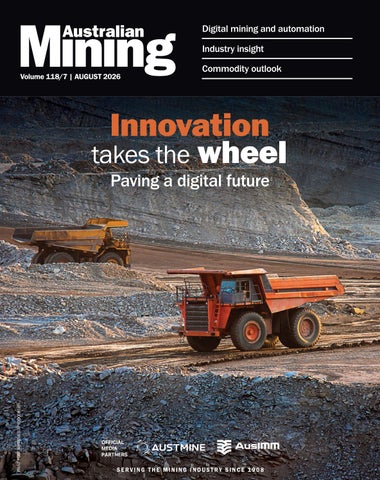
Innovation takes the wheel
PRINT POST APPROVED PP100008185
Paving a digital future
OFFICIAL MEDIA PARTNERS
SERVING THE MINING INDUSTRY SINCE 1908
All content on the left side of the page adjusted slightly to meet the “Minimum 8 mm from edge” (Australian Mining printing requirements)
rockprocessing.sandvik
Put more and better data to work for you 800i crushers are ready to be connected to the SAM by Sandvik cloud-based digital assistant, our ever-evolving data capture and analysis service. Look at the status of your connected equipment, communicate across teams, view alerts and notifications, pro-actively order spare parts and much more. SAM is the digital assistant supporting operational excellence in crushing and screening plants, that makes working with your 800i series crusher even more of a pleasure.
COMMENT
New beginnings, familiar ground Alcoa’s South32 acquisition is a reminder that new beginnings in mining do not always start with a fresh discovery. Prealene Khera Editor
E
very journey begins with a first step, and mining is no different. It might be the first discovery, the first blast, the first tonne mined or the first time a new technology is put to work, but each sets the direction for what comes next. This edition marks my own first as I introduce myself as editor of Australian Mining. It’s a reminder that new beginnings are woven into every part of this industry, from individuals to multi-billion-dollar projects. Alcoa’s agreement to acquire South32’s interests in a portfolio of bauxite, alumina and aluminium operations is one example of the decisions that will forge mining’s next chapter. The approximately $5.9 billion transaction will expand Alcoa’s global footprint, adding established assets across Australia, Brazil and South Africa while strengthening its position across the aluminium supply chain. The deal also highlights the value of relying on assets that are already in operation – most wheels just need a new wagon. Developing new mines and processing facilities can take years, with projects requiring significant investment before they begin generating returns. Acquiring established operations gives companies access to existing production, infrastructure and the experience of the people already running those assets. Instead of starting a new aluminium supply chain from the ground up, Alcoa is adding to an existing network that already spans mining, refining and smelting. This approach is a handy blueprint for companies that are also looking beyond traditional project development when
considering what their own ‘new beginnings’ will look like. The transaction comes at a time when the worth and stability afforded by secure supply chains is undeniable. The materials these operations produce feed industries worldwide, and reliable access to them is no longer something governments and manufacturers can take for granted. It also shows that growth in mining doesn’t always mean finding a new deposit or building a greenfield project. Sometimes it means recognising what’s already working and strengthening it. The decisions companies make around these assets now will map out how they’re positioned as the market shifts. Transactions, approvals, technology, investments – each one is a bet on where the industry is headed. As I begin my chapter with Australian Mining, I’m looking forward to covering those bets and the people making them. The projects being advanced and the strategies being developed today are the stories we’ll be telling for years. The first step in any of this only starts the journey…it’s what comes after that decides where it ends up.
Prealene Khera Editor
Chairman John Murphy
Ethan Benedicto ethan.benedicto@primecreative.com.au
Chief executive officer Christine Clancy
Jackson Haddad jackson.haddad@primecreative.com.au
Managing Editor Paul Hayes paul.hayes@primecreative.com.au
Client Success Manager Janine Clements 02 9439 7227 janine.clements@primecreative.com.au
Editor Prealene Khera prealene.khera@primecreative.com.au Journalists Engel Schmidl engelbert.schmidl@primecreative.com.au Mikaela Henschel mikaela.henschel@primecreative.com.au
Sales Manager Jonathan Duckett 0498 091 027 jonathan.duckett@primecreative.com.au Business Development Managers James Phipps 0466 005 715 james.phipps@primecreative.com.au
Ben Cartwright ben.cartwright@primecreative.com.au
AUSTRALIANMINING 3 AUGUST 2026
Rob O’Bryan 0411 067 795 robert.obryan@primecreative.com.au Art Director Michelle Weston michelle.weston@primecreative.com.au Subscription Rates Australia (surface mail) $120.00 (incl GST) Overseas A$149.00 For subscriptions enquiries please contact 03 9690 8766 subscriptions@primecreative.com.au Prime Creative Media 379 Docklands Drive, Docklands, Vic 3008 www.primecreative.com.au © Copyright Prime Creative Media, 2016 All rights reserved. No part of the publication December be reproduced or copied in any form or by any means without the written permission of the publisher.
Printed by Brougham Press 865 Mountain Hwy, Bayswater VIC 3153 03 9873 5144 Published 11 issues a year Cover image: pkproject/stock.adobe.com
In this issue 12
Digital mining and automation 9 The digital mine takes shape
28
Digital technologies are transforming Australia’s mining industry, giving operators new ways to improve productivity.
12
17
20
Human expertise in an AI age Artificial intelligence is reshaping mining, but lasting value will come from grounding technology in operational realities. Mastering brownfield autonomy EACON Mining Technology is aiming to significantly lower the barriers to adoption of wide-scale autonomous haulage. Safe and sound conveyor monitoring Advanced fibre optic cable technology is supporting improved conveyor condition monitoring in mining environments.
Industry insight 44 Beyond the pit
A new EY report suggests the next phase of critical minerals success will follow what happens after the ore leaves the mine.
Critical minerals 48 The missing link
CopperString will deliver the longawaited infrastructure needed to unlock an untapped critical mineral region, according to Queensland Resources Council CEO Janette Hewson.
52
Sun rises on scandium A major scandium project has gained further momentum after receiving support through a government-backed critical minerals scheme.
58
Waste not, mine more Researchers and miners are finding novel ways to transform mine tailings into valuable resources.
Industry events 63 A night of recognition
Excellence across Australia’s industrial sectors was celebrated at the 2026 Women in Industry Awards in June, with mining talent once again taking centre stage.
32
76 AUSTRALIANMINING 4 AUGUST 2026
WHO WE ARE OTR Tyres is Australia’s leading independent partner for off‑highway tyres, wheels, consumables and service solutions. With nationwide manufacturing, service hubs, and on‑site support teams, we provide the most comprehensive ground‑contact offering in the country. With deep expertise across mining and heavy industry, OTR Tyres is trusted by major operations to deliver safe, compliant, and cost‑effective solutions built for tough Australian conditions.
est Outperform The R
WHAT WE DO TYRE SOLUTIONS • Massive range & stocks of earthmover, truck & LV tyres. • Full range from 6” through to 63” from leading global brands.
Mining tyre and wheel experts. OTR Tyres is at the forefront of tyre, wheel and service innovation, proudly supporting Australia’s mining, construction, transport, agricultural and industrial
• Tyre fitting, rotation, change‑outs and on‑site support. • Tyre pressure management and haul profile optimisation. • Tyre valving, O‑rings & tooling
WHEEL & RIM SOLUTIONS • Wheels, rims, assemblies & components. • Australian manufactured with in‑house design. • Test, repair & certification under Australian Standards AS4457.1. • Latest MID and MRD compliance.
ON-SITE SERVICES • Mobile fitting capability for large OTR assemblies. • Dedicated tyre & wheel technicians for major mining operations. • On‑site wheel, rim & tyre management programs. • Tyre Handlers, mine site spec for sale or hire.
TRAINING • Industry‑accredited Cert II tyre fitting and safety training. • RTO provided on‑site or at OTR facilities.
sectors. We deliver unmatched capability, performance and reliability across every site and every haul road. Our commitment is simple, if your tyres or wheels stop, your production stops - so we’re here to keep you moving.
WITH SERVICE HUBS AND MANUFACTURING FACILITIES ACROSS AUSTRALIA, OTR TYRES PROVIDES RAPID RESPONSE AND CONSISTENT SUPPORT WHEREVER YOU OPERATE.
Phone 1300 OTR TYERS or visit www.otrtyres.com Perth | Mildura | Gold Coast | Brisbane | Emerald | Mackay | Mount Isa | Gladstone | Sydney | Muswellbrook | Karratha | Port Hedland | Kalgoorlie | Geraldton
INDUSTRY INSIGHT
Alcoa is expanding its Australian aluminium footprint, with the South32 deal marking a major strategic shift.
Alcoa’s aluminium play Alcoa’s South32 acquisition could reshape Australia’s aluminium supply chain while strengthening local processing, jobs and long-term manufacturing capability.
Image: jetcityimage/adobe.stock.com
I
t’s an “unequivocal vote of confidence in Australia’s resources sector and manufacturing capabilities”. Those were the words used by Federal Resources Minister Madeleine King after news broke of Alcoa’s multibillion-dollar deal to acquire South32’s portfolio of bauxite, alumina, and aluminium operations. The miner struck an upfront $5.9 billion deal for South32’s assets, with the cash-and-stock transaction including a contingent value of up to $1.1 billion, with future payments linked to agreed revenue-sharing based on alumina and aluminium prices. Including net debt, primarily related to normal course financing leases, the transaction represents an implied enterprise value of approximately $6.8 billion. King said the landmark agreement showed Australia remained a leading destination for global resources investment, with the transaction expected to strengthen onshore processing capabilities, secure supply and support local jobs. “This is a significant moment for our resources sector and shows yet again how the world is choosing Australia as a growth destination,” King said. Alcoa Corporation chief executive officer William Oplinger said that the company brings the scale, capital strength, and operational capability required to support long-term investment in the aluminium supply chain in Australia. “We are confident that this transaction will help make Australia’s bauxite-toaluminium value chain more competitive, more resilient, and better positioned to continue supporting local jobs, businesses, and regional communities,” he said. Beyond the value of the transaction, Alcoa has positioned the acquisition as a major step in strengthening its integrated aluminium platform. This acquisition adds what Alcoa described as a high-quality, low-cost and globally diversified portfolio of mining, refining and smelting assets, enhancing its mine-to-metal platform and supporting its long-term growth strategy. The company expects the acquisition to generate approximately $1.3 billion in net present value synergies while immediately improving earnings per share and free cash flow following completion. The transaction will also expand Alcoa’s presence in strategically important regions, reinforcing its operations in Australia and
AUSTRALIANMINING 6 AUGUST 2026
Brazil while establishing a new presence in South Africa. Alcoa said that South32’s operations bolster its strategic outlook, considering its proven operating model, technical expertise, and commercial capabilities are expected to unlock “meaningful performance improvements” across the combined portfolio. To add, the wider scale and integration are expected to reduce complexity, lower costs, improve competitiveness, while strengthening supply chain resilience across key jurisdictions. “This is exactly the type of opportunity Alcoa is built to execute,” Oplinger said. “These high-quality, globally relevant assets are a strong strategic fit within our portfolio and align directly with our strengths as a leading pure-play upstream aluminium company.” Alcoa expects the transaction to generate roughly $USD900 million in net present value through operational optimisation across complementary assets and the application of best practices. “Consolidating the life of asset planning across the Western Australia mining and refining operations provides a considerable portion of the anticipated synergies,” the company said.
Clarity moving forward
The deal comes after Alcoa reached a landmark agreement with the Federal Government earlier this year to modernise environmental approvals for its Western Australian bauxite operations, resolving uncertainty over its Huntly and Willowdale mines. Under that agreement, Alcoa committed to paying $55 million in enforceable undertakings to remediate historical land clearing, described at the time as the largest conservation-focused commitment of its kind in Australia. The government also granted a “national interest exemption” to allow operations to continue for 18 months while a full assessment is completed. Federal Environment Minister Murray Watt said the exemption was important for Alcoa’s 6000 workers and for critical mineral supply. “To regularise environmental approvals moving forward, the Australian Government has agreed to progress a strategic assessment agreement with Alcoa to guide sustainable mining at its Huntly and Willowdale mining operations,” Watt said. “[The exemption] ensures the continued supply of bauxite and supports
Image: BJP7images/adobe.stock.com
INDUSTRY INSIGHT
Bauxite remains central to Alcoa’s upstream aluminium ambitions.
Strategic repositioning
The South32 acquisition has followed a period of operational repositioning for Alcoa, shifting the company to an expansion-focused upstream leader through a major global growth strategy. Securing access to South32’s aluminium value chain is expected to make Alcoa the world’s largest bauxite miner, overtaking Rio Tinto. The transaction also secures full ownership of the Boddington bauxite mine and Worsley alumina refinery in Western Australia, while adding key assets in Brazil and South Africa. The expansion follows a broader restructuring that included Alcoa’s
Alcoa’s acquisition builds scale across the aluminium and bauxite chain.
Image: krishnadasekm/adobe.stock.com
future gallium production, critical for renewable systems like solar panels and wind turbines.” Alcoa welcomed the clearer pathway for its Western Australian operations. “We are committed to responsible operations and welcome this important step in transitioning our approvals to a contemporary assessment process that provides increased certainty for our operations and our people into the future,” Oplinger said at the time. “We appreciate the government’s recognition of the important contributions of our operations to the Australian economy.” With the strategic assessment covering mining through to 2045 and separate assessments for the Myara North and Holyoake regions ongoing, Alcoa’s Australian bauxite footprint remains central to both its operational certainty and its longer-term upstream aluminium strategy.
full acquisition of Alumina Limited in 2024 and the permanent closure of the high-cost Kwinana refinery in Western Australia to streamline operations and improve its carbon and cost profile. The company expects the combined portfolio to deliver around $US900 million in net present value savings, with analysts describing the strategy as a clear return to an expansionary phase as Alcoa positions itself for forecast structural supply deficits. Alcoa chairman Thomas Gorman said the South32 acquisition would also help strengthen the company’s long-
term financial performance and future capital growth. “The board is pleased to support this transaction, which we believe strengthens Alcoa’s competitive position, supports long-term earnings and cash flow growth, and creates lasting value for our shareholders,” Gorman said. “We remain committed to the employees and stakeholders whose contributions are central to the success of these operations.” Oplinger said the acquisition further reinforced the company’s commitment to global supply security, responsible
AUSTRALIANMINING 7 AUGUST 2026
production, and the communities in which it operates. “By investing in this opportunity, we are underscoring our commitment to supply security for our customers,” he said. “But also strengthening the communities in which we operate and delivering responsibly produced materials that are essential to the global economy.” In the national context, the transaction reinforces the strategic importance of Australia’s bauxite and alumina industry, and for Alcoa, it provides the platform to shape the future of the global upstream aluminium supply chain. AM
No blast. No fumes. No overbreak. Meet the MC51 Continuous Miner.
Precision tunnelling without compromise. The agile, electric, remote-controlled MC51 uses automated DynaCut technology to create accurate tunnel profiles, minimising overbreak and reducing disruption associated with conventional development methods. komatsu.com/mc51
DIGITAL MINING AND AUTOMATION
Image: Erd.Concept/stock.adobe.com
Digital technologies are reshaping modern mining operations.
The digital mine takes shape Digital technologies are transforming Australia’s mining industry, giving operators new ways to improve productivity, strengthen safety and enhance environmental performance.
A
ustralia’s mining industry has always been defined by its ability to embrace innovation. From mechanisation and large-scale haulage to autonomous operations, each technological leap has strengthened the sector’s productivity, safety and global competitiveness. The next phase of that evolution is digital mining. Digital mining has moved beyond isolated pilot projects and technology demonstrations. Digital tools are being embedded into everyday operations across Australia’s iron ore, gold, coal and critical minerals sectors. Autonomous haul trucks, connected drilling fleets, artificial intelligence (AI), digital twins, predictive maintenance platforms, remote operations centres and cloud-based mine planning software are becoming integral to how mines are designed and operated. Importantly, however, digital mining is not replacing people. It is providing operators, engineers and maintenance teams better information to make more informed decisions. Australia’s resources sector is well positioned to benefit. The country continues to possess a world-class mineral endowment and remains one of the world’s leading destinations for mineral
exploration, while government investment in geoscience and exploration data is helping attract new discoveries and longterm investment.
From isolated machines to integrated operations
The modern mine generates enormous volumes of operational data. Every haul truck, excavator, drill rig, conveyor, crusher, processing plant and fixed asset continuously produces swathes of information. Rather than existing in separate systems, these data streams – in areas such as productivity, equipment health and operating conditions – are rapidly being integrated into unified operational platforms. Fleet management systems provide dispatching, production monitoring and equipment tracking in real-time. Highprecision positioning systems enable centimetre-level machine guidance, while onboard payload monitoring helps to maximise productivity without exceeding equipment limits. These technologies are designed to allow mine managers to understand what is happening across an entire operation as events unfold, eliminating the need to wait for end-of-shift reports. Digital planning platforms have also transformed modelling and scheduling.
Certain software enable geologists and engineers to update resource models, optimise pit designs and evaluate multiple production scenarios far more rapidly than traditional workflows allowed. The result is faster decision-making supported by higher-quality information. As digital systems have become more sophisticated, they have also accelerated the adoption of automation across operations. Automation has become one of Australia’s defining mining strengths. Large autonomous haulage fleets now operate continuously across the Pilbara, while autonomous drilling systems deliver greater consistency in blast execution and improved downstream fragmentation. Such autonomous operations generate benefits well beyond labour efficiency. Vehicles operate within predefined parameters, reducing unnecessary acceleration, braking and idle time. This lowers fuel consumption, reduces component wear and improves equipment availability. Remote operation also removes personnel from some of mining’s highestrisk environments. This philosophy extends across numerous mobile assets. Semiautonomous drilling rigs, tele-remote loaders operating underground and remotely controlled dozers all contribute
AUSTRALIANMINING 9 AUGUST 2026
to improving workplace safety while maintaining production. Automation does not eliminate operational expertise; instead, it shifts skilled personnel into supervisory, analytical roles where they oversee multiple assets simultaneously. The value of these connected systems extends to reshaping how mining companies maintain some of their most critical assets. Maintenance is increasingly driven by data rather than fixed service intervals. Sensors installed throughout mining equipment continuously monitor vibration, temperature, hydraulic pressure, engine performance and component health. This data is analysed using predictive maintenance software that identifies developing faults before failures occur. Instead of reacting to unexpected breakdowns, maintenance teams can schedule repairs during planned shutdowns, reducing unplanned downtime and extending equipment life. Digital condition monitoring is particularly valuable for high-value assets including haul trucks, crushers, mills, conveyors and processing plants, where unexpected failures can significantly affect production. The combination of Industrial Internet of Things (IIoT)
DIGITAL MINING AND AUTOMATION
Efficiency and sustainability go hand-in-hand
Digital mining is also contributing to stronger environmental performance. Precision drilling reduces overbreak and improves blast efficiency; real-time fleet optimisation reduces unnecessary fuel consumption and associated emissions; water management platforms monitor storage facilities, groundwater and processing circuits continuously, enabling more efficient water use and earlier identification of potential issues. Environmental monitoring has also become increasingly sophisticated through the use of drones, satellite imagery and remote sensing technologies. These systems allow operators to monitor rehabilitation, tailings storage facilities, dust generation and vegetation health more frequently and across much larger areas than traditional inspection methods. The result is improved environmental oversight supported by timely and objective data. While digital technologies are reshaping equipment and infrastructure, they are also changing the way people work across modern mining operations. Remote operations centres now allow engineers, planners, dispatchers and maintenance specialists to support multiple mine sites from central locations. Augmented reality tools enable field technicians to receive expert assistance while working on equipment in remote areas. Wearable technologies monitor worker location, fatigue and
environmental conditions, strengthening emergency response capabilities while improving situational awareness across complex operations. Digital documentation, electronic permitting systems and mobile inspection platforms have further streamlined everyday operational activities, reducing paperwork while improving compliance and traceability. Taken together, these technologies are strengthening Australia’s position as one of the world’s most advanced mining jurisdictions. The country’s resources sector continues to invest heavily in exploration, technology and operational improvement. The Australian Bureau of Statistics reported that mineral exploration expenditure increased by 6.3 per cent in the March 2026 quarter, a figure that highlights the continued confidence in the industry’s long-term prospects. And digital mining will play an increasingly important
role in converting that investment into productive, safe, sustainable and wellrun operations. Success will not be determined by any single technology, but by how effectively companies integrate autonomous equipment, connected sensors, AI, advanced analytics, cloud platforms and skilled people into a unified operating environment. The Australian mining industry has consistently demonstrated its ability to adopt world-leading technologies while maintaining high standards of operational performance. Digital mining represents the next stage of that journey. By combining advanced equipment, intelligent software and data-driven decision-making, Australia’s resources sector is creating mines that are safer, more productive and better equipped to meet the demands of a rapidly evolving global economy. AM
Image: LimeSky/stock.adobe.com
ventilation management and processing optimisation. By allowing operators to test different scenarios virtually, they reduce operational risk while improving planning accuracy.
AI provides a decision-support tool that allows operators to respond more quickly. Autonomous haul trucks are becoming integral to how mines are designed and operated.
Image: Beto Santillan/stock.adobe.com
sensors, cloud computing and AI-powered analytics is helping maintenance become increasingly proactive. Much of this capability is being driven by AI, which is rapidly becoming an everyday operational tool rather than an emerging technology. AI is moving beyond experimentation into practical mining applications. It can analyse production trends, identify bottlenecks, optimise haulage routes, improve blasting outcomes and forecast equipment failures. Machine-learning algorithms also assist exploration teams by processing large geoscience datasets, satellite imagery and geophysical surveys to identify prospective mineral targets more efficiently. Within processing plants, AI is supporting flotation optimisation, ore blending and process control by identifying subtle operating patterns that would be difficult to detect through conventional analysis. Instead of replacing engineering judgement, AI provides another decision-support tool that allows operators to respond more quickly to changing conditions. That improved decision-making is being further strengthened through the growing use of digital twins, which are among the fastest-growing technologies in mining. Digital twins combine real-time operational data with three-dimensional engineering models to create a live digital representation of an asset, plant or entire mining operation. Operators can visualise production, monitor equipment performance and simulate operational changes before implementing them in the field. Digital twins are also supporting mine planning, maintenance scheduling,
AUSTRALIANMINING 10 AUGUST 2026
COMPLETE
CONVEYOR SOLUTIONS
Fenner Dunlop Conveyor Belts
Fenner Conveyors Service and Site Support
ACE Engineered Conveyor Solutions
Fenner Conveyors is your Complete Conveyor Solution. A leading Australian manufacturer and service operator for all aspects of conveyor systems, Fenner provides belt manufacture, belt handling, on-site servicing, components like conveyor structures, pulleys, rollers, idlers, and more all the way up to engineering and fabrication support for the commissioning
Phone 1800 Fenner (336 637)
fenner.com.au | sales@fenner.com.au
Conveyor Products and Solutions (CPS)
Belle Banne Belt Handling Equipment
iBelt Diagnostics and Monitoring
of complete conveyor systems. A Michelin Company, Fenner Conveyors specialise in heavy-duty mining conveyors, and are unique in their ability to supply true turnkey solutions for conveyor operations, designing, manufacturing, installing and servicing every aspect of the conveyor.
DIGITAL MINING AND AUTOMATION
Why mining’s AI future still depends on human expertise Artificial intelligence is reshaping mining, but lasting value will come from grounding technology in operational realities, domain expertise and measurable business outcomes.
E
very generation of mining has its defining technology. Mechanisation transformed productivity, and automation reshaped operations. Today, artificial intelligence (AI) is emerging as mining’s next major technological breakthrough. But mining has never embraced technology simply because it’s new. Every investment comes back to one question: will it improve the operation? That same discipline is now shaping how the industry approaches AI. For Cyient global president – mining and minerals Andrew Wilson, that’s exactly how it should be. “Mining has been solving the same problems for 50 years: increase recovery, improve throughput, reduce costs, make operations safer. Those aren’t new problems,” he told Australian Mining. “AI is another major tool in the toolkit that can help solve them.” That philosophy sits at the heart of Cyient’s approach to digital transformation. Rather than beginning with technology, the global engineering and technology solutions provider starts with the operational challenge, combining engineering expertise, domain knowledge and AI through what it calls ‘Embracing Intelligence’.
Expertise you can’t download
Mining is facing a challenge that technology alone can’t solve, with experienced engineers, operators and maintenance specialists retiring and taking decades of operational knowledge with them. Some of the industry’s most valuable knowledge doesn’t exist in manuals or operating procedures, but in the instincts developed over years on site – recognising when a plant sounds different, spotting subtle changes in performance or understanding when something simply doesn’t feel right. Every operation, Wilson said, has that one overturn operator who has spent 25 years on site. “They know when something doesn’t sound right. They know when a vibration feels different or when the plant isn’t behaving the way it should,” he said. Capturing that kind of expertise before it walks out the door is becoming increasingly important as mining’s workforce evolves. “Turning up with the technology solution alone misses a huge amount of knowledge and expertise,” Wilson said. “You’re actually missing a huge amount of knowledge that can’t be built into the
model if you only approach it from a ones-and-zeros perspective.” By combining operational data with the experience of the people running the plant every day, AI becomes another way of preserving that knowledge and embedding it into workflows rather than replacing it. This philosophy of augmenting expertise, rather than replacing, shapes Cyient’s broader approach to AI implementation. “There have been plenty of technology solutions over the years that sounded compelling in theory but didn’t necessarily improve the things that actually matter,” Wilson said. “That experience has fundamentally changed the conversation. The result is an industry that is disciplined about separating genuine innovation from hype.” Instead of asking what AI can do, mining companies are asking what business problem they’re trying to solve. “Sometimes we spend an hour discussing a challenge and never once talk about AI,” Wilson said. “We start with the business objective first, then determine whether AI is actually the right tool to solve it.” Technology, therefore, isn’t the goal; better operational outcomes are.
AUSTRALIANMINING 12 AUGUST 2026
Cyient partner – digital and AI Dr Sorousha Moayer guides miners towards using AI.
While organisations across almost every industry are racing to position themselves as AI-first, Cyient is deliberately taking a different approach. The company starts by understanding how an operation works, where the constraints exist and what success actually looks like. Only then does the conversation turn to technology. “We tell our clients to win the impact race rather than the technology race,” Cyient partner – digital and AI Dr Sorousha Moayer told Australian Mining. “Most of the challenges mining companies face aren’t about having a
Images: Cyient
Image: aekkorn /stock.adobe.com
There are more than 150 potential AI applications across the mining value chain, according to Cyient.
DIGITAL MINING AND AUTOMATION
better AI model. They’re about how those models become part of the operating model and actually create impact.” Backed by more than three decades of engineering experience across mining, energy, aerospace and telecommunications, Cyient views AI as one tool among many. “There are more than 150 potential AI applications across the mining value chain,” Moayer said. “The question isn’t whether AI can be used; it’s where should you start so you can demonstrate value and build confidence.”
Turning philosophy into action
For many mining companies, the biggest challenge isn’t recognising AI’s potential; it’s knowing where to begin. “We see a lot of companies wanting to enter the AI world, but they don’t know where to start,” Moayer said. “Everybody wants to use AI, but they don’t know where it will create the biggest impact.” A global mining company approached Cyient knowing it wanted to invest in AI, but without a clear understanding of where to begin. Rather than launching multiple AI initiatives across the business, Cyient worked with the operator to identify a single operational challenge where success could be measured quickly and clearly. The resulting cash-generation program was designed to deliver up to 10 times the return on investment in less than six months. That early return allowed the program to become self-funded, with value generated from the initial investment used to support further AI initiatives without additional capital expenditure.
“The important thing is demonstrating value early,” Moayer said. “When people can clearly see the outcome, it becomes much easier to build momentum for wider adoption.” That value-first approach isn’t limited to individual projects. Cyient has found mineral processing plants to be effective starting points for AI adoption, thanks to historical operating data and measurable performance outcomes. “The processing plant gives you historical data, existing infrastructure and measurable outcomes,” Moayer said. “You can create significant value without introducing major capital expenditure, and that helps organisations build momentum for wider adoption.” The biggest gains often aren’t measured in recovery or throughput, but in the conversations AI creates between the people using it. “The operators start giving feedback, the engineers also begin giving feedback, and suddenly they’re talking to each other in ways they weren’t before,” Moayer said. “One of our clients told us the recovery improvement was important, but one of the biggest benefits was that their operators, metallurgists and process engineers were working together much more closely.” Rather than replacing human judgement, AI becomes a platform for sharing knowledge, helping experienced operators pass decades of expertise to the next generation while improving decisions across the operation. Over the next five years, Moayer expects AI to become increasingly
Cyient global president – mining and minerals Andrew Wilson says conversations with miners start with the business problem, not the technology.
embedded in how mining operations run as the technology matures. He compares the shift to the evolution of computing from desktop computers to laptops and mobile devices. AI tools are already changing how quickly people can access and organise information, reducing tasks that once required hours of searching and research to seconds. Moayer expects accessibility to improve as well. Inside processing plants, automation and AI integration could help mining companies improve performance without treating the technology as a standalone initiative. But wider adoption alone will not determine which companies create lasting value from AI.
For Wilson, the next phase will test whether mining leaders can move beyond isolated pilots and short-term technology deployments to rethink how work is done across the business. “Long-term value generation is what differentiates leaders,” Wilson said. “The leaders that will differentiate themselves are the ones who think smartly about where to deploy AI, then redesign the ways of working around it to create value.” The leaders who succeed will be those who use AI to create sustainable, repeatable value across the business, combining the technology with domain expertise and operational workflows rather than treating it as another technology box to tick. AM New technology is helping mines capture the knowledge of experienced operators.
The leaders that will differentiate themselves are the ones who think smartly about where to deploy AI, then redesign the ways of working around it to create long-term value.” – Cyient global president mining and minerals Andrew Wilson
AUSTRALIANMINING 13 AUGUST 2026
DIGITAL MINING AND AUTOMATION
Seeing the difference A mine-site incident exposed the limits of traditional protection around moving equipment, setting SICK on a six-year path to find another way.
W
hen SICK began expanding its sensor business into Australian mining almost 20 years ago, the company was catering to a necessary demand – operators wanted to know whether something was there or not. The conversations SICK industry sales manager Wayne Greenwell has with miners now are very different. Autonomous vehicles need to navigate safely around unexpected obstacles, while safety systems are being asked to distinguish a worker from the machinery moving around them. Miners also want information from devices in the field to identify problems before they become bottlenecks. Greenwell has spent more than two decades with the global sensor and automation technology company. He led SICK’s expansion into the mining industry and remembers how emerging sensor technologies were being tested as research and development projects.
“Back then, they were just after a sensor that gave them a yes or no answer, on or off,” Greenwell told Australian Mining. “Now we’re looking at areas where vehicles need to navigate and travel autonomously. Operators also want to increase production while maintaining safety.” Miners are also asking more of devices in the field, including condition information and digital data they can access through their own servers or the cloud. That information can give operators a clearer view of how a device is performing, rather than waiting for a problem to interrupt production. “They base success not only on productivity gains, but also on safely reducing downtime and bottlenecks,” Greenwell said. An incident at an Australian mine led SICK to ask whether a safety system could detect the worker, not just movement
around the machine. A worker had been injured near moving equipment in an area where traditional protection was difficult to use. The equipment itself needed to move through the monitored zone, so a
conventional system could trigger a stop even when a worker was not in the area. “If you imagine a robotic arm or drill that is moving, it’s very hard to use traditional means to protect that zone because, by its very nature, it will
Safety-rated LIDAR supports collision prevention and traffic management underground.
Images: SICK
A worker is flagged the moment they enter the monitored zone, sending an output straight to the machine controls.
AUSTRALIANMINING 14 AUGUST 2026
DIGITAL MINING AND AUTOMATION
move into the zones we want to protect,” Greenwell said. The team began looking at whether a camera could recognise a person without reacting to every object in view. “What we wanted to do was build a vision system that would basically only look for people in that field,” Greenwell said. The first concept paired a camera with a separate personal computer (PC). On mobile machinery, however, space constraints made this difficult, and customers said they wanted something simpler – a device with intelligence on board to detect people and provide outputs directly into the vehicle controls to stop the machine. Work then began on a self-contained device capable of processing information onboard, a development effort that took about six years before the finished system was released last year. This camera-based system uses builtin artificial intelligence (AI) to identify people within a programmed area, including when only part of a person is visible. It can then provide an output without relying on an external PC. Moving the processing onto the device made the system more practical for mobile machinery by eliminating the need for separate computing hardware. “I just program the distance I want to see, and it gives me the on and off signals to say, ‘I see someone’,” Greenwell said. “Having the AI built into a camera is extremely important. “When we look at devices for object or people detection, we want to ensure it is a finished product and does the job we say it will do.” Other applications may call for Light Detection and Ranging (LiDAR) or radar, depending on what needs to be detected and where the equipment is working. Safety-rated laser scanners, or LiDARs, have traditionally faced limitations outdoors, where rain and dust can affect performance. Black objects can also be difficult to detect at a distance. The multiScan100-S safety laser scanner extends safety-rated detection to distances of up to 20m, including against black objects. “When it comes to safety, our major focus is ensuring we see a detection probability of 99.99 per cent under environmental influences – ambient light, fog, dust, rain, snow and hail,” Greenwell said. “What sets us apart is that we came up with LiDAR that can achieve a distance of up to 20m in a true safety application.” Applications include collision prevention on ship loader booms, where equipment needs to operate over distances beyond the reach of shorter-range safety scanners. “Normally, most safety scanners couldn’t be used outdoors because they’d be affected by rain or dust,” Greenwell said.
SICK’s Visionary 3D camera range puts the intelligence on board the device, with no external PC required.
The camera-based AI system detects people within programmed safety zones.
“Now we have a device that moves beyond four metres indoors to seeing up to 20m on black in a safety zone under the harshest environmental conditions.” Safety programmable logic controllers (PLCs) process information from connected devices and provide additional redundancy. They have been used to monitor lanyard switches on conveyor belts and barrier protection systems in underground mines. The SICK Flexi Soft Safe PLC becomes particularly important where several inputs and outputs need to be assessed before the equipment responds. Rather than relying on a single signal, it can process information from connected safety devices and apply the logic the
The multiScan100-S extends safetyrated detection to 20m, even in rain and dust.
application demands, to the required safety rating. On a conveyor, the SICK Flexi Mobile and Flexi Soft PLCs can monitor a series of lanyard switches and identify where a safety input has been triggered. Underground, they can process inputs from barriers and other safety devices to support barrier protection and traffic management without unnecessary interruptions to vehicle movements. One example is underground traffic management, where improved control of vehicle movements reduced incidents that had been causing unplanned stoppages. “We’ve already seen the benefits for our clients, not only by safely providing reliable management, but by increasing
AUSTRALIANMINING 15 AUGUST 2026
productivity because they’re no longer having the incidents they used to have,” Greenwell said. Some applications require several technologies to work together. A camera can identify a person, while a safety-rated scanner adds another layer of detection, and the safety PLC processes the information. Using several technologies reduces reliance on any single device, with each performing a different role in the application. “That dual redundancy gives us greater reliability,” Greenwell said. “It means the vehicle can operate at optimum levels while still protecting workers in those zones.” AM
Bradken Cast Beam Backhoe Buckets ®
Strength redefined, precision engineered for maximum results Bradken’s Cast Beam Buckets offer increased machine availability and optimised productivity with premium structural integrity and durability. Bradken’s next generation in bucket design features a cast beam, providing structural integrity enhancements through the elimination of fatigue-prone welds. Advanced engineering ensures the main load carrying members in the bucket can stand up to the toughest digging applications. Collaboratively designed with Bradken’s Eclipse® and Zenith® lip systems, Bradken’s Cast Beam Buckets use a holistic design approach for optimal performance.
SCAN TO LEARN MORE
DIGITAL MINING AND AUTOMATION
Mastering brownfield autonomy EACON Mining Technology is aiming to significantly lower the barriers to adoption of wide-scale autonomous haulage in brownfield operations.
A
utonomous haulage has become one of mining’s defining technology success stories, delivering measurable gains in safety, productivity and fleet utilisation – with EACON Mining Technology being among the pioneers. Much of the industry’s progress in autonomous haulage has been initially made in purpose-built greenfield operations. But the next phase of adoption will largely depend on solving the complex challenge of implementing autonomy in existing mines, which present an entirely different set of conditions. Mixed fleets, multiple contractors, ageing equipment and established operating practices all create obstacles that autonomous technology providers must overcome if the industry is to realise autonomy at scale. For EACON, these complex challenges have shaped the company’s approach from the beginning. EACON Australia chief growth officer Elaine Jin said it has plenty of practice and experience in tackling the unique set of real-life challenges posed by deployments in existing operations. “Most of our projects are actually brownfield operations,” Jin said. While EACON’s early deployments focused on isolated areas, its systems have since evolved to operate alongside manually driven trucks in active production environments – thereby broadening the range of sites where autonomy can be deployed.
“In China, you might have three contractors working on different benches who all share haul roads and crushers,” Jin said. “One contractor may want to use our system, while another doesn’t want any technology installed on its trucks at all.” That creates one of the industry’s biggest technical hurdles: enabling autonomous trucks to safely interact with vehicles that have no connected technology onboard. EACON’s answer has been to develop a mixed-fleet operating capability built around onboard perception rather than relying solely on connected vehicle infrastructure. Each autonomous truck continuously processes information from sensors providing 360-degree visibility around the vehicle, allowing it to identify moving and stationary objects before making driving decisions in real time. “We have sensors covering 360 degrees around the truck, so the system always knows what’s happening around it,” Jin said. Where mine operators choose to install communication equipment on manually operated vehicles, EACON can also use shared positioning data to provide an additional layer of redundancy. However, Jin said the company deliberately designed its technology to perform safely even when neighbouring vehicles have no autonomous equipment installed. That capability has expanded considerably as projects have matured.
Initially, EACON’s autonomous trucks shared only haul roads with manually operated vehicles. Today, they can operate alongside conventional trucks at loading units and other shared production areas. This removes one of the biggest barriers to integrating autonomy into existing operations, eliminating the need to create isolated autonomous zones that can restrict production flexibility.
Flexibility drives adoption
The business case for autonomy depends as much on preserving existing assets as on introducing new technology. Large haul trucks often have years of productive life remaining, making complete fleet replacement economically unrealistic. Jin believes retrofit technology and OEM-agnostic solutions will therefore become increasingly important as autonomous haulage adoption accelerates. According to EACON’s own analysis, most mine sites operate mixed-brand fleets. Rather than requiring customers to standardise on a single equipment supplier, EACON has developed an autonomous platform capable of integrating with multiple truck models through its independently developed drive-bywire system. This interface allows the autonomous driving computer to communicate directly with a truck’s steering, braking and acceleration systems while preserving the original machine’s characteristics,
AUSTRALIANMINING 17 AUGUST 2026
allowing the truck to be safely controlled by EACON’s ORCASTRA autonomous system. “We have a large vehicle engineering team that focuses on that drive-by-wire layer between the truck and the autonomy system, as well as on the integration of the autonomy system with the vehicle platform,” Jin said. Importantly, EACON is not seeking to own that interface indefinitely. Instead, the company advocates that OEMs develop and open their own drive-by-wire systems, allowing different autonomous technology providers to integrate with their equipment. Jin believes greater inter-operability will ultimately benefit equipment manufacturers, technology providers and mining companies alike. Although autonomous driving principles remain largely consistent around the world, she said successful deployment requires significant localisation to reflect how different mining regions manage production. “When we came to Australia, we identified lots of operational differences,” Jin said. “They created different requirements for the product.” While object detection, vehicle control and autonomous decisionmaking remain fundamentally the same, Australian operations differ in areas including production planning, safety procedures, fleet management and reporting requirements.
Images: EACON Mining Technology
The retrofit HD1500 fleet has started autonomous day-shift operations.
DIGITAL MINING AND AUTOMATION
Those differences prompted EACON to spend more than a year adapting its software platform during its Australian trial program. “We work very closely with the miner, with potential customers and with our own people who have more than 10 years of mining experience,” Jin said. “They all contribute to making sure the product fits local operations.” That collaborative approach, she said, enables EACON to tailor both onboard autonomous systems and fleet management software to local operating practices while maintaining the core technology platform.
Building an open autonomous ecosystem
Despite widespread recognition of autonomy’s benefits, Jin believes implementation remains an ongoing challenge. Historically, autonomous haulage has often required significant changes to mine layouts, operating procedures and workforce training before operations could begin. EACON’s philosophy is to minimise those changes by making the autonomous system itself more adaptable. “The smarter the system becomes, the less change is required from the mine site,” Jin said. Reducing operator intervention, simplifying training and limiting changes to existing production processes lowers the barriers to adoption associated with transitioning from conventional haulage
to autonomous operations. That approach is now also being demonstrated in Australia through EACON’s deployment at Norton Gold Fields’ Mulgarrie openpit mine. Working alongside Thiess and Norton Gold Fields, the company recently reached a significant milestone with the commencement of day-shift autonomous operations on the fleet of six retrofitted Komatsu HD1500 haul trucks, in the active production environment of the Havana Pit, at a gold mine in Western Australia. The current day-shift rollout is also upskilling the site team for future nightshift autonomous operations.
“Achieving this milestone safely and on schedule validates the maturity of our ORCASTRA system, its adaptability to the Australian mining environment and its proven performance on large-scale rigid dump trucks,” Jin said. Jin also expects inter-operability to become increasingly important as more autonomy providers enter the market. Rather than competing through closed technology ecosystems, she believes the industry should move towards open standards that allow mining companies to integrate equipment from multiple manufacturers while selecting the autonomous platform that best suits their operation.
For EACON, creating that open ecosystem is central to accelerating industry-wide adoption. Rather than simply developing autonomous trucks, the company sees its role as helping mining companies introduce autonomy without replacing productive assets, redesigning entire operations or becoming locked into a single equipment supplier. With autonomous haulage expanding beyond greenfield developments, those capabilities are likely to determine how quickly the technology becomes part of everyday mining operations. The future, Jin believes, lies in autonomy that adapts to mines – not the other way around. AM
An EACON-powered autonomous truck interacting with a manual truck in a live environment. As autonomous haulage adoption accelerates, retrofit technology is becoming more important.
AUSTRALIANMINING 18 AUGUST 2026
MORE LIGHT. SAME FUEL. The New Benchmark in Mine Site Lighting. Allight MineSpec Lighting Towers — now with Allume 190 LED lighting technology. With industry-leading efficacy of up to 190 lumens per watt, the new Allume 190 LED lights deliver significantly greater illumination from the same power output—helping improve visibility for safer night-time operations. The increased light output also enables operators to achieve illumination levels comparable to larger lighting tower configurations, reducing capital investment while lowering fuel consumption, maintenance requirements and ongoing operating costs. Brighter sites. Safer operations. Lower total cost of ownership. Same proven MineSpec platform.
Up to 29% More Light. Same Fuel Consumption MineSpec Super Skid (15-head)
MineSpec Trailer (6-head)
MineSpec Trailer (4-head)
From: 992k lumens To: 1,282k lumens
+290k lumens
From: 396k lumens
To: 513k lumens
+116k lumens
From: 264k lumens
To: 342k lumens
+77k lumens
*Light performance shown is after stabilisation (effective lumens)
Find out how to achieve more light with the same power.
www.allight.com/brightest AUSTRALIANMINING 19 AUGUST 2026
DIGITAL MINING AND AUTOMATION
Images: REMA TIP TOP
Pin-pointing conveyor problems early can help prevent costly interruptions and downtime.
Safe and sound conveyor monitoring Advanced fibre optic cable technology, adaptive algorithms and machine learning are transforming conveyor condition monitoring in mining environments. through site-specific tailoring. By adapting to each environment, ARMS ensures consistent and reliable fault detection despite differences in structure, loading, and operating conditions.” Rather than applying a standardised monitoring model across every site, the system is designed to recognise that no two conveyor installations behave exactly the same. Differences in belt loading, conveyor design and operating environments all influence the acoustic signatures generated by rollers, making site-specific calibration essential for reliable performance. Developed by REMA TIP TOP and Terra15, ARMS combines Terra15’s DAS technology with REMA TIP TOP’s conveyor maintenance expertise to provide continuous monitoring of conveyor rollers. The system helps maintenance teams identify developing faults, monitor their progression and better time replacements, reducing unplanned downtime while avoiding unnecessary servicing. Originally developed for critical infrastructure monitoring, the DAS technology has been adapted for mining and bulk materials handling. A maintenance-free fibre optic cable installed along the conveyor detects acoustic signals and vibrations, while Terra15’s Treble interrogator sends
thousands of laser pulses every second through the fibre to identify developing faults. The resulting data is processed through the cloud-based AssureSrv platform, giving authorised users real-time visibility of conveyor health. Interpreting that data accurately is where machine learning plays an important role. “Traditional frequency-based diagnostics assume that faults produce consistent and repeatable signatures,” Laudehr said.
Fibre optic cable is installed along the conveyor to detect acoustic signals and vibrations.
AUSTRALIANMINING 20 AUGUST 2026
“In practice, however, roller fault signatures vary significantly between sites due to differences in structure, load, speed, and installation conditions. “Rather than relying on a single known frequency, machine learning shifts the approach to understanding what ‘normal’ looks like at each location and identifying deviations from that baseline.” Instead of searching for one predefined fault signature, ARMS continually assesses operating behaviour against the baseline for each monitored location.
Image: sxcd/stock.adobe.com
C
onveyor rollers may be among the smallest components in a mining operation, but a single failure can trigger costly belt damage, unplanned downtime and unnecessary maintenance. For REMA TIP TOP mechatronics engineer Rachael Laudehr, understanding how to detect those failures earlier has become the focus of extensive research. Laudehr recently authored a peerreviewed paper on the Automated Roller Monitoring System (ARMS), examining how distributed acoustic sensing (DAS), adaptive algorithms and machine learning can improve conveyor condition monitoring in mining environments. While DAS technology has attracted growing interest in conveyor monitoring, Laudehr said turning raw acoustic data into deployable maintenance information requires more than sensing alone. “ARMS performs advanced analysis on the raw DAS signals, transforming them into actionable insights,” Laudehr told Australian Mining. “A wide range of algorithms have been developed to identify different fault signatures, supported by numerous background adjustments that optimise system performance for each site. “Every conveyor system operates under different conditions, and ARMS enables this variability to be accounted for
DIGITAL MINING AND AUTOMATION
characteristics rather than a one-size-fitsall approach. “The physical installation of the sensing fibre is highly dependent on conveyor structure and baseline vibration characteristics,” she said. “In general, positioning the fibre as close as possible to potential fault points improves signal strength and detection capability. However, this is not always optimal.” “Heavier belts tend to generate stronger fault signatures, allowing the fibre to be installed in a straighter, more central configuration while still maintaining detection performance,” she said. “This also helps reduce issues such as excessive vibration from cable movement. “In contrast, lighter belts often produce weaker signals, requiring the fibre to be mounted closer to the structure to improve sensitivity. As a result, careful site scoping is essential to determine the optimal installation approach.” Rather than representing a compromise between sensitivity and reliability, Laudehr said the installation process is focused on identifying the best mounting position for each conveyor to deliver the most accurate readings possible while minimising and reducing unwanted background vibration. Following successful in-house validation and operational trials, REMA TIP TOP and Terra15 are supporting commercial deployments of ARMS across Australian mining operations. As mining companies expand condition monitoring across multiple conveyors, managing large volumes of data also becomes important.
“The primary challenge in scaling DAS-based monitoring is managing the volume of data generated,” Laudehr said. “The online interface AssureSrv provides a consolidated view across systems, enabling site-wide visibility and easier identification of fault conditions.” The platform allows multiple conveyors to be monitored from a single installation, giving maintenance teams a centralised overview of conveyor health across an operation. Reporting tools are designed to further streamline maintenance planning by highlighting alarm-state rollers and helping operators prioritise inspection and replacement activities. “Successful scaling also depends on proper system configuration,” Laudehr said. “Setting appropriate sensitivity levels during commissioning is critical to avoid excessive alarms and ensure the
system remains practical and effective for operators.” Laudehr said balancing system sensitivity with usability is essential as conveyor monitoring expands across larger mining operations. “A well-configured system balances detection performance with usability, enabling confident decision-making at scale,” she said. As conveyor systems continue to grow in length and complexity, technologies capable of providing continuous, sitewide condition monitoring are becoming increasingly valuable. By combining distributed acoustic sensing with adaptive algorithms and machine learning, ARMS aims to give operators earlier visibility of developing roller faults, allowing maintenance to be planned more effectively while reducing the risk of unexpected conveyor failures. AM
ARMS helps maintenance teams identify developing faults, monitor progression and better time replacements.
Image: Terra15 Technologies
This allows the system to recognise subtle changes that may indicate an emerging roller failure, even when those changes differ from site to site. Laudehr said this approach enables earlier, more reliable fault detection, improving detection accuracy while reducing false positives. “In real-world mining operations, this has led to improved detection accuracy and a reduction in false positives,” she said. Mining environments also present challenges such as fluctuating background noise and changing belt speeds. Rather than relying on a single detection algorithm, Laudehr said ARMS uses multiple algorithms together to improve reliability. “One key shift was moving away from relying on a single algorithm per fault type to using multiple algorithms in combination,” she said. “This layered approach improves robustness and ensures more reliable detection across varying conditions.” Laudehr said developing the system reinforced the need for flexibility rather than fixed analytical models. “Mining environments are inherently variable, and it is expected that new challenges will continue to emerge,” she said. “It reflects a broader change in thinking – from fixed solutions to adaptive, multifaceted analysis.” That adaptability also extends to how the monitoring hardware is installed. According to Laudehr, the optimal position of the sensing fibre depends on the conveyor’s structure and vibration
Terra15’s Treble interrogator sends laser pulses through the optic fibre to identify developing faults.
AUSTRALIANMINING 21 AUGUST 2026
DIGITAL MINING AND AUTOMATION
Built for the modern workforce Mid-sized miners are looking to scale faster and manage compliance complexity, prompting renewed interest in smart human resources platforms.
Image: Workday
Workday ANZ senior regional sales director Matt Lovell.
measurable results in HR operations using the company’s Workday GO platform, including a 25 per cent reduction in HR case volumes, an 18 per cent decrease in time to fill roles and faster responses to payroll and scheduling queries where automation has been introduced. “In mining, the challenge shows up when you need to mobilise people fast,” Lovell said. “You might be bringing in contractors, on-boarding permanent staff and adjusting rosters at the same time, but the systems underneath are often still fragmented and rely on manual workarounds or side Excel spreadsheets across different platforms.” He said compliance requirements add another layer of workload, particularly around safety training, certifications and role-based access rules that must be tracked across multiple sites. In many mid-sized organisations, these records are stored in separate systems that do not always update in real time. Designed for organisations typically between 250 and 3500 employees, the Workday GO platform brings all layers
together under one system – unifying HR and finance functions rather than relying on separate payroll, recruitment, learning and reporting tools. Lovell said many mining companies reach a point where their existing systems no longer match the speed at which the business operates. “You see payroll in one system, recruitment in another and then spreadsheets sitting around both of them,” he said. “When managers need workforce data, it often means chasing it through different teams instead of seeing it directly.” In mining operations, that disconnect is most visible during hiring surges or acquisitions, when employee data from different systems needs to be combined quickly. Lovell said integration work can slow down decisions that depend on accurate headcount and availability information. Workday GO runs on a multi-tenant SaaS model, meaning customers operate on the same core platform rather than customised versions. Updates and new features are deployed across the
Workday’s platform is already in use across a range of Australian mine sites.
system, including artificial-intelligence (AI) functions embedded directly into HR workflows. One example is employee self-service tools that allow workers to check payslips, Mid-tier miners are adopting integrated HR platforms to streamline workforce management, compliance and growth.
Image: Being Imaginative/stock.adobe.com
A
s mine sites expand and hiring pressures build, mid-sized producers are reassessing whether their human resources (HR) systems can continue to handle the growing requirement of workforce management. Workday ANZ senior regional sales director Matt Lovell told Australian Mining companies are already seeing
AUSTRALIANMINING 22 AUGUST 2026
Image: Gorodenkoff/stock.adobe.com
DIGITAL MINING AND AUTOMATION
leave balances and payroll queries without contacting HR teams. Workday said this reduces repetitive queries that typically sit with HR service desks in mining operations or local site managers.
Recruitment remains one of the most time-sensitive pressure points in midtier mining companies, particularly in regional Australia, where competition for skilled labour is strong.
“Time to fill roles is a constant issue,” he said. “A lot of the delay is not the availability of candidates, but the internal steps between managers, HR and approvals.” Workday has also focused on scheduling tools for shift-based operations, where rosters often need to be adjusted at short notice. According to Lovell, mining companies use these tools to replace manual processes that identify replacements when workers are unavailable. The platform is already in use with Australian miners, including Genesis Minerals, which has adopted Workday Human Capital Management to replace manual HR processes and spreadsheetbased systems. The company is expanding to more than 500 people across multiple sites in the Leonara district of Western Australia, with Genesis requiring a modern HR system capable of scaling with its ambitious growth plans. Genesis said the Workday system will be used to centralise employee data across sites and reduce time spent reconciling payroll and workforce records as production expands. “Our partnership with Workday is a strategic investment in our future, helping to ensure we have the right HR platform and tools to scale efficiently and effectively,” a Genesis Minerals spokesperson said.
“Workday’s ability to seamlessly adapt to our evolving needs was a key factor in our decision.” Lovell said mining companies are increasingly looking to consolidate systems rather than add new tools on top of existing ones, particularly as operations expand across multiple sites, workforce complexity increases, and companies look to embrace native AI capabilities within their core operating systems. “Most of the mid-market companies we work with don’t have large back-office teams. They are doing their day jobs while also trying to implement new technology, so fast implementations and rapid time-tovalue become all the more important.” Workday’s partner network includes firms such as Datacom, Echo, Intecrowd, Kainos, Kliqtek, Mivada and Synergy Group, which support deployment and configuration across Australian customers. Lovell said mining customers typically engage local Workday partners, who are well-versed in working with mid-market companies that have lean HR and IT back-office teams, to implement the software. These partners provide best practice advisory support so companies don’t just “lift and shift” what they’re doing today. That shift is making it easier for companies to track workforce data across all operations in one place, instead of reconciling separate systems after the fact. AM
ATLAS COPCO
GENERATORS - LIGHT TOWERS- COMPRESSORS RELIABLE POWER WHEN IT MATTERS MOST.
RUGGED, PORTABLE, AND JOB-READY
DESIGNED FOR TOUGH ENVIRONMENTS & DEMANDING WORKLOADS.
Atlas Copco’s extensive range of generators, light towers and compressors are engineered for maximum uptime while providing uncompromising efficiency in the toughest environments. Whether you need reliable onsite power, precision-engineered air flow, or high-intensity illumination, our equipment delivers the sustainable performance and rugged durability your project demands.
PH: 1800 733 782 www.atlascea.com.au
AUSTRALIANMINING 23 AUGUST 2026
DIGITAL MINING AND AUTOMATION
A new era in lubricant management Real-time oil monitoring is changing the way mining companies manage asset reliability. and water ingress before they escalate into costly failures. It transforms lubrication from a routine maintenance task into a key contributor to asset reliability and operational performance. Continuous monitoring also supports condition-based maintenance. Oil-drain intervals can be optimised, interventions planned rather than reactive, and maintenance resources directed where they deliver the greatest value, improving asset availability while reducing costs and extending equipment life. Insights are delivered in real time via intuitive digital platforms, ensuring that maintenance and operations teams have the information they need at their fingertips, whether they are on site or remote. Viva Energy national technical manager Darren Barwick explained that Shell Remote Sense represents a shift from reactive maintenance to real-time, predictive insight. “It’s helping customers make faster, more informed decisions about their equipment and lubricant performance,” Barwick said. Lubrication is increasingly becoming a strategic contributor to operational performance rather than simply a
maintenance consumable. By linking lubricant condition directly to equipment health, Shell Remote Sense helps organisations translate technical data into practical maintenance decisions. For customers, the benefit is not just visibility, but control. “For our customers, it’s not just about monitoring oil. It’s about gaining control over asset health, reducing downtime and improving overall operational efficiency,” Barwick said. In sectors where uptime is critical, this level of control is increasingly essential, allowing businesses to align maintenance strategies more closely with operational demands. Shell’s development of Remote Sense is supported by an annual global investment of around $USD1.2 billion across its energy and lubricants portfolio. Combined with decades of lubricant expertise and extensive oil analysis data, the technology continues to refine its predictive capabilities as it learns from operating conditions. In Australia, Shell Lubricants and Viva Energy are deploying Remote Sense across mining and other resource operations, helping identify contamination and
emerging equipment issues earlier than conventional oil analysis. Combining Shell’s global technology with Viva Energy’s local expertise ensures customers receive both advanced digital tools and on-the-ground support. Shell’s global expertise combined with Viva Energy’s deep local knowledge and national distribution network ensures solutions are tailored to the unique requirements of Australian industries, including mining, transport, manufacturing and energy. This approach enables customers to leverage world-class innovation while benefiting from on-the-ground support and industry-specific expertise. For Viva Energy, Shell Remote Sense represents a broader shift from supplying lubricants to helping customers manage them more intelligently. “Through our partnership with Shell, we’re bringing world-class digital innovation to Australian industry, backed by local expertise and support,” Barwick said. “Shell Remote Sense ultimately provides information on equipment health and reliability that equipment owners would not have been aware of otherwise.” AM
Image: Shell
F
or decades, lubricant management has relied on routine oil sampling and laboratory analysis, providing valuable insights but often only after equipment conditions have begun to change. Technologies such as Shell Remote Sense are changing that model. Using remote sensors, advanced analytics and machine learning, the intelligent oil condition monitoring service assesses lubricant health in real time, delivering continuous insights into oil condition and equipment performance together with alerts and recommendations as conditions evolve. This shift is a pivot-point in the maintenance of vehicles and machinery. Lubrication has always been essential to asset reliability, yet it has often remained overlooked as a performance lever. Poor oil condition monitoring continues to be a contributing factor to equipment failure and unplanned downtime across industries. Moving to a continuous monitoring model means operators are well-placed to address the situation before it becomes an issue. Continuous monitoring enables maintenance teams to detect contamination, oxidation, fuel dilution
Shell’s Remote Sense technology supports continuous monitoring for condition-based maintenance.
AUSTRALIANMINING 24 AUGUST 2026
vega.com
DIGITAL MINING AND AUTOMATION
Image: Bugra Kaan Ersoy/stock.adobe.com
Conveyor systems are integral to modern mining operations, moving vast quantities of material across sites daily.
Smarter belt monitoring Thejo’s intelligent belt monitoring system is driving greater conveyor reliability for operators.
C
onveyor systems are the lifeblood of modern mining operations, moving vast quantities of ore and waste across sites every day. As mines continue to pursue higher productivity, greater automation and improved operational efficiency, conveyor reliability has become increasingly important. A single belt failure can bring production to a standstill, resulting in costly downtime, unplanned maintenance and potential safety risks. Traditional maintenance practices have long relied on scheduled inspections and routine servicing. While effective to a point, these approaches often struggle to identify defects before they develop into major failures. As a result, the mining industry is increasingly shifting towards condition-based maintenance, where maintenance decisions are driven by the actual health of the conveyor rather than fixed inspection intervals. Intelligent Belt Monitoring (IBM) is helping support this transition by combining advanced technologies that continuously assess both the external condition and internal structural integrity of conveyor belts. Rather than relying solely on periodic inspections, IBM enables maintenance teams to identify developing faults early, allowing repairs to be planned before failures occur. Surface damage is often the first visible sign that a conveyor
belt is beginning to deteriorate. Cuts, gouges, cracks, scratches, tears, edge damage and splice wear can all develop gradually before eventually compromising belt performance or leading to catastrophic failure. Thejo’s SURFACE360 system has been designed to continuously monitor both the carrying and return sides of an operating conveyor belt without interrupting production. Using line cameras and high-density light sources alongside advanced real-time 3D imaging, the system automatically detects a wide range of surface defects while intelligent filtering helps eliminate false alarms. Every revolution of the conveyor belt is digitally recorded, creating a comprehensive inspection history that maintenance teams can access at any time. This historical record allows operators to monitor how individual defects progress over time, verify the effectiveness of repairs and accurately locate damage along the length of the belt. By providing continuous visibility of surface condition, systems such as SURFACE360 help improve maintenance planning, reduce unexpected shutdowns, extend conveyor belt service life and support the broader digitalisation of conveyor maintenance programs. While surface monitoring identifies external damage, understanding the internal condition of steel cord belts is
equally important. Structural defects hidden beneath the belt surface can develop long before they become externally visible, making specialised inspection technologies essential. For operations seeking periodic assessments rather than permanently installed monitoring equipment, the TRX Radiographic Steel Cord Belt Scanning Service provides detailed on-site inspection of internal belt condition. Using a portable continuous radiography scanning system operated by trained and certified radiographer technicians, the service identifies broken steel cords, splice abnormalities, corrosion, cord displacement and other structural defects without interrupting normal conveyor operation. High-resolution digital images are captured throughout the inspection and analysed using specialised software to generate detailed condition maps. These reports allow maintenance teams to accurately locate defects, assess their severity and plan targeted repairs before problems escalate. During scanning, live images of the belt’s internal structure are automatically analysed, with defects highlighted in real time. Historical scan records and comprehensive inspection reports also allow teams to track defect progression across successive inspections, supporting informed predictive maintenance strategies.
AUSTRALIANMINING 26 AUGUST 2026
Because the service is delivered by specialist technicians using portable equipment, operations gain access to advanced radiographic inspection technology without investing in permanent X-ray systems or dedicated operating personnel. This provides a practical and cost-effective option for sites where continuous internal monitoring is not required but regular structural assessments remain essential. By combining continuous surface inspection with internal steel cord monitoring, Intelligent Belt Monitoring delivers a more complete picture of conveyor belt health throughout its operating life. Inspection data, defect trends and condition reports can also be integrated into plant maintenance systems and operational dashboards, giving maintenance teams the information needed to optimise maintenance schedules, and reduce manual inspections. As operations continue to embrace automation and digital technologies, conveyor monitoring is evolving from periodic inspection to continuous asset intelligence. With greater visibility of both surface condition and internal structural integrity, intelligent monitoring systems are helping operators maximise conveyor availability, extend belt life, reduce maintenance costs and strengthen the reliability of one of mining’s most critical assets. AM
S PECIALISTS I N
Critical Infrastructure Structural Remediation Engineering-led structural remediation solutions for mining, water, transport and industrial infrastructure across Australia. Ironstone Civil delivers specialist structural remediation solutions where performance, reliability and safety matter most. We partner with asset owners and Tier 1 contractors to restore, strengthen and extend the life of critical infrastructure. Our expertise spans concrete repair, water control, spray-applied structural linings, annulus grouting and complex asset rehabilitation. Combining practical construction experience with strong engineering capability, we solve technically challenging problems while minimising disruption to operations.
Talk to our team about your next structural remediation challenge. 1300 914 108 | ironstonecivil.com
COMMODITY SPOTLIGHT
Rubidium’s critical moment Everest Metals’ Mt Edon project is shaping to be a world-class critical mineral project. Western Australian explorer Everest Metals believes that could change. The company has formally written to the Federal Resources Minister and the Critical Minerals Office requesting that rubidium be added to Australia’s Critical Minerals List, arguing the mineral has become increasingly important to global technology and defence supply chains. The submission follows continued progress at Everest’s flagship Mt Edon project in Western Australia, where the company recently upgraded the Mineral Resource Estimate to 4.3 million tonnes grading 0.23 per cent Rb2O, with 63 per cent now classified as Indicated Resources. The update reinforces Mt Edon’s position as Australia’s most advanced rubidium project and one of the world’s highest-grade primary rubidium deposits. Everest Metals executive chair and chief executive officer Mark Caruso believes shifting geopolitics has transformed rubidium from an obscure speciality metal into a strategically important commodity. “As with most critical minerals, it’s really about supply and the dominance that China has on global supply of almost whichever mineral you want to mention, including rubidium,” Caruso told Australian Mining. “The world has woken up to that, particularly
the US, and it’s made a conscious effort to diversify supply.”
considered during the next update, expected as early as next year.
Looking to the US
Building a complete supply chain
While Everest’s application focuses on Australian recognition, Caruso said the company’s primary commercial opportunity lies in the United States. “The real supply chain usage is from America,” he said. “The Australian inclusion gives it validation and probably gives us some access to federal funding and other funding schemes that are available.” The timing coincides with closer critical minerals cooperation between Australia and the US, including the US–Australia Critical Minerals Framework, which has created new pathways for Australian miners to access US investment, partnerships and downstream markets. Caruso said those relationships are already beginning to bear fruit. “There’s been cross-pollination of US support for Australian mining companies to provide that supply chain.” Australia reviews its critical minerals and strategic materials lists at least every three years to reflect changing strategic, technological and economic priorities. With the most recent review completed in February 2024, rubidium could be
Unlike many known rubidium occurrences globally, where the metal is recovered only as a by-product of lithium production, Mt Edon is being developed specifically as a primary rubidium project. That distinction gives Everest greater flexibility because production is not tied to lithium prices or the economics of another commodity. The challenge is processing. There is currently no commercial rubidium production in Australia because extracting the metal has historically been technically difficult. To overcome that hurdle, Everest has partnered with Edith Cowan University (ECU) on a research program supported by funding from the Minerals Research Institute of Western Australia (MRIWA). The collaboration forms a key part of Everest’s ambition to become an integrated producer, mining ore at Mt Edon before processing it into refined rubidium products in Western Australia. “We’re trying to make a direct rubidium extraction route versus rubidium extracted from a lithium process as a byproduct, and I think that’s significant,” Caruso said. The partnership has already delivered encouraging results. Metallurgical test work has demonstrated rubidium recoveries of
Rubidium is extracted from tantalite-lepidolite pegmatites found in the Mt Edon mine.
AUSTRALIANMINING 28 AUGUST 2026
Image: Henri Koskinen/stock.adobe.com
R
ubidium’s time as a critical mineral may finally have arrived. The alkali metal plays an essential role in technologies that underpin modern economies, including atomic clocks used for global positioning systems (GPS), telecommunications network synchronisation and research applications across the aerospace, defence and medical sectors. Among its most specialised applications are the four United States Naval Observatory (USNO), which help maintain the US military frequency standard using a network of 48 weighted atomic clocks. Much of the digital and automation technology that mining companies have come to rely upon contain rubidium somewhere in the value chain. The advanced GPS technology that enables autonomous heavy machinery, precise geological surveying, and real-time fleet management, with rubidium atomic clocks supplying the precision heartbeat for stable satellite functioning. While rubidium has long been recognised as a scientifically important commodity, its significance has grown as governments seek to diversify critical mineral supply chains away from China. The United States added rubidium to its inaugural critical minerals list in 2018, and it remains on the country’s expanded list of 60 critical minerals. It is also recognised as a critical mineral by Japan, India and New Zealand. Australia, however, has yet to follow suit and do the same.
COMMODITY SPOTLIGHT
The next objective is to transition from laboratory testing to pilotscale production. “Clearly, we’ve got one of the highestgrade primary rubidium deposits in the world,” Caruso said. “The next marker for the company is to build a pilot plant rubidium processing facility. “We’ve fundamentally got that process pinned down with ECU. The next step is validating it through a pilot plant before moving to commercial production.”
Image: Philipp Berezhnoy/stock.adobe.com
Rubidium oscillators are highly sought after for critical applications such as satellite receivers.
A niche market with growing demand
Rubidium remains one of the least transparent mineral markets in the world. “The market is quite opaque because production is so limited,” Caruso said. Limited production and highly specialised applications mean pricing information is scarce, but Everest estimates rubidium products currently trade at around $US1200 per kilogram. The company also cites forecasts suggesting the global rubidium market could grow from approximately $US4.46 billion in 2023 to $US7.2 billion by 2032, driven by increasing demand from electronics, telecommunications, defence and advanced technologies against a backdrop of constrained global supply. Caruso believes the market’s relatively small size could also mask its key strategic importance. “There’s a rarity about it. It’s a supply chain demand story, but it’s also a supply chain constraint,” he said. “It is very specialised.” Rubidium’s uses extend well beyond atomic clocks and GPS systems into a wealth of devices and machines used in everything from quantum computing to biomedical research. It also plays an important role in defence technologies, where reliable precision timing and specialised chemical compounds are essential. “One of the most important uses for rubidium is in defence,” Caruso said.
Caruso cited the example of the rubidium-enhanced flares emitted by fighter jets like the McDonnell Douglas F-15 Eagle, which burn at specific wavelengths designed to match the radiant intensity of aircraft exhaust, successfully tricking the tracking algorithms of modern infrared-guided surface-to-air or air-to-air missiles. “It’s a very specialised thing.”
Positioning for the future
Everest already holds a granted mining lease at Mt Edon in Western Australia’s Paynes Find greenstone belt, an area well serviced by existing road and rail infrastructure and recognised for its highly prospective pegmatite systems. The company has also received a grant from MRIWA under its Mining, Equipment, Technology and Services Innovation Program, supporting Everest’s collaborative research with ECU through matched funding and project facilitation. For Everest, the immediate priorities are clear: secure recognition of rubidium as a critical mineral in Australia, complete pilot-scale processing and position Mt Edon as a new source of secure supply for global markets increasingly focused on diversification. If those milestones are achieved, a metal that has spent decades largely outside the spotlight could become an increasingly important part of Australia’s critical minerals story. AM
Image: Victor Sanchez/stock.adobe.com
up to 97 per cent, while researchers have developed an environmentally sustainable extraction process capable of producing commercially viable rubidium chloride. The multi-stage process combines extraction with iterative purification techniques that progressively increase product purity. It is currently being refined at bench scale and is supported by provisional patent applications covering Everest’s proprietary extraction technology.
Rubidium compounds are added to pyrotechnic mixtures to produce a distinct purple-to-violet-red colour in fireworks.
AUSTRALIANMINING 29 AUGUST 2026
CONVEYORS
Engineering the distance Fenner Conveyors has completed the 9km overland conveyor linking the Upper Hunter Valley’s Maxwell mine to its coal handling facilities.
W
hen Malabar Resources needed a conveyor to transport coal from its Maxwell underground mine to the processing plant, the company selected Fenner Conveyors to design, deliver, and support the entire system. The project required a nine kilometre overland conveyor to traverse difficult terrain in the Hunter Valley, connecting the largest underground metallurgical coal mine in New South Wales to its coal handling and preparation infrastructure. Rather than supplying individual components, Fenner delivered the entire project from start to finish through its various brands. While Conveyor Products & Solutions (CPS) supplied 9km of composite rollers, Australian Conveyor Engineering (ACE) was responsible for design, engineering, project delivery, pulley manufacture and installation. Additionally, Fenner Conveyors manufactured and supplied 18km of steel cord belting, and Fenner Service completed belt installation and continues to provide on-site support.
Across 97,672 hours of on-site construction, for Fenner, the complexity of the project lay in the conveyor route itself. The alignment included both horizontal and vertical curves, while access limitations and topographical constraints restricted design options. ACE principal engineer Taylor Jobson said the conveyor geometry required several design iterations before the final arrangement was selected. “The system is designed to have the full 2.8 megawatt (MW) of drive power located at the head end of the conveyor,” Jobson said. “While this creates some challenges in managing tension distributions, by distributing power this way, the site can avoid placing excessive infrastructure along the conveyor route, reducing both capital expenditure and complexity.” Locating the drive power at the head of the system reduced equipment requirements along the conveyor corridor. However, it also increased the importance of accurately managing belt tensions throughout the system.
To address this, Fenner’s engineering team modelled multiple operating scenarios during the design phase, assessing how the conveyor would respond under varying loads and operating conditions. The conveyor’s efficiency was also heavily influenced by installation accuracy. More than 11,000 survey points were captured during construction to verify the alignment and support strict installation tolerances. Fenner said maintaining these tolerances was critical to achieving the performance targets established during the design stage. The system also incorporates high-tolerance CPS rollers and roller frames to minimise frictional losses. Jobson said these details contribute significantly to the operating efficiency of long-distance conveyor systems. “Overland conveyors magnify small design and installation issues,” he said. “Maintaining tight tolerances across the entire length of the conveyor becomes increasingly important as distances increase.” The completed system has demonstrated low power consumption
Fenner’s 9km overland conveyor links Maxwell mine to its coal handling facilities. AUSTRALIANMINING 30 AUGUST 2026
Fenner delivered the Maxwell conveyor project from design through to installation and support.
despite the demanding route profile. Another design consideration was operational redundancy. The conveyor’s power demand is split between two drives, allowing the system to continue operating at reduced throughput if one drive is unavailable for maintenance. Fenner business development manager Dean Callaway said the belt showcases the company’s in-house custom engineering
Precise surveying and installation were critical to the conveyor’s longdistance performance.
capabilities as it optimised the system particularly for this application. The company supplied a steel cord belt designed specifically for Maxwell application. Compared with conventional fabric-ply or solid woven belts, steel cord construction offers higher tensile strength and lower stretch characteristics, making it particularly suited to long overland installations.
Jobson said the project demonstrates the value of tailoring belt specifications to the operating conditions of a specific site. “The beauty of engineering is that there are so many factors at play – curves, slopes, loads, speeds, capacities and safety requirements – and accounting for these in our custom conveyor solutions is where the passion of our engineers lies,” he said.
“While many sites are happy with an off-the-shelf belt specification, we are able to truly demonstrate the benefit of this approach when customers like Malabar allow us to engineer a tailored solution.” Because Fenner was responsible for the complete conveyor package, decisions could be coordinated across the project. “What enhances this approach is
we are delivering the entire system; we are managing the schedule, when equipment is delivered, how each component is being designed, which means we can engineer aspects for ease of installation and future maintenance works,” Jobson said. “This is where we thrive because we can deliver the most value to a customer’s operation.” AM
EARLY DETECTION EARLY PREVENTION Visionary AI-Assist reliably recognises people and objects, helping avoid collisions, lower the operators stress level and maintain high productivity. Scan here
sick.com.au
AUSTRALIANMINING 31 AUGUST 2026
Images: Fenner
CONVEYORS
MINING SERVICES
Prime Pilbara partnership GSD WA’s partnership with KOR Equipment Solutions is helping build vacuum capability for the Pilbara’s toughest operating environments.
The Cappellotto trucks supplied by KOR have transformed GSD WA’s operations in the Pilbara.
I
n Western Australia’s Pilbara, equipment isn’t given the luxury of easy conditions. Temperatures can rise beyond 45 degrees Celsius in remote worksites that are already difficult to access, with tight shutdown windows. However, it’s an environment where industrial vacuum loading, high-pressure water jetting, hydro excavation, and hazardous waste management provider GSD WA has shaped every part of its growth journey. Established in 2023, GSD WA has quickly built a presence across the Pilbara, North West and Far North West of Western Australia, supporting the mining, oil and gas, marine and infrastructure sectors for their hazardous waste management, specialised cleaning, and maintenance needs. According to GSD WA director Scott Collins, the company’s growth has been a mix of bolstering its equipment inventory and choosing the right tool, the right people, and the right partners for the job – a position in which
KOR Equipment Solutions has played a central role. Starting without any heavy industrial vacuum units, GSD WA has grown into a 10-truck industrial vacuum fleet, with KOR supplying Cappellotto units that now sit at the heart of its operations. The relationship began with GSD WA’s first Cappellotto CAP VAC 3200 CVI 10x4 in 2025, before the company used KOR’s lease solutions to secure a Cappellotto BORA unit from the eastern states when Pilbara workloads began to outstrip fleet capacity. That support allowed GSD WA to keep servicing clients while managing growing demand, ultimately leading to the purchase of a second CAP VAC 3200 CVI 10x4 in 2026. Discussions are already underway for a Cappellotto CAP COMBI 3200 Wet/Dry Industrial 8x4 to further expand the fleet. Collins, who began his career around 28 years ago as an operator in a heavy industrial vacuum truck, said the decision to partner with KOR was grounded in experience.
“I’ve spent my entire career around vacuum extraction and know exactly what these machines are expected to do in the real world,” he said. “The Cappellotto units have genuinely impressed me. Their performance, reliability and overall capability have given us confidence to pursue technically challenging projects knowing we have equipment capable of delivering.” Collins’ understanding stems from decades in the field, and he knew exactly what GSD WA needed when it came time to scale. “We didn’t have time really to try before we bought in that instance. We just knew that the brand was sound and we needed that,” Collins said. The key, he said, was vacuum capacity, versatility and confidence on difficult, challenging jobs. “It’s turnkey that we can do liquids and we can do dry products,” he said. “I know that the market segment that we work in, so I know that I can go out comfortably and the unit’s versatile within itself; and I know that if I need to do a
AUSTRALIANMINING 32 AUGUST 2026
wet, dry, or powder job, I can go and do that. I know that I need to do an iron ore job; I can go do that, and if I need to do liquids, then I can go do liquids.” Adaptability is what mattered to Collins and the performance of the fleet, considering the Cappellotto range is deployed on applications ranging from heavy product extraction and pit sumps to hydro excavation and iron ore clean-up work in underground conveyor galleries and transfer tunnels. Some projects require more than 100m of six-inch vacuum hose to reach confined areas, including one job where GSD WA extracted high-density iron ore products over a 135m hose run with a gradual incline. “Out of every vacuum truck in our fleet, the Cappellotto was the unit capable of consistently delivering that performance,” Collins said. “It wasn’t simply about moving product. It was about maintaining production, keeping shutdown schedules on track and providing clients the confidence the work would be completed safely and efficiently.”
MINING SERVICES
WA, and when they see that growth, they accommodate for it; they start setting people up here and allow us to source local help, instead of going interstate. “They’ve just got a full turnkey solution that makes it easy for us.” As KOR grows its WA footprint, Collins said local inventory and faster parts access are becoming increasingly significant for companies operating in remote mining regions. GSD WA also works to keep operators paired with the same trucks where and when possible, helping them understand the equipment and treat it with ownership, and that human element, Collins said, is just as important as the hardware. “They get familiar with it, they treat it like their own, and they can keep on top of everything, because they are a big beast of a truck,” he said. Looking ahead, GSD WA sees KOR as part of its long-term growth strategy as it continues investing in specialised industrial services across mining, oil and gas and marine markets. From Collins’ perspective, it’s a relatively simple formula. “Good people, quality equipment and strong partnerships,” he said. “That’s how we’ve built GSD WA, and that’s exactly how we’ll continue to grow.” AM
KOR’s support to GSD WA allowed the Cappellotto range to be deployed on heavy product extraction and pit sumps, hydro excavation and iron ore clean-up work.
Images: KOR
In one marine example, GSD WA worked alongside Globe Construction at Pilbara Ports in Dampier, vacuumextracting seawater from large steel pile casings during berth upgrade works, running under strict tidal windows, marine safety requirements and 24-hour operations over about three months, conditions which Collins said are where machine performance and supplier support become inseparable. “When you’re operating in some of Australia’s most remote locations, aftersales support becomes just as important as the machine itself. KOR understands that” he said. “Their support has been exceptional and gives us confidence that we’re backed by people who understand our business and the environments we operate in.” KOR’s contribution extends beyond getting the truck through the gate. Collins pointed to training, parts support, troubleshooting systems and inventory growth in Western Australia as important parts of the partnership. “We’re comfortable because we know that there is a high level of support that KOR provides for Cappellotto and for us,” he said. “For example, if we have a breakdown, we can get a part within 24 hours from the east coast to here [Western Australia]. KOR is also growing significantly in
GSD WA has quickly built a presence across WA, supporting the mining, oil and gas, marine and infrastructure sectors.
AUSTRALIANMINING 33 AUGUST 2026
Operational Intelligence Platform AI-driven insights for smarter, safer mines.
IWT Clarity™ brings together production activity, asset performance, underground conditions, atmospheric monitoring, and safety systems into a single operational intelligence platform. Coordinate crews in real time, reduce manual reporting, identify bottlenecks early, and use AI-derived insights to support predictive maintenance and smarter operational decisions. One platform. Faster action. Fewer surprises. Bringing Clarity to Mine Operations.
Innovative Wireless Technologies | iwtwireless.com
EQUIPMENT
Crushing for the future As demand for industrial minerals grows, Komatsu’s MVT-II Sizer is helping producers improve throughput, cut downtime and tackle difficult materials more efficiently. the MVT-II Sizer’s meshing, timed, and centre-sizing shafts provide self-cleaning action, scrubbing material from the shafts during operation, and preventing blockages to keep production steady. “In mining operations working with coal, lignite, or moisture-rich industrial minerals, the self-cleaning design minimises downtime and eliminates one of the most common issues experienced with older crushing systems,” Komatsu said. “Ultimately, the MVT-II Sizer is designed for sustainability and cost control. Its segmented roll design with replaceable teeth gives operators the flexibility to replace or repair only the worn segment instead of the entire roll, reducing both component costs and waste.” Forming part of Komatsu’s wider crushing portfolio, the MVT-II Sizer represents bespoke engineering,
demonstrating how each of Komatsu’s systems is purpose-built to help producers optimise throughput while minimising maintenance and downtime. The MVT system itself is trained on the foundation of pick technology, which Komatsu said its sizers use, to break mineral in tension rather than compression. Since most minerals have a tensile strength of less than 10 per cent of their compressive strength, Komatsu said this method “dramatically improves” energy efficiency and component life while reducing fines generation. “The MVT matches roll speed to the material flow, enabling the system to maintain steady throughput and consistent size reduction without overgrinding,” Komatsu said. “The self-cleaning teeth design allows properly sized material to discharge
The MVT-II Sizer is specifically engineered to “outperform” traditional double-roll alternatives, jaw crushers, and other mineral versions.
AUSTRALIANMINING 35 AUGUST 2026
freely, preventing buildup. This controlled, low-speed crushing action not only enhances energy efficiency but also minimises dust and fine particle production, resulting in smoother downstream processing and a higher percentage of saleable material.” Catering to an industrial minerals market poised for growth, Komatsu said that crushing solutions are becoming more important than ever, especially for coal plants or any industry where consistent sizing, low fines generation, and the ability to handle wet and sticky materials are crucial. “Our MVT-II Sizer is a smarter, more efficient alternative,” Komatsu said. “With superior technology, lower operating costs, and a design built for challenging materials, it’s the future of mineral sizing.” AM
Image: Komatsu
F
orming the foundation of the construction, agriculture, and manufacturing sectors across the globe, industrial minerals derived from mining have been dubbed by Komatsu as the “unsung heroes” of modern industry – a fitting title for an essential contributor to societal growth. Like many materials, minerals, and methods in mining, industrial minerals – cement, phosphate, limestone – have been projected to increase at a compound annual growth rate of four to six per cent by 2035. At the same time, Komatsu said operators are facing growing pressure to move more material, more efficiently, and with less downtime. Komatsu’s solution is the MVT-II Sizer. The heavy equipment manufacturer’s feeder breakers, sizers, and reclaim feeders are designed to meet the demands of the material handling and crushing market – with the MVT-II Sizer specifically engineered to “outperform” traditional double-roll alternatives, jaw crushers, and other mineral versions. “This is done through a combination of high-throughput capacity with unmatched fines control, all in a compact, lowmaintenance package,” Komatsu said. “The MVT-II Sizer stands apart thanks to its Matched Velocity Technology (MVT), which aligns the roll tooth speed with the velocity of material passing through the crusher, reducing the excess crushing action and recirculation that lead to unwanted fines. “For coal crushers, this means less waste and better recovery; for industrial mineral crushers, it means consistent sizing, improved downstream efficiency, and reduced processing costs.” These types of efficiency-based improvements, especially considering the mineral outcome, are integral in a process that often involves handling challenging materials, many of which contain wet, sticky, or abrasive ores that can easily clog conventional crushers or cause excessive wear. Mining, construction, and agriculture, in this sense, face the same dilemmas. This includes high maintenance downtime due to equipment clogging or component wear; energy inefficiency from compression-based crushing methods; excessive fines generation that reduces usable output, increasing waste; and mobility and flexibility requirements for shifting production zones. Komatsu said that when it comes to tackling wet, sticky, or abrasive ores,
Skip the compressor room. Plug in the AIRCUBE. Building a compressor room on a mine site can mean additional design work, civil construction, approvals, project delays and rising costs. Why miners choose AIRCUBE: Plug-and-play installation – dramatically reduce project timelines Portable and relocatable – move with changing site requirements No dedicated compressor building required – avoid costly civil works and infrastructure Factory-engineered package – compressor, air treatment and controls integrated into one solution Scalable design – expand compressed air capacity as your operation grows Meets Australian standards and regulations*
All in one containerised compressor room. Anywhere. Anytime. Made for Mining. Atlas Copco Compressors Australia 1800 023 469 www.atlascopco.com | compressorsau@au.atlascopco.com
Scan for more mining applications *Electrical installation meets AS3000 standards
0826_AM_AtlasCopco.indd 1
8/07/2026 2:53:00 PM
2:53:00 PM
AIR QUALITY
Engineering cleaner air With decades of mining experience, Nederman MikroPul is solving complex dust and emissions challenges.
F
Nederman MikroPul is a leading supplier of industrial air filtration systems.
Mining operations are also looking to future-proof their processing plants, designing emissions control systems capable of meeting tighter environmental standards over decades of operation. These applications typically require multi-stage cleaning systems using specialised materials and technologies rather than conventional dust collectors. Nederman MikroPul’s wet scrubbers and gas absorbers are engineered to provide high-efficiency control of particulate and gaseous emissions, achieving collection efficiencies of more than 99 per cent across mining and minerals processing operations. “The multi-stage systems we provide are smaller because of these acids in the gases, which can mean the materials
of construction are more expensive,” Purchase said. “We are also probably one of the only suppliers in Australia that can supply wet scrubbers and scrubbing technology.” Gold processing presents some of the company’s most demanding applications, where emissions control systems must handle highly corrosive process streams while meeting strict environmental performance requirements. “We make specialised hybrid units for wet scrubbing. In the gold industry, sometimes they use these autoclaves where they pressurise it and boil it up with acid. But what’s coming off there is highpressure, acidic steam. We’re building a couple of units at the moment that take that high-pressure steam, depressurise it
and remove all the slurry that’s mixed in,” Purchase said. “It’s a very specialised, custom-designed type unit. “And it has to be very efficient because of the arsenic levels in gold processing.” Purchase said flexibility and adaptability were just as important as technical capability when delivering successful outcomes for mining customers. “We can do turnkey, we can do full installs, full builds,” he said. “We’ve got internal engineers and technicians who commission the equipment. We’ve got an aftermarket department that can do spare parts servicing and equipment service contracts. “We’re a sophisticated engineering firm backed by a full-service business model.” AM Nederman MikroPul’s engineering expertise supports the requirements of a wide range of mining projects.
Images: Nederman MikroPul
ew companies have more experience with advanced dust and emissions control than Nederman MikroPul. With more than 50 years of supplying solutions to Australia’s mining industry, its engineering expertise is now trusted by some of the country’s largest mining companies. The company’s engineering-led approach has built long-standing relationships with Tier 1 miners by delivering reliable dust control solutions with a low total cost of ownership, Nederman MikroPul national manager – engineered solutions Paul Purchase told Australian Mining. Part of the global Nederman Group, Nederman MikroPul combines international capability with local expertise to develop solutions for most dust and emissions control applications, including wet scrubber systems. “We get a lot of business from blue-chip companies across mining, industrial and agriculture,” Purchase said. “These companies want solutions they trust will work, something that provides reliability and dependability.” The company has seen an upturn in mining activity over the past two years, with a diverse range of projects driving demand. “I think mining has come out of a bit of a trough in the past year or two. You’re seeing the commodity prices starting to rise; gold and silver have raced ahead. We’re doing a lot of gold projects here in Australia, but also overseas in places like Africa,” Purchase said. “Along with the gold projects, we’ve seen more nickel, tin and zinc, and now the rare earths projects are becoming more evident in the mix.” Supporting such a broad range of commodities has seen Nederman MikroPul work closely with major engineering, procurement and construction (EPC) contractors and original equipment manufacturers (OEMs) to deliver highly customised dust and emissions control systems. Purchase said many of the rare earths and other critical minerals projects the company is supporting are relatively small but technically complex, presenting unique engineering challenges. “We’re dealing with thermal processes that use a lot of acids and other chemicals to extract the minerals,” he said. “The gases that contain the dust are hot. They’re very corrosive and abrasive. It’s a new set of factors that can make it a lot more complex for the equipment to handle.”
AUSTRALIANMINING 37 AUGUST 2026
GOLD
Regis Resources has redesigned the McPhillamys project around a filtered tailings system to support future development approvals.
Image: Phawat/stock.adobe.com
Regis resets McPhillamys Regis Resources has reset its stalled McPhillamys development with a new tailings strategy that reinstates the project’s billion-dollar scale.
R
egis Resources has brought its McPhillamys gold project in central New South Wales back into development focus, releasing a revised prefeasibility study that restores the scale of the deposit and sets out a new way to build and operate the mine. The update reinstates a 1.89-millionounce ore reserve and confirms a redesign of the project’s waste management system, shifting away from a conventional tailings storage facility to a filtered tailings approach co-disposed with waste rock in an integrated waste landform (IWL). The change is central to how Regis intends to progress the project through approvals.
McPhillamys sits near Blayney in the Central Tablelands, an area that has seen sustained regulatory scrutiny due to its proximity to heritage-listed land and competing land uses. In 2024, a Section 10 declaration under federal heritage legislation restricted access to part of the project footprint, removing the ability to proceed with the original tailings dam design. That decision pushed Regis to suspend the prior development pathway and reevaluate the project’s engineering layout and permitting strategy. The revised study keeps mining and processing infrastructure within
Regis-controlled land and avoids the area affected by the heritage determination. The integrated waste landform replaces the previous tailings storage concept with a single engineered structure designed to contain both processed tailings and waste rock. This allows the project to retain its overall footprint while removing the need for a separate dam facility, which had been a key approval hurdle. Unlike conventional tailings storage facilities, where tailings are pumped as a slurry into a dedicated dam, the revised design uses filtered tailings with much of the water removed before disposal. The filtered material can then be co-disposed
Image: Steveandfriend/stock.adobe.com
The McPhillamys gold project near Blayney remains one of the largest undeveloped gold deposits in New South Wales.
AUSTRALIANMINING 38 AUGUST 2026
with waste rock in a single engineered landform, reducing the need for separate waste storage infrastructure. The approach requires additional filtration infrastructure but can offer operational and environmental benefits, including reduced water consumption, a smaller surface footprint and a more integrated rehabilitation strategy. At McPhillamys, it also enables the project to avoid the area affected by the Section 10 declaration while maintaining the mine’s planned production profile and reserve base. The reserve base supporting the new plan stands at 56 million tonnes grading 1.1 grams per tonne gold. That material forms the foundation for a long-life open pit operation that had previously positioned McPhillamys as one of the more advanced undeveloped gold projects in Australia before its approval pathway was interrupted. Under the revised parameters, Regis is forecasting average annual production of about 190,000 ounces of gold over the first nine years of operation. The updated financial modelling uses an all-in sustaining cost of $1718 per ounce and a gold price assumption of $4000 per ounce, which underpins an estimated $7.1 billion in revenue across the project’s early operating life. The project’s scale has been a defining feature since its early development work, with McPhillamys consistently described by Regis as a cornerstone asset in its New South Wales portfolio. The revised study maintains that positioning by preserving throughput and mine life assumptions, while changing
GOLD
the physical configuration of surface infrastructure to align with current regulatory constraints. Regis managing director and chief executive officer Jim Beyer said the company had been working through alternative technical pathways since the 2024 setback, aiming to retain the project’s economics while also adapting to the changed approvals environment. “The IWL approach is a technically sound and practical pathway forward,” Beyer said. Since the Section 10 declaration, Regis has pursued two parallel processes. One involves a Federal Court judicial review of the decision, while the other focuses on progressing revised approvals for the redesigned project. Those approvals include the integrated waste landform itself, along with supporting infrastructure such as a water supply pipeline and electricity connection required to link the operation into regional networks.
Image: JasonBennee/stock.adobe.com
The integrated waste landform approach is a technically sound and practical pathway forward.” – Regis Resources managing director and chief executive officer Jim Beyer
The revised tailings design uses filtered tailings with much of the water removed before disposal, reducing the need for separate waste storage infrastructure.
The infrastructure approvals will be critical to determining when construction can begin, with water and power connections forming essential components of the overall development. Regis will also need to demonstrate that the redesigned waste management system meets the environmental and engineering requirements of the revised approvals process, alongside the broader assessment of the mining operation. The company has also maintained engagement on the broader approvals
framework for State Significant Infrastructure, which applies to major components of the project. That pathway is expected to shape timing for construction readiness, particularly for infrastructure that sits outside the immediate mining footprint. The revised schedule targets a final investment decision in the first half of 2028, subject to permitting outcomes and completion of infrastructure approvals. That timeline places McPhillamys into a longer lead development cycle
than originally planned, but with a clearer engineering pathway compared to the uncertainty that followed the 2024 intervention. With the updated study, Regis has effectively re-established McPhillamys as a large-scale gold development project. With a defined reserve base, a reworked infrastructure layout, and a staged approvals process that is now being advanced alongside ongoing legal proceedings. AM
TRX RADIOGRAPHIC SCANNING
PROTECT YOUR MOST CRITICAL CONVEYOR ASSET
Visible Intelligence Detects Hidden Belt Damage
Real-Time X-Ray Imaging
Continuous visibility of internal steel cord condition.
Intelligent Defect Detection
Detects hidden damages like broken cords corrosion, splice integrity, internal replacement etc. before catastrophic belt failures occur.
THEJO ENGINEERING LIMITED INDIA: +91 96770 44702
AUSTRALIA: +61 89434 4811
Predictive Asset Management Enables condition-based maintenance through automated analysis and reporting.
MARKETING@THEJO-ENGG.COM BRASIL: +55 19996238339
CHILE: +56 963603525
AUSTRALIANMINING 39 AUGUST 2026
Improved Reliability & Uptime
Maximizes belt life while reducing maintenance costs and production losses. WWW.THEJO-ENGG.COM SAUDI ARABIA: +96 6568524806
UAE: +971 544023729
KREBS pumps are a premium part of the FLS range.
Service at speed FLS has sharpened its Asia-Pacific PCV focus with a new appointment.
F
LS is strengthening its commitment to Australia and the wider AsiaPacific mining sector with a renewed focus on pumps, cyclones and valves (PCV), backed by expanded local service capability and new regional leadership. Leading that push is newly appointed head of Asia-Pacific PCV Joseph AppiahKubi, who brings almost two decades of mineral processing experience spanning metallurgy, operations and original equipment manufacturing. After serving as FLS Ghana general manager, Appiah-Kubi believes miners everywhere are looking for the same thing. “I’m confident because I know our customers have the same fundamental expectations, regardless of the region or where they operate,” he said. “They want partners who provide better service and make their operations run more efficiently.” That philosophy reflects FLS’s evolving approach to its PCV business, which is increasingly focused on lifecycle support rather than simply supplying equipment. A key part of that strategy has been about strengthening its Australian service network. FLS recently opened a larger service centre in Mackay, complementing its existing operations in Pinkenba, Welshpool, Henderson and Beresfield. The investment comes as mining companies place greater emphasis on after-market support when selecting equipment suppliers.
Appiah-Kubi said customer feedback has directly shaped how the business is building and maintaining relationships with current and future clients. Speed and efficiency have emerged as critical factors: fast access to technical expertise, spare parts and rebuild services is now on par with equipment performance for many customers. “This includes everything that happens after the product is procured and commissioned, from spare and wear parts availability to rebuilds, audits and digitalisation. We want to do this as quickly as possible, which is what we call our ‘speed strategy’,” Appiah-Kubi said. That strategy centres on expanding service capability close to customers while building technically specialised teams capable of responding quickly to operational challenges. According to Appiah-Kubi, FLS already had strong products but has worked hard in recent times to improve service delivery. “Our customers shared valuable feedback with us through a survey,” he said. “They told us we have the best pumps, cyclones and valves on the market, but they pointed to areas we could improve our service. That’s exactly what we’ve done by implementing our speed strategy, because we already have one of the best product portfolios in the market.” Performance remains central to the PCV portfolio, with the KREBS range
proving a standout long-term solution for many customers. The KREBS range includes heavy-duty slurry valves designed for applications from comminution through to tailings management, while the KREBS slurryMAX pump is engineered to improve durability, hydraulic efficiency and maintenance. Even modest gains in pump efficiency can significantly reduce energy consumption across large mineral processing plants. “We have a pump design that delivers energy savings of three to five per cent by significantly reducing the recirculation of material inside the pump through our suction wear ring adjustment,” AppiahKubi said. “We also offer a complete range of pumps and materials for specialised applications.” FLS has also introduced the KREBS Express Pump Program, enabling bare shafts to be delivered in as little as two weeks and complete slurryMAX pumps within four weeks, helping customers reduce unplanned downtime. Digital capability is also another major focus. FLS uses 3D scanning technology to digitally map existing installations before upgrades, allowing engineers to create accurate overlays and engineering drawings that reduce installation risk and minimise costly plant modifications.
AUSTRALIANMINING 41 AUGUST 2026
The company has also expanded its process optimisation capability following the acquisition of TIPCO Tudeshki Industrial Process Control GmbH in 2024. Its KREBS One Stream Analyser (KOSA) provides real-time particle size distribution measurements, giving operators greater visibility of grinding circuit performance and supporting faster operational decisions. Combined with FLS’s gMAXcyclone technology, the digital platform moves the PCV portfolio beyond standalone equipment towards integrated processing solutions. A mineral engineer with almost 20 years of experience in the industry, AppiahKubi said the focus for the company across Australia and the wider Asia-Pacific region is clear. “There are so many opportunities in APAC, especially across Australia and across all commodities. All those processing plants need pumps, cyclones and valves. Our underlying strategy is to be the number one preferred life cycle service partner for our existing and future partners,” he said. As miners pursue greater productivity, lower energy consumption and improved reliability, FLS aims to differentiate itself through responsive local support, technical expertise and lifecycle partnerships designed to keep processing plants performing at their best. AM
Image: FLS
EQUIPMENT
SAFETY TECHNOLOGY
AI safety protects Award-winning AI technology is helping operators detect people, not just movement, in high-risk work environments.
A
The SANY 360° AI Pedestrian Recognition System uses cameras and artificial intelligence to identify workers around operating telehandlers in real time.
construction and infrastructure. SANY, a global heavy equipment manufacturer, has continued to expand its Australian presence through its partnership with CEA. The SANY 360° AI Pedestrian Recognition System combines multiple cameras with AI-powered recognition software that analyses video feeds in real time. The system continuously monitors the area surrounding the equipment and identifies pedestrians without the need for wearable tags or other devices. Visual and audible warnings are activated inside the cab when a person enters a designated risk zone. Personnel are simultaneously highlighted on an incab monitor displaying live camera feeds, allowing operators to quickly identify their location relative to the machine. The technology achieves more than 99.8 per cent accuracy in pedestrian identification, according to CEA group wholesale manager Greg Sealey.
The AI-powered system alerts operators when personnel enter designated risk zones around the machine.
The technology was developed to address blind spots commonly associated with heavy equipment, where sight lines can be restricted by machine design, attachments, loads or surrounding infrastructure. The SANY system is displayed through an in-cab monitor that provides a live camera view. When an alert is triggered, personnel are highlighted on the display, allowing the operator to quickly identify their location relative to the machine. “The hardware carries an IP69 rating, enabling it to withstand dust, water ingress and high-pressure cleaning procedures commonly encountered in heavy industrial environments,” Sealey said. While initially developed for telehandler applications, the recognition at HIRE26 reflects growing industry interest in technologies that improve situational awareness around mobile plant, particularly as operators seek
new ways to reduce interactions between people and machinery. The SANY 360° AI Pedestrian Recognition System is available in Australia through CEA, which distributes SANY equipment and support services nationally. “The technology forms part of CEA’s broader focus on introducing equipment and safety solutions suited to Australian operating conditions,” Sealey said. This collaboration is part of a growing partnership between CEA and SANY, with the pair commencing an agreement in January for CEA to be the distributor for SANY excavators across much of Australia, adding telehandlers and materials handlers to the portfolio in February. SANY’s presence in the CEA portfolio not only strengthens its wellestablished footprint across the country but enhances its ability to support a diverse range of customers with a broad equipment offering. AM
An in-cab monitor highlights nearby pedestrians, helping operators maintain awareness of people working around equipment.
AUSTRALIANMINING 42 AUGUST 2026
Images: CEA
rtificial intelligence (AI) is increasingly being deployed to solve some of the mining industry’s most pressing safety challenges, with equipment manufacturers and operators looking for new ways to reduce interactions between people and machinery. CEA and SANY have been recognised at HIRE26, Australia’s leading event for the equipment hire and rental industry, for a machine safety system that uses AI to identify pedestrians around operating equipment. The companies took out the Best New Product Service Provider/Software category at the event’s industry awards program, which recognises innovation, safety and operational excellence across the hire, construction and industrial equipment sectors. The SANY 360° AI Pedestrian Recognition System is designed to help reduce the risk of collisions between workers and mobile equipment, an issue that remains a key safety focus across heavy industries. CEA is one of Australia’s largest distributors of construction, earthmoving and material handling equipment, supplying machinery and support services to customers across sectors including mining, quarrying,
INDUSTRY INSIGHT
Beyond the pit
Image: Parilov/stock.adobe.com
Australia’s critical minerals advantage is undeniable, but a new EY report suggests the next phase of the industry’s success will follow what happens after the ore leaves the mine.
There is an opportunity for Australia to become a greater partner across the global critical minerals supply chain.
A
ustralia is often referred to as the ‘lucky country’ for its abundance of natural resources. From the lithium fields of Western Australia to copper deposits in South Australia and rare earths emerging across multiple jurisdictions, the nation possesses one of the world’s richest collections of critical minerals. This fortune has reinforced Australia’s reputation as a global mining powerhouse for decades, but according to a new report, the industry’s future will be determined by something far less visible than ore bodies. EY’s latest report, Risk and resilience: Rethinking Australia’s critical materials advantage in a disorderly world, suggests Australia can become a more valuable partner across the global critical minerals supply chain amidst a shifting competitive landscape.
A demand boom from two directions
Critical minerals have been central to discussions around the energy transition for years, but EY says a second structural trend is now accelerating demand even further – artificial intelligence. The rapid expansion of AI infrastructure is creating enormous demand for data centres, which rely on many of the same minerals needed for batteries, renewable energy and electric vehicles. Combined with ongoing electrification, the result is ongoing pressure on global
mineral supply chains. According to the report, demand for critical materials is expected to quadruple by 2040 as clean energy technologies and AI infrastructure continue expanding simultaneously, with Australia entering this period from an enviable position. The report states that the country holds 26 per cent of global lithium reserves, 22 per cent of nickel, 18 per cent of cobalt and manganese, 11 per cent of copper and 28 per cent of iron ore reserves. Alongside those natural advantages sits significant mining expertise, strong institutions and significant renewable energy potential. However, the report explains possessing abundant resources no longer guarantees a competitive advantage. While Australia produces large volumes of critical minerals, much of that production still leaves the country before undergoing higher-value processing and refining. Those downstream stages have become increasingly concentrated globally, creating vulnerabilities that can’t be solved simply by opening new mines. China currently dominates global refining across many strategically important materials, including lithium chemicals, graphite and rare earths. This means supply disruptions increasingly occur after extraction rather than before it. Export controls, licensing restrictions, processing bottlenecks and pricing pressures all have the potential to
interrupt manufacturing supply chains, even when sufficient and adequate mineral resources exist. For miners, this represents a subtle but important change – resource ownership alone is no longer enough. Access to reliable processing capability is also becoming just as strategically and economically important.
The EY report highlight’s Australia’s significant mining expertise.
AUSTRALIANMINING 44 AUGUST 2026
For decades, mining supply chains have largely been designed around efficiency. Finding the lowest-cost supplier, the fastest logistics pathway as well as the cheapest processing option eventually became the common, standard commercial practice The EY report suggests this model is rapidly being replaced, with a rise
INDUSTRY INSIGHT
Coordinated planning
Building new mining capacity has never been quick. The average new mine takes approximately 16 years to move from discovery to production, according to the report. At the same time, EY projects supply shortfalls of between 30 and 40 per cent for both copper and lithium by 2035 without additional capacity. Those figures highlight the long lead times facing both industry and government. Projects approved today may not begin producing until well into the next decade, while investment decisions delayed until markets tighten could arrive too late to capture emerging opportunities. It also reinforces why processing capacity cannot simply be viewed as a downstream issue. New mines, refineries, transport infrastructure and energy systems all require coordinated planning over many years. Another important consideration for companies is choosing where to compete. Rather than attempting to build every part of the critical minerals value chain
domestically, the EY report suggests Australia should concentrate investment in a limited number of areas where it can develop genuine global leadership. It explains Australia should focus on three to five priority sectors where the country can combine its resource base with competitive processing capability and trusted international partnerships. Potential opportunities include common-user processing hubs that reduce infrastructure costs, stronger integration between mining and manufacturing, coalition-based offtake agreements and targeted government support to reduce investment risk. Recent policy initiatives, including Australia’s Critical Minerals Strategic Reserve, demonstrate the growing recognition that governments have an important role to play in strengthening supply chain resilience alongside private investment.
where supply chain resilience is becoming just as important as production volumes. Australia’s geological advantage remains extraordinary, as few countries possess comparable reserves of the minerals required to support electrification, renewable energy and artificial intelligence. Even fewer combine those resources with stable institutions, established mining capability and strong international relationships. But the report makes it clear that geology is only the starting point. EY explains the countries that create the greatest long-term value from critical minerals will be those that build resilient supply chains, invest in downstream capability and position themselves
as trusted partners in an increasingly complex global market. For Australia’s mining industry, the opportunity extends well beyond producing more tonnes. The next phase of growth will be shaped by how effectively the nation transforms its natural resource wealth into enduring industrial capability, ensuring that more of the value generated by the critical minerals boom is created on Australian shores rather than overseas. This transition will not happen overnight, but as demand accelerates and supply chains continue to evolve, the decisions made today will help determine Australia’s place in the global critical minerals economy for decades to come. AM
The rise in construction of data centres is driving demand for critical minerals.
From miners to system builders
A significant message from the report is that Australia’s critical minerals future extends well beyond mining itself. Australia’s competitive advantage has long-been been built on efficient extraction and export, but the next chapter is likely to be defined by the country’s ability to participate more deeply in the industries that transform mineral resources into finished products. Processing capability, renewable energy, logistics infrastructure, advanced manufacturing and international partnerships are becoming increasingly interconnected. Success will depend on how effectively these elements are developed together rather than in isolation. That systems-based approach reflects a broader shift in global thinking,
Image: WILL PHOTOGRAPHY/stock.adobe.com
in trade-related interventions around the world, as governments increasingly treat critical minerals as strategic assets rather than purely commercial commodities. This means mining customers are placing greater value on supply security, traceability and long-term reliability alongside competitive pricing. Companies capable of demonstrating reliable production, transparent ESG performance and trusted commercial relationships may find themselves increasingly attractive partners in a market where certainty carries a premium, the report explains.
Image: VSzili/stock.adobe.com
Image: Kings Access/stock.adobe.com
Australia holds 11 per cent of all global copper reserves.
AUSTRALIANMINING 45 AUGUST 2026
Engineered Clean Air, Dust Control and Product Recovery Solutions for Mining and Mineral Processing
Nederman r a e a r der nd r a a r n nr a ean n and r d re er n r n ea nd r a r n n m n n and m nera r e n a a n m n n de ade en neer n er a e e a ren e Nederman r e m an de er r er rman e em de ned r demand n era na en r nmen nded n Nederman r a e ed r m a r d ed er n a e en neer n ar ner r d n end end n a en m a de n de er and e e r e m an e er e an d e n r e ra n a ean n and ma er a re er em a red ad a ra e and n n d mnn a a n e a r a ne r d ar e and a r e de er eam en r n re a e e e na r d er e N N
er ear n neered d an ed a
r en e er en e n r e em de ned r m e a n en neer n de er n
ra n and nd r a d nr d and m n r a mnn m ed n
Nederman r r de m n n mer n n n n e men n e n de e men and mm nn r era n and ma n enan e
erm er n den e a r
a
e
era
n
a er e and are ar a e e e r m de n and
r
Over 250,000 Installations Worldwide BUILT FOR MINING CHALLENGES
TAILORED FOR MINING APPLICATIONS • • • •
Baghouse Dust Collectors Cyclone Separators Wet Scrubbers Gas Cooling & Controls
• • • •
High Dust Volumes Harsh Conditions Regulatory Compliance Cost Effective
END-TO-END EXPERTISE • • • •
Design & Engineering Installation & Commissioning Maintenance & Support Turnkey Solutions
www.nedermanmikropul.com Contact us
sales@nedermanmikropul.com.au
INFRASTRUCTURE
A smarter setup Atlas Copco’s AIRCUBE replaces lengthy compressor room construction with a modular solution designed to bring compressed air online faster.
T
commissioning the system, allowing operations to be up and running in days rather than the weeks or months associated with conventional compressor room builds. For mining companies operating in remote locations or facing urgent deadlines, this speed can make a significant difference to both productivity and project outcomes. Available in 20-foot, 40-foot and any other required configurations, the AIRCUBE is engineered to deliver the flexibility required across a wide range of mining applications. Atlas Copco’s engineering team designs each solution to match the site’s flow, pressure, safety, air quality and environmental requirements. “An AIRCUBE is selected by Atlas Copco’s engineering team based on the compressed air equipment required to meet a site’s flow and pressure needs,” Kumbla said. “All other design, cooling and safety requirements can then be tailored to meet your specific site regulations and expectations.” The containerised design is particularly suited to harsh and remote mining environments where traditional infrastructure may not be practical. Standard units operate reliably in temperatures from 0 to 46 degrees Celsius, while customised versions can be engineered for extreme climates ranging
from -40 to +50 degrees C and beyond if necessary. Optional features include dust filtration systems, fire protection, special paint systems for corrosive environments, enhanced ventilation and advanced monitoring technology. Beyond speed and flexibility, the AIRCUBE has been designed to support modern mining operations focused on efficiency, reliability and sustainability. Customers can configure their AIRCUBE with Atlas Copco’s proven compressor technology, air treatment equipment, air receivers and smart monitoring systems. Integrated controls such as SMARTLINK, Optimizer 4.0 and central controller solutions provide operators with real-time visibility of system performance, helping optimise energy consumption, improve maintenance planning and minimise downtime. SCADA and industrial Ethernet connectivity ensure valuable operational data is always accessible. The modular design also allows sites to scale their compressed air infrastructure as operational demands change, without the disruption and expense of constructing permanent facilities. As the mining sector continues to focus on reducing environmental impact and improving project efficiency, the AIRCUBE offers a practical alternative
Images: Atlas Copco
raditionally in mining, installing a new compressed air system has meant designing and constructing a dedicated compressor room – a process that can take weeks or even months once civil works, ventilation, electrical infrastructure and site approvals are considered. Atlas Copco is helping mining operations overcome these challenges with the AIRCUBE, a modular, containerised compressor room designed for rapid deployment and maximum flexibility. “Suitable covered areas or plant rooms are not always available to house compressors, blowers or gas generation equipment close to applications,” Atlas Copco product manager Roshan Kumbla said. “The AIRCUBE is a modular solution that safely contains and protects compressed air equipment in any location or environment without the need for new or upgraded plant rooms, removing cost and safety implications.” Conventional compressor room installations involve multiple stages of construction, contractor coordination and site disruption, often becoming a bottleneck in project delivery. The AIRCUBE eliminates this obstacle by arriving on site as a complete, operational compressor room housed within a standard shipping container. Installation is reduced to positioning the unit, connecting utilities and
The AIRCUBE can be configured with Atlas Copco’s compressor technology, and air treatment equipment.
to traditional infrastructure projects. By eliminating the need for dedicated compressor buildings, mining operations can reduce construction materials, transport requirements, labour inputs and site disruption while still gaining access to a reliable compressed air solution tailored to their needs. The result is a faster, more efficient project delivery model with a reduced footprint. Mining operations need solutions that can adapt as quickly as their projects do. Combining proven Atlas Copco compressor technology with a fully integrated, plug-and-play design, the AIRCUBE provides compressed air wherever it is needed – without the time, cost and complexity of building a compressor room. For mine operators looking to accelerate project delivery, increase flexibility and reduce infrastructure costs, the AIRCUBE is setting a new benchmark for compressed air solutions in the Australian mining sector. Whether supporting a mine expansion, temporary operation, remote site or urgent capacity requirement, the AIRCUBE delivers a turnkey solution that is ready when production demands it. “For a seamless, sustainable approach to compressed air needs, the AIRCUBE is an unmatched asset for Australian mining operations,” Kumbla said. AM
The AIRCUBE is designed for rapid deployment and maximum flexibility on mine sites.
AUSTRALIANMINING 47 AUGUST 2026
CRITICAL MINERALS
The missing link CopperString will deliver the long-awaited infrastructure needed to unlock an untapped critical mineral region. It will also support energy needs of local communities as well.”
Connected grid
The CopperString project involves building 840km of new electricity transmission line from Townsville to Mount Isa, connecting the NWMP to the national electricity grid for the first time in Australia’s history. Publicly owned energy cooperation Powerlink and construction partners UGL and CPB Contractors will deliver the project, which is not only expected to support existing mining operations, but also create opportunities for future developments that have previously been constrained by remote Australia’s power availability. Many mining operations rely heavily on isolated power stations or diesel generation, creating higher operating costs, but as they continue to pursue lower emissions, electrification and automation, dependable grid-connected electricity is becoming increasingly important. Hewson said CopperString can support this next stage of growth. “It could help existing mines access more reliable power, while also making it easier for new critical minerals projects to get off the ground,” she said. “That means more investment, more jobs and more opportunities across the supply chain.”
Greater investment
The Queensland Government had originally pledged a record $2.4 billion to the project, but in an announcement made ahead of the recent state budget, it reaffirmed its commitment to CopperString further by increasing the investment to $3.2 billion. The State Government said this financial commitment would support construction of the Eastern Link and preparation works on the Western Link through the North West Energy Fund. Additionally, it signals growing confidence that CopperString will underpin the next phase of mining development across northwest Queensland. Developing new mines requires substantial upfront capital and confidence that supporting infrastructure will be available throughout the life of a project. Hewson said commitments such as CopperString help create that certainty. “Any funding is a positive step towards securing the long-term future of the region,” she said. “Investors are looking for regions that support the development of future-facing resources with infrastructure, including those needed for energy and water. Major infrastructure commitments like this give investors greater confidence that the foundations are being put in place to support new projects and economic growth.”
Investor confidence is becoming increasingly important as Australia competes internationally for exploration dollars and project financing. While Australia’s fortune of critical minerals remains a significant advantage, companies are also weighing factors such as permitting timeframes, infrastructure access, energy costs and policy certainty before committing billions of dollars to new developments. For Queensland, strengthening those fundamentals could help position the NWMP as one of the world’s leading critical minerals regions.
Construction gathers pace
While the Queensland Government’s latest CopperString funding announcement looks to the future, work is already progressing on the ground. Construction activity has commenced at the Flinders Substation near Hughenden, with bulk earthworks scheduled to follow. The State Government has also committed an additional $200 million through the North West Energy Fund to support electricity generation, storage and reliability projects while CopperString is being constructed. These investments are intended to strengthen energy security across the region through gas, storage, wind and solar projects ahead of the transmission
Image: Queensland Resources Council
Q
ueensland’s North West Minerals Province (NWMP) is recognised as one of the richest global mining regions, with estimates suggesting it holds up to $700 billion worth of critical minerals. Stretching some 375,000 square kilometres, the region hosts significant copper, zinc, lead, silver and phosphate resources, with many of these commodities expected to play an increasingly important role in the global energy transition. Despite this geological wealth, the region’s potential has largely been untapped due to one consistent challenge – access to reliable and affordable electricity. However, Queensland Resources Council (QRC) Chief Executive Officer Janette Hewson told Australian Mining the upcoming CopperString project would deliver the infrastructure that region has been waiting for. “CopperString is the missing piece of infrastructure the North West Minerals Province has needed for decades,” Hewson said. “Conversations about this project have been prolonged and ongoing for many years. Reliable and affordable power will help unlock one of the world’s most prospective regions for critical minerals and support both existing mining operations and future developments.
The North West Minerals Province region hosts significant copper, zinc, lead, silver and phosphate resources. AUSTRALIANMINING 48 AUGUST 2026
CRITICAL MINERALS
Image: Nuttapon/stock.adobe.com
The CopperString project involves building 840km of new electricity transmission lines.
line becoming fully operational, with the project expected to be completed in 2032. Queensland Treasurer and Energy Minister David Janetzki said there was no time to waste in the critical minerals boom. “That’s why we’ve invested $200 million in the North West Energy Fund to get energy solutions up and running while we build CopperString all the way from Townsville to Mount Isa,” he said. “Strong feedback was received during market sounding for the North West Energy Fund and new energy generation and storage to service the Dugald River Mine is already being considered, alongside other proposals.”
approvals all influence whether projects ultimately proceed. As demand for critical minerals accelerates, jurisdictions that can offer a complete investment proposition are likely to attract the greatest share of future capital. CopperString represents more than just another infrastructure project for Queensland’s resources industry, it’s an investment designed to reshape one of Australia’s most significant mining regions. Reliable electricity has the potential to lower operating costs, improve
productivity and enable new generations of mines that may have otherwise struggled to progress. Just as importantly, it sends a signal that governments are prepared to invest in the infrastructure needed to unlock long-term economic growth. For Hewson, the measure of success will ultimately be seen not in kilometres of transmission line, but in what follows. “Success would mean more investment, new mining projects, stronger regional communities and a North West Minerals Province that is better positioned to
supply the critical minerals the world is increasingly demanding,” she said. As Australia seeks to strengthen its position in global critical minerals supply chains, the question is no longer whether the NWMP holds world-class resources. The focus has shifted to whether the infrastructure exists to bring those resources to market. With record funding now committed and construction gathering momentum, CopperString is increasingly being viewed as the project that could provide that missing connection. AM
The electricity transmission will be built from Townsville to Mount Isa.
Powering the future
Image: Platima/stock.adobe.com
Although CopperString is regarded as a transformational project, it can also be viewed as one component of a broader strategy for unlocking the NWMP. Hewson said infrastructure, exploration and policy certainty will all need to work together if Queensland is to maximise the region’s potential. “CopperString is critical, but it needs to be supported by efficient approvals, strong exploration activity, transport and water infrastructure, and policy settings that provide certainty for long-term investors,” she said. This message reflects a growing understanding across Australia’s resources sector that competitiveness depends on an integrated approach to development. Transmission infrastructure may unlock access to affordable electricity, but roads, rail, ports, water and streamlined AUSTRALIANMINING 49 AUGUST 2026
Other AI guesses. Ours was built to never have to. When your margin for error is zero, guesswork won’t get the job done. Workday is the enterprise AI platform for HR, finance, and IT that knows your context, your guardrails, and your org structure. Our agents keep you audit-ready, so you can move with speed and confidence. Our AI doesn’t guess, but delivers 24/7 accuracy to get work done, and get it done right.
It’s a new work day. © 2026 Workday, Inc. All rights reserved. WORKDAY and the Workday logos are trademarks of Workday, Inc.
MINING EQUIPMENT
Tough as nails VEGA sensors have supported operations in Madagascar, proving they can handle all climates and operating challenges with ease.
VEGA develops level and pressure sensors for industrial process engineering.
“I knew the VEGA sensors from my previous job at the chrome and platinum works in Rustenburg, South Africa, and was impressed by their accuracy and robustness,” Toamasina plant technical advisor for measurement technology Hilary Taaziva said. “Once the instruments were installed, we had rarely any problems. Thanks to that great technology, the number of times we had to call service technicians was drastically reduced.” The need for VEGA’s support during installation became apparent when measuring the density of the ore slurry. The previously used instruments from another manufacturer had been discontinued and there were no more spare parts. Much more relevant, however, was that these legacy instruments delivered inaccurate results and the measurements were very unreliable overall due to the process conditions. “Our team therefore kept resorting to sample measurements done by hand with a sludge scale”, Taaziva said. A total of three detectors with NaI scintillators of type MINITRAC 31 from VEGA were selected to measure the density of the ore sludge directly from the mine and in the thickeners of the PAL facility. The compact detector is a radiationbased sensor for non-contact density measurement of liquids and bulk solids. It measures right through the pipeline or container wall. Thanks to its compact
design, the sensor is ideal for mounting in places that are difficult to access or where space is limited. Its special advantage: it can be installed while the process is running and is not bothered even by the toughest process conditions. Exactly this kind of measuring system was needed in Toamasina. “The density of the slurries flowing through the pipes changes constantly. So it’s extremely important that sampling is done at a point that’s as close as possible to the detector. This is the only way to perform an accurate linearisation calibration,” Taaziva said. A number of VEGA instruments were installed into the Madagascan operation with the overall goal of improving visibility – including VEGADIS displays for greater monitoring, VEGAPULS 64 to monitor levels of explosive or highly volatile substances and VEGACONNECT and PACTware to bring systems into the 21st century as a predictive maintenance system. These systems, as Taaziva said, helped eliminate issues around not always knowing what was going on. “The instruments can be easily set up via PLICSCOM, Bluetooth tablet, smartphone or PC laptop,” he said. “And we especially appreciate their robustness and longevity and the fact that little to no maintenance is required after installation, even in our challenging tropical climate.” AM
AUSTRALIANMINING 51 AUGUST 2026
MINITRAC 31 from VEGA was selected to measure the density of the ore sludge directly from the mine.
Images: VEGA
N
ickel and cobalt are among the most sought-after raw materials globally thanks to demand across electric vehicles or for use in smart phones. An important deposit of these critical minerals is in the Indian Ocean, on the island of Madagascar. Nickel laterite ore is extracted in an open-pit mine in Moramanga. Formed by the long-term weathering of rocks, laterite occurs frequently, especially in tropical regions. Ambatovy Minerals extracts not only nickel and cobalt from this ore, but ammonium sulphate and zinc as well. The ore is crushed and ground into a slurry and then transported around 200 km to a site south of the port city of Toamasina, where it is further processed. There, 60,000 tonnes of nickel and 5600 tonnes of cobalt are extracted every year. In addition, 210,000 tonnes of ammonium sulphate is processed annually for the fertiliser industry and packaged for export via the port. The factory premises are correspondingly large, consisting of supply facilities, pressure acid leach (PAL) technology, the refinery, the ammonia store, the tailings processing facility, as well as the port and a large outdoor compound. The facilities have been fully automated for years and have used operating control systems from global technology provider Siemens – but original parts for measure ore slurry density had been discontinued or had become too inaccurate for further use. Enter VEGA. The pressure measurement technology provider develops level and pressure sensors for industrial process engineering. For more than six decades, the familyowned business has been synonymous with thinking outside the box in driving innovation across chemicals, food, mining, pharmaceuticals, water, wastewater, oil and gas industries. With operations typically dealing with tropical climate, slurries containing abrasive raw materials and long transport distances, VEGA sensors can deal with the harshest of environments.
CRITICAL MINERALS
Sun rises on scandium
A
mineral once limited by supply is at the centre of Sunrise Energy Metals’ plans for Syerston, where the company is working to establish a new source of scandium. Located in central west New South Wales, Syerston is one of the few advanced scandium projects globally and is expected to play a role in developing new supply chains for a mineral that remains constrained, despite growing demand from advanced technologies. The project has been selected as one of the first developments to benefit from the NSW Government’s critical minerals royalty deferral scheme, providing additional support as Sunrise progresses towards construction in the second half of 2026 and first production in mid-2028. Sunrise managing director and chief executive officer Sam Riggall said the milestone reinforced the company’s focus on progressing the project through its next phase of development. “This is another positive milestone for the Syerston Scandium Project,” Riggall told Australian Mining. “We remain focused on disciplined execution
as we progress Syerston and look forward to delivering lasting value for our stakeholders and the communities in which we operate.” The royalty deferral scheme allows eligible critical minerals projects to delay royalty payments for five years, helping ease early cash flow pressures while developments transition from construction into operation. Riggall said the support would strengthen Syerston’s position as it moves towards production and help establish a more secure source of scandium supply. “This decision provides momentum as we continue to advance the Syerston Scandium Project through early construction and to first production,” he said. “The royalty deferral will strengthen our already strong financial position during the critical early years of the project and reinforces NSW’s commitment to building a globally competitive critical minerals industry.” Scandium is a key material in a range of emerging technologies, including fuel cells, semiconductors, defence applications
and advanced communications systems. However, limited global supply has historically restricted its broader adoption. Riggall said bringing Syerston into production would help address this challenge by creating a new source of scandium from a trusted mining jurisdiction. “The NSW Government’s support demonstrates the importance of developing secure, reliable rare earths supply chains from trusted jurisdictions,” he said. “By bringing the Syerston Scandium Project into production, we [will] unlock a significant new source of scandium for next-generation technologies, overcoming the long-standing supply constraints that have limited its broader commercial adoption.” The project is expected to generate $200 million in capital investment, $113 million in royalties and support 59 ongoing jobs over its life, while contributing to the broader growth of NSW’s critical minerals sector. The Syerston development is one of two projects approved under the NSW Government’s royalty deferral scheme,
Sunrise’s Syerston scandium project is set to benefit from the royalty deferral scheme.
AUSTRALIANMINING 52 AUGUST 2026
Sunrise Energy Metals CEO Sam Riggall believes the scheme will bolster Syerston’s position.
alongside Iluka Resources’ Balranald project in the Murray Basin. While Syerston represents a potential new source of scandium, Balranald is focused on producing zircon, rutile, ilmenite and rare earth-bearing mineral concentrates used in industries including renewable energy, electric vehicles and advanced manufacturing. Iluka chief operating officer Shane Tilka said the scheme recognised the scale of investment required to bring critical minerals projects into production. “Support of this kind is particularly valuable during the ramp-up phase, when projects are transitioning from development into steady-state operation,” Tilka said. The two projects are the first to take up the NSW initiative, which forms part of the state’s $250 million Critical Minerals and High-Tech Strategy. Association of Mining and Exploration Companies chief executive officer Warren Pearce said the announcement showed the impact of collaboration between government and industry in supporting new developments. “The announcement of two projects set to benefit from the NSW royalty deferral initiative demonstrates what can be achieved when governments work with industry to unlock investment,” Pearce told Australian Mining. “For critical minerals projects, improving cash flow during the early stages of production can make the difference between a project proceeding and remaining on the drawing board.” Pearce added that further support would be needed to strengthen the pipeline of future critical minerals developments, particularly among earlystage explorers. “While the royalty deferral initiative is welcome, more targeted support for earlystage mineral explorers is also needed,” he said. “This would help increase the pipeline of potential for future mines in NSW.” AM
Images: Sunrise Energy Metals
A major scandium project has gained further momentum after receiving support through a government-backed critical minerals scheme.
CAP VAC INDUSTRIAL 10×4 WET & DRY RECOVERY IN ONE UNIT
WET OR DRY, ONE TRUCK CLEARS IT.
3,800
m³/hr Air flow
High airflow for faster recovery and shorter cycle times.
8″ hydro excavation, high-airflow vacuum recovery and a class ‘A’ high pressure water pump, built for Australian and New Zealand conditions and backed by KOR service on the ground.
8″ hydro excavation
High payload capacity
270° boom rotation and a class ‘A’ water pump for more productivity.
Longer shifts between dumping with a 10x4 high capacity chassis LEARN MORE
KEEP OPERATIONS RUNNING. AU 1300 567 784 · NZ 0800 567 691 · kor.com.au
LIGHTING
Brighter thinking
Allume 190 delivers the high-performance illumination modern mining operations demand.
S
ixteen thousand lighting towers are proof of Allight’s sustained market leadership. The recent production of the company’s 16,000th MineSpec lighting tower reflects decades of engineering innovation and the trust placed in the company’s lighting solutions by mining operations across Australia and around the world. However, milestones are not simply an opportunity to reflect on past achievements – they also provide a platform to demonstrate what’s next. As mine operators continue to pursue greater productivity, lower operating costs and improved sustainability, lighting technology continues to evolve. Building on the success of the MineSpec range, Allight is once again raising the standard with the introduction of its Allume 190 LED technology – its most powerful and efficient LED light to date.
A new benchmark
Lighting technology has continued to evolve, but until recently, many mine operators still faced a familiar trade-off:
achieving the required site illumination often meant more light towers or larger lighting tower configurations with more light heads, higher fuel consumption and greater maintenance requirements. That equation is changing with the introduction of the Allume 190 LED light. Developed by Allight, alongside a leading Australian lighting specialist, the new light delivers substantially higher light output than the previous-generation Allume 147 while maintaining the standard demanded in harsh mining environments. The benefits extend beyond light output alone. More light from the same amount of fuel means greater efficiency where it matters most. Operators can illuminate larger work areas or deliver higher light levels in existing work zones without increasing the number of light heads or energy consumption, reducing maintenance requirements and total cost of ownership. Importantly, increased performance has not come at the expense of reliability. Allume 190 has been engineered specifically for demanding
Images: Allight
Allight’s new Allume 190 LED technology delivers significantly greater illumination from the same power, helping mining operations improve visibility, support safer worksites and reduce total cost of ownership.
Australian mining conditions, delivering dependable performance in environments characterised by dust, vibration, heat and continuous operation.
For the modern mine
The higher output delivered by Allume 190 gives mine operators improved flexibility when designing site lighting layouts. Rather than specifying additional lighting towers or larger tower configurations to achieve the required illumination, operators can often deliver the same outcome with fewer light heads improving operational efficiency while
Allight general manager – light Latif Ahmad with Allight’s milestone 16,000th MineSpec lighting tower.
AUSTRALIANMINING 54 AUGUST 2026
reducing capital, maintenance and whole-of-life costs. Fewer light heads also simplify servicing, reduce spare parts inventory and improve fleet utilisation, particularly for hire companies and contractors managing large lighting tower fleets. “The increased performance of Allume 190 means operators no longer need to specify the same number of light heads to achieve the required site illumination,” Allight general manager – light Latif Ahmad said. “In many applications, a four-light MineSpec lighting tower fitted with Allume 190 can deliver up to 95 per cent of the lighting performance of conventional six-light lighting tower configurations. This creates flow-on savings in operating and maintenance costs over the life of the asset.” For contractors and mine operators alike, the ability to achieve comparable site lighting with fewer light heads represents a practical engineering improvement that delivers measurable operational and financial benefits. As the mining industry continues to focus on safety, productivity, sustainability and total cost of ownership, lighting technology is evolving from a simple compliance requirement into a significant operational asset. Rather than simply producing more light, Allight’s next generation of lighting solutions is delivering more value from every watt consumed and every asset deployed. With Allume 190, Allight is showing that meaningful innovation doesn’t always come from making equipment bigger or more complex – it comes from engineering smarter solutions that deliver measurable value for mine operators, improving safety, efficiency and productivity across modern mining operations. AM
ASSET PRESERVATION
Whatever the challenge, Ironstone delivers As miners seek to maximise the value of existing deposits, critical infrastructure is increasingly being relied upon to remain in service well beyond its original design life. Structural foundations, reclaim tunnels, large culverts, bridges, underpasses, storage or process tanks often need to remain in service or repaired during short shutdown periods. To help with that, Ironstone Civil’s remediation teams work
across Australia, delivering specialist repair and rehabilitation works on mine sites with complex access, operational and shutdown requirements. One area in the Pilbara where the company has delivered significant work Ironstone Civil rehabilitates ageing culverts to extend asset life and avoid costly replacement.
Image: Ironstone Civil
S
eeking mine life extensions is a regular occurrence in the mining industry. With operators uncovering new resources and looking to maximise the value of existing deposits, many sites remain in production well beyond their original design and operational lifespan. The ore body may still have years of production ahead of it, but the infrastructure supporting it often doesn’t. “A lot of the infrastructure supporting Australia’s mining industry was built decades ago and is now being asked to perform well beyond its original design life,” Ironstone Civil owner Max Kudrenko told Australian Mining. With mine lives extended by 10, 20 or more years, operators are increasingly required to assess whether critical infrastructure can continue to perform safely and reliably, and what needs to be done to keep it operating with the minimum disruption to production. “For many sites, replacing major civil infrastructure simply isn’t practical from a cost, operational or scheduling perspective,” Kudrenko said. “That’s why remediation and asset preservation are becoming such an important part of the conversation.” For Ironstone Civil, that often means solving infrastructure problems that don’t fit neatly within standard construction or maintenance scopes. The company specialises in remediation and asset integrity works, with expertise spanning structural repairs, specialised grouting, ground stabilisation, water ingress control and underground infrastructure rehabilitation. Repairing critical infrastructure is rarely as straightforward as replacing a damaged section. More often, the challenge is restoring performance while the asset remains in service. “There’s no off-the-shelf solution. You’ve got to see the site, assess what’s available in terms of material or repair method, understand the client’s operational constraints and then work backwards from there,” he said. And that often means developing bespoke solutions rather than relying on conventional maintenance approaches. “On the mechanical side, when things break down, it’s quite common to swap parts out. But for infrastructure or civil assets, it’s not that straightforward,” Kudrenko said.
AUSTRALIANMINING 56 AUGUST 2026
is the structural rehabilitation of ageing culverts beneath live rail corridors using a sprayed structural geopolymer lining technology. “You can’t exactly stop trains for weeks at a time to replace culverts,” Kudrenko said. By rehabilitating existing culverts rather than replacing them outright, operators can extend asset life while avoiding the cost and disruption associated with full replacement. Rather than focusing on a single asset type, Ironstone Civil responds to a wide range of infrastructure challenges across different mining environments. In Tasmania, this has included stabilising haulage roads affected by ground movement. In New South Wales, the company has repaired sag and ball mill foundations, undertaken crusher sole plate replacement and completed precision grouting works where structural deterioration threatened the long-term reliability of critical processing infrastructure. Further up, projects in the Northern Territory have included ground stabilisation works associated with leachpond construction and polyurethane voidfilling and soil improvement programs. In Western Australia, the team has undertaken rehabilitation works within reclaim tunnels and delivered specialised culvert rehabilitation projects throughout the Pilbara. “The client has a problem, and it’s about being able to interpret that problem, understand the time and cost constraints of the repair, and then implement something that’s actually going to work,” Kudrenko said. Many of these projects sit outside conventional construction or maintenance scopes, requiring tailored solutions to keep critical infrastructure operating safely and reliably. Ironstone Civil expects demand for asset preservation and life extension services to continue growing as operators seek to maximise the value of existing infrastructure. “The longer infrastructure remains in service, the more deterioration occurs that, in time, will compromise safety or operational efficiency” Kudrenko said. “As mines continue to be extended and existing infrastructure continues to be used, the instances of structural repair and remediation are only going to increase.” AM
Ventilation - Large Diameter Shaft Drilling
Australian Shaft Drilling (ASD): Leaders in Large-Diameter Ventilation Shaft Drilling ASD specialises in large-diameter ventilation shaft drilling using advanced vertical blind boring technology—one of Australia’s safest construction methods. Since 2004, we’ve completed 54 shafts for coal and metalliferous mining operations, continually refining our approach to ensure safety, efficiency and reliability.
Why Choose Blind Boring? Blind boring enables the completion of shafts ahead of underground development, minimising project delays and enhancing overall efficiency. Beyond ventilation, this method offers cost-effective solutions for: > Mine Access: Establishing safe and reliable entry points. > Mine Haulage: Facilitating efficient material transportation. > Tunnel Access: Providing pathways for construction and maintenance. > Emergency Egress: Ensuring critical escape routes for enhanced safety.
How Does Blind Boring Work? Our blind boring methodology begins with the excavation of a presink to allow for the installation of the drilling tools. The drilling phase involves the use of a specialised drill head to cut through varied strata, with cuttings extracted via reverse circulation, ensuring efficient material removal and minimal surface disruption. Once drilling is complete, the liner is installed and securely grouted into place. This method ensures structural integrity and is adaptable to a range of geological conditions, including weak clays, uncemented sand, sedimentary materials, basalt and granite, ensuring optimal outcomes for each project.
mackay PO Box 9094, Slade Point QLD 4740 370 Airstrip Road, Nebo QLD 4742 Ph: (07) 4951 4831
Commitment to Safety Safety is the foundation of our operations. We have maintained an impressive record of 7,948 days without a Lost Time Injury (LTI), and as of February 2026, our Medical Treatment Injury Frequency Rate (MTIFR) stands at 2.44 per million hours—demonstrating our commitment to maintaining the highest industry standards.
Drilling & Lining Capabilities > Shaft Diameters: From 2.2 meters to 7.3 meters, tailored to project requirements. > Lining Options: Including steel, concrete or a combination, selected based on strata conditions and shaft lifespan.
Innovation, Precision and Reliability With a focus on cutting-edge technology, precision-driven processes and a steadfast commitment to safety, ASD continues to provide industry-leading shaft solutions for Australia’s mining sector.
SUSTAINABILITY
Waste not, mine more Researchers and miners are finding novel ways to transform mine tailings into valuable resources.
F
or generations, mine tailings have been viewed as an unavoidable byproduct of mining – vast volumes of rock, water and fine particles left behind once valuable minerals have been extracted. But a growing wave of research is challenging that perception, with scientists and major miners increasingly exploring how waste streams can become a source of new value. Australia generates an estimated 620 million tonnes of mine waste every year, much of it stored across around 250 active tailings dams. Tailings typically comprise the rock, clay, water and other materials left after ore processing, often forming a wet slurry that accounts for around 80 per cent of the material extracted from a mine. Managing these enormous volumes carries significant environmental, operational and financial responsibilities. Storage facilities require ongoing monitoring, while companies continue searching for safer, more sustainable ways to manage mine waste. Rather than treating tailings purely as a liability, researchers are investigating technologies that could recover additional critical minerals, reduce environmental impacts and even transform waste into useful construction products.
critical minerals while helping detoxify mine tailings. The project, led through UQ’s Biosustainability Hub, demonstrates how biological processes could replace more chemically intensive methods traditionally used to extract valuable elements from mining waste. Conventional recovery of critical minerals from tailings often relies on acid leaching and chemical solvents. UQ researcher Dr Denys Villa-Gomez has instead developed a process using fungi that naturally produce organic acids capable of breaking down minerals and releasing valuable metals.
“We take fungi that grows naturally in mining and then we engineer them to actually be super, so they can cope with toxic environments and tolerate harsh conditions,” Villa-Gomez said. “We know this process works well for extracting high-value critical minerals such as vanadium and scandium, which are key compounds in electronics and microchips.” The fungal strains are created using adaptive laboratory evolution, exposing naturally occurring fungi to progressively harsher conditions so only the strongest survive and evolve into more resilient organisms.
Fungi take on mine waste
One of the more unconventional approaches is emerging from researchers at the University of Queensland (UQ), where environmental engineers are using engineered fungi to recover
Reimagining tailings management will require the industry to rethink its approach to waste.
AUSTRALIANMINING 58 AUGUST 2026
Building with tailings
While UQ researchers focus on recovering additional minerals from tailings, Australia’s national science agency is investigating whether the waste itself can become a valuable construction material. CSIRO’s Recovering Tailings group, part of the Sustainable Mining Technologies program, is developing geopolymer concrete manufactured from mine waste.
Image: WILL PHOTOGRAPHY/stock.adobe.com
UQ researcher Dr Denys Villa-Gomez has developed a process using fungi that is capable of releasing valuable metals.
Villa-Gomez compares the process to the origin stories of comic book superheroes. “It’s just like how a superhero gets powers because they are exposed to radiation,” she said. Once developed, the fungi are introduced into state-of-the-art bioreactors at UQ’s Biosustainability Hub, where they are combined with mining waste and feedstock. PhD candidate Fernanda SotoMontandon said the fungi begin producing natural organic acids as they consume the feedstock. “Those acids then break down the mining waste, destabilising the mineral structure and releasing the trapped metals into a liquid form,” she said. “From there, the metals can be recovered and reused, turning what was once waste into a valuable resource through a low-impact biological process.” The work highlights growing interest in bio-based processing technologies that may reduce reliance on harsh chemicals while supporting Australia’s ambitions to strengthen domestic supplies of critical minerals used in advanced manufacturing, defence and clean energy technologies.
The concept is designed to transform tailings from a long-term storage challenge into a commercially useful product while significantly reducing the carbon footprint associated with conventional concrete production. CSIRO scientists are producing geopolymer concrete that can reduce carbon dioxide emissions by up to 90 per cent compared with traditional Portland cement. Instead of using cement produced from limestone heated to approximately 1400°C, geopolymers rely on aluminosilicates, including clays rich in aluminium and silicon compounds. “Geopolymers can be substituted for the cement used in most concrete,” CSIRO scientist Clint McNally said. “By using an aluminosilicate instead of limestone, we can get a significant amount of our clays from mining waste.” Beyond lowering emissions, geopolymers can also be tailored for different engineering applications depending on the composition required. McNally likens the process to baking. “It’s a bit like making a cake,” he said. “Change the ratio of eggs, sugar and flour to get the type of cake you want.” That flexibility means geopolymer products could potentially be adapted for applications ranging from high-strength road construction materials through to stable waste encapsulation products.
Images: The University of Queensland
SUSTAINABILITY
Fungi acids break down mining waste, destabilising mineral structures.
Rethinking tailings management
Innovation in tailings management is also extending beyond research laboratories into large-scale mining operations. Major miners BHP and Rio Tinto established the Tailings Management Consortium (TCM) in 2022 to accelerate development of improved tailings dewatering technologies and increase water recovery from mine waste streams. The consortium recently released a white paper, Unlocking Large Tonnage Filtered Tailings Stacks: A Geotechnical Perspective, examining how filtered tailings systems could become more widely adopted across large mining operations.
Filtered tailings technology is already used at smaller mines, but wider deployment has remained challenging. The consortium’s research outlines opportunities to optimise compaction methods, improve stacking techniques and refine upstream processing and material handling to support larger-scale filtered tailings facilities. If successfully implemented, broader adoption could reduce water consumption, lower environmental impacts and improve longterm storage outcomes. BHP principal innovation tailings Tony Tran said continued progress will depend on embracing new thinking. “Reimagining tailings management will require the industry to explore new ideas,
using the new information from emerging research and development,” Tran said. Rio Tinto principal advisor research and development copper Kaci Jenkins said innovation must remain flexible as new findings emerge. “Successful innovation requires an agile approach that adjusts to new information,” Jenkins said.
From liability to opportunity
Although these projects remain at different stages of development, they point towards a broader shift in how the mining industry views mine waste. Instead of focusing solely on storing tailings safely, researchers and miners are increasingly investigating ways to recover additional critical minerals, reduce greenhouse emissions, improve water efficiency and create new commercial products from existing waste streams. Whether through engineered fungi extracting valuable metals, geopolymer concrete replacing conventional cement or large-scale filtered tailings technologies improving water recovery, Australia’s research community is helping redefine one of mining’s oldest challenges. As pressure grows to improve sustainability while securing supplies of critical minerals, mine tailings may increasingly become recognised not simply as waste, but as an untapped resource capable of delivering environmental and economic benefits alike. AM
Fuels, Lubricants, Equipment and Storage Solutions
As the official Shell Lubricants Macro Distributor in Australia, Viva Energy keeps your equipment working Scan here to enquire now
Heavy Duty Diesel Engine Oil
AUSTRALIANMINING 59 AUGUST 2026
COMMODITIES
Gold has become Australia’s second-largest export.
A WI
Im A
M
tter
rrow Tomo
M VOLU
rial A Be Indust ting d Altra era in w rd an Rexno rs in a ne ands with egal he r of R rd IPS us ned br d to end ge ow er m en Ren Rexno obal ions. ry. ering The gl into Regal ain Solut deliv vy Indust ucts tr n Motio rial Power train prod g and Hea in er Indust class pow ns to Min io ld ut wor train Sol Power
Image: TSViPhoto/stock.adobe.com
Crea
Bidding for gold Gold has overtaken coal and gas to become Australia’s second-biggest export, and mid-tier miners are racing to cash in.
G
old’s glow continues to shine in Australia as the mineral recently became the nation’s second-largest resource export for the first time in more than six decades. The Federal Government’s Resources and Energy Quarterly report, released in June 2026, highlighted that since the December 2025 Quarterly Report (REQ) forecast of Australia’s resources and energy exports, there have been higher-thanexpected prices for energy commodities, including gold. The mineral generated $68.4 billion in export earnings during the 2025–26 financial year, trailing behind iron ore at $116.6 billion while surpassing coal, $67.6 billion, and liquefied gas, which was at $59.4 billion. While iron ore is slated to remain Australia’s biggest export, gold exports are forecast to peak at $73 billion in 2026–2027. As the Federal Government notes that geopolitical tensions are likely to uphold gold’s demand, there remains an opportunity for Australia to turn record prices into lasting exploration, mine development, and regional economic growth.
The price of gold hit an all-time high at US$5400 an ounce in late January 2026, before settling back to the $US4500–5000 range; this was largely driven by the fall of the US dollar and what the report said was the prospect of further US official interest rate cuts. Prices are forecast to hold at $US4000 an ounce over the outlook period. These same high prices then play a role in the chance of lifting resource export volumes, with standouts being gold and copper, especially with exploration spending spiking in the last year. While Australian mineral and petroleum exploration fell by 14 per cent in the March quarter, it was 24 per cent higher year-on-year, and by those same terms, expenditure grew by 53 per cent for gold, a return from two years of falls and a response to the sharp rise in pricing. Australia continues to be a dominant global player in the gold market, being the third-largest producer in 2024, hosting 24 per cent of global gold resources, and exporting 239 tonnes in 2024–2025, valued at $47 billion. On the ground, this can be observed with Genesis Minerals’ mid-year $5.6 billion bid to merge with Vault Minerals,
with the latter emphasising that Genesis’ proposal was superior to its previous merger agreement with Regis Resources. An article titled ‘Miners Seek Relevance Through M&A As The Gold Price Retreats’ by Forbes exemplifies what it described as Australia’s mid-tier gold miners being subject to mergers and acquisition activity, with investment bank UBS telling its clients that “bigger is better in mid-cap gold”. The Genesis-Vault merger will now create a $12.6 billion Australian gold producer with an annual output of 600,000–700,00 ounces and establish the combined company as the dominant operator in Western Australia’s LeonoraLaverton gold district. Another example in the push for scale, liquidity, stronger balance sheets and deeper production pipelines at a time of elevated gold prices can be seen with Zenith Minerals entering a binding takeover implementation deed with Forrestania Resources in early June 2026. The off-market scrip takeover valued the company at roughly $93.5 million, with Zenith’s managing director, Andrew Smith, saying that the proposed combination with Forrestania
AUSTRALIANMINING 60 AUGUST 2026
lp an he IPS c tions. xnord lu rexno al Re rtrain So g e .regal R e ut www l Pow find o .com ct to d Industria rd ta ackay n M no co lrex en Get in h end to @rega ane Brisb it stralia w au s. u yo sale tle 1300
6
258 72
ey Sydn
-
urne
-
Melbo
is a significant milestone for Zenith, following a period of “transformational growth” across its portfolio, such as the Consolidated Dulcie gold project in Western Australia. At this stage, the national gold sector continues to be an evergreen field for companies seeking consolidation, giving producers greater flexibility to fund expansions and encouraging explorers to return capital to the drill bit. These deals reflect a broader pattern flagged in the Federal Government’s own forecasts, with Australian gold mine production tipped to climb from 340 tonnes in 2025–26 to 369 tonnes the following year, as projects including Northern Star’s Hemi mine, the KCGM Mill expansion, and works at Cadia and Tanami come online. As an industry riding record prices, consolidation offers miners like Genesis and Zenith the scale and balance sheet strength to fund exactly this kind of expansion. Should current pricing conditions hold, the appetite for further mid-tier tie-ups is unlikely to fade soon, keeping Australia’s gold sector firmly in the spotlight through the rest of 2026. AM
as Newc
Join Australia’s premier mining resource. DECISION-MAKERS
23 IMARC 20 A WIRTGEN GROUP COMPANY
COMMODITY SPOTLIGHT
AWARDS PROSPECT MINERALS L CA ITI CR | FEBRUARY 2024
ENT AGEM MAN
WASTE MINE G MININ PNG
AUTOMATION
VOLUME 116/01
ER 2023
/11 | DECEMB VOLUME 115 ERS Impressively strong. -MAK ISION . DECent Amazingly intellig
MOBICAT MC 120 PRO
r
2023 MBER | NOVE 5/10 ME 11 VOLU
rrow Tomo
Bette rial Indust Altra in d and new era ith a w ers in d brands d en ne to ow d en en ry. ering deliv vy Indust nd Hea
TO LOOKINGURDO E WN TO THE THE FLEUINATDINEGRS SET NCH
CRU
THOSUURGFHACTNEEMFOR 2024 A NEW ERA IN CRUSHING THEINSTCOEDAYC’SES G
MC 120 PRO
E ON TFHIT O FACE
AND SCREENIN
UR RESO OR SECT
TENANCE OPERATION. WITH INTUITIVE, LOW-MAIN nt preAND RUGGEDNESS, COUPLED crusher and the largest independe POWERFUL PERFORMANCE an impressively powerful the concept actively supports mobile jaw crusher features The MOBICAT MC 120 PRO The intuitive SPECTIVE operating MC 120 PRO: performance up to 650 t/h! touchscreen. The MOBICAT S screen in its class – for maximum and precisely – simply by quickly – IA PARTNER task every MED for OFFICIAL user in finding the ideal setting pack. power The intelligent www.kleemann.info
PRINT POST APPROVED PP100008185
Guildford WA 6055VED PP10000818 Highway (off Ivy St) · South APPRO LTD · Lot 2, Great Eastern PRINT POST WIRTGEN AUSTRALIA PTY · www.wirtgengroup.com/australia +61 448 030 420 RS T: +61 8 6279 2200 or Mobile RTNE IAL
OFFIC
lp an he IPS c tions. d.com xnord lu rexnor al Re rtrain So .regal e www Perth l Pow om nord.c
galrex
a@re
astle Newc
ane
-
-
A PA MEDI
85 000081 VED PP1 APPRO POST PRINT
SER
VING
THE
MIN
ING
INDU
OFFICIAL MEDIA PARTNERS
5
STR
Y SI
NC
SERVING
THE MIN
ING IND
USTRY S
INCE 19
08
SERVING THE MINING
INDUSTRY SINCE 1908
08 E 19
y Macka
Brisb
• Access unparalleled industry insights, news and trends. • Explore exclusive interviews, business profiles, newsworthy innovation, and the latest on regulation. • Australian ustralian Mining provides all information in one reputable source. AustralianMining
OzMining
Australian-Mining
SUBSCRIBE
AIMEX RELAUNCHED GET INVOLVED, EXHIBIT NOW
MINING A SMARTER FUTURE
INDUSTRY EVENTS
A night of recognition Excellence across Australia’s industrial sectors was celebrated at the 2026 Women in Industry Awards, with mining talent once again taking centre stage. While accepting the awards, Adamson reflected on an 18-year career that began with ambitions of becoming a metallurgist and, eventually, a leader. “I couldn’t do it without the support of my family and my partner, who has sacrificed part of his career to support me,” she said. Adamson also credited the mentors, sponsors and advocates who encouraged her throughout her career, saying their belief gave her the confidence to pursue leadership opportunities. “Without those sponsors and advocates, giving me the confidence to put my name forward and believe that I could do it, I wouldn’t be here,” she said. Her career began on the concentrators at what is now Newmont’s Cadia operation in New South Wales, where she spent six months working day and night shifts as a young metallurgist. Adamson described that period as one that could have “made or broken”
her career, but said the support she received from the site’s predominantly male workforce helped shape the leader she would become. “The predominantly male team embraced me, supported me, and made me feel included; they laid the foundations for my career,” she said. Returning to Cadia years later in a leadership role, Adamson now oversees eight departments, manages multimilliondollar budgets and leads one of the site’s most diverse workforces. Her experience, she said, reflects the broader progress mining has made over the past two decades. “There are fewer occasions when I am the only female in the room, and comments have changed from women not being strong enough to operate a plant, to ‘I would hire 10 of her if I could’,” Adamson said. “But we still have work to do.” Adamson said continued progress will depend on creating workplaces where
Brooke Adamson nabbed two major titles at the awards.
women receive constructive feedback, are supported to pursue leadership opportunities and have inappropriate behaviours challenged when they arise. “We need to provide women with the feedback that they are doing an exceptional job, to help boost their confidence, call out behaviours that aren’t aligned with our values, and stand beside them,” she said. “We need to be their biggest supporters and advocates, and we need to encourage everyone within our industries to do the same, together.” The Women in Industry Awards recognised excellence across 15 categories this year, with four new awards introduced to acknowledge achievement in leadership, marketing, health and medicine, and the skilled trades. The expanded program reflects the growing breadth of women’s contributions across Australia’s industrial sectors and the increasing number of women taking on leadership roles in traditionally male-dominated industries. AM
THE 2026 WOMEN IN INDUSTRY AWARDS WINNERS: Tradeswoman of the Year – Shannen Jeffery, Newmont Women in Leadership – Karlie Zec, Tiny Tins Mentor of the Year – Laura Canning, Komatsu Excellence in Transport – True Ross, Ross Transport Excellence in Mining – Brooke Adamson, Newmont Industry Advocacy Award – Tatiana Delendik, Grundfos Rising Star of the Year- 30 years and under – Caitlin Barlow, JATEC Transport Business Development Success of the Year – Yuan Yuan, Sykes Group Excellence in Health and Medicine – Dr Sarah Crowe, OOXii Marketer of the Year – Caroline Luczynski, SMEC Excellence in Energy – Louise Bishop, Zinfra Operations Excellence in Construction – Alysse Reedy, Fulton Hogan Construction Excellence in Manufacturing – Charline Siccardi, Argon & Co Safety Advocacy Award – Sarah Barnbrook, Away from Keyboard Inc. Excellence in Engineering – Hoda Ehsani, Fortescue
AUSTRALIANMINING 63 AUGUST 2026
Image: Prime Creative Media
F
rom graduate metallurgist to Woman of the Year, Brooke Adamson’s 18-year mining career has been recognised at the 2026 Women in Industry Awards, where the Newmont leader also claimed the Excellence in Mining Award. Held in Sydney, the awards celebrated women making an impact across Australia’s industrial sectors, recognising achievement in leadership, innovation, workplace safety and technical excellence. More than 350 industry professionals attended this year’s event, which attracted a record number of nominations and marked the largest Women in Industry Awards program to date. Adamson, who manages processing operations at Newmont, received the night’s highest honour after first taking out the Excellence in Mining Award. She oversees a workforce of around 300 people across multiple copper concentrators, Australia’s only molybdenum plant, heavy haulage and site services.
INDUSTRY EVENTS
Where mining decisions are made Perth is home to the people making some of Australian mining’s biggest purchasing and operational decisions. For suppliers, getting in front of them can change what happens next.
A
ustralian mining has many homes, but Western Australia is where much of its business gets done. The industry isn’t confined to the Pilbara or the Goldfields. Walk through Perth’s CBD and its presence is written across the skyline. The headquarters of BHP and Rio Tinto stand just streets apart, and many of the country’s biggest purchasing and operational decisions are made within those few blocks. “WA has always been where mining companies come to do business,” Prime Creative Media mining events relationship manager Rebecca Todesco said. “If you’re looking to work with the industry’s biggest operators, this is where many of those decisions are being made.
“That’s what makes Perth such an important place for the sector.” That demand has sold out the WA Mining Conference and Exhibition (WA Mining) in each of the past two years. More than 5500 people attended the 2025 event, alongside 155 exhibitors and more than 60 conference speakers. Nearly half of those who came held purchasing authority. “The people you want to meet are already here,” Todesco said. “If you’re introducing a new product, looking for customers or catching up with existing clients, WA Mining gives you the chance to do it face-to-face. “That’s why companies keep coming back.”
While buyers still chase efficiency, an emissions target now sits behind most decisions, and the 2026 exhibition splits its response across two dedicated spaces. The Decarbonisation Zone gathers the technologies operators are turning to as those targets tighten. Pitmaster, a privately owned Australian company, is bringing mine-spec lighting towers, power generation units, battery-hybrid and diesel sets, and Battery Energy Storage Systems built for the harsh conditions of Australian industrial and mining sites. Workforce transport sits in the same zone. VDI Australia, national distributor of Yutong buses and coaches, is showing a range that runs from 23 to 57 seats in either Euro 6 diesel or full-electric
The exhibition floor gives visitors a close look at equipment and technologies being developed for mining operations.
AUSTRALIANMINING 64 AUGUST 2026
powertrains, with each vehicle engineered for Australian conditions and backed by a national service network. The zone also marks an international arrival. GST Mining Machines, a South African original equipment manufacturer (OEM) with more than 20 years supplying drill rigs, loaders and dumpers to mines including Anglo American, Glencore, Harmony, Samancor and West Wits, launches in Australia in 2026. The company runs more than 400 mechanised machines and builds its underground systems with Deutz engines, Bosch Rexroth hydraulics and Montabert HC28 drifters. “Companies aren’t just looking for the next piece of equipment,” Todesco said.
INDUSTRY EVENTS
The company specialises in IBM Planning Analytics, a platform that connects geology, mining operations, processing, maintenance, logistics, workforce and finance into a single view, running from long-term mine plans through to weekly forecasts and executive financial reporting. DrilLedger targets the back office. Its artificial intelligence (AI) native operating system runs 17 specialised agents across four desks, covering people and workforce, safety and compliance, operations and maintenance, and commercial and finance. The company says automating that administration lets suppliers take on another site, contract or intake of workers without adding head office staff, and estimates the recovered labour is worth more than $500,000 a year. Paul Peter has spent more than three decades helping mining organisations navigate high-value decisions where billions of dollars and operational continuity are at stake. At WA Mining he will give an exclusive first look at Remi, an organisational intelligence platform built to connect information, expertise
and decision context across complex sites, and to cut the knowledge lost when experienced people move on. JOST Australia brings the piece back to hardware. Part of the global JOST World network, it exhibits engineered heavy-transport parts including fifth wheels, landing gear, turntables, hydraulic systems, towing equipment and safety couplings, each tailored to local operating conditions. An operator can spend a morning with a simulation specialist and an afternoon with a components maker, comparing solutions and asking how each has held up in the field. “The best conversations usually start with a problem someone is trying to solve,” Todesco said. “That’s when suppliers can explain not just what a product does, but why it works for a particular operation.” No two operations in WA face the same problem. An iron ore producer in the Pilbara works to different pressures than a gold mine in Kalgoorlie or a lithium operation in the state’s south.
The exhibition lets operators compare approaches across all of them, put technical questions to suppliers and see how a similar problem has been solved on a different commodity before committing back at site. The conference theatre and the exhibition floor sit within a short walk of each other. A question raised during a presentation can become a conversation minutes later with the person who designed the equipment, wrote the software or delivers the service. “You can do plenty of research before you arrive,” Todesco said. “But eventually you need to sit down with someone, ask questions and understand whether a solution is right for your operation. That’s what WA Mining gives people.” The mine sites may be hundreds of kilometres away, but many of the decisions that shape them begin in Perth. AM Exhibit at WA Mining. Get involved at waminingexpo.com.au/exhibit/
WA Mining gives suppliers the chance to understand operational challenges face-to-face before proposing a solution.
Images: Prime Creative Media
“They’re asking how technology fits into the bigger picture, whether that’s reducing emissions, improving planning or making better decisions. “Those are the discussions happening across WA, and we wanted the exhibition floor to reflect that.” The Transformative Tech Zone puts emerging technology in front of visitors before it becomes standard on site, and the exhibitor list shows how wide that now runs. LEAP Australia has spent 30 years helping engineers and product designers apply digital engineering across the mining and minerals industry. Its work covers particle and discrete element modelling of bulk materials handling equipment, multi-physics simulation for flow, thermal, structural and fatigue analysis, 3D computer-aided design, product lifecycle management, and digital twins. The team works with engineeringsimulation and product-lifecycle software from vendors Ansys, Synopsys and PTC. Cubewise works on the planning that sits behind those designs.
AUSTRALIANMINING 65 AUGUST 2026
HUNTER VALLEY MINING EXPO
The Inaugural Hunter Valley Mining Expo Coming May 2027
WANT TO LEARN MORE?
Brought to you by the organisers of
Newcastle Entertainment Centre, Broadmeadow, NSW 19-20 May 2027
INDUSTRY EVENTS
Adelaide’s mining moment South Australia’s mining industry is expanding beyond its traditional strengths, making Adelaide the natural home for the industry’s biggest conversations. with highlights including the highly anticipated Stewardship Summit. According to Todesco, the sessions will explore how mining companies are responding to changing operational, environmental and commercial demands. “Mining has always been an industry built on practical knowledge,” she said. “People trust what they’ve seen, what they’ve tested and what someone else has successfully implemented. AIMEX creates an environment where those experiences can be shared.” Todesco said this is particularly useful as every operation faces different challenges. One site might be looking to improve productivity, another to reduce emissions or adopt new technology. AIMEX creates a space where those challenges are met by the companies developing practical solutions, helping turn new ideas into practical improvements that can be taken back to the site. “The best events leave people with something they can use,” she said. “It might be a new technology, a different way of solving a problem or a partnership that changes the direction of a project. That’s what people remember when they leave AIMEX.”
The appetite for those ideas continues to grow, with more than 5300 delegates, 236 exhibitors and 80 speakers attending AIMEX in 2025, as mining professionals from more than 30 countries travelled to Adelaide for the event. Now, South Australia’s mining industry is entering its next chapter, driven as
much by collaboration and innovation as the resources beneath the ground, and AIMEX 2027 will bring those ideas and the people behind them together in one place. AM Exhibit at AIMEX 2027: aimex.com.au/ exhibitor-enquiries
AIMEX connects mining companies with practical technologies and solutions.
Seeing technology up close helps mining professionals assess what works for their operations.
AUSTRALIANMINING 67 AUGUST 2026
Images: Prime Creative Media
F
rom BHP’s Olympic Dam to Hillgrove Resources’ Kanmantoo copper mine, South Australia’s growing pipeline of projects is putting Adelaide at the centre of some of mining’s biggest conversations. It’s why the Asia-Pacific’s International Mining Exhibition (AIMEX) 2027 is returning to the city. “Mining has become much more connected,” Prime Creative Media relationships manager Rebecca Todesco said. “The companies developing critical minerals are working alongside technology providers, equipment manufacturers and software developers. “Adelaide is the perfect place to bring those conversations together.” The mining industry is evolving on multiple fronts – demand for the minerals needed to support renewable energy, electric vehicles and advanced manufacturing continues to grow, while automation, artificial intelligence and digital technologies are reshaping the way mines are designed, operated and maintained. That makes AIMEX a showcase for where the mining industry is heading. Returning to the Adelaide Showground from September 28–30, 2027, the biennial event will reflect that shift, bringing together the technologies, projects and ideas driving the sector forward. “People don’t just want to hear about change, they want to see it,” Todesco said. “They want to understand what’s working on mine sites today, what’s coming next and how those ideas can be applied to their own operations.” Attendees will be able to experience this shift firsthand at AIMEX. The Renewable, EV and Tech showcase will display advances in automation, artificial intelligence and digital mine systems, while the Mining Pavilion will highlight mining companies and critical minerals projects from across Australia and the Asia-Pacific. “The best ideas don’t stay on a presentation slide,” Todesco said. “They come from seeing a technology up close, asking questions and talking to the people who have already put it into practice. That’s what AIMEX gives the industry.” Seeing new technology is only part of the experience; understanding how it can be applied is the next step. Across three days, the conference program will examine operational excellence, innovation and sustainability,
INDUSTRY EVENTS
Images: Prime Creative Media
The Prospect Awards return to Perth on September 16.
More than a trophy The Prospect Awards recognise mining’s best, but their greatest value extends well beyond the winners’ podium.
F
or Rema Tip Top group general manager – Industrie Ben Gatzlaff, the Australian Mining Prospect Awards is about promoting “healthy competition” in the industry. “If the winner is my competitor, and my competitor is better than me, let’s look closely at why they’re better,” Gatzlaff told Australian Mining. “It makes us think about what we can do to improve.” With finalists now announced ahead of the awards gala at Fraser’s Kings Park in Perth on September 16, the event is set to celebrate the people, projects and innovations shaping Australian mining. Although that recognition is essential, the awards don’t end when the trophies are handed out. Instead, Gatzlaff said that’s when companies start asking what they can learn from the organisations leading the way. “The winning companies set a standard,” he said. “If we want to be the winners next year, or encourage one of our customers to be the next winner, we need to learn from the wider industry. By doing that, slowly but steadily, we improve.” The categories themselves are designed to help the industry grow by recognising achievements across digital transformation, autonomous operations, mine safety, sustainability, workforce development and community engagement. “Excellence in mining is no longer measured by tonnage only,” Gatzlaff said. “It’s about delivering safe, reliable and sustainable operations while continuously adapting to a very complex and fastmoving environment.”
Few things cost a mining operation more than unexpected downtime. Reliability has become just as important as production, placing greater emphasis on maintenance strategies, asset performance and workforce capability. “Reliability is something that we all talk about every day, but it needs to be at the heart of every operation,” Gatzlaff said. “Unplanned downtime has a significant impact on productivity and costs, so mining companies must build reliability into every aspect of their operations, because reliability turns into sustainability.” According to Gatzlaff, reliability isn’t the only measure of a high-performing, productive operation.
“You must have safety at your heart,” he said. “People need to be trained, people need to be educated, but people also need to be heard. “Is it the best practice just because it works on paper, or should we start listening more and more to our workers on site and incorporating that feedback into our day-to-day operations?” The same principle applies to innovation – new technology only matters if it solves a real operational problem and delivers measurable improvements on site. “I don’t believe innovation is just about adopting the next and latest technology; it’s about solving real operational problems,” Gatzlaff said.
The 2025 Prospect Awards recognised excellence across Australia’s mining and resources sector.
AUSTRALIANMINING 68 AUGUST 2026
“Artificial intelligence (AI), asset monitoring, improved conveyor technologies and digital inspection tools should create measurable improvements in safety, availability and cost efficiency.” That shift, Gatzlaff added, comes from creating workplaces where people are encouraged to question existing processes and look for better ways of working. “The best mining operations I’ve worked with created a culture where employees are encouraged to identify opportunities to improve,” he said. “Small improvements made consistently make the whole process safer, whether it’s maintenance, planning or execution. That has a much bigger long-term impact than one breakthrough project.” That’s where the Prospect Awards has the greatest impact. The event encourages companies to look beyond their own operations, study what’s working elsewhere and ask how those ideas could improve their own sites. The industry’s largest miners often become those benchmarks, setting standards that contractors, suppliers and smaller operators can learn from. The industry’s best will be recognised in Perth on September 16, but Gatzlaff hopes the influence of the night extends well beyond the presentations. “We all learn day to day from not only the big mining companies, but from the industry itself,” he said. “If they set the standard and they lead the standard, there are people who will follow. “And by challenging ourselves, we improve.” AM
SOLVE YOUR TOUGHEST PROBLEMS AT AUSTRALIA’S ONLY BULK HANDLING EVENT Melbourne Convention and Exhibition Centre
16-17 September 2026
ASSOCIATION PARTNER
Get Tickets
INDUSTRY EVENTS
The Hunter’s next chapter
C
oal has defined the Hunter Valley’s mining capabilities for generations. And although it still powers the region, the way the broader industry operates is changing. Today’s Hunter is being shaped as much by technology as the coal beneath it. Artificial intelligence (AI), automation and electrification are changing the way mines operate as companies look to improve productivity, attract skilled workers and keep people safe. That’s why the Hunter Valley Mining Expo (HVME) is coming to Newcastle in May 2027. “We always knew there was a strong appetite for a dedicated mining event in the Hunter, but the response has exceeded our expectations,” Prime Creative Media mining events relationship manager Rebecca Todesco said. More than 60 per cent of the exhibition space was booked out within five weeks of the event launching, with major suppliers across equipment, engineering, technology and industrial services moving quickly to secure their place on the exhibition floor. “The speed of uptake and the level of early sponsor commitment show just how strongly the industry has responded and how important this platform is becoming,” Todesco said. The Hunter is among Australia’s most significant mining regions, home to some of the country’s largest mining operations and one of the world’s busiest coal export ports. Its long history of mining has also made it a proving ground for new technologies, operational improvements and equipment that are often adopted across the broader industry. “The Hunter has always been an industry that embraces practical innovation,” Todesco said. “Companies here aren’t adopting technology for the sake of it. They’re looking for solutions that make operations safer, more efficient and more reliable.” Across the region, suppliers are also developing smarter equipment, safer systems and more efficient ways to keep mines running, while digital platforms are giving operators greater visibility across entire mining operations. “That’s exactly what we want HVME to reflect,” Todesco said.
“It’s about giving people access to technologies, practical ideas and the expertise behind them. People want to understand what’s working, ask questions and take those lessons back to their own operations.” Mining companies are investing in people as well as technology, balancing today’s production targets with longterm workforce development, equipment upgrades and operational improvements. Improving efficiency, reducing downtime and building safer workplaces remain central to keeping the Hunter one of Australia’s leading mining regions. HVME’s conference program has been built around those same challenges. Attendees will hear from industry experts tackling operational challenges, explore emerging technologies designed to improve mine performance and connect directly with suppliers working across every stage of the mining value chain. They will also have the opportunity to compare approaches, ask questions and take practical ideas back to their own operations. The exhibition will span the full mining value chain, from exploration and drilling through to engineering services, software, energy solutions and specialised consumables. A dedicated Mining Pavilion will showcase local businesses and industry associations, highlighting the depth of the Hunter’s regional supply chain and the role local businesses continue to play in supporting Australia’s mining industry. “The Hunter has always found practical ways to solve mining’s biggest challenges,” Todesco said. “HVME is an opportunity to bring the people developing those solutions together with the people putting them into practice every day. That’s where ideas are tested, relationships are built, and better ways of working begin.” The technology on display may look different from the machines that built the Hunter’s reputation, but both have the same goal: keeping one of Australia’s most important mining regions moving. AM Learn more about HVME, including exhibition, conference and networking opportunities, at: huntervalleyminingexpo.com.au AUSTRALIANMINING 70 AUGUST 2026
Coal built the Hunter Valley, and HVME will bring the industry together to discuss where it goes from here.
Image credit: Qaqas/stock.adobe.com
From coal and heavy industry to artificial intelligence and automation, the Hunter Valley is entering a new era, and the industry is ready to talk about it.
16-17 September 2026 Perth Convention & Exhibition Centre
GET TICKETS
Register today
Unlocking the future of mining from the west
waminingexpo.com.au
Hear from
ISSUE 44 -
THE
RITY FIRS T PRIO
FOR AUS
TRA LIA’S
MIN ING
JUL–AUG 2026
INDU STRY
Through the
2026 | JUL-AU
RIGHT LENS
G | ISSUE
ety Bringing saf o focus int technology
44
THE FIRS
FOR AUS
TRA LIA’
IND UST
REDUCIN
SAFETY LGOthe A material AD hand ling breakth rough
2026 | MAYJUN | ISSUE
K.COM .AU
IA PARTNERS
OFFICIAL MED
43
t
ibitor spotligh
wguide – Exh
QMIHSC sho
nology
Safety tech
nts
Industry eve
SAFE TOW ORK. COM .AU
OFFICIAL
MEDIA PAR
TNERS
Insight
SUBSCRIBE TODAY
Visit www.safetowork.com.au, select Magazines > Subscribe and use our easy online form to subscribe today!
S MIN ING
RY ISSUE 43
SAFET OWOR
Safe to Work is a high-quality, multiplatform publication for the Australian mining sector with safety being the key priority. It is a communication channel within the Australian mining industry that exclusively focuses on safety products and services.
T PRIO RITY
OFFICIAL MEDIA PARTNERS
www.safetowork.com.au
Health
Events
- MAY–JUN
2026
INDUSTRY EVENTS
Small solutions, big outcomes Mining’s biggest operational gains don’t always come from major investments, sometimes they begin with solving the everyday engineering problems that keep material moving.
T
he biggest disruptions in mining don’t always come from major equipment failures. Sometimes, it’s a conveyor belt wearing faster than expected, a transfer point that isn’t performing efficiently, or dust escaping where it shouldn’t. Small engineering problems like these can have site-wide consequences, affecting productivity, maintenance schedules and operating costs. That’s where the Bulk Handling Technical Conference and Expo comes in. “Bulk handling is one of those parts of mining that people only notice when something goes wrong,”
Prime Creative Media head of marketing – events Molly Hancock said. “Every operation is trying to move more material, more safely and with less downtime. This conference is about hearing from the engineers solving those challenges every day and sharing ideas that people can take straight back to site.” Held at the Melbourne Convention and Exhibition Centre on September 16 and 17, the conference program is built around the engineering decisions that keep material moving and mining operations running. From conveyor belts that last longer to transfer points that flow more efficiently
Images: Prime Creative Media
Melbourne will host the Bulk Handling Technical Conference and Expo this September.
and dust control systems that keep material where it belongs, the conference program focuses on the everyday engineering decisions that make a measurable difference on site. Presentations will cover conveyor technology, wear management, mining innovation, safety, storage and engineering solutions, with speakers drawing on practical experience from across the industry. The solutions presented at the conference are drawn from projects, operations and engineering challenges already being tackled across the industry. Keeping conveyors running longer is one of those challenges. Tiago Cousseau, a consulting engineer with TUNRA Bulk Solids, will examine the effectiveness of current conveyor belt wear testing methods and how improvements can help extend conveyor belt performance and service life in his presentation, ‘Assessing Conveyor Belt Wear Resistance: A Critical Review of Current Test Methods’. Getting material from mine to ship presents another set of engineering challenges. Bob Dunbabin, principal structural engineer at WGA, will draw on practical project experience in ‘Travel System Design for Mobile Ship Loading Conveyor,’ exploring the complexities of designing reliable and efficient travel systems for mobile ship loading applications.
Real-world case studies will explore practical solutions helping operators move material safely and efficiently.
The program also balances long-term innovation with practical operational improvements. Luke Bennett, head of sales at Koch Solutions, will present IBEX – The Future of Deep Mining, while Matthew Bailey, engineer at BFM Global and BFM Australia, will explore practical ways to reduce dust leaks and improve productivity through quality flexible connectors. All the sessions highlight a common goal – helping operators move material safely, reliably and efficiently. “The best conferences don’t send people home with a notebook full of ideas; they send them home with solutions,” Hancock said. “Someone might walk in looking for a way to reduce dust or improve conveyor reliability, then leave after speaking to someone who’s already solved that problem. Those are the conversations that make a real difference once you’re back on site.” While mining remains a major focus, the conference also welcomes professionals from ports, manufacturing, processing, agriculture and construction materials, reflecting the shared challenges across industries that rely on moving bulk materials. The learning doesn’t end when the presentations finish. On the exhibition floor, attendees can see the latest bulk handling technologies in action, speak directly with suppliers and explore solutions designed to improve reliability, safety and productivity. “Technology keeps evolving, but the best ideas still come from people sharing what they’ve learned,” Hancock said. “Whether it’s a conversation after a presentation or a discussion on the exhibition floor, those are the moments that help people solve problems, make better decisions and head back to site with confidence.” Small improvements to a bulk handling system can deliver significant gains across an operation. For engineers, operators, maintenance professionals and business leaders, the Bulk Handling Technical Conference offers practical knowledge, real-world case studies and conversations that can be turned into action. Tickets for the conference are now available. Secure your place to gain access to practical technical knowledge, real-world case studies and the industry connections that can help drive better outcomes for your business. AM To view the full conference program and purchase tickets, visit bulkhandlingexpo.com.au
AUSTRALIANMINING 73 AUGUST 2026
INDUSTRY EVENTS
Images: Prime Creative Media
Expert speakers explored the future of PNG’s resources sector.
Where PNG mining came together PNG Expo 2026 showed that the future of Papua New Guinea’s mining industry will be shaped as much by collaboration as it will by investment and new projects.
P
apua New Guinea’s (PNG) mining sector is entering its next phase of growth, underpinned by new investment, expanding operations and a renewed focus on collaboration across the industry. And that momentum was on full display at PNG Expo 2026, where more than 900 industry professionals gathered alongside 100 exhibitors and 43 expert speakers to explore the technologies, partnerships and ideas shaping the future of the country’s resources sector. More than an exhibition, PNG Expo has evolved into one of the Pacific nation’s leading industry forums, providing a space where miners, contractors, equipment suppliers, engineering firms and service providers can connect, share expertise and build relationships that extend well beyond the event itself. “The response to PNG Expo 2026 exceeded our expectations and demonstrated just how important this event has become for the country’s mining and industrial sectors,” Prime Creative Media head of marketing – events Molly Hancock said. “The exhibition brought together the people, technologies and businesses
driving PNG’s resources industry, creating an environment where valuable conversations quickly turned into genuine business opportunities.” The breadth of organisations represented highlighted the diversity of PNG’s resources industry. Mining, resources and heavy industry professionals accounted for 40 per cent of attendees, complemented by strong representation from engineering, technology, industrial solutions, energy, infrastructure and manufacturing businesses. Government agencies, industry bodies and professional services also contributed to discussions throughout the event. Just as significant was the quality of the audience. Nearly half of all registered delegates were managers and business leaders, while C-suite executives, engineers and technical specialists ensured conversations centred on operational challenges, emerging technologies and future project opportunities. Across the exhibition floor, global equipment manufacturers stood alongside established miners and local service providers, illustrating the increasingly connected nature of PNG’s mining
supply chain. Companies including OK Tedi, Newmont, Harmony Gold, K92, PanAust and Geopacific Resources joined service-providers such as Komatsu, XCMG, Sandvik and Hastings Deering to showcase the products, services and expertise supporting mining operations throughout the region. “The diversity and quality of exhibitors and attendees reflected the strength of PNG’s mining industry and the confidence businesses have in its future,” Hancock said. While new equipment and technology attracted plenty of attention, the conversations taking place between exhibitors, delegates and speakers proved equally valuable. From project development and operational efficiency to workforce capability and long-term investment, PNG Expo provided a platform for industry stakeholders to exchange ideas and identify new opportunities for collaboration. As PNG continues to strengthen its position as a major mining nation, events that bring the industry together are becoming increasingly important. By connecting decision-makers with technology providers, contractors and
AUSTRALIANMINING 74 AUGUST 2026
The exhibition floor showcased the latest mining technologies and services.
service companies, PNG Expo is helping build the partnerships that will support the sector’s next chapter. “We’re incredibly proud of what the industry achieved together at PNG Expo 2026,” Hancock said. “We’re already looking forward to building on this momentum for future events.” AM
Don’t miss an issue – subscribe today
Combining the resources of our respected editorial team with the knowledge and insights of some of the best and brightest minds in the sector, Mining keeps you up-to-date with the latest news, discussions, innovation and projects in the Australian mining sector.
@MiningMagAus
Mining-Magazine
@mining-mag
SCAN TO SUBSCRIBE
www.miningmagazine.com.au
INDUSTRY EVENTS
Mineral processing on show AusIMM’s Mill Operators Conference promises to tackle the big issues as Australia’s mineral processing sector enters a new era. maintenance practices, reliable data, and practical improvement projects all contribute to better performance.” Across three days, delegates will hear more than 40 technical presentations delivered through 11 sessions, complemented by workshops, a full exhibition tradeshow and a range of networking opportunities aimed at fostering collaboration across the minerals processing industry. This year’s technical program has been selected through a highly competitive paper review process, ensuring presentations focus on practical outcomes, proven case studies and innovations that can deliver measurable improvements to plant performance. Rather than splitting delegates across concurrent technical streams, the conference will once again adopt a singlesession format. Every attendee will have the opportunity to hear each presentation, while extended discussion and questionand-answer sessions following keynote
addresses and technical papers will encourage deeper industry engagement. Radford, principal specialist metallurgy at Gold Fields, brings more than 25 years of metallurgical and operational experience to his role as conference chair. After studying chemistry and extractive metallurgy at Murdoch University, he began his career at the Telfer gold mine in 1997 before progressing through senior metallurgical positions across Australian gold operations. Today, he supports both Australian and international operations while helping transfer successful practices across the company’s global portfolio to improve consistency and operational performance. His career has combined technical expertise with a strong focus on mentoring, operational improvement and knowledge sharing, which are qualities that align closely with the objectives of the Mill Operators Conference. Radford said the reality facing processing operations across Australia
and internationally is that inflationary pressures continue to affect operating costs. “The minerals processing industry is operating in an increasingly unstable environment, with ongoing pressure from rising input costs, including raw materials, diesel, power, labour and consumables,” Radford said. “In that environment, the focus has to remain on doing the fundamentals well by maintaining and improving recovery, increasing throughput rates, reducing operating costs where we can, and continuing to improve overall plant efficiency.” The conference program has been developed with those operational priorities in mind, combining practical case studies with technical presentations that showcase how operations are improving recovery, increasing throughput and strengthening plant performance. Alongside operational excellence, the conference will also examine one of the industry’s fastest-moving areas:
Image: Jorge/stock.adobe.com
T
he mining industry’s leading metallurgical and processing specialists will gather later this year for the 17th Mill Operators Conference, with a program designed to help operations improve plant performance, strengthen operational discipline and embrace new technologies without losing sight of the fundamentals. Hosted by AusIMM, the conference will bring together metallurgists, geometallurgists, engineers, researchers, suppliers and industry leaders from around the world to explore the latest developments in mill operations, mineral processing technology, and environmental, social and governance (ESG) initiatives. Conference chair Reg Radford believes the greatest improvements in processing plants often come from consistently executing the basics. “A key theme is that many gains come from doing the little things consistently well,” Radford said. “Good metallurgical control, sound operating discipline, strong
AusIMM’s Mill Operators Conference will highlight key operational insights.
AUSTRALIANMINING 76 AUGUST 2026
Image: Parilov/stock.adobe.com
INDUSTRY EVENTS
The conference aims to provide information that delivers measurable improvements to plant performance.
International expertise
The conference will also feature keynote presentations from respected industry leaders whose careers span mining operations, consulting and research. Orway Mineral Consultants managing director and principal metallurgist Brian Puntland will draw on more than three decades of minerals processing experience. Recognised internationally for his expertise in comminution, process engineering, flowsheet design, gold processing technologies and plant optimisation, Puntland began his career in Western Australia’s gold sector before leading Orway Mineral Consultants’ expansion into North America through the establishment of the company’s Toronto office. He is also a founding director of OrwayIQ, developer of the MillROC optimisation platform used by mining operations globally, and serves as a non-executive director of Lycopodium Minerals APAC. Joining him will be University of Queensland industry expert Martin Lynch, whose career spans mining operations, renewable energy and academic research. A chemical engineering graduate from the University of Queensland, Lynch worked in operational and analytical roles with Rio Tinto and Iluka Resources before establishing a renewable energy business specialising in solar hot water, solar power and energy storage. After selling the business in 2024, he commenced a PhD through the University of Queensland’s Sustainable Minerals Institute, where his research examines how broader economic trends influence the mining industry. He has also published academic papers and authored the book Mining in World History. The keynote speakers reflect the conference’s focus on combining operational experience with strategic thinking about the future of minerals processing.
Gold Fields’ Tristan Freemantle and Reg Radford (centre) accepting the Mine of the Year award at last year’s Prospect Awards.
Building capability
While technical presentations remain central to the conference, Radford believes one of its greatest strengths lies in bringing together the full spectrum of the minerals processing industry. “Conferences like Mill Operators are incredibly important because they bring together metallurgists, engineers, vendors, suppliers, researchers and industry leaders in one place,” he said. “One of the real strengths of MillOps over many years has been the quality of the technical papers, but also the strong support from suppliers and the practical, insightful conversations that happen around new emerging technologies, operating challenges and continuous improvement.” Those interactions extend well beyond the formal conference sessions. “These conferences help build connections across Australia and internationally and those relationships are important when it comes to trialling new technologies, sharing knowledge, understanding what has and has not worked at other operations, and finding practical ways to improve efficiency across the industry,” Radford said.
AUSTRALIANMINING 77 AUGUST 2026
As Australia seeks to strengthen its downstream minerals processing capability and expand onshore valueadding, the exchange of operational knowledge becomes important. For Radford, developing future industry leaders is equally critical. “The broader value is in continuing to develop the skills of our young and emerging leaders, sharing the knowledge built up over many years, and making sure practical operating experience is passed on so we continue to improve without repeating the same mistakes,” he said. “MillOps plays a critical role in bringing those pieces together and helping strengthen the minerals processing sector.” With its combination of practical case studies, technical expertise, industry discussion and professional networking, the 17th Mill Operators Conference aims to equip delegates with the knowledge and connections needed to improve plant performance while helping shape the future of minerals processing in Australia and beyond. AM Early registration is now open at the AusIMM website: ausimm.com/ conferences-and-events/mill-operators/
Image: Prime Creative Media
the growing role of data, automation and artificial intelligence (AI) in mineral processing. Digital technologies are increasingly being adopted to support decisionmaking and improve plant performance, but Radford believes success also depends on first establishing strong operational foundations. “Another major issue is the increasing role of data, automation and AI in processing plants,” he said. “We will be covering this directly through the AI and data visualisation panel discussion on day three of the conference, which aims to explore both the opportunities and the practical challenges for industry.” Rather than viewing AI as a standalone solution, the conference aims to present a balanced discussion around where emerging technologies can genuinely create value. “AI and advanced analytics have real potential, but as an industry we need to be careful not to rush into technology without the foundations in place,” Radford said. “Good, consolidated and reliable production and operating data is essential. As the saying goes, rubbish in, rubbish out.” According to Radford, improving the quality and integrity of operational data remains one of the sector’s biggest challenges. “The challenge for the industry is to improve how we collect, validate and secure our data, so that new technologies can be applied in a way that genuinely improves recovery, throughput, cost performance and decision-making without putting the operation at risk,” he said. The focus on practical implementation reflects the broader philosophy underpinning this year’s conference: technology should support operational excellence rather than replace it.
EVENTS
CONFERENCES, SEMINARS AND WORKSHOPS Event submissions can be emailed to prealene.khera@primecreative.com.au
Health, Safety, Environment & Community Conference and Awards 2026 Rydges Resort Hunter Valley, NSW August 2–5 The 2026 NSW Mining HSEC Conference and Awards brings together industry leaders, professionals, and decision-makers to explore operational safety, workforce wellbeing, environmental management, and community engagement. Featuring expert panels, case studies, and networking opportunities, the event promotes leadership, professional development, and collaboration. • nswmining.com.au/events/healthsafety-environment-communityconference-and-awards-2026/ Diggers & Dealers Mining Forum 2026 Goldfields Arts Centre, Kalgoorlie, WA August 3–5 Diggers & Dealers is Australia’s leading mining forum, combining corporate presentations by listed mining and exploration companies alongside a large exhibition area housing over 159 exhibitors from the sector. Delegates include miners, explorers, brokers, bankers, investors, financiers and mining service industries from around the world.
The event provides a unique opportunity for industry professionals to meet and network, visit regional mine sites, raise finance, invest in projects and generally engage with the resources sector at an executive level in a mining community setting, Kalgoorlie, the unofficial gold mining capital of Australia. • diggersndealers.com.au/ Women in Mining Summit 2026 Brisbane, Qld August 25–27 The Women in Mining Summit 2026 will bring together mining leaders, operators and industry professionals for a programme focused on strengthening leadership capability, advancing workplace inclusion and supporting long-term career growth across the sector. Built around the question of how mining can create an industry where the best people succeed regardless of gender, the summit will feature real-world case studies from organisations driving meaningful change, alongside interactive discussions, networking opportunities and practical insights designed to foster collaboration and shared learning across the industry. • womeninminingsummit.com.au/
Mine Health and Safety Conference 2026 Pan Pacific Perth, WA October 5–7 The Mine Health and Safety Conference 2026, organised by AusIMM, is a leading industry forum dedicated to improving health, safety and wellbeing across mining operations. Attendees, including safety professionals, site leaders and regulators, will explore risk management, critical controls, ergonomics, equipment safety and workforce wellbeing. The event features expert panels, technical sessions, and networking opportunities. • ausimm.com/conferences-andevents/mine-health-and-safety/ International Mining and Resources Conference + Expo (IMARC) 2026 ICC Sydney, NSW October 27–29 IMARC is one of Australia’s premier mining industry gatherings, bringing together global industry leaders, investors, technology providers and policy-makers under one roof. Attendees will explore topics from project development and investment to ESG, operational excellence, mine digitisation, and sustainable
AUSTRALIANMINING 78 AUGUST 2026
mining practices across a packedout conference program and vast exhibition show floor. With over 500 exhibitors showcasing cutting-edge technology, machinery and services, IMARC provides a unique opportunity to discover innovations shaping the future of mining — alongside networking with peers from more than 120 countries. • imarcglobal.com Ground Support 2026 Sofitel Brisbane Central, Brisbane, Qld November 17–19 Ground Support 2026 brings together mining professionals, geomechanics experts and underground-mining practitioners to focus on ground support design and rockfall mitigation – a critical safety concern in underground operations. Themes include mechanised support installation, support for dynamic conditions, corrosion-resistant systems, instrumentation and monitoring, numerical modelling and case studies. The symposium offers technical papers, networking, professional-development credits and exhibition-level engagement. • acggroundsupport.com/
Let’s celebrate excellence in the Mining Industry
Get tickets
GET TICKETS
FRASER’S KING PARK, PERTH
WEDNESDAY, 16 SEPTEMBER
Principle Partner The most prestigious awards for the Australian mining and mineral processing industry
Platinum Partners
Gold Partner
OF0041 Rema_Australian_Aus_Mining_Terra_235Wx297Hmm_v01.indd 1
10/6/2026 1:00 pm