www.bulkhandlingreview.com
VOLUME 31, ISSUE 1 | JANUARY/FEBRUARY 2026
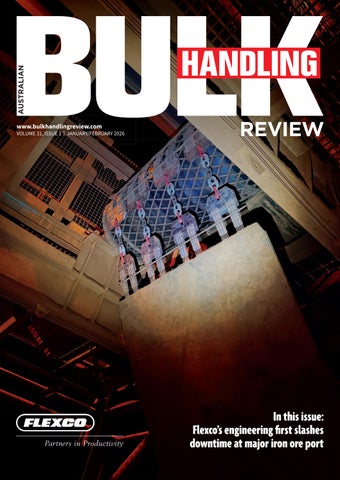
In this issue: Flexco’s engineering first slashes downtime at major iron ore port
reh Comp s t feedlo
off Oceania Satake g decades gin levera d es of fee • All typ ed co establish of pects • All as nk tur offering cess grain pro nds-on, • A ha tion, e opera mp ter longdesig • From es c provid in y all loc
erag By lev c and effi of needs
Contac
0 Office info@sa a www.s
Feeding, Conveying and Elevating | Bulk Material Storage | Bin Isolation Gates | Reagent Preparation Systems Lime Slaking and Limestone Grinding Systems | Wet Grinding Ball Mills and Grinding Media Handling | Custom Solutions
Bulk Handling Technologies draws on deep industry experience to engineer purpose-built, innovative systems that address the specific challenges of each application. From custom bin and hopper design to an extensive portfolio of feeding, conveying and weighing solutions, we deliver complete, reliable packages to handle any bulk material with accuracy and confidence.
BULKHANDLING TECHNOLOGIES
Engineered and Built in Australia
We also support our customers with site audits, troubleshooting and practical refurbishment or upgrade solutions to improve performance, extend equipment life and maximise operational efficiency. Our equipment and solutions are supplied across Australia and to international clients.
+61 8 9332 3454 | sales@bulkhandlingtech.com.au | 10 Ferguson St Kewdale WA | bulkhandlingtechnologies.com.au
1
CONTENTS JANUARY/FEBRUARY 2026
06
16
37
56
6 A fastening first
37 Bulk handling in motion
Flow aids
10 Merging in the right direction
40 A bulk win for the bulk industry
22 Preheater towers: Considerations for improving flow and safety
12 Standardised tests, incredible results
42 A helping hand for the harvest
16 DHHI plants seed for growth
44 Boral’s breakthrough in carbon capture
18 Cutting out the nuisance
46 Free tickets available for QME 2026
20 Filtering for success
48 BULKtalk: Training
28 A critical legacy
52 Designing screw feeders for reliable bulk solids handling
30 Breakthrough innovation 32 Victorian dairies are in safe hands 34 From then to now
26 Keeping bulk solids moving with air
56 Inside HOSCH’s real-world training program 58 Bulk handling meets PNG
ASSOCIATION PARTNER
SHOWCASE YOUR INNOVATION AT AUSTRALIA’S ONLY BULK HANDLING EVENT Melbourne Convention and Exhibition Centre
16-17 September 2026
COVER STORY: A FASTENING FIRST Flexco’s engineering solution has reduced downtime during the belt changeout process at a major iron ore facility.
www.bulkhandlingreview.com
VOLUME 31, ISSUE 1 | JANUARY/FEBRUARY 2026
EXHIBIT IN 2026. BE SEEN. BE HEARD. BE CHOSEN.
For the full story, see page 6
A cross-sector showcase of bulk handling innovation
2026
IN CONJUNCTION WITH
MEDIA PARTNERS
Scan now to download the 2026 Prospectus!
In this issue: Flexco’s engineering first slashes downtime at major iron ore port
MHD Supply Chain Solutions
Australian Bulk Handling Review: January/February 2026 І 3
EDITOR’S NOTE
Published by:
379 Docklands Drive Docklands VIC 3008 T: 03 9690 8766 www.primecreativemedia.com.au CEO Christine Clancy E: christine.clancy@primecreative.com.au Editor William Arnott E: william.arnott@primecreative.com.au Assistant Editor Adam Daunt E: adam.daunt@primecreative.com.au Journalist Daniel Williamson E: daniel.williamson@primecreative.com.au Business Development Manager Rob O’Bryan E: rob.obryan@primecreative.com.au Client Success Manager Janine Clements E: janine.clements@primecreative.com.au Head of Design Blake Storey Design Laura Drinkwater Subscriptions T: 03 9690 8766 E: subscriptions@primecreative.com.au
Bulk business The bulk handling industry requires a diverse range of equipment, from conveyors, crushers, trucks, and silos. While much of the machinery is designed and built for one sector specifically, other ind stries ha e incorporated it into their day-today operations. ach ind stry has di erent ways o opti ising e ip ent se to est fit their needs, and have learned to get the most out of the technology for their specific application. There is a lot of potential value from sharing these strategies, learning what wor s elsewhere, and finding ways to incorporate it into arrying. That’s partially the goal of the upcoming Australian Bulk Handling Technical on erence and xpo . The show plans to ring ind stries that se l aterial handling e ip ent together to showcase the latest technologies, inno ations, and pro ide an opport nity to networ with li e inded peers. It’s the only dedicated Australian event of bulk commodities such as concrete, sand, stone, grains, coal, iron ore, ani al eed, or woodchips. ip ent li e con eyors, silos, otors, d st control syste s, weigh scales, le el eas ring prod cts and ore will e on display at the show. n partic lar, the show will highlight the latest ad ances in the nternet o Things, a to ation, and artificial intelligence. ttendees will also e a le to attend se eral networ ing e ents, o ering the opport nity to eet with new potential clients and learn a o t new ar ets. t will also host the stralian l andling wards, which celebrates the achievements of companies and individuals that have demonstrated innovative practices and superior performances across the year. will ta e place at the el o rne on ention and xhi ition Centre from 16–17 September 2026.
www.bulkhandlingreview.com
The Publisher reserves the right to alter or omit any article or advertisement submitted and requires indemnity from the advertisers and contributors against damages or liabilities that may arise from material published. © Copyright – No part of this publication may be reproduced, stored in a retrieval system or transmitted in any means electronic, mechanical, photocopying, recording or otherwise without the permission of the publisher. William Arnott Editor - ABHR
4 І Australian Bulk Handling Review: January/February 2026
MODEL
TA
BELT ALIGNMENT SWITCH
MODEL
RS
PULL CORD SAFETY STOP SWITCH FOR CONVEYORS
MODEL
DB
DAMAGED BELT DETECTOR
™
MAGNETICALLY COUPLED MOTION SWITCH
MODEL
CMS
COMPACT MOTION SWITCH
INTRODUCING AN EASY WAY TO PROTECT YOUR WORKERS AS WELL AS PROTECT YOUR INVESTMENT INTO YOUR EQUIPMENT. THE CONVEYOR SAFETY SYSTEM™ IS AN EASY, COST EFFICIENT WAY TO GET PEACE OF MIND AND PROTECTION FOR CONVEYOR EQUIPMENT. BY BUNDLING OUR MODEL RS SAFETY STOP SWITCH WITH OUR MODEL TA BELT ALIGNMENT SWITCH, MODEL DB DAMAGED BELT DETECTOR WE HAVE YOUR WORKERS AND EQUIPMENT COVERED. COUPLE THAT WITH ADDING ONE OF OUR MOTION SWITCHES (MAG-NEAT-O™ OR MODEL CMS), YOU CAN FEEL CONFIDENT KNOWING THAT YOUR SYSTEM AND WORKERS ARE PROTECTED FOR A FRACTION OF THE COST OF DOWNTIME, REPAIRS AND REPLACEMENT EQUIPMENT.
www.conveyorcomponents.com
COVER STORY
The FXC Steel Cord Belt Fastener can be preassembled on the new belt ahead of time.
A fastening first Flexco’s engineering solution has reduced downtime during the belt changeout process at a major iron ore facility. WHEN AN IRON ORE PORT in Western Australia faced a critical belt changeout requiring the connection o two di erent elt specifications, it needed a sol tion that was ast, sa e, and engineered. The traditional dummy splice method wo ld re ire to ho rs o downti e, and connecting elts with di erent cord pitches and diameters presented unique technical challenges. The site’s conveyor specialist had been considering alternatives for months to help drive the company’s initiative of decreasing downti e in a sa e anner. The port facility regularly changes belts on its stacking conveyors due to co er wear and da age, t this ti e it was switching to a di erent elt specification to standardise to a ore co on elt type. The old belt featured a cord pitch of . with a cord dia eter o . .
The new belt had a much tighter cord pitch of just 12mm and a smaller cord dia eter o . . oth were rated ST2500 and measured 1800mm wide with a . o erall thic ness, t internally they were co pletely di erent. istorically, the site sed d y splices or elt changeo ts, sing a generic vulcanised splice designed solely to withstand pull forces during the belt installation process. The connection only needs to survive long enough to get the new belt into position before being cut o t and replaced with a per anent splice. This process was familiar to every elt splicing crew e er on site. team of four or more would remove co ers, clean cords, layer in nc red r er, and lcanise the asse ly. n an wide elt, the process typically too to ho rs. That s ore than a full shift dedicated to creating a te porary connection.
6 І Australian Bulk Handling Review: January/February 2026
The bigger concern for the port was predicta ility. ost d y splices lac o cial ratings, and their strength depends on multiple variables incl ding the s ill o the splicers, the condition o the elts, en iron ental actors, and how well the lcaniser aintains te perat re. or connecting two di erent elt specifications, d y splices eco e even more problematic because creating a reliable vulcanised connection between two elts with di erent internal str ct res is inherently di c lt. Like most large-scale mining operations, e ery ho r a con eyor sits idle represents significant lost re en e. typical iron ore conveyor might move 3000 tonnes per ho r, and that co ld ic ly lead to potentially hundreds of thousands of dollars in lost production d ring downti e.
The engineered solution The port knew its upcoming belt changeout could take even longer than the usual 10 to 12 hours if it used traditional ethods. t egan ha ing disc ssions with sol tions pro iders, including a meeting with Flexco about the steel cord elt astening syste . The FXC’s documented safety factors and potential time savings aligned with the port s operational needs, so the site decided to trial the FXC for the next elt changeo t. Working closely with the site’s aintenance tea , lexco s engineering department developed a custom pull plate sol tion specifically designed to connect two elts with di erent cord specifications. The challenge was straight orward. FXC mechanical fasteners come in di erent si es to acco odate di erent cord dia eters and pitches. The new elt with its . cords needed si e one asteners and the old elt with its . cords needed si e six asteners. These asteners don t ate directly together. The customised solution used specially-engineered p ll plates, allowing each belt end to get its appropriately si ed asteners. Then, the p ll plates would attach to those fasteners and connect to each other via industrial-grade low profile shac les and chains. The complete system featured three ain co ponent types. The p ll plate and joint assemblies provided a strength rating o . t per asse ly with a . -ti es sa ety actor o er the calc lated pea elt p ll re ire ent. ith o r asse lies on each elt end, the total strength reached t. pler hac les pro ided a t rating with a o r-ti es sa ety actor, while
rade chain slings carried a . t rating with a -ti es sa ety actor. The total pull strength requirement or the o was calc lated at . t. ery component in the system exceeded this re ire ent s stantially, with the connection pro iding . -ti es the re ired capacity. This level of documented engineering ga e the port confidence that the connection would safely withstand all pull forces during the belt changeout process and manoeuvre easily around pulleys and the four troughing roller set p.
The installation process The Flexco team arrived on site knowing they needed to demonstrate the system to a splicing crew who had years of experience with traditional ethods. The new elt was already lapped o t, and the winding e ip ent was ready, t maintenance work was still underway on
the head p lley and ilding sca olding. After explaining the maintenance wor didn t a ect where the elt wo ld e prepared, lexco and the elt crew ca e together at the con eyor, wal ed through the FXC system component by co ponent, showed the engineering calc lations, and explained the . -ti es sa ety actor. With Flexco’s guidance and its distri tor s elt crew s confidence in the syste , they started preparing the elt end o the new elt. This already o ered a downtime advantage because dummy splice belt ends must be brought together in an enclosed area before they can be prepared, protecting the elt preparation ro en iron ental actors. Power crimping went smoothly once the ferrules were properly positioned and the - loc s o ed reely. The asteners, olts, and n ts co pleted the asse ly witho t iss es, and the team left the bolts unground in
Images: Flexco
lexco hard etals ind stry specialist, ason oe, told ABHR the technology was a world-first design that ai s to significantly speed p the steel cord splicing process. “ elia ility is i portant, he said. “ lexco s history is ilt aro nd echanical elt asteners. t was o r ery first prod ct when we egan in , so it ade sense or s to engineer the ind stry s first steel cord elt astener.
The FXC Steel Cord Belt Fastener has been proven to be a safe alternative to traditional dummy splice methods.
Australian Bulk Handling Review: January/February 2026 І 7
COVER STORY
case adjustments were needed when connecting to the old elt end. t too a total o three ho rs and fi e in tes to install the new elt end. ince the old elt had the larger . cords and older co ers, preparing this elt end took a slightly longer than compared to the new elt end. arder r er co ers and the bigger cord diameters made removing the covers and hooking the cords ore di c lt, t the crew sped p as their techni e i pro ed. nstalling the co ponents too an ho r. n total, oth elt ends too se en ho rs and in tes, co pared to 10 to 12 hours for a traditional d y splice.
The results ith oth elt ends prepared, the crew used a crane to lift the old belt end out of the system and position it on top of the con eyor, re iring a o t o r separate li ts. The elt end was ed thro gh the t capacity pinch drive and attached to the powered elt reel syste . The new belt end was pulled into the take-up area using a 5t capacity
winch dri e. eca se the winch had only a single point o p ll, the tea used just the two middle pull plates with long chains to distribute the load e enly. The err les attached to the two middle pull plates had a combined capacity o approxi ately tons, providing a seven-times safety factor o er the winch capacity. Once the new and old belts were connected, the elt crew positioned themselves at critical points throughout the operation and the FXC moved thro gh the syste s oothly, as the co ponents, p ll plates, shac les, and chains transferred loads as anticipated with every part performing exactly as was engineered. The crew completed both belt ends in approximately six to seven hours of act al wor . owe er, the real ad antage lies in ad ance preparation capa ility. The new belt end could have theoretically been prepared weeks earlier during normal operations at ero downti e cost, as only the old belt end required work during the act al sh tdown window.
ith ad anced preparation, the potential time comparison becomes 10 to 12 hours for a traditional dummy splice versus two to four hours for the d ring the sh tdown, a per cent to 80 per cent reduction in critical path downti e. The elt splicers, who initially were hesitant about the syste , were enth siastic y the end and confident they co ld wor aster on s se ent installations. The management team at the port now had doc ented engineering, pro en per or ance, and eas ra le ti e sa ings, all o which were eno gh to sti y initial and t re in est ents. The success came from documented engineering that pro ided credi ility, custom solutions developed colla orati ely or specific challenges, hands-on s pport d ring installation, and ost critically, a syste that per or ed flawlessly nder real loads. For mining operations facing tight maintenance windows and pressure to red ce downti e, lexco s steel cord elt astening syste o ers a pro en alternati e to traditional ethods.
The FXC Steel Cord Belt Fastener offers a controlled, engineered solution for belt pulls on overland conveyors
8 І Australian Bulk Handling Review: January/February 2026
POWERCORE®
DONALDSON DELIVERS
PERFORMANCE PROTECTION AND
THE
PROOF IS IN THE PERFORMANCE Protect your equipment and bottom line by using only clean, dry fuels and lubes. Donaldson’s field proven bulk filtration may be your best investment. REDUCE UNPLANNED DOWNTIME
TRUSTED BY OEM’S
PREFERRED
BY PROFESSIONALS
MINIMISE PREMATURE COMPONENT FAILURES
LOWER YOUR TOTAL COST OF OWNERSHIP
For more information, scan the QR code
AGRICULTURE
Merging in the right direction ABHR learns how the Bunge and Viterra merger will affect the Australian bulk handling industry. VITERRA, ONE OF THE LARGEST
In Australia, Bunge has 55 storage and handling sites and six port terminals across South Australia and western Victoria. It also has three storage and handling sites, including a port terminal in southern Western Australia, two import facilities in Victoria and ew o th ales, and eight o ces spread across the country in key growing regions. A Bunge spokesperson told ABHR that the merger brings together a diverse and talented group of people, creating a team of around 900 employees to service over 13,000 farmer customers. “Our team has been busy integrating our combined business and our joint expertise will ring enefits to o r farmer customers, as well as our end use customers in Australia’s local and international destination markets,” the representative said. “By combining our strengths, we re a le to o er expanded ar et opport nities, a ore di ersified and resilient agriculture network, and enhance our services to support our farmers in maximising the value of their grain. Our buyer and end use customers will experience greater supply chain certainty, expanded access to high-quality Australian grain, and a
ore e cient, integrated networ that enables stronger connections between origin and destination.” Bunge remains committed to serving and collaborating with growers to discover new markets for their products and to improve the productivity and en iron ental e ciency o agric lt re, the spokesperson said. In a media release, Bunge said that the highly complementary asset footprints of each company when combined will be positioned to connect farmers in the world’s largest production regions to areas with the fastest-growing consumption. iterra chie exec ti e o cer David Mattiske has joined the Bunge executive leadership team as co-chief operating o cer alongside lio arros, the most recent Bunge co-president of agribusiness. The Bunge spokesperson said for the 2025/26 harvest, it’s business as usual across its operations and short-term and long-term goals remain the same. “Farmers and buyers continue to engage with our team and utilise our sites and services as they have in the past. Across Australia, our business is operating as Bunge, with a transition to the Bunge brand underway,” they said. Image: Jeff Whyte/stock.adobe.com
buyers of Australian agricultural co odities, has finalised its erge with a US-based agricultural giant. First announced in 2023, regulatory approvals pushed back the Bunge and Viterra merger for nearly two years. The respective agribusinesses are now one company, which is simply known as Bunge. The merger aims to enhance the company’s ability to meet the demands of increasingly complex markets and create a strong financial profile. nge chie exec ti e o cer reg ec an said it s a defining o ent or the company and the global team. “I’m grateful to our colleagues whose energy, collaboration and commitment brought us to this milestone. Together, we’ve formed a stronger organisation with enhanced capabilities and expertise to meet the evolving needs of our customers, maximise value for our sta eholders and lfill o r shared purpose to connect farmers to consumers to deliver food, feed and fuel to the world,” he said. Now, we begin the exciting work of bringing our teams and operations together, uniting our strengths to realise the full potential of this combination.”
Viterra was one of the largest buyers of Australian agricultural commodities.
10 І Australian Bulk Handling Review: January/February 2026
POWDER HANDLING
Standardised tests, incredible results Haver & Boecker are committed to perfecting the packing process for powdery products.
Images: Haver & Boecker
The Institute’s work performs product analyses and filling trials.
IN THE TOWN OF OELDE, GERMANY stands the Haver & Boecker Institute, a 1,000m2 test facility dedicated to studying the properties of its customers’ powdery products. Here, a team of 10 specialists ranging from technicians to engineers de elop e cient filing syste s and select the most suitable packaging materials for process reliability and e ciency. “ ery prod ct eha es di erently d ring flow, filling, and storage, a er & Boecker Institute general manager Thomas Hilling said. “Our task is to understand these behaviours and match them with the optimal technology and the c sto er s specific expectations. That’s how we guarantee process relia ility and e ciency ro start to finish.
The foundation: Product analysis and filling trials At the core of the Institute’s work are prod ct analyses and filling trials, processes that are critical to developing high-performance, reliable filling syste s. “Product assessment with respect to flow eha io r, filling, and storage is the o ndation or designing s ita le filling technology, illing said. Standardised test methods are used to analyse how a material behaves in various stages of handling. These results form the basis for defining the correct filling principle, technical details and requirements, and packaging type. The Institute’s technical facilities, equipped with 15 filling syste s, allow experts to per or ll-scale filling tests to alidate theoretical findings.
12 І Australian Bulk Handling Review: January/February 2026
Hilling said every project is unique. Even materials sold under the same name can ary significantly d e to di erences in raw materials or production processes. “That’s why we always consider the packing triangle as a single interdependent syste , he said. The design of the bag also plays a decisive role. Factors such as air permeability, material strength, and clos re type can directly infl ence filling performance and product stability. These variables are reviewed and optimised as part of every Institute project.
Evolving products, increasing complexity Product diversity has grown enormously. “Thirty years ago, the building materials industry mainly dealt with ce ent, li e, and gyps , illing said. “Today, an act rers o ten o er
ore than di erent or lations, any o which are ch finer and ore co plex. The trend toward finer particle si es and the inclusion of chemical additives has redefined the re ire ents or odern filling technology. inely gro nd materials have higher surface areas and increased reactivity, demanding advanced sealing, aeration, and dust control capabilities. Beyond construction materials, the Institute encounters a wide spectrum of products - from chemical powders to food and agricultural materials. “Every now and then we still get so ething co pletely nexpected, Hilling said. “Recently we had spice liquorice powder from Turkey and even bat droppings used as fertiliser from Australia. Each product brings its own challenges.
Rising customer expectations As products evolve, so too do customer demands. “ xpectations ha e increased across all ind stries, illing said. “ sto ers want higher filling capacities, tighter weight tolerances, often beyond legal calibration limits, and greater a to ation. Cleanliness, ease of product changeo ers, and energy e ciency are now key factors in every design. Sustainability has also become a central priority. “Our customers want to minimise waste and prod ct loss, illing said. “Filling must be resourcee cient and clean, and pac aging must reliably protect the product. Even visual presentation and usability features such as carrying handles or easy-open systems are recognised as co petiti e ad antages. This shift has positioned the Institute as not only a technical testing centre but also a strategic partner helping customers meet modern performance and environmental standards. Further to this is ongoing regulatory developments such as the Australian Packaging Covenant Organisation’s national regulatory framework and the European Packaging and Packaging
Waste Regulation which a putting a strong focus on the requirement for more sustainable packaging. In turn, this is creating a need from manufacturers for more innovative recycled bag materials, functionality and design. The Institute’s reputation for precision and relia ility is reflected in its growing customer base. “We welcome about 3,000 visitors each year, illing said. “That number alone shows how ch tr st o r c sto ers place in s. eca se the filling line is o ten the final lin in a c sto er s prod ction process, its performance is critical. A poorly optimised system can jeopardise the entire operation. “Our database now contains ore than , prod ct analyses, Hilling said. “This accumulated knowledge allows us to make accurate comparisons and informed recommendations. Customers appreciate that we not only look at the machine technology, but also all the para eters infl encing filling. That s o r expertise, and it ilds tr st. The Institute acts as a central service provider within the Haver & Boecker
Group and beyond. It collaborates closely with internal divisions and subsidiaries such as Haver Engineering Meißen, Ibau Hamburg, Feige Filing, Behn+Bates, Aventus, and Newtec ag alleti ing. As a global company Haver & Boecker operates test institutes with a similar set p in hina, ndia, ra il, and the USA to be close to its customers. xternally, the nstit te maintains partnerships with plant engineering fir s, trade associations including EUROSAC and PSSMA, as well as universities and packaging material manufacturers. “Over time, raw material producers - especially in paper and plastics - have come to us for testing before their prod cts reach the ar et, illing said. “That keeps us constantly informed about the latest developments and trends. Continuous innovation is driven by market demands, customer feedback, and internal initiative. “New ideas come from many directions, sometimes directly from customers, sometimes ro o r engineers, illing said. “We often test concepts even before there s a specific c sto er re est. The company’s guiding principle is the packing triangle.
Australian Bulk Handling Review: January/February 2026 І 13
POWDER HANDLING
This proactive approach allows us to identify opportunities for improvement early on. cono ic e ciency and nctional reliability remain central considerations. “There are many innovative technologies o t there, he said, “but they must withstand realworld conditions. That’s why we test extensi ely e ore i ple entation. One of the company’s latest solutions is its QUAT2RO, a modular digitalsolutions suite designed to bring ‘smart factory’ level transparency, control, and e ciency to ind strial pac ing and l material processing plants. QUAT2RO combines real-time monitoring, AI-powered quality control, and advanced process analytics that can e tailored to a acility s specific needs,
from simple real-time dashboards to full integration o ixing, filling, pac ing and logistics.
Knowledge and transfer training Training plays an essential role in maintaining HAVER & BOECKER’s technical excellence. ach year, aro nd new employees from the headquarters in elde, s sidiaries, and external partners receive instruction at the Institute. “In addition, we train service engineers and apprentices as part of their ocational progra s, illing said. Since 2024, the HAVER Academy has expanded this o ering, pro iding structured learning modules for customers. “It’s important that everyone involved, from engineers to sales
sta . The etter prepared they are, the s oother their t re pro ects will r n, Hilling said. ith approxi ately illion ags filled worldwide each year, the challenges o precision, e ciency, and s staina ility continue to grow. Yet, for Hilling and his tea , this constant e ol tion is exactly what keeps their work engaging. “ ery prod ct eha es di erently, every bag design is new, and every c sto er rings specific expectations, he said. “That a es o r wor exciting, and it keeps us moving forward. As Haver & Boecker grows and technology advances, so will the Institute. If we maintain our passion for innovation and precision, our future will be just as strong as o r tradition.
C
M
Y
CM
MY
CY
CMY
K
The Haver & Boecker Institute.
14 І Australian Bulk Handling Review: January/February 2026
12-1_ABHR_InsertV1.pdf
1
11/26/25
9:22 AM
C
M
Y
CM
MY
CY
CMY
K
Martin®Hurricane Air Cannon
hen bulk material stops moving due to buildup or blockages, you can have some serious problems: unscheduled shutdowns, maintenance safety risks, lost production, and diminished profits. Martin® Air Cannons use the power of compressed air to handle the most troublesome clogs — eliminating manual cleaning, reducing workplace hazards, and mitigating confined space entry. Don't get jammed up. From emergency installations to custom solutions, Martin stands ready to respond to your specific material transfer needs — maintaining flow, improving safety, and reducing costs.
For service, training or sales call 1300 627 364, email salesau@martin-eng.com or visit martin-eng.com.au. Martin Engineering Australia Pty Ltd, 102 Christensen Road South, Stapylton, QLD, 4207, Australia
EPC
DHHI plants seed for growth International manufacturing giant DHHI is planning to expand its engineering, procurement, and construction project delivery capacity in Australia.
DHHI manufactures around 650,000 tonnes of steel structures and more than 120 major machines each year. Images: DHHI
IN AUSTRALIA, DHHI IS MOST known for delivering massive bulk handling equipment. However, the international giant’s expertise extends far beyond conveyors, stackers, reclaimers, spreaders, car dumpers, and shiploaders. Over the years, DHHI has grown into a fullservice engineering, procurement, and constr ction pro ider, o ering co plete fixed-plant sol tions that co er every stage of ore processing. DHHI Australia sales manager Will Haua told ABHR the Chinese business has global ambitions in this space, and Australia is one of the key target markets. “Our traditional clients might not understand the full depth of DHHI’s capabilities, thinking that we are only a manufacturer of balanced machines,” he said. “We are looking to expand with ore ining pro ects, specifically in Australia, South America, the middle east and certain African countries.
“We can deliver everything from the run of mine (ROM) pad, through to crushing, screening, processing, stockyard equipment, and train or truck loading and unloading.” Headquartered in Dalian, China, with o ces aro nd the world ens res clients enefit ro oth world-class manufacturing and reliable local support. The company does this by setting up local branches that recruit homegrown talent. This means DHHI can provide region-specific expertise, aster spare parts availability, and on-site technical assistance while enefitting ro its extensive manufacturing capacity. has fi e an act ring and research facilities across the province of Dalian, China totalling more than 2.5 million square metres of real estate including direct access to multiple deep water port loading facilities. Its workshop manufacturing capabilities range from bulk
16 І Australian Bulk Handling Review: January/February 2026
handling machines, process plants, conveyor systems, port machines, metallurgical and power generation equipment, logistics centres, foundries, spare parts workshops as well as its own electrical manufacturing and control equipment plant. DHHI manufactures around 650,000 tonnes of steel structures and more than 120 major machines each year from its large-scale processing facilities with strict quality control. “We can draw on the expertise of more than 1600 engineers and technicians across 12 professional design institutes to ensure each project has s cient reso rce capacity to eet oth our high standards of quality as well as o r client s detailed specifications and expectations,” Haua said. “Case by case we will also utilise the expertise of our long-standing engineering and design partners in China such as NETC (under MCC Group).
The inclusion of wet high-intensity magnetic separator processing allows recovery of fine and weakly magnetic minerals.
“DHHI Australia has also formed multiple partnerships with local Australian subject matter experts and cons ltants to le erage o ind stry specific nowledge, partic larly in the process plant space to further ensure we meet those expectations.” a a said a ey di erentiator is s a ility to tailor specific pro ect execution strategies for every customer. “DHHI aligns each project to our client’s preferred suppliers as well as providing low-cost sourcing options to the flow sheet ro a s stantial global supply chain and China domestic manufacturing partnerships.” DHHI can also design, fabricate, assemble and commission large modules in controlled facilities before delivering it to site. “Structural steel, mechanical equipment, piping, electrical systems,
and switchrooms are all manufactured, assembled and quality-tested prior to delivery, reducing constructability risks on site and enabling faster, more predictable installation,” Haua said. “Modules are designed to the maximum size possible subject only to the transport window to each specific site. Modularisation and standardisation help to de-risk projects by providing more predictability in design processes, project schedule and pricing. Fabrication and assembly are typically a significant portion o scope for any project thus the ability to conduct this work in DHHI’s facilities provides assurance to its clients. Once the modules arrive on site, DHHI and its partners oversee complete site construction, including civil works, structural, mechanical, DHHI can design, fabricate, and trialassemble modules in controlled facilities before shipping them internationally.
and piping erection, and electrical and instrumentation installation. Commissioning is generally executed collaboratively with DHHI and the client. This includes pre-commissioning, no-load commissioning, and load commissioning, with technical assistance provided throughout to ensure the plant operates sa ely and e ciently. also pro ides final reporting, ens ring ll accountability and documentation for the project. Haua said DHHI’s experience demonstrates both technical capability and global reach. “We have delivered WHIMS plants for Hancock Iron Ore (previously Roy Hill), executed a major EPC project in Peru, conducted feasibility studies for multiple Tier One mines in Australia, and recently secured a major EPC project in Africa, covering the full ROM-to-loadout process includes site constructions and civils,” he said. “By combining detailed engineering, od lar a rication, o -site trial assembly, and full-service site construction, commissioning and complete aftermarket services, DHHI provides clients with a single, accountable partner for the entire project lifecycle. “With global manufacturing strength, proven technical expertise, and an expanding local presence in Australia, DHHI is uniquely positioned to deli er odern, e cient, and relia le fixed-plant sol tions or ining operations worldwide.”
Australian Bulk Handling Review: January/February 2026 І 17
SENSORS The Smart Series maintains its IP67 rating for long periods of time thanks to high-quality seals and O-rings.
Cutting out the nuisance Pacific Automation knows its mining customers require reliable equipment, which is why it has developed a smart pull wire solution. WATER POSES A PROBLEM FOR
Contacts inside the switch are IP67-rated and fully epoxied, preventing corrosion even in extreme moisture or dust.
pull wire switches. If it gets inside a switch s enclos re, fl ct ations in temperature can lead to trapped humidity. Similarly, if dust manages to work its way into a switch’s enclosure, it can accumulate over time. Either can corrode important contacts inside the enclosure over time, especially if there is a lot of vibration. Unfortunately, Australian mines have the perfect cocktail for things to go wrong: hot days, cold nights, dusty environments and equipment that creates near-nonstop vibration.
18 І Australian Bulk Handling Review: January/February 2026
hen the c rrent flowing thro gh the switch does not reach the correct contact point, it can cause a nuisance trip, grinding everything to a halt and causing headaches throughout the process. n shorter con eyor elts, finding the culprit may be relatively simple. However, if the conveyor spans 20 kilometres (km), it becomes much more di c lt to find the a lt. acific to ation prod ct anager for conveyor control and mining Johan Blignaut told ABHR these nuisance trips were a major concern for engineers. “If your equipment isn’t reliable, it could be potentially unsafe,” he said. “Unreliable equipment also leads to unplanned downtime and loss of money due to process stoppages.” Blignaut has more than 30 years o experience wor ing as a field engineer in the mining industry. This extensive career has given him a deep
Images: Pacific Automation
understanding of what causes equipment to fail and how to prevent it. When it comes to pull wire switches, he said recurring issues stemmed from three key areas: loose wire connections, exposed switch contacts prone to corrosion, and slack wire tripping caused by thermal expansion and contraction of the lanyard wire. acific to ation s art eries p ll wire switches are designed to avoid this issue entirely. Featuring a Weidmüller A-Series push-in terminal, the switches use spring-tension technology that grips tighter with movement, making them impervious to vibration and thermal cycling. Contacts inside the switch are IP67rated and fully epoxied, preventing corrosion even in extreme moisture or dust. Each contact connects directly to a fly lead, which is then ed into the spring terminals, adding a second
layer of protection. Internal springs inside the switch body have also been eliminated, eliminating the problem of slack-wire tripping. Blignaut said the Smart Series maintains its IP67 rating for long periods of time, thanks to high-quality seals and O-rings. “Other products may have the same IP rating, but they don’t last. If the seal becomes compromised, the rating isn’t good anymore,” he said. “Even if dust gets into the enclosure, the switch by itself is IP67, which protects it. No dust can actually get into the switch. “We had an installation that had been in operation for around 15 years. When it was opened up for an inspection, it looked brand new – the inside was still shiny. If there had been a failure, you would have seen signs of water or dust, but this switch was like new.”
Due to their construction, the Smart Series pull wire switches require little maintenance. To assist mines with regular maintenance, the company introduced a tension indicator that aligns with the AS/NZS 4024.3610:2015 safety standard, gi ing operators a is al confir ation that tension is within a compliant range. Blignaut said the system has proven itsel in the field. “A major mine in Western Australia recently installed a full conveyor safety package, including our Smart pull wire switches,” he said. “They previously had so many problems with their old system. Since installing ours, they’ve had zero nuisance trips. “The client was so impressed that all future upgrades and new projects will be standardised across operations with the system.”
Australian Bulk Handling Review: January/February 2026 І 19
FUEL
Filtering for success
Bulk diesel tanks require high quality breathers to minimise airborne contamination.
ABHR sat down with Donaldson to learn how and why fuel cleanliness is not to be overlooked in the bulk handling industry. DIESEL ENGINES ARE THE workhorse of Australia’s bulk handling industries, powering essential vehicles and machines. Whether it’s building infrastructure, planting and harvesting crops, or mining minerals, modern life depends upon the performance of diesel engines. Donaldson Company training manager Hayden Schulz said modern diesel engines operate with extremely high injection pressures and require exceptionally clean fuel to perform e ciently and relia ly. “If fuel cleanliness is not maintained, it can result in catastrophic failures,” he said. “It’s not just the cost of the labour and components; the bigger cost to industry is that production is interrupted when machines are not working. So, the implications and true cost of a ailed critical engine is specific to each consumer and application. “When customers are handling bulk goods such as ore, coal, or grain we can expect significant a o nts o
airborne dusts. Bulk diesel tanks require high quality breathers to minimise airborne contamination from being drawn into their bulk storage tanks every time fuel is dispensed.” Schulz said that the use of high-quality breathers to minimise contamination and moisture ingress is the ost cost-e ecti e step a c sto er can take. Contaminated fuel can lead to expensive equipment failures. Whether it’s an excavator, truck, or generator, unplanned downtime can lead to an unacceptable loss of productivity. “The truth with diesel is that the more times its handled and transferred from one tank to road tank, with the biggest killer being customers nowadays having their own fuel on site, is that the tank has never had a quality breather to keep the airborne moisture and dust out,” he said. “The problem is not if that fuel is static in the tan , that s fine. The challenge is when customers receive a delivery of fuel, which comes in at high
Images: Donaldson Company
Installing highly efficient filters to the dispense side of a storage tank ensures that contaminated fuel isn’t pumped into equipment.
20 І Australian Bulk Handling Review: January/February 2026
velocity, spurs that contamination on the bottom of the tank out and it gets its way through the entire fuel tank.” Despite being an ongoing challenge, there are methods to improve fuel cleanliness. nstalling highly e cient filters to the dispense side of a storage tank ensures that contaminated fuel isn’t pumped into equipment. “It doesn’t matter what the machine is, anything that has an engine will have el filters, ch lt said. “It all depends on the quality of those filters. it s really good ality and has dirty fuel, it will block rapidly and not make it to a standard service central. If they se lower el e ciency filters on the engine, they may not block up, but that contamination will pass through and do the damage to high-pressure fuel pump and injectors.” Schulz said that managing fuel cleanliness challenges have been part of Donaldson’s standard works for many years. “ ood ality filtration and reathers, go hand in hand, and are important to achieving a good result,” he said. “ owe er, the est ality filter will never be a substitute for bad maintenance practices. “When Donaldson are working with customers, we like to understand their situation and consider what improvements could be made to increase their chances of achieving a positive outcome. “Good maintenance practices are essential.”
Keeping your operations moving today, tomorrow, and for the next 40 years.
YOUR COMPLETE CONVEYOR SOLUTIONS PARTNER. nepeanconveyors.com
FLOW AIDS
Preheater towers: Considerations for improving flow and safety Martin Engineering’s global air cannon product manager Brad Pronschinske explains how new air cannon technologies can minimise lost production, reduced revenue, employee morale issues in cement production. RAISING THE TEMPERATURE of the cement meal to ensure it doesn’t cool the kiln when it arrives saves on energy consumption, reduces the calcining time and promotes plant e ciency.
Within seconds before entering the kiln, material fed into the preheater at a temperature as high as 93ºC is heated to a scorching . However, no matter how many stages the preheater has, material can
22 І Australian Bulk Handling Review: January/February 2026
quickly adhere to the coarse refractory wall, ild p and clog the syste . ottlenec s in the flow leads to expensi e nsched led downti e. Many operators mitigate clogs by implementing regular cleaning
“To improve safety and increase e ciency, irt ally all ce ent plants in the USA have air cannons installed on the preheaters,” Martin Engineering US air cannon business development anager i e oody said. “Over the years, we’ve worked to improve the technology to the point where both installation and maintenance can be performed safely without a sh tdown or expos re to intense heat.
Preheater flow Today’s preheater tower designs can have as many as six stages in towers p to storeys tall. The eal flows down a chute to a splash box, proceeds Images: Martin Engineering
schedules, assigning workers with water lances extended thro gh access holes. A worker ascends the tower and dons a suit of high-heat personal protective e ip ent . ancing the aterial with high-pressure water clears the blockage, and the workers restore proper flow. Unfortunately, this procedure is always done while the preheater is still in operation, causing a tremendous amount of heat and some molten aterial to low ac . The PPE, the heat and the safety issues make preheater cleaning one of the most unpleasant jobs in a ce ent plant.
to the airflow o the riser d ct, where it gets heated and progresses to the next stage, and the procedure happens all o er again. One of the biggest contributors to material buildup is high heat and aterial elocity. s aterial gets hotter, it gets stickier, clinging to the sides o the flow ch tes and splash ox, as well as in the riser d ct. le t unchecked, clogs can form quickly, stopping the aterial flow, which leads to unscheduled downtime and lost prod ction. arge ild ps can even completely block the outlet of the cyclone. Whenever operators open the access door, this lowers operating te ps. Cold water also reduces temperature, and injecting water into the hot tower creates steam, which can result in dangero s stea . A better alternative is a series of low-press re air cannons. Air cannon nozzles are strategically positioned in the tower, riser duct or cyclone. s adhered aterial is dislodged, it ret rns to the flow, with the press rised shot acilitating the flow and enhancing e ciency. New technology has even been developed for installing air cannons in high-temperature applications without a processing shutdown, allowing specially-trained technicians to mount the units on furnaces, preheaters, clinker coolers and in other hightemperature locations while production contin es ninterr pted.
Sequenced shots
Some manufacturers have a refurbishing program that reduces costs through simply swapping and shipping.
The basic components of the air cannon include an air reservoir, fast-acting valve with a trigger mechanism and a nozzle to distribute the air in the desired pattern to ost e ecti ely clear the acc lation. Often installed in a series and precisely sequenced for maximum e ect, the networ can e ti ed to est suit individual process conditions or aterial characteristics. The air blasts help break down material accumulations and clear blocked pathways, allowing solids and/ or gases to res e nor al flow. To customise the air cannon installation
Australian Bulk Handling Review: January/February 2026 І 23
FLOW AIDS
to the ser ice en iron ent, specific air blast characteristics can be achieved by manipulating the operating pressure, tank volume, valve design and no le shape.
Tanks and valves To facilitate maintenance without a process shutdown, air reservoirs with ol es typically ranging ro p to are now o tfitted with a rear-facing valve that can be removed witho t dis o nting the tan . Today’s fast-acting valves can release the tank volume in a fraction of a second, creating a high-magnitude force at the exit nozzle that’s installed thro gh the wall o the essel or d ct.
The new designs feature a hybrid valve concept that provides more force, ses less air and si plifies aintenance in challenging applications with li ited dgets. ositi e-firing al es that respond to an air pressure surge delivered by a solenoid have also made air cannons sa er. nli e negati e press re-firing designs, a cannon equipped with this type of valve will not discharge accidentally in response to a drop in pressure, so an air supply failure or ro en line cannot trigger it s ddenly. The high-speed valve design is mounted on a smaller air reservoir, delivering higher discharge forces than less e cient al es on larger tan s.
The material flows through this stage several times within seconds, leading to the kiln.
24 І Australian Bulk Handling Review: January/February 2026
The new generation of valves produces about twice the blast force output of previous designs, saving energy by using about half the co pressed air ol e.
Nozzles and service Another innovation has been the Y-shaped assembly that allows the nozzle to be maintained or replaced without removing the tank or disrupting the re ractory. The system allows technicians to mount the units on furnaces, preheaters, clinker coolers and in other hightemperature locations while production contin es ninterr pted. t dra atically red ces downti e associated with traditional approaches to installation, service and replacement, which require that high-heat processes be halted to allow core drilling and o nting o the cannons. “Avoiding unplanned shutdowns is ey to a plant s profita ility, oody said. “ ny sh tdown other than scheduled maintenance is production ti e that can t e reco ered . “Once that production time is lost, it can t e ade p again. ith the core drilling option and Y-pipe, installation and maintenance can be done during nor al prod ction. The nozzle is the component that takes the stored energy in the form of compressed air and directs it to do wor , so it has a dra atic e ect on the per or ance o any air cannon. The application dictates the type of performance needed, including the shape o the air last or length o the pl e. A primary goal in every application is to se the stored energy as e ciently as possi le. A series of retractable air cannon no les was de eloped specifically for high-temperature applications, extending into the material stream only d ring the firing cycle to protect the nozzles from extreme temperatures and a rasion. These “smart” nozzles allow the cannon and nozzle to be installed independently, so the nozzle can be accessed for inspection or service during production, without stopping the process or re o ing the cannon.
With a spinning kiln above, air cannons keep workers safe by mitigating clogging and improving material flow.
The new design solves two common industry problems: dislodging accumulations in hard-to-reach areas without shutdown or manual labour, while significantly extending no le li e. Further, the units can be serviced from outside the vessel without disturbing the refractory, reducing potential damage while minimising ser ice ti e and ris o in ry.
Conclusion Flow through the preheater tower takes only seconds, but a clog can cause hours or days of downtime that can’t e ade p, res lting in significant losses (production time that can’t e reco ered . Prevention and maintenance can be a gruelling task that leads to increased la o r costs. Than s to new air cannon technologies, the lost production, reduced revenue, workplace safety implications and employee morale issues can e e ecti ely ini ised. “After calculating the costs saved by avoiding downtime, this technology pays or itsel ic ly, oody said. “The savings are compounded by reduced maintenance, improved safety, lower labour costs and greater prod ction e ciency.
Retractable nozzles are only exposed to the material stream for the split second it takes to deliver the shot.
Australian Bulk Handling Review: January/February 2026 І 25
FLOW AIDS
Keeping bulk solids moving with air ESS Engineering’s air cannons are helping keep bulk material flowing across the country.
Images: ESS Engineering
Air cannons offer an alternative for when vibrators aren’t suitable for the application.
MATERIAL BLOCKAGE IN BULK storage had been previously under license systems is a common occurrence. Silos, kilns, and bunkers can have so much build-up that it can impede operations or even stop flow altogether. This material build-up becomes a safety hazard if it requires manual removal. Clearing the blockage from the outside has historically involved hitting the str ct re with a ha er, ca sing structural damage and presenting a manual handling risk. ESS has a comprehensive range of flow-aid de ices, ro air cannons to industrial vibrators to silo cleaners, all of which can e adapted across any l handling applications. In the bulk materials and handling sector, air cannons have numerous applications. They can quickly solve l flow pro le s in silos, hoppers, and ch tes, and are o ten applied where
vibration is impractical or other methods are too expensive. ESS air cannons are pneumatic bulk aterial flow aid syste s that tilise the release of a volume of compressed air. This sudden release of energy is directed through a transition pipe into compacted material in a bulk storage structure to fracture blockages, restoring material flow and regaining storage capacity. When the opportunity came up or to design its own line o air cannons, it chose to focus on designing a ore power l, sa er, flexi le, and customisable version. “We had our engineers redesign the valve arrangement and had it independently tested by The University o ewcastle esearch ssociates against other air cannons on the market,” ESS account development manager, Ken Minch, told ABHR. The design demonstrated strong performance and quickly gained traction
26 І Australian Bulk Handling Review: January/February 2026
across the bulk handling sector. Since their launch, ESS air cannons have been installed on silos, hoppers, chutes, and storage piles throughout the country, providing rapid, repeatable relief from flow o str ctions. ir cannons, co pared with other ethods li e i rators, can a ect a much larger area inside the vessel. Instead of energising a small zone on the wall, a single last can sweep across the vessel’s surface and aerate the stagnant material.
Restoring storage capacity and operational efficiency Material blockages can reduce a storage vessel’s functional capacity by half or more. ESS branch manager Bryce Cook cited a dustbin example in which tonnes o aterial were h ng p inside a -tonne in. “That was hal o the infrastructure’s capacity gone,” he
said. “ st two air cannons were a le to give them back their silo again.” This ability to reclaim lost capacity quickly is one of the key advantages of the technology.
Designed for safety and reliablity Compressed air systems inherently pose risks, so ESS engineered its air cannons to minimise exposure to stored energy. The nits fill with air i ediately e ore firing, rather than staying contin o sly charged. ir is released directly thro gh the valve and discharge pipe during activation, reducing the time the vessel remains under pressure. The mechanical design also supports long asset life. Cook said the cannons have only one moving part the piston responsible for releasing the air charge, the piston that releases the air. “Occasionally, you may need to replace the -rings, which is why they are designed to provide quick access to the valves inside,” he said. eca se firing cycles occ r ro ghly once e ery in tes, co ponent wear is extre ely low. also an act res cast- essel options with no weld sea s, eliminating potential fatigue points. Minch said the cast-vessel option is able to last or aro nd illion cycles, and in many cases, far longer. “I’ve inspected air cannons that I had installed as an apprentice that are still in service today,” he said.
Optimising air cannon performance for every site wor s closely with c sto ers to deter ine ideal place ent, firing sequences, and design options based on material characteristics and vessel geometry. t tr c loading stations, the process can e as straight orward as a dri er exiting the cab and pressing a button to restore flow. The company maintains an extensive library of case studies spanning coal, gyps , cr shed roc , woodchips, and numerous other bulk materials. inch said decades o experience with air cannon technology ha e allowed to contin o sly refine the design. “They re extre ely e ecti e pieces o equipment, and our clients love them.”
ESS can manufacture the air cannons as cast vessels
The air cannons are designed to fill with air just before they are fired.
Australian Bulk Handling Review: January/February 2026 І 27
MACHINERY
A critical legacy Bulk Handling Technologies explain how its work 18 months ago on the Balama Graphite Project has provided the company with further work to add to its impressive portfolio. let alone 18 months. Bulk Handling Technologies (BHT) founder and engineering manager Paul Ingleson told ABHR that industry needs are evolving – especially in the critical minerals sector. According to Geoscience Australia, the country is home to 31 critical minerals that are vital for manufacturing advanced technologies, from the iPhone to the semi-conductor. Ingleson said that in the past 18 months, BHT has been involved with several rare earth and critical minerals projects, each with its own unique requirements. “For some minerals, the process is straightforward: extract the material, sort it by size, and send it to market,” he said. “But, by contrast, with many rare earths and critical minerals, they demand intensive handling and complex downstream processing before their valuable elements can be recovered. At each stage of processing there can be unique and often challenging materials to be handled.” When ABHR spoke with Ingleson for the May 2024 edition, the Perth-based company referenced the custom designed heavy-duty twin-screw feeders supplied to the Balama Graphite Project. The Cabo Delgado based project, considered glo ally significant , is one o the world s largest and highest-grade fla e graphite operations. “These heavy-duty twin screw eeders handling graphite fla e filter ca e were supplied and commissioned in late 2017 and have been operating reliably for nearly 8 years. The Balama project was a great opportunity to demonstrate our materials handling expertise for poor flowing and di c lt to handle prod cts, Ingleson said. “At the time, there were no installations that we were aware of using this equipment to handle this same bulk material at these feed rates.
Since then, BHT has been involved in many projects requiring unique solutions to handle di c lt aterials. “We are not a cookie cutter company that develops one product and then tries to apply this product each and every time,” Ingleson said. “We are a solution-oriented business, rather than a product-oriented one. Our customers know that we have a range of products and a very experienced design team who will work with their engineers to de elop a cost e ecti e and reliable solution.” Following the Balama project, BHT has gone on to work with many companies in the critical minerals space, incl ding ynas are arths and l a s are arth efinery in nea a. “We have also completed a number of projects for the Lithium sector,” Ingleson said. As part of a recent project, BHT designed a highly customised
The flocculant mixing system was central to production at the Rare Earths Refinery.
28 І Australian Bulk Handling Review: January/February 2026
solution to receive high temperature beta-spodumene. “Beta-spodumene is a hightemperature, crystalline from of the mineral spodumene which is suitable for lithium extraction,” explains Ingleson. “The system recently supplied by BHT included storage, extraction and precise mass-controlled feeding of beta-spodumene into the process. Careful design was required to ensure reliable performance as this product is not only hot, but it is extremely abrasive and is well known or eing poor flowing and di c lt to handle.” Moving forward, Ingleson believes there will be a major focus on reliability and maintainability when working on critical minerals projects. “In my experience when working on projects involving complicated processing, e o nd that yo can ha e lots of problems due to the many and
IMAGE: BHT Storage Tank for Critical Minerals Project.jpg
A LOT CAN CHANGE IN A DAY,
varied intermediate products that must be handled,” he said. “All you need is one of those areas to e nrelia le, and it a ects the whole production. This is why reliability and maintainability are such important criteria for BHT.” The company aims to continue growing in this sector and plans to be recognised as a leading supplier of engineered bulk materials handling equipment and systems. “Our plan is to continue doing what we re doing and to contin e ser icing the evolving critical minerals market, expanding our experience in this important sector,” Ingleson said. “We will continue to pick the right projects carefully, which suit both the way we work and the requirements of our customers. Our speciality is engineered materials handling equipment, and we think the need for our products and services will continue to grow in the coming years.”
BHT has been involved with several rare earth and critical minerals projects
FASCINATING ENGINEERING. AS ONE.
PLUG & PACK Pack your cement, building material or chemical products into valve bags at up to 1000 s/h with our new-gen INTEGRA.
Contact us today Learn more
info@haveraustralia.com.au 08 6240 6900
Follow us on LinkedIn
FEATURE
Breakthrough innovation
Images: Belt Wise
ABHR had a chat with Belt Wise managing director Beau Weiss about an innovation which may save companies millions, whilst also improving on-site safety.
Belt Wise has made a breakthrough discovery in preventative maintenance.
CONVEYOR MAINTENANCE AND optimisation cannot go overlooked. A smoothly running conveyor is vital in reducing costly downtime, boosting productivity, extending equipment life, and ensuring workplace safety. Many companies nowadays are stri ing to find inno ations that create a safer workplace, whilst also remaining cost-e ecti e. Belt Wise managing director Beau Weiss said the company has made a breakthrough discovery in preventative maintenance. “We have created an automated splice quality assurance (QA) system, which is a world-first inno ation, he said. “We have developed a software that essentially does a visual cross-reference of a splice and analyses it based on a learning algorith and pre-loaded data. Weiss said every splice will have a specific ethod, print and standard in which the that belt must be joined.
It then needs to match an instruction and comply with all necessary technical standards. If a splice does not meet the standards, the “failure can e catastrophic. “On a mine site, this is one of the major issues that can cause major rework, rea downs, and pro le s, he said. “Normally, it arises due to a defective splice where something has been done wrong or has not been utilised correctly. t s ery di c lt or a site to understand this or read the signs because they’re still overly reliant on an al and asic syste s. A year ago, Weiss witnessed such an event. After a $37 million splice failure, Weiss decided it was time to develop a new way of doing things. “To remove that risk, we have developed software that can, in real-time, provide compliance and cross-check visually, and then assess any potential de iation, he said.
“The software cross-references visually against learning algorithms, data, and pre-loaded information about the specific splice. t assesses e ery single aspect of the splice in real-time, which can prevent any failure from happening e ore it does. Belt Wise’s system then provides a conclusive report, stating whether the splice is compliant or non-compliant. “If the splice is non-compliant, the software will say why and provide an engineering viability assessment that states all o the reasons, eiss said. “If the system says the splice is compliant, it then vulcanises or cures the elt. nce e eryone is satisfied it s compliant in the uncured state, they cure it, and that also requires a high level of monitoring to ensure the heat, time and pressure is correct among other critical aria les. “What this system does is it provides asset reliability, accountability,
30 І Australian Bulk Handling Review: January/February 2026
DMN025
“The software cross-references visually against learning algorithms, data, and pre-loaded information about the s eci c s lice assesses every single as ec of he s lice in real-time, which can prevent any failure from happening efore i does ”
and it improves the safety of everyone on site, he said. “This is a big deal because the sites can know that when they go back into operation, the belt is operating smoothly. The other thing is that if something goes wrong and the team need to identify what the mode of failure was, they can instantly determine whether it was the splice. Another issue the software helps to address is insurance claims. Weiss said that companies can lose hundreds of millions of dollars due to
an incorrect conveyor installation, and it’s in the best interests of not just the site, but the conveyor company to be using preventative measures like this to ensure they operate at a high standard and so that there are correct levels of accountability. “This will mitigate splice failures significantly, e ecti ely sa ing companies hundreds of millions of dollars every year whilst improving the safety of e eryone on site, he said. Belt Wise have begun the initial rollout of the software at sites across Australia, with the system having
been in development over the past 12 months. Weiss said it took about eight months to get the technology to a state where it could be used e ecti ely in trials. e s confident that soon, this software will have the potential to become its own standard. “ ery confident that it will eco e a new code, he said. “I’d be very surprised if in two- or three-years’ time it’s not the mandatory requirement for a belt to be spliced using this so tware.
Belt Wise’s software can help mitigate splice failures significantly.
THE FASTEST WAY TO EFFICIENCY THE IMPROVED PTD PLUG DIVERTER VALVE 8-10x faster seal replacement Spend less time servicing to boost your production hours Plug position indicator on both sides Service from your preferred side Learn more at lgpm.com.au
R&D trials commissioned by DMN-WESTINGHOUSE, 2024/2025.
DMN0253 ABHR Magazine_DMN-LGPM_Ad_1-2_210x148mm_CoBranding_v01.indd 1
26/8/2025 09:24
AGRICULTURE
Victorian dairies are in safe hands LGPM’s rotary valves are proving to be a valuable resource for Victorian Dairies.
Victoria, the state is the largest dairy producing and exporting in the country. Around 62 per cent of Australia’s milk production is from Victoria, which accounts for around 77 per cent of the country’s dairy exports. As such, it is imperative that operations run as smoothly and e ciently as possi le. owe er, accidents happen, and companies like LGPM are there to ensure dairies can recover. LGPM’s inception travels ac as ar as , and so does the inauguration of the Sydneyased co pany rain rocessing Machinery. Then known as GPM, it ilt its rep tation as a specialist in grain processing and l materials handling. GPM would then go on to expand its products and services, and in 2004 a change in management saw the a alga ation o the el o rne i ision with ynch oro gh orporation to ro ynch oro ghGPM Corporation Pty Ltd (LGPM). When a Victorian dairy recently s ered a costly conta ination incident, the root cause was traced ac to ndetected rotor contact inside an ageing rotary valve. Metal fragments had entered the product stream, resulting in the loss o a s stantial ol eo finished prod ct. Beyond the direct cost of wasted
product, the plant faced sanitation work, line downtime, investigation and erification testing. s part o its corrective action plan, the plan pgraded to rotary al es fitted with the latest RID 3.0 system, giving the site a far more advanced earlywarning safeguard that goes a long way toward preventing similar events in future. Rotary valves are an unglamorous t ission-critical co ponent in any dairy powder handling line. Whether dosing milk powder into pac aging, eeding sta ilisers to mixers, or discharging dust collectors, the right rotary valve eeps prod ct flowing, pre ents air leakage and, most importantly for food processors, protects hygiene and product integrity. LGPM, alongside DMNT , has a strong trac record in the food and dairy sectors,
32 І Australian Bulk Handling Review: January/February 2026
supplying sanitary rotary valves, hygienic config rations and pro en solutions for demanding powder handling applications. A common and underestimated risk in rotary valve installations is rotor contact with the al e ody or end covers. This can arise from earing wear, oreign o ects, prod ct ild- p, or incorrect reasse ly after maintenance. en rie contact e ents can introduce metal contamination into high-value dairy powders, quickly leading to downtime, quality assurance investigations, and expensive disposal o finished prod ct. s rotor interference detection (RID) syste is designed specifically to identi y these e ents early, e ore contamination or mechanical damage occurs. The latest RID 3.0 technology continuously monitors electrical RID 3.0 is a practical, frontline safeguard for any dairy powder handling system.
Image: LGPM
ACCORDING TO AGRICULTURE
Image: nilsversemann/stock.adobe.com Dairies are an important part of Victoria’s economy.
resistance to detect even the slightest rotor–housing interference. Compared with earlier versions, RID 3.0 delivers improved sensiti ity, ore sta le cali ration and updated electronics that reduce false alarms. It also provides modern connectivity, including a 4–20 mA output and industrial network communication options, making integration into PLC and SCADA systems straightforward. perators recei e i ediate, clear alar s when inter erence egins,
allowing the al e to e isolated e ore contamination can spread. For dairy processors, the value is clear: reduced contamination risk, earlier detection of mechanical wear, etter protection against costly downtime, and improved overall plant assurance. portantly, . can e paired with DMN’s hygienic and ic -release al e config rations witho t co pro ising cleana ility or compliance with dairy hygiene standards.
RID 3.0 is a practical, frontline safeguard for any dairy powder handling system. In high-value production environments such as milk powder manufacturing, the cost of a single contamination event far outweighs the investment in prevention. For processors upgrading legacy equipment or specifying new lines, DMN rotary valves equipped with RID . o er a ro st, odern sol tion that directly supports quality, safety, and operational e ciency.
CONVEYORS
From then to now NEPEAN Conveyors NSW general manager Bill Munday shared how the company began as a small business and the reasons why it’s continuing to thrive four decades later. AROUND 77 PER CENT OF SMALL sinesses a e it to their first anniversary, according to the Australian Bureau of Statistics. Less than half make it to four years. Making it to 40 is a rare event, which is why NEPEAN Conveyors celebrated the milestone in 2025. The privately owned company began as a small business known as NEPEAN Engineering founded in Narellan, New South Wales, in 1974 by David Fuller. Fuller approached Peter Gilbert in 1985, and together they started NEPEAN Mining. From 1985 to 1992, NEPEAN Mining was focused primarily on general mining equipment.
NEPEAN Conveyors NSW general manager Bill Munday said that back then, the company did not really specialise in conveyors. It wasn’t until the early 90’s that the decision was made to change the name of the business to NEPEAN Conveyors and switch its focus to conveyor systems. “When you’re working on just general mining equipment, there’s a lot of competition,” Munday said. “At the time, there wasn’t a lot of competition in the conveyor space. So it was a better opportunity, one that I’m so glad we took.” Since those early days, NEPEAN has grown into a substantial international
Images: Nepean Conveyors
NEPEAN chief executive officer Miles Fuller.
34 І Australian Bulk Handling Review: January/February 2026
company with operations on six continents, annual turnover in excess of A$1b, and employing more than 2000 people globally. NEPEAN comprises some of the world’s best-known brands in bulk materials handling such as PROK, ALPINE, GURTEC, ROXON, NEPEAN Power and NEPEAN Conveyors. NEPEAN Conveyors specialises in the design, in-house manufacture, installation, and servicing of overland, underground, and surface belt conveyor systems and bulk materials handling projects. nday said that when he first started at NEPEAN Conveyors 38 years ago, there was only half a dozen people working on site. “It was a very small facility, maybe only a 600m2 or 700m2 factory working on general mining equipment,” he said. In the early 1990’s, the company also opened operations in Queensland and South Africa. “We stayed at this facility until about 2012, and by that point we had outgrown the site completely. We found a bigger facility in Wollongong, and it has grown from there” commented Munday with reference to the New South Wales, Australian based operation where it all started in 1985. The move to Wollongong was a significant t rning point or NEPEAN Conveyors. “It certainly allowed us to expand the business. We went from $35 million a year in NSW, to a $120 million plus per year business,” Munday said. At the foundation of everything good at NEPEAN Conveyors is its employees. From senior management to production sta , any een at the co pany or to 25 years, which Munday said is the core reason why NEPEAN Conveyors can celebrate achievements such as its 40year anniversary. “I get a lot of pleasure out of the fact that many of the senior people here are
NEPEAN Conveyors celebrated its 40-year anniversary with 150 people in attendance.
people we have promoted though the years working at the company,” Munday said. “Like myself, I started as a tradie on the wor shop floor and wor ed y way up to general manager, and I’ve been the general manager of NEPEAN Conveyors NSW for nearly 20 years.” Munday said the chance for NEPEAN Conveyors to establish itself as the leading provider for materials handling in Australia has been a major highlight for the business. “Taking on the multi-national companies, it’s certainly been very pleasing to consistently take market share o these players to the point where we’ve either forced them out of the market or we’ve acquired them. Around 150 people turned up to celebrate and pay tribute to the company’s long-lasting legacy, built upon hard work and an openbook policy. “We run the business how we see fit, nday said. “We have guidelines, but there’s no micro-managing. If we have an issue, we’re open with one another and we solve it quickly. We don’t operate in a corporate structure; there’s no red tape.”
Moving forward, the plan remains the same: Continue to grow and get better. NEPEAN Belting is another example of this continuous growth. Expanding its regional footprint, NEPEAN Belting will operate in two strategic locations, in Mackay, Queensland, and in Kelso, NSW. “NEPEAN Belting just closes the loop,” Munday said.
“We still have a huge appetite for growth. Whether it’s expanding into new markets, bringing new products and services into existing markets, we will tackle anything. As one of our core values: We pride ourselves in being local and useful. For us, it is all about making our customers successful – always.”
NEPEAN Conveyors NSW general manager Bill Munday says the company’s success is all down to its staff.
Australian Bulk Handling Review: January/February 2026 І 35
ROLLING TOWARDS INNOVATION CONVEYOR OPTIMISATION SPECIALISTS At Belt Wise, innovation isn’t a slogan — it’s embedded in every roller, pulley, and engineered component we deliver. Our optimisation-first philosophy drives us to design and supply conveyor hardware that performs longer, handles harsher conditions, and improves wholeof-system reliability.
From precision-built pulleys to high-performance composite rollers, our products are packaged, handled and delivered using purpose-designed stillages and crating systems to protect geometry, minimise transport damage and ensure seamless installation. Every detail — from materials selection to corrosion protection, balancing, sealing, and QA traceability — is engineered for operational excellence. Partnering with market-leading fabricators, we combine advanced manufacturing with practical site experience to give customers solutions that reduce downtime and extend asset life. For Belt Wise, optimisation is not an add-on — it is the foundation of how we design, build and support conveyor systems across Australia.
CONTACT
sales@beltwise.com.au
LEARN MORE
beltwise.com.au | LINKEDIN
SUPPORT
Bulk handling in motion Motion’s Brett Jennings and Josh Cornish discuss Motion’s direction for 2026 and the company’s focus on protecting throughput. MOTION CONNECTS PARTS, PEOPLE and problem-solving under one roof so Australian bulk handling industries keep moving. “Customers don’t just want a catalogue of available parts and services; they want outcomes,” Motion executive general manager of product management and marketing Brett Jennings said.“What sets Motion apart
is the combination of local specialists, national reach and the ability to join the dots between components, engineering and on-site service. That’s how we improve performance and deliver for our customers.” Moving from name recognition to genuine understanding is the next step for Motion. “Plenty of people know the name; fewer know the breadth,” he
said. “Bridging that gap is about telling the whole story – industrial solutions, fl id power sol tions, engineering and services – and showing how those pieces work together on real jobs.” Jennings said one of the most common misconceptions is that Motion is a “parts supplier”. “Supplying critical parts is foundational – and we’re very good at
Images: Motion Australia
Motion has a national footprint of more than 100 branches and a workforce of 1400 staff.
Australian Bulk Handling Review: January/February 2026 І 37
SUPPORT
it – but customers stay because we solve problems,” he said. “We design, we install, we commission, and we stand behind the result.” His favourite proof point is a behindthe-scenes save. “A customer faced a line-stopping failure ahead of peak demand. Our local team stabilised the plant overnight with replacement drives and belting, while engineering modelled a longer-term upgrade. The site hit its target, and weeks later we deli ered the per anent fix without a single unplanned stop. That’s Motion at its best: immediate action with a plan for tomorrow.” For bulk handling industries, the value is straightforward: fewer breakdowns, safer operations and better use of capital. With access to an extensive range o stoc ed co ponents, field crews who know the conditions, and engineers who can lift performance, Motion meets urgency without losing sight of the system. The result is uptime that lasts. The Motion philosophy is underpinned by a holistic understanding of an operation’s lifecycle: stabilise, optimise, then future-proof. That might mean moving from reactive changeouts to planned reliability programs, upgrading drives and hydraulics for e ciency, or engineering sa eg ards that reduce exposure at pinch points. Compliance is designed in, not bolted on; and the same ethos applies whether Motion is supporting a single machine or a lti-site fleet.
“The Motion philosophy is underpinned by a holistic understanding of an operation’s lifecycle: stabilise, optimise, then future-proof. That might mean moving from reactive change-outs to planned reliability programs, upgrading drives and hydraulics for efficiency, or engineering safeguards that reduce exposure at pinch points.” Scale matters too. With a national footprint of more than 100 branches and a wor orce o sta , expertise is local while inventory is shared nationally. Digital tools, from condition monitoring to traceable service records, shorten diagnosis and keep decisions grounded in data. otion e ips s illed sta to cond ct training at customer sites to maintain equipment, while constantly upskilling their own team with the latest knowledge and expertise through far-sighted internal education and training programs.
The right parts at the right time In bulk handling, schedules are set by ships, trains and stockpiles – and mobile ining fleets carry the press re. otion s role is to eep those fleets ready with the right parts, on time, across iron ore and coal regions. “The majority of what we supply is spare parts for component rebuilds,” Motion national business development manager Josh Cornish said. “Bearings, seals and O-rings, plus hydraulic cylinder seal kits, driveshafts and engine cooling fans for trucks and excavators. We also hold a range of major Motion equips skilled staff to conduct training at customer sites to maintain equipment.
38 І Australian Bulk Handling Review: January/February 2026
co ponents li e final dri es, slew dri es and slew bearings.” “We can deliver complete track frames for drill rigs,” Cornish said. “And while our focus here is product supply, we also o er re r ish ents, s ch as or driveshafts and engine fans, to help sites turn gear around faster.” “We’re an aftermarket supplier with OEM-quality products. You get the performance you expect from the original – at a more competitive price point.” With Motion’s national network behind local branches in WA, Queensland and NSW, critical inventory stays close to site and part numbers can e standardised across fleets. That shortens change-o ts, si plifies stores, and reduces the risk of look-alike substitutions. The result is predictable availability for haulage and loading assets – and a safer, cleaner path to keeping bulk product moving to plan.
Improving service Jennings said Motion never rests on its laurels. Having achieved so much as a company in a few short years, it keeps its eye on what’s coming over the horizon – for themselves and, more importantly, for the industries they serve. “ oo ing ahead fi e years, we re doubling down on what customers value most: people who show up, parts that are there, and engineering that lifts performance,” he said. “Each sector we serve faces its own pressures – from quarry dust and downtime to food safety and automation – and our job is to meet those challenges with solutions that fit. e re expanding o r networ , digitising service records and condition monitoring data, and standardising solutions so gains replicate site to site. That combination – local specialists with national scale – is Motion’s distinctive advantage. It’s how we’ll deliver more uptime, cleaner operations and safer work, every time.”
Queensland Mining & Engineering Exhibition
Australia’s largest regional mining event
21-23 JULY 2026 | MACKAY SHOWGROUNDS
FIND OUT MORE
queenslandminingexpo.com.au
EVENTS
A bulk win for the bulk industry BULK2026 continues to get closer, and exhibitors are getting ready well in advance. ON 16-17 SEPTEMBER AT THE Melbourne Convention and Exhibition Centre, the bulk handling sector will come together for the industry’s only dedicated exhibition and conference, the Bulk Handling Technical Conference and Expo (BULK2026). Prime Creative Media general manager of events Siobhan Rocks said after a successful event in 2024, the show will also now feature a dedicated technical conference. “When we ran BULK in 2024, it was mainly an exhibition, so we had a lot of great exhibitors demonstrating their products,” she said.
“But in 2026, we are getting back to what we think is the most important thing for a bulk handling event, which is to focus on the technical conference. BULK2026 is really about the content first, s pported y the exhi ition. “We are being guided by Australian Society of Bulk Solids Handling and TUNRA, who will curate the program.” The dedicated technical forum is intended for all types of leading industry fig res, incl ding senior engineers, researchers, consultants, and global specialists. Rocks said this further establishes BULK2026’s position as Australia’s premier destination for
BULK2026 will be colocated with MEGATRANS.
40 І Australian Bulk Handling Review: January/February 2026
innovation, knowledge exchange, and leadership in bulk handling. “BULK2026 is about industry experts coming together under one roof,” she said. “It will bring together a collection of exhibitors so people can learn a o t inno ations in the field, and gain exposure to the latest products to a e the ore e cient and improve operations.” “Whether it’s grain in Victoria or coal in Mackay; it’s about giving insights into the industry and the latest and greatest technology available.” BULK2026 has already locked in a number of leading bulk handling
BULK2026 brings together a community of industry professionals.
But what HAWK really wants to demonstrate at the show is its ability to make product for a market that is tried and tested. “At BULK2026, we really want to push our conveyor health
Images: Prime Creative Media
solutions companies as exhibitors, including Hawk Measurement Systems. The company’s product manager of fi re optics athew oo said he is looking forward to building upon a strong outing at the previous expo. “We were very successful at BULK2024, and we are looking forward to another positive exhibition,” he said. “A couple of things went really well at BULK2024, and we want to expand upon these moments to deliver a great exhibition for customers and clients. I knew that I was in the right place when I saw a customer who bought Hawk’s first sol tion, witho t nowing that they would be attending.” Established in 1988, Hawk has won several awards for their breakthrough technologies. Cook said the company has its own research and development team, and an internationally distributed network.
onitoring syste , which is the fi re optics that we place on the conveyor belt,” he said. “Our focus is going to be primarily on conveyor belts and end user experience.” BULK2026 will be collocated with MEGATRANS, Australia’s largest integrated conference and exhibition dedicated to the logistics and supply chain industry. “ espite eing di erent e ents, we know that supply chain logistics and the bulk handling communities are really interconnected,” Rocks said. “We are also excited to change what we’re doing from a networ ing perspecti e. or the first time ever, we are going to have a dedicated network evening.” xperts and ind stry fig res will have the opportunity to explore the latest in research, practical case studies, and innovations that are shaping the future of bulk materials handling. Attendees will be provided with an invaluable technical conference, central to the event, and a chance to meet people to grow and expand operations. “At BULK2026, exhibitors can expect real leads and projects, engaging directly with professionals who are actively seeking bulk handling solutions,” Rocks said. “The e ent o ers n atched exposure, giving your brand the chance to shine in front of one of Australia’s largest industrial audiences.”
Australian Bulk Handling Review: January/February 2026 І 41
STACKERS
A helping hand for the harvest After a year of infrastructure improvement, Kilic Engineering is ready to hit the ground running in 2026. THROUGHOUT 2025, KILIC Engineering (KE) underwent a serious growth spurt. Business was booming, but to keep up with demand, expansion was necessary. The company added around 1750m2 to its factory footprint, bringing the total size of the premises to 3500m2. KE general manager Craig Dennis said the expansion opened
opport nities to refine new developments for its products. “By reorganising the fabrication and production facilities, we can now take advantage of improved productivity throughout the design and manufacturing process,” he said. “It’s allowed us to develop a new machine that has gone from concept to reality within nine to ten months,
Images: Kilic Engineering
The BunkerStacker 4000 uses a programmable logic controller to manage the material’s flow.
42 І Australian Bulk Handling Review: January/February 2026
featuring engineering updates and new technologies.” The new machine, the BunkerStacker 4000, is used in the Australian agricultural sector to unload trucks during the grain harvest period and deposit their payload into open storage bunkers. It uses a cleated belt to improve throughput at elevated boom angles and has a nameplate capacity of 1000 tonnes per hour. Activity during the harvest period is often frantic, and in many parts of Australia, the competition for grain is intense. In addition to being competitive and having to move grain quickly, grain handlers operate in regional sites where labour is increasingly scarce. KE managing director Jason Kilic said the company began testing automated features in 2024 before incorporating them into the BunkerStaker range. “Adding automatic features to KE machines helps our customers face these challenges. Simplifying operations could ean less sta or o r c sto ers or open opportunities for the recruitment of less experienced operators,” Kilic said. Traditionally, when a truck tipped material for stacking, an operator had to manually control the amount of grain that flowed ro the trailer onto the main conveyor. The BunkerStacker 4000 instead uses a programmable logic controller to anage the aterial s flow. there is too much grain, it can slow the underhopper system by changing its speed, and vice versa. Dennis said the system removes some of the burden on operators, who are becoming harder for the agriculture sector to retain. “As time progresses, there are fewer and fewer experienced operators working around the harvest period with heavy machinery,” he said. “They don’t have the familiarity with the equipment. Our new system means
D t s
The BunkerStacker 4000 is used to unload trucks during the grain harvest period and deposit their payload into open storage bunkers.
they can get the most out of the machine at the busiest time of year.” In addition, KE’s expansion has enabled it to explore alternative options to support the sector mid-harvest. The company plans to roll out an equipment hire system as an alternative to help organisations reduce capital expenditure.
Dennis said there is a demand for extra support during the hectic harvest season. “It might be capital constraint, smaller operators trying to rapidly grow, or a big player that had a better harvest than they expected – there are many reasons why having an a orda le stac ing sol tion is
proving to be popular,” he said. “We’re looking at redeveloping one of our existing designs to maximise tonnes while remaining straightforward to transport. “We’re already getting some good feedback from operators and truck drivers. This year is shaping up to be a big one for KE.”
DHHI’s local After Sales team supports your operation and equipment throughout its entire lifecycle, providing reliable and cost effective solutions every step of the way. New Machines DHHI is a major supplier of balanced machines for Tier 1 and 2 Australian and international mining companies.
Engineering and Optimisation Onshore and offshore structural, mechanical, electrical, control systems and reliability engineering as well as ongoing technical support.
End of Life Life enhancements, capacity upgrades and deconstructions.
Spare Parts Along with low cost sourcing, rotables and service exchange, DHHI’s key strength is manufacturing high-quality and low-cost spare parts for both DHHI and non-DHHI equipment.
Site Services Managing and executing high risk maintenance activities, both planned and unplanned.
Contact for spare parts parts@dhhi.com.au
Any other inquires support@dhhi.com.au
SUSTAINABILITY
Boral has undertaken trials to prove crushed recycled concrete can effectively absorb captured CO2.
Boral’s breakthrough in carbon capture Boral is trialling new technologies to help capture and store CO2 through recycled concrete. CONCRETE IS ONE OF THE MOST widely used construction materials in the world, but it comes with a major carbon footprint, one that is increasingly di c lt to a ate. Boral head of sustainability and innovation, Dr Ali Nezhad, said this is exactly why the company is investing so heavily in lower-carbon materials and new technologies that change how concrete is ade, sed, and recycled. “Concrete emissions come mostly from cement, which is the main binder,” he said. “Almost 65 per cent of those emissions are hard-to-abate emissions inc rred d ring ce ent an act ring. So, carbon capture becomes an important decar onisation le er to address that. “One challenge is the utilisation or the storage o that car on, e had said. “You’re looking for storage in places or in materials that you can reutilise so ewhere. That s ore i portant ro the environmental point of view and the financial point o iew. Nezhad said that the team at Boral began searching for a material which
can absorb CO2 and hold it per anently. The answer lay in concrete itsel . The process o re-car onation, according to Boral, is where carbon dioxide is absorbed by the concrete used in buildings and infrastructure through their ser ice li e and end o li e phases. “Concrete loves to absorb carbon dioxide, e had said. “Studies have shown that concrete could absorb anywhere between 20 and 55 per cent of the process emissions from cement manufacturing during the life of the ilding or in rastr ct re. For Nezhad and the team, that question became: what if this process could be engineered and accelerated? “With that concept, we knew that concrete is good at absorbing carbon, and we knew we needed to store carbon in a aterial, he said. “Then the idea was, can we st se concrete to store the carbon emissions from our cement manufacturing?” The rea thro gh ca e thro gh oral s recycling operations. Construction and demolition waste already provides the company with
44 І Australian Bulk Handling Review: January/February 2026
significant ol es o cr shed concrete, and crushing increases surface area, which in turn boosts CO2 a sorption. “If the concrete is crushed into a smaller body, that gives it a larger surface area and etter a sorption, e had said. “Luckily, the crushed concrete we are looking for is the product of our recycling siness. Boral demonstrated the system at larger scale, proving that crushed recycled concrete can e ecti ely a sor captured CO2. t a sorption was only half the battle; the material also needed to e se l. The tea then de eloped concrete mixes where natural aggregates were replaced with these recar onated aggregates. “We had to demonstrate that it can be re sed and tilised, e had said. “ o get two ad antages. ne is a reduction in the embodied carbon of concrete because of the carbon that’s going into those aggregates, and the other is the environmental enefit o re sing nat ral aggregates thro gh recycling.
GET IT FLOWING! According to Nezhad, concrete and asphalt together account for anywhere between 20 and 70 per cent of the embodied car on o ildings and in rastr ct re. “Our buildings and infrastructure can’t be decarbonised nless these aterials are decar onised, he said. Boral’s plan does not limit itself to carbon-absorbing aggregates. e had said ore than per cent o concrete s embodied carbon comes from cement, which typically makes p less than per cent o the ix y weight. o, decar onising ce ent itsel re ains the iggest and ost i pact l le er. “The first option yo ha e is decar onising ce ent an act ring, he said. “If you have less emissions from cement, you can go a long way. e had said that o er the past fi e-six years, oral has “accelerated its alternative fuel program,” shifting away from coal toward waste-deri ed options. “We are now using 114 kilo tonnes of waste material instead o coal, he said. “That s a assi e so rce o red ction. oral is also in esting in alternati e raw aterials. “ e re replacing li estone with pre-car onated aterials. Where it doesn’t need to be decomposed into carbon dioxide,” e had said. While full decarbonisation of cement manufacturing remains Boral’s goal, Nezhad said that the company is also p rs ing a second strategy se less ce ent in concrete. “ lot o o r research and de elop ent goes into finding new ways to se less ce ent, e had said. Nezhad said that supplementary cementitious materials s s ch as fly ash and slag ha e long played that role, but supply constraints and performance limitations mean the ind stry needs to e inno ati e. “One of Boral’s key focus areas is achieving high cementreplacement levels without compromising the properties of concrete, he said. Nezhad said that the company is now working to push replacement rates to 70 per cent or higher, while also identi ying new s. “One of the challenges we face is having access to enough aterials to replace ce ent, he said. “We’ve made progress recently with calcined clay, but when cement manufacturing decarbonises fully, you’ll achieve yo r o ecti e.
Industries that incorporate bunkers, silos, chutes, transfer points or hoppers into a system encounter bulk material blockages, reducing productivity and, in some cases, bringing operations to a halt.
The ESS Air Cannons are pneumatic bulk material flow aid systems that utilise the release of a volume of compressed air. This sudden release of energy is directed through a transition pipe into compacted material in a bin, silo or stockpile to dislodge that material, restore flow and regain storage capacity. BENEFITS OF ESS AIR CANNONS: •
Enhanced Material Flow - Effectively clears blockages and prevents build-up.
•
Increased Equipment Lifespan - Eliminates components prone to wear, like springs.
•
Improved Safety - Reduces hazards with on-demand filling and remote activation.
•
Remote Activation - Controlled via a Sequence Controller for precise timing & coordination of multiple air cannons.
•
Customisable Solution - Wide range of configurations and tank sizes to meet specific requirements.
SCAN THE QR CODE FOR MORE
Construction and demolition waste already provides Boral with significant volumes of crushed concrete.
Images: Boral
INFORMATION ABOUT ESS AIR CANNONS
ENGINEERING SERVICES & SUPPLIES PTY LTD
PH: 1800 074 446 www.esseng.com.au
EVENTS
Free tickets available for QME 2026 The mining industry can now secure a place at Queensland’s biggest regional mining event, for free. THE COUNTDOWN IS ON FOR THE
the ret rn o the highly anticipated Mining Pavilion, a vibrant hub where key ining co panies and a or contractors will showcase their latest pro ects, inno ations, and initiati es. The ining a ilion o ers attendees a ni e opport nity to engage directly with the organisations dri ing eensland s ining t re, o ering insights into proc re ent and partnership opport nities, and helping build meaningful connections within the thri ing ining co nity. cross three a -pac ed days, the QME conference will dig into topics incl ding the t re o coal, etals, and inerals the p sh toward more sustainable mining; and the latest thinking in safety, mental health, and wor orce well eing. Sustainability and environmental, social and governance (ESG) remain central themes for the resources sector, which is why QME 2026 will again host the decar onisation showcase. The initiative showcases the technologies, strategies and ser ices that help ining co panies red ce e issions, i pro e energy e ciency and eet co it ents.
Prime Creative Media show director - ining e ents, e ecca Todesco, said the is a ey opport nity or the ining ind stry. “If you want to know where the ind stry s heading, is the place to e si ple as that, Todesco said. “Three days, hundreds of exhibitors, new tech across the expansi e expo is a powerho se o inno ation or eensland s ining ind stry. “ e ll e wor ing closely with o r ind stry partners and tapping into the editorial strength of our leading p lications to ring together an insight l, i pact l con erence. ext year s e ent enefits ro the s pport o two ey sponsors irte and itachi onstr ction achinery. While Pirtek brings valuable backing to the event overall, Hitachi Construction Machinery takes a leading role as sponsor o the leadership series, a critical plat or or ad ancing tho ght leadership and ostering the strategic con ersations that will shape the ining sector s t re. The e ent also en oys strong partnerships with the eensland eso rces o ncil and the owen
Images: Prime Creative Media
Queensland Mining & Engineering Exhibition (QME) returning to Mackay from 21–23 July and tickets are o cially p or gra s. QME is where the Queensland mining industry comes to connect, disco er, and get p close and personal with the latest gear. The e ent is shaping p to be one of the biggest years yet, with hundreds of exhibitors, live demos, ree se inars, and plenty o chances to networ . QME 2026 will bring together h ndreds o leading s ppliers, with industry heavyweights such as Milwaukee Tools, Hitachi Construction Machinery, lton ogan, piroc, astings eerings, roo s , and lexco stralia. ro nd per cent o exhi ition space already sold, with and limited outdoor space re aining. The strong interest in early oo ings reflects the ind stry s strong co it ent to eing part o three days of live technology demonstrations, insight l tho ght leadership, and a cele ration o regional ining excellence. entral to the e ent s exhi ition floor is
QME will return to Mackay from 21–23 July, 2026.
46 І Australian Bulk Handling Review: January/February 2026
asin ining l . , eensland s pea reso rces ody, rther ele ates s significance y highlighting the e ent s role in showcasing innovation and its contri tion to ac ay s regional econo y and s pply chains. BBMC adds further weight by holding the prestigio s eensland Mining Awards in Mackay at the same ti e as the exhi ition, a pli ying the cele ration o excellence and inno ation. s presence osters networ ing and partnership opport nities that showcase eensland s leadership in ining e ip ent, technology, and ser ices inno ation. “ e re incredi ly excited to ring the Queensland Mining & Engineering xhi ition ac to ac ay in , Todesco said. “This event is where innovation, colla oration, and opport nity co e together and we re loo ing orward to welcoming everyone to three
The QME conference will dig into important industry topics across three jam-packed days.
days pac ed with inno ation, learning, and networ ing. “There s a certain energy when the ind stry gathers in one place or that comes from shared challenges, bold ideas and a collective drive to lead the way orward. ith exhi ition space rapidly filling and the excitement building, QME stands as the st-attend e ent for anyone serious about mining in eensland. t s where the sector s biggest deals and boldest ideas are realised – in the heart of Mackay, at the centre o eensland s ining ind stry.
e el
Todesco said the focus for 2026 is on eeping e erything people now and lo e a o t the e ent t p shing it rther. “That eans refining the experience, enhancing the content, and creating more eaning l opport nities to connect, she said. “Attendees and exhibitors of QME can expect the ind o networ ing people now, lo e and ha e co e to rely on, and the energy that only happens when the right people are in the sa e place at the sa e ti e. “The 2026 event will take that to the next le el.
ou FLOW
Powder & Bulk Solids Testing Chute Design with DEM Physical Models & Prototyping Custom Engineering Site Assessments Get your expert consultation today! +61 8 9277 3303 info-australia@jenike.com | www.jenike.com
TRAINING
talk
Steve Davis has spent more than 40 years in the bulk handling industry but is always surprised at how sparse the available training materials are. BULK MATERIALS HANDLING
and around the world. Bulk materials handling will continue to grow, as almost everything that contributes to current day existence relies on moving minerals and other products in bulk at some stage in production. There are few tertiary education facilities that provide
guidance in Australia and around the world, but the general level of engineering education barely touches on our discipline, if at all. The current courses available include a three-month online ro essional certificate o competency in plant design, conveyors, chutes, dust control Image: Right 3/stock.adobe.com
STEVE DAVIS Steve Davis discusses Australia’s bulk handling sector, highlighting the advancements the industry has made and the organisations that are providing local innovations and expertise. Steve has worked in bulk handling for 40 years, for both resource companies and professional engineering firms, in Australia, South Africa, the Middle East and Canada. His experience encompasses such commodities as iron ore, coal, potash, phosphates, petcoke, sulphur, sands and grain.
installations are often large and complex multidisciplined systems that include any di erent achines connected to achieve safe and continuous operation. Our industry is truly global and employs hundreds of thousands of people in Australia
A
M F
There are few tertiary education facilities that provide guidance in Australia and around the world.
• • • • • • •
C CA 48 І Australian Bulk Handling Review: January/February 2026
AP Pi in
and energy e ciency in ining ro the Australian Engineering Institute of Technology; Bulk materials handling and transportation, o ered as part o the rad ate certificate engineering science and Master of engineering science degree from the University of Newcastle; and Mechanical design and l aterials handling o ered as a component of Mmechanical engineering by James Cook University. Engineering Institutions mostly align with the traditional disciplines. The Australian Society for Bulk Solids Handling is active, arranging for seminars and presentations. Globally there is the UK’s Materials Handling Engineers’ Association (MHEA), the European Materials Handling Federation, Conveyor Equipment Manufacturers Association in the USA, and it in o th rica. ll o er online learning. I learned the basics of conveyor mechanical design from the Dunlop
conveyor handbook. If I had not previously gained hands-on operating experience on a mine, I feel that my integration of the mechanical design with civil, structural, electrical, control, process and maintenance into a complete system would likely have been far less successful. y first ew aterials handling courses were courtesy of the laboratory for advanced engineering in Pretoria. Next was the excellent Practical belt conveying course presented by David Beckley in Perth. This four-day co rse is still o ered in erth y training, and from Brisbane by Tech Training Australia Pty Ltd. I have attended various TUNRA and Jenike and Johanson courses that focus on the science of material testing and movement of bulk material through chutes and in storages and cover some more practical aspects. I have attended courses that cover the use of various software systems
that provide designs for conveyors and for direct element method modelling of chutes and the like. I have generally tried to attend the courses and webinars that are available. Many are now advertised online. Dust management is well covered by the US, with many practical short courses that relate to National Fire Protection Association expectations. a e or stralia o ers online training in safety aspects. We lack publications that address the practicalities of bulk materials handling. There are some excellent focussed books. Martin Engineering Foundations in its 4th edition is good and is available to download for free. hand oo s o er g idance on conveyor practicalities. Gulf conveyor syste s o er the Trans er h te Design manual, which is full of value. reg ehos o ers a ree download o an abridged Storage and Flow of Bulk Solids, or the complete book. Perry’s
on BELT CONVEYOR product are carried on a cushion of air
Air-cushion BELT CONVEYOR Air-cushion BELT CONVEYOR Both belt and product are carried on a cushion of air Both belt and product are carried on a cushion of air
MONEY SAVING SAVING MONEY FEATURES: FEATURES: • Low power consumption • Reliability
Fax: 02 4631 2915
TION
Aerobelt Australia Ltd 0419 279 566 | Fax: 02 4631 2915 Ph: 02 4631 2919 Pty | Mob: Ph: 02 4631 2919 | Mob: 0419 279 566 | Fax: 02 4631 2915 info@aerobelt.com.au | aerobelt.com.au info@aerobelt.com.au | aerobelt.com.au
on belt o closed conveyor
CONTACT US FOR MORE INFORMATION CONTACT US FOR MORE INFORMATION Aerobelt Australia Pty Ltd
ability tenance lt igh belt speeds
•• Low consumption Reliability Low power wear and tear • Low• maintenance •• Low and •tear • Low maintenance Highwear capacity Light weight belt •• High capacity • Light weight Steep angles of inclination • belt High belt speeds •• Steep angles of inclination • High belt speeds Dust tight • True belt tracking •• Dust tight • True belt tracking Complete settling of materials on belt •• Complete settling offrom materials onclosed belt conveyor Simple conversion open to • Simple conversion from open to closed conveyor
TRAINING
“There are few tertiary education facilities that provide guidance in Australia and around the world, but the general level of engineering education barely touches on our discipline, if at all. ”
chemical engineering handbook has some good information. We have good Australian Standards that look at the practicalities of safety
and safe design. AS 4324.1, which has just been revised, looks in detail at design of mobile equipment for materials handling. AS 4024, which
wraps the older AS 1755, covers safe design of material handling equipment. There are equivalents from other countries, but I believe the Australian versions are the best. We have several conferences where knowledge is transferred. The 15th International Conference on Bulk Materials Storage, Handling & Transportation (ICBMH 2026) will be held in Fremantle. The Bulk Handling Technical Conference and Expo (BULK2026) will be held in Melbourne later in 2026. The International Powder and Bulk Solids Conference
Discussing and interpreting issues with others can help teach important skills.
W ex Ha
Image: Phushutter/stock.adobe.com
S
50 І Australian Bulk Handling Review: January/February 2026
ABHR ad
will take place in Texas in 2027. The 12th International Conference on Conveying and Handling of Particulate Solids (CHoPS2027) will be held in Delft, the Netherlands in July 2027. The International Materials Handling Conference will hold Beltcon 23 in Johannesburg. Other useful sources are at AIMEX and similar exhibitions. There are many documents on the internet that evaluate common issues with bulk material handling systems. Belt tracking issues are well nderstood, t find that those who need the information are often not aware this exists. Similar information is available for conveyor belting damage, bearing failure, idler roll and pulley failure, electric motor failure, and more. Again, those who wo ld enefit ro this in or ation generally do not now where to find it. A web search for “conveyor belt tracking troubleshooting”, “conveyor
belt failure troubleshooting”, brings a wealth of guidance. Most bearing supplier websites reference bearing failure modes. Information is readily available. There also appear to be fewer face to face courses available for materials handling and other engineering subjects than I remember. There is a reasonable amount of webbased training available. Martin ngineering o er se eral co rses, lexco o er six online od les. thers o er a range o operation, maintenance and safety training. Has web learning superseded face to face training? Is there less interest in training? Has the cost of training become prohibitive? Are the decision makers for training making the wrong choices? In a recent example, we had a specific co rse lined p and signed o y engineering only to be quashed by HR, who stated that they could learn as they worked.
World leaders with 50 years’ experience in Bulk Materials Handling Research and Consulting
Could AI be the future of learning? I asked Chat GPT to “tell me about conveyor belt tracking” and received a reasonable very highlevel summary that lacks substance. t o ered a step- y-step g ide to tracking as a bonus. This was relatively good, but does not go into s cient detail and does not o er any depth or context and misses many aspects. I learn some of the best guidance from discussing and interpreting issues with others. On any site, the collecti e and specific experience o the site always exceeds mine. n any design o ce, e eryone has something to add to discussion. n any co rse we enefit ro shared experiences. Discussion with many often leads to new knowledge, and a shared solution. I have learned a lot, however there is always something new to add.
$&-"5*/( :&"34
TUNRA Bulk Solids develops custom solutions to suit the individual needs of our clients. Services: Flow Properties and Materials Testing Dust (environmental) Testing Wear Testing (Impact, Abrasion and Erosion) Conveyor Belt, Idler Roll and Pulley Testing Discrete Element Method (DEM) Modelling DEM Calibration Testing Materials Handling Consultancy and Contracted Research Bin and Stockpile Design Pneumatic and Hydraulic Conveying Computational and Scale Modelling Site Visits Professional Development Courses
+61 2 4033 9055
www.bulksolids.com.au ABHR ad 2025 JanFeb 2026.indd 1
2026 Professional Development Opportunities: Storage, Feeding, Transfer and Belt Conveying Course: 23-27 March (Online) Storage, Feeding, Transfer and Belt Conveying Course: 19-21 May (Brisbane) Storage, Feeding, Transfer and Belt Conveying Course: 17-19 November (Perth) Enquiries to Danielle.Harris@newcastle.edu.au 25/11/2025 10:43:43 AM
SCREW FEEDERS
Designing screw feeders for reliable bulk solids handling TUNRA Bulk Solids technical director Bin Chen and founding director Alan Roberts detail the principles of designing reliable screw feeders. SCREW FEEDERS PLAY A CRITICAL role in bulk solids handling, particularly for materials with low cohesion, s ch as fine powders and granular products. These feeders are designed to dispense material under controlled conditions at relati ely low flow rates, making them indispensable in processes where precision and consistency are important. Their positive displacement ode o operation o ers a significant advantage by providing reliable volumetric feed control. Despite their widespread use, screw feeders present certain challenges. Their reliance on friction for material transport results in relatively low energy e ciency, and the rotary otion
imparted to the bulk material can reduce ol etric e ciency. dditionally, abrasive materials can accelerate wear, while fine powders prone to flooding re ain di c lt to control nder certain conditions. Nevertheless, screw feeders o er excellent d st contain ent d e to their enclosed design, making them suitable for applications where environmental control is critical.
Flow property testing and mass flow hopper design The design of a screw feeder cannot be considered in isolation - it is intrinsically linked to the hopper that supplies material to it. In most applications, the screw feeder and hopper function as an integrated unit, and their interaction
Figure 1: Flow property testing rig – time storage bench.
52 І Australian Bulk Handling Review: January/February 2026
determines the overall reliability of the system. While screw feeders can be fitted to conical hoppers, they are ost co only integrated with plane-flow hoppers, particularly where material must be withdrawn along slotted openings. The performance of these hoppers is critical to achieving reliable discharge and maintaining the controlled feeding nction o the screw eeder. t T Bulk Solids, the design process begins with a comprehensive assessment of the aterial s flow properties. These incl de the flow nction, wall riction angle, internal friction angle, bulk density, and compressibility. Each of these parameters is determined through standardised laboratory testing, providing the data necessary to predict flow eha io r nder real operating conditions. The concept o ass flow nderpins the hopper design for screw feeders. In a ass flow hopper, all aterial o es whenever any is withdrawn, eliminating stagnant zones and reducing the risk of segregation. This is achieved by selecting appropriate wall angles and surface finishes to ens re ni or flow toward the outlet. The conceptual design process applies these principles to define hopper geo etry that g arantees ass flow e en under the most challenging conditions. Moisture content is one of the most significant actors infl encing flow behaviour. Higher moisture levels can increase cohesion, red ce flowa ility, and lead to problems such as arching or ratholing. To address this, worstcase moisture content testing is carried o t, ollowed y detailed flow property measurements at that condition. This approach ensures that the hopper design remains robust under adverse circumstances. Wall and liner materials also play a vital role in promoting mass flow. ow- riction liners are co only
Figure 2: Constant pitch, constant diameter screw showing feed at rear of hopper.
Figure 3: Screw feeder with constant screw diameter, tapered shaft diameter and expanding pitch. Results in uniform draw-down in hopper.
used to reduce wall friction and maintain consistent discharge. xtended storage periods ay significantly increase the bulk strength of a material, which in t rn ay lead to serio s flow pro le s d ring discharge. nderstanding this e ect is essential or relia le hopper and feeder design. Figure 1 shows the flow property testing rig ti e storage bench, which is used to simulate undisturbed storage conditions. Testing under these conditions is critical to evaluate how prolonged storage impacts aterial flowa ility and to ens re that equipment is designed to handle worstcase scenarios.
Hopper draw-down pattern critical o ecti e in screw eeder design is achieving uniform draw-down of material from the hopper. This ensures consistent discharge and prevents
segregation or dead ones. screw with constant pitch and constant diameter cannot accomplish this, as material is withdrawn primarily from the rear of the hopper in a nnel-flow pattern ig re . The reason is straightforward: the first pitch o the screw fills co pletely during one rotation, and as this material moves forward, subsequent pitches cannot draw additional material from the hopper. n e ect, the screw eha es as a conveyor rather than a feeder. While a conveyor maintains constant capacity along its length, a feeder must provide variable, increasing capacity in the direction of feed. Several design strategies have been proposed to achieve this progressive capacity increase, including stepped pitch, variable pitch, variable pitch combined with variable diameter, and variable shaft diameter.
owe er, not all config rations deli er ideal per or ance. or exa ple, a screw with constant screw and shaft diameters but progressively increasing pitch i pro es flow co pared to a constant-pitch design but may still tend to draw preferentially from the rear. This occ rs eca se ol etric e ciency decreases as pitch expands toward the discharge end. The ost e ecti e sol tion co ines an expanding pitch with a tapered sha t ig re , which promotes uniform draw-down across the entire hopper length. When selecting the minimum pitch, particularly for cohesive bulk solids, it is essential to ensure that the pitch is large eno gh to pre ent arching or a ing within the screw flights. low property testing provides the necessary data to assess this risk. Designers should also consider that screw feeders incur high frictional losses and are susceptible to abrasive wear when handling harsh materials. Consequently, screws and shafts should be constructed from lowfriction, wear-resistant materials. The section o the screw extending beyond the hopper toward the outlet plays a key role in determining discharge per re ol tion. or e ecti e control, this section should include a choke zone, maintaining the same radial clearance as the tro gh and extending or a ini length. This prevents material from cascading o er the flights and ens res accurate metering.
Screw Torque The torque required to drive a screw feeder is governed by the forces acting on the screw blade. The torque acting over one pitch length can e expressed as
where:
This integral is generally solved using numerical methods; however, for practical design purposes, an approxi ate sol tion is o ten adopted to
Australian Bulk Handling Review: January/February 2026 І 53
SCREW FEEDERS
simplify calculations while maintaining acceptable accuracy. Because screw geometry typically varies along its length, the overall torque must be determined by summing the contributions from each individual section. In addition to the tor e generated y the screw flights,
frictional resistance between the bulk material and the screw shaft also adds to the total torque. This shaft-related torque is calculated for each pitch segment and then combined with the blade torque to obtain the complete torque requirement for the feeder.
Figure 4: Mass flow hopper design parameters for the fertiliser.
54 І Australian Bulk Handling Review: : January/February 2026
Case study recent pro ect nderta en y T Bulk Solids involved the conceptual design o a ass flow hopper and ltiple screw eeders or handling fine fertiliser material. The design process began with a comprehensive evaluation o the aterial s flow characteristics under worst-case conditions. Initial testing focused on determining the axi oist re content li ely to occur during storage. This moisture level was then used for detailed flow property testing, incl ding wall riction, internal riction, and flow function measurements. In addition, time storage testing was conducted to assess the e ect o prolonged, undisturbed storage on bulk strength. sing the eas red flow properties, the hopper geometry was developed to ens re ass flow, eli inating stagnant zones and minimising segregation. The discharge arrangement from the hopper consists of four helical screw eeders, config red as two pairs o counter-rotating screws positioned on either side of a longitudinal triangular insert. This insert e ecti ely di ides the in into two plane-flow lower hoppers, each with a slotted outlet sized to prevent the formation of cohesi e arches ased on the flow property results. To maintain fully active openings, the twin screws were designed with s cient dia eter to pro ote e cient discharge, and the hopper bottom was kept horizontal to ensure parallel outlet slots. The hopper half-angles have also been selected ased on the aterial flow property res lts to ens re that ass flow conditions can be achieved. To achieve uniform draw-down, the screw feeders were designed with geometry that provides progressively increasing capacity along the feed zone from the rear toward the discharge end. The system was engineered to deli er a total flow rate o t h, with each screw handling six t h. ig re illustrates the hopper and screw feeder arrangement. Detailed calculations were performed to determine the torque and drive power requirements for each screw, ensuring robust and e cient operation.
A
M
E
E
Outcome of the case study
Conclusion
The final installation o the screw eeder et all design o ecti es, delivering the required capacity with exceptional relia ility. lient feedback was overwhelmingly positive, highlighting the system’s performance during challenging conditions. They ha e experienced no iss es with bridging or blockages in either the hopper or the screws. During a three-week winter shutdown, the hopper was le t approxi ately full. On restart, the screws cleared the material without any problems, demonstrating the robustness of the design. This case study demonstrates the i portance o rigoro s flow property testing, worst-case scenario analysis, and careful integration of hopper and screw feeder design principles to achieve reliable bulk material handling.
Screw feeders are a critical component in bulk solids handling systems, partic larly when fine powders and granular materials are handled, and controlled discharge is essential. chie ing relia le per or ance re ires more than selecting the screw size o the eeder it de ands a holistic approach that integrates flow property testing, ass flow hopper design, and screw geometry optimisation. The case study presented de onstrates the al e o flow property testing and application of design principles. By applying mass flow principles and tailoring the screw geometry, the system achieved consistent discharge without bridging or loc ages, e en a ter extended storage periods. Torque and power calculations further ensured mechanical relia ility. cc rate flow property data and sound design principles are
Figure 5: Hopper and screw feeders.
essential to pre ent flow iss es and ensure reliable performance in industrial applications. For operators and designers, investing in these steps upfront translates into long-term operational e ciency and red ced downti e.
AUTOMATED BUNKERSTACKERS
MAKE UNLOADING TRUCKS EASY AND FAST UP TO 1000 TPH!
Enquire now for your 2026 requirements – Call 08 8268 5333
Email enquiries@kiliceng.com.au Visit kiliceng.com.au to see our range.
/kilicengineering
TRAINING
Inside HOSCH’s real-world training program Hosch is helping to bridge the experience gap in modern mining through its real-world training program.
HOSCH believes in establishing collective standards for reliability practices.
THE MINING INDUSTRY HAS ALWAYS been a place where fresh talent meets boots-on-the-ground experience. Every year, new graduates step into the sector, bringing fresh perspectives and enthusiasm. They’re highly educated, tech-savvy and critically minded but despite all these advantages, one critical element is often missing, the hands-on experience that seasoned professionals have earnt from years in the dirt. The learning gap can show itself in safety incidents and reliability challenges. It takes time for new engineers to become lly e ecti e contri tors. The reality is that mining is very much a physical, practical industry. Handbooks and manuals remain al a le reso rces, t they rarely reflect the reality of real-world scenarios. In Australia, engineers rely on a mix of sources. There is Australian standards for compliance and safety, original equipment manufacturer (OEM) manuals from companies, university lecture notes from mining programs, industry papers and individual training programs. The result is there’s no single, holistic view that combines theory with
the actual practices and realities of mine sites. Tradeshows and OEM presentations are shiny solution versions but are they reality? Trials can be costly and slow to execute. Contractors gain knowledge as they o e ro site to site o ering inp t on the technology and physics behind bulk handling systems. Older generations often started as apprentices spending years on site before moving into engineering roles. That immersion gave them a deep, instinctive understanding of equipment. Today’s graduates often skip that stage, moving straight from university into technical roles. The result is a knowledge gap that can t e filled y theory alone. n the flip side, when grad ates receive proper hands-on training, the results speak for themselves. They can troubleshoot and provide solutions that blend their well-learnt theory with practice. To prepare the workforce of tomorrow, the sector must share unbiased technical knowledge and collaborate. HOSCH believes in establishing collective standards for reliability practices. Industry wide foundations for
56 І Australian Bulk Handling Review: January/February 2026
technical knowledge to ensure graduates and professionals have access to consistent, practical guidance. The industry needs more hands-on training with full-scale equipment, so graduates get real exposure before they step onto a site. It also needs structured mentorship and coaching, pairing them with experienced maintainers who can explain not just the what, but the why. Additionally, mining need more open knowledge sharing, such as case studies, forums, even lessons from failures. Critically, it requires cooperation between OEMs, operators, and training institutes, so technical knowledge develops with limited bias. One of the most important elements are “reality checks” in training – teaching not just best practice, but also why common workarounds like tying back trackers exist. That builds critical thinkers, not blind rule-followers.
Introducing the Hosch Conveyor 101 Program This is exactly what HOSCH has set out to change with the Conveyor 101 Program – a three-day, fully immersive training experience built around real equipment, real components, and real scenarios. Instead of theory alone, participants work hands-on with scrapers, trackers, idlers, skirting, ploughs, pulleys, sensors, wash boxes, and full conveyor assemblies. Each module begins with core principles and ends with practical exercises: installing components, identifying wear, diagnosing mistracking, testing safety setups, analysing monitoring systems, and troubleshooting live faults. From transfer point design to belt repair methods, from impact systems to predictive maintenance strategy, every topic blends engineering fundamentals with the realities of site work. It’s the
Industry collaboration stralia co ld enefit ro a shared reference body that sets a collective knowledge base for reliability practices. has ta en a first step in that direction by building strong partnerships. The company has partnered with TEGA, Hawk, Tribotech and Couplers to ensure participants are exposed to a broad, unbiased range of technologies and design philosophies. Wagener Vulcanizer has also provided a full splicing press, allowing attendees to understand belt construction, repair techniques and the realities o splice integrity firsthand. These collaborations mean the course doesn’t showcase just one brand or one It takes time for new engineers to become fully effective contributors on a mine site.
sol tion, t it reflects the tr e di ersity of equipment found on Australian mine sites and gives every participant a more complete, industry-wide understanding.
Why practical knowledge still matters in a digital world As mining becomes more digital, the need for practical grounding won’t disappear. Digital tools can model scenarios, but they are only as good as the real-world understanding behind them. Without accurate inputs, even the smartest systems produce unreliable results. Conveyor systems today are far more advanced than they were a decade ago – smart sensors, automated monitoring, integrated analytics, yet the fundamentals haven’t changed. Belts still mis-track, components still wear, and people still make decisions under pressure. That’s why the modern workforce values transparency, collaboration and shared learning more than ever.
Hosch is building a space where the industry can openly discuss failures, workarounds and lessons learned. A space where maintainers, engineers and operators can share what actually happens on site and not the polished version. It wants to set the benchmark for how practical knowledge can be passed on. Mining is as much about people as it is about equipment. The smartest graduates won’t succeed without the realities of site work ground in. And the most experienced maintainers won’t be able to pass on their wisdom unless the industry creates the structure to make that happen. Hands on training, honest knowledge sharing and industry wide collaboration aren’t just nice ideas, they are essential. HOSCH is proud to play its part to prepare the new generation to think critically, act safely and keep operations reliable for one day to the next. Images: HOSCH
kind of structured, experience-based learning that gives graduates – and e en seasoned wor ers the confidence to make sound decisions, ask better questions, and bridge the exact gap the industry has struggled with for years.
Australian Bulk Handling Review: January/February 2026 І 57
EVENTS
Bulk handling meets PNG The PNG Expo returns in 2026, and anticipation is already ramping up. THE PNG INDUSTRIAL MINING
Networking is the heart of PNG Expo.
experts from across the mining and resources sector presenting on challenges and opportunities for the local industry. Networking is the heart of PNG Expo, and in 2026 the resources industry will have the opportunity for high-impact meetups alongside informal catchups by the pool. It is an invaluable chance to spark conversation, build relationships, and create long-lasting connections. Curated in collaboration with the PNG Mining editorial team, a free-to-attend conference program will also take place. The conference will cover all the critical issues that are impacting the future of the mining and greater resources industry, and sessions will
The PNG Expo is a chance build relationships, and create longlasting connections.
58 І Australian Bulk Handling Review: January/February 2026
Images: Prime Creative Media
Resources and Conference (PNG Expo) returns in 2026 with a clear message: Papa New Guinea’s resources pipeline is entering a new phase of growth. Delegates from mining companies, bulk handling suppliers and logistics operators, will converge to discuss exciting opportunities across minerals processing, materials handling, and site infrastructure. Prime Creative Media show director – mining events Rebecca Todesco said that PNG Expo is an exciting and valuable opportunity for the greater resources industry to connect. “This is your chance to get your business in front of the right people, in the right market, and at the right time,” she said. “We’re not just hosting an event; we’re bringing the industry directly to you.” PNG Expo aims to bring together all sectors of the industrial, mining, and resources sectors together into one vibrant location. The two-day exhibition will feature an array of equipment displays and stands across an expanded floorplan, while the conference will showcase
feature thought-provoking discussions expert analysis, and practical advice for professionals. In response to exceptional demand and significant year-on-year growth, PNG Expo 2026 will feature an expanded floorplan. This will elevate the exhibition experience and support its continued trajectory as the region’s premier industry showcase. The entire event will be hosted at a world-class and secure venue, which will eliminate the need for travel between sites and ensures a seamless experience for all attendees. “The redesigned floorplan, to stronger content streams and bigger networking opportunities, it all showcases that everything we’re doing is designed to add value for both exhibitors and attendees,” Todesco said. All the extra preparation for the 2026 event comes after a strong showcase in 2024 and 2025. At PNG Expo 2024, 65 per cent of attendees indicated they’re directly involved in the decision making proves at their companies. There was a 10 per cent increase in attendees in 2025, and 62 per cent attendees local to PNG. Todesco urges delegates and exhibitors to sign up early and secure their positions at the premier event. “Don’t wait to get on board,” she said.
SUBSCRIBE TODAY WA’s minin flagship g eve nt
Industrial. Fluid. Engineering.
Join us where at Perth’ s la indus try le rgest min aders, in innova g conferen tors an ce d visi and exhib onarie iti s com on, e tog ether.
This is
www.
www.bulkhandlingreview.com
VOLUME 30, ISSUE 6 | NOVEMBER/DECEMBER 2025
Tailored solutions keeping Australia in Motion.
E
VOLUM
From mining to manufacturing, agriculture to aquaculture, transport to energy – Motion has built a reputation for keeping industries productive, safe, and always moving.
motion.com.au
e, storag needs. s and e dlot silo meet divers to s for fee solution technology larger ensive nced dlots to compreh d adva rtup fee offers perience an sta all nia m sm Ocea ed, of ex provid ging fro Satake g decades ran are , gin of ment handled levera g equip erent types ts are run ones. llin Mi dlo and ee diff es of fee ercially ndling, ludes the thr • All typ ed comm ain Ha g. inc Flakin client’s rage, Gr uired. This establish am Sto the Ste d lk d an of Bu , an s if req and underst pects solution g, Tempering to fully th short-term • All as turnkey taken ackin for bo ach is offering cessing: Cr eania appro s are offered round take Oc ed grain pro ion ce, Sa on-the-g best solut nufactur ing servi nds-on, g the d ongo stems are ma ards. • A ha tion, ensurin the business. an lation e sy stand for opera plans to instal Our storag ce to local m on ter cti ment. heren longnstru and co ject manage ality and ad design pro high qu robust • From es complete suring ovide alia, en provid can pr specific in Austr Oceania at meet the . locally th Satake
In this issue: Conveyor Components Company’s protection
.com ngreviewE 2025 lkhandli Y/JUN www.bu30, ISSUE 3 | MA
A name that brings together Australia’s most trusted industrial brands – and a business that’s been supporting the nation’s industry for generations.
ns for solutio ensive storage h re p Com silos and t feedlo
bu
lk ME 30 handlingr , ISSUE ev 4 | JU iew.com LY/AU GUST 2025
VOLU
SCAN TO LEARN MORE
ShiploadIn this issue: er st for the rategy future
8-9 O Perth ctober 20 2 Conv entio 5 n&E xhibit ion C 2024 entre ev sold ou ent t, se your spot cure to
day wam ining expo .com .au
nson ue: In this iss with Jenike & Joha rts In-depth ce gets global expe Conferen
ity ities, lutions and reliabil capabil storage so these d rmance eraging edlot silo an g high perfo By lev cient fe ensurin and effi our clients, of s need w t us no Contac 4725 2600
02 Office ake.com.au info@sat ke.com.au ata www.s
Australia’s only publication 100%-focused on bulk solids handling. Australian Bulk Handling Review covers conveyors, silos, engineering, dust control, powder handling, weighing, pneumatics and much more, in industries such as mining and metals, ports and terminals, grain, fertiliser, sugar, salt, foods, milling, resins, cement and woodchips.
ns,
e,
1 year
$99.00 (inc GST)
2 years
$179.00 (inc GST)
6 issues of Australian Bulk Handling Review and
12 issues of Australian Bulk Handling Review
1 copy of the Equipment and Services Guide
and 2 copies of the Equipment and Services Guide
Subscribe today: www.bulkhandlingreview.com/subscribe
ASSOCIATION PARTNER
SHOWCASE YOUR INNOVATION AT AUSTRALIA’S ONLY BULK HANDLING EVENT Melbourne Convention and Exhibition Centre
16-17 September 2026
EXHIBIT IN 2026. BE SEEN. BE HEARD. BE CHOSEN.
A cross-sector showcase of bulk handling innovation
2026
IN CONJUNCTION WITH
MEDIA PARTNERS
Scan now to download the 2026 Prospectus!
MHD Supply Chain Solutions