A hundred years ago, we took the saw to the tree. Today, we bring a total site solution. The STIHL AP System is a proven, interchangeable battery platform with 50+ tools to power your entire fleet. Delivering pro power for your top-handle saw, ground saw, pole pruner, blower and more - day in, day out.
No compromise. No downtime. Just legendary performance since 1926.
One Battery System. 50+ tools.
IPX4 For working in all conditions.
CONSTANT POWER at any charge Level.
Welcome
The climbing competition season for 2026 is under way.
Tasmania kicked things off with an event at Ulverstone in February, and I’m sitting here looking hopefully at the year planner, because the Queensland Arboricultural Association (QAA) has its Amateur Tree climbing Competition on May 16, and I’m hoping to get to that one.
(QTCC), set for September 11 and 12 at Aroona Park, Caloundra. It might seem a little far off, but 2026 seems to be moving at an insane speed. Now is a good time to begin sorting accom and travel. Caloundra is a popular spot at any time, and with a big event on the cards, the earlier you get organised, the better off you’ll be. I’ve cunningly planned to be at an unrelated event in Queensland in the days leading to the QTCC, so I have my fingers crossed I’ll be able to sneak off quietly and spectate for at least a day, and hopefully work the camera for a while.
The big one is the Australian Tree Climbing Championship, and if there’s a comp worth stretching out to see, it must be that one. It’s set for the Long Beach Reserve in Sandy Bay, Tasmania, from April 10 to 12, so as I’m writing this there’s still time to get there. Hopefully you followed the promotion on social media and enjoyed the competition. Tasmania is always worth the price of admission in my opinion, and a national tree-climbing comp would only make the visit to one of the world’s most fabulous arboreal centres even more worthwhile.
I’m sure there are other events scheduled around the country – if there’s not one happening near you, maybe you
The welcome afforded at climbing competitions is overwhelming and genuine.
could look into organising something –but those are the ones I have my eye on right now.
You might wonder why I get so excited about the climbing competitions. After all, I’m an office worker, not a climber.
Aside from enjoying the athleticism and problem-solving I see at climbing competitions, the big attraction for me is the atmosphere of inclusion. I have never seen anywhere else a competitive situation where everyone is so accepting of, and helpful to, everyone else. From the children spectators through to the world-class competitors and support volunteers, the welcome afforded at climbing competitions is overwhelming and genuine. It’s a pleasure for an onlooker like myself to stand on the edge of the excitement and luxuriate in that feeling of inclusion.
I guess I’ll add it to the long list of great things trees do for us.
Tom Foster Editor
Images: TF
The Australian Arbor Age is published bimonthly by Prime Creative Media Pty Ltd.
The Australian Arbor Age magazine is owned by Prime Creative Media and published by John Murphy. All material in The Australian Arbor Age magazine is copyright and no part may be reproduced or copied in any form or by any means (graphic, electronic or mechanical, including information and retrieval systems) without written permission of the publisher.
The editor welcomes contributions but reserves the right to accept or reject any material.
While every effort has been made to ensure the accuracy of information, Prime Creative Media will not accept responsibility for errors or omissions, or for any consequences arising from reliance on information published. The opinions expressed in The Australian Arbor Age magazine are not necessarily the opinions of, or endorsed by, the publisher unless otherwise stated.
Articles All articles submitted for publication become the property of the publisher. The editor reserves the right to adjust any article to conform with the magazine format.
Sydney Office Suite 11.01, 201 Miller Street North Sydney, NSW. 2060. Australia
Contributor
Jim McArdle
B.Ed. Sc (Sydney), Dip. Arb. (Ryde), VTRA@ QTRA qualifications. Director at McArdle Arboricultural Consultancy and TCAA President, Jim’s career spans across almost 40 years and focuses on consulting and reporting in tree risk protection and management plans, and tree impact assessments.
A cracker from Wanaka
The Wanaka Tree is an aboricultural influencer on New Zealand’s South Island.
Believe it or not, the Wanaka Tree – or the Wanaka Willow, depending on your choice of ‘social’ – began its media career as a fence post. An opportunist farmer picked up the willow branch and, with a farmer’s zeal for a freebie, drove it into the soft ground on the edge of Lake Wanaka, strung some barbed wire around it, and left his happy stock safe.
The little branch, no doubt fighting against the curbing of its natural freedom,
The Wanaka Tree is a much-photographed attraction on New Zealand’s South Island. Image: Martin Valigursky/stock.adobe.com
took root and sprouted. It thrives to this day as the tree we can see here.
In 2014 Dennis Radermacher snapped a photo of the willow on a misty day and won the 2014 New Zealand Geographic Photograph of the Year. Since then everyone with an iPhone and a craving to make it big on social media has made their way to the lake to shoot the lonely, wet-footed wonder, and the tree has become a viral sensation.
But like most things on social media, hard fact and original thought are a little hard to come by. The tree’s age is offered at between 70 and 80 years, which is fair enough, but it seems every post has a gazillion replies from users who’ve photographed other trees on the edge of different lakes and they believe they deserve to be just as famous as Radermacher.
It’s enough to make a willow weep.
Celebrating 100 years
This outdoor equipment manufacturer is stepping into its second century with a clear focus on the future.
S TIHL has celebrated its centenary, marking 100 years of engineering heritage. At a prestigious event at Melbourne’s beautiful Royal Botanic Gardens, Dr Nikolas Stihl, Chairman of the Supervisory Board and Advisory Board of STIHL, shared the family-owned company’s vision for the years and decades ahead.
“Any company that reaches the grand old age of 100 hasn’t got there by relying on tradition alone,” said Stihl. “It can only stay successful for a century if it knows its roots, while also recognising when it’s time to start a new chapter. With that in mind, our anniversary is not only a time to look back, but also a moment to recognise the strength that comes from
our combination of heritage, engineering expertise, and the courage to innovate.”
Collectable
Since 1926, STIHL has manufactured products designed ‘to make working with and in nature easier’, as founder Andreas Stihl (1896–1973) said, and while battery-powered products now account for one quarter of STIHL products sold globally, petrol runs deep in the brand’s legacy.
Revealed to Australians at the company’s exclusive 100-year celebrations in Melbourne, Dr Stihl unveiled the limited-edition STIHL MS 500i Centennial Edition – a petrolpowered chainsaw that’s a testament
to the company’s engineering, development, and innovation. Featuring an elegant black design, the anniversary edition will be available from selected retailers, paying tribute to the STIHL MS 500i – the world’s first mass-produced petrol chainsaw with electronically controlled fuel injection.
The next 100 years
While there was a great deal to celebrate at STIHL’s 100th anniversary event, Dr Stihl was passionate about establishing the next century for the brand. He outlined the company’s ongoing commitment to Australia and the Pacific region with continued partnerships and connection to the community.
Dr Nikolas Stihl and the STIHL MS 500i Centennial Edition. Image: STIHL
ForestQuip steps up its Australian operation
ForestQuip has announced its expansion into the Australian market. ForestQuip Australia will offer a range of vegetation-management equipment to contractors, arborists, and land-management professionals nationwide.
While ForestQuip’s establishment of a headquarters in Australia marks an expansion, the company has been supplying firewood processors, wood chippers, and hedge-trimming equipment here for many years, forming relationships and earning a reputation for supplying reliable machinery.
Building on its success in New Zealand, ForestQuip Australia will continue to deliver equipment designed to meet the demands of Australia’s diverse and challenging environments, with the company’s focus remaining on durability, efficiency, and productivity
across the forestry, agriculture, civil, and commercial sectors.
European-engineered equipment for Australian operators
ForestQuip Australia introduces a selected portfolio of globally respected brands, including:
• FSI Stump Grinders – internationally recognised for their powerful performance and solid construction and designed for both contractors and owner-operators, FSI Stump Grinders offer cutting efficiency, compact access solutions, and long-term
reliability in demanding conditions.
• Pezzolato wood chippers –manufactured in Italy, Pezzolato wood chippers are engineered for high productivity and consistent output. ForestQuip Australia will supply a range of PTO-driven, engine-driven, and electric chippers, providing flexible solutions for different applications. Pezzolato machines are valued for their chip quality, making them ideal for biomass and boiler fuel production, as well as forestry and arboricultural operations. With robust construction and feeding systems,
Pezzolato chippers are valued for the quality of their chips.
Images: ForestQuip
vegetation management, Elkaer hadge and orchard trimmers offer extended reach, clean cutting performance, and durable design, making them well suited to contractors, councils, and agricultural users requiring efficient and consistent results.
Supporting the Australian market
ForestQuip Australia is committed to more than just supplying machinery. The company will provide local expertise, responsive service, and reliable parts support, ensuring customers can operate with confidence and minimal downtime.
“Our expansion into Australia is a natural step for ForestQuip,” said a company representative. “Having supported Australian customers for years, we are excited to strengthen our presence and continue delivering proven equipment solutions to a market that demands performance and reliability.”
FSI is Denmark’s largest manufacturer of stump grinders.
Elkaer specialises in trimmers for nature and orchard management.
wood
are engineered for high productivity and consistent output.
Driving efficiency and performance
As the demand for efficient land clearing, vegetation management, and biomass processing continues to grow, ForestQuip Australia aims to deliver
solutions that improve productivity while maintaining the highest standards of quality.
To learn more about ForestQuip Australia, visit forestquip.com.au.
Pezzolato
chippers
Elkaer orchard trimmers deliver Danish precision for large-scale vegetation management.
Maintaining blade performance
For contractors, municipalities, and vegetation-management professionals, blade performance on machine attachments is a day-to-day productivity issue.
W hile the right one can help keep jobs moving, the wrong fit can drive unnecessary downtime.
Bryan Campbell, Vice President of Parts Business at Diamond Mowers, said many crews focus on the visible components – the carrier and the attachment – but blades are where the work actually happens.
“When these parts stay sharp longer, fit correctly, and withstand heavy impact, teams spend less time servicing machines and more time clearing hectares,” he said.
Drawing from field experience and service conversations with operators, Campbell offered the following guidance on blade-related areas crews should routinely evaluate.
These considerations reflect the performance and maintenance checks contractors should use to keep blades working in demanding job-site conditions.
Increased efficiency and performance
Efficiency in the field isn’t just about speed. It’s also about maximising productivity and minimising disruptions. Blades designed to maintain sharpness can reduce the frequency of sharpening and changeouts, meaning less time in the shop and more time staying productive. Consistent cutting also reduces the need for repasses, which saves fuel and time and helps maintain
steady performance across varying vegetation densities.
“You shouldn’t have to babysit the carrier,” Campbell said. “When the blade matches the material, the head runs true and the cut stays uniform, allowing operators to cover more ground, experience fewer interruptions, and keep equipment operating the way it was intended.”
Durability
Maintaining that level of performance over long shifts depends on how well a blade holds up. Whether working along roadsides, clearing overgrown land, or managing forestry applications, blades must withstand repeated strikes without compromising performance. Hidden
rocks, wires, roots, and debris are sometimes unavoidable, so users need to rely on components that can absorb shock rather than chip or bend.
Blades with reduced damage resistance may cut aggressively at first but can dull quickly or send force back into the machine. Designs that absorb the hit help extend component life, maintain smoother operation, and reduce operator fatigue.
“We know the toughest jobs demand the toughest tools,” said Campbell. “That’s why each Diamond blade is manufactured using high-strength steel to deliver durability under stress. Doing so offers longer blade life and gives customers the confidence to take on challenging work and maintain peak performance.”
Compatibility breakdown
Durability alone isn’t enough, though. Matching blades to the specific attachment and application is essential for safely handling machinery. Tip speed, carrier size, and cutting width all influence how a blade behaves during use, so mounting patterns and material types should be confirmed before installing replacements.
“The way blades fit affects their cut quality, safety, and effectiveness,” Campbell explained. “If they aren’t compatible with the head, they can introduce vibration and add unnecessary strain on the machine and the operator.”
In practice, crews select blade profiles based on how equipment is used. Skid-steer attachments, for example, favour shorter, heavier blades for mixed brush and occasional ground contact. Conversely, excavator attachments rely on balanced sets sized to cutting widths to prevent oscillation or uneven rotation, while those compatible with tractors use lighter swinging blades to maintain coverage at different traveling speeds.
Verifying compatibility before installation also helps maintain consistent results and reduces deterioration.
Features supporting performance
Beyond application and fit, operators should also look closely at the physical characteristics that influence how a blade performs over time. From a maintenance perspective, evaluate how quickly a blade can return to action well it protects surrounding components between service intervals. The following traits are commonly associated with high-performance, heavy-duty cutting blades:
• Thick, hardened steel helps the cutting edge maintain shape after repeated contact with material, extending maintenance cycles and preserving cutting consistency;
• pivoting mounts allow blades to deflect when hitting rocks or debris, reducing shock transfer to bearings and motors and helping protect the carrier; and
• simplified replacement kits allow crews to restore functionality quickly.
Operational tips
In addition to choosing the right blade(s) for the job and attachment, routine inspections and handling habits play roles in optimising service life. Best practices for reducing strain on hydraulic systems and improving overall longevity include:
• Inspecting blades daily during heavy land-clearing cycles;
• avoiding prolonged ground contact while spooling up; and
• matching cut speed to material density rather than engine RPM alone.
While equipment capability often drives purchasing decisions, experienced operators know consumable components determine productivity.
For more information about Diamond Mowers, visit colbrookindustries.com.au.
Thick, hardened steel helps a blade’s cutting edge maintain shape after repeated contact with material.
Innovative products
Pacific Materials Handling has relaunched the GreenTec equipment range in Australia. Images: Pacific Materials Handling
Green-Tec relaunches in Australia
Pacific Materials Handling is expanding into vegetation management with Irish manufacturer Green-Tec.
As demand grows for safer, more efficient vegetation-management solutions across Australia and New Zealand, Pacific Materials Handling (PMH) has announced the relaunch of the Green-Tec equipment range, bringing a new level of capability to arborists, contractors and councils.
Appointed the exclusive dealer for Green-Tec, a Terex brand, PMH is introducing a portfolio of specialist equipment designed to tackle the toughest vegetation management applications. The range includes chippers, spider lifts, mulchers, shredders, grinders and screening solutions, built to deliver high levels
of productivity, safety and reliability.
The relaunch follows more than 12 months of product and service training, ensuring the PMH team is equipped to support customers – an investment that reflects a commitment to not only supplying equipment, but also delivering long-term operational value.
Fulfilling a need
PMH General Manager Fab Carrettin said the decision to bring Green-Tec to market was driven by a clear industry need.
“We identified a gap for high-quality, competitively priced equipment that’s purpose built for the demands of
vegetation management,” said Carrettin. “Green-Tec stood out immediately. Backed by Terex with manufacturing in Europe and the US, the brand combines proven engineering with global support. Just as important, the company is responsive. It’s continuously developing products to meet customer requirements.”
Specialists
Green-Tec’s product development is ongoing, with new innovations emerging from its Campsie facility in Ireland alongside established equipment from the broader Terex group. This combination of innovation and proven
performance is helping position GreenTec as a growing leader in the global vegetation-management sector.
Customers benefit from equipment designed to improve jobsite efficiency, reduce manual labour, and enhance operator safety for projects in urban environments or large-scale land clearing applications.
PMH National Product Sales Manager Kurt Palmer said he’s been impressed with the support Green-Tec has provided.
“The support we’ve had in sales and service training has been impressive,” he said. “We have direct lines of contact to the team, from the GM to the design engineers. It’s very refreshing, and critical when it comes to being able to support our customers.
“The equipment is also impressive in terms of build quality, performance, and ease of use. It does what it says on the box, out of the box.”
Support
Backing the product is PMH’s service and support network. As part of the Adaptalift
Group, an Australian family-owned business operating since 1979, PMH offers customers access to 30 branches across Australia and New Zealand, ensuring fast response times, expert product advice, and reliable spare parts availability wherever the job may be.
Customers will benefit from improved jobsite efficiency, reduced manual labour and enhanced operator safety.
The Green-Tec range is available now through Pacific Materials Handling.
To learn more or arrange a demonstration, visit pacificmh. com.au or contact your local PMH branch on +61 3 9319 6000.
Elevating work platforms
Modern spider lifts are designed for fast setup, compact access, and efficient repositioning. Images: Monitor Industries
Are arborists undervaluing access equipment?
Climbing has been the backbone of arboriculture for decades. As the industry evolves, is the true value of elevated work platforms appreciated? Monitor Industries offered some thoughts.
Assessing the value of elevated work platforms (EWPs) isn’t about replacing climbers or sidelining traditional techniques. It’s about recognising how modern access equipment, particularly compact EWPs and spider lifts, can change not just how tree work is done, but how it’s planned, priced, and sustained.
The unmeasured cost
Many arbor businesses still default to climbing as the primary access method, even when mechanical access is available. Common reasoning runs along the lines of ‘climbing avoids hire costs, reduces setup time, and feels more flexible’.
But that logic often ignores the cumulative cost. Fatigue, slower task
repetition, increased exposure to risk, and longer job durations all erode margins over time. On repeat pruning programs, council maintenance, or utility vegetation management, those inefficiencies add up quickly.
From the perspective of access specialists like Monitor Industries, a common pattern seen nationwide is
arborists underestimating how much time, energy, and consistency is lost by defaulting to ‘the way it’s always been done’.
Access equipment doesn’t just reduce strain. It standardises output. The same task, repeated at height, can often be completed faster and more predictably from a platform than via multiple climbs.
Safety and productivity
Safety is usually the entry point for conversations about access equipment, and for good reason. Stable work platforms, controlled positioning, and reduced fall exposure deliver safety benefits.
But productivity is where the real return sits. Modern spider lifts are designed for fast setup, compact access, and efficient repositioning. Monitor, which supplies and supports spider lifts and EWPs across Australia, regularly works with arbor businesses who report completing more work per day, with less physical toll on their crews, once access equipment becomes part of standard job planning.
This is relevant in a market facing ongoing labour shortages and an ageing workforce. Keeping experienced arborists productive for longer isn’t just good for people; it’s good for business.
Planning access first
One of the changes over recent years has been a shift in mindset among many arbor businesses.
Instead of asking, “Can we justify access?”, these businesses are asking, “What’s the best access method for this job?” They then decide whether climbing or mechanical access makes the most sense.
This access-first planning approach is common on commercial, council, and utility contracts where consistency, compliance, and risk management matter as much as speed. It doesn’t mean every business needs to own a spider lift. Rental and mixed-fleet models play a role. The value lies in understanding when access equipment is the smarter tool and using it.
Client expectations
Councils, utilities, and commercial clients are no longer impressed by brute effort alone. They expect documented risk mitigation, professional site presentation, and repeatable outcomes.
Access equipment delivers all three. Businesses that continue to treat EWPs as an optional extra may find themselves underquoting work, missing tender requirements, or absorbing unnecessary risk. Those who understand the productivity and compliance value of access equipment are often better positioned and better priced.
Working smarter is the new tough
Arboriculture will always demand skill and resilience, but longevity in
the industry now depends on working smarter, not just harder. Access equipment doesn’t diminish arborist expertise – it amplifies it. And suppliers like Monitor, who combine equipment, training, and nationwide support, are playing a growing role in helping arbor businesses adapt.
The real question isn’t whether climbing still matters. It’s whether the industry is valuing the tools and partners
EWPs and spider lifts can change not just how tree work is done, but how it’s planned, priced, and sustained long-term.
Moving on up with the Leguan 265 spider lift
Jordans Tree Services in Western Australia is a business on the rise, and not just thanks to the recent addition of a Leguan 265 spider lift to its fleet.
B ased in Port Kennedy, Western Australia, Jordan Taurua owns and operates Jordans Tree Services, covering everything from pruning, trimming, and cleaning in domestic settings, to commercial tree removal, chipping, mulching, and emergency stormdamage response.
“Trimming trees, removing trees… anything to do with trees, we’re pretty much all over it,” said Jordan.
Efficient
Jordan finds it especially rewarding to ensure the safety of trees.
“Whether it’s taking out dead wood or
removing heavy lateral limbs, habitat pruning, remedial pruning…I love that aspect of arboriculture,” he said. Jordan is hands-on. He doesn’t sit in an office and send others to do the work, and he pointed out that the mechanisation of tree care has not only made his business more efficient, but in
enjoyment of doing a good job.
According to Jordan, the recently purchased spider lift falls squarely into the ‘great to use’ and ‘super-efficient’ categories.
“The Leguan 265 is an absolute beast,” he said. “It’s fast. Getting to the tree and setting up can all be done from the basket. It automatically levels so there’s no need to worry about setting the individual outriggers.
“In rapid mode it’s super quick. Getting the outriggers down is done with one button. You can get up high into the canopy, do what you need to do, and get down again, fast.”
Jordan went on to tell how the Leguan
It gets to positions quickly, and that saves time and money. “ ”
The set-up time from compact to full reach on the Leguan 265 is around 95 seconds. Images: Prime Creative Media
The spider lift has increased Jordan’s working life in tree care.
Leguan 265 features
• Working height: 26.5m
• Working reach: 13.6m
• Capacity: 250kg
• Drive speed: 3.1kph
• Joystick controls in the basket (no deadman pedal)
• Auto Home and auto Back to Work
• Solid boom structure with all hydraulic lines in the boom
• Emergency lowering from the basket
• Steel basket with a mesh floor
• Uniformity across the Leguan fleet
• All-terrain capabilities
• The world’s fastest 27m spider lift
• Can track across a 25-degree side slope
• Heavy-duty track system with protected undercarriage
• Intuitive joystick control with the ability to complete multiple functions
• Around 95 seconds to extend booms to maximum working height
Everything about the machine makes our work easier. “ ”
had allowed him to prune 10 trees in one set up. “It was like having four climbers onsite,” he said.
He’s also impressed with the access into restricted spaces.
Good business
Will Johnson, Business Development Manager for Monitor Industries in WA, ensures Monitor’s customers get the support their businesses need.
“The Leguan 265 is the fastest 26m spider lift in the industry,” said Will. “It’s easy to operate with its joystick control, and there’s no deadman pedal. The setup time from compact to full reach is just over a minute-and-a-half, and it’s a reliable product.
“Leguan has uniform joystick controls across all models, so if an operator moves from one machine to another model, the machines operate the same.
There’s also a ‘Home’ function and a ‘Return to work’ function that makes it easy to return to what you were doing if you need to stop for a break.
“It’s one of the few machines in the market that can be driven from the basket and track across a 25-degree side slope. I’m proud to be associated with the brand.”
Jordan said Monitor has been great for the business, with Will and the team there from the get-go.
“Even when I couldn’t afford the machine, it didn’t faze them. Will would still call to see how I was tracking,” he said.
“The follow-up service has been amazing. I have nothing but good things to say about Monitor and this machine,” he summed up.
A good purchasing decision
The upgrade from the previous EWP has given Jordans Tree Services a lift
in efficiency. Jordan also pointed out the Leguan has increased his working life in tree care. His 36-year-old body was beginning to protest at some of the physical stress of climbing.
“Where does it help us out most?” pondered Jordan. “It gets to positions quickly, and that saves time and money. It’s super easy to use, whether it’s operating from the hand controls in the basket or the remote, and everything about the machine makes our work easier.
“We want something that’s efficient and easy to use. The Leguan has its price tag, but we’ll recover the investment quickly.”
To learn more about Leguan lifts and Monitor’s sales and service, visit monitor.net.au. To watch the video, visit arborage.com.au.
Jordan Taurua (left), owner of Jordans Tree Services, and Will Johnson, Business Development Manager for Monitor Industries in WA.
Maximising cutting performance
In the field, efficiency isn’t just a metric –it’s the difference between a productive day and an exhausting one.
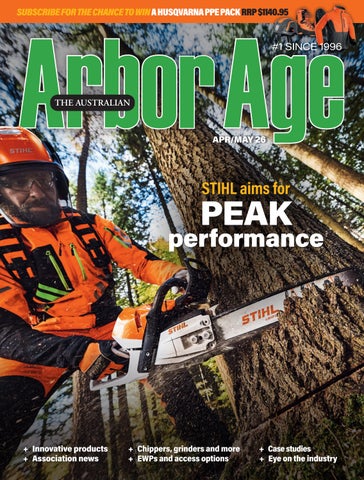
As the Australian landscape transitions into the cooler, more demanding months of the year, the professional arborist’s workload shifts from routine maintenance to highintensity removals and storm response. This isn’t just a change in the weather; it’s the season where the STIHL for Life philosophy is put to the test.
Achieving peak performance means looking past the powerhead itself and focusing on the total cutting system. A chainsaw is only as effective as the synergy between its three critical contact points: the guide bar, the saw chain, and the lubrication that allows them to function at high RPMs. When these components are matched, the result is reduced vibration, increased fuel efficiency, and a level of precision that makes even the toughest winter hardwoods feel manageable.
The Swiss-made edge
While many manufacturers outsource their cutting attachments, STIHL produces every component in its dedicated facilities in Wil and Bronschhofen, Switzerland. This control over the manufacturing process allows for a high level of metallurgical precision.
Each cutter is stamped from a proprietary steel alloy chosen for its ability to hold an edge while remaining resilient under impact. The secret to their longevity lies in the inductionhardening process. By heating the cutters to about 1000°C and quenching them in a specialised salt bath, the steel achieves a hardness that exceeds standard consumer-grade chains. Furthermore, STIHL chains are prestretched at the factory. In professional environments, initial stretch is a common nuisance that requires frequent adjustment during the first hour of use. By applying high tension during the final stage of assembly, STIHL ensures the chain maintains its structural integrity
from the moment it’s mounted on the bar. This precision reduces the risk of the chain jumping the rails – a critical safety factor.
The guide bar is a structural asset
The guide bar is often underestimated as a simple piece of metal, but in a professional setting it’s a stressed component. Whether dealing with the lateral forces of a complex felling cut or the extreme heat generated during a heavy bore cut, the bar must remain rigid.
STIHL guide bars are developed using CAD software and subjected to bend tests to ensure they can withstand real-world stresses without permanent deformation. For the professional arborist, the Ematic™ system within the bar is a gamechanger. This system reduces chain lubricant consumption by up to 50 per cent by ensuring every drop of oil is directed where it’s needed: the sliding surfaces of the rails and the chain links.
Here’s a pro-maintenance tip: the Rotational Rule. One of the simplest ways to extend the life of your equipment is to flip the guide bar every time you sharpen or change the chain. This ensures that the rails wear evenly on both sides. Over time, rails can develop burrs – tiny, sharp edges of metal – that can cause the chain to tilt in the groove. Using a flat file to remove these burrs and maintaining a clean oil inlet will ensure the bar remains winterready for years of service.
Effective lubrication
If the chain and bar are the hardware, the oil is the software that keeps the system running smoothly. Standard oils often fail when subjected to the high temperatures and friction levels of a professional engine.
A fully synthetic two-stroke engine oil, STIHL HP Ultra is designed to burn cleanly, leaving virtually no carbon
One of the simplest ways to extend the life of your equipment is to flip the guide bar every time you sharpen or change the chain. Images:
STIHL
deposits on the piston rings or in the exhaust ports. In the colder months, where engines may take longer to reach operating temperature, using a clean-burning synthetic oil prevents the ‘gumming up’ that leads to power loss and difficult starts.
For the cutting attachment itself, the Oilomatic® system represents a high
point of friction management. Each drive link features a fine groove that picks up oil from the bar’s inlet and channels it to the rivets and the sliding surfaces. This doesn’t just reduce wear; it prevents thermal expansion. When a chain gets too hot, it expands, causing it to sag and increasing the risk of derailment. By using a high-tack lubricant like STIHL
SynthPlus, you ensure the oil stays on the chain even at the high speeds required for professional work, cooling the system.
Winter resilience
Preparing for the season isn’t just about having the right gear; it’s about a disciplined maintenance routine.
STIHL produces every component of its chainsaws in its dedicated facilities in Wil and Bronschhofen, Switzerland.
As we move into the peak season for storm cleanup and firewood harvesting, workshop habits dictate field success.
• Sprocket inspection: a worn drive sprocket is the silent killer of new chains. If you notice grooves deeper than 0.5mm on the sprocket, it will cause the chain to climb and wear out prematurely. Always check your
sprocket when installing a fresh chain.
• Air filter integrity: winter air is often damp, which can cause fine debris to paste over the air filter. A clogged filter forces the engine to run rich, increasing fuel consumption and reducing the torque available for large-diameter cuts.
• Tensioning for temperature: in cold weather, remember that metal contracts. A chain that felt properly tensioned in a warm workshop may feel different after 10 minutes in the frosty morning air. Always check your tension after the first few cuts of the day.
The competitive advantage
The reason many arborists choose a complete STIHL system is the reduction in operator fatigue. When the powerhead, bar, and chain are designed as a single unit, the harmonic vibration is lower. Lower vibration means less white finger risk and a more precise feel for the wood.
By investing in the synergy of German-engineered components and high-grade Swiss manufacturing, you aren’t just buying a tool; you are investing in your own productivity and safety. This season, ensure your kit is as resilient as the trees you maintain.
Explore the full range of professional accessories and technical guides at stihl.com.au.
If the chain and bar are the hardware, the oil is the software that keeps the system running smoothly.
Proving the durability of a Bandit chipper
Tree Aesthetics has provided tree care services in the Perth Hills and surrounding regions for more than 30 years. A family-owned and operated arboriculture business, the company has tackled some of the toughest tree jobs. A Bandit 1890XP chipper has been a part of that success.
Tree Aesthetics’ 2010 Bandit 1890XP woodchipper has clocked more than 10,300 hours of service and continues to perform reliably.
Kane Jurak of Tree Aesthetics, said, “We bought the 1890XP in 2012, and it’s the only chipper we’ve had. We’ve only done the clutch just before Christmas and fitted new belts.
“It cops a beating, all day, every day. There’s been no dramas with the engine or turbo. I wouldn’t have anything else.”
Bandit chippers are known for rugged construction, heavy-duty components, and high uptime – qualities that align with the standards Tree Aesthetics demands on every job.
The fleet
This Bandit 1890XP has been instrumental in processing countless cubic metres of brush and timber, proving a well-built chipper paired with routine maintenance can deliver long-term value. While many machines begin to show wear as hours accumulate, the Bandit’s welded steel frame and feed system continue to tackle large branches
Tree Aesthetics’ 2010 Bandit 1890XP woodchipper has clocked more than 10,300 hours of service and continues to perform reliably.
and challenging material without sacrificing performance – a testament to Bandit’s engineering and build standards.
At Tree Aesthetics, the combination of skilled arborists and robust equipment – including trucks, EWPs, and the Bandit 1890XP – enables the team to handle everything from hazardous tree removal to precision pruning efficiently and safely.
Durability on offer
For tree-care professionals or contractors looking for gear that stands the test of time, the story of Tree Aesthetics’ Bandit 1890XP underscores the durability and reliability of Bandit chippers in the arboriculture field.
Tree Aesthetics services in Perth, Swan, Mundaring, Kalamunda, Belmont, Bayswater, and Bassendean, with a longstanding commitment to these areas.
If you’re in the market for durable chippers, speak to the TCM team today on 1800 681 733, or visit the website at treecaremach.com.au.
Bandit chippers are known for their rugged construction. Images: Tree Aesthetics
Chippers, grinders and clean-up options
On track for success
Piranha Chippers’ new BT310 chipper is gaining traction with Australia’s arboriculturalists.
There has been strong interest in the BT310 tracked chipper from Piranha Chippers, and for good reason. It’s built for hard work and reliability and designed from the ground up to excel in performance and serviceability. Sharing the same technical specifications as the BT300 trailer version, the BT310 has the tough, 6" x 2" RHS chassis rails – manufactured from Australian-made steel – that support the chipper structure, and it’s powered by
the same 4HK1 Isuzu turbo diesel motor as the BT300. The 197hp is sent through a hydraulically activated, self-adjusting WPT Power Corp clutch that in turn spins the 650mm diameter heavy-duty cutter drum with four knife pockets.
Safe operation
The BT310’s infeed is 15"H x 20"W and features an aggressive, twin horizontalfeed-wheel design, and the large topfeed wheel produces the pulling power
required to handle difficult material. The Auto Lift & Crush on the Posi-Arc infeed means the BT310 will climb up onto large logs and pull the toughest branches in by itself. There’s no need for an operator standing beside the machine to manually activate the crush function to feed the timber. Being mounted on a standard five-tonne excavator undercarriage ensures replacement parts are readily available should they be required, and
The BT310 features an aggressive, twinhorizontal-feed-wheel design.
the unit is operated via a radio remote control that incorporates the two-speed function that is standard on excavators. The 400mm-wide rubber tracks ensure dependable, reliable performance, even in the toughest, wettest ground conditions.
No-fuss maintenance
With easy access to the cutter drum for changing blades, and filters all mounted at the front of the engine compartment door, servicing this woodchipper is easy. Add in a fiveyear/3000-hour warranty (the engine and clutch are covered by the manufacturer’s two-year warranty) and you have peace of mind knowing that not only did you buy Australianmade and are supporting local manufacturing, but you also have a 15" chipper that will save you time and money.
For information on Piranha Chippers, including the BT310, visit piranhachippers.com.au.
PIRANHA CHIPPERS
When Performance and Serviceability Matter!
The tracked Piranha has the same tough, 6" x 2" RHS chassis rails and 4HK1 Isuzu turbo diesel motor as the BT300 trailer-mounted chipper. Images: Piranha Chippers
Chippers, grinders, and clean-up options
Anticipation
is building around the arrival of the Vermeer AX17.
Australia’s arboriculture industry is placing increasing value on equipment that delivers higher throughput, smart technology and dependable performance in diverse conditions. Vermeer’s AX17 is already gaining attention among arborists who want a machine that balances serious capacity with practical design.
Work ready
At the heart of the AX17 is a 130hp (96.9kW) Cummins 3.8-litre diesel engine designed to handle heavy material processing and the hardwoods encountered across Australia. Its 19.5” x 20.5” (49.5cm x 52.1cm) infeed throat places it in a versatile performance class, allowing operators to process large timber efficiently and consistently. Dual horizontal feed rollers provide more than 6500lb (2948kg) of pulling
The Vermeer AX17 is earning attention from arborists who want a machine that balances big capacity with practical design.
force, giving crews strong and reliable control when feeding irregular or heavily branched material. An optional winch with up to 3200lb (1451.5kg) of line pull can assist operators when loading material onto the feed table, and hydraulic stabilisers are available to improve machine stability on larger or uneven jobsites.
The AX17 incorporates SmartFeed and SmartCrush technologies to maintain consistent feeding under load and reduce the need for operator intervention during challenging material flow. These systems, combined with a wide infeed opening and a fixed, robust infeed table, support efficient mechanical feeding and steady workflow. Optional remote operation enhances site versatility by allowing operators to manage key functions from a loader or mini skid steer.
Mobility
With a configured weight under 9700lbs (4400kg), the AX17 is designed for practical transport between suburban, regional and roadside worksites without additional licence requirements in many areas. This transport friendliness, paired with user-oriented features such as a convenient cleanout door and a patented winch boom that can be raised out of the way during feeding, reflects a focus on real-world usability and jobsite efficiency. An important aspect of the AX17’s introduction is where it sits in Vermeer’s chipper lineup. With its 17-inch capacity, the AX17 naturally fills the gap between the BC1500 in the 15-inch class and the BC1800 in the 18-inch class. For operators seeking more capacity than a mid-range chipper without moving to the size, tow weight or investment of a large-frame model, the AX17 presents
a compelling middle-tier solution supported by high power and intelligent control systems.
Connecting with industry at the Arboriculture Australia Conference
As interest in the AX17 continues to build, arborists will have opportunities to learn more directly from Vermeer specialists. Vermeer Australia will take part in the Arboriculture Australia Conference 2026, held on April 12 to 14, 2026, in Hobart, Tasmania. The event offers an opportunity to meet the Vermeer Australia team and discuss Vermeer environmental equipment innovations, including the AX17.
With its blend of power, technology and engineered features, the Vermeer AX17 is positioned to become an important new option for arborists who want a high-capacity, productive and practical chipping solution suited to Australian conditions.
To find out more, contact your local Vermeer Australia team or visit the Vermeer Australia stand at the Arboriculture Australia Conference.
An optional remote operation allows operators to manage key functions from a loader or mini skid steer.
A wide infeed opening and a fixed infeed table support efficient feeding. Images: Vermeer Australia
A chipper designed for urban work
Wilkinson Tree Services offers tree removal and care solutions tailored for individual properties. A Först ST8D chipper has been a welcome addition to the fleet.
Wilkinson Tree Services owner and Director Daniel Wilkinson began his arboricultural journey in 2003 in Sheffield, England, working for a company caring for English country estates. He also worked in Sweden servicing clients which included the Swedish royal family.
Today, based in Sydney’s Eastern Suburbs, Daniel and his team operate in and around the metro area.
When it was time to add a second chipper to the Wilkinson fleet, Dan started with the tried-and-true method of research: word of mouth. This led to the company’s purchase of a Först ST8D wood chipper.
Good thing in a small package
“Först was recommended by a friend of ours who’s on his own business journey,” said Dan. “We were looking for a second chipper. Our main chipper is a large machine, and we wanted something versatile and manoeuvrable to help negotiate the challenges of working in the city and Eastern Suburbs.
“We’d also heard a disc chipper was better for processing the palm and strelitzia material that makes up part of our work.”
Dan and his crew of six have found several advantages with the ST8D, aside from its small footprint and light weight.
“The power-to-weight ratio on the
Först is good,” said Dan, “and it’s good at processing fibrous and wet waste. Where the drum chipper would be getting blocked, we can process that difficult material with the smaller machine.
“I think the ST8D weighs just over a tonne,” he said, “so it can be pushed about by hand, and we can back it down a domestic driveway using the four-wheel-drive. The Först tows easily behind a standard car-licence vehicle.”
High performance
A compact eight-inch wood chipper designed for professionals in urban and rural environments, the Först ST8D offers strong torque and good fuel
efficiency, and features that include:
• A 45HP Kubota turbo diesel engine;
• a 200 x 255 mm (8" x 10") feed roller aperture;
• an open-top flywheel with twin 10" blades;
• the FörstGrip feed roller system;
• AutoIntelligence No Stress Device with water and vibration-proof touch pads;
• a braked chassis with handbrake;
• a weight of approximately 1250kg; and
• a three-year Monitor warranty.
Monitor
Purchasing a Först meant dealing with Monitor, and Dan praised the service. Monitor has been supplying arbor
equipment across Australia for more than 28 years, working with arborists, contractors and hire companies nationwide. The company has built a reputation for providing reliable machinery backed by knowledgeable support and industry expertise.
Först chippers, supplied by Monitor, come with a three-year warranty, giving business owners added confidence when investing in equipment. Every machine is prepared to Australian Standards with support from Monitor’s in-house engineering team, ensuring it’s compliant and ready to work. Arborists interested in the range can also book a
demonstration with their local Monitor branch to see the Först chipper in action.
“Monitor’s team was good,” said Dan. “We had a great relationship with Stuart Samson in sales, and I’d rented from Monitor previously and had always had a good experience.
“It’s excellent to have such a compact machine when street parking is tight and for its and general manoeuvrability. It’s also a great machine for the work we do – palm pruning, strelitzia, and on fine pruning jobs.”
To find out more about the Först range of chippers, visit monitor.net.au.
The Först ST8D is a compact eight-inch wood chipper designed for professionals in urban and rural environments. Images: Monitor Industries
Dan Wilkinson (right) had rented from Monitor previously and praised the service.
Land clearing linked to myrtle rust in native forests
New research has revealed past land clearing is increasing the vulnerability of native Australian forests to the invasive myrtle rust disease, with regrowth forests emerging as hotspots for impact.
In a study published in the journal Ecological Solutions and Evidence: Historical land use couples with host density to affect myrtle rust impacts in a wet sclerophyll forest community in Eastern Australia, researchers surveyed 21 patches of eucalypt rainforest (wet sclerophyll forest) across Queensland and northern New South Wales. The site species included small, bushy, native rainforest Myrtaceae (the myrtle family), which are susceptible to myrtle rust.
Among the national park, council, and privately owned land examined were areas that had been subject to different levels of historical land clearing.
Led by Dr Kristy Stevenson and Professor Jennifer Firn at Queensland University of Technology (QUT), the National Environmental Science Program Resilient Landscapes Hub study found this type of forest with a history of heavier land clearing was more
“Regrowth forests tend to have higher densities of species that are susceptible to myrtle rust, particularly a small tree called rose myrtle (Archirhodomyrtus beckleri ),” Dr Stevenson explained. “Native rose myrtle can rapidly recover and dominate an area after land clearing. However, its abundance is also associated with more severe myrtle rust damage at those sites.
“Our results show historical landuse leaves a biological legacy that can shape disease risk decades later. It’s not just where the pathogen can go – it’s where the most vulnerable hosts are concentrated.”
Implications
Professor Firn added that the findings had important implications for forest management and conservation planning.
“Regrowth forests may need closer monitoring for both myrtle rust damage
areas could act as important refuges for healthier individuals of threatened species, with value for long-term conservation and potential plant breeding,” Professor Firn said.
“Mapping clearing history alongside forest age could help managers target surveillance and management where disease risk is highest.”
Rapid spread
Myrtle rust is caused by the destructive fungal pathogen Austropuccinia psidii. Native to South America, it was first detected in Australia in 2010 and has since spread rapidly. It’s a winddispersed disease that threatens a range of native eucalypts, tea trees and bottle brushes. As its spores travel easily across landscapes, understanding where susceptible plants occur is critical to slowing its spread and damage.
Read the full paper online at besjournals.
Dr Kristy Stevenson in the field. Image: Queensland University of Technology
Trees don’t wait for ideal conditions
When access is tight, power is out, or conditions are rough, a high-quality hand saw becomes the most reliable tool in the kit.
Arborists are dealing with weather that’s becoming more unpredictable every year, with strong winds, sudden downpours, fallen limbs, blocked access and emergency callouts all on the rise. It’s in those emergencies Silky Saws prove their worth, not because they’re trendy or look flashy, but because they work every time.
No fuel, no batteries, no delays
One of the advantages of a Silky is its simplicity: it doesn’t depend on anything except you. There’s no petrol to run out of, no batteries to die, and no pull cords to fight when you’re already under pressure. Silky blades are built to bite fast, cut clean and keep performing long after cheaper saws have dulled or twisted. That’s why so many emergency crews and arborists keep one close by.
Serious reach when it matters
When storms leave dangerous hangups or broken limbs overhead, reach becomes everything. Silky pole-saw systems extend to more than 7.7 metres, allowing hazards to be dealt with safely without climbing or relying on machinery that can’t always access the site.
Lightweight, balanced, and razor sharp
Silky Saws are ideal for:
• Storm clean-ups;
• emergency limb removal;
• high-canopy pruning; and
• clearing access after fallen branches. When speed and safety matter, having serious reach without serious weight makes all the difference.
Small saws that punch above their size
At the other end of the scale, Silky hand saws are available with blades as short as 13cm, perfect for tight spaces, quick trims, climbing kits, and everyday pruning.
Don’t let the size fool you. Their impulse-hardened teeth and precision Japanese steel cut fast and smooth. Many arborists are stunned the first time they use one, finding them well-suited to in-tree work, quick storm clean-ups, tight crotches and dense growth, and everyday pruning without hauling big gear.
Once you use one, it’s hard to go back.
Built for years, not just a season
Silky tools aren’t disposable. They’re engineered with Japanese steel and feature aggressive, precision tooth geometry, strong but lightweight handles, and many models have replaceable blades.
That means not buying a saw every year. The investment is in a tool that stays sharp, stays straight, and stays reliable through seasons of hard work.
Plenty of arborists are still using Silky saws bought many years ago and they’re still cutting like beasts.
A saw for every job –no compromises
From ultra-compact hand saws to longreach pole systems, Silky covers nearly every cutting situation, including:
• Emergency response;
• professional arbor work;
• storm damage;
• pruning and maintenance; and
• tight access or high reach.
Silky offers range without sacrificing quality.
Ready for the next emergency
When the weather turns bad, you don’t want to be wondering if your gear will hold up.
Silky Saws were built for those moments.
Whether it’s clearing dangerous limbs overhead or slicing through storm debris in tight spaces, there’s a Silky for nearly every need.
Once you’ve used one in real conditions, you’ll understand why so many arborists won’t work without one.
To see the Silky range, visit atcproducts.com.au.
Silky covers nearly every cutting situation.
A Silky depends only on you. There’s no petrol, batteries, or pull cords. Images: ATC Products
300-hectare woodland to be planted by Forestry England
A rejuvenated forestry area is expected to restore nature, help tackle the climate crisis, and give local communities access to green space in England’s West Midlands.
Bagots Park Wood is being designed to join up with existing woodland.
Images: Forestry England
orestry England is creating a
mature woodlands side by side.
Paddy Harrop, Central Director, Forestry England, said, “Creating a woodland on this scale is a rare and exciting moment for us. It’s not since before 2005 that we’ve had an opportunity on this scale, and this project represents a major investment in the future of Staffordshire’s natural landscapes.
“Every place we plant with trees is unique. We’re looking carefully at the soil, habitats, historic features of the landscape, and other important factors before we design this special woodland. We’ll share our draft designs with local
people and other stakeholders in due course and hear their views. Local people can look forward to spending time in the new woodland that will be a lasting natural asset for generations.
The process
Forestry England is now beginning its detailed planning and will work closely with local communities and organisations as proposals are considered. Draft designs will be shared later this year as part of a public consultation to help residents shape how this important new woodland grows.
Since 2021, Forestry England has planted more than two million trees across 17 new woodlands covering more than 1140 hectares.
The project is funded through the government’s Nature for Climate Fund and forms part of Forestry England’s wider program to create new, climateresilient woodlands. Since 2021 more than two million trees have been planted across 17 new woodlands covering more than 1140 hectares. Each woodland is designed to withstand the threats from climate change, pests and diseases, and biodiversity collapse to ensure they flourish in the future.
You can find out more at forestryengland.uk.
A new take on roadside maintenance
Diamond Mowers’ latest release – the DM360 and DM360X municipal maintenance machines – signals a shift in how roadside mowing and vegetation control can be approached, particularly for councils and contractors working across multiple seasons and applications.
F or Australian vegetationmanagement contractors, roadside maintenance has always been a balancing act. Crews are expected to work fast and safely, minimise traffic disruption, manage dense vegetation in challenging conditions, and do it all with tighter budgets and fewer machines.
At first glance the DM360 looks familiar, resembling a wheeled excavator fitted with a boom mower, but its design philosophy is different. Diamond Mowers has moved beyond attachments and integrated the carrier, hydraulics, boom, controls and safety features to work together as a single platform.
While the base carrier is sourced from an established third-party manufacturer, Diamond designed the boom system, operator interface, hydraulic integration, attachment compatibility, and overall machine
configuration. The result is a machine optimised for roadside and municipal maintenance rather than adapted from general construction duties.
Available in both DM360 and DM360X configurations, the platform is offered with either a 25-foot or 30-foot boom, providing reach for batters, drains, waterways and roadside vegetation that would otherwise require multiple passes, additional machinery, or staff using line trimmers.
360-degree visibility
One feature of the DM360 is its rotating cab. Combined with a boom-mounted attachment, operators gain 360-degree visibility and control, allowing them to stay aligned with traffic flow while maintaining clear sightlines to the cutting head.
For Australian contractors working on
live roads this has safety implications. The ability to mow on the left-hand side while maintaining traffic alignment reduces exposure, improves situational awareness and allows work to continue without constant repositioning.
Panoramic roof glass and vertical sightlines eliminate common overhead blind spots, particularly when working under bridges or over guardrails.
With up to a metre of cable-rail clearance, the DM360 can comfortably reach over standard guardrails into drains and waterways – a frequent challenge on Australian road networks.
Intuitive operation and reduced fatigue
Excavator-style joystick controls provide intuitive operation for operators already familiar with earthmoving equipment. Features such as joystick steering,
At first glance, the DM360 resembles a wheeled excavator fitted with a boom mower, but its design philosophy is different. Images: Colbrook Industries
all-wheel steer and smooth hydraulic integration reduce fatigue during long roadside runs and repetitive tasks.
For contractors juggling skilledlabour shortages, the learning curve is an important consideration. Machines that feel familiar from day one can translate into faster onboarding, fewer mistakes and more consistent productivity across crews.
Built with safety front of mind
Roadside mowing is high risk, and Diamond has prioritised safety in the DM360’s design.
Engine placement within the lower chassis lowers the centre of gravity, while a standard axle stabiliser improves balance and control, creating a stable platform even the with boom at full reach, and a Level II FOPS roof guard provides protection from falling debris, essential for mulching and heavy vegetation work.
The machine’s 2.5m travel width and streamlined profile help reduce shoulder clearance and meet transport and road authority requirements, creating safer work zones for both operators and passing motorists.
One machine, multiple seasons
Where the DM360 stands apart is in its adaptability throughout the year.
The DM360X variant adds a universal skid-steer plate and dedicated lower hydraulics, opening the door to additional attachments beyond boom mowing. Tasks such as street sweeping, mulching, stump grinding and other seasonal maintenance can be handled by the same carrier.
Compatible Diamond attachments include boom rotary and flail mowers, drum mulchers, disc mulchers, saw heads and ditchers, along with skidsteer-mounted mulchers and grinders on the DM360X. This flexibility allows contractors and councils to maximise machine utilisation, rather than parking expensive assets for part of the year.
While snow removal may not be a major consideration for most Australian operators, the broader principle holds true: the versatility of the DM360, including snow removal, means fewer machines doing more work across departments and contracts.
Supported by Colbrook Industries
ground matters. Colbrook Industries offers efficient, local access to parts, service and technical support, helping keep machines working and downtime to a minimum.
From a fleet-management perspective, Colbrook’s approach of offering full machine, on-theground, or over-the-phone support simplifies ownership. Warranty, parts, driveline and service are all backed through a single channel, reducing downtime and administrative complexity.
This local backing is valuable for contractors operating under council tenders or long-term maintenance contracts, where reliability and response times affect productivity and profitability.
A shift in how roadside work is done
The DM360 reflects a shift toward dedicated, purpose-built maintenance platforms that prioritise operator safety, efficiency and versatility.
As roadside vegetation grows thicker, compliance requirements increase, and labour pressures continue, machines that can do more with fewer people – while keeping crews safe – are likely to play a bigger role in the Australian market.
For arborists and councils alike, the DM360 offers a glimpse at what the next generation of roadside maintenance equipment could look like: integrated, adaptable and
The machine signals a shift in roadside vegetation control.
Operators gain 360-degree visibility and control.
SUBSCRIPTIONS
A silent war on Sydney’s trees
AQF
Level 5 Consulting Arborist Julian Parry and TCAA President Jim McArdle report on suspected poisoning and vandalism threatening the NSW capital’s urban forest.
Atree dies quietly. The leaves don’t fall first. Instead, they dry out and hang on, brown and brittle, clinging to branches that were green only weeks earlier. Sometimes there are small drill holes in the trunk. Sometimes the bark has been cut away in a thin ring around the stem. Occasionally there’s a faint chemical smell in the soil near the base of the tree. By the time an arborist is called, it’s often too late.
Across Sydney’s suburbs, mature canopy trees that have stood for decades, sometimes more than a century, are dying under circumstances arborists suspect are not natural. According to those working closest to the problem, the scale of the problem may be greater than most people realise.
Suspected cases every week
Julian Parry, a consulting arborist and director of Arbor Pride Tree Services, spends much of his working week
inspecting trees across Sydney. He estimates he assesses around 50 properties each week, ranging from residential blocks to redevelopment sites and council inspections.
It’s a level of exposure that provides a window into the health of Sydney’s urban forest, and Parry’s comments on what he is seeing are alarming.
“In my consulting work across Sydney, I now encounter between five and 10 suspected tree-poisoning cases every week,” he said.
Over the course of a year, that could equate to hundreds of suspected incidents.
TCAA arborists want to assist the government in reducing tree loss through illegal means, and while many arborists privately acknowledge the trend, few cases ever lead to prosecutions.
The reason is simple: proving who poisoned a tree is difficult.
The pattern arborists recognise
After inspecting thousands of sites, arborists say the pattern is often familiar.
It starts with a property changing ownership. Development plans are proposed, and soon afterwards, a large tree suddenly begins to decline. The symptoms can appear quickly. Rows of drill holes may appear in the trunk or herbicides may be injected into the tree’s vascular system. In other cases, bark is stripped away around the trunk – a method known as girdling or ringbarking.
Large trees can complicate development, while removing them can increase a site’s potential. Image: Doubledee/stock.adobe.com
The effect is the same: the tree slowly starves, and within months may become structurally unsafe. Once it’s declared hazardous, it can often be legally removed.
“By the time an arborist is asked to inspect the tree, the damage is usually irreversible,” Parry said.
The economics
Large trees can complicate development. Their root systems can limit excavation, their canopies may restrict building envelopes, and protected trees often require costly
design changes or engineering solutions. Removing them can dramatically increase a site’s development potential.
In Sydney’s property market, that difference can be worth hundreds of thousands – or even millions – of dollars.
Penalties for illegal tree removal, however, are often lower. The biodiversity act states a fine of $200,000 and two years gaol, while the local council will issue fines starting at $3000. In serious cases prosecuted under environmental
legislation, penalties can be greater, but prosecutions remain rare.
When the potential financial gain vastly outweighs the likely penalty, arborists say the deterrent effect disappears.
“If the value of removing a tree is measured in millions of dollars and the penalty is only a few thousand, the risk becomes a business calculation,” said TCAA President Jim McArdle.
Signs of deliberate poisoning
Arborists trained to assess tree health often recognise indications of deliberate
interference. Common indicators include:
• Drill holes of uniform depth in the trunk;
• holes spaced around the circumference of the tree;
• damage to buttress roots or exposed primary roots;
• chemical staining around injection points;
• rapid dehydration of foliage while leaves remain attached; and
• vertical cracking in vascular tissue exposing internal wood.
Substances suspected in poisoning incidents can include herbicides, petroleum products, salt compounds and other contaminants introduced into the tree’s vascular system.
But arborists must also rule out natural causes such as root failure, lightning strikes, soil movement or prolonged water stress before reaching conclusions.
A living remnant forest
Many of the large trees affected are found across Sydney’s North Shore –suburbs such as Wahroonga, Pymble and Turramurra.
These areas once supported extensive forest ecosystems, including Blue Gum High Forest and Sydney Turpentine–Ironbark Forest, both now listed as endangered ecological communities.
Many mature trees standing in suburban streets and backyards are surviving remnants of those original forests, and when one of those trees is lost, arborists say it represents more than the removal of a landscape feature. It’s the disappearance of a living remnant of Sydney’s ecological history.
Other forms of tree vandalism
Tree poisoning is not the only threat. Across bushland reserves, parks and campsites, arborists also see widespread physical damage to trees. Carving, cutting and chainsaw scarring are common forms of vandalism. The cambium layer beneath the bark –responsible for transporting nutrients through the tree – is relatively soft and vulnerable. Damage to this layer can interrupt the tree’s vascular system and eventually kill it.
Some trees carry historic scars left by Aboriginal cultural practices or early surveyors marking routes through bushland, but modern vandalism bears little resemblance to these cultural artefacts and often results in long-term damage.
When the potential financial gain vastly outweighs the likely penalty, arborists say the deterrent effect disappears. “ ”
The launch of Arboristry in Australia will be part of a TCAA event at Hornsby RSL on May 1. Image: TCAA
Rows
drill holes in the trunk
The ecological value of deadwood
Another lesser-known environmental issue is the removal of deadwood from bushland areas for firewood.
While fallen timber may appear lifeless, it plays a crucial ecological role, providing:
• Habitat for insects and fungi;
• shelter for reptiles and small mammals;
• nesting and roosting sites for birds; and
• nutrient recycling within forest ecosystems.
Removing these natural structures can disrupt entire microhabitats. In some jurisdictions, collecting wood from protected areas can attract large penalties.
Why most cases go unreported
Despite the frequency with which arborists say they encounter suspicious tree deaths, most incidents are never formally investigated. Establishing proof requires chemical testing, forensic investigation and evidence linking the act to a specific individual. Without witnesses, cases can be difficult to pursue. The NSW Environment Protection Authority (EPA) regulates pesticide use and can investigate reports of chemical misuse or environmental damage, and this may involve site inspections, laboratory testing, interviews with nearby residents, and letter drops to surrounding properties.
Arborists say many incidents are never reported in the first place.
A problem hiding in plain sight
According to AQF Level 5 Consulting Arborist Julian Parry and McArdle, the most concerning trend may be the public’s
growing acceptance of the issue. Where neighbours once reacted with outrage when mature trees died suddenly, arborists now report a more resigned response.
“People are starting to treat it as normal,” said McArdle. “That’s the most worrying part. If deliberate tree destruction becomes routine, the pressure that once discouraged it
Sydney’s urban forest provides more than visual appeal. Large canopy trees reduce urban heat, provide wildlife habitat, absorb stormwater and improve air quality. They also shape the character of neighbourhoods.
Arborists argue that protecting these trees requires stronger enforcement, better reporting of suspected poisoning, and penalties that reflect the true environmental value of mature canopy trees. Trees are worthy of CCTV security to reduce these incidents and EPA regulators are able to assist, because once a tree that took a century to grow is
The loss is measured not in years but in generations.
The TCAA has an AQF 3 and AQF 5 event at Hornsby RSL on May 1 from 9.00am to 3.00pm. The risk assessment methodology of VTRA and AANZAA valuation will be introduced ArboristryinAustraliaand licensing will be included. Members can attend for free, and non-members for $300. Contact Admin@tcaa.com.au or info@mcardlearborist.com.au for more info. There are 40 places available.
Fit-for-purpose equipment can improve both productivity and safety on site. Images: Vermeer Equipment of WA & NT
Looking after roots
While canopy health is often the most visible indicator of a tree’s condition, Pia Finnigan of The Arboricultural Association of Western Australia – Arbwest – highlights how the real story begins underground.
From the scorching heat of Perth summers to wet winter storms, trees are essential assets in the Western Australian urban and regional landscapes. They provide shade, reduce heat, support biodiversity and enhance liveability – but their long-term health depends on what lies below ground.
Roots matter
Root damage can cause trees to decline and fail. In areas near construction work, roots are commonly impacted by trenching, excavation and paving.
When roots are severed, crushed or compacted, the consequences can include:
• Reduced nutrient and water uptake;
• canopy thinning and branches dying;
• increased susceptibility to drought; and
• structural instability.
In sandy WA soils, root anchorage is important. Mature eucalyptus trees and other large species rely on root systems for stability. Root damage can compromise both the tree’s biological health and its structural integrity.
Often, symptoms are subtle to begin with – minor canopy decline, leaf discolouration or reduced vigour – before progressing to more serious issues such as soil heave at the base or fungal bodies indicating decay.
Safer excavation
Where excavation near trees is unavoidable, traditional mechanical digging methods can pose risks.
Vermeer Equipment of WA & NT Sales Manager Sam Hayes explained: “Vacuum excavation operates through two key
components that work together to provide a safe, non-destructive digging method. Part one is the water system, where water pressure can be adjusted to suit the application. The controlled water stream is used to break up and loosen the soil. Part two is the highvelocity vacuum system, which extracts the loosened material and deposits it into a sealed spoil tank for easy removal.
“For arborists, this method is particularly valuable when excavation is required around or beneath tree roots. Because the process relies on water and suction rather than mechanical digging, it reduces the risk of damaging the root system or compromising the health and stability of the tree. Vacuum excavation provides a precise, low-impact solution that helps protect mature trees during critical underground work.
“In WA’s increasingly dense urban environments, where retaining established canopy is a priority, this nondestructive approach is becoming an important tool for arborists, contractors and local governments alike.”
The right equipment
Looking after roots is only part of the picture. Safe and efficient above-ground management is equally important, particularly when transitioning from bushfire season into winter storm preparation.
Sam highlighted that having fit-forpurpose equipment can improve both productivity and safety on site.
“A wood chipper is an essential asset for arborists, and Vermeer Equipment of WA and NT is proud to support the industry with a broad range of machines
tailored to real-world needs,” he said. “We recognise that one size does not fit all – whether a client requires hydraulic features such as landing legs, chutes, deflectors and a remote control, or prefers the simplicity of manual configurations, we can supply a machine that matches their needs and workflow. With advanced safety and productivity features – including smart feed, winch interlock systems and vertical feed rollers – feeding material into the chipper has never been easier or safer.”
In WA conditions where large removals of storm-damaged trees and high-volume green waste are common, efficient processing equipment reduces manual handling and the risk of injury.
Understanding the critical root zone
When assessing potential root damage, arborists consider the critical root zone – the area around the trunk where the most important structural and absorbing roots are located. If roots within this zone are severed or decayed, the risk of tree damage increases. A tree may remain biologically alive – still producing leaves and appearing healthy – yet be structurally compromised below ground.
As a general guide, trees can sometimes tolerate up to 40 per cent root loss before severe decline occurs. However, structural stability may be compromised before visible canopy symptoms appear.
This is particularly relevant in WA, where:
• Sandy soils offer less resistance to root movement;
• prolonged summer drought stresses
trees already coping with reduced root mass; and
• winter storms can expose weaknesses created months or years earlier.
What to do?
Root problems are often subtle and easily overlooked by the untrained eye. Warning signs may include:
• A thinning canopy, particularly at the top;
• the tree leaning or soil lifting at the base;
• dead or broken surface roots; and
• fungal growth around the trunk.
If you suspect root damage, engage a qualified arborist. Professional assessment may include root investigation, soil testing, structural analysis and risk evaluation.
As Sam Hayes explained, the goal is not simply to remove trees at the first sign of trouble, but to manage and protect them wherever possible.
“Protecting root systems during excavation is one of the most effective ways to preserve mature trees,” Sam said. “Once significant root damage has occurred, options become limited. Using the right method from the start makes all the difference.”
Protecting WA’s urban forest
In WA, retaining mature canopy is important for trees to survive. Whether it’s through non-destructive excavation methods, careful construction planning, or using fit-for-purpose equipment, proactive management below ground supports safer, longer-lived trees above ground.
When the roots are right, everything else has a stronger foundation.
To find a qualified arborist in WA, visit arbwest.com.au/statewide.
Vermeer Equipment of WA & NT Sales Manager Sam Hayes.
Vacuum excavation with units like Vermeer’s VX30250 provides a safe, non-destructive digging method.
Tree pruning with a purpose
Pia
Finnigan of the Arboricultural Association of Western Australia – Arbwest – explains some of the science of reducing tree canopies and foliage.
As the heat of summer fades and autumn arrives, residents often start to notice their trees. Attention turns to which trees look healthy and which appear messy, stressed or inconvenient. The instinct is often immediate: prune it, tidy it, fix it.
But according to professional arborists, that instinct can be a problem. Pruning isn’t cosmetic maintenance. It’s a long-term biological decision, one that can either protect a tree for decades or begin its decline. Poorly
planned pruning removes live tissue a tree needs to photosynthesise, regulate temperature and manage water stress, especially in Western Australia’s sandy soils and intense summer heat. What may look like improvement can compromise the tree’s health.
The modern arboricultural approach is simple: every cut must have a purpose.
Sustainability
In arboriculture, sustainability is often misunderstood as planting more trees.
In reality, it starts with keeping the ones we already have.
Sustainability means not passing today’s losses onto future generations. Tree retention ensures future communities inherit healthy urban forests. Mature trees provide immediate environmental, social and economic benefits, including shade, cooling and wildlife habitat – benefits newly planted trees may take decades to replace.
For arborists, sustainability influences daily decisions: whether to prune, how
The instinct is often immediate: prune it, tidy it, fix it.
Images: Arbwest
much to remove, how to manage risk, and whether removal is truly necessary.
Not all pruning is good
Experienced arborists don’t start with a chainsaw. They start by asking: ‘Why are we pruning this tree?’
Pruning objectives include:
• Reducing risk;
• improving structure
• guiding future growth; and
• providing clearance from buildings and roads.
Without a defined objective, pruning often removes excessive live crown and places a tree under unnecessary stress. Trees depend on their canopy. Remove too much and the tree loses its ability to regulate temperature and water movement – critical functions in the WA climate.
The sustainability shift on the job site
For tree climber and arborist Michael Byrne of CPD Tree Services, sustainability isn’t a policy document, it’s a daily decision-making process.
“We avoid unnecessary pruning and look for alternatives to removal,” he said. Inspection comes before any dismantling.
“We inspect potential sites for fauna, usually by climbing or drone. If a section can’t be inspected thoroughly, we lower it to the ground by rope to minimise injury to animals that might be inside,”
Tree hollows, often viewed as defects, are wildlife homes.
“We try to leave as many hollows as possible after careful assessment,” Michael explained.
Even when a tree must be removed, the work doesn’t necessarily end with a stump and a chipper.
“Timber can be milled into valueadded timber products. Firewood can be retained or delivered to suitable locations, and mulch can be reused or sold,” said Michael. “Sometimes logs can be left as habitat if the client is agreeable, however this isn’t always in keeping with the land-use or fireprevention strategy.”
Western Australian arborists must also consider quarantine restrictions when moving timber due to polyphagous shot-hole borer (PSHB). In other words, sustainability in arboriculture is sometimes less about not cutting and more about what happens after the cut.
Every cut has consequences
One of the most common causes of premature decline in urban trees is overpruning.
Damaging practices include:
• Topping;
• excessive thinning; and
• stripping inner canopy growth. These practices often weaken trees, increase failure risk and shorten the lifespan of a tree. Modern arborists instead use recognised methods like deadwood
The modern arboricultural approach is simple: every cut must have a purpose “ ”
Proper pruning is applied plant science. Decisions depend on species, health, growth stage, root disturbance, and pest pressures. Some Western Australian natives, particularly mature specimens, don’t tolerate heavy pruning, so summer is often used for assessment rather than action – observing how a tree handles heat stress helps determine what work, if any, should occur later.
Trees as infrastructure
Arborists are more often describing trees not as landscaping, but as infrastructure.
Large, established trees cool suburbs, improve liveability and support biodiversity. Removing them cannot be offset quickly by planting replacements; young trees can’t provide the same environmental services for many years.
Pruning with purpose protects both public safety and canopy longevity. It removes dead or weak branches, improves structure and airflow, and encourages healthy growth while preserving canopy function. Improved airflow also helps reduce pest and disease.
A changing profession
Arboriculture has evolved from reactive tree cutting to preventative management. The goal is no longer simply removing hazards, but managing trees so hazards don’t develop.
Sometimes sustainability means:
• Leaving habitat;
• reusing timber;
• delaying work; and
• doing less work, or choosing not to prune at all.
In a challenging climate, every cut influences the future urban forest.
Pruning with intent – guided by science, safety and ecological awareness – ensures Western Australia’s canopy survives not just the next summer, but the next generation.
Proper pruning is applied plant science.
Unlocking key issues with probation periods
The TTIA’s CEO, Brian Beecroft, outlines some of the legalities involved in using probation periods when employing staff.
The purpose of a probation period is to allow a reasonable opportunity for a business to induct and train an employee in a position, and assess the employee’s aptitude and competency, to determine whether they are suitable for the organisation and the position. It is, in a real sense, a practical extension of the selection process.
If the probationary employee proves to be unsuitable for the job, the employer may want to terminate employment with a week’s notice, or equivalent pay in lieu, without having to exhaust the time and resources associated with a formal counselling or warning process.
The length of a probationary period
It’s important for employers to be aware that if a probationary period extends beyond six months (or 12 months for a small business employer), the employer risks a likely unfair dismissal claim for ending employment without providing reasons for termination and/or opportunities to improve performance. This is because the Fair Work Act’s minimum qualifying period will override any probationary term in an employment contract when determining whether an employee is protected from unfair dismissal.
In order for a probation period to be an effective safeguard for employers, it is crucial that:
• The amount of time allocated to probation in an employment contract (including extensions to probation) does not exceed the qualifying period for unfair dismissal – which is six months (or 12 months for a small business employer);
• the employer reviews the suitability of the probationary employee for ongoing employment prior to the end of the qualifying period; and
• if the employee is unsuitable, a decision to terminate probationary employment is confirmed prior to the end of the qualifying period.
Legal protections relevant to probationary employees
It is unlawful to dismiss a probationary employee (or any employee) for reasons that are in breach of their general protections, in breach of discrimination laws, or are specified as unlawful reasons in employment legislation. This is distinct from the unfair dismissal provisions.
Dismissal of a probationary employee
If the person’s employment has not reached the minimum qualifying period for unfair dismissal (six months or 12 months), the employer is not required to use formal processes such as disciplinary meetings, performance improvement plans, or formal warnings when ending the probationary employment. The probationary employee may, however, be entitled to consultation in the event of redundancy or major workplace change. Contact TTIA in these circumstances for more assistance.
Remember that probationary employees (other than casuals and fixed-term employees) are also entitled to written notice of termination in accordance with the National Employment Standards (NES).
Does an employer need to provide reasons to dismiss a probationary employee?
If the employee does not qualify for unfair dismissal, they are not entitled to written reasons for dismissal.
However, a written notice should be given reminding the employee they are on probation, which is an extension of the selection process, and that the business has decided to discontinue their employment based on the terms of that probation period.
For clarification on any employmentrelated issues, contact TTIA by email at ttia@ttia.asn.au, or speak to a member of the TTIA team on (02) 9264 0011. For more information on TTIA, visit ttia.asn.au.
Brian Beecroft, TTIA CEO. Image: TTIA
A big year still to come
2026 is underway and the Queensland Arboricultural Association (QAA) calendar continues to offer opportunities to connect, collaborate and grow.
QAA Meet & Mingle events are open to industry sponsors, employers, employees, contractors, students and the ‘arb curious’. Whether you are well established in the industry or exploring arboriculture as a career pathway, these
gatherings provide an opportunity to expand your professional network, exchange technical knowledge and engage with peers.
The QAA January Meet & Mingle at Fitzys Loganholme wedding and
function centre was a small and intimate affair, providing an ideal setting for genuine conversations and industry engagement. With a relaxed atmosphere and strong cross-sector attendance, the evening reinforced why these events
Brisbane Lord Mayor’s Apprentice and Mentor of the Year. From left: Noah Wagstaff (Responsive Customer Service Award), Sascha Seifritz (Main Trainer, RelyOn Australia), and Justyce Hoani-Seifritz (Third Year Apprentice of the Year).
continue to gain momentum – they cultivate professional relationships and strengthen collaboration across Queensland’s arboricultural community.
Following the success of the November Meet & Mingle at The Sporting Globe at Westfield Chermside, QAA’s Meet & Mingle was there again on March 13. QAA offers a big ‘thank you’ to James and Xavier from Aviso, industry insurer and QAA Industry Sponsor, for their attendance and support.
Presidential visits
QAA President Jan Paterson recently visited two AQF Level 3 ReplyOn cohorts at Loganholme and Yandina, along with the Diploma class at Loganholme and two online Diploma cohorts. During these sessions, Paterson promoted the work of the QAA, highlighting the importance of professional networking, mentoring, and collective industry leadership to ensure sustainable growth across the sector.
The Australian Institute of Arboriculture began its first intake for the year in March, and Paterson is scheduled to visit classes to introduce the new cohort to QAA and outline the benefits of early engagement within the professional community.
If you would like Paterson to visit your workplace or present at a toolbox meeting, please contact the QAA office and submit a request (subject to availability and location).
Upcoming events
The Amateur Tree Climbing Competition will be held on Saturday, May 16, 2026, at Teralba Park in Everton Park, in Brisbane’s north. Sponsors, competitors, supporters and volunteers are welcome and encouraged to participate. The event provides an opportunity to observe experienced climbers in action, with mentoring throughout the day to help emerging climbers further develop their technical skills and confidence. Also coming up with the Australian Institute of Arboriculture are:
• April 23 - AQF Level 3 cohort at the Gold Coast training facility; and
• May 5 - AQF Level 3 cohort at the Banyo training facility.
Membership benefits
Membership of QAA delivers tangible professional benefits, including structured networking opportunities, climbing competitions, ongoing
the arboricultural profession. We look forward to seeing you at upcoming events.
Meet & Mingle events cultivate professional relationships and strengthen collaboration across Queensland’s arboricultural community.
The QAA March Meet & Mingle at Chermside was a well-attended gathering. Images: QAA
The Series 3 MIS Review
In 2026, Arboriculture Australia will begin the review of the MIS Series 3 titles and is inviting arborists from across the industry to contribute their knowledge and experience.
A cross Australia and New Zealand, arborists share a common goal: caring for trees safely, professionally, and responsibly. One of the key tools supporting this goal is the Minimum Industry Standards (MIS) series. These books provide practical guidance for arborists across a range of tree-care activities and have become a primary reference point for the arbor industry.
Arboriculture Australia’s review of the MIS series is an opportunity for the people who actually use the books to help shape the next editions.
Why review?
Arboriculture is constantly evolving; new research emerges, equipment changes, standards and regulations change, work practices improve, and our understanding of tree biology continues to grow. To keep the standards relevant, each MIS title should be reviewed about every five years. This ensures the guidance reflects current best practice and remains useful to the people who rely on it every day.
Series 3 has taken several years to publish, so this upcoming review will
bring all titles together and prepare them for the release of updated editions.
Your input matters
The MIS series has always been built by the industry, for the industry.
The arborists using these books every day – climbers, ground crew, EWP workers, trainers, and municipal arborists – are the people best placed to identify what works well, what needs clarification, and where new knowledge should be included.
Your input might include:
• Suggesting clearer wording;
• identifying areas where guidance could be expanded;
• highlighting changes in equipment or techniques;
• alignment with regulatory requirements and Australian standards;
• sharing insights from practical experience; and
• ensuring the guidance reflects current industry practice.
Even small suggestions can make a big difference. The goal of the review is not simply to update the books. It’s to ensure their continued relevance and reflection of best practice.
A brief history of the MIS
The MIS were developed by Arboriculture Australia and New Zealand Arboriculture Association to provide the arboriculture industry with clear, practical guidance on what good practice looks like.
Unlike some standards that are highly technical or difficult to apply in the real world, the MIS books were designed to be accessible and practical.
There are two sets of MIS: the Series 3, developed as core texts for the Certificate III in Arboriculture; and Series 5, which is in development and designed for the Diploma in Arboriculture.
The MIS Series 3 consists of 17 titles, the first of which were published in 2018 and the final titles in 2022. These books have grown into a resource that helps define the baseline expectations
for professional arboriculture, and Arboriculture Australia and New Zealand Arboriculture Association are proud to provide the electronic versions of the Series 3 MIS free to all students enrolled in Certificate III Arboriculture.
The importance of the MIS
Arboriculture is a skilled profession that combines science, experience, and practical judgement. However, it’s also an industry that operates in a wide range of environments, from residential backyards and city streets to utility lines and large infrastructure corridors.
The MIS books help bring consistency and clarity to this diverse profession.
They help arborists understand: What good tree care looks like; how to approach common arboricultural tasks; how to make informed decisions when working with trees; and how to communicate professional standards to clients, managers, and the public.
For many arborists, the MIS series provides a shared language for the profession. When arborists refer to ‘industry standards’, the MIS books help define what that means.
The books are also widely used by: Practicing and consulting arborists, referencing best practice approaches; training providers, supporting arboriculture education;
Those using MIS Series 3 include climbers, ground crew, EWP workers, trainers, and municipal arborists. Images: Arboriculture Australia
There are 17 titles in the MIS Series 3, including Arborist Ropes and Tree Climbing
The review offers everyone the opportunity to provide feedback on any of the MIS Series 3 titles.
Association news
• local councils, helping guide treemanagement practices;
• business owners, supporting internal procedures and staff training; and
• clients and asset managers, helping them understand what professional tree care involves.
In many cases, the MIS books help bridge the gap between technical arboriculture knowledge and the practical realities of working with trees.
Providing feedback
The MIS Series 3 review is happening now, with Arboriculture Australia inviting feedback from across the industry. Feedback will be collected through an online form on the Arboriculture Australia website.
To participate:
• Visit www.trees.org.au;
• search ‘MIS Series 3 Review’; and
• submit your feedback through the online form.
You can submit feedback as many times as you like, and people are encouraged to contribute whenever they have suggestions or insights. The feedback form will be open to the arboriculture community for a minimum of six months and will close at the end of 2026, giving everyone the opportunity to provide their input.
Arboriculture Australia, along with all the state and territory associations and New Zealand Arboriculture Association, will provide regular reminders to have your say and provide feedback on the MIS Series 3.
After the feedback period
Once the feedback period closes, Arboriculture Australia will establish a working group of subject-matter experts to review the submissions and develop updated drafts of each title. The experts will carefully consider the feedback and incorporate appropriate updates into the next editions. Revised drafts will undergo a national review and ratification process before being published.
The updated editions of the MIS Series 3 titles are expected to be released between 2027 and 2028.
Strengthening our profession
Professional industries rely on shared knowledge and agreed standards. The MIS series represents one of the most important ways the arboriculture community captures and shares that knowledge. By contributing to the review process, arborists across Australia and New Zealand can help ensure the books remain relevant, practical, and valuable for the next generation of professionals.
If you’ve ever read an MIS book and thought: ‘This could be clearer’, ‘We don’t really do it that way anymore’ or, ‘There’s something important missing here’, the 2026 review is an opportunity to help improve it. The best standards aren’t written by a few people in isolation – they’re shaped by the experience of the whole industry.
Arboriculture Australia encourages everyone working in arboriculture to take part in the review and help strengthen the standards supporting our profession.
For more information, visit trees.org. au and search ‘MIS Series 3 Review’.
Electronic MIS is provided free to all students enrolled in Cert III Arboriculture.