AUSTRALASIAN BUS & COACH
ZBUS
New ventures
VOLVO
Pilbara focus
FUTURE FOCUS New Product Showcase
ISSUE 469 September 2026 $5.95 inc GST
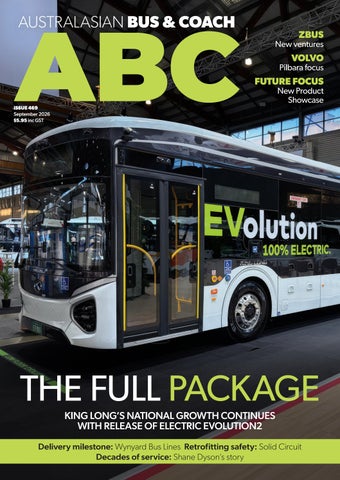
THE FULL PACKAGE KING LONG’S NATIONAL GROWTH CONTINUES WITH RELEASE OF ELECTRIC EVOLUTION2
Delivery milestone: Wynyard Bus Lines Retrofitting safety: Solid Circuit Decades of service: Shane Dyson’s story
CONTENTS
SEPTEMBER 2026
EXECUTIVE GROUP CEO: Christine Clancy Chairman: John Murphy Head of Customer Experience: Regina Fellner
EDITORIAL & DESIGN
20
Image: CDC
in the know 06. editorial | ignition TURNING TABLES The past year has been filled with a changing of the guard within Australia’s bus and coach operating landscape
08. news | all aboard Check out the latest news from around Australia and the world
Art Director: Daz Woolley
range of businesses around the country, from urban transporters to outback operators
Designer: Apostolos Topatsis
36. feature | zbus BRAVE NEW WORLD
PRINTING Brougham Press
Following more than a decade in the local bus industry, Rashidul Siddique made the decision to start his own bus operation
38. bus technology | solid circuit NEXT LEVEL SAFETY
ADVERTISING Sales Manager – South: Courtney Burton ph: 0481 736 890 e-mail: courtney.walker@primecreative.com.au
Western Australian operator Goldrush Tours has decided to proactively take the next step when it comes to safety technology, retrofitting Solid Circuit’s ADR 68/01 Safe-Ride system to its growing fleet
Business Development Manager – Bus: Michael Girgis ph: 0432 237 187 e-mail: michael.girgis@primecreative.com.au
Local content matters, but Bus Stop’s Pete White says the real test is what remains after delivery
40. bus technology | charge hub PLAN BEFORE PLUGGING
20. feature | cdc driver campaign RAISING RESPECT
Charge Hub, through its latest array of software capabilities, is proving why bus depot electrification must start with the schedule
www.busnews.com.au/subscribe ph: +61 (0)3 9690 8766 Mon-Fri 8am-4.30pm (EST) e-mail: subscriptions@primecreative.com.au mail: 379 Docklands Drive, Docklands VIC 3008 Australia
features 16. cover | bus stop BEYOND THE PERCENTAGE
National operator ComfortDelGro Australia (CDC) has launched the second iteration of its Driver Respect Campaign
24. feature | foton THE FUTURE IS NOW-RA An official breaking ground ceremony earlier this year signified a special moment for Foton Mobility Distribution in Australia.
26. from the pod | dysons DECADES OF DEDICATION Having driven buses and started working for the family business as a teenager, Shane Dyson was always going to become a critical cog of the Victorian bus industry
30. new product showcase Check out the latest products that have been recently released into the local bus and coach market, from vehicles to technology
32. feature | wynyard milestone BURNING FROM BOTH ENDS In just 17 years, the Sherman family has run an array of bus and coach services at opposite ends of the country
34. feature | volvo BUILT FOR THE PILBARA Volvo Bus Australia’s evolving aftersales support and Genuine Volvo Parts is benefitting a wide
42. feature | camira FUELLING THE FUTURE More than two centuries since its roots in the textile industry, Camira Fabrics is leading the way in local bus seating fabric innovation
45. column | qbic NOTHING TO FEAR
Facebook facebook.com/ABCBusnews
SUBSCRIPTIONS
Annual subscription rates (12 issues): Australia: $99* Overseas: $A170 (Australian air-mail only) *price includes GST Cover image: Bus Stop
QBIC’s Jason O’Dwyer analyses the new Master Code and Chain of Responsibility for operators
47. best bus | september WINTER WARMER The spoils for the past month have been announced and handed out, with a snow special being crowned the winner for September
departments 50. deliveries | august MOVING FORWARD It’s another case of a productive month of deliveries for the local bus and coach market
54. back seat | bedford conversion CONVERTING DREAMS Peter and Cheryl Mitchell knew little about buses when they bought a stripped-out 1997 Bedford
Follow us online at:
4
Managing Editor: Geoff Crockett e-mail: geoff.crockett@primecreative.com.au Editor: Sean Mortell e-mail: sean.mortell@primecreative.com.au ph: 0468 577 166
YouTube bit.ly/busandcoachtv
Twitter/X x.com/ABCmag
379 Docklands Drive, Docklands VIC 3008 T: 03 9690 8766 www.primecreativemedia.com.au
ISSN 1324-8634 Distribution
Distribution within Australia and New Zealand and beyond by paid subscription to the owners and managers of: • route buses • government bus operations • school buses • extended and day tour operations • express coaches • country and charter operations • bus and coach manufacturers • equipment suppliers • tourism attractions • railways management. Australasian Bus & Coach (ABC) magazine is owned by Prime Creative Media. All material in ABC is copyright and no part may be reproduced or copied in any form or by any means (graphic, electronic or mechanical including information and retrieval systems) without written permission of the publisher. The Editor welcomes contributions but reserves the right to accept or reject any material. While every effort has been made to ensure the accuracy of information Prime Creative Media will not accept responsibility for errors or omissions or for any consequences arising from reliance on information published. Opinions expressed in ABC are not necessarily the opinions of, or endorsed by the publisher unless otherwise stated.
ABC • busnews.com.au
Challeng
Challenger_Buses_ABC Mag #454_210mm x 297mm_PressAD_0625_fa.indd 1
5/6/2025 9:05 pm
IGNITION
EDITOR’S NOTE
Turning tables The past year has been filled with a changing of the guard within Australia’s bus and coach operating landscape. While celebrating this rich history, it’s worth exploring what the future of the sector may look like for the dwindling number of transport businesses
6
ABC • busnews.com.au
T
he days of the major suburban family bus and coach operators may be slowly changing. It’s a sad reality, and, as much as it pains to say it, most of these historic family businesses that have spanned generations are now being acquired and sold by larger operators. Over the past year, Victoria has been the home of some prime examples. Think Ventura’s sale, then the acquisition of Dyson Group by Kinetic earlier this year. Kinetic was at it again in late August and early September, announcing the acquisition of Tasmanian operator Tassielink Transit to assume ownership of another enduring family transport business. This isn’t to say every family operator is being acquired, but more so some of the major family names that have formed an honour roll within the local bus and coach industry are experiencing a changing of the guard not seen before in their history. It’s apparent the number of suburban contracted bus operators are continuing to dwindle, particularly along the east coast, so it begs a question – what does the future of the industry look like? Is it a network run predominantly by a handful of major international operators, and if so, is this necessarily the best way forward? It’s worth plenty of discussion. Before these topics are unravelled fully, our job at ABC is to pay tribute to these family operators as they prepare for a new future. Courtesy of our recently launched podcast Bus News, we’ve welcomed some of these businesses to tell their story and discuss their latest news. The second episode saw Shane Dyson, former joint managing director of Dyson Group, sit down to recount his enduring career in the industry and his thoughts on Dysons’ sale to Kinetic. It made for a wonderfully timed deep dive into the family’s history of running buses in Melbourne’s north for numerous decades. Head to page 26 to find out more about the operator’s history, and keep an eye out on the latest episodes, including our third edition with Ventura’s Carol-Anne Nelson. Another primary issue within the bus industry is the ongoing driver shortage, with one major business reviving a popular campaign to address these challenges.
Our job at ABC is to pay tribute to these family operators as they prepare for a new future Throughout the month of September, CDC has taken its Respect your Driver campaign to the next level – it was wonderful to get involved with some of the national operator’s leading drivers to uncover how we can better market the career to other Australians while keeping them safe. Head to page 20 for more. On the supplier side, local content is an ongoing discussion that continues to drive conversation at industry events. As our cover for this month, Bus Stop Sales addresses the topic, with Pete White opening up on his thoughts on how the industry can work together to provide future solutions that meet local content requirements and offer skilled roles to workers. Check it out on page 16. For the first time we’ve also launched our New Product Showcase. In the aftermath of July’s Expo, we thought it was worth recapping some of the leading products to be launched in recent months. Flip through to page 30 to read more about some of these releases and how they are helping the industry. This is barely scratching the surface of an edition full of stories – from Tasmanian operators celebrating milestone vehicles to the latest appointments among suppliers and operators, this magazine is full of the latest news and features. We hope you enjoy the read.
B Sean Mortell EDITOR, ABC
A journey coast to coast Since 1991, BCI’s journey has been driven by connection, innovation and purpose. Over 35 years, we have grown into one of Australia’s leading bus manufacturers, delivering vehicles built for the roads, climates and communities of this country. From city streets to regional routes, every BCI bus reflects experience, pride and a commitment to keeping Australia moving— coast to coast, every day.
BUS & COACH INTERNATIONAL Contact our team for further information on 1300 289 224 or visit bcibus.com.au
Head Office Perth: 08 9353 9000 Melbourne: 03 8787 2100 Brisbane: 07 3275 6900 Adelaide: 08 8182 3888
NEWS
QLD announces major bus procurement plan Known as the Better Bus Build, the procurement drive aims to deliver a new fleet of modern and fully accessible buses across the state The Queensland government has announced a major procurement drive as it aims to deliver up to 630 new buses across the state. Named the Better Bus Build, the plan seeks to introduce a fleet of modern, fully accessible buses to replace ageing vehicles, with the first new buses expected on the road from the 2027-28 financial year. Details are yet to be released publicly on which manufacturers have been chosen to supply the buses at the time of publishing, with Queensland transport and main roads minister Brent Mickelberg saying the build will provide vehicles needed to maintain service continuity across the state while creating a pipeline of work for industry. Manufacturers, assemblers and suppliers will be asked to demonstrate how government investment can support jobs, skills and industrial capability while delivering the greatest value for taxpayers.
8
ABC • busnews.com.au
Below: More than 600 buses will be procured as part of the plan. Image: Translink
Combined with the LNP’s Permanent 50 Cent Fares locked-in law, Mickelberg says this is a “game-changing investment” to make public transport more affordable, more reliable and more accessible for Queenslanders. “Queensland is growing and we’re working to deliver the road and transport upgrades to get Queenslanders home sooner and safer,” he says. “Labor’s plan to replace Queensland’s bus fleet was a fanciful pipedream, with no grounding in reality. Their half-baked plan involved buying electric buses, but no plans, or money, for the recharging facilities or additional depots to support the fleet expansion – in other words, all they were doing was buying big, expensive paperweights to block local streets. “By contrast, we’re delivering a record investment into transport infrastructure, including up to 630
new buses, The Wave, Mooloolah River Interchange, the Light Rail Extension, the GC Surfer, and Bruce Highway upgrades funded 80:20 with the Commonwealth.” Minister for manufacturing Dale Last says the state government is delivering more jobs and investment to supercharge the industry. “Queensland has a proud manufacturing industry with the skills, capability and experience to play an important role in delivering our State’s future transport needs,” he says. “We want to see Queensland manufacturers well positioned to seize the opportunities that come from our growing state and the significant investment being made in its future. “This is about backing local industry while building the infrastructure that will keep Queensland moving for decades to come.”
busnews.com.au • ABC
9
NEWS
Kinetic acquires Tasmanian stalwart The deal sees Kinetic expand further across Tasmania’s bus and coach scene, with the drivers and frontline team members staying on
Australasian bus and coach operator Kinetic has announced yet another acquisition, continuing its expansion into Tasmania after agreeing to acquire one of Tasmania’s most respected bus operators. Kinetic has acquired Tassielink Transit, which operates six contracted General Access services connecting Greater Hobart with the Huon Valley, Tasman Peninsula, East Coast, Southern Midlands, as well as services in both the Launceston region and on the West Coast, on behalf of Building Tasmania. The business operates a fleet of 39 buses from its Derwent Park depot and satellite sites across the state. Tassielink has connected Tasmanian communities for decades and has been owned and led by the Dewsbery family since 2020. Managing Director Shane Dewsbery, known to many across Tasmania 10
ABC • busnews.com.au
Above: Tassielink Transit has a new owner. Image: Scania Australia
as ‘Bubbles’, has been part of the business for more than 30 years. Tassielink’s drivers and frontline team members will continue to deliver services and passengers will see no change to routes or timetables. Bubbles says the business has been a huge part of his and his family’s life. “We have had the privilege of working alongside some wonderful people and serving communities right across Tasmania,” he says. “Ultimately this decision was about making sure Tassielink has the right foundations for its next stage, and protecting the interests of our customers, our people and the communities we serve. “There is sadness in bringing this chapter to an end, but we are enormously proud of what we have built and excited about the future of the business. “Above everything else, I want to
thank our staff. The people who drive our buses, manage our fleet and look after our customers every day are the heart of Tassielink. “We run more than 100 services a day around Tasmania, and I am grateful for their loyalty and professionalism. Without them, Tassielink would not be what it is today. “This has never simply been a business to us. It has been a family business built around our people and the needs of our local communities.” The transaction is expected to be completed later this year, subject to customary regulatory approvals. Kinetic Group CEO Michael Sewards says the acquisition reflects Kinetic’s long-term commitment to invest in Tasmania. “Shane and his family have built a business that has a proud record of serving Tasmanian communities, and we look forward to continuing their legacy,” he says. “Tasmania is growing rapidly, and Hobart’s growth corridors, from the Huon Valley to Sorell and the southern beaches, are among the fastest-moving in the state, and we believe buses will carry that growth. “Reliable bus services have never mattered more to these communities, and this investment deepens our partnership with the Tasmanian government and our commitment to delivering safe, reliable services to Tasmanians.” Kinetic General Manager (Tasmania) Andrew Grzinic says the team is looking forward to welcoming their new colleagues. “We’re excited to welcome the Tassielink team on board – they’re known across Tasmania as a team who genuinely care about their passengers, and that’s exactly the kind of team we want alongside us,” he says. “Our focus over the coming months is a smooth and seamless transition for the Tassielink team, their customers and the communities they serve.”
Reliable by Design. Flexible by nature. Whether it’s diesel or electric that you need, Volvo Bus Australia’s full chassis range is built to keep your operation moving. The Volvo B13R and B8R continue the diesel reliability operators have trusted for decades. On the electric side, the Volvo BZL Electric has established itself as Australia’s benchmark for safety and reliability. Now, with the Volvo BZR Electric and the new Volvo BZLA Electric – Australia’s first electric articulated bus – we offer a complete portfolio designed around your operation, not the other way around. And we back every electric platform with the industry’s most reliable battery commitment. We ensure enough usable battery energy through the vehicle’s entire service life, giving you certainty not just on day one, but for years to come. Diesel or electric, Volvo delivers the right solution, backed by the flexibility, support and confidence your operation demands.
Scan for more, or visit volvobuses.com.au busnews.com.au • ABC
11
NEWS
Victorian DTP leader steps down over PT tax The news follows a report revealing the state government introduced a levy on all public transport fares in Victoria in 2025 to fund the Suburban Rail Loop project
A new report has revealed the Victorian government introduced a levy on all public transport fares in metropolitan Melbourne and regional Victoria over the past 18 months to fund major infrastructure projects. A new Suburban Rail Loop report released by the Victorian Auditor-General (VAGO) says the government’s strategy to fund the $34.5 billion project hasn’t been transparent, with some funding sources being uncertain. “The government’s new revenue raising measures are intended to fund one-third of the project costs. These measures include a levy on all public transport fares in metropolitan Melbourne and regional Victoria,” the VAGO’s report says. “It has been using this levy to raise revenue since January 2025. The levy is not fully consistent with the state’s value capture framework.” While the government announced a “value capture package” in December last year that included a car parking levy, existing land tax revenue and revenue from state-initiated property development, it didn’t announce the new levy introduced on public transport fares from January 1, 2025 as part of the annual CPI fare increase. The levy introduced was an annual one per cent increase to all public 12
ABC • busnews.com.au
Above: Victoria has a new secretary of the DTP. Image: Victorian Department of Transport
transport fares on top of existing annual CPI adjustments, with the government planning to allocate 60 per cent of the estimated $4.8 billion revenue to fund the SRL East project. “This levy will be the project’s largest source of value capture revenue,” the report says. “The government first approved the levy in August 2021. It also confirmed it in December 2023 and November 2024 when it made further decisions on the project’s value capture revenue package. “In November 2024 the government confirmed it needed the levy to service its borrowings for the project. The government and Transport Victoria did not acknowledge the levy in their public communications about the 2025 and 2026 annual fare increases.” The Victorian government has announced the appointment of a new secretary of the Department of Transport and Planning (DTP). Premier Ben Carroll unveiled Fiona Adamson as the new secretary, replacing the outgoing Jeroen Weimar. “I want to acknowledge Jeroen Weimar’s contribution to DTP and across the Victorian public service, and wish him well for the future,” he says.
Adamson will replace him in the role after recently serving as the deputy secretary of transport services for DTP, where she has played a key role in directing the state’s public transit, road infrastructure, network operations and customer experience frameworks. Previously she has held key executive roles within Public Transport Victoria and Transport for Victoria, leveraging a 15-year commercial background at Foxtel in customer operations and management. Adamson started as secretary of DTP in late August and will play a critical role in advising and supporting the government to deliver the ongoing transformation of the transport network. She will manage Victoria’s integrated transport, planning and housing portfolio as it delivers generational projects and drives critical development reforms. “I congratulate Fiona Adamson on her appointment,” Carroll says. “She brings substantial knowledge of the transport sector and her leadership will be important as DTP continues to manage Victoria’s transport network, deliver generational infrastructure projects and drive critical planning, housing and development reforms.” The Victorian Liberal Party says the “secret public transport tax” is “a scandal of the highest order”. “The independent Auditor-General has exposed that Labor has taxed every single public transport fare since January 2025 and they never told the public about it,” Leader of the Opposition Jess Wilson says. “Ben Carroll was the Minister for Public Transport when this secret tax was approved in 2021. What other secret taxes are Labor levying on Victorians without telling them?”
NEWS
Volvo appoints new local GM After serving in the acting general manager role, the popular bus and coach industry member is now leading the local giant
Images: Volvo Bus Australia
Left: Volvo Bus Australia and New Zealand GM Sarah Forbes
Below: Volvo Bus has entered a new era in Australia and New Zealand
Volvo Buses has announced the official appointment of its latest Volvo Bus Australia and New Zealand general manager. Sarah Forbes, previously serving in the acting general manager role, has stepped into the official position as of August 1. Forbes will lead the Volvo Bus business across Australia and New Zealand, a market that continues to lead the shift to electromobility, backed by strong, long-term customer partnerships and growing electric bus deliveries. Forbes joined Volvo Buses Asia Pacific in April 2022 as Director of Strategic Partnerships and Projects, a
role in which she advanced strategic initiatives, strengthened customer relationships and developed partnerships across the Asia-Pacific region, before moving across as the Director of Commercial Solutions to grow the services solutions segment. “I am honoured to lead the Volvo Bus Australia team and build on the strong customer foundation we have established over many years,” Forbes says. “By working closely with our customers and partners, we will continue to deliver safe, reliable transport solutions while accelerating our electromobility journey toward a more sustainable future.”
busnews.com.au • ABC
13
NEWS
INTERNATIONAL
Custom Denning expands into Europe The Aussie brand is growing in Europe with two new leaders announced as part of the evolving venture Australian-based bus and coach manufacturer Custom Denning has announced an expansion into Europe through the appointment of a new CEO and head of sales and commercial. In August, the brand announced Antony Goozee would join Custom Denning as its new European CEO after an eight-year tenure with UK operator National Express. Custom Denning says Goozee will bring leadership experience in large-scale transport operations while leading the brand’s growth across the UK and European markets from its East Midlands Delivery Centre. “With strong interest already building around the next evolution of our Element, we’re looking forward to accelerating customer engagement ahead of the Element 2.2 launch
Above: The manufacturer is growing in Europe. Image: Custom Denning
at Euro Bus Expo 2026,” Custom Denning says. Goozee says he’s excited to start a new challenge with Custom Denning. “It’s great to be staying in the sector – this time on the manufacturing side, selling buses and coaches – and I’m looking forward to teaming up again with Scott Dunn for another adventure,” he says. “I’ve been really impressed by the
product the Custom Denning team has built, and I can’t wait to help drive their plans forward across the UK, Europe, and beyond from our Europe HQ & Delivery Centre in the East Midlands.” Route One also revealed former Scania and Alexander Dennis member Martin West has been appointed as Custom Denning’s new head of sales and commercial in the UK market.
UK changes disabled transport rules The new UK prime minister described buses as “a lifeline” for many people upon lifting time restrictions on concessionary passes The UK government has made bus travel free around the clock for disabled people as it takes further action to ease cost of living burdens. Eligible disabled people across England will soon have access to free bus travel 24/7 after the government lifted time restrictions on concessionary passes. From April 1 next year, people holding a disabled bus pass can travel on buses for free regardless of the time of day, with the extra support opening access to workplaces, education, training and other opportunities. Currently, disabled bus passes are only valid for travel between 9.30am and 11pm during weekdays, unless local authorities choose to fund an extension. For example, Greater Manchester Combined 14
ABC • busnews.com.au
Authority permanently lifted the time restrictions from March this year. Backed by £60 million of funding, the UK government is now stepping in to remove these time restrictions across the whole of England so that from next year disabled bus pass holders can always travel for free on the most popular form of public transport, regardless of their postcode. “Buses are a lifeline for so many people – making it easier to get to work, education and healthcare,” UK prime minister Andy Burnham says. “It’s simply not right that many disabled people cannot travel using their pass during certain times of the day, so we’re fixing that. Disabled people will now have unlimited free bus travel 24/7. “I did it before in Greater
Manchester and I’m proud to do it now for the whole country. This is part of our ongoing action to bring back hope and give people some much needed breathing space on the cost of living.” UK transport secretary Heidi Alexander says the move puts an end to “postcode lottery” for disabled people wanting to access free bus travel. “We are making this change because we’ve listened to disabled people, and we know the importance of buses to local communities,” Alexander says. “These passes are a lifeline for so many, helping them stay connected and get to work and appointments, and it’s only right they receive the same treatment, no matter their postcode.”
INTERNATIONAL
NEWS
Kinetic launches NZ program Kinetic New Zealand has launched Women in Motion, a new initiative designed to connect women across transport operators, councils, authorities and industry partners Kinetic New Zealand has launched Women in Motion, a new initiative designed to connect women across the transport sector. The first event was held in Auckland in August, bringing together women from Kinetic New Zealand, councils, transport authorities and industry partners. Kinetic says Women in Motion was created to support stronger connections across a sector where women’s representation is growing, but many established professional networks remain male-dominated. The initiative complements Kinetic’s existing work to improve gender representation across its business. For the inaugural event, Kinetic hosted a table at the M2woman
Journey to Excellence event in Tāmaki Makaurau Auckland. The group included women working across frontline operations, leadership, customer experience, property, communications, public transport planning and industry advocacy. The discussion came as public transport continues to navigate major change, including fleet and depot electrification, emerging technology, changing customer expectations and the pressure of delivering safe and reliable services. Kinetic says those challenges will require resilient leaders who can build trust, negotiate shared outcomes and use technology while retaining the human judgement that sits at the centre of passenger transport.
Kinetic New Zealand Marketing and Communications Manager Meenal Maharaj developed Women in Motion after identifying an opportunity to create stronger links between women across the transport sector. “Women play an essential role at every level of our industry, but they don’t always have access to the same networks or visibility,” Maharaj says. “Women in Motion is about using Kinetic’s position in the sector to bring people together, build stronger relationships and create opportunities for women who are helping move our communities forward.” Bus and Coach Association New Zealand Chief Executive Delaney Myers joined the inaugural Women in Motion group.
busnews.com.au • ABC
15
BUS STOP
Images: Bus Stop Sales
COVER
Beyond the percentage
L
Local content matters, but Bus Stop’s Pete White says the real test is what remains after delivery: reliable buses, whole-of-life support, skilled people and a strong industry built on certainty and long-term supply
ocal content has become a central topic in Australasia’s bus and coach industry, but ask three people what it means and the answers may differ. Is it a bus made here from local parts? An imported pack assembled in Australia? Or a locally completed vehicle that combines overseas technology with Australian labour and components? Those questions matter as governments, operators and manufacturers plan the next phase of heavy-vehicle production. For Bus Stop Sales managing director Pete White, local content is valuable when it combines proven global technology with Australian capability and delivers a better outcome for the operator. White remembers standing at the Warwick Farm bus show in Sydney in the 1990s, looking at American MCI coaches displayed in left-hand drive. “They were impressive vehicles, but simply moving a product from left-hand drive to right-hand drive does not make it right for Australia,” he told ABC. “You still have to listen to operators here and adapt the vehicle, local content and whole-of-life support around how they actually work.” The easiest fleet replacement is usually like for like: a known product, familiar parts and an established support path. But in some categories,
16
ABC • busnews.com.au
the badge may be the same while the bus underneath has changed significantly, whether in size, configuration, driveline or supply chain. At that point, staying with the same brand is no longer a true like-for-like decision, and the operator has to look across the market for the best fit. Other challenges are arriving just as quickly. Introducing a zero-emission bus into a depot built around diesel, meeting growing passenger demand without moving beyond an LR licence, meeting government local-content requirements or keeping a regional vehicle supported hundreds of kilometres from a capital city. At Bus Stop, the starting point is that each challenge may require a different answer because no two operators face exactly the same commercial and operational pressures. What has not changed, according to White, is the need for good old-fashioned support and parts availability. Whatever technology sits underneath the vehicle, operators still need knowledgeable people who answer the phone, parts on the shelf and practical help when a bus is off the road. “We need enough range to solve the first problem, then the parts, training, technical knowledge and support to keep the bus doing its job over its life,” he says.
Above: Bus Stop is continuing to grow the King Long product in Australia
White is commercially wired to look for an answer, but he is also realistic about what it takes to deliver one – engineering, compliance and product development take time. More money can open more options, but it does not remove the need to make sensible choices. “We have learnt that every decision gives something and takes something away,” he says. “Increasing passenger capacity adds weight, while GVM, axle loads and seating layout determine the final usable seat count. Electric batteries add another significant weight challenge. If the industry is expected to deliver a genuine 57-seat zero-emission school bus, regulators also need to review current GVM settings. “When seatbelts were introduced, a two-tonne uplift recognised the additional weight – the transition to electric vehicles requires the same practical approach. Depending on the design, scale and capability available, more local content can also add cost or extend delivery while a new integration pathway is established. “Customisation may solve today’s requirement but add complexity for the next 15 years. The best answers come when operators, engineers, manufacturers and maintainers sit around the same problem. A
useful partner is honest about the trade-offs.” This is not a Bus Stop argument alone. Industry leaders have recently called for procurement to recognise the Australian economic value created over a vehicle’s full life, not only where final assembly occurs. This argument points to local jobs, suppliers, training, engineering, maintenance, investment, taxation, parts and whole-of-life support. This position remains strongly supportive of genuine Australian manufacturing, but clear that policy should be judged on ‘outcomes, not optics’. “Operators want to support Australian content and the businesses and jobs it creates wherever it makes practical and commercial sense,” White says. “But a bus is also a working asset, and local content cannot come at the expense of suitability, reliability or whole-of-life value. “The bus still has to be reliable, suit the route, work for drivers and passengers, arrive when promised and earn its keep. That becomes even more important as the industry moves from individual trials to transition at scale.” That is where a proven international platform, combined with Australian integration, components and support, can deliver better value over the vehicle’s life rather than simply the lowest purchase price. “An operator with enough capital to replace 10 ageing buses may find that the vehicle premium, charging, depot works and training reduce the same program to six or seven zero-emission buses,” White says. “The other buses do not disappear. Neither do the services, maintenance bills or passengers relying on them.” White strongly supports Australian manufacturing but says local content must work in practice. It should create lasting jobs and skills without making buses too expensive, unsuitable for the job or difficult to keep on the road. Bus Stop is family-owned, but White expects it to carry the product, technical, warranty and lifecycle responsibilities of an OEM-level supplier. That also means remaining
profitable. Without a strong Australian business, there is no long-term reinvestment, employment or fleet support. White wants more of that value to remain onshore through wages, apprenticeships, facilities, engineering, parts and service. Government procurement can help turn local-content ambition into lasting capability by giving the supply chain a clearer view of future demand. Greater transparency would also build trust and give businesses more confidence to invest locally. “A manufacturer cannot responsibly expand, buy equipment or employ apprentices on the possibility of another order,” White says. “Credible volume, consistent rules and realistic timing give businesses the confidence to invest.
Above: The latest bus technology is on display down under
Below: White is committed to growing the national workforce via Bus Stop’s Brisbane Bus Centre
“The workforce pressure is shared – operators need drivers and mechanics, while manufacturers are competing for welders, engineers, technicians and people with high-voltage skills.” That pressure has influenced Bus Stop’s latest product work. The King Long EVolution2 is designed as a modular platform, allowing the operator, body builder, OEM and specialist suppliers to decide where work is best carried out and what level of local content is realistic for the skills, capacity and timetable available. Bus Stop is also trying to grow more capability from within. Its apprenticeship pathways have included school-based entrants, Indigenous Australians and mature-age workers progressing towards qualified roles. White says the aim is to build a team with momentum, ownership and the professional standards expected of an OEM-level supplier. The broader mix of people also widens the industry’s talent pool and creates careers that can last beyond a single contract. “Our EV Training Centre was never intended to promote one company or one brand,” he says. “Its first purpose is to keep people safe as high-voltage vehicles become part of everyday fleet operation.” The centre develops practical safety and diagnostic capability for manufacturers, operators, technicians, depot teams and emergency responders. “My view is simple: a rising tide lifts all boats,” White says. “The transition will work only if the busnews.com.au • ABC
17
COVER
BUS STOP
industry builds capability together.” He points to Bus Stop’s 40,000square-metre Rocklea site, which has room for expanded assembly or manufacturing when sustainable demand supports it, as an example. The company has also provided BusTech with space there for the past three years. White believes Australia needs a healthy and competitive bus industry, with several capable suppliers working alongside operators and the local supply chain. The scale and variety of the fleet transition cannot be met by one dominant company without risking choice, capacity and long-term resilience. For now, White sees the strongest opportunity in a deeper network of specialist Australian SMEs contributing to mid-build assembly, body integration, electrical work, interiors, accessibility, commissioning and support. He wants that participation to move further upstream as skills, volume and order certainty grow. Bus Stop’s range shows how the approach works in practice. White grew up around Australian bus building and later helped bring international brands into this market. The lesson he draws from both is straightforward: use global scale
18
ABC • busnews.com.au
where it adds value, then build Australian capability and support around it. On relevant diesel models, Bus Stop has accepted a higher upfront cost to specify recognised systems such as ZF independent front suspension and axle technology. ZF’s Australian aftermarket network gives operators access to parts and support through established service partners and resellers. White acknowledges that, at the value end of the market, the lowest purchase price can be difficult to look past, but a cheaper component at delivery may not remain the better-value decision over the life of the bus. Operators can also localise seating, air-conditioning, accessibility equipment, CCTV, electrical systems and completion work where the supplier, parts pathway and warranty responsibility are clear. The I-Bus partnership responds to a different operator problem: adding passenger capacity without moving beyond an LR licence. “The NQR carries 31 passengers plus the driver while retaining an LR-licence option on a Japanese-made Isuzu chassis,” White says. “Comparable LR-licence buses carry between 21 and 27 passengers, giving the I-Bus between four and
Below: White is looking to help drive the future
10 additional passenger seats. That extra capacity can make a meaningful difference without requiring a driver with a higher licence class. “Some buyers have traditionally operated other brands, only to find that a genuine like-for-like replacement is no longer available in Euro 6 or that the current model uses a substantially different driveline. This has led operators to look beyond the familiar badge and decide which product now offers the best combination of capacity, simplicity and support.” The King Long range covers the nine- and 10-metre midi segment, sitting between minibuses and full-size coaches, as well as 12-metre school, charter and coach applications. A lower-volume 13-metre option remains available where additional passenger or luggage capacity improves the route economics. White says supporting a genuine, if smaller, part of the market is also part of being a solutions partner. The same thinking is visible with the EVolution2, which Bus Stop regards as King Long’s most advanced zero-emission platform yet. It is fully integrated and modular, with room to increase Australian content as capability and volume grow. The core chassis can take an Australian or New Zealand-built body, with local engineering, interiors, accessibility systems, electrical integration, commissioning and completion added as capability develops. Options include a Global Bus Ventures body from New Zealand or a Volgren body built in Australia, while a complete imported-body pathway remains available when the application calls for it. “EVolution2 is next generation, but it does not begin at zero,” White says. “Its battery integration, thermal management, controls, driveline and safety architecture draw on lessons from more than 100,000 King Long electric vehicles operating internationally. Local trials remain essential for Australian roads, heat, depots and duty cycles, but they should refine a mature platform rather than ask an operator’s revenue fleet to uncover
basic weaknesses.” White says he would welcome a viable Australian battery solution, but the difficulty is that the cells, battery-management software, thermal control, charging, vehicle controls and diagnostics must work as one system. For its current production requirements, Bus Stop hasn’t identified a complete domestic solution with the scale and operating history available internationally. Its position is to use proven technology now while supporting Australian capability to keep developing. For White, that’s the value of a global partnership – engineering tested at scale, combined with Australian and New Zealand bodies, components, skills and support. King Long EVolution chassis with Global Bus Ventures bodies are already operating on Kinetic’s SkyBus service in Melbourne with substantial Australasian body-build content, with those lessons feeding into the EVolution2. “Partnership matters most when something goes wrong,” White says. “Every contract, from one regional bus to a major fleet program, carries direct and indirect costs through capital, delay, downtime and management time. A bus can involve the chassis maker, body builder, electrical, charging and software suppliers and local installers.” When Bus Stop is the prime contractor, often through its role as chassis supplier, White accepts that his group must coordinate those parties and return the vehicle to service. The operator should not be left carrying the gaps. White wants local content that can be pointed to in the vehicle, the workforce and the supply chain: assembly, engineering, components, skills and ongoing support. In his view, a percentage created mainly through accounting treatment does little for government, operators or suppliers making genuine investments. The same practical test applies to zero-emissions models. In his view, local completion delivers its full value only when grid capacity, chargers, depot power, route planning, training and emergency procedures are ready with the bus. Brisbane 2032 is an important milestone, but the lasting measure will be a stronger transport system and local capability serving Queensland well beyond the event. White has taken responsibility for brands with histories that predate Bus Stop. For him, respecting that legacy means improving the products and support to meet today’s market and where operators want to go next. The company’s developing ‘control tower’ brings technical support, parts, warranty and field feedback into one place so lessons from service lead to the next improvement. The real test comes later – is the bus available, did the apprentices qualify, is the supplier still operating and did the operator have enough confidence to order again? “Meaningful local content is the value that remains after delivery: skilled people, stronger Australian suppliers and reliable buses that operators can afford to keep in service,” White says. “Our responsibility is to bring those pieces together, stand behind the complete vehicle and keep building capability for the next order, not only this one.”
Here for the Journey… Camira is the trusted fabric partner for the Australian bus and coach industry. Our Melbourne team is on hand to provide quick turnaround times, with stock readily available here in Australia. From routine maintenance to unexpected repairs, Camira supports vehicles throughout their lifetime.
T 03 9832 0624
E info@camiragroup.com.au
ABC Aus Trans Ad Oct 2025.indd 1
www.camirafabrics.com
22/10/2025 08:33
busnews.com.au • ABC
19
OPERATOR FEATURE
COMFORTDELGRO AUSTRALIA (CDC)
Raising respect
A
National operator ComfortDelGro Australia (CDC) has launched the second iteration of its Driver Respect Campaign to address the growing challenge of antisocial behaviour across public transport networks
s Russell pulled away from the bus stop, he noticed the bus had become quiet. The darkness had fallen quickly so that only the lights of his bus and the streetlights blasted a way forward through the creeping shadows. Sounds of the bus – the rumbling engine, pieces of gravel being crushed by tyres, the blasting of the air-conditioning system – filled the silence while Russell pulled at the wheel to navigate the twists and turns of streets. As he snuck a glance at his mirror, he saw only one person left on the bus. A girl, all on her own, waiting to reach her destination after everyone else had already found theirs. When Russell pulled the bus 20
ABC • busnews.com.au
into her stop, he knew he had a responsibility to ensure she was safe. “I was driving for a special event and she was the last passenger on the bus,” Russell recalls. “I wanted to make sure she got home safely, so I asked her where her car was and told her to go to the car and turn the lights on while I waited for her. Once she got to the car and turned the lights on, I knew she was safe.” It was nothing out of the ordinary for Russell, who has been working across multiple roles at operator CDC’s Northern Territory operation for the best part of three decades. He admits he’s held multiple
Above: CDC drivers are the face of the latest iteration of the campaign
positions over that time – bus washer, driver and driver trainer – enough to make him a self-labelled ‘jack of all trades’. He’s now being recognised by the operator as part of a new driver respect campaign. Featuring CDC drivers as the faces of the campaign, the initiative aims to promote kindness, respect and safe interactions for bus drivers who play a vital role in keeping communities connected. CDC is leading the way in fostering a culture of respect and ensuring a safer, more positive travel experience for both drivers and passengers. As part of this campaign, CDC’s drivers like Russell shared some of their experiences of providing care
Images: CDC
to passengers and how kindness can make a big difference. Throughout his years of experience behind the wheel, Russell has always wanted to go above and beyond to keep his passengers safe. This night was just one instance of his caring nature coming to the fore, but it soon became a significant moment. “I thought nothing of it, but the next day I got a call from my boss who said a report had come in on me,” he says. “I thought I must’ve done something wrong, but it turns out the girl had written a really nice report about me helping her.” The end result was a letter of commendation from the Northern Territory government for his efforts in helping the community. While it may have felt like part of an ordinary day for Russell, it signals the power and responsibility bus drivers have throughout the country to transport people safely. Rising antisocial behaviour across their operations and on public transport in general led to CDC starting an initiative to tackle growing incidents of anti-social behaviour towards bus drivers in Australia. Last year the national operator launched the Respect your Driver campaign, aimed at showing support for its drivers and growing respect for those who help many get to where they need to go safely and reliably. After this initial success, CDC has now launched the second phase of the national campaign in a public initiative
that looks to tackle the growing issue of antisocial behaviour towards bus drivers while highlighting the important role they play in local communities. The Human.Kind Respect your Driver campaign features real CDC drivers from across the country like Russell who share their personal stories and the importance of this campaign to them. It allows drivers like Russell to share their passion for the job and their connections to the communities they serve. “This campaign is really important for two reasons. Firstly, I think it will encourage people to join as drivers after seeing the friendly faces and
Above: The campaign is focused on respecting CDC’s bus drivers
Below: CDC drivers like Russell say the program has already had an impact
how much customer service is involved in bus driving and caring for your passengers,” he says. “People will see CDC doing our part by giving our passengers really good customer service. I think it also shows how important it is to interact with people – interacting with people is such a big part of the job. You want people to enjoy their journey. It’s not just about getting people from A to B, it’s about making them feel comfortable. “I always make sure that as soon as I open the door, instantly I say ‘good morning’ or ‘good afternoon’ – that’s really important. It makes
I care about the safety of every passengeR
busnews.com.au • ABC
21
OPERATOR FEATURE
passengers feel comfortable straight away. Even if I don’t get a hello back, passengers notice it. It helps them think ‘this driver’s cool – he’s friendly and driving safely’ For some of them, maybe that means they’re more likely to take the bus every day instead of the car.” The sentiment is being echoed on the other side of Australia courtesy of CDC Victoria driver Narelle, who was chosen to be one of the faces of the campaign. Twenty-one buses across Victoria, New South Wales, Queensland and the Northern Territory carry campaign bus wraps of drivers as well as posters inside around 80 per cent of CDC’s buses across Australia. “I think because we are the face of our company and there is so much negativity out there, if we can be nice and happy to people then hopefully they can leave the bus feeling positive and happy as well,” Narelle says. “This campaign is so important to remind the general public we are human and have human responses. As drivers, we have to make hundreds of decisions every day when something is happening on the bus, whether getting involved will help or hurt the situation. “But I believe if you are nice to people and speak to them then it 22
ABC • busnews.com.au
COMFORTDELGRO AUSTRALIA (CDC)
makes a difference. A lot of drivers have come from truck driving and it’s important we remember the human element as the cargo we are transporting in buses is human. The cargo can talk back, so it’s an important part of the job to be nice. It’s really important that people understand that we’re just people trying to do our job, the same as anyone else is.” By putting a human face to the people behind the uniform and wheel, CDC’s campaign is addressing a multitude of challenges, including the psychological and physical effects that anti-social behaviour has on drivers and passengers across the country. Diving deeper, it also focuses on the hidden cost this has on recruiting drivers and patronage numbers. As incidents of verbal abuse, threats and other forms of antisocial behaviour continue to affect public transport workers, the campaign serves as a timely reminder that drivers are more than operators of vehicles. Common humanity is at the heart of the campaign, with passengers encouraged to respect and empathise with each other, mirroring the behaviour of drivers like Russell and Narelle. “My manager insisted we put the
Above: The wraps are all about spreading a message of respect
posters of me up on our buses in Geelong, so I’ve noticed people coming to me and saying they saw me on the poster,” Narelle says. “At the photoshoot, the photographer showed me how to do the love heart sign and I’ve since being doing that to our drivers. Since the campaign launched, other drivers have been doing it back to me too, which is really nice. “I believe what you put out in the universe is what you get back. I treat everybody the same, regardless of the situation they are in. Often because you are nice to every passenger, when there is a bit of trouble in the bus, those passengers you’ve been nice to come to your aid – they become your biggest supporter. “I think this campaign will make a difference. Due to the posters being on the bus, right behind the drivers, everyone can see. I like to think this makes a difference to how people behave.” The Human.Kind Respect your Driver campaign will run until October and forms part of CDC’s broader commitment to fostering safer, more respectful communities, elevating the role of bus drivers and addressing key challenges in the industry.
Sean Mortell Host & Editor, Australiasian Bus & Coach Magazine
Michael Baulch, Director, Emerald Coaches
LISTEN NOW
S E A RC H “BUS NEWS PODCAST”
Shane Dyson, Former Joint Managing Director, Dyson Group
Carol-Anne Nelson, CEO, Ventura Bus Lines
The Bus News podcast takes you behind the scenes of the Australasian bus and coach industry, introducing the people driving the sector forward. From the leaders of major operators to the long-standing industry figures who have helped shape the industry, each episode uncovers the stories, insights and experiences behind one of Australia’s most important transport sectors.
FOTON MOBILITY DISTRIBUTION
Images: Foton Mobility Distribution
FEATURE
The future is Now-ra An official breaking ground ceremony earlier this year signified a special moment for Foton Mobility Distribution in Australia. Beyond the celebrations, the ongoing construction of the brand’s NSW site sets the tone for Australia’s zero-emissions bus future
A
flash blinks, rapidly illuminating an assortment of smiling faces preserving facial tension as if part of a wax museum exhibit. “Say cheese!”. A snap of the camera begins a procession of clicks – chik-chik-chik-chik-chik – like an army marching in sync, heavy boots striking pavement in unison. A smattering of awkward laughter, relieved handshakes and joyful hugs follow as the group converges around those with high-vis vests on. One person holds a shovel – a symbol of new beginnings. As the Australian bus and coach industry continues its evolution into zero-emissions technology, breaking ground ceremonies have arrived quickly and often. All around the country, more and more depots are beginning construction works to swap diesel nozzles for state-ofthe-art electric chargers – futuristic boxes powering the future of the 24
ABC • busnews.com.au
nation’s public transport sector. As this progresses, so do the vehicle manufacturers enhancing their production capabilities for the latest zero-emissions buses and coaches, creating a loop of evolution and constant development. Another milestone in a long series of ceremonies and celebrations recently took place in Australia, this time in the New South Wales regional city of Nowra, when construction officially kicked off on what will become one of the nation’s most significant zero-emissions vehicle facilities. “KRW Hydron’s new Nowra factory represents something the industry has needed for a long time,” founder and CEO of Foton Mobility Distribution (FMD), the sister company of KRW Hydron, Neil Wang told ABC. “It’s a new, 100 per cent Australian-owned facility dedicated to assembling electric buses specifically for Australian conditions, using local content.”
Above: FMD is moving on its groundbreaking Nowra facility
While construction has only recently started on the Nowra site, an interim facility in the region has allowed FMD to grow its Australian home base for the local bus and coach sector. In March last year, the bus and coach brand obtained a temporary facility in Nowra to handle incoming parts and begin early production while awaiting approvals for its main site. Now, with ground officially broken via the turning of the sod ceremony, construction is officially underway to produce FMD’s permanent NSW home. Once completed, the site will allow FMD to shift its approach to supplying zero-emissions buses alongside its newly unveiled Euro 6 diesel coach to the Australasian market. With much of the nation’s electric bus stock currently entering the market having been designed overseas and adapted for local roads, climate and regulatory
requirements after the fact, the Nowra site releases the shackles so FMD can do things differently. “Nowra flips this approach, putting Australian conditions at the centre of the assembly process from day one,” Wang says. Once complete, the new factory will have the capacity to produce up to 400 electric buses per year while employing more than 100 people to the Shoalhaven region in NSW’s South Coast. Already the project is supporting 19 regional suppliers as part of a wider goal to extend FMD’s economic benefit well beyond the factory floor and into the broader Shoalhaven supply chain. “While the current focus is on assembly with growing local content, the long-term aim is to build the buses from the chassis up, deepening local manufacturing capability as the facility matures,” Wang says. This approach may offer FMD a point of difference in the local market, but it also holds significance for operators across the country looking to procure the latest zero-emissions bus technology. For those considering the transition to sustainable fleets, it means every Foton electric bus already meets ADR certification and DDA compliance requirements as they’re engineered to Australian standards rather than retrofitted to meet them. Wang says the Nowra facility takes this commitment a step further by bringing assembly onshore as a core part of the manufacturing process rather than treating local input as an afterthought. “There’s sometimes a tendency to dismiss assembly as somehow lesser than ‘real’ manufacturing, but that view misunderstands how modern vehicle production actually works,” he says. “Assembly is where engineering meets precision on the factory floor, where skilled workers transform locally sourced components into finished vehicles they can stand behind and be proud to deliver to the public. “It’s a labour intensive, quality critical stage of production, not a
simple bolt together exercise, and building that capability onshore means Australian workers are developing and retaining skills that will only become more valuable as the zero-emission transition accelerates.” As work continues to progress on the groundbreaking site, Wang and the FMD team have only a snippet of time to reflect on the importance of the milestone, to pause for a photo and a smile while holding the ceremonial shovel. Once the handshakes and celebrations subside, he says the Nowra facility is a significant moment for KRW Hydron, the associated entity of FMD, and the winder bus industry. With a tangible
Above: The site will allow Foton to produce more buses in Australia
Below: FMD is positioning itself to become a leading supplier in the local market
signal now being made about FMD’s intentions in Australia, Wang says the zero-emissions transition is officially under construction across the country. “The transition is no longer just a distant policy goal,” he says. “State and federal governments continue to tighten emissions targets for public transport fleets, and operators around the country are already weighing up how and when to make the switch. A facility like Nowra changes that calculation, offering a local supply option backed by Australian jobs, Australian standards and shorter, more resilient supply chains.”
busnews.com.au • ABC
25
BUS NEWS
Images: Dyson Group
FROM THE POD
Decades of dedication Having driven buses and started working for the family business as a teenager, Shane Dyson was always going to become a critical cog of the Victorian bus industry
E
xhaust fumes filled the tin sheds, forming into plumes that spread across the depot in a low-hanging cloud of diesel. Men of all ages converged around buses, tinkering with parts here and there, moving swiftly around vehicles that reversed into parking bays. It was the ‘70s at a bus depot in Melbourne’s northern suburbs, a door-die setting for a 16-year-old to start work as an office boy. But Shane Dyson was no ordinary 16-year-old in the bus and coach industry. No wide-eyed naïve teenage boy coming in without a clue, Shane was already a well-known presence – not just at Dysons’ Reservoir depot,
26
ABC • busnews.com.au
but behind the wheel. “I used to drive the buses in the yard back at age 14, backing them up and putting them in the yard,” he told ABC’s Bus News Podcast. “The drivers used to laugh, they could see me coming out of the driver’s room and trying to drive the buses in the yard, but they couldn’t see me behind the steering wheel. “I’d have to back these big old buses up in the yard into very tight spaces. The original Reservoir depot only held a maximum of 28 buses, so you had to watch what you were doing when it was full.” Luckily Shane was made of the right stuff to be around buses. His
Above: Shane (right) alongside Neil Dyson (middle), Lance Deacon (second from left) and Andrew Jakab (left)
first memories centred around the family business – taking buses with his parents to kindergarten, to the nearby Northlands Shopping Centre, to the East Preston tram terminus. By the time he hit teenage years he had developed a passion for buses, memorising the timetables gradually each week during weekly Sunday morning visits to the depot with his father, who was a driver at the time. As school quickly became a dead-end, the Dyson Group formed an important outlet and opportunity for Shane. By age 13 he was working in the Reservoir yard during his school holidays, cleaning the buses and filling them with diesel. After
commencing driving them around the depot the next year, he transitioned to the office in 1975 at the ripe age of 16. “I learnt everything I knew about bus operations by doing what we call the switch, which were the phones at the time,” he says. “I would watch Pop, my grandfather, count the money and help him when I could. He used to come in every day to count the money, and it was a very important job due to everything being on the fare box then.” He rapidly made an impression, progressing from simple office boy to the cadet of the operations manager for three years after he announced his long-term plans to retire. Having worked for the old Transport Regulation Board and Bell Street Bus Company before leading operations at Dysons, he taught Shane how to handle drivers and daily operations. By the age of 20, Shane was thrust into the role of operations manager, having received a diverse if imperfect education at his family’s growing business. “I was always doing the timetables and the rostering, learning how to do them better for our growing cohort of drivers,” he says. “We also had running boards at the time, but this soon changed as the industry evolved as a whole.” While Dysons is now renowned as one of Victoria’s largest bus operators to have served the local community over the past 74 years, it ran a lot humbler operation at the time of Shane’s transition to operations manager. With 15 route buses and eight charter or school vehicles, Dysons was then in its own state of boom after war veteran Laurie ‘Pop’ Dyson founded the business in 1952 with three buses. As the family legend goes, Sundays were the operator’s busiest days in its infancy, requiring Pop to use all three of his buses to take the families of war veterans to nearby hospitals for visiting day. A contract to transport the nurses to and from these facilities allowed the business to grow further north of Bundoora in Melbourne’s northern suburbs, placing Dysons on
We’ve had operators come and tell us they’re glad they sold to us because they know we look after their employees, which is a major focus I’ve had over the years a trajectory to dominate the region’s bus routes. “The biggest change for the business came in 1966 when Northland Shopping Centre was built,” Shane says. “My Dad always mentioned this as a pivotal moment that made a big difference to our network – everything changed. It formed the first time we took over a neighbouring company to offer bus services to the shopping centre.” This fast formed a rivalry between the Dysons and the nearby Cooper family with their Reservoir Bus Company that Shane compared to the AFL conflict between Collingwood and Carlton – Shane’s quick to clarify the Dysons were the former in this stand-off as a proud Magpies fan. Consistent arguments over new routes led the two operators to draw a line in the sand along major roads,
Below: The Dyson family, including Shane (front, left)
dividing the growing inner north into a fair playing field for both businesses. Being on the Preston side of the split, it meant Dysons got the Northland runs, allowing it to grow rapidly. This evolution meant young leaders like Shane were soon rewarded. Under the tutelage of his father and uncles, Shane, alongside cousins Lance Deacon and Neil Dyson, were given the opportunity to be junior directors. While Shane looked after the operational side, Lance was in administration and Neil was in the workshop, creating a harmonious three-pronged approach to preparing for the business’ future. In 1993 they were officially made joint managing directors after the previous wave of leadership retired. Having been handed the keys to Dysons, the trio set about establishing a plan for the operator’s future. “I can’t remember us having a big
busnews.com.au • ABC
27
FROM THE POD
stand-up argument between the three of us,” he says. “We all just did our jobs in our respective areas and worked together to tackle the growth corridors we could expand into.” More change would meet the operator shortly after when Melbourne’s 86 tram route was extended further down Plenty Road and north from Bundoora. As it travelled along Dysons’ main run at the time, it posed a significant challenge, but the newly minted managing directors pivoted to the nearby growth suburb of Mill Park, resulting in a shifting of its main depot to the other side of Bundoora. The move to the depot was inspired by Pop, who bought the land “in the middle of nowhere” next to a trotting training track. The switch allowed Dysons to develop a new primary run that would fuel its growth for the decades to follow. “I remember back in the day my Dad would always tell me Whittlesea
BUS NEWS
doesn’t make money except for one day a year, which is its show day, but that it would be our future,” he says. “For Pop to have the foresight to buy that property in Bundoora allowed us to grow from one acre in Reservoir to five quickly. We moved there in 1987 and it served as our home until 2006 when we relocated to our new Bundoora depot.” When the third generation, led by the trio of leaders, took over operations in the ‘90s, it spurred a period of growth via acquisitions. Shane is most proud that Dysons has never had to chase anyone for an acquisition, with many family businesses coming to them over the years to hand over the keys to a fellow family operator. “We take a lot of pride in having roughly 90 per cent of the businesses we’ve acquired coming to us wanting to sell,” he says. “It started in 1990 and has allowed us to expand in both metropolitan and regional settings. Back when we just
Above: Dysons has continued evolving over decades in the Victorian bus industry
Left: The operator’s fleet has certainly changed over time
28
ABC • busnews.com.au
had the services around Reservoir, Pop bought a service up to Echuca with an old Bedford that ran daily. His vision allowed us to grow into the country, resulting in our Shepparton depot today. “We’ve had operators come and tell us they’re glad they sold to us because they know we look after their employees, which is a major focus I’ve had over the years.” This eye to the future also spurred Dysons’ ongoing acquisitions, with the family filled with the belief that the state government wanted to streamline the network to four operators running in various corners of Melbourne. The decision was made to expand to become one of the larger operators in the state, making it easier to secure future contracts. A pinnacle of Dysons’ takeovers came in 2012 when the family acquired its historic foe in the Reservoir Bus Company. It was a case of Collingwood and Carlton merging – two enemies back in the day forging a friendship for a new era in Melbourne’s northern suburbs. This boom rippled into the 2000s, where Dysons, under the tutelage of Shane, Neil and Lance, went from strength to strength with 1,200 employees and 700 buses now under its banner – a far cry from the 35 employees and 28 buses Shane first encountered when starting with the company all those years prior. In 2022, the trio of leaders commenced a staged retirement process after more than 30 years in charge. To hand over affairs, Andrew
Jakab was introduced as the first non-Dyson family member to lead the operator while many in the family continued to work throughout different parts of the operation. “Pop wanted to create employment for the family – he’d be really proud of us evolving to then employ 1,200 people,” he says. “We were comfortable going into
retirement knowing we had good management and family involvement. Andrew’s appointment brought a fresh perspective to the business.” This all led into the latest round of hotly contested Melbourne Zero-Emissions Bus Franchise tendering. Dysons was successful in winning the largest stand-alone franchise (green) and also won a second franchise (pink) with some new routes, but this came at the cost of some inner-city routes previously serviced by its Reservoir depot. Always one to move quickly, Dysons saw that scale was the key to competing with the larger multi-national operators. The family decided to look at external financial help to continue preparing for a fruitful future. Without fuss, the operator entered the market for an equity partner. “That didn’t really eventuate as we thought it would – we had a lot of interest but we decided to look at putting our whole business on
Our family and Pop would be pretty proud of what we’ve all achieved in that time, but unfortunately sometimes your time is up, and now is our time
Below: Dysons leaders over time from Shane to Bill and Col Dyson
the market, not just our Melbourne network,” he says. “We got an offer from Kinetic to buy the business and we decided it was the way to go. The word I use to describe it is bittersweet – Kinetic made the comment they were proud to take over a company like us with our reputation and history, but it’s hard when you look at the future and see it won’t be the same. “Our family and Pop would be pretty proud of what we’ve all achieved in that time, but unfortunately sometimes your time is up, and now is our time.”
busnews.com.au • ABC
29
NEW PRODUCT SHOWCASE
New evolving range BCI For 35 years, BCI has been proudly supplying buses and coaches to Australia, building a reputation for quality, flexibility and a deep understanding of our operating environment. From urban and school buses to mining coaches, premium touring coaches and fleet solutions, BCI offers a versatile range designed to meet the diverse needs of Australian operators. Our strong partnerships with Volvo and Scania combine world-class chassis technology with BCI’s proven body design, engineering
and manufacturing expertise. The result is a range of premium vehicles engineered for comfort, safety and reliability. As the transport industry evolves, so does BCI. Our growing range of battery-electric vehicles provides
operators with practical, sustainable solutions for the future of public and passenger transport. Now 35 years on, BCI continues to innovate, deliver and support Australian operators – from the city to the mine site and beyond.
vehicle energy demand and depot constraints, tested with a simulated disruption tool referred to as Chaos Monkey. The result is a practical simulation of how buses will move, park and charge during a typical operating day and during the difficult days that put systems under pressure. DepotSim allows Charge Hub
to test different charging station layouts, charger ratings, parking configurations and operating schedules. It can show how many chargers are genuinely required, where they should be located and whether the proposed design supports the movement of vehicles through the yard without creating bottlenecks.
exceptional durability, corrosion resistance and a long service life in demanding Australian conditions.
Inside, the 57-seat V12 combines passenger comfort with a premium touring environment, while advanced safety technology, generous luggage capacity and an operator-focused design make it equally at home across school, charter and touring applications. Australian owned and designed, the V12 reflects Challenger’s commitment to building vehicles around what Australian operators need. Built to last. Designed to perform.
Right: BCI’s latest range. Image: BCI
DepotSim CHARGE HUB Charge Hub’s new software platform DepotSim is used to model depot layouts, route schedules and charging behaviour before infrastructure decisions are locked in. Instead of estimating charger requirements from fleet size and vehicle specifications alone, operators can input real bus data, route schedules, layover windows, arrival and departure times,
2026 V12 CHALLENGER Refined, capable and built with purpose, the 2026 Challenger V12 represents the next evolution of one of Challenger’s most proven coaches. Now featuring the upgraded Eaton automated transmission, paired with Cummins Euro 6 power, the latest V12 delivers a refined driving experience with the dependable performance operators expect from Challenger. Behind its distinctive design is a BSF600 stainless steel chassis and body structure, engineered for 30
ABC • busnews.com.au
Above: The new-look V12. Image: Challenger
Safety and comfort standard COMFORT LINE COMFORT LINE, Sydney’s new premier coach charter and tour operator, is offering its new service with unmatched comfort. The operator has welcomed a brand new Zhongtong H12 coach, recently acquired from ZBus Australia in Yatala, Queensland. With accreditation approved by Transport for NSW to operate long and short distance charters and tours, COMFORT LINE uses safe, spacious and the latest luxury-equipped coaches.
With experienced coach operators who have their driving authority approved by Transport for NSW, COMFORT LINE can provide group transport solutions onboard its elite fleet consisting of seatbelted 57 recliner seats and under carriage luggage bins. COMFORT LINE runs anywhere in the greater Sydney region for corporate and private charters, school excursions, sporting venue transfers, hotel transfers, airline
Above: Image: Comfort Line
staff or passenger transfers within timeframes with a reliability and satisfaction guarantee. It’s also looking to establish a long-term contract for weekdays or weekends as a permanent run or route with private schools, hotels or airlines to transfer, pick-up or drop-off passengers in the metro Sydney area. Please call Rashidul on 0414 573 490 or contact via rashidul13@hotmail.com
Compliant passenger bus doors BUS DOORS AUSTRALIA Bus Doors Australia manufactures and supplies compliant passenger bus doors to the transport industry. Its products are backed by local service, spare parts and technical support. Being privately Australian owned, Bus Doors Australia promotes local content and manufacturing capabilities.
The BDA range is comprehensive across pneumatic and electric controlled door systems. BDA has capacity to develop a preferred system alongside design. Right: Local bus doors with parts and service support. Image: Bus Doors Australia
For further information go to www.busdoors.com.au or contact 02 4866 7030 or sales@busdoors.com.au
Irizar i6S Efficient IRIZAR The Irizar i6S Efficient represents the latest generation of Irizar coaches, combining efficiency, sustainability, safety and passenger comfort with distinctive European design. Engineered to deliver more with less, the i6S Efficient achieves up to 10 per cent lower fuel consumption and emissions, supported by a 30 per cent improvement in aerodynamic coefficient and a weight reduction of up to 330kg. These improvements help operators reduce environmental impact and
operating costs without compromising performance, reliability or comfort. Inside, passengers enjoy a spacious, comfortable environment designed
Above: The Irizar i6S Efficient. Image: Irizar Asia Pacific
for long-distance travel, while drivers benefit from excellent visibility, ergonomics and advanced safety technologies. Versatile and built for demanding operations, the i6S Efficient is suited to touring, charter and premium passenger transport. Combining intelligent engineering with Irizar’s renowned quality and design, the i6S Efficient sets a new benchmark for efficient, comfortable and sustainable coach travel. busnews.com.au • ABC
31
OPERATOR FEATURE
Burning from both ends
C
In just 17 years, the Sherman family has run an array of bus and coach services at opposite ends of the country. Now, Wynyard Bus Lines is focusing on the Apple Isle after buying a milestone vehicle
risp and clear mornings where you can see your breath as you head outside. Blazing fires, comforting wine and world-class seafood. Rolling countrysides and idyllic beaches. Tasmania is fast becoming a popular home for many Australians seeking a chilly yet picturesque home at the foot of the country. John and Sue Sherman were ahead of this curve when they decided to take their expansive bus and coach expertise to the Apple Isle in 2009 as part of a new venture. Fast forward 17 years and the family business at Wynyard Bus Lines is celebrating the 100th bus purchased by the enduring operator. “My parents were living in
32
ABC • busnews.com.au
Melbourne and decided to head to Wynyard in Tasmania’s north-west to take over Fenton Buses,” Jordyn Sherman, the daughter of John and Sue as well as the business’ sales and Hobart operations manager, told ABC. “My Dad was the national operations manager for Dysons at the time, gaining experience in touring around the country and dealing with everything including the Sydney Olympics in 2000. “He wanted to semi-retire, so he took over Fentons Buses and started Wynyard Bus Lines.” The foundations saw the Shermans start with 14 buses along eight school runs in Tasmania’s north-west. Having worked across Darwin in his previous industry roles, John was sought after
Above: Wynyard Bus Lines has become a popular Tasmanian operator
by several of his previous contacts wanting to work with him under his own management. This resulted in the fledgling operator being contacted roughly a year later about picking up runs in Katherine at the Nitmiluk Gorge with the Indigenous custodians along the Ghan. Before long the Shermans were spread across both Tasmania and Darwin with buses being run in both regions. “This led to the purchase of Grand Touring in Darwin in 2014, which we used as a subcontractor while we started running services for cruise ships in the area,” Jordyn says. “A huge portion of our early business was in that – we were running all over the Northern Territory across Kimberley tours, work with the
Images: Wynyard Bus Lines
WYNYARD BUS LINES
Ghan, military runs and cruise ship services.” This paid off back in Tasmania, where the rise of cruise ships and tourism, particularly in Burnie, allowed Wynyard Bus Lines to put its experience to the test locally. Far from the familiar warm expanses of the Northern Territory, the Shermans were also asked to expand services into Hobart to keep the Tasmanian fleet growing. Running across three locations in Tasmania nowadays, the team has more than 40 drivers and guides creating a backbone across the state. In a unique scenario, the family was split across opposite ends of the country as both the Tasmanian and Northern Territory operations continued to grow. “It was amazing fun running in both regions – we had staff running the Territory for us and my parents would head there in the dry season,” Jordyn recalls. “We’ve been fortunate to work with some of Tasmania’s finest bus and coach drivers to keep the state’s services running, with several having been with the company for more than a decade. “When COVID-19 hit, there was no tourism in the Top End and we couldn’t afford to keep staff there after roughly six months, so my parents and I basically moved to the NT and would be there for months at a time running the operations alongside our Fleet and Wynyard managers. “We were running both networks simultaneously with vehicles going back and forth – we’d take some buses up to the NT for the dry season when Tassie would be quieter – we loved it and do miss it.” As fun as the dual networks may have been, it eventually became too successful for the family to operate the business alone. In 2022 the operator was approached by Kelsian Group to see if they’d be interested in selling their NT operations. The family duly discussed and determined that John could again consider semi-retirement and operate in just the one state rather than different ends of the country. They sold the Northern Territory division and concentrated on
the growth in Tasmania. “For roughly three years we have had our winters back in Tasmania and we’ve been expanding here ever since,” Jordyn says. “It is easier to not have to head up to the NT for the dry season, plus it’s allowed us to receive more new coaches for tour services in Tasmania.” It was a case of fortuitous timing for Jordyn as she welcomed her daughter to the world, and family business, in 2024, making for a memorable time for the entire Sherman collective throughout another bitterly cold yet lovely Tasmanian winter. As shown in previous years, the family isn’t renowned for relaxing and resting on its laurels – Wynyard Bus Lines made the call that winter to put more than 75 years of collective experience in tourism and transport into pushing its services to a range of new clients across a variety of services. “It resulted in us pushing multi-day tours for new customers all over the world,” Jordyn says. “We picked up two new school runs in Hobart and more in the north-west, while we also expanded into mining services in Savage River. “This led to us continually growing our fleet, and recently we bought our 100th bus in fleet number 114.” In true down-to-Earth Sherman family fashion, the operator didn’t even realise it had reached a milestone. With the ongoing intention to add more coaches to its touring line-up, the family added the 114th member of the fleet over time – a
Below: The Sherman family away from the dayto-day operations of bus services
century on from where the story started with vehicle number 14 – and quickly got to work before realising it had reached a historic moment. “We all knew our operations commenced with a fleet of only 14 buses, as it’s part of the same speech that Dad gives at every Christmas party,” Jordyn laughs. “It was still pretty crazy to realise we had purchased 100 buses in 17 years of operations. It was an awesome feeling to know we had continued growing our fleet with newer, upgraded vehicles.” The lucky 100th bus bought by Wynyard Bus Lines is a 2022 Yutong midi coach. It gave the family a brief moment to reflect on its fleet throughout the years – Jordyn says no one within the operator’s fraternity would be surprised by her favourite vehicle. “My favourite is number 88, which was commonly referred to as my bus,” she says. “It’s a new one we bought in a 2020 BLK President 2 that I relocated to and from Darwin twice. We joke within the business that when we were relocating these buses, myself and my sister-in-law Abi Wood, who’s the Wynyard operations manager, may have been the first all-female convoy of buses to travel from Darwin to Tasmania. That bus is a clear favourite.” The milestone has been a far cry from a slow burn – in just under 20 years, the family has pushed through a variety of vehicles and services as it continues growing in Tasmania. In true Sherman fashion, the family operator is planning to continue expanding into the idyllic regions of Tasmania and enhancing its experience. “The touring side is definitely our strong suit, so now is the time to use our resources and experience to push our touring capabilities throughout Tasmania,” Jordyn says. “We don’t want to spread ourselves too thin and we want to ensure that we continue to give our clients the attention and service they expect from us. Our focus is to expand our charter work for tours and cruise ships – as opportunities arise, we’ll take on the challenge.” busnews.com.au • ABC
33
FEATURE
VOLVO
Built for the Pilbara Volvo Bus Australia’s evolving aftersales support and Genuine Volvo Parts is benefitting a wide range of businesses around the country, from urban transporters to outback operators
34
ABC • busnews.com.au
Images: Volvo Bus Australia
I
t’s the type of heat that makes you feel like you’re withering. The booming sun feels larger, like a giant saucepan in the sky, and the extreme warmth makes your lips dryer and your brow thicker with sweat as each gust of wind pushes more sauna-like heat towards your face. Then there’s the red dust, glowing brighter with each ray of sun that falls onto it, burning the soles of your feet as you take each agonising step. Few environments test a bus and coach fleet like Australia’s rugged Pilbara region. Combine the arid heat with long distances between major service points and it serves as the ultimate testing ground for any vehicle and the parts that keep it moving. Western Australian operator Go West Tours faces this harsh terrain as part of its daily life running bus and coach services. Part of Transit Systems Group, the WA-owned tourism and transport company specialises in bus and coach operations, running a fleet of more than 350 vehicles across a footprint spanning from Port Hedland in the north to Albany in the south and towns across the Pilbara including Karratha, Tom Price and Newman. Within that fleet, 218 of Go West’s vehicles operate in the Pilbara region alone. Of these, 70 are Volvo B8R coaches, predominantly running mine transfers. For Go West’s Maintenance and Procurement Manager Darren Babich, the decision to deploy Volvo coaches in one of Australia’s toughest operating environments has paid off. He says the vehicles have demonstrated their durability under such demanding conditions, travelling through the red dust and to the reliability of Genuine Volvo Parts and the OEM’s consistent aftersales support. “We have found that through the
use and introduction of the Volvos, the vehicle parts have definitely lasted a lot longer than some other suppliers,” he says. “We have had very little warranty claims, if any, through Volvo, and with the Genuine Parts, our maintenance costs have been much less than other vehicles.” It’s a view shaped by decades of industry experience. Babich has spent close to 40 years in the bus and coach sector, including the past 16 years with Go West, where he’s overseen the operator’s maintenance and procurement needs across WA. “We’ve definitely had a great experience with the Volvo products and from the wider team,” he says. “The support and backup from the Perth branches and people has been outstanding.” The realisation of Volvo’s bus and coach prowess has been far from an overnight sensation. Babich says
Above: Volvo’s national support is helping operators like WA’s Go West
the value of Genuine Volvo Parts has become most evident over time, particularly when analysing longer service intervals and running componentry combatible with the Pilbara’s unique demands. “With the filters, oil and the coolant, the extended service intervals have definitely made a difference,” he says. “Also, with things like front suspension, bushes and other
We have had very little warranty claims, if any, through Volvo, and with the Genuine Parts, our maintenance costs have been much less than other vehicles
items like that, the Volvos that we’re operating have definitely outlasted a lot of other chassis providers.” It’s a difference that adds up, with fewer part replacements meaning less time off the road and lower maintenance costs over the life of the vehicle. “We haven’t had to change as many parts with those vehicles,” Babich says. “With the Volvos, there’s been very minimal interruption to our fleet.” It’s a common thread across Volvo Bus Australia’s ongoing bus and coach operations. Through various parts of its diverse customer base, the same pattern of service reliability has emerged and strengthened over many years. This has allowed the OEM to continually invest in its aftersales support nationally, from eastern coast cities to the Pilbara. Volvo Bus Australia and New Zealand General Manager Sarah Forbes says the difference Genuine Volvo Parts make boils down to engineering, with Volvo producing parts purpose-built for the vehicles while the brand invests in regions where customers operate. “Every Genuine Volvo Part is designed specifically for its function within the chassis, tested to the same standards as the vehicle itself,” she says. “For operators running in conditions like the Pilbara, that engineering margin is what separates a genuine part that performs and lasts from a generic one that becomes a liability down the track.” Forbes points to the training that underpins the Genuine Volvo Parts offering – an investment Babich has experienced first-hand with the Volvo Bus team in Perth. “Our technicians and aftersales support team don’t just supply parts, they work alongside operators’ own technical and maintenance teams,” she says. “That includes on-site training so mechanics understand which part to fit as well as why doing it right once matters for long-term vehicle performance.” Babich and the Go West Tours team are just one example of this in action.
He says Volvo visited the site at the beginning of the contract and gave the required support to the operator. “The Volvo technician has attended and trained our Go West mechanics on site, and has done numerous visits back, and is always available by the phone,” he says. The availability of Genuine Volvo Parts tells a similar story – Babich says Volvo’s stock levels in WA mean Go West rarely waits on parts, even out in the Pilbara. That local stockholding is backed by Volvo’s Regional Distribution Centre at Minto in South-West Sydney, supplying dealers and customers across the country, with parts typically reaching almost anywhere in Australia within 24 hours, stock levels permitting. “Whether an operator is running in metro Sydney or deep in the Pilbara, our goal is the same – reliably delivering the parts and support that keeps customer vehicles on the road,” Forbes says. From Babich’s perspective, this signifies a combination of Volvo’s product performance, parts reliability
Above: Volvo is focusing on its aftersales capability to cater to operators in regional spaces
Below: Training and servicing is part of the wider Volvo package
and the people behind it that has made the difference. “In a vehicle, Go West looks for vehicle performance, parts and backup support from the OEMs,” he says. It’s a standard Volvo Bus Australia continues to build its aftersales offering and support around – engineering built for Australian conditions, backed by a national support network. Forbes says it all comes back to trust – not only in the parts themselves, but in the ongoing support from the people and teams that stand behind them. “We want operators to know that when it comes to their vehicle and Genuine Parts, they’re built to last and that our dedicated aftersales team will always be there to back them up,” she says. “Go West’s experience with our B8R product is a great example of that. Wherever our customers are operating, and whatever the conditions, we’ll be there to support them.”
busnews.com.au • ABC
35
FEATURE
ZBUS
Brave new world
T
Following more than a decade in the local bus industry, Rashidul Siddique made the decision to start his own bus operation. His first action was to look to ZBus for his maiden bus
here are many people in the industry who are happy where they are. The bus driver with a strong passion for transporting people each day. The manager with enough time to spend with their family. The salesperson brimming with optimism about what could be for their brand. Rashidul Siddique wasn’t one of these people. After starting behind the wheel in 2014 with Sydney buses, he gradually explored options to grow his skillset. Whether it be in the yard helping with repairs or lending a hand to the operations team to work with schedules and driver dispatches, Rashidul has spent his 12 years in the
36
ABC • busnews.com.au
local industry to date constantly on the move. It’s resulted in him recently pooling his experience to start his very own coach charter and tours operations in Sydney. “I started setting up SYD Trans roughly four months ago, trading as COMFORT LINE,” he told ABC. “I’m currently the sole director and decided to venture out on my own as I saw there were many great opportunities in Sydney to offer high quality, comfortable all-purpose coach charter services to all and also, school excursions and group touring. His ambition to grow in the bus and coach industry has always been tied to opportunity. After learning the
Above: The very first COMFORT LINE Zhongtong bus
core pillars of running a successful transport company in Australia – on-time, reliable services, clean and comfortable vehicles and up-to-date safety technology and protocols – he headed to the Australasia Bus and Coach Expo in Sydney this July, leading to another opportunity to build his operator ambitions. It was there he came upon the Zhongtong stand at the Sydney Showgrounds, with the returning entrant to the local market catching his eye. “As a new operator, I was instantly attracted to the Zhongtong vehicle and ZBus team,” he says. “Being the second largest bus and
includes everything we want and need,” he says. “The total package features plenty of different parts like a set of cameras, recliner suits, curtains and automatic sunscreens at the front. Some manufacturers charge extra, but not ZBus. “The engine is also really economical, while the seats are comfy and the lighting is good, meaning it’s an appealing vehicle for both passengers and drivers. Then there’s also the latest safety features like warning signs to meet new seatbelt ADRs for each individual seat, as well as child check mate.” Standard manufacturer warranty for Zhongtong’s vehicles courtesy of ZBus is 300,000 kilometres or two years, whichever comes first. Glenn says ZBus was elated to meet Rashidul and provide an ideal vehicle package for a new operator looking to make a difference in the local bus industry. The sale to SYD Trans and COMFORT LINE involved just one of 15 buses the brand has sold since the July Expo, adding to the building momentum the brand is enjoying in Australasia. “This shows we’re not just targeting the large tourism and charter operators, and that we’re always willing to talk to the smaller businesses,” he says. “For us, to get in with them on the ground floor and provide a helping hand is such a rewarding opportunity. We like to help new operators like Rashidul as much as we do our Tier 1 large-scale clients.
Below: ZBus has worked with Rashidul on the very first vehicle
“He ended up enjoying our vehicle and features, including the AEBS and multi-media system, which is a great sign for our brand. “We were also able to put the livery on for him with no extra charge. It’s very exciting to provide the back-up to new operators that he needs to get going. We’ll make sure we now look after him with our leading aftersales service capabilities – we even delivered the bus to him on a weekend to accommodate for his busy schedule.” The delivery of his very first bus served as a milestone moment for Rashidul and his new venture. However, much like his previous 12 years in the local bus and coach industry, he won’t stop and smell the roses for too long. He already has growth plans in the works for SYD Bus and COMFORT LINE, with ZBus set to play an important role in its future expansion. “Our first venture is now well underway with Zhongtong bus, and we’ll soon look at ways to offer practical pricing options for our new services,” Rashidul says. “The experience I have had dealing with Glenn is a very positive one. He delivered everything we agreed on and continues to support us. As a beginner, all of this is needed, so I’m looking forward to the experience I’ll have with ZBus in the coming years. “We look forward to going back to the Zhongtong team with a long-term plan and develop a relationship to provide the very best vehicles and services to the local community.”
Images: SYD Trans
coach manufacturer in China, the quality of ZBus coaches and their engine, particularly their overall package, suited me perfectly. I learnt that the company behind ZBus is SDHI group from Shandong, China and they have been producing heavy trucks and buses for over 70 years. “Glenn Davidson (ZBus national corporate sales manager) showed me their products on the stand – I loved the hybrid smaller bus, but I saw the bigger Cavbus golden H12 and thought it was very attractive.” After asking for a quote, it quickly became difficult to find the ideal fit for Rashidul’s needs as a new operator. Luckily, the ZBus team had him covered courtesy of existing stock at its Queensland space in Yatala. A quick weekend flight helped seal the deal, giving SYD Trans and COMFORT LINE its maiden vehicle. “We’d exhausted all of our stock in New South Wales, so we flew him to Queensland to drive the bus in Yatala,” Glenn told ABC. “We didn’t want him to just have to take our word for it, so we let him drive it and fortunately he was very impressed and decided to buy the vehicle.” Rashidul found the H12 in Queensland included every feature he had enjoyed seeing on the latest models at the Expo. He says the entire standard package for the H12 involves a raft of systems and technology that many other manufacturers in the local market only advertise as additional options. “It’s an up-to-date model that
busnews.com.au • ABC
37
BUS TECHNOLOGY
SOLID CIRCUIT
Next level safety Western Australian operator Goldrush Tours has decided to proactively take the next step when it comes to safety technology, retrofitting Solid Circuit’s ADR 68/01 Safe-Ride system to its growing fleet
T
hroughout the winding era of changes that have occurred over time in the Australasian bus and coach industry, one constant has remained as a core principle. Safety. From the introduction of seatbelts to the latest fleet technology entering a range of buses and coaches, keeping passengers safe and secure has perennially been the top priority for suppliers and operators. This is no different out west, where long-standing operators like Goldrush Tours have constantly put passengers first throughout their ongoing growth. Having commenced operating in 1973 in Kalgoorlie, the award winning tour, charter and transfer business moves more than 3,000 people daily to and from mine sites around Western Australia. To run such a large business, safety continues to be the main focus for the business.
38
ABC • busnews.com.au
“We’ve now got a fleet of more than 80 vehicles that complete a variety of work from mine site transfers to tour and charter services,” Goldrush Tours general manager Daniel Bennett told ABC. “We run a large fleet of buses and luxury coaches that aim to deliver an impressive but most importantly safe service each and every day.” In recent times, safety has evolved for the entire bus and coach market in Australia, meaning operators have had to adjust to new ways of using technology in the sector. Goldrush Tours has been a pioneer in this space, joining forces with technology provider NOVO Transport Systems over recent years to explore what safety technology they can introduce across their expanding fleet. This went to a new level at the recent Australasia Bus & Coach Expo in Sydney when they caught up with the NOVO TS team and Solid Circuit
Above: The system is all about passenger safety. Image: Solid Circuit
to discuss the latest system adhering to an impending Australian Design Rule (ADR). “NOVO TS has supplied cameras for our buses for some time now, particularly regarding fatigue monitoring and 360-degree cameras,” Daniel says. “At the recent Expo we were shown the new system coming in for the ADR around seatbelt signage and notifications. We decided to buy them not just for the ADR side, but also for our own benefit so we can continue running the safest possible services. “Many of our drivers had told us they had issues getting passengers to wear seatbelts, so this aims to make it easier for everyone involved to stay safe.” From November 1 this year, Australia will begin introducing a higher standard for occupant protection in buses and coaches
through ADR 68/01 – Occupant Protection in Buses, which will apply to new models from November 1 while broader application to newly supplied vehicles occurs from November 1 next year. Among the changes are visual and audible reminders encouraging passengers to wear their seatbelts. “The intent is clear – having a seatbelt available is only part of the solution. Passengers need to actually wear it,” Solid Circuit managing director Kieran McHatton told ABC. “ADR 68/01 doesn’t retrospectively require operators to upgrade every existing bus or coach – many vehicles operating today will remain in service for years after the new requirements begin. However, there is an important difference between asking whether an operator is legally required to retrofit an existing vehicle and asking whether the risks associated with that vehicle have been properly assessed. “Fleet operators have an ongoing responsibility to identify risks, assess the effectiveness of existing controls and consider whether additional controls are reasonably practicable. Seatbelt use should be considered in exactly the same way.” As one of these forward-thinking operators, Goldrush Tours decided to buy and retrofit these systems to their fleet. The technology means every time a door shuts on the bus with passengers onboard, an audio reminder will play to remind everyone to put seatbelts on. “We thought it was a very good initiative and it has multiple benefits for us,” Daniel says. “We’ve recently started receiving the systems and we’re working through our latest builds at the moment. “It’s a great idea as it takes the task of reminding passengers to wear seatbelts and be safe out of the driver’s hands, meaning it’s an automated process that everyone can rely on.” Kieran says a useful way to consider seatbelt compliance is through the hierarchy of controls. Eliminating the risk entirely is generally not possible, as bus and coach travel involves vehicle movement, passengers and
the potential for sudden braking, collision or rollover. This means operators need to consider the remaining controls available to them, including engineering and administrative controls. Historically, seatbelt compliance has often relied heavily on administrative measures such as signage, driver announcements and passenger instructions. These measures remain important, but they rely on people consistently remembering to perform a task. A driver may need to make the announcement correctly on every departure, while simultaneously managing passenger boarding, vehicle controls, traffic conditions, schedules and other operational responsibilities. “Where a process can be automated, operators should consider whether that provides a more reliable control,” he says. One of the key objectives behind Solid Circuit’s Safe-Ride is to reduce the reliance on the driver having to remember and manually deliver seatbelt announcements. As their primary responsibility is to safely operate the vehicle, they may be juggling monitoring passengers, mirrors, doors, traffic, route conditions and timetable requirements at the time of departure, meaning another manual task creates another point at which human error can occur. Safe-Ride automates the seatbelt reminder process by providing the required visual and audible passenger warnings at the appropriate stage of vehicle operation. This means it doesn’t remove the driver’s responsibility for safe operation, but instead assists drivers by making one safety control consistent and repeatable. “Rather than relying solely on an administrative control in the driver remembering to make an announcement, automation introduces an engineering-based control that can operate consistently each time,” Kieran says. “This was an important consideration for Goldrush Tours, who has begun retrofitting Safe-Ride
across its fleet. Their focus was on assisting the driver – by automating passenger seatbelt announcements, the operator can reduce the number of tasks that depend on the driver remembering to perform them manually. That is a practical example of how the hierarchy of controls can be applied in a real fleet environment.” He says retrofitting provides operators with an opportunity to introduce this type of control without replacing otherwise serviceable vehicles. Safe-Ride, as an Australian-developed seatbelt reminder system designed with retrofit applications in mind, provides visual and audible passenger reminders and can be incorporated into buses and coaches that pre-date ADR 68/01. For fleets containing vehicles from different manufacturers, ages and specifications, retrofit technology provides a pathway towards greater consistency. Rather than having some vehicles rely primarily on driver announcements while newer vehicles provide automated reminders, operators can progressively consider whether older vehicles should be upgraded. Kieran says the introduction of ADR 68/01 should not be interpreted as meaning every existing bus has suddenly become unsafe or non-compliant. Instead, it provides operators with a clear indication of where the industry is heading. “For seatbelt compliance, automated reminders are increasingly part of that discussion,” he says. “One of the fundamental principles of risk management is to avoid relying unnecessarily on human memory where a reliable, engineered control is available. Drivers are highly trained professionals, but they are still operating in a demanding environment. “Here technology can automatically perform a repetitive safety function, it can reduce workload, improve consistency and allow the driver to concentrate on the task that matters most – safely operating the vehicle. That’s the philosophy behind Safe-Ride.” busnews.com.au • ABC
39
CHARGE HUB
Images: Charge Hub
BUS TECHNOLOGY
Plan before plugging
A
Charge Hub, through its latest array of software capabilities, is proving why bus depot electrification must start with the schedule
s Australia accelerates the transition to zeroemission public transport, bus operators are discovering that depot electrification is not simply a matter of buying chargers and plugging in vehicles. The real challenge is operational. A depot must continue to dispatch buses on time, rotate vehicles through service and maintenance, manage parking and driver movements, manage available power capacity and control electricity costs, all while supporting a fleet that now depends 40
ABC • busnews.com.au
on charging availability as much as diesel once depended on fuel deliveries. For Charge Hub, a specialist in electric vehicle charging and bus depot electrification across Australia and the UK, successful projects begin well before construction with planning, data and simulation. By taking a route-led approach, Charge Hub helps operators have a level of certainty how their fleet will use energy, what charging assets best fit the application, where the charging assets should be placed and how
Above: Charge Hub now caters to more than just electric bus chargers
depot operations may need to be redesigned for electric buses without unnecessary cost or disruption. At the centre of this approach is DepotSim, a software platform used to develop a level of planning confidence for depot layouts, route schedules and charging behaviour before infrastructure decisions are locked in. Instead of estimating charger requirements from fleet size and vehicle specifications alone, operators can input real bus data, route schedules, layover windows, arrival and departure times,
vehicle energy demand and depot constraints, tested with a simulated disruption tool referred to as Chaos Monkey. Charging is then optimised against the site’s grid capacity and tariff structure, including demand and time-of-use charges where applicable. The result is a practical simulation of how buses will move, park and charge during a typical operating day and during the difficult days that put systems under pressure. “This matters because every depot is different,” Charge Hub Australia managing director Paul Guy told ABC. “A regional depot with long dwell times and predictable routes may need a very different charging strategy from a high-frequency metropolitan operation with tight turnaround windows. “DepotSim allows Charge Hub to test different charging station layouts, charger ratings, parking configurations and operating schedules. It can show the required number of charging connectors, installed power capacity and power allocation. He says this level of certainty is valuable for operators around the country. Overbuilding charging infrastructure ties up capital in equipment that may not be used efficiently while underbuilding creates operational risk, with buses waiting for available chargers or leaving the depot without sufficient range. A simulation-led design process helps find the balance between reliability and cost, giving fleet managers confidence the depot can meet its scheduled service obligations from day one. Energy cost is another critical factor – electric buses can deliver significant operating benefits, but unmanaged charging can expose depots to expensive peak demand events. Charge Hub’s planning process examines when buses can be charged, how charging can be staggered and how charging windows can be shifted to take advantage of off-peak electricity rates. By optimising charging times across the fleet, operators can reduce demand charges, lower total energy costs and make better use of the
available grid connection. DepotSim also supports better depot logistics, particularly when it comes to zero-emission operations. In a conventional diesel depot, fuelling is often a quick, centralised activity, but electric bus depots require a different flow. Vehicles may need to park in assigned bays, connect to chargers, move through cleaning or maintenance areas and be positioned for morning pull-out in the correct order – if those movements are not planned, the depot can lose time and labour every day. By modelling vehicle movements and parking arrangements, Charge Hub can help operators streamline operations, reduce shunting, improve driver workflows and avoid infrastructure that looks good on paper but fails in practice. Scenario testing is where the value becomes especially clear, as operators can compare the cost and performance of different designs before committing to civil works, electrical upgrades or charger procurement. What happens if route schedules change? How does the depot perform with fewer higher-powered chargers compared with more lower-powered chargers? Can charging be delayed until cheaper tariff periods without affecting morning departures? Is there
Below: Charge Hub’s capabilities extend into depot electrification planning
enough flexibility to support future fleet growth? These questions are far easier and far cheaper to answer in a simulation than after equipment has been installed. Guy says the timing is important for Australia’s bus industry. Operators are increasingly being asked to plan for electric fleets while continuing to deliver reliable public transport services today. Depots may have limited space, ageing electrical infrastructure, complex lease arrangements or staged fleet replacement programs. He says the right electrification plan needs to respect those constraints, it should identify the infrastructure required now, allow for future expansion and avoid forcing operators into costly redesigns as electric fleet numbers grow. “Charge Hub’s role is to bring together the technical, operational and commercial parts of the transition,” he says. “Electric bus charging is not only about hardware, it’s about understanding the timetable, the depot, the grid connection, the energy tariff, the driver workflow and the long-term fleet plan. When these elements are considered together, electrification becomes more predictable, more affordable and more scalable.”
busnews.com.au • ABC
41
FEATURE
CAMIRA
Fuelling the future t’s been more than 200 years since the foundations of Camira Fabrics were founded. The fabric business can be traced back to 1822 when John Holdsworth established his own wool textile company in the UK town of Halifax through his own worsted spinning mill. Now, in 2026, it’s been two decades on the dot since a 2006 management buy-out saw John Holdsworth’s legacy merge into the Camira Fabrics business, ensuring a global legacy for a range of fabric markets. “With 200 years of manufacturing history, Camira has a wealth of knowledge and experience in all upholstery and ancillary textiles,” Camira APAC transport business manager Rodney Peterson told ABC. “While Camira’s 200-year anniversary in textile manufacturing was officially celebrated in recent years, it remains focused on the continual evolution of its products.” The end result in 2026 is a business bringing more than 200 years of experience in textile manufacturing to the table for Australasian bus and coach operators, with new products being developed and adapted to new horizons. This was on display at the Australasia Bus and Coach Expo in Sydney, with many examples and versions of Camira’s wool moquette taking centre stage. “It’s a fabric renowned for its durability, safety, design capability and ecological sustainability,” Peterson says. “We enjoyed fielding many enquiries from operators, industry colleagues and the public on our fabrics.” He says fabric has become a key part of where people can really enjoy being part of the vehicle and its interior look and feel. With an
42
ABC • busnews.com.au
array of ranges, colours, patterns and textures available, Camira showcased its ability to cater to all enquiries and continually develop bespoke custom-made patterns as part of its expanding core business. Also on display at Sydney Showgrounds was Camira’s newly developed ranges of fabric, all well
Above: The brand has released new fabric technology
Below: The latest Camira products were on display at the Expo
suited to the coach market. Peterson says these new models perfectly suit operators looking for sleek, modern and a high-performance look to their coach interiors. “Of the ranges displayed, each have their own look and story,” he says. “‘Oceanic’ and ‘Quest’ fabric ranges are produced from plastics
Images: Camira Fabrics
I
More than two centuries since its roots in the textile industry, Camira Fabrics is leading the way in local bus seating fabric innovation
reclaimed from waterways. By contributing to cleaning up the environment, there is an obvious attraction and, being a Camira produced and developed fabric, it maintains our high standards of durability and the performance required for public transport. “It also adheres to all safety
standards by meeting at a minimum the R118.3 EU requirements for safety and flammability.” Two centuries of experience and development has given Camira Fabrics plenty of avenues to explore in public transport. Along similar lines to its latest range on display in Sydney is Camira’s new futuristic looking and
Above: The new fabrics also adhere to the latest safety standards
Left: Camira is now much more than just wool moquette
dimensional fabric known as ‘Replay Zero’. Peterson says this line is woven entirely from post-consumer recycled plastic bottles, further saving on landfill or other non-environmentally friendly methods of disposal. Despite having deep historical roots in the transport and textiles markets, it’s these future-focused innovations that are powering the Camira name forward for years to come. “These newly developed ranges partner with Camira’s other non-core fabrics such as Vision (an automotive look fabric) and vinyl ranges,” Peterson says. “As Camira is known for wool moquette and the fabrics previously mentioned attributes, it’s good to see Camira is also thinking outside our safety zone and introducing fabrics well suited for now and the future, all with safety, durability and minimising environmental impacts in mind.” busnews.com.au • ABC
43
Don’t miss the bus! Subscribe to
magazine today!
Get 12 editions delivered to your door Scan this QR code to
SAVE 20%
QBIC
Nothing to fear
T
QBIC’s Jason O’Dwyer analyses the new Master Code and Chain of Responsibility for operators
he release of the 2026 updated Chain of Responsibility (CoR) and Master Code (MC) has within industry caused concern and trepidation, but it does not create an entirely new compliance system. The NHVR’s new Master Code (MC) provides a source of practical guidance for managing heavy-vehicle hazards, assessing risks and selecting appropriate controls. It’s designed to help parties in the Chain of Responsibility meet their Primary Duty under the Heavy Vehicle National Law. While the bus and coach industry is required to comply and there are common hazards and risks between the bus/coach and truck industries, there are also some big differences. Bus Industry Confederation (BIC), the NHVR and state associations like QBIC have committed to developing a specific bus/coach code. Importantly, the CoR and many of the MC specifics can be incorporated into an operator’s existing Safety Management System (SMS) rather than treated as a separate administrative burden. For operators that already have sound systems covering workplace health and safety, vehicle maintenance, driver fitness, fatigue, incident reporting, route assessment, passenger safety and contractor management, the starting point should be familiar. For small operators, the impending release of the NHVR’s online Hazard, Risk and Controls platform presents the gold standard in industry engagement and education tools. Those with limited time and resources will find this new tool extremely helpful. I commend the NHVR for providing practical assistance to small operators. The central principle of CoR is the Primary Duty. Each party must ensure, so far as is reasonably practicable,
the safety of its transport activities relating to a heavy vehicle. Transport activities extend beyond driving and include the business processes and decisions associated with using the vehicle. In the Passenger Transport sector, what may not be well understood is this duty applies whether an organisation is a government department, transport authority, contractor, operator or another party exercising relevant influence. It cannot be transferred to the bus operator through a contract and nor can it be given to a driver by an operator. The extent of a party’s responsibility depends upon what it can influence or control. A party is not expected to manage a risk over which it genuinely has no control. A contracted school service provides a useful example. In Queensland, a bus operator is responsible for matters such as the condition of the vehicle, driver competency, fatigue management, safe operating procedures,
Above: The association is looking into the NHVR’s Master Code. Image: Mujie/ stock.adobe.com
passenger management and responding to identified route hazards. However, the operator doesn’t control every part of the transport activity. The Department of Education and individual schools may influence student supervision, loading zones, behavioural expectations, communications with families and the orderly movement of students onto and around buses. The Master Code and COR should encourage structured conversations between operators, contracting agencies, schools and road authorities. The objective is not more paperwork for its own sake. It’s to ensure that known risks are not allowed to sit between organisations because each assumes someone else is responsible. The Chain of Responsibility is not something bus operators should fear. Properly applied, it recognises what operators have long understood: safe passenger transport depends on every party in the transport chain doing its part. busnews.com.au • ABC
45
S U B T BES N O I T I T E P M CO ! D E V L O V N I T GE
E T A P I C I T R A P O T E D O C SCAN QR Send in your best bus or coach photos to feature in next month’s magazine.
BEST BUS
FEATURE
WINNER
Winter warmer
W
The spoils for the past month have been announced and handed out, with a snow special being crowned the winner for September
inter is done. The clouds are lifting, the rain slowly coming to a stop. The bitterly cold mornings steadily begin to lack that crisp edge, the days staying longer to beautiful sunsets for just a few minutes more each and every night. As we begin spring, it’s worth looking back on the winter that has been one last time. The September winner of ABC’s Best Bus competition does just that with a
pristine winter warmer of a photo. Damian Shiambi, a previous winner of Best Bus, has been crowned again as winner for the past month with a stunning photo of a Volvo/Marcopolo coach for Ventura. “I was with a school on a three-day snow camp of Mt Sterling and Mt Buller,” he told ABC. Damian beat out another competitive field, including two wonderful photos from Paul Davies
Above: A repeat winner for September. Image: Damian Shiambi
at Grant’s Coachlines and another great entry from David Rae. As the winner of Best Bus September, Damien received a free 12-month subscription to ABC magazine, while the winning photo is also being shown off as ABC’s Facebook cover photo for the whole of the month. Don’t forget to send through your Best Bus photos for October and throughout 2026 via email and keep an eye on our Facebook page for more details! busnews.com.au • ABC
47
FEATURE
BEST BUS
Above: Images: Paul Davies Grant
48
ABC • busnews.com.au
Above: All parked up and ready to go. Image: David Rae
Right: Travelling around Sydney. Image: Eamonn Murray
busnews.com.au • ABC
49
DELIVERIES
AUGUST
Moving forward It’s another case of a productive month of deliveries for the local bus and coach market
T
he latest bus and coach deliveries data is in for August, with the market remaining busy after a recent productive period. The latest industry deliveries data, courtesy of ABC, recorded 152 units in August. While it’s down from July and slightly below June’s efforts, it maintains the industry’s lofty average throughout much of 2026. The chassis sector once again belonged to Volvo despite the European giant slowing down slightly through 36 deliveries. It finished ahead of Scania with 24 deliveries, Yutong with a combination of 19 heavy bus and five light bus deliveries and BYD with its 22 heavy bus and two light bus deliveries, with Zhongtong the next best with 14 deliveries. Following this group were Custom Denning and BLK (seven apiece), while BCI (four), MAN (four) and I-Bus (four light bus deliveries) stayed clear of King Long and ARCC with two apiece. There were no surprises in the body sector as Volgren continued a rampant year with a further 57 deliveries in August. It more than doubled any competitors, with
50
ABC • busnews.com.au
Yutong finishing second through 19 heavy bus and five light bus deliveries. Zhongtong claimed third with 14, ahead of Irizar’s 11 deliveries. Custom Denning finished the next best with eight deliveries, while BCI and BLK couldn’t be split with seven units apiece. In an ever-even market, the final 24 deliveries were split across 11 different brands. If Volgren’s body dominance wasn’t enough, McConnell took it to the next level in the seating market with 70 August units. It nearly tripled its rivals, with StyleRide surging to second with 29 deliveries for the month. Sege had to settle for third with 17 deliveries, ahead of Zhongtong (14) and Yutong (10). In a close finish, APM (four) stayed ahead of King Long, Leadcom, BYD and Marcopolo, who all registered seats for two vehicles apiece. Another competitive air-conditioning market battle in August saw Coachair emerge on top again courtesy of 38 August deliveries. Cling-Yutong came in second with 24, while the middle brands all jostled for position in a tight tussle. Spheros finished third with 20 deliveries, but it had to fight off the likes of Thermo
Above: King Long continued its push in the local market this August. Image: Bus Stop Sales
King (17), Denso (14), Tongsun (14) and Hispacold (12) to do so. Following this pack was I-Bus (four), who stayed clear of BCC (three), King Long (two) and Konvekta (two). It was another month of dominance for New South Wales in the state-based battle as it recorded a further 58 units. Queensland once again had to settle for second with 38 units, with Western Australia (25) pipping Victoria (24) to claim third. In a one-sided market, the only other regions to record deliveries in August were South Australia with five and Northern Territory with two. The power source split continued to get closer to an even keel as there were 85 diesel deliveries in August compared to two hybrid and 65 zero-emissions models. Out of the diesel deliveries, Volvo (22) held off Scania (21) and Zhongtong (14), with Scania recording two diesel hybrid deliveries too. On the electric side, BYD (24) was a clear leader ahead of Yutong (15) and Volvo (14). Turn overleaf for comprehensive bus and coach delivery information for August. Please note all data is as supplied from manufacturers, at their discretion.
14
10
2 1 7 ARCC Scania Custom 2 Denning 14 BCI
Volvo
15
Yutong
24
4
2
2
3%
39%
SA
NSW
16% VIC
23%
2
2
Sales by air-conditioner
17
NT
WA
Coachair Cling-Yutong Spheros Thermo King Denso Tongsun Hispacold I-Bus BCC King Long Konvekta Songz
38 24 20 17 14 14 12 4 3 2 2 2
Diesel deliveries
29
1%
QLD
McConnell took it to the next level in the seating market with 70 August units. It nearly tripled its rivals, with StyleRide surging to second with 29 deliveries
70
BYD
Sales by chassis
Sales by region
Sales by body Seat delivery units ZEB deliveries
Volgren continued a rampant year with a further 57 deliveries in August. It more than doubled competitors, with Yutong finishing second
17%
Out of the diesel deliveries, Volvo (22) held off Scania (21) and Zhongtong (14), with Scania recording two diesel hybrid deliveries too
The chassis sector once again belonged to Volvo despite the European giant slowing down slightly through 36 deliveries. It finished ahead of Scania with 24 deliveries, Yutong with a combination of 19 heavy bus and five light bus deliveries and BYD with 22 heavy and two light buses
busnews.com.au • ABC
51
DELIVERIES
AUGUST
52
UNITS
MANUFACTURER, OPERATOR & LOCATION
CHASSIS (Model)
BODY BUILDER
CLASS MD or ME
ENGINES GVM
HP*
Rear / Front
TRANSMISSION
Emissions standard
A: Automatic M: Manual AS: Auto-Shift O: Opticruise
ARCC
Busways
NSW
1
ARCC Viking
ARCC
ME
18t
640
R
Zero
A
ARCC
TfNSW Safety Policy Environment & Regulation (SPER)
NSW
1
ARCC Viking
ARCC
ME
18t
640
R
Zero
A
BCI
Territory Transit
NT
2
BCI Classmaster
BCI
ME
18t
315
R
Euro 6
A
BCI
Sydney Airport Corp
NSW
2
BCI Citirider EV
BCI
ME
18t
N/A
R
Zero
N/A
BLK
Nowra Coaches
NSW
2
BLK President 2
BLK
ME
18.5t
360
R
Euro 6
A
BLK
Rod North & Sons
QLD
1
BLK President 3
BLK
ME
23.01t
490
R
Euro 6
A
BLK
Bundaberg Coaches
QLD
1
BLK President 3
BLK
ME
23.01t
490
R
Euro 6
A
BLK
Nowra Coaches
NSW
3
BLK President 3
BLK
ME
23.01t
490
R
Euro 6
A
BYD
Kinetic
QLD
2
BYD B70
BYD
MD
8.5t
138kWh
R
Zero
N/A A
BYD
Kinetic Melbourne
VIC
12
BYD BC12A06
Volgren
ME
19t
382kWh
R
Zero
BYD
Transit Systems Australia
NSW
10
BYD BC12A06
Volgren
ME
19t
382kWh
R
Zero
A
Custom Denning
Government
NSW
7
Custom Denning
Custom Denning
ME
18t
400
L:R
Zero
N/A
I-Bus
School
QLD
1
Isuzu NQR
I-Bus Australasia
ME
8t
190
F
Euro 6
AS
I-Bus
School
QLD
1
Isuzu NQR
I-Bus Australasia
ME
8t
190
F
Euro 6
AS
I-Bus
School
QLD
1
Isuzu NQR
I-Bus Australasia
ME
8t
190
F
Euro 6
AS
I-Bus
School
VIC
1
Isuzu NQR
I-Bus Australasia
ME
8t
190
F
Euro 6
AS
King Long
Private School
VIC
1
King Long
King Long
ME
18t
400
R
Euro 6
A
King Long
Private
SA
1
King Long
King Long
ME
14t
320
R
Euro 6
A
MAN
Transit Australia
QLD
1
MAN LE.19.330.RC2.E6D Global Bus Ventures
ME
19.5t
330
R
Euro 6
A
MAN
Transit Australia
QLD
3
MAN LE.19.330.RC2.E6D Global Bus Ventures
ME
19.5t
330
R
Euro 6
A
Nexport
Department of Transport and Main Roads
QLD
2
Scania
BusTech
ME
18t
320
R
Euro 6
A
Scania
BNG Coaches
QLD
1
Scania K 320C B4x2NB
Coach Concepts
ME
19.5t
320
R
Euro 6
Opticruise
Scania
Brighton Coach
NSW
1
Scania K 370C B4x2NB
Scania Higer
ME
19.5t
370
R
Euro 6
Opticruise
Scania
Bus QLD
QLD
2
Scania K 320C B4x2LB
Volgren
ME
19.5t
320
R
Euro 6
A
Scania
CDC NSW
NSW
1
Scania K 360H B4x2NI
Irizar
ME
19.5t
360
R
Euro 6
Opticruise
Scania
Crisps Coaches and Bus Lines (Stanthorpe)
QLD
1
Scania K 320C B4x2NB
Irizar
ME
19.5t
320
R
Euro 6
A
Scania
Deanes Coaches Group
NSW
1
Scania K 500C B6x2*4NI
Scania Higer
ME
26.5t
500
R
Euro 6
Opticruise
Scania
Department of Infrastructure and Transport
SA
1
Scania K 230E B4x2LB
Volgren
ME
20.5t
230
R
without
N/A
Scania
Donric Group
VIC
1
Scania K 500C B6x2*4NI
Irizar
ME
26.5t
500
R
Euro 6
Opticruise
Scania
GT Busco
QLD
1
Scania K 320C B4x2NB
BCI
ME
20.5t
320
R
Euro 6
A
Scania
Maffescioni Bus Lines
VIC
1
Scania K 370C B4x2NB
Coach Concepts
ME
19.5t
370
R
Euro 6
Opticruise
Scania
Mullumbimby Bus Service
QLD
1
Scania K 320C B4x2NB
Volgren
ME
19.5t
320
R
Euro 6
A
Scania
Murrays Coaches
QLD
1
Scania K 500C B6x2*4NI
BCI
ME
26.5t
500
R
Euro 6
Opticruise
Scania
Transport for NSW
NSW
6
Scania K 360C A6x2/2MB
Volgren
ME
30t
360
R
Euro 6
A
Scania
Warragul Bus Lines
VIC
1
Scania K 320H B4x2LB
Custom Bus Group
ME
20.2t
320
R
Euro 6
Opticruise
Scania
Warren Bus Service
WA
1
Scania K 320C B4x2NB
Coach Design
ME
19.5t
320
R
Euro 6
A
Scania
Warrnambool Bus Lines
VIC
1
Scania K 320C B4x2LB
BCI
ME
19.5t
320
R
Euro 6
A
Volvo
Public Transport Authority WA
WA
14
Volvo BZL Electric
Volgren
ME
19t
N/A
R
Zero
A
Volvo
Kangaroo Bus Lines
QLD
1
Volvo B8R
Irizar
ME
19t
350
R
Euro 6
A
Volvo
Department of Transport and Main Roads
QLD
9
Volvo B8RLE
Volgren
ME
19t
320
R
Euro 6
A
Volvo
Atwal Bus
NSW
1
Volvo B8R
Volgren
ME
19t
320
R
Euro 6
A
Volvo
Sinclair Buses
NSW
1
Volvo B8R
Irizar
ME
19t
350
R
Euro 6
AS
Volvo
Diggers Shuttle Service
NSW
1
Volvo B8R
Marcopolo
ME
19t
350
R
Euro 6
A
Volvo
Sydney Coach Charter
NSW
1
Volvo B8R
Marcopolo
ME
19t
350
R
Euro 6
A
Volvo Volvo Volvo
Keolis Downer Hunter
1 3 1
Volvo B8RLE Volvo B8R Volvo B8R
Express Irizar Irizar
ME ME ME
19t 19t 19t
320 350 350
R R R
Euro 6 Euro 6 Euro 6
A A AS A
Alston Coaches
NSW SA VIC
Volvo
Dysons Group
VIC
1
Volvo B8R
Irizar
ME
19t
350
R
Euro 6
Volvo
Latrobe Valley Buslines
VIC
1
Volvo B8R
Volgren
ME
19t
350
R
Euro 6
A
Volvo
Gillicks Buslines
VIC
1
Volvo B8R
Irizar
ME
19t
350
R
Euro 6
AS
Yutong
Private
QLD
1
Yutong D7
Yutong
ME
8t
190
F
Euro 6
A
Yutong
Private
VIC
1
Yutong C12E
Yutong
ME
18t
350
N/A
N/A
N/A
Yutong
Private
VIC
1
Yutong D7
Yutong
ME
8t
190
F
Euro 6
A
Yutong
Private
WA
4
Yutong C12
Yutong
ME
18t
340
F
Euro 6
A
Yutong
Private
NSW
3
Yutong D7
Yutong
ME
8t
190
F
Euro 6
A
Yutong
Goverment
NSW
14
Yutong E12
Yutong
ME
18t
350
N/A
N/A
N/A
Zhongtong
Private
QLD
1
Zhongtong H12
Zhongtong
ME
18t
340
R
Euro 6
A
Zhongtong
Private
WA
2
Zhongtong H12
Zhongtong
ME
18t
340
R
Euro 6
A
Zhongtong
Private
QLD
1
Zhongtong H12
Zhongtong
ME
18t
340
R
Euro 6
A
Zhongtong
Private
QLD
4
Zhongtong H12
Zhongtong
ME
18t
340
R
Euro 6
A
Zhongtong
Private
QLD
1
Zhongtong H12
Zhongtong
ME
18t
340
R
Euro 6
A
Zhongtong
Private
NSW
1
Zhongtong H12
Zhongtong
ME
18t
340
R
Euro 6
A
Zhongtong
Private
WA
2
Zhongtong H12
Zhongtong
ME
18t
340
R
Euro 6
A
Zhongtong
Private
WA
2
Zhongtong H12
Zhongtong
ME
18t
340
R
Euro 6
A
ABC • busnews.com.au
Kinetic Resources
TOTAL DELIVERIES 152
missions andard
A: Automatic M: Manual AS: Auto-Shift O: Opticruise
TRANS MAKE
AXLES
TRANSMISSION
BODY LENGTH (metres)
AIR-CON (Brand)
NUMBER OF SEATS
APPLICATION
Fixed Coach
Recliners
Metro
Long Distance
Charter
City or Route
School
On Demand
SEATING
DOOR MFR/ SUPPLIER
SEAT BELTS
WHEEL CHAIR LIFT ACCESS Y
Zero
A
N/A
2
12.5
Thermo King
–
–
–
–
–
36
–
X
McConnel
SMC
N
Zero
A
N/A
2
12.5
Thermo King
–
–
–
–
–
36
–
X
McConnel
SMC
N
Y
Euro 6
A
ZF
2
12.3
BCC
57
–
–
–
–
–
X
–
Sege
BCI
Y
N
Zero
N/A
N/A
2
12.5
Coachair
27
–
–
–
–
X
–
–
Leadcom
BCI
N
Y
Euro 6
A
Allison
2
12.5
Spheros
–
48
–
X
–
–
–
–
StyleRide
BLK
Y
Y
Euro 6
A
Allison
3
14.5
Spheros
65
–
–
–
X
–
–
–
Sege
BLK
Y
N/A
Euro 6
A
Allison
3
14.5
Spheros
–
58
–
X
–
–
–
–
StyleRide
BLK
Y
Y
Euro 6
A
Allison
3
13.5
Spheros
–
54
–
X
–
–
–
–
StyleRide
BLK
Y
Y
Zero
N/A
N/A
2
7
Songz
–
–
16
–
–
–
–
X
BYD
Masats
N
Y
Zero
A
BYD
2
12.5
Coachair
–
–
43
–
–
X
–
–
McConnell
Ventura
N/A
Y
Zero
A
BYD
2
12.5
Coachair
–
–
43
–
–
X
–
–
McConnell
Ventura
N/A
Y
Zero
N/A
N/A
2
12
Spheros
–
–
39
–
–
X
–
–
McConnell
Ventura
N
Y
Euro 6
AS
Isuzu
2
8.3
I-Bus
32
–
–
–
–
–
X
–
APM
I-Bus
Y
N
Euro 6
AS
Isuzu
2
8.3
I-Bus
32
–
–
–
–
–
X
–
APM
I-Bus
Y
N
Euro 6
AS
Isuzu
2
8.3
I-Bus
32
–
–
–
–
–
X
–
APM
I-Bus
Y
N
Euro 6
AS
Isuzu
2
8.3
I-Bus
32
–
–
–
–
–
X
–
APM
I-Bus
Y
Y
Euro 6
A
Cummins
2
12
King Long
57
–
–
–
–
–
X
–
King Long
King Long
Y
N
Euro 6
A
Cummins
2
9
King Long
45
–
–
–
X
–
–
–
King Long
King Long
Y
N
Euro 6
A
ZF
2
12.5
Spheros
47
–
–
–
–
X
–
–
StyleRide
Ventura
N
Y
Euro 6
A
ZF
2
12.5
Spheros
47
–
–
–
–
X
–
–
StyleRide
Ventura
N
Y
Euro 6
A
ZF
2
12.5
Thermo King
–
–
44
–
–
X
–
–
StyleRide
Ventura
N
Y
Euro 6
Opticruise
Scania
2
12.3
Thermo King
57
–
–
–
–
–
X
–
McConnell
N/A
Y
N N
Euro 6
Opticruise
Scania
2
12.3
Konvekta
–
54
–
–
–
–
X
–
Sege
N/A
Y
Euro 6
A
ZF
2
12.5
Thermo King
–
–
44
–
–
X
–
–
McConnell
N/A
N
Y
Euro 6
Opticruise
Scania
2
12.3
Hispacold
–
41
–
–
–
–
X
–
Sege
N/A
Y
N N
Euro 6
A
ZF
2
12.3
Hispacold
58
–
–
–
–
–
X
–
Sege
N/A
Y
Euro 6
Opticruise
Scania
3
12.3
Konvekta
–
52
–
X
–
–
–
–
StyleRide
N/A
Y
Y
without
N/A
Scania
2
11.8
Hispacold
41
–
–
–
–
X
–
–
McConnell
N/A
N
N
Euro 6
Opticruise
Scania
3
13.5
Hispacold
–
50
–
X
–
–
–
–
Sege
N/A
Y
N
Euro 6
A
ZF
2
12.3
Coachair
–
53
–
–
–
–
X
–
Sege
N/A
Y
N
Euro 6
Opticruise
Scania
2
13.0
Thermo King
56
–
–
–
–
–
X
–
McConnell
N/A
Y
N
Euro 6
A
ZF
2
12.3
Coachair
57
–
–
–
–
–
X
–
McConnell
N/A
Y
N
Euro 6
Opticruise
Scania
3
14.5
BCC
–
58
–
X
–
–
–
–
Sege
N/A
Y
N
Euro 6
A
ZF
3
18.0
Thermo King
–
–
57
–
–
X
–
–
McConnell
N/A
N
N
Euro 6
Opticruise
Scania
2
12.5
Coachair
–
–
52
–
–
X
–
–
McConnell
N/A
N
N
Euro 6
A
ZF
2
12.5
Coachair
57
–
–
–
–
–
X
–
StyleRide
N/A
Y
N
Euro 6
A
ZF
2
12.5
Thermo King
–
–
43
–
–
X
–
–
McConnell
N/A
N
N
Zero
A
Volvo
2
10 - 12.9
Denso
–
–
32
–
–
X
–
–
McConnell
Ventura
N
Y
Euro 6
A
ZF
2
13.2
Hispacold
61
–
–
–
–
–
X
–
Sege
Masats
Y
N
Euro 6
A
ZF
2
10 - 12.9
Coachair
43
–
–
X
–
–
–
–
McConnell
Ventura
N
Y
Euro 6
A
ZF
2
12.5
Thermo King
57
–
–
–
–
–
X
–
McConnell
SMC
Y
N
Sege
Masats
Euro 6
AS
Volvo
2
12.5
Hispacold
57
–
–
–
X
–
–
–
Y
N
Euro 6
A
ZF
2
12.3
Spheros
57
–
–
–
X
–
–
–
Marcopolo Marcopolo
Y
N
Euro 6
A
ZF
2
12.3
Spheros
57
–
–
–
X
–
–
–
Marcopolo Marcopolo
Y
N
Euro 6 Euro 6 Euro 6
A A AS
ZF ZF Volvo
2 2 2
12.5 10 - 12.9 10 - 12.9
Thermo King Hispacold Hispacold
– – –
– 48 51
45 – –
– – –
– X X
X – –
– – –
– – –
StyleRide Sege Sege
Express Irizar Irizar
N Y Y
Y N Y
Euro 6
A
ZF
2
10 - 12.9
Hispacold
46
–
–
–
–
–
X
–
Sege
Irizar
Y
N
Euro 6
A
ZF
2
10 - 12.9
Coachair
57
–
–
–
–
–
X
–
McConnell
SMC
Y
N
Euro 6
AS
Volvo
2
10 - 12.9
Hispacold
57
–
–
–
–
–
X
–
Sege
Irizar
Y
N
Euro 6
A
Allison
2
7.7
Cling-Yutong
27
–
–
–
–
–
X
–
Yutong
Yutong
Y
N/A N/A
N/A
N/A
N/A
2
12.3
Cling-Yutong
57
–
–
–
X
–
–
–
Yutong
Yutong
Y
Euro 6
A
Allison
2
7.7
Cling-Yutong
27
–
–
–
X
–
–
–
Yutong
Yutong
Y
N/A
Euro 6
A
Allison
2
12.3
Cling-Yutong
–
53
–
X
–
–
–
–
Yutong
Yutong
Y
N/A
Euro 6
A
Allison
2
7.7
Cling-Yutong
27
–
–
–
–
–
X
–
Yutong
Yutong
Y
N/A
N/A
N/A
N/A
2
12.4
Cling-Yutong
–
–
44
–
–
–
–
–
StyleRide
Yutong
N/A
Y
Euro 6
A
Allison
2
12.3
Tongsun
57
–
–
–
X
–
–
–
Zhongtong Zhongtong
N/A
N/A N/A
Euro 6
A
Allison
2
12.3
Tongsun
–
57
–
X
–
–
–
–
Zhongtong Zhongtong
N/A
Euro 6
A
Allison
2
12.3
Tongsun
–
57
–
–
X
–
–
–
Zhongtong Zhongtong
N/A
N/A
Euro 6
A
Allison
2
12.3
Tongsun
57
–
–
–
–
–
X
–
Zhongtong Zhongtong
N/A
N/A
Euro 6
A
Allison
2
12.3
Tongsun
–
57
–
–
X
–
–
–
Zhongtong Zhongtong
N/A
N/A
Euro 6
A
Allison
2
12.3
Tongsun
–
57
–
–
X
–
–
–
Zhongtong Zhongtong
N/A
N/A
Euro 6
A
Allison
2
12.3
Tongsun
–
57
–
X
–
–
–
–
Zhongtong Zhongtong
N/A
N/A
Euro 6
A
Allison
2
12.3
Tongsun
–
57
–
–
X
–
–
–
Zhongtong Zhongtong
N/A
N/A
busnews.com.au • ABC
53
BACK SEAT
Converting dreams Peter and Cheryl Mitchell knew little about buses when they bought a stripped-out 1997 Bedford. Twenty years of rebuilding, travelling and shared advice later, their Inheritance remains a work in progress
W
hen Peter and Cheryl Mitchell bought a stripped-out 1977 Bedford NFM school bus in 2006, they knew almost nothing about buses or building motorhomes. That ignorance didn’t last long. Built by New Zealand Motor Bodies, the Bedford still carried its original 330 diesel engine and five-speed Turner gearbox when the Mitchells collected it from Picton. It broke down almost immediately. The local garage got them moving again, only for an injector pipe to crack on the trip home to Nelson. It was an early introduction to life with a 29-year-old bus. The couple jokingly named it Their Inheritance because inheritance money funded the purchase and, Peter joked, the bus might be the only inheritance their children eventually received. Once work began, the jokes briefly gave way to concern. Removing the interior aluminium panels exposed
54
ABC • busnews.com.au
serious corrosion in the steel frame beneath the windows and around floor level. Unable to find anyone to tackle it, Mitchell borrowed an arc welder, bought box-section steel and repaired it himself. “There was a tear or two shed, that’s for sure,” he says. From there, the conversion became a rolling education. They insulated the walls, installed a queen-size bed and built a kitchen from Bunnings kitset units. Cheryl covered the couch that Peter made from plywood. Even the bathroom involved practical experimentation. Their 6ft 4in son sat on the proposed toilet position with his feet resting on the wheel arch. Once he was comfortable, Peter knew where the toilet, shower and walls had to go. Years later, the satisfaction Peter found in the build helped inspire him to establish B2B RV Limited, his own RV repair business. The biggest mechanical change came after the Bedford engine reached the end
Above: The Inheritance in its full glory. Image: Peter and Cheryl Mitchell
of its useful life. Peter replaced it with an Isuzu 6BD1 engine and gearbox, fabricating mounts, adapting the driveline and working with an engineer on a new front cross-member. He says advice from other bus owners helped throughout. “You should always listen to 10 people,” Mitchell says. “You’ll get two or three ideas, and then you put all those ideas into one.” Today, after recent months spent travelling, the 49-year-old Bedford is still being improved. Peter is tidying wiring and documenting connections for whoever owns Their Inheritance next. That work recently liberated some “magic smoke” from the electrical system. “Don’t be scared to have a go,” Mitchell says. “But when you’re playing with electrics, make sure your battery is disconnected properly.” After 20 years, the bus is still teaching him something.
“I listen to loads of stuff in the truck on the road, but Australian Truck Radio is my go-to radio station. A great music mix and heaps of handy info day and night!” LIESL HALES
MC DRIVER, MATTINA FRESH PRODUCE
Visit us on www.australiantruckradio.com.au
By
BUS STOP SALES AUSTRALIA’S LARGEST SALES & SERVICE CENTRE
QUEENSLAND NEW SOUTH WALES VICTORIA