

![]()


A
global issue has challenged bus and coach operators throughout the country over the past month, but that hasn’t stopped many businesses from seizing a unique opportunity
It hasn’t been an easy time recently for transport in Australia. The freight and public transport sectors have been equally impacted by a plethora of issues in the past couple of years – driver shortages, safety regulations and now the rising cost of fuel. This latter challenge has reared its head in recent months and eventually came to a head in late March and early April when international conflict saw the Strait of Hormuz temporarily closed.
At the time of publication, this issue is no closer to a solution, but the severity of the situation has seen the federal government, alongside state and territory counterparts, leap to action for the public transport sector. Through the halving of the fuel excise, the temporary removal of the road user charge and other continuous measures, there has been some relief handed down to operators around the country, big or small.
However, at the same time, more pressure has been put on bus networks, particularly around Australia’s major cities, as free or reduced public transport fare measures have been introduced to encourage an increased patronage on buses, taking more cars off the road to free fuel supplies. It creates quite a contract for operators – on the one hand, more passengers and an ability to showcase our industry’s unique qualities as a trusted transport provider can only be seen as a positive, but ongoing doubts about fuel supplies and business viability due to rising diesel prices makes it difficult to revel in this PT boom. As always, this conundrum is best summed up by Bus Industry Confederation (BIC) executive director Varenya Mohan-Ram, who had this message for the sector when I chatted to him in early April.
“Diesel needs to be prioritised for our industry so we can maintain our timetables and continue moving Australians around,” he said.
“If we aren’t prioritised, timetables may be changed when demand is high, resulting in some upset Australians who can’t move around freely.”
You can check out more of Varenya’s comments and the latest updates at the time
It hasn’t been an easy time recently for transport in Australia
of publication on the fuel price issue from page 24 as ABC takes you inside the bus industry’s fight to not just survive the crisis, but potentially elevate our standing. Despite the prominent issue presenting to the sector, it’s still worth recognising the positives that often arise in our tight-knit market. It’s always wonderful to celebrate an Australian business that has grown and evolved locally, and Challenger is a perfect example of this. From page 20, it was wonderful to catch up to founder Greg Sloan and discuss the rise of the brand and why now is the perfect time to unveil a special new model that Greg has been envisaging for quite some time.
A new appointment dominated VDI Australia’s operations for this month – head to page 26 to check out the latest member of the growing business. Another appointment was the talk of the town for Volvo on page 34, while Bus Stop Sales provides an in-depth look into its continual expansion on page 28.
Lastly, it was wonderful to learn more about the story of Hailo this month as the new accessibility technology launched on Ventura’s Melbourne bus network. From page 38, I recommend all in the industry reading the capabilities of this mobile phone app and the motivations behind it.

Sean Mortell EDITOR, ABC


04. editorial | ignition PERSISTINGTHROUGHPROBLEMS
A global issue has challenged bus and coach operators throughout the country
08. news | all aboard
Check out the latest news from around Australia and the world features
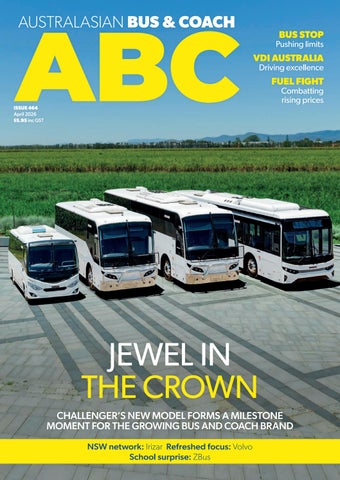
20. cover story | challenger PICKOFTHEBUNCH
Just under a decade since the brand was founded to build quality buses and coaches, Challenger is set to unveil its latest model to the market
24. feature | fuel fight STICKINGFAT
ABC takes you inside the fight to ensure public transport networks received the help needed to provide crucial services in a time of need
26. feature | vdi
DRIVINGCUSTOMERSERVICE EXCELLENCE
VDI Australia has appointed an industry leader to a newly created national role, elevating operator support, quality and training
28. feature | bus stop WORLD-CLASSPRODUCT, AUSTRALIAN HEART
Bus Stop Sales and King Long are challenging assumptions with their latest product range and local support networks
32. feature | irizar BUILDINGWITHTHEBLUES
Irizar’s emergence in the NSW bus and coach market across various segments is allowing the body builder to evolve its product offering 34. feature | volvo FRESHFOCUS
Volvo Bus Australia has appointed a new manager as it looks to elevate its aftersales capabilities and offer the cherry on top for its local customers
36. feature | zbus TOOCOOLFORSCHOOL
ZBus is continuing its resurgence in the Australian market, with its adaptability and quality emerging as a stand-out option
38. feature | hailo CHANGINGTHEGAME
Victoria is the home of a world-first transport accessibility solution that was recently introduced to Ventura’s Melbourne bus network
40. feature | sege CATALYSTFORCHANGE
A year after it was first unveiled in Europe, Sege’s new generation modular seating range is ready to take the local bus industry by storm at this year’s Expo
42. feature | solid circuit BEYONDCOMPLIANCE
Solid Circuit investigates why operators are retrofitting seatbelt reminder systems as ADR expectations rise
44. feature | team super FIVETHINGS
Team Super discusses five tips that people in the wider transport sector should know when it comes to super
46. feature | Newcastle THEPUBLICPUSH
A recent institute report has called for Newcastle’s bus network to be returned to public hands, with BusNSW weighing in on the findings
51. competition | best bus WESTERNWONDER
A 1929 beauty from the Bus Preservation Society of WA’s Heritage collection has taken home the title of Best Bus for April
54. factory facts | bus deliveries MARCHDELIVERIES
Check out the latest bus and coach supplier sales data collected and recorded for you to review and see how the market fared in March
58. back seat | wine bus WINEONWHEELS
There’s a range of beloved wineries in Australia that are supported by famous bus tours. Now, Australia’s capital has received a unique hop-on hop-off service
EXECUTIVE GROUP
CEO: Christine Clancy Chairman: John Murphy
Head of Customer Experience: Regina Fellner
EDITORIAL & DESIGN
Managing Editor: Geoff Crockett
e-mail: geoff.crockett@primecreative.com.au
Editor: Sean Mortell
e-mail: sean.mortell@primecreative.com.au ph: 0468 577 166
Art Director: Daz Woolley
Designer: Apostolos Topatsis
PRINTING
Brougham Press
ADVERTISING
Sales Manager – South:
Courtney Burton ph: 0481 736 890
e -mail: courtney.walker@primecreative.com.au
Business Development Manager – Bus: Sylvie Hanlon ph: 0466 545 664
e-mail: sylvie.hanlon@primecreative.com.au
SUBSCRIPTIONS
www.busnews.com.au/subscribe ph: +61 (0)3 9690 8766
Mon-Fri 8am-4.30pm (EST) e -mail: subscriptions@primecreative.com.au mail: 379 Docklands Drive, Docklands VIC 3008 Australia
Annual subscription rates (12 issues): Australia: $99*
Overseas: $A170 (Australian air-mail only) *price includes GST
Cover image: Challenger
x.com/ABCmag


Just months after celebrating its 50th anniversary, the familyrun passenger transport operator has completed its final run
A long-standing Queensland passenger transport business has been sold to a fellow family operator in the state after more than half a century of service.
McInnes Wilson advised John and Lenore Christensen on the sale of Christensen’s Bus and Coach to Coast and Country Buses.
The Christensens started in the bus industry on August 1, 1975 through the purchase of a single school run from Toogoolawah to Kilcoy.
Since that time, the family has acquired multiple operators to become the sole provider of bus services in the towns of Kilcoy and Woodford, west of Caboolture in Queensland.
After more than 50 years of service, John and Lenore Christensen operated their final runs on March
Below: Christensen’s Bus and Coach has
27 after the operator was sold to the Kuhlewein family’s Coast and Country Buses with 17 buses.
“Having first met John and Lenore
depot, it was an incredible honour and privilege to be engaged on the sale of their business 16 years later,” McInnes Wilson joint head of

The changes included halving the fuel excise and removing the road user charge for three months
The federal government has halved the fuel excise on petrol and diesel for three months while also removing the road user charge in immediate cost relief measures for the transport industry.
Prime Minister Anthony Albanese revealed the measures following an emergency Cabinet meeting to discuss the fuel price issue, halving the excise by approximately 26 cents a litre from April 1.
The changes also see a delay to an increase to the heavy vehicle road user charge by six months.
“We’re announcing the Commonwealth government will halve the fuel excise on petrol and diesel for three months. We’re making fuel cheaper because we understand that Australians are under serious pressure,” Albanese said.

Fuel cost measures are now in place. Image: Dina/ stock.adobe.com

“We also want to encourage Australians who can to take public transport to help save fuel for the areas and industry that need it.
“Obviously, the less fuel we use in the cities, the more we can direct to regional areas that are under pressure.”


Our Low Entrance Coach sets new standards in accessibility and performance. Built on a leading European OEM chassis and paired with the BCI Cruiser body, it features a front wheelchair area and easy-access ramp for seamless boarding. Engineered for Australian conditions, with advanced safety, bold design and superior comfort, it delivers confidence to operators and a smoother journey for every passenger.
BUS & COACH INTERNATIONAL
Contact our team for further information on 1300 289 224 or visit bcibus.com.au
Head Office Perth: 08 9353 9000
Melbourne: 03 8787 2100
Brisbane: 07 3275 6900
Adelaide: 08 8182 3888

after celebrating its 100th anniversary in service.
The family-owned and operated bus company has employed and served generations of people in the Geelong region, and currently
adobe.com
representing the third and fourth generation of the family, announced the news to staff on Thursday March 26 that the business is starting the process of finding a buyer through Pitcher Partners Melbourne.
The news comes after McHarry’s celebrated its 100th anniversary in 2025, marking a major milestone for one of Geelong’s most successful family businesses.
Pitcher Partners’ Michael Sonego says McHarry’s has a strong history of delivering for the community in Geelong and the Bellarine, but the family has decided it’s time to make way for a new owner who could continue to grow the company.
“The family are looking for a new owner who shares their passion for the transport sector and community service,” he says.
“While stepping aside is always a difficult decision, the family believes it is the right moment to find a new owner able to build on their legacy and continue to grow McHarry’s for the future.”
The bus milestone highlights local manufacturing strength and long-term partnerships in Victoria’s bus industry
Volgren has marked a major manufacturing milestone, handing over its 6,000th bus built at its Dandenong, Victoria facility to long-time partner Dysons.
The achievement reflects nearly three decades of collaboration between the two companies, with the date also marking 29 years since Dysons received its first Volgren bus. Nowadays, Dysons operates more than 250 Volgren vehicles across its fleet.
The milestone highlights the role of local manufacturing in supporting Victoria’s bus industry, with the Dandenong site continuing to deliver vehicles for metropolitan and regional operators.
The 6,000th bus represents not just production volume but also the capability and coordination required across manufacturing, assembly,
and delivery teams.

The event brought together representatives from Dysons, BYD, SEMMA and the Bus Industry Confederation, alongside Volgren staff, recognising the partnerships and supply chain that underpin local bus manufacturing.
The Dandenong facility remains a

in Australia, supporting local jobs and maintaining industry capability as fleets evolve.
Volgren says the milestone reflects the collective effort of its workforce and partners, as well as the ongoing demand for locally built buses.


When every litre counts, the Volvo B13R delivers.
The Volvo B13R: When fuel costs are anything but predictable, the Volvo B13R gives operators something they can count on. With real-world fuel savings of over 15% reported by Australian operators, the Volvo B13R is setting a new benchmark for diesel efficiency.
Available from 380 to 500 hp, it's a proven performer on Australian roads - and on your operating costs. More confidence on every route.
Visit volvobuses.com.au for more.


The new state record comes after a variety of cost-of-living measures and new rail station openings headlined 2025
Public transport usage in Western Australia is at a record high, with the latest Transperth patronage numbers smashing records.
In 2025, a record number of passengers used the state’s bus, train and ferry network, with boardings surpassing 150 million for the first time in the state’s history.
This saw 2025 beat the previous record of 148.7 million boardings in 2013, with new month records being set in January, July, September, October, November and December.
This growth occurred despite large sections of the Armadale Line being closed for significant portions of the year and a number of school students not tagging on and off, resulting in an underreporting of the data.
The patronage growth, smashing 2024 boardings by almost five million, comes as METRONET train
Below: Patronage is at a record high in WA. Image: Transperth
services roll out and the state makes commitments to reducing public transport costs.
These include free weekday travel for students, free travel every Sunday for those who tag on and off with a SmartRider or bank card, introduction of new contactless payment options across the network and the introduction of the Go Anywhere Fare in January.
WA transport minister Rita Saffioti says catching public transport is cheaper than ever before since the introduction of the Go Anywhere Fare, with passengers paying no more than $2.80 to travel anywhere on the network using a SmartRider with Autoload or $3.50 using contactless payments.
As part of this commitment, Transwa fares were also permanently reduced by 50 per cent on January 1 this year.
“For the first time in WA’s history, more than 151 million passengers jumped on our trains, buses and ferries in 2025, smashing the previous year’s patronage by almost five million boardings,” she says.
“Our Go Anywhere Fare has made public transport the cheapest it’s been in decades, and our new contactless payment options are making it easier than ever for WA families, students, workers and visitors to move around our suburbs.
“It’s never been easier to catch public transport and it’s another way we’re delivering real cost of living relief to Western Australians.”

The most recent measures to start 2026 are already paying dividends, with patronage increasing by 16 per cent when comparing the first week of March in 2025 with the same week this year.
Busways has invested in a major CCTV upgrade project across its Greater Sydney fleet by enabling live access to onboard CCTV footage.
Through its Operations Control Centre (OCC), Busways can now access real-time footage to improve onboard safety.
Busways’ Operations Control team can now remotely view and respond to incidents through eight upgraded cameras inside and outside each bus across almost 900 buses operating in Western Sydney, Northwest Sydney and the Central Coast.
Previously, CCTV footage could only be accessed by physically retrieving a memory card from the bus. Now, incidents can be reviewed immediately and shared with police to
support investigations and help keep services moving.
This change has already proven valuable, with Busways OCC manager Bhim Raj Singh recalling a recent incident where a driver was unaware a passenger seated directly behind them in a blind spot had been wounded.
“From the live CCTV feed, I could see the situation clearly and instructed the driver to secure the bus and assist the passenger,” Singh says.
“Without live footage, that incident may have escalated.”
“We are always looking for ways to improve safety and support better outcomes for passengers, drivers and the wider community,” he says.
The technology also supports faster responses to major road incidents, with Singh’s team able to review and share relevant CCTV footage immediately in one case when a motorbike collided with a bus in Shalvey.
“The footage showed the rider came out of an alleyway behind a parked truck without stopping,” Singh says.


Busways head of assets Chris Wolf says the project reflects the operator’s focus to use technology to strengthen different aspects of the business.


“As soon as police saw the video, they cleared the road within half an hour. It could have been an all-night diversion otherwise.”


The new fleet of Volvo BZL Electric buses will be ready to begin servicing new Western Sydney bus routes from July

Volvo Bus Australia has announced it has delivered 22 new BZL Electric buses to Transport for NSW in a major boost for the state’s zero-emissions bus network.
Currently, 18 of the electric bus models contracted to TfNSW are on track to begin servicing new bus routes in Western Sydney from July 5 – three months ahead of passenger flights commencing at the new Western Sydney International Airport.
The buses will run as part of five new permanent bus routes that will connect communities across Penrith, Oran Park, Campbelltown, Liverpool, Mount Druitt and Leppington to the new airport.
Part of TfNSW’s New Bus Services for Western Sydney Program, Volvo’s 18 BZL Electric buses were bodied locally by Volvo partner Volgren, reinforcing Volvo’s commitment to Australian manufacturing and a sustainable transport future.
In addition to the 18 luggage rack equipped buses servicing the new routes, Volvo has also supplied four Volgren bodied BZL growth buses that are operating on existing routes.
“We are excited to deliver these electric buses to Transport for NSW. Volvo is the largest automotive employer in Australia, employing over 1,400 people – of which over 400 employees are based in New South Wales, many of those supporting these buses,” Volvo Bus Australia general manager Mitchell Peden says.
“We are ready to support these buses with two state-of-the-art dealerships based in Prestons and Blacktown and our National Parts Warehouse based in Minto. Our team has extensive experience delivering electric buses to government organisations and we hope to showcase our expertise with this order to the NSW government.”
Peden says the Volvo BZL Electric is at the forefront of electric buses in Australia, offering a safe and silent solution for modern urban transit.
Safety remains a cornerstone of Volvo’s philosophy. With the introduction of high-voltage bus systems in Australia, Volvo Bus Australia continues to lead the way in safety innovation. The Volvo BZL Electric is equipped
with advanced safety features, including a comprehensive electric safety architecture that can prevent malfunctions and damage to the traction system.
In addition to vehicle safety, Volvo Bus Australia has been committed to supporting the industry through education and training. Volvo’s partnership with TAFE NSW led to the development of specialised safety courses tailored to the introduction of electric buses in Australia.
Volvo’s purchase is part of the NSW government’s Zero Emission Buses Program, which is targeting around 1,700 electric buses operating across Sydney’s network by 2028.
Peden says Volvo is proud to support the NSW government’s goal of net zero emissions by 2050. With services beginning on July 5, Western Sydney communities will have access to 30-minute frequency services from 5am to 10pm, seven days a week –connecting them to the new airport and other key destinations such as education, employment, health, retail centres and the broader public transport network.
Keolis’ rebrand follows the company becoming sole owner of its local bus and multimodal transport operations

Keolis has begun a new chapter in Australia’s public transport sector after completing the acquisition of Downer’s shares in the Keolis Downer joint venture.
The transaction makes Keolis the sole shareholder of its Australian operations, which will now operate under the Keolis brand.
The move marks a significant milestone for the international operator, which has been active in Australia for more than 15 years and currently employs more than 3,500 staff across five states.
The company operates more than
Above: Keolis has completed the acquisition of Downer. Image: Ricochet64/stock. adobe.com
1,300 buses across several Australian networks, alongside multimodal transport systems, including light rail, ferry and rail services.
Keolis Group International CEO Laurence Broseta says the acquisition strengthens the company’s long-term commitment to the Australian market.
“We are proud to deepen our commitment to Australia, a strategic market for the Group’s international growth,” Broseta says.
“This new structure gives us the agility to pursue new opportunities, form targeted partnerships to accelerate our development and
strengthen our partnerships with public transport authorities.”
The rebrand comes after more than a decade of operations under the Keolis Downer joint venture, which delivered services including the Gold Coast light rail network and integrated transport operations in Newcastle.
Broseta says the new structure will allow the operator to further integrate international expertise with its local operations.
“We look forward to continuing to deliver efficient, sustainable, and passenger-focused mobility solutions.”
Keolis Australia CEO David Franks says the change represents an important milestone for the organisation and its workforce.
“This is a significant moment for our team and the communities we serve,” Franks says.
“We are excited to move forward as Keolis, building on our legacy and embracing new opportunities to grow and innovate.”
Franks says the organisation’s priority remains delivering high-quality services in partnership with transport authorities.
“Our focus remains on delivering exceptional service and working with our partners to shape the future of public transport in Australia.”


The business behind Greyhound Australia and New Zealand’s InterCity has announced its new leader as it enters its latest phase of growth
Transport operator Entrada Travel Group has announced the appointment of a new CEO as the business marks its next chapter.
The group includes bus brands like Greyhound Australia, InterCity in New Zealand and the Auckland Explorer Bus.
Dan Alpe has been appointed as the group’s new CEO, bringing more than 20 years of experience leading tourism and transport businesses across New Zealand and Australia. He co-founded JUCY and later established Travvia following the acquisition of Star RV, serving as Chief Executive Officer, while also leading the business through periods of both
Below: Entrada Travel Group has a new leader. Image: Rafael Ben-Ari/ stock.adobe.com
growth and industry disruption.
Known for his practical, hands-on leadership style, he combines strong commercial discipline with a clear focus on people, customer experience and long-term value creation. He brings a deep understanding
of what drives performance in transport and travel businesses, from day-to-day operations through to strategic execution.

Under the contract, Kinetic will deliver one of New Zealand’s largest zero-emission buses rollouts from day one
Kinetic will deliver one of the largest zero-emission bus deployments in New Zealand after securing all four contract units in Auckland Transport’s Tranche 3 bus services tender.
Valued at NZD $755 million, the contracts represent the operator’s largest award in Auckland and will see a significant expansion of electric bus services across central and eastern parts of the city.
Under the agreement, Kinetic will introduce 165 zero emission buses from the first day of operations for the central units in July 2027. Over the life of the contracts, the company expects to operate a total of 201 electric buses across the network.
The eastern unit will begin services earlier, in December 2026, before the central routes transition to fully electric operations the following year.
The three central contract units will operate for 11 years, while the eastern unit will run for 8.6 years, providing long-term certainty across key
sections of Auckland’s bus network.
Kinetic Group CEO Michael Sewards says the contract represents a major step forward for zero-emission public transport in the city.
“This is a landmark contract for Kinetic and a major step forward for zero-emission public transport in Auckland,” he says.
“We are investing in the fleet, depot infrastructure and people required to support Auckland Transport’s decarbonisation objectives and the city’s continued growth.”
As part of the agreement, Kinetic will invest more than NZD $121 million in new zero-emission buses as well as upgrades to depot infrastructure and charging systems across several Auckland facilities.
The upgrades include installing a second overhead gantry charging system at Kinetic’s City depot, building on the large-scale gantry charging infrastructure already operating at its Glenfield depot.
Entrada Travel Group says the appointment allows the operator to build on its strong foundations and progress its long-term strategic ambitions across its portfolio of travel brands.
“I’m really looking forward to joining Entrada and working with the team. There is a strong foundation in place, and a real opportunity to build on that with clear focus, disciplined execution, and a continued commitment to delivering great customer experiences,” Alpe says.
Chair of Auckland Council’s Transport and Infrastructure Delivery Committee Andy Baker says the announcement is great news for Aucklanders.
“The contract announced today will make a huge difference for Aucklanders who use the 23 frequent routes that will benefit from safe, modern, quiet and comfortable electric buses from next July,” Councillor Baker says.
“Auckland’s bus network has seen some massive improvements over the past few years, with 750,000 Aucklanders now living within easy walking distance of a frequent bus stop or train station.
“The new electric buses and long-term commitment to these bus routes will help encourage even more people to make the most of the frequent and reliable buses on their doorstep which is important at a time when the cost of living and rising fuel prices are on everyone’s mind.”
Contactless public transport expands across England, with tap and go ticketing set to simplify journeys across buses, trains and trams
Contactless public transport is set to reshape how passengers move across England, as the UK government rolls out a new national strategy designed to remove complexity from everyday journeys.
Announced on April 2, 2026, the Better Connected strategy aims to integrate buses, trains and trams into a more unified network, with tap-and-go ticketing at its core.
Rather than navigating multiple ticket types, apps and fare structures, travellers will increasingly be able to use contactless payments across entire journeys, moving seamlessly between modes without needing separate tickets.
UK transport secretary Heidi Alexander says the goal is to make
public transport easier to use and more attractive for everyday travel.
“People want to be able to get off a train and straight on to a bus without having to battle through a confusing system or buy separate tickets for each part of their journey,” she says.
The expansion of tap-and-go ticketing is expected to reduce friction at key interchange points, particularly in urban areas where buses form the backbone of first- and last-mile connections.
The strategy includes more than 40 initiatives, combining fare reform, digital tools and infrastructure upgrades to improve the passenger experience.
Among them is a new partnership with Google to deliver real-time
tracking through Google Maps, helping passengers better understand when their bus will arrive and how it connects with other services.
A £6 million pilot in the Peak District will also test integrated scheduling, with bus services timed to align more closely with train arrivals.
The government has committed £40 million to support local trials of digital ticketing and contactless systems, alongside support for regions adopting tap-and-go models.
Importantly, local authorities will retain control over how these systems are implemented, allowing networks to tailor solutions to regional conditions while aligning with national objectives.


Just under a decade since the brand was founded to build quality buses and coaches, Challenger is set to unveil its latest model to the market. It’s a milestone moment for Challenger’s founder as he sees his dream vehicle become reality
When Greg Sloan first started Challenger in 2017, he had a vision in mind. As an operator in Far North Queensland, his goal was to produce the best quality buses for the Australian market with unparalleled support.
Since making the decision to switch from operating to building buses,
Greg has had one dream model in mind. A three-axle coach. Now, nearly a decade since starting the venture in a bold bid to revolutionise the local bus and coach industry, Greg and his growing team at Challenger Bus & Coach have been able to turn the dream into a reality.
“Our goal has been to introduce more models that are fit-for-purpose
Above: Challenger is continuing to ramp up its technological development
in the local market,” he told ABC
“We want to produce the right sized vehicles that give long service and life expectancy, with a quality look to it. The impending arrival of our three-axle coach is a perfect example of this.”
The three-axle model that will be unveiled to the local bus industry this year is a culmination of years of hard

work for Challenger. While the recent expansions into smaller models and electric low-floor vehicles have been important additions to the fleet, the three-axle coach is the cream of the crop, something off the top shelf. Like all successful models in Australasia’s bus industry, the three-axle model first shifted from an aspiration to reality when customers came calling.
“A couple of our customers contacted me saying they wanted a three-axle vehicle, as there were little options in the market,” Greg says.
“What we’ve tried to produce since is something that carries the trademark Challenger high quality, using stainless steel and components that won’t corrode or swell with water. Our windows will be double glazed, creating a quieter and higher model that can come with a bullbar, a wheelchair lift and a toilet.”
Greg says everything a bus and coach operator could want in a
We want to produce the right sized vehicles that give long service and life expectancy, with a quality look to it. The impending arrival of our three-axle coach is a perfect example of this
three-axle vehicle is present as standard in the latest Challenger model. Staying true to Greg’s original wishes for a bus manufacturer, the three-axle model, which is yet to be officially named, features a wide array of premium componentry that makes this new coach impressive.
The research and development for the new model was done locally, with the Australian family-owned company then building the coaches in its offshore factory. Over the course of three years, Challenger has based the vehicle off a similar American build that is a robust workhorse. With popular components fitted into this special design, Challenger has
Below:
The supplier’s fleet is getting bigger and better
created a three-axle beast ready to tackle the unique climate and conditions of Australia.
“We’re keeping servicing costs to a minimum by using componentry that is readily available in Australia,” Greg explains.
“We supply all the parts for the model – we started with the Cummins X12 engine, rated between 400 and 600hp, while we have plans to eventually move to the X10 engine when it’s released in Australia.
“The X12 was chosen as the engine due to the fuel economy it provides. With an automatic ZF transmission, the pair works


together alongside a DANA driveline to create a pristine driving experience.”
Throw in Thermo King air-conditioning, double glazed windows, a wheelchair lift, a toilet, a bullbar and a stone guard, and this is one formidable coach. Greg says the addition of all of these extras as standard is an important display of support for local operators, ensuring there’s no further costs to put a coach on the road that can handle a multitude of conditions.
“We have gotten the three-axle coach built completely integrated with these features, offering a point of difference in the market,” he says.
“The whole point of the vehicle is for it to be very robust, strong and durable. At 25 years old, the body should be in a great condition despite the usual wear and tear – it should be as good as the day it came out of the factory.”
steel, Greg says the quality of the vehicle means it shouldn’t rust if left unpainted. When it is released this year, Greg says operators can expect a strong and durable model designed for a variety of long-distance applications.
“The body is currently in build and being painted, then it’ll be fitted with the running gear,” Greg says.
“This is backed by personable support – people buy a vehicle from us, and we always go and check for things we can maintain and improve for them over the lifespan of the bus. It provides relief for customers so they know the vehicles will always be supported.”
On the other side of the scale, Paul Fagg has only become involved with the project in its latter stages. Upon starting as general manager at Challenger just under a year ago, he
quickly learnt the three-axle coach formed the pinnacle of Greg’s ideas for what Challenger should look like as a local vehicle supplier.
“When Greg started Challenger, his focus wasn’t on taking the world by storm, it was about building a good bus – hence the focus on a stainless steel chassis and reinforced fibreglass,” Paul told ABC
“He wanted the buses to be remembered as reliable and long-term options for operators. Now, he’s reached the pinnacle of his idea, which is the big bus, the three-axle coach.”
Our goal has been to introduce more models that are fit-for-purpose in the local market
This is backed by personable support – people buy a vehicle from us, and we always go and check for things we can maintain and improve for them over the lifespan of the bus. It provides relief for customers so they know the vehicles will always be supported
It’s taken time and effort to get to this point. Challenger started with its V10 and V12 models, before moving on to the smaller Callibar option for a different application. Then came the foray into new vehicle technology through its low-floor electric bus. The brand has veered again with its new model, transitioning from smaller and lighter models to a larger, more heavy-duty option for long distance and tour operators.
“The three-axle coach was in the works well before I started at Challenger – I remember going to the factory with Greg in my first couple of months at the business and we decided it was finally time to get the three-axle model into production,” Paul recalls.
“It started from the ground up. We had to define the application, horsepower ratings and configurations – it’s definitely more than just a standard V12 with an extra axle. It’s taken the majority of the past year meeting with our suppliers to formulate the model and get it built and delivered.”
Paul says the coach is designed to work on both interstate and local runs, with the focus on fuel economy benefitting both applications. In recent months, production has picked up, leaving the Challenger team incredibly excited about what’s set to arrive.
“It’s now down to the final touches and aesthetics of the vehicle – our seating and interior has been enhanced to suit longer trips behind the wheel compared to our previous models,” Paul says.
“This all sets it apart, making it the pinnacle of our offerings, the flagship of our fleet.”
Other additions to the latest Challenger model include a new dashboard, updated seating and lighting for passengers and a new-look trim colour. Once outside the vehicle, the aluminium luggage bin doors are pantographed and will swing upwards instead of straight
out with larger luggage storage underneath for tour passengers, enhancing both operator convenience and overall vehicle aesthetics.
“The idea is more space, more height, more comfort for drivers and passengers,” Paul says.
“It gives operators completing interstate transfers more ease in getting in and out of the bus.”
Paul, much like Greg, can’t wait to check out the coach once it’s finally delivered and ready to go.
The latest Challenger model will be on display in mid to late 2026, but most importantly, it’ll be a milestone moment for the Challenger team. In
just under a decade, Greg’s dream has been realised. He now has his prized vehicle from the top shelf that he can sit back and enjoy.
“It’s been rapid growth over the past eight or so years since we delivered our very first models,” Greg says.
“It’s been wonderful to see our first models delivered nearly 10 years ago have no rust and still look as good as the day they were delivered. It’s testament to the Challenger brand and the quality we’ve built over the years.
“Now, as we get busier and receive more interest, we get to enjoy this latest model as a standout option in our fleet.”


As rising fuel prices and supply queries gripped the nation, the bus industry worked hard behind the scenes to secure priority access to diesel. ABC takes you inside the fight to ensure public transport networks received the help needed to provide crucial services in a time of need
Without trucks, Australia stops.
It’s a well-known sentiment throughout the country, but what happens when buses and coaches grind to a halt? Does the world turn upside down? Do people become aimless, lost, hopeless? In recent years, the bus and coach sector has proven to be a pivotal part of Australia’s fabric. When COVID lockdowns were first decided upon, public transport options like buses became vital ways of connecting isolated communities in times of distress. Essential workers could still
get to their jobs, people to nearby family in need.
Amid the current fuel price issues that have torn across Australia in the early months of 2026, bus and coach has once again shone as an important choice for many. As patronage soars across the country, Bus Industry Confederation (BIC) executive director Varenya Mohan-Ram hopes governments are realising the power bus has in times of need.
“During COVID, the government needed the bus industry to both keep us moving and keep morale high around the nation,” he told ABC “We are now telling them not to
Above: The bus industry is fighting to be prioritised amid the fuel issue.
Image: 孤飞的鹤/ stock.adobe.com
forget us at a time that’s extremely trying for our organisations and industries. Our message is to not forget that the passenger transport sector, and the service we offer, is critical to this nation.”
Public transport has become more and more popular in recent weeks, especially when Prime Minister Anthony Albanese’s national address on April 1 urged Australians to take bus, train, tram and ferry trips in order to preserve fuel and diesel supplies. However, Varenya argues that if the public transport sector is to be leaned on again so heavily, it needs priority access to diesel supply.

“It’s well established that our industry is a critical party, so we have fought to be part of roundtable discussions taking place on fuel supplies and prices across the country,” Varenya says.
As the figurehead association for the bus and coach industry in Australia, BIC’s primary focus amid the fuel price rises has been to guarantee priority access to diesel supplies for the nation’s operators. Whether it be large urban transport companies or smaller charter and school bus businesses in regional spots, BIC has been consistently calling on the federal government to follow previous legislation and keep bus at the top of mind.
Varenya and his team have been pointing to the Liquid Fuel Emergency Act 1984, which listed public transport as an essential service that should receive priority access to fuel if there’s a national fuel emergency. He says it’s now time for the federal government to ensure public transport receives enough diesel to maintain services.
“By following the Act, we’ve argued that we need to be at the table to ensure our members, bus operators, are represented,” he says.
“Diesel needs to be prioritised for our industry so we can maintain our timetables and continue moving Australians arounds. If we aren’t prioritised, timetables may be changed when demand is high, resulting in some upset Australians who can’t move around freely.”
This call became more important when Australian states and territories began incentivising public transport travel to ease the burden on fuel supplies. In late March, the Victorian government made public transport free for the entirety of April, while the Tasmanian government introduced free fares for three months until July 1. A week later, the ACT government followed suit, halving public transport monthly fare caps from April 8 until June 30 to encourage more people to ditch cars and take buses and coaches.
While Varenya welcomed these measures that have already seen public transport patronage spike,
he says this increased demand must be kept in mind when allocating diesel supplies.
“We welcome these cost-of-living measures, but we must ensure the industry is part of future fuel framework and discussions,” he says.
“We need to know what is happening so we can know what services we should put on and where to deploy buses – we want to be part of the solution.
“There are many towns where the only form of public transport is buses, taking kids to schools, the elderly to appointments and so on. We’re important and we deserve to be prioritised.”
The industry has been part of wider benefits introduced by the federal government in early April to combat the fuel price rises. Prime Minister Anthony Albanese, prior to his April 1 address, announced the temporary halving of the fuel excise for three months while also removing the road user charge for the same period.
While this has provided some relief for operators, BIC has also been looking into diesel standards across the country to ensure the industry maintains its quality benchmarks.
The government has temporarily amended diesel quality standards to allow a lower minimum flash point level to support greater access to international supply options and facilitate higher levels of domestic diesel production. Under this measure, diesel with a flash point of 60.5 degrees Celsius may be supplied to the local market until September 30 this year, representing a temporary reduction from the current 61.5 degrees Celsius limit.
While this measure doesn’t change how diesel is classified under the Australian Dangerous Goods Code, and there are no changes to the existing safety requirements for transport with no adverse vehicle operability or environment impacts, Varenya says this has an impact on emissions across the country’s bus fleets.
“We’re focusing on reducing emissions, but if you change the sulphur content of diesel then you may risk damaging the emissions
We welcome these cost-of-living measures, but we must ensure the industry is part of future fuel framework and discussions
programs in these systems,” he says.
“We recognise this is currently a global issue and the government has significant priorities to balance, but it shouldn’t take away from the hard work and consultation we’ve been through to reduce emissions.’
For the rest of the industry, Varenya’s message is simple – stay calm and be part of the solution. He says panicking will take away opportunities for the bus industry to find fixes that stop the fuel pain.
“With this being a global problem, it’s important to be part of the solution,” he says.
“This means not panicking and being strategic in decision-making while communicating clearly. You can talk to local members and state politicians, as feeding up the chain is important, but communicating to staff is equally as important to let them know what plans you have in place.”
He says it’s also an ideal time to call for more drivers to join the industry and make a positive contribution to the lives of everyday Australians.
As the adage goes, sometimes the most challenging moments are the best opportunities to grow. Varenya is hoping the industry can find the positives in a tough time for many.
“While our networks are under the pump, Aussies have the opportunity to become a driver and add value to our industry,” he says.
“We all know how rewarding this industry is – let’s make it known to everyday Australians and show how bus transport is at the heart of keeping the nation moving.
“We’ll keep urging the government to not construct policy in isolation. We’re a great and resilient sector that have a track record of sticking together. We’re ready to work with everyone and find the best solutions.”

SVDI Australia has appointed an industry leader to a newly created national role, elevating operator support, quality and training as the brand scales nationally
“Mike’s appointment signals our commitment to building long-term relationships grounded in capability, trust and real operational support.”
Blundell’s appointment is a direct response to that responsibility. He brings almost 20 years of experience in the heavy vehicle sector, including 13 years specifically in the Australian bus industry, across technical service, aftersales operations and customer competency development. It’s a background that maps directly to the demands of the role.
The new position works across three interconnected areas: quality assurance in service delivery; customer support coordination through VDI’s national network; and operator training, with a particular focus on the technical competencies required to safely operate and maintain modern bus fleets.
national distributor for Yutong buses in 2018, Vehicle Dealers International (VDI Australia) has grown from a family-owned Far North Queensland operator into a nationally operating business with more than 2,000 Yutong deliveries across every state and territory. That growth has been built on relationships — and it has brought with it a responsibility to support operators not just at the point of sale, but throughout the full life of their fleet.
The brand has now announced an appointment in a newly created role that brings together quality assurance, customer support coordination and operator training under a single national remit.
Blundell as its national quality, customer support and training manager. The appointment reflects how VDI sees its next phase: building a post-sale experience that earns the confidence of operators who hold every supplier, regardless of industry, to the standard of the best service relationships in their business.
“As the business grows nationally, our responsibility to operators extends well beyond delivery,” VDI managing director Peter Woodward told ABC
“This role is about being deliberate and accountable in how we support fleets over their full life — through consistent service quality, practical training and a customer experience that reflects the standards operators expect from their best partners.
Importantly, the role works alongside – not in place of – VDI’s existing technical, aftersales and parts functions. Those departments remain distinct. Blundell’s remit is to coordinate and elevate the quality of the customer experience across them, creating clearer accountability and consistency for operators at every touchpoint after delivery.
“VDI is working with partners to deliver competency training for our service staff and to collaborate and assist our customers’ technical and operations teams to reach the highest standards in the industry with this new technology,” VDI Australia chief operations officer John Soars told ABC
“As we blaze a path forward, we will share our learnings and experience with our partners. This new appointment will speed up that process and create the
learning culture that allows us to excel in our operational and critical safety deliverables – for VDI and our partners.”
Central to the new structure is a customer service coordinator team already operating across the eastern seaboard, providing operators with a consistent, named point of contact for service bookings, parts queries and technical concerns. Under Blundell’s oversight, the intent is clear: when an operator reaches out, they should speak with someone who has both the knowledge and the authority to help. The measure is not industry convention – it’s the responsiveness operators have come to expect from the best partners across their entire business.
“The foundation was already there – a dedicated coordinator team doing strong work across the eastern seaboard,” Blundell told ABC
“The focus now is giving that team the tools and authority to resolve, not just refer. When an operator contacts us with a concern, they should leave that conversation with a clear answer and a next step.”
The philosophy behind the role runs consistently through every part of it – the relationship with an operator does not end at delivery, and VDI’s obligation is to be genuinely useful at every point after it.
“The relationship that determines whether an operator comes back isn’t built at delivery – it’s built in every interaction that follows,” Blundell says.
“Our goal is to be the partner operators rely on throughout the life of their fleet. That means delivering not just the vehicle, but the expertise and support that helps them succeed. When they succeed, we succeed.”
The training dimension of Blundell’s role carries particular weight as operators navigate the shift to electric and zero-emission fleets. Working with high-voltage systems, such as those in Yutong’s E12 and D7E models, requires a fundamentally different standard of training and credentialling than traditional diesel maintenance.
VDI is addressing that shift through a deliberate investment in nationally accredited training, moving beyond internal manufacturer programs to deliver recognised qualifications through partnerships with registered training organisations. The first course is already complete, a second is scheduled within weeks and a dedicated Cert IV trainer is expected to be embedded within six months.
“The credential matters beyond the training room. For a technician working on high-voltage systems, a nationally recognised qualification carries real professional accountability – it is verifiable, portable and it sets a standard that protects both the individual and the operator’s business,” Blundell says.
The investment extends to VDI’s own service and technical staff, who are being upskilled alongside
Below: VDI Australia has focused further on customer support with its latest appointment

customer teams, ensuring the entire support chain is ready as the fleet mix shifts.
“Our own team carries the same obligation. As we move deeper into new technology vehicles, our service and technical staff need to be fully across high-voltage safety and EV systems – not just our customers’ technicians. We’re upskilling in parallel, so when an operator’s workshop is being trained, we’re learning alongside them,” Blundell says.
Blundell’s impact is already measurable. Within his first six weeks, VDI has introduced structured monthly reporting on product campaign execution, ensuring improvement programs reach every affected vehicle in the fleet. A new automated service scheduling tool is also being rolled out, giving operators clear visibility of their maintenance requirements from the moment of delivery.
“Six weeks in and we already have structured reporting on campaign execution in place. These programs exist to keep fleets performing at their best – and if we are not tracking whether they are being completed, we are not delivering on our commitment to operators. That level of accountability should be a baseline, not a milestone,” Blundell says.
Australia’s bus industry is navigating a significant shift – electrification, evolving procurement frameworks and a fast-changing skills landscape are redefining what it means to operate a competitive fleet.
At the same time, operators arrive at every service relationship with expectations shaped by the full breadth of their professional experience. The responsiveness, accountability and consistency they have come to expect from the best partners across their business does not pause when they engage a fleet supplier. VDI’s investment in this role is a direct response to that reality.
Mike Blundell’s appointment brings the structure, experience and intent together. For operators planning their next fleet decision, it is a clear signal of the kind of partner VDI is building itself to be.

For years, common thought prevailed that the best quality international bus product emerged from Europe. Now, Bus Stop Sales and King Long are challenging these assumptions with their latest product range and local support networks
After years of getting the product right, King Long and Bus Stop Sales are making their move
Not a trial, not a demo, but the real thing. SkyBus Melbourne Airport has a fleet of King Long electric buses running around the clock, seven days a week. Recently the latest EVolution deliveries went straight into revenue service on one of the most punishing
routes in the country and they haven’t yet missed a beat.
“King Long has been in Australia close to 20 years, and globally it’s sold buses in more than 100 countries,” Bus Stop Sales managing director Pete White told ABC
“In the company’s history, the diesel range came first – school buses and charter coaches earning confidence route by route.
“While the industry raced to get electric models to market, Bus Stop Sales went about it differently, quietly building its aftersales and workshop capability. Then, the electric range came when the support was ready, not before.”
Bus Stop Sales is a well-known Australian family business, with 50 years spent in Australian bus sales. Add in one of the largest dedicated

Come and have a look for yourself. Walk the facility, drive the bus and talk to the blokes in the workshop. A factory tour on the other side of the world makes for a nice trip, but knowing who picks up the phone at six o’clock on a Friday night is what actually counts
bus facilities in the country, 50 employees and a new support depot in New South Wales, situated in Auburn, and this presence commands power when it comes to supplying bus tenders.
“We walked away from the Canberra tender because local support was not ready,” White says.
“Most distributors would have bid anyway, but Bus Stop would rather miss out than let someone down.”
White isn’t new to the Chinese bus market. Previously he was the country’s largest dealer for another major Chinese OEM and launched their electric buses into some of Australia’s biggest fleets. King Long’s previous distributor approached him three times before he said yes – what got him over the line was a promise to build an Australian-designed bus to the highest spec without cutting corners and to support it through its whole life. It aligns with the way the Whites have done it for 50 years.
The Bus Stop Sales team tells the rest of the story. Head of operations Paul Cartwright came out of lean manufacturing and truck assembly at a major global OEM, while the workshop crew include people from MAN Trucks and Mercedes-Benz. None of them came to Bus Stop Sales for a quiet and peaceful gig.
“Every King Long sold here is built to Bus Stop Sales’ spec – not pulled off a global line,” White says.
“Australian roads, Australian heat, Australian operators. Look underneath and you find ZF axles and transmissions, Cummins engines, WABCO braking, ISRI seats and BOCK compressors.
“Then there’s Spheros or Thermo King air conditioning, a digital VDO or Actia dash where others still run analogue gauges. None of it is proprietary and all is available off the shelf through normal Australian supply chains. That’s the difference between a bus that is cheap to buy and a bus that is cheap to own.
“On the road you feel it – full independent ZF front suspension where others run fixed I-beam axles with Chinese componentry. It’s cheaper to build, but the driver and passengers wear it every shift.”
White says the Cummins X11 engine wasn’t a box-tick either. With plants building Cummins engines at various levels all over the world, King Long completed a Euro 6 analysis. This landed on the X11 due to it being the best quality engine that Cummins make, even at a higher cost.
The end result is a 400hp engine – nearly 18 per cent more than the 338 that power many other buses. It’s a bigger engine with lower RPM, less fuel, less noise and less strain, all running through a ZF transmission that White says is “as smooth as anything on the road”.
“People assume the best engineering comes out of Europe, but try pricing a mid-life engine replacement on one of those platforms,” White says.
The EVolution Midi fills another gap, with the nine-metre low-floor electric bus being ideal for routes too tight for a 12-metre option. White says the MU12E turned heads at Busworld Europe last year as a new battery platform with record range.
“European operators traditionally locked in to European manufacturers have since placed volume orders including articulated models now on the line,” he says.
“Buyers who grew up on European product are choosing King Long for the same componentry at a price nobody else can match.”
White is tight-lipped when asked about articulated zero-emissions buses for Australia, but he’s unable to hide the grin.
Outside of this high quality product range, Bus Stop Sales has also expanded its partnership network around Australia’s bus manufacturing scene. Since 2022, Volgren and King Long have been building bodies nationally, while Bus Stop Sales has

Bus Stop Sales work on the ground alongside Express to train local staff and put more manufacturing jobs into nearby regional towns.
Then there’s across the ditch, where New Zealand’s Global Bus Ventures has built bodies for King Long electric models. Outside of these partners, King Long is ready for local assembly in Australia – White says the platform is designed for it and Bus Stop Sales has the facility and workforce, making it a lucrative option for government procurement orders.
“There are plenty of electric bus brochures doing the rounds, but King Long stands out as it has tested all of its claims,” White says.
“SkyBus runs EVolution electric buses around the clock at Melbourne Airport, while 58 zero-emissions buses on King Long chassis have rolled into Victoria’s Preston depot recently. There’s King Long electric models in Perth, and some on trial in Noosa. It’s all about different states,
White also points to another metric of success – repeat orders. There’s 14 on contract with one Queensland operator, and more than 70 with another. In Victoria, an operator recently took a 20th into its fleet. While no bus operation is without its challenges, White says Bus Stop Sales is quietly working through the small ones and aiming to deliver excellent aftersales without fanfare to get the job done.
“None of this works without good people. Bus Stop has taken on apprentices across automotive, diesel and auto electrical – mid-career workers and Indigenous Australians coming into the trade,” he says.
“EV training runs out of head office, Auburn handles NSW and the interstate push is underway.”
For decades, the local bus and coach market had its assumptions about products coming from various regions of the world. White says King Long is a key reason why that
Every King Long sold here is built to Bus Stop Sales’ spec – not pulled off a global line
spec’d locally and looked after by people who have done so for years at the highest level, Bus Stop Sales isn’t a compromise nor a cheap option. Instead, White is evolving the brand to become the yardstick for the rest of the market to be measured against.
“World-class componentry, built to our spec, backed by people who answer the phone. That is what we promised and that is what we deliver,” White says.
“Come and have a look for yourself. Walk the facility, drive the bus and talk to the blokes in the workshop. A factory tour on the other side of the world makes for a nice trip, but knowing who picks up


In recent years, Irizar’s emergence in the NSW bus and coach market across various segments is allowing the body builder to evolve its product offering for Australian operators
Change isn’t a consistent, linear phenomena.
Sometimes it grinds slowly, small tweaks each day amassing over time to eventually lead to evolution, while on other occasions it’s a fast moving hurricane that rustles through everything and shakes it into a new normal rapidly.
For the majority of its first few years, Irizar’s operations in New South Wales as part of Panel 4 grew steadily. By the end of 2025, change hit all of a sudden, allowing the body builder to quickly grow its operations in not just the state, but the wider country.
“Our recent growth in NSW has been good with increasing deliveries of vehicles under Panel 4,” Irizar Asia Pacific managing director Steve Heanes told ABC
“NSW was always a relatively small market for us on panels, but now
our consistent knocking on the door as allowed us to quickly evolve in the state.”
Instead of taking the Irizar Asia Pacific leader’s word for it, the numbers speak for themselves. When Panel 4 orders first started trickling in during 2023, Irizar sold and delivered 17 buses to NSW that year, before backing it up with a further 28 vehicles in 2024. This progression jumped in 2025, with Irizar delivering 45 buses in the state for the year.
While Panel 4 is a major reason for this growth, Heanes says a combination of private deals, as well as TrainLink contracts, has allowed the Irizar brand to expand in NSW.
“Outside of our good momentum with Panel 4 deliveries, our TrainLink vehicle progression has complemented sales nicely,” he says.
“Whether it’s been hybrid or diesel
buses, it’s been a good result to give us a growing cross-section of customers across the state.”
When Irizar first got itself on the latest NSW bus and coach suppliers panel, the body brand was competing against local manufacturers and other long-term businesses in the state. Heanes says Irizar’s consistent presence in the market and regular attendance at BusNSW’s Regionals, as well as its expanding product range, has allowed the supplier to deliver more and more across various parts of the NSW bus industry.
We supply a good, strong vehicle that is both aesthetically and internally high quality
“People are seeing what we’re doing in the charter and coach sector with our vehicles and it’s translating into sales growth,” Heanes says.
“We supply a good, strong vehicle that is both aesthetically and internally high quality, while our multifunctional buses and coaches provide NSW transport providers with flexibility in their operations.
“By being on Panel 4, we’ve been able to display our customer service to meet expectations, whether it be for regional or metro customers. People take comfort in that support, even though our vehicles have been reliable over time.”
Upon handing over a growing number of buses and coaches in NSW, Irizar has been gaining feedback from customers on their product. Heanes says these responses have been “very good and positive” to date when it comes to vehicle quality and durability. A major reason behind this strong feedback has been the flexibility built into the Irizar fleet.
While the requirements of Panel 4 mean buses and coaches tend to be similar across the board, Irizar has built in more flexibility to meet particular requirements for certain applications or locations.
“No one customer is the same, so Irizar’s bodies allow customers to adapt the vehicle for different needs,” Heanes says.
“However, at its core our fleet is uniform, which is important for our larger customers who complete lots of driver training and can’t afford to have features in different positions in different buses.
“Within the Irizar platform, buses can be customised – specifications will align with the Panel, but the actual layout and customisations can be added to meet customer wishes.”
When it comes to the TrainLink deliveries made in recent times, Irizar has supplied to two major customers in CDC NSW and Dysons. The former has been buying Irizar hybrid electric models, requiring the supplier to be creative when it comes to the design and layout of the vehicle.
Heanes says the hybrid vehicle has also been working in Australian mines
for more than a year and have been “incredibly successful” to date. With no issues emerging, Heanes says the ability to use geofencing and switch to full electric mode in certain regions is offering lots of benefits for both metro and regional operators.
“The hybrid model isn’t an easy bus to deliver from a TrainLink perspective, but it’s been worthwhile and offers good results for customers,” Heanes says.
“We’ve been going from a diesel bus with plenty of space to a hybrid model with batteries that requires us to optimise luggage capacity. We’ll continue working with CDC NSW to ensure our models meet all requirements in the future.”
While CDC NSW is using Irizar’s unique product to evolve in the hybrid and emissions reduction space, Dysons has been using Irizar’s diesel products on the TrainLink side, showcasing Irizar’s flexibility across the board. This expertise comes at an important time for Irizar, with the supplier preparing to unveil two new products at this year’s BusNSW Bus & Coach Expo.
While Heanes remains tight-lipped on what these new releases will be, he says it’ll mark the next step in Irizar’s product evolution as it goes from strength to strength in NSW.
to come, showcasing the latest technology in bus bodies, design and weights,” he says.
“Some of this technology has been seen in Europe and various other countries and has seen a fuel reduction of up to 12 per cent. We’ve done a lot of work and we’re looking forward to how it’ll help local operators.”
This mix of current growth and future potential is keeping Heanes and his local Irizar team busy as the brand continues evolving in Australia. Upon reflecting on the expansion in NSW, Heanes says it’s come at a vital time as Irizar continues to tackle industry challenges and grow in various industry segments.
“It’s offset challenges seen in Victoria over the past year – it’s made us become very keen on TrainLink orders and our hybrid technology,” Heanes says.
“I don’t believe full electric is the ultimate solution for emissions reduction in Australia’s bus and coach industry – I think it has to be done with a mix of fuels, including diesel vehicles.
“Our hybrid has been very successful in mining and TrainLink operations to date, with no complaints coming through at all, so

Volvo Bus Australia has appointed a new manager as it looks to elevate its aftersales capabilities and offer the cherry on top for its local customers
What’s the point of an ad break without the TV show? The studying without the degree? In the bus and coach industry, it’s well known that the relationship between an operator and an OEM doesn’t end at delivery.
In an increasingly complex operating environment that’s shaped by tightening emissions standards, fleet electrification and growing customer expectations, a sophisticated relationship between a bus company and a manufacturer includes much more than just the product. This is where aftersales care is a major point of focus for suppliers across the country – offering the extra service to make the entire bus procurement experience worthwhile and long-lasting. Volvo Bus Australia is one supplier responding to this reality through the appointment of its latest national quality, technical and competence manager.
Joshua Smith isn’t new to the Volvo world. With nearly two decades inside Volvo Group for both Australia and Europe, he has held roles across the full spectrum of technical and customer support, from workshop supervisor to key account services manager and regional technical manager. That breadth of experience is deliberate, as the latest Volvo Bus Australia national quality, technical and competence manager looks to bring a renewed focus and a customer-first mandate to the existing role.

regional service managers to do the same, is imperative for us to support our customers in the best way.”
“It’s important we evolve our thinking as the industry and our customers change the way their businesses operate – particularly with the shift to electric,” Volvo Bus Australia general manager Mitch Peden told ABC
“Having Josh lead with a fresh, customer-focused perspective, and to continue to push our dedicated
In a market where operators are navigating the arduous path to transitioning towards zero-emission fleets, the person responsible for national aftersales needs to understand both the technical complexity and the commercial pressure operators are under. Years ago, product quality was the sole and gold standard of a supplier in the market – nowadays it’s the minimum requirement, and the real differentiator is what surrounds it.
While Peden says Volvo’s buses
continue to speak for themselves with their array of safety architecture, fuel efficiency and reliability under demanding cycles, the operators of today who keep the buses on the road every single day need more than just good hardware. They also need a support partner who is proactive, responsive and invested in their uptime. This is where Smith comes in, setting the standard for aftersales care at the largest chassis supplier in the local market.
Smith’s role as national quality, technical and competence manager sees him lead a team of five dedicated regional service managers across
Australia’s eastern states who are each embedded in their market and responsible for the day-to-day dealer relationships that keep the network running. Acting like the cherry on top of the Volvo Bus cake, the regional service managers ensure dealers have access to the latest technical information and product updates, forming a critical function as Volvo’s electric bus platforms introduce new service requirements across the network.
An extra member of the Volvo Bus Australia aftersales team is industry stalwart David Woodward, the popular and dedicated competence development manager who is responsible for training delivery across Australia.
This training function is proving central to Volvo Bus Australia’s aftersales proposition, with the training being run without any additional cost for customers. As fleets transition to electric buses, operators and their teams are having
to navigate new technology, new maintenance rhythms and new safety protocols. By having a dedicated resource solely focused on capability uplift, bus and coach customers across the country become better equipped to get the most from their investment, reduce reliance on reactive support and build genuine operational confidence at every level of the business.
Peden says Smith’s appointment isn’t a run of the mill announcement. The symbolism of his role is clear – Volvo Bus Australia recognises that the aftersales function must evolve in step with the Australian bus industry. As the brand’s BZR and BZL electric bus platforms continue to roll out across the country, the infrastructure of support behind them, be it the people, processes or training, need to be just as advanced as the vehicles themselves.
The appointment of Smith is
Having Josh lead with a fresh, customerfocused perspective, and to continue to push our dedicated regional service managers to do the same, is imperative for us to support our customers in the best way
a signal that Volvo is taking that obligation seriously. While good product will always be the foundation of OEMs in the local bus industry, Volvo Bus Australia’s appointment is a symbolic starting of the TV show after the ad break. The well-deserved degree. Through service, partnership and expertise, Volvo is using its experience where the modern bus supplier relationship is won.


ZBus is continuing its resurgence in the Australian market, with its adaptability and quality emerging as a stand-out option for a well-known Brisbane secondary school
Is there a more versatile vehicle than a school bus? It starts the day at the crack of dawn, heading out on the morning runs to ferry students from their homes to the grounds. By mid-morning it is whisking more kids to sports games and excursions, before returning them by the early afternoon. Then it’s time to carry everyone home, often returning back to the school or depot after dark, having traversed gravel and asphalt, highways and local roads. It takes a versatile vehicle to fulfil these demanding duties day in, day out. When Todd Dening, logistics manager at boys’ school Brisbane St Joseph’s Nudgee College, situated
in the northern surrounds of the city, looked at options for updating the fleet, a new option soon stood out as the best value choice for the unique burdens of being a school bus.
“We have an ageing fleet at Nudgee College and we recently looked at upgrading it,” Dening told ABC
“We’ve known for some time that we had buses due for replacement. Previously we stuck with one supplier for our buses, but this time around we took a different approach and reviewed four supplier offerings before deciding to go with Zhongtong buses from ZBus.”
The recent decision means two new Zhongtong buses have been
Above: St Joseph’s Nudgee College has chosen to go with ZBus
delivered to the day and boarding school to rejuvenate its fleet.
Dening says the pair of buses will be completing “the whole gamut” of services, encompassing the morning and afternoon school runs and excursions throughout the week.
On the weekend, the buses will also transport boarder students and take more to and from sports games.
Throw in a run at the end of each term down to Moree on the northern border of New South Wales and Nudgee College had a complex set of requirements for its new buses. ZBus quickly stood out as the leading option among school bus suppliers.
“We put the figures down on paper

and assessed different features –whether it be pricing, servicing or the total ownership package – and ZBus came out with the best bang for buck,” he says.
“We then test drove the bus and felt it drove exceptionally well. It was the best bus that we took for a test drive, and we were very impressed by the array of modern features that were built in as standard.”
For Dening, a standout part of the Zhongtong school bus model was the choice of seating. He says the combination of moulded plastic and a robust handle on the seat’s backrest made for an ideal option for both seated and standing students.
When it comes to other features built into the Zhongtong product, Dening likened them to driving a car.
“There’s rain-sensing wipers, automatic wipers and an eight-camera onboard system as standard that includes a 360-degree camera for when the bus is reversing,” he says.
“The cameras also show a bird’s eye view of the bus, which is very handy as a lot of accidents come when reversing at low speeds. Then there are bin door alarm systems as standards – we usually have to add these after purchase, but it’s so convenient and valuable that it all comes as standard.”
The delivery of the school buses is another milestone for ZBus as the supplier continues to build
momentum in Australia. Late last year the brand returned to the Australian bus market, reigniting sales after originally entering the local sector in the mid-2000s as the first Chinese bus manufacturer to bring a fully imported and ready to use bus down under.
The Zhongtong badge is now present once again in Australia through a combination of two diesel and two hybrid bus models.
“The H12 diesel model can range from 35 to 57 seats and comes with a variety of luxury options available as add-ons like toilets,” ZBus national corporate sales manager Glenn Davidson told ABC.
“We then have the L7 – a 22 to 27 seat including driver model, while the L8 is our smaller hybrid model at 8.5 metres long and offers the same benefits as the H12, just in a shorter configuration.”
The brand has a national presence around the country, with Davidson and national sales manager Barry Henderson leading the tight-knit local team. Davidson says the Zhongtong products are off to a hot start in Australia due to a variety of factors – they’re at a good price point, lots of standard options are built into the models and the pair have experience working with operators around the country.
“Our models in Australia all come with fully independent front ZF suspension and Cummins
Below:
running gear, providing a uniform standard,” he says.
“These buses are well attuned to Australian conditions. We’ve had a lot of interest to date, we’re the only Chinese manufacturer currently bringing a full plug-in hybrid option to Australia.”
Despite having standard options, flexibility is still a key part of ZBus’ approach to supplying Zhongtong buses. Whether it be the number of seats or the colour of paint, ZBus can remain versatile in what it produces from its Chinese factory.
These qualities shone through with Dening and Nudgee College, as did ZBus’ aftersales care. When there was a minor issue with the specialised stickers on the buses, ZBus quickly made the fix locally to ensure the school received the buses promptly. It has allowed the college to waste no time in getting its drivers trained on the buses so that they can begin their wide-ranging array of services in no time.
“While the product itself stood out for us, the customer support has also been outstanding,” Dening says.
“Despite the delivery being on time, they still provided us a bus in the meantime so we won’t left with any inconveniences. The service so far has been good, and I’m confident we’ll have a wonderful experience with these two buses over the coming years.”


It’s been eight years ago since Hailo was started. Now, Victoria is the home of a world-first transport accessibility solution that was recently introduced to Ventura’s Melbourne bus network
Santiago Velasquez was nervous. The student was at his local bus stop, anxiously awaiting the next service to take him to a university exam. As a blind man, Santiago arrived at the stop early with his high-vis vest on and guide dog beside him, while his route number was raised. Through circumstances outside of the drivers’ fault, three buses drove past him and Santiago was left behind at a crucial moment in his young life.
“When using public transport, it’s difficult to know when my bus is coming so I can appropriately alert the driver of my disability,” he told ABC “It’s even more difficult at busy stations where four or five buses may pull up. It’s more difficult for friends of mine who can’t speak English
or can’t move their arms. It’s a lot of responsibility on the drivers and operators to drive such a large vehicle and ensure everyone who wants to catch the bus is able to.”
While Santiago is gracious in emphasising the mishap wasn’t the fault of any driver, it had a lasting impact on him. It cost him six months in getting his degree and becoming an electrical engineer, and it certainly wasn’t the last time he was left behind.
Instead of lamenting the frustrating day, Santiago chose to push for change.
“Because I was left behind, I thought I had to do something to make life easier for others,” he says.
“People with disabilities can’t handle rideshare services daily, plus they cost a lot. We have to use public
transport, so it became about how we can make these bus services more accessible to more people.”
It’s an inspiring story behind what is now the world’s first system allowing public transport passengers to electronically hail a bus from their phone in real time. In early March, Hailo was launched on all Ventura Bus Lines services in Melbourne via a free app download.
The groundbreaking app works simply – passengers can access the app and hail a bus electronically, with Hailo alerting the driver via the bus’ telematics system through audio and visual blasts that a certain passenger is waiting to board the bus at the next stop. They will then know to ensure that person boards the bus, with Hailo then showing where they
need to be dropped off so people with disabilities don’t miss their destination.
“It’s very simple in terms of experience and it’s easy for drivers to use,” Santiago says.
“For passengers, they can hail a bus around them in real time and choose where they want to disembark. You don’t have to worry about ringing the bell to get off at the next stop, as the driver already knows. People can hail one vehicle at a time to ensure they catch the right bus to where they need to go.”
Hailo was started in 2018 by Santiago and his co-founder Jonathan Dalton, with the Hailo system being embedded into the Consat Telematics system on Ventura’s Melbourne bus network. Santiago admits forging industry partnerships became difficult when COVID lockdowns were announced, with the Queensland based company having to wait years to organise trials and meetings with Victorian operators like Ventura.
“Fortunately after COVID, things picked up and we were able to run a small pilot in Sydney in 2021,” he says.
“Ventura then saw it and it aligned with their wish to improve public transport in Victoria, so we launched the system with them this year.”
Santiago says the system isn’t built just by Hailo’s own input – the co-founder spoke to bus drivers across Australia’s eastern seaboard to learn

how they assist passengers and ensure no one is left behind, regardless of their barriers to access. After various interviews and discussions, Santiago was left resolved that Hailo’s simple but effective idea could make life easier for many people, from parents with young children to those living with disabilities.
A key feature of Hailo is that it’s designed to be agnostic across telematics systems, which quickly became a key component as Consat wanted to get involved with Ventura. The trio worked together to ensure any teething problems were ironed out. Now, eight years since Santiago and Jonathan founded Hailo, the technology is officially running on Victorian buses.
“The aim behind Hailo is to ensure

no one ever feels like they’ve been forgotten on buses, like I was that day when trying to get to my exam,” he says.
“It’s not anyone’s fault, it’s the system as a whole that needed to be reinvented, irrelevant of where you are in the world. I want to live in a world where regardless of where you want to go, you can do so without being left behind or catching the wrong vehicle.”
The Hailo initiative was launched at Guide Dogs Victoria in early March, with staff from the Department of Transport & Planning, as well as representatives from the Public Transport Ombudsman, PTTANZ and disability community representatives attending. Santiago is now urging anyone who lives in Ventura’s Victorian bus network to download the app and try Hailo to understand what the groundbreaking concept could mean for the future of the world’s public transport scene. It may just change your life and allow you to avoid frustrating, life changing moments like what Santiago endured as a student.
“Hailo began with my frustration, but it’s all about help – helping drivers, operators, passengers and everyone wanting to use public transport,” he says.
“We’re now working hard to make it accessible to everyone across all modes of transport.
“I promise you that this can make everything a lot easier. Make Hailo part of your world.”
A year after it was first unveiled in Europe, Sege’s new generation modular seating range is ready to take the local bus industry by storm at this year’s Expo
It’s officially the season of new releases for the Australasian bus and coach industry. By the time you read this, it’ll be just under three months until the doors open at Sydney Showgrounds for the 2026 edition of the BusNSW Australasia Bus & Coach Expo. For many brands, it provides a prime opportunity to unveil the latest technology and products.
Sege Seats is no exception to the rule. After multiple years of growing in the local market, the global seating supplier has a new range of seats ready to launch at the upcoming Expo in Sydney. While the new generation of Sege modular seats will be a grand display of the market’s local evolution, Sege can introduce them to the Australasian sector with confidence after putting them to the test globally.
“The range was first introduced in Europe in early 2025, allowing Sege to validate the design under real-world operating conditions before expanding into other markets,” Sege Seats director Ozcan Kuvanci told ABC
This decision quickly paid dividends, with the European market taking to Sege’s latest seating product. The new generation seats were initially deployed on buses around Sege’s manufacturing hub in Bursa, Turkey, where operator and passenger feedback informed further refinements to create an exciting new model that is set to take the Australasian bus seating market by storm from July onwards.
“When you introduce a brand new product to market, you’ll always have some more research and development to do on them,” Kuvanci says.
“After testing the model under real-world operating conditions, we received feedback to improve the product further. We know that testing
seats in a test facility is different to real world conditions, so it was great to receive feedback from real runs and make refinements to improve customer comfort.”
Another intriguing element of Sege’s latest release is that it differs from a traditional bus and coach seat. These new generation models are modular seats with the new system separating the front trim from the rear cover, allowing individual components to be replaced without removing the entire seat assembly. The frame also varies from a traditional Sege seat, with the new
Below: Sege will unveil the new range at this year’s Bus & Coach Expo
model being tested and deemed compliant with the latest Australian Design Rules (ADRs) around seating and seatbelt safety.
Kuvanci says all of this technology makes for a brand new model that elevates the standard of bus seating in the Australasian market.
“If you want to replace a traditional seat cover, you have to lift the covers off, which becomes much harder for mechanics,” Kuvanci explains.
“The modular design significantly reduces maintenance time. Front covers can be replaced in as little as five to 10 minutes, without removing accessories or dismantling the seat. For operators, this means faster turnaround, lower labour costs and simplified refurbishment processes.
“Down the line, if a customer wants to refurbish the vehicle, you don’t have to physically remove


the seats out of the vehicles to change them. Instead, you can change the front inserts while keeping the seats fitted, saving cost and time on repairs and retrofits.”
While the reveal of the new generation of modular seats at the July Expo will be a first look for many in the Australasian industry, there are some in the local scene who have already checked out the models. Following last year’s Busworld in Brussels, Belgium, a handful of Australian Sege customers got to visit the brand’s Turkey manufacturing facility to see and touch the seats.
Kuvanci says these customers were “extremely impressed” by the design and concept of the seats, with the Australian operators now eagerly awaiting their local release.
“Several units are already undergoing in-service trials across Victorian bus fleets, giving local operators early exposure ahead of the official Expo launch,” Kuvanci says with a smile.
While Sege Seats is all about its new range in Australasia, Kuvanci says the product launch also comes at a pivotal time for Sege locally. The business has undergone a restructure to support its rapid growth –strengthening aftersales support, improving parts availability and expanding its sales capabilities.
From aftersales support to parts availability and sales capabilities, Kuvanci says this shift behind the scenes

is establishing the framework for Sege to continue emerging as an Australasian bus seating juggernaut. All it needs now is the new generation modular seats to be released for Sege to shoot to new heights.
“With Sege having grown so much within the local industry in recent years, we’ve restructured and redesigned our policies, procedures and wider organisation,” Kuvanci says.
“We’re now more customer focused than ever before. We have a very comprehensive product support program, while spare part availability is at 100 per cent in both Melbourne and Sydney.
“We also now do stock seats for local customers, meaning we have bus seats ready in stock to go around the
clock. Throw in the new models and we’re excited about what’s to come for Sege in the local bus market. Sege is positioning itself for its next phase of growth in Australasia – starting with a strong showing at this year’s Expo.”


Solid Circuit investigates why operators are retrofitting seatbelt reminder systems as ADR expectations rise, reshaping how passenger safety is managed across existing fleets
As the Australian bus and coach industry prepares for the rollout of ADR 68/01, attention has largely centred on ensuring new vehicles meet the incoming requirements.
However, a growing number of
Across school runs, charter services and airport transfer fleets, it remains common for passengers to travel without any visual or audible prompt to fasten their seatbelts. In many cases, seatbelt use still depends entirely on individual behaviour rather than active intervention.

are often unfamiliar with the vehicle and focused on travel logistics, leaving little attention for safety cues that are not clearly presented.
The result is a widening gap between regulatory compliance and real-world safety practice.
While ADR 68/01 formally applies to new builds, expectations around passenger safety are shifting. Operators are increasingly being assessed not only on what is required, but on what is reasonably practicable.
This shift is driving renewed interest in retrofit safety systems. Seatbelt reminder signage and automated announcements are emerging as practical tools to introduce active safety controls across existing fleets. Unlike passive measures, these systems provide consistent prompts throughout a journey, reinforcing behaviour rather than assuming it.
Following several high-profile incidents, scrutiny across the sector

has extended beyond vehicle specification to operational safety measures. Questions are now being asked about what steps operators have taken to actively influence passenger behaviour. This has direct implications for incident defensibility.
In the event of an incident, the presence of an active reminder system can demonstrate that a control measure was in place. Without it, operators may face questions about whether a reasonably available safety solution was overlooked.
Retrofit solutions are gaining traction as a result. Solid Circuit has developed its Safe-Ride system as a pathway for upgrading existing vehicles. The system interfaces with door signals and integrates with the vehicle’s existing electrical architecture to deliver illuminated “fasten seatbelt” signage, along with optional audio announcements triggered during boarding events.
Importantly, it connects to the existing speaker system, avoiding the need for additional hardware and simplifying installation across varied fleet configurations. Its modular design allows deployment on both single- and dual-door buses, supporting consistency across mixed fleets.

safety function, the system can also be configured to deliver programmable announcements. These can include welcome messages on boarding and closing messages at the end of a journey, supporting a more consistent passenger experience in charter, tourism and airport operations.
For operators managing fleets of different ages and specifications, this provides a scalable way to standardise safety presentation without waiting for replacement cycles.
Despite increasing relevance, there is currently no dedicated funding support for seatbelt reminder
retrofits in Australia. Operators adopting these systems are doing so independently, rather than in response to subsidy or mandate.
“Operators that retrofit are effectively moving ahead of the regulatory baseline,” Solid Circuit managing director Kieran McHatton told ABC
“They’re implementing a control that is already aligned with the intent of ADR 68/01, rather than waiting for it to be enforced through new vehicle supply.”
This proactive approach is also beginning to influence how operators position themselves in competitive tender environments, particularly in school and government contracts where safety carries increasing weight.
By introducing visible and measurable safety controls, operators are strengthening both their operational credibility and their market position.
In the penultimate analysis, the distinction between compliance and expectation is narrowing. As ADR 68/01 moves closer to full implementation, the question for many operators is no longer whether to act, but how quickly they can respond.

Team Super discusses five tips that people in the wider transport sector should know when it comes to super
Most people are aware that their employer generally pays a percentage of their salary to their super fund. This is called a Super Guarantee (SG) contribution. You can also choose how this money is invested by making an investment switch or simply stay with the option your super funds picks for you (which is usually their MySuper or default option).
But did you know there are other things you can do that can make a difference to how you grow and manage your super? Our friends at Team Super highlight the five things you should be across when it comes to super.
1.Nominatingbeneficiaries
It’s not fun, but it’s important to think about what happens to your assets
when you pass away, and that includes who’ll receive your super or pension benefit. Did you know that if you have a valid binding nomination on your super account, your super will be paid according to your wishes? If you don’t, then your super fund must decide. For pension accounts, you can make a reversionary nomination or binding nomination to ensure that your pension is paid according to your wishes.
2.Accessingyoursuper Super is a way to manage your retirement savings. You can generally only access it when you retire or reach ‘preservation age’, which is age 60. There are very limited circumstances when your super can be accessed ‘early’, such as becoming permanently incapacitated or terminally ill, or if you’re under severe financial hardship or meet specified
compassionate grounds. These are known as conditions of release.
It’s important to know the rules, as accessing your super early is illegal when you don’t meet one of these conditions. If you do, you could lose your retirement savings and be hit with huge penalties. You also need to be aware of people who offer to help you access your super early. These people, also known as ‘promoters’, may tell you they can set up a self-managed super fund (SMSF) in your name so you can access your super to buy a house to live in, or go on a holiday, but this is also illegal.
If you’re changing jobs, your new employer should ask you which super fund you want them to pay your super contributions to. If you’re a member of Team Super, the fund has made


this easy – you can simply download and fill in their Super Standard Choice form, then share it with your new employer.
If you don’t tell your new employer which super fund you want them to pay your super to, they’ll need to check with the Australian Taxation Office (ATO) to see if you have a ‘stapled super fund’. If you do, then they’ll have to pay your super into that fund.
Insurance can give you peace of mind as it provides financial support to protect what’s important to you if you die or must stop work due to illness or injury. Super funds, including Team Super, typically have three types of insurance for members:
• Death and Terminal Illness Cover (also known as life insurance)
• Total and Permanent Disablement (TPD) Cover
Adding an extra $20 a fortnight to your super, could mean an extra $29,700 in retirement*.
You see, even small contributions can really snowball over time. And the earlier you start, the better, as these good habits can really pay off in the future! Check out IndustrySuper Funds calculator at teamsuper.com/ boostsuper to check how small changes now can grow your retirement savings over time.
AlreadyamemberofTeamSuper?
You can view and manage your account online! Simply grab your member number from your last statement and log in via teamsuper.com/login.
Notyetamember?
Learn about the benefits of joining Australia’s
top specialist fund for transport, energy and mining. Visit teamsuper.com/join.
* Calculation made using Industry SuperFunds Super contribution calculator. Based on a 30 year old earning $80,000 pa with a super balance of $50,000 and adding $20 per fortnight as a before-tax contribution. Calculation as at January 23, 2026.
Team Super is Team Super Pty Ltd AFS licence 246864, the trustee for the Team Superannuation Fund. Refer to the PDS and TMDs on Team Super’s website at teamsuper.com when considering if their financial products are right for you. Any financial advice in this article does not take into account your financial situation, needs or objectives, and you should consider these factors before taking any action.
• Income Protection (IP) insurance
Deciding if and how much insurance is best for you depends on your circumstances, such as your age, whether you have dependants and the amount of savings or other income you have. It’s important to check if you have any insurance on your super account, as often this is automatically applied when you meet certain eligibility requirements.
While most super funds offer insurance cover to their members, they may not cover people working in a job that’s considered ‘dangerous’. If you work in transport, mining or a related industry, jobs commonly excluded from insurance cover include miners, truck drivers, loaders, mechanics, flight crew or store persons.
At Team Super, our insurance caters for members working in such high risk or ‘dangerous occupations’, who can find it hard to obtain adequate and reasonably priced insurance elsewhere due to their jobs.
5.Growingyoursuper
Investing extra money into your super is one way you can help set yourself up for a comfortable retirement. One of the great benefits of super is that earnings are taxed at a low rate. So, unlike other types of investments, any earnings you make on your super will be taxed at a maximum of 15 per cent instead of your marginal tax rate.
A recent institute report has called for Newcastle’s bus network to be returned to public hands, with BusNSW weighing in on the findings
The New South Wales bus industry has responded to a recent report is calling for Newcastle’s bus network to return to public hands from 2027.
The McKell Institute report Private Gain, Public Pain was commissioned by the Rail, Tram and Bus Union (RTBU) NSW and determined that Newcastle Transport ranked eighth out of nine operators in performance across outer metropolitan NSW while the value of the private ballooned from around $450 million to more than $600 million.
The RTBU NSW has used this to determine that the “privatisation experiment” in Newcastle has failed while calling for the network to be returned to public hands when the current contract expires in 2027.
“Privatisation was sold as a way to improve services. Instead, commuters are getting cancellations, delays and chaos,” RTBU NSW tram and bus division president Peter Grech says.
“Taxpayers are paying more while private operators chase profit.”
State association BusNSW has responded to the report, with executive director Matt Threlkeld saying the report presents a largely ideological argument that fails to recognise the historical evidence and policy context that led to the franchising of bus services in Newcastle and parts of Sydney.
“The report overlooks the well-documented reasons why the NSW government moved away from direct government operation of bus services,” he says.
Below: Debate rages over whether to privatise Newcastle’s bus network.
Image: Irina/stock. adobe.com
“A 2015 NSW Auditor-General’s Report found that the former government operator (State Transit Authority) was underperforming compared with private operators, including poorer punctuality and weaker overall performance indicators.
“The Auditor-General also concluded that the contractual arrangements with the State Transit Authority did not clearly separate the roles of purchaser and provider and lacked the financial incentives and risk transfer that exist under privately operated bus contracts.”

Threlkeld says the McKell report acknowledges that franchising has delivered significant cost savings for taxpayers, though it doesn’t recognise the NSW government’s
Procurement Policy Framework and the principle of achieving value for money when contracting in the future.
He says it’s also important to note that the report was produced in partnership with the RTBU, which he says has a vested interest in the return of government-operated bus services.
“This raises legitimate questions about the objectivity of the report’s recommendations,” he says.
BusNSW also noted that the McKell report overlooks the fundamental structure and benefits of the franchising model used in NSW.
“Timetables, routes, bus stops, bus frequency, network planning and fares are regulated by Transport for NSW, while private operators deliver services under contract in accordance with strict performance requirements,” Threlkeld says.
“The suggestion that private operators control the network and service design is simply incorrect.
“Similarly, the insinuation that private operators have ownership of government assets under the franchising model is misleading.
“Furthermore, there is no credible evidence to support claims that pay and conditions have worsened for workers employed by private operators.”
Threlkeld says the report fails to acknowledge the significant external factors that have affected public transport services in recent years.
“A 2025 Auditor-General’s report on metropolitan bus contracts recognised that the industry has faced unprecedented disruption following COVID-19,” he says.
“This includes driver shortages, changing travel patterns as more people work from home and increased traffic congestion caused by a shift away from public transport.
“The Auditor-General’s report also noted that operators often have limited ability to address root causes of customer complaints such as congestion, patronage fluctuations and government’s control of timetables.”
He says the report doesn’t recognise fare evasion and anti-social behaviour directed at bus drivers as community issues, instead attributing
Below: BusNSW has disputed parts of the report. Image: Caseyjadew/ stock.adobe.com
responsibility to private bus operators and franchising.
He says the McKell report’s recommendation that Transport for NSW assume day-to-day operational responsibility for the Newcastle bus network is difficult to reconcile.
“Given the well-documented criticism of Transport for NSW’s bus service procurement processes and contract management in recent Bus Industry Taskforce and Auditor-General reports, it is not logical for the McKell report to recommend that the same agency assume responsibility for drivers, rostering and operations,” he says.
“Transport for NSW does not possess operational experience or the capability required to directly operate bus services.
“The idea that a government operator could be created to compete in a tender process run by the government itself is a highly unusual policy proposition.
“The NSW government previously exited direct bus operations in part because the former government operator was costing taxpayers around $3 per kilometre more than comparable private operators.”

Threlkeld points to the NSW Bus Industry Taskforce that highlighted the importance of a genuine partnership model between Transport for NSW and private operators.
“The Taskforce recognised that better outcomes are achieved when government and private operators work collaboratively to improve bus services,” he says.
He says the Newcastle community would benefit from the NSW government focusing on investment in bus service adjustments and practical improvements to the public transport system.
“Advancing fleet upgrades, replacing an outdated ticketing system, improving real-time bus tracking, and delivering better customer information will do far more to enhance the passenger experience in Newcastle than unnecessary efforts to assess the reinstatement of a high-cost government operator,” he says.

Australia’s top manufacturers, including bus and coach businesses, are set to gather for the industry’s most anticipated evening in May
Tickets are now on sale for the prestigious Manufacturer’s Monthly Endeavour Awards, where national recognition of outstanding individuals and businesses remains at the centre of the premier awards program.
The gala dinner, taking place at The Westin Brisbane on May 13, will deliver an exceptional showcase of industry achievement, alongside a valuable opportunity to celebrate teams, will strengthen networks and allow people to connect with peers.
While finalists for the 2026 program have already been revealed, the gala evening is open to all who wish to be part of a night that celebrates not only exceptional people and organisations, but also the strength, resilience and success of Australian manufacturing as a whole.
Attendees can look forward to connecting with a dynamic mix of industry professionals, senior leaders and emerging talent. The celebratory atmosphere creates the perfect environment to spark authentic conversations and build meaningful relationships beyond formal meetings.
Beyond networking, attending the gala dinner provides valuable insight into the trends, innovations and leadership shaping the future of Australian manufacturing. Attendees will see the forward-thinking strategies and the people driving meaningful change across the sector.
The evening also presents an opportunity for organisations to recognise and reward their teams with a memorable night of celebration, acknowledging
their hard work and contributions in a setting that encourages industry excellence.
“This is more than a traditional awards night,” Prime Creative Media head of events marketing Molly Hancock says.
“With a record number of nominations this year, we are set for our largest awards night gathering leaders, decision-makers and key industry professionals in one room. You won’t want to miss this one.”
Ready to join sponsors, award finalists and manufacturing industry leaders for the industry’s night of the year? Tickets are now on sale.
Want to book a table for your business? Contact Courtenay Lord: courtenay.lord@ primecreative.com.au or call +61 422 046 299


endeavourawards.com.au


Send in your best bus or coach photos to feature in next month’s magazine.


A 1929 beauty from the Bus Preservation Society of WA’s Heritage collection has taken home the title of Best Bus for April
There’s been a pattern throughout recent winners of ABC ’s Best Bus. Newer buses and modern models have dominated our pages in the past few months, taking out top prize of a 12-month subscription to the magazine and some wonderful social media airtime.
However, this comes to a stop in April courtesy of some preserved beauties. One of these has emerged as the April winner, and it’s worth the shake-up.
The Best Bus April winner comes courtesy of Shane Montague at the Bus Preservation Societ of WA, with a stunning close-up of a 1929 Leyland Lion LT1 dubbed ‘Metro 22’ taking home the top prize. The bus is a ‘runner’ and, according to Shane, has
been on public display at Revolutions Transport Museum in Whiteman Park for the best part of a year.
“The display was changed recently and the attached photos were taken when the change of display took place,” he told ABC
“The Metropolitan Omnibus Company Ltd, trading as METRO, came into being from December 1, 1926, formed by a consortium of bus operators that had been competing intensively for custom on the route between Perth and Fremantle.
METRO 22 was the first of 10 Lion LT1 units bought from Leyland Motors in 1929.”
Shane submitted the winning shot alongside a couple of photos of a 1967 Leyland Lion PSR1/1 with bus number DP90 that finished as a finalist
Above: This 1929 Leyland Lion is on display in WA. Image: Shane Montague
for April. This bus was part of the WA government railways’ fleet, carrying 20 passengers on country road trips when new in 1967.
Other finalists came from Dave Read at Australia Wide Coaches for catching two beautiful buses in the one shot, as well as Darren Ehrich for his Sid Fogg’s coach preparing for departure.
As the winner of Best Bus April, Shane received a free 12-month subscription to ABC magazine, while the winning photo is also being shown off as ABC ’s Facebook cover photo for the whole of the month.
Don’t forget to send through your Best Bus photos for May and throughout 2026 via email and keep an eye on our Facebook page for more details!


A
The latest Australian bus and coach deliveries data showcases an influx of bus handovers occurring across the country to cap off a stellar first quarter of 2026. Following 155 deliveries in January and 147 in February, March saw 199 deliveries made according to ABC ’s deliveries data.
It’s a mega jump from this time last year where 123 units were delivered for March 2025, and brings the total buses and coaches delivered in the first quarter to 501 vehicles – well above 446 units recorded at the same point last year.
A change at the top was seen in the March chassis sector, with Yutong recording a stellar month through 60 deliveries (48 heavy bus, 12 light). Perennial leader Volvo had to settle for second with 38 deliveries, with Scania (34) breathing closely down its neck in third. BCI claimed fourth with 14, just ahead of I-Bus with 13 (12 light bus, one heavy), while Zhongtong jumped to 11 units in March. Custom Denning and BYD couldn’t be split with eight deliveries apiece, the same occurred with Nexport and MAN with four deliveries apiece, while King Long (three) stayed ahead of BLK (two).
A similar change was seen in the bodies game, with Yutong’s combo of 48 heavy bus and 12 light seeing it claim top spot in the sector ahead of Volgren with 45 deliveries. BCI claimed third with 19 deliveries ahead of Irizar (16), I-Bus (12 light bus, one heavy) and Zhongtong (11). Custom Denning stood clear of a mega pack with eight deliveries, as did Scania Higer with seven, while the remaining 20 deliveries was spread across nine brands in an ultra-even finish.
While Yutong had great success in the other markets, it couldn’t catch McConnell in the seating sector as

the latter continued its dominance with 65 deliveries in March. Yutong had to settle for second with 45 units, with Sege (28) claiming third by the barest of margins over StyleRide (27).
APM shot to fifth with 13, Zhongtong recorded the 11 units and Leadcom (seven) came back to lead King Long with three.
Yutong’s dominance, however, did extend to air-conditioning as Cling-Yutong claimed top honours with 60 March deliveries. Coachair took second spot comfortably with 32 deliveries, while Hispacold finished third with 20. Thermo King (16) stayed clear of a pack consisting of Spheros (13), I-Bus (13), Tongsun (11) and Denso (10), while Konvekta and BCC couldn’t be split on seven units each.
In the final few deliveries, Songz (four) finished narrowly ahead of Valeo and King Long (three apiece).
The deliveries boom saw New South Wales extend its lead in the state-based battle, usurping its stellar
Above: Yutong led the way in March as the industry fell one short of 200 deliveries. Image: Paul Aldridge
February efforts with a further 73 deliveries in March. Western Australia continued its terrific year to date with 56 units, ahead of Queensland (31) and Victoria (25). Outside of the big four, only South Australia recorded units delivered in March with 14 registered.
The zero-emissions swing continued to occur in March, with the alternative energy buses accounting for 59 of the 199 deliveries made last month. In that market, Yutong (15) led the way ahead of Volvo (11), Custom Denning (eight), BYD (eight), BCI (seven), Scania (six) and Nexport (four). Out of the 139 diesel deliveries made, Yutong also led with 45 ahead of Volvo (27) and Scania (27), with the latter also recording a sole diesel hybrid unit.
Turn overleaf for comprehensive bus and coach delivery information for March. Please note all data is as supplied from manufacturers, at their discretion.
A similar change was seen in the bodies game, with Yutong’s combo of 48 heavy bus and 12 light seeing it claim top spot in the sector ahead of Volgren with 45 deliveries
While Yutong had great success in the other markets, it couldn’t catch McConnell in the seating sector as the latter continued its dominance with 65 deliveries in March
In the diesel market, Yutong (15) led the way ahead of Volvo (11), Custom Denning (eight) and BYD (eight)
A change at the top was seen in the March chassis sector, with Yutong recording a stellar month through 60 deliveries (48 heavy bus, 12 light). Perennial leader Volvo had to settle for second with 38 deliveries, with Scania (34) breathing closely down its neck in third spot
BYDTransitSystemsAustraliaNSW8BYDBC12A06VolgrenME19t382kWhRZero
I-BusSchoolVIC1IsuzuNQRI-BusAustralasiaME8t190FEuro6 I-BusSchoolVIC1IsuzuNQRI-BusAustralasiaME8t190FEuro6 I-BusSchoolVIC1IsuzuNQRI-BusAustralasiaME8t190FEuro6 I-BusSchoolQLD1IsuzuNQRI-BusAustralasiaME8t190FEuro6 I-BusSchoolVIC1IsuzuNQRI-BusAustralasiaME8t190FEuro6 I-BusCharterSA1IsuzuNQRI-BusAustralasiaME8t190FEuro6
I-BusSchoolVIC1IsuzuNQRI-BusAustralasiaME8t190FEuro6 I-BusSchoolNSW1IsuzuNQRI-BusAustralasiaME8t190FEuro6 I-BusSchoolQLD1IsuzuNQRI-BusAustralasiaME8t190FEuro6
I-BusSchoolQLD1IsuzuNQRI-BusAustralasiaME8t190FEuro6 I-BusLinkSASA1IsuzuNQRI-BusAustralasiaME8t190FEuro6 I-BusLinkSASA1IsuzuNQRI-BusAustralasiaME8t190FEuro6 I-BusMiningQLD1IsuzuFTS4x4I-BusAustralasiaME13.9t260FEuro5 KingLongPublicSchoolNSW1KingLongKingLongME14t320REuro6 KingLongPublicSchoolQLD1KingLongKingLongME14t320REuro6 KingLongPrivateVIC1KingLongKingLongME18t400REuro6 MANSurfsideBuslinesQLD2MANLE.19.330.RC2GlobalBusVenturesME19.5t330REuro6 MANO'Shannessy'sQualityToursVIC1MANCO.19.480.RR2CoachDesignME18.5t480REuro6 MANClarkBusLinesVIC1MANIC.19.330.RR8CoachConceptsME19.5t330REuro6 NexportNorthSydneyBusChartersNSW4NexportNexportME18tN/ARZero ScaniaBungendoreBus&CoachNSW1ScaniaK360CB4x2NBScaniaHigerME19.5t360REuro6 ScaniaBaxtersCoachesNSW1ScaniaK320CB4x2NBCoachConceptsME20.5t320REuro6 ScaniaBusQLDQLD4ScaniaK320CB4x2LBVolgrenME19.5t320REuro6 ScaniaDepartmentofInfrastructureandTransportSA6ScaniaK230EB4x2LBVolgrenME20.5tN/ARN/A ScaniaDepartmentofInfrastructureandTransportSA1ScaniaK320HB4x2LBVolgrenME20.2t320REuro6 ScaniaDriverGroupAustraliaVIC5ScaniaK370CB4x2NBScaniaHigerME19.5t370REuro6 ScaniaDysonGroupVIC2ScaniaK320CB4x2NBIrizarME19.5t320REuro6 ScaniaIrizarAsiaPacificQLD1ScaniaK320CB4x2NBIrizarME19.5t320REuro6 ScaniaJAndBBusesNSW1ScaniaK320CB4x2NBVolgrenMalaysiaME19.5t320REuro6 ScaniaKuuwaRentalsWA1ScaniaK320CB4x2NBBCIME19.5t320REuro6 ScaniaKuuwaRentalsWA3ScaniaK320CB4x2NBBCIME19.5t320REuro6 ScaniaPremierMotorServiceNSW5ScaniaK320CB4x2LBVolgrenME19.5t320REuro6 ScaniaSG&KJKochVIC1ScaniaK320CB4x2NBIrizarME19.5t320REuro6 ScaniaTransportforNSWNSW1ScaniaK360CA6x2/2MBVolgrenME30t360REuro6 ScaniaWarragulBusLinesVIC1ScaniaK370CB4x2NBScaniaHigerME19.5t370REuro6 VolvoPublicTransportAuthorityWAWA10VolvoBZLElectricVolgrenME19tN/ARZero VolvoGebenMotorsQLD1VolvoB8RVolgrenME19t350REuro6 VolvoKeolisDownerHunterNSW2VolvoB8RLEExpressME19t320REuro6 VolvoCDCBlueMountainTransitNSW3VolvoB8RLEVolgrenME19t320REuro6 VolvoCDCRockhamptonQLD2VolvoB8RIrizarME19t350REuro6 VolvoBuswaysPacificNSW1VolvoB8RIrizarME19t320REuro6 VolvoWideBayTransitQLD1VolvoB8RIrizarME19t350REuro6 VolvoKangarooBusLinesQLD2VolvoB13RIrizarME26.5t500REuro6 VolvoFassifernCoachesQLD1VolvoB8RIrizarME19t350REuro6 VolvoDepartmentforEducationSASA1VolvoB8RVolgrenME19t350REuro6 VolvoAustraliaWideCoachesNSW1VolvoB13RMarcopoloME26.5t500REuro6 VolvoNewcombeCoachLinesNSW1VolvoB8RVolgrenME19.1t320REuro6 VolvoREOInvestmentsNSW2VolvoB8RVolgrenME19.1t320REuro6
VolvoNulineCharterVIC1VolvoB11RCoachConceptsME19t410REuro5 VolvoDaleKHeardVIC2VolvoB8RIrizarME19t350REuro6 VolvoGrantsCoachlinesSA1VolvoB8RIrizarME19t350REuro6 VolvoWillungaCharterSA1VolvoB8RLEBCIME19t350REuro6 VolvoRowling’sBusServiceVIC1VolvoB8RBustechGroupME19t350REuro6 VolvoTrottersCoachesVIC1VolvoB13RIrizarME26.5t500REuro6 VolvoSunburyCoachesVIC1VolvoB13RIrizarME26.5t500REuro6 VolvoNulineCharterVIC1VolvoB8RMarcopoloME19t350REuro6 VolvoTfNSW/BuswaysNSW1VolvoBZLElectricVolgrenME19tN/AN/AZero YutongPrivateQLD1YutongC12YutongME18t340FEuro6 YutongPrivateQLD2YutongC12YutongME18t340FEuro6 YutongPrivateQLD1YutongC12YutongME18t340FEuro6 YutongPrivateQLD1YutongD7YutongME8t190FEuro6 YutongPrivateQLD1YutongD7YutongME8t190FEuro6 YutongPrivateQLD1YutongC10YutongME13.6t310REuro6 YutongPrivateSA1YutongD7YutongME8t190FEuro6 YutongPrivateWA8YutongC12YutongME18t340FEuro6 YutongPrivateWA1YutongC12YutongME18t340FEuro6 YutongPrivateWA1YutongD7YutongME8t190FEuro6 YutongPrivateWA2YutongD7YutongME8t190FEuro6 YutongPrivateWA17YutongC12YutongME18t340FEuro6 YutongPrivateNSW2YutongD7YutongME8t190FEuro6 YutongPrivateNSW1YutongC10YutongME13.6t310REuro6 YutongPrivateNSW1YutongD7YutongME8t190FEuro6 YutongPrivateNSW1YutongD7YutongME8t190FEuro6 YutongPrivateNSW1YutongD7YutongME8t190FEuro6 YutongGovermentNSW15YutongE12YutongME18t350N/AN/A YutongPrivateNSW1YutongC12YutongME18t340FEuro6 YutongPrivateWA1YutongD7YutongME8t190FEuro6 ZhongtongPrivateQLD1ZhongtongH12ZhongtongME18t340REuro6 ZhongtongPrivateQLD1ZhongtongH12ZhongtongME18t340REuro6 ZhongtongPrivateQLD2ZhongtongH12ZhongtongME18t340REuro6 ZhongtongPrivateWA1ZhongtongH12ZhongtongME18t340REuro6 ZhongtongPrivateWA1ZhongtongH12ZhongtongME18t340REuro6 ZhongtongPrivateWA2ZhongtongH12ZhongtongME18t340REuro6 ZhongtongPrivateWA2ZhongtongH12ZhongtongME18t340REuro6 ZhongtongPrivateWA1ZhongtongH12ZhongtongME18t340REuro6
AZF212.3BCC–55––X–––SegeBCIYN AZF212.3BCC–55––X–––SegeBCIYN AZF212.3BCC–55––X–––SegeBCIYN N/AN/A212.5Coachair––27––X––LeadcomVenturaNY AZF28.8BCC–35––X–––SegeBCIYN AZF212.3ThermoKing57–––––X–SegeBCIYN AZF210.6BCC33–––––X–SegeBCIYY AAllison212.5Spheros57–––X–––SegeBLKYN/A AAllison212.5Spheros57–––X–––SegeBLKYN/A ABYD212.5mCoachair43––––X––McConnellVenturaN/AY WithoutN/A212Spheros––41––X––McConnellVenturaNY ASIsuzu28.3I-Bus32–––––X–APMI-BusYN ASIsuzu28.3I-Bus32–––––X–APMI-BusYN ASIsuzu28.3I-Bus32–––––X–APMI-BusYN ASIsuzu28.3I-Bus32–––––X–APMI-BusYN ASIsuzu28.3I-Bus32–––––X–APMI-BusYN ASIsuzu28.3I-Bus32–––––X–APMI-BusYN ASIsuzu28.3I-Bus32–––––X–APMI-BusYN ASIsuzu28.3I-Bus32–––––X–APMI-BusYN ASIsuzu28.3I-Bus32–––––X–APMI-BusYN ASIsuzu28.3I-Bus32–––––X–APMI-BusYN ASIsuzu28.3I-Bus32–––––X–APMI-BusYN ASIsuzu28.3I-Bus32–––––X–APMI-BusYN ONAIsuzu28.8I-Bus41––––––XAPMSASDoorsYN ACummins210KingLong45–––––X–KingLongKingLongYN ACummins210KingLong45–––––X–KingLongKingLongYN ACummins212KingLong57–––X–––KingLongKingLongYN AZF212.5Valeo––46––X––StyleRideVenturaNN AZF212.5ThermoKing–36––X–––StyleRideCoachDesignYN AZF212.3Spheros57–––––X–StyleRideCoachConceptsYN AN/A212.5Songz54–––X–––StyleRideGTKYN OpticruiseScania212.3Konvekta58–––––X–McConnellN/AYN AZF212.3ThermoKing57–––––X–McConnellN/AYN AZF212.3ThermoKing––44––X––McConnellN/ANN OpticruiseScania211.8Hispacold41––––X––McConnellN/ANN OpticruiseScania211.8Hispacold41––––X––McConnellN/ANN AZF212.3Konvekta58–––––X–McConnellN/AYN AZF213.5Hispacold57–––––X–SegeN/AYN AZF212.3Hispacold58–––––X–SegeN/AYN AZF212.3Coachair57–––––X–McConnellN/AYN AZF212.5Coachair58–––––X–SegeN/AYN AZF212.5Coachair–53––––X–SegeN/AYN AZF212.5ThermoKing––44––X––McConnellN/ANN AZF212.3Hispacold53–––––X–McConnellN/AYN AZF318.0ThermoKing––57––X––McConnellN/ANN AZF212.3Konvekta58–––––X–SegeN/AYN AVolvo210-12.9Denso––32––X––McConnellVenturaNY AZF210-12.9Thermoking65–––––X–McConnellSMCYN AZF212.5Thermo-King––45––X––StyleRideSMCNY AZF212.5Coachair––43––X––McConnellSMCNY AZF212.5Coachair61–––X–––SegeMasatsYN AZF212.5Hispacold57–––––X–McConnellMasatsYN AZF212.5Hispacold57–––––X–SegeMasatsYN ASVolvo313.5Hispacold–57–X––––SegeMasatsYY AZF212.5Hispacold64–––––X–SegeMasatsYN AZF210-12.9Coachair57–––––X–McConnellSMCYN ASVolvo313.5Spheros–50–X––––SegeMarcopoloYY AZF212.5Coachair57–––––X–McConnellSMCYN AZF212.5Coachair57–––––X–McConnellSMCYN ASVolvo210-12.9Valeo57–––X–––StyleRideSMCYN AZF210-12.9Hispacold57–––––X–McConnellIrizarYN AZF210-12.9Hispacold57–––––X–SegeIrizarYN AZF210-12.9BCC59–––X–––StyleRideBCIYY AZF210-12.9Coachair57–––––X–SegeBCIYN ASVolvo313-14.9Coachair–52–X––––McConnellSMCYY ASVolvo313-14.9Hispacold–53–X––––SegeIrizarYY AVolvo210-12.9Spheros–48––X–––SegeMarcopoloYY ASVolvo212.5Coachair––38––X––McConnellVenturaNY AAllison212.3Cling-Yutong–53–––––XYutongYutongYN/A AAllison212.3Cling-Yutong57–––X–––YutongYutongYN/A AAllison212.3Cling-Yutong57–––––X–YutongYutongYN/A AAllison27.7Cling-Yutong27––––––XYutongYutongYN/A AAllison27.7Cling-Yutong27–––X–––YutongYutongYN/A AZF29.9Cling-Yutong–43––––X–YutongYutongYN/A AAllison27.7Cling-Yutong27–––––X–YutongYutongYN/A AAllison212.3Cling-Yutong57–––X–––YutongYutongYN/A AAllison212.3Cling-Yutong–53––X–––YutongYutongYN/A AAllison27.7Cling-Yutong28–––X–––YutongYutongYN/A AAllison27.7Cling-Yutong28–––––X–YutongYutongYN/A AAllison212.3Cling-Yutong–53––X–––YutongYutongYN/A AAllison27.7Cling-Yutong27–––––X–YutongYutongYN/A AZF29.9Cling-Yutong–43––––X–YutongYutongYN/A AAllison27.7Cling-Yutong27–––––X–YutongYutongYN/A AAllison27.7Cling-Yutong27–––X–––YutongYutongYN/A AAllison27.7Cling-Yutong27–––––X–YutongYutongYN/A N/AN/A212.4Cling-Yutong––44––X––StyleRideYutongN/AY AAllison212.3Cling-Yutong57––––––XYutongYutongYN/A AAllison27.7Cling-Yutong24––––––XYutongYutongYN/A AAllison212.3Tongsun57––––X––ZhongtongZhongtongN/AN/A AAllison212.3Tongsun57–––––X–ZhongtongZhongtongN/AN/A AAllison212.3Tongsun57–––––X–ZhongtongZhongtongN/AN/A AAllison212.3Tongsun57–––––X–ZhongtongZhongtongN/AN/A AAllison212.3Tongsun57–––––X–ZhongtongZhongtongN/AN/A AAllison212.3Tongsun57–––––X–ZhongtongZhongtongN/AN/A AAllison212.3Tongsun57–––––X–ZhongtongZhongtongN/AN/A AAllison212.3Tongsun57–––––X–ZhongtongZhongtongN/AN/A
There’s a range of beloved wineries in Australia that are supported by famous bus tours. Now, Australia’s capital has received a unique hop-on hop-off winery service
There’s a quiet shift happening in how passengers experience regional tourism, and in Canberra, it’s arriving by bus. Wine Hopper, a hop-on hop-off winery service, is carving out a niche that blends flexibility, local partnerships and practical transport logistics into one cohesive offering.
The idea wasn’t born in isolation. It came from observing what works elsewhere.
“We thought there was a hole in the market,” says Mark Supple, owner and director of Wine Hopper.
“We’d been on similar tours in places like LA, Margaret River and Queenstown and realised there wasn’t one in Canberra.”
That gap has proven to be real. Canberra’s wine region, often overshadowed by larger Australian counterparts, has a structural advantage that suits the model. Wineries are clustered closely together, allowing short travel times and more time spent off the bus.
“Because there is that cluster of all the wineries by each other, the drives between them are short, so people aren’t just sitting on the bus,” Supple says.
It’s a simple operational insight, but one that directly shapes the passenger experience.
Vehicle choice has also been deliberate. Wine Hopper runs 25-seat buses, striking a balance between capacity and frequency.
“They have the most capacity space,” Supple explains. “If we were running smaller vehicles, we’d be leaving passengers behind every week.”
For operators, that kind of efficiency matters. It reduces missed revenue while maintaining a manageable fleet profile, avoiding

the jump to full-size coaches where demand may not yet justify it. Equally important is the relationship
This reflects the collaborative nature of the Canberra region itself, where smaller, often family-run wineries work closely together. That dynamic feeds directly into the service’s appeal.
“There’s a nice, smaller community,” Supple says. “A lot of them are mum and dad-style wineries, and they’re always there themselves trying to provide the best service.”
Behind the scenes, however, the operation is anything but casual. Regulatory compliance and workforce management remain ongoing pressures.
“Making sure all of the staff are correctly licensed and we’re adhering to all the requirements is something we have to stay on top of,” Supple says.
“It’s time-consuming, but it’s critical.”
Marketing is another constant focus, with social media playing a central role in maintaining visibility and bookings. Looking ahead, expansion is already on the radar.


“Australian Truck Radio is my trucking radio station. So many great trucking tunes with loads of industry news. I lock it on and leave it on all day long!”


