

![]()


BLK provides a full range of purpose-built school transport solutions - from midi buses to full-size coaches - delivering safety, durability, and value.

City Star Midi
Built for Urban Performance & Everyday Reliability
A compact and dependable city bus offering smooth manoeuvring, low running costs, reliable comfort and wheelchair accessibility - ideal for tight routes, busy schedules and everyday metro or school operations.

President 10
Unmatched Luxury & Performance
A sophisticated modern Midi coach with cutting-edge technology, ecofriendly features and spacious interiors - ideal for school and charter integration and regional operations.

President 2
A Perfect Blend Of Efficiency, Comfort & Safety
The President 2 combines high performance, fuel efficiency, spacious interiors and advanced safety - ideal for high capacity and long-distance student transport.

Celebrating 20 Years of BLK in Australia 2006–2026
Twenty years of partnerships. Twenty years of experience. A future driven by quality and confidence

For two decades, BLK has supported Australian operators with quality vehicles, dependable aftersales support, and long-term value.
for

For
all of the news and activity happening in the local bus scene, this edition of ABC is a timely reminder to slow down temporarily and enjoy the numerous achievements being made
It may be an old and slightly tiresome adage, but the starting months of 2026 are proving that the wheels on the bus do indeed tend to go round and round. There’s barely been a week without seismic industry news in the opening months of the year. Acquisitions. New appointments. New models. Everything is new and changing, updating with the times and, in most cases, pushing ahead into unchartered waters.
This was the challenge the bodybuilder and its operator partner faced, but the end result is an incredible tale of persistence and success, as well as some beautiful photos at one of our country’s most scenic tourist hotspots.
Everything is new and changing, updating with the times and, in most cases, pushing ahead into unchartered waters
Throughout all the fast-paced news emerging within our industry to start 2026, this March edition of ABC is a bit of a juxtaposition. On one hand, as the industry publication for Australasia’s bus and coach sector, this magazine is filled with the latest news and updates, from Ventura’s acquisition of fellow Victorian operator Crown Coaches (page 26) to the ongoing story in New South Wales about driver pay and safety. Throw in new depots opening on the Sunshine Coast, replacement buses coming into effect and appointments at some of the world’s largest bus and coach manufacturers, as well as Panorama Coaches’ recent route acquisitions in regional Victoria (page 38).
However, all of this speed calls for a pause. As Billy Joel famously said in the enduring 1977 classic ‘Vienna’ – “slow down, you crazy child”. The perfect way to do this within a bus industry that is moving at such breakneck pace is to reflect and take the slightest pause in one’s day to realise how far so many companies in this sector have come. So, whenever you take hold of this edition of ABC, remember to slow down for just a little bit. Maybe seeing the incredible milestones being reached and reflected on in these pages may just allow you to realise how far the entire industry has come over the years.
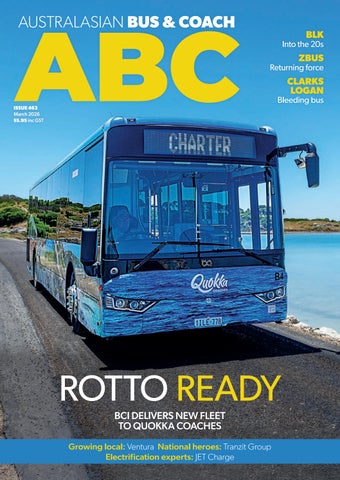
The celebrations start with our cover story, courtesy of BCI and operator Pinnacle Coaches. From page 22, delivering buses in itself is no mean feat – it requires organisation, time, innovation and foresight. Then consider having to do this for a fleet of buses on Rottnest Island, off the coast of Perth, and that these buses have to be built using a chassis brand that recently paused supplying in Australia.
We then found some milestones worth celebrating, allowing operators and suppliers to take a trip down memory lane. Clarks Logan City Bus Service is celebrating a half-century – it was a pleasure to chat to Kaylee Clark in depth from page 32 about her remarkable family and their journey from running a singular bus service to now being a mainstay of Queensland’s bus industry.
Across the ditch, Tranzit Group finished 2025 with a mega party as the family business turned bus behemoth celebrated a century of running transport services in New Zealand. Coming complete with a rich family history, an art exhibition and a book, the tale behind one of the nation’s bus industry icons can be found on page 44.
It’s these milestones that allow us to attempt to take a momentary pause in this March edition of the magazine. By recognising industry stalwarts like Clarks Logan and Tranzit Group, we’re reminded of the industry’s enduring legacy and incredible history.
All of this and more, including the return of Zhongtong buses to Australia, JET Charge’s mind-blowing wisdom with electrifying bus depots and Solid Circuit’s latest ADR solution, can be found in another helter-skelter edition of ABC. Just remember to take a pause, slow down and enjoy how far we’ve all come. We

Sean Mortell EDITOR, ABC


Three years on the road and leading from the front, the combination of leading European OEM manufacturers chassis with the BCI Cruiser coach body has delivered outstanding results across Australia. Packed with advanced safety technology and engineered for tough local conditions, it delivers bold design, spacious comfort and superior climate control—giving operators confidence and passengers a smoother, smarter, more enjoyable journey every time.
BUS & COACH INTERNATIONAL
Contact our team for further information on 1300 289 224 or visit bcibus.com.au

Head Office Perth: 08 9353 9000
Melbourne: 03 8787 2100
Brisbane: 07 3275 6900
Adelaide: 08 8182 3888
06. editorial | ignition SMELLTHEROSES
38. feature | jet charge DRIVINGMOMENTUM
In under five years the Australian bus industry has taken significant strides in designing and delivering and operating electric bus depots. With rich knowledge and experience, JET Charge is enhancing its offering to drive the future of zeroemissions charging
EXECUTIVE GROUP
CEO: Christine Clancy
Chairman: John Murphy
Head of Customer Experience: Regina Fellner
EDITORIAL & DESIGN
Managing Editor: Geoff Crockett
e-mail: geoff.crockett@primecreative.com.au
Editor: Sean Mortell
e-mail: sean.mortell@primecreative.com.au ph: 0468 577 166
Art Director: Daz Woolley
Designer:
Apostolos Topatsis & Deborah Pilarinos
PRINTING
Brougham Press
For all of the news and activity happening in the local bus scene, this edition of ABC is a timely reminder to slow down temporarily and enjoy the numerous achievements being made 08. news | all aboard
Check out the latest news from around Australia and the world features
24. cover story | bci ISLANDINNOVATION
Supplying buses to Rottnest Island is a challenge in itself. Throw in building bodies on a chassis brand that withdrew from the local market and BCI had to pull out all the stops for Pinnacle Travel Group and Quokka Coaches’ latest order
26. feature | ventura acquisition JOININGFORCES
Ventura’s recent acquisition of Crown Coaches marks a major milestone for Victoria’s bus industry, bringing the Haoust family and Ventura back together once again
28. feature | clarks logan city bus service BUSINTHEBLOOD
As Clarks Logan City Bus Service prepares to celebrate its 50th anniversary, the family business is filled with great memories and plenty of pride. Sean Mortell chats to the family about the enduring family legacy of the Queensland operator
34. feature | zbus RETURNINGFORCE
Several years after the brand exited the market, Zhongtong has returned to Australia’s bus and coach industry with the latest global bus manufacturing technology at its fingertips
36. feature | panorama coaches SPREADINGOUT
Panorama Coaches’ acquisition of Shepparton school runs and a depot comes off the back of also expanding in the Goulburn Valley over the past year
40. feature | solid circuit PREPARINGFORCHANGE
Ahead of ADR 68/01 coming into effect in November, Solid Circuit’s latest Safe-Ride product is helping operators stay at the cutting edge of safety and compliance
42. feature | tranzit group FAMILYTIES
The latter stages of 2025 saw New Zealand family business Tranzit Group celebrate its 100th anniversary. In the years since AJ Snelgrove first ran a bus service in Wairarapa, the fourth-generation operator has always been at the forefront of innovation
48. column | qbic NATIONALNEEDS
QBIC executive director Jason O’Dwyer looks at recent costings for high-speed rail, analysing big dreams against immediate national requirements
51. competition | best bus SILOSTAR
A wonderful photo of a Panorama Coaches vehicle in front of some stunning Victorian silo art proved too eye-catching for Best Bus March
54. factory facts | bus deliveries FEBRUARYDELIVERIES
Check out the latest bus and coach supplier sales data collected and recorded for you to review and see how the market fared in February
58. back seat | poo bus NUMBERTWOSONTOUR
A £300 LDV Convoy became Harrogate’s most talkedabout minibus, complete with emoji cushions, disco lights and divided opinion
ADVERTISING
Sales Manager – South:
Courtney Burton ph: 0481 736 890

e -mail: courtney.walker@primecreative.com.au
Business Development Manager – Bus: Sylvie Hanlon ph: 0466 545 664
e-mail: sylvie.hanlon@primecreative.com.au
SUBSCRIPTIONS
www.busnews.com.au/subscribe ph: +61 (0)3 9690 8766
Mon-Fri 8am-4.30pm (EST) e -mail: subscriptions@primecreative.com.au mail: 379 Docklands Drive, Docklands VIC 3008 Australia
Annual subscription rates (12 issues): Australia: $99* Overseas: $A170 (Australian air-mail only) *price includes GST
Cover image: BCI
379 Docklands Drive, Docklands VIC 3008 T: 03 9690 8766 www.primecreativemedia.com.au
ISSN 1324-8634


The return comes after a vote passed through Parliament to restore rapid bus routes to the region of West Belconnen

The Australian Capital Territory (ACT) Parliament has passed a vote that will see at least one rapid bus service restored to West Belconnen.
The return of rapid bus routes to West Belconnen comes after almost 1,500 people signed a community petition backed by the ACT Greens to reinstate the R2 and R3 to its original route.
The Greens then successfully passed the vote in Parliament, with Greens ACT deputy leader Jo Clay saying the region is home to almost one in 10 Canberra locals.
The vote also saw amendments to increase other routes, like the R4 and R5, following the network changes which came into effect earlier in February.
Clay says the government’s decision to remove the routes had unfairly impacted people.
“The Greens will always back better
outcomes for the community – and this vote does this,” she says.
“It will see the rapid routes return to West Belconnen and shows that the ACT Labor government made a poor decision which had real impacts on people’s everyday lives.
“The ACT Labor government’s decision to cut the R2 and R3 bus routes from Spence, Kippax and Fraser caused disruptions and cut off rapid convenient travel and direct connection to other hubs where people work, study or be part of events and community.
“This decision was a betrayal to the 50,000 Canberrans who live in north and West Belconnen. Labor promised West Belconnen more rapids at the last election but instead cut their routes.”
ACT Greens spokesperson for transport Andrew Braddock says the ACT government knew about
the upgrades to Commonwealth Avenue Bridge for years and failed to grow the territory’s fleet and workforce in preparation.
“This is yet more evidence of Labor’s lack of investment in public transport in anticipation of the Commonwealth Avenue Bridge works that the ACT government knew was coming,” Braddock says.
“Canberrans want more public transport options during major road disruptions, not less. Labor has disincentivised use of the public transport system for many Canberrans. Everyone has been impacted by these changes, and in West Belconnen they were hit hardest.
“Belconnen residents won’t see the benefits of light rail this decade – the very least this government can do is maintain the rapid bus routes people already rely on.”


In a historic development, NSW bus companies have aligned with the union to call on the state government to better fund the industry
Roughly 8,000 bus workers in New South Wales have threatened to shut down bus services across the state if the state government doesn’t reverse 15 years’ worth of wage cuts.
The Transport Workers’ Union (TWU) has led an application of 8,000 workers as part of the federal government’s new multi-employer bargaining laws to call on the NSW government to properly fund fair standards through its contracts with the bus operators.
The development has seen bus companies declare their alignment with the union to join calls for the state government to appropriately fund the sector.
With the TWU saying NSW bus workers are among the lowest paid in the nation, face significant safety concerns, a severe driver shortage and job insecurity, it has threatened to shut down bus services from Wollongong to Port Stephens if cuts
Below: Bus worker
often vulnerable members in our communities, are dealing with horrific assaults, declining pay and job insecurity from contracts constantly changing hands,” TWU national secretary Michael Kaine says.
“We will look at using multi-employer bargaining with bus companies across the country to put an end to state governments looking for the cheapest bidder.”
The application was filed with the consent of every major bus company across Sydney, Wollongong, the Central Coast and the Hunter region and echoes the NSW Bus Industry Taskforce’s recommendation to enhance pay to deal with retention and attraction issues.
“The fact that the bus companies are saying, “look, we’re with the TWU on this, the industry’s on a knife’s edge and something has to be done,” I think shows how desperate the situation is getting for
A successful application would allow all 8,000 bus workers to take action simultaneously, with all current state Enterprise Agreements expiring in 2026. The TWU has aligned over 200 agreements to expire in 2026 right across road transport and aviation.
The TWU has welcomed progress made with the NSW government following a delegation of bus drivers to Parliament in November, but says workers’ patience is running out after over a decade’s worth of fighting for a fairer and safer industry.
“In November, our delegates as well as the bus companies told the treasurer and transport minister to their faces that the status quo is untenable,” TWU NSW secretary Richard Olsen says.
“We’ll continue to work constructively with the government for better pay and


“Australian Truck Radio is my trucking radio station. So many great trucking tunes with loads of industry news. I lock it on and leave it on all day long!”


By the middle of this year, snow-goers will be able to hop on a FlixBus green coach to head to ski resorts and nearby towns

Global coach service FlixBus has continued its expansion in Australia, launching two new direct routes connecting Sydney and Canberra to snow resort towns in the state.
The two new routes connect the two cities to Jindabyne, Thredbo and Perisher Ski Tube, and will also include stops at Sydney Domestic Airport, Canberra Airport and Cooma.
The services will get underway on June 6, with the Sydney to Thredbo service running six days a week (with Wednesday having no service), while the additional Canberra to Thredbo service will run on weekends. Additional services will be put on for public holidays and during the July school holiday period.
“We’re excited to give Australians and people travelling in Australia a budget-friendly, convenient and flexible option to reach two of Australia’s most popular ski stations,” FlixBus Australia senior managing director Yvan Lefranc-Morin says. By adding a direct service to the Thredbo-Perisher area, FlixBus says it is making it easier for visitors to plan their winter trips to two of the best
alpine and ski resorts in Australia. Travellers will be able to go straight from Sydney, Canberra or their respective airports to Jindabyne, Thredbo or Perisher Ski Tube – saving time and money to make the best of their winter holidays.
The new routes will be operated by existing local bus partner Deanes Coaches Group, owned and operated by the Deane family.
General manager Alyson Deane is a former member of the Australian Ski Team, specialising in Super G and Downhill Alpine.
“It’s incredibly special for us to be part of improving access to the Snowy Mountains. Having represented Australia in alpine skiing, I know how influential time in the mountains can be to build confidence, resilience and lifelong memories,” Deane says.
“Whether it’s someone heading to the snow for their very first ski adventure or regular skiers benefiting from easier, more convenient access to the slopes, we’re proud to help more Australians experience the beauty of the Snowy Mountains.”
FlixBus launched in Australia in
November 2025 and has since rolled out nine routes across Victoria, the ACT, NSW and Queensland – all the way to Cairns. The green buses offer sustainable, reliable and affordable travel all along the Australian east coast, connecting over 40 regional destinations, five city hubs and five airports.
The new route makes a skiing trip to the Australian Alps possible without needing to drive and park at the Ski Tube.
“Ski resorts in Australia have the reputation of being very expensive. This has historically prevented Australians from making the most of the snow season,” Lefranc-Morin says.
“With this new route, we hope to make a winter holiday to Australia’s biggest ski resorts more accessible – whether you are a solo traveller hopping in for a quick ski weekend, a family planning a holiday getaway, or friends gearing up for a snow trip.”
Tickets can be purchased at www.flixbus.com.au or through the FlixBus app
The new bus and coach head comes from Scania’s head office, but it’s not the first time the experienced leader has headed to Australia
Scania Australia has announced the appointment of a new head of bus, coach and power solutions.
Niklas Walter joins the Australian arm of Scania from the global OEM’s head office in Södertälje, Sweden.
Walter was most recently the bus and coach head of sales for Scania’s Africa, Asia, Middle East and Oceania markets, with 14 years of experience at the brand since joining as a trainee in the production department for trucks and then moving to bus and coach sales.
He has also served as group manager production and as a process engineer following his
traineeship with Scania, earning a Masters’ degree from Sweden’s Lund University in mechanical engineering and technology management.
It won’t be Walter’s first time working with Scania Australia after he came in 2017 and 2018 to work on a customer relationship management development project.
“I am very excited to return to Australia not only to join Scania here but also because the culture, lifestyle and the transport industry in Australia is very close to my heart. This is also a logical move for me to broaden my business experience and get closer to our customers,” he says.
“At head office I was primarily focused on setting our sales strategies for the regions and I was the interface between the factory and our distributors, but in this new role in Australia I will have far more focus on customer relations and their purchasing motivations.
“Being really close to the customer and having a better understanding of their business brings far clearer insights for us to reflect back to the factory, thus influencing our future strategy and direction.
“I believe we have very professional and enthusiastic bus and coach and power solutions teams in Australia, and over 40 years we have developed very strong relationships within the Australian market.

“We are a stable business, our customers know they can rely on us and that we are well set-up to assist our them achieve maximum uptime, thanks to a well-established network of service workshops across the country in addition to our company-owned branches.
“Scania is a premium brand, with excellent products that are suited to the local market across several segments, and many decades of operator experience with our products and our aftersales service.”
Walter says Scania has a “full complement” of renewable fuel solutions for customers who are keen to reduce environmental footprints, particularly for long-distance touring. He also pointed to full battery electric products such as the city buses being delivered to South Australia as an example of sustainable route bus
“I am particularly excited to be starting at Scania Australia now given that we have some very exciting new products on the way that will further cement our position in the market and give us the opportunity to grow our footprint, both in the bus and coach and the power solutions sectors,” he says.
Kinetic has opened a $15 million Noosaville depot to strengthen the Sunshine Coast bus network as passenger numbers climb 20 per cent year on year

A new $15 million bus depot in Noosaville has officially opened, expanding capacity across Kinetic’s Sunshine Coast bus network as passenger growth accelerates across the region.
The purpose-built facility on Production Street has capacity for 32 buses and more than 80 staff. It has been designed to lift operational efficiency and improve reliability at a time when bus patronage on the Sunshine Coast has risen 20 per cent in the past 12 months.
Kinetic Group CEO Michael Sewards says the investment directly responds to rising demand.
“We’re seeing more people choosing buses on the Sunshine Coast than ever before, and that trend is only going to accelerate,” he says.
“Affordable fares, better infrastructure and growing communities are all driving passenger demand, and this depot is part of our investment into the Sunshine Coast to make sure the network can keep up.
“It gives us the infrastructure to run more reliable services now, and the capacity to scale as the network grows.”
Kinetic operates more than 100 buses across 30 routes on the Coast
in partnership with Translink. The new depot strengthens coverage in the Noosa area, where congestion can impact running times and service consistency.
Kinetic managing director Australia Matthew Campbell says the location would support faster operational responses.
“The Noosaville Depot allows us to respond more quickly to network requirements in the Noosa area, where high traffic volumes often cause delays, improving service reliability for passengers across the northern Sunshine Coast,” he says.
“With 20 per cent more passengers on our services this year, having the right infrastructure in the right locations matters more than ever.
“This depot puts us in a stronger position to support the growing demand we’re seeing right across the Coast, and as new communities and developments take shape across the region, having infrastructure like this already in place means we’re ready to extend services where they’re needed.”
Beyond operational performance, the facility is expected to cut more than 400,000 kilometres of non-service travel each year. That
reduction translates to an estimated 502 tonnes less CO2 annually and savings of more than 176,000 litres of diesel fuel.
The depot has also been built electric-ready, with charging gantry infrastructure and electrical transformers already installed to support future zero-emission buses. The design aligns with recent depot developments in Melbourne and Auckland and reflects Kinetic’s approach of future-proofing new facilities for fleet transition.
The investment comes as the Sunshine Coast enters a significant growth phase. The region’s population is forecast to exceed 640,000 by 2046, with major projects underway including The Wave transport corridor, housing expansion and infrastructure upgrades ahead of the Brisbane 2032 Olympic and Paralympic Games.
Sewards says buses would play a central role in that next phase of development.
“As The Wave comes online, the bus network will be critical to connecting communities to rail, increasing service frequency and making sure passengers can move seamlessly across the Sunshine Coast,” he says.
“We’re committed to working alongside the Queensland government to deliver an effective, true multi-modal public transport network, with bus and rail services working together seamlessly.
“Investments like the Noosaville Depot make sure we have the operational capacity to support that vision.”
The Noosaville Depot follows earlier upgrades to Kinetic’s Caloundra facility in 2022, which supported the introduction of 11 zero-emission buses, and marks the operator’s latest step in reinforcing the Sunshine Coast bus network ahead of a decade of population and infrastructure growth.
Buses and coaches will replace trains across several metro and regional train lines as level crossing removal projects get underway again
The Victorian government has confirmed buses will replace trains on sections of two major rail lines as the state prepares to remove more level crossings.
From mid-to-late April, buses will replace trains on sections of the Werribee, Williamstown and Frankston line as level crossing removals begin.
When work begins on April 30 to remove two level crossings on the
May 21 to coincide with the opening of the new Mordialloc Station.
Out west, buses will also replace trains on sections of the Werribee and Williamstown lines between Newport and Werribee from April 10 until April 25 as work begins to remove the Maddox Road level crossing.
In regional Victoria, coaches will replace trains on the Maryborough Line from April 25 to May 21 to complete the Murray Basin Rail
Geelong, Warrnambool, Seymour and Shepparton lines in April and May for maintenance, upgrades and works at Warrnambool Station.
“We’ve opened the Metro Tunnel and West Gate Tunnel and we’re not slowing down – upgrading road and rail across the state for busy families,” Victorian transport infrastructure minister Gabrielle Williams says.
“Every level crossing we remove


The new MD of the operator’s Victorian operations arrives after most recently working with the state’s Department of Transport and Planning

Transit Systems Victoria has announced the appointment of a new managing director, with the new leader bringing extensive public transport policy and operational leadership experience to the role.
George Konstantopoulos is the new managing director of Transit Systems Victoria, joining from the Victorian Department of Transport and Planning. He most recently served as director of bus network planning and reform at
Left: George Konstantopoulos. Image: Transit Systems
the department, working closely with government, operators and industry stakeholders.
Transit Systems executive general manager business operations
Mark Peters says Konstantopoulos’ appointment reflects Transit Systems’ focus on strong leadership and operational capability across its Victorian business.
“George brings a deep understanding of public transport systems and the role bus services play in connecting communities,” Peters says.
Konstantopoulos says he’s looking forward to leading the Transit Systems Victoria team and continuing to support the role of buses within the broader transport network.
Below: The operator is sharpening its focus in the state. Image:
BYD Australia
“For me, it’s always been about connecting people with places and communities, and buses provide a huge amount of flexibility and mobility coverage that other modes don’t,” he says.
“Buses play a vital role in connecting people to education, employment and community life and I’m looking forward to working with the Transit Systems Victoria team to deliver strong outcomes for passengers, government partners and the broader network.”
In his new role, he will lead Transit Systems Victoria’s metropolitan, regional and school bus operations, with a focus on service delivery, operational performance and customer experience.
Peters says Konstantopoulos’ appointment reinforces Transit Systems commitment to experienced leadership and strong collaboration with government and stakeholders.
“George’s appointment underscores Transit Systems’ ongoing focus on enhancing connectivity and delivering safe, reliable and customer-focused transport services and we welcome him to the team,” Peters says.


is leading the way in driving public transport passenger trip increases in Queensland since the introduction of permanent 50 cent fares.
Marking a year to the date since the Queensland government made the cheapest public transport fares in the state’s modern history a permanent measure, the state government says public transport patronage has risen by 21 per cent.
This has resulted in $423 million in savings for passengers across the state, with south-east Queensland leading the way in improved
Below:
Bus is leading the way in Queensland’s PT patronage surge. Image: f11photo/ stock.adobe.com
Under the permanent 50 cent fares, public transport patronage has surged 22 per cent in Brisbane, 20 per cent on the Gold Coast, 20 per cent on the Sunshine Coast and 24 per cent in Moreton Bay as Queenslanders took 200 million trips in the past year.
Leading the way is bus, with more than 122 million trips out of the 200 million being bus trips, ahead of 54 million train trips and 14 million on trams.
Queensland transport and main roads minister Brent Mickelberg says

delivering cost of living relief for Queenslanders.
“The LNP’s permanent 50 cent fares are relief you can rely on, they’re permanent cost of living support for Queenslanders,” he says.
“We’re doing our bit to help with the pressures facing Queenslanders, with this permanent relief that is saving families thousands of dollars a year.
“Under the former government, 50 cent fares were nothing more than an election sugar hit, in contrast we’ve delivered permanent support.”


Volgren has strengthened its South Australia bus manufacturing footprint with new fleet deliveries and a dedicated Adelaide service facility to support hybrid and battery-electric buses

state advances its transition toward lower-emission buses.
The Australian bus body manufacturer has delivered 40 hybrid buses into South Australia and is supplying 90 battery-electric buses, with deliveries underway from late 2025 and continuing through early 2026. The first battery-electric vehicles for Adelaide Metro were delivered in December 2025, marking the beginning of a progressive rollout across the network.
The deliveries position Volgren as a central supplier in South Australia’s evolving bus fleet landscape, where operators are balancing emissions reduction targets with the practical demands of day-to-day service reliability.
A key component of the battery-electric program is Volgren’s Optimus body, built with a lightweight aluminium structure designed to
vehicle weight while simplifying maintenance requirements across the fleet lifecycle.
With hybrid vehicles already in service and battery-electric units now entering operation, Volgren’s focus extends beyond manufacturing to long-term operational performance. The company has established service capability in Adelaide to provide local access to parts, warranty support and technical expertise as zero-emission fleets expand.
In parallel with the metropolitan electric rollout, Volgren is supplying 28 Endura school buses for the South Australian Department for Education. Built on the Volvo B8R Euro 6 chassis and fitted with the Endura body, the vehicles are engineered for durability in regional and school operating conditions, where reliability and uptime are critical to communities.
and parts supply for both Volgren and Marcopolo vehicles. The site includes more than 15 work bays and a 25-metre spray booth, increasing throughput capacity and reducing turnaround times for operators.
For South Australian fleets, the combination of local manufacturing supply and in-state aftersales capability reduces reliance on interstate repair networks and shortens response times when vehicles require support.
Volgren’s expanded presence reflects broader shifts in South Australia bus manufacturing as governments prioritise fleet renewal and emissions transition. By combining hybrid and battery-electric vehicle supply with a permanent Adelaide service base, the manufacturer is reinforcing its long-term commitment to the state’s public transport operators.
The Victorian government has officially launched the new Lara Avalon Airport bus route on March 15, providing the first regular public transport connection between Lara Station, Avalon Airport and the Greater Avalon Employment Precinct.
Route 18 replaces the existing Route 11 service between Lara Station and Lara East, marking a shift in local bus priorities toward improved access to the airport and employment.
The new route operates 21 weekday trips and 20 weekend trips, with service running from early morning until around midnight. Timetables have been designed to align with both shift patterns at the Greater Avalon Employment Precinct and flight schedules at Avalon Airport.

Buses generally arrive 20 minutes before and after major shift start and finish times, supporting workers travelling to and from the precinct. For air passengers, services reach the airport between 75 and 120 minutes before the departing flight and depart around 30 minutes after the arrival.
Importantly, Route 18 connects with trains at Lara Station, primarily for
services to and from Geelong. This integration is intended to make the Lara Avalon Airport bus route a viable alternative to private car travel for both airport staff and travellers.
Stops include Canberra Drive within the employment precinct and a stop near the Avalon Airport terminal entrance, allowing direct access to both employment and aviation facilities.
The introduction of Route 18 sees the removal of Route 11. While part of the former Route 11 alignment have been retained, eight bus stops are no longer serviced. Passengers affected by these changes are being directed to nearby Route 18 stops, including those along Archimedes Avenue and McClelland Avenue.
Two bus stops on Rennie Street near Archimedes Avenue have been relocated from just south of the intersection to just north of it, with new stop numbers assigned.
The service change reflects growing demand for better connections into the Greater Avalon Employment Precinct, which continues to expand as an industrial and logistics hub. Until now, there has been no dedicated public transport link to Avalon Airport, limiting access for workers and passengers without private vehicles.
Passengers are encouraged to review the Route 18 timetable and map and plan before travel. Journey planning tools are available through the PTV app, online journey planner or by contacting PTV directly.

A new urban bus network will roll out in Whanganui from April, introducing higher frequencies, expanded coverage and seven-day services across the city
Whanganui’s urban bus services are set for a major reset, with a redesigned network scheduled to begin operating from April 17 as New Zealand operator Horizons Regional Transport looks to improve coverage, frequency and ease of use.
The new network will replace the existing route structure with a simplified model built around frequent, all-day services. Two core routes will operate every 20 minutes throughout the day, with three additional routes running hourly. All routes will operate seven days a week.
Horizons Regional Council says the changes are designed to reflect how people move around the city, while supporting future growth and encouraging more residents to choose buses for everyday trips.
The redesign follows strong patronage growth since the launch of Te Ngaru The Tide, a high-frequency service, in 2023. That service helped drive a sharp increase in urban bus use, with annual passenger trips in Whanganui more than doubling compared with 2022 levels.
Horizons Regional Council manager of transport services Mark Read says the new network builds on that momentum.
Below: Whanganui’s new look network will go live in April. Images: Adwo/ stock.adobe.com
“Off the back of this success, we consulted with the Whanganui community last year about how we could make more improvements to better connect the community and support the city’s growth,” Read says.
Consultation feedback showed strong support for a more frequent and reliable network, with residents prioritising services that are easier to understand and run consistently throughout the week.
Under the new design, the two high-frequency routes will run every 20 minutes between 8am and 6pm, with slightly reduced frequencies early in the morning and evening on weekdays, and later last services on Fridays and Saturdays. The three hourly routes will operate from early morning through to early evening on weekdays and Saturdays, with reduced hours on Sundays.
Coverage will also expand into areas not currently served by the urban network, including Pūtiki, while Aramoho and Castlecliff will see improved access. Overall, the proportion of Whanganui residents living within walking distance of a regular bus service will increase significantly.
Currently, about 31 per cent of residents live within 400 metres of a
route operating at least hourly. From April, that figure is expected to rise to 72 per cent, with more than half of residents within 400 metres of a high-frequency, 20-minute service.
School travel patterns will also change under the new network. More frequent all-day services will operate past or near schools, replacing the limited once-a-day school bus services currently provided by Horizons within the urban area. Ministry of Education-run school services are not affected.
Ahead of the April launch, Horizons Regional Council will begin a public information campaign outlining route changes, timetables and how existing users can transition to the new system. The council says clear communication will be critical to helping passengers adapt and encouraging new users to try the service.
Read says simplifying the network is central to making buses a practical option for more people.

“Our goal is to provide a bus network that boosts transport options, reduces emissions and connects more people to the places they need to go,” he says.
Transport for London has started a 12-month trial of redesigned bus shelters, testing how lighting, seating, materials and CCTV can improve safety and accessibility
Transport for London (TfL) has launched a year-long trial of new bus shelter designs at 27 locations across the capital, marking a renewed focus on the often-overlooked waiting environment for bus passengers.
The trial, which began in late January, is testing two shelter designs and multiple feature configurations to assess how changes to lighting, seating, materials and layout can improve accessibility, safety and customer comfort.
Locations were selected based on passenger volumes, the condition of existing shelters and areas with higher reported crime.
TfL says the initiative responds to the reality that bus stops and shelters are the most frequently used waiting points across the public transport system, yet their quality and condition can vary.
More than five million bus journeys are made in London each day, making shelters a critical part of the customer experience rather than simply roadside furniture.
Key upgrades being tested include brighter lighting to improve visibility and personal safety, redesigned seating aimed at better supporting passengers with mobility impairments, and tougher materials intended to reduce vandalism and maintenance demands. A new roof design using reflective red vinyl has also been introduced to improve shelter visibility at night and reinforce the city’s iconic bus identity.
Priority seating areas and clearly marked waiting spaces for priority customers are also being trialled, alongside CCTV at 10 selected shelters. TfL will assess whether cameras influence crime levels
Below: New bus shelter designs are being trialled. Image: kbarzycki/stock. adobe.com
and passenger confidence, particularly for women travelling after dark.
The shelter designs were developed with input from disability groups and passenger advocates, including the RNIB, the Suzy Lamplugh Trust and London TravelWatch. TfL says feedback gathered during the trial will inform future shelter standards across the network.
Alongside the trial, TfL is expanding shelter coverage more broadly. Around 20 new Landmark London shelters are being installed at high-demand stops that previously had no shelter, while refurbished shelters are being redeployed to improve conditions at other locations.
TfL director of streets and network operations Carl Eddleston says the project reflects a broader shift in how bus infrastructure is viewed.
“This initiative reflects our commitment to creating a bus network that feels safer, more welcoming and easier to use,” Eddleston says.
“By modernising our infrastructure, we’re ensuring that Londoners benefit from spaces that truly support their daily journeys.”
The trial aligns with TfL’s Bus Action Plan, which aims to grow bus use and support the Mayor of London’s target for 80 per cent of trips to be made by public transport or active travel by 2030.
Results from the trial will be used to assess costs, feasibility and the potential for wider rollout across London’s 14,000 bus shelters.


Supplying buses to Rottnest Island is a challenge in itself. Throw in building bodies on a chassis brand that withdrew from the local market and BCI had to pull out all the stops for Pinnacle Travel Group and Quokka Coaches’ latest order, Sean Mortell reports
It’s a place where the sun shines brightly and the water is crystal clear. Where it’s easy to hop on a bike and check out every corner, before swapping wheels for snorkels and investigating coral reefs that beggars belief. A simple step outside showcases the very best flora and fauna of Australia, including a unique friendly animal that leads to many photo opportunities and lifelong memories.
For years, Rottnest Island, or Wadjemup (the Aboriginal name for the island derived by the native Noongar word meaning ‘place across the water where the spirits are’), has fast emerged as an idyllic part of Australia’s beauty. Just a short ferry
ride from Perth, the island is quickly becoming a tourism hotspot – visitor numbers hit a record high in 2023/24 when more than 823,000 visitors descended on it. With this popularity comes the need for bus and coach services that blend in with the island’s splendour. Enter Pinnacle Travel Group and its latest fleet of eight BCI/ Mercedes-Benz vehicles that have recently started operating on the island.
“In around 2016 we took over transport on the island from the government authority who previously handled it,” Pinnacle Travel Group managing director James Mulholland told ABC “They had two buses permanently
and used to get an extra couple over the busy summer period. We immediately started modernising the fleet on the island and the introduction of eight brand new low-floor buses is the culmination of it.”
There are many similarities between the Western Australian operator and the famous island just off the coast from Perth and Fremantle. Much like the island, Pinnacle Travel Group has had a recent period of evolution and popularity, with the family business having grown via acquisition.
The purchase of Australian Pinnacle Tours in 2013/14 allowed the business to grow its WA coverage, before the addition of Adams Coachlines to the group in 2019 evolved into Pinnacle

Coachlines. Now, the operator is just one arm of the wider Pinnacle Travel Group, with the likes of Integrity Coachlines recently joining the fold through acquisition and allowing the business to flourish. The overarching group includes Rottnest Fast Ferries, Explore Tours Perth and, most importantly, Quokka Coaches, the specialist operator for buses on Rottnest Island.
“We’ve now grown to have a fleet of almost 90 buses spread across the state, including in Broome and Geraldton and also on Rottnest Island,” Mulholland says.
“We have a range of touring coaches for day trips, school buses, mining specified buses and low-floor charter vehicles for Rottnest Island
It’s a far cry from Pinnacle Tours’ early days, where a couple of four-wheel drives would take several passengers to The Pinnacles ancient limestone pillars in the state’s Nambung National Park. Now, that service itself runs daily and sometimes twice a day, while the wider Australian Pinnacle Tours operation has grown across the state since commencing operations in 1979. When it comes to Quokka Coaches, the emerging island operation has a total of 16 vehicles, ranging from golf buggies to hop-on hop-off buses that traverse the island.
“The island has now surpassed 800,000 visitors per year, with the growth being inspired by the post-COVID return of international tourists from Asia, specifically Malaysia and Singapore,” Mulholland says.
“This has allowed us to expand the fleet and tour offering on the island to the point that we have specific Japanese guides running sunset tours to the far end of the island for Japanese tourists.”
When Pinnacle Travel Group, through Quokka Coaches, first took over operations on Rottnest Island, the business bought a BCI Classmaster before acquiring an ex-Murray’s BCI/Mercedes combination. It proved the perfect tonic for island services, starting a relationship that is mirroring the

growth of tourism popularity on the island.
“We ran the BCI/Mercedes bus for a year or so and were very impressed from the get-go, so we ordered more 13.5m BCI/Mercedes coaches on top of it,” Mulholland says.
“We’re happy with the quality of the vehicles and the relationship. It led us to then order eight low-floor Mercedes-Benz bus chassis with BCI bodies.”
The order didn’t necessarily go to plan. After ordering the first four buses with a goal in mind to have a uniform fleet on the island, Mercedes-Benz pulled out of
supplying buses in Australia. The operator wasn’t in limbo for long as BCI came to the rescue to ensure the rest of the order was set to be completed, rain, hail or shine.
“The first four buses we ordered came just before Mercedes-Benz made the announcement, which led us to begin searching for another four chassis that we could get BCI to build on,” Mulholland explains.
“The build of the body was so good and the city commuter bus product was high quality, so we wanted to continue the partnership. The models had little features that made for a simple product for drivers to enjoy.

“We were able to work with BCI to track down four more Mercedes-Benz coach chassis and we just recently took delivery of the very last Mercedes-Benz/BCI combo coaches in Australia.”
It’s a sombre milestone for both operator and supplier to share.
From BCI’s perspective, the goal throughout was to keep the fleet uniform while also adjusting features to match the unique demands of Rottnest Island runs.
“Pinnacle Travel Group first approached us before the Rottnest Island project with the want to receive new-style tourist coaches,” BCI sales development manager Armando Baylon told ABC
“They were fond of the Mercedes-Benz chassis, so they started buying coaches from us with that chassis that met the specific limitations and requirements of the Rottnest Island run.”
This meant BCI had to make some allowances to ensure the final four buses could be delivered to match the first four that were ordered before Mercedes-Benz’s closure. Nowadays, BCI has a more modern bus body style and shape on its Citirider

product, but for the sake of fulfilling this order, the supplier went back to its old low-floor body shape to match with the Mercedes-Benz 0500 LE chassis.
“We were all happy to still use the old style body, so we went ahead with this unique production,” Baylon says.
“James and his team found the chassis, then we shipped them to our Chinese factory and built the exact same BCI Citirider 12 bodies on them before shipping them back.
“The first four buses were built in
Above: Quokka Coaches will continue transporting the growing number of tourists around the island
Below: Fitting in with the crystal clear ocean
early 2024 and delivered by the end of that year, while the last four models were built and delivered using these bodies at the end of last year.”
Upon receiving the final models, Pinnacle Coachlines had to organise their delivery to Rottnest Island by shipping the buses onto the island before establishing a locally based team to ensure all maintenance and service was completed. It meant Quokka Coaches soon employed a maintenance staff member with deep BCI knowledge to work on the island


and keep the vehicles up to date.
“The buses themselves don’t come with too many special features, but they do have built-in parts that allow for drivers to easily collect lots of people and cater to standing passengers,” Baylon says.
“It’s almost the end of an era for both Mercedes-Benz chassis and the old-style BCI bodies in Australia. Nowadays we have a more aesthetically pleasing new body shape that we use with our low-floor bus and coach builds.”
The decision to stray from the newer body type on the final order of four buses may not have been ideal for BCI, but it has now allowed the partnership to flourish with Quokka Coaches. The supplier says the aftersales process has been made easier with a consistent fleet of eight coaches.
“They’re all uniform when it comes to parts and servicing, which is a major benefit for both us and Quokka Coaches,” BCI national sales manager Cameron Millen told ABC
“It marks a sad closure on our chapter with Mercedes-Benz – our first chassis we built on from then was in 2010 and now these are our final ones, so it’s an ending to a partnership of more than 15 years.
“The eight buses delivered in two separate instalments all follow the same specifications, so it allows for the same spare parts and servicing for the operations team on the island.”
The story behind these deliveries means it’s an order that has a bit
more weight to it than a standard bus handover. BCI’s effort put in behind the scenes to finish the order and fulfil Pinnacle’s wishes is one that Mulholland and his team is very grateful for as they now plan to cater to growing tourism on Rottnest Island.
Mulholland admits that the island is almost at capacity at certain times of the year, meaning more off-peak tourism is the focus for Quokka
continued emergence in the years to come.
“We’re excited to have these Euro 6 vehicles and then look in a few years’ time to match the renewable energy push that the island is slowly making,” he says.
“For the wider Pinnacle Travel Group, we’ll also be looking for complementary businesses. Whether it be on the island or up in Broome,

Ventura’s recent acquisition of Crown Coaches marks a major milestone for Victoria’s bus industry, bringing the Haoust family and Ventura back together once again

It’s rare to see two bus giants come together, but it’s exactly what has happened in Victoria with Ventura Bus Lines’ acquisition of Crown Coaches. On Thursday February 26, following days of speculation, Ventura confirmed it had acquired the fellow major Melbourne-based operation as it plans to continue growing its local capabilities while accelerating its transition to zero-emissions services.
Pending ACCC and FIRB approval, Ventura will acquire Crown Coaches, bringing the operation run by the Haoust family into its fold.
As a highly regarded operator specialising in school and corporate charter services, the acquisition of Crown Coaches’ network to Ventura will expand the latter’s Victorian operational footprint.
The deal sees Ventura add approximately 155 buses, including
10 electric buses, to its fleet, while all 267 Crown employees will be offered employment.
In 1967 Victor and Joyce Haoust put down their life savings as a small deposit and bought Route 10 Bus Service from the Hoare brothers (was later renamed as Route 608), for whom Victor Senior had been driving route services since 1960.
With 21-year-son Victor returning from a working holiday in New Zealand to help run the business the tragic passing of Victor Senior in 1968 saw Victor take the reins to become Victoria’s youngest bus operator at just 22.
It was from these early days that the company forged a reputation for being a trendsetter, with Victor’s wife Julie, at age 22, leaving her job as a secretary in 1972 to become only the second woman licenced bus driver and operator in Melbourne.
Operating out of a BP service station in Camberwell and the Hawthorn tip during the early days, this innovation allowed the business to buy its first fully fledged depot on Burwood Road in Hawthorn in 1976. This was five years after Victor and Julie had two-way radios installed in all their buses, making them reportedly one of the first Victorian bus operators to do so.
This all led to growth. In 1987, expansion in Box Hill, Doncaster, Balwyn and Vermont allowed Victor and Julie to modify a bus to carry passengers with disabilities, complete with a rear-side mounted wheelchair lift. This set the tone for focusing on specialist school contracts and special needs charter jobs and allowed the business to boom.
The recent acquisition by Ventura isn’t the first time the Haoust family has been involved with the fellow
operator. In 1987, Ventura bought all of Victor and Julies route services, with the Crown Coaches name born as the Haousts moved to Ventura’s East Burwood depot in 1989.
The brand remained at East Burwood for many years, growing its wheelchair-accessible fleet until size constraints saw it shift to its much larger current depot in Nunawading in August 2005.
Four years later the business showed its penchant for innovation yet again, introducing one of the first fully electric buses to Victoria in 2009. By the 2020s, it was back implementing the sustainable technology again and introducing a fleet of electric buses to its premises.
Victor and Julie Haoust retired 15 years ago, with Renee and Jerome Haoust continuing the innovative style of their parents in growing and modernising Crown Coaches.
Ventura says the Crown Coaches brand will continue operating under Ventura’s umbrella, maintaining existing service relationships and preserving the strong reputation Crown Coaches has built across specialist school and charter transport.
Ventura CEO Carol-Anne Nelson says the acquisition allows Ventura to accelerate its transition to zero-emissions buses by using existing operations.
“Ventura has always been committed to delivering safe, reliable and innovative transport services for our customers and communities,” Nelson says.
“This acquisition strengthens our capability, supports the transition to cleaner, greener transport and maintains the trusted service Crown Coaches is known for.”
Nelson reiterates all existing client relationships will continue uninterrupted, with Crown and Ventura working closely with stakeholders to ensure a smooth transition.
The transaction was confirmed in February 2026, with completion expected in April subject to approvals.
ABC spoke to Crown Coaches about the acquisition, with director Renee Haoust confirming operations will remain “unchanged” as the business embarks on the “new chapter”.
She says it’ll do so in a way that “honours its legacy while strengthening its future”.
“The Haoust family, who have led the company with pride since its beginnings, is now joining forces with Ventura,” Haoust told ABC
“For 59 years, Crown Coaches has built a reputation for safety, reliability and professionalism — values shared across the bus and coach industry. Central to that reputation has been
the dedication of its people.
“The Haoust family has had the privilege of working alongside extraordinary people — from our dependable employees whose talent and commitment have shaped our success, to our loyal clients and industry partners whose trust and collaboration made our work so rewarding.”
Haoust says the decision to join Ventura brings together “two long-established Victorian operators with strong alignment in safety, culture, values and service standards”.
“Ventura’s added capability, scale, and long-term investment will support Crown Coaches’ growth well into the future, ensuring a stable and sustainable pathway for the business, its people and the communities it serves.
“Importantly, the Crown Coaches brand, workforce and contracts will continue unchanged. For customers, suppliers and staff — including the drivers who remain the face of the organisation — operations will continue as they do today. The partnership enhances Crown’s ability to deliver safe, reliable, customer focused transport, backed by the resources of a larger network.”
The Crown Coaches director says the transition is as much about the past as it is the future, with the acquisition allowing the Haoust family to reflect on its commitment to safeguarding the Crown Coaches legacy and ensuring the business remains well-positioned for the decades ahead.

“By joining forces with Ventura, Crown Coaches strengthens its foundation while preserving the identity and values it has carried proudly since its first day on the road in 1967, while still delivering safe, high-quality transport and continuing the legacy entrusted to the next generation of leadership.”
Jerome and Renee Haoust will now focus their energy on their business Evident Solutions to continue developing their Coach Management System, or CMS, software for the Australian bus industry, working towards safety and efficiencies.
As Clarks Logan City Bus Service prepares to celebrate its 50th anniversary, the family business is filled with great memories and plenty of pride. Sean Mortell chats to the family about the enduring legacy of the Queensland operator

Kaylee Clark didn’t have what one would consider a typical childhood. Her earliest memories are of bus drivers standing around the dining table each night following a hard day’s work. Of a mini-fuel tank sitting on the family’s property to fuel buses. Of watching people push-start buses down the street in front of the house. The turn of each week came the process of making weekly bus tickets with her mother and sisters, using stamps and ink pads to create tickets out of cardboard.
This atypical childhood was one spent in the midst of a family bus business in Queensland during the latter half of the 20th century. It involved plenty of time outside, riding
on various buses in and out of town.
While Kaylee and her sisters lived only a 10-minute walk away from school, they’d catch the bus home instead, riding the whole run for hours until they were taken to the depot to meet with their parents. Life was diesel, grease and grime. As Clarks Logan City Bus Service now celebrates 50 years since her parents Reg and Yvonne Clark first operated their own school run in south-east Queensland, Kaylee wouldn’t have it any other way.
“I remember so many little parts from my childhood – I recall Mum bringing the money home and counting it at home with a small but noisy coin machine that sat on the kitchen bench,” she told ABC
“We first ran the buses from our home, so life revolved around the house and the buses we’d park in the yard.”
Unlike Kaylee and her sisters, Reg and Yvonne didn’t grow up around buses they were both raised on dairy farms. By the early 1970s, Reg worked for Bretts Hardware, while Yvonne was a full-time mother who was active at Loganholme State School’s Parents and Citizens’ association. It was at this association that Yvonne heard of a growing need for a school bus service, with the body writing to local operators seeking help. Letters were sent to seven operators over two years without any responses. By 1975, Yvonne and Reg decided to take matters into their own hands,

calling Allan Haussen of Mt Gravatt Bus Service and Bob Brooks of Greenline Bus Service seeking advice. Bob Brooks advised to apply for a permit to run the school service. This ended in an appointment with the Department of Transport in late 1975, with the department quick to listen to the couple. An existing school bus operator had recently decided to hand the bus operation back to the government, while no operators wanted to take on new services in Logan. It meant the Clarks quickly received a permit in the opening months of 1976 to buy an ex-army bus from Cousins Truck and Bus Sales and begin the school run on their own.
Clarks Logan City Bus Service officially launched on March 22, 1976, with Reg heading off on the long school journey. By the end of the first week, Reg and Yvonne planned to receive $105 for their cash fares. After carrying up to 30 students each way, they had $120 and thus began a family bus business that’s now regarded as an iconic part of Queensland transport history.
It all happened quickly for the Clarks. Only four weeks later the couple began the search for a second
vehicle, resulting in the acquisition of an ex-army Canberra mini bus that was affectionately dubbed the ‘Butter box’ and became a staple of the Clark family.
“We had this little Austin mini bus referred to as the ‘Butter box’ that we could drive down the side and around the back of our house,” Kaylee recalls.
“I remember if we ever went on a holiday, Mum and Dad would load up the ‘Butter box’ and we’d go on holidays in the mini bus.”
By the end of the year the Clarks had employed their first staff member in Bev Patrick, a local mother of three children who started driving the third vehicle in the growing fleet. Fast forward to the business’ very first Christmas and the family had five vehicles running at local schools, with new tenders meaning Yvonne and Reg were quickly leading a transport empire in Logan.
Something had to change – an emerging bus operator couldn’t keep running vehicles from the family house. In the aftermath of having the licence 201 renewed for a further seven years in 1979 and acquiring their very first new bus in a 1978 Hino, the Clarks bought land at Chetwynd Street in Loganholme for $15,000. They duly moved the vehicles and office from their house on Drews Road to the new space.
“While it was good for the family, the downside was I never saw my Dad in the mornings before school, only in the evening when he came home,” Kaylee says.
“Once we set up the first depot on Chetwynd Street, he’d be there at 5am each morning, doing the oils and preparing buses for the day.”


Coinciding with this expansion was the first setback to hit the operator, as Shailer Park High School opened its doors in 1980, meaning a large number of students that previously depended on the Clark family’s buses to get to school in Loganholme wouldn’t be eligible for the services.
The opening of another school in 1982 meant downsizing services and staff from the previously burgeoning operation. It was at this time that a new policy regarding charter became the norm for Clarks Logan in its continuing history. To this day, the family business doesn’t run charter services outside of certain charity events.
“At this point, there was a belief across the industry that urban network was subsidising charter runs, but in reality it’s the other way around, so we ceased doing charter,” Kaylee says.
“It meant no one in negotiations could accuse us of doing anything untoward.”
This innovative thinking would come to the forefront in 1987 when the Department of Transport and Main Roads informed the Clark family that Greenline Bus Service was for sale. Several meetings followed and the operator acquired Greenline for $1.3 million, building the fleet from 18 vehicles to 38 and doubling the service area that the family business now covered.
On December 19 that year, the Clarks moved from Chetwynd Street to Greenline’s depot while launching the first charter trip on the Greenline book. It didn’t have a great start – the vehicle was on its way to Cairns but couldn’t get as far as Gympie before three tyres had blown.
Thankfully, Polleys Coaches lent two tyres so the vehicle could reach
wanted to do, so I walked into the depot and started working for the business with no clear purpose of what I was doing.
“I’d refer to myself as ‘Girl Friday’ because I did everything but nothing specific. That evolved over time to the point where I became involved on the financial and contract side and I now absolutely love my job and career to

architectural design wasn’t what I

More than 30 years since starting with the family business, Kaylee’s passion for the industry is clear. She’s now the finance and performance manager at the business and the president of the Queensland Bus Industry Council (QBIC) – a far cry from the ‘girl Friday’ position she first assumed when joining the operation.
“I could wax lyrical about this industry for days, not just hours,” she says.
“There’s so much that happens in our industry that’s not really understood by the general public. Everyone knows a school bus or has ridden a bus in their life, but they don’t understand the work we do behind the scenes to offer services in times of need.
“Over the years I’ve seen the business change so much – my parents started with high-floor buses that had stairs and an engine inside the bus that the driver had to climb over to get to the wheel. There was no air-conditioning and no power steering.
“It was only in the ‘90s the Clarks installed two-way radios and electronic ticketing equipment. Not much later the state government encouraged industry to move to low-floor vehicles. If you broke down, you’d knock on someone’s

door or find a public phone to ring a mechanic and find a way to get the service back up.
“Nowadays we have telematics and CCTV and we’re starting to look at zero-emissions operations and what we can do in that space. It’s a different world.”
This evolution of technology has been critical to Clarks Logan’s success Below: 50 years down and
and Yvonne’s industry nous and passion for innovation.
It was in 1991 that electronic ticketing and smart card technology was introduced on the network to provide accurate sales data for future contract negotiations. Two-way radios came in the same year after public telephones were removed or vandalised, offering another point of

of the decade, Reg and Yvonne had bought their first ultra-low-floor, fully accessible vehicles. It’s all a far cry from the tough moments that the Reg and Yvonne had to confront.
“Mum tells the story of going in to see her accountant and saying the business was broke, only for the accountant to tell her she wasn’t and that there was a cash flow problem instead,” Kaylee says.
“When faced with challenges, my Mum has led the way in getting the right advice and reaching out to the right people to understand what choices had to be made.
“It’s something that’s been passed onto the next generations – there’s always a solution, you just have to find it and ask for help.”
As the business plans to celebrate 50 years of serving the Logan region this year, it’s this philosophy that has allowed Clarks Logan City Bus Service to evolve into the transport juggernaut that it is today.
With a Translink contract that allows it to deliver a mix of urban and school bus runs, the business has a fleet of 135 vehicles and approximately 220 staff that operate every day of the year
except for Christmas Day.
“It’s one of the few things my parents are yet to budge on – they get a positive response from the community when they tell them that we need to give our staff the day off to spend with their families,” Kaylee says.
Much like the entire industry, the Clarks have had their fair share of
Kaylee is beaming when she declares the operator hasn’t had to drop any trips due to driver shortages since the end of the third school term last year. Much like in 2001, when the operator celebrated its 25th anniversary with a new east-west service to coincide
Busway, there’s plenty in store for the
“We had a service change start on

Translink too, nearly all of which contribute to increased staffing and fleet requirements. We’re in a growth phase right now.
“Before June, we also want to resurrect the original depot out at Loganholme as a satellite mini depot that can hold 10 buses and a spare to take the pressure off of our primary


depot. There’s lots to look forward to.”
On a personal note, the 50th anniversary is also a time for Kaylee and her family to reflect on the journey.
Nowadays there are three generations working at the company and a fourth generation member around, with Kaylee recently becoming a grandmother. She says with a chuckle that the baby has been brought in to work every day recently, acting as “good stress relief” for the managers.
The most emotion, however, is reserved for her parents who started the venture on a whim half a century ago. All members of the Clark family have come a long way since they first started running buses from their Loganholme property in 1976, making the milestone all the more special for Kaylee and the Clarks. She pauses to reflect on the cocktail of feelings that wash over her whenever she hears employees praise Reg and Yvonne and the impact they’ve made on the local community.
“I’m extremely proud, I always have to compose myself when reflecting on my family,” she says.
“What my parents have achieved and continue to achieve, as they still come in most days, is really great. They’re my primary role models –everything I do is based on them.
“I’m so proud to hear the way the staff talks about the company and
what we’ve all been part of. If it wasn’t for them, this business wouldn’t be what it is and I wouldn’t be the person that I am today. Being part of the family business has been priceless and makes me incredibly proud every day.”


Several years after the brand exited the market, Zhongtong has returned to Australia’s bus and coach industry with the latest global bus manufacturing technology at its fingertips
There’s nothing quite like the power of a sleeping giant. Lurking in the shadows, biding its time to find the opportune moment to return. Over the past year, one of the largest bus and coach manufacturers in the world has evolved from a sleeping giant in the Australian market to now position itself as an emerging force down under.
Zhongtong first entered the Australian market in the mid-2000s as the first Chinese bus manufacturer to bring a fully imported and ready to use bus to the nation. However, during COVID lockdowns, the local ZBus exited the area as sales dropped. Now, in its bid to become the largest bus manufacturer in the world, the Zhongtong badge has returned to Australia to resume unfinished business.
“Zhongtong is currently present in roughly 100 countries and the brand
wants to give it another go in Australia,”
ZBus national corporate sales manager Glenn Davidson told ABC
“The brand’s leaders approached investors in Australia to relaunch in the country and they chose to bring ZBus back into the local market.”
The return of Zhongtong to Australian roads sees more
and below:
international experience join the manufacturing market. Zhongtong Bus’ history dates back to 1958 when the company was founded as Liaocheng Vehicle Manufacturing and Repair Factory. By 1971 the group was building buses, with numerous name changes ending when the name Zhongtong Bus was settled on in 1998.


This paved the way for Zhongtong to become publicly listed in 2000, evolving the rich history of one of China’s earliest bus manufacturers.
Nowadays, the manufacturer operates out of a production facility in Liaocheng, Shandong Province that spans 471,000 square metres and can produce on average 30,000 large, medium and light-duty buses each year.
This vast capability has seen Zhongtong produce and sell more than 300,000 buses in its history, of which more than 100,000 of these are new energy. Its wide-ranging product line-up features more than 140 models, with four of these currently available in the local market for Australian operators.
“We have two diesel models in larger and small sizes, as well as two hybrid buses in large and small lengths,” Davidson says.
“The H12 diesel model can range from 35 to 57 seats and comes with a variety of luxury options available as add-ons like toilets. We then have a 22 to 26 seat including driver model, while we have two options on the hybrid side.

October last year,” Davidson says.
“Our aim is to continue growing our operations as the sales and presence grows across the country.”
“The H12 hybrid model is our larger option at 12.3 metres long, with the addition of a battery allowing us to make it a little longer than the diesel version and seat a few more people courtesy of a totally flat floor and putting the engine at the back.
“The L8 is our smaller hybrid model at eight metres long and offers the same benefits as the H12, just in a shorter configuration.”
Currently the local ZBus team includes Davidson as the national corporate sales manager alongside national sales manager Barry Henderson, who has experience launching Yutong buses in Australia and working with numerous bus and coach brands in the local space.
Davidson says the pair are proactive in introducing the Chinese-built buses to local operators, with Henderson often heading to the ZBus factory to assist with minor details and changes, as well as quality assurance checks.
“We’ve currently got a presence in three states around Australia and we’ve sold 26 buses locally since
When it comes to how ZBus has gotten off to such a fast start in its relaunch in Australia, Davidson says there are many factors behind the Zhongtong product that make it a lucrative option for local operators.
“We’re at a good price point – the product is really good and there’s great value for money,” he says.
“We have a lot of standard options built into the models that other manufacturers only have as optional add-ons, while Barry and I have drawn from our experience in customer service over the years to talk to bus operators around the country.
“A lot of people have so far been willing to try the unit and then haven’t had any issues, leading to repeat orders.”
These recent trials and sales have seen Zhongtong buses working in remote regions of Australia, including at mining sites in Western Australia and Queensland, as well as completing school runs.
Davidson says the current Zhongtong models in Australia all
come with fully independent front ZF suspension and Cummins running gear, providing a uniform standard for local operators to enjoy.
“These buses are well attuned to Australian conditions,” he says.
“We’ve had a lot of interest to date, we’re the only Chinese manufacturer currently bringing a full plug-in hybrid option to Australia.”
The hybrid option comes with 180kW of battery in the longer 12 metre variant, while the smaller eight metre version packs in 80kW of battery. The popularity of this shorter option is already inspiring the ZBus team to investigate further models, with Davidson saying a smaller L7 hybrid bus is currently being evaluated in Australia with various engine options. So far, he says the 12 metre models have been leading initial sales, with the customisable nature of the larger options being important factors in building momentum.
“Being able to customise each bus has been popular among operators –if people want 57 seats with different colours, then we can do that,” he says.
“We have different paints included in our price, with all options coming fitted out from the factory. With our order bank building for the smaller options, we’re continually looking to grow our offering in Australia.”
The sky is the limit for ZBus as it settles into its second stint in Australia. Davidson says both he and Henderson are excited about what the future holds for Zhongtong in the local market as sales continue to build and the word spreads that a sleeping giant in bus manufacturing has returned to Australia.
“The goal is to grow and bring more models out to the Australian market,” he says.
“We’ve got roughly 14 series and 144 different models globally we can draw on to bring to Australia, it’s just a matter of what the market demands and when.
“We’ve been very progressive in establishing spare parts facilities with a large stock holding of fast moving parts available now in Queensland, Western Australia and New South Wales.”

Panorama
Coaches’ acquisition of Shepparton
school runs and a depot comes off the back of also expanding in the Goulburn Valley over the past year
Victorian operator
Panorama Coaches has continued to expand in regional areas of the state after acquiring 15 school services in Shepparton.
Panorama Coaches recently acquired 15 school services from Jacobsons Bus Service, with 14 being contracted to Greater Shepparton Secondary College and one servicing Kialla West Primary School.
The purchase also saw the operator buy a depot at 8-10 Wheeler Street, Shepparton, adjacent to the Stockyards to provide future capacity for Panorama’s new local fleet.
“Discussions around this purchase began late last year, and as part of that strategy, the group made the decision to secure a permanent site in Shepparton,” Panorama Coaches operations manager Lee Culshaw told ABC
“We are well advanced in establishing a fully independent operation, including driver facilities,

a staff tearoom and administrative offices.”
The new site has also welcomed a 30,000-litre fuel cell, with Panorama Coaches planning the construction of an undercover wash bay to maintain fleet presentation and standards, pending council approval.
Alongside this growth, the operator has also been “actively building relationships” with local school bus coordinators and is planning to engage more broadly with schools and private charter clients to strengthen its presence in the region. This expansion in the Greater


Shepparton and Goulburn Valley region started mid last year when Wangaratta Coachlines’ Matt Joyce approached Bill Dineen regarding the sale of five Rushworth schools bus contracts. This consultation saw Panorama buy both the Rushworth depot and the five contracts alongside

a team of experienced drivers.
“While managing a location two hours from our base presented its challenges, we saw genuine long-term opportunity in the region and embraced the transition,” Culshaw says.
“Shortly thereafter, we were notified that Walters was seeking to sell seven school bus contracts and their Kyabram depot. The site included a fully functioning workshop, driver facilities and administrative space. We took over operations from Wayne and Sue Walters in August, again inheriting a capable and committed driving team.”
Panorama Coaches then also acquired two contracted services from local operator Gary McConnell for Tongala Primary School. Since then, it has been working closely with local bus coordinators to gradually establish a presence in the regional charter market.
“Panorama is genuinely delighted to now be servicing the Goulburn
Valley and Greater Shepparton region,” Culshaw says.
“We are excited about continuing to expand our footprint and positioning Panorama as a leading provider of school services, school camps and charter operations across the region.”

In under five years, the Australian bus industry has taken significant strides in designing, delivering and operating electric bus depots. With this growth comes new challenges and an increased need for partners with the expertise to deliver reliable and scalable infrastructure

In the grand scheme of Australia’s bus and coach history, electric bus depots are in their infancy.
It was only just over three and a half years ago that the very first large scale site was opened in Leichhardt, New South Wales, laying the platform for more to follow. Now, in the years since late 2022, when Leichhardt was first commissioned, other suburbs have become prominent parts of Australia’s zero-emissions bus history. Ivanhoe. Malaga. Kingsgrove. Preston.
This quick growth in building and commissioning electric bus depots has coincided with the rapid development of the industry’s education and experience with the technology. A major point to emerge out of ongoing depot electrification projects has been the importance of reducing and managing any potential risks.
“As an industry, we’re almost
through delivering the second generation of depot electrification projects,” JET Charge director of major projects Alex Bowler told ABC
“There were the early large-scale projects such as the Leichhardt depot, but now we’re also seeing the second iteration of depots like Brookvale, Malaga and Preston coming online.
Looking back over these projects to date, we’ve been taking stock of the value of having a partner who can loop together and guarantee performance across all parts of the project.”
This is where JET Charge has been an integral part of the industry’s electrification process. Bowler has been with JET Charge for more than four years, meaning he has extensive experience delivering both generations of depot charging projects in Australia. With this knowledge, he says, is the ability to better manage risks and factor in
Above: JET Charge were engaged by Downer EDI Engineering to supply and commission Australia’s first pantograph down chargers for the Brookvale bus depot
costs for the next wave of operators wanting to electrify depots.
“Learning from previous projects, we’re now looking at improving our forecasts for operational costs when it comes to working on the next generation of depots,” Bowler says.
“This is a direct result of the gap between what equipment manufacturers may offer in terms of warranty and service, and what customers need to have price certainty across a 10 or 15 year period. An operator just buying a charger may get the equipment and a warranty for a couple of years, but then someone needs to commission the machine, test it’s working and provide ongoing support well outside of the warranty period. This isn’t covered by OEM offerings, meaning that’s an exposure to potentially unplanned expenses and downtime down the line.”
As more and more zero-emissions bus depots are coming online,
partners are working with operators beyond just helping them select a preferred charger. Bowler says the business’ focus is on securing long-term financial viability for operators when it comes to the total cost required to own and operate the asset. Having developed experience in deploying chargers in a variety of sectors in recent years, JET Charge is looking to take these learnings and help bus operators have higher confidence when it comes to exploring electrifying depots.
“We want operators to be incredibly certain of the costs and expectations involved in selecting chargers, introducing an electric bus depot and running them over the long term,” Bowler says.

“We’ve done a lot of work over the past 18 months to collect data from previous operations and see what’s required to understand the true cost of charger operations over the asset life.
“In a space where the way in which governments engage contractually with operators can vary, we want to help operators leverage our experience and expertise by taking on as much risk as we can.”
With new technology comes the potential for failure or other issues. Electrifying a bus depot is no different – there are times when an operator is left stranded by a charger with a fault. This is where JET Charge is focused on implementing its knowledge and capabilities to better support operators.
“By number and time, the vast majority of electric charger call-outs to date aren’t strictly for hardware faults, but more so for ecosystem issues – be it between the bus, charger, cloud platform or communications between them all,” Bowler says.
“As a turnkey provider, JET Charge is well positioned to troubleshoot and solve issues faster. A couple of years ago there was a charging time-based power issue where a depot’s chargers had a fault on a Friday night and nothing was working. There were up to six different systems that could’ve been causing the issue, so we got one of our on-call commissioning engineers to check it all out, and
we found that one communications provider had changed a network setting, which stopped sessions from starting.
“If you’re an operator, this could’ve taken a long time to troubleshoot and fix – imagine if you had to put in tickets with four different suppliers and get them to agree on the fault. Having one accountable partner and contracting structure provides faster tangible outcomes, which is an important difference between having chargers offline for one hour compared to 36 hours.”
JET Charge’s ability to help is two-fold – it can be a total manager of an electric bus depot’s ecosystem from selecting the right infrastructure to maintaining it, or it can provide contracting help whenever needed if an operator chooses to put their own team in place to manage sub-contracts independently.
“It’s all ultimately about the industry finding the right way forward to make a correct value proposition to operators that allows them to derisk their fleet transition,” Bowler says.
Central to helping operators within the industry to make a safe and worthwhile transition to electric bus infrastructure is knowledge. This is where partners who have both experience and the know-how in the space come to the fore, with JET Charge working as an end-to-end delivery partner.
For example, JET Charge recently worked on a depot design where one part of the site control system was identified as a critical single point of failure for the whole depot. From there, Bowler says the company made the decision to design and install additional redundancy into this system, giving the operator confidence of mitigating any issues
“It meant the operator could flip a switch if one control unit failed and continue standard charging operations as if nothing had
“We’ve experienced industry members who have had these single point of failure scenarios, and we now know we can build in mitigation to cover these failures and increase reliability in the long run. It’s all about bringing this experience and risk base approach together for operators.”
This depth of knowledge means operators can work with JET Charge in a myriad of ways, from introducing the business to help plan large-scale charging projects as a subject matter expert to welcoming them from the get-go to provide a turnkey design for a potential electric bus depot.
It’s already playing various roles in the Australian bus and coach industry, completing first-in-market deployments on electrified depots. From pantograph charging to overhead gantry chargers, JET Charge’s experience allows it to take on higher risk and unique projects to drive the future of Australia’s electric bus depots forward.
“We can go as far as completing consulting work on how the depot should be designed and upgraded through to its installation and ongoing charging operations,” Bowler says.
“We want to work with customers to mature the way electric bus depots can be developed, contracted and operated. We’re a long-term delivery partner for customers and very focussed on providing long term value for money.
“It then provides maximum value to operators and price certainty. We want to provide value every step of the way.”

Ahead of ADR 68/01 coming into effect in November, Solid Circuit’s latest SafeRide product is helping operators stay at the cutting edge of safety and compliance
Safety, as we know it in the bus and coach sector, is always changing. The nature of safety and compliance in Australian buses is set to evolve in the next year as regulations come into place reflecting the events of recent years.
From November, Australian Design Rule (ADR) 68/01 will come into place, formally raising the compliance bar for seatbelt reminder systems in applicable buses. The ADR, which focuses on occupant protection in certain buses, is a direct response to the Hunter Valley bus crash in 2023 and resulting industry lobbying. The ADR requires any applicable new
bus and coach models fitted with seatbelts to also be fitted with visual signage and audio announcements for seatbelt wearing from November 1 this year. Exactly a year later, these systems will need to be on all applicable new buses that are fitted with seatbelts.
This requirement means there’s been a gap in the market for this exact technology in the local bus and coach sector. This is where Solid Circuit has stepped in, having released and delivered its Safe-Ride retrofittable seatbelt alert system to make buses safer than ever before.
“For bus body builders, this is not simply a documentation exercise – it
Above:
Solid Circuit’s SafeRide is ideal for operators wanting to meet ADR 68/01 requirements
is a design integration requirement,” Solid Circuit’s Kieran McHatton told ABC
“Vehicles must now incorporate compliant visual and/or audible seatbelt reminder functionality that meets the intent of occupant safety legislation while maintaining reliability, durability and OEM-level presentation. Safe-Ride has been developed specifically to address this requirement.”
Designed and supplied by Solid Circuit Enterprises, Safe-Ride is a purpose-built seatbelt reminder system engineered for seamless integration into new bus builds as well as retrofit applications. The system

acts as a multi-function alert system to remind passengers to ‘wear their seatbelts’. However, it also doubles as a reminder for passengers to ‘tap on’ as they enter a bus.
It was designed with the installers in mind, with the system able to be activated by high or low door open and close signals. McHatton says the system was designed to be ready for a government retrofit in the wake of a recent industry tragedy. The system interfaces with door signals and existing electrical architecture, triggering clear, high-visibility ‘fasten seatbelt’ signage and optional audio prompts when doors close.
“This product started with Solid Circuit manufacturing its own ‘Fasten Seatbelt’ sign with larger text than what was available and we have since manufactured the signs in a couple of sizes,” McHatton says.
“Then, when the ADR came out, we spec’d a second version of Safe-Ride and called it Safe-Ride 2.0 with small tweaks to meet the new requirements.”
The objective is simple – to deliver a consistent and automatic reminder that’s aligned with ADR 68/01 without adding complexity to the build. For body builders, integration is designed to be straightforward. The system can operate via door trigger inputs and connects to vehicle speaker systems through relay-controlled outputs. The Safe-Ride system works by broadcasting over the existing speaker system on a bus. This provides two advantages – it results in less work during the installation
process and it becomes a cheaper option because there’s no need to install and duplicate speaker sets.
“We’re just simply utilising one speaker channel momentarily when the fasten seatbelt announcement is made and we then re-set it,” McHatton says.
“Music can keep playing on the bus, the announcement specified in the ADR just plays on the left channel before returning to the sound being played prior.”
When it comes to the visual side of Solid Circuit’s system, signage is available in OEM-grade black with high-contract yellow text for maximum passenger visibility. The modular design allows configuration for single or dual-door buses, ensuring compliance logic remains consistent across different layouts.

“The illuminated signs can be made to order, although we have two standard sizes that have proved to suit all applications to date,” McHatton says.
“We designed Safe-Ride before we were aware of ADR68/01 prescribing similar features. As we had already designed the platform, there were only minor changes required to meet the new standard.
“As our system was designed specifically for ease of install, we have designed the system as plug and play. As we also do, we have added additional options such as an announcement on ‘door open’. This allows coaches to have a welcome message as passengers board if they so wish.”
The Safe-Ride system joins other safety products in Solid Circuit’s stable, including Safe-Check, Safe-Brake and Safe-Alert that each address different critical aspects of vehicle operation and safety compliance.
Beyond compliance, Safe-Ride offers a commercial advantage for operators around the country. McHatton says these businesses increasingly demand demonstrable safety features, particularly in school, charter and regional fleets. By integrating a compliant seatbelt reminder system to existing buses, it positions operators as proactive partners in passenger safety, rather than reactive participants to regulatory change.
The Australian-owned and operated company is continuing to roll out the model to more and more operators ahead of the ADR first coming into effect later this year. McHatton says it’s a clear tailor-made option for operators to help them remain at the cutting edge of safety and compliance.
“For fleets seeking retrofit solutions ahead of November, Safe-Ride also provides an industry-ready upgrade pathway,” he says.
“ADR 68/01 is now a legislative requirement. Safe-Ride ensures compliance is achieved professionally, efficiently and with minimal engineering friction –enabling bus body builders to deliver vehicles that are compliant.”


The latter stages of 2025 saw New Zealand family business Tranzit Group celebrate its 100th anniversary. In the years since AJ Snelgrove first ran a bus service in Wairarapa, the fourth-generation operator has always been at the forefront of innovation
Shirtsleeves to shirtsleeves, it’s the famous adage of a family business over the years. The first generation builds it, the second maintains and the third, having enjoyed the spoils, squanders it.
Tranzit Group is an exception to the rule. After Albert James (AJ) Snelgrove launched a bold venture in Wairarapa in 1925, roughly an hour and a half drive from Wellington, it took three generations for the business to grow outside of the region. Today, more
than 100 years on, Tranzit Group is a national powerhouse and the only family bus business of decent size left in New Zealand. It’s all because of the injection of an eager third generation in the early ‘80s that took the Wairarapa operator to grander heights.
“In 100 years, we’ve had to change and adapt – and boy, we’ve had some dramatic changes and overcome several challenges,” Tranzit Group managing director Paul Snelgrove told ABC
Above: Tranzit has become a New Zealand bus empire over the past century
“But at the end of it, we have to have the same principles guiding us as when we started. It is a family business, and we are our people.”
Paul is the figurehead of the crucial third generation, having bought into the business alongside his wife Lorraine in 1981. The qualified mechanic took over the family business with a determination to grow the business beyond Wairarapa by embracing technology. He did so by first investing in a smart new computer that made work more

efficient from the get-go. A few years later, Paul’s brother Keven Snelgrove and his wife Robyn also bought into the business, ushering in a new era for the business that has now resulted in the Snelgrove family proudly celebrating its 100th anniversary in
Prior to the arrival of Paul and Keven, the history of the family business was traced back to AJ Snelgrove and his single bus that started under the name of Grey Bus Service. The new service in the 1920s ran between Masterton and Carterton daily on a two-hourly schedule, with the local Wairarapa Daily Times advertising this service and its smaller Sunday run.
The start-up operator had plenty of identity shifts in the early years, switching to the name Royal Blue Bus Services in 1930 before changing again to Blue Bus Service in 1947 before the second generation took over in the form of Bert Snelgrove and his siblings Joan, Donald, David and John. This leadership shift saw a brand-new depot build to house a growing fleet of eight vehicles.
However, this evolution exploded in the ‘80s when Paul and then Keven took over at the helm. By 1984, just three years after Paul bought into the business, the rebranded Tranzit Group had 32 vehicles in its fleet and the brothers had turned their grandfather’s business into a freight and tourism force.
The growth over the ensuing decades saw Tranzit Group cement itself as New Zealand’s largest family-owned transport and tourism company, spanning multiple sectors and capabilities. With a fourth generation under Paul and Keven’s wings, the Snelgrove family business works in public transport, school bus transport and tourism while also growing their event charters, electric bus services and car rentals.
The injection of the latest generation has seen the Snelgrove’s assume key roles in the new-look operator. James Snelgrove is the director of Cross Country Rentals, Jenna Snelgrove is the general manager for Tranzit Group’s Coachlines, InterCity and Tourism Division while Renee Snelgrove is
Tranzit Group’s HR and legal director and Emma Snelgrove is the training and content developer.
The Snelgrove family has more than 2,000 employees across New Zealand, with its head office proudly remaining in Masterton and continuing to attract new talent to the region. It’s clear that Tranzit Group
has always been about family, but Paul says these core principles have been extended to the operator’s entire workforce over the years.
“All our business units link together with a common goal and that common goal is our people because without our people we are nothing,” he says.


the family business over the years. Working largely on a relationship style approach with its suppliers, Paul and Keven have been long-term
the operator work with overseas suppliers, including an expanding number coming from China. Tranzit Group has also spent time visiting

for the centenary
been spared tough times throughout its century-long history to date. These challenges have often coincided with national issues – the NZ Economic Depression, WWII, natural disasters. It was during COVID-19 that the New Zealand bus industry was impacted most. However, Tranzit Group, through its diverse portfolio of services, was one of the lucky few businesses to survive the restrictions. Paul acknowledges if the operator had only been involved in tourism, they would’ve crashed.
Instead of buckling down and trying to survive the pandemic, Tranzit Group got on the front foot, securing a transport contract to transfer passengers on the first Wuhan evacuation flights that arrived at Auckland Airport. Tranzit’s Cross Country Rentals division made in-house adaptions to its fleet of Mercedes Sprinters and secured major contacts with district health boards for patient transport. As well as the vehicles, drivers were provided special training and wore personal protective equipment. It was shrewd thinking of a family operator looking to innovate in times of hopelessness.


school bus tender in 2020 seeing Tranzit lose school runs in a shock
In a trend befitting of the Snelgrove’s ongoing approach to bus operations, the business responded quickly – while some drivers switched to other roles within the Tranzit Group and others retired, Tranzit retained Ministery of Education school runs and picked up new runs in Hawke’s Bay, Ohakune and Taumarunui.
This all set the scene for Tranzit to acquire Nimon and Sons in 2021, including their fleet of vehicles and leases for three depots at Whakatū, Napier and Taupō. The move saw many Nimon’s drivers move from one family operator to another, often driving the same buses they had
This continual growth means Tranzit Group now operates a fleet of


of Tranzit opened at Aratoi: Wairarapa Museum of Art and History in Masterton, compiled by local historian Gareth Winter and accompanied by his book on the family business. Aratoi director Sarah McClintock says the exhibition, which concluded on February 8, brought Tranzit’s history to life through memorabilia, photos, old uniforms, oral histories and objects that celebrate the people involved with the company.
“Tranzit holds a special place in the Wairarapa – it has connected our community for 100 years and Aratoi is incredibly proud to celebrate this milestone by collaborating with Tranzit on this exhibition that has enlightened, entertained and shone a light on a true Wairarapa success story,” she says.
Midway through 2026, members of the Snelgrove family and some of Tranzit’s senior leaders will embark on a road show around Tranzit’s New Zealand depots with the aim to


QBIC executive director Jason O’Dwyer looks at recent costings for highspeed rail, analysing big dreams against immediate national requirements
Australia is again debating a nation-building highspeed rail link between Sydney and Newcastle, with estimates ranging from $60 billion to almost $100 billion. It is an ambitious vision. But at a time of fiscal pressure, rising construction costs and growing demands on essential services, we must ask a simple question:
Is this the most urgent investment Australia needs right now?
Public funding is always about choices. Every dollar committed to one project is a dollar unavailable for others that may deliver broader, earlier or more certain benefits. We have seen recent commentary about federal spending’s effect on inflation. To understand the scale, consider what a $100 billion investment could deliver in health infrastructure. $100 billion could build approximately 30 to 50 major metropolitan hospitals, or regional hospitals, and provide significant funding to staff and operate them.
The Pacific Highway upgrade from Sydney to Brisbane costed approximately $25 billion. These comparison illustrates the magnitude of national investment decisions and the opportunity cost involved.
For a similar investment envelope, governments could accelerate significant priorities that deliver immediate safety, productivity and
emissions outcomes. In Queensland we might suggest electrifying bus depots, duplicating the Bruce Highway and making it more resilient, or working on the Coomera Connector.
The overlooked reality is buses carry Australia. While high-speed rail captures public imagination, the everyday reality is far less glamorous – buses are the heavy lifter of public transport in Australia.
In Queensland, bus travel continues to outperform other modes in total patronage by two to one. Yet federal infrastructure narratives remain dominated by megaproject rail announcements while the backbone mode remains under-recognised.
Japan’s high-speed rail success is built on mega-regional population density, extraordinary travel volumes and decades of integrated land-use planning and the absorption of construction costs by government to allow the service to be operationally profitable – there are no passenger ticket subsidies. Australia’s population geography is fundamentally different and our public transport is one of the most heavily subsidised in the world. This does not mean high-speed rail has no future here — but it does mean timing, scale and opportunity
cost must be carefully weighed.
If policy goals include emissions reduction, congestion relief, safety improvements, regional resilience, productivity gains or cost-of-living relief, then a diversified infrastructure program will likely deliver broader national benefit than a single mega-project. Bus electrification, highway safety upgrades and regional network improvements produce tangible outcomes within the next decade — not a generation away.
High-speed rail is an inspiring idea. But nation-building is not defined by speed alone. It is defined by safer roads, reliable public and school transport, resilient communities, accessible healthcare, education and meaningful emissions reductions.
Before committing $60 to $100 billion to one corridor, Australia needs an honest conversation about priorities. Because the most transformative investment may not be the one that moves fastest — but the one that moves the most people, improves the most lives and delivers benefits the soonest.
And today, that backbone remains bus transport. Albeit I may be somewhat biased, given the performance of recent major projects such as various Metros, Cross River Rail, Snowy Hydro and various traffic tunnels, my belief is that $100 billion is more likely to be $300 billion by the end of it.

With nominations now closed, the Endeavour Awards is building momentum after also adding two new sponsors to the program
The Endeavour Awards 2026 has announced the addition of two new platinum sponsors ahead of the awards night.
The awards have welcomed the Manufacturing Industry Skills Alliance and RSM Australia as sponsors.
This partnership shows a shared commitment to celebrating excellence and driving innovation across Australia’s manufacturing industry.
Manufacturing Industry Skills Alliance (MISA) is an industry-owned and industry-led organisation dedicated to equipping Australia’s manufacturing workforce with the skills needed for a modern, innovative and globally competitive future.
The organisation plays a pivotal role in shaping workforce planning, training product development
and fostering strong partnerships between industry, employers, unions and training providers across Australia.
Also joining in 2026 as a platinum sponsor is RSM Australia, a leading provider of assurance, tax, consulting and business advisory services. Returning sponsors have also been announced in Weld Australia and BDO Australia.
Above and below:

RSM Australia’s sponsorship reflects its ongoing commitment to supporting innovation and excellence within the Australian manufacturing industry.
“The addition of these sponsors is the perfect fit for the 2026 Awards. The shared passion for industry growth and success will elevate the Awards program by creating more opportunities for connection, relationship building and support for manufacturing businesses and individuals,” Prime Creative Media head of marketing – events Molly Hancock says.
For more information about the Endeavour Awards 2026 and sponsorship opportunities visit the website at https://endeavourawards.com. au/get-involved/


Send in your best bus or coach photos to feature in next month’s magazine.


A wonderful photo of a Panorama Coaches vehicle in front of some stunning Victorian silo art proved too eye-catching for Best Bus March
Throughout the couple of years that ABC has been running Best Bus, silo art has been a common theme to many photos that have flooded through our inbox. As charter and tour trips traverse the country, nothing quite signals a rural town like a massive silo with some striking colours and designs added to it.
Now, a silo art shot has won Best Bus March, courtesy of Panorama Coaches driver Jason Taylor, who submitted the photo through operations manager Lee Culshaw. The photo depicts a Volvo Irizar coach in front of the Rochester silo art along the Murray, just south of Echuca.
“His pride in his work and professionalism really shine through. Jason has been with Panorama for 18 years and during that time has worked across all areas of the industry — from
dedicated school services through to charters and camps, long-distance touring and relief driving across metropolitan services, including V/ Line and Metro rail replacement operations,” Culshaw told ABC
“He’s a fantastic representative of the company and the standards we aim to uphold.”
The winning shot was submitted as part of three Panorama Coaches photos taken by drivers, with the other two photos including a greater Shepparton flick from a newly acquired contract and one from a driver on an excursion near Karoonda Park Camp along the Snowy River.
There were a few themes that shone through in the March edition of Best Bus, including another superb Wilsons Promontory photo to back up February’s winning shot taken by Owen Hedley. This time it was Peter
Above: Jason Taylor’s stunning shot took home Best Bus March. Image: Lee Culshaw/Jason Taylor
Anthony who took a stunning photo of a Ventura Volvo/Marcopolo coach while completing a free shuttle run for Parks Victoria, making it a worthy honourable mention. Outside of this, Elijah Winn submitted a photo of a Jacobsons school bus, just as Panorama Coaches acquired runs from the operator in the Shepparton region and keeping the Panorama theme flowing.
As the winner of Best Bus March, Lee and the Panorama Coaches driver received a free 12-month subscription to ABC magazine, while the winning photo is also being shown off as ABC ’s Facebook cover photo for the whole of the month.
Don’t forget to send through your Best Bus photos for April and throughout 2026 via email and keep an eye on our Facebook page for more details!


numbers being recorded by Off the back of 155 deliveries in January, there were a further 147 recorded in February. However, this number is still down on the 159 deliveries recorded in February last year.
The chassis leadership changed hands in February, with Volvo bouncing back courtesy of a perfect 50 deliveries to take the crown.
January’s winner in Yutong had to settle for second with a combination of 20 heavy bus and 13 light bus deliveries, with Scania’s 21 deliveries seeing it round out the top three. From there, Nexport shot back into calculations with 11 deliveries, as did Zhongtong with 10, staying ahead of Custom Denning (seven) and BCI (six). The final nine deliveries were split between four brands in a much closer finish to the chassis market compared to recent months.
Yutong was also overrun in the body game, as Volgren’s 40 deliveries saw it return to its usual spot up top.
Yutong’s 20 heavy and 13 light bus mix saw it sit second, with Irizar (14)
units seeing it stick one clear of both Express Coaches and Challenger with three deliveries each. To finish, each of Marcopolo, Coach Design and Global Bus Ventures recorded the solitary unit.
Another perennial market leader rose to the fore in February, with McConnell falling one short of 50 deliveries, but doing more than enough to claim the top spot in the seating market. StyleRide snatched second with 29 deliveries, finishing just the one unit ahead of Sege with 28. Yutong wasn’t far behind with 26, but Zhongtong’s 10 saw a clear gap. Fainsa had the three deliveries for February, with Marcopolo and BusTech both reaching one unit apiece.
Yutong finally had a win in February, with Cling-Yutong claiming the air-conditioning honours with 33 deliveries for the month. It stuck clear of Coachair with 26 units, while Hispacold sat comfortably in third with 18 deliveries. Spheros, Denso and Songz all couldn’t be split with 11 deliveries each, while Thermo King
had seven units delivered in February,
New South Wales kicked into gear in February, taking out the state-based battle with ease courtesy of 65 deliveries for the month.
Western Australia shot into second with 35 deliveries, with Queensland’s 21 units seeing it surge ahead of the January leader in Victoria (16). South Australia remained steady with nine deliveries, while Tasmania recorded the sole unit.
There was a substantial change in the power source split for February, with 45 out of the 147 units recorded being zero-emissions, and specifically electric. In this market, Volvo (12) led Nexport (11), Yutong (eight), Custom Denning (seven) and Scania (five).
Out of the remaining 102 deliveries, Volvo led the diesel market with 38 deliveries ahead of Yutong (25) and Scania (15, plus the one diesel hybrid unit).
Turn overleaf for comprehensive bus and coach delivery information for February. Please note all data is as supplied from manufacturers, at their discretion.
Yutong was also overrun in the body game, as Volgren’s 40 deliveries saw it return to its usual spot up top. Yutong’s 20 heavy and 13 light bus mix saw it sit second
Another perennial market leader rose to the fore in February, with McConnell falling one short of 50 deliveries, but doing more than enough to claim the top spot in the seating market. StyleRide snatched second with 29 deliveries, finishing just the one unit ahead of Sege
Out of the 102 diesel deliveries, Volvo led the way with 38 units ahead of Yutong (25) and Scania (15 plus one diesel hybrid unit) 49 29 28 26 10 3 11
The chassis leadership changed hands in February, with Volvo bouncing back courtesy of a perfect 50 deliveries to take the crown. January’s winner in Yutong had to settle for second with a combination of 20 heavy bus and 13 light bus deliveries, with Scania’s 21 deliveries seeing it round out the top three
BCICTFInvestmentsWA1BCIClassmasterBCIME19t320REuro6 BCICTFInvestmentsWA1BCIClassmasterBCIME19t320REuro6 BCIHolbrewNomineesVIC1BCIPromaBCIME11.8t220REuro6 BCIHancockIronOreWA1BCIFleetmasterEVBCIME19tN/ARZero BCISwanTransitWA1BCIClassmasterBCIME19t320REuro6 BCICustomServiceQLD1BCIFleetmasterBCIME19t320REuro6 BLKPrivateQLD2BLKPresident2BLKME18.05t360REuro5 BLKPrivateVIC1BLKPresident2BLKME18.05t360REuro5 BYDDysonGroupVIC1BYDBC12A06VolgrenME19t382kWhRZero ChallengerCastlemaineBusLinesVIC1ChallengerV12ChallengerME18.25t360REuro6 ChallengerFNQBusLinesQLD2ChallengerV12ChallengerME18.25t360REuro6 CustomDenningGovernmentNSW7CustomDenningCustomDenningME18t400L:RZero MANSurfsideBuslinesQLD1MANLE.19.330.RC2GlobalBusVenturesME19.5t330REuro6 MANCoastandCountryQLD1MANIC.19.330.RR8BLKAutoME18.5t330REuro6 NexportNorthSydneyBusChartersNSW11GTKGTKME18tN/ARZero ScaniaBlueBusQLD1ScaniaK360CB4x2NBScaniaHigerME19.5t360REuro6 ScaniaDepartmentofInfrastructureandTransportSA5ScaniaK230EB4x2LBVolgrenME20.5tN/AN/AN/A ScaniaDonricGroupVIC1ScaniaK500CB6x2*4NIIrizarME26.5t500REuro6 ScaniaDepartmentofInfrastructureandTransportSA1ScaniaK320HB4x2LBNexportME20.2t320REuro6 ScaniaGTBuscoPtyLtdQLD1ScaniaK320CB4x2NBBCIME19.5t320REuro6
ScaniaHillcrestChristainCollegeQLD1ScaniaK370CB4x2NBScaniaHigerME19.5t370REuro6
ScaniaIrizarAsiaPacificVIC1ScaniaK320CB4x2NBIrizarME19.5t320REuro6
ScaniaPremierMotorServiceNSW2ScaniaK320CB4x2LBVolgrenME19.5t320REuro6
ScaniaSidFogg&SonNSW2ScaniaK500CB6x2*4NIBCIME26.5t500REuro6 ScaniaVenturaBusLinesVIC3ScaniaK370CB4x2NBScaniaHigerME19.5t370REuro6 ScaniaWarragulBusLinesVIC2ScaniaK370CB4x2NBScaniaHigerME19.5t370REuro6
ScaniaWarrnamboolBusLinesVIC1ScaniaK320CB4x2NBCoachDesignME19.5t320REuro6 VolvoEmeraldCoachesQLD1VolvoB8RIrizarME19.1t350REuro6 VolvoQLDSchoolBusQLD1VolvoB8RMarcopoloME19.1t350REuro6 VolvoCurrumbinValleyCoachesQLD1VolvoB8RIrizarME19.1t350REuro6 VolvoGRHarrisonWA1VolvoB8RBCIME19.1350REuro6 VolvoRoverMotorsNSW3VolvoB8RLEVolgrenME19t320REuro6 VolvoPictonBuslinesNSW1VolvoB8RVolgrenME19t320REuro6 VolvoCHATCoachesNSW1VolvoB13RIrizarME26t500REuro6 VolvoPortStephensCoachesNSW1VolvoB8RLEVolgrenME19t320REuro6 VolvoOgdensCoachesNSW1VolvoB8RVolgrenME19t320REuro6 VolvoKineticSurfsideBuslinesNSW6VolvoB8RVolgrenME19t320REuro6 VolvoBuswaysPacificNSW5VolvoB8RIrizarME19t320REuro6 VolvoCDCNSWHunterValleyNSW8VolvoB8RLEVolgrenME19t320REuro6 VolvoKeolisDownerHunterNSW3VolvoB8RLEExpressME19t320REuro6 VolvoCDCRockhamptonQLD2VolvoB8RIrizarME19t350REuro6 VolvoTfNSW/BuswaysNSW1VolvoBZLElectricVolgrenME19tN/AN/AZero VolvoBlairsBusesVIC2VolvoB8RIrizarME19t350REu6 VolvoWillungaCharterSA1VolvoB8RLEBCIME19t350REu6 VolvoPublicTransportAuthorityWAWA11VolvoBZLElectricVolgrenME19tN/ARZero YutongPrivateQLD1YutongD7YutongME8t190FEuro6 YutongPrivateQLD1YutongD7EYutongME8t190N/AN/A YutongPrivateSA1YutongD7YutongME8t190FEuro6 YutongPrivateVIC1YutongD7YutongME8t190FEuro6 YutongPrivateSA1YutongD7YutongME8t190FEuro6 YutongPrivateTAS1YutongD7YutongME8t190FEuro6 YutongPrivateWA10YutongC12YutongME18t340FEuro6 YutongPrivateWA2YutongD7YutongME8t190FEuro6 YutongPrivateWA1YutongC12YutongME18t340FEuro6 YutongPrivateNSW3YutongD7YutongME8t190FEuro6 YutongPrivateNSW1YutongD7YutongME8t190FEuro6 YutongPrivateNSW2YutongC12YutongME18t340FEuro6 YutongGovernmentNSW7YutongE12YutongME18t350N/AN/A YutongPrivateVIC1YutongD7YutongME8t190FEuro6 ZhongtongPrivateQLD1ZhongtongH12ZhongtongME18t340REuro6 ZhongtongPrivateQLD1ZhongtongH12ZhongtongME18t340REuro6 ZhongtongPrivateQLD2ZhongtongH12ZhongtongME18t340REuro6 ZhongtongPrivateWA1ZhongtongH12ZhongtongME18t340REuro6 ZhongtongPrivateWA1ZhongtongH12ZhongtongME18t340REuro6 ZhongtongPrivateWA1ZhongtongH12ZhongtongME18t340REuro6 ZhongtongPrivateWA2ZhongtongH12ZhongtongME18t340REuro6 ZhongtongPrivateWA1ZhongtongH12ZhongtongME18t340REuro6
AZF212.3BCC57–––––X–SegeBCIYN AZF212.3BCC43–––––X–SegeBCIYN AZF28.8Valeo39–––––X–SegeBCIYN N/AN/A212.3Coachair–53––X–––SegeBCIYN AZF212.3BCC57–––––X–SegeBCIYN AZF212.3BCC–55––X–––SegeBCIYN AAllison212.5Spheros57–––X–––SegeBLKYN/A AAllison212.5Spheros–53––X–X–SegeBLKYN/A ABYD212.5Coachair43––––X––McConnellVenturaNY AAllison212.35ThermoKing–57––X–X–FainsaN/AYN/A AAllison212.35ThermoKing–57––X–X–FainsaN/AYN/A N/AN/A212Spheros––41––X––McConnellVenturaNY AZF212.5Valeo––46––X––StyleRideVenturaNN AZF212.5Valeo57–––––X–SegeBLKYN AN/A212.5Songz54–––X–––StyleRideGTKYN AZF212.3Konvekta–53––––X–StyleRideN/AYN OpticruiseScania211.8Hispacold41––––X––McConnellN/ANN OpticruiseScania314.0Hispacold–52–X––––SegeN/AYN OpticruiseScania212.3Hispacold––43––X––BusTechN/ANN AZF212.3Coachair58–––––X–SegeN/AYN AZF212.3Konvekta58–––––X–StyleRideN/AYN AZF212.3Hispacold57–––––X–SegeN/AYN AZF212.5ThermoKing––44––X––McConnellN/ANN OpticruiseScania313.5BCC–55–X––––SegeN/AYY AZF212.3Konvekta58–––––X–SegeN/AYN AZF212.3Konvekta58–––––X–SegeN/AYN AZF212.5ThermoKing57–––––X–McConnellN/AYN AZF213.2Hispacold69–––X–––SegeMasatsYN AZF212.3Spheros57–––––X–MarcopoloMarcopoloYN AZF210.8Hispacold45–––––X–SegeMasatsYN AZF212.5Coachair57–––––X–SegeBCIYN AZF212.5Coachair45––––X––StyleRideVenturaNY AZF212.5Coachair57–––––X–McConnellSMCYN ASVolvo313.5Hispacold–52–X––––SegeIrizarYY AZF212.5Coachair45––––X––StyleRideSMCNY AZF212.5ThermoKing57–––––X–StyleRideSMCYN AZF212.5Coachair57–––––X–StyleRideSMCYN AZF212.5Hispacold57–––––X–McConnellIrizarYN AZF212.5Coachair––43––X––McConnellSMCNY AZF212.5ThermoKing––45––X––StyleRideSMCNY AZF212.5Coachair61–––X–––SegeIrizarYN ASVolvo212.5Coachair––38––X––McConnellVenturaNY AZF210-12.9Hispacold53–––––X–SegeIrizarYN AZF210-12.9BCC59–––X–––StyleRideBCIYY AVolvo210-12.9Denso––32––X––McConnellVenturaNY AAllison27.7Cling-Yutong27–––X–––YutongYutongYN N/AN/A27.7Cling-Yutong––––X–––YutongYutongYN AAllison27.7Cling-Yutong27–––––X–YutongYutongYN AAllison27.7Cling-Yutong27–––X–––YutongYutongYN AAllison27.7Cling-Yutong27–––––X–YutongYutongYN AAllison27.7Cling-Yutong27–––––X–YutongYutongYN AAllison212.3Cling-Yutong57–––X–––YutongYutongYN AAllison27.7Cling-Yutong28–––––X–YutongYutongYN AAllison212.3Cling-Yutong57–––––X–YutongYutongYN AAllison27.7Cling-Yutong27–––––X–YutongYutongYN AAllison27.7Cling-Yutong27–––X–––YutongYutongYN AAllison212.3Cling-Yutong57–––––X–YutongYutongYN N/AN/A212.4Cling-Yutong––44––X––McConnellYutongN/AY AAllison27.7Cling-Yutong27––––––XYutongYutongYN AAllison212.3Tongsun57–––––X–ZhongtongZhongtongN/AN/A AAllison212.3Tongsun57–––––X–ZhongtongZhongtongN/AN/A AAllison212.3Tongsun57–––––X–ZhongtongZhongtongN/AN/A AAllison212.3Tongsun–57––––––ZhongtongZhongtongN/AN/A AAllison212.3Tongsun–57––X–––ZhongtongZhongtongN/AN/A AAllison212.3Tongsun–57––X–––ZhongtongZhongtongN/AN/A AAllison212.3Tongsun57–––––X–ZhongtongZhongtongN/AN/A AAllison212.3Tongsun–57––X–––ZhongtongZhongtongN/AN/A
A £300 LDV Convoy became Harrogate’s most talked-about minibus, complete with emoji cushions, disco lights and divided opinion
There are sensible ways to spend £300 (roughly $550 AUD) on a used minibus. Practical ways. Responsible ways.
Barry Busby chose none of them. What he bought was a 17-seat LDV Convoy. What he created was the Poo Bus.
“To be fair, there’s a little story behind it,” Busby explains. “I like to do things that are a bit unique. I like things that stand out.”
The origin story is almost disappointingly simple. Ideas were floated. A Nightmare on Elm Street theme was rejected as overdone. A children’s TV replica bus was deemed unsuitable. Then, lying in bed, Busby clocked a poo emoji cushion and started laughing. Some people find it funny. Others find it disgusting. Decision made.
A handful of stickers became a bulk purchase of emoji cushions, re-engineered into headrests. Then came the accessories. And the accessories for the accessories. Soon, Harrogate had gained a rolling brown landmark and a children’s author with at least three books to Busby’s name.
“I went into the shop, did a little deal with him to buy the lot, and turned them into headrests,” he says.
The reaction has been as mixed as you would expect in a spa town better known for conferences and cream teas.
“I love it,” Busby says of the criticism that the bus “lowers the tone”. “If I can bring a sense of humour and bring it down a bit, I don’t mind.”
Children wave. Adults point. Some recoil. Some applaud. Busby insists the demographic split is not as clear as you might think.

Below: It’s not just a minibus, but also an overnight home
“I get a lot of elderly people coming past, finding it funny. Other people find it disgusting. Some of the kids love it. Some find it disgusting.” When the bus is in storage, people ask where it has gone. When it is out, it rarely travels unnoticed. The Poo Bus has become both a family day-trip vehicle and a mobile mood experiment.


endeavourawards.com.au


