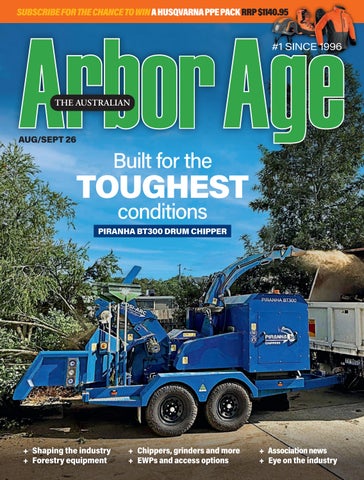
#1 SINCE 1996
AUG/SEPT 26
Built for the
TOUGHEST conditions
PIRANHA BT300 DRUM CHIPPER
#1 SINCE 1996
The Australian Arbor Age is published bimonthly by Prime Creative Media Pty Ltd.
Chairman John Murphy CEO Christine Clancy National Advertising Manager Joanne Davies P: +61 434 785 611 joanne.davies@primecreative.com.au Editor Tom Foster tom.foster@primecreative.com.au Client Success Manager Justine Nardone justine.nardone@primecreative.com.au Design Jacqueline Buckmaster, Danielle Harris Subscriptions P. +61 3 9690 8766 subscriptions@primecreative.com.au Website arborage.com.au
Copyright
The Australian Arbor Age magazine is owned by Prime Creative Media and published by John Murphy. All material in The Australian Arbor Age magazine is copyright and no part may be reproduced or copied in any form or by any means (graphic, electronic or mechanical, including information and retrieval systems) without written permission of the publisher. The editor welcomes contributions but reserves the right to accept or reject any material. While every effort has been made to ensure the accuracy of information, Prime Creative Media will not accept responsibility for errors or omissions, or for any consequences arising from reliance on information published. The opinions expressed in The Australian Arbor Age magazine are not necessarily the opinions of, or endorsed by, the publisher unless otherwise stated. © Copyright Prime Creative Media, 2026 Articles All articles submitted for publication become the property of the publisher. The editor reserves the right to adjust any article to conform with the magazine format.
Sydney Office Suite 11.01, 201 Miller Street North Sydney, NSW. 2060. Australia
2
THE AUSTRALIAN ARBOR AGE
“ Image: STIHL
Head Office 379 Docklands Dr, Docklands VIC 3008 P: +61 3 9690 8766 info@primecreative.com.au www.primecreative.com.au
STIHL’s next-generation professional battery system promises more peak power and a nine-minute fast charge Page 12.
”
Contributor
SUBSCRIBE FOR THE CHANCE TO WIN A HUSQVARNA PPE PACK RRP $1140.95
Jim McArdle B.Ed. Sc (Sydney), Dip. Arb. (Ryde), VTRA@ QTRA qualifications. Director at McArdle Arboricultural Consultancy and TCAA President, Jim’s career spans across almost 40 years and focuses on consulting and reporting in tree risk protection and management plans, and tree impact assessments.
Feature
On the cover
#1 SINCE 1996
08. ON THE COVER
Piranha Chippers: Australian designed and built
24. SHAPING THE INDUSTRY
AUG/SEPT 26
Nathan Sangster
Built for the
TOUGHEST conditions
Regulars
PIRANHA BT300 DRUM CHIPPER
04. WELCOME LETTER 06. SIGNIFICANT TREES 12. INNOVATIVE PRODUCTS + Shaping the industry + Forestry equipment
+ Chippers, grinders and more + EWPs and access options
+ Association news + Eye on the industry
Piranha Chippers puts power behind the cut. Image: Piranha Chippers
20. ELEVATING WORK PLATFORMS 26. CASE STUDY 28. CHIPPERS, GRINDERS AND CLEAN-UP OPTIONS 30. FORESTRY EQUIPMENT 32. CASE STUDY: The Rayco RG37 Trac and Stump N Grind 34. TECHNICAL INSIGHT 36. EYE ON THE INDUSTRY 42. SUBSCRIBE AND WIN 44. ASSOCIATION NEWS
THE AUSTRALIAN ARBOR AGE
3
Welcome
Professional arborists have a real desire to ‘spend time with trees’. Image: TF/Prime Creative Media
Moving in the right direction T
he mechanisation of tree work has been under discussion a bit lately, and I wonder if the industry is a little at sixes and sevens on the subject. While there’s undoubtedly a need for arborists to work faster and more efficiently to maintain profitability – as there is in every modern business venture – I still feel when I’m speaking to arborists that there’s a real desire to ‘spend time with trees’. There’s been plenty of discussion about arborists not being tree loppers, and I feel as though this is part of the same phenomenon. There’s a connection among the individuals in the tree-care community, and at its centre is a love of trees. It’s a lot stronger than a love of money. But we all must earn a living, and if tree removal or pruning for convenience – rather than necessity – pays the bills, the pressure to perform that service can be overwhelming. I can’t help but admire the arborists who, when offered a job that can be done and invoiced quickly, take the time to explain to a prospective client waving a credit card that the tree in question
4
THE AUSTRALIAN ARBOR AGE
needn’t be removed, or that one side of the canopy doesn’t need to be hacked off because it’s dropping leaves on the carport. Those conversations put the job at risk. The client may decide he’ll find someone who’ll do the job without wasting his time discussing it. Or worse, he may even decide to borrow a mate’s chainsaw and do it himself. I’ve seen that situation many times: a patient, slightly frustrated arborist tries to do his best for both his client and the tree, but ultimately fires up a chainsaw, calls in a chipper and does the job requested. No one can blame the arborist. He has to pay his bills. The situation can become more complex if the tree in question is a native or protected. The arborist can face real pressure to turn a blind eye in those circumstances, as can consulting arborists doing assessments for property developers and infrastructure projects. Things have started to swing back in favour of common sense lately, though. We ran a story last issue about a tree in Western Australia that developed a
crack that could’ve been a safety issue. Removal would’ve been a financially justifiable action for the local authority, but after lobbying from the community the tree received expert attention and was saved. In November 2025 we saw a lone tree in the track of an infrastructure project preserved after community members approached the project owners and voiced their concerns. Several associations have taken the initiative and begun presenting at schools and outdoor shows to educate people on the work arborists can do and the joys of working among trees. Slowly, but surely, the concept of living alongside these timeless, majestic wonders is taking hold. Let’s hope the philosophy continues to grow – along with the trees themselves. Tom Foster Editor
CHARGED WITH
next level power NEW STIHL ALLPRO BATTERY SYSTEM
SCAN TO LEARN MORE. COMMERCIAL DEMONSTRATIONS AVAILABLE.
Significant trees
Poland’s Crooked Forest
A curvaceous curiosity in Polish Pomerania.
The Crooked Forest, near the town of Gryfino in Poland, has an eerie beauty. Image: Darek Bednarek/stock.adobe.com 6
THE AUSTRALIAN ARBOR AGE
T
here’s no credible explanation as to why this grove of 400 or so Scots pines in Poland’s northwest grew with a distinctive curve near ground level. The cluster of Pinus sylvestris was planted in the 1930s, and each tree twists to the north before returning to the more usual straight trunk of the species, growing to about 15 metres in height. There are plenty of theories about the cause of the unusual growth pattern. It’s generally accepted human intervention is fundamental to the phenomenon, although our research did unearth someone conjecturing it was the result of a snowstorm, and another pondering the possibility of the pines being ‘a forest from a different world’. Despite their uncertain heritage, the trees have become a popular destination for tourists, and for a while damage to the site by humans was a problem. Now humans have put in place a program to revitalise and preserve the area. That’s a twist nearly as good as the ones on the trees.
READY TO CLIMB. READY TO WORK. JLG’s range of Compact Crawler Booms are available and ready to order now! When access is challenging, JLG helps arborists reach more jobs with confidence, combining a compact footprint, low ground pressure and strong manoeuvrability with working heights up to 32.48 m, backed by JLG’s nationwide Ground Support network.
Model
X13 SJP
X13 JP
X17 JP
X20 JP
X22 SJP
X26 JP
X33 JP
Working Height
12.90 m
13.30 m
16.96 m
20.05 m
22.00 m
25.60 m
32.48 m
Propulsion
Internal Combustion Diesel Engine
Internal Combustion Petrol Engine
Battery Electric Motor
Australia 131 JLG www.jlg.com.au
On the cover
The BT310 as pictured is designed and built to cope with Australian conditions and timbers. Images: Piranha Chippers
8
THE AUSTRALIAN ARBOR AGE
Power behind the cut
Designed and built in Melbourne, the Piranha BT300/BT310 is ready to take on the world.
P
iranha Chippers’ BT300 is a serious, 15-inch capacity chipper with plenty of horsepower to get the job done. Powered by the 4HK1 Isuzu turbodiesel engine producing 197hp, the BT300 runs a 650mm-diameter cutter drum with four staggered cutter knives and a 380mmH x 500mmW (15" X 20") direct opening into the cutter-drum housing with no step-downs. Being an electronically controlled, common-rail direct-injection diesel motor, the 4HK provides good fuel economy and is quiet when running. The dual horizontal infeed wheels offer strong pulling power, and with the assistance of the hydraulic winch – which folds up out of the way when machine loading – difficult trees and branches are dealt with using minimal physical effort from the operators. Other features ensuring ease of use include the hydraulic auto-engage clutch, hydraulic discharge chute swivel, raise, and tilt, and the hydraulic tailgate raise-and-lower functions. All these actions can be operated via the radio remote control unit, offering further productivity gains when feeding with a loader.
Serviceability
The design team paid attention to detail on the BT300, and servicing of all required items can be done quickly, easily, and with minimum effort. Starting at the front with the engine, the Isuzu 4HK1 has service intervals of 500 hours. That means longer intervals between scheduled oil and filter changes, and with many operators already running Isuzu trucks in their fleets, sharing common filters allows minimal stockholdings of essential engine parts and spares. THE AUSTRALIAN ARBOR AGE
9
On the cover
Both models carry a five-year/3000-hour warranty. The engine and clutch are covered by a manufacturer’s two-year warranty. 10
THE AUSTRALIAN ARBOR AGE
Difficult trees and branches are quickly dealt with.
When the front door of the engine compartment is opened, all filters and service points are easily accessible, so the changing of filters and oil can be done with minimum time lost and minimum inconvenience to operators. The remote oil-drain hose makes draining the engine oil from the sump fast and mess-free, and the access door at the top of the engine cover ensures easy and trouble-free refills. There’s a work light mounted inside the engine bay to ensure checking the essentials can be done even in dark conditions. The other major service requirement for any chipper is attending to the chipper knives, and on a Piranha chipper access is made easy via the side walkway ramp. When the chipper housing hood is opened, the top part of the cutter drum is completely exposed, making changing the knives easy and safe. Operators and owners will know chipper blades need to be torqued up tight, and when the process requires reaching through a
small access door the job becomes very difficult. That has all changed with the Piranha BT300.
Versatility
Piranha Chippers currently offers two design variations: the BT300 Trailer Chassis and the BT310 Tracked Chassis. Both models share the same chassis and running gear. The only difference between the two is a dual-axle trailer chassis on the BT300 and a self-driving tracked chassis on the BT310. Piranha chippers are 100 per cent Australian made and owned, and with a five-year/3000-hour warranty (the engine and clutch are covered by the manufacturer’s two-year warranty) they are a strong choice for those serious about chipping wood. Contact the Piranha team today. They’d love to show you just how good their chippers are in real life. Visit piranhachippers.com.au to learn more.
BUILT IN AUSTRALIA FOR AUSTRALIA
that’s PIRANHA
www.piranhachippers.com.au THE AUSTRALIAN ARBOR AGE
11
Innovative products
Battery platform takes aim at tree work
STIHL’s next-generation professional battery system promises more peak power, a nineminute fast charge and the latest technology. Here’s what it means for arborists. STIHL has built its new ALLPRO Battery System with demanding, all-day users in mind. Images: STIHL 12
THE AUSTRALIAN ARBOR AGE
T
his Spring is shaping up to be a landmark season for professional battery power and STIHL has built its new ALLPRO Battery System with demanding, all-day users in mind. It delivers more peak power, faster charging, longer service life, and greater toughness. For arborists, that combination lands where it counts – the grunt to drive a saw through heavy timber, the runtime to keep a crew cutting, and a pack rugged enough for the daily move between canopy and chip pile. The platform spans five batteries across two series, and is backed by new, fast-charging hardware. For anyone with existing STIHL kit, full backwards compatibility means ALLPRO batteries suit more than 60 tools in STIHL’s professional range, including every APsystem tool already in the field.
A century of engineering
STIHL has spent more than 100 years at the sharp end of outdoor power equipment, and that depth of expertise sits behind every part of the ALLPRO system. The company develops its battery technology in-house, owning the full process from cell research and thermal engineering through to field testing that exceeds industry benchmarks. ALLPRO is the payoff from that investment. At the core is new tabless cell technology, a step-change in how a battery cell is built, and the reason a single pack can deliver higher peak power, charge faster, and last longer – rather than trading one gain for another.
What ALLPRO delivers
For arborists, the numbers that matter most sit in the ALLPRO Performance Series where the top model delivers: • 60 per cent higher peak power and 20 per cent more runtime than the previous generation (peak power is the burst a battery can deliver at its highest-demand moment); • rapid charge, with 80 per cent achieved in just nine minutes using the new AL 1802 MO mobile charger; • constant power with no fade as the charge drops; • Power Boost on compatible tools, unlocking maximum output on demand; • a rating of up to 3000 charge cycles, which STIHL puts at roughly 15 years of typical use; and
STIHL is introducing the AL 1802 MO rapid battery charger, built for all weather conditions.
• IPX5 water resistance, certified against direct water jets from any direction.
The range at a glance
The Performance Series is where the new battery technology is concentrated: three distinct packs, sharing the higher peak power, faster charging and longer service life the new cell design delivers, and scaling from a light pack for light tools up to a range-topper built for the heaviest, most sustained cutting. A Standard Series joins the line-up, rounding out the range with two packs for crews who don’t need the fastcharge capability.
Keeping the crew moving
The most practical claim for a working outfit is the fast charge time. The intended workflow is simple – run one battery in the saw while a second charges – so a removal or a day of heavy cutting never has to stop. The charger supports sequential charging for outright speed or gentler parallel charging to protect long-term battery life, and it’s rated for outdoor use in rain, vehicles, and remote sites. For crews working beyond the reach of mains power, STIHL is also introducing the PS 2000 power station, which brings that fast-charge capability off-grid entirely. There’s a quieter point worth noting for tree work specifically: a battery platform of this capability makes it easier to run saws in noise-sensitive settings and to work in the canopy without exhaust fumes at head height – advantages that matter to operators who are on the tools all day.
Built for a hard life
The Performance Series packs have been tested at temperatures from –20°C to +50°C, subjected to 1.5-metre drop tests, and put through vibration testing meant to exceed real-world punishment. Batteries cop more knocks than the tool they power. They’re often dropped off a tailgate, banged against the trunk, clipped to a line and hauled up to a climber, so a housing that shrugs off impacts and keeps water out earns its place through wet winters, hot summers and the daily grind of removal work.
The upgrade path
For contractors already running the STIHL AP battery system, the path forward with ALLPRO is seamless. The new system is fully backwards compatible. Every existing AP tool and charger works alongside new ALLPRO batteries from day one. With compatibility spanning more than 60 tools in the STIHL line-up, the ALLPRO system slots into an existing operation effortlessly, protecting past investment while opening up the full capability of next-generation battery performance. STIHL ALLPRO arrives in Australia in Spring, 2026. Book in with the National Commercial Team to experience ALLPRO with a handson demonstration. Visit stihl.com.au to learn more and stay up to date on the release. THE AUSTRALIAN ARBOR AGE
13
Innovative products
What can a top-spec grapple saw look like? Finding the right machine-and-attachment combination has become a specialist task.
These grapples have their own valve bank and need only proportional one-way oil flow from an excavator’s standard hammer function.
N
ot too long ago, using a compact excavator with a simple thumb grab to help feed a chipper was considered a major change in reducing the workload for ground crews. Today, having an excavator of any size with a specialised attachment, such as a tree shear or grapple saw, is common, or even expected, when pruning, felling, clearing, and processing material for an increasing number of projects. While tree-handling attachments are becoming more familiar, there are unique challenges for potential buyers,
14
THE AUSTRALIAN ARBOR AGE
excavator dealers, attachment suppliers, and other stakeholders looking to ensure the best fit for a machine-andattachment package.
The right system for the job
The hydraulic system forms an important part of assessing the capability of an excavator for a business and future possibilities for work tools. “It all starts with the hydraulic supply down the boom, then we can jump right into the details of what can run from that and how the functions will be
controlled” explained Rey Kell, Forest Centre Director. “Grapple saws can differ between brands or models even more than excavators, and it’s helpful to look at the big picture, from spec sheet all the way through to the operator’s seat. “It’s a collaborative journey we at Forest Centre go through with every customer. Often we find the way forward more from a performance requirement or an excavator’s hydraulic specs, rather than a factor like price.”
Control systems
Direct hydraulic control is the most common system. Each attachment function requires its own control valve and set of hydraulic lines from the excavator. The joystick button or roller switches are dedicated to the respective functions of rotate, grapple, and saw. While considered the simplest and most reliable control method, direct hydraulic control often requires customisation work onn the excavator during installation to deliver oil where it’s needed. That often makes predicting installation costs difficult. A grapple saw will often need three auxiliary valve functions, enough spare buttons on the joystick controls to accommodate the functions, and seven hoses down over the boom. Electronic diverter switching is another popular system. Depending on the pressure and flow needs for each function, operator control inputs can swap from one attachment function to another. A common switching example has a joystick button assigned for the ‘grapple close’ function that can also activate the saw while a second switching button or foot pedal is held on. When the operator releases the secondary switch, the grapple buttons go back to controlling just the grapple movement. Ideally, the solenoid control and switching valve are designed into and pre-fitted to the attachment itself, with user instructions and technical functions detailed in the attachment owner’s manual.
Modern equipment challenges
Tree-handling attachments are becoming more familiar. Images: Forest Centre
Excavators with their own complex computer management systems using Controller Area Network (CAN) Bus digital signals for almost every function on the machine are becoming more common. Attachments from THE AUSTRALIAN ARBOR AGE
15
Innovative products
Vosch Control is a new approach to grapple saws.
the excavator brand’s own catalogue, or simple tools that require only the factory-fitted hydraulics can be connected, adjusted, and go to work almost seamlessly. In the case of specialised attachments like grapple saws that require at least one extra hydraulic function, it can be difficult or even impossible to integrate the necessary extra components on these latest-generation machines. Machine-wise, a TV show phrase comes to mind: ‘Computer says no.’ Attachment manufacturer Vosch, represented in Australia by Forest Centre, tackled this issue head-on while developing its latest 50 Series grapplesaw models. The two most popular Vosch grapple sizes are now offered in both full direct hydraulic and electrohydraulic CAN attachment control configurations.
Electro-hydraulic control
Vosch Control is a new approach to grapple saws in terms of both installation and functionality, shifting the controls from the excavator to the attachment. These grapples have their own valve bank, which only require proportional 16
THE AUSTRALIAN ARBOR AGE
one-way oil flow from an excavator’s standard hammer function – one pair of lines for pressure and return. All hydraulic movements for the grapple saw are then proportionally controlled via the valve bank, an electrical cable down the boom, and CAN digital signals from the Vosch system components in the cabin. Customised joysticks replace the factory handpieces during the Vosch Control system installation, using roller switches for grapple and rotate control, plus additional buttons for new functions such as ‘enable saw’ (like a safety-gate switch just for the saw unit) with LED indicator, and saw-bar movements in and out, independent of saw-motor RPM. Two spare rollers can even be used to control the excavator with wheel or track steering as an option. A user-friendly touchscreen display in the cabin allows adjustment of parameters such as speed and sensitivity which can be useful for training purposes or when working in confined areas. “Operators are often surprised to learn they have the capacity to drive the saw bar out to either verify positioning before
making a cut or to free a hooked-up branch,” said Kell of the Vosch Control system. “They can pull the bar back in if the chain becomes jammed mid-cut as well, all without running the saw motor and risking damage. “It’s also nice to have a service position, with the bar fully extended, for maintenance or replacement of cutting system parts.” When the grapple saw is disconnected, the Vosch Control system and joystick switches revert to standard auxiliary work-tool functions on the excavator, ready to operate a mulcher, tree shear, or other attachment. “Another big plus with Vosch Control is the outright performance level for each grapple function,” said Kell. “There are no compromises in strength or speed. All motors and cylinders on the grapple saw can be supplied the right amount of oil on demand, without having to rely on the individual auxiliary circuit capacities that vary between excavator models. “The result with the Vosch Control system is a multi-purpose grapple saw with gripping and turning power surpassed only by the large, fixed felling heads used in forest harvesting.”
What’s around the corner?
Under development since 2019, the next step from today’s CAN control for attachments will be Machines in Construction 4.0 (MiC 4.0). The new MiC 4.0 standard defines a universal data interface and communication protocol that uses a CAN bus framework to let construction machinery and attachments ‘plug-andwork’ across different manufacturers. “Some of our suppliers, including Vosch, are already MiC 4.0 compatible, fitting solutions on the latest generation excavators in Europe,” said Kell. “When this trickles down to our market, even more streamlined installation could be possible, without adding any extra hydraulic or electrical components. Upon fitting the attachment, the excavator recognises it and adjusts hydraulics and operator controls accordingly.” For more information on grapples, shears, saws, and attachments, contact Forest Centre on (02) 6947 2833 or visit forestcentre.com.au.
Customised joysticks replace the factory handpieces during the Vosch Control system installation.
THE AUSTRALIAN ARBOR AGE
17
Innovative products
The Cairns Show Pole Climbing event is one of the festival’s most anticipated spectacles. Images: ATC Products
Inspiring the next generation An event sponsored by Silky Saws gives young people the chance to try a safe, exciting arbor environment.
H
osted annually at the Cairns Showgrounds in Far North Queensland, the Cairns Show Pole Climbing event is one of the festival’s most anticipated spectacles, and perhaps the most rewarding part of the event is seeing the younger competitors. There’s something special about watching a youngster clip in, tackle the pole with determination, and ring the bell at the top while the crowd erupts in applause. Moments like those plant a seed. Some of the junior competitors could well become tomorrow’s climbing champions, crew leaders or business owners. Australian arboriculture needs passionate young people, and events like this one show them that arboriculture isn’t just a job – it’s a career full of adventure, challenge, and lifelong friendships.
18
THE AUSTRALIAN ARBOR AGE
Silky keeps returning
Silky Saws has supported the Cairns Show Pole Climbing Competition for many years and is proud to continue that support. The event represents everything Silky Saws loves about arboriculture: professionalism, skill, safety, and community. It’s also an event that showcases people who genuinely enjoy what they do. Supporting events like these helps strengthen the arbor industry and encourages the next generation of climbers to chase excellence.
The saw every climber trusts
Before anyone says, “You don’t need a saw to climb a pole,” that’s right – but once a climber is in a tree, they’ll be glad there’s a hand saw hanging on their harness. Whether used to make a precise pruning cut, remove deadwood,
or tackle a dismantle, Silky Saws have earned their reputation for one reason: they work. They’re razor sharp, smooth through timber, lightweight to carry, and built to withstand the demands of professional climbing. Ask an experienced arborist what handsaw they trust, and there’s a good chance the answer will be, “Silky”. It’s one of those tools that can’t be appreciated until it’s been tried. Then arborists wonder how they ever managed without it.
A day worth experiencing
More than just a sporting event, the Cairns Show Pole Climbing Competition is the celebration of an industry. It showcases the professionalism of arborists, introduces the public to a trade many know little about, encourages young people to get involved, and reminds all of us why we
Silky Saws are designed for professional tree work.
Some junior competitors could well become climbing champions, crew leaders or business owners.
enjoy being part of this profession. Whether you’re an arborist, a family looking for something different, or just curious to see what climbing a 10-metre pole at full speed looks like, it’s worth visiting the show in 2027. Who knows? Your friends might leave with a new appreciation for the people working high above their backyards every day. If you’re already climbing for a living, there’s a good chance you’ll
leave thinking about your next Silky Saw. Silky Saw will be there again next year, supporting one of Australia’s most unique arboriculture events. After all, the only thing better than watching someone ring the bell at the top of the pole is hearing them say afterwards, “That was easier than getting my Silky back from the apprentice.” To see the range of Silky Saws, visit atcproducts.com.au.
THE AUSTRALIAN ARBOR AGE
19
Elevating work platforms
Here comes the boom JLG Industries has extended its range of access equipment for Australian tree workers.
T
he JLG range of Compact Crawler Booms (CCBs) can be divided into two categories: straight and articulated.
Straight
The Straight range of JLG CCB consists of two models – the X13SJ Plus and the X22SJ Plus. The X13SJ Plus is a lithium-batterypowered AC-drive machine. Among its many features are a straight boom (12.9m of maximum working height, 6.40m of horizontal outreach and 230kg unrestricted capacity throughout the working envelope), narrow chassis, a tracked wheel carriage (0.75m retracted width), and lighter-weight construction, which make the machine easy to manoeuvre through gates, yards, and around gardens. The X22SJ Plus comes with a Bi-Energy power system that combines a diesel
All JLG CCBs feature non-marking tracks. 20
THE AUSTRALIAN ARBOR AGE
engine with a lithium battery, providing greater flexibility across a range of applications. The machine features a straight boom with a maximum working height of 22.0m, horizontal outreach of 11.9m, and 230kg unrestricted capacity throughout its working envelope. Both units have envelope tracking and feature ‘Go-Home’ (the unit will return to the fully closed position) and ‘Go Back’ (the unit will return to the last saved position) settings designed to help improve productivity.
Articulated
The Articulated range consists of five models: X13J Plus, X17J Plus, X20J Plus, X26J Plus, and X33J Plus. The X13J Plus has a maximum working height of 13.3m, horizontal outreach of 7.08m, and 230kg unrestricted capacity. The X17J Plus has a 16.96m maximum
working height, 7.65m of horizontal outreach, and 230kg unrestricted capacity. The X20J Plus has a maximum working height of 20.05m, 9.85m of horizontal outreach, and 230kg unrestricted capacity. All three models are available with a petrol engine, diesel engine, or a lithium battery power pack. The X26J Plus has a maximum working height of 25.60m, horizontal outreach of 13.75m, and 230kg unrestricted platform capacity. The X33J Plus has a maximum working height of 32.48m, horizontal outreach of 16.50m, and a 230kg unrestricted platform capacity. These two models come with the Bi-Energy (diesel engine and lithium battery) powerpacks.
JLG is expanding its team of in-house technicians and field service mechanics across capital cities and regional areas.
Range
All JLG CCBs feature non-marking tracks that can be automatically adjusted to widths better suited to the workspace or to help manoeuvre through confined jobsites. The outrigger pads are also non-marking with a Teflon finish, reducing the risk of floor damage in sensitive environments. All JLG CCBs also feature SkyGuard™ as standard. SkyGuard™ is a JLG proprietary enhanced control panel protection system that automatically stops all machine functions and temporarily reverses most functions to the state they were in one second before the system was activated. The benefits continue with autolevelling outriggers with integrated lifting lugs, which increase stability and ease of set-up. Other features include auto cut-out when the machine is out of level, emergency descent systems, an envelope management load-sensing system.
five years of coverage for all specified major structural components, giving owners additional peace of mind. For further details on the range of Compact Crawler Booms and other JLG products, visit jlg.com.au.
JLG now has a range of Compact Crawler Booms available in Australia. Images: JLG
Expert support
JLG is continuing to invest in aftermarket support, expanding its team of in-house technicians and field-service mechanics across capital cities and regional areas. JLG employs its own experts to ensure customers receive the highest level of support. The units are backed by JLG’s ‘1 & 5’ warranty, which provides a full year of coverage for the complete machine, plus THE AUSTRALIAN ARBOR AGE
21
Elevating work platforms
Niftylift launches a global machine support hub A new platform consolidates a range of existing Niftylift support resources into a single machine-focused portal.
P
roviding a single point of access to machine-specific documentation, the MyNifty hub offers troubleshooting tools and instructional video content for Niftylift equipment. Users can access information by scanning the QR code located on a machine’s serial plate, or by searching using a machine serial number online.
Global support
As a manufacturer whose products are sold and used in more than 70 countries, Niftylift sees MyNifty as an important step in providing more consistent and accessible support to customers around the world. MyNifty also complements Niftylink, Niftylift’s telematics platform. While
Wide support
Developed to support operators, fleet owners, service personnel and distributors, MyNifty makes it easier to locate information for a specific machine model, helping users find answers whether they are in the workshop, on site or managing equipment across multiple locations. Depending on the machine, a MyNifty page may include: • Operating and safety manuals; • service and parts manuals; • technical drawings and schematics (login required for some documents); • error code look-up; • cage-overload override reset codes; and • NiftyPRO video content for that model, including Familiarisation, Quick Start, Emergency Recovery, Charging, and Loading and Lashing guidance.
Improved access
A key feature of MyNifty is its QR-driven accessibility. Most Niftylift machines currently in service already feature QR codes on their serial plates, allowing users to access machine-specific support information directly from the machine using a mobile device. The platform currently provides support coverage for Niftylift machines spanning approximately the past 20 years, encompassing most machines still in active service. NiftyPRO video content is available for Niftylift’s selfpropelled range, with additional product ranges planned for future inclusion. 22
THE AUSTRALIAN ARBOR AGE
MyNifty makes it easier to locate information for a specific machine model. Images: Niftylift
Niftylink helps owners monitor machine status, utilisation, and maintenance priorities, MyNifty provides the documentation, guidance and support resources needed to take action. “Customers want information to be easy to find and easy to access, wherever they happen to be,” said
Simon Maher, Marketing Manager at Niftylift. “MyNifty has been developed to provide a single destination for machine-specific support information, whether someone is operating a machine, maintaining it, or managing a fleet. “By combining documentation, troubleshooting tools and video guidance in one place, we’re making it easier for customers around the world to get the most from their Niftylift equipment.” To learn more about MyNifty and watch the introductory video, visit niftylift.com.au.
The MyNifty hub offers troubleshooting tools and instructional video content for Niftylift equipment.
Most Niftylift machines currently in service feature QR codes on their serial plates. THE AUSTRALIAN ARBOR AGE
23
Shaping the industry
From DIYer to national recognition
Launching a manufacturing concern in Australia takes courage and commitment. Piranha Chippers’ top man has plenty of both.
The first Sangster-built chipper went to work in the early 2000s. Images: Piranha Chippers
A
welder by trade, Nathan Sangster discovered a joy in manufacturing and a love for trees and arboriculture early in life. “I’ve been passionate about the tree industry since I was 12 years old and first used my grandpa’s chainsaw,” remembered the Victorian business owner. “I became what could be considered a ‘recreational’ arborist. I bought all the tree-climbing gear, and while I never had any formal training, I used to prune and cut down trees when I was in my late teens and early 20s. “It wasn’t a commercial pursuit. I just did it for family and friends.”
Progression
As a young man Sangster joined his family business manufacturing furniture 24
THE AUSTRALIAN ARBOR AGE
and then later started his own business manufacturing quality furniture from recycled hardwood timbers, and the monthly hiring of a chipper to process the timber waste seemed an opportunity. Rather than continually paying a hire fee, why shouldn’t they make their own chipper? Both Sangster and his younger brother were good with their hands, and particularly enjoyed welding and fabrication. In the early 2000s the first Sangster-built chipper went to work. But it wasn’t all plain sailing. “It was a gravity-fed disc chipper, and it used standard, high-speed chipper knives,” said Sangster. “All woodchippers do, but the furniture timber was either old, recycled or kiln-dried hardwood, and the blades went blunt quickly.
“As the business progressed and demands changed, we started using more plywood and particle-board wood panels, and they were tough. We sold that first chipper and built a little mini tub grinder. It wasn’t quite a tub grinder, but it was like mini horizontal grinder without the horizontal bit. “Once again it was gravity fed, and we made a big drum and fitted it with stumpgrinder teeth.” That grinder turned out to be a real success. The stumpgrinder teeth were designed to cope with the dirt, rocks and foreign debris of grinding jobs, and they coped well with the materials the Sangsters were processing. “Anything we threw in the tub was just ground up, no problem,” he explained. “We kept that grinder in use until we
Sangster’s second machine was a small mini tub grinder.
closed the furniture business and then sold it. “That was the start of building chippers and timber processing equipment for me.”
Moving on
From manufacturing furniture Sangster moved into the supply of ply and timber panels for commercial wall and ceiling applications, and the business, Maxiply, flourished and is still doing well. But Sangster’s love of machinery, manufacture, and tree work has never faded, and when a couple of disconnected events aligned, Sangster once again saw an opportunity. “My son had finished school, done his trade, and was keen to get into running his own business,” he said. “He was hands-on and a good welder. In 2020 COVID hit and parts for the American machines were hard to get in Australia because of the lockdown on freight and logistics. I spoke to a few people in the industry who said, ‘Well, if you were building woodchippers here in Australia today, we’d be buying them. We can’t get them from America’. “That’s what started Piranha Chippers.”
It’s a date
As Australian manufacturing faces challenges from overseas forces, a move into producing capital-equipment machinery was a big leap, but Nathan made the commitment and, with his son, set to work. “We built the first prototype at the
Maxiply factory,” he said. “We have a nine-metre-by-six-metre shed where we do all our machinery and equipment repairs. It has all the welders, cutting machines, saws and so forth, and we built the first Piranha in there. In 2024, when we were sure we were launching Piranha Chippers as a business, we moved to a factory in Bayswater North.” Like all business owners, Sangster would like to see faster growth for Piranha Chippers, but he’s realistic in his expectations. “Some people say the business is building nicely, but I’m always keen to see sales go roaring off,” he said. “But I think, by and large, for a brand-new product, it’s doing well. “We’ve done a huge amount of research and development, and that caught me unawares. I didn’t realise it’d take so long to fine-tune the product. When I stand back now and look at how far we’ve come, from making a product from scratch to the way we’re seeing it perform now, it’s satisfying.”
equipment, especially when arborists and contractors have to be ready to deal with storm activity – when there’s a need to get in and do a big clean-up as fast as possible.” That led The Australian Arbor Age to wondering about the future of Piranha Chippers. With the BT300 and BT310 both being so new, was Sangster looking to sit tight and consolidate? Apparently not. “Piranha will build a little single-axle chipper that’ll be probably half the weight of our current one at some stage – something that can be easily towed by small trucks,” he said. “In the meantime we’ll concentrate on bigger models. The next one will be a 21-inch machine – the existing one is a 15-inch chipper – and it’ll have a motor twice the size. We have a 200-horsepower Isuzu in the current model, and the new machine will have the 9.8-litre Isuzu 362 horsepower.” To see the Piranha Chippers range, visit piranhachippers.com.au.
Change
While business has kept Sangster fully occupied, over the years he’s remained in touch with arbor and tree-care work and feels the biggest changes he’s seen in the industry are in the growth of mechanisation. “More and more people are using machine-fed woodchippers, just to reduce labour,” he said. “There’s a market for small chippers, but there’s definitely a growing demand for bigger
Nathan Sangster, Director and owner of Piranha Chippers. THE AUSTRALIAN ARBOR AGE
25
Case study
Josh Brack (left) of Bracky’s Trees took delivery of his BC2100XL from Vermeer Australia’s Wade Green in Townsville.
Generations of Vermeer
As a business moves from father to son, the choice of machinery remains unchanged.
B
racky’s Trees is a Townsvillebased arbor company servicing Queensland’s north and northwest. From routine pruning to large-scale removal and emergency callouts, the company is ready – staff are insured, qualified and well-equipped. Director Josh Brack didn’t set out to be an arborist but moved into the business as his father’s part-time arbor work grew. Now the company employs 15 people and runs a fleet of machinery – all of it Vermeer.
A big move
Josh’s father officially kicked off the business in 2018, but, as Josh recalled, he’d worked in trees for some time. “Dad had been in the business for around 30 years,” said Josh. “He’d always worked in the mines and done arbor work on his days off. “I went to school in Mount Isa, and then we moved to Townsville and Dad officially started Bracky’s Trees. I came on board full time in 2020. The business has just grown from there.” Now a Level 3 arborist and studying for his Level 5, Josh didn’t start out all that keen. “I didn’t want to do it at all,” he 26
THE AUSTRALIAN ARBOR AGE
admitted. “I’m scared of heights. I’d always drag branches with Dad when he needed help, but it wasn’t something I wanted as a career. It just fell into my lap. He got to the point where he wanted a break and said, ‘It’s your turn now’. “Once I started to learn about trees, and when I started showing up at jobs confident I could get the work done without needing help, I started to really enjoy it.”
Stepping up
Both Josh and his father are confirmed fans of Vermeer, a situation bought about by long years of good service from the brand. “It was about 25 years ago Dad bought his first Vermeer,” recalled Josh. “It was a BC1800XL, and across the years the Vermeer machines we’ve owned have always been reliable.” Recently Bracky’s Trees took delivery of a new BC2100XL to run alongside the BC1800XL and the BC1500XL already in service, and Josh considers it a step toward the business’s future. “It’s a big investment,” he said. “We wanted to move into more land-clearing work – not full-scale land clearing, but bigger jobs. Nobody else in the area can
offer a chipper of that size, and we’re hoping people will start calling Bracky’s for the larger contracts. “I think Dad’s always wanted to move into horizontal grinders and tub grinders, but that’s a big set up to establish, with massive excavators and million-dollar machines and so forth. The BC2100XL is a step in that direction.”
Local
The long-time satisfaction with Vermeer equipment was a major factor in Bracky’s Trees’ recent purchase – the company fleet includes two Vermeer skid steers and two Vermeer stump grinders alongside the chippers – but the convenience of a Vermeer dealership in Townsville was also a consideration, as Josh explained. “We did look at other brands, and they were good to deal with,” he said, “but having the Vermeer Australia branch here in town is good for us. It’s always handy being able to take machines straight to them. I think Vermeer is really good at what it does.” Visit vermeeraustralia.com.au to learn more about the Vermeer range of equipment.
Vermeer BC2100XL Wood Chipper
• Engine: Tier 3 Cummins QSB 6.7 L sixcylinder diesel • Gross horsepower (maximum): 275hp/205.1kw • Torque (maximum): 730ftlb/989.8Nm • Fuel tank capacity: 65gal/246.1L • Length (feed table up, tongue in): 235 inches/596.9cm • Length (table down, tongue extended): 259 inches/657.9cm • Width: 95.8 inches/243.2cm • Height: 116.5 inches/295.9cm • Sound power: 86dB(A) • Aggregate trailer mass: 8000kg • Material capacity: 21 inches/53.3cm
The BC2100XL is a step toward expansion for Bracky’s Trees. Images: Vermeer Australia THE AUSTRALIAN ARBOR AGE
27
Chippers, grinders and clean-up options
Tailored equipment solutions, such as tracked chippers, allow the matching of equipment to specific job requirements. Images: Monitor Industries
Optimising tree-care equipment for Australian arboriculture Arborists’ opinions are becoming more relevant as urbanisation and mechanisation increase.
A
ustralia’s landscapes present unique challenges for tree-care professionals tasked with maintaining the health and beauty of the natural surroundings. Arborists play a crucial role in overseeing the management of large trees and their ecological impact on communities, ensuring they meet the appropriate health, safety, and suitability standards of property owners’ or communities. But inadequate care can result in the demise of these environmental stewards.
A role in urban sustainability
Safety is paramount in arboriculture. As highlighted in the study Arboriculture safety standards: Consistent trends (Lim et al. 2020) cited by Arboriculture 28
THE AUSTRALIAN ARBOR AGE
Australia, tree workers in Australia experience the highest fatality rate among all industries. With this in mind, Australian arborists are continually seeking innovative solutions to enhance efficiency, minimise environmental impact, and deliver exceptional service to their clients. A study by Davison and Kirkpatrick in 2014, Re-inventing the Urban Forest: The Rise of Arboriculture in Australia, underscored the impact of arboriculture on Australian cityscapes. The study also stated that arborists were actively shaping and executing plans to oversee the urban canopy, thereby enhancing urban sustainability. The recognition of the advantages offered by city trees has fuelled a surge in arborists’ influence, despite mounting difficulties
in integrating them into urban environments.
Enhancing efficiency with equipment
Lessons from international counterparts offer valuable insights. UK practices highlight the essential tools necessary for efficient and safe arboriculture tasks, and Australian arborists can benefit from adopting similar practices to enhance their work. Investing in high-quality equipment is paramount. In October 2023 Först, an international manufacturer of woodchippers, celebrated its 10th year of providing arbor machinery. Although there are various models under the Först brand, the Först ST8D is a well-established
The Först ST8D is a wellestablished eight-inch woodchipper that offers good chipping capacity and mobility.
eight-inch woodchipper and offers good chipping capacity and mobility, improving productivity and service offerings. Tailored equipment solutions, such as the Först TR8 tracked chipper designed for heavy-duty forestry tasks, allow the matching of equipment to specific job requirements. By incorporating these lessons, Australian arborists can enhance the efficiency and effectiveness of their tree-care endeavours.
Safety
Given the role arborists play as custodians of Australia’s natural landscapes, it’s important to address the unique challenges they face with innovative solutions. By prioritising safety, adopting best practices, and investing in quality equipment, Australian arborists can enhance the efficiency and effectiveness of their arboricultural services. Moreover, by ensuring the long-term health and sustainability of the natural environment, they contribute to a brighter future for generations to come. To see the Först range, visit monitor.net.au. THE AUSTRALIAN ARBOR AGE
29
Forestry equipment
An efficient tree-care solution
The SENNEBOGEN 718 E forestry material handler is well suited to demanding tree-care projects.
W
hether it’s foliage maintenance along a busy public thoroughfare or pruning near power lines and infrastructure, the compact SENNEBOGEN 718 E can quickly and safely grab, cut, move and stack trees, trunk sections, and branches quickly and safely. The forestry material handler has space-saving dimensions, a small rear swing radius, and a transport weight of approximately 26,500 tonnes. A full safety guard for the cab provides protection against falling branches, and with a load capacity of 1.7 tonnes at the full 13-metre outreach, even heavy trunks and tree sections can be dealt with. Surrounding cameras ensure allround visibility, and the machine’s stable undercarriage with reinforced axles gives a secure footing and
30
THE AUSTRALIAN ARBOR AGE
optimum manoeuvrability, even in challenging terrain.
• ease of transport, even with a grapple saw fitted.
Features
Made for the job
The 718 E offers: • 5500kg capacity out to its full vertical reach through its full 360-degree working radius (the weight of any attachment needs to be deducted from the lift capacity chart when calculating retained lift capacity); • a 30-degree elevating cabin; • a telescoping stick that will reach out to 15m (including the length of any attachment) and retract for operation in tight work areas; • travel speed of up to 20kph on four wide pneumatic tyres; • four independent and simultaneously controlled hydraulic stabilisers; and
SENNEBOGEN designs its tree-care handlers to optimise the marriage of hydraulics and engineering, resulting in high efficiency when felling and handling trees and timber waste. The 718 E reduces operating costs and boosts productivity thanks to precise cutting, low fuel consumption, and durable components. With professional use in mind, the 718 E offers both joystick and steeringwheel control and an Albach quickconnect system for the fast changing of attachments. The engine runs in line with the machine body allowing good service access, and underbelly protection is standard.
Multiple uses
In addition to the rear swing radius of less than 2.4 metres, a separate and coordinated hydraulic circuit allows various attachments to be fitted, including grapple saws, grapples, mulchers or cutting units. Whether for clearing roads and forest paths, processing stormdamaged and infested timber, felling problem trees or spacesaving tree care, the SENNEBOGEN 718 E is both cost-effective and versatile. To learn more about the 718 E and see the SENNEBOGEN range, visit pacificmh.com.au.
“ The 718 E reduces operating costs and boosts productivity, thanks to precise cutting, low fuel consumption, and durable components. Images: SENNEBOGEN
SENNEBOGEN 718 E forestry material handler
• Operating weight: approximately 36.5 tonnes including Albach attachment • Reach: 15m • Width (stabilisers up): 2670mm • Width (stabilisers down): 3890mm • Wheelbase: 2550mm • Engine type: Cummins fourcylinder Tier 3 [no AdBlue] • Undercarriage: MP28 in M-HDS version for diesel machines with four-point stabilisers, all-wheel drive, and two-stage powershift transmission
The 718 E reduces operating costs and boosts productivity thanks to precise cutting, low fuel consumption, and durable components
”
SENNEBOGEN designs its tree-care handlers to optimise the marriage of hydraulics and engineering. THE AUSTRALIAN ARBOR AGE
31
Case study
The Rayco RG37 Trac’s compact design makes it quick to move between jobs. Image: Monitor Industries
An arborist’s go-to stump grinder
A versatile, compact stump grinder proved the catalyst for the growth of this business.
S
tump grinding can be a tricky job, demanding both precision and power to get through tough stumps without damaging the surrounding area. When it comes to choosing the right equipment, the Rayco RG37 Trac stands out as an efficient, compact machine that combines agility with strength and is well suited to professionals who need reliable machinery to get the job done.
Jake Whitfield’s story
For Jake Whitfield, owner of Stump N Grind, the journey in arboriculture began in 2000/2001 at Wollongbar TAFE. Over the years, he gained experience in felling, pruning, and climbing, working with various local arborists in the Northern Rivers region of NSW. A large portion of his work was done alongside Swing Tree Service, where Jake honed his skills and built his reputation as a reliable arborist. In 2007, Whitfield made his first step into the stump-grinding business by purchasing a Rayco RG1625 Super JR to complement his tree work. Despite the machine’s simplicity, he quickly realised there was much to learn about maintaining the its efficiency, avoiding underground damage, and using proper screening tactics to protect property. After the COVID-19 pandemic hit, industry demand led Whitfield to shift his focus further towards stump grinding for private and commercial jobs. As his workload increased, so did the need for better machinery. This led him to upgrade to the RG35T, a step up from the RG1625. The new machine offered more power and allowed Jake to focus almost entirely on stump grinding. 32
THE AUSTRALIAN ARBOR AGE
Game changer
When it came time for another upgrade, Whitfield turned to the Rayco RG37 Trac. The RG35T was still working well after 1400 hours, but he knew the wear and tear from his busy schedule would soon catch up. Upgrading to the RG37T allowed Whitfield to minimise downtime, increase productivity, and meet the demands of his clients. The RG37T has proven to be a versatile, compact stump grinder, ideal for both small residential jobs and more extensive commercial work. Its compact size (890mm wide) allows it to fit through gates that are typically 900mm wide, a critical factor when working in suburban areas with tight access points. With a cutting depth of 450mm and a hydraulic backfill blade, the RG37T excels in removing stumps completely, ensuring builders can lay foundations or install services without any obstruction.
Efficiency
The RG37T has boosted Whitfield’s productivity. “It is my go-to machine for most small to mid-sized suburban jobs,” he said. “It cuts quick enough and doesn’t leave a crazy mess. Plus, it cuts deep, which is handy when working with builders.” He said his experience with Monitor Industries, the company that distributes Rayco stump grinders, has been excellent. “They have been professional and helpful,” he noted. “I do most of my own repairs and servicing, so it has been handy that they offer good support, and I can talk to one of their mechanics to resolve technical issues.”
Rayco RG37 Trac key features
Here’s what makes the RG37 stand out: • Compact design and good traction; • a rubber-track undercarriage; • easy manoeuvrability from a short track base; • counter-rotating tracks; • power and precision; • a 37hp Vanguard engine; • a 43.8cm x 2.5cm cutter wheel; • 44.5cm cutting depth; • a swing-out control station; • good visibility while cutting; • two-speed travel and hydraulic backfill blade; • quick to move between jobs; and • easy cleanup with the backfill blade.
Looking to the future
As Whitfield’s business continues to grow, so does his fleet. He recently added a Rayco RG165T-R, boasting a 165hp engine and cutting depth of 710mm, making him ready to tackle even the largest stumps. For arborists and contractors seeking a versatile, reliable, and compact stump grinder, Whitfield said the Rayco RG37 Trac is a good choice. Its combination of power, manoeuvrability, and compact design makes it suited to various job sites, from small suburban yards to larger commercial projects. Visit monitor.net.au to see the Rayco range.
the world’s best equipment supported locally
170
16.8m
SPIDER LIFT 1800 025 024 monitor.net.au @MonitorAUS
Now In Australia Leguan 170 Spider Lift
PREMIUM PERFORMANCE ENGINEERED FOR EFFICIENCY.
+true off road capability +unmatched gradeability +automatic levelling
16.8M 8.9M working height
horizontal reach
250KG max. capacity
Built for demanding tree work. Tracked chassis tackles rough terrain. High-clearance tracks handle uneven ground. Automatic levelling speeds up setup. Drive and operate from the platform.
For the best quality specialty equipment globally and the most reliable local support, training and parts network.
Sales Service Parts Hire
Brisbane | Melbourne | Perth | Sydney | Tamworth
Finance
Technical insight
Novel treatment methods for brown root rot
Research on dealing with an aggressive and destructive plant pathogen is continuing. WORDS: SAM CARR, DIRECTOR AND SENIOR CONSULTANT AT QUEENSLAND’S SPECIALIST ARBOR SERVICES.
Pyrrhoderma noxium has become a major issue on fig trees throughout Brisbane. Images: Specialist Arbor Services
P
yrrhoderma noxium (P. noxium) is a primary pathogen known to affect more than 250 plant species throughout the tropics and subtropics. It has become a major issue on fig trees across the Brisbane area due to its sophisticated colonisation methods and ability to infect large heritage trees.
Colonisation
P. noxium is able to colonise new hosts by root-to-root contact with infected neighbouring trees, or during times, of flooding, and via airborne spores. Sandy soils allow mycelial development to intercept new hosts, such as on sandy ranges in the hinterland or alluvial areas, with clay soils seeming to limit species-to-species contact, likely due to 34
THE AUSTRALIAN ARBOR AGE
reduced mycelial extension. The pathogen can remain viable in dead stumps and roots for up to 10 years, but seems to have a lifespan of less than six months in soil where there is no available wood material. Although P. noxium has been described as causing a simultaneous white rot, later work described it as a brown-rot decay. Given the organism’s large arsenal of more than 488 plant-cell wall-degrading enzymes, and its ability to alter enzyme expression depending on the host species, a more appropriate description is that P. noxium exhibits decay-mode plasticity, expressing different enzymatic strategies depending on host tissue and environmental conditions. It is a true opportunist.
Treatment
Novel treatment approaches for P. noxium include the use of beneficial biotic agents that exert antagonistic effects on the pathogen, as well as the application of volatile organic compounds (VOCs) produced by these organisms. These biological agents and their VOCs have demonstrated inhibitory activity against P. noxium in vitro and represent emerging, environmentally compatible options for managing brown root rot.
Antagonistic soil biota
Multiple research papers confirm Trichoderma spp and some bacteria (Streptomycetes spp) can be antagonistic to wood-degrading fungi, including P. noxium.
Trichoderma spp are recorded to exhibit tolerance to poor environmental conditions, such as reduced water activity and elevated temperature in soils. These are conditions under which P. noxium typically exhibits reduced metabolic activity and development. Being able to tolerate poor growing conditions enables Trichoderma to maintain mycelial growth and occupy nutrient resources, resulting in a primary antagonistic behaviour by ‘occupying real estate’ and nutrients prior to the ingress or development of the pathogen when favourable conditions arise. Trichoderma and Streptomycetes may also suppress pathogens such as Pyrrhoderma noxium by competing for iron. Trichoderma has the ability to chelate insoluble iron within the rhizosphere, effectively rendering it unavailable, and this can become detrimental to P. noxium due to its reliance on iron for enzyme function and other metabolic requirements. Meanwhile, Streptomycetes are able to bind to iron, making it more bioavailable where it can then be utilised for plant growth and development. It has been reported that some strains of Trichoderma spp and Streptomycetes spp can promote tree health and pest resistance through the production of plant growth-regulator compounds that can act as plant hormones, such as auxins.
Mycoparasitism
Mycoparasitism is a biological interaction in which one fungus (Trichoderma) directly attacks, penetrates, and consumes another fungus (Pyrrhoderma). It involves mycelial growth on the predator’s behalf meeting with the mycelial growth of the prey, known as ‘hyphal contact’. Studies suggest Trichoderma actively seek out other fungal growth and, after contact begin breaking down pathogen’s structure via enzymatic degradation and nutrient extraction.
Pyrrhoderma noxium has been described as causing a simultaneous white rot. Later work described it as causing brown-rot decay.
Volatile organic compounds
Volatile organic compounds (VOCs) have also been associated with Trichoderma spp and Streptomycetes spp. These compounds have been observed instigating antifungal properties that can help suppress Pyrrhoderma noxium by reducing its mycelial growth. The VOCs occupy the air pockets within soils, creating antifungal activity. This means the organism does not require direct physical contact with the fungi. In vitro (lab research) studies show that VOC-producing Streptomyces isolates can reduce Pyrrhoderma growth by 39 to 100 per cent, demonstrating strong fumigant-type suppression.
Conclusion
In vitro studies demonstrate that Trichoderma spp have the capacity to suppress P. noxium through the production of volatile organic compounds, direct competition, and mycoparasitism. However, antagonism from Trichoderma spp is
influenced by environmental factors, tree species, pathogen genotype, and the Trichoderma strain involved, as not all Trichoderma are known to be antagonistic. Achieving reliable field results will require further investigation to match Trichoderma strains to P. noxium genotypes, host species, and favourable soil conditions. Effective suppression is realistic only when all three components, including strain compatibility, host species, and conducive environment, are met. At this time there is not enough field-based evidence to suggest soil inoculation of Trichoderma and other antagonistic soil biota will provide adequate protection to trees within conducive environments or adjacent to infected trees.
This article was the result of collating research from a variety of respected authors. Sam Carr would like to acknowledge the following: • Adra, C., Panchalingam, H., Foster, K., Tomlin, R., Hayes, R.A. & Kurtböke, D.İ. 2024, In vitro biological control of Pyrrhoderma noxium using volatile compounds produced by termite gut associated streptomycetes, Frontiers in Plant Science, vol. 15, 1371285. • Indrayadi, H., Glen, M., Fahrizawati, Siregar, B.A., Rimbawanto, A., Mardai, Tjahjono, B. & Mohammed, C. 2023, Effect of soil types on root infection of Acacia mangium and Eucalyptus pellita by Ganoderma philippii and Pyrrhoderma noxium, Biodiversitas, vol. 24, no. 4, pp. 2358–2364.DOI: 10.13057/biodiv/d240450. • Panchalingam, H., Adra, C., Shapcott, A. & Kurtböke, İ. 2025, Biological control of Pyrrhoderma noxium: an aggressive basidiomycete responsible for brown root rot of trees, Microbiology Australia, CSIRO Publishing. • Panchalingam, H., Powell, D., Adra, C., Foster, K., Tomlin, R., Quigley, B.L., Nyari, S., Hayes, R.A., Shapcott, A. & Kurtböke, D.İ. 2025, Assessing the various antagonistic mechanisms of Trichoderma strains against the brown root rot pathogen Pyrrhoderma noxium infecting heritage fig trees, Journal of Fungi, MDPI. • Schwarze, F.W.M.R., Jauss, F., Spencer, C., Hallam, C. & Schubert, M. 2012, ‘Evaluation of an antagonistic Trichoderma strain for reducing the rate of wood decomposition by the white rot fungus Phellinus noxius’, Biological Control, vol. 61, pp. 160–168. • Howell, C. R. (2003). Mechanisms employed by Trichoderma species in the biological control of plant diseases. Plant Disease, 87(1), 4–10.
THE AUSTRALIAN ARBOR AGE
35
Eye on the industry
A new era for JCB
A new flagship dealership has opened its doors in Victoria, marking a milestone for JCB.
36
THE AUSTRALIAN ARBOR AGE
T
he purpose-built Adaptalift JCB facility in Truganina, Victoria, welcomed its first customers, industry leaders and partners in late July, showcasing a new dedicated destination to experience the latest JCB construction equipment, connect with product specialists, and access service and support.
From the top
Adaptalift has created a model dealership to showcase JCB’s growing product range and the customer support that Adaptalift JCB has to offer across Australia’s major metropolitan territories, including Melbourne, Sydney, Brisbane, Perth and Adelaide. JCB’s Deputy Chairman George Bamford, son of JCB Chairman Anthony Bamford, hailed the opening as a crucial next step to realising JCB’s growth ambitions in the Australian market. “I’m really excited about where we are going in Australia, both in construction and agriculture,” said Bamford. “For me, Australia is one of our most important markets. JCB is a family business, and we really want to give our customers the best and finest support, and we have that with Adaptalift, which is also a family business. “This next chapter is going to be exciting for JCB, Adaptalift JCB and our regional dealership network. I’m really pleased about where we’re going in Australia.”
Management speaks
Adaptalift has opened a model dealership to showcase JCB’s growing product range. Image: Prime Creative Media
JCB CEO Graeme Macdonald said, “With the opening of Adaptalift JCB, we’re now moving at pace to grow our presence in Australia and unlock many new opportunities.” Adaptalift Group CEO Lindsay Whiffen was also happy with the new partnership, saying, “This celebration is more than just the opening of a new facility; it’s the beginning of a new chapter for our customers. JCB is a worldwide brand and we’re proud to represent it across key metro and regional markets. From day one, our focus is simple: selling a great product range, providing fast service and world-class parts availability, and keeping machines working safely and reliably.” Speaking at the launch event, JCB’s
International Sales Director Jose Luis Gonçalves said, “The Adaptalift Group’s investment here in Truganina should be a powerful signal that Adaptalift really does mean business when it comes to representing the JCB brand in Australia. Customers can expect a broad product range coupled with outstanding aftersales and customer care. It is a winning combination.”
Regional dealer network gathers in Sydney
JCB also hosted its regional dealer conference in Sydney the same week, bringing together JCB dealers from across Australia to launch a strategy focusing on getting the brand closer to customers. In Australia, this has meant shortening the chain from factory to customer by taking direct control of importation, alongside strong investment in building and supporting the dealer network. JCB’s product range is now bigger than at any point in its 80-year history, offering growth opportunities in Australia. As a global producer of backhoe loaders and telescopic handlers, JCB is well positioned to grow its share of these sectors in Australia. There are also opportunities for JCB’s range of excavators, which spans from the one-tonne micro excavators to the 52-tonne tracked machines. JCB is also a leading producer of wheeled loaders, skid-steer loaders, compaction equipment and access equipment, as well as specialist materials handlers for agriculture. Speaking at the Regional Dealer Conference, Managing Director for JCB Agriculture John Smith said, “The opportunities for the JCB brand in both agriculture and construction across Australia are vast. JCB is well established in agricultural materials handling, and many Australian customers are already operating JCB telescopic handlers and wheeled loaders. With Adaptalift JCB coming on board now alongside our 20 regional dealerships, many customers will come to experience JCB products and service support. Our new Fastrac 6000 Series tractor is about to be launched in Australia, and we’re excited for what lies ahead.” For more on JCB Australia and its dealer network, visit jcb.com/en-AU/. THE AUSTRALIAN ARBOR AGE
37
Eye on the industry
The property provides critical habitat for malleefowl (Leipoa ocellata).
One million hectares of wildlife corridor
Bush Heritage Australia has secured a 107,000-hectare property in Western Australia, a landmark acquisition that tackles large-scale habitat fragmentation.
B
ush Heritage Australia has purchased Wanarra, a property adjoining its existing Charles Darwin Reserve, reconnecting more than one million hectares of public and private protected land and creating one of the largest continuous conservation landscapes in the region. The property is on the lands of the Badimia people and Widi Mob of the Yamatji Nation, 220km south-east of Geraldton, at a critical transition point between agricultural land in the Western Australian Wheatbelt and semiarid rangelands. Bush Heritage Chief Executive Officer Rachel Lowry said the acquisition is an extraordinary moment for conservation in Australia.
38
THE AUSTRALIAN ARBOR AGE
“More than 90 per cent of native vegetation in Western Australia’s wheatbelt has already been cleared, leaving fragments of remaining habitat isolated and vulnerable,” she said. “At a time when the environment is under unprecedented pressure, we’re thrilled to see science, strategic investment, and community support coming together to successfully protect and reconnect nature at scale.”
Rich in biodiversity
The acquisition reflects a growing shift towards landscape-scale conservation, where protecting and reconnecting large, intact ecosystems is increasingly recognised as critical to
reversing biodiversity loss and building climate resilience. Wanarra’s southern half sits within the Southwest Australia Biodiversity Hotspot – one of the most biologically rich and threatened regions on Earth. Large areas of Critically Endangered eucalyptus woodlands that have been extensively cleared elsewhere remain on the property. Many plant species in this region are found nowhere else in the world, according to Bush Heritage ecologist Fiamma Riviera. “This is one of the most floristically varied places on the planet, and there’s a real chance there are still more plant species to be discovered,” said Riviera.
Bush Heritage staff measure the trunk of a Salmon Gum (Eucalyptus salmonophloia), a species endemic to Western Australia.
Recovery
The property also provides critical habitat for malleefowl (Leipoa ocellata) – classified as ‘vulnerable’ on the International Union for Conservation of Nature Red List – and the endangered Western Spiny-tailed Skink (Egernia stokesii badia). During rare wet periods, the Mongers Lake complex, which spans more than 100km, becomes a haven for thousands of migratory waterbirds. Sheep and goats were removed from the former station more than a decade ago by its previous owner and the land already shows signs of natural regeneration. “Wanarra is showing us what recovery can look like,” said Riviera. “Now we have an opportunity to build on that to create a stronghold for biodiversity, which is more important than ever in a changing climate.” Lowry said the acquisition reflects the kind of action needed if Australia is to meet international commitments to protect 30 percent of land and waters by 2030. “This is what we need to see more of across the country to meet Australia’s 30 by 30 global commitment,” she said. “It’s not just about protecting more land – it’s about protecting the right land, with a focus on connectivity at the right scale.”
Wanarra reconnects more than one million hectares of public and private protected land. Images: Bush Heritage Australia
THE AUSTRALIAN ARBOR AGE
39
Eye on the industry
Not a threat. A demise. A rare Australian wattle is quietly heading for extinction.
A
threatened South Australian plant has been slowly declining for more than 3000 years, with new genetic research revealing it is now on the brink of extinction and should be recognised as Critically Endangered.
Long term
Researchers from Adelaide University and the University of Wollongong have used DNA from living plants to reconstruct the long-term history of the rare Spidery Wattle (Acacia araneosa), uncovering evidence that its population has collapsed by more than 99.9 per cent over the past 3200 years, long before European settlement. The study, published in Ecology and Evolution, shows the shrub’s effective population size has fallen from around 49,000 to just over 50 over the past three millennia, with climate drying, prolonged drought, and grazing by introduced animals all contributing to its decline. Lead author Brittany Hogben, a PhD researcher from the School of Biological Sciences at Adelaide University, said the findings provide a glimpse into Australia’s ecological past while offering a new tool for protecting threatened species. “We analysed DNA from living plants and used statistical techniques to reconstruct the species’ history,” Hogben said. “By looking at patterns in the genetic data, we can work backwards to understand how populations have changed over thousands of years and identify the pressures that have driven those changes.”
Localised
The Spidery Wattle is found only in a small area around Arkaroola in South Australia’s Flinders Ranges. Researchers found its decline began during a period of increasing aridity around 3000 years ago and accelerated during more recent droughts, including the Millennium Drought. Historical grazing by sheep, goats and rabbits has also limited the plant’s ability to recover by preventing the survival of young seedlings. “It’s not one single factor that’s pushed this species towards extinction,” Hogben said. “It’s the combination of a drying climate, recurring droughts, habitat fragmentation and grazing pressure that has slowly eroded the population over thousands of years.” The study also revealed that what was once thought to be a single population is two genetically distinct populations with little exchange between them. “This separation reduces genetic diversity and makes the species less resilient to future environmental change,” said Hogben.
Action
Although the Spidery Wattle survives only in a small pocket of Arkaroola, active conservation efforts are 40
THE AUSTRALIAN ARBOR AGE
underway. Grazing-exclusion fences protect remaining plants, restoration plantings have begun, and about 2000 seeds have been preserved by the Botanical Gardens of South Australia and the Millennium Seed Bank at Kew Gardens in the UK to support future recovery efforts. Co-lead author Dr James Dorey from the University of Wollongong said upgrading the species to Critically Endangered status would help attract funding and international recognition for the conservation work still needed. “Threatened species listings are one of the main ways conservation funding is allocated,” Dr Dorey said. “Getting the listing right means we have a better chance of securing the resources needed to protect this species before it’s too late.”
Research defining uncertainties
Beyond the fate of a single wattle species, the researchers said their approach demonstrated how modern genetics can reveal hidden chapters of Australia’s environmental history and help identify species most at risk in a rapidly changing climate. The research also confirmed that the Spidery Wattle remains a distinct species despite occasionally hybridising with the more common Silver Wattle, strengthening the case for its continued conservation. Population collapse of the Spidery Wattle (Acacia araneosa) during Late Holocene aridification: genomic evidence for Critically Endangered status is published in Ecology and Evolution. DOI: 10.1002/ece3.73959
7.7 metre Telescopic Pole-saw
Exceptional design Superior quality
saws
...since 1919 Adelaide University PhD candidate Shannon Evenden with a rare Spidery Wattle at Arkaroola. Image: Emily McAllan
1300 368 1599 170 07 3823 www.atcproducts.com.au www.arborlab.com.au
THE AUSTRALIAN ARBOR AGE
THE AUSTRALIAN ARBOR AGE 41
41
SUBSCRIPTIONS
Subscribe #1 SINCE 1996
96
SUBSCRIBE & WIN SUBSCRIBE AND ENTER THE DRAW TO WIN A HUSQVARNA ARBORIST PPE PACK 1 x Arborist Spire helmet (helmet only) valued at $209.00 RRP 1 x Classic chainsaw trousers valued at $179.00 RRP 1 x Classic jacket valued at $119.00 RRP 1 x Technical gloves (pair) with saw protection (20m/s) valued at $74.95 RRP 1 x Technical 24 protective boot with saw protection (24m/s) valued at $559.00 RRP
TOTAL VALUE: $1140.95 RRP
Terms & conditions: All prizes drawn Friday, 26 June, 2026. All paid subscriptions will enter the draw. Staff of Prime Creative Media, or friends or relatives of Prime Creative Media staff, are not eligible to win prizes. See https://arborage.com.au for full terms and conditions.
SCAN THE QR CODE TO SUBSCRIBE
OR CALL +61 3 9690 8766 Website: arborage.com.au
Association news
Maturity in trees
A tree’s age, maturity, vigour, and growth cycle can be ambiguous, underlining the importance of an arborist’s assessment. WORDS: JIM MCARDLE, TREE CONTRACTORS ASSOCIATION OF AUSTRALIA MEMBER AND AQF5 ARBORIST.
Assessing a tree’s age is a job for an expert. Image: TCAA 44
THE AUSTRALIAN ARBOR AGE
Tree growth and maturity. Image: Adobe Firefly/stock.adobe.com
E
cologists and arborists view plant maturity through fundamentally different lenses. Ecologists focus on reproductive capability and ecosystem role, while arborists focus on structural stability and individual tree health. Ecologists generally regard a plant as mature once it is capable of reproduction. Arborists assess maturity in relation to a tree’s life cycle, classifying it as juvenile, immature, semi-mature, mature, or post-mature. Estimating lifespan helps place a tree within these categories, although classification can be difficult when trees differ in form or have adapted to unusual conditions. Tree ageing methods include radiocarbon dating and the use of growth models based on increments in tree diameter measured over time.
“
Once the growth cycle and circumstances are considered we can estimate where the tree’s age falls on the spectrum from young to old
”
Dendrochronology (counting annual rings via a core sample or increment borer) is the most common method, although it’s invasive and not always possible. A useful starting point for ageing a tree is to understand the typical lifespan of its species and its potential age range. Some species may live for thousands of years while others survive for only a few decades.
Factors to be considered
A tree in an unusual or difficult environment may be stunted and abnormal. It may be erroneously categorised if adjustments aren’t made to identify and allow for the specific circumstances – an area of expertise for an arborist, not an ecologist. One way to qualify age is to also consider the growth cycle and vigour. When taking a tree’s environment into account it’s plain to see a hot aspect and poor soil will likely stunt growth, while a tree of similar maturity growing in a large volume of soil and a protected area may thrive and double in height at the same age. Once the growth cycle and circumstances are considered we can estimate where the tree’s age falls on the spectrum from young to old.
Lifespan
Tree maturity and growth models evaluate variables like age, size, competition, and climate to guide
sustainable forest management, biomass estimation, and conservation efforts. Good management of economical resources such as plantations and forests require these assessments to be based on more than casual observation. That’s where the arborist comes in. The issue of age versus maturity is difficult to reconcile. Age is usually determined by counting rings that reflect seasonal variations or by utilising black-and-white photos and other available evidence – which may include stories, memoirs or publications relating to a specific tree. Growth cycle is fluid in that it can be seen when a tree is spent and entering post-maturity. It will have evidence of hollows, cavities, and breakages associated with storms, drought, ice, snow, wind, and so forth. Large trees are perhaps the most difficult as it’s easy to assume a tree is mature, but it may be in a pristine environment where its growth has been accelerated. It may be younger than it looks. Conversely, the age of small trees may be difficult to categorise. Poor growth exposure, genetic displacement or mutation may have restricted growth. If age is tied to growth cycle, then the age of a tree should reflect the typical growth-cycle pattern. Does it have small florets? Does the stem look typical or stunted? Has it been attacked by pests and disease? Is it located in a place where it is difficult to access moisture? Once the environmental observations have been made and correlated with comparisons to a tree growing in a pristine environment, an arborist can then give a reasonable and informed assessment of the individuals age or stage of growth cycle.
An expert view
For the assessing arborist, trees are assessed for structure and tree health rather than reproductive capability – that is, assessing age regardless of whether a tree is flowering and seeding. Therefore, when arborists work with ecologists, the arborist should strive for diligent description rather than acceptance of the ecologist’s evaluation. Visit TCAA.au to learn more about the association. THE AUSTRALIAN ARBOR AGE
45
Association news
Growing the next generation of Australian arborists Every experienced arborist can remember the people who gave them their first opportunity.
New Arborist of the Year class of 2026. Images: Arboriculture Australia
46
THE AUSTRALIAN ARBOR AGE
W
hether it’s an employer taking a chance, a mentor sharing knowledge, or an experienced climber offering encouragement, successful careers are built on people investing in the next generation. That’s why Arboriculture Australia (Arb Aus) created the New Arborist of the Year (NAotY) competition – not only to recognise emerging talent, but also to help build confident, connected professionals who will shape the future of the Australian arb industry. Held alongside the 2026 Arboriculture Australia Conference and Australian Tree Climbing Championships (ATCC) in Hobart, this year’s NAotY competition brought together 10 emerging arborists from Tasmania, Victoria, and New South Wales for a day of practical challenges, networking, learning, and encouragement. Although the weather was cold and gusty, the atmosphere was warm and welcoming. Competitors quickly got to know each other as they opened their CSPD gear bags, with the carabiner-patterned socks proving a favourite. It was clear from the start that this event was about much more than competition.
Building connections, not just competitors
The purpose of NAotY has always been to support arborists at the beginning of their careers. Starting out in arboriculture can be daunting. New arborists are learning technical skills, finding their place within the profession, and building confidence in an industry that values both knowledge and experience. NAotY provides an opportunity to accelerate that journey by bringing together peers from across Australia to challenge themselves, learn from experienced professionals, and become part of the wider arboriculture community. The feedback from competitors confirmed that the event is achieving what it set out to do. Rather than focusing on winning, participants were rapt at the friendships they formed, the confidence they gained, and the welcoming culture they experienced. As competitor Ollie Grieves reflected, “The event made me feel more confident with the industry and community I joined.” Joint winner Sammy Rashleigh shared
Will McCormack during the knot-tying event. McCormack finished equal first on the day.
Lauren Cairns working on tree identification.
Dave Ferrier provided the trophies, with Sammy Rashleigh one of the co-winners.
a similar sentiment and said, “It was a great way to feel more involved with the greater arb community. I met and spoke with a lot of new people from all different backgrounds, all with a big passion for trees. The competition itself was very inclusive and fun, and I’d highly recommend it to any new arborists out there.” For Arb Aus, comments like these are the real measure of success.
and Will McCormack who finished tied for first place and were crowned the 2026 New Arborists of the Year. Their shared victory reflected the standard of this year’s field and highlighted the depth of talent emerging within the profession. Every competitor should be proud of the professionalism, enthusiasm and camaraderie they displayed throughout the event.
Outstanding performances
A community that gives back
Of course, there was still plenty of healthy competition. Across five events – knot tying, throwline, tree identification, work site safety assessment, and a quiz – competitors demonstrated problemsolving, technical knowledge and professionalism, with participants encouraging one another throughout the day. Congratulations to Sammy Rashleigh
Perhaps the strongest demonstration of what NAotY is becoming came from people who weren’t competing. Last year’s competitor Brad Hocking returned in 2026 – not to compete again, but to volunteer as part of the event crew. Drawing on his own experience, Hocking helped guide competitors through the day’s five events, offering encouragement, sharing his own experiences and helping create the THE AUSTRALIAN ARBOR AGE
47
Association news
supportive atmosphere that has quickly become a hallmark of NAotY. Reflecting on his return, Hocking said, “It was amazing to see the event growing and to see so many of last year’s competitors back again, either competing or volunteering at the ATCC. I’ll be at the event in WA next year because it’s such a positive and inclusive event.” Another returning competitor, Alex Doyle, also highlighted what makes the event special. Although priority is always given to first-time competitors, Doyle was able to step in after a last-minute withdrawal. His reflections captured the spirit of the event. “This year had just the same vibe as last year,” he said. “Collaboration, skill sharing, encouragement, and a good excuse to play in the trees. I hope this competition carries on for many years.” For organisers, there could be no better endorsement.
Behind the scenes
Behind every successful event is a team quietly making hundreds of decisions that most people never see.
Miller Brand, Sammy Rashleigh, and Chantal Bronkhorst (right) opening their CSP Distribution gear bags. 48
THE AUSTRALIAN ARBOR AGE
Leading that effort is volunteer NAotY Coordinator Rebecca Barnes, whose months of planning, organisation and attention to detail ensure the event runs seamlessly. On the day, Barnes was supported by Rod Hall, Royce Turner, Brad Hocking, and Alex Wilson, Business Development Manager at Arboriculture Australia, whose combined efforts created an experience that competitors consistently described as welcoming, professional and enjoyable. Reflecting on the event, Wilson said, “Arb Aus is incredibly proud to support new people in our industry with projects such as the Head Start collaboration and the NAotY event, which is my favourite in the arb calendar. I’m really excited for NAotY in Perth in 2027 where we hope to see the event continue to build.”
Investing in the future
Supporting the next generation is something Arb Aus cannot do alone, and the success of NAotY is only possible with the support of organisations that share the association’s vision for developing Australia’s future arborists. Power Safety Training (PST) and Skills
Insight have supported NAotY since the very beginning. PST backed the concept in 2025 when the event was still just an idea. After seeing the success of the inaugural competition, the company immediately committed again for 2026 and has already pledged its support for Perth in 2027. The staff’s confidence in the event from day one has helped turn NAotY into one of the highlights of the national conference. Skills Insight – the Jobs and Skills Council responsible for developing the skills standards, qualifications, and workforce capability across agriculture, horticulture, conservation, and land management, including arboriculture, has also been a valued partner since the inaugural event. Its commitment reflects a shared belief that attracting, developing and retaining skilled arborists is essential to the future of the profession. Together, PST and Skills Insight funded every competitor’s attendance at the National Conference, providing support valued at more than $1000 per participant. Their investment gives competitors far more than a day of
The NAotY quiz event was run in the local club rooms out of the cold.
Congratulations to the entire NAotY Class of 2026: competition – it provides access to education, networking opportunities and professional development that will benefit them throughout their careers. Arb Aus’ thanks also go to CSP Distribution (CSPD), whose outstanding competitor gear bags were once again a highlight of the event. Along with the ever-popular carabiner socks, CSPD donated an At Heights equipment bag for the winner. When Rashleigh and McCormack finished tied for first place, CSPD immediately offered to provide a second prize so that both winners received identical recognition – a generous gesture that reflected the spirit of the event. Special thanks also goes to David Ferrier from Treasuring Our Trees, who handcrafted and donated the stunning winner’s trophies from reclaimed timber. Fortunately, Ferrier had anticipated every possibility and arrived with a second trophy, ensuring both champions could take home a unique keepsake celebrating their achievement. To every sponsor and partner, thank you. Your support is helping shape the future of Australia’s arboriculture industry.
Looking ahead
NAotY is just one part of Arboriculture Australia’s broader commitment to creating pathways into the profession and supporting arborists throughout the early stages of their careers. In 2026 that commitment also extends to a partnership with Head Start Victoria, through which Arb Aus is developing a register of Victorian arboriculture businesses willing to be contacted when local students are seeking school-based apprenticeships, traineeships or workexperience opportunities. Joining the register carries no obligation to employ a student. It lets Arb Aus and Head Start know a business is open to having a conversation if a suitable student becomes available in that business’ area. Keep an eye out for the register to be advertised on the Arb Aus socials and go to trees.org.au to sign up. Be it Head Start or NAotY, every opportunity created helps strengthen the profession for tomorrow. During NAotY and the ATCC, Arb Aus saw experienced practitioners sharing knowledge with apprentices. Last year’s competitors were mentoring this year’s
• Alex Doyle; • Sammy Rashleigh; • Taylor Nelson; • Ollie Grieves; • Will McCormack; • Lauren Cairns; • Daniel Gerlach; • Miller Brand; • Chantal Bronkhorst; and • James Cunliffe.
entrants. Sponsors weren’t simply donating prizes; they were investing in people. Volunteers gave up their time because someone had once done the same for them. By the end of the day, two competitors had lifted trophies, but all 10 competitors walked away with something even more valuable: a stronger connection to their profession and a network that will support them throughout their careers. That’s what the creation of the NAotY competition was intended to achieve. Please encourage anyone in their first three years in the industry to be part of the Class of 2027 in Perth. Event registration will be advertised via the Arb Aus socials. THE AUSTRALIAN ARBOR AGE
49
Association news
Things are looking up
The Queensland Arboricultural Association has had plenty going on in the past couple of months, and even more planned for the near future.
T
he Amateur Tree Climbing Championship (ATCC), held in May at Aroona Park in Caloundra, Queensland, showcased high-level performances across all categories and enjoyed amazing support from industry. The Queensland Arboricultural Association (QAA) congratulates all competitors and encourages members to support the sponsors wherever possible. The list includes: • Event overall: Husqvarna and Arb Supplies; • Throwline: Your Local Tree Guy; • Aerial rescue: Husqvarna; • Work climb: Shockload Bags; and • Freestyle: RelyOn Australia.
On TRAQ
Tree Risk Assessment Qualification (TRAQ) sessions are scheduled to be held at the QAA office – 26 Delancey Street, Cleveland, Queensland – from November 25 to 27 and November 30 to December 2, 2026. These are new dates, and the International Society of Arboriculture (ISA) has introduced a new registration process from previous years. Those who have registered their interest will receive the details by email.
Socials and industry messaging
Here are a couple of tips for posting about your work, competitions, or events: • Tag the QAA in social media posts. We’ll share your content with our wider audience. • Use industry-specific wording such as ‘QAA Approved Contractor’, ‘QAA Approved Consultant’, ‘AQF Level 3 arborist’, or ‘AQF Level 5 arborist’. These tips help people understand the value of using trade-qualified arborists and support safety, quality, and industry standards.
Schools reminder – QAA Approved register
At the end of every term an email is sent to all state, Catholic, and independent schools reminding them to use QAA Approved contractors and consultants when engaging arboricultural services. 50
THE AUSTRALIAN ARBOR AGE
The QAA Meet & Mingle sessions are a great way to connect with other arborists. Image: QAA
This is part of the association’s ongoing effort to support industry, strengthen industry standards, and educate the community about the importance of using trade-qualified arborists. For questions, help with tender registrations, or anything else QAArelated, phone 0480 704 967, email office@qaa.net.au, or visit qaa.net.au.
ATCC results
Overall Men 1st: Zach Cozzitorto 2nd: Cameron Waugh 3rd: Rowan Sutherland Women 1st: Ella-Beth Bowey 2nd: Chantal Bronkhorst Pro 1st: Rory Haydock 2nd: Chris Fahy 3rd: Jorim Hutton Throwline Men 1st: Zach Cozzitorto 2nd: Rowan Sutherland 3rd: Lachlan Noom Women 1st: Chantal Bronkhorst 2nd: Ella-Beth Bowey Pro 1st: Jorim Hutton 2nd: Rory Haydock 3rd: Chris Fahy
Aerial rescue Men 1st: Lachlan Noom 2nd: Rowan Sutherland 3rd: Zach Cozzitorto Women 1st: Ella-Beth Bowey 2nd: Chantal Bronkhorst Pro 1st: Rory Haydock 2nd: Chris Fahy 3rd: Jorim Hutton Work climb Men 1st: Peyote Simmons 2nd: Cameron Waugh 3rd: Brayden Hughes Women 1st: Ella-Beth Bowey 2nd: Chantal Bronkhorst Pro 1st: Chris Fahy 2nd: Rory Haydock 3rd: Jorim Hutton
Freestyle Men 1st: Cameron Waugh 2nd: Zach Cozzitorto 3rd: Jason Little Women 1st: Ella-Beth Bowey 2nd: Chantal Bronkhorst Pro 1st: Chris Fahy 2nd: Rory Haydock 3rd: Jorim Hutton ATCC is set for the same venue in 2027 – Aroona Park, Caloundra – and will run from Saturday, September 11 through to Monday, September 13. Save the dates, and if you’re planning to compete or attend, start making your arrangements
Association news
Growing skills and strengthening community The Perth Hills Discovery Centre provided the backdrop for an ArbWest event that united the industry. WORDS AND IMAGES: PIA FINNIGAN, ARBWEST. The rigging station was supported by some of WA’s top competition climbers.
A
rbWest’s Arbor Day 2026 was a hands-on training session that brought together arborists, climbers, apprentices, and industry supporters from across Western Australia for a day of learning, connection and inspiration. Sponsored by RelyOn, the event combined practical skills development with important discussions about the future of arboriculture, tree retention and habitat conservation.
Knowledge shared
From aerial rescue and rigging to chainsaw maintenance, habitat creation and tree retention, participants rotated through a series of interactive stations designed to reflect real-world arboriculture challenges. The emphasis was on learning by doing, with attendees
encouraged to ask questions, try new techniques and share experiences with some of WA’s most experienced arborists. ArbWest President Dave Crispin said the event highlighted the value of practical training and collaboration within the industry. “Arboriculture is a hands-on profession, and events like Arbor Day give people the opportunity to learn practical skills from experienced professionals. When arborists come together to learn, share knowledge, and talk about best practice, everyone benefits – including the trees we work with.” Reflecting on the day, Crispin was delighted with the enthusiasm shown by participants.
“Everyone had a smile on their face. Even novices gave it a go,” he said. “The day brought home the importance of spreading the message of tree retention and supporting our native wildlife.”
Investing in skills and safety
Major sponsor RelyOn supported Arbor Day as part of its ongoing commitment to professional development within the arboriculture sector. Philip Price, Vegetation Management Qualifications Manager at RelyOn, said quality training is fundamental to both safety and good tree management. “Caring for trees begins with equipping people with the right knowledge and skills. High-quality training reduces risks, elevates professional standards, and ensures tree care decisions are based on THE AUSTRALIAN ARBOR AGE
51
Association news
planning and design. “We need to stop defaulting to removal and start designing for retention,” Sheary said. “The Western Australian Local Government Association (WALGA) template for Tree Retention Policy gives us a framework to protect WA’s canopy and make smarter, long-term decisions. “It was encouraging to see so many enthusiastic young arborists participating in the activities.”
Arborists supporting wildlife
Pascal Oosterik (pictured) and Jolyon ‘Joly’ Elliott handled the aerial rescue tutorial.
sound science and best practice,” he said. Price believes events such as Arbor Day strengthen the entire industry. “By investing in training and supporting the people who care for our urban forests, we’re helping build a safer, more knowledgeable, and more sustainable future,” he said.
Learning from the best
One of the most popular stations on the day was aerial rescue, led by experienced climbers Jolyon (Joly) Elliott and Pascal Oosterik. Participants learned rescue techniques, casualty care, and safe lowering procedures while gaining climbing experience. “We wanted to create a day where arborists could get hands-on experience,” said Elliott. “It was good to see people of all levels getting involved, even those who had never climbed before.” The rigging station, led by ArbWest Committee member Donny Byrne and supported by some of WA’s top competition climbers – including Riki Peterson, Luke Osborne and Lucas Burt – focused on lowering techniques, friction management, and load control. “We made sure everyone had the chance to participate and use equipment they might not be familiar with,” said Byrne. “Understanding the physics behind what we do leads to safer and more effective practices.” Participants were able to gain practical experience with a range of 52
THE AUSTRALIAN ARBOR AGE
equipment while learning the principles that underpin safe and efficient rigging operations.
Next generation
Chainsaw maintenance may not be the most glamorous part of arboriculture, but it remains one of the most important. ArbWest partner Tim Stuart from Coastline Mowers led a practical session covering machine care, troubleshooting, and chain maintenance. For Stuart, Arbor Day was about more than machinery. “The best part of Arbor Day was creating connections with attendees and helping them learn new skills to strengthen their position in the industry,” he said. “Handing over skills to up-andcoming arborists is critical. They are the future of this industry and play an integral role in saving our trees.” Stuart praised the collaborative spirit of the industry, acknowledging the organisers, volunteers, and station leaders who willingly shared their knowledge throughout the day.
From tree removal to tree retention
A key theme throughout Arbor Day was the evolving role of arborists in protecting and enhancing WA’s urban forest. ArbWest Committee member Zana Sheary led a discussion focused on tree retention and how arborists can influence better outcomes through early
Another standout session was led by Dean Arthurell from Carnaby’s Crusaders, focusing on habitat creation and the role arborists can play in biodiversity conservation. Arthurell brought along some of his cockatoos and highlighted the urgent need for habitat – a reminder that arborists can play a key role and offer habitat creation as a valuable service. He made the urgency of the situation clear: Baudin’s Cockatoos are on the verge of extinction due to habitat loss. The session reinforced a powerful message: arborists are not just tree workers. They are custodians of urban forests, wildlife habitat and community wellbeing.
Building a stronger future
Arbor Day 2026 demonstrated the strength, generosity and professionalism of WA’s arboriculture community. From seasoned professionals sharing decades of experience to newcomers climbing for the first time, the event showcased an industry committed to learning, collaboration and continuous improvement. As challenges such as canopy loss, workforce development, and environmental stewardship continue to grow, events like Arbor Day provide a platform for building skills, sharing knowledge and strengthening connections across the profession. By combining practical training with meaningful conversations about sustainability and conservation, ArbWest’s Arbor Day is helping shape a more capable, connected, and forwardthinking arboriculture industry – one ready to protect and grow WA’s urban forest for generations to come. Visit arbwest.com.au to see future ArbWest activities.
Phil Price, Vegetation Management Qualifications Manager at RelyOn. Image: RelyOn
ArbWest Committee member Zana Sheary with ArbWest President Dave Crispin.
Tim Stuart from Coastline Mowers led a practical session covering machine care.
Dean Arthurell from Carnaby’s Crusaders and his cockatoos highlighted the urgent need for habitat.
THE AUSTRALIAN ARBOR AGE
53
Association news
Understanding WHS codes of practice Brian Beecroft, CEO of the Timber Trade Industrial Association, offers insight into an important facet of Australian business management.
W
ork health and safety (WHS) codes of practice help employers meet safety obligations under Australian law. They are an essential ingredient for workplace safety compliance. Regardless of the industry, employers are obligated to provide employees and visitors with a healthy and safe workplace. This includes compliance with work health and safety regulations, as well as risk management. Timber-industry businesses can find it challenging to understand the different laws and requirements for WHS. This is where codes of practice come in. The
Employers are obligated to provide employees and visitors with a healthy and safe workplace. Image: Yevhen/ stock.adobe.com 54
THE AUSTRALIAN ARBOR AGE
WHS codes of practice are detailed guides designed to help employers and business operators achieve the standards of WHS laws. They make it easier to understand what to do and how to get there.
What is a code of practice?
A code of practice is a practical set of guidelines to manage health and safety risks outlined in the WHS Act. These are generally developed by state and territory governments, as well as industry groups and interested parties. It’s important to keep in mind that
codes of practice can vary depending on the state’s or territory’s WHS regulations. SafeWork NSW has a list of up-to-date codes of practice that employers need to abide by in line with state and federal legislation. Other state safety regulators have similar resources.
Which industries have codes of practice?
Codes of practice aren’t in effect until they have been approved by the relevant safety minister and Safe Work Australia. There are currently 31 model codes of practice in place, which include:
• Abrasive blasting; • Confined spaces; • Construction work; • Demolition work; • Elevating work platforms; • Excavation work; • First aid in the workplace; • Hazardous manual tasks; • Healthcare and social assistance industry; • How to manage and control asbestos in the workplace; • How to manage work health and safety risks; • How to safely remove asbestos; • Labelling of workplace hazardous chemicals; • Managing electrical risks in the workplace; • Managing noise and preventing hearing loss at work; • Managing psychosocial hazards at work; • Managing risks in stevedoring; • Managing the risk of fatigue at work; • Managing risks of hazardous
chemicals in the workplace; • Managing risks of plant in the workplace; • Managing the risk of falls at workplaces; • Managing the risk of falls in housing construction; • Managing the work environment and facilities; • Managing risks of respirable crystalline silica in the workplace; • Preparation of safety data sheets for hazardous chemicals; • Safe design of structures; • Sexual and gender-based harassment; • Spray painting and powder coating; • Tower cranes; • Welding processes; and • Work health and safety consultation, cooperation and coordination.
Codes of practice and legislation
Codes of practice are a useful tool for employers, but they don’t have the same legal force as the WHS Act. An employer can’t be prosecuted for failure to
follow the code-of-practice examples. However, codes of practice are designed to be used with the WHS Act and regulations to attain a safe workplace. Employers with a duty of care should follow the relevant code of practice unless there’s a better alternative course of action. However, following an alternative course of action can come with risks. If a workplace incident occurs, failure to comply with codes of practice could be used as evidence against an employer.
Help for the timber industry
TTIA has a fully functioning in-house WHS unit headed up by Ken Hocking, which is there to support TTIA members nationally. The association has the long-term experience in the timberproducts industry and a proven record in safety management, documentation, training, and legal resources. If you require further information, contact Ken Hocking on 0418 280 335 or the TTIA Office on (02) 9264 0011.
THE AUSTRALIAN ARBOR AGE
55
Association news
Shaping Perth’s future, one tree at a time
The conversation around urban greening in Western Australia has progressed. WORDS AND IMAGES: PIA FINNIGAN, ARBWEST.
H
ow do we deliver meaningful canopy outcomes for our communities?’ That was the focus of the Arboricultural Association of Western Australia’s (ArbWest) annual seminar, From Seed to Strategy, presented in partnership with Vermeer Equipment of WA & NT at Perth’s WACA Ground. Delegates came together to tackle a challenge that will shape Perth’s future – creating a greener, cooler, and more liveable city.
The right place
The event attracted a capacity crowd, reflecting the interest in the future of Perth’s urban forest. Representatives from 17 local authorities and two State Government departments joined arborists, urban foresters, consultants, contractors, and industry leaders for
a day of discussion, collaboration and practical solutions. Adding to the atmosphere, Craig Woodroffe from ArbWest’s partner Ellenby Tree Farm supplied a beautiful collection of trees for the venue, creating a living reminder of why everyone had gathered: to secure a greener future for Western Australia.
Diversity
ArbWest President Dave Crispin said the strong turnout highlighted the growing momentum behind urban greening. “This was an important day, and it was pleasing to see the number of people that turned up, from arborists, individuals, and local authority urban foresters to decision makers in State Government. Together we can spread the message and help reach the goal of 30 per cent canopy cover,” he said.
As Perth continues to grow, the challenge of balancing development with the retention and expansion of tree canopy has become increasingly important. The seminar explored practical solutions, with speakers drawing on local and national experience. Opening the seminar, environmental scientist and television presenter Dr Josh Byrne challenged delegates to shift their thinking from policy to implementation. “Urban greening is no longer about awareness or policy ambition – the challenge is delivery. Trees must be treated as essential urban infrastructure from the beginning of development, not added later as landscaping,” he said. Building on that theme, Nicholas Dufty from the Department of Planning, Lands and Heritage outlined the State Government’s pathway towards From Seed to Strategy was presented in partnership with Vermeer Equipment of WA & NT at Perth’s WACA Ground.
56
THE AUSTRALIAN ARBOR AGE
Environmental scientist and television presenter Dr Josh Byrne with Sarah Allchurch, Chair of Western Australian Tree Canopy Advocates (WATCA).
Organisers and presenters, from left: Joe Carriera, Pia Finnigan, Zana Sheary, Nick Hayes, Sarah Allchurch, Dave Crispin, Freya Thomas and Nicholas Dufty.
achieving 30 per cent canopy cover across Perth and Peel by 2040. He highlighted initiatives including the Let’s Grow Grants program, climateready tree research, improved planning integration and stronger collaboration across government and industry. “Urban greening only succeeds when policy is connected to practical action and long-term partnerships,” Nicholas said. The audience also had the opportunity to learn from a leading urban forestry program. Drawing on over a decade
of experience with Melbourne’s Urban Forest Strategy, Dr Freya Thomas shared lessons about what it takes to create lasting change. “Successful urban greening requires long-term planning, strong policy, good data, biodiversity outcomes and genuine community involvement,” she said. “It’s about more than simply planting trees.”
Community
While government and industry have an important role to play, the seminar also recognised the contribution
of community advocacy. Sarah Allchurch, Chair of Western Australian Tree Canopy Advocates (WATCA), brought a community perspective to the discussion, highlighting the challenges facing Perth’s urban canopy. “Perth has the lowest canopy cover of any Australian capital, and despite our targets, we’re still designing canopy loss into new suburbs. Community advocacy has an important role to play in changing that,” she said. THE AUSTRALIAN ARBOR AGE
57
Association news
Working together
ArbWest committee member and seminar organiser Nick Hayes said the event reinforced the importance of collaboration. “Urban greening isn’t delivered by strategy alone. It takes planners, engineers, local government, industry, and arborists working together to deliver real outcomes on the ground,” he said. ArbWest sees its role as helping to build those connections by bringing together the people responsible for planning, managing and caring for the state’s urban forest. Through training, education, advocacy, and industry events, the association continues to support better outcomes for trees and the communities that rely on them. ArbWest Vice President Joe Carriera said bringing together such a diverse audience was one of the seminar’s greatest strengths. “The conversations throughout the day showed there’s a real willingness across the sector to work together. By sharing knowledge and practical experience, we can build the capability needed to deliver lasting canopy outcomes for Western Australia.”
Industry support
Main sponsor Vermeer Equipment of WA & NT was proud to support the event and the wider industry. Sales Manager Sam Hayes said, “We were happy to support the association and the event, and it was great to interact with members from the industry and discuss this important topic.” From Seed to Strategy is part of ArbWest’s commitment to delivering an annual seminar that brings together local authorities, the arboricultural industry, State Government stakeholders and decision makers to tackle the biggest issues facing Western Australia’s urban forest. The challenge now is to maintain the momentum and continue turning good ideas into real canopy outcomes for a greener, cooler and more liveable Perth.
Vermeer Equipment of WA & NT was represented by Sales Manager Sam Hayes. Image: Vermeer Equipment of WA & NT 58
THE AUSTRALIAN ARBOR AGE
For information on future ArbWest seminars, visit arbwest.com.au/seminars. Find out more about the WA State Government’s Let’s Grow initiative at wa.gov.au/letsgrow
FROM 12-21 METRES We have the perfect machine for you
170 TRAILER MOUNT
LOW-WEIGHT COMPACT TRAILER-MOUNTED EWPS
25 YEARS
IN AUSTRALIA & NEW ZEALAND
210 TRAILER MOUNT 150T TRAILER MOUNT
+ Best Outreach in their Class + Low-Weight Chassis + Outstanding Safety Technology + Choice of Power Source + Multi-Award Winning + Designed and Built in UK + Sales and Service Australia Wide
TO FIND OUT MORE: 1300 4 NIFTY 02 4964 9765 sales@niftylift.com.au
AX17 POWER FOR PROFESSIONALS
NOW AVAILABLE IN AUSTRALIA. The AX17 delivers strong performance with its 17 inch chipping capacity and a 130 hp Cummins 3.8L engine. Its horizontal feed system provides more than 6,500 lb of pull‑in power for efficient processing of tough material. Built for demanding Australian conditions. Contact your local Vermeer Australia team to book a demo. VERMEERAUSTRALIA.COM.AU | 1300 VERMEER
Vermeer and the Vermeer logo are trademarks of Vermeer Manufacturing Company in the United States and /or other countries. Product specifications are subject to change by OEM. ©2026 RDO Equipment Pty Ltd (trading as Vermeer Australia). All Rights Reserved. *While stocks last. Image for illustrative purposes only. US model shown.