
AA0226

Page 1


A CENTURY OF THE CLIMB

A hundred years ago, we took the saw to the tree. Today, we bring a total site solution. The STIHL AP System is a proven, interchangeable battery platform with 50+ tools to power your entire fleet. Delivering pro power for your top-handle saw, ground saw, pole pruner, blower and moreday in, day out.

No compromise. No downtime. Just legendary performance since 1926.

Welcome

There’s a common perception that an arborist is a tree lopper.

I can imagine the tree-care community rolling its eyes at that statement, but it’s only lately been driven home to me how that opinion is embedded in the public view, and how challenging it makes the recruiting process for the industry.

As discussed last issue, there’s some excellent work being done by the associations to inform young people about the opportunities and lifestyle in the tree-care professions. A life spent in and around trees can be rewarding both nancially and in terms of personal satisfaction. Imagine being instrumental in saving or nurturing a tree that may remain in place for generations, giving joy to communities and providing habitat to a multitude of birds and animals. That must surely be an achievement in which any reasonable human being could take real pride.

But thinking back over the past, say, 10 years, the calls I’ve made to my local arborists for help on my sprawling halfacre of sun-drenched paradise have all been because I needed ‘lopping’ services. I have a few gorgeous Camphor Laurels (Cinnamomum camphora). While

majestic, their canopies quickly expand to where a falling branch could damage structures, vehicles, or even cause an injury. Having had a shed destroyed a few years ago, I keep an eye on their growth.

The point is, I could grab my chainsaw and start cutting o branches. But I don’t. I call an arborist.

I ask for professional help because I want the tree pruned so as to do it minimal damage, and to hopefully have it continue its many decades of o ering shade, attracting animals and birds, cutting the force of the huge winds around the house in storm season, and for the pleasure it gives me to have those gorgeous old custodians standing tall and majestic – as they have for years before I was born.

That takes specialist knowledge and an empathy for the tree. Accepting the pruning needs to be done isn’t di cult, but then discussing the aim of the pruning with the client (me), and then outlining the various possibilities and the e ect they may have on the tree in future… that’s arboriculture.

Within the industry I hardly ever see or hear the words ‘tree lopper’. Unfortunately, I hear it a lot from

everywhere else. So often when I’m asked about the magazine, people outside the tree-care world trying to understand ‘arbor’ say, “Oh! It’s a magazine for tree loppers!”

It might be time for a campaign where those within the tree-care industry work to educate their communities and get them beyond the idea of hacking o branches. Talk about pruning, assessment, and understanding the processes, life cycles and bene ts of the life forms they’re called to attend. When called to prune or remove a tree, make sure the client is aware of the knowledge and equipment being brought to the task.

I expect it would have to be a long-term project – and that’s being optimistic – but it has to start somewhere.

It could start with you, me, and our local communities.

Think about it.

I want these gorgeous old custodians to thrive for decades to come. Image: TF

The Australian Arbor Age is published bimonthly by Prime Creative Media Pty Ltd.

Chairman

John Murphy

CEO

Christine Clancy

Advertising Sales Manager

Emma Murphy

emma.murphy@primecreative.com.au

Ph: +61 403 500 544

Editor Tom Foster

tom.foster@primecreative.com.au

Client Success Manager

Arianna Lucini

arianna.lucini@primecreative.com.au

Design

Jacqueline Buckmaster, Danielle Harris

Subscriptions

P. +61 3 9690 8766

subscriptions@primecreative.com.au

Website arborage.com.au

Copyright

The Australian Arbor Age magazine is owned by Prime Creative Media and published by John Murphy. All material in The Australian Arbor Age magazine is copyright and no part may be reproduced or copied in any form or by any means (graphic, electronic or mechanical, including information and retrieval systems) without written permission of the publisher.

The editor welcomes contributions but reserves the right to accept or reject any material.

While every e ort has been made to ensure the accuracy of information, Prime Creative Media will not accept responsibility for errors or omissions, or for any consequences arising from reliance on information published. The opinions expressed in The Australian Arbor Age magazine are not necessarily the opinions of, or endorsed by, the publisher unless otherwise stated.

© Copyright Prime Creative Media, 2026

Articles All articles submitted for publication become the property of the publisher. The editor reserves the right to adjust any article to conform with the magazine format.

Head O ce

379 Docklands Dr, Docklands VIC 3008

P: +61 3 9690 8766

info@primecreative.com.au www.primecreative.com.au

Sydney O ce Suite 11.01, 201 Miller Street North Sydney, NSW. 2060. Australia

Contributor

Jim McArdle

B.Ed. Sc (Sydney), Dip. Arb. (Ryde), VTRA@ QTRA quali cations. Director at McArdle Arboricultural Consultancy and TCAA President, Jim’s career spans across almost 40 years and focuses on consulting and

in

and management

and tree

Major Oak’s long innings

Robin Hoodwinking the general public.

Voted ‘England’s Tree of the Year’ in 2014, Major Oak, a Quercus robur, sits in Sherwood Forest in Nottinghamshire, England.

The tree is estimated to weigh in at around 21 tonnes, has a girth of 10 metres, and its canopy covers 28 metres. It’s thought to be between 800 and 1000 years old and is accepted as England’s second-largest tree after the Majesty Oak in Dover.

The tree rst came to public notice in 1790 when Major Hayman Rooke mentioned it in a book, and one of the

most its notable features is its limbs being partially supported by sca olding since the 1970s.

Like anything associated with Sherwood Forest, there’s a lot of myth and legend surrounding Major Oak. We even saw one report claiming: ‘Robin Hood and his merry men sheltered under the leafy spread’.

British, surrounded by legend, and needing outside support for the past 50 years?

It sounds like the English cricket team.

The centuries-old Quercus robur is a British legend Image: Colin & Linda McKie/stock.adobe.com

Centenary of innovation

STIHL’s legacy and the future of professional arboriculture are closely intertwined.

Tools like the MSA 300 C-O have become trusted workhorses for ground-based felling and crosscutting. Images: STIHL

For 100 years the name STIHL has been part of the arboriculture vocabulary – not just as a brand, but as a promise of performance that arborists, tree-care contractors and forestry professionals can rely on. From its birth in a small Stuttgart workshop to a global standard in chainsaws, battery systems and professional tools, STIHL’s story mirrors the evolution of arboreal industries.

The Australian Arbor Age has chronicled changes in tree-care practices and equipment over decades, and rarely has an anniversary been as meaningful to the sector as STIHL’s centenary. For many Australian professionals, STIHL is more than equipment; it’s part of their daily craft, safety practice, and business reputation.

From one man to a global standard

To understand where the industry is going, we must appreciate where it began.

In 1926 Andreas Stihl founded an engineering o ce in Stuttgart with a vision that was radical for its time: to make working with and in nature easier. His initial focus was on a simple yet transformative concept: taking the saw to the tree, rather than bringing the tree to the saw.

For the modern arborist, it’s easy to forget the early days involved two-man machines weighing more than 40kg, but the DNA established in those early years – durability, serviceability, and constant innovation – remains the backbone of the company today.

The DNA established in STIHL’s early years remains the backbone of the company today.

Over the decades, STIHL became synonymous with the roar of the twostroke engine. Models like the STIHL Contra in the late 1950s revolutionised productivity, and by 1971, the brand was the world’s best-selling chainsaw manufacturer. In Australia, where hardwoods are notoriously unforgiving, STIHL saws earned their keep, and a legacy was built on trust. Someone 40 feet up in a canopy needs a tool that starts the rst time and delivers consistent torque.

Future-focused technology for tree-care pros

STIHL’s evolution extends beyond the power source. It encompasses engine systems, ergonomic design, digital connectivity, and tool-management apps that reshape how professional crews coordinate work on complex sites. From urban forestry to large-scale arboriculture contracts, integrated tech platforms help track tools, manage maintenance and optimise eet performance.

While STIHL remains committed to ‘dual technology leadership’ –continuing to re ne its legendary petrol engines for the decades of work ahead – the centenary is an opportunity to highlight the maturity of the AP battery system. Far from being a newcomer, the AP system has spent years proving itself in the eld, evolving into a high-performance platform designed speci cally for the rigours of professional arboriculture.

Innovative products

A land of climate extremes

The Australian environment is hostile to machinery, and STIHL found a spiritual home here. The dust is ner, the wood is harder, and the sites are more remote. For decades, STIHL’s distinct orange power tools have been integral in managing the Australian bush.

The STIHL AP System is a commercialgrade ecosystem designed to withstand rain, dust, and heavy use. Buying into the system means more than just a tool and a battery; it’s an investment in a suite of professional accessories, from high-capacity backpack batteries to multi-chargers, all backed by a national dealer support network.

Proven performance in the canopy and on the ground

The professional adoption of battery technology in Australia has been

driven by capability. Today’s arborists are utilising a diverse range of battery tools that have already proven they can handle the heavy-duty nature of Australian timber.

Within the established AP system, tools like the MSA 300 C-O have become trusted workhorses for ground-based felling and cross-cutting, o ering the high chain speed and torque required for professional work. In the canopy, the MSA 220 TC-O has earned its place as a standard for climbers, providing the balance, precision, and instantstart reliability that technical removals demand.

By o ering a eet that includes both high-displacement petrol saws and proven battery alternatives, STIHL ensures the professional has the right tool to match the demands of the tree and the environment.

Continued expansion of the battery range is complementary to the petrol heritage that built the STIHL brand.
The STIHL brand became synonymous with the roar of the two-stroke engine.
Ebony from ETS using the MSA 220 TC-O.

The advantage of the interchangeable eet

The true power of the modern STIHL eet lies in its seamless interchangeability. For a professional crew it’s about the convenience of a single power source that supports every phase of the job. The same AP battery that powers a top-handle saw can be swapped into an HTA 135 pole pruner for crown lifting or a BGA 250 blower for the nal site cleanup.

This ‘one-system’ logic streamlines the work ow on site and simpli es transport organisation. It removes the need to manage multiple fuel types for secondary tools, providing instant power at the pull of a trigger across crew’s entire kit.

Beyond the logistical gains, the health and comfort of the operator remain central to the eet’s ergonomics. The reduction in vibration and the absence of exhaust fumes are factors in operator longevity, reducing physical fatigue and improving the work environment.

While the maintenance requirements of the AP system are streamlined, the professional relationship with the dealer remains. All mechanical systems require care, and the STIHL dealer network provides the specialised product care and genuine parts that keep both petrol and battery eets at peak performance.

A partnership for the next 100 years

While the tools evolve, the mission remains the same. STIHL’s role is to provide the smart power to meet the changing demands of modern tree care.

The continued expansion of the battery range is complementary to the petrol heritage that built the brand. STIHL will continue to innovate in petrol technology for decades to come. It’s the ultimate ful llment of Andreas Stihl’s 1926 promise to “make the work easier” by providing a diverse, high-performance, and proven toolkit for the modern professional.

As STIHL looks to the next century, the brand continues at the pinnacle of professional arboriculture. Whether powered by petrol or the proven e ciency of the AP system, STIHL remains the mark of a pro ready for the climb.

Here is to the past, the present, and the next 100 years of innovation.

To learn more about STIHL products and commercial eet solutions, visit stihl.com.au.

Monitor spider lifts: simple by design, versatile by nature

Monitor spider lifts focus on what matters most – fast setup, tight-access capability, low ground impact, reliable reach, and getting to work quickly.

Access is often the hardest part of an arborist’s job. Backyards with narrow gates, trees leaning over sheds, unstable ground, sloping blocks, sensitive landscapes, and pressure to complete jobs quickly without damage are everyday realities. That’s where Monitor spider lifts have carved out their reputation: they’re simple, practical machines built to solve access problems.

Designed around the way arborists work

Monitor spider lifts are built around the reality of arbor work – moving between multiple jobs in a day, accessing backyards and con ned spaces, and working safely in di cult environments. Arborists don’t want machines that take 30 minutes to deploy or require

specialist operators to get started. They want equipment that arrives on site, sets up quickly, and lets the crew focus on the job at hand. That philosophy is re ected throughout the Monitor spider lift range. Intuitive controls, simpli ed hydraulics, e cient stabilisation systems, and clean layouts all contribute to machines that operators feel con dent using. That means less training time and more productive hours.

Fast setup means more jobs each day

Simplicity translates into productivity, and in arboriculture, time on the ground costs money.

Leguan spider lifts, supplied Australiawide by Monitor, are recognised for having one of the fastest setup times

in their class. Operators can tow in, position the machine, deploy outriggers, and be at working height in a few minutes.

That speed delivers advantages like faster job starts, reduced hours on each site, more jobs completed per day, and less fatigue on crews during long shifts. For arborists juggling multiple bookings, fast setups can be the di erence between squeezing another job into a day or knocking o early.

Getting through the gate matters

One of the biggest challenges arborists face isn’t working at height – it’s getting the machine to the tree.

Thanks to narrow track widths and compact dimensions, many Monitor spider lifts can pass through standard

backyard gates, carports, and doorways, allowing access to con ned spaces unreachable by truck-mounted EWPs or larger machinery.

That allows tackling:

• Residential backyard tree work;

• tight access beside houses;

• enclosed courtyards;

• schools, parks, and public spaces; and

• heritage sites with restricted access. Once in position, Monitor spider lifts still deliver serious working height and outreach – without damaging surrounding structures, fences, or landscaping.

Low ground impact where it matters most

Protecting lawns, gardens, and sensitive surfaces is a concern for arborists,

climbing requirements, and allows safer pruning and removal strategies.

particularly in residential settings.

Monitor spider lifts use tracked undercarriages that distribute weight evenly and reduce ground pressure. This allows machines to work on soft or uneven terrain while minimising damage to turf and landscaping.

For customers, it means less disruption. For arborists, it means fewer repairs, fewer complaints, and a more professional nish.

Compact with serious reach

While compact on the ground, Monitor spider lifts deliver impressive performance in the air. Articulating booms give arborists the ability to work up, over, and around tree canopies, structures, and obstacles. This improves cutting positions, reduces manual

Having both vertical height and horizontal outreach in a single machine allows approaching trees with greater control, often reducing rigging complexity and improving safety outcomes.

Easily towable

For contractors covering large service areas, trailer towing is an operational advantage. With machines ranging from 13 to 23 metres that can be transported on a plant trailer up to a 4.5T GVM, Monitor o ers Australia’s largest towable spider lifts. Arborists can access working height without the cost or inconvenience of tilt-tray transport. Being able to tow a spider lift on a trailer behind a ute means:

• Reduction in transport and mobilisation costs;

Compact enough to t through a pedestrian gate, the 1890 is only 800mm wide.
The Monitor 2714 is a spider lift with double knuckle tech and an adjustable y-jib. Images: Monitor Industries

• reduction in time waiting for hiremachine availability and transport;

• easier, faster, movement between jobs;

• simpli ed logistics for regional and remote work; and

• exible operations.

One platform, year-round versatility

Arborists rarely do just one style of application.

Monitor spider lifts are used for:

• Tree pruning and removals;

• palm maintenance;

• dead rooting;

• storm clean-up;

• powerline clearance;

• council and parks work; and

• hedging.

Because spider lifts can operate indoors, outdoors, on slopes, soft ground, or hard surfaces, a single machine often replaces multiple access solutions in an arbor eet.

With petrol, diesel, hybrid, and electric options available, arborists can choose machines that suit noise-restricted environments, residential work, or council contracts without compromising performance.

Nationwide backing

Australian arboriculture demands tough, reliable equipment.

Every Monitor spider lift is engineered to comply with Australian Standards and is supported by Monitor’s nationwide service network. With local technicians,

service vehicles, and genuine parts, arborists are backed wherever they operate. Monitor support ensures machines stay working when they’re needed most.

As Leon Fry from Arcadia Tree Care said, “Naturally a machine’s performance is important, but so are the service and support from the company maintaining it – and once again, Monitor was a winner.

“As far as arbor machinery goes, you can deal with just the one company. In this day and age, when there’s so much to do, it’s made buying and running machines easy. All in all, it’s just a fantastic company to deal with.”

A smarter investment for arbor businesses

Monitor spider lifts aren’t just about access – they’re a business tool. They reduce risk, increase productivity, and maximise return on investment by combining:

• Fast setup times;

• backyard and gate access;

• low ground impact;

• Trailer towable with high reach; and

• broad arbor-industry application.

Built for arborists

Monitor spider lifts aren’t designed to impress in a showroom – they’re designed to perform in backyards, parks, and worksites across Australia every day. They’re simple to operate, quick to deploy, and versatile enough to handle almost any arbor access challenge.

The Monitor 1890

At the heart of Monitor’s spider lift range is a machine that has become a staple of the Australian arbor industry: the Monitor 1890. It has earned its reputation not through hype, but through consistent performance. With a working height of around 18 metres, the 1890 sits squarely in the sweet spot for everyday arbor work. It’s high enough to handle the majority of residential and commercial tree jobs, yet compact enough to access tight backyards, gated properties, and con ned urban sites with ease.

• Maximum working height: 17.60m

• Maximum working reach: 8.70m

• Capacity: 200kg

• Chassis type: Crawler tracks

• Hydraulic y boom: Yes

• Platform rotation: Yes

• Weight/outreach limited: Yes

• Turret rotation: 360°

• Outrigger stabilisers: Yes

• Power: Honda/Kubota/240V/ batteries

• Minimum transport length: 4.56m

• Minimum transport width: 0.79m

• Minimum transport height: 1.95m

• Weight: 2457 kg

The Monitor 43T is one of the largest spider lifts available in Australia.
Monitor’s 1890 Pro is one of Australia’s most popular spider lifts.

Niftylift introduces Hydrogen-Electric

technology

As carbon emissions rise around the globe, the pressure on machinery operators to minimise emissions and carbon use has never been greater.

With sustainability targets pushing operators towards zero-emission machinery and charging facilities still scarce on many job sites, how can allelectric EWPs such as Niftylift’s be used without disrupting daily operations?

Working in remote locations often means operators are forced to resort to diesel-powered EWPs or to charge electric EWPs using diesel or hybrid generators. Both options generate CO2, particulate matter, and noise emissions.

The Niftylift solution

Niftylift has met this challenge with the introduction of its Hydrogen-Electric (H2E) technology. Currently operating in Britain, but not yet available in Australia, the HR15 H2E and HR17 H2E are the world’s rst and only mobile EWPs to integrate hydrogen fuel cell technology, delivering performance and e ciency while emitting zero carbon during operation.

Hydrogen-electric: a repeatable solution

Niftylift’s H2E system is a hydrogen fuel cell that fully charges the EWP batteries from one G20 hydrogen bottle, doubling the machine’s range while emitting no CO2 or other pollutants. The G20 bottle is quick and easy to replace and provides a convenient, clean, and repeatable on-site solution for long-term site use that can help users meet operational net-zero targets.

Hydrogen-electric EWPs can futureproof businesses’ environmental, social, governance (ESG) strategy and provide customers with a viable longterm solution to continue net-zero journeys.

The HR15 and HR17 H2E

Niftylift’s low-weight, electric, compact booms are ideal for hydrogen-electric technology, providing a clean on-site solution that helps o set operational net-zero targets while maintaining performance.

The H2E lifts are the rst in the HeightRider range to feature all-electric drive and hydrogen fuel cell technology, enabling them to operate for more than ve days on a single charge. Even in the absence of on-site charging facilities, the EWPs can continue to work, emitting only water vapour. This commitment to sustainability is reinforced by a range of additional bene ts, including updated

Niftylift’s introduction of hydrogenelectric mobile EWPs marks a step towards more sustainable use.
Images: Niftylift

Elevating work platforms

screen software, integrated telematics, and Niftylift’s multi-award-winning SiOPS® safety system.

Niftylift’s All-Electric HeightRider range, combined with H2E technology, will help businesses become more e cient, cost-e ective, and environmentally friendly.

The future looks clear

Niftylift’s introduction of H2E mobile EWPs marks a leap towards more sustainable use. Harnessing the power of hydrogen fuel cell technology not only advances the company’s commitment to sustainability but also provides a practical, e cient, and cleaner alternative for the tree-care sector. This initiative underlines Niftylift’s dedication to leading the way in eco-friendly practices, ensuring a greener future is within reach.

Let’s hope the technology makes its way to Australia sometime in the future.

To see the Australian Niftylift range of EWPs, visit niftylift.com.au.

Niftylift’s H2E system is a hydrogen fuel cell that fully charges EWP batteries from one G20 hydrogen bottle, doubling the machine’s range while emitting no CO2 or other pollutants.
The H2E lifts, not yet available in Australia, are the rst in the HeightRider range to feature all-electric drive and hydrogen fuel cell technology.

Dedication over decades

A regular contributor to The Australian Arbor Age magazine, Jim McArdle has spent a lifetime working in and around trees. Currently president of the Tree Contractors Association Australia (TCAA) while continuing to work in the family arbor business, Jim shared a few observations on the industry’s past, present, and future.

TCAA president and life-long arborist, Jim McArdle. Image: Jim McArdle

Jim McArdle can lay more claim than most to a family tree.

“My grandfather was a tree worker,” said the West Gosford-based Level 5 arborist. “He was a North Sydney Council linesman. And then my father went into a tree-care business which he took over in the early 1950s when his partner retired.

“In those days, they were called ‘tree loppers’, but he consulted to councils and gave them advice.”

Taking root

Jim’s brothers are tree workers. Dan did a trade as a toolmaker and then merged back into arboriculture and Mat still works as an AQF3 arborist. Jim followed the family trend.

“When I nished school, I did my horticulture certi cate under Bruce McLeod at Ryde TAFE,” he said. “Ryde TAFE at that time also o ered a couple of semesters of being a tree surgeon or arborist, which I enjoyed, and I went on to cover the identi cation of pests and diseases and similar subjects.

“I was interested in that eld and did a science degree because I enjoyed nature and the environment so much.”

Readers may want to ick back through the many articles in previous issues where Jim told of his early times in arbor work, and of the formation and growth of the TCAA and the arbor industry.

Associated

A great deal of Jim’s time and energy are spent on running McArdle & Sons Tree Services with his father and brother, and in steering and supporting the TCAA.

“I’ve been working with the TCAA for several decades at least, and while it keeps me busy, it’s a voluntary position,” said Jim. “I’m still working as an arborist.

“I put so much into the TCAA because I believe we need to keep the industry transparent and push for quality benchmarks. My brother has done a lot of work over a long period on the Tree Work Industry draft code of practice to replace the 1998 Amenity Tree Industry Code of Practice, and I’m glad I’ve been able to help him with executive support.”

A broad view

Jim’s yarns about life as a young timber worker, and his insights into shaping the legislation and structure of the Australian arboriculture industry, have

The McArdle family are all involved with the TCAA, including Jim’s brother, Dan. Image: TCAA
Representing the TCAA, visiting AQF3 arborists. Image: TCAA

Shaping the industry

made interesting and informative reading in The Australian Arbor Age. But there are a few milestones that remain at the forefront of his thoughts, both from his hands-on work in the eld and his consultation and association pursuits.

“Between 2010 and 2020 we had an incredible amount of legislation come through,” said Jim. “It wasn’t all for the best.

“We had the 10/50 Vegetation Clearing Scheme that decimated a lot of the arboreal community working along the east coast. I think councils realised the damage that scheme had caused and that led them to put conservation areas around to try and reduce the loss of vegetation. That was a tough time for many.”

“When I think of all that’s happened in the tree-work industry over the past 40 or 50 years, it’s clear arborists have become more specialised and advances in technology have given us the opportunity to be more productive. We used to have hessian ropes, ladders and chainsaws as our basic equipment.

“Chippers are an example. When I rst started in tree work, chippers weren’t invented. We used to burn or recycle everything. We’d stack or pack timber if we thought it might be useful, but that meant it had to be stored. It wasn’t until the early 1980s we got chippers. We thought they were great.

“Now we also have technologies and machinery that assist us in working at heights in di cult circumstances while maintaining high levels of safety. It’s rare we have an injury due to equipment failure today.

“But I think the processing ability of the large vegetation-management companies is becoming phenomenal. They have the big, tracked machines, and they can process the huge amounts of timber from clearing for roads or large tracts of land quickly, and sometimes arboriculture gets lost in the push for fast, pro table action.”

Like many arborists, Jim has a rm conviction: “We’re not part of the forestry industry.”

Good things

Jim has written of the importance of ‘collegiality’ and sharing knowledge in arboriculture.

“Learning is always a great changer of people and professions,” he said,

Jim has enjoyed a lifetime working in tree care. Image: TCAA

“and I think when you’re adapting and changing into a new role or a new contract, you look at where the most learning has occurred.

“The increase of literature and documentation, and the way that information can be shared and delivered today compared to when I was starting out has helped everyone identify and classify. We’ve even found new species, like the Wollemi pine that came on the scene probably close to 30 years ago. That’s a blink of time in the life and evolution of trees. Finding that specimen was a big hoo-rah, and the news was disseminated around the world almost instantly.”

Arboriculture evolution

Jim also cites administrative and procedural changes.

“Some big things have happened in the industry in my time,” he said. “Instead of hazards and audits, we now have Risk Assessments.

“I think there’s probably over 150 Risk

Forestry equipment

People Detection utilises the smart camera to alert the operator when a person is detected behind the loader.

New technology options for Cat® medium wheel loaders

Next Generation Cat® medium wheel loaders are built with the latest technologies to advance safety and help customers work faster and with greater accuracy.

Integrated for optimum performance, Cat medium wheel loaders can be easily upgraded with optional technologies as work demands.

“Our new optional Collision Warning system with Motion Inhibit includes Object Detection, People Detection and Motion Inhibit as a package,” said Frank Stadelmann, Caterpillar global product application specialist for medium wheel loaders. “The package improves safe operation by alerting operators and inhibiting loader motion in the instant a machine transitions from an inactive to an active state.

“The new Cat Payload for Trade1 option builds on our Advanced Payload Scale system that electronically captures weight and other data from the loader, now in a certi ed way, and can send it to the o ce or directly via email.”

Operating safety

Starting with a foundation of the standard HD rear camera with an integrated touchscreen, Cat medium wheel loaders o er a progressive building block of optional technologies, including

the Multiview (360°) Vision System, Rear Object Detection, and now, Collision Warning System with Motion Inhibit.

The new system uses radar and vision sensors to detect hazard potential, alert operators, and inhibit motion when initiating reverse motion from a stationary position. Targeting collision potentials that emerge from behind the loader, the Collision Warning System leverages both smart camera and radar technology to give audible and visual alerts to help operators see, mitigate and manage hazards that might otherwise go unnoticed. The system’s three colour zones – yellow for awareness, amber for caution and red for critical – approximate the distance of the object to the anticipated path of the loader.

The embedded Motion Inhibit feature prevents direct reverse-gear engagement when shifting from neutral and automatically applies the brake when the system detects an object or worker in the critical alarm zone behind the loader. When this occurs, the operator is alerted by an on-screen noti cation. The loader will reverse once

the operator shifts back into neutral and steers to clear the detection.

People Detection utilises the smart camera to alert the operator when a person is detected behind the loader. Three levels of alerts dynamically adjust based on the person’s proximity to the machine, and the system highlights people in red bounding boxes on the incab monitor to distinguish and manage the potential risk.

Payload accuracy

Standard Cat Payload delivers precise bucket load information with on-the-go weighing to help prevent overloading or underloading. Upgrading to the Advanced Payload system expands automation features and capabilities, including automatic tip-o assist for the nal bucket process to help meet target payloads. A new multitask mode within Advanced Payload tracks two loading processes simultaneously, while split mode allows for loading multiple bodies, tracking individual targets and tabulating grand totals of each load. Add Dispatch for Loading2 to integrate the

The embedded Motion Inhibit feature automatically applies the brake when the system detects an object or worker in the

loader into the scale house process. The Cat Payload for Trade1 option for Cat Advanced Payload allows you to integrate scale data directly into your business processes. It is type-approved by the International Organization of Legal Metrology and retains all the features of the standard version of Cat Advanced Payload.

E ciency building blocks

From material handling and truck loading to general construction and stockpiling, the integrated Cat medium wheel loader technologies help operators of all skill levels work more e ciently and productively with less fatigue. These new technologies increase the machine’s capabilities by building on a number of standard and optional features already available, including:

• Auto Set Tires – helps operators with proper digging technique and improves bucket ll factors;

• Autodig – performs a full dig cycle automatically for the operator upon detecting a dig condition;

• Programable Kickouts – automates repetitive tilt, lower, and lift functions to reduce operator fatigue;

• Machine Speed Limit – o ers customers two limit options to control the loader’s top speed;

• Tire Pressure Monitoring System – helps operators to maintain recommended tyre pressure;

• Remote Flash – enables downloaded software updates to be initiated from the on-board display; and

• Remote Troubleshoot – remotely connects the loader to the dealer’s service department to diagnose fault codes.

Removing the operator from the machine, the recently announced Command for Loading technology o ers remote control of Next Generation medium wheel loaders. An ergonomic Command console enables line-ofsight remote control of basic machine functions such as startup/shutdown, bucket rack/dump, and lift/lower. For non-line-of-sight operation, the Command Station can connect to multiple machines and allow the user to operate one machine at a time, either on-site or from kilometres away.

More information on the new technology upgrades for Cat wheel loaders can be found by contacting a Cat dealer or visiting cat.com.

1 Available in Australia and New Zealand. Country certi cations vary. Contact your Cat dealer for more information

2 Subscription and compatible scale house software are required

Three levels of alerts dynamically adjust based on the person’s proximity to the machine.

Images: Caterpillar

The system’s three colour zones approximate the distance of the object to the anticipated path of the loader.
critical alarm zone behind the loader.

Telehandlers o er the lifting capacity of a crane, the manoeuvrability of a loader, and the precision of a material handler in one machine.

Telehandlers are arbor gamechangers

Telehandlers are becoming an essential arboriculture tool. From safer lifting to improved site e ciency, machines like Merlo’s range of telehandlers are helping arborists work smarter, safer, and more sustainably.

The tree-care industry has always demanded machinery that combines strength, precision, and reliability. From large-scale removals to intricate residential work, arborists face a daily challenge of balancing safety, e ciency, and minimal site disturbance. Traditionally, this has meant relying on a mix of cranes, loaders, and manual handling. But as worksites become tighter and expectations for e ciency and sustainability grow, arborists are looking for a smarter solution.

Enter the telehandler, a versatile machine becoming a gamechanger in tree care, with manufacturers such as Merlo supporting its growing use across Australia and New Zealand.

Beyond traditional

Cranes have long been a staple for arborists, but they come with high mobilisation costs, large footprints, and limited adaptability once on site. Loaders and skid steers provide lifting power but often struggle in con ned

spaces or when precision is required. Manual handling, while sometimes unavoidable, exposes workers to unnecessary risks.

Telehandlers bridge the gap, o ering the lifting capacity of a crane, the manoeuvrability of a loader, and the precision of a material handler in one machine. For arborists, it means one investment can replace multiple pieces of equipment while expanding the scope of what can be achieved.

Safety rst

Safety is at the heart of every arborist operation, and it’s also at the core of Merlo’s design philosophy. Features such as all-round visibility, load-management systems, stabilisers, and frame-levelling technology ensure operators can work with con dence, even on irregular surfaces.

The Merlo joystick controls provide ne, responsive movements, enabling operators to handle loads with millimetre precision. This is important in tree care where the handling of cut sections or equipment can make the di erence between a safe operation and a costly accident.

By reducing the need for ground crew to manually manoeuvre heavy or awkward pieces, telehandlers also minimise the risk of strain and injury, creating safer worksites.

E ciency and versatility

No two jobs are the same in arboriculture. One day might involve dismantling a large gum in a residential street while the next day may be spent clearing storm damage across a wide block. This variety demands machinery that can adapt quickly and is where telehandlers excel.

Compact Merlo models such as the TF27.6 or TF33.7 are designed for tight suburban and residential sites, o ering manoeuvrability without compromising on lifting power. Meanwhile, the ROTO series provides 360° turret rotation, allowing arborists to cover a large work zone without the need to constantly reposition the machine.

With the right attachment, a single telehandler can be a bin rotator, a lifting jib, a grab handler, or work with tree-

speci c implements. This versatility not only speeds up work ows but also reduces the need to transport multiple machines, saving time, labour and costs.

Sustainability

Sustainability is a growing focus in the tree-care industry. Arborists are under increasing pressure to deliver e cient outcomes while reducing environmental impact. Telehandlers align with this shift.

By consolidating multiple functions into a single machine, telehandlers

Features such as all-round visibility, load-management systems, stabilisers, and frame-levelling technology ensure operators can work

reduce overall eet size required on site. This means lower emissions, reduced fuel consumption, and less wear on access routes or sensitive ground. Compared to larger cranes or tracked machinery, telehandlers also minimise surface disturbance, leaving sites cleaner and communities less impacted.

The future

Telehandlers are proving their value in arboriculture and are no longer con ned to the construction or agricultural sectors. For businesses looking to improve safety, e ciency, and sustainability, they represent a smart investment with long-term bene ts. With decades of experience and a dealer network across Australia and New Zealand, Merlo is helping arborists embrace this shift. Whether it’s compact machines for suburban sites or high-reach ROTO models for largescale projects, Merlo telehandlers are purpose-built to elevate arborist operations.

To learn how a telehandler can transform your tree-care business, talk to your local Merlo dealer today. To see the Merlo range, visit merlo.com/aus/en.

With the right attachment, a telehandler can be a bin rotator, a lifting jib, a grab handler, or work with tree-speci c implements.
with con dence. Images: Merlo.

Integrated chipping systems built for real-world contracting

In arboriculture and forestry contracting, machinery choices are rarely about novelty. The priority is equipment that performs consistently, integrates properly on site, and is backed by people who understand how it’s used day to day. That’s ALFA Equipment’s operating position.

Supplying the Heizohack chipper range, JAKE tractor integration systems, and the PALMS forestry lineup – including cranes, trailers, and grapples – ALFA focuses on complete, practical solutions for professional contractors rather than individual machines in isolation.

The emphasis is not on introducing new ideas to the industry, but on

applying proven systems in a way that makes work safer, more e cient, and easier to manage on the ground.

What matters

Once equipment is in regular use, the conversation tends to move away from speci cations and on to how the setup performs over the course of a real-world working day.

PALMS cranes and grapples can be mounted securely while maintaining tractor balance, visibility, and driveline protection.

Contractors point to the same fundamentals: fewer machines on site, controlled material handling, stable operation on uneven ground, and chip quality that remains consistent across varying material. Systems that can realistically be managed by one operator are particularly valued, especially where labour availability is tight. Those priorities are re ected in

When paired with the Heizohack drum chipper range, JAKE systems can be con gured to suit arboricultural, forestry, and biomass applications without compromise.

Certi ed to ISO 8084 forest standard. Images: ALFA

con gurations such as the Heizohack 10-500 KF crane-fed chipping system supplied to Whakatipu Timber, where a rear-mounted PALMS 7.94 crane on a JAKE-mounted tractor feeds material directly into a rear-mounted chipper. The results were evident early on.

“It’s rinsing through the material and we’re impressed,” said Whakatipu Timber founder Rich Gunston. “It produces a ne-quality wood chip and it rips through the material. We’re happy we got the 10-500 model with its single axle as it’s versatile. We’re excited to see what we can do.”

Why integrated systems work

At the centre of these setups is the JAKE integration platform, developed in Finland for forestry and crane applications. Rather than relying on custom fabrication, JAKE provides engineered mounting frames, structural reinforcement, support legs, and protection packages designed to handle sustained load and o -road work.

This allows PALMS cranes and grapples to be mounted securely while maintaining tractor balance, visibility, and driveline protection. In practice, the crane, tractor, and chipper function as a single working unit rather than separate machines competing for space,labour and attention.

The outcome is predictable handling, reduced operator fatigue, and a

smoother overall work ow. E ciency is key here, with the ability to reduce labour units and machinery to achieve the same outcome.

The PALMS range spans compact to heavy-duty forestry cranes, log and biomass trailers, and purposebuilt grapples for timber, brash, and chip handling. When paired with the Heizohack drum chipper range – from mid-size contractor machines through to high-capacity crane-fed models – systems can be con gured to suit arboricultural, forestry, and biomass applications without compromise.

Flexible, not one-size- ts-all

While integrated systems show what’s possible, ALFA recognises that contractors operate at di erent scales and stages.

The Heizohack chipper range is supplied both as part of complete systems and as standalone machinery, allowing operators to upgrade or replace equipment based on output requirements and material types.

PALMS cranes, trailers, and grapples are also supplied independently, giving contractors the ability to improve material handling without changing their entire setup.

Likewise, JAKE systems are available as complete or modular packages, including mounting frames, support legs, underbody and driveline

protection, engine and fuel-tank armour, and structural reinforcement. These can be speci ed individually or as an integration package, depending on the application.

“Some operators want a complete system,” said Asher Bowyer, Director at ALFA Equipment. “Others prefer to build their setup over time. The important thing is that everything works properly together.”

A consistent approach across markets

The same approach applies wherever ALFA operates: proven equipment, correctly speci ed, and supported with an understanding of how it’s used in the eld.

That experience now carries through to ALFA’s work with Australian contractors, where the focus remains on supplying integrated, well-matched equipment rather than pushing generic solutions.

Moving forward

For contractors considering new chipping, handling, or transport equipment, the conversation is not about adopting something untested, but about applying established systems in a way that suits their operation.

For more information on the ALFA Equipment range – Heizohack, PALMS, and JAKE – visit alfaequipment.co.nz.

Chippers, grinders and clean-up options

Production is underway at Piranha Chippers

After an intense period of testing and development, units from Piranha Chippers are rolling out the assembly plant and onto Australian worksites.

The rst production-model BT300 rolled o the line at Piranha Chippers just before Christmas 2025 and headed north from Piranha’s Victorian headquarters, becoming the rst chipper for David Norton of ARBISAN. The Piranha team was excited to see how the BT300 would perform with the di erent timbers and palms in Queensland – time will soon tell.

The rundown

The BT300 is an optioned, handfed, drum-style chipper designed to maximise e ciency and minimise operator e ort. Where possible, everything on the BT300 is hydraulically operated, including clutch engagement, winch, tailgate raise and lower, lift and crush, and the discharge chute functions (swivel, raise and lower).

Powered by the Isuzu 4HK1 motor with 197hp and a 15"H X 20"W infeed, the BT300 makes quick work of any timber

presented to it. Combined with a Lodar remote control unit so the operator can control most of the chipper’s operational features from the cab of the machine, it’s in a class of its own.

Ideal for machine feeding with the winch arm that folds up and out of the way, the programmed lift and crush allows the BT300 to process large and di cult timber without the need for an operator to be standing beside the chipper and manually operating the lift and crush functions. This safety feature also saves costs.

Australian designed and built

Piranha Chippers are 100 per cent designed and manufactured in Bayswater North, Victoria, from Australian-made, high-tensile steel, and are covered by a ve-year/3000hour warranty. With factory support from Isuzu Australia for the engine, they can also be serviced at any of the 40+

Isuzu dealership centres around the country – regardless of where you are in Australia, you’re never far from help. Also, given Piranha has used common metric bearings and belts, Landcruiser wheels, and many other quality parts as standard, you’ll never be left waiting for expensive parts to come in from overseas – they’re available at local supply shops.

When you invest in a Piranha Chipper, not only are you buying Australian-made and supporting local engineering and supply businesses and their families, you’re also investing in a chipper designed from the ground up to be easy to service, with parts readily available Australia-wide, and built to be tough and durable (Piranha’s welders are Australian Standard certi ed).

Book a demo today to discover the Piranha di erence.

Designed and built to handle Australian timbers and working conditions.

fed,

is an

chipper designed to maximise e ciency and minimise operator e ort.

The BT300
optioned, hand-
drum-style
Piranha Chippers are 100 per cent designed and manufactured in Bayswater North, Victoria, from Australian-made, high-tensile steel. Images: Piranha Chippers

Vermeer Australia’s BC2100XL is engineered for high-volume timber processing. Images: RDO Equipment.

Engineered power for modern tree-care operations

Vermeer Australia’s compact BC700XL and the high-capacity BC2100XL demonstrate how modern design, intelligent systems and real-world practicality can support the di erent needs of arborists, tree-maintenance operations, councils and land-clearing teams.

The BC700XL is the smallest wood chipper in Vermeer’s line-up, engineered in direct response to operator feedback and designed to deliver a balance of ease of use and productivity. It is powered by a 25hp (18.6kW) Kohler EFI petrol engine that improves cold-start performance, reduces the likelihood of ooding, and o ers better fuel economy than comparable carburetted engines. Its compact frame is complemented by a large 6 x 8-inch infeed opening, which reduces the amount of cutting required before feeding, while the wide axle helps stabilise the machine during towing or manoeuvring. A weight of 816kg and the low centre of gravity mean minimal ground disturbance and repatriation

costs and times are minimised.

Operator safety is central to the design. The bottom-feed stop bar is positioned so it can be struck with the operator’s leg to instantly stop the feed mechanism, whether intentionally or in an emergency, while Vermeer’s SmartFeed feed-sensing system monitors engine rpm, automatically stopping or reversing the rollers to prevent stalls and protect engine components.

BC2100XL

While the BC700XL is suited to everyday arboriculture, landscaping, and typical tree maintenance, the BC2100XL is built for a larger scale of work. This heavy-duty model is engineered

for high-volume timber processing and can handle logs up to 21 inches (53.3cm) in diameter. Its 275hp (205.1kW) Cummins QSB 6.7L diesel engine supplies the torque required for clearing and land-management operations, giving contractors the power for sustained, high-throughput work.

A xed, solid, feed table and reinforced infeed area are built to allow the rigors of machine feeding.

Material handling

The BC2100XL’s material-handling performance is enhanced by two horizontal feed rollers working in combination with Vermeer’s SmartCrush feature, producing a theoretical pulling force of 10,000lbs (4536kg). This can

be controlled on the y by the optional remote control to allow machine feeding or by conveniently placed buttons on the unit ideal for ground feeding.

SmartCrush allows the upper feed roller to climb onto large or forked material before applying downward pressure, improving e ciency when processing irregular or heavy timber. The standard hydraulic winch further reduces manual handling by lifting logs up to 4000lb (1814kg) onto the feed table, an advantage during large property clean ups or commercial land-clearing work.

Fitted as standard, hydraulic outriggers on the BC2100XL ensure stability, allowing feed into large trucks and trailers, while the hydraulically operated chute allows discharge to where it’s needed on the y – into waiting vehicles or into piles – controlled by the optionally supplied remote or ground control buttons.

SmartFeed

Like the BC700XL, the BC2100XL is equipped with Vermeer’s SmartFeed system, which works automatically to help prevent jams and maintain productivity. Safety and ergonomics are built into the machine’s structure, including a 60.5-inch (153.7cm) feed table that positions the operator further from the drum, and a bottom-feed stop bar that provides immediate shutdown capability during feeding.

Two good options

Vermeer’s commitment to intelligent engineering is evident across both models. The BC700XL gives local councils, landscapers and arborists a dependable, easy-to-operate chipper that excels in tight urban environments and routine maintenance work with minimal imprint and area disturbance. The BC2100XL, by contrast, delivers the strength, pulling force and throughput demanded by contractors who regularly process large-diameter material and need a machine that keeps pace with the heaviest workloads. In combination, these two chippers provide Australian operators with versatile solutions tailored to both everyday tree-care tasks and challenging timber-processing jobs.

To learn more about Vermeer’s range of tree-care solutions, or to speak with your local specialist, visit vermeeraustralia. com.au or contact your nearest branch.

The BC700XL is the smallest wood chipper in Vermeer’s line-up, suited to everyday arboriculture.
A 6 x 8-inch infeed opening reduces the amount of cutting required before feeding the BC700XL.
The BC2100XL is built for largescale jobs and sustained, highthroughput work.

Light to tow and easy to push about, yet o ering a chipping speed to rival much bigger machines, the ST8D boasts a quiet and fuel-e cient 45hp Kubota diesel engine and a robust build.

Plenty of power

The FörstGrip feedroller system incorporates twin hydraulic feed rollers

with plenty of crushing power, climbing on an arc over the timber for maximum grip. The rollers are tensioned with twin heavy-duty springs, breaking most limbs and forks with ease. An open-top ywheel system with large gusseted draught ns at the rear means chip is thrown, not blown, so blockages on wet

material are almost non-existent.

A simple yet advanced electrical control system takes care of all electrical functions – historically troublesome on plant and machinery. Först AutoIntelligence is a waterproof and vibration-proof system designed and tested in the toughest environments, ensuring usability and

Light to tow and easy to push about, yet o ering a chipping speed to rival bigger machines.

Först ST8D features

Feed roller aperture: 8" x 10"

Feed roller system: FörstGrip

Flywheel system: Open-top ywheel (728 x 30mm) with twin 10" blades

Engine: 45hp Kubota diesel

No stress system: AutoIntelligence no-stress device

Feed system: AutoIntelligence waterproof and vibration-proof touch pads

Fuel capacity: 35 litres

Noise level: LwA 122dB

Weight: 1375kg

Width: 1.5m

Length (hopper up): 3.7m

Height (with chute): 2.4m

reliability. It will also recommend routine maintenance and alert the operator when servicing is due.

User friendly

The 45hp Kubota diesel engine is quiet, delivering fuel e ciency and ample power, and the machine is operated via an illuminated, heavy-duty, touch pad.

IP69-rated feed controls are located on either side of the hopper to make the machine easy to use, while the feed rollers are also controlled by the traditional feed bar.

Heavy-gauge steel is used in construction where needed, and there’s plenty of support under the hopper to ensure the machine will

stand up to hard work.

As a nal nod to safety and user convenience, the Först ST8D runs a braked chassis with a manual handbrake included.

To learn more about the ST8D and the Först range, call your local Monitor dealer, or log on to monitor.net.au.

The Först will throw the chip right to the front of the truck bin.
Images: Monitor Industries

Eye on the industry

When considering spider treecare machinery, a free on-site demo is a good place to start. Images: Monitor Industries

Bringing the equipment to the job

Monitor Industries o ers free demonstrations of tree-care machinery.

In arboriculture, the right machinery can be the di erence between a smooth day on site and a blown-out job. Access restrictions, sensitive ground conditions, residential driveways, tight backyards, and active chipping zones all demand equipment that’s purpose-built for tree work.

That’s why Monitor Industries o ers free on-site demonstrations of tree-care machinery across Sydney, Melbourne, Brisbane, and Perth. Rather than guessing whether a machine might work for your application, Monitor brings the equipment to you so you can see how it performs. Things to consider include, are you:

• Next to active tree chipping operations;

• in narrow residential access points;

• on sloping or uneven ground;

• around gardens, buildings, and infrastructure; and

• under real-time pressures on real jobs. It’s a practical way to evaluate whether the equipment ts your work ow.

One demo, multiple solutions

Whether you’re looking at spider lifts for fast set-up and safe access in tight or sensitive areas, woodchippers that keep pace with high-output arbor crews,

stump grinders that minimise ground disturbance and clean up e ciently, or a full tree-care eet solution, Monitor can demonstrate multiple machines in a single visit tailored to the way your crew operates.

Designed for arborists

The demonstrations are suitable for:

• Arborists wanting to reduce set-up time and increase daily productivity;

• businesses evaluating versatile, easy-to-use machinery that adapts to residential, commercial, and sensitive sites;

• arborists looking for safer, lowerimpact access solutions for pruning, removals, and vegetation management; and

• tree-care contractors aiming to streamline jobs, reduce set-up time, and minimise operator fatigue. With specialists on hand, demos also include guidance on machine capability, setup techniques, transport considerations, and long-term ownership or hire options.

Nationwide support, local expertise

With branches and service teams supporting Australians nationwide, Monitor Industries doesn’t just

demonstrate the machinery, it backs it with ongoing service, training, parts, and technical support long after the demo is done.

If you’re considering spider lifts, wood chippers, stump grinders, or a complete tree-care machinery solution, a free on-site demonstration is an ideal rst step.

Give the Monitor sales team a call to secure a free demo. Phone (02) 6755 6000.

On-site demonstrations are a practical way to evaluate whether the equipment ts your work ow.

Eye on the industry

Free training resources for small business

Here are ve no-cost education and training resources to upskill your team and help your small business thrive.

Investing in education and training is one of the most e ective ways to keep a business competitive, foster growth and support a team’s development. The good news is there are some great no-cost resources available if you know where to look.

Here are ve tips that can help build the skills and capability of a business. The programs are all free and accessible online, making it easy for you and your employees to upskill without impacting your bottom line.

1. AI Skills for Business

This series of free courses comes from the National AI Centre and the Department of Industry, Science and Resources. The course aims to help businesses understand and adopt AI responsibly, while helping employers and employees develop practical AI knowledge that can help improve e ciency and support new ways of working.

The courses focus on three key areas:

• Understanding AI foundations;

• applying generative AI in business contexts; and

• implementing responsible AI practices.

The courses are short, self-paced and delivered online so they can be completed whenever time is available.

Learn more at industry.gov.au/nationalarti cial-intelligence-centre/ai-skillsbusiness.

2. Cyber Wardens

The Cyber Wardens program is designed to make cyber security simple for small businesses. Through easy-to-follow training, it shows how to protect a business from online threats, safeguard customer data, and reduce the risk of cyberattacks – no technical expertise required.

The program is made for busy smallbusiness owners and employees, so the courses are short, jargon-free and available in a range of formats to suit di erent learning styles and schedules. Visit cyberwardens.com.au.

3. Skills for Education and Employment Program

The Skills for Education and Employment (SEE) Program from the Department of Employment and Workplace Relations helps employers and employees improve language, literacy, numeracy and digital skills. It provides free, tailored training that can help a team adapt to changing workplace demands.

For employers, industry associations and unions, the SEE Program o ers Workplace-Based Training Projects. These projects allow organisations to partner with an SEE Provider to co-design training solutions to suit your business.

Learn more at dewr.gov.au/skillseducation-and-employment

4. Essentials to strengthen your small business

Meeting tax and super obligations as a small business can feel daunting, but the Australian Taxation O ce (ATO) has resources that can help.

‘Essentials to strengthen your small business’ is the ATO’s free online learning resource for small businesses, with practical courses to help manage cash ow, understand tax obligations and plan for growth.

Visit smallbusiness.taxsuperandyou. gov.au for more information.

5. Fair Work Ombudsman online learning centre

The Fair Work Ombudsman’s online learning centre o ers free interactive courses on workplace rights and obligations. Topics include hiring employees, managing performance, and record-keeping and pay slips – all essential for compliance and good workplace practices.

For more information visit smallbusiness.fairwork.gov.au/ More resources available

To nd training resources covering a wide range of activities and categories, visit business.gov.au and search ‘Sta development and training’.

Eye on the industry

Fruit tree removal unavailable under revised GMV Fruit Fly Program

Greater Shepparton City Council has reminded residents that the current Goulburn Murray Valley Fruit Fly Program is unable to provide funding or support for the removal of fruit trees from private properties.

Greater Shepparton City Council secured $469,000 in Victorian Government funding last year to continue the Goulburn Murray Valley (GMV) Fruit Fly Program for the 20252026 nancial year. However, this allocation is not su cient to cover the cost of tree removals. As a result, this component has been removed from the broader Fruit Fly Program.

Since the funding announcement last year, Council has received a surge of requests from residents seeking to remove fruit trees as part of their e orts to manage fruit y on their urban properties. While Council has acknowledged and appreciates this proactive community response, the program’s limited funding must be directed to other high-priority activities.

Mayor of Greater Shepparton Shane Sali said the strong interest from residents highlights the need for this service to continue. He added that the Council will be advising the Victorian Government of the value of the treeremoval program in the broader response against Queensland Fruit Fly.

“We appreciate the community’s commitment to managing fruit y and its willingness to remove unwanted fruit trees,” he said. “However, based on expert advice and the challenges we are facing this season, funding has been directed to other essential activities, such as establishing a stronger eld presence, supporting volunteers and delivering education programs throughout the Goulburn Murray Valley.

“We will continue our advocacy e orts to the Victorian Government to ensure it understands the strong impact this tree-removal program can have in

managing Queensland Fruit Fly in our urban areas.”

Good for industry

Applications for tree removals are often received from the elderly and physically challenged who are unable to manage their backyard fruit trees. President of the Cobram and District Fruit Growers Association, Adrian Conti, reinforced the value of the initiative.

“The fruit-tree-removal program is very important to us as fruit growers. We hope that funding in future years will enable the continuation of urban tree removals. We are very grateful for the community’s interest in supporting the fruit industry,” he said.

Council said it will continue to advocate for the reinstatement of a funded tree-removal program, given the community demand and its potential bene ts for fruit y management.

Tips

To manage Queensland Fruit Fly in the community, residents are encouraged to:

• Actively manage their fruit and vegetables if they live near identi ed fruit y ‘hot spots’;

• inspect produce for sting marks, strip plants of infested produce and dispose of it by solarisation;

• purchase fruit y netting to prevent fruit y stinging their produce;

• remove any unwanted/unmanaged fruit y habitat from their land; and

• pick produce early rather than late, and prune fruit trees to a manageable size so fruit is not left high in the canopy.

For further advice and support, visit fruit ycontrol.com.au

current

Murray

Fly Program does not include funding or support for fruit tree removal on private properties. Image:

The
Goulburn
Valley Fruit
Greater Shepparton City Council

Trees’ hidden superpower

Australian researchers have discovered the bark of trees harbours trillions of microbes that help scrub the air of greenhouse and toxic gases.

Luke Je rey climbing a wetland Melaleuca to measure gas uxes.
Image: Luke Je rey/Southern Cross Uni.
The researchers spent ve years sampling trees across eastern Australia, including in wetland, upland, and mangrove forests. “ ”

It’s long been known trees ght global warming by consuming carbon dioxide (CO2) through photosynthesis. A new study published in the journal Science shows their microbial partners take up vast amounts of other climateactive gases too.

A new understanding

The study, conducted primarily by Dr Bob Leung at Monash University’s Biomedicine Discovery Institute (BDI) and Dr Luke Je rey at Southern Cross University’s Faculty of Science and Engineering, rewrites the understanding of how trees and their resident microbes shape the atmosphere.

“Each tree hosts trillions of microbial cells on its bark,” said Dr Leung, a corst author. “Yet their existence and roles have been overlooked for many decades until now.”

The researchers spent ve years sampling trees across eastern Australia, including in wetland, upland, and mangrove forests.

They then used genomic and biogeochemical techniques to determine, for the rst time, the identities, capabilities and activities of the microbes living in their bark.

“Remarkably, most of these microbes are tree-adapted specialists that feed on climate-active gases,” Dr Leung said. “They consume methane, hydrogen, carbon monoxide, and even volatile compounds released by the trees themselves.”

Dr Je rey, also a co- rst author, said the scale of this hidden process was staggering.

“Counting all the trees on Earth, the total global surface area of bark covers an area roughly the same as all seven continents combined,” he said. “The microbial activity across this massive ‘bark continent’ is potentially removing millions of tonnes of climate-active gases every year.

“These gases can come from the atmosphere or from within tree stems. By consuming these unwanted gases, microbes in bark are essentially

cleansing our air and enhancing the bene ts of trees in multiple ways.”

Long-term potential

The BDI’s Professor Chris Greening, who co-led the study with Southern Cross University’s Professor Damien Maher, said there was long-term potential to use the ndings for climate action.

“We now know di erent trees host di erent microbes,” Professor Greening said. “If we can identify the trees with the most active gas-consuming microbes, they could become priority targets for reforestation and urban greening projects.”

Professor Greening added that the discovery could bene t both climate and human health.

“In addition to being a climate-active gas, carbon monoxide is also a toxic air pollutant,” he said. “Tree microbes are helping scrub it from the air and so improve air quality.”

Professor Maher said there were many more discoveries to be made in this area.

“This research is really the tip of the iceberg in terms of expanding our understanding of how trees and microbes interact,” he said. “The diversity of microbes that we found living in the bark of these trees suggests we may need to rethink how trees and forests control Earth’s climate now and into the future.”

Selection

The tree species included paperbark (Melaleuca quinquenervia), Swamp box (Lophostemon suaveolens) and Swamp oak (Casuarina glauca) from freshwater wetland forest; Banksia (Banksia integrifolia) and Golden wattle (Acacia longifolia) from coastal heath forest; Mangrove (Avicennia marina) from mangrove forest; and Grey ironbark (Eucalyptus siderophloia) and Grey Gum (Eucalyptus propinqua) from upland forest.

Read the full paper, published in Science, titled Barkmicrobiotamodulateclimateactivegas uxesinAustralianforests, at doi.org/10.1126/science.adu2182.

Melaleuca wetland forests on the NSW Tweed Coast are hotspots for tree microbial life. Image: Luke Je rey/Southern Cross Uni
Dr Bob Leung preparing bark microcosms. Image: Monash University

Competitors bring back additional bene ts from events, integrating them with the technical skills they are already honing.

Image: Drazen/ stock.adobe.com

Developing more than technical competence

WorldSkills Australia continues to inspire, develop and celebrate skills excellence.

Despite recent data from Jobs and Skills Australia showing a decrease in the number of occupations experiencing a skills shortage, e orts to ensure the next generation of workers are being e ectively trained and developed are continuing.

WorldSkills Australia’s 2026 regional competitions will see thousands of apprentices, trainees and students from all corners of the country showcasing their abilities. Participants have the opportunity to progress to the National Championships and Skills Show, and the potential to be selected as a Skillaroo and represent Australia on the world stage in 2028 at the WorldSkills Competition in Aichi, Japan.

Bene ts

Skills competitions provide an opportunity for young people to demonstrate their abilities, benchmark their progress and put the technical skills they have learnt to the test alongside other competitors in their eld.

Ranging from skills valued by sectors such as bricklaying and automotive mechanics, to those coming to the fore

in IT and robotics, the full breadth of Australian vocational education and training (VET) will be on display.

One of the features of these competitions is the opportunity they o er competitors to develop a broader, complementary set of skills beyond those being demonstrated and judged in events.

Perhaps harder to quantify, it’s so-called ‘soft skills’ – such as time management, networking, and creative thinking – that are critical abilities participants will develop as they compete and progress in skills competitions.

Positive impact

For those who progress beyond the regional competitions, the demands placed on competitors and the challenges they will need to overcome, will require an exceptional level of commitment, adaptability and resilience.

Even the process of travelling interstate or overseas for preparation and competitions provides opportunities and experiences that can be channelled

into further personal and professional growth.

Competitors then bring these bene ts back from events, integrating them with the technical skills they are already honing to accelerate their careers and make a stronger contribution in the workplace.

It’s these value-added skills that today’s apprentices can draw on to become tomorrow’s managers, or to begin the journey towards running their own business.

This is why WorldSkills is seeing growing support from industry partners, education providers and government at all levels in the mission to develop and celebrate skills excellence. The positive impact of skills competitions is being felt beyond individual participants, helping the next generation of skilled professionals make a greater contribution in workplaces across Australia.

To stay up-to-date with the competition schedule, and to learn more about WorldSkills Australia, visit worldskills.org.au.

Don’t be caught out

Eye on the industry

As Australian businesses move into 2026, workplace compliance is back in focus, with experts urging employers and workers to ensure mandatory certi cations are current, valid and job-ready. Short-course training can help.

Chainsaw certi cation is easily overlooked, but it is an arboriculture necessity in most cases. Image: Parilov/stock.adobe.com

Short-course training plays a critical role in meeting legal obligations across many industries and community services sectors, including arboriculture.

National Courses Director Samuel Bohr said a new year represented one of the busiest periods for compliance training, as expired certi cations, new hires and updated safety expectations converge.

“January is when many businesses reset their workforce plans and safety obligations,” Mr Bohr said. “It’s also when we see a spike in expired licences and outdated certi cations. The bottom line is, starting the year compliant isn’t just good practice, it’s essential.”

While a new year brings the sense of a fresh start, workplace compliance requirements remain constant. Many mandatory quali cations require renewal every one to three years, and

operating without current certi cation can expose businesses to legal and nancial risk.

First Aid and CPR are essential across just about all industries, while a White Card is mandatory for access to any construction site. Chainsaw certi cation is easily overlooked, but it is an arboriculture necessity in most treecare work.

Legal obligation

Mr Bohr said employers have a legal duty of care under Australian workplace health and safety laws to ensure workers are appropriately trained, licensed and competent for their roles, and short-course training o ered a fast and exible way to meet compliance requirements.

Many courses can be completed in a single day, helping businesses minimise

downtime while ensuring workers remain protected and work-ready.

“For job seekers, a new year is about opportunity. For employers, it’s about preparedness,” Mr Bohr said. “Short courses bridge that gap, improving safety, boosting employability and reducing risk across Australian workplaces.”

As regulatory scrutiny increases and workplace safety expectations continue to rise, nationally recognised short courses remain a cornerstone of compliance and risk management.

Mr Bohr encouraged employers and individuals to review their certi cations early in the year to avoid disruption, delays or non-compliance.

For more information on accredited workplace compliance training, visit nationalcourses.edu.au.

Polycarbonate cab protection enhances safety while ensuring machines meet recommended protection standards.

Polycarbonate protects equipment operators

Safety should never take a back seat. From ying debris and dust to unpredictable weather and rough terrain, machinery operators face constant exposure to hazards that can quickly turn a routine job into a risky one.

Polycarbonate cab reinforcement

o ers a proven line of defence between operators and the realities of the job site,” explained Nate Cleveringa, Vice President of Engineering and Product Management at Diamond Mowers. “Built to withstand heavy impact and designed for easy installation, these durable panels keep operators safe and equipment in top shape, all while reducing interruptions that can cost time and productivity.

“The result is greater uptime, longer equipment life, and peace of mind knowing crews are guarded by industrygrade safety materials.”

Every job and machine is di erent, so the right t and design matter.

While there are a variety of solutions, there are several factors that should be considered when evaluating or upgrading cab protection. These solutions make it simple to out t skid steers, excavators or tractors with a matched kit that enhances visibility and job-site con dence without slowing down operations.

Built-in safety

A minimum half-inch polycarbonate shield is recommended when running heavy-duty attachments. It’s a highimpact protective barrier that o ers strength and shatter resistance, making it one of the most e ective ways to help prevent injuries caused by ying material,

wood chips, and other projectiles.

Polycarbonate solutions are engineered to outperform standard cab glass and are designed to help operators stay protected without sacri cing visibility. The heavy-duty layer not only absorbs impact, but reduces glare, blocks dust and de ects branches.

“Whether managing overgrown brush, tackling roadside maintenance, or operating in unpredictable environments, it helps crews stay safe and focused no matter what the challenge,” Cleveringa said.

Reliable durability

Diamond Mowers’ polycarbonate solutions are engineered to match the

Images: Diamond Mowers

dimensions and contours of a machine’s cab, ensuring a secure t that stands up to long hours, heavy workloads, and the demanding nature of vegetation management. Treated with UV- and abrasion-resistant coatings, the panels maintain clarity and strength season after season, meaning less wear, fewer replacements, and lasting visibility.

“The level of resilience gives operators con dence their cab protection will hold up, no matter how demanding the job or environment,” said Cleveringa. “It’s the kind of long-term dependability that keeps equipment performing at its best, and crews focused on the work instead of the wear and tear on their machines.”

Fast installation

Minimising downtime is important, so a well-designed polycarbonate panel

should install quickly and securely. Through close collaboration with equipment manufacturers, Diamond Mowers o ers exact- t solutions for brands such as John Deere, Bobcat, and Kubota that help eliminate guesswork during installation and maintain the integrity of the machine’s original enclosure.

Each self-installed kit arrives ready to go, drop-shipped directly to a shop or job site, so operators can get back to work without delay. Fleet managers also appreciate the consistency across equipment lines, making it simple to out t an entire team with reliable coverage. Whether running a single skid steer or a mixed eet of excavators and tractors, Diamond Mowers’ customt approach ensures every operator bene ts from the same dependable coverage.

When to replace your polycarbonate

Even the toughest materials eventually show signs of wear.

“Operators should inspect polycarbonate panels regularly and replace them if they show visible scratches, hazing, or impact marks that could impair visibility or reduce structural strength,” Cleveringa explained. “Staying proactive not only keeps crews safe, but extends the life of equipment and upholds the standards of job-site safety.”

A smart investment

Polycarbonate cab protection is a smart, cost-e ective way to enhance safety while ensuring machines meet recommended protection standards.

For more information about Diamond Mowers, visit colbrookindustries.com.au.

SUBSCRIPTIONS

Hear di erent perspectives and insights at the national conference. Images: Arboriculture Australia

A big year for learning, connection and professional growth

Hobart will become the national focal point for arboriculture in April 2026 when industry practitioners from across Australia gather for the National Arboriculture Conference. It will be just the tip of an educational iceberg in 2026.

The National Arboriculture Conference, from Sunday, April 12, to Tuesday, April 14, 2026, will form the centrepiece of one of the most comprehensive professional-development programs the industry has seen in recent years. Running alongside the conference will be the Australian Tree Climbing Championships (ATCC), from Friday, April 10, to Sunday, April 12, and New Arborist of the Year on Sunday, April 12.

The year will also boast workshops with international experts, the development of a local tree risk assessment method (AANZAA), and several courses of Tree Risk Assessment Quali cations (TRAQ 3.0) being held in several locations around the country.

Continued education matters

Arboriculture is not a static profession. Advances in tree science, evolving safety expectations, new tools and technologies, and increasing public scrutiny of treemanagement decisions mean that what was considered best practice a decade ago may no longer be su cient today.

Continued education and training are essential for maintaining professional competence, managing risk, and ensuring arborists can con dently justify their decisions – whether working on a suburban street tree, a complex construction site, or urban forest assets.

Ongoing learning is not only about formal quali cations or compliance. It is about developing judgement, understanding context, and keeping pace with emerging research and shared experience from across the profession.

Conferences as learning ecosystems

Industry conferences remain one of the most e ective ways to bring these elements together. While formal presentations deliver technical knowledge, the broader value often lies in the exchange of ideas between sessions: conversations with peers, discussions with researchers, exposure to di erent approaches, and the opportunity to re ect on one’s own practice.

The National Arboriculture Conference in Hobart will again provide a forum for these exchanges, bringing together climbers, consultants, educators, researchers, students, suppliers, and decision-makers. Delegates consistently report that conferences help them return to work with renewed perspective, practical insights, and stronger professional networks – outcomes di cult to replicate in isolation.

Skills, sport and professional pride

The Australian Tree Climbing Championships are more than a

competition. They showcase technical excellence, safety, innovation, and physical capability, while also providing an informal but powerful learning environment. Watching competitors tackle complex problems under pressure o ers lessons that extend well beyond the competition arena.

Events like the ATCC also play a critical role in building professional identity, demonstrating to the wider community that arboriculture is a skilled, disciplined, and trained profession.

Recognising emerging professionals

Another important element of the 2026 program is the continued recognition of emerging talent through initiatives such as New Arborist of the Year.

Highlighting early-career professionals who demonstrate technical skill, commitment to learning, and leadership potential sends a clear message: arboriculture values growth, mentorship, and long-term career development.

Recognition programs help reinforce a culture where learning is expected and celebrated, rather than seen as an optional extra.

Learning from global expertise

In addition to major events, the 2026 calendar includes specialist workshops

delivered by internationally recognised experts. These include sessions with Frank Rinn, known for his work in tree safety inspection and evaluation, and Ondrej Kolarik, whose expertise in tree biomechanics and tree stability software provides valuable international perspective.

Workshops like these allow practitioners to engage with complex topics, ask questions, and apply new thinking directly to Australian conditions, bridging the gap between research, theory, and practice.

Keeping quali cations current

Late 2025 saw the International Society of Arboriculture (ISA) launch TRAQ 3.0, an updated Tree Risk Assessment

Quali cation with refreshed training resources, revised assessments and materials, and an extended seven-year credential validity. This is up from the previous ve-year term and replaces the renewal courses.

Arboriculture Australia will be hosting TRAQ 3.0 multiple times throughout the year, with four dates already set:

• Melbourne – March 3-5;

• Sydney – August 4-6

• Adelaide – August 31-September 2; and

• Adelaide – November 18-20.

This new version of TRAQ requires attendees to rst have their quali cations approved by ISA before registering for a course with Arboriculture Australia.

In 2026, Arboriculture Australia, in partnership with New Zealand Arboricultural Association, hopes to o er a new tree risk assessment method – AANZAA. This method is a quantitative approach developed in Australia and is another tool for the industry. More details of this educational opportunity will be announced soon.

This evolution in one of arboriculture’s key credentials re ects the industry’s ongoing growth and underscores the importance of maintaining up-to-date skills and knowledge as part of a lifelong commitment to professional excellence and safe, evidence-based practice.

Networking as professional infrastructure

Networking is sometimes dismissed as secondary to ‘real’ training, but in arboriculture it is fundamental. Many of the industry’s most e ective problemsolving conversations happen informally

Five courses are open for the new TRAQ 3.0, which has a seven-year expiry.

between people who trust each other and understand the realities of the work.

Events provide the infrastructure for those relationships to form. They connect sole traders with larger businesses, students with mentors, regional practitioners with national peers, and experienced professionals with the next generation.

In an industry facing skills shortages and increasing complexity, these connections are not incidental; they are essential.

Looking ahead

As arboriculture continues to evolve, the need for high-quality, accessible

professional development has never been greater. A strong events program spanning conferences, championships, workshops, and recognition initiatives helps ensure learning remains embedded in everyday practice.

Full details of all 2026 events, including registration information and updates, are available via the events page on the Arboriculture Australia website at trees.org.au/events.

For practitioners at every stage of their career, 2026 o ers an excellent opportunity to learn, connect, and contribute to the ongoing strength and professionalism of Australia’s arboriculture industry.

Updating superannuation and holiday pay

A major change is coming for super contributions. The TTIA’s Brian Beecroft clari es the situation for workers and employers.

Tree contractors should be aware that from July 1, 2026, employers will need to pay super with each payday, not quarterly. Now is the time to review business cash ow and update payroll systems to stay compliant.

For more information and an explanation of the changes, visit ato.gov. au and click on the ‘Payday Super’ tab.

Public holidays

The TTIA National Timber Members’ Hotline has had queries seeking clari cation on the entitlement due when an employee falls ill on a declared public holiday. There are several conditions relating to payment while on holiday that employers should be aware of. Here’s a brief overview.

According to the Fair Work Act (s98):

• If the period an employee takes paid personal/carer’s leave includes a day or part day that is a public holiday, the employee is taken to be on the public holiday and not absent on paid personal/carer’s leave. They must therefore be paid for the public holiday.

• If a public holiday falls during a period of annual leave, an employee is paid for the public holiday. This includes any hours that fall on a part-day public holiday.

• Under the Fair Work Act (s89), if a public holiday (or part-holiday) falls during a period of annual leave, or a period where an employee is eligible for personal/carer’s leave (including compassionate leave) or community service leave, the employee is taken not to be on annual leave for each day eligible for the other leave or public

holiday. The period of annual leave is not extended by any such absence, but the employee is to be re-credited annual leave for each day of eligible absence.

• An employee isn’t paid for any public holiday that falls during a time when the employee is on unpaid leave.

• Whether a public holiday extends a period of long service leave will depend on the relevant Commonwealth, State, or Territory long service leave legislation.

Payment for holidays not worked

Under the Fair Work Act (s116), an employee is to be paid at their ‘base rate of pay’ for their ordinary hours of work when absent on a speci ed public holiday.

‘Base rate of pay’ is an employee’s ordinary rate of pay excluding incentivebased payments and bonuses, loadings, monetary allowances, overtime or penalty rates, or any other separately identi able amounts. This means an employee will be paid at their ordinary rate of pay, excluding the appropriate public holiday penalty payment (had the employee worked), provided by the applicable modern award or enterprise agreement.

For clari cation on any award-related issues, speak to one of the TTIA team on (02) 9264 0011. For more information on TTIA, visit ttia.asn.au.

Brian Beecroft, TTIA CEO. Image: TTIA

Post-storm support for schools

The Queensland Arboricultural Association is looking set for a big year in 2026.

The start of the year has once again reminded us how unpredictable Queensland’s climate can be.

Following the storms in late 2025, the Queensland Arboricultural Association (QAA) contacted schools across Queensland and Northern NSW, directing them to the association’s Approved Register. Ensuring access to tradequali ed arborists is not just about cleanup; it is about safeguarding students, protecting assets, and maintaining trees in line with Australian Standards.

The register continues to be a vital community tool, steering schools away from risky shortcuts and towards competent, insured professionals.

Seeking Quotation submissions

The Seeking Quotation portal has gathered momentum already in 2026. Enquiries have increased, and each submission is forwarded to the relevant Approved Contractor or Approved Consultant distribution list. This

approach guarantees two outcomes: the public receives credible arboricultural services, and our members gain access to genuine business opportunities.

It’s a system designed to serve the industry and the community at the same time, and it’s working.

Business workshop – coming soon

Arborists excel in technical skill; business performance should match it.

The QAA’s rst workshop of 2026 is built around that principle. In just three hours, attendees will gain practical tools to re ne quoting, improve pricing accuracy, and sustainably increase pro tability.

This session cuts through the guesswork. It’s designed for operators who want to turn capability into commercial advantage.

TRAQ – dates coming soon

Tree Risk Assessment Quali cation (TRAQ) remains one of the association’s most requested programs, and it will

The QAA will continue its aim to strengthen standards, expand access to professional education, and bridge the gap between quali ed arborists and the communities that rely on them. Images: TF

return later this year. Registrations of interest are now open via o ce@qaa. net.au. Early expressions of interest allow us to plan capacity, secure facilitators, and ensure no one wanting the quali cation misses out.

As always, priority will be given to members.

QAA Executive Committee 2025–2026

The association’s 2025/26 Executive Committee continues to settle into its leadership role. Jan Paterson is the new President with Sascha Seifritz in the Vice President’s chair.

The Executive Committee is made up of:

• Jamie Boston;

• Glenda Holowaty;

• Troy Moncur;

• Josh O’Rourke; and

• Caleb Pratt.

This year marks a rst for the association with the appointment of a female President.

QAA will continue its program of climbing competitions throughout 2026.

Queensland Amateur Tree Climbing Competition

Teralba Park, Everton Park, Queensland

Saturday, May 16, 2026

(Park approval from Brisbane City Council is pending).

Queensland Tree Climbing Championship

Aroona Park, Caloundra, Queensland

Friday and Saturday, September 11 and 12, 2026

(Park approval from Sunshine Coast Council is pending). Image: TF

To honour this milestone, the QAA logo has turned pink, symbolising renewal, visibility, and the industry’s evolution. It’s not a novelty; it’s a statement of intent building on the work of past committees. Arboriculture in Queensland is changing, and the QAA intends to lead that change.

As 2026 moves on, the association’s focus is unchanged: strengthening standards, expanding access to professional education, and bridging the gap between quali ed arborists and the communities that rely on them.

The storms will pass, the seasons will shift, but the value of competent tree care endures.

To stay in touch with the QAA and its courses, activities, and services, visit qaa.net.au.

Arborists excel in technical skill.

As organic mulch breaks down, it feeds soil microbes and gradually returns nutrients to the soil pro le. Image: LittleDreamStocks/stock.adobe.com

Pia Finnigan of The Arboricultural Association of Western Australia –ArbWest – champions the use of an oftenoverlooked product.

As Western Australia is experiencing another long, hot summer, tree care shifts from a seasonal consideration to a priority. Soils heat quickly, moisture evaporates almost as fast as it’s applied, and even hardy native species can struggle under prolonged heat stress.

Yet one of the most e ective tools for supporting urban trees through summer remains surprisingly simple: mulch.

Often underestimated, mulch locks in moisture, suppresses weeds that compete for water and nutrients, and steadily improves soil health as it breaks down. Mulch doesn’t just help trees survive summer – it helps them thrive.

Keeping every drop where it belongs

Few environments test trees like a Western Australian summer. High temperatures combined with sandy soils mean water is easily lost before roots can bene t.

A well-applied layer of coarse organic mulch can reduce evaporation by up to 70 per cent, allowing moisture to penetrate deeper and remain available for longer. For young or recently planted trees, this can be the di erence between establishing a strong root system and limping through the season under stress. Mulch e ectively moderates

Mulch is one of the most e ective tools for supporting urban trees through summer. Image: Victor/stock.adobe.com

soil temperature, protects ne feeder roots, and creates a more stable growing environment during extreme heat.

Starving the competition

Mulch is also a defence. By blocking sunlight from reaching the soil surface, it suppresses weed growth and limits competition for water and nutrients – an advantage when resources are already scarce. In urban landscapes where trees are often surrounded by turf, garden beds or disturbed soils, this weedsuppression e ect reduces maintenance requirements while giving trees a muchneeded edge during summer.

Building better soil, slowly

As organic mulch breaks down, it feeds soil microbes and gradually returns nutrients to the soil pro le. Over time, this improves soil structure, boosts biological activity, and enhances waterholding capacity. The result is healthier soil that supports healthier trees, not just in summer, but year-round.

These bene ts were front and centre at ArbWest’s ‘Beneath the Canopy’ seminar at the WACA. Speakers including Julie Fielder and Jeremy Thomas explored the role of fungi, composting, and soil biology in building resilient urban canopies. Julie described fungi

as “…the planet’s original recyclers”, highlighting their role in nutrient transfer through underground networks, while Dave Crispin reinforced how correct soil preparation and organic inputs can save thousands of dollars in long-term tree management.

Mulch sits at the heart of all these processes: feeding fungi, improving soil structure, retaining moisture, and reducing stress during summer extremes.

Looking ahead

As summers grow hotter and water becomes an increasingly precious

WOOD CHIPPER CLEARANCE

Turn static files into dynamic content formats.
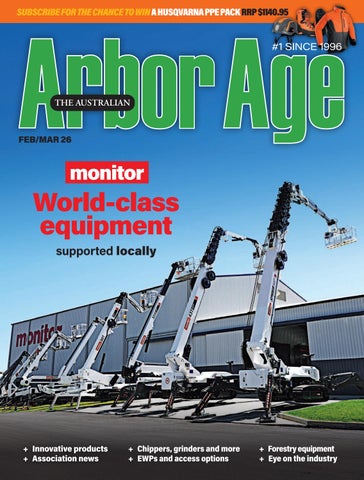
Create a flipbook