64-69 Fleet Guide copy (1)

Page 1


LONG WAY TO THE TOP

Keeping up with a market currently governed by seismic consolidation makes the Australian commercial road transport an interesting one to observe.

The Haulmax Premier Commercial Fleet Guide affords the opportunity each year to take stock of the movers and shakers in industry and, progressively in recent times those that have fallen by the wayside. While a new year always offers renewal and renewed hope, the reality for key carriers in commercial road transport is that they have not paused while the rest of us went on holidays. In that sense activities of these fleets exist in a continuum that calendar dates might as well frame for the purposes of accountancy. It’s no secret that changes in the marketplace have had severe impacts on numerous operators and generational businesses, with some household names no less immune to

them. There are always shifts in those dominant businesses that top the lists for mobile assets in a given category, but as we have seen with increasing regularity over the past year, major fleets, especially the independent ones, are no longer invulnerable.

Ron Crouch Transport, Don Watson Transport, XL Express are headlines, lamentably, among dozens of others to have been brought undone by a combination of economic and market forces, some of which, it must be said, have been contrived against them. General insolvency data indicates that the business closure rate for the road transport sector in the 12 months to November 2025 reached 8.46 per cent, or approximately one in every 12 operators as the stressors of inflated

costs and compliance have taken a significant toll. We’re through the looking glass now.

The road transport segment has never been considered, by any measure, a picnic. To that end seasoned operators know it can get tough and the days, let alone the weeks, are rife with obstacles to be overcome often with little warning.

It’s always different, always the same to paraphrase a famous quote made by Radio One DJ John Peel on his favourite band The Fall. Longevity, for any group or organisation, hinges on maintaining a consistency of excellence that in this post-COVID era amounts to having, if a recipe can be summarised, shrewd digital integration, tried and true systems in place, additional

revenue streams and reliable people at the helm. As government keeps expanding, it doesn’t hurt to have contracts on projects aligned with strategic policy, infrastructure and growth commodities not subjected entirely to fluctuations synonymous with provincial markets. Certainly, the exponential growth sought out by all businesses is somewhat limited to a select few with room to scale, many of them now found within the middle tier of fleet categories who are actively investing in their own infrastructure, expanding their portfolios and filling vacuums in the absence left by others. That gap following a carrier closure is typically soon occupied either by a new entrant, of which there has been no shortage

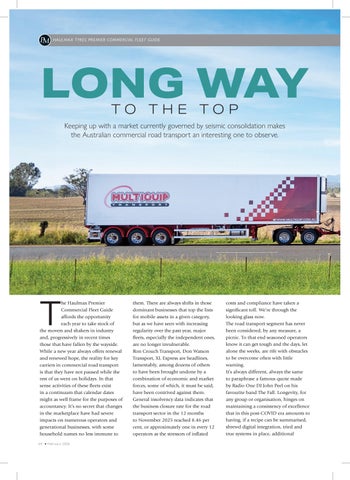
One of Multiquip’s new 44-pallet high productivity units.

since 2020, or a competitor. But for how long? Some in the industry consider it, at best, a bandaid for servicing the 26,000 tonne-kilometres of freight needed to be moved annually for every Australian. Yes, you read right. “A crisis is an opportunity riding a dangerous wind.” So goes a thousandyear old Chinese proverb. Regionally, Europe is following a

similar pattern. Bankruptcies in the European transport and storage sector have surged by roughly 180 per cent over the last five years compared to historical baselines, permanently removing a large number of small and mid-sized carriers from the market. Many others have downsized fleets or postponed investment, while thousands of smaller carriers have

exited the industry altogether. The traditional ‘safety buffer’ of spare capacity has largely disappeared and been replaced with what has been described as “a baseline of persistent volatility.”

The bank bailouts following the Global Financial Crisis in which several financial institutions were notoriously deemed “too big to fail” set a precedent the world is still coming to terms with. “Growth for the sake of growth,” author and environmentalist Edward Abbey famously once noted, “is the ideology of the cancer cell”. Taxpayers it would appear, by proxy, become the patient from which the metastasis is transferred. In Australia independent, longstanding and reputed road transport companies have had no such fortune unless of course they’re an airline. But in periods of downturn in which already vulnerable segments of the economy are left further exposed it can and often sets the scene for predictable financial panic. But as a rule, according to John Stuart Mill,

Minus 1 has boosted its fleet numbers significantly over the past 18 months.

“panics do not destroy capital; they merely reveal the extent to which it has been previously destroyed by its betrayal into hopelessly unproductive works”.

With the land mass equivalent to western Europe to cover, Australia is prone to supply chain vulnerabilities. The COVID crisis made this obvious. An isolated island continent with a deepening reliance on imports is going to be subject to scarcity in times of crisis especially when it has a road network of 877,651 kilometres — the ninth longest in the world. One third of the country’s road freight crosses a state border accounting for an estimated 213.9 billion tonne-kilometres every year. A fact that accounts for the slow adoption of heavy battery electric vehicles not subsisted by ARENA funding. Even in metropolitan tasks, smaller fleets actively pushing for battery electric solutions are looking to defer ownership to its driver pool under current cost-benefit analysis.

According to the last serious survey conducted by the Australian Bureau of Statistics — Survey of Motor Vehicle Use released in December 2020, the Australian fleet consists of 924,860 registered heavy vehicles and trailers, including 521,255 heavy rigid vehicles and 104,442 articulated trucks. We now know that is shrinking.

Of the registered heavy vehicles in Australia, prime movers, according to ARTSA Institute data, have shown the largest reduction in the last 12 months at just over 20 per cent with trailers and heavy rigids also experiencing double digit reductions. Overall, the total new registrations for prime movers, trailers and rigids was just over 40,000 units for 2025, bringing it on a par with the 2022 calendar year but six to seven thousand units below the peak years of 2023 and 2024.

Following three years of considerable growth starting in 2021, total new heavy vehicle registrations have had a downturn of -0.6 per cent in the 2024 calendar year and a further 13.4 per cent contraction in 2025.

According to records compiled by Truck Industry Council members, 14,297 heavy-duty trucks were sold in 2025. Demand softened noticeably by 16.7 per cent on the previous recordbreaking year. In a statement, TIC CEO Tony McMullan, speaking on behalf of the peak body’s members, was concerned that the average age of the Australian truck fleet remained much older than that of Europe, North America and Asian countries like Japan and Korea.

“An old truck fleet is not conducive to improved safety, public health and environmental outcomes for our society,” McMullan said.

“Governments across Australia must consider what more can be done to reduce the age of our nation’s truck fleet.”

It would be good to know what percentage of new prime mover sales are accounted for by the top fleets who have got their RFPs, notwithstanding supply chain shortages, down to a fine art. Perhaps the topic of a future edition of this report.

Most of the major fleets honour carrier accounts with Coca-Cola Europacific Partners, a

In such an established industry there a seldom radical changes at the top of the categories. Not unless it is relatively new one like battery electric. That said there is no shortage of people movements any given year within the industry. However, last year was arguably one of the most volatile for key decision makers, with the likes of Rob Dummer moving from Lindsay Transport to Followmont and Terry Bickerton moving to Cleanaway from Australia Post. Longtime Managing Director, Ivan Vanis of Tasman Logistics Services, a major mover on an impressive growth trajectory, vacated his post, Christine Holgate shifted roles to Chair at Team Global Express and Toll Group’s former Managing Director found a home at Primary Connect. Border Express, SRV Freight and Supagas all acquired companies while the Qube sale to Macquarie was still subject to approvals.

The industries major players all share one thing in common that goes beyond their size, scale, IP and trucks. Each of their origin stories commenced with some form of risk being weighed up and taken. No doubt some went about it less conventionally than others. As the case will be for the future Centurions.

Image:
Coca-Cola.

EQUAL

TO THE TASK

Keeping up with a market currently governed by seismic consolidation makes the Australian commercial road transport an interesting one to observe.

There are few linehaul carriers serious about optimising their palletised and bulk transport offering who have yet to adopt Performance-Based Standards (PBS). Not only do PBS-approved combinations give them an edge in moving essential goods across borders on key freight corridors, but they also afford significant efficiencies in cost savings, fuel, emissions, not to mention make something of a bold statement to prospective customers about the operational credentials of the business. They are, from concept through to building and approval, exacting investments. Therefore, a vital bumper-to-bumper solution for truck OEMs that are engineering vehicles to handle the demands of high productivity design itself requires a proven premium product.

Australian Tyre Traders has launched a new range of steer tyres to complement the nationally renowned Haulmax Tyres portfolio. Four new dependable options headline the series – the locally-engineered ATT420, ATT424, ATT499 and ATT120 variants which were specifically developed for Australia’s unique road and transport operations. The new Haulmax Tyres steer range is best suited for linehaul and regional steer applications. Each model was designed to provide better cost per kilometre performance, wear resistance – and upon deployment – reduce road noise and increase driver comfort.

Australian Tyre Traders National Marketing and Communications Manager, Daniel Sapsead, says the new selection presents the market with

another high-quality choice that can be relied on in line with ever-expanding government regulations.

“We want to be able to provide a full front-to-back solution for truck and trailer manufacturers, and operators alike,” he says. “Haulmax Tyres now has that complete package with the new steer tyre range.”

The ATT424 model is a dedicated super single steer tyre available in a 385/65R22.5 size. Meanwhile the ATT499, available in 315/80R22.5, was crafted with stone ejectors at the groove base to help eliminate stone retention and drilling, while also meeting the standards to Euro VI compliant vehicles. Accompanied by the ATT420 model which is available in the widely used 295/80R22.5 size. The ATT420, ATT424 and ATT499 are met with the ATT120 which, being smaller in size

(295/60R22.5), is more suitable for light trucks and local transport operators and direct changeovers from 275/70 R22.5 tyres for a wider footprint with the same overall diameter.

“Australia has some of the best operators and toughest terrains in the world,” Daniel says. “We’re trying to provide solutions that will work for everyone.”

The new steer tyre range underwent significant trials prior to launch. The products were tested in various applications across Australia, for example in Western Australia’s Pilbara region – an area that is notorious for its extremely harsh operating conditions.

The results were vastly positive according to Daniel.

“Steer tyres are one of the hardest types of tyres to design and manufacture because there’s a lot of technology included,” he explains.

“The driver also feels everything. Any vibration or movement is automatically felt through the steering column. It’s therefore very important to get it right for driver comfort as well as application.

“We’ve tested the product in areas it’s going to be the most challenged in. If it works in extremely demanding environments, we know it’s going to work well in easier applications.”

Testing, of course, has been intensive including the punishing grades found in the mountainous terrain of New South Wales. Kilometres under load have been measured. Wear patterns recorded. In sum, Haulmax have recognised the increasing relevance of fit-for-purpose tyres for all applications and delivered a range equal to the task.

Image: Haulmax.
A new range of Haulmax steer tyres has has been launched.

Turn static files into dynamic content formats.

Create a flipbook