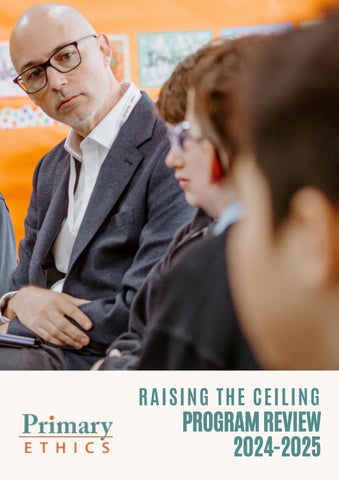
RAISING THE CEILING
PROGRAM REVIEW 2024-2025
RAISING THE CEILING
01
Since our first program review in 2022, Primary Ethics has conducted two further reviews, observing 111 ethics lessons to see how our training program, curriculum and classroom support are translating into classroom practice by our volunteers. The results are clear: the changes we made are working. Classroom quality has improved substantially, very weak lessons are now rare and more lessons are reaching an excellent standard.
BASICS OF THE REVIEW
02
Our baseline 2022 review gave us an honest snapshot: strong foundations, with clear room to grow. In response, we made changes – sharpening training content, introducing proactive check-ins for new teachers, refreshing guidance on the discussion rules and expanding professional development for active teachers. This 2024–25 review report asks: did these changes work? And if so, where should we focus next? We want to know: Has classroom quality improved since 2022 – and by how much? Which classroom practices explain any improvement? Are the specific changes we made after 2022 showing up in classroom practice?
STRONG FOUNDATIONS, WITH CLEAR ROOM TO GROW.
We also ask: Where should our training, curriculum and classroom support focus in 2026-27?
This 2024-25 review provides the clearest evidence yet that our approach is working. The findings are encouraging: classroom quality has improved and the results give us a clear, evidence-informed direction for the next phase of our work.
WHAT DOES OUR PROGRAM AIM FOR IN EACH ETHICS LESSON?
03
Primary Ethics runs a large-scale volunteer ethics education program, training everyday people – no teaching background or philosophy qualifications required – to lead weekly classroom ethics lessons for classes of eight to 22 children in schools across New South Wales. It's an ambitious model, delivered by a large, geographically-dispersed volunteer workforce. Holding quality steady at that scale is a real challenge – which is why we rely on carefully developed lesson scripts, active communication channels and layered support to every volunteer, wherever they are teaching. Every element of our training, curriculum and support exists to produce a genuine community of inquiry in the classroom.
Community of inquiry: In a Primary Ethics classroom, students – from kindergarten up – work together to explore an ethical question, build on each other's thinking and reach well-reasoned conclusions, guided but not led by their teacher.
04 We teach the foundational teacher skills of: anchoring, asking for reasons, and opening to others. We teach three foundational facilitation skills: keeping discussion focused on the question, asking students to explain the reasons for their answers and inviting different views so students can build on – or respectfully disagree with – one another’s ideas. Techniques for organising the lesson include: ·echoing – repeating a student’s contribution word-for-word rather than paraphrasing it, so their own reasoning stays central to the discussion think-pair-shares, where students briefly consider a question alone, discuss it with a partner, then share their thinking with the whole class. We provide high-quality scripts, developed by experts and approved as age-appropriate by the NSW Department of Education. All teachers are also supplied with a copy of the Primary Ethics discussion rules, which are designed to be displayed and actively reinforced in every lesson.
When a volunteer's skills and our scripts come together well, a high-functioning community of inquiry is the result.
PRIMARY ETHICS COMMUNITY OF INQUIRY Lesson materials
Stories and scenarios on a range of topics Questions with no easy / straightforward answer Balance of philosophical perspectives
+ ethics teacher Brings the stories and scenarios to life Creates a sense of curiosity about topic and questions Facilitates discussion Remains neutral, enabling the students to be at the centre of inquiry
05
... prompt students to Express their own views and their reasons for holding them Consider a range of views Judge whether the reasons they and others have are good reasons (eg. relevant, logical, supported by evidence) Think about important ethical concepts/factors, including intentions, circumstances, consequences and what contributes to good character Empathise with people in different situations
… which helps students develop
Collaborative inquiry Critical thinking Ethical reasoning
Portrait of an excellent lesson observed in the review Students explored the topic, offered reasons and engaged with different views. Overall, the discussion resulted in a deep and nuanced discussion of the topic. Students were deeply engaged and enthusiastic. Students were on-task and following directions. Interruptions to learning were rare.
06
RECOMMENDATIONS FROM OUR 2022 REVIEW Our first program review, in 2022, made five key recommendations for strengthening program quality: Develop short courses and resources (including videos and podcasts) that focus on identified areas of need, forming a training resource library for existing teachers Update the Ethics Teacher Handbook and teacher training courses to better emphasise and support the identified areas Set a maximum period between completion of training and beginning teaching Increase the number of in-person lesson observations by the Classroom Support Team outside of the review period Conduct a program review at least every two years to monitor program quality and assess progress. All five recommendations were implemented within 18 months, by mid-2024, including: updated training resources a revised Handbook a new cap on the gap between training and teaching more in-person Classroom Support Team observations and a commitment to regular program reviews.
WE ARE PROUD TO HAVE ACTED QUICKLY AND FULLY ON OUR OWN FINDINGS. THIS WORK LAID THE GROUNDWORK FOR THE PROGRESS DOCUMENTED IN THIS 2024–25 REPORT.
THE 2024-2025 REPORT
07
Areas of investigation In 2024 and 2025, our observers assessed lessons across six domains: teacher delivery (including following our approved curriculum), facilitation quality, classroom management, student discussion, student engagement and student behaviour. Each domain was rated on a four-point scale – Excellent, Good, Limited or Not acceptable. Lessons are selected for observation at random each year, using selection criteria designed to ensure a broadly representative sample of our teaching population. In total, 81 lessons were observed in our 2022 baseline, 63 in 2024 and 48 in 2025 – with the 2024–25 analysis combining all 111 lessons and comparing them against the 2022 baseline to track change over time.
08
Observers also recorded which specific techniques from our training were used – and which opportunities were missed – so we could see not just whether quality is improving, but which classroom practices are driving that improvement. Who we reviewed: Our sample closely reflected the broader ethics teaching population across class day and time, school stage, teacher gender, age, training cohort and teaching load – giving us confidence that these findings represent the program as a whole, not just a subset of it.
09
Our findings Classroom quality has improved substantially since 2022, with clear gains in teacher delivery, student engagement, student discussion and student behaviour: Lessons rated Good or Excellent for teacher delivery rose from around 78% in 2022 to 95% in 2024–25. Lessons rated Good or Excellent for student engagement rose from around 78% to 94%. Lessons rated Good or Excellent for student discussion rose from around 73% to 88%. Lessons rated Good or Excellent for student behaviour rose from around 77% to 89%.
Not acceptable ratings for teacher delivery, student engagement and student behaviour fell to zero in both 2024 and 2025. The improvement is also visible at the top end. Excellent ratings for teacher delivery rose from around one-third of lessons in 2022 to two-thirds in 2025, while Excellent ratings for student engagement rose from 43% to 56%. Between 2024 and 2025, Excellent ratings also increased by 14 percentage points for teacher facilitation and 15 percentage points for classroom management.
TOGETHER, THESE RESULTS POINT TO BOTH A RAISED FLOOR AND A RISING CEILING IN CLASSROOM QUALITY.
OUR FINDINGS AND RECOMMENDATIONS UNPACKED
10
INVESTIGATIVE QUESTION 1: HAVE OUR POST-2022 CHANGES MADE A DIFFERENCE? After the 2022 review, we made a coordinated set of changes: increased emphasis on classroom management in training discussion rules posters mailed to all active teachers clearer guidance on seating students in a circle more emphasis on opening discussion and encouraging students to build on one another’s ideas new professional development workshops for active teachers proactive check-ins from the Classroom Support Team during new teachers’ first months. The results show that these changes are working. Teacher delivery, student engagement, student discussion and student behaviour have all improved since 2022. Very weak lessons are now rare, while top-end quality continues to grow. The training-cohort results tell a similar story. Teachers trained under our updated model follow the curriculum more closely, use the discussion rules more consistently and are more neutral than those trained under earlier versions – further evidence that the updated training is translating into stronger classroom practice. The direction of travel is clear: the improvements introduced after 2022 are showing up in the classroom practices that matter.
11
INVESTIGATIVE QUESTION 2: WHAT ACTUALLY DRIVES LESSON QUALITY? We wanted to know whether lesson quality is shaped mainly by what teachers do in the classroom or by factors such as training mode – face-to-face versus online – class size or teacher background. The review found that a relatively small set of classroom practices is strongly and consistently linked to better student discussion, engagement and behaviour.
KEY CLASSROOM PRACTICES LINKED TO STRONGER LESSONS
12
Classroom practice
What it supports
Setting clear, high expectations
Stronger discussion and better behaviour
Sharing speaking opportunities across the class Encouraging students to build on one another’s ideas
Stronger discussion and better behaviour
Giving clear, concise instructions
Better engagement and stronger discussion
Intervening promptly when behaviour slips
Better engagement and deeper discussion
Using low-level strategies before behaviour escalates
Stronger discussion
Actively reinforcing the discussion rules
Better engagement and stronger discussion
Stronger discussion
All practices shown have a statistically
Why does this matter?
significant relationship with one or more
It also gives us a clear, high-impact lever
measures of lesson quality.
for lifting classroom quality: continuing to refine our training and helping teachers put
Other important signals included bringing
these core practices into action
students back to the question, remaining
consistently.
neutral, using the follow-up questions provided in the lesson script and keeping closely to the wording of curriculum questions. By contrast, training mode, class size and teacher characteristics showed little reliable relationship with overall lesson quality.
THIS IS REASSURING. IT MEANS OUR MODEL CAN SCALE AND THAT QUALITY IS DRIVEN PRIMARILY BY CLASSROOM PRACTICES THAT CAN BE TAUGHT, OBSERVED AND STRENGTHENED – NOT BY STRUCTURAL FACTORS WE CANNOT EASILY CHANGE.
13
INVESTIGATIVE QUESTION 3: WHICH TECHNIQUES ARE TEACHERS USING WELL – AND WHERE ARE THE OPPORTUNITIES?
The discussion rules were
These findings demonstrate the strong professional foundations
actively reinforced in 63%.
that volunteers bring into their classrooms each week.
Teachers encouraged
At the same time, the review identified some clear opportunities
students to build on one
to strengthen practice:
another’s ideas in 46% of
displayed in 48% of observed lessons and
lessons. Giving students thinking time after a question remained uncommon. The wording of curriculum questions was changed in 38% of lessons, even though changing the wording is associated with weaker student discussion. We also see room for more consistent neutrality, greater use of echoing rather than paraphrasing and more consistent responses to behaviour. Tellingly, several of the techniques not yet used consistently are also among those most strongly linked to student discussion, engagement and behaviour. This tells us exactly where to focus.
14 4 INVESTIGATIVE QUESTION 4:
WHAT ELSE DID WE LEARN ABOUT THE CLASSROOM CONTEXT? The review also provided useful insight into the conditions in which volunteers teach. Working with supervising teachers Most observed classes had support from a school teacher: 72% had a dedicated supervising teacher present, while a further 14% were supported by a roaming supervisor. This reinforces the value of preparing volunteers to work effectively alongside classroom teachers. Our guidance on working with supervising teachers, developed after the 2022 review, remains one of our most-used support resources. Making lessons work within the available time Fewer than half of teachers with the standard 30-minute lesson slot (44%) completed the full lesson in that time. This strengthens the case for more flexible lesson structures that allow teachers to adjust the depth and pace of a lesson to the time available without losing its central ideas. Focusing preparation on what matters most Preparation time broadly reflected our current expectations: 12% of teachers reported spending less than 10 minutes preparing, 58% spent between 10 and 30 minutes, and 30% spent more than 30 minutes. However, preparation time showed little relationship with lesson quality. The lesson observations suggest that support should focus not simply on encouraging teachers to spend longer rehearsing the script, but on helping them consistently apply the specific facilitation and behaviour-management practices most closely linked to high-quality lessons.
OUR GUIDANCE ON WORKING WITH SUPERVISING TEACHERS, DEVELOPED AFTER THE 2022 REVIEW, REMAINS ONE OF OUR MOST-USED SUPPORT RESOURCES.
WHAT WE LEARNT – A SNAPSHOT
16
LESSONS ARE MORE CONSISTENT
Classroom quality has moved forward substantially since our 2022 review. Lessons are more consistent, very weak lessons are now rare and a growing number are excellent – clear evidence that the changes we made after 2022 are paying off. Differences in classroom quality are shaped far less by training format, teacher background or class size than by how consistently teachers apply a defined set of classroom practices. This is good news: these practices are well defined, teachable and observable.
VERY WEAK LESSONS ARE NOW RARE
17
STRATEGIC IMPLICATIONS
Teacher delivery is now generally strong across the program. The key opportunity ahead is to ensure that this consistently translates into high-quality student discussion and engagement. Our regular program review now functions as a
The next phase of quality improvement
continuous improvement cycle: identifying
should centre on strengthening consistency
classroom challenges, implementing targeted
in these high-impact classroom practices,
changes across curriculum, training and
particularly those relating to behaviour
classroom support, measuring the results
management and facilitation.
through observation and refining our approach based on the evidence. The following areas require continued focus in our training and coaching: prompt, effective intervention when behaviour issues arise use of low-level strategies before problems escalate explicit use of the discussion rules seating students in a circle giving students thinking time after questions echoing rather than paraphrasing student responses encouraging students to build on one another’s ideas sticking closely to the wording of curriculum questions.
RECOMMENDED PRIORITIES FOR 2026 & 2027
18
Embed these priorities across new-teacher training, refresher sessions, professional development workshops and Classroom Support Team coaching. Use program review data directly to inform training design and coaching priorities. Continue proactive Classroom Support Team check-ins with new teachers during their first months in the classroom. Conduct our next program review to track progress against these priorities.
ONE MORE THING…
19
This progress reflects our volunteers’ commitment. Thank you for showing up each week, embracing feedback and continuing to refine your teaching – it really does make a difference for students. And a particular thank you to the 111 teachers who welcomed observers into their ethics classrooms during 2024 and 2025.
THINK.REASON.DISCUSS
For more information, contact Primary Ethics Director of Education, Jarrah Aubourg W: www.primaryethics.com.au E: helpdesk@primaryethics.com.au T: +61 2 8068 7752