Erin Marshall Allen Kramer Kurt Keller Matt Fawber Joe Lesko Shanna Muscavage
6
WOMEN'S CONFERENCE RECAP
Over 200 insurance professionals gathered on March 31 in Gettysburg, PA for the fourth-annual IA&B Women's Conference.
8
12
INTERVIEW WITH FIFS PARTNERS
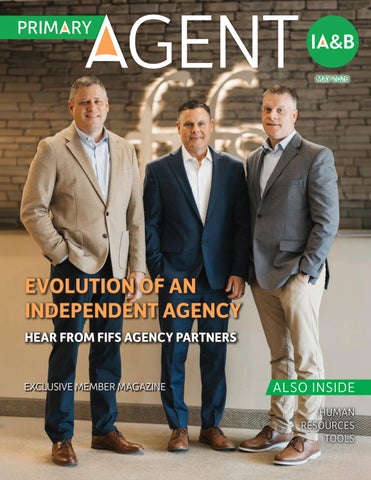
Franconia Insurance & Financial Services (FIFS) agency partners Sid Ruth, Chad Yoder, and Kyle Zehr share how their careers unfolded and how their agency has grown.
WE’VE GOT YOU (HR) COVERED
Karen DiGioia, of IA&B’s HR consulting firm – an arm of Cherry Bekaert Advisory LLC – shares how IA&B member resources can help you hire faster, reduce HR risk, and resolve escalating employment issues.
WORKING HARD TO DELIVER FOR YOUR AGENCY
Once again in this month’s magazine, you’ll see references to IA&B’s core strategic initiative – Insuring Careers Certification Program (ICCP). You keep hearing about this because it is a major focus for the organization, and one we firmly believe in.
If you aren’t familiar, ICCP is the easiest and most comprehensive way to teach new employees baseline insurance principles and prepare for the state licensing exam in PA, MD, or DE. To learn more, go to IABforME.com.
Hand in hand with ICCP is IA&B’s industry recruitment –our work to get individuals into ICCP and into our member agencies. We recently conducted member input meetings on the topic. Following these, our board of directors met and discussed next steps for the program, including:
▲ Focused job recruitment efforts on those attending high schools and community and technical colleges, as well as on those looking for a career change.
▲ Focused internship recruitment efforts on students at fouryear institutions.
▲ Creation of a hiring directory, where member agencies can provide basic details about job openings.
The IA&B Board of Directors is fully committed to ICCP, and our carrier partners are beginning to recognize the value and are helping to support it as well. We recognize the importance of industry recruitment and training and are working hard to deliver. Continue to read this magazine, as well as other IA&B communications, for news in this area.
Onward and upward,
Jason F. Ernest President & CEO
INSURANCE AGENTS & BROKERS
650 Wilson Lane, Suite 200 Mechanicsburg, PA 17055
191 Main Street, Annapolis, MD 21401
800-998-9644 | IABforME.com
IA&B BOARD OF DIRECTORS
OFFICERS
Andrew Enders, Esq. - Chair Enders | Harrisburg, PA
Kate Dawson, CISR, CPIA - Vice Chair Ferri Dawson Insurance | Murrysville, PA
MEMBERS
Greg Bennett Famous & Spang Associates Aberdeen, MD
Tony Cusati, CIC Sitter Insurance LLC Erie, PA
Michael Gaetano The Hartman Group Montoursville, PA
Debra McAfee McAfee Insurance Agency, LLC Wilmington, DE
Michael McGroarty, Jr., CIC McGroarty & Bradburn Insurance Pittsburgh, PA
Hunter McHugh McHugh Insurance Group Wilmington, DE
Shayne McIntosh, CIC JPI Insurance Associates Dillsburg, PA
Chris Miller, CIC Miller Insurance Protection Team Jonestown, PA
Jill Nye, CIC, CISR, CPIA Gunn-Mowery, LLC Lemoyne, PA
Lisa Parry, CPIA Parry Insurance Langhorne, PA
Bill Purdy Purdy Insurance Agency, Inc. Sunbury, PA
Kent Reynolds, CIC Blue Ridge Risk Partners LLC Hagerstown, MD
David Rivell, CIC, CRM Element West Chester, PA
Christy Rose Avery Hall Insurance Salisbury, MD
Ashley Stafford, CPIA Element
Michael Thomas Lighthouse Insurance Svcs Gambrills, MD
Kyle Zehr, CIC FIFS, LLC Telford, PA
NATIONAL DIRECTORS
Diana Hornung, CIC (IIABA) IOA National, Inc. | Wilmington, DE
Mark Monroe (IIABA)
Mark J. Monroe Insurance | Downingtown, PA
QUESTION: ANSWER:
CLAIRE-IFICATION
IA&B Vice President - Advocacy Claire Pantaloni, CIC, CISR
Are you a member with a question? Contact Claire to find the answer at 717-918-9202 or ClaireP@IABforME.com.
While transitioning paper files from a purchased agency into our management system, I discovered some in-force policies without signed applications. How should I handle this?
Unfortunately, it is not unusual to discover missing signed applications when transitioning files from a purchased agency, or even during a routine internal audit. As uncomfortable as it may be, it’s far better than discovering them after a claim occurs.
Signed applications and required selection forms such as UM/UIM, and stacking forms in Pennsylvania, document the insured’s coverage choices and representations. Most carrier agreements place responsibility for maintaining these documents squarely on the agency. If they can’t be produced at claim time, the carrier will likely pay the loss and pursue recovery through your E&O coverage. So, how to handle it?
If the policy is recent: For business written in the current term, the fix is usually straightforward: Contact the insured, explain that an audit revealed a missing signature, and obtain a properly dated signature (never backdate)
IF THE POLICY WAS WRITTEN YEARS AGO:
Start with the carrier. Contact each affected carrier. Insurer procedures vary, and some carriers may have
more flexibility than others. Some may be less concerned with the application than they are with the missing statutory forms (tort, UM/ UIM or stacking) because unsigned forms can default to higher limits by operation of law. Keep tabs on each carrier’s recommendations.
At renewal: Prioritize the accounts with missing signatures for a thorough coverage review. Any changes, or remarketing, will generate new applications and selection forms, giving you a clean path forward for those accounts.
If the renewal review does not yield any changes: As mentioned above, each carrier may handle this situation differently, and you will need to follow their guidance.
If you cannot recreate the application, one carrier may ask you to focus your attention on securing signatures for any required statutory forms, including UM/UIM, tort election, and stacking. Another carrier may ask you to also secure a written affirmation from the insured, confirming the insured’s current coverages and limits. While not a substitute for a properly executed original application, and not a guarantee against E&O exposure, it may help document the insured’s intent. Yet another
carrier may prefer that the insured complete, date, and sign a current ACORD application, with today’s information, which could be retained by the agency in case of claim. In all those cases, it is best to follow the specific carrier’s instructions.
PREVENTIVE MEASURES
In the case of an agency or book purchase, keep in mind that the agency should always do a thorough review of all accounts that are being acquired. In addition, moving forward, this incident is a good opportunity to set new processes, including:
▲ Reinforcing staff training
▲ Confirming signature verification is built into system workflows
▲ Reviewing documentation retention procedures
▲ Conducting periodic spot audits
Addressing the issue proactively can significantly reduce future E&O risk.
This document is not a legal opinion and should not be relied upon as such. The intent of this document is to provide a general background regarding the topic or topics discussed, not to provide legal advice. Producers and agencies should consult an attorney regarding specific situations and specific questions with respect to the topic or topics covered in this document. Neither the Insurance Agents & Brokers nor any of its employees shall be responsible for any errors or omissions regarding any statements made in this document, nor any errors or omissions regarding any statutes, regulations, court rules, and/or any other government documents cited in this document.
DRONES – WHERE IS THE COVERAGE FOR YOUR COMMERCIAL INSUREDS?
By Cathy Trischan
Your contractor client uses a cameraequipped drone to inspect the exterior of the upper levels of a highrise building. How does coverage under your insured’s policies apply?
Imagine the contractor’s Commercial General Liability (CGL) policy is the Insurance Services Office, Inc. (ISO) CG 00 01 04 13 coverage form. Coverage A provides “bodily injury” and “property damage” liability coverage. This coverage, though, has an exclusion for “bodily injury” or “property damage” arising out of the ownership, maintenance,
use or entrustment to others of any aircraft, “auto” or watercraft owned or operated by or rented or loaned to any insured. Does this exclusion apply to drones? Although the CGL policy does not define aircraft, assume yes.
The question of whether a drone is an aircraft was addressed by a California court. A photography company used a drone to film a wedding, and the drone seriously injured a guest when it made contact with her eye. The court looked to the dictionary where aircraft was defined as “a vehicle
(such as an airplane or balloon) for traveling through the air.” The court ruled that a drone is an aircraft, and the CGL exclusion applies.
The aircraft, “auto” and watercraft exclusion is not absolute, though. Here is how the exclusion applies in the case of our contractor.
▲ If the contractor uses an owned, rented, or borrowed drone to inspect the building, there is no coverage if the drone causes “bodily injury” or “property damage.”
▲ If the contractor hires a subcontractor with a drone to do the inspection, the named insured has coverage. The drone is not owned or operated by or rented or loaned to any insured.
▲ If the contractor indemnifies the owner of the building for “bodily injury” or “property damage” caused by the drone, the contractor has coverage for this indemnification obligation. With respect to aircraft, the exclusion has an exception for liability assumed under an “insured contract,” and the indemnification agreement is an “insured contract.”
Coverage B in the CGL provides “personal and advertising injury” liability coverage. For example, the contractor publishes the drone video on its website. A building resident appears in the video and claims the contractor violated his right of privacy. There is no aircraft exclusion in Coverage B, so coverage applies whether the named insured or a subcontractor is using the drone. Coverage B’s contractual liability exclusion does not have an exception for liability assumed in an “insured contract,” so there is no coverage for the indemnification obligation.
Many insurers seek to further restrict coverage. ISO’s Exclusion –Unmanned Aircraft (CG 21 09 06 15) is a commonly used endorsement. This endorsement introduces the term “unmanned aircraft” to describe a drone. Under Coverages A & B, the CGL does not apply to any loss involving an unmanned aircraft. This eliminates coverage for “bodily injury,” “property damage,” and “personal and advertising injury” offenses. The exclusion applies
whether the named insured or a subcontractor is using the drone, and there is no longer coverage for liability assumed under an “insured contract” if the “bodily injury” or “property damage” is caused by an “unmanned aircraft.”
Some insurers will agree to add coverage for the use of certain drones to a CGL policy. ISO’s Limited Coverage For Designated Unmanned Aircraft (CG 24 50 06 15) endorsement begins by excluding coverage the way the Exclusion – Unmanned Aircraft (CG 21 09 06 15) does. The Coverage A & B exclusions, though, do not apply to the use of unmanned aircraft described on the endorsement for use in operations described on the endorsement. The insurer is also able to include an aggregate limit of liability for this exposure, which is subject to the other aggregate limits already on the policy.
What if an insurer is unwilling to add coverage for the use of drones to the CGL? In that case, separate coverage should be written. There are a number of specialty insurers willing to provide liability coverage to businesses using drones.
What about damage to the drone, the physical damage exposure? Most property policies and contractors’ equipment policies do not provide coverage for damage to aircraft. And while some insurers may be willing to amend policy language to cover damage to a drone, a specialty policy is often needed. Many of the insurers covering drones will provide both liability and physical damage coverage.
If and how businesses use drones is a question that should be asked by every insurance agent. The exposure
is becoming more common and must be addressed with the client and the insurer so that proper coverage can be arranged.
‘Til next time
Cathy Trischan, CPCU, CRM, CIC, ARM, AU, AAI, CRIS, MLIS, TRIP is IA&B’s commercial lines education consultant. She works with our CIC and CISR programs, as well as our live CE webinars. Catch her at one of our upcoming courses: IABforME.com/education
Rather listen?
Also available in audio format at IABforME.buzzsprout.com
Earn CE and learn more about CGL exclusions. Instructor: Cathy Trischan CGL ENDORSEMENTS THAT WILL BREAK YOUR POLICY MAY 14 1-3 PM CE PA/DE: 2 GEN MD: 2 PC IA&B Members: $50 (save $30!) Non-Members: $80
Over 200 insurance professionals gathered on March 31 in Gettysburg, PA for the fourth-annual IA&B Women’s Conference. The sold-out event featured a keynote from Tracey Heeter Allen on mastering the art of tough talks. Other highlights included peer and roundtable discussions, as well as presentation of the IA&B Women of Influence and Women to Watch awards.
Stay up to date on IA&B's initiatives for women: IABforME.com/women-in-insurance
Webinar Series for Women in Insurance
Tune in on June 3. Jenn Urso, founder of The Leadership Project, will lead a discussion on everyday impact. Attendees will learn to redefine impact and better align their day-to-day work with the difference they already make, leading to greater satisfaction, connection, and purpose.
Women-Focused Webinar: Everyday Impact Wednesday, June 3
Noon-1 PM EST
There is no cost for IA&B members to attend.
Register by visiting IABforME.com/women-in-insurance or calling 800-998-9644, option 1.
IA&B works on your behalf to ensure that state legislators and regulators understand the issues affecting agents.
And your financial support amplifies your message. Please consider contributing. More information at iabforme.com/political_advocacy
Q& A with FRANCONIA INSURANCE & FINANCIAL SERVICES
Founded in 1994 in Telford, PA, Franconia Insurance & Financial Services (FIFS) is an independent agency offering a full range of commercial and personal insurance products, as well as financial planning services. In this interview, agency partners Sid Ruth, Chad Yoder, and Kyle Zehr share their story.
Q. First and foremost, how did you get your start in insurance – or in Sid’s case, financial planning?
A. [Sid:] I graduated with an accounting degree with the idea of keeping the business world open. I worked at a public accounting firm and earned my CPA, but I realized it wasn’t where I wanted to be long term. At the accounting firm, we had a lot of financial planners come through the door, and their job was intriguing to me.
I told Chad [Yoder] what I was thinking, and he encouraged me to talk to John Frankenfield – the owner of FIFS at the time – because financial planning was an area that he wanted to develop. I met John on Sept. 11, 2001, and he basically said, the door is open and take it where you want to go with it. That was the origination of the FIFS Capital Advisor Group.
[Chad:] After college, I worked for a mentor of mine in the moving and transport industry. I got my class A CDL and decided to drive long-haul truck. I did that for about three years, and it didn’t take me long to realize that I needed
a career that was more centric to family, friends, and community … not to mention better sleep.
An acquaintance asked if I could see myself in insurance or sales. I said, yes, that I enjoyed talking to people, but that I didn’t know anything about insurance. He told me that he knew someone looking to hire and connected me to John Frankenfield. John said if I could pass the licensing exam, he’d give me a job. The initial job opening was in Life & Health, so I got that license first. I quickly realized that I preferred Property & Casualty, so after a few months, I got that license too which led me into personal lines and eventually management.
[Kyle:] My college degree was in education. I started out in business but switched to education because I have two sisters who are teachers. When I was student teaching, I quickly realized that there was no way I was going to continue in education.
My wife and John are cousins, and my sister-in-law was working for John at the time, and she said he might be
looking for someone. I had my interview with him in the midst of student teaching and got the job. I finished student teaching and then began working at the agency after I graduated college in May of 1994.
Q. Tell us about the agency’s beginnings and how it evolved.
A. [Kyle:] John started the agency in January 1994. In 2001, Chad and I became minority partners. In 2014, when John retired, Sid joined the ownership team, and the three of us purchased the agency in full.
When John started the business, it was primarily a Life & Health agency that did a little bit of Property & Casualty. Then in 1995 FIFS purchased a small Property & Casualty agency (Stan Jones Agency), which got our foot in the door of the P&C world. In 1999 FIFS acquired the Clemens Hall Agency and then Penn Community Insurance In 2020 (several weeks prior to COVID).
We operate in three silos. Sid manages our Capital Advisor Group, which is financial planning and 401(k) plans. Chad manages our Personal Lines division which is Property & Casualty and Life & Health. I manage the Business division, which includes Property & Casualty and Group Benefits.
It’s worth noting that we became members of Keystone Insurers Group in 2003, which expanded opportunities with carriers, niche markets, and programs.
[Chad:] Keystone also gives us intellectual capital. We’re not competitors [with other Keystone agencies]; we’re partners. We can sit down with Keystone partners and ask, “What are you seeing in this particular industry? What have your successes been?” We trust each other and know that our individual growth benefits the whole group.
Q. Our industry has changed rapidly over the past three decades. To what do you attribute your business’s ongoing success and growth?
A. [Chad:] FIFS is very diversified; we have a lot of products and services. Another thing I attribute our success to is adaptation to the changing insurance and business landscape. Covid really tested and shaped us. We’ve applied VoIP and cloud-based servers, and now we’re implementing AI into our workflows – not to replace people but to allow them to focus their time on clientbased issues.
[Kyle:] Plus we have a great team of new and experienced staff members, all dedicated to making FIFS successful every day.
Q. You’ve been diligent in creating a team environment at FIFS. What lessons in employee relations and management have you learned along the way?
A. [Chad:] We try and lead by example. We work hard to create team-building events and foster interpersonal relationships in the office. We like to have fun, but at the same time we want to assure our clients that we’re serious about insurance. One way we do that is by stressing the importance of professional development. Most of our employees have CISR designations. Many have CISR Elite, CIC, and CRM. Beyond that, I believe everything can be a teachable moment.
[Kyle:] Something else we do is pairing experienced people with new people to help mentor them and get them started. We’ve learned lessons over time, like you need to have the right people in the right seats that best match their skill sets and allow them to grow.
We also give back to the community. The community supports us and trusts us, and that’s huge. If our staff is involved in a non-profit or community organization, we help support it. That helps build the team as well.
[Chad:] To piggyback on that, our corporate giving plan first and foremost supports anything the staff is involved with. We encourage them to be involved and offer paid time off to volunteer. It’s another way we encourage them to get involved.
Q. Your recent hire, Jacob, completed IA&B’s Insuring Careers Certification Program (ICCP) earlier this year. How did sending him through ICCP benefit your agency?
A. [Chad:] Jacob came to us as a referral from a current coworker. He wanted something more stable and community oriented and did his research before applying, and he has done great. He started in October and by March he was already making and taking phone calls.
ICCP was a great springboard that got him on the fast track to learning the process. In addition to that, we
Continued on page 15
PLATINUM PARTNER PROFILE
Insurance Agents & Brokers proudly recognizes Keystone as one of its Platinum Partners.
Stronger Together.
Independent insurance agencies are built on local trust, strong reputations, and deep roots in the communities they serve. Keystone was built on the same foundation, and on the belief that independent agencies can achieve even more when they work together.
When like-minded partners align around shared values and common goals, everyone competes at a higher level. Each agency partner brings local insight and credibility earned within their own communities. Keystone provides alignment, shared standards, and resources that amplify that strength, combining local expertise with the scale and capabilities of a broader network.
Our partners never give up on what makes them successful when they join Keystone. Instead, they build on it. Every partner contributes unique experience, perspective, and relationships, strengthening the entire organization by design. Today, Keystone supports a growing network of 350+ independent agencies across the country, helping them scale while preserving their local identity.
Partners helping Partners
A key part of Keystone's model is collaboration. Through industry events, leadership forums, and ongoing dialogue across the network, agencies share insights from their local markets and learn from one another's experiences. These conversations turn individual successes into collective advantages, helping agencies navigate challenges, identify new opportunities, and strengthen their businesses. When one partner grows, the entire network benefits.
Experienced Leadership
Keystone's model is powered by leaders with a proven track record of organic and strategic growth. Deep industry roots and a history of adapting to change gives partners something valuable: a company that has seen a lot, learned from it, and knows how to respond as the landscape shifts.
Resources Built for the Long Game
Keystone partners benefit from access to specialized resources designed to support longterm success, including sales training programs, risk management expertise, employee benefits support, carrier management strategies, and benchmarking tools to measure performance and identify opportunities for improvement.
Together, these resources help agencies stay competitive while maintaining the independence and entrepreneurial spirit that defines them. More than a broker or a network, Keystone is a team built on trust, shared standards, and a belief that independent agencies are stronger together.
We’ve Got You (HR) Covered
Human Resources Tools for IA&B Members
By Karen DiGioia, Cherry Bekaert Advisory LLC, HR Consulting
How many times a day do you say the word coverage? I won’t try to guess the exact number, but I’m betting it’s a lot. Insurance is all about coverage—making sure your clients have the right protection in place. With that in mind, I’d like to share how IA&B—along with the Human Resources support available through the HR Consulting arm of Cherry Bekaert—has you covered from an HR perspective.
You’re already an expert at helping your clients get the insurance coverage they need. But when HR questions come up, you may not feel quite as certain—and that’s completely normal. The good news is that your IA&B membership gives you access to a strong library of HR and people-management resources. In the sections that follow, we’ll walk through key points in the employee lifecycle and highlight what’s available—either directly through IABforME.com/HR-resources or by contacting IA&B (advocacy@iabforme.com or 800-998-9644, option 4).
Read on to see how your IA&B membership can help you:
▲ Fill roles faster with hiring templates and tools
▲ Reduce HR risk with policy, classification, and documentation resources
▲ Get unstuck quickly with guidance and suppor t when issues escalate (performance challenges, leaves of absence, resignations, terminations)
Hiring and Selection
Your agency is growing, and it’s time to add staff. You’ve started sourcing candidates but aren’t sure what else you should be doing to prepare. No worries—everything you need can be found in the guidance below or through IA&B.
Employment Application: To make sure you have all the details you need about each candidate’s qualifications, education, and experience, be certain to have them complete an employment application. “Isn’t a resume good enough?” you might ask. The answer is no—and there are a few reasons an application is still the best route. First, it ensures you’re gathering the same information from every candidate, which helps you make a more informed and fair decision. Second, an employment application is signed by the applicant, while a resume typically isn’t. That signature “certifies” that the information they’ve provided is true and complete. And if a candidate ever misrepresents their background (it’s not common, but it can happen), you have a signed document to support your decision not to hire or to let the individual go. This protects the agency.
Bottom line: employment applications help to ensure you’re legally covered.
And if your response to the last section is “Candidates? What candidates?”, IA&B also offers resources for job postings and applicant review.
Interview Questions: Wondering what you should ask in the interview—or which questions are allowed? While you want to be friendly and personable, it’s important to avoid questions of a personal nature. “Do you have any kids?” or “Are you married?” might sound harmless, but they can create grounds for a discrimination claim. It’s critical to stick to job-related topics—previous experience, skills, preferred ways to work, and techniques for handling pressure are all valid topics. And while it’s fine to chat about the college your candidate attended, make sure you don’t ask what year they graduated.
Bottom line: there’s a lot to think about when you’re structuring your interview questions. To help guide your interviews, IA&B offers resources such as guidelines for conducting interviews, a telephone pre-interview worksheet, and a candidate evaluation worksheet.
New Hire/Offer Letter: Once you’ve chosen your candidate, an offer letter is the best way to clearly communicates the basics—title, start date, pay, exempt/ nonexempt status, and any contingencies (background check, drug screen, licensing, etc.). It’s also a great place to note that employment is at-will (Pennsylvania, Maryland, and Delaware are at-will employment states)
and that the offer is not a contract. A clear offer letter helps avoid misunderstandings from the start. Where can you find a sample offer letter? You guessed it— there’s one available through IA&B. Also available are sample agreements (including non-piracy and producer agreements) that may be critical for some of your hires.
Employee Management
When it comes to managing your employees, there are a number of tools you should have in place. If you haven’t dusted yours off in a while, check out the IA&B site for resources to help you clarify and communicate policies and practices, manage performance, and stay up to date on regulatory changes.
Employee Handbook: What are your company’s standards for attendance, attire, remote work, and smoking? What’s the vacation policy? Have you clearly communicated what’s acceptable when it comes to social media use or relationships in the workplace? What about the use of AI at work? These are just a handful of the topics your handbook should cover. Your handbook is also the right place for required language around equal employment opportunity, harassment, I-9s, and anti-discrimination. If you don’t have a handbook in place—or if yours hasn’t been reviewed and updated in a while—check out the handbook template on the IA&B site for suggested policies and language.
Job Descriptions: How do you make sure you and your employees are on the same page regarding responsibilities and expectations? Clear job descriptions help you set expectations from day one and should be revisited regularly—during onboarding, annual reviews, and any progressive discipline discussions. Job descriptions make it easier to have specific, productive conversations— for example: “Let’s chat about customer response time. The job description lists a 24-hour expectation, and lately you’ve been missing that mark. Help me understand what’s driving the change and what support you need to get back on track.”
Clear job descriptions support strong employee performance. However, if an employee doesn’t meet those expectations and is terminated, a signed job description helps protect you from an ex-employee who claims, “I didn’t know I was responsible for that.”
FLSA Classification: Is my employee exempt or non-exempt? Salaried or hourly? Is “salaried nonexempt” a real thing? How do I classify employees in a way that’s compliant with the law—and how do the duties tests apply?
Proper classification under the Fair Labor Standards Act (FLSA) can feel overwhelming, but it’s critical to get it right. IA&B provides resources on the member site, including a detailed guide to the FLSA and a sample timesheet to help ensure hourly employees are recording time appropriately.
Performance Management: While performance management is a topic unto itself and should never be all about the forms, documentation still matters. Performance management is really about communication. It’s about ongoing conversations regarding what’s going well and what could use improvement. When it comes to “coverage,” it’s important to put key items in writing. Forms to support performance management can be found on the IA&B member site, including performance review templates, employee self-appraisal forms, and progressive discipline forms.
Just remember: the forms are tools that support a strong performance management process. Effective performance management isn’t a once-a-year formal review—it happens every day through quick check-ins, one-on-one conversations, and clear feedback. For more guidance, check out the member webinar on this topic at IABforME.com/HR-resources.
Regulatory Updates: Each week, IA&B’s newsletter brings you the latest changes that may impact you and your agency. Some of these updates are HR-related and critical to keeping your agency in compliance with federal, state, and local regulations—from minimum wage and FMLA to sick leave requirements and independentcontractor definitions. If you aren’t already, be on the lookout each week for these updates.
Leaves of Absence and Termination
What happens when an employee needs to take a leave of absence? Are they eligible for FMLA, mandated sick leave, or paid time off? And what should you do when an
employee submits their resignation—or when you need to let an employee go?
If you’ve been paying attention, by now you know the answer: resources are available through IA&B. As the old tagline used to go, “membership has its privileges”—and the privileges of IA&B membership include a wealth of HR tools, many of them highlighted here and available right on the website.
And if the resources you find don’t go far enough, don’t forget: as part of your IA&B member benefits, you have access to professional expertise and guidance on HRrelated topics. Just email me at karen.digioia@cbh.com or Victoria Zefran at Victoria.zefran@cbh.com. We’ll be happy to point you in the right direction and make sure all your questions are—you got it—covered.
Karen DiGioia provided this article on behalf of Cherry Bekaert Advisory LLC, HR Consulting, IA&B’s contracted human resources consulting firm.
Trust Harford Mutual Insurance Group to provide comprehensive property and casualty insurance designed to protect what matters most to policyholders— their business.
COVER
Continued from page 9
utilized Applied University as part of his training.
[Kyle:] Jacob was excited to go through ICCP and was proud to complete it. He displays the certificate on his desk. The program put him a step ahead, plus it took some of the initial training off our plate.
Q. Summer will be right around the corner when this issue hits mailboxes. Anyone have exciting travel plans?
A. [Chad:] My wife and I planned to travel internationally for our 25th anniversary, but those plans were derailed due to Covid. We’re finally going to make it happen. We’re going to Italy, to the northern Dolomite region. We’re looking forward to lots of hiking along with good pasta and wine.
[Sid:] We’re taking our boat down to Douglas Lake in the Smoky Mountains of Tennessee. We’ll have all the kids there and do some hiking, boating, and relaxing over the Fourth of July.
[Kyle:] Our daughter is getting married in June, so that’s the focus right now. After that, we’ll spend some time in South Carolina, enjoying the beach.
VISION
A thriving independent insurance agent community.
MISSION STATEMENT
To serve as a driving force to champion independent agency success by educating, consulting, advocating, and fostering community in Pennsylvania, Maryland, Delaware, and beyond.
PRIMARY AGENT
Editor:
Karen Robison KarenR@IABforME.com 717-918-9209
Contributing editors: Jennifer Ross Megan Fioretta
Luke Donald knows the game has evolved. As a winning Ryder Cup Captain, he chooses his players carefully.
At United Risk, we unite elite capability backed by proven results. A magnet for apex underwriting professionals committed to free enterprise and success.
The Global Choice for Apex Underwriting Professionals.