Rolla Presbyterian Manor
AUGUST 2019
Donor spotlight: Mary McFarland
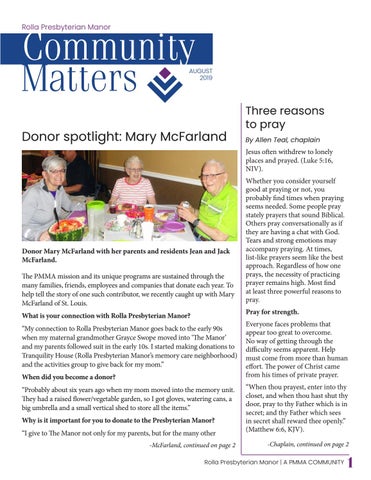
Donor Mary McFarland with her parents and residents Jean and Jack McFarland. The PMMA mission and its unique programs are sustained through the many families, friends, employees and companies that donate each year. To help tell the story of one such contributor, we recently caught up with Mary McFarland of St. Louis. What is your connection with Rolla Presbyterian Manor? “My connection to Rolla Presbyterian Manor goes back to the early 90s when my maternal grandmother Grayce Swope moved into ‘The Manor’ and my parents followed suit in the early 10s. I started making donations to Tranquility House (Rolla Presbyterian Manor’s memory care neighborhood) and the activities group to give back for my mom.” When did you become a donor? “Probably about six years ago when my mom moved into the memory unit. They had a raised flower/vegetable garden, so I got gloves, watering cans, a big umbrella and a small vertical shed to store all the items.” Why is it important for you to donate to the Presbyterian Manor? “I give to The Manor not only for my parents, but for the many other -McFarland, continued on page 2
Three reasons to pray By Allen Teal, chaplain
Jesus often withdrew to lonely places and prayed. (Luke 5:16, NIV). Whether you consider yourself good at praying or not, you probably find times when praying seems needed. Some people pray stately prayers that sound Biblical. Others pray conversationally as if they are having a chat with God. Tears and strong emotions may accompany praying. At times, list-like prayers seem like the best approach. Regardless of how one prays, the necessity of practicing prayer remains high. Most find at least three powerful reasons to pray. Pray for strength. Everyone faces problems that appear too great to overcome. No way of getting through the difficulty seems apparent. Help must come from more than human effort. The power of Christ came from his times of private prayer. “When thou prayest, enter into thy closet, and when thou hast shut thy door, pray to thy Father which is in secret; and thy Father which sees in secret shall reward thee openly.” (Matthew 6:6, KJV). -Chaplain, continued on page 2
Rolla Presbyterian Manor | A PMMA COMMUNITY
1
-McFarland, continued from page 1
residents that are friends of the family that reside there as well.” Living in St. Louis, how often do you make it back to the community? “I try to make it to Rolla on a
weekly basis to see my parents. I am a retired teacher, single with a dog, Zoey, that also likes to visit my parents and other residents.” To become a donor like Mary, visit giving.presbyterianmanors.org or contact the PMMA Department of Giving at 800-336-8511. ◆
-Chaplain, continued from page 1
Pray for health Human bodies break down. Young and old experience physical sickness. While medical science makes steady progress against human diseases, praying also makes a difference in our health. God’s word speaks of the importance of prayer when we are sick. “Is anyone among you sick? Let them call the elders of the church to pray over them and anoint them with oil in the name of the Lord. And the prayer offered in faith will make the sick person well; the Lord will raise them up.” (James 5:1415a, NIV). Pray for others Being unselfish in our prayers is important. In James 5:16, the Bible clearly states, “Pray one for another.” When it comes to praying, we need each other. Human beings tend to have more faith when praying for someone else than when praying for themselves. We need to pray for others and be willing to have others pray for us. Linking our prayers to the prayers of other people gives them greater strength. “Again, truly I tell you that if two of you on Earth agree about anything they ask for, it will be done for them by my Father in heaven.” (Matthew 18:19, NIV). ◆
Like us on Facebook to stay updated on news and events.
ROLLA Presbyterian Manor
573-364-7336 ◆ Fax: 573-364-7495 1200 Homelife Plaza Rolla, MO 65401-2595 RollaPresbyterianManor.org
2
COMMUNITY MATTERS | August 2019
Community Matters
is published monthly for residents and friends of Rolla Presbyterian Manor by Presbyterian Manors of Mid-America, Inc., a not-for-profit 501(c)(3) organizaton.
To submit or suggest articles: lfreeland@PMMA.org Ann Caudill, executive director Joelle Freeland, marketing director
OUR MISSION: To provide quality senior services guided by Christian values.
Video chats with family and friends can offer a mental health boost By Sarah Lindenfeld Hall for Next Avenue
Anne Whitley lives 800 miles from her grandchildren’s home in Florida, but she still sees them daily. On her iPhone’s FaceTime app, Whitley catches up with her five-year old granddaughter, Cairo, who might show off a new toy, and her year-old grandson, Garvey, who enjoys practicing his latest words. All it takes is just a few minutes each day to bridge those miles between them. “I don’t want them to forget me in between visits,” said Whitley, 83, a retired teacher in Clayton, N.C., who sees her grandchildren in person a couple times a year. “That keeps us connected.” Whitley’s main concern is staying in touch with her grandkids, but there’s another reason older adults may want to consider dialing up their loved ones by video chat platforms like FaceTime and Skype. to connect with A recent study from Oregon Health & Science University in Portland found that the use of video chat with friends and family also may be an effective way for older adults to dramatically reduce their risk for depression. Fending off depression with a video chat The study, published in the American Journal of Geriatric Psychiatry, used data from the National Institute on Aging’s Health and Retirement Study, which surveys older Americans every two years. Researchers looked at Americans age 60
and up who used four kinds of communication technologies — video chat, email, social media networks like Facebook and instant messaging. Then, they examined their symptoms of depression two years later. “It gives my dad and me a more immersive, more interactive experience.” Researchers found that older adults who connected with their loved ones through email exchanges, Facebook posts or instant messaging sessions had about the same rate of depression compared to those who did not. By contrast, those who communicated through video chat cut their probability of depression by nearly half. “We need to get beyond a discussion of technology being good or bad,” said lead author Alan Teo, an associate professor of psychiatry at Oregon Health & Science’s School of Medicine and a researcher at the VA Portland Health Care System. “The conversation we need to be having, and I hope that this study helps move forward, is what ways should we be using our technology and what particular types of platforms might be the most beneficial for our health and happiness.” Not just about preventing the blues Studies show that depression and social isolation can be problems for older adults. While the majority
are not depressed, according to the Centers for Disease Control and Prevention, rates can rise as high as about 12% for those who are hospitalized and 14% for those who need home health care. And as many as 32% of people older than 55 feel lonely, according to the National Institutes of Health. Both depression and loneliness can have consequences beyond feeling blue and include links to poorer physical health and a shortened lifespan. “People literally die earlier when they are lonely,” Teo said. Teo’s research didn’t examine why video chat might be the better technology, but he can make an educated guess after years of treating patients as a psychiatrist and researching ways to help them. When we’re able to see the emotions and expressions as we talk to our loved one, we have a more intimate exchange, said Teo, who now makes the effort to video chat more often with his father, 82. “It gives my dad and me a more immersive, more interactive experience,” he said. “We can be tempted to just shoot off a quick text message … but this study is a reminder that we shouldn’t settle for that all the time.” The findings ring true with Kim G. Johnson, an assistant professor of - Video chat, continued on page 4
Rolla Presbyterian Manor | A PMMA COMMUNITY
3
ROLLA
Presbyterian Manor THE WAY YOU WANT TO LIVE
1200 Homelife Plaza Rolla, MO 65401-2595 RETURN SERVICE REQUESTED
Our Mission: to provide quality senior services guided by Christian values Like us on Facebook to stay updated on news and events.
- Video chat, continued from page 3
psychiatry and behavioral sciences at Duke University, who was not involved in the research. She said she regularly hears from patients about their video chats with their grandchildren. “It’s almost the next best thing to being there,” she said. The trick now, she said, is to make technologies like video chat more accessible to older adults. 4 ways to incorporate more video chats into your lfe Here are four tips on how to see your loved ones’ faces more often: Get familiar with the technology. If you’re not sure how to use video chat, Teo said, figure out the barriers and get help. Some, like Whitley, get guidance from techsmart children or grandchildren. Whitley’s daughter gave her an
4
iPhone and showed her how to use FaceTime. “I won’t ever know how to use it as well as she does, but what I do know is good for me,” she said. You also could sign up for a technology class at your local senior center or search online for tutorials. TechBoomers offers YouTube videos for how to use both Skype and FaceTime. Switch it up. Daily or weekly video chats may need to be scheduled, but not every session has to be on the calendar, Teo said. If your granddaughter posts a prom picture on Instagram, instead of just posting a comment, contact her on Skype to ask her about the dance. Take the initiative to add more virtual face-to-face chats to your daily life. “Change up the mode of communication when you can,” Teo
COMMUNITY MATTERS | August 2019
said. Look in their eyes. During a video chat, make the effort to appear to be looking at the other person, Johnson said. That means you’ll need to look directly into the tiny video camera at the top of the screen from time to time instead of the screen where your family member’s face is. It’s an important way to help build rapport during your conversation, she said. Still get together. Video chat and other forms of online communications should never replace your in-person gettogethers, where you can hug and hold and be present with the ones you love, Teo and Johnson said. “But when you don’t have the option of being in person,” Teo said, “video chat is probably best.” ◆