Refreshments available contact Jennifer on 07555 100909 or Phyllis on 07808 501612
Designs by Greenisland Flower Arrangement Society (NIGFAS)
Visit us at:Ballylig Road, Magheramorne, LARNE BT40 3HZ
Connect Tech Services provides professional AV and networking solutions for churchesfrom sound, lighting, and visuals to hearing assistance and WiFi
We deliver reliable technology and seamless support, so your church can focus on its mission. Contact us today! T: 028 9691 8892 W: www.connecttechservices.co.uk E: info@connecttechservices.co.uk
Subscriptions
CONTRIBUTORS
Rick Hill is Secretary of PCI’s Council for Mission in Ireland. He is an elder in Carnmoney Presbyterian and lives in Doagh with his wife Sarah and their three children.
Rev Colin Dickson is mission project leader at the International Meeting Point (IMP) and is also a former PCI global mission worker to Jordan.
Jonny McClune is PCI’s congregational witness development officer. He is married to Bethany, dad to two young children, and a member of Saintfield Road Presbyterian.
Prof Gordon Campbell is Senior Research Fellow in New Testament at Union Theological College and a retired principal of the College.
The views expressed in the features, news reports, letters and book reviews of this magazine are not necessarily those of the editor. Editorial comment and signed articles do not necessarily contain the official views of the Church, which can only be laid down only by the General Assembly. Acceptance of advertisements does not imply endorsement of the goods or services. Advertising will not be included if the product or service is deemed to be in conflict with the Church’s official views, or if it is inappropriate for a church magazine. It is not Herald policy to include any editorial content along with adverts. The editor reserves the right to decline any advertisement or letter without assigning any reason. Letters may be edited for publication. No correspondence can be entered into regarding nonpublication of advertisements or letters.
A ministry of presence p18
Culture Watch p16
Pathways over programmes p10
EDITORIAL
Fearless faith
March is a month when the celebration of ‘Irishness’ is marked, both here and around the world, on St Patrick’s Day. In Culture Watch, Patrick Mitchel looks at the history of this day and how it has become a lucrative business event. However, he points us to the man behind the merchandise; a man “with a love for God and the people of Ireland, willing to suffer for the gospel, deeply impacted by God’s grace, soaked in Scripture and with a passion for justice…”
Patrick sought to love God and love people, just as Jesus directed. In this month’s congregational story, we hear how Newtownbreda Presbyterian in Belfast is also seeking to do just that. Through community ‘pizza nights’ they are striving to prioritise people, by considering the experience of the outsider and cultivating a culture of grace, hospitality, and witness.
This month we also have a focus on chaplaincy – a ministry centred on loving people. Rick Hill outlines the variety of areas where PCI supports chaplains – in healthcare, prisons, universities, the armed forces and the rural community. He describes chaplaincy as a ministry of “carrying the presence of Christ into places where many people never expect to meet him.” Our mission articles feature the experiences of two chaplains in the healthcare sector – Liz Lowrie in Dublin and Heather McCracken in Belfast. Both attest to the privilege of drawing alongside patients and their families at times of great vulnerability and stress, and bringing the love of Jesus to their situations.
Heather uses a quote from James Stainaker to express the motivation that she and other chaplains have: “Chaplains walk into rooms that no one wants to walk into. Not because they have answers, but because they refuse to let pain go unseen.”
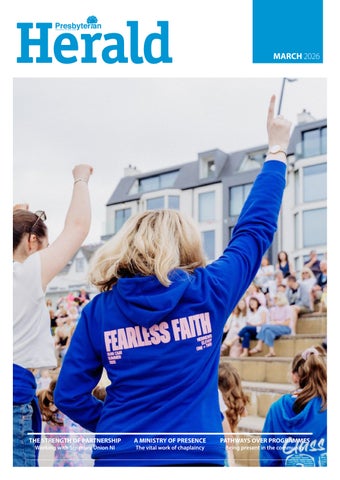
Our front cover illustrates the wonderful work of Scripture Union Northern Ireland (SUNI). Director, Damian Wharton tells us that SUNI is pioneering work into new areas, hoping to partner with churches and provide support for them to serve their local schools. As the cover highlights, reaching out to love and serve people requires a ‘fearless faith’, which is certainly something St Patrick would approve of. Credited for bringing Christianity to Ireland, he endured many challenges and hardships. Yet, his trust in God was unwavering, saying: “Wherever I am, I am never alone; Christ is there with me.” His legacy, passion and commitment are an inspiration for us all.
LETTERS
United Appeal for Mission
Dear Editor,
As convener of the United Appeal for Mission, I write to sincerely thank readers for their faithful generosity. Each year, congregations across our Church give sacrificially to the United Appeal, and each year that giving is transformed into ministry, mission, and practical support that reaches far beyond what any of us could achieve alone.
Within the pages of the Herald, readers regularly have the opportunity to read about people, projects and resources supported by the United Appeal. These stories, whether from local congregations, chaplaincies, church plants, global mission partners, or the work of our Councils, are reminders that God is at work in and through the Presbyterian Church in Ireland.
They show the difference that these donations make: equipping leaders, strengthening congregational life, supporting mission workers overseas, resourcing compassionate social witness, and enabling ministries of evangelism,
pastoral care and discipleship across our island.
The most recent Appeal has once again demonstrated the remarkable commitment of our congregations. At a time when many face financial pressures, as I reported at the June Assembly, the giving of congregations has enabled the full grant commitments for 2024 to be met and has encouraged the committee as we assess the contributions for 2025 and look ahead to supporting the work planned for 2026.
Thank you for standing with us, and with those who serve Christ through these ministries.
As we move forward together, may I invite you not only to continue giving, but also to continue praying – for our Councils, for our workers at home and overseas, and for the communities they serve. Your partnership enables gospel‑shaped hope, compassion and witness to flourish.
Thank you again for your generosity, and for all you do in enabling this shared mission.
Martin
Hampton Convener, United Appeal for Mission
Topical Tweets
@News_Letter
Supreme Court Northern Ireland RE: Minister says no plans to change school worship and RE still to focus on Christianity.
@rtenews
The provision of religious education at schools in Northern Ireland is to be reviewed by an independent panel.
@careorguk
New research indicates that artificial intelligence has contributed to a net loss of jobs, down 8% in the past 12 months.
THE APOSTLES’ CREED
Ascended and enthroned
Frank Sellar
“He ascended to heaven and is seated at the right hand of God the Father Almighty.”
What is Jesus doing now? That’s a question few Sunday school leaders would relish being asked by an enquiring youngster!
Let’s begin with the biblical text. After Jesus was raised from the dead, Luke tells us how Christ spent 40 days speaking with his disciples about the kingdom of God and how all the Scriptures pointed to his death, resurrection and ascension. So, if the resurrection affirms that Jesus lives forever, the ascension affirms that he reigns forever. And if the resurrection tells us Jesus’ atoning sacrifice has been accepted, his ascension tells us he has completed all the work his Father gave him to do.
First truth: Jesus is King. When we think of the word ‘ascended’, the image that immediately comes to mind is ‘going up’, and while that’s certainly part of what it entails, there is another element. On 6 May 2023, after a 73-year wait, King Charles ascended to the throne of the United Kingdom. Sure, he may have sat on a raised plinth, but that was only a physical representation of something far more significant; his coronation, his enthronement, ushering in a new era and relationship with his nation and the world.
means other human beings can get there too. In addition, when during illness, fragility or vulnerability we are unable to pray, Jesus our intercessor is praying for us. That’s what Old Testament priests were called to do in the temple –bring the things of God to the people and the concerns of the people to God.
…our glorious Saviour is preparing a place for his
redeemed…
In Colossians 1:17 we read “[Christ] is before all things and in him all things hold together.” As Jesus’ earthly ministry gave dead people life, controlled the elements and fed the hungry, so now Jesus keeps and sustains the breath in our lungs, the globe on its axis and the sun rising each morning. Moreover, in 1 Corinthians 15:25–26, we learn: “He must reign till he has put all enemies under his feet. The last enemy that will be destroyed is death.” Right now, Jesus is reigning as King of heaven and earth. Although God’s people still face opposition and persecution around the world, Christ’s victorious rule assures us of future triumph!
And yet more, John 14 encourages us that Jesus is at this moment preparing a place for us, so that where he is, we may be also. Ascended, enthroned and seated at the right hand of the Father, Christ’s exaltation speaks of his completed work of salvation, his rule and authority.
Second truth: Jesus is our Priest. At the right hand of the Father, until Christ returns to earth in judgment and glory, 1 John 2 assures us the ascension guarantees Jesus’ advocacy and intercession on our behalf. I love the words of John ‘Rabbi’ Duncan who said: “The dust of earth now sits on the throne of the universe.” There is a man in heaven! That
Since he has trod the path we have walked, Jesus understands in every respect our hurts, needs and requests. Jesus assures us in John 17 that he is actively engaged in the lives of those who love him and intercedes for us as we face the trials and troubles of the flesh, the world and the devil. Jesus not only offers a perfect sacrifice but even as the High Priest bore the names of the 12 tribes of Israel on his breastplate, so Christ now has our names engraved on his heart. For as Hebrews 7:25 puts it: “He is able to save completely those who come to God through him, because he always lives to intercede for them.”
Third truth: Jesus is our Prophet. Christ’s ascension to his heavenly throne ushered in the Age of the Spirit (Acts 1:8). Before his departure to God’s right hand, Jesus was limited by time and space. Following his ascension, he could be in all places at all times, empowering his everexpanding church with courage and conviction to go in the Holy Spirit’s strength to witness in Jerusalem, Judea, Samaria and to the ends of the earth. Even as Jesus had prophetically proclaimed the good news in his earthly ministry, so now as the exalted Prophet, he equips his followers to fulfil the Great Commission to make disciples of all nations (Matthew 28:20).
What then is Jesus doing right now? He has by no means retired from active service. As King, Jesus “defends and preserves us against all enemies” (Heidelberg Catechism 51). As Priest, Jesus intercedes before the throne by his own physical presence and continually prays for his weak and broken people. And as Prophet, Jesus continues to speak in power through the Holy Spirit as his word is opened and proclaimed throughout the world.
Even now, Christ our glorious Saviour is preparing a place for his redeemed, and will come back to take us to be where he is. Hallelujah!
Very Rev Dr Frank Sellar is a former PCI Moderator and minister emeritus of Bloomfield Presbyterian Church.
‘Month of Sundays’ in An Tionólann
PCI’s newest expression of church in west Belfast, An Tionólann, has just concluded a trial month of weekly Sunday services.
Since it began in 2022, PCI’s special ministry in west Belfast has organised a number of historical, linguistic, cultural, sporting and spiritual events. Monthly services commenced in 2024 and now have around 40 regular attendees.
“We feel that the time has come to take things to the next level and establish a regular pattern of Sunday services,” explained Rev David Moore, who leads An Tionólann.
The services took place in Cultúrlann McAdam Ó Fiaich on the Falls Road, which until 1982 was the home of Broadway Presbyterian Church.
Education appointment
Rev Dr Colin McClure has been appointed to the board of the Education Authority.
As the person nominated by the Transferors’ Representative Council, Dr McClure will represent the interests of controlled schools in Northern Ireland.
Minister of First Larne, Dr McClure is also clerk of Carrickfergus Presbytery and has served on the board of governors across a wide range of schools in both rural and urban settings.
Education Minister Paul Givan said, “His knowledge and expertise will be highly beneficial to the board, as we seek to continue to progress critical transformation of teaching and learning in Northern Ireland.”
EA launches reports
Evangelical Alliance has released five supplemental reports from the ‘Finding Jesus’ research, giving insights into how people are coming to faith across specific demographics.
The reports provide a snapshot into the statistics around certain groups and cover those who are 18 to 24 years old, over 65, on a lower income, from a non Christian background, and male and female.
Project lead Rachael Heffer, said of the latest research: “These five supplemental reports are a great tool for church and ministry leaders to better understand those coming to faith in their church and provide insight into how they can be discipled more effectively.”
RE review welcomed
The Transferor Representatives’ Council (TRC) has welcomed the announcement by Northern Ireland’s Education Minister that there is to be a review of the Religious Education curriculum.
In a statement, the TRC, which represents the three main Protestant denominations including PCI, said, “We remain committed to supporting schools in providing high quality balanced RE and meaningful collective worship, which reflects the Christian ethos of all of our schools and is consistent with the rights of all children. We will continue to work tirelessly to ensure that the Christian ethos remains and underpins our education system.”
Caoimhín Ó Seanáin (Cultúrlann tourism officer), Rev David Moore (who leads An Tionólann), Rev Moore Casement (who led one of the weekly services) and Cónall Ó Corra (manager of Cultúrlann).
Environment conference
A capacity crowd gathered in Newry recently for the ‘Let justice flow like rivers’ care for creation conference.
Organised by Ireland’s Church Leaders’ Group, the Irish Council of Churches and the Irish Inter Church Meeting, this faith based gathering was a response to the pollution of Lough Neagh and wider environmental concerns, and involved the participation of theologians, scientists, lay people and clergy who shared their experience of care for, and challenge to, God’s creation.
Former PCI Moderator Dr John Kirkpatrick was among those in attendance.
Call for Bill amendment
A Northern Ireland Assembly committee has called for a Bill to be amended, to ensure justice for the victims and survivors of mother and baby institutions.
Following a seven month scrutiny period, the Committee for the Executive Office has published its amendments and recommendations on the Inquiry (Mother and Baby Institutions, Magdalene Laundries and Workhouses) and Redress Scheme Bill.
Committee chair Paula Bradshaw said, “This is a Bill to make provision relating to one of the most distressing and hurtful episodes in Northern Ireland’s history. Getting the foundations of the Inquiry and the Redress Scheme right is essential, and the committee has taken its responsibility of scrutinising the Bill extremely seriously.”
She added, “The committee has agreed a series of amendments aimed at strengthening transparency, enhancing survivor involvement, improving accountability and ensuring robust Assembly oversight.”
The Bill will move to the ‘consideration stage’, where MLAs will debate and vote on the clauses and amendments.
OPEN DOORS
World Watch List launched
The Stormont launch of Open Doors‘ 2026 World Watch List took place recently.
Faith leaders and MLAs gathered to hear sobering statistics from the 50 countries where Christians face the most severe persecution.
According to the report, more than 388 million Christians face high levels of persecution and discrimination for their faith.
North Korea tops the list, but Open Doors’ research indicates that Nigeria remains the country where more Christians are killed for their faith than all other countries put together. Of the 4,849 killed worldwide during the reporting period because of their Christian identity, 3,490 were in Nigeria.
In some regions of the world, the longstanding presence of the Christian church leaves it exposed, for example in Syria. It has climbed back into the top 10 due to an increase in violence and is now at number six in the list.
Next Moderator elected
Rev Richard Kerr, the minister of Templepatrick Presbyterian Church, will become PCI’s next Moderator.
The 60 year old received the most votes in a second round of voting, having tied initially with Rev Ker Graham, minister of Clarkesbridge and First Newtownhamilton Presbyterian Church, Garmany’s Grove and McKelvey’s Grove Presbyterian Churches. This is the first time that a second round of voting has taken place since 2014.
Speaking about his election, Mr Kerr said he felt deeply humbled, and added, “My overriding desire in this year would be to encourage the Church, reminding us of the confidence we have in Christ, encouraging us to serve the wider community, and world, out of that place of knowing we are deeply loved by him.”
The Moderator Designate continued, “I’m also conscious of the significant central Church failings in safeguarding that came to light last year, and my heart goes out to those who have been hurt by our failure. It is important to reiterate the apology made by the Moderator at December’s Special General Assembly, as we are sorry to all who we have failed. I want to do what I can to build on the contrition already expressed in December, seek to ensure that we learn from and address our failings, and work with all involved to rebuild trust that has been broken.”
The County Antrim minister was one of four nominees for PCI’s 19 presbyteries to consider. In the first round, he received six votes (North Belfast, East Belfast, Carrickfergus, Coleraine and Limavady, Monaghan, and Templepatrick) as did Mr Graham (Armagh, Ballymena, Derry and Donegal, Down, Newry, and Omagh). Rev Dr Jonathan Curry received four votes (Dromore, Iveagh, Route, and Tyrone) and Rev Mairisíne Stanfield received three votes (Ards, South Belfast, and Dublin and Munster).
The voting in the second round was as follows: Mr Kerr had 10 votes (Ards, South Belfast, East Belfast, North Belfast, Carrickfergus, Coleraine and Limavady, Dublin and Munster, Dromore, Monaghan, and Templepatrick); Mr Graham received nine votes (Armagh, Ballymena, Derry and Donegal, Down, Iveagh, Newry, Omagh, Route, and Tyrone).
Mr Kerr will be officially nominated to this year’s General Assembly when it gathers in Belfast in June, succeeding the current Moderator, Dr Richard Murray, who will continue in office until then.
PERSONAL VIEW
Life lessons
Lisa Keys
Chief officer of The Northern Ireland Boys’ Brigade
I am married to Leslie and have two grown-up sons. I’ve been a Christian since childhood and have always believed it’s important to use the gifts God has given me to serve him, both in my professional life and in ministry. I’ve held a number of interesting roles in commercial and ministry organisations, including CastleCourt, Pinsent Masons, Institute of Directors and The Northern Ireland Boys’ Brigade (BBNI). I’m a member of Newtownbreda Baptist Church, where I have the privilege of serving in the children’s ministry.
My role in The Northern Ireland Boys’ Brigade (BBNI) is as the chief officer, which means I lead a staff team of 10 who support and equip over 2,700 volunteer leaders across NI and Donegal. The leaders work with around 11,300 boys and young men in 240 BB companies connected to local churches. I’ve been a staff member with BB for almost five years. My role is focused on the day-to-day operation of the organisation and also includes being company secretary to the board of trustees.
BBNI has a real opportunity to challenge what seems to be a very popular current narrative where the word ‘toxic’ is linked with ‘masculinity’. Every week, our volunteer leaders build on relationships with boys and young men. They have an incredible opportunity to speak into their lives, to teach them new skills, and most importantly, to share with them about Jesus. Our vision in BBNI is to ‘raise generations of Christ-like men’. Boys and young men are living in a noisy culture where what is seen on social media attempts to influence what is right and wrong. Many of the boys who come along to BB have no other church connection. Each week we can challenge that narrative, through biblical teaching, combined with a programme of activities and committed leaders who support and champion these boys. It’s exciting to see many BB companies growing in number and to be having conversations with churches who are exploring the possibility of opening a BB company.
Leadership in general is demanding; every day is a juggling act. On the one hand, you have to dream, innovate and cast vision, but then you are grounded in the daily reality of people, processes and practical limitations. I’ve always felt that Christian leadership adds a deeper layer of responsibility, regardless of whether it’s in a ministry organisation or not. It’s not just about achieving the goals or guiding people effectively, it’s also about serving others in a way that reflects Christ’s heart. Being in a ministry like Boys’ Brigade that has existed for over 140 years is both a blessing and a challenge. We know that BB has impacted so many lives over those years, but we face the ongoing challenge of ensuring that BB remains relevant and effective in a changing world.
Professionally, one of my greatest achievements was receiving the IoD Third Sector Director of the Year award in December 2023. The timing of that recognition made it even more special, coming just at the end of a two-year journey to establish BBNI as an independent organisation. Personally, my greatest achievement is a shared one. Our home is filled with love and laughter. It’s not perfect, but it’s real and being a mum is just the best job there is.
God has been very clear that we should not be weighed down by our worries, but instead give them to him. That’s been one of the hardest lessons for me to learn. Learning to truly release control has not been easy, but I’m so thankful that God never gave up on me. He patiently showed me the damage that worry and self-reliance can do, and reminded me that he is far more capable of carrying my burdens than I ever could be. Through it all, I’m learning that peace doesn’t come from having everything under control – it comes from knowing he is in control.
MY STORY...
Stanley Matthews recently celebrated 50 years as organist and choirmaster in Trinity, Omagh. He shares some of his golden memories.
Two score years and 10
Igrew up on a farm in the shadow of the Gortin Glens, Omagh side and there would have been an expectation that I would follow my older brother Rea into that business. Across our field, over the bog and up a long lane lived the local piano teacher – Shady Baxter – and like many of the local children, I was sent to her for music lessons. Now, farming just wasn’t for me, but music was a different story. I soon mastered the art of decoding the Egyptian-type hieroglyphs and transferring them through my fingers to black and white teeth on a big black wooden box. In other words, I could play the piano – sort of anyways.
As a church musician you have to... cope with changes in musical trends…
Mrs Baxter and my parents were very keen that I should attempt to play hymns and to everyone’s amazement, including myself, this style of playing fell easily under my fingers.
My first permanent appointment as organist came in 1973, at the age of 15, to the long-gone St Patrick’s Garrison Church in Omagh, and it was at that time I was encouraged to have formal organ tuition. So, every Saturday morning for five years, I travelled to First Cookstown Presbyterian Church for organ lessons with Brian Dunlop, culminating in the achievement of my Grade 8.
Around 1975, the minister of Trinity Presbyterian Church, Omagh – Rev Bill Clarke who was a padre to St Patrick’s –noticed me playing and as there was no organist in Trinity at that stage, asked me to take up the role on a three-month probationary basis. I don’t recall the probation ever being lifted and I have remained there to this day.
I practised regularly and worked really hard on mastering the ropes of being a choirmaster. In 1988 I completed my ALCM Diploma exams on the organ and have been a member of the Ulster Society of Organists and Choirmasters for many years.
Memorable events in the 1980s and 1990s included choir concerts, the acquisition of the first church piano, the
robing of the choir and fundraising to repair and improve the organ. We are probably a rarity these days in that the choir are still proud to wear their robes every Sunday and look great in them. We are not at all old fashioned in our outlook – we have all age groups represented and sing a wide range of music including that of Rutter, McDonald, Townend/Getty and Lawton.
Fifty years is a long time in any job. As a church musician, you have to develop strategies to cope with changes in musical trends and what is going on elsewhere in your life. I sometimes think I’ve had more regenerations than Dr Who!
Some interesting statistics I’ve estimated over the 50 years are: I’ve played hymns more than 8,000 times; the choir has learned more than 400 special pieces; I’ve been musically involved in at least 180 weddings; I’ve seen off two ministers of religion (happily, through retirement). Music has certainly given me the opportunity to go places and meet people.
I decided to mark my 50th year with special musical events. In early August, I organised a solo event called the Battle of the Keys. At this I played a varied programme of music on the piano, church organ and digital piano. Voluntary donations went to FOPC Malawi 2025 Fund and we achieved £1,550 for this worthy cause.
We celebrated the 50th anniversary on Sunday 26 October with our traditional Harvest service in the morning and a special evening concert put on by the choir, which was enjoyed by a full capacity church. A grand total of £2,062.50 was raised through this event for the Alzheimer’s Society. After which, a splendid Harvest supper was put on by the ladies of the congregation and several excellent presentations were made to me by various groups. I enjoyed the occasion very much indeed.
I now, in the words of Star Trek, ‘boldly go’ into the future with Trinity and look forward to whatever exciting musical adventures that may bring.
Pathways over programmes
Jonny McClune shares how St John’s Newtownbreda is being present where God has placed it, witnessing effectively to the diverse community around it.
In the heart of suburban south Belfast, St John’s Newtownbreda occupies a prominent spot on a busy arterial road. St John’s is a traditional congregation with a growing awareness of the changing world just beyond its doors. Its parish is simultaneously home to some very affluent streets and a growing migrant population to which the congregation has embraced the call to be present to these changing and diverse contexts. The congregation’s story is one of intentionality, creativity, and a deep desire to serve and welcome their neighbours.
Responding to a changing community
Recognising the shifting demographics around it, St John’s has taken deliberate steps to engage with and serve its community. One of the most practical and impactful responses has been the launch of the ‘English project’. Language support meets a real need
…not everyone will come to church, but everyone deserves a thoughtful, hospitable invitation.
for those whose first language is not English and who, as a result, often experience levels of marginalisation. The project offers welcome, inclusion, and community to individuals and families in these circumstances, while the language support seeks to elevate their position and facilitate broader integration into society.
The church sees this work as part of its calling as God’s people; to reflect God’s generous care and hospitality to the stranger: “The foreigner residing among you must be treated as your native-born. Love them as yourself, for you were foreigners in Egypt. I am the
Lord your God” (Leviticus 19:34).
The church’s witness doesn’t stop at service – it extends into worship. Each Sunday, the sermon is translated into Farsi and Cantonese, allowing newcomers to engage in their native language. This simple yet profound act communicates: You are seen. You are welcome. You have a place here. You can belong.
Pizza,
people, and pathways
Over the summer months, St John’s hosts community pizza nights –large-scale, joyful events that draw families from across the parish. With banners that read: ‘Curious about church or just love pizza?’, the invitation is open, warm and non-threatening. Volunteers host every aspect of the event, from dough-making to pizzatopping at cooking stations, using pizza ovens the church has invested in specifically for this initiative.
These nights are more than
Are we inviting people into the community, or simply serving them at a distance?
just fun – they are missional spaces. Some volunteers focus on the practical tasks of making and serving pizza, while others take on the role of trusted guides. These guides move through the space – chatting with people in queues, engaging during the pizza-making process, and connecting with guests as
they eat. Their role is relational: helping guests feel at ease, painting a broader picture of the event’s purpose in the life of the church, and gently inviting them to experience more of the community through Sunday services or other events.
At each table, guests also find invitations to a community choir starting in the autumn and to the Sunday service – described in accessible language for those unfamiliar with church, and accompanied by the promise of another pizza lunch. Each step is designed with care, creating space for those curious about church to inquire further and offering community for those not yet at that point. It acknowledges that not everyone will come to church, but everyone deserves a thoughtful, hospitable invitation.
A culture of hospitality
While the pizza nights may appear to be well-
Who is around us? What do they need? How can we serve and invite others with love and clarity?
executed events, they reflect a deeper intentionality – a commitment to thinking through their guests’ experiences. From the moment someone arrives, St John’s acts as a host. Even the banners at the entrance, featuring images of the congregation, communicate welcome. Not to be underestimated, the visuals show newcomers the sort of people who attend, what they do, and importantly – that the church is vibrant, diverse and intergenerational.
These subtle features affirm a powerful message: This is a place for everyone.
The church has considered the experience of the outsider. They’ve asked: How do we serve? How do we welcome? How do we invite? And in answering these questions, they’ve cultivated a gospel culture of grace, hospitality, and witness.
Intentional leadership
It’s no surprise that the kirk session at St John’s didn’t arrive at this place by accident. This is not the work of a few lone rangers.
It’s the fruit of Spirit-led renewed consideration of their community and a prayerful discernment of their model for ministry and mission.
Pizza parties and English projects may not be the right fit for every church, but the posture behind them is universally relevant. The challenge for all of us is to ask: Who is around us? What do they need? How can we serve and invite others with love and clarity?
Outreach ministries: funnels or silos?
This congregational story raises a vital question: Are our outreach ministries functioning as funnels or silos? Funnels
channel the flow – welcoming people in, guiding them gently towards deeper engagement with the church community and its practices of faith. Silos, on the other hand, can isolate outreach from the rest of church life, offering good service but no clear pathway into belonging or to a place to explore who Jesus is.
St John’s Newtownbreda demonstrates an example of a funnelshaped ministry. Its English project and community pizza nights are not standalone efforts – they are thoughtfully connected to worship, relationship-building, and further invitations. Its intentionality in signage, translation, and hospitality shows how small details can support a larger vision of welcome and inclusion.
Are we building pathways or just running programmes? Are we inviting people into the community, or simply serving them at a distance?
Jonny McClune is PCI’s congregational witness development officer.
World Development Appeal total
The final total of the 2024 World Development Appeal, ‘Hunger Pains: Scarcity to Abundance’ was £490,159. This has been split between PCI’s development partners, Christian Aid and Tearfund, with 5% retained to be allocated to PCI partner projects.
The 2024 Appeal focused primarily on a Tearfund project in Rwanda, through the Presbyterian Church in Rwanda, who seek to share God’s love while assisting with practical interventions, including agricultural training, self help groups, and savings and lending groups.
The Appeal will also support Tearfund projects in Malawi, Bangladesh, Uganda and Burkina Faso, as well as Christian Aid projects in Honduras, the Democratic Republic of Congo (DRC), Sierra Leone and Burkina Faso.
In Bangladesh, Tearfund’s partner is training farmers in flood resistant farming techniques and disaster preparedness to help communities that are trapped in cycles of poverty due to regular flooding, soil degradation and extreme weather.
In DRC, Christian Aid’s partner is training displaced people and their host communities in adapting to the changing climate including climate smart agricultural practices.
Funds also support PCI partners, including one that works to provide vocational skills training and primary healthcare for minority communities in India.
The Council for Global Mission would like to express thanks to those individuals and congregations who so generously gave to the 2024 Appeal.
pains scarcity to abundance
Urban Mission Network
The Urban Mission Network met recently in Rathcoole Presbyterian to think about ‘Revitalisation in Hard Places’. This morning event was attended by around 50 ministers and outreach workers from a variety of urban and estates settings within PCI. Rev Marty Gray shared insights from his DMin research on ‘revitalisation’ and there was also opportunity to learn from the experience of others and be encouraged for the work God is doing in these demanding but opportunity filled places.
Let’s pray
‘Let’s Pray’ is a useful way of keeping up to date with the latest PCI prayer requests.
Available every Thursday, the email resource features prayers and requests concerning all aspects of the life and work of the Church.
To subscribe, go to www.presbyterianireland.org/letspray
Church planting conference
‘From Seed to Harvest’ was held on Saturday 7 February in Drogheda Presbyterian.
Organised by the Council for Mission in Ireland, the church planting conference aimed to equip those involved in church plants across PCI. Around 50 people from across Ireland attended and Rev Neil MacMillan, director of City to City Europe, was the keynote speaker.
Conference for leaders
High Kirk Presbyterian Church in Ballymena will host an allday conference for emerging leaders later this month.
‘Emerge’ is aimed at those aged 21 to 30 years and serving in a leadership role within church. It will combine practical teaching, interactive workshops, real life leadership stories, space to reflect on their leadership journey, and opportunities to connect with other emerging leaders from across PCI.
The event takes place on Saturday 21 March between 11am and 6.30pm. To find out more and book, scan the QR code.
Website hubs
The PCI website features a number of hubs to help congregations connect with younger generations and those outside the church.
The ‘Outreach and Evangelism Hub’ provides ideas on how to connect, build relationships and gain confidence in sharing God’s story.
The children’s, youth and family ministry hubs contain curriculum ideas, support and training for leaders as well as links to resources.
Access the hubs by scanning the QR codes.
Children, youth and family hubs Outreach and Evangelism Hub
hunger
Mission in Ireland evenings
In the coming weeks, several presbyteries are hosting ‘Mission in Ireland Evenings’ to share vision, stories and examples of the mission of our Church across Ireland.
Supported by the Council for Mission in Ireland, these evenings seek to underline how God is at work through the Church across Ireland today. The theme for 2026 is ‘Declare and Display’, with various speakers highlighting ways the gospel is being shared and shown, from Home Mission congregations across the island to mission projects closer to home.
Rev Kenny Hanna (rural chaplaincy) and Rev Nigel Craig (universities chaplaincy)
SAFEGUARDING
PCI holds safeguarding roadshows
A series of safeguarding roadshow events recently took place.
Designed for those who have responsibility for safeguarding in PCI congregations, the nine information evenings took place in counties Antrim, Cavan, Londonderry, Donegal, Fermanagh, Tyrone and Dublin. The initiative is part of the preparation for major safeguarding changes that are to be implemented.
Check the PCI website for updates: www.presbyterianireland.org/safeguarding
Evangelistic resource
With spring approaching, now is a good time to look at ‘Seasons’ – an evangelistic resource by PCI. Through four standalone videos – themed by a season of the year –individuals unfold their experience of Christian faith in a variety of circumstances of life. Download the free video clips by scanning the QR code. Accompanying cards featuring Bible prompts and discussion questions are available on the PCI website.
Chaplaincy conference
A conference focused on chaplaincy will be held in Assembly Buildings on Thursday 10 September from 10am to 4pm.
Hosted by the Council for Mission in Ireland, this conference will be open to anyone from the Presbyterian Church in Ireland currently serving in a chaplaincy role of any description or considering this as an opportunity.
More information will be available soon but, in the meantime, please save the date and plan to attend if this area of service is of interest to you.
Women’s conference
Jo Frost, co-author of Being Human: A new lens for our cultural conversations, is guest speaker at a women’s conference taking place in Assembly Buildings, Belfast on Saturday 16 May.
The half day conference is an opportunity for women of all ages to come together to worship and celebrate all that God is doing, as well as launch Presbyterian Women’s theme for 2026/27, ‘Generation to generation’.
There will be two sessions, the first running from 10.15am to 11.30am, and the second from 12pm to 1.30pm.
Travel grant
The deadline to apply for the ‘Overseas Mission Travel Grant’ is 31 March.
DIARY DATES
March
Mission in Ireland
Evenings
Newry Presbytery in Downshire Road – Tuesday 3
South Belfast Presbytery (venue TBC) –Sunday 8
Ballymena Presbytery in Clough – Wednesday 11
Ards Presbytery (venue TBC) –Sunday 15
This is a ticketed event –to book, scan the QR code
Family event
The PCI ‘Family Festival’ is an opportunity for families of all shapes and sizes, with children aged 0–11, to enjoy a fun afternoon of outdoor activities, crafts and games.
Taking place between 2pm and 5pm on Saturday 9 May at Spruce Meadows in Lisburn, this is an ideal event to build connections with families whose children attend toddler groups, uniformed organisations and kids’ clubs but aren’t involved in the rest of the life of the church.
With funding made available from the Concorde Fund, the grant helps young Presbyterians, aged between 18 and 25 years, finance their travel overseas for short term service.
Further information is available from the PCI website.
Bouncy castles, a scavenger hunt and funfair games are among the activities included in the £7.50 per person price (under twos free). Go to www.presbyterianireland.org/familyfestival for further information.
CHILDREN’S EVENT
3 1 in
This year’s ‘Kids’ Big Day Out’ takes place at Carnmoney Presbyterian Church on Saturday 7 March.
This fun filled afternoon event will explore the theme ‘God 3 in 1’ through worship, a Bible talk, crafts and games.
Taking place from 2pm to 4pm, this is an ideal opportunity to bring primary school aged children from your Sunday school, children’s organisations or other activities and come together as a group. Tickets cost £6. To find out more and to book, go to www.presbyterianireland.org/ kbdo or scan the QR code.
Carrickfergus Presbytery in Joymount – Sunday 15
Dromore Presbytery in Legacurry – Sunday 15
Iveagh Presbytery in First Rathfriland – Sunday 15
Route Presbytery in Bushmills –Sunday 15
Templepatrick Presbytery in Muckamore – Sunday 15
Armagh Presbytery in First Portadown – Wednesday 18
North Belfast Presbytery in West Kirk – Sunday 22
Omagh Presbytery in Irvinestown – Sunday 22
Tyrone Presbytery in Molesworth – Sunday 29
Kids’ Big Day Out Carnmoney Presbyterian –Saturday 7
Ministry Taster Day
Union Theological College – Saturday 14
Emerge
High Kirk, Ballymena –Saturday 21
May
Family Festival
Spruce Meadows, Lisburn –Saturday 9
Women’s conference
Assembly Buildings, Belfast –Saturday 16
The Irish saint
Since this is the March edition, it seems appropriate to reflect on the evolving culture of this month’s biggest event in Ireland – St Patrick’s Day. At least four versions of Patrick are intertwined to produce the global phenomenon that we know today.
A religious saint
The origins of St Patrick’s Day are uncertain. It had been celebrated for some time before Pope Urban VIII made it a feast day in 1637. Sometime after that, Patrick was promoted to patron saint of Ireland with an associated annual festival. While he was primarily a Catholic saint, Patrick was also celebrated within the established Church of Ireland.
A nationalist saint
St Patrick’s Day did not become a national bank holiday until 1903. The day had become inextricably connected with the rise of 19th century Irish Catholic nationalism and the development of the Gaelic League (established in 1893) and the Gaelic Revival. 17 March was a day to
Patrick Mitchel looks at the history and now global phenomenon of St Patrick’s Day.
celebrate Irish language, culture and religious identity. The League argued for the closure of pubs and Patrick’s driving the snakes out of Ireland was used as a metaphor for the nationalist goal of ending British rule. Padraig Pearse and the 1916 Rising emerged out of this matrix.
Given this history, St Patrick’s Day tended to gain an ambiguous reception within Irish Protestantism, especially in the divided north. (A personal comment here: I am named after Patrick – mainly due to being a surprise twin born in mid-March and my parents looking in a hurry for another boy’s name! I was one of only two Patricks in a large secondary school – it was not really a Protestant name. I am grateful to be named after him though.)
…I wonder what Patrick would make of how his name has been claimed over the centuries.
A capitalist saint
In the 19th century, in large part due to the famine of the late 1840s, millions of people left Ireland for a better life, particularly in America, Canada and Australia. Over time, St Patrick’s Day became a crucial annual celebration of the Irish diaspora’s sense of connection with their ‘homeland’. In the USA, Irish-Americans became increasingly powerful politically and culturally. By 1948 the New York parade was attended by President Truman with 80,000 marchers and over a million spectators. Deeply aware of the Irish vote, Major Richard J. Daley of Chicago was a key figure in the development of what is now one of the biggest St Patrick’s Day parades in the world.
The commercial opportunities of such a popular event were not lost in the home of free-market capitalism. Authors of The Wearing of the Green: A history of St Patrick’s Day say: “St Patrick’s lack of a business agent and his failure to impose copyright laws meant that entrepreneurs easily appropriated his name or
his anniversary to sell commercial products.”
There is big business in stereotypical Irish ‘Saint Paddywackery’: advertising, TV broadcasts, shamrocks, ‘Kiss Me I’m Irish’ T-shirts, hats, Irish flags, green-coloured beer and so on. Guinness and St Patrick’s Day are now inseparable as markers of Irish national identity globally, and vast amounts of alcohol are consumed in St Patrick’s week.
An RTÉ article in March 2025 asked: ‘What is St Patrick worth to the Irish economy?’ The value of the festival to Dublin was €122 million. Over 550,000 people were expected to attend with over 100,000 visitors and hundreds of millions of people watching globally through partnerships with global print and broadcast media. It concluded with an ode to St Patrick the proto-capitalist: “St Patrick may have helped sway visitors’ decisions to come to Ireland, but his real legacy might be the purchasing power associated with celebrating his life.” Wow.
A pluralist saint
I’ve lived in the Republic for the last 35 years and have witnessed how contemporary Ireland has been transformed into a secular, pluralist, economically successful, postChristendom culture. St Patrick’s Day has evolved into a day to celebrate ‘Irishness’ globally. The Dublin festival aims to be “a joyful occasion marked by parades, performances, and diverse expressions of Irish heritage; a multicultural international event that is committed to displaying contemporary and traditional arts, culture and heritage of the Irish people and the people who call Ireland home.” Pretty well every town and city in the country holds its own celebrations along similar lines, if on a lesser scale. Well over a million people attend St Patrick’s Day parades across Ireland. This is Saint Patrick as a symbol for inclusion, diversity, creativity and joy.
…a humble believer with a love for God and the people of Ireland…
Which Patrick?
I wonder what Patrick would make of how his name has been claimed over the centuries. I suspect he might be humbled, astonished, bewildered and appalled. That’s my guess of course, but it is based on his own words. His Confessio and his Letter to Coroticus (both easily available online) provide first-hand insights into the man and his Christian faith. I find them profoundly moving and inspiring. They reveal a humble believer with a love for God and the people of Ireland, willing to suffer for the gospel, deeply impacted by God’s grace, soaked in Scripture and with a passion for justice (against slavery). It would take another article or two to unpack them so allow me to close with this suggestion. This St Patrick’s Day, put aside an hour and spend some time with the real Patrick – it will be time well spent.
Patrick Mitchel is senior lecturer in Theology at the Irish Bible Institute in Dublin and an elder in Maynooth Community Church, Co Kildare.
A ministry of presence
Rick Hill encourages the Church to rediscover the gift of chaplaincy.
If you were to wander through the corridors of a hospital late at night, stand at the edge of a windswept farmers’ mart on a wintry morning or overhear a quiet conversation in a prison chapel, you might encounter one of the Presbyterian Church in Ireland’s chaplains.
They are not always easily spotted. Sometimes they wear a uniform. At times they carry a name badge. Often, however, they simply show up – quietly, faithfully and prayerfully – carrying the presence of Christ into places where many people never expect to meet him.
himself loved to walk? As a Church, we can celebrate this important ministry, not merely because of the breadth of chaplaincy roles we hold, but because of the unique opportunity chaplains have to embody the gospel in an increasingly secular and fragmented society.
Chaplaincy…consistently occupies the margins.
Chaplaincy is one of those ministries that rarely occupies the headlines, but consistently occupies the margins. And wasn’t it the margins where Jesus
Over the past year and more, the Council for Mission in Ireland (CMI) brought together chaplains who serve across healthcare, prisons, universities, the armed forces and the rural community. From the stories they shared and the perspective they offered, a renewed vision emerged, which was developed into a report that affirms chaplaincy as a ministry of care, presence and hope.
Care for the Church: holding onto the displaced
One of the clear threads of chaplaincy is how many people are met who, in ordinary times, may not be found within our pews. A soldier stationed away from family. An inmate dealing with the consequences of sinful choices. A student far from home at university. A patient who once served faithfully in their congregation but now lies in a hospital bed feeling disconnected and anxious.
Chaplaincy becomes the Church’s extended arm to those who, for a season, may not be present with us. It strengthens the lifelong pastoral journey of the Church, sometimes offering even a single, timely conversation that reconnects someone to the faith they thought they had lost or the fellowship they feared had forgotten them. It becomes a blessing, not only to individuals, but to families and staff who need a supportive Christian presence in difficult moments.
Chaplaincy is showing up long enough, often enough, and gently enough that people eventually trust you with their real selves.
Presence in society: moving into the neighbourhood
Again and again, chaplains described their work as “a ministry of presence”. That phrase may sound simple, but its weight is profound. In Eugene Peterson’s paraphrase of John 1, “The Word became flesh and blood and moved into the neighbourhood,” chaplains remind us that our calling is not only to welcome people into the church but to carry Christ into their world.
They do this in environments that are not set up for them – secular institutions where Christian influence is less visible, sometimes even less welcome. Yet chaplains consistently report something remarkable: that when they show up with humility, gentleness and genuine care, people notice. Patients who have never prayed before, ask for prayer. Prisoners share moments of deep honesty. Students voice questions they’ve been afraid to speak aloud. Farmers fearful about the future, seek help and prayer in a quiet conversation. Sports clubs value the presence of a chaplain to offer a pastoral voice amidst tactics and testosterone.
One chaplain described it beautifully: “Chaplaincy is showing up long enough, often enough, and gently enough that people eventually trust you with their real selves.” It is, in the truest sense, incarnational.
Missional intent: sharing a reason for hope
While chaplaincy is never forceful or coercive, neither is it spiritually neutral. It is rooted in the conviction that God is already at work in the lives of people, long before a chaplain arrives. Many chaplains described ‘kairos moments’ – brief windows of openness where a simple prayer, a Scripture verse, or a gentle reference to Jesus becomes a seed sown with love. Sometimes that seed is planted in a hospital corridor at 2am. Sometimes in the corner of a prison exercise yard. Sometimes in a quiet cuppa with a weary nurse or a worried student.
The book of Acts gives us a pattern for this flexible missional posture. Paul adapted his approach in the marketplace, the synagogue, the riverbank and the home, without ever compromising his message. Chaplains are modern-day practitioners of that approach, offering hope with sensitivity, discernment and deep respect. In particular, three images have emerged that help us understand the nature of chaplaincy.
This is a ministry marked not by…platform but by proximity.
If chaplaincy is to flourish in the years ahead, then the Church must continue to support and invest in it.
An away match: Chaplains play on someone else’s turf. They don’t set the rules, shape the culture, or choose the conditions. And yet, in this ‘away match’, many chaplains discover unusual openness, often in moments of crisis or searching. Their calling is to listen well, love well, and speak wisely.
A bridge: Chaplaincy creates connection where it might not otherwise exist – between faith and culture, despair and hope, the church and the world. For many people who would never walk into a church building, the chaplain becomes their first pastor.
An ambassador: Chaplains do not go in their own strength or authority. They go as representatives of Christ, of the gospel and of the Presbyterian Church in Ireland. Their task is to reflect the character, compassion and truth of the One who sends them.
The heart of chaplaincy: professional, relational, Spiritled
Chaplains described their calling in a number of overlapping ways, which can often be a challenge to hold it all together. They are to be professional in their conduct, collaborative within multi-faith and multi-disciplinary teams and relational, often ‘loitering with intent’ to be available to all, regardless of background. Chaplains will also seek to be intentional in pointing people to Jesus wisely and sensitively, while being culturally aware but also Spirit-led as they are alert to unexpected opportunities, avoiding pressure or manipulation.
This is a ministry marked not by power but by presence. Not by platform but by proximity. Not by loudness but by love.
Quotes from chaplains
The following are snapshots captured from various chaplains from the Presbyterian Church in Ireland:
“God is in the business of bringing good out of bad circumstances. ‘Captive audience’ and ‘nominalism’ are not usually positive terms, but in the prison context they provide a basis for ministry – an opportunity to share the gospel with men who wouldn’t normally have any contact with a Christian minister.”
Rev Graham Stockdale, HMP Maghaberry
“As chaplain to the Presbyterian community and designated chaplain for people living with a diagnosis of dementia, I consider every bedside visit a privilege. Bringing Christ to people in the name of the Church is a wonderful thing to be able to do. God’s Spirit is present and allows me to listen to each patient’s concerns and, guided by him, choose a particular hymn or a passage of Scripture for each individual and then to pray with them about what has been shared. This is a joy.”
Claire Sellar, Ulster Hospital
“As military chaplains, we are presented with a unique opportunity to walk alongside those who the nation asks so much of. This role is vital, not only in times of conflict, but as now, as we navigate an era that feels increasingly fragile and perilous. Simply being present embodies the gift of chaplaincy, wherever, whatever and whenever.”
Rev Michael McCormick, forces chaplain
…God is already at work in the lives of people, long before a chaplain arrives.
The Church’s responsibility If chaplaincy is to flourish in the years ahead, then the Church must continue to support and invest in it. This is something CMI will seek to do in the following ways:
• Training: helping those who sense a call to chaplaincy to pursue appropriate qualifications and preparation.
• Endorsement: recognising that chaplaincy is not ‘second-choice ministry’ but a distinct calling requiring emotional intelligence, pastoral sensitivity and genuine love.
• Support: ensuring chaplains do not feel unseen or disconnected from the Church that sends them.
• Collaboration: encouraging congregations to partner with chaplains in mission – from ‘Alpha’ courses in prisons to outreach on campuses to pastoral follow-up in healthcare settings.
“The privilege of weekly Thursday morning outreach at the Magee campus highlights chaplaincy as a compassionate, attentive ministry rooted in simply being with people. In offering free tea, coffee, Bibles, conversation and prayer, there is comfort, meaning and the discovery of the Lord Jesus for many as we seek to accompany students and staff through life’s challenges with empathy and gospel hope.”
Rev Graeme Orr, University of Ulster Magee
Chaplains may serve beyond the walls of the Church, but they must never serve without the support of the Church. As a denomination, we owe a deep debt of gratitude to our chaplains, who step into some of the hardest and most hidden spaces in society. They sit beside bedsides and within barracks. They listen to stories of hurt and hope. They hold silence. They pray. They offer Christ.
In a culture where the Church’s public influence may feel diminished, chaplaincy is a reminder that God still opens doors – sometimes small, sometimes unexpected, but always significant. May we continue to send, support and stand with those who serve in this beautiful ministry of presence. And may their faithful witness help many more people discover the One who has promised, “I am with you always.”
Read more
The Council for Mission in Ireland has recently published a report entitled ‘Chaplaincy: A ministry of presence’. This report, approved by the General Assembly, seeks to clarify a vision for chaplaincy and capture the essence of a chaplain’s role in clear and helpful ways. It is available in digital form on the PCI website or in printed form from the Mission Department on request.
Save the date
A conference focused on chaplaincy will be held in Assembly Buildings on Thursday 10 September 2026 from 10am–4pm. It is open to anyone from PCI currently serving in a chaplaincy role of any description or considering this as an opportunity. More info to follow soon.
“God has opened many doors. We serve as pastoral evangelists, caring for farming families across the community, pointing people to the hope only Jesus can give. We also help local congregations in their outreach, are present in five livestock markets, partner with farm support agencies, visit agri businesses and initiate evangelistic events.”
Rev Kenny Hanna, rural chaplain
“Being chaplain at Ballymacash Rangers FC has afforded me more opportunities in the past six years to build and deepen relationships with local people than in my previous 15 years of ministry in this area. I pray that my presence around the club will commend Jesus well and that those relationships will begin to bear gospel fruit – it was so encouraging to see one good friend from the club come to faith a year ago. We yearn for more!”
Rev Andrew Thompson, sports chaplaincy
Mission in the Middle East
Richard Kerr and Colin Dickson share their experiences of a recent trip on behalf of PCI to the Middle East.
Richard Kerr and Colin Dickson both have a wealth of experience in engaging in global mission on behalf of PCI. Rev Richard Kerr, currently minister of Templepatrick Presbyterian, is a former PCI global mission worker and also convenes PCI’s Global Development committee. Rev Colin Dickson is mission project leader at the International Meeting Point (IMP) and is also a former PCI global mission worker. Here they share their stories of a recent trip that saw them co-leading a conference for ministers and their spouses in Egypt.
Richard Kerr
I was blown away by Egypt. It wasn’t just the massive and bustling metropolis of Cairo. It wasn’t even the Pyramids of Giza, impressive as they are. What inspired me most was the vision and commitment to mission of the Evangelical (Presbyterian) Church of Egypt (EPCE).
EPCE is the largest Presbyterian Church in
the Middle East and North Africa (MENA), with 500 congregations in eight presbyteries. What is particularly striking is that 100 of those congregations were planted in the past 20 years. This is in part due to relatively favourable government policies. However, the EPCE has seized these opportunities, and established congregations are encouraged to plant and support others.
There are a further 10 million Coptic Christians in Egypt, as well as a number of smaller denominations;
all this against a background of a predominately and sometimes oppressive Islamic culture. While persecution is at times overt, the general picture we got was of Christians living side by side with their Muslim neighbours but always aware of the limitations. It was put to me that there is a ‘glass ceiling’ in many aspects of civic life through which Christians could not progress.
Anne Zaki, the speaker at our 2024 conference on the Middle East, and her husband Naji met me on the Sunday morning and I had the privilege of worshipping with them in an EPCE congregation that morning, and another in the evening. Both had sizable congregations, especially for the evening service. Sunday is a working day in Egypt, so those at the morning service tended to be retired. A notable and necessary feature is the security process (similar to an airport) as you enter the church premises.
At the morning service, it was a privilege to meet the
current General Secretary of the Bible Society Amir El Hamy and his predecessor Ramez Attallah. Ramez was a speaker at Bangor Worldwide a number of years ago and it was good to renew our acquaintance.
Throughout the week, I thoroughly enjoyed meeting key church leaders from the various councils of the EPCE. Their vision and enthusiasm for mission, growing disciples and church planting was infectious.
Another highlight was participating in an in-service training conference for ministers and their wives hosted in the Evangelical Theological Seminary in Cairo. My friend and colleague, Rev Colin Dickson, had taught most of them as students in Jordan Evangelical Theological Seminary (JETS) and continues to keep contact and provide support. Most are working in pioneering and challenging situations. Meeting with them, hearing something of their stories, and sharing with them at the conference was a wonderful privilege.
Immediately after the conference, we joined one of the couples to visit the work they are doing with Sudanese refugees in Cairo. Millions of people have fled the civil war in Sudan. Many have sought refuge in Cairo, blending in with their Egyptian neighbours, but often living in poverty. We had the privilege of meeting a couple of these families, hearing something of their stories and seeing first-hand the work being done among them.
Throughout our brief visit it was humbling to observe people so committed to living and sharing their faith, often in the most challenging of circumstances. God is at work in Egypt today, and just getting a glimpse of that blew me away!
Colin Dickson
I am always gripped by a nervous excitement in the weeks before I make a return trip to Jordan. Marjorie and I were formerly PCI global mission workers to the Middle East. We served in Jordan Evangelical Theological Seminary (JETS), returning to Northern Ireland in 2022.
The country is…an exhilarating place to visit, where Bible passages come alive.
The country is a land rich in biblical history (predominately Old Testament), and an exhilarating place to visit, where Bible passages come alive. The kingdom of God is growing throughout this dry and dusty land and for the most part, the evangelical churches are vibrant and alive.
It was good to be back! The purpose of this trip, made with the support and encouragement of the Council for Global Mission (CGM), was to meet with graduates from JETS, who hold leadership roles in various Christian churches and ministries in Jordan and Egypt. I was there, not only in a mentoring role, but to listen and learn regarding their faith in God, how to live out the Christian life under Islam, and to pray together and encourage one another.
JETS has a bold and unambiguous mission statement: ‘Equipping spiritual leaders for planting and strengthening churches in the Arab world.’ It was a joy to renew friendships with faculty, staff and students on campus and spend a morning discussing how best to intentionally support and encourage graduate leaders in their ministries
…it was humbling to observe people so committed to living and sharing their
faith, often in the most challenging of circumstances.
of ‘planting and strengthening churches in the Arab world’. The highlight of my threeday visit was spent with several graduate leaders in their ministries. B (newly married) and his wife M recently joined a wellknown international Christian organisation (that developed the ‘God’s plan for your life’ evangelistic presentation) that trains believers in evangelism and sends them out to reach the majority religion with the gospel in universities, cities, towns and neighbourhoods throughout Jordan. I was humbled and challenged by their willing and passionate involvement in a demanding and dangerous ministry.
N is a pastor (co-leader in the church where we worshipped and served) in a Christian Arab church. He and his wife F faithfully shepherd a large and growing special ministry to manual labourers through visitation, Bible studies, discipleship and a full and vibrant Friday evening service. It was a joy to bring greetings from PCI and preach at the Friday and Sunday evening services.
The next stage of the trip involved a flight to Cairo. On past occasions I have made solo trips to Jordan and Egypt. This time it was encouraging to have the company of long-time friend and ex-PCI missionary, Rev Richard Kerr, with me in Egypt.
We organised and held a two-day conference in the facilities of the Evangelical Theological Seminary Cairo (ETSC). The conference took the theme of ‘Shepherd leader’. The main speaker was unable to attend (having given prior notice), so myself and Richard, on the first evening, co-taught the sessions ‘Lead the sheep’ and ‘Know the sheep’, reflecting on leading out of your relationship with the Shepherd and knowing through offering pastoral care. The next day, Dr Anne Zaki, taught the second session ‘Feed the sheep’ with reference to preaching and Bible studies. There was time for feedback on the theme, prayer for challenging ministries, fellowship, encouragement, listening and learning from one another.
COMMUNITY OUTREACH WORKER
A faithful God
Ben Cavan
Ballycrochan Presbyterian Church, Bangor
A particular encouragement last year was our young people’s willingness to help out in various activities…
Last year was one of new life around me. Our first son was born. Young people we work with came to faith or took a step further along in their journey. New young families have started coming to church regularly.
However, 2025 also had its fair share of challenges. Some initiatives did not take off in the way we had hoped and we are still not seeing the numbers we would love to see. Despite that, God has been renewing my outlook, emphasising how success in his eyes is not based primarily on breadth but depth. While in writing an article like this, it is tempting to focus solely on what is new, it is also important to acknowledge God’s faithfulness in the regular and weekly activities. While not necessarily seeing anything dramatic, it is easy to see God’s constant, sustaining presence.
A particular encouragement last year was our young people’s willingness to help out in various activities like ‘Messy Church’, holiday Bible club or church services. Such involvement has helped bridge a generational gap so that we can feel like one church family.
Given the rising challenges to Christianity in schools, I have been blessed to have a presence in local primary schools. This gives me an opportunity to build relationships with the children and staff, to the point where they are not afraid to say hello to me on the street. I was also able to go into another primary school for assemblies and it is hoped
that we will run another prayer space in 2026 to further develop the connection.
Also of note was Ballycrochan Bible Club last summer where numbers and spirits were high. The team enjoyed deep fellowship and the young people showed great interest in learning from the Bible. This was most apparent when we had our highest ever number of children and their parents attending our celebration service on the Sunday after Bible club was over. One of these families has been at the church ever since, with the parent even giving their life to Jesus.
The year also ended on a high. Utilising the Presbyterian Children’s Society’s grant, Thrive Academy came to the church in November. Many young people from various groups came together to hear the importance of online safety from a Christian perspective. As all readers are aware, Christmas is a busy time of the year in churches. We had various events, including a community carol service which attracted around 100 people who wouldn’t normally come to church. An early Christmas present!
With all that in mind, we look forward to 2026. We do not know what God will do, but we do know that he will be faithful.
• Give thanks for the opportunities in local schools and pray for the upcoming prayer space in April.
• For those who have recently come to faith.
• For Ben and other volunteers in this ongoing work. Please pray:
CHAPLAINCY
Offering support
Liz Lowrie
Lead chaplain, Dublin and Munster Presbytery
They offer an ear to listen, comforting words, care and spiritual support when needed or requested.
Over a year ago, the Dublin and Munster Presbytery agreed to develop a new team of volunteers who would visit members of congregations admitted to hospital. This service was established to support ministers who, for various reasons, are unable to visit patients at certain times.
These volunteers are important. They offer an ear to listen, comforting words in discussion, and support to the patient. They are led by a lead chaplain, whose role is to oversee the building of a team of volunteers, including filling in the necessary paperwork and organising training for all members of the team.
The lead chaplain also liaises with ministers. The initial request to organise a visit to a patient is from the minister, when a member of his or her congregation is admitted to hospital. A member of the team is then contacted by the lead chaplain to arrange the visit. Disclosure of patient names and their religious affiliation is no longer allowed, so it is vital that there is communication between the ministers and the team.
Whether lying in a hospital ward or having one’s own room, most patients have a slight feeling of nervousness. Whether it is a first stay in hospital or whether it is a constant return for treatment, there can be a dreaded feeling of the unknown. This is where the team of volunteers step in. They offer an ear to listen, comforting words, care and spiritual support when needed or requested. They offer support to all while fostering connection in friendship. It is humbling and rewarding.
The team is always on the lookout for new members who feel this is a role that they would like to do. Anyone interested should contact their own minister in the first instance. A meeting will then be arranged with the lead chaplain to explore the role and availability of the volunteer.
The team tries to organise visits so that volunteers do not have too far to travel to visit patients. Expenses are paid and there are monthly meetings to discuss visits, training and any improvements or suggestions for the development of the team. It is a humbling and rewarding role.
Please pray:
• Give thanks for the volunteers and pray that God will use their presence to bring comfort.
• That the lead chaplain knows God’s presence as she liaises with ministers and coordinates the team of volunteers.
• For more volunteers to come forward so the work can expand.
DEACONESS SERVING IN HEALTHCARE CHAPLAINCY
Looking behind the screens
Heather McCracken
Belfast Health and Social Care Trust and Musgrave Park Hospital
My job is to turn my eyes behind the screens – to move into a sacred space in which I am able to listen, pray and serve…
In the hospital, I pass many screens. I turn my eyes to see who or what will be behind the screen.
In the neonatal unit, it could be a new life – a little person, born early, being cared for by a new parent and a skilled nurse and medical team.
In the main hospital, I meet many patients being treated in the corridor, with only a screen to give them space. They don’t normally complain, but many find it difficult because of the noise and lights, along with the lack of room.
In the intensive care unit, I stand in front of a screen, and below it I can see a row of feet belonging to staff who are working with dignity to help a very ill patient. I wait, praying silently, until I can join the patient and their family.
On the way back from the intensive care unit, I turn my eyes up towards the windows and see the sun setting. I am drawn to pause and look out. A passing colleague joins me. We have a short conversation about the spectacular view out to the horizon. We chat about lifting our gaze to God in the midst of where we are, before we return to our work.
At the Christmas party for parents and siblings of those in the neonatal unit, I turn my eyes to fun. The highlight is meeting Mrs Claus (a ward sister), along with Santa and the Grinch. The staff have so much compassion and concern for the families of those who need the services in the neonatal unit. In Musgrave Park Hospital, I meet Pudsey, who drives through the wards bringing cheer and smiles to patients.
We chaplains turn our eyes to public spaces –we are in the reception area on St Luke’s Day in October, giving out literature and praying with patients, visitors and staff. We offer a prayer for the blessing of hands. Other times, we bring maternity packs for mothers who experience baby loss,
and leave off knitted squares that are to be given to the mothers and the babies in the neonatal unit.
We also turn our eyes to those who bring patients to hospital. We encourage the emergency services by handing out KitKats as they wait at ED and throughout the hospital.
My job is to turn my eyes behind the screens – to move into a sacred space in which I am able to listen, pray and serve; to see and meet each individual; to not walk past. It is a privilege to do this as a deaconess from the Presbyterian Church.
“Chaplains walk into rooms that no one wants to walk into. Not because they have answers, but because they refuse to let pain go unseen” –James Stainaker.
Please pray:
• For God’s peace, comfort and strength to fill every room in this place of healing.
• That every patient feels surrounded by compassion.
• Ask that God would give skill and wisdom to those doing research or searching for a cure.
• For healthcare workers, as they put others’ needs before their own.
• Remember the chaplaincy teams as they respond with kindness and understanding to connect with everyone they meet.
SPECIAL MINISTRY
Thinking outside the box
Rev John Brogan
Ballina Special Ministry
Jesus Christ…is doing something far greater in building his church, from every tribe, language, nation, and people…
Ballina is a town in County Mayo with a population of almost 11,000 people. It is a beautiful part of the world, situated on the River Moy, famous for its salmon.
It also has a unique claim in County Mayo, as it is the only place in the whole county with a Presbyterian Church. Indeed, in the whole province of Connaught, there are only three other Presbyterian churches: Galway (Rev Helen Freeburn), Drumkeeran (Rev Dr Jean Mackarel) and Sligo (vacant with leave to call).
This is good for us all to remember these things, lest we begin to think that everywhere looks like Co Antrim. Just imagine there were only four Presbyterian churches across the whole of Ulster…
If you are familiar with the map of Presbyterian churches across the 32 counties, I’m sure you will be quite shocked at the spread (or lack, thereof) of PCI across the island. It remains difficult for me, as a Christian, Presbyterian minister, as well as an Irishman, that one part of our all island Church has an abundance of meetinghouses, whilst – geographically at least – much of this island remains under represented by the Reformed faith.
That is why I am especially thankful to the people in Ballina Presbyterian Church, the Council for Mission in Ireland (CMI), and the Monaghan Presbytery, for thinking outside of the box and being willing to do something new in the west of Ireland in the form of the Ballina Special Ministry, which has two overlapping parts.
Firstly, I serve as the ‘stated supply’ to the congregation. In real terms, that means that I take Sunday services and provide pastoral care. This has been a really wonderful privilege, and a highlight of my time in PCI. The people are incredibly warm, kind and receptive. It has been a
tremendous blessing to myself and my wife Olivia, and our son Eerae, as we seek to build relationships with people from every age group and the wonderful mix of nationalities in the congregation, to be met with genuine warmth, kindness and friendship. Secondly, on the ‘Special Ministry’ side of things, Olivia and I are working with a small group of local people to develop outreach opportunities that are expressly outward facing and gospel centred. This includes building on some existing work, such as a holiday Bible club that is supported by young people from Edenderry CE and First Portadown. Something that I have really come to appreciate during my time on both sides of the border is the beauty of the church. Jesus Christ did not come to form a political party. He does not stand under any flag or sing a particular national anthem. Instead, he is doing something far greater in building his church, from every tribe, language, nation, and people… including his people from all four provinces of Ireland.
Please pray:
• For the gospel work in the Republic of Ireland. There is much work to be done. Truly, the fields are white for harvest.
• For Rick Hill (CMI Secretary) and the CMI team as they look to strengthen existing churches and plant new gospel churches in the Republic of Ireland.
• Give thanks for those who, in the past, have gone and have preached Christ and him crucified.
Planting churches
Neil and Jenny Stewart
Global
mission workers, northern Spain
MWe want to bring the gospel to the nations…
ission is about church planting. We can do other stuff to help that, but the core activity of what we call ‘mission’ is to plant churches. Think of the Great Commission; it’s not just an encouragement to share our faith with others, it’s a call to make disciples by going, baptising and teaching. This means that we incorporate people into a worshipping community as set out by Scripture i.e. a church. Or think of what Paul does – he went to a place where there was no Christian community and he started one. Once a church was planted, Paul said that he had “fulfilled the ministry of the gospel” there and that he no longer had “any room for work in these regions” (Romans 15:19, 23). As Presbyterians we are bound by Scripture and so Paul’s example is not just a wise thing to do, but a pattern to be followed. Mission is about planting churches.
There are some great examples of church planting going on in Ireland, but our missional responsibility is not limited to these shores. There are large parts of the world where there is little Christian witness and very few churches. Sadly, one of those places is in northern Spain. Of the population of Spain, evangelical Christians represent less
than 2% with the vast majority of that consisting of Latin American immigrants. In northern Spain, of the ethnically Basque population, evangelicals make up only 0.67% (data from Joshua Project).
The Presbyterian Church has four global mission workers (Derek and Jane French, and ourselves) working in this region to both help existing Christian work and to establish a new church. There is a lot of work to do in mastering language and culture, combatting stereotypes, forming relationships and proclaiming the gospel. It is slow work but important work. We want to bring the gospel to the nations so that God’s praises would be sung and his glory seen by those who currently live in darkness. But if church planting is the direction of travel, prayer is the engine to get there. These types of church plants are the work of the whole church and so we all have our part to play.
Please pray:
• For the work, for God to open doors and for people to be receptive to the gospel.
• Consider how God might be asking you to serve, either in Ireland or overseas.
• Above all, praise the Lord. He will establish his church and we all have the privilege of seeing him do it (Matthew 16:18).
GLOBAL MISSION
Sharing the gospel
Naomi Keefe Global mission worker, Brazil
W…we know that the Holy Spirit is able to use our simple forms of communication strategies to enable many to call on God…
orms, teeth and puppets – what on earth do they have to do with evangelism?
All the volunteers involved in the various evangelistic events within the communities of Beberibe and Peixinhos will be able to tell you the answer to this and even give you the biblical reasons behind our actions. Our younger volunteers of 7–10 years will be able to inform you of the verses from the Bible which back up our evangelistic strategies. (The older volunteers tend to have difficulty in memorising the verses – something we are working on.)
Here is a list of the Bible verses which we often use to remind ourselves here what biblical evangelism is all about and how we should go about it according to the Bible:
“’Come, follow me,’ Jesus said, ‘and I will make you fishers of men’” (Matthew 4:19);
“When they had seen him, they spread the word concerning what had been told them about this child, and all who heard it were amazed at what the shepherds said to them” (Luke 2:17–18);
“How, then, can they call on the one they have not believed in? And how can they believe in the one of whom they have not heard? And how can they hear without someone preaching to them? And how can anyone preach unless they are sent? As it is written: ‘How beautiful are the feet of those who bring good news!’” (Romans 10:14–15).
Whether it is through programmes of street evangelism events, reading room activities in the poor community, ‘Books in the Park’, Good News Club activities, football evangelism, visits to the Catholic old people’s home, family events, or evangelistic Bible studies; all these methods of fishing are very different, but have one thing in common –sharing the good news of Jesus to the lost. Communicating the gospel to those who, in some cases, have never heard it before.
Hearing doesn’t just mean hearing sounds or words with your ears as it needs to be in a language you can understand. If you don’t understand English, the telling needs to be in your language, hence a translator might be needed. If you are deaf, you will need a sign language
interpreter (one of our volunteers is actually learning to sign). If you are a child or an adult with poor literacy, or are functionally illiterate, the language used needs to be simple; or if you fall into the autism spectrum disorder or spectrums of attention deficit disorder, the language used to communicate needs to be spoken in a different format, often using visual communication – hence our strategic use of puppets! Here in Recife and Olinda, using various strategies, we are trying to communicate the good news of Jesus to others in an inclusive way in which all the listeners in our particular context will understand.
Adapting our communication skills is challenging, but we know that the Holy Spirit is able to use our simple forms of communication strategies to enable many to call on God and believe in him for salvation. The Holy Spirit is the only one who can draw people to God but our responsibility is to speak/preach clearly.
My own puppet called Blue doesn’t have teeth as one of our young puppet volunteers recently pointed out to me, but even without teeth he can still communicate the good news of Jesus.
It always amazes me to see how God can use the hand of a young seven year old to work the mouth of his puppet to speak, communicate, preach, share the good news of Jesus in a way others can understand. It is wonderful to remember that our God can make even a donkey speak to communicate his words.
Please pray:
• That in using various strategies of communication, the Holy Spirit will use the words that we speak to bring many boys and girls and their families to come to know Jesus.
• Continue to pray for the ‘Reading in the Park’, reading room activities, ‘Coffee with God’ Bible studies, street evangelism events, nursing home visits, football evangelism and the Good News Club activities, that all would bring glory to his name.
The next stretch
David Thompson shares the vision for an upcoming retreat day on Monday 11 May 2026 in Groomsport Presbyterian Church for those who lead in aspects of the life or witness of congregations.
Giving a lead in the life of a congregation has perhaps never been more difficult. Most leaders find themselves in a perfect storm these days. With increasing demands comes a reducing number of those able to share the load. With ever greater expectations comes ever less time to meet them all. In a rapidly changing world, comes little or no time for the necessary stepping back to take stock of all that is swirling around to gain a solid footing and sense of priority.
It is easy to be consumed by the question: what shall we do in response to all this? But maybe there is a deeper question to explore. How shall we set ourselves to live faithfully and fruitfully as a Christian leader in this moment?
The upcoming retreat day for congregational leaders invites anyone in a leadership role into a space and place to reflect on that question in their own congregational circumstances and situation. The day will be framed to be helpful to ministers, elders and other employed ministry staff members, but also to those who serve week-by-week in the kind of unpaid leadership roles that are crucial to the flourishing of the ongoing activities and organisations of our congregations.
…unasked for change… easily defaults to a ‘this is not the job I signed up for’
response.
Leadership as Irish Presbyterians
This opportunity is unique because it comes directly out of conversations focused on navigating the many leadership challenges facing Presbyterian congregations in Ireland today and as they look to the future. The idea for offering the retreat arose as an additional string to the bow of a suite of activities that have been quietly growing and developing in importance and impact in recent years. Under the umbrella heading of ‘Leading Edge’, ministers, elders and others
in congregational leadership roles, have found benefit in being brought together in both one-off morning events and a five-part programme in the last two years.
These gatherings have grappled with the ‘on the ground’ realities of the journey of leading change in the life of a local church. This has enabled a deeper understanding of what leadership looks like for us as Irish Presbyterians and how our own structures shape the way we practise leadership.
Alongside these external realities of congregational life, there has also been valuable discussion about the emotional and spiritual experience of leadership. Paying attention to both the outward, practical challenges we face and the inner landscape of what leadership feels like is essential if we are to lead with realism and resilience.
A forward-facing theme
The theme chosen for the retreat is ‘The Next Stretch’. It will be relevant to anyone in leadership who is thinking about, or anxious concerning, what lies ahead in the next season of their ministry.
That forward view is one which we dare not avoid, because we live in a changing situation in which we have an increasing sense that ‘more of the same’ will not cut it. This can be unsettling though, because leading into a different future often requires an expansion of our existing gift-set upon which we have come to rely. The willingness to open up personally to new challenges calls for the kind of courage that pushes beyond the natural inclination of our hearts when we are faced with unasked for change, which so easily defaults to a ‘this is not the job I signed up for’ response.
In this inescapable transitioning in church leadership from something we are comfortable and familiar with to being nudged into something we never asked for or saw coming, the retreat aims to stimulate fresh courage and confidence that with God’s help we can find the inner resources to rise to new challenges.
Format of the day
Participants will be signing up for a day centred upon God and his Word. Seven short devotions on the theme to read in the run-up to the day will be provided in advance so that we come to the retreat with hearts and minds already attuned to taking God’s Word to heart and letting it sink in to make his impression on us.
…we have an increasing sense that ‘more of the same’ will not cut it…
A series of short guided reflections from Scripture and worshipful responses will frame our time together. Space for personal contemplation will help us to chew over and ponder what God is saying and to take the implications of that into our own leadership role with a freshly rekindled faith and fire. The day will end with the opportunity for sharing in conversation and prayer about what God has been saying.
Whether you are someone seasoned in the practice of retreats, or coming new to the experience, ‘The Next Stretch’ will provide a non-threatening, accessible opportunity for Bible-framed reflection and renewal for the next season of your leadership journey.
Rev David Thompson is Secretary of the Council for Congregational Life and Witness.
Event details for The Next Stretch
Date: Monday 11 May 2026
Time: 10.30am–4.30pm
Venue: Groomsport Presbyterian Church
Cost: £25 (including lunch)
To book your place scan the QR code
The strength of partnership
Damian Wharton highlights the work of Scripture Union Northern Ireland and describes how partnering with local churches has opened up new and exciting gospel opportunities.
Fish and chips, Ant and Dec, Laurel and Hardy, strawberries and cream, Torvill and Dean –these are all examples of great partnerships. You can eat fish on its own, and a plate of chips is fine, but when you put them together, you have an iconic, world-renowned meal. Or consider Jayne Torvill, such a graceful ice skater, and Christopher Dean, strong and precise as he glides across the ice. When you put them together, something truly spectacular happens –their skating becomes world-class.
There is something special about partnerships, and in Ecclesiastes 4 we find the encouragement that “two are better than one”. Scripture Union Northern Ireland (SUNI) has, over the decades, held the importance of collaboration in high regard. Whether partnering with an individual supporter, another Christian ministry, or a local church, partnership is recognised as a core value woven through everything SUNI seeks to do.
…the ministry of SUNI has grown significantly… due to the partnerships established with so many churches…
The vision of SUNI is to reveal God’s good news to children and young people across Northern Ireland. It’s a big vision – faith-building and farreaching – and one that is unlikely to be achieved by a single person, organisation, or local church. Coming together to serve God’s plans and purposes means lifting our eyes to see the vast possibilities of what collective effort can accomplish.
The Bible highlights the importance of remembering that there is one body, made up of many parts. For the body to function fully, all the parts must work together; we need each other. SUNI cannot operate in isolation. By partnering with others who share a similar vision, we are able to see more and more children and young people meeting God as they open the Bible –in schools, at camps and on missions.
Growth through partnerships
Over recent years, the ministry of SUNI has grown significantly, and much of this growth is due to the partnerships established with so many churches across the region. As local congregations have caught the vision of opening the Bible with the younger generation, their prayers and practical support have made a remarkable difference.
Rev Rodney Beacom, minister at Lisbellaw, Lisnaskea, Maguiresbridge, and Newtownbutler, shared about his churches’ partnership with their local SUNI schools worker:
“We’ve been actively engaged with local primary schools through helping to deliver the ‘Scripture Union Fist Pump Five’ and ‘It’s Your Move’ programmes, and by running afterschool SU groups. This is such an encouragement for us, with eight people volunteering to help with this muchneeded work and witness of the gospel, and for the opportunities we’ve had to build and maintain relationships with staff, pupils and families in our local primary schools.”
Rather than one worker attempting to visit many schools on their own, we aim to have teams of people – like those from Rodney’s congregations – who have a passion for Jesus and a desire to see Religious Education taught in a way that is relevant and engaging.
Support through partnership
Laura Grant, director of children’s ministry at Hamilton Road Presbyterian, Bangor, has also seen the benefit of partnering with SUNI. She shared:
“Our partnership with Scripture Union is vital to how we serve our
…the
SUNI team is committed to breaking new ground by pioneering work in new areas…
community. We are incredibly grateful for the dedication and expertise of SUNI workers who haven’t just offered advice; they have actively equipped our members who are eager to serve. This collaboration – especially their model of pastoral, spiritual and practical support – has been essential as we build our ministry in local schools.”
With hundreds of primary, postprimary, and special schools across Northern Ireland, the team at SUNI is keen to encourage local churches to connect with their local schools and make a positive difference. Laura added:
“We were delighted to recently host our own schools’ ministry evening to share the vision of schools’ ministry with our church family. Guided by the belief that we are called to ‘Serve one another humbly in love’ (Galatians 5:13), SUNI’s assistance ensures we are impacting our local community confidently and strategically.”
Pioneering partnerships
Alongside the thriving work in schools and the ever-popular camps and missions programme – which in the summer welcomed around 7,000 children and young people across 40 events held on beaches, in castles, adventure centres and housing estates – the SUNI team is committed to breaking new ground by pioneering work in new areas of Northern Ireland.
With invitations from local churches, one of the current areas SUNI is exploring is what we are calling the ‘A1 District’ (the corridor between Sprucefield and Newry). Scott McMenemy, assistant minister at Ballydown Presbyterian, shared:
“We couldn’t be more thankful for our relationship with SUNI and how partnering with them has been a means of serving our local primary school. Last spring, for three days, we had the opportunity to be with SUNI and their
More info
‘Prayer Bus’ initiative as they taught RE lessons, giving all primary school pupils the chance to learn what Christians believe about prayer, and showing staff that we as a church are keen to support them prayerfully and practically.”
The partnerships SUNI has developed over the years give much cause for gratitude. Mutual encouragement and a desire to bring out the best in one another are hallmarks of fruitful partnership. Churches have much to offer their local communities, and SUNI desires to provide excellent resources and practical support to enable churches to serve their local schools and lead effective summer missions.
May we be inspired as we witness partnerships flourishing across Northern Ireland – partnerships that reach out to those who do not yet know God, while encouraging and enabling children and young people to play their part in the body of Christ.
Damian Wharton is general director of Scripture Union Northern Ireland.
For further information about Scripture Union Northern Ireland or to enquire about building a partnership between SUNI and your congregation, please contact: info@suni.co.uk (www.suni.co.uk)
C’est la vie
Gordon Campbell writes about life and learning at Faculté Jean Calvin, a theological college supported by PCI in Aix-en-Provence, France.
In October 1974, a new theological college called Faculté Libre de Théologie Réformée (FLTR) first opened its doors to students in Aixen-Provence, with the aim of supplying ministers to France’s two Reformed denominations. My own first exposure to the church in France was two years later, as a member of a team working with a small Brethren assembly: part of a nationwide campaign of evangelism by Operation Mobilisation (OM), our team knocked on doors in Vichy, in central France; commending the resource ‘Un Seul Chemin’ (‘Only One Way’) to the few who would listen. Back then, OM estimated numbers of French evangelical believers at around 150,000, with no evangelical witness in many areas. Fifty years later, and now spread throughout the country, they are thought to number some 650,000 – steady church-planting growth that contrasts, over the same period, the marked decline in historic Protestant denominations, whether Lutheran or Reformed. Nevertheless, Faculté Jean Calvin (FJC) – as Aix’s theological college has been called since 2011 – is still training leaders for the church in France and the Frenchspeaking world today; in 2024, my wife Sandra and I were pleased to represent PCI at its 50th anniversary celebrations.
Our association with the college began in the early 1990s. As pastor of two small Reformed churches in Western Region of the Reformed Church of France, I enrolled in FLTR for predoctoral study; later, when we moved south to pastoral
…grants from PCI…have played their part in sustaining quality theological education in Aix…
work in Marseilles-Aubagne, I also did some part-time teaching and soon – from 1998 to 2005 – would teach New Testament there full-time, on secondment from PCI in a new partnership, which remains active: during the intervening 20 years, it has been my privilege to continue contributing regularly to the NT curriculum, most recently in November 2025.
Today’s cohort of FJC students is the largest it has ever been. They come from right across the Frenchspeaking evangelical world and beyond: 83% are French, 7% come from sub-Saharan Africa and the remainder are from Algeria, Brazil, USA, Switzerland, Eastern Europe and South Korea. Whilst around 20% are Reformed/Presbyterian, similar percentages are from either Baptist churches or Pentecostal Assemblies of God, with 18% from assorted other evangelical churches, 10% charismatics and the remainder from a few other backgrounds. Together they amount to 130 full-time students – the largest number ever – enrolled on pathways that lead to a diploma: 88 are undergraduates, of whom 90% are distance learners; 37 others are master’s students, two thirds of them distance learners; and five are doctoral students. A further 62 occasional students are taking one or more à la carte courses – studying the biblical languages, for instance.
Separation of church and state in France (since 1905) makes student loans unavailable for studying Theology; so, with funding a perennial difficulty, home-based study is correspondingly attractive. Many FJC students are already engaged in Christian service when they enrol for theological training: opting for distance learning, as most do, allows them to stay put, avoid extra living costs and remain involved in their church. With so many distance learners, FJC has made a priority of consolidating facilities for their studies, investing
recently in a virtual learning platform that offers digital documentation for all college courses, videoed on campus using bespoke recording facilities. Since drop-out rates in distance education are typically higher than for campusbased study, the college in response has enhanced its measures for mentoring and interacting with students, both remotely and during any campus visits.
In spite of dwindling numbers on campus – a situation exacerbated by the Covid-19 pandemic – FJC has set about regrowing an on-campus community, composed of some FJC Theology students and of other Christian students enrolled at the University of Aix-Marseilles. Over the last two years, there has been an encouraging upswing in rentals of the college’s accommodation, which has seen various upgrades both to rooms and to communal facilities. A new role – coordinator of community life – is also being pioneered this year, supporting the all-round wellbeing and spiritual growth of students as they live together at the college.
For a flavour of FJC’s ministry, I asked a student, a lecturer and a former student to tell Herald readers a little of their story.
Danny Ralombondrainy, married with two young children, is a first-year Theology student who lives in Aix. Leaving his job as an engineer in 2025, Danny began full-time undergraduate study on campus, enrolling on the Theology and Mission degree pathway.
Danny Ralombondrainy
While training, Danny hopes to grow in piety and spiritual maturity and eventually become a pastor in La Réunion (an island département of France in the Indian Ocean), where he grew up. His course combines faceto-face classes in a range of subjects with a concurrent practical placement, where he serves alongside ministers in his denomination’s pastors’ regional fraternal. Danny is impressed “by the quality of the teaching from professors who are all experts in their fields. It’s a joy to be able to profit from their considerable expertise in dogmatics, Old and New Testaments, biblical languages, church history and so on.”
Danny expresses his thanks to all of FJC’s donors and supporters: over the years, grants from PCI’s Council for Global Mission (CGM) have played their part in sustaining quality theological education in Aix for the long term, helping FJC in various practical ways, including development of the college library. Danny particularly appreciates both the physical library facilities and the digital resources: “The virtual environment for distance learners is of very high quality, compared to those of certain other seminaries that I’ve used.” Mostly, however, Danny attributes the progress he is making, both as a disciple of Christ and as a budding theologian, to his on-campus experience: “We share times of worship and prayer with faculty and this praying together, sharing our personal requests, and praising together create a different sort of relationship between students and lecturers.”
Pray for God to raise up a new generation…ready to serve with theological understanding…
Ongoing support from CGM has most recently helped fund the post of Professor of Systematic Theology, held for the last 10 years by PierreSovann Chauny. For Pierre-Sovann and his faculty colleagues, it is the recent success of church-based distance learning that shapes the main teaching context: faculty have found themselves “at the forefront of delivering theological training by a whole new, church-focused method, our main challenge being to create strong links to distance learners,” says Pierre-Sovann; “It is a great joy to see students, whether on campus or in distance learning, grow and mature in their understanding of the gospel and in discernment of their particular calling.”
In 2024, Renaud Genevois graduated from FJC with a master’s in New Testament, capping eight years in all of theological study through distance learning. For five years now, Renaud has been pastoring a church in Colmar, in the south of Alsace – a congregation within the Perspectives grouping of around 90 churches, formed by the recent merger of France Mission with Vision France – but now also does some teaching at FJC himself, in both Biblical and Systematic Theology. Renaud acknowledges how much he owes to the college for training him for the practice of ministry and, especially, in theological thinking: “The academic competence and capacity for research that I developed during those years have been a real blessing, not just for me but for my local church and for the students; it is my joy to teach.”
Renaud’s gifts and skills well illustrate the importance of FJC’s service to the church in providing pastors who are equipped for ministry, theologically and practically; Renaud is working on a short book on Christology, scheduled for publication in 2027, and his studies are not over yet. Now enrolled as a doctoral student at the Faculté Libre de Théologie Évangélique in Vauxsur-Seine, near Paris, he is working towards offering a critical analysis of a
recent slump in vocations for ministry among France’s evangelical churches. This research should help the church better understand the issues and take appropriate remedial action.
As you read this, March is the month for FJC’s annual weekend of theology. Its theme for 2026 – ‘The Word in the era of social media’ – will involve pondering how God’s Word shapes our word and what it means to communicate responsibly and Christianly online: timely reflection, especially given the presence of Faculté Jean Calvin today on Facebook, Instagram, Tiktok or Telegram, or via its podcasts on YouTube, Spotify or Deezer.
Please pray for FJC’s ministry. You might begin with some prayer topics from Pierre-Sovann Chauny. Pray for:
• God to raise up a new generation of ministers, missionaries and teachers ready to serve with theological understanding;
• renewed vigour for the teaching team in teaching and mentoring students;
• the team’s reinforcement, becoming all the more urgent as its biblical specialists approach retirement;
• long-term funding for the coordinator of community life role.
Professor Gordon Campbell is Senior Research Fellow in New Testament at Union Theological College.
Pierre Sovann Chauny (right)
Renaud Genevois and his wife Sarah
Songs from the heart
Chris Thompson interviews worship leader and singer-songwriter Andy Flannagan about the importance of singing worship songs that reflect our daily lives and spur us to action in tackling poverty and injustice.
Is our worship making a difference beyond the church walls? This was the question Andy Flannagan brought to Northern Ireland recently in a series of collaborative events with Tearfund. Andy, a longtime advocate for Tearfund, feels strongly about seeing the church in the UK move from ‘words to ways’ –transitioning from Sunday songs to everyday action. I caught up with him to discuss how our worship can become a powerful tool for global justice and a genuine expression of love for the poor.
Andy, you’ve been leading worship for years, but you also work in the corridors of Westminster. How can our Sunday morning songs better prepare us for the Monday morning reality of a world struggling with poverty and injustice?
I don’t think it’s too complicated because we have a solid biblical precedent and framework for doing that: the Psalms. When we consider the psalms, 71 out of the 150 are actually what you would call ‘workplace psalms’, songs where David cries out for help in
a specific place, using the imagery and stories of his real life.
I sometimes worry that if King David arrived at one of our Christian gatherings today, he might say, “I’m flattered that you’re still singing my songs, but would you not follow my ways rather than just my words?” He observed what was before him and used that imagery to cry out for help in the midst of his workplace. Modern worship should follow David’s example of bringing real-life concerns to God, rather than merely relying on someone else’s unrelated words.
I’ve seen it happen in the halls of Westminster when we’ve used words like: “Fill all who lead with your integrity.” Not many people have tried to put ‘integrity’ in a worship song before, but singing that line at the National Prayer Breakfast in 2022 had a visible impact on those in the room. When we use the language of the marketplace in worship, we are crying out to God for help in real situations, and it’s amazing how he moves. If we believe what we sing, that should have a major impact on how we live the rest of the week.
Tearfund, who you have partnered with, works in many of the world’s poorest countries. How do we move from merely singing about the poor to actively singing with them?
Over the last few decades, people have started to write songs of lament as they’ve become aware of the state of the planet. But sometimes those songs betray the fact that we’re not actually standing shoulder-to-shoulder with the marginalised or the dispossessed. Our songs can become ‘middle-class anthems’ because they are sung from a place of privilege.
Sometimes, God is trying to make us realise that we are just as in need as those in material poverty. We should be sharing life with people in need, not just finding people who are like us, but spending time in the tougher parts of our towns. Some of the people who have most inspired me are those living in the midst of slums, raising children where sex trafficking and drug use are rampant. Children seeing miracles in those places are so aware of God’s power.
We often assume that’s okay for others, but we don’t want to make
If we believe what we sing, that should have a major impact on how we live the rest of the week.
those choices for our own kids. We want to give them the ‘best start possible’. But what is that? Is it a huge flat-screen TV and a PlayStation? Is it the anxiety of constant social media use? Or is it being alive in a real place, meeting people in need, and realising God has a passion to meet those needs through us?
We are at our healthiest when we are surrendered, not when we are controlled and controlling. We like to tick boxes: get the finances sorted, get the house sorted, and then if there’s time, do some charity work. That is not the way Jesus lived. He went to where the need was greatest and intentionally chose to be among those who were not comfortable to be around.
You encourage people to worship in a way that brings real change. Can you give us an example of when worship truly ‘spilled out’ of a building and transformed a community?
We used a song a few years ago called Raise Your Voices. It was about speaking up for those whose voices get lost. As we were singing it at an event, a chorus of people began crying out. This intercession was angry and raw. During the set, I actually broke a guitar string and had to stop playing. The band noise subsided, and it became
a ‘God moment’, this wave of sound from people crying out for victims of human trafficking. That moment led several people to kickstart a movement within the 24/7 Prayer network and other churches to regularly pray for and engage with Stop the Traffik. It was incredible to witness. We shouldn’t forget that simply being present to him transforms us, even if no words are spoken.
What would you say God has challenged you about through worship?
It led me to ask: Do we share food with people who are marginalised? Not just through a programme, but by sharing life? When we lived in London, we started a ‘neighbour night’ where we would eat with someone from our block on a council estate. It’s easy to live somewhere but not actually dwell there.
A friend once gave me great advice: “When you go to try and bless somewhere, always go in need.” Don’t turn up like a Messiah with all the answers. Go in need of flour or a kitchen utensil. Going in need levels the playing field. It dispels the myth that we are there to sort their life out and instead suggests we are journeying together.
Can we view lobbying a politician or campaigning for debt relief not just as activism, but as a literal act of worship?
If Jesus says, “Love your neighbour as yourself”, then he’s calling us to care about all their struggles. I can’t love my neighbour, Frank, in a vacuum. If I love Frank, I have to care if the lift in his building works so he can get upstairs with his dodgy knee. I have to care about the GP availability, the bus service to get him there, and the 18-month waiting list for his surgery. When people say, “I’m not into politics,” I tell them: “You are into people, and if you are into people, you have to be into politics.” You have to care about the context in which they sit.
Furthermore, we are already polluted. To think we can sit in a Christian ivory tower because we don’t want to get involved is impossible. Your petrol supports oppressive states; your mobile phone contains minerals mined by slave labour; your pension might support the arms trade. We are already colluding with the systems of a fallen world. The question isn’t: should we get involved? We already are. The question is: what are we going to do about it?
Lobbying and emailing MPs is vital. It’s how they know which way the wind is blowing. But do it relationally. Don’t just write when you’re angry. Build a relationship, offer thanks, and invite them to see what your church is doing and to pray for them.
Boundless worship
We are at our healthiest when we are surrendered…
In an age of social media tribalism, how does worship re-centre our identity in Christ and change how we engage in a polarised landscape?
Worship reminds us where the ultimate authority lies. This is vital as social media drives us apart. I see believers giving their primary allegiance to an online ‘tribe’ rather than to Jesus.
Andy Flannagan has been involved in ‘Boundless’, an initiative by the London Institute of Contemporary Christianity (LICC) and Integrity Music to produce songs that affirm the truth that God cares about every single part of our lives. Written and performed by some of the UK’s top worship songwriters, the songs will inspire you to see your whole life through God’s eyes.
Boundless challenges us that Christ is at work right in the nitty gritty detail of the day to day – and that as a result, we can join in his mission right where we are.
To find out more about
Boundless scan the QR code.
We need to be discipled locally by people who actually know us and who are different from us, not by an algorithm or a YouTube video. Jesus cares about how society is ordered. We shouldn’t be scared of the complicated discussions regarding legislation and how our consumption impacts the rest of the world.
Get involved
To access Tearfund resources to help you to connect and communicate with your local MLA or MP please scan the QR code.
Chris Thompson is director of Tearfund NI.
REVIEWS
The BibleProject
Timothy Mackie and Jonathan Collins
PODCAST
The BibleProject podcast hosted by Timothy Mackie and Jonathan Collins is a series of approximately one-hour long episodes that cover and discuss each book in the Bible.
The latest offering gives an in depth study of the book of Jude, working through a few verses in each episode. For example, the fifth episode is called ‘The path of Cain, Balaam and Korah’ and covers verses 11–16.
Focusing on the theme of immoral and deceptive people and false teachers infiltrating the church, Jude first compares them to three characters in the Old Testament –Cain, Balaam and Korah who ignored God and chose rebellion in addition to leading other followers astray. This emphasises the need for Christians to only follow true Christian teachings. This is especially pertinent in today’s secular world which poses many evils, in an attempt to either lead Christians astray from faith or push distorted truths about God’s Word.
Jude goes on to compare corrupt church members to selfish shepherds, rainless clouds and wandering stars. He reasserts to Christians that they live in a fallen world and need a relationship with Jesus to obtain salvation, and that those who act as false teachers will be judged by the just God.
Overall, this podcast provides an excellent Bible study, breaking down Scriptures and exploring the meanings and teachings within its books and letters.
Unless otherwise stated all resources are available from your local Faith Mission Bookshop or online www.fmbookshops.com
Sincerely Stoneheart
Emily Wilson Hussem
NELSON BOOKS
In this book, Emily Wilson Hussem has taken the concept of C.S. Lewis’ Screwtape Letters and adapted it specifically for a female audience. The book is a series of letters from one demon (Stoneheart) to her protégé (Belphegora), who has been assigned to inflict the schemes of the Enemy on one woman as she journeys through life. It sets out to show that Satan wants women to feel trapped, insecure and worthless, and his tactics in achieving this are to keep women distracted, exhausted, anxious, confused and worried. The aspects of life covered include friendship, marriage and motherhood.
There is much in this book that will resonate with women, perhaps particularly younger women who have grown up with smartphones. It provides a helpful perspective on the dangers of screentime and the damage that constant distraction can do to our relationship with God. However, for me, there were too many generalisations implied and so not everything will resonate with all. It was also a shame that there was a lack of hope reflected – it was somewhat demoralising to read about the endless ways we are attacked, without a focus on Christ’s ultimate victory over evil and our subsequent freedom to live life to the full.
Hopefully it will at least help women to look with fresh eyes at their daily struggles and encourage them to make conscious changes in their lives to counteract the negative thought patterns that can easily take hold.
SH
Encounter: People Jesus met, then and now
Olive Tree Media
RESOURCE
This is the latest offering from Olive Tree Media. As in previous resources produced by the Australian company, such as ‘Jesus the Game Changer’ and ‘Towards Belief’, Karl Faase is the extremely capable host.
Lasting 30 minutes each, the 10 episodes in this documentary series explore the encounters Jesus had in New Testament times with insights from Bible scholars Mike Bird and Lynn Cohick. There is also commentary from Pete Greig and Justin Brierley.
The episodes feature the fascinating stories of people from the UK, USA, Africa and Australia who have had life changing encounters with Jesus. These include Sam, who left home as a young teenager and lived on the streets of Nairobi. He abused drugs and was in and out of prison before being impacted by the love and service of John, who visited and fed the gang of homeless people Sam was a leader of every Sunday. This led to Sam attending the church John was a member of – initially to ensure he would keep feeding the group. Whilst there, Sam came up for prayer, and a hug from the pastor changed his life, as he felt genuine love for the first time. Sam is now a pastor of a church plant.
As well as the video content, the ‘Encounter’ resource features a discussion guide with Bible verses, introduction, conversation starters and questions for going deeper for each episode.
This is perfect for small groups and can be accessed at www.olivetreemedia.com.au/watch/ SEH
REVIEWERS
KMcI – Rev Dr Keith McIlroy is minister of First Dromore SEH – Suzanne Hamilton is an administrative assistant for the Herald
10PUBLISHING
£3.99
Anyone familiar with Alistair Begg’s viral video of the same name is likely to pick up this book as a result. That was certainly the case for me. But this little book is far more than a rehash of that material. This is narrative evangelism at its best. I might even venture to say that this is a ‘tract’ for our time.
Unlike most conventional evangelistic literature that majors on propositions, Begg’s book communicates the gospel through stories – three stories each drawn from the New Testament.
There is the story of the woman at the well (John 4), the healing of the paralytic (Mark 2), and the titular story of the thief on the cross (Luke 23). Although each story speaks of the transformative nature of these encounters, the focus is on what these stories tell us about Jesus. For the woman at the well he is, “The man by the well [who] quenched my thirst.” For the paralytic he is, “The man in the house [who] healed me forever.” And for the thief on the cross he is, “The man on the middle cross [who] said I could come.”
It’s unlikely that the seasoned Christian will learn anything new or revolutionary from this book. But that is not its intention. The value of the book is in its evangelistic potential. Not only is each story accompanied by the full text of Scripture, but the reader can also scan a QR code to view an online dramatised version of it. I for one will be buying several copies to give away.
KMcI
RB – Ruth Bromley is PCI’s children’s development officer
AH – Andrew Hamilton is a member of St Andrew’s, Bangor
RD – Ruth Dalzell belongs to Second Comber Presbyterian Church
SH – Sarah Harding is editor of the Herald
Dear Jesus
We The Kingdom
AVAILABLE VIA STREAMING SERVICES «««««
We The Kingdom is back with a new album which has been two years in the making. Dear Jesus was recorded in the band’s own studio in Nashville, and is full of songs which are deeply personal, rooted in faith and talk about struggles which Christians have.
The band has been around since 2018 and is very popular due to the songs having an easy to listen to folk rock sound, a bit similar to Rend Collective,
Rachael Hood
THE GOOD BOOK COMPANY
£3.99
I love a book that gives you even more than just the story, though in this case it is the greatest story of all time.
The Easter Story Brick by Brick is a beautifully written, rhyming version of Easter for children to enjoy. This retelling of the Easter story will allow Lego loving children to engage with it, highlighting
which brings a lot of energy.
Speaking about Dear Jesus, We The Kingdom said this album is “the culmination of the beauty that came from freedom: no themes or motives, but truly authentic.”
Most of the songs on this album aim to encourage those who are finding themselves in dark times, reminding them that the light shines in the darkness and the darkness has not overcome it. This idea is found in Don’t Let the Darkness
The title track, Dear Jesus, is based on a letter written to God from a person who finds themselves in brokenness but is searching for hope, renewal and belonging. Rescue Me is a song which uses the theme of David and Goliath as a metaphor for courage in daunting times and relying on God for his divine strength.
With only seven songs on this album, it is perfect for your commute or having 30 minutes to yourself. If you feel like you’re in a place of darkness and you feel like you need some light, this is the album for you.
RD
the joy of Palm Sunday, the magnitude of the cross and the wonder of resurrection morning. The Good Book Company, which publishes this book, has priced it so that, when bought in bulk, it enables churches – both large and small – to give the book away affordably at Easter.
To add to the organisational partnership of this resource, Faith in Kids, a Christian organisation based in the UK, has written a suite of accompanying resources to go with the storybook. There are three children’s ministry sessions which could be used in Sunday schools, children’s church or other kids’ clubs at Easter, as well as an all age service plan and a community event programme. Podcasts are also planned for this month. As if all that were not enough, there is also a free to download animation of the story produced by Go Chatter Studios. This is a great suite of resources for the church to use in the run up to Easter and for families to use at home. I thoroughly recommend all of them.
RB
The Man on the Middle Cross Alistair Begg
The Easter Story Brick by Brick
Faithful service recognised in Dungiven and Largy
The congregations of Dungiven and Largy recently presented their minister Dr Clive Glass and his wife Margaret with gifts in recognition of 30 years’ faithful service.
Pictured left is the Dungiven presentation with Emma Semple (treasurer), Mrs Glass, Dr Glass and Graham Semple (clerk of session of the County Londonderry church). On the right, is the photograph taken in Largy of Jim Donaghy (clerk of session), Dr Glass, Mrs Glass and Kathleen Smyth (secretary).
Retirement in Bushvale
A celebration evening at Bushvale Presbyterian Church marked with thanksgiving the 33 years of ministry of Rev Kenneth Crowe. He and his wife, Honor, are pictured receiving retirement gifts from Heather Lyle (honorary treasurer), Lyn Chestnutt and John Chestnutt (clerk of session).
Anniversary marked in First Dunboe
First Dunboe PW celebrated its 65th anniversary with a dinner in the Mark Memorial Hall. The current leader, Louie Conn, welcomed everyone and led opening devotions. The anniversary cake, baked by Linda McMullan, was cut by Nora Lavery, founder member, and by Alison McCaughan, wife of the minister emeritus. Mrs McCaughan, who had been president of the branch for 36 years, was the speaker for the evening. Everyone enjoyed looking at the display of many photographs and information about PW down through the years – these evoked much conversation and laughter. Pictured are the current PW committee with the guest speaker: Denise Henry, Denise McAfee, Mrs Conn, Sharon Mackey, Mrs McCaughan, Mrs Lavery, Ruth Olphert, Barbara Hyndman, Margaret Kennedy and Yvonne Conn.
Charity benefits from Cairncastle celebration
Cairncastle Presbyterian along with three other local churches, community association and community choir held a joint Harvest celebration, resulting in a donation of £1,258 being given to the Northern Ireland Air Ambulance.
New communicants in Raloo
Raloo Presbyterian Church recently welcomed five new communicants.
Gillian McBurney, Robert Crawford, David Crawford, John Gray and Steven Weatherup are pictured with some elders from the County Antrim church and the vacancy convener Rev Andrew Watson.
Presentation in Castlederg
Milton Porter presents a gift cheque and bouquet of flowers to Janette Lowry in recognition of her 25 years as church organist in First Castlederg Presbyterian Church. Also pictured is Rev Steve Gaston (minister of the County Tyrone church).
Tag good news stories from your congregation on Twitter with #lifeinpci and @pciassembly
Presentation in Redrock
Daniel Anderson, Beth Black, Emily McConnell and Matthew Black, members of Redrock Presbyterian Church in County Armagh, were recently presented with Bibles.
Presentation in Sion Mills
George Hamilton recently stepped down as a ruling elder of Sion Mills Presbyterian Church after 34 years of faithful service and now becomes an elder emeritus. He is pictured with Rev Philip Houston, who presented a gift to Mr Hamilton in recognition of his commitment and dedication over the years, and Colin Campbell (clerk of session of the County Tyrone church).
Eight new communicants in Magheramorne
Magheramorne congregation recently welcomed new communicants Katie Bell, Sophie Montgomery, Karen Anderson, Catherine Hislop, James Anderson, Emma Montgomery, Laura Bell and Anna Hislop. They are pictured with Morris Gardner (clerk of session) and Rev Andrew Watson (vacancy convener of the County Antrim church).
Closing service in Ballygrainey
Emily Thompson, from Boys’ Brigade NI, was honoured to attend the closing service of First Ballygrainey Boys’ Brigade. Whilst a sad occasion, it was also an opportunity to celebrate all the work that has been done over the past 69 years to advance Christ’s kingdom through the lives of all the boys who have been part of the County Down company. She is pictured with Trevor Magowan (company captain) and his wife along with Rev James Rogers (chaplain) and Brian McDowell (clerk of session).
100th birthday in Lislooney
Mrs Jean Wilhelmina (Ina) Busby celebrated her 100th birthday on 30 January. Her minister, Rev Ivan Thompson, along with clerk of session, Harry Dunwoody, and two elders, David McCrea and George McAree, brought birthday greetings on behalf of Lislooney Presbyterian Church.
CROSSWORD
compiled by Harry Douglas
1 Scotland’s Robin Hood (3,3)
4 Noisy toy (6)
8 Naval sword (7)
11 Rock off Ayrshire (5)
12 Character of God (3,7)
13 Initials of historic Dublin landmark (3)
14 Dwelling (5)
17 Usually (8)
18 Copy (5)
20 Scottish city (9)
22 One was thrust into Jesus (5)
24 Forever (7)
25 City of sin (5)
DOWN
1 Thrice kingly name (7)
2 Our Lord’s birthplace (9)
3 Affirmative (3)
5 Once more (5)
6 A story (4)
7 Escape (7)
9 News giver (9)
10 Timber worker (6)
13 Wedding band (4,4)
15 Thus (2)
16 Wanderer (7)
18 OT patriarch (5)
19 Snail like shell fish (5)
21 Notion (4)
23 Final act (3)
FIRST HOLYWOOD PRESBYTERIAN CHURCH
invites applications for the post of
Coordinator of Children’s and Youth Ministry
to coordinate the strategic development of the children’s and youth ministry of the congregation.
Drumachose Presbyterian Church, Limavady
invites applications for the post of
Organist/ Musical Director
We seek to appoint an accomplished pianist and organist (or someone willing to be funded as an organ scholar) who is committed to a Christian ethos in leading worship using a blend of traditional and contemporary music. Experience of choral leadership is desirable.
Applications are also welcome from those who may wish to job share.
The attractive honorarium is negotiable depending on experience.
For further details, job description and application pack please email chsec_drumachose@outlook.com or call
07799 796964
Closing date for applications 28 March 2026
We are seeking an experienced individual who has a clear understanding of and commitment to the effective outreach to and discipleship of children and young people. They also require an ability to establish and maintain good relationships with children, young people, parents and leaders.
This post will provide strategic development and oversight of children’s ministry and will give support and coordination to a growing youth ministry. There will be a particular emphasis on developing outreach to children and their families.
Hours of work: 37.5 per week (permanent)
Salary: PCI recommended salary scale Band B (£28,707–33,691 per annum) point dependent on qualifications and experience, with annual review.
Information pack, revised job description and application form are available from:
Church Office, First Holywood Presbyterian Church, 7 Bangor Road, Holywood, Co Down, BT18 0NU
Tel: 028 9042 5035
Email: office@firstholywood.co.uk
Closing date for applications: 12pm on 20 April 2026
Wedding
Filmmaker & Photographer
stephenlinkens.film@gmail.com
+44 (0) 7519036340
@shotbyslinks.weddings
(Watch my films here)
IN THIS MONTH... March 1971
Dipping into the archives to take a look back at what was making Presbyterian headlines and news in history.
What is the Church doing in education?
The answer is partly historical. Many schools were originally built and maintained by the Churches long before the state concerned itself in this field at all.
…on the setting up of the Northern government a scheme was inaugurated whereby the Churches could transfer their schools to the local authority. Religious Education would continue to be taught. It was also agreed that the Churches would have a substantial representation on such boards as might be set up to manage the schools. By and large that is why our Church is still interested in education. We are concerned about our children and all the forces that seek to influence them and mould their character.
The United Appeal
The Plowden Report of 1966 in England disclosed that some 80% of parents still wanted Religious Education taught to their children. If that is true in England it would doubtless be even more true here. Is not this the concern of the Churches?
…Nothing can take the place of the home. If religion is not taught or ‘caught’ in the home the bias is against its being ‘caught’ anywhere else. Our Sunday school teachers also do heroic work to which tribute should be paid, but they only have the child for half-an-hour a week.
The day school teacher has the child every day and if he or she is prepared to teach this important subject no one will do it better. We recognise, however, that there must be a conscience clause for teachers. Teachers must not be coerced into teaching RE. Many teachers who are willing nevertheless ask for help. It is for that reason that our Board together with the Boards of our sister Churches is pressing the government and local authorities to appoint specialists in RE…
Presbyterian hostel
Rev Douglas Armstrong, convener of the Hostel Management committee and minister of Strand Presbyterian Church, talking to a group of young residents, some of whom have been in residence for two or three years. The group, which is led by schoolteacher Billy Campbell (third from left), meets weekly for Bible study. Included in the photograph, from left to right, are: Winston Feather, Yorkshire, working in Royal Victoria Hospital; Carol McCullough, Kilkeel, third Pharmacy QUB; Billy Campbell; Doris McFarland, Cullybackey, third year QUB; Etta Hanna, Kilkeel, fourth year Medic QUB; Ronnie Pollock, Portadown, Rupert Stanley College; David Thompson, Londonderry, first year Science QUB; Derek Hutchinson, Londonderry, first year Science QUB; Douglas Armstrong.
Presbyterians believe missions are not the business only of those who have a special interest. It is the business of the whole Church. In past years it was left to each mission or committee separately to seek the support of congregations. The Assembly set different Sundays for the various collections…
The number of these collections increased as more and more fields of Church work opened up… Because of this, people asked for something more unified, more studied, more business-like and fairer – both to the different missions and committees concerned and in spreading the load over all congregations.
The answer has been the ‘coordinated budget scheme’ or United Appeal…
The Appeal target is meant to be a minimum not a maximum for contributions – the least that is needed if everyone is to bear their share and the work is not to suffer. The hope is that congregations would not only meet their targets, but go on to encourage any work in which they may have a special interest by extra contributions…
Also from March ’71
Led Zeppelin debut Stairway to Heaven in Belfast
NI prime minister James ChichesterClark resigns
First flight of a Boeing 747 aircraft in Ireland
Granny Dario Leal
There are two verses in 2 Timothy 1:5–6 that I often think of:
“I am reminded of your sincere faith, which first lived in your grandmother Lois and in your mother Eunice and, I am persuaded, now lives in you also. For this reason, I remind you to fan into flame the gift of God, which is in you through the laying on of my hands.”
I have always wondered what Timothy’s relationship with his grandmother was.
It was a sunny winter’s day, and my granny and I got up early to get to church. The crisp sea air filled my lungs as we began walking down the hill towards the big lift that carried people up and down between the town centre and the populated hills. Valparaíso is the port city of Chile and is surrounded by hills. These big lifts were my only connection to the United Kingdom at the time; they were built in Bristol in the 1800s. Today, there are not many left, and those that remain are considered national treasures.
the bus from leaving – I shouted to the driver: “Please stop, please wait for my granny!” He did, only to realise that my granny was wearing her high heels and fur coat. He looked at me, laughing and said: “Oh my word, is this your granny?” He may have thought that he was holding the bus for an old and frail lady, but not a chance!
There are so many memories I have of her: lovely summer breaks, her home, her warmth, her telling off, and sometimes she did something I did not understand at all. Without her knowing, I saw her with her Bible, praying. I know she prayed for her boys and their families.
I know that she prayed for me... I grew up in the church and went to Sunday school because of her.
Once we got down into the city centre, we stopped at the bus stop and waited for the bus that would take us close to the Iglesia Metodista Pentecostal de Chile – the Methodist Pentecostal Church of Chile. This was our family church; my grandmother’s father was one of the first ministers. He was highly respected in the city and helped usher in the big revival that took place around 1906–1909. So, my granny, my dad and a host of other relatives grew up in this church.
I was the firstborn and therefore the spoiled one. I was my granny’s boy, and even though I have two more sisters and other cousins, I was the chosen one. I spent weeks and weekends as a child with her. We had a beautiful relationship.
My granny was known for her beautiful voice and strong character. Life was not easy for her. She got married and had three sons, but her husband, Dario, decided to leave them when my uncles were boys. So, she lived with the stigma of a failed marriage, and with her being one of the daughters of the minister, you can imagine that going to church took some courage.
She had a great sense of humour, and she loved her shoes and bags. I remember once running to the bus stop to stop
When she was diagnosed with bone cancer, life completely changed for her, for the family and for me. During her illness, she came to live with us for a while as the cancer progressed; her strength was fading, but her faith became stronger. Once she told me off because I wasn’t praying for her enough; I was probably 13 at the time. I was not offended by her; I understood that she was in much pain and was frustrated that she was now bed-bound.
She asked my dad to take her back to her own home, as she wanted to die there, and he did. My mum moved there for a couple of weeks. This time, for reasons I don’t know, I didn’t visit her. Maybe it was a way of protecting us. But a few days before her passing, she called my dad; she wanted to talk to him. Of the many things that they said to one another, she told him that I was going to be a minister, a preacher and that I was going to leave my home country. I know that she prayed for me. I know that I grew up in the church and went to Sunday school because of her. Years later, my dad told me those words after a Sunday evening service, when I preached in my home church. I have treasured those words, and they are part of the foundation of my walk and call from the Lord.
Grannies and grandads do not give up praying.
Rev Dario Leal is minister of Dunfanaghy and Carrigart Presbyterian Churches and project leader of Carrigart Mission Project.
CHURCH RECORD
VACANT CONGREGATIONS, MODERATORS AND CLERKS OF KIRK SESSIONS
(Information supplied by clerks of presbyteries, conveners of Assembly commissions and councils.)
1 LEAVE TO CALL GRANTED
Application forms are available on request from the Clerk’s Office or may be downloaded from the PCI website.
REV PHILIP POOTS: Mr James Lamberton, 1 Deanfield, Limavady Road, Londonderry, BT47 6HY.
FAUGHANVALE and GORTNESSY:
REV DR SETH WRIGHT: (Faughanvale) Mr Donald Montgomery, 25 Carnmoney Road, Eglinton, BT47 3JJ. (Gortnessy) Mr Ross Hyndman, 32 Temple Road, Strathfoyle, Londonderry, BT47 6UB.
LOUGHBRICKLAND and SCARVA: (Reviewable Tenure – 5 years)
REV DR MARK GRAY: (Loughbrickland) Mr Fred Cairns, 20 Scarva Street, Loughbrickland, Co Down. (Scarva) Mr Robert Jordan, 3 Station Road, Scarva, Co Armagh, BT63 6JY.
NEWMILLS:
REV SEAMUS BURKE: Dr Stephen Sharpe, 61D Moss Bank Road, Portadown, BT63 5SL.
OMAGH, TRINITY and GILLYGOOLEY: (Reviewable Tenure – 7 years)
RAPHOE and BALLINDRAIT: (Reviewable Tenure – 7 years)
REV DR CRAIG WILSON: Mrs Sylvia Cole, The Common, Raphoe, Donegal.
RAY and NEWTOWNCUNNINGHAM: (Reviewable Tenure – 7 years)
REV GRAHAM ORR: (Ray) Mr David Hetherington, Drumoghill, Manorcunningham, Co Donegal. (Newtowncunningham) Mr Derek Roulston, Moyle Hill, Newtowncunningham, Co Donegal.
SLIGO: (Home Mission – Reviewable Tenure 7 years)
REV DANIEL REYES MARTIN: Mr Albert Higgins, Carraroe, Sligo.
STRABANE and SION MILLS: (Reviewable Tenure – 7 years)
REV STEPHEN HIBBERT: (Strabane) Mr William Watson, 44 Orchard Road, Strabane, BT82 9QS. (Sion Mills) Mr Colin Campbell, 26 Albert Place, Sion Mills, Strabane, BT82 9HN.
REV D. CONKEY: (Anaghlone) Mr John Logan, 4 Bluehill Road, Katesbridge, Banbridge, BT32 5LU. (Garvaghy) Mr James Smyth, 35 Tullyglush Road, Banbridge, BT32 3TN.
ARMAGH, THE MALL:
REV A.W.T. MARTIN: Mr Colin Berry, 26 Killuney Park Road, Armagh, BT61 9HG.
BADONEY, CORRICK and GLENELLY:
REV ROGER McELNEA: (Badoney & Corrick) Mr Edmund Allison, 31a Strahulter Road, Newtownstewart, BT78 4ED. (Glenelly) Mr Ivan McKelvey, 37 Main Street, Plumbridge, BT79 8AA.
BAILIEBOROUGH FIRST, BAILIEBOROUGH TRINITY, CORRANEARY and ERVEY: REV JONATHAN PORTER: (Bailieborough First) Mr Fred Gilmore, Lisgar, Bailieborough, Co Cavan, A82 YW66. (Bailieborough Trinity) Mr Leslie McKeague, Urcher, Bailieborough, Co Cavan, A82 EY72. (Corraneary) Dr Alan Hunter, 9 Rockfield Rise, Cootehill, Co Cavan, H16 PX00. (Ervey) Miss Jean Archibald, Largy, Drumconrath, Navan, Co Meath, C15 PH99.
REV ALAN BURKE: Mr David McKee, 83 Tullyhubbert Road, Ballygowan, BT23 6LY.
BALLYHOBRIDGE, CLONES, NEWBLISS and STONEBRIDGE:
REV DAVID HAGAN: (Ballyhobridge) Mr David Jordan, 197 Cavan Road, Newtownbutler, Co Fermanagh, BT92 8FB. (Clones) Mr Tom Elliott, 155 Magheraveely Road, Bellmount, Newtownbutler, Co Fermanagh, BT92 6LT. (Newbliss) Mr Thomas McConkey, Killyfuddy, Newbliss, Co Monaghan, H18 K593. (Stonebridge) Mr Alan Mackarel, Granshamore, Clones, Co Monaghan, H23 HY99.
BALLYNAHINCH FIRST:
REV ANDREW CONWAY: Mr Brian McKee, 25 Mourne View, Ballynahinch, BT24 8EL.
BALLYMENA, WELLINGTON:
REV A.A.P. BAXTER: Mr G. Marshall, 1 Beaumont Hill, Ballymena, BT43 6BJ.
BALLYMENA, WEST CHURCH:
REV W. SINCLAIR: Miss A. Dines, 7 Old Park Drive, Ballymena, BT42 1BG.
Editor’s Note: Information for this page is supplied by the General Secretary’s Department. Vacancies for conveners of commissions, councils and committees of the General Assembly are online at www.presbyterianireland.org/convenerships
Clerks of presbytery please note: Only material received by the General Secretary’s Department by noon on the first Friday of the month can be included in the Church Record.
PLEASE NOTE: Adverts must be received in writing (email or post) by the first of the month preceding publication to guarantee inclusion. Adverts received after that date will be published if space permits. Advertising rates can be found on the website –www.presbyterianireland.org/herald – or telephone the Herald office on +44 (0)28 9032 2284 for more information.
PORTSTEWART : Modern 3 bed / 3 bathroom (2 ensuite) detached property. 2 minutes from Promenade. Includes spacious private parking, fully enclosed rear garden, WiFi, and all mod cons. Tourism NI certified. No pets allowed. Now also taking bookings for 2026. Contact Chris: Tel: 07742 350738; Email: chrisdorman@icloud.com
PORTRUSH: Cosy comfortable holiday home available few minutes’ walk to beaches and town centre. Can accommodate 6 persons in 3 bedrooms. Sorry no dogs. Min stay 2 nights. Reasonable rates. Call 07735 928901.
PORTSTEWART : Superb location at harbour, 2 bed, ground floor. All mod cons, sun terrace, private parking. NITB registered. Tel 07753 718494.
Refreshments will be available in the Church Hall - to book a table please ring : 07459 489510
In support of First Derry Presbyterian Church Charity NIC105641 and One Mission Society Charity SC042930
Christian Aid Ireland
JAMES DICKSON BOOKS
At James Dickson Books, we buy and sell fine Christian literature and theology, from rare Bibles and antiquarian works to modern evangelical classics. Call us now to sell your books
We're especially interested in: Puritan and Reformation writings, Scottish Covenanting and Presbyterian history, Antiquarian and rare theological books, early and rare editions of the Bible, commentaries, sermons, and church history. Entire libraries or individual quality items.
Tel.: 01236 827978
Email: info@jamesdicksonbooks.com
Shop online now where you can browse thousands of rare and out-of-print Christian titles: www.jamesdicksonbooks.com
Christian Aid Ireland is recruiting for three Board Committees - are you ready to join us?
Is an international development agency founded by the Protestant churches of Britain and Ireland, a global movement of individuals and organisations passionately committed to ending poverty and injustice.
We are a separate legal entity within the wider Christian Aid family, sharing the same vision and values.
Our work is based on our Christian conviction that everyone is created in the image of God and deserves to live a full life.
Do you want to...
To that end, we work with people of all faiths and none to tackle both the symptoms and root causes of poverty.
• be part of a dynamic organisation which serves both people with lived experience of poverty around the world, as well as those in Northern Ireland and the Republic of Ireland who enable our work through their giving, acting and praying?
• be part of the solution to the persistent problems of poverty and injustice in the world around you?
• work with passionate individuals to solve problems creatively and with determination?
Do you have...
• experience and skills in the areas of human resources, finance in the charity sector, international programmes, humanitarian relief, or media and communications?
... if so, we'd really love to hear from you.
For more information and to express your interest, please send a CV and covering l etter to Rev Dr Karen Campbell, Chair of the Nominations & Board Governance Committee, c/o jdonaldson@christian-aid.org by Friday 17 April 2026.