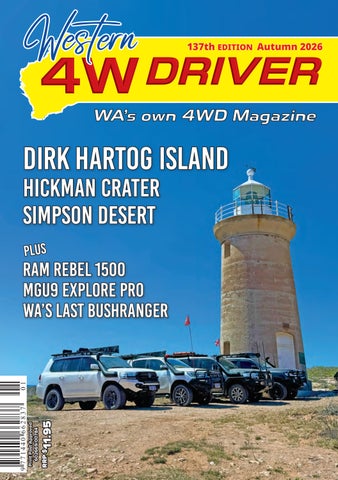
137th EDITION Autumn 2026
DIRK HARTOG ISLAND HICKMAN CRATER SIMPSON DESERT
RRP $
11.95
RAM REBEL 1500 MGU9 EXPLORE PRO wa’s last bushranger
Print Post Approved 602669/00784
WESTERN 4W DRIVER 137th EDITION Autumn 2026
PLUS
Arm yourself against fatigue. Regularly get 7.5 hours sleep a night. On long drives take a break every two hours and swap drivers if you can. Make every journey safe. wa.gov.au/rsc/fatigue
RSCOBH0131-A5_148x210mmh Fatigue press-Western 4WDriver.indd 1
8/8/2025 10:15 am
Canning Stock Route Canning Stock Route
18th 18th July July - 8th- August 20252025 8th August Embark on aon 4WD exclusive tag-along tourtour Embark a 4WD exclusive tag-along Twenty-two nights Twenty-two nights 1850km Wiluna to Kimberley HotelHotel in Halls Creek 1850km Wiluna to Kimberley in Halls Creek Exploring 51 heritage wells along stock Exploring 51 heritage wellsthe along the stock route: route: Home of Ironman 4x4, Manta Performance Exhaust
and Bosch Car Service Centre
Discover four Western Australian desertsdeserts Discover four Western Australian EngageEngage with stories of flora,offauna, with stories flora, fauna, Exciting new showroom & product range now available! heritage, and culture heritage, and culture ExploreExplore stunning lakes and geological stunning lakes and geological • Ironman formations formations 4X4 Accessories Enjoy breathtaking views views service Enjoy breathtaking • Full auto electrical Appreciate rock artrock collections Appreciate art collections • Manta Performance Exhaust Learn about lands Warri, Learnthe about theoflands ofYatungka, Warri, Yatungka, and•the Martu and thepeople Martu people Mechanical service and repair UnwindUnwind and relax atrelax lakesat and lagoons and lakes and lagoons
• Log book servicing
1/35 Great Eastern Hwy, Kalgoorlie Phone (08) 9091 4797 goldfieldsoffroad.com.au
Contact Alison or Steven Melvin at ForestExplorers.com.au. Contact Alison or Steven Melvin at ForestExplorers.com.au. Reach Alison at 0427 98 1198 87 or87 Steven at you’re 0447 107 Reach Alison at 0427 orwhen Steven at 0447 107 951. Keeping you on the road ...11 even off951. road western4wdriver.com.au |
1
CONTENTS Edition 137 | Autumn 2026
ADVENTURES
18
6
6
Dirk Hartog Island
Chris and Karen go on a 4WD adventure to the edge of WA
50 Hickman Crater
A Pilbara bucket-list journey to the edge of space
70
70
A Desert Odyssey
Grant and Linda journey across the Simpson Desert from Mount Dare to Birdsville
REVIEWS 18
Pickup Power Meets Off-Road Agility
Ram Rebel 1500
38 A Big New Player in the Dual Cab Arena MGU9 Explore Pro
90
108 Dark Mode Emberstrike Pro
A game-changer for winter campfires
110 Start Me Up
Grant and Linda put Milwaukee’s new Hotshot Jump Starter to the test
114 On Tap Black Edition
Is the On Tap Camping Shower practical enough to justify a place in your setup?
2 | Western 4W Driver #137
50 FEATURES
REGULARS
28 Ian Elliot
4
The Front Matter
120
The Things You See
Western 4W Driver Spotlight
56 Western Australia's Last Bushranger
122
Bush Mechanics
Uncover the tale of Frank Thomas: escape artist, horse thief, bushman, and a thorn in police sides
128
Country Stargazing
130
Outback Survival
66 The World's Biggest Tractor
134
Fishy Business
138
Gear to Go Camping
142
Clewed Up
144
Smart Photography
150
Goings On
153
Capture the Moment
154
Now We're TAWKing!
157
Quarterly Crossword
158
Subscriptions
159
Advertiser Directory
160
Silly Snaps
Visit the massive replica Chamberlain 40K in the Wheatbelt town of Carnamah
80 Uncovering Coins That Shaped Western Australia's Early Ecomony A Guide for Four-Wheel Driving Metal Detectorists — PART 1
90 Reach for the Sky
Photo Feature by Scott McCook
102 Pelicans
Learn about these birds with sweeping wings, a gangly frame and an almost comically sized bill
western4wdriver.com.au |
3
Vanguard Publishing
ABN 70 616 133 870 26 John Street, Northbridge WA 6003 PO Box 50, Northbridge WA 6865 Phone: (08) 9422 4330 admin@western4wdriver.com.au www.western4wdriver.com.au EDITION 137: Editor Brayden Edwards Graphic Design Karen Morton Content Brayden Edwards Michael Collins Advertising Brayden Edwards brayden@western4wdriver.com.au Matt Clarke matt@western4wdriver.com.au Natalie Du Preez natalie@vanguardpublishing.com.au Administration Steve Larcombe Sally van Heemst Printing Vanguard Print Cover image: Cape Inscription, Dirk Hartog Island by Karen Morton
Disclaimer: The views expressed in this publication are not necessarily those of Vanguard Publishing or the editors but those of the authors who accept sole responsibility and liability for them. While every care is taken with images and photographs, and all other material submitted, Vanguard Publishing accepts no liability for loss or damage. Vanguard Publishing reserves the right to amend publication schedules and frequencies. Edition 137 Autumn 2026
4 | Western 4W Driver #137
T
here is something about autumn in WA that feels just right. That fierce heat we have endured over a long hot summer eases, the days are still warm, but the lovely cool nights make sleeping so much better! Mornings are crisp, campfires make sense again, and the road seems to call a little louder. If summer is about surviving the heat, autumn is about thriving in the journey. And what a journey this edition takes you on. Chris and Karen Morton return to the mag and set the tone beautifully with their 4WD adventure to Dirk Hartog Island, I have to say one of my favourite places to visit. It is not a trip you tick off and forget. It lingers. Shark Bay’s wild isolation, those towering cliffs, that feeling of standing at the edge of Western Australia with nothing but ocean beyond. You can almost feel the salt in the air as you read it. We shift gears with Matt Payne, who throws the new RAM 1500 Rebel at the Lancelin dunes to see whether pickup power still stacks up when the terrain turns soft. Downsized engine, serious expectations. He puts it through its paces. Luke Clatworthy heads to York to size up the MGU9 Explore Pro, a big new entrant in the dual-cab arena. Bigger than the usual suspects and with plenty to prove, Luke does not shy away from asking the right questions. Luke also brings us the tale of Western Australia’s last bushranger, Frank Thomas. Escape artist, horse thief, bushman: a reminder that the history of this state is anything but dull. He continues with Part 1 of the Guide for Four-Wheel
T H E F R O N T M AT T E R WITH MICHAEL (SPIKE) COLLINS
Driving Metal Detectorists, giving practical insight for those who enjoy a little prospecting while touring. Grant and Linda Hanan guide us across the Simpson Desert from Mount Dare to Birdsville in A Desert Odyssey. Long horizons, red sand, proper adventure. Then they put Milwaukee’s Hotshot Jump Starter to the test in Start Me Up. Because sometimes the difference between a good story and a bad day comes down to whether your engine starts or not. Our Western 4W Driver Spotlight shines on Ian Elliot, a name many of you know well. More than two decades of contribution to this magazine. Columns, features, travel guides, even a stint in the editor’s chair. If you have followed one of his guidebooks, chances are you have driven in his wheel tracks. Grant and Linda capture his story with respect and admiration, and rightly so. In the Pilbara, Hickman Crater earns its bucket list status: striking, ancient, and shaped by a meteorite impact that still captures the imagination. Created in collaboration with the Shire of East Pilbara, this piece shows how geology and beauty often walk hand in hand out here. Colin Kerr brings two very different stories this issue. First, the World’s Biggest Tractor in Carnamah. Eleven and a half metres high, forty-two tonnes of steel, and built by a community of just 400 people. Then Colin slows the pace with Pelicans, capturing the quiet presence of one of our most recognisable coastal companions.
Truthful Phil Bianchi returns with an update for those eyeing off the Canning Stock Route in 2026. Road conditions, wells, wildlife. If the Canning is on your bucket list, this is required reading. Geoff Lewis reminds us in Parts Are Where You Find Them that in the Pilbara heat, ingenuity and humour are often as important as spare parts. John Bormolini turns his attention to Autumn King George Whiting. With demersal bans in place, he makes a strong case for targeting this seasonal favourite. And when the sun drops and the fire settles, Autumn Stargazing brings something else to look forward to. A total lunar eclipse, a planetary lineup, even a Blue Moon. Sometimes the best show in Western Australia happens when you simply look up. Autumn is prime touring season. The heat has backed off, and the tracks are calling! Oh, and don’t forget, if you are heading to the Perth Caravan and Camping Show 1922 March at the Claremont Showgrounds, don’t forget to drop by the Western 4W Driver stand in the tourism pavilion. This and a whole lot more is packed into this edition. As always, thank you, our reader, for continuing to support this amazing little local magazine. Cheers Spike
western4wdriver.com.au |
5
DIRK HARTOG ISLAND 4WD ADVENTURE TO THE EDGE OF WA
Some journeys end the moment you pull back into the driveway, but a trip to Dirk Hartog Island lingers in the mind long after the dust has been washed away. Nestled within the Shark Bay World Heritage Area, this rugged outpost offers a rare brand of isolation where the outside world feels worlds away and the landscape dictates the pace. BY CHRIS & KAREN MORTON
6 | Western 4W Driver #137
T
here are trips you enjoy while you’re on them, and then there are trips you keep thinking about long after you’re home. Dirk Hartog Island firmly falls into the second category. Sitting off the coast of Western Australia in the Shark Bay World Heritage Area, Dirk Hartog Island feels genuinely remote in a way that’s becoming harder and harder to find. It’s not just the distance from Perth or the fact that you need a barge to get there—it’s the combination of rugged landscapes, limited access, and the sense that once you arrive, the outside world fades away remarkably quickly. We travelled as a group, driving north from Perth, crossing to the island from Steep Point on the 4WD barge, and spending nine days camping at the Homestead Bay campground. What followed was a mix of challenging 4WD tracks, dramatic coastal scenery, quiet beaches, long evenings around camp, and the kind of shared experience that makes group trips so memorable.
THE LONG ROAD NORTH: PERTH TO STEEP POINT
Any trip to Dirk Hartog Island starts well before the island itself comes into view. From Perth, the drive north into Western Australia’s Coral Coast region is a journey in its own right. The scenery gradually shifts from farmland to red dirt, wide horizons and coastal scrub, and the sense of heading somewhere “out there” builds with every kilometre. Once you turn west towards Steep Point, things become more serious. The sealed road eventually gives way to gravel, corrugations and sand, and tyre pressures come down as you prepare for the final push. This is not a road you rush. It rewards patience, sensible driving and a willingness to take it as it comes. Arriving at Steep Point feels like reaching the end of something—which, in a way, you have. It’s the westernmost point of the Australian mainland, and standing there with the Indian Ocean
Sheltered eastern beaches with calm, crystal-clear water.
western4wdriver.com.au |
7
adds to the sense that this isn’t mass tourism. Numbers on the island are limited, and that’s a big part of what keeps the place feeling special. As the barge pulls away from the mainland, it doesn’t take long before the sense of isolation really hits. Steep Point shrinks behind you, and the low profile of Dirk Hartog Island rises ahead—sandy, windswept and seemingly untouched. The iconic Steep Point sign marks the westernmost point of the Australian mainland.
stretching out in front of you makes it very clear that you’re a long way from anywhere else. For many travellers, Steep Point is the destination. For us, it was the launching point.
CROSSING THE WATER: THE DIRK HARTOG ISLAND 4WD BARGE
Access to Dirk Hartog Island for 4WD travellers is via the purpose-built landing barge that runs between Shelter Bay at Steep Point and the island itself. The crossing is relatively short, but it’s a memorable moment— watching your vehicle roll onto the barge, tyres deflated, recovery gear ready, and knowing that once you drive off the other side, you’re committed. The barge carries one vehicle (and trailer, within size limits) at a time, which
Driving off the barge onto the island is one of those quiet, grin-inducing moments that doesn’t need much commentary. You’ve made it.
PREPARATION MATTERS: WHY THIS ISN’T A CASUAL TRIP
A well-prepared, high-clearance 4WD is essential. The island’s tracks are predominantly soft sand, with some rocky sections and plenty of corrugations. Tyre pressures stay low, speeds stay sensible, and mechanical sympathy goes a long way. Fuel planning is critical. While the island isn’t huge on paper, driving in sand adds up quickly, and distances between key points can be deceptive. It’s far better to leave the island with spare fuel than to spend your time worrying about range. Water is equally important. There are no shops, no easy resupply options, and no safety net if you miscalculate.
One vehicle at a time — low tyre pressures are required as you roll on and off the Dirk Hartog Island barge.
8 | Western 4W Driver #137
Between drinking, cooking, cleaning and the occasional rinse after a salty swim, water consumption is higher than many people expect—particularly in warm or windy conditions.
• Sun and wind protection: Hats, long sleeves, sunscreen and shelter are not optional
Travelling as a group added a huge amount of value to this trip. Beyond the obvious safety benefits, it meant shared recovery efforts, shared meals, shared planning, and plenty of laughter when things didn’t go exactly to plan. Dirk Hartog Island is a fantastic place for group travel, as long as everyone arrives prepared and on the same page.
• Cameras, drones and spare batteries: The island is endlessly photogenic.
WHAT TO BRING (AND WHY YOU’LL BE GLAD YOU DID)
Beyond the usual camping and 4WD essentials, a few items really stood out as worth their weight in gold: • Fishing gear: Even if you’re not a hardcore angler, having a rod ready opens up countless opportunities from beaches, headlands and calm bays • Snorkelling gear: The eastern side of the island can be remarkably calm, with clear water and plenty to see
Homestead Bay is the perfect location to base yourself whilst exploring Dirk Hartog Island.
• Spare food and fuel: Always plan for more than you think you’ll need
It’s also worth checking everything carefully before departure—vehicles, trailers, fridges, recovery gear. Once you’re on the island, fixing problems becomes a lot more complicated.
CAMP LIFE AT THE HOMESTEAD BAY CAMPGROUND
We chose to base ourselves at the Homestead Bay campground, which turned out to be an excellent decision. Having a central, established base made the trip feel relaxed rather than rushed. Each day could be planned around weather, tides and energy levels, with plenty of flexibility to change plans on the fly. Longer drives to different areas of the island were balanced by quieter days closer to camp. The campground itself struck a good balance between comfort and
western4wdriver.com.au |
9
remoteness. It never felt crowded, and the limited number of vehicles on the island meant there was always a sense of space. Evenings quickly fell into a rhythm—cooking together, sharing stories from the day and watching the light change as the sun dipped toward the horizon. Having access to our own camp kitchen (unpowered) with a gas cooktop, hot showers and flushing toilets meant that we didn’t need to bring as much with us. The kitchen is resupplied daily with fresh drinking water, further reducing the amount of water we needed to bring with us. For those camping within the national park, this is not an option, and you will need to bring everything. With no light pollution, astrophotography became part of the evening routine.
10 | Western 4W Driver #137
With minimal light pollution, the night sky was a constant reminder of how far from everyday life we really were.
EXPLORING THE ISLAND: TRACKS, CLIFFS AND EMPTY BEACHES
The western side of the island is wild and dramatic. High cliffs drop into a restless Indian Ocean, blowholes send spray into the air, and lookout points make you stop and simply take it all in. The sense of exposure out here is real—the wind, the noise of the ocean, and the vastness of it all combine into something pretty special.
The eastern side offers a completely different experience. Sheltered beaches Cape Inscription, where European history on the island dates back more than 400 years.
stretch for kilometres, the water is calmer and clearer, and the pace naturally slows. It’s the kind of place where time disappears, whether you’re fishing, swimming, snorkelling or just wandering along the shoreline. Driving the island’s network of sandy tracks is part of the appeal. This isn’t about ticking off destinations as quickly as possible—it’s about enjoying the journey, stopping often, and letting the island set the pace.
HISTORY, PERSPECTIVE AND STANDING AT THE EDGE
Dirk Hartog Island isn’t just about scenery. It’s a place layered with history. Soft sand dominates the island’s tracks, making tyre pressures and momentum key.
From early European exploration at Cape Inscription to the island’s later pastoral and maritime past, there are reminders scattered throughout the landscape that people have been coming—and leaving—for centuries. Standing at points like Cape Inscription or looking out from high vantage points along the western cliffs gives a strong sense of perspective. It’s not hard to imagine how isolated this place must have felt to those who arrived here long before modern navigation, maps or vehicles. Those moments of quiet reflection ended up being just as memorable as the driving and the beaches.
Dirk Hartog Island is Western Australia’s largest island, stretching roughly 80km in length and forming part of the Shark Bay World Heritage Area.
western4wdriver.com.au |
11
FISHING, FOOD AND SLOWING DOWN
Fishing became a regular part of our daily rhythm, rather than a dedicated activity. A few casts in the morning, an hour or two in the late afternoon, and the occasional session that turned into something more when the conditions were right. Meals were simple, shared and unhurried. Without shops, schedules or distractions, food became part of the experience rather than something rushed between activities. Cooking together, eating together and lingering long after the plates were cleared felt entirely natural on the island.
CAPTURING THE EXPERIENCE: PHOTOS AND VIDEO
Trips like this deserve to be documented, and Dirk Hartog Island makes that easy. We came home with a huge collection of photos and video—from sweeping drone shots to small, quiet moments around camp. An edited video piece pulls the whole experience together and does a great job of conveying the scale, isolation and beauty of the island. Watch the Dirk Hartog Island adventure video here:
This slower pace is one of Dirk Hartog Island’s greatest strengths. There’s no pressure to do everything. In fact, trying to do too much would miss the point entirely. A dugong sighting right in front of our campsite was a very special experience.
FINAL THOUGHTS: WHY DIRK HARTOG ISLAND STAYS WITH YOU Dirk Hartog Island isn’t a casual destination, and that’s exactly why it’s so rewarding.
It demands preparation, patience and a willingness to embrace remoteness— but in return, it offers space, silence, and experiences that feel increasingly rare. For us, nine days felt both long and far too short, which is probably the best compliment you can give a place like this. If you’re looking for a 4WD adventure that genuinely feels like you’ve gone somewhere special—somewhere beyond the edge of the map—Dirk Hartog Island delivers.
12 | Western 4W Driver #137
VEHICLE & PREPARATION
High Clearance 4WD Required Soft sand dominates Dirk Hartog Island, with rocky sections in places. Some of the tracks are narrow, so be prepared to come away with some pinstriping. High clearance, low-range gearing and good suspension make a noticeable difference once tyre pressures come down and the kilometres add up. Tyre Pressures Make the Trip Extended sand driving meant running consistently low pressures on both the mainland access tracks and the island itself. Managing pressures carefully reduced track damage, improved ride comfort and kept driveline stress to a minimum. Self-Sufficiency Is Non-Negotiable With no roadside assistance and limited vehicle numbers on the island, every vehicle carried full recovery gear—recovery boards, rated points, straps and a compressor—even though it was rarely needed. Fuel Planning While the island isn’t huge on paper, soft sand driving quickly adds up. Fuel planning focused less on kilometres travelled and more on time spent in low range with tyres deflated. You will either need to bring additional fuel or
ensure you budget for the higher costs associated with purchasing fuel from the homestead. Barge Access, One Vehicle at a Time The Dirk Hartog Island landing barge departs the mainland from Shelter Bay (camping is available here for the night before you depart or longer if you wish) and carries a single vehicle per crossing. The ramp onto the barge will be wet and slippery, so tyres should be deflated to around 20psi, and your vehicle should be in low range, second gear. Exiting the barge onto the island is directly onto soft sand. Be prepared and ready to go prior to the time you have been advised (times can change depending on weather), and pay attention to the instructions given by the barge skipper, who will direct you as you drive on. It takes around 15 minutes to get from the mainland to the island on the barge. Communications Mobile coverage is unreliable to nonexistent across much of the island. A UHF radio is essential for inter-vehicle communication. We had a couple of Starlink minis within the group, and that made it extremely easy to stay in touch with friends and family and provided an additional safety measure if we needed to call for help.
western4wdriver.com.au |
13
WHERE TO STAY
Basing ourselves at the Homestead Bay campground allowed long exploratory days without the need to pack up camp repeatedly—a big advantage on extended stays. Bringing firewood onto the island is prohibited (campfire spots are located at each campsite within the Homestead Bay campgrounds, where you can also purchase bags of firewood).
Sunset views from the Inscription Bar & Cafe.
There are also various camping spots throughout the National Park (you will need to be fully self-sufficient), or you can spoil yourself with an all-inclusive stay at the Eco Lodge. The Inscription Bar & Cafe (Australia’s most remote bar and café) is located right between the Homestead Bay campground and the Eco Lodge. Open in the morning for coffee and for sunset drinks in the evening, it makes the most spectacular place to sit and relax.
Ensure you keep your tent zipped up to avoid a visit from one of these locals.
Camp oven cooking with a view.
Kayaks and SUPs are available for guests to use at Homestead Bay.
Enjoying our last night on the island.
14 | Western 4W Driver #137
A BRIEF HISTORY OF DIRK HARTOG ISLAND
From European Landfall to Sheep Station and Beyond Long before it became a bucket list destination for four-wheel drivers, Dirk Hartog Island held deep significance for the Malgana people, who know the island as Wirruwana. Its modern name, however, comes from one of the earliest recorded European encounters with the Australian continent. In 1616, Dutch sea captain Dirk Hartog made landfall on the island during a voyage of the Dutch East India Company. To mark the occasion, Hartog left behind a pewter plate nailed to a wooden post at what is now known as Cape Inscription—one of the earliest physical records of European presence in Australia.
The island would later be visited by other European explorers, some of whom replaced Hartog’s original plate with their own inscriptions, unknowingly preserving a unique historical timeline in metal. Today, replicas mark the site, while the originals are preserved elsewhere. Despite its remote location, Dirk Hartog Island did not remain untouched. By the mid to late 1800s, the island had become a pastoral lease, initially used for grazing sheep. Over time, infrastructure slowly developed— shearing sheds, wells, homesteads and tracks—many of which still leave subtle traces across the landscape today. A tour of the old shearing shed to discover the island's pastoral history is a must do.
To honor the 1616 and 1697 visits, replicas of both pewter plates have been placed at Cape Inscription.
western4wdriver.com.au |
15