

50 years of trusted, local guidance for life’s biggest moves.
From the Desk of the Chief Economist
Property investment in Australia is ingrained as an equity and wealth builder exercise, to arm for retirement. It is a key component to the housing rental market, where many renters are reliant on investors – especially now, when the vacancy rate is extremely low and rental prices are high.
The intricacies of property investment, especially negative gearing and capital gains tax, are a known “comfort” for many investors; a practice as old as time. The Federal Budget 2026-2027 shook this comfort, proposing several changes to the tax landscape attached to property investment.
On Thursday 25 June, these proposals, under the Treasury Laws Amendment (Tax Reforms No. 1) Bill 2026, were officially passed by both houses of parliament, making it a legislative instrument.
What are these changes? And how might it impact the property market?
Negative Gearing Changes
The Treasury Laws Amendment (Tax Reform No. 1) Bill 2026 was introduced by the Treasurer into the House of Representatives. The bill is part of the Government’s tax reform package announced in the 2026-2027 Federal Budget.
Changes to negative gearing include:
From 1 July 2027, investors can only offset rental losses against wage/salary income if the property is a new build (refer to Table 1: Definition of a “New Build”, which is correct as of Thursday 25 June).
• Applies to individuals, partnerships, companies, and most trusts
• Does not apply to widely-held trusts or super funds (including SMSFs)
Eligible New Build
A newly constructed apartment bought off the plan
A duplex constructed through a knock-down rebuild replacing a single, free standing house
Any residential construction on previously vacant land
A newly built property which is occupied for less than 12 months before being first sold
Source: Department of the Treasury of Australia
Not An Eligible New Build
An established property that has recently been extended to add additional bedrooms
A free standing house constructed through a knockdown rebuild replacing an older smaller freestanding house
A granny flat built adjacent to an established property that is not eligible for negative gearing
A newly built property which is occupied for more than 12 months before being sold to a subsequent investor
This change suggests that for any established residential properties/homes purchased as an investment property after 7:30pm AEST 12 May 2026 the property investor can no longer access traditional negative gearing from 1 July 2027
50 years of trusted, local guidance for life’s biggest moves.
For established residential properties/homes bought after 7:30pm AEST 12 May 2026:
• Losses cannot be deducted against wages or other income
• Losses can only offset residential property income.
• Excess losses may be carried forward to future years
Any residential investment property owned before 7:30pm AEST 12 May 2026:
• Keeps full negative gearing without a time restriction (i.e. the 1 July 2027 deadline does not apply), due to grandfathering clauses.
• No change to how losses are treated
CGT Changes
The bill also introduced changes to capital gains tax (CGT). Any changes in CGT might impact an investor’s decision to sell; taking away more stock from an already undersupplied housing market.
Changes to capital gains tax Include:
From 1 July 2027, the 50% CGT discount has been removed. This is replaced with a cost base indexation method and a 30% minimum tax on capital gains. These changes apply to individuals, partnerships, companies and most trusts. Widely held trusts (for example, most managed investment trusts) and superannuation funds (including SMSFs) will be excluded.
As per changes to negative gearing, grandfathering and transitional rules apply to recent capital gains tax (CGT) changes in Australia. The system applies a "split" approach to capital gains:
• Gains accruing up to 1 July 2027 will be subject to the 50% discount
• Gains accruing after 1 July 2027 will be subject to a cost base indexation (adjusted for inflation) and a 30% minimum tax rate
Important to note: there is a special carve-out for individuals, trusts and partnerships investing in “new build” (refer to Table 1) residential property. These property investors will be able to choose between the 50% discount OR the new cost base indexation/30% minimum tax regime.
It is important to note that the grandfathering clauses in CGT changes are different to negative gearing. It does not refer to when the residential property/home was purchased (for example if the home was purchased on or before 12 May 2026 or 1 July 2027). Rather, it refers to the asset growth or any capital gains made on the asset up to or after 1 July.
SMSF Changes
On the 23 June 2026, the Federal Government confirmed a deal with the Greens Party to ban new limited recourse borrowing arrangements (LRBAs) by superannuation funds (SMSF) purchasing residential property. The bill passed both houses of parliament on Thursday 25 June and is currently awaiting Royal Assent before becoming law.
Changes to self managed super funds Include:
50 years of trusted, local guidance for life’s biggest moves.
Once the legislation receives Royal Assent, new residential LRBAs will be banned 45 days later Details known as of Thursday 25 June:
• Existing residential LRBAs are grandfathered. If your SMSF already holds a residential property under an LRBA, nothing changes.
• Commercial property LRBAs are unaffected
• A 45-day transition window will be applied. Contracts that are signed or under process in this time frame will be unaffected.
Important to note: SMSF changes only apply to LRBAs. If you are borrowing money in order to purchase residential properties/homes. If you have enough funds/cash in your SMSF and do not require an LRBA, you are still able to purchase a residential property/home using your SMSF.
How will these changes might impact the property market?
Property investment is the key to our housing rental market supply. Changes in negative gearing and CGT arrangements can impact the number of investors in the market, which directly impacts the rental market on numerous fronts: the availability of rental homes, quantity and quality rental homes, rental tenure length, and ultimately rental prices.
Table 2 outlines our vacancy rate, which determines how many rental properties are available to rent. The table shows that vacancy rates are extremely low; with some capital cities – Brisbane, Hobart, Perth, Darwin, and Adelaide; all under 1.0% as of May 2026.
Prepared by PRD Research. Source: Haver. © PRD 2026.
Compared to the Real Estate Institute of Australia’s healthy benchmark of 3.0%, all capital cities are well under this figure. This suggests that our housing rental crisis is ongoing, and we are in need of more property investors, not less.
50 years of trusted, local guidance for life’s biggest moves.
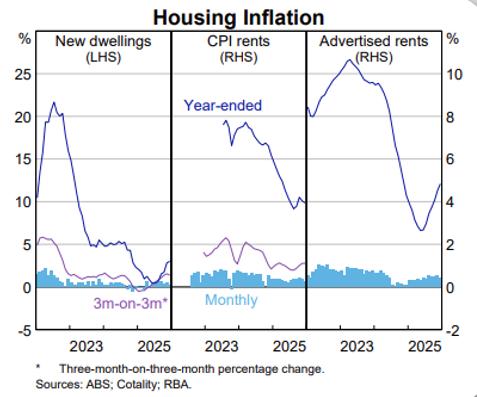
The latest data on housing inflation from the Reserve Bank’s Statement Monetary Policy as of May 2026 provides further context to the intricacies of the issue, outlining current trends in rental prices and new dwelling costs.
Graph 1. Housing Inflation.
Source: Reserve Bank of Australia, Statement of Monetary Policy 2026 © PRD 2026.
Graph 1 on housing inflation shows three things:
• Rent inflation (CPI Rents) has slowed down. This is the percentage growth in rental prices, NOT the actual dollar amount. Post-COVID we saw rental price growth skyrocket, with many renters reporting rental price increases in excess of $100. Now, rental price increases are less than $100. This shows a slower rental price growth, hence slower rent inflation.
• However, the advertised rents and the actual dollar amounts have continued to increase. Rental prices continue to be more expensive, causing many renters stress.
• New dwelling inflation (as in, the percentage increase in new dwelling costs) continues to increase. Building new houses, units/apartments and townhouses is still expensive and costs are rising and not slowing down. These costs are more often than not passed on in the final sale / purchase price, meaning buyers must spend more to buy a new build.
The changes to negative gearing and CGT does have a carve-out clause for individuals, trusts and partnerships investing in a “new build”. The premise of this clause/policy is:
• Divert investors into purchasing a new build, increasing the demand in the sector to ensure more dwellings are built. In theory, this “attacks” the housing undersupply issue.
• Lessen competition in the established market. This benefits first home buyers and other owner-occupiers (for example upsizers and downsizers).
PRD Corporate Head Office GPO Box 2750, Brisbane QLD 4001 Australia P 07 3229 3344 E info@prd.com.au PRD.com.au
50 years of trusted, local guidance for life’s biggest moves.
In theory, the policy has “legs”. That said, as seen in Graph 1, the carve-out clause forces investors to make a strategic financial decision:
A. Buy a “new build” for a higher purchasing cost (which also suggests higher mortgage costs and possibly other costs – for example, body corporate/strata) and benefit from traditional negative gearing and have a choice in CGT calculations upon selling, OR
B. Buy an established home with potentially a lower purchasing cost (thus less mortgage repayments and possibly other costs) but cannot use traditional negative gearing and will be automatically subject to new CGT calculations upon selling.
A key indicator to property investment is rental returns, or rental yield. Table 3 provides a comparison between rental yield in capital city vs regional areas.
Table 3. House Rental Yield Comparison – Capital City vs Regional Areas May 2026
Prepared by PRD Research. Source: Haver. © PRD 2026.
Table 3 shows that in Queensland, New South Wales, and Victoria, rental yields are more often than not higher in regional areas. Therefore property investment in regional areas is potentially positively geared, meaning the changes in negative gearing may not apply. Because of this, will regional area investors move to purchasing a “new build” or continue to buy established homes?
Overall, whether or not changes in negative gearing and CGT will actually increase “new builds” and housing supply (whether in the short or long run) in a significant manner, and especially in places where it is most needed (i.e. regional areas), is questionable.
If the policy design is ultimately to lessen competition for first home buyers and increase our housing supply; is changing negative gearing and CGT settings the best method to do so?
Moving forward
Independent modelling (by Qaive and Tulipwood Economics) shows that the combined effect of the Federal Government's 2026-2027 Federal Budget measures, including its $2 billion Local Infrastructure Fund will result in:
• a net reduction in dwelling construction of 8,742 over four years.
• an increase in rents by around $3 per week in 2026-27, rising to $9 per week in 2029-30
• a reduction in gross domestic product (GDP) by $846 million over four years
• a reduction in construction output by $1.18 billion and construction employment by 3,854 full-time equivalent workers over the four-year period.
As of March quarter 2026, investor financing (i.e. home loan commitments) is high, at $14.50Bn.
50 years of trusted, local guidance for life’s biggest moves.
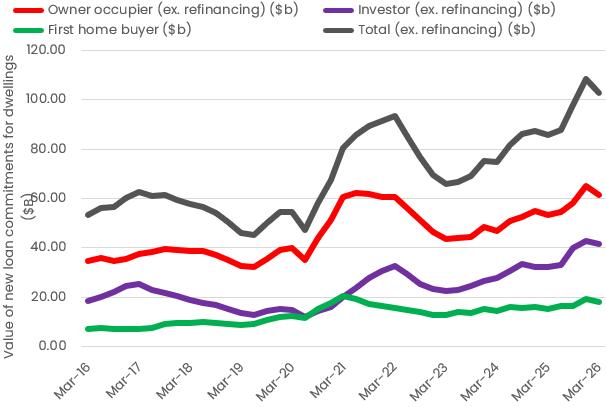
Graph 2. Home Loan Commitments – March Quarter of 2026
Prepared by PRD Research. Source: Australia Bureau of Statistics Cat.5601 © PRD 2026
Graph 2 on Home Loan Commitments indicates investor activity increased by 28.1% in the past 12 months to March quarter 2026, far above owner occupier (15.4%) and first home buyers (16.2%).
Investor activity did see a significant dip in the March quarter of 2022- March quarter of 2023 due to 13 cash rate hikes, which resulted in our rental market crisis and skyrocketing rental prices.
The changes in negative gearing and CGT, along with SMSF, passed both houses of parliament on Thursday 25th June 2026. Amendments are expected to be introduced in subsequent tranches of legislation later this year, including the definition of “new residential dwellings” and the carveout for innovative startups. The definition of new builds and the housing investment exemptions for negative gearing will be moved into primary legislation, following a period of consultation.
Unsurpisingly, many housing industry peak bodies are not fully in favour of the changes. The Property Council of Australia expects the reforms to the CGT discount and negative gearing will have a negative impact on investment and housing supply, of 35,000 homes over 10 years.
How will negative gearing, CGT, and SMSF changes play out? Only time can tell. Watch this space.
-END-
About PRD.
PRD is a recognised leader in Australian real estate. Established in 1976 and backed by Colliers, PRD combines strong local knowledge with industry-leading research, a national network of offices, and a commitment to smarter real estate.
PRD does not give any warranty in relation to the accuracy of the information contained in this report. If you intend to rely upon the information contained herein, you must take note that the Information, figures and projections have been provided by various sources and have not been verified by us. We have no belief one way or the other in relation to the accuracy of such information, figures and projections. PRD will not be liable for any loss or damage resulting from any statement, figure, calculation or any other information that you rely upon that is contained in the material. Prepared by PRD Research © All medians and volumes are calculated by PRD Research. Use with written permission only. All other responsibilities disclaimed.
PRD Corporate Head Office GPO Box 2750, Brisbane QLD 4001 Australia P 07 3229 3344 E info@prd.com.au PRD.com.au