PRESENTS
Welcome to the Personality Era
CENTERS OF INFLUENCE: A PRAYTELL POV

JUNE 2026

Introduction
There’s a moment when a creator you follow stops feeling like content and starts feeling like a friend. Turns out, the scroll is a slippery slope.
In last year’s edition of Centers of Influence, emerging media was the obvious protagonist. It was reshaping how information is created, distributed and consumed. It also restructured who is making it.
Since the time of that publication, we’re already seeing a notable increase in how the media environment is shaped by evolving algorithms, AI and synthetic content. In this landscape, human personality stands out even more: the unpolished edges, the inconsistencies, and the sense that a real person is behind the content.
We turned our focus this year to the growing power of personality in modern media: the mechanics of parasocial relationships, the rise of creators and how audiences are recalibrating trust in the presence of AI.
Together, these shifts point to a broader reality, one that’s central to this year’s Centers of Influence report:

To understand the state of this new landscape, we had to go back to the beginning — examining the structural forces behind today’s media environment that existed long before social media or generative AI.
Influence… has less to do with expertise than it does with alignment. Being right helps. Feeling right tends to matter more.
NATE JAFFEE EVP, Strategy & Innovation
Here’s what you’re about to read:
Chapter 1 unpacks the mechanics behind why personalities outperform institutions in earning attention, trust and relevance — and have been for decades.
Chapter 2 builds on that foundation with new data from our expanded consumer survey, adding new perspectives on AI and personality across the US, UK and Australia.
Chapter 3 introduces a new map of the media ecosystem for The Personality Era, organized around three distinct but interconnected layers where brands must earn attention, credibility and influence.
In this landscape, human personality stands out even more. The unpolished edges, the inconsistencies, the sense that there’s a real person behind the content.
Chapter 4 provides a tactical playbook for brands and communications professionals, with innovative approaches for brands — and their favorite personalities — to break through the algorithmic fog and build a sustainable competitive advantage.

CHAPTER ONE: A Media Environment for Main Characters
Technology reshaped the media landscape in ways that are easy to point to.
It has disrupted industries, influenced elections and changed how we express ourselves. What’s less obvious is how much of that isn’t actually new. It just feels that way because of the speed, scale and ubiquity of digital media.
In the early 1970s, economist Herbert Simon coined the term “attention economy,” warning that an abundance of information would create a scarcity of attention. At the time, it read as a warning. Now it reads as a business model. Today, the media is not just competing for attention, it is engineered to capture, hold and monetize it.
When Netflix’s Reed Hastings described sleep as his company’s primary competitor, it sounded like hyperbole. It wasn’t.
Human attention is the asset and increasingly, human biology is the battleground. Sleep, it turns out, doesn’t stand much of a chance.
An abundance of information creates a scarcity of attention.
HERBERT SIMON Economist

We're competing with sleep.

REED HASTINGS CEO, Netflix
What thrives in an environment of infinite information and a finite amount of time is intimacy. And nothing expedites decision-making more than trusted humans; the ones who recount the news of the day, tell you what to pack for your next vacation, or recommend that gluten-free recipe you need for your mom’s birthday.
The creator economy didn’t invent this dynamic; it removed the barriers around it. Individuals no longer need institutions to reach an audience at scale. They can build one directly. And once they do, the relationship that forms feels like a genuine connection.
This is where “parasocial relationships” come in. First articulated in the 1950s, sociologists Donald Horton and Richard Wohl coined the term describing a simple but powerful phenomenon: audiences form one-sided relationships with media figures. At the time, these figures were TV and radio hosts; yet these one-sided relationships felt like real social bonds. Once that bond forms, influence shifts.
Audiences are not just hearing what is being said, they are evaluating who is saying it and how it makes them feel. These relationships drive behavior, from engagement, to purchase, and increasingly, trust.
Influence, in other words, has less to do with expertise than it does with alignment.
Being right helps. Feeling right tends to matter more.
Throughout history, books, newspapers and magazines have been finite, physical products that people had to seek out, but now content consumption has collapsed into one continuous stream.
Welsh scholar Raymond Williams contrasted these older forms of media with television’s passive entertainment experience.
Williams called it “flow” and in Television: Technology and Cultural Form, he argued that television's defining characteristic is not its individual programs, but its continuous stream of sequences designed to capture and hold viewer attention.
Media theorist Neil Postman extended the idea, observing that as media becomes more continuous, it also becomes even more performative. Politics starts to resemble theater. News begins to be reported on as entertainment. Audiences stop thinking in paragraphs and start thinking in visual scenes and heightened emotions.
Today, that flow has reached the feed. Everything competes in the same format, at the same pace, for the same fleeting attention.
Discovery is driven less by personal networks and more by algorithms, designed to maximize time spent. The result is a media environment that looks less like a conversation and more like a constant audition.
In that setting, personality does a different kind of work.
“Oral memory works effectively with... personas whose deeds are monumental, memorable and commonly public.”
WALTER ONG Theologian, Historian, and Author
As our survey results confirm, the tension between authenticity and expertise has decisively tilted.

In his 1982 book, Orality and Literacy: The Technologizing of the Word, Walter Ong observed that modern communication was beginning to resemble oral cultures, where truth is established through resonance.
As more of life is lived in public, credibility becomes less about being right and more about being visible and consistent. People place greater value on relatability than credentials, on coherence over time rather than authority in a moment.
While the survey data in Chapter 2 empirically validates how these parasocial bonds drive consumer trust, Chapter 3 introduces a new three-layer framework: Discovery, Authority and Decision to help brands navigate a new hybrid media reality.
This model maps out how influence moves across algorithmic “push” and intent-driven “pull” channels, demonstrating how brands can combine personality-driven attention with the critical third-party verification needed to build authority.

The
system hasn’t suddenly started favoring personalities. It always has.
What’s changed is that the system is now fully built with them at the center.

CHAPTER
TWO: Praytell x YouGov Survey Results
Media diets are universally “hybrid,” and personalities are doing the trust-building work with audiences that institutions used to do alone.
To pressure-test the theoretical foundation laid out in Chapter 1, we partnered with YouGov to survey 3,600 weekly media users across the United States, United Kingdom and Australia in March 2026. This year's study expands meaningfully on our 2025 US-only baseline: we added two new international markets, deepened our questions about parasocial relationships and favorite media personalities and introduced a dedicated section on AI usage and trust.
of the time, people prefer news and information from BOTH traditional and emerging media sources.
Consumers are increasingly drinking from a fire hose, devouring as much information as their waking hours allow.
% of respondents that regularly get news from...
What emerges is not a single, clean narrative. It's a more complicated and actionable picture: hybrid media diets are universal, trust is fragile and fragmenting, audiences are increasingly fluent in the language of AI even as they grow more wary of it, and personalities — the focus of this year's report — are doing the trust-building work that was once reserved for institutions.
Five findings stand out.
Vibes beat facts
When asked what makes their favorite media personalities credible, audiences rank warmth above expertise.
These two lowest-rated credibility traits are the only ones about rigor
Praytell x YouGov, March 2026
Parasocial Bonds Are Credibility
The single most important finding in this year's survey is also the most theoretically loaded: across all three markets, parasocial interaction scores are positively correlated with credibility ratings. The more personally connected a respondent feels, the more credible they rate that person, regardless of credentials, training or institutional affiliation.
This pattern holds across roles and categories. It applies to legacy news anchors like Dan Rather (US), consumer advocates like Martin Lewis (UK), documentary filmmakers like Louis Theroux (UK), podcasters like Joe Rogan (US), news creators like Aaron Parnas (US) and comedians like Hamish Blake (Australia).
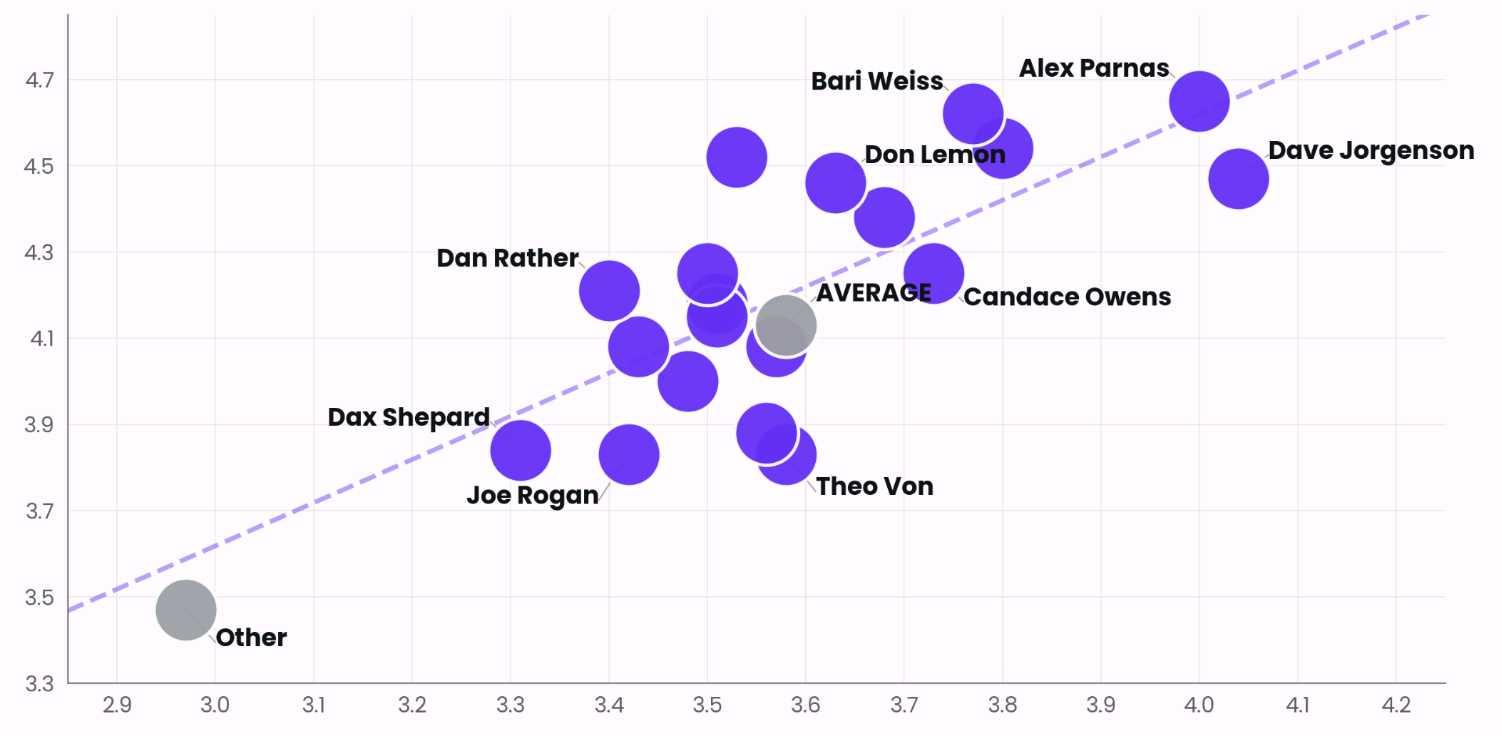
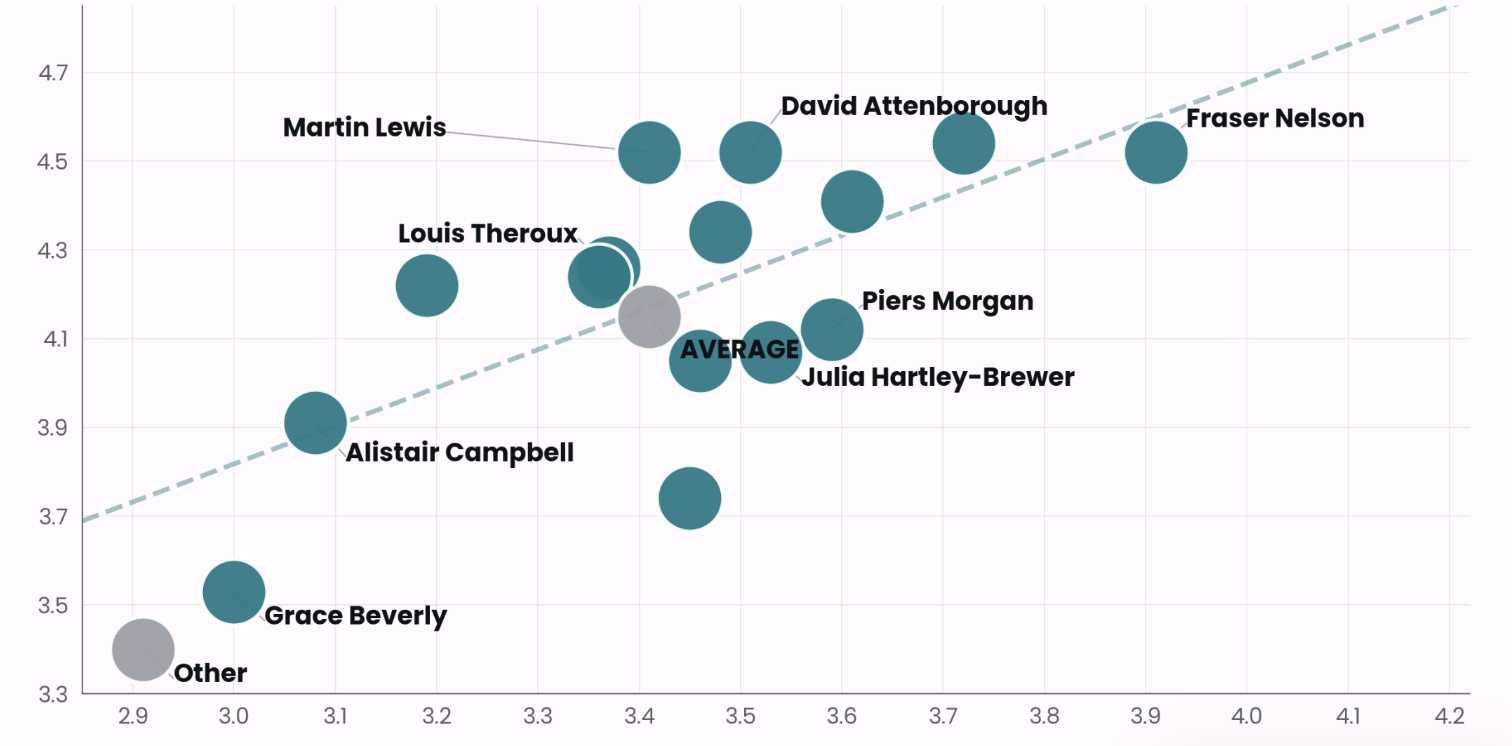

For brands and communicators, the strategic implication is clear. Investing in recognizable, human messengers is not a soft branding exercise; it is a credibility strategy.
A spokesperson, executive, employee or creator who has built a parasocial relationship with an audience does not just carry a message, they carry the trust required to make that message land.
Why it matters: This finding, that resonance now functions as a credibility signal, gives empirical weight to our theory that in a media environment shaped by parasocial relationships and continuous flow, "feeling right" carries more influence than "being right." In The Personality Era, it’s vibes over facts. Walter Ong argued that oral cultures establish truth through resonance rather than verification, and our data suggests today's media culture has tilted that direction.
United States
Aaron Parnas
Praytell x YouGov, March 2026
United Kingdom
Praytell x YouGov, March 2026
Independent Creators Now Rival Traditional Journalists as Sources of Opinion Change
When we asked respondents who had recently changed their minds on something to identify the source of that change, the results upended a long-standing assumption about where influence lives.
Traditional journalists drove opinion change for 31% of US respondents, 29% of UK respondents and 35% of Australian respondents. Levels of opinion change attributed to independent creators were nearly identical: 30% in the US, 33% in the UK and 28% in Australia. Personal contacts, by contrast, accounted for just 4–6% across all three markets.
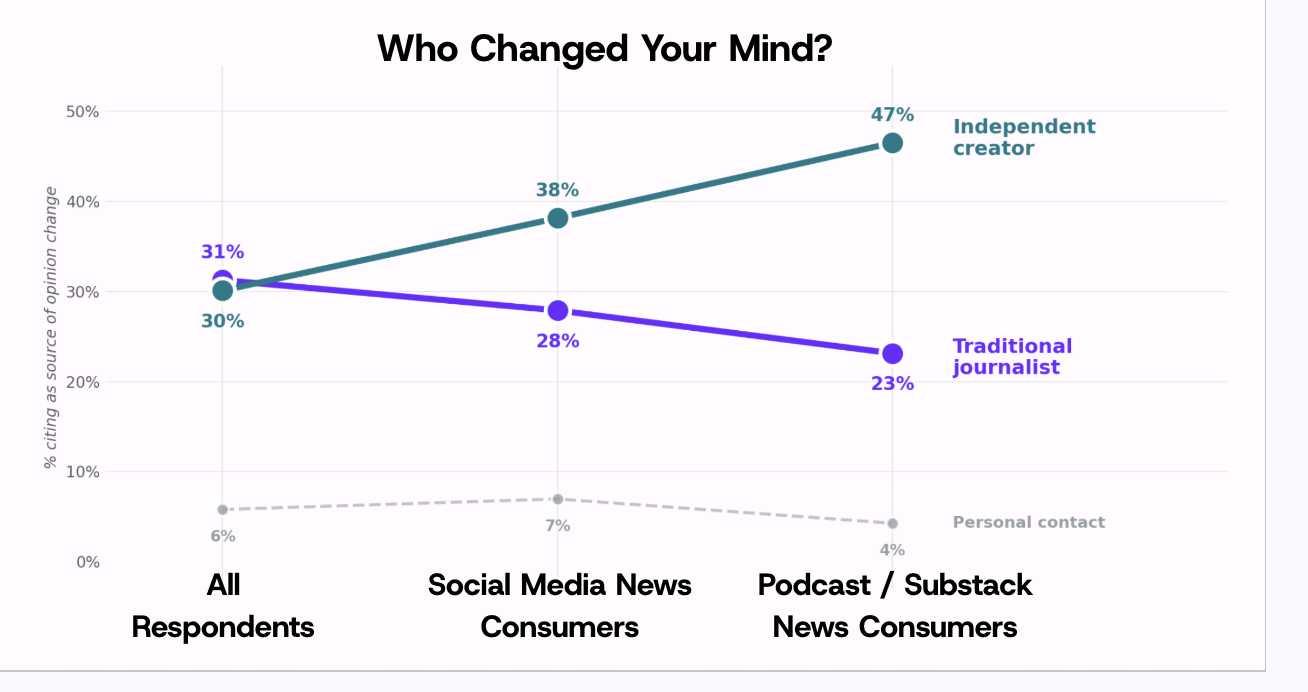
Traditional journalists still move minds — but the deeper audiences go into emerging media, the more decisively independent creators take the lead.
Independent creators (30%) now rival traditional journalists (31%) as the primary drivers of opinion change for US audiences.
The people most responsible for changing minds today are not the people audiences know in real life. They are the personalities that they encounter through their screens.
Why it matters: This finding does two important things. First, it shows that audiences truly have not abandoned traditional media for emerging media, they have built hybrid media diets that draw from both. Second, it complicates the "godirect" narrative that replaces the role of gatekeeper with founder-led communications. Individual personalities are clearly powerful. The data shows they’re powerful enough to rival institutional journalism in changing minds. But they are not displacing it. The audiences that can be influenced by an individual personality are often the same audiences that are influenced by an individual journalist.

Praytell x YouGov, March 2026
Trust in Emerging Media Lags Without Traditional Media’s Presence
For all the influence that creators wield, traditional media outlets remain the most trusted source category in every market we surveyed, with net trust scores of +43% in the US, +52% in the UK and +62% in Australia. Whereas emerging channels (podcasts, social-media news handles, Substack) trail significantly: 30% in the US, 18% in the UK and 27% in Australia.
The narrowing gap between legacy journalists and independent creators when it comes to the ability to change opinions might suggest that traditional media is losing relevance. But segment-level data points to the opposite conclusion: Traditional media is still the foundation on which trust in any media gets built.
Among US audiences who consume both traditional and emerging media daily, trust in both rises and converges at 51% — the highest trust scores in the dataset, and notably, the only segment where emerging media earns majority trust. In other words, regular exposure to traditional media doesn't compete with trust in emerging sources; it appears to enable it.

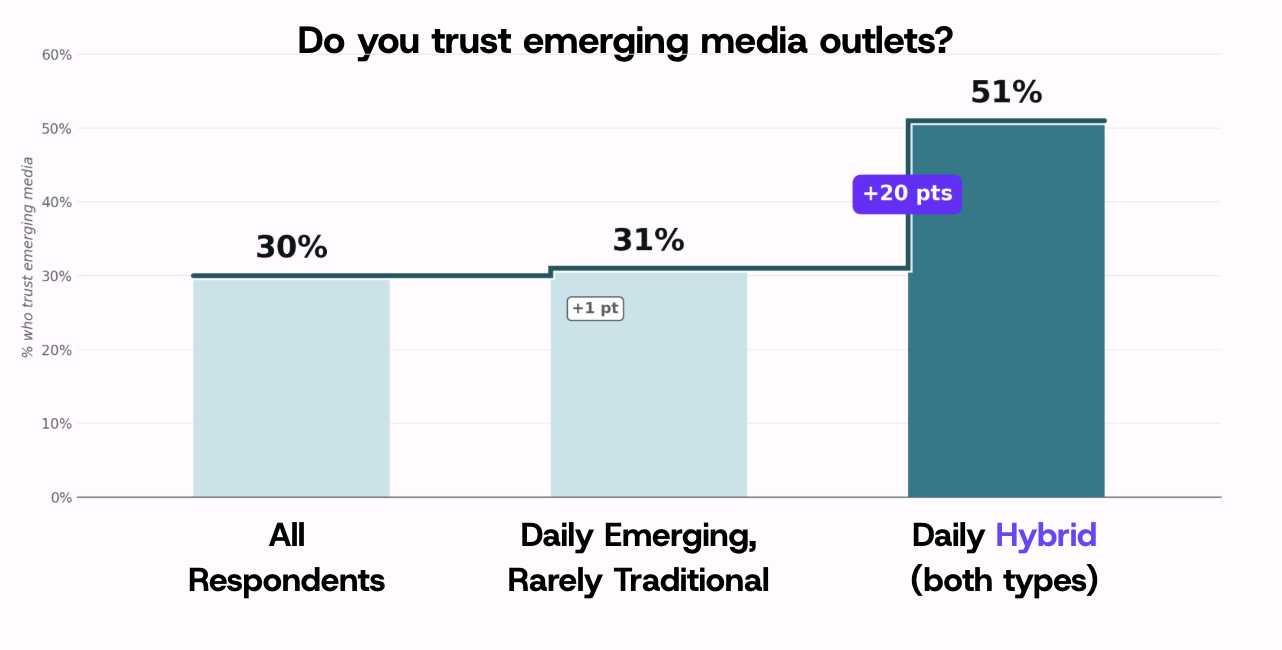
Why it matters: This data shows that the “go-direct” strategy of bypassing gatekeepers has a hard ceiling and that traditional media is the credibility infrastructure that makes a hybrid media strategy possible. Emerging media alone is not enough because the "go-direct" model mistakes distribution for trust: only 11% of US respondents trust emerging media exclusively. Going direct gives a brand or personality a stage. What it does not automatically give them is credibility. The data suggests audiences know the difference — they turn to emerging media to feel connected and culturally current. They turn to traditional media to verify, to go deep, and to decide what's real.
The “Go-Direct” Warning
Bypassing traditional gatekeepers entirely has a hard ceiling. Emerging media alone is not enough because the "go-direct" model mistakes distribution for trust. Audiences turn to emerging media to feel connected, but they still rely on traditional media to verify, go deep, and decide what’s real.
This is also why the Authority layer in our new media framework is newly important for PR and organic brand communications. In a media environment where direct distribution is cheap and abundant, the scarcest resource is verification. Earned coverage, expert sources, peerreviewed research, moderated communities and trusted publications are what convert visibility into belief. Brands that invest exclusively in their own channels and creator partnerships are building reach without the verification infrastructure that turns visibility into trust.
Praytell x YouGov, March 2026
AI Distrust Is Creating a Premium on Human Authenticity
AI is now a routine part of life for the audiences we surveyed. Nearly 60% of respondents use AI several times a week or more, with usage highest in Australia (64%) and remarkably consistent across markets. Audiences are using AI to find information (59–63%), complete tasks (26–40%), and increasingly for personal support (17–32%) and entertainment (20–28%).
Just because people are familiar with AI, doesn't mean they trust it. Across the board, nearly two in three respondents report high levels of concern about AI use in traditional media outlets, and majorities express concern about AI use in every other media category we tested.
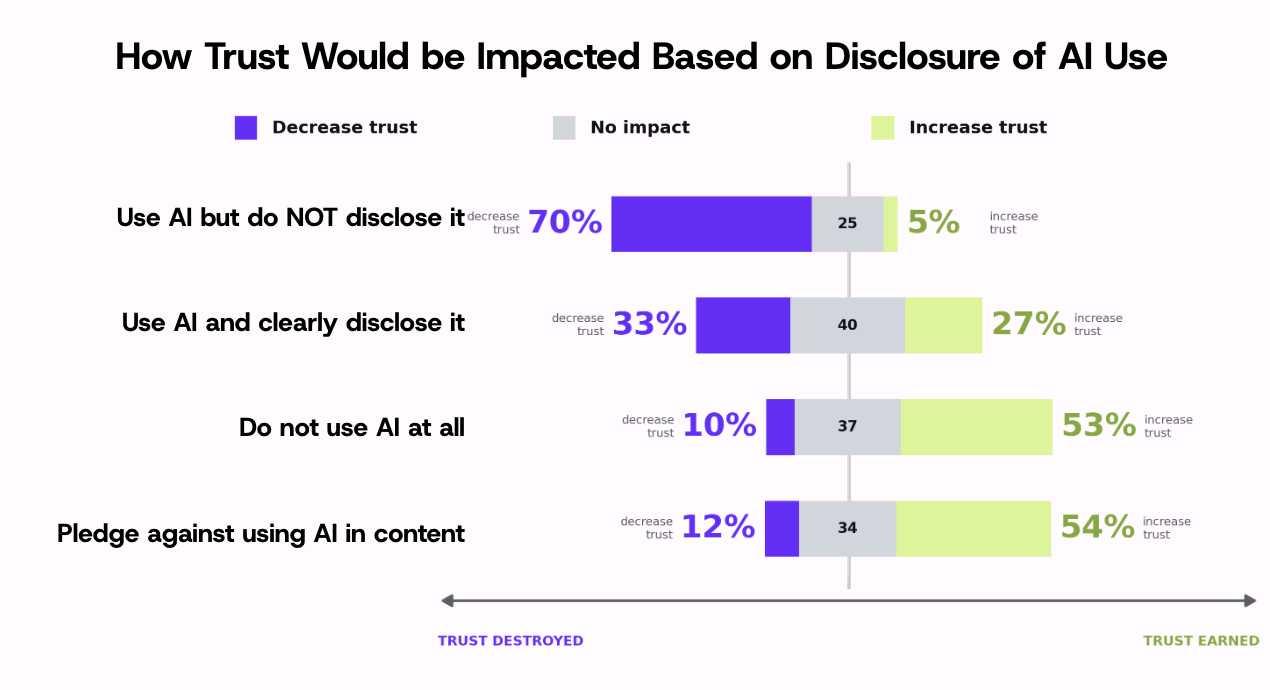
The most striking finding sits in the trust dynamics around disclosure. When media personalities use AI but do not disclose it, trust drops sharply: 70% of US respondents, 82% of UK respondents and 69% of Australian respondents lose trust.
When personalities pledge against using AI in content, the trust dynamic flips — 54% of US, 61% of UK and 50% of Australian respondents say their trust increases.
Why it matters: This finding validates the idea that human personality becomes more valuable in a world of AI slop because the “unpolished edges” are relatable signals that audiences use to identify human-made content.
Disclosure, in particular, deserves to be treated as a strategic lever. The data suggests that AI disclosure is one of the highest-leverage trust-building moves available to a brand or creator today. Pledging against AI in content actively generates trust upside. In an environment where everyone has access to the same generative tools, the brands and personalities who choose transparency and a preference for humans will gain trust.
The Personality Era is, in part, a counter-reaction to the AI era, and audiences are willing to reward brands that embrace this dynamic.

Praytell x YouGov, March 2026
The US Stands Out As a Low-Trust, Low- Engagement Market
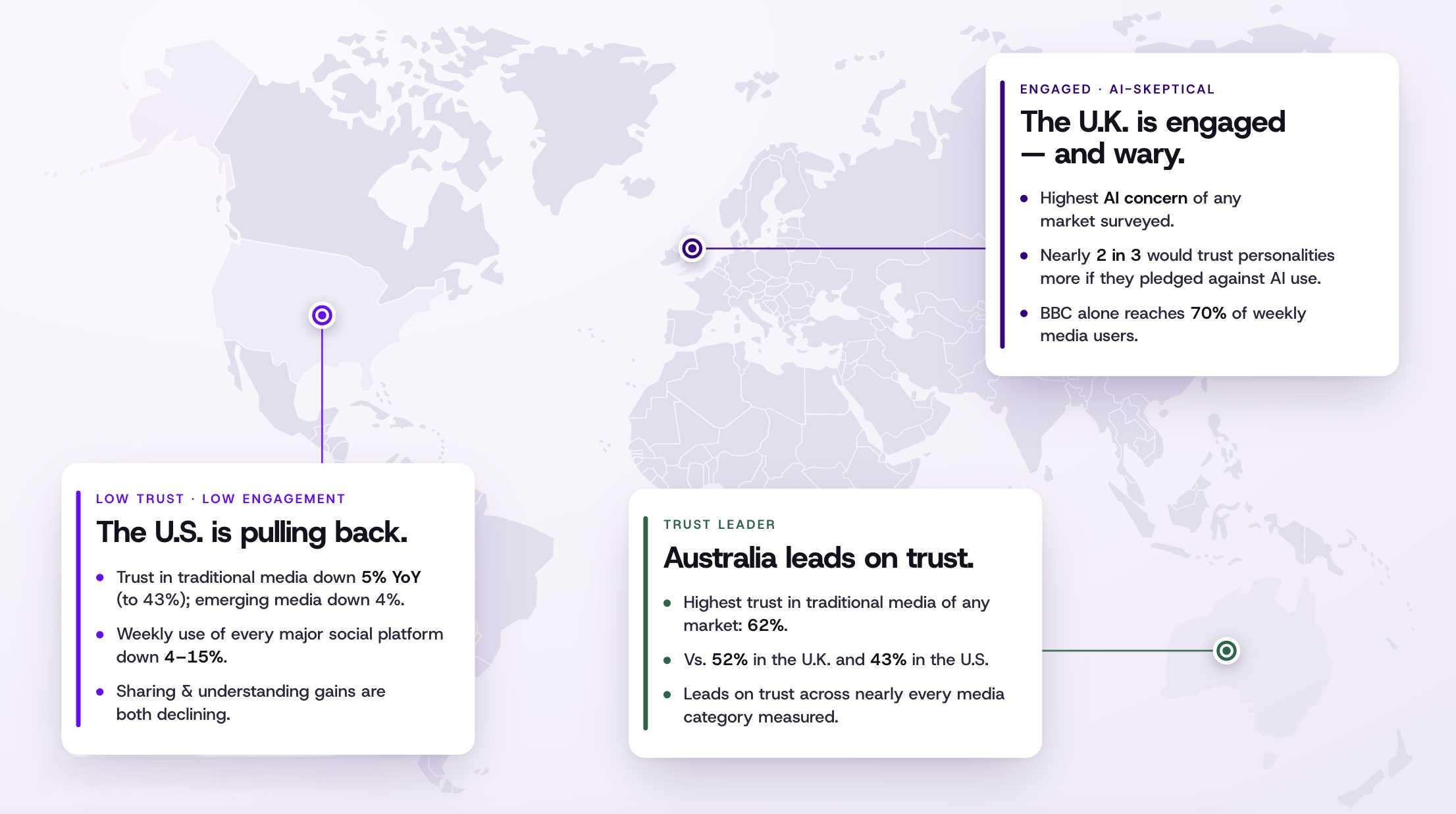
One of the clearest patterns in the data is that trust is eroding across the board in the US. Year-over-year, US weekly media users report declines in nearly every metric we measured. Trust in traditional media is down 5%, trust in emerging media is down 4%, and trust in social-media content from influencers, sponsored posts, and posts from friends and family are all down.
And the decline goes beyond trust; the cultural conversation around “logging off” is proving to be real. Weekly usage of every major social platform we measured — YouTube, Facebook, Instagram, WhatsApp, TikTok, X — is down between 4% and 15%. Average understanding gained from both traditional and emerging media has dropped between 5% and 10%.
Sharing likelihood is down across every source category, and average engagement with both traditional and emerging media is down by roughly 0.2 points on a five-point scale.
The UK and Australia tell a different story. Australian respondents report the highest media trust of any market we surveyed across nearly every category. UK audiences engage with traditional media more heavily (BBC alone reaches 70% of weekly media users) and emerging media more than the US, even as they show the highest levels of AI concern.

Three markets, three stories.
The most notable trends that were distinct to each of the markets we surveyed.

Why it matters: The Personality Era is not a rising tide that lifts all boats.
The US is the market most associated with the creator economy, the "godirect" playbook and venture-backed personality-driven brands. It is also the market where audiences are pulling back fastest from nearly every type of media. This complicates any one-size-fits-all version of our framework, and it carries a counterintuitive strategic implication: the Authority layer may be most critical in the markets where trust is lowest.
When ambient trust collapses, verification becomes more valuable. Earned media, expert sources, proprietary data, and credible third-party validation are how brands break through in environments where audiences have learned to be skeptical. For US-focused communicators, this is the data point worth sitting with: in a market drifting toward lower trust and lower engagement across the board, the brands that win will be the ones that work hardest to earn credibility across all three layers of the framework: Discovery, Authority and Decision.
Praytell x YouGov March 2026
The people most responsible for changing minds in 2026 are the personalities audiences encounter through media.
Key takeaways
Vibes Beat Facts:
Parasocial bonds are now a primary indicator of credibility, showing audiences value resonance as much as verification.
Hybrid Media By Default:
The data refutes the "go-direct" only strategy. Traditional media is the credibility infrastructure that makes an emerging media strategy work.
The AI Authenticity Premium:
Undisclosed AI craters trust (70%+ drop), while pledging to avoid AI gives brands a measurable trust boost.
US Market Divergence:
The US is facing a widespread collapse in ambient media trust across all platforms, meaning communicators must work harder to earn credibility.



CHAPTER THREE:
The New Framework
Narratives that span discovery, authority and decision systems; turn attention into action.
A hybrid media ecosystem
People may discover a story through a creator, but when the stakes rise — when they need to know whether something is real, credible or worth acting on — their behavior shifts.
They search. They compare. They check trusted publications, other creator reviews, Reddit threads, and official brand channels.
The result is not a delineation between traditional media or emerging media, but a truly hybrid media environment. One where vibes beat facts and consumer journeys can be a matter of minutes or months.
This non-linear, hybrid path is why brands need a new framework for building winning strategies in The Personality Era.



Push and Pull Channels Explain How Consumers Interact With Different Forms of Media
To understand this new ecosystem, we need to know how consumers use different media types. It’s helpful to think in terms of push and pull dynamics.
Push
Social and audio platforms are “push” channels, and function as open-ended discovery.
Algorithmic, personality-led and optimized for attention, social feeds, podcasts and clips drop brands into culture through entertainment, emotional alignment, and repeated exposure. As Derek Thompson pointed out in his essay “Everything is Television,” social platforms like Instagram are "lean back" experiences where consumers passively encounter culture. Discovery is dominated by the Creator Economy and increasingly the "Clip Economy," where visibility depends on personality and (sometimes manufactured) virality.

The Bridge
Verification becomes the critical middle layer.
Understanding the ecosystem as push and pull makes the need for a connective middle layer critical for incorporating a mechanism to verify information. Discovery platforms can make a brand, personality or idea highly visible and culturally salient, but they are not reliable mechanisms for verifying the source or accuracy of information. This is why misinformation and disinformation flow so freely on social channels. On the other end, when AI chatbots synthesize information and recommend products, they need to be grounded in reality to be useful.
This layer consists of trusted media sources that have a verification mechanism: humans.
Journalists verify source credibility. Reddit has moderators and rules. Product reviews verify if they came from an actual buyer. Government data, like the census, has a rigorous data verification process. Academic studies are peer-reviewed.
This layer of verification determines what is real, trusted, and retrievable. It’s not a perfect process, but these self-correcting mechanisms are critical for a healthy and functioning media ecosystem.
Pull
AI chatbots and traditional search are “pull” channels, operating as intent-driven retrieval.
Intentional, query-driven systems are activated when consumers want answers, recommendations or reassurance. Increasingly, these tools are becoming decision engines. ChatGPT is a "lean forward" experience because consumers are explicitly on the hunt for a product or answer. Analyst Eric Seufert emphasizes that these AI chatbots are taking an increasing share of product discovery and effectively operating as bottom-of-funnel decision engines.
PR’s Expanded Role In The Personality Era
Earned media’s most strategic role is no longer just visibility. It is authority-building. Quality earned coverage creates the durable public evidence that journalists, communities, and LLMs can reliably cite and trust.
As Generative AI chatbots become society’s informational gatekeepers, earned media effectively functions as "authority infrastructure.”
Our New Media Framework for Narrative Building in The Personality Era
Now that influence moves across discovery, verification, and decision support systems, brands need a guide designed for how narratives actually travel.
We’ve designed the framework to help a single idea, personality, product launch, or brand story compound as it travels across discovery, authority and decision systems.
Designing for All Three Layers of
The Framework

Discovery pu s h
Authority the bridge
Powered by personalities and creators to generate attention, emotional relevance and cultural fluency.
Think: Short form, fun, engaging content, like clips of podcasts, short form video
Goal: Capture "lean back" moments to drive awareness and demand
Decision pull
Validated by journalism, expert voices, and reviews; to establish credibility and trustworthiness.
Think: Longer form designed to resonate with earned sources, like feature articles in legacy media, podcasts with traditional outlets, and even listicles
Goal: Establish credibility, legitimacy, and trustworthiness; and feed both discovery and decision

Synthesized by search engines and AI to make your brand recommendable for intent-driven retrieval.
Think: Content that feeds AI-assisted search (Gemini) and LLM chatbots like Claude or ChatGPT
Goal: Become easily referenced within AI, search, and decision systems
As Generative AI chatbots become society’s informational gatekeepers, earned media functions as authority infrastructure.
Key takeaways

The End of the Binary:
Generative AI collapses the old distinction between traditional and emerging media by acting as a deeply hybrid "digital orality" tool.
PR & Earned Authority:
PR has a critical role in establishing verifiable expertise and translating it to authority and narrative building.
Verification is the Bridge:
To connect viral discovery with bottom-of-funnel decision-making, brands need a credible middle layer of earned media and verification.

CHAPTER FOUR:
The Personality Era Playbook
A field guide to modern influence: How brands build familiarity, establish authority, and create narratives strong enough to break through to humans and robots.
Driving Earned Impact in The Personality Era
The internet delivered on its promise of democratizing information. The Personality Era democratized influence.
We now operate in a media environment built for larger-than-life characters, ambient expertise and people explaining macroeconomics from the comfort of their kitchens.
Some of them are brilliant. Some are simply relentless. None of them would be here without algorithms. Recommendation algorithms do a lot of the legwork: they increasingly reward front-facing, personality-driven formats; encouraging audiences to gravitate toward people who feel candid, opinionated, knowledgeable, or emotionally recognizable.
Once a parasocial bond forms, influence shifts: audiences evaluate not only what is being said, but who is saying it and how they feel about them.
The most successful at this are the ones who master the art of influence: earning attention, relevance and trust. Attention comes from creative freedom that cuts through the algorithm. Relevance comes from speaking to the interests, passion points, needs and desires of fan communities online. Trust comes from consistently and authentically showing up for your audience.
This changes the job of communications strategy.
In an ecosystem where narratives move fluidly across personalities, editorial platforms and AI systems, brands can no longer rely on visibility alone.
Attention must translate into credibility. Credibility must translate into recommendation. And narratives must remain coherent as they travel across each layer of the media transmission framework.
What follows is a field guide to just a few of the components of modern influence: how brands build familiarity, establish authority and create narratives strong enough to survive both the algorithm and AI.

DISCOVERY
Dissolve Marketing Silos via Influence Maps Tackle Both Sides of the New Media Barbell “There’s a Creator for That”
AUTHORITY
Establish Parasocial Dynamics Play the Long-Form Game Embrace Creator Journalism
DECISION
Earn Shelf Space in an AI Search World

Dissolve Marketing Silos Via Influence Maps
Our most consistent learning is that audiences today gravitate toward a hybrid of traditional and emerging media forms.
But when the public gets information and entertainment from such a wide range of sources — social media, aggregators like Apple News, a favorite chatbot or even intimate Discord channels — where do you even start to figure out how to reach them?
It begins with integration across marketing channels from the jump — removing silos and replacing “channel ownership” with a clear idea of who, how and where you need to influence.
Enter: Influence maps. Influence maps are like a guide that help brands show up where their target audiences are. They inform media lists. They augment content calendars. And they add behavioral data to target audience profiles.
Who do you need to influence?
Define the target based on actual interests and behaviors, such as recent searches, online communities they’re a part of, podcasts, or YouTube channels they engage with.
Where does influence happen?
Where do they spend a lot of time online? What platforms, AI chatbots, apps or games do they overindex on?
What are their modes of influence?
Which content mediums do they spend their time consuming? Are they gamers who connect via livestreams? Are they college students who rely on social proof to make a purchase? Millennials who get informed by reading The Economist?

Content is [now]... either three seconds long, or three hours.
Tackle Both Sides of the New Media Barbell
Content is splitting into two extremes: it’s either three seconds long… or three hours. Short-form social clips dominate discovery. Long-form podcasts build depth, trust and authority. But in many cases, the very same source material can reach two very different audiences — all based on the platform and format in which it’s distributed.
This paradox is the new media barbell.
The rise of video podcasts, livestreams, and other long-form formats opened the door to the Clip Economy: the extracting, remixing and redistributing of short ‘highlight’ moments into algorithm-friendly, high velocity social clips.
To stop — or at least momentarily pause — the scroll, short-form content needs a highly emotional hook, a clear point of view, and enough volume to keep resurfacing in the feed.
But volume doesn't have to mean a content farm. The most effective players run a barbell: long-form on one end to build depth and trust, and a steady stream of clips on the other to drive discovery.
Technology Business Programming Network, also known as TBPN, the daily tech-business show hosted by John Coogan and Jordi Hays, illustrates the model. The hosts stream live for about three hours a day, and their team cuts the stream into clips. The disparity is striking; by one analysis, a typical livestream draws around 7,000 live viewers, while clips cut from it average around 257,000, roughly 37 times the reach from identical content.
Brands don’t need to be churning out thousands of clips to reap the benefits of the clip economy. Leaning into this barbell format can be as straightforward as landing your executives, talent partners or expert spokespeople on long-form podcasts — and letting the podcast’s social team do the work of cutting down sound bites and disseminating across channels.
“There’s a Creator for That”
News creators, history buffs, college students, HVAC professionals, refrigerator organizers, sourdough bakers — if there's a niche, there's a creator owning it. And they have the audience to prove it.
There can be a temptation for brands to lean towards being “relatable” to the masses; avoiding the risk of going too specific, and potentially alienating one audience subset in favor of another.
But the algorithms embrace the messiness that makes us human; the overlapping interests, intersectional identities, IYKYK reference points. Creators are embodying multidimensional passions, leaning into fandoms and niche communities online and off.
The more you appeal to niche interests, the more likely you are to reach the community of people that care. And it makes sense when you think about how the algorithms work:
Humans engage with content that feels highly relevant to them; content that makes them feel "seen."
High engagement signals that the post is worth serving up to a broader group of people with adjacent interests.
Content is boosted to a wider circle of users, driving more visibility, more engagement... and on it goes.
Partnering with creators who are community insiders allows you to move from generic, broad-based messaging to sharper, more specific and compelling language that builds trust — but only when the collaboration makes sense, and lets the creator “do their thing.”

In a mediafragmentedenvironment where audiences are constantly pulled toward the next recommendation, personality creates continuity.

Establish Parasocial Dynamics
Parasocial intimacy is what creates return behavior. Audiences crave continuity; they come back for the reassuring familiarity of a voice, perspective or persona that feels embedded in their daily lives.
Brands can nurture parasocial intimacy in several ways because, at the end of the day, humans want to connect with humans.
This could look like spotlighting your charismatic C-suite executives through “get to know me” video opportunities and long-form content like podcasts, or identifying and uplifting employees at the ground level who are connecting with people that look and sound like them.
"Keith from Sonos," for example, became a folk hero for the brand on Reddit simply by providing candid updates and communicating like a real person rather than a corporate representative.
The "Staples Baddie" turned her sales floor whimsy into an industry comeback story for the office supply giant.
Elevating real people into ongoing story arcs creates trusted attention and community growth.
05
Play the Long (Form) Game
In The Personality Era, long-form content is where trust compounds. Short-form clips may dominate discovery, but long-form formats — whether they’re visual (podcasts, livestreams, documentary-style video) or written (Substack essays, print and online feature stories) — are where audiences build a deeper sense of familiarity, alignment and belief.
These formats allow personalities, creators, and brands to communicate worldview, humor, curiosity, and emotional texture. Over time, this repeated exposure creates a form of parasocial trust that is difficult to replicate through fragmented social content alone.
The fragmented landscape has driven a built-in sense of urgency for brands to show up everywhere all at once; it can feel like an impossible time commitment for an executive to carve out three hours from their busy schedule for a single podcast interview. But playing the long game does pay off.
These formats increasingly function as narrative infrastructure: spaces where brands can develop distinct perspectives, communicate complexity, demonstrate expertise and establish a durable identity beyond campaigns or viral moments.
In an ecosystem dominated by clips, long-form also provides contextual resilience to combat moments of crisis. Audiences who have spent meaningful time with a personality or brand are often less susceptible to isolated moments, misleading edits, or rapid-fire backlash cycles, because they interpret new information through an existing relationship rather than a single fragment.
The brands best positioned are those not simply producing more content; they are building recurring spaces where audiences can spend time with them.

Embrace Creator Journalism
Legacy media has evolved their internal editorial structures to gain a foothold in competing with the endless video feeds.
Major media publishers like Hearst, Condé Nast and People Inc. have ramped up their investment in producing editorial video, recurring social series, and persona-heavy editor advocacy.
The writers behind the bylines have stepped into the spotlight: testing products, recounting their written articles in bite-sized formats, and sharing first-person takes in both long and short form video.
Showing up on front-facing video has become so ubiquitous across traditional media that even The Wall Street Journal launched a Talent Lab — an incubator to coach journalists how to pop on camera.
When communications teams are mapping out the most strategic approach for a new product launch, thought leadership pulse point, or trendjacking pitch, they need to lead with the story — but include considerations of visual assets, access, and an idea for what will travel on the outlet’s social media channels.
Research behind any pitch now goes beyond reading the reporter’s most recent articles; it includes scrolling through the outlet’s — and the editors’ — social feeds to digest the look and feel, identify hook patterns, and work from there.

Even The Wall Street Journal launched an incubator to coach journalists how to pop on camera.

Earn Shelf Space in an AI Search World
Search has been the backbone of the online information ecosystem and digital publishing for two decades. As discussed in Chapter 3, AI chatbots are taking an increasing share of product discovery and operating as bottom-of-funnel decision engines.
Chatbots summarize, compare, evaluate, and remove friction from decision making. If a brand is absent from the trusted verification sources that a chatbot uses to synthesize its answers, the brand effectively does not exist on the shelf.”
It is a strategic imperative for brands to be a trusted, definitive answer when a chatbot user asks for a solution in their category.
To achieve this, brands must actively build "Signal Architecture in the verification layer, because LLMs rely heavily on the broader, external information ecosystem from listicles to product pages to Reddit to NIH.gov to synthesize their recommendations.

The Foundations of Signal Architecture
01
Build lasting third-party proof:
Brands need to build a broad network of credible sources to prove their legitimacy. This means securing everything from authoritative media coverage and analyst reports to Reddit conversations, product reviews, and forum discussions. 02
Increase the production of truthful, nuanced owned content:
Publish internal blogs and articles that truthfully and accurately explain exactly how your product solves a specific problem.
03
Leverage proprietary data:
Using your company’s unique data for storytelling makes your brand a definitive source of truth. When you release data-backed reports, you create reliable public evidence — the kind of proof that journalists will cite and AI models will read.
04
Keep information organized and easy to find:
Make sure your product information, use cases, and value proposition are clearly structured and easy to access. This streamlines your brand message across all credible sources, for search engines and AI to find.
0 5
Use major retail sites:
In e-commerce, big retailer websites hold massive authority. AI models trust these domains because retailers are highly motivated to publish accurate product information. Partnering with these retail domains is valuable digital real estate.
0 6
Target specific user prompts and comparison questions:
The key to building effective influence maps is understanding the specific questions consumers ask chatbots related to your category, brand, product or issue. By clarifying the category entry points, it is easier for an AI to identify exactly when and why the brand or product should be the recommended default.

The
Personality Era is, in some ways, a strange side effect of the internet fulfilling its promise a little too well.

We live in a world of unlimited information, infinite content, and intelligent machines capable of answering nearly any question on demand. Yet, people are placing more weight than ever on distinctly human traits like personality, familiarity, perspective, humor, and taste. These are the rough edges that make someone feel real.
Maybe that’s because modern media is exhausting. Maybe it’s because AI has made synthetic content feel unavoidable. Or maybe people have simply reached a point where they no longer want information alone.
They want orientation, and they want someone to help interpret the noise.
This is why the defining figures of this era are not brands or institutions, but people. They are the creators, experts, commentators, obsessives, and accidental micro-celebrities.
For brands, the takeaway is both timely and timeless. The back-end efficiency you gain from AI must be paired with public-facing, recognizable humans. That is the only way to earn attention, relevance, and trust across the modern media ecosystem.
The system has always favored the person. It's now fully built to reward them.