Publications mail agreement #43155015
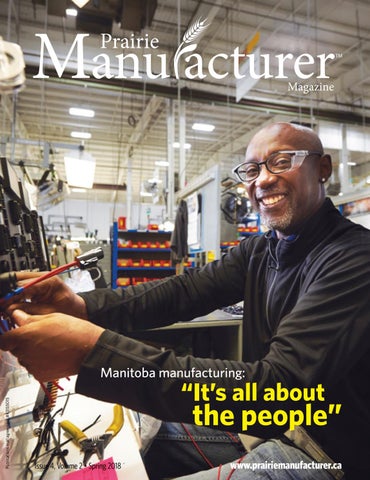
Manitoba manufacturing:
“It’s all about
the people”
Issue 4, Volume 2 • Spring 2018
www.prairiemanufacturer.ca
PROLONG OR RESTORE THE LIFE OF YOUR FLOOR NEW OR OLD, CRACKED, & CRUMBLING!
• Safe and Durable Epoxy Floor Coatings
Our proven products have years of satisfied customer use.
• Unparalleled High Value and Performance
Servicing a variety of markets with our innovative epoxy technology.
• Extensive Field and Laboratory Tests
Bringing you the best possible solution for your application.
• Home Grown, Bio-Based Materials Truly making EcoPoxy the natural choice.
Find a Certified EcoPoxy Installer! www.ecopoxycoatings.com/installers
Learn more at www.ecopoxycoatings.com or call us at 1.855.326.7699
8,000
Publisher Ronda Landygo ronda@prairiemanufacturer.ca 877.880.3392
In this issue It’s all about the people
6
Manitoba manufacturing icon Paul Soubry reveals what he believes is his company’s top competitive advantage: It’s people. And while it’s an easy claim to make, he explains why there is a significant difference between saying it and building a company around it.
Reversing the workplace civility crisis
18
We are smack in the middle of a civility crisis. It is not only affecting your people, either — it is impacting your productivity and profitability as well. Acclaimed Manitoba-based expert Lew Bayer shares her tips to improve workplace decorum.
Conversation with the minister
22
Prairie Manufacturer Magazine Editor Derek Lothian sits down with Hon. Blaine Pedersen, Manitoba’s minister of growth, enterprise, and trade, to discuss the Province’s strategy for manufacturing prosperity.
Paving the Protein Highway
28
Roquette. Verdient. Superclusters. Big public and private sector investments in crop processing are laying the groundwork for a world-class food manufacturing sector on the Prairies, and protein is at the top of the list.
The factory of the future
42
From digital technologies to state-of-the-art research facilities, Manitoba is leading the charge on the evolution of advanced manufacturing. Meet a few of the leaders building and nurturing that ecosystem.
A new northern light
54
These are tricky times in Northern Manitoba. Innovative thinking, however, is breathing new hope for the future. Martin Cash explains how manufacturing could power the next generation of prosperity for the region’s Indigenous Peoples.
Next issue Spotlight: We’ve all heard the line: We have people without jobs and jobs without people. There are few industries where that is more true in Canada than manufacturing. We meet with thought leaders from across the Prairies to discuss what the skills are of tomorrow — and how, as manufacturers, we’ll be able to find them. Regional feature: If people are your greatest asset, it could be argued that education is the most important supply chain system for the long-term success of manufacturers. We look at how the approach to training is evolving, and what training providers are doing to keep pace with the rest of the world. Booking deadline: April 27, 2018 Material due: May 4, 2018
Editor Derek Lothian editor@prairiemanufacturer.ca 306.380.3765 Special thank you to our editorial advisory committee. Creative Director Dana Jensen Sales info@prairiemanufacturer.ca © Copyright 2018 Prairie Manufacturer MagazineTM All rights reserved. The contents of this publication may not be reproduced by any means, in whole or in part, without prior written consent of the publisher. Publications mail agreement #43155015 Return undeliverable Canadian addresses to: Prairie Manufacturer Magazine 207 Hugo St. North, Suite 3 Winnipeg, MB R3M 2N1 To change your address, or to be removed from the mail list, e-mail info@prairiemanufacturer.ca. While every effort has been made to ensure the accuracy of the information contained in and the reliability of the source, the publisher in no way guarantees nor warrants the information and is not responsible for errors, omissions or statements made by advertisers. Opinions and recommendations made by contributors or advertisers are not necessarily those of the publisher, its directors, officers or employees.
Proudly printed by Premier Printing Ltd. Printed in Canada | 2/2018
@prairiemfg
Manufacturing Management Practical experience and technical mastery are important but today's managers also need business acumen to establish competitive advantage in a rapidly changing global context. The Manufacturing Management certificate of completion (MMC) is designed exclusively to do just this.
“Technical knowledge is no longer sufficient to manage a business profitably. A successful manager must also have well rounded business acumen. The Athabasca University MMC is a perfect solution.” Jodi Lant Human Resources Manager Standard Machine
Qualifies for Canada Provincial Job Grant up to $10,000 per student
Online, no time spent away from work
Study with students from across Canada
4 week courses, study when and where it's convenient for you
8 courses — complete within 1 year › Quality Management › Safety Management › Leadership and Change
In partnership with:
› Cross Cultural Leadership › Financial Decision Making › Supply Chain Management
› Manufacturing Management › Project Management
FOR MORE INFORMATION: 1-800-561-4650 business.athabascau.ca/mmc
Editor’s Notebook
itor Guest Ed
Back to the future By Ron Koslowsky
I
n December, my daughter in New York invited me to lunch with Ron Chernow, who has written bestselling and award-winning biographies of historical figures, and is perhaps best-known for his book, Hamilton, which served as the inspiration for the hit Broadway musical of the same title. I love history and had a fascinating discussion with Ron about how it tends to be “rewritten” based on post-modern thinking and values. This is happening all around us, including a mainstream revision of the reasons why we have unparalleled wealth today. The world in which manufacturers now find themselves has more opportunities than ever before, but also more challenges that can threaten their future. The foundational principles of a free and open society that, over the past 200 years, unleashed human potential and created a dramatic rise in the wealth and lifestyle of all people is coming under attack. Some of the factors of our past success were: Open and freer trade, allowing markets to determine where money should be spent; fiscally responsible and limited government; and, individual personal freedom and property rights that created the incentives for economic development. Today, many people are ignorant of these factors and are actively undermining them. Globalization, as an example, is condemned in many circles as detrimental. Instead, freer trade is viewed through the lens of protectionism, where any imports are seen as a negative without regard for solid economic evidence of the value — especially to those lower on the income scale.
The markets and private enterprises are often vilified and blamed for any perceived disadvantage or economic inequities. While the marketplace is sometimes a chaotic environment with frequent disruptive forces, it is by far the best way to ensure a nation best utilizes its human and natural resources for the benefit of all citizens. Central planning has proven woefully inadequate anywhere it has been tried. Governments have assumed an ever-increasing control and influence — not just in creating and enforcing laws to protect people, but by entering into private business and personal arenas, distorting the effectiveness of the marketplace and creating barriers to development through a plethora of overregulation and ‘programs’ for virtually every social issue. In taking money from citizens and companies, and borrowing beyond revenue collected to expand said programs, they are sowing the seeds of a dramatic negative future harvest, where all of us will be required to suffer — citizens and businesses alike. The number of rising autocratic and populist governments preying on people’s ignorance and fears is evidence of a disturbing trend. Personal freedom, for which earlier leaders such as John Locke risked their lives and reputations to fight for, are today being legislated or ostracized away by a politically correct collectivist groupthink that scorns individualism (which, in fact, was key to our economic development). We have become a people who have moved from a balanced discussion on issues based on facts, science, and informed reason to extremists more concerned with who the messenger is. We live in a world of emotion, fear, and ‘fake facts’ based on internet-supported ‘information’ — often more someone's viewpoint than fact. Finally, we have a growing worry about the equality of income and wealth (which can only be accomplished through coercive redistribution and the proven related negative impact on the wealth of all). What was foundational to success was equality of freedom and equal rights to pursue individual goals and opportunities. Not everyone is born equal or will have equal wealth. Envy would rather have all people poorer than seeing some people succeeding dramatically.
“It’s important to remember that manufacturers compete globally, and their ability to do so successfully depends on both their company and the system through which they manufacture.”
4
Prairie Manufacturer Magazine • Spring 2018
People forget that it is not a ‘zero sum’ situation where the only way people can become rich is at the expense of others. Show me a country where poor people are better off through robbing the rich. So, what now? It’s important to remember that manufacturers compete globally, and their ability to do so successfully depends on both their company and the system through which they manufacture. This means having an education system that prepares youth for the competitive world today and is willing to embrace changes to a century-old model. It means governments need to reconsider running many aspects of our society, such as healthcare and other societal needs, through partnership with the private sector, not-for-profits, or foundations that, in most cases, can be more effective and less costly. Regulations must be reviewed to be smart, efficient, and outcomes-based, overcoming resistance to change by supposed safety or environmental concerns masking either extreme naivety or the protectionism of special interest groups. Manufacturers must do their part as well. Trade deals with other countries must be followed up with aggressive export
plans, investment in advanced manufacturing technologies and systems, development of employees and of new products, along with embracing productivity improvements. And, sustainability and safety must be understood as an opportunity for enhanced profit opposed to cost. If we want to see a future where people are truly free and can enjoy an unparalleled standard of living, we need to understand the principles and values that were discovered in the past and boldly speak for these against others who — through populism, envy, and emotion — are seeking to destroy what has been built. History repeatedly shows that once successful nations forget what brought peace and wealth, only to abandon those principles and values, the result is inevitable demise. We owe it to our descendants to learn from history.
Ron Koslowsky is the vice president of Manitoba for Canadian Manufacturers & Exporters — Canada’s largest trade and industry association.
The bank of make it or break it At BDC, we understand the importance of cash flow protection, and the challenges. No matter the obstacle or objective, we can help you find the business solution that fits. As the only bank exclusively devoted to entrepreneurs, rest assured, our financing services are tailored to you.
Call us at 1-888-INFO-BDC or visit bdc.ca
BDCad_Manufacturing_7x4.625_en.indd 1
2017-11-17 12:14 PM
www.prairiemanufacturer.ca
5
View from the C-Suite
6
Prairie Manufacturer Magazine • Spring 2018
It’s all about the people By Paul Soubry
F
or the past nine years, I have been fortunate to work for a great Canadian company, New Flyer Industries Inc., which has been around since 1930. We manufacture buses and lead our industry within North America. Over the years, we have grown organically and through acquisition — now consisting of a team of nearly 6,000 people. We have transformed our business, both by changing our capital structure and by adopting lean principles to enhance our products, service, and competitiveness. As I get older and wiser (not to mention fatter and balder), I have come to truly believe the only real source of competitive advantage we have is our people. It’s easy to say — and everyone
does — but there is a significant difference between saying it and building a company around it. We have made a commitment to continuously pursue excellence in our operating environment and in the relationship with our team members. I read a book nearly 25 years ago that had a huge impact on the way I think about business and what is really important: The Great Game of Business, by Jack Stack. It is a story about a company in the mid-west United States on the verge of being shut down that transforms itself and turns it around. It is an easy read and, through logic and analysis, explains how understanding the economic engine of your business is vitally important.
From my perspective, the most profound statement in the book — which I seem to repeat almost daily — is, “You can fool the fans, but you can’t fool the players.” I interpreted that to mean we can tour a visitor through our plant and impress them with the way it looks, but the reality is we cannot fool our employees, customers, or shareholders. Our team members know whether they are trained, safe, paid fairly, and engaged. Our customers know whether our buses are properly functioning and providing good value. Finally, our shareholders know whether we are growing, generating solid cash flow, and delivering consistent returns. At New Flyer, we are focused on our players. Our method in maintaining the satisfaction of our players is developing Continued on Page 8
Pinnacle is Manitoba’s largest recruitment firm with 25 professional recruiters who are dedicated to their specific areas of recruitment expertise.
WWW.PINNACLE.JOBS | 394 GRAHAM AVENUE, WINNIPEG, MB | 204.943.8649
facebook.com/pinnaclejobs twitter.com/pinnacle_ca
www.prairiemanufacturer.ca
7
“As I get older and wiser (not to mention fatter and balder), I have come to truly believe the only real source of competitive advantage we have is our people. It’s easy to say — and everyone does — but there is a significant difference between saying it and building a company around it.”
outstanding leaders and a thriving work environment. We know we must aspire to set the vision and have the ambition to achieve great things, but we recognize that we must inspire and motivate our employees to do great things as well. We want our team members to follow us not because they have to, or because ‘it’s their job,’ but because they want to. We believe leadership is not the same as management, and that to be successful we must learn the difference, and do both. We are constantly investing in leadership development so that our team members who design, source, manufacture, and support our products are continuously led and engaged to do the right thing. We want everyone to be committed to making exceptional products and not to accept any that are not high-quality or finished — where ‘good enough’ is not good enough. We also subscribe to the concept that people are a product of their environment (think Eddy Murphy and Dan Aykroyd in the 1983 comedy Trading Places). The work environment, the tools and systems, and even the support areas must be right if we are going to consistently build high-quality buses. We have tried to locate as many leaders and support professionals as possible on the shop floor, where the buses are built, to provide leadership, assistance, and troubleshooting support — right in the game, on the playing surface, and not in the bleachers or press box.
8
Prairie Manufacturer Magazine • Spring 2018
We are committed to transparency and always trying to be sincere and humble. One of our customers once said to me, “Shit happens, but tell me — don’t let me find out.” That comment resonated with me. Clearly, it applies to all the players — employees, customers, and shareholders. We are working hard on communication of direction, priorities, and expectations through various mediums and frequencies within the organization. With, however, the vast number of employees in multiple locations, in addition to the different generations, cultures, and ethnicities, effective communication is a constant challenge. Lastly, as we continue to evolve as a business, we sought out an outlet to rally all our team together, to unify all employees, whether it be office or shop, staff or union, leader or worker, local or remote, and all others within the organization. We chose the United Way. You may ask: What does the United Way have to do with buses? Nothing. But what it does is allow every person in our company across 32 locations in North America to come together as one team, with the common goal of benefitting others within our respective communities. As my university basketball coach once told me when I showed up upon graduation from high school, thinking I was something special, “It’s amazing what can be accomplished when no one cares who gets the credit.” If New Flyer is going to be successful for another 88 years, we must keep focused on our key competitive advantage — our people. Remember, you can’t fool the players. Business is a team sport and the pursuit of building a winning team is never done. Paul Soubry is the president and chief executive officer of NFI Group, and — in 2016 — was named CEO of the Year by the National Post.
Money & Markets
Industry 4.0: Are Prairie manufacturers ready? By Pierre Cléroux
T
he outlook for Prairie manufacturers has brightened considerably over the last year. Buoyant economic conditions in North America and rising oil prices have led to a job recovery in the sector amid higher sales and exports. That’s welcome news after a couple of dark years that saw 35,000 manufacturing jobs disappear in the region. Half those jobs were recovered in 2017 as sales and exports surged 12 per cent and 11 per cent, respectively, in the first 11 months of the year. We expect the good times to continue this year. After the Canadian economy posted robust 3.1 per cent GDP growth in 2017, our forecast is for the economy to ease to a still healthy 2.2 per cent this year. On the Prairies, the oil price recovery, strong U.S. economy, and relatively low Canadian dollar are forecast to produce 2.5 per cent GDP growth in Alberta, 2.1 per cent in Saskatchewan, and two per cent in Manitoba.
10
Each year, we ask Canadian entrepreneurs about their investment intentions for the coming 12 months. For our 2018 study, we surveyed more than 4,000 business owners and found that higher-than-expected economic growth last year is fueling strong business confidence.
Entrepreneurs plan to increase investments Our survey indicates Canadian entrepreneurs plan to increase investments by three per cent in 2018 to $140.5 billion. Most of the increase will be on business acquisitions. This makes sense because the baby-boom generation of entrepreneurs is heading to retirement, leading to what we expect will be a surge in business transitions in coming years. Entrepreneurs also plan to increase spending on intangible assets (intellectual property, research and development, information technology, and employee training) by a total of $2.1 billion this year. This increase, however,
Prairie Manufacturer Magazine • Spring 2018
will be offset by a decline of $6.5 billion in spending on tangible assets (machinery and equipment, vehicles, and nonresidential construction). This decline in spending on hard assets is not surprising because it follows a year of exceptional growth. BDC’s mission is to provide entrepreneurs with the financing and advice they need to build strong, productive, and profitable businesses. Manufacturers form our largest client group, and we’re vitally interested in how economic conditions affect their businesses. We believe conditions for investing in manufacturing businesses are excellent, given the healthy growth outlook both in Canada and globally, combined with low interest rates and plentiful business credit.
A great time to adopt digital technologies Specifically, we believe this is a great time for manufacturers to harness
the power of digital technologies that have collectively come to be known as Industry 4.0. What is Industry 4.0? It’s the Fourth Industrial Revolution, after those sparked by the steam engine, the assembly line, and electronic automation and globalization. A core Industry 4.0 application is the use of wireless sensors at every step of the production process to monitor and control machinery and equipment in real time. These sensors allow you to track production, control quality, and reduce downtime. Equipment can even tell you when it needs maintenance or is about to break down. What’s more, advanced analytic software makes it possible to mine data to gain insights to improve production, asset utilization, and employee performance. Elsewhere, the use of 3D printers allows companies to achieve faster prototyping, reducing the cost of engineering and accelerating time to market.
Smart factories produce dramatic productivity gains The result, according to a recent BDC study on Industry 4.0, is an agile smart factory that produces dramatic gains. As part of our study, we conducted a survey of close to 1,000 entrepreneurs
to understand how Canadian smalland mid-sized manufacturers are incorporating digital technologies into their operations and what benefits they are reaping. We saw that companies who embrace digital technologies enjoy impressive rewards. Sixty per cent boosted their productivity, 50 per cent reduced operating costs, and 42 per cent improved overall product quality. We also found that Saskatchewan and Manitoba lead most other provinces in adoption, with 44 per cent of businesses implementing digital technologies. Alberta, meanwhile, is close to the back of the pack with 35 per cent of businesses participating. While representing a promising start, these numbers suggest Prairie manufacturers, like those in other regions, are still in the early stages of digital adoption. We believe it’s important to pick up the pace to remain competitive. Indeed, many manufacturers in the U.S. and Europe are intensively using Industry 4.0 technologies to successfully compete against low-cost countries in Asia.
An example of a successful technology adoption One example of a BDC client who has embraced technology is Ray Turner,
CEO of Lenmak Exterior Innovations, an Edmonton maker of building cladding and roofing. One of Turner’s most important digital projects has been to automate product pricing. Customers can now use a fillable template to upload a list of components from a building design directly to Lenmak’s website and receive a fully priced quote. The system allows customers to try different products to see what the impact is on overall pricing. Once the order is confirmed, Lenmak’s enterprise resource planning system automatically converts the information — dimensions, colours, and other features — into files that guide CNC machines. “It’s efficient, it’s fast, and it eliminates the risk of error,” Turner says. “You wouldn’t believe how technology can help you step up your game.”
“On the Prairies, the oil price recovery, strong U.S. economy, and relatively low Canadian dollar are forecast to produce 2.5 per cent GDP growth in Alberta, 2.1 per cent in Saskatchewan, and two per cent in Manitoba.”
Continued on Page 12
www.prairiemanufacturer.ca
11
Advice on adopting digital technologies BDC’s Industry 4.0 study identified a series of steps entrepreneurs can take to successfully introduce digital technologies into their business: • Focus on customer needs: The goal of your digital projects should be to deliver more value to your customers. So, your choice of technology should be driven by what is most important to them. For instance, Lenmak’s automated product pricing makes it very convenient for customers to choose the product and pricing they want, while, at the same time, delivering productivity gains to the company. • Be strategic: Evaluate your current digital maturity and identify where you need to be to bring more value to customers in coming years. Then make a plan to get there. • Empower your employees: Involve employees in your technology projects from the beginning. They have deep knowledge about your company and can provide invaluable expertise as you adopt new technology. An open discussion about the new technology will reduce resistance and get the staff excited about the new direction the company is taking. • Walk before you run: If you’re at an early stage in adopting technology, start with small pilot projects. For example, you could go paperless in your business office or connect your equipment to capture key performance indicators. Once you have some success, build on it. • Get outside advice: Even though technology has become ever more user-friendly, choosing and implementing technology can still be a complex undertaking, especially for a busy entrepreneur. Using the services of an experienced, objective expert can make a huge difference in your success.
“We saw that companies who embrace digital technologies enjoy impressive rewards. Sixty per cent boosted their productivity, 50 per cent reduced operating costs, and 42 per cent improved overall product quality.”
Superior Cabinets, a Saskatoon designer and manufacturer of custom kitchens, is another BDC client that has successfully followed a game plan to create a smart factory. A key decision was to introduce software that allows Superior staff to design a kitchen with customers in its stores in Saskatchewan and Alberta and send the order directly to the factory in a smooth, paperless process. CEO Scott Hodson estimates this and other initiatives have produced productivity gains of 50 per cent, with waste being reduced to just two per cent of sales, down from seven per cent. Hodson says: “If you’re dependent on manual, traditional ways of doing business things, you can’t scale your business.” We believe now is the right time for Prairies manufacturers to incorporate digital technologies into their operations. Industry 4.0 projects can be complex and involve considerable investments. But our research shows the scale of the benefits are such that they clearly justify the investment required. Digital technologies allow you to ramp up production, increase productivity, and deliver a better customer experience. These are the keys to building more competitive, resilient, and profitable company. Pierre Cléroux is the vice president of research and chief economist for the Business Development Bank of Canada (BDC).
2018 CANWELD EXPO & CONFERENCE SEP 12-13 | WINNIPEG, MB. | RBC CONVENTION CENTRE
THE WELDING & FABRICATION BUSINESS COMES TOGETHER • CANADA’S PREMIERE WELDING SHOW • METAL FABRICATING, WELDING, FINISHING • EXHIBIT TO INDUSTRY MEMBERS FROM CANADA & THE U.S.
EXHIBIT AT CANWELD 18 NOW!
Stephen Furze • dmg::events | stephenfurze@dmgevents.com (403) 444-6529
12
Prairie Manufacturer Magazine • Spring 2018
Lessons in Lean
“The linchpin, by no surprise, has been better engaging our people. I remember touring through a local plant many years ago; and, talking to the team there, it became apparent that their program was employee-driven from the inside out. We wanted to replicate that.�
14
Prairie Manufacturer Magazine • Spring 2018
You don’t need to be Toyota to do lean well By Shaun Stephen
O
ne of the most frustrating excuses you hear in the manufacturing world for tolerating inefficiencies is ‘we are too small to fully embrace lean — we’re not Toyota.’ More often than not, those same companies are struggling to maintain margins and suffer from less-than-stellar health and safety records. When I first joined Alumicor, we probably fell into that same category. Our safety performance was inadequate, we had lots of work in progress (or, WIP) cluttering the floor, and inventory levels were beyond our production needs. At the time, our answer was to build more space. But, tens of thousands of square feet later, we were no further ahead, and it became abysmally clear that something had to change. So, we took our first steps along the road to continuous improvement (CI). Our lean journey, however, is not one of unabashed success or radical, overnight transformation. Instead, it’s a story of commitment, perseverance, incremental movement, and plain old-fashioned hard work. We started roughly a decade ago with the basics. A critical element to maintain a high standard of safety is workplace organization; and, the fundaments of 5S became our tool of choice. From there, we built in colour-coded, cellular manufacturing and introduced metrics to track the indicators most important to us,
including safety incidents, defect rate, on-time delivery, productivity, and inventory accuracy. We had made enough strides that we felt comfortable applying for the AME Manufacturing Excellence Award. And while we didn’t become a finalist, the exercise helped us identify other far-reaching areas of opportunity, such as ways to enhance our pull systems. The biggest leap forward came one year later, in 2013, when our business was purchased by a Minneapolis company called Apogee, which brought resources to support us in our lean deployment. After four years on their roadmap, we have increased our productivity, reduced our space requirements, significantly bolstered quality, and — most importantly — minimized injuries. Our 40-45 employees — split 70-30 shop-to-office staff — now outperform benchmarks set when we were running two complete shifts compared to one. The linchpin, by no surprise, has been better engaging our people. I remember touring through a local plant many years ago; and, talking to the team there, it became apparent that their program was employeedriven from the inside out. We wanted to replicate that. Fortunately, we had some strong factors already playing in our favour. For starters, we traditionally hadn’t been bogged down with Continued on Page 17
2018CANADIAN
C O N F E R E N C E
PLAN TO ATTEND THE LARGEST LEAN EVENT IN CANADA | EMBRACINGEXCELLENCE.CA
Photo credit: Michael Pratt
36 PRESENTATIONS | 18 TOURS | 15 WORKSHOPS | 7 KEYNOTES www.prairiemanufacturer.ca
15
TWO GREAT SHOWS UNDER ONE ROOF
PROGRESS BEGINS HERE MARK YOUR CALENDARS
APRIL 4
Winnipeg, MB
Victoria Inn Hotel
MAY 2
Saskatoon, SK Prairieland Park
The DEX and MMP Expos make their return to Winnipeg and debut in Saskatoon! The combined DESIGN ENGINEEERING and METALWORKING, MANUFACTURING AND PRODUCTION EXPO’S provide a forum for faceto-face interactions with leading suppliers from a wide range of metal manufacturing, machine building and systems integration segments. ATTENDANCE IS FREE
PRODUCTS AND TECHNOLOGIES ON DISPLAY INCLUDE: Abrasives Additive Manufacturing Adhesives & Fasteners Automation Cutting Tools Drives Metal Fabrication Fluid Power
SPONSORED BY:
BROUGHT TO YOU BY:
Machine Tools Metrology Motion Control Motors Power Transmission Reverse Engineering Welding And much more...
REGISTER HERE
www.dexexpo.com /attend / www.mmpshow.com /attendees / INTERESTED IN EXHIBITING? DEX Alan MacPherson
t: (416) 510 - 6756 e: amacpherson@design-engineering.com
MMP Rob Swan
t: (905) 315 - 8342 e: rswan@canadianfabweld.com
SUPPORTED BY:
a lot of turnover in our factory (and still aren’t). And, we’ve been lucky along the way that our group on the floor has really taken ownership of what we do here on a day-to-day basis. Sure, we’ve had a few resisters to change, yet most people have been quick to jump on-board. There are three main drivers, I think, that have allowed us to sustain that culture. The first is leader standard work (LSW). Our LSW is centered on managing daily improvements — doing gemba walks, talking to employees, understanding and addressing bottlenecks, flexing our labour force, and doing a lot of documenting, so we can understand why problems arise. Some of that was probably done in the past. Making it a formalized process, though, has been a game-changer for helping flow that focus down to team leads and supervisors. The second hones in on visual management. We have a lot of signage in our plant that speaks to meaningful metrics — for example: how many quality defects we have in a certain week opposed to the more abstract cost implications of quality failures. We have a card-based total preventative maintenance system, too, where each cell outlines what activities should be happening each month and what needs to be outsourced. And, we have a centralized CI board that shows us in real-time where we are at on existing kaizens and A3s, as well as what’s coming down the road. Finally, we’ve made a purposeful effort to connect our employees to both CI and corporate performance in ways that resonate with them.
That starts with the managers (and hence our diligence to LSW). We need our leaders to be able to communicate to employees what is in it for them. The more cost-effective we can be, the more we sell. The more we sell, the more consistent of a workforce we can maintain. The more stable our workforce, the happier our customers are, the more enjoyable our work environment is, the more investment is turned back into the company, the larger the profit share, and so on. We’ve started celebrating and troubleshooting, together. We have monthly town halls, recognize accomplishments on monitors placed throughout the facility, and have institutionalized the practice of daily huddles. And, we’ve put in place the right incentives. We have a pretty robust visual skills matrix — actually, it’s more like a wall — that contains employee names, job classifications, and job duties. Green labels are then put by their names to indicate what type of work they are
signed-off to do. Those abilities are subsequently tied back to the pay grid, which puts a monetary value on crosstraining and helps the worker to see the value back to the company. No high-priced consultants. No complex technology. Just common-sense lean. Whenever I am asked how companies like ours should get started on their own journeys, my advice is to pick one or two tools first and focus on becoming great at executing on them. Don’t overwhelm people. Operational excellence is allencompassing — you will create more internal champions by rolling up your sleeves and demonstrating results than by inundating them with new information and systems. You really only need to be you — you don’t need to be Toyota. Based in Winnipeg, Shaun Stephen is the vice president and regional general manager of Alumicor in Western Canada — a leading supplier of architectural aluminum building envelope products.
INNOVATIVE MANUFACTURING DIPLOMA Register now for Fall 2018. Learn more at saskpolytech.ca/MEM
www.prairiemanufacturer.ca
17
The Principal Resource
Reversing the workplace civility crisis By Lew Bayer
W
e are smack in the middle of a civility crisis. With research on both Canadian and U.S. companies showing a whopping 98 per cent of people have experienced uncivil behaviour on the job, rudeness in the workplace is systemic and epidemic. Evidence that the incivility virus impacts — amongst other things — our productivity, our ability to work together, our creativity, and our health, is growing every day. For employers in the manufacturing sector, where innovation, thinking skills, and changereadiness are essential to survival, incivility in the workplace represents a significant cause for concern, operationally and financially. Consider, for example, that, according to Business Insider, four out of five people are dissatisfied with their jobs. How do you think this dissatisfaction manifests? If your response encompasses negative impacts to retention, engagement, productivity, stress levels, and profitability, you’d be correct. A Canadian study by Bar-David Consulting and Canadian HR Reporter shows incivility affects the following key business indicators, as reported by human resource professionals: • 90 per cent say it hurts collaboration; • 78 per cent say it affects talent retention; • 52 per cent say it affects brand reputation; • 92 per cent agree incivility has negative effects on productivity; and • 80 per cent report an impact on absenteeism. But when we knuckle-down and examine workplace culture, we frequently find — and an increasing body of research validates — the root cause of most workplace stress can be attributed to disrespectful behaviour, including verbal, nonverbal, situational, and contextual aspects. And, when we begin to understand what causes incivility, and when we start to track the nature and frequency of uncivil behavior, we begin to see patterns.
18
Prairie Manufacturer Magazine • Spring 2018
“Plainly and simply, civility is a conscious awareness of the impact of one’s thoughts, actions, words, and intentions on others. It is combined with a continuous acknowledgement of one’s responsibility to ease the experience of others (through restraint, kindness, non-judgment, respect, and courtesy), as well as a consistent effort to adopt and exhibit civil behaviour as a non-negotiable point of one’s character.”
Many of these patterns are well-ingrained behaviours and habits of mind. Further, many of these negative and uncivil patterns are unwittingly endorsed through, and facilitated by, the organization’s processes and procedures. Shockingly, in a recent study of a diverse occupational sample of 180 workers on the Canadian Prairies, 40 per cent polled reported experiencing at least one of 45 specific acts indicative of psychological harassment or bullying on a weekly basis for at least six months. An additional 10 per cent of the sample reported experiencing five or more such acts on a weekly basis for at least six months. It is indisputable that workplace incivility causes stress. A quarter of employees say work is their main source of stress and 40 per cent say their job is ‘very or extremely stressful.’ Clearly, if we are not alarmed that up to half of our work teams are experiencing this type of stress on a daily and weekly basis, we should be. So, you may be wondering: Why are our workplaces so stressful? Good question. And there is not an easy answer. The reasons vary, of course, depending on the workplace, and on the people involved. Certainly, chronic change is a contributing factor, as can be downsizing, restructuring, labour shortages, outsourcing, demographic shifts, economic insecurity, technology, or trends in work style (job-share programs, telecommuting, etc.). The mistake many organizations make is assuming that having a respectful workplace policy in place will offset the impacts of the stress caused by incivility. Expecting that we can change deep-set attitudes, thinking patterns, and behaviours just by posting anti-bullying posters in the lunch room, or requiring employees to attend a half-day seminar, is just not realistic. While these policies can be helpful in terms of addressing steps to take after incivility has occurred (in fact, most provinces have legislated a requirement for employers to have one), simply having them does not guarantee a more respectful workplace. They are, instead, just one part of a comprehensive plan. Creating a culture where civility thrives is the only way to prevent the stress caused by uncivil behaviour such as harassment, bullying, discrimination, and any of the day-to-day rudeness stemming from poor communication skills and low social intelligence. The key issue is that many leaders still do not understand what civility is. They chalk it up to
‘niceness’ or ‘kindness,’ or to soft skills and then underestimate its value. Plainly and simply, civility is a conscious awareness of the impact of one's thoughts, actions, words, and intentions on others. It is combined with a continuous acknowledgement of one’s responsibility to ease the experience of others (through restraint, kindness, non-judgment, respect, and courtesy), as well as a consistent effort to adopt and exhibit civil behaviour as a nonnegotiable point of one's character. It is a measurable competency, underpinned by just four key skill areas — all which can be taught: Social intelligence, cultural competence, systems thinking, and continuous learning. As a 20-plus-year practitioner in the field, it is always surprising to me how few employers are willing to consider implementing a civility initiative in their workplaces. A recent poll found that twothirds of employees believe there is a strong need for civility training; while another study found that 83 per cent of employees believe a civil work environment is very important to their wellbeing, health, performance, and job satisfaction. What we’ve been doing to-date isn’t working. Yet, old habits die hard. If you are one of the few who is considering building a culture of civility in your workplace, your leadership team must understand that civility at work is, at first, a values (defining character statement) proposition, in that the organization must choose and define civility as a core value. Then, it also becomes a value (having worth) proposition, in that leadership must be able to devise a persuasive argument as to why employees should buy into the notion of a respectful workplace. Everyone in the organization must have some understanding of what civility means in terms of day-to-day life on the job. Ideally, every individual in the organization (and, at the very least, the change-makers) must be convinced that embedding a culture of civility into the workplace is of value — to the individual, to the team, to the customer, to the organization, and even to the community. They also must believe that civility presents the best solution for resolving whatever organizational culture problems may have been identified. There are two core elements to a successful civility change initiative. First, we must understand and acknowledge that, to take root, a civility change initiative must be Continued on Page 20
www.prairiemanufacturer.ca
19
“Creating a culture where civility thrives is the only way to prevent the stress caused by uncivil behaviour such as harassment, bullying, discrimination, and any of the day-to-day rudeness stemming from poor communication skills and low social intelligence.”
WORK INJURY MANAGEMENT CORPORATE HEALTH SERVICES
From getting injured workers back on the job ... to making a strategic plan for executive health Invest in recovery and prevention for your team Trust a multi-disciplinary team that’s successfully handled a wide range of workplace injuries, as well as provided the latest preventive programs and care. Reconditioning Work Hardening
Executive Medical Assessments
Functional Capacity Evaluations
Pre-employment Screening
Job/Physical Demands Analyses
Ergonomic Assessments
Early Injury Assessments Worksite Visits
For details contact 204.632.3906 or executivemedicals@wellnessinstitute.ca Get well and stay well at Seven Oaks General Hospital
20
Prairie Manufacturer Magazine • Spring 2018
wellnessinstitute.ca
strategic, well-planned, and long-term, and there must be a clarified rationale for civility in the workplace. Just like most change initiatives, incorporating civility into your workplace culture is going to take some time, money, and energy. You’ll likely have to delegate people and resources, and you’ll have to manage both the process and the people sides of the change. To be successful, you will need a plan that includes identifying stakeholders, assigning roles, completing assessments, setting goals, implementing the plan, delivering alignment communications, planning and delivering training, and evaluating. How complex and costly each of those components are will depend on the context and on your business priorities. To be clear, when we talk about how complex a civility initiative might be, we are referring to how many components are included in the plan. This is different from the level of difficulty or how complicated the initiative might be. Civility as a change initiative might be complex in that there are a lot of components to consider, but it isn’t necessarily complicated. Second, we must understand and acknowledge that the work will be ongoing and continuous. The reality is, due to the fact the situation, the people, the priorities, and the conditions in a workplace are constantly changing, you are never truly finished with civility as a change initiative. And this is an extremely important realization. I believe that this realization is one of the biggest barriers most organizations face in moving forward with civility initiatives. But, if you can get past this hurdle, you will be successful. And the rewards are often immutable, measurable, positive, and significant. Based in Winnipeg, Lew Bayer is an internationally-acclaimed author and civility expert. In addition to serving as distance faculty with Georgetown University, she also teaches at Manitoba Institute of Trades and Technology, as well as the Canadian Management Centre.
Put SAFE Work into action.
Every day. safemanitoba.com www.prairiemanufacturer.ca
21
Conversation with the minister Prairie Manufacturer Magazine Editor Derek Lothian sits down with Hon. Blaine Pedersen, Manitoba’s minister of growth, enterprise, and trade, to discuss the Province’s strategy for manufacturing prosperity Derek Lothian denoted by the initials DL; Hon. Blaine Pedersen denoted by the initials BP. DL: Minister, thank you so much for taking the time to chat with us. BP: You’re very welcome. DL: Let’s start at the 30,000-foot level. When you look at Manitoba, few would argue it’s probably one of the strongest and most consistent manufacturing jurisdictions in Canada, comprising around 10 per cent of the total provincial workforce. How is Manitoba positioning itself in the marketplace to maintain its competitive edge? BP: I just had a great conversation with our local manufacturing association on this. Our colleges — Red River College here in Winnipeg, for example — are doing a tremendous job in training people for work, getting them out [into the workforce], and bringing them back for future training. Our universities are catching up for the new demands of the workplace, too. You must have that skilled workforce. Manitoba also started the immigrant nominee program back in the 1990s, and it continues to allow us to bring in the skilled workers we need to fit very specific jobs because of our highly diverse manufacturing base.
22
Prairie Manufacturer Magazine • Spring 2018
DL: There is a direct tie between skills development and investing in new, smart technologies, such as automation and machine learning — you need those skill sets to integrate and sustain those technologies into a broader system. How are those two things linked in your province? BP: You’re right in that it’s a combination. It’s one thing to train a person to enter into a particular role; it’s another thing to bring those same people back for further training so they can keep up with the new technologies. We’re long past the days where we learn a skill and that skill stays forever. We have to be nimble in our education system — not just at the post-secondary level, but into elementary and high schools as well, so we can start training our young people earlier into in-demand career paths. Training is now a lifelong endeavour. DL: Let’s shift focus a bit. One of the things I am always struck by coming to Manitoba is the breadth of public R&D assets you have there, from the Composites Innovation Centre to the Industrial Technology Centre. Why has your government been so adamant about continuing those investments, and what is your philosophy around building that public innovation infrastructure? BP: You have to prepare for the future. Governments have tended to be fairly short-sighted; however, we’re taking the
“We’re long past the days where we learn a skill and that skill stays forever. We have to be nimble in our education system — not just at the post-secondary level, but into elementary and high schools as well, so we can start training our young people earlier into in-demand career paths. Training is now a lifelong endeavor.”
long view on this. You talk about the Composites Innovation Centre, then you have the North Forge Technology Exchange and Manitoba Innovation Accelerator — these are the go-to places for manufacturers to incubate ideas, where they need to do the necessary prototyping and testing before you can get into actual production. We’ve long-recognized this — and these are initiatives that come directly from the private sector — so we remain very supportive of them. DL: Building on that notion of incubation: In your portfolio, I’m sure it’s very apparent that one of the toughest things to do
is grow from a small business to a medium-sized business, and then from a medium-sized business to a large business. What is your government looking to do to support that transition? BP: We’re redoing our entire economic development portfolio to make sure we’re getting a good return on investment. Part of that is addressing the need to access capital. From my experience, it’s one thing to get a business up and running, but it’s that next step where you need more capital to be successful. We’re in the midst of developing out supports for that process — we’re in the very early stages, yet we’re excited to get rolling on Continued on Page 24
My Asper MBA is helping secure the world’s food supply. What will yours do? An Asper MBA will give you the confidence and knowledge you need to lead in your workplace, your community and abroad.
Register now for our next info session asper-mba.ca
Zach Wolff CEO, Exigence Technologies
www.prairiemanufacturer.ca
23
“Take the aerospace industry: We have a handful of large players, and what they’re looking for is these small manufacturers that are able to supply them with parts — with very exacting specifications, very stringent quality and product control standards. It sets those SMEs up from a process standpoint to be globally competitive in industries beyond just aerospace.”
Red River College’s Technology Access Centre in Winnipeg opens up a world of new opportunities for manufacturing enterprises, including: Applied Research — access to RRC facilities, technologies, resources and expertise for your research projects Technical Services — including rapid prototypes, NDT, machining, 3D printing and CMM Knowledge Transfer — seminars, workshops and special events around new and emerging technologies and productivity Industry Training — in manufacturing, mechanical engineering, CNC, composites, robotics and automation, and more
Partner with us today at
rrc.ca/tac
24
Prairie Manufacturer Magazine • Spring 2018
it, as it is a main impediment to business growth, especially in capital-intensive industries like manufacturing. Cash is still king. DL: In this issue of Prairie Manufacturer Magazine, we’re doing a story that highlights Roquette’s $400 million investment in Portage-laPrairie to build a new pea processing plant. Manitoba, obviously, is uniquely positioned to capitalize on value-added agriculture. How do you aim to attract more Roquettes in the future? BP: There are several factors that set Manitoba apart for investors. For starters, we have an abundance of water and we have an abundance of affordable, reliable hydroelectricity, which are two of the baselines you need in that industry, on top of a ready, high-quality supply of commodities. Furthermore, we just received an award for red tape reduction, and we are going to continue down that road. We need to make it attractive for companies to come to Manitoba as far as minimizing the regulatory burden is concerned, while maintaining strong environmental protections. In the end, it’s all about the overall business environment. If we can attract businesses like Roquette and help make them successful, others will see that and follow suit. DL: You mentioned one word earlier in the interview — diversity — that I wanted to pick back up on. There is so much push right now toward specialization. That said, Manitoba has historically done extremely well across numerous manufacturing sub-sectors, from aerospace and transportation to pharmaceuticals and farm equipment. How do you keep finding those niche strengths in your local economy to build up? BP: It’s about leveraging strengths. Take the aerospace industry: We have a handful of large players, and what they’re looking for is these small manufacturers that are able to supply them with parts — with very exacting specifications, very stringent quality and product control
standards. It sets those SMEs up from a process standpoint to be globally competitive in industries beyond just aerospace. Diversity ultimately breeds diversity; but we need to ensure we have a competitive workforce, a competitive tax regime, and an ‘open for business’ sign hanging there to show industry that, as a government, we are committed to manufacturers’ success in Manitoba. DL: Unlike next door in Saskatchewan, where the manufacturing base is distributed evenly across Saskatoon, Regina, and the rural parts of the province, so much of Manitoba’s manufacturing activity centres around Winnipeg. That, however, seems to be changing somewhat. How do balance, given the restraints of government, the needs of that evolving rural manufacturing portfolio with the reality that the best bang for your buck still likely is in a single city? BP: It’s a big challenge in Manitoba, where we have two-thirds of the population living in the capital region. One of the really good examples I can give you, though, is HyLife Foods in Neepawa, which is a hog processing facility. We’ve removed some of the political interference that was happening with respect to new development in the hog industry, and that has allowed HyLife to build more barns and now they’re doing a major expansion. Neepawa is a rural community that, 15 years ago, you could’ve driven down Main Street and there was no one there on a Saturday afternoon; now, it’s bustling all the time. Again, it’s about diversification. It’s about having good transportation infrastructure to access markets in all directions. And it’s about having a business climate that encourages investment. DL: Last question: Over the next year, what is your government’s top priority to help grow the manufacturing sector in Manitoba? BP: It’s hard to limit it just to one. The redeployment of our economic development strategy addressing access
to capital could have some of the most immediate impact. Red tape reduction needs to continue. And, fiscal control from government is paramount, so that businesses know we are serious about reducing our deficit here and that Manitoba will be competitive. That’s the best thing we can do: To instill
confidence in the business community. We’re going to reduce our PST prior to the next election, yet we’re not wavering on being financially responsible. Just like every business needs to have fiscal control, so, too, does government. DL: Thank you, Minister, for your time.
We make it our business to understand your business Before we can understand how to best meet your banking needs, we want to understand your business. That’s why at TD Commercial Banking, we offer our clients the advantage of a dedicated Relationship Manager who is committed to fully understanding your business needs before recommending a customized banking solution. Your Relationship Manager is your one point of contact and there is a whole team of specialists adding expert value and support. Find out how TD Commercial Banking can give you the personal service you and your business deserve.
For more information, contact: Bernie Scheurer Sales Manager 204-988-2655 bernie.scheurer@td.com
David Kendall Manager Commercial Services 204-988-2929 david.kendall@td.com
TD Commercial Banking Winnipeg 201 Portage Avenue, 4th Floor, Winnipeg, MB
M00002 (0412) ®/
The TD logo and other trade-marks are the property of The Toronto-Dominion Bank or a wholly-owned subsidiary, in Canada and/or other countries.
www.prairiemanufacturer.ca
25
THANKYOU
TO OUR MANUFACTURING WEEK SPONSORS
™
GA ALA
WARDS
DINNER
CONGRATULATIONS TO THE 2018 RECIPIENTS
CME’s Gala Awards Dinner promotes Manitoba manufacturing excellence. Connect and celebrate with more than 500 industry influencers, job creators and thought leaders in one very special evening. March 22, RBC Convention Centre Winnipeg
*as of February 20, 2018
CELEBRATINGMANITOBA MANUFACTURINGEXCELLENCE MANUFACTURING WEEK 2018 | MARCH 19-23
ROY COOK
CHARLES BALMER
Monarch Industries
Valmar Airflo awarded posthumously
Hall of Fame Award
Pioneer Award
Celebrating individuals who have consistently demonstrated visionary leadership and designed or implemented new or revolutionary products, systems or processes
CLEARLINE TECHNOLOGIES Emerging Award Celebrating new companies with significant future potential that are distinguishing their business through growth, impact and innovation
Celebrating individuals who began a manufacturing business in Manitoba and nurtured it into a successful company
FLOFORM Export Award
RED RIVER COLLEGE Partner Award
Celebrating companies that demonstrate excellence in expanding its market numerically and geographically
Celebrating partners and service providers that demonstrate a measurable impact on the growth, sustainability or mission of manufacturing companies
Manufacturing matters on the prairies and CME helps you stay at the top of your game. Dare to Compete brings together insightful keynotes, powerful professional development and opportunities to network with the best of the best in prairie manufacturing. March 20, RBC Convention Centre Winnipeg
THE LARGEST ANNUAL MANUFACTURING EVENT IN WESTERN CANADA!
CME MANITOBA HELPS MANUFACTURERS GROW. CONNECT WITH US TODAY! DARETOCOMPETE.CA
Photo: Dennis Lange, Manitoba Agriculture
28
Prairie Manufacturer Magazine • Spring 2018
Paving the
Protein Highway Big investments in crop processing are laying the groundwork for a world-class food manufacturing sector on the Prairies By Joanne Paulson
J
ust west of the small Manitoba city of Portage la Prairie, the darkness of a winter night comes alight with the glow of a changing future. The site of a new, $400-million pea processing plant is being prepared for spring construction, and locals can’t help but be awestruck by the bustle of activity. “Particularly after sundown, it gets really exciting here, because all the site lights come on and you say, ‘hey, there’s lots happening in that field,’” quips Vern May, executive director of Portage Regional Economic Development — the entity responsible for attracting new business to the area. “As soon as the spring thaw happens, things will be going at a pretty aggressive pace.” The facility belongs to the French company Roquette and, until the $460 million announcement by Simplot on February 15 to double the size of its Portage la Prairie potato plant, represented the largest single private sector investment in the province’s history. It’s a move that has shifted many eyes directly onto the community, with a sense of interest and wonder as to how a region of only 20,000 people could secure such as a massive deal. Well, deals. “When you talk to people in the foreign direct investment industry, they say this is what foreign investors are looking for: To be in the cluster, to be near an international airport, all of these things that — when we look at Portage la Prairie — we’re not,” admits May. “We’re not Toronto, Montreal, or Vancouver.” That, however, didn’t stop the city from beating out a half-dozen other potential Canadian jurisdictions, as well as North Dakota, to land the Roquette expansion. “Manitoba offers an environment that perfectly fits with Roquette’s strategic ambitions,” says Martin Fregeau, managing director with Roquette Canada Ltd. “It has a well-educated and professional workforce. It has strong logistics, with Winnipeg being the major Canadian hub, providing ready access to multi-modal transportation links throughout North America and beyond. And it has reliable, competitive, and sustainable hydroelectric energy. “When you combine that with the business-friendly spirit and support we’ve received from the Province and the local administration, it was clear that Portage la Prairie is a perfect location to develop a food business.” While Roquette does operate two locations in the United States already (Illinois and Iowa), this venture is its first into the Canadian marketplace — and the first outside of France to process peas. It only makes sense. After all, Canada accounts for roughly 30 per cent of global pea production each year. But, as with most investment attraction efforts, location alone is seldom enough. It takes a multi-faceted team of stakeholders from both the public and private sectors to pull all the necessary pieces together. In the case of Roquette, World Trade Centre Winnipeg and Manitoba Agriculture were two of the early champions to get the ball rolling. Continued on Page 30
www.prairiemanufacturer.ca
29
Those relationships aren’t stagnant, either. They must also grow and evolve over time to develop the right supply chain components and labour pool to sustain a project of this magnitude. At a vendor information forum held this past November, 200 companies filled the room to hear about potential supplier opportunities. “There has been active engagement from groups like the Manitoba Pulse Growers Association,” notes May. “They’ve actually started some test crops this year. I think there will be an increase in pea acres locally and I expect they’ll be looking at importing from Saskatchewan, too. It just illustrates how an investment like this — although every municipality is trying to get it — how wide-reaching the economic impact is.” Once completed, the plant will extract protein from peas for use in a range of food products, such as pasta, bread, sports bars, and soups. The construction phase alone is expected to create 350 jobs, and approximately 150 jobs are on the docket for when operations are officially commissioned.
Connecting the corridor Roquette’s decision to invest in Manitoba is representative of a broader push to advance pulse processing and exports on the Canadian Prairies. Several initiatives are burbling or underway to create a higher level of value-added opportunity for agricultural commodities, including the concept of the Protein Highway. This idea — an informal alliance of western provinces and northern American states, most of which have the capacity to grow dryland
30
Prairie Manufacturer Magazine • Spring 2018
crops rich in proteins — was launched in September 2016 to help identify how to position the crop processing cluster as an economic engine. Wilf Keller, CEO of Ag-West Bio Inc., a Saskatoon-based catalyst organization mandated to advance agri-products development, has helped lead the conversation from day one. In fact, he was a driving force behind the submission of a massive proposal to the Government of Canada’s supercluster initiative, which was one of five selected for funding in February. The result was $150 million in seed capital and the establishment of Protein Industries Canada — an umbrella organization bringing together 120 postsecondary institutions, research facilities, manufacturers, and other public assets to create an ‘ecosystem’ for collaboration. The proteins supercluster is expected to create 4,500 jobs across the Prairies and add $4.5 billion to the gross domestic product over the next decade. “This framework has more structure, a defined set of goals and so forth, where the Protein Highway is more of a think-tank discussion initiative that will hopefully result in resources,” explains Keller. “If the Americans come up with a similar thing to a supercluster, we can really make it run.” Even Hollywood is beginning to get excited about the possibilities. This past fall, movie producer James Cameron (of Titanic and Avatar fame) came to Saskatchewan to unveil their latest undertaking, Verdient — a new organic pea processing facility located in Vanscoy, just west of Saskatoon.
“FCC knows how our industry works.” Melissa Vencatasamy, Co-owner, genAG Farm Equipment Retail
Your business is unique. Your financing should be too. Grow with a lender who understands Canadian agriculture. With over 100,000 customers, big and small, and a portfolio that tops $30 billion, Farm Credit Canada can help build your business success story.
fccfinancing.ca
Continued on Page 32
www.prairiemanufacturer.ca
31
Portage la Prairie: Island on the Prairies By Vern May
O
ptimally situated at the midway point of the TransCanada highway, Portage la Prairie has a long history in the food processing industry. But it wasn’t until the 2017 announcement that Roquette had selected the region as the site for the world’s largest pea protein processing facility that the manufacturing sector has truly taken interest in Portage’s investment advantage. Once home to Campbell’s Soup, which operated here until 1990, Portage has been home to potato processing for the local McCain plant since 1979. Simplot established their potato operation here in 2001. Other food production includes smallerscale operations by Nutri Pea, Prairie Quinoa, Best Cooking Pulses, The Better Hemp Company, and Canadian Prairie Garden Purees. The location’s strategic advantage includes its proximity to an R-TAC-rated highway, its connectivity to both national railways, plentiful access to water, and its rural setting within a comfortable commute from the provincial capital and an international airport. Combined with Manitoba’s attractive utility rates and a large footprint of available land already zoned for industry, it won’t surprise many to learn that investment interest is high in the area. In 2017, Portage la Prairie closed the year with a sum of $493 million in new investment. Roquette factored largely to that total; however, interest in residential and commercial development has also seen an encouraging climb. Many projects are expected to break ground in 2018. Of that investment, it is interesting to note that close to $23 million reflects re-investment by existing merchants in expansion and diversification of their holdings. This encompasses an estimated $8 million proposed from Portage Consumers Co-op to create a retail neighborhood adjacent to their existing food store and gas bar operations. A unique element of Portage’s economy that is often overlooked is the city and municipal relationship with the local First Nations. Long Plain First Nation, whose reserve lands sit 20 kilometres southwest of the city, has secured designated land that borders on the city limits to develop the Keeshkeemaquah urban reserve. Through the settlement of recent treaty land entitlements, the land’s Arrowhead Development Corporation has been heavily invested in development. This includes housing and commercial projects in excess of $13 million with an eye on expanding into the hospitality industry in the near future. As Roquette has inspired the world to learn more about Manitoba’s ‘Island on the Prairies,’ the future is looking bright for Portage la Prairie. Vern May is the executive director of Portage Regional Economic Development.
32
Prairie Manufacturer Magazine • Spring 2018
Cameron, a vegan who has recently become heavily involved in processing healthy food, along with his wife, Suzy, also signed a $500,000 agreement with the Saskatchewan Food Development Centre to further the creation of foods and ingredients from Prairie plant sources. Soon thereafter, in January, that centre opened the doors to its 43,000-square-foot expansion, dubbed the Agri-Food Innovation Centre. Keller says it’s all part of a big vision to realize the potential of Canada’s food manufacturing industry. He points to a report by McKinsey & Company’s Dominic Barton, who was brought into Ottawa two years ago to advise on economic development. “He put down a challenge and said that Canadian exports of agri-food are in the range of $50 billion, and that our target should be $75 billion,” says Keller. “That’s a 50 per cent increase; and it’s not likely we can get there just by selling a commodity. We need to add value.” Keller believes Protein Industries Canada could move the needle by $10 billion or more. Approximately 85 per cent of that would come from growth in pulses and canola exports, and the rest would centre around flax, oats, quinoa, and other crops. “It’s an important signal to indicate we on the Prairies are a good source of protein crops that are fairly produced, comparatively speaking, and in a sustainable manner,” he adds. “We have lower disease loads and are in a good position to produce them as raw material or feedstock to add value.” Achieving that mark would also mean a spike in jobs and revenues for companies like Roquette and Verdient. Continued on Page 35
SPONSORED CONTENT
Join the Southport community, today! Southport is a not-for-profit, property management and development company and airport, located 3 km south of Portage la Prairie, Manitoba, Canada. Our goal is to establish a world-class business centre balanced with lifestyle, wellness, and recreation facilities. Featuring aviation and aerospace training facilities, research and development of new products, light manufacturing, educational institutions, beautiful open spaces, a golf course, and a state of the art fitness centre. Southport owns a Transport Canada approved air traffic control tower. Southport Airport has four well maintained runways (largest runway is 7,000ft), large apron with helipad, multiple navigational guidance systems, and runway lighting. Aircraft of various sizes are able to land at Southport. Southport is a significant contributor to the local economy. Southport and Southport-related businesses contribute 970 jobs, $52 million in income, $103 million in gross domestic product (GDP) and $170 million in economic output on an annual basis.
Southport is continuously looking to develop and improve the site. We work with those onsite to determine the needs they have in their facilities and will work with them to develop something that will help with the success of their business here at Southport. When working with a potential customer, Southport will work though the development process from initial conceptual design to project completion. With a dedicated facilities department featuring a project manager, operations director, maintenance coordinator and multiple maintenance staff, we are able to reduce the need for outside involvement throughout the process. Southport strives to ensure that the facilities our tenants use fit their needs based on their unique requirements. We are committed to providing quality customer service and establishing a sense of community around Southport that will enrich the experience of doing business with us.
www.southport.ca
www.prairiemanufacturer.ca
33
“CME gave us knowledge and confidence to embrace change; yielding substantial gains in safety, cost efficiency and sustainability.” -Jonathan Hayes, Royal Canadian Mint, Winnipeg Operations
34
Prairie Manufacturer Magazine • Spring 2018
“Manitoba and Saskatchewan are chronically underrated in terms of being able to attract industry like this. People forget about us in the middle. We’re historically too humble. We’ve adopted a little bit of that Alberta attitude, and we’re becoming more aggressive with our own marketing. That’s what we need to do.” Roquette’s Fregeau agrees that the Manitoba plant is a positive step in that direction, and will help his company expand deeper in global food, nutrition, health, and other specialty markets. If one thing is certain, it is that demand isn’t disappearing anytime soon. Between now and 2050, the world will need to produce more food than in the previous 10,000 years combined, and with more specialization to accommodate for increased regional preference. “If you’re in India, Pakistan, and Turkey, it’s lentils. If you’re in New York: Enriched pastas, breads, and alternate meat products. In Europe, they may want a vegan burger. They all derive from pulses,” Keller exclaims. “You have the human need, and then pet foods, too. This is big business.”
And it’s starting to land here. Back in Portage la Prairie, Vern May thinks the time is now right to step up our collective game. “Manitoba and Saskatchewan are chronically underrated in terms of being able to attract industry like this,” he says. “People forget about us in the middle. We’re historically too humble. We’ve adopted a little bit of that Alberta attitude, and we’re becoming more aggressive with our own marketing. That’s what we need to do. “The potential is huge. Other countries need what we can produce, and that is why we’re seeing a lot of international interest on the Prairies. That’s exciting not just for us, but for Canada overall in terms of foreign investment.”
CME MANITOBA HELPS MANUFACTURERS GROW
CME Manitoba brings a powerful, coordinated voice to government and is a strong national and provincial advocate on policies and regulations that matter to you. We ensure that your voice is heard by leveraging our connections and providing you with one-on-one opportunities to meet with policy makers. Services include:
» » » »
» LEAN Certification training (101, Levels 1, 2 and 3) » LEAN for Leaders » Training within Industry (TWI) LEAN Consortia
Special Interest Groups (SIGs) Best practice tours LEAN Coaching (Kaizen blitzes, custom LEAN assessments, LEAN strategy development, and more)
LEARN MORE AT DARETOCOMPETE.CA
www.prairiemanufacturer.ca
35
Why are we still talking about innovation? By Jayson Myers
I
spent Groundhog Day at a conference on boosting Canada’s innovation performance. How fitting. No groundhog made an appearance, but there was an overwhelming sense of déjà-vu. It was a rehash of the same issues we’ve been fretting about for the past 30 years, if not longer. Why do Canadian manufacturers lag behind when it comes to investing in research and development, and new technology? Why is our productivity growth so much lower than in the United States? Is there anything that can be done to improve the situation? Why should we care? What bugs me is we shouldn’t be starting again at ground zero. There is actually a lot of good analysis available that helps, at least in part, to answer these questions. We know, for instance, it isn’t a matter of industry structure, since — over the past decade — every major industry group in Canadian
manufacturing, except for paper, chemicals, and petroleum refining, invested less in new machinery and equipment as a proportion of sales than their counterparts in the U.S. We know, on the other hand, that size matters. There are 150 times more large manufacturing facilities (with 500 or more employees) south of the border than in Canada. Larger facilities are more capital intensive and require greater investment in technology simply to keep operating. They have greater economies of scale and more resources to manage innovation, and thus tend to be more productive than the smaller, more flexible manufacturers that characterize Canadian industry. We also know that investment and productivity increase rapidly under favourable market conditions. Both are driven directly from operating cash flow. Prairie manufacturers outperformed their counterparts in both Canada and
the U.S. when oil prices surged between 2004 and 2014. Technology investment and productivity growth in Canada’s manufacturing sector have taken a nosedive over the past three years. The slump in crude prices hasn’t helped; nor has the loss of many of our larger manufacturers in the aftermath of the recession, which resulted in plant closures, consolidation, or shifts in business focus, as some of our major companies put greater emphasis on services rather than manufacturing. Our problem is that, even with a considerable lead in some fields of technology, few manufacturers have grown fast enough to replace the production capacity we have lost through shutdowns. Don’t get me wrong: Canada boasts some of the most innovative companies with some of the best technologies in the world. We just don’t have enough of them. And, we don’t do as well in Continued on Page 38
36
Prairie Manufacturer Magazine • Spring 2018
Building a better Manitoba with you. — Empowering our businesses with a strong legal foundation.
Gimli
Riverton
Steinbach
33 Centre Street Gimli, MB p: 204-642-7955 tf: 1-800-235-9009
56 Laura Avenue Riverton, MB p: 204-378-2281 tf: 1-800-235-9009
Unit 2 - 330 PTH 12 North Steinbach, MB p: 204-988-0438 tf: 1-800-235-9009
St. Claude
St. Malo
Notre Dame de Lourdes
Winnipeg Beach
at MIG Insurance 46, 1st Street Saint Claude, MB p: 204-379-2548 c: 204-781-1539
at Caisse St. Malo 92, Avenue de la Grotte Saint Malo, MB p: 204-347-5533 c: 204-781-1539
at Caisse ND de Lourdes 151, Notre Dame Avenue Notre Dame de Lourdes, MB p: 204-248-2332 c: 204-781-1539
23 Stitt Street Winnipeg Beach, MB p: 204-389-2550 tf: 1-800-235-9009
9th Floor – 400 St. Mary Ave. Winnipeg, MB R3C 4K5 · Phone: 204-949-1312
TMLAWYERS.COM
“Canada boasts some of the most innovative companies with some of the best technologies in the world. We just don’t have enough of them. And, we don’t do as well in supporting manufacturing scale-up and business growth as we should.”
supporting manufacturing scale-up and business growth as we should. Government policies haven’t been much help. Federal and provincial governments have invested billions in research, hoping someday that it will make its way to commercialization. But the record of application in industry is disappointing to say the least. We’re world leaders in publicly-funded R&D, but laggards in applying new knowledge and technologies in manufacturing to create wealth. Researchers and technology companies will say they have a great technology, that they’ve already done 95 per cent of the work. Manufacturers know that 95 per cent of the work still must be done to adopt that technology in their operations and deliver the business results they require. Skills shortages are another major constraint on growth. More than 40 per cent of manufacturers across the country say they cannot find people with the technical skills, trade qualifications, or practical experience they need to grow. Business and technology management skills also seem to be in short supply.
38
The results of a recent Statistics Canada survey on advanced technology should give us all some cause for concern. It highlights that only seven per cent of Canadian manufacturers carry out any form of competitive benchmarking on a regular basis. Only 19 per cent have lean or other continuous improvement practices in place. Meanwhile, more than a third of manufacturers that have invested in advanced technologies report they have not achieved their business objectives. Either the objective was too ambitious, the technology was inappropriate, or the company was unable to manage the technology effectively. Ultimately, the root cause was a management issue. Advanced technologies are revolutionizing manufacturing globally, leading to dramatic improvements in operating efficiency, as well as to significant business and revenue opportunities based on new products and services. The adoption of advanced technologies, however, can be highly disruptive, requiring — in the case of digital technologies — major
Prairie Manufacturer Magazine • Spring 2018
transformations in workflow and organizational management. The risks of investment can be high and the returns uncertain. The StatsCan survey shows that many manufacturers in Canada are understandably hesitant about investing. They are uncertain of the benefits that advanced technologies offer their business, unclear about what technologies are optimal for them to use, unsure about the business requirements for successful deployment, and unaware of the technical, business, and financial resources available to help them de-risk their investments, even at a local level. Mind you, manufacturers are not doing themselves many favours. Less than a quarter of Canadian manufacturers report some sort of collaborative arrangement with another company, or with a university, college, or government research organization, in support of their innovation and growth objectives. Fewer than 30 per cent have formal employee training programs in place, while only 23 per cent actively attempt to recruit skilled employees. My
“Less than a quarter of Canadian manufacturers report some sort of collaborative arrangement with another company, or with a university, college, or government research organization, in support of their innovation and growth objectives. Fewer than 30 per cent have formal employee training programs in place, while only 23 per cent actively attempt to recruit skilled employees”
own observation is that when business is good, many manufacturers are too busy to think about improving products and processes, and when business is rotten, they don’t have the money to invest. There are lots of things our governments can do to encourage manufacturers to invest and grow: Reduce taxes and regulatory compliance costs that eat into cash flow; offer tax credits and other financial incentives for investment, technology improvement, and manufacturing management education programs; and support initiatives that help manufacturers understand and de-risk the deployment of advanced technologies. In other words: We can keep up with what other governments are doing in advanced industrial economies around the world. But, manufacturers need to step up, too. For many, there needs to be a longer-term, strategic view of business objectives, combined with a stronger, short-term emphasis on process improvement and technology management. Investments in innovation are no guarantee of business success; yet, in today’s disruptive world of advanced technologies, inaction is a likely guarantee of business failure. Jayson Myers is an award-winning business economist, specializing in industrial and technological change. He is an advisor to both private and public sector leaders, and has counselled Canadian prime ministers and premiers, as well as senior corporate executives and policymakers around the world.
All the news is Bill 30! If you hold a safety-related position, please take the time to review Bill 30. The Government of Alberta’s Bill 30 is an Act to Protect the Health & Well-being of Working Albertans. MHSA is currently reviewing these legislative changes and identifying how they will affect us, your Certifying Partner and you, our employer. Please stay tuned to the MHSA homepage for details as they become available. Did you know the MHSA’s Overhead Crane & Rigging Program has a new look for 2018?
A SAFER WORKPLACE STARTS HERE
www.mhsa.abca
The revised structure offers three 1-day courses that run on consecutive days. Workers will learn the appropriate material for the types of rigging and lifting they do on the job. For more information please visit our website under News & Events.
In other news • MHSA is looking into releasing a Hygiene Basics course • Employers needed to pilot a new Audit Tool • Dates for Member Forums to be announced Please stay close to www.mhsa.ab.ca and your inboxes for a quarterly update from the Executive Director of the MHSA. MHSA continues to be dedicated and committed to our employers; living up to our mission: “To achieve worksite wellness and reduce occupational injuries and illnesses in the manufacturing industry through education, training, advocacy and partnership.” MHSA South: 201, 292060 Wagon Wheel Link, Rocky View, AB T4A 0E2 (403) 279-5555 / 1-888-249-2002 MHSA Central: 54 Queensland Crescent, Red Deer, AB T4P 0V2 (403) 343-0002 / 1-844-343-0002 MHSA North: 225 Parsons Road SW, Edmonton, AB T6X 0W6 (780) 428-1006 / 1-888-249-2001
www.prairiemanufacturer.ca
39
Lean: Let’s do life better By Paul Akers
T
his June, I will be speaking at the Canadian Lean Conference in Winnipeg. My subject will be Lean is Simple, centered on how I built a lean culture with my team at FastCap and how thousands of other organizations around the world have done the same. It begs the question: How could it possibly be simple when so many people are struggling with making it happen? As with most things in life, the key isn’t complicated, is often missed, and eludes even the most intelligent people. Everyone, for instance, wants to be a little thinner and in a bit better shape. Turn on the TV and you could buy countless new exercise machines, supplements, and wonder drugs, all claiming to solve the problem. The real problem, though, is the food! You eat bad food, you look bad — there is no more to it than that. I say this as a person who totally transformed his body and completed two Ironman competitions. With lean, it is exactly the same and it is that simple. If you want your culture, your company, and your organization to be lean — to think lean, to act lean, to be lean — you need to do lean. Stop pointing your finger at everyone else and start pointing it back at yourself. We all are performing countless clunky and difficult processes every day. All these processes are begging to be touched by the power of small lean
"Start your journey and you will gain a new perspective as soon as you make your first improvement. And that perspective will continually change, as each improvement is linked to the next one. This ongoing evolution will become the catalyst for the next improvement and the motivation to make lean a way of life instead of the flavour of the month."
improvements. We have, including myself, enough waste in our life for 10 lifetimes, let alone the one we are living today and tomorrow. That’s right: Almost everything you do is waste, and the sooner you come to grips with it, the sooner you start down the most beautiful journey in the world — a life of daily continuous improvement to do life better. You say: Paul, I don’t know where to start. It’s too difficult. I’m not good at this improvement thing. About a year ago, I asked a friend of mine who worked with Thai Chi Ohno what the most important thing is he ever told him. His response? “The most important improvement you can make is the easiest improvement and the one you can make right now.” Why, I asked, did Ohno say this? “Because it will change your view. You will climb the mountain, you will.” Start your journey and you will gain a new perspective as soon as you make your first improvement. And that perspective will continually change, as each improvement is linked to the next one. This ongoing evolution will become the catalyst for the next improvement and the motivation to make lean a way of life instead of the flavour of the month. Stop pointing your finger at everyone else. Start improving yourself, your sphere of influence, and everything you do every day. I always marvel at why so many people around the world follow what I’m doing. I’m a simple cabinetmaker. I run a small company of only 50 employees. There’s nothing really remarkable about me, except for one thing: I improve everything I touch every day. And that is astounding to a world of genius procrastinators. Paul Akers is the president of Washington-based manufacturer FastCap and award-winning author of 2 Second Lean. Paul will be speaking at the 2018 Canadian Lean Conference, June 4-7 in Winnipeg. Visit embracingexcellence.ca for more information.
SPONSOR 2018 CANADIAN LEAN CONFERENCE
2018CANADIAN
C O N F E R E N C E
REGISTER
NOW ATTEND THE LARGEST LEAN EVENT IN CANADA EMBRACINGEXCELLENCE.CA
Photo credit: Michael Pratt
36 PRESENTATIONS | 18 TOURS | 15 WORKSHOPS | 7 KEYNOTES
MIKE ROTHER
Bestselling author of Toyota Kata and Learning to See
PAUL AKERS
President of FastCap and author of 2 Second Lean
RAY TANGUAY Former head of Toyota Motor Manufacturing Canada (TMMC)
DAVE WILLIAMS Astronaut, aquanaut, jet pilot, ER doctor, scientist
SAVE 10% FOR GROUPS OF 6+
BOB MAGEE
Chairman, The Woodbridge Group
BILLY TAYLOR The Goodyear Tire & Rubber Company
JIM LANCASTER CEO of Lantech and author of The Work of Management
42
Prairie Manufacturer Magazine • Spring 2018
The
factory of the
future From digital technologies to state-of-the-art research facilities, Manitoba is leading the charge on the evolution of advanced manufacturing By Joanne Paulson
H
istorically, we have been a ‘bricks and mortar’ society, grouped into economic silos of industry, education, and government. That has been especially true of manufacturing, which — by its very nature — relies on complex physical infrastructure to produce tangible goods. The way those three pillars interact, Continued on Page 44
www.prairiemanufacturer.ca
43
“Our hope is that Manitoba will be the place where SME manufacturers can go for help. The typical SME sometimes gets shut out of the support they need. They become suppliers to the companies that receive it, but don’t get into the guts of Industry 4.0 themselves. If we can figure out how to up their game, we have a leg up on other markets.”
however, has been changing for some time. Colleges and universities no longer function at arm’s length from industry — they are an integrated part of the innovation and skills supply chain. Governments, too, are becoming direct players in the development of assets designed to assist businesses in the commercialization process. Yet the world continues to spin increasingly quick on its technological axis. Without coordination, seamless collaboration, and resource-sharing, industries and even nations can be left behind. Enter the drive toward the factory of the future — not defined by four walls and a singular shop floor, but by its ability to connect, communicate, and enable companies to compete in the next generation of global commerce. It’s called Industry 4.0. And manufacturers everywhere are starting to embrace the ideology. Manitoba, for instance, has already ignited its efforts to address lagging productivity performance, stimulate the adoption of new technologies, and help local manufacturers keep pace
with surging international jurisdictions, particularly in Europe and Asia. Led by major players in industry, academia, government, and the services sector, the Advanced Manufacturing Coalition (AMC) is a new group comprised to support the ongoing evolution of manufacturing through research. Among its members is Canadian Manufacturers & Exporters (CME). “In Canada, we are behind the U.S. and Europe in terms of implementation of 4.0 technologies,” says CME Manitoba Vice President Ron Koslowsky. “More than half of companies — probably 60 per cent — haven’t done anything or have just started to incorporate it in its most basic form. We have to do better than what we’re doing.” But, according to Koslowsky, the horizon is not all gloom and rain clouds. The limited size of the sector comparative to other manufacturing hotbeds means Manitoba — and, by extension, Canada — enjoys a nimbleness that results in a competitive advantage. Perhaps most notably, it means stakeholders and resources can be pulled together to push in the same direction with relative agility.
“Our hope is that Manitoba will be the place where SME manufacturers can go for help,” he adds. “The typical SME sometimes gets shut out of the support they need. They become suppliers to the companies that receive it, but don’t get into the guts of Industry 4.0 themselves. If we can figure out how to up their game, we have a leg up on other markets.” Other organizations, such as the National Research Council (NRC), are adding fuel to that vision. When the NRC opened consultations in Manitoba on how best to support its factory of the future initiative (since renamed the Advanced Manufacturing Program, or AMP), participation was broad and plentiful. The AMC provided a holistic summary of what competencies exist, what gaps there were in the labour force, and what needed to happen to seize on Industry 4.0. One of the first steps was to clearly define what the term meant to manufacturers. “Industry 4.0 is the digitization of the factory, from operations to management, pulling together advanced technologies in a way that accelerates innovation Continued on Page 47
GET AN ENGINEERING INTERNSHIP OR CO-OP STUDENT WORKING FOR YOU 44
Prairie Manufacturer Magazine • Spring 2018
More than 230 Manitoba employers hire U of M engineering co-op students because: >> students are skilled and motivated >> they’re able to work flexible contracts from 4 to 16 months >> tax credits are available
HIRE A STUDENT
UMANITOBA.CA/ENGINEERING/PROGRAMS/COOPIIP
SPONSORED CONTENT
SPONSORED CONTENT
By Doug Darling, Executive Director of Tripwire Media Group Inc.
Make Customers Connect: Capturing Long-Term Buy-In with Emotional Advertising through Video A few years ago, I felt an emotional connection to raw chicken... It was through a commercial for Maple Leaf Prime, called “Sundown,” and it showed a montage of mini-stories. The stories included a large family getting together for dinner; a group of friends catching up at a dinner party; and a woman who had just come home from a long day of work and was eating dinner while chatting on the phone. As I saw these stories, a calm voice spoke in verse about dinnertime – how it was about “breaking bread” and asking the world “to stop spinning, for now, we eat.” It was a beautifully shot piece – you almost felt like you were there! I remember every time I saw this commercial, I would think: “I need to call my mom,” or “I haven’t seen my friends in a while.” I would well-up with emotion, but I enjoyed watching the ad every time it came on. Later on, when I was at the store shopping for chicken, I took notice of Maple Leaf Prime Chicken first, and would instantly be brought back to the commercial and the feelings it gave me. As I began to think about why this commercial had resonated with me, it hit me: “This is a commercial about buying raw chicken!” I laughed to myself and revelled in the brilliance of the piece.
You are not selling a product, you are selling the experience that surrounds it. In other words, when you show the experience surrounding your product, you present to the audience the purpose that product can serve in their lives. Similarly, when you forego emotion in advertising, and simply list all of the features your product or company does, there is no connection made and no longstanding reason for people to choose your product over others, over time. The Maple Leaf commercial didn’t list all of the ways you could cook their chicken. It showed the experience that can come when you use their chicken, and the purpose their chicken could serve. It may sound silly, but it’s true! Many manufacturing and B2B companies think that they don’t belong in the storytelling realm, or even need video as a sales tool. They think that they make products that only serve
a function, and that buyers base their decisions purely on facts and features. These companies feel that there is limited-to-no emotional value in their products. But that simply isn’t the case. I was recently talking with a client, who was involved in the steel business. After going through the regular gambit of questions, I asked “what is the emotional value of your work in steel?” They didn’t know. After digging a bit more, we discovered that it wasn’t the steel, itself, that was important, but the amazing structures that can be made through the use of steel. We determined that they were the backbone to just about every amazing structural design that exists – be it museums, stadiums, skyscrapers. And we had found the cool-factor for their emotional piece. If this client talks to their audience about the experiential benefit, rather than the listing off the general product benefits, they will connect with their audience in a much deeper and profound way, and likely engage their patronage over a longer period of time. Everything your company makes serves a purpose beyond the product itself. It could be to make the world a safer place, or to solve an unsolvable problem, or to make an industry more efficient. And with that, there are emotional experiences tied to it that impact people’s lives every day. When you’re trying to find the experiential value of your product, don’t ask yourself what it does but, instead, ask yourself what purpose it serves. Does it save lives? Does it make products globally accessible? Or does it simply save money or time for your customers? You have experiential value in everything your company makes, regardless of your product and industry. Find that deeper purpose and lead with it. See how you can create a better connection with your current audience, future audience, your employees and even your team, in ways that will garner long-standing buy-in.
www.tripwiremedia.com thestudio@tripwiremedia.com 204-272-9695
“This is about connecting the brains, facilities, equipment, training, and research to allow companies, including SMEs, to see, practice and safely implement the latest in advanced manufacturing technology. The goal is to support manufacturing in very practical ways, and I think we are well on the road to doing just that.”
in both product and process,” explains Koslowsky. “We wanted common messaging, and that’s exactly what we’ve been able to establish.” For those still grappling with the lingo: Industry 4.0 essentially translates into the Fourth Industrial Revolution. The first was mechanization, the second centered around electrification, and the third focused on automation. Now, the fourth is about ‘smart’ materials and systems that can sense, collect and analyze data, and adapt as needed. It’s not an easy notion to fully understand at first. And that is precisely
why the NRC contends that seeing may be believing. In 2015, the Crown corporation announced it would be injecting $60 million into a new research facility to be built in Winnipeg. While NRC Vice President of Transportation and Manufacturing, François Cordeau, notes the building’s completion is still several years out, the process is well underway. “Our research facilities across NRC often have multiple mandates,” says Cordeau. “In the case of Winnipeg, it is designed first and foremost to support an advanced manufacturing
program, but it may also support other objectives. It is being built as a flexibility facility that we can modify with time to accommodate different requirements.” The land for the project has already been selected in the north end of the city, and the next step is to have the land serviced, which is due by August of this year. Once that is complete, the NRC plans to formally acquire the parcel and begin construction in March 2019, with a completion date of March 2021. Roughly 75 people are expected to be employed in the up-to-45,000-squareContinued on Page 48
www.prairiemanufacturer.ca
47
“In Canada, we are behind the U.S. and Europe in terms of implementation of 4.0 technologies. More than half of companies — probably 60 per cent — haven’t done anything or have just started to incorporate it in its most basic form. We have to do better than what we’re doing.”
foot building. Most of the space will be dedicated to labs. “What we’re planning to have in there is a series of equipment to support advanced manufacturing, specifically areas like additive manufacturing and advanced inspection technologies — machine vision and robotics applied to inspection,” outlines Cordeau. “There will be research teams that work collaboratively with other partners in academia and industry to develop technologies that can be licensed to other industries or commercialized.” It will also likely feature a demonstration wing, because a lot of SMEs don’t have the resources to understand the benefits or challenges of implementing Industry 4.0 technologies without first ‘kicking tires.’ For example, the instinct of many companies is to turn to robotics to solve repeatable process challenges; yet, a majority fail to properly think through the viability and effectiveness of the application before making the investment. “We do want to have the capability for industry to come in,” adds Cordeau. “The same demonstration area we
foresee will be available for training — not necessarily through NRC, but through our partners.” Two of those partners will almost certainly include the University of Manitoba and Red River College. Cyrus Shafai, professor and associate dean in the U of M’s Faculty of Engineering, says its staff has been meeting regularly with members of Manitoba’s manufacturing community with the goal of improving competitiveness in the changing industrial climate. “New professors have been hired in targeted areas and new courses have been established to provide training in advanced manufacturing processes and industry practices,” he says. “The faculty has identified research and expertise areas as well, so that we can better engage with industry partners. In conjunction with this, staff have been hired into industry partnership roles to support the establishment of industry-university links in advanced manufacturing.” Keeping one eye keenly fixed on the future is extremely important. Technologies regularly take years to
develop, and require a changing toolbox of skill sets and disciplines. These factors pose significant challenges and potential costs for industry to absorb on its own, so post-secondary partners have become increasingly popular in recent years to help manage the risk. This collaborative approach is anything but foreign to Red River College, which has long-supported manufacturers with highly customized training programs and applied research initiatives. The college recently received $10 million in new funding — a portion thereof earmarked for the AMP venture. “Over the last 14 to 17 years, we have invested a lot in equipment and capabilities to serve aerospace and manufacturing,” says Oyedele Ola of the Technology Access Centre for Aerospace and Manufacturing. “NRC is familiar with that now, because they have visited some of our sites, so they know what we have. They see the opportunity to leverage what we already have and build on those capabilities as part of the Advanced Manufacturing Program.” Ray Hoemsen, the college’s executive director of research partnerships and
Time is running out to convert to ISO 14001:2015. We can get you there. Give us a call. 204.781.2199
48
Prairie Manufacturer Magazine • Spring 2018
cansustain.ca
innovation, points specifically to the heavy vehicle and aerospace sectors in the region as areas of focus. “In the past three years, there have been various discussions with NRC on the aerospace and heavy vehicles side. They don’t want to duplicate any capability regionally or within NRC’s own infrastructure. It will be complementary,” he explains. “My vision would be that, once [their facility] is operational, we would have some space there to conduct applied research, training, and to support NRC’s initiatives.” As Ola points out, however, not Red River nor the U of M nor industry is waiting around on their hands. They’re all putting the feet to the proverbial pedal. “AMP is not about the building. It’s a program. We now have something called Manitoba QuickStart for the AMP, where different people are looking to get something going prior to the
physical location being established,” imparts Ola. Koslowsky says several projects are moving forward currently that could get funding for research and the application of digital technology, “and they will be public in the sense that they’ll be open” for other companies. “It’s all about encouraging innovation. This year is about putting in place concrete solutions.” All that innovation is key to Canada’s future, adds NRC’s Cordeau. “It’s well-known and well-publicized that Canada is doing poorly in terms of improving its productivity. The effort in advanced manufacturing is actually to de-risk the introduction of new technologies to the manufacturing industry in Canada so they become more productive and competitive. “Other countries are doing it. Other countries are introducing Industry 4.0 technologies — robotics, additive manufacturing, artificial intelligence,
big data analytics. There is a need for Canada to introduce its own technology and facilitate the implementation within industry so they become more competitive. That is why we’re doing this.” Cordeau sees the AMP as assisting more than traditional heavy manufacturing, too. Food processing is another sector he believes the AMP can boost. But, in the end, it’s all about providing real supports that help local companies make a big difference on the world stage. “This is about connecting the brains, facilities, equipment, training, and research to allow companies, including SMEs, to see, practice and safely implement the latest in advanced manufacturing technology,” concludes Koslowsky. “The goal is to support manufacturing in very practical ways, and I think we are well on the road to doing just that.” Maybe the factory of the future isn’t that far away after all.
GET UP TO
of your employee training costs covered through the Canada Job Grant.
IMPROVE YOUR BOTTOM LINE See how NAIT’s integration of practical education, innovative technology and manufacturing expertise can reduce your operational costs, improve your productivity and enhance your competitiveness. Learn more about our Productivity and Automation Technology courses at nait.ca/pes
8
www.prairiemanufacturer.ca
49
Big tax changes here for small businesses By Chris Kauenhofen
T
he federal government has announced several tax changes over the last year, which will have an impact on many businesses, including manufacturers. In October, the government outlined a few changes related to the small business tax rate, income splitting, and how passive investment income earned in private companies is taxed. It also pronounced it wouldn’t move forward with proposed measures to limit access to the lifetime capital gains exemption (LCGE). Two months later, the government revealed legislation to simplify restrictions on income splitting. Here’s an overview of the changes:
Small business taxes At the beginning of January, the small business tax rate has decreased to 10 or 10.5 per cent, depending on classification. As of January 1, 2019, the rate will decline again to nine per cent. The rate applies to the first $500,000 of active business income earned by a Canadian-controlled private corporation.
Income splitting Starting in 2018, the government started limiting income ‘sprinkling’ using private corporations, while promising the rules won’t affect businesses where there are clear and meaningful contributions by members of the family. There will be a reasonable test for family members over the age of 18 to demonstrate their contribution to the business based on four basic principles: Labour contributions; capital or equity contributions to the business; sharing financial risks; and/or past contributions in respect to previous labour, capital, or risks. The tax on split income (TOSI) has been expanded to apply in respect of certain amounts received by adult individuals. These amounts generally include capital gains or profits from
the sale of certain properties, certain split income from trusts and partnerships, and interest or dividends paid by a private corporation directly or indirectly to an individual from a related business, subject to specific exclusions. For taxpayers who are age 25 and older, they can avoid the TOSI rules on income received from a company if they own excluded shares that represent 10 per cent or more of the votes and value of the company when the income is received. This capital contribution test only applies to shareholders who are 25 or older. Also, the business of the corporation is restricted to businesses where less than 90 per cent of the income is from services. If the taxpayer doesn’t meet the capital contribution test, they can avoid TOSI if they meet the labour contribution test. The taxpayer must be actively engaged in the business in the taxation year or any of the five previous taxation years. The Canada Revenue Agency considers someone to be actively engaged if they work an average of 20 hours or more per week. If the business only operates for part of the year, the 1,000-hour annual requirement is prorated for a portion of the taxation year that the business is in operation. For taxpayers who are between 18-24, the labour test or a modified capital contributions test applies. If the labour test isn’t met, the amount received must fit into one of two specific return of capital tests. For adults who are 65 or older, the TOSI rules don’t apply to capital gains or income received from a business where the individual’s spouse or common-law partner made contributions to the business. Starting in 2018, split income includes taxable capital gains and income from the sale of certain property after 2017. The rules apply to exclude specific taxable capital gains from a taxpayer’s split income, including those that arise from the sale of property that qualify for the LCGE.
The best brand experiences in Canada have
one thing in common. freemanav-ca.com | 1-800-868-6886
50
Prairie Manufacturer Magazine • Spring 2018
For taxpayers who are 25 or older and don’t meet the exclusions described earlier, an amount can be excluded if it’s a reasonable return based on one or more of the following criteria: Labour contribution, property contribution, risk incurred, historical payments, and other factors that may be relevant. For taxpayers between the ages of 18-24 who have contributed arm’s length capital to support a business, their reasonable return from the business is based on the contribution they made.
Passive investment income The government has decided to move forward to limit the tax-deferral benefits of passive investments in private corporations. Policymakers, however, will balance this with flexibility for small business owners. There will be a maximum threshold of $50,000 of investment income earned annually in a corporation that won’t be subject to a new regime. The government estimates this threshold is about $1 million in invested assets, assuming a five per cent rate of return. The threshold is intended to help small business owners build a savings cushion to deal with a downturn, sick and parental leave, or retirement. For business owners with significant passive asset investments in corporations, the rules will only apply to new investments, meaning income earned on existing assets won’t be impacted. Draft legislation is expected to be released as part of the 2018 federal budget, but the government hasn’t indicated when the new proposals will come into effect.
Budget 2018-19 On January 18, 2018, Canadian Manufacturers & Exporters (CME) joined forces with members of the Canadian Manufacturing Coalition and sent a letter to federal Finance Minister Bill Morneau, highlighting the priorities of the manufacturing sector for the 2018 federal budget. The letter underscores the critical importance of manufacturing to the Canadian economy and outlines six tax reforms CME believes the government should consider going forward to boost investment and growth in the sector: 1. Reduce federal and provincial general corporate taxes to a combined 20 per cent; 2. Expand and improve the Accelerated Capital Cost Allowance (ACCA) depreciation rules to mirror the new U.S. rules; 3. Introduce an investment tax credit on purchases of new equipment and software of between 10-15 per cent to help companies, especially SMEs, improve cash flow and offset the impact of the low Canadian dollar on the cost of buying foreign machinery and equipment; 4. Introduce a ‘patent box’ innovation support that would reduce taxes on profits from new products and product mandates;
5. Lower the top marginal personal income tax rate from 33 per cent to 31 per cent; and 6. Reform the Scientific Research and Experimental Development Tax Credit program to lower the administrative burden and support a broader range of corporate innovation needs, especially product commercialization. Once BDO’s communication outlining the federal budget has been published, you can find it at www.bdo.ca. Chris Kauenhofen is a partner with BDO Canada LLP and is based out of the firm’s Winnipeg office.
CME MANITOBA HELPS MANUFACTURERS GROW. Register now for 12 months of can’t-miss professional development and networking opportunities! APRIL 25 Annual General Meeting JUNE 18 Manitoba Manufacturing Industry Golf Tournament
OCTOBER 25
Southern Manitoba Manufacturers’ Summit NOVEMBER 1 Deputy Ministers’ Dinner NOVEMBER 29 Trade Summit 2018 MARCH 19, 2019 Dare to Compete Conference 2019 MARCH 21, 2019 CME Awards Gala Celebration 2019
Looking to enhance your LEAN and leadership capabilities? CME can help. See our suite of events and upcoming courses at DARETOCOMPETE.CA
www.prairiemanufacturer.ca
51
IMPROVING PROJECT PRODUCTIVITY
Collaboration is where two or more people or organizations work together to realize or achieve a goal or project successfully. - Wikipedia Project Alignment & Delivery is a group of industry leaders that facilitate industry improvement in Alberta on project delivery with a lead-by-example approach; demonstrating representation from all levels of project delivery value chain. PAAD Successes: •
33% cost reduction by standardizing Well Pad design from getting Owner, Engineering, Constructors and Fabricators collaborating
•
Regular meetings between owner and contractor to discuss sharing risks lead to a $6M saving on a single project
•
Creating partnerships and relationships around workforce skills and competencies created more effective continuous improvement
•
Most waste in our systems are from transactional costs; project collaboration dramatically reduces waste
•
Best Practices implementation increases on-time and on-budget project delivery
Caitlin Marshall National Project Manager
C +1 403 467 3442 | TF 1 844 245 8278
caitlin@goproductivity.ca
RISK MANAGEMENT
COLLABORATION
SCOPE FRONT-END PLANNING
SKILLS & COMPETENCIES
paad.ca
Improve your Firm’s Productivity And build an improvement culture The ARC helps companies at any stage of their productivity journey to improve their competitiveness and cultural alignment. It creates the foundation for a company to build productivity capacity and is executed through three key components:
A R C
ASSESSMENT Clarity around the current state of your business and identification of gaps ROADMAP A clear plan and priority around specific opportunities for improvement COACHING Building capacity within the team to leverage higher levels of innovation and productivity
INDIVIDUAL COMPANY SUCCESSES Identified 9 key improvement areas
Increased daily production capacity 13%
Re-thinking business model in light of new competition
Identifed training opportunities & process for idea generation / follow through
Reduced lost time labour by 15%
goproductivity.ca
Improved net income by $100,000
Reduced inventory carrying costs by 6%
6
New jobs created
Riphay Al-Hussein, MSc
Manager ARC Delivery Alberta & Saskatchewan
C +1 780 901 6196 | TF 1 844 245 8278 riphay@goproductivity.ca
Anorthern new
light
54
Prairie Manufacturer Magazine • Spring 2018
How aerospace manufacturing could power the next generation of prosperity for Indigenous People in Manitoba’s north By Martin Cash
T
hese are tricky times in Northern Manitoba. A suspension of rail service through the north, as a result of springtime flooding in 2017 that washed out the line, has left the Hudson Bay coast town of Churchill without an overland transportation link. The washout occurred after the owner of the line, Denver-based Omnitrax, had already let it be known it wanted out of the market and was in discussions with a consortium of First Nations to figure out a way to transfer the rail infrastructure and port to local ownership. That has turned into an excruciatingly drawn-out process, with legal darts being thrown by the company, provincial and federal governments — even in-fighting between two rival First Nation-led groups, who eventually joined forces in an effort to acquire the crucial corridor. Adding to that cloud, Northern Manitoba is also facing all sorts of uncertainty in its legacy resource sector. Late in 2016, the paper mill in The Pas averted closure at the last minute when a ‘white knight’ emerged in the form of a U.S. private equity fund, saving more than 300 jobs. Vale, the Brazilian metals giant, closed a mine in Thompson in 2017 and is planning to shutter its smelter and refinery there later in 2018. In total, that will mean the elimination of about 700 jobs in the city of 14,000 people. And it doesn’t stop there. About 400 kilometres away, in Flin Flon, HudBay Minerals has made it clear its plan is to close that town’s main mine (and employer) in 2020, as well as a smaller mine called Reed Lake by the end of this year. This is all happening in a region where three-quarters of the total population self-identify as Indigenous and where on-reserve unemployment hovers around 75 per cent. But the people of the north are not easily discouraged. The confluence of hard luck has inspired a growing willingness to try something new. The Province convened a northern economic development task force in 2017 called Look North, that has served to galvanize stakeholders to focus on collaboration and think outside-the-box. Continued on Page 57
www.prairiemanufacturer.ca
55
“At OCN, we have a mindset where we have to think outside-the-box and do things differently. We need to be able to diversify and look at new opportunities with the changing economies and the changing times.”
RCAF Aircrew Training Service Provider Since 2005 - Generating 80% of all RCAF Pilots
P: (204) 428-2500 F: (204) 428-2501 www.KFAero.ca
56
100% of Helicopter Pilot Training
100% Multi-Engine Pilot Training
100% of Primary Pilot Training
100% Air Combat Systems Officer Low-Level VFR Navigation Training
Prairie Manufacturer Magazine • Spring 2018
It just so happened that is exactly what Kim Westenskow was prepared to do. Westenskow, the managing director for Boeing Canada Operations Ltd. and general manager of the company’s 1,600-person composites parts manufacturing business in Winnipeg, had independently started exploring ways to leverage Boeing’s position in the Manitoba marketplace to do something positive for the northern Indigenous economy. “I thought, wait a minute. What can we do to help?” she recalls. “What can aerospace do?” She started thinking about what it might take for a parts supplier to be created not just in the north, but maybe even on-reserve — possibly owned by a First Nation. If there is anything good that has come out of the recent display of vulnerability in the northern economy, it’s that there is more focus on the need to address it. That greater attention is being brought to bear at the same time as the consciousness of the entire nation has been raised about the challenges facing Canada’s Indigenous community through the Truth and Reconciliation Commission. From that environment of pressing need for change, Manitoba’s aerospace industry has partnered with the Province and one of those First Nations in a unique attempt to develop an aerospace parts manufacturer in the north. Although she would prefer to frame it as an industry-wide initiative, those inthe-know credit Westenskow — who was raised in eastern Montana, surrounded by American Indian reservations — as a driving champion. “It’s a little different down there, but there’s some of the same problems,” she says. Westenskow’s own consciousness was raised by a recent presentation by one of her longtime supervisors at a Boeing fabrication leadership team event in Seattle. She remembers the team being brought to tears by the story of the man’s Métis father’s experience of prejudice in the workplace.
“It compelled me to say, I’m up here — what else can we do?” As a starting point, the industry revisited the supply chain of the province’s three largest aerospace companies: Boeing, Magellan Aerospace Corp., and StandardAero, which collectively employ about 4,000 people. It became clear the supply base needed to grow, and that the Province was ready to help.
Armed with an $85,000 government grant for the completion of a feasibility study, an innovative partnership with Opaskwayak Cree Nation (OCN) near The Pas has been formed to gauge what it would take to actually build a factory at OCN that Boeing and others would agree to buy from. Using the powers of persuasion that goes with the Boeing name, as well as a Continued on Page 58
Homegrown Homegrownleadership leadershipachieves achieves Homegrown leadership achieves RISING TO RISING TOTHE THESUMMIT SUMMIT global globalsuccess success RISING THE SUMMIT ISISTO AACHALLENGE CHALLENGE global success IS A We CHALLENGE provide training We provide training We provide training and knowledge transfer and knowledge transfer We provide training and knowledge transfer consultancy services to to consultancy services to and knowledge transfer consultancy services support your company’s rise. support your company’s rise. consultancy services to support your company’s rise. support your company’s rise.
CESD is is proud to to bebe part of of thethe Manitoba landscape providing CESD is proud to be part of the Manitoba landscape providing CESD proud part Manitoba landscape providing training, knowledge transfer and consultancy to support your training, knowledge transfer and consultancy to support your CESD is proud to be part of the Manitoba landscape providing training, knowledge transfer and consultancy to support your company’s growth. company’s growth. training, knowledge transfer and consultancy to support your company’s growth. company’s growth. FLEXIBLE SOLUTIONS FOR YOUR BUSINESS: FLEXIBLE SOLUTIONS FOR YOUR BUSINESS: FLEXIBLE SOLUTIONS FOR YOUR BUSINESS: We We understand Competitive Advantage andand have worked withwith diverse clients to give them thethe We understand Competitive Advantage and have worked with diverse clients to give give them the FLEXIBLE SOLUTIONS FOR YOUR BUSINESS: understand Competitive Advantage have worked diverse clients to them
practical tools theythey need to continuously improve andand evolve to be in the global practical tools need to improve evolve to contenders be in the global practical tools they need to continuously continuously improve and evolve be contenders contenders the globalthe We understand Competitive Advantage and have worked withtodiverse clients toingive them marketplace. OurOur services cancan helphelp make your evolution a structured journey withwith thethe focus youyou marketplace. services make your evolution a journey focus marketplace. help make your evolution a structured structured journey with focus you practical toolsOur theyservices need tocan continuously improve and evolve to be contenders in thethe global need to be We We believe in building sustained internal capability by focusing on aon need to successful. be successful. successful. We believe in building building sustained internal capability by focusing focusing oncore a core core need to be believe in sustained internal capability by a marketplace. Our services can help make your evolution a structured journey with the focus you list list of functions: of functions: list ofto functions: need be successful. We believe in building sustained internal capability by focusing on a core listLeadership of functions: • Leadership • Operations • Human Resources • Leadership • Operations Operations • Human Human Resources • • • Resources
• Leadership • Operations • Human Resources Contact Us Us Contact Us Contact 1000 Waverley St St John Kliewer, CD, CD, B.Sc, CHRM, CPHR 1000 Waverley St John Kliewer, CD, B.Sc, CHRM, CPHR Contact Us 1000 Waverley John Kliewer, B.Sc, CHRM, CPHR Winnipeg, MB MB R3TR3T 0P30P3 Leader – Consulting Winnipeg, MB R3T 0P3 Leader – Consulting Consulting Winnipeg, Leader – 1000 Waverley St John Kliewer, CD, B.Sc, CHRM, CPHR Canada P: (204) 451-1375 Canada P: (204) 451-1375 Canada P: (204) Winnipeg, MB R3T 0P3 Leader –451-1375 Consulting www.cesdservices.ca www.cesdservices.ca www.cesdservices.ca Canada P: (204) 451-1375
www.cesdservices.ca
www.prairiemanufacturer.ca
57
genuine desire to help, it seems like the entire industry has been mobilized along with interests from across the north. Chris Cook, vice-president of special projects at Paskwayak Business Development Corp., OCN’s development corporation, said community-wide support has been tremendous. “They (civic and regional leaders from the Town of The Pas) have all been at the table from the beginning and continue
to show interest in moving forward and to continue to look at other resources to help get the venture going,” he says. It won’t be easy, but the Manitoba Aerospace Association (MAA) — of which Westenskow serves as chair — has plenty of experience helping upgrade the expertise of suppliers to become qualified to sell to OEMs. On top of that, Neeganin College of Applied Technology in Winnipeg has graduated more than 100
Indigenous workers, successfully placing them in Manitoba aerospace positions. “MAA has this beautiful toolset that’s been developed over the years helping suppliers,” explains Westenskow. “Because we are very picky. We need to be. We build airplanes.” It’s still early days in a project that could take years to materialize, yet there are some who are already dreaming about how this kind of daring greenfield
Your image is in good hands. premierprinting.ca
58
Prairie Manufacturer Magazine • Spring 2018
development could become a model used to diversify economically disadvantaged regions across the country. Having a partner like OCN in what could be a precedent-setting development is also good fortune. It is often regarded as one of the most enterprising Northern Manitoba First Nations, led by Look North task force CoChair Chief (Okenewa) Christian Sinclair, who led a successful business career before returning to run for public office. “At OCN, we have a mindset where we have to think outside-the-box and do things differently,” he says. “We need to be able to diversify and look at new opportunities with the changing economies and the changing times.” OCN has built several successful businesses, including licensing a novel Korean technology that uses LED light systems to grow without soil, in normal room temperatures, at a rate faster than most greenhouses and for a fraction of the energy of a greenhouse. It is one thing to be opportunistic, however, and another to embark on a project to meet the exacting scrutiny of the aerospace industry. Westenskow, for one, refuses to be cowed by naysayers. “I always think that is your parent’s rhetoric,” she says. “You go up and talk to the progressive councils in the north. They are working hard to grow industry. OCN has been a wonderful partner and they have a young, energetic council working on growth within the community.” The next big hurdle will likely be sourcing the necessary capital. According to Thompson MLA Kelly Brindle, the provincial government is prepared to do what it can to back the project and will seek additional support from other partners, such as the federal government. Even before a single widget has been made, the project has attracted national attention. “You have to walk before you run,” says Bindle. “But just announcing the process has generated all sorts of interest from other First Nations.”
“They (civic and regional leaders from the Town of The Pas) have all been at the table from the beginning and continue to show interest in moving forward and to continue to look at other resources to help get the venture going.”
www.prairiemanufacturer.ca
59
Maintaining the ‘status Moe’ Political commentator Tammy Robert explains why Canada should expect more of the same from Saskatchewan’s new premier By Tammy Robert
T
he late-January morning of the Saskatchewan Party’s leadership convention dawned in Saskatoon under a blanket of fresh snowfall. An Alberta clipper — a parting gift from Saskatchewan’s estranged neighbour — had dumped more than six inches of snow on the region overnight. Treacherous conditions, that would effectively shut down other parts of Canada, equaled just another winter day in the province, and were no match for the Saskatchewan Party’s rural base, which showed up in droves to say one last goodbye to Brad Wall and hello to their new leader. Finally, after a campaign that felt like a marathon ran at a sprint’s pace, Rosthern-Shellbrook MLA Scott Moe emerged as the victor, earning the title of the first post-Brad Wall leader of the party and the keys to the office of the Saskatchewan premier. It wasn’t a decisive mandate. Moe received only 26 per cent of first-choice support, not reaching the 50-per-centplus-one majority required to win until the fifth ballot, which saw him finally take the win over longtime civil servant Alanna Koch, 54 to 46 per cent. Saskatchewan businesses can now begin looking to the future with Premier Moe leading the way, and how that might be shaped by his ideology,
60
motivations, and cabinet selections. On the environment and the federal government’s proposed carbon tax, Moe remains consistent with the same position he held when he walked out of a 2016 climate talks meeting of Canadian environment ministers with federal minister Catherine McKenna. At that time, Moe told reporters, "Many westerners will see [a carbon tax] as 'National Energy Program 2.0.’ It’s not a good day for federal-provincial relations.” He echoed those sentiments in his leadership victory speech, when — on the topic of preventing a carbon tax in Saskatchewan — he warned, “Justin Trudeau, if you are wondering how far I will go, just watch me.” Perhaps Moe might be better served by the sentiments he shared in a March 2015 Saskatchewan Legislative committee meeting: “I suppose with any initiative, not specifically this one that was not able to move forward, the very first thing I think we would all do as responsible elected people is to sit down with precisely those stakeholders and discuss with them what the next moves would be.” Born and raised on a grain farm in rural Saskatchewan, Moe — along with his wife and two children — still live in his hometown of Shellbrook. He has
Prairie Manufacturer Magazine • Spring 2018
an agriculture degree; and, throughout his campaign, his team placed heavy emphasis on his farming background, using country western music and farm imagery liberally, and kicking off his campaign in front of a combine. The majority of the SaskParty’s countryliving and agriculture-based voters will very likely be satisfied, if not pleased, with Moe’s win. Moe, however, might not fare so well in Saskatchewan cities — specifically Saskatoon and Regina, which are largely considered, thanks in part to recent poll numbers, at-risk for the SaskParty. On the Saskatchewan economy, Moe has been passionate about the notion that population growth and exports are key to its strength. This is a refreshing departure from the normal reliance on resource mining, but not exactly a new concept. The Saskatchewan Trade and Export Partnership (STEP) was created twoplus decades ago by the Province to promote — well — trade and exports, and has done an incredible job by virtually any measure. Moe acknowledged this himself in his response to the 2017 Throne Speech last October. “Mr. Speaker, [exports are] our source wealth in our province, and are why it is important for us to engage to
attempt to grow that even further to $35 billion, to $40 [billion] to $45 billion, in the years ahead,” said Moe. “Through value-added agriculture, through opportunities that we have to export our energy products, through opportunities that we have to support our sustainable mining products here from the Province of Saskatchewan, Mr. Speaker, that then, in turn, creates careers in our communities across this great Province of Saskatchewan — the opportunity to attract people from across Canada, from across North America, from around the world.” Those are rather grand statements. Undoubtedly, Saskatchewan’s business community and beyond will be watching keenly as Moe rolls out his plan to deliver on them. “I always say if a farmer just outside Saskatoon can build a dispenser for saran wrap, which was a particular trouble for me over the years, we can build anything in this province,” Moe continued in his Throne Speech reply that day. Perhaps that statement best captures his worldview of Saskatchewan’s potential, or at least demonstrates a kind of the same folksy humility that people in this province loved about Brad Wall. That said, the contrast in presentation between Moe and Wall has been stark from the outset. But, we knew that, as just one of many challenges, overcoming the comparisons to Wall meant any new premier would have an uphill battle to fight. On that frigid January night, after the results were in and the program wound down, it didn’t take long for the cavernous convention hall to clear out, despite the fact a post-leadership convention ‘celebratory reception’ was advertised as part of the evening’s itinerary. Those that straggled behind huddled in small groups, uniformly wearing Alanna Koch scarves or Ken Cheveldayoff stickers, heads down and whispering furiously. For the SaskParty to survive this leadership change, the three-plus-quarters of the organization’s membership that did not put Moe down as their first choice, or — in some cases — even their second, third, or fourth, must be motivated to embrace him anyway. This does not just mean Moe’s
caucus — half of which supported his candidacy — or his cabinet. It must trickle down through constituency associations to the potential voter in the next general election. Moe’s caucus support of his leadership is good news, to a point, as it resulted in ensuring some continuity in cabinet and in government in general — with the exception of executive council, which has been stripped back and rebuilt almost solely with Moe loyalists.
Installing Shannon Andrews as his chief of staff, who, over the last decade, has worked her way up from Brad Wall’s itinerary coordinator, is a refreshing infusion of both gender diversity and youth into that role. The majority of cabinet — 10 ministers — kept their portfolios, while another seven were shuffled to accommodate the reappointment, as is customary, of Moe’s leadership rivals Tina Beaudry-Mellor, Ken Cheveldayoff, Continued on Page 63
Need help building
your safety program? Try our online safety tool
• Download free, customizable forms for hazard assessment and inspections • Explore best practices • Check legislation • Take online training
Check it out now at
www.worksafesask.ca or pillars.worksafesask.ca
WCB17 Foundational SUMA Ad 4.625x7 1.0.indd 1
www.prairiemanufacturer.ca 61 11:38 AM 2017-11-09
SPONSORED CONTENT
SPONSORED CONTENT
GLOBAL PETROLEUM SHOW NORTH AMERICA’S LEADING ENERGY EVENT
JUNE 12-14, 2018 C A LGA RY, C A N A DA
B O O K Y O U R S PA C E N OW G LO BA L P E T RO L E U M S H OW. CO M / E X H I B I T Global Petroleum Show (GPS) is the most important energy event in North America attracting more than 50,000 international and domestic oil & gas executives from over 20,000 companies, high-level government officials, National and International Oil Companies (NOC’s & IOC’s), thought leaders and influencers from than 115 countries around the world. This year GPS celebrates its 50th anniversary, June 12 - 14, 2018, and will feature special events and host some of the world’s top leaders and decision makers in government and industry. GPS provides you with the ideal platform to showcase your brand, latest products, services and technology to over 50,000 visitors from 115 countries. The world convenes at Global Petroleum Show which connects investors and buyers looking to do business in an ever-changing dynamic energy market.
What’s new at GPS this year? • Industry Led GPS Executive Committee - Created by the industry for the industry. This committee will ensure GPS is equipped to meet today’s industry demands and new challenges of the future of the energy sector. • GPS Technical Committee- Comprised of more than 30 international experts from a variety of disciplines, and led by Chairman Mark Salkeld, President & CEO at Petroleum Services Association of Canada (PSAC). • GPS Conference - The GPS Business and Technical Conference features more than 150 expert speakers in their field. This major conference will host a full business and technical program, plenary sessions, and premium networking opportunities over three days. • Global Petroleum Club - Exclusive membership club for oil & gas industry leaders from around the world. Connect with new and old colleagues in an exclusive luxury environment where you can get business done. • One-on-One Meeting Program - Enhanced networking opportunities to help you find the technology and solutions to succeed. • GPS Celebrates Concert - It’s our 50th anniversary this year and we are hosting a party you can’t miss. Stay tuned for the headliner to be announced!
To book your space please contact gpssales@dmgevents.com or call (403) 209-3555
and Gord Wyant. The shuffle-out of Moosomin MLA Steven Bonk was a bit of an eyebrow-raiser. Replacing Bonk at the cabinet table is relatively unknown Melville-Saltcoats MLA Warren Kaeding, who takes on the ministerial role responsible for government relations and First Nations, Métis, northern affairs. The now Moe-led SaskParty has barely recovered from last year’s disastrous budget, which outraged nearly every business sector and residential demographic in the province, forcing the government to walk back on nearly all of it — at a still-unknown cost added to an already revenuedeficient plan. Moe has made some further popular-but-costly promises, namely reinstating the provincial sales tax exemption on crop, life, and health insurance, as well as a $30 million cash infusion into schools to rehire the teaching assistants whose jobs have fallen like dominos in recent years. Yet,
“We knew from the moment he announced his departure that Brad Wall’s popular shoes would be nearly impossible to fill, and that Saskatchewan’s new premier will have an uphill battle to fight. Moe’s first moves as premier have not included any significant new ideas or major change. And that is likely the best course for him. Whether it remains the best course for his party and for Saskatchewan, now and in the future, will be known soon enough.”
Moe also remains committed to Brad Wall’s original promise of the provincial budget’s revenue and expenses returning to balance by 2019, claiming he can accomplish all of this simply through a five per cent workforce reduction in the executive government and Crown corporations by way of retirement and attrition. You know when something sounds too good to be true? Well, let’s leave it at that. We knew from the moment he announced his departure that Brad Wall’s
popular shoes would be nearly impossible to fill, and that Saskatchewan’s new premier will have an uphill battle to fight. Moe’s first moves as premier have not included any significant new ideas or major change. And that is likely the best course for him. Whether it remains the best course for his party and for Saskatchewan, now and in the future, will be known soon enough. Tammy Robert is a Saskatoon-based political commentator and author of the blog OurSask.ca.
www.prairiemanufacturer.ca
63
5
QUESTIONS
about
reaching customers With Guy Regnier, president and creative director of Winnipeg-based marketing and design agency Deschenes Regnier
Everyone is pushing us to give up traditional marketing and try online marketing — do I have to? In the last 20 years, there has been incredible growth in the number and types of marketing vehicles available to businesses, especially in online or ‘digital’ spaces. This doesn’t mean that older, more ‘traditional’ means of advertising should be ignored, but it does provide you with a greater breadth of options to consider when you are developing your marketing strategy. Today, the best marketing campaigns use a strategic combination of new media and traditional vehicles to maximize your marketing impact and connect with your customers wherever they may be.
As a manufacturer, I have always used brochures, trade shows, presentations, and direct B2B mail campaigns, but people tell me these don’t work anymore. Is that true? Of course not. These can still be valuable assets in your marketing campaign. Even though these tools have worked in the past, however, you now have access to a variety of new options that can be more cost-effective and that make it easier to measure the results of your campaign. The trick is understanding your customer. Today’s challenge in developing a strategy is finding ways to integrate these new mediums to complement your traditional tactics and ensure your spend is maximized. It is also important not to forget about the role your website plays in your overall marketing plan. Many companies make the mistake of using their website as nothing more than an online version of their corporate brochure. Your website is the hub of your online communications. When potential clients hear about your company (at a trade show, for example, or someplace else), they go directly to your website first to find out more. When you post on social media, that content should be highlighted on your site. Online advertising (and, to a lesser extent, direct mail advertising) should be pointed to specific landing pages on the website that speak about the specific topics you want your customer to understand, like your product’s value proposition. In most situations, your website is the first point of contact for a potential customer (public or B2B).
You mentioned online advertising — does it work? Online advertising can take many forms: You can use your current social media properties to deliver a brand message; you can buy ads on social media sites; you can advertise in search engines
64
Prairie Manufacturer Magazine • Spring 2018
using tools such as Google AdWords; or, you can purchase ads on third-party sites. The real questions are: What are your goals, what are you marketing, and who are you trying to reach? Just like your physical toolbox at home: A hammer can be a helpful tool, but it doesn’t serve much help in loosening a bolt.
Sure, my kids use social media, but is it actually useful in a business setting? Social media activity is not an ‘advertising’ tool — it is a communications tool that enables you to position yourself as a thought leader in your industry and to engage in conversations with people about your business. It helps you project a corporate ‘personality’ that is less easily delivered through traditional marketing means as well. But we always warn people before they get involved that taking part in social media requires a significant amount of time and resources. To be successful, you need to be consistently active, and you must commit to do more than ‘push out’ information — you have to meaningfully interact, which isn’t always comfortable to do for the world to see (navigating a customer complaint, for instance). And, most importantly, you must be sincere in your participation or your audience will figure out your game.
Dollars are tight — what are the best ways to market in the B2B segment? The ‘best’ way needs to be your best way — not the best way for everyone else. I can tell you, though, that, in the past, advertising was about telling people why they should choose your product or service over your competitors’. Now, in a marketplace cluttered by choice and confusion, the purpose of advertising is slanted toward simply being found by potential customers. The good news is there is an abundance of choice for every style and budget. Unlike in the past, where you may have been stuck experimenting or implementing marketing activities that weren’t right for your audience, you can now target tailored messages with laser-like focus and measured performance. Online, your website is the cornerstone of your brand, your offerings, and your activities. Get that right before exploring any other types of new media. And, if your ‘old school’ approach is still working, stay committed, because new is not always better. Know your customer, know their habits, and have an articulated, wellresourced strategy for how you’re going to reach them.
“Turns out we’d been under-forecasting.” People who know Manufacturing and Distribution, know BDO.
The Manufacturing and Distribution Practice at BDO BDO’s Manufacturing and Distribution practice combines accounting, tax, and business advisory with industry prowess. Whether you’re looking to leverage international operations, grow through acquisition, or optimize inventory management systems, BDO stands ready with proactive information and guidance wherever in the world you do business. In the Prairies, our BDO locations proudly include: Brandon | Calgary | Edmonton | Grande Prairie | Lethbridge | Pembina Valley | Portage la Prairie | Red Deer | Winnipeg Proud partner of:
Assurance | Accounting | Tax | Advisory www.bdo.ca/manufacturing
An initiative of
1,043
Made Safe member companies, representing well over half of industry engagement by payroll
444
100%
membership
training courses held, representing more than 19,000 hours of training
100 percent membership from 18 WCB rate codes representing
$1.7 billion
195
2,700
195
19,000 hours
in payroll
Industry-based certification works. We’re stronger, safer, together with the industry support to prove it. Visit madesafe.ca to see why so many Manitobans are choosing Made Safe as their source for manufacturing safety.
companies and 2,700 employees participated in training