Publications mail agreement #43155015
by Manitobans
Issue 4, Volume 1 • Spring 2017
www.prairiemanufacturer.ca
A MANITOBA Company. EcoPoxy Products are Developed and Made for our Canadian Climate.
Contact your nearest certified EcoPoxy installer at: ECOPOXYCOATINGS.COM
What’s Protecting Your Floor?
EcoPoxy - Box 220, Morris MB R0G 1K0 1.855.326.7699 • EcoPoxyCoatings.com
Publisher Ronda Landygo ronda@prairiemanufacturer.ca 877.880.3392
In this issue Manufacturing the Monarch way
8
In this issue’s View from the C-Suite column, Monarch Industries President & CEO Roy Cook shares his thoughts on sustainable growth, strategic planning, and the importance of living and working your values.
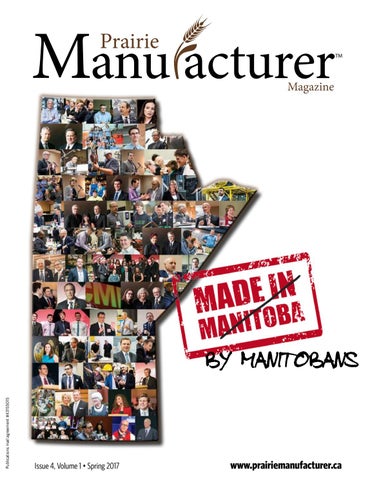
Made by Manitobans
22
$17.4 billion in annual sales. Close to 64,000 workers. Roughly 10 per cent of the provincial GDP. Prairie Manufacturer Magazine catches up with five influential leaders to get their take on what is driving Canada’s hottest manufacturing market.
Up in the clouds
34
Manitoba manufacturing has long been synonymous with global excellence in aerospace. But why? Business writer Joanne Paulson explores the history of the burgeoning sector and the people coming together to give it wings.
Our cheesiest article yet
42
From a local cooperative founded in the thralls of The Great Depression to Canada’s largest independent cheese manufacturer, Bothwell Cheese has seen its share of ups and downs. But one ingredient to success has never changed.
A colony of innovation
46
In-house chemists, an on-site laboratory, environmental entrepreneurs: This isn’t your average Hutterite colony. EcoPoxy Co-Founder and CEO Jack Maendel explains how a shift toward diversification is transforming an entire industry.
Selling your manufacturing business
54
As your manufacturing business matures, it is never too early to start thinking about what it is worth and how you plan to exit. Prepare against disappointment by knowing the factors impacting value and the options you have for smooth succession.
Next issue Spotlight: ‘Skilling up’ for success The upcoming Summer 2017 edition of Prairie Manufacturer Magazine examines the current and future skills landscape in manufacturing, and how demographics are changing the conversation. Special feature: Women in industry In this issue, each article showcases or is written by a female industry leader in Western Canada. Booking deadline: May 12, 2017 Material due: May 19, 2017
Editor Derek Lothian editor@prairiemanufacturer.ca 306.380.3765 Special thank you to our editorial advisory committee. Creative Director Dana Jensen Sales info@prairiemanufacturer.ca © Copyright 2017 Prairie Manufacturer MagazineTM All rights reserved. The contents of this publication may not be reproduced by any means, in whole or in part, without prior written consent of the publisher. Publications mail agreement #43155015 Return undeliverable Canadian addresses to: Prairie Manufacturer Magazine 207 Hugo St. North, Suite 3 Winnipeg, MB R3M 2N1 To change your address, or to be removed from the mail list, e-mail info@prairiemanufacturer.ca. While every effort has been made to ensure the accuracy of the information contained in and the reliability of the source, the publisher in no way guarantees nor warrants the information and is not responsible for errors, omissions or statements made by advertisers. Opinions and recommendations made by contributors or advertisers are not necessarily those of the publisher, its directors, officers or employees.
Proudly printed by Premier Printing Ltd. Printed in Canada | 2/2017
@prairiemfg
Manufacturing Management Practical experience and technical mastery are important but today's managers also need business acumen to establish competitive advantage in a rapidly changing global context. The Manufacturing Management certificate of completion (MMC) is designed exclusively to do just this.
“Technical knowledge is no longer sufficient to manage a business profitably. A successful manager must also have well rounded business acumen. The Athabasca University MMC is a perfect solution.” Jodi Lant Human Resources Manager Standard Machine
Qualifies for Canada Provincial Job Grant up to $10,000 per student
Online, no time spent away from work
Study with students from across Canada
4 week courses, study when and where it's convenient for you
8 courses — complete within 1 year › Quality Management › Safety Management › Leadership and Change
In partnership with:
› Cross Cultural Leadership › Financial Decision Making › Supply Chain Management
› Manufacturing Management › Project Management
FOR MORE INFORMATION: 1-800-561-4650 business.athabascau.ca/mmc
Editor’s Notebook
Turning up the volume on ‘Prairie proud’ By Derek Lothian
A
mentor of mine once told me the greatest strength a business leader can have is recognizing internal weakness — individually and organizationally. That requires discipline, authenticity, and a predisposition toward continuous improvement. Only then can one properly manage risk and pivot to new opportunities as they arise. It is an ability many of us struggle to master. No one enjoys vulnerability. But, often, it is when we are most exposed we experience the most radical growth. As a manufacturing community, we have spent generations cultivating our core strengths into a regional brand. We are trustworthy, we believe in relationships over transactions, we have high standards of quality, and we push the boundaries of product innovation. That is what we are known for in the international arena. Our shortcomings, on the other hand, are seldom identified with the same conviction. If honesty is the baseline, however, perhaps it is the right time to acknowledge what there has been seemingly closed-door consensus on for years: We have a marketing problem. Call it modesty, call it humility, call it whatever you want — it is holding us back. Unfortunately, the issue isn’t contained to just sales. It is also now jeopardizing our ability to compete for the best and brightest talent, to influence public policy, and to strengthen our local value chains. Now, before you e-mail me a 2,000-word opus extolling our ‘humble Prairie demeanour’ as the eternal spring of our success, hear me out:
6
Prairie Manufacturer Magazine • Spring 2017
I have spent the last decade of my life traveling the globe, both as a manufacturer and in a capacity directly supporting manufacturers, and I will contend that humility is not part of our Prairie brand at all. It is simply how we self-identify. No one has ever come up to me at a tradeshow in Germany or Argentina and claimed to have sought out our booth, or to have preferred doing business with us, because we keep to ourselves. It then begs the question: Why are we so hesitant to be our own loudest champions? Historically, granted, it may not have mattered — or at least as much. We’ve gotten to where we are by listening to customers and offering solutions no one else was, or could. But the global economy is changing. The pace of competition is running rampant, and even jurisdictional advantages we once leaned on are disappearing by the day. Market conditions are saying good riddance to the old adage that good is good enough. We need to be the best, and we need the confidence to say that we are — at home and abroad. This edition marks the first full year in operation for Prairie Manufacturer Magazine. Over these four, quarterly issues, our writing team and I have requested interviews with dozens of homegrown, world-class manufacturers. And we’ve been fortunate to feature several I have personally looked up to for years. It is not uncommon, though, for companies to decline the invitation — usually with a benevolent politeness, I should add — under the pretext they appreciate the offer, and read the publication religiously, but prefer to maintain a low profile. I’m not complaining. While I don’t consider myself a journalist per se, this is the career I’ve chosen, and rejection is a part of it — something several years as a shy, awkward teenager coincidentally have made me a quasi-expert in. I’m merely pointing out the culture we have built for ourselves. I’m not contesting our modesty is all downside, either. Far from. Truth be told, we showcase several companies in the proceeding pages — from Monarch Industries (Page 8) to Bothwell Cheese (Page 42) — where it is evidently embedded in their accomplishments. I am, instead, suggesting maybe it’s time we be a little less humble. The world is evolving, and if we want to lead it, we need to as well. Over the holiday break, I caught myself skimming through a 2015 report authored by the World Economic Forum, which collected the input of 800 industry experts; and, based on their feedback, predicted the likelihood of reaching certain technological ‘tipping points’ by the year 2025. Roughly four-fifths surveyed believe at least five per cent of consumer products will be 3D-printed, driverless cars will
represent 10 per cent of all traffic on U.S. roads, and the first implantable mobile phone will be available for purchase. Fortyfive per cent, meanwhile, said an artificially-intelligent machine will serve on a corporate board of directors. It triggered me to think of all the manufacturing facilities I’ve walked through across the Prairies, and how similar changes would impact those companies. And, at that moment, I was profoundly struck by how unprepared many of us are for the Industrial Revolution that is come, especially when measured up against manufacturers overseas. Only a few months ago, I toured a local plant — 100-plus employees, major exporter, renowned for product advancements — that had just installed its first robotic welding cell. What does that have to do with being humble, you ask? Everything. There is a convergence between technology integration and promotion in how we perceive ourselves — our weaknesses — and prepare to adapt. It is rooted in every facet of business practice. Just as we will not remain competitive if we fail to accelerate investments in enhancing our technological processes and sophistication, we will not remain, period, if we don’t start realizing, and communicating to others, how exceptional we actually are. If you don’t advertise why people should choose to work for you, don’t expect to attract A-class talent that can take your company to the next level.
“Just as we will not remain competitive if we fail to accelerate investments in enhancing our technological processes and sophistication, we will not remain, period, if we don’t start realizing, and communicating to others, how exceptional we actually are.”
If you don’t purposefully publicize in target markets why you should be the supplier of choice, don’t expect to keep finding new customers. And, if you don’t commit to voicing why manufacturing is important in your town, city, province, or country, don’t expect elected officials to intuitively understand what conditions and policies you need to prosper. I truly do believe the last one-hundred years on the Canadian Prairies have given us some of the greatest manufacturing success stories on the planet. We have some of the best products, the best businesses, and the best leaders anywhere — and I am proud to cover them in this magazine. There is no shame in doing well by doing good. Let’s tell the world what we have to offer.
Innovative Manufacturing Technology Diploma Starting Fall 2017
www.prairiemanufacturer.ca
7
View from the C-Suite
“It isn’t enough to do the same as we did yesterday. Throughout every facet of our organization, we work hard to continually improve, adapt, and respond to changing demands. Doing so effectively means staying in close touch with customers, employees, and regulatory agencies, and strategically evolving our business to stay ahead of the changes.”
8
Prairie Manufacturer Magazine • Spring 2017
Manufacturing the Monarch way By Roy Cook
W
hen I was first asked to contribute to this issue of Prairie Manufacturer Magazine, Ronda and Derek suggested that sharing some thoughts on how Monarch Industries has sustained and grown over its long history would be of interest to other manufacturers. I hope that proves to be true. Let me begin with some background. Monarch is a privately-owned Canadian company, with its head office and main manufacturing facility located in Winnipeg. Our foundry operation is headquartered an hour southwest, in Winkler; we also have a joint venture in China, as well as a distribution centre in Kansas City. We manufacture hydraulic cylinders and iron castings, primarily for original equipment manufacturers (OEMs), and the majority of our sales are within North America. Monarch was founded in 1935 by John Klassen, as a family-owned and -operated business, and remained under family control for roughly the first 55 years of its history. In the early 90s, the company transitioned over to investor and senior management ownership. I joined at the latter stages of this transition — a long time ago, in other words — and am therefore most familiar with our company’s ‘recent history.’ So, what are the key factors driving our longevity and — from my admittedly-biased point of view — Monarch’s ongoing success? There are hundreds of decisions and elements that could be pointed to as being influential, or even imperative, but for the sake of brevity, I will wrap them under two umbrella headings. The first is living and working your values. While I can’t comment on the actions and strategies of the first 55 years, there is no question the culture and product lines that were built over this period laid a strong foundation for future growth. Well-engineered products and a strong commitment to quality and customer service, all coupled with a quintessential ‘Canadian Prairie work ethic’ and approach to business, were then, and still are today, an invaluable legacy and enduring strength for our company. Many years ago, we set the following standing priorities for Monarch: Quality, service, and safety (and, more recently, environment). And we express and summarize our values
into the following, simple statement: We strive always to do what’s right and to do what we say we’ll do. We strongly believe that sustaining these strengths and core values is critical to our future; and we dedicate a great deal of attention and resources accordingly — not only on a day-to-day basis, but also as part of our longerterm planning efforts. It isn’t enough to do the same as we did yesterday. Throughout every facet of our organization, we work hard to continually improve, adapt, and respond to changing demands. Doing so effectively means staying in close touch with customers, employees, and regulatory agencies, and strategically evolving our business to stay ahead of the changes. I’m not suggesting these priorities or values fit for every person or every business. These are ours and they work for us. They guide our decisions and — perhaps most importantly — our actions on a daily basis. Our shared commitment to them is, frankly, what makes the difference. Staying true to ourselves is not always an easy task, but it is at the heart of our success. The second overarching theme is a compound of strategic planning and follow-through. Strategic planning has been and continues to be one of our cornerstone business management processes. Every 1218 months, we formally take a step back from our business and undertake an objective review of the overall economic environment, our markets, our competitive positioning, and our current strategic opportunities and challenges. Sustaining objectivity throughout this stage is particularly crucial, as it provides facts and balanced input for the subsequent steps. This review then feeds into a reassessment of current strategies and potential new strategic initiatives. At this stage, active engagement in the actual planning is essential to overcoming resistance to change and the emergence of innovative solutions. Informally, we take the same approach to opportunities and challenges that arise on a daily basis, pausing before proceeding to make sure we understand the full implications of the issue and to consider all possible solutions. For us, and I suspect for most businesses, the strategic planning process (whether the formal or the daily informal Continued on Page 10
www.prairiemanufacturer.ca
9
“For us, and I suspect for most businesses, the strategic planning process (whether the formal or the daily informal process) usually results in small modifications to responses or the overall longer-term plan. But, occasionally, it will lead to significant change.” process) usually results in small modifications to responses or the overall longer-term plan. But, occasionally it will lead to significant change. Some examples from our history would be: Our decision to shift the emphasis of our pump business toward the retail market channel in the late 1990s; the significant commitment of resources to expand our hydraulic cylinder product lines to include welded cylinders in the early 2000s; the sale of the pump product line in 2007 (which, at the time, represented almost a third of our business); the major investment in 2009 (in the trough of The Great Recession) in a multi-million-dollar paint line to address anticipated future customer standards; and, more recently, further significant investment in the development of larger bore, highly engineered welded cylinders and the formation of a joint venture cylinder manufacturing operation in China. Our team is what ties these two elements together and makes the magic. Monarch’s staff (then and now) is comprised of
10
Prairie Manufacturer Magazine • Spring 2017
talented, dedicated, and effective people, who ‘walk the talk’ when it comes to our values, execute our plans effectively, and ‘make a difference.’ I won’t say these changes were obvious or easy (they weren’t), or that success was guaranteed in each case (it wasn’t), and that the execution of these decisions didn’t take a lot of hard work by our people (it definitely did), but all of these major initiatives have paid off for us and we are a very different company today than we were 20 years ago because of them. Today, we are proud to be a major supplier of cylinders and castings to OEMs and to the industry leaders within our targeted markets. We are weathering the current cyclical downturn in the global agricultural equipment market, which is one of our major market segments, but are continuing to gain market share in all of our targeted markets. We also remain strongly committed to sustaining our core strengths and values, and to executing our longer-term strategic initiatives. Perseverance is another Canadian Prairie character trait that is a proud part of our heritage. Roy Cook is the president and chief executive officer of Monarch Industries. He has previously served as both the Manitoba and national chair of Canadian Manufacturers & Exporters.
2018CANADIAN
C O N F E R E N C E WINNIPEG | JUNE 4–7, 2018
REGISTER NOW TO ATTEND THE LARGEST LEAN EVENT IN CANADA
SAVE BIG 40% OFF
Photo credit: Michael Pratt
7 KEYNOTES INCLUDING:
UNTIL APRIL 28
36
BEST PRACTICE PRESENTATIONS 4 VALUE STREAMS
MIKE ROTHER
LEADERSHIP PEOPLE DAILY IMPROVEMENT RESULTS
BESTSELLING AUTHOR OF TOYOTA KATA AND LEARNING TO SEE
BILLY TAYLOR
THE GOODYEAR TIRE & RUBBER COMPANY
PAUL AKERS
PRESIDENT OF FASTCAP AND AUTHOR OF 2 SECOND LEAN
PLUS
EMBRACIN GE X CE LLE N C E.C A
18PLANT TOURS 15WORKSHOPS
Money & Markets
Making the most of government funding By Paul Boucher
T
he government funding landscape to support manufacturing companies in Canada is changing. A yearlong review of spending initiatives and tax provisions to support the industry has been completed. The government has sought public and expert input from across the country to assist with defining a new approach to sector support. Although the specifics are not yet known, it is clear that change is coming. In addition, funding initiatives will have a higher level of accountability with respect to the return on investment and value of the funding program to achieve stated objectives. Canada has developed a myriad of funding initiatives from a number of federal departments, resulting in a complex path for companies to access government funding. Sourcing out these programs is often difficult for manufacturers, let alone successfully submitting an application. But initiatives to improve this process have already been implemented. For instance, a ‘concierge’ program has been established to access government services, while the 2016 federal budget introduced a framework for a future ‘innovation agenda.’ And, it is anticipated that the upcoming 2017 budget will announce revisions, streamlining and consolidating funding programs, as well as rolling out new initiatives.
A competition for dollars The Scientific Research and Experimental Development (SR&ED) Investment Tax Credit is the largest single source of government support for industrial R&D. The program provides
12
incentives in the form of cash refunds and/or tax credits to Canadian businesses of all sizes, and in all sectors who conduct R&D in Canada. The SR&ED claim consists of a technical report and project financials that are filed as part of the corporate tax return. The benefits from the SR&ED program have been clawed back over the last number of years and this trend is expected to continue. The savings from a reduced SR&ED program have been channeled to new or expanded direct funding initiatives for various industries; however, these programs are a competition for funds rather than eligibility based on the Income Tax Act for all companies to access. Direct funding programs have a subjective eligibility threshold typically judged by an administrative panel. Each program is tied to achieving specific outcomes — job creation, skills upgrading, export market development, or greenhouse gas reductions, as examples. Participants must be proactive in their applications, as only expenditures incurred after receipt of application approval is eligible in most cases. This will force manufacturers to advance their planning processes and improve the development of comprehensive business cases to support funding applications. Although all submissions may meet the stated program eligibility requirements, only the best business cases will win!
SR&ED program trends The experiences on the Prairies mirror the trend from across Canada with respect to increased CRA review and program compliance. Specifically,
Prairie Manufacturer Magazine • Spring 2017
emphasis has been placed on the existence of documentation to support each phase of SR&ED eligibility: Technological uncertainty, hypothesis, scientific method, technological advancement, and portability for future technical applications. CRA has taken the administrative position, based on jurisprudence, that project eligibility is established when all five questions can be answered and proven through evidence-based internal systems and controls. Contemporaneous documentation created at the time the work is performed, rather than end-ofyear work summaries, are required. The burden is on the taxpayer to comply with all administrative review requirements of the program. Most companies struggle in this last aspect, as manufacturing operations are typically not geared to generate the level of detail required to support all aspects of the development process. Manufacturers have a tendency to document the conclusion of the experimental process well, but fail to document the details of the iterative developmental process taken to achieve that final outcome. The SR&ED program is geared towards rewarding the developmental journey taken rather than the final outcome, whether positive or negative. This is a fact that is difficult for manufacturers to understand, and creates the major gap between CRA reviewers and companies in assessing project eligibility. In addition to performing eligible SR&ED activities, manufacturers must also ensure their internal systems and controls generate information in support
“There are four ‘must-dos’ for every manufacturer: Plan in advance for funding support on a proactive basis; enhance internal systems and controls; fully understand funding program objectives and ensure submissions meet those objectives; and, seek professional assistance from an experienced service provider.”
of the project. This includes financial general ledger accounts, activity time tracking, test results, analysis, and actions taken related to product or process development.
Manufacturing must-dos There are four ‘must-dos’ for every manufacturer: Plan in advance for funding support on a proactive basis; enhance internal systems and controls; fully understand funding program objectives and ensure submissions meet
those objectives; and, seek professional assistance from an experienced service provider. Inevitably, with any change comes both confusion and opportunity. Practices that may have been acceptable in the past are now no longer adequate. Companies must raise their game for SR&ED submissions to meet the current increased level of review. New or enhanced funding programs and details of Canada’s ‘innovation agenda’ will provide companies with
new support opportunities. Successful companies will be those that have a solid business plan, and robust internal systems and controls that can provide the data required to participate in any governmentsupported funding program. Paul Boucher is a partner with BDO Canada LLP, and leads the organization’s Special Advisory Services Manufacturing Industry Team, focused primarily on maximizing opportunity under the SR&ED Investment Tax Credit program.
The bank of problem solvers For every business concern, there’s a BDC solution. As the only bank devoted exclusively to entrepreneurs, we tailor our financing solutions to fit your specific needs. We know how important it is to protect your cash flow, and how challenging it can be. And we can help you piece it all together. Call us at 1-888-INFO-BDC or go to bdc.ca BDCad_Problem_Solver_7x4.625_112816_EN.indd 1
2016-11-25 4:26 PM
www.prairiemanufacturer.ca
13
Lessons in Lean
An old lesson for
achieving new success By Scott Keddie
F
or many manufacturers, the pursuit of excellence is all about embracing the new — new technologies, new markets, new products, and new ways of doing businesses. Competition has become so fierce, the quest to capture an advantage no one else has can be a consuming endeavour, both personally and as an organization. But, as our parents and grandparents have always told us, new is not necessarily better. Take, for example, Training Within Industry, or TWI. TWI is a system of hands-on learning and practice that dates back to the
14
Second World War. With conscription pulling away thousands of skilled workers from the shop floor to join the battlefield, the United States government found itself needing to innovate. The fight required artillery, aircraft, and reliable equipment — and the Allied forces could not afford a drop in manufacturing productivity. A new supply of labour needed to be trained up, and fast. By 1940, the U.S. Department of War had rolled out TWI in factories across the nation as a means of shortening the onboarding process, standardizing work, and reducing defects. The basic premise
Prairie Manufacturer Magazine • Spring 2017
centered around simplified training that allowed employees to produce repeatable results. An increasing number of women brand new to the industry were soon able to rival the output of their male counterparts. ‘Rosie the Riveter’ became the real-life poster child of the movement and is still recognizable in pop culture today. Some experts credit the success of this program for being the factor that decided the outcome of the war; and, although I do not pretend to be a historian, I have seen first-hand how transformational TWI can be.
At Kitchen Craft Cabinetry (a division of MasterBrand Cabinets) in Winnipeg, TWI has been an ingrained part of our culture since 2012. We were at the height of unprecedented growth, swelling out the seams of a 575,000-square-foot plant and struggling to keep pace with our roughly 1,400 workers. There is nothing wrong with demand, but rapid expansion is usually accompanied by a rapid acceleration in problems. Don’t get me wrong: We were doing well, and were far from treading water. We had an active continuous improvement team, and our commitment
to lean methodology had us chugging along at break-neck speeds. Yet, there was opportunity we were missing — and it showed in our quality control metrics and staff engagement levels. So, like any entrepreneurial company, we experimented. TWI is essentially comprised of three core modules: Job Instruction (JI), which ‘trains the trainer’ to break down tasks into short bursts of information and walk through the application of the process step-by-step; Job Relations (JR), which focuses on nurturing a culture of shared respect and engagement between
management and frontline workers; and Job Methods (JM) — a means of effectively evaluating efficiencies and suggesting improvements. We started with a pilot of JI in an assembly area, where we had just added 20 employees in a second shift. In the past, it would require up to six weeks to get a new cell producing at its target rate. And it would usually be marred in inconsistency. Habits would form and issues would follow. TWI simply did not allow for those variations. To our surprise, by the end of the first week, we had the line running Continued on Page 16 www.prairiemanufacturer.ca
15
just as quick as the first shift, and with fewer defects. It was time to scale up. Fortunately, I had some exposure to TWI before I arrived at Kitchen Craft. That gave me the confidence to ‘give it a go’ in the first place. For several other managers, however, seeing the impact first-hand was the catalyst they needed to embrace the concept full-bore. Over the months that followed, we began to implement JI in each of our production lines, and eventually decided it was time to dive one tier deeper, into JR. Anyone who has worked in manufacturing knows the supervisor-employee relationship is paramount to profitability. It has a direct correlation to efficiency, quality, safety, attendance, turnover, and cost. High-performing manufacturers ooze positivity and motivation, effectively cooperate, and resolve conflicts at the source. That was where we wanted to get to. The first principle of JR is respect for individualism. Everyone is different — they have different beliefs, different
16
Prairie Manufacturer Magazine • Spring 2017
experiences, different skills, and different instincts. They need to treated as such. The second tenet of JR is prevention. If you can diffuse tension before it escalates, or mitigate it before it even rears its head, you avoid many of the landmines that degrade employee relations. Sounds like common sense, right? Absolutely, it is. Think about, though, how many times you’ve seen a supervisor or superior decide to act before having all the facts, or take action before weighing options. How many times have they then retreated into the chaos of the workweek without checking on the results of that action? All. The. Time. What TWI provides is the system for managing those issues with consistency. It also establishes the four overarching foundations for good employee relations: The first is to let each worker know how he or she is doing. Clearly articulate your expectations (allow your worker to do so in return) and suggest means of improvement.
“Fortunately, I had some exposure to TWI before I arrived at Kitchen Craft. That gave me the confidence to ‘give it a go’ in the first place. For several other managers, however, seeing the impact first-hand was the catalyst they needed to embrace the concept full-bore.”
Second, give credit where credit is due. Look for those who go the extra mile, and recognize that effort as soon as you see it. Third, tell people in advance of changes that will affect them. Tell them why if possible, let them know what they can expect, and ask them to embrace the situation. Finally, make sure to capitalize on each person’s unique ability. Search out untapped potential, and never stand in the way of personal initiative. Now, before you run out and enroll your entire leadership team in TWI training, have no illusions that TWI itself is not the be-all and end-all. It is a tool — one of several in your toolbox as a manufacturer and as an executive. And, like any
200-78 Innovation Drive Winnipeg, Manitoba Toll Free: 1.800.728.7933 www.itc.mb.ca
tool, it needs to be the right fit for the job. I would also suggest your operations have a high degree of competency in lean prior to jumping into TWI with both feet. That said, Kitchen Craft has found success with it. We can service customers from order to installation in 4-5 weeks, our employee morale is up, and our production flaws are down. There is always a need for vigilance and improvement. But when you can spend a little less time putting out fires, you have a little more time to capitalize on opportunity. Scott Keddie is the general manager of Kitchen Craft Cabinetry, a division of MasterBrand Cabinets, in Winnipeg.
3D Printing 3D Scanning Product Durability Testing Calibration Mechanical Testing Custom Data Acquisition Noise & Vibration Test Equipment Rental Modeling & Simulation Technical Information & Advice
www.prairiemanufacturer.ca
17
The Principal Resource
Developing strong leaders for stronger results By Ron Koslowsky
D
uring the rapid rise of the Canadian dollar against the U.S. greenback in 2003-04, I carried out a research project to answer the question of how manufacturers in Canada could overcome an at-par loonie through productivity improvement. I interviewed close to 100 business leaders in the sector and concluded the number one need to compete was improving leadership capacity, both at the top as well as cascading throughout organizations. Leadership starts with establishing core values, such as integrity or respect, that act as a foundation to all in the organization around how things are done. Leadership also requires vision to direct plans and actions in achieving the desired results. While values and vision are determined primarily by the top executive, leadership can and should be exercised by all those in the organization who are in a supervisory role and who lead on an informal basis. The fable of the traveller, wind, and sun has resonated with me since childhood. As the story goes, the sun and wind were debating one day which of the two were stronger, when they came upon a traveller walking down a winding road. To settle the dispute, they agreed that whoever could cause the traveller to remove his coat would be the more powerful. The wind blew as hard as it could until it could blow no more. But the stronger the gusts, the more closely the traveller bundled himself. The sun, instead, came out, shone brightly, and the traveller soon removed his coat, finding it was not needed. This fable shaped my own philosophy on leadership. The
most effective leaders today realize you accomplish more with people if you create a positive, engaging environment. Leaders understand the culture they create determines the outcomes — from productivity, quality, and safety, to staff turnover, and, ultimately, the bottom line.
Leadership best practices Over the course of my career, I have been fortunate to work alongside many exceptional leaders. And, in that time, several principles and strategies have emerged as common approach and best practice amongst those who lead most effectively. Here are the lessons that have stuck most prominently with me: Lead by example: Your actions speak louder than words, so set the tone in your area. Don’t ask people to do something you would not be prepared to do. Servant leadership: Support your team realizing they are the ones who add the value for the customer. As you delegate and empower people, your capacity to grow the organization increases. Develop your reports: Coach and mentor those who report to you. As you build other leaders, you free up your own time. Spend less time fighting fires and allow time to work on your business instead of in your business. Hire the best: Don’t be afraid to hire or promote talent even though it may mean someone could rise beyond you in the organization. Discouraging talent may leave you feeling ‘safe’ temporarily, but a weaker team eventually leads to weaker Continued on Page 20
18
Prairie Manufacturer Magazine • Spring 2017
“The most effective leaders today realize you accomplish more with people if you create a positive, engaging environment. Leaders understand the culture they create determines the outcomes — from productivity, quality, and safety, to staff turnover, and, ultimately, the bottom line.”
“FCC knows
how our industry works.” Melissa Vencatasamy, Co-owner, genAG Farm Equipment Retail
Let’s talk business Work with the leading lender to agriculture, agribusiness and agri-food in Canada. fccfinancing.ca
1-855-230-6821
www.prairiemanufacturer.ca
19
“Leaders create the environment, and the business success, by how they act or what they ignore. Remember, the number one reason good employees stay with a company or leave it is the quality of their leader.”
results. Attract the best talent to show you are to be trusted with more. Communicate and celebrate: Help your team know what is expected. Share information and appropriate tools, and raise everyone’s ability to accomplish goals. Recognize good behavior and results. Praise for good effort is incredibly motivating. Lead with questions: The natural tendency for leaders is to ‘solve the problem’ and provide answers to issues based on experience and knowledge. This approach may feel good in the moment, but will tend to bring other issues to your doorstep. Take the time to ask questions and let your team arrive at the solutions. Not only will you create stronger problem solvers, you will often arrive at even better solutions. Toyota leaders are very good at this development method. Their results have demonstrated the value of questions. Lead with lean: Leaders know that improving cost, quality, and on-time delivery is not optional today. When fully adopted, lean has served manufacturers well. The biggest barrier in achieving bottom-line success with lean is a leader who neither visibly supports nor personally engages in improvement efforts. Critique the process, not the person: There are seldom bad people — just bad processes. Focus on improving processes to allow people to drop their defences, open up, and create more effective workflow. Encourage doing — learn from mistakes: Where employees focus on avoiding mistakes of any kind, a ‘paralysis by analysis’ develops and progress stalls. Encourage incremental action even if mistakes will occur. Your team will be more productive and more responsive to the customer. Where mistakes happen, encourage people to share them and see them as an opportunity to further improve processes and initiatives. Model this approach yourself. Openly admit your mistakes, as this will empower your team. Focus on the customer: Place customer requirements and satisfaction at the heart of any process or initiative. Identify and help overcome internal silos. Unless employees understand the customer, they won’t intrinsically make the best decisions. Continue to learn: Manufacturing is changing every day. Lead by setting an example of continuous learning. Show you are willing to learn and support learning for
20
Prairie Manufacturer Magazine • Spring 2017
your team. Good employees stay with organizations where development is encouraged and they believe they have a better future. Develop a discipline of leadership for yourself, including a routine you follow every day. World-class organizations, large or small, understand the value of a standardized company-wide approach and system to leading people for best results. While serving as vice president of human resources at Palliser Furniture some years ago, I saw the positive results of a standard leadership training program. At CME, meanwhile, we have recognized this need and have developed our leadership training program for first- and second-level leaders within manufacturers to incorporate lean thinking and connect best practices to mentorship. In addition, our Training Within Industry (TWI) program provides standardized job instruction and relations. What about smaller companies that don’t have many formal leaders? Arguably, leadership is even more critical, as poor leaders can sink a company quickly. To address this, we have established executive councils for top leaders of small and mid-sized firms, facilitating regular meetings to allow executive leaders to deal confidentially with strategic issues and opportunities among trusted peers. It is like having an advisory board of directors without the hassle.
The bottom line Companies differentiate themselves from the rest through the talent of their people. How well that talent is utilized depends on leadership. The best leaders understand it is not just about getting things done. Equally as important, it is about the way things get done. Leaders create the environment, and the business success, by how they act or what they ignore. Remember, the number one reason good employees stay with a company or leave it is the quality of their leader. It pays to carefully choose and deliberately develop your leaders for the best results. Ron Koslowsky is the Manitoba-based vice president of Canadian Manufacturers & Exporters — Canada’s largest trade and industry association.
Proud to be a part of the legal landscape in Manitoba.
Gimli 33 Centre Street Gimli, MB p: 204.642.7955 tf: 1.800.235.9009
Riverton 56 Laura Avenue Riverton, MB p: 204.378.2281 tf: 1.800.235.9009
Steinbach Unit 2 - 330 PTH 12 North Steinbach, MB p: 204.988.0438 tf: 1.800.235.9009
St. Claude at MIG Insurance 46, 1st Street Saint Claude, MB p: 204.379.2548 c: 204.781.1539
St. Malo at Caisse St. Malo 92, Avenue de la Grotte Saint Malo, MB p: 204.347.5533 c: 204.781.1539
Notre Dame de Lourdes at Caisse ND de Lourdes 151, Notre Dame Avenue Notre Dame de Lourdes, MB p: 204.248.2332 c: 204.781.1539
9th Floor - 400 St. Mary Ave. Winnipeg, MB p: 204.949.1312 | tmlawyers.com
Winnipeg Beach 23 Stitt Street Winnipeg Beach, MB p: 204.389.2550 tf: 1.800.235.9009
“Anyone who has succeeded in Manitoba has a ‘secret sauce’ somewhere. They have a market speciality, they have found something there’s a market for, they have found a unique product they can produce in a unique way here, and that starts their journey. Once that journey begins, you look for anything to stay on top of that game. Some of it is industrial research and development, some of it is adopting new technologies, and some of it is investing in human capital. Lean is part of it all. You look for any advantage you can find and exploit the hell out of it.”
22
Prairie Manufacturer Magazine • Spring 2017
by Manitobans Five provincial leaders share their perspectives on what is driving Canada’s hottest manufacturing market By Will Stanley & Derek Lothian
M
anitoba and manufacturing: They go together like Churchill and polar bears. For the past century, the sector has been at the heart of Manitoba’s economic engine, from the early days of farm machinery and aeronautics to the latest progressions in advanced materials and value-added food production. Today, the industry generates $17.4 billion in annual sales, and comprises 10 per cent of the entire provincial workforce. Manufacturing companies, meanwhile, remit an estimated $3.2 billion in wages to employees each year. These are more than just numbers. They tell the story of a sector at the forefront of global competition, innovation, and technological change. But it didn’t get that way by accident. Much of the recent prosperity can be attributed to purposeful diversification — in product, and in customer. Since 2007, manufacturers in the Keystone Province have weathered dramatic swings in currency and commodity prices to expand at a steady
rate of 6.4 per cent, more than double the national pace. Unlike other Prairie jurisdictions, however, where roughly 70 per cent of total output stems from nondurable goods, Manitoba’s manufacturing base is anchored by a virtual even split between durable and non-durable goods production. Agricultural implements and transportation equipment alone account for nearly $4 billion in revenue. Export destinations are shifting, too. More than half of everything made in Manitoba eventually finds its way to outside markets — increasingly to Asian countries, such as China, Japan, and Hong Kong. Few can argue, though, the real difference-maker has been the people behind the products and processes. Decades of entrepreneurial will and old-fashioned hard work have carved out a unique niche for manufacturing in the regional landscape. To discover how this powerhouse culture has developed, and what the next 20 years have in-store, Prairie Manufacturer Magazine caught up with five of those
influential leaders for an in-depth dialogue on Manitoba’s roadmap to success.
Hon. Cliff Cullen Minister of Growth, Enterprise, and Trade, Government of Manitoba Meet the man in charge of growing Manitoba’s manufacturing economy. Although Hon. Cliff Cullen has yet to be on the job for a full year, the new Minister of Growth, Enterprise, and Trade has already earned a reputation as one of the province’s most vocal cheerleaders. It is a role he embraces on behalf of his fellow policymakers. “It’s our job as government to shine a light on the good things that are happening in our province,” says Cullen. “People don’t always recognize the substantial impact manufacturing has in Manitoba. It is about 10 per cent of our gross domestic product. We don’t always go out and sing our own praises, but hopefully you will be hearing more of that from our government moving forward.” Continued on Page 24 www.prairiemanufacturer.ca
23
by Manitobans As of late, the good news stories have been aplenty. Just this past January, French food processor Roquette unveiled plans for a new, $400 million pea protein manufacturing facility in Portage la Prairie, an hour west of Winnipeg — a project expected to create up to 150 full-time jobs once construction is completed. Forty other communities are said to have been in the running for the investment.
“We have a very low electricity rate in Manitoba, we have a quality and stable workforce, but what really closed the deal was the positive business environment,” says Cullen. “That’s the message we’ve been trying to deliver over the past nine months.” Trade has been high on the political agenda as well. Premier Brian Pallister swept into office on the promise of reducing barriers to the flow of goods and
services, which included joining Saskatchewan, Alberta, and British Columbia as signatories to the New West Partnership Trade Agreement, and taking an aggressive stance on the renegotiation of Canada’s internal trade pact. Next on the docket is cutting through unnecessary or duplicative regulation. “Formulating a red tape reduction strategy is another foundational thing
“We wouldn’t be as far along on our journey without CME Manitoba.” Lisa Ballentyne, All-Fab Building Components
2017-02 - PMM - SuccessStories (All-Fab).indd 1
24
Prairie Manufacturer Magazine • Spring 2017
2/8/2017 3:43:02 PM
we are taking on,” adds Cullen. “This is about instituting a framework for having a conversation with all Manitobans on how we go about it and remove barriers to allow businesses to thrive.”
Rick Duha Managing Director, The Duha Group There are a handful of Manitoba surnames as synonymous with manufacturing as Duha.
What started as a family-owned, home-based printing press in the 1940s, The Duha Group has evolved into a global pioneer in the production of colour marketing tools, with operations in nine countries on four continents. While a lot has changed in the past seven decades, third-generation owner and Managing Director Rick Duha credits a chance phone call 15 years ago with fundamentally altering the company’s ethos.
“We were in the very first lean consortium formed in Manitoba through Canadian Manufacturers & Exporters,” explains Duha. “And I remember vividly the call. At the time, I didn’t really know what lean was, but the gentleman on the other line said the government would pay our way for the first year, so that was ‘lean enough’ for me.” The rest, they say, is history. Within a couple years, the company Continued on Page 26
CME MANITOBA HELPS MANUFACTURERS GROW.
From the front-line to the C-suite, our manufacturing-focused programs will help you fully engage employees at all levels. Human Resource and Skills Development programs, events and services include:
» » » » » »
Leadership development program (including mentorship) HR toolkit, network groups and senior network Youth programs aimed at promoting manufacturing careers Regional and national labour market information Access advocacy and engagement with government and education to address HR concerns Made Safe training, programs and services
LEARN MORE AT DARETOCOMPETE.CA 2017-02 - PMM - SuccessStories (All-Fab).indd 2
2/8/2017 3:43:04 PM
www.prairiemanufacturer.ca
25
graduated its own lean-certified Master Black Belt and eventually spun that core expertise off into a separate operating division dedicated to lean training. Many other Manitoba manufacturers followed suit. Duha believes that earlystage adoption has fostered a distinct agility, allowing the province to stay ahead of its competition. “The other day I was in a local supermarket and I could see one of their departments was using our huddle boards,” he says. “We have never trained anyone at that supermarket before. So, what that means is the knowledge is migrating, and lean thinking is becoming part of the culture here more than perhaps it is elsewhere.” At Duha, lean permeates throughout every facet of the business, and is palpable in every decision made. In many respects, it charts the day-to-day action plan for how small, incremental innovations can be scaled up, marrying continuous improvement principles and workforce strengths to craft and apply breakthrough ideas. And, in an age where the propensity for embracing new concepts and technologies must be elastic, Duha contends the time is right to doubledown on lean methodology. “Anyone who has succeeded in Manitoba has a ‘secret sauce’ somewhere. They have a market speciality, they have found something there’s a market for, they have found a unique product they can produce in a unique way here, and that starts their journey. Once that journey begins, you look for anything to stay on top of that game. Some of it is industrial research
26
Prairie Manufacturer Magazine • Spring 2017
by Manitobans and development, some of it is adopting new technologies, and some of it is investing in human capital. Lean is part of it all. You look for any advantage you can find and exploit the hell out of it.”
Mariette Mulaire President & CEO, World Trade Centre Winnipeg Duha has a straightforward philosophy when it comes to international business development: “If we can get clients to visit, they’re clients for life.”
Granted, Winnipeg in February isn’t always the easiest sell. But that’s why Manitoba has advocates like Mariette Mulaire. Mulaire is the chief executive of World Trade Centre (WTC) Winnipeg — an independent export development organization belonging to a network of 330 trade facilitators in 90-plus countries. Similar to Duha, she prefers to “invite the world” to Manitoba, opposed to relying on costly outbound foreign trade missions. “Having the world come to us can’t
be understated as a strategy,” Mulaire maintains. “If they get on a plane and come here, we know they’re serious. It also removes a lot of the risk for businesses here; and either confirms they are exportready or shows them how unprepared they still are.” Every few years, the group hosts its marquis Centrallia event — a popular forum that brings together local and global players on home soil to explore business opportunities. Continued on Page 28
The World Trade Centre Winnipeg helps Manitoba businesses access global trade and investment opportunities through guidance, information and contacts.
> Trade information and market intelligence > Business matchmaking > Advisory services
Follow us:
> Trade missions > Trade education and training > Centrallia
204.253.4888 info@wtcwinnipeg.com wtcwinnipeg.com
219 Provencher Blvd, 3rd floor Winnipeg, Manitoba R2H 0G4
www.prairiemanufacturer.ca
27
by Manitobans Mulaire expects that initiative to continue to rise in prominence as Canada pursues new trade accords. The signing of the Comprehensive Economic and Trade Agreement, or CETA, with the European Union — coupled with lingering uncertainty south of the border — should, she says, renew interest in a deeper level of market diversification. But that doesn’t mean turning a blind eye to domestic opportunity. In fact, WTC Winnipeg is beginning to dedicate some of its focus to the Canadian north. “Places like Nunavut are full of untapped potential and unmet needs,” says Mulaire. “We’re working with communities and supporting brand new resource development projects there. That requires a lot of infrastructure, and there’s no reason we can’t supply the solutions.”
Mark Colley Chief Financial Officer, The Winning Combination The Winning Combination (TWC) could very well be Manitoba’s poster child for modern manufacturing. The sports nutrition and supplement producer has grown from approximately 60 to 110 employees in only two years, and will be honoured with the Emerging Award at the 2017 Canadian
Manufacturers & Exporters’ Gala Awards Dinner this March. For Mark Colley, TWC’s chief financial officer, the job has been a lesson in adaptation. In addition to finance, Colley also oversees functions related to IT and operations. It may seem like a daunting portfolio, but Colley insists having immediate visibility to all the moving parts has allowed the business to scale quickly. “One of the best things [CEO] Shazad [Bukhari] and I did was institute daily meetings to break down silos and provide clarity around what other areas of the business are doing,” exclaims Colley. “Especially if you’re undergoing a period of significant change, it’s important to have upper management involved in operational discussions to ensure everything is aligned with the leadership’s vision of where you’re heading.” Surviving that change is not without bumps in the road. Shortly after Colley assumed the position in December 2014, there were admitted growing pains. Sales and production capacity ebbed and flowed with minimal consistency, creating strains on order turnaround and customer expectations. He soon found some relief in material requirements planning (MRP) software. “Scaling up in our company was heavily reliant on putting in place a material replacement system,” Colley recalls. “Adding the MRP software to be able to do a lot of the forecasting and benchmarking for us, to a point where we can now look by month to see what we need per SKU, allows us to hold each department accountable in the decision-making process.” He argues, though, nothing can replace an initial top-down evaluation of corporate structure and function. “When I came here, much like a lot of small companies, there was a lot of people wearing a lot of different hats in a lot of different jobs,” says Colley. “So, right off the bat, we had to assess if we had the right people in the right positions. In some cases, that means moving staff to other areas of the business to allow their skills to flourish. “Technological tools can be effective, but they often run on a ‘garbage in, garbage out’ basis. You need to take the time to be certain you have synergy at the human resource level.”
CUSTOMS SOLUTIONS FOR GLOBAL TRADE
www.ghy.com
28
Prairie Manufacturer Magazine • Spring 2017
Mark Hoddenbagh Vice President, Strategic Development, Red River College In Winnipeg academic circles, Mark Hoddenbagh is the new kid on the block. The former executive lead for innovation and applied research at Ottawa’s CME MANITOBA HELPS Algonquin College took over as vice president of strategic development at MANUFACTURERS GROW. Red River College this past summer, culminating a near-30-year career that has now taken him to each of Canada’s three Prairie provinces. Register now for 12 months It was an opportunity Hoddenbagh couldn’t pass up. The college is of can’t-miss professional already a go-to destination for manufacturers engaging post-secondary development and networking institutions, partnering with roughly 60 local businesses and some of opportunities! Manitoba’s most identifiable companies — StandardAero, New Flyer Industries, and Manitoba Hydro, just to name a few. APRIL 27 The school is also home to the Centre for Aerospace Technology Annual General Meeting & Training, a state-of-the-art non-destructive testing facility, as well as JUNE 15 advanced robotics and additive manufacturing equipment. Manitoba Manufacturing Industry Golf Tournament Yet, Hoddenbagh isn’t satisfied with the status quo. “There are three areas where I think the college can strengthen linkages OCTOBER 26 with industry,” he says. “The first, of course, which we are already known for, Southern Manitoba Manufacturers’ Summit is talent development. The second area is business development — we’re just into that, becoming more active in connecting marketing students to NOVEMBER 2 Deputy Ministers’ Dinner small- and medium-sized companies in particular. And the third is product development. NOVEMBER 30 “Helping companies develop products, processes, and services at low Trade Summit 2017 cost using industry-hardened faculty and creative students pays off in a big MARCH 20, 2018 way in terms of economic development and job creation. Beyond the R&D, Dare to Compete 2018 expertise, and leading-edge equipment, the college is exploring options to MARCH 22, 2018 enhance its infrastructure so that it is a step up from the ‘makerspace.’ This CME Awards Gala would allow manufacturers to produce a prototype run of 100, 150, or 200, Celebration 2018 that they can then go out and test with their customers in higher volumes, JUNE 4-7, 2018 and probably higher qualities.” Embracing Excellence – 2018 Canadian LEAN Conference Ultimately, the goal is to power local innovation. That, says Hoddenbagh, is how Manitoba will continue its rise in prominence on the global stage. But maybe, he adds, it’s time to amend how we think of innovation Looking to enhance your LEAN altogether. and leadership capabilities? CME can help. See our suite of “I don’t know if we want to push Canada to the front of traditional events and upcoming courses at innovation,” questions Hoddenbagh. “What I mean by that is the measures DARETOCOMPETE.CA typically used are divorced from the things we do to stimulate and help true innovation. Sure, measures like IP are fine; but what I’d like to do is lead a ‘fifth metric,’ where we set the standard for transforming knowledge into Congratulations to commercialized products. That’s not necessarily going to be picked up on in 2/16/2017 3:11:43 PM innovation scales like the OECD (Organisation for Economic Co-operationSave the date_PMMad_Feb17.indd 1 and Development).” As for how Manitoba can stay ahead of the pack? Hoddenbagh has some Early booking winner for Dare to Compete advice for elected officials. Conference 2017. You have won two prime seating “Any government worth its salt will take a real, hard look at how colleges tickets for the Winnipeg Jets vs. Philadelphia Flyers can function as the commercialization pipeline for publicly-funded IP, such game on March 21. as IP held within universities,” concludes Hoddenbagh. “Currently, the
Juha Keinanen from Decor Cabinets!
economic outcomes are not commensurate with the public money we invest in research. “Colleges have the platform and connections to translate knowledge into tangible products, processes, and services. And Manitoba can be a leader in formalizing those partnerships and that value chain.”
Enjoy the game! Courtesy of
www.prairiemanufacturer.ca
29
2016 Economic Dashboard
30
Prairie Manufacturer Magazine • Spring 2017
2016 MANUFACTURING SALES Per cent change year-over-year, seasonally adjusted -4
-8 -7 -6 5
-8 -7 -6 5 -9
-9
-4
-10
Saskatchewan: +1.2%
National Average: +3.9%
-10
-9
9 10 7 8
-10
4 6
Manitoba: +1.2%
0 1 2 -2 -1 3
5
9 10 7 8
-10
-3
4 6
9 10 7 8
9 10 7 8
Alberta: -8.5%
0 1 2 -2 -1 3
5
6
6
-9
-3
4
5
5
-8 -7 -6 5
0 1 2 -2 -1 3
-4
-3
4
-8 -7 -6 5
0 1 2 -2 -1 3
-4
-3
2016 MANUFACTURING EMPLOYMENT Per cent change year-over-year, averaged, seasonally adjusted -4
-4
6
9 10 7 8
9 10 7 8
-20 -15 -10 -5
4 5
6
9 10 7 8
9 10 7 8
Saskatchewan: -1.5%
Manitoba: -1.9%
1 0 1 2 3 -2 -
-3
4 5
6
6
Alberta: -17.2%
0 1 2 -2 -1 3
-15 -10 -20 -5
-3
4 5
5
-20 -15 -10 -5
1 0 1 2 -2 3
-4
-3
4
-20 -15 -10 -5
1 0 1 2 -2 3
-4
-3
National Average: -0.9%
SHARE OF PROVINCIAL EMPLOYMENT Per cent, averaged (2016), seasonally adjusted 11
Saskatchewan: 4.5%
8 9 1 0 6 7
11
3
14 15 13
14 15 13
Manitoba: 10.4%
4
5
0 1 2
3
3
8 9 1 0 6 7
12
4
5
12
14 15
0 1 2
11
14 15 13
13
Alberta: 5.1%
8 9 1 0 6 7
12
4
5
0 1 2
11
0 1 2
6 7 8 9 10
3
5
12
4
National Average: 9.4%
TOP EXPORT DESTINATIONS Prairie region, manufactured goods, per cent share (2016)
1. United States (72.1%)
2. China (9.4%)
4. Mexico (2.6%) 3. Japan (4.0%)
www.prairiemanufacturer.ca
31
MANU
THANKYOU
TO OUR MANUFACTURING WEEK SPONSORS
™
GA ALA
WARDS
DINNER
CONGRATULATIONS TO THE 2017 RECIPIENTS
CME’s Gala Awards Dinner promotes Manitoba manufacturing excellence. Connect and celebrate with more than 500 industry influencers, job creators and thought leaders in one very special evening. March 23, RBC Convention Centre Winnipeg
DARETOCOMPETE
unCONFERENCE2017 THE LARGEST ANNUAL MANUFACTURING EVENT IN WESTERN CANADA!
*as of February 22, 2017
CELEBRATINGMANITOBA FACTURINGEXCELLENCE MANUFACTURING WEEK 2017 | MARCH 20-24
NEIL CARLSON
EMERIC V. DUHA IX
The Carlson Group
The Duha Group
Hall of Fame Award
Pioneer Award
Celebrating individuals who have consistently demonstrated visionary leadership and designed or implemented new or revolutionary products, systems or processes
Celebrating individuals who began a manufacturing business in Manitoba and nurtured it into a successful company
FRIESENS CORPORATION Export Award
THE WINNING COMBINATION Emerging Award
Celebrating a company that demonstrates excellence in expanding its market numerically and geographically
Celebrating new companies with significant future potential that are distinguishing their business through growth, impact and innovation
Manufacturing matters on the prairies and CME helps you stay at the top of your game. Dare to Compete brings together insightful keynotes, powerful professional development and opportunities to network with the best of the best in prairie manufacturing. March 21, RBC Convention Centre Winnipeg
PLUS,
special events targeting advanced manufacturing, the Discovery Youth in Manufacturing province-wide final competition and more!
CME MANITOBA HELPS MANUFACTURERS GROW. CONNECT WITH US TODAY! DARETOCOMPETE.CA
Up in the clouds How Manitoba took Canada’s aerospace industry to new heights By Joanne Paulson
34
Prairie Manufacturer Magazine • Spring 2017
W
hen the National Hockey League announced a franchise would be returning to Winnipeg for the 2011-12 season, there was little public debate around what the team should be called. Since 1972, they were, and in the minds of fans, would always be known as the Jets — an homage to the city’s historied roots in aviation. Many believe the Canadian Football League’s Winnipeg Blue Bombers garnered their name from the same source. But, in fact, it is widely attributed to a Winnipeg Tribune sports writer, who had referred to the moniker in 1935 after famed boxer Joe Louis had coined the nickname the ‘Brown Bomber.’ The mix-up is understandable. Aerospace is, after all, an intrinsic part of Manitoba’s DNA. Diving into the archives, it is not difficult to see why. The sector dates back more than a century, anchored in the romantic past of trading days at The Forks — the confluence of the Assiniboine and Red Rivers. Fast forward to today, the province is home to the third largest aerospace cluster in Canada, surpassing $1.9 billion in annual sales and housing some of the world’s most recognizable brands, from GE Aviation and Boeing to RollsRoyce and Pratt & Whitney.
It hasn’t evolved to its current state by chance, although geography and a pair of World Wars have played an undeniable role. It has required vision, generational leadership, and an unwavering belief that Manitoba has a natural affinity to soar.
Humble origins Two of the top aerospace pioneers didn’t just find their way to Winnipeg — it was where they first spread their wings. It began with Standard Machine Works (which is still in operation today) — the precursor to StandardAero, the largest independent small-turbine engine maintenance company on the planet. Like many Prairie businesses, StandardAero’s Senior Vice President of Technology, Kim Olson, points to the firm’s humble origins as the foundation for its success. “We really trace our lineage back to 1911, starting with a little farm machine shop,” says Olson, who notes the company now employs roughly 1,250 people in its Winnipeg facility alone. “In wartime, we got into aircraft engines, and we grew from there.” Continued on Page 36
www.prairiemanufacturer.ca
35
Shortly after Standard Machine Works embarked on its rise to prominence, in 1914, MacDonald Brothers Sheet Metal charged into the marketplace, manufacturing floats for bush planes. As the First World War began to take shape, the company pulled up stakes from its second floor factory in downtown Winnipeg, and moved into hangars on the outskirts of the city to allow for the outfitting of larger aircraft. Out of that transition, Magellan Aerospace was born. Other smaller companies followed. But it wasn’t until more than a decade later, long after the armistice was signed, the next major player entered the stage.
That man was James A. Richardson, the modern-day namesake of the Winnipeg International Airport. After taking over as president of his grandfather’s grain exporting empire, Richardson turned his sights to aviation, founding Western Canadian Airlines to serve the mining community of Red Lake Ontario, and then Manitoba’s northern mining assets. The company eventually merged into the fledgling Trans-Canada Air Lines in 1936. War soon returned. And Manitoba became an epicentre of the British Commonwealth Air Training Plan in 1939, which brought pilots from the United Kingdom over to the Canadian Prairies. Continued on Page 38
36
Prairie Manufacturer Magazine • Spring 2017
Enhanced performance through better design.
www.compositesinnovation.ca
www.prairiemanufacturer.ca
37
After the Allies declared victory, Manitoba’s aviation community began to transform yet again. In the 1960s, Winnipeg’s Bristol Aerospace unveiled the Black Brant sounding rocket, a multi-stage system used to carry payloads to high altitudes. Within a decade, the cluster had added significantly more space to the aero, and the arrival of Boeing in 1971 solidified an identity that has since been the envy of North America. “Boeing Canada Winnipeg has established itself as a reliable, innovative, and proficient supplier to Boeing,” says Terry Trupp, communications specialist with Boeing Canada. “Ever since winning important contracts to build parts for the 787 Dreamliner a decade ago, Boeing’s Winnipeg operation has increasingly been tapped to construct some of the company’s most complex composite parts assemblies.”
Fueling the dream History notwithstanding, industry clusters seldom thrive without intentional care. For the 40-plus companies in the province engaged in the sector, Manitoba Aerospace has served as that catalyst. The membership-based entity was once comprised of two organizations, the Manitoba Aerospace Association and the Manitoba Aerospace Human Resources Council. Now amalgamated, Manitoba Aerospace Inc. provides support across four key pillars: Workforce optimization, promotion, innovation, and supplier development. Sometimes, those priorities overlap. AAiM Day, for instance, held every year at Red River College’s Stevenson Campus, brings together approximately 700 grade six students for experiential, hands-on
“We usually have in the vicinity of 150 volunteers from across business and academia engaging youth in activities that are seamlessly aligned with science curriculum. It’s a significant investment of time; but if you don’t make that investment and have a system to attract young people into the industry, the industry won’t be able to sustain itself.”
38
Prairie Manufacturer Magazine • Spring 2017
“When you see someone on the side of the road in a blizzard, you stop to help — it’s a life or death situation. Aerospace here is no different. It’s supportive, collaborative, and collegial. There’s a can-do attitude to problem solving that’s a special thing to behold.” learning opportunities in the fields of aerospace and aviation. “You could probably call it orchestrated madness,” quips Wendell Wiebe, CEO of Manitoba Aerospace. “We usually have in the vicinity of 150 volunteers from across business and academia engaging youth in activities that are seamlessly aligned with science curriculum. “It’s a significant investment of time; but if you don’t make that investment and have a system to attract young people into the industry, the industry won’t be able to sustain itself.” Similarly, a healthy manufacturing and service cluster is dependent on a wellrounded, capable supply chain. It is a subject of personal significance to Wiebe, who came over from Magellan Aerospace in 2009 to, in part, strengthen this support. “That was one of the things that enticed me to [Manitoba Aerospace] — to work on the Competitive Edge program,” he recalls. “It focuses on 11 business processes, and assesses companies to evaluate how robust they are. Then, the participating companies get assistance from the ‘big three’ (StandardAero, Magellan Aerospace, and Boeing) to improve their performance to a place where they can realistically become suppliers.” In other industries, it may be odd to see competitors — regardless if they are direct competitors or merely competitors for resources and talent — working so closely together. Wiebe, however, believes it is part Prairie mentality, and part necessity. “When you see someone on the side of the road in a blizzard, you stop to help — it’s a life or death situation,” he says. “Aerospace here is no different. It’s supportive, collaborative, and collegial. There’s a can-do attitude to problem solving that’s a special thing to behold.”
What they do Unless you’ve spent time in Manitoba or have read through the volumes of literature recapping the progress of the sector, the ordinary Prairie manufacturer may not have a solid grasp on exactly
what aerospace companies do here. There’s Boeing, which operates Canada’s most expansive composite production centre. There’s Micropilot — a global trailblazer in the development of autopilot systems for unmanned aerial vehicles.
StandardAero, on the other hand, dismantles, inspects, and overhauls engines before they are reinstalled on aircrafts. Each engine type even has its own facility. “We’re in multiple buildings, each housing a different business unit; Continued on Page 40
Homegrown leadership achieves global success
CESD is proud to be part of the new Manitoba landscape providing training, knowledge transfer and consultancy to support your company’s rise. FLEXIBLE SOLUTIONS FOR YOUR BUSINESS: We understand Competitive Advantage and have worked with diverse clients to give them the practical tools they need to continuously improve and evolve to be contenders in the global marketplace. Our services can help make your evolution a structured journey with the focus you need to be successful. We believe in building sustained internal capability through focusing on a core list of functions: • Leadership • Operations • Human Resources Contact Us 1000 Waverley St Winnipeg, MB R3T 0P3 Canada
John Kliewer, CD, B.Sc, CHRM, CHRP Leader – Consulting P: 1-204-451-1375
www.cesdservices.ca
www.prairiemanufacturer.ca
39
Manitoba Aerospace
By the Numbers
$3 billion Dollar value of aerospace product exports over the past decade, including $400 million to emerging markets
5,300 Skilled workers employed in the sector, from advanced engineers to cold weather test specialists
6
Number of continents shipped to by Manitoba aerospace companies
95 Per cent increase of aerospace product and parts manufacturing in the past decade
40
Prairie Manufacturer Magazine • Spring 2017
“Sure, there are some small overlaps that exist. They’re not considerable, though. It keeps us out of the corners most of the time. Where we do compete, you bet, we’ll get our elbows and our sticks up — but we always do so in the nicest possible way.”
however, we view ourselves as one site,” explains Olson. “We’re quite diversified in this location. That allows us to use that specialization and leverage our skill sets on different products.” The company has expanded well beyond Winnipeg, to the U.S., Europe, Australia, and mid-east Asia. Down the road, meanwhile, Magellan remains an icon of the aerospace world, employing 700 people in its 800,000-square-foot Winnipeg facility. Paul Heide, general manager of Magellan Winnipeg, as well as chair of the board of Manitoba Aerospace, says the company concentrates on three distinct business lines. The first is the manufacture of defence and space solutions. “We produce several different rockets, and the main competency there is propellant and chemical production,” he details. “We build the CRV-7 and the Black Brant rockets. That business group also evolved through the 1970s and 1980s into manufacturing satellite busses — the brains of a satellite. The bus carries the experiment or instrument into space, keeps it positioned, and has solar panels on it to provide power.” The second is airframe structures. During World War II, the Avro Anson — a British twin-engine warplane — was produced out of the Winnipeg plant. More recently, the pre-eminent part has been the horizontal tail for the F-35 fighter. And, third, is a mix of engine components, and the maintenance and repair of engine sub-components — baring a degree of similarity to StandardAero. Heide adds there are several other enterprises in the province forging new ground in areas such as spacecraft design and integration, aircraft modification and certification, cold weather and environmental testing, as well as military and civilian pilot training. “Sure, there are some small overlaps that exist. They’re not considerable, though. It keeps us out of the corners most of the time,” he says, harkening a hockey analogy fitting for the Prairies. “Where we do compete, you bet, we’ll get our elbows and our sticks up — but we always do so in the nicest possible way.”
Red River College’s Technology Access Centre opens up a world of new opportunities for manufacturing enterprises, including: Applied Research — access to RRC facilities, technologies, resources, and expertise for your research projects Technical Services — including rapid prototypes, NDT, machining, 3D printing and CMM Knowledge Transfer — seminars, workshops, and special events around new emerging technologies and productivity Industry Training — in manufacturing, mechanical engineering, CNC, composites, robotics and automation, and more
Partner with us today at
rrc.ca/tac Winnipeg • Manitoba • Canada
Our cheesiest article yet
From a local cooperative founded in the thralls of The Great Depression to Canada’s largest independent cheese manufacturer By Pat Rediger
42
Prairie Manufacturer Magazine • Spring 2017
H
eralding back to the time of its earliest customers, Bothwell Cheese is still frequently visited by the milkman. Those shipments, however, no longer consist of a few glass bottles. The independent cheese manufacturer — located in New Bothwell, Manitoba, roughly 50 kilometres southeast of Winnipeg, near Steinbach — is the final destination for as much as 168,000 litres of the ‘white stuff’ per day, equivalent to 5-7 truckloads, seven days per week. And it’s not just any milk. The company uses only 100 per cent pure, locallysourced milk in every block of cheese it produces, free from hormones, antibiotics, preservatives, artificial colours, fillers, or additives. For Bothwell Cheese Vice President Mike Raftis, that commitment has been the not-sosecret strategy for success. “Our recipe has stayed the same — we’ve never wavered from using 100 per cent local milk since the beginning,” says Raftis, who notes that 98 per cent of the cheesemaker’s ingredients come from within a 100-kilometre radius. “Some companies use modified milk because [the alternative] is expensive. We could add these inputs to lower our costs, but we believe pure milk provides the highest quality product and directly supports the farmer.” This longstanding philosophy was inspired by the company’s founders. Bothwell Cheese began in 1936 as a cooperative of dairy farmers looking for a way to put their extra milk to good use. It was a small operation, with only a handful of employees, but provided a unique foundation for growth coming out of The Great Depression. Continued on Page 44
www.prairiemanufacturer.ca
43
“When you look at the co-op model, there were a lot of farmers with shared values and interests, who were passionate about the cheese-making process, and put a lot of hard work and dedication into their craft,” says Raftis. “The founders really established roots in the community, and cultivated a loyal following that continued with generations of families growing up with the product.” While there is no denying Bothwell Cheese is steeped in tradition, it has also demonstrated a remarkable ability to adapt to changing market conditions. One of the first major pivots was to invest in a milk pasteurizer — among the first plants in Canada to do so. This technology allowed cheesemakers to control how much cream, fat, and moisture enters each block of cheese. The company has turned to automation as well. To keep up with the pace of growth, portioning and packaging processes have been mechanized, helping to sustain a production line capable of churning out 15,000 kilograms of cheese daily — even more astounding
considering one kilogram of cheese requires approximately 10 litres of milk. High-capacity vats are used to produce 19-kilogram blocks of cheese, which are then packaged, refrigerated, and aged for up to a year. In total, Bothwell Cheese manufactures more than 25 varieties, including Jalapeno Monterey Jack, Habanero, Black Truffle, Horseradish Cheddar, Red Hot Chili Pepper Jack, and Madagascar Green Peppercorn. Red Wine Extra Old Cheddar, meanwhile, has exploded in popularity across Eastern Canada. In fact, these products can be found on store shelves throughout much of the country — a significant departure from the original cooperative model. Raftis credits this shift — and owners Kevin and Len Thomson — with the company’s recent expansion. “Under the co-op structure, in the later years, Bothwell Cheese just wasn’t financially sustainable,” he explains. “The new ownership has invested heavily in sales and marketing to ensure there is demand for our products. We virtually
We’ve been able to persevere in the market through product development and listening to our customers. By investing in advertising and social media presence, we’ve created materials that better tell our story. It has made a tremendous impact.”
44
Prairie Manufacturer Magazine • Spring 2017
didn’t have any personnel in that function four years ago.” The result, he adds, has been a surge from 60 employees to more than 100 in only 24 months. “We’ve been able to persevere in the market through product development and listening to our customers. By investing in advertising and social media presence, we’ve created materials that better tell our story. It has made a tremendous impact.” Other big plans are on the horizon. Beyond tightening its foothold on markets nationwide, in 2017, Bothwell Cheese will become the first Canadian manufacturer to offer cheese made from ‘Non-GMO Project Verified’ milk. It also plans to explore other product areas, such as butter, made possible by the acquisition of the province’s famed Notre Dame Creamery, built in 1921 in Notre Dame de Lourdes. For a company that celebrated its 80th anniversary last year, there are plenty of reasons to celebrate. Among them is sheer survival. Bothwell Cheese endures as one of the few remaining cheesemakers in Manitoba — an industry that was once comprised of more than 40 producers. According to co-owner Kevin Thomson, the next 80 years will require
adherence to the same proven recipe. Although strategies may change over time, values do not. “Bothwell Cheese has a long history
of introducing innovations in cheese to provide customers with greater choice,” he says. “This has allowed us to thrive in a very competitive market for 80 years.
“Individuals and families are telling us they would like to be given more choice, and we are proud to be able to offer this as an option.”
Risk is expensive Keep your business safe
Manufacturing
solutions all the way down the line.
and your costs down with Arthur J. Gallagher
• Dedicated manufacturing insurers • Customized business interruption evaluation • Thermographic image loss prevention • Health & Safety review • Over 100 years of manufacturing broker experience
Contact Us 204.925.8550 AJGcanada.com
www.prairiemanufacturer.ca
45
A colony of innovation In-house chemists, an on-site laboratory, environmental entrepreneurs: This isn’t your average Hutterite colony By Pat Rediger
46
Prairie Manufacturer Magazine • Spring 2017
“Egg shells usually end up in the landfills, because there are very few uses for them. We’re proud to have found a way to divert that waste stream. And, by 2018, we’re planning to use recycled chicken feathers to make up 40 per cent of the plastic content in our containers. We’ll have one chicken producing revenue from two waste streams. How cool is that?”
T
here are few Canadian manufacturers more iconic and synonymous with innovation than Bombardier. The company even has its own Museum of Ingenuity — reopened this past June after an 18-month, $14 million overhaul. Meandering through the sleek facility, located in Quebec’s Eastern Townships, it is hard to ignore the similarities between many of Bombardier’s flagship products, such as the Ski-Doo snowmobile, the Sea-Doo watercraft, and the tri-wheeled CanAm Spyder. But beyond the obvious comparisons in design and operational interface, one shared theme bubbles beneath the surface: These vehicles didn’t just revolutionize recreational transportation, they created entirely new markets.
Two-thousand kilometres west, near the town of Morris, Manitoba, the Oak Bluff Hutterite Colony has embraced that same approach. After more than six decades dedicated almost exclusively to agriculture, the colony has begun to reap the rewards of diversification and shifting trends in ‘green’ technology — finding new ways to capitalize on existing expertise. It required, however, some trial and error. Their first attempt was a company called iRecycle, which aimed to fill a niche in the distribution of recycled products. Unfortunately, the origin of the ‘niche’ quickly became apparent: There simply wasn’t any money in it. Continued on Page 48 www.prairiemanufacturer.ca
47
So, a handful of entrepreneurial colony members went back to the drawing board. They learned how recycled glass and epoxy could be combined to create terrazzo flooring, and struck out to find an environmentallyfriendly epoxy that could be paired with an ample supply of local glass. When this proved impossible, they decided to create their own, and EcoPoxy was born. “It became clear that it was going to come down to real chemistry,” recalls EcoPoxy Co-Founder and CEO Jack Maendel. “We got in touch with the folks at CME, or Canadian Manufacturers & Exporters, who helped connect us with potential chemists, and customers.” Within months, the young company hired three trained chemists and began construction on a new “state-of-the-art” laboratory.
48
Epoxy resins, first offered commercially in 1946, are used by many industries for protective coatings or in structural applications, from laminates and composites to tooling and casting. Traditionally, these epoxies have been petroleum-based, and there have been limited attempts to incorporate bio-based ingredients. Not so with EcoPoxy. “Anything that can be made from oil can be made from soybeans,” explains Maendel, whose product line of resins and coatings use up to 52 per cent bio-based material, including soybean oil, flax oil, and cashew nut oil, among others. “In a sense, we’re not competing with anyone. We’ve created a whole new market for products that didn’t exist before.” Maendel believes the primary ingredient to their success has been an
Prairie Manufacturer Magazine • Spring 2017
unwavering commitment to research and development. Through these investments, EcoPoxy has been able to introduce a budding offering of epoxies, coatings, resins, hardeners, and various pigments. Take, for example, their MultiPurpose Sealer, for use on wood, metal, fibreglass, and slightly damp surfaces. It contains no volatile organic compounds, is odorless, and is non-toxic. “Traditionally, epoxies are used in factories with lots of ventilation,” he says. “We, on the other hand, are able to create products that can be used in non-ventilated workspaces, homes, and studios.” Other solutions have also attracted considerable attention. The company has unveiled lightweight laminate systems for the manufacture of high-performance composite parts, as well as a specialized coating for use in water
tanks to protect against structural changes due to variations in air, ground, or water temperature. In recent years, EcoPoxy joined the Western Retail Lumber Association and has become a staple at its annual buying shows. At his first show with EcoPoxy, Maendel was hoping to enlist at least one retailer, and ended up landing 45, mainly Windsor Plywood outlets. The brand is now being distributed through more than 55 retail stores and has been sold to customers all over the world. Processes have evolved, too. In addition to growing EcoPoxy’s plant-based inputs, the colony is now leveraging its 8,000-head chicken venture to increase its role as a self-supplier. Currently, one-fifth of EcoPoxy’s coatings are formulated using ‘recycled’ egg shells.
“In a sense, we’re not competing with anyone. We’ve created a whole new market for products that didn’t exist before.”
“Egg shells usually end up in the landfills, because there are very few uses for them,” says Maendel. “We’re proud to have found a way to divert that waste stream. And, by 2018, we’re planning to use recycled chicken feathers to make up 40 per cent of the plastic content in our containers. “We’ll have one chicken producing revenue from two waste streams. How cool is that?” While the company remains relatively small, the demand for EcoPoxy’s innovations has sparked
new opportunities in places like Dubai, Australia, France, and the United Kingdom. Maendel, though, is careful not to make the same mistake as other young manufacturers by allowing ambition to outpace capacity. “It’s important to always look ahead. Yet, at this point, we’re not ready for that kind of expansion,” he says. “We don’t know what the future holds, but it’s clear that we’ve found a new enterprise for our colony, which will allow it to prosper into the future.”
Your image is in good hands.
premierprinting.ca www.prairiemanufacturer.ca
49
Fishing tips for manufacturing social media success By Derek Lothian
B
logger Brian Farrell once said that social media is a lot like fly-fishing: It’s deceptively complex. What looks like someone flailing around their arms and a fishing line is really a wellcoordinated effort to get a near-weightless fly in front of a hungry fish. Social media — particularly for manufacturers — is no different. It may seem overwhelming at first, or even pointless. But there is a method to the madness. First, you need to make the right decisions around where to cast your hook. Timing and placement is everything. And then you need the right equipment, the right fly, and the right skill before you can reel in your catch. It is an undeniable fact that more and more manufacturers are embracing social media. According to a recent report from the Content Marketing Institute, 85 per cent of manufacturers already use some form of social media to distribute business information. Of those, nine in 10 use LinkedIn, roughly eight in 10 use YouTube, Facebook, and Twitter, and two in 10 use Instragram. Few, however, are having a fish fry at the end of the day. There remains a notable lack of sophistication and understanding in how to get the most out of social media tools. For the second year in a row, manufacturers ranked YouTube the most effective platform (at only 66 per cent), followed by LinkedIn (54 per cent), Twitter (43 per cent), Slideshare (30 per cent), and Facebook (30 per cent). That’s not to say these channels are faulty or ineffective. An experienced fisherman can hand someone his junior all the right pieces of equipment, but without some guidance or practice, chances are the big, juicy trout will live to see another day. So, what can you do to improve your chances of success? Follow these five, simple rules:
1) Know the stream you’re fishing in Start with a ‘discovery session.’ Carefully articulate: Who is your target market? Demographically and geographically, who is your ideal customer? Who are your competitors? What are
50
Prairie Manufacturer Magazine • Spring 2017
you trying to communicate? How important is this to you, and what resources will you commit to seeing it through? All of these questions need answers. Never before have you been able to market so accurately to your target audience. You can now select with nearindividualization who is exposed to your messaging. Know what you’re fishing for, know what bait works best, and spend the money to get the tackle you require.
2) Be authentic Businesses don’t communicate — people communicate. There’s no magic to this one. You need to listen to what your customers are saying and truly interact with them. Social media is not a one-way foghorn. This can be a tough thing to do, especially in times of crisis or when you’re dealing with negative feedback. I’ve seen first-hand Canadian businesses in the midst of a crisis shut down their Facebook and Twitter accounts — which, people like me will tell you, is the absolute worst reaction you can have. It’s true: Some people are not always willing to listen. Those individuals, though, will stick out and disqualify themselves from having any influence whatsoever — so long as you speak to those who will listen with genuine care for their concerns, and a tone you would expect from a neighbour, not a corporation.
3) Ask for help The purpose of social media is to engage with your audience. But they generally won’t do this on their own — you have to ask. Manufacturers like John Deere and Hampton Creek frequently ask customers to submit photos, stories, and experiences using their products in an open and public forum for everyone to see. Often, this is paired with some sort of a contest to encourage responses. Your best brand ambassadors are your customers, so provide them every opportunity and motivation to become involved! And if you can identify key influencers in your network (in the case of
John Deere, a large farmer in southern Manitoba, for example), leverage those connections to create additional content that can be shared (blogs, videos, you name it!).
4) Be part of the community The age of the internet has made forming global communities of common interest easier than ever. There are tens of thousands of forums, pages, and groups dedicated to exactly what it is you do — whether that’s manufacture for the B2B market or directto-consumer. Be active in those communities. They’re no less important than being an active participant in the town or city in which you have bricks and mortar.
5) Hire an experienced fishing guide This isn’t gratuitous self-promotion — on the contrary, there are experts right here in Western Canada far more proficient in this field than I. It’s actually a suggestion to save you money in the long run. If you’ve never fished before, you probably aren’t going to become an expert without a little help. And if you enjoy eating fish, but perhaps don’t want to learn how to catch them on your
“Businesses don’t communicate — people communicate. There’s no magic to this one. You need to listen to what your customers are saying and truly interact with them. Social media is not a one-way foghorn.”
own, that’s perfectly fine, too. There are plenty of resources out there to lend a hand. Don’t get taken, however, hook, line, and sinker (terrible pun intended). Completely outsourcing your social media efforts can save you two-thirds (or more) the cost of a single full-time hire. It can also be an exercise in wasting tens of thousands of dollars if you don’t do your homework. When hiring social media agencies or specialists, start by looking at their own social media profiles. You wouldn’t hire a fishing guide that fishes only once or twice a year. Don’t hire a social media guide with insufficient activity or poor quality content. Derek Lothian is the editor of Prairie Manufacturer Magazine, and president of Lothian & Associates Management Group Inc. — an executive advisory firm specializing in organizational strategy, government relations, M&A, and communications.
Workplace flexibility
www.pegcityyoga.com
Benefits of bringing Yoga into the workplace: • • • • • In studio classes On site classes Team workshops Individual coaching/training
Increased productivity Decreased health care premiums Reduced staff turnover Reduced employee absenteeism De-stress and ability to handle stress improves • Higher job satisfaction amongst employee • Appealing to potential employees seeking employment with your company
Call (204) 339 2489 /(204) 573 2770 or email pegcityyoga@gmail.com
www.prairiemanufacturer.ca
51
Back to basics: Industry 4.0 and lessons from
B an a na r aMA
By Jayson Myers
“It ain’t what you do, it’s the way that you do it. It ain’t what you do, it’s the time that you do it. It ain’t what you do, it’s the place that you do it…”
Y
ou know the rest (sorry if you’re now humming it all day). It’s just one of those songs that are difficult to get out of your head. I like the Bananarama and Fun Boy Three version myself. But, the tune has been a hit since the 1930s. Maybe it’s good it sticks with you — it says a lot about how to succeed in manufacturing. It’s a lesson Prairie manufacturers should take to heart in a world of slowgrowth markets, fierce competition, and rapid technological change. Innovation has become the key to survival, competitiveness, and business growth. In every sector, companies are looking to new products and services, and to new markets, to boost revenues. And they’re turning to new technologies to improve efficiency, reliability, and flexibility; speed up design, development, and delivery times; and reduce costs. Of course, it’s not just a Prairie phenomenon, which means that competitive challenges may appear more pressing than ever. On every corner of the globe, manufacturers are experiencing a fourth Industrial Revolution resulting from the application of advanced, digitally-enabled technologies like mechatronics, the internet of things, cloud computing, artificial intelligence, robotics, connected automation systems, virtual reality, additive manufacturing, advanced materials, and innovative processing and machining systems. While the first Industrial Revolution was driven by mechanization, as well as water and steam power, the second
52
by electricity and mass production, and the third by computers and automation, Industry 4.0 (I-4 as some now call it) is distinguished by the integration of cyberphysical systems — the application of high-powered information and communication technologies in smart and connected products and processes. The impact of the revolution is widespread. In manufacturing, digitization is disrupting both production and business systems. Products are now being designed, tested, and engineered for manufacturing using three-dimensional software. 3D printing is enabling rapid prototyping and the manufacturing of highly complex parts at lower costs. Products are being made more frequently by smart machines in fully automated factories, allowing for greater customization, flexibility, and production efficiency. Software and data analytics are being more widely used to optimize manufacturing operations, value chain collaboration, and other business processes. And, interconnectivity is driving greater horizontal integration not only along the value chain from customers to manufacturers to their suppliers, but throughout the entire lifecycle of products as well. The business of manufacturing is also changing as a result of new technological capabilities. Product development cycles are becoming compressed, forcing more manufacturers to prefer partnerships or acquisitions over in-house research and development to acquire critical technologies. Supply chains are being
Prairie Manufacturer Magazine • Spring 2017
reconfigured more frequently. More value is being generated through technological knowledge, software algorithms, and data analysis than through easily replicable production processes. Local, flexible automation facilities are replacing long-distance supply chains. Digitization is allowing manufacturers to cut costs, improve quality, and make better and quicker decisions. It is allowing them to develop more innovative products and offer new services for their customers. As products and processes become information platforms, new revenue opportunities are being generated through the analysis and application of that data, to provide solutions for customers that go well beyond the provision of products themselves. Sounds neat. So how do you make money? Technology trends, even if they are widespread, are not business strategies. For that, it’s important to go back to basics — and to understand the full range of risks and opportunities involved in adopting advanced technologies. For any business, it starts with offering customers a solution they are prepared to buy, because it’s the best that can be reliably provided to do the job at a competitive price, and it’s easy to manage. Advanced technologies can play a role — often an essential one. But they won’t make sense unless manufacturers themselves can manage how they are developed, adapted, and applied in their production and business processes. That
requires a comprehensive understanding of the business requirements for implementation for manufacturers and for their customers. What’s the best technology solution to do the job? It’s not only a matter of price — or of technical requirements alone. It’s about the business processes — the information systems, operating architecture, revenue model, innovation partnerships, supplier relationships, skills, data security systems, regulatory compliance, and financing requirements — needed to implement, manage, and maintain integrated technology solutions. A little I-4 lean thinking can go a long way. Focus on what customers value. Make smart technology investment decisions to optimize products and processes by focusing on eliminating non-value-adding activities for customers. Understand and take steps to mitigate the risks of managing the technologies best suited for the job. It’s first and foremost about implementing a business model that makes money on a sustainable basis.
“Joining the Industry 4.0 revolution is no guarantee on its own of business success. I see too many manufacturers lose money because they leap into a technology they don’t necessarily need, or they don’t know how to manage, to drive improved business results.”
Joining the Industry 4.0 revolution is no guarantee on its own of business success. I see too many manufacturers lose money because they leap into a technology they don’t necessarily need, or they don’t know how to manage, to drive improved business results. I see too many governments investing billions of dollars in schemes aimed at pushing technologies into the marketplace with little appreciation of how they would need to be applied or scaled up for commercialization. I also see many Prairie manufacturers successfully competing and growing in North America and other markets around the world. They are doing something right. Whether they specialize in food or agricultural equipment, high-tech components or high-volume metal production, metal products, aerospace, specialized vehicles, or oil and gas field
equipment, they are producing innovative products and services their customers want to buy. They are increasingly adopting the advanced technologies that drive Industry 4.0 to enhance products or improve productivity. But, they know that successful deployment of those technologies involves managing people, processes, customers, suppliers, and investors. The technology is the easy part. Listen to Bananarama: “It ain’t what you do, it’s the way that you do it. And that’s what gets results.” Jayson Myers is an award-winning business economist, specializing in industrial and technological change. He is an advisor to both private and public sector leaders, and has counselled Canadian prime ministers and premiers, as well as senior corporate executives and policymakers around the world.
Industry Driven. Student Focused. MITT is expanding its offerings in continuing education in the fields of skilled trades, information technology, healthcare and human services. Coming Soon: Cisco Levels 1-4
Facilitating With Purpose
Become a Networking Mastermind
Unlock Your Inner Communicator
Power Engineering Class 1 and 2 Exam Preparation
Voice Data Video ‘M’ License Exam Preparation
Move Up a Class and Switch on Your Career
You’re already a Pro, the ‘M’ Just Proves It
Adobe Creative Cloud | MS Office 2016 | Auto CAD | Cisco Networking
Trades Exploration
Get a Bigger Piece of the Digital Pie
Explore Construction and Find Your Passion
…and more to come!
WE BUILD SUCCESS. 204.989.6500 For more info: info@mitt.ca mitt.ca/continuing-education
www.prairiemanufacturer.ca
53
Reality check: Selling your manufacturing business By Steven Beal
A
s your manufacturing business matures, it is never too early to start thinking about what it’s worth and how you plan to exit. Even as you are trying to grow and manage dayto-day operational decisions, it is useful to know what key variables will impact value, and what you can to do increase the value when you decide to sell. To start, it’s helpful to understand how a business is valued. It is generally determined by two key factors: Cash flow and the multiple. The cash flow of your business is measured by the profit, plus or minus a number of ‘normalizing adjustments.’ Typical adjustments include owner’s compensation, depreciation, and other expenses that have a highly variable or somewhat discretionary element. The multiple is even more important. Of course, if you can double your bottom
54
line, the value of your business increases — so the obvious advice is to focus on sales and profits. But there are other key value drivers that influence the multiple, regardless of the size of your business: Successor: Don’t just wait for buyers to come to you. Invest in the legwork to identify, qualify, and prepare potential successors. This may include redefining roles and responsibilities, training, monitoring, and implementing dispute resolution mechanisms. Determine ‘optimal buyers’ and their motivations. The strategic acquisition of specialized equipment or intellectual property, for instance, may be of higher value to some buyers than others. Consider your marketing strategy as you approach them. Management: Do you effectively delegate? Do you have quality ‘bench strength?’ Can you personally take a
Prairie Manufacturer Magazine • Spring 2017
two-month holiday without any adverse effects on the business? If the answer to any of those three questions is no, the value of the business is locked up in you, and it will be hard to sell or transition your business at all. Finance: A common mistake that erodes value is when the owner clouds the bottom line with ‘personal’ expenses. Your business is valued based on a multiple of sustainable income. You need to prove your business makes a good profit and can thrive without you. If you are funneling your personal expenses through your business (nudge, nudge), consider this: Doing so saves you perhaps 12 per cent tax. That means paying for $8 in personal expense saves you one dollar in tax, but — assuming a conservative multiplier of three-times your bottom line — could cost you $24 when you sell.
Revenue mix: Do you have a customer that disproportionally accounts for a large portion of your sales? Buyers prefer a diversified customer base. Unless you have a contract in place with your ‘big fish,’ the value of your business may decrease. Personal guarantees and long-term track records aren’t enough. What you make and how you make it: Companies that manufacture a unique product, or that employ a unique process, are more appealing than ‘job shops’ where there is greater competition. Pay attention to where your sales fall along the product lifecycle as well. If you are overly reliant on sales from ‘dated’ technology, your primary business is exposed to elevated risk and consequently lesser value.
“Succession planning isn’t always a fun exercise — especially if you’ve built the business from scratch. Actually parting with your business can be even harder. Many owners start with an inflated idea of what their business is truly worth, and can be left feeling dejected.”
keep the ‘spirit’ of the organization completely intact. Finally, start thinking broader. Understand the full range of succession planning issues — on the business side, as well as the transaction side. While the transaction pieces are critical, the
longer-term business issues are where you will really make the difference in the success of the transition. Steven Beal is a charted business valuator, and is the principal of Winnipeg-based Beal Business Brokers & Advisors.
Tips for transition Succession planning isn’t always a fun exercise — especially if you’ve built the business from scratch. Actually parting with your company can be even harder. Many owners start with an inflated idea of what their business is truly worth, and can be left feeling dejected. There are a few things you can do, though, to make the experience less stressful: Plan early — 10 years out isn’t too long. Many adjustments to managerial and financial aspects of your business will take time to put in place, but certain tax savings strategies may take even longer. You can save significant dollars if you plan ahead at least two years before you sell. Review the legal structure of your company and its ownership. Try to ensure the corporation is ‘clean,’ ready to sell, and positioned to maximize the ability to sell shares and utilize your personal capital gains exemptions. Be prepared to leave a small amount of money in the company as it transitions. Some buyers see this as reassurance they will have your cooperation as the new ownership takes the reigns. Consider alternative sales options. Employee ownership is becoming a popular vehicle that may allow you to
YOUR INDUSTRY, YOUR COMMUNITY, YOUR MAGAZINE Currently seeking for 2017-18 Partners – Advertisers – Contributors SUMMER 2017 Distribution Mid-June Spotlight: ‘Skilling Up’ for Success Special feature: Women in Industry FALL 2017 Distribution Mid-September Spotlight: Exporting Excellence Regional feature: Best in Sask WINTER 2017 Distribution Mid-December Spotlight: Resources & Supply Chain Regional feature: All About Alberta SPRING 2018 Distribution Mid-March Spotlight: The Innovation Equation Regional feature: Made in Manitoba
For more information, please contact info@prairiemanufacturer.ca or call 1-877-880-3392 www.prairiemanufacturer.ca
Prairie Manufacturer Magazine would like to sincerely thank all our current partners, advertisers, and contributors. We encourage our readership to engage and support these companies and organizations.
www.prairiemanufacturer.ca
55
The ‘eyes’ have it! Stop trivializing visual management — the returns are too large to ignore By Dave Hogg
T
he winter issue of Prairie Manufacturer Magazine confirmed 5S for what it is: Workplace organization, where everything is in a known place when not in use. While it is a straightforward concept, the success of its application depends upon management’s leadership and daily discipline. The illustration on this page shows a simplified movement of elements that gradually propel lean practitioners from basic 5S toward true world-class performance — a journey reliant on a visual workplace to drive improvements in safety, productivity, waste reduction, and competitiveness. Don’t take it from me. Remember, Toyota Way author Jeffrey Liker cites that very necessity as his seventh principle of management: “Use visual controls,” he writes, “so no problems are hidden.” Every step of the manufacturing process depends on visual management to ensure optimized flow. Perhaps the leading authority on the matter, Dr. Gwendolyn Galsworth, defines a visual workplace as “A self-ordering, self-explaining, self-regulating, and selfimproving work environment, where what is supposed to happen does happen, on time, every time, day or night, because of visual solutions.” Seeing is believing. Even multinationals like 3M have recognized the importance of sight in our cognitive absorption, citing that “83 per cent of what we know today has come through our eyes.” Recall situations in your own life where spoken words have been taken out of context or misinterpreted, resulting in mistakes, arguments, or offence to another individual. Using visuals or models to share ideas is a more universal form of communication.
56
Visual Management – Real-Time
Visual Factory Plan
Continuous Improvement Act
Do
Standard Work Study
5S – Workplace Organization
Process Thinking Everywhere
World-Class Productivity, Manufacturing Velocity & Competitiveness Unfortunately, in industry, this is still not fully understood. Making one’s workplace more ‘visual’ demands serious thought. It is far too easy to dismiss visual improvements as ‘elementary,’ but that is often exactly the intended effect. People are routinely distracted by ‘shiny objects,’ while ignoring simple visual cues that would yield greater value. Leaders who get it bear zero tolerance for anyone who demeans 5S or visual management as ‘just housekeeping.’ It is far more than that.
Prairie Manufacturer Magazine • Spring 2017
Getting real Visual management has the power to deliver more ‘money in the bank’ than many other factory improvements. That impact is multiplied when paired with top-down leadership and support, employee involvement, routine ‘quick eye’ assessments, and visual thinking. So, how do companies tap into this potential? Somewhat ironically, many won’t take it seriously until they see it for themselves. In the words of Robertson Davies, “The eye sees
only what the mind is prepared to comprehend.” It will require honest self-criticism, careful planning, and coaching. On the Prairies, however, there are already great opportunities for manufacturers to see the practice in action. One of the best examples is the New Flyer bus plant in Winnipeg, where visual innovation and visual management rule the day. There, they have ‘extracted’ the visual strategies used in dentists’ offices to guide their own decisions around layout design and communication, and to train employees on the real-world value of 5S and visual aids.
Start at the beginning (a very good place to start) Visual controls can come in an almost infinite number of forms, from electronic display boards and start-stop lights to uniquely coloured clothing for different cells or production teams. If you’re starting from scratch, there are plenty of resources out there to help steer you along the early stages
“One of the best examples is the New Flyer bus plant in Winnipeg, where visual innovation and visual management rule the day. There, they have ‘extracted’ the visual strategies used in dentists’ offices to inform their own decisions and train employees on the real-world value of 5S and visual aids.”
of implementation. Dr. Galsworth has written seven well-illustrated books — all of which are available at online retailers such as Amazon — and has published extensive research and ‘how to’ guides. Over her career, she has found that visual management can generate a 45-65 per cent reduction in space, equipment changeover, classroom training time, and annual inventory time, as well as a 65-90 per cent improvement in flow distance, rack storage, and non-conformances in assembly. The training efficiencies are especially noteworthy, and are seldom considered. By harnessing the ‘visualization’ of processes, the training required to execute said processes is simpler, more clearly understood, and less error-prone. Once you have a general
understanding of the theory, start percolating ideas and forging a common understanding by walking through your horizontal value stream with your leadership team and most innovative thinkers. As the benefits become visible, so, too, will the fear of what your competitors might achieve by putting visual management to work before you. Interest in this topic is accelerating at conferences and in trade publications as folks consider the risks and opportunities that lie ahead. This may just be the right time for a new way of seeing. Dave Hogg is one of Canada’s premier thought leaders on lean manufacturing, and previously served as long-time editor of the distinguished Accelerate the Journey newsletter.
If you are an open shop contractor and looking for benefits, why not join us? The Merit Contractors Association of Manitoba advocates for the unique interests of Manitoba’ s open shop contractors. Our 270+ members enjoy many benefits and services including: n n n n
Employee benefits plans Training and education Career promotion Advocacy
We are open minded, open shop and open for business. If you are an open shop contractor, contact us to discuss the benefits of membership.
Give us a call today at 204 888-6202 or visit www.meritmb.com
www.prairiemanufacturer.ca
57
Protecting your brand with trademarks By Nicole Merrick
W
e have all felt in recent days the uncertainty triggered by U.S. discussions of policy changes on international trade. At the moment, it is unknown what effect these changes may have on the Canadian manufacturing industry, both at home and abroad. Where old trade paths need to be reconsidered and new trade relationships forged, it makes good business sense to consider your brand and how it represents your business. Branding is a key characteristic of a successful business. Not only should manufacturers consider their business and corporate names, but also their trademarks in the form of wordmarks, designs, slogans, and product packaging, for example, as these marks stand for or symbolize your products, product lines, and your services in the marketplace. Often, the question I get from clients is, "Where do I begin?" My first response is to advise that a client take stock of what it has. What marks or brand names are you using at present? What marks or brand names have you used in the past? How does what you have reconcile with your vision for your business over the next number of years? What steps have you taken to protect your brand thus far? The goal of a good trademark lawyer is to help you protect your brand — your vision for your business, products,
and services. While it is possible at law to rely on common-law rights to protect your trademark interests, there is significant risk to leaving trademark rights unregistered. Common-law rights exist only where they can be proven, and are limited even then to a specific jurisdiction where reputation has been definitively shown to exist. While it may sound simple (you know you have a great product, and you know people recognize your brand in your home city, for instance), proving your rights in court is a very challenging and costly endeavour. Relying on common-law rights also has limited utility. Given that the scope of protection for common-law rights is limited to the jurisdiction in which you have established that reputation, this would not necessarily prohibit someone else from adopting the same or similar mark in another city or province outside of that territory. Canadian registration of your trademark rights, by contrast, provides national protection. If you file, and if your trademark application is granted, then protection exists across Canada. Registration of your trademark may also block the registration of confusing business or corporate names depending on provincial registry systems. Trademark registrations are renewable and last for a period of 15 years.
“Branding is a key characteristic of a successful business. Not only should manufacturers consider their business and corporate names, but also their trademarks in the form of wordmarks, designs, slogans, and product packaging, for example, as these marks stand for or symbolize your products, product lines, and your services in the marketplace.”
58
Prairie Manufacturer Magazine • Spring 2017
Applications can be filed in other countries as well, depending on where you use or intend to use or protect your trademarks. Each country typically has its own registration system, though there are a limited number of registrations that cover multiple jurisdictions, such as a Community Trademark filing in the European Union. Your business plan — and your budget — should take into account registration and protection costs to best define and protect your business. Developing a trademark portfolio gives a business assets that it can potentially license and sell to others, or which can form a valuable asset when obtaining financing. Trademark registrations are also much easier to enforce than relying on common-law rights, legally speaking. While registration adds some cost to your bottom line, the protection granted can save both significant expenses long-term and add valuable assets to the overall value of your business. In short, registration makes good business sense and is a tool in the business owner's toolkit to both grow and protect your business in the days ahead. Nicole Merrick is a partner and trademark agent with Taylor McCaffrey LLP — one of Manitoba’s largest law firms.
Turn barriers into hurdles
A organization’s ability to innovate is it’s strongest competitive advantage. We can help you leap over hurdles, be more productive, innovative, and competitive. 4Lean Six Sigma training 4Plant Layout & Optimization
4Process improvement 4Site Assessments
4Value Stream Mapping 4Project Coaching
START NOW | goproductivity.ca | 1.844.245.8278
5
Questions
about
executive fitness With Noah Krol, owner and operator of Peg City Yoga and the Sivatantra Yoga Teacher Training program in Winnipeg
Why is it important for executives to integrate exercise into their daily routines?
How do you know what type of exercise is right for you?
No matter what you do, your body needs to exercise, period. Exercise helps to sustain, nourish and increase your body and mind’s capacity to function at a higher, more efficient intensity. In the workplace, and in life more generally, we are often faced with a multitude of stressors, which have the opposite effect on the body. Regular exercise helps to balance the negative impact of distress — the unhealthy stress — by imposing a eustress, which is regarded as a healthy type of stress, because it stimulates you in ways that are necessary for growth and development, mentally and physically.
Assess your weaknesses within your levels of flexibility, strength, and endurance, and then prioritize your fitness plan with a higher volume of training dedicated to improving upon your weakest areas. You can do this yourself, or — better yet — seek direction from a personal trainer. From there, ask yourself what activities you will enjoy doing. If you know running is hard on your knees or hips, but you perceive your ‘weakness’ to be cardio and endurance, try swimming, an elliptical machine, or a spin bike — facilities and equipment that are reasonably available near or at every home, workplace, and hotel. Add in some variety, though, to keep it challenging and interesting in a way that keeps you coming back. It doesn’t need to be a chore for you to work out. It can be fun, too. There will, however, be certain variances in your fitness and nutritional regimens depending on your goals. For example, if you want to lose weight, you need to burn more calories than you consume. If you want to build muscle and add mass, you will likely need to eat more calories than you burn. And if you simply want to improve your overall health, you will need a plan that incorporates elements from both outcome strategies. Even 20-30 minutes can make a life-changing difference.
What should be considered regular? There is no blanket answer to that one, because it depends on factors that vary from person to person — the desired results, current activity levels, and schedule. I would suggest that more important than frequency itself is consistency. Whether it’s three days per week or five days per week, structured exercise regimes will far better serve you than setting unrealistic or unsustainable expectations. One of the advantages, particularly for busy and traveling executives, is that exercise now comes in so many various forms, it can be tailored to fit into literally anybody’s lifestyle. Specific equipment isn’t required, nor is a gym necessarily. You can even exercise in the comfort of your hotel room! There is no good excuse for not taking care of yourself anymore.
What are some of the more popular trends in fitness? Yoga for both genders and all ages, as well as Cross Fit, have surged in popularity over the last few years. These offer a good spectrum of what’s ‘trending’ and each allow for customization based on flexibility, strength, and endurance in a single session — maximizing the time allotted, while hitting three major pillars of wellness. The use of online training software and apps is also on the rise due to their accessibility and how easily they ‘fit’ into changing or demanding time constraints. Although many of these ‘technological advancements’ offer quality instruction, there is no substitute for proper coaching with a professional who can watch your movements and provide feedback on safety and technique.
60
Prairie Manufacturer Magazine • Spring 2017
Okay, I’ve made a plan, but now how do I stay motivated? You are responsible for your own motivation and commitment to your exercise program, just like you are for everything else in your life — your relationships, your career, your finances, and every aspect in between. That will look different for all of us. Some find a workout ‘buddy’ sparks accountability, some find that buying a monthly pass to a local gym, Cross Fit, or yoga centre is the answer (financial guilt!). Others build it into their existing routine by using it as a chance to think through problems or catch up on the news. I know quite a few people who keep exercise journals, and who have joined online groups. Maybe it needs to be the first thing you do in the morning, before you become distracted with other things, or the first thing you do after work to avoid rush hour traffic. The list is endless. It may be trial and error. But whatever you do try, keep in mind it is an investment — in your health, in your quality of life, and in your future. You can only expect to see the return if you put in the time and effort.
Injuries prevented and lives saved
that’s the VALUE of SAFE Work Find resources to prevent injuries and improve safety and health in your workplace at safemanitoba.com
62
Prairie Manufacturer Magazine • Spring 2017
Know safety, no injury Many Manitoba manufacturers are seeing reductions in their WCB premiums — but that’s no reason to deter focus or investment on improving safety outcomes By Dani Desautels
M
anitoba manufacturers have made enormous strides in improving workplace safety over the last decade. Safety is one of the three main pillars supporting success in business, and we are doing well. But, there is more work to be done, and vigilance must remain high. Backsliding is not an option. In a consolidated effort to maintain and improve workplace safety, Manitoba’s manufacturing safety association landscape has changed dramatically over the past year. New industry associations have been formed to cover the province in every sector, and they are ready to help and serve their members.
Made Safe was formally introduced in January 2016 by Canadian Manufacturers & Exporters, evolving from the Agricultural Manufacturers of Canada safety association, which had been around since 1994, to become a program for all manufacturing companies in the province. Other associations, such as the Construction Safety Association of Manitoba and Manitoba Heavy Construction Safety Association have been in operation since 1989-90, while several new organizations have emerged more recently to support safety in various sub-sectors, including the RPM Trucking Industry Safety Association and the Motor Vehicle Safety Association of Manitoba. Continued on Page 64
Rocky View Office #201, 292060 Wagon Wheel Link, Rocky View, AB T4A 0E2 (403) 279.5555 | 1.888.249.2002
Edmonton Office 225 Parsons Road S.W., Edmonton, AB T6X 0W6 (780) 428.1006 | 1.888.249.2001
Red Deer Office MANUFACTURERS’ HEALTH & SAFETY ASSOCIATION
54 Queensland Crescent, Red Deer, AB T4R 2V3 (403) 343.0002 | 1.844.343.0002
www.prairiemanufacturer.ca
63
“In 2007, the manufacturing industry in Manitoba suffered from an injury rate slightly above 17 per cent. In 2015, however, the rate had fallen to 5.1 per cent, and early indications suggest that mark fell even further last year. Yet, there is still a long road ahead.”
All of these industry-based safety programs (IBSPs) share a common raison d'être: To provide resources that help companies develop tools to improve safety outcomes and be in compliance with legislation. At minimum, safety should always be held at the same level of importance as quality and production. If you don’t have quality, you don’t have a customer; if you don’t have production, you don’t have a product to sell; and, if you don’t have healthy workers, you don’t have either of the first two. Most modern manufacturers
64
understand that. In 2007, the manufacturing industry in Manitoba suffered from an injury rate slightly above 17 per cent. In 2015, however, the rate had fallen to 5.1 per cent, and early indications suggest that mark fell even further last year. Yet, there is still a long road ahead. Unfortunately, some businesses can be lulled into complacency when Workers Compensation Board (WCB) rates fall. The message they hear is that they’ve done well, and their programs are working, so why continue to push the bar?
Prairie Manufacturer Magazine • Spring 2017
It is true that when companies have good safety programs and ensure their workers are compliant, they will have fewer injuries and less lost production. In turn, their rates will go down. If WCB rates fall each year, it’s often because the company is not contributing reportable injuries. But there are other fundamentals attached to WCB rates. For example, the WCB may have made sound investments and, by legislation, cannot carry a surplus. In that case, the board will return the surplus to industry through lower rates. If rates are coming
down for an industry sector as a whole, an individual company within that sector could also drop to a lower risk category, bringing its rates down despite no significant improvement in safety performance. It stands to reason then that just because a company’s rates have fallen doesn’t mean it can back away when it comes to safety vigilance. As of this year, the WCB has a new way for companies to keep safety top-of-mind, with a powerful, builtin incentive. The Manitoba Safety Certification program was recently launched after more than two years’ worth of consultation and input from government and industry. Going forward, companies who are aligned with the certification program can apply for a rebate. It takes some work — four courses are required to achieve the certification — but it will be worth the time and effort. IBSPs are there to help every step of the way. Has your organization enrolled yet in a safety association? Only one-third of Manitoba manufacturers are currently signed up as members. Although that is more than double from just three years ago, there is no good reason not to access such a supportive tool. It’s a company’s best resource in running successful safety programs and making sure all employees go home healthy every day. Manitoba’s safety associations are committed to seeing our entire culture be safety-aware and safetydriven. We want the safety toolkits used by employees at work to follow them home, and vice versa. We want a province where people don’t just stop using safety tools because they’ve clocked out for the day. Rebates shouldn’t be the only reason to embrace a workplace safety culture. Safety should be front and centre at work and at home, so we can raise generations that believe safety is
just part of growing up. That’s how we’ll legislation. Be diligent about your safety create a safer, healthier future. programs, and let your associations help. We’re doing better than ever, but Our workplaces, homes, families, and there’s a long way to go. Let’s keep going our province will all be better for it. down that road to safety, and keep our Dani Desautels currently serves as program collective foot on the gas pedal. manager for Made Safe and is a CRSPHow? Join the associations. Apply for designated safety professional. Manitoba Safety Certification. Follow the WCB16 Foundational SUMA Ad 4.625x7 1.6.qxp_Layout 1 2016-11-02 7:29 PM Page 1
Need help building
your safety program? Try our online safety tool
• Download free, customizable forms for hazard assessment and inspections • Explore best practices • Check legislation • Take online training
Check it out now at
www.worksafesask.ca or pillars.worksafesask.ca
www.prairiemanufacturer.ca
65
Managing Your Money
February 15, 2017
Group insurance and group benefits – know what you have and what you don’t have If you’re an employer or an employee, group insurance is a good thing. For employers, a group insurance plan helps strengthen compensation packages making it easier to recruit and retain quality people. For both employers and employees, a group plan provides a sense of security because everyone covered by the plan knows that they have insurance protection in place if something unexpected happens. Or do they? As an employer or employee, assurance that your group benefits plan will deliver the coverage and services you need when you need them is important. The goal of a group insurance plan is to help ensure that every employee has access to a range of benefits. Members of a group insurance plan are compensated when they require medical services, subject to the terms of the contract. Employers and employees share in the cost of the insurance coverage which helps to ensure affordability amongst participants. Group insurance packages vary, but may include: • Life insurance • Accidental death and dismemberment • Dependents insurance • Short-term disability • Long-term disability • Extended health care • Dental care
Do you know exactly what your group plan covers and what it doesn’t? If not, start by carefully reviewing your group benefits booklet to discover whether or not your plan: • Covers all your sources of income such as bonuses and commissions, or whether or not caps exist that reduce the maximum benefits payable to a total amount, limit the benefit period, or that restrict compensation to a specific income source. • Is indexed to address inflation rates. • Premiums will increase dramatically over time, depending on the age and health experience of your group. • Is cancellable. • Has a restrictive definition of disability and/or other limitations and exclusions – for example, pre-existing conditions, soft tissue damage, or mental/nervous disorders. • Includes a long waiting period before benefits kick in. Group plans are attractive but often are not tailored to fully address each individual’s unique needs. Review your group plan with your professional advisor to determine if you need to top-up your protection to preserve your finances with a personal, portable plan that is always yours regardless of your employment situation.
• Critical illness • Out-of-country medical coverage • An employee assistance program
Written and published by Investors Group Financial Services Inc. (in Québec – a Financial Services Firm), and Investors Group Securities Inc. (in Québec, a firm in Financial Planning) as a general source of information only. Not intended as a solicitation to buy or sell specific investments, or to provide tax, legal or investment advice. Seek advice on your specific circumstances from your own advisor or an Investors Group Consultant. Insurance products and services distributed through I.G. Insurance Services Inc. (in Québec, a Financial Services Firm). Insurance license sponsored by The Great-West Life Assurance Company (outside of Québec).
“Turns out we’d been under-forecasting.” People who know Manufacturing and Distribution, know BDO.
The Manufacturing and Distribution Practice at BDO BDO’s Manufacturing and Distribution practice combines accounting, tax, and business advisory with industry prowess. Whether you’re looking to leverage international operations, grow through acquisition, or optimize inventory management systems, BDO stands ready with proactive information and guidance wherever in the world you do business. In the Prairies, our BDO locations proudly include: Brandon | Calgary | Edmonton | Grande Prairie | Lethbridge | Pembina Valley | Portage la Prairie | Red Deer | Winnipeg Proud partner of:
Assurance | Accounting | Tax | Advisory www.bdo.ca/manufacturing
An initiative of
Workplace Safety & Health Committee Training*
Safety Management Systems*
Safety Essentials • for Leaders* • for Supervisors
Internal Auditor Training*
Adult Learning Theory
Forklift • Operator Theory • Theory & Practical • Train the Trainer • Practical Evaluator
Racking Inspection and Maintenance
Aerial Lift • Operator Theory • Lift Practical Evaluator • Theory & Practical • Train the Trainer
Inspections Training
Respiratory Protection • Theory/Fit Testing • Train the Trainer
Confined Space Awareness
Investigations
Violence & Harassment Training
Ergonomics (MSI) Training
Lockout - Tag Out
WHMIS/2015 • after GHS Training • after GHS Train the Trainer
Fall Protection • Theory & Practical • Train the Trainer
Overhead Crane • Operator Theory • Practical Evaluator • Rigging Training • Train the Trainer
* SAFE Work Certified by Made Safe pre-requisite
31
courses available to members at no additional cost. Through training alone, your membership can pay for itself!
Manufacturing Safety for Manitoba