Publications mail agreement #43155015
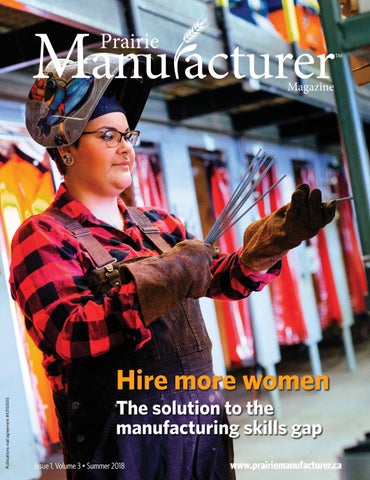
Hire more women The solution to the manufacturing skills gap Issue 1, Volume 3 • Summer 2018
www.prairiemanufacturer.ca
YOUR MANUFACTURING PARTNER TO WEATHER ANY JOB.
100% FIRST NATIONS-OWNED. SERVING THE O&G INDUSTRY SINCE 1994. We are at the Global Petroleum Show! Call (306) 552-5239 to book an appointment. 261 Sherwood Road Regina, SK S0G 5K0 Phone: (306) 525-6710 E-mail: info@prometal.ca www.prometal.ca
Publisher Ronda Landygo ronda@prairiemanufacturer.ca 877.880.3392
In this issue Excelling in a world of change
6
Morris Industries President & CEO Ben Voss looks back on what has made the agricultural equipment manufacturer thrive over the past 90 years, and how both business and leadership models must evolve going forward.
Hire more women: The solution to the manufacturing skills gap
16
Females account for only 28 per cent of the national manufacturing workforce — and far less on the Prairies. But with a widening skills gap hampering growth, that may soon change.
Moving the needle on Mission: Zero
20
Three occupational health and safety leaders from manufacturers across the Prairie provinces share their best advice on eliminating lost-time injuries and building a true culture of safety from the bottom-up.
Point/Counterpoint
27
In this new regular feature, we bring you two competing viewpoints on a pressing manufacturing issue to help inform and guide your business decisions. This quarter: The business case for and against a unionized workforce.
“The more things change, the more they stay the same”
30
Continuous improvement icon Dave Hogg reflects on three decades in the lean consortia movement, and what they can tell us about the future of Canadian manufacturing.
Next-generation manufacturing is in good hands
42
Jayson Myers, award-winning business economist and CEO of the new advanced manufacturing supercluster, recounts a recent trip to Hannover Messe and explains why his sense of optimism has been reinvigorated.
Next issue Spotlight: Old partners, new friends: That is the name of the game for Canada’s trade agenda. While our neighbours to the south still account for an overwhelming majority of Canadian-manufactured exports, new trade pacts and changing geopolitical realities are realigning the chess pieces. Regional feature: When you think of Saskatchewan, what comes to mind? How about emerging manufacturing superpower? No? It could be closer than you think. We visit the Land of the Living Skies to explore the entrepreneurs, innovations, and latest trends getting noticed on the world stage. Booking deadline: August 10, 2018 Material due: August 17, 2018
Editor Derek Lothian editor@prairiemanufacturer.ca 306.380.3765 Special thank you to our editorial advisory committee. Creative Director Dana Jensen Sales info@prairiemanufacturer.ca Cover photo courtesy of Saskatchewan Polytechnic. © Copyright 2018 Prairie Manufacturer MagazineTM All rights reserved. The contents of this publication may not be reproduced by any means, in whole or in part, without prior written consent of the publisher. Publications mail agreement #43155015 Return undeliverable Canadian addresses to: Prairie Manufacturer Magazine 207 Hugo St. North, Suite 3 Winnipeg, MB R3M 2N1 To change your address, or to be removed from the mail list, e-mail info@prairiemanufacturer.ca. While every effort has been made to ensure the accuracy of the information contained in and the reliability of the source, the publisher in no way guarantees nor warrants the information and is not responsible for errors, omissions or statements made by advertisers. Opinions and recommendations made by contributors or advertisers are not necessarily those of the publisher, its directors, officers or employees. Proudly printed by Premier Printing Ltd. Printed in Canada | 5/2018
@prairiemfg
Editor’s Notebook
Can’t we all just get along? By Derek Lothian
T
he title of Scott Gilmore’s April 19 Maclean’s op-ed is equal parts incendiary clickbait and honest critique of the state of our federation: Canada is not a country. Talk about a headline. “If we can’t build pipelines, move beer, or find some common ground,” he argues, “we may have a fatal problem.” Perhaps more important than a commentary on pan-provincial trade woes, Gilmore dissects the growing list of divisions between Canadian people — in terms of identity, geography, prosperity, understanding, and, heck, even our willingness to understand. It had me thinking about what that means for the future of Canadian manufacturing — not entirely how we make things or how they get to market, but who makes them and whether we will be able to collectively reimagine a supply chain that is more person than product. We write a lot in Prairie Manufacturer Magazine about the emergence of Industry 4.0. This summer issue is no different. And don’t kid yourself: The ability to understand and deploy advanced technologies may very well save your current production system from extinction. Production, however,
is only one element of a successful manufacturing enterprise. I recall — from my days at Canadian Manufacturers & Exporters (CME) many moons ago — a prominent CME board member once proclaiming that “modern manufacturing is not about where goods get made; it is about to where the value comes home.” In the moment, I must admit those words caught me off-guard. “How,” I asked myself, “could someone who had such a fiduciary and moral responsibility to represent the interests of Canadian manufacturers be so agnostic about their futures?” Turns out his comments were simply ahead of his time. You will read later in this edition (on Page 30, to be specific) renowned lean icon Dave Hogg muse about the degradation of Canadian competitiveness and the shifting focus toward disruptive innovation. Those of you who know me also know that I have been singing this song for years. It’s a business imperative. While technology may help some manufacturers gain the efficiencies required to sustain fragile margins in the short term, the real opportunity it presents is in revolutionizing the industrial business model.
“Although the early prophetic warnings that additive manufacturing would immediately overtake conventional processing have not come to pass, there is no arguing that what it has done is change where the value lies in the concept-to-customer experience. Technology, in this case, may actually be the anchor.”
4
Prairie Manufacturer Magazine • Summer 2018
Take 3D printing. Although the early prophetic warnings that additive manufacturing would immediately overthrow conventional processing have not come to pass, there is no arguing that what it has done is change where the value lies in the concept-to-customer experience. Technology, in this case, may actually be the anchor. Thirty years ago, the making of any physical item required a complex pyramid of specialized skills, expertise, and equipment. As an average Joe, you relied upon the engineering team to design the product, the suppliers to source out the materials, the manufacturer to fabricate it, the logistics company to transport it, and the retailer down the street to get it into your hands. Today, those steps can be all but erased, going straight from the designer, through a software intermediary, right to the 3D printer in your living room, in a fraction of the time. The opportunity that big data presents is no different. Not only do we have more of it from more places, our capability to collate and analyze it has completely changed how we can anticipate customer needs and customize a highly tailored solution with rapid responsiveness anywhere on the globe.
My point is that a large chunk of the types of jobs we have traditionally valued in manufacturing are quickly becoming redundant due to globalization. Canada is, by all accounts, a high-cost jurisdiction in which to do business, with a steep regulatory burden compared to, well, almost all our neighbours. The jobs of tomorrow are those that recognize the true value is in the knowledge required to create the customer solution, and in the management of the technology required to deliver that solution. Which takes us back to the dilemma of present-day Canadiana. The high-value manufacturing jobs of today — forget 10, 20 years from now — are more collaborative, dispersed, intricate, and people-centric than at any other time
in history. Relationships will become a professional and economic currency. We need to understand each other — and, for Pete’s sake, we need to get along. Beyond decorum, though, I worry that we still do not have some of the basics in place, either. Our single largest public investment in research and development — our post-secondary education system — continues to yield dismal commercialization outcomes. We have a patchwork of certifications and licensing regimes across the provinces that are not harmonized or recognized. And, we have yet to truly embrace managerial, cultural, technological, and financial literacy as mandatory underpinnings of our early-years skills development framework.
In last quarter’s View from the C-Suite column, NFI Group President & CEO Paul Soubry reminded us that manufacturing is “all about the people.” I challenge you, as you flip through the proceeding pages, to reflect on how you are preparing your people for the obstacles and opportunities of the new economy. I’m talking to you, manufacturers. You, too, politicians. Now is not the time for nostalgia. Only with the right game plan and the best talent will Canada thrive in the competitive arena of next-generation manufacturing.
The bank of make it or break it At BDC, we understand the importance of cash flow protection, and the challenges. No matter the obstacle or objective, we can help you find the business solution that fits. As the only bank exclusively devoted to entrepreneurs, rest assured, our financing services are tailored to you.
Call us at 1-888-INFO-BDC or visit bdc.ca
BDCad_Manufacturing_7x4.625_en.indd 1
2017-11-17 12:14 PM
www.prairiemanufacturer.ca
5
View from the C-Suite
Excelling in a world of change
By Ben Voss
“Where I see the ongoing struggle is when companies harken back to five or 10 years ago, and keep hammering that ‘we always made money that way before.’ Just because we were profitable then — in a low-cost environment or in a top-down leadership model — does not mean we can continue to assume that trajectory will allow for duplication. The environment has changed.”
6
Prairie Manufacturer Magazine • Summer 2018
I
always like to begin stories with a little perspective on history. I grew up in small-town Saskatchewan at a time when the normal career path was to obtain your education and then leave this great province to pursue your life’s ambition elsewhere. I, unlike many, chose to stay. I remember attending session after session put on by the local economic development agencies and chambers of commerce, which listed off the many reasons why Saskatchewan was
a great place to setup manufacturing businesses. Reasonable wages, a skilled and readily available workforce, cheap real estate (often in small towns with low taxes), and low utility rates were all considered attractive reasons to open a factory here. Remarkably, in less than two short decades, those low-cost advantages inverted to high-cost challenges. The boom arrived and, with it, a great deal of opportunity and growth. Change became the most popular buzzword in
many executive offices. ‘Adapt or die,’ they said. Some have, unfortunately, went the way of the latter. Others have merely survived. But there are those that have persevered — albeit, still looking to adapt. Morris Industries falls into that category. As a global manufacturer of agricultural seeding and hay hauling equipment now entering its 90th year of business, Morris is far from alone and is uniquely familiar with the
www.prairiemanufacturer.ca
7
“What makes manufacturing successful on the Prairies is the willingness to embrace change, diversity, and automation. Most of our strengths 20 years ago were based on undocumented (tribal) knowledge, and corporate leaders who were bold and took risks to find a successful strategy by trial and error. It was the school of hard knocks.”
necessity of adaptation. Just think of the evolutions that have happened on the farm since your grandparents’ days. That has required the company to institutionalize change management into our daily routines — understanding change, managing expectations, and dealing with succession. All of this is profoundly impacting our teams and is upending the foundations of what we thought made us prosper. When we look at what made our company successful five years ago, we must adjust to the new realities of what will make us successful five years from now. We need to dispose of every past assumption. Assuming low-cost and highly available talent is no longer an option. Assuming people want 40-year careers with a single employer is no longer valid. Assuming our biggest competitive advantage is a low cost of doing business and a low Canadian dollar are no longer what make us global titans. Assuming a single leader at the top has all the answers is no longer what defines success. What makes manufacturing successful on the Prairies is the willingness to embrace change, diversity, and automation. Most of our strengths 20 years ago were based on undocumented (tribal) knowledge, and corporate leaders who were bold and took risks to find a successful strategy by trial and error. It was the school of hard knocks. Now, in an era of data and analytics, it is the ability to analyze our way — even as medium-sized companies — into the right solution. Jobs that used to be mainstays, like running a shear or assembly line, are being replaced with higher-skilled, higher-paying positions, such as continuous improvement specialists, CNC programmers, as well as laser nesting and robotics experts. I like movies, and some of the best lessons for corporate leaders can be in the simplest of stories. One of my favourites is Moneyball. The scene where the baseball scout tells Brad Pitt he can’t replace 20 years of experience with a spreadsheet and some kid from Yale with an economics degree has long resonated with me. The truth is: It’s a reality we are continuing to face given
8
Prairie Manufacturer Magazine • Summer 2018
whatever we thought was sacred five years ago is shifting sand today. Another is Lone Survivor, based on the true story of navy seals caught in a battle behind enemy lines in Afghanistan. In the most intense of moments, the leader would listen to every idea and the entire team had only seconds to put everything on the table. They would argue and, in the end, what the leader decided — right or wrong — was what the entire team agreed to. There would be no regrets or ‘I told you so.’ In both cases, the characters chose to learn from the experience if it didn’t turn out an immediate success. Diversity of thinking leads to better outcomes. Where I see the ongoing struggle is when companies harken back to five or 10 years ago, and keep hammering that ‘we always made money that way before.’ Just because we were profitable then — in a low-cost environment or in a top-down leadership model — does not mean we can continue to assume that trajectory will allow for duplication. The environment has changed. It is the same issue as assuming all good ideas should or must come from the top. Just because someone from within the team brings forward a different idea or has a different opinion does not mean they are challenging the honour or will of the corporate leadership. That may have been a no-no 20 years ago, but not today. Today, good leaders know when to embrace sound thinking and innovative ideas no matter where they come from, and then they know how to manage the change. Modern manufacturing leadership is about helping your team find a way forward. Learn from the past. Respect it. But, accept that change is good. Those are the keys to success in a world that, like it or not, will never stop changing. Ben Voss is the president and CEO of Morris Industries, which has manufacturing operations in Yorkton, Saskatchewan, and Minnedosa, Manitoba, as well as a research and development facility in Saskatoon.
Improve Your Efficiency, Safety and Profitability. + 6 More Reasons to Hire a CPHR.
TM
Excellence in manufacturing is a game of inches. If you’re looking to improve your competitive edge, here are nine ways a CPHR can deliver. 1
Your priorities don’t seem to get traction.
6
Your unique mix of compensation, benefits and pensions works best when it’s fair and consistent and when it aligns to your business outcomes. 7
Some decisions seem to come out of left field.
8
Some people do only what they need to get by. Disengaged people create a vortex at work, where money, imagination and motivation swirl slowly away. Engaged people are motivated by purpose, excellence and creativity. If you’re looking to increase the energy level in your organization, talk to a CPHR.
4
9
You’re a leader determined to create more leaders. From the executive suite to the shop floor, people benefit from mentoring, coaching and continuous learning, to keep their competencies relevant and effective and ensure their skills align with the outcomes you need.
Efficiency gaps are costing you money. In most companies, salaries and benefits total about 80% of costs. If you’re looking for a better bottom line, you need HR based financial and operational decision support, and you need performance indicators that matter.
5
You need strong, lasting labour relations. If you need expertise in negotiations, or the sound management of collective agreements that build better relations between negotiations; if you want to reduce the likelihood of employee-based litigation and risk; and you prefer to stay on the right side of labour legislation, then you want a CPHR on your team.
When people make the right decision, at the right time, at any level in the organization, it isn’t luck. It’s knowledge, preparation, training and culture. CPHRs call this Professional Practice. It’s about knowing what’s expected, every day. 3
You worry about people’s health, wellness and safety. Helping keep people healthy, well and safe shows thoughtful leadership, saves money and reduces organizational risk. A CPHR can do this. What more is there to say?
CPHRs understand business strategy and they translate it into action. They support strategic leadership and they know how to maximize its value to achieve results. 2
You want to reward people fairly, without breaking the bank.
You’re competing to find and keep the best. Only people make a business succeed. Keeping talented people in a competitive marketplace is critical, but so is having the right number, of the right people, in the right place.
Ready to hire a CPHR? Post your position on CPHR Manitoba’s job board cphrmb.ca/Post_A_Job
FOR MORE INFORMATION ON WHY YOU SHOULD HIRE A CPHR PLEASE VISIT:
CPHRMB.CA
www.prairiemanufacturer.ca
9
Money & Markets
The smart money is investing in our young people By Steve McLellan
I
magine these situations: Elaine is a recent widow. Her husband did all the banking and, during their 40 years of marriage, she worked, looked after the house, and raised their three children. Now she is the family broker, investment advisor, and budgeter. She is finding the task a challenge. Isaac is a proud, recent graduate of the Saskatchewan Polytechnic CAD technician program and, after 12 years of school and the additional two years of study to get his diploma, he is ready to make some money and start living life. While he has some student loans, he believes that with his newfound income in manufacturing he will soon be in the ‘big money’ and will not have to rely on Kraft Dinner for supper five nights a week. A sure sign of his future success is that he received notice in the mail he’s been pre-approved for three credit cards and has signed up for them all. Susan, meanwhile, moved to Canada from Somalia as a refugee and saw this country as a bright light of peace and harmony — a great place to raise three children and see them grow to be productive and proud Canadians of Somali descent. She has never had a bank account or many belongings but, now in this land of plenty, she has been offered a deal to furnish her apartment with all new furniture for one very low monthly payment. Susan’s dream is coming true. From a refugee camp tent to donated furniture and beds — which were appreciated but not what other Canadians had — to now having a family home with all new furniture: She ‘had made it.’ How do these stories end? Well, there are two scenarios.
10
Scenario #1 Elaine received the insurance money and let it sit in her chequing account for months. She listened to her grandson, who is 30 and living with his parents, and invested in a ‘get rich scheme’ that allowed someone else to get rich quick. She managed to keep her home but never had the life that she and her husband had planned for their golden years. Isaac went on two trips — one with his buddies and one with his family — and used his new credit cards. He did get a good job as a CAD technician but, after eight months, he got laid off when the company lost a big contract. Then, he spent six months with no income and learned what 28 per cent interest was on credit card debt. Susan lived in her apartment with her new furniture for 17 years and paid each month for the furniture. In total, she paid three times the retail price for the honour.
Scenario #2 Elaine went to her bank where, until then, she had only gone to get cash from the ATM or — for many years — from a teller. She asked for an appointment and met with a patient and skilled person named Tamara, who helped her with budgeting and investment advice, and told her she had enough money to go on a trip each year to visit her sister in B.C. In fact, she even gave her grandson money to go to school and he finally moved out of his mom’s house. Isaac used the cards once to take his parents out for dinner to thank them for their support. When his first ‘career paycheque’ came in, he paid off the credit card and put it into his sock drawer. He then reviewed the costs and benefits of all three cards and cancelled two.
Prairie Manufacturer Magazine • Summer 2018
Susan saw a billboard on her way to the furniture store from a credit union that spoke about advice and loan services for free. They helped her do a budget and, with her income, she could pay cash for the furniture and make monthly payments to the credit union. In three years, she had paid the loan back, kept to the budget, and had the nice furniture for years to come. Once the furniture loan was paid off entirely, she put the same amount into an RESP for her kids’ education — all part of her budget and part of her life plan.
The difference is in the detail These are three very different stories. Each could have several outcomes, but all could end with success — if they receive sound advice and are financially literate. Sadly, many people experience financial challenges like these all too often. The pain and grief of carrying heavy debt can be consuming, especially when it’s done with bad advice or no advice at all. That said, more and more people are looking up, getting the advice they need, and turning the second scenario from the exception to the norm. This is, in large part, thanks to the financial services sector — credit unions, banks, and investment advisors — seriously evaluating their services. They all offer advice — often free — so their clients are informed and make decisions based on fact and reality, not hype and pipe dreams. In Saskatchewan, we have a sincere group of financial sector and business leaders whose commitment to financial literacy is making a difference. Each of our credit unions and banks are committed to their clients’ success. Many of these financial institutions have banded together with the Saskatchewan Chamber of Commerce
and other businesses to form the Saskatchewan Financial Literacy Network (SFLN). It’s a new initiative, but is already doing good things. The SFLN has held two gatherings of people across a multitude of sectors involved in financial literacy, and is creating a new and improved website to be launched this summer. The mandate of the project is to promote the services and expertise of their member organizations. One clear and trusted Saskatchewanfocused website, where information on the basics and contact to experts is available, will be a very positive service. The best way to ensure the lack of financial literacy is never again a problem is to ensure all people are educated early. The SFLN and the Saskatchewan Chamber of Commerce have been advocating for years the need for a mandatory high school course to be made available in all schools. Fortunately, the Saskatchewan Ministry of Education recently made the commitment to have this course available in all high schools by fall 2019. While it will be offered as an elective, it is still a tremendously positive first step. Many of you reading this probably wish you’d had better financial advice early in your life — or that you took the advice you received. ‘Freedom 55’ was a great marketing slogan and is a reality for some. For others, we can look back five, 10, or 25 years and say, “I should have invested in Google, not Bre-X.”. Looking through the rearview mirror is a waste of time. The future is where your focus should be. You can always learn more about financial issues, regardless if you are 18 or 68. New programs are being created like the tax-free savings account that are worth knowing about and, if they make sense, to utilize. The key is to get educated. Make financial literacy a priority for yourself, your family, and your business. My final message is for all of you grandparents and parents. Help your kids out. Not by giving them money, but by giving them the tools. Buy them David Chilton’s The Wealthy Barber Returns and tell them once they read it and have a discussion with you about it, you’ll give
them $100. That’s education and cash. And if they don’t read the book, hit them over the head with it. There are too many Elaines, Isaacs, and Susans out there, and it is our responsibility to help them learn and to reduce the number of people — many of them our employees — who face unnecessary challenges because of bad financial decisions. Those challenges have
a very real impact on your business and the economy. So, get busy. Go see the barber or your own financial advisor today. Steve McLellan is the CEO of the Saskatchewan Chamber of Commerce and a longtime advocate for financial literacy education.
“FCC knows how our industry works.” Melissa Vencatasamy, Co-owner, genAG Farm Equipment Retail
Your business is unique. Your financing should be too. Grow with a lender who understands Canadian agriculture. With over 100,000 customers, big and small, and a portfolio that tops $30 billion, Farm Credit Canada can help build your business success story.
fccfinancing.ca
www.prairiemanufacturer.ca
11
Lessons in Lean
What does lean have to do with HR? By Rodelle Genoway
T
here are many common misconceptions about human resources. Let’s start by addressing HR’s function. More often than not, the layman thinks of it as ‘hiring and firing.’ But that’s only partly correct. The role of HR has evolved immensely over the past two decades. It has shifted from being purely administrative in nature to a ‘business partner’ model, grounded in the leadership of an organization. Modern HR is about creating systems to ensure human capital is working as effectively and efficiently as possible — and in a manner that complies with employment law. Under that definition, those of you familiar with lean can already see the correlation. Lean and HR are about developing
systems to optimize business processes — only one is physical and the other is intangible. For an organization to reach its full potential, equal attention must be paid to both. After spending several years with manufacturers across the Prairies either conducting lean training or assisting in lean assessments, one thing has become crystal clear: The root cause of most process problems usually boils down to inadequate HR processes. Whether it be unclear policies, poor communication, an unstructured hiring protocol, the quick onboarding of new employees, an old-school performance management system, no compensation structure, or the lack of a termination process, how you coordinate and nurture your people will have a direct
“After spending several years with manufacturers across the Prairies either conducting lean training or assisting in lean assessments, one thing has become crystal clear: The root cause of most process problems usually boils down to inadequate HR processes.”
12
Prairie Manufacturer Magazine • Summer 2018
“For an industry that makes tangible things, focusing on the intangible can be an uncomfortable exercise. Yet, by improving the intangible, you will lead to tangible — and rewarding — results.”
impact on the success of your lean journey. And how you support and lead your people will have the largest downstream effect on your continuous improvement culture. It would be fair to say that the relationship between lean and HR begins at the recruitment stage. Recruitment is about marketing your organization as a great place to work. The goal is to entice the best qualified candidates to apply. As a manufacturer that embraces lean as part of your ethos, do you make it clear in the job ad that continuous improvement is a core value, and that past lean experience is preferable? When interviewing, do you set aside time to have a specific conversation about lean (I have found that one question to evoke a telling response is: What does lean mean to you?)? Remember that recruiting is just as much about new employees getting to know you as it is you getting to know your new staff, so structure systems to reinforce what matters most to you as an employer. That carries through to the orientation and onboarding process. Do you spend a generous chunk of time trumpeting your recent or transformational wins that lean tools have helped realize? Or better yet, do you standardize ‘lean 101’ training so that new employees, regardless of department, can speak the same ‘language’ as everyone else in the organization? This is a simple educational investment with maximum ROI. Another piece of low-hanging fruit that can be addressed early on with team members is the assurance of role clarity, which is a common root cause for organizational inefficiencies. If you’ve ever heard ‘that is not part of my job’ or ‘I didn’t know I was supposed to do that,’ you likely have a problem. Without a clear, documented description of what each job entails, new employees are moulded from tribal knowledge, and the fundamental purpose of the role is eventually forgotten. Having a shared understanding of scope and responsibility also results in a better performance review process (which is
another topic all its own). Peter Drucker once wrote, ‘What gets measured gets done.’ Compelling employees to assess their work through the lens of CI metrics is a powerful means to emphasize the importance of lean. The number of ideas suggested and implemented, the dollars saved because of those improvements, and benchmarks achieved in training and development are all KPIs that I have seen implemented in performance reviews — sometimes directly tied to compensation. These are steps you can begin to take, today, to align your lean and HR efforts. But the ultimate goal — an enterprise-wide culture of continuous improvement — requires a bottom-up strategy where the intangible becomes the critical link and HR truly earns its place as an underpinning to lean. After all, the innerworkings of people are not finite. The ability to navigate through change, deal with conflict, understand intrinsic motivation, instill accountability, and engage staff around a common set of objectives are prerequisites to high performance. None of these come easy, either. The first step is for HR to understand what the business does and how it does it, including its systems and bottlenecks. The next step is to modernize HR into the leadership structure. Great things will soon come. Payroll is typically the largest line item of any business — why not ensure it is working to its full potential? For an industry that makes tangible things, focusing on the intangible can be an uncomfortable exercise. Yet, by improving the intangible, you will lead to tangible — and rewarding — results. Rodelle Genoway is the principal of Untapped Potential Business Consulting. She is a Chartered Professional in Human Resources as well as a certified Lean Black Belt. She holds a bachelor’s degree in commerce and a master’s degree in business administration.
` 2018CANADIAN
C O N F E R E N C E
WINNIPEG | JUNE 4–7, 2018
Helping you grow YOUR business! Keep the learning, sharing & connecting going all year round That’s CME’s business. CONTACT US today to learn how. DARETOCOMPETE.CA
www.prairiemanufacturer.ca
13
The Principal Resource
How to recruit top manufacturing talent in a competitive market By Dale Driedger
W
e all know Manitoba is a manufacturing hub. With such a high number of manufacturers proportionate to our population, recruiting top talent in this industry is already competitive. And it’s about to get tougher. According to Canada's Urban Futures Institute, some 9.8 million Canadian baby boomers are approaching retirement. By 2020, the number of Canadians retiring each year will be 425,000. With their departures will be a drain in knowledge, experience, and leadership in our workforce. It will be near-impossible for companies to keep up with the amount of job openings compared to the number of retirees. Sure, schools are turning out lots of people in the skilled trades, but only
14
time can produce the leaders with the experience needed to fill senior roles. What are Manitoba manufacturers to do? It’s not all doom and gloom. Companies that invest in succession planning will position themselves for success. Every role has different hiring requirements. If you haven’t identified how long it would take to recruit for each role in your company, and then have planned accordingly, the results can be disastrous for a company’s productivity, profit, and morale. On the one hand, if an employee retires or leaves your organization before you’ve made a successful hire, you’re caught. Yes, you’ve saved some money by paying one salary instead of two, but
Prairie Manufacturer Magazine • Summer 2018
you’ve also lost the needed expertise to ensure the new hire’s success. Add to this problem the other consequences of having a vacancy in a key position: The longer people are compensating for the extra workload of a vacancy, the more likely they are to get burnt out and unhealthy. Now you’re paying sick time on top of more overtime to the people left filling in. With a drop in employee morale, comes a drop in productivity. Workers are tired and may be feeling pressure from home, missing family functions or obligations. From the production standpoint, if both morale and productivity drop, it is bound to affect the bottom line. Deadlines are missed and your customers
“According to the 2015 Global Recruiting Trends Report, it takes, on average, 27 days to make a new hire, but the best candidates are off the market in 10 days. Yes, a thorough recruiting process is important, but it’s all for naught if you lose your ideal candidate to another opportunity.”
are unhappy, which could lead to client and profit loss in the long term. Taking all these points into consideration, spending some time and money up-front in your succession planning is one of the smartest investments you could make in your company’s future. So, what are the steps you need to take to plan for upcoming recruitment needs? First, look at your organization from top to bottom. Evaluate every position and job category. What is the seniority of the people in these roles? When are retirements expected? From there, you’ll be able to see what’s coming. Next, prioritize the top positions you need to start succession planning for. Finally, implement an operational plan to bring in people who can be mentored for supervisory, management, or senior management roles. Identifying and designing a healthy organizational culture is also fundamental to your succession plan. In my experience, a quality workforce is productive, engaged, and believes in the company they are working for. These desired traits need to be continuously nurtured and demonstrated through the company culture. The trend is if you’re not willing to take care of your workforce,
they will find another company that will. Another mistake I’ve seen employers make is taking too long in the hiring stage. They go through the entire recruitment process, they do all the interviewing, and then they have people wait. According to the 2015 Global Recruiting Trends Report, it takes, on average, 27 days to make a new hire, but the best candidates are off the market in 10 days. Yes, a thorough recruiting process is important, but it’s all for naught if you lose your ideal candidate to another opportunity. What we have to remember is that people want to provide for their families and they can’t afford to wait. Even if they take your job offer over another, you may have damaged that relationship right off the bat with a poor impression. Now, back to that strategic planning and getting it down to a science. Recruiting an engineer with an MBA is not going to take the same amount of time and resources as filling an opening on the production floor, and they definitely don’t have the same level of urgency. One could be 6-8 months and the other could be 3-4 weeks. You have to do that research to understand your structure for hiring, both on an individual basis and seeing the organization as a whole.
Chipping away every day trying to fill holes that keep appearing will never work. But you already know that. A partnership with a trusted recruitment firm can be an excellent resource for managing immediate and succession planning hiring for your company. Invite them into your manufacturing world and share your company goals. If they can see production schedules, they can help you evaluate every position. They can give you advice on the best and the toughest time to hire people, which will help you make adjustments, making your life easier when you do hit recruitment time. I urge you to start the conversation around succession planning today. What might have worked three years ago no longer works today. Assuming that top employees will be willing and ready to come work in your company just when you need them could be a costly mistake. The reality is they are not waiting. Top talent is much more savvy in marketing themselves and many other companies are seeking them, too. Dale Driedger is the president and co-founder of Pinnacle Staffing Solutions — Manitoba’s largest recruitment firm.
www.prairiemanufacturer.ca
15
16
Prairie Manufacturer Magazine • Summer 2018
Hire more women The solution to the manufacturing skills gap Females account for only 28 per cent of the national manufacturing workforce — and far less on the Prairies By Martin Cash
T
he manufacturing industry needs more people like Tammy Wisminity. For the past three years, the 41-yearold single mother has operated a universal grinder at Standard Machine in Saskatoon, putting the final touches on extra-large wheel bearings for mining equipment and large industrial trucks. After a decade-long career as a farmhand, she was already accustomed to shedding career stereotypes. Manufacturing, however, has budded into her true calling. And she believes if more women knew about the immense opportunity in the sector, more would be likely to join her in the workforce. “Every day for me is something interesting, something different,” says Wisminity. “Lots of women, I’m sure, would love to get into this type of work and do something they are passionate about.” That has been the rallying cry for manufacturing leaders across the country, who are now fully engaged in a coast-to-coast initiative to increase female participation in ‘nontraditional’ occupations. The transition being catalyzed by automation and Industry 4.0 technologies will bring with it a burgeoning demand on new skills and greater diversity. This becomes doubly important when
considering the growth in the working-age population is expected to level off at zero per cent in Canada by 2020. And what better place find a new supply of talent than in a demographic historically underrepresented: Women. This past fall, Canadian Manufacturers & Exporters (CME), in partnership with BDC and KPMG, made its marquis effort to catapult the issue to the national forefront, releasing Untapped Potential: Attracting and Engaging Women in Canadian Manufacturing — a researchladen report culminating in an action plan designed to encourage women to pursue careers in manufacturing. Women like Wisminity, productively engaged on the shop floor — and embracing the role — would like nothing more than to have a greater number of women working by their sides. They see no reason why that can’t be the case, either. But the fact remains that women still account for only 28 per cent of the manufacturing workforce, and there has been no marked increase in that share over the past 15 years. Only six per cent of employed women in Canada have a job in manufacturing, compared to 13 per cent of men. Most agree it won’t be easy to change that dynamic; though, it is a good sign that real
www.prairiemanufacturer.ca
17
attention and resources are now being directed toward making and sustaining progress. Patience will also be key. Among the industry’s priorities is reclaiming the image of modern manufacturing. It’s no longer about dingy and dark factories, or heavy lifting; manufacturing today can offer some of the most attractive work environments available, regardless of if you are a machinist or marketing major. “A lot of manufacturing facilities are spotlessly clean, well lit, very organized,
ergonomically-designed, and very humancentered,” contends Kathryn Atamanchuk, an engineer-in-residence with the Faculty of Engineering at the University of Manitoba. “Places like StandardAero, New Flyer, and MacDon are so clean you can eat off the floor.” The message is simply not reaching the masses as well or as widely as it should be. It was noted in the CME report that, while women’s participation in the workforce at-large has increased over the past three decades, shifting economy-wide
WORK INJURY MANAGEMENT CORPORATE HEALTH SERVICES
From getting injured workers back on the job ... to making a strategic plan for executive health Invest in recovery and prevention for your team Trust a multi-disciplinary team that’s successfully handled a wide range of workplace injuries, as well as provided the latest preventive programs and care. Reconditioning Work Hardening
Executive Medical Assessments
Functional Capacity Evaluations
Pre-employment Screening
Job/Physical Demands Analyses
Ergonomic Assessments
Early Injury Assessments Worksite Visits
For details contact 204.632.3906 or executivemedicals@wellnessinstitute.ca Get well and stay well at Seven Oaks General Hospital
18
Prairie Manufacturer Magazine • Summer 2018
wellnessinstitute.ca
dynamics are changing the manufacturing landscape. For example, women have traditionally accounted for the highest percentage of jobs in certain manufacturing sub-sectors, such as garment production, at 62 per cent. Yet, now, that business has all but moved offshore, taking the volume of jobs with it. In specialized, high-skilled areas and STEM-related positions, women are as hard to find as ever, accounting for less than 4.5 per cent of employment in the skilled trades, 7.2 per cent of manufacturing jobs in supervisory and central control operations, and 8.3 per cent in transportation and heavy machinery operation. The Prairie provinces are particularly weak when it comes to gender representation, lagging well below the national average. Saskatchewan has the dubious distinction of bearing the lowest rate of women in manufacturing, at only 19 per cent, although it’s not due to a lack of effort. At Standard Machine, where employees work on gearing as large as 30 feet in diameter, Organizational Advancement Manager Jodi Lant maintains physical limitations are not as prevalent as a lack of female applicants. “It is really important to connect with female youth in high school to show them that the opportunity is there,” she explains, adding that the business’s parent firm, The Timken Company, has been extra supportive of increasing its female contingent. “As employers, it is also important to teach our educators and guidance counsellors that these opportunities are out there.” Another of the highlighted areas for CME’s action plan is related to profiling role models and providing a heightened degree of industry exposure. It may force manufacturers to address their longstanding reluctance to throw their doors open to the public. Carolyn Geddert, who heads up the University of Manitoba engineering co-op program, believes that manufacturing has not enjoyed the benefits of its public promotion efforts to-date — in part, because those efforts have been minimal (or, at least, uncoordinated) to begin with. After all, it’s not like there are picture
windows where passers-by can watch a bus being assembled or a circuit board being printed. “Manufacturing is a little bit mysterious and secretive to folks who aren’t directly involved in it,” she explains. “There are not a lot of public opportunities where our female students would have been exposed to what goes on.” As far as the co-op program is concerned, Geddert believes there would be an uptick in both company participation and disposition from female students if that narrative changed. “Having even a small number of students with a positive experience working as a student in a facility — that word would spread like wildfire.” The problem is that the women who have chosen manufacturing as their career path already are generally happy with where they are working. The authors of Untapped Potential assert one of the most important findings was that 83 per cent of women under 35 years old working in manufacturing are satisfied with their career choice
and would recommend it to others. In fact, within this metric, women are actually more satisfied than their male counterparts. Tricia Girardin would fall into that category. As the sales manager for Winnipegbased Graphic Packaging Inc. and a graduate of the Asper School of Business, her chance exposure to a production operations management course led to an ingrained passion for manufacturing. By the age of 25, she was managing 50 shop floor staff, mostly men, and is now one of two women on CME Manitoba’s board of directors. “Sure, I had to take some crap, but I don’t know if it would have been any more than if I was a 25-year-old man in the same position,” says Girardin. “If you’re young and ambitious in any sector, it comes with the territory.” She notes there are more women in the business now than when she started, but moving the needle further will require a coordinated focus that has been absent in the past.
Part of that needs to be encouraging employers to truly listen to the concerns of women, and then take steps to make their workplace culture more inclusive — the final pillar of the CME report. CME, however, is not alone in its pursuits. Engineers Canada, the national organization of provincial regulatory bodies that license engineers, is also working to increase the number of women in their ranks, with the goal of raising the percentage of newly licensed engineers who are women from 17 per cent to 30 per cent by the year 2030. Back in Saskatoon, Jodi Lant is equally optimistic and cautious. While she insists headway will not be made overnight, Lant is adamant the industry must start by peeling away the Prairie humility and talking proudly about its opportunity and accomplishments — especially where women are at the centre of the storyline. “It used to be a man’s world, but it’s definitely not anymore.”
GET UP TO
of your employee training costs covered through the Canada Job Grant.
IMPROVE YOUR BOTTOM LINE See how NAIT’s integration of practical project leadership/project management education, innovative technology and manufacturing expertise can reduce your operational costs, improve your productivity and enhance your competitiveness. Learn more about our Productivity and Automation Technology courses at nait.ca/Productivity
8
www.prairiemanufacturer.ca
19
Moving the needle on
Mission: Zero
Three OH&S leaders share their best advice on eliminating lost-time injuries and building a culture of safety By Joanne Paulson
W
orkplace safety has come a long way over the past decade. In Saskatchewan, for example, Workers’ Compensation Board (WCB) numbers show the lost-time injury rate per 100 workers stood at 1.86 last year. Only five years ago, it was more than 36 per cent higher, at 2.54. Over the same period, the total injury rate fell from 7.8 to 5.25. That’s progress. Most experts credit this success to a tidal change in safety culture, as organizations continue to build robust internal safety programs and governments tighten regulations. Jon Harnish, manufacturing safety officer with C&V Portables in Calgary, has witnessed this shift first-hand. “Ten years ago, a safety program was still a grumble. But, now, people are into it — after a while, it just became a part of daily life,” he says. “I see a change with newer people entering the industry. They’re excited to work for a company where protection is mandatory. They’re coming in already with a positive attitude, and that wasn’t always the case.” Training and promotion have played a central role as well. Programs like the Manufacturing Management Certificate at Athabasca University have entire modules devoted to safety management, while initiatives such as Mission: Zero, launched by WorkSafe Saskatchewan in 2008, have become a call to action for employers across all three Prairie provinces. But the ‘mission’ is not yet accomplished. Zero is still the goal. So, we asked three occupational health and safety (OH&S) leaders what their manufacturing enterprises are doing to eliminate lost-time injuries and earn full, enterprise-wide buy-in from their team members at every level. Here is their advice:
Start from the top Gord Secuur is the branch manager of Advance Tank Centre in Regina, and previously served as corporate director
20
Prairie Manufacturer Magazine • Summer 2018
of health, safety, and environment for Advanced Engineered Products. He oversees 26 staff, including 19 mechanics, who service semi-trailer tanks that haul dangerous goods. “One of the keys to be successful is right from the directing minds down,” he explains. “And, by that, I mean you need support from the company as a whole, the CEO, and senior management. Leaders need to demonstrate the culture they want to instill. When you have that, you can improve by leaps and bounds.”
Train as you intend to do At C&V Portables, which manufactures moveable buildings for industrial job sites as well as modular components for residential projects, each employee is trained regardless of skills or prior experience. This education is delivered on-site, using the same equipment staff will be using as part of their daily routines. “We have in-house training for both forklift and skyjack operation, and fall protection,” says Human Resources Manager Lisa Fraser. “All new hires are put through extensive orientation that involves an in-depth review of our policies, and they are trained on all the tools they will have in their hands, from the table and mitre saws to drills and the air nailer.”
Invest in safety equipment Black Cat Wear Parts is headquartered in Edmonton, but also has two blade manufacturing facilities and a foundry in Selkirk, Manitoba. The plants and the foundry employ approximately 80 people each. The company produces wear parts for construction, mining, and road maintenance, including scraper and ripper teeth for large-scale machinery, such as front-end loaders. “We definitely try not to recreate the wheel,” says Plant Manager Zach Zabizewski. “We’ve been involved with Canadian Manufacturers & Exporters (CME) from a lean perspective for several years, and had a special interest group
“Leaders need to demonstrate the culture they want to instill. When you have that, you can improve by leaps and bounds.�
www.prairiemanufacturer.ca
21
“You have to rely on your employees’ knowledge of the job. I’m a welder by trade, with an extensive background in safety training. But, when it comes to doing a hazard assessment on a certain type or piece of equipment, their input matters. You need to figure out what is going to work for them.”
“The expansion for us was a real turning point,” says Harnish. “We could install what we wanted for air quality, tools, and all the table saws — all hooked up to a dust collection system. We also have a separate welding bay. We were able to redesign the processes and tie them in together when we moved in.”
Incent safety awareness going focused on safety. That was all about getting people together from different plants to discuss their struggles and the different tools they were using.” As a result, Black Cat turned its attention to making its own guarding for the machines on the shop floor. They also added safety maps, lift assists, and other controls to help mitigate hazard risk. Since implementing these improvements, the company reduced its WCB rates from $4.50 per $100 in 2008 to $2.50 today — at the low end of the rate coding spectrum. “The last three or four years I would say we’ve really seen a cultural shift,” Zabizewski contends. “Now that we’ve walked the walk and shown some of those capital investments, and we have a very collaborative safety committee that works side-by-side in looking at what issues come up — everybody feels like they have a say in our safety program. That has had a direct impact on our culture.” For C&V Portables, the ability to design its production space from scratch was a major catalyzing factor. In 2014, it opened a new, 90,000-square-foot facility with safety as its core principle.
22
Prairie Manufacturer Magazine • Summer 2018
Harnish believes that the company’s rewards system supports the safety culture by keeping it top-of-mind in a positive — not punitive — and even fun way. “We have a peer system where, when the [safety] committee meets, there are recommendations as to who would qualify for a safety award,” he outlines. “Every month, somebody is drawn and given a gift certificate. “What makes it work is being peer recommended. As far as culture goes, the staff is always looking for who they think is setting an example — who is going above and beyond to report hazards. That keeps them more cognitive and looking for safety best practices.”
Get to know your employees — and listen to them Safety culture is non-existent without real employee buy-in. Period. That’s the view of Secuur at Advance Tank Centre, who says it comes down to listening, being available, and forming relationships.
Manufacturing Safety for Manitoba ABOUT MADE SAFE
TRAINING
CERTIFICATION
A CME Manitoba initiative, Made Safe provides health and safety services designed for the manufacturing work environment. In partnership with SAFE Work Manitoba, we make it easier for employers and workers to ensure workplaces are safe and productive.
Made Safe offers training courses and consulting services by manufacturers, for manufacturers.
Certification pays! 15 per cent or $3,000 – whichever is greater.
CONSULTING Made Safe provides a number of occupational hygiene and other consulting services, including noise level testing, ergonomic assessments, respiratory fit testing, workplace inspections and more. Visit madesafe.ca today for details.
31 courses are available through membership at little or no cost! From safety basics like fall protection; to equipment-specific training like respiratory protection, forklift and overhead crane; to the four core courses required for safe work certification (internal auditor, safety essentials for leaders, safety management systems and workplace safety & health committees) – Made Safe has you covered.
Made Safe is the manufacturing sector certifying partner for SAFE Work Certified. The SAFE Work Certified standard is based on best practices in international, national and provincial standards and legislation. Every day, more and more Manitoba manufacturers are making the decision to pursue certification. Talk with a Made Safe advisor to start your certification journey today!
204.949.1454 madesafe.ca @madesafemb
Made Safe
“You need to listen. It has to be genuine when you’re listening to staff concerns,” he says. “They have to be involved; they need to have a free say with no restriction. I have an open-door policy: If you have a concern, you can come in and see me.” Involving employees in hazard assessments and other handson safety processes is equally important. “You have to rely on your employees’ knowledge of the job. I’m a welder by trade, with an extensive background in safety training. But, when it comes to doing a hazard assessment on a certain type or piece of equipment, their input matters. You need to figure out what is going to work for them. “Talk to your employees, get to know your employees, show them the respect, and that will get the buy-in from staff.”
Allocate time and resources to safety organizations Advance Tank Centre, with products that hit the highway on a perpetual basis, is regulated or monitored through Transport Canada, Measurement Canada, and Saskatchewan Government Insurance, and is also registered with the American Department of Transportation to perform vessel repairs. Secuur says the company’s relationship with the Safety Association of Saskatchewan Manufacturers (SASM) has been a huge benefit in navigating the high standard of expectations. “We are audited to the ‘silver level’ of COR (Certificate of Recognition), which we just completed a month ago. That was a big deal for us to get back into place,” he iterates. “I give SASM a
lot of credit. I rely on them quite heavily for advice — the way our safety advisor interacts with our employees is so important.” At the time of this article, Advance had completed nearly 400 days of no lost-time incidents — a first for the company. And they took time to celebrate. “The deal was that when we passed the audit, when we got to one year, we were going to have a barbeque. Actually, I just handed out their safety award jackets today.” Black Cat, meanwhile, is a Best Managed Company and earned its Made Safe certification through CME Manitoba just two months ago. “That was a real celebration for our group — an acknowledgement of how far we’ve come,” beamed Zabizewski. “Those accolades and accomplishments just reinforce the safety culture.” And, in Alberta, C&V Portables is highly engaged with the Manufacturers Health and Safety Association, accessing training courses for employees and Leadership for Safety Excellence training for supervisors. In addition, C&V is heavily involved with CSA and the Modular Building Institute. Oh, and then there’s the ‘Bible.’ “That’s the nickname for it on the shop floor — an 80-page document with the things that need to be signed off on as we go through the checks and balances to make sure things are 100 per cent,” says Harnish. “It’s our quality control manual and one of the most important documents in our company.” We can all give an amen to that.
To have your event listed in the next issue, contact info@prairiemanufacturer.ca
24
Prairie Manufacturer Magazine • Summer 2018
Building a better Manitoba with you. — Empowering our businesses with a strong legal foundation.
Gimli
Riverton
Steinbach
33 Centre Street Gimli, MB p: 204-642-7955 tf: 1-800-235-9009
56 Laura Avenue Riverton, MB p: 204-378-2281 tf: 1-800-235-9009
Unit 2 - 330 PTH 12 North Steinbach, MB p: 204-988-0438 tf: 1-800-235-9009
St. Claude
St. Malo
Notre Dame de Lourdes
Winnipeg Beach
at MIG Insurance 46, 1st Street Saint Claude, MB p: 204-379-2548 c: 204-781-1539
at Caisse St. Malo 92, Avenue de la Grotte Saint Malo, MB p: 204-347-5533 c: 204-781-1539
at Caisse ND de Lourdes 151, Notre Dame Avenue Notre Dame de Lourdes, MB p: 204-248-2332 c: 204-781-1539
23 Stitt Street Winnipeg Beach, MB p: 204-389-2550 tf: 1-800-235-9009
9th Floor – 400 St. Mary Ave. Winnipeg, MB R3C 4K5 · Phone: 204-949-1312
TMLAWYERS.COM
5
QUESTIONS
about
cybersecurity in manufacturing With Sean Devin, partner and technology strategist with Saskatoon-based MNP LLP
Are small- to mid-sized manufacturing companies on the Prairies really a cybersecurity target? Absolutely — and the question itself starts to shape the reasoning why. Cybersecurity attacks happen to all sizes of organizations, in all industries, everywhere in the world. Even if you’re operating in a rural community selling only to local customers, you can be as much of a target as a global conglomerate with a highly integrated supply chain. Think of it as a numbers game. As a hacker, I could go after one large company that invests heavily in protecting itself against digital vulnerabilities, or I could pursue several small companies that tend to not invest heavily in cybersecurity. I would have a higher chance of breaching the latter and could conceivably acquire the same volume of sensitive data in a fraction of the time, and at a lower risk.
What information do I have that anyone would want? Many companies — particularly those in the SME segment — make the mistake of assuming their data is not ‘sensitive’ or worth enough to warrant a hacker’s interest. To the right person, however, your customer information, employee data, financial information, intellectual property, and other files are as good as gold. That will become only more true as data is leveraged to automate manufacturing, quality control, and other processes. Not all intruders want to steal your data to keep, either. Some simply want it to ransom back to you, as its value to you and your business may be greater than its value to others. Product drawings, bank records, prototype photos — if they are of value to you, they’re valuable to someone else.
What are the most prevalent cybersecurity threats facing my business? The three biggest cybersecurity threats today are hacking, malware, and phishing. Hacking is the act of someone or a group of individuals gaining unauthorized access to your computer. The average time a hacker stays hidden in a network before being discovered is 140 days. Malware is malicious software that is intended to damage or disable computer systems and data. Ransomware is a type of malware that encrypts your data and provides you an opportunity to pay for it to be unencrypted (usually through a facilitated bitcoin transaction) by a certain time, or else it is deleted forever.
26
Prairie Manufacturer Magazine • Summer 2018
Phishing, meanwhile, is the act of obtaining sensitive information such as usernames, passwords, and credit card numbers, or receiving money, by disguising as a trustworthy entity or individual. Remember all those Nigerian princes who want to transfer you cash, if only you help with their legal fees? Or the bank that sends you an e-mail with a link to a website that looks exactly like theirs, requesting you to log in? These are prime examples of phishing scams. The rule of thumb is that if it seems suspicious or sounds too good to be true, it likely is.
What would be the potential impact to my business if I had a cybersecurity breach? The impact to your organization can vary significantly depending on the scope of the breach and what type of information is compromised. Besides operational impact, financial loss, reputational damage, and even legal proceedings are also possible. Class action lawsuits are becoming more common in Canada due to cybersecurity breaches. How many customers or suppliers would want to do business with a company that is known to have lost sensitive information? Internationally, cybercrime damages are projected to hit $6 trillion each year by 2021, making cybersecurity one of the fastest growing industries in the world, for good reason.
What are some initial steps I should be taking right now to protect our company? Regardless of the size or complexity of your organization, there are several immediate steps you can take and incorporate into policy. Start by using and enforcing a company-wide protocol for strong passwords. I recommend a minimum of eight characters — mixed lowercase and uppercase, numbers, and special characters. A two-step or two-factor verification process is preferable whenever possible. Next, ensure all your software and hardware is updated at least once per month. If you haven’t already installed a network firewall and anti-virus software, do so immediately and double-check they are both properly configured and auto-updating. And finally: Setup your company devices to auto-lock, never add people to your social media profiles that you don’t know or who look suspicious, and allocate the resources to engage a qualified third-party in conducting a security assessment. Understanding your exposure is the first step to being adequately protected.
Point Counterpoint
The business case for and against a unionized workforce In an industry facing unprecedented change and challenge, debate is everything. At Prairie Manufacturer Magazine, Point/Counterpoint is our effort to contribute to furthering the conversation. Each quarter, we will bring you two competing viewpoints on a pressing manufacturing issue to help inform and guide your business decisions. Who knows — we may even change your opinion.
www.prairiemanufacturer.ca
27
T
he rise of unions coincided with the Industrial Revolution and the concurrent conflict between industrialists and urban workers. Early on, this conflict was often a violent class struggle. While the violence subsided, the conflict orientation remains. Given this history, agreement is a distant bridge for proponents and opponents of unionization. Invariably, arguments for and against unionization become embroiled in questions of fairness, individual versus collective rights, and an existential struggle for power between labour and employers. There is ample objective evidence to make the case that unionization is good for the firm and the economy as whole. The benefits of unionization are evident from both microeconomic and macroeconomic perspectives. For the macroeconomic case, let’s revisit Reaganism and Thatcherism. As celebrated 1980s pro-business, anti-union leaders, Reagan took on American air traffic controllers while Thatcher dismantled coal miners in the U.K. Both proposed that freeing business from regulation and unions would mean more wealth for all. Their assault accelerated declines in unionization rates in many developed economies. From 1980-2017, American union density dropped from 20.1 per cent to 10.7 per cent and Canada’s from 38 per cent to just over 30 per cent. Reagan and Thatcher had predicted unparalleled economic growth and riches for all economic classes. Except that didn’t happen. By 2015, they had been proven wrong by two staunch defenders of the free market, the International Monetary Fund (IMF) and the Organisation for Economic Co-operation and Development (OECD). The IMF stated ‘evidence strongly indicates that de-unionization is associated with rising top earners’ income shares.’ The OECD found that ‘countries where income inequality is decreasing grow faster than those with rising inequality.’ It found that the U.S. and U.K. economies lost between 6-9 percentage points of growth due to increasing wealth concentration. Turns out that, as unionization declined, greater inequality followed and economic growth slowed. The IMF and OECD had made an undeniable macroeconomic case for more unionization. But what about the microeconomic case? Even if higher union density is good for the economy as a whole, why should individual firms care? Don’t firms exist to maximize profits for owners? Yes, but are unions antithetical to that profit purpose? Absolutely not. Do most managers see unions as an asset? Absolutely not. Most managers see unions and collective agreements as constraints on management rights. In Outliers, Malcolm Gladwell described a persistent conflict between the Hatfields and McCoys that endured through generations despite significant changes in their wealth and status. Similarly, union-management conflict persists as a ‘dividing the pie’ conflict rather than focusing on ‘growing the pie.’ Progressive employers understand that an engaged workforce is essential for long-term business success. Building an engaged culture includes having employees who act as
28
Prairie Manufacturer Magazine • Summer 2018
The argument for By Sudhir Sandhu
company advocates, not only for the products and services of the organization, but also for recruiting talent. When smart employers involve unions as partners in building a culture of engagement, the likelihood of success becomes exponentially higher. Collective agreements become a blueprint for shared goals, collaboration, and equitable profit distribution. Having unions represent the common interests of employees is both easier and effective. Unions can facilitate employee consultation and clearly articulate employee interests so the parties can commit to a common framework. This model exists. Germany has a formidable economy. German workers form work councils which ensure that key decisions at workplaces are not taken by the employer alone, but involve worker representatives. Work councils cannot consider just the interest of the employees; they must work with employers ‘in a spirit of mutual trust — for the good of the employees and the establishment.’ While Germany relied on mutual trust and cooperation, we treated unions with distrust. And, it turned out unions were indeed the canaries in the coal mine. As unions suffered, so did our economies. Reversing this downward trend in the well-being of developed economies will require individual firms treat their employees as partners and unions as agents of engagement. That is the ultimate microeconomic and macroeconomic win-win proposition. Sudhir Sandhu is the chief executive officer of Manitoba Building Trades.
The argument against By Yvette Milner
T
here are inherent advantages to workplaces where membership in a union is not a condition of employment. We define this as ‘open shop,’ and can include non-union employees, unionized employees, or an employee association working together. Most industrial sectors in Canada are majority comprised of open shop employers. Take construction, for example, where open shop entities account for 70 per cent of the entire industry. These are small, medium, and large-sized businesses engaged in industrial, commercial, and residential projects. Despite this dominance, however, governments coast-to-coast continue to utilize closed tendering practices that restrict bidding on public sector contracts to unionized vendors. It is not difficult to figure out that, when only 30 per cent of suppliers are eligible to participate, competition goes down, costs go up, innovation suffers, and thousands of workers are put at-risk. In the long run, that benefits no one. As president of an organization that exclusively represents open shop contractors, I see the positive aspects of our member workplaces on a regular basis. The flexibility of open shop businesses is perhaps the most prevalent distinction. For instance, employees can be promoted or rewarded based on merit (a novel concept indeed), as opposed to a unionized environment, where employees are often rewarded based primarily on seniority — often at the cost of having the right people in the right jobs to maximize performance. It should go without saying that employees can flourish in an environment where they are hired for their skills, where they can multitask, and where they can fill a variety of roles. It should also go without saying these are cornerstones to operational efficiency. Unfortunately, in unionized settings, these are not always possible due to narrowly defined scopes, third-party liaisons, rigid compensation structures, and limited vertical movement. The result is weakened employee productivity and reduced employer profitability.
The fundamental problem is that unions represent the needs of a collective group, which can come at a cost to the individual employee. As someone who has worked in a variety of labour platforms, I personally value the opportunity to make the business case to my employer regarding my value to the organization, instead of having that ‘worth’ predetermined by set of guidelines and rules designed to benefit others. Whether this is a negative or a positive will likely depend on your experience and perspective. One stereotype I find myself constantly pushing back on is that open shop organizations have less safe working conditions. Having served in the labour relations field most my career, I contend that is simply untrue. Industry standards (like COR safety certification in construction) are routinely exceeded by non-unionized employers and, in some cases, far surpass even the strongest of unionized organizations. Another stereotype I fight is that open shop employers do not pay fair wages. As with the products and services our members offer, supply, demand, and quality dictate price. And, in a marketplace where employers are currently competing furiously for talent, inadequate compensation is just not an option. It goes beyond wages, too. All of our members provide a comprehensive benefits plan that is at the top of its class. Attracting and maintaining the very best human capital is the name of the game for modern industry. Having the elasticity to pivot to the new business realities is more important now than ever before. For our members, the philosophy is straightforward and the concept proven: Open shop means freedom of choice and individual fairness. I’m not sure how you can argue with that. And it can only bode well for our industry and in the future. Yvette Milner is the president of the Merit Contractors Association of Manitoba. www.prairiemanufacturer.ca
29
“The more things change, the more they stay the same” Dave Hogg reflects on three decades in the lean consortia movement, and what they can tell us about the future of Canadian manufacturing By Dave Hogg
W
hat a century this has been for manufacturing. Ford’s flow production design — the true root of lean — exploded onto the world stage in 1914, which made it possible to build an unheard-of 9,000 cars per day. Similar technologies boosted the World War II effort, with one high-performing plant churning out 17 B17 bombers in each 24hour cycle. Then, in 1950, Toyota turned to flow manufacturing principles to stave off bankruptcy, beginning the lean revolution we know today. Experts are realizing that lean will be a crucial factor in setting the stage for the next advanced manufacturing landscape — commonly referred to as Industry 4.0. In fact, lean is found today in virtually every area of human endeavour; and those with the foresight to have it already in place are finding the future a friendlier place to be, no matter who they serve. To be clear, Dan Jones, who co-authored Lean Thinking alongside Jim Womack, sees lean as the founding platform for Industry 4.0. In other words: There can no slacking off when it comes to lean, but rather a call to accelerate its use to remove the waste that is still hampering your competitiveness. And, if you’re looking for a lean refresher, The Lean Strategy is a great book written by international practitioners that will help you create a competitive advantage, unleash your innovation potential, and deliver sustainable growth for your business. Indeed, we are heading into one of the most important and challenging times in the history of Canadian manufacturing. We need lean now more than ever, and technology alone is not the answer. If there is one thing Toyota has taught us, it is that the best barometer for what lies ahead may be reflecting on what has worked in the past. There is no debate
30
Prairie Manufacturer Magazine • Summer 2018
www.prairiemanufacturer.ca
31
“Top leaders use vision as a powerful driver of corporate direction. Properly crafted, it is your desired future state — tomorrow’s reality expressed as an idea today. It is not general information, nor should it simply be exploited to drive conversations, meetings, or objectives, absolving you of true accountability.”
that the consortia movement is at the top of the list. So, given this issue of Prairie Manufacturer Magazine happens to coincide with the 2018 Canadian Lean Conference, I thought I would take this opportunity to give you a glimpse into what lean consortia have faced over the past three-plus decades, and what they have helped their members learn to compete and win in the global marketplace.
The early days Tribal thinking has existed since humans first recognized the value of working together to accomplish things an individual could not accomplish on his or her own. While lean manufacturing consortia, of course, do not date back to the age of cavemen, their roots can be traced — at least in part — to the economic recession of the early 1980s, when the Ontario government earmarked $40 million to ‘accelerate the effective utilization of advanced manufacturing technology, and the growth of supportive industries, to improve industry productivity and competitiveness.’ Sound familiar? You could drop that same sentence on top of a government program today and it would carry the same resonance. The rules and equipment may have changed, but the game has not. That eight-figure investment gave birth to five hands-on tech centres, including a CAD/CAM centre, in which yours truly joined near its inception as the organization’s manager of educational programs and services. The initiative brought exposure to real
world-class thinking to Canadian companies, thanks to multiple best practices tours to Asia, Europe, and the U.K. Yet, it was the effort of Canadian Manufacturers & Exporters’ (CME) then-CEO Perrin Beatty — himself from a family of manufacturers — that really lit the initial spark to the consortium movement. In the mid-1980s, he brought over from Denmark Nielse Nielson, who shared his experience as the facilitator for the ‘503 consortia’ that involved 3,000 Danish companies from all sectors.
First consortia are born After the five-year funding commitment for the manufacturing centres lapsed, their 100 employees returned to industry with their newly honed skills. Bill Heatherington, who was the president of factory automation equipment manufacturer Allen-Bradley, immediately saw their value, and eventually brought several of them together in 1990 to form the first consortium in Cambridge, Ontario, called the High-Performance Manufacturing Consortium, or HPM for short. I was invited to be the group’s facilitator. It was a fascinating time to get involved. Manufacturers in the region were searching for a shield against a return to recession, and survival was on everyone’s mind. The urgency gave way to a meaningful desire to work together, think outside-the-box, and do things differently. And wouldn’t you know it: They managed to do just that.
Discover all you need to succeed in Manitoba’s fastest growing community. Located 30 km south of Winnipeg, Niverville offers all the services you need, including lower operating costs, so you can save and invest more into your company’s growth. Ferd Klassen President & GM Niverville Autobody Ltd.
32
Lots now available at the Niverville Business Park, starting at $31,000.00. Be Niverville’s next success story. Call today. 204.388.4600 feedback@whereyoubelong.ca
Prairie Manufacturer Magazine • Summer 2018
• Access to key target markets and distribution centres • Large skilled trade workforce
2018CANADIAN
C O N F E R E N C E
THANK YOU TO OUR SPONSORS Photo credit: Michael Pratt
Platinum Sponsors:
Gold Sponsors:
Community Supporters:
DARETOCOMPETE.CA
“Everyone has their own idea of what world-class looks like based on their life experiences. Hence, all will be different, which results in much argument, frustration, and waste. Somehow, we must enable everyone to develop a common understanding and ability to identify true world-class behaviours”
The consortia explosion By the mid-90s, HPM was publishing a weekly update that was distributed across Canada, and even received some international recognition. It attracted enough interest that, in 1998, the first consortium outside Ontario finally came together, launching in B.C. through the great work of CME’s Werner Knittel. Other provinces soon followed — Manitoba, Saskatchewan, Newfoundland, and beyond. They also endured. Today, Manitoba boasts five consortiums, while the original HPM group is now part of a five-consortium operation in Ontario, with specific focuses on healthcare, manufacturing, not-for-profit operations, and services. Bob Kerr, who joined me in 2000 to help respond to the demand for new consortia installations across Canada, the U.S., and Australia, was instrumental in this success.
Houston, we have a problem This is the part of the column where I get to muse about the current state of manufacturing in Canada and how it relates to what I’ve seen through my time working arm-in-arm with consortia members. The biggest problem today as I see it is that our competitors are out-preparing us when it comes to their readiness to deploy and profit from new technologies, such as artificial intelligence. Two recent surveys, one by the United Nations and one by the World Economic Forum, placed Canadian manufacturers 15th and 14th respectively in overall competitiveness.
Although these numbers may sound respectable, our competitors have been slipping by us steadily since the 200809 recession. We now trail the likes of Sweden, France, Italy, Brazil, and the list goes on. Are you still comfortable? As new trade pacts like the Comprehensive and Economic Trade Agreement with the European Union now come online, these pressures are only going to mount. If there is any news to take solace in, it’s that we are not alone. Our Australian peers are struggling, too, after the complete collapse of their auto-making industry last year. Not so obvious was its impact on the loss of the innovation pipelines that had been built over the last 50 years. Some Aussie leaders now contend that only 10 per cent of homegrown manufacturers can compete globally. I think the lesson worth considering here is that you must strike a balance between efficiency innovation — or lean — and the type of disruptive innovation championed by Clayton Christensen. The Lean Enterprise Institute’s John Shook recently mused that ‘innovation is the new lean’ — and it’s a concept that merits careful thought in your own organization.
Understanding the stepping stones My first boss at Westinghouse once said to me in his stiff naval accent, “Lad, never forget that you can’t change the past, but what you improve in the present opens doors to the future.” The challenge that Canada now faces is to learn from our poor anticipation of and response to the recession of
VISIT US AT: millerenvironmental.ca Phone: 204 925-9600
MANAGING ALL YOUR INDUSTRIAL WASTE REQUIREMENTS
34
Prairie Manufacturer Magazine • Summer 2018
2008-09, and to accelerate our efforts to get closer to our customers. How else will we know how to make them more successful before someone else does? Technology has erased the advantages geography once gave us. Customers now have choices. We have choices. We can choose to get the right people on our buses, in the right seats. And, we can choose to support them to learn, adopt, and manage innovative thinking that generates the outcomes needed to survive. Or, we can choose the status quo. Technology may — or it may not — be a large part of the answer. Before running off to make that investment, start by honestly evaluating the direction you’re now pointing. Realign it, where necessary, and enforce it with discipline. Top leaders use vision as a powerful driver of corporate direction. Properly crafted, it is your desired future state — tomorrow’s reality expressed as an idea today. It is not general information, nor should it simply be exploited to drive conversations, meetings, or objectives, absolving you of true accountability. After 30 years of walking through factories, the question ‘What is your company’s vision and what is your role in it?’ evokes blank stares more often than not from random employees. Done correctly, everyone in the organization should be able to understand clearly where you are going, and why. They should have full confidence that management is 100 per cent supportive of both them and the direction. Finally, they should know their role and exactly what is expected of them.
Defining your world-class While perspectives give us a point of view, the perceptions gleaned from those points form the mental models upon which we make decisions. Everyone has their own idea of what world-class looks like based on their life experiences. Hence, all will be different, which results in much argument, frustration, and waste. Somehow, we must enable everyone to develop a common
understanding and ability to identify true world-class behaviours. We used a very simple mental model to establish many consortia over the years, consisting of very different companies of very different sizes, visions, and maturities — each steeped in their own time-developed cultures and perspectives. We borrowed this model from Industry Week Publisher John Brandt, who benchmarked competitive characteristics and compared them against high-performing manufacturers around the world. From 1983 right through to 2014, the top characteristic of a high-performing organization was being customer-focused. In 30 years, it didn’t change. The customer may have changed. The way companies collaborate with the customer definitely has. Yet, that overarching true north has not. Remember that as you work to capitalize on the opportunity of the next 30 years. Lean is not solely about eliminating waste. It never has been. It is about eliminating waste while adding value for your customer.
A final word of advice Now that I am retired, enjoying life in beautiful Penticton, B.C., I have had ample time to look back on my career and how I have seen hundreds — if not thousands — of manufacturers emerge and thrive, flounder and disappear. And I can say confidently there is a very fine line separating all of them. The difference between a successful manufacturer and an unsuccessful manufacturer isn’t much. To some, it may even be indistinguishable. The more things change, however, the more they stay the same: It is still all about the people. Hire the best ones you can find. Treat them well. Invest in them. Keep them. Help them grow. Almost always, your business will grow along with them. Dave Hogg is one of Canada’s premier thought leaders on lean manufacturing, and previously served as long-time editor of the distinguished Accelerate the Journey newsletter.
How can we help? ü Lean Process Re-engineering ü Cost Optimization ü Root Cause Analysis and 30+ additional services
Focused Performance Improvement
When you need a better consulting experience, let’s talk.
www.prairiemanufacturer.ca
35
MOVE FROM FE AR, UN CE RT A
T IN
& Y
. . . T B U DO
TAKE CHARGE OF YOUR CHANGE...
GROWTH LTY & ABI FIT RO ,P TY
TO S US TA IN AB IL I
ARC ASSESSMENT ROADMAP COACHING
FOR MORE INFO ON THE ARC PROGRAM CONTACT RIPHAY@GOPRODUCTIVITY.CA | 1.844.245.8278
Dare to Compete 2018 Helping manufacturers grow This year, the Canadian Manufacturers & Exporters’ (CME) Dare to Compete conference saw 220 delegates, 27 exhibitors, three keynotes, and 20 presenters. Participants walked away with practical toolkits and thought-provoking content. Dr. David Posen, a.k.a. Doc Calm, expert on stress, was a crowd favorite that led us all to think about our working habits as leaders and influencers, while Tannis Osterman from CanSustain took us through the delicate balancing act of production, profit, and global environmental concerns. What did attendees have to say? “It was truly a valuable day for me both from a learning and networking perspective.” “I noted that people stayed until the end, which you don’t often see at a conference. Dr. Posen was awesome.” “Keynote speakers the last two years were excellent (Andrew Coyne and John Ibbitson). The panel at lunch was also excellent.” Plan to attend Dare to Compete 2019 on March 19 and the CME Gala Dinner on March 21 — both in Winnipeg. Visit www.daretocompete.ca for more information.
PHOTOS BY DANIEL CRUMP
38
Prairie Manufacturer Magazine • Summer 2018
www.prairiemanufacturer.ca
39
SPONSORED CONTENT
2018 CANWELD EXPO & CONFERENCE SPONSORED CONTENT
SEP 12-13 | WINNIPEG, MB. | RBC CONVENTION CENTRE
THE WELDING & FABRICATION BUSINESS COMES TOGETHER • CANADA’S PREMIERE WELDING SHOW • METAL FABRICATING, WELDING, FINISHING • EXHIBIT TO INDUSTRY MEMBERS FROM CANADA & THE U.S.
EXHIBIT AT CANWELD 18 NOW!
Stephen Furze • dmg::events | stephenfurze@dmgevents.com (403) 444-6529
Canada's premier annual event for the welding, fabricating and finishing industry. Entering its ninth year in 2018, the world-class CanWeld Conference & Expo will feature even more live working equipment and technology, top industry speakers and unparalleled industry networking. A national event that moves between Western and Eastern provinces, CanWeld 2018 will take place in Winnipeg – one of Western Canada’s prominent manufacturing clusters.
What Makes this event different? CanWeld Expo & Conference is Canada’s only annual welding, metal fabricating and metal forming event that brings the whole industry together under one roof. Join industry members from across Canada and US to network and see the latest in arc welding, consumables, welding machines, tube & pipe, metal, cutting, bending & forming, robotics, gases, finishing assembly and more.
Expo Highlights 100+ companies exhibiting today’s foremost technologies, products and services • CanWeld Simulator Welding Zone • Fabricating, Finishing & Welding Zones • Industry Specific Meet Ups
• • • • •
One-to-One Meeting Program New Technology Program Canweld’s Best Welder Competition Over 20 Hours of Networking And more!
Conference Highlights • 40+ Sessions • Top Industry Keynotes • Exhibitor Pitch Opportunities
• Poster Sessions • CWB Official Networking Dinners & Galas • And more!
Visit canweldexpo.com for more information and updates!
2018 CME Gala Awards Dinner Made-in-Manitoba manufacturing and exporting success. This gala dinner pays tribute to the remarkable individuals and organizations that have made outstanding contributions to the manufacturing and exporting industry, both locally and globally.
Export Award
Emerging Award
Partner Award
Award Recipient: FLOFORM – Ted Sherritt, Chief Executive Officer, accepting
Award Recipient: Clearline Technologies – Neil Krovats, President, accepting
Award Recipient: Red River College – Paul Vogt, President & CEO, accepting
Hall of Fame – Inductee
Hall of Fame – Pioneer Award
Award Recipient: Roy Cook, President & CEO, Monarch Industries, accepting
Award Recipient: Charles Balmer, Valmar, - Mercedes Caron, Former President of Valmar and Charles' step daughter, accepting on behalf of the family of Charles Balmer
CME Gala Dinner – March 21, 2019 www.daretocompete.ca www.prairiemanufacturer.ca
41
Next-generation
manufacturing
is in good hands By Jayson Myers
I
was blown away this year by my visit to Hannover Messe. Thanks to the folks at Siemens Canada, I had the chance to spend a few days in April wandering around Germany’s annual industrial showcase, which attracts more than 200,000 attendees. I made it to most of the 27 halls on the exhibition grounds — many of them larger than football fields, full of the latest manufacturing technologies from around the world. The sheer scale of the show is impressive. The technologies were pretty cool, too (especially the robots). There were robotic flying foxes, robots winning at ping pong, robots playing the piano, as well as ‘co-bots’ assembling cars. What really caught my attention, though, wasn’t the technology at all. It was the excitement of the hundreds of young people who were at the show as visitors, exhibitors, students, and seminar participants. I spent a lot of time learning about many of the technologies on display from young engineers and technicians, girls and guys, who clearly enjoyed explaining — or, better yet, demonstrating — their products. Routinely, I nodded as if I completely understood what they were saying. Their enthusiasm was infectious. I learned about how to use drones to construct a digital twin of factory layouts
42
from a 24-year-old engineering student from Kiel University. I attended a seminar by a group of young operations specialists from around the world, where they were discussing priorities for automation based on the theory of constraints and basic lean principles. I overheard a group of young technicians from China arguing fiercely — in English — about optimal control architecture for discrete product automation. I became lost in the moment, looking at posters and prototypes developed by researchers from technical colleges, universities, and institutes. I enjoyed attending a ‘Dragon’s Den’ contest where a 19-year-old engineering student from India was talking about how he used sensors to keep the grass green on Bayern Munich’s football pitch. On the last day of the fair, when it’s open to students to attend for free, you couldn’t get near the robots for the crowds. It all got me thinking. First, it’s clear that advanced technologies like additive manufacturing, virtual and augmented reality, and — of course — robots, are making manufacturing cool again. We need to capitalize on that. Teaching science, technical, engineering, and mathematics skills are critically important. But, they are not the whole answer to building the manufacturing workforce of the future. We
Prairie Manufacturer Magazine • Summer 2018
need to make sure that more technologies than Instagram play an important role in the educational experience of young people — gamification, virtual training, and makerspaces can help. We should encourage the experiences of young people with manufacturing to be as positively impressive as possible. They should associate the industry with neat technologies, appealing working conditions, and modern, light, airy, and well-connected workplaces. We need to bring more students in to see what is actually going on in our plants and technology centres more often — and their parents, guidance councillors, and teachers should come with them. Role models are important. And, we need to celebrate the achievements of Canadian manufacturers on the world stage — like the three Prairie manufacturers I visited at the Hannover fair. Another thing that hit home for me was how important work-integrated learning is for modern manufacturing. Practical, immersive, hands-on experience is still an essential asset, even with the increasing use of software, digital design, virtual reality, and artificial intelligence. Technologies can be designed for manufacturing, but they need to be developed further, tested, scaled, and integrated in a manufacturing operation
“Thinking and doing are both important skills to have. What I saw in Hannover showed me that those skills can be far more valuable when young people enthusiastically engage with the vision and values of a company they are proud to work for.”
if they are to be produced or applied successfully. Thinking and doing are both important skills to have. What I saw in Hannover showed me that those skills can be far more valuable when young people enthusiastically engage with the vision and values of a company they are proud to work for. The business of manufacturing is all about solutions and problem solving — it’s not simply about getting a product out the door. The innovation embodied in the technologies on display in Hannover and in the way they can be used to develop new products and processes makes that perfectly clear. In exhibit after exhibit, the focus was on creating new ways of generating value. It was not about axing jobs. And, if there was ever any doubt about the potential that new technologies
hold for high value, well-paying jobs in manufacturing and supporting services, the knowledge, interest, and enthusiasm expressed by young people at the fair should be cause for a great deal of optimism about the future. If there are still concerns about where manufacturing is going, the potential negative impact of automation on jobs, or the continual problem of skills shortages, then maybe it’s an indication that manufacturers themselves do not see much future in their business. I’m amazed that, while industry surveys regularly find a large majority of Canadian manufacturers facing skills shortages, Statistics Canada reports that only 30 per cent regularly invest in employee training, and fewer than a quarter actively try to recruit skilled employees. The jobs of the
future in advanced manufacturing are going to require the technical and business skills on display by young people at this year’s Hannover Messe. They won’t come cheaply or without effort. Their availability cannot be taken for granted. Following my visit to Germany, I’m convinced that next-generation manufacturing won’t be as big a challenge as many people think. I’m far more worried about our generation’s ability to get us there. Jayson Myers is an award-winning business economist, specializing in industrial and technological change. He is an advisor to both private and public sector leaders, and has counselled Canadian prime ministers and premiers, as well as senior corporate executives and policymakers around the world.
www.prairiemanufacturer.ca
43
SPONSORED CONTENT
SPONSORED CONTENT
Celebrating employee excellence The spring season has been a busy one for Merit Contractors Association of Manitoba. On April 3, Merit held its second-ever Employee Awards of Excellence banquet at the majestic and historic Metropolitan Theatre. The evening followed the association’s annual general meeting, and built on last year’s successful inaugural iteration. As a core part of its mandate, Merit provides a comprehensive health and benefits plan to its member employees, and promotes education, training, and human resource best practices to attract and retain industry-leading employees, who are key to business success. The purpose of the event is to provide the opportunity for Merit’s member companies to recognize their outstanding employees in an enjoyable forum that would be difficult to replicate on their own. The attendees included member companies, their employees, colleagues in the business community, and government representatives. Musician Garrett Neiles performed popular tunes at the reception; Blaine Pederson, minister of growth, enterprise and trade brought greetings on behalf of the Province; and, emcee and keynote speaker, Paul Huschilt, delivered remarks with the theme of ‘stress less for success.’ He spoke about practical strategies to deal with stress in the workplace (and was hilarious in doing so!). Attendees enjoyed a fun evening of networking and celebration. Congratulations to all who were nominated — there were many great submissions — and, of course, to the award winners, who were selected based on multiple criteria, including excellence in safety, continuing education, competence and skill in their respective role, and demonstrated leadership within their organization. Family, caring, and devotion to their work and fellow employees were common themes that emerged in the employee nominations.
Five individuals received cash awards as ‘go-to people’ for their employers in the following categories:
Outstanding Field Employee FWS Group of Companies
Outstanding Site Supervisor Cladan Electric Ltd.
Outstanding Office Employee Static Electric Ltd.
Outstanding Site Supervisor Vector Construction Ltd.
Outstanding Field Employee Banff Constructors Ltd.
Also, a big thank you to the sponsors: Main stage sponsor Cladan Electric Ltd.
Major sponsors Vector Construction Ltd. FWS Group of Companies
Event sponsors Static Electric Ltd. M.D. Steele Construction Ltd. Banff Constructors Ltd. Western Construction Services Inc. Corporate sponsor Prairie Manufacturer Magazine
Visit www.meritmb.com for photos and videos of the last two award nights, and watch for next year’s call for nominations in the coming months.
Varying perspectives versus groupthink Why diversity on boards is good for business By Alison Kirkland
I
f the role of the board of directors is to support and advance the strategic direction of an organization, one might assume that a group of likeminded individuals would be most effective in achieving that goal. The growing body of research and intense discussion around board diversity, however, is showing the opposite to be true. Diversity isn’t about rogue directors with their own agendas, but rather individuals with different knowledge and experiences, who will trigger discussions that contribute to the success of an organization. The complexity of situations that confront boards and the speed at which the business environment changes means there is not just one answer to a question or a singular way to approach a challenge. Varying perspectives arising from gender, age, cultural background, geography, expertise, and experience mean the insights shared
and the questions asked of the CEO result in better decision-making, which, in turn, yields better organizational performance. The Status of Women Canada report, Women on Boards: A Competitive Edge, identified six key ways that an organization benefits by having women on a board of directors: 1. Greater financial performance, including return on equity, share performance, and stock price growth; 2. A much larger talent pool from which to select board members when skilled women are included in the mix; 3. Heightened innovation and creativity resulting from varied perspectives and experiences; 4. Enhanced client insight because the board is more reflective of the composition of society; 5. Positive reputation related to corporate social responsibility
“When there is diversity at the table, directors may feel more comfortable sharing opinions they might otherwise keep to themselves. Those perspectives fuel conversation around the strategic plan, trends in the market, and big-picture goals — all important fodder for successful decision-making.”
46
Prairie Manufacturer Magazine • Summer 2018
reflected in good employee relations, ethical product sourcing, strong environmental and human rights records, and support for local communities; and 6. Board effectiveness as measured by attention to the strategic direction, accountability through audits and risk management, and more objective decision-making. According to Sandra Altner, CEO of the Women’s Enterprise Centre of Manitoba, “We were astounded when more than 100 women registered for an information session in Winnipeg about getting involved on corporate boards. Women certainly have a role to play, but just don’t know how to get started.” The Women’s Enterprise Centre of Manitoba and Status of Women Manitoba have been working to develop a database of qualified women who would be ideal candidates for positions on corporate and publicly traded boards. The goal of the partnership is
to create a ‘one-stop shop’ that would facilitate bringing together women with the necessary skills and the boards that need them. While diversity on a board is necessary and governance requirements may dictate some of the board composition, each organization must determine what diversity means to them. The skill set required is the first and foremost consideration when filling vacant seats. The new database will provide an opportunity for a potential board candidate to outline the skills and experience she will bring to the board table and for the organization to articulate what gaps in the skills matrix it needs to fill. The hope is that streamlining the process will make it easier to reach candidates who might otherwise be unknown to an organization. Developing an effective, diverse board requires a deliberate approach. One of the first steps in the process is securing the commitment of the CEO
and chair. Not only must they buy into the value of a diverse board, they must create a culture of inclusiveness and respect that encourages challenging the status quo. But board members must remember that their role is threefold: Oversight, insight, and foresight. While governance rules guide oversight, it is insight and foresight that have the most significant impact on the success of an organization. Education, experience, gender, age, cultural background, and geography all inform an individual board member’s insight on a particular subject. When there is diversity at the table, directors may feel more comfortable sharing opinions they might otherwise keep to themselves. Those perspectives fuel conversation around the strategic plan, trends in the market, and big-picture goals — all important fodder for successful decision-making. Filling vacant board positions can be challenging. The people we
But don’t take our word for it… • In a global analysis by Credit Suisse, boards with one or more female members yielded higher returns on equity. • In a 2015 McKinsey report of 366 public companies, those in the top quartile for ethnic and racial diversity in management were 35 per cent more likely to have financial returns higher than the industry mean. The top quartile with gender diversity were 15 per cent more likely to have higher returns than the mean. • The Canadian Board Diversity Council’s 2016 Annual Report Card indicated that 21.6 per cent of board seats in the Financial Post 500 were held by
admire and associate with tend to think and behave as we do. When it comes to recommending someone for a board position, we draw on that network. Prospective board members must actively expand their network to connect with individuals and organizations where they could contribute as a board member. At the same time, CEOs and the nominating committee must cast a wider net to find those individuals with the skills and perspectives to enhance business success. There is no shortage of qualified people for boards. Sometimes it takes a bit of looking, but the reward is definitely worth the effort. Alison Kirkland is the director of communications and client services at the Women’s Enterprise Centre of Manitoba — an organization dedicated to supporting women entrepreneurs as they start and grow their businesses.
women in 2016, almost double from 10.9 per cent in 2001. • The Osler 2017 Diversity Disclosure Practices study that explored women in leadership roles at TSXlisted companies found that 47 per cent of S&P/ TSX 60 companies have adopted a target for the representation of women on the board. • The Status of Women in Manitoba published in 2018 by the Manitoba Women’s Advisory Council noted that women represent nine per cent of directors in Manitoba’s top 25 companies. Fourteen companies had no female board members. The same report noted that women make up 40 per cent of all board members in Manitoba’s four Crown Corporations.
www.prairiemanufacturer.ca
47
SPONSORED CONTENT
SPONSORED CONTENT
By Allana Schmidt, Director of Operations and Culture at Tripwire Media Group Inc.
CULTURE CLUB:
Creating Work Environments Where Your Teams Care as Much as You Do What would you give to know your team, at every level, was as focused on the growth and development of your company as you are? Imagine walking on to your factory floor each day, seeing your tradespeople working tirelessly on their tasks with the same goals for productivity in mind that you have each day. What would you do to make this a reality? Is it even possible? This kind of commitment – this kind of buy-in – from employees only manifests when they clearly understand the company’s purpose and goals. Not only that, but long-term buyin will only occur when they understand how your company’s purpose and goals align with their purposes and goals, both inside and outside of work.
Your people want to know they are an important part of the plan. If you haven’t shared your company’s goals for growth with the entire team, you need to do so as soon as possible. And if your company leaders haven’t had future-focused conversations with the very capable entry- and mid-level rock stars within your business, you will eventually lose them to your competitors. It’s simple: When you allow misinformation to fester, or remain secretive about company initiatives and progress, your team has no way of connecting themselves to the company beyond the tasks they are assigned to each day. And tasks alone will never breed commitment and loyalty among employees.
People want to know what they are working towards and how they are a valuable part of the equation. As people, focusing on the why and the how is what helps us through challenging situations, such as work life. Marketing departments need to spend time building strategies around internal communications and releasing company developments to the team at large. Human Resources departments should be identifying and having conversations with exceptional workers at all levels of the company, creating informed succession plans around workers who see themselves as part of the long-term equation. Prioritizing these efforts comes down to company leaders investing in the development of one of the most important concepts in business: corporate culture. Corporate culture is at the centre of the why, the who, the what and the how of your business – both public-facing and internal. Whether you know it or not corporate culture predicts how you make decisions for your business and how your employees behave at work. Fostering a corporate culture that is inclusive, informative, open, empathetic and practical is important. And having informed workers who have an understanding and a vested interest in the role they play in the company’s future is a powerful force in any business. Knowledge is power and, in this case, their knowledge is your company’s power.
www.tripwiremedia.com • allana@tripwiremedia.com • 204-272-9695
“Turns out we’d been under-forecasting.” People who know Manufacturing and Distribution, know BDO.
The Manufacturing and Distribution Practice at BDO BDO’s Manufacturing and Distribution practice combines accounting, tax, and business advisory with industry prowess. Whether you’re looking to leverage international operations, grow through acquisition, or optimize inventory management systems, BDO stands ready with proactive information and guidance wherever in the world you do business. In the Prairies, our BDO locations proudly include: Brandon | Calgary | Edmonton | Grande Prairie | Lethbridge | Pembina Valley | Portage la Prairie | Red Deer | Winnipeg Proud partner of:
Assurance | Accounting | Tax | Advisory www.bdo.ca/manufacturing
NEED IT? WANT IT? GET IT! HELPING MANUFACTURERS GROW
CONTACT US CME Manitoba
67B Scurfield Blvd., Winnipeg 204.949.1454 | DARETOCOMPETE.CA
CME Saskatchewan
55 – 33rd Street East, Saskatoon 306.514.2282 | sk.cme-mec.ca
CME Alberta
Scotia 1, 10060 Jasper Ave., Edmonton 780.426.6622 | ab.cme-mec.ca