Publications mail agreement #43155015
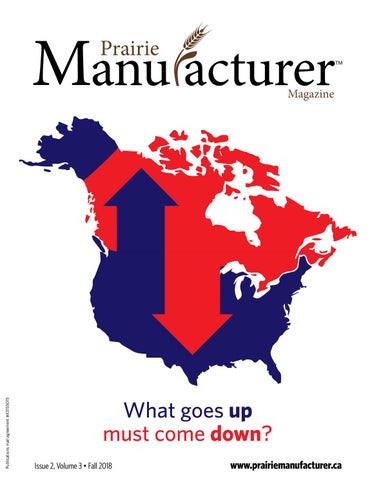
What goes up must come down? Issue 2, Volume 3 • Fall 2018
www.prairiemanufacturer.ca
Greater Regina Area — the first stop on the plant protein highway
economicdevelopmentregina.com
“Having HR at the table has been fundamental to our growth and development.” Paul Soubry
President and CEO of NFI Group Inc.
Successful Businesses Rely on CPHRs Hire a CPHR.
Chartered Professionals in Human Resources help manufacturers improve efficiency, safety and profitability. New Flyer Industries created their competitive advantage around people. Go to CPHRMB.CA/BUSINESS to see the video.
CPHRMB.CA
Publisher Ronda Landygo ronda@prairiemanufacturer.ca 877.880.3392
In this issue From plant to pint: Beer, and the case for growing the local value chain
6
What does craft beer have in common with federal superclusters? ‘More’ than you may think. Rebellion Brewing President Mark Heise explains how ‘more local’ can pave the way to ‘more global.’
The bruises and triumphs of our second-generation succession
18
Transitioning a family business from one generation to the next is no simple task; but it’s a common challenge for Prairie manufacturers. Southland Trailers’ Ryan Sailer shares his thoughts on what works — and what doesn’t.
SaskInnov8s
22
Canola oil to oven cleaner: Prairie Manufacturer Magazine’s Joanne Paulson takes a closer look at eight Saskatchewan innovations and how they’ve changed — or are changing — manufacturing and the Canadian economy.
This ‘family squabble’ may mean finding new friends
30
The Canada-U.S. trade relationship is on shaky ground, and that may have long-term impacts, regardless of how NAFTA negotiations play out. But how realistic is it to find new allies when the 800-pound gorilla sleeps next door?
Westward ho to the Asia-Pacific
36
Jayson Myers, acclaimed trade expert and CEO of NextGen Manufacturing Canada, reminds manufacturers that while disruption can be expensive, it can also create new opportunities for business expansion.
New online platform preaches the importance of safety training
38
Between 2014 and 2017, lost-time claims amongst Saskatchewan manufacturers plummeted 40 per cent. And to maintain the momentum, one expert is leaning on technology to reach an evolving ‘congregation.’
Next issue Spotlight: Modern manufacturing is all about breaking the conventional supply chain. Big data, decentralized production, specialized markets, and advanced technologies are changing the rules for what it takes to start — and grow — a successful enterprise. We look at the trends that will impact you in the months and years ahead. Regional feature: For far too long, the ‘Alberta advantage’ has been synonymous only with its vast wealth of natural resources. But peel back the layers, and you will find a true market differentiator: It’s people. Booking deadline: November 9, 2018 Material due: November 16, 2018
Editor Derek Lothian editor@prairiemanufacturer.ca 306.380.3765 Special thank you to our editorial advisory committee. Creative Director Dana Jensen Sales info@prairiemanufacturer.ca © Copyright 2018 Prairie Manufacturer MagazineTM All rights reserved. The contents of this publication may not be reproduced by any means, in whole or in part, without prior written consent of the publisher. Publications mail agreement #43155015 Return undeliverable Canadian addresses to: Prairie Manufacturer Magazine 207 Hugo St. North, Suite 3 Winnipeg, MB R3M 2N1 To change your address, or to be removed from the mail list, e-mail info@prairiemanufacturer.ca. While every effort has been made to ensure the accuracy of the information contained in and the reliability of the source, the publisher in no way guarantees nor warrants the information and is not responsible for errors, omissions or statements made by advertisers. Opinions and recommendations made by contributors or advertisers are not necessarily those of the publisher, its directors, officers or employees.
Proudly printed by Premier Printing Ltd. Printed in Canada | 8/2018
@prairiemfg
Editor’s Notebook
Good neighbours and global leaders By Derek Lothian
T
he last 12 years of my career have been — in one way, shape, or form — tied to manufacturing on the Prairies. One of my favourite jobs came in my early 20s, overseeing sales and marketing for a small agricultural equipment start-up. It was quintessentially Saskatchewanian: A handful of farmers with no manufacturing experience whatsoever running production out of a quonset to satisfy a growing global customer base. It was one of the few situations where inexperience (and even a bit of ignorance) was an undeniable asset. We didn’t know the ‘right way’ to do things, so we made it up on the fly. Sometimes we got burned; but, more often than not, we persevered. And we were a better, more resilient company because of it. My first hands-on experience with exporting came in 2007. We had just struck a deal with a North Dakota distributor, and there was interest bubbling from potential partners in Western Europe. Concepts I had never heard of before — rules of origin labelling, receivables insurance, FX
hedging — were, almost overnight, a regular part of my vocabulary. It was also my first exposure to how other jurisdictions perceived the made in Saskatchewan brand. If you haven’t personally seen the respect and curiosity it elicits, no one could blame you for not believing it. At trade shows in every corner of the world, customers quite literally seek out Saskatchewan manufacturers. They are synonymous with innovation, quality, and good, honest business practices. Just spend an hour with the Saskatchewan delegation at Agritechnica in Hannover, Germany, or at the IFT food expo in Chicago, and you will understand — probably in the first 10 minutes — what I mean. Out of all the experiences I was fortunate to have in that role, bearing witness to the export might of little ol’ Saskatchewan was perhaps the most special. Apart from the countless friends made and the dozens of new places visited, there was a certain pride that came with standing shoulder-toshoulder beside representatives from many of the companies you will read up on in these pages. It gave me a new respect for what manufacturing
“Whether its craft beer using local crops or new farm innovations for nurturing and harvesting those crops, the upstream and downstream manufacturing opportunity created from being North America’s ‘breadbasket’ is a sprawling regional advantage.”
4
Prairie Manufacturer Magazine • Fall 2018
is all about — and for the importance international trade has on the economic health of the Prairies. It has helped me understand why Saskatchewan manufacturers have consistently punched above their weight class as well, especially compared to other Canadian provinces. Between 2007 — my first full year with that company — and 2017, Saskatchewan manufacturing sales grew by six times the national average, spiking 54 per cent to $16.1 billion. And exports have led the way. While Canada as a whole only hit nine per cent growth in manufacturing exports over the same timeframe, Saskatchewan came in just shy of 50 per cent, and now sends nearly two-fifths of its entire manufacturing output to markets abroad. The end-destination of those goods, however, has changed significantly. In 2007, Saskatchewan shipped 54 per cent of its manufacturing exports to the United States, and another 25 per cent to the United Kingdom. Today, more than three-quarters go south of the border, and trade with the U.K. has all but erased. In fact, four countries that
were on the list of the top 10 markets for Saskatchewan manufacturing exports a decade ago — the U.K. (#2), along with France (#3), Russia (#5), and Thailand (#9) — didn’t even make the list in 2017. China, though, has more than made up the difference. The Red Dragon purchased $636 million worth of product from Saskatchewan manufacturers in 2017 — well in excess of three times what it did 10 years ago. Those trying to unlock the secret to Saskatchewan’s success needn’t look further than agriculture. Sales from the province’s food manufacturers, for example, have ballooned 82 per cent since 2007, and now hover around $4.4 billion annually. Chemical production, meanwhile, leapfrogged more than 134 per cent and farm implement manufacturing catapulted 58 per cent. It lends credence to a major theme you will find threaded throughout this issue: Generating new growth through value-added manufacturing.
Whether its craft beer using local crops (Page 6) or new farm innovations for nurturing and harvesting those crops, the upstream and downstream manufacturing opportunity created from being North America’s ‘breadbasket’ is a sprawling regional advantage. And it’s one all three Prairie provinces need to work together to build upon. On Page 10, Regina Economic Development’s David Froh lays out a compelling case for this cooperation, using the federal superclusters initiative as the catalyst. In it, he quite articulately argues that the challenge of our next generation will be how we feed the world — and that the challenge, plus the opportunity that accompanies it, is simply too expansive for one city or one province alone. Froh is right on the mark. Fortunately, manufacturers here are already no stranger to collaboration. Some of my fondest manufacturing
memories are times spent alongside would-be competitors, sharing lessons learned over a post-trade show pint or venturing out into the field to jointly troubleshoot a product issue we were both experiencing. It’s that ‘good neighbour’ mentality that, I believe, can be our competitive advantage. The real question will be: Can we get governments, and those organizations that support manufacturers, on the same bus — at the same juncture — quickly enough to capitalize? Only time will tell. But, if the last 10 years have been any indicator, manufacturers have the problemsolving capacity to lead and get the job done.
The bank of make it or break it At BDC, we understand the importance of cash flow protection, and the challenges. No matter the obstacle or objective, we can help you find the business solution that fits. As the only bank exclusively devoted to entrepreneurs, rest assured, our financing services are tailored to you.
Call us at 1-888-INFO-BDC or visit bdc.ca
BDCad_Manufacturing_7x4.625_en.indd 1
2017-11-17 12:14 PM
www.prairiemanufacturer.ca
5
View from the C-Suite
From plant to pint: Beer, and the case for growing the local value chain By Mark Heise
6
Prairie Manufacturer Magazine • Fall 2018
W
hen you think of Regina, Saskatchewan, what do you think of? The Saskatchewan Roughriders? The RCMP Depot? The Italian Star Deli? What about beer? Earlier this year, the Queen City was named to the list of the top 30 beer destinations in the world, joining the likes of Dublin, Ireland, and — of course — the iconic home of Oktoberfest, Munich, Germany. But what has made this place so special? Why are craft beer sales here expected to jump by 30 per cent industry-wide in 2018 alone? The answer isn’t a complicated one: It starts with what goes into the product. I’ll give you a few examples. Take AGT Food and Ingredients — the crown jewel of Saskatchewan’s agri-processing sector, and one of the largest exporters of pulse crops on the planet. At Rebellion Brewing, we bucked tradition and found a way to incorporate AGT’s King Red Lentils (coincidentally, which were developed at the University of Saskatchewan) into what has become our best-selling product, the Lentil Cream Ale. On a much smaller scale (and to complement our core business of beer), we work with honey producers near Tisdale, Saskatchewan, to brew honey wine — known as mead — using sour cherries from Over the Hill Orchards, just up the road in the Lumsden valley. The next community on every local brewer’s lips, meanwhile, is Rosthern — a farming town located about 45 minutes north of Saskatoon. This area is the nexus for some of the best malting barley available anywhere.
www.prairiemanufacturer.ca
7
“It’s no longer about which supplier can sell to you the cheapest; it’s about which partner can best know your business needs, customize products, anticipate your problems, and bring you solutions before you need them. All these factors point to our own backyard.”
Barley is an essential ingredient for beer. Cargill operates a malting facility about 160 kilometres southwest of Rosthern, and regularly plays host to representatives from some of North America’s most popular and successful craft brewers to meet with farmers in the region, inspect crops, and make plans for the coming 3-5 years. Having this relationship allows brewers to track
8
Prairie Manufacturer Magazine • Fall 2018
such variables as soil conditions, plant proteins, beta glucans, and moisture, and then determine what impact those indicators have had on output. Even start-ups are getting into the game. Maker’s Malt recently opened its doors in Rosthern to supply small-batch, custom-roasted products for the most discerning customers. For craft brewers like us, that allows us to experiment with
new recipes and iterate on each batch to capture the ideal flavour. The truth is that not too many people think about what goes into their beer. On a sunny, 30-degree day at the lake, who can blame them? The fact remains, however, brewing is as much of an art as it is a science. Apart from barley (and, in the case of our Lentil Cream Ale, lentils) the other three main ingredients that go into beer are water, hops, and yeast. Minor differences in any of those ingredients mean that even the same recipe may not taste the same from location to location, and brewers must account accordingly in their processes. Water, for instance, may be hard or soft, or have contrasting mineral
characteristics. The same thing goes for hops and barley — just like grapes or coffee beans — soil and climate can affect the taste and aroma of the product. No different than every other manufacturing enterprise, the quality and consistency of inputs are paramount — especially now, as specialization becomes the name of the game, and new competitive pressures pop up seemingly every day. That reality underscores the revolution I think is happening right now with respect to the localization of the value chain. It’s no longer about which supplier can sell to you the cheapest; it’s about which partner can best know your business needs, customize products, anticipate your problems, and bring you solutions before you need them. All these factors point to our own backyard. It’s the main reason why companies like ours are excited about an initiative as weighty as the new protein supercluster, announced by the federal government back in February. We need to do a much better job — as a city, as a province, and as a country — working more collaboratively to add as much value as we can here at home before we ship out to meet global demand. That’s most prevalent around agriculture. We have so much expertise here: Implement manufacturing, advanced farming practices, soil nutrition, food production, you name it — from plant to pint. The quickest path for growing market share is together, creating new markets as we do it, sometimes against the odds. Again, I believe craft brewers have laid the blueprint. All the ‘market research’ and anecdotal evidence told us originally not to bother selling our products in rural Saskatchewan. They said we’d never succeed there, and that people would never switch to drinking craft beer. Our partners, though, told us those predictions would be wrong. They told us that rural support of local goods is, instead, unquestionable. Our partners were right. Some of our best customers are from places like Estevan, Kindersley, Davidson, and Assiniboia.
But the proof in the collaborative model isn’t me revelling in its virtues — the proof is in the numbers. According to a recent study conducted by Economic Development Regina, the city’s craft brewers are expected to contribute close to $14 million to the regional economy this year, and grow employment by 17 per cent. These are small businesses having a big impact, using local inputs as the anchor.
People ask me all the time why we decided to open a brewery in Regina. Why not somewhere else? They just don’t see what more and more business folks are seeing — the untapped opportunity that exists right here, across the value chain. There is some cool stuff going on, and I for one am having a lot of fun. Mark Heise is the president of Rebellion Brewing Company, based in Regina.
“FCC knows how our industry works.” Melissa Vencatasamy, Co-owner, genAG Farm Equipment Retail
Your business is unique. Your financing should be too. Grow with a lender who understands Canadian agriculture. With over 100,000 customers, big and small, and a portfolio that tops $30 billion, Farm Credit Canada can help build your business success story.
fccfinancing.ca
www.prairiemanufacturer.ca
9
Money & Markets
Rethinking
competitive advantage Superclusters and economic development By David Froh
“Traditional economic development is often thought of as a zero-sum game with winners and losers, where regions fiercely compete for investment, sometimes to their detriment. Such an approach is not sustainable.�
10
Prairie Manufacturer Magazine • Fall 2018
P
rairie people have always seen the advantages of our wideopen spaces — they are a blank canvas of opportunity. These endless possibilities have fostered a culture where we have become accustomed to creating great things. As you will read throughout this issue of Prairie Manufacturer Magazine, Saskatchewan’s tradition of innovation is more than a century old, and continues strong today. Family-owned enterprises like Dutch Industries, SeedMaster, DOT Technology Corporation, and Degelman Industries literally started in farmyard quonsets, and then expanded to serve global markets. The path to prosperity in this province has always been built upon trade — and that, as they say, takes a village. You need to find quality suppliers, nurture distribution channels, and earn trust with customers. The common denominator is understanding the value proposition and partnering with those that complement the business. Traditional economic development is often thought of as a zero-sum game with winners and losers, where regions fiercely compete for investment, sometimes to their detriment. Such an approach is not sustainable. It can lead to neglecting local companies and assets, and cause entire regions to miss out on dynamic opportunities to partner and prosper. Governments can, however, support industry through competitive taxation and regulatory regimes, as well as through
procurement and strong trade infrastructure. They can also provide targeted policy and well-timed incentives. Enter the federal Innovation Superclusters Initiative — a $950 million pool of money that encourages businesses to work together toward a stronger, shared competitive advantage. Economic Development Regina was proud to play a leadership role in the creation of one of these superclusters, Protein Industries Canada (PIC). PIC is a consortium of small- to large-sized enterprises, comprised of research and development, technology, economic development, finance, investment, and education partners — all focused on positioning Canada internationally as the leading source of high-quality plant protein and co-products. PIC’s mission is to feed the world sustainably and supercharge the Canadian economy. By securing $150 million in federal dollars and hundreds of millions more in private sector commitments, achieving this goal is within reach. The global population, which is expected to reach 9.7 billion people by 2050, will require more food than we’ve produced in the history of humankind. There are approximately three billion people in the middle class alone demanding better proteins and safer, more reliable food. With their consumption growing by four per cent year-over-year, how will we feed these people with limited resources? The answer is twofold: Different than we are today, and with a Prairie solution.
www.prairiemanufacturer.ca
11
“I love a good burger; but the truth is that the future of food, and perhaps our economy, is plant protein — foods and food ingredients from pulses, canola, hemp, and wheat.
I love a good burger; but the truth is that the future of food, and perhaps our economy, is plant protein — foods and food ingredients from pulses, canola, hemp, and wheat. Millennials across North America and beyond are eating differently, demanding ‘flexitarian’ options, and contributing to a surging plant protein market that is expected to grow from $10 billion to $13 billion by 2020. PIC has ambitious goals to move Canada to second place in global agricultural exports and fifth in agri-food exports. If successful, the cluster will change the footprint of food processing, manufacturing, and agriculture technology in Canada. To get there, cluster partners must recognize and cultivate their own distinct competitive advantages, but align them toward one common mission. Clustering enables businesses to enjoy economies of scale. They can access talent, information, suppliers, and capital often reserved for larger organizations. It has historically occurred when companies from the same sector gather in close proximity. This is particularly evident in industries like banking and information technology. Think San Francisco or Waterloo as case studies. While this particular supercluster is much more expansive, reaching across all three Prairie provinces, the Greater Regina Area (GRA) is a critical stop along the plant protein highway. One of the primary reasons is geography. We are surrounded by massive amounts of quality and sustainable inputs right at our back door. More than five million tonnes of pulses were exported from Saskatchewan last year, much of it from the Regina plains. Our 17,000 pulse growers produce 99 per cent of Canada’s chickpeas and 84 per cent of Canada’s lentils. Additionally, Saskatchewan farmers grow 9.2 million
12
Prairie Manufacturer Magazine • Fall 2018
tonnes of canola, making them Canada’s largest canola producer. We are also well-connected — supported by a vast network of trade infrastructure, making the GRA an ideal location to source, process, produce, and export from. Exporters can reach 60 million consumers within a day’s drive of the region, and more than 270 million consumers within two days. It is home to Canada’s only self-governing inland port authority, the Global Transportation Hub, as well as the Chuka Creek Business and Logistics Park — the new state-of-the-art container and intermodal terminal facility for CN Rail. Manufacturing is an important part of PIC’s strategy, too. Sensors, devices, and equipment produce large amounts of data that can provide unprecedented decisionmaking capabilities. From farm to table, manufacturers of purpose-built devices (seeders, sprayers, combines, rail cars, and everything in between) can be the core of this smart agriculture ecosystem. Leaders like ISM Canada, headquartered in Regina, already work with private and public sector players on big data, cloud computing, analytics, and smart mobile applications for agri-business, and can enable manufacturers and farmers to jointly identify efficiencies, boost performance, and enhance profitability. With $5 billion-plus in sales and nearly 10,000 employees in the agri-business and manufacturing sectors, the GRA is, again, ideally positioned. We already specialize in short-line manufacturing of agricultural equipment for precision dryland farming. The city has a world-class steel mill and local companies that provide steel processing services, including profile cutting and bending technology. The Innovative Manufacturing Center at Saskatchewan Polytechnic, meanwhile, is the most well-equipped machining and manufacturing facility in the province, offering full testing, prototyping, and certification capabilities.
With the rapidly changing demand for new technologies, it is still possible to enter the manufacturing or agri-value sector as a start-up — two of the few industries where that remains true. Part of the reason is the capital that is accessible here. Conexus Credit Union, for example, is a partner in PIC’s $150 million Venture Capital Fund, and a proud operator of the area’s newest business incubator. Other initiatives, like Path CoWork — a new collaborative co-work space, where entrepreneurs are supported by organizations like EDR and Women Entrepreneurs of Saskatchewan — allow entrepreneurs to connect with the resources they need to thrive. We realize, though, we are not alone in our pursuits. The GRA is an essential pillar of the PIC cluster, but could never reach our goals without leveraging the worldleading plant biotechnology research in Saskatoon, machine learning and artificial intelligence expertise in Winnipeg, and the production and processing expertise in the Edmonton region. These jurisdictions house assets Regina doesn’t yet have — and that’s okay. That’s why the cluster spans Western Canada. Finally, our respective provincial governments have a role to play. In Saskatchewan, initiatives like the Technology Start-Up Incentive (a 45 per cent non-refundable tax credit for investments in eligible tech start-ups), the Value-Added Agriculture Incentive (a 15 per cent tax credit on capital expenditures for newly constructed or expanded value-added agriculture facilities), and the Commercial Innovation Incentive (which reduces the Corporate Income Tax rate to six per cent for up to 10 years on taxable income earned from the commercialization of a broad range of qualifying IP) all strengthen the competitive equation. In the GRA, collaboration is at the heart of everything we do. And that needs to be the mantra of modern economic development agencies everywhere: Think big, build a world-class business base, and search for new partners — regardless of where they’re operating today.
WHERE INDUSTRY COMES FOR SOLUTIONS AND TO SUCCEED INDUSTRY IS A PARTNER IN ALL THAT NAIT DOES. For over 50 years, we’ve collaborated with a wide range of organizations, at home and abroad. We’ve worked together to increase productivity, design, build and test new products, and partner on applied research. We’ve elevated management and leadership practices through customized training. We’ve helped companies embrace innovation and adopt new technologies. Our ever-evolving relationship with industry is about to transform again. Opening in Fall 2018, NAIT’s Productivity and Innovation Centre will lead the way in helping our clients to innovate, grow and compete within Alberta and far beyond our borders.
Learn more at nait.ca/industry
Lessons in Lean
Quick lessons for the modern lean leader By Stewart Bellamy
L
ooking back now on more than five decades in manufacturing, I often think about just how much more may have been accomplished had I — and the companies I worked with — been exposed to this ‘lean stuff’ earlier. After 20 years as a continuous improvement practitioner, plus countless hours of ongoing personal study time, one thing has become abundantly clear: A lean journey is infinite. The more you learn, the more there is to know. What follows are a few observations from my career on several key elements routinely misunderstood, or not even considered, in many lean initiatives.
• Respect for people: Not about remembering everyone’s name and what sports their kids play. This is about recognizing, through direct observation, where impediments to easier, safer, faster work are present, and then committing the necessary resources to eliminate the obstacles. • Kaizen: Identifying problems with current work processes and learning, through collaboration and experimentation, where improvements must be made. The ultimate outcome is developing a new standard work and finally sharing what was learned.
High quality, quick delivery, low cost — pick any two
More than 90 per cent of lean implementations are not sustained
Have you ever seen this statement posted in a business? Maybe it’s just the unwritten mantra of the owner? Either way, it’s not an uncommon thought. The premise is that you can have high quality and fast delivery, but it won’t be cheap. You can have high quality and low cost, but it won’t be fast. Or, you can have fast delivery and low cost, but the quality may suffer. But why should customers have to compromise? A lean organization’s strategy is to provide all three, simultaneously: Fulfill customer needs with the highest quality, in the shortest lead-time, and at the lowest cost. Lean or not, most organizations do recognize — and even state — these concepts, in some form or another, as guidelines for success. The golden riddle is how to make it happen. In a 2009 article entitled TPS vs. Lean, longtime Toyota Production System (TPS) authority Art Smalley describes Toyota’s far more comprehensive version of what organizational success looks like. He states, “For over 50 years, TPS in Toyota has been primarily concerned with making a profit, and satisfying the customer with the highest possible quality at the lowest cost in the shortest lead-time, while developing the talents and skills of its workforce through rigorous improvement routines and problem solving disciplines.” Four key points stand out for me in the Toyota version: • Making a profit: Getting paid a fair price for your products while simultaneously seeking every opportunity to minimize costs. Basically: No profit, no company, no jobs. • Leadership: Taking ownership for the advancement of your workforce’s capabilities; developing a tiered system for the delivery of training, coaching, and mentorship at every level.
According to Art Byrne in his excellent book, The Lean Turnaround, only 5-7 per cent of companies attempting a lean implementation see long-term sustainable success. So, what differentiates the winners from the losers? For the winners, senior leadership is the catalyst guiding the initiative. Lean becomes the culture driving organizational strategy, which — in turn — means that every member of the organization is committed, engaged, and involved every day in the effort. Regrettably, the overwhelming majority (the remaining 93-95 per cent) see lean as merely an operational cost-cutting program — usually implemented part-time, by someone in middle management, who applies lean tools with a primary focus on production floor performance. And although this does generate some short-term positive results, it falls far short of what is possible when the whole organization gets involved. That is not to say that there aren’t organizations who see success with this limited operational approach. There certainly are. One can’t help but wonder, though, just how much are they leaving on the table.
14
Prairie Manufacturer Magazine • Fall 2018
Strategic alignment is more than a buzz-phrase The ability to align everyone’s energies in meeting ‘true north’ objectives (corporate intent) can be extremely challenging. For one thing, the increments of measurements at the facility, department, and individual levels will be very different. At the facility level, operations management may have annual or quarterly targets. At the departmental level, they’re looking at monthly or weekly numbers. And the production folks (the valueadders) need daily, hourly, or even minute-by-minute indicators.
Beginning at the top of the hierarchical pyramid, with the ownership group, a structured process is developed that makes expected outcomes clear and visible at every level. The number of levels is, of course, dependent on the size and structure of the organization. Sharing corporate intent
Now that everyone has a clear understanding of what is excepted of them, we need a similar structured process that tracks and reports back on results. This is where we invert the pyramid, with the frontline folks now driving the bus. Results at each level then become the input to the next, and so on, until results reach the ownership group. Reporting the results
“Lean isn’t some grandiose concept you need to spend years planning or preparing for. It’s about making and sustaining small but meaningful change.”
Need TRAINING? CME has you covered!
» » » » »
Leadership Development Program LEAN for Leaders (Executive Level) Blackbelt Program Greenbelt Program LEAN Level I
SAVE THE DATE SOUTHERN MANITOBA MANUFACTURERS’ SUMMIT
For more information, contact us at mb.info@cme-mec.ca or 204.949.1454
OCTOBER 25, 2018
ACCESS EVENT CENTRE | MORDEN, MB
CME TRADE SUMMIT BUSINESS-READY TACTICS NOVEMBER 29, 2018
HOLIDAY INN AIRPORT POLO PARK
REGISTER NOW AT DARETOCOMPETE.CA
www.prairiemanufacturer.ca
15
One more point about data reporting: The chances of getting meaningful, accurate, and timely information from the folks who report to you is greatly improved when you take a collaborative approach. Rather than imposing a predetermined reporting method on people, try this alternative approach: Describe what must be measured and take the time to explain why it’s important. Then ask for two or three suggestions on how they would provide the needed data. Once you reach agreement, people now have ‘skin in the game’ and feel far more obligated to do it well. Another — and perhaps more significant — benefit of accurate and timely reporting is the opportunity for a lead-hand, supervisor, or manager to see very quickly when problems inevitably arise, and provide support in getting things back on track with the minimum of disruption to productivity.
The cost, profit, price equation Back in the ‘good old days,’ when I first began project estimating, traditional thinking said that the manufacturer sets the price by simply calculating material, sublet services, labour, and overhead costs, and then tacking on an anticipated profit margin. This formula (cost + profit = price) assumed that, except where a deal could be found on cheaper materials or sublet services, costs were generally fixed. With experience, it becomes apparent it’s rarely that easy. Try looking at it from a different perspective: Price - costs = profit. Although there’s no mathematical difference, lean thinkers recognize that costs are not fixed, and selling price is ultimately determined by the customer and market. Taichi Ohno’s book, Workplace Management, dedicates a chapter to this subject. He muses that, “Costs do not exist to be calculated; costs exist to be reduced.” Appreciating this fact shifts the focus towards the internal factors that drive organizational costs.
The truth about kaizen Kaizen is perhaps the most misunderstood component of any lean initiative, most often seen as a prescheduled, event-based, group activity.
The Japanese term kaizen is typically translated to mean good change or better way. But good change only describes the expected outcome. A deeper understanding of the Kanji characters provides a more literal translation: Kai means self-reflection. In manufacturing terms, this means each individual (including you) studying their own work processes to identify where improvement opportunities exist and thinking about what needs to happen to reach the next level. Zen, meanwhile, means sacrifice. No improvement happens without change — sacrificing the comfort and safety of the status quo and committing (sacrificing) the time, effort, and energy necessary to achieve an improved state. This helped me to understand why kaizen is a way of thinking, and not an activity or event.
Just start doing Mark Twain once wrote that, “Gradual Improvement is better than delayed perfection.” Picture this: As a manager, you approach the people in your department and explain the company needs to reduce costs to remain competitive. You ask them to implement changes to their work that would free up one month of additional productive work per year. This seems like an almost impossible challenge. Now, what if you asked them to find ways to reduce the time they spend waiting, searching, and walking to find materials, tools, workspace, and information, by just five minutes per hour? This seems much more realistic, right? Believe it or not, when you do the math, it provides the same results. That’s the lesson I’d like to leave you with: Lean isn’t some grandiose concept you need to spend years planning or preparing for. It’s about making and sustaining small but meaningful change. Why not stop the excuses and start making those changes right now? Stewart Bellamy is a certified lean black belt and the co-founder of the Lean Practitioners Association of Saskatchewan (LPAS). The 2018 LPAS Conference runs November 13-14 in Regina; details are available at www.lpasask.com.
Your image is in good hands. premierprinting.ca
16
Prairie Manufacturer Magazine • Fall 2018
The Principal Resource
The bruises and triumphs of our second-generation succession By Ryan Sailer
F
or us, it never was a decision if we would take over the family business. It's not like we sat down when we were all 10 or 12 years old and said, “Okay, this is the road map. This is what you guys will be doing; here's how it will look, and here's how it will work.” My two brothers and I (Jason, older than me by two years, and Scott, younger than me by three years) generally had an interest in the business. And, when we were still in high school, we always held summer jobs in various positions at the shop. We did everything, from sweeping the parking lot and driving forklift to servicing end-customers’ trailer brakes and unloading trucks. As we grew, we found we shared a passion for fixing problems and things that bugged us. That inherently led us to take on more responsibility year after year. It was around 2007 and 2008 we found our way into critical roles in the business. With this responsibility, we were met with skepticism and resistance to change from the other middle and senior managers — largely because we were the “owners’ kids.” There were a few managers that occasionally agreed and believed in the changes we wanted to implement; however, most of management at that time was comfortable with the status quo. To drive and push solutions forward, we would meet with our
18
Prairie Manufacturer Magazine • Fall 2018
father, explain the issue and what we believed the solution was, and he would help work with everyone to implement the change (or a compromise of that change). This went on for about a year. At that point, I was 21 years old. My older brother, meanwhile, was 23, and my younger brother, 18. Then, one day, we ended up getting into a heated debate with the purchasing manager about changing our purchasing process. Long story short: About three weeks later, that manager submitted his notice. Later that week, another manager met with our father and shared his concerns over the changes my brothers and I were trying to implement (these were all changes to office processes, I mind you — nothing to do with a company-wide lean implementation or anything of that magnitude). My father realized he needed to have a conversation with us: Either we decide to believe in the business and what we can do with it, or we back off and allow the business to run as it had been in the past and stop questioning the way current managers were operating. This is when it became real for us. We had to dig deep and truly decide if the family business was the career path we wanted. We knew if we stayed involved, the mangers we had in-place would most likely leave, and we would be left to figure out how the business
can and should run. We knew we would always have guidance and input from our father, but a lot more responsibility would fall onto our shoulders. Our family was very close and did a lot together, so we sat down one evening and had an informal family dinner, to discuss my brothers’ and I’s future. As we dug deeper into the conversation, there was a couple guiding values that became very clear to us (these principles had always been there, we just were not necessarily conscious of them). The first value was candor. We had — and have — the ability to be brutally honest with each other and ask the hard questions. There were times that we would be extremely frustrated or raise our voices, but, deep down, we all knew it was never personal — it was always for the betterment of the business and to improve the process. Sometimes, we had to let things sit for 24 hours; but when we reflected, we always came out with a better way. This candor started to get noticed within the business, and still rings true within our company to this day. We encourage everyone to always speak their minds, and to never leave a huddle or meeting in silent disagreement. The only way to move ahead is if all the cards are on the table so that the most informed decision can be made. Candor allows a business
“We decided that no matter what happened, our relationship as a family was always more important than anything in the business. If it ever came to the day that the business was negatively affecting my brothers’ and I’s relationship, or the relationship between us and our parents, we would sell it.”
to understand what everyone is thinking. You might not always agree, yet at least you can move towards a common direction as a team. The second value was family first. We decided that no matter what happened, our relationship as a family was always more important than anything in the business. If it ever came to the day that the business was negatively affecting my brothers’ and I’s relationship, or the relationship between us and our parents, we would sell it. There was nothing more important to us than our family. All family business owners know there are many externalities that will directly and indirectly influence the decision-making process. Sometimes it can become a bit convoluted and very challenging, although we always make sure the family first value holds true, and that ultimately helps guide us to a decision. Once we realized these values had always existed, we made sure we were conscious of them and never let them fall by the wayside. From here, it became evident that the three of us were going to transition into senior management roles, and eventually take over the business. Certain managers that didn’t
believe in that approach ended up leaving within a year. Other managers jumped onboard and were all-in on the change process and adopting a philosophy of continuous improvement. Eventually, when it was decided that I would assume the general manager role, the previous general manager was very good to work with. We put together a sixmonth transition plan and moved ahead with that. Our previous general manager and I are still good friends and stay in touch to this day. As we earned a couple years of senior management experience, our father was incredibly patient. He always seemed to know the perfect balance of when he needed to step in and provide guidance and direction, yet never stepped on our toes or micro-managed the day-to-day. He gave us enough flexibility to learn and make mistakes and grow. I can’t imagine being in his position, watching his kids in their 20s take over what he had built for more than 30 years. It would be difficult to let go of the reigns. Fortunately, the four of us also had our mother, who remains the glue that keeps everything together, even through the toughest disagreements. Up to this point, whether right or
wrong, we never had a lawyer, banker, or accountant directly involved in the transition. We kept them in the loop and wanted their input on different succession strategies, but we knew we needed to feel out the transitionary years, and ensure we all found our roles, hit our stride, and confirm we could make it work. It was only at that point we officially sat down to finalize the legalities of it all. We felt if we did that up-front and didn’t have the experience or trial-and-error under our belts, we would potentially be wasting a bunch of time and money on legal aspects (unanimous shareholder agreements, tax planning from one generation to the next, and so on) that weren’t yet important. Don’t get me wrong: There is no substitute for professional advice. Without a shared vision, though, every family succession is doomed to fail. Ryan Sailer is general manager of Southland Trailer Corp. Southland employs approximately 175 people and operates out of an 80,000-square-foot facility in Lethbridge, Alberta.
www.prairiemanufacturer.ca
19
Thinking of growing or expanding? We can help.
Save money, talk to SREDA first. SREDA administers the City of Saskatoon’s Business Development Incentive. This tax abatement incentive was developed to encourage attraction and expansion of businesses and facilitate long-term job creation. Incentives include: exemptions or reductions of any city tax or fee; waiving of utility deposits and down payments on land; and exemptions of reductions of prepaid servicing levies.
Eligibility Criteria •
Be a legally incorporated entity.
•
Be involved in energy, oil and gas, mining, manufacturing, processing, technology, transportation and logistics, telecommunications, or data processing.
•
Demonstrate that a minimum of 5 new full-time positions will be created within 1 year, if from an existing business; or demonstrate that a minimum of 15 new full-time jobs will be created within 3 years, if from a new business.
•
Invest a minimum of $500,000 in plant, land and/or leasehold improvements.
•
Possess the required financial resources to complete the project.
•
Be a legal owner of the property or provide a copy of the lease agreement upon application.
•
Possess a realistic and acceptable business plan and/or executive summary.
•
Must apply for an incentive prior to commencing with an expansion or new building project and prior to applying for a building permit through the City of Saskatoon.
Let us help you! For more information, contact: Joanne Baczuk Director, Business Development jbaczuk@sreda.com (306) 664-0728
22
Prairie Manufacturer Magazine • Fall 2018
SaskInnov8s A look at eight Saskatchewan innovations and how they've changed — or are changing — manufacturing and the Canadian economy By Joanne Paulson
T
he innovative spirit of Saskatchewan was a natural outcome of its early days, harkening to a time of ploughs and pioneers. While much has changed, that drive to create — to solve problems — has not. According to the Western Development Museum, Saskatchewan is home to 3,200 patents. Thousands of other unrecorded inventions and process innovations have been successfully commercialized. Some of these advances have led to the genesis of the province’s thriving manufacturing sector — an industry that, through 2017, employed 28,000 people and generated more than $16 billion in sales. And while we can’t tell all these stories in one issue, we’ve selected eight of them we think capture the spirit that has earned Saskatchewan an international reputation for manufacturing and economic ingenuity.
Canola & Canola Oil If there has ever been a crop to revolutionize agriculture on the Prairies, it’s canola. Farmers here originally planted hardy grains, such as wheat, oats, barley, and rye, which could withstand harsh weather. One of the earliest oilseeds experimented with was rape — an industrial crop containing erucic acid. Because of high concentrations, however, it was not safe for human consumption. Furthermore, compounds called glucosinolates in the crop also made it unsuitable for animal feed. If farmers wanted an oilseed option, something had to change. By the 1960s, Keith Downey, a geneticist at the University of Saskatchewan, along with Baldur Stefansson of the University of Manitoba were on it. The Downey team’s first breakthrough came with help from Bryan Harvey and Burton Craig working at the National Research Council. Harvey evaluated some samples for erucic acid by using a gas-liquid chromatograph created by Craig, and found a seed with a fatty acid type significantly different from the rest. From there, Harvey and Downey crossed the seed with a leafy Polish variety, using a technique that allowed the oil to be analyzed without destroying it. In 1974, Stefannson developed the first low-erucic and low-glucosinolate rapeseed, an Argentinian variety. By 1977, Downey had created the canola that would thrive in northern growing areas. The next step would be to extract the oil from the seed — a process that was initially developed at the government-funded POS Pilot Plant in Saskatoon. Today, POS is a privately-owned manufacturer, research facility, and ingredient processor, with clients in 50 countries around the globe. Canola, meanwhile, is a major export on the Prairies, spawning $12.2 billion in economic benefit for Saskatchewan each year, and $26.7 billion for Canada, when related jobs and wages are included.
www.prairiemanufacturer.ca
23
DOT
Draganfly UAVs
Three years ago, inventor and manufacturing executive Norbert Beaujot was contemplating the problems created for farmers by high machinery costs and a shortage of skilled labour. His musings led to the creation of DOT — an autonomous, diesel and hydraulically-driven platform that can take the place of conventional tractors to power farm implements, such as seeders, sprayers, and harvest equipment. The U-shaped DOT uses GPS to travel the route planned by the producer, self-adjusting for optimal traction and precision. Safety is the top priority — if the machine veers off-course for any reason, the engine stops. There is also an emergency shut-down device. DOT’s frame is lightweight compared to the traditional alternative, and the 163-horsepower engine is capable of pulling 40,000 pounds at up to six miles per hour. DOT Technology Corp., the maker of the unmanned platform, is a sister company to SeedMaster, which manufactures air seeders near Regina. The genesis is somewhat poetic, given the air seeder’s original roots in Saskatchewan (which itself could be the subject of an entire article). The new-age implement launched in 2017. Earlier this year, WIRED magazine called DOT the “Transformer of ag-bots” and added that it was “capable of performing 100-plus jobs, from hay baler and seeder to rock picker and manure spreader.”
Twenty years ago, Zenon Dragan demonstrated his first innovations by flying them around his living room. The little radiocontrolled blimp and helicopter were fun, but would the technology prove to be the game-changer he and his wife, Christine, hoped for? Without question. Draganfly Innovations is now recognized as a global leader in creating unmanned aerial vehicles (UAVs) for commercial purposes. Most people know them better as drones. The company’s inaugural model, the X6, took home the nod for Popular Science’s ‘Best of What’s New’ award in the ‘Aviation and Space’ category in 2008. It would become the first first-federally approved, commercially-produced UAV in North America available to the civilian market. From there, Draganfly has kept pushing the envelope. For example, the company’s Draganflyer Commander product, a multi-rotor mini-helicopter, offers 45 minutes of flight time for use in law enforcement, search and rescue, mapping, agriculture, and aerial imaging. Another product, the dual-rotor Draganfly X4-ES (since upgraded to a newer model), even helped save a life. The Saskatchewan RCMP used the system to find an injured driver who wandered away from a single-vehicle accident. The driver was eventually found, and the device made history as the first civiliandeveloped, small UAV used in a life-saving operation. Draganfly offers other solutions, too, including an airplane-style drone (the Tango2), which supports several kinds of payloads, such as equipment for high-resolution colour video, high-tech imaging, and data collection. “In the beginning, people were fascinated to fly a multi-rotor helicopter, and we sold thousands of them,” Zenon Dragan has said. “Soon, people realized they’re amazing tools and that’s when everything started to change.”
24
Prairie Manufacturer Magazine • Fall 2018
The Blairmore Ring
Schulte Rock Picker
The commodity known as ‘pink gold’ was discovered in southeast Saskatchewan while drilling for oil in 1942. Much of it may still be in the ground, however, had it not been for the invention of the Blairmore Ring. More than 1,000 metres under the surface lies a vast layer of potash that extends south into North Dakota. This stretch is known as the Blairmore Formation — an up-to-400-foot-thick layer of sand, shale, and water, mixed together at roughly 700 psi. International Minerals and Chemical Corp. (better known locally as IMC) began to sink a shaft for its K1 mine at Esterhazy in the late 1950s. Early attempts, though, were stymied by the combination of high pressure and water, which would result in almost-instantaneous flooding. The miners tried sealing the shaft using concrete, to no avail. But two years later, a solution was discovered: First, freeze the ground with pipes — up to 58 of them measuring 250 feet long — and a refrigeration unit; then, install massive cast iron rings to hold back the water and earth. This 28-tonne device earned the name the Blairmore Ring. By 1962, 17,000 bolts secured 100 rings, creating a watertight shaft that rescued the mining venture that had already cost more than $20 million. Even today, a modified version of the ring is used to cut through the Blairmore Foundation. It was an engineering feat of spectacular proportions. “Without the Blairmore Ring, the mine would flood and the shaft could potentially collapse in on itself. So, without it, we’d have no underground mining of potash,” says Eric Anderson, executive director of the Saskatchewan Industrial and Mining Suppliers Association. “We’d have been decades behind on what is now one of our biggest and most important industries.”
If Saskatchewan manufacturing is known for anything, it would be for its dominance in the agricultural implement sphere. One of the earliest companies engaged in the sector was run by the Schulte family. In 1912, Caspar Schulte acquired the blacksmith’s shop in the town of Englefeld, 145 kilometres east of Saskatoon, and was joined in business by his son, John, 20 years later. John first built brush-cutting and cleaning equipment, followed by a front-mount snow plow in the 1940s. But the first breakthrough for farmers was the Schulte rock picker, patented in 1963. The device scoops up rocks and sends them through wide grates and into huge buckets, which can then be dumped into piles. One year later, under the name Schulte Welding and Machine Ltd., the company began full-scale production of the snow blowers, earth scrapers, and rock pickers. By 1967, through Rockelator Sales Ltd., the rock pickers rapidly found export markets in the United States and around the world. Fast forward 50 years. With monikers like Titan, Giant, and Jumbo, rock pickers are now commonplace. Schulte’s newest Titan 500 model was just introduced in July, branded the largestcapacity picker in the industry. That sure beats the more manual methods of the past — picking them by hand, or using chains and tractors for each individual rock. In fact, it would be fair to say the Schulte rock picker is the emblematic Saskatchewan innovation: Ingrained in an everyday problem, with a common-sense solution and global demand.
“Without the Blairmore Ring, the mine would flood and the shaft could potentially collapse in on itself. So, without it, we’d have no underground mining of potash. We’d have been decades behind on what is now one of our biggest and most important industries.”
www.prairiemanufacturer.ca
25
Vertical-Axis Wind Turbine Picture a conventional wind turbine: A tall, steel pole adorned with three hulking blades. Now, picture a large egg beater — positioned closer to the ground with cables supporting each of six blades. It performs the same function, but the Lux vertical-axis wind turbine, or VAWT, may offer several distinct advantages. According to Lux Wind Power, headquartered in Saskatoon, the design uses recyclable materials should it require removal, takes up less space due to a narrower operating span, is safer for wildlife, is much quieter than conventional models, and could prove to be less expensive to manufacture. The company’s founder is Glen Lux. In 2013, his design for the VAWT won top prize in the ‘Sustainable Technologies’ category at the Create the Future Design Contest, held by NASA Tech Briefs. More than 8,000 product designs are entered into the massive contest annually. He had been working on the project since 2004, and has since fine-tuned the VAWT through more than 30 iterations — the newest of which emerged just a few weeks ago, when Lux installed a 100-kilowatt turbine west of the city. He is currently commissioning the prototype. “It’s bigger than any of the others I’ve built; and it’s connected to the grid, so that’s a whole new experience for us,” he says. “When it’s commissioned, we have a 20-year contract to sell electricity to SaskPower.” Part of the project involves assessing the potential of the design, and deciding if Lux will produce this size of turbine in the future. “We seem to have a lot of interest,” says Lux. “We’ve had numerous cars driving by and asking, What is it? And we’re getting support from the industry in general. People want to see this happen. “I think it’s going to work. I think we’re going to end up manufacturing this right here in Saskatchewan.”
A special thanks to the Western Development Museum and its ‘Saskatchewan Innovations’ virtual exhibit for being the inspiration (and a primary resource) for this article.
26
Prairie Manufacturer Magazine • Fall 2018
A Financial Revolution
Easy-Off Oven Cleaner
While this one isn’t necessarily a manufacturing innovation, its impacts on consumerism and the economy at-large have been wide-reaching, so we’ve included it. Plus, we think it’s downright cool. If you’ve tried telling people the now-ubiquitous automated teller machine (ATM) had its start in a Saskatchewan credit union, you’ll know that look of disbelief on their faces. But it’s true. The first full-service ATMs went into use at Regina’s Sherwood Credit Union (now Conexus Credit Union) in March 1977. They were developed by the information technology staff at Co-operative Insurance Services, in conjunction with IBM Canada. The credit union ATM system spread quickly throughout the province, as members enjoyed the convenience of access to their money, 18 hours a day, seven days a week, in amounts up to $200. These were not, however, simple cash dispensers. In late 1977, Sherwood members could also make deposits as well as loan and credit card payments, plus transfer funds among accounts and determine balances. This wouldn’t be the last time Saskatchewan’s credit unions would pioneer a revolutionary idea, either. In 1985, the credit union partnered with Pioneer Co-op in Swift Current on a two-year project to pilot the use of the debit card. By the early 1990s, thanks — in part — to the widespread acceptance of ATMs, debit cards were available nationwide. Businesses and individuals could hardly then imagine the revolutionary nature of the digitization of financial transactions. Today, we could hardly imagine life without it.
Oven cleaner may not be the sexiest product invented in Saskatchewan, but it may be one of the most commercially far-reaching. Easy-Off was invented by Herbert McCool in either 1932 or 1933, depending on who you ask. No one is even quite sure if McCool made much money off it. Lore has it the electrician made the caustic product in his basement and sold it door-to-door until his death in the mid-40s. His widow then sold the rights to American Home Products and Boyle Midway Canada. Canadian actor and comic Steve Smith — better known as Red Green — put it this way in his book, The Woulda Coulda Shoulda Guide to Canadian Inventions: “For me, the beauty of this product is that ole Herb came up with a formula that was strong enough to clean an oven, but safe enough to have in your kitchen,” he wrote. “If I had invented it, it would be made out of sulfuric acid and come in a huge can so they had room to print all the warnings.” Jokes aside, such was the beauty of Easy-Off. As Smith rightly noted, “He knew things and he did tests until he came up with the perfect balance between safety and getting the job done.”
Today’s global landscape and technological advances require but one constant — change. Now, more than ever before, leaders need to integrate change while managing current issues and demands strategically. With a Levene MBA, gain fundamental business knowledge while developing a comprehensive approach to leading cross-functional teams, formulating solutions and achieving results.
The power of an MBA
Discover your unlimited career potential with a Levene MBA. Register for an information session at: levenegsb.ca Features: Flexible study schedules and formats, pay-as-you-go structure, mid-career admission option and more!
www.prairiemanufacturer.ca
27
Saskatchewan’s ‘Iron Triangle’ a hub for ag manufacturing innovation By J. Robert Shanks
G
ifted with a rich farming tradition and 40 per cent of Canada’s arable land, Saskatchewan is synonymous with agriculture in the minds of many. But the reputation belongs with more than farmers alone. The province is also home to a burgeoning shortline and OEM agricultural manufacturing base, which — in 2017 — exported roughly $300 million in product to markets around the world. The strength of the industry is, perhaps, not surprising — especially given that 85 per cent of Saskatchewan’s GDP is generated outside of its high-profile resource sectors. Ag manufacturers have proven to be one of the brightest and most creative stars of Saskatchewan’s economy. Largely composed of small businesses, they have built a sterling international reputation for quality and innovation, and the ‘made in Saskatchewan’ brand is sought after at trade shows and equipment showcases from Red Deer to Germany to Kazahkstan, and everywhere in between. Many of these businesses are located outside of the province’s two largest cities. The rural area east of Saskatoon in particular has strong history of being a furnace of ag manufacturing activity. Centered around the town of Humboldt, the region has a humble population of about 6,800 people — more than 1,300 of whom are employed in manufacturing. Trailer manufacturer Doepker Industries, headquartered in the village of Annaheim, population 210, represents one corner of this ag manufacturing hub — affectionately known as the Iron Triangle. This ‘triangle’ is formed geographically by Doepker, world-leading air seeder manufacturer Bourgault Industries in St. Brieux, and Schulte Industries, a maker of shortline agricultural equipment in Englefeld that has been around for a century and now has sales on five continents. These firms are not alone. Other manufacturers in the area
28
Prairie Manufacturer Magazine • Fall 2018
include: Commercial Industrial Manufacturing (Humboldt), a builder of steel products such as truck boxes; Koenders Manufacturing (Englefeld), which specializes in plastic moulded products for the recreation and agricultural industry; specialty tarp maker Michel’s (St. Gregor); and Highline Manufacturing (Vonda), which produces rock pickers and balers. The Iron Triangle’s origins are rooted in response to the needs of farmers. Saskatchewan, it turns out, is a superb place to develop and establish an agricultural equipment business: The large local market is an ideal arena for testing new products, and companies can find their feet before turning their attention to potential global growth. This dynamic, paired with the availability of other supports, have enabled these entrepreneurial enterprises to continually punch above their weight class, in trade and in commercialization. Humboldt is home to the Prairie Agricultural Manufacturing Institute (PAMI) — a research, development, and testing organization, with diverse engineering expertise. PAMI serves all three levels of government and manufacturers from coast to coast — and not just related to agriculture, either. PAMI has customers spanning transportation, defence, aeronautics, forestry, and mining as well. “PAMI has benefited greatly from being located within the Iron Triangle. Sharing a common rural background and agrarian roots, we have enjoyed decades-long relationships with all of these companies,” says David Yee, vice president of PAMI’s Saskatchewan operations. “The body of work and the international reputation PAMI has developed over the years was built on the projects developed in collaboration with rural-based manufacturers. We continue to see this category of manufacturers as a core and critical engine for growth and innovation within the marketplace of agriculture and other sectors they have branched out to.”
Manufacturing Success Agriculture, mining, oil & gas, and renewable energy: these are the sectors driving opportunities for Saskatchewan manufacturers. Find your competitive edge and next manufacturing location in Saskatchewan: • The lowest corporate income tax in Canada for manufacturers at 10% • A highly skilled and productive workforce • Manufacturing and processing exporter tax incentives to help offset the cost of hiring full-time employees and head office staff • Saskatchewan Commercial Innovation Incentive, the first “patent box” style incentive of its kind in North America, further reducing corporate income tax for eligible companies Discover opportunities for your business by emailing invest.sask@gov.sk.ca or visit us online.
saskatchewan.ca/invest |
2017 Saskatchewan Manufacturing Shipments
16 billion
$
Manufacturing Shipments 2007-2017
54
%
Triple the national average!
30
Prairie Manufacturer Magazine • Fall 2018
This ‘family squabble’
may mean finding new friends The Canada-U.S. trade relationship is on shaky ground — and that may have long-term impacts, regardless of how NAFTA negotiations play out By Martin Cash & Derek Lothian
T
hey say you can’t choose your family, but you can choose your friends. So, if the current Canada-U.S. trade rift constitutes — as President Trump purports — a ‘family squabble,’ the question is: Is it time for Western Canadian manufacturers to find new friends? While the world as we know it isn’t coming to an end, the fracture of international trade norms is shaking up traditional business dynamics for many Prairie manufacturers. Yet, the actual macroeconomic impact has been modest — at least so far. According to Statistics Canada, the country’s trade gap in June dropped to $626 million, down from $2.7 billion a month earlier. The bilateral trade surplus with the U.S., meanwhile, hit $4.1 billion — a 24 per cent spike and the largest increase in more than a year. Those numbers came one month after the U.S. imposed 25 per cent tariffs on Canadian steel and 10 per cent tariffs on aluminum.
“It’s not as if you raise prices and everyone gets richer. You raise prices and people stop buying. That is not a Canadian or American bias. It’s true on both sides of the border. It’s happening already and it going to happen more.”
www.prairiemanufacturer.ca
31
“Breaking the mindset is dramatic when you have had globalization as a mantra for such a long time. There are so many integrated economies and sectors. To contemplate having that disturbed — it’s a lot of work to reposition suppliers and a customer-base, even if they are readily available.”
On July 1, aptly timed for Canada Day, the Trudeau government began enforcing $16 billion in countervailing tariffs on American goods, from steel to ketchup. Economic reports for late July and August, however, continue to show strong growth on both sides of the border. Perhaps it should come as no surprise. The U.S. market has been the dominant destination for Canadian exporters since long before the introduction of NAFTA. Modern supply chains are so thoroughly integrated, severing ties overnight is not an easy proposition.
32
Prairie Manufacturer Magazine • Fall 2018
But it could also just be a matter of time. Even before the implementation of new tariffs, North American steel prices jumped 40 per cent, prompting fresh concerns over manufacturing competitiveness. While many companies have been shouldering the additional costs thus far, some experts maintain the inflationary pressures are too strong not to pass onto customers eventually. For Trent Meyer, president of Regina’s Hi-Tec Profiles, which is a key supplier to local exporting manufacturers, it’s a difficult proposition.
“It’s not as if you raise prices and everyone gets richer,” says Meyer. “You raise prices and people stop buying. That is not a Canadian or American bias. It’s true on both sides of the border. It’s happening already and it going to happen more.” There is still a chance, though, for disaster to be averted. The conventional wisdom in trade circles is that, sooner or later, a new NAFTA deal will be completed and sanity will prevail. Saskatchewan Trade and Export Partnership CEO Chris Dekker falls into that camp. “We firmly believe that free trade is a mutual benefit and that the message is being delivered effectively
to decision-makers in the U.S.,” he contends. “Eventually, I think NAFTA will be signed and our access into the U.S. will be maintained.” That does not mean this isn’t a teachable moment. Dekker’s organization is one that champions the need to nurture the relationship with “our most important customer” and seek new business around the world simultaneously. The recent appointment of Winnipeg MP Jim Carr to the newly-created position of Minister of International Trade Diversification is a clear signal the federal government shares Dekker’s position. That said, there are few national issues as important as smoothing out the current spat between neighbours. Manufacturers in Alberta, Saskatchewan, and Manitoba collectively sent nearly $31 billion in goods across the 49th Parallel in
2017 alone — roughly 72 of total manufacturing exports, including roughly $6.5 billion in food products, $3.8 billion in petroleum products, and $645 million in agricultural implements. Former Canadian Ambassador to the U.S. and former Manitoba Premier, Gary Doer, knows better than most how to mend the fray. And it starts with speaking the language of Trump. “A disruption in trade dynamics leads to a disruption in investment, which ultimately leads to a disruption in jobs,” he explains. “That’s what we need to be reinforcing — this is about jobs, jobs, jobs. Jobs creation is a win for Trump’s base, and there are enough ways to modernize the agreement and have discernible wins for all three countries.” Doer believes Carr is a canny appointment because of his long tenure as the head of the Business Council of
Manitoba. He says that Carr can speak the language in ways other politicians can’t — and that may help influence the narrative in the Oval Office. “I think having more on-ramps through a visible federal minister with experience working with business and working with markets is very, very important,” he adds. The real question is: Does Trump want to listen? At times, it seems American trade policy is set based on the president’s last conversation instead of decades’ worth of data and institutional knowledge. That is doubly frustrating when contrasted to the priorestablished rules of engagement that companies have built entire business strategies around. Mariette Mulaire, CEO of World Trade Centre Winnipeg, has spent most of her career assisting companies to
www.prairiemanufacturer.ca
33
“A disruption in trade dynamics leads to a disruption in investment, which ultimately leads to a disruption in jobs. That’s what we need to be reinforcing — this is about jobs, jobs, jobs. Jobs creation is a win for Trump’s base, and there are enough ways to modernize the agreement and have discernible wins for all three countries.”
expand their export markets. She says the Trump administration’s divergence from the status quo has already caused manufacturers to more aggressively hedge their bets. “We share a border, the same language, and a similar culture with the Americans. There are so many reasons companies are still looking at the States,” she says. “But the need to diversify exports for Canadians is becoming much more obvious now. We can’t rely on markets being as predictable as they have been.” She, too, is encouraged by the launch of the federal trade diversification department, and believes there are tangible and inexpensive ways government can help manufacturers — especially small and mid-sized — test out new markets. “For me, it just seems now is the time to take the chance if government can be there to reduce the stress and the level of risk.” In her previous role with Western Economic Diversification, Mulaire briefly ran a program that allowed exporters developing new markets to hire international relations graduates and receive funding equivalent to a year of those individuals’ salaries.
Unfortunately, the program didn’t last long; and, to date, there is little upfront assistance for exporters to either recoup costs resulting from the tariffs or defray costs associated with quickly changing sales focus. The Government of Canada did announce an initiative to issue remission payments in certain circumstances, but Canadian Manufacturers & Exporters (CME) Vice President Ron Koslowsky laments that process has been made “almost impossible.” Rick Reiss agrees. Reiss is the president and CEO of GHY International, a 117-yearold customs broker headquartered in Winnipeg. It is his job to assist companies in accessing those payments — and it has been far from easy. Part of the reason is the complexity of the supply chain, which is no longer as straightforward as importing steel, making it into something, and then exporting it. “The reality of it is there might be an importer of record that then sells onto a distributor. The distributor moves it to another company in the supply chain. Then, it goes to the manufacturer, which ultimately ships it to the U.S.,” outlines Reiss. “The detailed work
burden and cost of even tracking that steel to be able to get a potential refund is brutal.” Most Prairie manufacturers don’t have the comfort of American operations, either. Companies like bus-maker NFI Group (formerly New Flyer Industries) have lived with Buy America quotas for years and now have a well-developed base of manufacturing facilities in the U.S. to complement their Canadian production. But, it is a lengthy and expensive strategy, often too prohibitive for the size of manufacturer that needs it the most. Instead, breaking out of the cycle of reliance will take time and, most importantly, patience. The trade winds are simply too gusty to pivot fast with any degree of confidence. “Breaking the mindset is dramatic when you have had globalization as a mantra for such a long time,” says Reiss. “There are so many integrated economies and sectors. To contemplate having that system disturbed — it’s a lot of work to reposition suppliers and a customer-base, even if they are readily available. “It’s critical that work starts, although I don’t see it ending anytime soon.”
Manitoba Aerospace Dinner & Awards Evening
Reception 5:00 PM . Dinner 6:15 PM Victoria Inn | 1808 Wellington Ave. Winnipeg
RSVP at 204-272-2957
info@mbaerospace.ca
For tickets and sponsorship opportunities: mbaerospace.ca
34
Prairie Manufacturer Magazine • Fall 2018
ManitobaAerospace
® ®
Serving all of Manitoba Au service de tous les Manitobains
CANADA’S TRADE ACCELERATOR PROGRAM
TAP Canada is an intensive industry-led training program for current and prospective exporters. The program outcome for the participating company is a fully-developed Export Plan validated by industry experts.
KEY DATES (FALL 2018) > October 12, 2018 > October 29 -30, 2018 > November 7, 2018 > December 13, 2018
> Application Deadline > Export Readiness Training > Export Plan Workshop > Mentoring and Validation
For more information, please visit: www.wtcwinnipeg.com/tap
Follow us :
204.253.4888 | 1.800.665.2019 info@wtcwinnipeg.com wtcwinnipeg.com
219 Provencher Blvd |3rd floor Winnipeg, Manitoba R2H 0G4
www.prairiemanufacturer.ca
35
WESTWARD HO to the Asia-Pacific! What’s hot and what’s not in export markets By Jayson Myers
I
t’s mind-boggling how a year that began with so much promise for Prairie manufacturers — and for the world economy in general — now appears to be careering toward trade wars, trade sanctions, and inflation. It was only last year the global economy began running on all cylinders again, after a lengthy hiatus following the 2008 financial meltdown. True, there are still plenty of risks in financial markets, and Canada — along with many other countries — will need to work off record levels of household, private, and public sector debt. But, for the first half of 2018, Canada, the United States, and a majority of the world’s leading economies were in full growth mode. Year-over-year, global trade grew eight per cent in the first six months of this year. Western Canadian manufacturers have had a good start to the year as well. Manufacturing sales for the first half of 2018 were about seven per cent higher than for the same period last year. Exports by Prairie manufacturers are up by almost 12 per cent — their strongest rate of growth in more than a decade.
Yet, in spite of the good news, storm clouds are gathering. Political risks are undermining prospects for further economic and trade growth. U.S. tariffs on steel and aluminum, on imports from China, as well as on other goods the U.S. imports from this country and abroad, have led to reciprocal measures on the part of its major trading partners, including Canada. Escalating tariffs are already upsetting supply chains, playing havoc in commodity markets, and pushing up costs for manufacturers and prices for their customers. The future of NAFTA, Brexit, CETA ratification, and the World Trade Organization are all in doubt. For Canada, the future of the Trans-Pacific Partnership remains unclear. A new populist regime has taken power in Mexico and is set to review many of the economic reforms and procurement plans of the previous administration. Russia is facing international sanctions. The Turkish economy is close to freefall. In fact, the entire Middle East has become a hotbed of tension. Saudi Arabia’s sanctions on Canada are only
“Exports accounted for 43 per cent of total sales revenue for Prairie manufacturers during the first half of this year. That’s up significantly from 34 per cent five years ago. As exports become more important for business, manufacturers need a strategy to diversify risks and opportunities. And, they need to take practical steps to mitigate the political, commercial, and pricing risks involved in international trade.”
36
Prairie Manufacturer Magazine • Fall 2018
one aspect of the geopolitical forces being played out in the region. So, what does this all mean for you? First of all: What happens in international markets is highly relevant for manufacturers across Canada. Exports accounted for 43 per cent of total sales revenue for Prairie manufacturers during the first half of this year. That’s up significantly from 34 per cent five years ago. As exports become more important for business, manufacturers need a strategy to diversify risks and opportunities. And, they need to take practical steps to mitigate the political, commercial, and pricing risks involved in international trade. No market is safe today — but some are lower risk than others. While much has been said about the need to reduce Canada’s export dependency on the United States, the reality is that our American friends continue to offer a very attractive customer base for Canadian and Prairie manufacturers. The U.S. now accounts for 72 per cent of total manufactured exports from the Prairies — actually up a bit from five years ago. It accounts for more than four-fifths of the market for refined petroleum, chemicals, wood products, and motor vehicles and parts, which together add up to just under half of everything that Prairie manufacturers export. The U.S. will remain a hot market for exporters. U.S. tariffs will have a minimal
Market
Percentage of Prairiemanufactured exports
Growth since 2013
United States
72.1%
35%
China
9.4%
33%
Japan
4.0%
86%
Mexico
2.4%
86%
South Korea
1.2%
57%
Australia
0.8%
34%
Hong Kong
0.8%
33%
Total Exports
100%
30%
“Just remember: Disruption can be expensive and it can also create new opportunities for business growth.”
impact on most Prairie exports unless NAFTA negotiations completely go off the rails and the U.S. imposes acrossthe-board tariff increases on imports from Canada. (It’s remarkable that even a small risk could now be attached to what only two years ago would have been an unthinkable situation!) Of greater concern are the cost increases that Prairie manufacturers will face as a result of Canadian and U.S. tariff action and the negative impact that price increases will have on U.S. customer demand. Look for the Federal Reserve to continue to raise interest rates in the face of inflationary pressures south of the border. The combined impact of higher prices and higher interest rates will eventually take its toll on the U.S. economy. But, even slower growth in the U.S. still offers significant potential for Prairie exporters. On the downside, it’s clear that some markets are much riskier than others. Russia and the Middle East stand out in this regard. But, Prairie manufacturers have already seen a significant decline in export sales to these regions of the world. Sales to Russia are now running at only 45 per
cent of what they were five years ago, and account for less than half a per cent of the total value of goods exported by Prairie manufacturers. Likewise, sales to the entire Middle East have fallen by 30 per cent over the past five years and by more than half since 2008. They now account for less than one per cent of Prairie-made exports, although producers of mining, oil and gas, and construction equipment, as well as fabricated metal products, are more highly exposed than other manufacturing sectors. Today, Prairie manufacturers are looking westward for new sales growth — around the world, to the Far East and Australia in particular. Over the past half-decade, exports to China have grown by 33 per cent, to Japan by 86 per cent, South Korea by 57 per cent, Australia by 34 per cent, and Hong Kong by 26 per cent. Food, chemicals, wood products, primary metals, aerospace equipment, and motor vehicles are all seeing rapid sales growth in the Asia-Pacific. Exports to Mexico have risen 86 per cent since 2013 as well — the major beneficiaries being Prairie food, chemicals, and petroleum refining sectors. Agricultural implement manufacturers have ramped up sales to Australia and central Asia. All of these markets remain prime prospects for international sales growth. In fact, U.S. sanctions on China will likely increase demand for Canadian
products not only in that country, but around the Pacific Rim as well. Finally, it’s important not to give up on Europe. Despite our new trade agreement with the European Union, Prairie manufacturers are today exporting only two-thirds as much as what they sold into the bloc five years ago. Of note, sales to the United Kingdom have fallen sharply with recent concerns about Brexit top of mind. But, Brexit is forcing U.K. importers to diversify their sources of supply, most aggressively for food products, consumer goods, and high-tech equipment. The rest of Europe is also recovering economically, and presents an attractive market and potential source of investment and partnerships for Canadian manufacturers of advanced technologies. Just remember: Disruption can be expensive and it can also create new opportunities for business growth. The need for a more strategic approach in developing new customer relationships, new products and services, new and much less costly production systems, and risk mitigation practices is more important than ever. Jayson Myers is the former president and CEO of Canadian Manufacturers & Exporters and is the current CEO of Next Generation Manufacturing Canada — Canada’s advanced manufacturing supercluster.
www.prairiemanufacturer.ca
37
38
Prairie Manufacturer Magazine • Fall 2018
New online platform preaches the importance of safety training By Derek Lothian
K
en Ricketts is an avowed safety evangelist. When you first meet Ricketts, the executive director of the Safety Association of Saskatchewan Manufacturers (SASM), it is difficult not to be captivated by his passion. Much like a good Baptist minister, he is compelling in his delivery, articulate and thoughtful with his words, and convincing with his message. Rickett’s crusade is to make the province’s manufacturing sector the safest in the world — zero fatalities and zero injuries. And, although he still has a way to go, if you consider the trending numbers, you can’t ignore he is converting a growing crowd of followers. Between 2014 and 2017, lost-time claims in the industry plummeted by 40 per cent, equating to close to 3,000 more worker days’ worth of increased productivity. No-lost-time claims, meanwhile, dropped by a third.
www.prairiemanufacturer.ca
39
“It doesn’t matter if the training is in a classroom or online, the purpose of it is for the student to understand the principles being taught.” Over that same timeframe, the cumulative cost of injury also edged downward, by 18 per cent. The question is how to sustain and accelerate that momentum. According to Ricketts, finding new ways to connect with shop floor personnel and enable greater access to educational tools will be paramount. That’s why, earlier this year, SASM rolled out its new online Training Management System (TMS) — a web-based portal, free to all 270 of the organization’s members and their 9,500 workers. The TMS allows students to take courses asynchronously, from the convenience of their homes or places of business, and empowers managers and supervisors to track certifications, course
40
Prairie Manufacturer Magazine • Fall 2018
completion, and marks. “Our members wanted more training delivered faster,” explains Ricketts. “There are many different realities that manufacturers need to navigate. For example, geography and cost may be prohibitive to send rural employees to the city for training. And then you must deal with the disruption to your operations. So, the ideal solution is one that is available anytime, anywhere, on-demand.” In developing the TMS, there were three important requisites that Ricketts and his team had to satisfy. First, the content needed to be consistent and high-quality, meeting or exceeding rigorous standards for expected learning outcomes. One luxury of an online system is being able to
remove the inconsistencies and variables that come from multiple instructors teaching the same course. This is especially critical in the onboarding process. Another capability is randomized test questions — no two students on the TMS ever receive the same exact set of questions. Second, it had to be continuously available. The often-cyclical nature of manufacturing means that some companies routinely find production employees with intermittent periods of downtime. Instead of that time going toward non-value-added activities, workers can renew safety certifications or add to their knowledge base. And, third, it had to be packaged to complement employer return-to-work
2018 Safe Worker Award - Justin Ellis, Humboldt Electric
2018 Safe Employer Award - R.M. of Wilton
Safety is their
mission WorkSafe Saskatchewan congratulates 2018 award winners
Above: From left to right: Mike Carr, Deputy Minister, Ministry of Labour Relations and Workplace Safety;
Safe Worker – Justin Ellis, Humboldt Electric, Saskatoon
Dale Trimble, Occupational Health and Safety Manager, R.M. of Wilton;
Safe Employer – R.M. of Wilton, Marshall SK
Justin Ellis, Electrical Supervisor, Humboldt Electric;
These awards are given annually to recognize
Gord Dobrowolsky, Board Chair, Saskatchewan Workers’ Compensation Board
outstanding employers and individuals who strive to make Mission: Zero a reality in Saskatchewan. To nominate someone for the 2019 Safe Worker or Safe Employer Awards, visit worksafesask.ca
“There are many different realities that manufacturers need to navigate. For example, geography and cost may be prohibitive to send rural employees to the city for training. And then you must deal with the disruption to your operations. So, the ideal solution is one that is available anytime, anywhere, on-demand.” procedures. Some companies using the TMS have even signed out laptops to employees who cannot attend work due to injury. This has the dual-pronged benefit of the employer receiving some measure of productivity out of the employee, and the employee receiving 100 per cent of his or her pay (opposed to the 90 per cent on an active WCB claim). Above all: It had to be impactful. “It doesn’t matter if the training is in a classroom or online, the purpose of it is for the student to understand the principles being taught,” says Ricketts.
Prepare for change!
“Many people find the online method easier to learn. They can go back and revisit a concept without the fear of being called out, and can ultimately learn at the pace they feel comfortable.”
Online learning on the rise While not all manufacturers have made the leap out of the classroom, others have embraced the concept lock, stock, and barrel. Great Western Brewing Company is one of those firms. Based in Saskatoon, the beer-maker has already signed
up roughly 20 of the TMS’s 1,110-plus registered learners — about a third of its on-site labour force. “We use the system quite extensively,” chimes Wayne Morgan, Great Western’s manager of occupational health and safety. “The convenience of accessibility is a major asset. The interactivity better immerses students in the learning experience as well.” The use of multimedia, such as video, is incorporated throughout the 10 courses now available on the TMS, which range from forklift and overhead crane theory
The 2018 year has been a time of significant changes including:
• New legislative requirements for business • New training courses developed • New expectations for Health and Safety Associations MHSA’s Program Development Department is working diligently to accommodate the changes in legislation and the new audit protocol for 2019. MHSA’s Health & Safety Committee Guidelines course has been running strong for over 15 years! This has kept the MHSA in line with the current Legislation. Our newly created full day course is in the review stages and awaiting approval by OHS. MHSA is excited to be your authorized training provider!
A SAFER WORKPLACE STARTS HERE Let MHSA help you navigate this year’s changes and assist in developing your Health & Safety programs, as we strive “to achieve worksite wellness and reduce occupational injuries and illnesses in the manufacturing industry through education, training, advocacy, and partnership.” MHSA’s online Violence and Harassment course has been updated to meet the new Legislation requirements. Register today!
www.mhsa.ab.ca Congratulations to our Central Alberta location for being a 2018 Red Deer Chamber of Commerce Business of the Year nominee! MHSA South: 201, 292060 Wagon Wheel Link, Rocky View, AB T4A 0E2 (403) 279-5555 / 1-888-249-2002 MHSA Central: 54 Queensland Crescent, Red Deer, AB T4P 2V0 (403) 343-0002 / 1-844-343-0002 MHSA North: 225 Parsons Road SW, Edmonton, AB T6X 0W6 (780) 428-1006 / 1-888-249-2001
Keep in touch with what’s happening in industry and at the MHSA by visiting www.mhsa.ab.ca
42
Prairie Manufacturer Magazine • Fall 2018
to respiratory protection. In keeping with the manufacturing mantra of continuous improvement, the next iterations of the TMS will have much of the video filmed in first-person, using a chest-mounted GoPro camera. Ricketts believes this small change can make a big difference, and is fast-tracking the advancements. “Studies have shown there is no substitute for visualization,” he says. “But it can be hard to visualize a process from a vantage point different than that of the person who is performing the task. This is about as close to virtual reality as you can get without the headset — it’s a matter of helping that student see how it is supposed to look when they’re doing it.” Morgan agrees with that sentiment, noting several of the TMS courses are designed to prepare employees for practical testing.
“There’s always a hands-on component to learning,” he adds. “The goal is to get [students] as prepared as possible before putting them in that realworld situation.
Spreading the word SASM’s membership is currently comprised of four WCB rate codes: M41 (creamers and dairies), M72 (wholesale meat processing), M91 (agricultural machinery), and M94 (large metal fabricators). Companies that fall into these rate codes are required to carry SASM membership. Great Western falls outside that scope; however, it has not stopped the company from taking out membership voluntarily. “What I like most about SASM is their approach to quality education,” says Morgan. “These are not ‘awareness’ courses — they have really powerful,
relevant, dynamic content. “Plus, they’ve been so easy to work with. We’ve had folks from all walks using the online system — 20-year-old new employees to 60-year-olds who don’t know much about computers. And, whenever there has been a question, SASM staff have been there to answer it. It’s very simple to use.” Ricketts hopes more companies outside the compulsory rate codes will follow suit. In fact, SASM offers the TMS to non-members free of charge, providing they furnish a letter of support for their corresponding rate code to fall under SASM’s mandate. “We don’t want to keep this to ourselves,” says Ricketts. “That’s not what we believe in. We think that safety should be a priority for every company and, if we can help them make improvements, great!” Let’s get an amen to that.
SASM’s Training Management System Safety Association of Saskatchewan Manufacturers 1313 Broadway Avenue, Regina, SK S4P 1E5 Phone: 306-525-7276
Safety Association of Saskatchewan Manufacturers 1736 Quebec Avenue, Saskatoon, SK S7K 1V9 Phone 306-384-7276
www.prairiemanufacturer.ca
43
Point Counterpoint Is preparation for this issue of Prairie Manufacturer Magazine, Editor Derek Lothian and one of our guest columnists, Stewart Bellamy (Page 14), found themselves embroiled in a debate: When it comes to manufacturing, is it lean, Lean, or LEAN? Does it even matter? Can the capitalization of a word actually have real-world, operational implications? Read their thoughts and then you decide.
44
Prairie Manufacturer Magazine • Fall 2018
It’s Lean
It’s lean
By Stewart Bellamy
By Derek Lothian
I
s it lean, Lean or LEAN? Many would contend that it’s just a word — that it doesn’t matter. I beg to differ. In this context, it’s Lean, and it’s a term, not simply a word. Let’s start with why it isn’t lean. Consider the origins of the term lean production. It was first proposed in the late 1980s by John Krafcik — a member of the Massachusetts Institute of Technology research team, led by Jim Womack, that studied automotive production methods at multiple companies across 14 countries. Krafcik was describing the results being achieved by Toyota’s production system when compared to the rest of the pack. Basically, it was determined that lean production requires less of everything to produce a given amount of product. At the time, the lowercase adjective lean covered it well enough, as it described the observed outcomes. My Webster’s Dictionary defines the ‘word’ lean (an adjective) as “thin, slender, little or no fat.” With that restrictive interpretation, it’s not hard to imagine why it would be seen by many as a system aimed simply at cutting cost. This is, I believe, why lean often receives bad press — because the cost-cutting approach invariably results in a reduction in head-count. Who, except for management, is going to be onboard with that? And then there’s LEAN. When I read anything written in all capitals, it infers one of two things: It’s an acronym, or I’m being yelled at. Lean is not an acronym, and there’s no need to yell. Enough said! Now, most importantly, why is it Lean? Consider the proper definition of a term: “An expression, word, or phrase that has a fixed and known meaning in a particular art, science, or profession.” As we know, management is widely recognized as all three — an art, a science, and a profession. When capitalized, Lean is no longer just a simple word. It now becomes a term — a term used to describe an alternative organizational management system. A methodology, where process improvements, at every level, create added capacity to fulfill a strategically planned increase in customer demand. An organization-wide set of processes intentionally designed to provide “little or no fat” results. In conclusion, although it’s not yet in the dictionary or a publication style guide, please join me, and many more likeminded passionate Leannies, in asserting that Lean is the term used to describe an organization doing Lean, or implementing Lean, through the development of an organization-wide, structured, strategic management system. Stewart Bellamy is a certified lean black belt and the co-founder of the Lean Practitioners Association of Saskatchewan (LPAS).
I
’ve been known to use a few four-letter words from time to time. Some of them I can’t repeat in this magazine (sorry, mom). But one that you and I are both likely no stranger to is lean. I’ve always contended that words matter. I suppose, like it or not, it’s the penance one accepts when making a living as a writer or editor. That’s probably why I struggle so profoundly with the lean versus Lean versus LEAN debate: Deep down, I think it’s silly. In fact, I’d suggest it’s even harmful to the cause it’s meant to advance. Nevertheless, whenever I find myself in lean circles across the country, this always seems to be a topic of conversation amongst practitioners (although, ironically, when I was employed by a manufacturer, I don’t think it came up once). And, given that I am now paid to have an opinion, I’ll give you mine and the reasoning behind it. Let’s start with LEAN — the most ridiculous of the three iterations. It’s not an acronym, and you’re not Donald Trump on Twitter, so unless the written implication is that you’re shouting LEAN! with the accompanying exclamation mark to boot (and, even then, it’s grammatically wrong), let’s just agree to never, ever use this capitalization again. Now we can move onto the real crux: Lean or lean. The argument for using an uppercase L often revolves around the belief that lean is a proper noun — a person, place, or thing — with a formal name. Granted, I can see how, in black and white terms, that could be true — but not necessarily in how we use it. Instead, we use lean as an adjective — a descriptor of, in this case, how you do something. Lean manufacturing, for instance, describes the way in which the act of manufacturing is being done. To illustrate my point, try interchanging lean with Six Sigma. It wouldn’t make sense to say “Six Sigma manufacturing” now, would it? That’s because we use Six Sigma the system as a noun (and we know you can’t ‘manufacture’ Six Sigma). As a result, we accept the capitalization that was used when Motorola registered the term as a trademark in 1993. If you still have a strong opinion on it either way, though, you’re missing the forest from the trees. Having spent the last eight years touring facilities right across the country, it is hard not to be concerned by the apprehension manufacturers have to adopt and to then fully embrace lean as a core part of their ethos (the latter is probably why as few as five per cent of companies that begin down the lean path find long-term, sustained success). The common retort is that lean is too expensive, too complex, and too rigid. And who can blame them when those championing the methodology are held up on something as trivial as capitalization? Lean is not supposed to be some massive, scary thing that needs to revolve around an all-consuming implementation, driven by highpriced consultants. It’s supposed to be a way to do small things better — to focus less on the trivial and more on the things that matter. Like how to add value. So, let’s start there. Let’s be lean and not about Lean. Derek Lothian is the editor of Prairie Manufacturer Magazine.
www.prairiemanufacturer.ca
45
SPONSORED CONTENT
How to Use Video as a Vehicle for Sales: Understanding How Touchpoints Create the Sales Journey A year ago, a colleague of mine ran into a Google exec at a trade show. The exec asked, “Do you know how many touchpoints there are before a sale is made?” My friend answered, “No, how many?” He replied,“29.” 29 touchpoints!? The number floored me. I mean, I’ve spent years educating clients on how video can act as a touchpoint (among a number of other touchpoints) to move customers through the bigger picture of the customer journey. But 29 touchpoints? That’s an incredible amount of interactions between a customer and a brand before a sale. But what does this number really tell us?
The world of sales and marketing are combining. People have never been more educated (and more scrutinizing) about the products they buy, both in the B2B and B2C world. They are looking at your brand online, judging your story, consuming your content and doing the same thing to your competitors. Essentially, they’re doing so much more than they used to, to make the best purchase possible.
46
It all culminates into the customer’s journey through the ‘Sales Funnel,’ which is made up of many touchpoints. These touchpoints could be videos, websites, blogs, e-books, e-blasts, print and digital ads, third-party reviews, social content, phone calls, word-of-mouth… Do I need to list 29?
The customer’s journey is essential. If you don’t maintain the path, they’ll get lost or turn back. Or they could choose a competitor who’s offering a clearer way to the finish line. Touchpoints aren’t just interactions along the customer journey; they’re experiences that are based on your customers’ expectations. And customers are increasingly expecting to see video content. In fact, Cisco projects video will account for 82% of consumer internet traffic by 2021. Why? Because video offers a more engaging experience. It could be a brand awareness video that inspires new customers to find out more, a product video that shows off the latest features, or a testimonial that proves you make a real impact on real people. Every good marketing video begins with understanding the customer and
the journey that they’re on. But truly great marketing videos not only deliver the right information for each step of the sales journey, they make the experience more emotional and engaging. Imagine you’re waiting to catch the bus when a good friend stops by and offers you a lift. It’s no longer a meandering trip from A to B, it’s a fun journey with someone who understands you, knows where you need to go and genuinely wants to help get you there.
Effective video marketing should pay for itself. Videos can play a huge role in your sales funnel, as it is one of the best ways to engage an audience on a large scale and (eventually) get them to the end of the funnel. But in order to create great video content that delivers ROI, you need a strategy that considers the way they experience your brand. Create the touchpoints to make a better customer journey, and it will pay off. Happy strategizing! Doug Darling is the Executive Director and Owner of Tripwire Media Group, a Video Production Company that specializes in corporate video and animation.
Prairie Manufacturer Magazine • Fall 2018 www.tripwiremedia.com • doug@tripwiremedia.com • 204-272-9695
Building a better Manitoba with you. — Empowering our businesses with a strong legal foundation.
Gimli
Riverton
Steinbach
33 Centre Street Gimli, MB p: 204-642-7955 tf: 1-800-235-9009
56 Laura Avenue Riverton, MB p: 204-378-2281 tf: 1-800-235-9009
Unit 2 - 330 PTH 12 North Steinbach, MB p: 204-988-0438 tf: 1-800-235-9009
St. Claude
St. Malo
Notre Dame de Lourdes
Winnipeg Beach
at MIG Insurance 46, 1st Street Saint Claude, MB p: 204-379-2548 c: 204-781-1539
at Caisse St. Malo 92, Avenue de la Grotte Saint Malo, MB p: 204-347-5533 c: 204-781-1539
at Caisse ND de Lourdes 151, Notre Dame Avenue Notre Dame de Lourdes, MB p: 204-248-2332 c: 204-781-1539
23 Stitt Street Winnipeg Beach, MB p: 204-389-2550 tf: 1-800-235-9009
9th Floor – 400 St. Mary Ave. Winnipeg, MB R3C 4K5 · Phone: 204-949-1312
TMLAWYERS.COM
www.prairiemanufacturer.ca
47
EMBRACING
EXCELLENCE 2018 By Laurel Johanson
I
t’s fitting that the 2018 Canadian Lean Conference ended with a showstopping Broadway musical number. By the time keynote speaker Paul Huschilt was doing high-kicks across the stage at the RBC Convention Centre’s ballroom to demonstrate the benefits of humour in the workplace, the enthusiastic conference crowd seemed ready to join him. For the end of a week-long conference, there was a surprising amount of energy still in the air. Such was the spirit of the 2018 edition of Canada’s largest lean event, hosted by Canadian Manufacturers & Exporters Manitoba (CME) every three years. The conference took place June 4-7 this year in Winnipeg, with over 1,000 delegates attending from all across Canada. The scope of the conference had never been bigger, with 15 workshops, 18 plant tours, 36 practitioner presentations, and seven keynote addresses included in this year’s programming. Right from the start, the atmosphere was teeming with energy and enthusiasm from delegates, educators, tour guides, and speakers alike. Take Billy Taylor as a prime example. Taylor, director of commercial and off-highway
48
Prairie Manufacturer Magazine • Fall 2018
manufacturing for the Goodyear Tire & Rubber Company, kicked off the conference’s keynote addresses with an impassioned presentation about engaging your workforce through instilling in them the desire to “win” together. One of Taylor’s key messages was not just the value of people but the idea that “people want to be valued.” Or look at Mike Rother, lean educator and bestselling author of Toyota Kata and Learning to See. In addition to
being a conference keynote speaker, Rother hosted two ‘Kata in the Classroom’ workshops in which dozens of delegates spent more than an hour figuring out new and timely ways to strategize putting together a children’s puzzle. The exercise yielded real transformations in group problem-solving dynamics, with many shared laughs along the way. People learning together was an important theme of this year’s lean conference. Whether touring the halls of New Flyer Industries or playing the biggest group game of ‘Simon Says’ possibly ever during Paul Huschilt’s keynote
“Right from the start, the atmosphere was teeming with energy and enthusiasm from delegates, educators, tour guides, and speakers alike.”
www.prairiemanufacturer.ca
49
presentation, the energy and sense of camaraderie were palpable in every piece of programming. And not just in the programming, for that matter. In between sessions, delegates had the opportunity to network and interact with booths from local exhibitors like Tripwire Media Group and St. John Ambulance. The conversations never stopped, even during break times. In the spirit of lean, a real culture of learning was created and cultivated. Speaking of lean, perhaps Paul Akers summed up the lean spirit best at the end of his keynote presentation ‘Lean is Simple’.
HONOURING A LEAN LEGEND
50
Prairie Manufacturer Magazine • Fall 2018
“It’s about people,” said Akers, president of Fastcap and author of 2 Second Lean. “It’s as simple as every person, every thing, every day.” And Akers was right. People do make all the difference, in lean and in life, and truly it was the people that made the 2018 Lean Conference an unforgettable experience.
For keynote presentations, photos, and more information about the 2018 Canadian Lean Conference, visit www.embracingexcellence.ca
The “Father of Lean” and pioneer of the lean consortia movement in the 1990s was presented with a special Lifetime Award from Canadian Manufacturers & Exporters (CME) Manitoba at this year’s Canadian Lean Conference. Dave Hogg took to the stage at Winnipeg’s RBC Convention Centre on June 5 to accept his award amid a standing ovation from the crowd and seemed visibly overwhelmed with the response. “This is totally unexpected,” said Hogg onstage. “I’ve been inspired by so many people.” In his speech Hogg reflected on some of the lessons he learned at his first job, working under a former commander of the Royal Canadian Navy at Westinghouse Electric Canada Inc. more than 50 years ago. Hogg was a technical assistant at the time. “My first boss said to me, ‘Lad, you cannot change the past, but with everything you improve, you open doors to the future,’” said Hogg. With Industry 4.0 and the further development of artificial intelligence looming in our
own futures, Hogg said that promoting the principles of people working and developing ideas together should be a priority for the future of lean practices. “None is as smart as all of us,” said Hogg. “That’s kind of the spirit of consortium.” CME Manitoba’s Vice President Ron Koslowsky said in his opening remarks that he was “honoured” to be the one to present Hogg with the award. “You’ve been a forwardthinker and you’ve been key to the adoption of lean around the country,” said Koslowsky. “In addition, you’re a friend and a really good individual. You have earned the title ‘Father of Lean’, as far as I’m concerned.” Prior to the award presentation, a touching video montage compiled of tributes from friends and colleagues of Hogg’s played for the crowd at the conference. Many people shared different stories of Hogg’s impact on their lives and their companies’ operations, but all of the stories ended with the same message: “Thank you, Dave.”
It takes more than sales to grow your business. Growing your business takes leadership, innovation and a safe work environment. Made Safe is a non-profit safety association for Manitoba dedicated to the prevention of injuries in the manufacturing sector. As a certifying partner for SAFE Work Manitoba, Made Safe is also your go-to resource for top-down support.
Are you ready to accelerate safety programs in your workplace?
1. 2. 3.
It’s in your best practice. Studies show that certified companies have superior injury reduction over non-certified companies. In fact, Made Safe companies experienced a full 70 per cent lost time reduction over their non-member counterparts – just one of the benefits of an industry-led safety association. You get the labour force advantage. Not only do companies that are safer have an easier time attracting and retaining the skilled workers they need, but they’re better positioned to advertise themselves as employers of choice. Manufacturers continue to report labour shortages as a key issue for the sector. You reap the financial rewards. The majority of Manitoba’s manufacturing companies are already paying for Made Safe through their Workers Compensation Board (WCB) premiums. If a company is successful in implementing more safety measures and improves its safety record, it will see premiums reduced over time. Companies engaged in an Industry-Based Safety Program (IBSP) will pay 18 per cent less in 2018. Data indicates companies engaged with an IBSP show improved injury reduction and employee retention. Your company will also see a decline in recruitment costs and disruption costs. What’s more, once they become certified companies become eligible for a 15 per cent rebate on WCB premiums.
Made Safe is ready to help your company achieve SAFE Work Certification. Contact us today!
67B Scurfield Blvd. Winnipeg, MB R3Y 2G4 204.949.1454 madesafe.ca
An initiative of
5
QUESTIONS
about Women in Manufacturing With Rhonda Barnet, president and COO of Steelworks Design and national chair of Canadian Manufacturers & Exporters
What is the Women in Manufacturing (WIM) initiative? WIM is a national initiative of Canadian Manufacturers & Exporters (CME), aimed at reviewing the trends for women in the manufacturing workforce in Canada compared to other countries, understanding the issues and barriers that are preventing more women from entering and existing women from advancing, and coming up with solutions to increase the participation and success of women in manufacturing. Attracting more women into manufacturing professions is critical to helping companies grow and to replace the existing and aging workforce. To do this, CME’s WIM Working Group is focusing its efforts on the following pillars: • Engage and inspire: Introduce STEM to young women and girls; • Attract and retain: Increase the number of women entering and staying in the manufacturing workforce; and • Empower, support, and accelerate: Help women achieve success in the workplace by breaking down barriers to their personal and professional growth.
What level of female participation is there in the Canadian manufacturing workforce? In Canada, women account for 48 per cent of the labour force, but only 28 per cent of the manufacturing workforce. What is even more alarming: There has been no increase in the share of manufacturing jobs held by women over the last 30 years.
them (those efforts need to focus on occupations within manufacturing rather than on the sector itself); 3. Efforts to encourage young girls to pursue an education in STEM fields and/or the skilled trades need to be improved; 4. Businesses need to listen to the concerns of women and take steps to make their workplace culture more inclusive; and 5. Businesses must find creative ways to improve work-life balance for their employees and to accommodate both women and men who have unavoidable family obligations.
What advice do you have for young women considering a career in the manufacturing sector? Eighty-five per cent of women in manufacturing love their job and 70 per cent would recommend the career choice to other women. We just don’t have enough women knocking on the door of our Canadian facilities. Manufacturing isn’t the same industry it once was. The days of ‘dirty and dangerous’ have long since passed. Manufacturing leverages technology and offers amazing opportunities for career growth; with opportunities to see the world, and to learn and interact with some of the brightest minds in the world. You work to create amazing things, and work at the very heart of industry. Innovation, and ingenuity are rewarded, and success is helping make the world and everything we use better. Manufacturing careers also offer opportunities to close the gender wage gap. We see little or no gap in our highly skilled professions.
What are some steps we can take as an industry to attract more women into manufacturing careers?
What does success look like for the WIM initiative?
In 2017, CME released Untapped Potential — an action plan identifying the challenges women face in advancing their careers in manufacturing, the perception of manufacturing as a career option for women, and the barriers that impede women-led manufacturing firms. The plan highlights five areas where action is needed to improve female representation: 1. More high-profile female role models are needed to inspire and encourage young women to pursue a career in manufacturing; 2. Young women need more exposure to modern manufacturing facilities to gain a more accurate perspective on the career opportunities available to
Success is moving the dial. We aim to increase the percentage of women in the manufacturing workforce by 10 per cent over the next decade — or an increase of 100,000 new jobs held by women in Canadian manufacturing. We need manufacturers to stand up and pledge that diversity matters. Companies that pledge will commit to support women in manufacturing, creating inclusive workplaces, engaging your communities and sharing your success stories. But we will not be successful without the support from manufacturers across the country. As this campaign rolls out, CME will be asking the manufacturing community to pledge their support for the WIM initiative.
52
Prairie Manufacturer Magazine • Fall 2018
SPONSORED CONTENT
WIM: Women in
Manufacturing WHEN IT COMES TO CANADA’S MANUFACTURING WORKFORCE, WOMEN ARE STILL AN UNTAPPED RESOURCE. Though women make up 48 per cent of the total workforce in Canada, they account for just 28 per cent of Canada’s manufacturing workforce. In an effort to improve this figure, Canadian Manufacturers & Exporters (CME) created a National Working Group for Women in Manufacturing (WIM) on the eve of International Women’s Day in 2017. This year on July 30, WIM held its first stakeholders’ meeting in Winnipeg. Over 40 industry stakeholders, including CME National Board Chair Rhonda Barnet, came together at CME Manitoba’s offices to discuss the national initiative and its’ important next steps moving forward. Challenges and opportunities for women in the workplace were some of the main discussion points at that first meeting. For starters, sexism and a malecentric workplace culture are things that many working women still have to contend with today. Though there are undoubtedly many male leaders in manufacturing eager to take on female employees, the lack of women in positions of leadership and mentorship may be discouraging for those women wanting to break into the industry. “You can’t be what you can’t see,” said one stakeholder at the meeting. Child care and parent care were also addressed at the meeting seeing as it may be more difficult for those in manufacturing positions to access care centres that accommodate the irregular
hours that can come with shift work. Women (and men) who work early mornings, overnight, or otherwise outside “standard” work hours can have limited options in their search. But one of the most difficult-to-tackle issues that the modern manufacturing industry faces is an image problem, according to Barnet and many others in the meeting. A survey conducted by WIM seemed to support this claim, with 43 per cent of female respondents saying they avoided a career in manufacturing because of its poor reputation. Of those same respondents, 40 per cent think that improving the image of manufacturing would attract more women to the industry. This image problem may be what is keeping youth, and particularly young women, from taking up a career in manufacturing. Outdated ideas about manufacturing jobs being repetitive and thankless are still in the public consciousness. Though the possibilities for women in manufacturing are “limitless”, according to one stakeholder, this information is not resonating with today’s youth—at least, not yet. One of the key messages that WIM will try to get across in the coming years is that the opportunities for women are there, despite the obstacles. Reaching out to students at the grade school and postsecondary level to make them aware of this is one of the WIM initiative’s top priorities in the coming years.
The plan is to showcase high-profile female role models in the industry, encourage more touring of modern manufacturing facilities to erase stigmas and stereotypes, and as always encourage participation in STEM fields for women. The WIM initiative is also launching a campaign this Fall to challenge manufacturers across the country to support, encourage and inspire women in their communities to consider careers in manufacturing. More details will follow soon. Though WIM is a national initiative, CME Manitoba has already proven to be a driving force behind spreading the message of WIM and its importance. Those outside Manitoba can look forward to the potential creation of provincial WIM member groups in the future. The next meeting of WIM is on Sept 18 at CME Manitoba’s offices.
For more information on WIM, contact CME Manitoba’s offices at 204-949-1454, or email CME Manitoba’s Director of Operations Carrie Schroeder at carrie.schroeder@cme-mec.ca
INDUSTRY EVENTS SEPTEMBER 2018
2018/19 NOVEMBER 2018
Women in Manufacturing Action Group Meeting September 18, 2018 CME Office www.daretocompete.ca
Deputy Ministers’ Dinner November 1, 2018 Fort Garry Hotel, Winnipeg, Manitoba www.daretocompete.ca
LEAN and Green 101 Workshop September 26, 2018 8:30a.m. - 4:30 p.m. Calgary, Alberta www.cme-mec.ca/ab
Manitoba Aerospace – Dinner & Awards Evening November 22, 2018 Victoria Inn, Winnipeg, Manitoba www.mbaerospace.ca
OCTOBER 2018 Hoshin Kanri (Strategy Deployment) One-Day Workshop October 12, 2018 CME Office www.daretocompete.ca Women Building Futures: Trade Perspectives: Work Proud Summit 2018 October 2-4, 2018 Radisson Hotel & Convention Centre, Edmonton, Alberta www.workproudsummit.ca Southern Manitoba Manufacturing Summit October 25, 2018 Access Event Centre, Morden, Manitoba www.daretocompete.ca
Ministers’ Manufacturing Dinner November 28, 2018 Regina, Saskatchewan www.cme-mec.ca/sk Trade Summit November 29, 2018 Holiday Inn Polo Park, Winnipeg, Manitoba www.daretocompete.ca
MARCH 2019 Dare to Compete March 19, 2019 RBC Convention Centre, Winnipeg, Manitoba www.daretocompete.ca CME Gala Awards Dinner March 21, 2019 RBC Convention Centre, Winnipeg, Manitoba www.daretocompete.ca
To have your event listed in the next issue contact info@prairemanufacturer.ca
54
Prairie Manufacturer Magazine • Fall 2018
ARC
ASSESSMENT → ROADMAP → COACHING
WRITE YOUR SUCCESS STORY
$ ↑ ↗
SAVED $150,000 on raw materials costs*
IMPROVED net income by $100,000*
INCREASED daily production capacity by 13%*
*Actual results from companies who went through the ARC or ARC+ The ARC is a two-day workshop designed to build a continuous improvement program in your firm. Funding is available for qualified companies. For more details contact: Riphay at riphay@goproductivity.ca or 1.844.245.8278 goproductivity.ca
SPONSORED CONTENT
THE CRA’S POSITION ON CRYPTOCURRENCY: GST/HST IMPLICATIONS By Chris Kauenhofen, CPA, CA We live in a digital age — information is transferred and transactions are completed at a speed that past generations never thought possible. We have seen some amazing innovations in the last decade. One is the creation of digital currency, or cryptocurrency. To date, we do not have formal legislation outlining the GST/HST implications of cryptocurrency, or a detailed technical position paper from the CRA stating its position on how cryptocurrency should be treated for GST/HST purposes. Nevertheless, we will try to navigate our way through the limited guidance that the CRA has provided.
Is Cryptocurrency a “Taxable Supply”? Only supplies of goods or services which are deemed by legislation to be “tax exempt” or “zero rated” can be supplied free from GST/HST. Legislation governing GST/HST does not specifically address cryptocurrency, so it is difficult to speculate on how it should be treated for GST/HST purposes. While the CRA may say that cryptocurrency does fall within one of the tax exemptions found in the legislation, this is far from certain.
Using cryptocurrency to buy goods or services Cryptocurrencies are not recognized as legal tender in Canada, so the rules governing barter transactions will apply where cryptocurrency is used to purchase or sell goods or services. Both parties to a barter transaction must determine if they are required to charge, collect, and remit GST/HST based on the fair market value of the provided goods or services. For example, let’s assume a lawyer provides legal services to a contractor in exchange for a new roof. Since legal services are subject to GST/HST, the lawyer is responsible for 56
Prairie Manufacturer Magazine • Fall 2018
determining the value of the legal services rendered, and collecting GST/HST on that value. Similarly, the contractor is required to determine the value of the roof provided and collect GST/HST on its value. The use of cryptocurrency as a means of payment for the legal services rendered would not be treated any differently. For instance, if the lawyer in the above example accepts cryptocurrency in exchange for legal services, the lawyer would still be required to collect GST/ HST on the value of the legal services provided. Similarly, the purchaser of the legal services would be obligated to determine if using cryptocurrency as a means of payment constitutes a taxable supply for GST/HST purposes. Assuming it does, the purchaser would then be required to collect and remit GST/ HST on the value of the cryptocurrency exchanged for the legal services. Determining the value of the cryptocurrency exchanged for legal services is more complicated. In the past, the CRA seemed to take the position that, where a taxpayer uses cryptocurrency to purchase services or goods for their business, they must use the Canadiandollar value of the services or the goods when recording their costs or expenses for income tax and GST/HST purposes. However, it is now easier to quickly and accurately determine the Canadian-dollar equivalent of most cryptocurrencies. As a result, it may generally become more practical for the purchaser using cryptocurrency to value the transaction based on the fair market value of the cryptocurrency.
Selling and purchasing cryptocurrency It is difficult to say whether the CRA will conclude that the sale of cryptocurrencies is subject to GST/ HST. If the sale of cryptocurrency is
Chris Kauenhofen is a Winnipeg-based partner with BDO. He has over 20 years experience providing valued advice to entrepreneurialminded businesses. Chris’ experience is centred around working with owner-managed businesses in the agribusiness, manufacturing and distribution sectors.
determined to be subject to GST/HST, sellers or traders of cryptocurrencies who are acting in the course of a business will generally have an obligation to charge GST/HST to the purchaser of the cryptocurrency. The purchaser would only be entitled to recover the applicable GST/HST by claiming an input tax credit if they are acquiring the cryptocurrency in the course of their taxable business activities. Depending on the location of the sale, the application of GST/HST adds between 5% and 15% to the purchase price paid for the cryptocurrency. Businesses that transact in or accept cryptocurrency payment will need to consider how to maintain books and records that are acceptable to the CRA. Taxpayers who accept cryptocurrency for goods or services, or who pay for goods and services in cryptocurrency, should ensure that they have established a system and implemented it consistently for all books and records of their business. Businesses must ensure that the appropriate amount of GST/HST is remitted to the CRA, and that transactions are reported on the appropriate GST/HST return.
Contact your BDO advisor via www.bdo.ca for questions on our tax, assurance, accounting, and advisory services.
“Turns out we’d been under-forecasting.” People who know Manufacturing and Distribution, know BDO.
The Manufacturing and Distribution Practice at BDO BDO’s Manufacturing and Distribution practice combines accounting, tax, and business advisory with industry prowess. Whether you’re looking to leverage international operations, grow through acquisition, or optimize inventory management systems, BDO stands ready with proactive information and guidance wherever in the world you do business. In the Prairies, our BDO locations proudly include: Brandon | Calgary | Edmonton | Grande Prairie | Lethbridge | Pembina Valley | Portage la Prairie | Red Deer | Winnipeg Proud partner of:
Assurance | Accounting | Tax | Advisory www.bdo.ca/manufacturing
Stand out. With customers. With government. With your peers. Have your voice heard in a crowded world.
Manitoba Saskatchewan 204.949.1454 306.514.2282 daretocompete.ca sk.cme-mec.ca
Alberta 780.426.6622 ab.cme-mec.ca