April 28, 2019
Longmont Times-Call—TimesCall.com
BOULDER COUNTY FAIR—150 YEARS
1
Rodeo
The
PreStige Chrysler Dodge Jeep Ram
Way
PreStige
Chrysler Dodge Jeep Ram
PreStigeDoDge.com East 3rd Avenue in Longmont 2
BOULDER COUNTY FAIR—150 YEARS
303-219-1181
Weekdays Until 9pm • Sat. Until 8pm
Longmont Times-Call—TimesCall.com
April 28, 2019
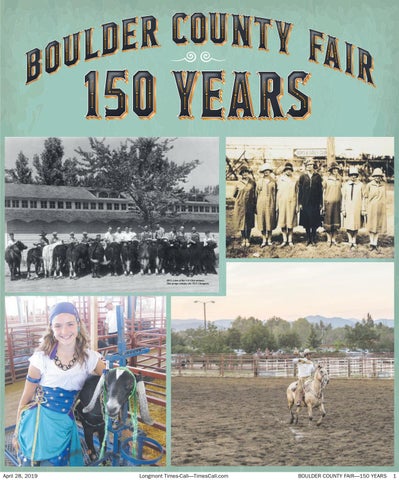
A SHORT HISTORY OF THE BOULDER COUNTY FAIR 1920 Home Demonstration
By Linda Thorsen Bond for Times-Call Photos courtesy Boulder County Fair t’s hard to get a perspective on 150 years. There is not one person alive who is that old. Not your grandfather, not even your grandfather’s grandfather. The magnificent Front Range was here, but the city of Longmont was just a twinkle in the eye of some Chicagoans bent on colonizing the west. Yet on a spring day in 1869, a group of farmers, fruit growers and stockmen were dreaming big dreams and making plans that would come down to us, right here, right now in 2019—150 years later. The members of the new Agricultural Society met at the Boulder courthouse. One of their ideas was to start a community fair. “Two parallel things happened,” said Rich Koopmann, executive director of the Farmers Alliance Integrated Resources (FAIR). “The community fair started in Boulder at 28th Street and Valmont Road in 1869, and the Chicago Colony founded Longmont in 1871, the more agricultural of the two towns. The Boulder fair’s ag displays and education about new inventions for homemakers were a big draw for county people whose lives April 28, 2019
revolved around agriculture. “The fair changed as Boulder stopped thinking of itself as primarily agricultural. Mining in the east and coal mining in the southwest became more important. The emphasis of the fair became the horse races that were so popular. Agriculture was becoming less important in this country,” Koopmann said. “It’s typical of urbanization that only 2 percent of the population has a connection with agriculture. Very few kids have the luxury of living on a farm.” Still, the fair remained in Boulder for 30 years. Longmont became the official site in 1899 with horse racing, a livestock show and home economics exhibits at the Driving Park. The tastiest idea was scheduling the fair at the same time as Pumpkin Pie Day. The bounty of Longmont’s agricultural abilities resulted in 5,000 pies made by the local housewives using canned pumpkin from Longmont’s own Empson cannery. While attendance had declined in Boulder, it grew steadily when the fair moved to Longmont. Area families exhibited their crops, livestock and home economics handiwork and the fair officials replaced the temporary exhibit tents with permanent buildings. That site, Driving Park, was donated to Longmont in 1892
and became the Roosevelt Park we know today. According to Koopmann, in 1927 the county fair hosted 5,000 visitors during the September 5-8 run. There were fire-fighting displays, a daily stock parade in front of the new grandstands, harness races with 52 entrants, and a high jumping horse that would jump over high hurdles as well as an automobile. In 1930’s many area farms were lost to foreclosure during the Great Depression. Despite the mood of the community a smaller fair event was still held and Pumpkin Pie Day was revived. On August 19th, 1946, the record of annual Boulder County Fair celebrations since 1869 was interrupted. Due to communitywide fears of a polio outbreak, the fair was cancelled that year for the first and only time in its long history. After WWII, the Boulder County Fair was becoming the premium county-level fair in all of Colorado. There was new exhibit space for 4-H and open class displays, a new rodeo arena built by the American Legion, extensive flower and vegetable displays, and the most complete livestock show ever held at the fairgrounds. Farmers and ranchers from around the state brought their best show animals to Longmont for a trial run prior to taking them to Pueblo for the State Fair. At times the dairy cattle show in Longmont was larger than the show at the State Fair. And then, of course, the
Longmont Times-Call—TimesCall.com
Roosevelt Park area became too crowded. Koopmann said, “The surrounding neighborhoods were filled with a massive influx of activity and people during the fair days. People camped out in the neighborhoods, even though there was no campground. The old high school needed perfect turf for its athletic grounds.” After 80 years in Roosevelt Park, in 1976 the fair was relocated again. In 1976, the 130-acre Affolter Corner Farm in southwest Longmont was purchased by Boulder County to be developed for the new fairgrounds. After the first phase of construction was completed, the inaugural county fair at the new site kicked off on August 7, 1978. In recent years the Boulder County Fair visitation has surpassed 152,000. From those modest beginnings 150 years ago, the fair remains as a gathering place for families, friends and newcomers to wander among educational displays and exhibits, share in the excitement of 4-H livestock show competitions, buckle in for a carnival ride, enjoy turkey legs, funnel cakes and the 4-H dairy bar, or grab a beer while dancing to live bands or watch heart pounding car wrecks during the demolition derby. Koopmann speculates that through the dedication of countless adults and youth, the county fair will continue to be part of our culture and community. For another 150 years.
1935 Boulder County 4-H members and livestock projects BOULDER COUNTY FAIR—150 YEARS
3
BOULDER COUNTY FAIR CONTINUES EVOLVING By Linda Thorsen Bond for Times-Call
of the Boulder County Fair board of directors, said that after 150 years, the 4-H program is “100 percent important to the fair. When people come through the gates, they pretty much ask, ‘Where are the animals?’ It’s so much fun to watch the kids at their Saturday market sale, at the end of their whole year’s work. On our 150th year of the fair, we want to get it right for the community. The fair began with agriculture and despite all the fun, new and interesting things we do, the emphasis on that history has never changed.” Jennifer Musick started raising and showing animals at the fair when she was only five years old. “The most exciting part of the fair, to me, is getting the animals ready to show. I started with a bucket calf. That means you get a bottle baby calf and your goal is to have it drinking from a bucket by time for the fair. It’s just cute kids with cute calves. When I was
Photos courtesy Boulder County Fair he Boulder County Fair is the place to see demolition derby, ballet on horseback and tractor pulls. But the heart of the fair from the very beginning has been the young people who show their livestock and crafts and are initiated into the world of agriculture. When a school principal started the 4-H movement in Ohio around 1902, a new opportunity was created for young people. They learned about livestock as they learned about leadership and competition. The county fairs across the US give them a showcase and a reward for their hard work. Dominique Sexton, president
The Westernaires are just one of the ways the fair has evolved over 150 years.
eight, I graduated to showing market steers, then breeding heifers, then raising hogs.” Musick is now a 4-H leader, sharing the Liberty Livestock 4-H group with her parents. It’s her parents’ 20th year to lead the 4-H group and her 12th. “I learned
so much in the 4-H program showing livestock,” Musick said. “There’s dedication, responsibility, leadership, working with animals, networking with people. The impact it had on my life was to make me want to be a part of the livestock industry.”
WHEN TURNING YOUR LANDSCAPE VISION INTO A REALITY,
INSIST ON PIONEER. COMPLETE HARDSCAPE & LANDSCAPE SUPPLY
10% OFF
PIONEER COLLECTIONS
DECORATIVE ROCK
YOUR NEXT PURCHASE
GARDEN BED SOLUTIONS PATIO & WALL SYSTEMS OUTDOOR LIVING ARTIFICIAL GRASS GARDEN BORDERS & EDGING PATHWAYS & EROSION CONTROL
Expires 9/30/2019. Excludes delivery. Availability varies by location. See store for details.
WINTERIZATION BAGGED PRODUCTS LANDSCAPE TOOLS & ACCESSORIES COMMERCIAL APPLICATIONS
BOULDER 6379 Valmont Rd LONGMONT 601 E Rogers Rd 4
BOULDER COUNTY FAIR—150 YEARS
Longmont Times-Call—TimesCall.com
www.pioneerco.com
303-217-7627
April 28, 2019
She graduated from CSU with a degree in animal science and a minor in ag business. Now she lives on the farm in Mead where she grew up, only a two-mile stretch from her parents and her husband’s parents. Her little sister Diana is now studying at CSU, so this is the first year in a long time that a member of their family isn’t showing an animal at the fair. Over the years, the fair has added something extra each season as the show evolved to be the 10-day event it is. There has been drone racing, BMX riding, a firemen’s challenge. Last year’s joust was a big hit and is coming back. There are always musical performances scattered through the days. The main ticket events of the show are Pro Bull Riding (PBR), a Mexican rodeo and the Westernaires, a mounted precision drill organization composed of Denver-area youngsters from nine to 19 years
April 28, 2019
Boulder 4-H Sheep Club shearing competition.
of age. This year a big concert spotlighting Lauren Alaina, who was runner-up in American Idol. “We’ve been talking about the 150th anniversary for the past three or four years,” Sexton said. “We always have had the desire to board to really recognize the 150th. We wanted to do something big. We’re competing with fairs that do music as
primary event and we decided for this year we will do the big concert.” “The fair is really important to me,” Musick said. “People from all walks of life come to it. It ties the urban community back to the ag side. Young people learn where food comes from and about the agriculture of this area; there are so many
Longmont Times-Call—TimesCall.com
events they can take part in, even cake decorating. It’s cool that it’s a 150-year-old event. It’s monumental. The big concert will draw people come to all the exhibits and people will look around at all the exhibits who might not have come to it otherwise. Not many events can say they’ve been around for 150 years and have a 10-day event. It’s awesome.” After each fair, the Board surveys and does focus groups to learn how people felt about the fair. Sexton said, “Our goal is to listen, to improve how we work together. We’re listening hard to the community. We focus on 4-H and ag things primarily, and we vary the other things that draw people in. We do it for a pure passion to promote the fair. The 150th fair will have the history that has carried it through the years, and we’ll have plenty of other reasons for people to come enjoy it.”
BOULDER COUNTY FAIR—150 YEARS
5
BOULDER COUNTY FAIR
CELEBRATES 150 YEARS OF TRADITION Exhibits and competition in areas other than livestock have always been part of the fair.
Harness racing was one historic event that showed off the skill of both horse and rider.
From parades to 4-H to livestock shows, the fair is steeped in tradition By Sarah Huber for Times-Call Photos courtesy Boulder County Fair he Boulder County Fair was a beloved tradition before Colorado even achieved statehood. From the Dust Bowl to the mining boom, from the Great Depression to the Great Recession, through women’s suffrage, world wars and Prohibition, the Boulder County Fair has brought Coloradoans together for 150 years to celebrate award-winning agriculture, handmade goods, skill in the saddle and the love of community. With parades, carnival rides, horse and dog races, demolition derbies, live agricultural markets, rodeos, outstanding food and live music, the fair has never failed to deliver fun, educational and communityenriching experiences. The Fair Family represents fair history The Boulder County Fair Family 6
BOULDER COUNTY FAIR—150 YEARS
has played an important role in representing the fair since 1956. The R.C. Montgomery family was the first family to be handed the honor. The annually chosen Fair Family typically has a long history of involvement with 4-H and the fair over multiple generations. Boulder County farmers Mike and Kathy Litzenberger, who with their children were named the Fair Family of 2015 to acknowledge their support of the fair for more than 20 years, believe the fair is essential to the health and growth of Boulder County. Kathy noted, “Our kids are the fourth generation of agriculturists in our family, but in a community that has become so urban, it is more important now than ever to keep the agriculture heritage alive.” She added, “4-H helps to connect youth back to the agriculture heritage in Boulder County, and the fair helps to foster that farm to table relationship.” Celebrating agriculture and 4-H Of course, 4-H—which first organized in the early 1900s when children were encouraged to exhibit livestock at fairs—is not exclusively about agriculture, nor is the Boulder County Fair all about 4-H. In the main exhibit building, 4-H projects
span engine design, photography, sewing, crocheting, knitting, cake decorating, natural resource studies, beekeeping and woodworking. Sharon Bokan, a small acreage coordinator with Colorado State University Extension Boulder County, participated in 4-H throughout her childhood. “Back when I was a kid,” she recalled, “there weren’t as many clubs in the county, and 4-H was a great outlet for youth development.” Today she continues to sew and implement the speaking skills she mastered in 4-H. “From the beginning, 4-H has helped kids develop confidence, responsibility and skills useful to life,” she said. Fair history illuminates Colorado history Learning, sharing and enjoying “skills useful to life” have epitomized the fair since its inception a year prior to Boulder’s incorporation, said Boulder County Fair volunteer and historian Richard Koopman. In 1869, Boulder was booming into a mining supply town and preparing to construct a university. A plunged golden stake linked eastern and western states via the Transcontinental Railroad, which swiftly transported John Deere catalogs and carloads of seed and farm equipment to Colorado. When gold fever abated, Koopman said, disillusioned miners settled into farming, thus providing the burgeoning population grain, vegetables and livestock feed. While farmers painstakingly cultivated crops at altitude, the Boulder territorial legislature approved a complex
Longmont Times-Call—TimesCall.com
irrigation system. Finally, in June of 1869, as Boulder County ascended as top grain-producer in Colorado territory, “a group of the county’s prominent farmers, fruit growers and stockmen gathered at the Pearl Street courthouse and organized the non-profit Boulder County Agricultural Society,” Koopman said. “The stated purposes of the fair were to explore the potential of the new west, to encourage diversified endeavors and to accumulate and share information about agriculture in this area.” Livestock show and sales Livestock showing was integral to the fair from the start. The president of the agricultural society, Granville Berkley, presented the first annual fair addresses, stating, “One great mistake of the first settlers of the territory was that every effort, energy and encouragement was given to the development of the mines while agriculture seems to be lost sight of. Neither can prosper without the other.” The livestock sale remains a central feature of the fair with youth in 4-H and FFA devoting their time to learning animal husbandry skills to raise their livestock to be auctioned off during the fair. “In the 1950s and 1960s, the county fair started to bloom into the premier county fair of Colorado, leading to the state fair on Labor Day,” Koopman said. “People around the state would bring their show animals to Longmont for a trial run prior to taking them to Pueblo for the state fair. At times the dairy cattle show in Longmont would be larger than the show at the state fair.” By 1960, thanks to the popularity of the livestock exhibits, a full-time veterinarian was hired. Yet the overflowing barns demanded change, and in 1975, 750 4-H students sent letters requesting expanded fairgrounds. A year later a site was purchased in southwest April 28, 2019
Auto racing has given way to the Demolition Derby, a fair favorite.
favorite. Firefighters once again get to display their skills through the recent addition of the Firefighter Combat Challenge. Jousting is a recent addition Food, of course, has long to the fair’s entertainment been an important part of the roster fair. To counter of blasé of the Longmont, and the new outdoor Great Depression, Longmont arena was named in Murphy’s commenced the 1930 Boulder honor, Koopman said. County Fair with free sandwiches and pumpkin pie, a nod to the Entertainment at the Fair early 1900s Longmont Pumpkin Throughout the late 1800s, Pie Days. The 4-H Dairy Bar, a Longmont farmers attempted to woo the fair north, where 4-H club-run canteen, has been agriculture reigned as Boulder’s a favorite stop for soft serve ice fair emphasis shifted to cream, handmade milkshakes, entertainment. The move from cold beverages, and other treat for Boulder to Longmont was decades. finalized, Koopman said, with a one-day celebration of horse New events, traditional fun racing, a livestock show and home Since the relocation, the fair economics exhibits. The event was capped with has burgeoned with buildings horse races, a rodeo, circus acts and events and continues to draw and a “moving picture” show, record crowds. Koopman said. Current fairgrounds manager When Charles Hover served Joe LaFollette showed hogs at as superintendent of the 1925 the fair as a child. He reflected, fair, events included a daily stock “The fair is more important parade, fire-fighting displays and today than it has ever been. We a horse that jumped inordinately high hurdles. New grandstands are losing sight of agriculture in were completed that year, just in today’s society. To quote Baxter time for the first automobile races. Black, ‘Our culture expends a Eventually the track was converted great deal of effort on future NBA into a rodeo arena, Koopman said. stars, astronauts, environmental The rodeo remains a much lawyers, doctors and political anticipated spectacle for attendees, science majors. But for every always drawing large crowds. As 100 rock stars, Rhodes Scholars an official CPRA Rodeo, events have been expanded over the years and Heisman trophy winners to include bareback riding, team our country produces, we better roping, steer wrestling, ladies make sure we spend enough to barrel racing, tie down roping, bull train at least two future farmers, riding and more. so the rest of them can eat.’” He Instead of racing autos concluded, for 150 years, “that entertainers eventually turned (has been) the essence of the to destroying them through the Demolition Derby—still a fairgoer county fair.” April 28, 2019
AUGUST 23, 2019
Longmont Times-Call—TimesCall.com
DOWNTOWN LONGMONT
HIGH PLAINS BANK
BOULDER COUNTY FAIR—150 YEARS
7
The Boulder County Fair, with its deep historic roots, is the oldest fair in the state of Colorado. Started by a group of prominent ranchers and farmers, the first fairr in the Colorado Territory was held on October 12, 1869. The vision of these early pioneers was to create a community event which would celebrate the rich diversity of the area, and reflect the activities of its citizens through exhibits encouraging the county’s basic economy. In order to ffulfill this dream, the Colorado Agriculture Society was organized and 40 acres of land was purchased between 28th and 30th Street, south of Valmont Road, for $600. Plans were immediately made for the fair to be held in mid-Octoberr. A pavilion was erected, and there were refreshment stands and stalls. 1869 In 1875, a grandstand with a seating capacity of 1000 was built as horse racing became the major attraction of the fair. The grandstand, instead of the round house, became the symbol of the new emphasis for the county fair.
In 1975, 750 4-H memberss sent hand written letters, mostly in pencil, telling the name of their Club and asking County Commissioner Jack Murphy to build them a new fairgrounds. He listened and d did the best he could to convince the other two board members it was a good idea. Jack Murphy was always proud of the fact that the fairgrounds facilities were paid for in caash the day the facility opened to the public. To honor his advocacy for the new fairgrounds site and his interest in promoting youth agriculture programs, the outdoor arena is named the Jack Murphy Arena.
1875 A new feature of the fair in 1879 was the daily auction of livestock, to great advantage for Boulder County Stockmen. Vegetables on display included corn, onions, carrots, peas, pumpkins and squash. But, operating primarily as a fair with exhibits, the Industrial Association was not making any money. At the conclusion of this year, it was $3000 in debt and there was a strong sentiment to sell out.
1975 Record breaking crowd of 2500
A horse show was added aand Boulder's first rodeo since 1927 1
1879
1869
1869
The first county fair at the new site opened August 7, 1978 and ran for 12 days. The first buildings consisted of the indoor and outdoor arenas, grandstands, livestock barns and a rustic campground for fair exhibitors. Buildings added later included the Exhibit building, Natural Resources Building, Red Cross Building, an additional livestock barn near the outdoor arena, a maintenance shop.
1921
1978 Unplanned exhibit as 4-H goat gives birth to triplets while at the fair.
1939
October 5, 1899, the Boulder County Fair was officially moved to Roosevelt Park in Longmont (then called Driving Park). That year the fair lasted only one day, but featured such events as traditional horse racing, as well as livestock and home economics exhibits. The women of Boulder County honored Pumpkin Pie Day by making enough homemade pies to feed the entire fair crowd, free of charge!
uring Co. opened a tractor factory in In 1946, The Gibson Manufactu Longmont, the first new heavyy industry to locate here since the turn of the century. Many weree looking forward to a display at the for the first and only time county fair, but the event was cancelled c in its history duee to a polio outbreak.
1899
11946
1884
1899
1997
1914
1929
1 1944
Fair goes to 10 day Schedule and Rodeo returns 2013
1959
1974
1925
1873 This was a transitional year. The Territorial fair in Denver was changed from the Agricultural Society to the Colorado Industrial Association and premiums to be awarded were increased to $15,000.00 In Boulder, more emphasis at the fair was placed on mineral ores and the race track was substantially improved to retain its reputation as the finest track in Colorado Territory
1905
1885 In 1885, the round house interior was refurbished with a new entry, floor, paint, exhibits and displays. This provided the springboard for the following year,1886 when the News Banner called that year ,"the best fair ever". There was beautiful sea of exhibits. The roundhouse was a monument of beauty. The livestock stalls were filled with prize animals and choice specimens of silver ores were exhibited.
2019
1989
2019
2004
2017
1983
In August 1925, a new grandstand in Roosevelt Park was completed witth funds bachelor farmer Fred Sigley willed to the City. It was finished just in time fo or the first of many auto races in the park. Eventually the track area was converted to a rodeo arena.
Slow & steady growth with permanent buildings replacing tents
150 year anniversary and oldest County Fair
The Old Timers Rodeo event begins at the fair. 1988
1942 In 1942, the fair building consissted of three wooden structures in the northeast cornerr of Roosevelt Park. The largest was the horse barn left ovver from the horse track days. There was also a cattle barrn and a sheep and pig barn.
300 Professional cowboys and cowgirls were registered to compete in a 3-night rodeo event.
Held the first Firefighter Combat Challenge and implemented new volunteer program
1976 2014
In 1976 the county commissioners purchased the Affolter Corner Farm, 130 acres of land at the northeast corner of Nelson and Hover Road
The first year that the pageantry and skill of a Mexican rodeo has been on display. 2011
1970
Fair days changed from Tuesday through Saturday to Wednesday through Sunday and the Fair saw an increase in attendance by 21%
Roundhouse built for displays 1994
125th celebration of the Boulder County fair has record attendance.
1877 The timing was changed to follow the territorial fair in Denver so many of the exhibits could be brought to Boulder. There continued to be, "big vegetables, fast horses, gallant firemen, and rich ore". The display of farm machinery was added at this fair and crowds gathered as steam engines, threshers, hay presses and draft horse pulling plows labored under the sun.
8
BOULDER COUNTY FAIR—150 YEARS
Longmont Times-Call—TimesCall.com
April 28, 2019
A April 28, 2019
Longmont Times-Call—TimesCall.com
BOULDER COUNTY FAIR—150 YEARS
9
4-H AND THE BOULDER COUNTY FAIR By Emma Castleberry for Times-Call
dad and grandpa had both been exhibitors at the Boulder County Photos courtesy Boulder Fair, and being raised County Fair on our family farm, participating in 4-H or youth just came naturally,” involved in 4-H she says. “I have been programs, the around livestock Boulder County my entire life, and Fair offers an started showing unmatched market and breeding opportunity to to display cattle at the fair their hard work. 4-H when I turned eight. programs in the Boulder I continued showing region are delivered by the cattle and hogs, as Colorado State University well as participating Extension, one of more in the dog show than 100 public Livestock shows and sales are and cake decorating universities across the an important part of 4-H’s contests until I aged nation that provide contribution to the Boulder out of 4-H at 18.” opportunities for County Fair. Musick continued young people to to participate in learn through 4-H in a leadership experience. The role and she is now CSU Extension started its entering her twelfth year as a assists youth in involvement in co-organizational leader, beef selecting a the program leader and swine leader for the project or roughly 60 years Liberty Livestock 4-H Club. She projects for the ago, when her says the 4-H program plays a vital year, such as two older sisters role in the Boulder County Fair. livestock, started showing “The 4-H program fosters the 1932 Boulder County Sheep Club boys learn to show sheep for fun sheep. “My woodworking, leadership and responsibility that rocketry, sports parents led by it takes for exhibitors to complete fishing, example and their projects and compete in level of youth involvement and photography or held positions livestock shows,” she says. “4-H personal growth in areas such baking. Throughout the year, the as 4-H club leaders and market and the fair work hand to hand to as responsibility, accountability, 4-H youth attend club meetings, sale committee members, as well make many events possible.” confidence in public speaking and hold positions of leadership, as assisting with the sheep show Musick adds that 4-H is beginning finance. As a volunteer, complete detailed record books, and supporting the involvement important to the regional it is exceptionally rewarding and give demonstration speeches and of other families in 4-H,” Irvine community because it provides an exciting to see the development participate in community service says. She followed in her parents’ engaging opportunity for youth and growth in our youth activities and bonding as part of footsteps of volunteerism and and also connects people to the participants year after year.” their club. The Boulder County became a project leader, 4-H agricultural heritage of their Not only does the Boulder Fair lends a sense of culmination Club co-leader and two-term area. “In a community that has County fair provide a venue for to their year of work as the youth president of 4-H Leaders Council. become so urban, it is important 4-H youth to demonstrate their demonstrate their skills in “The families and kids of 4-H to foster the connection from learning, but it also provides a competitions. are truly special and work so farm to table, and embrace the chance for the public to view and “4-H promotes continued hard to learn and present their history of agriculture within the participate in some of the events knowledge and understanding projects,” she says. “It is an community,” she says. “Some of and activities. “The Boulder within our general community exceptionally rewarding place to the original 4-H clubs started out County Fair brings people about livestock, agricultural contribute your volunteer time as Corn Growing Clubs. Today, together for ten days of fun, practices, earth and animal and the impact on kids and the 4-H has projects that anyone can learning and great family time sciences, healthy living and food community is enormous.” be involved in, no matter if you viewing the 4-H judging events safety,” says Janet Irvine, Boulder Fellow 4-H leader Jennifer live on a large farm or you live in and exhibits, enjoying the carnival Musick first got involved in the County Fair sheep superintendent town.” and visiting the grandstand and 4-H volunteer. “The program at age 5, when she Irvine adds that many people events,” says Irvine. distinctive methods utilized by started showing bucket calves at share a misconception that 4-H Irvine’s family has a long 4-H, in association with Colorado the Boulder County Fair. “My focuses only on rural practices. State University, promote a high history with 4-H. Her family 10
BOULDER COUNTY FAIR—150 YEARS
Longmont Times-Call—TimesCall.com
April 28, 2019
Other competitions, such as this 1947 garment competition have grown out of 4-H and FFA involvement with the fair.
ONT D A GM
IRY
L ON
“4-H touches every aspect of life–from the meat, produce and other goods we eat, to the clothing we wear, to the sciences and professions that employee much of our community,” she says. “The projects offered by 4-H are as varied as the types of
relationships and friendships gained are irreplaceable.” As the Boulder County Fair celebrates 150 years, 4-H shares a sense of accomplishment. “The association of the fair to 4-H reflects the county and community support of our youth, Colorado agricultural history and the continuation of a valuable tradition,” says Irvine. “We are the longest running fair in the State of Colorado. We couldn’t continue to support our youth without the extended support of our communities.”
These include shooting sports, a fashion review, a product sale with baked goods and 1920s Canning demonstration milk products, (note hats and aprons) and a dairy bar selling ice cream and milkshakes, people who participate in them. with proceeds benefitting Boulder Everyone is welcome in 4-H, no County 4-H. matter where you live or what “4-H is a wonderful program your interests are.” that gives so much to the youth The Boulder County Fair will who are enrolled,” says Musick. feature a number of 4-H and “The leadership experiences, the Future Farmers of America events life lessons and the responsibility in addition to livestock shows. learned are invaluable. The
HOME DELIVERY
April 28, 2019
Longmont Times-Call—TimesCall.com
TM
BOULDER COUNTY FAIR—150 YEARS
11
BOULDER COUNTY FAIR’S 150 YEARS GENERATES
FOND MEMORIES
By Shelley Widhalm for Times-Call
oing to the fair brings up fond memories of showing anything from knitting to cattle and amassing lots of blue and red ribbons. With the Boulder County Fair reaching 150 years, the memories list could be quite lengthy, but touching on a few highlights gives a glimpse into life at the fair.
FAVORITE MEMORIES OF THE FAIR Meet Tari Hoagland... ari Hoagland of Mead, for instance, won multiple county and state fair ribbons but didn’t want to specify, preferring to recall her times brushing and feeding the numerous Angus and other types of cattle she helped raise as a 4-H member and later as a 4-H parent. “We showed breeding stock basically my whole life,” Hoagland said. “When my kids were old enough, they showed. Now that they no longer are involved in it, I’ve taken over that responsibility. … They aged out, so then we decided to get in the business and raise registered breeding stock.” Hoagland, who owns Lakeview Angus, showed market steer and breeding beef with her brother, Rick Smith, from 1972 to 1982 until she aged out of 4-H at 18, and he continued until aging out in 1985. “I liked doing the work, the pre-fair work, and bonding with my animal,” Hoagland said. “We worked hard at it.” Hoagland’s children, Landan and Kylee, showed cattle from 1998 to 2011. “That’s my greatest memory is thinking about how much fun they had showing animals and doing it with their cousins and doing it as a family event,” Hoagland said. Hoagland has two additional favorite memories, one involving her late husband, Larry, and the second, a fair superintendent. At one point in 2005, Larry was grooming a heifer that ended up having a bit of an accident. “The kids weren’t doing their 12
The Hoagland siblings, Landan, Lauryn, Zach and Kylee with their 2007 herdsman award. (Photo courtesy Tari Hoagland)
job, and all of sudden he got pooped on on top of his head,” Hoagland said. “It was the highlight of the kids’ fair.” Hoagland also has fond memories of Clarence Kneebone, a former 4-H leader when she was in 4-H and later a 4-H superintendent of the beef barn during her children’s tenure. Now, he is a fair volunteer doing anything that’s asked of him. “He worked so hard during the fair, and it was a joy to see how spry and how youthful he and his wife were, and they’re still working at the fair,” Hoagland said. “He’s always been around. He’s been thoughtful and helpful and just generally a nice person. … From setting up the kennels and cleaning the stalls, he was always working; he was always having to coordinate. He was a great organizer and volunteer.” Hoagland continues to go to the fair but just for fun and to see friends, she said. “It’s just seeing old friends, old faces, and getting reacquainted
BOULDER COUNTY FAIR—150 YEARS
with the people that I grew up with,” Hoagland said. “I like to walk through the cow barns to see how things have changed from year to year and just the different techniques. … They’re not as tall and a lot thicker, and their hair is a very important part of raising steer. Back in my day, that wasn’t as important.” Other 4-Hers and 4-H families also have fond memories of the fair.
Meet Steve Penner... teve Penner participated in the Fairview 4-H Club from 1969 to 1976, and his daughter, Morgan, now 24, who participated in the Hooves & Chutes 4-H Club from 1999 to 2013. Both competed in the fair in livestock projects in the area of breeding beef, plus Penner did market beef. He is a member of the Junior Livestock Market Sale Committee, which plans and runs the livestock
Longmont Times-Call—TimesCall.com
sale and buyers barbecue every year. “I never was a grand champion or anything, I just participated,” said Penner, who owns a cattle ranch in Lafayette and is in the process of moving his operations to Chapel, Neb. “We would have placings. I would be in the middle of the class.” Morgan had a more successful career in 4-H, Penner said, adding that he and his wife, Arlene, supported her in that endeavor. “She had a successful show career not only at the county but at the state and national fairs,” Penner said. “My daughter today is still involved in showing cattle nationwide. She has a passion for it. … Not only when I was growing up but when my daughter was involved, fair was one of the highlights of the year.” During his time with the fair, Penner recalls sleeping with his cattle as one of his favorite memories. “Back then, everyone slept in the barn overnight. When you went to county fair, you took your sleeping bag and you were there for the duration,” Penner said, adding that at the time, his leader was Kneebone. “Clarence and Eleanor watched over all of us kids like they were theirs.” The Kneebones gave rides to anybody from the club that placed in the state fair and again watched over them, Penner said. Another favorite memory of Penner’s and a proud moment for him was being awarded Fair Family of the Year last year, an honor that includes riding in the parade and being introduced at some of the grandstand events. “That’s a very good memory,” Penner said. “Each year, they have a fair family, someone they honor for their involvement to the fair.” April 28, 2019
Meet Jennifer Musick... ennifer Musick of Mead participated in the fair from age five to 18. Upon aging out, she became the coorganizational leader of the Liberty Livestock 4-H Club with her parents, Mike and Kathy Litzenberger. She and her sister, Diana Litzenberger, are fourth-generation agriculturists on the family farm, a diversified crop and livestock operation in the Longmont and Mead area. “Livestock has always been in my blood as I grew up on the family farm and then continued on to Colorado State University where I majored in animal science and then came back to the family farm,” Musick said. As a club co-leader, something she has done for 12 years, Musick helps with the cattle and swine shows and the Junior Livestock Market Sale. She also is secretary of the Junior Livestock Market Sale Committee.
When she was a 4-H member, Musick primarily exhibited livestock and then watched her sister exhibit in the years following until she aged out last year—this year will be the first year in 22 years that her family did not exhibit in the fair. “We always enjoyed being there to see friends, fellow competitors and to spend the week with our family,” Musick said. “It was a lot of work but also a very rewarding time spent doing what we love working with livestock.” Musick’s favorite memory centers on a blue ribbon, when she won grand champion market steer during her last year exhibiting. “I had worked very hard throughout my entire show career to try to win our county fair show. Being able to accomplish that the last year that I could show and go out on such a positive note was overwhelming,” Musick said. “Had I not won that year, I wouldn’t have been upset, but it definitely was a perfect ending to
my show career story.” Musick’s second favorite memory involves her family and husband, Chad, when they were nominated as the Fair Family of the Year in 2015. “It was an honor to receive that award and reflect on how much we had been involved with the fair over the years,” Musick said. “The fair and showing livestock has always been great family time for us, and we were very appreciative of the experience.”
Meet Terri Jo Labor... erri Jo Labor is a Longmont native and a participant in the fair from 1970 to 1979. She showed Angus cattle in the market and breeding animal categories, plus entered several of her knitting projects. Her brother, Scott Smith, and her two sons, also showed. In her first year, Labor and her heifer named Beulah won grand champion breeding beef, and
over the years, she won several championships in the animal and knitting categories. “I was nine years old. It was a really fun thing,” Labor said about her first year of showing. “Back then, there were lots of cattle. There would be 10 to 15 per class, so it was quite the thing to win.” Labor’s favorite memories include being taught to knit by her great-grandmother. “I would sit on her couch and knit my projects with her,” Labor said. “Granny did everything. She knitted, tatted, crocheted, sewed; she did all those kind of crafts.” Another of Labor’s favorite memories involved winning herdsman with her brother in the early 1970s for keeping their stalls, aisles and animals clean, Labor said. “We were so proud of that,” Labor said. “We won it because we worked so hard together. It’s always been an award that’s coveted. It’s your work and your effort. … It’s going a little bit beyond to make sure everything is done.”
Congratulations TO THE
WE BELIEVE it takes the courage and conviction of an entire community to change the trajectory of a child’s life.
Boulder County
FAIR & RODEO
150 Years Strong!
GIVE OR VOLUNTEER AT 303.444.3636 WWW.IHAVEADREAMBOULDER.ORG 420 Main Street Longmont, Colorado 80501 303-772-2510 www.ronsprinting.com staff@ronsprinting.com
April 28, 2019
Longmont Times-Call—TimesCall.com
BOULDER COUNTY FAIR—150 YEARS
13
A GATHERING OF FRIENDS: A History of Fairs Rich Koopmann, Boulder County Fair he history of fairs appears to be dated back into biblical times as well as Native American culture. References of people gathering in marketplaces, festivals, trade locations, religious feasts, and ceremonial grounds have been documented in written form as well as oral tradition. Archaeologists have long noted that artifacts made from specific materials have been discovered in regions far distant from those natural sources. It can be best explained as “trade goods” that were exchanged along travel routes of nomadic peoples. In later times, powwows provided a central festival environment where tribal groups gathered to celebrate seasonal events, share cultures, and trade stories and hand-made goods. Like so much else in western culture, “agricultural fair” has its basis in Latin. “Agricola” is the Latin term for farmer, and the most likely source of “fair” is “feria” – a Latin term for “free day” or “holy day”, which was celebrated as a religious holiday. The blending of agriculture, commerce, and religion is consistent with our understanding that religion was at the center of most political, economic and social activities in ancient and medieval times. Over time, fairs became more secular with education, entertainment and competition displacing religion. In the Middle Ages in England, fairs developed as temporary markets where wholesale traders travelled to locations where they could be sure to meet those they needed to buy from or sell to. These were often tied to special Christian religious occasions and the annual fairs provided the opportunity for sales of animals and other wares. In western Europe there was a blending of religion and commerce that resulted in periodic gatherings, or “fairs” that brought together producers of all types of commodities for the purpose of barter, exchange, or sale. To this marketplace were later 14
The Farm to Table dinner exemplifies the gathering of the community at the fair. (Photo courtesy Boulder County Fair)
BOULDER COUNTY FAIR—150 YEARS
added entertainment and other forms of activity. Modern church bazaars, as a source of revenue for churches, are thought to have their roots in early religious fairs. In the historic American West, explorers, hunters, mountain men, and trappers met periodically at a predetermined “Rendezvous” location to barter and sell animal furs, hides, and assorted wares. Fairs were as much social as commercial endeavors, giving people a chance to get together and share a story or two of their adventures as well as exhibit their products. In 1765, the first North American agricultural fair took place in Windsor, Nova Scotia. In Upper Canada a fair was held in 1792, sponsored by the Niagara Agricultural Society. Both of these fairs continue to operate today. Meanwhile, in the United States, Elkanah Watson, a New England farmer and businessman, has been bestowed the title of “Father of the US agricultural fairs”. He initially showcased his sheep in his home town square in 1807. From that event he organized the Berkshire Agricultural Society and created a Cattle Show in Pittsfield, MA in September 1811. $70 of prize money was paid out in the competition for the best exhibits of oxen, cattle, swine and sheep. Mr. Watson worked diligently helping communities organize their own agricultural societies and fairs. By 1819 most counties in the New England States had
organized their own fairs and the movement was spreading across the country. In 1841, the first county fair in IL was held in Naperville, and the first state agricultural fair in the U.S. was held that same year in Syracuse, NY. It highlighted New York’s prize winners from the county fairs throughout that state in the livestock and food production categories. Overall, 47 of the 50 states currently have a state fair, with Connecticut, Rhode Island, and Massachusetts opting out in favor of a combined Eastern States Exposition (“The Big E”). It has been held since 1917 and is the 6th largest agricultural fair in the country. Many fairs around the U.S. went on hiatus between 186070 because of the Civil War. Following the Civil War, rodeo competitions emerged, with the first held in Cheyenne, WY in 1872. The first professional rodeo where admission was charged and trophies were awarded was held in Prescott, AZ in 1888. Between 1890 and 1910 the offerings at rodeos included Wild West entertainment shows featuring individuals such as Buffalo Bill Cody and Annie Oakley. By 1910 several major rodeo events in the West became established including the Calgary Stampede, Pendleton Round-up and Cheyenne Frontier Days. In 1985, a new breed of rodeo contestant emerged including young, athletic men and women from urban backgrounds.
Longmont Times-Call—TimesCall.com
One third of the PRCA members now have a college degree while one half of the competitors had never worked on a cattle ranch. Entertainment became important as county fairs restarted and competed with national expositions during what was considered the golden age of agricultural fairs between 1870 and 1910. Many fairgrounds owners/operators sought out enough acreage to provide onehalf-mile oval tracks for harness racing and speed trials. Trotting and pacing competitions, bicycle races, balloon ascensions, and eventually automobile races, airplane demonstrations and pyrotechnic displays became commonplace. Early in the decade of the 1900’s, the Illinois Farmers’ Institute began encouraging boys and girls to exhibit fair entries. They also began sponsoring county and regional chapters of a new national youth movement called 4-H. This movement provided a revitalization of livestock and domestic arts competition and was considered a reaction to the growing bawdiness of fairs at that time. The core elements of these annual events are at the heart of the agricultural fairs today. It is competition for the best agricultural and domestic products of the county, region or state, and an annual celebration for the community to gather together to share, to learn, and to have fun. Despite the diminishing presence of agriculture in our urbanizing world, there remain over 3200 fairs in North America, according to the International Association of Fairs and Expositions, and attendance exceeds 150 million people each summer. They still provide industrial equipment and technology demonstrations, a chance to show off the best in agriculture, animal husbandry, horticulture, homemade food and craft items, art work, other products from that region, educational activities from the 4-H and FFA youth development programs, mid-ways, amusement rides, food, and entertainment shows. April 28, 2019
29
$
95
OIL Change
*Most gas vehicles, Up to 5 Qts. with synthetic blend oil. Expires 12/31/19
April 28, 2019
Longmont Times-Call—TimesCall.com
BOULDER COUNTY FAIR—150 YEARS
15
Our Fair Start Celebrating Today! The Boulder County Fair Our History 150th Anniversary Celebration Our Community culminates August 2-11th, 2019. The 2019 Fair will be a once in a lifetime opportunity to fully relish our past and our future - together as one community! Today we value many of the same things that our ancestors did: • Recognizing the role of agriculture • Gathering together as a community
• Celebrating families • Exhibiting our crafts & talents
Community Club Exhibit, Boulder County Fair Association. Clarence Kneebone washes Jack the bull (Longmont Times-Call )
Ferris Wheel, Longmont Museum & Cultural Center
For more information call 720-864-6460 or visit bouldercountyfair.org 16
BOULDER COUNTY FAIR—150 YEARS
Longmont Times-Call—TimesCall.com
April 28, 2019