
LEVEL 4 TRANSITION RULES
WELCOME TO THE TALENT POOL
A single exam failure can lead to the abrupt end of a promising accountancy career, but this does not have to be the case.
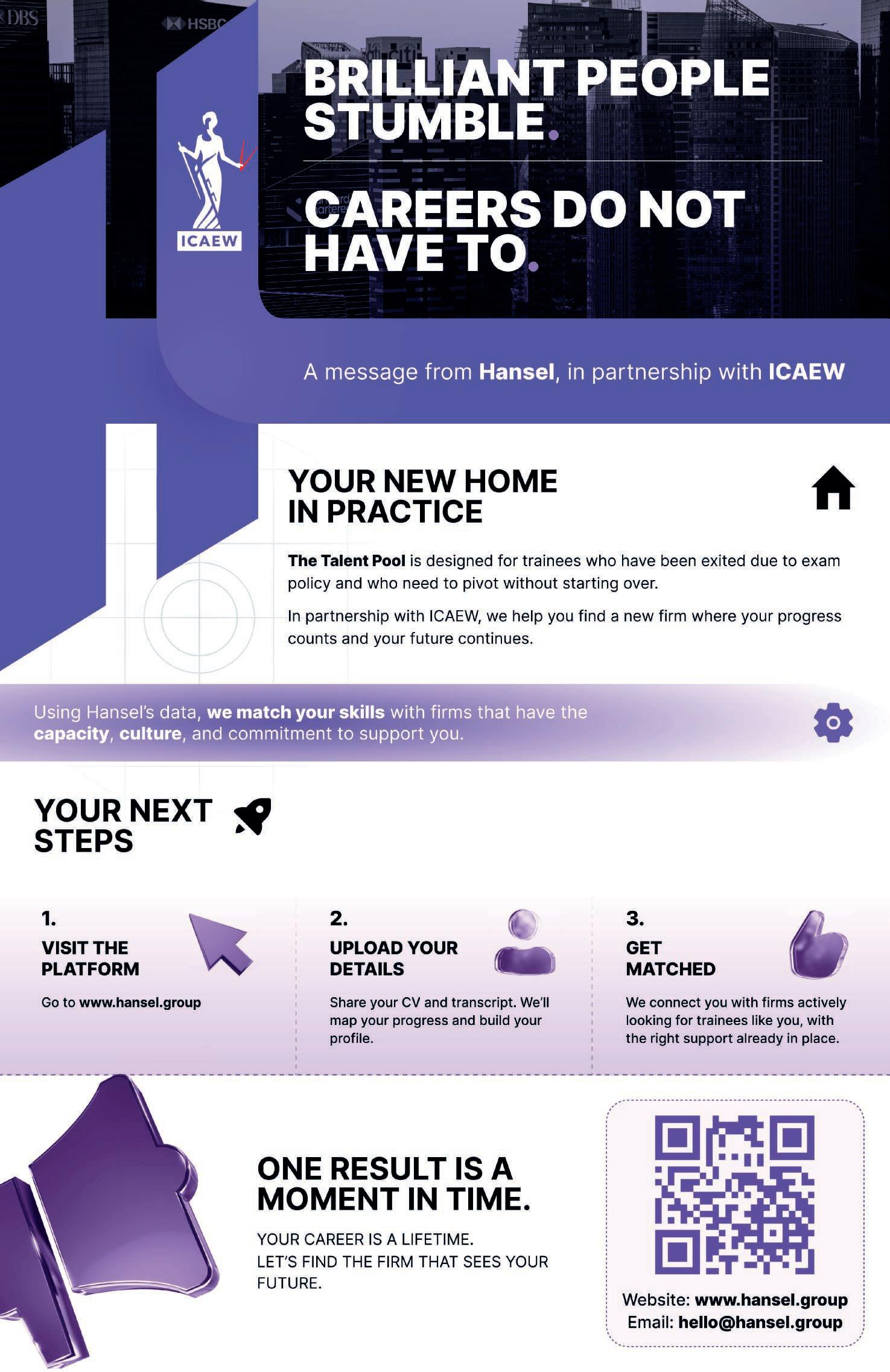
Hansel, the workforce intelligence and talent infrastructure provider, has announced the launch of The Talent Pool. This landmark industry initiative is designed to solve the systemic challenge of trainee attrition within the accountancy profession.
Supported by ICAEW and PQ magazine, the initiative provides a vital career continuity pathway for the approximately 800 ACA trainees who are ‘exited’ from their firms annually, primarily due to rigid internal exam policies. The Talent Pool acts as ‘a new home in practice’, ensuring that high-quality training and thousands of hours
of investment are not lost to the industry.
While spearheaded by Hansel, the initiative is being launched with the active support and integration of a broad coalition of the UK’s most prominent accountancy firms. This group includes a growing number of Top 20 and mid-tier practices who are adopting the platform as a key component of their talent and outplacement strategy.
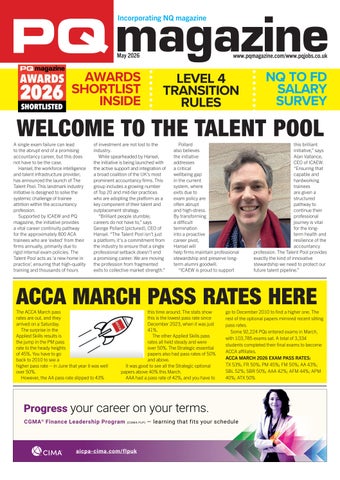
“Brilliant people stumble; careers do not have to,” says George Pollard (pictured), CEO of Hansel. “The Talent Pool isn’t just a platform; it’s a commitment from the industry to ensure that a single professional setback doesn’t end a promising career. We are moving the profession from fragmented exits to collective market strength.”
Pollard also believes the initiative addresses a critical wellbeing gap in the current system, where exits due to exam policy are often abrupt and high-stress. By transforming a difficult termination into a proactive career pivot, Hansel will help firms maintain professional stewardship and preserve longterm alumni goodwill.

“ICAEW is proud to support
this brilliant initiative,” says Alan Vallance, CEO of ICAEW. “Ensuring that capable and hardworking trainees are given a structured pathway to continue their professional journey is vital for the longterm health and resilience of the accountancy profession. The Talent Pool provides exactly the kind of innovative stewardship we need to protect our future talent pipeline.”
ACCA MARCH PASS RATES HERE
The ACCA March pass rates are out, and they arrived on a Saturday.
The surprise in the Applied Skills results is the jump in the PM pass rate to the heady heights of 45%. You have to go back to 2010 to see a higher pass rate – in June that year it was well over 50%.

However, the AA pass rate slipped to 43%
this time around. The stats show this is the lowest pass rate since December 2023, when it was just 41%.
The other Applied Skills pass rates all held steady and were over 50%. The Strategic essential papers also had pass rates of 50% and above.
It was good to see all the Strategic optional papers above 40% this March.
AAA had a pass rate of 42%, and you have to
go to December 2010 to find a higher one. The rest of the optional papers mirrored recent sitting pass rates.
Some 92,224 PQs entered exams in March, with 103,785 exams sat. A total of 3,334 students completed their final exams to become ACCA affiliates.
ACCA MARCH 2026 EXAM PASS RATES: TX 53%; FR 50%; PM 45%; FM 50%; AA 43%; SBL 52%; SBR 50%; AAA 42%; AFM 44%; APM 40%; ATX 50%


















IN THIS ISSUE
A note from the Editor

It is rare that we find people who really understand the world of accountancy education as we do and see a problem that can be solved. Enter George Pollard and Susie Sroka from Hansel, and you find people who genuinely care and question why we should lose 800 extremely bright and talented people from the profession, simply because they failed one exam. Working with student organisations – and us – over the past few months they have developed ‘The Talent Pool’, a truly innovative and practical response to the problem. We have already announced the shortlist for the 2026 awards (you can see them on page 17), and I can promise you this is such a gamechanger it will be winning an award next year!
It has been a bit of a mad month, so we haven’t put anything in this issue about our roundtable on ‘Accountancy: a licence to print money’. There will be more on this next month. Take a look at the recording here. Meanwhile, as we were going to press, we heard that the ICAEW/ CIPFA integration might be delayed. The vote for CIPFA members will now not take place until the Autumn, as there is still a wait for regulatory approval. We will cover this online, of course, so remember check out www.pqmagazine.com if you want the real news first. Graham Hambly, Editor and Publisher, PQ magazine
4 AAT research
Outdated perceptions hamper recruitment into accountancy, report finds
5 Clare Finch
Our tribute to ‘a technically brilliant woman’ and friend of PQ
6 Workplace diversity
The narrative around neurodiversity is changing, says new ACCA report
8 Landmark FRC guidance
FRC issues guidance for audit firms using generative AI in audit engagements

9 Student loan controversy
Parliamentary committee to investigate fairness of loans –and you can get involved
Recruitment
Employers must be aware of tech’s role in recruiting young staff 12 Tech news
Inefficient use of AI ‘could be costing UK businesses billions’ Features, etc
The PQ Digest
EY roll-out of agentic AI set to revolutionise the role of the accountant; and how the right tarnished the legacy of Adam Smith, and why his reputation must be restored 17 PQ awards shortlists
So who’s up for a coveted PQ magazine trophy at this year’s awards? 18 ACCA spotlight
ACCA finds diverse and inclusive workforces are good for business and good for society
20 Accountex 2026
Check out the wide range of seminars, tutorials and networking opportunities at this year’s event
21 AAT level 4
Nick Craggs explains how to best switch from the old to the new level 4 qualification
22 IFA spotlight
How financial modelling works for smaller organisations
23 Tech breach
A computer glitch at Companies House exposed millions of UK businesses for months
24 Salary checker
Are you getting paid what you should be? Hays’ Karen Young has the figures and outlines the trends
26 CIMA spotlight
We outline a line manager’s role in helping an organisation’s PQs achieve exam success
27 CIPFA spotlight
Why performance audit skills matter – and how CIPFA’s new qualification can help
29 AAT spotlight
Accountancy needs to ‘change the story’ if it is to improve recruitment into the profession
30 AAT exams
How to approach a budgeting and variance exam-style question
31 Distance learning Why your research is vital when
it comes to choosing the right distance learning course
32 A question for Tom Tom Clendon steers you through key accounting standards relevant to P&L accounts
35 ACCA exams
How to pass the Strategic Business Reporting exam when it looks like being a complete disaster
36 Apprenticeships
George Moss explains how his accountancy company’s ethos is built on developing apprentices
37 Careers
Deep poverty has a long-lasting effect on pay, new research finds; our Agony Aunt has some advice on when to specialise; and our Book Club review
38 Fun
The lighter side of life – and accountancy
The columnists
Rachel Harrison It’s vital you put a study plan in place 4 Sunil Bhandari Calling all ACCA PQs: sit those exams now! 6 Prem Sikka Growth cannot happen without equality 8 Anna Kate Phelan Preparation is the key to exam success 10
Rachel Harris Smart revision beats long hours. Here’s why 12

RACHEL HARRISON

Get your study plan in place
Where’s the talent pipeline?
Outdated perceptions about what accountants actually do is helping to shrink the talent pipeline, according to new AAT research.
The ability to create a realistic and effective study plan is a key study skill for exam success, helping you sit the exam when you intend to and pass it first time.
When you start to study a subject, use these tips to establish a good study routine from the outset:
• Create a calendar which shows fixed events where you can’t study (family events or regular hobbies, for example).
• Identify three two-hour fixed study slots per week. Establishing a routine is vital for building good habits and will make it easier to stick to your plan.
• Look for regular 15-minute pockets of time for microlearning activities – part of your lunch break or commute.
• Take a couple of days off from studying each week. It is important to include time to relax and recharge so you remain motivated.
• Further study sessions can be added in remaining gaps on your study calendar. Plan 25-minute sessions where you focus on one task without interruption. Reward yourself with a five-minute break before returning to studying.
• If you miss a study session, give yourself 24 hours to re-schedule. Don’t let one missed day turn into a missed month.
Establishing good study habits early in your professional journey ensures these become second nature.
What changes will you make today to the way you plan your studies to gain control over your PQ journey?
Rachel Harrison is Head of Academic Support at Kaplan
Accountex London is almost here!
There is still plenty of time to register for Accountex London. This year’s two-day show, which is the 15th in a row, runs from 13-14 May.
Last year’s show welcomed more than 16,000 accounting and finance professionals, and as one attendee said: “Accountex is Disneyland for Accountants!”
Vistors to Excel will get the chance to catch up with existing suppliers and compare new
AAT found that the pool of new career entrants is narrowing as technology reshapes the realities of work, and deep-rooted socioeconomic barriers continue to influence access to the profession.
Better career advice and wider access to meaningful work experience could help.
AAT CEO Sarah Beale (pictured)

said: “This research makes it clear that accounting isn’t struggling because of a lack of talent; it’s struggling because too many

Red carpet is ready…
The shortlist for the 23rd annual PQ magazine awards night is out! Everyone who is anyone in accountancy education will be
heading for the Bloomsbury Ballroom, in London’s famous Bloomsbury Square.
Zoe Whitman and Jo Woods,
KPMG axing jobs
KPMG is reportedly cutting 600 jobs across the UK, as the leadership fears the firm will miss key budget targets. The audit teams are losing some 440 assistant manager roles, around 6% of the current team strength. And 120 advisory jobs will also be lost.
In a statement
KPMG said:
services, all under one roof.
The CPD-accredited seminar programme boasts over 250 seminars across 13 theatres.
Sign up to Accountex London here
PQ magazine is a partner of both the London and Manchester events.
Student loan interest capped at 6%
Student loans for plan 2 and 3
graduates are to be capped at 6% from September.
people still don’t see a place for them. Careers in accounting and finance are still shaped by an outdated, one-size-fits-all narrative, when we should be talking about the careers they lead to and the impact finance skills have in every business. People change careers, move between sectors and build experience in many ways, and finance skills are valuable wherever they go.”
Read the research here and go to page 29 for more.
who work very closely together are both up for Personality of the Year, alongside Muhammad Bilal and Libby Walklett.
We have a new category this year – Student Champion of the Year. There is strong competition here with Will Boardman, Emma-Louise Waple and John Magpayo fighting it out to be the inaugural winner on the night.
We will also be announcing the second induction into the PQ magazine Hall of Fame!
No PQ magazine awards night would not be the same without JeanPaul Noel-Cephise, and he will be there as part of the entertainment as always.
You can check out the full shortlist on page 17
“In our audit business, alongside hiring for growth, we expect to see a regular pattern of natural attrition. But current market conditions mean our attrition rates are very low within certain parts of our audit population, which is why we are proposing to right-size those areas.
“This isn’t a decision we
The UK government said that this was a ‘temporary’ measure to protect students from the rising inflation coming because of Donald Trump’s war in the Middle East.
Grads on the plan 2 loans have to pay interest rates based on the retail price index (currently 3.2%) plus 3% when they earn over £29,385.
Skills minister Jacqui Smith said: “We know the conflict in the Middle East is causing anxiety at home, and while the risk of global

take lightly, and we will support our people throughout this consultation.”
A consultation on the redundancies will now run until May.
shocks is beyond our control, protecting people her is not.”
The new RPI figure will be published on 22 April.
ACCA scraps three variant exams ACCA has confirmed it is withdrawing FTX-MYS, LW-LSO and TX-Hun following the June 2026 exam session.
Any student considering studying these three exams before their withdrawal should consider these changes in their exam planning.
Clare Finch: ‘a truly amazing person’
It is with great sadness that we report the sudden death of top accountancy tutor Clare Finch.
Clare trained with KPMG and qualified in 1990, but quickly discovered that teaching accountants was more fun than auditing them!
She joined Kaplan, before leaving a senior role to start her own business, co-founding HTFT Partnership in 2013.
She was also the author of ‘A Student’s Guide to IFRS’, which has been the Amazon numberone bestselling IFRS book since it was published in 2007.
Throughout her career Clare always put students at the heart of what she did, and had a genuine passion for innovation.
She became an inaugural member of the PQ magazine Hall of Fame last year, and Clare’s energy and intellect will be missed by everyone in the industry.
Our thoughts are with her family, friends and co-workers at this sad time.


Her colleague David Evans summed up what many thought of this wonderful woman: “Clare was a truly amazing person. She
was technically brilliant, with an encyclopaedic knowledge of corporate reporting, and was one of the best communicators and
teachers that I have known.
“She was a true innovator and entrepreneur, always willing to challenge convention and look for new and better ways to prepare students to pass accountancy exams. She was a true pioneer in accountancy training and changed the lives of so many people.
“Above all, Clare was a kind and incredibly generous person. A beautiful human being with a beautiful soul. She always had time to help and support staff and students, and it has been lovely to see all the warm messages from clients and current past students and colleagues. I was reminded this week of the student who named his daughter after Clare, such was her impact on him!
“Her legacy lives on in HTFT. The values, culture, ethos and genuine focus on the personal needs of each and every student will continue to be delivered by the wonderful team of people she led at HTFT.”


SUNIL BHANDARI Make hay while the sun shines

We are now entering the last five sittings of the current ACCA syllabus exams. There are only positives to be gained for the ACCA students in this period.
This is the time I would recommend ACCA students to ideally qualify or at least complete as many papers as possible.
Why would I say this?
Well, I have lived (‘lived’ being a key word given recent events) through so many exam syllabus/ format changes over the past 39 years. The same pattern happens each time. I see no reason why this will not happen again now.
Firstly, we are all familiar with the current exams. There are plenty of past exam questions available to use. That makes preparation easier for sure.
Secondly, the examiners are unlikely to make any changes to a syllabus that is in its dying embers. It makes sense to keep the status quo.
Thirdly, there may well be the ‘churning’ of past exam questions. They will not be a ditto copy of what is in your exam kits, but similar. I have seen this already to some extent with my exam ACCA AFM.
I am not saying the exams will be easy or easier.
But if history repeats itself, there are factors surely in your favour.
Recognising neuro-divergent talent
The narrative around neurodiversity is changing, and organisations are beginning to recognise the significant strengths of neurodivergent individuals and their contributions, says the ACCA.
In its latest report, ‘Neurodiversity in accountancy: navigating your career’, ACCA says neurodivergent professionals themselves are reclaiming their own stories, reshaping expectations of what workplaces should provide.
The report identifies five key areas where individual action creates conditions for success:
1. Understanding your own cognitive profile: for many neurodivergent professionals, formal diagnosis provides

transformative reframing.
2. Making strategic disclosure decisions: disclosure is not an obligation – it’s a choice.
3. Leveraging technology: the right technology can amplify your capabilities and make you strategically resourceful.
4. Advocating individualised support: the most effective
workplace support is co-created, not prescribed.
5. Building your own personal support system: you can’t control organisational culture, but you can build a personal system that enables you to thrive.
Jamie Lyon, Global Head of Skills, Sectors and Technology at ACCA (pictured), said: “The narrative is moving from ‘what can neurodivergent people do for organisations?’ towards ‘what systems need to change to enable everyone to work effectively?
“This reframe matters because it shifts responsibility: individuals should not need to adapt to the workplace – the workplace needs to be designed better.”
FRC’s ‘comply and explain’ reminder
The UK Corporate Governance Code allows companies to ‘comply or explain’, meaning they can depart from certain provision if they clearly explain why a different approach works better for them.
The problem is for too long ‘comply and explain’ has been misconstrued as ‘comply or else’, says Richard Moriarty, FRC CEO (pictured).
He worries many companies have come to believe the safest
course is simply to follow every provision of the Code and avoid departures altogether. “That misses the point of the UK’s governance framework,” said Moriarty.

He continued: “The Code was deliberately designed to give boards flexibility to make decisions that work for their company and their shareholders, and to explain those decisions clearly. A thoughtful, well-reasoned explanation is just as valuable as compliance.
AI can’t replace trust in people
More than two-thirds (72%) of accounting professionals just don’t trust the outcomes from Gen AI, according to a year-long study by ICAS.
The big fear is Gen AI can easily produce errors or reach incorrect decisions. This in turn means anything produced with AI needs careful review and ‘strong
Bookkeeper wins payout
A boss has been ordered to pay his bookkeeper over £23,500 after shouting ‘potato’ at her in a strong Irish accent, despite his claim that it was merely ‘banter’.
The Leeds employment tribunal also hear the director of engineering firm West Leeds Civils used the words ‘paddy’, ‘stupid paddy’ and ‘pikey’.
Bernadette Hayes, who is Irish, described Mick Atkins’ taunts as “death by 1,000 cuts!” The judge
agreed that she had been racially harassed, and that Atkins had created a hostile, humiliating and offensive environment for her.
Teach tax in schools Schools must do more to help improve young people’s understanding of tax, says the Association of Technicians.
Despite tax affecting almost every UK adult, many students leave school with little knowledge of how the tax system works or why taxes matter. To help combat this, the ATT
oversight’.
That said, around the same number of accountants (74%) say the technology speeds up the tasks they perform. It means quicker data extraction, document analysis, and information crossreferencing. Despite this, just 22% believe this has translated into a substantial increase in their overall
is encouraging tax professionals and educators to work together to bring tax education into classrooms.
Forvis Mazars growing fast
Forvis Mazars grew its revenue by over 8% in FY25. Revenue rose year-on-year from £362.4m to £391.9m. The audit and assurance business delivered exceptional growth of 21%. Tax services grew by 10% and financial planning by 13%. Meanwhile, headcount rose to 3,542, with 326 trainees welcomed
“Boards should feel confident using that flexibility. Good governance comes from boards thinking from themselves and explaining their judgement, not box-ticking compliance.”
productivity.
Concern over client data privacy and confidentiality was also raised by 50% of accountants.
So, how is AI currently used?
More than half of respondent (53%) use Gen AI to write emails and edit texts, while 46% use it to summarise meetings and documents. Around a third rely on it to support spreadsheet or other software-based tasks.
to the firm.
James Gilbey, UK CEO, said:
“In a year marked by economic uncertainty, our teams have delivered exceptional results for our clients while maintaining an uncompromising focus on quality. Against a backdrop of ongoing economic uncertainty across the UK and an evolving geopolitical landscape, our continued investment and disciplined approach have helped position the firm to navigate a more challenging market environment.”
Sunil Bhandari is an AFM tutor at FME Learn Online


IFA 2026 Conference & Awards


Transformation: HMRC’s vision for better customer service
Myrtle Lloyd, Chief Customer Officer, and Director General for Customer Services, HMRC
Helping clients navigate change: key tax developments for 2026
Cyber awareness essentials: protecting your data at work and home
Simon Baker, Cyber Crime Unit, Metropolitan Police IPA Group update
Andrew Conway, CEO, IPA Group
Economic Crime and Corporate Transparency Act (2023): an implementation update
Henry Vaile, Principal Policy Advisor for Accounts & Reporting, Companies House

CPD HOURS: 8 Expert-led sessions on tax, cyber crime and regulatory updates Thursday 25 June | 9am – 5pm | Royal
Rebecca Benneyworth mbe fca, Rebecca Benneyworth & Co




LORD SIKKA

There’s no progress without equality
The UK economy has been flatlining for years. Due to inequitable distribution of wealth, people don’t have enough purchasing power to stimulate economic growth.
Some 25.3m Britons live below the Minimum Income Standard, lacking the income to meet material needs and to enable participation in society. This comprises 48.6% of children and 35% of working-age adults. Low wages deprive people of good food, housing, education and life chances, and lead to greater pressure on public services. The UK has a high rate of infant mortality compared with peer countries. Victorian illnesses like rickets and scurvy have returned.
Against this background, the government has increased the hourly minimum wage rate for workers over the age of 21 from £12.21 to £12.71, enabling them to have gross earnings of around £25,000 a year. This is barely enough but is resented by some.
The new rate was opposed in parliament by the Conservatives and by many commentators who portray it as a threat to the economy.
In sharp contrast, there is silence about executive pay. A typical FTSE100 CEO collects the average UK wage in two days, and the CEO-to-worker pay ratio is 141 times. Recently, the CEO of Shell got a pay rise of 60% to £13.8m. At Melrose Industries, the CEO-toworker ratio is over 1,110 times. Workers have no say in corporate governance.
Economies can’t grow without equitable distribution of income and wealth.
Prem Sikka is Emeritus Professor of Accounting at the University
of Essex
Tax briefs
Are you tax confident?
HMRC has launched a new ‘Tax Confident’ website, and is encouraging taxpayers to use it to fill their ‘tax knowledge gaps’. Based on real-life situations, the aim is to help people find the information that is relevant to their circumstances, such as ‘tax in retirement’, ‘small businesses’, and ‘working life’. The website also has ‘tax basics’ and explains where to get more support.
HMRC said GOV.UK remains
Guidance on AI and audit a first
The Financial Reporting Council has issued landmark guidance for audit firms on using generative and agentic AI tools in audit engagements – the first from any audit regulator globally.
The guidance sets out how firms can mitigate risks to audit quality posed by these tools, while supporting firms to realise the significant benefits these technologies offer.
FRC stressed the guidance is not a response to identify quality
deficiencies, but rather it codifies good practice, promotes audit quality, builds confidence in the use of AI and provides a conceptual foundation for future FRC work in
NQs see modest salary rises
The average salary for a newly qualified accountant in London now stands at £60,000, according to the Hays Salary & Recruitment Trends survey.
This compares with an average NQ salary in the North East of £52,000. However, in Wales the take home for NQs is just £46,000.
NQ salaries generally seem to be holding steady, with 34% reporting no increase at all last year, and another 20% saying they were given
a 2.5–5% rise.
Moving ahead to five-years-plus qualifying, an accountant in London can be taking home £100,000. In the West Midlands the same accountant can expect a pay packet of £85,000.
Karen Young, a Director at Hays (pictured), said: “Early-career talent is ambitious and eager to accelerate; senior professionals are seeking clarity and fairness; and employers are responding
AAT partners with Swoop
AAT has announced a new partnership with business funding platform Swoop, designed to help accountants and bookkeepers support their clients with funding and cash flow decisions.
Through the partnership, AAT’s licensed accountants and bookkeepers will gain access to Swoop’s funding platform, tools
the primary resource for detailed guidance and for completing
HMRC related tasks. Tax Confident is about helping people feel ready to take that next step, it added. Check out more here
Mileage rate review ‘long overdue’
The decision to review milage rates ahead of a future Budget is ‘long overdue’, says the Association of Taxation Technicians (ATT).
However, ATT said there is a problem – the review does not go
and data insights, making it easier to identify potential funding needs, introduce clients to specialist support and improve outcomes without adding complexity to their own workflows. AAT members will also receive a 20% discount on Swoop’s accountant and bookkeeper offering.
far enough to help workers already out of pocket!
Current approved milage allowance payments (AMAPs) have remained unchanged since 2011, despite a sharp rise in motoring costs. In the last 10 years these costs have increased by almost 60%, and the current 45p rate set in 2011 would need to increase to 67p to keep pace with inflation.
Online sellers face fresh crackdown
HMRC is gearing up for a fresh
this area.
The FRC’s Mark Babington said: “AI adoption in audit is accelerating, and agentic AI is expected to follow. It is important to be clear, however, that while technology changes the fundamental principle of our regulatory framework does not: it is people – the firms and Responsible Individuals –who are accountable for audit quality. AI is a powerful tool, but the professional judgement and accountability of the auditor remains at the core of how we regulate.”
See the full report here

with increased investment in skills, flexibility, and technology.”
Check out the average salaries of NQs and CFOs on page 24
The partnership will be supported by a programme of joint activity, including CPD-accredited webinars, data-led insight reports and practical resources to help AAT members strengthen their advisory role and better support SME clients.
Chantel Carpenter, Commercial Director at AAT said: “Through this partnership with Swoop we’re giving our licensed members practical, straightforward tools to build on the brilliant work they already do, helping clients get the results they need with clarity and less pressure.”
crackdown on those who fail to disclose their incomes from online sales after new figures show that the tax authority received reports on the earnings of almost four million online sellers in 2025. The new figures, obtained via a freedom of information request submitted by accountancy firm BDO, reveal that HMRC received reports on the incomes of 3,988,892 online sellers in the calendar year 2025, a 272% rise on the 1,466,171 seller reports it received in 2024.
Student loans inquiry launched
The UK’s Treasury Committee is launching a new inquiry into student loans and the broader taxation of graduates.
According to the Institute for Fiscal Studies, students now leave university with more than £50,000 in student loan debt.

The Committee is aware that many graduates have become intensely dissatisfied with the terms of the loan. This was amplified by the recent decision to freeze
the threshold for repayments.
MPs are now seeking evidence on graduates’ repayment terms, including the extent to which they are reasonable and proportionate in the broader context of graduates’ marginal tax rates. This will be used to inform the Committee’s views on whether people are being treated fairly once they leave higher education.
The Committee is also asking
AAT training provider winners are…
The AAT training provider community was out in force for the recent annual conference and awards night (PQ editor Graham Hambly was one of the judges).
There were 12 categories up for grabs, including awards for Inclusive Provider of the Year and Community Focused Provider of the Year.
The winners on the night were:
• Student of the Year: Michaela Howes AATQB, Training Link.
• Apprentice of the Year: KaydeeMae Commins, Exeter College.
• Tutor of the Year: Ellis Harris-Kijak, Ideal Schools.
• Distance Learning Provider of the Year: e-Careers.
• Small Provider of the Year: The Fernandes and Rosario Consulting Ltd T/A FAR Training.
• Medium Provider of the Year: Chesterfield College.
• Large Provider of the Year: First

anyone over the age of 16 to contribute their experiences directly to the inquiry through an online survey. Questions include whether they would take out the loan today if given the option and whether repayments are having a material impact on their financial planning.
Chair of the Treasury Committee, Dame Meg Hillier (pictured), said: “This inquiry is about fairness. Fundamentally, what we’re asking is, have the goalposts been moved in a way which is unfair to graduates?”
Intuition.
• International Provider of the Year: MAS Education Center (Management & Accountancy School).
• Apprenticeship Provider of the Year: Solveway Apprenticeships.
• Community Focus Provider of the Year: System & Skills Training Concept....
• Inclusive Provider of the Year: Exeter College.
• AAT Special Recognition Award: ICS Learn.
Happy birthday caba
Accountancy
occupational charity caba recently celebrated its 140th birthday. Founded in 1886 after a group of ICAEW council members personally stepped in to gift £50 to a junior colleague suffering from a terminal illness, the Chartered Accountants’ Benevolent Association has been there for accountants and their families ever since.

In the past 20 years the charity has spent £37m supporting those in need, including financial grants, counselling, career coaching and practical advice.
Dr Cristian Holmes, Chief Executive at caba, said: “For 140 years, caba has been here for every member of the ICAEW community when they need support most. While the profession and its landscape has evolved significantly over that time, the pressures people face –whether they are financial, personal or professional – remain.”
Meet Tom Clendon
‘My passion is to help ACCA students pass their SBR exam, but you may not know that I was an ACCA student once. I know the pressures of juggling work, life and study. When I left school I went straight into the workplace. But, aged 22, I married Jenny and that made me realise I needed a career and a profession, not just a school leaver’s job.
So, with no exemptions and minimal support from my employers, I studied for ACCA. It was not easy, but it was worth it. Becoming an ACCA member changed my life.
It has enabled me to earn a living to provide for my family, live and work abroad, change my career from being in practice to education and, eight years ago, start my own online business.
I am now a wholly independent ACCA SBR online lecturer, offering platinum courses (tuition and revision) and stand-alone revision courses to individuals who choose to study with me. I am passionate about breaking it down, keeping it simple and getting students over the line. Marking is dear to my heart.
I share my knowledge by being active on LinkedIn and being a podcaster and YouTuber. Over the years I have worked closely with ACCA to support the qualification. I have won three PQ awards – one for my podcast, one for Lecturer of the Year, and one as part of the Online College of the Year!’
If you want help passing the ACCA SBR exam, check out my socials or WhatsApp me.
Message Tom on +44 7725 350793
See www.tomclendon.co.uk And there’s more on Tom’s YouTube channel

ANNA KATE PHELAN

If
you fail to prepare…
Are you wasting your time?
Accountancy practice bosses must not overlook the role tech has in attracting and retaining staff, says new research from IRIS Software Group.
For PQs, exam success is not just about how much you study, it’s about how you prepare. With increasing flexibility in how assessments are delivered, candidates have more control than ever over their exam experience. The key is to use that to your advantage.
One of the simplest ways to reduce stress is to study using the same tools you’ll encounter in your exam. Becoming familiar with the digital assessment environment can make a significant difference on the day. When the format feels familiar you can focus your energy on the content, not the software.
Practice is equally important. Choosing a training provider that offers a wide range of mock exams and practice questions helps build both confidence and exam technique. Practical preparation also plays a role. If you’re sitting your exam at home create a clear, quiet space where you won’t be interrupted. If you’re heading to a test centre, plan your journey carefully and allow extra time so you can arrive calm and ready.
Finally, remember that preparation isn’t only academic. Exams can be demanding, so it’s important to look after your mental wellbeing. Build in time for activities that help you recharge, whether that’s exercise, meeting friends, or simply switching off for an evening.
These qualifications are a marathon, not a sprint. With the right preparation, you can approach each exam with confidence and clarity.
Anna Kate Phelan is Chief Product Officer at Eintech
The study of accounting students, recent grads and earlycareer accountants revealed a stark gap in what technology junior colleagues expected to be in place and the reality of what practices were equipping them with.
Nearly half (43%) expected modern, cloud-based systems and 34% expected seamless, integrated technology across all workflows. However, 40% of respondents already in training or working full time admitted to spending

significant time on manual data entry – and a quarter (25%) work across more than five disconnected systems day-to-day.
Early-career accountants revealed that these issues are leading to five hours being wasted
New ICAS fast-track
ICAS has initiated a new fast-track pathway that enables experienced auditors from around the world to gain the UK Audit Qualification (AQ) – and progress to ICAS membership.
The pathway, approved by the Financial Reporting Council, offers a targeted and streamlined route (the quickest ever) for senior members of many internationally recognised accountancy bodies.
Candidates will only have to complete the UK specific competencies required by the regulator, supported by relevant practical experience.
ICAS CEO Gail Boag (pictured) said: “This pathway recognises the depth of audit expertise already held by senior international professionals and channels it efficiently into UK practice. It reflects ICAS’ commitment to
FRC supporting SMEs
The UK’s Financial Reporting Council has announced a package of measures aimed at making audits more proportionate and efficient for SMEs.
To help this process FRC will:
• Publish new guidance to support auditors apply auditing standards in a way that is relative to the complexity and size of the business.
• Launch a new programme of engagement with auditors of SMEs to support understanding of this new guidance.
• Develop a Technology Sandbox within the FRC’s Innovation and Improvement Hub to enable smaller audit firms to explore the use of AI in corporate reporting.
• Establish a new working group
each week, equivalent to 33 days of productive time being lost each year.
IRIS Accountancy’s Jonathan Priestley (pictured) said: “Practice modernisation is often discussed in terms of productivity and profitability. But it’s rarely considered as a factor in attracting and retaining talent – despite chronic skills shortages across the sector.
“The profession is at a crossroads. Firms are being asked to do more with less, while also meeting rising expectations for the new generation of talent who won’t accept inefficient, disconnected workflows as the norm.”

opening a faster, more streamlined route for talented auditors to gain the UK Audit Qualification and play a vital role in upholding audit quality across the UK.”
with the Recognised Supervisory Bodies (RSBs) to promote more consistency in how audits of SMEs are supervised.
• Engage with stakeholders on the international Less Complex Entities auditing standard, providing UK stakeholders with the opportunity to influence its future development.
Supporting SMEs is part of the FRC’s wider work to reduce burdens on businesses and support economic growth.


New CEO for Deloitte UK
Deloitte UK has announced
Darren Graves as its next senior partner and chief executive, following a vote by the firm’s partners. He will succeed outgoing chief Richard Houston on 1 June 2026. Graves joined Deloitte as a graduate in business tax in 2001, before moving into M&A tax, where he became a partner in 2012.
Graves said: “I am incredibly proud to become CEO of Deloitte UK at such a pivotal time. My focus will be twofold: to ensure we continue to deliver exceptional value to our clients, by helping them navigate a period of complexity and seize new opportunities; and to
reinvent our firm for the next generation.
“I am committed to ensuring Deloitte remains a place where everyone, regardless of background, can thrive and access the same opportunities for growth and development that have shaped my own career here.”
Improving outcomes for young women
The UK could unlock major economic gains by reducing the number of young women who are not in education, employment or training (NEET).
Latest analysis from PwC’s Women in Work Index shows that bringing female NEET rates in line with Germany could add £5 billion to the UK’s GDP, while matching the Netherlands
could deliver up to £11 billion. Even returning to the UK’s 2021 low would generate a further £3 billion.
The report examines why nearly 946,000 16 to 24 year olds – almost one in eight – are now NEET, up from 11.9% to 13.6% since the pandemic.
In the UK, low GCSE attainment significantly increases NEET risk for young women, and the impact is more pronounced than it is for young men (24.5% versus 19.4%). This reflects deeprooted gendered patterns in the labour market: boys with low qualifications are more likely to move into better-paid, male-dominated sectors such as construction that have accessible routes into work, while girls often face far fewer comparable opportunities.
Develop the accounting leaders of tomorrow.
Digitally upskill your team through funded degree apprenticeships
Available in:
•Data Scientist
•Digital and Technology
Solutions Professional
•Project Manager
• Delivered primarily online with flexible, asynchronous learning
• Funded through the Growth and Skills Levy, levy transfer, or government co-investment

2026 October intake now open for applications
D Deadline: 28th August
RACHEL HARRIS

Why
smart
revision beats long hours
There’s a point in every trainee’s journey where more hours stop equalling better results. You’re revising longer, re-reading notes, highlighting everything… and still not seeing the progress you want.
That’s not a motivation problem. It’s a method problem (promise!). Most trainees default to passive study: reading textbooks, watching lectures, copying notes. It feels productive, but it’s low impact. The shift comes when you move to active recall and exam-focused practice. Here’s the reset I give our trainees.
First, flip your revision. Close the book and ask: “What do I actually remember?” Write it out. Then check. The gap between what you think you know and what you actually know is where the marks are.
Second, practise under pressure. Timed questions aren’t just for the final weeks. They train your brain to retrieve information quickly and apply it, which is exactly what the exam demands.
Third, track your weak spots. Not vaguely (“tax is hard”), but specifically (“I keep missing VAT adjustments”). Targeted revision beats blanket effort every time.
At striveX we see the same pattern: trainees who switch to active methods often improve faster while studying less.
Finally, protect your energy. Burnout doesn’t earn marks. Focused, intentional sessions do. The goal isn’t to study more. It’s to study in a way that actually works
Beware AI inefficiency
UK business could be losing billions in unrealised productivity gains and wasted operational spend because of inefficient and unstructured use of artificial intelligence, according to Crispin Read (pictured), founder of The Coders Guild.
New analysis suggests that poor strategy, lack of training and widespread ‘shadow AI’ usage are limiting the technology’s impact –and in some cases actively harming businesses.
Based on conservative modelling, if just 25% of the UK’s 5.5 million businesses are using AI inefficiently, and each loses
Modernising the tax base
Tax policy needs to adapt to ensure future government funding remains durable, according to OpenAI. Its new report, ‘Industrial Policy for the Intelligence Age’, suggests there needs to be new taxes on automated labour and wage-linked incentives to encourage firms to retain, retrain and invest in workers. It pointed out that similar policies already exist for R&D.
The report said that as AI reshapes work and production, the composition of economic activity
an average of £5,000-£10,000 annually, then the total cost to the UK economy could exceed £6.8 billion to £13.7 billion a year. The figures do not include longerterm losses such as reduced competitiveness and slower innovation.
Read said: “Without clear strategy or training, many organisations are relying on free, off-the-shelf AI tools with little oversight or integration into business processes. As a result, teams are spending increasing amounts of time validating unreliable outputs,

often duplicating work across departments, and making decisions based on AI-generated responses that haven’t been properly scrutinised.”

will shift, expanding corporate profits and capital gains while reducing reliance on labour income and payroll taxes.
This could erode the tax base that funds core programmes like social security and health care, ultimately putting them at risk. Workers also need to be given a voice, says the report authors. This will help the transition to better and safer AI. They will also be critical voices in understanding how AI can be used in the workplace.
New talking points
Silverfin, the accountancy SaaS platform, has launched Talking Points, designed to help firms scale advisory by harnessing insights from routine compliance work.
Talking Points gives accountants a structured way to capture discussion points during file review, present them to clients and follow up with clear action points,

Xero and Anthropic collaboration
Xero and Anthropic, the company behind Claude, have announced a multi-year partnership to bring Claude’s AI directly into Xero, and Xero’s financial data and tools into Claude.ai
It is the first time Xero customers will be able to work with their financial data directly inside a major AI platform. Powered by Claude’s advanced reasoning, Jax will do the heavy lifting – analysing revenue and profit performance,
tracking real-time cash flows and identifying unpaid invoices.
Xero’s chief product and technology officer, Diya Jolly, said the collaboration means small business owners and their accountants can get the answers they need and act on them in real time.
Dext launches AI Assist
Dext has unveiled Dext AI Assist, an AI agent designed to help accountants, bookkeepers and
finance teams automate everyday bookkeeping tasks.
AI Assist is built into the Dext platform and learns from users’ decisions, preferences and edits. It then uses this information to suggest how to automate those repetitive tasks across future workflows.
Dext COE Sabby Gill said: “Dext has already helped remove millions of hours of manual data entry from bookkeeping by automating document capture and processing at scale. With AI
all from one platform. Silverfin CEO An Maes (pictured) said: “Compliance work is highly structured in most firms but client meetings aren’t. That’s where valuable insights get lost. Talking Points changes that by making advisory a natural extension of the compliance work teams are already doing in Silverfin. We built it because we believe a shift to advisory shouldn’t mean more software. It should mean better use of the data firms already have.”
Assist, we are taking the next step; helping firms and finance teams apply their own judgement and way of working more consistently across every transaction.”
Barclays and Sage partner up Barclays and Sage have announced a strategic partnership designed to help businesses save time on their admin, gain clearer oversight of their finances, and keep pace with evolving UK tax requirements.
Rachel Harris is the founder of striveX and @accountant_she




























THE PQ DIGEST
THE FUTURE OF AUDIT IS HERE
Stuart Pedley Smith, a professional education advisor: “EY has just told us what the future of audit looks like. So, educators take note, this is helpful.
“EY has just announced the global rollout of enterprise scale agentic AI across 160,000 audit engagements in more than 150 countries. AI agents will now orchestrate complex tasks, assess risk dynamically, and access continuously updated auditing guidance at a scale and speed no human team could match.
“This isn’t a pilot, it’s happening. And that raises a difficult question for accountancy educators; could a newly qualified accountant walk into EY today and genuinely add value?
“The principles of compliance, and assurance are still hugely important. EY are at pains to stress that ‘human judgment, scepticism and insight’ remain fundamental. But what examples are being used in class that brings to life this real-world application.
QUOTE OF THE MONTH:
“Challenging the machine is the new competency”

“The future accountant needs to be skilled in asking questions, interrogating AI output and deciding if the agent got it right, and if not why not?
“So, challenging the machine is the new competency. That demands a very different kind of education and training. One built around
critical thinking, professional scepticism, and an ability to work with intelligent systems rather than simply alongside them.
“EY are building a global training programme to upskill their own people. The question is, should educators be doing something very similar and faster?
See https://lnkd.in/ecARbum8
ECONOMISTS HAVE GOT ADAM SMITH WRONG!
Professor Richard Murphy, owner of Tax Research LLP: “Neoliberalism claims Adam Smith as its founding father, but that claim is built on a lie. Smith’s first great work, The Theory of Moral Sentiments (1759), placed empathy and sympathy for others at the very heart of economic life. That foundation was deliberately discarded by the Chicago School in the 1970s, who weaponised a single phrase, ‘the invisible hand’, which was hardly used across his entire body of work, to justify a radical ideology of selfish individualism that Smith himself would have rejected. The result is an economic model that treats fear, insecurity, and social division as acceptable

costs of doing business.
“But Smith understood something today’s
neoliberal economists refuse to accept: our well-being is interconnected. When others suffer, we all suffer. Addressing economic insecurity isn’t charity; it’s an economic necessity.
“This video [see link, below] makes the case for a return to Smith’s original insight: that care, empathy and collective wellbeing must be the foundations of political economy, and not the pursuit of personal wealth at any cost. If we want an economy that works for everyone, we need to reclaim Adam Smith from those who misrepresented him.”
Check out the video here
Free subscription: www.pqmagazine.com/subscribe/ Delivery problems or need a change of email address: admin@pqmagazine.com Website: www.pqmagazine.com
Richard Murphy


























AWARDS 2026 SHORTLIST
Who is up for a coveted PQ magazine trophy at this year’s awards?
The entries have been judged, and we have our shortlist for the 23rd PQ magazine awards night. But who, we hear you shout, made it onto the list? Well, here’s your answer!
STUDENT BODY OF THE YEAR

Accounting/Business Students, University of Reading
Accounting Society, University of Greenwich Birmingham Chartered Accountant Students' Society (BCASS)
CIPFA Student Network
ACCOUNTANCY COLLEGE OF THE YEAR

PUBLIC SECTOR
The Finance Subject Group, Northumbria University Stanmore College
University of Liverpool
PRIVATE SECTOR
e-Careers
First Intuition
Kaplan UK
ONLINE COLLEGE OF THE YEAR

ICS Learn
Training Link
VIVA Financial Tuition
ACCOUNTANCY LECTURER OF THE YEAR

PUBLIC SECTOR
Catriona Hyde, University of Leicester
Joanne Parker, University of Newcastle Dean Quartermaine, Sheffield College
PRIVATE SECTOR
Natalie Breslin, ICAS
Ben Campbell, Training Link
Shane O’Grady, AccountancySchool.ie
STUDY RESOURCE OF THE YEAR

AAT ‘Silent Study’
ACCA-X
Premier Training CV Boosters
Skills Bootcamp, Future Connect Training & Recruitment
INNOVATION IN ACCOUNTANCY

AAT and the University of Exeter
Accounting Cafe
Kaplan UK’s Tutor Bot
The Christie Costing Team
BEST USE OF SOCIAL MEDIA

Crowe UK
Natasha Everard, aka The Bookkeeper
Superhero
TCS Gurnsey
PODCAST OF THE YEAR

Kaplan UK – Learn Better
The Bookkeepers’ Podcast
The Practice Owners Podcast
TRAINING MANAGER/MENTOR OF THE YEAR

Simon Clayton, North West Ambulance Service
Qais Hussain, PKF Smith Cooper
Fiona Jones, striveX Accountants
ACCOUNTANCY TEAM OF THE YEAR

Logic Manufactured Bespoke Ltd
PKF Smith Cooper
Warrington and Vale Royal College
GRADUATE/APPRENTICESHIP TRAINING PROGRAMME OF THE YEAR

Hey Monika (The Bookkeeper Training Academy Ltd)
Kaplan’s ACCA finance data technician
apprenticeship programme
Reed Business School
ACCOUNTANCY PERSONALITY OF THE YEAR

Muhammad Bilal
Libby Walklett
Zoe Whitman
Jo Wood

STUDENT CHAMPION OF THE YEAR

Will Boardman
Emma-Louise Waple
John Magpayo
ACCOUNTANCY APPRENTICE OF THE YEAR

Dylan Evans, Wilkes Tranter & Co Ltd
Edward Gleeson, PKF Francis Clark
Oscar Spalter, Buzzacott LLP
DISTANCE LEARNING STUDENT OF THE YEAR

Lorraine Flynn, Michaela Howes
Wil Diamond
ACCOUNTANCY GRADUATE OF THE YEAR

Hannah Adedoyin, Queen Mary Flying Start
Monika Kunc, University of Northampton
Jason Howie, Heriot-Watt University
NQ OF THE YEAR

Disha Chhugani
Laura Mason
Tangia Swaby
Diego Trucco
PQ OF THE YEAR

Laleh Ameri
Natasha Care
Tim Mickleburgh
Maheen Shahzad
Neurodiversity: a force for good
ACCA’s Jamie Lyon explains how understanding your personal cognitive profile and building support structures can help you thrive
At ACCA, we believe that diverse and inclusive workforces are good for business and good for society. Our latest research in this area explores how having a neurodivergent condition has presented both work-based challenges that needed to be overcome, yet also endowed individuals with unique strengths, capabilities and qualities they have used to their career advantage.
Accountancy’s inherent structure – systematic processes, objective frameworks, pattern-based analysis – maps naturally onto neurodivergent cognitive strengths. Where some professionals may need to develop systematic thinking through training, many neurodivergent professionals think systemically by default.
While we recognise that organisations have a critical role in creating work environments where everyone can thrive, we also know that we all individually have a role to play in supporting ourselves. Our research explores five key areas where individual action creates conditions for your success. These are interconnected strategies that support you to actively shape your work environment:

1. Understanding your own cognitive profile: Self-awareness is foundational to navigating your career strategically as a neurodivergent professional. When you understand your specific cognitive strengths and challenges you can make informed decisions about roles, environments and the support you need. For many neurodivergent professionals, formal diagnosis provides transformative reframing. Even so, diagnosis isn’t required for success. What matters is self-understanding: knowing what energises you versus what drains you; which environments enable your best work; and which career paths align with your cognitive strengths. Consider how your cognitive profile aligns with different roles – neither is better, they’re different, and recognising your own enables strategic career decisions.
2. Strategic disclosure decisions: The decision to disclose your neurodivergence at work is deeply personal and profoundly strategic. Disclosure is not an obligation – it’s a choice based on careful assessment of your circumstances, organisational culture and what you hope to gain.
Disclosure can open access to formal adjustments and legal protections and reduce
the exhausting burden of masking. But disclosure also carries risks. You may face lowered expectations or assumptions about capabilities that are based on diagnostic ‘labels’. All choices are valid. Some successful neurodivergent professionals never disclose formally, relying on careful job selection and preference-based adjustments. Others disclose selectively. The right decision serves your specific goals while protecting your wellbeing and career trajectory.
3. Leveraging technology as your cognitive assistant: Technology can be transformative for neurodivergent professionals – not as compensation for deficiency, but as amplification of capability. The right tools bridge gaps, enhance productivity and enable you to work to your cognitive strengths. These aren’t crutches – they’re professional tools readily available that align with neurodivergent needs and are usually free and easily accessible.
Neurodivergent professionals are often users of AI and technology – early adopters who intuitively understand how to leverage these tools strategically. In workplaces increasingly shaped by AI, this positions you at the forefront, not the margins. Technology doesn’t make you less capable. It makes you strategically
resourceful.
4. Advocating individualised support: The most effective workplace support is co-created, not prescribed. Generic ‘neurodiversity adjustments’ rarely work because they assume all neurodivergent brains function identically. So:
• Reject one-size-fits-all approaches: what works for a neurodivergent colleague may be counterproductive for you.
• Be specific about your needs: specificity makes it easier for managers to say yes.
• Explain your profile: your manager doesn’t need a masterclass in your neurotype – they need to understand how your individual brain works.
• Recognise fluctuations: support requirements aren’t static. Communicate these fluctuations rather than struggling silently.
• Advocate your needs from your position of authority: you’re the expert on your own experience.
5. Building your personal support system: Consider the following interconnected elements of a comprehensive personal support system that will enable you to navigate your career sustainably:
• Design for flexibility: your support needs will change across life stages. Build regular check-ins with yourself to reflect on what’s working and what needs to evolve.
• Invest in specialist support: consider coaching from neurodiversity-specialist professionals. External coaches provide perspectives and strategies that workplace support rarely offers.
• Build support beyond your workplace: develop external networks – professional associations, neurodivergent community groups, online networks. These provide validation and remind you you’re not alone when workplace support falters.
• Identify allies strategically: beyond your direct manager, identify sponsors and allies who could champion you. Distribute support across multiple relationships so you’re not dependent on any single person.
The combination of self-awareness, strategic disclosure, technology adoption, individualised advocacy and multi-layered support creates resilience. You cannot control organisational culture, but you can build a personal system that enables you to thrive regardless.
Explore the findings of ACCA’s latest research here
• Jamie Lyon, Head of Skills, Sectors and Technology, ACCA
















AI, sales, leadership – and much more
The education programme at Accountex London is designed to help accountants conquer the numerous challenges they face
On 13–14 May 2026 at Excel London, Accountex London is taking place alongside the first-ever co-located FD Show, a new event dedicated to finance leaders.
The two shows bring together a wide range of software and service suppliers, packed CPDaccredited education programmes, and exciting features and networking opportunities.
The exhibitor list boasts 300-plus fintech companies including leaders like FreeAgent, Intuit QuickBooks, IRIS, Sage, TaxCalc, Wolters Kluwer and Xero. First-time exhibitors include Visa and Barclays, with new FD Show exhibitors including Metro Bank, ScaleXP, Crowe, Octopus Electric Vehicles and Corpay.
The CPD-accredited seminar programme features 250-plus seminars across 16 theatres and features more than 400 speakers over two days.
Designed to address the real challenges professionals face daily, the programme spans critical topics including AI, pricing and

leadership – ensuring attendees leave equipped with actionable insights to take back to the office.
Programme highlights
Drawing on 30 years as a professional comedian and seven-times Emmy Award-winning comedy writer, Beth Sherman teaches teams the principles that entertainers use to create emotional connection quickly, and how to apply those same principles to build clarity, trust and
momentum in sales, marketing and leadership. Don’t miss ‘Accelerate influence and outcomes with really really rapid rapport (really!)’ to learn techniques for creating human connections that accelerate influence and drive commercial outcomes.
Emma Jones CBE, the Small Business Commissioner, will join AAT President Lucy Cohen for a session on addressing late payments to support SMEs. ‘It’s time to pay up to support small businesses’ will dive into efforts to tackle the issue of late payments, which often blights the small businesses supported by accountants.
Sales expert and Director of ThinkGrowSales. com, Saroj Bains, has more than two decades of experience in tech and sales, driving technology solutions for private and public sector organisations, generating millions in revenue. She will be taking to the stage for ‘Sales Mastery: What the top 1% do differently’, which will reveal how top-performing professionals and advisory teams consistently attract and retain ideal clients without relying on outdated tactics.
Talking all things AI will be Ben Avery, the Audit AI Research Lead at Grant Thornton UK’s Audit & AI Lab and a founding member of their Digital Audit Team. The session ‘Taming the mess with bespoke AI’ introduces the lab and presents their AI’s spooky ability to find missing transactions in a general ledger.
• Accountex London and the FD Show are taking place at Excel on the 13-14 May 2026. You can register for your free ticket here

Big changes are afoot
Nick Craggs explains how students should approach switching from the old to the new level 4 qualification

AAT’s new level 4 qualification, called L4PAT, will launch on 1 September 2026, the association has announced. There are significant changes: there are no written tasks, no optional units and results will be available within 24 hours. Talking to level 4 students, one of the most common concerns is how they can move onto the new qualification. This reminds me of a scene from Jurassic Park, where Jeff Goldblum says when talking about bringing dinosaurs back to life: “Your scientists were so preoccupied with whether or not they could, they didn’t stop to think if they should.” The principle applies to moving from the current level 4 Qualifications 2022 to L4PAT.
At the time of writing, you can’t transition anyway; the first date you can do this is 1 September 2026. However, when you can transition there is a lot to consider. The main thing one is AAT’s transitional rules. Some passes will carry directly over, some require a combination of units to carry over, and some simply don’t carry over at all.
The simplest ones are Drafting and Interpreting Financial Statements and Applied Management Accounting units on Qualifications 22. A pass in either of these will give you an exemption from their corresponding units Financial Accounting and Management Accounting units on L4PAT respectively. The percentages you achieved in each unit will carry over as well. In the new qualification, Audit and
Assurance and Internal Accounting Systems and Controls have been amalgamated into one unit called, not surprisingly, Audit and Internal Controls. This means that you must have passed both units to get the exemption from the Audit and Internal Controls unit. If a student moves over having passed only one of these units they will effectively lose that pass. In terms of what percentage that carries over, it is an average of your results in both the Audit and Assurance and the Accounting Systems and Controls unit.
The two tax units, Personal Tax and Business Tax, units are very similar. These have been amalgamated into a single unit known as Principles of Taxation. This new unit tests you on both personal and business tax, so you need to have passed both units to get the exemption. Likewise, the percentage that carries over is the average of both units. Again, if you have only passed one of these units and transfer you will lose that singular pass and
have to take an exam that will test you on both personal and business tax.
Then we have those units that don’t transfer over. There aren’t any corresponding units in the new qualification for both the Credit and Debt Management unit and the Cash and Financial Management units. So, if you have passed either or both of these and transfer to the new qualification you will lose your passes.
Finally, going the other way, the new qualification has a new unit known as Advanced Business Awareness, which doesn’t have a corresponding unit on Qualifications 22. Any student who transfers will not only have to sit the corresponding units for the exams they haven’t sat on Qualifications 22, but they will have to sit the Advanced Business Awareness as well.
So, what should you do? The worst thing you can do is move over without taking advice or doing detailed research!
AAT have allowed a longer crossover between the two qualifications this time, and the current syllabus will run until the end of July 2028. This means that even if you started level 4 on the current syllabus on the last possible date, 31 August 2026, you still have nearly two years to complete without transitioning. Completing on the current standards by July 2028 is the simplest option. I would suggest you do this if you have passed Credit and Debt Management or Cash and Financial Management, or you would lose those passes – you would have wasted your time and money.
If you have passed one of the two tax units, or indeed one of Audit and Assurance or Internal Accounting Systems and Controls, I would focus on passing the other unit as this gets you the exemption on the new qualification. For example, if you have only passed Personal Tax, and it is May 2028, you do not want to be studying Applied Management Accounting. You want to do all that you can to pass Business Tax to protect your pass in Personal Tax. Whether you complete Management Accounting on the current or new syllabus isn’t as important as making sure you get that exemption in Principles of Taxation.
Finally, the last thing you need to consider is if you have any level passed that were taken on the previous standards AQ2016. These passes will not carry over onto L4PAT, and so ideally you would want to complete on Qualifications 2022, as this is as far as these passes will carry forward.
And remember Jeff Goldblum – take advice and think before you act, whether that is bringing the T-Rex back to life or transitioning to L4PAT!
• Nick Craggs, AAT distance learning director, First Intuition
Celebrating the launch of new the AAT Level 4 qualification
Financial modelling made simple
PQs need to know about how financial modelling works for smaller organisations. Here the IFA explains all
For PQs working in small and medium-sized enterprises (SMEs) or small and medium practices (SMPs), financial modelling can feel like something reserved for large corporates or specialist finance teams. However, a recent webinar held for members of the Institute of Financial Accountants (IFA) served as a good reminder that strong modelling skills are just as valuable in the SME environment.
In smaller organisations accountants are typically closer to decision-making, so the ability to build clear, flexible models can have a direct impact on things like business planning, cash flow management and strategic choices. The message for PQs then is simple: financial modelling doesn’t need to be complex to be effective. It needs to be practical, transparent and fit for purpose.

frequently used by ownermanagers or non-finance stakeholders who need quick, clear insights rather than technical detail. Overly complicated spreadsheets can create confusion and reduce trust. Instead, PQs should focus on building models with these end users in mind.
formulas makes spreadsheets easier to navigate, especially when shared with colleagues or clients. In SMPs, where multiple team members may work on the same file, this consistency is essential for collaboration and efficiency. A consistent approach can also help when it comes to error checking. Simple control measures, such as ensuring that totals reconcile or that key balances tie together, can prevent costly mistakes.
A key takeaway from the session was the importance of simplicity. In SMEs, models are
Structure remains critical, regardless of business size. Separating inputs, calculations and outputs helps keep models organised and reduces the risk of errors. For example, assumptions such as sales growth, costs or payment timings should be clearly laid out in one place, making them easy to review and update. This is particularly important in SMEs, where circumstances can change quickly and models need to be adapted regularly and with ease. Consistency is another habit that can elevate the quality of everyday modelling. Using standard formatting such as colour coding for inputs and

YOUR WELLBEING HUB

The webinar also highlighted the risks of hard-coding, a common issue in time-pressured environments. Embedding numbers directly into formulas may save time initially, but it makes models harder to update and more prone to error. In contrast, keeping all assumptions visible and editable allows for quick scenario testing, an invaluable feature when advising SME clients facing uncertainty.
Ultimately, financial modelling is as much about communication as it is about technical skill. A strong model tells a clear and logical story, linking assumptions to outcomes in a way that supports informed decision-making no matter what size of business you are. By adopting these habits early, PQs can add real value to their organisations and clients. In a world where timely, accurate insights are critical, the ability to build simple, effective models is a skill that will always stand out.
• Thanks to the IFA for this article



Companies House flaw exposed
A computer glitch exposed millions of UK businesses for months before someone spotted the problem
Amajor vulnerability in the Companies House website gave unauthorised access to the private dashboard of any of the five million registered companies for five months, according to Tax Policy Associates (TPA).
Directors’ home and email addresses were exposed during this time, and it appears any attacker could have changed company and director details, and even filed fake accounts. TPA revealed that just pressing the ‘back’ key at a particular time would gain you access. The vulnerability was discovered on 12 March by John Hewitt at Ghost Mail, a corporate service provider. He tried to contact Companies House directly but did not get a response – so he contacted TPA.
In a statement Andy King, CEO of Companies House, said: “On Friday 13 March, Companies House was made aware of a security issue which meant that a logged-in user of our WebFiling service could potentially access and change some elements of another company’s details without their consent after performing a specific set of actions.

“This was not accessible to the general public. Only users with an authorised code and logged in to the service could have performed this action.
“We closed WebFiling at 1:30pm on Friday 13 March while we investigated and resolved the issue. The service has been independently tested and is back online as of 9am on Monday 16 March.
“Our investigation has established that specific data from individual companies not normally published on the Companies House register may have been visible to other loggedin WebFiling users. This includes dates of birth,
residential addresses and company email addresses. It may also have been possible for unauthorised filings – such as accounts or changes of director – to have been made on another company’s record.”
King confirmed that:
• Passwords were not compromised.
• No data used as part of the identity verification process, such as passport information, was accessed.
• No existing filed documents, such as accounts or confirmation statements, could have been altered.
He added: “We believe that this issue could not have been used to extract data in large volumes or to access records systematically. Any access would have been limited to individual company records, viewed one at a time by a registered WebFiling user.
“Our investigation indicates that this issue was introduced when we updated our WebFiling systems in October 2025.
“We have proactively reported this incident to the Information Commissioner’s Office (ICO) and the National Cyber Security Centre (NCSC). We are actively analysing our data to identify any anomalies, and we’ll be emailing every company’s registered email address to explain how to check their details and what steps to take if they have any concerns.
“If we find evidence that anyone has used this issue to access or change another company’s details without authorisation, we will take firm action.
“We are asking all companies to check their registered details and filing history to make sure everything appears correct. If a company has a concern, please raise a complaint and include evidence to describe the concern.
“We have no reports at this stage of data having been accessed or changed without permission. However, our investigation is ongoing. We’ll provide further updates as our work progresses and we remain committed to being transparent throughout.
“We’ll soon be publishing a page with more details to answer any further questions you may have.
“I recognise that this incident will have caused concern and inconvenience to many of the companies and individuals who rely on our services. I am sorry for that.
“Companies House takes its responsibility to protect the data entrusted to us extremely seriously. We have taken swift action to secure and restore our service, and are committed to doing everything in our power to support those affected and to making sure that our services continue to merit the trust placed in them.”


Salaries for NQ to senior accountants
Hays director Karen Young (pictured) says the profession is shaped by rising expectations and fresh opportunities
The UK accountancy market in 2026 is shaped less by dramatic salary shifts and more by the rising expectations of a workforce that wants transparency, flexibility, and visible progression.
Drawing on the latest Hays Salary & Recruiting Trends datasets across NQ, mid-level and senior professionals, a consistent narrative emerges. While pay growth remains steady and modest, it is the structure around reward, from hybrid policies to promotion frameworks, that determines whether talent stays, moves or even applies in the first place
NQ and mid-level talent

Early career accountants are stepping into 2026 with a clear sense of identity and direction. An impressive 82% now classify themselves as intermediate, reflecting a cohort that feels confident in its capabilities and eager to progress. Although salary movement remains steady, with 34% reporting no increase and 20% receiving 2.5%–5%, career optimism remains encouragingly high.
More than half (52%) feel positive about their progression prospects, and their motivations highlight a healthy ambition: they move roles not due to dissatisfaction, but to unlock challenge and advancement. Progression and stimulating work, both cited by 32%, top the list of reasons to move. Hybrid working has become firmly embedded as standard practice. Some 63% of NQ and mid-level accountants work hybrid, and almost two-thirds (64%) would turn down a role without this flexibility. Despite economic uncertainty, 64% rate their worklife balance positively, and the willingness of 57% to consider a lower paid role for better balance demonstrates a strong, values-driven approach to work.
Senior accountants
Senior accountants continue to operate with stability, responsibility and a desire for clarity in their next steps. Over 54% earn between £45,000–£79,999, with bonuses becoming more prevalent – over a third now receive one, and overall sentiment is strong, with 65% reporting feeling satisfied or very satisfied.
Where challenges arise they largely reflect ambition rather than dissatisfaction. Over 54% highlight a lack of transparent promotion routes, and 50% feel unsure about long-term career prospects, signalling an opportunity for employers to provide
greater clarity. This appetite for progression is driving movement: almost 30% expect to change roles within six months.
Building future-ready teams
Employers face a competitive hiring landscape, but many are responding with renewed focus and strategic capability building. While 69% say permanent recruitment remains challenging, organisations are increasingly turning inward to strengthen their teams.
A notable 58% now prioritise upskilling, demonstrating a strong commitment to developing existing staff and futureproofing their business. When recruiting externally, employers are targeting key capabilities such as financial modelling, business analysis and projectrelated skills (52%), reflecting the evolving demands of transformation and growth-focused environments.
Skills, learning and AI
Across the profession, enthusiasm for learning and development is not just strong, it’s energising. NQ and mid-level professionals are clear and confident about what supports their growth, with 43% prioritising funded external training, 34% valuing structured in-house programmes, and 28% seeking protected time dedicated to upskilling. These preferences show a workforce actively investing in its future.
AI adoption is also moving in a positive direction, with 52% of professionals across all levels now using AI regularly. And although 49% express concerns about the pace of change, this reflects a desire for guidance rather than hesitation: employees are curious, open and ready to embrace new tools when given clear frameworks and transparent support.
The bottom line
Taken together, the findings paint a picture of a profession that is evolving with purpose. Expectations are rising, but so too is the maturity, confidence and capability of the accountancy workforce. Early career talent is ambitious and eager to accelerate; senior professionals are seeking clarity and fairness; and employers are responding with increased investment in skills, flexibility, and technology.
In a market defined less by salary shifts and more by meaningful growth, the future of accountancy belongs to those who lead with transparency, empower their people and remain adaptable in a rapidly changing landscape.
To see the salary guide in full click here
North West

West Midlands
South West
North East

Yorkshire & the Humber
East Midlands

East of England
South East

Giving a helping hand
CIMA’s Mark Foley outlines a line manager’s role in helping an organisation’s PQs achieve exam success
For many PQs, studying for CGMA exams can represent a very demanding and stressful period of their careers. Balancing work, study and personal commitments can be intense and the support they receive from their line manager often plays a key role in whether they stay on track. But for newly appointed line managers, knowing how best to support a colleague (candidate) studying for the CIMA qualification through this process isn’t always obvious. While formal study policies matter, what often makes the difference is how expectations are set, workloads are managed and motivation is sustained when pressures build.
Here are my top tips:
• Check if you organisation has a study support policy: A good first step is to understand what structured study support exists within your organisation. Many employers have a study support policy that sets out what candidates are entitled to, from paid study leave to tuition and exam fee support. It allows the candidate to plan when exams are taken and what learning method to choose within their budget. The policy may also specify dates when study leave or exams cannot be taken, such as month/year-end routines.
• Be upfront about your expectations: Candidates will face study obstacles at some
point, whether due to time pressure, confidence dips or competing work commitments. Our research shows that, in these circumstances, attendance at live lectures and mock exams submission rates tend to decline. Setting expectations at the outset of the study journey can help keep candidates on track when motivation starts to dip.
• Take a genuine interest: Study momentum and motivation can improve when managers take an interest in exam progress. Regular check-ins can help identify obstacles early on and solve issues before they become reasons to disengage. Often, you will find that your candidate isn’t looking for you to solve an issue – they just want to be listened to. If your candidate is using a tuition provider you may wish to reach out to them, as they can help with progress tracking and implementing personalised study plans.
• Make space for study: Every candidate has their own study habits – some may wish to study before or after their working day, while others will prefer to study during lunch breaks. Providing access to a quiet workspace, where possible, can help foster a more structured and systematic approach to study.
• Plan capacity around exams: Candidates frequently reschedule exams due to unexpected work commitments; while flexibility is important, frequent rescheduling can have a negative
impact on pass rates. Simply being aware of exam dates allows you to block out calendars, delay non-urgent meetings and manage workloads, so candidates can take their exams when they are at their peak of ‘exam readiness’.
• Encourage exam preparation: Our joint research with the training provider community found a positive correlation between mock exam completion and exam success. Anything you can do to encourage mock completion, including making it a formal expectation, will benefit a candidate’s CGMA study journey.
• Celebrate success and link CGMA journey to career opportunity: There’s no better feeling than passing challenging exams, so any celebration that recognises your candidate’s achievement only cements a desire to continue studying. In fact, many organisations link career progression to exam success, demonstrating a clear path to more senior roles. Helping candidates to see how completing the CIMA qualification supports their current role, future progression, or even succession planning, can be a powerful motivational tool, particularly when their studies are competing with life challenges and pressures.
• We are here to help: Remember that you don’t need to have all the answers. If you’re unsure of how to help a candidate, do encourage them to reach out to our dedicated 1-2-1 Support Team, who can provide study resources and advice tailored to their circumstances.
Finally, make sure your candidate has received the Proficiency Guide. Designed specifically for CGMA Case Study Exam candidates, it can significantly improve their chances of exam success – and your candidate will thank you for it. The guide brings the assessment process to life by showcasing failed, marginal and pass standard scripts, with examiner explanations as to why each script received its mark and what could have been done to improve.
• Mark Foley, Senior Director – Student Progression at CIMA
Going beyond the numbers
Iain Murray explains why performance audit skills matter – and how CIPFA’s new qualification can help

As a public finance student you spend a lot of time learning how money is managed, reported and accounted for. But an equally important question is increasingly coming to the fore: how do we know whether that spending is actually making a difference where it matters?
That is where performance auditing fits in. Financial audit will always be essential. It provides assurance that money has been spent properly and reported accurately. Performance audit looks at something different – whether

policies and services are delivering the outcomes they were intended to achieve.
In practice, that means going beyond the numbers. It involves assessing effectiveness, value for money and the wider impact of public spending, including social and environmental outcomes. As demand for services grows and resources remain tight, this kind of insight is becoming more important across the public sector.
For those starting out in the profession, this is an area worth paying attention to. Performance
auditing is developing as a distinct skillset, requiring analytical thinking, sound judgement and the ability to evaluate complex programmes in real-world conditions. These are skills that translate well beyond audit roles and into wider finance, policy and operational positions.
CIPFA is introducing a new Performance Audit Qualification (PfAQ) to support the development of these capabilities. Launched in April 2026, the qualification’s emphasis is on practical application; in other words, how performance audits are carried out, rather than purely theoretical study.
For students, this reflects a broader shift in what employers are looking for. Alongside technical accounting knowledge, there is growing demand for professionals who can assess outcomes and demonstrate value for money.
Performance auditing supports that shift. It strengthens transparency and accountability but also gives finance professionals a more complete view of how public services are performing.
As pressures on the public sector continue, being able to answer not just “what was spent?” but “what did it achieve?” will become an increasingly important part of the job.
• Iain Murray, Director of Public Financial Management, CIPFA

























Why accounting is for everyone
AAT’s second Filling the Gap skills report, called The Talent Pipeline, explories the UK’s growing skills shortages in accounting. Sarah Beale, AAT CEO, explains why changing the story matters

We’re losing people from accounting before they ever consider it as a path.
To find out why just ask someone what an accountant looks like and you’ll hear something familiar. Spreadsheets, suits, a certain type of person, in a specific type of office; that image has proved remarkably stubborn even though it no longer reflects the role, or the people at all.
Today’s finance roles require power skills such as digital confidence and communication. These skills are needed in support of every sector imaginable: entertainment, luxury retail, film. People enter finance from a wide range of starting points, including school leavers, career changers, graduates, and adults returning to work after time away. More than one in five AAT learners begin their training after working in a
completely different field. The breadth of roles and entrepreneurial opportunities are endless. But if the public picture doesn’t shift, potential talent and opportunity are wasted. People rule out accounting before they’ve looked closely at it, and we can’t afford for this to be a reality anymore.
Role of technology
Technology is part of the answer, not the threat. There’s a version of the automation story that positions technology as something hollowing out entry-level finance work. But we found that two in five people said they would consider accounting if routine tasks were automated. Among those who have already left the sector, nearly a quarter said better AI tools would have kept them in it longer. That’s a significant pool of interest sitting just outside the door, but we can only reach it if the
story changes, from ‘technology will take these jobs’ to ‘technology will make these jobs more interesting’.
Fixing the pipeline
Perception isn’t the only barrier. It’s shocking that nearly one million young people in the UK are currently not in education, employment or training. Many have the practical, problemsolving mindset that a career in finance needs. But if accounting still looks like it’s designed for a particular type of privileged, already wellconnected person or community, they will never see it as an option.
Our findings also show that people from lowerincome backgrounds progress more slowly within the industry, despite performing just as well as their colleagues. This is a clear structural issue, and it starts with who feels welcome enough to walk through the door in the first place.
This is why, at AAT, we’ve made inclusion central to how we design our qualifications and membership, not just what we say about them. Our new Level 4 Diploma for Professional Accounting Technicians (L4PAT) assessments reflect the full range of people who work in finance, so that learners can genuinely see themselves in the sector.
Changing the story
Opening up access to careers in finance for everyone, regardless of background or circumstance, is at the heart of what AAT exists to do. That means earlier, clearer guidance in schools about what these roles actually involve. It means championing financial literacy and confidence in young people. This must be coupled with flexible entry routes, better access to quality work experience, and qualifications that reflect what employers are looking for today. Then we need to hold onto this talent and ensure it continues to develop – hence membership.
Employers, professional bodies and the government all have a role here too. Routes into a career in finance and accounting need to be more visible and easier to navigate for the people who are genuinely interested and want to be welcomed into such a meaningful career path.
Shifting perceptions alone won’t close the skills gap. But if we keep presenting accounting through an image that no longer fits the reality of today, we’ll keep turning away people who could genuinely thrive in it. All because nobody told them the door was open.
That’s the part we must change.
• Sarah Beale, CEO, AAT
Budgeting and variances: what you need to know
Karen Groves explains how to approach a budgeting and variance exam-style question and tests your knowledge of the subject
Budgeting and variances are assessed at AAT Levels 2, 3 and 4. At Level 2, only a basic level of knowledge is required; however, you will still be required to calculate variances and identify whether these are adverse or favourable.
Budgeting helps a business manage sales and costs and helps managers control the business. The budget is based on what you expect to happen in a future period, for example, next month. The budget is then compared to the actual amounts and any difference, or variance, can be investigated to identify the cause. For example, an increase in material cost could be due to a shortage nationally of materials, which in turn, has increased the purchase price.
A favourable variance occurs when our costs are lower than expected or our sales are higher than expected. A favourable variance will increase profits.
An adverse variance occurs when our costs are higher than expected or our sales are lower than expected. An adverse variance will decrease profits.
As an AAT tutor I get many questions on how to calculate the variances, with students getting confused about which figures to base their calculations on.
We will look at an example question, and the way this should be approached.
Example
The following information has been provided for the month of April 2026, detailing budgeted and actual costs for the month:

The first step is to calculate the variances as follows, being the difference between the budget amount and actual amount. For example:
Direct materials £33,580 - £35,690 = £2,110
We are advised that any variance greater than 6% of budget is considered to be significant and should be investigated further.
The next step is to calculate the variance percentage, as follows, being the variance amount divided by budget x 100, for example: Direct materials £2,110 ÷ £33,580 x 100 = 6.28% Direct labour £1,500 ÷ £20,000 x 100 = 7.5%
Note: In an exam question you may also be asked to show the percentage variance as calculated above, so be sure to take the variance amount and divide by the budget amount.
Now have a go
The following information has been provided for the month of May 2026, detailing budgeted and actual costs for the month. Any variance greater than 5% is deemed as significant and should be investigated further. Calculate the variances and identify if the variances are significant or not.
Direct materials £46,270 - £42,560 = £3,710
Direct labour £30,000 - £29,000 = £1,000
Overheads £20,000 - £24,000 = £4,000
Admin costs £15,000 - £15,500 = £500
Direct materials £3,710 ÷ £46,270 x 100 = 8.02%
Direct labour £1,000 ÷ £30,000 x 100 = 3.33%
Overheads £4,000 ÷ £20,000 x 100 = 20%
Admin costs £500 ÷ £15,000 x 100 = 3.33%
• Karen Groves is an AAT tutor and AAT Faculty Director at e-Careers
Is distance learning for you?
Michele Baker explains why doing your research is vital when it comes to choosing the right distance learning course

Over the years I have signed up for many distance learning courses. I’ve always chosen subjects that have interested me. I liked numbers so I started with a bookkeeping course. I got the bug and since then I’ve worked through all ICB and AAT courses using three different providers. I do also like a bit of glitter, so I’ve done several nail technicians courses as well (wide and varied interests!).
Choosing a provider can feel like a minefield. So here are some things to consider before starting on your own journey.
Can you commit?
Any course you choose will be a financial commitment. You need to consider whether
you are able to commit your time as well. We have busy lives, and fitting it all in can be like a military operation. Have an honest conversation with yourself and with your family. You will need to be able to set aside some quiet time where you are able to focus on your studies.
Are you able to put that time aside? We are not talking hours every day but the time needs to be productive.
Are you motivated and disciplined? You need to pick those books up even when you’ve had a long day and you don’t feel like it.
Having said that, although distance learning demands discipline, remember the huge benefit it provides: flexibility. It allows you to study around your job, your family commitments and
your life. You can work at your own pace and revisit complex topics when you need to.
Finding the right course
I would suggest that before you sign up that you do a little research. Make sure it is the right course for you. What are your plans? What are you looking to do once you have competed your studies?
Which training provider?
I am not going to tell you which provider to choose. There are many great AAT and ICB providers to choose from. To a certain degree you will need to take a leap of faith when it comes to deciding. I am though going to tell you to do some research.
Check their website. Look at the cost of the course and what it includes. Is student membership included? Are the exams included? Do you have access to a tutor? Will there be any extra costs, such as paying for assessment feedback or mock exams?
Cost isn’t always an indicator of quality. The most expensive doesn’t always mean the best and the cheapest doesn’t mean the worst!
Reviews are your friend. Most, if not all, providers will have Trust Pilot or Fief reviews. Social media can give you a good feel about them. You can see how the provider interacts with their students.
If you are not sure then pick up the phone. Remember, they are experts in their field and any provider will be happy to answer your questions. They understand the commitment you are making. They will help to ensure that you sign up for the course best suited to your goals.
My final thought: whether your interests lie in numbers or glitter always keep your goal in mind. None of us start a course with the view of not completing it so never forget your reason for signing up.
• Michele Baker, Training Link

A question for Tom
Tom Clendon steers you through the key accounting
standards relevant to the P&L account
The question
Why aren’t all gains & losses recognised in the statement of Profit or Loss account (P&L)? And why are some gains and losses recognised in equity and included in Other Comprehensive Income (OCI)?
Tom’s
answer
Let me explain – with examples! The answer to both questions is that gains and losses are recognised in accordance with the requirements of the relevant International Financial Reporting Standard. In other words, it is a rules-based approach.
Let’s look at two key accounting standards and see where gains and losses are recognised!
IAS 16 Property Plant & Equipment (PPE)
Most revaluation gains and losses on PPE are recognised in equity and reported in OCI. But sometimes revaluation gains and losses are recognised in P&L.
IAS 16 requires that revaluation gains are recognised in equity, unless they are a reversal of a loss previously recognised in P&L. IAS 16 requires that revaluation losses are recognised in equity only if they can be offset against previous gains relating to the same asset.
Let me show you an application of that. Take land that is accounted for as PPE costs $100m and is then revalued to $150m. The gain is therefore $50m. This gain is all recognised in equity and reported in OCI.
In a subsequent year the same land is revalued to $90m. As a result, there is a loss of $60m. The first $50m of the loss is recognised in equity but having exhausted the reserve relating to that asset, the balance of the $10m loss has to be charged as an expense in the P&L.
Next year the land is revalued to $125m. This results in a gain of $35m. The first $10m is taken to P&L as it is reversing a loss that has been charged to P&L. This leaves the balance of the gain of $25m to be recognised in equity and reported in OCI.
IAS 21 Foreign Currency
Foreign exchange differences are recognised in the P&L and in equity – it just depends on how the foreign exchange differences arose.

If the foreign exchange difference arises at the individual company stage, for example on the retranslation of a monetary balance, then foreign exchange gain or loss must be recognised in P&L.
But if the foreign exchange difference arises at the group accounts stage on the retranslation of an overseas subsidiary’s net assets and goodwill, then the group foreign exchange gain or loss is recognised in equity and reported in OCI.
An observation
I observe that gains and losses recognised directly in equity and reported in OCI tend to be:
• unrealised
• not from operating activities, and
• non-recurring in nature
Thus, the exclusion of these gains and losses from the P&L results in the profit for the year being more representative of underlying earnings than would otherwise be the case. This means when it comes to taking historic profits reported in P&L and extrapolating them into
the future, the reported profits are relatively more predictable, and therefore more relevant. Information is only useful if it relevant.
However, excluding gains and losses from the P&L means that profit for the year is an incomplete record of gains and losses recognised in the period. If information is incomplete, it is not a faithful representation, and so not useful.
This is why when gains and losses are excluded from P&L and recognised in equity they are reported in OCI. In this way the profit from the year from P&L and the total of other recognised gains and losses from OCI are aggregated to report the total comprehensive income. This ensures that a complete and faithful representation is given. Information is only useful if it is a faithful representation.
• Tom Clendon is an ACCA expert tutor and an online lecturer. Contact via WhatsApp: + 44 (0)7725 350793. See www.tomclendon.co.uk













CGMA® Finance Leadership Program (CGMA FLP) — learning that fits your schedule.
CGMA FLP is your flexible path to CIMA® membership and the CGMA designation. Through the CGMA FLP, you can design your learning programmes, paths, and pace — all through a convenient online platform.








The art of passing SBR
Liliya Kirylenka explains the art of passing the Strategic Business Reporting exam when it looks like being a complete disaster

You spend three months preparing for an ACCA exam. You pay your tuition fee, your registration fee, you spend an hour driving to the exam centre, you get there, you wait for the exam to load and… disaster!
You can’t make sense of the scenario. You don’t understand what the examiner wants from you. And, even worse, it looks like you’ve missed this very topic completely. This is every SBR student’s nightmare.
But with SBR it’s to be expected. There’s always a question in the exam that couldn’t have been predicted. In June 2025 it was about the importance of the ‘Uncertainties Note’. Even perfectly prepared students didn’t see that either in theory or in past question practice. It’s not a separate standard. There’s no chapter that actually describes it. Of course every student felt unprepared.
So what should you do? That’s what this article is about: nine ideas explaining how to deal with ‘problem questions’.
Idea 1. Your chance of passing doesn’t depend much on how hard the exam looks: There’s little, if any, correlation between how difficult an exam is and the pass rate. You can prove this. Open five past papers and rank the requirements on a scale of one to five by how hard they seem (five being easy). Add your mark weighted scores for each paper. Now look at the pass rate – any correlation? I doubt it.
In September 2025, some people said they left the exam room crying. Yet the pass rate was 48%, which is within the 47%-52% range of the past 12 sitting. Lots of students give up when they see a hard question: if you can keep your cool, and apply these ideas, your chances of passing improve.
Idea 2. Learn to spot triggers: Is there any mention of the past year? Apply IAS 8 and discuss whether it’s a change in an accounting
policy, a change in an accounting estimate, or an error. Is there any mention of the next year? Apply IAS 10 and challenge whether the event is adjusting or non-adjusting.
Idea 3. Stop trying to answer the question. Challenge it instead: If you are at the SBR stage, most likely your job expects you to make decisions: ‘yes/no’, ‘option 1 or option 2’. That’s why I see many people freeze when they look at a question and don’t know what the final answer is.
But the answer doesn’t score marks in SBR. You’re given marks for challenging the scenario not for giving the ‘right’ answer. Walk through the scenario, sentence by sentence.
Take Q Hummings (March 2020). You don’t have to know what the functional currency is, you literally need to go step-by-step through every sentence, discussing whether it’s important to the functional currency decision. Idea 4. Think about it: In Q Juan (September/ December 2022) there were severe weather conditions and a plant was to be decommissioned sooner than planned. We don’t have a standard on weather conditions, but we can guess that if PPE is disposed of earlier then the benefits it brings over the lifetime will be lower than originally expected. Looks like an impairment indicator. Also, the decommissioning costs will be paid sooner, so they will be discounted for fewer years, so a provision needs to be recalculated. A-ha! We’ve generated two separate ideas; write them down. Idea 5. Chase marks, not answers: You should aim to earn a mark with every two to three lines. You earn marks for relevant points, not for volume. But you only have so much exam time. So train yourself to recognise when what you’re writing actually earns marks and when it doesn’t. Keep your practice answers and re-read them a day or two later. Do they make sense? Score through anything that doesn’t earn a mark
– what are you left with? When faced with a difficult question get the marks you can get and then move on.
Idea 6. Aim to get 70%, not 100%: The number of marks in each requirement should determine how many ideas you provide. But some marks are easier to get than others. You’ll likely spend as much time getting 95% on one 25-mark question as you do on getting 70% on two 25-mark questions. The first approach is a fail, the second a clear pass. Change your mindset: aim for around 70% of the marks, not 100%. And always attempt all four questions.
Idea 7. Practise unusual questions: Students often focus on numerical questions and don’t practice unusual questions. What you don’t practice you’ll struggle with. Challenge yourself with questions that require thinking outside the box. One great example is Q Sizer (September 2018), where the Conceptual Framework challenges IAS 38. It confuses students because they’re not used to applying the Conceptual Framework instead of a specific standard, but such practice trains the skill of working with the unknown.
Idea 8. So how do IFRS get tested? I discuss this in my ‘SBR Made Easy’ podcast. For example, IAS 32 is tested very often by challenging whether the entity has unavoidable obligations to pay cash either as dividends or as final repayment. Knowing how standards can be tested will make it easier for you to spot marks. Idea 9. Construct logical arguments: In my course videos I focus on the logical structure embedded within IFRS definitions.
For instance, “fair value is the price that would be received to sell an asset or paid to transfer a liability in an orderly transaction between market participants at the measurement date” has three elements, each of which can generate a logical argument as to whether it applies to a scenario. When will each hold true?
• The transaction must be orderly: a transaction where a company was going bankrupt and sold its machinery is not orderly so we can’t take that price as the reference for FV estimation.
• It must be between market participants, so not between a company and its subsidiary.
• It must be at the measurement date, so not based on data from a year ago.
Understanding definitions opens the door to more marks. Many ‘hard’ questions are simply applications of definitions you’ve already seen – e.g. Q Sizer (September 2018).
Practising these ideas gives you more mental flexibility, making you more resilient towards unusual questions. Consciously practise each idea.
Knowing IFRS content is base one. These ideas are base two. Base one plus base two plus a ‘problem question’ = a mark generator. And then ‘problem questions’ in your SBR exam can become your best friend.
• Liliya Kirylenka is an ACCA tutor with over 10 years’ experience, and a former SBR prizewinner
Opening up the profession
George Moss gives an employer’s take on accounting apprenticeships and explains how his company has been built around developing talent
Bee Motion is a tech-based accountancy practice in the heart of Stockport. The business was built on a clear mission to open up entry into the accounting profession through apprenticeships and to modernise an industry that was traditionally paper-driven.
Every member of the team, from the company director to the newest recruit, began their career as an apprentice. This shared journey reflects our commitment to developing talent from the very start of their working lives and encouraging new ideas in an ever-changing profession.
Why apprenticeships?
Apprenticeships were part of the business model from the very beginning. Bee Motion was incorporated with the belief that the best way to build a future ready accountancy practice was to create clear entry routes into the profession. Apprenticeships provided a way to bring people into the industry early, support their development and grow together as the business evolved.
Our motivation
The motivation was centred on creating opportunities for people to enter the profession, encouraging innovation and supporting the local community. Accountancy has traditionally been difficult to access without academic or financial advantages, and Bee Motion wanted to change that. Apprenticeships made it possible to bring in new talent, nurture it and build long-term careers within the business rather than relying on traditional recruitment routes.
The business was built around apprentices rather than viewing them as an alternative to experienced hires. The primary need was never short-term output but long-term sustainability and innovation. Bringing people into the profession at the start of their careers allows them to be trained in modern, paperless ways of working from day one rather than needing to unlearn outdated practices. This supports the long-term direction of the firm and the wider profession.
Choosing a training provider
Choosing the right training provider was essential because learning is treated as a core part of the role, not as time away from work. Providers

were selected based on their understanding of modern accountancy and their ability to support apprentices both academically and professionally. Off-the-job training has always been built into the structure of the working week so that learning and practical experience run alongside each other.
Work/study balance
Workloads are designed around development rather than productivity alone. Apprentices are given meaningful responsibilities that reflect their stage of learning and are supported with protected time for study. Tasks are chosen to reinforce what they are learning through their qualification so that theory and practice connect naturally.
Role of internal mentors
Mentorship is central to how Bee Motion operates. Apprentices are supported by managers and colleagues who have been through the same pathway themselves. This creates a culture where knowledge is shared openly and support is built into everyday working life. It also allows learning to flow both ways, with newer team members bringing fresh perspectives while gaining experience from established staff.
Bee Motion Accounting works with Premier Training. For more information on Premier Training’s apprenticeship provision and support click here.
• George Moss, Practice Manager, Bee Motion Accounting

Bee Motion’s George Moss
Dear Karen
Ask PQ’s very own agony aunt Karen Young when you need advice from a real expert. Email your dilemma to graham@ pqmagazine.com, and he will pass on the best ones to Karen

THE DILEMMA
I’m early in my career and want to specialise, but I’m not sure which path is right for me. With so many options I’m worried about choosing the wrong one. What should I think about before deciding?
KAREN’S RESPONSE
It’s natural to feel uncertain about which path to take next. What matters is approaching the decision with curiosity rather than pressure. Start by focusing on the work you genuinely enjoy. Think about the topics that spark your interest during your qualification, or the tasks in your current role that feel energising rather than draining. If you’re someone who enjoys structure, technical detail and solving precise problems, you may find areas like audit, tax or risk especially rewarding. If you thrive on variety, commercial awareness and collaborating with non finance teams, commercial finance or business partnering could be a much better fit.
Take time to understand the realities of each pathway. Some specialist areas offer clear progression routes and long term stability, while others, like ESG reporting or data analytics, are evolving quickly and attract people who enjoy working in a fast changing environment. Speaking to people already working in the areas you’re curious about can be incredibly revealing. Ask what their day looks like, which skills they rely on most, and what they wish they’d known earlier in their careers.
Remember, choosing a niche area isn’t about restricting yourself. It’s about finding the space where you can grow, make an impact and genuinely enjoy the work you do.
• Karen Young is a director at Hays. She is passionate about helping people to find the right job and companies the right person
The poverty pay penalty
A long shadow still hangs over pay inequality, says the Resolution Foundation
A graduate who grew up in deep poverty will earn 5% less (over £2,800 a year) than a more privileged peer working at the same firm with an equivalent degree a decade after graduation, highlighting the scarring effect of childhood poverty, according to new research by the Resolution Foundation.
‘The Long Shadow’ – funded by the Nuffield Foundation – uses comprehensive data which tracks the educational pathways and earnings of over half-a-million graduates in England, including
In brief
Buzzacott unveils new UK chief Buzzacott has announced the appointment of Peter Chapman as its new managing partner, effective from 1 October 2026. He takes over from Tony Hopson, who has been in charge for the past eight years. Hopson will continue in his role as partner in Buzzacott’s US/UK tax team.
Chapman said: “As a firm with a history of more than 100 years, our independence is an important part of who we are. It gives us the freedom to shape our future in the way that best serves the firm’s partners, staff and our clients.”
PQ
JOB OF THE MONTH
A large, complex, contract-led

35,000 who grew up in deep poverty, measured by eligibility for free school meals (FSM) aged 16.
Overall, after 10 years of work there is a large pay gap of 13% (£7,590 per year) between graduates who grew up in deep poverty and those who did not.
Students from poor families
infrastructure business is looking for two additional interim commercial finance support staff, to ensure continuity and robustness across key contracts.
As an interim commercial finance analyst you will play a pivotal role supporting one of the organisation’s largest and most commercially complex contracts. Reporting into the Head of Commercial Finance, you will act as a key link between finance, operations and commercial teams.
The initial assignment is six to nine months, with a potential for extension. A day rate of £300 to £375 is on offer. Hybrid working is also available, with two days onsite per week
Closing date for applications is 1 May 2026. For more click here
are less likely to attend the most selective universities – 15% compared with 29% of more affluent graduates – and are less likely to receive first-class and upper second-class honours –36% compared with 44%.
Julia Diniz, economist at the Resolution Foundation (pictured), said: “What degree you get continues to impact on your earnings a decade into your career, but poorer students are less likely to gain access to the best universities and get the best grades. And even when they do get the same degree and work at the same firm as more privileged graduates, they still earn thousands of pounds a year less.”
Everyone needs an internal auditor
UK internal auditor roles jumped by 18% in 2025, driven by an increase demand for governance and oversight roles. The latest Morgan McKinley and Vancancysoft Internal Audit report says the growth was driven by banks. London remained firmly at the centre of the market. Hiring in the capital climbed 29%, lifting its share of total UK vacancies from 53% to 57%, with recruitment activity peaking in July.
One concern will be that momentum has not carried into 2026. Vacancies in the first two months of 2026 saw a 40% fall.
The PQ Book Club: books you should read
Financial Accounting for Dummies by Steve Collings and Maire Loughran (Wiley, £26.99)
This second edition from Steve Collings and Maire Loughran will help you tackle accounting concepts, understand financial statements, and even understand how you start a career in financial accounting. It is unusual to see a technical book also giving direct work advice, but we think it works. As the book is aimed at those just starting on their accounting journey, it is great idea explain where your studies and hard work could lead you. The authors start by looking
at the bigger picture of financial accounting and its limitations. They stress the importance of your ethical responsibilities and your integrity, and even point out that behaving professionally extends to your behaviour on social media platforms, too. It is chapter two that looks at making a career as a financial accountant. The authors suggest that a career could be right for you if you love research, detail and logic. They also say qualified accountants can earn in excess of £100,000 – although some earn a lot less! The one thing they ask you to do on your journey is keep your technology skills up to date. That is wise advice.
PQ RATING: 5/5 There is so much to love about in this book! We love the chapters on ‘Acronym Alert’ and ’10 financial accounting shenanigans’. This is such a must read for every accountancy student. We have three signed copies (by Stephen Collings) to give away this month. Just turn the page and enter our monthly giveaway.
Don’t be fooled again!
PQ magazine loves an April Fool, and there were lots out there. Adam Yannakakis revealed ACCA had just made the biggest announcement in its history, and was partnering with OpenAI, Anthropic, xAI and Perplexity to trial AI tools inside face-to-face exams. Worryingly, some students said they were starting to get concerned. Others actually thought it would be a good idea!
Tom Clendon said the breaking news on 1 April was ACCA’s plans to pilot instant AI-marking for the June 2026 session. It means, he explained with a straight face, that you would get your results while at the exam centre. There would also be an opportunity to resit the same day. Sean Freeland felt the same day resit might be a bit brutal. He’s right there.
Maybe you picked up FI’s Gareth John’s proposed new look – ‘The Gareth2026’ – where his new option will be a white shirt and tie. Gareth’s shirts (not him) were

once entered for the PQ magazine Personality of the Year award, and nearly made the shortlist!
Another fav was Sunil Bhandari’s up-and-coming appearance on BBC’s MasterChef. He had even
Mega VAT win
When is a marshmallow a sweet and when is it a ‘cooking ingredient’? Well, the answer appears to be when they are ‘Mega Marshmallows’!

Innovative Bites Ltd, who distribute Mega Marshmallows, recently won its VAT dispute with HMRC over whether its product qualified for VAT zero-rating. HMRC had argued that the mega marshmallows should be classified as confectionery, as the marketing focus was on roasting them over an open fire. That would have made
’
devised this menu, and later confessed if you Google the words ‘narr’, ‘scemo’ and ‘moorkh’ they are the German, Italian and Hindi words nearest to the English word ‘fool’!
them standard-rated. Innovative Bites argued the marshmallows were primarily sold as a cooking ingredient and used for melting and toasting. So they are not bought for direct consumption like most sweets.
The Upper Tribunal ruled that Mega Marshmallows were not confectionery within the meaning of the VAT legislation. And, when we are talking about VAT legislation, we are talking Group 1, Schedule 8 of the Value Added Tax Act 1994, of course.
Getting down with nature on banknote

The Bank of England became embroiled in a huge political debate after it announced images of the UK’s wildlife will feature on the next series of banknotes.
The move follows extensive public consultation, where the nature theme received the highest proportion of nominations. Many people also said they wanted to see wildlife that is native to the UK (so no lions or tigers).
For more than 50 years banknotes have showcased inspirational historic figures who have helped shape the nation. Any change will be a few years away and, rest assured, the King will remain on the front.
Here at PQ we are happy to see a British bulldog replace Churchill. Other favs are badgers and hedgehogs. Our choice, if we are allowed a bird, is a robin, and our insect would be the humble bumble bee, or maybe the magnificent stag beetle (Editor: I have them in my garden). Choosing just four is going to be tough.
W E V E G O T T H E L O T
Financial Accounting for Dummies
If you are looking for an easy-to-follow guide to financial accounting we have the book for you. Steve Collings and Maire Loughran’s 2nd edition of ‘Financial Accounting for Dummies’ has hit the streets. It walks you through bookkeeping, business transactions and ledgers, and even explains how you can get a new career in financial accounting.
Our friend Steve has sent us three signed copies to give away this month.
To win one of these books just send an email headed ‘FA for dummies’ to giveaways@pqmagazine.com along with your name and address.
Book Club giveaways – part 2





We have three recent review books from the PQ Book Club to give away in our lucky dip draw this month. Up for grabs are ‘Money Beyond Borders: Global currencies from Croesus to Crypto’ by Barry Eichengreen; ‘Unforgettable Prescence: Get Seen, Gain Influence, and Catapult Your Career’ by Lorraine K. Lee; and ‘Economica: A Global History of Women, Wealth and Power’ by Victoria Bateman. To be in with a chance to win one of these great books simply email us at giveaways@pqmagazine.com with your name and address and we will put you in the hat to win a prize. Head up your email ‘PQ book club – part2’.
Terms and conditions: One entry per giveaway please. You must send your name and address to be entered for the draw. All giveaway entries must be received by Friday 15 May 2026. The main draw will take place on Monday 18 May 2026.