Incorporating NQ magazine
August 2026
www.pqmagazine.com/www.pqjobs.co.uk
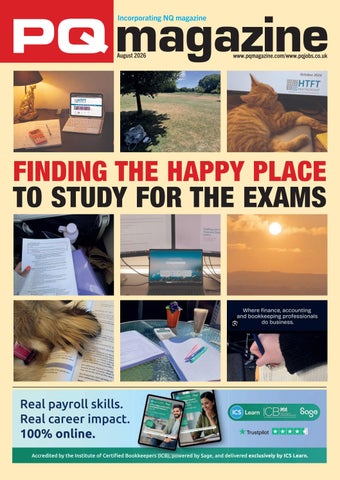
FINDING THE HAPPY PLACE TO STUDY FOR THE EXAMS
Real payroll skills. Real career impact. 100% online. Accredited by the Institute of Certified Bookkeepers (ICB), powered by Sage, and delivered exclusively by ICS Learn.
Earn. Learn. Qualify. Progress.
Become an Accounting Finance Manager Apprentice with the University of Exeter Study with a leading Russell Group university whilst gaining valuable workplace experience.
A DECADE OF APPRENTICESHIPS 2016 - 2026
https://ex.ac.uk/eaP
Scan the QR code to find out more. ACADEMIC PROFESSIONAL PARTNERSHIP PROGRAMME
One programme. Three achievements:
BSc (Hons) Applied Accounting AAT Level 4 Diploma in
Professional Accounting ACCA and CIMA exam exemptions (subject to criteria) Designed to accelerate your progression towards Chartered Accountant status whilst developing the skills employers need. 3 years | Online delivery | September start If you already hold a Level 4 qualification, you may be eligible to fast-track into Year 2.
2026EI047
Degree Partnerships
contents PQ
IN THIS ISSUE
August 2026
A note from the Editor If you want to be a successful accountancy student in today’s ever-changing world you need to be curious, diligent and have a growth mindset. So says ICAEW’s Chief Learning Officer, Dana Day, on page 4. I loved her three pieces of career advice too, particularly the need to ‘be kind’. A firm’s reputation is also becoming more and more important, and it is directly shaping hiring outcomes in the accountancy sector. In other news we take a look at ICB’s new qualification offerings and run the rule over the ACCA June exam pass rates. If you love our regular look at disciplinary cases then turn to page 8 to understand why it’s so important you keep your mobile phone off the exam desk! HTFT has launched the Clare Finch Accounting Scholarship, and one lucky PQ will be offered full tuition support and mentoring throughout their journey. Clare dedicated her life to education and teaching, and the scholarship is a fitting way to remember her. Find out more on page 5 and page 9. If you are someone who teaches, then do get online and add to the Accounting Educator Barometer. Accounting Café wants to find out how you are really feeling right now. Again, check out page 4 for more. Happy reading and stay cool. Graham Hambly, Editor and Publisher, PQ magazine News 4
8
Career advice Be curious, diligent and have a growth mindset if you want to be a successful accountancy student
5
ACCA June pass rates We run the rule over the latest set of exam results
6
The workplace When it comes to recruiting staff, a firm’s reputation is allimportant
9
Exam cheats sanctioned ACCA’s expels more students for using mobile phones in their exam Clare Finch scholarship HTFT launches Clare Finch Accounting Scholarship, giving one aspiring finance professional the opportunity to qualify for free
10 New ACCA qualification Association says students need to think about their transitioning arrangements 12 Tech news Deloitte set to launch AI studio on its London campus Features, etc 14 The PQ Digest Why it’s time to back people and tax the robots; and while getting qualified is vitally important, it is only one part of your career ‘equation’
p22
17 Your study tips Our readers provide their top study tips and name their favourite places to study
18 ICB spotlight ICB’s Vanessa Aradia explains the recent changes to the Level 2 and Level 3 qualifications 20 Money laundering AI can support AML compliance but tread carefully – it cannot replace professional judgement 22 Redefining accountancy New PQ contributor Joanna Perry explains why every accounting firm needs a ‘shadow board’ of younger employees 23 AI and you Why it’s time to dial down the panic over AI taking your job 24 Back to basics Understand the ‘why’ behind double-entry bookkeeping and you will build a solid foundation for learning 26 AI fraud AI-generated receipts are here – and expense controls need to be beefed up 27 Profile Meet Clare Hopwood: farmer, accountant and pageant queen! 28 CIMA spotlight Coping with exam failure is an important part of getting qualified. So how do you deal with it?
36 Payroll Why it’s vital payroll professionals understand every number they are processing 38 LLP ruling A recent Supreme Court judgment may change how LLPs will be taxed in the future 39 Careers Demand for accountants is on the rise, says Robert Half; our Agony Aunt deals with another of your workplace issues; and our Book Club review 40 Fun The lighter side of life – and accountancy The columnists Rachel Harrison It’s vital you set work/life boundaries 4 Sunil Bhandari Where’s the ‘separation of powers’?
6
Prem Sikka Corporate profits soar as cost-of-living crisis bites 8 Stuart Pedley-Smith When using AI start with the task, not the tool 10 Rachel Harris Why MTD will really matter for you 12
29 ACCA spotlight ACCA’s BSc programme with the University of London is now even more accessible 31 BSc Honours scheme How you can add a degree to your CV in double-quick time 32 ACCA SBL Top tutor Chris Cain explains techniques for passing the Strategic Business Leader exam 33 CIPFA spotlight Sustainability is everywhere – so why isn't sustainability reporting? 34 Viewpoint Motivational platitudes are everywhere, but as more students study without tutor support they can be far from helpful
p27
To subscribe for FREE go to www.pqmagazine.com Join thousands of your peers
who have made the switch. Stand out with the CGMA ® Finance Leadership Program (CGMA FLP).
aicpa-cima.com/flpuk
PQ the
RACHEL HARRISON Setting those crucial red lines Balancing work, family commitments and studies can be tricky. Saying yes to everything can feel like the route to success when you’re starting your career, but it rarely is if it comes at the detriment of your mental and physical wellbeing. Here are my top tips for setting boundaries inside and outside the workplace: • Understand your motives for saying yes: if you take on extra work and responsibilities reflect on how you can adjust your boundaries and find time to accommodate the task. • Suggest a solution: negotiate to make things work for you. Can your manager reassign an existing task to free up time for the additional work? • Protect your time: prioritise tasks and put time for completing work in your calendar. Do the same with your lunchbreak. Don’t let other people’s priorities become yours. • Extend this to your personal life: treat social events, rest time and study time as non-negotiable. Let your family and friends know so they can support you in maintaining these boundaries. • Focus on what you can control: if an issue is outside of your control, spending time worrying about this won’t change the outcome. Gain control of the situation by thinking about your immediate actions and how you will react if the event happens. Make your boundaries clear and they will guide your career and relationships with others, rather than creating barriers for the future. Rachel Harrison is Head of Academic Support at Kaplan
Future-proof your career You need to be curious, diligent and have a growth mindset if you want to be a successful accountancy student in today’s world, according to ICAEW’s Chief Learning Officer, Dana Day (pictured). In a recent interview she also revealed her top three pieces of career advice. At number one was save for your pension. This, she said, was serious advice and she doesn’t want students to ignore it. Day said: “The best advice I was ever given, aged 23 and in my first real job, was to pay into your
pension and max out my pension contributions.” At two was be kind. She said:
“Kindness and empathy don’t cost you anything to give out. And the more you give out, the more you get in return. Build your network thoughtfully, be trustworthy, and have integrity, because your network is going to be your greatest asset as you grow older.” Finally, she said you have to say ‘yes’ to more things and maybe take a risk. Day stressed: “Just take a shot and trust yourself; you’ll figure it out. If you make a mistake, own it, apologise if needed, get back up and keep going.”
Teaching accountancy – how does it feel? Accounting Cafe have launched the Accounting Educator Barometer, an annual, anonymous survey of the mood among accounting educators worldwide. They are listening to hundreds of voices from across the field, and are looking for as many people as possible to contribute. You don’t have to call yourself an ‘accounting educator’ to take part. If you
help people learn accounting your view counts. To complete the survey click this link, or find it on the
Timely responses to audit failures The Financial Reporting Council (FRC) has published reforms to its Audit Enforcement Procedures (AEP), which it hopes will “deliver faster outcomes and earlier learnings for the UK audit market”. The reforms include a new and expanded range of routes to resolution:
• Published Constructive Engagement (PCE), combining remediation with public transparency to support improvement and learning for the whole audit market. • Accelerated Procedure (AP), enabling faster resolution where sufficient evidence is already
a spokesperson for Deloitte said in an emailed statement. The Big 4 firm is not the first to announce redundancies. Earlier this year KPMG said it was looking to cut 600 roles.
Kim says perseverance is her top study tip, while Madeline has a study buddy in the form of her little friend – it’s a cat! Kiran believes you have to identify your distractions and then remove them. Read more wise words from them and other PQs on page 17.
Accounting Cafe website at https:// accountingcafe. org/. The survey will close on the 31 July 2026. Initial findings will be shared at the Accounting Cafe Pop-up at Warwick Business School on 18 September 2026, with the full report following in the autumn. If you’d like the report when it’s published you can leave your email address at the end of the survey. available. • Early Admissions Process (EAP), which encourages firms to cooperate with the FRC earlier in admitting and identifying breaches of relevant requirements. FRC believes this graduated approach will give FRC more flexibility to act quickly and in a more targeted way when serious issues arise.
In brief Deloitte looking to lose 175 audit roles Deloitte UK is planning to shed up to 175 of its auditors through voluntary redundancies because of low attrition rates and stagnant revenues. According to Bloomberg, among those affected will be managers and assistant managers across the business. “The firm is offering voluntary redundancy packages to a number of staffers in a response to low levels of staff attrition in its audit practice,” 4
Listen and Learn with HTFT A big congratulations to the winners of the HTFT Apple Airpods. They are Kim Schofield, Madeline Howard and Kiran Kullar. HTFT asked for your favourite places to study and top study tips.
Revolut ditches WFHfirst option for grads Graduates joining Revolut will now be required to work from the office at least three days a week from next
year, according to the Guardian newspaper. The digital bank said all new graduates and interns will have to go to the office because “the early stages of a career benefit from in-person collaboration and mentoring”. Previously, trainees could choose to work from home or at Revolut’s offices. However, Revolut stressed this was not the start of a roll-back of flexible staff benefits for its wider 11,000 strong global workforce. PQ Magazine August 2026
news PQ
ACCA June exam pass rates are in… Just under 120,000 students sat the ACCA June exams, with 136,544 papers sat. With an average of 1.14 papers per student, that means most students are just taking one paper at a time. It would be interesting to discover if, as with the ICAEW exams, the success rate is higher for students who take more exams per sitting. Some 4,690 students completed all their exams in June, becoming affliates. Students sitting the Strategic Essential papers this summer had very different experiences. Those sitting SBL said the paper was ‘OK’. However, for many of those attempting to pass SBR the session was a ‘disaster’. The SBR pass rates do show a slight dip – to 47%, but this is nowhere
near what many feared. That said, you have to go back to December 2022 to find the figure as low as 47%. The SBL pass rate this time around held steady at 51%.
Looking at the June Strategic Option pass rates, AAA now stands on its own, with a pass rate of just 39%. Meanwhile, APM at 42%, is a rare thing indeed. AFM was a healthy 47%, but ATX
dipped on previous success rates, with a pass rate of 47%. At the Applied Skills Level PM sitters achieved the lowest pass rates for the level – 41%. AA had a pass rate of 47% and for FM it was 48%. All the other papers had pass rates above 50%. Alan Hatfield, ACCA executive director – content, quality and innovation (pictured), said for the June session there was “ongoing strong engagement with our new CBE Practice Platform, which delivers an improved user experience for students.” He stressed: “On-demand resources and supplementary live sessions again form a key part of the guided learning support journey ACCA provides.” Hatfield also pointed out that we are just a year away from the allnew redesigned qualified. Students need to start planning now, and look to use the transitional tool (see page 10 for more on this). ACCA JUNE 2026 PASS RATES: BT 89%; FA 71%; MA 65%; LW 82%; TX 55%; FR 52%; PM 41%; FM 48%; AA 47%; SBL 51%; SBR 47%; AAA 39%; AFM 47%; APM 42%; ATX 47%
The Clare Finch Accounting Scholarship HTFT has launched the Clare Finch Accounting Scholarship. Clare dedicated her professional life to financial education: teaching, writing and, ultimately, founding HTFT so she could do things on her own terms. This scholarship exists to honour that journey, to celebrate what Clare built, and to ensure that what she stood for will be remembered and passed on to future generations. The scholarship offers: • Full tuition support for the chosen qualification pathway. • Access to HTFT learning resources and support. • Mentoring and guidance throughout the journey. Applications opened on the 15 July and will close on 31 August 2026. HTFT believe talent should never be limited by financial barriers. This scholarship is designed to help an exceptional student take the next step towards a successful professional future.
For all the details go to:
https://htftpartnership.co.uk/clarefinchaccountingscholarship/ PQ Magazine August 2026
5
PQ the
SUNIL BHANDARI Never the twain…?
For most of my career as an accountancy tutor the roles of accountancy bodies, publishers and training colleges were clearly distinct. Accountancy bodies appointed examiners, set the syllabus and assessed students. Publishers produced textbooks and exam kits, while tutors, through colleges, delivered the courses that supported student success. Accountancy institutions rightly require publishers and training providers to meet suitable standards, hence the existence of approved publisher and learning provider status. That separation, however, is beginning to blur. First, study material publication was brought in-house, putting it wholly under the control of an accountancy body. Then that material was used to offer online courses to students, again under the accountancy body’s control and delivered only by selected tutors. The familiar Chinese wall is meant to preserve the necessary ethical separation within the organisation – a safeguard of sorts, even if not one made of bricks and mortar. There may be sound academic and financial reasons for this significant change. The materials are free to students, and the courses are heavily discounted, all with the aim of improving pass rates. Even so, the outcome is an entity that now appears to act as judge, jury and executioner. That should concern us all. Next month, I will continue this theme by arguing that accountancy training increasingly resembles rearranging deck chairs on the Titanic. Lucky for me, I got dropped off in Greenland. Sunil Bhandari is an AFM tutor at FME Learn Online
Reputation is all! Accountancy firms are losing talent at every stage of hiring, with 22% of professionals turning down job offers because of concerns about a firm’s reputation. New research from B2B PR agency Midnight shows that employer reputation is now a decisive factor in the accountancy sector, with nine out of 10 (90%) of employees saying it is important that a firm reflects their personal values – higher than the national average of 82%.
Flo Powell (pictured), Joint Managing Director at Midnight, said: “Reputation is now directly shaping hiring outcomes in the accountancy sector. It is influencing who applies, who accepts and who walks away.” And the trend is accelerating, with more than four in five (83%) accountancy professionals saying employer reputation will play an even greater role in their career decisions in future. The research also highlights a
disconnect between how firms present themselves and how they are perceived. University of Sussex students reported that it is often difficult to understand what an employer does, let alone assess its culture or reputation, based on its website and social channels.
Overhaul of ICB qualifications The Institute of Certified Bookkeepers has completed a major redevelopment of its Level 2 and Level 3 bookkeeping qualifications, which will be taught for the first time in January 2027. ICB’s head of learning, Vanessa Aradia (pictured), told PQ magazine the review was evidence-led and researched with employers, with feedback from training providers and learners. The whole process was then validated through extensive AI-assisted deep research into emerging themes
Balancing ambition
AAT has released Balancing ambition and Balancing ambition for students – two new monthly podcasts that bring together expert voices, fresh insight and real conversations from across the world of business and finance. The first episode, ‘Finding
across bookkeeping, finance and technology. The result is, says Aradia, a
curriculum built around how bookkeepers work today: MTD quarterly reporting, VAT as it operates now, cyber security, and professional judgement. Crucially, ICB’s Level 3 remains a licence to practise – once qualified you can open your own supervised practice immediately. Later in 2027, Level 4 will undergo the same evidence-led redevelopment, and ICB will introduce a Level 5 qualification, a first for the profession. Find out more on page 18.
success without a straight line’, looks at the rise of portfolio careers and explains to listeners how they can make the most of bespoke career paths. James Green and Ellis Harris Boulter (pictured) are the guests on the episode, hosted by AAT’s Zoe Smith. Future episodes will tackle topics including the need for human skills in an AI-enabled world and the importance of building trust in a complex and changeable world. Host Zoe Smith said: “Careers –
and ambition – are very personal and individual things, that’s why we’ve called the podcasts Balancing ambition. No two career journeys are the same, and I hope these podcasts really do help people on their journey – whatever that might look like.”
In brief London exposed to AI job cuts London is the most exposed city in the developed world to the looming jobs ‘bloodbath’, according to the Organisation for Economic Co-operation and Development. In a new report, the OECD says the capital has the highest proportion of roles under threat from generative AI, and some four in five jobs will be at risk “now or in the near future”. The reason for London to stand out – above New York, San 6
Francisco, Paris and Berlin – is because of the high proportion of jobs in finance, professional services and the creative industry. CIMA mentoring programme open The CIMA Mentoring Programme will open for its next intake on 20 July 2026 – a great initiative designed to support the next generation of finance professionals. Whether you’re an aspiring management accountant looking for guidance or an experienced
CIMA member ready to give back, this programme creates meaningful connections that focus on growth, confidence and career direction. Mentoring isn’t just about advice. It’s about gaining real world insight, building long-term relationships and strengthening leadership and communication skills. Click here to register for your place. ACCA partners with UNITAR ACCA has signed a partnership
deal with the United Nations Institute for Training and Research (UNITAR) to help design, deliver and scale practical learning pathways in finance, digital innovation, entrepreneurship, public finance management, ethics and value creation. Together, ACCA and UNITAR want to expand access to highquality learning, online and offline, and strengthen the capacities of individuals and institutions across the world. PQ Magazine August 2026
Effective E ffective A AML ML is mea measured asured by outcomes, paperwork. b y outcom mes, not pa aperwork. AML A ML is no longer judged d by whether a file looks s complete. The q uestion is whether y our ffirm irm can show thatt iitt understands real question your financ cial crime rrisk, isk, acts prop portionatelly a nd reduces exposure. financial proportionately and
AMLCC enables you to easily prove your AML is effective because
Supervisors now expect you to evidence effective AML because
FATF is focused on effectiveness and outcomes
Know w tthe he rrisk. isk. Act Ac ct proportion proportionately. nately. Evidence Ev vidence effect effective tive AML.
amlcc.com a mlcc.com +44 (0)1455 320530 enquiries@amlcc.com @amlcc
Anti-Money Laundering Compliance e Company Limited | Registered Address: 21 High Street, Lutterworth, Leics, LE17 4AT Registered Number: Num mber: 04525430 © 2026 Copyright AMLCC. All rights reserved.
PQ news the
Keep mobiles out of reach
LORD SIKKA Profits soar as cost-ofliving crisis bites The government must address the cost-of-living crisis. The average real wage has hardly changed since 2008. The gross median wage of an employee is £31,512, and take-home pay is £26,208. The median wage for women, disabled and ethnic minority workers is even lower. Many cost-of-living pressures have arisen from profiteering by privatised utilities, such as water and energy, or from oligopolies dominating various sectors. Governments rarely break up conglomerates to create competition and reduce excessive profits. They shun price controls. Trade union Unite examined the annual accounts of 17,000 major corporations and found that since the pandemic average profit margins have soared by an average of 30%. Some of the biggest hikes were in electricity and gas supply (363%), transport and logistics (47%), water and sewerage (44%), and mining and quarrying (43%). The average UK renter spent 41% of take-home pay on rent in 2025. Social housing would help to reduce rental cost but since the 1980s, under the Right to Buy schemes, 2.8m homes have been sold and not replaced. More than 1.3m households (about 4m people) are on waiting lists for a social home, but only 12,198 were built last year To achieve sustainable economic growth, governments need to increase workers’ share of the economic pie and eradicate profiteering by price controls or public ownership of essential industries. Failure to do so will incubate social unrest. Prem Sikka is Emeritus Professor of Accounting at the University of Essex
ACCA’s disciplinary committee has sanctioned more students for using mobile phones in the exam hall. Students should know that mobile phones are one of the items that are ‘not permitted on or about your desk or person’, but some can’t seem to help themselves. During a remote FR exam in December 2025, Vaishnavi Pillay failed to adhere to ACCA’s Exam Guidance to ‘move mobile phones… out of arm’s reach’. She then attempted to give the exam proctor misleading information about the presence of the mobile.
She was found guilty and removed from the student register. Pillay was ordered to pay costs of £50. Another student, Nur ‘Izzah Insyriash Zaidi, was also caught with a phone in her PM March exam in 2025. The committee ruled she should be removed from the student register and pay costs to ACCA of £3,761.50. During a centre-based PM exam in June 2025 Leer Hu used her mobile phone to take photos of the paper, and then shared them with a third party. She was removed from the student register and ordered to pay cost of £6,300.
Accountex Manchester first Taking place on 15 September 2026 at Manchester Central, this year’s Accountex Summit Manchester is set to be the biggest and most exciting to date. This year marks an exciting new chapter for the event, with the FD Show joining Accountex Summit Manchester for the first time. Portfolio Director
Caroline Hobden said: “This is a landmark moment for Accountex Summit Manchester. Not only are we bringing
together the biggest and best line-up of exhibitors and speakers we’ve ever had in Manchester, but for the very first time the FD
Show is joining us. That means finance directors and senior finance leaders from across the North will have their own dedicated space and programme, sitting right at the heart of the event.” There will be more than 135 software and service providers on the exhibition floor, including household names like Sage, Xero, FreeAgent, Wolters Kluwer, TaxCalc, Bright, Intuit Quickbooks, IRIS and Dext.
Meet CIMA’s new president South African Alfred Ramosedi (pictured) has been elected the 93rd president of CIMA. Ramosedi has spent his working life in banking and financial services, and has been a long-standing CIMA volunteer. He promised the focus of his presidential year will be on building an AI-enabled profession, and championing opportunities for the next generation of talent. Ramosedi explained: “The
choices we make today – how we earn trust, embrace technology, lead through uncertainty and complexity, and invest in the next generation – will shape the future of finance and accounting. If we get those choices right, we will not simply keep pace with change, we will define it. “I take on this role with humility and a strong sense of responsibility. I am committed to serving our members, students and the wider
profession, and working with them to create a future grounded in trust, innovation and opportunity.”
to be treated as employees instead of true partners of the business, leading to an increased income tax and National Insurance burden.” For more on this turn to page 38.
2027, and phase 2 will commence from 6 April 2028. This, says HMRC, will support smoother transition for businesses. From 6 April, mandatory payrolling of BiKs will be phased in as part of phase 1 for company cars; car fuel; vans; van fuel; and employer-provided medical benefits. HMRC will provide draft data item guidance in the coming weeks, reflecting the removal of 94 realtime information (RTI) data fields for BiKs.
New mileage rates ‘fall short’ The increase in mileage rates fall short of the real costs faced by workers using their own vehicles for business travel, says the Association of Taxation Technicians. The Chancellor recently confirmed that the Approved Mileage Allowance Payments (AMAPs) rate for cars and vans will rise from 45p to 55p per mile for the first 10,000 business miles each tax year (backdated to April).
Tax briefs Higher taxes for more LLP members HMRC’s win in the Supreme Court means higher income tax and national insurance for more LLP members, according to Blick Rothenberg’s head of tax, Sean Drury. He said: “The long-awaited Supreme Court judgement on BlueCrest Capital Management LLP is finally out and as widely expected it has been a win for HMRC. This opens the way for more Limited Liability Partnership (LLP) members 8
Phased approach to BiKs Mandatory real-time reporting of income tax and Class 1A National Insurance Contributions for certain benefits in kind (BiKs) and taxable expenses will be phased in from 6 April 2027. Phase 1 will start from 6 April
PQ Magazine August 2026
news PQ
The Clare Finch scholarship
Do you use AI for careers advice?
HTFT has launched the Clare Finch Accounting Scholarship, giving one aspiring finance professional the opportunity to complete their qualification with HTFT free of charge. Clare, who passed away unexpectedly in March, dedicated her professional life to financial education, teaching, writing and, ultimately, founding HTFT so she could do things on her own terms.
Young people are increasingly turning to AI tools and social media to guide their careers, and in some cases replacing advice traditionally provided by parents and teachers, according to a new report from accountancy and business advisory firm BDO. BDO’s ‘Young Minds 2026: The Unequal Advantage’ report, based on a survey of 2,000 18–25-year-olds, highlights a growing shift towards digital sources of guidance amid widening inequalities in access to opportunity. The research shows that three-quarters of young people now use digital sources to inform their career decisions, including AI tools (29%), social media influencers (25%) and other online research (21%). Worryingly, those from a lower socio-economic background are more likely to rely on these tools than they are on family networks and teachers.
The values that define HTFT today – integrity, care, courage and perseverance – reflect how Clare lived and worked. The new scholarship offers full tuition support, access to HTFT learning resources, and mentoring and guidance throughout the journey. This scholarship is open to anyone taking their first steps in a career in finance, or those
already on that journey. Whether you are about to begin your AAT, ACCA or CIMA studies, or are already working towards a qualification, they want to hear from you. HTFT is looking for motivated individuals who can demonstrate commitment, genuine potential and a real passion for building a career in accounting and finance. Applicants will asked to complete a short form
and submit a 300-word personal statement. Applications are now open and will close on 31 August. For all the details click here.
CIMA signs new MoU with Indian College AICPA and CIMA have signed a Memorandum of Understanding (MoU) with St Joseph’s College of Commerce to help strengthen finance and accounting career pathways in India. Under the MoU the parties will develop platforms for ongoing
PQ Magazine August 2026
student engagement and industry interaction – giving students insights into career opportunities in management accounting. The agreement also creates a pathway for high-potential students to pursue the Chartered Global Management Accountants (CGMA)
qualification, alongside their undergraduate education. CIMA’s Andrew Harding said: “As the finance profession continues to evolve, it is increasingly important that students are equipped not only with strong academic foundations, but also
with the professional and strategic capabilities employers seek. By engaging students early and helping them understand the value of the world-leading CGMA qualification, alongside their university education, we can support stronger career outcomes.”
9
PQ news the
STUART PEDLEY-SMITH
Task not tech: GenAI for study Many accounting students are already deep into Gen AI. Most will have used tools like Gemini or Claude to help with a variety of tasks, both personal and professional. Which is of course fine, but when it comes to study you need to be careful. It’s easy to focus on the task rather than what will help you learn more effectively and develop the skills needed to pass the exam. The advice is simple: start with the task, not the tool. Avoid opening a GPT looking for something to use it for. First, decide what you’re trying to achieve, then ask whether the AI can help you without reducing the impact on your learning. Here are a few suggestions: • Personalised study planning: use AI to create a tailored study timetable based on exam dates and your personal strengths and weaknesses. • Reducing cognitive overload: why not ask the GPT to provide information in different formats, for example a diagram, chart, table or mind map? This is an excellent way of reducing large amounts of text. • Understanding – asking questions: this is possibly the most popular use of a GPT, simply asking a question. There’s a saying that if you have a hammer, everything looks like a nail. Use Gen AI to make learning genuinely easier and more effective – not just because it’s convenient. • Stuart Pedley-Smith is an accountancy lecturer, education advisor, author and blogger
Have you used the transition tool? ACCA students are being encouraged to start thinking about how they will undertake a smooth transition to the new ACCA qualification. The redesigned Foundation and Knowledge levels are being introduced in July 2027, followed by the Expertise and Strategic Professional in September 2027. PQs will receive credit for any exams completed under the current structure, and ACCA has promised they will not be disadvantaged by the transition. Students can check out the transitional tool at ACCA Qualification transition tool.
exam as your first Applied Skills exam. All students who don’t complete the LW exam prior to transition will be required to enter the K3 Business Law before or at the same time as entering for Expertise exams.
UK government ‘mis-sold’ student loans The UK government has been accused of misselling student loans, in a damning new report from the Treasury Select Committee. The committee was given the job to see if the current student loans system was ‘broken and unfair’, and it has decided that it is.
The MPs felt comparing student loan repayments to mobile phone contracts or cinema tickets in promotional presentations ‘amounted to mis-selling’. However, the government has exempted its student loan policies from consumer protection laws
and cannot be held liable in law for mis-selling. The committee said no government should ever have taken advantage of this exemption by pursuing lending practices that cause consumer detriment. The report stressed: “Students have a right to expect the government acts as an exemplary lender. Successive government have undermined that expectation.”
Cash flow statements need an upgrade The international cash flow accounting standard should be revised to help users of financial statements assess the liquidity, solvency and financial flexibility of companies. This is the conclusion of collaboration between academics and professional accountants on how statements of cash flows could evolve. The report by academics from the British Accounting and Finance
Big 4 make Gender Equality list Deloitte UK has been named in The Times Top 50 Employers for Gender Equality list for the eleventh year running. Also on the list are KPMG, PwC, EY, and Grant Thornton. Jackie Henry, managing partner, People and Purpose at Deloitte UK, said: “Our inclusion in The Times Top 50 Employers for Gender Equality highlights Deloitte UK’s dedication to fostering an environment where women succeed. We actively champion women’s career progression, from supporting their entry into the profession through school 10
For those studying Applied Knowledge, the FA Financial Accounting and MA Management Accounting have exam equivalents. However, BT Business and Technology does not. If you do not complete BT Business and Technology before transition you will be required to complete the Responsible Business Management Essential Employability Module in the redesigned qualification. This module will be chargeable. If you complete the Applied Knowledge level requirements ahead of transition, ACCA is encouraging you to study for the Corporate and Business Law (LW)
Association’s Financial Accounting and Reporting Special Interest Group (FARSIG) concluded that opportunities to improve statements include requiring supplementary disclosures such as a reconciliation of net debt, and exploring how to integrate cash flows and ESG-related information. ACCA’s Sharon Machado said: “FARSIG’s work this year raises interesting questions about the
relationship between earnings and cash flows, and the impact of social and environmental factors on organisations’ current and future cash flows. Today, such factors are rarely explained in cash flow statements or related disclosures. The reporting of sustainability-related financial disclosures may fill this gap through complementary information.”
and university programmes to strengthening their leadership via the successful Deloitte Academy Women on Boards programme.”
said: “The capital’s enduring status as a fulcrum of professional and financial services means it will always be absolutely core to our business.”
PwC will be in Eden PwC UK has agreed Heads of Terms for 350,000 sq ft of new office space at One Eden in Canary Wharf, with completion expected in the autumn. The decision follows an extensive review of potential sites as the firm plans for an expected major refurbishment at Embankment Place from 2030, where 5,500 staff are currently located. The new space will address PwC’s immediate requirements from 2030, as it also plans for the expiry of its More London lease in 2035. Marco Amitrano, Senior Partner of PwC UK,
Where is the value? KPMG’s latest Global AI Pulse report finds that as UK businesses move AI into everyday work, leaders are under increasing pressure to demonstrate value, with cost visibility emerging as a key barrier to scaling AI effectively. The quarterly global survey found that over a quarter (26%) of UK companies now use AI as part of everyday work, up from 18% in Q1 2026. But as organisations expand their use of AI tools and agentic systems, managing usage costs is becoming both more complex and more critical to realising value. PQ Magazine August 2026
Real payroll skills. Real career impact. 100% online.
Develop your finance career faster than ever at icslearn.co.uk
Accredited by the Institute of Certified Bookkeepers (ICB), powered by Sage, and delivered exclusively by ICS Learn.
PQ tech the news
RACHEL HARRIS
The quarter that changes everything
On 7 August, the first-ever MTD for Income Tax quarterly update is due. If you’re a trainee in practice you are about to feel it more than anyone: here’s why this matters to you. Compliance work is about to become continuous. For years, the rhythm of a practice was one big push to January. Now the first tranche of sole traders and landlords will file four times a year, plus a final declaration. Chasing records, cleaning data and nudging clients stops being a January problem and becomes a permanent one. Guess who will do most of that chasing. That sounds like bad news. It isn’t. Continuous data means continuous conversations, and conversations are where advice happens. The trainee who can look at a quarter’s numbers and say something useful about them, rather than just submit them, becomes indispensable fast. So volunteer for the MTD clients nobody wants. Learn the software properly. Notice which clients keep good records and which don’t, and ask why. Write down what goes wrong in August, because it will go wrong somewhere, and be the person who knows how to fix it in November. Your exams will teach you the rules. This quarter will teach you the profession, live, while everyone else is figuring it out at the same time. Nobody in your firm has done this before, either. That’s the opportunity. Rachel Harris is the founder of striveX and @accountant_she
Deloitte set to launch London AI studio Deloitte has announced it is to open a new AI studio on its London campus. Developed in collaboration with Google Cloud, the studio will help UK organisations move beyond AI experimentation to deploy autonomous, action-oriented AI systems at scale. As the centrepiece of its AI investment, the Deloitte AI Studio will open in late July. The facility will focus on transitioning sectors, such as the public sector, financial services, retail, consumer products, healthcare and life sciences, and media and telecommunications.
The Big 4 firm also announced an intensive upskilling initiative to train 1,000 members of its UK AI and data workforce on Google
Cloud’s Gemini Enterprise. Deloitte UK’s chief AI officer, Hayley McKelvey (pictured), said: “Our clients are looking for more than just productivity gains – they want AI that can take action and drive real-world business outcomes. With our new AI Studio and the continued investment in our people we are providing the physical and technical infrastructure necessary to make agentic AI an industrial reality in the UK. This is about moving from curiosity to a new era of autonomous business operations.”
We need AI regulation now! Governments must take a far more active role in regulating artificial intelligence (AI), says a new survey from ICAS. Some six in 10 chartered accountants (60%) believe government intervention on AI regulation must increase – four times the number who disagree (15%) – highlighting the concern within the profession about the pace and impact of the technology. More than half of respondents (52%) also cited concerns
around client data privacy and confidentiality. There is a strong appetite for clear rules and oversight, and the results add to the mounting pressure on policymakers to establish robust governance frameworks as AI reshapes business, finance and decisionmaking. Gail Boag, ICAS CEO (pictured), said: “Our findings show a clear and growing consensus that AI can’t continue to develop without
stronger rules and accountability.” However, she felt any regulatory approach must be proportionate and practical, and strike the right balance between enabling innovation and protecting against misuse and misinformation.
Beware AI-generated receipts Over one-quarter of UK employees (29%) have admitted to using AI to generate or manipulate expense receipts to top up their salary. New research from Emburse shows an even higher number (40%) admitted they have submitted personal purchases as business expenses or considered doing so because of concerns about their own personal finance. The study also reveals growing concern among employees who are routinely required to cover business
expenses out of their own pockets. More than two-thirds (69%) of UK office workers say they have incurred bank fees after paying for business expenses.
Marne Martin, CEO of Emburse, said: “As the cost-of-living crisis has progressively worsened, the expectation that employees must absorb additional charges, interest or overdraft fees linked to workrelated spending is unsustainable. “The research reveals a painful truth: when companies require staff to cover business expense upfront, the arrangement can effectively amount to an interest-free loan from employee to employer.” See page 26 for more on this.
Tech briefs Last-minute MTD rush is coming… Accountants are bracing themselves for a ‘manic’ last-minute rush in client onboarding ahead of the first quarterly filing deadline for making Tax Digital for Income Tax on 7 August. It may be the biggest shake-up of the self-assessment system in recent times, but research from FreeAgent shows one in seven (14%) of sole traders and landlords required to sign up “don’t understand anything at all” about 12
the new rules. HMRC has estimated 864,000 sole traders and landlords earning over £50,000 in qualifying income from self-employment and property will be impacted this year. The worry is just 336,000 people are currently registered. Welcome to the verification tax Rather than saving time, professionals are finding themselves playing detective with black box AI outputs.
New research from IDC for Sage reveals that UK finance professionals are now spending on average 13 hours every week manually reconstructing, validating and defending AI outputs. In the UK, the burden is even heavier. Almost one in five (21.2%) are trapped spending 30-plus hours a week, nearly a full-time job, just double-checking the AI’s work. The researchers suggest the next generation of successful finance AI platforms may be differentiated less by the breadth of automation they
offer and more by their ability to reduce validation burden, accelerate explainability, operationalise governance, streamline review workflows and scale organisational trust efficiently. Xero announces AI innovations Xero unveiled new AI innovations at Xerocon London recently. Powered through JAX, its agentic platform, the idea is to simplify end-to-end bookkeeping, automate routine tasks and proactively manage cash flows. PQ Magazine August 2026
BSc (Hons) Applied Finance and Accounting
A UK Honours degree for qualified accountants and finance professionals. Awarded by the University of Greenwich. Delivered by GEMS
A one-year top-up programme designed for professionals who hold a recognised accounting or finance qualification but have not previously completed a bachelor’s degree. The programme converts professional expertise into a full UK Honours degree, opening access to postgraduate study, degree-filtered roles, and points-based immigration pathways in the UK, Canada, Australia and the UAE.
Who is eligible
Curriculum
•
ACCA Affiliates and Members
•
ACA / ICAEW Qualified Members
•
CA (ICAS) Qualified Members
•
CAI — Chartered Accountants Ireland
•
CIMA / CGMA Qualified Members
Four modules at Level 6, 30 credits each: Investment Management; Machine Learning in Fintech; Quantitative Finance Research; and Corporate Governance, Ethics & Sustainable Practices. Assessment is entirely by coursework, with written academic feedback on every submission.
•
CIPFA Qualified Members
•
AAT (Level 4 and above)
•
Recognised international CPA bodies (case-bycase)
On completion
A professional qualification is the entry requirement.
01
academic year
Apply at financetopup.com
100% online
Graduates receive the same award as Greenwich’s on-campus students; the certificate does not state “online”. They may attend the official graduation ceremony at the Old Royal Naval College on the Thames and join the University’s alumni network of 21,000 graduates across 140 countries.
£2,000 total tuition
No
examinations
University of Greenwich · Established 1890 · TEF Gold · QAA-regulated · 21,000 students across 140+ countries
PQ in the news
THE PQ DIGEST Each month we look at the accountancy stories that have made waves on social media
TIME TO TAX THE ROBOTS!
J
ames Reed, chairman and CEO at Reed: “Thank you, Sean Farrington, for having me on BBC’s Big Boss Interviews to talk about a simple idea: back humans and tax robots! Our tax system is pointing in the wrong direction at exactly the wrong time. If AI and automation are where the wealth is being created, then taxation needs to follow it. “The urgency is real. The rise in employers’ National Insurance has acted as a tax on jobs, accelerating decisions to automate or offshore. At the same time, AI is burning through entrylevel roles, shrinking opportunities for young people just as they enter the workforce. We’re already seeing it in the numbers: vacancies are down, and graduate opportunities have collapsed dramatically in just a few years. “This isn’t about resisting progress; it’s about redesigning the system to support people through it before it’s too late. We need a smarter model that backs humans first. “With a new UK Prime Minister expected to take office soon, this is a rare window for the government to reset relations with business and a real opportunity to correct past mistakes.”
EXAMS JUST THE BEGINNING
N
adia Zackria, FCCA, tutor at First Intuition: “One of the biggest misconceptions I see among aspiring finance professionals is this: ‘If I pass all my exams, my career will take care of itself.’ “Unfortunately, that’s not how it works. Professional qualifications are incredibly valuable, but they’re only one part of the equation. “Over the years I’ve taught many talented
QUOTE OF THE MONTH: “Employers want professionals who can apply knowledge to real business situations.”
students, and I’ve noticed that the people who progress fastest focus on much more than passing exams. “They develop: “Technical expertise: qualifications provide the foundation. But employers want professionals who can apply knowledge to real business situations, not just pass exams. “Communication skills: being able to explain financial information clearly to non-finance stakeholders is often what separates good professionals from great ones. “Commercial awareness: businesses don’t exist to produce accounts. They exist to create value. The more you understand strategy, customers, operations and risk, the more impactful your finance career becomes. “One question I encourage students and newly qualified professionals to ask themselves
is: ‘What problem can I solve for an employer or client?’ “The clearer your answer, the more valuable you become. “Qualifications may get you an interview but your skills, mindset and ability to create value determine how far you go once you’re through them.”
YOUR PQ MAGAZINE Free subscription: www.pqmagazine.com/subscribe/ Delivery problems or need a change of email address: admin@pqmagazine.com Website: www.pqmagazine.com 14
Editor: Graham Hambly Email: graham@pqmagazine.com Associate editor: Adam Riches Art editor: Tim Parker Origination: Classified Central Media
Phone: 07765 386489 Address: PQ Publishing Limited, 4 Dangan Road, London E11 2RF Copyright: PQ Publishing 2026 PQ Magazine August 2026
Join thousands of your peers who have made the switch. Stand out with the CGMA® Finance Leadership Program (CGMA FLP).
CGMA FLP is your flexible path to CIMA® membership and the CGMA designation. Your peers appreciate being able to master a syllabus with a 100-year reputation of excellence through a convenient, fully online platform; we don’t want you to miss out.
Find out more at aicpa-cima.com/flpuk
Founded by AICPA® and CIMA, the Association of International Certified Professional Accountants® powers leaders in accounting and finance around the globe. © 2025 The Chartered Institute of Management Accountants. All rights reserved. 2507-247958
listen and learn
PQ
Top study tips Our readers provide their top study tips and name their favourite places to study, just for you!
H
TFT Partnership recently got together with PQ magazine to offer three lucky readers a set of Apple AirPods. We asked you to send a picture of the place where you feel most happy studying, along with your top study tip. We promised to put the best on the cover – which we have done – and here are some of those top tips and reasons why those happy study places work for them… Richard Balogh: “I study best when I am at home at my desk with multiple screens, with notepad, pen, pencil, eraser and calculator at hand. I study with a mixture of calming, relaxing music in the background to create the flow. “I use Osborne Books’ tutorials or the workbook, writing the answers with pencil and erasing to reuse the task again later. “I found multiple screens useful, as on one screen I can have the tasks to resolve and on the other screen the answers to check, so I can find where I went wrong. While using the computer I also use YouTube videos walkthrough on mock assessments.” Madeline Howard: “Slightly outside the box, not a physical place, but my happiest place studying is with my little friend Whiskey. He got me through AAT Level 4 and is now doing CIMA Operational Level with me!” Emily Orchard-Pain: “As a distance learner I set myself a study goal at the beginning of the week. This could be how many chapters I want to get through that week, or time spent studying, which helps me to stay on track. Inevitably, life sometimes gets on the way so my caveat to the first tip is be kind to yourself, if study doesn’t quite go to plan that’s ok, tomorrow is a new day.” Sharon Pickering: “I feel most happy studying on the beach. My studying tip is to focus on active practice over passive reading as ACCA exams aren’t just about knowing theory; it tests how well you can apply the theory. So for every hour of reading on the beach I spend at least another hour applying what I learn through questions, while listening to the white noise of the tide. “My studying tip is basically to study like the beach; take one topic at a time (waves), build strong basics (sand), revise regularly (tides) and stay consistent (sun). Stay steady, and success will come ashore. “The beach is Trunk Bay, Tortola, Virgin Islands. Kim Schofield: “This desk (see cover) is where I spend most of my time working through practice questions and preparing for my exams. My top study tip is perseverance and not giving up, even when the journey feels longer than expected. Over the past two years I have been studying for F2 and P2, and it has really tested my resilience. It took me four attempts to pass F2 and three attempts at P2, and there were times when I
PQ Magazine August 2026
seriously considered giving up. “During this time I learnt that it’s important to ask for help when you need it. Reaching out to tutors helped me understand topics I had struggled with and gave me the confidence to keep going.” Keira Lake: “My top study tip is to always carry flashcards with you (if you made them yourself then that’s even better!). The reason why I say this is because if you ever find yourself with a spare five minutes whilst waiting for the train (for example), then you have them on you for quick recall. After all, studies show that using flashcards like this for quick recall is a brilliant way to solidify your knowledge. “The photos of my favourite place to study: Maiden Castle (see cover). The photos were taken whilst I was there to watch the sunrise.” Kiran Kullar: “Sharing the place I am happiest
studying – while I may never reach feeling truly happy while studying (!) – I do have fond memories of packing all my notes and walking over to my local park in the sun. The picture I am sharing (see cover) was taken last summer, when I was studying for my CIMA Management Case Study. It was incredibly peaceful and a really lovely way to feel less isolated and like I was missing out on being outside and having fun. “My study tip is to identify distractions and figure out the best way to remove them so you can stay focused rather than trying to ignore them. Social media was my biggest distraction by far when I first started my qualification, and I would pretend it wasn’t or ignore the fact that it was. So, whenever I am studying, I make sure to delete and log out of apps and accounts, to ensure I make it easier on myself to remove distractions. It helps my mental health too, so win-win!” 17
PQ ICB spotlight
What should tomorrow’s bookkeeper know? ICB’s Vanessa Aradia explains the recent changes to the Level 2 and Level 3 qualifications
remained human, and every learning outcome faced one test: does this make someone a more capable bookkeeping professional? If not, it was rewritten, repositioned or removed. What changed? At Level 2, learners work in digital records from day one, understand audit trails and recognise cyber security risks. MTD for Income Tax arrives through quarterly reporting from digital systems, because that is now key to the job. At Level 3, three integrated assessments replace the old unit structure, applying knowledge across sole traders, partnerships and limited companies. VAT has been rebuilt around the framework as it operates today, including Postponed VAT Accounting and the Northern Ireland arrangements, so learners study the rules as they are, not as they were before Brexit and MTD. Communication, ethics and professional judgement run throughout. AI awareness is now vital, so it is built into both qualifications; AI mastery has its own dedicated programme, the ICB AI Academy.
H
ere’s an uncomfortable question for anyone part-way through an accountancy qualification: how much of what you’re studying will still be relevant when you graduate? The routine layers of accounting are automating fast. What isn’t automating are the people who hold it all together, day in, day out: who know the business, the data, the software and the logins, who understand the context behind the numbers, and who carry responsibility for what reaches HMRC. So, when we rebuilt ICB’s Level 2 and 3 qualifications (first teaching will be from January 2027) we started
18
with one question: what should tomorrow’s bookkeeper know? Evidence first A syllabus is a promise that what learners study will still matter when they use it. We gathered evidence first: employer research into what businesses value, feedback from training providers and learners, and legislative developments. We then validated and sharpened that groundwork through AI-assisted deep research, analysing emerging themes across bookkeeping, finance and technology at a scale no manual review could match. Every decision
What matters to PQs Consider what Level 3 confers: the right to apply for an ICB Practice Licence and open your own practice with AML supervision, immediately. Not after a training contract. Not after years of signed-off experience. Qualified, licensed, trading: typically faster and more affordable than a chartered route into a role automation is thinning out. ICB exams are online, on-demand and remotely invigilated, so you sit them when you’re ready, not when an exam window dictates. And the career pathway doesn’t stop there. Later in 2027, Level 4 gets the same evidenceled redevelopment, covering advanced VAT, management accounts, tax, and accounts preparation and filing across the private, public and third sectors. Alongside it, a new Level 5 arrives, focused on advisory, tech oversight and leadership, with a bridge to a Master’s programme. It fills a gap the profession has lived with for years. • Vanessa Aradia is ICB’s Head of Learning
PQ Magazine August 2026
PQ money laundering
Use AI for AML – but be wary AI can support AML compliance but cannot replace professional judgement, writes Lisa Simms
A
rtificial intelligence is becoming part of everyday compliance work. For AML-regulated designated non-financial businesses and professions (DNFBPs) – including accountants, lawyers, trust and company service providers, real estate professionals, and high-value dealers/dealers in precious metals and stones – the real question is no longer whether AI will be used, but how it should be used. Global AML standards apply to these sectors and are built around a risk-based approach, with firms expected to understand their own risks and apply proportionate controls. Used properly, AI can be a valuable support tool. Used badly, it can weaken judgement, flatten risk assessments and PCPs (Policies, Controls and Procedures) into generic text, and push firms back towards the kind of tick-box compliance that supervisors increasingly reject. The opportunity is real, but so is the danger. Where AI adds value The most useful role for AI in AML compliance is as a research and productivity assistant. It can help staff, compliance teams and fee earners move through large volumes of open-source intelligence (OSINT) more quickly, identify patterns across public records, and summarise long material into manageable points for review. That is particularly helpful in areas such as company registry searches, beneficial ownership research, adverse media screening, public filings, sanctions and PEP (Politically Exposed Person) checks, litigation databases, and multilingual open-source intelligence. A tool that helps a professional review Companies House data, compare public information across jurisdictions, or spot inconsistencies in media reporting can save time and widen the scope of initial enquiries. It can also support staff with drafting followup questions, organising notes and preparing summaries for internal review. There is also real promise in AI-driven monitoring tools. In practice, transaction monitoring is easier to automate in banking and payments, where data is high-volume and structured. DNFBPs often work with lower volumes, different workflows and more bespoke matters, so they should be cautious about assuming that tools built for financial institutions will transfer neatly into their own environment. Risk assessments The difficulty begins when firms ask generative AI to complete business-wide risk assessments, client risk assessments or a set of PCPs. This is where caution is essential. Proper risk assessments, or PCPs, are not simply well-written documents. They are judgement exercises. The Financial Action Task Force (FATF) standards expect firms to understand their risks, maintain PCPs to manage them effectively, and apply enhanced or simplified measures according to the level 20
of risk identified. That only works when the assessment reflects the firm’s actual services, delivery channels, client types, jurisdictions, source of funds and wealth exposure, transaction patterns, and previous experience of what has gone wrong in practice. Generative AI can produce polished wording, but polished wording is not the same as insight. Left to itself, the output is usually generic. Even when a professional gives the tool detailed prompts, the result is still only an outline process based on the information supplied. It cannot genuinely know the business in the way the business knows itself. AI tools cannot understand the subtleties of a long-standing client relationship, the significance of a last-minute change in instructions, or the difference between a normal transaction and one that simply feels out of place. Professional judgement The most important AML judgements in DNFBPs are often not mechanical, they are contextual. They come from experience, scepticism and familiarity with the client, the matter and the commercial reality behind a transaction. An accountant may notice that a client's explanation for a payment flow no longer matches the underlying business activity. A lawyer may sense that a proposed structure is more complex than the stated purpose requires. A Trust or Company Service Provider (TCSP) may recognise that a beneficial ownership
explanation is technically possible but commercially implausible. A real estate professional may spot unexplained urgency, an unusual source of funds, or a buyer who seems detached from the economics of the deal. A high-value dealer may see a cash pattern or purchasing behaviour that does not ring true. That instinct is not mystical. It is accumulated knowledge of the business and of the client. FATF standards require suspicious activity/ transaction reporting by DNFBPs in specified circumstances, and a central part of an effective AML framework is the ability to recognise when something may be wrong and escalate it into a suspicious activity or transaction report where appropriate. AI cannot and should not carry the responsibility for that process. Not a writing exercise One of the biggest dangers with overusing AI is that it can make AML compliance look complete when it is not. A polished, generic document can create the illusion of rigour while adding very little that is specific to your business or clients, testable or proportionate. Weak AML documents usually fail in the same way. They contain broad statements about customer due diligence, monitoring and reporting, but provide little evidence that the firm has really thought about its own risk profile. They sound interchangeable. A risk assessment that could be copied from one practice to another with only a few minor edits is not a real risk assessment at all. PQ Magazine August 2026
money laundering PQ That is also why generic, AI-written content invites scepticism from supervisors. The issue is not style alone. The real problem is substance. If the document does not reflect ownership, judgement and firm-specific thinking it goes against the whole purpose of a risk-based AML programme. Effectiveness matters This point is becoming even more important because the global AML conversation has moved well beyond whether a policy exists on paper. FATF mutual evaluations assess both technical compliance and effectiveness, and FATF is explicit that effectiveness is now the main focus. Countries are expected to show that measures are working and delivering the right results; having laws and frameworks on the books is not enough. That same logic is increasingly relevant at business level. The question for a DNFBP is no longer ‘do we have a risk assessment?’ It is also: • Does it drive better decisions? • Does it change the level of due diligence? • Does it help us identify unusual activity? • Does it lead to timely escalation, internal challenge and better reporting where needed? If AI helps a firm research faster, document decisions more clearly, or review opensource intelligence more efficiently, that supports effectiveness. If it produces generic assessments or PCPs that weaken critical thinking it does the opposite.
PQ Magazine August 2026
The hidden risks There is also a practical governance issue. Official guidance on AI use highlights several risks that are highly relevant to AML work, including confidential information being entered into prompts, automation bias and hallucinations. It also stresses the need to define clearly what AI can and cannot be used for. For DNFBPs that matters. Client information may be commercially sensitive, legally privileged, confidential or protected by data protection law. Staff may also give too much weight to confident-sounding AI output, especially when they are under time pressure. A summary that looks convincing can still be wrong, incomplete or based on poor sources. In AML, that is not a minor flaw. It can distort risk ratings, weaken ongoing monitoring and create a misleading audit trail. Recommendations A sensible approach is to treat AI as an assistant, not an assessor. Use it for research support, draft summaries, comparison of open-source material, translation, drafting of internal questions and administrative efficiency. Do not use it to replace the firm’s own PCPs, business-wide risk assessment, client risk assessments or final judgement on suspicion. Put an internal AI policy in place. Define
which tools are approved, what data may and may not be entered, who is allowed to use the tools, how outputs must be checked, and where human sign-off is required. Official guidance is clear that there is no one-sizefits-all model, so the policy should reflect the nature of your services, clients and data. Require staff to verify important outputs. Check source material, especially for adverse media and beneficial ownership research. Record the human rationale behind the final decision. Train teams on hallucinations, automation bias and confidentiality risks. Most importantly, make sure the accountable, AML-regulated professional remains completely accountable. Conclusion AI can make AML compliance faster, broader and in some areas more consistent. For DNFBPs, it is particularly useful in opensource research, information gathering and administrative support. But AML compliance has never been only about collecting information. It is about interpreting it, challenging it and knowing when something does not feel right. That is why AI can support AML compliance, but cannot replace professional judgement. The strongest AML programmes will be the ones that use AI to sharpen human thinking, not to bypass it. • Lisa Simms is managing director of AMLCC
21
PQ redefining accountancy
We need shadow boards Joanna Perry explains why every accounting firm needs a shadow board of younger employees
R
ecently, I was training a room of around 70 accounting students and graduates. Towards the end of the session I decided to ask a question that had nothing to do with the content we’d been covering. I asked: “If you could ask me one question about your career, what would it be?” The responses were anonymous. I wanted to know what was genuinely on their minds. I expected questions about AI, technical skills or how to stand out in a competitive market. Instead, almost half revolved around one theme: How do I transition out of my current role and start my own business? That surprised me. It surprised me because before they'd built a career, they were already thinking about an exit strategy. I’ve read all the reports about Gen Z. We know they value purpose, autonomy and flexibility. But there’s a difference between reading statistics in a report and standing in front of 70 people watching those questions appear on your screen in real time. Accounting firms spend an enormous amount of time talking about the next generation yet very little time is spent asking them what they’re actually thinking.
22
Joanna Perry will be a regular contributor to PQ
Back in 2015, Gucci created what it called a ‘shadow board’ – a group of younger employees brought together to challenge assumptions and contribute to strategic decisions. The thinking was simple: if you’re trying to sell to a younger generation, perhaps you should involve that generation in the conversation. Why don't we do the same thing in accounting? Every firm already has two boards. There’s
the official board sitting around the boardroom table making strategic decisions. Then there’s the unofficial one – the conversations happening over lunch, in the office kitchen and in group chats. Imagine if every firm created a shadow board made up of graduates and intermediates. A small group that met with leadership a few times a year to offer a perspective that can’t be gained from experience alone. Before redesigning your graduate programme, ask them. Before wondering why graduates leave after 18 months, ask the people who are still there. Reflecting on the workshop, I realised the students weren’t really asking how to leave accounting. They were asking how to build something meaningful. They wanted ownership. They wanted to make decisions. They wanted to feel their ideas mattered. If accounting wants to remain relevant to the people who will shape its future I think it’s time we stopped guessing what young professionals want and started inviting them into the conversation. Perhaps the voices in the room that are experiencing the future before anyone else are just as valuable as the voices with the most experience. • Joanna Perry is a business adviser, educator, international speaker and founder of Firm Ready. A qualified accountant, she lives in Sydney
PQ Magazine August 2026
AI and your job PQ
Future-proof your career in the AI age
A
Thomas Newman says maybe it’s time to dial down the panic over AI taking your job
lot of ACCA students have been asking recently about whether AI is going to wipe out accountancy jobs. A recent Economist cover added fuel to that worry, and I wanted to share a calm read on it. The issue led with a cheery article headlined ‘Prepare for an AI jobs apocalypse’. While I respect The Economist (I’m a long-time subscriber, after all), they have a history of having been famously wrong, from the death of the euro to repeated predictions of American decline to name just two. And I believe they’re wrong again. Firstly, The Economist article doesn’t actually represent the consensus view on AI and jobs. Aside from the CEOs of the frontier AI labs and their investors (who have a big incentive to overstate AI’s impact, given all the capital they’ve thrown at it ahead of IPOs), most commentary from mainstream publications, labour economists, etc., are dialling the panic down, not up. The New York Times and The Ringer have both published articles arguing the opposite side recently.
PQ Magazine August 2026
Secondly, the history of capitalism is a history of innovations that rendered some jobs obsolete, but ultimately ended up creating newer, better jobs that created more wealth and well-being. That’s the base rate. Why should this time be different? Even so, let’s assume The Economist is directionally right. What are the implications for accountants and finance professionals? Without a doubt, labour markets are changing fast. Big 4 firms are restructuring around AI. Junior tasks that used to fill an accountant’s first 18 months (basic reconciliations, transaction processing, first-draft compliance work) are increasingly being done by machines. When finance professionals ask me how best to position themselves in the age of AI, I come back to four things: 1. Get qualified: ACCA is updating its syllabus for the AI age and continues to be a highly respected credential that commands higher pay, better roles and access to the work AI cannot do. If you haven’t qualified, qualifying is still the highest ROI
thing you can do for your career. 2. Become ‘AI-fluent’: AI on its own won’t replace you, but an accountant who knows how to use it well might. Fluency is more than using ChatGPT for emails. It’s knowing when to use it, when not to, and how to use it without switching your brain off. 3. Sharpen your critical thinking: AI produces volume. It also produces hallucinations, fabricated citations and confident nonsense. EY had to retract a published study recently for exactly this reason. The work of reviewing, challenging and signing off on what AI produces is becoming one of the most valuable things an accountant does. 4. Build the soft skills accountants are often accused of lacking: Communication, leadership, business partnering and the ability to sit with a non-finance colleague and translate the numbers into something they can act on is vital. AI can produce a PowerPoint, but it cannot present it, defend it and influence decisions in a room of senior leaders. Coming soon: I will be releasing a fuller version of this piece as a YouTube video. You can subscribe to the VIVA channel to get notified when it’s live. • Thomas Newman, Founder, VIVA Financial Tuition
23
PQ back to basics
DEAD CLIC: beyond the acronym Understand the ‘why’ behind double-entry bookkeeping and you will build a solid foundation for learning, says Sarah Wilson
D
ouble-entry bookkeeping is the heartbeat of accounting. Early in your AAT studies you are likely introduced to ‘DEAD CLIC’ – a handy mnemonic to help you remember which accounts are debits and which are credits. While mnemonics are great for getting started, relying on them as a shortcut without understanding the underlying logic can lead to errors as you progress to more complex levels. Beware shortcuts The danger of DEAD CLIC is that it treats accounting like a memory test rather than a logical system. For example, if a student simply memorizes that ‘assets are debits’ they might struggle when they encounter a credit entry in an asset account, such as a disposal or a bank overdrawn position. Similarly, when dealing with ‘sales returns’ or ‘purchase returns’ students often get stuck. If sales is a Credit (income), where does a return go? If you only know the acronym you might hesitate. If you understand the nature of the transaction – that it is reversing a previous entry – the answer becomes logical rather than a guess. The accounting equation To move beyond the shortcut, we must return to the fundamental accounting equation: Assets = Capital + Liabilities This equation must always balance, and double-entry is simply the mechanism that keeps it in check. • The Left Side (Debits): Represents what the business has or where the money has gone. • The Right Side (Credits): Represents where the money came from (the sources of finance). When you look at DEAD CLIC through this lens the ‘why’ becomes clear: • Debit: Expenses, Assets, Drawings (what the business has spent or currently holds). • Credit: Liabilities, Income, Capital (how those assets and expenses were funded).
When things get tricky Consider a sales return. Sales is income (Credit). A return is effectively ‘negative income’ – it reduces the amount of income the business has earned. To reduce a credit balance, you must do the opposite. Therefore, a sales return is a Debit. You don’t need a new acronym; you just need to understand the relationship between the accounts. Now have a go Identify whether the following transactions result in a Debit or a Credit for the bold account: A: Purchases of goods for resale on credit. B: Owner draws cash from the business for personal use. C: Taking out a bank loan. Answers
The dual effect Instead of just reciting the letters, ask yourself: does this transaction increase what the business owns/has used, or does it increase how the business is funded? Task
Dual Effect
Example
Buy a van for cash
Increase an Asset (van) / Decrease in Asset (cash)
Dr van / Cr cash
Pay the electric bill
Increase an Expense (electric) / Decrease in Asset (cash)
Dr electricity / Cr cash
Owner invests cash
Increase Capital (capital) / Increase Asset (cash)
Dr cash / Cr capital
This approach works regardless of the complexity of the transaction: it is flexible, reliable, and will always work. 24
Transaction
Working
A
Debit (Purchases are an Expense – E)
B
Debit (Drawings – D)
C
Credit (Bank Loan is a Liability – L)
Final thought Mnemonics like DEAD CLIC are brilliant ‘training wheels’, but to be a successful accountant at Level 4 and beyond you need to be able to ride without them. Anchoring your knowledge in the fundamental accounting equation provides a mental framework that is flexible, reliable and will always work – no matter how unusual a transaction may appear. This is especially critical when sitting your AAT exams. Under exam pressure, it is easy to misremember a short cut or panic when a question is structured in a way that feels slightly unfamiliar. However, if you have a ‘clear starting point’ based on logic rather than a memorized acronym you can approach any task with confidence. Remember, examiners are specifically looking for you to focus on the logic of the transaction. By mastering these basics now, you ensure you aren’t just rewarding your memory, but are instead building the professional judgment required for a successful career in accountancy. • Sarah Wilson is a learning content creator and AAT tutor at Accountancy Learning PQ Magazine August 2026
PQ AI in action
Beware AI-generated receipts It would appear AI-generated receipts are here – and expense controls need to tighten up…
A
I-generated receipts are making expense fraud faster, easier and harder to detect with traditional controls, according to new research from Emburse. The study of UK and US businesses found one in three (34%) of respondents admit they have used AI to generate fake receipts for a business expense. Interestingly, US respondents reported the behaviour at a higher rate, with 40% saying they have done it, compared with 29% of UK respondents. And 19% of respondents overall admitted using AI-generated receipts to obtain a larger reimbursement than the original purchase amount. It all means finance teams must now contend with technology capable of generating highly convincing fraudulent documentation at scale. One emerging behaviour in the data is what Emburse calls revenue spending: employees submitting personal purchases as business expenses because of financial pressure or reimbursement frustration has changed how they view workplace spend. AI-generated receipts are not just a fraud problem. They are a control, visibility and employee experience problem. Finance leaders
should, say Emburse, focus on five priorities: • Move controls earlier in the expense process: policy guidance should happen before submission, not only after an expense reaches finance. Real-time prompts, pre-submission checks and embedded policy reminders can help employees correct issues before they create rework or risk. • Reduce reimbursement friction: delayed reimbursements can create financial stress for employees and frustration with the expense process. Faster, cleaner workflows reduce the burden on employees and lower the conditions that can make non-compliant behaviour more likely. • Expand corporate card use where appropriate: corporate cards can reduce the need for employees to front business expenses while giving finance teams better visibility and control. As employees become less interested in mixing personal and business spend, corporate cards can support employee experience and stronger governance.
• Use AI to evaluate context, not just extract text: receipt review needs to account for merchant details, line items, categories, timing, duplicate patterns and behavioural anomalies. In an AI-generated fraud environment simply confirming that a receipt exists is no longer enough. • Govern employer-funded AI tools like a spend category: AI subscriptions and usage should be visible, policy-aligned and connected to broader spend management controls. Finance and business leaders need to understand which tools are being used, what they cost, and whether they align with company policy. In the age of AI, expense management software needs to do more than track what happened. It needs to help finance teams guide what happens next. The goal is not to treat every employee as a risk. It is to build a system where trust is easier to maintain. In the age of AI, finance teams need controls that work before, during and after spending happens.
The award-winning podcast is back for series three. Discover practical advice from expert guests on everything from communication and productivity to healthy habits, brain-boosting exercise and learning more effectively.
Learn better. Work smarter. Listen now wherever you get your podcasts: OnYourMarks.lnk.to/podcastst
26
PQ Magazine August 2026
profile PQ I entered previously and finished fifth. I could have stopped there, but I wasn't finished. I then competed at Miss Cheshire before returning to Miss GB Manchester one final time. This time everything came together. I was crowned Miss GB Manchester and also received the Charity Award and the Beach Body Award. Winning was one of the proudest moments of my life. But what I am most proud of is that I didn’t let earlier results define me. Life rarely goes right the first time. Whether it’s exams, careers or personal goals, sometimes success comes from refusing to stop trying.
Muddy boots, high heels and big dreams Clare Hopwood (pictured) explains how farming, an accounting apprenticeship and winning Miss GB Manchester taught her that she never had to choose
T
he night I was crowned Miss GB Manchester I don't think I slept much. I lay awake replaying every moment: the announcement, the applause, hearing my name called. The next morning I was back outside in my wellies, feeding the animals and clearing the farmyard. Standing on a stage in an evening gown one day and walking through a muddy farmyard the next might seem like two completely different lives. To me, they are simply two parts of the same story. I grew up in Heyrod, on the edge of Tameside, where farming isn’t just a job – it’s a way of life. Hard work isn’t something you talk about; it’s something you do. Today, alongside the farm, I’m working in an accountancy practice, completing an accounting apprenticeship with Premier Training, and preparing for the Miss Great Britain national final in Leicester.
PQ Magazine August 2026
Being true to my roots I didn’t grow up dreaming of becoming an accountant. Finance wasn’t part of my world. Farming was. But I knew I wanted a career in accounting. I planned to go to college to study it, but I didn’t get the grades I needed. At the time it felt like the door had closed before I’d even had the chance to begin. Looking back, that moment didn’t stop me. It redirected me. Instead, I found an accounting apprenticeship with Premier Training. It gave me something I didn’t expect: the chance to earn, gain real experience, and build my career from day one. If you truly want something there is another way to get there. An apprenticeship became my opportunity, not a backup plan. Journey to the crown Miss GB Manchester was my third competition.
Why mental health matters Growing up in farming has given me so much, but it has also shown me how quietly people can struggle. Farming can be isolating. The pressure is constant, and there’s often an expectation to just carry on. I’ve seen and felt that. That’s why mental health is something I care deeply about. Having the title of Miss GB Manchester has given me a platform, but I want to use it for something meaningful. If sharing my story helps even one person feel less alone or encourages them to speak up, then it will be worth it. You don’t have to choose People often ask me how I balance farming, pageantry and my accounting apprenticeship. The truth is I don’t always get it right. Some days are exhausting. Some days I question whether I’ve taken on too much. But I’ve learned something important. For a long time I thought I had to choose who I wanted to be: the farmer, the accountant, or the pageant queen. But I don’t. Each part of my life has shaped me. The farm gave me resilience, my apprenticeship is building my future, and Miss GB Manchester has given me confidence and a voice. They don’t compete. They complete each other. Setbacks don’t define your future. You don’t have to follow a straight path or choose just one version of yourself. Because, in the end, it was never about choosing between muddy boots or high heels. It was about learning to stand strong in both. Angela Renshaw, Director of Apprenticeships at Premier Training, adds: “Clare’s story is a reminder of what apprenticeships make possible. She brings resilience, purpose and real commitment to her studies while carrying responsibility far beyond the classroom. We are incredibly proud to be part of her journey.”
27
PQ CIMA spotlight
Exam setbacks happen! CIMA’s Nasheen Wuisman looks at what students can do if they receive the result they hadn’t hoped for
W
ith results for the May 2026 Case Study exam sitting now being released many students will be celebrating success. However, we equally recognise that some students will have not received the result they hoped for. This can be incredibly difficult to handle as it often comes as a shock. Many students contact us after receiving unsuccessful Case Study exam and Objective Test results, and we always advise students to reach out to us sooner rather than later if they need support. When we hear our students talk to us about unsuccessful results we can feel their intense emotions of frustration, disappointment and
guilt. This really strikes a chord with me as I remember the highs and lows of my study journey and how much of my life it consumed at times. Since then, and through many years as a tutor, I have learnt that there are a few things you can do to gain perspective: • A result is not a reflection of your ability: There can be several other factors that affected your performance on the day, and one unsuccessful result does not define you. • Try not to feel guilty: There will
be implications of having to resit an exam, but internalising this emotion and being hard on yourself will not help. • It is a setback, not the end: Nothing has changed – your goal remains the same and your chosen path is still there. You are still firmly on it. You are not alone Knowing what to do next after receiving an unsuccessful result can feel overwhelming. Here are some steps you can take:
• Talk to us: We are here to listen and help. Our Study Support Team is committed to supporting students, making sure you have what you need to progress and pass your next exam sitting with confidence. • Take flexible empowerment: We have resit guides for all levels, including our new Certificate in Business Accounting guide. Our Revitalise for self-tailored (traditional) pathway covers Objective Tests and Case Study exams and our Finance Leadership Program Revitalise guide covers Case Study exams. These resources can help you assess your knowledge and access targeted exam preparation guidance. • Gain structure and motivation: Join our Case Study resit programme and community to help alleviate feelings of isolation, re-gain self-confidence to move forward and keep you motivated. During your studies you will feel various emotions. But there is only one that lasts a lifetime – the one you feel when you very proudly say “I am CGMA qualified”. • Nasheen Wuisman, Senior Manager – Global Academic Progression at CIMA
shine.
Get a BSc Professional Accountancy plus your ACCA. Rise above the competition in your future job search with a BSc from the University of London. It fits seamlessly into your ACCA studies and you could qualify in just 12 months.
Find out more.
28
PQ Magazine August 2026
ACCA spotlight PQ
ACCA BSc: eligibility just got better
One year on from the launch of its collaboration with University of London, ACCA’s BSc programme is now even more accessible, says the association’s Tom Spence
I
n 2025 ACCA joined forces with the worldrenowned University of London to give ACCA students the opportunity to gain a BSc (Hons) Professional Accountancy as they study for their accountancy qualification. This route offers a great career launchpad for those who want to do both at the same time, and now even more students will be eligible to register – good news as we approach the deadline for applications for the autumn cohort. So what’s new? The five-year rule The five-year rule no longer applies to Applied Knowledge and Law exams. Previously, students had to have passed, or received exemptions for, the Applied Knowledge and Business Law (LW) exams in less than five years from the date of starting the BSc programme. This rule has now been removed, enabling students who have passed or received exemptions from these exams at any time to apply to for the course. PQ Magazine August 2026
Funding may be available Many UK students may be able to take advantage of student loan funding to help finance their studies. Students living in England, Wales and Northern Ireland who are studying towards a first undergraduate degree can apply for a part-time tuition fee loan. More information can be found on the University of London website. University tuition UK fees are £4,000 for online study and are payable in full or on a module-by-module basis. Save on costs Studying for the BSc continues your progress towards completing the ACCA qualification. The exemptions awarded for the Performance Management (PM) and Financial Management (FM) Applied Skills exams as a result of completing BSc modules will save you tuition and ACCA exam costs. To recap:
• The BSc gives students the flexibility to study for the University of London degree programme from anywhere in the UK through supported online learning. • The programme involves undertaking two 30-credit points modules mapped to the ACCA’s PM and FM exams and a 60-credit points project module. Successful completion of the programme can take as little as 12 months and exempts you from these exams in the ACCA syllabus and can be done at the same time as preparing for other exams. Demand for the BSc has been strong from the start and the collaboration has attracted registrations from 39 countries so far. Feedback from students has also been positive with one student telling us: “Although I am currently midway through the programme my experience so far has been extremely positive. “The teaching and course content have been engaging and well designed. What stands out most is the level of support provided by the tutors. Whenever I have submitted a query I have received prompt and detailed responses, which has helped me gain a deeper understanding of the material and stay on track with my studies. “The course also incorporates a variety of creative and interactive activities, making learning much more hands-on rather than simply reading content passively. This has made it easier to apply concepts in practice and remain actively engaged throughout the programme.” They added: “For anyone considering the programme, my advice would be to actively participate in the learning activities and make full use of the resources available. Engage in discussions, attend webinars where possible, and don’t hesitate to reach out to tutors with questions. The programme offers far more than just course materials and taking advantage of these opportunities can significantly enrich your learning experience. “Overall, the course provides a highly supportive, interactive and engaging learning environment, and I would recommend it to anyone looking for a programme that combines academic rigour with practical and collaborative learning.” Interested? Applications for the September 2026 intake close on 10 August. Find out more about the University of London BSc here. • Tom Spence is ACCA’s Universities Development Lead 29
DON’T MISS THE NORTH’S #1 EVENT FOR ACCOUNTANCY & FINANCE BOOK YOUR FREE TICKET
GET
BSc Honours
PQ
Why a degree still matters Peter O'Hara explains how you can add a degree to your CV in double-quick time
T
here is an interesting challenge faced by many professionally qualified accountants. Throughout their careers, they demonstrate expertise through rigorous professional examinations, practical experience and ongoing development. Yet in some situations – whether applying for a senior role, pursuing postgraduate study or meeting international qualification requirements – a bachelor’s degree remains an important formal credential. For many qualified and affiliate accountants this can create an unexpected gap. Professional qualifications provide extensive technical knowledge and practical competence, but they do not always offer the academic award that
WHAT STUDENTS STUDY Investment management – portfolio theory, asset classes, risk and return Machine learning in fintech – Python, programming, data analysis, predicative modelling Quantitative finance research – independent research dissertation using real finance data Corporate governance, ethics & sustainability – ESG, Board effectiveness, ethics NOTE: The programme does not repeat professional qualification content. It builds honours-level academic depth in areas that extend beyond professional body syllabuses
PQ Magazine August 2026
some employers, universities and regulatory systems require as part of their standard entry criteria. In my work in international engagement I regularly meet talented finance professionals whose qualifications and experience are highly regarded, yet who would benefit from holding a degree to support their career progression or international mobility. In many cases, returning to a traditional three- or four-year undergraduate programme is difficult to balance alongside professional and personal commitments. Recognising this, the University of Greenwich has developed a one-year BSc (Hons) in Applied
KEY POINTS
• It’s a full UK bachelor’s degree from the University of Greenwich – a Gold-rated, QAAregulated public university • It takes one year, fully online, with no attendance required • All assessment is coursework – no examinations • The total fee is £2,000 with no additional charges • Your professional qualification (ACCA, ACA, CIMA, etc.) is the entry requirement – no prior degree needed • Graduates can attend the University of Greenwich graduation ceremony in London Finance and Accounting for professionally qualified accountants. The programme is designed to build upon existing professional knowledge rather than repeat it. Assessment focuses on applied coursework, written reports, quantitative analysis and independent research, allowing students to demonstrate their learning through practical and analytical work. The focus reflects the evolving nature of the profession, with study in areas such as fintech, machine learning, quantitative analysis, governance and sustainability, culminating in an independent research project. For qualified accountants seeking to strengthen their academic profile, programmes such as this offer a practical and accessible route forward. For more go to www.financetopup.com • Peter O’Hara is Director of International Engagement for the University of Greenwich
31
PQ ACCA SBL
No marks for knowledge Top tutor Chris Cain emphasises that in the ACCA’s Strategic Business Leader (SBL) exam there are no marks for knowledge, unless they are applied
S
BL is one of the most practical ACCA exams students sit. The SBL examiners constantly inform students and trainers that there are ‘no mark awarded for knowledge unless its applied’. So, what does that mean in relation to a Task that appeared in the SBL September 2023 exam – Corjetz? (This pre-seen and task can be found in the SBL exam resources.) The Task Note that there are three parts to the Task: 1 The preamble 2 The Task 3 The Professional skills Understanding that the three parts are all relevant and interconnect is critical when planning an answer. Note, in this illustration, the statement in the Task: “the impact that the current CEO’s leadership style has had on Corjetz’s culture” is emphasised in the Professional skills: “the impact of leadership style on Corjetz’s culture”. Given that there are no marks for knowledge unless applied, students must avoid doing a memory dump of everything they know about the ‘cultural web’ and/ or the different styles of leadership, such as coercive, directive, participative and collaborative. Although students never lose
32
marks, they certainly won’t collect any for statements such as: “Culture can be defined as the way we do things around here and the cultural web is an excellent model to consider in the case of Corjetz.” No marks for this statement! Or: “There are a number of different leadership styles that the CEO in Corjetz can adopt, such as tell, sell, consult or join”. No marks for this statement!
The solution To collect marks, knowledge must be applied to the pre-seen information and the relevant Exhibit(s) in the context of the task. The following Exhibit is relevant to this Task: Based upon the above, the following is a brief excerpt from one of my student’s answers who I have taught the SRriIC process and how to apply knowledge. Briefing Note Prepared for: Chief People Officer (CPO) Prepared By: Senior Business Analyst Date: September 20X3 Problems caused by the previous leadership style at Cortetz Loss of Talented Staff One of the main problems caused by the previous leadership style adopted at Corjetz of ‘punishment’ rather than ‘reward’ was the significant loss of talented staff. This was a major problem because it would have had a negative impact on the motivation of employed Corjetz staff in suggesting ways of improving operations and in-flight services. A major consequence of losing talented staff is the increased cost of talent management, ranging from initially attracting staff, going through induction at Corjetz to motivating them to undertake their role at Corjetz effectively. Note: the above excerpt from my student’s answer has the appropriate format, the use of headings and sub-headings and applies SRriIC. The above is likely to be awarded two technical marks because it is answering the task requirement, and well on the way to collect the four professional skills marks. • Chris Cain, the creator of SRriIC©, is an experienced ACCA lecturer and has trained SBL prizewinners. WhatsApp: +44 7973 508793 PQ Magazine August 2026
CIPFA spotlight
PQ
becomes an integral part of organisational decision-making rather than a standalone reporting exercise. Developing skills For today’s public finance students and newly qualified professionals, sustainability reporting is becoming an increasingly important part of the profession. As public sector organisations face growing expectations to report more transparently on their environmental and social impact, finance teams are playing an expanding role in collecting, assuring and communicating sustainability information. Developing these skills now will help prepare finance professionals for the evolving demands of public sector reporting. This isn’t about replacing traditional financial reporting. It’s about broadening the information available to decision-makers so they can better understand long-term risks, opportunities and value. For future public finance professionals, sustainability literacy will become just as important as financial literacy.
Turning ambition into action Sustainability is everywhere, writes Amit Verma – so why isn't sustainability reporting?
F
rom David Attenborough documentaries and Netflix series to TikTok creators sharing low-waste lifestyles, sustainability has become firmly embedded in popular culture. Climate change is no longer confined to scientific reports or policy papers; it’s part of the conversations we have every day. But while public awareness has grown, sustainability reporting can still struggle to find its place in organisational priorities. CIPFA’s ‘Sustainability Reporting: a leap forward’ report argues that it deserves a much more central role within public financial management. The report explores how and why sustainability reporting should no longer be reduced to a bolt-on but embedded within financial management, governance and strategic decision-making. Take centre stage Sustainability reporting helps organisations understand and share their environmental,
social and economic impact. As governments, regulators and standard setters place increasing emphasis on climate and broader sustainability disclosures, there is growing expectation for the public sector to strengthen its sustainability reporting. This is where finance professionals have an increasingly important role to play. Many of the principles that underpin good financial reporting – transparency, accountability, robust data and effective assurance – are equally important to sustainability reporting. As organisations increasingly integrate financial and non-financial information, finance teams are well placed to strengthen reporting, build trust and support better-informed, long-term decision-making. If sustainability reporting continues to be overlooked, opportunities to improve resilience, manage risk and deliver long-term value across the public sector may be missed. CIPFA’s report argues that public finance professionals can play a leading role in ensuring sustainability reporting
Opening doors Sustainability literacy is crucial, now and into the future. It opens the doors to higher chances of success, and it can help finance leaders make key decisions that save public sector organisations money. All thanks to informed decision-making and a higher awareness of energy and resource saving options. At a time when many public bodies are focused on balancing budgets and maintaining essential services, it can be tempting to see sustainability reporting as an additional burden. But the opposite is true. Better sustainability information helps organisations understand risk, identify opportunities to improve efficiency and make more informed long-term investment decisions. As Attenborough once said: “Real success can only come if there is a change in our societies, in our economics, and in our policies.” Sustainability reporting provides one of the tools that can help public organisations make that change by turning ambition into informed action. Ultimately, sustainability reporting is about more than measuring environmental impact. It is about equipping organisations with better information to make better decisions. By embedding sustainability reporting within financial management and governance, finance professionals can help ensure public services remain resilient, accountable and sustainable for the communities they serve. • Amit Verma is CIPFA’s Sustainability Policy Manager
Registered Tuition Provider
PQ Magazine August 2026
33
PQ viewpoint
You showed up — well done. Now what? Motivational platitudes are everywhere – they feel kind. As more AAT students go it alone without tutor support, research suggests they may be anything but, says Steven Nash
ÒY
ou showed up.” Just three words. And what harm can they do? I mean, an eye-roll and my toes curling up isn’t enough to require a trip to A&E. Cast a glance at forums, groups and chats, and you’ll quickly encounter an assortment of wellintentioned platitudes churned out, presumably by a bored generative AI that probably wonders itself whether that was really worth the cost of boiling a kettle. “Your best is always good enough.” “There are no mistakes, only lessons.” “Choose joy.” “Be the energy you want to attract.” And, reigning supreme over the whole sun-drenched genre, the perennial classic: “You showed up. That’s enough.” It is not enough. It is specifically and demonstrably not enough if you are sitting ACCA, CIMA, ICAEW or AAT – rigorous professional qualifications in which, for some papers, fewer than half the candidates who show up actually pass. The bar is not set at attendance. Never has been. The bar is set considerably higher than that, and a collective cultural decision to pretend otherwise is, it turns out, doing real harm. And it is doing the most harm to the students least equipped to absorb it. Going it alone Something significant has been happening quietly in the AAT student population: the rise of selfstudiers. These are students who have bought a set of textbooks, registered directly with AAT, and are navigating the qualification without a training provider, without a tutor, and without a structured programme of any kind. In a cost-of-living crisis, the economics are hard to argue with: tutorsupported courses cost significantly more than a pile of study books and a YouTube subscription. So where do these students turn when they get stuck on a consolidation question at 10pm on a Tuesday, or when they fail a mock and need to understand why, or when – and this is the moment that matters most – they need someone to tell them honestly whether they are on track? They turn to the groups. The forums. The communities. The same places where “you showed up, that’s enough” is trotted out with alarming frequency. For a student with a tutor, that post is wallpaper. Mildly irritating background noise, perhaps, but ultimately irrelevant – because they have a real human being who knows where they are in the syllabus, how they have been performing, and what they specifically need to hear. The platitude does not land because it does not need to. For the self-study student, the group may be the only support infrastructure they have. Which means the norms of that group – its defaults, its tone, what it chooses to reward and what it chooses to challenge – carry genuine weight. The
34
generic post addressed to nobody in particular becomes, for this student, the closest thing to guidance they are going to get. It starts with good intentions To be fair – briefly – the genre did not emerge from a vacuum. “You showed up” and its extended family of reassurances were born as a reaction to something genuinely worth reacting against: the early 2010s’ hustle culture that celebrated 4am alarm clocks, treated sleep as weakness, and told anyone who wasn’t grinding 16 hours a day that they simply didn’t want it badly enough. That was grim. Pushing back on it was reasonable. The trouble is that the pendulum has not so much swung as flown off its mounting entirely. What began as a corrective to toxic overwork has metastasised into a cultural permission slip to avoid the discomfort that is, as it happens, the actual mechanism of learning. Worse, it has done so while insisting that this avoidance is an act of self-compassion. It is the intellectual equivalent of telling someone that eating the whole packet of biscuits counts as self-care. What the research says Carol Dweck at Stanford has spent decades studying what actually builds capability in students – and it is not being told that turning up counts as an achievement. Her research on growth mindset drew a distinction that sounds obvious once you hear it but is apparently not obvious enough, given how seldom it appears on motivational posts. Meaningful encouragement, the kind that builds genuine self-efficacy, focuses on effort, strategy and the willingness to work through difficulty. Praise that simply acknowledges presence tends to produce students who become riskaverse, avoid challenging tasks and quietly stop developing. Then there is the question of what happens when we paper over the difficult emotions that hard work produces. Marc Brackett, the founding director of the Yale Center for Emotional Intelligence and author of ‘Permission to Feel’, has researched this for over 25 years. His conclusion is not what the good-vibes-only crowd would hope: when people act on that advice and push difficult emotions aside those emotions don’t dissolve. They accumulate. They turn up later as anxiety, depression or physical health problems. The frustration of a failed mock, the self-doubt after a topic that won’t click, the creeping suspicion that everyone else in the group understands this better than you do – these are not signs that something is wrong. They are data. They are telling you something useful. Telling
people to ignore them is not kindness. It is, as psychologist Dr. Jaime Zuckerman has put it, an avoidance strategy dressed up as support. The virtues of finding things hard Cognitive scientists Robert and Elizabeth Bjork developed a concept they called ‘desirable difficulties’ – the finding that students learn more deeply and retain material more durably when they engage with genuinely challenging problems than when things are made artificially smooth. The discomfort of not quite getting something is not a malfunction. It is learning, in the process of happening. Researchers call this ‘productive struggle’ – defined by Kapur and Bielaczyc (2012) as the process of grappling with difficult tasks that lie just beyond current mastery. It builds not just knowledge but resilience, persistence and the self-belief that comes from having actually done something hard. A 2025 Bellwether Education report put it plainly: “Struggle for struggle’s sake can deter learning.” The goal is not to make things needlessly brutal. The goal is to stop pretending they are easier than they are. For the self-study student, this distinction matters more than it does for anyone else. Nobody is calibrating the difficulty for them. Nobody is watching their performance and adjusting the challenge accordingly. The productive struggle they need to engage in is largely self-directed — which means the messages they absorb about what effort should feel like, and what the appropriate response to difficulty is, shape their behaviour in ways that tutor-supported students can more easily correct. The structural flaw Here is the structural flaw at the heart of the motivational post. Pinned to the top of a student group with thousands of members, it is addressed simultaneously to all of them — which means it is meaningfully addressed to none of them. The student who is genuinely in crisis, juggling a bereavement and a full-time job and a failed exam result and two children who need feeding, might actually need to hear that showing up today was enough. That student exists, and in their specific context, the message might be exactly right. But the same message reaches the student PQ Magazine August 2026
viewpoint PQ
look I showed up!
who handed in a perfunctory mock paper, skimmed the chapter summary, and spent the rest of the evening on their phone. For that student, “you showed up” is not compassion. It is permission. And the person issuing it will never know the difference, because issuing it took four seconds and required no knowledge of either student whatsoever. A tutor-supported student has someone who can tell the difference between those two students. The self-study student, increasingly,
does not. If the community they rely on cannot make that distinction either — if its default is blanket reassurance rather than honest, contextual engagement — then it is failing the students who need it most precisely when they need it most. What to say instead None of this is an argument for cruelty, or for the kind of performative toughness that mistakes contempt for rigour. Students working towards
professional qualifications face real pressures — financial, professional, domestic — and the failure rate in some of these exams means that most of them will at some point get a result that will genuinely floor them. That deserves acknowledgement. Difficulty is real. Exhaustion is real. But acknowledging difficulty is not the same as suggesting it should not exist. The most useful thing a student community can offer is not reassurance that the bar is low enough to step over. It is an honest account of what clearing the actual bar looks like, combined with the genuine belief that the person asking can do it. Dweck’s research is specific on this: the most effective encouragement focuses on process. Not “you showed up” but “you worked through that question four times until the approach clicked” — something true, specific and pointing in the right direction. The habits of self-expectation formed now are not easily revised at 35. And for the growing number of AAT students who have chosen to go it alone, the community is not a supplement to their support — it is their support, full stop. The quality of what that community tells them about effort, difficulty and what is actually required to pass matters enormously. Rather more, it turns out, than whether it makes them feel good at 10pm on a Tuesday. You showed up. Excellent. The kettle has boiled. Now open the book. • Steven Nash, Training Link
Online education programme Offer a range of accountancy-led services to the general public in the UK when you gain an IFA practising certificate through IFA Direct. The flexible, relevant and accessible study units provide structured learning designed to complement busy lifestyles.
Ofqual Regulated
Find out more at ifa.org.uk/ifadirect or call our Education Team now on +44 (0)20 3567 5999
PQ Magazine August 2026
35
PQ payroll
The case for learning payroll properly Jo Fredriksen explains why it’s vital payroll professionals understand every number they are processing
P
ayroll has never been more visible. Regulation is tightening, Making Tax Digital is reshaping how businesses report, and the expectation on professionals to deliver accuracy under pressure has never been higher. The ICB has done more than most to ensure that payroll is recognised as a genuine specialism rather than an administrative afterthought – and that recognition is long overdue. Which is why the question of how we train the next generation of payroll professionals matters so much. Not just whether they qualify, but what they actually know when they do. I have been teaching payroll for 21 years.
Before that I worked in it – in-house, in bureaux, in practice. I have seen what happens when something goes wrong on a payroll run. It is not an abstract error on a spreadsheet. It is someone’s rent. It is someone’s mortgage. It is the moment a person opens their bank account on payday and finds something missing. That is why I have a simple view of what payroll training needs to do. It needs to make sure that when a professional sits down to process a payroll, they understand every number they are producing. Not because the software told them so. Because they know. This is not a criticism of software. BrightPay, Sage, Xero – these are excellent tools, and familiarity with them is genuinely valuable. But
tools work best in the hands of people who understand what they are doing with them. The sequence matters. Understanding first. Application second. The ICB examination system exists precisely to validate that understanding. When a student sits and passes the ICB payroll exam, they have demonstrated not just that they can follow a process, but that they genuinely comprehend the subject. That is what gives the qualification its weight with employers. That is what gives the professional their confidence – not the confidence that comes from completing a programme, but the confidence that comes from knowing they can handle what they haven’t seen before. Payroll is becoming more complex, not less. IR35, auto-enrolment, student loan plan types, off-payroll working rules – the landscape changes every tax year. We update the course every year following the Budget, because what we teach our students must reflect the world they are walking into, not the world as it was when the course was last updated. The profession is growing. More businesses need payroll expertise. More bookkeepers are adding payroll to their services. That growth is something to celebrate. But growth without rigour is a risk. As more people enter the profession through more routes, the question of what a payroll qualification actually certifies becomes more important, not less. Employers deserve to know that the person they are hiring has been tested on the subject – properly, independently, under examination conditions. The students I am proudest of are not necessarily the ones who qualified fastest. They are the ones who, months or years later, tell me they spotted an error that nobody else caught. That they advised a client on something nobody had asked them about. That they understood what they were looking at when something unexpected appeared. That is what good payroll training produces. Not just qualified professionals, but capable ones. The distinction is everything. • Jo Fredriksen is an ICB Companion and lead payroll tutor at Training Link
Develop your finance team with funded degree apprenticeships: Data Scientist, Digital and Technology Solutions Professional, Project Manager BOOK A FREE CONSULTATION CALL
36
PQ Magazine August 2026
Develop the accounting leaders of tomorrow. Digitally upskill your team through funded degree apprenticeships Available in: • Data Scientist • Digital and Technology Solutions Professional • Project Manager • Delivered primarily online with flexible, asynchronous learning • Funded through the Growth and Skills Levy, levy transfer, or government co-investment
2026 October intake now open for applications Deadline: 28th August
FIND OUT MORE
PQ Limited Liability Partnerships
Changing landscape for LLPs KPMG’s Richard Green looks at the recent Supreme Court judgment and how LLPs may be taxed in the future
T
he Court of Appeal has released its judgment in HMRC v BlueCrest Capital Management (UK), a landmark case on the application of the ‘Salaried Member’ tax rules. The judgment found in favour of HMRC, overturning the decisions of the First-tier Tribunal (FTT) and the Upper Tribunal (UT). In short, this represents a victory for HMRC, albeit one won on surprising (and potentially for HMRC not entirely welcome) terms. The key point for LLPs is that the direction of travel has changed; whereas the FTT widened the net of what is meant by ‘significant influence’ for Condition B of the ‘Salaried Members’ rules, the Court of Appeal has narrowed it. Unless an appeal is launched that finds otherwise, the judgment will restrict the ability of partners to take the position that they exert ‘significant influence’ over the affairs of their LLP. The history The BlueCrest case began in 2022. BlueCrest claimed that some of its members should not be taxed as employees; HMRC sought to invoke the ‘Salaried Members’ legislation to claim
that they should be. For the rules to apply, the members needed to meet all three of the following conditions: • Condition A: Disguised remuneration – broadly, 80% of the member’s profit share is ‘disguised salary’; that is remuneration that is fixed or variable without relation to the overall profits of the LLP, or not in practice affected by those profits; • Condition B: The member does not have significant influence over the affairs of the LLP; • Condition C: The member’s capital contribution to the LLP is less than 25% of their ‘disguised salary’. BlueCrest claimed their members failed conditions A and B; HMRC opposed this. Condition A: Despite a cross appeal of the FTT’s findings, the courts have been aligned on their judgment in relation to Condition A. The members of BlueCrest were all deemed to meet the condition. What all three judgments make clear is that there must be a concrete link between the LLP’s profits and how the member’s profit share is calculated for the condition to be failed.
Condition B: The FTT found that some members of BlueCrest met condition B, whilst others failed it. The findings were contrary to HMRC’s stance that, to have significant influence, a member must be able to influence the affairs of the whole LLP. The tribunal ruled a member may have significant influence if they could only significantly influence particular (albeit important) aspects of the LLP’s affairs, such as its profits. The Court of Appeal’s decision appears to be in direct opposition and whilst it results in a defeat for BlueCrest, is of particular interest because HMRC’s appeal was not upheld on the basis it had expected. It found that the FTT and UT erred on a point of law and have remitted the case to the FTT. At point are the very facts that made the judgment at the FTT of interest; the CoA judgment is firm in that only influence deriving from the legally enforceable rights and duties of the members is to be taken into account in assessing whether they have ‘significant influence’, not de facto influence arising from other arrangements. It should be noted that this reasoning was not part of HMRC’s original submission to the courts and may give unwanted results should the focus of the courts move from what happens in reality to merely the legal rights of a member. Impact on LLPs Taken alongside HMRC’s change to their guidance on Condition C (See our earlier article on this) the decision highlights the need for LLPs to have a firm understanding of the basis on which they consider members fail the conditions to be a salaried member. Any members relying solely on their failure of Condition B should undertake a detailed review of their position and the evidence they hold to support their position. More commonly in professional service and asset management LLPs, Condition B was considered in support of another failed condition and these members should review their position to ensure their primary defence stands particularly when viewed alongside the change to HMRC guidance on Condition C. Understanding the statutory basis of your own position, its relation to the recent case law and how it might be affected in the longer term are the order of the day. • Richard Green, Tax Director, professional services, KPMG UK
BSc (Hons) Applied Finance and Accounting
A UK Honours degree for qualified accountants. A 1-year online top-up · Awarded by the University of Greenwich · Delivered by GEMS
01
year
100%
online — no attendance required
£2,000 total tuition
No
examinations
APPLY AT www.financetopup.com info@financetopup.com
38
PQ Magazine August 2026
careers PQ
Dear Karen Ask PQ’s very own agony aunt Karen Young when you need advice from a real expert. Email your dilemma to graham@ pqmagazine.com, and he will pass on the best ones to Karen
THE DILEMMA I’ve been told different things about whether to include my hobbies on my CV. Do you think it’s a good idea? KAREN’S RESPONSE Many CV templates have space to mention your personal interests and hobbies, such as creative pursuits, sports or volunteering. While you want to paint a picture of who you are as a person, so an employer can assess whether you’d be a good fit for the team, it’s important to reflect on how relevant your hobbies may be in the job you are apply for. It is worthwhile highlighting hobbies that illustrate your transferable skills, whether that is working well with other people in a team sport or having strong technical skills from online gaming. Think about the hobbies that demonstrate and enhance your problem-solving, communication and project management skills to really impress your prospective employer. Hobbies can illustrate the personality traits that will help to depict you as a suitable candidate for the role in question. So consider whether you would be comfortable speaking about your hobbies in an interview, then make sure you tailor that section accordingly. If you have space towards the end of your CV, and you have come to a conclusion that they are relevant, appropriate and interesting, there’s no harm in including your hobbies. Keep any mention of your personal interests’ brief, as the bulk of your CV should reflect your experience and transferable skills and your studies and qualifications, and you want your CV to be eye-catching and concise. • Karen Young is a director at Hays. She is passionate about helping people to find the right job and companies the right person PQ Magazine August 2026
Finance hiring on rebound Is demand for accountants on the rise again? Robert Half says it is
Demand for finance professionals is gaining momentum across the UK, according to recruitment consultancy Robert Half. Employers are now prioritising performance, strategic oversight and finance governance as they look to strengthen their finance and accounting expertise. Demand for leadership knowledge is on the rise, with financial director postings up 20% between April and May. Credit controller roles also saw a notable month-on-month uplift of 19%.
Accountants assistant positions remain most in demand with 1,300 jobs posted, followed by finance manager roles (1,150) and tax manager positions (940). Phil Boden, market director at Robert Half, said: “UK businesses are continuing to sharpen their focus on financial resilience, and
that is clearly feeding through into hiring patterns. Demand is rising for finance leaders who can bring clarity, control and long-term direction in a complex market. “We are also seeing particular growth in roles aligned to cash flow management and working capital. This reflects a pragmatic shift among employers. Firms are clearly prioritising visibility over finances and strengthening controls where it matters most. “It’s clear that businesses are recognising just how critical finance teams are to business performance in today’s market. Employers are not just hiring to backfill roles. They are building capability that can help firms navigate change with confidence.”
In brief Your ideal path PQ editor Graham Hambly recently sat down for a chat with Ideal School’s Elaine Van Den Akker about careers, opportunity and the changing face of the accountancy profession. Drawing on more than four decades of experience in accountancy education and journalism, the PQ editor reflected on his own journey from a working-class background into a career that has placed him at the heart of conversations about qualifications, professional development and student success. The conversation looks at social mobility, higher education, mental health, student support and the importance of ensuring that aspiring professionals can see people like themselves
succeeding within the industry. You can watch/listen here. BDO expands summer insights BDO has expanded its summer insight programme for young people, with more than 1,100 places available across the UK as part of the firm’s continued commitment to improving access to the accountancy profession. The programme will deliver 20 in-person Insight Days this summer, giving school, college and university students aged 16 and over the opportunity to gain valuable experience and learn about what a career in professional services could look like. Students will participate in interactive workshops, employability skills training, networking opportunities and
social impact activities at a BDO office local to them. As part of its commitment to developing its people the sessions will be run by BDO’s first year trainees. AI layoffs gather pace Oracle, the soft and hardware manufacturer, has shed 21,000 jobs over the past year as the tech giant carries out seeping layoffs as a result of AI. The cut represents around 13% of the total workforce, which has shrunk from 162,000 employees to 141,000. Oracle said: “The adoption and deployment of AI technologies across our operations have resulted, and may continue to result, in reductions to our workforce.”
The PQ Book Club: books you should read The Bold Move: Building confidence – reinvent your career in the age of AI, by Georgie Hubbard (Wiley, £16.95) On her LinkedIn page Georgie Hubbard explains that her book is the roadmap she used to pivot from being a manager to starting her own business as a tech recruiter. She says it is for women staring at AI headlines wondering: “Will I be replaced or will I lead?” Her goal is to help woman transition into AI and help them build businesses that matter. Hubbard wants you to start with a decision, and that
decision is to back yourself. She believes one of the biggest myths about confidence is that it comes first, that you have to feel it before you take action. But if you wait for confidence you will be waiting forever. And that bold move you are dreaming of might never happen. Imposter syndrome and doubt also get in the way. What you must do is back yourself unapologetically, and advocate for what you want and take charge of your life and career. Hubbard even provides you with a ‘30-Day Bold Move Challenge’ and provides lessons from women who have made
bold career moves. But one of my favourite bits was the ‘stop doing’ and ‘start doing’ lists. Her suggestions for ‘stop doing’ includes stop comparing yourself to co-workers and stop skipping lunch. On the ‘start doing’ list was drinking more water and taking real lunch breaks to reset. PQ rating: 5/5 Also on the ‘start doing’ list is connecting with 100 fellow professionals weekly and dressing like the professional you want to be! Reviewer: Graham Hambly 39
PQ the got a story, funny or serious, you want to share? Email graham@pqmagazine.com
King one of top 100 taxpayers
AI law firm wins first case An AI-powered law firm has won a court case without any lawyer handling the pre-trial work, which is being hailed as a UK or even global first. Garfield AI, which is authorised and regulated by the Solicitors Regulation Authority, helped a freelancer recover £7,000 worth of unpaid fees following a three-hour trial at Wandsworth County Court. The claimant also had to defend a counterclaim from the other side, which they also won. The freelancer reportedly paid around £400 to recover her lost fees. The firm said it has processed over 600 claims and recovered around £500,000 for clients. Philip Young, Garfield AI’s co-founder, said: “This is the first trial ever won by an AI lawyer against human opposition.” He felt the outcome showed regulated AI-powered legal services can help real people recover real money through the courts. And claimed the result was “the dawn of a new age of access to justice”.
King Charles recently became the first British monarch to publicly reveal his annual tax payments. The figures show he paid £12.9m in tax for 2024-25. Over the same period the Prince of Wales paid £7.76m in tax. The accounts reveal that the Sovereign Grant will double in three years, and be just under £100m by 2027-28. We also discovered that
UK tax gap is £59bn A formula for growth The British Grand Prix welcomed a record-breaking 565,000 race fans across the weekend of racing in July. The massive interest in Formula 1 in the UK reflects the huge impact the sport has on the country’s economy. With 10 of the 11 teams headquartered in the UK, it has been estimated that F1 contributes around £12 billion to the economy every year, and supports 41,000 jobs across 4,500 companies. The newest team, Cadillac, established its F1 facilities at Silverstone last year, and both Aston Martin and Mercedes have major expansion projects under way.
Farewell Halifax Lloyds Banking Group has announced that the Halifax brand is being phased out for good. In the coming months existing Halifax customers will need to use the Lloyds app and will see their accounts rebranded to Lloyds over time. As part of this change, the Halifax brand will stop opening new accounts. 40
the King and Queen will not live in Buckingham Palace (pictured) after its renovation. James Chalmers, Keeper of The Privy Purse, said: “When Prince of Wales disclosed his tax he has asked that we make public his combined income and capital gains tax payments as king. I can share with you that His Majesty’s tax payable for 2024-25 was £12.9
million. “If annual media league tables are to be believed on such matters, that places His Majesty among the top 100 taxpayers in the country for that year. Chalmers added that the King’s tax payable for 2023-24 was £11.7 million and the total amount of tax payable since Charles’ accession to the throne is more than £30 million. “All of this, remember, [is] on a voluntary basis,” he added.
The UK tax gap – the difference between the amount of UK tax the government expected to raise and what was actually raised – was 6.4% for the 2024/25 tax year. According to HMRC latest report, the largest share of the tax gap comes from the non-compliance of small businesses. They represent 62% of the gap. And around half of the small business tax gap is for corporation tax. Failure to take reasonable care (35%), due to carelessness or negligence, remains the largest behavioural risk to the tax gap, followed by error (16%) and evasion (12%). HMRC collected £865.2 billion in 2024/25, amounting to 93.6% of all tax due. But that means an estimated £59.2 billion went unpaid in that tax year. JP Marks, HMRC Chief Executive and First Permanent Secretary, said: “Today’s estimates reflect the changing world in which HMRC operates, where it is becoming more difficult to tackle non-compliance through traditional approaches alone. That is why our aim is a well-designed modern tax system that makes it easier to get things right first time and harder to get things wrong, and which allows us to respond effectively to non-compliance and tackle criminal activity.” Halifax branches will be rebranded to Lloyds – meaning that Lloyds will continue to offer one of the largest branch networks in the UK today. There is no change to Bank of Scotland, which will continue to offer the same experience and propositions, exclusively to customers in Scotland. Halifax and Bank of Scotland have been part of Lloyds Banking Group since 2009. Since early 2025, customers of all brands have been able to manage their accounts across all Lloyds Banking Group branches and customers can already manage all their accounts in a single app or phone call. Lloyds said there are no changes to previously announced plans for branches, and there will be no role reductions. PQ Magazine August 2026