Companion Animal Behaviour for Photographers


![]()
Companion Animal Behaviour for Photographers


We’ve launched a private, mobile-friendly space just for PPOC members, no noisy social feeds, just real connection.


Gallerie Is published 3 times annually:
Winter
Spring
Autumn
Gallerie is a premier magazine for
professional photographers across
Canada Each issue features awardwinning images editorial information, technical and featured articles,
advertising and members services. All photographers are welcome to view the digital version on our website
The Travelling Dress project is a standout, showcasing the creativity and diverse styles of our members. What a fun and innovative way to highlight so many unique perspectives and locations. As a lifelong animal lover, I also always enjoy Tracy’s work, her imagery is beautiful, and I continue to learn so much from her insights into animal behaviour and the business of pet photography
This issue also celebrates excellence on the world stage with the WPC Team Canada images Congratulations to everyone who participated whether you entered, advanced through the rounds, or represented Canada at the highest level We are impressed by each of you and the way you continue to elevate our profession
I hope to see many of you in Saskatoon for Canadian Imaging.
The sense of community, the calibre of speakers, the awards, and the expo promise to make this an exceptional event
Planning is already underway for 2027, so if you can’t join us this year, I encourage you to add it to your future plans
Finally, on behalf of the Board, thank you to Kari Carter,
Jayson Childs, our contributing writers, and our sponsors for
bringing together such a beautiful and professional publication
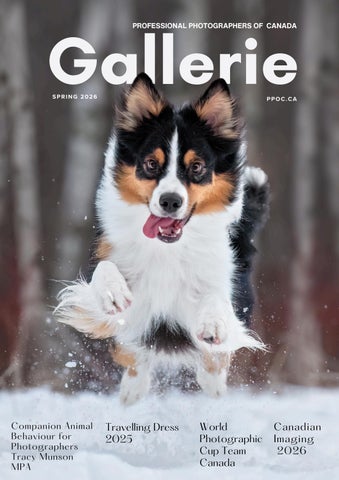
On our cover: Tracy Munson MPA I hope you find this issue of Gallerie Magazine as visually inviting and engaging as I do. It is filled with a wonderful variety of articles and inspiring imagery that truly reflects the talent within our community.
Subscription
PPOC Members and members of our email list receive online issues of
Gallerie three times per year To be added to our email mailing list please contact the PPOC office at (info@ppoc.ca).
Advertising
One single advertising package will secure your ad space and all three issues for the year
Double page space $1575/year
Full page outside back cover
$1375/year
Full page inside cover $1125/year
Advertising supplement $1000/year
Full page $975/year
Half page $630/year
Quarter page $400/year
PPOC Commercial Partners receive a 20% discount off the above rates.
This issue's designers and editors:
Kari Carter MPA and Jayson Childs
Advertising: Angela Patrick
For inquiries, please email editor@ppoc.ca

Meet Team Canada 2025 offers a glimpse into the heart of Canadian photography at its finest This dedicated group represents the nation's talent, creativity, and passion on the world stage, embodying the spirit of innovation and excellence that defines Canadian artistry Each member contributes unique perspectives and skills, coming together as a united force to showcase the best of Canadian photography at the World Photographic Cup It s an opportunity to connect with the visionaries behind the lens and celebrate the stories they bring to life
The World Photographic Cup (WPC) is where the artistry of photography meets the thrill of global competition Often called the Olympics of Photography, the WPC celebrates creativity, technical mastery, and cultural diversity by uniting photographers from around the globe Each participating nation crafts a portfolio of their finest images, competing for international acclaim and the coveted top spots It’s more than a contest it’s a celebration of artistry that transcends borders, connecting photographers in a shared pursuit of visual excellence.
Entries for the World Photographic Cup open annually, inviting photographers from across Canada to submit their best work and vie for a spot on Team Canada Keep an eye on official announcements for submission deadlines and guidelines to be part of this prestigious competition


TOP TEN


THE TEAM 2026


What happens when one dress begins a journey across the country, passing from photographer to photographer, collecting stories along the way?
The PPOC Travelling Dress Project became exactly that, a collaborative exploration of creativity, storytelling, and community. Beginning in Alberta and eventually spreading across several provinces, the project invited photographers to interpret the same striking teal dress in their own unique way.
the stories behind the images
Each stop along the journey created something new: different landscapes, different models, different emotions, and completely different artistic visions What united them all was the shared experience of creating, connecting, and pushing creative boundaries


Angela Patrick was the driving force behind the Travelling Dress Project
“I had taken part in a travelling dress project before, but it was usually limited to photographers within the same city, handing the dress off in person. I loved the concept, but kept thinking about how fun it would be to take it beyond one location and include more people”
That idea sparked the creation of a PPOC-wide collaboration
“It began here in Alberta and quickly grew as photographers from other provinces wanted to join in. Opening it up to PPOC members across Canada felt like the obvious next step.”
The dress began its journey in Westlock, Alberta, travelling throughout the province before making its way to British Columbia, Saskatchewan, Manitoba, and Ontario, collecting stories, ideas, and creative interpretations at every stop
What started as a simple idea became a powerful reminder of how connected photographers can be through creativity

The year was 2020 a year none of us will forget.
For Marlene Palamarek, the Travelling Dress Project became a chance to return to Dry Island Buffalo Jump, a location she had quietly avoided for years. She had first photographed her son’s girlfriend there during a graduation session, planning to return later to photograph her son as well. When the relationship ended, the place became tied to heartbreak.
Years later, the travelling dress gave her a reason to go back. “When the opportunity came along, I jumped at it, knowing immediately where I was going.” The rich blue fabric flows against


The rugged hoodoos and autumn landscape created exactly the contrast she had envisioned. But the evening became more than just a photo session. Walking, laughing, and creating with fellow photographers shifted something. The images transformed the location from a place of sadness into one of renewed appreciation. “They gave me a new way to hold that place again.”


When Jaime Knight first heard about the project, she immediately knew she wanted to participate. “I needed a fun creative shoot for myself.”
After putting out a model call, the project grew bigger than she expected.
“I ended up photographing 15 models for it, although in all fairness, three were my own children!”
Jaime chose Steep Rock, Manitoba, known for its stunning beaches and vibrant turquoise water, as the location for one of her images. Another image came about unexpectedly.
“I had thought of the concept only a few days before I had to ship the dress, so I didn’t think it would happen. But the postal strike delayed shipping while we found an alternative method.”
The delay allowed her to photograph dancer Lucy, creating one of her favourite images of the project. Her final image featured her youngest daughter in a playful interpretation of childhood imagination.
“It was a fun play on ‘dressing up like mom’, something little girls love to do.”


When Krisztina Beothy first saw the dress, the concept came to her almost immediately.
“With its satin sheen and deep, rich blue, I immediately thought of the elements: water, air, and movement.”
Her daughter stepped in as the model, while her husband assisted by repeatedly tossing the dress into the air so Krisztina could capture multiple layers of movement to composite later.
“I wanted drama, motion, and atmosphere.”
The evening sky offered diffused light from cloud cover as the sun set, creating the perfect mood. “That’s how this image came to life.”
Instagram: @beothyphotography Website: www.beothyphotography.com

Joan Kennedy’s images were photographed at Red Rock Coulee in Southern Alberta, a striking geological site known for its large red sandstone formations. Her two daughters modeled for the session.
“The orange colour of the rocks and sunset complement the blue of the dress.”

Each daughter represented a different concept. One daughter, who is Muslim, was portrayed as a Desert Princess, bringing elegance and strength to the image.
The second daughter embodied Joie de Vivre, a joyful, free-spirited interpretation of the dress within the dramatic landscape.


Ann Poole approached the travelling dress with her own artistic interpretation, bringing her creative style to the flowing teal fabric.
Website: www.annpoolecreations.com Instagram: @ann poole creations Facebook: Ann Poole Creations


https://beyondthelensonline.com/

“The Whisper of Teal” is a visual story about confidence, movement, and presence.
The series begins with a dreamy and mysterious mood as the model reclines in the flowing satin dress, her mask adding an element of fantasy.
As the series progresses, the dress begins to move and swirl through the air, capturing emotion through a variety of poses curiosity, strength, softness, and creativity.
“The satin becomes almost alive, moving like water around her.”
The final portrait is bold and empowering, with the dress rising behind the model like wings.
“This series celebrates expressive fashion and the power of owning your space.”

Lianne Matieshin’s concept focused on the natural beauty surrounding Saskatoon along the South Saskatchewan River. Since she specializes in pet photography, including an animal was an important part of her vision.
Her friend Kendra and her dog Fitz became the perfect models.
“I love the bond they have.”
Sadly, Fitz has since passed away unexpectedly.

“These images now carry even more meaning. They remind us how special photos with our pets are, and that it’s never too late to have them done.”
www.liannematieshinphotography.com


Megan Groenenboom’s Travelling
Dress series tells a story of transformation and self-discovery.
“The flowing teal gown becomes a symbol of movement and change.”
In one image, the dress cascades from a bridge toward the water, symbolizing grounding and reflection.
In another, the fabric lifts into the prairie wind across an open field, representing freedom and forward momentum.
Together, the images tell the story of a woman both rooted and rising moving confidently through her journey.
www.megankelseyphotography.ca


Kirsten Lynch took the travelling dress far beyond Canadian borders. While travelling to Mexico to photograph a destination wedding, she brought the dress along with her.
The bride and groom graciously agreed to model, allowing the dress to become part of their wedding story.
About two kilometres down the beach, the landscape transformed dramatically.
“Rugged rocks rose from the shoreline, and I instantly knew this was where the dress needed to be photographed.”

Beyond the rocks was a secluded cove with powerful winds — wild, dramatic, and perfect for the vision she had imagined.
“In that moment, the travelling dress became exactly what I had hoped it would be a symbol of movement, place, and emotion.”
Website: www.seesthedayphotography.ca


Ilse Van Loon originally planned to photograph the dress at a snowy lookout near her home.
However, a snowstorm forced a change in plans.
Searching for indoor locations proved difficult due to permit requirements, but inspiration struck when she noticed a staircase at Grant MacEwan University in Edmonton.

“I suddenly had a ‘Breakfast at Tiffany’s’ vision.”
After securing permission from the university, the shoot went ahead — and the images were later shared with the school’s photography department, where they were very well received.
“I had a great time and I’m looking forward to participating in the next project.”
www.ilsevanloonphotography.com


“Throne of Stories” began as a long held idea in my sketchbook, brought to life by the flowing teal dress. Originally imagined in a forest, the concept shifted to my studio, allowing me to build the entire scene myself. As a collector of antiques and old books, I created a throne from worn volumes, many from my own collection, with others contributed by friends. At its center are open Bibles, representing the most enduring and meaningful story among them all.
Every detail, from moss and dust to mushrooms and butterflies, was placed intentionally to create a timeless, almost forgotten world. While the setup took hours to build around the model, the final image came together quickly a quiet, intimate portrait of a woman surrounded by stories, yet always drawn back to the one at the heart of it all. www.michellemariecreative.com

Adam focused on showcasing the elegance of the dress through texture, movement, and contrast. He was drawn to the way the silk could flow, envisioning it like waves or a cascading waterfall. The final images highlight that motion, with the fabric moving dynamically around the frame, while the model remains calm and composed. This contrast between chaos and stillness creates a striking visual balance, allowing both the dress and the subject to stand out in their own way. www.delmarphoto.ca


In a world where everyone has a camera in their hand, and the internet is flooded with low resolution image captures, how do you stand out from the crowd?


How can you assure potential clients that the work they see on your social media post can be turned into a billboard, a wall mural, a fine art print or an incredible enlargement to be cherished for year's to come?

We encourage professional photographers across Canada to join PPOC. Share your expertise, learn from peers, compete in image salons, earn specialty accreditations and lift your business to a higher standard of credibility

True professionals belong to industry associations in order to continually refine their craft, stay up to date on the latest industry trends and technology and offer an extra level of credibility to their client base Engineers, Marketers, Event Planners, Lawyers, Medical Professionals and yes, Photographers


For nearly a century, Canon has stood at the forefront of photographic technology, shaping how the world captures and remembers the era defining moments on the global stage as well as the personal moments in homes around the world. From its origins in Japan in the 1930’s, to its position today as a global imaging powerhouse, Canon’s history is a
ory of innovation, adaptability, and an enduring drive to c
eat
w
rld class optics Canon was founded in Tokyo as the Precision Optical Industry Co with the goal of challenging leading European camera brands. The first major development w
Han
Canon, Jap
’s first high-quality 35mm focal-plane shutter camera in 1936 (Canon Museum) The ea
y and design. The company name was adapted from ‘Kwanon’ , the Buddhist deity ‘Goddess of Mercy’ and was first used in 1935 with the current unified logo having been used and unchanged for over 65 years (Canon Logo).

Canon’s first single lens reflex (SLR) camera, the Canonflex, was introduced in 1959 to meet the growing demand of photographers due to their versatility and ease of use Another innovation in the SLR photography market was the Canon Pellix which featured TTL metering which was found to be accurate and reliable Canon’s commitment to design and reliability attracted photographers from a diverse range of fields including journalists, scientists and amateur enthusiasts
The 1970s, saw the world enter the age of electronics and it began a transformative time for the photography industry Canon continued to adapt and innovate in response to the changing technology and demands of photographers around the world Canon introduced the AE-1 in 1976 and it was successful around the world because it was one of the first microcomputer-controlled cameras, which simplified the process of taking a photo and as such made photography more accessible to everyday consumers
Canon Innovation continued in the 1980’s with the development of technology that would shape the industry In 1987, Canon revolutionized the industry again with the EOS system (Electro-Optical System) in the EOS 650 which featured the latest technological innovations including fully electronic lens mounts and accurate autofocus technology
that set new standards and remains influential today as EOS cameras continue to be a popular choice with photographers. The EOS system culminated with the development of the EOS-1 and EOS-1HS which were top of the line cameras that featured advanced autofocus, a more sensitive sensor, different metering modes and a booster unit that pushed the continuous shooting speed.

With the success of the EOS system, Canon entered the global digital age of photography with the release of the Canon Powershot 600 (1996) and EOS D30 (2000) which made high quality digital image more widely available to people of all ages around the world Iconic models such as the EOS 1D, EOS 5D and EOS Digital Rebel series brought reliable performance and high-quality digital imaging to a broad audience from amateurs to professionals, while Canon’s L-series lenses became synonymous with professional excellence With their performance, reliability and versatility, Canon set the standard for what could be achieved with their cameras The EOS R system, including the R1, R3 and R5 offers all the same performance, reliability and high quality imaging that photographers have come to expect from the EOS DSLR’s except that it all comes in a more lightweight and compact form.
Today, Canon continues to innovate and evolve with new cutting-edge sensors, and imaging solutions that push the boundaries of photography. Canon is a global leader in photography, and its market share represents over 40% for digital stills and video cameras Through decades of change, Canon’s mission has remained constant, to help people see and capture their world more clearly one frame at a time

Open to the Public Experience the Gear. Meet the Brands.
Public EXPO Day
April 18 9 AM• 4 PM


Poor Diesel, he looks so miserable in his costume”, said my client
I was crushed. I had been excited to show her the photos of her adorable senior Yorkie from the Halloween fundraiser The client was an animal rescuer whom I held in high regard. I was a veterinary technician with over two decades of experience. How could I, of all people, have been so blinded by cuteness that I missed the dog’s obvious discomfort?

When I first took up photography, pointing the camera at pets was a natural progression. I had been working with animals my whole adult life, so I never would have imagined that photography would teach me so much about animal behaviour. I handled hundreds of wild and domestic animals weekly at my job in an animal shelter During those interactions, I was responding to animal cues on a split-second, subconscious level. Freezing moments with the camera allowed me to consciously see the signals that my subjects were sending me, and that helped me learn how to do a better job of ensuring their safety and comfort.
Please don’t misunderstand; I’m not claiming to be anywhere close to perfect. I still screw it up all the time. I take one step too close and cause a wild bird to take flight. I get excited by an awesome composition and ask the dog to do something that makes it uncomfortable (and sometimes only notice later, when reviewing the images). The key is to have increased awareness and the intention to learn, adjust, and improve every time.

This nervous Great Dane kept his left ear cocked throughout the entire session. I thought it was just a funny quirk until I got home and realized that, in a couple of photos where my assistant had switched sides, the dog had his right ear raised instead. Although he was keeping an eye on me, he was still keeping an alert ear towards my assistant!

Many signs can have multiple meanings, depending on context Dilated pupils will be normal in a dimly lit room, but combined with other signs like crouching or cowering, “ saucer eyes ” are a sign of fear in cats
Most of us recognize the obvious signs of a dog or cat in a state of extreme distress or aggression: the curled lip, the ears pinned back, a cowering posture, hackles raised, a low growl, hiss, or yowl. We aren’t always so good at noticing some of the more subtle signs that precede these cues, but once you become aware of them, 90% of the “adorable” viral online videos featuring dogs with small children will make you cringe These might include seemingly innocuous signals like lip licking, yawning, “whale eye ” (when you can see the whites around the eye), averting gaze/avoiding eye contact, or a raised paw. In cats, dilated pupils or a rapidly flicking tail can offer clues that you need to back off and give them some space.


These photos of a Dalmatian were spread throughout the session and occurred in this order. In retrospect, the escalation was clear, and steps should have been taken to make the dog more comfortable long before the last image

Preparation is key, and there are things we can do before the session that will reduce the chances of reaching this point in the first place. I prefer to photograph dogs in locations that allow 5-10 minutes of walking. During this time, I talk to the owner and mostly ignore the dog I may stop randomly a few times along the way, point the camera in the dog’s direction, click the shutter and toss a treat. This helps create a positive association before my face is covered by the big black box with the giant eye. Next, I start with some running shots to help the dog blow off some steam and understand that our time together is going to be super fun!
Noisemakers can help get a dog’s attention If you ’ re good at making noises yourself, you ’ re way ahead of the game. I suck at it, so I have a lanyard full of duck calls, whistles, and squeakers There are also a number of smartphone apps that have a selection of animal noises, door bells, crinkling bag sounds, etc Each noise will only be effective 2 or 3 times before it loses its novelty, so make sure you don’t waste them and only use them when the shot is all set up, and camera settings are dialled in.


Coach any family members ahead of time to make an effort not to call the dog’s name or try to get the dog’s attention. This will be a lot harder for everyone (including you!) than you might think, but most dogs are used to coming when their name is called, so your perfectly set-up shot will be ruined. Some knowledge of human behaviour is helpful, too. One thing I’ve learned throughout hundreds of sessions is that the minute you turn your attention away to change lenses, the owner will get the dog to do all their best tricks, and then will be disappointed that you didn’t capture it
You’ll want to reward the dog frequently, but you don’t want to cause any stomach upsets, so use tiny, pea-sized treats or food like cheese that can be easily cut or broken into small chunks Rewards need to be given almost immediately, within less than a second of the behaviour occurring, for the dog to associate the treat with the behaviour This can be challenging when you are standing several metres away, so unless you are up close and using a wide-angle lens, whoever is handling the dog should have the treats, not the photographer.

For cats, try spritzing the area ahead of time with Feliway spray (which mimics “happy cat” pheromones) Catnip spray can also help, and will make less of a mess than regular catnip. Most cats love to roll in catnip, so if you do use it, it will end up in their fur and all over the backdrop. Always start with just a little bit and see how the cat reacts. Some are disinterested or barely affected by it, others will go crazy and climb the walls!
Providing a box, basket, bed, large bowl, suitcase, etc, for cats to hide in will make them feel safer and help keep them contained in your scene. Put them up on a table or ottoman, ideally something just high enough that they will hesitate to jump off, but not so high that they will hurt themselves when they do. Because they will
While noise makers work well for most dogs, cats are more visually stimulated Toys like the feather on a fishing rod type work well to draw out a cat that wants to hide, or to dangle above your lens to direct their attention When it comes to treats for cats, the smellier the better! Try the pouches of wet “lickable treats”, especially in a fishy flavour.


If you want some photos of the horse at a distance, do not let them know you have treats, because once they know there’s a bag of carrots in your pocket, this is the only shot you will get

Reptiles will slow down in cooler temperatures, so it may be easier to handle and photograph them if you turn down the thermostat a bit. (Though it will not be conducive to capturing them in action).
Horses can be frustrating because they spend a lot of time with their noses to the ground, grazing. In that situation, the same noisemaker apps I mentioned for dogs can be helpful Sounds of horses whinnying, candy wrappers crinkling, and crunching a plastic water bottle can work well to get ears up
Never crouch down or turn your back to a rooster, and don’t wear red to any barnyard session where there may be free-ranging roosters, even if they are not your intended subjects
Think about whether an animal is naturally a predator (engage with prey sounds, chase toys) or prey (offer security, a place to hide, never chase)
So what can we do when we have an animal in front of the lens that is beginning to show signs of stress or discomfort? Back off. Be flexible. If possible, walk around a little, head to a new location, play some games, share some treats, switch to a longer lens and give them more space.
Of course, this article is by no means exhaustive on the subject of animal behaviour. I have tried to share some of the less common or obvious tips I have learned over the years, and hope there may have been something new or unexpected for you!

telling Each photograph is carefully composed and technically accurate to highlight the emotion, atmosphere, and detail of the location, turning everyday moments into meaningful visuals.


Gavin Hoey is a UK-based photographer and photographic educator known for his creative, practical, and highly accessible approach to photography. With a strong background and passion for studio and location work, he utilizes a host of creative lighting techniques that help him to create striking images and tell a story Gavin shares his photographic and photoshop knowledge through tutorials and demonstrations, making photography more approachable for beginners and experienced shooters alike, through his online presence as well as through other outlets such as Adorama
Michael Shainblum is a San Francisco–based photographer known for his dramatic, atmospheric landscapes and cityscapes His technical mastery with artistic vision captures the intersection of natural and human landscapes and light, transforming familiar locations into cinematic, almost otherworldly scenes with rich tones, careful composition which combines to create an emotional impact. Beyond still photography, Shainblum is also known for his time-lapse and aerial work, which further expands his visual storytelling


Tracy Munson, MPA
Some photographers create beautiful images. Others help shape an entire community behind the scenes. Tracy Munson does both.
Based in New Brunswick, Tracy is known for her striking, emotive work in pet, wildlife, and fine art photography. With over 25 years of experience working in veterinary clinics and animal shelters, she brings a deep sense of patience and connection to her subjects, capturing not just how they look, but who they are
A Master of Photographic Arts with multiple accolades and her third bar designation, Tracy has earned recognition at both regional and national levels for her consistent excellence in image competition.
Beyond her own work, Tracy plays a vital role within the Professional Photographers of Canada, serving on the National Board of Directors. As Atlantic Director and Communications Chair, she contributes countless hours behind the scenes, helping support and strengthen the photographic community across the country.
This cover represents more than award winning imagery. It reflects an artist, a leader, and a dedicated force helping move the profession forward.
Tracy Munson is not only creating meaningful work, she is helping shape what comes next
Unauthorized reproduction, distribution, or use of any portion of this publication, in whole or in part, without prior written permission is strictly prohibited