At Prior Park, we build an individual GCSE curriculum around each student, offering our young people considerably more choice about what they study than the vast majority of other schools.
This is driven by our philosophy of creating young people who are happy and successful, in that order. It means students here don’t feel on a treadmill at GCSE – they enjoy their learning, and they excel because of that, with Prior students frequently gaining grade percentages that rival extremely academically selective schools, and often with much stronger value-added*.
Most students study nine GCSEs, almost 70% of which are students’ own choices.
This booklet is designed to give you more information about the many subjects on offer at Prior Park College, and we hope that it will help you to make the right choices for GCSE.
Mr Chris Gamble Deputy Head Academic
*Value-added is a measure of students’ performance versus similar ability students in other schools. At Prior Park, GCSE students frequently attain over a whole grade better across all their subjects compared to similar ability students in other schools.
PRIOR PARK’S GCSE PATHWAY
All students take the Core Essentials:
• English (Language and Literature) or English as an Additional Language
• Maths
• Non-examined: Games, PSHE, Core RE
Then, students are free to select six Optional Subjects.
GUIDANCE, SUPPORT AND THEMES
We guide each student through the process of choosing their GCSE subjects during the Lent term of their F4 year.
Students will have detailed discussions with their tutors and Housemasters/ mistresses before making their initial choices, which are then reviewed by their teachers and the Senior Team.
We encourage our students to choose subjects in which they have a keen interest. Students need to work
consistently hard for two years in order to succeed at GCSE. Some subjects may require more coursework than others; some subjects will be practical as well as theoretical. Students should also think about how well suited their skills and talents are to each subject.
As a general rule during our advice and subsequent review, we look for each student’s programme (including their Core Essentials and Optional Subjects) to address – at least once – each of these general themes:
Core Essential Subjects:
English: Linguistic
Mathematics: Mathematical
Games, PSHCE, Core RE (non-examined):
Physical, Human & Social
Optional Subjects:
Art: Aesthetic & Creative
Biology: Scientific, Technological, Human & Social
Business: Human & Social, Mathematical
Chemistry: Scientific, Technological
Classical Civilisation: Linguistic, Human & Social
Drama: Aesthetic & Creative, Human & Social, Linguistic
French: Linguistic, Human & Social
Further Maths: Mathematical
Geography: Human & Social
History: Human & Social, linguistic
Latin: Linguistic, Human & Social
Mandarin: Linguistic, Human & Social
Music: Aesthetic & Creative, Human & Social
Photography: Aesthetic & Creative
Physical Education: Physical, Human & Social
Physics: Mathematical, Scientific, Technological
Religion & Philosophy: Human & Social
Spanish: Linguistic, Human & Social
Textiles: Aesthetic & Creative
LEARNING NEEDS
For students currently accessing LDP support at Prior, we recommend liaising with their teacher or our Head of LDP to understand how they can be best supported through the GCSE course. This might include continuing with dedicated LDP sessions, in which case students should select ‘LDP’ as one of their option choices at GCSE. LDP sessions are available in every option block.
For students with learning needs who are not currently accessing LDP support, we would also encourage them to contact the Head of LDP to discuss what support might be appropriate through the GCSE course. For students at Prior, this will be through their tutor in the first instance and, for external students, through Admissions.
CORE ESSENTIAL SUBJECTS
All students at Prior Park College will study and take exams in Maths and English. Native speakers will pursue GCSEs in both English Language and English Literature. International students with very strong English language ability may also follow this route (at the school's discretion), others will take iGCSE English as a Second Language. Other qualifications are also available for one year students.
ENGLISH LANGUAGE
WEB LINK
EXAM BOARD WHAT DO WE STUDY?
ASSESSMENT STRUCTURE
HOW COULD I PREPARE?
CIE First Language English IGCSE (0990)
Cambridge IGCSE (9-1) English - First Language 0990
GCSE First Language English helps students become confident, thoughtful and creative communicators. Students read and explore a wide range of engaging texts, developing a strong understanding of how language is shaped by audience, purpose and form. They build fluency and control in writing, learning to express ideas clearly and persuasively and are encouraged to think critically about how language can influence others, while refining their own responses through reflection and experimentation. With a flexible syllabus, the course supports different interests and abilities, inspiring learners to read, listen and communicate with confidence and curiosity.
Assessment will be through 2 ‘unseen’ examinations, assessing Reading and Writing skills.
Students are encouraged to practise good reading habits. Exploring novels, plays, poems, newspapers and other non-fiction will help build vocabulary and confidence with different text types. Students should also try to think critically about what they read, considering audience, purpose, language choices and themes.
ENGLISH LITERATURE
EXAM BOARD
WEB LINK
WHAT DO WE STUDY?
ASSESSMENT STRUCTURE
HOW COULD I PREPARE?
CIE Literature in English (0992)
Cambridge IGCSE (9-1) Literature in English (0992)
GCSE Literature in English invites students to explore, enjoy and respond to a rich range of literary texts, including poetry, prose and drama from Shakespeare to modern writers. Students develop a deeper appreciation of how authors use language to create meaning and powerful effects. The course encourages reading for pleasure while also engaging with universal themes and ideas that shape our understanding of ourselves and the world. Students build confidence in forming personal responses and thinking critically about context and culture.
Assessment will be through 3 examinations, assessing Poetry and Prose, Drama and Unseen Poetry and Prose.
Students are encouraged to practise good reading habits. Exploring novels, plays, poems, newspapers and other non-fiction will help build vocabulary and confidence with different text types. Students should also try to think critically about what they read, considering audience, purpose, language choices and themes.
This course is for international students who need to improve their English so as to access the other subjects on the curriculum. The aim is to develop the ability to use English effectively for practical communication, to form a sound base for the skills required for further study using English as the medium of instruction, and to develop an awareness of the nature of language and language learning skills. Students are taught to improve their reading, writing, speaking and listening skills, as well as improve their knowledge of English grammar and vocabulary.
Reading & Writing Paper (2 hours, 50% of grade):
- Skim reading to extract the gist of texts
- Scan reading for specific details
- Reading and taking notes
- Writing in an informal style (e.g. email to a friend)
- Writing in a more formal style (e.g. article for a school magazine).
Listening paper (approx. 45 minutes, 25% of grade):
- Extensive and intensive listening.
Interview (approx. 15 minutes, 25% of grade):
- Speaking with fluency, accuracy & good pronunciation.
International students with very strong English language ability may take First Language English GCSE (at the discretion of the school). Many international students are encouraged to take one of the suite of Cambridge examinations (B1-PET, B2-First, or C1-Advanced). These exams are particularly popular with our international students who only stay at the college for one year. Please note that international students may be required to take the IELTS examination during their time in Sixth Form if they wish to study as an international student at a UK university.
Successful students are those who use English on a daily basis. Students who are well integrated into the international community at Prior Park tend to do well, as do those who regularly watch English TV programmes. A systematic approach to learning English vocabulary is essential, as is an awareness of typical errors when checking writing.
This course encourages students to think for themselves at all stages.
Objectives of the course are that students should:
Demonstrate knowledge, understanding and skills in number and algebra:
- numbers and the numbering system
- calculations
- solving numerical problems
- equations, formulae and identities
- sequences, functions and graphs.
Demonstrate knowledge, understanding and skills in shape, space and measures:
- geometry and trigonometry
- vectors and transformation geometry.
Demonstrate knowledge, understanding and skills in handling data:
- statistics
- probability.
ASSESSMENT STRUCTURE
HOW COULD I PREPARE?
IGCSE is a linear course and the students will sit 2 examination papers at the end of Upper 5. There is no longer any coursework component at IGCSE level.
Students should ensure that their basic arithmetic, algebraic and geometric skills are understood and practiced regularly. There are a number of websites that offer examples and questions e.g. BBC KS3 Bitesize.
Students should look at the website nrich, which offers lots of puzzles and articles on Mathematics. http://nrich.maths.org/forstudents
OPTIONAL SUBJECTS
ART
EXAM BOARD
WHAT DO WE STUDY? ASSESSMENT STRUCTURE HOW COULD I PREPARE? WEB LINK
Students follow the Fine Art route of the OCR Art and Design specification. Fine Art offers a highly flexible course and students are able to explore a wide variety of mediums including drawing, painting, printmaking, digital and photographic processes, ceramics and mixed-media techniques, as well as an introduction to a number of themes within the history of art. During the first term, students develop their practical and research skills through two contrasting projects.
From the second term onwards, they are able to select a more individual direction for their Coursework Portfolio (60%) and pursue an independent project over three terms which culminates with a major piece of coursework. The Set Task unit (40%) is a series of starting points set by the exam board. Students pursue a further project in response to one of these starting points and then produce a final piece under exam conditions. A GCSE in Fine Art not only offers students the opportunity to extend their creative capacities, but it also promotes independent research, presentation skills and good time-management.
60% Coursework Portfolio undertaken over three terms.
40% Set Task undertaken over one term and finishing with a 10 hour exam over two days.
Drawing is an essential component of GCSE Art but it can take many forms. As well as observational drawing, imaginative drawing, doodling, digital art and designing are all excellent ways to prepare for the course. Visit Tate Britain, Tate Modern or the Saatchi Gallery websites or go there in person. Start to think about the kind of art you like and why you like it. Go to local museums and visit the commercial galleries in Bath such as Beaux Arts. Explore ideas independently through keeping a sketchbook and include collected items such as tickets, postcards, etc, which mean something to you. Look at Pinterest and make a board. Take interesting photos with your mobile phone and edit them thoughtfully. Enjoy looking at objects, people, places and record them in a variety of ways.
There are 2 question papers to be taken at the end of the course.
Each paper is a written exam: 1 hour 45 minutes. Foundation and Higher Tier papers are available. 100 marks per paper. Each paper contributes to 50% of the GCSE. The grade achieved will be based on an aggregate score of the two papers.
This course builds on KS3 science covered in Years 7 and 8. It is designed for students wishing to do lot of science in their timetable and are likely to pursue the A Level sciences. Having a natural interest in the subject either through wider reading, visiting scientific institutions, watching science programmes and/or ‘hands-on’ practical, is useful preparation.
We investigate small business, looking at enterprise and entrepreneurship. Learn how to spot business opportunities and how to put business ideas into practice. Understand what makes a business effective and the external influences that affect it. We learn about the functional areas of business such as Marketing, Human Resources, Operations and Production and Finance and Accounts.
2 exam papers, both 1 hour 45 minutes and 90 marks each. The papers will consist of calculations, multiple-choice, short-answer and extended-writing questions based on business contexts.
You should have an interest in the commercial world and the operating of a business. You could look for opportunities to become involved in enterprise schemes or clubs in school, or seek to take responsibility for running any school enterprises such as house tuck shops. You should take an interest in current business events and keep up-to-date with the latest developments in Business decisions, locations and technology. You could watch television programmes on enterprise and business such as The Apprentice or Dragons Den.
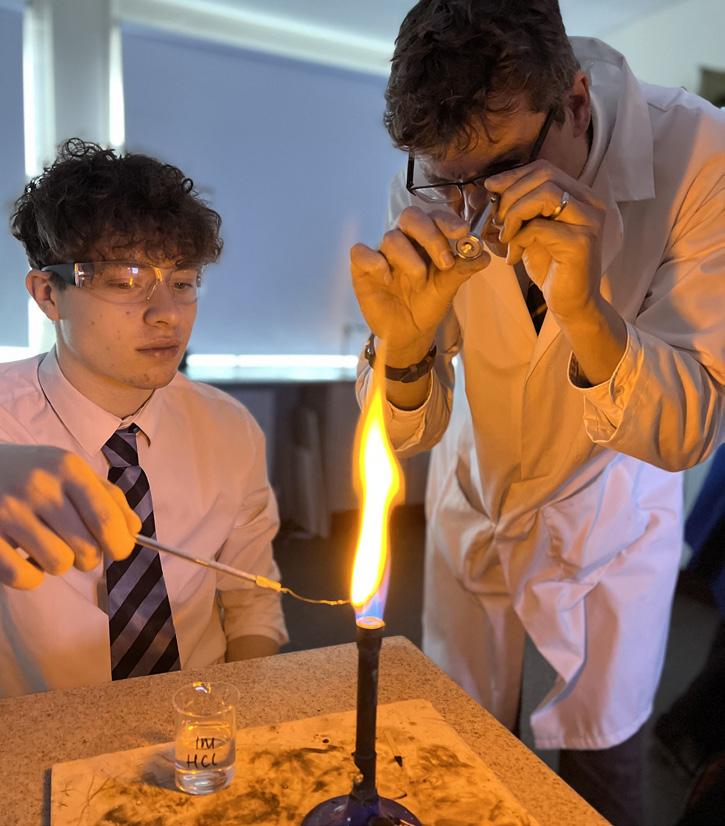
The course has been developed to provide students with the opportunity to experience Chemistry within the context of their general education and in terms of progression to A Level. Our aim is to provide a rigorous but interesting grounding in the principles of Chemistry, accessible to all, but one that challenges the most able. Our teaching approach is heavily based on practical investigation.
Overview of subject content – 10 topic areas:
1. Atomic structure and the periodic table
2. Bonding, structure and the properties of matter
3. Quantitative chemistry
4. Chemical changes
5. Energy changes
6. The rate and extend of chemical change
7. Organic chemistry
8. Chemical analysis
9. Chemistry of the atmosphere
10. Using resources.
ASSESSMENT STRUCTURE
HOW COULD I PREPARE?
2 externally assessed written papers, each 1 hour 45 minutes, both sat in June of Upper 5.
Paper 1: 1 hour 45 minutes on Topics 1 to 5 above 50% of overall mark, structured and open questions.
Paper 2: 1 hour 45 minutes on Topics 6-10 above 50% of overall mark, structured and open questions.
There is no controlled assessment, however students will have to complete 8 required practicals, and written exam questions will draw on students’ practical science experience. At least 15% of the marks will be allocated to these, looking at areas such as investigative skills, knowledge of practical methodology and terminology and students’ ability to analyse and evaluate experimental data.
To prepare yourself you just need to foster your interest in the subject by watching science YouTubes, wider reading of science books and visiting scientific institutions.
Women in Greece and Rome: Pupils study a range of topics within this component, exploring the myths about Greek and Romans, the role of women in public and family life, stories of and sources about women who were deemed ‘controversial’.
War and Warfare: Pupils study the armed forces of Sparta, Athens and Rome, looking at training, drills, and how they fought. They also read a range of extracts from Greek and Roman literature, including selections from Homer’s Iliad and Virgil’s Aeneid.
Two written exams, each 90 minutes long, one on each component. There is no coursework or controlled assessment requirement.
There is no Latin or Greek language in the GCSE Classical Civilisation course.
You do not need to have studied Classical Civilisation previously, nor do you need any experience of Latin or Greek, as these are not part of the GCSE course. A lively interest and curiosity are more important than your previous (in)experience with the subject.
Pupils could prepare by doing some research: exploring some of the ancient myths, reading some literature, watching relevant documentaries, or by visiting Roman or Greek sites. The Classical Civilisation teachers are very happy to talk to you, if you want to find out more, and want some tips in where to start exploring this diverse and exciting subject.
The course offers the same type and number of units as separate sciences but in places has less content.
Biology has 7 units: Cell biology, Organisation, Infection and response, Bioenergetics, Homeostasis and response, Inheritance, Variation and evolution, Ecology.
Chemistry has 10 units: Atomic structure and the periodic table, Bonding, structure and the properties of matter, Quantitative chemistry, Chemical changes, Energy changes, The rate and extend of chemical change, Organic chemistry, Chemical analysis, Chemistry of the atmosphere, Using resources.
Physics has 7 units: Energy, Electricity, Particle model of matter, Atomic structure, Forces, Waves, Magnetism.
ASSESSMENT STRUCTURE
HOW COULD I PREPARE?
There are 6 science papers (two papers per subject). Each paper is a written exam: 1 hour 15 minutes. Foundation and Higher Tier papers are available. 70 marks per paper.
Each paper contributes to 16.7% of the GCSE. The grade achieved will be based on an aggregate score of all six papers. The grades will range from 9,9 (highest) to 1,1 (the lowest).
This course builds on KS3 science covered in Years 7 and 8. The course is designed for students wishing to go on to A Level science or for those students who want a general grounding in science. Compared to the ‘separate’ route, the course allows room to study an additional non-science subject. Having a natural interest in the sciences, either through wider reading, visiting scientific institutions, watching science programmes and / or ‘hands-on’ practical, is useful preparation.
Students will study a wide range of computer science topics. These will build on the content delivered over previous years and will include: Hardware – CPU, storage, memory, networks and system security.
- Software: systems software, operating systems, utility software, data compression, data encryption, backups
- Ethical, Legal, Cultural & Environmental concerns – legislation, impact of technology
- Translators & Languages – IDE, compliers, interpreters, assemblers, run time environments
- Data representation – bit/byte, binary, denary, hexadecimal, ASCII, how images are stored, sound representation, compression types.
ASSESSMENT STRUCTURE
HOW COULD I PREPARE?
2x 1 hour 30 minutes written paper.
Students will also be given the opportunity to develop the practical programming skills. This programming not assessed in its own right but will support students’ ability to answer questions on algorithms and programming in the second exam paper.
Engage with opportunities to improve your general ICT/technology knowledge e.g. understanding your home network. You could also follow some free online courses for coding such as W3 schools, Code Combat and Code Academy. Working well in your Computer Science lessons will also help a great deal and the lower-school curriculum is aimed at laying the foundations for GCSE and beyond.
This course encourages students to develop an awareness of the nature and significant importance of Design Technology in a rapidly changing society. Students combine practical skills with an understanding of aesthetic, social and environment issues, function and industrial practices; essential in the technological field.
Lower 5 focusses on building up students’ skills in the workshop environment. Students start by learning about and working with wood, metal and plastic. They use a range of hand tools and machinery. Further projects encompass metal casting, welding, electronics and smart materials. As well as practical experiences, students also learn about industrial processes and the issues surrounding sustainability and the impact we are having on our environment. They will then look at traditional graphical communication skills, then move on to using industry standard computer-aided design software. From lasercutters and 3D Printers through to the comprehensive range of CNC Machines, students will experience using the very latest technologies that the design industry has to offer.
ASSESSMENT STRUCTURE
HOW COULD I PREPARE?
Students will be assessed at the end of Upper 5.
Component 1: Written Examination (1DT0/1F)
1 hour 45 minutes, 100 marks, 50%. A theory exam. Section A assesses core content. Section B assesses the material category chosen.
Component 2: Design and Making Practice (1DT0/02)
Approximately 45 hours, 100 marks, 50%.
A project based on contextual challenge. It tests skills of investigating, designing, making and evaluating a prototype of a product.
The best design and technology students have a genuine passion for design and an interest in how things work. They are entrepreneurial and are creative problem solvers. They are confident in a practical environment and have good communication skills. To be successful students must be organised and able to work within strict time frames. Watch the BBC series ‘Design For Life’, and follow the CreativeDesignPPC Youtube channel.
Students undertake a series of components which encourage them to look at how drama can help explore current issues or thematic ideas. They will also work on three texts by well-known playwrights and explore the various options and choices facing a drama practitioner today. There are regular theatre trips and students write review notes, which is part of the final written examination. They will also take a final practical examination where they will work in a group drawn from classmates and create or develop a piece of theatre which is then marked externally by a visiting examiner. There is also a devising option which allows for students to create their own piece of theatre from scratch and perform it to their peers. This also contains a portfolio submission.
ASSESSMENT STRUCTURE
HOW COULD I PREPARE?
Some of the assessment is practical, although students will be required to keep a written record of their practical work; they will explore themes, ideas and plays in a wholly practical way and the teacher will assess how well they have done.
Students will also be required to perform in a play or contribute a form of design to a production, such as costume, lighting or sound. They will perform the play with a visiting examiner in the audience.
There is 1 written examination, lasting 1 hour 45 minutes and worth 40% of the overall grade. Students will write about the work of a leading playwright and also answer questions on theatre that they will watch during the course.
Students will probably have had experience of drama during Key Stage 3 in Drama lessons or in English lessons. They may also be a member of a drama club. Any of these experiences can help if they choose Drama as a GCSE subject. An enthusiasm for the subject, plus going to see a lot of theatre and reading plays, will be an ideal preparation for any student considering the subject for GCSE.
Our course allows students to develop their ability to communicate with French native speakers in both speech and writing. They will study across a variety of contexts relevant to their age and interests and will also develop a greater awareness of culture of Frenchspeaking communities and countries. These contexts vary from future aspirations to holidays and travel. Students will develop and use their knowledge and understanding of French grammar progressively through their course of study. The course is taught with a wide range of integrated ICT solutions, which allows our linguists to contextualise their language skills in today’s digital world. During the course students also have the opportunity to practice with a native language assistant on a weekly basis in order to improve their confidence in French. Students will also have the chance to put these skills into action on a trip, which takes place every two years and includes lessons in the mornings and then cultural activities in the afternoons
ASSESSMENT STRUCTURE
HOW COULD I PREPARE?
The assessment consists of three papers-
Paper 1: Listening - 30 minutes - 25%
Paper 2: Reading and Writing - 1hour and 45 minutes - 50%
Paper 3: Speaking - 10 minutes - 25%
Having studied French previously is highly recommended. You could also follow francophone news media and use apps such as Quizlet to revise vocabulary.
This course is designed for students who are expected to achieve a grade 7 or above in iGCSE Mathematics. It prepares students for A-level Mathematics while offering opportunities for stretch and challenge. The course covers key areas such as number, algebra, geometry, calculus, matrix transformations, and coordinate geometry.
There is a strong emphasis on higher-order technical proficiency, rigorous reasoning, and problem-solving skills. Additionally, the course introduces essential topics such as calculus and matrices, while further developing understanding in trigonometry, functions, and graphs.
ASSESSMENT STRUCTURE
HOW COULD I PREPARE?
Two examination papers at the end of Upper 5, one of which is noncalculator and the other allows the use of a calculator.
Students should ensure that they review key topics such as algebra, trigonometry and geometry and also their non-calculator techniques. Familiarising themselves with problem style questions and using online platforms like nrich, ukmt or Khan Academy.
Human Geography: Urban Environments; Economic activity and energy; Fragile environments and climate change. Urban fieldwork
ASSESSMENT STRUCTURE
HOW COULD I PREPARE?
2 written examinations:
Paper 1: Physical Geography – 1 hour 10 minutes, 70 marks (40% of GCSE) – 2 sections, answer 2 questions out 3 in Section A and 1 out of 3 in Section B.
Paper 2: Human Geography – 1 hour and 45 minutes, 105 marks (60% of GCSE) – 3 sections, answer 2 questions out of 3 in Section A, 1 out of 3 in Section B, and 1 out of 3 in Section C.
Question types: multiple-choice; short-answer; data-response; and open-ended questions.
Following on from your enjoyment of the topics and learning covered in the Key Stage 3 course you should read widely in quality news media sources about environmental, social, economic and political issues. Watch documentaries from the likes of David Attenborough, Brian Cox, and Iain Stewart. Keep your eyes open and be engaged with the geographical events and phenomena that are happening around you in your environment.
Students will examine the following key questions in relation to the topic:
Germany: development of dictatorship, 1918–45
A world divided: superpower relations, 1943–72
Paper 2: Investigation and Breadth studies
Students will examine the following key questions in relation to the topic:
The USA, 1918-41
Changes in medicine, c1848–c1948
ASSESSMENT STRUCTURE
HOW COULD I PREPARE?
Paper 1: Written paper, 1 hour 30 minutes, 60 marks (50%). Students answer two questions, one on each of the depth studies they have studied.
Paper 2: Written paper, 1 hour 30 minutes, 60 marks (50%). Students answer two questions, one question on their historical investigation and one question on their breadth study in change.
The best history students can use their knowledge to construct arguments, both in writing and during class discussions. The Form 4 programme of study has been crafted to prepare you for the rigors of the iGCSE both in terms of content and assessment. The history literacy periodic table display suggests a range of books on each section which would help students acquired the knowledge to excel. In addition to this, there are a range of documentaries and films available that offer an insight into international relations throughout the 20th century
Language: we consolidate the work already done on Latin language, building confidence in applying the rules of grammar, learning new forms and structures, and introducing new vocabulary. We read stories about Roman history, going from the early days of the city, through the threat posed by Hannibal, to the life and death of Julius Caesar.
Literature and Sources: Pupils study a selection of brief extracts from Latin verse and prose, along with some visual sources, all linked to a theme (currently Love and Marriage). They also read an extract of Latin by one author, currently Hannibal’s journey over the Alps.
1 written paper for Latin Language (90 minutes) 1 paper for Literature and Sources(75 minutes) 1 paper for Literature (Narratives) (60 minutes)
There is no coursework or controlled assessment component.
You must have studied Latin up to F4 (Year 9 level), and have a sound grasp of the vocabulary and language work covered.
You could start reading some Latin literature (in translation), to gain a sense of what is to come, or researching Rome and the Romans. There is also a GCSE set vocabulary list: you could get start to learn some of the words in it.
We also offer GCSE Greek, which is taught as an activity: https://www.ocr.org.uk/qualifications/gcse/classical-greek-j292from-2016/
The GCSE course covers 5 topics: Identity and culture; Local area and travel; Future aspirations, study and work; International and global dimension. We study the vocabulary and grammar through all four skills: reading, writing, listening and speaking and explore aspects of Chinese family life, festivals, foods and traditions.
ASSESSMENT STRUCTURE
HOW COULD I PREPARE?
Previous study of Mandarin is essential. To build upon this there are many apps to support Mandarin learning such as Chinese Writer, Hello Chinese, Pleco dictionary etc as well as online resources. YouTube has excellent channels at all levels and Chinese Grammar Wiki is an excellent resource. EXAM BOARD
GCSE Mandarin can be taken at either Foundation or Higher Tier. Both qualifications have 4 papers.
Paper 1: Listening 25%
Paper 2: Speaking 25%
Paper 3: Reading and Translation 25%
Paper 4: Writing and translation 25%
MUSIC
EXAM BOARD WHAT DO WE STUDY?
Eduqas
https://eduqas.co.uk/qualifications/music/gcse
Eduqas GCSE spans a huge range of music from four wide areas of study (Musical Forms and Devices, Music for Ensemble, Film Music, and Popular Music) and includes detailed study of two set works, Badinerie by Bach, and Africa by Toto. We study music from the sixteenth century right up to the present day, getting to understand its elements and how it works. Students also develop their performing as singers or instrumentalists, performing solos and ensembles; finally students learn to compose their own pieces in a range of styles.
ASSESSMENT STRUCTURE
HOW COULD I PREPARE? WEB LINK
There is just one major listening/appraising exam worth 40%, which is taken in summer Upper 5. In addition, throughout the two years, composing and performing skills are taught and developed to produce the remaining 60% of the mark, which is built up of coursework. This is two compositions and two individually recorded performances (one solo and one ensemble) which are externally assessed at the end of U5.
Listen to lots of different types of music. Grades are not required, but the ability to play or sing is essential, ideally to at least Grade 3 standard by the end of Upper 5, as is some understanding of Music Theory. You need an appetite for lots of different kinds of music, and a willingness to get involved in performing in ensembles, choirs etc.
PHOTOGRAPHY
EXAM BOARD
WEB LINK
OCR
Cambridge OCR Level 1/Level 2 GCSE (9-1) in Art and Design (Art, Craft and Design/Fine Art/Graphic Communication/Photography/ Textile Design/Three-Dimensional Design/Critical and Contextual Studies) J170-J176 specification
WHAT DO WE STUDY?
GCSE Photography is a creative and practical course that focuses on communicating ideas and telling stories through images. Students explore photography as a distinct visual subject, experimenting with a wide range of styles, themes and techniques.
The course is particularly well suited to students who enjoy being creative but may not feel as confident with drawing or traditional fine art skills. Photography allows students to express ideas visually using cameras and digital processes rather than relying on hand-drawing. Students develop technical and creative skills including camera use, lighting, composition, location and studio photography, and digital image editing. Alongside practical work, students research photographers and visual artists, learning how images convey meaning and emotion. Through structured projects, students develop ideas from initial concepts through to refined final outcomes, building a strong and personal portfolio of photographic work.
ASSESSMENT STRUCTURE HOW COULD I PREPARE?
60% Coursework Portfolio developed throughout the course. 40% Externally Set Task issued by OCR, resulting in a final photographic outcome completed during a timed practical exam. There is no written exam.
No previous photography experience is required. You do not need to have studied Art before, and you do not need to be able to draw. Students can prepare by taking photographs regularly using a digital camera or mobile phone, experimenting with different subjects, lighting conditions and viewpoints.
Looking at the work of photographers is an important part of the course. Visiting galleries, exploring photography books and websites, or following photographers online will help develop ideas and inspiration. Keeping a sketchbook or digital portfolio to record images, edits, ideas and reflections will support creative development. Curiosity, creativity and a willingness to experiment are far more important than technical skill at the start of the course.
- The components of fitness, methods of training, principles of training, fitness testing
- Training and injury prevention
Paper 2:
- Goal setting and SMART targets
- Information processing, guidance and feedback on performance
- Mental preparation for performance
- Social groups and engagement in physical activity and sport
- Commercialisation, media, sponsorship and technology in physical activity and sport
- Diet, health, fitness and well-being
- Drugs and hooliganism in sport
Non-Examined Assesment (NEA)
- Practical Performance in 3 activities
- Analysis of Performance in 1 activity
ASSESSMENT STRUCTURE HOW COULD I PREPARE?
2 exams, each 1 hour 15 minutes; worth 60% of the overall course.
NEA written Analysis of Performance in 1 activity, NEA Practical Performance in 3 sporting activities; worth 40% of the overall course.
Play as much sport as possible, especially in sports that you might choose to have your practical performance assessed in. Watch as much sport as you can on TV and follow current issues in the media.
Topic 1: Energy - The different forms energy can take and the processes that convert it from one form into another. We also look at renewable and non-renewable energy resources.
Topic 2: Electricity - Electric circuits and how electricity works in the national grid. We also look at static electricity.
Topic 3: Particle model of matter - How the particles inside materials determine their properties. Density, pressure and gases are all covered.
Topic 4: Atomic structure - Students will look at the history of the atom and how an atom can become unstable. This leads to the different types of radiation and their uses and danger. We will see some real radioactive sources and begin to learn how to handle them safely. We also look at nuclear power stations.
Topic 5: Forces - Speed, distance and Newton’s Laws of motion. We’ll study how forces affect how objects move and how we can use this to our advantage in dramatic situations like car crashes. We then look at rotating objects, gears and levers as well as pressure in fluids.
Topic 6: Waves - Different kinds of wave; sound, light, electromagnetic (EM), and their behaviours. We also look at the many uses of the EM spectrum and its possible dangers.
Topic 7: Magnetism and electromagnetism - We review magnetic fields, then move onto the interactions between magnets and electricity. This leads to how motors, generators and transformers work.
Topic 8: Space physics (Please note, you will not study space physics in the Combined Science course) - The solar system, orbits and the life cycles of stars, along with bigger questions about where the universe came from and how we know.
ASSESSMENT STRUCTURE
HOW COULD I PREPARE? WEB LINK
2 written papers, 1 hour 45 minutes each, taken at the end of the course in Upper 5. Each one will assess different parts of the content. Both papers are equally weighted and contain a mixture of different question styles, including multiple-choice, short-answer questions, extended responses and calculations.
Your existing KS3 course will have given you a lot of the grounding you need in basic theories of energy, heat transfer or speed. ‘New Scientist’ magazine gives a weekly insight into the importance of current topics in Physics. The Physics department also has a small library of subjectrelated books that you are welcome to borrow.
GCSE Religion, Philosophy and Ethics is an exciting and thoughtprovoking course that explores some of life’s biggest questions and the role of religion in shaping beliefs, values, and society. Students will study two major world religions—Christianity and Islam—in depth, learning about their core beliefs, teachings, and practices. This includes topics such as the nature of God, life after death, worship, festivals, and how faith influences daily life.
Alongside this, the course examines philosophy and ethics, encouraging students to think critically about issues that affect individuals and communities today. Key themes include:
• Relationships and Families – marriage, divorce, gender roles, and sexuality
• Religion and Life – the origins of the universe, the value of life, and debates on abortion and euthanasia
• Crime and Punishment – justice, morality, and the purpose of punishment
• Human Rights and Social Justice – equality, prejudice, and the role of religion in promoting fairness
Through discussion, debate, and analysis, students develop skills in reasoning, empathy, and evaluation—skills that are valuable for life beyond the classroom. This subject is ideal for those who enjoy exploring ideas, asking questions, and understanding different perspectives.
ASSESSMENT STRUCTURE HOW COULD I PREPARE?
Assessment will be through 2 examinations, 1 for each component, each worth 50% of the full GCSE. These will be 1 hour 45 minutes each and will be taken in the summer of the students’ Upper 5 year. Topics from both units will be taught during each year of the 2-year course.
Before starting the course, students can prepare by developing curiosity about life’s big questions and exploring the basics of Christianity and Islam, the two religions studied. Reading short articles or watching videos on faith, ethics, and philosophy can help build understanding. Practising discussion and debate at home, getting comfortable with reading and writing, and staying organised with notes will make the transition easier. Most importantly, approach the subject with an open mind and a willingness to consider different perspectives.
Our course allows students to develop their ability to communicate with Spanish native speakers in both speech and writing. They will study across a variety of contexts relevant to their age and interests and will also develop a greater awareness of culture of Spanishspeaking communities and countries. These contexts vary from the world of work to international and global affairs. Students will develop and use their knowledge and understanding of Spanish grammar progressively through their course of study. The course is taught with a wide range of integrated ICT solutions, which allows our linguists to contextualise their language skills in today’s digital world. During the course students also have the opportunity to practice with a native language assistant on a weekly basis in order to improve their confidence in Spanish. Students will also have the chance to put these skills into action on a trip, which takes place every two years and includes lessons in the mornings and then cultural activities in the afternoons.
ASSESSMENT STRUCTURE
HOW COULD I PREPARE?
The assessment consists of three papers-
Paper 1: Listening - 30 minutes - 25%
Paper 2: Reading and Writing - 1hour and 45 minutes - 50%
Paper 3: Speaking - 10 minutes - 25%
Having studied Spanish previously is highly recommended. You could also follow Spanish news media and use apps such as Quizlet to revise vocabulary.
Students follow the Textile Design route of the OCR Art and Design specification. They explore a wide variety of media including dyed and printed textiles, drawing, mark-making, collage, appliqué, fabric manipulation, hand and machine embroidery, constructed textiles, laser cutting and smart/modern materials.
In the second term they begin their Coursework Portfolio unit (60%) in which they produce an extended project leading to the production of a costume/ fashion/ surface print/ interior or art piece as a final outcome. The Set Task unit (40%) is a series of starting points set by the exam board. Students pursue a further project in response to one of these starting points and then produce a final piece under exam conditions. A GCSE in Textile Design not only offers students the opportunity to extend their creative capacities, but it also promotes independent research, presentation skills and good time-management.
ASSESSMENT STRUCTURE
HOW COULD I PREPARE?
60% Coursework Portfolio undertaken over three terms. 40% Set Task undertaken over one term and finishing with a 10 hour exam over two days.
Visit London galleries and museums such as the V & A. Go to local galleries and museums, fashion shows, visit contemporary fashion & interior shops. Visit the commercial galleries in Bath. Try drawing, designing and making things for pleasure at home. Keep a sketchbook of drawings and collected items such as tickets, postcards, etc, which mean something to you. Make a Pinterest board. Take interesting photos with your mobile phone. Enjoy looking at things and recording them.
ROOM TO BE ME
Ralph Allen Drive, Bath BA2 5AH
Tel: +44 (0)1225 835 353
Email: office.ppc@priorparkschools.com
priorparkcollege.com
Information given in this document is believed to be correct at the time of printing (February 2026).