‘Mickey & Richard’ Profiles a Gay Fantasy Icon, Then and Now Mark S. King Film Review Gay Life Living with HIV/AIDS Meth and Recovery My Fabulous Disease News One of several films centering people living with HIV at the upcoming Out On Film festival in Atlanta is Mickey & Richard, a documentary examining the life of Richard Bernstein, aka the 1980s porn icon Mickey Squires. Fortunately for you, anyone in the United States can view the film as part of the festival’s streaming program. The in-person screening of Mickey & Richard will take place on October 3, 2026, with streaming available on October 4th. Advance tickets for both are available now. Director/Producers Ryan A. White and A.P. Pickle have done a beautiful job toggling between the on-screen life of Mickey Squires, the smoldering everyman who projected an effortless masculinity, and Richard Bernstein, the real-life man who inhabited Mickey and is now living as a gay man of a certain advanced age in Palm Springs.
Trailer: https://www.youtube.com/watch?v=N6Hd8OK4QzI
The film is expert in not only showing us Richard’s doubts and insecurities – his modest incredulity as being the subject of this film, at this time in his life, stands in stark relief to his confidence in front of cameras – but the film also has something to say about the carefully curated lives we live online today. Who hasn’t tried to limit their social media posts to the very best parts of themselves? And more to the point, who hasn’t felt the pressure of living up to those images they post of a perfect life. What if the flattering lighting in their profile pics on dating apps doesn’t tell the true story? Richard Bernstein experienced these anxieties through the decades, as his iconic looks gave way to the natural aging process and insecurity set in. As life progressed, so did struggles with drug addiction and eventually an HIV diagnosis. The film is a nostalgic trip down fantasy lane for anyone who was there, and the film (very explicitly) shares a highlights reel of the video and photographic work of Mickey Squires in all his glory. Richard Bernstein’s commentary throughout doesn’t hold back either, on everything from his response to his HIV diagnosis, to the pressures of living up to a gay porn mystique, to the politics in the adult industry over the size of his “package.”
The most moving revelation of all may be Richard’s realization about his own worth in the here and now, and that people in his life sincerely care for him exactly as he is today. There’s a helpful lesson there for all of us. I had the pleasure of speaking with both directors of the film and with Richard Bernstein as part of a video interview series for Out On Film. The entire team is insightful and humble in their accomplishment, and Richard Bernstein can still rock a sleeveless t-shirt.
Watch here: https://www.youtube.com/watch?v=SJUjaoHISog&t=4s
Mickey & Richard is one of several festival entries that feature a storyline about people living with HIV and the pitfalls and rewards of aging in our culture. One of them, Welcome to the Toolshed, is a documentary short about a gay hangout in Palm Springs (again!) that caters to older gay men who were part of the desert migration to the oasis in the 1980s, expecting to die, and have instead found community. It plays as part of a documentary shorts collection that is also available for streaming. Out On Film is one of the most heralded LGBTQ film festivals in the country, and an Oscar-qualifying one. Earlier this year it got its first Oscar win, when Two People Exchanging Saliva, which qualified through Out On Film, won a 2026 Oscar in the category of Best Live Action Short Film. For more information on the festival, check out the Out On Film website.
It’s about 8:23 PM on September 11th, 2026. It’s the twenty-fifth anniversary of that tragic day in the United States. My husband and I are watching a 9/11 special on ABC. They have shown several people who had phone calls from people on the planes and the subject of survivor’s guilt came up. I was in New York City that day. I walked about thirty miles from Columbia University to Kingston Avenue in Brooklyn. As the TV special started telling the story of the last living survivor, Genelle Guzman-McMillan I am really relating. I have known so many people who died of AIDS or the complications of living with HIV that are no longer here with us. And those memories often make me wonder why I am still here. Last month I interviewed Geary Marcello for the magazine. I had never met him in person. He was a Facebook friend that I reached out tell his story. Three days before the magazine was published, Geary called me and left me a voicemail around 9:30 AM. Anyone who knows me knows that I am not a morning person and my day doesn’t usually start until noon or 1 PM. I had been calling him with no response. So, when I started listening to his voicemail, I was hoping that he was calling to tell me that he was excited to see the article. Instead, he left a message that he had just gotten out of the hospital and had overdosed but was saved. Then he said something that I was not expecting. He told me that he wanted to die and was planning to attempt again with the help of someone who he knew in the medical profession. I began to panic. I started dialing his number over and over. No response. I left him several messages practically begging him not to do anything rash. I decided to call my friend Donna. She always says that my voice is so calming for her, but in actuality hers is for me. And somehow I knew she would be a good person to talk to. She listened and then told me something I wasn’t expecting. She told me that it was not my place to ask him not to kill himself. She reminded me that I have no idea of what his pain is like…and she was right. I’ve been homeless before, but it was only for ten
days. I slept in the bus terminal in Tampa, Florida back in 1985 (my last year of high school). But I couldn’t let it go. In fact, I called for a week. I was so stressed. The magazine came out and I had no idea if Geary was still with us. And then on September 6th, I dialed his number and he picked up. I was so relieved. Once we started talking, I apologized for all the messages I left. I told him that I had no right and the only thing I could do was be a sounding board if he needed it. He explained that he never thought that he would have lived to be sixty or to be homeless at sixty. I confided that he basically had been trying to end it all of these years because he wasn’t supposed to live this long. I can definitely relate to that. It doesn’t come up often but there are some days that I wake up and I start thinking about all the stupid mistakes I made in my youth. I was reckless at some points. I hurt a few people along the way…broke their hearts. I chose to be a whore instead of a good partner. And the few times that I did the right thing it didn’t seem like it was enough. So, how are some of my friends and favourite people gone and I’m still here. Most never see me when I am depressed. I don’t think my husband even sees it…and he lives with me. But then I look around at my life right now and I remind myself that if I weren’t here, I wouldn’t be able to support the people in my life right now. My dreams of using my talents for something good and beyond superficial fame or wealth would not be happening to me if I weren’t here. And that slogan “It Gets Better” wouldn’t be true. For all the crap I went through in my childhood and my teen years none of it compares or outshines the sense of accomplishment I feel when I think of creating spaces for my community. Helping others has been the redemption that I had been looking for. And as much as I wish I could instill this thinking into Geary, I will never know how he feels or what brought him to his recent decisions. I have no idea if he has gone through with his plan or if he is still here with us. Unfortunately, I have no plans of returning to the states until The Orange Menace is gone. In my panic, I did ask a mutual friend to see if they could find out any information about Geary for me. I still haven’t heard anything back, but I am glad that I did get to talk to him and apologize for overstepping with asking him not to commit suicide.
SUICIDE HOTLINE (United States & Canada) Federal Communications Commission: www.fcc.gov National Suicide & Crisis Support: https://988.ca Dial 988
Find the article here: https://www.cnn.com/2026/09/16/asia/fiji-hiv-emergencymethamphetamine-intl-hnk?cid=ios_app
A Medical Services Pacific Moonlight program team offering free HIV testing during an outreach visit to a suburb of Suva, Fiji, on March 19, 2026. AFP/Getty Images
The small Pacific nation of Fiji has declared a national HIV emergency as it grapples with surging case numbers, partly driven by a growing methamphetamine problem.
One in every 60 adults in the archipelago of less than a million people are now estimated to have Human Immunodeficiency Virus (HIV) –– bucking a global trend of falling rates of the incurable, but treatable, virus. A tourism hotspot famed for its friendly culture, white-sand beaches and teeming coral reefs, Fiji first declared an outbreak of the virus in January 2025 and ramped up testing, revealing the scale of the spiraling public health crisis. Declaring the emergency on Tuesday, Health Minister Dr. Atonio Lalabalavu said the country had 2,016 new diagnoses of HIV in 2025, calling it a sign of the “seriousness of the epidemic and the urgent, coordinated response our country now needs.” The epidemic has reached the country’s newborns, with a two-month-old baby becoming the youngest identified patient living with both HIV and tuberculosis (TB), Save the Children Fiji said this week. HIV attacks the immune system and makes it easier to contract TB. Last year, 59 babies acquired HIV from their mother, the organization said. Five years ago, one in 167 Fijians were estimated to be living with HIV. But in recent years, Fiji has seen a surge in intravenous drug use as the islands have emerged as a crucial transit point for narcotics being trafficked from the Americas to lucrative markets in Australia, New Zealand, and parts of Asia. This, along with persistent sexual transmission spurred by low condom use and stigma, has made the outbreak difficult to tackle.
The alarming statistics do not capture the full scale of the crisis, said Renata Ram, Fiji adviser for the Joint United Nations Programme on HIV/AIDS (UNAIDS). “What concerns me most is the speed of the epidemic and the number of people who may be living with HIV without knowing it,” Ram told CNN.
An HIV awareness poster displayed along a main road in Suva, Fiji, on March 19, 2026.
The alarming statistics do not capture the full scale of the crisis, said Renata Ram, Fiji adviser for the Joint United Nations Programme on HIV/AIDS (UNAIDS). “What concerns me most is the speed of the epidemic and the number of people who may be living with HIV without knowing it,” Ram told CNN.
Only around 39% of people living with HIV in Fiji know their status, and less than a quarter (22%) are on treatment, Ram said. When left untreated, the virus can progress to Acquired Immunodeficiency Syndrome (AIDS), making the body highly susceptible to fatal illnesses and cancers. Fiji reported 117 HIV-related deaths in 2025, up from 25 in 2021, according to national health statistics.
A Medical Services Pacific Moonlight programme team offering free HIV testing during an outreach visit to a suburb of Suva, Fiji, on March 19, 2026. AFP/Getty Images
Fiji’s HIV crisis is caused by multiple factors, “but injecting drug use has become a major and rapidly accelerating route of transmission,” Ram said, adding that it is common to share needles. Massive stockpiles of methamphetamine smuggled onto the islands by cartels have seeped into the local communities, spurring a widespread addiction crisis and straining the local health system. In 2025, people who inject drugs made up roughly half of new HIV cases in Fiji where a transmission mode was identified, while the other half contracted the virus through sexual transmission, according to national health statistics. Ram said low condom use, multiple sexual partners, limited testing and stigma are contributing factors. HIV is spread through the exchange of body fluids from an infected person into the bloodstream of an uninfected person. One in 50 pregnant women in Fiji are infected with the virus, said Lalabalavu, the health minister. Infected mothers can also pass HIV to their infants during pregnancy, labor and delivery, and breastfeeding. Fiji’s growing epidemic bucks the trend globally, where enormous progress has been made against HIV. UNAIDS estimates the number of new HIV infections worldwide has declined by an estimated 42% between 2010 and 2025, Ram said.
“Fiji has experienced an extraordinary increase over essentially the same period,” Ram said. Fiji’s low rate of people receiving treatment also stands in contrast to the global average, where 78% of people with HIV are accessing treatment.
Renata Ram is pictured at the United Nations office in Suva, Fiji, on March 19, 2026.
Stigma is a barrier to treatment HIV is “not only a health issue,” said Joeli Colati, executive director of Fiji Network Plus, a community organization that supports and advocates for people who are HIV positive. “It’s also connected to stigma, poverty, transport, confidentiality, fear.” Colati, who has been living with HIV for 19 years, said there are many reasons why someone may be hesitant to get treatment.
“The reason is not always that somebody does not want treatment,” he said. “It can be fear of being recognized at the HIV clinic.” Fiji is a deeply religious society, where premarital or casual sex is generally considered taboo. Colati said there is also a major information gap about HIV in Fiji, with many people not understanding how the virus is transmitted or how effective treatment can be. In his address Tuesday, Lalabalavu said Fiji will be moving “quickly” to respond to the emergency, expanding testing, treatment and access to preexposure prophylaxis (PrEP) –– a preventative medication –– as well as introducing a formal needle and syringe program. “I ask anyone who may have been exposed to HIV, including through sharing needles or other injecting equipment, or sex without a condom, to come forward for testing. Do not wait until you feel unwell.” Lalabalavu also encouraged Fijians not to shame, exclude or threaten anyone because of their HIV status, saying “stigma drives people away from the very services that can help them.” Colati said he knows firsthand what “treatment, support and hope can do.” “Please don’t let fear make decisions for you,” he said. “Knowing your HIV status gives you the power to do something about it.”
Reminding you that if you’re in Toronto any event with DJ Relentless is a person living with HIV and EVERYONE is welcome. On Saturday October 10th, 2026 he will be spinning for his Video Dance Party called CLUB LITE (Toronto’s only monthly Video Dance Party). So, if you like a hot mix of Pop, Hip Hop, Club & House with Go Go Boys in a shower you gotta come check it out! NO COVER happening at THE WELL (located at 487 Church Street on the 2nd Floor with the patio).
EDITOR’S NOTE: It was brought to my attention that a good way to fight stigma and show sex positivity is to share and remember some of the adult actors/sex workers as well as celebrities we lost to AIDS. Facebook page: https://www.facebook.com/theaidsmemorial Greg Patton (1960 - 1993) was a gay 6ilm actor who died of AIDS in West Hollywood. He was 32 years old. In the early 80s, Greg met Lee Ryder in the Boom Boom Room, a gay bar in Laguna Beach. Within a few months, he moved from Santa Barbara to Los Angeles and they became lovers. Lee at that time had already achieved fame in gay 6ilms. Greg, at the urging of Lee, began starring in 6ilms and was soon in demand as a performer on 6ilm and in night clubs. By the mid-1980s, Greg and Lee separated and both soon retired from the 6ilm industry. Lee died of AIDS in a hospice in Los Angeles in 1991, at age 31. Greg went on to pursue a vocation in jewelry repair which he began learning as a teenager in Santa Barbara and having studied in Paris Junior College, Texas. When he made a comeback in 6ilm in 1990, he dated Joey Stefano (1968 - 1994). The relationship did not last and his comeback consisted of only three 6ilms. The late Shawn Mayotte told The AIDS Memorial he remembered Greg from parties in Long Beach and Laguna Beach and said Greg “was a talkative, smart guy. The Boom Boom Room in Laguna seemed to be Ground Zero for what we called gay cancer back then. Sadly, many of my friends who went there in 1982 to ‘83 became ill and died. I was only 17 in 1982 yet I
knew men who frequented the 1350 Club in Long Beach (and became infected), Lil Lucy's, Rage, Mickey's and Gold Coast in West Hollywood but the Boom Boom Room was a huge attraction. I went there to meet paying clients for my escorting services. It seemed to me at the time that a greater number of men who frequented the Boom Boom Room became ill — as well as the bathhouses. Both Greg and Robert mattered to more people than they ever knew.” #whatisrememberedlives
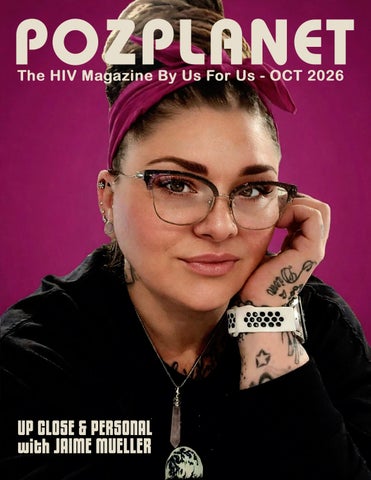
So, many of you know about our POZPLANET Facebook group and probably find the link to our issues there. Well, believe it or not I often find some of our featured cover persons in that group. And this month I sat down with an activist living with HIV, Jaime Mueller. It's not often we get to interview our female counterparts. So, I was really curious to find out about her journey. AKJ: Welcome Jaime...how are you today? JM: I am doing pretty damn good today, Alphonso. And considering where I was eight years ago, that answer carries some weight. I just celebrated what I call my rebirth. Eight years ago, people genuinely did not know if I was going to make it. Today I am sitting here talking to you, laughing, writing, making plans, just moved into a new home, and generally being a pain in somebody's ass. So yeah. I am doing pretty fucking good. Hahaha. AKJ: So, hopefully you are familiar with how our interviews go. It was so nice of you to accept my offer of being our featured person for this month's issue. Could you tell us a little about yourself? Where are you from? What's your background? JM: Thank you for asking me to do this. I am genuinely honored. And honestly, I am still a little baffled by the whole fucking thing. Sometimes it feels like a fever dream that I get to sit here and tell these stories and have somebody actually want to hear them. I am Jaime, although most people know me as CupCake. I was born on Guam, spent part of my childhood and early adulthood in California, eventually ended up in Oklahoma, and I have managed to collect a whole lot of stories along the way. I have been a mother, a wife, a daughter, a friend, and now a grandmother. I have survived addiction and a lot of trauma.. I have lived nearly a year aboard a sailboat in St. Croix in the U.S. Virgin Islands. I have written poetry since I was a kid, and my mother actually had one of my poems published when I was thirteen. Writing has always been one of the ways I make sense of the world. And I think that matters because when people hear “HIV activist,” they can forget there is a whole person attached to that title. I was already loud, funny, emotional, stubborn, adventurous, occasionally inappropriate — okay, probably more often than not, hahaha — and complicated long before HIV came into my life.
The diagnosis did not create me. It just became one hell of a chapter. AKJ: I hope you don't mind, but I sort of stalked your Facebook profile and then your site. I love that you are a presence online that declares she is positive and thriving. Do you mind sharing with our readers how long you have been positive and what was it like when you got diagnosed? JM: I absolutely do not mind that you stalked my Facebook. I am actually kind of flattered. You went from Facebook to the website, so apparently this was a thorough investigation. Hahaha. I was first given the diagnosis of HIV 3 in July of 2018, and I did not know what that meant. It took me several weeks of research to understand that HIV 3 meant AIDS. I had been diagnosed with HIV/AIDS, but at the time I did not understand the significance of that diagnosis.
There were also a few people who publicly attacked me online when I came out. They were telling me that I had AIDS, and I was arguing with them, telling them they did not know what the fuck they were talking about.
There was so much stigma in my mind and wrapped around that word. It was a word I could not even say. I would say HIV 3, or I would just leave it out altogether. So now I am very intentional about using the word AIDS when I talk about my medical history. I had been sick for years before anybody figured out why. I kept going to doctors with one medical problem after another, and a lot of what I was experiencing was dismissed or misdiagnosed. By the time I landed in the emergency room in 2018, I was critically ill. My oxygen saturation was around 58. Can you fucking imagine that? The same doctor who had been dismissing my symptoms as asthma and allergies for six months sent me out of her office just hours before I ended up in the ER. I was sitting there crying, telling her that I knew I was about to die. She told me that if I really felt that way, I should go to an ER. So, thank God I did. My organs were failing, and I ended up on life support. They told me I likely would not have made it another 48 hours. My viral load was 717,000 and my CD4 count was 34. As you know, a CD4 count below 200 is what gives somebody an AIDS diagnosis. Mine was 34. I was definitely dying. My first reaction was basically, “What the fuck?” There was fear, anger, confusion, and, strangely enough, relief. Somebody had finally found an explanation for why I had been so sick. I remember thinking, “So I was not crazy.” For years I had been telling doctors something was profoundly wrong with me. They saw the fires, but they never looked for the match. Then I had to confront the word AIDS.
Before my diagnosis, AIDS meant death to me. I had to learn what it actually meant medically instead of letting old stigma tell me what my future was going to be. That was a pretty fucking important lesson. AKJ: I'm curious...how and why did you decide to disclose so publicly? JM: I did not really set out to become a public HIV advocate. I was already living my life out loud online, and then HIV became part of that life. The disclosure happened very early, while I was still hospitalized. I am not good at secrets. That is especially ironic because I spent a huge part of my early life keeping them. I survived childhood sexual abuse, trauma, addiction, and a lot of things I learned to hide. At some point, I got fucking tired of hiding. People were already following my life online. The year before my diagnosis, my thenhusband had been battling stage four cancer, so a lot of people knew us and were following that journey. Then I became critically ill. People wanted to know what was happening. My family needed to know. Previous partners needed to know. And my then-husband left while I was on life support. I needed to tell him. I could not keep giving everybody some sanitized version of what was happening. I had two choices. I could construct a version that was easy for people to hear, or I could just tell the fucking truth. So, I told the truth. Some people disappeared. Some were scared. Some asked questions. Some stayed. And that is really where the advocacy grew from. People started asking questions about HIV, and I realized that my willingness to talk could help somebody else feel less alone or less afraid.
Then people started coming back and telling me I had opened their eyes. People were educating themselves, getting tested, having conversations they had been too afraid or ashamed to have before, and realizing how much they had believed about HIV that simply was not true. I started seeing people challenge their own stigma because I was willing to put my life out there and talk about the shit nobody wanted to talk about. I was not trying to become anybody's inspirational story. I was just not lying about my own life. AKJ: And now we should talk about your online personas. Could you tell us about how you came up with your names and where we can find you online? JM: The CupCake name actually started with my daughter. I got a cupcake tattoo on my neck for her. Then I got more cupcake tattoos, people started calling me CupCake, and eventually the name just stuck. So, there is a very sweet story underneath the woman with the filthy mouth. Hahaha. Jaime is my name. CupCake is the name people know. My main projects are Positively Medicated and Wreckage & Rebirth. Positively Medicated is my cannabis-as-medicine lifestyle, education, advocacy, and activism brand. It grew out of my own use of cannabis as medicine, which began when I was fifteen. Cannabis legalization happened here in Oklahoma literally as I was being diagnosed, when I was thirty-eight. I had already been using cannabis for more than two decades, and it became a critical part of my health and healing. When I was diagnosed, I had PCP pneumonia, cryptococcal meningitis, and multiple other opportunistic infections. I spent years on antibiotics, antifungals, and other medications that were putting a lot of stress on my body. I believe cannabis helped keep me alive during the sickest point of my life and helped me recover. I also fully believe it helped pull me through Mycobacterium avium complex. I do not think I would have fucking cured that without RSO. So yes, cannabis is part of my HIV story, but Positively Medicated is not primarily HIV advocacy. It is about plant medicine, health and healing, cannabis education, and helping people understand that cannabis is medicine and how it can help. HIV is one part of my experience, not the entire identity of the work.
The name Positively Medicated actually has several layers to it. Obviously, I am HIV positive, but I am also B positive, so there is that little bit of wordplay built in. I also genuinely believe in the power of positivity, and I believe a positive mindset can be its own kind of medicine. I believe plant medicine can be a positive part of healthcare, too. I do not think of cannabis as an “alternative” to medicine. To me, it is original medicine. Pharmaceuticals absolutely have their place, and I use them when they are necessary, but I do not believe everything that heals us has to come from a pharmaceutical laboratory. The idea really started taking shape after I bought a shirt that said, “Heavily Medicated,” which made me laugh and got my brain going. Then I started playing with what “positively medicated” could mean for me. Even the logo tells that story: the cannabis leaf represents plant medicine, while the red ribbon represents HIV/AIDS awareness. There is also a little bit of intentional irony there, because the red ribbon has historically been associated with anti-drug messaging, while I am very specifically challenging the idea that cannabis is simply a drug. I believe cannabis is medicine, and I think we need to be able to have that conversation without automatically dismissing it as an alternative or lesser form of care. The tagline is “Live. Life. Irie.” For me, “irie” carries that feeling of being good, peaceful, happy, and alright. “Live. Life. Irie.” is my reminder that life is happening now. Do not spend all of it waiting for permission to enjoy it. Wreckage & Rebirth is where I share my life and write about the messier parts of it: trauma, motherhood, grandmotherhood, grief, relationships, survival, HIV, stigma, poetry, and the shit that happens between falling apart and putting yourself back together. That is where the poetry and the rest of my life live. It is separate from Positively Medicated, even though the different parts of my story sometimes overlap. I am also part of The Well Project's A Girl Like Me. AKJ: And what is "The Well Project"? JM: The Well Project is a nonprofit organization focused on changing the course of the HIV pandemic by serving women and girls across the gender spectrum, and A Girl Like Me is their storytelling program. They have been doing this since 2002, and honestly, they are the
fucking elite standard when it comes to information, resources, advocacy, and sisterhood for women affected by HIV. I am genuinely proud to be even a tiny part of what they have built. It mattered to me because women living with HIV are human beings first. We deal with the same shit everybody else deals with. We fall in love. We have sex. We raise kids. We become grandmothers. We get our hearts broken. We worry about our bodies, relationships, money, aging, loneliness, and a thousand other things. HIV is one part of our lives. When I first found A Girl Like Me, I remember reading other women's stories and feeling seen. Then I immediately thought, “Who the hell am I to think my story belongs here?” I did not think I was smart enough, polished enough, or put together enough. Eventually I realized none of that mattered. I just needed to be real. That is what I try to bring to the work. Not a perfect version of a woman living with HIV. A real one. And if my story can make another woman feel seen, give her information she needed, or make her think, “Okay, maybe I can do this too,” then I am damn proud to have a place at that table. AKJ: Before I let you go, what advice would you give a young woman who has just been diagnosed? JM: First, breathe. You do not have to figure out your entire life today. You do need to learn about your diagnosis, find a doctor you trust, take your medication, and ask questions. Give yourself time to understand what is happening instead of letting fear fill in the blanks. And learn about U=U. If you are on effective treatment and maintain an undetectable viral load, you do not sexually transmit HIV. That is science, and knowing that can change how you think about your future. You are not dirty. You are not ruined. You are not some cautionary tale. And find your community. Do not wait like I did. Having an HIV community is so important to me, and it is even more important to me now. I am in a support group online and in person here in Tulsa, where I live. Even if you do not want to talk yet, find those people. Sometimes just knowing they are there matters.
And if you are not ready to tell everybody, you do not have to. Take care of yourself first. Then figure out what you want your life to look like. So, to anybody reading this who is scared, newly diagnosed, or wondering whether there is any life left for her, listen to me: sweetheart, you are going to live. You are going to have a life that belongs to you. You can fall in love. You can have great fucking sex. You can build a family, make plans, change your mind, start over, laugh until your stomach hurts, and become somebody your diagnosis never had the power to define. You do not have to believe that today. Borrow my belief until you can find your own. The fear is real. I know that because I have fucking lived it. But fear does not get to write the rest of your story. AKJ: Well, I really appreciate the work and service you are providing for women living with HIV. Our voices and stories are so important in changing hearts and minds. Thank you. Is there anything you'd like to share (like how someone could contact you if they'd like to communicate)? JM: Thank you for letting me tell my story. And honestly, if there is one thing I hope people take away from it, it is that HIV/AIDS does not get to reduce any of us to a diagnosis. There is a whole fucking life on the other side of those letters, and I intend to keep talking about it loudly enough that other people can see themselves there, too. Three years ago, I finally learned how HIV was transmitted to me. I had been unknowingly living with HIV for basically six years before I ended up on life support, dating back to July 2012. That is a huge part of why I get on my soapbox about testing, knowing your status, and knowing your partner's status. I cannot change what happened to me, but I can damn sure use what I learned to help somebody else have the information they need to make informed decisions about their own health. If anybody wants the full rabbit hole, my complete story is on my website, and you can find me across social media as 420_Cupcake. All of my links are in my bios, and you can also find
me on The Well Project's A Girl Like Me as CupCake80. There is a lot more to my story than I could possibly fit into one interview. And I am pretty sure anybody who has made it this far has already figured that out. Hahaha.
Madonna was one of the first global superstars to speak openly about HIV/AIDS when stigma and government silence dominated the early 1980s. She lost close friends including her roommate Martin Burgoyne, dance teacher Christopher Flynn, and artist Keith Haring to AIDS-related illness. In 1987 she held a benefit dance marathon at New York’s Madison Square Garden during her “Who’s That Girl World Tour,” raising $400,000 for amfAR — one of the first major AIDS benefits by a superstar. That same year she appeared in an AIDS Dance-a-thon on NBC, urging education and thanking her mentor who was living with AIDS. She also used her albums for awareness. In 1989 she included a “Facts About AIDS” insert with Like A Prayer. Fans have said that message “possibly saved my life”.
Fundraising and advocacy milestones Key actions: • • • • • •
1987: Madison Square Garden amfAR benefit 1989: Like A Prayer HIV info pamphlet 1991: Interview with The Advocate, becoming the first mainstream artist to do so 1991: Received GLAAD’s Raising Gay Awareness award 2019: Honored with GLAAD’s Advocate for Change Award for decades of LGBTQ and HIV work 2023-2024: On her Celebration Tour, performed “Live to Tell” with a montage of friends lost to AIDS, including Burgoyne and Flynn, and images submitted by families via @theAIDSmemorial
At the 2019 GLAAD Media Awards, Madonna recalled hospital visits in the 80s: “I watched so many people die—male and female, children, straight, gay. It was a devastating time for me”. She described hugging patients in a ward that “felt like a concentration camp”.
Connection to LGBTQ+ community Madonna has called homophobia “a major problem” since her 1991 Truth or Dare documentary. In a 1991 Good Morning America interview she said she was “just showing you reality” and that visibility would “open the door” for acceptance. Publications credit her with bringing gay culture and AIDS awareness into the mainstream when it was still called a “gay disease”.
Recent advocacy On World AIDS Day 2023 and 2025, Madonna posted on Instagram condemning the Trump administration’s reported decision to stop recognizing World AIDS Day. She wrote: “Donald Trump has announced that World AIDS Day should no longer be acknowledged… I bet he’s never watched his best friend die of AIDS”. She urged remembrance and continued education.
Philanthropy Madonna’s broader philanthropy includes the Ray of Light Foundation (1998) and Raising Malawi (2006). Raising Malawi supports HIV awareness and prevention in Malawi, a country with many children orphaned by AIDS. She’s also been recognized by AIDS Project Los Angeles and amfAR for her contributions. Why it mattered: In the 80s and 90s, “a few celebrities were speaking out, but Madonna was the only one that connected with young people” who weren’t getting HIV
info elsewhere. Her mix of fundraising, education inserts, hospital visits, and public mourning helped fight stigma when the epidemic was politically neglected.
1. The “Live to Tell” Celebration Tour tribute, 2023-2024 How it was put together: For the Celebration Tour, Madonna performed “Live to Tell” as a memorial to friends lost to AIDS. Each night, screens above the stage displayed a cascading photo montage of people who died from AIDS-related illness. Family + fan involvement: • • • •
Madonna and her team partnered with The AIDS Memorial on Instagram @theAIDSmemorial to source photos. Families, friends, and loved ones could submit pictures of people they lost to be included in the tribute. The account put out open calls before the tour launched. The montage included her close friends Martin Burgoyne, Christopher Flynn, and Keith Haring, plus hundreds of submissions from fans worldwide. Madonna performed suspended in a floating cube while singing, turning the arena into what many described as a “collective wake.”
•
Why it hit hard: It was the first time many families saw their loved ones honored in a stadium. The tribute linked the 1980s crisis to younger fans who weren’t alive then, making the history personal again.
2. Madonna’s work with amfAR Early fundraising: •
1987: Madonna organized an AIDS benefit dance marathon at Madison Square Garden during her Who’s That Girl tour. She helped raise $400,000 for amfAR, one of the earliest major AIDS benefits by a pop superstar.
•
Ongoing recognition + events: •
•
amfAR has recognized Madonna’s contributions for decades. She’s been honored by AIDS Project Los Angeles (APLA) and amfAR for her help in the AIDS epidemic. 2025: At an amfAR benefit, Madonna gave a speech calling AIDS a crisis that “requires a fucking warrior to fight,” recounting personal loss and condemning stigma. She performed on stage in a black-and-red dress, with on-screen text like “AIDS IS RAISING” to underscore urgency.
•
Style of advocacy with amfAR:
Madonna blends performance + direct appeals. She uses galas to raise money, but also to educate — speaking about friends she lost, hospital visits in the 80s, and the need for research funding. GLAAD noted she used her platform to “raise funds, and challenge the silence” when the government was largely silent.
The throughline From 1987’s dance-a-thon to 2024’s tour, Madonna’s AIDS work has been about 3 things: fundraising, remembrance, and fighting stigma. She was one of the only mainstream artists in the 80s “connecting with young people” who weren’t getting HIV info elsewhere.
Listen to the mix here: https://www.mixcloud.com/djrelentlessny/ear-candy-october-2026 Download your free video of this mix here: https://mega.nz/file/0vliXRTa#Rd01cgg7hj8Tq5YBvIBS2E7XcyYt-21kKDtN5NUgh_o
Subscribe to DJ Relentless’ Mixcloud page: https://www.mixcloud.com/djrelentlessny Follow DJ Relentless’ HearThis page: https://hearthis.at/djrelentlesstoronto The year has flown by and we are already in October. Here in Canada, we are getting ready for Thanksgiving and Halloween. We’ve got twenty-one tracks to talk about. Some new ones, some remixed classics, three exclusives and a couple of tributes. Let’s get started, shall we… I believe our first selection got my attention with its music video. Watching how Ballroom Culture is now Pop Culture really makes me happy. Victoria Monet’s new single, “Reach Out” is a great downtempo House track and the vogue-ing in the video is excellent. It makes me wish that my good friend Hector Xtravaganza was still alive to see Ballroom not only in Pop Culture but also on Broadway in CATS: The Jellicle Ball. Shame that it closed on August 8th, 2026 but I have seen a lot of the underground come to the foreground in my 59 years on earth.
Our second track is the latest from John Legend. It’s called “Daylight”. Now…I have to confess that I sped it up to mix with Victoria’s track. I just felt like it sounded better at 107 BPMs instead of 100. Every now and then John drops something that catches my
ear. I like this one. It’s smooth and definitely would make a great House track…hint, hint to the remixers out there. So, with all the talk of Macklemore being fired from Ed Sheeran’s tour and all the hate towards Pink, I find it interesting that an LGBT artist like Cain Culto has been yelling “FREE PALESTINE” since last year and is selling out shows. I even remixed his cover of Madonna’s “Like A Prayer” a little while ago. And now he’s back with “Dungeon Cult Devotee 001”. I watched his tutorial on how he makes his own props for his videos and it was very interesting. Such a creative individual. If you haven’t discovered Cain, I suggest you Google him. He’s an excellent songwriter and rapper.
Okay…here’s another confession. I didn’t listen or watch the entire video for Canada Drag Race Season 1 Winner, Priyanka’s latest single, “Call Me Babe” and was surprised at the cameo of Lemon’s rap in the middle that changed speed. So, after speeding Priyanka’s track up to 109 BPMs when Lemon comes in, she sounds insane! So, there are so many new artists that it is almost impossible to keep up with them. But this next selection caught my ear because the production is straight out of the late 80s or early 90s R&B / Hip Hop genres. “FREAK” by YSEULT featuring JT sounds like it would mix seamlessly with “Rub You The Right Way” by Johnny Gill or “Poison” by Bell Biv DeVoe. It’s so interesting how now we are moving into Retro that I thought I
would never hear again. If it wasn’t for the raunchy lyrics and rap, I would have sworn this was an old song. Every now and then something in another language catches my ear. This was the case with AIDAN’s “Dolce Vita” from his album released back in March called “Cowboys Don’t Cry”. Who is AIDAN? Aidan (born Aidan Cassar) is a popular Maltese pop singer and songwriter who represented Malta in the Eurovision Song Contest 2026 in Vienna with his song "Bella". His video made me believe he is in the LGBT Community but according to Wikipedia he is very private about the subject. It says that he has embraced his following. Okay, gurl! We understand.
For our sixth track, I chose an artist that I had not paid attention to in years. The last time I played anything by her she was doing mashups of Janet Jackson and Paula Abdul songs. But here we are in 2026 and she’s back with a political song called “World Song”. I am speaking of Kat Graham. I don’t think that it will make a dent in Billboard’s chart, but I do like and appreciate that it has substance. The video really is a modern day “Earth Song” by Michael Jackson. And speaking of popular 80s music like Janet and Paula, our seventh selection is the Choppa Davilla Remix of “Nothing Can Stop Us Now” by Starship. Yeah, yeah…that Starship – the one that was the updated version of the 60s Jefferson Aeroplane with Grace Slick. When this song was a hit, I could take it or leave it. It was
radio fluff and had no place in my sets as I was learning to mix back then. But somehow in this crazy time we are living in, this remix made me smile and think of a younger time when the world seemed to have endless possibilities. Hope of freedom was just around the corner for that teenager practicing on his turntables in his bedroom.
On August 25th, 2026, we lost two icons…Dolly Parton and Tim Curry. I had already finished last month’s mix. So, I wrote a tribute piece at the end of September’s EAR CANDY article. I felt it was only fitting to include them in this month’s mix. I chose the Jimmy the Hatt & DJ Jimmy Remix of “Two Doors Down” for Dolly and I chose the Rydal Remix of “Sweet Transvestite” by Tim Curry. Now you know that I love when classic songs get a makeover. And our eleventh selection is the DJ Raffaela Giusti Nu Disco Rework of “Riders On The Storm” by The Doors. I like this “rework” by I still think the Chew Fu Remix is the best for this song. In my continued efforts to support our LGBT Artists, I decided to remix “TOUCHDOWN” by influencer and comedian, Jake Jonez. Honestly…I really only knew Jake from his funny videos from “The Mean Gays” and his individual ongoing saga of a big booty white boy who cannot help dancing when “Back Dat Ass Up” by Juvenile featuring
Mannie Fresh. I didn’t know has sang at all. So, I hope there is more to come with this multi-talented person.
Back in the mid to late 80s there was this big tit pinup girl from the UK named Samantha Fox who burst on the scene with a downtempo track called “Touch Me”. I’m sure the lesbians were drooling as much as the men who had posters of her. Because I was a gay man, I didn’t question her sexuality. So, I was surprised when she came out as a lesbian in 2003. Our thirteenth selection is the Licious The Daddy Remix or LTD Remix of “Touch Me”. Not as sexy as the original but a good remix for a club setting. I’m sure Samatha is happy to be mentioned after all these years. Well, since it doesn’t look like we are ever going to get another Rihanna album the remixers have been digging through her catalog. This time we have the MistaJam Mashup of “California King Bed” vs “How Will I Know” by David Guetta. I never cared for this song, but this mashup has given me something to consider when it comes to my sets. And while I’m feeling nostalgic for yester-year, our fifteenth track is the Walter Scalzone Remix of “Friday I’m In Love” by The Cure. This was another song that I didn’t really
care for back in the day. I mean…it was alright, but I have some other favourites featuring the vocals of Robert Smith. But this remix I would play! Up next is the latest single by RAYE and her sisters, Amma & Absolutely. It’s called “JOY” and I liked the song, but it wasn’t DJ friendly. So, I had to give it a Relentlessly Touched Vocal to make it work for one of my sets. Okay…the listing on Youtube for our next track was confusing. It looked like “Dirty Dirty Disco” by Rough Traders featuring Dannii Minogue. But in actuality it was (I believe) “Dirty Dirty Disco” the Rough Traders Edit by Dannii Minogue. Of course, after I finished my mix John Torres (better known as Betamax Disco) did an amazing remix and video for the track. Viewer Discretion is advised for his version of the video. It borrows not only the “Walk The Night” sample by The Skatt Brothers but also the atmosphere of “Cruising” The Movie for which the original song was created.
And of course we have to lean into the Halloween season. So, here’s Youngr’s cover of the classic Talking Heads song, “Pyscho Killer”. There’s nothing scarry about this cover or the video, but this would be great for a dance floor. No Halloween is complete without a version of “Thriller” by Michael Jackson. And the DJ Rem vs DJ Sunny Remix is a really good revisit to this classic. And for our twentieth track I ahd to throw in my Relentless Fired Up Club Mix of “Demons” by Doja Cat to round off our Halloween mini-set.
And to close out this month’s EAR CANDY mix, I chose the Danny Morris Remix of the latest Miley Cyrus single, “Bass Persuades”. The video is a full-on Retro dance choreography romp that makes me nostalgic for those big productions that the 80s artists made famous. Miley looks great and it’s a colorful visual. Don’t forget to get your free download of the video version of this mix. For those in the Toronto area, you can come dance and watch my video set for CLUB LITE at THE WELL (487 Church Street) on Saturday October 10th from 10 PM to 2 AM. And be sure to check out my weekly show, MASTER CONTROL with DJ RELENTLESS on Sandcastle Radio from 3-4 PM (EST) here: https://streams.radio.co/s79d5cb9d5/low