Perth Observatory Newsletter | March 2026 Bonus Edition
Betelgeuse, Betelgeuse, Betelgeuse!
The Humiliation of Nyeeruna by Duane Hamacher
Betelgeuse by Paul Fisher
Tsukimi–Moon Viewing in Japan by Diana Rosman
20 Lunar Eclipse in the Wheatbelt by Mara Leisavnieks 26 Breath Beneath The Stars: Breathwork, Planetary Sound and Stargazing at the Perth Observatory by Andrew Cox
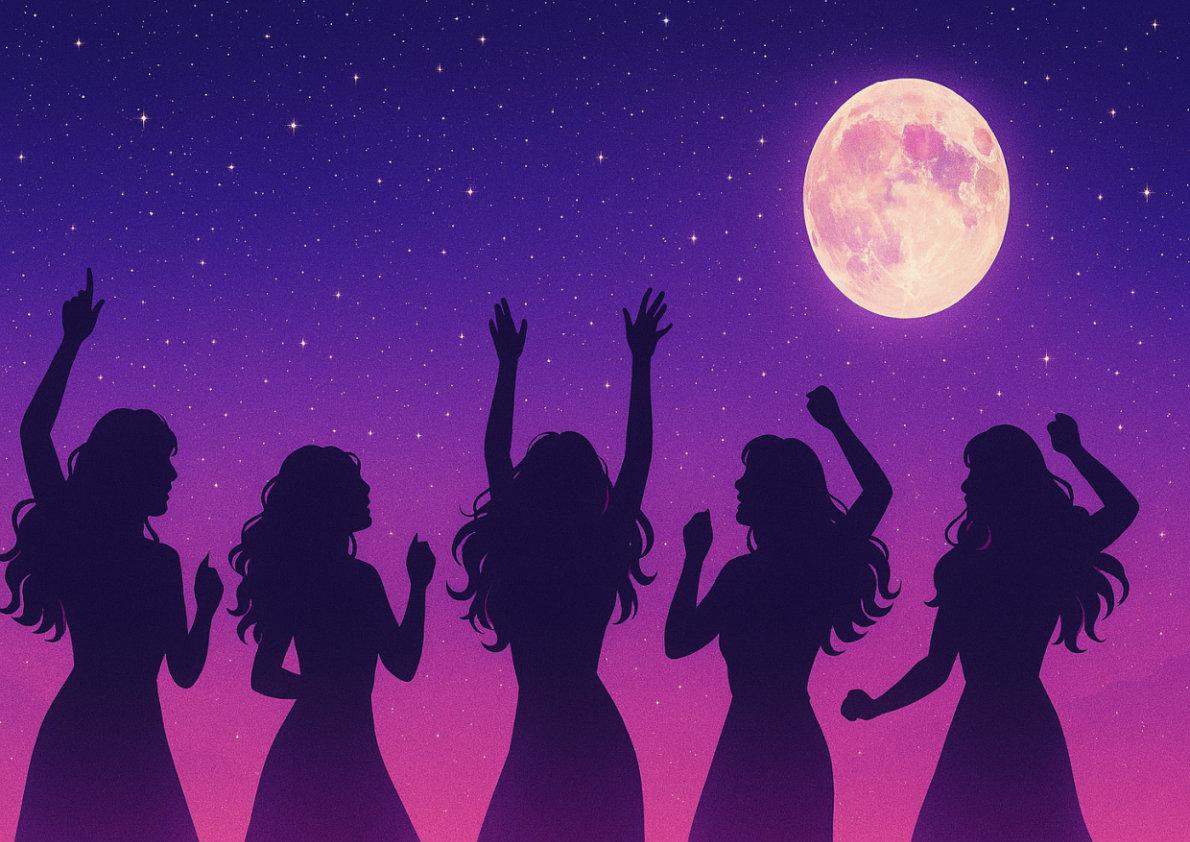
Ladies’ Star Party Night Shines Bright Under a Waxing Gibbous by Jodie Sims
Bowers, Deise Carvalho,
Cox, Paul Fisher, Duane Hamacher, Louise Kaestner, Mara Leisavnieks,
an excerpt from First Astronomers by Duane Hamacher, published by Allen & Unwin. Chapter 7, on The Variable Stars, pages 147 to 150 reprinted with permission and introduction from and by Duane Hamacher and publisher.
Author's preface
Aboriginal have been observing the stars for millennia. These observations establish the foundations of knowledge systems that have been guiding daily life, spiritual practices and cultural identity for thousands of generations. The stars are more than a calendar marker or a navigational tool; they are storyboards on which narratives are encoded that describe the human experience. They embed lessons about life, culture and society.As Elders share their traditional knowledge, scientists are starting to realise that many of their 'discoveries' have long been known and utilised by other cultures. The story of the Seven Sisters embeds lessons about life, seasons and traditional law, serving as a map of Country that spans theAustralian continent. It is narrated in the motions of the constellations and mapped out in the positions of stars. NonIndigenousAustralians have long dismissed these stories as ‘myths and fairy tales'. In doing so, they have entirely misunderstood the meaning and importance of these stories. They are not entertainment; they are modes of knowledge transmission—passed down from generation to generation through deep-time oral tradition.As we continue to explore our universe, it is critical to engage with these ancient-yet-living systems of knowledge to better understand our place within it. This requires us to respectfully collaborate withAboriginal communities and Elders in mutually beneficial ways.And we must acknowledge that there is so much more that we can learn if we only listen.
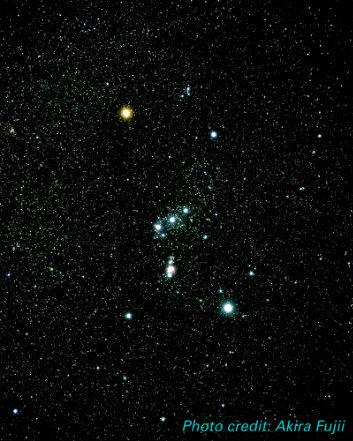
Aboriginal people in Kokatha Country of the Great Victoria Desert maintain traditions about Nyeeruna, a man in the stars comprising the Western constellation Orion. Like the Greek Orion, Nyeeruna is a skilled hunter, vain and full of himself. He proudly dons a feathered headdress, a string belt and whitened tassel (represented by the belt and ‘scabbard’stars of Orion), holds a club in his right hand (the star Betelgeuse) and covers his body in red ochre. But Nyeeruna is not a gentleman. He is a womanizer and preys on the young Yugarilya sisters of the Pleiades. The sisters are timid and fearful of the aggressive Nyeeruna, who chases them across the sky each night. He tries to be clever and use trickery to catch them, leaving food out for the girls and hiding nearby. But they are cleverer than Nyeeruna and don’t fall for his ploy. Instead, dingoes eat the food.
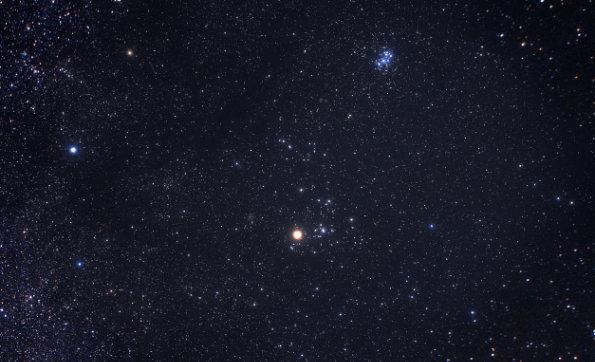
The eldest sister, Kambugudha, is protective of her younger siblings and knows Nyeeruna’s inappropriate intentions. She also knows that behind his arrogant façade, Nyeeruna is really a coward. Kambugudha, who is represented by the Hyades star cluster, is not afraid of him and stands before him, taunting and mocking while blocking him from reaching her young sisters. She is so contemptuous of him that she places a row of dingo puppies between Nyeeruna and herself to keep him away (the arc of stars seen as Orion’s shield). Her mockery and use of the puppies rather than adult dingoes are deliberate acts of humiliation.
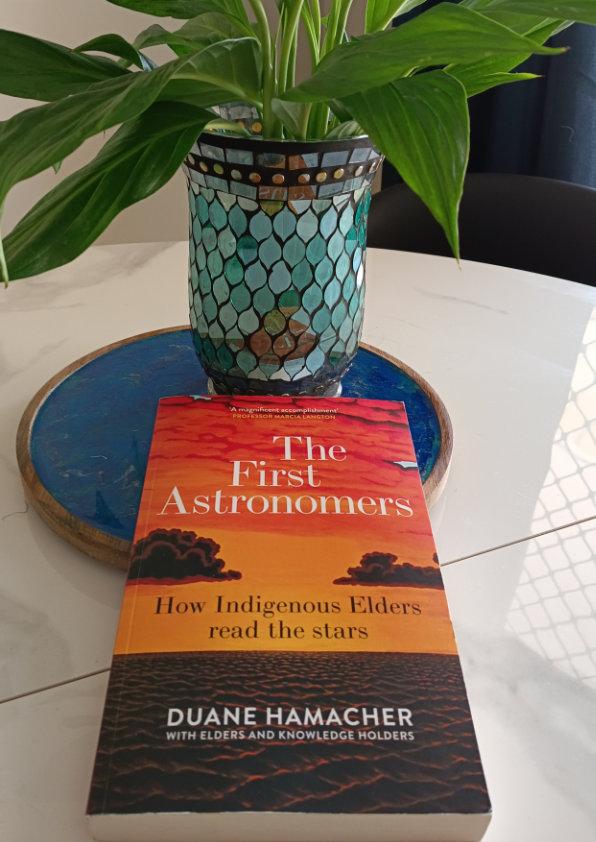
Photo: The First Astronomers paperback edition Image credit: Louise Kaestner
Kambugudha’s taunts infuriate Nyeeruna, and his desire for the Yugarily sisters only grows more intense. Nyeeruna begins to chant and produce fire magic in the club he holds in his right hand (the star Betelgeuse). This makes his hand grow bright and hot, and sparks emanate from his body. Seeing this terrifies the Yugarilya sisters, who are of the Mingari (thorny devil lizard, Moloch horridus) totem. They morph into the small lizards to escape the interest of Nyeeruna. Kambugudha counters him by producing fire magic in her left foot (the starAldebaran). She advances towards Nyeeruna, lifting her leg and kicking fire towards him. This frightens the cowardly Nyeeruna, and his fire magic dissipates.
Eventually, Nyeeruna’s lust returns with force, and he again gathers fire magic in his right hand. Kambugudha calls on Babba (the father dingo), who rushes in and attacks Nyeeruna,, grabbing and shaking him. While Babba is shaking Nyeeruna to the east and west, the eldest sister laughs and points her red foot mockingly at the womanizer. Her young sisters hide their heads under lumps on their necks, just as the thorny devil lizards do when frightened. The surrounding stars all jeer at Nyeeruna. They twinkle with laughter and stand ready to assist Kambugudha. In his humiliation, Nyeeruna’s fire magic dissipates again.
Different versions and variations of this story are found across CentralAustralia. Each is slightly different, as are the names of characters in the narrative, as they reflect the different languages of cultures across the region. But they are all linked together through a Songline that stretches across the continental interior, connecting the story in the sky with features in the landscape and important ceremonies. This Songline was central to a popular art exhibition about the sisters of the Pleiades being pursued by the man in Orion that debuted in 2017 at the National Museum ofAustralia in Canberra, titled Songlines: Tracking the Seven Sisters.
Similarly, Classical Greek traditions describe Orion as a vain hunter who pursues the Seven Sisters of the Pleiades. In the sky, Orion is prevented from reaching the stars by Taurus, the bull. The V-shape of the Hyades star cluster signifies the horns of the bull (though this was not described in Greek traditions, but rather developed to make sense of the astronomical orientation of these stars). In the Kokatha traditions recorded by Bates, we find many similarities. Even thought the stars familiar to the Greeks are seen ‘upside down’inAustralia, the Kokatha people say Nyeeruna is upside down in the sky—in the same orientation as his Greek counterpart.
This is the same for the ‘All Father’creation ancestor in Wiradjuri traditions of central New South Wales. The stars Betelgeuse and Bellatrix represent his right and left hands, and Rigel and Saiph are his feet. You can see Kambugudha in the sky as the Hyades star cluster. The V-shape of the Hyades, which represents the horns of the bull in Greek traditions, traces out Kambugudha’s legs in Kokatha traditions.
The similarities betweenAboriginal traditions and Classical Greek mythology drew the attention of newspaper readers in the 1920s. One reader, signing off as ‘Canopus’, wrote to the editor about Daisy Bates’ article, claiming that theAboriginal traditions must have been influenced by, or based on, the Greek traditions brought toAustralian during British colonization. Bates countered these comments by stating that this was known to the people much earlier, with no outside influence.
What we find in this story are layers of knowledge based on careful observations of these stars. The pursuit of the Yugarilya sisters by Nyeeruna describes the diurnal (east to west) motion of the stars as they move across the sky each night. The red colour of the fire magic in Nyeeruna’s right hand and Kambugudha’s left foot is reflected in the colours of the associated bright red stars Betelgeuse andAldebaran. Even the rising of these stars at dusk is reflected in the story’s association with the thorny devil lizard. The eggs of the lizards begin hatching in December, when the Yugarilya sisters rise at dusk.
In her journals, Daisy Bates seemingly had difficulty explaining how the stars brighten and fade over time. Bates attributed the changing brightness of the stars to ‘emissions from nebulae,’though no astrophysical basis exists for this description. To be fair, she may have simply not known about this as it was not common knowledge that stars change in brightness back then—or even now. Rather than ‘emissions from nebulae’, what theAboriginal people were describing was the variable nature of these stars, something that escaped the attention of anthropologists and astronomers for more than 80 years.
Photo:Aldebaran (Kambugudha) in Taurus with Plieades (Yugarilya sisters)
Image Credit:Akira Fujii
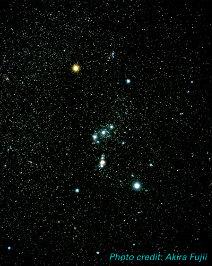
Photo: Orion with Betelgeuse (Nyeeruna) top left red star.
Image Credit:Akira Fujii ESA/Hubble
Betelgeuse
By Paul Fisher
On a warm summer night, the sky overhead glistens with the stars of the Orion Spur, and prominent among the sights to be seen is the mighty constellation of Orion the Hunter. It’s a rough rectangle of bright stars surrounding the famous ‘saucepan’ asterism. Brightest among these stars is Rigel, rivalled by the distinctive orange-red glow of Betelgeuse.
Betelgeuse may not be the brightest star in Orion, but it is probably the best known and one which has puzzled astronomers and physicists for hundreds of years. Betelgeuse is one of the brightest stars in the sky and with its distinctive colour it has attracted our attention since prehistoric times.
The ancient Greeks and Romans knew Betelgeuse as one of the brightest stars in Orion. Perhaps surprisingly they didn’t seem to have a name for the star but just referred to it as the first (or second) star in Orion. Ptolemy recorded the star as yellow, as did ancient Chinese astronomers. If correct, this indicates a rapid evolution over the space of a few thousand years.
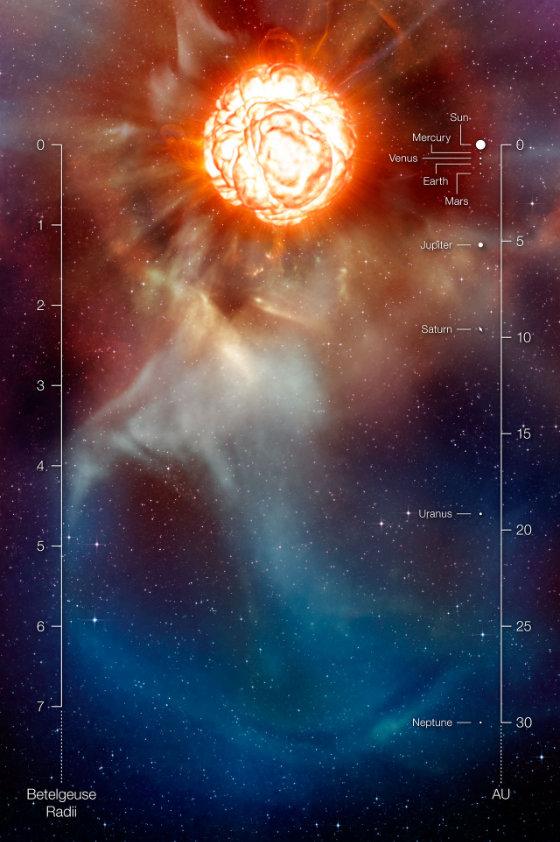
Betelgeuse is a supergiant star many times the size of our Sun. Various estimates put it between 640 and 764 times the Sun’s diameter—if it was placed at the centre of our solar system its outer edges would lie beyond the asteroid belt. Mercury, Venus, Earth and Mars would all lie within the star. The distance to Betelgeuse has been estimated between 400 and 600 light years from Earth.
It is unusual for such a large and relatively close star to have such broad discrepancies in measurements of size and distance. While most stars are clearly spherical with a well-defined surface Betelgeuse is distinctly distorted and its surface is hard to define. It is surrounded by a dense cloud of matter probably expelled from the surface of the star, and it undergoes pulsations which change its size and shape over time. Hence it is difficult to exactly define the true surface.
Further, Betelgeuse undergoes periods of brightening and dimming—it is a highly irregular variable star. Hamacher (2017) has noted that various Indigenous Australian nations knew Betelgeuse and other prominent variable stars and were aware of their variability. In 1836 Sir John Herschel described the variability of Betelgeuse and noted the irregular nature of its variations[1]
The rate of variation seems to be made up of several overlapping periods of 400 days and 185 days with a much longer period of 2100 days also indicated. The cause of these variations may be due to internal pulsations, perhaps with contributions from an orbiting companion star—more on that later.
Image: Artist's rendering from ESO showing Betelgeuse with a gigantic bubble boiling on its surface and a radiant plume of gas being ejected to six photospheric radii or roughly the orbit of Neptune Credit: ESO/L. Calçada
In 2019 Betelgeuse underwent a period of extreme dimming—between late 2019 and early 2020 its brightness dropped by a factor of 2.5. But in March 2020 it started brightening again and has now returned to normal (or what passes for normal in such a weird star!) Although there was widespread speculation that the dimming presaged a supernova, this of course failed to eventuate. The most likely cause of the dimming event was a surface mass ejection which collapsed into an enormous dust cloud that partly obscured the star.
Like its distance and diameter Betelgeuse’s mass is also difficult to estimate—it is somewhere between 10 and 20 solar masses. Given this mass range and its orange-red colour, astronomers estimate Betelgeuse is about 10 million years old—quite young in stellar terms but nearing the end of its life.
We see Betelgeuse as the shoulder (or armpit) of Orion, but it is moving through space at a rate of 30 km/sec. It may have formed somewhere in the vicinity of Orion’s belt and been ejected by a near-collision or stellar explosion, though even this is uncertain.
Some of the unusual features of Betelgeuse may be explained by the presence of a companion star. This would be consistent in that most stars have companions. However, the brightness of Betelgeuse, its enormous size and complex outer atmosphere make the detection of a companion extremely difficult. Nevertheless, astronomers have reported sightings since the 1980s but such sightings have not been confirmed.
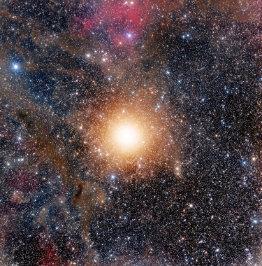
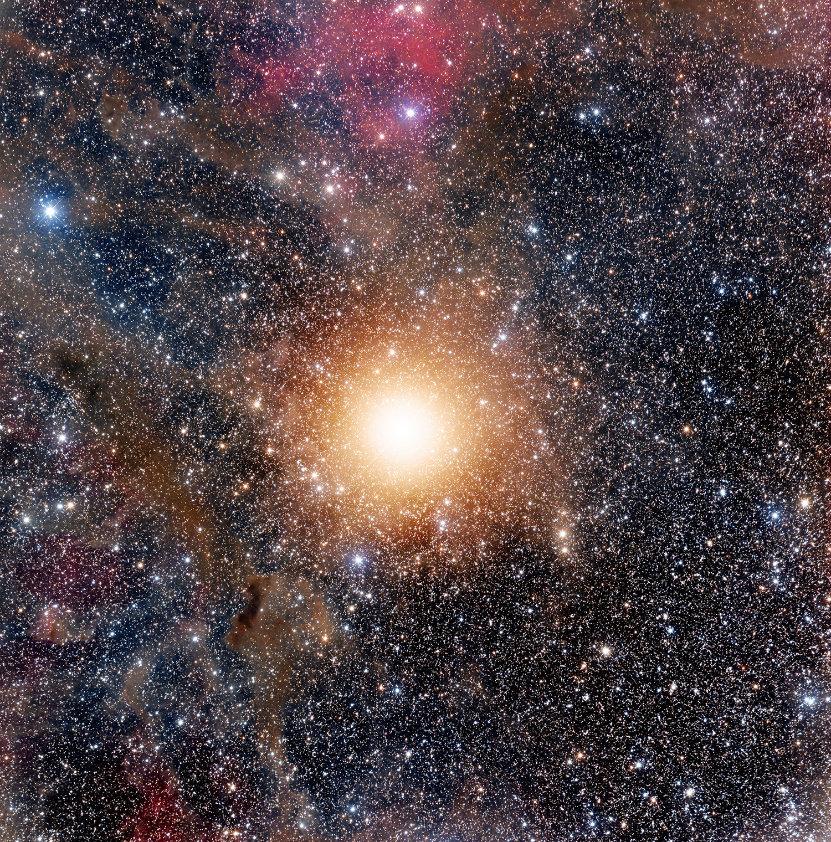
Image: Betelgeuse
Credit: Adam Block/Steward Observatory/ University of Arizona
Image: Betelgeuse before and after dimming. This comparison image shows the star Betelgeuse before and after its unprecedented dimming. The observations, taken with the SPHERE instrument on ESO’s Very Large Telescope in January and December 2019, show how much the star has faded and how its apparent shape has changed Credit: ESO/M. Montargès et al
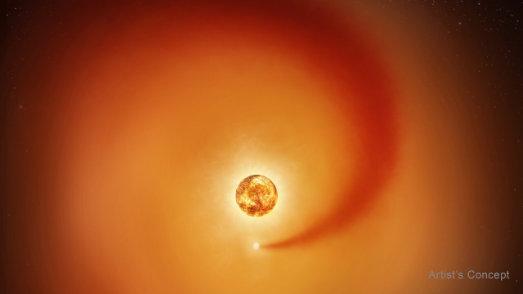
In 2025 Howell & Ciardi reported the probable direct imaging of a companion star which they named Siwarha, meaning ‘her bracelet’. This companion is close to the star, orbiting within its extended atmosphere. This detection was followed by spectroscopic studies by Dupree, MacLeod et al in 2026; they used spectroscopic analysis to visualise the companion leaving behind a wake (like that of a ship) in the outer atmosphere. To date, these studies give us the most complete explanation yet of some of the strange anomalies of this amazing star[2][3]
For many thousands of years Betelgeuse has been a source of wonder and mystery to people all over the world. Its brightness and distinctive colour, together with its extreme variability, make it a conspicuous night sky object which has been the subject of myths, legends and folk tales. Even now in the 21st century our science cannot explain everything about this star. It will remain a subject of intense study and speculation until its eventual demise as a supernova in thousands of years to come.
Image: Betelgeuse and wake of its companion star (artist's concept)
References:
1 Duane W. Hamacher. 2017. Observations of red-giant variable stars by Aboriginal Australians'. The Australian Journal of Anthropology. https://doi.org/10.1111/taja.12257.
2 Howell, Steve B.; Ciardi, David R.; et al. (July 2025). 'The Probable Direct-imaging Detection of the Stellar Companion to Betelgeuse'. The Astrophysical Journal Letters. 988 (2): L47. arXiv:2507.15749. Bibcode:2025ApJ...988L..47H. doi:10.3847/2041-8213/adeaaf
3 Dupree, Andrea K.; Cristofari, Paul I.; MacLeod, Morgan; Kravchenko, Kateryna (1 January 2026). Betelgeuse: Detection of the Expanding Wake of the Companion Star'. The Astrophysical Journal. arXiv:2601.00470
Credit: NASA, ESA, E. Wheatley (STScI), Science: A. Dupree (CfA) Background image: Fantasy
style galaxy background Credit: Freepik
Tsukimi – Moon Viewing in Japan
By Diana Rosman
Astronomers try to avoid moonlit nights, but for most of us the Moon, in all its phases, is both alluring and mysterious.
The History
We evolved within its regular cycles, and many cultures still use a lunar calendar to organise their lives. Throughout our history, we have told stories about the Sun, Moon and planets to explain, entertain and educate our communities. Some of these stories may now be lost but many have survived thanks to oral traditions, recaptured accounts and written archives. For impact, some ancient stories may be dramatic or even gruesome. Their lead characters may be supreme beings with superpowers or the humblest of animals.
The words to describe the Moon sometimes give a clue to lost stories: ‘Meeka’; ‘Marama’; ‘Bulan’; ‘Luna’; ‘Selene’; ‘Chandra’; ‘Daal’; ‘Yue’. In Japan the word for the Moon is ‘Tsuki’; a full moon is ‘mangetsu’; a new moon is ‘shingetsu’; an ‘Ariake no Tsuki’ is visible at dawn; a fading moon is ‘Zansuki’; a cold winter moon is ‘Kansuki’; or ‘Izaioi’, a late-rising moon.
In Japan, year around the full moon in October, a special moon-viewing event is held. This ‘Tsukimi’ event is an opportunity to give thanks for a good harvest and follows traditions dating from the Heian period 1,200 years ago. Celebrations last for several days from the 13th to the 15th day of the lunar month.
The Journey
I’ve always been fascinated by the Moon. I remember the Apollo missions vividly and was intrigued to learn that minerals found in the early samples were very similar to those found on Earth. And although lots more samples have been analysed since, the jury is still out on exactly how and when the Moon was formed.
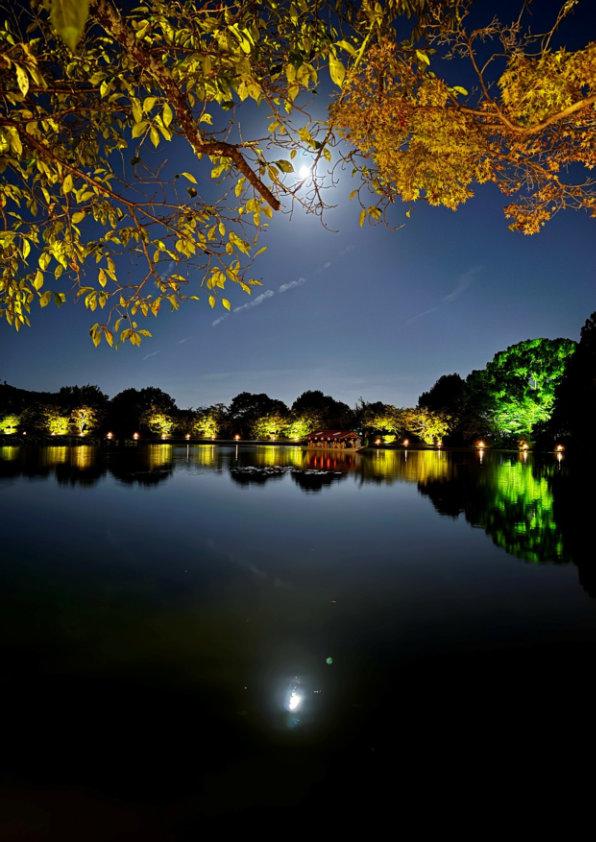
Image: sukimi Festival at Daikaku-ji, Japan on 6 October 2025
Credit: Anne Spencer
So, when I heard that Fred Watson and Marnie Ogg were planning to lead a Dark Sky Travellers (DST) Tsukimi tour to Japan in October last year, I signed up just in time to grab the last spot. Our DST tour began on 4 October 2025 in Osaka, and the next day we travelled to Kyoto to join in the moon-viewing ceremony at Kangetsu-no-yube Buddhist temple.
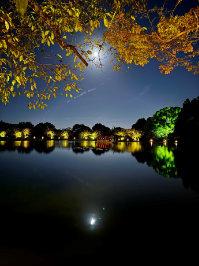
The centrepiece for this event at Daikaku-ji near Kyoto is the beautiful lake positioned to provide a near-perfect reflection of the Moon for all to admire. The original temple, Old Saga Imperial Palace Daikaku-ji, was built in the Heian period after Emperor Saga transferred his court to Kyoto and appointed his grandson, Prince Gojaku, as the head priest. The emperor wanted to admire the Moon too but resented having to look up at it. So, his monks created this small lake beside the temple so that the emperor could see the Tsuki (moon) reflected and marvel at its beauty. Now the site with temple and surrounding buildings belongs to the Shingon Buddhism sect founded by Kōbō Daishi.
Understanding only some of this background, our DST group of 21 science and astronomy enthusiasts arrived at Daikaku-ji and quickly dispersed to find a spot by the lake to absorb the event and watch as the Moon rose and its reflection slowly crossed the water. The night was clear, the lake was still and the atmosphere was heavy with the smell of incense and the haunting sounds of flutes and occasional chants. Even though the procession of robed monks and the tea ceremony presented on the small platform in the lake were barely visible to those buried among the crowd of onlookers, we manoeuvred to get a glimpse.
A few keen photographers managed to find the best spots near the lake to capture some special scenes; some included the dragon-head boat slowly making its way across the lake from the ceremonial platform to the Moon’s reflection. My favourite photo from that evening, though, is this one, taken by Anne Spencer, with autumn leaves in the foreground. It captures the mood and the season.
The Rabbit
The Tsukimi moon-viewing event is also celebrated more simply by families across Japan. At the centre is a tasty treat called a ‘mochi’ (moon cake) made from bean paste coated in a dough made from rice flour. This mochi tradition relates to another fascinating Moon legend from Japan about a Moon Rabbit pounding rice to make flour for these cakes, food for longevity.
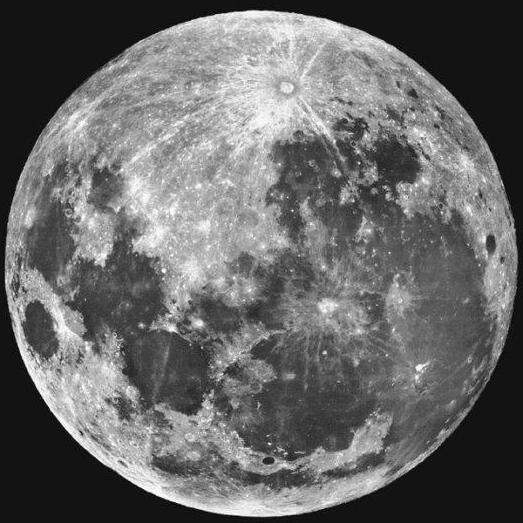
This rabbit story puzzled me for quite a while. From Australia, it is easy to see a distinctive rabbit shape on the near side of the Moon, with its head at the Sea of Tranquillity and body at the Sea of Serenity. But this looks like an upside-down rabbit from the Northern Hemisphere.
Image: The Moon
Credit: Lick Observatory/ESA
The Japanese rabbit tale, however, echoes throughout East Asia. It comes from Buddhist JŌtaka tales (no. 316), ancient stories about the Buddha’s previous lives. In one of these tales a rabbit is the hero. He represents self-sacrifice because, unlike other characters in the story, he offers himself to Śakra, King of Heaven, who is disguised as a beggar. This offering is so poignant that Śakra orders the rabbit’s image to be painted on the Moon for eternity.
The next day our Tsukimi tour continued by bus, train (fast and slow), boat (raft) and plane as we explored Japan’s busy cities, beautiful mountains and lakes, its rich traditions and interesting cuisine, and then ventured on to the dark skies of Shiretoko National Park in Hokkaido.
As we travelled from Kyoto to Nagoya, Takayama, Gokoyama, Karuizawa, Yamanashi, Hakone and Tokyo, we learned about history, culture and modern life in Japan from our local guide Kyoko. Then, as each new geographic, atmospheric or cosmic anomaly passed by, Fred would eloquently explain the scientific process involved, be it a volcano, lava garden, river, waterfall, glacier, sun halo or double rainbow.
There were other special highlights too: a 3D journey through the universe at the NAOJ Observatory planetarium; an in-depth visit to the ISS Kibo control centre at the Japan Aerospace Exploration Agency (JAXA) near Tokyo; and many stories about the collaborations and connections between Australian and Japanese astronomy and space agencies, past and present.
Concluding with Buddhist Wisdom
There’s another Buddhist teaching from Japan that I really like. It refers to ‘Tsuki wa j¶man’, the Moon is always full. It reminds us that whatever the perspective from Earth, the Moon is happily orbiting its planet, shielding it from incoming asteroids; unchanging, it is always full.
Our Moon is a magnificent object, a remnant of a cosmic collision more than 4 billion years ago. After more than 50 years, it has become a destination again. Artemis II is poised to launch soon.
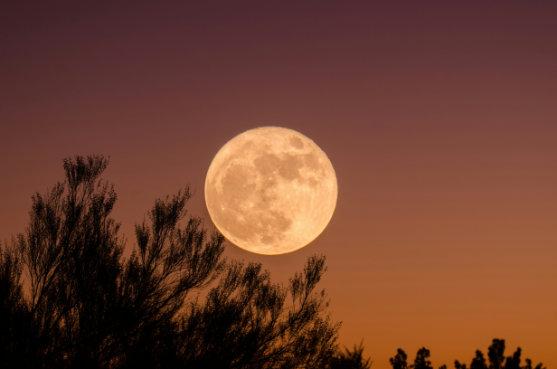
Image: The Moon
Credit: Ganapathy Kumar on Unsplash
Each month, you too can join a moon-viewing event at Perth Observatory when we retell myths and legends, remember Apollo and look forward to the next Artemis development with keen anticipation.
References
Theresa Matsuura, Uncanny Japan podcast: https://uncannyjapan.com/podcast/ (Ep 183) ‘Japanese Moon Lore: selfless rabbits; murdered goddesses and Tsukimi’.
Lunar Eclipse in the Wheatbelt Article and
images by Mara Leisavnieks
‘Space and time’ are part of Einstein’s Theory of Relativity and something we may contemplate, discuss or impart to our visitors as POVG volunteers. Sometimes, I think of space and time as an opportunity for me to combine some of the things I love doing. Yes Albert, you are right, space and time are not independent but interwoven.
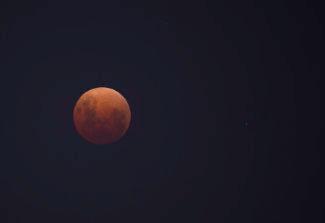
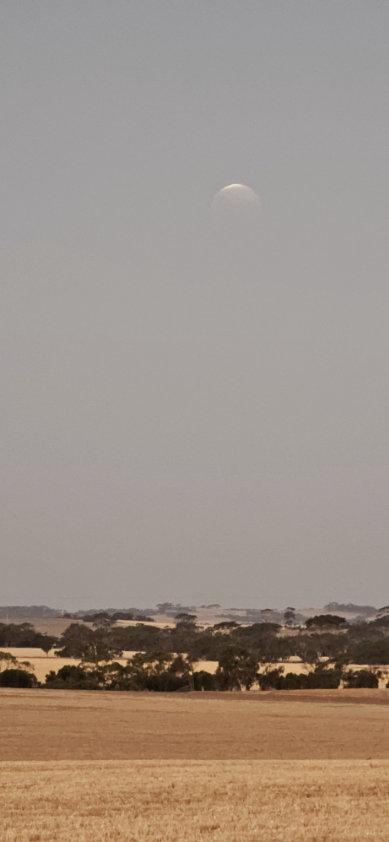
I found a space in my calendar which allowed me time to travel to Dumbleyung to observe and capture the lunar eclipse on March 3rd, 2026. Why Dumbleyung? Just because it is there and I have never visited it before. Also, I expected that the skies would be much darker and allow for good viewing of the eclipse.
Off I went, with my trusty four-legged navigator and supervisor Tallulah and camper trailer in tow to check out where Donald Campbell set the world water speed record in 1964. Camp was to be behind the GODI aka the Grand Olde Dumbleyung Inn. I have heard good things about the food there, and that if you drank and ate at the Inn, you have access to the toilet and shower as well as a free campsite.
Scouting around once we arrived in the general area, I saw that Dumbleyung lake was almost dry, so I settled on taking a photo of the moon between the football goalposts at the oval which was only 500m away from the campsite. With the plan worked out, I ordered a delicious Scotch fillet steak with salad and mash for 6pm dinner as I wanted to get into position by 6.45pm to watch and capture the eclipse.
However, just as we sometimes have telescopes that choose to misbehave on night sky tours, I did not know that Tuesday night was football training and the oval light towers would shine down brightly on my previously picked out position. OK, time for plan B… only there was not one.
I decided to drive out on one of the quieter back roads and managed to find a spot where I could park the car in an east/west orientation to block out the ‘getting stronger by the minute’ southerly wind. With the tripod set up and the 100-400mm zoom lens lined up at 400mm on the moon, I spent the next couple of hours taking photos and watching the sky darken to reveal so many of my favourite night sky objects.
As the shadow started receding on the moon and the night air got colder, it was time to head back to camp and watch the moon get brighter and wash out many of the fainter stars. Lying down to think about the night, I found myself going down a rabbit hole of, ‘Donald Campbell broke the water speed record here going 444.66 kilometres per hour in 1964. How long would it take to get to the moon at that speed?’ Turns out it would take around 863 hours or just over a month in a straight line. With that knowledge, I went to sleep happy I had experienced ‘space and time’.
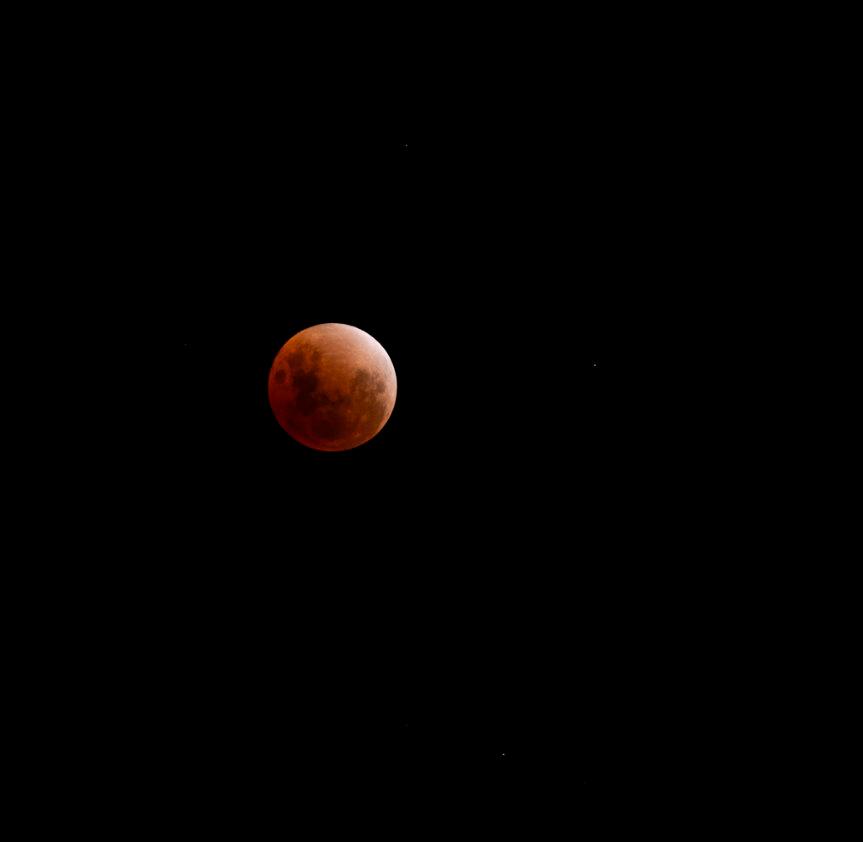
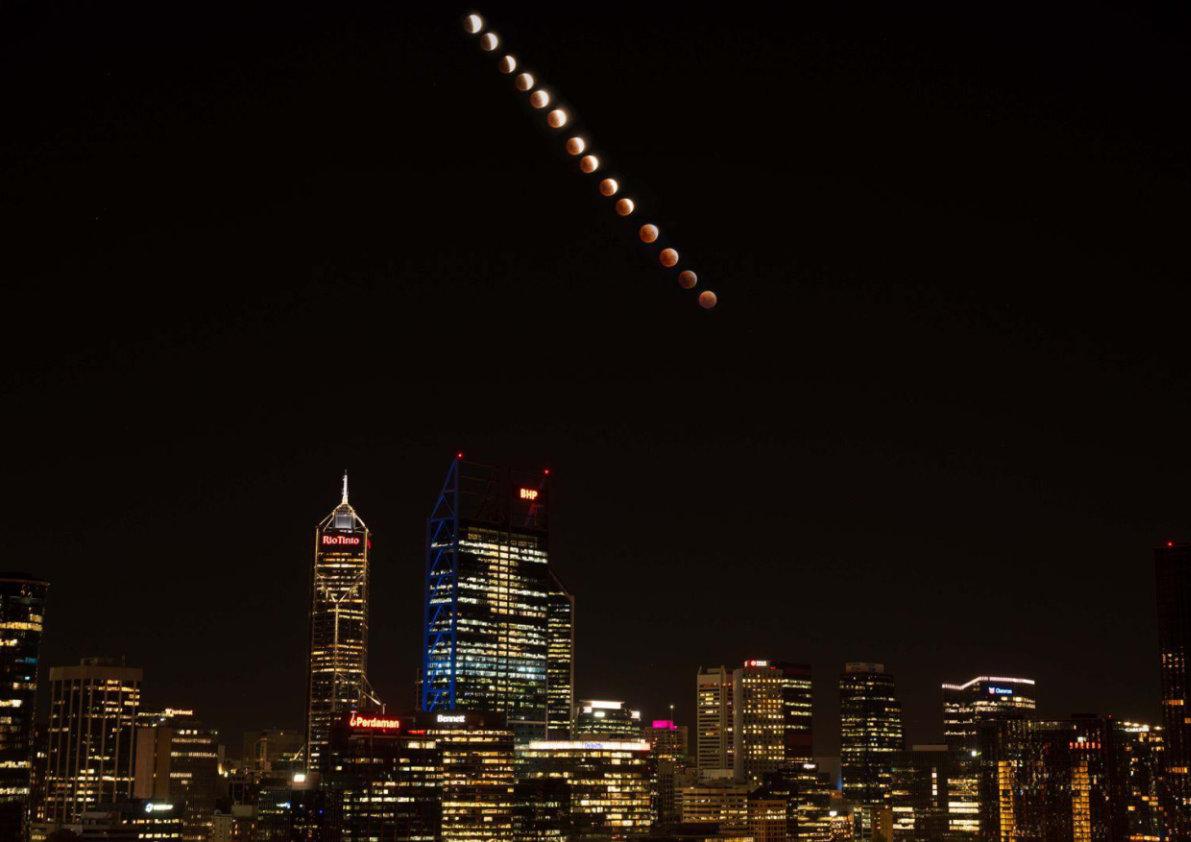
Image: Blood Moon eclipse over Perth Skyline
Credit: Su Seneviratne
Breath Beneath The Stars: Breathwork, Planetary Sound and Stargazing at thePerth Observatory
By Andrew Cox
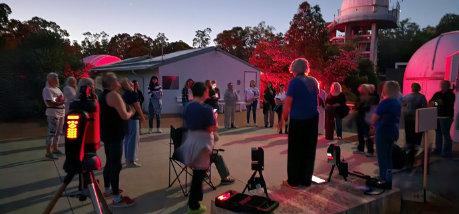
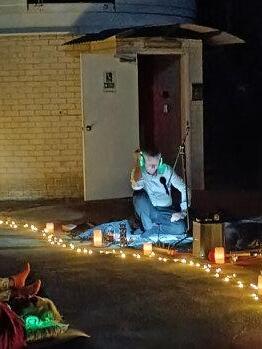
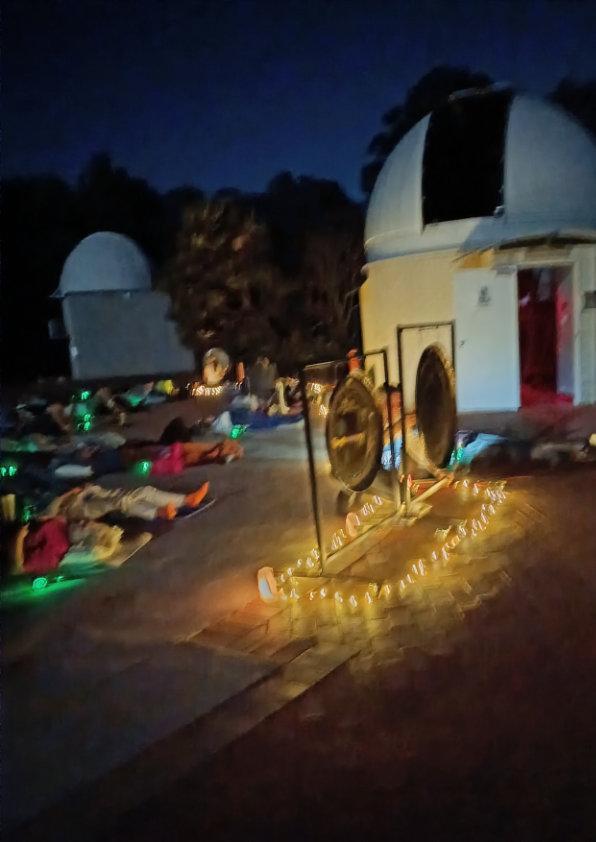
Image credit Louise Kaestner
On a clear summer evening, something subtle yet powerful unfolds beneath the telescopes at the Perth Observatory.
Guests were invited into a multi-dimensional experience combining gentle breathwork, immersive sound and guided stargazing, a reminder that wellbeing and wonder are deeply connected.
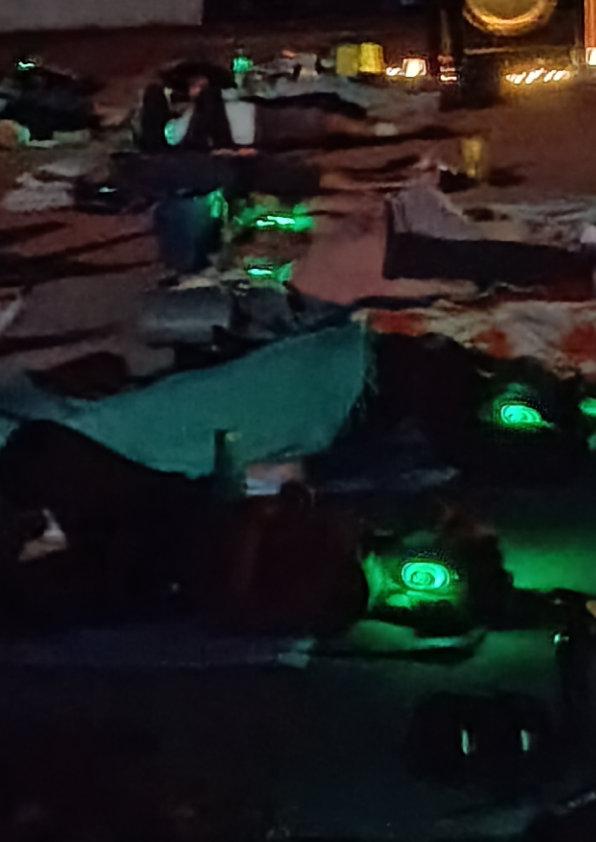
The evening began at sunset with a 60-minute guided breathwork journey. As stars and nebulas gradually emerged overhead, participants were supported to slow the nervous system, deepen awareness and shift out of everyday mental noise. Wearing multi-dimensional sound headsets, the experience was underscored by expansive, cinematic works inspired by science fiction and space exploration, including music by Jean-Michel Jarre, Hans Zimmer and Vangelis.
Breathwork has been shown to reduce stress, improve mental clarity, enhance emotional balance and increase energy levels. By consciously working with the breath, the body’s relaxation response is activated, allowing participants to let go of tension while cultivating focus, calm and a deeper sense of self-awareness.
Following the breathwork, guests moved into a 30-minute planetary sound healing while resting beneath the Milky Way and treated to an immersive soundscape of planetary gongs tuned to the frequencies ofJupiter, the Sun, Earth and Pluto.
Planetary gongs are tuned using a mathematical principle rather than an astronomical claim that planets emit audible sound. The system most commonly used was developed by Hans Cousto and is known asThe Cosmic Octave.
Every planet has a measurable orbital period the time it takes to complete one full cycle around the Sun. These periods can be expressed as frequencies, but they occur at extremely low values, far below the range of human hearing. Using octave equivalence, the same principle that allows musical notes to repeat at higher or lower pitches, these frequencies can be mathematically doubled multiple times until they fall within the audible range.
The resulting tones are then used to tune instruments such as gongs, tuning forks and singing bowls. While the sound itself is symbolic rather than literal, the process maintains a precise mathematical relationship to the original planetary motion.
From a physiological perspective, low-frequency sound and vibration are known to influence the nervous system through resonance and entrainment. Slow, sustained tones can encourage relaxation responses, reduce mental chatter and support a sense of grounding. When paired with breathwork and stillness, these sounds provide a structured sensory environment that supports deep rest, reflection and embodied awareness.
The resonant tones of the gongs flowed through the space, grounding the body while inviting a sense of alignment and perspective. Many participants described the experience as calming, expansive and deeply restorative.
To conclude the evening, guests were invited to enjoy a brief guided telescope viewing, bringing the journey full circle from breath, to vibration, to direct observation of the night sky.
The next Breathwork, Sound Healing, and Stargazing experience will take place on Monday13 Aprilat the Observatory in collaboration with Treemendus Health and Vibrant Health. Tickets are limited so secure your place today.
For other Sound Healing and Breathwork events incorporating Planet Gongs with Treemendus & Vibrant Health, please visit:https://www.treemendushealth.com.au/ events.
Ladies’ Star Party Night Shines Bright Under a Waxing Gibbous
By Jodie Sims
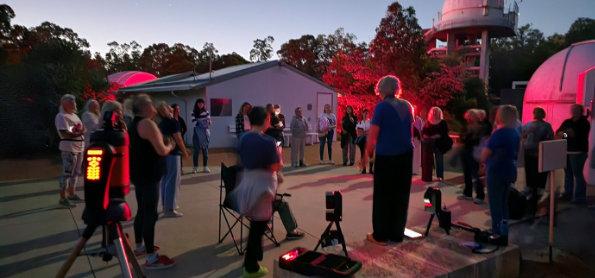
Image credit Mara Leisavnieks
What a spectacular evening our Ladies’ Star Party turned out to be! Originally planned to celebrate International Women and Girls in Science Day on the 11th, the clouds had other ideas. Rather than let the weather dim our spirits, we moved the event to the 26th and the sky rewarded our patience in the most magical way.
A glowing waxing gibbous Moon lit up the evening, casting a silvery brilliance across the sky. And what a star party it was!
We were thrilled to welcome a wonderful mix of women of all ages and backgrounds. Only three attendees brought telescopes the rest joined for the workshop, the shared experience, and a bit of old-fashioned networking. The atmosphere was warm, welcoming, and full of curiosity.
On the Celestial Menu:
Our observing lineup did not disappoint. Guests enjoyed breathtaking views of:
�� The Moon, glowing in its waxing gibbous phase
�� Jupiter, complete with its dazzling Galilean moons
�� The stunning Orion Nebula (M42)
�� The dramatic Eta Carina Nebula
�� The magnificent Tarantula Nebula
�� The sparkling Jewel Box Cluster
�� Alpha Centauri
�� Omega Centauri
There were plenty of “oohs” and “ahhs” as these celestial objects came into focus. The Dobsonians were a particular hit with the Ladies having chance to find objects themselves and get a feel for optical astronomy.
The evening was hands-on, engaging, and filled with thoughtful questions about telescopes, observing techniques, and the wonders of space. It also gave the attendees an opportunity to create connections with like minded people whilst learning in a relaxed environment with the help of our Volunteers.
The clouds may have delayed us, but they certainly couldn’t stop us. Here’s to clear skies and curious minds! We hope to run this evening again in 2027 so watch this space.