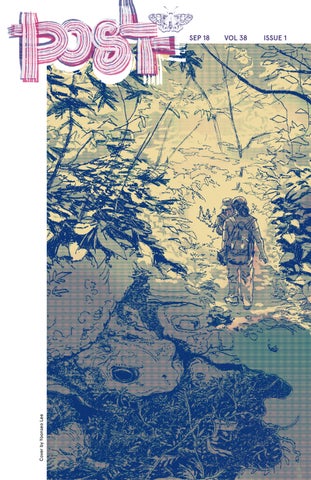
Cover by Yoonseo Lee
SEP 18 VOL 38 ISSUE 1
Table of
Contents feature
narrative
arts & culture
lifestyle post-pourri crossword
The Big
2.
Fiona
3.
The one that keeps the doctor away
4.
-jack (of My Little Pony fame)
5.
Lowly Worm’s car
6.
-BOTTOM JEANS
7.
-seed, Johnny
8.
The one that’s rotten right to the core
9.
Pen, Pineapple, _____, Pen
10. Red Delicious post–
1
summer instructions
3
aloneness
7
so alone we go
9
a very analog day
11
untitled
13
ten years at sea
14
Apples
1.
4
genii and genAI
“I might be cooking, but I might burn it here.” “Oh my Goddd, we should start hazing!”
LETTER FROM THE EDITOR
letter from the editor Dear Readers,
about what we’re taking away from our summer adventures. Also in Narrative, Katya observes three different cities. For A&C, Lizzy processes homesickness while watching a concert. Yana takes advantage of a broken phone to catalogue campus in Lifestyle, and Fern catalogues her artist residency in post-pourri. Finally, enjoy your journey coming to a close with an Odysseythemed crossword by AJ!
Summer always puts me in a contemplative
I’m cherishing my contemplation while
mood. I know it’s not the regular time for that.
I can, since I can already feel classes and
Chilly winters—with all that sitting and snow and
extracurriculars creeping up behind me to take
mugs of cocoa—seems much more the time for
that time away. I hope you take this first issue of
quiet thinking. Or fall, and the melancholy that
post- and find somewhere quiet and alone to read
the changing leaves bring, might be better suited.
it.
But it’s always summer for me. Maybe it’s the bright sun, encouraging me to keep my head down and study the ground, that sets my mind spinning. Maybe it’s running into old friends back home and counting up the ways our paths have differed. Maybe it’s returning to campus and having my regular path diverted by some new construction project.
Watching and waiting,
Elaina Bayard Editor-In-Chief
Luckily, our writers seem to agree with my contemplative mood. In Feature, our managing editors wonder about AI and the sources of their own imagination, and, in Narrative, we think
S eptember 18, 2026
FEATURE
genii and genA a collaborative chorus
by Managing Editors Illustrated by Hannah Gapp
PRELUDE The concept of “genius” was originally conceived as a guardian spirit, an ever-present tutelary guide—think “genie.” Now in their personally-tailored, natural-language-equipped presentation, generative AI tools may also yield glimpses—if not prolonged illusions—of the ghost in the machine. However, I am more fascinated with the panoply of creative genii that predated the AI bubble, as humans have had their muses for millennia, and I maintain that inspiration is fundamentally a subjective human experience: AI tools do not know inspiration, only prompts and predictions. After all, the word “inspire” literally means “to breathe into.” So I ask, what breathes life into us, and what do we breathe life into? I’m finding that there is a certain point on the syllabus day of a writing-based humanities course where the professor stops and sighs, and I can’t help but sympathize. We are all sick and tired of talking about it, sick and tired of being sick and tired. I for one am practically at the point where this exasperation itself is starting to feel performative, that I almost lack the energy for exhaustion. Specifically right now, fresh in the wake of whistleblower Jacob Coxon’s dire warning of companies like OpenAI and Anthropic “gambling with our lives,” how are we expected to 1
post–
reconcile the looming shadow of a genuinely potentially apocalyptic future with questions of AI’s role in the humanities classroom and creative life? This is not a drill; this is an alarm, and as an undergrad immersed in the study of human language and literature, I am plagued by a nebulous feeling of lacking both the expertise and the power to do anything meaningful about such an existential threat other than hope and fear. But assuming our extinction does not occur within the next decade, those of us in this boat can turn our minds to the artistic pedagogy and practices of past and future generations, and we can turn to our communities. So I turned to the post- editorial community for a polyphony of perspectives on matters of creativity and artificiality. In the first movement of this chorus, they respond to the question of what is generative for them in their own artistic practice, harmonizing on subjective experiences of inspiration. In
the second movement, they relate encounters with AI in the wild, to again ground the conversation in concrete experiences. I have collected these kernels, not to grind them into monochrome sludge as in an LLM, but to fully explore their rough, distinctive edges and shiny reflective parts. To turn them over in our hands. Chloe Costa Baker MOVEMENT I: GENERATIVE i. The need to write is a traveling itch. It begins as just a tickle, a stray thought, but grows and spreads in scope and interest as I ignore it. Eventually, it's everywhere, inescapable, unignorable, and I must scratch it—time to
FEATURE
AI
only away from the work I need to do. I listen to my Spotify-made playlists that include songs I’ve listened to fifty times and others I only intended to hear once, only for them to become an earworm. I drink obscene amounts of coffee. It takes a lot for my brain to feel “on.” When I really need to write, then I sing. As the daughter of a former acapella singer and perpetual theater kid, I grew up singing everywhere: in the car, under my breath in school, whenever someone mentioned a word that reminded me of a song. I learned with time to regulate that (and just how annoying it was to everyone around me), but when I have to focus, I still end up putting on a karaoke track. It reminds me just how many ways there are to express an emotion, and studies show that even for those as young as preschool children, singing enhances creativity. It may sound just a little bit ridiculous to those outside of my window, but I haven’t found anything else that works quite so well. And once I start writing, I rarely stop. There is something freeing about articulating one’s thoughts and feelings and random insights. I’ve gone on a multi-page CNF ramble about bats in urban spaces. I’ve dissected relationships and identities and whatever I have yet to understand about myself. Throughout it all, I use my favorite (only semi-relevant) alliterative adjectives to have fun with the process.
from a diverse range of resources, with the known boundaries of my Type A personality. As if reading the morning pages, I’m sitting at my black wooden desk I picked off the side of Ives Street, and completing my to-do’s of the day. Mid-morning, my “Poem of the Day” from the Poetry Foundation arrives in my inbox, where I’ve discovered Robert Wood Lynn’s steady “We Got Used to Surprises” and Jane Wong’s tender “Everything.” After, I’ll go through the list of starred links I’ve saved throughout the week from friends—tidbits they picked up in class, in passing, or right before bed. I’ve fallen in love with C Pam Zhang’s work, particularly “The Taste of Her Care,” and anything New York Times’s Modern Love related. Beyond writing, I’ve accepted the taste of Spotify’s curated playlists, where on my weekly Friday grocery run, I’ll listen to new releases. (Amie Blu and Ashe are my latest loops.) Largely, I’m inspired because of the built-in extra step—adding a new restaurant to Beli, bookmarking the title dropped during syllabus week—and truly returning to it at the end of the day. This is my way of regulating: utilizing the abyss-like systems around me to forcibly, with intention, become better informed. Gabrielle Yuan v.
Hallel Abrams Gerber
iii.
write. I picture this as an ouroboros: eating my own body of words until I bloat with it and spew transformed text back out, only to again start chewing on words. I can't imagine it any other way. I'll eat my tail forever, words in, words out. Sasha Gordon
There are lots of warm and fuzzy things that make me want to write—a rolling hillside, a good song, the light hitting a leaf just right, a unique turn of phrase. But, if I’m being honest, nothing makes me more inspired to write than spite and indignation. Watching a movie that could have been good, but isn’t; a clunky rhyme in a song; a disappointing final chapter. I pace around my bedroom, a fevered genius, thinking about all the ways I could do it better. My ego swells within me until it bursts words upon the page. If I’m honest again, the words are rarely any good. But they do appear.
Something we forget about creativity is that the creator also experiences their own work. In a way, they are its first audience. I myself am in the practice of rereading my poems, short stories, screenplays, translations, letters to loved ones, scavenger hunt clues for my sister’s birthday, and yes, mini ME articles for post-… both as part of the revision and extended writing process, and also years later when I’m almost far enough removed to experience it as a reader myself, as something crafted by the writer I was years ago. In this way, inspiration feels like putting together a symphony for an audience of one. Constructing a puzzle for myself to crack. Doing the impossible: tickling myself. Chloe Costa Baker
Elaina Bayard ii.
vi.
As I write this, I come off nearly seven hours of work and class and more work. The concept of generation is at the same time deeply relevant and difficult for me to parse. So, in my attempt to be thoughtful and also accurate, I am enacting the very tasks that inspire me. I take meandering walks that lead
There’s a baby tree outside my window, a sweet little thing, smack-dab in the center of my view. When the sun’s out, its rays swirl and glitter around my tree’s round leaves, a mirage of a chandelier more resplendent than the dazzling one in my old house, shimmering in afterglow on the shadows of a childhood home
iv. I’ve realized through trial and error that a systematic approach to consuming any form of creativity works best for me. It stems largely from a tumultuous combination of my desire to consume the greatest amount of media possible,
S eptember 18, 2026
2
FEATURE
half-forgotten. There’s a chandelier in my dorm now, and lovely lightbulbs and lamps dot all the cafés I frequent, but there’s nothing that makes me feel more alive than natural light. I love big glass windows and blazing summers, sequinned starlight on water and orchid-pink horizons that promise new hopes, new beginnings, and new people to love and lose and grow up with. Natural light suffuses me with the shakti that my namesake (a Hindu warrior goddess) promises, and it photosynthesizes inspiration in my soul in a way that nothing else quite does. Tarini Malhotra MOVEMENT II: AI i. I type “light tree illustration” in the search bar of my Pinterest app and press the little magnifying glass icon, hoping to find art to add to my “illo inspo” folder. Every artwork I click on—the now-rare, real, and raw rendering of emotion interspersed sparsely between Amazon and Etsy advertisements—reads “AI modified” in the bottom-left corner. Tarini Malhotra
ii. AI can be very picky. And also, it loves to change its mind. It’s kinda “Hot N Cold” (Katy Perry, 2008) when you think about it. I was asked to use AI for certain tasks at my internship this summer. It really is being pushed in every industry, which unfortunately includes publishing. So there I was, frequently opening ChatGPT to get it to combine and reorganize certain 10,000-line spreadsheets. And it hated the way I named them. I got error messages about using an incorrectly formatted title, and then the next day I’d get a new error message for following the format it asked for. It was, admittedly, good at putting spreadsheets together. But I felt, frequently, like I was communicating with a very unpredictable and opinionated imp. Elaina Bayard
3
post–
11
post–
iii. This year, I made the mistake of introducing my mom to ChatGPT. I should have known better, after witnessing her growing reliance on her Alexa, but reluctantly gave in when I got tired of answering basic IT questions like how to turn her ringer back on after she had accidentally toggled it off. I love my mom, but no one will ever accuse her of being too technologically savvy. It started out innocently (Doesn't it always?): She was writing a letter to our HOA, and I suggested she use ChatGPT to help her find a more appropriate tone for her email. How could I have known that this would lead to ChatGPT becoming her consultant for everything from directions to medical advice? In fact, ChatGPT has even gained a persona in our household. The first time I heard her say, “He told me I should do this,” I was taken aback. I have no brothers, and there are no male figures living in our house, so I came to the quick realization that “he” was referring to ChatGPT, my mom’s newest friend and confidant. It was at this point that I knew we were in too deep. Months later, there is absolutely no convincing this woman of the perils that lie within the world of AI. I'm sure that even if I did try to convince her, “he” would tell her all was fine. Jessica Lee
iv. I once had a twentyminute conversation with an eight-year-old about using Claude for video game hacks. At this point in time, I really only considered the adult side of AI— family members generating recipes, peers writing papers. That a child would use it casually and easily said a lot. I guess I shouldn’t have been surprised; this technology is everywhere. It is advertised on
billboards when I take the subway at home and in partnerships with most brands I grew up with (and when I searched for the brands that have joined this movement, the AI overview came up first). That children are using AI for Minecraft shouldn’t take me by surprise, but it does leave a questionable taste in my mouth. Hallel Abrams Gerber v. My father and I attend a rustic omakase dinner on a quiet Kyoto street. We befriend the young American couple seated next to us, who, toward the end of the evening, begin exchanging post-meal pleasantries with one of our chefs. “Everything was delicious,” the husband says. “I’m glad it worked out,” the chef replies. “And by the way, can I ask how you managed to get on the waitlist? We’ve never seen this before.” From my adjacent counter seat, I witness the conversation unfold, the chef recounting how a never-before-seen tab on their reservation management platform had
FEATURE
popped up earlier that week, a new waitlist feature. It is at this point that the couple reveals that they had used an AI agent to book their travel itinerary, including at this restaurant. It had been the AI agent itself that had added them to the waitlist, and so nobody can speak to the mechanics of how it had actually come to be. At this point, all the guests of this dimly lit, intimate space share in astonished amusement. Everyone keeps retreading the absurdity of the situation: a previously nonexistent feature spontaneously appearing to grant the request. Sycophancy to the point of sorcery. From a corner table, another guest remarks that AI is extraordinarily good at innovating loopholes and inventing new rules for itself to accomplish a task. We all laugh again, but perhaps more uneasily, because we also read the news. Chloe Costa Baker vi. This summer I interned in the corporate world of healthcare, and I was immediately
taken aback by the incessant use of AI. While some framed it primarily as a productivity tool—used to find emails lost in countless threads, or summarize notes at the end of meetings—I saw AI being employed to put together presentations that should’ve taken days, analyze colleague and company data in seconds. The deeply embedded culture of various automation tools in every colleague’s life, including my own ease to use it in the workplace, was a shock. It was disheartening, and a peculiar challenge, for me to witness the automation of a simple task. With my particular experience in working in Human Relations, I found myself wanting to lean out, wanting to engage directly with colleagues from spreadout call centers, hear an individual concern, or even take handwritten notes to put together later. Back at school, my balance of being productive and staying true to the systematic, tedious habits grilled into me through years of schooling has been complicated. I’m hopeful that more conversations with students in different sectors, experiences, perspectives can help me find more solace in extracting creativity from AI’s inevitable course. Gabrielle Yuan CODA I call this collection collaborative, in part because it centers labor. Like inspiration, I believe that LLMs cannot fathom labor, much less labors of love, a process at once embodied in struggle and invested with emotion, with breath, with life. In August, I was fortunate enough to visit a permanent collection of the life work of avant-garde artist and indisputable genius Yayoi Kusama, at a museum in her hometown of Matsumoto, just one
w e e k before h e r passing. At the e n d of the exhibit, I was taken by
something she had written in her “Message from Yayoi Kusama to Everyone in the World.” It read, “Each day from morning to evening I put my life on the line in the struggle to produce works of art.” I wondered at this profound perspective: art as painstaking, lifestaking, born from struggle. As someone fascinated with language, I marvel at how, etymologically, even our most abstract words often find their origin in the concrete. LLMs in their swaths of training data have inherited a human vernacular still infused with our embodied experiences of the material world. Inspire and an exhaled breath, Collaborate and a physical struggle. In the same message, Kusama also wrote, “My hope is that these beloved works of mine, sincerely created with all my heart, all my life, will continue to be seen by people after my death … An eternally shining future, the beauty of human love, and the continuation of this soul of mine: such are my grandest wishes for all when I’m gone.” “Genius” and “generative” happen to share the same Proto-Indo-European root: “gene-” meaning “give birth, beget.” Here we find embedded in the language of creativity another embodied metaphor that is uniquely, unambiguously ours: giving new life, as in creating a future, as in fostering human love, as in the continuation of a human soul. Chloe Costa Baker
S eptember 18, 2026
4
NARRATIVE
courting by Elaina Bayard
summer in
I spent my summer in the big city, the Big Apple, New York. (Imagine I’m saying it in the accent.) And it was, indeed, big. Very big. Overwhelmingly big, in the best way. Unfortunately, I didn’t know many people who were there that summer. Some acquaintances, some friends from class, but none of my partners in crime from Providence, the people who expect me to throw rocks at their window and drag them away from homework without warning. So I took myself on solo dates. I didn’t want to spend my precious free time lingering in that tiny Brooklyn apartment. It’s a little scary, I will admit, asking for a table for one or sitting alone in a theater while everyone sits around you, chit-chatting, waiting for the show to start. But somehow, my little budding romance survived. Me, myself, and I made it to a second date, and then a third, and then a fourth. I treated myself to free museum nights and wine bars and student-discounted plays. Now, keep this to yourself, but I think I’m going to try and keep this relationship going. Don’t tell her about it yet; I’m a little shy. But there are lots of places in Providence I’ve been meaning to check out, and I have a feeling she’ll want to come along. running out of runway by Sasha Gordon
Around the age of five, I began to believe that grown-ups could read minds. I would agonize over this issue frequently, unable to let it rest for fear that I was right. Maybe they’re just really good at keeping it a secret, I’d think. The chances were slim, sure, but any chance greater than zero meant I was at risk of psychic penetration. I didn’t concern myself with the mechanics of the process. And I still don’t—it’s never been about that. But I really believed this to be the truth, my conviction such that I would “think mathy thoughts” even when I didn’t understand the assignment so that at least my teacher would think I was on track. I’d try not to think about white lies I’d told or naughty things I was doing, lest they be read straight from my brain by a disapproving authority. As part of this belief system though, I imagined that at some point I, too, would learn to read minds. It was just a matter of time until I hit the magic birthday that would unlock the “real” world. You’d think that I’d either manage to set this quandary aside or finally disprove it at some point in my teenage years, but it truly only happened this summer. I’d waited expectantly for years. I remember thinking that my 10th birthday would be the magic one, and then my 13th, 16th, and yes reader, even 18th. But they all went by, and I still can’t read 5
post–
minds. And I now have no more milestones of that nature to reach. I’ve turned twenty, already long in double digits, and I’ve run out of stakes to lay this claim on. My thirtieth birthday feels too arbitrary to be the one. So though I still have no concrete proof that there isn’t a magic age after which the mind becomes legible, I’m laying it to rest. I’ve run out of mindreading runway. I’m a summer baby, and this summer I learned that there is no golden moment to wait for. I just get to make up something else now. P.S. PLEASE tell me if you can read minds before this goes out. I’ll be so embarrassed.
collection of takeaways from our managing editors by managing editors Illustrated by Angelina So
growing like a breeze by Chloe Costa Baker One of the most peculiar things about turning into a peach is the way you still view your flesh with a fruit-gatherer’s gaze. After hours inspecting those buoys in the branches for discoloration, insect bites, scratches, bruises, sun damage, or blemishes of any kind, you cast your field of appraisal upon the two single-creased bundles below. Or at least their surface. Decently fuzzy, with a protective coating of soft fur, but oh dear, certainly some insect damage, and even a few patches where the skin has broken. And you need a mirror to check for signs that the pit is still symmetrical, the seed intact. Around the dining table one night, we sing “Take Me Home, Country Roads”—it’s one of those English songs that everyone inexplicably knows. While the rest of us pull up the lyrics on Google, our Japanese host intones every word from memory, unmistaken and by heart. I get emotional over staggered cascades of goodbyes. As a parting gift, they present me with a peach of my very own, the size of my two hands
cupped together and arched at the fingertips. At my changeover in Kyoto Station, sixteen stories up, I consume the memory, tanned skin and white flesh and deep red core. Near the pit a tang of sour maroon, then the hard center is pulsing in my hand, blood and viscera cooling on my lips and running down my forearms. The opposite of cannibalism can be grief. At the next farm, I will hold a sanshō peppercorn buzzing on my tongue for nearly ten minutes. I will be awkward and uncomfortable among new living quarters and people and routines until they become a home, a perfectly predictable process that my stubborn body never remembers. On my next-to-last night, I will stay up talking with the new worker from the Netherlands, who will remind me to look at the stars. I still keep the hard pit, and the soft seed within. It is a reminder about change. The unfamiliar morphs into something I can’t help but sink my teeth into, and lick the grooves clean.
NARRATIVE
nst ruct ions to Symposium Books. At the same time, I found myself actually developing a schedule that worked for me, asking people to meet at the time that actually worked, even if that was half an hour later than they asked. People, to my surprise, always said yes. I didn’t realize that was something I could actually do. The school year is starting, and I can already see myself getting frantic and busy and booked. I don’t think there is any avoiding that. But I am still listening to what I want and taking that time alone. We’ll see how long that lasts. At the very least, I’m trying to remember that I am an active figure in my own plans, who can express wants, needs, and limits (while knowing every therapist and mentor in my life has been urging for this for years).
scheduling space by Hallel Abrams Gerber my musings on the “1” bus This summer, riding back and forth on RIPTA, I learned how possible it was to lead my own schedule. This sounds a little ridiculous— almost everyone I know has a colorfully packed Google Calendar, myself included. The idea of making plans, accomplishing goals, and having autonomy is what college is all about. But I spent all of my spring—and much of June— apologizing for always being late, having packed too many commitments on top of each other. I sat with friends at lunch, only to think about the next commitment I was running toward. But my schedule became more flexible, and I found myself spending more time with nowhere to go and no one to see. I spent a lot of that time wandering around. I learned that, without a car, I could get to Wildflour and back in twenty minutes. I became familiar with my favorite parts of India Point Park, something I had been wanting to do for years. I finally went
slow moves by Gabrielle Yuan I don’t claim to be a perfectionist, but the tendencies are there. I spent the majority of my summer in Hartford, CT, and while not the most glamorous city in which to spend three months, it was one worth the growing pains. Within the corporate sphere, repetition of any kind of task was the norm. Presentations were drafted countless times as I was sent back to my cubicle to fix the smallest details— all the way to reconfiguring corporate colors in some miscellaneous slides. Inevitably, my frustrations grew, but, I realized later on— not from the task itself, but the unfamiliarity of it—that maybe I’d been avoiding. What I noted after this rhythm of assignments was that the impatience eventually dissipated. The growing weight of wanting to move onto the next task, just to mark it off of the mounting to-do list, fizzled. I realized my inflamed desire to complete, to finish, to move on, could be temporary. While my patience expanded, my desire to slow down grew too, to feel the process,
to listen, to implement. Not even two weeks back, these changes have persisted. I allow myself to walk slower from south to north campus, no longer finding shortcuts just to shave three minutes off of my walk home. After moving into my first apartment, I’ve had to reorder and rearrange plenty. I no longer feel an acute awareness of being meticulous, but can move my too-heavy bedframe inch by inch while taking plenty of bed breaks in between. Perhaps the source is more communication with myself, the removal of blame and buildup. I have learned, and more importantly accepted, that promising results often come after more than one attempt. cobblestones by Tarini Malhotra A brief cobbled road, jutting out of concrete—glistening in sunlight, unmistakably out of place in an ultra-modern medical complex—led to the path I took to work every day this summer. One of my favorite memories with my high school best friend was stumbling around in our six-inch heels on the cobbled path from the beach during our senior trip, tipsy with whimsy and whispered secrets and promises for the future. I should probably call her. We’re both real and proper adults now; I learned to live independently, truly alone, for the first time this May–July. My days were filled with taking the T, helpless before the green line. They were redolent with the shared glee of coworkers discovering that our highly-funded lab had been using the same sheet of black paper to visualize brain sections swimming around in solution for years and were inexplicably attached to it. They were full of “corporate-slop” lunches, PIs mourning their emotional support World Cup teams when they lost a game, and little trips every weekend because New England summer can be really charming, and it was my first time experiencing it. As I reflect on summer now, I am reminded of the little moments pebbling the journey: an elderly couple watching France vs. Norway with us on a laptop in the Tatte near Boston Common, little sleepovers with friends in grown-up apartments, and getting woefully lost in Fenway with a local who should have known better. I claim that it was a productive girlboss summer, but more than that, it was an experiment in being an adult. After all, if you put me in six-inch heels now, I’d probably still stumble over cobbled streets. The only difference is that this time I’d be stumbling back to a home I created for myself.
S eptember 18, 2026
6
NARRATIVE
aloneness The introduction of every poetry book mentions the poet’s focus on alienation. Are all poets lonely, or are all introduction writers unoriginal? German novelist Erich Maria Remarque, beloved by angsty teenagers, names solitude “the eternal refrain of life.” A topic so universal, aloneness doesn’t require justification when referred to. It insists on confronting our ugly innards and feeling around for the skeleton of our beliefs. Chapter nine of Ulysses, Stephen Dedalus: “Every life is many days, day after day. We walk through ourselves, meeting robbers, ghosts, giants, old men, young men, wives, widows, brothers-in-love, but always meeting ourselves.” Stephen ends up meeting an even wider variety of creatures throughout the book. But a fictional character is never truly alone; they are accompanied by the author and the reader. Pleasant company, if you ask me. Are humans ever alone, if we have a mother and a past, if we are a byproduct of our experiences and spend our existence bathing in either memories or dreams? In his work “On Solitude,” Michel de Montaigne, who pioneered the genre of essays—I guess that makes him a godfather of Substack—advocates that social creatures like humans are still in need of being alone. “We must for the most part entertain ourselves with ourselves,” he writes, stating that no external knowledge should interfere with that pastime. What surprised me was how he invites enjoyment into that alienation: “We have lived enough for others; let us at least live out the small remnant of life for ourselves.” I often perceive loneliness as a punishment, a pathetic confinement—how else does it feel to sit alone at a dining hall?—and forget the exciting part of it, the familiarity of my own company. The Russian poet Joseph Brodsky said in a 1979 interview: “When you find yourself in a strange place, and the stranger the place it is, to a certain extent, the better—it somehow sharpens your notion of your individuality.” Brodsky claimed that one sees oneself better against a strange background. He was describing places like Venice and England (Old and New), juxtaposing them with New York. He hasn’t written much about this city, because, as he stated in the same interview, “You can’t do much about New York.” I understand what he means. It’s not that New York isn’t strange; instead, the city is so elusive and textured that the emerging clarity about yourself is of a different kind. It’s ergodic—requiring additional effort—much like the eponymous genre of literature. Reading some books offers you a clear reflection of your face on the surface of the paper; reading ergodic literature, where you jump from page to page, intersperse chapters, or deconstruct episodes, 7
post–
challenges and teases you, but it’s a rewarding mischief. My friends often describe me as someone who has no problem being on my own. I think the reason for that is because of how heterogenous were the places I’ve been alone at. Observing how they made me feel was often a masochistic experience. Those solitary adventures looked less graceful and romantic than Amelie’s antics in Jeunet’s movie. A more accurate comparison would be Soul 22 in the Pixar cartoon: learning how to walk, inhabiting a body, and holding a slice of pizza. Some places, like Astana, strip you to the bone with their whistling emptiness. Some, like Falmouth, pass you on to the ocean, incapable of curbing your turmoil. And some, temperamental and demanding, refuse to serve as a mere mirror. Care to guess the latter? New York I stroll down Park Avenue, unchained, unclaimed, unnamed. The city engulfs me, slurps me like an oyster, poking me with a tiny stick. I’m far from home—from my suitcase in Brooklyn, my college dorm in Providence, my apartment in Moscow. I look up the latter location on the Maps app. 4668 miles away. I don’t miss home, but I picture our bathroom, and it occurs to me that to simply wash my hands in that sink I would need to cross the ocean, take countless Ubers, trains, and, of course, flights. That logistical sequence anchored down the sensation of being in a viscous vacuum. Another uplifting quote by Remarque comes to mind: “Nowhere, no one and nothing awaits you; you only ever carry yourself around.” That’s what I was—a body, a bag, and a watch. A cluster of a physical vessel and several possessions moving down Park Ave, with nowhere to be yet desperate to belong, at least through my presence in the city. As if that would grant me something in common with New Yorkers. They race down the streets, simultaneously drinking their cold brew, reading A Little Life, listening to Charli XCX in their Airpods Max, and wearing their suede sneakers (whichever ones are trending). The other ones wake up to the view of Central Park from the windows and know their way around gallery openings and rooftop parties. It’s getting late, and I need to take the Q, because the thing about being extraneous in a city like this one is that there is no one to control you, but also no one to care. I am fascinated by the interaction between
the tale of three cities: new york, astana, falmouth by Katya Michkovskaia Illustrated by Yuna Ogiwara
solitude and anonymity. Does the feeling of not being recognized feel comforting or devastating? The untraceable journey of a guest, whose intrusion could remain unnoticed or cause a disturbance to the microcosm. Astana I land in Astana earlier than expected, around 5 a.m., and try to check into my hotel. It’s an unremarkable building next to the U.S. Embassy in Kazakhstan—the primary target of my visit. The hotel resembles an abandoned mall: it’s hollow, with balconies wrapping around the tall lobby. There are several sofas, a closed cafeteria, and palm trees for decor. A disheveled receptionist, who was clearly sleeping in one of the offices, mutters, “Nothing we can do for you right now. Check-in begins in six hours.” I leave my suitcases in her office. Astana is quiet and hollow, just like the hotel’s lobby. The streets are wide and exposing, no shade to hide in when it gets sunny, and the semiarid climate makes the heat prickly, suffocating. I ride the cramped bus with people going to work. Little do they know, I am not going to the office. I am here to renew my visa to get back to the US. I’m alone in this country, a complete unknown on a bureaucratic mission. At sunset, I ride a similarly tight bus without a ticket and almost get caught. I get out next to the Atyrau bridge and pass through the tunnel. This blonde boy is playing guitar, and I realize he is singing a song by Kino, a famous Soviet postpunk band. I pass by and exit the tunnel, but turn around and run down the stairs. I want to meet him and look him in the eyes. I hold on to several coins in my pocket to put in his guitar case, but it’s too late—he’s all packed up and walking towards me. Our conversation is meaningless. I still have
NARRATIVE my coins, which made my sweaty hands smell all metallic and acidic. Now I have to turn again and walk the tunnel for the third time. The bridge is intricate, but that’s the end of it. If you don’t have to cross the river, there’s only so much to do on a bridge. I walk hallways, then turn around. In the evening, I curl up on a chair in my hotel room and watch Twin Peaks. The texture of aloneness depends heavily on the surroundings of the exile. The feeling of marinating in an empty train at night is different from that of looking at the ceiling in your room. I think it might be because of the physics of reflection: Our loneliness ricochets differently from the trees during a stroll than from the walls of a hospital room. The angle of that rebound depends on the angle of launch. An intense feeling of estrangement will result in a more unbearable pain when confronted with the social world, while a lack of self-awareness will not lead to any meaningful conclusions. Perchance the value of socialization is to experience the deflection of your solitude when exposed to others of its kind, testing its boundaries and acknowledging its scaling. It feels like palpating the inside of the shell, like a scallop would, yet they can do it simply through existing and being in contact with their exoskeleton, and we have to enroll in silent retreats or journal in the morning. Falmouth Of course I got the date of my flight wrong. You can check a hundred times, you can triplelook and still end up confusing the layover with the departure. So he lets me stay in his house. It’s May, and I’m in Maine with my best friend. He has to leave for Vermont, but since I can’t—my flight is a day earlier than we expected—he leaves me at the House without a key. We have done some preliminary shopping: a cucumber, a tomato, a pack of frozen dumplings, and yet my supplies are gone after the first lunch. The House is huge, it’s intimidating, and I feel pushed out by the buoyant force, as if the House recognizes an intruder. I watch House M.D. and
pack my suitcases. I make coffee. Drink water. Wash cups. Call Mom. Walk around the house. Wash hands. It’s been two hours. I have twentyfive more before my departure. My throat is dragging, and my sinuses feel congested. I palpate my lymph nodes. They are warm and mysterious. The consensus is I’m getting sick, arguably one of the most depressing realizations known to man. I end up leaving the house and walking down to the ocean. The beach is unsurprisingly empty. The water brings humid, dense fog, and the waves are rocking, a relentless pendulum. After getting back from the beach, I convince myself that someone has lurked into the house and is waiting for it to get dark to jump out and murder me. I lock the basement and prick up my ears. It’s quite eerie to be stuck in a house that doesn’t belong to you, where objects know their places but not you, where someone else spent their childhood and ran around with their siblings. If I stay still for a moment, there is nowhere for sound to emerge from, so we’d all be sitting in silence; my body, my thoughts, my friend’s wooden table, his books and his piano. I catch this absence and release it by saying something out loud to myself. Here comes psychosis. Aloneness: a ruthless mirror. It’s terrifying to experience, to be in an environment where you are in charge of entertaining yourself. People often establish a rigid schedule explaining it with “workaholism” or a desire to escape negative thoughts, but what they are really running away from are the endless paths which they could take during their time alone. Montaigne writes about that too, our tendency to enslave ourselves to various institutions, simply to channel the energy somewhere,
without the taxing task of taking ownership. It is much more soothing to ignore your passions when there seems to be no time for them than to question how you would actually want to live your life. At the end of the day, one could hope to come home to Molly or Penelope or at least a nice bed. But aloneness is not a state to escape from or into. It is a moment of evaluation. To be truly alone is not just reading a book, going on a walk, or meditating. It’s the unwanted moment of boredom when you are pressured to hear your own thoughts: those four seconds in between the shower and the towel, the sound of the door closing after a guest leaves, the forced stillness when you are nauseous in the car and have to keep your head still and look out at the road. And to take pleasure in those moments, one should become good company—first and foremost, for oneself. Only then will those unbearable, exposing nodes in the fishing net of existence feel formative and inspiring. All that to say—maybe sitting alone at a dining hall isn’t so bad after all.
S eptember A pril 25, 18, 2026 2025
8 3
A&C
so alone we go
on pop, paris, and how to walk home from the other side of the world
K: Hey any chance you want to go to an Arabic singer’s concert in Paris K: I bought a ticket last spring but it got rescheduled to September and idk how to sell it I peel out of bed and squint at the screen. A sheer curtain mutes the afternoon sun. Paris is humid this time of year, so I lie atop the blankets of the bed I made an hour ago between tears. Car horns blare out the window. Doors slam in the hall. Pipes churn from a faucet opened somewhere a few rooms down. I am thousands of miles away from everyone I love. sure lmao what singer K: Her name is Zeyne, the concert is September 7 at the elysee montmartre K: If you give me your email I can fw the ticket to you I tap out my home email address and sink back into sleep. K shoots me an email a few minutes later. * I don’t know Zeyne, which doesn’t mean much, because I don’t know most musicians. I’ve never been to a concert and my imagination of one is less than positive: a dim room crammed to the brim with drunk young people trying to heft their phones over a sea of heads and other phones. Achy feet. Music that, while certainly better in person, isn’t worth sacrificing the comfort of a room of one’s own and a crackling pair of earbuds. To make matters worse, this isn’t just any concert, it’s a concert in France. France, where I feel like I don’t know a word of the language despite having studied it since third grade. Where I get so nervous about my blocky accent that I drop my voice until the waitress can’t understand me at all. What if my ticket doesn’t get accepted? What if it’s too dangerous to get back at night? How will I articulate anything? Nonetheless, I consider going. I do my five minutes of research before flopping into another twelve hours of sleep. Raised by a family of singers and dancers, pianists and CD collectors, Zeyne sprang onto the Arabic pop scene during the heights of the COVID-19 pandemic. What began as song covers posted to her quarantine Instagram account became celebrated singles and albums 9
post–
by Lizzy Bazldjoo Illustrated by Lila Vianna
all around the world, with her audience consisting mainly of young adults in the Middle Eastern diaspora. Her family hails from Nablus, Palestine, and she longs for the day when she can see her homeland in full. M a n y of her songs speak to this longing, to her grief and anger, and to her pride in her heritage amidst the horror of its decimation. One of her biggest songs, “Asli Ana” (my roots) centers this feeling. ةيرحلا انأ يسمش/ ةيمل يسار ينحب ام/ ةيقرش حاير تبه/ ةيبرع انأ لجس/ انأ يلصأ فرعبو This chorus translates, in much less rhythmic English, to Freedom is my rising sun / I bow my head to no one / The eastern winds have blown / Record that I am Arab / And I know my roots. The blue light from my phone starts to sting. I realize I do want to see this mystery artist after all, even if my heart cries out against the thought of fresh air and commotion. Maybe. * Twice on the day of the concert, I send and unsend messages to K saying I’m sorry, but I can’t make it. Exhaustion sours my mouth and shoots through the heels of my feet. I have just come from an immersion weekend in the south of France with my study abroad cohort, the beautiful countryside marred by the fact that I had made no friends, had forgotten to pack an outlet converter, and received my first rejection from a literary agent via email while my roommates gossiped about a regrettable kiss with someone named “Evil Max” one bed over. I’ll take a couple pictures for K, I decide. I’ll go scout out the venue, snap a view of the opener, then hurry on back out if I don’t like it. I don’t even have to go inside, I tell myself. If the vibes are off, if I have to speak too much French to the tickettaker, I’ll hop right back onto the metro and be home before dark. The concert line is easy to spot the moment I reach the right street. Mostly young people, mostly looking like me, dark eyes and hair that doesn’t flatten easily, keffiyehs tied around their skirts or shoulders. An usher hands me a flyer for a jazz festival and I nearly balk, thinking I’m in the wrong place, that I messed it all up, before I calm down enough to realize that it’s an advertisement for two weeks later. Entry is blessedly wordless. My ticket does work, and the arena I step into is spacious, air
conditioned and chilled by artificial fog. I order a cocktail at the bar without being carded— even though drinking’s legal at eighteen here, I’m short, and have been told I have the comportment of a nervous fifteen-year-old. Perhaps it’s the sip of lime-marbled vodka that makes this all feel more exciting. The room is busy but not suffocatingly crowded, and people sit against walls and pillars until the overhead lights dim. Opening the concert is a Franco-Algerian rapper, Léna, followed by a break where I text K my photos. I’ll stay until the main act, of course. Then I can leave. I don’t really want to leave, but the option’s open, isn’t it? That’s more than I can say about Paris itself. There’s a pulse of bass, and then we see Zeyne. She kneels on a riser on the l e f t side of the stage, a siren perched atop a rock, faux wind whipping through her hair, four dancers echoing her moves like flames rippling off of her. The lights reach her face, her voice reaches the speakers, and the crowd erupts into cheers. I’m not a musicologist in the slightest. I can’t describe the songs the way magazines do, as “slick” or “electric,” pop or R&B. I just f e e l them like the tender burn of alcohol on my tongue, a stinging, exhilarating crackle of energy down my throat. Occasionally, she brings u p a stand mic and sings a calmer ballad. Between numbers, she discusses her grandparents. Sometimes her music is a n g r y, sometimes fond. A litany a g a i n st bad boyfriends. A prayer for her mother in a time of sickness. She describes memories to us, coaxes us through the Arabic hymns, welcomes us into the strobe lights. That’s where we live for a few hours, in memory. It’s not quite home, and it’s definitely not our home, but it means something. Means home’s still out there, tracing our footprints, waiting for us to come back. * After sloughing off my first dehydrated nap on my first day in this brand new city, I texted my mom. Were you like this in Germany?
A&C
Her reply contains the usual questionable text grammar, replete with boomer emojis. Worst! I had to go to Spain first to wait for German visa. I was in a crappy hotel and I was so scared to leave the room. The bathroom and shower were in the corridor! I didn’t know Spanish and could speak a little English. I think I was there for two months or more. I started getting out more after 2–3 weeks.
🤪🤣
In Germany, the anxiety got better faster because I signed up for a language class. I think after one month or so. When I came to US, I lost weight the first time in 6 months . I became size 4
🤣
🤣😱
Looking back, I know I needed to go through those days to get here. I think about asking her how she managed it. But I already know: she had no choice. She wasn’t studying abroad to widen her world or escape something inside her she couldn’t name. War and tyranny snapped at her heels. The only way out was through. She was strong, brave. I am not
strong and I am not brave. The summer before my freshman year at Brown was months of eye-rolling and getting fed up with my mother, grating when she interrupted me, even by accident, taking every suggestion as criticism. I chafed against childhood. I tugged at its chains, wrestled and fought, and then I was on campus and the cuffs sprang open and I was hurtling through open air. I cracked down the middle. Cried night after night. When my mother said goodbye, I apologized to her for being a grouch, for being ungrateful, for rebelling in my feeble little ways, for reading Stephen King behind her back in middle school. I pleaded, “I’m sorry. I don’t know how to do this without you.” “I’m right here.” She always dyes her hair with henna. It glimmers red in the sun. “Anywhere in the world, I’m just a call away.” * The metro back to my street is peaceful, sparse enough that I can sit comfortably across from other concertgoers, then follow them up the platform’s stairs and onto my street. It barely feels like midnight: people milling in the streets, traffic signals and store signs still glowing over the narrow sidewalks, the crushed
cigarettes in the cracks of the road, the shuttered grocery stores. Many bars dot my neighborhood. The occasional terrace is awash in yellow light, spilling chatter out past the awning and the patio fences, French and Arabic and sometimes English and a dozen languages I can’t identify. Clinking glasses, lively tables sweeping me off into my quiet apartment. I cast one look back at where the British tourists hug on the street corner and the bus unloads another crop of passengers into tipsy laughter. It’s an odd, marvelous thing, my street. I have never seen it like this before. I have always been too scared of the dark. * I’d like to offer a neat ending, one where I love Paris now and shudder at the thought of going stateside, one where we can all make peace with new homes and forget about the old ones. As if. But there’s something to be said for this awkward metamorphosis, the uncomfortable shifting under my skin when I make it through the day, through a coffee order, through a ticket stand. The thrill in my chest when I feel a little less lonely, when I can stand in a darkened room and feel music I’ve never heard and barely understand the pulse under my shoes. Like a living thing, the bass, the fog, the Elysée Montmartre. Like a heart soldiering blindly, faithfully on.
S eptember 18, 2026
10
LIFESTYLE
a very analog day going offline at brown and the characters I met along the way by Yana Giannoutsos Illustrated by JJ Li
Naturally, my phone shattered on the one day of the week I desperately needed it. Perhaps that’s a bit of an exaggeration because, well, I rely on my phone to simply wake up before two. But the tragedy occurred just after the clock struck noon as I was on my way back from a class called “Writing at Three Miles An Hour.” It’s a creative nonfiction course taught by a professor who insists, just like every other professor during shopping period, that technology ought to be avoided at all costs. We had just been instructed to go on a walk without what he referred to as “gizmos.” I adore that word for some reason. That means no headphones, iPhones, AirPods, or any other Apple-adjacent device. Ten minutes later, I wiped out and shattered my phone. The humiliation ritual of slipping in the middle of the road, followed by repeatedly uttering random profanity under my breath when my phone was unresponsive, was only the start of a day-long saga. After that came a challenge: Get it fixed without any technology to help me. And so began my analog day. Approx. 1:00 p.m. I walk into the Brown Bookstore searching for help. They “don’t do phones.” Okay. On to the next. Approx. 1:30 p.m. I break down in front of the Brown Bookstore on Thayer, sitting on a bench with my head in my hands like I’m a rom-com lead, crying over a broken heart. Except I’m only just a girl—an adult, technically speaking—with an utter distaste for discomfort. I run into a member of my orientation group, who pulls up Google Maps and tells me how many blocks to walk until I reach the repair shop. I try to memorize the route, but my modern brain is not suited for cartography. Approx. 1:45 p.m. I am getting more and more impressed by my grandpa’s ability to get anywhere in Connecticut using only his brain. It took years of map studying, I’m sure. Maybe the world was harder “back in the day.” Approx. 2:00 p.m. I ask a group of passersby for directions. They are amused by my plight. One responds, “Wow. That’s so analog.” I don’t know what to say, so I just laugh. 11
post–
Approx. 2:30 p.m. I am close, I think, to the repair shop. I see a walker. She looks familiar. She was in the class I had just taken. I ask to trouble her for directions. She pulls up Google Maps. It’s ten feet away. It was directly before my eyes. Approx. 3:00 p.m. My phone is undergoing a “diagnostic test” to determine whether it is even fixable. I wait. I decide to walk back to campus. I do laps around the Main Green, across those walking paths used exclusively by tourists and guides. And this is when I start noticing people. Without a phone to gaze down awkwardly at as I pass someone I vaguely know but am too shy to acknowledge, I have no choice but to look up, out, and around me. My gait slows, my eyes peel open, and I begin pacing the perimeter of the Green, feeling almost as though I am both in and apart from the world around me. People cluster in their groups, scattered across the Green like little islands. As I pass, I catch fleeting glimpses of conversations, bursts of laughter, whispers of gossip. I realize I could do this forever. Brown, it turns out, has its own cast of characters. Once you start looking, you start to notice them everywhere. So, in honor of my first truly analog afternoon, allow me to introduce them: The Stair Sitters Every afternoon, there’s a group that hogs prime real estate on the stairs of the Campus Center. They stare out at the Main Green before them, thinking they are in an episode of Gossip Girl. Honestly, they always look epic. The Serial Shoppers Courses@Brown has become their best friend. This person is still “casually” shopping forty courses, with no intent of dropping any until the final minute of shopping period, during which they will arbitrarily choose the four with the most obscure-sounding titles. Their GCal resembles a haunted house and makes you wonder why shopping period is a selling point here. But they still feel the need to brag about it to everyone and anyone they see. The Serial Droppers This person comes in as an APMA-econ concentrator with four math courses and ends shopping period with five courses on metaphysical philosophy, insisting they are “taking advantage” of the Open Curriculum. Are you sure that STEM is right for you?? The Pre-Professional Posers Blazers? On. Shoes? Closed-toe. Colors? If it’s not navy or black, it doesn’t make it in
the closet. This person always has a coffee in their hand, and it’s usually obnoxiously small. Probably two straight shots of espresso to power the coffee chats and info sessions that will take up the work day. Tote Bag Tom This person is allergic to a backpack and likely suffers from severe scoliosis as a result. The tote bag hangs from their left shoulder, its weight contorting their body. They look at you offended if you even suggest a two-armed alternative. The Ratty Loyalist You see this person every single time you visit the Ratty and nowhere else. You wonder if they’ve taken the Ratty Challenge so seriously that they are now part of the architecture of the building itself. When it closes, are they allowed to camp out in the salad bar? Boy Band Billie This character rolls down the Green on a skateboard while carrying their guitar. Bonus points if it’s a slightly more obscure instrument, like a bassoon or a triangle. This person is taking the toughest course offered at Brown and somehow has the best grade in the class despite never having attended a single session. I don’t know. Something about the music? The Terrible Trio You’ve never seen these three people alone. They always walk in a group, always in the same configuration. You start to wonder whether they are actually three separate people or one extremely social organism. Spikeball Stans They have invested in sports glasses and insist that playing barefoot offers the best range. They’d skip a final exam for a chance at glory. They scream if they lose. Or win. Or if someone forgot the ball. They just always scream. And then there is: Little Old Me I’m sure people are making an archetype of me right now as I pace back and forth in front of Sayles, phone nowhere to be found, peoplewatching. Maybe they think I’m a creep with nothing else to do but judge the lives of others. Maybe someone is considering coming up and talking to me. Maybe no one is looking my way at all. I sit there and watch. For a long time. Or at least what feels like a long time—I can admit that my attention has been completely nerfed by the dopamine-inducing brain rot that is Instagram reels or, my personal kryptonite, YouTube shorts. 4:30 p.m. I eventually get my phone back. It was
LIFESTYLE
repairable, and I even got a discount in exchange for writing a positive Google Review. I spend the entire walk back from the shop with my eyes glued to my screen. The blue light reinvigorates me. I swear I hear someone mutter “screenager” to a friend as I pass them.
become so familiar. How the people who inhabit it can meander through your life as they live out their own—in whatever tote-bag-loving, guitarplaying way they wish. How they can change from strangers to small reminders of a place you’ve slowly begun to call your own.
11:00 p.m. As I write this article, the glare of my computer keeps me awake. All feels right in the world. I feel at home. It’s funny how a place can S eptember 18, 2026
12
POST-POURRI
O P U T R S R O P I BEFORE YOU GO
untitled
an exploration in paint
by Fern Nuñez-Flores | Illustrated by Lori Lai
This painting collection is the product of a summer residency where I focused on material and compositional exploration. Created during a residency at the New York Academy of Art, an institution rooted in traditional figurative realism, this series emerged as an intuitive counter-response to formal structure. After poring over the scintillating Impressionist and Abstract Expressionist works at the Met and MoMA, as well as Remedios Varo’s alchemical, Surrealist images at the Museo de Arte Moderno in Mexico City later in the summer, I felt an impulse to create from memory with a subtle nod to the art history of Mexico—my parents’ birthplace. While my guiding inspiration leans toward the quiet precision, shadowy texture, and emotional honesty of historic painters like Vermeer, Friedrich, and Andrew Wyeth, this summer became an intentional exercise in aesthetic rebellion. By abandoning rigid naturalistic representation for unabashed abstraction, these pieces document a necessary test of my own artistic boundaries, ultimately clarifying my commitment to the artistic qualities I value most. These intuitive, semi-abstract, and colorful works document an unbridled phase of material exploration and creative contrast. The minute details and bizarre, semi-austere figures perform strikingly, yet silently. With an eye to the verdaccio tradition (an underpainting technique of 15th-century Italy), I drew from imagination, urban life, and literature to conjure magical realist and uncanny scenes where people and trees gather. Using oil paint, gouache, and gesso on wood panels, this untitled series comprises a crowded scene of figures alongside a piece dedicated solely to trees. The subjects are foregrounded: either resting in silent repose, making direct eye contact with the viewer, or wandering as amorphous shapes across the picture plane. A strong, grounded verticality connects all the paintings, from the legs of city passersby to the interspersed figures and tree branches in the middle painting, and finally to the magical canopy of the rightmost panel. The figures defy the composed, calculated demeanors commonly expected of historical subjects. The layers and varying transparency of the watercolor and oil paintings reveal their underlying pentimenti (pencil marks and preliminary washes of color). By unveiling the creative process in parts—akin to the task of an art conservator—this series invites an intimate, dreamlike dynamic between my work and you, the observer.
15 13
post–
CROSSWORD
ten years at sea post- mini crossword
by AJ Wu illustrated by julia park
1
2
3
4
5
6
7
8
Across
Down
1. What's accrued when living beyond your means 5. Teller of "The Odyssey" 6. Join forces 7. Chris, re-re-teller of "The Odyssey" 8. Romantic rendezvous
1. One who visits a blood bank 2. Wilson, re-teller of "The Odyssey" 3. Alpha followers 4. Reznor of Nine Inch Nails 5. Pursue
S eptember 18, 2026
14
Thank you for reading
magazine. New issues every week.
EDITOR-IN-CHIEF Elaina Bayard
“I felt like a detective searching for inconsistencies with red yarn and pushpins. My parents, bless their hearts, tried their best to keep their stories consistent, but I was relentless.” — Katheryn Gonzales, “a letter to my fairies” 09.19.24
“This place is interesting—full of character and a subtle energy that only becomes apparent once you pay attention. If you bother to drop your book and deign to look up. If you decide to be present, curious, to crave details and explanations.” — Mar Falcon, “my friend at the museum” 09.16.25
FEATURE Managing Editor Chloe Costa Baker Section Editors Helen Hen Anika Kotapally ARTS & CULTURE Managing Editor Sasha Gordon Section Editors Gabriella Miranda Rebecca Sanchez NARRATIVE Managing Editor Gabi Yuan
Section Editors Lucie Huang Chelsea Long LIFESTYLE Managing Editor Hallel Abrams Gerber Section Editors Alayna Chen Tatiana von Bothmer POST-POURRI Managing Editor Tarini Malhotra Section Editor Christina Li HEAD ILLUSTRATORS Junyue Ma Lesa Jae
COPY CHIEF Jessica Lee Copy Editors Eve Kobell Kate Schuyler Michelle Wassef Su Yang LAYOUT CHIEFS James Farrington Alexa Gay Amber Zhao Layout Designers Joshua Rezneck Emma Vachal SOCIAL MEDIA Hung Lam Yana Giannoutsos Yeonjai Song Rebecca Sanchez