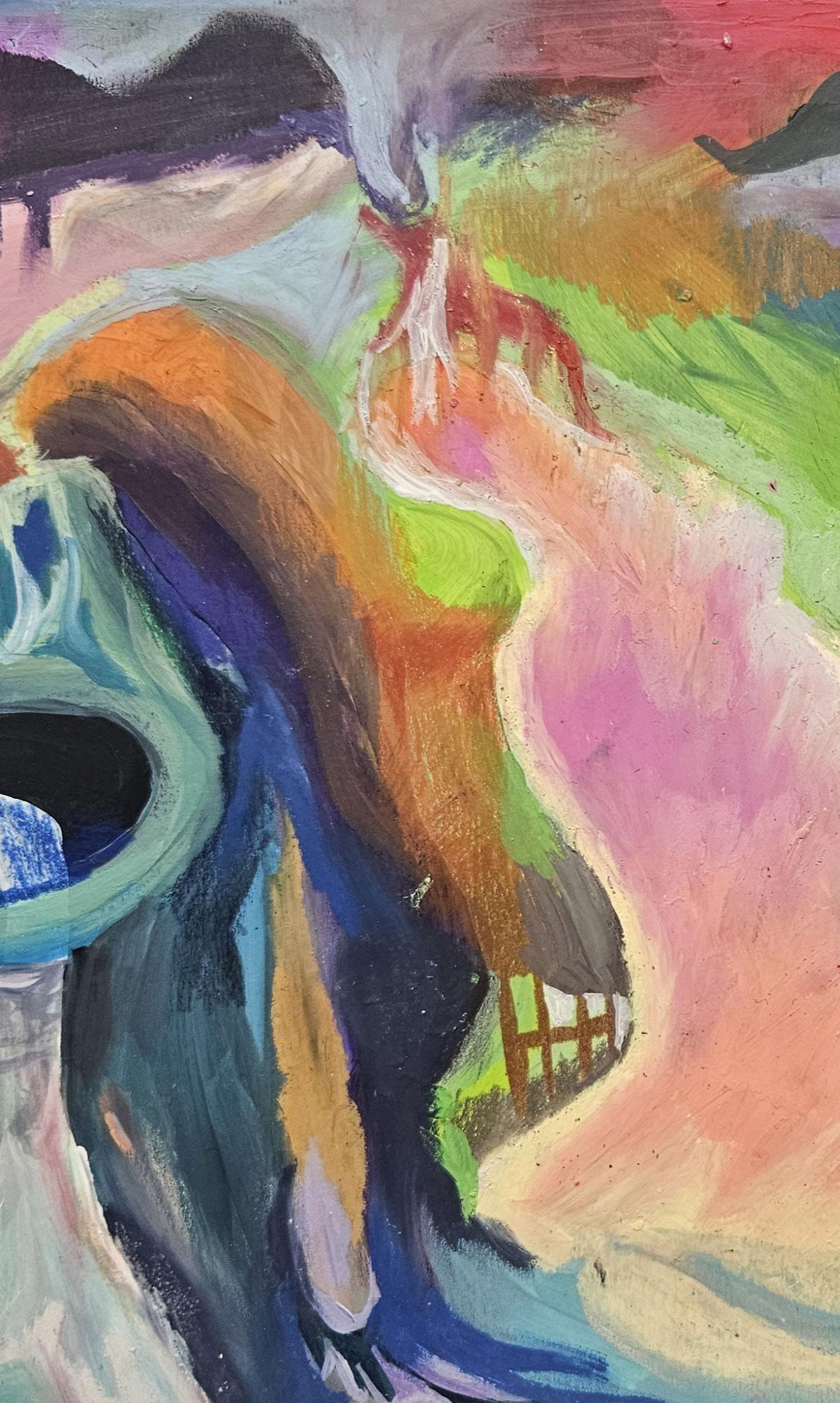
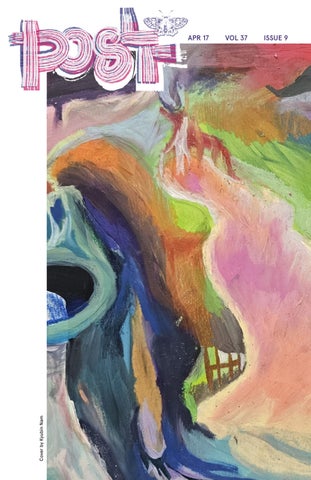
Cover by Kyubin Nam


Starting
Hanging
7. Not being Quiet
8. Dodging frisbees/footballs/spikeballs 9. Spotting Murphy!
“I’m so sorry, I’m a redhead racist.”
“She’s…Zendaya
for the educated.”
Starting
Hanging
7. Not being Quiet
8. Dodging frisbees/footballs/spikeballs 9. Spotting Murphy!
“I’m so sorry, I’m a redhead racist.”
“She’s…Zendaya
for the educated.”
Dear Readers, It’s been bittersweet thinking about what I want to write in my last editor’s note (and my second-to-last issue of post-) before graduating next month. The Venn diagram of my time at Brown thus far and my time at post- is a circle: I joined as a writer two weeks into my freshman fall on a whim. Over the next four years, I continued to write, made crosswords, was a copy ed, section ed, and did a very shortlived stint as an illustrator. Whatever it was, I loved it because it was postand—I don’t think I’m biased at all when saying this—post- is singularly special. Getting to read endlessly inventive and earnest student work every single week is something that I can never take for granted. And even in more tiring weeks, I could always look forward to spending Thursday nights, later Wednesday nights, in our cramped upstairs room in 88 Benevolent—abundantly joyful and together. I’ll miss it immensely.
This week in post-, our writers are also grappling with difficult questions and new horizons. In Feature, Katya defends autofiction and explores the evergreen challenge of authenticity. In Narrative, Shriya reflects on the love that surrounds
us and the love that is difficult to let go of, and Katya returns to ponder having perfect pitch and what it means to know with certainty. In A&C, Madison implores us to wander and brings us along an alluring tour of Paris through the eyes of a flâneur. In Lifestyle, Maria celebrates nostalgia and all its offerings. Also in Lifestyle, we’re full of surprises—catch a piece from our MEs about little moments that have caught us by surprise this semester. Lastly, don’t miss a timely Spring Weekend-themed crossword from Ishan and Jessica’s quiz that finally provides an answer to the ageold question: Which Brown dining hall are you? I can rest easy knowing I’m V-Dub. However I feel about it, change is constant. In post-, at least, there are new brilliant writers, illustrators, editors all the time—a different iteration of posteach semester and I’ve had reason to love every one. This little magazine has been home to some of my very favorite people and countless pieces that haven’t stopped rattling around in my head since the day they were published. Thank you for these four years. I’ve grown a bit, changed a bit, and—for a time—got to be a small part of this lovely magazine that continues changing and growing always. How lucky is that?
With all that said, I hope you, dear reader, enjoy this issue of post-. I’ve enjoyed all of it.
AJ Wu A&C Managing Editor
by Katya Michkovskaia
by Lesa Jae
experiment that was later developed into a book. In the disclaimer, she states that will not serve as entertainment, nor will it be an attempt to be likeable to the readers. Boyle’s depiction of her own life includes thorough tracking of her food intake, dosage of drugs and medications, retrospective and retroactive narratives. There is no buildup, no Freytag's Pyramid—just distilled life with its major and minor rough edges. “woke. drank leftover dunkin donuts coffee and ate maybe 5mg adderall.” Boyle plays with the idea of surprise— would a book still be of any interest if none of it were fantasy? Would we get tired of her life,
When asked whether her book is a novel, Boyle said, “It is a novel in the sense that I made a story by seeking out narrative elements in my life and linking them together. Whether that’s based on ‘true facts’ is kind of irrelevant, because I think truth is in both nonfiction and fiction.” Boyle’s response touches on how the value of autofiction is often being reduced to its “historical accuracy,” which shifts the focus from the immersion in artistic delivery
Another captivating piece in the genre of autofiction is written by Eduard Limonov. An established Russian poet and, as it often coincides, an established opponent of the system, he had to leave Russia and move to It’s Me, Eddie. It’s a novel about a Russian émigré whose strikingly beautiful wife left him and whose country became impossible to stay in. So, he has to make a living working whichever job he finds, nostalgically reminiscing of the fame he had back home and cynically despising his fellow compatriots: “When you yourself are in a lousy fucking situation, you don't much feel like having unfortunate friends and acquaintances. And almost all Russians bear the imprint of misfortune.” His all-encompassing distress is exacerbated, or even primarily shaped, by the heartache from the absence of his wife. “I loved her, this pale, gaunt, small-breasted creature in her whorish scrap of panties, who had donned my socks to sleep in. I was ready to cut off my own head, my own unhappy refined noggin, and throw myself face down before her. For what? She was a sleaze, a pig, an egoist, a stinker, an animal, but I loved her, and this love was higher than my consciousness.” This passage leaves a controversial impression; on the one hand, it depicts the intensity and paradox of the protagonist's feelings; on the other hand, it is quite explicitly based on a real person—
Elena, Limonov’s real-life wife. We, as
readers, feel like intruders, and yet, no offense to Elena, we are captivated by the narration. In reality, Elena’s love story with Limonov was similarly turbulent and acidic, full of passion, rivalry, and, eventually, disillusionment and pride. She even wrote her own book, It’s Me, Elena, five years after Limonov’s novel came out. Ironically, she denied any intention of homage to the original title, blaming it on the publisher.
It’s normal for autofiction to leave the degree of authenticity unclear. But the reason I consider It’s Me, Eddie to be a fascinating case is that here, the reasons behind the ambiguity deviate from the typical ones. Limonov isn’t trying to seem mysterious—“MFA-y,” as Megan Boyle would say—or, at least, not just that. His protagonist is provocative and blunt; he willingly provides us with the most graphic details, such as his experience having oral sex with a man. Limonov denied the connection between himself and the character; however, what else could he claim, knowing that any identification between them would all be used against him, should he visit the USSR? Not only has there already been a perception of a “hidden insult” to the Soviet Union in the book, it also contained episodes that would be considered pornographic and even illegal by the Soviet standards. In a 2005 interview with a stuffy sexologist on a sketchy Russian website, there was a comment on Limonov’s book: “No matter how much you show off, you can’t hide your true sexual orientation. Limonov is clearly bisexual. When I read the novel It’s Me, Eddie, I understood everything right away…
Only someone who enjoyed it—someone who had engaged in oral sex with men on more than one occasion—could describe the whole thing that way.” In other words, even though I wouldn’t attest to a complete similarity, Limonov was right to be cautious
if autofiction adds another dimension to the protagonist, making him more layered and somewhat polarizing in his ambiguity.
Another writer blatantly exposing himself was Sergey Dovlatov. He had an alcohol addiction, which he wasn’t just open about—he sincerely elaborated on it and its destructive consequences for his health and personal life, as if reveling in his own suffering. For instance, in his novel Pushkin Hills, he describes an intense elevenday bender (a
with drawing parallels between him and the protagonist, which to me appears largely a safety consideration. Bisexual or not, it was none of anyone's business.
The elegance of Limonov’s autofiction lies in the implication of truth, in the desperation of his confession. Is it a confession of a liar, a trickster? We’ll never know; there is enough evidence to support both positions. I tend to trust his narration; if he wanted to destroy or humiliate his ex-wife, he certainly didn’t have to expose the heart-wrenching pain he was in because of their separation, the extent to which he only wanted to be with her and no one else. If anyone, he is the one being unapologetically and harshly humiliated. He bitterly, thoroughly explores the inner lining of the pathetic, unfulfilling life in poverty and marginalization, the disgusting details of his intimate affairs, even going so far as to confess to masturbating to Elena’s shadow—“I wept, but what else could I do? I wept and came, and my cum splashed onto my already tanned stomach.” What autofiction grants the readers here is the discomfort, even shame, of peeking into the personal life of The Writer, Eduard Limonov, whom we learned to respect, and here he is in front of us, abandoned by his wife, sobbing and masturbating to the memory of her, loving her paradoxically and tragically, angrily and uncompromisingly. It’s almost as
binge drinking phenomenon for which Russians have a convenient untranslatable word zapoy). The bender happens because his wife and daughter leave the USSR and emigrate to the U.S.—a decision he couldn’t support. Boris, the protagonist, says: “But my readers are here. And over there...Who in the city of Chicago needs my short stories?” At this point, we understand that it’s not just Boris who’s afraid—so is Dovlatov.
Eventually, Sergey Dovlatov had to leave the USSR. He reunited with his family in New York. “I left to become a writer, and I did—after making a simple choice between prison and New York. The sole purpose of my emigration was creative freedom.” The U.S. welcomed Dovlatov warmly: He was published in the Partisan Review and the New Yorker, a success which, among Russian writers, was previously known only to Nabokov. He was, however, profoundly depressed: He couldn’t continue writing only about exile and immigration, nor could he come to terms with living in the U.S. and start working on something thematically different. Dovlatov continued to drink heavily and died of heart failure at the age of fortynine.
In Dovlatov’s case, autofiction is the
actual source behind my strong love for him and his prose. It’s the presumption of honesty and trust that he establishes with his readers, a certain request for non-judgementalness, in exchange for which he shares his wonderful stories. Despite all the hardships of Dovlatov’s life, he had an exceptional, absolutely elite sense of humour, essential for his style. I don’t mind that Dovlatov wrote about himself. On the contrary, I wish he wrote more. I would have read it all.
Another bold example of autofiction is Theodor Adorno’s Dream Notes, which is essentially a collection of his dreams, published with an emphasis on an almost complete absence of editing. Personally, being acquainted with the psychoanalytic approaches to dream interpretation, I would be absolutely terrified to share even a tiny excerpt from my dreams, and I’m certainly a less significant figure than Adorno (for now). However, it’s important to mention that most of those dreams were published posthumously, which probably made the whole affair less anxiety-inducing for Adorno (he was dead and didn’t care about Irma’s objection anymore). Raw notions of those oneiric experiences are not just autofiction; they are a priceless glimpse into his psyche that no biography could offer. The fictional narratives of dreamwork only appear distant and chaotic—one could disregard them as nonsense, or even a simple byproduct of sleep. However, by taking a closer look, dreams can reveal insightful wishes, ruminations, and neuroses. This glimpse into the author’s mind is amplified by the first-person perspective, which makes the dreams diaries an entrancing form of autofiction.
Toni told us not to write about what we know, but what can we write about, if not our own life? I think writing is inevitably authorcentric. In his 2003 interview, David Foster Wallace said that one of the things he likes about being a writer is that, “I get to use pretty much everything I’ve ever learned or think about.” Moreover, the inescapable “authorcentricity” arises from the ties our cognition creates and the way it does so. When writing,
one might not realize where the images come from, yet their source is either direct exposure to such experiences or indirect processing and speculation derived from some inspiring activity. Freud used a similar technique, one of associations, to psychoanalyze his patients, with a preface, “We must, however, bear in mind that free association is not really free.” By that, he implied that even the most surprising and nonsensical interrelations are actually highly meaningful and even revelatory. Similarly, when writing fiction, it seems to me that no idea, no character is accidental; they are all inextricable derivatives from the writer’s experience. That’s why it doesn’t matter whether we are reading “classic” or autobiographical prose; in this way, all fiction is autofiction.
This is where the aspect of vulnerability emerges. If fiction isn’t always about the author, either fully or tangentially, why do we feel exposed when showing it to the people who know us best? Sure, a manuscript with the protagonist sharing your name and their friends much resembling yours is a more stressful affair than a fairytale about a small girl no bigger than a thumb or a porcelain rabbit (because humans weirdly care about how you describe them and tend to get upset if you don’t sugarcoat their antics, ugh). Yet a caring, careful reader, say, your childhood friend, would notice the traces of the toys
you owned in the characters, the jokes you overheard on the subway in their replicas, and even that candy you like in a hypothetical magical snack. The imaginary dimension wouldn’t protect you from being known and dissected.
Such is my case in defense of autofiction. To me, the value of authentic first-person narration overshadows the concerns around genre conventions posed by lunatics with a polygraph and a code of conduct outside the autofiction writer’s door. As long as the fiction is tastefully written, compelling, and evokes empathy, curiosity, disgust, or any other reaction on my part, I’m there to read it and form my own opinion.
By the way, as I was writing this article, I encountered a new relevant quote. “Write what you know,” Mark Twain told us. See? Writing is easy. Just write what you know, but also don’t write about it because you know nothing. Hope this helps!
At the grand age of five, I didn’t have many talents, but I could do a lot of things mediocrely.
For instance, I was a very musically inclined child, but not in a piano competition child prodigy way—I was mostly just constantly humming to myself and loudly singing in our K-12 choir. “Take her to the music school,” they said to my mom. So we went. Music school appears to be one of the most universally hated experiences, and I’ve met more people who have quit than have actually graduated. Unless you build up the accountability to practice regularly, piano lessons are a semi-voluntary humiliation ritual. (You sign up for them, but you never know exactly what you are signing up for.)
When I was six, I made an entry in one of my diaries: What am I afraid of? Death, darkness, and my piano teacher.
by Katya Michkovskaia
Illustrated by isabelle wang onmusicschools
There was, however, a character trait that helped me persist in my pathetic piano attempts. (Apart from my parents’ unconditional support, of course; they had so little relation to music that it allowed them to praise me for what I could do, rather than pushing me toward a hypothetical asymptote of neurotic virtuosos and prestigious contests. The only piano competition I’ve ever participated in was called “Our Hopes,” after which my mom kindly asked whether there was one called “Our Hopeless Ones.”)
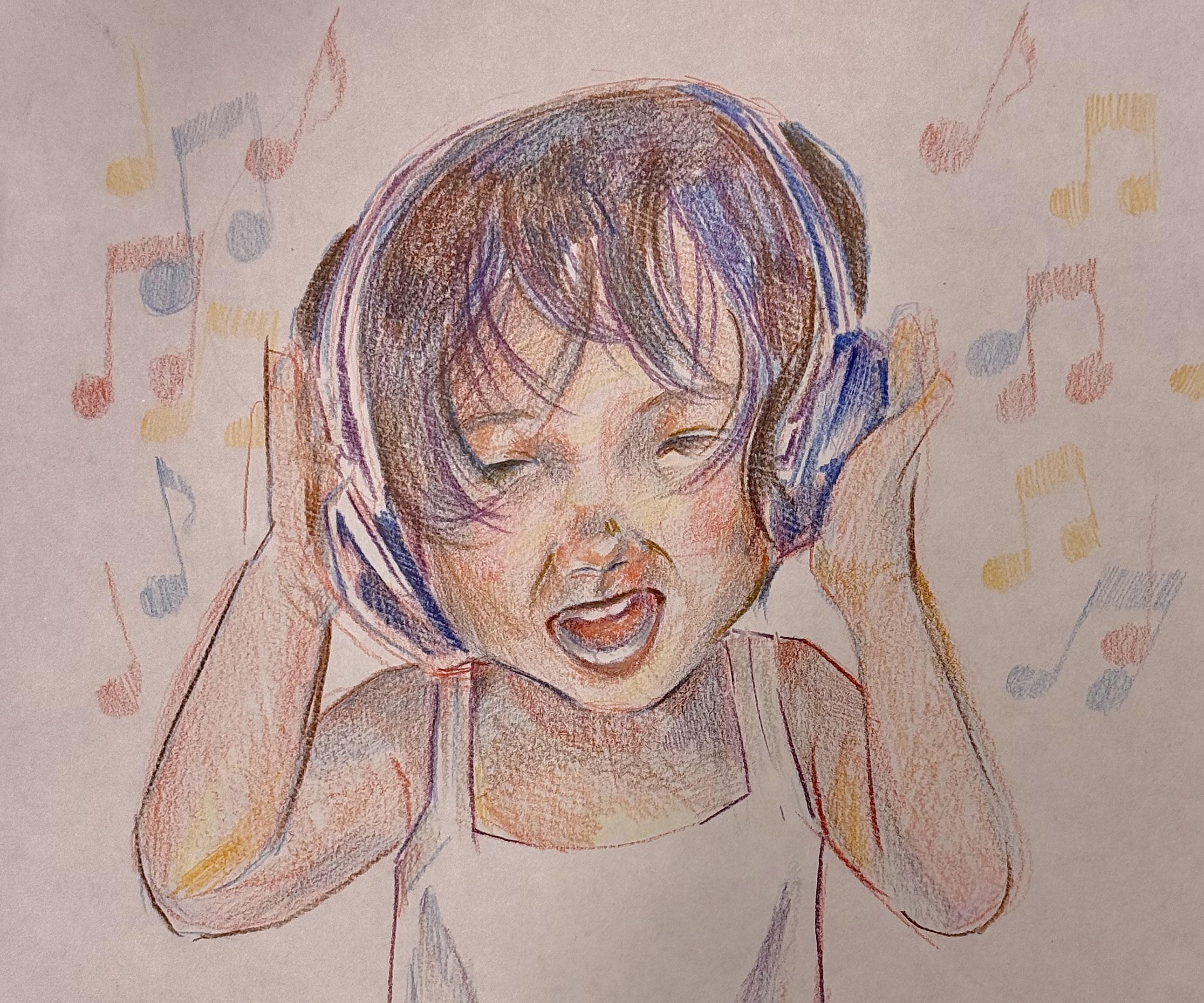
But I had one skill. In my introductory solfege class, where you learn how music works from a perspective of harmony, rhythm, and melody, I was singled out by a teacher. She made me look away and pressed a key.
“Which note is that?”
“A,” I told her.
“And this one?”
“F-sharp.”
She looked at me and enthusiastically declared, “Well, now we know that you have perfect pitch!”
Let me explain myself. You know how they say we could all be perceiving colors differently because we would never know that our “blue” is someone else’s “red”? We could look at the same thing, call it the same word, but have different subjective perspectives. It’s called the “inverted spectrum” or the “qualia problem”—some first-person experiences cannot be fully understood through third-person objective science. Well, my qualia problem is my perception of pitch. Before that class, I never realized that other people hear music very differently from me. Which is quite a reasonable assumption to have about your perception of the world!

Apparently, perfect pitch occurs in 1 in 10,000 people. To me, music is words. Whenever I hear a piano note, the humming of the saxophone, or a squeak of the violin, I hear a word. Music quite literally speaks to me. Every melody is simply a sequence of words. In the car with my family, I would sing “Ti-la-sol-mi-solmi-fa,” and everyone thought I was saying those words randomly; in reality, every word was tightly, inextricably linked to a pitch. Calling one pitch a different word made my brain shortcircuit, which is why it was always hard for me to transpose the melody into a different key in the choir and call the new, lower notes the initial names. I wanted to scream. This is wrong, guys! This does not make any sense! So whenever people are surprised by my ability to recognize or pinpoint the pitch correctly, I feel slightly confused. It’s not even that I make a correct assumption or listen carefully; I just know it, the way you recognize the smell of vanilla or distinguish a
salty taste from a sweet one, a rough surface from a smooth one. Each key is a word. I don’t need to ask; notes reveal themselves to me straight away. As you may guess, this carried me through music school. While others had to sweat during solfege dictations to write down the melody correctly, for me it was like writing down a sentence. This helped me make friends in every music school I went to. While my piano skills were quite average, there was no one as passionate about music theory as me. At some point, I lived in Perm, a city next to the Ural mountains—often called the last city in Europe because the Urals separate Europe from Asia. It would get very cold in winter, which didn’t necessarily indicate no classes. There was a rule: If an agreed-upon weather forecast website said negative sixteen degrees Fahrenheit, classes resumed, but if it was negative seventeen degrees and windy, school was cancelled. Picture me, an eleven-year-old, at 8 a.m. in January, making my way through the snowdrifts to get to my music theory class on time. It seemed my teacher was one million years old; I was confident she had witnessed Bach in his prime. I still cherish the notebooks from that time, because the stories she told us about composers I would never be able to find anywhere else… Alexander Scriabin’s synesthesia, Sergei Prokofiev’s childhood, Mikhail Glinka’s relationship to Alexander Pushkin through their lovers; she seemed to have known them all on the level of close friends, because if Schumann didn’t tell her all about his love life over a cup of coffee, how did she find out?
And then there were music theory competitions, where you had to memorize a hundred pieces of music and be able to recognize the composer, the original source (like the name of the opera or ballet) and sometimes, for concertos and sonatas, the specific part, say, Allegro molto moderato. To me, it was just recognizing word sequences and naming them with other words. Finally, I had found a niche where I didn’t have to be humiliated and could put my weird ability to good use.
The reason I have so many thoughts about perfect pitch is not because I’m particularly proud of it. Realistically, I’ve done nothing to earn or train it; I was simply born able to recognize notes. To me, it represents something much more symbolic— because, frankly speaking, there really isn’t much use to it other than when playing piano by ear or desperately trying to come up with a party trick. Perfect pitch frames how I hear the world. The street to me is a fusion of sounds and semitones: Car horns are often F or F-sharp, EMS sirens are augmented fourths, and intercom code is a funny sequence that you can memorize and hum to yourself. At some point, I discovered that the keys of my push-button phone are tuned to different notes, and spent hours playing melodies on it by ear by pressing the keys in the correct order. There isn’t a sound that doesn’t speak to me.
acceleration… mi… law of gravity… sol…
A similar thing occurs at classical music concerts. I wish I could let music envelop me, dissolve me, enter into my consciousness, and it does on some level, but there isn’t a way to zone out. There isn’t an outlet to “turn off” the conversion of sounds to words. You can’t escape it, can’t run away from your own head, and the more you think about it, the more overwhelming and stress-inducing it becomes.
None of my neuroscience professors knew how perfect pitch worked. That’s the philosophical part; what is the purpose of this ability in my life? Why me? What makes my brain different, and is there an explanation for this weird machinery behind the connection of sounds to words? What would have been different if I had never learned the names of the notes?
I think that a remarkable characteristic of perfect pitch is its atypicality to the human experience. We very rarely know things with confidence. This absolute degree of correctness is alien to how we operate. Consider the culinary area: When you blindly try a new dish, say, a new soup, you can list some of the ingredients, but would you know all of the spices used? Or in perfumerie: If there were an analogous ability in smell recognition, we would be able to confidently break down the fragrance pyramid. Even though some people are more inclined to precision in those activities, such as acclaimed chefs or experienced perfumers, the detail I’m emphasizing here is the absence of hesitation. The almost automatic recognition. The lack of need to think about the answer.
While explanations of those examples are heavily rooted in the neurobiology of taste and smell perception, it’s all just helping me paint the bigger picture: Humans are not quite wired for immediate knowledge. We tend to process information and our degree of confidence varies. From small things like guessing the outside temperature to describing the subtones and flavors during a wine tasting, the beauty of the human perception is its arbitrariness, relativity, and the range of sensations uncertainty provides us with. I am glad that I don’t immediately know if my coffee beans are from Nicaragua or New Zealand. I am grateful that I can’t say straight away what marzipan reminds me of. (Macaroons!) I am happy that I can’t instantly tell if I’m in love. It’s the process of pondering, assessing, comparing and figuring out the answer, because there isn’t a correct one, and marzipan could also remind me of the filling of the almond croissant, and my coffee could taste both earthy and floral, and I could cherish someone and think that I love them only to realize later that love is something entirely different.
But it gets overwhelming. At some point, I realized I can’t study with music on. Usually, people tend to only get distracted by music with lyrics, because our phonological loop in the short term memory model starts to process them as language. This interferes with your attempt to read, but might not disrupt your math problem set drill, since that isn’t as much of a language-heavy activity. But to me, every instrumental melody, even classical, even lo-fi—especially lo-fi, actually—is a constant flow of syllables and words. Re… F-sharp… centripetal
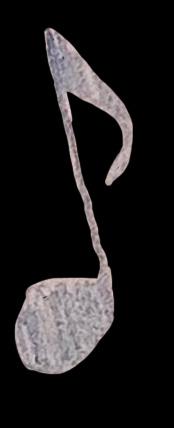
I’m glad I don’t always remember my dreams, that I don’t always notice the cameo in a movie. I’m excited about the ability to experience the feeling of eureka, whether it’s after figuring out a hard physics problem or remembering the name of that one cartoon I watched as a child. And you know what—sometimes the clang of a metallic object is not distinct enough, and I can’t tell if it’s an E or an E-flat.
And that’s okay. Because in the human experience, nothing is perfect—not even perfect pitch.
how lucky we are to have each other how lucky i am to have you
this piece means nothing
by Shriya Goel
Illustrated by selena zhu
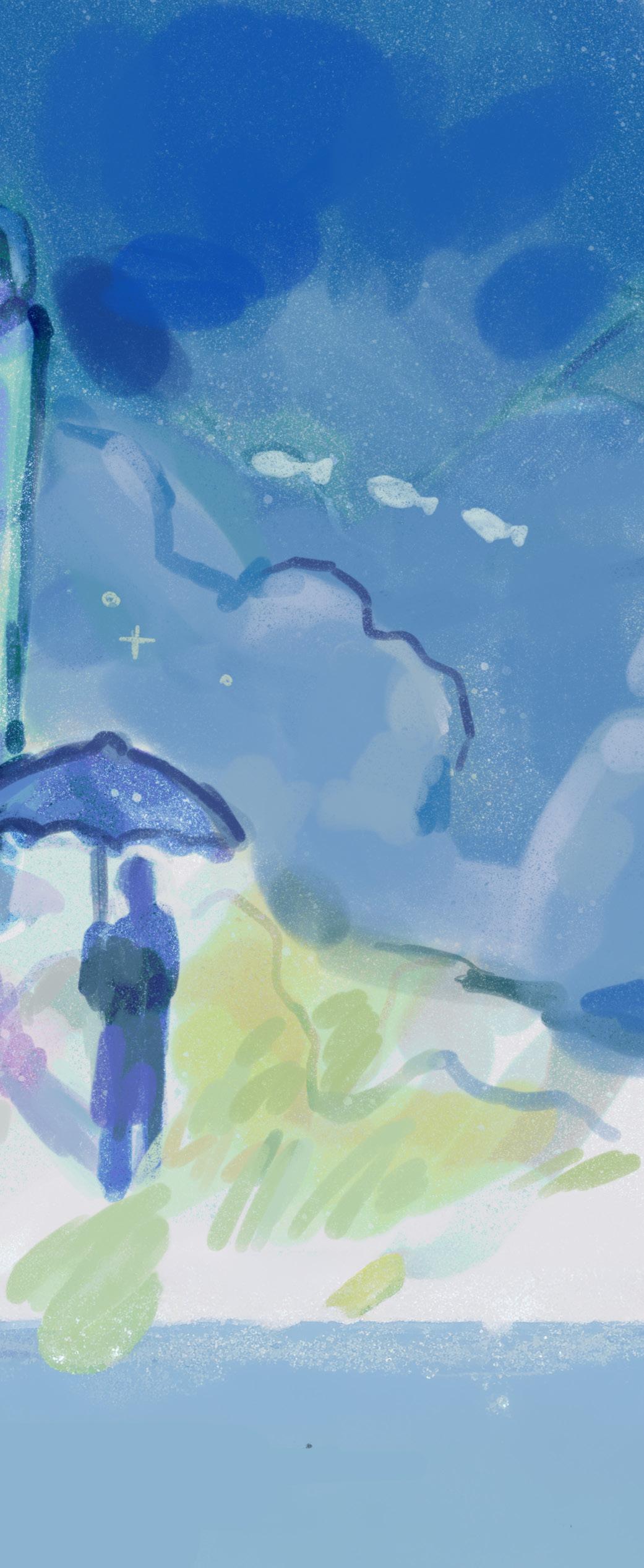
There are days that it rains even when the weather app promises it won’t. I still choose to trust whatever the weather app says for the next day and the day after, but you don’t. The weather is always changing and so are you, so maybe I should be changing, too. Instead, I sit still.
If I could confess, I would. If it was so easy to let go, I would. But I’m scared. I’m scared I’ll regret my decision, and I’m scared I’ll want you back. But you won’t understand, and there is no way to make you understand that.
There is love all around me, so I shouldn’t have any reason to be worried. Except the love that matters most to me, I am starting to realise, might not be good for me. But there is other love, too. Love is more than you. It is also forgiveness and my friend walking out in the cold to get me a Jo’s milkshake. It is also apologies and sitting with me while I finish my p-set. It is also care and the belief that we will do better tomorrow. But I’m worried. What if all of this other love is not good enough to keep me going and the only love that is sufficient is the one I need to let go of, at least partially?
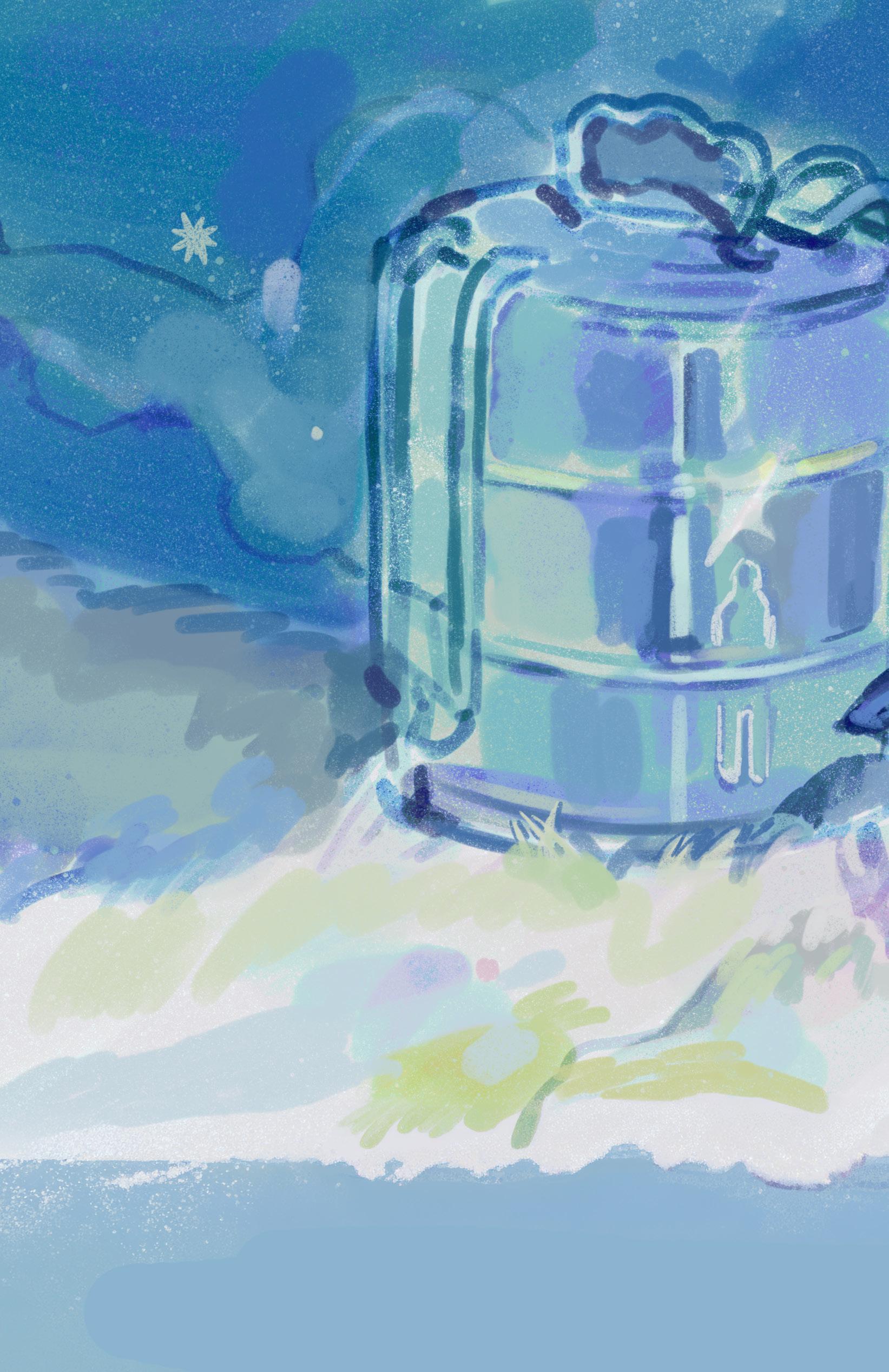
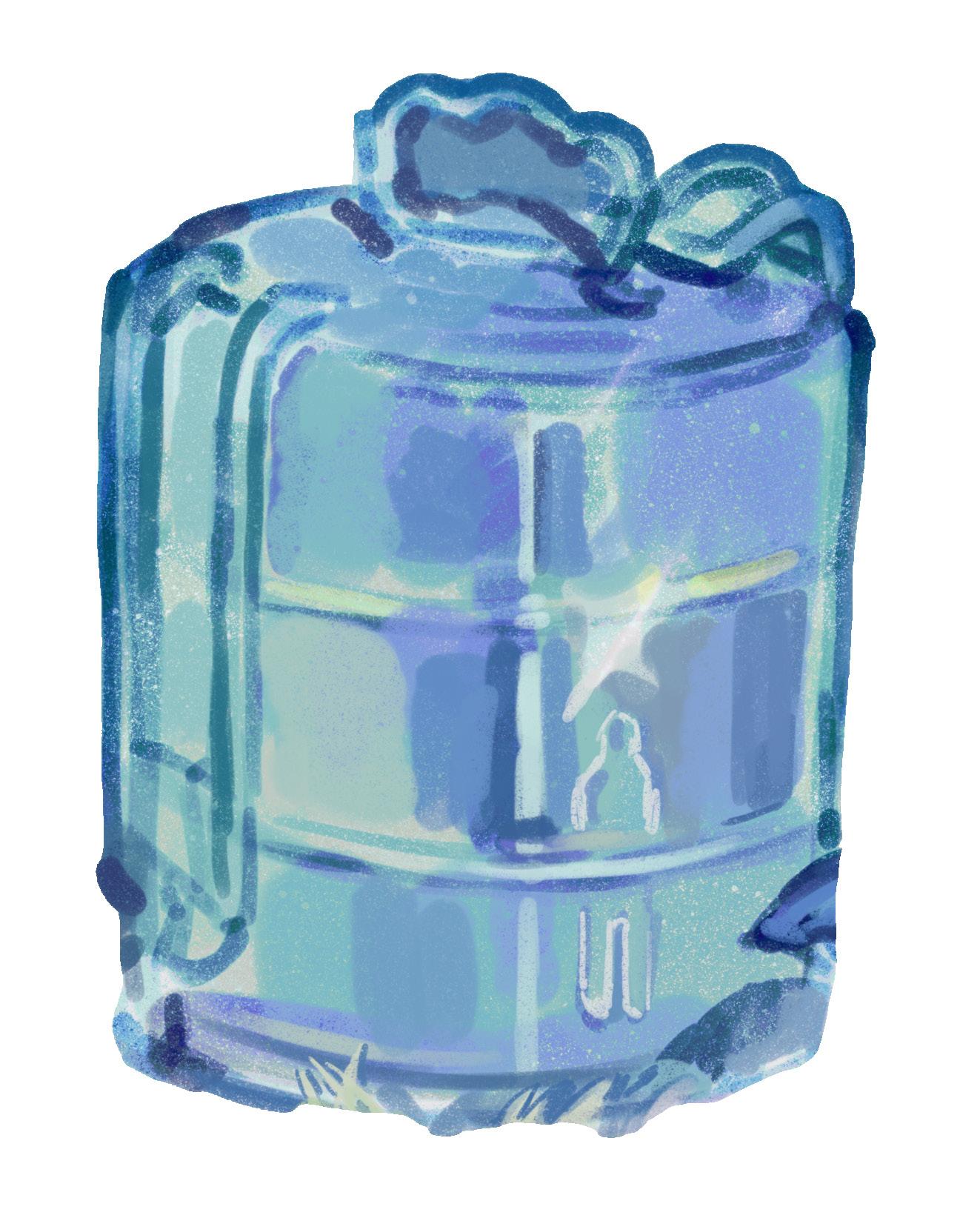
Pink primroses bloom, and the skies are bluer than usual. I keep looking up and clarity drifts down like perfume. I realise I have misinterpreted people and misinterpreted actions, mistaken mist for smoke and smoke for mist. My steel tiffin falls out of my bag and onto the ground. I scrunch my nose as I pick it up, wet grass clinging to it like I clung to what I thought was good, real, forever.
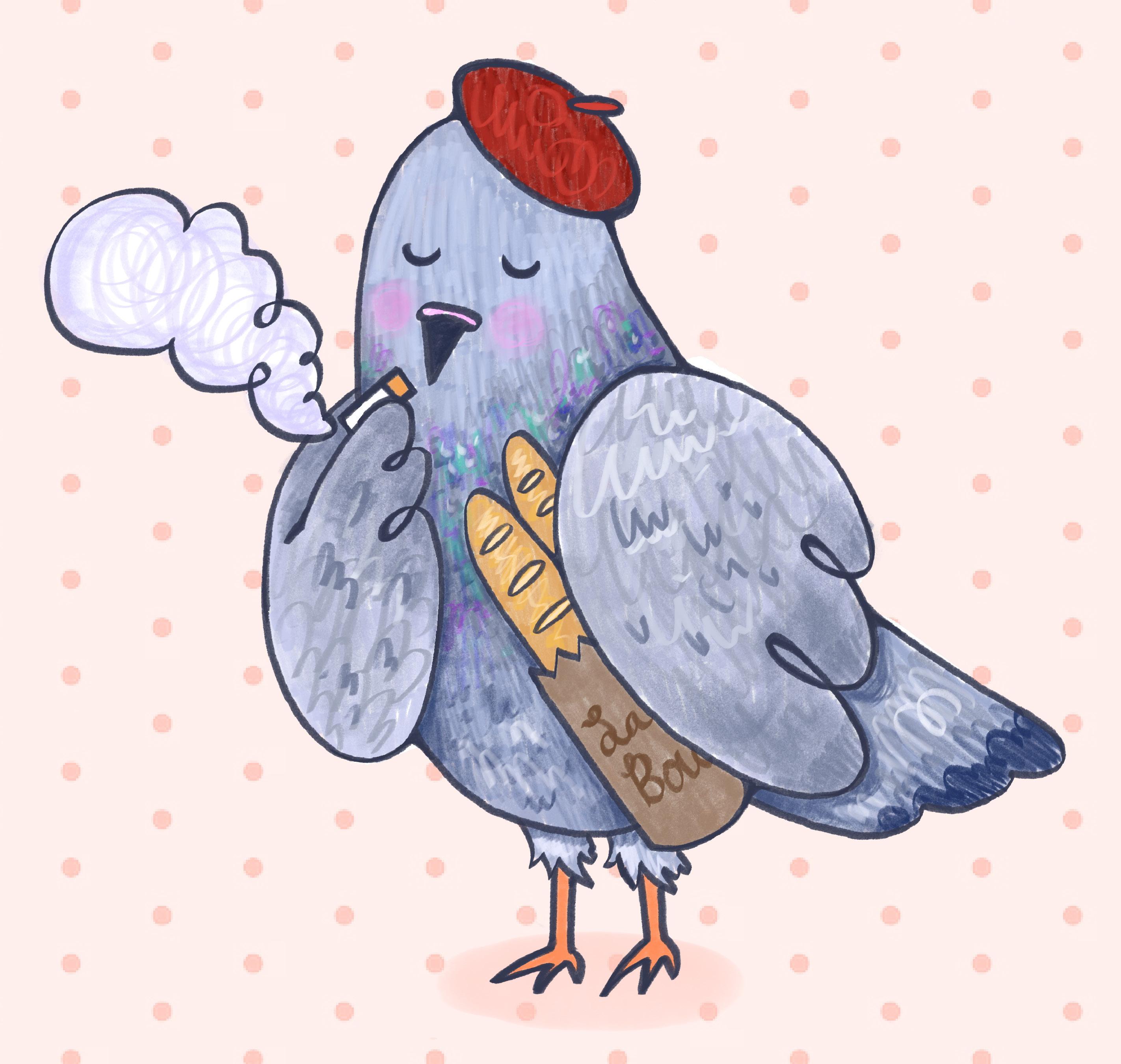
the joys of being an american flâneur in paris
by Madison Diaz
Illustrated by Orla Maxwell



What is there to say about Paris that hasn’t been said already? The rumors are true: Parisians strut around with baguettes peeking out of brown paper bags, breathe more cigarette smoke than air, and take politeness very seriously. The city pigeons coo and peck at croissant flakes underneath café tables— nothing new, but in Paris, everything can be viewed through rose-colored lenses. An ordinary pigeon, by virtue of being Parisian, is worth paying extra attention. Random alleyways, through which locals pass without batting an eye, are picture-worthy, because of course, it is Paris.
This spring break, my best friend and I embarked on our first European journey: a full circle moment for two small-town girls who had met in third grade and came to Brown together, eager to see the world. We landed in Paris ready for a week of sightseeing and spending all (and I mean all) of our money— the two markers of a great vacation. My prior research on Paris consisted of watching videos on social media (“10 Things You Should Know Before Visiting Paris!”), asking a French family friend for advice, and, at the suggestion of an author I had met previously, reading The Flâneur by Edmund White. The Flâneur is a travelogue centered around “the Paradoxes of Paris,” seen through the lens of a flâneur: an aimless stroller, walker, or pedestrian who moves through city streets with no purpose, but rather, a sense of adventure. Essential to being a flâneur is a willingness to explore and see where the wind takes you. In this cultural guide, White writes about the history of Paris, from its failed attempt to become a skyscraper city in the ’60s to the scandalous lives of 20th-century French writers and actors. The Flâneur spoke to me as someone who (1) loves walking and (2) admires the little things in life. I began reading it in hopes of embodying this type of traveler during my week in Paris.
Paris’s districts—arrondissements—are numbered one through twenty. Beginning with the first (home of the Louvre), at the center of the Seine River, the arrondissements spiral outward to create Paris’s enticing orbit. In The Flâneur, White writes, “In Paris virtually every district is beautiful, alluring and full of unsuspected delights, especially those that fan out around the Seine in the first through eighth arrondissements.” Upon landing, my best friend and I observe this beauty, noticing the way the sun bathes the buildings in light, welcoming us with open arms. Our first stop is to meet a friend from Brown at the Eiffel Tower—cliché, but even flâneurs must see the city’s heavy hitters before they can appreciate its finer details. Our Parisian adventure begins by navigating the metro and practicing our “non merci” to the vendors selling light-up keychains and bottles of wine at the tower.
Throughout the week we follow a loose itinerary, but in the spirit of being flâneurs, leave room for wandering aimlessly. I begin to

think that Edmund White was right—that Paris is best enjoyed when one is open to anything, whether that means stopping at every vintage shop we can find or climbing Montmartre’s hilly cobblestone avenues in search of souvenirs. For breakfast, we have demi-baguettes and pains au chocolat, picking at them while we peoplewatch from outdoor café tables: a Parisian’s favorite pastime. Our home base for the week is the eleventh arrondissement, which is described as a great destination for food and history enthusiasts alike. In our area, there are cafés and bakeries—boulangeries—on every corner, where we make failed attempts to blend in with the locals. Staying in the eleventh makes me feel integrated with true Parisian life, but I’m sure that our imperfect bonjours and mercis out us as tourists anyway.
On Tuesday, we make the trek to the Sacré-Cœur, up the Rue Foyatier’s 222 steps, our calves and knees burning intensely. The pain is worth it once we get to the top, where we admire a hazy but breathtaking view of the city’s skyline. On Wednesday, in true flâneur fashion, we lack lunch reservations and end up eating crêpes against the picturesque backdrop of Notre-Dame’s French Gothic architecture. The glistening sunlight provides a false sense of security—as we begin to walk off our meals, a sudden hailstorm ensues, prompting us to find refuge in Paris’s most famous cathedral. Thursday afternoon is spent sipping hot chocolate at the renowned Café de Flore and roaming the Jardin des Tuileries. We devote Friday morning to getting lost in the maze that is the Louvre and come out having only seen a fraction of it. These are what White deems the “Major Sights” of Paris, the landmarks that foreign tourists like us eagerly cross off their lists. It’s the moments in between these “Major Sights,” however, that become my favorite. During one particularly open afternoon, my best friend and I amble around the eleventh arrondissement, taking in the neighborhood as we go. We stop along the way for food and eat our lunches on a park bench, surrounded by the unfamiliar sounds of chatty French families. We decompress from the day and discuss tired topics—for us, beating a dead horse is an international activity, and a lot more fun to do in Paris than Providence. On the day of our Notre-Dame-hailstorm debacle, we visit Shakespeare and Company, a historic English language bookstore. Since its opening in 1951, Shakespeare and Co. maintains its legacy as a place for writers, artists, and readers to gather. Inside, the floors creak with each step and the walls are lined with books of every genre, making it one of my most cherished stops of the week. In the fourth and eighteenth arrondissements, we find ourselves drifting in and out of several thrift stores, ready to dig for vintage gems. As flâneurs, we are mostly untethered to concrete plans, which allows us to hunt for as long as we like. At one thrift shop, our hunting is interrupted by a small mouse
that skirts around the piles of vintage clothes flooding the floor; the elderly store owner scribbles on his notepad with a tiny dog at his feet, completely unbothered by the rodent’s presence. We laugh at the levity of it all and come out having purchased great vintage pieces (mouse not included).
According to the French study “Paris dans la littérature américaine” by Jean Meral, between 1824 and 1978, there were 200 American novels written about Paris. After spending six days there, I understand why we Americans are so fond of it. Paris has an extraordinary energy that doesn’t seem to be replicable in America— whether it is due to the ubiquity of happy hour or the rich history in its bones, I cannot pinpoint for certain. The café culture, characterized by outdoor seating facing the streets and ashtrays on every table, encourages leisurely peoplewatching and casual conversation. As a fond American watching people sip mid-afternoon espresso under café awnings, I can’t help but wonder why they aren’t busy at work or rushing to get to their next destination. But, as White writes, “The flâneur is by definition endowed with enormous leisure, someone who can take off a morning or afternoon for undirected ambling…an excess of work ethic inhibits the browsing, cruising ambition to ‘wed the crowd.’” Perhaps all Parisians are flâneurs in spirit, easygoing and unhurried. The sun goes down in Paris and the air becomes crisp and chilly, but this does not stop us from strolling through the warmly-lit streets. We bounce around from bar to bar in search of one open past 2 a.m. and buy liters of beer for €6,50 or shots for €4 (good for our wallets but not our livers). When the days are over, I listen to “Paris” by The 1975 on the metro home, and life feels complete. The song’s chorus rings, Oh, how I’d love to go to Paris again, and I miss the trip before it’s even over.
On our last day, we fulfill our prophecies as classic all-American tourists and flâneurs by first visiting the Arc de Triomphe, then—at the guidance of a semi-Parisian friend—Bois de Boulogne, a lush park on the outskirts of the city. With each step I take in Paris, I admire it more. I wonder if it’s because of the easy romance of it all—the allure of adventure in a foreign country, the friends, the films I’ve seen with this exact background—or the city itself. There is a difference between loving a place and loving the moments you experience there, and for a split second I question which category I fall into. When our last night ends with sitting outside the Place du Trocadero, looking up at the sparkling Eiffel Tower, I realize that it is both the city and the circumstance that have my affection. White describes a flâneur as someone willing “to take up residence in multiplicity, in whatever is seeing, moving, evanescent, and infinite: you’re not at home, but you feel at home everywhere; you see everyone, you’re at the centre of everything yet remain hidden from everybody.” Where better to do this than Paris?


Nostalgia is a peculiar experience. It evokes a swath of emotions, usually positive. From walking down the street to passing by a food truck whose aroma encompasses scents of sweet, of salty, of something in between, it is commendable how quickly we are able to connect that something, even if just a sliver, to a memory floating in our subconscious from nearly a decade ago. Nostalgia makes me wonder how many of our memories relate to the specific experience or situation, as opposed to the emotions that are connected to that memory.
The book I’m reading in my English class, Black Flower by Young-ha Kim, makes me nostalgic for binge-reading all five of the Percy Jackson and the Olympians series in one go at the Barnes & Noble that was a ten-minute drive from my childhood home. Leaves swirling in brown-tinted tendrils on the street on a windy day remind me of the ones I saw on a different street, maybe in a different city (though my memory doesn’t provide this detail) at a different time where all the leaves in the world seem to be swirling off their branches.
To me, nostalgia represents all that can be connected in unsuspecting ways. These connections can occur between instances that are similar or different. Coffee drips discreetly— yet not quite silently—into a pot that renders itself almost halfway full while I furiously
type out my English paper due at midnight. Suddenly, I am reminded of the tendrils of steam that emit from Lorelai’s cup of coffee in that one (or maybe more accurately, multiple) scene from Gilmore Girls where she yells at Luke over something not quite that serious.
Nostalgia reaches its arms into the past, but what about the other way around? Could the license plate on the car in front of me, H-V-E-FU-N, be a premonition that I indeed am taking on too large of a workload here at Brown and should follow my heart to solo-backpack-travel through the winding hills of the Netherlands like I’ve always dreamed of? In all seriousness, part of me wonders if nostalgia viewed this way—directed towards the future—has any real difference from that directed towards the past. Synchronicity is the tendency to perceive patterns or connections in random data. Maybe nostalgia, then, is its counterpart, connected more to the emotional, right hemisphere of our brain, offering us fleeting solace in our hectic everyday lives.
And what inherently makes this sense of nostalgia appear? Is there something in the way the leaves fall to the ground on this particular day, in dainty, crescent swaths rather than the usual staccato cascade when it’s windy, that evokes a sense of longing for this scene but at home? What should I make of these
by Maria Kim
Illustrated by Chloe Medina
unexpected, pleasant moments that spring about my day, that often catapult my mood into something between reminiscence and melancholy for extended periods of time?
Maybe, like all emotions, it is something that is meant to be celebrated as something fleeting yet oddly comforting. To me, it offers something powerful, the ability to make me feel at home regardless of the place I’m in. As a kid, I would scoff at the actors I’d see on movie screens who would get teary-eyed looking off into the distance or at some random scenery. As I’ve grown older, I actually admire my younger self for so brazenly shouldering off the most “embarrassing” moments of the human psyche. The older version of me has realized that I am not superhuman and gets teary-eyed looking at pretty landscapes sometimes, too.
Nostalgia is one emotion that has taught me this lesson, keeping myself grounded and connected to my past, which ultimately shapes both my present and future.
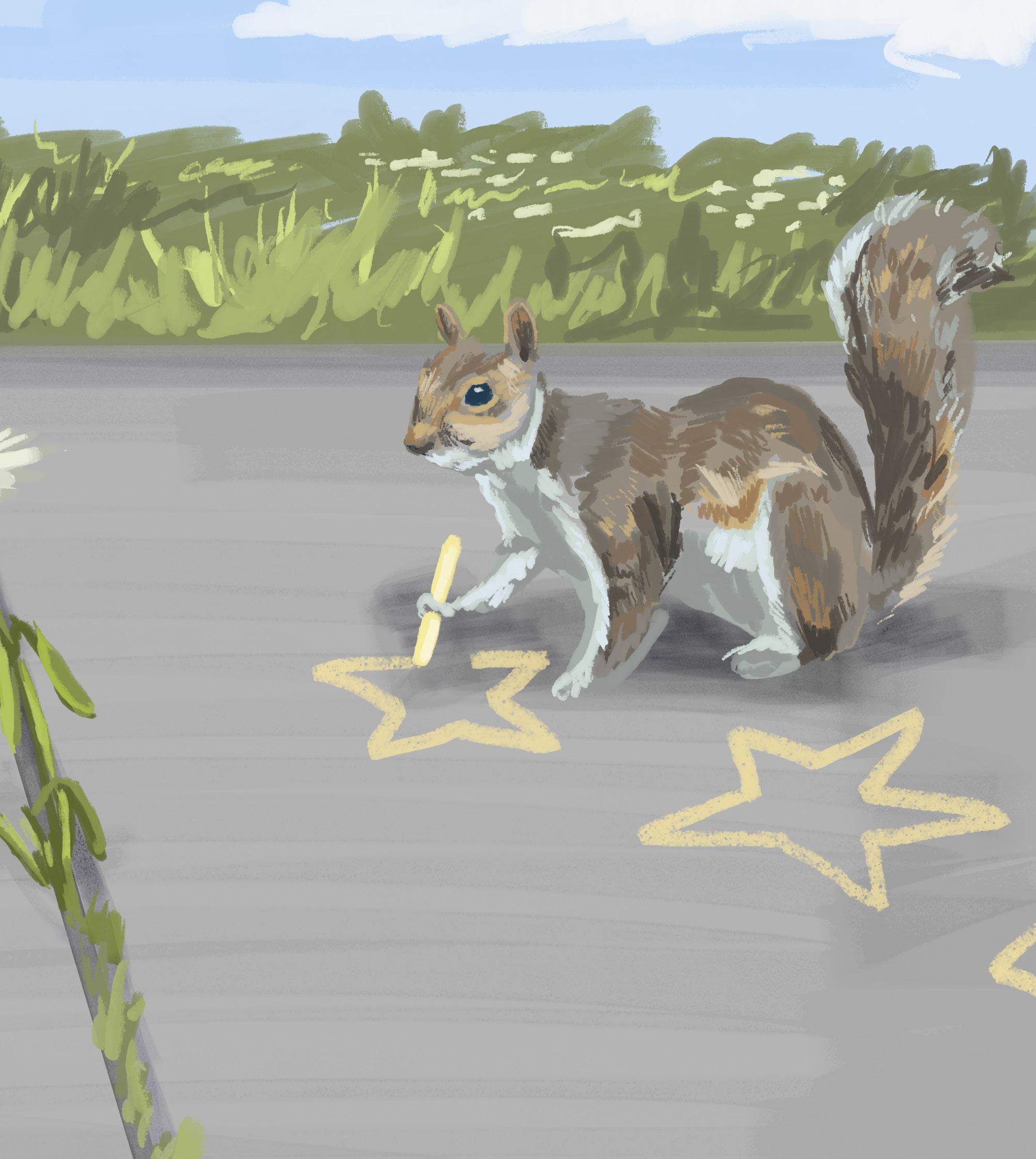
chalk stars by
Tarini Malhotra
Gold and shimmer stream through the open window; the sun is out, and she warms my cherry blossom latte. She is radiant but flimsy because it’s spring, and she has no qualms about abandoning us. I promise you, though, that it’s quite alright—Providence is a city of stars, and we twinkle regardless.
I don’t think anyone’s surprised when I tell them I loved getting gold stars in class when I was a child, but only you and I know that stars are my favourite thing to draw. You knew me when I would play with bubbles and fill the margins of my notebooks with structures made of two opposite overlapping triangles. You witnessed my transition to five-pointed stars as lopsided as the curls in my hair, and we listened to SOUR together, full of unknown angst, as my stars became more perfect and symmetrical with the steadiness of my hand. Now you’re thousands of miles away, and you can’t possibly see when I find yellow and pink stars scrawled on the sidewalks of Providence, and I secretly forgive the sun for leaving me, because at least she’s travelling to the tropics, special for you. The shadows of shade curl around my feet with unkept promises, but that cinnamon-scented cafe downtown has a blackboard where children play with chalk, and I drew twin stars, just like those on the kites in the lounge, just for us.
Sunshine and rainbows were suspended in the air again, but they were gone within a few hours. But there are hand-drawn stars etched on whispering whiteboards and time-tested bricks and the illos I make for post-, and they fill me with sparkle anew. It’s 10:45 p.m. here, and the stars are still shining: Good morning! Can I call you?
a sweet return by Gabrielle Yuan
by managing editors Illustrated by Hannah Gapp
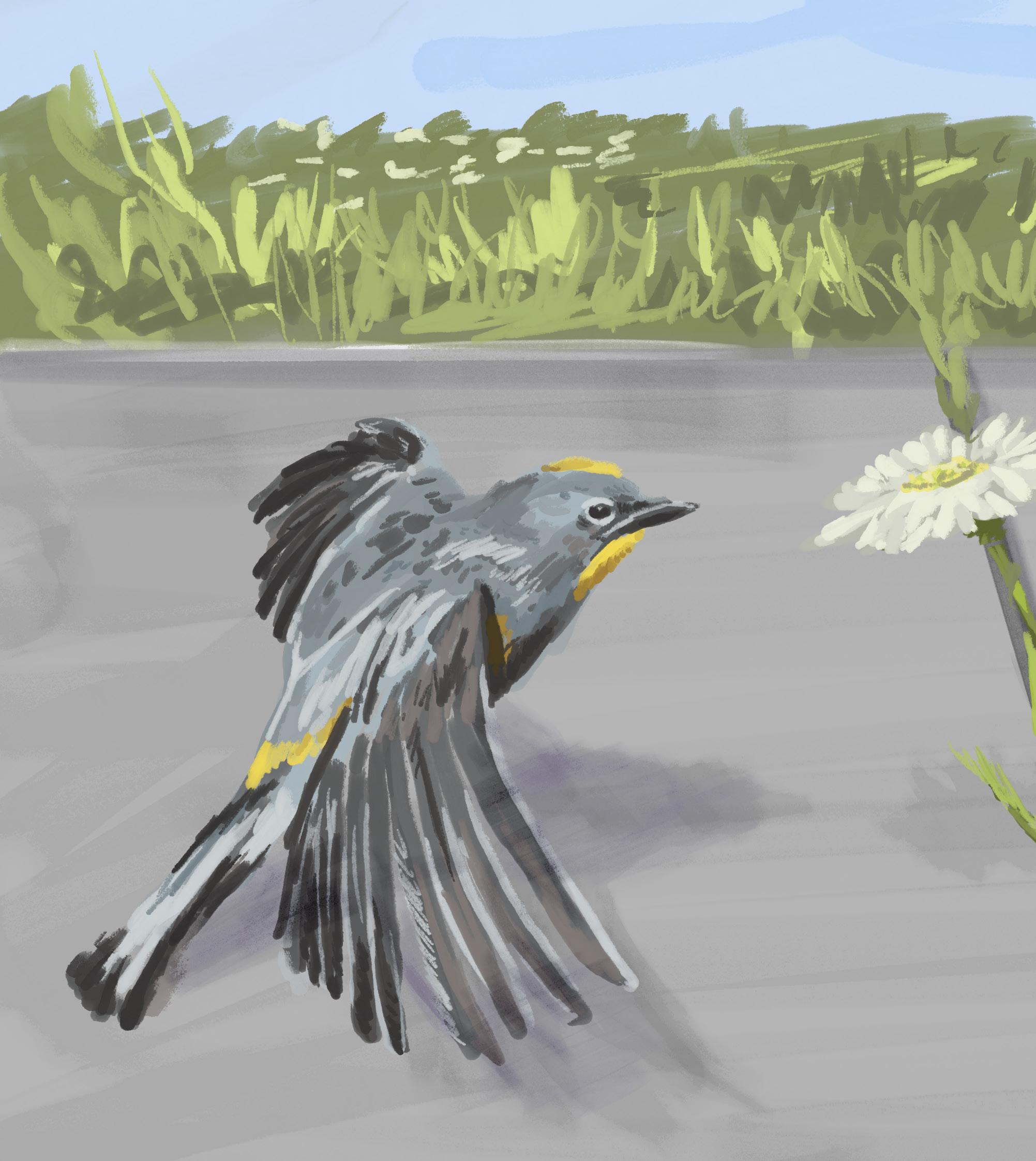
I’ve recently been spending time with someone who was muddled but emerged from the interworking of many mutual friends. It’s unfamiliar, even to myself, that only after a month of getting to know her completely on her own, I told her her eyes reminded me of Cadbury eggs (unromantic and unironic), further detailing that they were specifically the indulgent caramel-filled ones that feel neverending with each bite. I was even more taken aback when my palms didn’t clam up when we held hands for the first time, or, when the wind took complete liberty over my slightly too short, uneven bangs, I had the same strength and desire to look still into her round eyes to comb her own mane out of the way. As someone deeply unable, despite many attempts, to detach from the nuances of fulfilling social cues,
consistently finding ways to avoid awkward silences through endless questions, those very same questions hold a new weight when positioned at her. They’re somehow lighter, like an airy minty breath, and I’m brave enough to hold onto even less to her. The notion of return is strong, the fear barely present.
Then, in our faltering, cold conversation, one of us said, “Huh?” We followed the guiding finger, and huh indeed. A squirrel. Without his tail. When he bounded across the grass, it seemed like an animation glitch, the smooth wave stopping early. He seemed ignorant to our enchantment, happily journeying up and down trees.
furry encounters by
Elaina Bayard
A few weekends ago I was in Boston. There had been a confluence of events: A high-school friend was visiting her boyfriend in the city, another high-school friend was driving up from New York with his partner, and I was free for the first time in forever. So we all gathered. And none of us, apparently, thought to check the weather.
We huddled together in the Boston Common: gloomy, gray sky; biting winds; an unwillingness to open our wallets and take refuge in a Caffè Nero. The sun-adorned cardigan I was wearing felt particularly cruel.
Eventually the wind returned and we caved to the allure of a warm drink, but, briefly, we’d been so amused that everything else fell away.
onto to the next step by Hallel Abrams Gerber
I spent the majority of last week running the length of Hope Street in the dark. Moving from meals with home-people to my dorm and piles of work, I found myself deliriously making rhythms out of the bricks.
When I was a child, I spent every car ride as if I were in a video game, peering out the window and using my eyeline to construct an imaginary avatar jumping from building to
building as we drove past. I have since become more focused on the road in front of me, trying not to hit anyone, rather than looking at the scenes passing me by.
But something about last week brought me back to that game: an ordering of tasks, an intrinsic silliness, even my own created sound effects, as I moved without thinking twice. In the midst of midterms and papers and many mini-worries, I was alone and skipping, replaying a role with no responsibilities.
forever a theater kid by
Jessica Lee
Every time I make the trip to New York, I’m reminded of my deep musical theatre roots. Since theatre doesn’t play a role in any of my current studies or extracurriculars, it often becomes a distant part of my past, a long-lost dream. I forget the extent of how much joy it brings me until I’m sitting in a Broadway theatre, watching the house lights dim, and enjoying the hush of the crowd as the
and I am here with my partner, fending off a depressive episode with exercise, or something. Out on the football field, sprinklers slowly intersect like security guards’ flashlight beams. Every surface is dappled with raindrops— swing seats, bench tops, pull-up bars—but I don’t particularly care if my three-year-old Uniqlo shoulder bag gets wet. As I go to set it down, something under the bench catches my eye, dimly in the lamplight. I’m not wearing my contacts, but I know immediately that it’s a book. It’s kind of the quintessential image of one: blue cover, white pages, clothbound. No gaudy jacket or commercial text. A simple icon, sprouted like a fungus in the wild. When I pick it up, I find it completely dry.
There is a compass icon lightly embellished on the cover and a three-word name on the spine. Inside, photos and writings from family, friends, and loved ones abound. It is a celebration of the life of this man who apparently died in February of 2025—he would have been three years younger than my parents. According to the opening pages, a memorial event took place April 10, 2025, just over a year ago. But the book is pristine. The book lives.
I feel like crying in a different way than before: sad in a full way, rather than the emptiness of depression—emotions gently watercolored, not carved in black and white. Glancing across the field at the castle-like edifice of Hope, I glimpse what appears to be a stained glass window in its topmost turret. Unexpected for a high school building—I can’t quite tell if it’s real or a trick of the light. My partner says he sees it too. To my eye, it’s just a blurry beacon of impossible orange, purple, and blue.
overture begins to play. From that moment on, I am completely enthralled and nothing else matters. For two hours, I don’t check a single notification, my mind doesn't wander, and I am more present and focused than I could ever dream of being in any lecture or class. It’s partly out of love for the art form itself, partly out of love and respect for the performers. I love watching the little moments onstage when the actors try to make each other break or sneak in an unchoregraphed 8-count of their choosing. I love squinting through the darkness or peeking into the wings to watch the sets changing and props moving. I love noticing every detail I can. For two hours, I’m completely transported to another world. And for the many hours that follow, my own world becomes filled with new harmonies.
unbound love by
Chloe Costa Baker
AJ Wu
This semester has come with few surprises. Most of my days are blocked in similar colors and proportions on my GCal and I’m hesitant that, if dealt a Groundhog Day scenario, I would be able to recognize it in fewer than three days. Not to say that I’m discontent—it’s a happy sort of monotony, I think. A good routine. The other day, I checked my mail and found a postcard in it from a childhood friend studying abroad. She had sent it a while ago, but I had neglected my Page-Robinson mailbox for a few weeks and it was a bright surprise in the middle of the afternoon. On the front, she had painted a swan she saw recently in a park. I miss you! And God, did I miss her too. It’s funny how fast we can become acclimated to most things. Distance is practiced, becomes routine, and suddenly it’s been months since I’ve had a conversation with someone who used to be the center of my life. I called my friend and tried to lose track of time.
we can't all be josiah carberry
by Jessica Lee | Illustrated by Julie Sok
By this point in the school year, you have certainly figured out your favorite dining halls and go-to meals…But have you ever stopped to consider which dining hall matches your personality—not just your dietary preferences?
1. What is your birth order?
A. I’m an only child
B. I’m the eldest child
C. I’m stuck in the middle
D. I’m the youngest child
E. I’m a twin (or triplet)
2. What field of study are you pursuing?
A. Something arts-related
B. Something STEM-related
C. One of the foreign language concentrations
D. Social Sciences or Humanities
E. One of the smallest or most niche concentrations
3. Do you consider yourself a morning person?
A. Sometimes…depends on the day
B. Yes! I can’t start my day without coffee and breakfast!
C. Somewhat, I enjoy having a productive morning
D. I don’t mind getting up early, but I
E. Morning? I’m not waking up before noon…
4. What’s your go-to cafe order?
A. Cold brew coffee
B. Black coffee
C. Latte
D. Tea
E. Irish coffee
5. What is your favorite season?
A. I can’t choose!
B. Fall
C. Winter
D. Spring
E. Summer
6. What is your favorite beverage?
A. Good ol’ water
B. Coffee milk
C. Juice
D. Smoothie
E. Alcohol
7. What is your favorite Brown tradition/event?
A. Walking through the Van Wickle Gates
B. Late-Night Organ Concert
C. Brown v. Harvard Football Game
D. Spring Weekend
E. Naked Donut Run
8. What do your most productive lock-in sessions look like?
A. Soaking in the ambiance of the Hay
B. Sunbathing on the Main Green
C. Suffering in the SciLi basement
D. Isolating in the Rock’s Absolute Quiet Room
E. Multi-tasking during a lecture
If you chose mostly A’s: You are Andrews Dining Hall!
If you chose mostly B’s: You are the Ratty, or the
If you chose mostly C’s: You are V-Dub!
If you chose mostly D’s: You are the Ivy Room!
If you chose mostly E’s: You are Jo’s!
And finally, if your answers were all over the place and/or you simply don’t agree with my quiz, you can always claim to be the Blue Room, ERC, or the Underground.
post- mini crossword by
Ishan Khurana illustrated
Lila Vianna
by
2. ___ Life, Brown's housing
4. Spring Weekend artist _____ B
6. Figure sitting on your shoulder,
7. Baker's budding buddy
1. Block party game?
2. Ancient character
3. "Super Mario World" console, for short
4. Spring Weekend artist Magdalena ___
5. Word before rock or pop
“It was well past dinner time when we realized we were famished. The sun had long since set and a purifying fluorescence lit the room.”
— Kimberly Liu, “hunting for clues, eschewing the blues”
“It’s a bit past the Vernal Equinox now. The Northern Hemisphere is approaching the sun, but we’re still closer to the Vernal Equinox than we are to the summer solstice. I wish I could stay in the in-between for just a little longer. ”
— Katherine Mao, “spring (noun, verb)”
EDITOR-IN-CHIEF
Elaina Bayard
FEATURE
Managing Editor
Chloe Costa Baker
Section Editors
Anika Kotapally
Gabriella Miranda
ARTS & CULTURE
Section Editors
Section
LIFESTYLE Managing Editor
Section Editors Alayna Chen
Tatiana von Bothmer
POST-POURRI
Managing Editor
Tarini Malhotra
Section Editor
Christina Li
HEAD ILLUSTRATORS
Junyue Ma
Lesa Jae
COPY CHIEF Jessica Lee
Copy
LAYOUT CHIEFS
Alexa Gay
Amber Zhao
Layout Designers Emma Vachal
James Farrington Joshua Rezneck
SOCIAL MEDIA
Rebecca Sanchez
Yana Giannoutsos Yeonjai Song