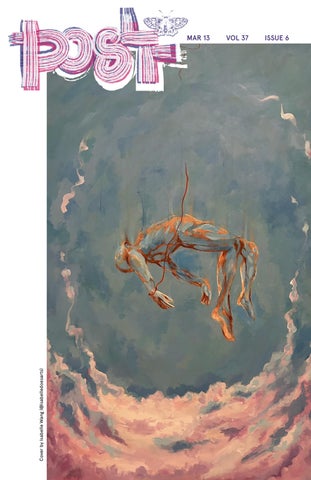
Cover by Isabelle Wang (@isabelledoesarts)
MAR 13 VOL 37 ISSUE 6
Table of
Contents chippy
1
twenty-six years of post-
3
my emily
5
pro tips, life hacks, and didacticism
7
music for a revolution!
9
dancing in a world alone
11
all of us at once
13
pockets of providence
15
post-pourri
find a penny, pick it up
17
crossword
first light
18
feature
narrative
arts & culture lifestyle
SIGNS 1. Now Entering Rhode Island 2. “I saw the—” 3. The one that is both the signifier and the signified 4. Goose crossing 5. Those vultures circling overhead 6. This one—send that text! 7. Auld Lang 8. On the dotted line 9. Count Olaf’s ankle eye tattoo 10. Now Leaving Rhode Island
4
post–
“The eight-year-olds yearn for the gorges.” “You brought a knife to a black hole fight.”
LETTER FROM THE EDITOR
letter from the editor Dear Readers, Despite the warm weather, I’m stuck reminiscing in the cold while time escapes me. Undoubtedly, February ranks first out of my twelve months— probably because there’s so much worth celebrating in just those twenty-eight days. With the mini snowstorms and record-breaking blizzard, after spending as much time outside as possible until my toes could feel no more, I spent the rest of it lackadaisically resting, in and out of a state of sleep and thought. I’m thinking about my large circle of loved ones bedazzling lip balms on a Saturday night, playing Cabo at 8 p.m. in isolated Western Maine, recreating the baseball scene from Twilight on the Main Green, and a new type of feeling—perhaps one finally returning, flickering under the edge of my arms, growing warm at the thought of new friends made each semester. I’m learning to remember and to recall and to recollect these mini moments, especially when alone. In this issue of post-, our writers are simultaneously reflecting on moments that bring us peace, while exploring new activities. In Narrative, Danielle writes
about the changing seasons within her home, while Katya discusses the different ways to give advice. In one Feature article, Coco talks about elementary school love through secret notes. In the other, Sasha details the history of post-, interviewing members of our original staff (!!!). In A&C, Ozzy analyzes action-thriller One Battle After Another, while Madison reflects on how Lorde is quintessential to coming-ofage imaginings. In this week’s Lifestyle, Acadia talks about enjoying movies alone, while Rachel reviews the local charms of Providence. In post-pourri, Alayna has a scavenger hunt for us. Finally, check out AJ’s springtime crossword! As the snow melts and I no longer have to wear thermals under my T-shirts and long skirts, I’m looking forward to the activities that take place best outside. Long runs by Blackstone Park, starting late in the afternoon with relentless sun; Prospect Terrace picnics consisting entirely of Whole Foods’ various cake options; traveling across the country to see friends we miss the most. Do you feel it? Spring is coming,
Gabrielle Yuan Narrative Managing Editor
FEATURE
Chip Clarke looked like a dream. Frankly, he was a dream to me. In 2012, he was practically identical to Justin Bieber—same honey-brown, gravity-defying swoop and soft, cherubic face— except he was eight. I would fantasize about him being my boyfriend, about him noticing me in the ways that counted, not just because we were assigned seats near each other in Spanish class, but because he had privately concluded I was beautiful. That I was, in some quiet tribunal of his mind, The One. My affection for Justin Bieber was most definitely loud and girlish; my deep crush on Chip was nearly monastic. Burning alive, buried inside of me. Pressed between diary pages, woven into the storylines I made up for my Barbies (he was always Ken), humming quietly in my subconscious as I slept for ten hours every night—the sleep of the morally uncomplicated. I was eight, and the boys in my grade were supposed to be disgusting, carriers of germs and cooties. It felt unkempt and embarrassing to think otherwise. In some vague season, on a day whose weather I do not know, I walked into Ms. Spooner’s second-grade homeroom, and Stewart, one of my close friends at the time, came bounding towards me. Stewart was like a golden retriever puppy—puppy because she was eight, golden retriever because she had electric blonde hair, tan-tinged red skin, and shocking blue eyes, bright and startling against her round, full cheeks. She was always bouncing, wagging her tail, always excited about something. I was curious what she had to tell me, of course, but not in a way that prepared me for surprise, because at eight in the morning, news from another eight-year-old rarely alters your life. But what she told me most definitely surprised me. I have a crush on Chip. Surely I was going to throw up. My stomach churned with hot disgust, and it didn't help that my heart was sinking right into this fiery pit of despair. She “called him.” She got to him first. She was the first lady brave enough to admit that he was absolutely the cutest, most wonderful boy in our class. And her courage, well, I couldn't argue with that. And I could hardly make my admission in tandem. At eight, that’s copying. Instead, I suggested she write him a love letter. I recall her giving me a kind of slanted, confused, lost-puppy (classic) look back. Clearly, Stewart was not a wordsmith. I insisted, This would be good, and anonymous—he would know he has an admirer. (The logic of this plan is entirely lost on me now, but I had probably seen it played out perfectly on some Disney afternoon specials. Front-runners include: Hannah Montana, Liv and Maddie, Ant Farm, etc. (Also…the anonymity of the letter didn't 1
post–
chippy entirely kick me out of the race…)) She conceded, and we set out. We gathered pink and purple construction paper—that was Stewart's hand in all of this, the making of the card. Our other friends came up, nosy, asking what we were doing. Secret project, butt out, we’d snicker. Then it was time to write. Stewart held the pen, shaky and unsure. I leaned in: Well, what do you want to say? How do you feel about him? She didn't know. Either I liked him much more, or her feelings were bigger than her vocabulary. Regardless, Stewart was out of her depth, so she passed me the pen, insisting I would be better at this. So I proceeded. Gladly! I can't remember exactly what I wrote—only that, judging by the aftermath, it might have been a little racy for second grade. Something along the lines of: I think you are the most handsome boy in the whole school, and I would love nothing more than for you to be my boyfriend. Then I think it said I’m in love with you. Love, your secret admirer. We felt not only a great sense of accomplishment, but also gloriously corrupt. We had stepped one inch past the invisible chalk line drawn around our youth. We had written to a boy. We had written love. We had invoked forces previously reserved for middle schoolers with lip gloss. At eight, this was complete and utter debauchery. But I could tell the devious sparkle was brighter in my eyes than in Stewart’s; while hers was more of a porch light eerily flickering in a storm, mine burned steady and devotional. She seemed nervous, understandably; this was an enormous admission, heart laid bare on pink cardstock. But I reassured myself, in my benevolent internal monologue, that I was here to help her. So I offered to slip the letter into Chip’s locker. It would be far too risky for her. What
when i first became inappropriate by COCO Kanders Illustrated by Candace Park
if he saw? What if he knew about her big fat crush? No, no, allow me. I would be the courier of longing. Stewart was the horse, and I was the mouth. The body trembling with desire and the articulate tongue. This was completely altruistic of me, entirely selfless. I was happy to help! We walked all of fifty steps down the hallway and to the left, holding our feminine divine quite literally in our hands, in a thick pink envelope with red Sharpie and heart stickers that caught the fluorescent light like sacred relics. The hallway buzzed with that classic institutional buzz, warm from the carpeted floors and bulletin boards declaring READING IS FUN! And we moved through this playpen like conspirators, giddy, knowing we knew something no one else in the whole school did. This wasn't a prank or a childish game; this was romance, yearning. Ancient and operatic and wildly disproportionate to our height. She waited about ten paces back, posted as a lookout, hands clasped tight in front of her, while I advanced. We knew we needed to be quick about this; the school day would start any
FEATURE
minute. The logistical problem: Chip’s locker was two down from the door to his homeroom. Dangerously exposed, but luckily, most of the students had already been funneled inside, so the corridor lay briefly unguarded, giving us a narrow strip of possibility. It felt safe, but like a heist nonetheless. I tiptoed up, heart battering my ribs, slid the note through the top slit of three, and turned back to Stewart. We did it. Home free. And then— Coco, what did you just put in Chip’s locker? Chip’s teacher stood in the doorway, adult and enormous. I turned to Stewart for backup. She was gone. Evolution at work: survival of the least implicated, joke’s on me. Ummmmmm. I can't remember the teacher's name. She opened the locker, picked up the letter, and asked me to return to my classroom. Some portion of the day dissolved, and I moved through it underwater, so nervous about what was to become of me. I felt dirty, and not the kind of dirty I felt after recess, but spiritually dirty. A promiscuous degenerate who was itching for the hands of Aphrodite to
bring me my mini Justin Bieber. And the worst part: It was true. Stewart barely had anything to do with the whole farce. The urgency, mine; the hunger, mine. This no longer felt like yearning or anything close to romance. Frankly, I felt like I had betrayed my adolescence and Stewart’s and Chip’s. It was my perverted mind that landed me smack-dab in the middle of this whole mess. By snack time, Ms. Spooner called me into the small auxiliary office—the one used exclusively for teacher lunches and child discipline. I knew immediately which category I fell into. She was very pregnant then, and luminous. Thick black hair pulled into a tight ponytail that could only wrap twice around itself. A sharp, almost animated nose and a sweet smile that had previously been a North Star for me. I loved her with the fierce devotion reserved for second-grade teachers, the ones who function as your mother for eight sanctioned hours a day. I wanted to be her, or, at the very least, to be approved by her. Today, she was not amused. This was not precocious or adorable. This was a breach: I, Coco, had invaded someone’s personal space. The word inappropriate landed like a verdict, so final, chilling. That's what I was, inappropriate. She said she would speak to Stewart, too, but we both understood the authorship here; I was, as it goes, caught red-handed, and between the tone, the flourish, and the reckless leap to love, she would have to call my parents. Shame quickly became physical. My face burned so hot it felt radioactive, and I was nauseous. But this was different from the kind I felt when I found out Stewart liked Chip; this was consequential nausea. I wished the chair would sink through the tile and lower me quietly into the earth. Preferably somewhere subterranean and punishing. Get it over with already. I wanted my
mom. I was also certain she would despise me now. Everyone would. Ms. Spooner. Stewart. Chip. God. Hell, probably Justin Bieber too, in his handsome, all-knowing ways. I despised myself most efficiently of all. The end of the day couldn't come slowly enough. When I got home, I opened the door quietly and slipped in like a trespasser. I eased it shut without a click, and as I shimmied off my shoes and attempted to disappear, unknown, upstairs, I heard my mom beckon me from the kitchen. Shoot. Jacket and backpack still on, I shuffled in, head down. My parents sat at opposite ends of the table, grave and symmetrical. I hovered by the door next to the landline, noting the instrument that had carried my prosecution. My head was down, not because I feared their crucifixion but because a new part of me, one I had only recently discovered myself, was now exposed to them. I was supposed to be their little girl, not some sexually craven rebel, scribbling love letters to boys. And I still was! All I wanted was to collapse in my mom’s arms and let the dam break, tears, hiccups, all of it. I imagined pressing my face into her soft chest, breathing her in, as her hand rubbed slow circles on my back like she always did when I was sad. Then she would laugh a little, and tell me, smiling, lifting up my chin to face her: Oh, Coco, you have a crush, it's okay. If anything, you are just a true romantic! She would then remind me of the time her brother read her Hello Kitty diary and discovered her own crush on Ryan Koffman, proof she knew this feeling all too well. That was not the ending I got. Hello, I said, bracing. They asked me to sit and told me Spooner called. Coco, we don't do things like this; that’s inappropriate. That damn word again. They couldn't quite articulate why it was catastrophic, only that the school had deemed it so, and therefore it was. Institutions speak, and parents echo. This was the kind of behavior parents in a small buttoned-up town in Connecticut would talk about and refer to as cheeky. Cheeky was not good; cheeky was sassy and slutty. As they rambled on, I drifted somewhere above the table, above the house, observing this small disgraced girl in her little jacket and little backpack, realizing with a clarity that wanting can indict you. This was when I learned true shame. The slow, interior kind. The kind that suggests something in you might be fundamentally miscalibrated. Too much, too soon, too intense. Maybe this was the afternoon my romantic world first shrank. Or simply the moment I understood that desire, once made visible, can turn on you.
M arch 13, 2026
2
FEATURE
twenty-six years of postan introduction
by sasha gordon Illustrated by tarini malhotra
The Beginning Somewhen in the interim between December 8, 1999, and January 26, 2000, an anomaly showed up on the Brown Daily Herald’s masthead. Somehow, Brooks King and Dara Cohen had been taken from the “assistant editor” and “staff writer” sections and erroneously written down as the magazine editor and assistant magazine editor of “post-.” Post- what? Post- what indeed. Today I’m bringing you what I did, postthat, to find out. This all started when I decided I needed to know how old post- is. Throughout the year, I’d checked off my friends’ birthdays, marked the occasions with cakes and dancing and trips to bookstores, but my best friend, post- magazine, wasn’t one of the names remaining on my evershortening list. Unacceptable! Furthermore, how was I to know if post- could take driving shifts on our cross-country roadtrip? Vote in the midterms? Buy a bottle of rum or even, perhaps, rent a real rental car? My world reoriented around my newfound priority number one: find the year of post-’s birth. I nudged a few editors, called up a few websites, and ultimately found my way to post-’s Issuu site, where after 83 seconds of looking, I promptly texted our dear EIC with “I might be wrong but I think this year is 20 years of post-?” I was wrong. Apparently we can’t decide whether to publish one volume a year or two, and thus my math, based on a collection of online issues rudely interrupted in 2015, was somehow incorrect. I turned to sources outside of my post- home. Braving the waters of the Brown Daily Herald’s digital repository, I boldly vowed to go where no post-it had gone before. Fathoms below, after an hour of downloading copy after copy of Heralds of yore, I found it. Volume 1, Issue 1: February 4, 2000. Triumphantly armed with a blurry screenshot of the cover, I declared victory. Our first day of production this semester was February 4, too, and thus, this year felt apt to make into a postanniversary. Please ignore the extra year and join me in celebrating this beautiful magazine’s twenty-fifth. Twenty-five years ago, post- looked different. It featured multiple arts calendars, music reviews, band interviews, and theater criticism, and not a whole lot of creative nonfiction personal narrative. Heading into this article, this worried me. Would I still find post- valuable after learning about its original mission and the ways in which we’ve changed? The Interview Somewhat to my surprise, the emails I pulled off BrownConnect+ were live, and they led me to some of post-’s original editorial team. They even wrote me back.
3
post–
Dramatis Personae Brooks King ’02 – the original post- EIC Dara Kay Cohen ’01 – post-’s OG assistant editor Hamish Chandra ’01 – post-’s first and maybe only dining editor Megan Rooney ’01 – a member of The Herald’s 110th board looking for change Wow. I managed to get King, Cohen, and Chandra on the phone as a group, and spoke to Rooney separately. As Cohen said on our call, “With post-, you could just call people up! And ask if they’d talk to you for a story.” Here I was, live, doing the very same thing. Admittedly, they called up Phyllis Schlafly (really?) and Dan Savage, but post- has evolved with the years. The Name The most- pressing question for the founders of post- was clearly the name. I was baffled to hear from contemporary post-its at a recent production night that they didn’t know what the name stood for. Obviously, I did. It was what the people at the Herald made afterward! When they were done writing the news at the end of the day! Or it was because it was printed, you know, in the last pages of the Herald, after the regular stories. While the latter reason was true in 2000, the original editorial crew didn’t make a single mention of the insert’s physical location. Instead, Chandra, post- dining editor extraordinaire, told me that post- was a product of the University, a nascent Modern Culture and Media department, and the students thereof who were deconstructing -isms left and right. Post- was post-colonial, post-modern, poststructuralist, post- whatever it needed to be. Post- was “sort of because of the Washington Post.” The hyphen was because they were “up in our MCM shit, to be honest.” Fun fact: Chandra, who was up in his MCM shit, wouldn’t let writers use the word “authentic” in restaurant reviews. But post- was a commentary arts mag, and it was saying something. Or whatever. Maybe it was just better than “Torque” or “&SomeCider,” which were apparently the other two frontrunner options. But in a more real sense, Rooney said, distinctly naming post- was also about a fresh start for the magazine component of the BDH. In the preceding years, post- had spent a few years called 195 Angell; before that, Good Clean Fun; and even before that, Fresh Fruit. Awesomely, Fresh Fruit might even have been distributed to other New England colleges in the seventies and eighties…so there’s lots of room for post- to grow. King cited 195 Angell as “too much nerdy humor,” and the 110th editorial board, helmed in part by Rooney, wanted to make it more current and cool. According to King, “Megan took me into the back office and was like, we
want you to take over the magazine with Dara who you’ve never met.” “My roommate,” Cohen interjected. “Who’s so cool and you’ve never met but you’re gonna have to take a leap of faith and gonna roll with it,” King said. If that’s not a recipe for a fresh start, I don’t know what is. While the team wasn’t necessarily surprised to hear that there was still a magazine run out of the BDH, they were a little shocked to learn that it’s still called post-. And for good reason—post-’s twenty-six-years-and-counting is more than double the span of any previous iteration of a Herald magazine that I’ve heard of. It’s something to chew on. Making It I asked this group of original post-its for their memories, big dreams, and bits of unfinished business, and here’s what they had to say: King interviewed Phyllis Schlafly, who wouldn’t take any of his bait, Cohen interviewed the NYT ethicist of the day, and Chandra wrote a strip club breakfast review, truly doing journalism as no student had ever done it before. Rooney’s metric of success for the magazine at the time was that it would be a “pleasure to look at, and a pleasure to read.” They didn’t remember everything—Cohen claimed total amnesia for some of post-’s founding, and Rooney remarked that “it’s funny how you think you’ll remember everything forever, especially important things, but then twenty-five years pass and you don’t remember anything.” I wonder what I’ll recall in 2052. The Point (not the tavern) post-, the “cooler little sister of BDH” (King), was supposed to be a little subversive, a little more co-ed. The most post-y thing I heard, I think, was Chandra’s repetition of the phrase “weird little twist” when describing what made something fit for post-. He explained that it taught him how to write journalism, or nonfiction as we might say, that still has a point of view. And although post- has changed significantly over the years and covers vastly different topics, post- has a weird little twist. We might call it a point of view. Formerly, post- filled a more specific niche of reviews and cultural event press that the internet has since subsumed, but it’s always been a somewhat longer-form, creative, riskier place to try new things compared to the BDH. I was told by the group that they thought of it as kind of cheeky, kind of sincere, and very, very earnest. Rooney told me the team was “so persnickety, so specific, so self-conscious, but we really meant it.” So while post- rarely features interviews at this point and no longer runs restaurant reviews or timely theater criticism, I’m comfortable saying we’re still post-. We’re earnest. We really mean it-.
NARRATIVE FEATURE
This Week In Numbers (aka “TWIN,” my favorite short-lived post- section)
1 22 2 1 7 9 7,016 4 0 6
the number of days since midsemester and coincidentally the number of days this week I’ve thought about moving somewhere tropical
the font size of the numbers in this first reincarnation of TWIN since 2001
the number of siblings in a pair of twins
the number of jeans in a pair of jeans
the number of men you need to ask to find one that knows Fancy Nancy
the smallest number of dollars Brown’s tuition will ever be again
the number of remaining false springs for Brunonians to misplace hope in
the number of 24-hour libraries at our R1 research university
the socially acceptable number of texts to send in a row without a response (I hope)
M arch 13, 2026
4
NARRATIVE
my em
things that wo
by Dani Illustrat Growing Pains: Take Tylenol. Or don’t. Tylenol was never allowed in my house. She was never allowed in the house either, but she comes anyway. I speak the same three words to her, drawing familiar ruts as they fall from my tongue. They drop like hot syrup on cooled-down pancakes— warm, inviting. We are kings of the world on a stained mattress bed. Now she takes my hand and tears fall from feathered lashes. Drip. I call her Emily, feathered names for feathered souls. Now she’s saying sorry, why is she saying sorry? Sorry and sorry and sorry. I’m sorry too but I don’t know why. Now winter comes. Winter comes and she’s gone. ... Note: There are skeletons in my closet. They’re made of printer paper and soft words. Skeletons belong to the dirt—bury them, hide them underground. I can’t bring myself to bury her. At the beginning of this summer, I decided that Ursula wanted Ariel’s voice in order to keep a part of her alive. It was too beautiful of a thing to be set loose in the sea. The waves did not deserve her song, nor did seafoam. I am Ursula, always tempted by honey-soft tones, wanting to reel them in with black tentacles, wanting to call them my own. She came with the summer too. One moment green shoots of dandelions and fiddlehead were fighting their way to the surface, struggling to breathe, to taste light and rejoice in the rain. The next moment she was there, an apparition in the heat, like the distant water that recedes everytime you draw closer. I call out to her, and she to me. We are easy together. Flower print with comfortable green vines that climb to the ceiling. We lie in feathers, on gravel roads, on the shimmering glass of the riverbed. We laugh until mouths split and tears fall and the hot ground is watered with mirth. Then we laugh as we cry. Grandma told me the best remedy for a cough was ginger, lemon, and a good long cry. Fireflies and lantern bugs, her sweat mingles with the scent of daffodils. I breathe it
5
post–
NARRATIVE
mily
on’t stay buried
ielle Li ted by JJ Li in. One, two. She intertwines her fingers with mine, and they become the roots of a tree, convoluted branches twisted in an eternal dance. The music stops. No more dancing. The willow sweeps the ground as if it's a broom. It’s my broom and I should be at home. Ma and Ba told me to clean my room this morning, but it can wait. She’s laughing again and it’s so sweet, oh so sweet, I want to tangle it in my arms and drown with it. She laughs when I tell her this. You are no dragon prince with an underwater palace, she tells me. Summer is fading now, long grasses turn bitter, brown, they sway and wave goodbye. We are still at the riverbed but tadpoles are now croaking of frogs, calling out farewells. She leans into me and I drink her in. Her lashes are magnified, a dusting of pollen on them, golden and blurred, the last sunlight captured in spider web silk. I hold my breath. I beg myself to not scare her away. Featherlight. Emily. Lips do not taste like strawberries. They taste like salt on the cupid’s bow, like damp moss and butterfly wings. Lips taste like lightning, like cotton candy clouds. Now they taste like fear. ... Sloths can sometimes mistake their own arm as a tree branch, grasping themselves with the same surety as the next rung of the ladder, only to realize that there is no ladder at all. And they fall, shooting stars that have given up hope. Wild eyes and breaths that heave, waves that strain to break the dry edge of the shore. I plead, please don’t run. She turns anyway. She is made of autumn leaves, but she is not brittle. I wonder if I had turned too, would my hair ripple like the pond, buttery sand slipping through fingers. Or would it be a black waterfall, that is what Ba always tells me. M y nail beds cling onto the sand. They refuse to let go. I sit until the snow falls. The river is frozen, charred to milky white, and so still. Only my breath paints the air now. Opaque, then gone. A shadow. It’s shaped like Emily. Fingertips tug at the lint in the lining of my winter coat. Chew on the loose skin that hangs from my upper lip. She’s laughing at a boy with golden locks. He pulls her in by the waist. I spit the broken skin into the grass and I taste blood.
M arch 13, 2026
6
NARRATIVE
pr o
sm
, s a k n c a d h d i e d f a i l c , t s i ci p it
why we seek advice
why weMichkovskaia seek advice by Katya Illustrated by Emily Chao
by Katya Michkovskaia Illustrated by Emily Chao
7
post–
NARRATIVE
Renata Litvinova, a famous Russian actress, once called gossip an underrated genre. The novelty of this saying isn’t just about playing devil’s advocate for talking behind people’s backs—it’s also about considering a seamless act of everyday communication as a distinct medium. Categorizing cultural artifacts is a game humans love to play, but how do we know when a thing becomes important enough to be singled out as a genre? A great definition of genre is given by James Martin, a founder of the Sydney School of writing pedagogy—which makes a lot of sense, since genre is the central concept of his theory and requires proper framing. He defines genre as “a staged, goal-oriented, purposeful activity in which speakers engage as members of our culture.” This way, genre is not only a conglomerate of items with similar traits, but a corpus influenced by a social dimension and having a pragmatic purpose. A phenomenon that fits this definition perfectly is advice. It might sound confusing; it’s rather unusual to zoom into advice as an independent entity. That’s what prompted my fascination: Like a stitch by an experienced surgeon, advice is elegant, productive, and discreet. Advice is not a call to action, yet it’s not just an opinion either. Neither passive nor active, it escapes a uniform definition. What is the dosage we give advice in, and who is qualified to do it? If advice is so helpful, why “take it with a grain of salt?” And, after all, if we are so generous and empathetic, why only give a “piece” of advice, and not all the wisdom in our possession? Advice is psychologically nuanced, inasmuch as its architecture involves benefitting both the other person and yourself in varying degrees. By seeking advice, a person admits a certain level of vulnerability; by giving advice, their companion either gains a reputation of being sage and trustworthy, or recommends themself as an insensitive jerk. There is, of course, an alternative scenario, in which you deliberately give bad advice and pray for your friend’s downfall. In this situation, I would recommend taking a Dark Triad Personality Test and looking out for Machiavellianism in your results. How does one find out if they are good at giving advice? I’ve heard people call it a personality trait, though I wonder if that’s just empathy and the benefit of a second opinion
in disguise. Still, why does an outsider’s perspective appear beneficial? It would seem logical for our own judgement to lead us the right way, and yet we ask our friends if a class is worth taking or if we should text our ex. Sometimes it’s not just people we know who we ask. Advice columns emerged as early as the 17th century, and now we’ve evolved as far as to invent Reddit, Quora, and Dear Indy. If advice is coming from someone who you’ve never met, if you are an addressee by chance, how can this guidance be of use? What makes you trust @ladybug123 in the Reddit comments when deciding whether to quit a toxic marriage? And how is the author of a prestigious advice column wiser than @ladybug123? I am very promiscuous and non-selective when seeking advice. I enjoy gaining an absurdly wide range of perspectives, be it on topics rather mysterious to me—say, financial literacy—or on things that I am knowledgeable about—like evidently, spending all the money I have. I also come from a culture heavily based on proverbs, and not just “The early bird catches the worm”-level. It’s more of, “If you sit on the corner of the table, you will never get married,” “An old friend is better than two new ones,” and “If words are silver, silence is gold.” I feel like this tradition of folk wisdom has taught me to always seek advice, but not to always follow it—as if determining the magnitude of the angle at which I will deviate from the collective unconsciousness. (For instance, rebelliously making two new friends even if I already have one.) This brings me to the topic of bad advice. I consider it another concept defined through relativity rather than objective and ubiquitous clues. We could call advice bad if it’s unsolicited and invasive; this type of bad advice imposes a power play, where you are forced to feel inexperienced and foolish even if you are not actually in need of guidance. Another type of bad advice is didacticism, in the sense that it inflicts a moral lesson with a purpose of reeducating and instructing. While important for religious texts, didacticism in everyday life feels suffocating and moldy. In writing, it often appears when the author assumes their audience to be stupid and feels the need to explicitly state something like: “And that’s why you shouldn’t steal money from your mom’s wallet. Trust is like a glass vase; once broken, it’s never fully repaired again.” We get it! In Siddhartha, Hermann Hesse writes: “Wisdom that a wise man attempts to impart always sounds like foolishness to someone else...Knowledge can be communicated, but not wisdom. One can find it, live it, do wonders through it, but one cannot communicate and teach it.” That makes me think: If advice
from others doesn’t work, can we give it to ourselves? It seems like no. There appears to be a dimension to advice that implies the need for externality, a mismatch in lived experience in order for advice to prompt a reaction. While wisdom itself might be intransmissible, advice has the power to challenge us and make us reason by contradiction. Another reason for seeking advice might be the desire to maximise our efficiency. The philosopher Anne Dufourmantelle calls our world “a century ahead of time.” If we go to a restaurant and don’t check the reviews, we might not order the most delicious item; we might miss out on the signature kombucha, or—even worse—get their extra spicy soup and not like it; that’s why it’s important to do the research in advance. Dufourmantelle defines risk as a modern luxury, an act of madness in a time when it is essential to plan two steps ahead. Advice, especially from trusted sources, ensures—or creates an illusion of— the ability to avoid the mistakes other people have made. It’s a promise of certainty and security. However, even if it won't maximize pleasure or protect us from disappointments, sometimes embracing the momentum and letting it carry you might open up a whole new “unsuspected reserve of freedom.” Am I being didactic? No matter how strongly I advocate for authenticity, there is a bewitching thing about advice. It offers us an opportunity for solidarity and vulnerability, capable of bridging time and differences in lived experiences. People read Marcus Aurelius’ Meditations and decide to quit scrolling reels; they listen to David Lynch’s interviews and start meditating; they ask each other for movie recommendations and later share their reactions. Perhaps that’s the reason we say, “Do not take criticism from someone you wouldn’t take advice from,” because considering someone’s advice is an indicator of being on the same wavelength. The best advice I’ve received always depended on two conditions: the inspiring expertise of my companion and a moment of our outlooks blending—perhaps briefly, but enough to reach an understanding, rewiring my perception. Perhaps this universal craving for advice is truly a search for one’s identity. By resonating with the opinions of some people and disagreeing with others, we might be trying to understand what our true self wants to happen. That might be the reason people recommend flipping a coin and then seeing whether you are satisfied with the outcome; here is your answer. It’s peculiar how we need an external force to reunite with our desires and beliefs, as if we are not their only source and storage. As the writer Robert Glück said, “Students want to find their voice. It’d be like finding your left arm.” Similarly, as the musician Miles Davis said, “Do not fear mistakes. There are none.” And as I said just now, it all comes down to whether you take their advice or come up with your own. M arch 13, 2026
8
music for a revolution! A&C
one battle after another’s defining needle drops by Ozzy Wagenseil Illustrated by ariana Jimenez
O n e Battle After Another, an action-thriller released last year, is the movie of the decade. And with the upcoming Oscars, this movie might have accolades upon accolades piled on its shoulders. Paul Thomas Anderson’s direction is phenomenal. Leonardo DiCaprio is a great lead actor. Teyana Taylor is a force of nature when she’s delivering dialogue. Sean Penn’s subtle aggressiveness is frightening. Fuck, it’s literally Chase Infiniti’s acting debut, and she’s dominating the screen even amid seasoned actors. The story that deals with immigration policies, corrupt military, and the people who fight back against unfair government couldn’t be more well-timed for a politically tense climate in the United States, and I’m going to root for this movie all the way 9
post–
till I die. In case you haven’t heard the plot of this movie, here’s a quick setup. When Bob Ferguson (DiCaprio), an ex-revolutionary, is discovered by the cruel Col. Steven J. Lockjaw (Penn), he is forced back into his combative lifestyle to rescue his daughter, Willa (Infiniti). Along the way, Bob is assisted by Sergio St. Carlos (Benicio del Toro) and Deandra (Regina Hall). The film also opens with an introduction to Perfidia Beverly Hills (Taylor), Bob’s partner and Willa’s mother, the frontwoman of the revolutionary group this film centers on. But anyway, let’s talk about music. The one thing that I couldn’t shake while watching
were the four prominent needle drops for this movie. For those unaware, a needle drop is a moment in film, TV, or commercial where a pre-existing song is used, unlike a movie composing an original soundtrack. It’s odd that these songs were selected for poignant moments of huge triumph and terrible weakness. However, more importantly, they enhance the main theme of this film—change is essential for the good of all people. This revolutionary belief is essential to the film’s plot. To clarify, One Battle After Another
A&C has an original soundtrack, composed by the marvelous Jonny Greenwood of Radiohead. Those ringing piano notes and tense strings played throughout the film are credited to him. Two unreleased musical cues composed by Jon Brion, a frequent collaborator of Paul Thomas Anderson, are used as well. I’ll talk a little bit about some repeating and diegetic songs that are just fun musical choices, and then I’ll really talk about the non-diegetic tunes that are poignant to the movie’s themes of social change. Miscellaneous Songs and My General Thoughts: “Perfidia” by Los Panchos is a Spanish acoustic guitar medley that plays on screen when Perfidia Beverly Hills is being her badass revolutionary self. In brief words, it sounds cool. The song’s lyrics describe intense heartbreak after a lover leaves, but the film only focuses on the guitar. I guess something could be said about how it signifies Perfidia’s longing to fight for the revolution instead of taking care of her newborn child. Or maybe the song is used as Bob Ferguson’s perspective, his reeling when she leaves them behind. But hey, who can hate that guitar, man! Throughout the movie, the members of the French 75 use lyrics from “The Revolution Will Not Be Televised” by Gil Scott-Heron to identify themselves. “Green Acres, Beverly Hillbillies, and Hooterville Junction…” Two things. The first is that this song is one of the most notable Black Liberation songs from the early seventies, alluding to revolution using comparisons to on-screen entertainment. The second thing is, after reading the lyrics, I kept thinking, “Shit, I need to listen to more jazz.” I damn near laughed in the movie theater when I heard both “Mo Bamba” and “Shut Up and Dance.” They both play at the high school dance when Willa Ferguson gets rescued by French 75 member Deandra. Shit had me tweaking. Nothing captures the spirit of being a teenager in high school more than jumping up and down and chanting “FUCK, SHIT, BITCH!” at the top of your lungs. Some of this stuff that I delved into—just now and later in the article—is talked about frequently in this Rolling Stone article. I highly recommend it! “Solider Boy” – The Shirelles “Oh, my little soldier boy, I’ll be true to you…” You couldn’t have picked a more perfectly uncomfortable yet fitting song for any movie scene ever! In the opening of this film, Perfidia and Lockjaw sneaky-link themselves into a hotel room in order to prevent Lockjaw from
arresting the French 75. He also has a deep lust for Perfidia, which is nuts. So, this song plays throughout this sexual encounter. It’s clear that Perfidia is the one in charge of Lockjaw, as she continuously rubs his own gun against him, is physically lying on top, and is the only one clothed in this shot. Shoutout Sean Penn for having an incredibly well-toned back. Yet it doesn’t feel like a truly romantic setting, as Lockjaw’s requests to go slower are ignored, and he is trembling either from excitement or fear. He’s powerless. He’s essentially the butt of the joke, decomposing the military honor we thought was intimidating earlier in the movie. In “Soldier Boy,” the Shirelles swoon about a wife longing for her husband away at war, who stays true to their love. In other words, a woman longing for her military man. And in this scene, we get elements of that, but with some twists. This song empowers a revolutionary woman like Perfidia to dominate the repressive forces in the military, not just through radical change but also on a personal, intimate level, reversing the roles of what the song playing dictates. She’s taking charge over a commanding officer, overthrowing the military we might’ve once feared. And as this song rings out in an ironic fashion, we see that these conventions of a wife waiting for her husband are overthrown and contrasted; here, the “wife” is really longing for victory over her military man. “Dirty Work” – Steely Dan “Sixteen years later, the world had changed very little.” That line, coming after a near 34-minute prologue of the French 75 and its dismantling, really sets the stage for how we are introduced to Willa Ferguson, who we can tell in the first shot is a confident young woman doing some kick-ass karate and probably aware of the legacy of a revolution she’s carrying on her shoulders. And you’re telling me that the needle drop to this scene is fucking Steely Dan?! Fuck you, Paul Thomas Anderson, you amazing madman! I was laughing so hard from surprise, shock, and a little bit of fear… “Dirty Work” is a classic. If you don’t know it, put it on and feel the laid-back groove. Feel that sax, man. It’s like lying on the beach in the summer, probably smoking some doobie. Speaking of which, as this song is playing and we cut away from Willa’s karate class, we cut to Bob smoking some doobie right before a parent-teacher conference. Way to be father of the year, dude! The song itself is placed ironically. It plays right after a riveting first half-hour, underselling what the current legacies of the French 75 are like for Bob and Willa. Bob, formerly a radical and dangerous revolutionary, is barely keeping it together when he’s high and trying to talk to teachers. Willa, just shown as a baby, is now a near-adult with clear discipline and focus. It’s apparent that Bob has become the adolescent, and Willa the adult. Bob, pretty much rid of any responsibility to his daughter or the revolution, doesn’t want to do any dirty work whatsoever. It’s a letdown of what we expect from Bob, and it showcases how he’s been led astray from his revolutionary self. It’s only when we get the next needle drop that we begin to see Bob in a new light…
“Ready or Not Here I Come (Can’t Hide From Love)” – The Jackson 5 This one I actually missed on the first watch, but oh damn is it fitting. As a nurse, a likely accomplice of Bob’s ally Sergio St. Carlos, unshackles Bob from his hospital bed after being taken by the police, a cheerful rhythm of piano chords slowly fades in. And just as the song becomes more audibly transparent, the lyrics ring out true for an exhilarated Bob on his way to rescue his daughter: “Ready or not / Here I come / You can’t hide / Gonna find you / And keep you happy…” This Jackson 5 cover of the original Delfonics classic finally puts a bright spin in the film. Right as we see Willa go into hiding and Lockjaw on Willa’s tail, Bob’s rescue allows the audience to root for our protagonist and the success of their rescue mission. It’s a great rejuvenation for the characters and the audience. Plus, it finally gets Bob to lock in and get ready to fight the forces of Lockjaw, using his former skillset as a revolutionary to fight the good battle and see a better future for him and his daughter. I would recommend reading more about this use of a needle drop in this Collider article. This writer states that the use of an older song like “Ready or Not Here I Come” reflects the former life of Bob as an expert revolutionary. Now, as a struggling paranoid stoner who has lost his ways, this song reminds him of his skillset, which enables him to rescue his daughter. It’s touching, isn’t it? Overall, what a fun track to play while you get broken out of a hospital and you and your daughter’s sensei drink beers and drive off in a hurry. Type shit. “American Girl” – Tom Petty & the Heartbreakers There’s a lot to unpack with the conclusion of this monumental film, and so few songs that can perfectly match the emotional reunion of Bob and Willa, not to mention the demise of Lockjaw. But this was just one battle to get through, and it’s still a difficult journey for change. After reading a sentimental letter from her mother, Willa overhears radio chatter of a protest in Oakland, which Bob remarks is a three and a half-hour drive away. So which song can fuel the audience to root for Willa’s long quest ahead? Tom Petty’s guitar rings out that familiar riff. Fuck yeah, what a great closing track. It’s already an upbeat, fast-tempo track. But compared to the reviving spirit of “Ready Or Not Here I Come,” this song isn’t meant to be a celebration; it’s fulfillment and determination, despite the odds. “Well, she was an American girl / Raised on promises / She couldn't help thinking that there / Was a little more to life somewhere else.” Hearing that verse with the closing title card is just so cool, dammit. Overall, it solidifies Willa’s role to fight for the revolution, much like her parents. The “American Girl” in this film is Willa, fighting for the necessary change that’s so desperately needed for this country, no matter how challenging it may be. It’s the perfect motivator for any citizen to fight for the most just causes in this country; God help us all, we need it.
M arch 13, 2026
10
A&C
It is September 2025, and I am having a spiritual experience at TD Garden of all places. Almost 20,000 people surround me, jumping up and down, screaming, “In your car, the radio up / In your car, the radio up.” I feel beads of sweat form on my face, and I’m probably bumping into the person next to me, but it doesn’t matter. Everyone in the arena is experiencing the thrill of live music, and we are all bonded by it. I can feel the music healing my inner teenage self, who listened to these songs incessantly and longed to hear them live. About a week prior, I impulsively decided to purchase a ticket to Lorde’s Ultrasound World Tour, knowing that I would regret passing up the chance to hear my favorite songs in person. None of my friends wanted to go, so I faced my fear of Doing Big Things Alone and braved the journey to Boston. I didn’t know what to expect from a solo concert experience. I thought it would be weird not having a friend or sister by my side, especially when everyone around me would likely be in couples or groups. Upon arriving at the venue, a faint sense of insecurity fills me, knowing that in a crowd of thousands, I am completely alone. Around me, groups of friends buzz with anticipation, and I feel slightly disappointed that my own excitement can’t be shared. The moment the lights go down, however, I’m reminded that I am not alone, but instead connected to every single person in the room, because everyone is here for the same reason that I am. For each audience member, the music carries different meanings, yet we are all touched by the same words, and we all come together because of it. Throughout my teen years, I found my music taste constantly changing, moving through phases that often directly correlated to whatever dramatic emotion I felt or persona I wanted to adopt. There were some artists, however, that stuck to my brain like glue, becoming ever-present in my rotation and subsequently, my Spotify Wrapped. Lorde has been one of those artists for me, her music a golden thread in the fabric of my adolescence. I recall being in my freshman year of high school, trapped in my room as the world shut down around me, listening to “Ribs” and reminiscing on pre-quarantine life. In her debut album, Pure
11
post–
Heroine, Lorde chronicles what it feels like to be a teenager, an experience marked equally by angst and bliss. Many songs on the album, such as the record-breaking hit “Royals,” critique society’s consumption-based culture and obsession with social status. My favorite song on the album, and possibly of all time, is “400 Lux” (I was severely devastated that it was not played at her show). It captures the sentiments of my suburban youth to such a startling degree that I almost can’t help but feel like Lorde wrote it just for me. The song sounds like driving around my cookie-cutter suburb, feeling a sense of both displacement and comfort, especially when the chorus comes on: “(And I like you) / I love these roads where the houses don’t change / (And I like you) / Where
w e can talk like there’s something to say.” These lyrics spoke to me as a teenager, when I was bored with the mundanity of my hometown but also incredibly scared to leave behind late-night drives, lunch dates, and spontaneous outings with my best friends. Much of my youth was marked by fear: fear of the future, fear of the unknown, fear of doing things without the comfort of my family
dancin world solo concerts
by Ma Illustrated
or close friends by my side. In the years leading up to college, I became increasingly anxious about my future, unsure of what moving away from home would be like. During those anxious times, I grounded myself by listening to Lorde’s music, finding comfort in her portrayal of teenagehood. In “A World Alone,” the final track on Pure Heroine, she sings, “I know we’re not everlasting / We’re a train wreck waiting to happen.” Feeling a lack of permanence in the world around me, I held
A&C
ng in a alone and self-relection
adison Diaz d by Lila Vianna
onto these words. I listened closely to the unintelligible chatter in the background of the verses, thinking of the background noise in basement parties filled with people I would likely never see again after high school. Whereas it seemed like everyone around me was excited to begin new lives in college, I felt like “a train wreck waiting to happen.” But then again, so did Lorde, so I guess I wasn’t really alone.
The show is almost ending, and she’s about to play “Ribs.” Having seen the setlist from her previous shows, I know that it will be the last song, so I soak in the moment before its inevitable conclusion. My feet ache in my platform Doc Martens, and my bangs stick to my forehead, slick with sweat, but I could easily stand all night if it means hearing more. The crowd awaits the dreamy opening of the song, but what comes instead is unexpected. I hear the girl next to me scream into her friend’s ear, She’s playing “A World Alone!” As the nostalgic chords begin to play, I am transported back to high school. The crowd is sent into a frenzy, and when it’s time for the chorus, thousands of voices sing, “You’re my best friend, and we’re dancing in a world alone / World alone, we’re all alone.” Everyone
i s m o v i n g , jumping, pulsating like a heartbeat. It’s exhilarating. I’m usually self-conscious of dancing like this, all too aware of how others perceive me, especially when I’m alone in a crowd. But in this moment, it’s hard to care. During my first two years at college, I continued to struggle with fear—this time on an even larger scale. After the novelty of freshman year wore off, the vastness of post-graduate life
became a source of anxiety. The summer of my nineteenth birthday, I played “Perfect Places” from Melodrama on repeat, always turning the volume up for the lyric, “I’m nineteen and I’m on fire.” Being able to relate to that line felt exciting, like being accepted into a secret society. My nineteenth year was a particularly difficult one, but at least Melodrama was there, providing an immersive synth-pop soundtrack to my own personal melodramas. As I approach the end of my junior year, Lorde’s albums continue to provide solace in times of uncertainty. I look to Solar Power, her third (and in my opinion, most underrated) album, to reassure me that the turbulence of my early 20s will eventually pass. In “Secrets from a Girl (Who’s Seen it All),” she says, “All your dreams and inner vision / All your mystical ambitions, they won’t let you down.” The song reminds me that one day I will look back on this period of my life with greater wisdom and view my 20-year-old self with a particular fondness I don’t quite possess yet. In Virgin, her most recent album and the center of her Ultrasound World Tour, Lorde reflects on relationships of all kinds. In her song “Shapeshifter,” she discusses the different roles she has taken on in her life and the ways she has changed herself in order to feel loved. At times, this is what growing up feels like for me: attempting to “try on” different identities in order to fit in. In the chorus, she sings, “I’ve been the siren, been the saint / I’ve been the fruit that leaves a stain / I’ve been up on the pedestal / But tonight I just wanna fall.” It is a strange feeling to be a shapeshifter, constantly adapting in order to play a certain part. With “Shapeshifter,” Lorde emphasizes the importance of letting go, breaking the mold you create for yourself, and letting yourself fall. The words of “Ribs,” the final track of the setlist, fade out, and confetti rains down. The lights come on, the veil of darkness lifts. The disjointed piano of LCD Soundsystem’s “All My Friends” spills from the speakers. I look around and feel an overwhelming sense of accomplishment, knowing that there was a time when fear would have stopped me from Doing Big Things Alone. On the train ride home, my phone dies, and I am left completely alone. Instead of being scared, I feel free, and the words of “Shapeshifter” ring in my head, “Tonight I just wanna fall.”
M arch 13, 2026
12
LIFESTYLE
all of us at once the cinema as cure for loneliness by Acadia Phillips Illustrated by chloe medina
You sit in a carpeted row, knee clanking against knee, elbow sharing armrest with elbow, like a curious line of bony wind chimes. You sit in the soft disquiet of a room full of people trying to make their little noises as noiseless as they can be. But breaths become louder when you pay attention to staunching them; hearts beat faster when you hold them close. When you push yourself down, everyone else’s spirits seem to float to the surface, oil rising in water. What is it about this place that puts you so deeply back into your body? You don’t know how or when it happened, but, at some point, the credits begin to roll. You look to your left, then to your right. You shake your head as if to say did you guys see that too? As you gather your popcorn and your coat, 13
post–
you unintentionally nudge the person next to you. You lock eyes, and then you both smile simultaneously. Last summer, I was living by myself in Providence and for the first time in my life, despite having been alone innumerable times, I felt truly lonely. And believe me, I tried not to feel this way; I’ve been an admirer of “loneliness as time still spent with the world” for years. But no matter where I went—work, a cafe, the park— no matter how crowded the world was, I still felt like a person with a cloak on, a layer that no one could cut through or completely dissolve. I felt that my loneliness was inescapable. I wish I could say that I barrelled through it, but I didn’t. I wallowed in my loneliness, swam around it even while the sun was high and lovely. But it was when I was freestyling in circles, waiting to rattle round the drain, that I discovered the delightful art of seeing-movies-solo. On my nineteenth birthday, I embarked on an expedition to the sweaty, crowded mall to see
an IMAX screening of Ryan Coogler’s Sinners. I shuffled past couples and families and huddles of friends and fretted that I was the only person alone in this world. I noticed someone else by themself and nodded to them out of solidarity. The moment the lights went down, I let out a sigh of relief. Eureka, I’d done it! I’d made it through the awkward bit, and I hadn’t even been caught! Sinners was a good movie, a really good movie, but what I liked most was that I could hear the sound of my own laughter rattling around with the laughter of other people, my soft sighs dancing in a galleria full of soft sighs, could step out of the room and feel the hum of shocking understanding. If I am giving you my most full and doting recommendation, I would say that to dull the sensation of loneliness, you don’t even have to see something good, or beautiful, or heartwrenching. It can be awful and trite. Sometimes, a terribly obnoxious movie is as igniting as a masterful one. The
LIFESTYLE
magic of seeing a movie all by yourself is that it’s a lie. You never can watch a movie by yourself, certainly not at a public cinema. You can’t watch anything alone. I went back to that crusty theater, then the Avon, then the cinemas in neighboring towns, and even once I had returned home to my comfortable, lazing Tennessee, there too I delighted in seeing movies by myself, all because I had found something uniquely enveloping. Going to a movie theater, however dingy, however plush, means taking part in an exercise in moving and being moved. Especially when you take a risk and go by yourself. Because then, at the end of the day, it is not about just you seeing something and experiencing it. It is about all of us at once, responding to a call a writer began years ago, and an actor months ago, and to a whole series of lives and moments lived to come into fruition. We are living in the loneliest of eras. According to the APA, a third of the adult
population of the United States identifies as lonely. I pose the question: How often do we feel together? Not necessarily feeling the same thing, but how often are we all so glaringly plugged into the same machine? Entertainment used to be a destination. A place you walked to, either arm in arm, or shoulder to shoulder. The theater is now an artifact of connectivity, one that we must seek to resurrect and then preserve. Between 2020 and 2023, over 3,000 cinemas closed, turning what was once the most exciting and unifying pastime into something somewhat novel. These third spaces, their liminality and their illumination, are vital and persistent. The promised impact of keeping cinemas alive is far grander and more necessary than just the monetary support of a business, or the keeping up with cultural swings. It is the community they bring and the mental health benefits they promise that demand our attention and intention. In her article “Movie Therapy: Using Movies for Mental Health,”
Denise Mann outlines that “cinema therapy” has the capacity to improve and regulate our mental health and raise our spirits. Going to the movies is not just a meditative or liminal experience, but a scientifically useful one. People poke and prod at whether or not a movie is a valid way to spend time with people, to get to know them, to romance them. Many go so far as to say that without conversation you cannot learn a thing. But to them I say, try to sit next to someone who, in the most simplified manner of phrasing it, is feeling for two hours. Sit next to them and try not to feel an ounce of connection, nor a smattering of understanding. Try to ignore the simultaneous thrums of heartstrings, the clever adjustments of hands. Try and you will fail.
M arch 13, 2026
14
LIFESTYLE
pockets of providen
highlights from a semester (and some) of exploration By Rachel Wicker Illustrated by ellie lin
After arriving at Brown last August, I have slowly become acquainted with the surrounding Providence area. The city has charmed me with its tree-lined neighborhoods, downtown area dotted with shops and restaurants and weekend markets, dispersed parks with their outlooks and benches and fleeting greenery, and how the
seasons have made everything anew again and again as the months have progressed. I have started to regularly explore Providence with intention, trying to soak up as many places and experiences as possible. Although I still have much to find, I’ve covered decent ground, visiting bookstores, parks, libraries, stores, restaurants, and so many cafes. Here are some of the places that shine:
1. Small Point Café Tucked into Westminster Street of downtown Providence, Small Point Café provides an artsy atmosphere and delicious drinks. I spend time here when I’m up early or need to do a quick assignment, as Small Point’s only drawback is that it closes at a sharp 3 p.m. on weekdays. With its spherical hanging lights, a large red decorative rug under black tables, and bright green plants lining the floor-to-ceiling windows, it is earthy, homey. I recommend sitting in one of the teal velvet chairs closest to the windows and plants. When ordering, try the drunken mermaid latte, made with housemade caramel bourbon sauce, or the roasted turkey sandwich with cheddar, cranberry, chipotle mayo, and greens. If this place was a person, it would be: a hippie grandma with long silver hair and bangles on her wrists.
15
post–
LIFESTYLE
nce 3. Riffraff Bookstore and Bar
2. Maruichi Japanese Food and Deli At Maruichi, you’ll find a deli, packaged snacks and tea, frozen treats, and a station for hot, fresh food. There’s also a small area filled with stationery and skincare. In addition to the overflowing aisles of treats and snacks, there’s a small sit-down area with wooden benches and tables to satisfy an eager appetite. If you buy one thing from the store, buy the Propitious Mango ice cream—which has gone viral on TikTok for its cute packaging and delicious taste. The 3D fruit ice cream comes in the shape of a small, perfect mango with a gradient of flushed yellow skin. The thin white chocolate exterior folds perfectly into the firm but creamy center, and the mango flavor is gently sweet and refreshing. Other items I recommend: the large packaged red bean mochis (starchy, chewy, and sweet), teriyaki rice sticks, and a frozen bar with sweet potato ice cream waiting inside a crispy monaka wafer. If this place was a person, it would be: that girl in elementary school who always shared the treats from her superior lunch with you.
Riffraff is located at The Plant, a former mill and business center in Olneyville, about 2.8 miles from College Hill—an hour-long trek. For fellow walking enthusiasts, I would gently suggest relinquishing your pride and ordering an Uber, especially during the winter. Here, you can browse for books, enjoy a cup of coffee, or chatter with friends over cocktails. It houses colorful wooden bookshelves and display tables, as well as a cafe and bar area with warm, dim lighting. The bar lines one side of the wall and the remaining space holds small tables occupied by figures sitting and reading, cocktails or coffee mugs nestled beside their books’ pages. The more socialized patrons sit in a line at the bar, chattering and laughing. Soft but lively jazz music plays as the coffee machine whirs, and the barista vigorously shakes a cocktail. Browsing, reading, and drinking (coffee or something stronger) are all options, and it’s lovely. Try the lavender latte, which is delicately perfumed, and the salted chocolate chip cookie, which is perfectly chewy and filling. If this place was a person, it would be: a seemingly performative man who is actually really cool and genuine (if only).
4. Avon Cinema This one doesn’t require as much exploring, as it is located right on our beloved Thayer Street. When you venture into the Avon, you’re not just paying for a movie—you’re paying for an experience. Get buttered popcorn, a glassbottled Coca-Cola, and a ticket to a foreign movie you’ve never heard of. Its singular showing room is old-fashioned and charming. A red curtain dangles over the screen before gliding open. Warm lights curve into swirled lines on either side of the room. At the Avon, you feel connected with the people beside you also watching the film unfold, unlike in those large movie theaters with reclining seats and bottomless popcorn buckets. It offers a smoother gateway to the escape that movies provide; as you enter past the ticket booth, it’s almost as if you’re already in another time and place. If this place was a person, it would be: your elderly, eccentric professor who always wears suits and spectacles. You never understand what exactly he is saying, but his class is still your favorite.
M arch 13, 2026
16
POST-POURRI
O P U T R S R O P I BEFORE YOU GO
find a penny, pick it up 99% of gamblers quit before they win it big by Alayna Chen
Illustrated by Orla Maxwell
Yesterday, I was on a game show. I had gone through several rounds of fierce challenges throughout the past week; now all I had to do was spin the wheel. It was a 50/50 chance: Half the wheel had a golden $1 million, and on the other half, comically large and stamped in red ink, was the word “NOTHING.” I spun the wheel. The crowd cheered. The host in a gray suit screamed, “What’s it gonna be?” into the microphone as the wheel slowed to a stop. And then it landed on “NOTHING.” “Unlucky!” the host cried as the crowd groaned. That dream ruined my whole day. I woke up in disappointment and later fell back asleep, irritated. I’m generally a lucky person—I win raffles and guess the right number. Yet all that does is set my expectations too high and make my inevitable losses hit harder. As I struggle through another problem set, trying to calculate the probability of A and B or the chance of a computer program identifying the correct Dora the Explorer character from the shape of a shadow, I know it’s really just probability. But that doesn’t mean that luck isn’t real or that lucky symbols and signs don’t work. Maybe the real problem is that we’ve been calling the wrong objects lucky all along. So here are some objects that are “close enough.” I’m sure they’ll work just fine! See how many objects you can find in one hour! ITEMS TO COLLECT! Four-leaf clover → grass (+1) Clovers aren’t even native to Rhode Island, so I’m not sure if they’d be lucky or a curse. Why not switch it up and wish on some grass? There’s so much of it all over the place, and for what reason? It hides bugs under a sea of green, and we cover the ground in picnic blankets anyway. → Pick up a blade of grass! I’m sure you’ll find some somewhere. Multiplayer: Longest piece of grass (+1 point). Ladybug → raincoat (+1) Ladybugs are red with polka dots. You know what else is red with polka dots? That’s right: classic, cute, little raincoats! No, the raincoat cannot be your own, and yes, it must be waterproof with a hood. Otherwise, it’s not fun and also not a raincoat. → Take a picture with someone on campus 17
post–
wearing a raincoat! Multiplayer: Red raincoat (+1 point). Horseshoe → snow footprint (+1) or horse (+3 for a live one, +1 otherwise) Horseshoe is a compound word, so this one has compound points! The snow might be a little melted, but I know there’s a patch somewhere just waiting to melt into ice and make you slip. You’ll find it! If you find a horse, you’ll be in the lead with those extra three points. → Take a picture of a snow footprint or a horse! Multiplayer: Smallest snowprint (or biggest horse?). Put your own foot in the photo for comparison (+1 point). Maneki Neko → high five (+2) I used to greet this beckoning cat any time I saw it waving at me from a counter. Most people shake hands when they first meet someone, but I was eight and chased the satisfaction of the perfect high five. So go meet someone new and give them a high five! → Get a video of a high five and the person’s name! You must high-five someone you’ve never met before. Multiplayer: You cannot high-five someone who has already been high-fived. Penny → money (+2) I know you spend too much time on your phone anyway, so put away the Venmo and Apple Pay and grab a stack of cash! Maybe you’ll find some under a couch cushion; maybe your grandma gave you some in an envelope. You’ll find it. And then, find a store that will still take it. → Buy something with physical money (paper bills or coins). You must keep this on you until the end of the hour to win points. Multiplayer: Least amount of change (+2 points). Tortoiseshell cat → squirrel (+1) or cat/ tortoise/turtle (+3) Black cats may be unlucky, but you can counteract their effect with a tortoiseshell cat. I haven’t seen one recently at Brown, so make like a dog and chase down a squirrel! As the snow melts, more will peek out of the trees. And if you’re lucky enough to see someone’s indoorinside pet out on a walk, ask the owner for some patspets and snap a photo! → Take a picture of a squirrel or a cat/tortoise/ turtle. It doesn’t count if you have one as a pet.
Multiplayer: Dog in the picture (+2 points). Seven → rainbow (+3) Seven colors—the lucky and wonderful rainbow! There’s been rain; there’s been sun. But not both, so take it back to kindergarten and DIY your own. Follow the rainbow to the end, and you just might find a pot of gold (or, at the very least, win)! → Find seven objects in the colors of the rainbow. You must have them with you at the end of the game for points—no half-credit. Anything related to arts and crafts does not count (pens, paper, paint, prints, etc.) Multiplayer: Weirdest item (+1). BONUS → Lemon Pig (+5) If you have completed every other challenge, you may take on the Lemon Pig. A fiercely American tradition, Lemon Pigs are traditionally made with four toothpicks, two cloves, a coin wrapped in foil, and, of course, a lemon. These beautiful creatures provide cleanliness to your home while ushering good fortune in with the New Year. → Craft your Lemon Pig with any materials you choose, but it must have the base of a lemon and must take the form of a pig. Multiplayer: Most beautiful pig (+1). PRIZES! • Single-player (1–9 points) or Multiplayer (1–12 points): A leprechaun who will make you a lifetime supply of shoes. Careful, though—he really only has experience making cursed dancing shoes, so your cowboy boots might dance you to the edge of the universe. • Single-player (10–15 points) or Multiplayer (13–22 points): A magic green potion. If you drink it, you’ll be able to make anything grow and fix climate change. Unfortunately, the side effect is that you’ll be permanently green, and every time you wear black, people will ask you if you’re dressed up as Elphaba in an alternate universe. • Single-player (16–19 points) or Multiplayer (23–29 points): A rainbow GPS. Use it to find pots of gold anywhere in the world, but it only works when there’s a rainbow in the sky. Pirates wish they could be you.
CROSSWORD
first light post- mini crossword by AJ Wu illustrated by Lesa Jae
1
2
3
4
5
6
7
8
Across
Down
1. Shrek, for one 5. What 8A will do with water, sun, and care 6. Take in 7. Greets the day 8. Future flower
1. An _____ but a goodie! 2. You don't want yours to be cooked 3. Used a lasso 4. CPR experts 5. Denies access to
M arch 13, 2026
18
Thank you for reading
magazine. New issues every week.
EDITOR-IN-CHIEF Elaina Bayard
“We’re entering our twenties now, which means internships, boyfriends, darker shades of lipstick, reading books other than young adult romance novels. But I still think about third grade—noisy recorders, dirt in our hair from the playground, and after-school crafts—with a warm familiarity.” — Ana Vissicchio, “spooled” 03.14.24
“Fish don’t exist. It’s quite a simple concept, though I suppose I should elaborate. ” — Ishan Khurana, “everything is everything” 03.14.25
FEATURE Managing Editor Chloe Costa Baker Section Editors Anika Kotapally Gabriella Miranda ARTS & CULTURE Managing Editor AJ Wu Section Editors Lizzy Bazldjoo Sasha Gordon NARRATIVE Managing Editor Gabi Yuan
Section Editors Chelsea Long Lucie Huang
COPY CHIEF Jessica Lee
LIFESTYLE Managing Editor Hallel Abrams Gerber
Copy Editors Eve Kobell Indigo Mudbhary Kate Schuyler Rebecca Sanchez
Section Editors Alayna Chen Tatiana von Bothmer
LAYOUT CHIEFS Alexa Gay Amber Zhao
POST-POURRI Managing Editor Tarini Malhotra
Layout Designers Emma Vachal James Farrington Joshua Rezneck
Section Editor Christina Li HEAD ILLUSTRATORS Junyue Ma Lesa Jae
SOCIAL MEDIA Rebecca Sanchez Yana Giannoutsos Yeonjai Song