3. Triathlon (skiing, rifle shooting, and admitting to cheating on your girlfriend on TV)
4. Alternate Triathlon (skiing, rifle shooting, and stealing your teammate’s credit card)
5. Prometheus Triathlon (stealing fire, delivering it to humans, and getting your liver eaten by an eagle)
6. The one Alysa Liu did
7. Curling, but only if you cheat
8. Kung Fu Panda triple toe loop
9. Keeping the cardboard bed quiet
10. Winning speed skating because everyone faster than you falls
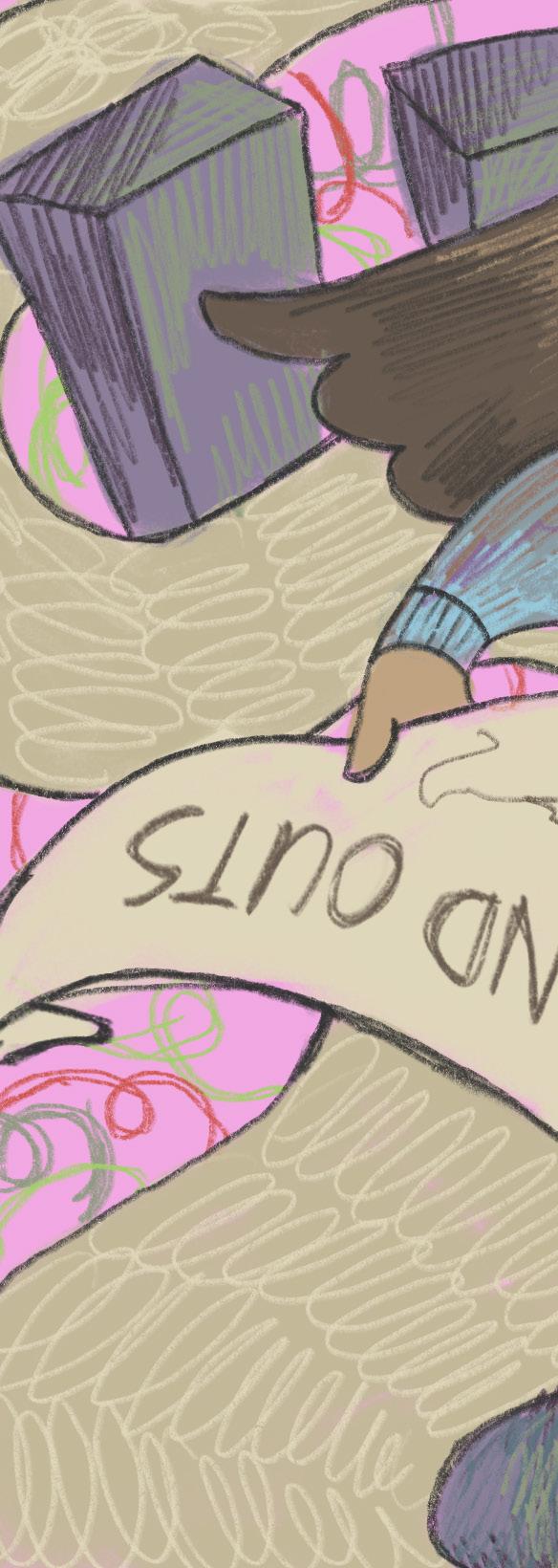
and outs and downs
shit is sexistential"
“Being hetero-erotic about it.”
“Really insane question, but have you ever read Karl Marx?”
letter from the editor
Dear Readers,
The last few days of relentless snow and all-around cancellations have made it feel like I’ve stepped thoroughly out of my real life. My roommates and I committed ourselves to the house mouse lifestyle, holed up indoors, and funnelled our pent-up energy into making a glorious charcuterie board and binging a show. My responsibilities lay dormant under the 37.9 inches of snow, waiting for me to uncover them at a time when time (and everything else) seemed more real. But, alas, real life comes crashing through eventually. Today, I spent over three hours digging out my car, as well as the giant shared lot it was buried in. Two planks of wood, attempting to listen to my Zoom midterm review on my phone, a very kind and helpful neighbor, and ample time to think thrilling and productive thoughts (e.g. I should just be a pedestrian for life, What did I do wrong in a past life (and this one)? and I’m so stupid for not getting snow tires) later, I freed my car and decided I was firmly back in my real life. And it’s good. It’s messy. It’s full of people I love, kind strangers willing to help dig out your dumb car, and strange
new joys all the time. As nice as it was to have a break for a few days, life only moves forward.
This week in post-, our writers are also exploring self-hood and connection during these transient moments in life. In Feature, Eleanor presents a gripping list of “ins” and “outs” for the year, while Sasha reflects on self-making and the stories of our lives. In Narrative, Vanessa writes on constructing an identity colored by Americanism, movement, and freedom to vs. freedom from. Also in Narrative, our managing editors come together to share sweet stories about love of all different kinds. In A&C, Johan delivers insightful commentary on how female musicians are navigating and resetting expectations related to aging and womanhood. Lifestyle is also home to reflections on identity— Olivia introduces us to possible versions of the self, including the one that is true and changing, and Sofia writes on the persistence of connection through life’s endings and beginnings. And of course, don’t miss a timely wintry crossword from Ishan and a post-pourri comic from Maison!
There’s a lot that’s still uncertain, perhaps still unplowed. While we all move bravely forward with our real lives, I hope you can still find time to take much-needed breaks as well—perhaps curl up with this issue of post- and find some comfort and joy here.
Leaving snow angels,
AJ Wu A&C Managing Editor
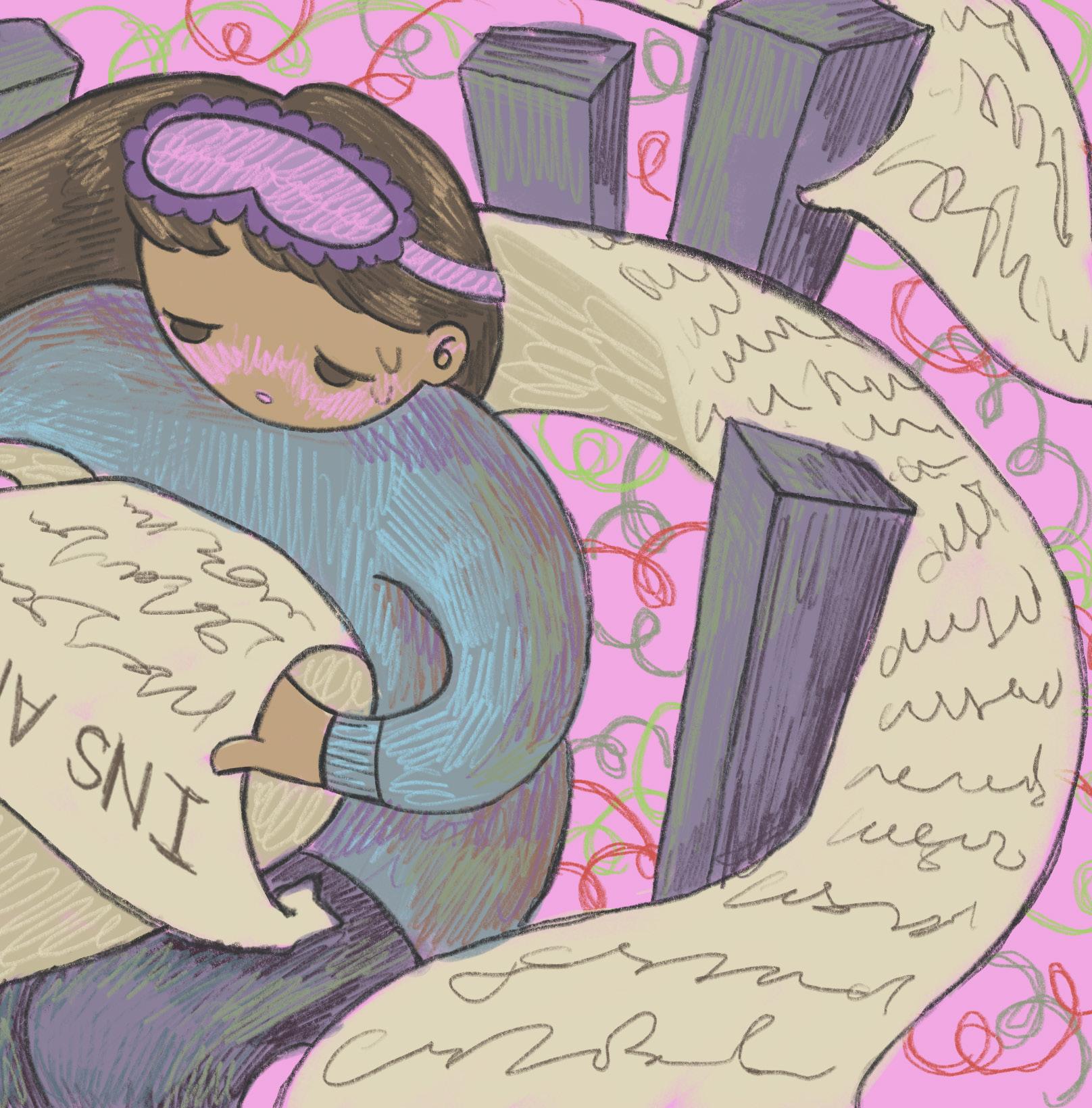
ins andouts and downs
by Eleanor Dushin
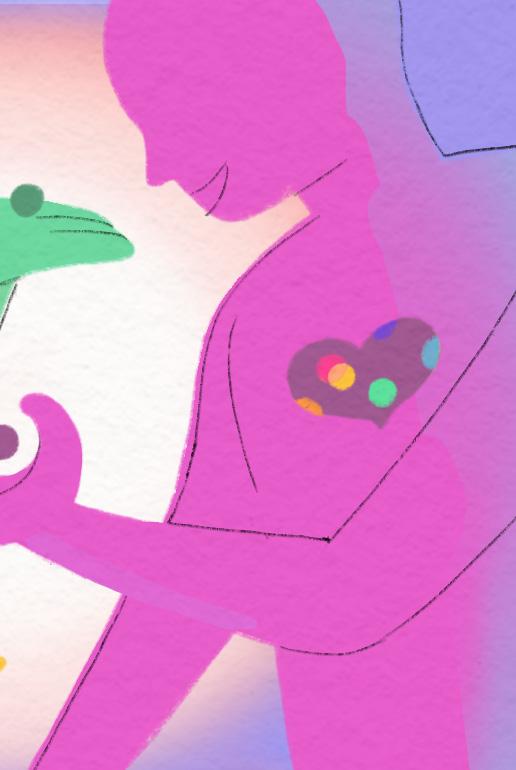
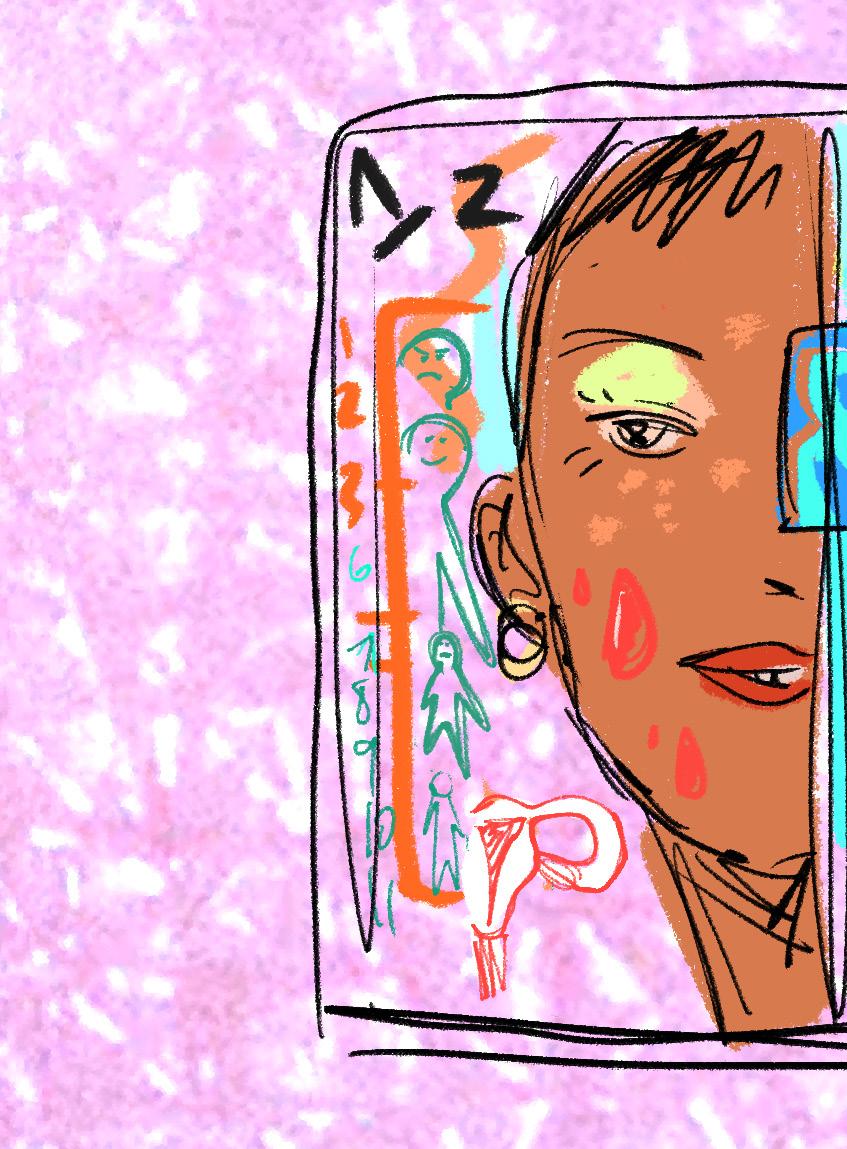
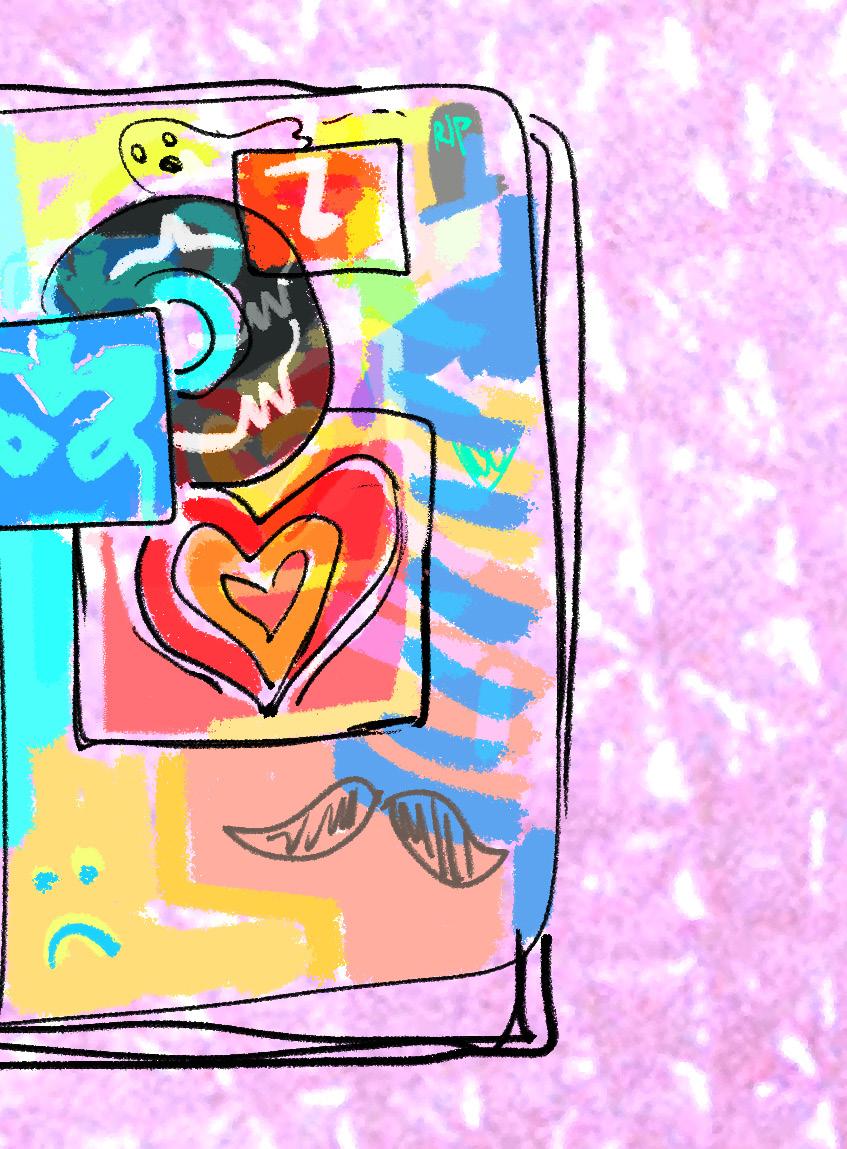
Illustrated by Candace Park
goingbackandforth a n d backagain
IN: Keeping an ins and outs list. It’s more of a set of commandments really, like a religion. I took the RIPTA to the Salvation Army in spring of 2025 so I could buy a Bible. They only had the New Testament, but God is pretty mean in the Old Testament, so I figured I could make do. I had an unshakeable feeling that I was about to drop dead, and I had made a friend in class who invited me to the Coptic Church in Cranston for Palm Sunday. I sat alone while children ran in the aisles weaving palm fronds. Of course, this all happened because I’m terrible at taking pills on a set schedule, so I’d given up on Lexapro within two months and turned to God.
OUT: Taking pills. I had considered the pill as a birth control method, but I knew that my nature (see: lazy, dysfunctional) would render it useless. I opted for an IUD and invited an acquaintance to the insertion appointment, which fell on 9/11 of last year, as a bonding opportunity. I asked the doctor if I had dealt with the pain well and she refused to compare me to others. I bled for four months straight.
IN: Comparing yourself to others, contemptuously. This is especially important in humanities seminars when a sophomore talks for five minutes to answer the question, “Well, what even counts as a language?” Look around the room and think to yourself, “I know that what we’re doing doesn’t really matter. No one on the sidewalk is going to be saved by poststructuralism.” You can add in some short-lived sprinkles of motivation to become an electrician or a cook. Or just go to the mailroom and watch someone stare at their phone while their name is called again and again. Dream about kicking them. You are better.
OUT: Nightmares. The day of my IUD insertion, I dreamt that I was coughing up bugs. Other nightmares I’ve had recently include: coughing up sawdust, t-Butyl-shaped wires growing out of my skin the night before a chemistry exam, and the guy I’m seeing being really mean to me. In order to live a completely satisfying life, you must reject your subconscious’s efforts at self-destruction. Have a lucid dream about goats and kittens that are friends.
IN: Prophetic hallucinations. This can also come in the form of a dream. I caught the flu as a freshman and hallucinated that the five pillars of Islam had become real pillars and were towering over me when I woke up sweating at two in the morning. Before that moment, I did not know that there were five pillars of Islam. I started panicking because I (not Muslim) was super haram. When I went back to bed, I dreamt that Allah healed me, and I woke up feeling totally fine. I didn’t eat pork for a year.
OUT: Predictable hallucinations. Examples: daydreaming about your boyfriend (the one who doesn’t like you that much) breaking up with you, your very old dog dying, or literally anyone being mad at you. These things will happen. Don’t think about them until they happen. Focus on your prophecies.
IN: Trusting your instincts, in the form of talking before you think. I recently attended a dinner party in which a statistically significant proportion of sentences I said were met with attendees side-eyeing each other. But then I remembered my commandment: You can always adapt to your environment, but what’s the point of trying to adapt to it before anything happens? Just say whatever.
OUT: Saying, “But who am I to judge?” Think about it. Are you having “hallucinations” or are they visions? You are special. You are the smartest girl in the mailroom. The best. You can judge anything you want. Even things that aren’t important; for example, is plastic surgery anti-feminist?
IN: Okay, bring it back, bring it back. Beauty sleep. In an ideal world, your roommate’s boyfriend will buy her a towel warmer as a gift and you will get to use it and feel luxurious and beautiful. You can slather on way too much Trader Joe’s body butter and put on your softest pajama pants and a shirt you can’t wear in public. Put zucchini slices on your eyes if you don’t have cucumbers. Crawl into bed and stay there for an amount of time that your mother would be disappointed in but your roommates would not be worried about. To get the perfect woke-up-like-this look, I recommend 10–12 hours per night.
IN: Caring way too much about your job. It should deeply impact you when someone says you’re doing a good job. It should also deeply impact you when someone says you’re doing a bad job. Like, don’t stop now. Keep going. You can be really good at this. And then go home and sleep for 12 hours and feel refreshed enough to do better the next day. Fail your classes to spend more time at work. Ideally, you are a dishwasher.
OUT: Doing the dishes outside of a work context. I don’t mean that you should let them pile up, unless you have serious issues with your roommates, in which case, absolutely let them pile up. I mean switch to paper plates and plastic forks. Only eat takeout. Delete the Uber app so you aren’t tempted to order delivery because you have to at least walk to the restaurant to
OUT: Disappointing your mother. She has done so much for you. Don’t you love her? Come on, did you even ship chocolates to her house for Valentine’s Day? Become the best version of yourself that your mother can imagine. Send her a photo of a beautiful meal to prove to her that you can cook. Water your plants before she visits to show that you, too, can take care of a life. Get another job. Then get another.
pick up the food, otherwise it’s just sad. By the way, you’re using way too much soap.
IN: Temperance. Take only what you need. There’s only so much hot water, so you can afford to shower every other day, maybe every three, maybe just once a week depending on the weather. Don’t let this impact the luxury of your 12-hour beauty sleep, of course, but your indulgence in the finer things can coexist with your restraint. You probably did too much ketamine last weekend. Cut down on that. The horses need it. And you should be using a flashlight to walk around your apartment and keeping the heat at 61 degrees—you don’t need all that light and heat. What a waste of energy.
OUT: Energy. Having it and using it for anything other than your job and your prophetic visions. You have chicken tikka masala in the fridge from last week. You’re supposed to eat that and go to sleep and dream of whatever is going to happen next year. Wake up on the couch and go to work without touching up yesterday’s mascara. Call it indie sleaze, and when people say indie sleaze isn’t in right now,
say you’re being subversive.
IN: Getting anything other than chicken tikka masala from an Indian restaurant. Get something new, like lamb and potato vindaloo. Don’t get the garlic naan, get the roti. Don’t even read descriptions, you don’t need to know what you ordered. This can also feed into your contemptuous comparison of yourself to others. Aren’t you so much more worldly than everyone else? Aren’t you so much more willing to change up your life? Isn’t your palate more refined?
OUT: Food that’s good in a way that isn’t complex enough. You should have to convince yourself a little bit that whatever you’re eating is good. Everything should be a bit oversalted and smell a bit off. You can have moldy bread and nothing bad will happen to you, I promise. Serve Délice de Bourgogne on a charcuterie board and say, “I love how it has this rot to it.” Don’t eat jam. Eat gherkins out of the jar.
IN: Repurposing jars. By this, I mean having a jar and keeping it in the cabinet just in case you need a jar. Don’t even try to get the
label off. Okay, fine, try to get the label off, but once it gets to the point where it’s just shredded and whatever is still there is really stuck on, stop trying. Someone will come over to your house and ask for a coffee. You will give it to them in this jar and say, “I can just get it back when I see you next,” and trust me when I say you will never see that jar again.
OUT: Replacing what’s lost. Don’t try to get back your jar or your pen or your money. What’s gone is gone. Accept that whoever you are now and whatever you have now is all that there is. Write down a list of everything you can remember that you want back: the shirt you lent to your brother’s ex-girlfriend, the respect of the professor whose class you failed, all that blood from the IUD, the affection of your boyfriend (seriously, girl, he just isn’t that into you anymore), your dog. Light a fire and burn the list. The fireplace in your apartment may not be functional, but that’s okay. You have a fire extinguisher around here somewhere. Don’t worry about it. Get your beauty sleep. There will be more to lose tomorrow.
life story
resumé version 3.1, ready for feedback
by Sasha Gordon Illustrated by Angelina So
“We tell ourselves stories in order to live,” Joan Didion says. But I don’t like Joan Didion, and I wish she’d never said that. I am looking in the mirror, and I am upset, rehearsing for an interview, a date, or the dreaded “tell me about yourself”—generally getting my narrative together. I want to present as someone with a sense of self and defined pursuits, but in the meantime, I’m still working on getting there. Somehow I never have meantime enough to figure them out.
The first time I heard this quote, I thought it was about communal storytelling—myths, fables, and the like—and its role in social bonding and norm creation. That’s nice, I thought. The phrase stirred up vague images of cave paintings and The Flintstones, an assurance that human stories, recorded or not, have always been present. Confronted with it a second time, amidst the colder setting of The White Album and slightly more insecure, I read it as an exercise in self-rationalization and coping. I tell myself stories to explain the world around me and the indignities within it. In order to live.
Her words have lingered, and I encounter them somewhat frequently. English class, online, in speeches otherwise well-delivered. It’s the public’s finest distillation of Didion, to the point that the YouTube description of her Netflix documentary only contains the quote. Today, though, I see the maxim as pathogenic. It honestly makes my skin crawl. The basest expression of loving kindness—sitting together to hear someone tell a story—has been spoiled. Her prescription has changed with the world that passes it around, acquiring a pre-professional shell along the way.
Today, a more natural reading of “in order to live” becomes “to make a living”: We tell stories to make a living. I’m not playing fast and loose with definitions here—think about it for a moment. To talk about the rest of what it is “to live”—the actual, you know, living of it all—I have to add extra words. I need to say “living, like having fun, like being outside, like seeing a sunrise, like doing what you love,” because living, standing on its own, has become work. I can’t just tell you that I’m doing something “to live,” for fear that you’ll hear it as “for my future housing prospects.” I especially can’t say that I don’t know why I’m doing something. Everything has to Fit In and Make Sense, and it’s obviously my job to package and present that to anyone who might need to hear my story. I was instructed about the necessity of this packaging first for college applications, then in Career Center events, and lately, it seems, everywhere and all the time. The moment I go online, I’m bombarded with messaging about creating cohesive work histories and extracurriculars and leadership activities, whatever that means.
It’s pervasive, reaching my eyes no matter how many accounts I block. I’m confused, though, if when I actually make my story, I need to sell it like I’m already at the end of my professional development journey. I’m still not sure where I get to try things and make mistakes if I need to keep repainting the walls of my heart before you can see inside, but I’m sure someone will tell me on LinkedIn.
Like my hopes and dreams, the first half of Didion’s excerpt has also been remodeled—I no longer hear the “we” who tell stories as referring to any sense of community, but an infinite stream of isolated storytellers, all self-mythologizing and hoping against hope that someone might buy what we have to sell. But if we keep revising our story instead of writing it, it’ll only get shorter, more compact, rendering both the description and our actual lives less vivid. I want to go back to the start of this issue. You’d expect me to say that I’ve been interested in public health or literary arts since I was four, but it’s just not true. I can’t take that advice. Though I’ve heard the beginning is a very good place to start a story.
driving a train with no brakes to an even less certain destination.
Perhaps this was doing things differently, but it probably wasn’t my best course of action. The alternative was clear: do the bare minimum of what would look nice on my resumé and relate to my future that I definitely have figured out, and spend the rest of my time eternally remediating my image in the hope of satisfaction that would never come. School, work, dorm, change my hair, school, work, dorm, repeat. This would alleviate my issues of having too many interests (or too poor impulse control to manage them). I would simply get rid of the inessential parts of my life, like listening to music, and replace them with inherently valuable “demonstrated interests.”
Before the start of my sophomore year, I resolved to do things differently in order to achieve something. This sounds vague, I’m sure. I have no more specificity. I was just going to “get involved” and “make something of myself.” I wasn’t sure how, but it was going to happen because it was important for my resumé and my “professional image,” and I’d do the things I wanted, and emerge as a more competent, shiny “sophomore studying public health @ Brown…” as a result. And then school started, and then I took a fifth class, and it was math (for math majors, if you ask me), and then I overslept, signed up to write for a magazine, joined a band, took nine days for Thanksgiving, stayed up late three nights in a row to watch movies on a plasticky couch, and found myself generally
This would make me a more hireable candidate, an easier sell, and lend me a more straightforward narrative. I’d appropriately present myself, for once, and simultaneously change my actual interests to represent my superimposed ones. Internal bliss.
But this concocted, artificially straightforward narrative is vulnerable: one wrong move and it topples over, too tall and slender to withstand any sideways forces. Stability is found in something more like a rooted, branching tree. A tree grows from the tips of its branches, today’s growth feeding tomorrow, instead of from the larger historic base. Lose too many branches, and a tree won’t grow very much at all. Some are pruned into straightforward trees, and others seem to grow up at warp speed, hurtling in one direction before they could ever branch out.
My friend C thinks that the story of Daedalus contains the most “myth for your myth,” like “bang for your buck.” If you had to pick any myth, this one would get you the most myth. I’m often told that I, too, should strive for the most “myth for my myth” when considering my own life—do the most things in the same arena, build narrative consistency, maximize my own bang for my buck. Put the most me inside of me. This is a hard task, but I’m learning that it might be the most important one for my ability to land an entry-level job, and thus the most important of my next two years. I think my friend is right— the myth of Daedalus is really many myths. C pointed out that hubris didn’t first meet Daedalus on his famously tragic flight, but had
can only iterate on the sequence of what he did yesterday. The myth of Daedalus is a meteoric ascent and sudden fall, but if he were the one telling it, we may only have heard of the ascent. You probably don’t want to take advice from Daedalus. Even if he does get the most myth for your myth.
begun to follow him far earlier. Daedalus, an enormously skilled craftsman, was so overcome with career-oriented jealousy that he tried to kill his young craftsman nephew to ensure his own prominence. Were this not enough, he crafted the components of the scheme that birthed the Minotaur, built the labyrinth that it (and eventually Daedalus himself) was trapped in, and the wings of escape that later killed his own son. He was so unable to resist showing off, his hubris so strong, that when told of an impossible task explicitly concocted to find him in his hiding spot, he solved it publicly. Dude. I say all this to say that Daedalus is truly just like us—an overachiever with a CV long enough to attract the attention of King Minos, a success so wild and well-known as to invite divine punishment. He’s got what I was told to want. It doesn’t work out for him. His tree got too small at the top. He
In this new paradigm where stories are currency with which to acquire something, they lose their organic nature. I think they’re even about to become fungible, so commercial as to be interchangeable. Walking around, there’s an odd phrase I keep hearing from my peers. “Did I ever tell you the [xyz] story? You should come over, and I’ll give it to you.” It struck me as incredibly odd when I first heard it. Sitting on the floor of someone’s dorm, I found it difficult to listen to the selfmyth of The Thing I Did That One Time. The inorganic nature of the story lands like a prepackaged supermarket salad— bland and never quite what you really wanted. I want to learn about people as people, in the wholeness and richness of life, and in the moment as things happen together. This presentation is very different to me than them just telling the story in the moment. The teller implies a certain importance of their story even when out of context, but it’s a hard sell to me that it’s not important enough to tell right now, yet also so important that we must convene so they can deliver it uninterrupted before I cheer and clap. This process has the glamour of the relational but is truly devoid of it. There’s this undercurrent of revision, this unwillingness to participate in synchronous socializing, an insistence on the perfect realization at a later date. A transaction. We’ve become elevator pitches.
Didion herself has become subject to this issue. Forgive me for burying the lede somewhat, but the very next page of The White Album begins to do some of the work of dispelling the problem. She discusses the doubts she has about the “imposition of a narrative line upon disparate images,” much like I do. She lists her perceived competencies and fundamental shortcomings, her sense that everything she’d ever been told “insisted that the production was never meant to be improvised.” And oh my God! This is what I’ve been saying! I feel you, Joan! Reaching through time, we commiserate. But then she blows it. She ends up insisting throughout The White Album that she is, in fact, someone important, to whom
important things happen. With her incredible foresight and typewriter, leotard, and mohair scarf, she portrays herself as someone who does have it figured out. She has to.
Maybe I can be stubborn, and maybe my dislike of Didion is similarly bullish, unfounded. But I am 19, and I can play the trombone. I am 18, and I tell my mother I want trombone lessons. I am teetering over the precipice of 19, and I call a man from a Yelp ad, and “Why trombone?” he asks. “I teach trumpet too; it’s more common.” All I can muster is “Why not?” This doesn’t work as an answer. He asks again, as does everyone else I meet over the course of that summer, and yet I still have nothing better to say. Most people are eventually placated with “God told me someone must play the herald”—this is alarming enough as an answer that they stop asking. I don’t think it’s a terribly interesting question. “Why this, why that?” What am I meant to answer? It’s line item seven on my five-year plan? Lord knows I’ve tried to make it so, but I can’t rope my longferal curiosities into line like that.
Occasionally, a Post-it note will appear on my suite fridge with a quote lovingly inscribed on its surface. C and I put them up when we think of it. Some are more seasonally thematic (Annabel Lee for Halloween), some are immediately topical (“No matter what, we must eat to live”), and some are maxims that I’m trying to force into saturation. I’ve paraded Sarah Ruhl’s “And life, by definition, is not an intrusion” through my dorm hallways over and over these past few weeks, seeking encouragement not to write this paper or do anything other than make music and socialize because, you know, life isn’t an intrusion. Maybe that’s not what she meant, but I love Ruhl’s stalwart rejection of sterility. Intrusion implies a story, so, sure, she agrees with Didion that there’s a story of me to be told, but it’s a story that coexists with life. Life isn’t an intrusion into this bigger, other thing, because life does not equal narrative. There is no other way. By definition.
This brings me back to the stories we tell. I think we’re hurting ourselves, robbing ourselves of the joys of the intrusions in life when we only pursue the directly applicable just to preempt a hiring manager or quizzical look, a “why” question we have no answer for. But when we forecast ourselves into the future and claim our greatness to have already happened, like on a resumé or in an essay collection, we have nothing to work towards, no branches to grow, and, truly, no story to tell. Life is what happens, and we need to live it. We’re not at the end yet.
I can’t be Joan Didion’s nemesis by virtue of her having already passed, but I can stage this conflict between her and Ruhl. On the surface, their two quotes are so similar: confident and universal, both authors mix the big picture—“in order to live” and “life, by definition”—with the minuscule—“we tell ourselves” and “an intrusion.” But at base, Didion commands us today to sell what we shouldn’t, to dispel our fears by cementing our narratives. Ruhl wants us to see ourselves as something bigger, kinder, more compassionate. You are something outside of what it is to make a living, something more expansive than one narrative. Life is not an intrusion, and you are more than a narrow conception of what it is to live. These excerpts might appear on the same inspirational calendar. Didion’s will never be on my fridge.
what it means to be free
and how to come back tomorrow
by vanessa tao
Illustrated by Julia Park
In my creative nonfiction class, we were asked to read Notes of a Native Speaker by Eric Liu. He starts the essay with a laundry list of declarations and negations, saying, “Here are some of the ways you could say I am ‘white.’” It made me wonder which identity everything in my life spun around—which identity held the gravity that everything else had to contort itself to. I settled on being American.
I am American, though likely not the first image of American that comes to mind. I am American in the sense that my parents were dirt-poor immigrants who docked onto this promised land when they were my age and now
provide a comfortable, upper-middle-class life in the suburbs for their Ivy League-attending daughter. I am American in that, over and over, I can recreate who I am. I can leave my family and dress it up as following my dreams. I can leave a city, a community, and call it chasing opportunity.
And because I am part of the race that is closest to being “white,” because I am part of the so-called model minority, I am as close as can be to the crux of American power—something that comes through in the way I speak, the way I walk, the way I assume I can customize my identity, free from roots, free from the culture that binds my parents, free from expectation,
just free.
Maybe the most distinctly American product I see in myself is that I dream of leaving. Not a day goes by that I don’t think about what it would feel like to just leave—leave the country, leave my school, leave whatever corner of my life I’ve carved myself into.
The thing is, leaving is in my blood. You can tell by the way my parents both fled their home countries when they were my age, by the way they decided the allure of a new life was worth the pain of creating one. You can tell by the way I can’t stay in one state for longer than a month, by the way I’m starting to subdivide my year
based on the next time I’ll be on international soil.
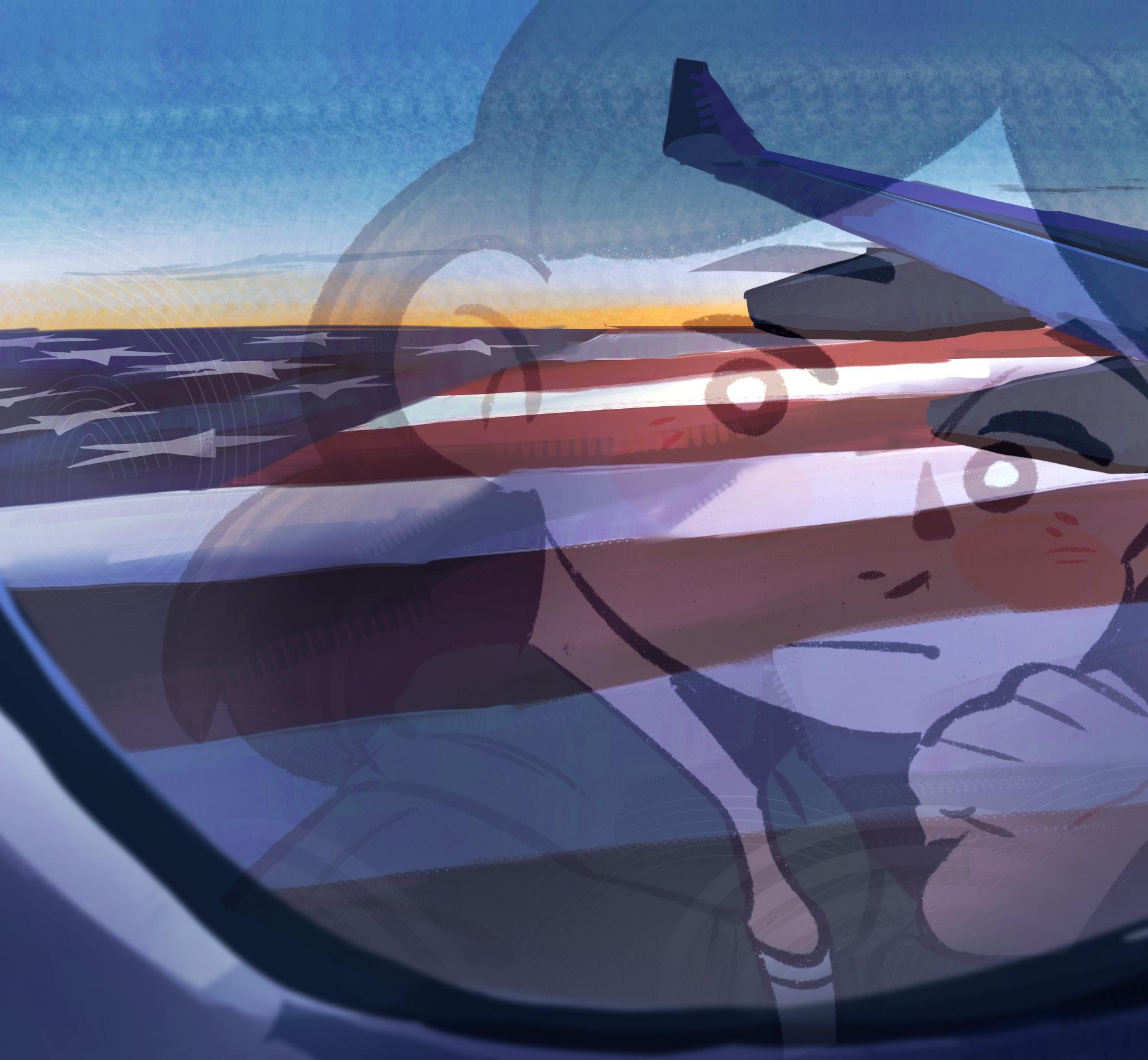
Lately, I’ve been finding myself in airports more and more frequently, as if I can’t bear to be on the ground for too long. When I hold my solid navy passport in hand, though, with its gold lettering boldly proclaiming that I am of the United States of America, it occurs to me that all I’m doing is leaving. What's the difference between that and running, really?
On my flights, I think about how big the world is. How it could swallow me so easily if I asked it to.
The first time I left, truly left, was when I packed up and flew across the country to Brown, resolving never to come home for breaks unless I had no choice. Yet after the rush of orientation and the blur of the first few months, I found myself facing the November chill with a new sensation tugging at my lungs: homesickness. As I packed up and drove to New Hampshire for Thanksgiving break, the not-quite-right mountains whizzing by in a car window that wasn’t mine, I wondered for the first time if I should have gone home instead. When I did finally go back to Colorado, back in my childhood bedroom with my high school friends, I was disoriented. It occurred to me that my friends’ voices were different,
lower in the wrong places. It occurred to me that the mountains were paler than I remembered, the house colder than I thought, my mom a little grayer than she had been before I left. What I expected to be a perfect fit was twisted, awkward, strangely shaped, and eroded by time.
I thought I was the only one changing. I thought I was changing relative to my hometown, rotating around the origin. It never occurred to me that the origin itself could also move.
A while ago, my brother told me to keep him updated about my life. When I told him it would take a novel to catch him up, he told me he didn’t care; after all, he used to be a reader, too.
Maybe he meant it as a throwaway statement, a reflexive rebuttal to what I said, but I took it as a promise. A promise that it doesn’t matter how many times I leave. I can’t shake him, can’t tear myself from him. He’s chosen to stay, regardless of what storms may batter at him or how bleak the land becomes.
When I visited China for the first time, the summer before my freshman year of college, I could taste freedom on my tongue in the way that every local glanced at my friend and me, dressed American with dyed American hair and speaking American.
I haven’t yet visited Vietnam, but I can feel the same acrid tang when I walk into a nail salon, or my mom’s restaurant, or her Christmas parties. I feel the half-accusatory and half-envious stares when I show any sign of my American privilege, whether it be a Brown University hoodie or unaccented English. I can sense that as much as I am scorned for having lost Vietnamese, I am also admired for how American I am—admired for how well I could change, adapt, contort myself to this new life.
I often think about the difference between freedom and loneliness. In almost all of my politics classes, we touch on the idea of freedom from and freedom to. Applied broadly, it’s the idea that a government is responsible for providing its citizens freedom from insecurity, violence, etc., and freedom to pursue their goals, to realize their potential.
Each time I flutter away from a person or a dream or a place, I wonder whether I’m pursuing my freedom to flee towards new land, fertile soil, or if I’m exercising my freedom from having a place to call home, a warm nest to return to.
Recently, my mom has been saying “I love you.” Not through a plate of fruit, or an exchange of
cash, or even by asking if I’ve eaten yet. No, these days, she’s been saying “I love you” verbally, in English, followed by a hug. My other brother tells me it’s because he’s been talking to her more frequently, long conversations where he explains to her what he thinks his siblings need when they come home after months of trying to figure out how to live on their own for the first time, or from a semester of New England cold seeping into their bones.
I’m never sure if it’s more American to dream of being something great, or to throw it all away in the pursuit of a life free from expectation.
The problem with leaving is that the more I do it, the easier it gets. Every single change, whether it’s the new friends or the new clubs or the new dreams, they’re all so brilliantly shiny every single time. Every single opportunity I chase after feels like a blatant expression of my own manifest destiny—because of course I can dream of something new. Of course I can go somewhere new, of course I can become someone new; after all, it’s part of what I deserve as an American, isn’t it?
It isn’t until the new thing dies that I come face to face with the price of it all.
I pay the price in the corner of every new room I find myself in. It whispers to me, chilled and eerie, reminds me again and again that I’m losing something too. It’s a loneliness I’ve learned to face, paradoxically, by leaving yet again to the next bright place that calls my name.
The first time my mom said “I love you,” I was unnerved. I couldn’t trust it, couldn’t trust this new change that I hadn’t engineered myself. The second time, I said it back. Most recently, when I came home for winter break, I said goodbye to my mom twice so I could say “I’ll be back tomorrow” in Vietnamese the second time, a phrase I had recently learned in class. My mom laughed, surprised, and then corrected my pronunciation. I drove a little slower after I left.
Maybe I’m scared of what it would feel like to come home to the same four walls, to stay long enough to notice how the sunlight hits the kitchen counter at the same angle every day. To stay long enough to see the cracks in the drywall, to see them and decide I want to live here anyway. Maybe I’m terrified of the origin changing, of deciding I will let myself fall into its orbit, of accepting whatever direction it’ll hurl me in.
Or maybe it’s part of being American— maybe the inability to stay in one place, to sink with one ship, to build a history anywhere before razing it to the ground in pursuit of unexplored land—is the closest I’ve gotten to being American.
The flip side of it, though, is that the final Americanism I’ve acquired is my ability to change. To learn, endlessly, relentlessly, and always with hope. To decide, for once, that there's a strength in staying—a certain freedom, even, in turning around to tell your mom that yes, you'll be back tomorrow.
by Elaina Bayard
In fifth grade, a boy passed me a note: Do you like me? Yes__ No __.
I held it in my little palms for a while, thinking, but not for too long. I took out my pencil, which I held incorrectly since I’d never learned the correct way, and I answered it: Maybe
When I tell this story, it’s met with laughs, with musings on how headstrong and ridiculous kids can be. I laugh too. It’s funny. I remember the boy looking back at me, bewildered. But I stand by tiny Elaina’s answer. I’d answer the same way now.
I’m a little in love with everyone I meet. Yes, everyone. Even you, reader. I’m prone to daydreams and flights of fancy, have been for forever. When someone laughs like a ringing bell or wears a gorgeous coat or says something particularly clever in a seminar, I’m off, designing our miniscule New York apartment and naming our future dogs. I’ve been accused of being in love with most of my friends and I am. For most of them, if they asked me out, I wouldn’t say no. I always find myself lingering right on that hazy boundary, the cliff edge between platonic and romantic.
Because how can I know if I love someone until I try? Love, as much as it is a feeling, is also a choice. You have to be there, in the moment, to discover if you’re willing to make that choice, again and again. So, maybe. Maybe not.
snow days (with you) by
AJ Wu
The last knockout blizzard I remember was in the
winter of 2010 in suburban Maryland. (Snowmageddon, it was called. 18 inches.) Two flashes of memory: my sister and I bundled up by our mom before being let loose outside; our neighbors gathering to help dig out our family car, which had sunk into the snow. I loved all of our neighbors from back then—Aunt Jenny, who would charitably look the other way when we swung from her giant willow tree (the grandest tree I’d ever seen), and Joy next door, six years older but still willing to be dragged into all our games.
Tonight, I’m checking the weather forecast (they’re saying over 20 inches; tomorrow they’ll measure 37.9, the highest in state history). Life’s felt a bit strange lately. My last semester, and so much fresh joy, sadness, and change. Like everything else, snow this winter is unending, unprecedented, and other adjectives, and digging out the walkway is beginning to feel Sisyphean.
We wait for the blizzard. I make a simple dinner. My girlfriend stirs hot chocolate, heaps on mini marshmallows, and we settle on the couch to finally watch a movie she’s been talking about for ages. I’m excited to learn more of her references. The snow begins its flurries, historic, I guess, yet quiet. Tomorrow will be shoveling and sinking waist-deep in snow trying to differentiate between the heap that used to be my car and the snowbank. But tonight is warm and bright. Moonlight reflecting outside, only slightly alien; the soft glow of the screen inside, as our little snowglobe shakes, settles. Our upstairs neighbors are doing karaoke to “Bohemian Rhapsody” as I drift asleep. But they’re pretty good, so I don’t mind.
reframing fulfillment by Gabrielle Yuan
As a way of daily introductions, I loosely, in one form or another, ask my friends how content they feel on a scale from one to ten. For friends who know me well, it’s really my way of asking how to approach staying present while being completely alone.
I found myself most in love after my first breakup. It’s like being drenched in snow, when your boots are too short to cover the colossal amounts of heavy, white dust seeping into your ankle socks; and all you know how to do is keep trudging forward into a path buried completely from
tender on the soul
love from our editors by
managing editors
Illustrated by Jenny Chen
sight. I couldn’t escape the shiftless wonders of when I’d run into her again on Brook Street, or how Thursday evenings were no longer solely reserved to trying new desserts, no longer accompanied by the charmed feeling of opening a bag of warm cookies.
Last semester, I learned that being content and being in love are not synonymous. Looking back now, I can watch through a foggy screen the way my friends drew me back into one piece: sitting by my bedside until I fell asleep; picking me up before class to get a hot coffee; walking me back to my dorm late at night, hand stuffed into my jacket pocket and always in reach. My circle of love grew wider, and I found myself at the end of the day no longer wishing it wasn’t over. I couldn’t comprehend how excited I now feel at the spontaneity that comes with no longer having a designated person to turn to. With time, I could really hear myself speak through the things that made each day an ideal one for me.
As March approaches, it’s almost frightening how easy being alone feels, and even scarier to think back to how fully I had lost hope that things would work out. As I find myself ranking my days higher and higher above that silly scale used for gentle conversation, I’ve realized how powerful the mantra I had been saying all along was: that all feelings really do pass.
on love that lingers by
Tarini Malhotra
Flowers have lived in every room I have ever called home.
They twinkle, even as they live there, stationary, in different colors, materials, and degrees of decay. The large bouquet, nestled in the corner, stands proud and brassy, while its little sister right in front of it is barely holding it together by the golden ribbon I used on the golden day I made it. The gold-painted metallic flowers by its side remind its little sister that they came first, and they are, truly, completely in the right, because I’ve had them for almost a year, from when a golden friend from back home gave them to me on a golden summer day. The Lego flowers on my bedside table smile to themselves, patiently; they know
they’ve been with me since last Valentine's Day and have lived through two homes, and they promise they’re okay with the fact that I have not gotten around to re-attaching the buds that fell during the move of Fall ’25.
And finally, even as I sit on my bed writing this, my flower-adorned blanket curls over me just as it did when I was 15 and a sophomore in high school, and we would sit near the large windows of my family home, basking in the golden hour. These flowers are older than my sweet, loving golden retriever; they persist even as the walls of home change color and the people flitting in and out differ over the years. They smile gently in the echoes of my room, steady, even as I love old and new.
hang the dj by Chloe
Costa Baker
I could say we met on Instagram. Or I could say we met on the streets of Kyoto.
When my now-boyfriend flew to Japan to meet me in person, a month of non-stop messages had led to this moment. We bonded over connections to Ghana and a childhood love for A Series of Unfortunate Events, all without ever seeing each other’s faces. But this didn’t matter: I was already falling in love with his soul
That same summer, I started wearing an Irish Claddagh ring, inherited from my mother. The first day I wore it was the day we met in Kyoto; only later did I learn that wearing it facing upward on my right hand signaled that I was in a relationship. I didn’t know it, but I was already his
My boyfriend was born exactly 365 days before me (2004 being a leap year). I like to think that he wanted to carefully vet every day of the year before signaling me to join him. I like to say we’re chasing each other around the sun
Or, this is what I say, at least, when I want to practice romance. I’m not someone who believes “everything happens for a reason,” but there is joy in the human act of constructing patterns from the past. I don’t subscribe to “red string theory,” but I appreciate the art of threading connections. When we blow out the same color candle last, or choose the same film for a Valentine’s Day surprise, I am
quick to call it a sign. Not from a higher power or an external cosmic abstraction, but from the two of us and how we actively relate to one another.
Both fate and random chance are equally unyielding to free will, and even then my mind easily boggles at the magnitude of intersecting choices that led each of us here. Yet I often think of The Good Place, and Michael’s advice to the pathologically indecisive Chidi: “If soulmates do exist, they’re not found, they’re made.”
Sometimes, simply being mutually drawn to another person can be considered serendipity. To me, love means license to find meaning in small connections and then build upon them. The art of noticing: not romanticized, but realizational. A two-and-a-half-year anniversary that lines up with Valentine’s Day is just one testament to this realized potential.
back in time
by Hallel Abrams Gerber
This morning, I got an email from 2021, a letter sent by one of my best friends. In a series of exclamation points and capitalizations, she asked about who we had become in the years that elapsed. To the disappointment of her sophomore self, neither of us have boyfriends at the moment, but we did reach many of the milestones she wondered about in the summers that followed. There were relationships and failures and things we learned to definitely not do again. Over late night fries, we continued to tell stories about the people who crossed our paths—new faces and crushes and rivals—their names now foggy and insignificant.
Five years later, we have changed in fundamental ways. How I think about love is so different from how I did back then, fresh out of pandemic isolation. I’d like to think that by now, I know more of what I want to be and who I want to be around. At the very least, the choices I make now feel markedly less embarrassing, or so I’d like to think. By the time they get told to her, they make perfect sense in my mind.
I visited my friend last week. We continued to talk and wander and explore each other’s updated lives.
At the end of her letter, she wrote, “your life would be so incomplete without me.” I am so glad that that is still true. I cannot wait for the next diner debrief of our lives and our loves.
alone but far from lonely by Jessica Lee
At the ripe old age of 26, I like to joke about my spinster status and how I find myself relating more and more to characters like Eloise Bridgerton. What initially started out as light joking has definitely become a comical part of my chronically single identity at this point. That being said, I feel I must clarify that while I may be alone romantically, I am far from lonely. Here at Brown, I always find myself running from class to class, activity to activity, and event to event. I never seem to have more than a moment of free time, but I love everything I’m a part of too much to give anything up. And even more than loving the activities I do, it’s the people involved in each and every one that truly fill my cup.
On Valentine’s Day this year, I spent about seven hours (and the majority of the day) with my cheerleading team—running a youth cheer clinic and supporting our awesome women’s basketball team—before ultimately heading back to my apartment to end my night with wine and the Valentine’s Day movie. Although it was, perhaps, the least romantic Valentine’s Day one could have imagined, I have never felt more overwhelmed with love and admiration for the people in my life. My cheer team is full of about 20 of the sweetest individuals in the world, who bring such wholesome joy into my life…even when they call me “unc” or make fun of my millennial tendencies. And it’s people and days like this that truly remind me how love is always in the air, and this type of platonic love is more than I could ever hope for.
“this shit is sexistential”
It is admirable to see an artist achieve greater and greater feats as their career progresses. Witnessing points of success, and sometimes failure, is inherently satisfying as audiences continuously age alongside creators. We have seen it with artists like David Bowie and his beloved discographic journey, or Guillermo del Toro’s graceful glide into some of his best work as he received more mainstream recognition throughout the years. However, when it comes to female musicians, aging in mainstream consciousness is often a more complicated story. In many cases, for a woman, aging is regarded as something that should be hidden from the public eye and even avoided at all costs. Extreme standards of beauty in the entertainment industry dictate how attractive a female artist is, and therefore, how profitable and deserving of mainstream attention that artist should be.
Consider female music pioneers of the ’90s: Madonna and Lil’ Kim, who were each once regarded as the pinnacles of their respective genres, are now subject to persistent ridiculing of their legacies due to cosmetic treatments and plastic surgeries. Björk, whose image in the ’90s became a symbol for electronic music lovers, now receives backlash for wearing face masks and talking about her divorce. These cases reflect societal pressure on female musicians to not only show their face as they promote their music, but to abide by impossible lyrical and beauty standards that appease pop culture, which are often not demanded of their male counterparts. Women in music are expected to remain appealing to the male gaze as they age, but when they try to do that (often relying on cosmetic treatments or simply keeping up with trends), most are ridiculed for their appearance or for acting “outside of their age.”
Many instances of ageism in popular culture go unnoticed as they are masked as shitpost humor, where intentions are more difficult to decipher. The common usage of “hag” as a derogatory term for middle-aged female artists and the birth of the old-face edits of many female artists are examples of this. But it unfortunately does not stop here. A recent video published by Bekuh Boom, a former songwriter for K-pop groups like BLACKPINK under YG Entertainment, went viral on TikTok. In the video, she recounts her struggles with motherhood and how she was ultimately “shelved” by the label, meaning her career was put on an indefinite pause, because of her pregnancy. Even though the songs she had written for the groups were performing well commercially, the label was against her pregnancy and refrained from giving her support to launch her own career. Her label suggested she have an abortion if she wanted to be kept
how female musicians are revindicating notions of womanhood and age in popular culture
by Johan Beltre Illustrated by Emily Chao
in consideration for a deal they had offered her months prior. This is the case for many female artists in the industry who are subject to dismissal once they represent canons outside of “conventional” youthfulness. It demonstrates how the industry’s obsessive control over pop star imagery shapes pop culture and reproduces deeply-rooted misogynistic attitudes. However, there have been recent countercultural moves by female artists that are directly challenging these harmful beliefs. Charli xcx’s brat is a definite turning point for the mainstream notion of womanhood and aging in recent memory. When the album cover
was first announced, there was backlash not only because of its simplicity, but also because it did not feature an intricate photoshoot showing Charli’s face. Female mainstream pop artists are usually pressured to use their image (especially their faces) in all aspects when promoting their music. Charli’s case is reminiscent of the backlash that Lorde experienced when the Pure Heroine album cover was first announced. However, brat builds upon realities of female representation in pop even further. For example, the track “I think about it all the time” gives us a vulnerable insight into the possibility of motherhood for Charli as she settles into her
30s. Pocketed in the last leg of the album and often placed at the end of most album rankings for its interlude-like nature, the song might be brushed over by audiences. However, I argue that lyrics like “Should I stop my birth control?” or “I might run out of time” stand out as both revealing and out of the ordinary for successful mainstream releases, moving the needle for female artists. As she ponders over a glitchy lo-fi beat, the veil of the party-girl aesthetic drops— revealing layers of self-doubt as she reconciles what it means to be a pop star and mother. For many female artists, besides outliers like Beyoncé, becoming a mother is considered a
career death sentence in mainstream success terms. To “make it” in the industry, female artists are expected to uphold narrow standards of beauty, perpetual youth, and sexual appeal that leave little room for identities associated with aging or domestic life. It is only natural that pop stars like Charli xcx have conflicting feelings about motherhood as figures in the public eye.
After brat, there has been a wave of major releases featuring female political displays of anti-ageist protest. Artists like Lorde, Robyn, Peaches, and Kim Gordon are paving a new path where women can talk about their realities with
less pressure as they age. For example, Lorde’s Virgin, released right after the success of brat, delved into her questioning what womanhood feels like to her. She introspects on pregnancy, genderqueerness, and being subject to maledominated spaces when she first started her career at 13. In 2024, at age 70, Kim Gordon released a critically acclaimed trap album called The Collective about mundane tasks and satirical characterizations of men, defying expectations for what kind of music a woman can make at any given point in her career. Robyn and Peaches have embraced sexuality and creativity since the early stages of their respective careers. This has only intensified as they have entered into more mature stages of their lives. Both are set to release albums this year that directly confront how people think of the female artist with respect to both their appearance and adherence to respectability politics.
No Lube So Rude, Peaches’ first project in over a decade, is set to be a manifesto centering her experiences with menopause and her body as a vessel for the fight for human rights for underrepresented groups. The singles and visuals so far suggest liberated and confrontational expressions that are not afraid to get messy and use satire and comedy to highlight the often disregarded reality of ageism.
For Robyn, her newly released title track from her upcoming album, Sexistential, fuses sex and existentialism into a bold, playful concept she describes as “feeling sensual and attracted to the things I enjoy, without letting anything take over that.” In the song, Robyn opens up about her life as a single mother who went through IVF while navigating the world of dating apps as a middle-aged woman, turning vulnerability into wit and self-discovery. The song was unexpectedly inspired by a GQ interview in which André 3000 joked that he no longer wanted to rap because he felt that no one wanted to hear about his adult experiences like getting a colonoscopy. Robyn embraced the honesty and humor of that reflection and transformed it into Sexistential, a project that is set to celebrate growing older while finding desire, curiosity, and meaning in everyday adulthood.
Women are tired of not being allowed to be multifaceted: messy, freaky, bad, happy, sad, and everything in between. We are all freakedout and deserve the space to share that freely without judgment and retaliation. As Robyn said, we all just “want to go out, wear something nice, and push,” and should be able to feel “sexistential” regardless of what is considered age-appropriate.
specimens of self
all of the strangers we’ve never met
by Olivia moon
Illustrated by Hannah Gapp
To: hiring@jobcareerstuff
Subject: Re: Application Status
Date Saved: November 9, 2025
“To be honest, I don't actually care about the ‘synergy’ mentioned in the job description. I just wanted to know if there’s a version of my life where I don’t spend my 20s wondering where I went wrong. I’m attaching a portfolio that feels wrong because I’m trying to sound like a person who has it all figured out, but—”
The most honest room that I own is my drafts folder, where the chairs are mismatched and the walls were never fully painted.
According to my Oma and Appa, I was an easy child—quiet, content in a stroller— until the moment I started crying. Once I began, I could never seem to stop.
In elementary school, everything seemed to make me cry. I would cry when my mom lectured my brother because seeing someone else upset made my chest hurt. I would cry because a car ride that ran on too long would begin to feel unsafe. My parents would wake up almost nightly to me standing in their doorway, shaking with some sort of terminal unhappiness. I could never voice the reasons for why I reacted this way, and as I grew up, the nurseryrhyme sadness turned into something sharper.
In high school, I cried before meals and after every therapy session or doctor’s appointment. Never
during them, though. I liked the idea of a clean record, a perfect score. I hated the idea of this part of myself becoming documented and rarely showed my face at school.
Freshman year of college, I cried in my dorm every Wednesday night. Thursdays, in sophomore fall. Never letting myself explain, out of fear that my words would be misunderstood. Then, at the start of the spring semester sophomore year, it all stopped. All the unidentified knots in my throat suddenly felt more like glee.
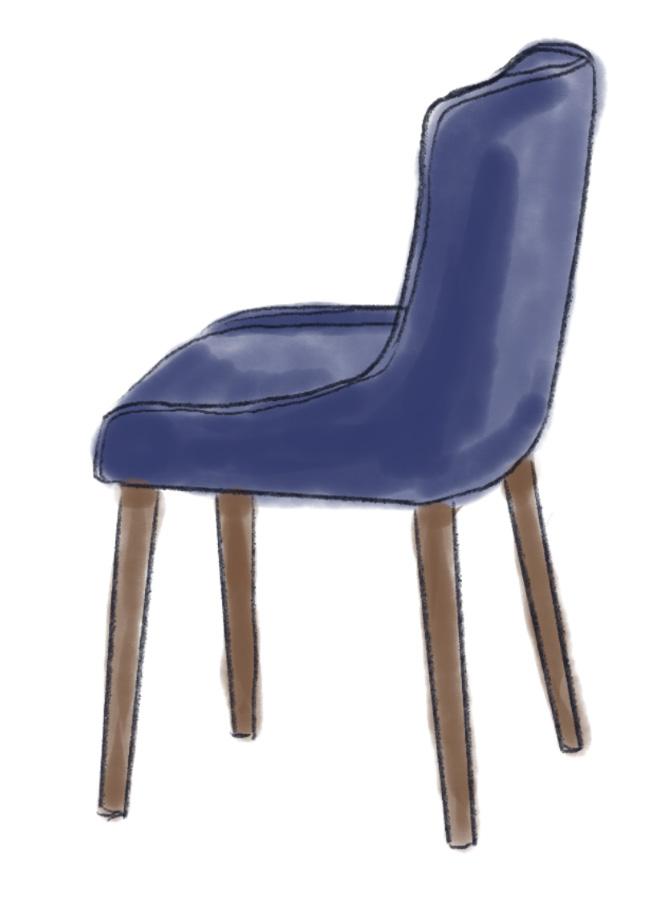
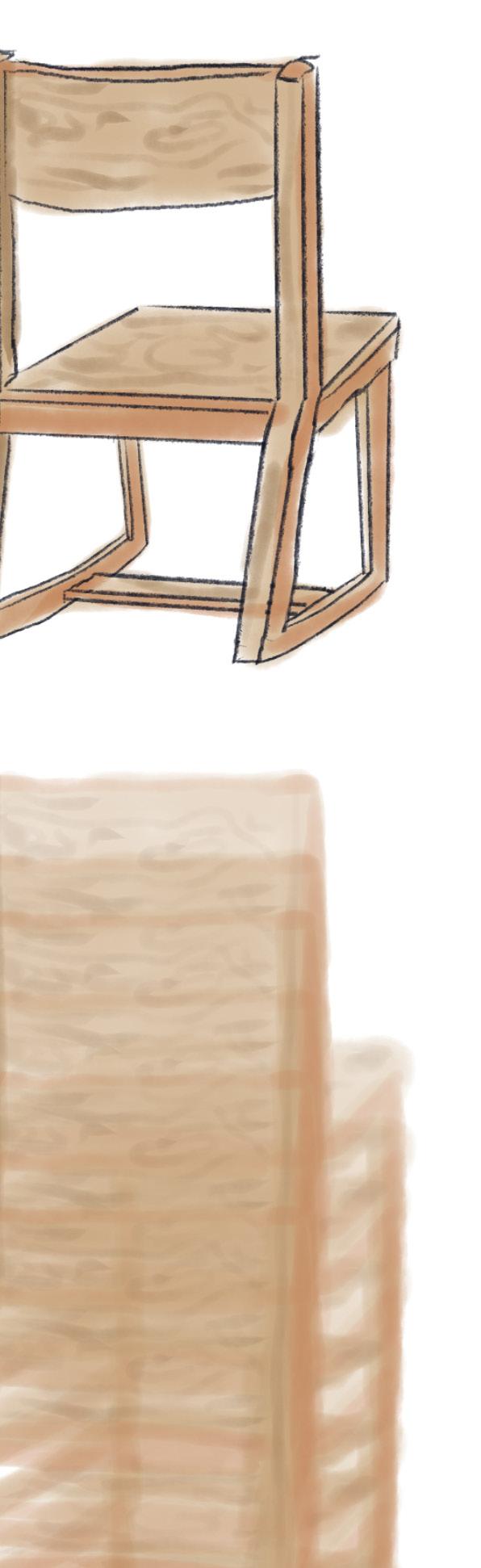
John, this little girl makes chairs! Can you believe it? You gonna make a living off doing that? I don’t know how all that kind of stuff works.
Maybe. I want to go into antique restoration. I’m more into fixing things.
Looking back, I realise that it was because I began to avoid telling the truth. These deceptions weren’t socially scandalous. Rather, I filled my message inbox with ghost texts, replacing “i’m not doing well actually” with “i’m goooood, how was your weekend? :D.” Friendships were maintained by not mentioning small grievances and shared silences blanketed a graveyard of conversations too deep, too exhausting to exhume.
When you stop letting yourself be seen, you become a story told to someone who doesn’t know the ending. This is how I ended up at a bus stop, looking a stranger in the eye and handing him a lie as if it were a gift. I think his name started with a T.
T was 65 years old, born and raised in Rhode Island. He asked me if I was a student. I said yes. He asked what I study. Furniture Design. Wow, first I’m hearing about that sort of thing. You make chairs? I have.
Well that’s even better. You working yet or just studying?
I’ll be working in California soon.
Your parents must be proud.
Thank you.
T was the first person I told this good news to. Actually, I told him long before it even happened. Let me explain.
For me, strangers have always been the easiest to talk to, because with strangers, anything goes. I can be whoever I want to be that day.
I’m never afraid of oversharing because I’m not really telling them about me, so it doesn’t really matter, does it? I’ve been an architecture student hoping to go abroad. I’ve been a film major, aspiring to make documentaries about disappearing oceans and climate change.
These are all lives that I wonder if I would have liked to live. In my journal, I call them “specimens,” failed versions of myself. Failed, not necessarily in a negative way, but as things which might have been but weren’t. I used to spend a lot of time mourning them. Perhaps these jagged truths were momentary reliefs that simulated being heard.
My summer before junior year took place in Boston on a sublease I couldn’t afford and a series of shifts so far away that my paychecks vanished into Uber rides home. I was a ghost in my own apartment, preferring the disposable friction of a party to the heaviness of a potential connection with my roommates. First impressions were blissful; second dates were never in the picture. It was just so much easier to be a new person every night than to be the same failing one every morning. I disliked the idea of letting anyone on to who I really was because honestly, I didn’t even really know myself.
Every moment was fleeting. I never told anyone about the yesterdays, just about how excited I was for the tonights. Noise was essential because I got bored easily, and I would put myself in dangerous situations just for the rush, just to avoid the awkward silence that I felt when I was alone with myself. I dreaded reality and chose thrill over suspense. Acting this way offloaded some kind of weight without actually dropping any burden.
Just over a year ago, around midway through fall semester of my junior year, the rush wore out. All of my truths came flooding out in the dorm room of a boy I had met hardly two months prior. There was no grand trigger, just the way he didn’t look away when I stumbled over a sentence. The feeling of safety that comes with hearing the words “I want to know you. Every part of you,
everything about you” was foreign to me. It took a year into our relationship for me to stop crying. I told him I loved him four months in, as well as a few moments ago today.
The fear of saying the wrong thing has always kept me from saying anything at all, but I no longer feel like I have to create a story to explain myself as a person. It takes a few minutes, often closer to an hour, but I can cry and speak at the same time now. Short sentences are more than enough. “This hurts. I want to fix it.”
I thought I wanted to do so many things that would never end up happening. I never expected that what I have and who I am, now, would feel so right.
To: hiring@jobcareerstuff
Subject: Re: Application Status
Date Saved: February 12, 2026
“Dear Recruitment Team at Job Career Stuff,
In my drafts folder, there is a version of this letter where I admit that ‘synergy’ is a word I rarely use, and that my greatest fear is wasting away my 20s. But the reason I am sending this version instead is because I’ve realised that my best work happens when I stop performing and start fixing.
My background in furniture design and my passion for antique restoration come from a very specific place: a deep respect for things that have been broken but are worth saving. Restoration requires a level of honesty that most modern manufacturing ignores—you have to understand the original intent of the piece in order for the repair to be seamless.
I am moving to California soon, not as a specimen of a person who has it all figured out, but as a craftswoman who excels at patient execution, authentic communication, and identifying structural weakness. I’ve learned that “I don’t know, but I will find out” holds far more value than a polished lie.
I’ve attached my portfolio below. It represents the versions of my work that I am most proud of, in which the joints are tight and the finish is true. I would love the opportunity to bring that same level of grounded, honest craftsmanship to Job Career Stuff.”
Best regards,
Olivia Moon
we’ll know each other forever
on leaving and holding on
by Sofia Kelleher Illustrated by Yoonseo Lee
This summer, when I arrived alone at the Zen temple with a toothbrush, two T-shirts, and a notebook, what had I been hoping for? Some semblance of freedom, surely.
The mornings were agonizing in their simplicity. Wake-up bell at 5:30, Earl Grey in four forceful sips, then sitting, stiff and still, till half-past 7. The point, as I understood it, was to sit with “presence,” but the only thing I could be present for was a terrible, itchy grief for the people I missed. By this, I mean the moments, feelings, and sensations I would never get back in their most actual, most vivid manifestations. Still, they were mine insofar as anything was mine. As ideas, memories, hauntings. Orange carnations and asters, a glimmering birthday party, safety in a room besides my own.
So, I sat, every morning and every evening, meditating on pretty faces and pretty words, and also fairly often on pretty faces and dreadful words. This felt like a failure in the only way possible. I was not approaching freedom; I was merely growing increasingly aware of and exasperated by my distance from it.
In those weeks, my personal losses felt so great, and in many ways they were. I found quietude only in the chanting and bowing portion of the morning services. By then (it would be almost time for breakfast), physical hunger would kindly overtake my attention, and the repetitions (“Gate gate pāragate pārasaṃgate bodhi svāhā,” nine bows) would lull me into a state of near ease. Motion has a way of dissolving, or at the very least softening, the austerities of the mind. This necessity for movement became an urgent observation for me—one that informed, consciously or unconsciously, my demeanor and hence my reality in the ensuing months.
***
The idea of transferring schools occurred to me during my stay at the temple on a routine afternoon walk to the ocean. It was an idea that landed lightly but, once settled, wouldn’t be shaken. My sudden obsession with making such a dramatic change to my circumstances surprised me, and I took this response seriously. Could it be enough, I considered, to feel called to something? Eventually, I decided that it was. I came to see it as the only thing—apart, possibly, from duty—that could ever make anything worthwhile.
So, the following semester, I made my plans to leave. I did it quietly, with effort, occasional assurance, and frequent doubt. Most of my goodbyes happened over the course of a couple of days. I said, I’ll miss you; I said, I can’t believe this; I said, I wish you all the best. I said, I’m excited. I’m scared. I said, Stay hungry and keep your dreams close. I said, Do you really think I’ll make any friends? Someone said, Of course I do. Someone said, I believe in you. I’ll really miss you, but this is what’s right.
While packing my bags to move across the country, nostalgia reminded me of the recent other times I’ve left a place to start over somewhere else.
The morning after my high school
graduation, I stood weeping on the side of a gravel road, waving goodbye to my 62 classmates as they set off to begin new lives in new places. The dramatics of the memory are sweet and poignant to me even now. How wonderful to have cared about something enough for its ending to have felt earth-shattering.
Soon after, I found myself alone on a flight to Nepal, where I would spend three months away from the home I knew, slowly discovering a new one in a group of dissimilar but miraculously compatible strangers. Eventually, it ended, as everything must. I spent weeks upon weeks having dreams about the people on the trip. The moments, feelings, and sensations I would never get back in their most actual, most vivid manifestations.
The rest of the year brought more of the same. Being alone and uncertain but hopeful; arriving someplace new; becoming attached to new people; parting ways. Doing it over again. By the time I arrived in Southern California for college, I thought I had mastered this cyclical process, more or less. I had not anticipated the intensity of the forthcoming cycle, nor how short it would be.
***
Now, once again, I am faced with the propensity of abrupt change to illuminate the fragmentation of the self.
I am here—in New England, in Rhode Island, in the dining hall, at the table in the corner. Eating one of those obscure ingredient waffles from the do-it-yourself machine. Thinking only of how much you liked these waffles—whether you liked the taste or doing it yourself, I was never quite sure. Thinking of how I refused to touch them until the day there was nothing else I could be bothered to eat; the day that hadn’t happened until today, when there was no herbivore section and no one else’s flipped waffle to wait on, and so, finally, I felt the urge to do it myself. It strikes me now as deeply bizarre that I struggled for drastic change only to find comfort in repeating what once was.
Sometimes I want to beg to be remembered. By you. By others. It seems ridiculous. To be the one who left, and still be so deeply consumed by all the things from which I craved such distance. But the truth is that moving on from anything meaningful is an unrealistic expectation. If not generally, then at least immediately.
***
Life is a perpetual series of endings and beginnings. I don’t think it’s fruitful or even all that interesting to try to fight this. Each new transition is not necessarily easier in virtue of past experience, but the sense of inbetweenness and fragmentation does grow more familiar. I’ve done this before. I’m doing it all the time. I am here, and I am there. In the past, I was there, and I was here, too. We are always in multiple places and times at once. We are dreaming and we are being and there is no firm distinction between the two.
The morning of my final flight out of the Ontario airport, my friend Millie sent me the following text: Just because we leave a place behind doesn’t mean we can’t take it with us and keep it forever. I’ll keep everything and everyone from every chapter of my life with me always. There is no other choice. Loss is a given, but so is the persistence of connection and care by means of the human spirit. If we’ve ever crossed paths, we’ll know each other forever.
POS T-P OURRI
BEFORE YOU GO
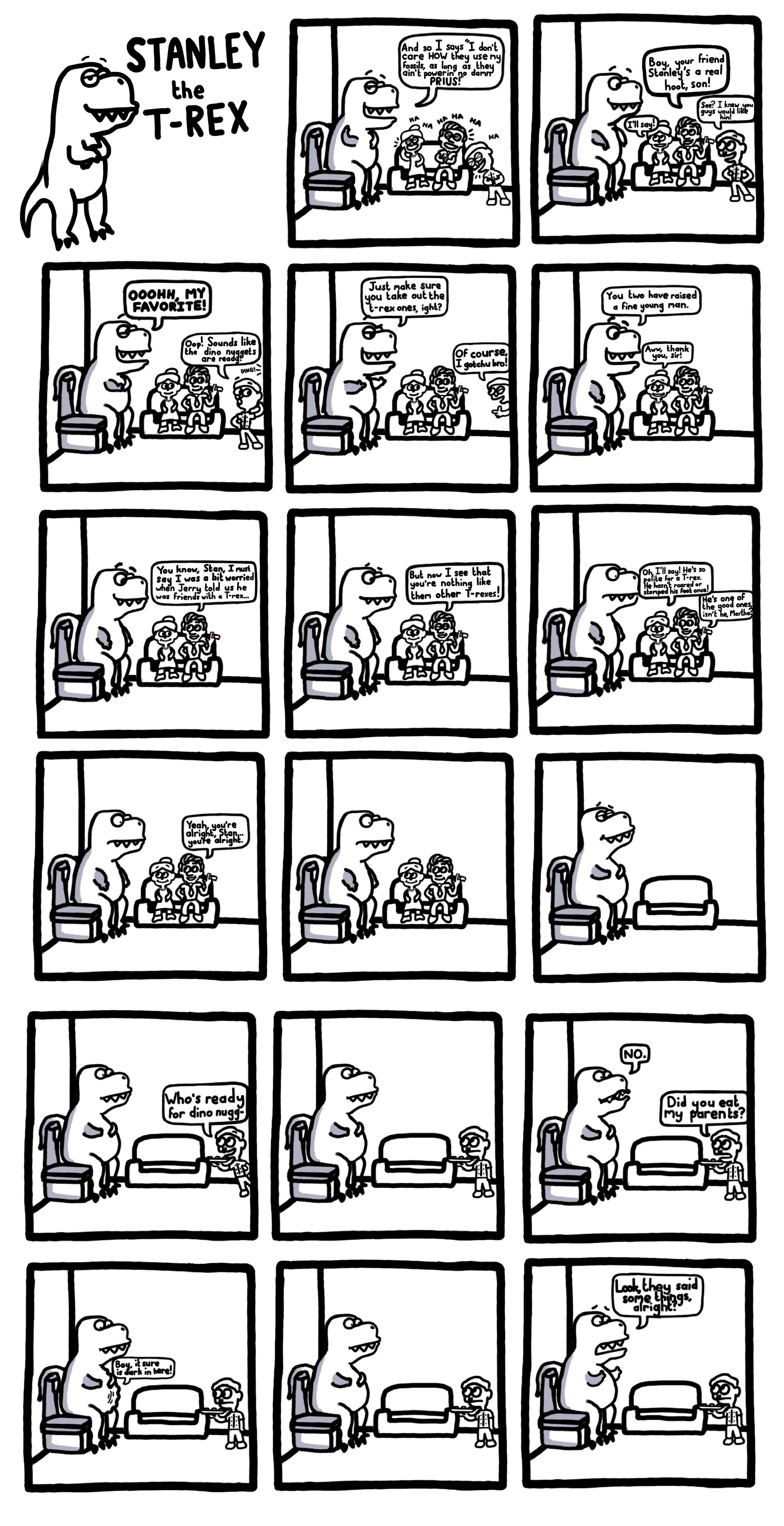
stanley the t-rex... ...meets his best friend's parents
by Maison Teixeira
wintry mix
post- mini crossword
Ishan Khurana
9. Therefore Across Down 4 7 8 5 6
1. Home state for ~1/8 of Brown students (abbr.)
3. "No," in Italian
5. Fiery felony
7. Rink surface, or the result of frozen rain
8. Calls, as a taxi, or a pluralized precipitation
10. Windy city state (abbr.)
11. "And __ it begins..."
1. Mother, informally
2. Default Google Docs font
3. Carols
4. Activated 6. ___ Li
8. "Hey!"
“If one had to summarize all of menswear—its ups and downs, bell bottoms, shin huggers, and oxford bags—into an essential fabric, it would have to be tweed.”
— Sean Toomery, “tweed and me”
“I have always cried on my birthday, maybe because it reminds me of my asymmetrical origins. Or maybe because it always feels like I’m standing in two places at once.”